

In His Name, the Most High
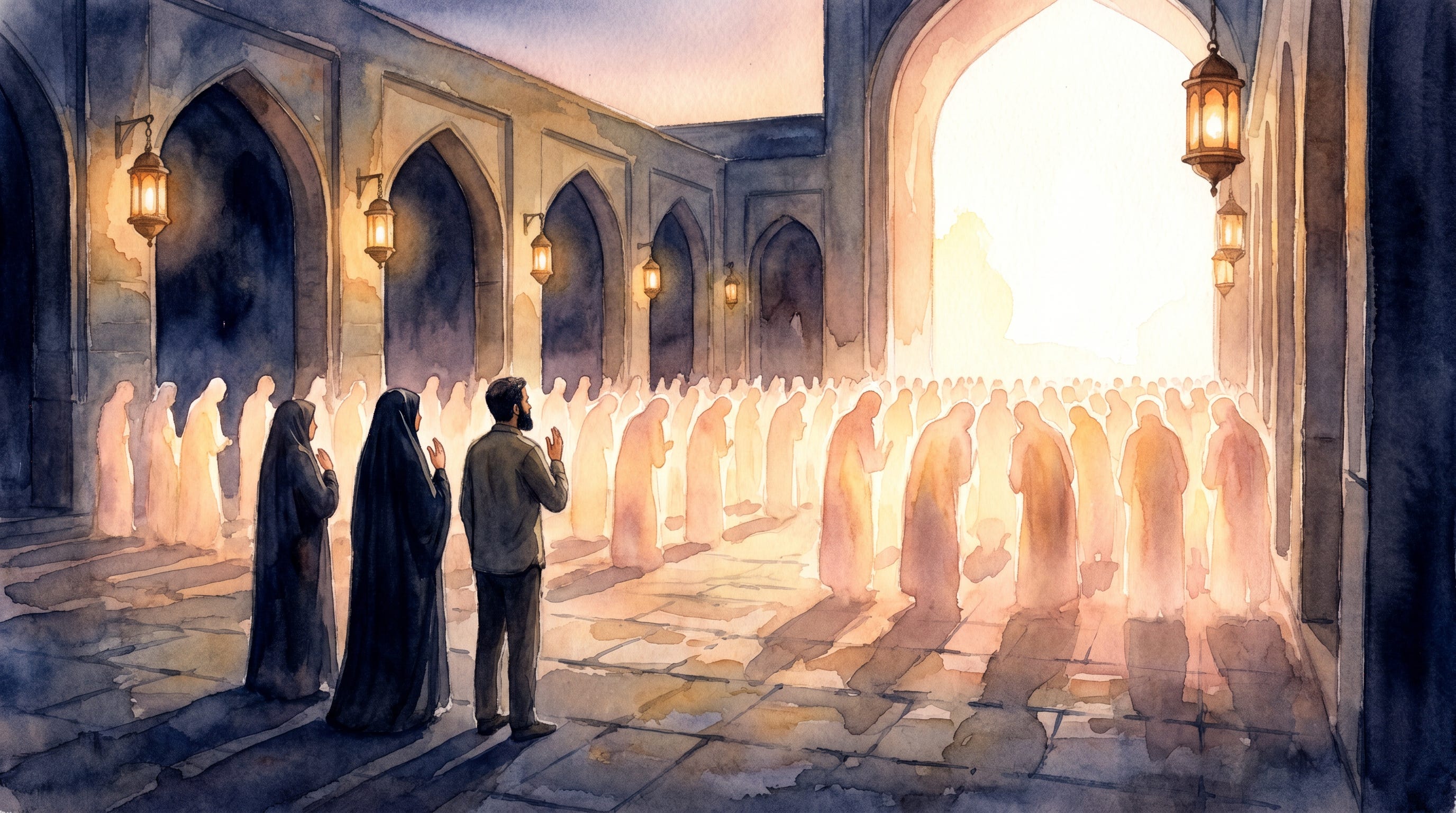
اَلسَّلاَمُ عَلَيْكَ يَا أَبَا عَبْدِاللَّهِ
وَعَلَى الْأَرْوَاحِ الَّتِي حَلَّتْ بِفِنَائِكَ
عَلَيْكُمْ مِنَّا جَمِيعًا سَلاَمُ اللَّهِ أَبَدًا مَا بَقِينَا وَبَقِيَ اللَّيْلُ وَالنَّهَارُ
وَلا جَعَلَهُ اللَّهُ آخِرَ الْعَهْدِ مِنَّا لِزِيَارَتِكُمْ
اَلسَّلاَمُ عَلَى الْحُسَيْنِ
وَعَلَى عَلِيِّ بْنِ الْحُسَيْنِ
وَعَلَى أَوْلَادِ الْحُسَيْنِ
وَعَلَى أَصْحَابِ الْحُسَيْنِ
Peace be upon you, O Aba Abdillah (O Husayn),
and upon the souls who have gathered in your courtyard.Upon you, from us all, is the peace of God—forever,
for as long as we remain and as long as night and day endure.And may God never make this our last pledge to visit you.
Peace be upon al-Husayn,
and upon Ali, son of al-Husayn,
and upon the children of al-Husayn,
and upon the companions of al-Husayn.— Adapted from Ziyarat Ashura
Video of the Sermon (Majlis/Lecture)
This is a video of the sermon, the maqtal — lamentation — referenced in this session can be found here.
Introduction
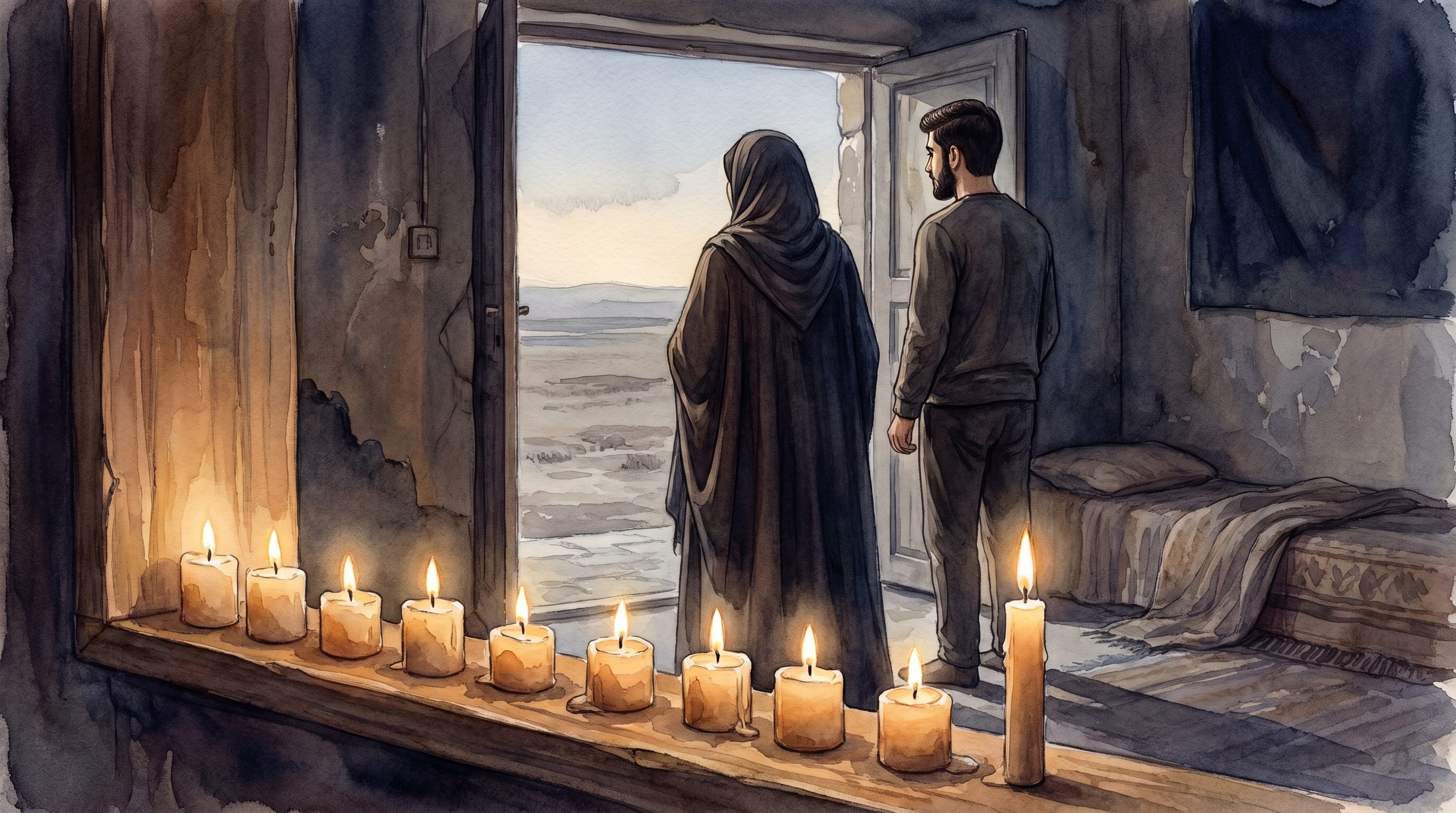
Nine nights, we have walked.
We recovered the word — shahada means witness, with the cost of witnessing borne in the body.
We traced its lineage from Abel, through the prophets — Noah, Abraham, John the Baptist, Zechariah, Jesus — through Hamza, to the Prophet Muhammad, and to a plain in Iraq.
We learned the theology of Shaheed Mutahhari’s five kinds of death — and the candle of society that has to burn for the room to be illuminated.
We heard Imam Husayn’s diagnosis at Mina and the three silences — fear, comfort, and the narrowing of moral vision.
And we received what Dr Shariati gave us, in his sociology — the distinction his Tashayyu’-e Alawi and Tashayyu’-e Safavi pointed toward, which our series has carried since as the shahada of the tongue and the shahada of the life.
We stood at the shared ground and the divergences between the Christian witness and our own, and we named the methodology that has carried us forward since:
honour without conflation.
The disciples of Jesus, son of Mary —
قَالَ الْحَوَارِيُّونَ نَحْنُ أَنصَارُ اللَّهِ آمَنَّا بِاللَّهِ وَاشْهَدْ بِأَنَّا مُسْلِمُونَ
“The disciples said: We are the helpers of God. We have believed in God; bear witness that we are submitters.”
— Qur’an, Surah Aal Imran (the Chapter of the Family of Imran) #3, Verse 52
The same root the Qur’an used for them is the root that holds this whole series together.
We left the religious neighbour and entered the secular one — Marx, Fanon — and we asked what becomes of sacrifice when the form is preserved and the content is missing.
We refused the cheap clipped reading of Marx’s famous sentence, and we heard the diagnosis the prophets had already made from inside before Marx made it from outside.
We walked the anti-colonial road — Vietnam, Ho Chi Minh, Quang Duc, and, in our own hour, Aaron Bushnell.
We asked the question the night turned on:
Whose worship is your walking for?
And in the maqtal we walked with al-Abbas ibn Ali, at the Euphrates — and the hands that did not drink.
We walked into the most difficult panel — the aesthetic-state-manufactured panel.
Bushido.
The kamikaze cockpit.
Hiroshima and Nagasaki on the other side.
Both empires in August 1945.
And we received the line that has become the structural pivot of this entire series — Sayyedah Zaynab in the court of Ubaydullah ibn Ziyad in Kufa, answering the tyrant in three words:
مَا رَأَيْتُ إِلَّا جَمِيلًا
I saw nothing but beauty.
— Sayyedah Zaynab in the court of Ubaydullah ibn Ziyad in Kufa, narrated in Sayyid Ibn Tawus, al-Luhuf ‘ala qatla al-tufuf; preserved identically in Bihar al-Anwar vol. 45, al-Mufid’s al-Irshad vol. 2, and Tabari’s Tarikh vol. 5
The seventy-two whose loyalty was to God Himself, to the Truth God had revealed, and to Imam Husayn as the proof of that Truth on earth — not to a flag, not to an emperor, not even to a man as such.
And last night — the corrective night.
The four counterfeits: political, ritual, cultural, and — for the first time in the series — imperial.
The three tests of true witness.
The young Iranian martyr named in honour of Mohsen ibn Ali, the first martyr of the Ahl al-Bayt after the passing of the Prophet — and how Hajj Qasem, named him a hujjat on how to live and how to die.
And Imam Khamenei sealed it:
شهید حججی حجت خدا در مقابل چشم همگان شد.
“Martyr Hojaji became God’s proof before everyone’s eyes.”
— Imam Sayyed Ali Khamenei, public address (khamenei.ir / yjc.ir)
Nine nights of building.
Tonight is the tenth.
We are at the door of the day.
In a few hours, when this hour closes and the night turns, the day of Ashura begins.
Imam Husayn — at the moment we begin tomorrow’s morning — will be standing in his armour, leading the morning prayer at Karbala for the last time.
By noon, he will be on the ground.
By the afternoon, the horses will have crossed his body.
Every one of those nine nights — every taxonomy, every witness, every cross-tradition figure, every quotation we recited together, every tear we shed — was preparation for this hour.
Not warming us up: preparation in the sense of teaching us how to see what we are about to see.
Because the witness at the centre of this hour is not a witness who fits into one of the categories we have been building.
He is the category itself.
He is what every other witness, in every other tradition, in every other generation, is measured against.
Every witness before Imam Husayn was a preparation.
Every witness after him is an echo.
He is the measure by which every claim to bearing witness is weighed.
That is the takeaway of tonight.
That is what I want you to carry home.
Tonight, we walk first to the roots — the prophetic chain, the literal inheritance, the blood of every prophet’s witness flowing to the body of Imam Husayn.
Then to the branches — the synthesis of the nine nights, each one already inside him.
Then to the climax — Husayn is the furqan, the criterion of God, the standard by which every empire of every age is weighed.
Then to the fruit — receiving the criterion, applying it not only to the empires out there but to the empire in here, the inner Yazid that the nafs al-ammarah whispers to us we should comfort.
And then we pause, hand off to Safar, pledge the return — and the maqtal opens the door we have been standing at all night.
Before we begin, the anchor verse on which tonight is built.
From the Qur’an, Surah al-Fath — the Chapter of the Conquest — verse 29. God speaks of His Prophet and of the community gathered around him.
Hear what He says:
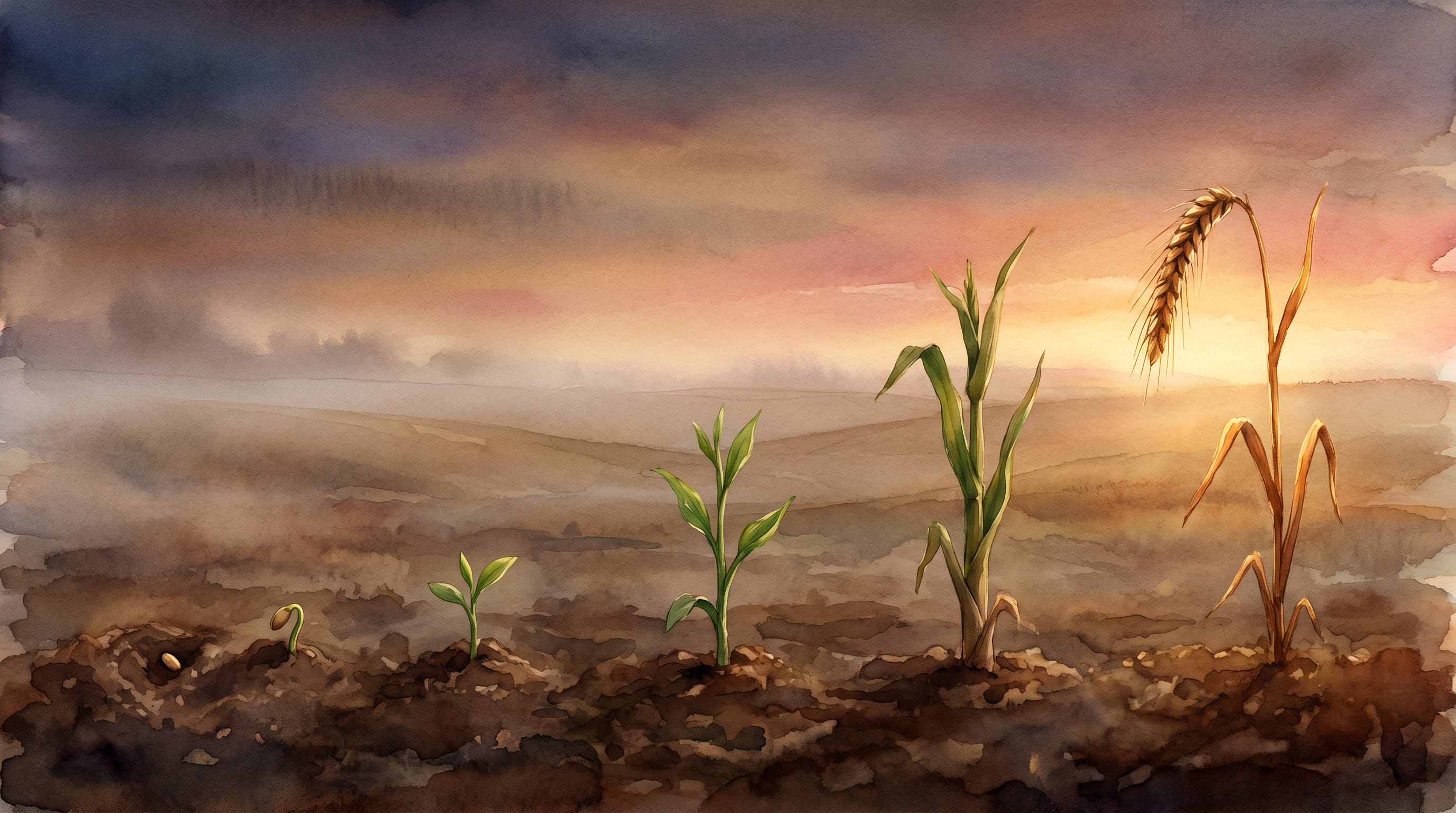
مُحَمَّدٌ رَّسُولُ اللَّهِ ۚ وَالَّذِينَ مَعَهُ أَشِدَّاءُ عَلَى الْكُفَّارِ رُحَمَاءُ بَيْنَهُمْ ۖ تَرَاهُمْ رُكَّعًا سُجَّدًا يَبْتَغُونَ فَضْلًا مِّنَ اللَّهِ وَرِضْوَانًا ۖ سِيمَاهُمْ فِي وُجُوهِهِم مِّنْ أَثَرِ السُّجُودِ ۚ ذَٰلِكَ مَثَلُهُمْ فِي التَّوْرَاةِ ۚ وَمَثَلُهُمْ فِي الْإِنجِيلِ كَزَرْعٍ أَخْرَجَ شَطْأَهُ فَآزَرَهُ فَاسْتَغْلَظَ فَاسْتَوَىٰ عَلَىٰ سُوقِهِ يُعْجِبُ الزُّرَّاعَ لِيَغِيظَ بِهِمُ الْكُفَّارَ
“Muhammad is the messenger of God. And those who are with him are firm of heart against those who reject the truth, merciful among themselves. You see them bowing, prostrating, seeking the favour of God and His good pleasure. Their mark is on their faces from the traces of prostration. That is their description in the Torah. And their description in the Gospel is as a seed which sends forth its blade, then makes it strong; it then becomes thick, and it stands on its own stem — delighting the sowers, that He may enrage the disbelievers through them.”
— Qur’an, Surah al-Fath (the Chapter of the Conquest) #48, Verse 29
This is the verse Allamah Tabataba’i, in al-Mizan, names as the structural pairing of firmness with falsehood and tenderness with the people — the pairing we took home with us last night, the pairing that runs from the Torah to the Gospel to the community of the Prophet.
But tonight I want you to hear the second half of the verse.
Their description in the Gospel is as a seed which sends forth its blade.
Then makes it strong.
Then becomes thick.
Then stands on its own stem.
This is the architecture of every prophetic chain.
Every witness is a seed.
Every seed sends forth its blade.
Every blade strengthens.
And eventually — when the chain has done its work — there stands, on its own stem, a single body that is the seed, the blade, the strength, and the standing crop all at once.
That body is our beloved Imam Husayn.
That body is what we will sit with tonight.
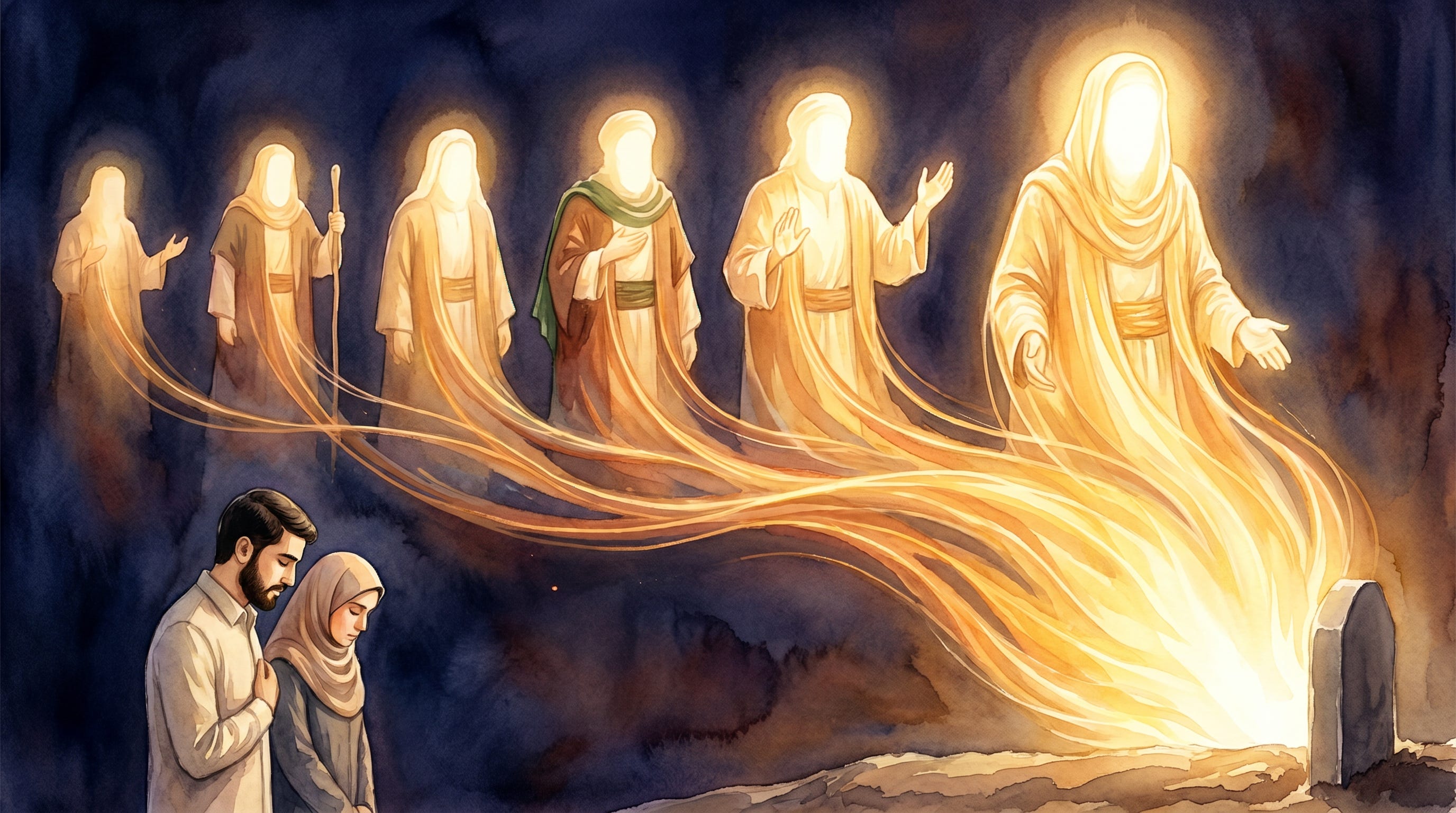
And as we open the door — as we recite, at the start of every visitation to him, the words the tradition has placed at the threshold of his grave — let us begin with the opening of the Ziyarat al-Warith.
The Ziyarat of the heir.
The Ziyarat the believers walk to Karbala to recite at his graveside:
السَّلامُ عَلَيْكَ يا وارِثَ آدَمَ صَفْوَةِ اللهِ
السَّلامُ عَلَيْكَ يا وارِثَ نُوحٍ نَبِيِّ اللهِ
السَّلامُ عَلَيْكَ يا وارِثَ إِبراهيمَ خَليلِ اللهِ
السَّلامُ عَلَيْكَ يا وارِثَ مُوسى كَليمِ اللهِ
السَّلامُ عَلَيْكَ يا وارِثَ عيسى رُوحِ اللهِ
السَّلامُ عَلَيْكَ يا وارِثَ مُحَمَّدٍ حَبيبِ اللهِPeace be upon you, O heir of Adam, the chosen one of God.
Peace be upon you, O heir of Noah, the prophet of God.
Peace be upon you, O heir of Abraham, the friend of God.
Peace be upon you, O heir of Moses, the speaker with God.
Peace be upon you, O heir of Jesus, the spirit of God.
Peace be upon you, O heir of Muhammad, the beloved of God.— Opening of Ziyarat al-Warith, preserved in Sayyid Ibn Tawus’s al-Iqbal bi-l-A’mal al-Hasana; Ibn Mashhadi’s al-Mazar al-Kabir; Bihar al-Anwar vol. 98; Mafatih al-Jinan of Shaykh Abbas al-Qummi.
Six inheritances.
This Ziyarat is not poetry.
This Ziyarat is doctrine.
When the believer walks to Karbala and stands at the grave of Imam Husayn, the believer says:
Peace be upon you, heir of Adam.
Peace be upon you, heir of Noah.
Peace be upon you, heir of Abraham.
Peace be upon you, heir of Moses.
Peace be upon you, heir of Jesus.
Peace be upon you, heir of Muhammad.
The body in the grave carries, in its blood, the inheritance of every prophet of God who came before.
Not symbolically.
Literally, in the Shia theology of the Imamate, the prophetic light passes through every prophet and lands, finally, in the bodies of the Ahl al-Bayt.
And so, the body of Imam Husayn at noon on the tenth is not one man on a battlefield.
He is the destination of the entire prophetic chain.
That is where we begin.
The Blood That Flows to Karbala
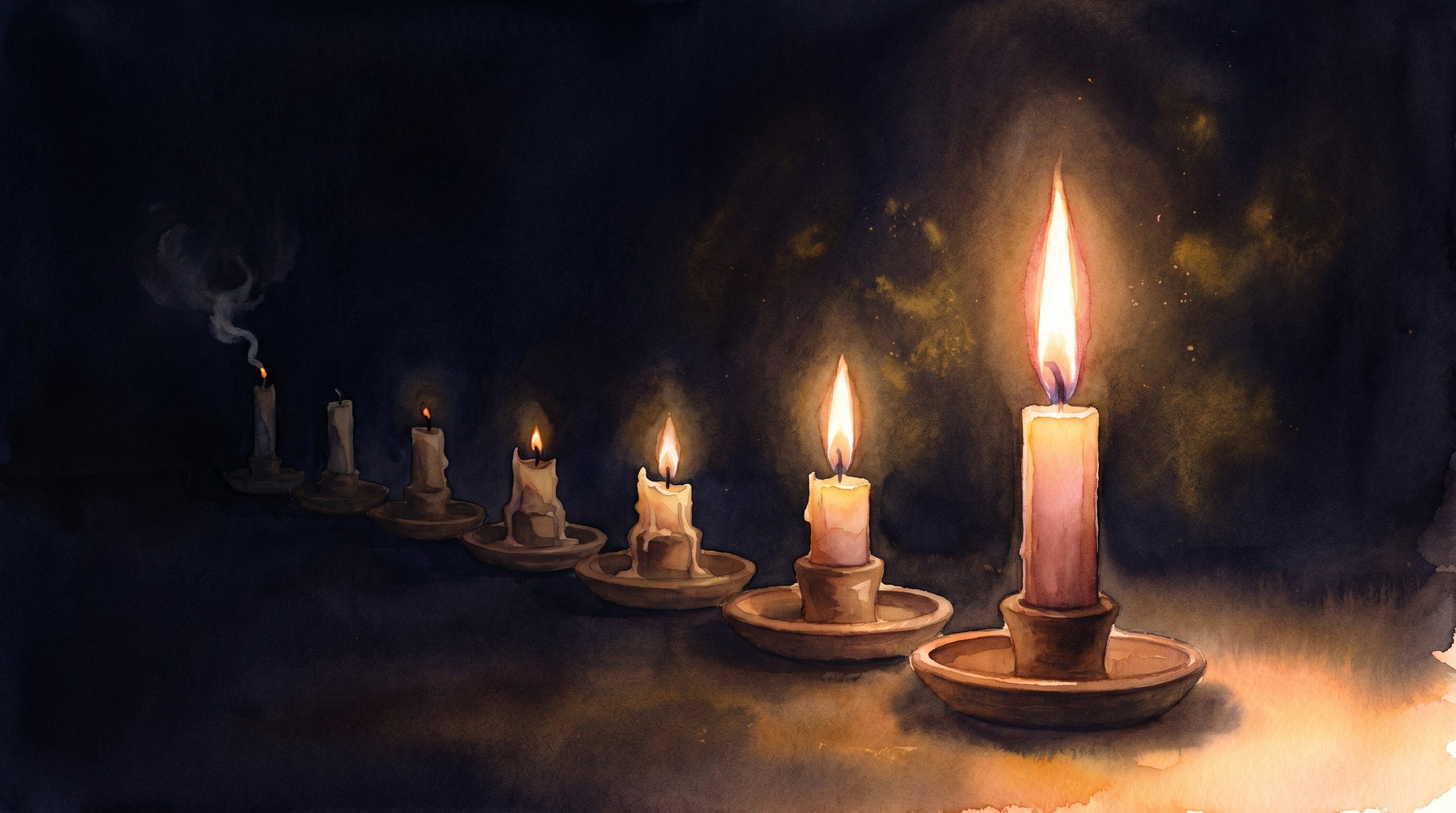
The first thing the Ziyarat does is name the inheritance.
Six names.
Six prophets.
Six lines of witness — each one ending, on its own, but each one handing forward what it carried.
Let me walk them with you tonight.
One by one.
Slowly.
Heir of Adam — The Chosen
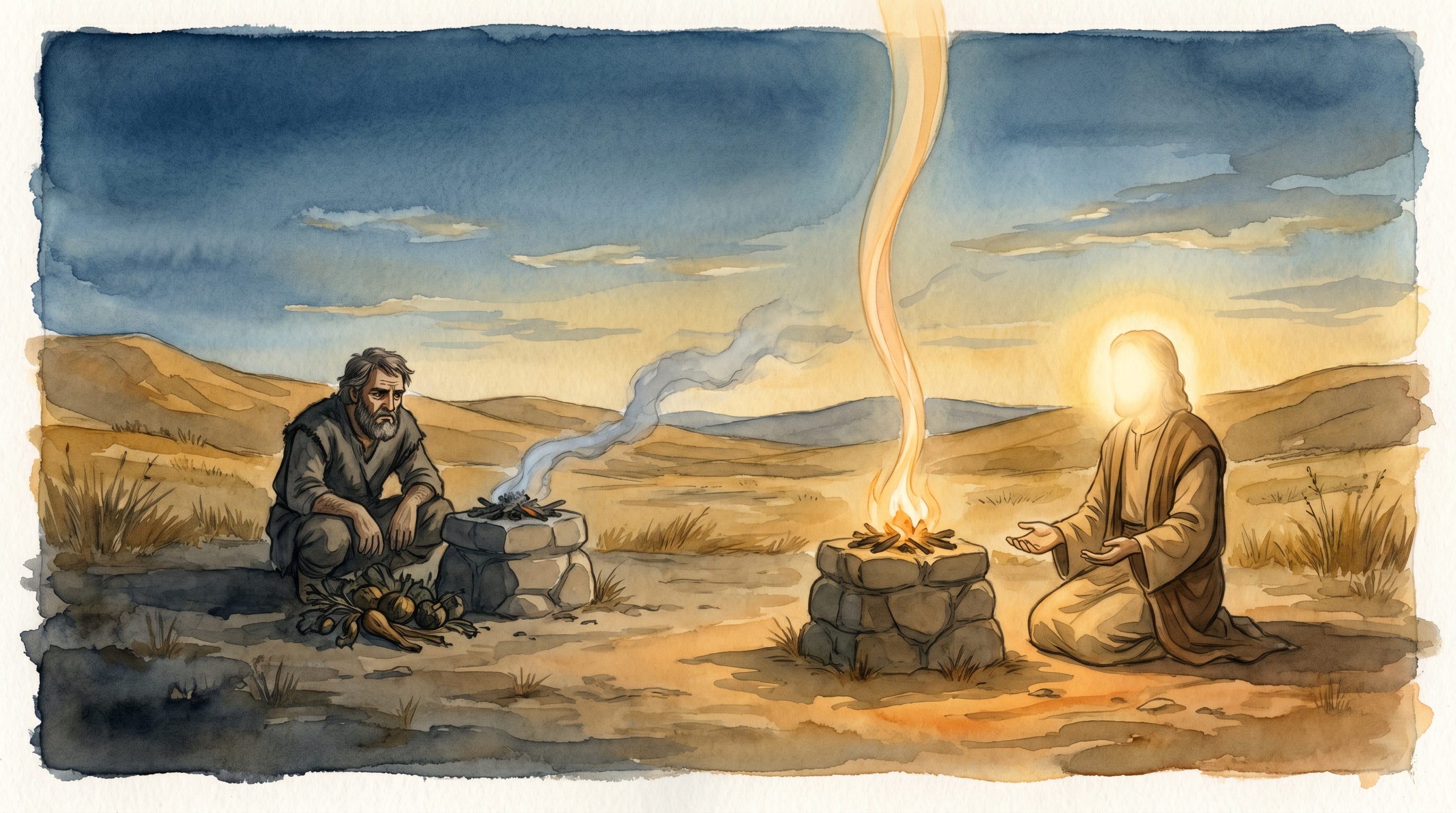
The first inheritance.
السَّلامُ عَلَيْكَ يا وارِثَ آدَمَ صَفْوَةِ اللهِ
Peace be upon you, O heir of Adam, the chosen one of God.
What is Adam’s witness?
It is the witness of return.
Of the first soul that, after the tark-e-awla — after the abandoning of the better, when Adam took from the tree he had been counselled not to take from — turned back to God.
Adam’s witness is the witness that the cycle begins again.
That the return is always open.
That the door to repentance — al-Tawwab, one of God’s names — is the door God Himself never closes.
But before Adam’s witness was even completed in his own life, the cycle had to be enacted by his sons.
And that is where this series began, on the very first night.
Abel — the first man whose blood the earth received because he had offered to God what God accepted, while his brother offered what God refused.
The first qurban the earth ever received from human hands.
Hear the verses again, the verses we read together on the first night, from Surah al-Ma’idah:
وَاتْلُ عَلَيْهِمْ نَبَأَ ابْنَيْ آدَمَ بِالْحَقِّ إِذْ قَرَّبَا قُرْبَانًا فَتُقُبِّلَ مِنْ أَحَدِهِمَا وَلَمْ يُتَقَبَّلْ مِنَ الْآخَرِ
“Recite to them the story of the two sons of Adam, in truth. When each of them offered a sacrifice (qurban), and it was accepted from one of them and was not accepted from the other...”
— Qur’an, Surah al-Ma’idah (the Chapter of the Table Spread) #5, Verse 27
And then Abel’s two sentences — the first act of witness in the history of the earth:
لَئِن بَسَطتَ إِلَيَّ يَدَكَ لِتَقْتُلَنِي مَا أَنَا بِبَاسِطٍ يَدِيَ إِلَيْكَ لِأَقْتُلَكَ ۖ إِنِّي أَخَافُ اللَّهَ رَبَّ الْعَالَمِينَ
“If you stretch out your hand to kill me, I will not stretch out my hand to kill you. I fear God, the Lord of all creation.”
— Qur’an, Surah al-Ma’idah (the Chapter of the Table Spread) #5, Verse 28
Two sentences.
A refusal, and the reason for the refusal.
On the first night we returned to these words and we read them with Allamah Tabataba’i, in al-Mizan — who showed us that Abel is not the language of a frightened man hoping to avoid a fight.
Abel is the language of a witness.
He had knowledge.
إِنَّمَا يَخْشَى اللَّهَ مِنْ عِبَادِهِ الْعُلَمَاءُ
“Only those endowed with knowledge truly fear God among His servants.”
— Qur’an, Surah Fatir (the Chapter of the Originator) #35, Verse 28
Abel feared God.
Therefore Abel had knowledge.
Therefore Abel was not a victim — he was a witness in full station.
And the same word the Qur’an uses there — qurban — is the word Sayyedah Zaynab will use at noon on the tenth, when she stands at the place of the body and the surface of the field is what it is, and what she names beneath the surface is qurban received by God.
Hear what kind of inheritance this is.
What Adam said with his soul — the yes he said in Surah al-A’raf, when God asked am I not your Lord? and the soul answered bala — shahidna — yes, we bear witness — Abel said with his body.
And Imam Husayn, at the door of the day we are walking toward, says it with his body at Karbala.
The first witness flows forward.
The covenant of al-A’raf becomes the offering of Abel becomes the standing of Husayn in the field.
The body of our beloved Imam is, in the language of the Ziyarat, the heir of Adam, the chosen.
He carries the first yes.
He carries the first qurban.
He carries the first witness who changed the heart of his own killer — because, as we read on the first night, the Qur’an does not stop at
فَطَوَّعَتْ لَهُ نَفْسُهُ قَتْلَ أَخِيهِ فَقَتَلَهُ فَأَصْبَحَ مِنَ الْخَاسِرِينَ
فَبَعَثَ اللَّهُ غُرَابًا يَبْحَثُ فِي الْأَرْضِ لِيُرِيَهُ كَيْفَ يُوَارِي سَوْءَةَ أَخِيهِ ۚ قَالَ يَا وَيْلَتَا أَعَجَزْتُ أَنْ أَكُونَ مِثْلَ هَٰذَا الْغُرَابِ فَأُوَارِيَ سَوْءَةَ أَخِي ۖ فَأَصْبَحَ مِنَ النَّادِمِينَThen his soul prompted him to kill his brother, so he killed him, and he became of those who are lost.
Then God sent a crow, scratching at the ground, to show him how to cover the body of his brother. He said: ‘Woe to me! Am I not even able to be like this crow and cover the body of my brother?’ And he became of those who regret.— Qur’an, Surah al-Ma’idah (the Chapter of the Table Spread) #5, Verse 30-31
“So he killed him … and he became of those who regret.”
The first witness in the earth’s history changed the heart of his own killer.
That is what our beloved Imam Husayn carries, in his blood, from Abel.
The witness whose body falls and whose witness continues to work on the world that watched it fall.
The series began with the question Abel’s blood still asks.
Tonight we will ask it again at the close:
Where is your brother?
Heir of Noah — The Prophet
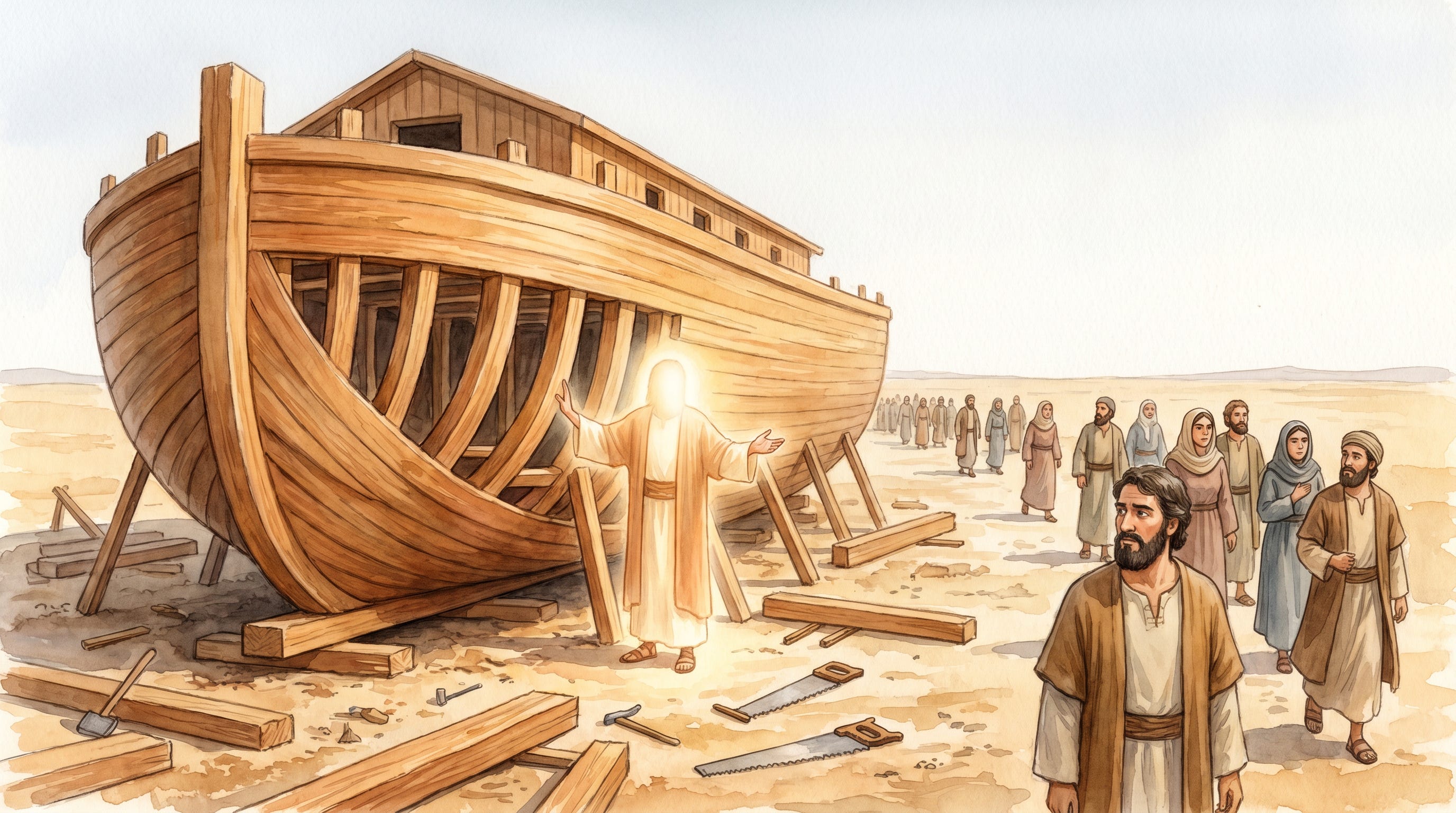
The second inheritance.
السَّلامُ عَلَيْكَ يا وارِثَ نُوحٍ نَبِيِّ اللهِ
Peace be upon you, O heir of Noah, the prophet of God.
What is Noah’s witness?
It is the witness of patience.
The patience to keep on inviting when no one is coming.
The patience to keep on building when the mockery does not stop.
The patience to stand on the call of God when the call has been refused for centuries.
The Qur’an preserves Noah’s voice.
He says — and listen carefully, because this sentence will sound exactly like the sentence Imam Husayn will live at Karbala:
رَبِّ إِنِّي دَعَوْتُ قَوْمِي لَيْلًا وَنَهَارًا فَلَمْ يَزِدْهُمْ دُعَائِي إِلَّا فِرَارًا
“My Lord, indeed I have called my people night and day, but my call has only increased them in flight.”
— Qur’an, Surah Nuh (the Chapter of Noah) #71, Verses 5–6
Listen to that voice.
This is the voice of every witness who has stood in a square or a desert or a court or a marketplace and called toward the truth, and watched the people walk away from him.
This is the voice of Imam Husayn on the morning of the tenth, when he stood at Karbala and addressed the army that had come specifically not to hear.
The chronicles preserve his words to that army.
He stood before them — already alone, already abandoned, already without water, with the bodies of his companions falling — and he gave them counsel.
He still tried to call them back.
That is Noah’s patience.
That is Noah’s witness, inherited and completed in the body of our beloved Imam.
The patience to keep witnessing when no one is listening.
Heir of Abraham — The Friend
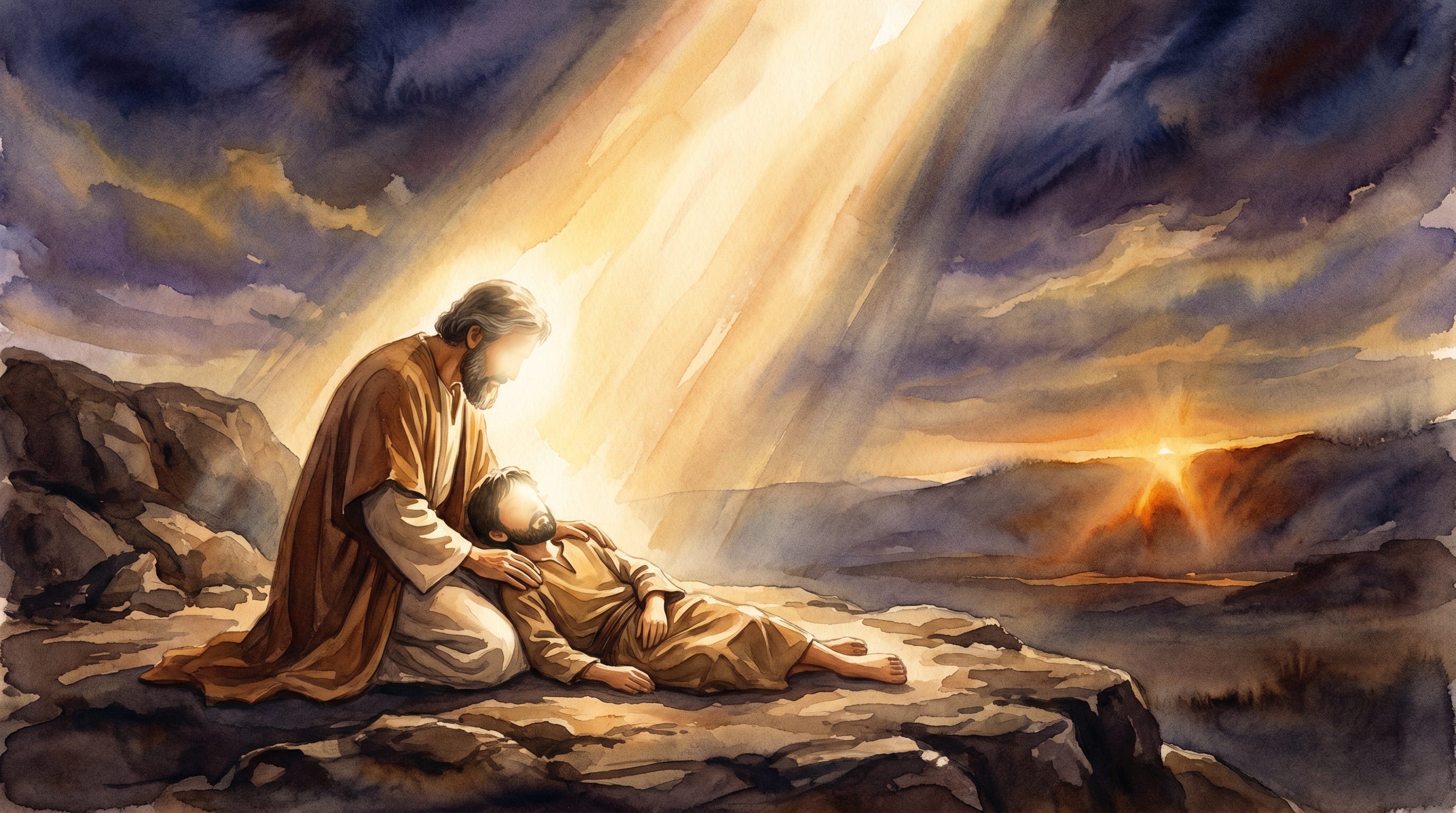
The third inheritance.
And this is where the language begins to weigh.
السَّلامُ عَلَيْكَ يا وارِثَ إِبراهيمَ خَليلِ اللهِ
Peace be upon you, O heir of Abraham, the friend of God.
What is the friend’s witness?
It is the witness of offering.
The willingness — not under coercion, but in obedience, with full awareness — to give up the dearest thing in the world.
The Qur’an preserves the conversation between Abraham and his son Ishmael.
Abraham has seen a dream.
In the dream, God has shown him that he must offer his son.
And Abraham — not in private, not with a hidden plan, but openly — turns to his son and tells him.
فَلَمَّا بَلَغَ مَعَهُ السَّعْيَ قَالَ يَا بُنَيَّ إِنِّي أَرَىٰ فِي الْمَنَامِ أَنِّي أَذْبَحُكَ فَانظُرْ مَاذَا تَرَىٰ ۚ قَالَ يَا أَبَتِ افْعَلْ مَا تُؤْمَرُ ۖ سَتَجِدُنِي إِن شَاءَ اللَّهُ مِنَ الصَّابِرِينَ
“And when the son reached the age of striving with him, Abraham said: ‘O my son, I have seen in a dream that I am sacrificing you. So look — what do you say?’ The son said: ‘O my father, do what you have been commanded. You will find me, by the will of God, among the patient.’”
— Qur’an, Surah al-Saffat (the Chapter of Those Ranged in Ranks) #37, Verse 102
Listen to that exchange.
The father has been asked to give the son.
The son says:
do what you have been commanded.
This is the moment that broke open every later witness in the prophetic chain.
The willingness to give the son, in obedience, to God.
But then the Qur’an continues.
The verses that follow are the ones that matter for tonight.
فَلَمَّا أَسْلَمَا وَتَلَّهُ لِلْجَبِينِ ۞ وَنَادَيْنَاهُ أَن يَا إِبْرَاهِيمُ ۞ قَدْ صَدَّقْتَ الرُّؤْيَا ۚ إِنَّا كَذَٰلِكَ نَجْزِي الْمُحْسِنِينَ ۞ إِنَّ هَٰذَا لَهُوَ الْبَلَاءُ الْمُبِينُ ۞ وَفَدَيْنَاهُ بِذِبْحٍ عَظِيمٍ
“So when they had both submitted, and Abraham had laid his son down upon his forehead — We called to him: O Abraham, you have fulfilled the dream! Thus do We reward the doers of good. Indeed, this was a clear trial. And We ransomed him with a great sacrifice.”
— Qur’an, Surah al-Saffat (the Chapter of Those Ranged in Ranks) #37, Verses 103–107
And here, we must stop and look very carefully.
The hand was stayed.
The angel called from heaven.
The son was spared.
And in his place,
وَفَدَيْنَاهُ بِذِبْحٍ عَظِيمٍ
We ransomed him with a great sacrifice.
What was that great sacrifice?
For centuries the commentators have asked.
Some say a ram, some a ram from paradise.
But the deeper reading — the reading our scholars have taught for fourteen centuries — is that the dhibhin azim promised at the end of the Ishmael narrative was not closed in Abraham’s lifetime.
It was a promise that would be kept later.
The son of Abraham was spared because the son of another would be — when the time came — given.
The grandson of the Prophet at noon on the tenth, would fulfil what Abraham had begun.
Hear me, very carefully. Ishmael and Imam Husayn are not the same act.
They are the same architecture, fulfilled across centuries.
For Abraham, the angel stayed the hand.
For our Imam, the angel does not come.
The companions fall — Ali al-Akbar, Qasim, Aun and Muhammad, al-Abbas, the suckling infant Ali al-Asghar in his father’s arms — every son and every nephew and every cousin falls.
The hand is not stayed.
The ransom does not arrive.
There is no ram from paradise.
Because the ransom from paradise that arrived for Ishmael is the one being offered, finally, at Karbala.
That is the inheritance of the friend.
Abraham’s witness was the willingness; our beloved Imam Husayn’s is the doing.
Abraham’s act was the preparation; Husayn’s, the fulfilment.
The promise the angel made to Abraham — We have ransomed him with a great sacrifice — was read forward in time.
The great sacrifice was Husayn.
The son of Abraham was spared because the grandson of Muhammad would not be.
This is the doctrine of the heir of Abraham, the friend of God.
Heir of Moses — The Speaker
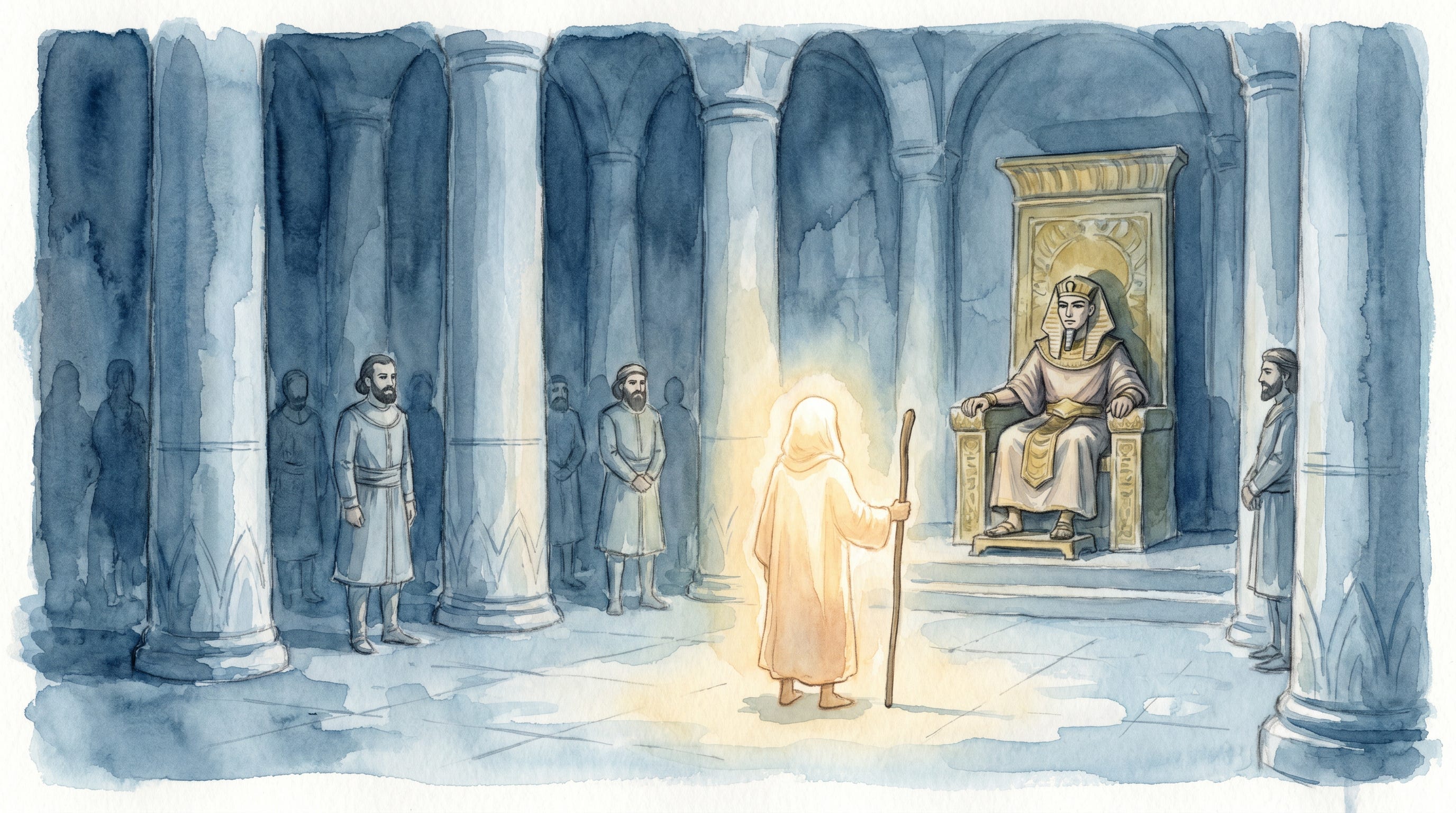
The fourth inheritance.
السَّلامُ عَلَيْكَ يا وارِثَ مُوسى كَليمِ اللهِ
Peace be upon you, O heir of Moses, the one who spoke with God.
What is Moses’s witness?
It is the witness of refusal.
The staff against Pharaoh.
The refusal to bow to any throne that is not God’s throne.
The Qur’an preserves the command.
God speaks to Moses.
And He says:
اذْهَبْ إِلَىٰ فِرْعَوْنَ إِنَّهُ طَغَىٰ
“Go to Pharaoh — for he has indeed transgressed beyond bounds.”
— Qur’an, Surah al-Naziat (the Chapter of Those Who Drag Forth) #79, Verse 17
Two words in the Arabic.
إِنَّهُ طَغَىٰ
Indeed, he has transgressed.
This is the foundational refusal.
The refusal to acknowledge as god what is not god.
The refusal to call legitimate what is not legitimate.
The refusal to bow.
And what is the sentence Moses’s inheritance lives in, in the mouth of Imam Husayn?
It is the sentence we have already heard, on the first night and on the third night and on the seventh night and on the ninth night, of this series.
The sentence our Imam said in Medina, when Walid ibn Utba called him and demanded allegiance to Yazid.
مِثْلِي لاَ يُبَايِعُ مِثْلَهُ
“Someone like me does not give allegiance to someone like him.”
— Imam Husayn ibn Ali, to Walid ibn Utba in Medina on the night of his refusal. Preserved in Sayyid Ibn Tawus, al-Luhuf; al-Khwarizmi, Maqtal al-Husayn; Ibn al-Athir, al-Kamil fi al-Tarikh.
This sentence is the staff against Pharaoh, said in Arabic.
This sentence is the refusal Moses learned at the burning bush, said in the mouth of our beloved Imam.
This sentence is what every witness in every age, from the first man Pharaoh has ever asked to bow, has been carrying in some form or another, in some tongue or another, in some hour or another.
It is what Polycarp said at Smyrna.
It is what Jägerstätter said at Brandenburg-Görden.
It is what Aaron Bushnell shouted in front of the embassy.
It is what Imam Khamenei said in Tehran on the 17th of February 2026, eleven days before they killed him:
someone like me does not give allegiance to someone like him.
The chain of refusal.
Moses inherits it.
Imam Husayn completes it.
And — hear me, because we will return to this at the close of tonight — every one of us, in the chamber of our own heart, every day, is being asked to live in some small fragment of the same sentence.
Heir of Jesus — The Spirit
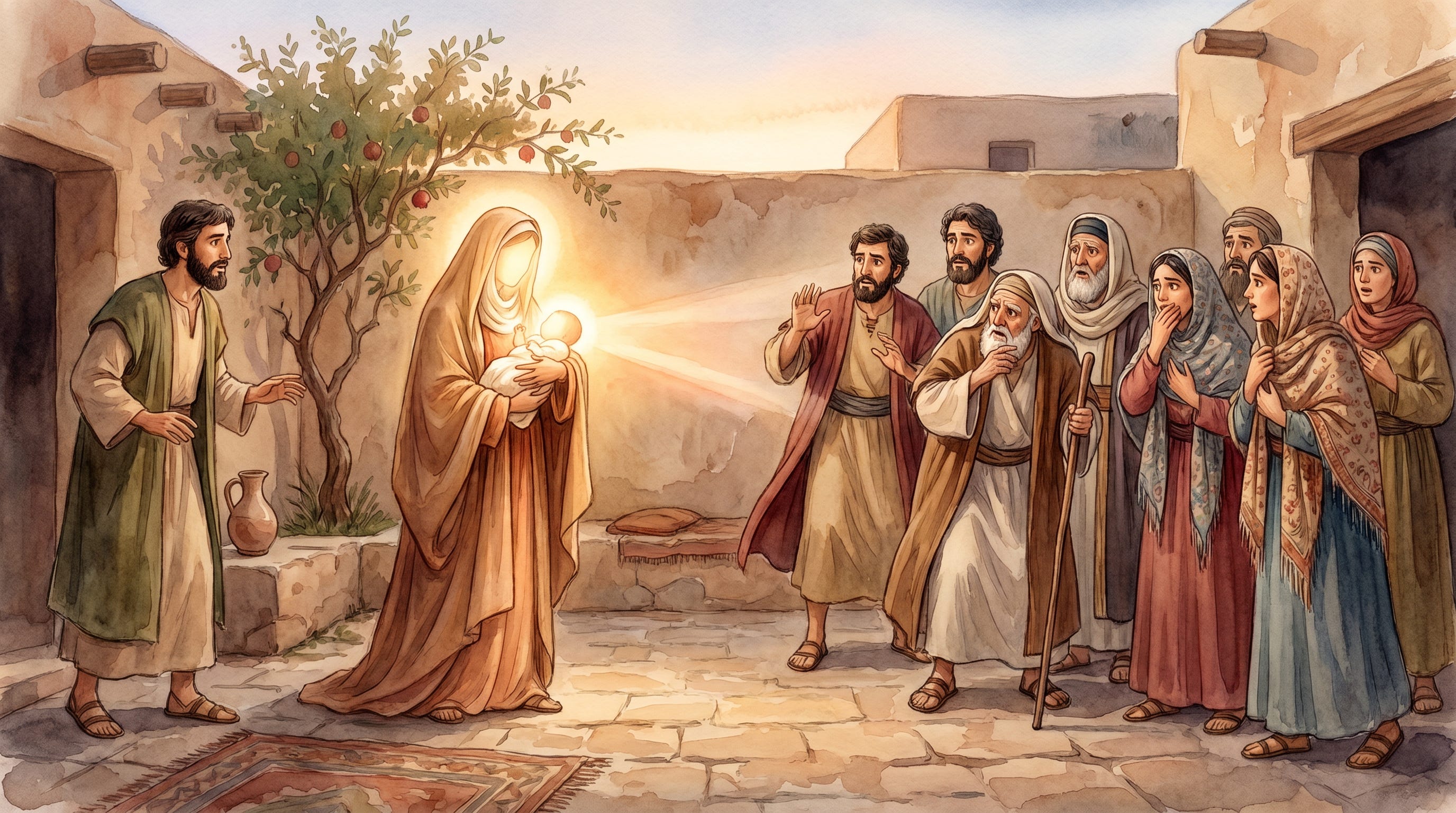
The fifth inheritance.
And here we must walk with the most care of all — because the witness of Jesus has been the most contested, the most layered, the most claimed-and-counter-claimed of any prophetic life in the chain.
We walk with the methodology we set down on the fifth night of our series — honour without conflation.
السَّلامُ عَلَيْكَ يا وارِثَ عيسى رُوحِ اللهِ
Peace be upon you, O heir of Jesus, the spirit of God.
What is the witness of Jesus?
It is two-fold.
The first half is what the Christian tradition has memorialised, and what we honoured already on the fifth night: the life laid down for the people, the body offered up so that the truth carried would not be lost.
But there is a second half, often less attended to in the popular telling — and one we must lift back into view tonight, because it wires directly into the Khutba of Mina our beloved Imam Husayn would, six centuries later, deliver to the corrupted scholars of his own community.
Jesus resisted the corrupted clerical establishment of his age.
He resisted it openly, publicly, with words sharp enough to be remembered for two thousand years and with actions visible enough to be feared by the men of position.
Begin with his mother.
Mary — Maryam — was, as we heard already on the fifth night, al-siddiqah, the truthful one; the Qur’an names her with one of the highest stations any woman has ever attained.
But the Pharisaic establishment that surrounded the birth of Jesus accused her, in its councils and in some of its later writings, of unchastity — slander deep enough that traces of it have been preserved, in some of the later rabbinical and Pharisaic texts, for the centuries that followed.
The Qur’an itself names what was done.
وَبِكُفْرِهِمْ وَقَوْلِهِمْ عَلَىٰ مَرْيَمَ بُهْتَانًا عَظِيمًا
“And for their disbelief and for their utterance against Mary of a grievous calumny.”
— Qur’an, Surah al-Nisa (the Chapter of Women) #4, Verse 156
Buhtanan azima — a grievous calumny.
The Qur’an reaches for the strongest word in the lexicon of slander.
And God’s answer was the answer of God:
He did not let Mary stand alone in the face of the accusation;
He did not let the slander hang in the air.
He gave her infant son the power to speak as a child in the cradle.
The Qur’an, in Surah Maryam, preserves the moment.
قَالَ إِنِّي عَبْدُ اللَّهِ آتَانِيَ الْكِتَابَ وَجَعَلَنِي نَبِيًّا
“He said: ‘Indeed, I am the servant of God. He has given me the Scripture and made me a prophet.’”
— Qur’an, Surah Maryam (the Chapter of Mary) #19, Verse 30
The infant Jesus in his mother’s arms, speaks to the people who had accused her — and his first words to the world are a defence of his mother’s honour against the slander of the corrupted establishment.
I am the servant of God.
He has given me the Scripture.
He has made me a prophet.
The witness of Jesus begins, in the Qur’an, before he can walk — and it begins as a refusal of the establishment that had slandered his mother.
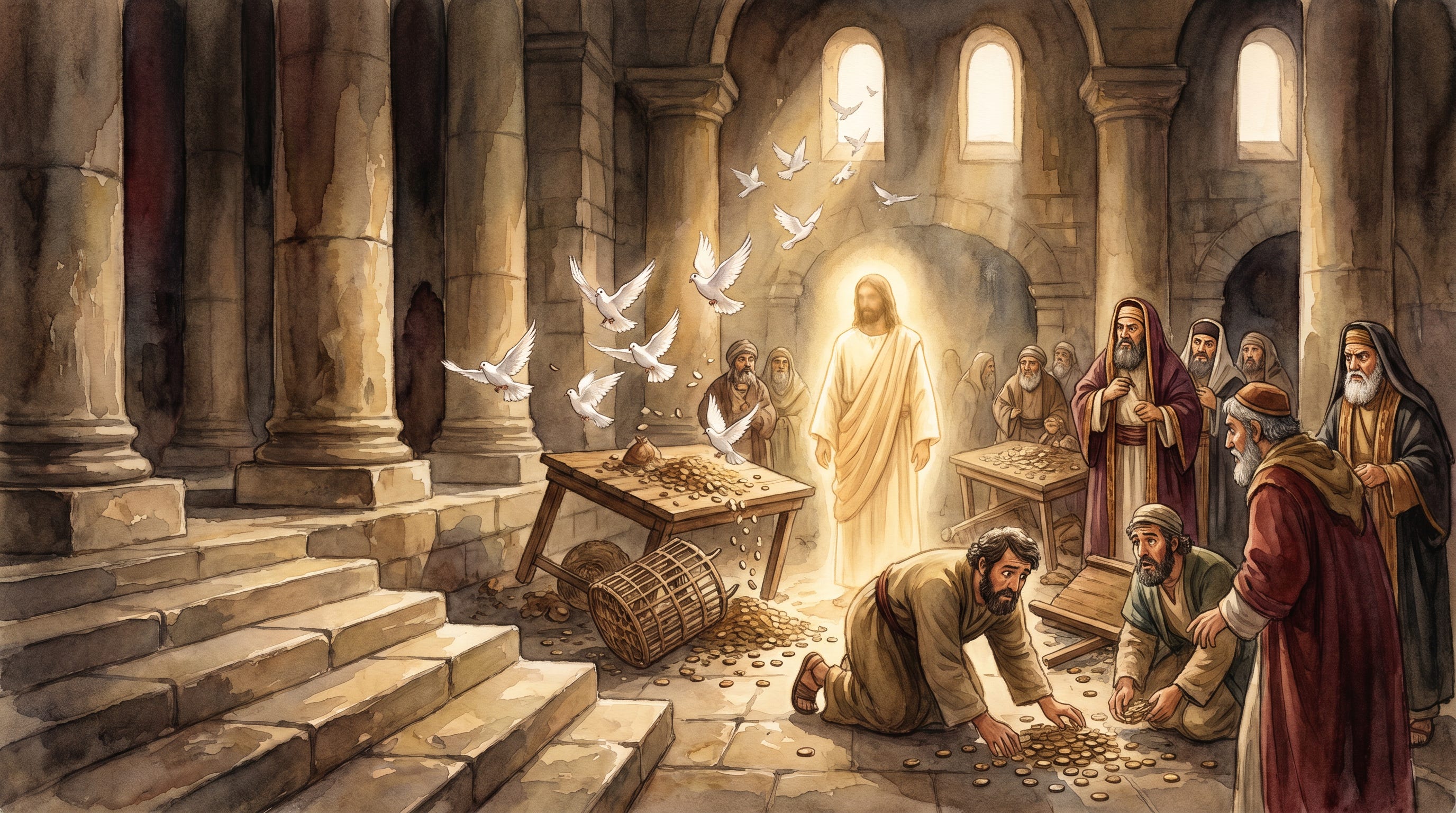
Years later, when Jesus was a grown man walking the streets of Jerusalem, he came to the Temple — the same Temple that had been built and rebuilt for the worship of the One God, that the Pharisees and chief priests had, over the generations, allowed to become an open market: money changers profiting from the worship of the poor, dove-sellers turning the Lord’s house into a place of commerce.
The Gospel of Matthew preserves what the witness did.
“And Jesus went into the temple of God, and cast out all them that sold and bought in the temple, and overthrew the tables of the moneychangers, and the seats of them that sold doves, and said unto them, It is written, My house shall be called the house of prayer; but ye have made it a den of thieves.”
— Gospel of Matthew, 21:12–13 (King James Version)
He overthrew the tables.
He did not write a tract.
He did not lobby the priests.
He went into the place of worship and physically — bodily — overturned the architecture of corruption.
This is not the witness of the lamb led silently to slaughter; it is the witness of the prophet of God who, with his own hands, refused to let the house of God be made into a marketplace.
And then he turned to the scholars, the chief priests, the men of position and learning and respect who had presided over the corruption — and he chastised them, by name, in public, in language that has not been softened in two thousand years.
The Gospel of Matthew, chapter 23, preserves what the tradition has called the Seven Woes.
Hear a selection.
“Woe unto you, scribes and Pharisees, hypocrites! for ye shut up the kingdom of heaven against men: for ye neither go in yourselves, neither suffer ye them that are entering to go in.
Woe unto you, scribes and Pharisees, hypocrites! for ye devour widows’ houses, and for a pretence make long prayer: therefore ye shall receive the greater damnation.
Woe unto you, scribes and Pharisees, hypocrites! for ye pay tithe of mint and anise and cummin, and have omitted the weightier matters of the law, judgment, mercy, and faith...
Woe unto you, scribes and Pharisees, hypocrites! for ye are like unto whited sepulchres, which indeed appear beautiful outward, but are within full of dead men’s bones, and of all uncleanness.”
— Gospel of Matthew, 23:13–14, 23, 27 (King James Version)
And then — listen, because this is the verse that lifts the whole of Matthew 23 into the chain we have been walking together for nine nights — Jesus closes the Seven Woes with a sentence that names the architecture.
“That upon you may come all the righteous blood shed upon the earth, from the blood of righteous Abel unto the blood of Zacharias son of Barachias, whom ye slew between the temple and the altar.”
— Gospel of Matthew, 23:35 (King James Version)
Hear what Jesus is naming.
The blood of righteous Abel — the first witness — we walked on the first night.
The blood of Zacharias — Zakariyya — we walked on the second.
Jesus himself names the chain.
Jesus himself places the corrupted clerical establishment of his own day in the lineage of those who killed Abel and those who killed Zakariyya.
Jesus is preaching the same architecture we are sitting in tonight.
And — this is what we must not miss — this is exactly what Imam Husayn will say at Mina six centuries later.
The Khutba of Mina that we walked on the fourth night was his own Woe to the scholars:
the same structure of rebuke,
the same kind of audience — scholars and religious functionaries who had made their peace with the system — and
the same transaction named: the comfortable scholar who knows the truth and stays silent,
the man of position who has purchased his safety from the oppressive ruling powers with flattery and compromise.
And hear what Imam himself was doing in the very first words of that sermon.
He opened by citing three Qur’anic verses — and the first one he reached for was Surah al-Ma’idah, verse 63:
God Himself rebuking the Rabbaniyyun and the Ahbar, the rabbinical and scholarly authorities of the Children of Israel, for failing to forbid the sinful speech and unlawful wealth they saw in their communities.
He did not begin by citing a verse against the Umayyads, or against Mu’awiya, or against Yazid — he could have.
He chose, instead, the Qur’an’s own verdict against the failed clerical class of an earlier prophetic community.
The very demographic Jesus had rebuked at the Temple six centuries earlier in the Seven Woes.
This is not us drawing a parallel across the centuries.
This is Imam Husayn himself drawing that parallel.
He was telling the comfortable scholars of Medina and Mecca, in the Qur’an’s own words, that they were the latter-day Ahbar — repeating the very failure the Qur’an had already named.
Jesus stood at the Temple.
Imam Husayn stood at Mina.
The same architecture.
The same diagnosis.
The same divinely inspired chastisement.
And the corrupted establishment did what corrupted establishments have always done to the witness who refuses to leave them alone.
They conspired to kill him.
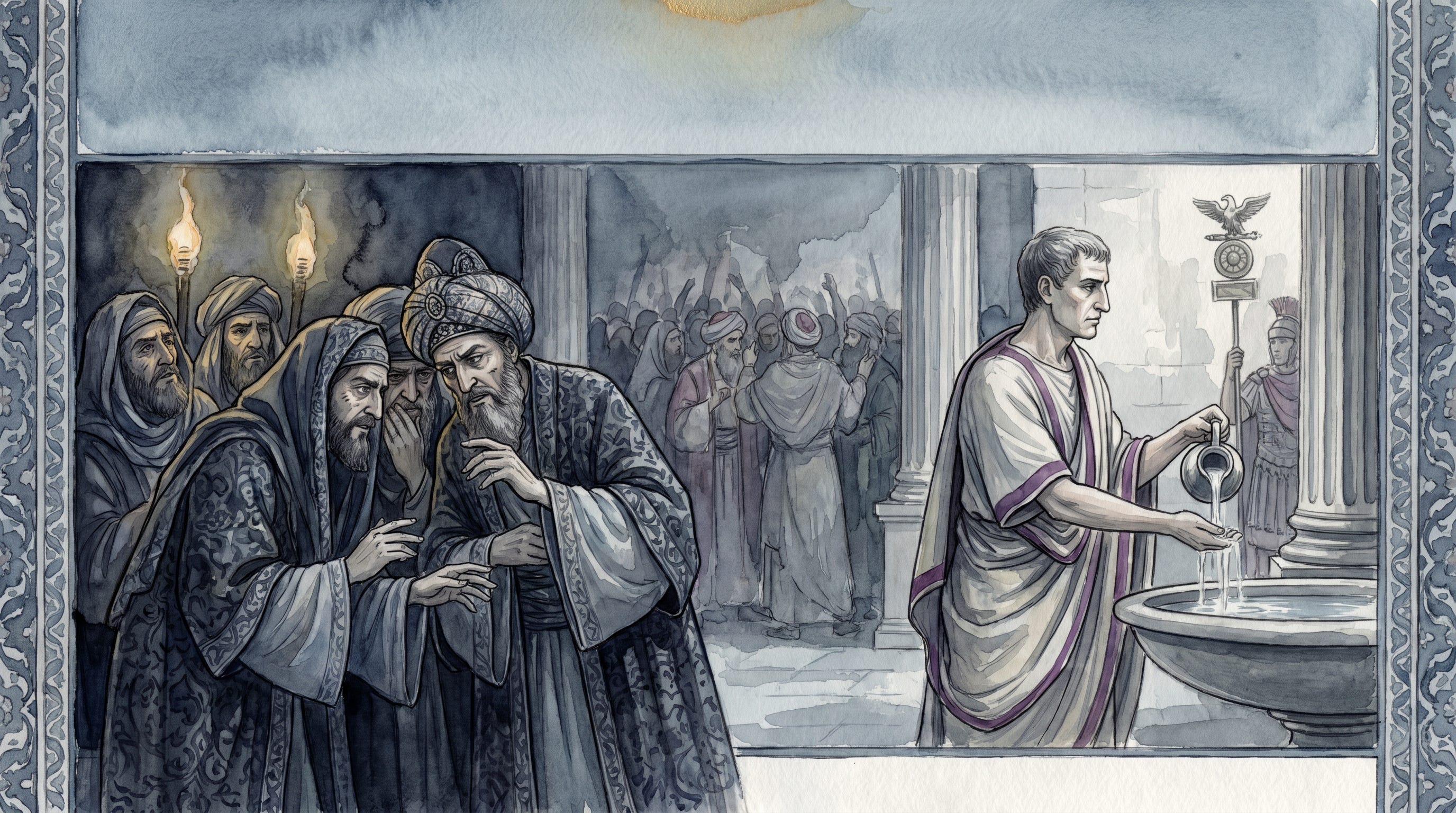
But they did not do it directly — they were too clever for that, and too cowardly.
They knew what would happen if they were seen to kill him openly: the people, the Gospel tells us, took him for a prophet.
The Pharisees feared the people more than they feared God.
So they did what corrupted clerical-political establishments have done in every age since:
they used the imperial power of their day as the instrument of their conspiracy.
The Gospel of Matthew preserves the planning.
“Then assembled together the chief priests, and the scribes, and the elders of the people, unto the palace of the high priest, who was called Caiaphas, and consulted that they might take Jesus by subtilty, and kill him.”
— Gospel of Matthew, 26:3–4 (King James Version)
And when they had taken him — by the kiss of a paid informer in the garden at night — they delivered him to the Roman governor.
“When the morning was come, all the chief priests and elders of the people took counsel against Jesus to put him to death: and when they had bound him, they led him away, and delivered him to Pontius Pilate the governor.”
— Gospel of Matthew, 27:1–2 (King James Version)
Pontius Pilate — the Roman procurator of Judaea, the instrument of the empire of Rome, the imperial superpower of that century.
And Pilate himself, the Gospel preserves, knew exactly what was being done:
“For he knew that for envy they had delivered him...”
— Gospel of Matthew, 27:18 (King James Version)
For envy.
The Pharisaic establishment had not delivered Jesus to Rome because Rome wanted him.
Rome did not want him.
Pilate, in the Gospel’s own account, washed his hands and said —
“I am innocent of the blood of this just person; see ye to it”
— Gospel of Matthew, 27:24 (King James Version)
The crucifixion was not Rome’s project.
It was the corrupted Pharisaic establishment’s project, executed through the imperial machinery of Rome.
The corrupted clerical-political establishment of Jerusalem manipulated the imperial superpower of its day into being the instrument of the killing it could not, by itself, perform without the people rising against it.
That is the architecture.
And the Pharisaic establishment did not stop at killing the witness — they demonised him, his mother, his disciples; they wrote their books and recorded their accusations and passed down to their successors a tradition of slander that has, in some quarters, persisted for two thousand years.
The Talmudic and later Pharisaic-tradition accounts of Jesus and of Mary include language that we, as Muslims, find unspeakable — the very calumny the Qur’an named buhtanan azima.
And the persecution did not stop at the prophet himself: the early Christian witnesses we honoured on the fifth night — Polycarp, Perpetua, Justin, and the others — were the inheritors of the same architecture of demonisation, now directed at the followers rather than the prophet himself.
The witness is killed.
The mother is slandered.
The disciples are persecuted.
The pattern is one pattern.
The Christian tradition holds that the crucifixion succeeded, and that Jesus’s witness was completed on the cross.
The Qur’an does not say this.
The Qur’an says something else.
And this is the moment of honour without conflation — where we name where the roads part.
وَقَوْلِهِمْ إِنَّا قَتَلْنَا الْمَسِيحَ عِيسَى ابْنَ مَرْيَمَ رَسُولَ اللَّهِ وَمَا قَتَلُوهُ وَمَا صَلَبُوهُ وَلَٰكِن شُبِّهَ لَهُمْ ۚ وَإِنَّ الَّذِينَ اخْتَلَفُوا فِيهِ لَفِي شَكٍّ مِّنْهُ ۚ مَا لَهُم بِهِ مِنْ عِلْمٍ إِلَّا اتِّبَاعَ الظَّنِّ ۚ وَمَا قَتَلُوهُ يَقِينًا ۞ بَل رَّفَعَهُ اللَّهُ إِلَيْهِ ۚ وَكَانَ اللَّهُ عَزِيزًا حَكِيمًا
“And for their saying: ‘Surely we have killed the Messiah, Jesus son of Mary, the messenger of God’ — and they did not kill him, nor did they crucify him, but it appeared to them so (a likeness was made to them); and most surely those who differ therein are only in doubt about it. They have no knowledge of it but only follow conjecture. And certainly they did not kill him — rather, God raised him to Himself. And God is Mighty, Wise.”
— Qur’an, Surah al-Nisa (the Chapter of Women) #4, Verses 157–158
Hear the verses with the weight they carry.
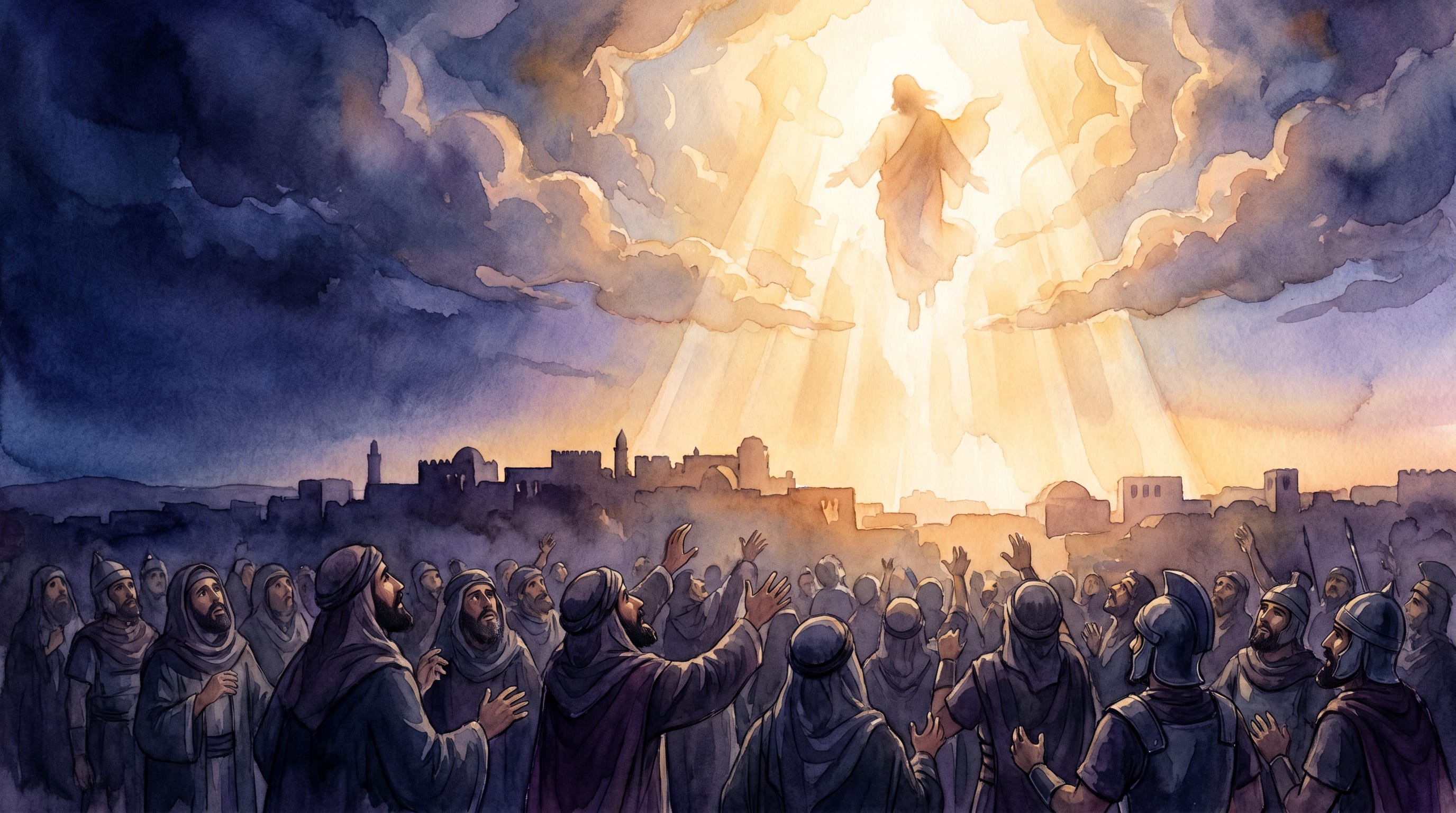
They did not kill him.
They did not crucify him.
A likeness was made to them.
They have no knowledge of it.
They did not kill him for certain.
Rather — God raised him to Himself.
Six denials and one affirmation.
The Qur’an’s grammar is precise.
The killing did not happen.
God preserved His prophet.
Allamah Tabataba’i, in his commentary on these verses in al-Mizan, explains the Shia position clearly.
Hear his words.
يَنُصُّ عَلى أنَّهُ (عَلَيهِ السَّلامُ) لَم يُتَوَفَّ بِأيدِيهِم لا صَلباً وَلا غَيرَ مَصلوبٍ، بَل شُبِّهَ لَهُم أمرُهُ فَأخَذُوا غَيرَ المَسيحِ (عَلَيهِ السَّلامُ) مَكانَ المَسيحِ فَقَتَلوهُ أو صَلَبوهُ، وَلَيسَ مِنَ البَعيدِ عادَةً، فَإنَّ القَتلَ في أمثالِ تِلكَ الاجتِماعاتِ الهَمَجِيَّةِ وَالهَجمَةِ وَالغَوغاءِ رُبَّما أخطَأ المُجرِمَ الحَقيقيَّ إلى غَيرِهِ، وَقَد قَتَلَهُ الجُندِيُّونَ مِنَ الرّومِيِّينَ، وَلَيسَ لَهُم مَعرِفَةٌ بِحالِهِ عَلى نَحوِ الكَمالِ، فَمِنَ المُمكِنِ أن يَأخُذوا مَكانَهُ غَيرَهُ، وَمَعَ ذٰلِكَ فَقَد وَرَدَت رِواياتٌ أنَّ اللهَ تَعالى ألقى شَبَهَهُ عَلى غَيرِهِ فَأُخِذَ وَقُتِلَ مَكانَهُ.
“He explicitly states that he did not die at their hands, neither by crucifixion nor by any other means.
Rather, his matter was made to appear similar to them, so they caught someone other than the Messiah, in place of the Messiah, and killed him or crucified him.
And this is not far from the natural course, for in such mob-like and tumultuous gatherings, the killing may sometimes miss the actual criminal and fall upon someone else.
And he was killed by the Roman soldiers, who had no complete knowledge of his condition; it was possible for them to take someone else in his place.
And along with this, narrations have come down that God, Most High, cast his likeness upon another, who was taken and killed in his place.”
— Allamah Sayyed Muhammad Husayn Tabataba’i, al-Mizan fi Tafsir al-Qur’an, Commentary on Surah al-Nisa, 4:157
Hear what this is — and hear what this is not.
What it is:
The testimony of the Qur’an, with the precision of one of our greatest commentators of the modern age, that Jesus was not killed. God raised him.
The witness was not completed on a cross — the witness was lifted, by God’s own hand, beyond the reach of the corrupted establishment that thought it had won.
What it is not:
A dogmatic position on the exact mechanism.
Allamah Tabataba’i acknowledges several possibilities and does not insist on one — and tonight, neither will we.
The doctrinal core is:
Jesus was not killed.
God raised him.
Imam Husayn is not the Islamic Jesus.
The Ziyarat means something more precise.
It means that the form of witness Jesus came to embody — the two-fold form, the prophetic resistance to the corrupted clerical establishment AND the prophetic submission to the will of God in the moment of greatest cost — was, in the Islamic understanding, fulfilled in its completed form at Karbala.
In the body of a man who was, indeed, killed — because the great sacrifice the angel promised to Abraham in Surah al-Saffat was the sacrifice that would come not to the son of Abraham but to the grandson of Muhammad.
In the body of a man whose blood, indeed, fell on the earth. In the body of a man who first rebuked the scholars at Mina — as Jesus rebuked them at the Temple — and then walked into the desert to face the imperial machinery that itself wanted him dead.
And here we must say plainly — because honour without conflation requires it of us — that the architecture of our beloved Imam’s killing was not identical to Jesus’s.
The roles are reversed.
In Jesus’s case, the Pharisaic establishment was the instigator; Rome, through Pilate, was the reluctant instrument.
The empire did not want Jesus dead; the corrupted clerical class did.
In our Imam’s case, the order was reversed: the Umayyad state — Yazid in his palace in Damascus — was itself the instigator; Ibn Ziyad in Kufa was Yazid’s agent, the local hand of the imperial will.
There was no Pilate figure.
The empire itself wanted him dead, and the empire itself executed the killing.
And the comfortable scholars of Medina and Mecca were not the Caiaphas of his hour.
They are latter-day Pharisees in a different sense — not by active conspiracy, but by the failure of silence.
They knew the truth and stayed silent — the three silences our beloved Imam himself diagnosed at Mina:
fear, comfort, and the narrowing of moral vision.
So there is a connection between the two killings, but not a direct analogy.
What is the same — and this is what matters — is the person at the centre: refusing to bow to a system that has lost its godliness, rebuking the corrupted clerical class that should have stood, killed in the end by the machinery of the day.
That is the heir of Jesus.
That is the heir of every prophet.
What differs is the corrupted clerical class’s failure mode — in Jesus’s hour: active conspiracy; in our beloved Imam’s hour: complicit silence.
Both fail the same prophetic call; both stand condemned before God.
And the blood, despite the failure of the scholars in both ages, becomes the seed of continued witness.
That is what the heir of Jesus means.
And now — with the gravity that the criterion of Karbala requires of us — we must name what the architecture looks like in our own age.
The Zionist regime is the corrupted clerical-political establishment of our century, and the empire of the United States — which, unlike Pilate, does not wash its hands — is its enthusiastic Rome.
The fuller naming — by regime, by lobby, by source, by published record, the Yazid-dynasties of our hour that will fall as every architecture of arrogance has fallen, the cross-tradition truth-will-out chain that joins what the Qur’an names about the inevitability of falsehood’s collapse — waits for the Arbaeen sessions, God willing.
Nights 13 and 14 will sit with all of it at length.
Tonight we hold the architecture; the criterion of Karbala will speak the rest.
The architecture has not changed in two thousand years.
The witness who refused it then is preserved by God.
The witness who refused it at Karbala — Imam Husayn — is the criterion against whom both then and now are weighed.
And we, who claim to walk in the inheritance of Jesus and the inheritance of Imam Husayn must learn to see the architecture for what it is.
Pilate’s hands.
Caiaphas’s plotting.
The crowd that was paid to call for Barabbas.
The same shape, every time.
The same machinery, every century.
And the lesson Jesus’s witness leaves us — the inheritance Imam Husayn carries forward — is the same lesson he gave at the Temple, the same lesson he gave in the Seven Woes, the same lesson the Qur’an preserves at the close of one of its shortest and most concentrated chapters.
Refocus toward God.
Surah al-Asr — the Chapter of Time.
Three verses.
Hear them.
بِسْمِ اللَّهِ الرَّحْمَٰنِ الرَّحِيمِ
وَالْعَصْرِ
إِنَّ الْإِنسَانَ لَفِي خُسْرٍ
إِلَّا الَّذِينَ آمَنُوا وَعَمِلُوا الصَّالِحَاتِ وَتَوَاصَوْا بِالْحَقِّ وَتَوَاصَوْا بِالصَّبْرِ“In the Name of God, the Most Compassionate, the Most Merciful.
By Time — indeed, mankind is in loss.
Except for those who have believed and done righteous deeds and enjoined one another to truth and enjoined one another to patience.”— Qur’an, Surah al-Asr (the Chapter of Time) #103
Mankind is in loss.
That is the diagnosis.
The default state of the human being, untethered from God, distracted by Pilate’s empire and Caiaphas’s scholarship and the moneychangers in the Temple, is loss.
Illa — except.
And the exception is the door.
Four conditions the verse names.
Those who have believed — amanu.
The orientation toward the One God.
La ilaha illa Allah — There is no god, except God
The negation of every false sovereign.
The affirmation of the One.
And done righteous deeds — amilu al-salihat.
The body that has become its faith.
The life that has become its testimony.
And enjoined one another to truth — tawasaw bi al-haqq.
The mutual call.
The community that refuses to let its members drift into the silence the scholars at Mina refused to break.
And enjoined one another to patience — tawasaw bi al-sabr.
The endurance under the cost of the calling.
The same sabr every prophet has carried.
The same sabr Jesus carried in the Temple and in the garden.
The same sabr Imam Husayn carried at Karbala.
That is the inheritance from Jesus.
That is the way out of loss.
That is what he taught with his life and what our beloved Imam Husayn completed with his.
And the amanu — the believing, the refocus toward God — is always first.
Because every other empire in every other age is built out of the heart that lost its bearing on the One.
Every Pharisaic establishment is built out of scholars who stopped believing in God before they stopped believing in their robes.
Every Rome is built out of administrators who stopped believing in justice before they stopped believing in their treaties.
The witness restores the bearing.
That is the work of Jesus.
That is the work of our beloved Imam Husayn.
That is the work the criterion places in our hands tonight.
And so, again —
السَّلامُ عَلَيْكَ يا وارِثَ عيسى رُوحِ اللهِ
Peace be upon you, O heir of Jesus, the spirit of God.
What the Christian tradition has gathered around Jesus — the love, the longing, the recognition of the witness who gives up everything for the truth, and who refuses to let the corrupted establishment have the last word —
Karbala makes literal in the body of our beloved Imam Husayn.
Not the same act.
Not the same theology.
But the same architecture — and the architecture that arrived, at Karbala, in the form God had decreed it should arrive.
This is what honour without conflation asks of us.
We name what we share.
We name where the roads part.
We do not flatten one tradition into another.
And we do not deny what is real in the other tradition.
Polycarp, Perpetua, Justin before Rusticus and all those we have spoken of.
Every one of these is a witness honoured by us, by name, with intellectual seriousness, with the recognition that the Spirit moves where it wills.
But what arrived, at Karbala, in the body of our Imam — is the form the prophetic chain was, all along, aimed at.
Imam Husayn is the heir of Jesus.
Not the replacement.
Not the rejection.
Not the borrowing.
The heir.
Heir of Muhammad — The Beloved
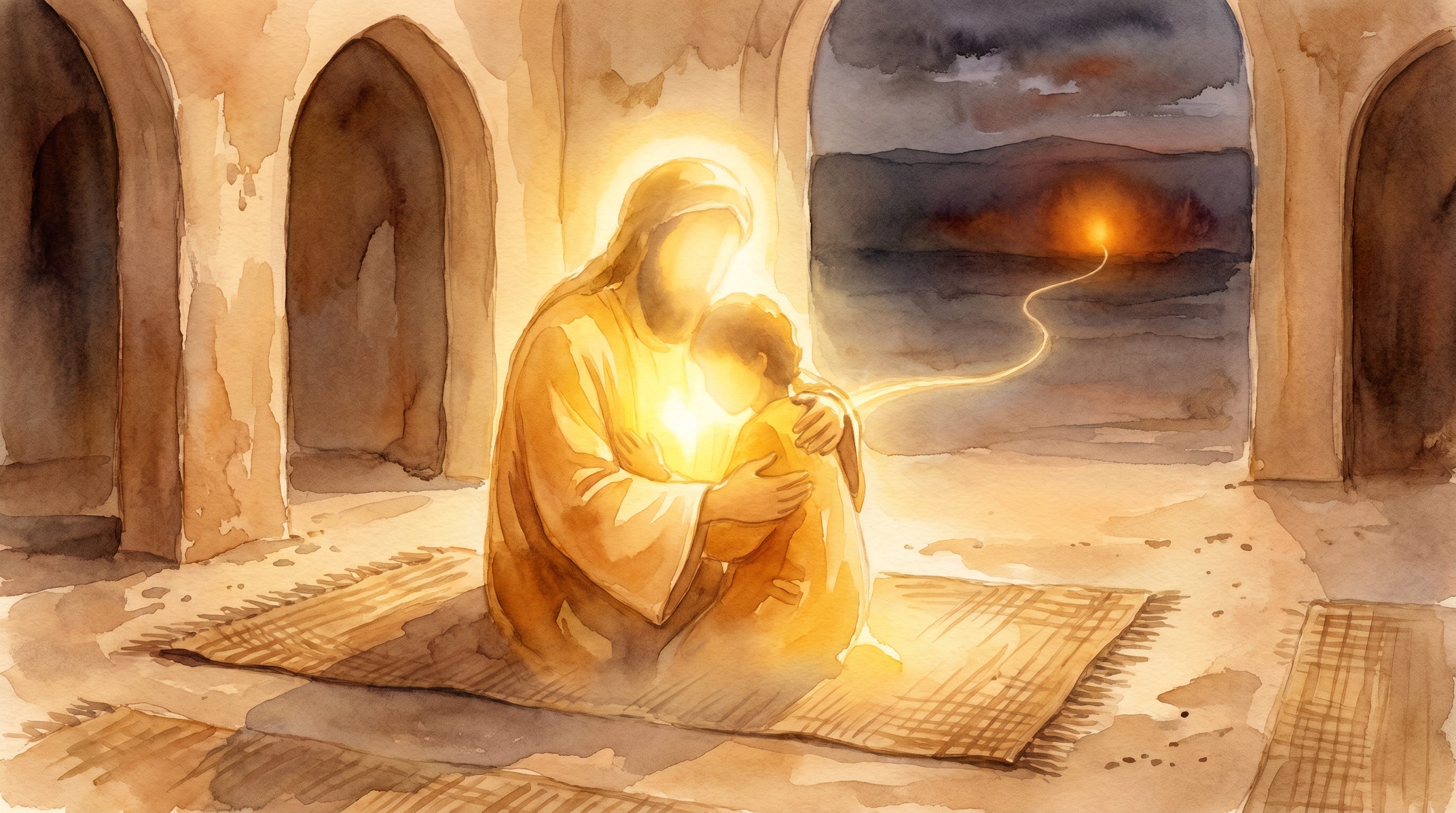
The sixth inheritance.
And the chain closes.
السَّلامُ عَلَيْكَ يا وارِثَ مُحَمَّدٍ حَبيبِ اللهِ
Peace be upon you, O heir of Muhammad, the beloved of God.
What is the witness of the Prophet?
The witness of completion.
The witness that the chain that began with Adam, that ran through every prophet of God, has — in his body and his message — arrived at its final form.
And what he hands forward — to whom does he hand it?
And here, with the most precision we have, we must clarify something essential — because the answer is not what the outside reader of Shia Islam often takes it to be.
In the Shia theology of the Imamate, the Prophet hands forward what God has placed in his keeping — not by inheritance, not by dynasty, not by bloodline — but by nass, explicit divine designation.
The Imamate is covenant, not crown.
Someone like me does not give allegiance to someone like him
— that line is the refusal of the hereditary monarchy Mu’awiya had constructed; it is the refusal of the very kingship-by-bloodline that the Imamate is not.
The full doctrine of nass — its grounding in Surah al-Baqarah 2:124, ismah as the hidden inner state only God can identify — we have walked at length in the Lantern of the Path series, in [24] Imamah (Leadership) — The Commander of the Faithful, Imam Ali, under the subsection Essential Qualifications of the Imam.
Tonight, hold the essential form.
Our beloved Imam Husayn carries the nass into the field of Karbala — not the dynastic claim, not the hereditary throne, but the divine designation transmitted to him by his father from the Prophet at Ghadir Khumm.
The Umayyads passed a crown to a son.
The Prophet passed a divine designation to the soul God had prepared to bear it.
These are categorically different things.
The body fell at noon on the tenth.
The nass did not.
It passed to Imam Sajjad that very afternoon — to the young man chained in the captives’ caravan — and from him forward, generation by generation, by the same divine designation, until the chain reaches the Hidden Imam of our Age.
And the Prophet said about Imam Husayn — the hadith narrated through both Sunni and Shia chains:
حُسَيْنٌ مِنِّي وَأَنَا مِنْ حُسَيْنٍ
“Husayn is from me, and I am from Husayn.”
— The Prophet Muhammad. Narrated through multiple Sunni and Shia chains, including: Tirmidhi #3775; al-Hakim al-Naysaburi, al-Mustadrak 3.177; Ibn Maja #144; Musnad Ahmad ibn Hanbal 4.172; al-Saduq, al-Amali; Bihar al-Anwar vol. 43.
Hear what kind of sentence this is.
Husayn is from me.
That is what every grandfather might say of his grandson.
That is the natural sentence of inheritance.
And I am from Husayn.
That is the impossible sentence.
That is the sentence that breaks open the architecture of every other inheritance.
The Prophet is not saying he descends biologically from his grandson.
He is saying that his prophetic mission — his witness, his work, his very identity as the seal of the prophets — is carried forward in the body of his grandson, in such a way that without that grandson’s witness, the Prophet’s own would be incomplete.
This is the sixth inheritance.
The Prophet is, in a sense the Shia tradition has held for fourteen centuries, completed by what our beloved Imam will do at Karbala.
And so the body that walks into the field at dawn on the tenth carries — in its blood, in its bones, in its breath — the witness of every prophet of God who came before.
Six inheritances.
One body.
One day.
One field.
This is the doctrine of the heir.
The blood that flows to Karbala is not a metaphor.
It is the literal arrival of the prophetic chain at its destination.
This is the doctrine of the roots.
And now — having received the roots — we turn to the branches.
The Synthesis of the Nine Nights
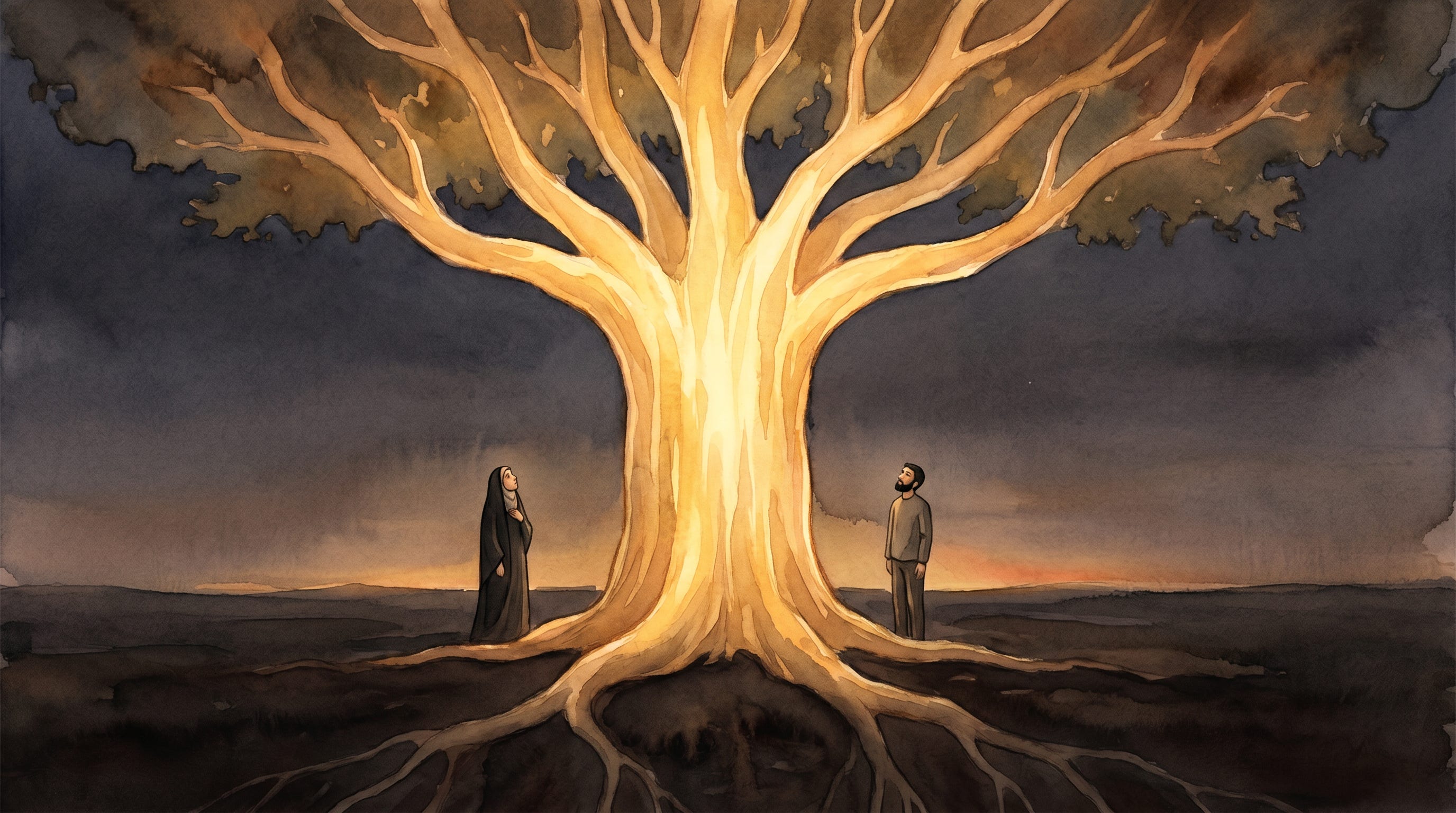
Across these nine nights we walked — from Abel and the recovery of the word, through the prophetic chain, Shaheed Mutahhari's five kinds of death, the Khutba of Mina, the Christian witness, the wretched and the witness, the anti-colonial cadence, the aesthetic emptied of truth, and the four counterfeits of the false shahada.
We walked the Soleimani Thread from quest to love to gnostic seeing to shahada at Baghdad airport.
Nine branches.
One trunk.
One root.
And now — the trunk speaks.
Husayn Is the Furqan
And here, at the synthesis of all nine nights, the imperial counterfeit thread that began as a seed on the eighth night, and was named as the fourth counterfeit last night, reaches its theological crescendo.
The furqan, in our Qur’an, is the criterion — the discriminator, the standard by which truth is separated from falsehood.
God says, in Surah al-Furqan — the chapter named after this word — verse one:
تَبَارَكَ الَّذِي نَزَّلَ الْفُرْقَانَ عَلَىٰ عَبْدِهِ لِيَكُونَ لِلْعَالَمِينَ نَذِيرًا
“Blessed is He who sent down the criterion upon His servant, that he may be a warner to all the worlds.”
— Qur’an, Surah al-Furqan (the Chapter of the Criterion) #25, Verse 1
And again, in Surah al-Anbiya, of Moses and Aaron, He says:
وَلَقَدْ آتَيْنَا مُوسَىٰ وَهَارُونَ الْفُرْقَانَ وَضِيَاءً وَذِكْرًا لِّلْمُتَّقِينَ
“And We gave Moses and Aaron the criterion, and a light, and a reminder for the God-fearing.”
— Qur’an, Surah al-Anbiya (the Chapter of the Prophets) #21, Verse 48
The Qur’an is criterion.
The Torah is criterion.
And tonight, we add a third form to the same word: the criterion is also a person.
The person is Imam Husayn.
Hear me carefully now.
Read with the weight the line carries: every empire that has ever called its mass killing necessary, justified, beautiful, or holy — is weighed against Imam Husayn, and found wanting.
Yazid’s empire claimed legitimacy from the Prophet’s family while slaughtering the Prophet’s family.
Caesar’s empire claimed Pax Romana while crucifying the prophets.
The British empire claimed civilisation while bleeding India and the world.
The American empire claims democracy while bombing civilians from Hiroshima to Gaza.
The Zionist regime claims biblical right while invoking Amalek over children and committing unspeakable crimes with impunity.
Husayn is the furqan.
The cherry blossom on the wing of the kamikaze cockpit.
The mushroom cloud over Hiroshima.
The bunker-buster over a Gaza hospital.
The white phosphorus over a Lebanese village.
The drone over Baghdad airport.
All of them fall under the same weighing.
The criterion does not change.
Karbala is the criterion under which every empire has stood, and every empire has fallen.
Imam Husayn is not one figure in history — he is the permanent measure.
And we must say this in the right voice.
Tabyeen, not apologetics.
We do not soften this to be liked;
We do not whisper it because someone might be uncomfortable;
We name it because it is true.
And we name it in the same breath we name something else.
Because the witness against the regimes IS the witness for the peoples.
The Western mother who lost her son to the meaningless wars of choice — the Iraqs, the Afghanistans, the Libyas, the Syrias — that NATO and the empire have dressed up as necessary, is honoured by this criterion.
The Jewish family whose conscience refuses what is done in their name is honoured by this criterion.
The Christian child raised in fear under a regime that has lost its godliness is honoured by this criterion.
The Palestinian child carried out of Gaza in a body bag is honoured by this criterion.
The Yemeni child whose food was the food the empire bombed;
the Afghan mother whose daughter the empire pretended for twenty years to liberate;
the Iraqi grandfather whose city the empire reduced to rubble;
the Lebanese family whose home the empire’s weapons set on fire;
the Iranian father whose country the empire has sanctioned and tried to break for half a century;
the African neighbour whose lands the empire has destabilised so its resources could be extracted
— every one of them is honoured by this criterion.
The protester in London charged as a “terrorist” for standing in direct action against the weapons-makers;
the journalist silenced for naming what is happening;
the citizen of conscience whose speech the empire has criminalised — while those who design the bombs and sign the cheques sit decorated, protected, and applauded by the very system that calls their conscience criminal
— is honoured by this criterion.
The criterion is for them.
The criterion is against the regimes that betray them.
And here is the methodological lock we take from tonight forward into the Arbaeen sessions and into the rest of our lives.
We do not personalise the regimes to their current leaders.
Netanyahu, Trump, Starmer, Modi — whichever name the news has placed in front of us this morning — they are not the disease.
They are the symptoms.
They are what an unchecked self becomes when given an empire.
To name the leader as the problem is to suggest the problem would resolve if the leader went — it would not; the system would — and has many times — install another.
And it is to collapse the structural critique back into personality, which is precisely the opposite of what the criterion does.
The criterion weighs the system.
And — as we will hear in a moment — the criterion also weighs the self that produces both the system and the leader.
Never the man at the head alone.
This is what our beloved Imam Husayn does, at noon on the tenth, when he refuses to give allegiance not just to Yazid but to the entire architecture of imperial legitimation that Yazid is just the current face of.
That is the furqan.
That is the criterion.
That is what tonight has been building you to receive.
The Criterion Weighs the Self
And now — to the heart of tonight.
We have built the criterion.
Tonight is the climactic clarification of the entire Muharram arc:
Imam Husayn, is not one historical figure we remember.
He is the permanent criterion against which every subsequent claim to martyrdom, sacrifice, and witness is measured.
Having walked nine nights to learn how to weigh — and having received tonight what we weigh against — the criterion is now in our hands.
The Three Tests from last night — loyalty to God, consistency with God’s law, full consciousness of why — are the working tools.
Imam Husayn is the standard the tools are calibrated against.
We will not call any death shahada that does not stand the test of our beloved Imam.
We will not bless any system that calls itself sacred while doing what Imam refused to do.
But — and here we do something that must be said before we close, because without it everything we have learned tonight remains theoretical —
The criterion does not weigh only the empires out there.
The criterion weighs the empire in here.
The Qur’an, in Surah Yusuf, in the mouth of the Prophet Joseph, teaches us the principle:
إِنَّ النَّفْسَ لَأَمَّارَةٌ بِالسُّوءِ إِلَّا مَا رَحِمَ رَبِّي ۚ إِنَّ رَبِّي غَفُورٌ رَّحِيمٌ
“Indeed, the soul is ever commanding evil, except for that on which my Lord has mercy. My Lord is forgiving, merciful.”
— Qur’an, Surah Yusuf (the Chapter of Joseph) #12, Verse 53
This is the verse.
The nafs al-ammarah — the soul that commands evil.
The Prophet Joseph is not confessing his own sin in this verse.
He is teaching us about the soul every human carries.
And the exception clause — illa ma rahima Rabbi, except for that on which my Lord has mercy — is the door.
The mercy of God is what lifts the soul out of its commanding pattern.
And jihad against the self is the labour by which we open ourselves to that mercy.
The Inner Empires Named
So hear me.
The criterion weighs the empires out there — Yazid’s, Caesar’s, the British, the American, the Zionist.
That is the work we have just done.
But the criterion weighs, also, the inner empires.
We carry in us, every one of us, the inner Yazid.
We carry in us the inner Pharaoh.
We carry in us the inner Caesar.
The name is different for each age; the disease is the same.
We carry in us the inner unchecked-self that, when given power — even small power, even private power, even the power of a household, even the power of the chamber of our own mind — becomes what we have just spent the last few minutes naming in the empires of the world.
And the leaders of our age — Trump, Netanyahu, Starmer, Modi, every other name the news asks us to memorise this morning and forget by next month — they are not the disease.
They are what an unchecked self becomes when it has been handed an empire.
The empire is the unchecked self, made structural.
If we want to refuse the empires, the work begins in here.
In the chamber of our own heart.
Every prayer, every day.
Someone Like Us
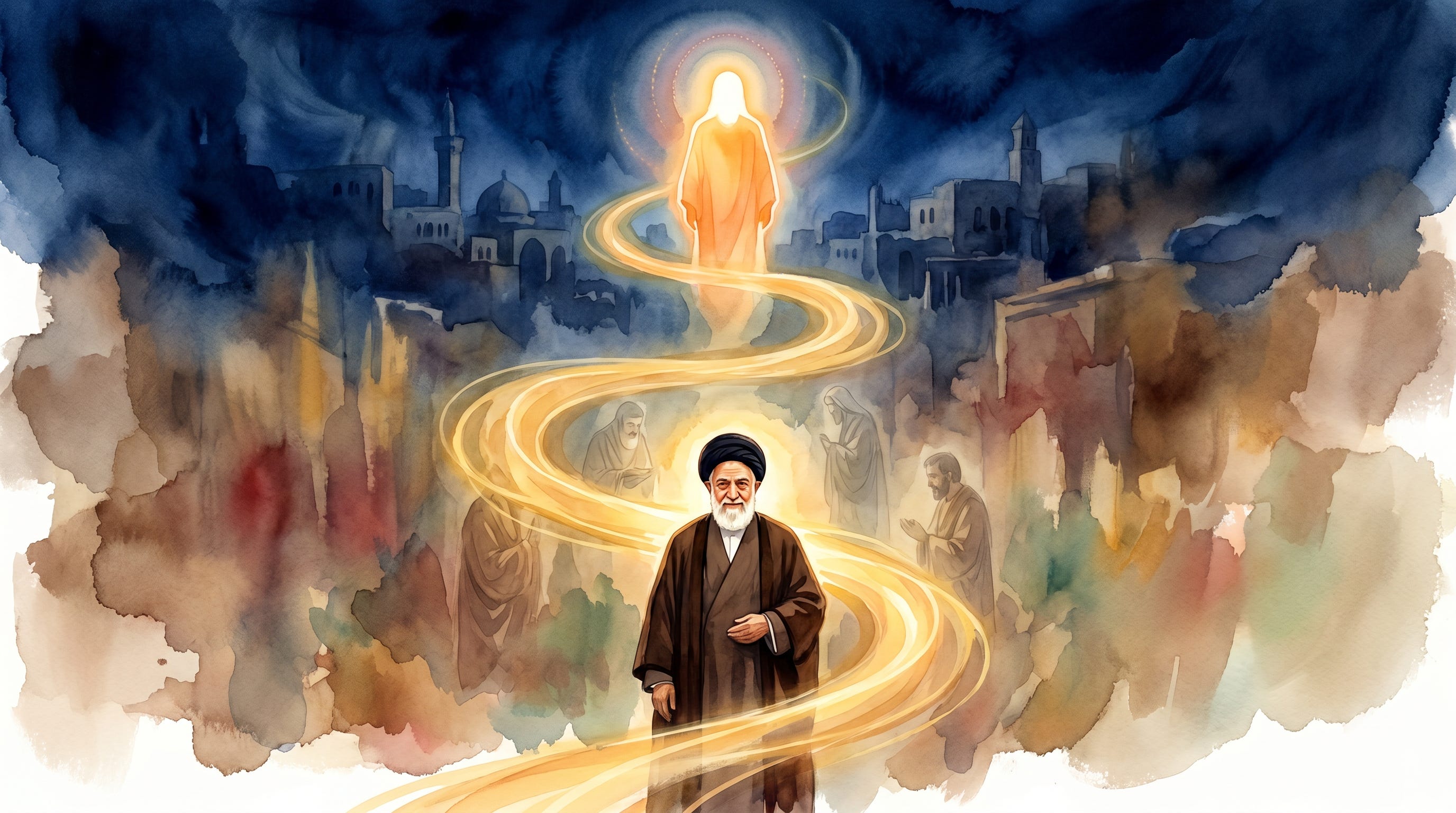
And here is the structural seed of this work — already named in the maqtal on the first night of our series, already named in this sermon a few minutes ago in the section on Moses.
In Medina, on the night Walid ibn Utba called him at midnight and demanded allegiance to Yazid, our beloved Imam answered with one sentence the chronicles have preserved for thirteen and a half centuries.
“Someone like me does not give allegiance to someone like him.”
— Imam Husayn ibn Ali, to Walid ibn Utba in Medina.
And Imam Khamenei eleven days before they killed him in February of this year, said the same sentence in Tehran.
“Someone like me does not give allegiance to someone like him.”
— Imam Sayyed Ali Khamenei, Power, Dignity, and the Unbreakable Nation, final televised address, 17 February 2026 (eleven days before his martyrdom on 28 February 2026 / 8 Ramadhan 1447).
The chain of refusal.
Across more than thirteen and a half centuries.
Same sentence.
Same architecture.
Same God.
And so — we, who claim to be lovers of Imam Husayn — we, who claim to walk in the chain that includes Imam Khamenei and every other witness whose body has paid the price of refusing to bow — must ensure that someone like us can never give allegiance to our inner Yazid.
To our inner Pharaoh.
To our inner Caesar.
To the base desires that lead us away from God.
To the whisperings of Satan, who counsels us — every hour of every day — that the small compromise will not matter, that the small theft is too small to notice, that the small lie is too small to repent of.
The same refusal we honour outwardly in our beloved Imam must be the refusal we make daily inwardly in ourselves.
Someone like Husayn can not give allegiance to someone like Yazid.
Someone like Imam Khamenei can not give allegiance to someone like the Americans and the Zionists.
And someone like us — we who claim to love these witnesses, we who weep for them every Muharram, we who walk to Arbaeen — someone like us cannot, must not, will not give allegiance to the inner Yazid the nafs whispers we should comfort.
The chain of refusal is the chain of love.
To love Imam Husayn is to refuse what he refused.
And the first place we refuse — the very first place — is the chamber that Imam Ali called the trench of the self.
The Daily Refusal — La ilaha illa Allah
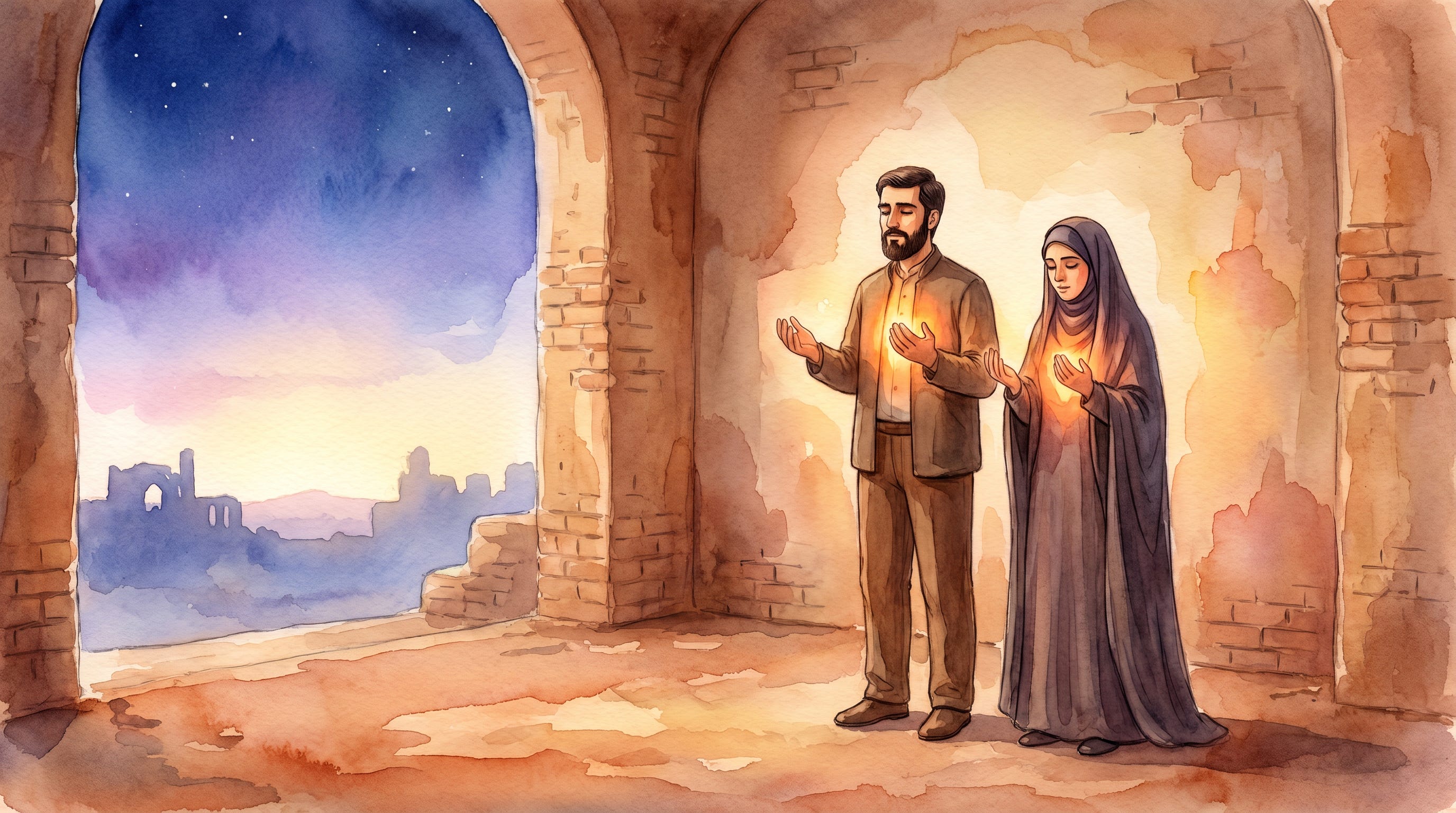
And now I want to put in your hands the weapon — the daily weapon, the one God Himself has placed in the prayer of every believer — by which the refusal we have just spoken of is practised, sustained, and made into the very fabric of who we are.
The testimony we make in every prayer.
لَا إِلَهَ إِلَّا اللَّه
“There is no god, except God.”
Look at the shape of the sentence.
It begins with a negation —
La ilaha, there is no god
— and only then comes the affirmation:
Illa Allah, except God.
The believer first negates — completely, absolutely, without remainder — every false god that might claim a throne in the human heart, and only after the negation is complete does the believer affirm the One God.
Negation before affirmation.
Refusal before allegiance.
The clearing of the chamber before the Throne is named.
And the false gods this testimony negates are not only the carved idols of the Quraysh that the Prophet Muhammad’s grandfather refused to bow to in Mecca.
They are every false sovereign of the human heart.
The inner Yazid.
The inner Pharaoh.
The inner Caesar.
The base desires of the nafs that the Qur’an, in Surah Yusuf, told us commands evil.
The whispers of Satan that counsel the small compromise.
The wealth-as-god of the Khawas of Kufa — and
the comfort-as-god, the position-as-god,
the safety-as-god, the career-as-god,
the family-as-god when family is loved more than the truth that loves the family,
the tribe-as-god, the flag-as-god,
the leader-as-god,
the system-as-god.
Every one of these is an ilah — a god — that claims the chamber of the believer’s heart for itself.
And every time we say La ilaha illa Allah in the prayer — between fifteen and eighteen times in each individual obligatory prayer, and more in the supererogatory — we are not making a polite declaration.
We are performing an act of negation.
We are emptying the chamber.
We are refusing every false sovereign and clearing the seat for the One.
And here is what the daily repetition does.
Du’a al-Nudbah — the Supplication of Lamentation, which we recite every Friday in longing for the return of the Hidden Imam, preserves a sentence the Prophet said to Imam Ali.
The sentence describes what faith does in the bodies of those who carry it fully:
وَالْإِيْمَانُ مُخَالِطٌ لَحْمَكَ وَدَمَكَ كَمَا خَالَطَ لَحْمِي وَدَمِي
“And faith is mingled with your flesh and blood, just as it is mingled with my flesh and blood.”
— The Prophet Muhammad, addressing Imam Ali ibn Abi Talib. Preserved in Du’a al-Nudbah (Mafatih al-Jinan); the originating hadith in Shaykh al-Saduq’s al-Amali, Session 157; Ibn Shahrashub’s Manaqib Aal Abi Talib; Bihar al-Anwar vols. 30, 36, 39. Cross-attested in Sunni source: al-Kanji al-Shafi’i, Kifayah al-Talib, ch. 62, p. 265.
Mukhalata.
Mingled.
Mixed.
Blended.
Inseparable.
The Prophet told the Commander of the Faithful — and through him, told us — that the faith of those who carry it fully is not a coat they put on, not an opinion they hold, not a doctrine they assent to.
It is something in the flesh, in the blood — something the body itself has become.
And here is what we must hear tonight — and we must hear it carefully, because the popular reading misreads the doctrine, and the misreading flattens what the doctrine is actually doing.
In the case of the Prophet and the Imams of guidance, this faith-mingled-with-flesh-and-blood is intrinsic.
It is given.
It is the doctrine the Hawza tradition has called ismah — what the Qur’an itself testifies to in the Verse of Purification:
إِنَّمَا يُرِيدُ ٱللَّهُ لِيُذۡهِبَ عَنكُمُ ٱلرِّجۡسَ أَهۡلَ ٱلۡبَيۡتِ وَيُطَهِّرَكُمۡ تَطۡهِيرٗا
Indeed God desires to repel all impurity from you, O People of the Household, and purify you with a thorough purification.
— Qur’an, Surah al-Ahzab (the Chapter of the Confederates) #33, Verse 33
But hear what ismah is — and what it is not.
Ismah — infallibility — is not the suspension of free will, not a metaphysical inability to sin, not a different kind of being incapable of choice.
If that were what it meant, the Ma’sumin — the infallible — would deserve no praise for their obedience, and the rest of us no censure for our failure — ismah would collapse the moral economy of the universe.
Ismah — as the Hawza tradition has carried it from Shaykh al-Mufid through Allamah al-Hilli, through Allamah Tabataba’i, into the teaching of Ayatollah Jawadi-Amoli today — is lutf, divine grace.
The grace that places into the heart of the Ma’sum such an abundance of the knowledge of God and intensity of love for God that — though they retain the full capacity to sin — the desire to sin has no weight.
The fire of their love is so total that the candles the nafs would offer cannot pull them.
The fuller exposition — Shaykh al-Saduq’s verbatim teaching that the Ma’sum is capable of sin but does not commit it;
Allamah Tabataba’i’s precise architecture that ismah is the perfection of the will through certain knowledge rather than its bypassing; and the pastoral payoff that the Ma’sumin are not a different species of being but the perfected end of the very road the believer is invited to walk — comes, God willing, when we walk together after Arbaeen, with the chain of witness that runs from Sayyedah Zaynab forward into the long ghaybah.
Night Eleven will sit with this doctrine in its fullness.
Tonight, hold the doctrine in its essential form:
The Ma’sum is perfectly human — the human as God made the human to be — and is the perfected end of the very road we are invited, in our daily refusal, to walk.
But in our case — in the case of every believer who is not infallible, who carries the inner Yazid, who knows the nafs commands evil — this faith-mingled-with-flesh-and-blood is something we cultivate, something we practise into, something we say into ourselves around sixty-five times across the five daily obligatory prayers, until what began as words on the tongue becomes substance in the bones.
La ilaha illa Allah, said once, is a declaration.
La ilaha illa Allah, said sixty-five times a day for sixty years, is a body that has become its testimony.
This is jihad al-akbar in its daily practical form — how the believer who is not infallible builds, slowly, the body that can refuse what our beloved Imam Husayn refused; how someone like us learns, prayer by prayer, to say to the inner Yazid the same sentence our Imam said in Medina:
someone like me does not give allegiance to someone like him.
By the time our test comes — and it will come, perhaps in great ways but more often in the small daily ways that Imam Ali warned us about — the question will not be whether we choose to refuse.
The question will be whether the body we have built, prayer by prayer, can do anything else.
This is the chain that runs from the morning prayer in Medina, through the prayer in the midst of arrows our beloved Imam Husayn would offer at Karbala — the prayer Sa’id al-Hanafi shielded with his body, the prayer that ended in the last sajdah — through every Du’a al-Nudbah we have wept on a Friday morning longing for the Imam of our Age, to the prayer we will make tonight, after this sermon, before we sleep.
Every La ilaha illa Allah is a refusal.
Every prayer is a small jihad al-akbar.
Every Friday’s Du’a al-Nudbah is the renewal of the covenant the soul made at al-A’raf, when God asked am I not your Lord? and the soul answered bala — shahidna — yes, we bear witness.
The faith mingles into the flesh through the saying.
The body becomes the testimony through the repeating.
And someone like us, by the mercy of God, becomes the kind of believer who — when the moment comes, small or great — can answer with the sentence that has been mingled into our blood for a lifetime.
La ilaha illa Allah.
There is no god — none, none, none — except God.
All My Deeds, One Devotion
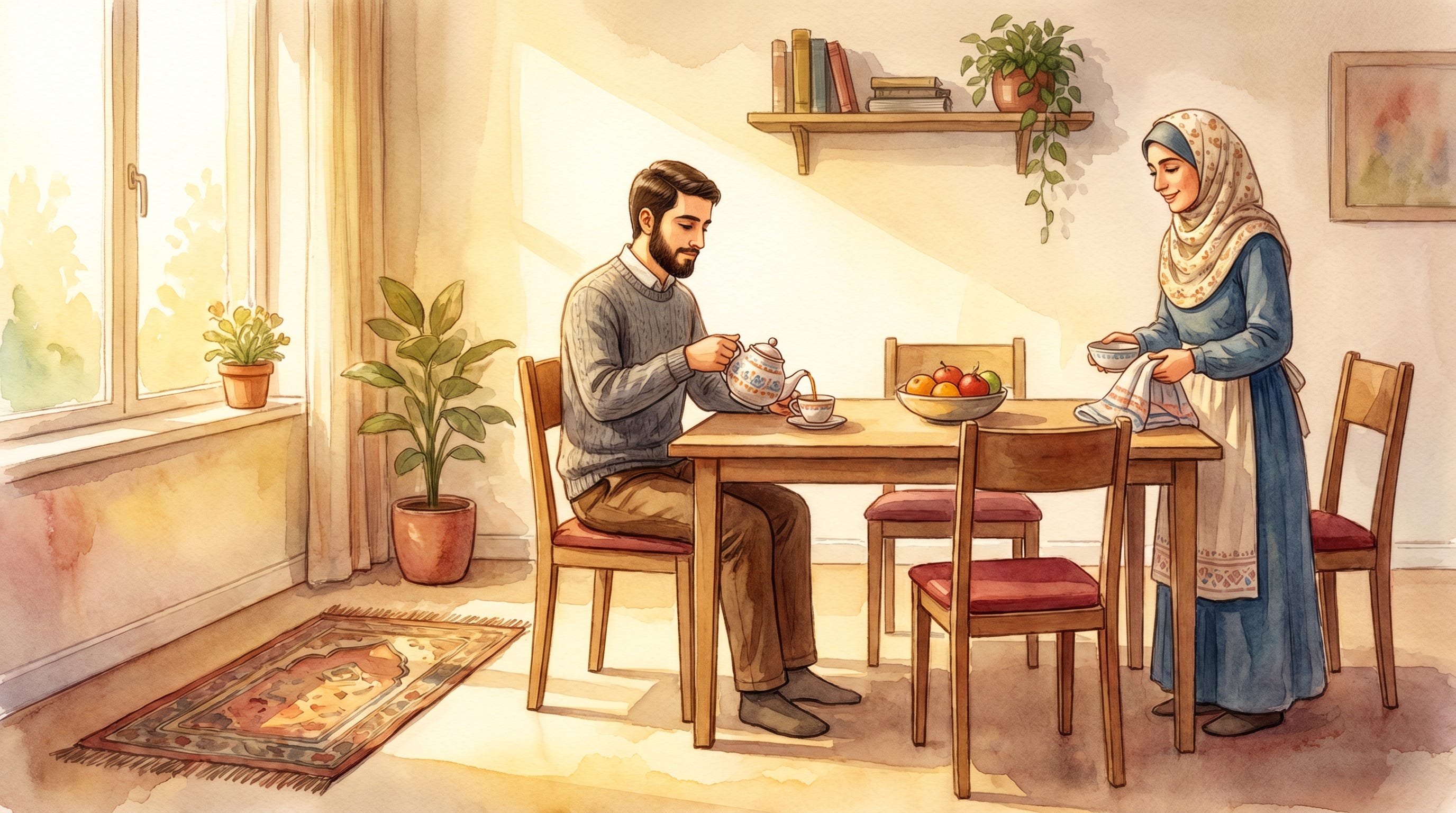
And the negation — la ilaha — clears the chamber.
But the chamber, once cleared, must be inhabited.
The testimony does not end at the negation.
It moves to the affirmation.
And the affirmation — illa Allah — is not the affirmation of a doctrine.
It is the affirmation of a sovereignty that, once accepted in the heart, asks for everything.
Tonight, on the eve of the tenth, I want to hand you the verse that names what the heart is being asked for.
It is the prayer of the Prophet Abraham — the same Abraham whose inheritance our beloved Imam Husayn carries on the day of Ashura.
The Qur’an, in Surah al-An’am — the Chapter of the Cattle — preserves what the Prophet was commanded to declare as the inheritance of Abraham:
قُلْ إِنَّ صَلَاتِي وَنُسُكِي وَمَحْيَايَ وَمَمَاتِي لِلَّهِ رَبِّ الْعَالَمِينَ ۞ لَا شَرِيكَ لَهُ ۖ وَبِذَٰلِكَ أُمِرْتُ وَأَنَا أَوَّلُ الْمُسْلِمِينَ
“Say: Indeed, my prayer, my rites of sacrifice, my living, and my dying are for God, Lord of the worlds. No partner has He. And this I have been commanded — and I am the first of those who submit.”
— Qur’an, Surah al-An’am (the Chapter of the Cattle) #6, Verses 162–163
Hear what kind of declaration this is.
My prayer — that is the easy part.
Of course my prayer is for God.
The believer says La ilaha illa Allah — there is no god, except God — and bows in prayer and the prayer is for God.
My rites of sacrifice — nusuki — the qurban (sacrifice) I offer, the hajj I walk, the offerings I bring.
Also for God.
Also the easy part.
The forms of worship are obviously for the One who set the forms.
But then the verse does something the believer must sit with.
It refuses to stop at the forms.
Mahyaya — my living.
Every breath, every meal, every conversation.
Every minute at the desk, every step on the road.
Every laugh and every sigh.
Every word said to a child.
Every coin counted.
Every choice made when no one is watching.
All of it — for God, Lord of the worlds.
Mamati — my dying.
Not only the moment of my death.
The whole arc of my mortality.
The fact that I am a creature who will end.
The whole shape of my finitude.
For God, Lord of the worlds.
And the verse closes — la sharika lah.
No partner.
Not even a small partner.
Not even the partner we have been training ourselves to deny in the la ilaha of the daily testimony.
The whole life, the whole death, the whole orientation — without a single competing throne in any chamber of any hour.
This is the Abrahamic prayer.
This is what our beloved Imam Husayn inherited from his forefather Abraham and carried into the field of Karbala.
When he prayed his last two raka’at — units — in the midst of arrows, and when he performed his last sajdah saying
raazian bi qadhaaika, mustaslimaan li amrika — contented with Your decree, submitting to Your command
— this is the verse the body was finally inhabiting.
My prayer, my rites, my living, my dying — all of them — for God, Lord of the worlds.
The whole arc of his existence had become the verse he had been carrying in his mouth since Medina.
That is the witness of the heir of Abraham.
And here is what Imam Ali, taught us about how a believer who is not infallible reaches toward that orientation.
Du’a Kumayl — the supplication Imam Ali taught to his companion Kumayl ibn Ziyad al-Nakha’i, which the Shia have recited on Thursday nights for fourteen centuries — preserves a sentence that is the believer’s aspirational answer to Surah al-An’am, verse 162.
حَتَّى تَكُونَ أَعْمَالِي وَأَوْرَادِي كُلُّهَا وِرْداً وَاحِداً، وَحَالِي فِي خِدْمَتِكَ سَرْمَداً
“...so that my deeds and my devotional practices may all become a single, unified devotion, and my state in Your service everlasting.”
— Imam Ali ibn Abi Talib, in Du’a Kumayl. Primary source: Shaykh al-Tusi, Misbah al-Mutahajjid; preserved in Shaykh Abbas al-Qummi, Mafatih al-Jinan, Thursday night supplications.
Look at what Imam Ali is asking for, on our behalf, every Thursday night when we recite this du’a.
A’mali — my deeds.
The mundane, the everyday — the making of a cup of tea, the walking to work, the standing in the supermarket queue.
Awradi — my devotions.
The salat, the dhikr, the recitation, the fasts, the pilgrimages.
And Imam Ali asks God to make these two things — the mundane and the sacred — into one.
Wirdan wahidan.
A single, unified devotion.
The believer who is given this — by God’s mercy — is the believer for whom the line between the everyday and the worshipful has been dissolved.
Whose work, whose cup of tea, whose conversation with a stranger at the bus stop, whose sleep, whose laughter, whose tears — each is a wird, a devotion.
And then — sarmadan — perpetual, continuous, unceasing, like a river that does not stop.
This is what Du’a Kumayl asks.
This is what Surah al-An’am 162 declares.
This is what Abraham inherited into the chain that lands at Karbala.
This is what Imam Husayn carried in his prayer at noon on the tenth.
And this is what someone like us, by the slow work of jihad al-akbar — prayer by prayer, Thursday night by Thursday night, Friday morning by Friday morning — is being shaped toward.
Four practices we hold tonight — and a fifth that closes the cycle when we walk together to mark the fortieth.
Five times a day — the obligatory prayer — we say La ilaha illa Allah, and the testimony is mingled into our flesh and blood.
Every morning — Du’a al-‘Ahd — we renew, with God and with our Awaited Imam, the very first covenant the soul made at al-A’raf when God asked am I not your Lord? and we answered yes, we bear witness.
Every Thursday night — Du’a Kumayl — we ask, with the words of Imam Ali, that our deeds and our devotions may become one continuous orientation.
Every Friday — Du’a al-Nudbah — we weep for the absence of the Hidden Imam and receive into our hearts the mukhalata line about faith mingling with flesh and blood.
And every Arbaeen — Ziyarat Arbaeen — the dedicated visitation text on the fortieth morning, when the chain of witness from Karbala to today reaches its annual seal.
Night Fifteen, God willing, will sit with these supplications in full, on the eve of the walking.
Daily.
Weekly.
Across the cycle of the year.
By these — set within the broader science of self-building, akhlaq, and tazkiyat al-nafs that our tradition has carried across the centuries — does someone like us, who is not infallible, slowly become the kind of believer whose life and death are for God, Lord of the worlds, without a partner, without remainder, without compromise.
This is the practical jihad al-akbar.
This is how the inner Yazid is defeated — not in one heroic moment, but in tens of thousands of small daily ones, repeated over decades, until the body has become its testimony.
Until what was once words on the tongue is, by the mercy of God, substance in the bones.
The Prophetic Teaching on the Greater Jihad
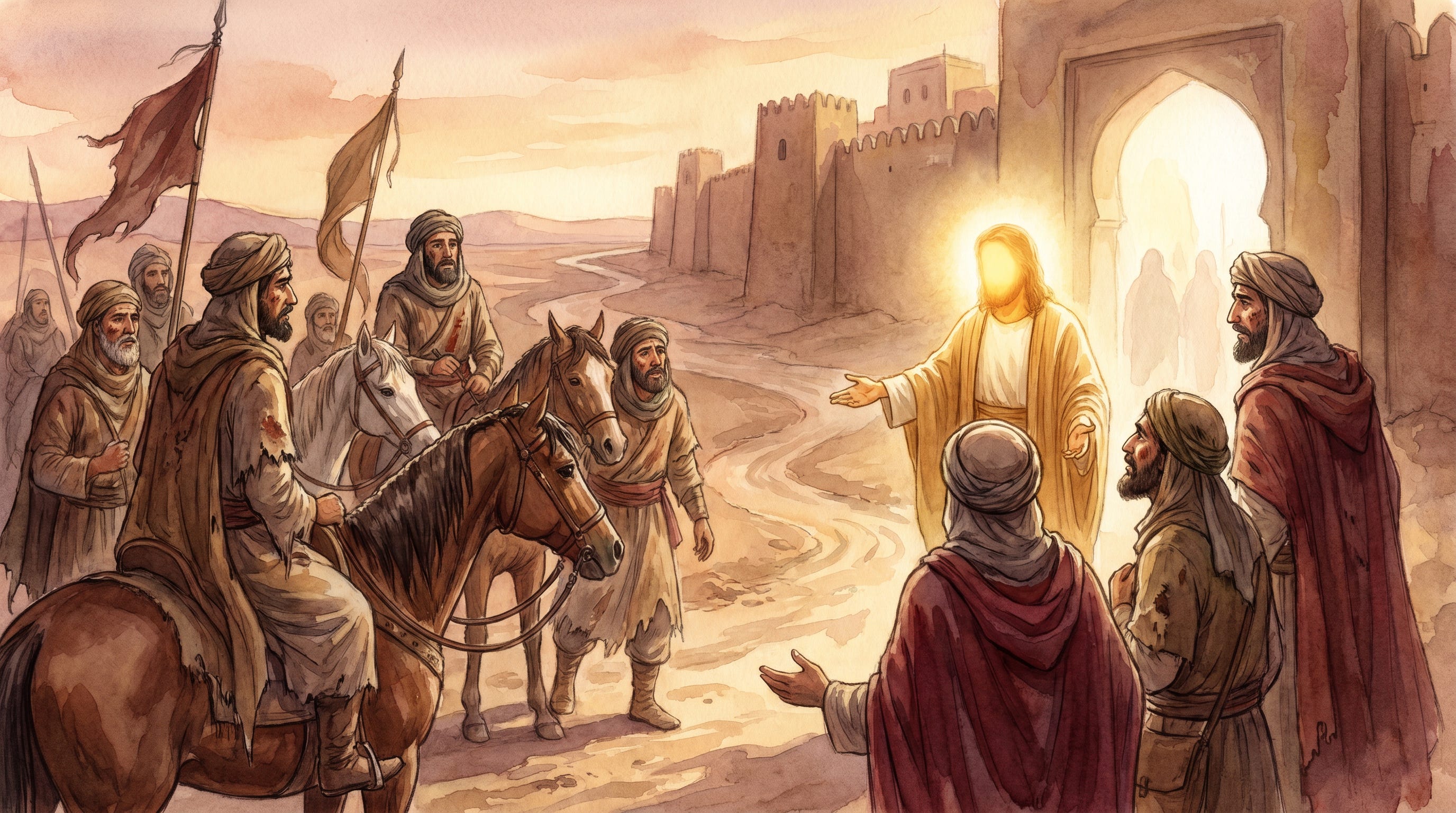
And the Prophet named this work as long ago as the early years of the Islamic call.
The famous narration.
When the Prophet welcomed back his soldiers from a military campaign, he turned to them and said:
رَجَعْنا مِنَ الجِهادِ الأَصْغَرِ إِلَى الجِهادِ الأَكْبَرِ
“We have returned from the lesser jihad to the greater jihad.”
His companions, surprised, asked him what the greater jihad was. He said:
جِهادُ النَّفْسِ
“The struggle of a person against his own nafs.”
— Prophet Muhammad. Preserved in Shaykh al-Saduq’s al-Amali; Bihar al-Anwar vols. 19 and 70; Ma’ani al-Akhbar and al-Khasal of al-Saduq.
The lesser jihad — al-jihad al-asghar — is the outer struggle: the defence of life, family, community, the ummah, against the aggression that comes from outside.
The greater jihad — al-jihad al-akbar — is the inner struggle, the struggle of a person against his own nafs — against his own self.
The Prophet’s order is important.
He does not say the outer jihad is unimportant — he calls it asghar, lesser.
And the inner he calls akbar, greater.
Why?
Because the outer jihad can be performed by a person whose inner jihad has collapsed — and when that happens, the outer jihad does not bring forth what God intends to bring forth from it.
It brings forth, instead, the very evil it was supposed to oppose.
A person who fights the outer Yazid without first having fought the inner Yazid will, sooner or later, become some version of what he was fighting against.
The revolution he wins will install, on the throne his enemy held, the throne his own nafs had been wanting to sit on.
The Prophet knew this fourteen centuries before any revolution of the modern world demonstrated it again.
The inner jihad is the foundation; without it, the outer cannot stand.
Imam Khomeini on Jihad al-Akbar
Imam Khomeini — the leader of the Islamic Revolution and founder of the Islamic Republic, the man whose pen broke the Pahlavi throne and whose lectures from Najaf became the spiritual foundation of a movement — wrote one of his earliest and most beloved works on this very theme.
Jihad al-Akbar: Mubarazah ba Nafs. The Greatest Jihad: Combat with the Self.
Compiled from his lectures to the seminarians at Najaf in the late 1960s and early 1970s, in the years he was building, in the shadow of one empire, what would become the rejection of every empire.
What did he teach the seminarians?
He taught them that the political work they would carry — the work of refusing the Shah, of preparing the Revolution, of building the Islamic Republic — was built upon, and could not exist without, the inner work.
The seminarians who would carry the outer struggle of the Revolution could not do so unless they had first carried the inner struggle of their own selves.
And the warning he gave them — and that we must hear tonight — is severe.
A revolution built by people who have not yet defeated their inner Yazid will, in the end, install an inner Yazid on the outer throne.
And then what the revolutionaries threw out the door will return through the window.
That is my reading of Imam Khomeini’s framework — the structural argument of his treatise, paraphrased rather than verbatim.
The exact verbatim of the lectures sits in Jihad al-Akbar in any edition the believer wishes to read.
The structural argument is this: the inner jihad is the precondition of the outer.
And the believer who would refuse the empires of the world must first refuse the empires of the heart.
Imam Khamenei — Ashura as the Perfect Manifestation
And Imam Khamenei returned to this theme across almost forty years of leadership.
One statement of his — repeated in many forms before every Muharram, foundational to his annual address theme to the eulogists and the public — captures it cleanly.
Hear what he taught us about Ashura itself:
عاشورا مظهر کامل جهاد با نفس و جهاد با دشمن است. آن کسانی که در کربلا با حسین بن علی (علیهالسلام) ماندند و آن حماسه را آفریدند، پیش از مقابله با شمشیرهای دشمن، بر نفس خود، بر ترس خود، و بر دلبستگیهای دنیوی خود پیروز شدند. آنها جهاد اکبر را به کمال رساندند که توانستند در جهاد اصغر، آنگونه بینظیر بایستند.
“Ashura is the perfect manifestation of both the jihad against the self — the inner jihad — and the jihad against the enemy. Those who stayed with Husayn ibn Ali, in Karbala and created that epic had, prior to facing the swords of the enemy, already conquered their own selves, their fears, and their worldly attachments. They brought the Greater Jihad to its perfection, which is precisely why they were able to stand so unparalleled in the Lesser Jihad.”
— Imam Sayyed Ali Khamenei, foundational annual address theme to eulogists and the public before Muharram.
Hear what this teaches.
The seventy-two who stood with our beloved Imam Husayn at Karbala — Habib ibn Muzahir, Burayr ibn Khudayr, Zuhayr ibn al-Qayn, Sa’id ibn Abdullah al-Hanafi, Muslim ibn Awsajah, and all the others — these were not men who happened, by some accident of geography or coincidence of biography, to find themselves in the right place at the right moment.
They were men who had already won the inner jihad, in the years and the decades that preceded Karbala.
By the night of Ashura, the bodies they brought to the field were bodies that could not have done otherwise.
The greater jihad had been won, prayer by prayer, refusal by refusal, in the long quiet years before anyone knew what those bodies were being prepared for.
And when the day came — when the moment of the lesser jihad arrived — there was nothing left in them to compromise with.
This is what makes them the lamps that would not flicker.
This is the perfect manifestation of both jihads — the jihad against the self perfected over a lifetime, the jihad against the enemy completed in a single hour.
The Theology Walked — When the Greater Jihad Took Flesh
And every theology must, at some point, answer one question:
Does this walk in human bodies, or is it just talk?
The Hawza tradition we have just walked through — from the Prophet, through Imam Ali, through Imam Khomeini in Najaf, through Imam Khamenei in Tehran — gave us the doctrine, the architecture, the diagnostic.
And then God gave us a generation of believers who lived it.
The theology written in the Hawza walked in the flesh of the Resistance.
It was the sleepless eyes of Hajj Qasem Soleimani — the Commander of the Hearts, the man whose name the Americans needed a drone strike to silence at Baghdad airport in January of 2020.
It was the twenty-five-year silence of Hajj Imad Mughniyeh — who did the work without his name on it, without his image on it, until even the most sophisticated intelligence apparatus in the world could not see him, because there was no “I” left to be seen.
It was Sayyed Abbas al-Musawi, refusing the palaces of the comfortable — climbing into the pulpit instead, anchoring himself in Imam Ali’s letter to his governor in Basra, fourteen centuries before, and refusing the leaders of his own day who had forgotten that letter.
It was Sayyed Hassan Nasrallah, winning the battle in the mihrab of the night prayer before he ever won it in the trench of Tammuz — teaching, across forty years of weekly addresses, that the victory of two thousand and six had nothing to do with the abundance of weapons.
It was Shaykh Naim Qassem, naming the Resistance itself as spiritual discipline.
Five lives.
One architecture.
The same theology Imam Khomeini wrote in Najaf and Imam Khamenei explained in Tehran — walked in the flesh of those who carried the body Sayyedah Fatimah al-Zahra, handed forward into history.
And of those who walked it — hear one sentence.
It was written by Hajj Qasem to his daughter Fatimah, in the years he was awake.
يا ابنتي أنا تعبان جدا. لم أنم منذ ثلاثين عامًا، لكني لا أريد أن أنام بعد الآن أيضا. أذرّ الملح في عيني حتى لا يجرؤ جفني أن يطبق كي لا يقطع رأس ذاك الطفل العاجز في غفلتي.
“O my daughter, I am so tired. I have not slept for thirty years — but I do not wish to sleep any longer either. I sprinkle salt in my eyes so that my eyelid dares not close — lest that helpless child’s head be cut off in my negligence.”
— Hajj Qasem Soleimani, letter to his daughter Fatimah, published posthumously by ISNA Iran, 2021.
This is what jihad al-akbar looked like in the body of one of the great commanders of our age.
Not asceticism for its own sake — asceticism so that the heart could be free enough to weep, and the body alert enough to act, when a single child in Aleppo, Mosul or elsewhere needed someone awake on her behalf.
The seventy-two who stood with our beloved Imam Husayn at Karbala won the inner jihad.
The Resistance Leaders of our own age won the inner jihad in their generation.
They walked the road.
The theology took flesh.
The fuller telling waits — across the Arbaeen sessions, God willing.
Tonight, hold the architecture: the theology took flesh in our own age.
But every theology that walks must also reckon with its shadow.
The Warnings of Ashura — How the Khawas (Elites) Failed
And there is a shadow to this teaching — the companion to it, the one Imam Khamenei gave us in his most uncomfortable lecture on Ashura: the Ebrat-haye Ashura, the Warnings of Ashura, delivered to the commanders and veterans of the 27th Mohammad Rasulullah Division on 10 June 1996.
The seventy-two won the inner jihad — that is why they could stand.
But the Khawas of Kufa — the elites, the notables, the men of position and learning who had once written letters of allegiance to our beloved Imam — lost the inner jihad.
That is why they could not stand.
And the diagnostic of their failure is the most uncomfortable warning Imam Khamenei ever delivered about Ashura.
اگر خواصِ طرفدارِ حق، جانشان را، راحتشان را، مقامشان را، فرزندانشان را، پولشان را، بیشتر از حفظ حق بشناسند و دوست بدارند... در وقت خطر، در وقت امتحان، در وقت جهاد اکبر و جهاد اصغر، از خود ضعف نشان دهند... آن وقت واقعهی عاشورا به وجود میآید و حسینبنعلیها به مسلخ میروند.
“If the elites who support the truth value and love their lives, their comfort, their positions, their children, and their wealth more than the preservation of the truth... if in the moment of danger, in the moment of the test, in the moment of the Greater Jihad and the Lesser Jihad, they show weakness... then the event of Ashura occurs, and the Husayn ibn Alis are sent to the slaughterhouse.”
— Imam Sayyed Ali Khamenei, Warnings of Ashura / Ebrat-haye Ashura, address to the commanders and veterans of the 27th Mohammad Rasulullah Division, 20 Khordad 1375 SH / 10 June 1996.
Hear what kind of sentence this is.
The killing of Imam Husayn at Karbala was not done only by the swords of Ibn Sa’d’s army — it was done also by the slow, daily, almost invisible weakening of the people of Kufa who had once written the eighteen thousand letters of allegiance.
They had not become enemies; they had merely become tired, comfortable, valuing their wealth and position and their children’s safety a little too much — more than they valued the truth.
And by the time the test came, there was nothing left in them to refuse with.
The eighteen thousand letters from Kufa were written by the very same people who, eight weeks later, stood in Ibn Sa’d’s army or sat in the back streets of Kufa with their doors locked.
The same people.
Not different people.
The same hearts that had said yes had — without the people noticing — already lost the strength to keep saying yes when saying yes cost something.
And Imam Ali named the diagnostic principle centuries before Imam Khamenei did.
أَشَدُّ الذُّنُوبِ مَا اسْتَهَانَ بِهِ صَاحِبُهُ
“The greatest sin is the one the doer considers small.”
— Imam Ali ibn Abi Talib, Nahj al-Balagha, Saying 348 (Subhi Salih edition). Also preserved in Ghurar al-Hikam wa Durar al-Kalim of al-Amidi, hadith #773.
The Khawas of Kufa did not see their love-of-wealth, their love-of-comfort, their love-of-position, their love-of-safety-for-their-children as great sins.
They saw these as — at most — small compromises.
The small concession to wealth.
The small holding-back from the dangerous truth.
The small turning of the face from the man in the desert.
But Imam Ali had already named what these were.
The sin treated as small is the sin that does its worst work — because it is never resisted, never repented, never carried to God.
It accumulates.
It hardens.
It becomes the soil out of which a great sin grows.
And when the great moment comes — the moment of Ashura, the moment when truth needs us to refuse with our whole self — the soil that has been built out of small compromises will not hold.
The Husayn ibn Alis of every age are sent to the slaughterhouse not by villains, but by good people who let their small sins grow into the inability to refuse.
And so — when we ask ourselves tonight what jihad al-akbar looks like in our own lives — the first place we look is at the sin we have been treating as small.
That one — the one we have been telling ourselves does not matter — is the one we must, by the criterion of our beloved Imam Husayn and the diagnostic of Imam Ali, treat as the greatest.
Because that is precisely what it is.
Imam Ali also taught us about the station that follows.
The sin that grieves us is itself a station.
سَيِّئَةٌ تَسُوءُكَ خَيْرٌ عِنْدَ اللَّهِ مِنْ حَسَنَةٍ تُعْجِبُكَ
“A sin that grieves you is better in the sight of God than a good deed that makes you proud.”
— Imam Ali ibn Abi Talib, the Commander of the Faithful, Nahj al-Balagha, Saying 46.
Better a heart broken by acknowledged sin than a heart inflated by an obedience that has lost its sincerity.
The first half of the criterion asks us: where is your refusal?
The second half asks us: which of your sins have you been treating as small?
Both questions are asked, every day, by the criterion of Karbala; both must be answered honestly.
The seventy-two stood because they had refused their inner Yazid in a thousand small daily battles.
The Khawas of Kufa fell because they had treated those battles as small.
And we — tonight, on the eve of the tenth — choose which side of that ledger we will spend the rest of our lives writing ourselves into.
Imam Ali on the Greatest Jihad
And Imam Ali did not leave us only the diagnostic of failure.
He gave us the lock that is also the way forward.
جاهِدْ نَفْسَكَ عَلى طاعَةِ اللّهِ مُجاهَدَة العَدُوِّ عَدُوَّهُ، وغالِبْها مُغالَبَةَ الضِّدِّ ضِدَّهُ، فَإنَّ أقْوىَ النّاسِ مَنْ قَوِيَ على نَفْسِهِ
“Fight against your soul in obedience to God the way an enemy would fight his enemy, and overpower it the way a rival would overpower his opponent — for indeed the strongest person is the one who subdues his self.”
— Imam Ali ibn Abi Talib, the Commander of the Faithful, Ghurar al-Hikam wa Durar al-Kalim of al-Amidi, Topic 86, Section 16.
Fight against your soul the way an enemy would fight his enemy.
Imam Ali — the man who at the Battle of Khaybar lifted a gate single-handed, the man whose sword at Badr and Uhud and Khandaq turned the tide of the early battles of Islam — that man tells us that the strongest person, the aqwa al-nas, is not the man who can fight his outer enemy.
The strongest person is the man who can fight his inner self.
Every Day Is Ashura — Revisited
And so.
Every day is Ashura. Every land is Karbala.
The Dr Shariati frame from the fourth night.
Now lands in its fullest meaning.
It is Ashura every day because the criterion is applied every day.
It is Karbala every land because the field of the inner jihad is wherever you are standing right now.
The criterion does not retire after Muharram.
The criterion was not closed when Imam Husayn fell.
The criterion is the air the believer breathes.
The Empire Begins in the Heart
And here is the structural payoff that closes tonight.
If we do not control the Yazid inside us — if we do not refuse the Pharaoh in our nafs, if we do not turn the staff against the empire in our own heart — then what is inside us will, eventually, pour out.
And what pours out is exactly the evil the empires perform on the outside.
The empires of the world are not in the world.
The empires of the world begin in the heart that refused its own jihad.
The American empire did not start in Washington.
The American empire started in every American heart that, given the option between tawhid and consumption, chose consumption.
The Zionist regime did not start in Tel Aviv.
The Zionist regime started in every heart, of any tradition, that chose the tribe over the truth.
The takfiri network did not start in Raqqa.
It started in every heart that chose the ease of declaring an enemy over the labour of seeing a brother.
The British empire did not start in Whitehall.
It started in every English heart that, given the option between Christ and conquest, chose conquest.
Every empire of the world is built out of the small choices of unconverted hearts.
And the work of the criterion — the work Imam Husayn has been asking of us for thirteen and a half centuries — is the work of converting our own hearts before the empire of any age can build itself out of them.
That is the criterion, fully applied.
That is jihad al-akbar.
That is the work that begins tonight, after this sermon, in the chamber of every one of us.
The Criterion — and the Pause
Imam Husayn is the criterion — for the empire out there and the empire in here.
The criterion is continuous, for every day of the rest of our lives.
And the work of the criterion is never only out there; it begins, every morning, in the chamber Imam Ali called the trench of the self.
And now — having received what we have received — we pause.
We have walked nine nights together; tonight is the tenth.
After tonight — for about five weeks, while the candle continues — the pulpit closes.
The work is now in your life.
Arbaeen is coming.
Arbaeen is on the 20th day of Safar — the 40th day after Imam Husayn, the Master of Witnesses, fell at noon on the tenth.
About five weeks from tonight.
We will gather again from the eve of the 15th of Safar — to walk the last five nights of the road that ends at the body of our Imam on Arbaeen morning.
We return because the story does not end at noon on Ashura.
There is a witness after the witness.
And her name is Sayyedah Zaynab.
About five weeks from now, we will begin again at the body of our beloved Imam — not at noon, but at evening, when the sister stands over him and refuses to leave.
That is the road ahead.
The Pact We Make Tonight
Three propositions to carry through the five-week silence between Ashura and the start of the Arbaeen sessions on the eve of the fifteenth of Safar.
First.
We know the criterion.
We have walked nine nights to learn how to weigh.
Tonight we have learned what we weigh against.
We will not call any death shahada that does not stand the test of Imam Husayn.
We will not bless the word until we know it.
Second.
We name the empires — and we name them as systems, not as men.
We will not flinch from naming what the imperial counterfeit looks like in our own age.
The witness against the regimes IS the witness for the peoples.
We honour the peoples by naming what the regimes have done in their name.
We name the system that has lost its godliness.
We do not collapse the system to the leader at its head; we name what an unchecked self becomes when given an empire.
Third.
We pledge the daily refusal.
The criterion is not for the great moments.
The criterion is for tonight, after this sermon, before we sleep — and tomorrow morning, and the morning after that, and every morning for the rest of our lives.
We will say La ilaha illa Allah — there is no god, except God — with the full negation of every false sovereign of the heart, and the full affirmation of the One.
We will fight the inner Yazid as Imam Ali told us to fight him — as an enemy fights his enemy.
We will treat no sin as small.
We will weep, when God’s mercy lifts us to it, the sin that grieves us — and we will not be made proud by any deed that does not also humble us.
Three propositions: the criterion, the empires, the daily refusal.
By God’s mercy, we will carry these for five weeks — until the eve of the 15th of Safar, when we return for The Witness After the Witness, our next teacher Sayyedah Zaynab.
By God’s mercy, the bodies that walk back into this room will be a little more like the bodies that stood with Imam Husayn at Karbala — and a little less like the bodies that stayed home in Kufa.
And the question we carry home with us — the question this series began with on the first night, the question we ask tonight in the broken voice of the Imam who comes after — is the question God asked Cain on the empty field, after the first qurban:
Where is your brother?
The question Abel’s blood has been asking the earth ever since.
Are we still walking, brother?
Or have we let the small sins grow into the inability to refuse?
Or have we stayed in Kufa with the doors locked, and let the Husayn of our hour go alone to the desert?
Tonight we received the criterion.
The criterion is now in our hands.
The walking is what comes next.
The Last Sajdah
And now, the maqtal opens the door we have been standing at all night.
In a moment we will hear the day of Ashura — as the Imam who comes after has carried it, behind the veils of ghaybah, for thirteen and a half centuries.
The morning prayer at Karbala.
The address to the army.
The going-out of the family one by one — Muslim and Hurr and Wahab, the four cherry blossoms of the morning, Habib and Burayr and Zuhayr and Sa’id and Muslim ibn Awsajah, al-Abbas, the suckling infant — every name we have wept for across nine nights, walking out, one by one, until our beloved Imam stands alone in a field of his own family.
The cry that returned no answer.
The final prayer in the midst of arrows — the prayer Sa’id ibn Abdullah al-Hanafi shielded with his body — the prayer that ended in the last sajdah of the religion.
Raazian bi qadhaaika, mustaslimaan li amrika — contented with Your decree, submitting to Your command.
The fall.
The body folded around the infant.
The trampling.
And, after the silence the trampling makes, the recovery — from Sayyedah Zaynab who has been the structural pivot of this series since the eighth night.
Ma ra’aytu illa jamilan — I saw nothing but beauty — in the broken voice that will close the maqtal.
Then the closing benediction, in a voice that — by the time the maqtal reaches its last words — will be different from the voice we have heard for ten nights.
Listen.
Segue to Maqtal (Lamentation)
Maqtal (Lamentation) for the Tenth Night of Muharram 2026/1448
Supplication
In Your name, O God — Lord of the worlds.
Peace upon Habil, the first witness of the earth.
Peace upon every witness in every tradition who refused to bow to other than God.
Peace upon every man and every woman who has been wronged, expelled from their home, only because they said: our Lord is God.
O God — we have nowhere to go but Your door.
O God — by the inheritance of Adam, of Noah, of Abraham, of Moses, of Jesus, of our master Muhammad that came to rest in the body of our beloved Imam Husayn: accept tonight’s sitting.
Make us heirs of the heir.
Make us walkers of the road.
Make us pray-ers of the prayer the Master of Witnesses prayed at noon on the tenth.
Peace upon Adam, the chosen one of God.
Peace upon Abel, the first qurban the earth received — and peace upon every brother whose blood, since then, has asked the question.
Peace upon Noah, who called his people night and day, and whose ark carried the seed forward.
Peace upon Abraham, the friend of God — and upon Ishmael, the son spared so that the son to come would, by God’s decree, be the great sacrifice the angel promised.
Peace upon Moses, who spoke with God, and upon his brother Aaron.
Peace upon their staff, raised against Pharaoh.Peace upon Jesus son of Mary, the spirit of God — and peace upon his mother Mary, the truthful one.
Peace upon David and upon Solomon, upon Zechariah and upon his son John the Baptist.
Peace upon every prophet whose name we know, and every prophet whose name only You know.
Peace upon our master Muhammad, the beloved of God.
Peace upon his daughter, Sayyedah Fatimah al-Zahra, the chief of the women of the worlds.Peace upon the Commander of the Faithful, Imam Ali ibn Abi Talib — who taught us, in his Ghurar al-Hikam, that the strongest person is the one who subdues his own self.
Who taught us, in his Nahj al-Balagha, that the greatest sin is the one the doer considers small.
Who taught us, on a Thursday night with Kumayl ibn Ziyad in the cemetery of Kufa, the supplication we still recite — the plea for wirdan wahidan, that our deeds and our devotions may all become one continuous devotion.Peace upon Imam Hasan, the patient one.
Peace upon our beloved Imam Husayn, the Master of Witnesses.
And we ask You, O God — by his blood, by his prayer in the midst of the arrows, by his last sajdah, by every wound the chronicles count and every wound only You count — make us of his friends.
Peace upon his sister Sayyedah Zaynab, the witness after the witness — who watched what no sister should be asked to watch, and who answered the tyrant of Kufa with the line our series has carried since the eighth night: I saw nothing but beauty.
Peace upon Sayyedah Fatimah al-Sughra and Sayyedah Sakinah and Sayyedah Ruqayya — the daughters who walked the captives’ road.
Peace upon Sayyedah Rabab, the mother of the suckling infant — who would not leave the grave for a year.
Peace upon Sayyedah Umm al-Banin, the mother of al-Abbas — who sent the four moons of her household and did not, when the news came, weep for her own sons until the men of the household had wept first for our beloved Imam.
Peace upon al-Abbas ibn Ali, the moon of the Banu Hashim.
Peace upon Ali al-Akbar.
Peace upon Qasim ibn al-Hasan.
Peace upon Aun and Muhammad, the sons of Sayyedah Zaynab and Abdullah ibn Ja’far at-Tayyar.
Peace upon Ali al-Asghar, the suckling — whose throat the arrow found in his father’s arms.
Peace upon every member of the family of the Prophet who fell on the desert of Karbala.
Peace upon Muslim ibn Aqil — the ambassador who fell in Kufa.
Peace upon Hurr — who turned at the last hour.
Peace upon Wahab al-Kalbi — the convert, with his mother and his wife at the tent.
Peace upon Habib ibn Muzahir — the elder, who laughed in the morning of Ashura.
Peace upon Burayr ibn Khudayr — the doyen of the reciters.
Peace upon Zuhayr ibn al-Qayn — who turned at Zubala.
Peace upon Sa’id ibn Abdullah al-Hanafi — whose body took the arrows for the prayer.
Peace upon Muslim ibn Awsajah — the resolute.
Peace upon every name the chronicles preserve and every name only You preserve.Peace upon the Imams of guidance — Imam Sajjad and Imam al-Baqir, Imam al-Sadiq and Imam al-Kazim, Imam al-Rida and Imam al-Jawad, Imam al-Hadi and Imam al-Askari until the chain reaches the Imam of our Age.
Peace upon Sayyed Abbas al-Musawi — who taught us the condition for God’s guardianship and the lesson of Imam Husayn.
Peace upon his wife Sayyedah Siham, and upon their five-year-old son Sayyed Husayn, who were martyred with him on the sixteenth of February, 1992, in the south of Lebanon.
Peace upon Shaykh Ragheb Harb.Peace upon Hajj Qasem Soleimani — the lover of eshgh, the seeker of ma’rifat, the shaheed whose blood the Americans spilled at Baghdad airport on the third of January, 2020.
By Your mercy, raise him with our beloved Imam Husayn.
By Your mercy, make us of those who learned from him.Peace upon Hajj Imad Mughniyeh — the architect of the Islamic resistance — martyred in Damascus in February of 2008.
Peace upon Hajj Abu Mahdi al-Muhandis — martyred on the same night as Hajj Qasem, at the same airport, by the same hand.
Peace upon Sayyed Hassan Nasrallah — Sayyed of the Resistance — martyred on the 27th of September, 2024 — by the same regime that has stolen the name of the Jewish people to commit what it commits.
Peace upon Imam Khomeini — who taught us, in his Jihad al-Akbar, that the inner struggle is the foundation of the outer; and who, in his Hukumat-e Islami, taught us na sharqi, na gharbi — neither East nor West.
Peace upon Imam Khamenei — who carried the same lamp for forty years and who, in his final address eleven days before they killed him in February of this year, said exactly what our beloved Imam Husayn said in Medina: someone like me does not give allegiance to someone like him.
O God.
We pray to You for Imam Sayyed Mujtaba Khamenei — the new Wali al-Faqih, the son who has taken his father’s place at the head of the worship.
Preserve him for us, O God. Strengthen him.
Guide him.
Make him the leader his father trained him to be, and the leader You have appointed him to be, until the Imam of our Age returns and the line he carries is handed back to its rightful holder.Peace upon the children of Minab and the young men of the Resistance — every Palestinian, Lebanese, Iraqi, Iranian, Yemeni, Syrian, Bahraini fighter who took his father’s place and his grandfather’s burden in his hands.
Peace upon the medics in Gaza who stayed when everyone else left.
Peace upon the Sunni families of Boukamal who wrote to Hajj Qasem after the liberation operation.
Peace upon every defender of the shrines.Peace upon the children of Gaza — every one of them — the children the empire has killed for two and a half years now in front of our eyes.
Peace upon the women of Gaza.
Peace upon the mothers.
Peace upon the orphans.
Peace upon the displaced.Peace upon every wronged person in every land — the Yemeni mother, the Iraqi father, the Bahraini sister, the Kashmiri grandmother, the Rohingya child — who has been wronged because they said our Lord is God.
O God. Hasten the return of the Imam of our Age.
Make us of his helpers.
Make us of his soldiers.
Make us of those who, when he calls, are already standing.
Let us, O God, before we leave this room — and before this sermon turns into the maqtal — recite the three verses we recite at the close of every gathering.
إِنَّا لِلَّهِ وَإِنَّا إِلَيْهِ رَاجِعُونَ
“Indeed, we belong to God, and to Him we return.”
— Qur’an, Surah al-Baqarah (the Chapter of the Cow) #2, Verse 156
وَسَيَعْلَمُ الَّذِينَ ظَلَمُوا أَيَّ مُنقَلَبٍ يَنقَلِبُونَ
“And the wrongdoers will soon know at what goal they will end up.”
— Qur’an, Surah al-Shu’araa (the Chapter of the Poets) #26, Verse 227
حَسْبُنَا اللَّهُ وَنِعْمَ الْوَكِيلُ
“God is sufficient for us, and He is the best of guardians.”
— Qur’an, Surah Aal Imran (the Chapter of the Family of Imran) #3, Verse 173
And our final pledge tonight, before the maqtal begins —
“O God — we will return.
By Your mercy, on the eve of the 15th of Safar — five nights before Arbaeen, forty days from this morning — we return.
To the body of Your Master of Witnesses.
To the sister who survived him.
To the road that does not end at noon on Ashura.
We will return.
Amen.”Amen, O Lord Sustainer of the Universes.
Amen, O Most Merciful of the Merciful.
And from Him alone is all ability, and He has authority over all things.
Salaam alaykum Shaykhna, plz publish the muharram series. They were excellent and very beneficial. I would be glad to edit or help in any way I can. Ws
The Furqan in the Qur’an NEVER refers to the Qur’an or the Kitab. That is why Moses is given Kitab & Furqan. The Furqan represents Adalah in the 5 Usool Ad Din. The Furqan is an aspect of the paternity of the supreme reality manifested in the Imam.