
In His Name, the Most High
This is session three in our four-part Fatimiyyah 2026/1448 series, “Fruit of the Heart,” on raising our children — based on the Qur’an, the Tradition of the Ahlulbayt (peace be upon them), and guidance drawn from the teachings of the martyred leader, Imam Sayyed Ali Khamenei, may God rest his pure soul.
It follows Night 1, “Before the Heart Hardens: The Soil, the Seed and the Fitrah,”, Night 2, “A Beautiful Growth: Love and Limits” and last year’s Fatimiyyah series, “Wilayah in the Home,” on marriage and the family.
Each night builds on the one before it, so readers are encouraged to take them in order.
إِذۡ تَلَقَّوۡنَهُۥ بِأَلۡسِنَتِكُمۡ وَتَقُولُونَ بِأَفۡوَاهِكُم مَّا لَيۡسَ لَكُم بِهِۦ عِلۡمٞ وَتَحۡسَبُونَهُۥ هَيِّنٗا وَهُوَ عِندَ ٱللَّهِ عَظِيمٞ
“When you were receiving it on your tongues, and were mouthing something of which you had no knowledge, supposing it to be a light matter, while it was a grave [matter] with God.”
— Qur’an, Surah al-Nur (the Chapter of the Light) #24, Verse 15; the English, Ali Quli Qarai’s
Received on the Tongue
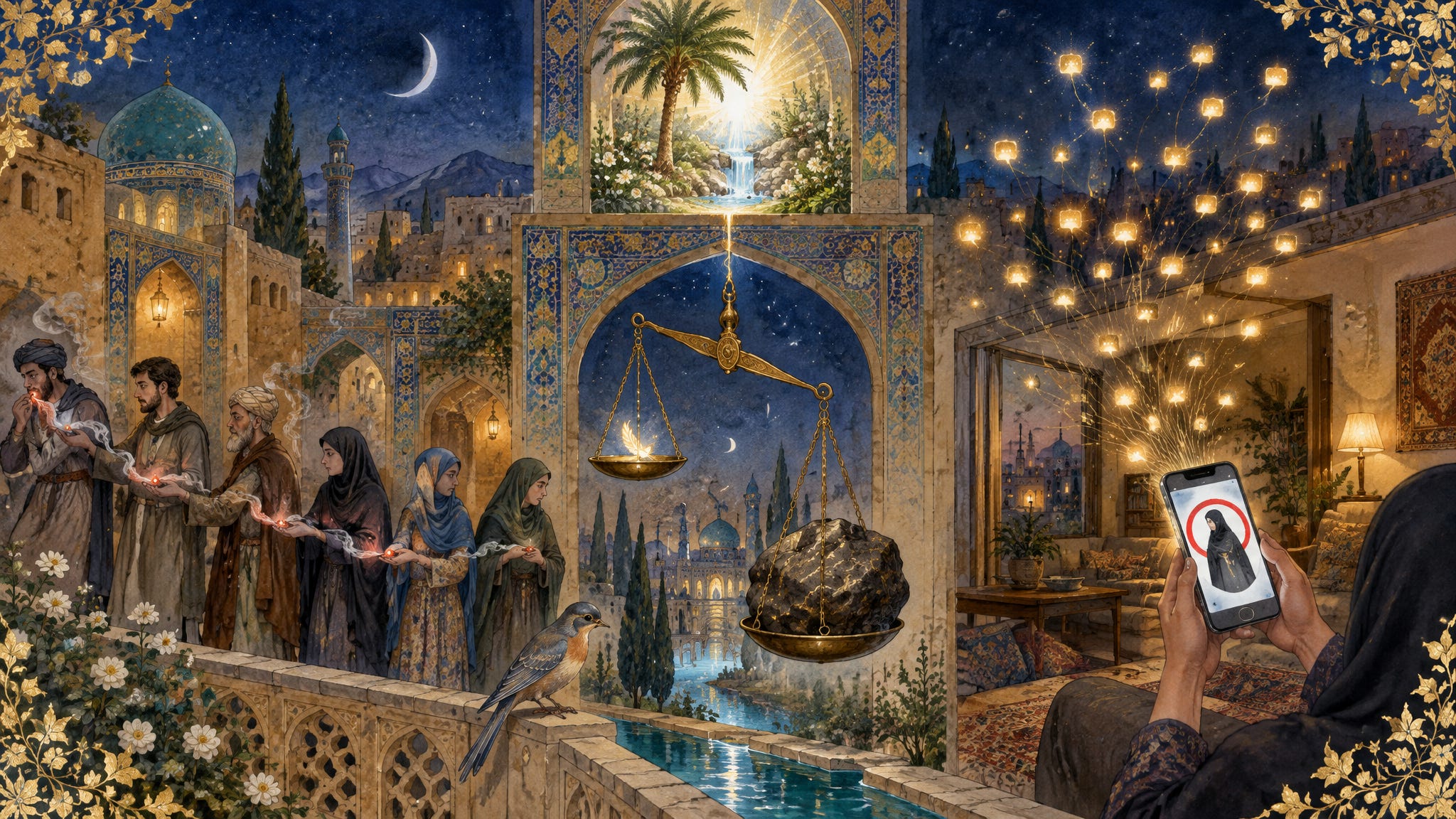
I want to begin tonight with one word in this verse.
The word is tongues.
The verse belongs to a passage in Surah al-Nur about a slander that went round Medina.
I am not going to enter tonight into the old argument over whom it concerned.
Tonight I want only what the verse tells us about how a slander travels.
Listen to it again.
When you were receiving it on your tongues.
Not hearing it with your ears.
Receiving it on your tongues.
A piece of news is meant to come in through the ear, pass through the mind, and only then — if it survives the mind — reach the mouth.
This one never went near a mind.
It was caught on one tongue and thrown to the next.
Mouth to mouth.
Like something passed hand to hand down a line, and nobody in the line stopping to look at what they were holding.
And were mouthing something of which you had no knowledge.
The verse does not say they lied.
It says they did not know.
In a way that is harder to hear — because every one of us has done it.
We did not invent the story.
We only passed it on.
Supposing it to be a light matter.
It was only a message.
Only what people are saying.
Only a forward.
Think how a thing like that travels now.
A screenshot.
A voice note.
A photo with a circle drawn round somebody’s daughter.
It arrives with I’m not saying it’s true, but — and a minute later it leaves with the same words, to thirty more.
Nobody in the chain believes he has done anything.
Each of them only passed it on.
While it was a grave matter with God.
Light with us; grave with God.
That is the distance tonight is about — the distance between how we pass a thing on, and how God weighs it.
It was there in Medina.
It was there when the Blessed Saint Mary, peace and blessings be upon her, came home to her people.
And it is in our own houses, on our own phones, tonight.
Hold on to that word — tongues.
By the end of the night we will need it again.
Her People, and the Child Who Spoke for Her
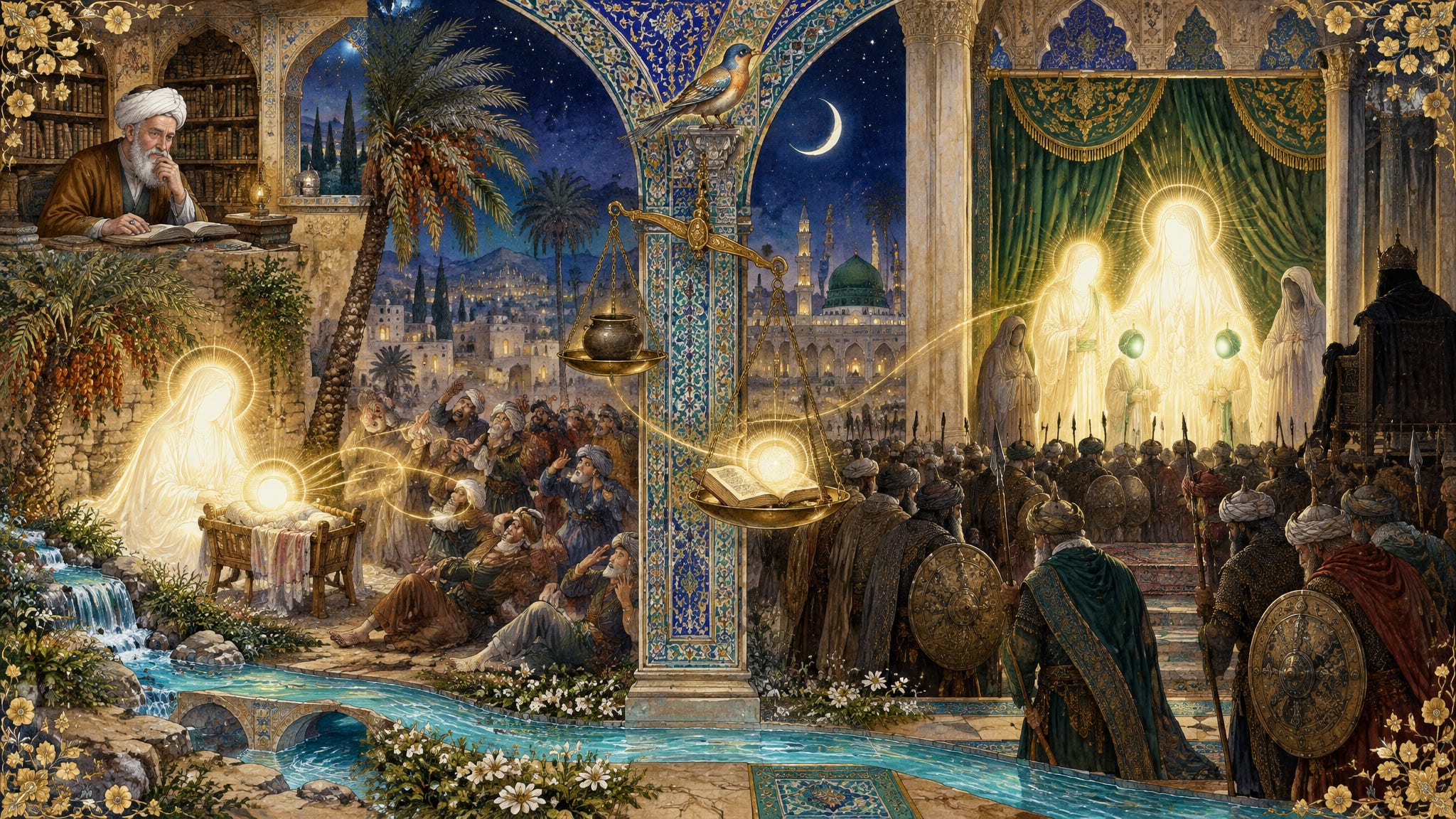
Last week we left the Blessed Saint Mary, peace and blessings be upon her, in her sanctuary — with the guardian who found something there he could not explain, and asked her where it came from before he judged her.
فَتَقَبَّلَهَا رَبُّهَا بِقَبُولٍ حَسَنٖ وَأَنۢبَتَهَا نَبَاتًا حَسَنٗا وَكَفَّلَهَا زَكَرِيَّاۖ كُلَّمَا دَخَلَ عَلَيۡهَا زَكَرِيَّا ٱلۡمِحۡرَابَ وَجَدَ عِندَهَا رِزۡقٗاۖ قَالَ يَٰمَرۡيَمُ أَنَّىٰ لَكِ هَٰذَاۖ قَالَتۡ هُوَ مِنۡ عِندِ ٱللَّهِۖ إِنَّ ٱللَّهَ يَرۡزُقُ مَن يَشَآءُ بِغَيۡرِ حِسَابٍ
“Thereupon her Lord accepted her with a gracious acceptance, and made her grow up in a worthy fashion, and He charged Zechariah with her care.
Whenever Zechariah visited her in the sanctuary, he would find provisions with her.
He said, ‘O Mary, from where does this come for you?’
She said, ‘It comes from God. God provides whomever He wishes without any reckoning.’”
— Qur’an, Surah Aal Imran (the Chapter of the Family of Imran) #3, Verse 37; the English, Ali Quli Qarai’s
And we left you with a promise.
Her people — and the child who spoke for her.
Tonight she comes home.
فَأَتَتۡ بِهِۦ قَوۡمَهَا تَحۡمِلُهُۥۖ قَالُواْ يَٰمَرۡيَمُ لَقَدۡ جِئۡتِ شَيۡـٔٗا فَرِيّٗا
يَـٰٓأُخۡتَ هَٰرُونَ مَا كَانَ أَبُوكِ ٱمۡرَأَ سَوۡءٖ وَمَا كَانَتۡ أُمُّكِ بَغِيّٗا
“Then carrying him she brought him to her people.
They said, ‘O Mary, you have certainly come up with an odd thing! O sister of Aaron[’s lineage]1! Your father was not an evil man, nor was your mother unchaste.’”
— Qur’an, Surah Maryam (the Chapter of the Blessed Saint Mary) #19, Verses 27 and 28; the English, Ali Quli Qarai’s
She had been away.
She comes back carrying a newborn child, she has no husband, and her people are waiting for her.
Notice what they do not do.
Last week’s guardian waited, and watched, and only then asked.
Her people do not ask.
Nobody says:
Mary, what has happened?
Where is this child from?
They go straight from the sight to the verdict, in one step.
You have certainly come up with an odd thing.
And then they reach for her family.
O sister of Aaron
— you come from the line of the priests.
Your father was not an evil man, nor was your mother unchaste.
In other words: you came from a good house.
So where did you learn this?
The guardian asked.
The crowd accused.
And she did not answer them.
She had been told not to.
فَكُلِي وَٱشۡرَبِي وَقَرِّي عَيۡنٗاۖ فَإِمَّا تَرَيِنَّ مِنَ ٱلۡبَشَرِ أَحَدٗا فَقُولِيٓ إِنِّي نَذَرۡتُ لِلرَّحۡمَٰنِ صَوۡمٗا فَلَنۡ أُكَلِّمَ ٱلۡيَوۡمَ إِنسِيّٗا
“Eat, drink, and be comforted.
Then if you see any human, say, ‘‘Indeed I have vowed a fast to the All-beneficent, so I will not speak to any human today.’’ ’”
— Qur’an, Surah Maryam (the Chapter of the Blessed Saint Mary) #19, Verse 26; the English, Ali Quli Qarai’s
So she said nothing.
She pointed to the child.
فَأَشَارَتۡ إِلَيۡهِۖ قَالُواْ كَيۡفَ نُكَلِّمُ مَن كَانَ فِي ٱلۡمَهۡدِ صَبِيّٗا
“Thereat she pointed to him. They said, ‘How can we speak to one who is yet a baby in the cradle?’”
— Qur’an, Surah Maryam (the Chapter of the Blessed Saint Mary) #19, Verse 29; the English, Ali Quli Qarai’s
And the child spoke.
قَالَ إِنِّي عَبۡدُ ٱللَّهِ ءَاتَىٰنِيَ ٱلۡكِتَٰبَ وَجَعَلَنِي نَبِيّٗا
وَجَعَلَنِي مُبَارَكًا أَيۡنَ مَا كُنتُ وَأَوۡصَٰنِي بِٱلصَّلَوٰةِ وَٱلزَّكَوٰةِ مَا دُمۡتُ حَيّٗا
وَبَرَّۢا بِوَٰلِدَتِي وَلَمۡ يَجۡعَلۡنِي جَبَّارٗا شَقِيّٗا
وَٱلسَّلَٰمُ عَلَيَّ يَوۡمَ وُلِدتُّ وَيَوۡمَ أَمُوتُ وَيَوۡمَ أُبۡعَثُ حَيّٗا
“He said, ‘Indeed I am a servant of God! He has given me the Book and made me a prophet.
He has made me blessed, wherever I may be, and He has enjoined me to [maintain] the prayer and to [pay] the zakat (poor-due) as long as I live, and to be good to my mother, and He has not made me self-willed and wretched.
Peace to me the day I was born, and the day I die, and the day I am raised alive.’”
— Qur’an, Surah Maryam (the Chapter of the Blessed Saint Mary) #19, Verses 30 to 33; the English, Ali Quli Qarai’s
Jesus — may our souls be his ransom, and may God hasten his return — is a newborn in his mother’s arms, in front of the people who have come to condemn her.
And among the very first words he speaks to the world is this: that God has enjoined him
to be good to my mother.
Not
my mother is innocent.
Something more than that.
He stands beside her.
He is the one witness that crowd could not argue with, and in his first words he takes up her honour.
Ayatullah Abdullah Jawadi Amoli, may God protect him — one of the senior teachers of Qom, whose commentary on the Qur’an, Tasnim, this majlis keeps returning to — asks what her grief was in.
When she cried out, under the palm,
I wish I had died before this,
what was she grieving?
Hunger?
Thirst?
She had been given her provision from the unseen for years.
No — her grief was the slander.
How was she to clear her name?
And the answer she was given was:
a defender will come.
— Ayatullah Abdullah Jawadi Amoli, Tasnim, his commentary on Surah Maryam, session 19, 25 October 2009 — narrated2
The verses he is explaining are her cry under the palm, and the answer that came to her:
فَأَجَآءَهَا ٱلۡمَخَاضُ إِلَىٰ جِذۡعِ ٱلنَّخۡلَةِ قَالَتۡ يَٰلَيۡتَنِي مِتُّ قَبۡلَ هَٰذَا وَكُنتُ نَسۡيٗا مَّنسِيّٗا
فَنَادَىٰهَا مِن تَحۡتِهَآ أَلَّا تَحۡزَنِي قَدۡ جَعَلَ رَبُّكِ تَحۡتَكِ سَرِيّٗا
“The birth pangs brought her to the trunk of a date palm.
She said, ‘I wish I had died before this and become a forgotten thing, beyond recall.’
Thereupon he called her from below her [saying,] ‘Do not grieve! Your Lord has made a spring to flow at your feet.”
— Qur’an, Surah Maryam (the Chapter of the Blessed Saint Mary) #19, Verses 23 and 24; the English, Ali Quli Qarai’s
And the defender came — in her arms.
Mary was told to keep silent, and her child spoke for her.
Now hold that.
Because six centuries later, a daughter did the opposite.
Sayyedah Fatimah al-Zahra, peace and blessings be upon her — the daughter of the Messenger of God, peace and blessings be upon him, his family, and his righteous companions — was not told to keep silent.
And she did not keep silent.
She spoke.
After her father had gone — when the decision had been taken to withhold from her the land of Fadak, and the news reached her — she wound her head-covering about her head, wrapped herself in her outer cloak, and came out among her attendants and the women of her people, the hem of her garment trailing on the ground.
And her walk, the narrators say, did not differ from the walk of the Messenger of God.
She came in upon the man who now sat in authority, among a great gathering of the Emigrants and the Helpers and others besides.
A curtain was hung between her and them.
She sat.
And she let out a single moan — and the whole gathering broke into weeping, and the place shook with it.
She waited, a little, until their sobbing had stilled.
And then she began — with the praise of God.
— Sayyedah Fatimah al-Zahra, peace and blessings be upon her, through Abd Allah ibn al-Hasan from his fathers; al-Tabrisi, al-Ihtijaj, as al-Majlisi gives it, in al-Tabrisi’s words, in Bihar al-Anwar, Volume 29, page 220 — narrated3
We spoke of this sermon from this minbar before — in our Tabyeen nights, the nights of clarification, at Arbaeen last year.
And what we said then is what I want you to carry tonight.
She did not speak emotionally — she spoke exegetically, correcting a misreading of divine inheritance law and the right of wilayah.
— from this majlis: Tabyeen (Clarification), session 14, “In the Footsteps of Sayyedah Zaynab”, 12 August 2025
She did not come into that gathering to weep.
She had wept before she began.
She came to clarify — to read the Book of God to the people who were holding it, and to correct the reading they had made of it.
And listen to how she corrected it.
She turned to the man who sat in authority, and addressed him by his father’s name.
And she asked him:
Is it in the Book of God that you should inherit from your father, and I should not inherit from mine?
And then she said to him:
You have certainly come up with an odd thing.
— Sayyedah Fatimah al-Zahra, peace and blessings be upon her; al-Tabrisi, al-Ihtijaj, as al-Majlisi gives it in Bihar al-Anwar, Volume 29, page 226 — narrated4
You have certainly come up with an odd thing.
Did you hear it?
Laqad ji’ta shay’an fariyya.
Those are the words of the people who surrounded the Blessed Saint Mary — the very words we heard a few minutes ago.
Laqad ji’ti shay’an fariyya.
The crowd threw them at a daughter of God’s chosen house, to slander her.
And the daughter of the Prophet took those same words, and turned them — not on a girl coming home with a child, but on the man who had taken what was hers.
And notice whom she calls to witness.
Zechariah, peace and blessings be upon him — last week’s guardian — praying for a son who would inherit from him:
وَإِنِّي خِفۡتُ ٱلۡمَوَٰلِيَ مِن وَرَآءِي وَكَانَتِ ٱمۡرَأَتِي عَاقِرٗا فَهَبۡ لِي مِن لَّدُنكَ وَلِيّٗا
يَرِثُنِي وَيَرِثُ مِنۡ ءَالِ يَعۡقُوبَۖ وَٱجۡعَلۡهُ رَبِّ رَضِيّٗا
“Indeed I fear my kinsmen, after me, and my wife is barren. So grant me from Yourself an heir who may inherit from me and inherit from the House of Jacob, and make him, my Lord, pleasing [to You]!’”
— Qur’an, Surah Maryam (the Chapter of the Blessed Saint Mary) #19, Verses 5 and 6; the English, Ali Quli Qarai’s
The guardian who asked is her witness, in her own mouth.
And then she turned from the man in authority to the crowd.
She turned to the Helpers — the people of Medina, the two tribes who had taken her father in when Mecca drove him out — and she called them by the name of their mother.
O Banu Qayla!
Shall my father’s inheritance be swallowed up, she asked them, while you see me and hear me, gathered in your assembly?
The call reaches every one of you.
You are many, and you are equipped; you have the weapons and the shields.
The call comes to you, and you do not answer.
The cry comes to you, and you do not come.
— Sayyedah Fatimah al-Zahra, peace and blessings be upon her; al-Tabrisi, al-Ihtijaj, as al-Majlisi gives it in Bihar al-Anwar, Volume 29, page 228 — narrated5
Mary was told to keep silent, and the crowd spoke against her.
Sayyedah Fatimah spoke — and the crowd sat silent.
Numerous.
Armed.
And silent.
And there is one more scene, and then I will leave Fadak for tonight.
When she claimed Fadak, she sent for Imam Ali, peace and blessings be upon him, and for al-Hasan and al-Husayn, peace and blessings be upon them, and for Umm Ayman, and for Asma’ bint Umays — and they came, and they testified for her to all she had said.
And the testimony was set aside.
Ali — he is her husband.
Al-Hasan and al-Husayn — they are her sons.
Umm Ayman — she is her freedwoman.
Asma’ — she is partisan to the house of Hashim.
All of these are pulling toward themselves.
— al-Majlisi, Bihar al-Anwar, Volume 29, page 197 — narrated6
And Imam Ali answered him.
فقال علي (ع) : أما فاطمة فبضعة من رسول الله (ص) ، ومن آذاها فقد آذى رسول الله (ص) (8) ، ومن كذبها فقد كذب رسول الله ، وأما الحسن
والحسين فابنا رسول الله (ص) وسيدا شباب أهل الجنة (1) ، من كذبهما فقد كذب رسول الله (ص) إذ كان (2) أهل الجنة صادقين ، وأما أنا فقد قال رسول الله صلىاللهعليهوآله : أنت مني وأنا منك (3) ، وأنت أخي في الدنيا والآخرة (4) ، والراد عليك هو الراد علي ، ومن أطاعك فقد أطاعني ، ومن عصاك فقد عصاني (5) ، وأما أم أيمن فقد شهد لها رسول الله صلىاللهعليهوآله بالجنة (6) ، ودعا لأسماء بنت عميس وذريتها.
“And Ali, peace be upon him, said:
As for Fatimah, she is a part of the Messenger of God — God’s blessings be upon him and his family — and whoever hurts her has hurt the Messenger of God — God’s blessings be upon him and his family — and whoever calls her a liar has called the Messenger of God a liar.
And as for al-Hasan and al-Husayn, they are the two sons of the Messenger of God — God’s blessings be upon him and his family — and the two masters of the youth of the people of Paradise; whoever calls them liars has called the Messenger of God a liar — God’s blessings be upon him and his family — since the people of Paradise are truthful.
And as for me, the Messenger of God — God’s blessings be upon him and his family — said: You are from me, and I am from you; you are my brother in this world and the next; whoever rejects you has rejected me; whoever obeys you has obeyed me, and whoever disobeys you has disobeyed me.
And as for Umm Ayman, the Messenger of God — God’s blessings be upon him and his family — testified that she is of the people of Paradise; and he prayed for Asma’ bint ‘Umays and her children.”
— Amir al-Mu’minin, Imam Ali ibn Abi Talib, peace and blessings be upon him; al-Majlisi, Bihar al-Anwar, Volume 29, pages 197 and 198; my translation
And the answer that came back was this:
You are all that you have said of yourselves — but a witness who draws benefit to himself is not accepted.
— al-Majlisi, Bihar al-Anwar, Volume 29, page 198 — narrated7
Hear the two scenes side by side.
A newborn spoke for his mother, and his testimony cleared her.
Her sons spoke for their mother — the masters of the youth of Paradise — and their testimony was refused.
The Daughter Who Comes Home Talked About
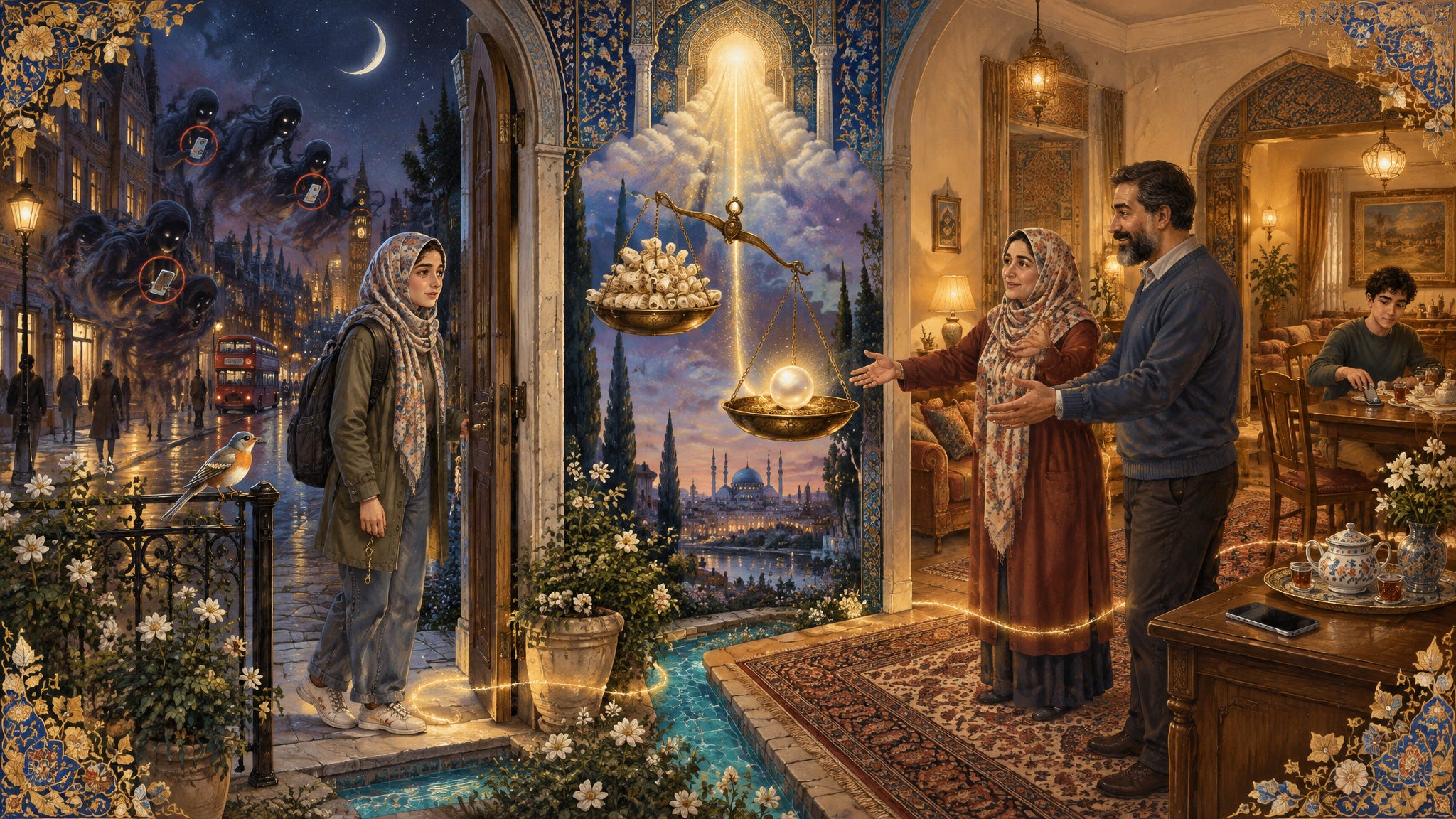
Now let me bring this into a house in this city.
A girl — sixteen, seventeen — comes home in the evening.
She has done nothing.
But someone saw her somewhere, standing near someone, and took a photo.
The photo has already gone round.
And by the time she puts her key in the door, the aunties’ group has reached her mother before she has.
So here is tonight’s question, and I want each of us to answer it honestly.
When the crowd’s account reaches us first — whose account do we believe? Hers?
Or the crowd’s?
The Qur’an answered that question in the same passage as the verse we began with:
لَّوۡلَآ إِذۡ سَمِعۡتُمُوهُ ظَنَّ ٱلۡمُؤۡمِنُونَ وَٱلۡمُؤۡمِنَٰتُ بِأَنفُسِهِمۡ خَيۡرٗا وَقَالُواْ هَٰذَآ إِفۡكٞ مُّبِينٞ
“When you [first] heard about it, why did not the faithful, men and women, think well of their folks, and say, ‘This is an obvious calumny’?”
— Qur’an, Surah al-Nur (the Chapter of the Light) #24, Verse 12; the English, Ali Quli Qarai’s
Think well of their folks
— in the Arabic,
of themselves.
When the crowd’s account arrives, the first duty is not to investigate, and not to interrogate.
It is to think well — of your own.
And who is more your own than your own daughter?
And one of our Imams took it further still.
Muhammad ibn al-Fudayl came to Imam Musa al-Kazim, peace and blessings be upon him.
Something had reached him about one of his brothers in faith — something he disliked.
He had asked the man, and the man had denied it.
But the people who had told him were trustworthy.
Whom was he to believe?
قُلْتُ لَهُ جُعِلْتُ فِدَاكَ الرَّجُلُ مِنْ إِخْوَانِي يَبْلُغُنِي عَنْهُ الشَّيْءُ الَّذِي أَكْرَهُهُ فَأَسْأَلُهُ عَنْ ذَلِكَ فَيُنْكِرُ ذَلِكَ وَ قَدْ أَخْبَرَنِي عَنْهُ قَوْمٌ ثِقَاتٌ فَقَالَ لِي يَا مُحَمَّدُ كَذِّبْ سَمْعَكَ وَ بَصَرَكَ عَنْ أَخِيكَ فَإِنْ شَهِدَ عِنْدَكَ خَمْسُونَ قَسَامَةً وَ قَالَ لَكَ قَوْلًا فَصَدِّقْهُ وَ كَذِّبْهُمْ لَا تُذِيعَنَّ عَلَيْهِ شَيْئاً تَشِينُهُ بِهِ وَ تَهْدِمُ بِهِ مُرُوءَتَهُ فَتَكُونَ مِنَ الَّذِينَ قَالَ اللَّهُ فِي كِتَابِهِ إِنَّ الَّذِينَ يُحِبُّونَ أَنْ تَشِيعَ الْفاحِشَةُ فِي الَّذِينَ آمَنُوا لَهُمْ عَذابٌ أَلِيمٌ.
“I said to him: May I be made your ransom — a man from among my brothers: something reaches me about him that I dislike, and I ask him about it, and he denies it; and yet trustworthy people have told it to me about him.
And he said to me: O Muhammad, give the lie to your hearing and your sight about your brother.
Even if fifty men bear witness before you under oath, and he tells you something, believe him, and give them the lie.
Never broadcast anything against him by which you would disgrace him and tear down his good name, and so become one of those of whom God has said in His Book: Indeed those who want indecency to spread among the faithful — there is a painful punishment for them.”
— Imam Musa al-Kazim, peace and blessings be upon him, through Muhammad ibn al-Fudayl; Shaykh al-Kulayni, al-Kafi, Volume 8, hadith 127 (thaqalayn); my translation8
Fifty men, under oath.
And on the other side, one man’s word about himself.
And the Imam says: believe him.
If that is what we owe a brother in faith, what do we owe our own children?
Mary’s people did not ask her.
They accused.
Zechariah asked.
We spent the whole of last week with the guardian’s question, and tonight we see what happens when that question is skipped.
The verdict comes first, the evidence never comes at all, and the child learns the most dangerous lesson a child can learn: that in her own house, the crowd is believed before she is.
And a child who has learned that stops bringing her account home at all.
The next time something happens to her — something real, something she needs us for — she will not tell us.
She already knows whose account wins in this house.
And sometimes it is the other way round.
Sometimes the tongue is ours.
Sometimes it is our son — in the group chat, forwarding what he never saw, about a girl he barely knows, and enjoying it.
I want to be careful here, because this is not a night for blaming the young.
The young did not invent the forward.
They learned it — from us, at our tables, over our cups of tea, in the way we talk about other people’s daughters.
As we said last week, when the house has not done the work of clarification, the crowd does the teaching instead.
So tonight’s diagnosis is the series’ diagnosis.
This is a failure of tabyeen — of clarification, of explanation.
And the answer is not a louder crowd on our side.
It is a home where a child’s account is heard first.
What We Carry Forward
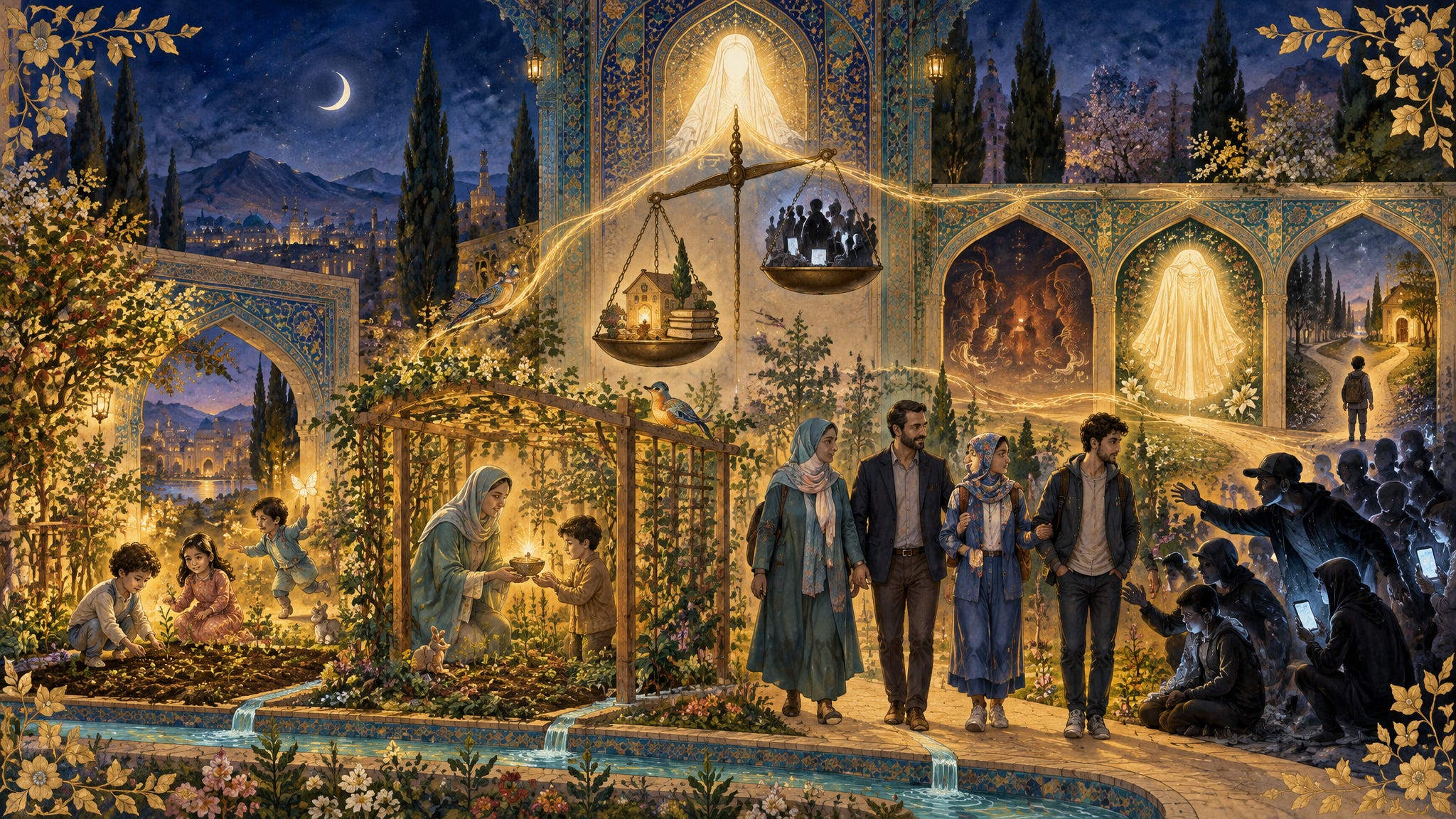
This is the third of our four nights on raising our children, in the days of the martyrdom of Sayyedah Fatimah al-Zahra, peace and blessings be upon her.
Today is Saturday, the 26th of Jumada al-Ula, 1448 — the 7th of November, 2026 — between the two dates our narrations give for her martyrdom.
On the first night we said that a child is born facing God, that raising her is cultivation and not manufacture, and that her first school is play and love; and our maqtal was The Door He Called At.
On the second night we met the guardian who asks, and we said that love must be able to say no — but that the limit is a medicine, never an anger.
We watched an Imam put his hand to his forehead at the sound of her name.
And our maqtal was Two Mothers.
And we have been walking through three sevens.
Imam Ja’far al-Sadiq, peace and blessings be upon him:
Let your son play for seven years;
Let him be taught adab for seven years;
And keep him with you for seven years.
— Imam Ja’far al-Sadiq, peace and blessings be upon him; Shaykh al-Saduq, Man La Yahduruhu al-Faqih, Volume 3, hadith 1528 (thaqalayn; 4743 is the edition’s own number) — narrated9
The first seven was play.
The second was adab.
Tonight is the third — keep him with you.
Companionship.
And it is the hardest of the three, because it is the seven in which they are able to walk away.
The years from fourteen to twenty-one, when friends, screens and the crowd all compete with the home for the same child.
So the question for the third seven is simple.
If these are the years of companionship — who are our children’s companions?
And whose tongue are they learning?
Tonight has three movements.
First, the crowd’s tongue — and our place in it.
Second, hijab — what it is before it is a scarf, and whom God spoke to first.
And third, the child who drifts — the son, the daughter, the marriage they cannot reach, and a clarification that is long overdue.
Video of the Majlis (Sermon/Lecture)
Her People’s Tongues — The Slander, the Forwarder and the Screen
Slander of One Raised to Guide

Go back to the Blessed Saint Mary, peace and blessings be upon her, for a moment — because Ayatullah Jawadi Amoli, may God protect him, says something about her grief that every parent in this room needs to hear.
Why was the slander so heavy for her?
Not only because it was false.
Because of who she was.
She had been given to God before she was born.
She had been raised in the sanctuary.
She was being prepared to carry something into the world.
Slander a farmer, he says, or a shopkeeper, or a clerk, and you have wounded his good name — but in the end he is still at his work.
Slander someone who was raised to carry the religion, someone who serves by way of his good name, and it is deadly: you have played with the very honour through which he was meant to guide.
Slander her, he says, and it is as if she no longer exists.
— Ayatullah Abdullah Jawadi Amoli, Tasnim, his commentary on Surah Maryam, session 19, 25 October 2009 — narrated10
Now look at your own children in that light.
We are raising our sons and daughters to carry this religion into a country that does not understand it.
Some of them will teach.
Some of them will lead a family, a mosque, a society, a workplace where they are the only Muslim anyone has ever known.
Their name is part of their work.
A girl whose name has been dragged round three group chats at sixteen will have to fight, at twenty-five, to be heard teaching anyone anything.
A boy who has been made into a joke does not easily become anyone’s example.
So the crowd that slanders a young person is not only hurting a young person.
It is trying to close a door that God opened — and that door is God’s to keep open, not the crowd’s to shut.
Not Only the Slanderer — the Forwarder

Go back to the verse we began with.
إِذۡ تَلَقَّوۡنَهُۥ بِأَلۡسِنَتِكُمۡ وَتَقُولُونَ بِأَفۡوَاهِكُم مَّا لَيۡسَ لَكُم بِهِۦ عِلۡمٞ وَتَحۡسَبُونَهُۥ هَيِّنٗا وَهُوَ عِندَ ٱللَّهِ عَظِيمٞ
“When you were receiving it on your tongues, and were mouthing something of which you had no knowledge, supposing it to be a light matter, while it was a grave [matter] with God.”
— Qur’an, Surah al-Nur (the Chapter of the Light) #24, Verse 15; the English, Ali Quli Qarai’s
Notice whom it is speaking to.
Not the one who invented the story.
It is speaking to everyone else — the ones who caught it, and passed it on, and thought it was nothing.
Tonight’s audience is not mainly the slanderer.
There are few of those.
It is the forwarder.
And there are a great many of us.
In our day the tongue has a button.
You do not have to say a word out loud.
You press, and it is gone — to thirty people, to three hundred — before the mind has had a chance to stand in the way.
Receiving it on your tongues has never been easier than it is in this decade.
And the question the verse asks of us is the same question it asked of Medina:
Did you know?
Not
Did you hear?
Not
Is everyone saying it?
Did you know?
If the answer is no, then it was not a light matter.
Not with God.
And the very next verse tells us what we should have said instead.
وَلَوۡلَآ إِذۡ سَمِعۡتُمُوهُ قُلۡتُم مَّا يَكُونُ لَنَآ أَن نَّتَكَلَّمَ بِهَٰذَا سُبۡحَٰنَكَ هَٰذَا بُهۡتَٰنٌ عَظِيمٞ
“And why did you not, when you heard it, say, ‘It is not for us to say such a thing. [O God!] You are immaculate! This is a monstrous calumny!’”
— Qur’an, Surah al-Nur (the Chapter of the Light) #24, Verse 16; the English, Ali Quli Qarai’s
It is not for us to say such a thing.
That is the whole cure for the forwarder, in one sentence.
Not
let me check.
Not
I’ll just send it to my sister.
It is not for us.
And listen to the verse’s last words — a monstrous calumny.
The Qur’an uses those same two words of what was said about the Blessed Saint Mary:
وَبِكُفۡرِهِمۡ وَقَوۡلِهِمۡ عَلَىٰ مَرۡيَمَ بُهۡتَٰنًا عَظِيمٗا
“And for their faithlessness, and their uttering a monstrous calumny against Mary,”
— Qur’an, Surah al-Nisa (the Chapter of the Women) #4, Verse 156; the English, Ali Quli Qarai’s
What was said in Medina, and what was said of Mary — the Qur’an gives them one name.
And our Imams tell us what becomes of the one who carries such a thing. Imam Ja’far al-Sadiq, peace and blessings be upon him, said to al-Mufaddal ibn ‘Umar:
قَالَ لِي أَبُو عَبْدِ الله (عَلَيهِ السَّلام) مَنْ رَوَى عَلَى مُؤْمِنٍ رِوَايَةً يُرِيدُ بِهَا شَيْنَهُ وَهَدْمَ مُرُوءَتِهِ لِيَسْقُطَ مِنْ أَعْيُنِ النَّاسِ أَخْرَجَهُ الله مِنْ وَلايَتِهِ إِلَى وَلايَةِ الشَّيْطَانِ فَلا يَقْبَلُهُ الشَّيْطَانُ.
“Abu Abdillah, peace be upon him, said to me: Whoever narrates against a believer a narration by which he means to disgrace him and tear down his good name, so that he falls from the eyes of the people, God puts him out of His guardianship into the guardianship of Satan — and Satan does not accept him.”
— Imam Ja’far al-Sadiq, peace and blessings be upon him, through al-Mufaddal ibn ‘Umar; Shaykh al-Kulayni, al-Kafi, Volume 2, hadith 1310 (thaqalayn); my translation
Last year, on these same nights, we spoke of wilayah in the home — the guardianship of God, and the guardianship that lives inside a family.
Here is its opposite.
The one who passes on a believer’s shame to bring him down in people’s eyes is put out of God’s guardianship — and not even Satan will take him in.
The Bad Companion in His Pocket
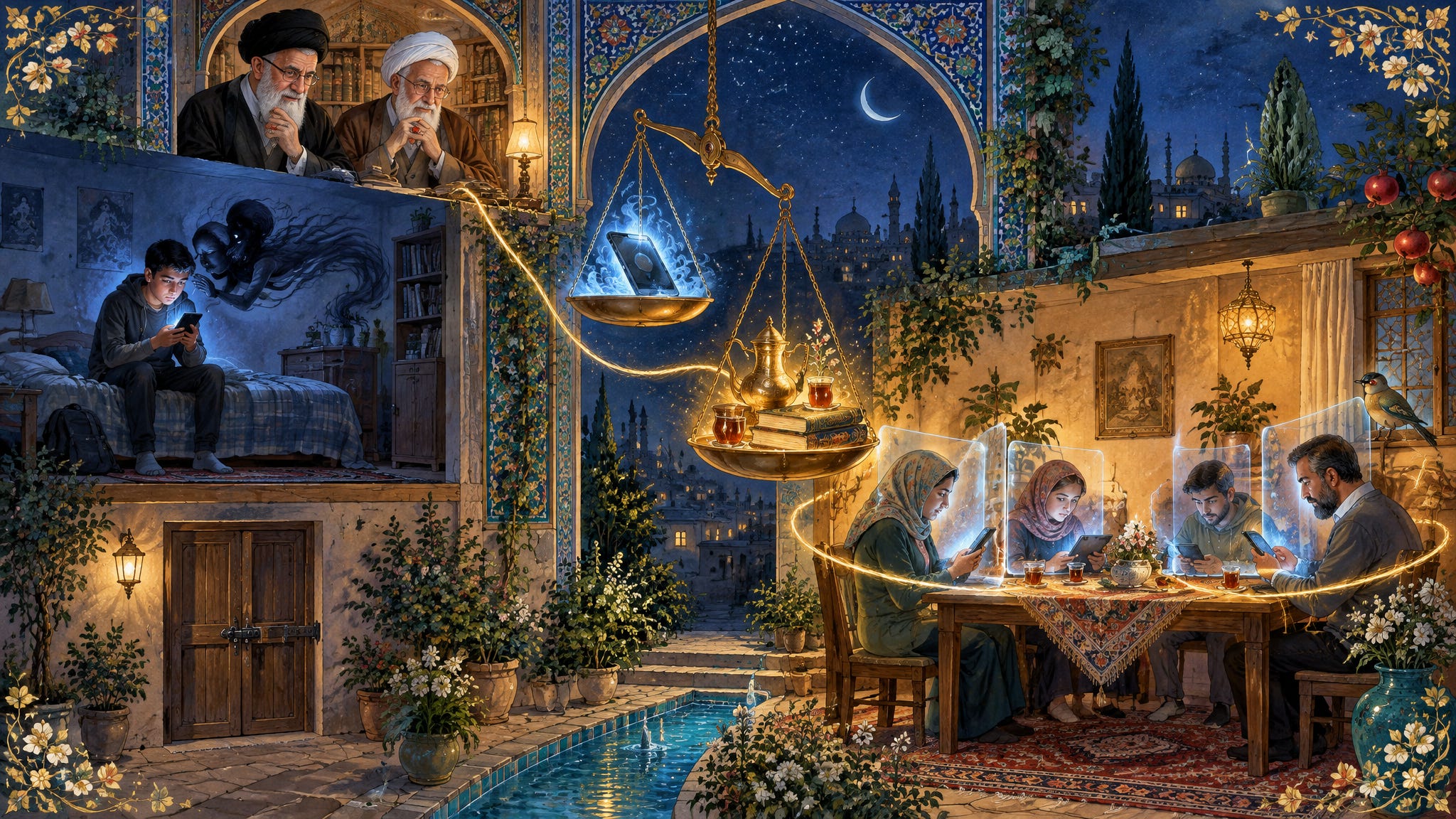
And now the crowd is not only outside the house.
It is inside — in our children’s hands.
The martyred leader, Imam Sayyed Ali Khamenei, may God rest his pure soul, put it in one sentence:
سابق ما نصیحت میکردیم جوانها را و برحذر میداشتیم از رفیق بد، مصاحب بد؛ حالا مصاحب بد داخل جیبش است، صفحهی مصاحبِ بد جلوی چشمش است، همه چیز در آن هست.
“In the past we used to counsel the young and warn them against the bad friend, the bad companion. Now the bad companion is inside his pocket — the screen of the bad companion is in front of his eyes, and everything is in it.”
— the martyred leader, Imam Sayyed Ali Khamenei, may God rest his pure soul, in an address of 12 July 2023 (farsi.khamenei.ir); my translation
Think about what our parents worried about.
The boy on the corner.
The friend from school who was a bad influence.
They could see him.
They knew his name.
They could, at least, tell their son not to go to his house.
The bad companion of this generation does not knock on the door.
He is already in the bedroom.
He speaks in your child’s ear at two in the morning, and you never meet him.
And three years earlier he had named another harm, quieter:
یکی از عیوبش این است که گفتم؛ یکی از عیوبش منزوی شدن بچّهها در خانه است؛ وقتی که با این تبلت و مانند اینها آشنا شدند، میروند سرگرم آن کار میشوند و از محیط خانه و خانواده در واقع بتدریج دور میشوند.
“One of its faults is the one I mentioned. Another of its faults is children becoming isolated at home: once they have become acquainted with the tablet and the like, they go off and are absorbed in it, and in fact they gradually grow distant from the setting of the home and the family.”
— the martyred leader, Imam Sayyed Ali Khamenei, may God rest his pure soul, in an address of 1 September 2020 (farsi.khamenei.ir); my translation
Gradually grow distant from the setting of the home and the family.
It is possible for a child to drift away from a family without ever leaving the house.
Every one of them at the same table.
Every one of them somewhere else.
Ayatullah Muhammad Taqi Misbah Yazdi, may God rest his pure soul — a philosopher and teacher of Qom in our own time — saw it in religious homes.
Something, he said, has taken the place of the old games, of religious teaching, of upbringing itself: a phone, or a tablet, which has taken the place of everything — and has unsettled even the closeness of sister and brother, and of mother and father with their children.
— Ayatullah Muhammad Taqi Misbah Yazdi, a talk of 4 December 2017 — narrated11
That is the third seven.
Keep him with you.
And he is sitting with you — and he is not with you at all.
The House That Taught Its Children
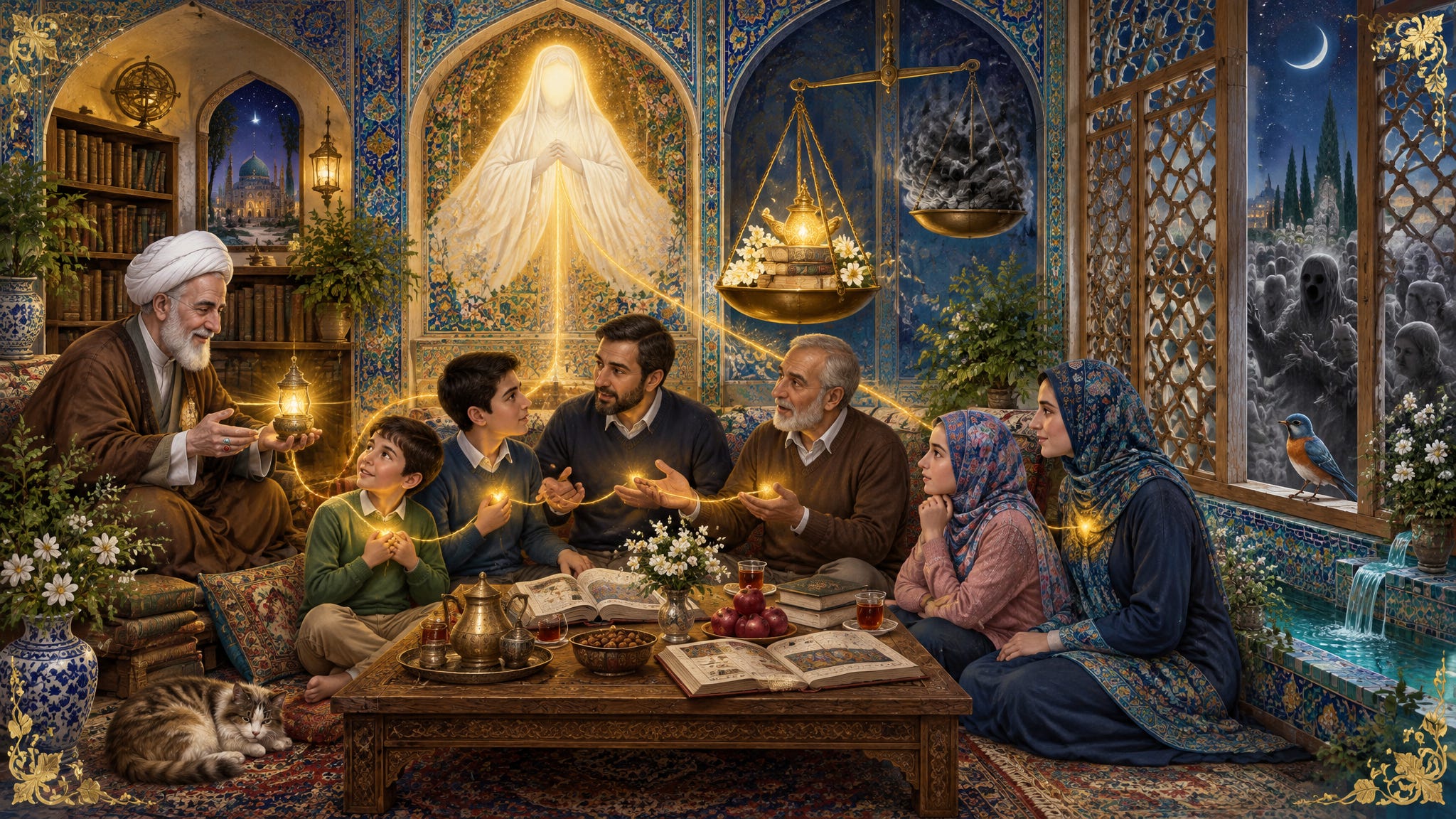
So what is the answer?
Take the phone away?
Lock the door?
Shout louder than the crowd?
Ayatullah Misbah Yazdi gave the answer too — the answer this series has been giving since the first night.
The way to protect and to raise a child, he says, is not harshness.
It is to bring him to the matters of belief with love, with kind words, with encouragement, and with argument suited to what he can understand — a little at a time.
— Ayatullah Muhammad Taqi Misbah Yazdi, a talk of 24 September 2014 — narrated12
And the sermon we began with gives us the picture of what that looks like.
There were people, later on, who said the sermon of Sayyedah Fatimah, peace and blessings be upon her, was not hers — that it had been composed afterwards by Abu al-’Ayna’, a famous man of letters of Basra in the third century after the Hijrah.
A crowd’s account, in other words.
And a man of her house was told this — Abu al-Husayn Zayd, a descendant of Imam Ali ibn al-Husayn, peace and blessings be upon him.
And he answered:
I have seen the elders of the family of Abu Talib narrating it from their fathers, and teaching it to their sons.
My own father told it to me from my grandfather.
And the elders of the Shia were narrating it, and studying it together, before the grandfather of Abu al-’Ayna’ was even born.
— Abu al-Husayn Zayd, as Ibn Abi Tahir reports him in Balaghat al-Nisa; al-Majlisi, Bihar al-Anwar, Volume 29, page 235 — narrated13
Teaching it to their sons.
The crowd said it was invented.
But the house had already taught it to its children.
The true account had been carried, from fathers to their sons, long before the crowd arrived with its version.
That is what a family is for.
Lessons for Our Time
Lesson One — Do Not Be the Crowd
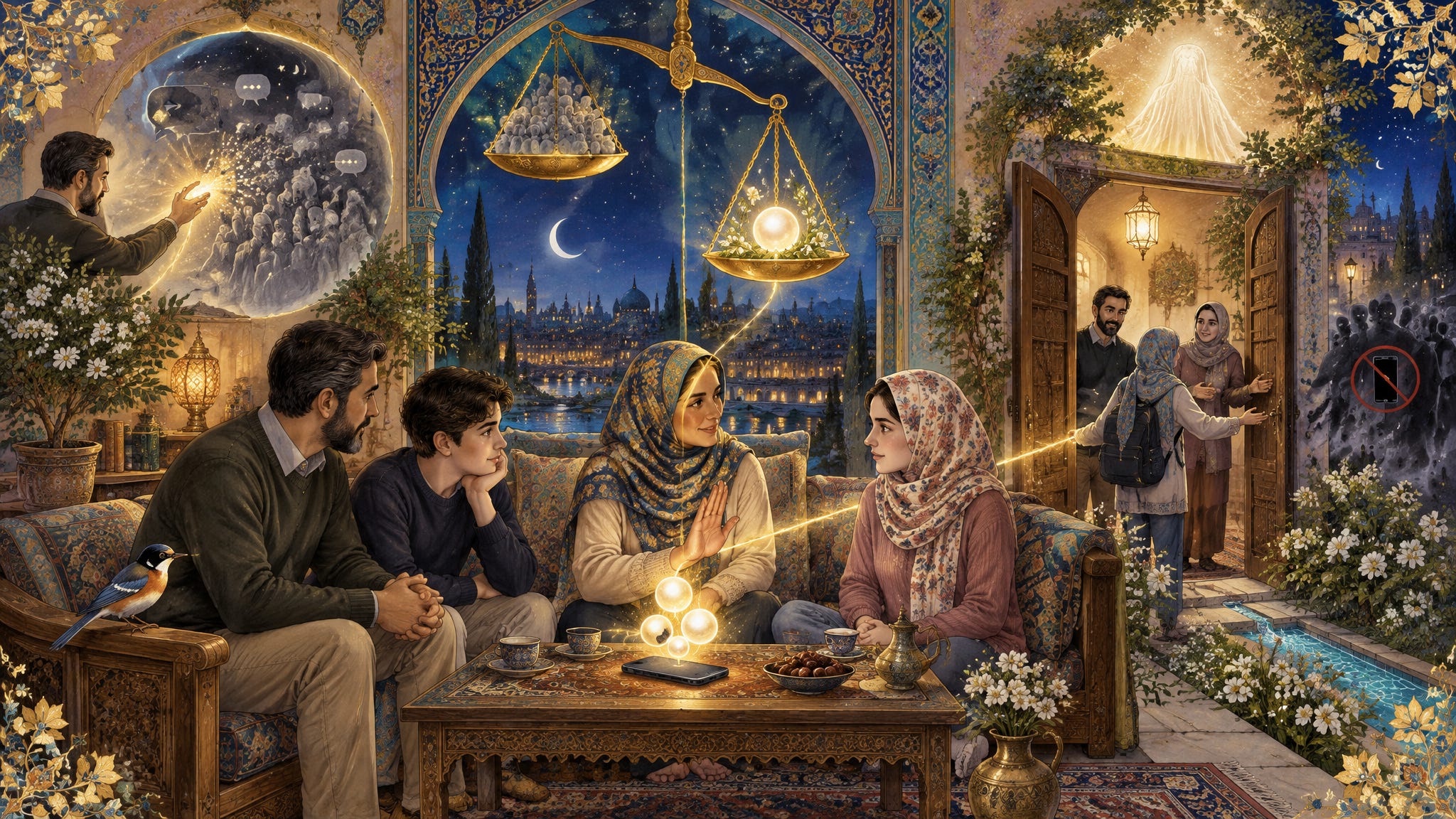
The first lesson is for us before it is for our children.
Before you pass a thing on — about anybody’s son, about anybody’s daughter — ask yourself three questions.
Did I see it?
Do I know it?
Would I say it to her face, with her mother in the room?
If the answer to any of them is no, it stays with you.
And say the sentence the Qur’an gave us for that moment:
It is not for us to say such a thing.
Say it out loud, in front of your children, the next time something arrives on the family group.
Let them hear what it sounds like when a forward stops.
And if you have already passed something on — and most of us have — then go back to the group and say so:
I sent that without knowing.
I should not have.
That one sentence will teach your children more about this verse than anything I can say tonight.
And when the crowd’s account of your own child reaches you before your child does — and it will — do what Zechariah, peace and blessings be upon him, did, and not what Mary’s people did.
Ask first.
Hear her first.
Let your home be the one place in the world where a child’s own account is heard before the crowd’s.
Lesson Two — Teach Them the True Account First

The second lesson is the family of Abu Talib’s.
They did not wait for the crowd to tell their sons who Sayyedah Fatimah was.
They taught the sermon at home.
So when the crowd came with its own version, the sons already knew.
Do the same.
Teach your children the true accounts — of their religion, of this house, and of themselves — before the crowd teaches them another.
Tell them, at your own table, who she was and what she said.
Tell them what this religion actually teaches, in your own words, with your own warmth.
Tell them who they are.
So this week, at your own table, tell your children one thing about her that they did not know.
Tell them that she walked into her father’s mosque and read the Book of God to the men who were holding it.
Tell them that her two sons stood up as witnesses for their mother.
Let them hear it from you first — so that whatever they hear later, they hear it as people who already know.
A child who already knows the true account can hear the false one, and stay standing.
Hijab Is a State of the Soul — And God Spoke to the Men First
It Begins with the Men
Last week we said:
My daughter has stopped wearing hijab
— and we asked whether she is any less our daughter, what her reason was, and whether anyone ever explained to her what hijab is for.
Tonight I want to do the explaining.
And I want to begin it somewhere most of us do not expect.
Tonight’s explaining begins with the men.
It begins with me.
When our communities talk about hijab, we nearly always mean a piece of cloth on a woman’s head.
We argue about its size, its colour, how much hair is showing.
And then we wonder why our daughters feel that the whole religion is watching them, and nobody is watching their brothers.
So listen to the order in which God speaks.
قُل لِّلۡمُؤۡمِنِينَ يَغُضُّواْ مِنۡ أَبۡصَٰرِهِمۡ وَيَحۡفَظُواْ فُرُوجَهُمۡۚ ذَٰلِكَ أَزۡكَىٰ لَهُمۡۚ إِنَّ ٱللَّهَ خَبِيرُۢ بِمَا يَصۡنَعُونَ
“Tell the faithful men to cast down their looks and to guard their private parts. That is more decent for them. God is indeed well aware of what they do.”
— Qur’an, Surah al-Nur (the Chapter of the Light) #24, Verse 30; the English, Ali Quli Qarai’s
The men first.
Before a single word is said to women about covering, the men are told
To cast down their looks and to guard their private parts.
And only then:
وَقُل لِّلۡمُؤۡمِنَٰتِ يَغۡضُضۡنَ مِنۡ أَبۡصَٰرِهِنَّ وَيَحۡفَظۡنَ فُرُوجَهُنَّ وَلَا يُبۡدِينَ زِينَتَهُنَّ إِلَّا مَا ظَهَرَ مِنۡهَاۖ وَلۡيَضۡرِبۡنَ بِخُمُرِهِنَّ عَلَىٰ جُيُوبِهِنَّۖ وَلَا يُبۡدِينَ زِينَتَهُنَّ إِلَّا لِبُعُولَتِهِنَّ أَوۡ ءَابَآئِهِنَّ أَوۡ ءَابَآءِ بُعُولَتِهِنَّ أَوۡ أَبۡنَآئِهِنَّ أَوۡ أَبۡنَآءِ بُعُولَتِهِنَّ أَوۡ إِخۡوَٰنِهِنَّ أَوۡ بَنِيٓ إِخۡوَٰنِهِنَّ أَوۡ بَنِيٓ أَخَوَٰتِهِنَّ أَوۡ نِسَآئِهِنَّ أَوۡ مَا مَلَكَتۡ أَيۡمَٰنُهُنَّ أَوِ ٱلتَّـٰبِعِينَ غَيۡرِ أُوْلِي ٱلۡإِرۡبَةِ مِنَ ٱلرِّجَالِ أَوِ ٱلطِّفۡلِ ٱلَّذِينَ لَمۡ يَظۡهَرُواْ عَلَىٰ عَوۡرَٰتِ ٱلنِّسَآءِۖ وَلَا يَضۡرِبۡنَ بِأَرۡجُلِهِنَّ لِيُعۡلَمَ مَا يُخۡفِينَ مِن زِينَتِهِنَّۚ وَتُوبُوٓاْ إِلَى ٱللَّهِ جَمِيعًا أَيُّهَ ٱلۡمُؤۡمِنُونَ لَعَلَّكُمۡ تُفۡلِحُونَ
“And tell the faithful women to cast down their looks and to guard their private parts, and not to display their charms, beyond what is [acceptably] visible, and let them draw their scarfs over their bosoms, and not display their charms except to their husbands, or their fathers, or their husband’s fathers, or their sons, or their husband’s sons, or their brothers, or their brothers’ sons, or their sisters’ sons, or their women, or their slave girls, or male dependants lacking [sexual] desire, or children who are not yet conscious of female sexuality.
And let them not thump their feet to make known their hidden ornaments. Rally to Allah in repentance, O faithful, so that you may be felicitous.”
— Qur’an, Surah al-Nur (the Chapter of the Light) #24, Verse 31; the English, Ali Quli Qarai’s
Allamah Sayyed Muhammad Husayn Tabataba’i, may God rest his pure soul — the author of al-Mizan, the commentary on the Qur’an this majlis has leaned on since the first night — reads the first verse as a general command: the believer is not to look at what is unlawful for him to look at, whether that is a man or a woman.
And when he reaches the women’s verse, he says that its opening is the same as the men’s.
— Allamah Sayyed Muhammad Husayn Tabataba’i, al-Mizan fi Tafsir al-Qur’an, on Surah al-Nur, Verses 27 to 34 — narrated14
And Shaheed Ayatullah Murtaza Mutahhari, may God rest his pure soul — the scholar and martyr of the Revolution whose books on women, the family and hijab are still the ones our teachers hand to us — makes the same point.
Everything he said of the men’s verse, he says — about the eyes, and about chastity — holds here as well.
The women’s verse does not begin somewhere else.
It begins exactly where the men’s began.
— Shaheed Ayatullah Murtaza Mutahhari, Ashna’i ba Qur’an (Getting to Know the Qur’an), Volume 4 — narrated15
So before we ask what our daughters are wearing, the Qur’an asks us where our eyes have been.
The Man Who Walked Ahead

Let me give you a picture of it — a man, not a woman.
Moses, peace and blessings be upon him, has fled Egypt with nothing.
And the Qur’an tells us what he found when he reached Midian, and what he did:
وَلَمَّا وَرَدَ مَآءَ مَدۡيَنَ وَجَدَ عَلَيۡهِ أُمَّةٗ مِّنَ ٱلنَّاسِ يَسۡقُونَ وَوَجَدَ مِن دُونِهِمُ ٱمۡرَأَتَيۡنِ تَذُودَانِۖ قَالَ مَا خَطۡبُكُمَاۖ قَالَتَا لَا نَسۡقِي حَتَّىٰ يُصۡدِرَ ٱلرِّعَآءُۖ وَأَبُونَا شَيۡخٞ كَبِيرٞ
فَسَقَىٰ لَهُمَا ثُمَّ تَوَلَّىٰٓ إِلَى ٱلظِّلِّ فَقَالَ رَبِّ إِنِّي لِمَآ أَنزَلۡتَ إِلَيَّ مِنۡ خَيۡرٖ فَقِيرٞ
“When he arrived at the well of Midian, he found there a throng of people watering [their flocks], and he found, besides them, two women holding back [their flock].
He said, ‘What is your business?’
They said, ‘We do not water [our flock] until the shepherds have driven out [their flocks], and our father is an aged man.’
So he watered [their flock] for them.
Then he withdrew toward the shade and said, ‘My Lord! I am indeed in need of any good You may send down to me!’”
— Qur’an, Surah al-Qasas (the Chapter of the Narrations) #28, Verses 23 and 24; the English, Ali Quli Qarai’s
He waters their flock for them, asks for nothing, and goes and sits in the shade.
And then one of them comes back to him.
فَجَآءَتۡهُ إِحۡدَىٰهُمَا تَمۡشِي عَلَى ٱسۡتِحۡيَآءٖ قَالَتۡ إِنَّ أَبِي يَدۡعُوكَ لِيَجۡزِيَكَ أَجۡرَ مَا سَقَيۡتَ لَنَاۚ فَلَمَّا جَآءَهُۥ وَقَصَّ عَلَيۡهِ ٱلۡقَصَصَ قَالَ لَا تَخَفۡۖ نَجَوۡتَ مِنَ ٱلۡقَوۡمِ ٱلظَّـٰلِمِينَ
“Then one of the two women approached him, walking bashfully.
She said, ‘Indeed my father invites you to pay you the wages for watering [our flock] for us.’
So when he came to him and recounted the story to him, he said, ‘Do not be afraid. You have been delivered from the wrongdoing lot.’”
— Qur’an, Surah al-Qasas (the Chapter of the Narrations) #28, Verse 25; the English, Ali Quli Qarai’s
Her father has sent for him.
And our reports tell us what Moses did on that walk.
He said to her:
Point me to the road, and walk behind me — for we, the sons of Jacob, do not look at the backs of women.
— Allamah Tabataba’i, al-Mizan fi Tafsir al-Qur’an, on Surah al-Qasas, Verses 22 to 28, giving the report — narrated16
He walked in front.
Not to lead her.
So that his eyes would not follow her.
And she noticed.
When she came home, she said to her father:
قَالَتۡ إِحۡدَىٰهُمَا يَـٰٓأَبَتِ ٱسۡتَـٔۡجِرۡهُۖ إِنَّ خَيۡرَ مَنِ ٱسۡتَـٔۡجَرۡتَ ٱلۡقَوِيُّ ٱلۡأَمِينُ
“One of the two women said, ‘Father, hire him. Indeed the best you can hire is a powerful and trustworthy man.’”
— Qur’an, Surah al-Qasas (the Chapter of the Narrations) #28, Verse 26; the English, Ali Quli Qarai’s
A powerful and trustworthy man.
How did she know he was powerful?
She had watched him water the flock.
But how did she know he was trustworthy, after one walk?
Her father asked her exactly that.
And our reports give her answer: when he told her to keep behind him and show him the road, because his people do not look at the backs of women, she knew he was not one of those who look at women from behind.
That was his trustworthiness.
— al-Qummi, Tafsir al-Qummi, as Allamah Tabataba’i gives it in al-Mizan fi Tafsir al-Qur’an, on Surah al-Qasas, Verses 22 to 28 — narrated17
His trustworthiness was in his eyes.
That is what she saw.
Not his prayers.
Not his beard.
Where his eyes went when nobody was watching.
And one thing more, for those who were with us on the first night.
In one of our reports, when Sayyedah Fatimah, peace and blessings be upon her, was born, God sent four women to stand beside her mother, Sayyedah Khadijah, peace and blessings be upon her.
One of them was Safra’, the daughter of Shu’ayb, peace and blessings be upon him — the wife of Moses.
A daughter of the house whose door Moses reached with his eyes lowered stood, generations later, at the cradle of the Mistress of the Women of Paradise.18
A Faith You Can Taste

And our Imams speak to the men about this too.
Imam Ja’far al-Sadiq, peace and blessings be upon him:
قَالَ أَبُو عَبْدِ اَللَّهِ عَلَيْهِ اَلسَّلاَمُ : “اَلنَّظْرَةُ سَهْمٌ مِنْ سِهَامِ إِبْلِيسَ مَسْمُومٌ مَنْ تَرَكَهَا لِلَّهِ عَزَّ وَ جَلَّ لاَ لِغَيْرِهِ أَعْقَبَهُ اَللَّهُ إِيمَاناً يَجِدُ طَعْمَهُ”.
“Abu Abdillah, peace be upon him, said: The glance is a poisoned arrow from the arrows of Iblis. Whoever abandons it for God, Mighty and Majestic — and for nothing else — God gives him in return a faith whose taste he finds.”
— Imam Ja’far al-Sadiq, peace and blessings be upon him; Shaykh al-Saduq, Man La Yahduruhu al-Faqih, Volume 4, hadith 3 (thaqalayn; 4969 is the edition’s own number); my translation
Do you see what he promises?
Not only a reward on the Day of Judgement.
A faith whose taste he finds — here, now.
The man who turns his eyes away for God alone does not walk away empty.
He walks away tasting something the looking would never have given him.
And the Qur’an gives us the young man who tasted it.
Joseph, peace and blessings be upon him — young, a stranger, far from his father, a servant in a powerful house.
And the doors are closed on him.
وَرَٰوَدَتۡهُ ٱلَّتِي هُوَ فِي بَيۡتِهَا عَن نَّفۡسِهِۦ وَغَلَّقَتِ ٱلۡأَبۡوَٰبَ وَقَالَتۡ هَيۡتَ لَكَۚ قَالَ مَعَاذَ ٱللَّهِۖ إِنَّهُۥ رَبِّيٓ أَحۡسَنَ مَثۡوَايَۖ إِنَّهُۥ لَا يُفۡلِحُ ٱلظَّـٰلِمُونَ
“The woman in whose house he was, solicited him. She closed the doors and said, ‘Come!!’ He said, ‘God forbid! Indeed He is my Lord; He has given me a good abode. Indeed the wrongdoers are not felicitous.’”
— Qur’an, Surah Yusuf (the Chapter of the Prophet Joseph) #12, Verse 23; the English, Ali Quli Qarai’s
She closed the doors.
No one would see.
No one would ever know.
And he said:
God forbid!
That is a young man’s hijab.
Not a garment — a refuge he runs to when the doors are closed and nobody is watching.
And Amir al-Mu’minin, Imam Ali ibn Abi Talib, peace and blessings be upon him, raises the chaste man higher still.
The martyr who falls in the way of God, he says, does not have a greater reward than the man who could — who had the means, and the chance — and stayed chaste.
The chaste man is almost one of the angels.
— Amir al-Mu’minin, Imam Ali ibn Abi Talib, peace and blessings be upon him; Nahj al-Balagha, Saying 474 — narrated19
A martyr’s reward. For a young man alone in his room, behind a closed door, with a screen in his hand — who closes it.
Not Only About Women
The martyred leader, Imam Sayyed Ali Khamenei, may God rest his pure soul, said this in so many words — and said it to a gathering of thousands of women and girls, less than a year ago.
پوشش زن و مرد از این قبیل است؛ از آن محدودیّتهایی است که وجود دارد، هم [برای] مرد و هم زن . مسئلهی پوشش، تنها مربوط به زن نیست. حجاب زن از این قبیل است؛ فواصل جسمی میان زن و مرد از این قبیل است؛ تشویق به ازدواج از این قبیل است؛ اینها همان چیزهایی است که آن عامل خطرناک و خطرزا را مهار میکند.
“The covering of man and woman is of this kind: it is among the limits that exist, for man and for woman alike. The issue of covering does not concern women alone. A woman’s hijab is of this kind; the physical distances between man and woman are of this kind; the encouragement of marriage is of this kind. These are the very things that hold in check that dangerous, danger-making factor.”
— the martyred leader, Imam Sayyed Ali Khamenei, may God rest his pure soul, to a gathering of women and girls, 3 December 2025 (farsi.khamenei.ir); my translation
The issue of covering does not concern women alone.
And notice the last item on his list —
the encouragement of marriage.
Hold on to that.
It will come back.
Ayatullah Alireza A’rafi, may God protect him, teaching the jurisprudence of the gaze and of covering in the hawza of Qom, counts the duties in these two verses, and his count is worth knowing.
The men are given two: lower the gaze, and guard your chastity.
The women are given about five.
And the first two of the women’s five are the very same two that were given to the men.
— Ayatullah Alireza A’rafi, a class on the jurisprudence of the gaze and of covering, 18 January 2026 — narrated20
And Shaheed Mutahhari gives the reason for the difference in two sentences.
Islam, he says, laid down duties for both men and women to temper and tame this instinct — and one duty, common to both, concerns the gaze.
And the reason the command to cover was made particular to women is that the inclination to display and adorn oneself is particular to women.
— Shaheed Ayatullah Murtaza Mutahhari, Mas’ale-ye Hijab (The Question of Hijab) — narrated21
Notice what he does not say.
He does not say she is worth less, or that anyone’s eyes are her fault.
He says where the pull lies — and so where the guarding has to be seen.
So hijab, in the Qur’an’s own order, is a state of the soul before it is a garment.
It begins in the eyes.
It is a guarding — of the one who looks, and of the one who is looked at.
In a woman, part of it shows.
In a man, almost none of it shows.
But it is owed by both.
Why She Covers
And now — only now — we can ask about our daughters.
Why does she cover?
Ayatullah A’rafi gives the wisdom of it as two things together.
It closes the door on desire, for the one who sees.
And it guards a woman’s dignity and honour, for the one who is seen.
And he is careful to say that this stands at the level of wisdom.
— Ayatullah Alireza A’rafi, a class on the jurisprudence of the gaze and of covering, 17 May 2025 — narrated22
A wisdom is a reason we can understand and teach.
It is not the cause a ruling hangs on — the ruling stands on God’s command.
The wisdom is how we explain it to a child who asks why.
And Imam Sayyed Ali Khamenei answers those who call these rulings dry, or fossilised.
These are points of precision, he says, and whoever hears them must reflect on them, or he will certainly not understand them.
They are not dry regulations: they guarantee the happiness of woman and man, and they bring purity and closeness into the home.
— the martyred leader, Imam Sayyed Ali Khamenei, may God rest his pure soul, Zan va Khanevadeh (Woman and Family), from two marriage sermons of September and October 2002 — narrated23
And if we pass them on as a dry rule, shouted across a kitchen, we have made the critics’ case for them.
A thing that precise cannot be handed down as a slogan.
It has to be explained.
And it has to be explained by someone who lives it — including the half of it that belongs to the men.
Lessons for Our Time
Lesson Three — It Begins with the Eyes
The third lesson is for the fathers, and for every man in this room.
Hijab begins with the eyes.
And in the Qur’an’s order, it begins with our eyes.
So a father who checks his daughter’s scarf every morning, and never once asks his son what he watched last night, has not understood the verse that speaks to him first.
A brother who polices his sister in the street, and lets his own eyes wander, has turned the Qur’an upside down.
If we want our daughters to believe that hijab is worship and not surveillance, they need to see their fathers and brothers keeping it too — the half that does not show.
This is a conversation most of us fathers have never had with our sons.
Have it.
Not as an interrogation, and not once a year when something has gone wrong.
Tell him about Joseph and the closed doors.
Tell him that the Imam promised a faith he would taste.
And let him see you keep your own eyes where they belong — in the street, at the wedding, on your own phone.
Lesson Four — Teach the Shared Duties First
The fourth lesson is about the order in which we teach.
The first two duties are shared.
Lower the gaze.
Guard your chastity.
Teach those first — to the son and to the daughter, together, at the same table, in the same words.
Then the daughter’s further duties will come to her as the next part of something her whole family keeps, and not as a fence built around her alone.
And when she asks why — explain.
Precisely.
Patiently.
With the depth it deserves.
A child who has been given the reasons can carry the rule.
A child who has been given only the rule will put it down the day she leaves the house.
And when a daughter does take up her hijab — at nine, at fifteen, at twenty-five — let it be a joy in the house, not a relief.
And when a son lowers his gaze, notice it, and honour it just as much.
A family that honours both halves of hijab has taught both its children that the religion belongs to them equally.
She Is Still Your Daughter — The Third Seven, Marriage, and a Clarification Long Overdue
O My Son

There is a father in the Qur’an whose son walked away from him — and walked away from God.
Noah, peace and blessings be upon him, had built the ark as he was told.
The flood had come.
Those who believed were on board.
And one son had kept apart.
وَهِيَ تَجۡرِي بِهِمۡ فِي مَوۡجٖ كَٱلۡجِبَالِ وَنَادَىٰ نُوحٌ ٱبۡنَهُۥ وَكَانَ فِي مَعۡزِلٖ يَٰبُنَيَّ ٱرۡكَب مَّعَنَا وَلَا تَكُن مَّعَ ٱلۡكَٰفِرِينَ
“And it sailed along with them amid waves [rising] like mountains. Noah called out to his son, who stood aloof, ‘O my son! ‘Board with us, and do not be with the faithless!’”
— Qur’an, Surah Hud (the Chapter of the Prophet Hud) #11, Verse 42; the English, Ali Quli Qarai’s
His son, who stood aloof.
And what does the father call him?
Not
you faithless boy.
Not
I warned you.
O my son.
Ya bunayya — the tender form.
My little son.
To a grown man, standing on the wrong side of the water.
And the son refused.
قَالَ سَـَٔاوِيٓ إِلَىٰ جَبَلٖ يَعۡصِمُنِي مِنَ ٱلۡمَآءِۚ قَالَ لَا عَاصِمَ ٱلۡيَوۡمَ مِنۡ أَمۡرِ ٱللَّهِ إِلَّا مَن رَّحِمَۚ وَحَالَ بَيۡنَهُمَا ٱلۡمَوۡجُ فَكَانَ مِنَ ٱلۡمُغۡرَقِينَ
“He said, ‘I shall take refuge on a mountain; it will protect me from the flood.’ He said, ‘There is none today who can protect from God’s edict, except someone upon whom He has mercy.’
Then the waves came between them, and he was among those who were drowned.”
— Qur’an, Surah Hud (the Chapter of the Prophet Hud) #11, Verse 43; the English, Ali Quli Qarai’s
Tonight I want only the father’s call.
He called him my son, until the waves came between them.
The Father Who Ran

And the Gospel gives us the other half of that picture — the son who does come back.
You know the story.
A younger son takes his share of the inheritance, leaves for a far country, and spends everything.
He ends up feeding pigs, and longing to eat what the pigs eat.
And he comes to himself, and he walks home, rehearsing what he will say to his father — that he is no longer fit to be called his son.
He never gets to finish the speech.
20 καὶ ἀναστὰς ἦλθεν πρὸς τὸν πατέρα ⸀ἑαυτοῦ. ἔτι δὲ αὐτοῦ μακρὰν ἀπέχοντος εἶδεν αὐτὸν ὁ πατὴρ αὐτοῦ καὶ ἐσπλαγχνίσθη καὶ δραμὼν ἐπέπεσεν ἐπὶ τὸν τράχηλον αὐτοῦ καὶ κατεφίλησεν αὐτόν.
“And he arose, and came to his father. But when he was yet a great way off, his father saw him, and had compassion, and ran, and fell on his neck, and kissed him.”
— the Gospel of Luke, chapter 15, verse 20 — the Greek of the SBL Greek New Testament (the small raised marks are its apparatus signs), and the King James Version
When he was yet a great way off.
The father had been watching the road.
He saw him before the son saw the house.
And he ran.
That is what she is still your daughter means.
Not that what she did was right.
That the road home is kept open — and watched.
Care, Not Domination
Ayatullah Sayyed Muhammad Husayn Fadhlullah, may God rest his pure soul, put the third seven into practice in a few lines.
A father loves literature, he says, and wants his son to study it — and the son wants medicine, or engineering.
Discuss it with him; advise him; do not impose — he will live a life that is not yours.
And the most dangerous place for that, he says, is marriage.
A father or a mother is taken with a young man for their daughter because he has money, or because he is a certain scholar’s son, or because his mother is known for her piety.
It is not enough.
The family can be righteous and the boy the most dissolute of men.
Do not force a daughter — and do not force a son.
Remember that you were once young yourselves, with dreams your own parents did not understand.
And ease their path.
— Ayatullah Sayyed Muhammad Husayn Fadhlullah, a Friday sermon of 1 March 1996 — narrated24
And the martyred leader, Imam Sayyed Ali Khamenei, may God rest his pure soul, puts it in the language of the law.
To force a daughter into a marriage is forbidden.
And a father’s you will not go out does not, of itself, bind a grown son or daughter — though to hurt a mother or a father is itself forbidden.
— the martyred leader, Imam Sayyed Ali Khamenei, may God rest his pure soul, Zan va Khanevadeh (Woman and Family) — narrated25
Notice what this does to us.
The third seven is the seven of keep him with you — and it is also the seven in which the law itself begins to stand on the child’s side of the door.
We cannot hold an adult by force.
We can only hold them by love.
If we did not build that love in the first two sevens, the third seven is where we find out.
Make Marriage Easy
And now the hardest part of the third seven.
Marriage.
A man wrote to Imam Muhammad al-Jawad, peace and blessings be upon him, about his daughters. Listen to the letter, and to the answer:
كَتَبَ عَلِيُّ بْنُ أَسْبَاطٍ إِلَى أَبِي جَعْفَرٍ (عَلَيْهِ السَّلام) فِي أَمْرِ بَنَاتِهِ وَأَنَّهُ لا يَجِدُ أَحَداً مِثْلَهُ فَكَتَبَ إِلَيْهِ أَبُو جَعْفَرٍ (عَلَيْهِ السَّلام) فَهِمْتُ مَا ذَكَرْتَ مِنْ أَمْرِ بَنَاتِكَ وَأَنَّكَ لا تَجِدُ أَحَداً مِثْلَكَ فَلا تَنْظُرْ فِي ذَلِكَ رَحِمَكَ اللهُ فَإِنَّ رَسُولَ اللهِ (صَلَّى اللهُ عَلَيْهِ وَآلِه) قَالَ إِذَا جَاءَكُمْ مَنْ تَرْضَوْنَ خُلُقَهُ وَدِينَهُ فَزَوِّجُوهُ إِلا تَفْعَلُوهُ تَكُنْ فِتْنَةٌ فِي الأرْضِ وَفَسادٌ كَبِيرٌ.
“Ali ibn Asbat wrote to Abu Ja’far, peace be upon him, about the matter of his daughters, and that he could find no one like himself. And Abu Ja’far, peace be upon him, wrote to him:
I have understood what you mention of the matter of your daughters, and that you find no one like yourself.
Do not look at it that way, may God have mercy on you; for the Messenger of God — God’s blessings be upon him and his family — said:
When there comes to you one whose character and religion you are pleased with, give him in marriage; if you do not, there will be turmoil in the land, and great corruption.”
— Imam Muhammad al-Jawad, peace and blessings be upon him, through Ali ibn Mahziyar, from the letter of Ali ibn Asbat; Shaykh al-Kulayni, al-Kafi, Volume 5, hadith 1375 (thaqalayn); my translation
The father could find no one, he said, like himself.
And the Imam told him not to look at it that way, and answered him with the words of the Messenger of God, peace and blessings be upon him, his family, and his righteous companions.
One whose character and religion you are pleased with
— not his salary, not his family’s standing, not the size of the hall.
Not
a man like me.
And if you refuse him:
turmoil in the land, and great corruption.
Look around our own community, and tell me that has not come true.
Imam Khamenei said it to us more bluntly than any of us would dare to say it from a minbar.
To the parents who stand in the way of their children’s marriage — with heavy dowries, heavy trousseaus, and the chase after name and standing — he calls out:
Fathers!
Mothers!
Be wary of God.
A Muslim boy and a Muslim girl, he says, both with believing hearts — these are each other’s equals.
Let them begin their life together.
— the martyred leader, Imam Sayyed Ali Khamenei, may God rest his pure soul, Zan va Khanevadeh (Woman and Family), from a Friday sermon of 28 November 1980 — narrated26
And remember the list he gave to the women and girls —
a woman’s hijab,
the physical distances between man and woman,
the encouragement of marriage.
The same list.
Marriage made easy is part of hijab.
A society that makes the halal impossible has not protected its children’s modesty.
It has only made their struggle harder.
One thing, so that nobody mishears me.
Easy does not mean cheap.
It does not mean a daughter’s dowry should be a token, or that a young man should be given a marriage he has done nothing to prepare for.
It means that the conditions we add — our conditions, the community’s conditions, the conditions of what people will say — must not become the wall between our children and what God has made lawful for them.
A Marriage with Reasons, Not a Licence

And that brings me to something I have wanted to say from this minbar for a long time.
It is a clarification that is long overdue in our community, and I am going to say it plainly.
It is about mut’ah — temporary marriage.
It is misunderstood, from outside our community and from inside it.
And sadly, it is abused.
There are young men who have been taught — or who have taught themselves — that it is a licence: a halal way to sow their wild oats, a way to have what they want without the responsibilities of a marriage.
It is not.
And I want to show you why, from our own scholars and from our own Imams, in order.
First, why it exists at all.

Shaheed Ayatullah Murtaza Mutahhari, may God rest his pure soul, wrote about this more than half a century ago, and the gap he described has only grown wider.
In our time, he says, the gap between the age at which a young person is ready in body and the age at which they are ready — in study, in work, in means — to carry a permanent marriage has grown wide.
A young man finishes his studies at twenty-five and needs years more before he can marry.
A young woman who studies, the same.
Ask a student to take on a permanent marriage, he says, and he will laugh at you.
So what is left?
He puts it as a question:
Which is it to be — a forced, temporary celibacy; relations with no bond at all; or temporary marriage?
— Shaheed Ayatullah Murtaza Mutahhari, Nizam-e Huquq-e Zan dar Islam (The System of Women’s Rights in Islam) — narrated27
Second, what it is.
It is a marriage.
A contract, with a dowry — without which it is void.
The same bars of kinship as any marriage.
A waiting period when it ends.
And a child born of it differs in no way from a child born of a permanent marriage.
— Shaheed Ayatullah Murtaza Mutahhari, Nizam-e Huquq-e Zan dar Islam (The System of Women’s Rights in Islam) — narrated28
Third — and this is the heart of it — for whom.
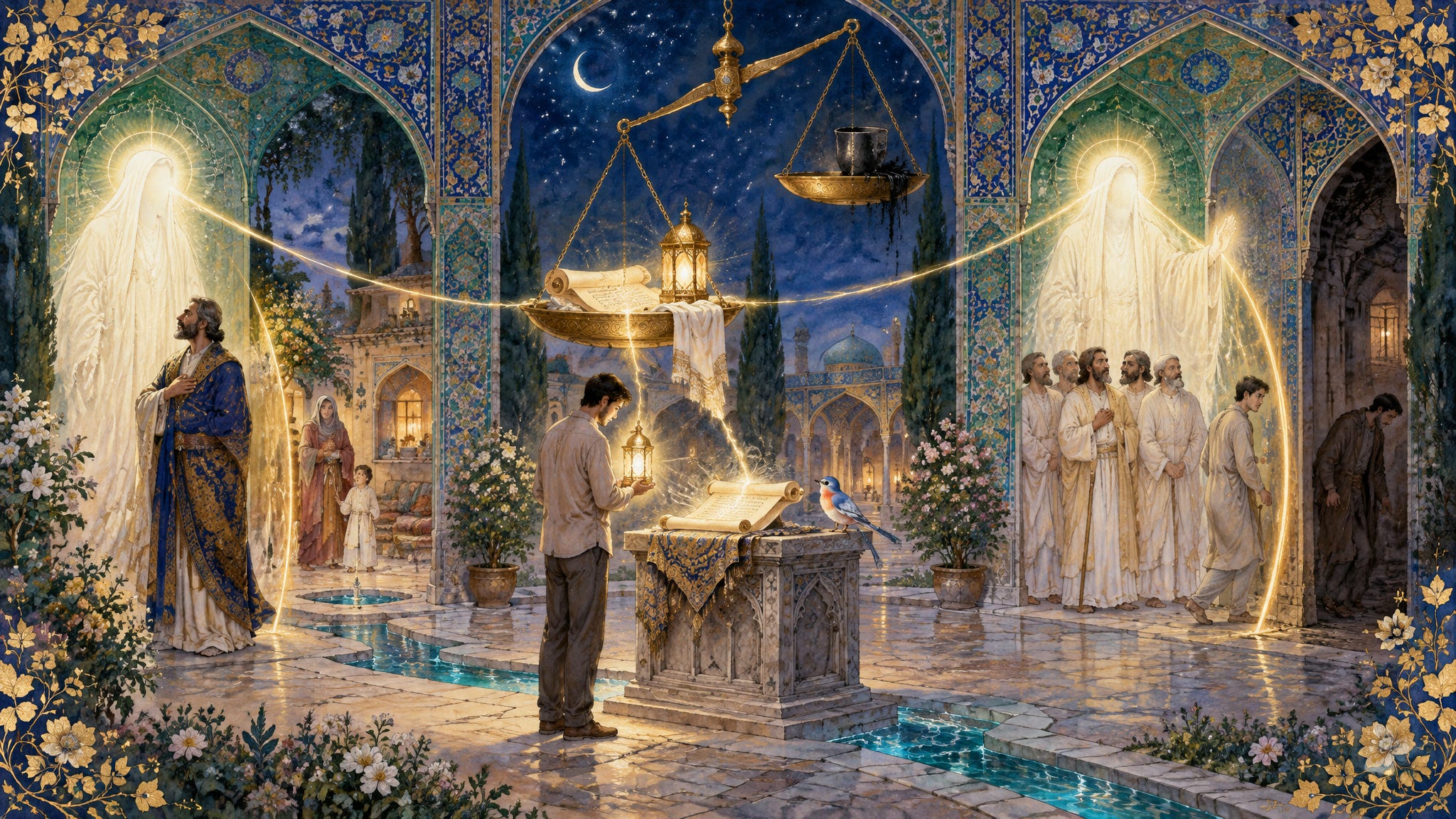
Listen to our Imams.
One of our Imams, Abu al-Hasan, peace and blessings be upon him, was asked about it.
And he said: it is lawful, and permitted, without restriction, for the one whom God has not made free of need through marriage — so let him keep himself chaste by it.
And once he has been made free of need of it by marriage, then it is permitted to him when he is away from his wife.
— Abu al-Hasan, peace and blessings be upon him, through al-Fath ibn Yazid; Shaykh al-Kulayni, al-Kafi, Volume 5, hadith 1790 (thaqalayn) — narrated29
Let him keep himself chaste.
That is its purpose, in an Imam’s own words.
Not pleasure.
Chastity — for the grown man or woman who cannot yet marry.
Ali ibn Yaqtin — a close companion of Imam Musa al-Kazim, peace and blessings be upon him, and a man of standing and of means, who served in the government of his day — asked the Imam about it.
And the Imam said to him:
What have you to do with it, when God has made you free of need of it?
Ali ibn Yaqtin said he had only wanted to know.
And the Imam told him:
It is in the Book of Ali.
— Imam Musa al-Kazim, peace and blessings be upon him, through Ali ibn Yaqtin; Shaykh al-Kulayni, al-Kafi, Volume 5, hadith 1789 (thaqalayn) — narrated30
Hear both halves, because both matter.
It is in the Book of Ali.
It is lawful.
Nobody may call it what God has not called it.
And:
What have you to do with it?
To the man God has already provided for, the Imam says — this is not for you.
And his father, Imam Ja’far al-Sadiq, peace and blessings be upon him, said it more sharply still, to his own companions:
سَمِعْتُ أَبَا عَبْدِ اللهِ (عَلَيْهِ السَّلام) يَقُولُ فِي الْمُتْعَةِ دَعُوهَا أَمَا يَسْتَحْيِي أَحَدُكُمْ أَنْ يُرَى فِي مَوْضِعِ الْعَوْرَةِ فَيُحْمَلَ ذَلِكَ عَلَى صَالِحِي إِخْوَانِهِ وَأَصْحَابِهِ.
“I heard Abu Abdillah, peace be upon him, say about temporary marriage: Leave it. Is one of you not ashamed to be seen in a place of shame, so that it is laid at the door of the righteous among his brothers and his companions?”
— Imam Ja’far al-Sadiq, peace and blessings be upon him, through al-Mufaddal ibn ‘Umar; Shaykh al-Kulayni, al-Kafi, Volume 5, hadith 1792 (thaqalayn); my translation
Leave it.
Not because it is forbidden — it is in the Book of Ali.
Because of what it does to the good name of the believers, when one of them is seen in a place of shame.
That is the answer to sowing wild oats, given more than twelve centuries ago.
Fourth, what it was never for.
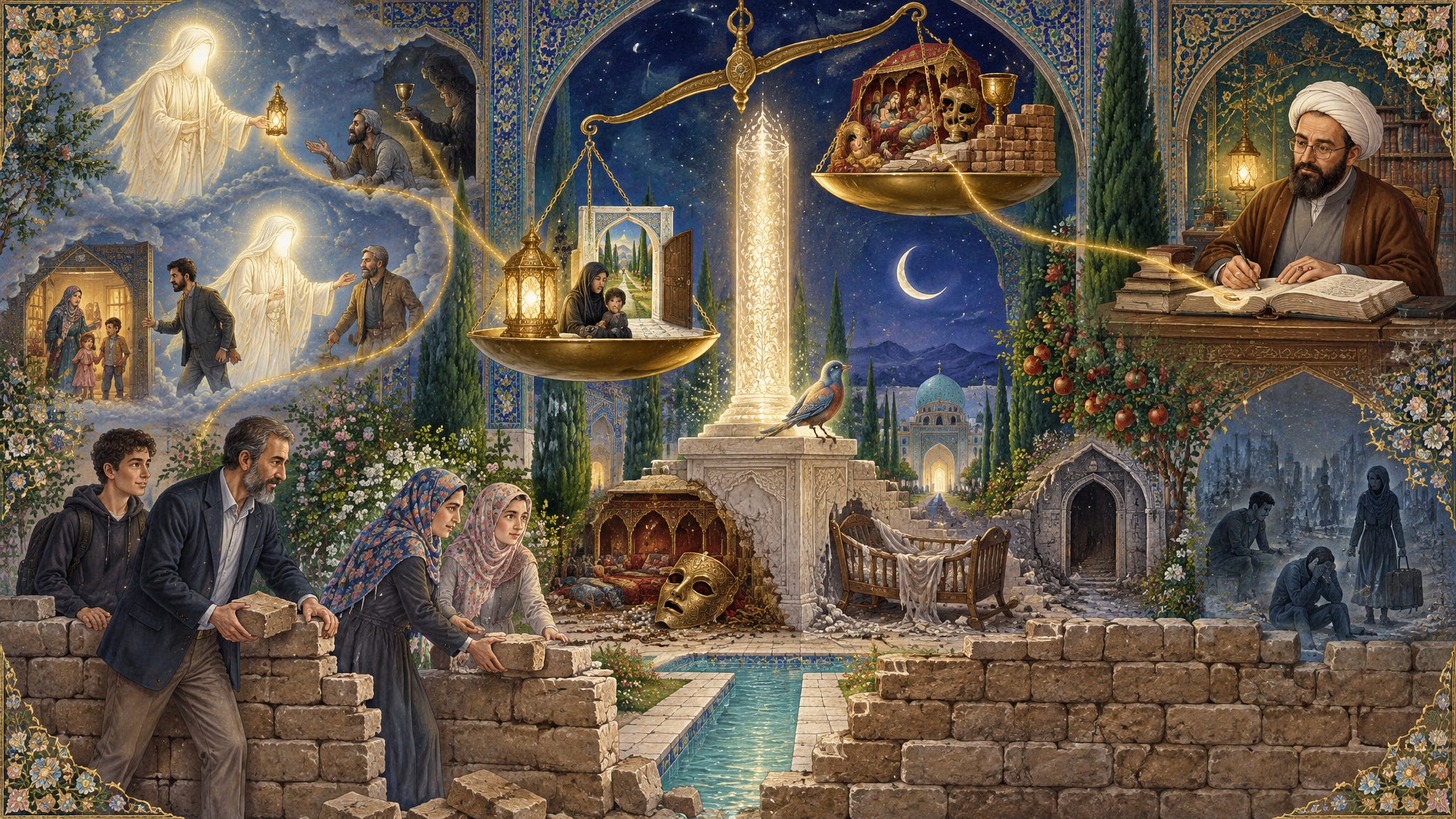
Shaheed Mutahhari again:
جای تردید نیست که هدف مقنّن قانون ازدواج موقت این نبوده است که وسیلهٔ عیاشی و حرمسراسازی برای مردم هواپرست و وسیلهٔ بدبختی و دربهدری برای یک زن و یک عده کودک فراهم سازد.
“There is no doubt that the aim of the lawgiver of the law of temporary marriage was not that it should provide a means of debauchery and harem-building for people who worship their desires, nor a means of misery and homelessness for a woman and a number of children.”
— Shaheed Ayatullah Murtaza Mutahhari, Nizam-e Huquq-e Zan dar Islam (The System of Women’s Rights in Islam), record 67; my translation
It was never meant to replace permanent marriage.
The loathing women feel for it, he says, was earned by lustful men who abused it — and the law must stop them.
A contract made by deceiving a woman is void, and the man must be punished; the crime is his, not the law’s.
And when our Imams encouraged it widely, he says, it was to keep alive a practice of the Prophet that was being buried.
Its first wisdom was always need — and that, he says, is why Imam al-Kazim turned Ali ibn Yaqtin away from it.
— Shaheed Ayatullah Murtaza Mutahhari, Nizam-e Huquq-e Zan dar Islam (The System of Women’s Rights in Islam) — narrated31
And elsewhere, speaking of the Prophet’s authority as ruler, he puts it in one line:
The Prophet permitted it where there was need, and not where it was mere lust.
— Shaheed Ayatullah Murtaza Mutahhari, Islam va Niazha-ye Zaman (Islam and the Needs of the Time), Volume 2, page 45 — narrated32
So: a marriage, with reasons. A contract with a dowry, a waiting period, and children who belong. For the grown man or woman who cannot yet marry, to keep themselves chaste. Not for the man who already has what God provided. And never, ever, a means of misery for a woman or a child.
And now the part that comes back to us — to the parents.
If we make permanent marriage impossible for our children — with our conditions, our dowries, our questions of status, our not yet, not him, not her — and then we are shocked at what they do instead, the failure was not first theirs.
Lessons for Our Time
Lesson Five — Make the Way Home Easy

The fifth lesson is Noah’s, and the father who ran.
She is still your daughter.
He is still your son.
Whatever they have done, whatever they have stopped doing, whatever the crowd is saying — keep the road home open, and keep watching it.
That does not mean pretending that wrong is right.
Noah did not tell his son the flood was imaginary.
It means the door is never locked from your side, and your voice — when it reaches them — still says my son, my daughter.
In practice, it means this.
Keep one line open that is never used for a lecture — a call that is only how are you, a meal that is only a meal.
A child who has drifted comes home along the road that was kept clear.
If every road has a sermon waiting at the end of it, he will take none of them.
Lesson Six — Make the Halal Easy
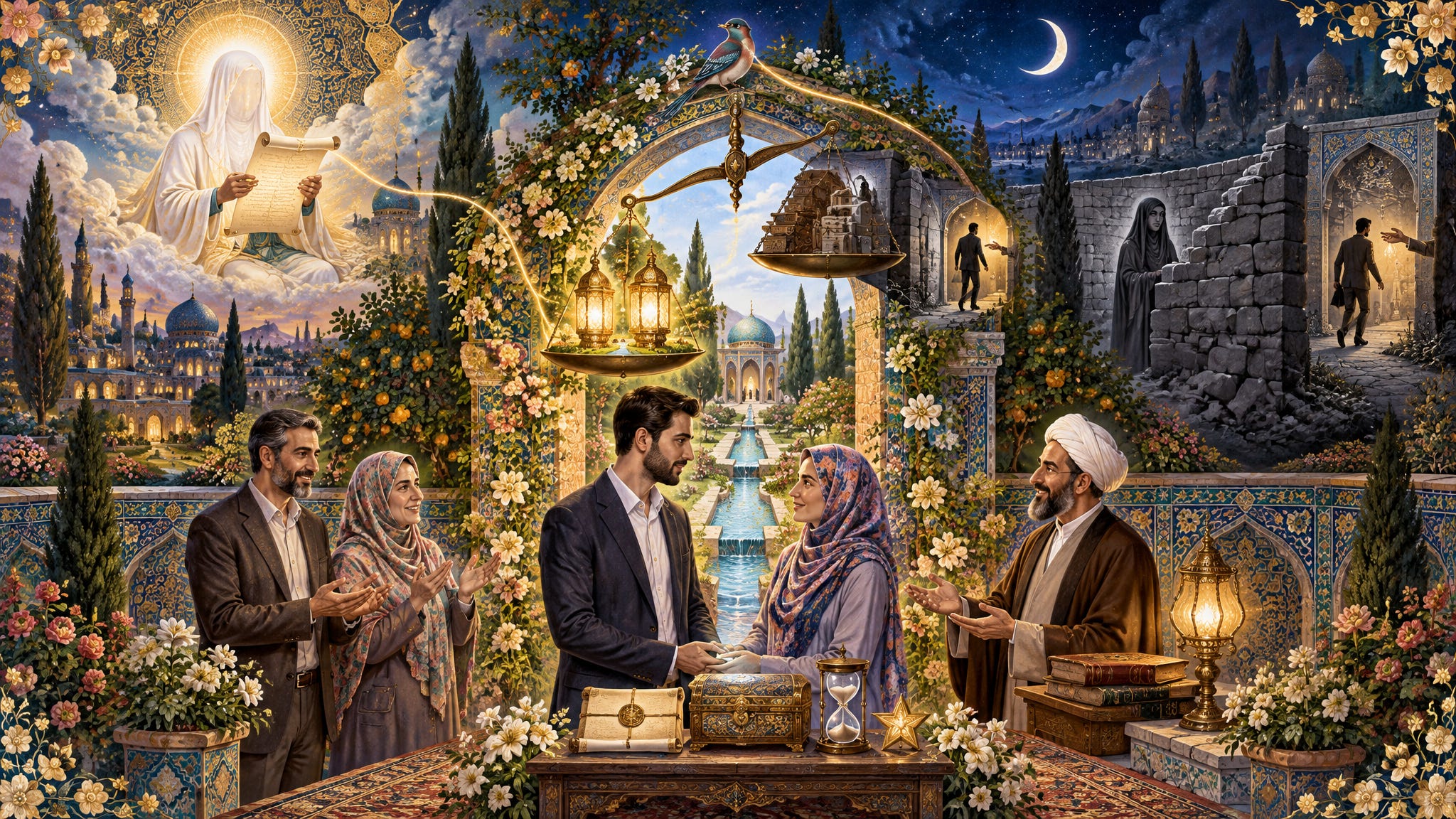
The sixth lesson is the Imam’s answer to the father who could find no equal for his daughters.
Make the halal easy before you make the haram loud.
If a young man comes whose character and religion you are pleased with — do not bury him under conditions.
Do not make your daughter wait for a status that has nothing to do with God.
Do not make your son wait until he is thirty-five and has lost years to a struggle you could have spared him.
And never — never — let mut’ah be the halal you made easy for him, while you made marriage impossible for her.
And to our young people listening tonight — those of you who are struggling, and who hear mut’ah talked about as if it were a shortcut.
It is a marriage, with a contract, a dowry, a waiting period, and duties toward any child God gives.
If you are not ready for those, you are not ready for it.
In this country no marriage of any kind — permanent or temporary, at a registry or only before a scholar — is lawful for anyone under eighteen33.
And under the rulings of our maraji’, a young woman who has never been married needs her father’s permission to marry.
So speak to your parents first — and then, with them, to a scholar you trust.
Conclusion — Key Takeaways
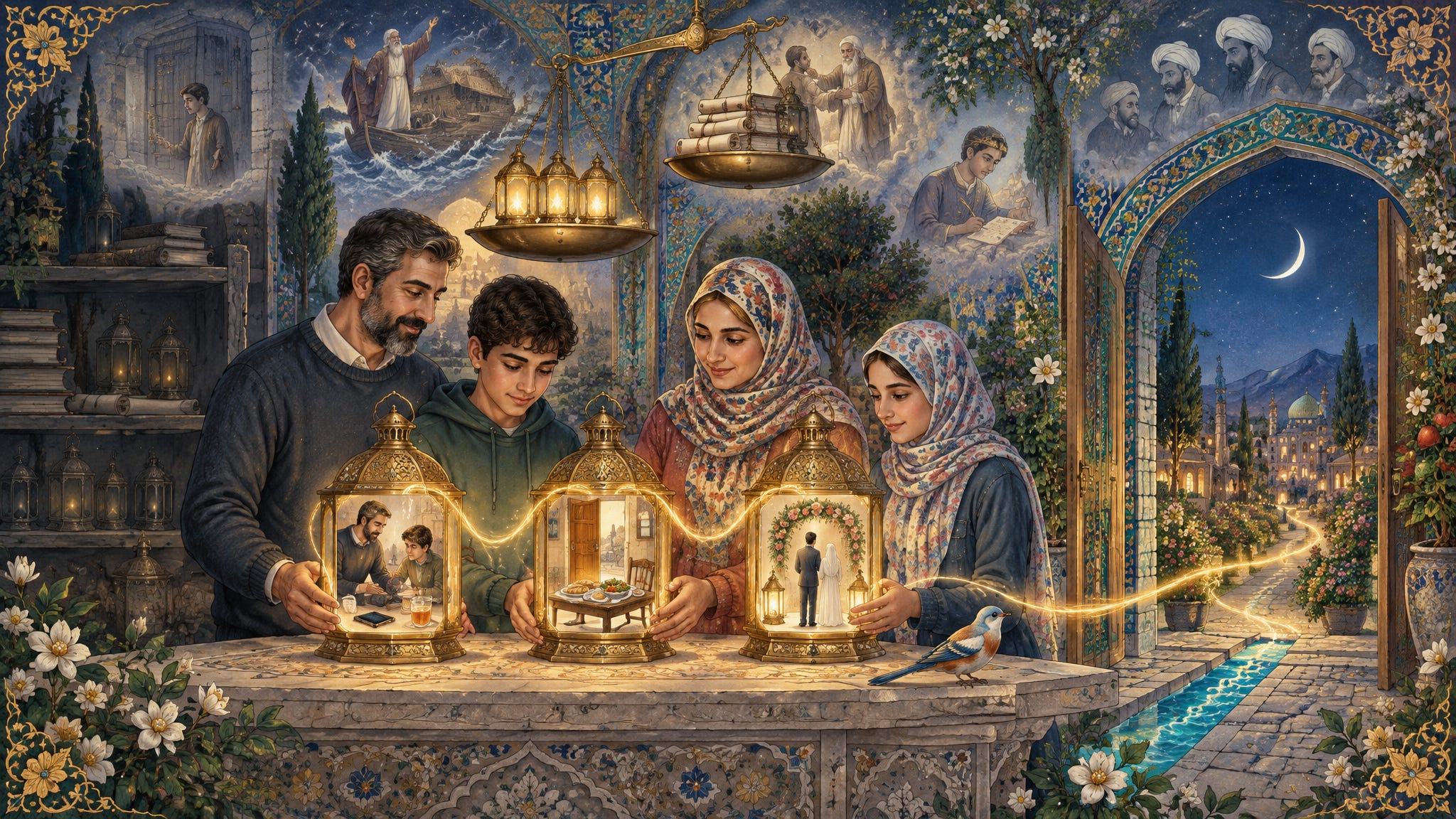
Three things to take home tonight — and they are things to do, not only things to think.
The first. The crowd’s tongue is not the truth — ask your child first.

The people of the Blessed Saint Mary, peace and blessings be upon her, went from the sight to the verdict in one step, and a newborn had to speak to clear her.
The Qur’an tells us the slander travelled on tongues that never knew, and an Imam told us to believe our brother over fifty sworn men.
In our day the tongue has a button, and the bad companion lives in our children’s pockets.
So this week: when something arrives about anybody’s child, say the Qur’an’s sentence —
it is not for us to say such a thing
— and forward nothing.
And when the crowd’s account of your own child reaches you first, hear her before you believe it.
The second. Hijab is a state of the soul — and it begins with the eyes of men.
God spoke to the men first.
Moses, peace and blessings be upon him, walked ahead so that his eyes would not follow her, and that was his trustworthiness; Joseph, peace and blessings be upon him, behind closed doors, said
God forbid.
The first two duties are shared, and the issue of covering does not concern women alone.
So this week: let every father ask his sons where their eyes have been before you ask your daughters what they are wearing — and teach both of them the two shared duties, together, with the reasons.
The third. The child who drifts is still your child — make the way home, and the way to marriage, easy.
Noah, peace and blessings be upon him, called my son until the waves came between them.
The father in the Gospel ran.
The Imam answered a father with the words of the Prophet, peace and blessings be upon him, his family, and his righteous companions: if you are pleased with his character and his religion, give him in marriage.
And mut’ah is a marriage with reasons — for the grown man or woman who cannot yet marry, to keep them chaste — never a licence, never a pastime, and never, in this country, for anyone under eighteen.
So this week: look at the conditions you have put in front of your own children’s marriage, and ask which of them God asked for.
And one thing beneath all three.
The family of Abu Talib taught the sermon of Sayyedah Fatimah, peace and blessings be upon her, to their sons, so that when the crowd came with another account, their children already knew the true one.
Teach yours.
Mary’s people did not ask her.
Medina sat silent while Sayyedah Fatimah called.
Let none of that be said of our houses.
Do those, and you will have done the work of the third seven —
keep him with you
— whatever the age of your child, and whatever your own.
Next week, God willing: the children who go ahead — Karbala, grief, and the house of praise.
Eulogy — She Carried Him to Her People

And now, because these are her nights, we go back to the two daughters.
The Blessed Saint Mary, peace and blessings be upon her, had been told not to grieve.
She had been told what to say, and what not to say.
She picked up her child, and she walked into the town where her people were waiting for her.
Ayatullah Jawadi Amoli, may God protect him, says she brought him to them with full courage — and with gladness, like a woman who had waited a long time to become a mother, and now was one.
— Ayatullah Abdullah Jawadi Amoli, Tasnim, his commentary on Surah Maryam, session 23, 31 October 2009 — narrated34
She walked into the crowd that had already decided about her.
And God cleared her, there, in front of all of them.
Sayyedah Fatimah al-Zahra, peace and blessings be upon her, also walked into a crowd.
She read them the Book of God.
She called them by their mother’s name.
And they did not come.
And the crowd did not stand with her.
The crowd sat silent.
Numerous, and armed, and silent.
She went home.
And not long after that, she fell ill.
And when her illness grew heavy, the women of the Emigrants and of the Helpers — the women of the very community that had sat silent — came to her house, and gathered at her side, and asked her how she was35.
And she answered them.
فقالت: أصبحت والله عائفة لدنياكم قالية لرجالكم ، لفظتهم قبل أن عجمتهم، وشنأتهم بعد أن سبرتهم، فقبحا لفلول الحد وخور القناة ، وخطل الرأي، وبئس ما قدمت لهم أنفسهم أن سخط الله عليهم وفي العذاب هم خالدون، لا جرم لقد قلدتهم ربقتها وشننت عليهم عارها فجدعا وعقرا و سحقا للقوم الظالمين، ويحهم أنى زحزحوها عن رواسي الرسالة وقواعد النبوة ومهبط الوحي الأمين والطبين بأمر الدنيا والدين، ألا ذلك هو الخسران المبين، وما نقموا من أبي حسن، نقموا والله منه نكير سيفه، وشدة وطأته، ونكال وقعته، وتنمره في ذات الله عز وجل، والله لو تكافوا عن زمام نبذه رسول الله صلى الله عليه وآله لاعتلقه، ولسار بهم سيرا سجحا لا يكلم خشاشه ولا يتعتع راكبه، ولا وردهم منهلا نميرا فضفاضا تطفح ضفتاه، ولأصدرهم بطانا، قد تخير لهم الري غير متحل منه بطائل إلا بغمر الماء وردعه سورة الساغب ولفتحت عليهم بركات السماء والأرض وسيأخذهم الله بما كانوا يكسبون، ألا هلم فاسمع وما عشت أراك الدهر العجب وإن تعجب وقد أعجبك الحادث، إلى أي سناد استندوا؟ وبأية عروة تمسكوا؟
“And she said:
By God, I have woken loathing your world, and hating your men.
I spat them out before I had bitten into them, and I came to detest them once I had tested them.
So shame on the blunted blade, and the spear-shaft gone weak, and the judgment gone astray!
And evil is what their souls have sent ahead for them: that God is displeased with them, and in the punishment they will remain forever.
No wonder, then: I have hung its halter about their necks, and loosed its shame upon them.
So may the wrongdoing people be disgraced, and brought down, and swept far away!
Woe to them — where have they moved it to?
Away from the firm-set mountains of the message, and the foundations of prophethood, and the place where the trustworthy revelation came down, and the one who knew the affairs of this world and of religion!
Indeed, that is the manifest loss!
And what was it they held against Abu al-Hasan?
By God, they held against him the dread of his sword, the weight of his tread, the force of his blow, and his fury for the sake of God, Mighty and Majestic.
By God, had they kept their hands off a rein the Messenger of God — God’s blessings be upon him and his family — had thrown to him, he would have taken it up, and led them on an easy road, one that would not bruise the camel’s nose nor shake its rider; and he would have brought them down to a clear and brimming spring whose banks overflow, and brought them back from it full, having chosen for them the fullest drink — taking nothing of it for himself but a mouthful of water, and enough to still the hungry one’s hunger.
And the blessings of the heaven and the earth would have been opened to them.
And God will seize them for what they used to earn.
Come, then, and listen — as long as you live, time will show you wonders; and if you wonder, what has happened has given you cause: on what support have they leaned?
And to what handhold have they clung?”
— Sayyedah Fatimah al-Zahra, peace and blessings be upon her, through Fatimah bint al-Husayn; Shaykh al-Saduq, Ma’ani al-Akhbar, hadith 695 (thaqalayn); my translation36
They had asked her how she had woken.
And she told them — not a word about her illness, not a word about her pain.
And she went on.
They had put the tail where the head should be, she told them.
It had conceived; let them wait until it gave birth — and then they would milk from it not milk, but fresh blood and bitter poison: a cutting sword, and a turmoil that takes in everything, and the tyranny of the wrongdoers, leaving their share meagre and their harvest cut down.
— Sayyedah Fatimah al-Zahra, peace and blessings be upon her, through Fatimah bint al-Husayn; Shaykh al-Saduq, Ma’ani al-Akhbar, hadith 695 — narrated37
And she ended with this.
فيا حسرتي لكم وأنى بكم وقد عميت عليكم أنلزمكموها وأنتم لها كارهون
“Oh, my grief for you!
And what is to become of you, now that it has been made invisible to you?
Shall we force it upon you, while you are averse to it?”
— Sayyedah Fatimah al-Zahra, peace and blessings be upon her, through Fatimah bint al-Husayn; Shaykh al-Saduq, Ma’ani al-Akhbar, hadith 695 (thaqalayn); my translation
Those are the words of Noah, peace and blessings be upon him, to his people — the same father we heard tonight, calling to his son:
قَالَ يَٰقَوۡمِ أَرَءَيۡتُمۡ إِن كُنتُ عَلَىٰ بَيِّنَةٖ مِّن رَّبِّي وَءَاتَىٰنِي رَحۡمَةٗ مِّنۡ عِندِهِۦ فَعُمِّيَتۡ عَلَيۡكُمۡ أَنُلۡزِمُكُمُوهَا وَأَنتُمۡ لَهَا كَٰرِهُونَ
“He said, ‘O my people! Tell me, should I stand on a manifest proof from my Lord, and He has granted me His own mercy—though it should be invisible to you—shall we force it upon you while you are averse to it?”
— Qur’an, Surah Hud (the Chapter of the Prophet Hud) #11, Verse 28; the English, Ali Quli Qarai’s
Shall we force it upon you?
She would not force it on them.
She had read them the Book in her father’s gathering.
She had called the Helpers by their mother’s name.
And now, from her sickbed, she told their women the truth — and she left it with them.
The crowd that would not come when she called — now its women came to her bedside to ask how she was.
And she did not hide from them what that silence had cost.
Sayyedah Fatimah spoke for herself — to the men in the gathering, and to the women at her bedside.
She was believed by those who loved her, and she was left by those who did not.
And before that sickbed, they had already seen her grief.
Segue to Maqtal
We began tonight with a single word:
tongues.
The tongues that passed on a slander without ever knowing it.
The tongues that stayed silent in a gathering while Sayyedah Fatimah, peace and blessings be upon her, called, and called.
The tongues that came, at the end, to her bedside, and asked how she had woken.
And there was one more thing those tongues had already done.
The verse said receiving it on your tongues.
Medina received her grief on theirs38.
Our maqtal tonight is By Night or by Day.
Supplication
In His Name, the Lord of Fatimah, her Father, her Husband and her Children
O God, we ask You by the verse with which we began — the verse that warned of tongues that received what they did not know, and of a grave matter they thought was light.
Do not let us be among them.
By Your prophets and Your chosen ones, peace and blessings be upon them all —
By Noah, who called my son until the waves came between them;
By Moses, who walked ahead so that his eyes would not follow;
By Zechariah, whose prayer for an heir the daughter of Your Prophet recited in her sermon;
And by the Blessed Saint Mary, who carried her child into the crowd,
And by her son, who spoke in the cradle for his mother — may our souls be his ransom, and may You hasten his return.
By Muhammad, peace and blessings be upon him, his family, and his righteous companions — whose daughter walked his walk into that gathering.
By the fourteen — by Sayyedah Fatimah al-Zahra, peace and blessings be upon her, the mistress of the women of the worlds, of the first and of the last, who spoke when the crowd was silent; and by every Imam, from the Commander of the Faithful, peace and blessings be upon him, whose testimony for her was set aside, to the one we are waiting for, may our souls be his ransom and may You hasten his return.
And we ask You in the words of her grandson, Imam Ali ibn al-Husayn al-Sajjad, peace and blessings be upon him, in his supplication for noble character — because tonight was about the crowd’s tongue, and this is the prayer that undoes it:
اللَّهُمَّ صَلِّ عَلَى مُحَمَّدٍ وَآلِ مُحَمَّدٍ، وَأَبْدِلْنِي مِنْ بِغْضَةِ أَهْلِ الشَّنَآنِ الْمَحَبَّةَ، وَمِنْ حَسَدِ أَهْلِ الْبَغْيِ الْمَوَدَّةَ، وَمِنْ ظِنَّةِ أَهْلِ الصَّلَاحِ الثِّقَةَ، وَمِنْ عَدَاوَةِ الْأَدْنَيْنَ الْوَلَايَةَ، وَمِنْ عُقُوقِ ذَوِي الْأَرْحَامِ الْمَبَرَّةَ، وَمِنْ خِذْلَانِ الْأَقْرَبِينَ النُّصْرَةَ، وَمِنْ حُبِّ الْمُدَارِينَ تَصْحِيحَ الْمِقَةِ، وَمِنْ رَدِّ الْمُلَابِسِينَ كَرَمَ الْعِشْرَةِ، وَمِنْ مَرَارَةِ خَوْفِ الظَّالِمِينَ حَلَاوَةَ الْأَمَنَةِ
O God, bless Muhammad and Muhammad’s Household and replace for me the animosity of the people of hatred with love, the envy of the people of insolence with affection, the suspicion of the people of righteousness with trust, the enmity of those close with friendship, the disrespect of womb relatives with devotion, the abandonment of relatives with help, the attachment of flatterers with love set right, the rejection of fellows with generous friendliness, and the bitterness of the fear of wrongdoers with the sweetness of security!
— Imam Ali ibn al-Husayn al-Sajjad, peace and blessings be upon him; al-Sahifa al-Sajjadiyya, Supplication 20, on noble moral traits — the English of our text of the Sahifa
O God, make us a people who ask before we believe, who hear our children before we hear the crowd, and whose tongues pass on only what we know.
O God, guard the eyes of our sons and the dignity of our daughters, and make hijab in our homes a state of the soul before it is a garment.
O God, make the halal easy for our young, and soften the hearts of their mothers and fathers toward the marriages You have made lawful for them.
O God, return to us the children who have drifted — and keep the road home open, and keep us watching it.
O God, have mercy on Allamah Tabataba’i, on Shaheed Mutahhari, on Ayatullah Misbah Yazdi, on Ayatullah Fadhlullah, and on all the scholars whose words we carried tonight; and protect Ayatullah Jawadi Amoli, Ayatullah A’rafi, and those of them who are still with us.
O God, we remember before You the martyred leader, Imam Sayyed Ali Khamenei, may You rest his pure soul — accept him, and gather him with those he loved.
O God, protect and guide and lengthen the life of our Wali al-Faqih, Imam Sayyed Mujtaba Khamenei, may You protect him, and keep him firm on the straight path until the rising of the one we are waiting for.
O God, hasten the relief of Your friend and the son of Your friend — the Imam of our Age, may our souls be his ransom and may You hasten his return.
And let us be among those he would be pleased to find raising their children for him when he comes.
O God, we remember before You the families of those in this majlis, and the martyrs, and the truthful — keep them in Your care, and let none of them be forgotten.
O God, by the sermon of Sayyedah Fatimah, and by her silence, make us of her lovers, and of those who weep for her tonight — and make our houses the houses that teach their children the true account.
And whatever we have said tonight that was true, it is from You; and whatever was wrong in it is from me, and I ask Your forgiveness for it.
Amen, O Lord Sustainer of the Universes
Amen, O Most Merciful of the Merciful
And from Him alone is all ability and He has authority over all things.
Appendix — The Fadak Sermon in Full
Sayyedah Fatimah al-Zahra’s sermon, peace and blessings be upon her, as al-Majlisi gives it from al-Tabrisi’s al-Ihtijaj in Bihar al-Anwar, Volume 29, pages 220 to 235, in the Rafed edition of the Arabic, with al-Majlisi’s closing note from Ibn Abi Tahir’s Balaghat al-Nisa. Page by page: the Arabic as our library holds it, set byte for byte, and beneath it the English — my translation, with the Qur’an in Ali Quli Qarai’s English. Nothing is cut. The bracketed notes in the English mark the readings that are unclear in the print, and the notes after the last page list them. The man who sat in authority is named in the text as it is printed: a primary text is not edited.
Bihar al-Anwar, Volume 29, page 220
8 ـ ورواها الشيخ أحمد بن أبي طالب الطبرسي في كتاب الإحتجاج (2) مرسلا ، ونحن نوردها بلفظه ، ثم نشير إلى موضع التخالف بين الروايات في أثناء شرحها إن شاء الله تعالى. قال رحمه الله تعالى : روى عبد الله بن الحسن بإسناده عن آبائه عليهمالسلام : أنه لما أجمع أبو بكر (3) على منع فاطمة عليهاالسلام فدك ، وبلغها ذلك لاتت [ لاثت ] (4) خمارها على رأسها واشتملت بجلبابها وأقبلت في لمة من حفدتها ونساء قومها تطأ ذيولها ، ما تخرم مشيتها مشية رسول الله صلىاللهعليهوآلهوسلم حتى دخلت على أبي بكر ـ وهو في حشد من المهاجرين والأنصار وغيرهم ـ فنيطت دونها ملاءة ، فجلست ثم أنت أنة أجهش القوم لها بالبكاء ، فارتج المجلس ، ثم أمهلت هنيئة حتى إذا سكن نشيج القوم وهدأت فورتهم ، افتتحت الكلام بحمد الله والثناء عليه والصلاة على رسول الله (5) (ص) ، فعاد القوم في بكائهم فلما أمسكوا عادت في كلامها. فقالت عليهاالسلام : الحمد لله على ما أنعم ، وله الشكر على ما ألهم ، والثناء بما قدم من عموم نعم ابتدأها ، وسبوغ آلاء أسداها ، وتمام منن والاها (6) ،
Majlisi: 8. And Shaykh Ahmad ibn Abi Talib al-Tabrisi narrated it in the book al-Ihtijaj without a chain of transmission. We give it in his words, and then, God Most High willing, we shall point out where the narrations differ from one another in the course of our commentary on it. He, may God Most High have mercy on him, said:
Abd Allah ibn al-Hasan narrated, with his chain of transmission, from his forefathers, peace be upon them, that when Abu Bakr had resolved to withhold Fadak from Fatimah, peace be upon her, and word of it reached her, she wound her head-covering about her head [the text prints latat; the edition’s bracket corrects it to lathat], wrapped herself in her mantle, and came forward among a band of her attendants and the women of her people, treading on the hems of her robes, her walk not falling short in the least of the walk of the Messenger of God, God’s blessings be upon him and his family, until she came in upon Abu Bakr — he was amid a throng of the Muhajirun, the Ansar and others. A sheet was hung before her, and she sat down. Then she let out a moan at which the people broke into weeping, and the gathering was shaken. Then she waited a little while, until, when the sobbing of the people had stilled and their agitation had calmed, she opened her speech with the praise of God, the extolling of Him, and the invocation of blessings upon the Messenger of God, God’s blessings be upon him and his family. The people fell back into their weeping, and when they had held back, she resumed her speech.
She, peace be upon her, said: Praise be to God for what He has bestowed, and to Him be thanks for what He has inspired, and laudation for what He has sent ahead: the all-embracing blessings He initiated, the abundant bounties He conferred, and the complete favours He made to follow one upon another,
Bihar al-Anwar, Volume 29, page 221
جم عن الإحصاء عددها ، ونأى عن الجزاء أمدها ، وتفاوت عن الإدراك أبدها ، وندبهم لاستزادتها بالشكر لاتصالها ، واستحمد إلى الخلائق بإجزالها ، وثنى بالندب إلى أمثالها ، وأشهد أن لا إله إلا الله وحده لا شريك له ، كلمة جعل الإخلاص تأويلها ، وضمن القلوب موصولها ، وأنار في الفكرة (1) معقولها ، الممتنع من الأبصار رؤيته ، ومن الألسن صفته ، ومن الأوهام كيفيته ، ابتدع الأشياء لا من شيء كان قبلها ، وأنشأها بلا احتذاء أمثلة امتثلها ، كونها بقدرته ، وذرأها بمشيته ، من غير حاجة منه إلى تكوينها ، ولا فائدة له في تصويرها ، إلا تثبيتا لحكمته ، وتنبيها على طاعته ، وإظهارا لقدرته ، و (2) تعبدا لبريته ، وإعزازا لدعوته ، ثم جعل الثواب على طاعته ، ووضع العقاب على معصيته ، زيادة (3) لعباده عن (4) نقمته وحياشة منه (5) إلى جنته ، وأشهد أن أبي محمدا (ص) عبده ورسوله ، اختاره وانتجبه (6) قبل أن أرسله ، وسماه قبل أن اجتبله (7) ، واصطفاه قبل أن ابتعثه ، إذ الخلائق بالغيب مكنونة ، وبستر الأهاويل مصونة ، وبنهاية العدم مقرونة ، علما من الله تعالى بمآيل الأمور (8) ، وإحاطة بحوادث الدهور ، ومعرفة بمواقع المقدور (9) ، ابتعثه الله تعالى (10) إتماما لأمره ، وعزيمة على إمضاء حكمه ،
whose number is too vast to be counted, whose span lies too far to be repaid, and whose endlessness is beyond comprehension. He summoned them to seek the increase of these blessings through gratitude, that they might continue; He sought the praise of His creatures by bestowing them lavishly; and He followed this by summoning them to the like of them. And I bear witness that there is no god but God, alone, without partner: a word whose inner meaning He made sincere devotion, whose bond He lodged in hearts, and whose sense He made to shine in thought. He is the One whom eyes are barred from seeing, tongues from describing, and imaginations from conceiving how He is. He originated things from nothing that was before them, and brought them into being without following models that He copied. He gave them being by His power and brought them forth by His will, with no need of His for their making and no gain for Him in their shaping, but to establish His wisdom, to call attention to obedience to Him, to manifest His power, to bring His creation to worship Him, and to exalt His call. Then He set reward upon obedience to Him and placed punishment upon disobedience to Him, as an increase [the text reads ziyada, ‘increase’; as printed the phrase does not construe] for His servants away from His vengeance, and as a herding of them by Him towards His Garden.
And I bear witness that my father, Muhammad, God’s blessings be upon him and his family, is His servant and His Messenger. He chose him and selected him before He sent him, named him before He fashioned him, and singled him out before He raised him up, when created things were hidden in the unseen, guarded behind the veil of terrors, and joined to the furthest edge of non-existence, out of God Most High’s knowledge of where affairs would end, His full grasp of the events of the ages, and His awareness of where the decrees would fall. God Most High raised him up to complete His affair, in firm resolve to carry out His judgment,
Bihar al-Anwar, Volume 29, page 222
وإنفاذا لمقادير حتمه (1) ، فرأى الأمم فرقا في أديانها ، عكفا على نيرانها ، عابدة لأوثانها ، منكرة لله مع عرفانها ، فأنار الله بمحمد (2) صلىاللهعليهوآله ظلمها ، وكشف عن القلوب بهمها ، وجلى عن الأبصار غممها ، وقام في الناس بالهداية ، وأنقذهم (3) من الغواية ، وبصرهم من العماية ، وهداهم إلى الدين القويم ، ودعاهم إلى الطريق المستقيم ، ثم قبضه الله إليه قبض رأفة واختيار ، ورغبة وإيثار بمحمد [ فمحمد ] (4) صلىاللهعليهوآله عن (5) تعب هذه الدار في راحة ، قد حف بالملائكة الأبرار ، ورضوان الرب الغفار ، ومجاورة الملك الجبار ، صلى الله على أبي نبيه وأمينه على الوحي وصفيه (6) وخيرته من الخلق ورضيه (7) ، والسلام عليه ورحمة الله وبركاته. ثم التفتت (8) إلى أهل المجلس ، وقالت : أنتم عباد الله نصب أمره ونهيه ، وحملة دينه ووحيه ، وأمناء الله على أنفسكم ، وبلغاؤه إلى الأمم ، وزعمتم حق لكم لله (9) فيكم عهد (10) قدمه إليكم ، وبقية استخلفها عليكم ، كتاب الله الناطق ، والقرآن الصادق ، والنور الساطع ، والضياء اللامع ، بينة بصائره ،
and to put into effect His binding decrees. And he found the nations divided into sects in their religions, bent in devotion over their fires, worshipping their idols, denying God though they knew Him. So God lit up their darkness through Muhammad, God’s blessings be upon him and his family, lifted from hearts their obscurities, and cleared the mists from eyes. And he rose among the people with guidance, rescued them from error, gave them sight out of blindness, guided them to the upright religion and called them to the straight path. Then God took him to Himself, a taking of tenderness and choice, of desire and preference; and so Muhammad [the text prints bi-Muhammad; translated by the edition’s bracketed reading, fa-Muhammad], God’s blessings be upon him and his family, is at rest from the toil of this abode, encircled by the righteous angels, the good pleasure of the All-Forgiving Lord and the nearness of the Almighty King. May God bless my father, His Prophet, His trustee over revelation, His chosen one, His elect from creation and His well-pleasing one; and peace be upon him, and the mercy of God and His blessings.
Then she turned to the people of the gathering and said: You, servants of God, are the ones charged with His commands and prohibitions, the bearers of His religion and His revelation, God’s trustees over yourselves, and His envoys to the nations. And you have claimed a right as yours [the text reads wa-za’amtum haqqun lakum; the sense is uncertain]. God has among you a covenant He set before you, and a remnant He appointed as successor over you: the speaking Book of God, the truthful Qur’an, the radiant light, the gleaming brightness; its insights plain,
Bihar al-Anwar, Volume 29, page 223
منكشفة سرائره ، متجلية (1) ظواهره ، مغتبطة (2) به أشياعه ، قائد إلى الرضوان اتباعه ، مؤد إلى النجاة إسماعه (3) ، به تنال حجج الله المنورة ، وعزائمه المفسرة ، ومحارمه المحذرة ، وبيناته الجالية ، وبراهينه الكافية ، وفضائله المندوبة ، ورخصه الموهوبة ، وشرائعه المكتوبة ، فجعل الله الإيمان تطهيرا لكم من الشرك ، والصلاة تنزيها لكم عن الكبر ، والزكاة تزكية للنفس ، ونماء في الرزق ، والصيام تثبيتا للإخلاص ، والحج تشييدا للدين ، والعدل تنسيقا للقلوب ، وطاعتنا نظاما للملة ، وإمامتنا أمانا من الفرقة (4) ، والجهاد عزا للإسلام ، والصبر معونة على استيجاب الأجر ، والأمر بالمعروف مصلحة للعامة ، وبر الوالدين وقاية من السخط ، وصلة الأرحام منماة (5) للعدد ، والقصاص حقنا للدماء ، والوفاء بالنذر تعريضا للمغفرة ، وتوفية المكاييل والموازين تغييرا للبخس ، والنهي عن شرب الخمر تنزيها عن الرجس ، واجتناب القذف حجابا عن اللعنة ، وترك السرقة إيجابا للعفة (6) ، وحرم الله الشرك إخلاصا له بالربوبية ، فـ ( اتَّقُوا اللهَ حَقَّ تُقاتِهِ وَلا تَمُوتُنَّ إِلاَّ وَأَنْتُمْ مُسْلِمُونَ ) (7) ، وأطيعوا الله فيما أمركم به ونهاكم عنه فإنه ( إِنَّما يَخْشَى اللهَ مِنْ عِبادِهِ الْعُلَماءُ ) (8). ثم قالت : أيها الناس! اعلموا أني فاطمة وأبي محمد صلىاللهعليهوآله ، أقول عودا وبدءا (9) ، ولا أقول ما أقول غلطا ، ولا أفعل ما أفعل شططا ( لَقَدْ
its secrets disclosed, its outward meanings shining forth; its adherents are envied for it; following it leads to God’s good pleasure, and making it heard leads to deliverance. Through it are attained God’s illumined proofs, His expounded obligations, His prohibitions that are warned against, His clarifying evidences, His sufficing demonstrations, His recommended virtues, His granted dispensations and His prescribed laws. So God made faith a purification for you from polytheism; prayer a keeping of you clear of arrogance; almsgiving a purifying of the soul and a growth in provision; fasting a confirming of sincerity; the pilgrimage a fortifying of religion; justice a harmonising of hearts; obedience to us an order for the community; our imamate a safeguard against division; jihad a glory for Islam; patience a help towards earning the reward; enjoining what is right a benefit for the common people; kindness to parents a shield against wrath; maintaining the ties of kinship a means of increasing numbers; retaliation a sparing of blood; fulfilling vows a laying of oneself open to forgiveness; giving full measure and weight a corrective for short-changing; the prohibition of drinking wine a keeping clear of filth; avoiding false accusation a screen against the curse; and giving up theft a securing of integrity. And God forbade polytheism, to make lordship purely His. So “Be wary of Allah with the wariness due to Him and do not die except as Muslims” [3:102], and obey God in what He has commanded you and what He has forbidden you, for “Only those of Allah’s servants having knowledge fear Him” [35:28].
Then she said: O people! Know that I am Fatimah, and my father is Muhammad, God’s blessings be upon him and his family. I say it first and last. I do not say what I say in error, nor do I do what I do in excess. “There has certainly
Bihar al-Anwar, Volume 29, page 224
جاءَكُمْ رَسُولٌ مِنْ أَنْفُسِكُمْ عَزِيزٌ عَلَيْهِ ما عَنِتُّمْ حَرِيصٌ عَلَيْكُمْ بِالْمُؤْمِنِينَ رَؤُفٌ رَحِيمٌ ) (1) ، فإن تعزوه وتعرفوه تجدوه أبي دون نسائكم ، وأخا ابن عمي دون رجالكم ، ولنعم المعزي إليه صلىاللهعليهوآلهوسلم ، فبلغ الرسالة ، صادعا بالنذارة ، مائلا عن مدرجة المشركين ، ضاربا ثبجهم ، آخذا بأكظامهم ، داعيا إلى سبيل ربه ( بِالْحِكْمَةِ وَالْمَوْعِظَةِ الْحَسَنَةِ ) ، يكسر (2) الأصنام ، وينكث الهام ، حتى انهزم الجمع وولوا الدبر ، حتى تفرى الليل عن صبحه ، وأسفر الحق عن محضه ، ونطق زعيم الدين ، وخرست شقاشق الشياطين ، وطاح وشيظ النفاق ، وانحلت عقد الكفر والشقاق ، وفهتم بكلمة الإخلاص في نفر من البيض الخماص ، ( وَكُنْتُمْ عَلى شَفا حُفْرَةٍ مِنَ النَّارِ ) ، مذقة الشارب ، ونهزة الطامع ، وقبسة العجلان ، وموطئ الأقدام ، تشربون الطرق ، وتقتاتون الورق (3) ، أذلة خاسئين ، ( تَخافُونَ أَنْ يَتَخَطَّفَكُمُ النَّاسُ ) من حولكم ، فأنقذكم الله تبارك وتعالى بمحمد صلىاللهعليهوآله بعد اللتيا والتي ، وبعد أن مني ببهم الرجال ، وذؤبان العرب ، ومردة أهل الكتاب ( كُلَّما أَوْقَدُوا ناراً لِلْحَرْبِ أَطْفَأَهَا اللهُ ) (4) ، أو نجم قرن للشيطان (5) ، وفغرت فاغرة من المشركين ، قذف أخاه في لهواتها ، فلا ينكفئ حتى يطأ صماخها (6) بأخمصه ، ويخمد لهبها بسيفه ، مكدودا في ذات الله ، و (7) مجتهدا في أمر الله ، قريبا من رسول الله ، سيد أولياء الله (8) ، مشمرا ناصحا ، مجدا كادحا ،
come to you an apostle from among yourselves. Grievous to him is your distress; he has deep concern for you, and is most kind and merciful to the faithful” [9:128]. If you trace his kinship and come to know him, you will find him my father, not the father of any of your women, and the brother of my cousin, not of any of your men; and how excellent is he to whom one is traced, God’s blessings be upon him and his family! He delivered the message, proclaiming the warning openly, turning aside from the path of the polytheists, striking at their very midst, seizing them by the throat, inviting to the way of his Lord “with wisdom and good advice” [16:125], breaking the idols and bringing the heads down, until the host was routed and they turned their backs; until the night split open upon its morning and the truth unveiled its pure substance; the spokesman of religion spoke, and the frothing brays of the devils were struck dumb; the rabble of hypocrisy perished, and the knots of unbelief and discord came undone; and you spoke the word of sincere devotion among a small band of the radiant and lean-bellied.
“And you were on the brink of a pit of Fire” [3:103]: a sip for the drinker, a chance for the greedy, a firebrand snatched by the hasty, ground for feet to trample. You drank fouled water and fed on leaves, abased and outcast; you “feared lest the people should despoil you” [8:26] from all around you. Then God, Blessed and Most High is He, rescued you through Muhammad, God’s blessings be upon him and his family, after trials great and small, and after he had been beset by the boldest of warriors, the wolves of the Arabs and the rebels among the People of the Book. “Every time they ignite the flames of war, Allah puts them out” [5:64]; or whenever a horn of Satan appeared, or a gaping maw of the polytheists opened wide, he would hurl his brother into its jaws, and he would not turn back until he had trodden its ear beneath the sole of his foot and quenched its flame with his sword, spent with toil for God’s sake, striving in God’s cause, close to the Messenger of God, the master of God’s friends, girded for action and true in counsel, earnest and labouring,
Bihar al-Anwar, Volume 29, page 225
وأنتم (1) في رفاهية من العيش ، وادعون فاكهون آمنون ، تتربصون بنا الدوائر ، وتتوكفون الأخبار ، وتنكصون عند النزال ، وتفرون عند (2) القتال ، فلما اختار الله لنبيه دار أنبيائه ، ومأوى أصفيائه ، ظهر فيكم حسيكة (3) النفاق ، وسمل جلباب الدين ، ونطق كاظم الغاوين ، ونبغ خامل الأقلين ، وهدر فنيق المبطلين ، فخطر في عرصاتكم ، وأطلع الشيطان رأسه من مغرزه هاتفا بكم ، فألفاكم لدعوته مستجيبين ، وللغرة (4) فيه ملاحظين ، ثم استنهضكم فوجدكم خفافا ، وأحمشكم (5) فألفاكم غضابا ، فوسمتم غير إبلكم ، وأوردتم غير شربكم (6) ، هذا والعهد قريب ، والكلم رحيب ، والجرح لما يندمل ، والرسول لما يقبر ، ابتدارا زعمتم خوف الفتنة ( أَلا فِي الْفِتْنَةِ سَقَطُوا وَإِنَّ جَهَنَّمَ لَمُحِيطَةٌ بِالْكافِرِينَ ) (7) ، فهيهات منكم! وكيف بكم؟! وأنى تؤفكون؟ وكتاب الله بين أظهركم ، أموره ظاهرة ، وأحكامه زاهرة ، وأعلامه باهرة ، وزواجره لائحة ، وأوامره واضحة ، قد (8) خلفتموه وراء ظهوركم ، أرغبة عنه تريدون (9) ..؟ ، أم بغيره تحكمون؟! ( بِئْسَ لِلظَّالِمِينَ بَدَلاً ) (10) ، ( وَمَنْ يَبْتَغِ غَيْرَ الْإِسْلامِ دِيناً فَلَنْ يُقْبَلَ مِنْهُ وَهُوَ فِي الْآخِرَةِ مِنَ الْخاسِرِينَ ) (11) ، ثم (12) لم تلبثوا إلا ريث أن تسكن نفرتها ، ويسلس قيادها ،
while you were in ease of living, at rest, making merry, secure, waiting for misfortunes to overtake us, listening out for the news, shrinking back when battle was joined and fleeing from the fighting.
Then when God chose for His Prophet the abode of His prophets and the shelter of His chosen ones, the rancour of hypocrisy showed itself among you, the garment of religion wore threadbare, the silent one of the errant found his voice, the obscure one of the lowly came to the fore, and the stallion of the falsifiers bellowed and went swaggering through your courtyards. Satan put out his head from his lair, calling to you, and found you answering his call and eyeing the delusion in it. Then he roused you and found you quick to rise; he inflamed you and found you full of anger. So you branded camels not your own and drove them down to water not your share. And this while the covenant was recent, the wound wide, the injury not yet healed, and the Messenger not yet buried! In your haste you claimed to fear sedition — “Look! They have already fallen into temptation and indeed hell besieges the faithless” [9:49].
How far this is from you! What has become of you? And how are you being turned away, when the Book of God is in your midst, its matters manifest, its rulings radiant, its signposts brilliant, its restraints plain and its commands clear? You have left it behind your backs. Is it aversion to it that you want …? Or is it by something else that you judge? “How evil a substitute for the wrongdoers!” [18:50] “Should anyone follow a religion other than Islam, it shall never be accepted from him, and he will be among the losers in the Hereafter” [3:85]. Then you waited no longer than it took for its bolting to calm and its halter to grow easy,
Bihar al-Anwar, Volume 29, page 226
ثم أخذتم تورون وقدتها ، وتهيجون جمرتها ، وتستجيبون لهتاف الشيطان الغوي ، وإطفاء أنوار الدين الجلي ، وإهماد (1) سنن النبي الصفي ، تسرون حصوا (2) في ارتغاء ، وتمشون لأهله وولده في الخمر (3) والضراء ، ونصبر (4) منكم على مثل حز المدى ، ووخز السنان في الحشا ، وأنتم (5) تزعمون ألا إرث لنا ( أَفَحُكْمَ الْجاهِلِيَّةِ يَبْغُونَ وَمَنْ أَحْسَنُ مِنَ اللهِ حُكْماً لِقَوْمٍ يُوقِنُونَ ) (6) أفلا تعلمون؟! بلى ، تجلى (7) لكم كالشمس الضاحية أني ابنته أيها المسلمون ، أأغلب على إرثيه (8)؟!. يا ابن أبي قحافة ، أفي كتاب الله أن ترث أباك ولا أرث أبي؟! لقد جئت ( شَيْئاً فَرِيًّا ) (9) أفعلى عمد تركتم كتاب الله ونبذتموه وراء ظهوركم إذ يقول : ( وَوَرِثَ سُلَيْمانُ داوُدَ ) (10)؟! وقال فيما اقتص من خبر يحيى بن زكريا (ع) إذ قال :رب (11) هب ( لِي مِنْ لَدُنْكَ وَلِيًّا يَرِثُنِي وَيَرِثُ مِنْ آلِ يَعْقُوبَ ) (12) ، وقال : ( وَأُولُوا الْأَرْحامِ بَعْضُهُمْ أَوْلى بِبَعْضٍ فِي كِتابِ اللهِ ) (13) ، وقال : ( يُوصِيكُمُ اللهُ فِي أَوْلادِكُمْ لِلذَّكَرِ مِثْلُ حَظِّ الْأُنْثَيَيْنِ ) (14) ، وقال : ( إِنْ تَرَكَ خَيْراً الْوَصِيَّةُ لِلْوالِدَيْنِ
then you set about kindling its blaze and stirring up its embers, answering the cry of the errant Satan, putting out the lights of the manifest religion and smothering the ways of the pure Prophet. You sip in secret under cover of skimming the froth [the text spells this word with the letter sad; with sin, the word of the proverb, it means ‘sipping’, as translated], and you stalk his family and his children under cover of thicket and hollow. And we endure from you the like of the cutting of knives and the thrust of the spear-point in the vitals. And you claim that we have no inheritance! “Do they seek the judgement of [pagan] ignorance? But who is better than Allah in judgement for a people who have certainty?” [5:50] Do you not know? Yes indeed: it is as clear to you as the morning sun that I am his daughter. O Muslims, am I to be overpowered for my inheritance?
O son of Abu Quhafa! Is it in the Book of God that you inherit from your father and I do not inherit from my father? You have certainly come up with “an odd thing” [19:27]. Was it deliberately, then, that you abandoned the Book of God and cast it behind your backs, when He says: “Solomon inherited from David” [27:16]? And He said, in what He recounted of the story of John son of Zechariah, peace be upon him, when he said: My Lord, grant “me from Yourself an heir who may inherit from me and inherit from the House of Jacob” [19:5-6]; and He said: “the blood relatives are more entitled to inherit from one another in the Book of Allah” [8:75; also 33:6]; and He said: “Allah enjoins you concerning your children: for the male shall be the like of the share of two females” [4:11]; and He said: “he leaves behind any property, is that he make a bequest for his parents
Bihar al-Anwar, Volume 29, page 227
وَالْأَقْرَبِينَ بِالْمَعْرُوفِ حَقًّا عَلَى الْمُتَّقِينَ ) (1) ، وزعمتم ألا (2) حظوة لي ولا أرث من أبي ولا رحم بيننا ، أفخصكم الله بآية أخرج منها أبي (3) (ص)؟! أم هل تقولون أهل (4) ملتين لا يتوارثان؟! ، أولست (5) أنا وأبي من أهل ملة واحدة؟! أم أنتم أعلم بخصوص القرآن وعمومه من أبي وابن عمي؟! فدونكما (6) مخطومة (7) مرحولة تلقاك يوم حشرك ، فنعم الحكم الله ، والزعيم محمد ، والموعد القيامة ، وعند الساعة ما تخسرون (8) ، ولا ينفعكم إذ تندمون ، و ( لِكُلِّ نَبَإٍ مُسْتَقَرٌّ ) (9) وسوف ( تَعْلَمُونَ مَنْ يَأْتِيهِ عَذابٌ يُخْزِيهِ وَيَحِلُّ عَلَيْهِ عَذابٌ مُقِيمٌ ) (10). .. ثم رمت بطرفها نحو الأنصار فقالت : يا معاشر الفتية (11) وأعضاد الملة ، وأنصار الإسلام (12) ، ما هذه الغميزة في حقي ، والسنة عن ظلامتي ، أما كان رسول الله صلىاللهعليهوآله أبي يقول : المرء يحفظ في ولده ، سرعان ما أحدثتم ، وعجلان ذا إهالة ، ولكم طاقة بما أحاول ، وقوة على ما أطلب وأزاول ، أتقولون
and relatives, in an honourable manner—an obligation on the Godwary” [2:180]. And you have claimed that I have no portion, that I do not inherit from my father, and that there is no tie of kinship between us! Has God singled you out with a verse from which He excluded my father, God’s blessings be upon him and his family? Or do you say: the people of two faiths do not inherit from one another? Are my father and I not of the people of one faith? Or do you know the particular and the general in the Qur’an better than my father and my cousin? Then take it, the two of you [the text reads dunakuma, addressed to two; what follows addresses one], haltered and saddled; it will meet you on the day of your gathering. For God is an excellent judge, Muhammad an excellent spokesman, and the Resurrection an excellent appointment; and at the Hour is what you will lose, nor will it profit you when you regret it; and “For every prophecy there is a [preordained] setting” [6:67], and soon “you will know whom a disgraceful punishment will overtake and on whom a lasting punishment will descend” [11:39].
… Then she cast her glance toward the Ansar and said: O company of young men, supports of the community and helpers of Islam! What is this slackness over my right, and this drowsiness over the wrong done to me? Was it not the Messenger of God, God’s blessings be upon him and his family, my father, who used to say: ‘A man is safeguarded in his children’? How quickly you have innovated, and how hastily this has turned to grease! You have the power for what I am attempting, and the strength for what I seek and pursue. Do you say:
Bihar al-Anwar, Volume 29, page 228
مات محمد صلىاللهعليهوآله ، فخطب جليل استوسع وهنه (1) ، واستنهر فتقه ، وانفتق رتقه ، وأظلمت الأرض لغيبته ، وكسفت (2) النجوم لمصيبته ، وأكدت الآمال ، وخشعت الجبال ، وأضيع الحريم ، وأزيلت الحرمة (3) عند مماته ، فتلك والله النازلة الكبرى ، والمصيبة العظمى ، لا (4) مثلها نازلة ، ولا بائقة عاجلة ، أعلن بها كتاب الله جل ثناؤه في أفنيتكم في (5) ممساكم ومصبحكم ، (6) هتافا (7) وصراخا ، وتلاوة وإلحانا ، ولقبله ما حل (8) بأنبياء الله ورسله ، حكم فصل وقضاء حتم : ( وَما مُحَمَّدٌ إِلاَّ رَسُولٌ قَدْ خَلَتْ مِنْ قَبْلِهِ الرُّسُلُ أَفَإِنْ ماتَ أَوْ قُتِلَ انْقَلَبْتُمْ عَلى أَعْقابِكُمْ وَمَنْ يَنْقَلِبْ عَلى عَقِبَيْهِ فَلَنْ يَضُرَّ اللهَ شَيْئاً وَسَيَجْزِي اللهُ الشَّاكِرِينَ ) (9). إيها بني قيلة! أأهضم تراث أبي (10) وأنتم بمرأى مني ومسمع ، ومبتد [ منتدى ] (11) ومجمع؟ ، تلبسكم الدعوة ، وتشملكم الخبرة ، وأنتم ذا (12) العدد والعدة ، والأداة والقوة ، وعندكم السلاح والجنة ، توافيكم الدعوة فلا تجيبون ، وتأتيكم الصرخة فلا تغيثون ، وأنتم موصوفون بالكفاح ، معروفون بالخير والصلاح ، والنجبة التي
Muhammad, God’s blessings be upon him and his family, has died? Then it is a grave calamity whose breach has spread wide, whose rent has gaped as wide as a river, and whose seam has burst apart. The earth grew dark at his absence, the stars were eclipsed at the blow of his loss, hopes were dashed, the mountains were humbled, the inviolable was left unguarded, and sanctity was stripped away at his death. That, by God, is the greatest blow and the most tremendous calamity; there is no blow like it, and no sudden disaster. The Book of God, exalted be His praise, proclaimed it in your courtyards, in your evenings and your mornings, in calls and cries, in recitation and chant; and before him came what befell the prophets and messengers of God, a decisive judgment and a binding decree: “Muhammad is but an apostle; [other] apostles have passed before him. If he dies or is slain, will you turn back on your heels? Anyone who turns back on his heels, will not harm Allah in the least, and soon Allah will reward the grateful” [3:144].
Ah, Banu Qayla! Am I to be cheated of my father’s legacy while you are within my sight and hearing, at a gathering-place [the text prints mubtad; the edition’s bracket corrects it to muntada] and an assembly? The call reaches you all, and the news encompasses you. You have numbers and equipment, means and strength; you have weapons and shields. The call comes to you and you do not answer; the cry comes to you and you do not come to the rescue. And you are renowned for combat, known for goodness and righteousness, the choice band that
Bihar al-Anwar, Volume 29, page 229
انتجبت (1) ، والخيرة التي اختيرت (2) ، قاتلتم العرب ، وتحملتم الكد والتعب ، وناطحتم الأمم ، وكافحتم البهم ، فلا نبرح (3) أو تبرحون ، نأمركم فتأتمرون ، حتى إذا دارت بنا رحى الإسلام ، ودر حلب الأيام ، وخضعت ثغرة الشرك ، وسكنت فورة الإفك ، وخمدت نيران الكفر ، وهدأت دعوة الهرج ، واستوسق نظام الدين ، فأنى حرتم (4) بعد البيان ، وأسررتم بعد الإعلان ، ونكصتم بعد الإقدام ، وأشركتم بعد الإيمان ( أَلا تُقاتِلُونَ قَوْماً نَكَثُوا أَيْمانَهُمْ وَهَمُّوا بِإِخْراجِ الرَّسُولِ وَهُمْ بَدَؤُكُمْ أَوَّلَ مَرَّةٍ أَتَخْشَوْنَهُمْ فَاللهُ أَحَقُّ أَنْ تَخْشَوْهُ إِنْ كُنْتُمْ مُؤْمِنِينَ ) (5) (6) (7) ألا قد (8) أرى أن قد أخلدتم إلى الخفض ، وأبعدتم من هو أحق بالبسط والقبض ، وخلوتم بالدعة ، ونجوتم من الضيق بالسعة (9) ، فمججتم ما وعيتم ، ودسعتم الذي تسوغتم ، فـ : ( إِنْ تَكْفُرُوا أَنْتُمْ وَمَنْ فِي الْأَرْضِ جَمِيعاً فَإِنَّ اللهَ لَغَنِيٌّ حَمِيدٌ ) (10) ألا وقد قلت ما قلت (11) على معرفة مني بالخذلة (12) التي خامرتكم ، والغدرة التي استشعرتها قلوبكم ، ولكنها فيضة النفس ، ونفثة الغيظ ،
was chosen, the elect who were elected. You fought the Arabs, bore toil and weariness, locked horns with the nations and battled the boldest warriors. We did not cease, nor did you; we commanded you and you obeyed; until, when the millstone of Islam turned through us, the milk of the days flowed, the throat of polytheism bowed, the boiling of falsehood subsided, the fires of unbelief died down, the call to turmoil fell silent and the order of religion was firmly gathered — how is it, then, that you have grown confused after clarity, concealed after proclaiming, shrunk back after advancing, and fallen into polytheism after faith? “Will you not make war on a people who broke their pledges and resolved to expel the Apostle, and opened [hostilities] against you initially? Do you fear them? But Allah is worthier of being feared by you, should you be faithful” [9:13].
Truly, I see that you have sunk into ease, set aside the one most worthy to give and to withhold, retreated into comfort, and escaped from straitness into plenty. So you have spat out what you had taken in, and thrown up what you had swallowed with relish. So: “Should you be faithless,—you and everyone on the earth, all together—indeed Allah is all-sufficient, all-laudable” [14:8]. Know that I have said what I have said in full knowledge of the desertion that has seeped into you and the treachery your hearts have taken as their inner garment. But it is the overflowing of the soul, the venting of rage,
Bihar al-Anwar, Volume 29, page 230
وخور القنا (1) ، وبثة الصدر ، وتقدمة الحجة ، فدونكموها فاحتقبوها دبرة الظهر ، نقبة الخف ، باقية العار ، موسومة بغضب الله (2) وشنار الأبد ، موصولة ب : ( نارُ اللهِ الْمُوقَدَةُ الَّتِي تَطَّلِعُ عَلَى الْأَفْئِدَةِ ) (3) فبعين الله ما تفعلون ( وَسَيَعْلَمُ الَّذِينَ ظَلَمُوا أَيَّ مُنْقَلَبٍ يَنْقَلِبُونَ ) (4). وأنا ابنة نذير ( لَكُمْ بَيْنَ يَدَيْ عَذابٍ شَدِيدٍ ) فـ : ( اعْمَلُوا ) ... ( إِنَّا عامِلُونَ ) (5) ( وَانْتَظِرُوا إِنَّا مُنْتَظِرُونَ ) (6). فأجابها أبو بكر عبد الله بن عثمان فقال : يا ابنة (7) رسول الله (ص)! لقد كان أبوك بالمؤمنين عطوفا كريما ، رءوفا رحيما ، وعلى الكافرين عذابا أليما ، وعقابا عظيما ، فإن (8) عزوناه وجدناه أباك دون النساء ، وأخا لبعلك (9) دون الأخلاء (10) ، آثره على كل حميم ، وساعده في كل أمر جسيم ، لا يحبكم إلا كل (11) سعيد ، ولا يغضكم [ يبغضكم ] إلا كل شقي (12) ، فأنتم عترة رسول الله (ص) الطيبون ، والخيرة المنتجبون ، على الخير أدلتنا ، وإلى الجنة مسالكنا ، وأنت يا خيرة النساء وابنة خير الأنبياء صادقة في قولك ، سابقة في وفور عقلك ، غير مردودة عن حقك ، ولا
the faltering of the spear-shafts, the outpouring of the breast and the presenting of the proof. So take it, then, and load it on your backs: galled of back, worn through of hoof, its shame abiding, branded with the wrath of God and everlasting disgrace, joined to “the fire of Allah, set ablaze, which will overspread the hearts” [104:6-7]. What you do is under the eye of God. “And the wrongdoers will soon know at what goal they will end up” [26:227].
And I am the daughter of a warner “to you before [the befalling of] a severe punishment” [34:46]. So: “Act” … “we too are acting” [11:121]; “And wait! We too are waiting” [11:122].
Abu Bakr, Abd Allah ibn Uthman, answered her, saying: O daughter of the Messenger of God, God’s blessings be upon him and his family! Your father was tender and generous toward the believers, kind and merciful, and to the unbelievers a painful chastisement and a mighty punishment. If we trace his kinship, we find him your father, not the father of any other woman, and a brother to your husband, not to any other intimate. He preferred him above every close friend, and he supported him in every grave affair. None loves you but the blessed, and none hates you [the verb is misprinted; the edition’s bracket corrects it to yubghidukum] but the wretched. For you are the pure kindred of the Messenger of God, God’s blessings be upon him and his family, the chosen elect, our guides to good and our paths to Paradise. And you, O best of women and daughter of the best of prophets, are truthful in your word and foremost in the fullness of your intellect; you are not to be turned back from your right, nor
Bihar al-Anwar, Volume 29, page 231
مصدودة عن صدقك ، و (1) والله ما عدوت رأي رسول الله صلىاللهعليهوآله ولا عملت إلا بإذنه ، وإن (2) الرائد لا يكذب أهله ، وإني أشهد الله وكفى به شهيدا أني سمعت رسول الله صلىاللهعليهوآله يقول : نحن معاشر الأنبياء لا نورث ذهبا ولا فضة ولا دارا ولا عقارا وإنما نورث الكتب (3) والحكمة والعلم والنبوة ، وما كان لنا من طعمة فلولي الأمر بعدنا أن يحكم فيه بحكمه ، وقد جعلنا ما حاولته في الكراع والسلاح يقاتل به (4) المسلمون ويجاهدون الكفار ، ويجالدون المردة ، ثم (5) الفجار ، وذلك بإجماع من المسلمين ، لم أتفرد به (6) وحدي ، ولم أستبد بما كان الرأي فيه (7) عندي ، وهذه حالي ومالي هي لك وبين يديك لا نزوي (8) عنك ولا ندخر دونك ، وأنت سيدة (9) أمة أبيك ، والشجرة الطيبة لبنيك ، لا يدفع (10) ما لك من فضلك ، ولا يوضع من (11) فرعك وأصلك ، حكمك نافذ فيما ملكت يداي ، فهل ترين أن أخالف في ذلك أباك صلىاللهعليهوآلهوسلم؟!. فقالت عليهاالسلام : سبحان الله! ما كان (12) رسول الله صلىاللهعليهوآله عن كتاب الله صارفا (13) ، ولا لأحكامه مخالفا ، بل كان يتبع أثره ، ويقفو
barred from your truthfulness. And by God, I have not gone beyond the view of the Messenger of God, God’s blessings be upon him and his family, nor have I acted except with his leave; and the scout does not lie to his people. I call God to witness, and He suffices as a witness, that I heard the Messenger of God, God’s blessings be upon him and his family, say: ‘We, the company of prophets, do not leave gold or silver, or a house or landed property, as inheritance; we leave as inheritance only the Books and wisdom, knowledge and prophethood. And whatever livelihood we had, it is for the guardian of the affair after us to rule on it by his judgment.’ We have put what you are seeking into horses and weapons, with which the Muslims fight, wage jihad against the unbelievers and do battle with the rebels, then the wicked. And that was by consensus of the Muslims; I did not decide it alone, nor did I act high-handedly on the opinion I held about it. This is my state, and this my wealth: they are yours and at your disposal; we do not hold them back from you, nor store them away from you. You are the mistress of your father’s community, and the goodly tree for your sons. The merit that is yours is not denied, nor is anything lowered of your branch and your root. Your ruling is binding in whatever my hands possess. Do you think, then, that I should go against your father, God’s blessings be upon him and his family, in this?
She, peace be upon her, said: Glory be to God! The Messenger of God, God’s blessings be upon him and his family, was not one to turn away from the Book of God, nor to oppose its rulings; rather, he followed its trace and walked in step with
Bihar al-Anwar, Volume 29, page 232
سوره ، أفتجمعون إلى الغدر اعتلالا عليه بالزور ، وهذا بعد وفاته شبيه بما بغي له من الغوائل في حياته ، هذا كتاب الله حكما عدلا (1) ، وناطقا فصلا ، يقول : ( يَرِثُنِي وَيَرِثُ مِنْ آلِ يَعْقُوبَ ) (2) (3) ( وَوَرِثَ سُلَيْمانُ داوُدَ ) (4) فبين (5) عز وجل فيما وزع عليه (6) من الأقساط ، وشرع من الفرائض والميراث ، وأباح من حظ الذكران والإناث ما أزاح (7) علة المبطلين ، وأزال التظني والشبهات في الغابرين ، كلا! ( بَلْ سَوَّلَتْ لَكُمْ أَنْفُسُكُمْ أَمْراً فَصَبْرٌ جَمِيلٌ وَاللهُ الْمُسْتَعانُ عَلى ما تَصِفُونَ ) (8). فقال أبو بكر : صدق الله وصدق (9) رسوله وصدقت ابنته ، أنت (10) معدن الحكمة ، وموطن الهدى والرحمة ، وركن الدين ، وعين الحجة ، لا أبعد صوابك ، ولا أنكر خطابك ، هؤلاء المسلمون بيني وبينك قلدوني ما تقلدت ، وباتفاق منهم أخذت ما أخذت ، غير مكابر ولا مستبد ولا مستأثر ، وهم بذلك شهود. فالتفتت فاطمة عليهاالسلام الناس (11) وقالت : معاشر الناس! المسرعة (12) إلى قيل الباطل ، المغضية على الفعل القبيح الخاسر ( أَفَلا يَتَدَبَّرُونَ الْقُرْآنَ أَمْ عَلى قُلُوبٍ أَقْفالُها ) (13) ، كلا بل ران على قلوبكم ، ما أسأتم من أعمالكم ، فأخذ
its suras. Do you then add to treachery a false pretext laid against him? This, after his death, is like the treacheries sought against him in his lifetime. Here is the Book of God, a just judge and a decisive speaker. It says: “who may inherit from me and inherit from the House of Jacob” [19:6]; “Solomon inherited from David” [27:16]. So He, Mighty and Majestic is He, has made clear, in the shares He apportioned upon it, the obligatory portions and inheritance He laid down, and the portion of males and females He made lawful, what removes the pretext of the falsifiers and dispels surmise and doubts for those who come after. By no means! “No, your souls have made a matter seem decorous to you. Yet patience is graceful, and Allah is my resort against what you allege” [12:18].
Abu Bakr said: God has spoken the truth, His Messenger has spoken the truth, and his daughter has spoken the truth. You are the mine of wisdom, the home of guidance and mercy, the pillar of religion and the wellspring of the proof. I do not set aside the rightness of what you say, nor do I deny your words. These Muslims are between me and you: they invested me with what I have taken on, and by their agreement I took what I took, neither overbearing nor autocratic nor self-seeking; and they are witnesses to that.
Then Fatimah, peace be upon her, turned to the people and said: O assembly of people, who hasten to false talk and shut your eyes to the ugly and ruinous deed! “Do they not contemplate the Quran, or are there locks on the hearts?” [47:24] By no means! Rather, the evil you have done in your deeds has rusted over your hearts, and it has seized
Bihar al-Anwar, Volume 29, page 233
بسمعكم وأبصاركم ، ولبئس ما تأولتم ، وساء ما به أشرتم ، وشر ما منه اعتضتم (1) ، لتجدن والله محمله ثقيلا ، وغبه وبيلا ، إذا كشف لكم الغطاء ، وبان ما وراءه (2) الضراء ، وبدا لكم من ربكم ما لم تكونوا تحتسبون ( وَخَسِرَ هُنالِكَ الْمُبْطِلُونَ ) (3). ثم عطفت (4) على قبر النبي صلىاللهعليهوآله وقالت : قد كان بعدك أنباء وهنبثة
لو كنت شاهدها لم تكبر (5) الخطب إنا فقدناك فقد الأرض وابلها
واختل قومك فاشهدهم وقد نكبوا (6) وكل أهل له قربى ومنزلة (7)
عند الإله على الأدنين مقترب أبدت رجال لنا نجوى صدورهم
لما مضيت وحالت دونك الترب تجهمتنا رجال واستخف بنا
لما فقدت وكل الأرض مغتصب وكنت بدرا ونورا يستضاء به
عليك تنزل (8) من ذي العزة الكتب وكان جبريل بالآيات يؤنسنا
فقد فقدت فكل (9) الخير محتجب فليت قبلك كان الموت صادفنا
لما مضيت وحالت دونك الكثب إنا رزينا بما لم يرز ذو شجن
من البرية لا عجم ولا عرب (10)
your hearing and your sight. Evil indeed is what you have construed, foul is what you have counselled, and worst is what you have taken in exchange. By God, you will find its burden heavy and its outcome baleful, when the covering is drawn back for you and the affliction that lies behind it is laid bare, and there appears to you from your Lord what you never reckoned, “and it is thence that the falsifiers become losers” [40:78].
Then she turned to the grave of the Prophet, God’s blessings be upon him and his family, and said:
After you there came tidings and turmoil;
had you been there to witness them, the calamities would not have grown so great.We have lost you as the earth loses its pouring rain,
and your people have fallen into disarray: witness them, for they have swerved.Every family that has kinship and standing
with God is drawn close, above the nearest.Men laid bare to us the secret whisperings of their breasts
when you passed on and the earth came between us and you.Men met us with scowling faces, and we were made light of,
once you were lost, and all the land is usurped.You were a full moon and a light by which light was sought;
upon you the Books came down from the Possessor of Might.Gabriel used to bring us comfort with the verses;
now you are lost, and all good is veiled.Would that death had come upon us before you,
when you passed on and the sand-hills came between us and you.We have been stricken by what no grieving soul
among all creation has been stricken by, neither non-Arab nor Arab.
Bihar al-Anwar, Volume 29, page 234
ثم انكفأت عليهاالسلام ـ وأمير المؤمنين عليهالسلام يتوقع رجوعها إليه ويتطلع طلوعها عليه ـ فلما استقرت بها الدار ، قالت لأمير المؤمنين عليهالسلام : يا ابن أبي طالب عليك السلام (1) : اشتملت شملة الجنين ، وقعدت حجرة الظنين ، نقضت قادمة الأجدل ، فخانك ريش الأعزل ، هذا ابن أبي قحافة يبتزني نحيلة (2) أبي وبلغة (3) ابني ، لقد أجهر (4) في خصامي ، وألفيته ألد في كلامي ، حتى حبستني قيلة نصرها ، والمهاجرة وصلها ، وغضت الجماعة دوني طرفها ، فلا دافع ولا مانع ، خرجت كاظمة ، وعدت راغمة ، أضرعت خدك يوم أضعت حدك ، افترست الذئاب وافترشت التراب ، ما كففت قائلا ، ولا أغنيت باطلا (5) ، ولا خيار لي ، ليتني مت قبل هنيئتي (6) ، ودون زلتي (7) ، عذيري الله منك (8) عاديا ، ومنك حاميا ، ويلاي! في كل شارق (9) ، مات العمد ، ووهت (10) العضد ، شكواي إلى أبي ، وعدواي إلى ربي ، اللهم أنت أشد (11) قوة وحولا ، وأحد (12) بأسا وتنكيلا.
Then she, peace be upon her, went back — the Commander of the Faithful, peace be upon him, was awaiting her return to him and watching for her to come into sight — and when she was settled in the house, she said to the Commander of the Faithful, peace be upon him:
O son of Abu Talib, peace be upon you! You have wrapped yourself as the unborn is wrapped, and sat in the corner of the suspect. You broke the pinions of falcons, and now the feathers of the defenceless have failed you. Here is the son of Abu Quhafa, wresting from me my father’s gift and the bare sustenance of my two sons [the word is unvocalised; it can also be read ‘my son’]. He has been brazen in disputing with me, and I have found him most contentious against my words, until Qayla withheld from me its support, and the Muhajirun their bond, and the community lowered its eyes from me. There is none to ward off and none to protect. I went out swallowing my anger and came back humbled. You lowered your cheek on the day you let your edge be lost. You preyed on wolves, and have taken the dust for your bed. You have not restrained any speaker, nor availed against falsehood [the text reads wa-la aghnayta batilan; the sense is unclear]; and I have no choice. Would that I had died before this hour of mine [the text reads hunay’ati, the word used on p. 220 for ‘a little while’; the sense is uncertain] and short of my stumbling [the text reads zallati, ‘my slip’]! God is my vindicator against you as assailant, and against you as protector [the text reads minka, ‘from you’, in both clauses]. Woe is me, at every sunrise! The pillar has died, and the arm has grown weak. My complaint is to my father, and my appeal for redress is to my Lord. O God, You are mightier in strength and power, and keener in might and in exemplary punishment.
On this page, home again, she speaks to the Commander of the Faithful, peace and blessings be upon him, in words of complaint and of grief.
We read them as the words of the wronged, laying the wrong before the one she trusted most — a wrong done to them both — and not as blame of him.
His answer, and her own last words, follow on the next page: God is enough for me.
The page is given here as it is printed.
Bihar al-Anwar, Volume 29, page 235, lines 2 and 3
فقال أمير المؤمنين عليهالسلام : لا ويل عليك (1) ، الويل لشانئك ، نهنهي (2) عن وجدك يا ابنة الصفوة ، وبقية النبوة ، فما ونيت عن ديني ، ولا أخطأت مقدوري ، فإن كنت تريدين البلغة ، فرزقك مضمون ، وكفيلك مأمون ، وما أعد لك أفضل مما قطع عنك ، فاحتسبي الله. فقالت : حسبي الله .. وأمسكت.
The Commander of the Faithful, peace be upon him, said: No woe upon you; woe to the one who hates you. Check your grief, O daughter of the Chosen One and remnant of prophethood. I have not slackened in my religion, nor fallen short of what lies within my power. If it is sustenance you want, your provision is guaranteed and your guarantor is to be trusted, and what has been prepared for you is better than what has been cut off from you. So reckon on God.
She said: God is enough for me … and she fell silent.
Bihar al-Anwar, Volume 29, page 235, lines 4 and 5
أقول : : وجدت هذه الخطبة في كتاب بلاغات النساء لأبي الفضل أحمد بن أبي طاهر (3) ، فأحببت إيرادها لما فيه من الاختلاف ، مع ما أوردنا سابقا. 9 ـ قال أبو الفضل : ذكرت لأبي الحسين زيد بن علي بن الحسين (4) بن علي بن الحسين بن علي بن أبي طالب صلوات الله عليهم كلام فاطمة عليهاالسلام عند منع أبي بكر إياها فدك ، وقلت له : إن هؤلاء يزعمون أنه مصنوع ، وأنه من كلام أبي العيناء ـ الخبر منسوق على (5) البلاغة على الكلام ـ فقال لي : رأيت مشايخ آل أبي طالب يروونه عن آبائهم ، ويعلمونه أبناءهم ، وقد حدثنيه أبي عن جدي يبلغ به فاطمة (ع) على هذه الحكاية ، ورواه مشايخ الشيعة وتدارسوه بينهم قبل أن يولد جد أبي العيناء ، وقد حدث به الحسن بن علوان عن عطية العوفي أنه سمع عبد الله بن الحسن يذكر (6) عن أبيه ، ثم قال أبو الحسين : وكيف يذكر هذا من كلام فاطمة فينكر ، وهم يروون (7) من كلام عائشة عند موت أبيها ما هو أعجب من كلام فاطمة ، فيحققونه (8) لو لا عداوتهم لنا أهل البيت ...ثم ذكر الحديث ، قال :
Majlisi: I say: I found this sermon in the book Balaghat al-nisa of Abu al-Fadl Ahmad ibn Abi Tahir, and I wished to set it down because of the differences it contains from what we gave earlier.
Abu al-Fadl said: I mentioned to Abu al-Husayn Zayd ibn Ali ibn al-Husayn ibn Ali ibn al-Husayn ibn Ali ibn Abi Talib, God’s blessings be upon them, the words of Fatimah, peace be upon her, when Abu Bakr withheld Fadak from her, and I said to him: These people claim that it is fabricated, and that it comes from the words of Abu al-’Ayna’ — the report is arranged on eloquence, on the speech [this clause is unclear in the text]. He said to me: I have seen the elders of the family of Abu Talib narrating it from their fathers and teaching it to their sons. My father narrated it to me from my grandfather, carrying it back to Fatimah, peace be upon her, in this form. The elders of the Shia narrated it and studied it among themselves before the grandfather of Abu al-’Ayna’ was born. And al-Hasan ibn ‘Ulwan narrated it from ‘Atiyya al-’Awfi, that he heard Abd Allah ibn al-Hasan relate it from his father. Then Abu al-Husayn said: How can this be mentioned as the words of Fatimah and be denied, when they narrate, of the words of Aisha at her father’s death, what is more remarkable than the words of Fatimah, and hold it to be authentic — were it not for their enmity toward us, the People of the House? … Then he related the report. He said:
Appendix Table — Temporary and Permanent Marriage
What the two forms of marriage share, and where they differ, as Shaheed Ayatullah Murtaza Mutahhari, may God rest his pure soul, sets them out in Nizam-e Huquq-e Zan dar Islam (The System of Women’s Rights in Islam), records 49 and 50 in our copy.
His words on where they differ follow the table; his words on what they share (record 50) are carried in Point 3.
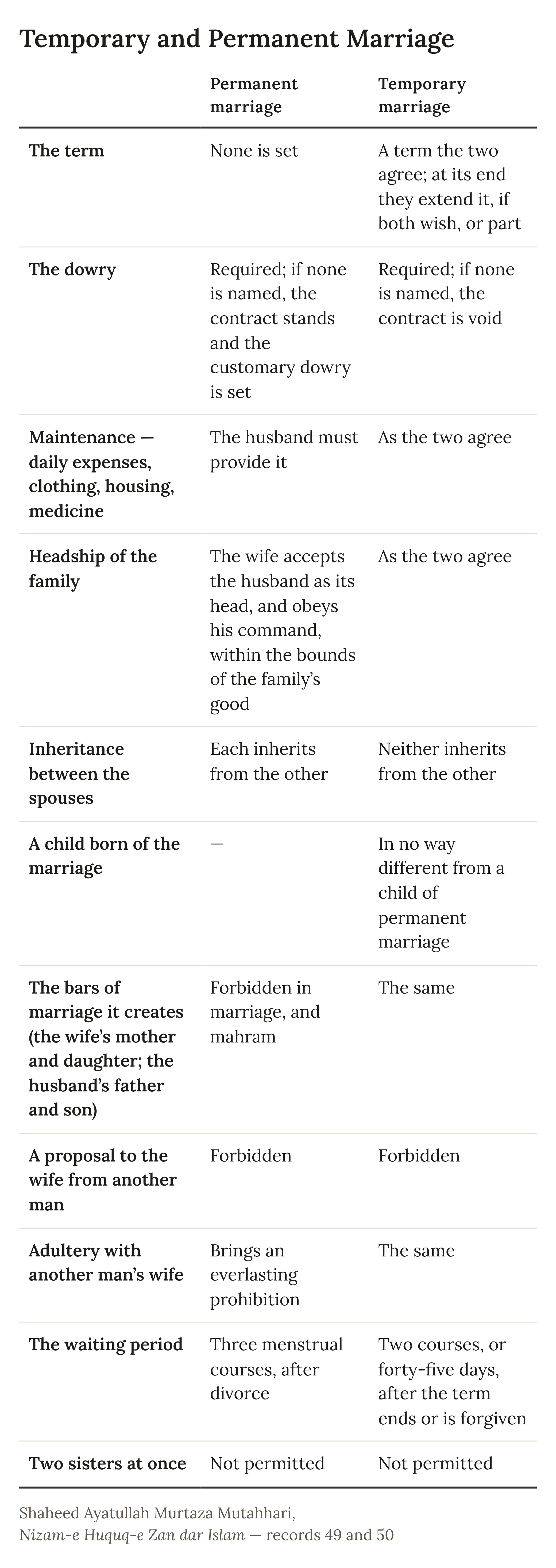
His words, on where the two differ.
یکی از قوانین درخشان اسلام از دیدگاه مذهب جعفری ـ که مذهب رسمی کشور ماست ـ این است که ازدواج به دو نحو میتواند صورت بگیرد: دائم و موقت. ازدواج موقت و دائم در پارهای از آثار با هم یکی هستند و در قسمتی اختلاف دارند. آنچه در درجهٔ اول ایندو را از هم متمایز میکند، یکی این است که زن و مرد تصمیم میگیرند به طور موقت با هم ازدواج کنند و پس از پایان مدت اگر مایل بودند تمدید کنند تمدید میکنند و اگر مایل نبودند از هم جدا میشوند.
دیگر اینکه از لحاظ شرایط، آزادی بیشتری دارند که به طور دلخواه به هر نحو که بخواهند پیمان میبندند. مثلاً در ازدواج دائم خواه ناخواه مرد باید عهدهدار مخارج روزانه و لباس و مسکن و احتیاجات دیگر زن از قبیل دارو و طبیب بشود، ولی در ازدواج موقت بستگی دارد به قرارداد آزادی که میان طرفین منعقد میگردد؛ ممکن است مرد نخواهد یا نتواند متحمل این مخارج بشود یا زن نخواهد از پول مرد استفاده کند.
در ازدواج دائم، زن خواه ناخواه باید مرد را به عنوان رئیس خانواده بپذیرد و امر او را در حدود مصالح خانواده اطاعت کند، اما در ازدواج موقت بسته به قراردادی است که میان آنها منعقد میگردد.
در ازدواج دائم، زن و شوهر خواه ناخواه از یکدیگر ارث میبرند، اما در ازدواج موقت چنین نیست.
“One of the brilliant laws of Islam, from the standpoint of the Ja’fari school — which is the official school of our country — is that marriage can take place in two ways: permanent and temporary. Temporary and permanent marriage are the same in some of their effects and differ in some. What first of all distinguishes the two is, first, that the man and the woman decide to marry for a fixed time, and at the end of the term, if they wish to extend it, they extend it, and if they do not wish to, they separate. Another is that, as to conditions, they have more freedom to make their compact in whatever way they wish. For example, in permanent marriage the man must, whether he will or not, take on the daily expenses, the clothing, the housing and the other needs of the woman, such as medicine and a doctor; but in temporary marriage it depends on the free agreement concluded between the two parties: the man may not want, or may not be able, to bear these expenses, or the woman may not want to use the man’s money. In permanent marriage the woman must, whether she will or not, accept the man as head of the family and obey his command within the bounds of the family’s good; but in temporary marriage it depends on the agreement concluded between them. In permanent marriage, husband and wife inherit from each other, whether they will or not; but in temporary marriage it is not so.”
پس تفاوت اصلی و جوهری ازدواج موقت با ازدواج دائم در این است که ازدواج موقت از لحاظ حدود و قیود «آزاد» است، یعنی وابسته به اراده و قرارداد طرفین است؛ حتی موقت بودن آن نیز در حقیقت نوعی آزادی به طرفین میبخشد و زمان را در اختیار آنها قرار میدهد.
“So the principal and essential difference between temporary marriage and permanent marriage is that temporary marriage is ‘free’ as to its limits and conditions — that is, it depends on the will and the agreement of the two parties; even its being temporary in reality gives the two parties a kind of freedom, and places time at their disposal.”
— Shaheed Ayatullah Murtaza Mutahhari, may God rest his pure soul, Nizam-e Huquq-e Zan dar Islam (The System of Women’s Rights in Islam), record 49; my translation
“Sister of Aaron['s lineage]” — gives the reading of the phrase as a description of her descent from Aaron, the brother of Moses, whose line served the house of worship; it is not a claim that she was Aaron's sister.
The lesson’s own words.
They answer a question from the class, which the website does not record.
پاسخ: نه, منظور اين است كه اينها كه قبل از نذر است الآن كسي بخواهد به او دلداري بدهد كه غمگين نباش غمِ مريم در چه چيزي بود؟ در اكل و شرب بود؟ اينكه ساليان متمادي از راه غيب روزي ميگرفت نگراني مريم در تهمتزدايي بود كه من اين تهمت را چطوري بزدايم كسي گفت نه, حامي پيدا ميشود.
“Answer: No — the point is this. These things come before the vow. Now if someone wants to console her — ‘do not grieve’ — what was Mary’s grief in? Was it in eating and drinking? She who for years on end had received her provision by way of the unseen? Mary’s worry was over clearing away the slander — ‘how am I to clear away this slander?’ Someone said: no, a defender will be found.”
— Ayatullah Abdullah Jawadi Amoli, Tasnim, his commentary on Surah Maryam, session 19, 25 October 2009 (tasnim.esra.ir); my translation
The sermon is set whole, page by page, in its Arabic and in English, in the Appendix at the end of this write-up — “The Fadak Sermon in Full”. The scene told here is its first page.
Her words, as printed; the man she addresses is named in them. The passage runs on into the next page, where she continues to read them the Book; the whole page is set in the Appendix.
يا ابن أبي قحافة ، أفي كتاب الله أن ترث أباك ولا أرث أبي؟! لقد جئت ( شَيْئاً فَرِيًّا ) (9) أفعلى عمد تركتم كتاب الله ونبذتموه وراء ظهوركم إذ يقول : ( وَوَرِثَ سُلَيْمانُ داوُدَ ) (10)؟! وقال فيما اقتص من خبر يحيى بن زكريا (ع) إذ قال :رب (11) هب ( لِي مِنْ لَدُنْكَ وَلِيًّا يَرِثُنِي وَيَرِثُ مِنْ آلِ يَعْقُوبَ ) (12) ، وقال : ( وَأُولُوا الْأَرْحامِ بَعْضُهُمْ أَوْلى بِبَعْضٍ فِي كِتابِ اللهِ ) (13) ، وقال : ( يُوصِيكُمُ اللهُ فِي أَوْلادِكُمْ لِلذَّكَرِ مِثْلُ حَظِّ الْأُنْثَيَيْنِ ) (14) ، وقال : ( إِنْ تَرَكَ خَيْراً الْوَصِيَّةُ لِلْوالِدَيْنِ
“O son of Abu Quhafa! Is it in the Book of God that you inherit from your father and I do not inherit from my father? You have certainly come up with “an odd thing” [19:27]. Was it deliberately, then, that you abandoned the Book of God and cast it behind your backs, when He says: “Solomon inherited from David” [27:16]? And He said, in what He recounted of the story of John son of Zechariah, peace be upon him, when he said: My Lord, grant “me from Yourself an heir who may inherit from me and inherit from the House of Jacob” [19:5-6]; and He said: “the blood relatives are more entitled to inherit from one another in the Book of Allah” [8:75; also 33:6]; and He said: “Allah enjoins you concerning your children: for the male shall be the like of the share of two females” [4:11]; and He said: “he leaves behind any property, is that he make a bequest for his parents [2:180]”
— Sayyedah Fatimah al-Zahra, peace and blessings be upon her; al-Tabrisi, al-Ihtijaj, as al-Majlisi gives it in Bihar al-Anwar, Volume 29, page 226; my translation
Her words. The sentence runs on into the next page; it is set whole in the Appendix.
إيها بني قيلة! أأهضم تراث أبي (10) وأنتم بمرأى مني ومسمع ، ومبتد [ منتدى ] (11) ومجمع؟ ، تلبسكم الدعوة ، وتشملكم الخبرة ، وأنتم ذا (12) العدد والعدة ، والأداة والقوة ، وعندكم السلاح والجنة ، توافيكم الدعوة فلا تجيبون ، وتأتيكم الصرخة فلا تغيثون ، وأنتم موصوفون بالكفاح ، معروفون بالخير والصلاح ، والنجبة التي
“Ah, Banu Qayla! Am I to be cheated of my father’s legacy while you are within my sight and hearing, at a gathering-place [the text prints mubtad; the edition’s bracket corrects it to muntada] and an assembly? The call reaches you all, and the news encompasses you. You have numbers and equipment, means and strength; you have weapons and shields. The call comes to you and you do not answer; the cry comes to you and you do not come to the rescue. And you are renowned for combat, known for goodness and righteousness, the choice band that”
— Sayyedah Fatimah al-Zahra, peace and blessings be upon her; al-Tabrisi, al-Ihtijaj, as al-Majlisi gives it in Bihar al-Anwar, Volume 29, page 228; my translation
Al-Majlisi gives it in the course of his chapter on Fadak; it names the man they came before, and the speaker of the reply is not named in it.
فبعثت إلى علي والحسن والحسين وأم أيمن وأسماء بنت عميس ـ وكانت تحت أبي بكر بن أبي قحافة ـ فأقبلوا إلى أبي بكر (5) وشهدوا لها بجميع ما قالت وادعته. فقال (6) : أما علي فزوجها ، وأما الحسن والحسين ابناها (7) ، وأما أم أيمن فمولاتها ، وأما أسماء بنت عميس فقد كانت تحت جعفر ابن أبي طالب فهي تشهد لبني هاشم ، وقد كانت تخدم فاطمة ، وكل هؤلاء يجرون إلى أنفسهم!.
“So she sent for Ali, al-Hasan, al-Husayn, Umm Ayman and Asma’ bint Umays — who was then married to Abu Bakr ibn Abi Quhafa — and they came to Abu Bakr and testified for her to all that she had said and claimed. And he said: As for Ali, he is her husband; as for al-Hasan and al-Husayn, they are her sons; as for Umm Ayman, she is her freedwoman; and as for Asma’ bint Umays, she was formerly the wife of Ja’far ibn Abi Talib, so she testifies for the house of Hashim — and she used to serve Fatimah. All of these are pulling toward themselves!”
— al-Majlisi, Bihar al-Anwar, Volume 29, page 197; my translation; the (5), (6) and (7) are the edition’s note marks
The reply, as printed; the man who gave it is named in it.
قال عمر (7) : أنتم كما وصفتم (8) أنفسكم ، ولكن شهادة الجار إلى نفسه لا تقبل.
“’Umar said: You are as you have described yourselves; but the testimony of one who draws benefit to himself is not accepted.”
— al-Majlisi, Bihar al-Anwar, Volume 29, page 198; my translation
The verse the Imam recites is the first half of Qur'an, Surah al-Nur (the Chapter of the Light) #24, Verse 19 — from the same passage as the verse with which we began.
The report in full; Shaykh al-Saduq gives it without a chain.
قَالَ اَلصَّادِقُ عَلَيْهِ اَلسَّلاَمُ : “دَعِ اِبْنَكَ يَلْعَبْ سَبْعَ سِنِينَ وَ يُؤَدَّبْ سَبْعَ سِنِينَ وَ أَلْزِمْهُ نَفْسَكَ سَبْعَ سِنِينَ فَإِنْ أَفْلَحَ وَ إِلاَّ فَإِنَّهُ مِمَّنْ لاَ خَيْرَ فِيهِ”.
“Al-Sadiq, peace be upon him, said: Let your son play for seven years, and be taught good conduct for seven years, and keep him close to you for seven years; then, if he prospers — well and good; and if not, he is one of those in whom there is no good.”
— Imam Ja’far al-Sadiq, peace and blessings be upon him; Shaykh al-Saduq, Man La Yahduruhu al-Faqih, Volume 3, hadith 1528 (thaqalayn; 4743 is the edition’s own number); my translation
The lesson’s own words.
﴿فَأَجَاءَهَا الْمضخَاضُ إِلَي جِذْعِ النَّخْلَةِ﴾ دردِ زايمان آن حضرت را وادار كرد كه به كنار يك درخت خرمايي كه به حسب ظاهر خشكيده بود آنجا برود اين ﴿جِذْعِ النَّخْلَةِ﴾ تكرار ميكند براي اينكه سبب كرامت آن حضرت در همين جذع نخله است يك بار اين جذع نخله را در همين آيه 23 ذكر فرمود بار ديگر در آيهٴ 24 ﴿فَأَجَاءَهَا الْمضخَاضُ إِلَي جِذْعِ النَّخْلَةِ قَالَتْ﴾ حالا اين را هنگام وضع حمل فرمود يا وجود مبارك عيسي به دنيا آمده فرمود در آستانهٴ ميلاد فرمود اين را آيه روشن نكرد فرمود وضع زايمان و درد زايمان مريم(سلام الله عليها) را وادار كرد كه به كنار درخت خرماي خشكيدهاي برود در اين حال اين جمله را فرمود: ﴿قَالَتْ يَا لَيْتَنِي مِتُّ قَبْلَ هذَا وَكُنتُ نَسْياً مَنْسِيّاً﴾ مستحضريد كه يك بحث بين خود مريم(سلام الله عليها) با خداي سبحان و جبرئيل و فرستادههاي الهي است آن «علي بيّنة مِن ربّها» بود براي اينكه فرشتهٴ الهي را ديد فرشته سخن گفت بشارت داد و او مادر شد و اين قضا و قدر الهي را هم پذيرفت يك ارتباط با مردم دارد مردمي كه طبق بيان نوراني امام صادق(سلام الله عليه) يك عاقل در بين آنها نبود تا مسئلهٴ كرامت و معجزه را بفهمد مريم(سلام الله عليها) را درك بكند و سخنان مريم را به جامعه منتقل بكند وجود مبارك امام صادق(سلام الله عليه) طبق اين روايت فرمود يك فرد رشيد در آن امّت نبود مشابه آنچه دربارهٴ حضرت لوط آمده ﴿أَلَيْسَ مِنكُمْ رَجُلٌ رَشِيدٌ﴾[1] اين مضمون دربارهٴ حضرت لوط هست كه فرمود يك آدم عاقل نيست كه من با او گفتگو كنم او را از قبح اين عمل آگاه كنم تا به ديگران منتقل كند داشتن يك آدم عاقل هم براي يك جامعه گاهي راهگشاست طبق اين بيان امام صادق(سلام الله عليه) يك آدمِ بِفهم در بين آن مردم نبود لذا اين تهمت را كسي كه بخواهد در جامعهٴ قداست دين را حفظ بكند دردناك است مرگآور است يك وقت كسي را متّهم ميكنند اين خانهنشين ميشود خب كاري هم ندارد يك وقت است كسي اصلاً پروريده شده براي نشر معارف دين براي حفظ دين با آبروي او بازي كردن يعني او را از تمام حيثيتهاي شغلي انداختن او ميشود آدم بيكار اما اگر كاسبي را, كشاورزي را, دامداري را متّهم كردند بالأخره او مشغول كار خودش هست اما يك روحاني را انساني كه از راه آبرو دارد خدمت ميكند او را متّهم كردن اين ديگر مُرده است ديگر, بنابراين براي كسي كه بخواهد ناشر دين باشد اگر با آبروي او بازي كردن يعني او را از هويّت انداختن ولي ديگران نه, اينچنين نيست اگر كسي كشاورز است, دامدار است, پيشهور است, كارمند است, كارگزار است بالأخره يك هتك حيثيتي شده ولي مشغول كار خودش است وجود مبارك مريم(سلام الله عليها) كه عمري را در معبد الهي گذراند براي نشر دين بود اگر با اين تهمت روبهرو بشود ديگر از هستي ساقط است بنابراين در ارتباط با فرشتهها و ذات اقدس الهي او «علي بيّنة من ربّها» است دربارهٴ مردم چون يك انسان عاقل كه مسئله كرامت را بفهمد نبود وجود مبارك مريم(سلام الله عليها) گفت ﴿يَا لَيْتَنِي مِتُّ قَبْلَ هذَا وَكُنتُ نَسْياً مَنْسِيّاً﴾ مشابه اين را ما دربارهٴ انبيا(عليهم السلام) هم داشتيم.
“The birth pangs brought her to the trunk of a date palm: the pains of childbirth compelled her to go to the side of a date palm which, to all appearances, had withered. This trunk of a date palm He repeats, because the cause of her wonder lies in this very trunk of the palm: once He mentioned this trunk of the palm in this verse, 23, and again in verse 24: The birth pangs brought her to the trunk of a date palm. She said — now, whether she said this at the moment of giving birth, or once the blessed Jesus had come into the world, or on the threshold of the birth, the verse has not made clear. He says: the state of childbirth and the pains of childbirth compelled Mary (peace be upon her) to go to the side of a withered date palm, and in this state she said this sentence: She said, ‘I wish I had died before this and become a forgotten thing, beyond recall.’ You will be aware that there is one matter between Mary (peace be upon her) herself and God, glory be to Him, and Gabriel and the divine messengers: there she was ‘upon a clear proof from her Lord’, for she saw the divine angel, the angel spoke and gave the good news, and she became a mother, and she accepted this divine decree and measure as well. And there is a relation with the people — a people among whom, according to the luminous saying of Imam al-Sadiq (peace be upon him), there was not one person of sense to understand the matter of the wonder and the miracle, to understand Mary (peace be upon her), and to carry Mary’s words to the community. The blessed Imam al-Sadiq (peace be upon him), according to this narration, said that there was not one right-minded person in that nation — similar to what has come concerning Lot: Is there not a right-minded man among you?[1] This sense is there concerning Lot: he said, there is not one man of sense with whom I can talk, and make him aware of the ugliness of this deed, so that he passes it on to others. And having one person of sense can sometimes open the way for a society. According to this saying of Imam al-Sadiq (peace be upon him), there was not one person of understanding among those people. So this slander, for someone who wants to preserve the sanctity of religion in society, is painful — it is deadly. At one time they accuse someone, and he stays at home — well, he has no work to lose. At another time it is someone who was raised from the very start to spread the teachings of religion, to preserve religion: to play with his honour means to strip him of all his standing in his work; he becomes a man without work. But if they accuse a shopkeeper, a farmer, a herdsman, in the end he is still busy at his own work. But a cleric — a person who serves by way of his honour — to accuse him: that man is finished. So for someone who would spread religion, to play with his honour means to strip him of his identity; but for others, no, it is not like this. If someone is a farmer, a herdsman, a craftsman, an employee, an official — in the end his good name has been violated, but he is still busy at his own work. The blessed Mary (peace be upon her), who spent a lifetime in the house of God, was there for the spreading of religion; if she is faced with this slander, she falls out of existence altogether. So in her relation with the angels and with the most holy Divine Essence, she is ‘upon a clear proof from her Lord’; but as for the people — since there was not one person of sense to understand the matter of the wonder — the blessed Mary (peace be upon her) said: I wish I had died before this and become a forgotten thing, beyond recall. We have had the like of this concerning the prophets (peace be upon them) as well.”
— Ayatullah Abdullah Jawadi Amoli, Tasnim, his commentary on Surah Maryam, session 19, 25 October 2009 (tasnim.esra.ir); my translation
His words.
امروز در محیط خانوادهی دینی، چیزی جایگزین انواع تربیتها، وسایل تفریحی، بازیهای سنتی، تعلیمات دینی و آموزشها شده است. ابزارهایی که قرار بود بچهها را به دین گرایش دهند، یاد بگیرند، عمل کنند، همه اینها جای خود را به یک تلفن همراه یا یک تبلت دادهاند که جای همهچیز را گرفته و حتی ارتباطات نزدیک خواهر و برادر و پدر و مادر با بچهها را مغشوش کرده است.
“Today, in the setting of the religious family, something has taken the place of every kind of upbringing, of the means of recreation, of the traditional games, of religious teaching and of lessons. The things that were meant to draw children toward religion — so that they would learn it and act on it — have all given up their place to a mobile phone or a tablet, which has taken the place of everything, and has even unsettled the close bonds of sister and brother, and of father and mother with the children.”
— Ayatullah Muhammad Taqi Misbah Yazdi, a talk of 4 December 2017 (mesbahyazdi.ir); my translation
His words.
اما به یاد داشته باشیم که راه حفظ و تربیت فرزندانمان سختگیری نیست، بلکه باید فرزندان را با محبت، با زبان خوش، با تشویق و با استدلالِ متناسبِ با مرتبه فهم و معلوماتشان به تدریج با مسائل اعتقادی آشنا ساخت.
“But let us remember that the way to protect and to raise our children is not harshness; rather, our children must be made familiar with the matters of belief gradually — with love, with kind words, with encouragement, and with argument suited to the level of their understanding and their knowledge.”
— Ayatullah Muhammad Taqi Misbah Yazdi, a talk of 24 September 2014 (mesbahyazdi.ir); my translation
His answer
9 ـ قال أبو الفضل : ذكرت لأبي الحسين زيد بن علي بن الحسين (4) بن علي بن الحسين بن علي بن أبي طالب صلوات الله عليهم كلام فاطمة عليهاالسلام عند منع أبي بكر إياها فدك ، وقلت له : إن هؤلاء يزعمون أنه مصنوع ، وأنه من كلام أبي العيناء ـ الخبر منسوق على (5) البلاغة على الكلام ـ فقال لي : رأيت مشايخ آل أبي طالب يروونه عن آبائهم ، ويعلمونه أبناءهم ، وقد حدثنيه أبي عن جدي يبلغ به فاطمة (ع) على هذه الحكاية ، ورواه مشايخ الشيعة وتدارسوه بينهم قبل أن يولد جد أبي العيناء ، وقد حدث به الحسن بن علوان عن عطية العوفي أنه سمع عبد الله بن الحسن يذكر (6) عن أبيه ، ثم قال أبو الحسين : وكيف يذكر هذا من كلام فاطمة فينكر ، وهم يروون (7) من كلام عائشة عند موت أبيها ما هو أعجب من كلام فاطمة ، فيحققونه (8) لو لا عداوتهم لنا أهل البيت ...ثم ذكر الحديث ، قال :
“9. Abu al-Fadl said: I mentioned to Abu al-Husayn Zayd ibn Ali ibn al-Husayn ibn Ali ibn al-Husayn ibn Ali ibn Abi Talib, God’s blessings be upon them, the words of Fatimah, peace be upon her, when Abu Bakr withheld Fadak from her, and I said to him: These people claim that it is fabricated, and that it comes from the words of Abu al-’Ayna’ — the report is arranged on eloquence, on the speech [this clause is unclear in the text]. He said to me: I have seen the elders of the family of Abu Talib narrating it from their fathers and teaching it to their sons. My father narrated it to me from my grandfather, carrying it back to Fatimah, peace be upon her, in this form. The elders of the Shia narrated it and studied it among themselves before the grandfather of Abu al-’Ayna’ was born. And al-Hasan ibn ‘Ulwan narrated it from ‘Atiyya al-’Awfi, that he heard Abd Allah ibn al-Hasan relate it from his father. Then Abu al-Husayn said: How can this be mentioned as the words of Fatimah and be denied, when they narrate, of the words of Aisha at her father’s death, what is more remarkable than the words of Fatimah, and hold it to be authentic — were it not for their enmity toward us, the People of the House? … Then he related the report. He said:”
— Abu al-Husayn Zayd, as Ibn Abi Tahir reports him in Balaghat al-Nisa; al-Majlisi, Bihar al-Anwar, Volume 29, page 235; my translation
His two sentences.
فقوله:«قل للمؤمنين يغضوا من أبصارهم»لما كان«يغضوا»مترتبا على
قوله:«قل»ترتب جواب الشرط عليه دل ذلك على كون القول بمعنى الأمر و المعنى مرهم يغضوا من أبصارهم و التقدير مرهم بالغض إنك إن تأمرهم به يغضوا، و الآية أمر بغض الأبصار و إن شئت فقل: نهي عن النظر إلى ما لا يحل النظر إليه من الأجنبي و الأجنبية لمكان الإطلاق.
“So His saying, Tell the faithful men to cast down their looks: since let them cast down is set upon His saying Tell, as the answer to a condition is set upon it, this shows that telling here means commanding; and the meaning is: command them, and they will cast down their looks — the implied sense being: command them to cast down; if you command them to it, they will cast down. So the verse is a command to cast down the looks; or, if you wish, say: a prohibition on looking at what it is not lawful to look at, of a man or a woman who is not one’s own — because the command is unrestricted.”
قوله تعالى:«و قل للمؤمنات يغضضن»إلخ، الكلام في قوله:«و قل للمؤمنات يغضضن من أبصارهن و يحفظن فروجهن»نظير ما مر في قوله:«قل للمؤمنين يغضوا من أبصارهم و يحفظوا فروجهم»فلا يجوز لهن النظر إلى ما لا يجوز النظر إليه و يجب عليهن ستر العورة عن الأجنبي و الأجنبية.
“His saying, exalted is He: And tell the faithful women to cast down, and so on. What is said in His saying, And tell the faithful women to cast down their looks and to guard their private parts, is the counterpart of what has passed in His saying, Tell the faithful men to cast down their looks and to guard their private parts: so it is not permitted to them to look at what it is not permitted to look at, and it is obligatory upon them to cover their private parts from a man or a woman who is not their own.”
— Allamah Sayyed Muhammad Husayn Tabataba’i, al-Mizan fi Tafsir al-Qur’an, on Surah al-Nur, Verses 27 to 34; my translation
هرچه در آیهٔ قبل راجع به غضّ بصر و حفظ فرج گفتیم در اینجا هم هست.
“Whatever we said in the previous verse about casting down the gaze and guarding chastity is here as well.”
— Shaheed Ayatullah Murtaza Mutahhari, Ashna’i ba Qur’an (Getting to Know the Qur’an), Volume 4, record 89; my translation
The report as al-Mizan gives it.
فروي أن موسى(عليه السلام)قال لها: وجهني إلى الطريق و امشي خلفي فإنا بني يعقوب لا ننظر في أعجاز النساء، فلما جاءه و قص عليه القصص قال: لا تخف نجوت من القوم الظالمين.
“It is narrated that Moses, peace be upon him, said to her: ‘Point me to the road, and walk behind me; for we, the sons of Jacob, do not look at the backs of women.’ And when he came to him and told him his story, he said: ‘Do not be afraid. You have been delivered from the wrongdoing people.’”
— Allamah Tabataba’i, al-Mizan fi Tafsir al-Qur’an, on Surah al-Qasas, Verses 22 to 28; my translation; the last words are the Qur’an’s own, Verse 25
The report.
و في تفسير القمي، قال: قالت إحدى بنات شعيب: يا أبت استأجره إن خير من استأجرت القوي الأمين، فقال لها شعيب(عليه السلام): أما قوته فقد عرفتنيه أنه يستقي الدلو وحده فبم عرفت أمانته؟ فقالت: إنه لما قال لي: تأخري عني و دليني على الطريق فإنا من قوم لا ينظرون في أدبار النساء عرفت أنه ليس من الذين ينظرون أعجاز النساء فهذه أمانته: أقول: و روي مثله في المجمع، عن علي(عليه السلام).
“And in the Tafsir of al-Qummi: one of the daughters of Shu’ayb said, ‘Father, hire him; the best you can hire is the strong and the trustworthy.’ And Shu’ayb, peace be upon him, said to her: ‘As for his strength, you have shown it to me — that he draws the bucket on his own. But how did you come to know his trustworthiness?’ She said: ‘When he said to me, “Keep behind me and guide me to the road, for we are a people who do not look at the backs of women,” I knew that he was not one of those who look at women’s backs. That is his trustworthiness.’ I say: and the like of it is narrated in al-Majma’, from Ali, peace be upon him.”
— Allamah Tabataba’i, al-Mizan fi Tafsir al-Qur’an, on Surah al-Qasas, Verses 22 to 28, from Tafsir al-Qummi; my translation
Shu'ayb is the name our reports give the old man of Midian, whom the Qur'an does not name; the Bible calls Moses's father-in-law Reuel (Exodus 2:18) and Jethro (Exodus 3:1).
Safra' is the name our reports give the wife of Moses; the Bible calls her Zipporah (Exodus 2:21). The report that names her among the women at the birth was told on Night 1.
The saying, in the Arabic and in the English of our text. Where that English has “it is possible that”, the Arabic says “almost”.
وَقَالَ (عليه السلام): مَا الْـمُجَاهِدُ الشَّهِيدُ فِي سَبِيلِ اللهِ بِأَعْظَمَ أَجْراً مِمَّنْ قَدَرَ فَعَفَّ، لَكَادَ الْعَفِيفُ أَنْ يَكُونَ مَلَكاً مِنَ الْمَلاَئِكَةِ.
Amīr al-mu’minīn, peace be upon him, said: The fighter in the way of Allāh who gets martyred would not get a greater reward than he who remains chaste despite means. It is possible that a chaste person may become one of the angels.
— Amir al-Mu’minin, Imam Ali ibn Abi Talib, peace and blessings be upon him; Nahj al-Balagha, Saying 474 — the Arabic, and the English of our text
The two parts of his count.
خطاب به مردها در باب ستر و نظر، دو تکلیف متوجه شده است؛
۱- ﴿یَغُضُّوا مِنْ أَبْصَارِهِمْ﴾
۲- ﴿یَحْفَظُوا فُرُوجَهُمْ﴾
“In the matter of covering and of looking, two duties have been addressed to the men: 1 — that they cast down their looks; 2 — that they guard their private parts.”
اما آیه سی و یک که مربوط به زنها است، آنجا به گمانم پنج خطاب و تکلیف دارد،
۱- ﴿وَقُلْ لِلْمُؤْمِنَاتِ یَغْضُضْنَ مِنْ أَبْصَارِهِنَّ﴾ این را سابق بحث کردیم.
۲- ﴿یَحْفَظْنَ فُرُوجَهُنَّ﴾ این را هم بحث کردیم.
“But verse thirty-one, which concerns the women — there, I think, there are five addresses and duties: 1 — And tell the faithful women to cast down their looks — this we discussed before. 2 — and to guard their private parts — this too we have discussed.”
— Ayatullah Alireza A’rafi, a class on the jurisprudence of the gaze and of covering, 18 January 2026 (eshia.ir); my translation
His two sentences, which sit some lines apart in the same record.
اسلام تدابیری برای تعدیل و رام کردن این غریزه اندیشیده است و در این زمینه، هم برای زنان و هم برای مردان تکلیف معین کرده است. یک وظیفه مشترک که برای زن و مرد هر دو مقرر فرموده مربوط به نگاه کردن است:
“Islam has devised measures to temper and tame this instinct, and in this regard it has laid down duties for both women and men. One duty, which it has prescribed in common for man and woman alike, concerns looking:”
اما علت اینکه در اسلام دستور پوشش اختصاص به زنان یافته است این است که میل به خودنمایی و خودآرایی مخصوص زنان است.
“But the reason that in Islam the command to cover has been made particular to women is that the inclination to display oneself and to adorn oneself is particular to women.”
— Shaheed Ayatullah Murtaza Mutahhari, Mas’ale-ye Hijab (The Question of Hijab), record 80 in our copy; my translation
His words.
این به عنوان مقدمه که فلسفه حجاب و فلسفه تستر یا فلسفه عدم نگاه و غض بصر یکی از جلوگیری از ظرفیت و استعداد تهییج شهوانی است، یکی هم حفظ جلال و احتشام آن زن نامحرم است. این دو حکمت در کنار هم قرار دارد.
این در حد حکمت است
“This, by way of introduction: that the philosophy of hijab, the philosophy of covering — or the philosophy of not looking, of casting down the gaze — is, for one thing, preventing the capacity and the potential for arousing desire, and for another, preserving the majesty and dignity of that woman who is not one’s mahram. These two wisdoms stand side by side. This is at the level of wisdom.”
— Ayatullah Alireza A’rafi, a class on the jurisprudence of the gaze and of covering, 17 May 2025 (eshia.ir); my translation
His words.
بعضیها خیال میکنند که مثلاً اسلام گفته رویتان را بگیرید، نگاه نکنید، چادر سرتان کنید، یک سری احکام تحجّرآمیز است. یک عدّه یاوهگو هم پیدا شدهاند و هر کلمهای که میگویند، یک تحجّر هم پشت سرش میآورند، خیال میکنند کاربرد کلمهی تحجّر در اینجاست. اینها همان نکات دقیقی است که آن کسی که میشنود، باید در آن تأمّل کند، اگر تأمّل نکند، مطمئناً نمیفهمد.۱
“Some imagine that, for example, Islam has said cover yourselves, do not look, wear the chador — that it is a set of fossilised rulings. And a number of idle talkers have appeared who, with every word they say, bring the word fossilisation along behind it; they imagine that this is where the word fossilisation applies. These are the very points of precision on which the one who hears must reflect; if he does not reflect, he will certainly not understand.[1]”
بعضیها خیال میکنند این محرم و نامحرم، چادر، نگاه نکن، چشمت را پایین بینداز و اینها، همهاش مقرّرات خشکی است که اسلام قرار داده است. نه؛ اینها سعادت زن و مرد را تضمین میکند و در محیط خانواده، صفا و صمیمیت بهوجود میآورد.
“Some imagine that all this — mahram and non-mahram, the chador, do not look, cast your eyes down, and the like — is all dry regulation that Islam has laid down. No; these guarantee the happiness of woman and man, and in the setting of the family they bring about purity of heart and closeness.”
— the martyred leader, Imam Sayyed Ali Khamenei, may God rest his pure soul, Zan va Khanevadeh (Woman and Family), record 145 — the first from a marriage sermon of 3 October 2002, the second from one of 19 September 2002; my translation; the [1] is the book’s own note mark
His words.
وهكذا الآن، مثلاً، إذا كان ولدنا – بنتاً أو صبيّاً – يريد أن يتخصَّص في مجال معيّن، وكان الأب يحبّ الأدب، ويريد لولده أن يتخصَّص في هذا المجال، بينما الولد لا يرغب في ذلك، بل يريد أن يتخصَّص في الطّبّ أو الهندسة أو أيّ شيء آخر، فإذا كنّا نرى لهم المصلحة فيما نختاره لهم، فإنَّ مسؤوليَّتنا أن نناقشهم، دون أن نفرض خياراتنا عليهم، لأنَّهم سيعيشون حياةً غير حياتنا، فلا يصحّ للأب أن يفرض نفسه على حياة ولده، وكذلك لا يمكن للأمّ أن تفرض نفسها على حياة ابنتها. نعم، علينا أن ننصحهم ونوجّههم ونحاورهم، لا أن نفرض عليهم فرضاً.
وأخطر شيء في ذلك هو الزّواج، صحيح أنَّ الله سبحانه وتعالى، أو الواقع الاجتماعيّ، قد منح الأهل نوعاً من السّلطة على أولادهم، لكن هذا لا يعني أن يفرضوا عليهم خياراتهم بما يتعلّق بزواجهم أو غير ذلك.
فقد يُعجب الأب أو الأمّ بشابّ معيّن لابنتهم، لأنَّ لديه مالًا، أو لأنّه ابن العالم الفلانيّ، أو لأنَّ أمَّه معروفة بالصَّلاح والتَّقوى. لكنَّ هذه الأمور لا تكفي، فقد يكون أهله صالحين وهو من أفسق النَّاس، وقد يكون والده من أعلم العلماء وهو من أكفر الكفَّار، وقد يكون أبوه طيّباً حسن الخلق ويكون هو سيّئ الأخلاق. ولهذا، لا يجوز أن نرغم الفتاة على القبول بشخص لمجرَّد أنَّ عائلته صالحة أو معروفة، ولا يصحّ أن نقول لها: إمَّا أن تتزوّجي هذا الشّابّ، أو لا زواج لك! كما لا يمكن أن نرغم ولدنا على أن يتزوّج بمن لا يريدها.
وأنا دائمًا أقول للآباء والأمَّهات أن يتذكَّروا أنّهم كانوا يوماً ما صبايا وشباباً، وكانت لهم رغبات وأحلام ربَّما لم يفهمها أهلهم في حينها، أو لم يوافقوا عليها، وكيف كانت مشاعرهم في تلك المرحلة، وماذا يفعلون هم الآن مع أولادهم.
لذلك، علينا كآباء وأمَّهات أن نتحمَّل مسؤوليّتنا في تسهيل الطَّريق أمام أولادنا وبناتنا، ليختاروا حياةً زوجيّةً سليمة تنطلق من القناعة والوعي، لا من الإكراه والضَّغط. وهذا لا يعني أن نكون حياديّين أو لا نُبدي رأينا، بل من واجبنا أن ننصح، وأن نعبّر عن رأينا، وأن نحاول إقناعهم، فإن اقتنعوا، فبها، وإن لم يقتنعوا، فليتحمّلوا هم مسؤوليّة اختيارهم.“So it is now, for example: if our child — a daughter or a boy — wants to specialise in a particular field, and the father loves literature and wants his child to specialise in it, while the child does not want that, but wants to specialise in medicine, or engineering, or anything else — then, if we see their good in what we choose for them, our responsibility is to discuss it with them, without imposing our choices on them; for they will live a life other than ours. It is not right for a father to impose himself on his son’s life, and nor can a mother impose herself on her daughter’s life. Yes — we must advise them, and guide them, and talk with them; not force it upon them. And the most dangerous thing in this is marriage. It is true that God, glory be to Him, the Exalted — or the reality of society — has given parents a kind of authority over their children; but this does not mean that they should impose their choices on them in what concerns their marriage, or anything else. A father or a mother may be taken with a particular young man for their daughter, because he has money, or because he is the son of such-and-such a scholar, or because his mother is known for righteousness and piety. But these things are not enough: his family may be righteous and he the most dissolute of people; his father may be among the most learned of scholars and he the most faithless of the faithless; his father may be good and of fine character, and he of bad character. And so it is not permissible for us to compel a girl to accept a person merely because his family is righteous or well known, and it is not right to say to her: either you marry this young man, or there is no marriage for you! Just as we cannot compel our son to marry one he does not want. And I always say to fathers and mothers that they should remember that they too were once young women and young men, with wishes and dreams which perhaps their own families did not understand at the time, or did not agree to — and how they felt at that stage — and what they themselves are now doing with their own children. So we, as fathers and mothers, must bear our responsibility to ease the path before our sons and daughters, so that they choose a sound married life that springs from conviction and awareness, not from compulsion and pressure. And this does not mean that we should be neutral, or keep our opinion to ourselves; rather, it is our duty to advise, and to give our opinion, and to try to convince them. If they are convinced, well and good; and if they are not convinced, then let them bear the responsibility of their own choice.”
— Ayatullah Sayyed Muhammad Husayn Fadhlullah, a Friday sermon of 1 March 1996 (bayynat.org.lb); my translation
His words, on the two matters.
از مسائلی که شنیدم در بعضی از نقاط این منطقه وجود دارد، آن است که مردان، دختران خود را مجبور به ازدواج میکنند. این کار از نظر اسلام حرام است. ازدواج بدون رضایت زن جایز نیست.
“Among the matters I have heard of, which exist in some places in this region, is that men compel their daughters to marry. In the view of Islam this is forbidden. Marriage without the woman’s consent is not permitted.”
به نظر اسلام، زن در انتخاب همسر آزاد است و هیچکس نمیتواند در مورد انتخاب همسر، بر هیچ زنی چیزی را تحمیل کند. یعنی حتّی برادران زن، پدر زن – حالا خویشاوندان دورتر که جای خود دارند – اگر بخواهند بر او تحمیل کنند که تو حتماً باید با این شخص ازدواج کنی، نمیتوانند و چنین حقی را ندارند. این، نظر اسلام است.
“In the view of Islam, a woman is free in choosing her spouse, and no one can impose anything on any woman in the matter of choosing her spouse. That is, even the woman’s brothers, the woman’s father — let alone more distant relatives — if they want to impose on her that you must marry this person, they cannot, and they have no such right. This is the view of Islam.”
در مورد پدر چنین حرفی نیستها! پدر بگوید که راضی نیستم، البته پدر را نباید رنجاند، مادر را نباید رنجاند، امّا برای انسانی که عاقل و بالغ هست واجب نیست که اگر او گفت بیرون نرو، نمیدانم معاشرت نکن یا چه، اطاعت کند.
“In the case of the father there is no such thing! If the father says, I am not content — of course one must not hurt a father, one must not hurt a mother — but for a person who is of sound mind and mature, it is not obligatory, if he says do not go out, or, I don’t know, do not keep company with someone, or whatever it is, to obey.”
— the martyred leader, Imam Sayyed Ali Khamenei, may God rest his pure soul, Zan va Khanevadeh (Woman and Family) — the first two from a meeting with the people of Gonbad, 19 October 1995 (records 29 and 30, the second running across from one record to the next), the third from record 97; my translation
His words
پدرها! مادرها! تقوای خدا پیشه کنید در امر ازدواج. این همه قرآن به ما میگوید، اسلام به ما میگوید، مهریّه را سنگین نکنید، دنبال جهیزیّههای سنگین نباشید، دنبال نام و نشان و شغل نباشید. پسر مسلمان، دختر مسلمان، هر دو دارای معرفت اسلامی، هر دو دارای دل مؤمن، اینها کفو همند. بگذارید زندگی مشترک را شروع کنند.
“Fathers! Mothers! Be wary of God in the matter of marriage. So much does the Qur’an tell us, does Islam tell us: do not make the dowry heavy; do not go chasing heavy trousseaus; do not go chasing name and standing and occupation. A Muslim boy and a Muslim girl, both with an understanding of Islam, both with believing hearts — these are each other’s equals. Let them begin their life together.”
— the martyred leader, Imam Sayyed Ali Khamenei, may God rest his pure soul, Zan va Khanevadeh (Woman and Family), record 32, from a Friday sermon of 28 November 1980; my translation
His words, on the gap and on the three ways.
خاصیت عصر جدید این است که فاصلهٔ بلوغ طبیعی را با بلوغ اجتماعی و قدرت تشکیل عائلهٔ زیادتر کرده است. اگر در دوران سادهٔ قدیم یک پسربچه در سنین اوایل بلوغ طبیعی از عهدهٔ شغلی که تا آخر عمر به عهدهٔ او گذاشته میشد بر میآمد، در دوران جدید ابـدأً امکانپذیر نیست. یک پسر موفق در دوران تحصیل که دبستان و دبیرستان و دانشگاه را بدون تأخیر و رد شدن در امتحان آخر سال و یا درکنکور دانشگاه گذرانده باشد، در ۲۵ سالگی فارغالتحصیل میگردد و از این به بعد میتواند درآمدی داشته باشد. قطعاً سه چهار سال هم طول میکشد تا بتواند سر و سامان مختصری برای خود تهیه کند و آمادهٔ ازدواج دائم گردد. همچنین است یک دختر موفق که دوران تحصیل را میخواهد طی کند.
“The characteristic of the new age is that it has widened the distance between natural maturity and social maturity — the ability to form a family. If, in the simple days of old, a boy in the first years of natural maturity could manage the occupation that would be his to the end of his life, in the new age this is not possible at all. A successful boy, who has passed through primary school, secondary school and university without delay, and without failing an end-of-year examination or the university entrance examination, graduates at twenty-five, and from then on he can have an income. It will certainly take three or four years more before he can provide a modest settled life for himself and be ready for permanent marriage. And the same holds for a successful girl who wants to go through her studies.”
شما اگر امروز یک پسر محصل هجده ساله را که شور جنسی او به اوج خود رسیده است تکلیف به ازدواج بکنید، به شما میخندند. همچنین است یک دختر محصل شانزده ساله. عملاً ممکن نیست این طبقه در این سن زیر بار ازدواج دائم بروند و مسؤولیت یک زندگی را - که وظایف زیادی برای آنها نسبت به یکدیگر و نسبت به فرزندان آیندهشان ایجاد میکند - بپذیرند.
“If today you ask an eighteen-year-old student, whose sexual drive has reached its peak, to marry, they will laugh at you. And the same holds for a sixteen-year-old girl who is a student. In practice it is not possible for this group, at this age, to take on the burden of permanent marriage and accept the responsibility of a life — one that creates many duties for them toward each other, and toward their future children.”
کدامیک؟ رهبانیت موقت یا کمونیسم جنسی یا ازدواج موقت؟
“Which one? Temporary monasticism, or sexual communism, or temporary marriage?”
— Shaheed Ayatullah Murtaza Mutahhari, Nizam-e Huquq-e Zan dar Islam (The System of Women’s Rights in Islam), records 51 and 52; my translation
His words. A table of what the two forms of marriage share and where they differ is set in the Appendix.
اثری که از این ازدواج تولید میشود یعنی فرزندی که به وجود میآید، با فرزند ناشی از ازدواج دائم هیچگونه تفاوتی ندارد.
مهر، هم در ازدواج دائم لازم است و هم در ازدواج موقت، با این تفاوت که در ازدواج موقت عدم ذکر مهر موجب بطلان عقد است و در ازدواج دائم عقد باطل نیست، مهرالمثل تعیین میشود.
همانطوری که در عقد دائم، مادر و دختر زوجه بر زوج، و پدر و پسر زوج بر زوجه حرام و محرم میگردند، در عقد منقطع نیز چنین است، و همانطوری که خواستگاری کردن زوجۀ دائم بر دیگران حرام است خواستگاری زوجۀ موقت نیز بر دیگران حرام است. همانطوری که زنای با زوجۀ دائم غیر، موجب حرمت ابدی میشود زنای با زوجۀ موقت نیز موجب حرمت ابدی میشود. همانطوری که زوجۀ دائم بعد از طلاق باید مدتی عده نگهدارد زوجۀ موقت نیز بعد از تمام شدن مدت یا بخشیدن آن باید عده نگهدارد با این تفاوت که عدهٔ زن دائم سه نوبت عادت ماهانه است و عدهٔ زن غیر دائم دو نوبت یا چهل و پنج روز. در ازدواج دائم جمع میان دو خواهر جایز نیست، در ازدواج موقت نیز روانیست.
“The fruit this marriage produces — that is, the child who comes into being — differs in no way from a child born of permanent marriage. A dowry is required both in permanent marriage and in temporary marriage, with this difference: that in temporary marriage, failing to name the dowry makes the contract void, while in permanent marriage the contract is not void, and the customary dowry is set. Just as in the permanent contract the wife’s mother and daughter become forbidden to the husband, and the husband’s father and son forbidden to the wife — becoming mahram — so it is in the interrupted contract; and just as proposing to another man’s permanent wife is forbidden, proposing to a temporary wife is forbidden to others too. Just as adultery with another man’s permanent wife brings an everlasting prohibition, adultery with a temporary wife brings an everlasting prohibition too. Just as a permanent wife must keep a waiting period for a time after divorce, a temporary wife too must keep a waiting period after the term has ended or been forgiven — with this difference: that the waiting period of a permanent wife is three menstrual courses, and that of a wife who is not permanent, two courses, or forty-five days. In permanent marriage it is not permitted to be married to two sisters at once; in temporary marriage it is not allowed either.”
— Shaheed Ayatullah Murtaza Mutahhari, Nizam-e Huquq-e Zan dar Islam (The System of Women’s Rights in Islam), record 50; my translation
The report.
سَأَلْتُ أَبَا الْحَسَنِ (عَلَيْهِ السَّلام) عَنِ الْمُتْعَةِ فَقَالَ هِيَ حَلالٌ مُبَاحٌ مُطْلَقٌ لِمَنْ لَمْ يُغْنِهِ اللهُ بِالتَّزْوِيجِ فَلْيَسْتَعْفِفْ بِالْمُتْعَةِ فَإِنِ اسْتَغْنَى عَنْهَا بِالتَّزْوِيجِ فَهِيَ مُبَاحٌ لَهُ إِذَا غَابَ عَنْهَا.
“I asked Abu al-Hasan, peace be upon him, about temporary marriage, and he said: It is lawful, permitted, without restriction, for the one whom God has not made free of need through marriage; so let him keep himself chaste through temporary marriage. And if he has been made free of need of it through marriage, then it is permitted to him when he is absent from her.”
— Abu al-Hasan, peace and blessings be upon him, through al-Fath ibn Yazid; Shaykh al-Kulayni, al-Kafi, Volume 5, hadith 1790 (thaqalayn); my translation
in the reports, Abu al-Hasan on its own usually means Imam Musa al-Kazim, Imam Ali al-Rida or Imam Ali al-Hadi, peace and blessings be upon them; this report does not say which of them is meant, and we leave it as it stands.
The report, with its last exchange, on extending the term.
سَأَلْتُ أَبَا الْحَسَنِ مُوسَى (عَلَيْهِ السَّلام) عَنِ الْمُتْعَةِ فَقَالَ وَمَا أَنْتَ وَذَاكَ فَقَدْ أَغْنَاكَ اللهُ عَنْهَا قُلْتُ إِنَّمَا أَرَدْتُ أَنْ أَعْلَمَهَا فَقَالَ هِيَ فِي كِتَابِ عَلِيٍّ (عَلَيْهِ السَّلام) فَقُلْتُ نَزِيدُهَا وَتَزْدَادُ فَقَالَ وَهَلْ يَطِيبُهُ إِلا ذَاكَ.
“I asked Abu al-Hasan Musa, peace be upon him, about temporary marriage, and he said: And what have you to do with that? God has made you free of need of it. I said: I only wanted to know about it. He said: It is in the Book of Ali, peace be upon him. And I said: May we extend it with her, and she extend it with us? He said: And what makes it good, but that?”
— Imam Musa al-Kazim, peace and blessings be upon him, through Ali ibn Yaqtin; Shaykh al-Kulayni, al-Kafi, Volume 5, hadith 1789 (thaqalayn); my translation
His words, on these three matters.
اینکه پایهٔ ازدواج باید بر دوام باشد، بسیار مطلب درستی است ولی این ایراد وقتی وارد است که بخواهیم ازدواج موقت را جانشین ازدواج دائم کنیم و ازدواج دائم را منسوخ نماییم.
“That the foundation of marriage must be permanence is a very true point; but this objection holds only when we want to make temporary marriage take the place of permanent marriage, and to abolish permanent marriage.”
جواب این است که اولاً منفوریت متعه در میان زنان مولود سوء استفادههایی است که مردان هوسران در این زمینه کردهاند و قانون باید جلو آنها را بگیرد و ما دربارهٔ این سوء استفادهها بحث خواهیم کرد.
“The answer is that, first, the loathing in which temporary marriage is held among women is born of the abuses that lustful men have committed in this area — and the law must stop them; and we shall discuss these abuses.”
اگر این اظهارات صحیح باشد، عقدی است باطل. مردی قسی، زنی بیخبر و بیاطلاع از قانون شرعی و عرفی را مورد تجاوز قرار داده و باید مجازات شود.
قبل از اینکه امثال رضاها مجازات شوند، باید تربیت شوند و قبل از آن که رضاها مجازات یا تربیت شوند باید مرضیهها آگاهانیده شوند.
جنایتی که از قساوت مردی و بیخبری و غفلت زنی سرچشمه گرفته است، چه ربطی به قانون دارد که مجلهٔ زن روز قیافهٔ حق به جانب به رضا میدهد و بعد نیز تیغ خود را متوجه قانون میکند؟ آیا اگر قانون ازدواج موقت نمیبود، رضای قسیٰ القلب مرضیهٔ غافل و بیخبر را آرام میگذاشت؟
“If these statements are true, it is a void contract. A cruel man has violated a woman who was unaware and uninformed of the religious and the customary law, and he must be punished. Before men like Reza are punished, they must be educated; and before the Rezas are punished or educated, the Marziyehs must be made aware. A crime that sprang from a man’s cruelty and a woman’s unawareness and heedlessness — what has it to do with the law, that the magazine Zan-e Ruz should give Reza the look of a man in the right, and then turn its blade on the law? If there were no law of temporary marriage, would hard-hearted Reza have left heedless, unaware Marziyeh alone?”
Reza and Marziyeh are the man and the woman in a case the magazine Zan-e Ruz had published, to which he is replying.
اینجا بود که ائمة اطهار ـ که پاسداران دین مبین هستند ـ به خاطر اینکه این سنت اسلامی متروک و فراموش نشود آن را ترغیب و تشویق فراوان کردند. امام جعفر صادق(ع) میفرمود: یکی از موضوعاتی که من هرگز در بیان آن تقیه نخواهم کرد موضوع متعه است.
و اینجا بود که یک مصلحت و حکمت ثانوی با حکمت اوّلی تشریع نکاح منقطع توأم شد و آن کوشش در احیاء یک «سنت متروکه» است. به نظر این بنده آنجا که ائمة اطهار مردان زندار را از این کار منع کردهاند به اعتبار حکمت اوّلی این قانون است، خواستهاند بگویند این قانون برای مردانی که احتیاجی ندارند وضع نشده است، همچنانکه امام کاظم(ع) به علیبن یقطین فرمود:
تو را با نکاح متعه چه کار و حال آنکه خداوند تو را از آن بینیاز کرده است.
“It was here that the pure Imams — who are the guardians of the clear religion — urged it and greatly encouraged it, so that this Islamic sunna would not be abandoned and forgotten. Imam Ja’far al-Sadiq (peace be upon him) used to say: One of the matters on which I will never practise taqiyya is the matter of temporary marriage. And it was here that a secondary benefit and wisdom came to stand beside the primary wisdom of legislating the interrupted marriage — and that is the effort to revive an ‘abandoned sunna’. In this servant’s view, where the pure Imams have forbidden married men from this, it is in view of this law’s primary wisdom: they wanted to say that this law was not laid down for men who have no need of it — just as Imam al-Kazim (peace be upon him) said to Ali ibn Yaqtin: What have you to do with temporary marriage, when God has made you free of need of it?”
و اما آنجا که عموم افراد را ترغیب و تشویق کردهاند، به خاطر حکمت ثانوی آن یعنی «احیاء سنت متروکه» بوده است زیرا تنها ترغیب و تشویق نیازمندان برای احیاء این سنت متروکه کافی نبوده است.
“And as for where they urged and encouraged people in general, it was for the sake of its secondary wisdom — that is, ‘reviving an abandoned sunna’ — because urging and encouraging those in need alone was not enough to revive this abandoned sunna.”
The best-known report in al-Kafi of the matters on which the Imam would not practise taqiyya names the mut’ah of the hajj; the words above are Shaheed Mutahhari’s, as he wrote them.
— Shaheed Ayatullah Murtaza Mutahhari, Nizam-e Huquq-e Zan dar Islam (The System of Women’s Rights in Islam), records 56, 57, 59, 70 and 71; my translation
His words.
یک جا مورد احتیاج بوده، اجازه داده. جای دیگر احتیاج نبوده، صرف شهوترانی بوده، پیغمبر اجازه نداده است.
“In one place there was need, and he gave permission. In another place there was no need — it was mere lust — and the Prophet did not give permission.”
— Shaheed Ayatullah Murtaza Mutahhari, Islam va Niazha-ye Zaman (Islam and the Needs of the Time), Volume 2, page 45; my translation
The law in England and Wales since 27 February 2023 — the minimum age of marriage is eighteen, and it is an offence to cause a child under eighteen to enter a marriage in any circumstances, including non-legally binding "traditional" ceremonies (GOV.UK, "Legal age of marriage in England and Wales rises to 18", 27 February 2023).
The lesson’s own sentence.
بعد از اينكه وجود مبارك مريم(سلام الله عليها) آن بارِ الهي را به زمين نهاد و محزون شد كه اگر از من بپرسند اين فرزند را از كجا آوردي چه كنم و آن فرزند چندين جمله به او فرمود او را از حُزن و اندوه نجات داد و اين كلمات سنگين را به عرض مادر رساند از آن به بعد مريم(سلام الله عليها) اين بچه را در كمال شهامت به نزد قومش آورد ﴿فَأَتَتْ بِهِ قَوْمَهَا تَحْمِلُهُ﴾[1] تكرار وجود مبارك مسيح با ضمير براي همان است كه اين مثل كسي كه مدّتها منتظر مادرشدن بود و هماكنون مادر شد با نشاط فرزند را ميآورد بعد فرمود: ﴿فَأَتَتْ بِهِ قَوْمَهَا﴾ ديگر لازم نبود بفرمايد: ﴿تَحْمِلُهُ﴾ كه خب ضمير ﴿بِهِ﴾ به عيسي برميگردد عيسي را آورد ديگر, ديگر ﴿تَحْمِلُهُ﴾ براي چه, اگر كسي با نشاط چنين كاري بكند خب بچه را در آغوش ميگيرد ميآورد ميشود گفت بچه را در آغوش گرفته و آورده اما اگر كسي نگران باشد و غمگين همان حدّاكثر بفرمايد: ﴿فَأَتَتْ بِهِ قَوْمَهَا﴾ اما ﴿فَأَتَتْ بِهِ﴾ يعني با عيسي آمد يا عيسي را آورد ﴿قَوْمَهَا تَحْمِلُهُ﴾[2] اين نشانهٴ آن است كه او در كمال شهامت و نشاط اين فرزند را به حضور مردم آورد.
“After the blessed Mary (peace be upon her) had set that divine burden down, and had grown sorrowful — what shall I do if they ask me where I brought this child from? — and that child had spoken several sentences to her, and rescued her from sorrow and grief, and conveyed these weighty words to his mother, from then on Mary (peace be upon her) brought this child to her people with full courage: So she came with him to her people, carrying him[1]. The blessed Messiah is repeated by a pronoun for this reason: she was like someone who had waited a long time to become a mother and has now become one, and brings her child with gladness. He then said she came with him to her people — there was no need to say carrying him, for the pronoun in with him already returns to Jesus: she brought Jesus. Why, then, carrying him? If someone does such a thing with gladness, she takes the child in her arms and brings him; one can say she took the child in her arms and brought him. But if someone were anxious and sorrowful, at most He would have said she came with him to her people. But she came with him — meaning she came with Jesus, or brought Jesus — to her people, carrying him[2]: this is a sign that she brought this child before the people with full courage and gladness.”
— Ayatullah Abdullah Jawadi Amoli, Tasnim, his commentary on Surah Maryam, session 23, 31 October 2009 (tasnim.esra.ir); my translation
The report’s opening.
لما اشتدت علة فاطمة بنت رسول الله صلوات الله عليها اجمتع عندها نساء المهاجرين والأنصار فقلن لها: يا بنت رسول الله كيف أصبحت، من علتك؟
“When the illness of Fatimah, the daughter of the Messenger of God — God’s blessings be upon her — grew severe, the women of the Emigrants and the Helpers gathered at her side, and said to her: O daughter of the Messenger of God, how have you woken from your illness?”
— Sayyedah Fatimah al-Zahra, peace and blessings be upon her, through Fatimah bint al-Husayn; Shaykh al-Saduq, Ma’ani al-Akhbar, hadith 695 (thaqalayn); my translation
In this report she addresses the women with the plural forms that take in their men as well; the same answer in al-Tabrisi's al-Ihtijaj addresses the women alone. We give Ma'ani al-Akhbar's text as it stands. Her words take up the words of the Qur'an, as her sermon did.
Her words, as they continue.
استبدلوا الذنابى والله بالقوادم، والعجز بالكاهل، فرغما لمعاطس قوم يحسبون أنهم يحسنون صنعا، ألا إنهم هم المفسدون ولكن لا يشعرون، أفمن يهدي إلى الحق أحق أن يتبع أمن لا يهدي إلا أن يهدي فمالكم كيف تحكمون؟
“They have taken, by God, the tail-feathers in place of the leading feathers, and the rump in place of the withers. So may the noses be rubbed in the dust of a people who suppose that they are doing good! Indeed they are the corrupters, but they are not aware. Is He who guides to the truth worthier to be followed, or he who is not guided unless he is shown the way? What is the matter with you? How do you judge?”
أما لعمر إلهك لقد لقحت فنظرة ريثما ننتجوا، ثم اختلبوا طلاع القعب دما عبيطا وزعافا ممقرا، هنالك يخسر المبطلون ويعرف التالون غب ما أسس الأولون، ثم طيبوا عن أنفسكم [أ] نفسا، واطمأنوا للفتنة جأشا وأبشروا بسيف صارم وهرج شامل واستبداد من الظالمين، يدع فيئكم زهيدا وزرعكم حصيدا.
“But — by the life of your God — it has conceived. So wait a while, until it gives birth; then milk from it a brimming cup of fresh blood, and of deadly, bitter poison. There the falsifiers will be the losers, and those who come after will know the outcome of what the first ones founded. Then give up your own selves, with good grace, and set your hearts at rest for the trial, and take the good news of a sharp sword, and of a turmoil that takes in everything, and of tyranny from the wrongdoers — that will leave your share meagre, and your harvest cut down.”
— Sayyedah Fatimah al-Zahra, peace and blessings be upon her, through Fatimah bint al-Husayn; Shaykh al-Saduq, Ma’ani al-Akhbar, hadith 695 (thaqalayn); my translation
What is said here of Medina, and of her weeping, is told in the maqtal, By Night or by Day. Its sources are these.
The first is the report as Shaykh al-Saduq gives it in al-Amali, from Imam Ja’far al-Sadiq, peace and blessings be upon him — the sentence that concerns her, which, as the Arabic is punctuated, runs on into the weeping of Imam Ali ibn al-Husayn, peace and blessings be upon him. Shaykh al-Saduq gives the same report in al-Khisal, Volume 1, hadith 676.
وأما فاطمة بنت محمد (صلى الله عليه وآله)، فبكت على رسول الله (صلى الله عليه وآله) حتى تأذى بها أهل المدينة، وقالوا لها: قد آذيتنا بكثرة بكائك، فكانت تخرج إلى المقابر مقابر الشهداء فتبكي حتى تقضي حاجتها ثم تنصرف، وأما علي بن الحسين فبكى على الحسين (عليهما السلام) عشرين سنة أو أربعين سنة، وما وضع بين يديه طعام إلا بكى، حتى قال له مولى له: جعلت فداك يا بن رسول الله، إني أخاف عليك أن تكون من الهالكين.
“And as for Fatimah, the daughter of Muhammad — God’s blessings be upon him and his family — she wept over the Messenger of God — God’s blessings be upon him and his family — until the people of Medina were troubled by her, and they said to her: You have troubled us with how much you weep. So she would go out to the graves — the graves of the martyrs — and weep until she had done what she needed, and then she would come away. And as for Ali ibn al-Husayn, he wept over al-Husayn — peace be upon them both — for twenty years, or forty; and no food was set before him but he wept, until a client of his said to him: May I be your ransom, O son of the Messenger of God — I fear for you that you will be among those who perish.”
— Imam Ja’far al-Sadiq, peace and blessings be upon him, in a report traced to him by Muhammad ibn Sahl al-Bahrani; Shaykh al-Saduq, al-Amali, hadith 241 (thaqalayn); my translation; for the reader only
The maqtal also tells a fuller account — the elders of Medina, the House of Sorrows in al-Baqi’, the mornings she sent al-Hasan and al-Husayn ahead of her. Al-Majlisi gives it in Bihar al-Anwar, and he tells us plainly where it stands. This is how he introduces it.
15 ـ أقول : وجدت في بعض الكتب خبرا في وفاتهاعليهاالسلام فأحببت إيراده وإن لم آخذه من أصل يعول عليه.
“15 — I say: I found in some books a report about her death, peace be upon her, and I wished to include it, even though I did not take it from a source that can be relied upon.”
— al-Majlisi, Bihar al-Anwar, Volume 43, page 174; my translation; for the reader only
The account itself, as he gives it.
واجتمع شيوخ أهل المدينة وأقبلوا إلى أميرالمؤمنين علي عليهالسلام فقالوا له : يا أبا الحسن إن فاطمة عليهاالسلام تبكي الليل والنهار فلا أحد منا يتهنا بالنوم في الليل على فرشنا ، ولابالنهار لنا قرار على أشغالنا وطلب معايشنا ، وإنا نخبرك أن تسألها إما أن تبكي ليلا أو نهارا ، فقال عليهالسلام : حبا وكرامة. فأقبل أميرالمؤمنين عليهالسلام حتى دخل على فاطمة عليهاالسلام وهي لا تفيق من البكاء ولا ينفع فيها العزاء فلما رأته سكنت هنيئة له ، فقال لها : يابنت رسول الله ـ صلىاللهعليهوآله ـ إن شيوخ المدينة يسألوني أن أسألك إما أن تبكين أباك ليلا وإما نهارا. فقالت : يا أبا الحسن ما أقل مكثي بينهم وما أقرب مغيبي من بين أظهر هم فوالله لا أسكت ليلا ولا نهارا أو ألحق بأبي رسول الله صلىاللهعليهوآله ، فقال لها علي عليهالسلام : افعلي يابنت رسول الله مابدالك. ثم إنه بنى لها بيتا في البقيع نازحا عن المدينة يسمى بيت الاحزان ، وكانت إذا أصبحت قدمت الحسن والحسين عليهماالسلام أمامها ، وخرجت إلى البقيع باكية
فلا تزال بين القبور باكية ، فإذا جاء الليل أقبل أميرالمؤمنين عليهالسلام إليها وساقها بين يديه إلى منزلها. ولم تزل على ذلك إلى أن مضى لها بعد موت أبيها سبعة وعشرون يوما ، و اعتلت العلة التي توفيت فيها ، فبقيت إلى يوم الاربعين ، وقد صلى أميرالمؤمنين
“And the elders of the people of Medina gathered, and came to the Commander of the Faithful, Ali, peace be upon him, and said to him: O Abu al-Hasan, Fatimah, peace be upon her, weeps night and day, so that not one of us finds any ease in sleep at night upon our beds, nor have we any rest by day at our work and in seeking our livelihoods; and we would have you ask her to weep either by night or by day. And he, peace be upon him, said: Gladly, and with honour. So the Commander of the Faithful, peace be upon him, came until he went in to Fatimah, peace be upon her — and she could not come out of her weeping, and no consolation availed her; and when she saw him, she grew still a little, for his sake. And he said to her: O daughter of the Messenger of God — God’s blessings be upon him and his family — the elders of Medina ask me to ask you to weep for your father either by night or by day. And she said: O Abu al-Hasan, how short is my stay among them, and how near my going from their midst! By God, I will not be silent by night or by day until I join my father, the Messenger of God — God’s blessings be upon him and his family. And Ali, peace be upon him, said to her: Do, O daughter of the Messenger of God, as seems best to you. Then he built for her a house in al-Baqi’, away from the city, called the House of Sorrows; and when morning came she would send al-Hasan and al-Husayn, peace be upon them, ahead of her, and go out to al-Baqi’ weeping; and she would not cease to be among the graves, weeping; and when night came, the Commander of the Faithful, peace be upon him, would come to her and lead her before him back to her home. And she continued so until twenty-seven days had passed for her after her father’s death; and she fell ill with the illness in which she died, and she remained until the fortieth day; and the Commander of the Faithful had prayed”
— Fidda, the maidservant of Sayyedah Fatimah, as Waraqa ibn Abd Allah al-Azdi reports her; al-Majlisi, Bihar al-Anwar, Volume 43, pages 177 and 178; my translation; the last line runs on into the next scene of the account, which is not given here