

In His Name, the Most High
Introduction and Recap
We ended last week with a promise.
We said: come hungry.
And I imagine most of you did.
Because if these first two weeks of Ramadhan have done what they are meant to do — if the migration has begun, if the mirror has been scrubbed even a little, if one limb has been guarded that was not guarded before — then something has shifted inside you.
You feel it as absence.
As space.
As a kind of interior quiet that was not there before.
And maybe — if you are being honest — as hunger.
Not the hunger of the stomach.
That hunger comes and goes.
You know its rhythm by now: the mid-afternoon dip, the last hour before maghrib, the relief of that first date and sip of water.
That hunger is real but it is manageable.
You have fasted before.
You know the shape of it.
The hunger I mean is different.
It is the hunger that appears after you have started cleaning.
It is the hunger of the mirror that has been scrubbed and is now sitting in an empty room, waiting for light.
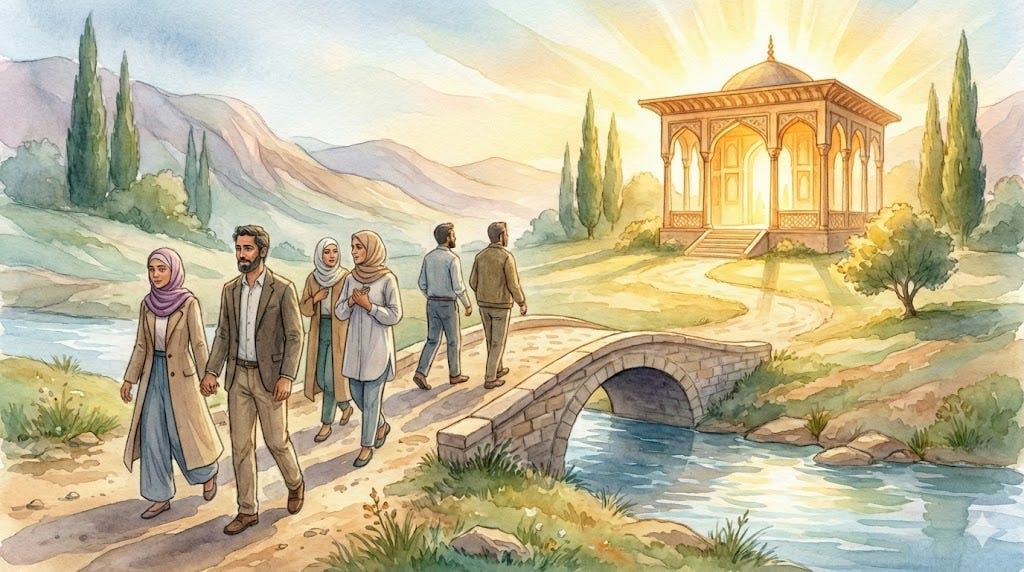
It is the hunger of the traveller who has left the house, walked the dusty road, washed at the river — and now stands at the threshold of the banquet hall, smelling something extraordinary from inside, and realising:
I am starving for something I cannot name.
That hunger is not a problem.
That hunger is the whole point.
Because tonight, we sit down to eat.
Let me tell you where we are in the journey.
In Session 1, we left.
We named the house of the ego — the Pharaoh within, the structure of habits and desires and self-worship that keeps us locked inside ourselves — and we said that fasting is the act of walking out the door.
The Great Migration.
Not a geographical movement but a spiritual one: from the self, toward God.
In Session 2, we cleaned.
We took the image of the mirror — the heart as a reflective surface, designed to catch and transmit the Light of God — and we confronted the rust.
We learned from Mirza Maliki Tabrizi that fasting has three tiers: the fast of the body, the fast of the limbs, and the fast of the heart.
We heard the Prophet, peace be upon him and his family, rebuke a woman who fasted from food but feasted on cruelty, and we were told:
how few are those who truly fast, and how many are those who are merely hungry.
We picked one limb.
We began to scrub.
And we ended with a question that has been hanging in the air ever since:
A clean mirror in a dark room reflects nothing.
An empty stomach that stays empty is not fasting — it is starvation.
So what is the fast for?
What does the emptiness make room for?
Tonight we answer that question.
And the answer is older than any of us.
It was given on the last Friday of Sha’ban, by the Prophet Muhammad, peace be upon him and his family, to a community that was about to enter the month of God.
And it begins with an invitation to dinner.
And it is no accident that we gather tonight — the 10th of Ramadhan — to speak about the banquet.
Because today we mark the passing of the woman who understood the feast before anyone else did.
Sayyedah Khadijah — the Mother of the Believers — who left this world on this day, in this month, in this very season of hunger and light.
The woman who took everything God gave her — her wealth, her standing, her comfort, her health — and fed it to the mission until there was nothing left of her but faith.
We will return to her tonight.
But for now, know this: the woman who first believed in the Prophet is the woman who first sat at God’s table.
And she did not fill up on bread at the door.
Video of the Sermon (Majlis/Lecture)
Audio of the Sermon (Majlis/Lecture)
Movement 1: The Core Concept — The Banquet of Dignity
The Invitation
Every year, as the month of Sha’ban draws to its close and the crescent of the Month of Ramadhan approaches, the words of the Prophet ring out across the centuries.
This is the Sha’baniyyah Sermon — one of the most important orations in the Islamic tradition, narrated through the chain of the Imams of the Ahl al-Bayt, peace be upon them all, from Imam Ali, from the Messenger of God himself.
Imam al-Ridha, peace be upon him, narrates from his fathers, from the Commander of the Faithful, peace be upon him, who said:
The Messenger of God, peace be upon him and his family, delivered a sermon to us one day, and said:
«أَيُّهَا النَّاسُ إِنَّهُ قَدْ أَقْبَلَ إِلَيْكُمْ شَهْرُ اللَّهِ بِالْبَرَكَةِ وَ الرَّحْمَةِ وَ الْمَغْفِرَةِ... وَ هُوَ شَهْرٌ دُعِيتُمْ فِيهِ إِلَى ضِيَافَةِ اللَّهِ وَ جُعِلْتُمْ فِيهِ مِنْ أَهْلِ كَرَامَةِ اللَّهِ»
“O people! The Month of God has approached you bearing blessing, mercy, and forgiveness... It is a month in which you have been invited to the Banquet of God, and in it you have been made of the people of God’s Dignity.“
— Prophet Muhammad, the Sha’baniyyah Sermon; narrated in Uyun Akhbar al-Ridha (Shaykh al-Saduq), via the chain of the Imams of the Ahl al-Bayt
Read that again.
Read it slowly.
You have been invited.
To the Banquet of God.
And you have been made — not promised, not offered the possibility of, but made — of the people of God’s Karamah.
Let us sit with that word for a moment.
Karamah.
We translate it as “dignity,” and that is correct, but it does not capture the full weight.
Karamah in the Quranic vocabulary is the word used when God describes the original station of the human being:
وَلَقَدْ كَرَّمْنَا بَنِي آدَمَ
“We have ennobled the children of Adam.”
— Quran, Surah al-Isra (the Chapter of the Night Journey) #17, Verse 70
Wa laqad karramna bani Adam — “We have ennobled the children of Adam.”
This is not social respect.
This is not the dignity of a job title or a good reputation.
This is ontological dignity — the dignity of being made in the image of the Divine names, the dignity of being appointed Khalifatullah, the representative of God on earth.
That is what was lost.
When the mirror rusted, when the ego built its walls, when we became opaque to the Light — what was lost was not just spiritual clarity.
What was lost was Karamah.
The original station.
The thing we were made for.
And the Prophet is telling us:
The Month of Ramadhan is the restoration.
Not a reward for suffering.
Not a gold star for enduring hunger.
A restoration of what was taken from you — or, more precisely, what you gave away, one sin at a time, one act of heedlessness at a time, until the mirror was so thick with rust that you forgot it was ever a mirror at all.
This is the Banquet.
This is what is on the table.
Not food — Karamah.
Not drink — the original human dignity that God placed in you before the world got to it.
Now.
Here is the question that structures everything else tonight.
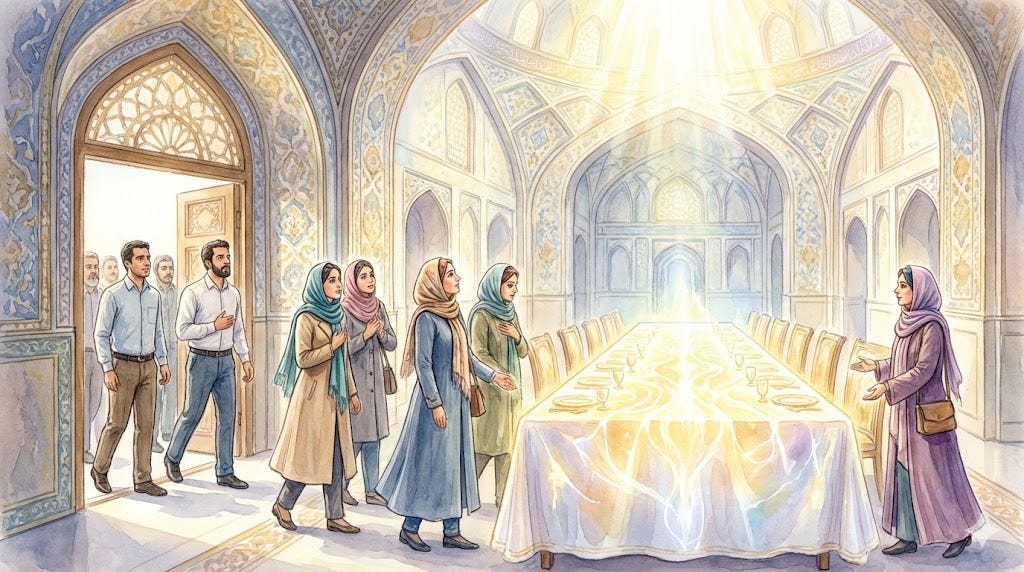
If you were invited to the banquet of a King — a real King, not a figurehead, but the most powerful and generous being you could imagine — and you arrived at the palace, and you walked through the gates, and you entered the hall, and you saw the table set with things you had never seen before, dishes prepared specifically for you, a seat with your name on it —
Would you fill up on bread at the door?
Would you stop at the entrance, grab a roll from the basket on the side table, and stand there chewing while the feast of your life waited in the next room?
That is what we do every Ramadhan.
We obsess over the iftar spread.
We plan the menu.
We share recipes.
We count down the hours until maghrib, and when the adhan sounds, we fall on the food like people rescued from a desert island.
The dates, the samosas, the soup, the rice, the sweets — we eat and eat and eat until the hunger of the day is drowned in the abundance of the night.
And there is nothing haram in that.
God made us hungry.
God made food good.
The Prophet himself, peace be upon him, broke his fast with dates and water and enjoyed what God had provided.
This is not an argument against eating.
But the iftar spread is the bread at the door.
The actual feast — the Karamah — is in the other room.
And most of us never make it past the entrance.
The Menu
So what is on the table?
What is the soul’s food?
What is the dish that the King has prepared and that we keep missing because we are too full of bread to want anything else?
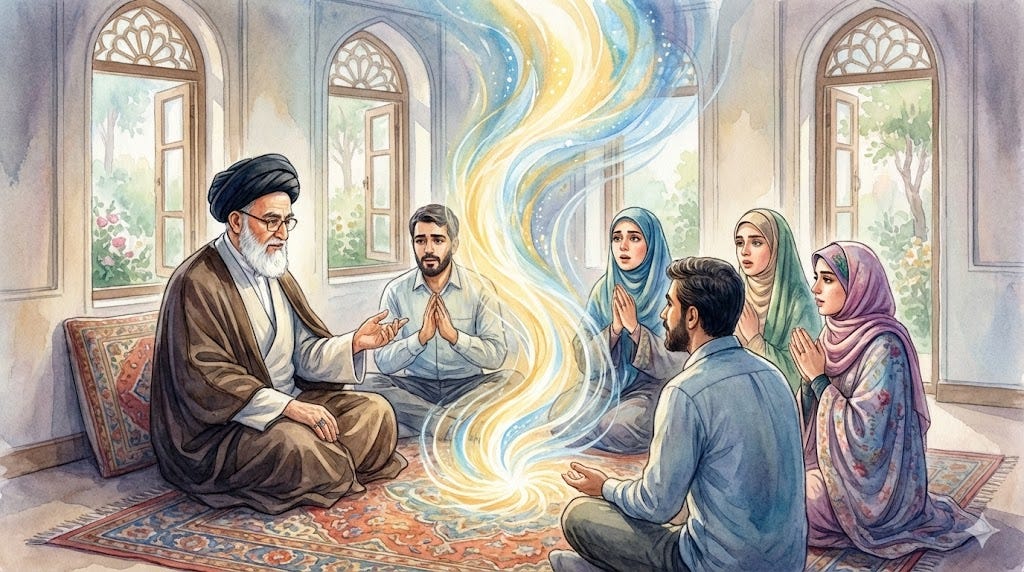
Imam Khomeini answers this with a passage that belongs in every Ramadhan curriculum in the world.
In Adab as-Salat — his masterwork on the inner dimensions of prayer — he writes:
«كذلك فإنّ للقلوب والأرواح غذاءً لا بدّ أن يكون مناسباً لحال كلّ منها وموافقاً لنشأتها... والغذاء المناسب لنشأة الأرواح هو المعارف الإلهية»
“Similarly, for hearts and spirits there is a food that must be suitable for the state of each and consistent with its origin... And the appropriate food for the origin of spirits is Divine Knowledge — Al-Ma’arif al-Ilahiyyah.“
— Imam Khomeini, Adab as-Salat (The Disciplines of the Prayer), Chapter on Guarding the Prayer from the Influence of Shaytan
This is the core thesis of tonight’s session.
The soul has a food.
It is not metaphorical.
It is not poetry.
The tradition is making an ontological claim:
Just as the body has a nutritional need that, if unmet, leads to weakness, disease, and death, the soul — the ruh, the qalb — has a nutritional need that, if unmet, leads to spiritual weakness, spiritual disease, and spiritual death.
And that food is Ma’rifah.
Divine Knowledge.
Now — this is crucial — Ma’rifah is not information about God.
That is theology, and it has its place, but you can have a PhD in theology and a starving soul.
Ma’rifah is experiential knowledge.
It is the difference between reading about honey and tasting it.
Between studying the properties of water and plunging into the ocean.
Between knowing that God is Merciful — because you read it in a book — and experiencing that mercy wash over you in a moment of prayer so overwhelming that you cannot speak.
One is knowledge about.
The other is knowledge of.
The scholars tell us that Ma’rifah begins with the names of God and extends through the entire chain of existence — from the First Cause to the last leaf on the last tree.
It is not a single insight but a nourishment, something the soul metabolises the way the body metabolises bread: slowly, continuously, building strength with every encounter.
And here is the connection to fasting.
When the body is full, the soul’s appetite is suppressed.
You have felt this.
After a heavy meal, the last thing you want to do is pray.
The body is digesting; the soul is dormant.
The physical system has taken over and there is no room — no space — for the spiritual system to function.
But when the body is hungry, something shifts.
The physical system quiets.
The noise of digestion and craving and satiation fades.
And in that quiet, if you are paying attention, you can hear something else.
A different kind of hunger.
A pull toward prayer, toward reflection, toward the Quran, toward something that is not food but that your whole being is reaching for.
That is the soul’s appetite.
That is the hunger that Ramadhan is designed to awaken.
The scholars of irfan have always associated hunger with illumination — not because suffering is holy, not because God takes pleasure in our pain, but because emptiness creates capacity.
You cannot fill a cup that is already full.
You cannot feed a soul that is stuffed with the world.
Fasting empties the cup.
And now — listen to this — now the angels speak.
Imam al-Baqir, peace be upon him, narrates:
«إِنَّ لِلَّهِ تَعَالَى مَلائِكَةً مُوَكَّلِينَ بِالصَّائِمِينَ يَسْتَغْفِرُونَ لَهُمْ فِي كُلِّ يَوْمٍ مِنْ شَهْرِ رَمَضَانَ إِلَى آخِرِهِ وَ يُنَادُونَ الصَّائِمِينَ كُلَّ لَيْلَةٍ عِنْدَ إِفْطَارِهِمْ: أَبْشِرُوا عِبَادَ اللَّهِ فَقَدْ جُعْتُمْ قَلِيلاً وَ سَتَشْبَعُونَ كَثِيراً»
“God, exalted is He, has angels appointed over the fasting ones who seek forgiveness for them every day of the month of Ramadan until its end, and they call out to the fasting ones every night at the time of their iftar: ‘Rejoice, O servants of God! You have hungered a little, and you shall be sated greatly!’”
— Imam Muhammad al-Baqir , narrated in Fadha’el al-Ashhur al-Thalathah (The Virtues of the Three Months - Rajab, Sha’baan and Ramadhan) (Shaykh al-Saduq)
You have hungered a little, and you shall be sated greatly.
Listen to the promise.
Not:
“you have suffered, and now you may eat.”
Not:
“your endurance has been noted, here is your reward.”
But:
you have hungered
— and the hunger was not the punishment.
The hunger was the preparation.
You were being emptied so that you could be filled with something greater than anything the body has ever tasted.
The bread at the door is dates and water.
The feast in the hall is Ma’rifah.
The hunger of the day is the clearing of the cup.
The sating of the night is the pouring in of Divine Knowledge — through prayer, through Quran, through the supplications of this blessed month, through the quiet moments of reflection when the world is asleep and the soul is finally, beautifully, achingly awake.
God did not invite us to Ramadhan to starve.
He invited us to dine.
The question is whether we make it past the bread basket at the door.
Movement 2: The Inward Lesson — How to Eat with Joy
The Meal You Cannot Taste
So the menu is Ma’rifah.
The table is set.
The food is there.
But here is the problem — and it is one that most of us will recognise the moment I name it.
Even the finest meal in the world is useless if you eat it while miserable.
You know this from your own life.
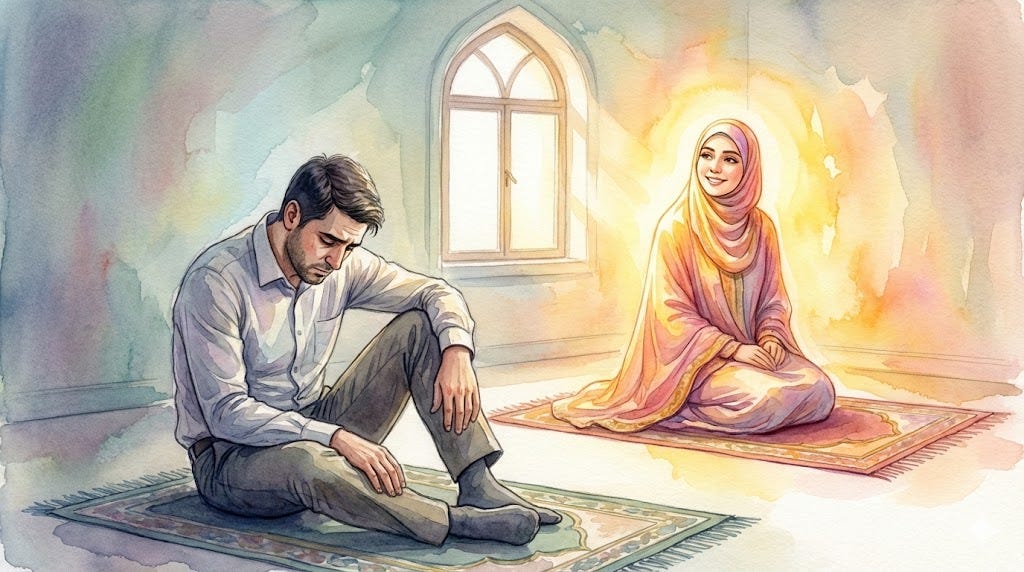
Think of a time you sat down to a beautiful meal — a meal prepared with love, a meal you should have enjoyed — but you were anxious, or angry, or distracted, or grieving.
The food went in.
You chewed and swallowed.
But you tasted nothing.
Your body was at the table; your heart was somewhere else entirely.
And when the meal was over, you felt full but not fed.
Stuffed but not nourished.
Now think of the opposite.
A simple meal — bread and cheese, a bowl of soup, something ordinary — but eaten in a moment of genuine happiness.
With someone you love.
After a long day of honest work.
On a cool evening with the window open.
And that simple meal tasted better than anything you had eaten in months, because you were present to it.
You were there.
Your body and your heart were in the same room.
Imam Khomeini saw this principle and applied it to worship with a precision that should stop us in our tracks.
In Adab as-Salat, he writes:
«وكما أنّ الأطبّاء يعتقدون بأنّ الطعام إذا أُكِلَ بالسرور والبهجة يكون أسرع في الهضم... كذلك يقتضي الطبّ الروحاني بأنّ الإنسان إذا تغذّى بالأغذية الروحانية بالبهجة والاشتياق محترزاً من الكسل والتكلّف يكون ظهور آثارها في القلب وتصفية باطن القلب بها أسرع.»
“Just as doctors believe that food eaten with joy and delight is faster in digestion... so too does spiritual medicine require that if a person is nourished with spiritual foods — with delight and yearning, avoiding laziness and forcing it — the appearance of their effects in the heart, and the purification of the heart’s interior, is faster.“
— Imam Khomeini, Adab as-Salat (The Disciplines of the Prayer), Chapter on the Inner Etiquettes of Worship
Read that passage like a diagnosis.
Because that is what it is.
Imam Khomeini is not giving a pious suggestion.
He is practising spiritual medicine.
He is identifying a condition — a condition that afflicts almost every one of us in the Month of Ramadhan — and he is naming it with clinical precision.
The condition is takalluf.
Forcing it.
Going through the motions.
Performing worship because you feel you have to, not because you want to.
Dragging yourself to the prayer mat the way you drag yourself to a meeting you dread.
Opening the Quran the way you open a textbook for an exam you are dreading.
And the diagnosis is devastating:
When you eat spiritual food in this state — with reluctance, with resentment, with the inner posture of someone grinding through an obligation — the food does not digest.
It goes in but it does not nourish.
The prayer is prayed but nothing lands.
The Quran is read but nothing opens.
The fast is kept but nothing changes.
You go through the Month of Ramadhan doing everything right — externally, perfectly, the full thirty days — and you come out the other end exactly the same person you were when you went in.
Not because the food was bad.
Because you ate it while nauseous.
The Silent Killer

This is the thing that silently destroys most people’s Ramadhan, and almost no one talks about it.
We talk about the three tiers of fasting.
We talk about guarding the limbs.
We talk about the Quran and the night prayers and the supplications.
But we rarely talk about the emotional posture with which we approach all of it.
And the emotional posture, for many of us, is dread.
Be honest.
When Ramadhan approaches, what is the first feeling?
For many people — good people, faithful people, people who love God and want to be close to Him — the first feeling is not excitement.
It is anxiety.
It is the weight of thirty days of hunger, thirty nights of staying up, thirty rounds of prayers that feel long and words that feel distant.
It is the quiet thought:
I hope I can get through it this year.
Get through it.
As if it were an ordeal to survive.
As if the Banquet of the King were a prison sentence to endure.
And this is not a failure of faith.
It is a failure of framing.
We have been taught — by culture, by habit, by the sheer weight of routine — to see the Month of Ramadhan as deprivation.
I cannot eat.
I cannot drink.
I must pray.
I have to read.
The entire internal vocabulary is the vocabulary of obligation, restriction, endurance.
And Imam Khomeini is saying:
that vocabulary is poisoning your food.
He backs this up with hadith.
The Imam quotes from Imam al-Sadiq, peace be upon him:
«لا تُكرِهوا إلى أنفسِكم العبادة»
“Do not force worship upon yourselves.”
— Imam Ja’far al-Sadiq, narrated in al-Kafi (Shaykh Al-Kulayni); cited in Adab as-Salat
And from the Prophet, peace be upon him and his family:
«يا عليّ إنّ هذا الدّين متين فأوغِل فيه برِفق ولا تُبَغِّض إلى نفسِك عبادة ربّك»
“O Ali, this religion is firm, so enter deeply into it with gentleness, and do not make the worship of your Lord hateful to yourself.“
— Prophet Muhammad, narrated in al-Kafi (Shaykh Al-Kulayni); cited in Adab as-Salat
And from Imam al-Askari, peace be upon him:
«إذا نَشِطَت القلوب فأَوْدِعوها وإذا نَفَرَت فوَدِّعوها»
“When the hearts are eager, entrust them with knowledge. And when they turn away, bid them farewell — let them rest.”
— Imam Hasan al-Askari, narrated in Adab as-Salat
The Prophet and the Imams.
One message.
The worship of God is not meant to be a burden that breaks you.
It is meant to be a meal that feeds you.
And if you approach it with hatred, with force, with the clenched jaw of someone enduring rather than enjoying — you are not only making yourself miserable.
You are blocking the very nourishment that God prepared for you.
The Reframe
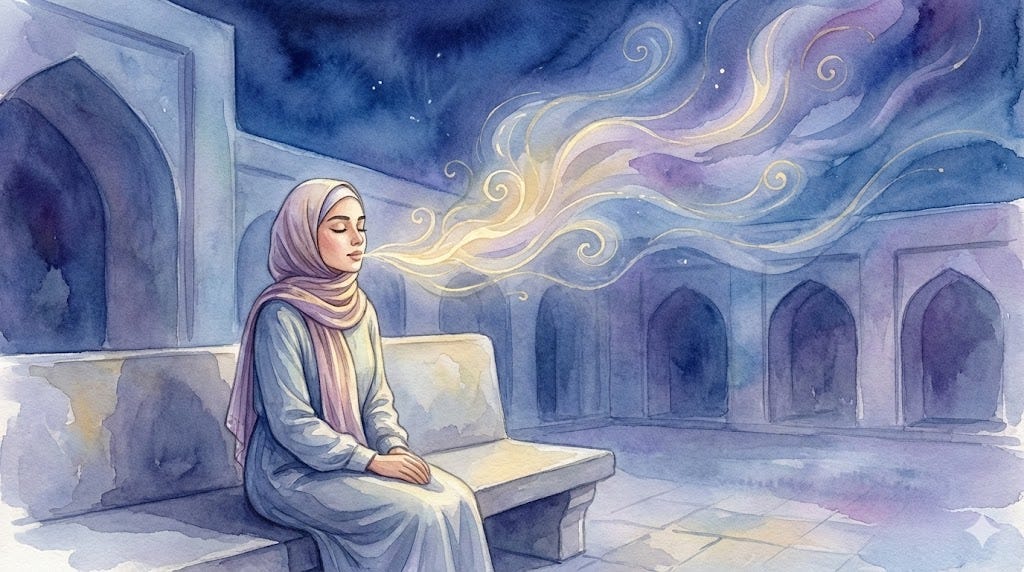
So what do we do?
How do we shift from dread to delight, from endurance to appetite?
The shift is simple — not easy, but simple.
It is a change of vocabulary.
A change of the internal story you tell yourself about what is happening to you in this month.
Replace the word “obligation” with the word “nourishment.”
You are not obligated to stay up tonight for the a'maal.
You are being fed.
The du'as of these nights — Dua Iftitah, Dua Abu Hamza, the prayers of the nights of Qadr — are not tasks on your checklist.
They are plates set before you, full of something your soul has been hungry for all year.
The question is not:
can I get through all the a'maal tonight?
The question is:
how much of this food can I actually taste?
You are not required to read your daily portion of Quran.
You are eating.
Every ayah is a morsel.
Every surah is a course.
And you have been starving — whether you knew it or not — since last Ramadhan, when the table was last set this generously.
You are not enduring the hunger of the fast.
You are clearing the palate.
A perfumer does not douse himself in cologne before testing a new scent.
A chef clears his palate before tasting a dish.
The emptiness of the day is not the punishment — it is the preparation.
It is the thing that makes your spiritual taste buds sharp enough to actually detect the flavour of what God is serving at night.
This is what the Prophet meant when he said, in that same Sha’baniyyah Sermon:
«أَنْفَاسُكُمْ فِيهِ تَسْبِيحٌ وَ نَوْمُكُمْ فِيهِ عِبَادَةٌ وَ عَمَلُكُمْ فِيهِ مَقْبُولٌ وَ دُعَاؤُكُمْ فِيهِ مُسْتَجَابٌ»
“Your breaths in it are glorification. Your sleep in it is worship. Your deeds in it are accepted. Your supplications in it are answered.”
— The Prophet Muhammad, the Sha’baniyyah Sermon; Uyun Akhbar al-Ridha
Your breaths are tasbih.
Your sleep is worship.
Do you hear what he is saying?
Even the involuntary, unconscious acts of the month — breathing, sleeping — are being counted as worship.
The entire month is a table set so generously that you are being fed even when you are not aware of it.
How can anyone approach this with dread?
How can anyone frame this as deprivation?
The problem is not the month.
The problem is that we have been told a story about the month that makes us eat with nausea instead of appetite.
And the food — the Ma’rifah, the Karamah, the Divine Knowledge that God has been trying to feed us — goes in but does not land.
The Practical Test

So here is the exercise for this week.
It is not about adding more worship to your plate.
It is about changing how you eat what is already there.
Tomorrow, before Fajr, before you begin the fast, say to yourself — out loud if you need to:
I am not being deprived today.
I am being prepared.
My hunger is not a punishment.
It is a clearing of the palate for something I cannot yet taste but that God has already set before me.
And tomorrow night, when you stand for prayer — whether it is the three rak'ahs of maghrib, the four of isha, or the nafilah before and after them — do not approach the prayer mat as a station of obligation.
Approach it as a table.
Ask yourself: what is being served tonight?
What does God want to feed me?
What am I hungry for — really hungry for, beneath the surface hunger of the stomach?
And if you feel joy — even a flicker, even for a moment, even in just one sajdah where something softens and you feel, however faintly, that you are in the presence of the One who invited you — stay with that.
Do not rush past it.
Do not check the time.
Do not think about how many rak’ahs are left.
Stay.
Because that flicker is the taste.
That is the Ma’rifah.
That is the food arriving.
And if you eat it with joy, with presence, with the delight of a starving person who has finally been given something real — then it will digest.
It will land.
It will change you from the inside out.
Imam Khomeini said it:
The appearance of its effects in the heart is faster.
Faster.
Not because you did more.
Not because you tried harder.
But because you were present.
Because you ate with joy instead of resentment, with yearning instead of obligation, with the wide-eyed gratitude of someone who has just realised that the King’s banquet was real all along — and the seat with your name on it has been waiting.
A fast performed with resentment is a meal eaten while nauseous — it goes in but nothing is absorbed.
A fast performed with even a sliver of genuine delight is a feast — and every morsel transforms you.
Do not force worship upon yourself.
Eat gently.
Eat with joy.
And trust that the food is real.
Movement 3: The Outward Call — The Transparency of the Prophets
What Ma’rifah Does to a Body
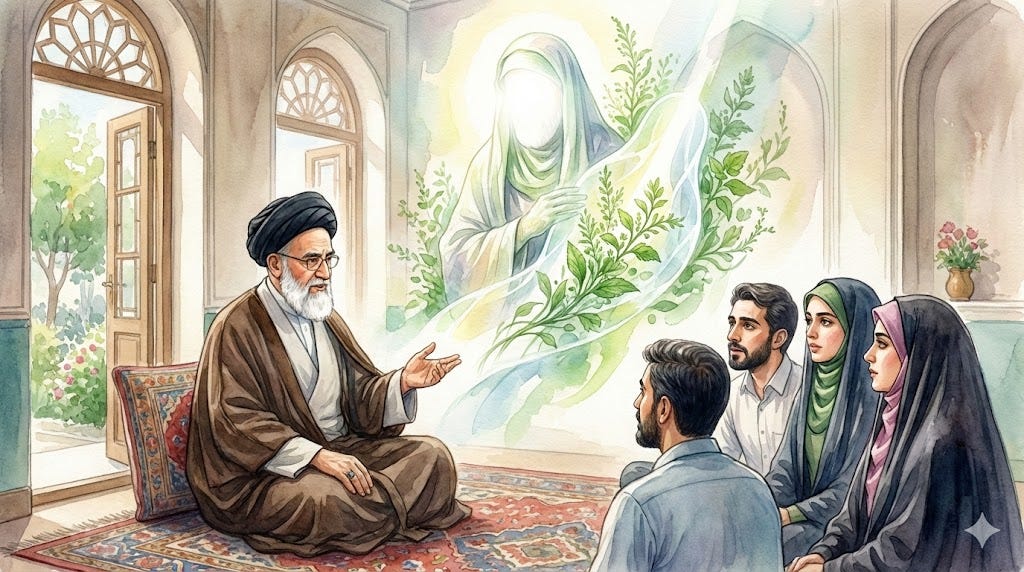
We have talked tonight about food.
About the menu — Ma’rifah, Divine Knowledge.
About the method of eating — with joy, with delight, not with the clenched jaw of obligation but with the open heart of a guest who has finally understood what the Host is offering.
But we have not yet asked the most important question of all.
What happens to someone who actually eats this food?
What does a human being look like — not metaphorically, not poetically, but actually — when they have been nourished on the knowledge of God?
Imam Ali, peace be upon him, gives us the answer.
And it is one of the most extraordinary images in the entire Nahj al-Balagha.
In Sermon 160 — a sermon dedicated to the asceticism of the Prophets, peace be upon them — the Imam has been describing the Prophet Muhammad, peace be upon him and his family, and his renunciation of the world.
And then he says:
and if you wish, I will tell you about the second
— Moses, the one who spoke directly with God.
«إذ يقول: رَبِّ إِنِّي لِمَا أَنْزَلْتَ إِلَيَّ مِنْ خَيْرٍ فَقِيرٌ. واللّه، ما سأله إلّا خبزاً يأكله، لأنّه كان يأكل بَقْلَةَ الأرض. ولقد كانت خُضْرَةُ البَقْلِ تُرى مِن شَفِيفِ صِفَاقِ بَطْنِهِ، لِهُزَالِهِ وَ تَشَذُّبِ لَحْمِهِ.»
“When he said: ‘My Lord, I am in desperate need of whatever good You send down to me’ — by God, he asked Him for nothing but bread to eat, for he used to eat the herbs of the earth. And the greenness of the herbs could be seen through the thin membrane of his belly, due to his emaciation and the wasting of his flesh.“
— Nahj al-Balagha, Sermon 160
Read that image and let it settle.
The greenness of the herbs.
Visible through the wall of his stomach.
Because there was so little flesh left on his body, so little between the inside and the outside, that Moses — a Prophet of God, the one who stood on Sinai and heard the Voice without intermediary — had become transparent.
Now.
The scholars read this passage and they see asceticism.
They see a lesson about renouncing the world.
And it is that.
But I want to suggest something deeper, something that connects directly to everything we have been saying tonight.
Moses became transparent because he was full of God and empty of everything else.
The herbs he ate were the simplest food on earth — the wild greens that grow without planting, that no one owns, that are the provision of the utterly dependent.
He did not eat them for nutrition.
He ate them because the body requires something, and he gave it the minimum — so that the maximum space was available for the other food.
The food of the soul.
The Ma’rifah.
And here is what happens when a human being is genuinely, deeply, really fed by that higher food: they become see-through.
The barrier between inside and outside dissolves.
What is within becomes visible without.
There is no performance, no mask, no gap between the private self and the public self — because there is no self left to hide behind.
There is only the Light, passing through.
This is what real Ma’rifah does to a person.
It does not make you impressive.
It does not make you powerful.
It does not give you a spiritual glow that others admire from a safe distance.
It makes you transparent.
And transparency is the most terrifying and the most beautiful thing a human being can become.
The Transparency We Choose and the Transparency That Is Forced
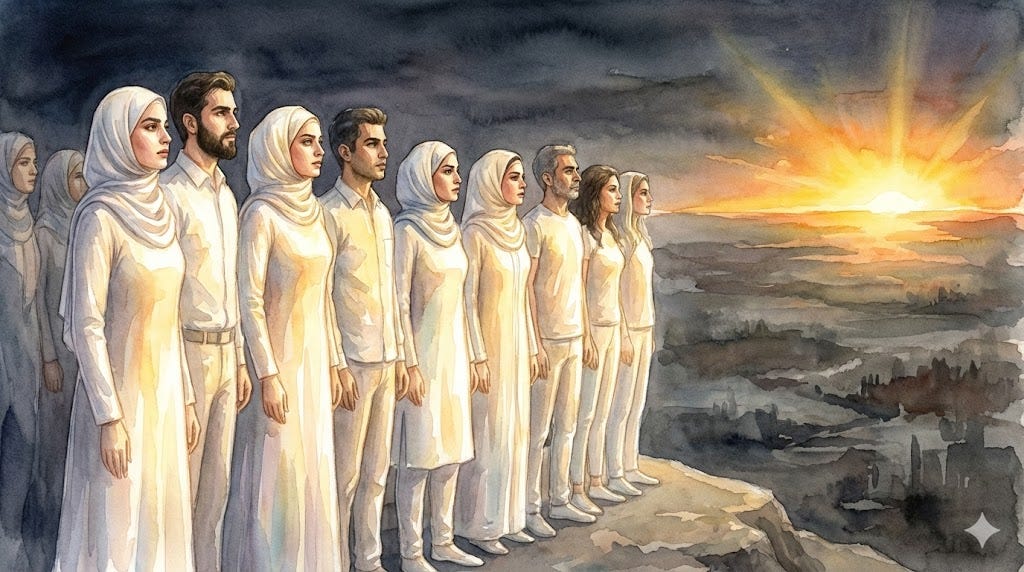
And now we must turn outward.
Because we cannot talk about transparency in Ramadhan 2026 without naming what is in front of us.
In Gaza, in Sudan, in every place where siege and starvation have become weapons, human beings are being made transparent against their will.
The flesh is wasting.
The bones are showing.
The greenness of the herbs — if there are any herbs left — is visible not as a sign of prophetic nearness to God, but as a sign of human cruelty beyond description.
Children whose bodies are transparent.
Not because they are full of God, but because they have been emptied of everything by the deliberate policy of other human beings.
And here we sit — fed, sheltered, warm — choosing to fast.
Do you see the gap?
Do you feel the obscenity of it?
There is a version of Ramadhan that stays safely inside — that fasts, and prays, and reads the Quran, and does the a’maal, and tastes the Ma’rifah, and feels the closeness to God, and never once allows that closeness to burn a hole through the walls of the self into the world outside.
A Ramadhan of private illumination.
A Ramadhan where the food is consumed but none of it reaches the limbs, none of it becomes speech, none of it becomes action, none of it becomes anger at what should not be tolerated.
That is not the fast of the Prophets.
Moses did not become transparent so that he could admire his own luminosity.
He became transparent so that God could be seen through him.
So that the truth of the world — its beauty, its horror, its desperate need for justice — could pass through a human being without obstruction.
And the Prophet Muhammad, peace be upon him and his family, in that same Sha’baniyyah Sermon, after telling us about the banquet and the Ma’rifah and the breaths that are tasbih — after all of that inner nourishment — says:
«وتصدّقوا على فقرائكم ومساكينكم ووقّروا كباركم وارحموا صغاركم وصلوا أرحامكم واحفظوا ألسنتكم... وتحنّنوا على أيتام الناس كما يُتحنّن على أيتامكم»
“Give charity to your poor and your destitute. Honour your elders and show mercy to your young. Maintain your ties of kin and guard your tongues... And show compassion to the orphans of others, as you would wish compassion shown to your own orphans.“
— The Prophet Muhammad, the Sha’baniyyah Sermon; Uyun Akhbar al-Ridha
The orphans of others.
As you would wish for your own.
This is the social programme embedded in the banquet.
This is the outward direction of the food.
Ma’rifah is not a private experience to be hoarded.
It is a force that passes through the transparent body and becomes justice in the world.
And the du’a that every one of us recites every single night of this month — Du’a Iftitah, the supplication that opens the nights of Ramadhan — does not let us forget it.
In its most extraordinary passage, after praising God and calling for the return of the Imam of our time, it makes us say:
«اللَّهُمَّ إِنَّا نَرْغَبُ إِلَيْكَ فِي دَوْلَةٍ كَرِيمَةٍ تُعِزُّ بِهَا الْإِسْلامَ وَ أَهْلَهُ وَ تُذِلُّ بِهَا النِّفَاقَ وَ أَهْلَهُ وَ تَجْعَلُنَا فِيهَا مِنَ الدُّعَاةِ إِلَى طَاعَتِكَ وَ الْقَادَةِ إِلَى سَبِيلِكَ»
“O God, we yearn toward You for a noble state through which You honour Islam and its people, and through which You humiliate hypocrisy and its people, and in that state make us among those who call to Your obedience and leaders toward Your path.“
— Du’a Iftitah, recited every night of the Month of Ramadhan; Mafatih al-Jinan
Dawlah Karimah.
A noble state.
A dignified order.
This is the main course of the banquet.
This is what God is actually feeding us toward.
Not private ecstasy.
Not personal illumination.
Not the sweet, safe feeling of closeness that asks nothing of us in the world.
God is feeding us Ma’rifah so that we become hungry for Dawlah Karimah — a world where Islam is honoured and hypocrisy is brought low, where the truth is not hidden out of fear, where the orphans of Gaza, Lebanon, Sudan, Kashmir and Yemen and every forgotten place are shown the same compassion we demand for our own children.
The word narghab — “we yearn” — is not a polite request.
It is an ache.
It is the word of someone who wants something with their whole body.
And what we are being taught to want, every single night of this month, is not a spiritual experience.
It is a just world.
And notice:
make us among those who call and leaders toward Your path.
Not spectators.
Not observers.
Not people who fasted and prayed and went home and changed nothing.
But du’at — callers — and qadah — leaders.
People who have been fed and who now go out to feed others.
People who have become transparent and who now let the light pass through them into the darkest corners of the world.
This is the trajectory of the whole series.
Session 1: Leave the house.
Session 2: Clean the mirror.
Session 3: Eat the food.
And then — let it make you transparent.
Let it turn you outward.
Let it make you dangerous to every system of hypocrisy and injustice, because a person who has been fed by God cannot sit still while God’s children starve.
Bridge to Session 4: The Sacrifice That Liberates

We have now moved through three stations.
We left.
We cleaned.
We ate.
And if the food has landed — if even a morsel of what was on the table tonight has been absorbed — then you already know that it is not comfortable.
Ma’rifah does not settle gently into the soul like a warm drink.
It burns.
It burns away pretence.
It burns away the stories you have been telling yourself.
It burns away the easy, automatic, unquestioned routines that have kept the ego safe and unchallenged for years.
And somewhere around now — week two, week three of Ramadhan — a voice inside you says:
Why am I doing this to myself?
Your sleep is wrecked.
Your routine is shattered.
Your coffee is gone.
Your patience is thinner than it has been all year.
The initial enthusiasm of the first week has worn off, and what remains is the raw, unglamorous reality of a body and a soul being reshaped against their will.
That feeling — the discomfort, the disruption, the sense that something in you is being broken — is not a side effect of fasting.
It is the point.
Because the tradition tells us that the ego does not enslave us through dramatic temptation.
It enslaves us through something far more insidious: habit.
Through the unquestioned routine.
Through “this is just who I am.”
Through the comfortable repetition that feels like life but is actually a cage.
And God designed the Month of Ramadhan to break the lock on that cage.
Next week, we enter the forge.
We ask why God deliberately disrupts every rhythm of your life in this month — and we learn, from Imam Ali himself, that the word for what he does to his soul is not “punishment.”
It is Riyadah — the word used for breaking in a wild horse.
A magnificent, powerful, dangerous horse.
He does not want to kill it.
He wants to ride it.
If the first three sessions were about receiving — receiving the invitation, receiving the cleansing, receiving the food — the fourth session is about what it costs to keep what you have been given.
And the cost is the Idol of Habit.
But before we enter that forge — the calendar gives us a gift.
In a few days, on the 15th of this blessed month, we mark the birth of Imam Hasan al-Mujtaba — the eldest grandson of the Prophet, the child born in the month of fasting, the child named by God Himself.
And there is something in that timing that matters for what comes next.
Because Imam Hasan is the Karim of the Ahl al-Bayt — the Generous One — who gave and gave and gave until generosity itself learned its name from him.
He was born into a month of hunger.
And he spent his life ensuring that no one who came to him left hungry.
The sacrifice we speak about next week is not destruction.
It is the kind of giving that only the truly fed can do.
Next week: the sacrifice that sets you free.
A Ballad for the Hungry Soul
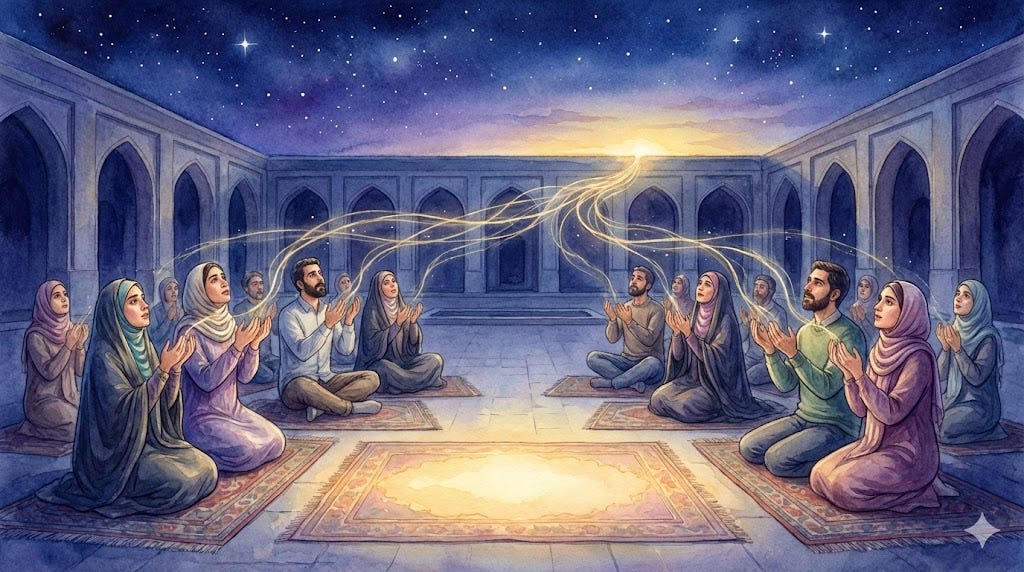
In the voice of the one who has been sitting at the banquet — and has just realised they have been eating bread at the door.
O Generous One.
O Host of hosts.
O You who set the table before we knew we were hungry.
This is the du’a of the one who came late to the feast.
Abu Hamza al-Thumali — that broken, luminous man who learned to pray at the feet of the Imam — teaches us how the hungry soul speaks to its Lord.
Not with the confidence of the fed, but with the ache of someone who has just discovered what they have been starving for:
«بِكَ عَرَفْتُكَ وَأَنْتَ دَلَلْتَنِي عَلَيْكَ وَدَعَوْتَنِي إِلَيْكَ وَلَوْلَا أَنْتَ لَمْ أَدْرِ مَا أَنْتَ»
«الْحَمْدُ لِلَّهِ الَّذِي أَدْعُوهُ فَيُجِيبُنِي وَإِنْ كُنْتُ بَطِيئاً حِينَ يَدْعُونِي. وَالْحَمْدُ لِلَّهِ الَّذِي أَسْأَلُهُ فَيُعْطِينِي وَإِنْ كُنْتُ بَخِيلاً حِينَ يَسْتَقْرِضُنِي»
“Through You I came to know You. You guided me to Yourself. You called me unto Yourself. And had it not been for You, I would not have known what You are.“
“All praise belongs to God, Whom I call upon and He answers me — even though I am sluggish when He calls upon me. And all praise belongs to God, from Whom I ask and He grants me — even though I am miserly when He asks me for a loan.“
— Du’a Abu Hamza al-Thumali, taught by Imam Ali ibn al-Husayn Zayn al-Abidin; Mafatih al-Jinan
Do you hear the hunger in that?
He answers me — even though I am sluggish when He calls. He gives me — even though I am miserly when He asks.
The food has been coming all along.
The table has never been empty.
It is we who have been slow to sit down, reluctant to eat, filling ourselves with bread at the door while the feast of a lifetime waited in the next room.
And still — still — He answers.
Still He gives.
Still the angels call out every night:
Rejoice, you have hungered a little, and you shall be sated greatly.
And when the hunger finally becomes unbearable — when you cannot stand another moment of being half-fed, of tasting enough to know what you are missing but not enough to be satisfied — this is what the starving soul learns to say:
«اللَّهُمَّ إِنِّي أَسْأَلُكَ أَنْ تَمْلَأَ قَلْبِي حُبّاً لَكَ وَخَشْيَةً مِنْكَ وَتَصْدِيقاً بِكِتَابِكَ وَإِيمَاناً بِكَ وَفَرَقاً مِنْكَ وَشَوْقاً إِلَيْكَ»
«يَا ذَا الْجَلَالِ وَالْإِكْرَامِ حَبِّبْ إِلَيَّ لِقَاءَكَ وَأَحْبِبْ لِقَائِي وَاجْعَلْ لِي فِي لِقَائِكَ الرَّاحَةَ وَالْفَرَجَ وَالْكَرَامَةَ»
“O God, I ask You to fill my heart with love for You, and awe of You, and belief in Your Book, and faith in You, and dread of You, and longing for You.“
“O Possessor of Majesty and Generosity — make Your meeting beloved to me, and hold me beloved to You, and in meeting You, grant me tranquillity, relief, and Karamah.”
— Du’a Abu Hamza al-Thumali; Mafatih al-Jinan
Fill my heart.
Not “teach my mind.”
Not “inform my intellect.”
Fill it — the way you fill a cup, the way you fill a starving body, the way you fill a room with light.
And the last word of the list — shawqan ilayk — longing for You.
This is not the prayer of someone who is full.
This is the cry of someone who has tasted one morsel and now wants the whole feast.
And notice what he asks for at the end: Karamah.
The same word the Prophet used in the Sha’baniyyah Sermon.
The dignity that was on the table all along.
He is asking God for the main course.
And in the du’a recited before the Ziyarah of Imam al-Ridha — the same Imam through whom the Sha’baniyyah Sermon reached us — the supplicant washes and says:
«اللَّهُمَّ طَهِّرْنِي وَطَهِّرْ لِي قَلْبِي وَاشْرَحْ لِي صَدْرِي وَأَجْرِ عَلَى لِسَانِي مِدْحَتَكَ وَمَحَبَّتَكَ وَالثَّنَاءَ عَلَيْكَ فَإِنَّهُ لَا قُوَّةَ إِلَّا بِكَ»
“O God, purify me and cleanse my heart, and expand my chest, and let Your praise and Your love and Your glorification flow upon my tongue — for there is no strength except through You.”
— Du’a before the Ziyarah of Imam Ali ibn Musa al-Ridha; Mafatih al-Jinan
Purify me.
Expand me.
And then — let it flow.
Let the praise move through me, not stick inside me.
Let the love pass through the transparent body and become audible, become visible, become something the world can hear and see.
This is the prayer of someone who has understood what tonight was about.
The food was never meant to stay inside.
It was meant to pass through — to make us transparent, luminous, dangerous to every lie and every silence.
And so — having heard how the masters teach us to ask, having learned the vocabulary of sacred hunger — we lift our hands and say:
O God —
We came to Your table and filled up on bread.
We counted the hours until maghrib and called that fasting.
We ate the dates, drank the water, recited the bismillah — and never once asked what else
You had prepared for us.
The Ma’rifah was there.
The Karamah was there.
You set the feast before we arrived.
And we sat in the doorway and called it enough.O God — we were not starving.
We were refusing to eat.And tonight, something cracked.
We heard that the food of the soul is real — as real as bread, as necessary as water.
We heard that You designed this hunger not as punishment but as preparation — a clearing of the palate for something we have never tasted but that our whole being has been aching for since before we were born.And we tasted it — God, we tasted it.
A flicker.
A moment in sajdah where something shifted and the chest opened and for one breath — one single breath — we were not performing worship.
We were being fed.Do not let that flicker die.
O God —
By Muhammad, who was so full of Your Light that the world has not stopped reflecting him in fourteen hundred years.
By Khadijah — O God, by Khadijah.
By the woman whose day this is.
The woman who left this world on the 10th of Your month, in this very season of hunger and feast.
She was the first to believe.
The first to pray beside him.
The first to spend everything — her wealth, her reputation, her comfort, her body — feeding a mission that the whole world rejected.
She understood the banquet before anyone: that the food passes through you and becomes life for others.
She fed the Prophet when no one else would.
She fed the da'wah when no one else could.
And when there was nothing left to give — when the siege of Shi'b Abi Talib had taken her health, her strength, the very flesh from her bones — she gave that too.
And she left this world transparent.
Like Moses.
Like the herbs through the skin.
Not because she chose asceticism — but because she poured herself out so completely that there was nothing left between her and You.By Ali, who ate two loaves of barley and disciplined his soul until it came safely on the Day of the Great Fear.
By Fatimah, who hungered in this world so that the hungry of every world could eat.
By Husayn, who was denied even the water of the Euphrates — and whose thirst became the river from which every revolution of justice has drunk.
We ask You:
Teach us to eat.
Not the bread at the door.
The feast in the hall.Make us hungry for what is real — for Ma’rifah, for knowledge of You, for the taste of Your presence in the quiet hours of this month when the world is asleep and the soul is finally, terribly, beautifully awake.
And when the food lands — when the Ma’rifah enters and the heart begins to see — do not let us hoard it.
Do not let us curl around the Light and make it a private treasure.
Make us transparent, like Your prophet Moses — so emptied of the self that the truth is visible through our skin.O God —
We heard You call tonight for a Dawlah Karimah — a noble state, a just world. We heard You ask us to yearn for it with our whole body.
And so we yearn.
We ache.For the orphans of Gaza who are being emptied by cruelty, not by choice.
For the children of Sudan who know the transparency of Moses but have never heard his name.
For every soul whose hunger is not a spiritual exercise but a crime committed against them by other human beings.Make our fast a bridge to their pain.
Make our hunger a window into theirs.
And make us — God, make us — among the callers and the leaders, the du’at and the qadah, who do not leave the banquet satisfied with their own fullness while Your children starve.O God —
We know that he is hungry too.
Your Imam.
Your Proof.
The one who walks among us and is not seen.
He hungers — not for bread, but for a people worthy of the justice he carries.
He waits — not because he is idle, but because we are not yet ready to eat at his table.We are the reason the feast is delayed.
So feed us.
Change us.
Strip the reluctance from our worship and the rust from our mirrors and the habit from our bones — until we are the kind of people who can sit at his table without shame.Until we are the kind of people in whom the world can see the greenness of the herbs — not because we are starving, but because we are so full of You that there is nothing left to hide.
O God —
For his sake, do not let this be another Ramadhan where the food was served and we did not eat.
For his sake, make us among those who hungered a little and were sated greatly.
For his sake — and for the sake of every soul that is waiting at an empty table for someone to bring the food —
Fill us.
Make us transparent.
And send us out from this banquet hall with the taste of Your Karamah still on our tongues and the cry of Your Dawlah burning in our chests.
«يَا ذَا الْجَلَالِ وَالْإِكْرَامِ حَبِّبْ إِلَيَّ لِقَاءَكَ وَأَحْبِبْ لِقَائِي وَاجْعَلْ لِي فِي لِقَائِكَ الرَّاحَةَ وَالْفَرَجَ وَالْكَرَامَةَ»
O Possessor of Majesty and Generosity — make Your meeting beloved to me, and hold me beloved to You, and in meeting You grant me tranquillity, and relief, and Karamah.
— Du’a Abu Hamza al-Thumali; Mafatih al-Jinan
اللَّهُمَّ صَلِّ عَلَى مُحَمَّدٍ وَآلِ مُحَمَّدٍ وَعَجِّلْ فَرَجَهُمْ
O God, send Your blessings upon Muhammad and the Family of Muhammad, and hasten their relief.
Amen, O Lord Sustainer of the Universes.
Amen, O Most Merciful of the Merciful.
And from Him alone is all ability, and He has authority over all things.