

In His Name, the Most High
We gather tonight for the third and final chapter of our introductory trilogy on Mahdawiyyah.
As we stand at this summit, gazing toward the horizon of the future, it is vital to remember the path that brought us here.
This series has been constructed like a building: the roof cannot hang in the air without the walls, and the walls cannot stand without the foundation.
While we will provide a summary of our previous discussions to orient our hearts, let it be clear: a recap is a map, not the terrain — a summary, not a substitute.
To fully benefit from tonight’s session, we strongly encourage you to engage with the previous sessions in their entirety.
Each session unlocks a specific dimension of our ideology, and missing one leaves the picture incomplete.
In His Most Beautiful Name, we proceed with the recap.
Video of the Majlis (Sermon/Lecture)
This is the video presentation of this write-up as a Majlis (part of the Truth Promoters Weekly Wednesday Majlis Program)
Audio of the Majlis (Sermon/Lecture)
This is the audio presentation of this write-up as a Majlis (part of the Truth Promoters Weekly Wednesday Majlis Program)
Recap
The Path We Have Traveled
Before we speak of the destination, let us confirm our coordinates.
The Commander
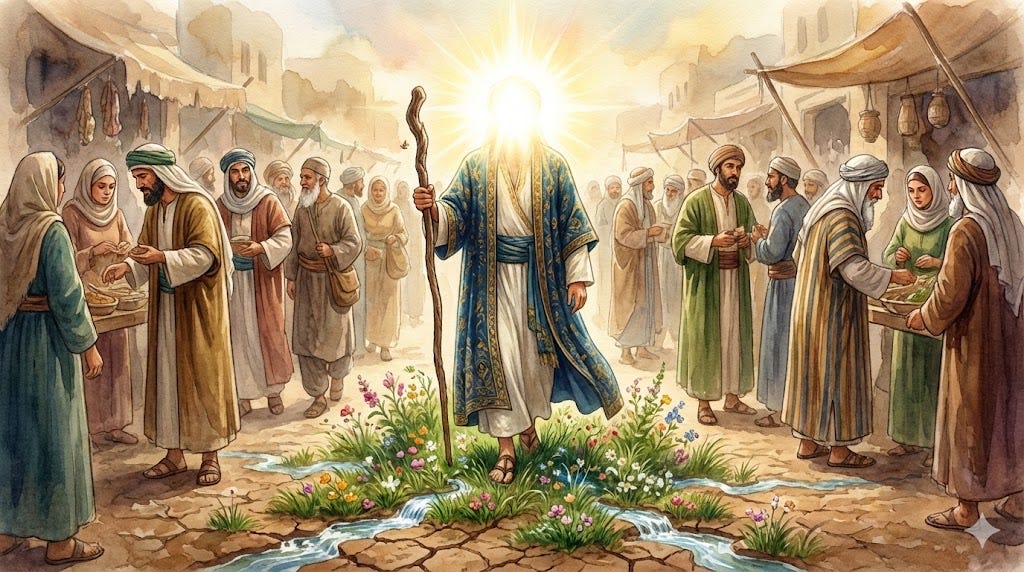
We began by establishing the identity of the leader.
We moved beyond the vague “Universal Hope” of a future saviour to the specific “Living Reality” of the Shia creed.
We established that Muhammad ibn al-Hasan al-Askari — may our souls be his ransom — is not a myth waiting to be born, but a witness waiting to be recognised.
He is the Heir of the Prophets, carrying the Staff of Moses and the Shirt of Joseph.
He is the Resurrector (mab’uth) whose mission is not merely to preach, but to revive the earth with justice after its death.
We corrected our vocabulary, understanding that ghaybah does not mean absence — being gone — but anonymity: being present, yet unrecognised.
The Soldier
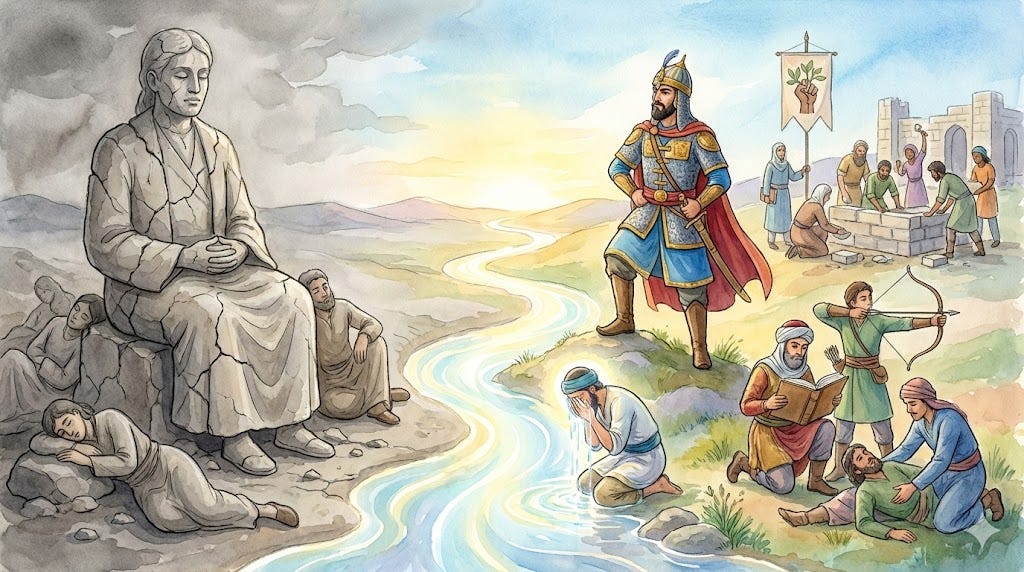
Having identified the Commander, we then turned the mirror upon ourselves to define the Soldier.
We shattered the idol of passive waiting.
We learned that intidhaar is an action (‘amal), not a feeling — the posture of a soldier standing guard (murabatah), not a spectator sitting in the stands.
We defined the curriculum of the one who waits:
Self-Building: Cultivating wara’ (scrupulous piety) to purify the vessel.
Readiness: Acquiring quwwah (power) — intellectual, moral, and physical capability.
System-Building: We established that we cannot invite the Global Government without building a base of operations. We recognised the Resistance Front not as a political accident, but as the theological necessity of tamhid: paving the way.
The Vision
Now, we face the final question in this introduction.
We know who he is.
We know what we must do.
But why are we doing it?
What is the prize at the end of this long history of sacrifice and struggle?
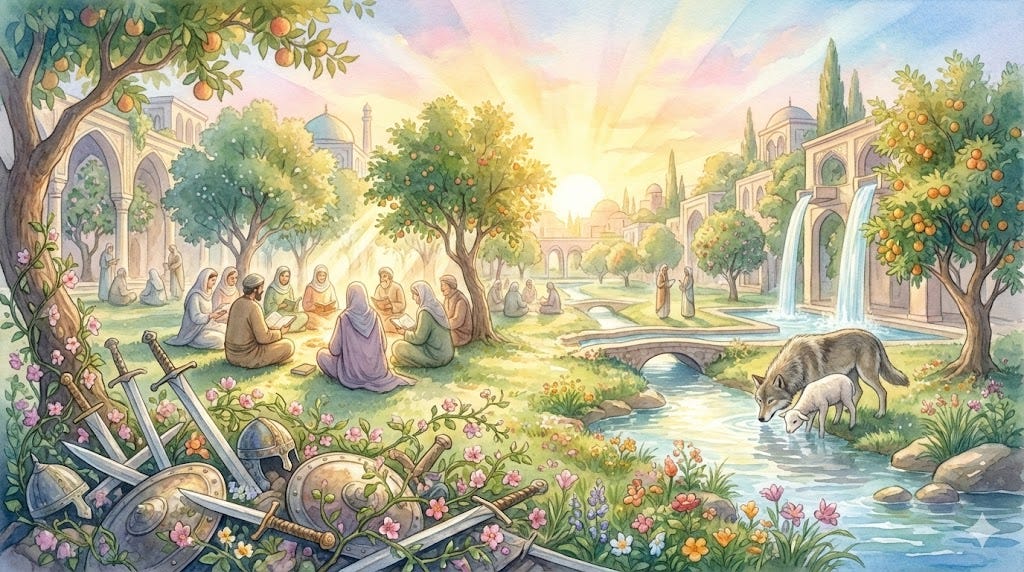
If we build this self, and if we build this system, what does the world look like when victory is finally achieved?
Is the Mahdawi state just a kingdom of swords, or is it something far more profound?
Tonight, we gaze into the promised dawn.
We will study the blueprint of the divine state — a civilisation defined by the perfection of intellect, the abundance of economy, and the absolute reign of justice.
In His Name, and with full reliance on His support and guidance, we implore Him for the tawfeeq — the ability and success — to understand, and to be among those who work in His way …
Mahdawiyyah (The Culminating Guidance) - Introduction to Mahdawiyyah - The Blueprint of the Divine State
The Revolution of Consciousness – The Maturation of Mankind
The End of Humanity’s Childhood
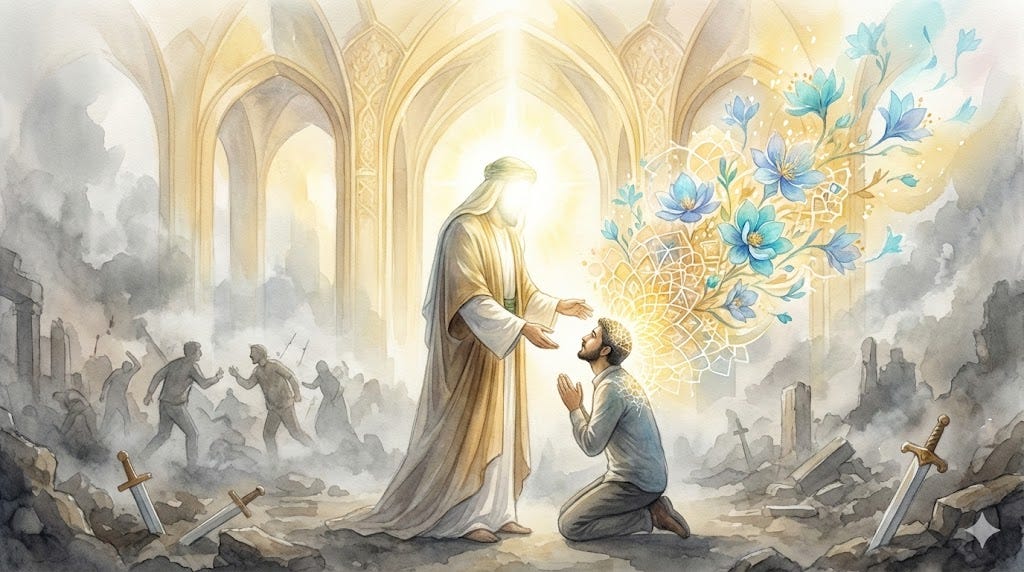
Before we speak of armies and economies, we must speak of minds.
For the first revolution of the Mahdi is not fought on a battlefield — it is fought within the human being.
Too often, we imagine the Mahdawi state as simply a time of abundant food and absent war.
This is a shallow, materialistic vision.
The Mahdawi state is not merely a storehouse of plenty; it is the University of Perfection.
History, until now, has been the childhood of humanity — a time of stumbling, ignorance, and immaturity.
The Era of the Mahdi is the adulthood of the human race.
He does not come merely to rule over bodies; he comes to elevate minds and purify spirits.
He comes to unlock the dormant potential buried within the human being.
The Perfection of Intellect (Al-Aql)
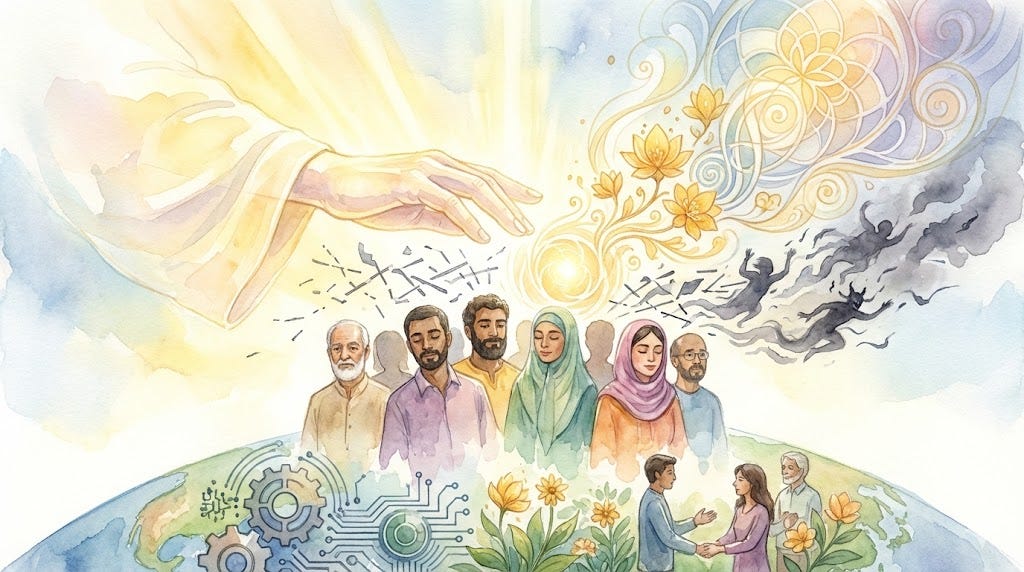
The first transformation is internal: the expansion of human cognitive capacity.
Today, humanity suffers from a fatal disconnect between intelligence and wisdom.
We have the technology to travel to Mars, yet we lack the wisdom to live peaceably on Earth.
We can split the atom, yet we cannot mend a family.
We have mastered information, yet we drown in confusion.
The Mahdi comes to repair this fracture.
Imam Muhammad al-Baqir describes this metaphysical intervention:
إِذَا قَامَ قَائِمُنَا وَضَعَ يَدَهُ عَلَى رُءُوسِ الْعِبَادِ فَجَمَعَ بِهَا عُقُولَهُمْ وَكَمَلَتْ بِهَا أَحْلَامُهُمْ
“When our Qa’im rises, he will place his hand over the heads of the servants, so their intellects (uqul) will be gathered (unified/strengthened) and their understanding (ahlam) will be perfected.”
— Al-Kulayni, Al-Kafi, Volume 1, Page 25, Hadith 21
Ayatullah Jawadi-Amoli, in his commentary on this tradition, explains that the “Hand of the Imam” symbolises his spiritual authority (wilayah).
Under his guidance, humanity will move from mere cleverness — which can be wielded for evil — to true intellect, which recognises and worships the Truth:
معنای دست کشیدن بر سرها، کنایه از تربیت و تعلیم الهی و تصرّف ولایی وجود مبارک امام عصر (عج) است... در آن زمان، عقول مردم کامل میشود؛ یعنی آن عقلی که «مَا عُبِدَ بِهِ الرَّحْمَن» است شکوفا میگردد، و شیطنت و نکرای که شبیه عقل است، رخت برمیبندد.
“The meaning of wiping the hand over the heads is a metaphor for Divine upbringing, instruction, and the authority-based influence (tasarruf-e walayi) of the blessed existence of the Imam of the Age... In that time, the intellects of the people will become perfect; meaning, that Intellect ‘by which the Merciful is worshipped’ will blossom, while devilry (shaytanah) and trickery (nakra’)—which merely resemble the intellect—will pack up and leave.”
— Ayatullah Jawadi-Amoli, Imam-e Mahdi: Mawjud-e Maw’ud (Imam Mahdi: The Promised Existing One), Page 220
The Explosion of Knowledge
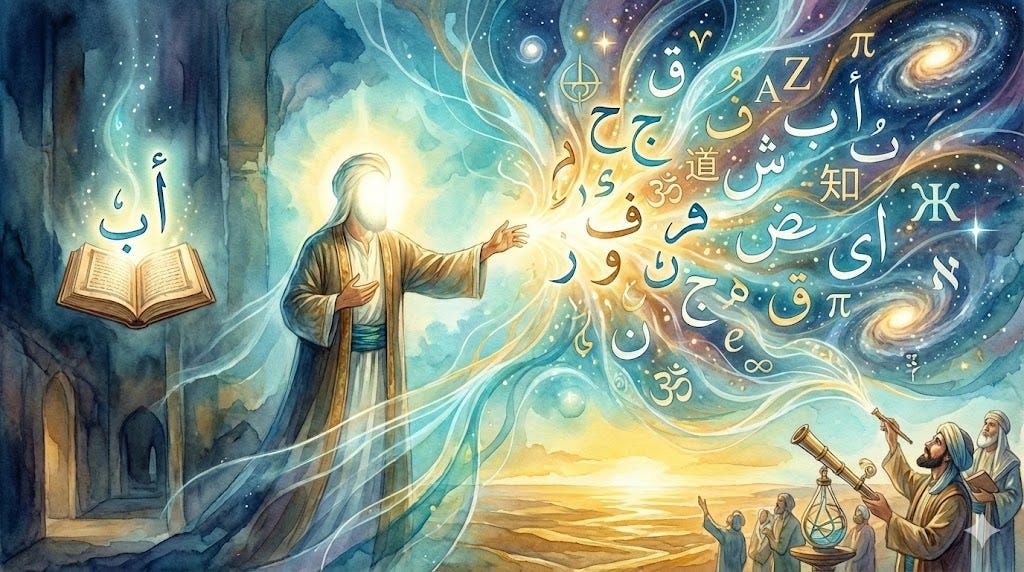
With perfected intellects comes the explosion of knowledge.
We imagine ourselves to live in an age of science — the pinnacle of human discovery.
But our traditions teach us that we have barely scratched the surface of reality.
All that we know, all that we have ever discovered, is but a fraction of what awaits.
Imam Ja’far al-Sadiq reveals the staggering ratio of this transformation:
الْعِلْمُ سَبْعَةٌ وَعِشْرُونَ حَرْفاً، فَجَمِيعُ مَا جَاءَتْ بِهِ الرُّسُلُ حَرْفَانِ... فَإِذَا قَامَ قَائِمُنَا أَخْرَجَ الْخَمْسَةَ وَالْعِشْرِينَ حَرْفاً
“Knowledge consists of twenty-seven letters. All that the Prophets have brought is two letters, and the people have known nothing until today except these two letters. But when our Qa’im rises, he will bring out the twenty-five letters and spread them among the people.”
— Al-Majlisi, Bihar al-Anwar, Volume 52, Page 336, Hadith 73
Pause and consider the weight of this statement.
Every prophet from Adam to Muhammad — every revelation, every science, every philosophy that humanity has ever possessed — amounts to two letters out of twenty-seven.
The Mahdi unlocks the remaining twenty-five.
This is a civilisation where the boundaries between physics and metaphysics dissolve, where the secrets of the cosmos and the mysteries of the soul are laid open.
It is the Golden Age of Science — not in opposition to Revelation, but sanctified by it.
The Spiritual Transformation
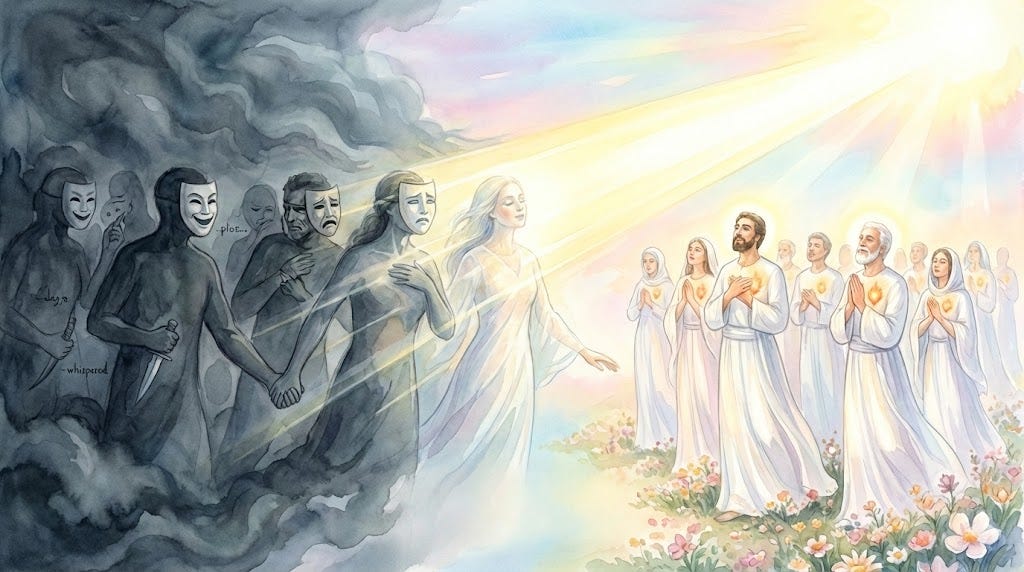
Intellectual perfection, in turn, leads to spiritual transparency.
In the Mahdawi state, religion is no longer a ritual performed out of habit; it becomes a reality witnessed by the heart.
The darkness of hypocrisy will vanish.
Today, a man can smile while hiding hatred in his heart.
He can pray in public while plotting in private.
But in the presence of the Truth, the inner reality is exposed; the masks fall away.
The Holy Qur’an promises a state where fear and hidden agendas are replaced by absolute security and sincere worship:
وَلَيُبَدِّلَنَّهُم مِّن بَعْدِ خَوْفِهِمْ أَمْنًا ۚ يَعْبُدُونَنِي لَا يُشْرِكُونَ بِي شَيْئًا
“He will surely exchange their fear for security. They will worship Me, not associating anything with Me.”
— Qur’an, Surah An-Nur (the Chapter of the Light) #24, Verse 55
Allamah Tabatabai explains in Al-Mizan that this verse promises a society cleansed of all “partners” to God — whether open idols or hidden hypocrisy.
He defines this security as the total removal of any threat to the religion or the believer’s soul, a state where shirk — the service, worship, or love of other than God — is eradicated from both heart and society:
وَهُوَ الْأَمْنُ الْعَامُّ الَّذِي لَا يَخَافُونَ فِيهِ عَدُوًّا فِي دَاخِلِ بِلَادِهِمْ وَلَا خَارِجِهَا، وَلَا كَائِداً يَمْكُرُ بِهِمْ... وَيَكُونُ الدِّينُ يَوْمَئِذٍ مَرْضِيّاً لِلَّهِ خَالِصاً لَهُ، لَيْسَ فِيهِ شَيْءٌ مِنَ الْبَاطِلِ وَلَا حُكْمٌ مِنْ غَيْرِ اللَّهِ
“This is the General Security (al-amn al-’amm) in which they will fear no enemy from inside their lands nor from outside, nor any plotter who schemes against them... And the religion on that day will be pleasing to God, purely for Him; there will be nothing of falsehood in it, nor any judgment from other than God.”
— Allamah Tabatabai, Al-Mizan fi Tafsir al-Qur’an, Volume 15, Commentary on Surah An-Nur (the Chapter of the Light) #24, Verse 55
This is the Restful Soul writ large — not merely in one person, but in an entire civilisation.
A world where the anxiety of falsehood is replaced by the tranquillity of Truth.
And so, the first pillar of the Divine State is the Revolution of Consciousness.
We are not merely waiting for a political change.
We are waiting for a transformation of what it means to be human.
A world where ignorance is erased by the twenty-seven letters of Knowledge.
Where immaturity is cured by the Perfection of Intellect.
Where hypocrisy is dissolved in the Light of Sincerity.
A world where it is easy to be a saint — and difficult to be a sinner.
The Revolution of Society – From Greed to Brotherhood
The Transformation of the Human Economy
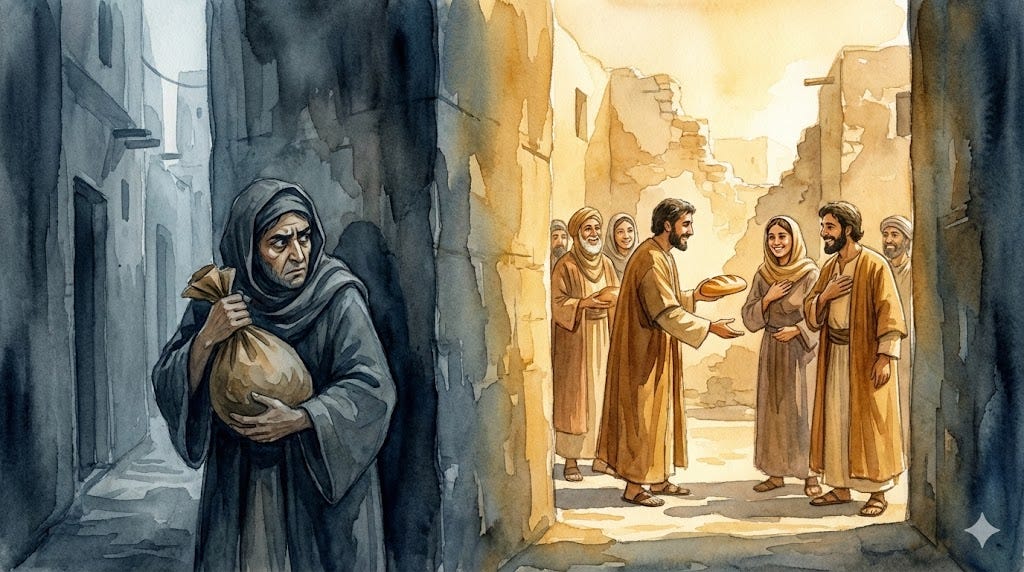
The first revolution reshapes the mind.
The second reshapes the world between us — the way we exchange, the way we own, the way we trust.
To understand the Mahdawi economy, we must first diagnose the disease of our current world.
The Diagnosis: The Shackles of Modern Slavery
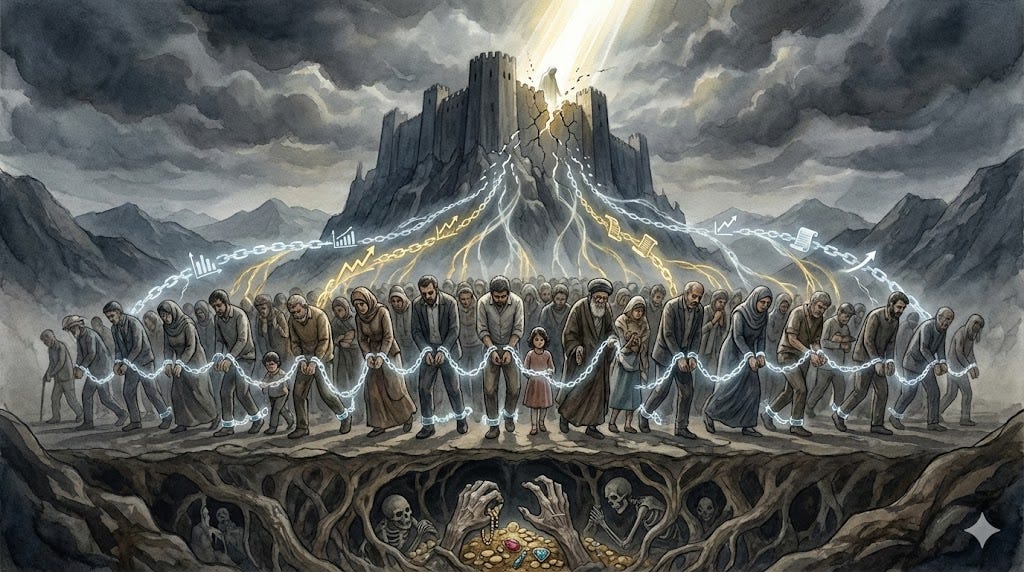
We live in an era of financial tyranny.
The global economy is built on a foundation of debt.
Money is no longer a store of value; it is a bond of servitude.
Through interest and speculation, wealth is siphoned from the masses to a tiny elite.
Human beings are reduced to “consumers” and “human resources” — valued not for their souls, but for their productivity and purchasing power.
The food we eat, the homes we live in, the education we seek — all have been financialised, turned into products for speculation rather than rights of existence.
A man works his entire life and still dies in debt.
A nation produces wealth for generations and still owes more than it owns.
This is not economics; this is enslavement with sophisticated vocabulary.
And yet, this is not a modern disease.
It is the ancient illness of hoarding, dressed in new clothes.
Imam Ali diagnosed its root centuries ago:
مَا جَاعَ فَقِيرٌ إِلَّا بِمَا مُتِّعَ بِهِ غَنِيٌّ
“No poor person goes hungry except because of what a rich person has enjoyed.”
— Nahjul Balaghah, Saying 328
Poverty is not natural.
It is manufactured — by greed, by hoarding, by systems designed to concentrate wealth in the hands of the few.
The Mahdi comes to shatter this system at its root.
The Cure: Justice, Not Magic
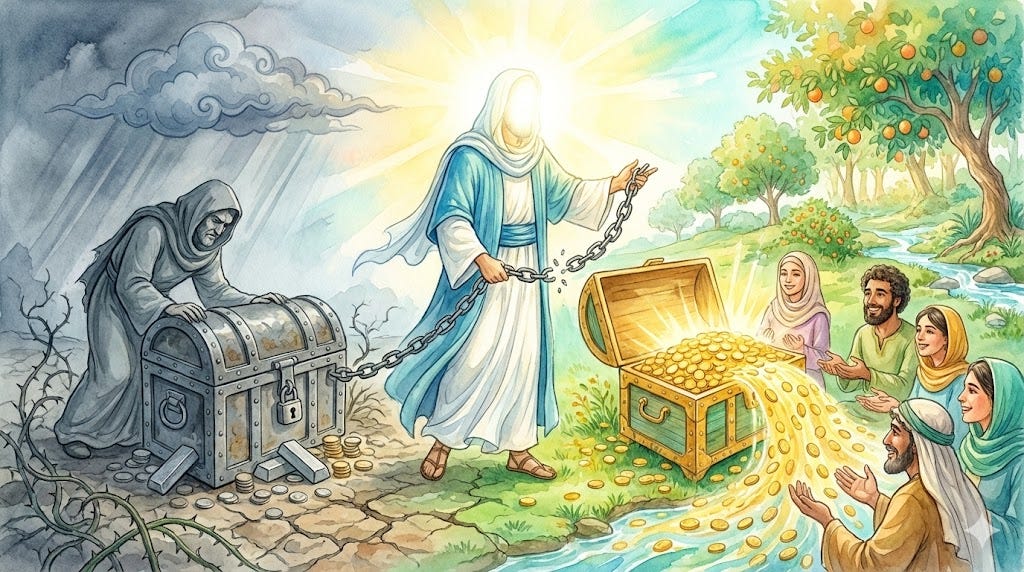
But how?
What is the secret of the Mahdawi economy?
The answer lies in understanding what money truly is.
Imam Al-Ghazali, in his profound analysis of economics, explains that gold and silver were created by God to serve a specific function: to be judges of value and facilitators of exchange.
They are like a mirror — possessing no colour of their own, but reflecting the worth of other things.
Money is meant to flow, to circulate, to serve.
When it is hoarded or lent for interest, it is imprisoned — diverted from its created purpose, transformed from servant into master.
The Mahdawi state liberates money from this prison.
It returns wealth to its original purpose: a means to human flourishing, not an end in itself.
But this raises a question: is there enough?
The capitalist worldview insists that nature is scarce, that there will never be enough for everyone, and therefore competition and inequality are inevitable.
Ayatullah Shaheed Muhammad Baqir al-Sadr, in his masterpiece Iqtisaduna — Our Economics — dismantles this myth:
إِنَّ الْمُشْكِلَةَ لَيْسَتْ فِي قِلَّةِ الْمَوَارِدِ الطَّبِيعِيَّةِ، بَلْ فِي سُوءِ التَّوْزِيعِ وَظُلْمِ الْإِنْسَانِ لِأَخِيهِ الْإِنْسَانِ
“The problem is not in the scarcity of natural resources, but in the maldistribution and the injustice of man against his fellow man.”
— Ayatullah Shaheed Muhammad Baqir al-Sadr, Iqtisaduna, Introduction
The earth has always had enough.
It is injustice that creates scarcity; justice will unlock abundance.
The Mahdi solves the economic problem not by magic, but by equity.
When the hoarded wealth is released, when the chains of usury are broken, when resources are distributed according to need rather than greed — the earth will reveal what it has been holding back.
The narrations describe this unlocking in vivid terms:
تُخْرِجُ لَهُ الْأَرْضُ أَفْلَاذَ كَبِدِهَا
“The earth will bring forth for him the pieces of its liver — its hidden treasures of gold and silver.”
— Muslim, Sahih, Book of Zakat, Hadith 1013
This is not merely about discovering new mines or advancing technology — though these may play a role.
It is about barakah: the blessing that descends when a society aligns itself with Divine justice.
The earth responds to righteousness.
And the abundance will be so vast that the very concept of charity becomes obsolete.
Imam Muhammad al-Baqir describes a world where poverty is not merely reduced, but eradicated:
يُسَوِّي بَيْنَ النَّاسِ حَتَّى لَا تَرَى مُحْتَاجاً إِلَى الزَّكَاةِ... فَيَطُوفُ صَاحِبُ الزَّكَاةِ بِزَكَاتِهِ لَا يَجِدُ أَحَداً يَقْبَلُهَا مِنْهُ
“He will distribute wealth equally among the people until you will not see anyone in need of zakat... The owner of zakat will walk around with his charity and find no one to accept it from him.”
— Al-Majlisi, Bihar al-Anwar, Volume 52, Page 390
Imagine a world where the problem is not finding someone to help you, but finding someone who needs help.
This is the economy of the Mahdi.
The Fruit: The Death of Greed
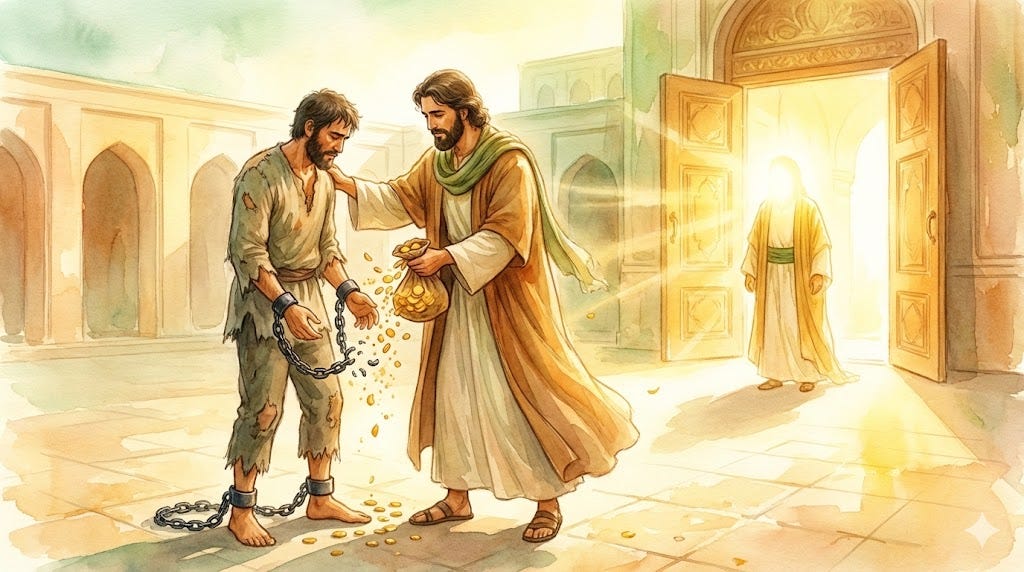
Yet the deepest revolution is not in the treasury; it is in the heart.
Our current economic models are built on a philosophical foundation called “rational self-interest” — a polite term for greed.
We are taught that humans are naturally selfish, and that the best economy is one that harnesses this selfishness for collective benefit.
The Mahdawi model rejects this premise entirely.
It is built not on self-interest, but on brotherhood.
Ayatullah Mohsen Araki explains that the economic system of Islam is founded on muwasaat — a word that implies not mere charity, but the equating of others with oneself.
In the Mahdawi society, the rigid walls of private ownership soften in the face of a brother’s need:
نظام اقتصادی اسلام بر پایه «مواسات» استوار است، نه «تکاثر»... در جامعه ولایی، مرزهای مالکیت خصوصی در برابر نیاز برادر دینی رنگ میبازد. آن روایتی که میگوید مومن دست در جیب برادرش میکند و او مانع نمیشود، تنها یک توصیه اخلاقی نیست؛ بلکه تصویر نهایی تکامل ساختار اقتصادی جامعه مهدوی است.
“The economic system of Islam is established upon muwasaat (sharing), not takathur (hoarding)... In the society of wilayah, the borders of private ownership fade in the face of the need of a religious brother. That narration which says a believer puts his hand in his brother’s pocket and he does not prevent him is not merely a moral recommendation; rather, it is the final image of the evolution of the economic structure of the Mahdawi society.”
— Ayatullah Mohsen Araki, Falsafeh-ye Nezam-e Iqtisadi-ye Islam, Lecture Series on Economic Justice in the Alawi and Mahdawi State
This is the narration he references — a description of trust so profound it restructures human interaction:
إِذَا قَامَ الْقَائِمُ... يَجِيءُ الرَّجُلُ إِلَى كِيسِ أَخِيهِ فَيَأْخُذُ حَاجَتَهُ لَا يَمْنَعُهُ
“When the Qa’im rises... a man will come to the pocket of his brother and take what he needs, and the brother will not prevent him.”
— Al-Saduq, Al-Khisal, Chapter 2, Hadith 12
This is not theft.
This is the absolute dissolution of the barrier between “mine” and “yours” in the face of genuine need.
It is a society where financial anxiety is extinct — because every believer knows that his brother’s wealth is his safety net, and his own wealth is his brother’s.
And finally, the Mahdi acts as the great liberator from the chains of debt.
In a world where nations and individuals are crushed under the weight of interest, the Mahdi fulfils the promise of the Prophet himself:
قَالَ رَسُولُ اللَّهِ: أَنَا أَوْلَى بِكُلِّ مُؤْمِنٍ مِنْ نَفْسِهِ... وَمَنْ تَرَكَ دَيْناً أَوْ ضَيَاعاً فَعَلَيَّ وَإِلَيَّ
“I have more authority over every believer than he has over himself... And whoever leaves behind a debt or destitute dependents — it is upon me to settle, and unto me they belong.”
— Al-Kulayni, Al-Kafi, Volume 1, Page 407; Al-Bukhari, Sahih, Book of Loans, Hadith 2398
This establishes the legal principle that the Imam, as Head of State, acts as the ultimate guarantor.
No family is left destitute by the death of a breadwinner.
No debtor is imprisoned for poverty.
The bayt al-mal — the public treasury — absorbs the burden, breaking the chains that the bankers have forged.
And so, the second pillar of the Divine State is the Revolution of Society.
It is the transition from money as master to money as servant.
From an economy of artificial scarcity to an economy of unlocked abundance.
From a culture of greed to a culture of brotherhood.
It is a world where no one is enslaved by a bank balance — for the treasures of the earth are laid open, and the hearts of the believers are laid bare in trust.
The Revolution of Governance: The End of Hegemony
The Dismantling of the World Order

We have spoken of the revolution within — the perfection of the mind.
We have spoken of the revolution between us — the transformation of the economy.
Now we turn to the revolution above us: the dismantling of the political order that holds humanity in chains.
A perfected society cannot exist in a world ruled by wolves.
Therefore, the final revolution is political.
It is the dismantling of the global order of arrogance — istikbar.
The Political Revolution: The Inversion of the Pyramid
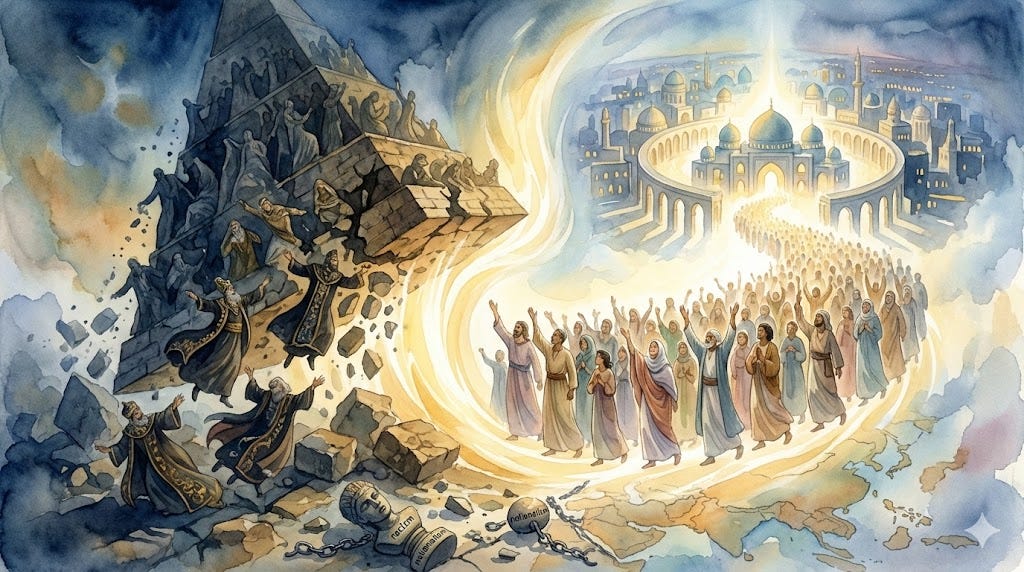
Today, the world is divided into two camps: the arrogant (mustakbireen) and the oppressed (mustad’afeen).
The arrogant are the geopolitical elites who hold veto power in the halls of nations, who control the banking systems that enslave countries with debt, who draw borders and topple governments to suit their interests.
The oppressed are everyone else — the billions whose lives are shaped by decisions made in rooms they will never enter.
The Mahdi comes to invert this pyramid.
He does not come to negotiate with the superpowers; he comes to retire them.
The Holy Qur’an announces this geopolitical shift as a Divine promise:
وَنُرِيدُ أَن نَّمُنَّ عَلَى الَّذِينَ اسْتُضْعِفُوا فِي الْأَرْضِ وَنَجْعَلَهُمْ أَئِمَّةً وَنَجْعَلَهُمُ الْوَارِثِينَ
“And We wanted to confer favour upon those who are oppressed in the land, and make them leaders, and make them the inheritors.”
— Qur’an, Surah al-Qasas (the Chapter of the Narrations) #28, Verse 5
Imam Khomeini, who named his movement the “Government of the Oppressed,” explained that this verse is the constitution of the Mahdawi state:
روز ولادت حضرت مهدی (عج) روز مستضعفین است... روزی است که آن وعده ای که خداوند داده است که «وَنُرِيدُ أَن نَّمُنَّ...» تحقق پیدا می کند. مستضعفین جهان، وعده داده شده است به آنها که شما را ما امام قرار می دهیم... این وعده در زمان ظهور حضرت، انشاءالله، به حقیقت میپیوندد و مستضعفین بر مستکبرین غلبه میکنند.
“The birthday of the Mahdi is the Day of the Oppressed... It is the day when the promise God has given — ‘And We wanted to confer favour...’ — will be realised. The oppressed of the world have been promised: ‘We shall make you leaders’... This promise will come true at the time of his reappearance, God willing, when the oppressed will triumph over the arrogant.”
— Imam Khomeini, Sahifeh-ye Imam, Volume 15, Page 209
And with this inversion comes the erasure of the false divisions that have fractured humanity.
The artificial borders drawn by colonial powers — Sykes-Picot, the Durand Line, the partitions of Africa — are dissolved.
There is no “First World” and “Third World.”
There is only the Kingdom of God.
Ayatullah Jawadi-Amoli explains that the Mahdi establishes a Unified World Government — not the “globalism” of the elites, which seeks to homogenise and exploit, but the universalism of Islam, which unites in diversity:
در حکومت جهانی حضرت مهدی (عج)، مرزهای جغرافیایی که عامل جدایی ملتهاست برداشته میشود و همه زمین به منزله یک شهر و یک خانه خواهد بود... در آن دوران، معیار ارزش و برتری، نژاد و ملیت و زبان نیست، بلکه تنها «تقوا» است.
“In the Global Government of the Mahdi, the geographical borders which cause the separation of nations will be removed, and the entire earth will be like one city and one house... In that era, the criterion for value and superiority is not race, nationality, or language; rather, it is only taqwa.”
— Ayatullah Jawadi-Amoli, Imam-e Mahdi: Mawjud-e Maw’ud, Page 235
Racism, nationalism, tribalism — the idols of the modern age — are smashed.
The only criterion for honour is God-consciousness.
This is true globalisation: not the globalisation of markets for the benefit of the few, but the globalisation of justice for the benefit of all.
The Reign of Justice: From Symptom to Source
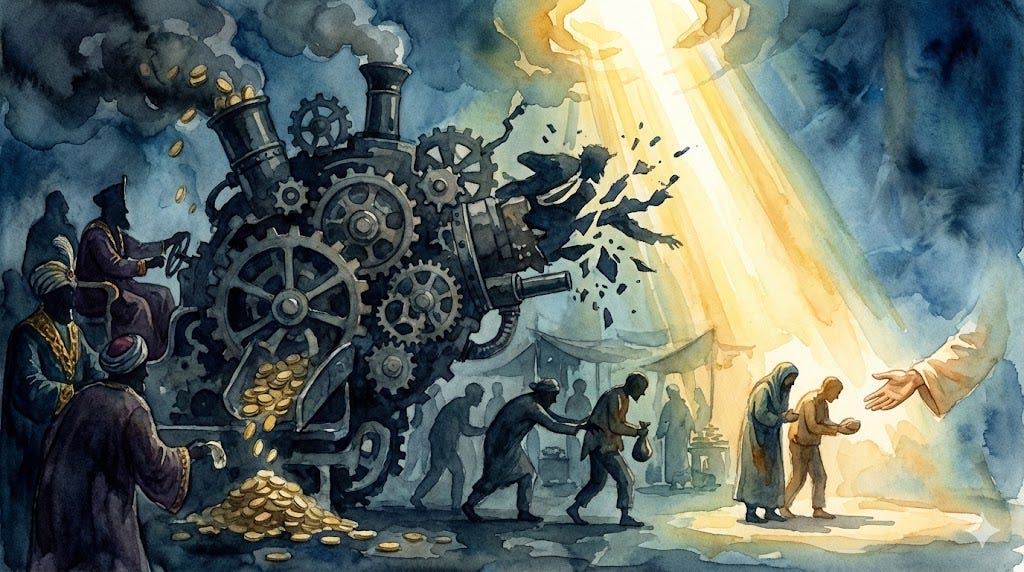
The defining characteristic of the Mahdi’s rule is ‘adalah — justice.
But we must correct our understanding of what this means.
Justice in the Mahdawi state is not merely a penal code where thieves lose their hands.
It is the forensic diagnosis of why there are thieves in the first place.
We must be precise here.
This does not mean personal responsibility is erased.
The individual who commits a crime — even out of desperation — still bears the burden of that choice, for God has endowed every human being with free will and the capacity to resist.
A sin remains a sin. A crime remains a transgression.
However, in the scales of Divine Justice, there is a profound distinction between the sinner by circumstance and the architect of circumstance.
Consider: the woman driven to degradation by poverty, the youth led to crime by lack of education, the father pushed to theft to feed his children.
In the Mahdawi state, these individuals are accountable for their actions — but their culpability is weighed against their constraints.
The Imam distinguishes between the hand that struck the blow and the system that forced the hand.
The individual faces correction and rehabilitation.
But the oligarch who engineered the poverty?
The elite who profited from the desperation?
They face destruction.
Imam Ali, in his historic letter to Malik al-Ashtar, established this doctrine of systemic liability.
He taught that the moral corruption of the people is often a symptom of the corruption of their rulers:
إِنَّمَا يُؤْتَى خَرَابُ الْأَرْضِ مِنْ إِعْوَازِ أَهْلِهَا، وَإِنَّمَا يُعْوِزُ أَهْلُهَا لِإِشْرَافِ أَنْفُسِ الْوُلَاةِ عَلَى الْجَمْعِ
“The devastation of the land only comes about through the destitution of its inhabitants; and the inhabitants only become destitute when the rulers concentrate on amassing wealth for themselves.”
— Nahjul Balaghah, Letter 53
The Mahdi applies this principle with absolute precision. He does not merely punish crime; he dismantles the machinery that manufactures criminals.
The Accountability of the Elites: The Purge of the Traitors
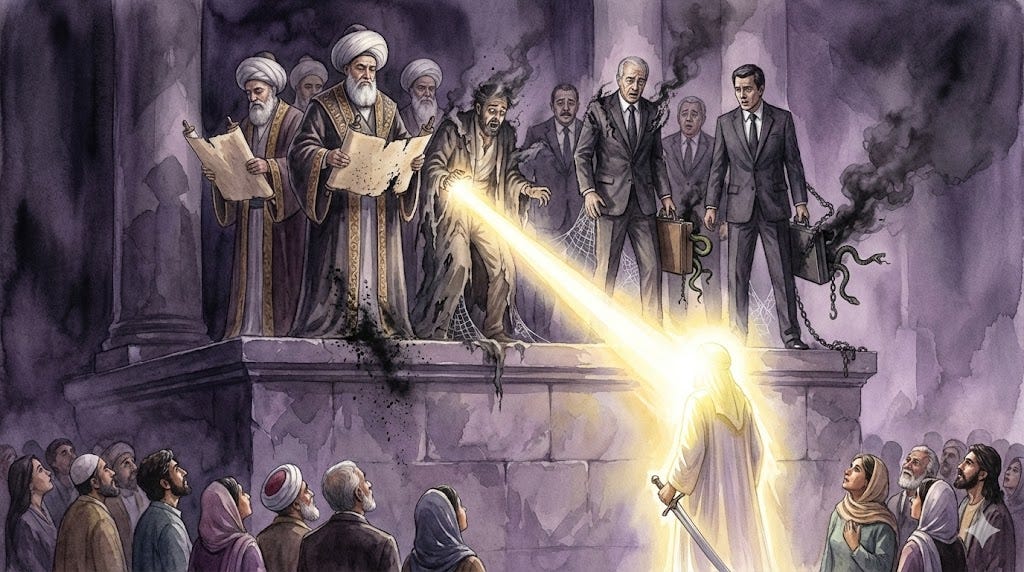
And this brings us to the most severe dimension of Mahdawi justice — the accountability of those who should have known better.
The Mahdi’s sword does not fall heaviest upon the ignorant masses who can be taught.
It falls upon the elites who knew the truth and concealed it, who had the power to prevent injustice and chose complicity instead.
And among these elites, none face greater accountability than the religious scholars.
There are terrifying narrations stating that when the Imam returns, his blade will fall upon the necks of thousands of so-called “scholars” and “interpreters of the Qur’an.”
Why?
Is the Imam against knowledge?
No.
He is against betrayal.
The scholar is not merely an academic; he is the physician of the soul.
He has a fiduciary duty of care.
If a medical doctor is careless and kills a patient, he is sued for malpractice.
But if a scholar — or one masquerading as one — manipulates religion to please a tyrant, or stays silent when he should speak, or speaks without investigation to gain popularity, he does not kill the body.
He kills the faith.
He murders the soul.
Imam Ja’far al-Sadiq describes a group called the batriyyah — outwardly religious, memorisers of Qur’an, experts in jurisprudence — who will be the first to march against the Mahdi.
Why?
Because his justice threatens their status:
ثُمَّ يَسِيرُ إِلَى الْكُوفَةِ فَيَخْرُجُ إِلَيْهِ بِضْعَةَ عَشَرَ أَلْفَ نَفْسٍ يَدْعُونَ الْبَتْرِيَّةَ، عَلَيْهِمُ السِّلَاحُ، وَهُمْ قُرَّاءُ الْقُرْآنِ وَفُقَهَاءُ فِي الدِّينِ... يَقُولُونَ لَهُ: ارْجِعْ يَا ابْنَ فَاطِمَةَ مِنْ حَيْثُ جِئْتَ، فَلَا حَاجَةَ لَنَا فِي بَنِي فَاطِمَةَ... فَيَضَعُ فِيهِمُ السَّيْفَ حَتَّى يَأْتِيَ عَلَى آخِرِهِمْ
“Then he will march to Kufa, and sixteen thousand will come out against him from the batriyyah. They are armed, and they are readers of Qur’an and jurists in religion... They will say to him: ‘Go back, O son of Fatimah, to where you came from — we have no need for the children of Fatimah!’ So he will put the sword among them until he finishes them to the last man.”
— Al-Mufid, Al-Irshad, Volume 2, Page 384
Imam Ja’far al-Sadiq also describes those who will fight the Mahdi not with swords, but with twisted interpretations:
يَخْرُجُ عَلَيْهِ قَوْمٌ يَتَأَوَّلُونَ عَلَيْهِ كِتَابَ اللَّهِ، وَيَقَاتِلُونَهُ عَلَيْهِ
“A people will rise against him, interpreting the Book of God against him, and fighting him based on their distorted interpretation of it.”
— Al-Nu’mani, Kitab al-Ghaybah, Chapter 17, Hadith 2
These are the scholars who weaponise religion against its own purpose. And Imam Khomeini — himself the pinnacle of the righteous scholar — did not mince words about his own class:
اگر عالم فاسد بشود، عالَم فاسد میشود... ضرر آخوند فاسد از ضرر ساواک به اسلام بیشتر است. آن، جيش يزيد است؛ این، بدتر از جيش يزيد است.
“If the scholar becomes corrupt, the world becomes corrupt... The harm of a corrupt cleric to Islam is greater than the harm of SAVAK. That is the army of Yazid; this is worse than the army of Yazid.”
— Imam Khomeini, Sahifeh-ye Imam, Volume 14, Page 29
In the Mahdawi state, the turban is not a shield of immunity; it is a target of higher accountability.
The physician who poisoned the patient will face the ultimate malpractice tribunal.
And this accountability extends beyond the clergy to every elite who trafficked in deception — the media that manufactured fear, the corporations that profited from lies, the politicians who sold their people for a bribe.
We live in an age where crimes are committed not by individuals but by networks, where the architect hides behind “liability shields” and blame dissolves into complexity.
The Mahdawi state operates on the Qur’anic command of tabayyun — forensic investigation.
God warns us:
يَا أَيُّهَا الَّذِينَ آمَنُوا إِنْ جَاءَكُمْ فَاسِقٌ بِنَبَإٍ فَتَبَيَّنُوا أَنْ تُصِيبُوا قَوْمًا بِجَهَالَةٍ فَتُصْبِحُوا عَلَى مَا فَعَلْتُمْ نَادِمِينَ
“O you who believe, if a corrupt one brings you news, investigate — lest you harm a people out of ignorance and become regretful over what you have done.”
— Qur’an, Surah al-Hujurat (the Chapter of the Chambers) #49, Verse 6
Allamah Tabatabai explains that this is not merely personal advice; it is the structural pillar of a sane society:
وَهَذَا أَصْلٌ عُقَلَائِيٌّ يَعْتَمِدُ عَلَيْهِ نِظَامُ الْمُجْتَمَعِ الْإِنْسَانِيِّ، إِذْ لَوْلَاهُ لَانْفَصَمَتْ عُرَى الِاجْتِمَاعِ وَتَعَطَّلَتْ مَصَالِحُ الْحَيَاةِ... وَالْمُرَادُ بِالتَّبَيُّنِ طَلَبُ انْكِشَافِ الْحَقِيقَةِ وَظُهُورِهَا
“This is a rational principle upon which the order of human society relies; for without it, the bonds of society would be severed and the vital interests of life would be suspended... The meaning of tabayyun is the demand for the uncovering of reality and making it manifest.”
— Allamah Tabatabai, Al-Mizan, Volume 18, Commentary on Surah al-Hujurat (the Chapter of the Chambers) #49, Verse 6
In the Mahdawi government, this principle becomes law.
The liability shield is shattered.
The hidden profiteers are dragged into the light.
The religious leader who issued a ruling without investigation is held accountable.
The politician who took bribes to harm his people faces the full weight of justice.
The lies of the powerful are exposed — not by counter-propaganda, but by the undeniable revelation of Truth.
It is a justice that cleanses the river at its source.
And so, the third pillar of the Divine State is the Revolution of Governance.
It is the inversion of the pyramid — from the rule of the arrogant to the rule of the righteous.
It is the erasure of false borders — from a fractured world to a unified Kingdom of God. It is the reign of true justice — where the architect of oppression, not merely the victim of it, faces the sword.
It is a world where the powerful are accountable, the deceivers are exposed, and the oppressed finally inherit the earth.
Conclusion
The World Worth Working For
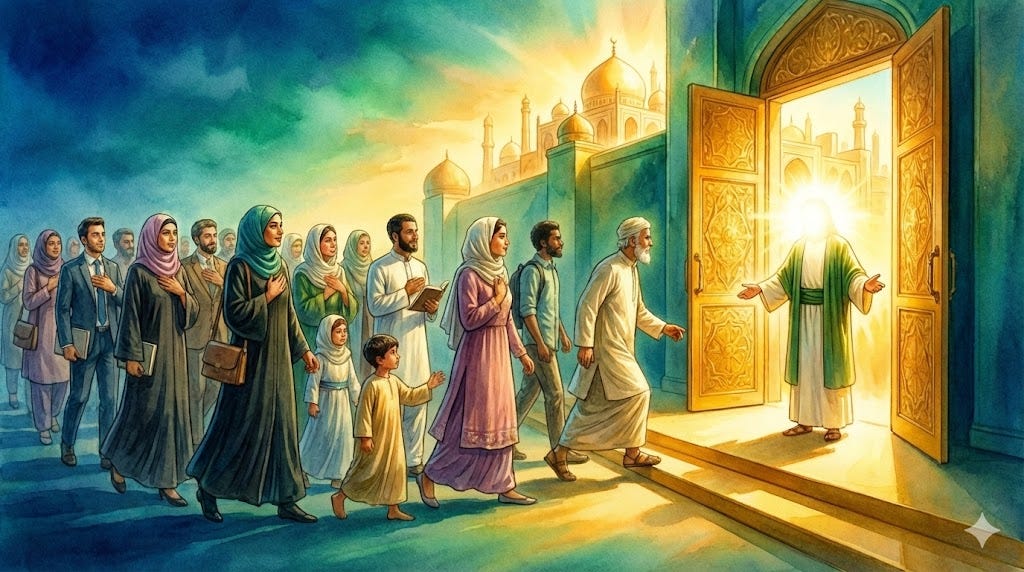
Tonight, we have seen the vision.
We have gazed into the promised dawn and glimpsed a world transformed:
A world where intellects are perfected — where science and spirit are reunited, and humanity finally grows into its adulthood.
A world where society is healed — where greed is replaced by brotherhood, scarcity by abundance, and the pocket of your brother is your safety net.
A world where governance is just — where the oppressed inherit the earth, the arrogant are cast down, and the physician who poisoned the soul faces the ultimate tribunal.
This is not a fairy tale invented by dreamers.
This is the blueprint etched into the heart of every believer.
It is the very vision we are taught to yearn for every night in the Holy Month of Ramadhan.
In Dua al-Iftitah — taught to us by the second deputy of the Imam himself — we do not merely ask for forgiveness.
We ask for a government.
We declare to God, with full intention, that this is the world we are fighting for:
اللَّهُمَّ إِنَّا نَرْغَبُ إِلَيْكَ فِي دَوْلَةٍ كَرِيمَةٍ، تُعِزُّ بِهَا الْإِسْلَامَ وَأَهْلَهُ، وَتُذِلُّ بِهَا النِّفَاقَ وَأَهْلَهُ، وَتَجْعَلُنَا فِيهَا مِنَ الدُّعَاةِ إِلَى طَاعَتِكَ، وَالْقَادَةِ إِلَى سَبِيلِكَ
“O God, we desire from You an honourable state — through which You give honour to Islam and its people, and humiliate hypocrisy and its people. And we ask that You make us, within it, among the callers to Your obedience and the leaders to Your path.”
— Dua al-Iftitah
Listen carefully to what we are asking.
We are not requesting that a miracle simply happen to us while we sleep.
We are asking to be callers and leaders within that state.
We are asking for a role.
We are volunteering for duty.
This is a world worth fighting for.
It is a world worth waiting for.
It is a world worth working for.
And it is a world worth dying for.
The Road Ahead: A Map for the Journey
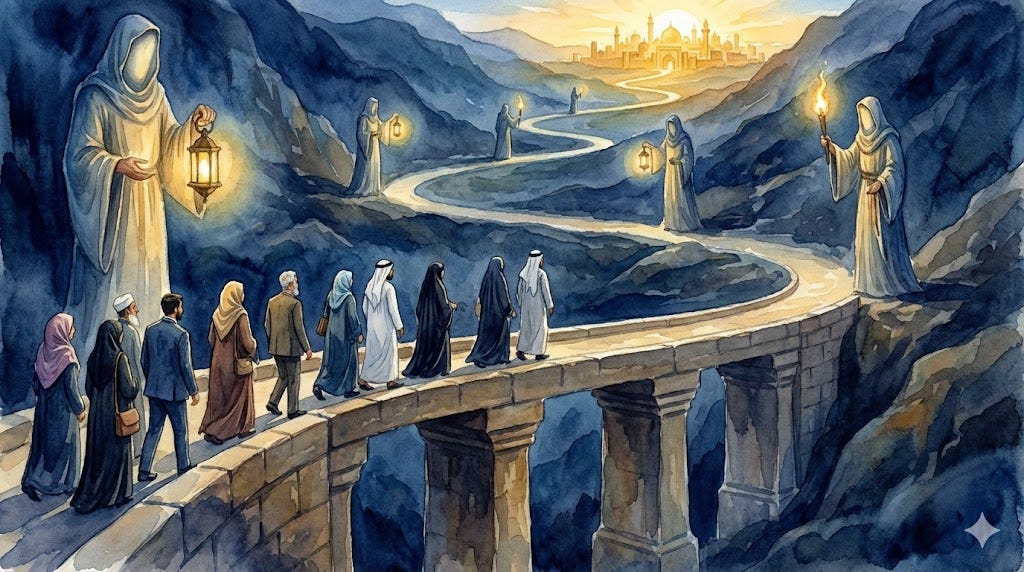
With this session, we complete our introductory trilogy.
We have spoken of his presence, our duty, and the vision of his future.
But this leaves a vast terrain unexplored.
How did we survive the initial shock of his disappearance?
How did a community, bereft of its living guide over eleven hundred years ago, organise itself to survive empires, inquisitions, and centuries of confusion?
What structures were built?
What institutions emerged?
And how do we, today, maintain our connection to the Imam in an age when he walks among us unseen?
These are the questions that will occupy us in the sessions to come.
Our next series within this series will travel back in time to the Ghaybat al-Sughra — the Lesser Occultation.
We will study the lives of the Four Deputies, the Nuwwab al-Arba’ — the master strategists appointed by the Imam himself, who preserved the Shia, managed the community’s affairs, and built the bridge that carries us to this day.
We will examine why there needed to be a Lesser Occultation before the Greater, and what wisdom lies in that transition.
From there, we will move into the Ghaybat al-Kubra — the Greater Occultation — and trace how the community adapted to the absence of direct deputies.
We will meet the towering scholars who held the line: Shaykh al-Saduq, Shaykh al-Tusi, Allamah al-Hilli, and others whose names are written in light.
Their struggles will teach us how knowledge was preserved when the enemies of the Ahl al-Bayt sought to extinguish it.
This historical journey will lead us naturally to the institution of Marjaiyyah — the system of religious authority that guides the Shia world today.
We will understand what a Marja’ is, how one is recognised, and what responsibilities this places on both the scholar and the follower.
And once we understand Marjaiyyah, we will be ready to tackle one of the most important — and most misunderstood — subjects in contemporary Shia thought: Wilayat al-Faqih, the Guardianship of the Jurist.
We will study the different theories that have emerged among our scholars: the consultative model proposed by Ayatullah Muhammad Shirazi, the selective authority of the Hasbiyyah school championed by Ayatullah al-Khui, and the comprehensive guardianship implemented by Imam Khomeini — with careful attention to what “absolute” actually means, and what it does not.
This will take us deep into political jurisprudence, economic theory, cultural policy, and social governance — but we will do our best, God willing, to keep it alive and relevant rather than dry and academic.
Only after we have understood the present will we turn to the future.
We will explore the realm of eschatology — the signs of the return, the nature of the reappearance, the structure of the Imam’s government, the identity of the 313 companions, and the role of Prophet Jesus in the final chapter.
But we will approach these subjects not as spectators scanning the horizon with telescopes, setting dates and chasing rumours.
We will approach them as soldiers seeking to understand the mission — so that when the call comes, we are not caught unaware.
Now, I must be honest with you.
The road I have just described — from the Lesser Occultation through Marjaiyyah, through Wilayat al-Faqih, through eschatology — will take us, God willing, somewhere between fifty and one hundred sessions before we have even scratched the surface.
And when we have completed that journey, we will need to circle back and dig deeper — returning to the very foundations, beginning with Tawheed itself, and rebuilding our understanding with greater precision and depth.
This is not a sprint.
It is a lifetime’s journey.
But what journey could be more worthy of our time?
We are not studying abstract theology.
We are studying the roadmap to the salvation of humanity.
We are preparing ourselves — intellectually, spiritually, and practically — for the role we asked God to grant us: to be among the callers and the leaders in that honourable state.
So let us walk this road together, one step at a time, with patience and with purpose.
A Supplication-Eulogy: The Pledge of Those Who Wait
In the Name of God, the Most Gracious, the Most Merciful — the Master of the Day of Judgment.
O God, send Your blessings upon Muhammad and the Family of Muhammad — the ship of salvation, the ark amidst the flood, the rope stretched between You and Your creation.
O God, send Your blessings upon Muhammad — the seal of Your prophets, the beloved of Your heart, the mercy You sent to all the worlds.
And send Your blessings upon his daughter, Sayyedah Fatimah al-Zahra — the radiant one, the mother of her father, the mistress of the women of all worlds.
She who stood at the door of the usurpers and let her voice be heard when the men were silent.
She whose anger is Your anger, and whose pleasure is Your pleasure.
In these blessed days of her birth, we renew our pledge to her: that we will not abandon what she defended, and we will not forget what was taken from her.
And send Your blessings upon her sons — Imams Hasan and Husayn, the masters of the youth of Paradise, the lamps that flickered but were never extinguished.
And send Your blessings upon the Imams of guidance, the lights in the darkness, from Imam Ali ibn al-Husayn to Imam Hasan al-Askari — each one a sun, each one silenced, each one waiting for the dawn his grandson would bring.
And send Your most perfect blessings upon the one we await — Your Proof over Your creation, Your Sword unsheathed, Your Word that shall never be broken:
Our beloved Master, Imam Muhammad ibn al-Hasan al-Mahdi, may our souls be his ransom, and may You - O our Lord - hasten his return
Peace be upon you, O Remnant of God on His earth.
Peace be upon you, O Son of the Prophetic Moons.
Peace be upon you, O Promise that has not been forgotten.O our Master, the world is dark without your sun.
Our intellects are incomplete without your guiding hand.
Our justice is fractured without your scale.
We stumble through the age of wolves, lost in a jungle that calls itself civilisation.We are tired, O God.
We are tired of the rule of the arrogant.
We are tired of the laws written by the lawless.
We are tired of watching the oppressors inherit the earth while the righteous are buried beneath it.We long for the rule of Your Representative.
We long for the Government of the Oppressed.
We long for the the Honourable State we beg You for every night.O God, we desire from You that honourable state — through which You honour Islam and its people, and humiliate hypocrisy and its people.
But we do not come to You empty-handed, asking for miracles while we sleep.
We come to You with a pledge:
That we will work to pave his way.
That we will build ourselves into vessels worthy of his call.
That we will not sit idle in the stands while the soldiers of falsehood march.
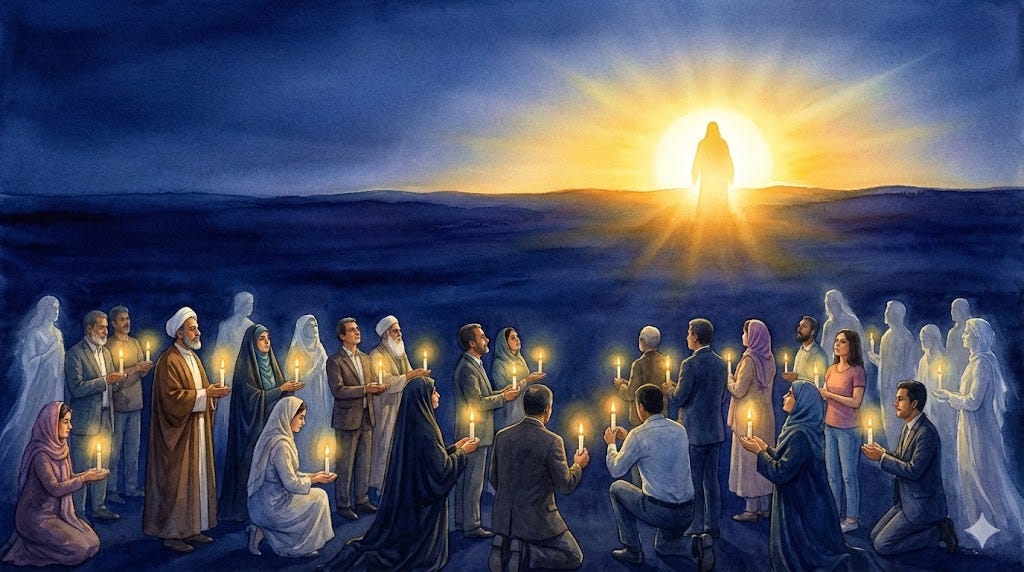
That we will make his name known in a world that has forgotten, and his face recognised in a time of anonymity.O God, make us the bricks in the wall of his city.
Make us the servants in the court of his justice.
Make us the callers to Your obedience and the leaders to Your path.We know we are weak.
We know we are scattered.
We know our sins are heavy and our deeds are light.
But You are the One who strengthens the weak, who gathers the scattered, who forgives the sinner who returns.So do not leave us to ourselves, O Most Merciful of the merciful.
Do not let our hearts deviate after You have guided them.
Do not write us among those who waited and then — when the call came — turned away.O God, let us live to see that Day.
Let us see the sun rise over a world filled with justice as it was filled with oppression.
Let us see the wolves brought low and the meek lifted high.
Let us see the scale of Ali in the hand of his son, weighing the deeds of the tyrants.And if we are not destined to see it with these eyes — then let our children see it.
And if our children are not destined — then write us among those who paved the way, who lit the candles in the long night, who never stopped waiting.
And when the Trumpet blows, O Lord, resurrect us in his army.
Let us taste just one breath of air in a world ruled by Your Justice.
Let us kiss the ground beneath his feet and say:We waited for you.
We worked for you.
And by God’s grace — we never lost hope.O God, send blessings upon Muhammad and the Family of Muhammad — and hasten their relief, and our relief through them.
Amen, O Lord Sustainer of the Universes.
Amen, O Most Merciful of the Merciful.
And from Him alone is all ability, and He has authority over all things.