

In His Name, the Most High
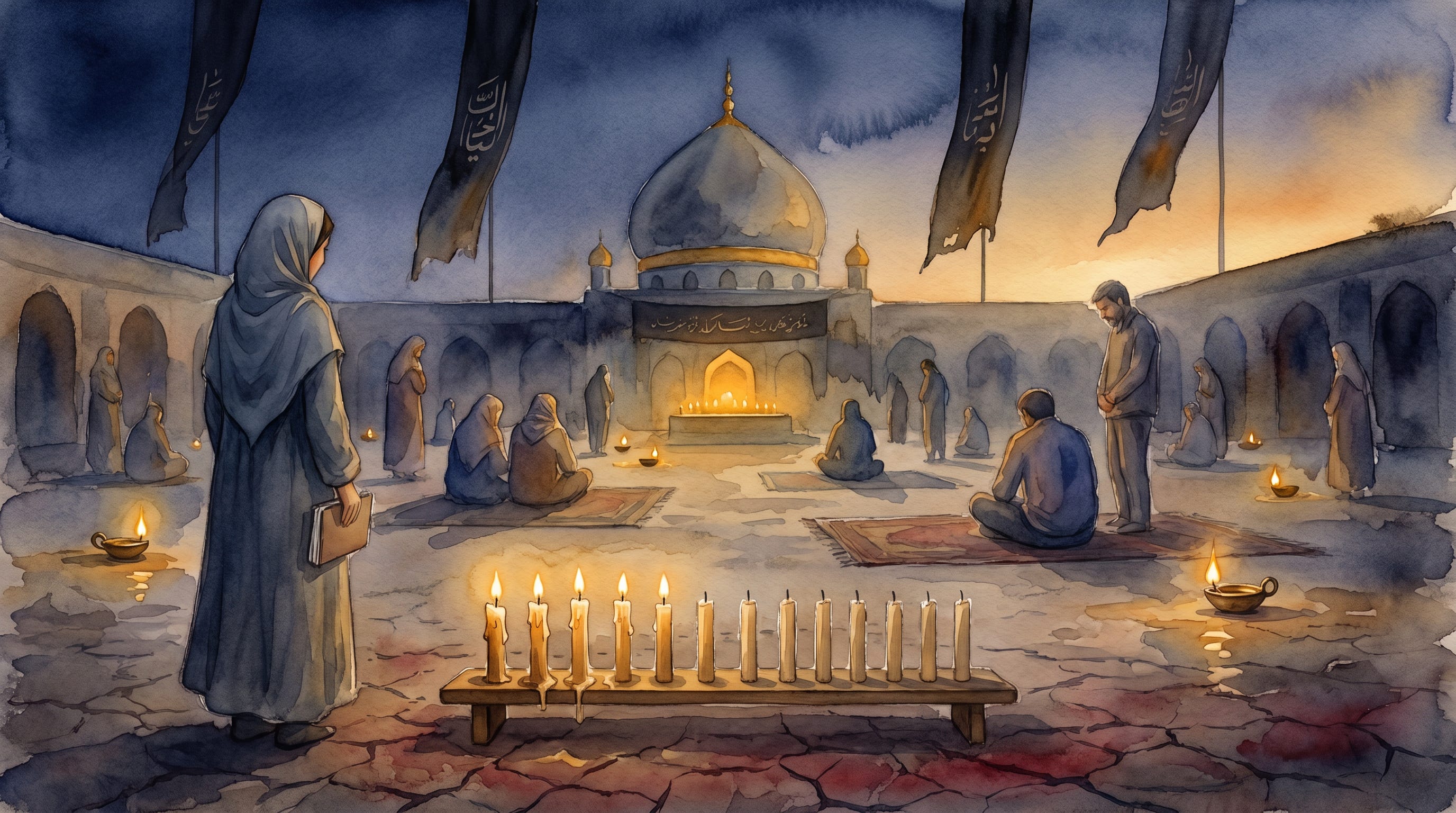
اَلسَّلاَمُ عَلَيْكَ يَا أَبَا عَبْدِاللَّهِ
وَعَلَى الْأَرْوَاحِ الَّتِي حَلَّتْ بِفِنَائِكَ
عَلَيْكُمْ مِنَّا جَمِيعًا سَلاَمُ اللَّهِ أَبَدًا مَا بَقِينَا وَبَقِيَ اللَّيْلُ وَالنَّهَارُ
وَلا جَعَلَهُ اللَّهُ آخِرَ الْعَهْدِ مِنَّا لِزِيَارَتِكُمْ
اَلسَّلاَمُ عَلَى الْحُسَيْنِ
وَعَلَى عَلِيِّ بْنِ الْحُسَيْنِ
وَعَلَى أَوْلَادِ الْحُسَيْنِ
وَعَلَى أَصْحَابِ الْحُسَيْنِ
Peace be upon you, O Aba Abdillah (O Husayn),
and upon the souls who have gathered in your courtyard.Upon you, from us all, is the peace of God—forever,
for as long as we remain and as long as night and day endure.And may God never make this our last pledge to visit you.
Peace be upon al-Husayn,
and upon Ali, son of al-Husayn,
and upon the children of al-Husayn,
and upon the companions of al-Husayn.— Adapted from Ziyarat Ashura
Video of the Sermon (Majlis/Lecture)
This is a video of the sermon, the maqtal — lamentation — referenced in this session can be found here.
Introduction

Four nights of foundation.
On the first night we recovered a word —
Martyr does not mean victim; it means witness.
We returned to Abel (Habil) — peace and blessings be upon him — and read his two sentences:
“I will not stretch out my hand to kill you. I fear God, the Lord of all creation.”
The first refusal.
The first testimony.
On the second night we went deeper than Abel — to the covenant before the body, the moment every soul was asked
“Am I not your Lord?”
and answered
“Yes — we bear witness.”
We traced that covenant through the prophets — Noah, Abraham, John the Baptist, Zechariah, Jesus, peace and blessings be upon them all — until it reached the Prophet Muhammad — peace and blessings be upon him, his family, and his righteous companions — and his grandson on a plain in Iraq.
On the third night Shaheed Ayatollah Murtadha Motahhari — may God rest his pure soul — gave us the theology — five kinds of death, only one of which is not death at all.
We placed Imam Husayn — peace and blessings be upon him — in the fifth category — the conscious, knowing, sacred giving of a life — and we said:
Between the third category and the fifth, between the victim and the witness, is everything.
On the fourth night we heard Imam Husayn’s own voice at Mina, diagnosing the silence of the scholars.
Three reasons men go quiet: fear, comfort, and the slow narrowing of moral vision.
And the cure:
Shahada of the tongue is cheap; Shahada of the life is the only kind that matters.
Tonight we step outside the family of the Prophet — peace and blessings be upon him, his family, and his righteous companions.
We listen, with care, to a witness in another tongue.
We trace the same word through another language, and we visit men and women who, in another tradition, in another century, in another empire, performed acts of testimony that the Greek and the Latin and the Arabic all describe with the same root:
They bore witness with their lives.
And we ask the question this night must answer:
Can we honour what is true in another tradition without diminishing what is true in our own?
That is the diagnostic question.
The faith we belong to neither flattens every tradition into the same shape, nor fortifies one against the other in mutual contempt.
It distinguishes — tabyeen, the work the man we are still mourning gave forty-five years of his life to — and it honours.
Both at once.
There is a thread to last night I want to pick up.
Imam Husayn — peace and blessings be upon him, in the Khutba of Mina, did not begin his diagnosis with a verse about Muslims.
He began with a verse about Christians and Jews — Surah al-Ma’idah, where God describes those of the Children of Israel cursed by the tongues of David and Jesus, son of Mary — peace and blessings be upon them, for failing to forbid the wrong they saw being done.
The word he used to indict the silence of the scholars of his own community was a word the Qur’an had already used about the silence of the scholars of an earlier one.
The chain we have been building tonight was already in the mouth of Imam Husayn at Mina.
That is our model.
We do not soften the differences.
We do not collapse one tradition into another.
But we do not refuse to hear them either.
How the Qur’an Honours Jesus — the Qur’anic Foundation
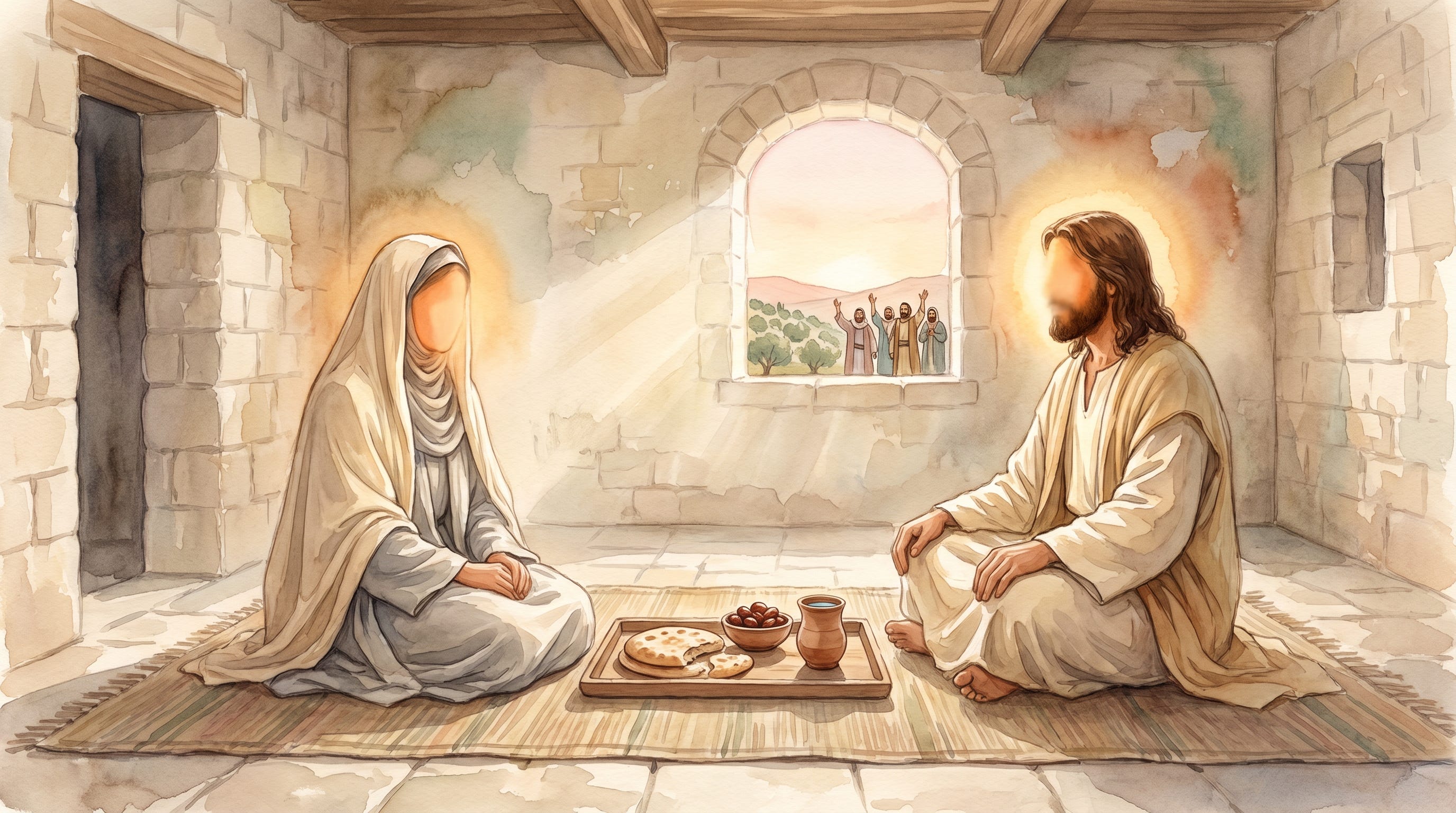
The Qur’an opens our path tonight with a verse from Surah al-Ma’idah:
مَّا الْمَسِيحُ ابْنُ مَرْيَمَ إِلَّا رَسُولٌ قَدْ خَلَتْ مِن قَبْلِهِ الرُّسُلُ وَأُمُّهُ صِدِّيقَةٌ ۖ كَانَا يَأْكُلَانِ الطَّعَامَ ۗ انظُرْ كَيْفَ نُبَيِّنُ لَهُمُ الْآيَاتِ ثُمَّ انظُرْ أَنَّىٰ يُؤْفَكُونَ
قُلْ أَتَعْبُدُونَ مِن دُونِ اللَّهِ مَا لَا يَمْلِكُ لَكُمْ ضَرًّا وَلَا نَفْعًا ۚ وَاللَّهُ هُوَ السَّمِيعُ الْعَلِيمُ
قُلْ يَا أَهْلَ الْكِتَابِ لَا تَغْلُوا فِي دِينِكُمْ غَيْرَ الْحَقِّ وَلَا تَتَّبِعُوا أَهْوَاءَ قَوْمٍ قَدْ ضَلُّوا مِن قَبْلُ وَأَضَلُّوا كَثِيرًا وَضَلُّوا عَن سَوَاءِ السَّبِيلِ
“The Messiah, son of Mary, was no more than a messenger. Other messengers passed away before him. His mother was truthful. They both used to eat food. Look how We make the signs clear to them — then look how they are turned away.”
“Say: Do you worship, beside God, what has no power to harm you or to benefit you? And God is the All-Hearing, the All-Knowing.”
“Say: O People of the Book, do not exceed the bounds in your religion, beyond the truth, and do not follow the desires of a people who went astray before, and led many astray, and themselves strayed from the even path.”
— Qur’an, Surah al-Ma’idah (the Chapter of the Table Spread) #5, Verses 75 to 77
Read what the Qur’an does in this verse.
"Honour the messenger. Refuse the excess. This is the model for tonight."
It honours Jesus (Isa) and his mother Saint Mary (Maryam) — peace and blessings be upon them both — in the very highest terms.
It calls Jesus a messenger in the chain of all the messengers.
It calls Saint Mary al-siddiqah — the truthful one — a station the Qur’an reserves for souls of the highest rank.
It tells us they ate food — a single, devastating sentence.
They were human beings.
The God who made them was not made; the human beings He made through their flesh ate and drank and walked the earth as our brothers and sister walk it.
And in the same chapter, the very next verses refuse what would later be built around them:
“Do you worship, beside God, what has no power to harm you or to benefit you?…
O People of the Book — do not exceed the bounds in your religion, beyond the truth”
The same God who honoured Jesus refuses to allow him to be worshipped.
The same God who called Saint Mary truthful refuses to allow her to be raised to a station she did not herself claim.
This is the model of the whole sermon tonight.
Honour what God has honoured.
Refuse what He has not.
The Qur’an itself teaches us how to speak of the Christian witness — how to honour the messenger and refuse the doctrine, in the same paragraph, without contradiction.
And there is a verse in Surah Aal Imran that bears on tonight before we move on.
The disciples of Jesus, when he asked who would help him in the cause of God, said:
قَالَ الْحَوَارِيُّونَ نَحْنُ أَنصَارُ اللَّهِ آمَنَّا بِاللَّهِ وَاشْهَدْ بِأَنَّا مُسْلِمُونَ
“The disciples said: We are the helpers of God. We have believed in God; bear witness that we are submitters.”
— Qur’an, Surah Aal Imran (the Chapter of the Family of Imran) #3, Verse 52
The verb is ashhad — bear witness — the same root that has held this series together for four nights.
The disciples of Jesus, in the Qur’an’s own grammar, ask to be witnessed — they ask to be entered into the chain.
And the Qur’an grants them that station.
Hold this.
Because it tells us, in advance, that the men and women we will name tonight were standing in a station the Qur’an itself had already opened for them.
They bore witness.
The Qur’an did not have to be persuaded to call them witnesses.
It had already used the word.
A Word in Two Tongues — Martys and Shahid
Let us begin with the word itself.
In Arabic, the root sh-h-d (ش-ه-د) gives us shahida, to witness; shahada, testimony and the declaration of faith; shahid, witness and martyr.
The same root, the same breath.
To witness and to die for the truth are not two separate things in our language — they are one word seen from two angles.
In Greek — the language of the early Christian Mediterranean — the same work is done by another word.
Martys (μάρτυς).
It means witness.
The trajectory is exact: martys, the witness who testifies in court, became martyr, the witness who testifies with their life.
Same trajectory the Arabic root travelled.
Same trajectory the Latin testis and testimonium travelled in the Roman language of the same age.
This is not a parallel that has to be defended.
It is a fact of grammar and history.
Three of the great Mediterranean languages of late antiquity — Arabic, Greek, Latin — all reached the same destination:
The one who tells the truth in court when the cost is everything.
And they reached it independently.
The word followed the act.
The modern comparative scholar David Cook, of Rice University, opens his comparative study of Islamic martyrdom with the observation that the same shape repeats across every tradition that has ever met God:
“Martyrdom means witness. Witness is the most powerful form of advertisement, because it communicates personal credibility and experience to an audience. Therefore, it is not surprising that the world’s missionary religions have developed the art of the promotional martyrdom into a process that is identifiable and fairly constant through different faiths.”
— David Cook, Martyrdom in Islam (Cambridge: Cambridge University Press, 2007), Chapter 1: “Martyrs in religions”
The shape is constant.
The languages differ; the act does not.
But our own Hawza has gone deeper than the academic argument — and we should hear from our own house before we let any Western voice, however careful, have the last word.
Allamah Sayyed Muhammad Husayn al-Tabataba’i — may God rest his pure soul, in Tafsir al-Mizan, in his commentary on the verse we read on Night 1 —
وَالَّذِينَ آمَنُوا بِاللَّهِ وَرُسُلِهِ أُولَٰئِكَ هُمُ الصِّدِّيقُونَ وَالشُّهَدَاءُ عِندَ رَبِّهِمْ ۖ لَهُمْ أَجْرُهُمْ وَنُورُهُمْ
“And those who believed in God and His Messengers — they are the truthful and the witnesses in the sight of their Lord. They shall have their reward and their light.”
— Qur’an, Surah al-Hadid (the Chapter of Iron) #57, Verse 19
— preserves two traditions that reach into the heart of this question.
The first comes from the Prophet Muhammad — peace and blessings be upon him, his family, and his righteous companions — himself, narrated by al-Barra’ ibn ’Azib:
مُؤْمِنُو أُمَّتِي شُهَدَاءُ
“The faithful of my nation are witnesses.”
— Prophet Muhammad, narrated by al-Barra’ ibn ’Azib, preserved in al-Suyuti’s al-Durr al-Manthur and cited by Allamah Tabataba’i, al-Mizan fi Tafsir al-Qur’an, Commentary on Surah al-Hadid 57:19
The faithful of my nation are witnesses.
He does not say some of them.
He uses the plural — shuhada’ — and applies it, without qualification, to every soul who has believed.
The second tradition is more direct still.
It is preserved in Tafsir al-Ayyashi — one of the earliest Imami commentaries on the Qur’an.
The narrator is Manhal al-Qassab, who came to Imam Ja’far al-Sadiq (peace and blessings be upon him) with a particular request:
قُلْتُ لِأَبِي عَبْدِ اللَّهِ ؏: ادْعُ اللَّهَ أَنْ يَرْزُقَنِي الشَّهَادَةَ. فَقَالَ: إِنَّ الْمُؤْمِنَ شَهِيدٌ. وَقَرَأَ هَذِهِ الْآيَةَ.
“I said to Abu ’Abdillah (Imam al-Sadiq), peace and blessings be upon him: ‘Pray to God to grant me martyrdom (al-shahada).’ He replied: ‘The faithful one is already a witness (shahid).’ And he recited this verse.”
— Imam Ja’far al-Sadiq, narrated by Manhal al-Qassab, preserved in Tafsir al-Ayyashi and cited by Allamah Tabataba’i, al-Mizan fi Tafsir al-Qur’an, Commentary on Surah al-Hadid 57:19
Sit with this exchange.
The man asks for martyrdom — for the death of the witness on the field.
And the Imam — peace and blessings be upon him — does not refuse the prayer.
He does something far more precise.
He corrects the grammar.
He says:
The faithful one is already a witness.
The station you are praying for is the station you are already in.
The witness in the courtroom and the martyr on the battlefield are the same word — and you have already said the word.
This is our tradition’s own answer to the linguistic question — older than David Cook.
The witness and the martyr were never two stations.
They were one station seen from two ends of a single life.
The Imam knew it before any Greek-speaking Christian and any Arabic-speaking Muslim ever sat down to compare notes on their respective vocabularies.
The Greek martys and the Arabic shahid are reaching for the same act because the act itself is one.
The Imam said so plainly.
We say what he said.
Tonight, then, we honour three of the early ones — three figures who carried the word martys into the Roman empire and would not surrender it back.
Polycarp at the Stake — Smyrna, c.155 CE
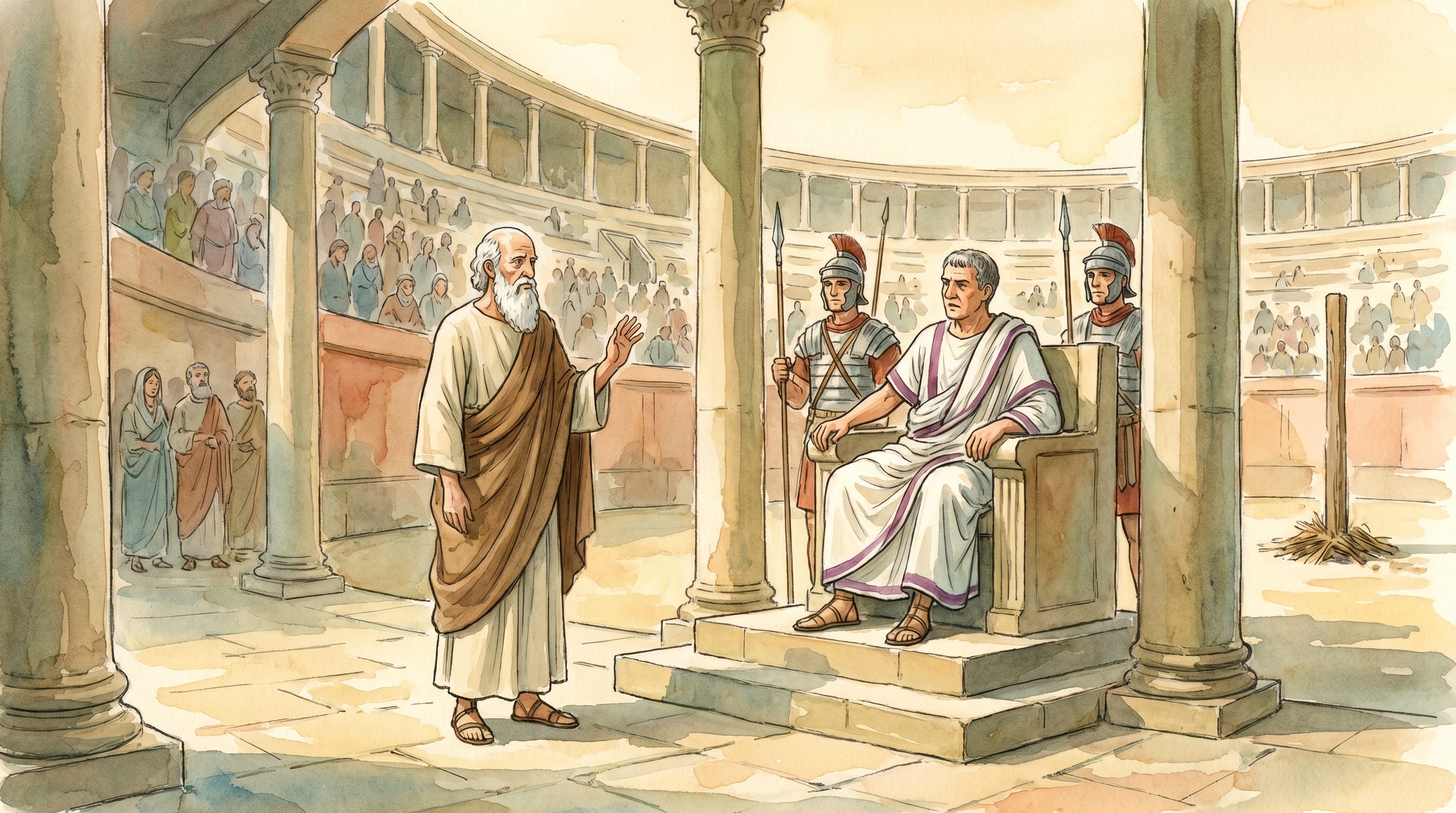
The first is an old man.
His name is Polycarp.
He is the bishop of Smyrna — a Greek city on the western coast of what we now call Turkey, then a thriving Roman provincial capital.
He is, by tradition, the last living disciple of John the Apostle — and so he carries, in his memory, the voice of a man who carried the voice of Jesus.
He is in his eighty-seventh year.
In the year 155 of the Christian calendar — about five hundred and twenty years before Karbala — the Roman proconsul of Asia, a man named Statius Quadratus, demands that Polycarp swear by the genius of Caesar, offer a pinch of incense to the imperial cult, and curse Christ.
The Roman charge is atheotēs — atheism, in the sense of refusing to worship the gods of the state — and maiestas, treason.
To refuse the incense is to refuse the empire.
When the soldiers come for Polycarp, he does what most of the men in this room would not do.
He greets them.
He has a meal prepared for them.
He asks for an hour of prayer.
The hour stretches to two — and when he comes out, he is calm.
He is brought to the arena.
The proconsul offers him a way out:
Swear by the fortune of Caesar, denounce Christ, and you will go free.
Polycarp’s reply has been preserved in The Martyrdom of Polycarp — one of the earliest surviving Christian texts after the New Testament:
Ὀγδοήκοντα καὶ ἓξ ἔτη δουλεύω αὐτῷ, καὶ οὐδέν με ἠδίκησεν· πῶς βλασφημῆσαι δύναμαι τὸν βασιλέα μου τὸν σώσαντά με;
“Eighty-six years I have served him, and he has done me no wrong. How can I blaspheme my King who saved me?”
— The Martyrdom of Polycarp, 9.3 (c.156 CE)
Read the architecture of the refusal.
There is no rage in it.
Eighty-six years.
He counts them.
He has done me no wrong.
He gives the verdict on his Lord — not from theology, but from experience.
How can I blaspheme my King who saved me?
The question is rhetorical only because it answers itself.
He cannot.
He will not.
Not because he is brave — he may well have been afraid — but because his conscience has already been formed, over eighty-six years, by a Lord who has done him no wrong.
He is burned at the stake; a soldier finishes him with a dagger.
A man who has served his Lord for eighty-six years does not blaspheme him to satisfy a magistrate.
The pastoral witness — the elder, the bishop, the one whose life has been one long act of service.
Listen for what Polycarp’s words share with the words of Abel that we recovered on the first night.
I will not stretch out my hand to kill you. I fear God.
And:
He has done me no wrong; how can I blaspheme my King?
The grammar is the same.
I will not. I fear. I cannot. He has not.
The witness states where they stand and why.
The empire — Cain in one age, Caesar in another — does the rest.
Perpetua and Justin — Two Forms in Brief
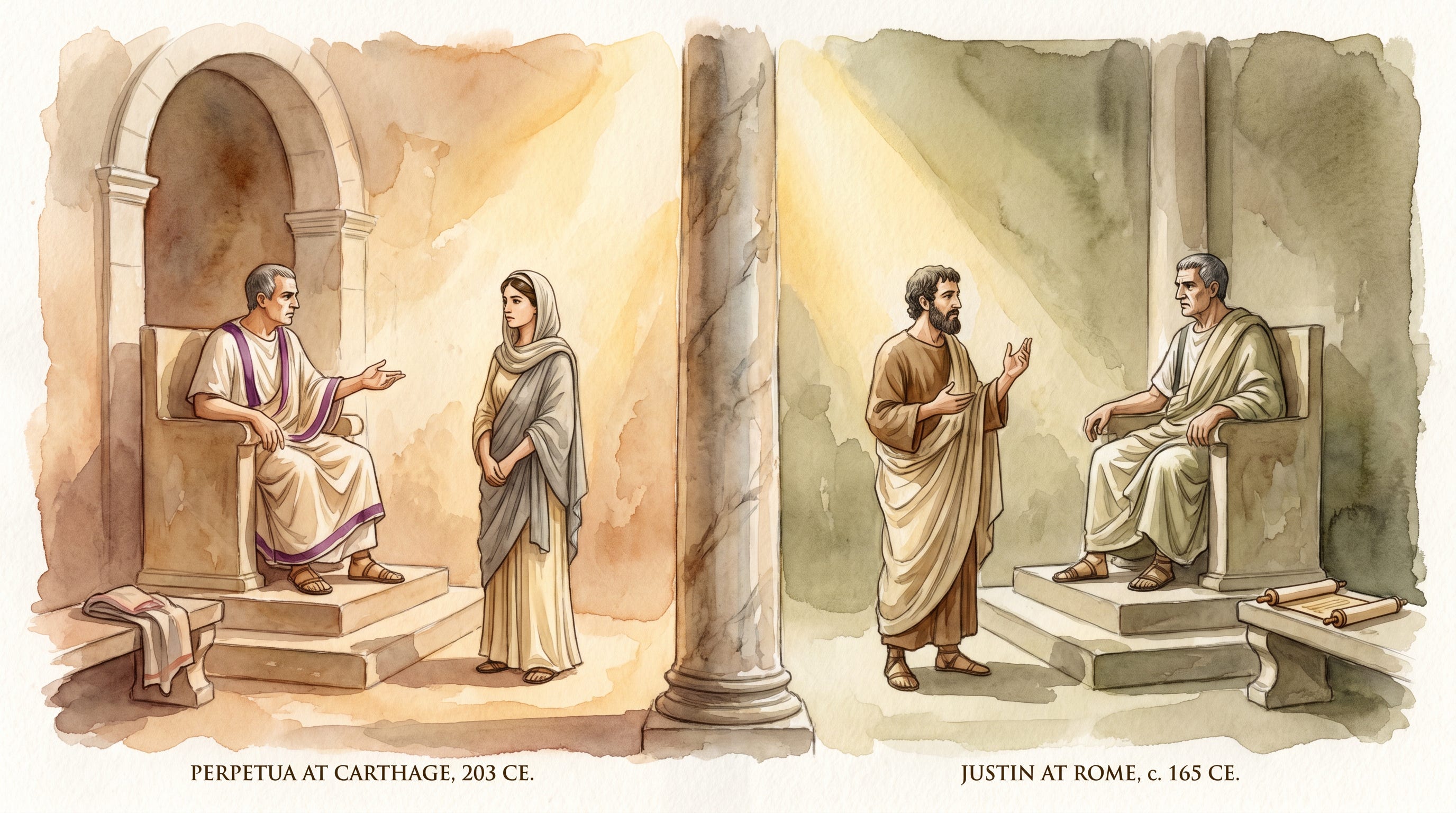
Two more witnesses from the same period, in briefer compass — because the form they each anchor is recognisable in our own tradition without elaborate retelling.
Perpetua of Carthage, killed in the arena at twenty-two, in 203 CE, under the procurator Hilarianus.
A young noblewoman, recently converted, the mother of an infant.
Her father came to her cell repeatedly and pleaded with her to recant.
She refused.
The procurator asked her to confirm her faith, and she answered, in Latin:
Christiana sum.
“I am a Christian.”
— Passio Sanctarum Perpetuae et Felicitatis, 6.4
Two words.
I am a Christian.
She was not declaring a doctrine; she was declaring an identity the empire could not rename.
The familial witness — the young woman, the mother, the one whose fidelity broke the closest hearts.
The lineage in our own tradition runs through Sayyedah Zaynab and the women of Karbala — peace and blessings be upon them; we do not force the parallel, but we do not pretend not to see it.
Justin Martyr, killed in Rome around 165 CE under the urban prefect Junius Rusticus.
A Greek-speaking philosopher who came to Christianity through reasoning, and defended it in writings addressed to the emperor himself.
When the prefect commanded him at trial —
“Obey the gods, and submit to the emperor”
— Justin answered:
Οὐδεὶς νοῦν ἔχων ἐκ πλάνης μεταβάλλεται εἰς ἀλήθειαν, ἀλλ᾽ ἐξ ἀληθείας εἰς πλάνην.
“No one of sound mind moves from truth to error; the movement is always from error to truth.”
— Acta Iustini Martyris, 5.4
The intellectual witness.
The man who used reason to argue the case for the truth, then sealed the argument with his head when the empire demanded he reverse it.
His station, in our own tradition, is occupied by Shaheed Murtadha Motahhari, Shaheed Beheshti, Dr Ali Shariati — may God rest their pure souls — the scholar-witnesses of every century.
What the Three Tell Us
Three figures.
Three forms.
The pastoral witness, the familial witness, the intellectual witness.
The bishop, the young mother, the philosopher.
The same three forms our own tradition has produced in every generation since.
There is a Greek word in the Christian theological vocabulary of that age that maps precisely onto our own sabr.
The word is hypomonē (ὑπομονή) —
Steadfast endurance under suffering.
Sabr and hypomonēare not the same word.
They are two languages reaching for the same thing — the witness’s gift of staying when staying costs everything.
What do these three teach us tonight?
First, the chain of witness is not Muslim alone.
It is human.
The Lord we worship is not a parochial Lord; the witness He honours is not the witness of one tribe or one tongue.
Second, the forms of witness are the forms our own tradition has always produced.
They are not Christian forms.
They are witness forms.
Third — and this is the harder lesson — to honour these witnesses is not to diminish our own.
The candle of society, in Shaheed Motahhari’s metaphor, has been lit, in different ways, in many places.
To say so is not weakness.
It is tabyeen.
The man who taught us tabyeen — Imam Sayyed Ali Khamenei — may God rest his pure soul, in the first Muharram since his own martyrdom — used to visit Christian families on the anniversary of the birth of Jesus, peace and blessings be upon him, and may God hasten his return.
He was not pretending Christianity was Islam.
He was honouring the witness wherever the witness was found.
We will return to him.
But first, we have to come up to our own century.
The Cost That Did Not Stop
The early martyrs sealed Christianity into the Roman empire.
By the time of Constantine, in the fourth century, the empire that had killed Polycarp was Christian.
We could be forgiven for thinking the cost had ended there.
It did not.
The twentieth and twenty-first centuries have produced their own Christian witnesses.
The names are different.
The empires are different.
The shape of the test is the same.
Jägerstätter at Brandenburg — August 1943
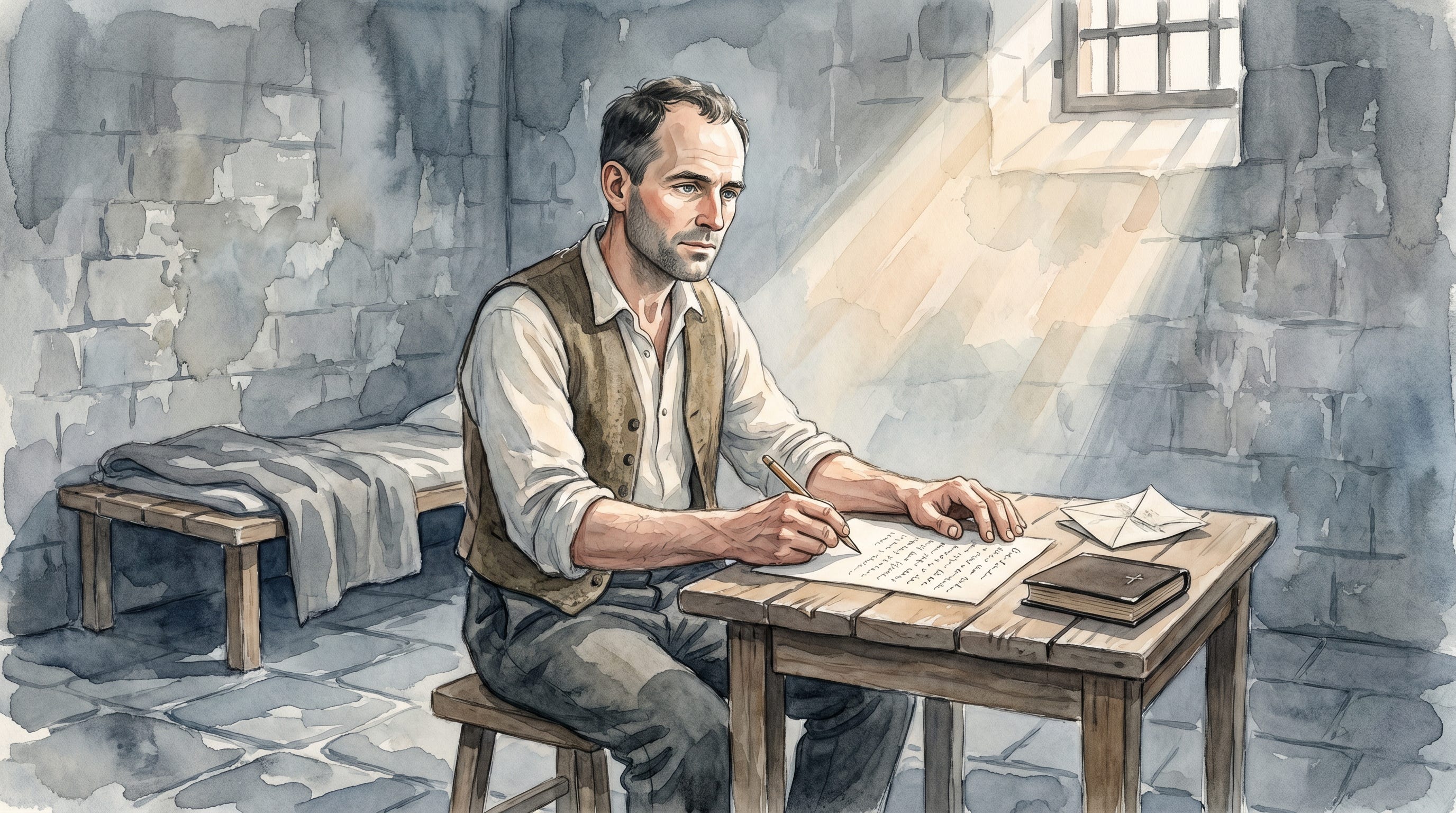
An Austrian peasant farmer from the village of St. Radegund in Upper Austria.
Devout Catholic.
Husband to Franziska.
Father of three young daughters — the youngest still a toddler.
By any worldly measure, the man with the greatest reasons to comply.
When the Wehrmacht conscription notice arrived in 1943, he refused.
He refused to take the loyalty oath to Hitler.
He refused to fight in a war he had decided, by his Catholic conscience, was unjust.
His parish priest urged him to comply.
His bishop urged him to comply.
His lawyer pleaded with him for the sake of his daughters.
His neighbours in St. Radegund — many of whose own sons were already in uniform — could not understand him.
He held to the refusal.
At his trial in Berlin on the 6th of July 1943, when the Reich Military Court asked him why he would not serve, he answered in language a man with no theology degree did not need a theology degree to find:
“It was impossible for me to be a Catholic and at the same time a National Socialist. There are matters in which one is obliged to obey God more than man; the commandment ‘Thou shalt love thy neighbour as thyself’ forbade me to engage in armed service.”
— Franz Jägerstätter, statement at his trial before the Reichskriegsgericht, Berlin, 6 July 1943; preserved in Erna Putz (ed.), Franz Jägerstätter: Letters and Writings from Prison (Maryknoll, NY: Orbis Books, 2009)
From the cell at Brandenburg-Görden Prison, in the weeks before his execution, he wrote prison letters and a small set of “Ten Questions”.
One of them carries the same logic our Imam Husayn — peace and blessings be upon him — carried at Mina:
“Is it not more Christian to offer oneself as a victim right away rather than first have to murder others who certainly have a right to live and want to live — just to prolong one’s own life a little while?”
— Franz Jägerstätter, prison letter, Brandenburg-Görden Prison, 1943; in Putz (ed.), Letters and Writings from Prison
The conscience of a peasant farmer with three small children, in language no library was required to write or to read.
This is the question every soldier in every army has been asked, by his own conscience, in every century.
Most have refused to hear it.
Jägerstätter heard it.
He answered it.
He was beheaded by guillotine on the 9th of August 1943, age thirty-six.
His final words to the prison chaplain:
“I am completely bound in inner union with the Lord.”
He was beatified by the Catholic Church in 2007 — fifty-eight years late, after the Austrian Catholic establishment that had urged him to comply spent two generations being uncomfortable with the man whose witness it had failed to recognise in the moment.
The theology is not ours.
The architecture of the witness is unmistakable.
The peasant who refused to be in the wrong army — the European Christian echo, in the twentieth century, of the captain we will hear of in tonight’s maqtal.
Twenty-One on a Beach — Libya, February 2015

A witness in our own lifetime.
The lifetime of every adult in this room.
In February 2015, twenty Coptic Christians from Upper Egypt, working as agricultural labourers in Libya, were captured by an offshoot of DAESH.
With them, a Ghanaian man named Matthew Ayariga.
They were marched to a beach near Sirte, dressed in orange jumpsuits, and beheaded on camera as a propaganda video.
The video shows their lips moving in prayer; eyewitness accounts say they were saying the name of Christ.
Matthew Ayariga, asked if he was Christian — given the chance to recant — is reported to have said
“Their God is my God.”
He was killed with the others.
The Coptic Orthodox Church canonised them as martyrs within weeks.
I will not describe the moment further.
The handling of this story belongs to silence — and to the discipline of refusing to do for the propagandists what they wanted us to do.
The working-class witnesses.
The labourers.
The men with no theology degrees, no books, no platforms — the men who had nothing to recommend them but their fidelity in the last twenty seconds of their lives.
They are part of the same chain.
And — let it not be said that we looked away.
Within forty-eight hours of the video’s release, on the 28th of Bahman 1393 SH — the 17th of February 2015 — the Society of Seminary Teachers of Qom (Jami’a-ye Mudarrisin-e Hawza-ye Ilmiyya-ye Qom), the senior body of the principal Shia seminary in the world, issued a formal condemnation:
بسم الله الرحمن الرحیم
جامعه مدرسین حوزه علمیه قم اقدام اخیر گروه تروریستی داعش در سر بریدن گروهی از شهروندان مسیحی مصری در لیبی را محکوم میکند و تأکید مینماید که تنها راه مبارزه با تروریستهای داعش، وحدت جهان اسلام است.
افکار عمومی جهان اسلام هرگز فراموش نخواهد کرد که جنایات داعش به دلیل حمایتهای غرب و تعدادی از حاکمان ارتجاعی منطقه شکل گرفته و گسترش یافته است.
“In the Name of God, the Most Merciful, the Most Compassionate. The Society of Seminary Teachers of the Hawza of Qom condemns the recent action of the terrorist group DAESH in the beheading of a group of Egyptian Christian citizens in Libya, and emphasises that the only path of struggle against the terrorists of DAESH is the unity of the Islamic world.
The public opinion of the Islamic world will never forget that the crimes of DAESH took shape and spread because of the support of the West and a number of reactionary rulers in the region.”
— Statement of the Society of Seminary Teachers of the Hawza of Qom, 28 Bahman 1393 SH / 17 February 2015. Published by IRNA.
The killing of Egyptian Christian citizens.
That is how Qom named them.
Not the Egyptian victims; not some Christians somewhere.
By their nationality.
By their faith.
The senior seminary body of the Shia world honoured those twenty-one Coptic men by name and by tradition, two days after the world had filed the video into the news cycle and moved on.
The comfortable Western media looked away when the same act was performed at a contemporary distance.
The Hawza of Qom did not look away.
And we, in this room, follow what they in Qom already said.
Romero at the Altar — March 1980
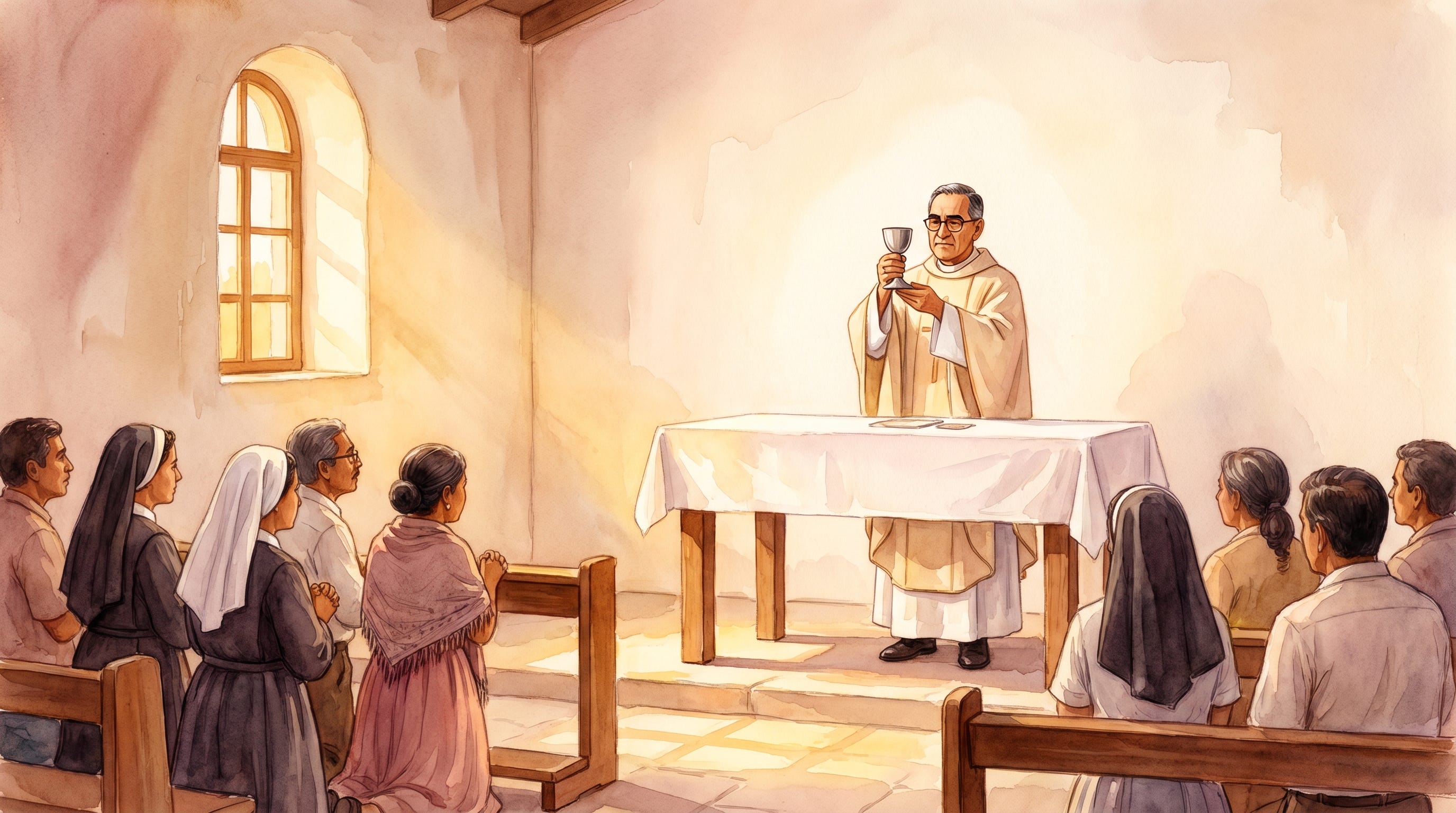
The third figure.
Óscar Romero, Archbishop of San Salvador in El Salvador.
A small Central American country in the 1970s and 1980s ruled by a US-backed military junta engaged in a civil war against its own peasant population.
Death squads were operating across the countryside, killing priests, catechists, peasant leaders, anyone who organised the poor.
Romero, in 1977, was politically cautious — chosen as Archbishop because the establishment expected him to keep quiet.
Then, in March 1977, his close friend Father Rutilio Grande was assassinated by a death squad while driving to celebrate Mass with peasants.
Romero went to see the body.
He was changed.
That is the word.
From that point until his own death three years later he spoke against the regime weekly, broadcast across El Salvador on the Catholic radio.
He named the disappeared.
He read the lists of the dead.
He told the soldiers, week after week, that they did not have to obey orders to kill peasants.
The homily he delivered on the Sunday before his death — 23 March 1980 — ended with a direct address to the soldiers:
Hermanos, son de nuestro mismo pueblo… Ningún soldado está obligado a obedecer una orden contra la ley de Dios… En nombre de Dios, pues, … les suplico, les ruego, les ordeno en nombre de Dios: ¡cese la represión!
“Brothers, you are from our own people. No soldier is obliged to obey an order against the law of God. In the name of God, then, … I beseech you, I beg you, I command you in the name of God: stop the repression!”
— Archbishop Óscar Romero, homily at the Cathedral Basilica of the Sacred Heart, San Salvador, 23 March 1980
The next day, on the 24th of March 1980, he was celebrating Mass at the chapel of a small hospital in San Salvador.
As he raised the chalice to consecrate the wine, a single rifle shot from a death squad gunman parked outside struck him through the heart.
He fell at the altar, mid-prayer.
The bishop killed by empire — the witness who used his pulpit and was killed for it, mid-sentence.
What These Three Add to the First Three
The cost has not stopped.
It has only changed shape — from the lions of the arena to the prison cell, from the Roman magistrate to the death squad, from the proconsul’s stake to the propagandist’s knife.
The empire that demands the incense has many faces.
It is a permanent fixture of the human story until Jesus and our beloved Imam al-Hujjah, may our souls be their ransom and may God hasten their return, return to settle the account.
We name these names not to flatter Christians, but because the truth — even partial truth — must be honoured wherever it appears.
To refuse to honour it is its own kind of silence — of the very kind Imam Husayn diagnosed at Mina.
Imam Husayn did not stay quiet about the witness of David and Jesus — peace and blessings be upon them.
He cited them.
He used their witness.
He honoured what God had honoured.
We do the same.
But before we turn to the doctrinal heart of the night — there is a thread we picked up two nights ago, and the empire that killed the twenty-one on the beach was broken, in this world, in part by a man whose stage on his own road was the stage Christian theology has always called love.
A Stage on the Road — Eshgh
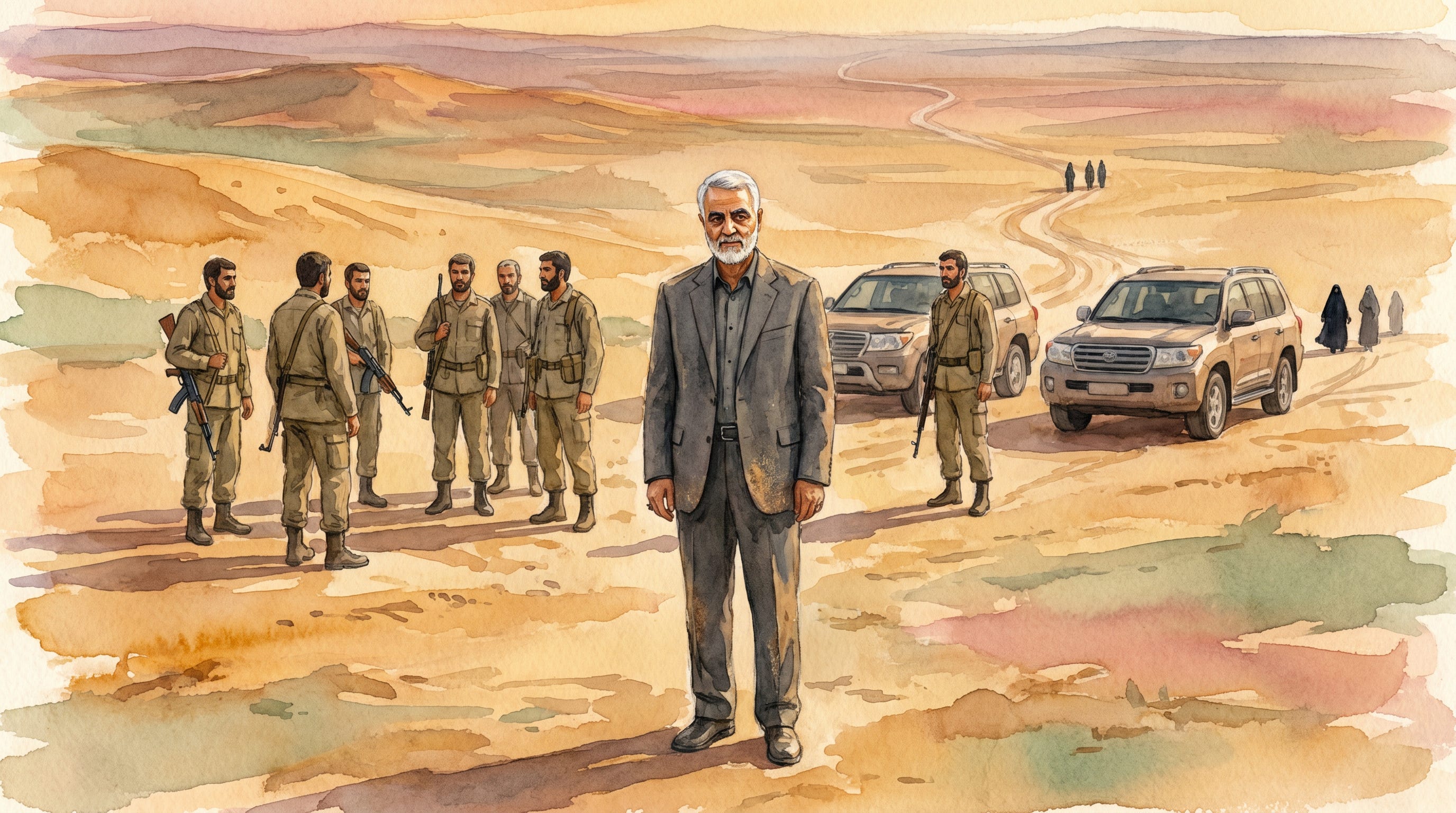
The men who killed the twenty-one are dust.
The empire of DAESH that they served was broken within three years of that beach.
And it was broken, in this world, in part by the hand of a man we have already met in this series.
On Night 3, when Shaheed Murtadha Motahhari — may God rest his pure soul — gave us the five kinds of death, we met Hajj Qasem Soleimani — may God rest his pure soul — at the beginning of his road.
We called that stage by the name the Persian mystical tradition gave it — talab, the quest.
The boy from a village in Kerman whose father worked with water and not with books; the question that would not stop asking itself; the candle being formed before anyone knew it was a candle.
Tonight we meet him at the next stage of the same road.
The Persian mystical tradition names that next stage eshgh.
Love.
Not love as a feeling — love as a station.
The station in which the soul stops being a seeker and becomes a lover.
There is a book — published by Astan-e Quds-e Razavi, the publishing house of the shrine of Imam Reza — peace and blessings be upon him — which has gathered the testimonies of those who walked beside Hajj Qasem in his lifetime, and arranged them along the four stages of the classical Persian mystical road: talab, eshgh, ma’rifat, and finally shahadat.
The book is called Rafiq-e Khoshbakht-e Ma — Our Fortunate Friend.
We will walk this road with Hajj Qasem across the rest of the series — ma’rifat on Night 7, shahadat on Night 9.
Tonight we are at eshgh.
The book opens its second chapter with a sentence that any Christian saint of the early centuries could have written:
خوب میدانست شرط عاشقی ابراز آن است. مکرر عشق خود به یارانش را ابراز میکرد. عاشق بدون ابراز عشقش چه هست؟!
“He knew well that the condition of love is its expression. He would express his love for his companions repeatedly. What is a lover without the expression of his love?”
— Rafiq-e Khoshbakht-e Ma, Astan-e Quds-e Razavi, Mashhad, 1399 SH — Chapter 2: Eshgh
Of his dearest brother in the field, Husayn the son of Hamadani — may God rest his pure soul, who fell defending the shrine of Sayyedah Zaynab, he said:
My breath is bound to your breath.
This is the stage of eshgh.
Love that must be expressed.
And the loop closes here with what we have been saying tonight.
Hajj Qasem’s title in the years before his martyrdom — the title our community used about him — was different from his official rank.
He was
The commander of the protection of the pilgrims of Arbaeen.
The procession of millions of pilgrims who walk every year from Najaf to Karbala was, for him, the work of his love.
He guarded the road to Karbala.
And the army that came to hunt the pilgrims of Imam Husayn — peace and blessings be upon him — on that road was the same army that beheaded the Twenty-One on a beach in Libya.
The book records the story, told by an Iraqi tribal leader.
DAESH fighters had moved to take Iranian pilgrims hostage on the road to Karbala.
Hajj Qasem was in a meeting when the message reached him.
He left in the suit he was wearing — there was no time to change.
He took twenty elite men and intercepted them in the desert.
The engagement was brief.
The outcome was decisive.
And Hajj Qasem — still in the civilian suit — turned to the captured fighter:
همانطور که میبینید، لباس من برای جنگ نیست. وای بر شما اگر رهبرم سیدعلی دستور بدهد که لباس نظامی بپوشم!
“As you can see, my clothes are not for war. Woe to you if my Leader, Sayyed Ali, ordered me to wear my military uniform.”
— Hajj Qasem Soleimani, recounted by Abu Hasan, an Iraqi tribal leader, in Rafiq-e Khoshbakht-e Ma
The danger to you is not what I am wearing.
The danger is what my Leader can ask me to wear at any moment.
This is wilayah in clothing.
The uniform of a soldier of God is whatever the Imam of the time tells him to put on.
A few months earlier, in September 2017, at the fortieth-day commemoration of one of the modaafe’an-e haram — the defenders of the holy shrines — Hajj Qasem made a vow:
“In less than three months, the end of DAESH and DAESH governance on this earth will be announced.”
Within three months, by December of that year, the territorial caliphate of DAESH had fallen.
The vow was kept.
This is eshgh.
Love that does not stay in the heart.
Love that expresses itself — in the protection of the pilgrim, in the road to Karbala kept open, in the breaking of the empire that thought it could kill twenty-one Coptic Christians on a beach in Libya without a reckoning.
The reckoning came.
The lover whose breath was bound to Imam Husayn’s breath could not let the lovers of Imam Husayn — Muslim or Christian — be hunted on the road to him.
We will meet him again at ma’rifat on Night 7, and at shahadat on Night 9.
Tonight is the stage of love.
And love, is the only force that has ever broken an empire from inside the suit you happened to be wearing when the call came.
What We Share, and Where the Roads Part
We have spent the first half of this night naming what we share.
Let us state it briefly, so that when we turn to where we part, the audience knows what is being preserved.
We share the linguistic root: martys and shahid are the same word in two languages.
We share the conviction that bearing witness is costly:
Every true witness in every tradition has paid for it.
We share the refusal to worship power:
Every true witness refuses the alternative offered by the throne.
And we share, deepest, the dignity of every soul, rooted in the universal covenant of
“Am I not your Lord?” — “Yes — we bear witness.”
These are the bones of the witness.
We do not lose them when we turn to where the roads part.
The Cross as Vicarious Salvation
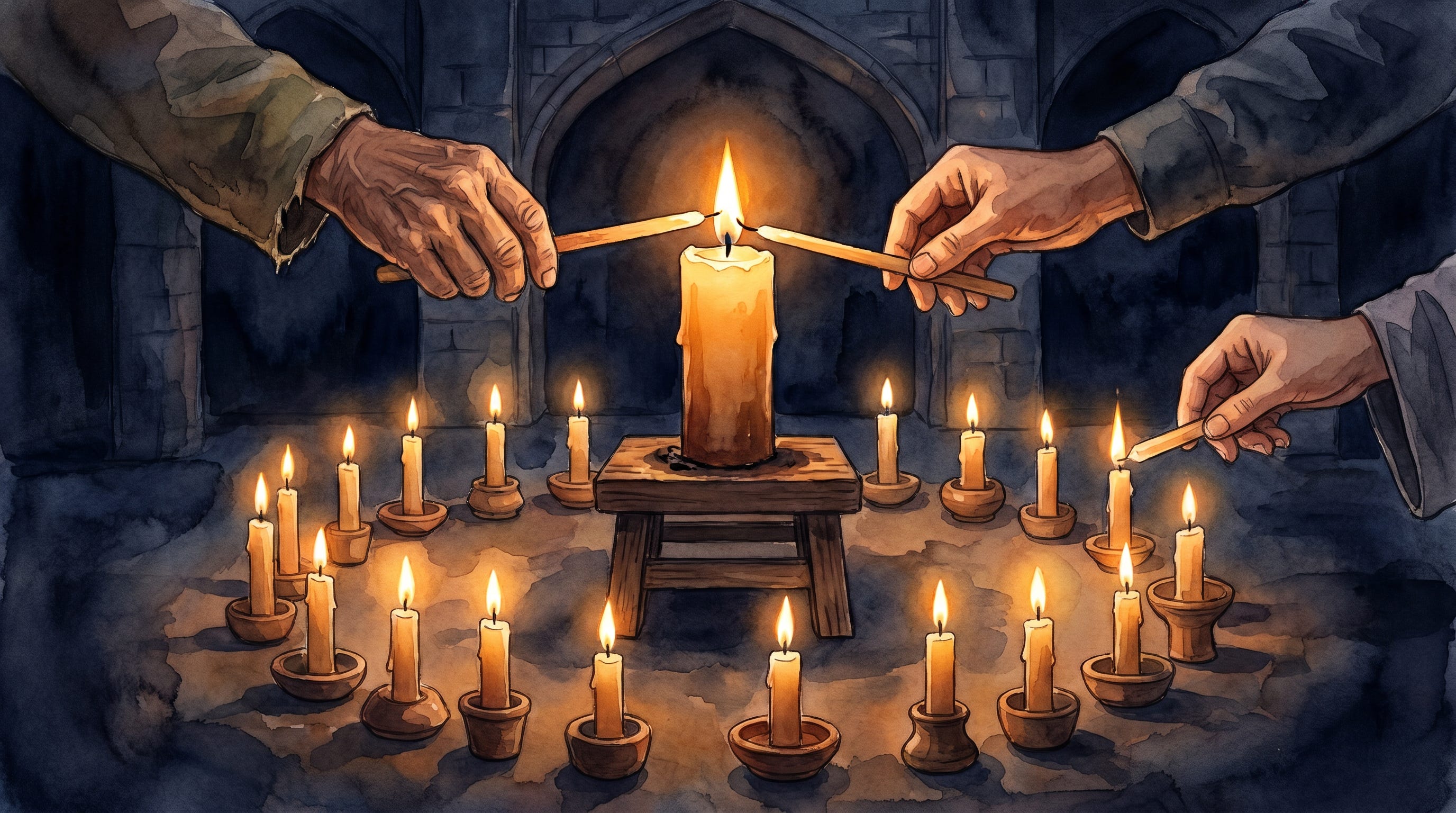
Christian theology in its dominant form holds that Christ’s death on the cross atones for the sins of humanity — that one death pays the price of many.
The Qur’an does not teach this.
The verse that closes the door on it appears five times across the Qur’an:
وَلَا تَزِرُ وَازِرَةٌ وِزْرَ أُخْرَىٰ
“No bearer of burdens shall bear the burden of another.”
— Qur’an, Surah al-An’am (the Chapter of the Cattle) #6, Verse 164
Five repetitions for a doctrine our Lord wants us to understand at five different angles.
Every soul stands before God on its own account.
There is no death that, in being undergone by one, settles the ledger of many.
This means that our martyrs do not atone for us.
They bear witness to us.
Their light illuminates our path.
It does not substitute for our journey.
When we stand at the grave of Imam Husayn — peace and blessings be upon him — we are not in the presence of a man who has paid our debt.
We are in the presence of a man who has shown us the road, and who waits to see whether we will walk it ourselves.
In the dominant Christian frame, the supreme martyr saves the believer through his death.
In the Islamic frame, the supreme witness — Imam Husayn — calls the believer to become a witness in turn.
The candle does not relieve us of the duty to burn; it shows us how to burn.
The flame is contagious; it is not transferable.
Inherited Guilt and the Soundness of the Fitrah
The second divergence is the doctrine of original sin — that we are born under the burden of Adam’s fall, and that the cross is the answer to that inheritance.
The Qur’an does not teach this.
The covenant we recovered on Night 2 —
“Am I not your Lord?”
— implies the opposite.
Every soul testifies for itself, before any guilt and before any inheritance.
The fitrah — the original disposition of the soul — is sound:
فَأَقِمْ وَجْهَكَ لِلدِّينِ حَنِيفًا ۚ فِطْرَتَ اللَّهِ الَّتِي فَطَرَ النَّاسَ عَلَيْهَا ۚ لَا تَبْدِيلَ لِخَلْقِ اللَّهِ
“Set your face toward the religion in natural devotion — the nature made by God in which He has made mankind. There is no altering of God’s creation.”
— Qur’an, Surah al-Rum (the Chapter of the Romans) #30, Verse 30
The nature God placed in us is not corrupt.
It is not fallen.
It is not in need of an inherited ransom.
The Qur’an’s account of Adam — peace and blessings be upon him — honours him as a prophet — and our tradition has a precise term for what happened in the garden:
Tark-e-Awla, the abandoning of the better.
The command not to approach the tree was advisory, not legislative — like a doctor’s counsel about what will harm you, not a king’s law that carries a legal penalty.
Adam chose a permissible act when a higher, more preferable one was available; what he experienced afterward was the natural consequence of that choice, not a punishment for a sin.
There was no fall in the Christian sense.
There is no inherited debt to pay.
Sin is what we do; it is not what we are.
These two divergences are not small matters of vocabulary.
They are the architecture of the difference.
The Qur’an honours Jesus and Saint Mary — peace and blessings be upon them both, in the very highest terms — a great prophet of God and al-siddiqah, the truthful one.
And in the very same Book it refuses two doctrines that grew up around them in the centuries that followed.
We hold both halves at once.
Honour without conflation.
Tabyeen — Honour Without Conflation
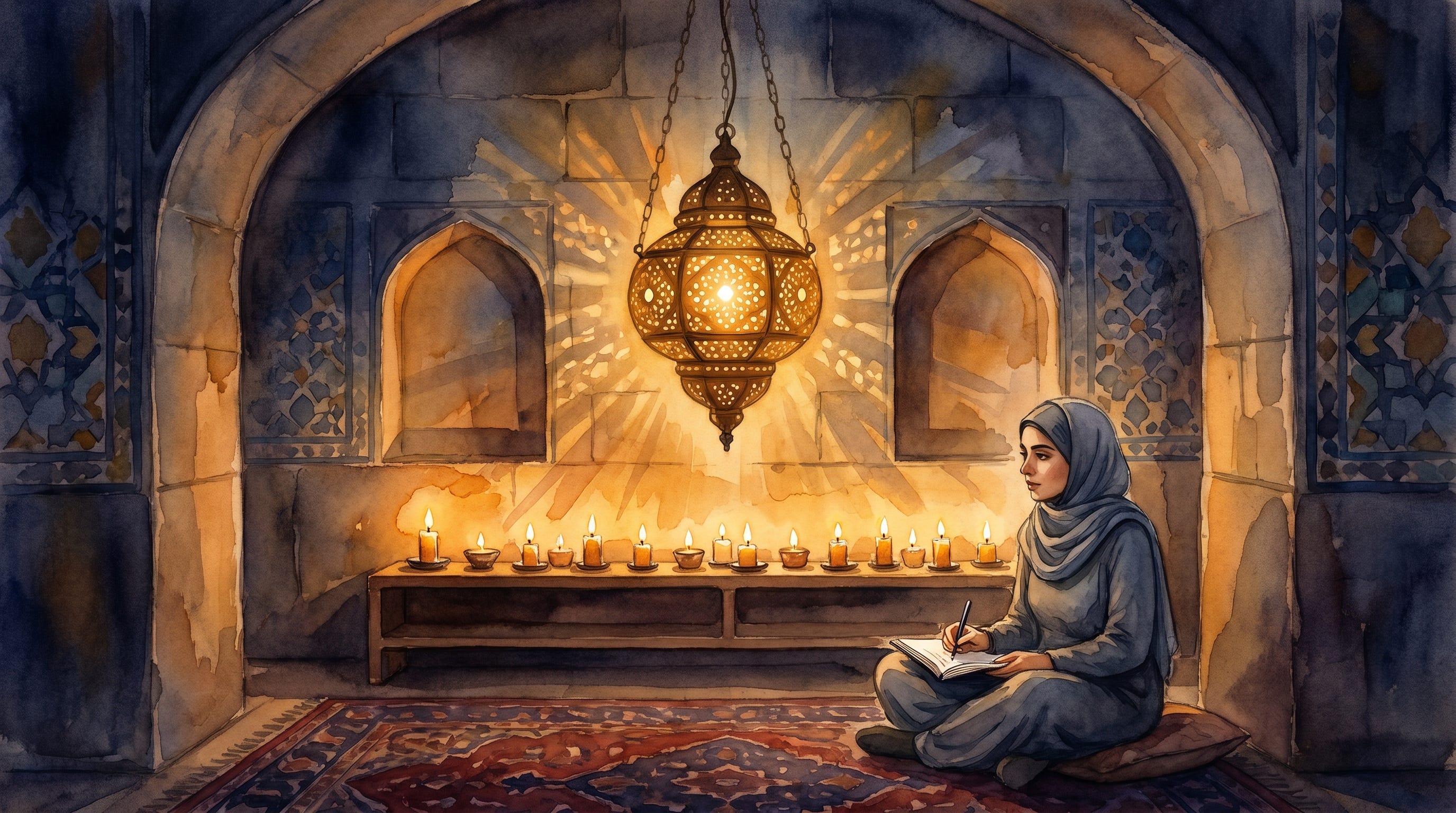
We can now speak the takeaway of tonight in its fullest form.
We honour the Christian witnesses as fellow travellers in a partial truth.
We recognise the witness of Imam Husayn — peace and blessings be upon him — as the completion of what they glimpsed.
The candle they lit in their cells, in their arenas, in their cathedrals, was a real candle.
It was lit by the same oil.
We do not — and we will not — say otherwise.
But the lamp that holds the candle in its complete form is the one Imam Husayn raised at Karbala.
It is the lamp of tawhid without partner; of a God who needs no atoning death because He forgives directly when His servant turns to Him; of a covenant that runs from each soul straight to its Lord, without inherited debt, without intermediary blood.
To honour the Christian witnesses without naming this distinction is to flatter them in a way that betrays both of us.
Tabyeen refuses both betrayals.
It honours every witness fully —
And it does not conflate any of them with any other.
This is what Imam Khamenei — may God rest his pure soul — gave forty-five years of his life to teaching us, and what the first Muharram since his martyrdom puts on us as an obligation to carry forward.
The differences between traditions are not embarrassments.
They are clarifications.
Romero would not have wanted us to flatter him.
Polycarp would not have wanted us to flatter him.
To honour them is to receive their witness as they offered it.
Islam Is a Complement to Real Christianity — Martyr Khamenei’s Voice
The corrected theology produces the lived practice.
Now we hear the voice of the man who lived it.
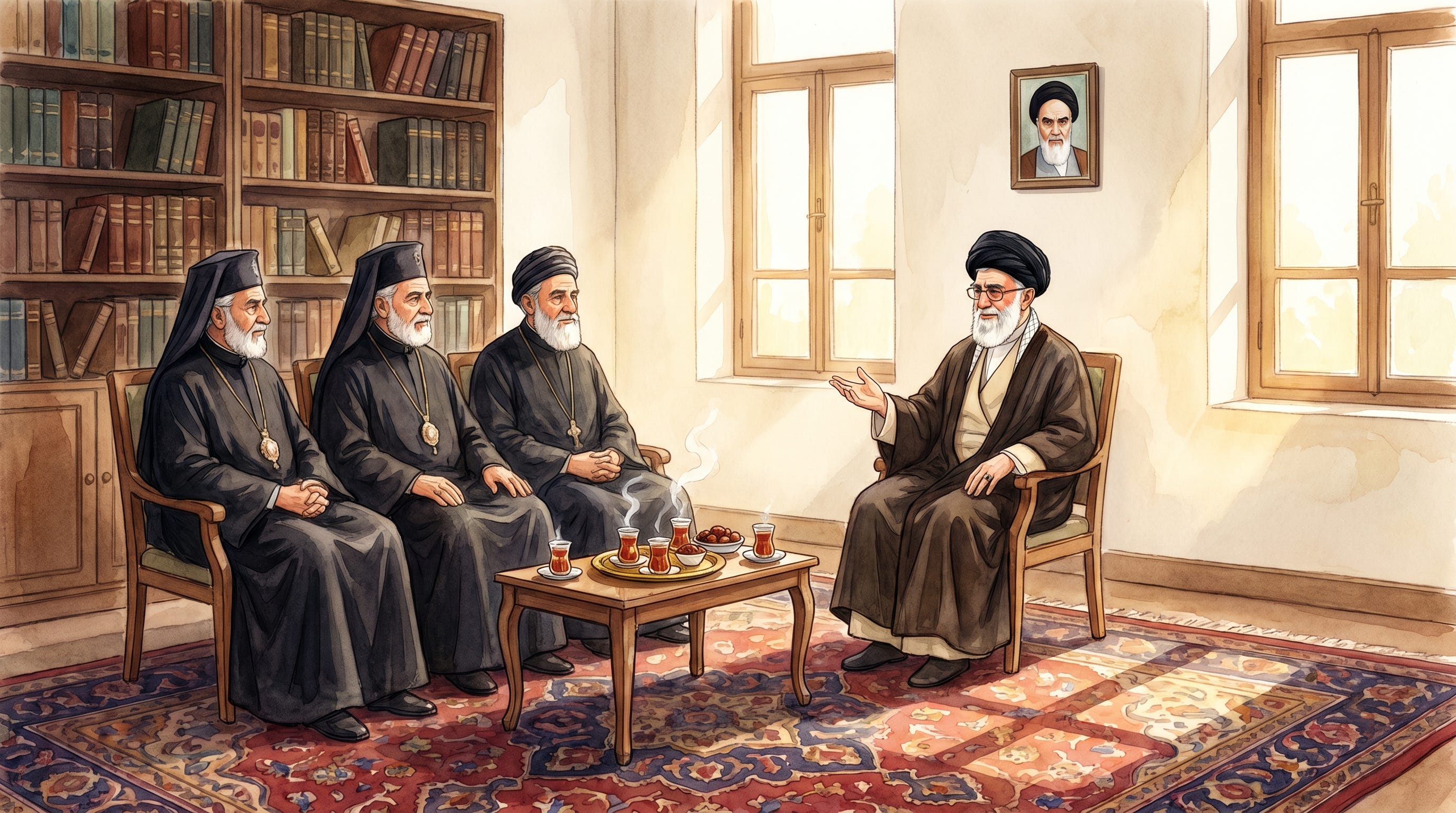
On the 12th of Dey, 1373 — the 2nd of January, 1995 — the Martyr, Imam Sayyed Ali Khamenei — may God rest his pure soul — received a delegation of senior religious figures from the Assyrian churches of Iran in his office, a few days after Christmas.
The Leader of the Islamic Revolution opened with these words:
ولادتِ حضرتِ عیسیٰ مسیح (علیه السّلام) را به مقاماتِ کلیسایی و ارامنهی ایران و مسیحیانِ جهان و نیز به مسلمانان تبریک میگوییم. … از نظر اسلام، حضرت عیسیٰ مسیح (علیه السّلام) پیامبرِ بزرگِ خدا و موردِ قبول و احترامِ مسلمین است.
“We congratulate the religious authorities, the Armenians of Iran, the Christians of the world, and also the Muslims, on the birth of Jesus the Messiah — peace be upon him. … From the perspective of Islam, Jesus the Messiah — peace be upon him, is a great prophet of God, accepted and respected by the Muslims.”
— Martyr Imam Khamenei, excerpt from remarks in the meeting with religious authorities of the Assyrian churches of Iran, 12 Dey 1373 SH / 2 January 1995. Archived at farsi.khamenei.ir, speech-content ID 57958.
In a separate message addressing the world’s Muslims and Christians on the meaning of Christmas, he said:
“Today humanity is in need of these teachings more than ever before. And Islam, which is a complement to real Christianity, has put calling humanity to piety and moral perfection high on its priority list.”
— Martyr Khamenei, message on the birth of Jesus, peace and blessings be upon him, 3 January 1994. Archived at english.khamenei.ir.
Islam is a complement to real Christianity.
Read this phrase carefully.
He does not say Islam contradicts Christianity.
He does not say it displaces Christianity.
He says it completes it — and he qualifies the noun: real Christianity.
Not the doctrines built around the prophet over the centuries.
The Christianity Jesus actually taught — the call to piety, the refusal to worship power, the readiness to bear witness with one’s life.
That Christianity finds its completion in Islam.
Honour without conflation in five words: a complement to real Christianity.
The witnesses we have named tonight were standing in real Christianity, in the part our Imam said our Islam completes.
They were not strangers to the path that runs from Abel to Imam Husayn.
They were on a section of it.
Saint Sarkis Cathedral, Tehran — Where the Caravan Carried a Christian Brother
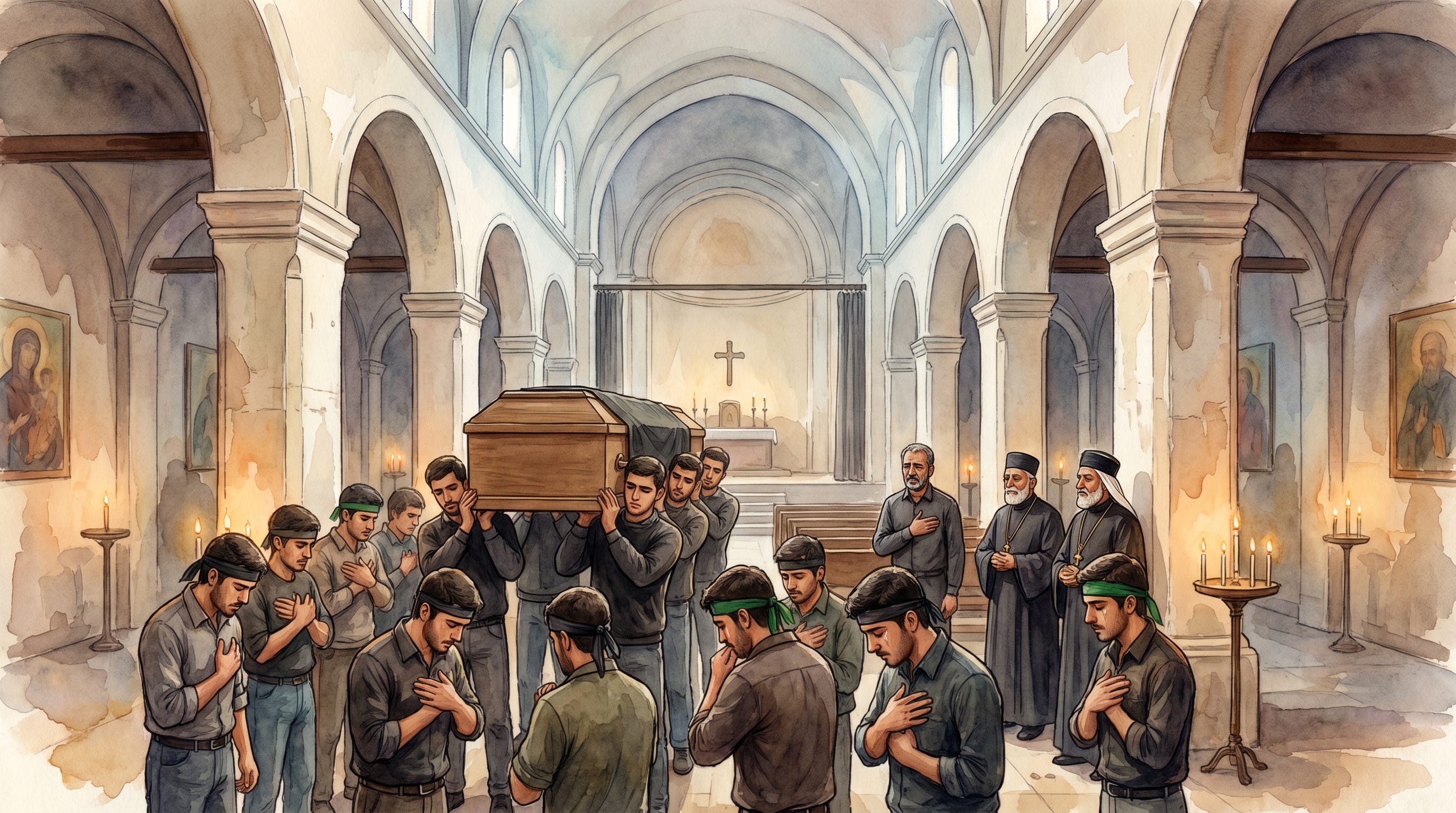
The doctrine that produces the practice.
The practice that lives the doctrine.
On the 7th of February, 1997, the Al-Quds Day march passed through Tehran.
After the march was over, a crowd of Muslim youth — without instruction from any authority, of their own initiative — moved across the city to Saint Sarkis Cathedral, the seat of the Assyrian Christian community.
A funeral was being held there for a man named Robert Lazar an Iranian Assyrian Christian who had been martyred in the last year of the Iran-Iraq war.
The Muslim youth who had marched for Palestine that morning carried his coffin into the cathedral.
His brother, who was present, recounted what happened:
“The funeral was strangely and remarkably massive — it was divine. … Inside Saint Sarkis Cathedral, Muslim brothers were gently beating their chests, [reciting verses] proclaiming that Jesus Christ is the owner of mourning today. There was no distinction between us and them.”
— Brother of Martyr Robert Lazar, recounted in From Tehran to Bethlehem: Christians on the Frontlines, archived at english.khamenei.ir, 25 December 2023
Sit with this image.
Muslim youth, after the Al-Quds Day march, beating their chests inside an Assyrian cathedral, for a Christian brother who fell on the same front as Husayn’s caravan.
Proclaiming, in their own latam (lamentation poetry), that Jesus Christ is the owner of mourning today.
This is not a hypothetical.
This happened.
In Tehran.
In our own time.
The Muslim youth did not ask permission.
They did what their hearts told them to do — and their hearts had been formed by Imam Husayn — peace and blessings be upon him, who taught them that the witness is recognised by the act, not by the ancestry.
This is what tabyeen looks like when it is not merely spoken but lived.
The Caravan in Our Own Tongue — the Christian Martyrs of the Sacred Defence
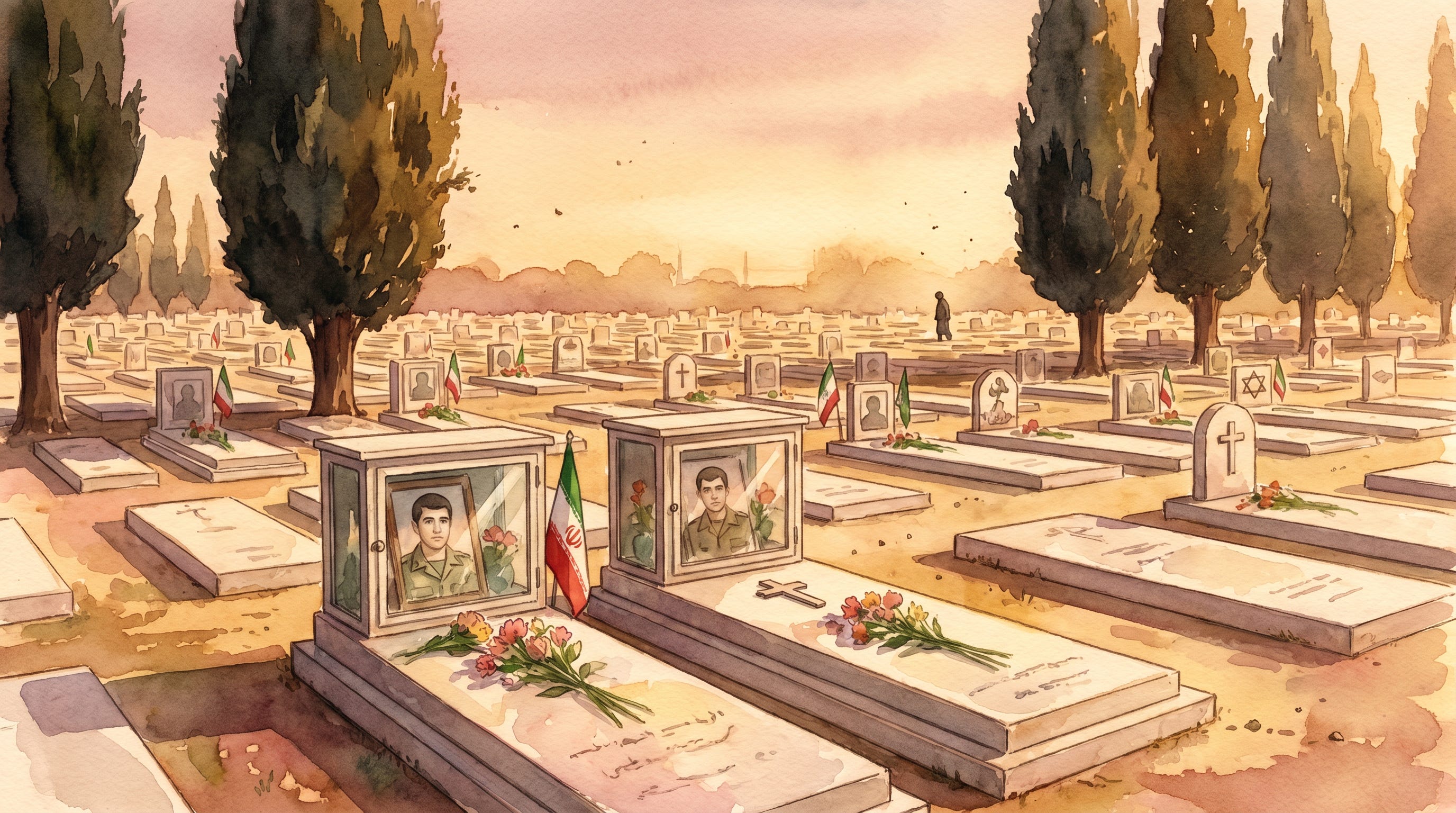
Names.
Each one.
We say them tonight because we have not said them often enough.
Robert Lazar — Assyrian Iranian Christian, martyred in the Iran-Iraq war, buried at Saint Sarkis Cathedral.
Razmik Davidian — Armenian Iranian Christian.
From the early days of the Revolution he joined the Islamic Revolution Committees alongside his Muslim brothers and was martyred in the Sacred Defence. His testament:
“Dear compatriots, I sacrificed my life for the freedom of our homeland. Beloved friends, do not mourn my martyrdom — as from the early days of the revolution, my objective was to sacrifice my life for the homeland’s freedom. I am honoured to wear the uniform of a soldier so that my name will be remembered alongside the names of patriots.”
— Testament of Martyr Razmik Davidian, peace and blessings be upon him; in From Tehran to Bethlehem: Christians on the Frontlines, english.khamenei.ir, 25 December 2023
This is the fifth kind of death from Night 3.
Conscious.
Wakeful.
Knowing.
He is part of the chain.
Vigen Karapetyan and Zurik Moradian — Armenian martyrs of the Sacred Defence.
Martyr Khamenei — may God rest his pure soul — personally visited their families in the years that followed.
These are not the only names.
More than two hundred and twenty religious-minority youth — Armenian, Assyrian, Zoroastrian, Jewish — were martyred in the eight years of the war.
More than one thousand one hundred were disabled.
Almost fifty were taken prisoner of war.
They paid in the same currency, in the same war, on the same front.
Many lie buried beside their Muslim brothers in the same cemeteries.
And every year — until the year he was taken from us — Martyr Khamenei made it his practice to visit the homes of Armenian and Assyrian martyrs on the anniversary of the birth of Jesus — peace and blessings be upon him.
He brought his condolences and the condolences of the Islamic Republic into Christian homes, on a Christian feast day, for a Christian son.
Stories of these visits are collected in a book published in Tehran, Christ on the Night of Power.
He went without convoy.
He sat in their living rooms and wept with them.
This is what we mean when we speak of honour without conflation.
It is not theory.
It is buried in cemeteries we know.
It is in the hands of every Muslim youth who, on the 7th of February 1997, beat their chest inside an Assyrian cathedral and said:
Jesus Christ is the owner of mourning today.
They are not in addition to our caravan.
They are of it.
One more name before we close.
Shireen Abu Akleh.
Palestinian Christian journalist.
On the 11th of May 2022 she was shot in the head — wearing a clearly marked PRESS helmet — by a sniper from the occupying army of the Zionist regime, while reporting on a raid in the Jenin refugee camp.
Her funeral was carried by Muslim and Christian Palestinians together; the same regime sent its police to attack the pallbearers and beat them with clubs.
The chain extends.
It is still being added to.
The Pact We Make Tonight

We have travelled a long way tonight.
The pact will not be a single thing — because the audience tonight is not a single thing.
Three doors.
Take the door that fits where you are.
If this material is new to you — find one Christian witness whose name you do not yet know.
Read their story.
Let them ask of you what they asked of their own community:
Would you have stayed in the room, or fled it?
Then bring the same question back to your own house, and ask it of yourself before Imam Husayn — peace and blessings be upon him.
If your mind tonight is sharpened by the doctrinal cut — take one of the divergences named tonight.
Vicarious atonement.
Inherited guilt.
Choose one.
Study it carefully.
Not to argue with anyone.
To know.
If the names of the religious-minority martyrs of the Sacred Defence stayed in the room — find their names.
Robert Lazar.
Razmik Davidian.
Vigen Karapetyan.
Zurik Moradian.
The more than two hundred and twenty.
Speak their names this week, when you say “the martyrs.”
Whichever door you walk through, walk through it.
The point of the pact is not which door.
The point of the pact is to choose.
Imam Husayn does not need our admiration;
He needs our movement.
Choose one door.
Walk it.
The Road Ahead
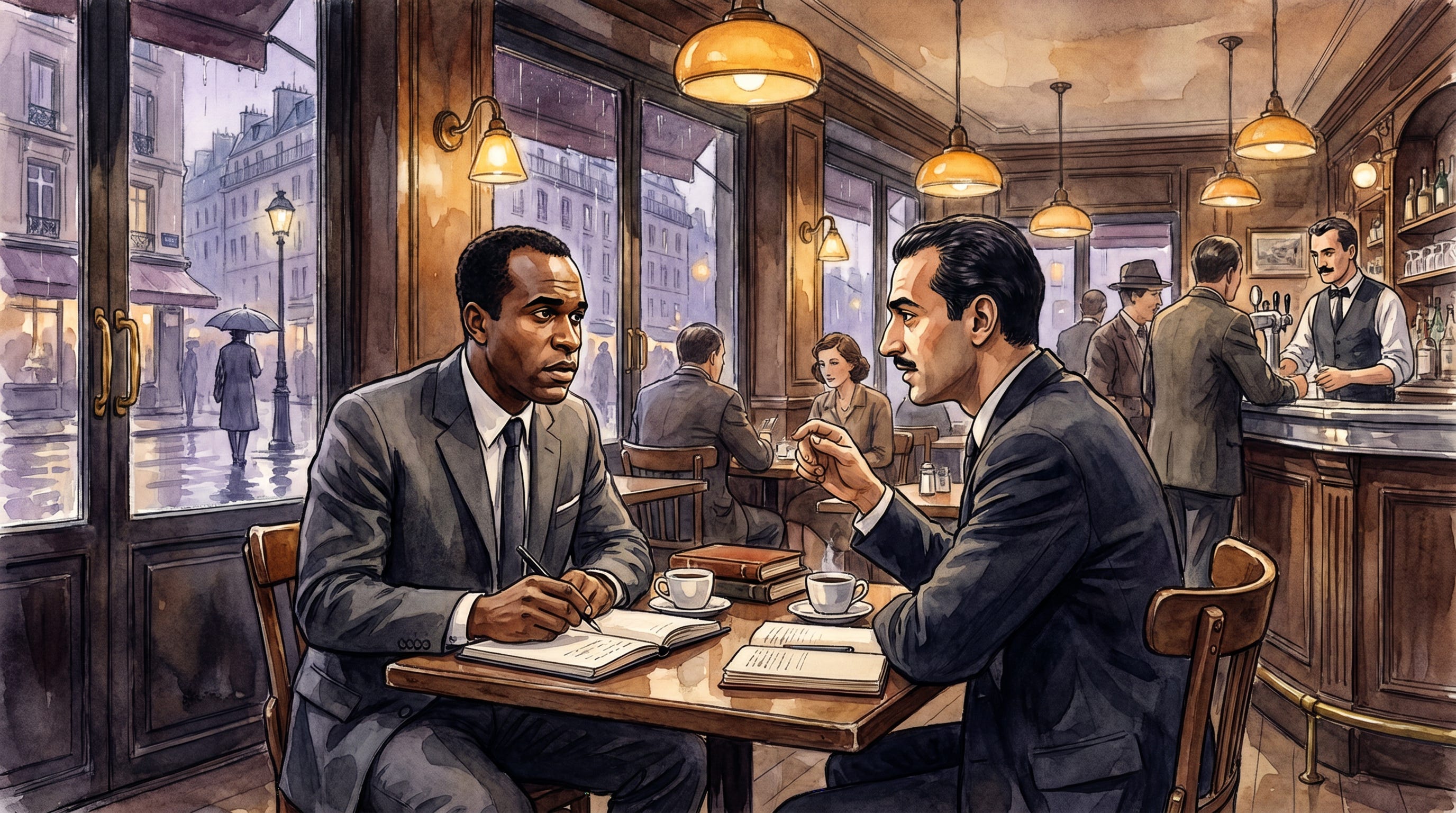
Tomorrow night we leave the religious neighbour and we visit the secular one.
Frantz Fanon and our own Dr Ali Shariati — may God rest his pure soul — who shared cafés in Paris in the early 1960s, who watched each other’s revolutions.
The twentieth century’s attempt to produce martyrs without God.
The Wretched and the Witness.
Where it sang, where it failed, what it teaches us about the witness whose source is not the covenant.
The Question to Carry Home
One question.
When the witness across the table is not from your tradition — when their words are different and their doctrines diverge from yours — can you honour what is true in them without diminishing what is true in you?
Or do you, like the sectarian on either side, find yourself reaching for diminishment to feel safe?
Imam Husayn — peace and blessings be upon him — never reached for diminishment.
The Khutba of Mina is an indictment of corruption.
It is not a denigration of Jew or Christian.
The proof of tabyeen is whether the lamp gives off enough light that a stranger can come closer — and distinctly enough that the lamp can still be recognised.
Two Who Crossed Over
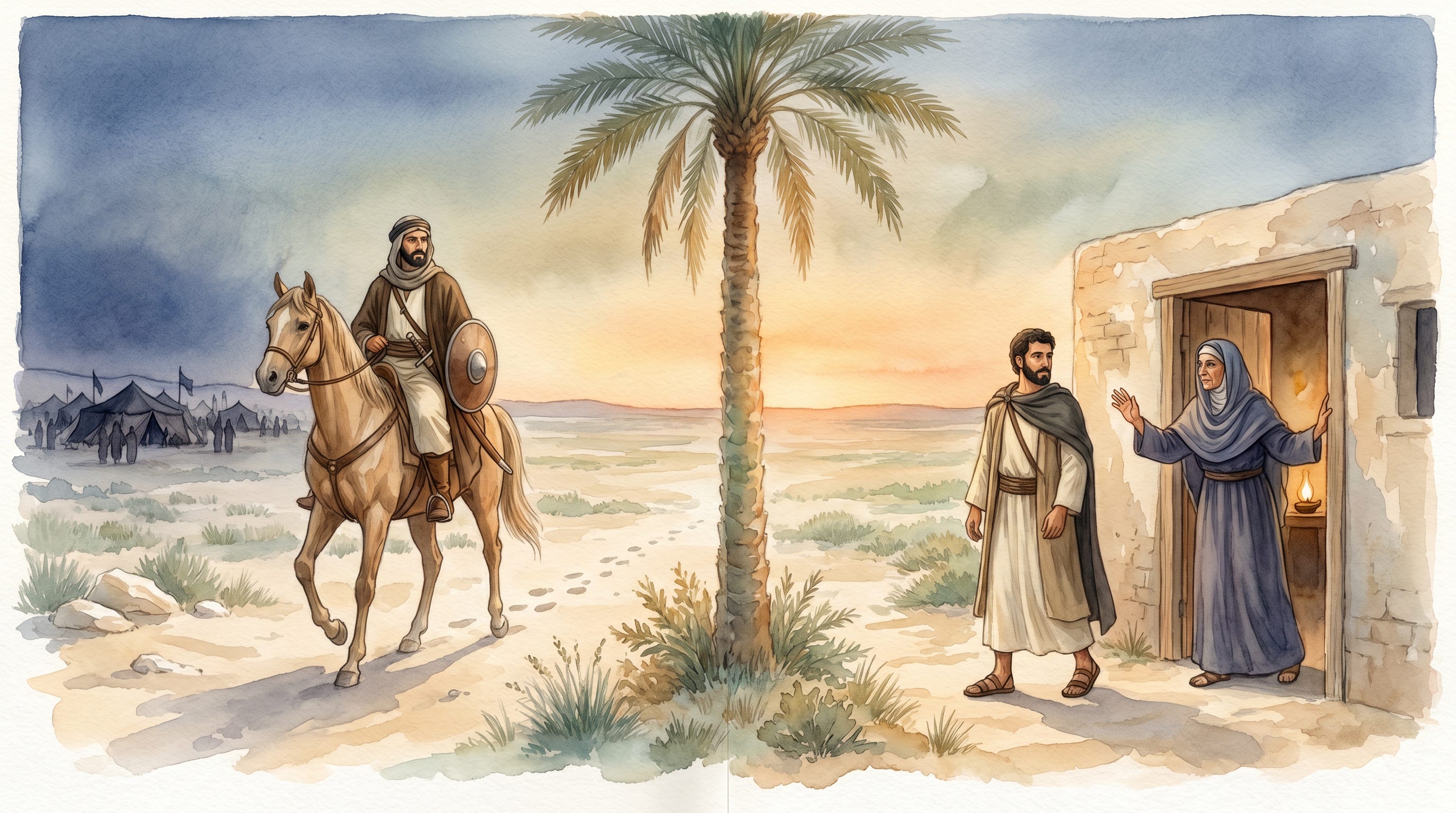
Now we give the rest of the hour to the one who has never left us.
The voice you are about to hear speaks from behind the veils of the occultation.
Tonight it speaks for two witnesses, not one.
The first is a captain in the wrong army.
Hurr ibn Yazid al-Riyahi — peace and blessings be upon him.
Sent by the governor of Kufa to herd Imam Husayn’s caravan to Karbala.
A thousand horsemen behind him; a wage; a tribe; a reputation.
And there was a man in another tent, on the same night, offered the governorship of Rayy if he would lead the army to the killing — that man stayed where he was, and chose Rayy, and chose the fire.
Hurr trembled in the same night, and chose differently.
At dawn he turned his horse and crossed the open sand and laid his shield upside down in the dust, and Imam Husayn looked at him and said:
God has accepted your repentance.
You are free, as your mother named you free.
The second started further away — a Christian.
Wahab ibn Abdullah al-Kalbi al-Nasrani — peace and blessings be upon him.
He and his mother were Christians of the Banu Kalb.
Imam Husayn — peace and blessings be upon him — passed by their door on the road to Kufa, and the mother — who knew from her own life what a prayer of Imam Ali — peace and blessings be upon him — had once meant for her — pressed her son:
Go and support the son of Ali.
They crossed — out of one tradition into the completion of it.
They walked with him to Karbala.
On the morning of Ashura, Wahab fought; he killed seven or eight before he was captured.
His head was struck off and hurled into Imam Husayn’s camp like a gift from the executioner.
His mother took up his sword to follow him into the field.
The Imam restrained her — and told her she and her son would be with the Messenger of God in paradise.
This is the Christian witness at Karbala.
Not a parallel.
Not an analogy.
A figure on the same plain.
Two crossings.
One out of an army into its opposite.
One out of a tradition into its completion.
They began at different starting points.
They fell at the same destination.
And the cross was made not at the moment of dying — but at the moment of living.
The Imam — may our souls be his ransom, and may God hasten his return — comes to us tonight from behind the veils — for both of them.
Listen.
Segue to Maqtal (Lamentation)
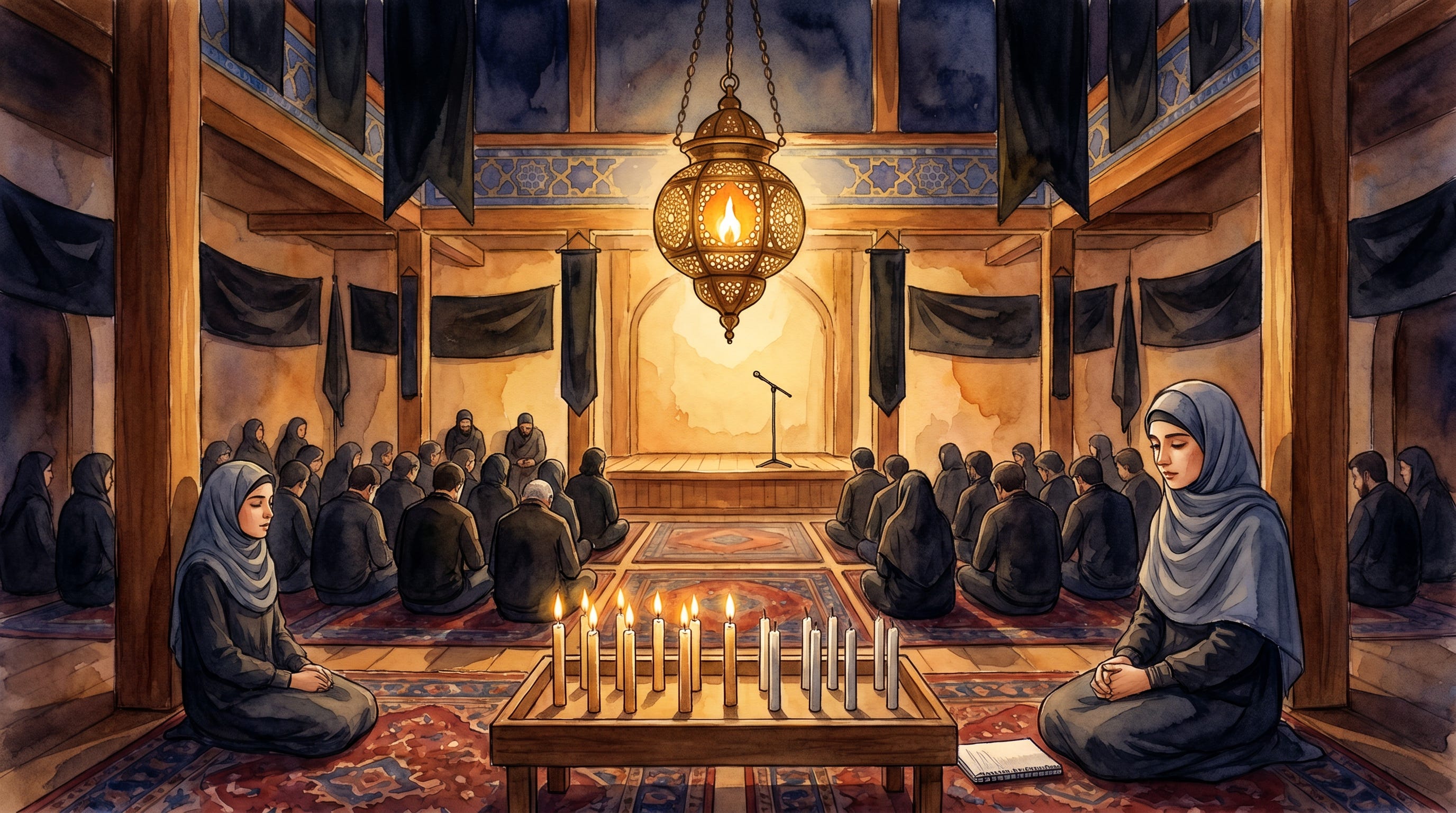
Maqtal (Lamentation) for the Fifth Night of Muharram 2026/1448
Supplication
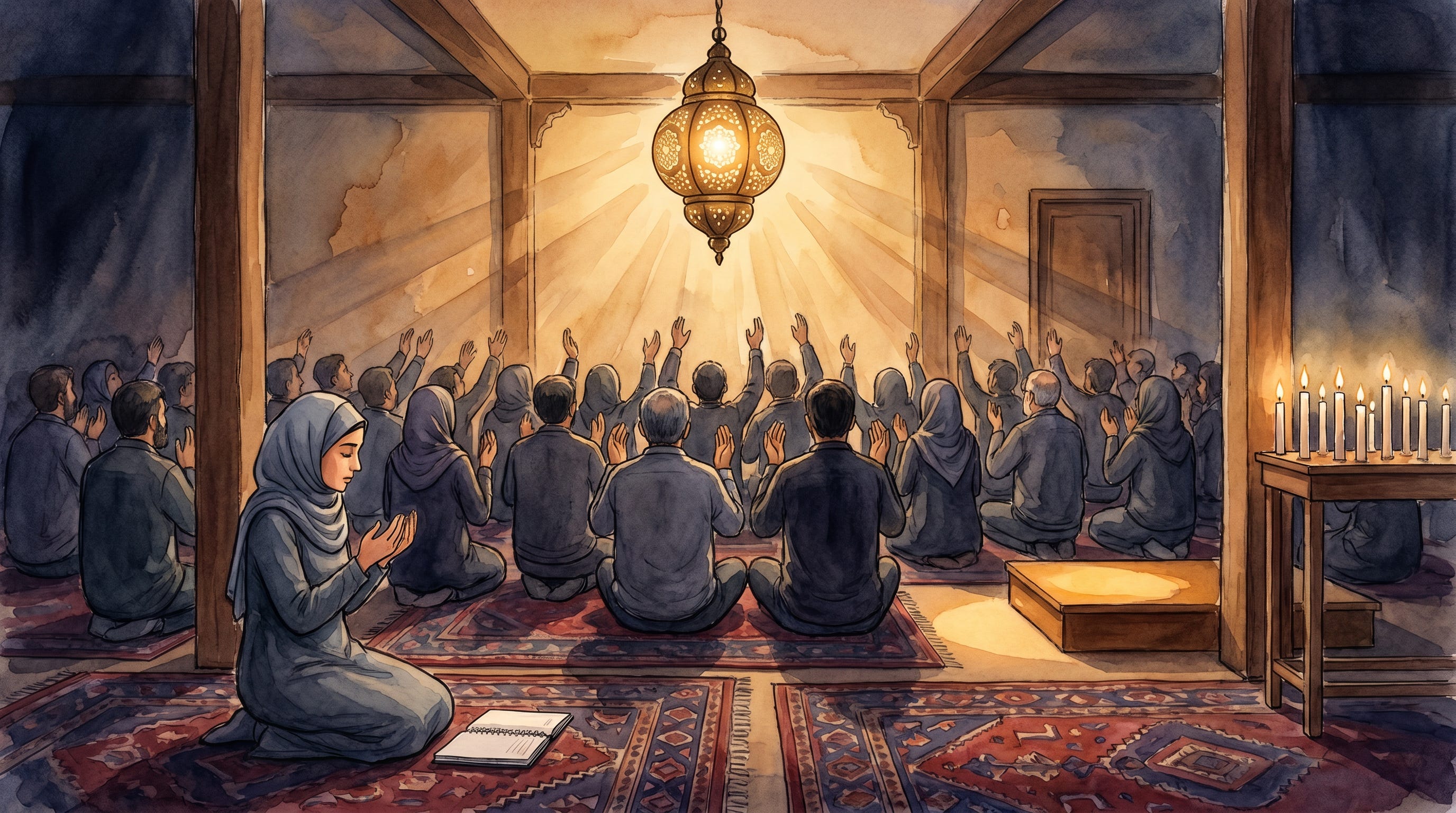
Peace be upon Abel, the first witness.
Peace be upon every witness in every tongue who refused to bow.
Peace be upon Hurr, who turned.
Peace be upon Wahab, who crossed.
Peace be upon Wahab’s mother, who took up his sword when his head came back to camp, and was promised by our Imam she would walk with the Prophet of God in paradise.
Peace be upon Husayn, the master of every chain.
Peace be upon the Imam of our age, who remembers.
Peace be upon Martyr Khamenei, in our first Muharram without him.
Peace be upon you all, and upon your houses, and upon the candle that was lit tonight and that will not be put out.
O God — You Who have no beginning and no end, You Who created the heavens and the earth and what lies between them — we turn to You tonight at the door of this Muharram, and we have no Lord but You, and no refuge but Your door, and no words worthy of You except the ones You Yourself have taught us.
All praise belongs to You — the praise of those who know You and the praise of those who are still learning to know You.
You are the One who sent the prophets, raised the witnesses, and preserved the chain from the first morning of creation until this hour.
The flame is Yours.
The oil is Yours.
The candle that burned to light each one of these rooms was Yours from the beginning, and the witnesses who lit it were Yours.
O God — we send our condolences and our congratulations tonight to Your beloved Prophet Muhammad — peace and blessings be upon him, his family, and his righteous companions — on the days of this month.
Condolences, because his grandson — the master of the youth of Paradise — will be slain on a plain in Iraq.
Congratulations, because the witness he gave has not ended.
It will burn until the day You raise him, and seat him beside You, and the whole of creation sees what the witnesses always knew.
O God — we send our peace tonight to Your servant Jesus, son of Mary —peace and blessings be upon him, and may You, our beloved Lord hasten his return.
The great prophet of Your Book.
The one who, in our own tradition, did not die on the cross but was raised by You into Your protection.
We send peace upon him as Your messenger — neither more nor less than that, as the Qur’an Itself instructs us.
And we send peace, with him, upon his blessed mother Saint Mary — peace and blessings be upon her — al-siddiqah, the truthful.
O God — peace upon those who, in the tradition of Jesus, peace and blessings be upon him, refused to bow when bowing was offered.
O God — we send our peace tonight to Hurr ibn Yazid al-Riyahi, peace and blessings be upon him — the captain who turned.
We ask You — for every Hurr in this room, every Hurr in this age who has been in the wrong camp and has not yet turned — open the door tomorrow morning, before the killing of the day begins, and let them turn their horses, and let them cross the sand, and let our grandfather Imam Husayn — peace and blessings be upon him, give them back the name their mothers gave them.
O God — we send our peace tonight to Wahab ibn Abdullah al-Kalbi al-Nasrani — peace and blessings be upon him — the Christian who saw the truth and the justice of the grandson of Your Messenger and entered Your religion at his hands; and to his mother — peace and blessings be upon her, who pressed him toward the witness on the road, and who, after his head had been hurled into the camp, took up his sword and meant to go to him.
We thank You for letting Wahab’s blood mingle on that plain with the blood of Imam Husayn — the Christian and the descendant of the Prophet — peace and blessings be upon them all, in the same earth.
O God — we send our peace to the Imam of our Age, the Proof of Your existence on Your earth, the Hidden One, the Awaited One, the son of Hasan al-Askari, peace and blessings be upon them both, and may You, O Lord sustainer, hasten his return.
We know he watches.
We know he waits.
We ask You to hasten his appearance.
We ask You to make us worthy of it.
Until that day — keep us among those who carry the candle he has entrusted to us, and who do not set it down.
O God — we mark tonight, with grief and with the obligation it places upon us, that this is the first Muharram since the martyrdom of Martyr Imam Khamenei — peace and blessings be upon him.
The man who taught us tabyeen.
The man who visited Christian families on the anniversary of the birth of Jesus — peace and blessings be upon him, year after year, until the year we lost him.
We ask You to gather him with the prophets and the witnesses and the chain that runs from Abel through Imam Husayn, and to seat us in the company of those who do not turn back.
O God — we send our peace tonight to Imam Husayn — peace and blessings be upon him, the Master of Witnesses, the heir of Adam, the heir of Abraham, their heir of Moses, the heir of Jesus, the heir of Muhammad — peace and blessings be upon them all — the lamp in whom every candle finds its complete form.
Peace be upon you, O Aba Abdillah.
Tonight we have honoured the candles.
Tomorrow night we will honour the candles that tried and failed for want of the right oil.
The night after that we will turn our faces back to your face.
We are coming to you.
Hold the door open.
O God — we have nowhere to go but to You, and no one to ask but You, and no words enough except the ones You have placed on the tongues of Your friends:
إِنَّا لِلَّهِ وَإِنَّا إِلَيْهِ رَاجِعُونَ
“We belong to God, and to Him we return.”
— Qur’an, Surah al-Baqarah (the Chapter of the Cow) #2, Verse 156
And we repeat your promise, an eternal promise for Justice, and a warning for the wrongdoers:
وَسَيَعۡلَمُ ٱلَّذِينَ ظَلَمُوٓاْ أَيَّ مُنقَلَبٖ يَنقَلِبُونَ
And the wrongdoers will soon know at what goal they will end up.
— Qur’an, Surah al-Shu’araa (the Chapter of the Poets) #26, Verse 227
And we add, from the depths of everything we have learned tonight:
حَسْبُنَا اللَّهُ وَنِعْمَ الْوَكِيلُ
“God is sufficient for us, and He is the best of guardians.”
— Qur’an, Surah Aal Imran (the Chapter of the Family of Imran) #3, Verse 173
Amen, O Lord Sustainer of the Universes.
Amen, O Most Merciful of the Merciful.
And from Him alone is all ability, and He has authority over all things.