

In His Name, the Most High
Introduction and Recap
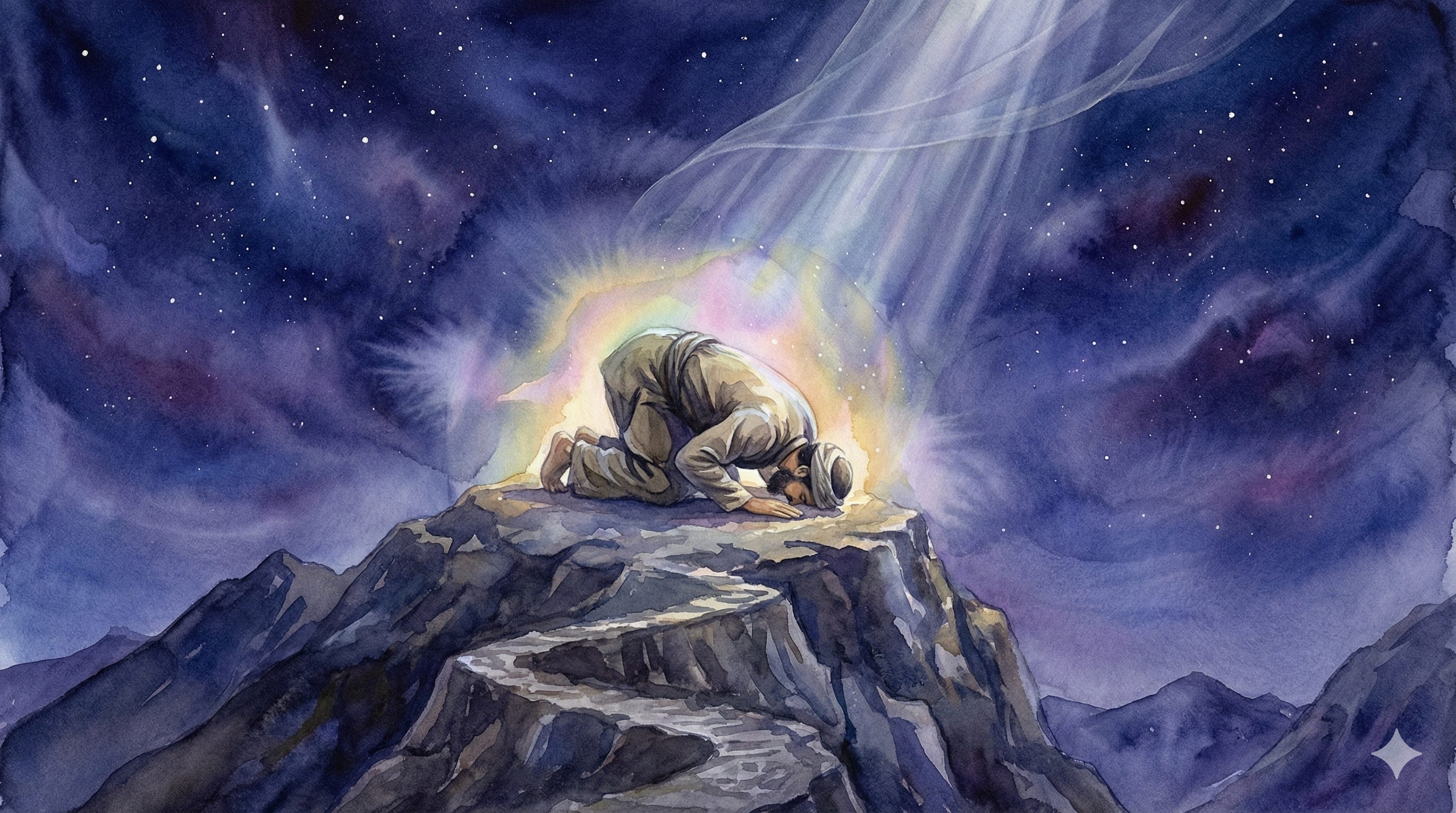
We have been climbing.
You may not have felt it as climbing.
It may have felt like stumbling, or crawling, or — on the worst afternoons, the ones where the hours before maghrib stretched like rubber and the old voice said go back, go back, it was easier before — it may have felt like falling.
But you were climbing.
For four weeks now — four Saturday evenings, four movements of a single prayer — we have been making our way up a mountain we could not see when we started.
In Session One, we left.
We heard the call of Abraham, peace be upon him, and we walked out of the familiar rooms of the ego into the open air of Ramadhan.
That was hijrah — the Great Migration.
The first step.
The hardest step.
Because leaving is easy to talk about and almost impossible to do — and the house of the self has a gravitational pull that most people never escape.
In Session Two, we cleaned.
We scrubbed the mirror of the heart — limb by limb, sense by sense, layer by layer — and we learned that the heart is not broken.
It is covered.
And that the work of Ramadhan is not to build something new but to remove what was never supposed to be there in the first place.
In Session Three, we ate.
We sat down at the Banquet of God — “You are the guests of God” — and we discovered that the food on the table was not bread but Ma’rifah: intimate knowledge that changes the one who receives it.
We learned what it means to be fed by God Himself.
In Session Four, we sacrificed.
We named the Greatest Idol — not a statue of stone but the living, breathing structure of habit and comfort and self-worship that we call “me.”
We met the horse that must be trained, not killed.
We heard Imam Ali, peace be upon him, describe the riyadah — the breaking-in of the soul through taqwa — and we traced the chain of inheritance: fasting to silence, silence to wisdom, wisdom to Ma’rifah, Ma’rifah to Yaqin.
And at the end of that session, Imam Ali left us with a word.
The word was al-Ahrar — the Free.
“Some worship God out of desire — that is the worship of merchants. Some worship God out of fear — that is the worship of slaves. And some worship God out of gratitude — that is the worship of the Free.”
We said: hold that word.
We will need it.
Tonight, we need it.
Because tonight is different.
We are inside the last ten nights of Ramadhan.
The nights of Qadr.
The air has changed.
Something has thinned — some membrane between you and your Lord that was thick and opaque a month ago has become, through four weeks of hunger and prayer and the slow cracking of the idol, almost translucent.
And three days ago — on the twenty-first of this blessed month — we lost the man who has been our teacher all series.
The Commander of the Faithful.
The trainer of the horse.
The breaker of the idol.
The man who said arudduha — “I am training it” — was struck down in the mihrab on the nineteenth, and he left us on the twenty-first, and in our closing du’a for Session Four we wept for him and heard him say, with blood on his lips and paradise in his eyes: Fuztu wa Rabb al-Ka’bah — “By the Lord of the Ka’bah, I have succeeded.”
His blood is still fresh in our calendar.
His teaching is still ringing in our ears.
And tonight — on the night he has prepared us for, through four sessions of training and breaking and feeding and stripping away — we arrive at the question that has been waiting behind every session:
What happens when you actually meet God?
There is a passage in Imam Ali’s letter to his son — Letter 31 of Nahj al-Balagha, written after the Battle of Siffin, perhaps the most extraordinary document a father has ever left a child — where Imam Ali gives six commands for the heart.
Not suggestions.
Not advice.
Commands.
Listen to them, and hear the map of everything we have done this month:
«أَحْيِ قَلْبَكَ بِالْمَوْعِظَةِ، وَأَمِتْهُ بِالزَّهَادَةِ، وَقَوِّهِ بِالْيَقِينِ، وَنَوِّرْهُ بِالْحِكْمَةِ، وَذَلِّلْهُ بِذِكْرِ الْمَوْتِ، وَقَرِّرْهُ بِالْفَنَاءِ»
“Revive your heart with counsel; still it with renunciation; fortify it with certainty; illumine it with wisdom; humble it with the remembrance of death; and bring it to confess its own annihilation.”
— Nahj al-Balagha, Letter 31
Six commands.
Five sessions.
The correspondence is almost too precise to be coincidence.
Revive your heart with counsel — that was Session One.
The wake-up call.
The moment the heart stirred and said:
I cannot stay in this house any longer.
Still it with renunciation — Session Two.
The stripping away.
The cleaning of the mirror until what remains is not the mirror at all, but what it reflects.
Fortify it with certainty; illumine it with wisdom — Session Three.
The Banquet.
The moment when knowledge ceased to be something you carry and became something you are carried by.
Humble it with the remembrance of death — Session Four.
The breaking of the idol.
The training of the horse.
Imam Ali on his deathbed three nights ago, blood on his lips, still teaching.
And the sixth command — the final word:
قَرِّرْهُ بِالْفَنَاءِ
Bring your heart to confess its own annihilation.
Al-fana’.
That is where we are standing tonight.
The entire programme of Ramadhan — compressed into six commands by the man whose martyrdom we are mourning.
And the last word is fana’.
Annihilation.
Not as an ending but as an arrival.
Not as something to fear but as something to confess — to acknowledge, to accept, to welcome.
The heart does not resist its own annihilation; it confesses it, the way a river confesses the sea.
But what does it mean to confess your own annihilation?
What does fana’ actually look like — not as a concept in a book of philosophy, but as something you might taste on a night like tonight, with your forehead on the ground and nothing between you and your Lord but the thinning air of the last ten nights?
That is what we are here to explore.
Video of the Majlis (Sermon/Lecture)
Audio of the Majlis (Sermon/Lecture)
Movement 1: The Worship of the Free — Why You Came

At the end of Session Four, we left you with a word.
Do you remember it?
Ali said — in Saying 237 of Nahj al-Balagha — that there are three kinds of worshippers:
«إِنَّ قَوْماً عَبَدُوا اللَّهَ رَغْبَةً فَتِلْكَ عِبَادَةُ التُّجَّارِ. وَإِنَّ قَوْماً عَبَدُوا اللَّهَ رَهْبَةً فَتِلْكَ عِبَادَةُ الْعَبِيدِ. وَإِنَّ قَوْماً عَبَدُوا اللَّهَ شُكْراً فَتِلْكَ عِبَادَةُ الْأَحْرَارِ.»
“Some worship God out of desire — that is the worship of merchants. Some worship God out of fear — that is the worship of slaves. And some worship God out of gratitude — that is the worship of the Free.”
— Nahj al-Balagha, Saying (Hikmah) 237
We said then:
Hold that word — the Free. We will need it.
Tonight we need it.
Because here is the question that the word ahrar opens up — and it is a question that matters more on the night of Qadr than on any other night of the year:
If the Free do not worship for the sake of paradise, and they do not worship from fear of hell — then what, exactly, draws them to the prayer mat at three in the morning on a night like this?
What force pulls a person to their knees when the transaction has been transcended?
When they are not buying paradise and they are not fleeing punishment?
What is left?
Imam Ali answers this.
In the same Letter 31 — the same wasiyyah to his son from which we drew the six heart-commands a few moments ago — he says:
«وَلاَ تَكُنْ عَبْدَ غَيْرِكَ وَقَدْ جَعَلَكَ اللهُ حُرّاً»
“Do not be the slave of another when God has made you free.”
— Nahj al-Balagha, Letter 31
Notice the architecture.
In Session Four, Imam Ali planted the idea of freedom in a hikmah — a short saying.
A seed dropped into the soil at the end of the evening.
Now, in his wasiyyah to his son — the most intimate document a father can leave — he does not suggest it.
He commands it.
God made you free.
Not partially free.
Not free on the condition that you perform well.
Not free as long as you maintain the right habits and the right image and the right standing among the right people.
Free.
And the command follows: do not enslave yourself to anything that is less than Him.
Not to desire.
Not to fear.
Not to habit.
Not to the opinion of others.
Not to anything that Imam Ali spent all of Session Four teaching you to break.
Act like the free person He created you to be.
But the question still burns.
The Free person who kneels on the night of Qadr — what draws them?
If it is not desire for reward and it is not fear of punishment — what is the pull?
What is the gravity?
There is a narration attributed to Imam Ali that the great scholars have treasured.
Mirza Maliki Tabrizi cites it in Al-Muraqabat in his discussion of the highest station of worship.
Ayatullah Bahjat, may God rest his pure soul, returned to it again and again in his teaching circles in Qom.
Imam Ali says:
«مَا عَبَدْتُكَ خَوْفاً مِنْ نَارِكَ، وَلَا طَمَعاً فِي جَنَّتِكَ، بَلْ وَجَدْتُكَ أَهْلاً لِلْعِبَادَةِ فَعَبَدْتُكَ»
“I did not worship You from fear of Your fire, nor from desire for Your paradise — but I found You worthy of worship, and so I worshipped You.”
— Attributed to Imam Ali; cited in Al-Muraqabat (Mirza Jawad Maliki Tabrizi), Chapter on Worship; also in Bihar al-Anwar (Allamah Majlisi), Vol. 41
وَجَدْتُكَ أَهْلاً لِلْعِبَادَةِ
Wajadtuka ahlan li’l-’ibadah.
I found You worthy.
Not:
I calculated the reward and decided it was sufficient.
Not:
I weighed the punishment and decided the risk was too great.
I found You — and what I found was that You deserve to be worshipped.
The worship came not from what I might receive, but from what You are.
Ayatullah Bahjat — a man who spent nearly a century in the proximity of God, who was known among the scholars of Qom for a spiritual depth that most of them could sense but few could name — taught this narration to his students and then said something remarkable.
He began by noting that the Imams themselves were not exempt from the human experience of hope and fear.
They too felt the pull of paradise and the weight of hell’s warning.
But they did not worship for those reasons.
And then he said:
ائمهی اطهار علیهم السلام هم ترس از جهنم داشتند و هم طمع به بهشت؛ ولی عبادت را برای خوف و طمع نمیکردند، زیرا جملهی «وجدتک اهلاً للعبادة، فعبدتک» — تو را شایستهی پرستش یافتم و پرستیدم — هیچ چیز به دست نمیدهد که چرا عبادت میکنیم، بلکه قصهی شمع و پروانه است.
“The Pure Imams, peace be upon them, felt both fear of hell and desire for paradise — but they did not worship for the sake of fear or desire. For the phrase ‘I found You worthy of worship, and so I worshipped You’ offers no explanation for why we worship. Rather, it is the story of the moth and the flame.”
— Ayatullah Bahjat; Dar Mahzar-e Ayatullah al-’Uzma Bahjat (Muhammad Husayn Rakhshad), Entry 25; Mu’assasat Farhangi-ye Sama / Markaz-e Tahqiqat-e Rayaneh-i Qa’imiyyeh Isfahan
Qisse-ye sham’ wa parvaneh.
The moth and the flame.
The moth does not fly toward the fire because it has calculated the thermal benefits.
It does not approach because it fears the darkness behind it.
It flies toward the flame because the flame is the flame — because light calls to the one who was made for light, and there is no argument that can explain the pull to someone who has not felt it, and no argument that is needed for someone who has.
And then Ayatullah Bahjat unpacked that phrase — ahlan li’l-’ibadah, “worthy of worship” — and drew from it three stations:
یعنی: اهلاً لأن یُطلب و یُراد و یُعبد. تو را اهل عبادت یافتم، یعنی اهل این که مطلوب و مراد و معبود باشی.
“It means: worthy of being sought, and desired, and worshipped. ‘I found You worthy of worship’ means: worthy of being the one who is longed for, wanted, adored.”
— Ayatullah Bahjat; Dar Mahzar-e Ayatullah al-’Uzma Bahjat (Rakhshad), Entry 25
Three movements in one word.
The seeker who searches.
The lover who longs.
The worshipper who bows.
All three drawn by the same gravity.
All three answering the same call.
All three saying, in different ways, the same thing the moth says when it turns toward the light:
I did not choose this.
This chose me.
This is why tonight matters.
Laylatul Qadr is not a transaction —
“worship tonight and receive a thousand months’ worth of credit to your account.”
That would be the worship of merchants.
And we left the merchants behind in Session Four.
The night of Qadr is the night when the veil between the servant and the Lord is thinnest.
The night when the reason for worship — not the reward of worship, but the reason, the pull, the gravity — becomes visible.
Not as an argument, but as a presence.
The Free do not worship harder on the night of Qadr because the reward is multiplied.
They worship because on this night, the Beloved is nearer.
And the moth cannot help but fly.
But how near?
And what happens to the one who draws close?
Movement 2: Fana — The Annihilation That Is Arrival
The Hinge: Created for Fana

Listen again to Imam Ali — the same letter, the same wasiyyah, a few lines further — and hear the sentence that splits our series in two:
«وَاعْلَمْ يَا بُنَيَّ أَنَّكَ إِنَّمَا خُلِقْتَ لِلْآخِرَةِ لاَ لِلدُّنْيَا، وَلِلْفَنَاءِ لاَ لِلْبَقَاءِ، وَلِلْمَوْتِ لاَ لِلْحَيَاةِ»
“Know, my son, that you were created for the Hereafter, not for this world; for annihilation, not for permanence; for death, not for life.”
— Nahj al-Balagha, Letter 31
Li’l-fana’ la li’l-baqa’.
For annihilation, not for permanence.
Imam Ali — the man whose martyrdom we marked three nights ago — uses the exact words of our final two sessions.
Tonight, Session Five, is fana’.
Next week, on Eid, God willing, is baqa’ — what remains.
Imam Ali wrote the outline of our series fourteen centuries before we sat down to plan it.
But listen carefully to what he is saying, because it is easy to hear this and recoil.
“Created for annihilation” — that sounds like nihilism.
It sounds like despair.
It sounds like the universe is a fire that consumes everything and leaves nothing.
It is the opposite.
What Imam Ali means is this: you were not created to persist as you are.
You were not created to grip tightly to the small, defended, frightened self that wants to be the centre of everything.
You were created to lose yourself in something so vast that the word “yourself” ceases to have the same meaning.
The drop was created for the ocean.
Does the drop die when it enters the sea?
In one sense, yes — it is no longer a separate drop.
But in another sense, it has become something immeasurably greater than it was.
It has become the sea.
The moth was created for the flame — and yes, Ayatullah Bahjat used that image in Movement 1, and here it returns, because fana’ is the completion of what the moth began when it first felt the pull of light.
And here is the callback to Session 2 — to the mirror.
Remember?
We said the heart is not broken.
It is covered.
And we spent that entire session cleaning — scrubbing away the rust and the grime until the glass was clear.
Now ask: what happens to a perfectly clean mirror?
It does not disappear.
It disappears into what it reflects.
You stop seeing the glass altogether.
All you see is the Face.
That is fana’.
Not the annihilation of the self, but the annihilation of the self’s claim to be the centre of the story.
The ego does not vanish.
It becomes transparent.
The mirror does not break.
It becomes invisible — because it is doing, at last, exactly what it was made to do.
The Two Joys: Why the Faster Meets God
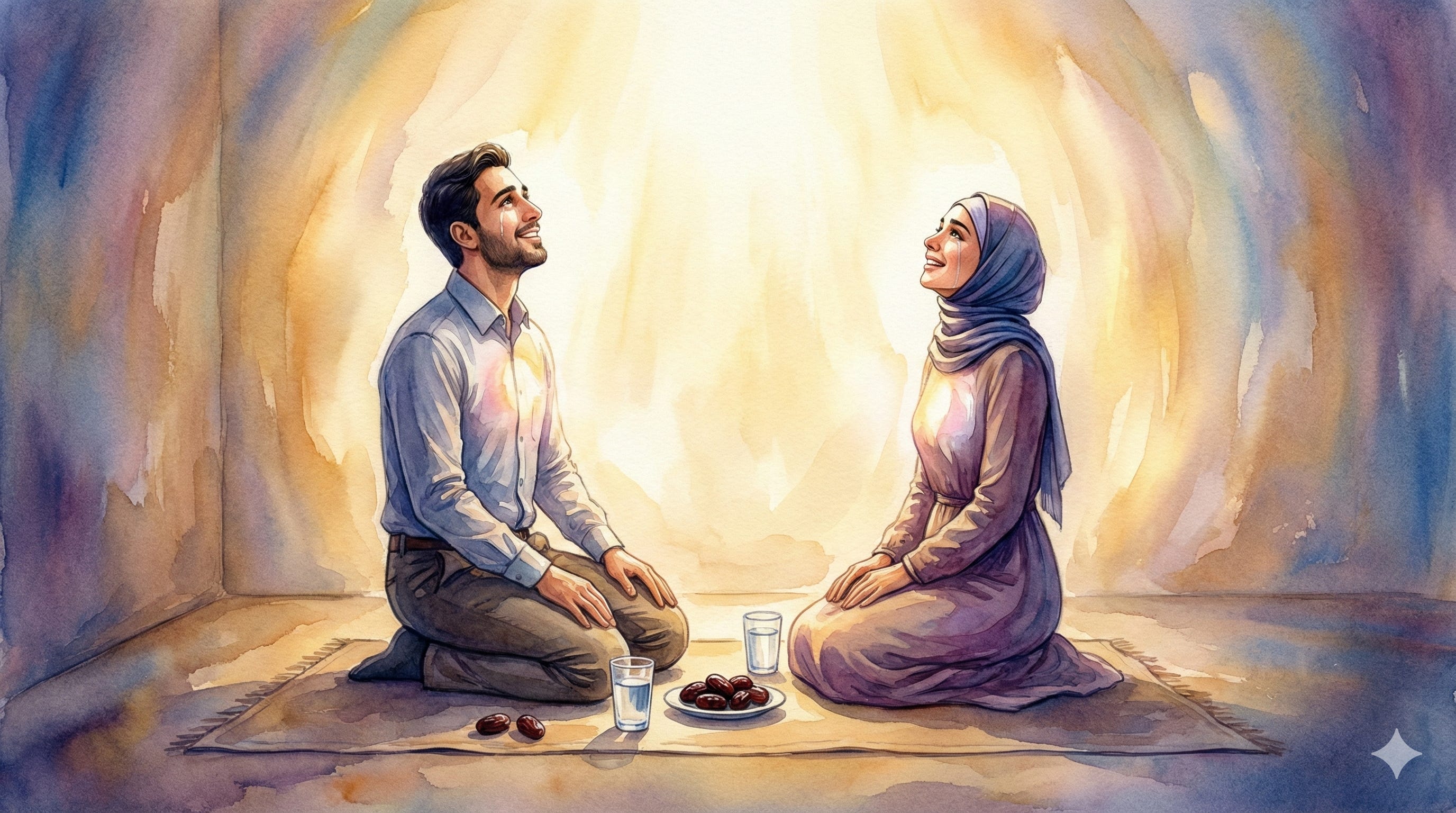
There is a hadith qudsi that has been with us since the beginning of this series — a thread running through every session, cited by Ayatullah Jawadi-Amoli in Hikmat-e ‘Ibadat and by Maliki Tabrizi in Al-Muraqabat.
You know it by now.
God speaking in His own voice:
«الصَّوْمُ لِي وَأَنَا أَجْزِي بِهِ»
“Fasting is for Me, and I Myself am its reward.”
— Hadith Qudsi; narrated in al-Kafi (Shaykh al-Kulayni), Kitab al-Siyam; cited in Hikmat-e ‘Ibadat (Ayatullah Jawadi-Amoli); Al-Muraqabat (Mirza Jawad Maliki Tabrizi), Chapter on the Month of Ramadhan; Bihar al-Anwar (Allamah Majlisi)
We have heard it before.
But tonight — on the night of Qadr, after four weeks of hunger and prayer and the slow cracking of the idol — we are ready to hear something in it that we were not ready for at the start of the month.
Ayatullah Bahjat returned to this hadith often in his teaching on Ramadhan.
And what he drew from it was not a repetition of what the other scholars had said.
It was a sharpening — a blade pressed against the comfortable reading we may have settled into:
در حدیث قدسی آمده است: «الصوم لی و انا اجزی به.» روزه برای من است، و من خود پاداش آن را میدهم. یعنی خداوند متعال ثواب آن را بدون واسطه میدهد، علاوه بر ثوابهایی که در کتاب و سنت ذکر شده است: «فلا تعلم نفس ما اخفی لهم من قرة اعین» — پس هیچ کس نمیداند که چه چشمروشنیهایی برای آنان مخفی شده است. یعنی قابل وصف و توصیف نیست.
“In the hadith qudsi it is stated: ‘Fasting is for Me, and I Myself am its reward.’ That is, God Most High gives its reward without intermediary — over and above the rewards mentioned in Scripture and the Sunnah. As the Quran says: ‘No soul knows what delights of the eye are hidden for them’ (32:17). Meaning: it is beyond description.”
— Ayatullah Bahjat; Dar Mahzar-e Ayatullah al-’Uzma Bahjat (Muhammad Husayn Rakhshad), Entry 347; Mu’assasat Farhangi-ye Sama / Markaz-e Tahqiqat-e Rayaneh-i Qa’imiyyeh Isfahan
Without intermediary.
Bidun-e wasiteh.
Not through a book of accounts.
Not through an angel tallying your deeds.
God Himself, directly, without anything between you and Him.
In earlier sessions, we heard this hadith as a statement about the uniqueness of fasting — that it belongs to God in a way that other acts of worship do not.
That reading was true.
But Ayatullah Bahjat presses further.
He says the reward is not merely unique — it is indescribable.
It exceeds what Scripture itself has named.
It exceeds what the Sunnah has catalogued.
It belongs to a category that the Quran can only gesture toward: no soul knows.
This is what four weeks of emptying has been preparing you to hear.
Every day of the Month of Ramadhan, you have been practising negation.
You have been saying no to food, no to water, no to the body’s most basic demands.
And in that repeated no, a space has opened — a space where the self used to stand, where the appetites used to sit, where the ego used to hold court.
That space is not empty.
It is available.
And what fills it, according to God’s own testimony, is God Himself.
There is another hadith that Ayatullah Bahjat taught alongside this one — the hadith of the faster’s two joys:
«لِلصَّائِمِ فَرْحَتَانِ: فَرْحَةٌ عِنْدَ إِفْطَارِهِ، وَفَرْحَةٌ عِنْدَ لِقَاءِ رَبِّهِ»
“The fasting person has two joys: one at the breaking of the fast, and one at the meeting with his Lord.”
— Prophetic hadith; narrated in al-Kafi (Shaykh al-Kulayni), Kitab al-Siyam; cited in Bihar al-Anwar (Allamah Majlisi)
Two joys.
The first is the body’s joy — the relief of iftar, the date on the tongue, the water in the throat.
Every one of us knows that joy.
We have tasted it every evening for twenty-four days.
But the second joy — farhah ‘inda liqa’ rabbihi — is the soul’s joy.
And notice: the hadith does not say “joy at receiving reward from his Lord.”
It does not say “joy at entering paradise.”
It says liqa’ — meeting.
The joy of the faster is not what God gives.
It is God Himself — encountered, met, present.
And Ayatullah Bahjat, with his characteristic sharpness, added a condition:
همچنین در روایت است که: «للصائم فرحتان: فرحة عند افطاره، و فرحة عند لقاء ربه.» روزهدار دو خوشحالی دارد: یکی هنگام افطار، و دیگری هنگام دیدار پروردگار. البته این در صورتی است که در فطور و سحری، نخوردن در روز را تدارک نکند.
“The faster has two joys: one at iftar, and one at the meeting with his Lord. But this is only so if, at iftar and suhur, he does not compensate for what he did not eat during the day.”
— Ayatullah Bahjat; Dar Mahzar-e Ayatullah al-’Uzma Bahjat (Rakhshad), Entry 348
Read that again.
The faster who gorges at sunset has traded the second joy for a larger version of the first.
The real faster carries the emptiness forward.
The emptiness is not a problem to be solved at iftar.
It is not a deprivation to be corrected at suhur.
It is the doorway to liqa’.
For twenty-four days you have been emptying.
Tonight is not the night to ask whether the emptying was worth it.
Tonight is the night to discover what the emptying was for.
The Bankrupt Servant: Arriving Empty
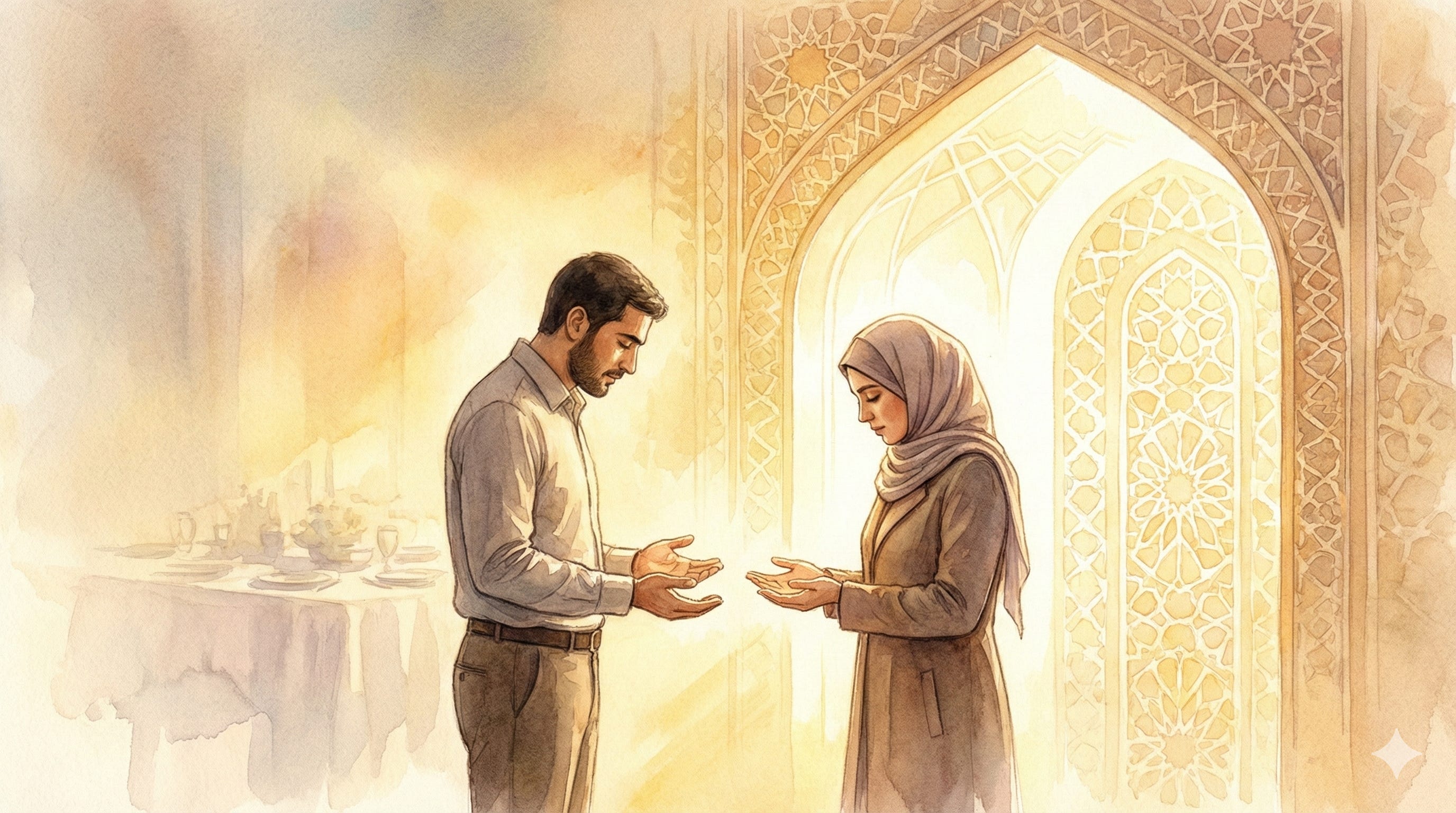
In Al-Muraqabat, Mirza Maliki Tabrizi asks us to imagine what the Month of Ramadhan actually is.
He says: picture the month as a noble envoy — rasulun ‘azizun sharif — arriving at your door from a great king.
The envoy tells you that the sultan has invited you to his banquet.
And not just any banquet — a banquet where the sultan himself will be present, where he promises forgiveness of every fault, gifts beyond reckoning, robes of honour, and — beyond all of this — something that defies description:
فالأولى له أن يتصوّر هذا الملك كأنّه رسولٌ عزيزٌ شريفٌ لبعض ملوك الدنيا، وجاءه من قبل هذا الملك لدعوة هذه الرعيّة مجلس ضيافة السلطان، وأُخبر أنّ السلطان معه في غاية اللطف من مغفرة الزلّات وعطاء الهبات وفرامين الولايات والخِلَع الفاخرات، بل في مقام الرضا والدعوة مجلس الأنس واللقاء والقرب والوفاء وتشريفه في زمرة الأحبّاء والأولياء.
“It is best for him to imagine this month as though a noble, honoured envoy from one of the kings of the world has come to him, and has come on behalf of that king to invite these subjects to the sultan’s banquet — and has informed him that the sultan will treat him with the utmost grace: forgiveness of faults, bestowal of gifts, warrants of authority, and splendid robes of honour — nay, rather in the station of pleasure, in the gathering of intimacy and meeting, nearness and fidelity, and his being honoured among the company of the Beloved Ones and the Saints.”
— Mirza Jawad Maliki Tabrizi; Al-Muraqabat fi A’mal al-Sanah (ed. Muhsin Bidarfar), Chapter: Muraqabat Shahr Ramadhan al-Mubarak; Manshurat-e Bidar, Qom
Intimacy.
Meeting.
Nearness.
The company of the Beloved.
This is what the Month of Ramadhan has been.
For a month, you have been sitting at that banquet.
God spread the table —
“You have been invited to the feast of God,”
the Prophet said in his famous sermon at the gates of the month,
“and you have been made among the people of God’s honour.”
«أَيُّهَا النَّاسُ، إِنَّهُ قَدْ أَقْبَلَ إِلَيْكُمْ شَهْرُ اللهِ بِالْبَرَكَةِ وَالرَّحْمَةِ وَالْمَغْفِرَةِ... شَهْرٌ دُعِيتُمْ فِيهِ إِلَى ضِيَافَةِ اللهِ وَجُعِلْتُمْ فِيهِ مِنْ أَهْلِ كَرَامَةِ اللهِ»
“O people, the month of God has come to you bearing blessing and mercy and forgiveness... a month in which you have been invited to the feast of God, and you have been made therein among the people of God’s honour.”
— Prophet Muhammad, peace be upon him and his family; Khutbat Sha’baniyyah; narrated via Imam al-Rida from his forefathers in Bisharat al-Mustafa (al-Tabari); cited in Al-Muraqabat (Maliki Tabrizi), Chapter: Muraqabat Shahr Ramadhan
You have eaten the king’s food.
You have worn the king’s garments.
You have slept under the king’s roof.
Every prayer was His gift.
Every moment of tawfiq — every time you managed to rise for suhur, every time you held your tongue, every time the horse obeyed the reins — that was His enabling, not your achievement.
And now, as the month draws to its close on the night of Qadr, the question hangs in the air:
what, exactly, have you brought to this banquet that was yours?
Mirza Maliki Tabrizi tells us how the honest servant responds.
Not with a list of accomplishments.
With four things:
بإظهار الشكر، وقبول المنّ، وعذر التقصير، وذلّ الاعتراف.
“By showing gratitude, accepting the grace, offering the excuse of one’s deficiency, and the abasement of confession.”
— Mirza Jawad Maliki Tabrizi; Al-Muraqabat, Chapter: Muraqabat Shahr Ramadhan al-Mubarak
Dhull al-i’tiraf.
The abasement of confession.
Not:
“Here is what I achieved this month.”
Not:
“Here is my record of devotion.”
The honest servant arrives at the end of the feast and says:
Everything was Yours.
The food was Yours.
The strength to fast was Yours.
Even the tears in my du’a were a gift I did nothing to earn.
I am bankrupt.
And I confess it.
And here is the secret that the tradition has been whispering to us all month long — that we first heard in Session 4 and that now, on the night of Qadr, becomes deafening in its clarity:
The bankruptcy is the qualification.
Listen again to the du’a we encountered two weeks ago — the du’a for the nights of Ramadhan, from Misbah al-Mutahajjid and Iqbal al-A’mal:
«فَإِنِّي لَمْ آتِكَ ثِقَةً بِعَمَلٍ صَالِحٍ عَمِلْتُهُ، وَلَا لِوِفَادَةِ مَخْلُوقٍ رَجَوْتُهُ، أَتَيْتُكَ مُقِرّاً عَلَى نَفْسِي بِالْإِسَاءَةِ وَالظُّلْمِ»
“I have not come trusting in any righteous deed I have done, nor seeking the patronage of any creature I have hoped in. I have come confessing against my own soul — my wrongdoing and my oppression.”
— Du’a for the Nights of Ramadhan; Misbah al-Mutahajjid (Shaykh al-Tusi); Iqbal al-A’mal (Sayyid Ibn Tawus)
In Session 4, we heard this du’a as the sound of an idol breaking — the idol of self-satisfaction, the idol of “I have done enough.”
Tonight, on the threshold of Qadr, we hear it differently.
We hear it as the entrance requirement.
You do not arrive at the Meeting with a CV of good deeds.
You do not present credentials at the door.
You arrive as the bankrupt servant, with nothing in your hands but the admission that everything in your hands was His.
The dhull al-i’tiraf that Mirza Maliki Tabrizi named — the abasement of confession — is not a failure.
It is the posture in which the Meeting becomes possible.
And the extraordinary, impossible, world-inverting truth of Qadr is this: that admission — that bankruptcy — is exactly what God has been waiting for.
The fast is for Me, He said.
Not for your résumé.
For Me.
And the reward is not what I give you.
The reward is that I am here.
Laylatul Qadr as Living Reality
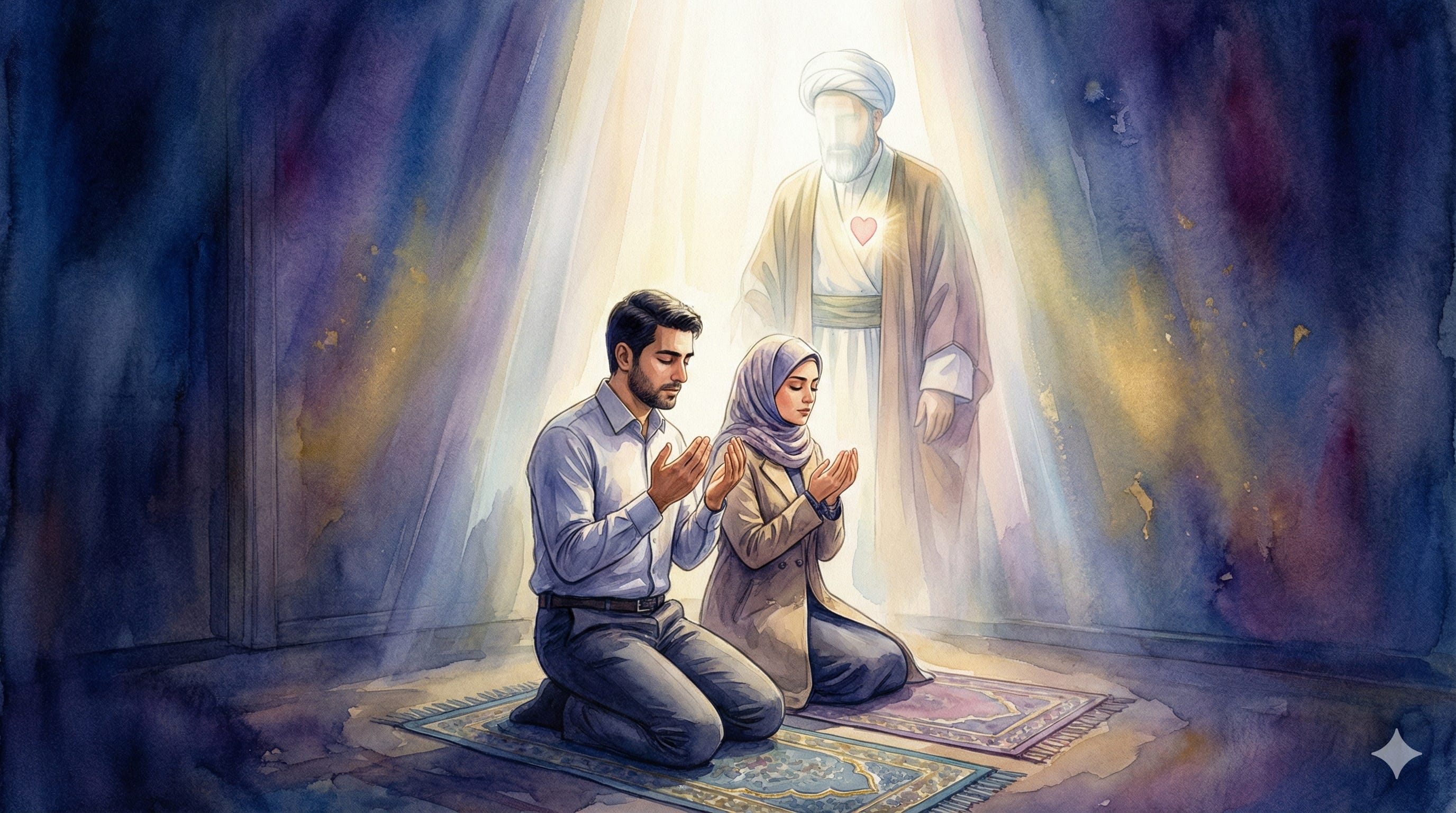
Ayatullah Bahjat — and we must speak of him here, because he spent decades living in the proximity of these nights in a way that few in our age have matched — taught something about Laylatul Qadr that cuts through a great deal of our confusion.
There is a report, attested in the biographical literature, that Imam al-Mahdi, may God hasten his appearance, said to someone who had long sought to meet him:
«خود را درست کن، ما به سراغت میآییم.»
“Fix yourself, and we will come to you.”
— Imam al-Mahdi (as reported); ’Asr-e Zuhur az Zaban-e Ayatullah Bahjat (Hamzeh Sharifi-Dust), Page 48; Daftar-e Nashr-e Ma’arif, 1393
And Ayatullah Bahjat added:
ترک واجبات و ارتکاب محرمات، حجاب و نقاب دیدار ما از آن حضرت است.
“The abandonment of obligations and the commission of prohibited acts — these are the veil and the mask that prevent our seeing of that Noble Presence.”
— Ayatullah Bahjat; ’Asr-e Zuhur (Sharifi-Dust), Page 48
The veil is not distance.
God is not far.
The Imam is not absent.
What prevents the encounter is nothing more exotic than our own abandoned obligations and committed prohibitions.
The veil is ours.
This is the teaching about Qadr that changes everything: you do not find God by searching. You find God by becoming findable.
Laylatul Qadr is not a treasure hunt where the treasure is hidden in one of three nights and your job is to guess which one.
It is the night — or rather, the state — in which the One you have been seeking turns and says:
I was here the whole time.
You were the one who was absent.
If you have done the work of four weeks — if you have left the house, cleaned the mirror, eaten at the Banquet, and broken the idol — then tonight, right now, you have become findable.
The question is not whether God will show up.
He is already here.
The question is whether you will be present enough to notice.
And notice what the Quran tells us happens on this night.
The Spirit — al-Ruh — descends.
Not just the angels, but the Spirit — which the Quran names separately, which is greater than the angels, which descends once a year upon the heart of the Imam.
Ayatullah Bahjat taught about the nature of this descent:
و این روح هم دو روح بوده: یکی روحی که در هر سال یک بار در شب قدر بر قلب امام — علیه السلام — همراه با فرشتگان نازل میشود: «تنزل الملائکة و الروح» — ملایکه و روح فرود میآیند. که روح غیر از ملایکه است.
“And this Spirit itself is of two kinds: one is the Spirit that descends once a year, on the night of Qadr, upon the heart of the Imam — peace be upon him — together with the angels: ‘The angels and the Spirit descend therein.’ The angels and the Spirit come down — and the Spirit is other than the angels.”
— Ayatullah Bahjat; Dar Mahzar-e Ayatullah al-’Uzma Bahjat (Rakhshad), Entry 355
The Spirit is other than the angels.
The Quran itself makes this distinction — tanazzalu al-mala’ikatu wa’l-ruh — naming the angels and then naming the Spirit separately, as though to say: this is something more.
Something the angels themselves attend upon.
Something that descends upon the qalb — the heart — of the living Imam, carrying within it the decrees of every soul for the coming year.
The tradition teaches us — and Mafatih al-Jinan records it in its commentary on the nights of Qadr — that on this night:
تقدیر امور سال در این شب صورت میگیرد، و فرشتگان و روح… به محضر امام زمان (عج) میرسند و آنچه را که برای هر فرد مقدّر شده بر آن حضرت عرضه میدارند.
“The decrees of the year’s affairs take form on this night, and the angels and the Spirit descend to the presence of the Imam of the Age — may God hasten his appearance — and they present to him what has been decreed for each individual.”
— Mafatih al-Jinan (Shaykh Abbas Qummi), Commentary on the Nights of Qadr (A’mal Shab-ha-ye Qadr)
The decrees of your life are being written tonight.
And they are being written not by a distant bureaucracy but in the presence of the one who carries the light of God on earth — the one to whom Ayatullah Bahjat devoted his life’s longing.
And yet — and this is the part that keeps the tradition honest, that prevents Qadr from becoming spiritual theatre — Ayatullah Bahjat also said:
لازم نیست که انسان در پی این باشد که به خدمت حضرت ولی عصر تشرف حاصل کند، بلکه شاید خواندن دو رکعت نماز سپس توسل به ائمه بهتر از تشرف باشد؛ زیرا هر کجا که باشیم، آن حضرت میبیند و میشنود و زیارت هر کدام از ائمهی اطهار مانند زیارت خود حضرت حجت است.
“It is not necessary for a person to seek a miraculous visitation with the Master of the Age. Rather, perhaps performing two rak’at of prayer and then making tawassul to the Imams is better than such a visitation — for wherever we may be, that Noble Presence sees and hears, and the visitation of any of the Pure Imams is equivalent to the visitation of the Hujjah himself.”
— Ayatullah Bahjat; ’Asr-e Zuhur az Zaban-e Ayatullah Bahjat (Sharifi-Dust), Page 45; reference to Dar Mahzar-e Ayatullah al-’Uzma Bahjat, Volume 1, Page 187
The Meeting is not spectacle.
It is not about seeing visions or hearing voices.
Two rak’at — offered with the heart that Imam Ali described, the heart that has been revived, stilled, fortified, illumined, humbled, and brought to confess its own annihilation — those two rak’at may be worth more than any extraordinary experience.
Because the Meeting is not an event.
It is a relationship.
And a relationship is built in the quiet.
In the ordinary.
In the two rak’at before dawn when no one is watching and the moth has nothing left to give except its flight toward the flame.
A Quieter Moment: The Man Who Lived It
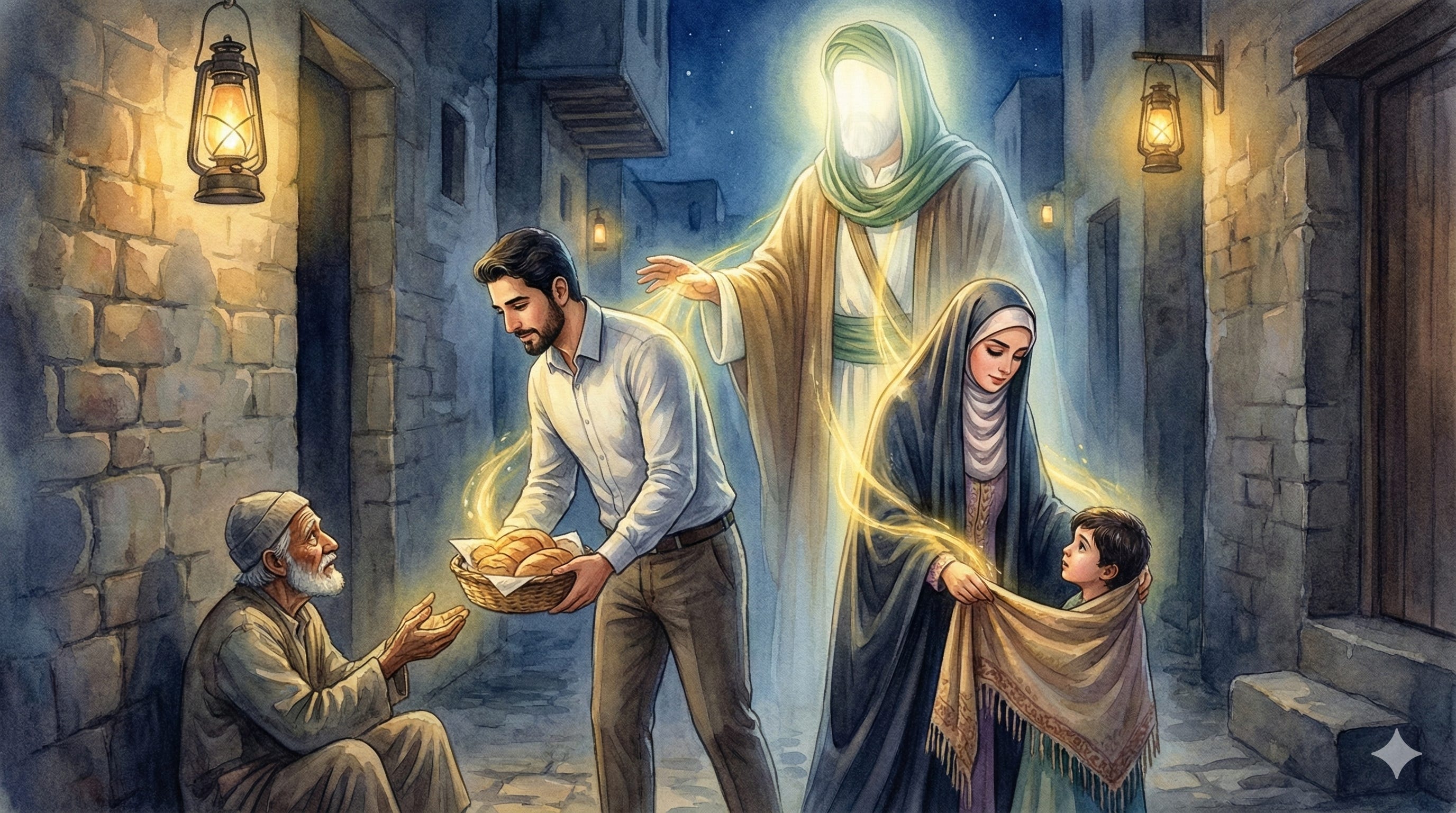
We have been speaking of fana’ as a concept.
A theological category.
A station on the path.
But three nights ago — on the 21st of Ramadhan — we marked the death of the man who did not merely teach fana’.
He lived it.
Imam Ali ibn Abi Talib was struck on the 19th.
He died on the 21st.
Between the blow and the death — in those final hours, with the poison of the sword moving through his body — he dictated his last testament to his scribe, ‘Ubaydullah ibn Abi Rafi’.
He addressed it to Imam Hasan and Imam Husayn and all his children, and through them, to every believer who would ever read it.
And the testament begins with the most extraordinary opening line a dying man has ever spoken:
«هذا ما أوصى به عبد الله أمير المؤمنين عليّ بن أبي طالب لآخر أيّامه من الدنيا، وهو صائرٌ إلى برزخ الموتى، والرحيل عن الأهل والأخلّاء.»
“This is the testament of the servant of God, the Commander of the Faithful, Ali ibn Abi Talib, in the last of his days in this world — as he is passing to the isthmus of the dead, and departing from family and companions.”
— Imam Ali; Nahj al-Balagha (Sharif al-Radi), the Wasiyyah (Letter 47, in the numbering of the Radi); dictated after being struck by Ibn Muljam, 19th Ramadhan 40 AH
Wa huwa sa’irun ila barzakh al-mawta.
He is passing to the isthmus of the dead.
He states it as a fact.
Not with dread.
Not with resistance.
With the calm of a man who told his son, in that same Letter 31 we have been reading all series:
you were created for annihilation, not for permanence.
And then — and this is the part that breaks you open if you are paying attention — he does not spend his last breath talking about himself.
He does not talk about his pain.
He does not talk about his legacy.
He does not talk about the injustice of the blow.
He turns his face — the face of a dying man — toward other people.
And he begins a litany.
«اللهَ اللهَ في الأيتام، فلا تُغِبّوا أفواههم، ولا يضيعوا بحضرتكم»
“God, God — in the matter of the orphans. Do not let them go hungry, and do not let them be lost while you are present.”
«واللهَ اللهَ في جيرانكم، فإنّهم وصيّة نبيّكم، وما زال رسول الله صلّى الله عليه وآله وسلّم يوصي بهم حتّى ظننّا أنّه سيورّثهم.»
“God, God — in the matter of your neighbours. They are the legacy your Prophet entrusted to you. He kept urging their care until we thought he would make them your heirs.”
«واللهَ اللهَ في القرآن كتاب ربّكم، فلا يسبقكم بالعمل به أحدٌ غيركم.»
“God, God — in the matter of the Quran, the Book of your Lord. Do not let anyone surpass you in acting upon it.”
«واللهَ اللهَ في الصلاة، فإنّها خير العمل، وهي عمود دينكم، فلا تغفلوا عنها.»
“God, God — in the matter of prayer. It is the best of deeds. It is the pillar of your religion. Do not neglect it.”
«واللهَ اللهَ في صيامه وشهر رمضان، فإنّه جُنّةٌ من النار لكم.»
“God, God — in the matter of fasting and the month of Ramadhan. It is a shield from the Fire for you.”
«واللهَ اللهَ في الفقراء والمساكين، فأشركوهم في معايشكم.»
“God, God — in the matter of the poor and the destitute. Make them partners in your livelihoods.”
«واللهَ اللهَ في الجهاد لأنفسكم، فهي أعدى العدوّ لكم.»
“God, God — in the struggle against your own selves. They are the most hostile of enemies to you.”
— Nahj al-Balagha, the Wasiyyah; also narrated in al-Kafi (Shaykh al-Kulayni), Kitab al-Wasaya, Volume 7; Tuhaf al-’Uqul (Ibn Shu’bah al-Harrani); Tahdhib al-Ahkam (Shaykh al-Tusi), Volume 9
God, God...
God, God...
God, God...
Twelve times.
The orphans.
The neighbours.
The Quran.
The prayer.
The zakat.
The wayfarer.
The poor.
The guest.
The month of Ramadhan.
The pilgrimage.
The jihad against others’ oppression.
The jihad against the self.
And then — his very last words:
«الصلاة، الصلاة، الصلاة. ولا تأخذنّكم في الله لومة لائم.»
“Prayer, prayer, prayer. And do not let the blame of any blamer hold you back in the path of God.”
«ولا تتركوا الأمر بالمعروف والنهي عن المنكر، فيولّي اللهُ عليكم أشراركم، ثمّ تدعون فلا يُستجاب لكم عليهم.»
“And do not abandon the commanding of good and the forbidding of evil — lest God set the worst of you over you, and then you call upon Him and He does not answer you against them.”
— Nahj al-Balagha, the Wasiyyah; also narrated in al-Kafi (Shaykh al-Kulayni), Kitab al-Wasaya, Volume 7; Tuhaf al-’Uqul (Ibn Shu’bah al-Harrani); Tahdhib al-Ahkam (Shaykh al-Tusi), Volume 9
This is what fana’ looks like when it is real.
It does not look like withdrawal.
It does not look like a man floating above the world, untouched by its suffering.
It looks like a dying man whose every last breath is spent on other people.
The orphans.
The neighbours.
The poor.
The wayfarer.
The self has been annihilated — not into emptiness, but into compassion.
The mirror has become so clean that all it reflects is the Face of God — and the Face of God, it turns out, is turned toward the orphan, the neighbour, the stranger, the one who has no voice.
This is the fana’ we have been building toward all month.
Not the fana’ that escapes the world.
The fana’ that returns to it — emptied of self, filled with God, and therefore incapable of passing by a single suffering person without stopping.
Imam Ali did not escape.
Imam Ali did not float.
Imam Ali bled, and with his last breath he said:
the orphans.
If our fasting has not made us more like that — more attentive to the orphan, more tender toward the neighbour, more incapable of walking past injustice — then we have not yet understood what the emptying was for.
And if it has — even a little, even imperfectly — then tonight, on the Night of Decree, we are closer to understanding what it means to be created for fana’.
Not created for disappearance.
Created for the kind of love that forgets itself entirely — because it has found something worth forgetting itself for.
The Last Friday: The Day of Quds
We have just heard Imam Ali spend his dying breath on the orphans and the neighbours and the poor.
We have heard his final warning:
do not abandon the commanding of good and the forbidding of evil.
And now I must name something that falls in these very days — something that the tradition has placed inside the last ten nights of the Month of Ramadhan not by accident but by design.
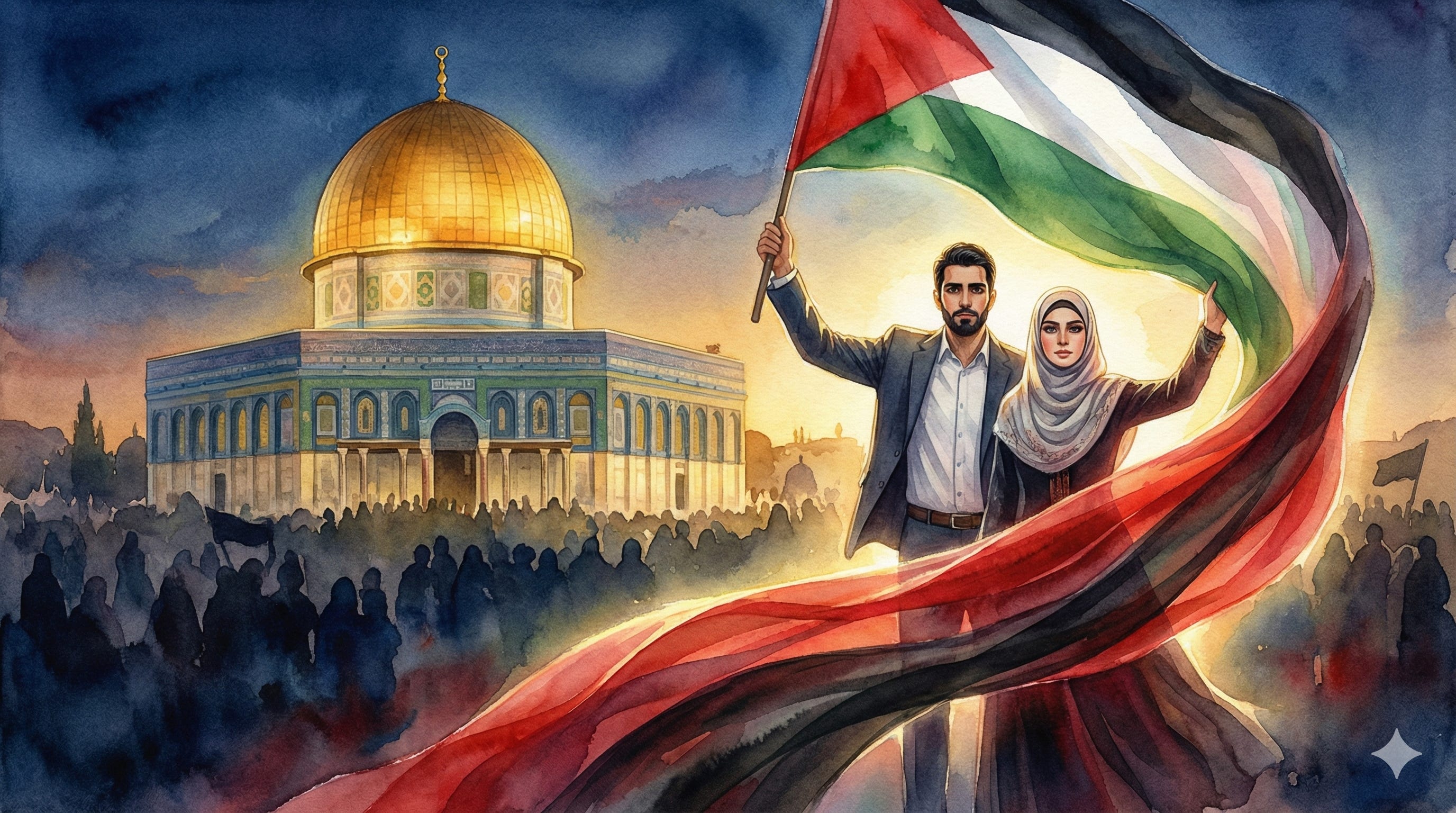
The last Friday of this blessed month is Yawm al-Quds — the International Day of Quds.
It was established in 1979 by Imam Khomeini, may God rest his soul, who called on all the Muslims of the world to designate the last Friday of Ramadhan as a day of solidarity — and notice his words carefully:
«من از عموم مسلمانان جهان و دولتهای اسلامی میخواهم که برای کوتاه کردن دست این غاصب و پشتیبانان آن به هم بپیوندند.»
“I ask all the Muslims of the world and the Muslim governments to join together to sever the hand of this usurper and its supporters.”
— Imam Ruhollah Khomeini; Sahifeh-ye Imam, Volume 9, Page 267; 7 August 1979 / 13 Ramadhan 1399 AH
He placed it in the Month of Ramadhan deliberately — inside the nights of Qadr, inside the very days when the decrees of the coming year are being written.
Because the fate of the oppressed is not a political footnote to the spiritual programme.
It is the spiritual programme.
The month that trains you to hunger is the same month that commands you to remember those who hunger without choice.
The nights that bring you to your knees before God are the same nights that should bring you to your feet for justice.
And while the Day of Quds was born from the specific suffering of the Palestinian people — and Palestine remains its primary and urgent subject, a wound that has only deepened in the decades since Imam Khomeini spoke those words — the day was never meant to be limited to one geography or one people.
Imam Khomeini himself said it plainly:
«روز قدس فقط روز فلسطین نیست، روز اسلام است.»
“Quds Day is not only the day of Palestine; it is the day of Islam.”
— Imam Ruhollah Khomeini; Sahifeh-ye Imam, Volume 9, Page 276
And the great Ayatullah Sayyed Muhammad Husayn Fadhlullah, may God rest his pure soul, expanded the frame even further:
«لا ينبغي أن نعتبر يوم القدس يوماً لمذهب خاص أو لمنطقة معينة، بل هو يوم للإسلام كله، ويوم للإنسان المستضعف في مواجهة المستكبرين. إنه صرخة في وجه الغاصبين بأن الحق لا يموت بمرور الزمن.»
“We must not consider Quds Day as a day for a specific sect or a specific region. It is a day for Islam in its entirety, and a day for the oppressed human being in the face of the arrogant powers. It is a cry in the face of the usurpers that rights do not die with the passage of time.”
— Ayatullah Sayyed Muhammad Husayn Fadhlullah; Friday Sermons, al-Hassanayn Mosque, Beirut
The oppressed human being — not the oppressed Muslim, not the oppressed Arab — the oppressed human being, in the face of the arrogant.
This is the frame.
The mustakbireen — the arrogant powers — and the mufsideen — the corrupters — oppress without regard for the creed or colour of those they crush.
And the believer who has been dyed in the month of Ramadhan stands against that oppression without regard for the creed or colour of those who suffer it.
Palestinian, Yemeni, Congolese, Rohingya, Sudanese, British, American, European, anyone — wherever a human being is displaced, besieged, starved, or stripped of dignity by the machinery of arrogance, the believer’s solidarity is not optional. It is worship.
And here is the point that prevents the Day of Quds from becoming a single square on the calendar — a day you observe and then set aside:
There is a saying that runs through the veins of this tradition like a second bloodstream:
كُلُّ يَوْمٍ عَاشُورَاء، وَكُلُّ أَرْضٍ كَرْبَلَاء
“Every day is Ashura, and every land is Karbala.”
— Al-Qutayfi, Al-Rasail al-Ahmadiyyah, Volume 2, Page 273
— Al-Amin, Ayan ash-Shia, Volume 1, Page 620
Ashura is not one day.
It is a permanent orientation.
It is the commitment to stand with Husayn against Yazid in every age, in every form, wherever the confrontation between truth and tyranny appears.
And the Day of Quds operates on the same logic.
It is not one Friday.
It is the annual sharpening of a blade that must remain sharp every day of the year.
The last Friday of Ramadhan brings the subject to the fore — just as Ashura does, just as Arba’een does — but the true believer does not put the oppressed down when the day ends.
The true believer carries them.
In du’a, in action, in refusal to look away, in the commanding of good and the forbidding of evil that Imam Ali made his very last words on this earth.
We heard those words minutes ago.
«ولا تتركوا الأمر بالمعروف والنهي عن المنكر، فيولّي اللهُ عليكم أشراركم، ثمّ تدعون فلا يُستجاب لكم عليهم.»
“And do not abandon the commanding of good and the forbidding of evil — lest God set the worst of you over you, and then you call upon Him and He does not answer you against them.”
— Nahj al-Balagha, the Wasiyyah; also narrated in al-Kafi (Shaykh al-Kulayni), Kitab al-Wasaya, Volume 7; Tuhaf al-’Uqul (Ibn Shu’bah al-Harrani); Tahdhib al-Ahkam (Shaykh al-Tusi), Volume 9
The Day of Quds is the tradition’s way of ensuring that those words do not remain beautiful and inert.
It is the institutional form of Imam Ali’s dying command.
It is the moment each year when the entire ummah is asked to look up from its private worship and say:
We see you. We have not forgotten. And we will not be silent.
If our Ramadhan has meant anything — if the fasting and the prayer and the breaking of the idol have done their work — then the Day of Quds is not an interruption of the spiritual programme.
It is its proof.
Movement 3: The Night the Angels Descend
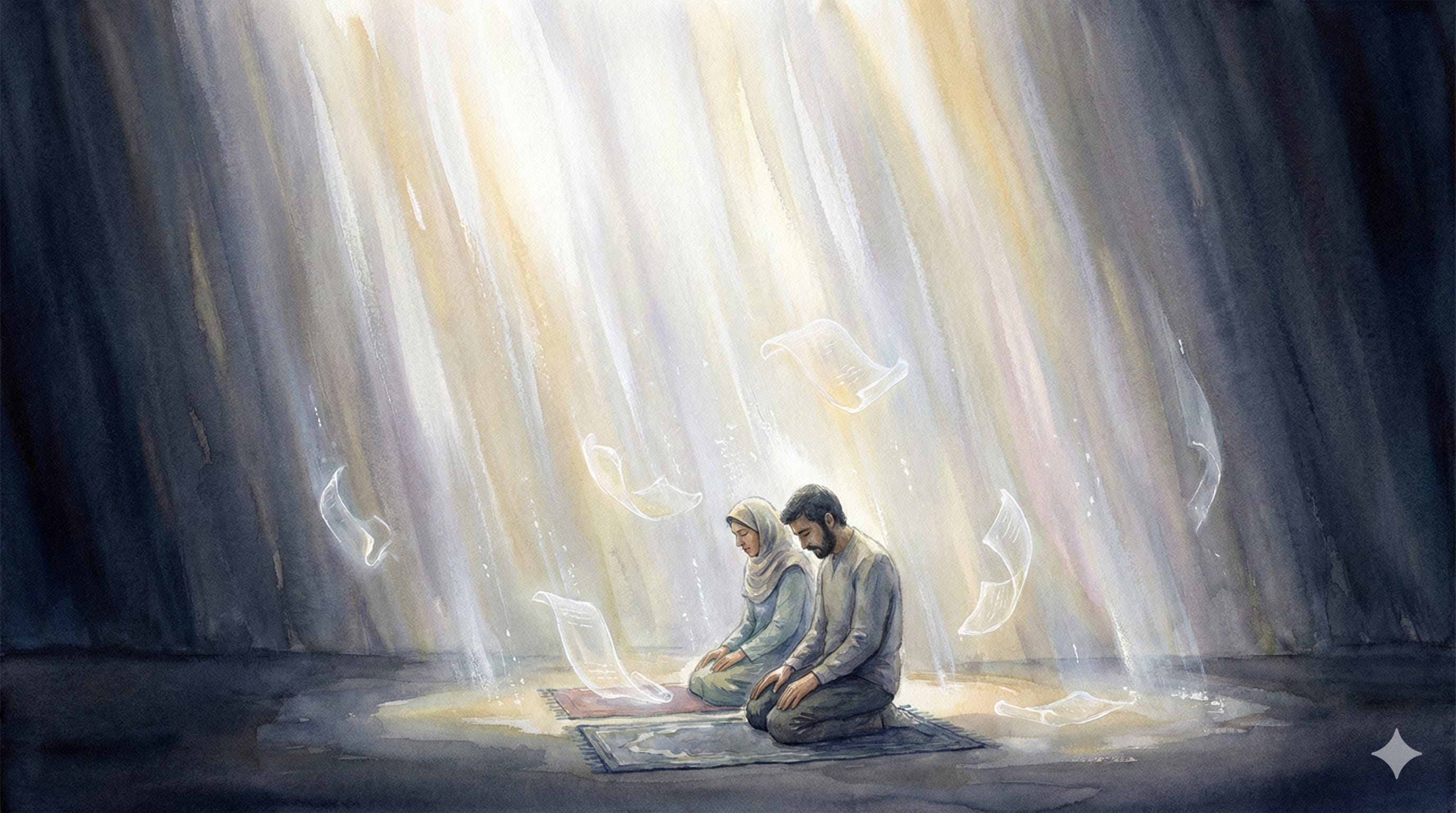
We have spoken enough.
Let us sit, now, with the surah.
بِسْمِ اللَّهِ الرَّحْمَٰنِ الرَّحِيمِ
«إِنَّا أَنزَلْنَاهُ فِي لَيْلَةِ الْقَدْرِ ﴿١﴾ وَمَا أَدْرَاكَ مَا لَيْلَةُ الْقَدْرِ ﴿٢﴾ لَيْلَةُ الْقَدْرِ خَيْرٌ مِّنْ أَلْفِ شَهْرٍ ﴿٣﴾ تَنَزَّلُ الْمَلَائِكَةُ وَالرُّوحُ فِيهَا بِإِذْنِ رَبِّهِم مِّن كُلِّ أَمْرٍ ﴿٤﴾ سَلَامٌ هِيَ حَتَّىٰ مَطْلَعِ الْفَجْرِ ﴿٥﴾»
In the Name of God, the All-Merciful, the Most Merciful.
Indeed, We sent it down on the Night of Decree. And what will make you know what the Night of Decree is? The Night of Decree is better than a thousand months. The angels and the Spirit descend therein, by the permission of their Lord, with every decree. Peace it is — until the rising of dawn.
— Quran, Surah al-Qadr (the Chapter of Destinty) #97, Verses 1 to 5
Five verses.
And in those five verses, everything we have been building toward all month.
Notice first what the Quran does not say.
It does not say: on this night, strive harder.
Pray more.
Push yourself beyond your limits.
It says: tanazzalu — they descend.
The angels come down.
The Spirit comes down.
The decrees come down.
This night is not about you going up.
It is about everything coming to where you already are.
You are exhausted.
You have been fasting for twenty-four days.
You have wept in du’a and fought with your nafs and stumbled and risen and stumbled again.
And God does not say to you tonight: climb higher.
He says:
Stay where you are.
I am sending everything down to you.
The angels — with every decree, with the script of your coming year, with the ink still wet on the page of your life — they descend to the ground where you are kneeling.
They come to you.
And the last verse — the seal of the surah, the word that covers the night like a blanket:
Salamun hiya.
Peace. It is.
Not peace in the night. The night is peace.
Hatta matla’i al-fajr.
Until the rising of dawn.
From now until the first light — everything is salam.
The war is over.
The struggle is paused.
The nafs is quiet.
The horse is still.
The idol is broken.
The mirror is clean.
The moth has reached the flame.
And all that remains is peace.
A Contemplative Exercise: The Six Commands Revisited

I want to invite you, now, into a moment of stillness.
If you can, close your eyes.
If you cannot, soften your gaze.
Breathe.
We have walked through five sessions together.
Each one was built on a command that Imam Ali gave his son — a command for the heart.
Let us walk through them one final time, slowly, not as lessons to remember but as stations to revisit.
The first command: Revive your heart with counsel.
This was Session One.
The Great Migration.
You heard the call and you left — left the house of the ego, left the familiar, stepped onto the road.
Breathe.
Remember the moment this month when something in you first woke up.
A du’a that landed differently.
A verse that opened.
A silence that felt like an invitation.
That was the heart being revived.
The second command: Still your heart with renunciation.
This was Session Two.
The Mirror.
You scrubbed and you cleaned.
You turned away from the things that clouded the glass — the noise, the distractions, the attachments that made the mirror opaque.
Breathe.
Remember the moment this month when you let something go.
A grudge.
A habit.
An opinion about yourself that you had been carrying for years.
That was the heart being stilled.
The third command: Fortify your heart with certainty. Illumine it with wisdom.
This was Session Three.
The Banquet.
You sat at the table and ate — not food, but knowledge.
The names of God.
The teachings of the Imams.
The du’as that arrived like letters from a Friend you had not yet met.
Breathe.
Remember the moment this month when something became clear.
When a truth you had heard a hundred times suddenly landed in your chest instead of your head.
That was the heart being illumined.
The fourth command: Humble your heart with the remembrance of death.
This was Session Four.
Breaking the Idol.
The horse was trained.
The ego was unseated.
You stood before God without the armour of self-satisfaction and said:
I have not come trusting in any righteous deed I have done.
Breathe.
Remember the moment this month when your pretence cracked.
When the mask slipped and you saw yourself as you actually are — not as you perform yourself to be.
That was the heart being humbled.
The fifth command — tonight’s command: Confess its own annihilation.
Qarrirhu bi’l-fana’.
This is now.
You are here.
You have arrived.
Not as the person you were a month ago.
Not as the person you pretend to be.
Not as the CV of good deeds you wish you could present.
You are here as the bankrupt servant — the one who has nothing in his hands except the confession that everything in his hands was His.
And that is enough.
That was always enough.
Breathe.
Closing: The Door Between Two Worlds
Open your eyes.
We began this session with Ali’s Letter 31.
We end where we began.
The same line.
The same breath:
«وَاعْلَمْ يَا بُنَيَّ أَنَّكَ إِنَّمَا خُلِقْتَ لِلْآخِرَةِ لاَ لِلدُّنْيَا، وَلِلْفَنَاءِ لاَ لِلْبَقَاءِ، وَلِلْمَوْتِ لاَ لِلْحَيَاةِ»
“Know, my son, that you were created for the Hereafter, not for this world; for annihilation, not for permanence; for death, not for life.”
— Nahj al-Balagha, Letter 31
Tonight, we have sat with fana’.
We have watched the moth reach the flame.
We have heard the hadith qudsi tell us that the reward of fasting is God Himself.
We have stood with the bankrupt servant who arrives with nothing and discovers that nothing was the entrance fee.
We have listened to a dying man spend his last breath on the orphans and the neighbours and the poor.
We have confessed our own annihilation.
But notice — Imam Ali said two words, not one.
Li’l-fana’ la li’l-baqa’.
For annihilation, not for permanence.
And yet — Imam Ali lived.
He governed.
He loved.
He judged.
He fought.
He wept.
He served.
He bled.
He raised children.
He wrote letters.
He did not float above the world in a state of mystical dissolution.
He lived in it, more fully and more fiercely than anyone alive.
Because fana’ is not the end of the story.
It is the hinge.
Something remains after the annihilation.
Something survives the fire.
And what survives is not the old self, patched up and returned.
It is something new — something that has been through the flame and come out the other side as pure light.
There is a word for this in the Quran — a word that belongs to our next and final session:
صِبْغَةَ اللَّهِ
Sibghatullah.
The colour of God.
The dye that does not wash out.
We will ask on Eid — God willing, in our final session of this series:
Did the dye hold? And what does a life look like when it does?
But that is for Eid.
Tonight is not for questions.
Tonight is for arrival.
And so I want to close with the words of the man who has been with us all evening — the man who taught us about fana’, and then lived it, and then died it.
Not from his letter to his son this time.
Not from his deathbed.
From his prayer.
This is the Munajaat of Imam Ali — his intimate conversation with God, recited at the very mihrab where, on the 19th of this month, he was struck.
Listen to what the man who said
“you were created for annihilation”
says when he turns to face the One he is annihilated before:
«يَا مَنْ أَظْهَرَ الْجَمِيلَ وَسَتَرَ الْقَبِيحَ، يَا مَنْ لَمْ يُؤَاخِذْ بِالْجَرِيرَةِ وَلَمْ يَهْتِكِ السِّتْرَ وَالسَّرِيرَةَ، يَا عَظِيمَ الْعَفْوِ، يَا حَسَنَ التَّجَاوُزِ، يَا وَاسِعَ الْمَغْفِرَةِ، يَا بَاسِطَ الْيَدَيْنِ بِالرَّحْمَةِ، يَا صَاحِبَ كُلِّ نَجْوَى، يَا مُنْتَهَى كُلِّ شَكْوَى»
“O He who made manifest what is beautiful and concealed what is ugly. O He who did not reproach for disobedience and did not tear away the veil of the inner secrets. O He of great pardoning! O He of goodly overlooking! O He of vast forgiveness! O He whose both hands are extended in mercy! O Master of every secret whispered! O Ultimate end of every complaint!”
— Imam Ali; Munajat Amir al-Mu’minin; Mafatih al-Jinan (Shaykh Abbas al-Qummi), A’mal Masjid al-Kufa, Mihrab Amir al-Mu’minin
And then — the passage that could have been written for tonight, for this session, for everything we have been trying to say:
«مَوْلَايَ يَا مَوْلَايَ، أَنْتَ الْمُعْطِي وَأَنَا السَّائِلُ، وَهَلْ يَرْحَمُ السَّائِلَ إِلَّا الْمُعْطِي»
«مَوْلَايَ يَا مَوْلَايَ، أَنْتَ الْحَيُّ وَأَنَا الْمَيِّتُ، وَهَلْ يَرْحَمُ الْمَيِّتَ إِلَّا الْحَيُّ»
«مَوْلَايَ يَا مَوْلَايَ، أَنْتَ الْبَاقِي وَأَنَا الْفَانِي، وَهَلْ يَرْحَمُ الْفَانِيَ إِلَّا الْبَاقِي»
«مَوْلَايَ يَا مَوْلَايَ، أَنْتَ الدَّائِمُ وَأَنَا الزَّائِلُ، وَهَلْ يَرْحَمُ الزَّائِلَ إِلَّا الدَّائِمُ»
“My Master, O my Master! You are the Bestower and I am the beggar — and who has mercy upon the beggar save the Bestower?”
“My Master, O my Master! You are the Living and I am the dead — and who has mercy upon the dead save the Living?”
“My Master, O my Master! You are the Everlasting and I am the perishing — and who has mercy upon the perishing save the Everlasting?”
“My Master, O my Master! You are the Eternal and I am the evanescent — and who has mercy upon the evanescent save the Eternal?”
— Imam Ali; Munajat Amir al-Mu’minin; Mafatih al-Jinan (Shaykh Abbas al-Qummi), A’mal Masjid al-Kufa, Mihrab Amir al-Mu’minin
Anta al-Baqi wa ana al-Fani.
There it is.
The whole session in one line.
You are the Everlasting. I am the perishing.
And who has mercy upon the perishing — save the Everlasting?
This is fana’ as prayer.
Not as concept.
Not as theology.
As the most intimate thing a human being can say to God:
I am nothing. You are everything. And I am not afraid — because who else would have mercy on nothingness, if not You?
And so, on this night — as the angels descend, as the decrees are written, as the salam settles over everything until dawn — let us close with the words of the Ziyarat Aminallah.
This is how the tradition teaches us to address the man who taught us all of this.
And buried inside the ziyarat — as though it were placed there for tonight — is a single phrase that carries everything:
«اللّهُمَّ فَاجْعَلْ نَفْسِي مُطْمَئِنَّةً بِقَدَرِكَ، رَاضِيَةً بِقَضَائِكَ، مُولَعَةً بِذِكْرِكَ وَدُعَائِكَ، مُحِبَّةً لِصَفْوَةِ أَوْلِيَائِكَ، مَحْبُوبَةً فِي أَرْضِكَ وَسَمَائِكَ، صَابِرَةً عَلَى نُزُولِ بَلَائِكَ، شَاكِرَةً لِفَوَاضِلِ نَعْمَائِكَ، ذَاكِرَةً لِسَوَابِغِ آلَائِكَ، مُشْتَاقَةً إِلَى فَرْحَةِ لِقَائِكَ»
“O God — make my soul tranquil before Your decree, content with Your judgment, devoted to Your remembrance and Your supplication, loving toward the chosen ones among Your friends, beloved in Your earth and Your heaven, patient in the face of Your trials, grateful for the abundance of Your blessings, ever mindful of Your bestowals — and longing for the joy of meeting You.”
— Ziyarat Aminallah; Mafatih al-Jinan (Shaykh Abbas al-Qummi), Ziyarat Amir al-Mu’minin
Mushtaqatan ila farhati liqa’ik.
Longing for the joy of meeting You.
That is the last word of this session.
Not fana’.
Not theology.
Not even Qadr.
Longing.
The longing of the servant who has been emptied, and cleaned, and fed, and broken, and rebuilt — and who now, on this night, with nothing left between herself and God, discovers that the only thing remaining in her heart is a single, overwhelming, uncontainable ache:
I want to meet You.
I have always wanted to meet You.
Everything else was just the road to this.
Salamun hiya hatta matla’i al-fajr.
Peace it is — until the rising of dawn.
Go to your prayer.
Go to your Quran.
Go to the ground — the same ground the angels are descending to right now — and place your forehead on it, and let the Meeting happen.
We will meet again, God willing, on Eid.
Oh God, Send your blessings upon Muhammad and the Family of Muhammad and hasten their relief.
Amen, O Lord Sustainer of the Universes.
Amen, O Most Merciful of the Merciful.
And from Him alone is all ability, and He has authority over all things.