

In His Name, the Most High
Preamble
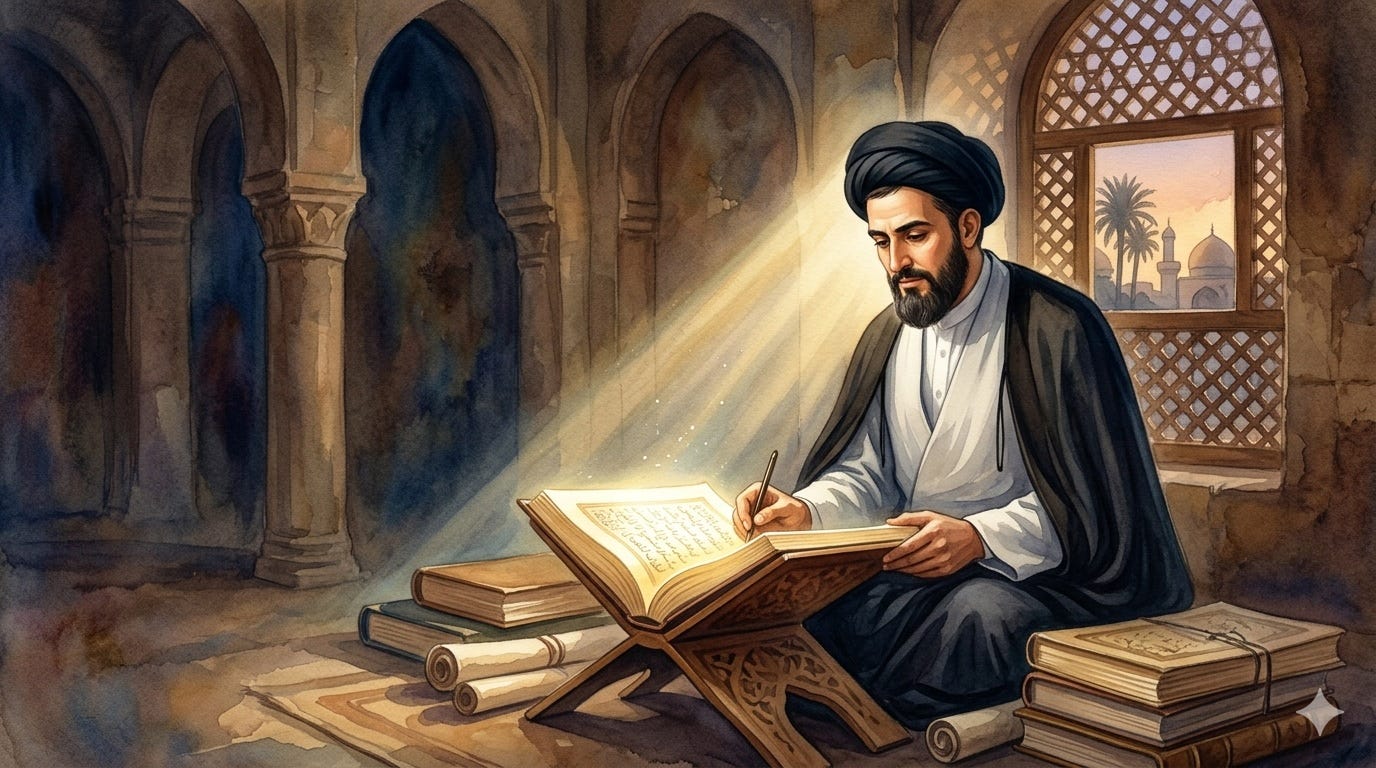
Tonight, we do not begin with ten words.
We begin with one life.
A life of forty-seven years.
Not a long life, by any measure.
Not by the measure of the Hawza tradition, where forty-seven is the age at which most great scholars are only just reaching the fullness of their prowess.
Not by the measure of his own elder brother, who would outlive him by thirty years and bury him beside their father in Karbala.
Not by the measure of his teacher, who would follow him to the grave nine years later.
Forty-seven years.
And in those forty-seven years — three commentaries on the Holy Qur’an, a treatise on the distinctive features of the Imams, a work on the figurative sayings of the Prophet, peace and blessings be upon him, his family and his righteous companions, a Diwan of his own poetry that the literary critics of his age placed among the finest of the century, a foundational role in a House of Knowledge that would become the prototype for every great Islamic seminary that came after, three of the most lucrative and politically dangerous offices in the Abbasid administration — and one book.
One book.
A book whose first words, before any sermon or letter or saying, were the words of his ancestor — the Commander of the Faithful, Imam Ali ibn Abi Talib, peace and blessings be upon him.
A book that he completed six years before his death, in the full knowledge, perhaps, that nothing else he ever wrote would outlive it.
Nahj al-Balagha. The Peak of Eloquence.
Listen to one of the maxims he chose to preserve in that book — a saying of Imam Ali on the kind of life that is worth measuring:
قِيمَةُ كُلِّ امْرِئٍ مَا يُحْسِنُهُ
“The worth of every person is what they do well.”
— Nahj al-Balaghah, compiled by al-Sharif al-Radhi, Maxims (al-Hikam), Saying 81
Ten words.
The worth of every person is what they do well.
Not how long they live.
Not how much they accumulate.
Not what titles they wear or what offices they hold.
What they do well.
Tonight, we sit with a man who, in forty-seven years, did one thing well — better than anyone in the Arabic-speaking world had ever done it before him, or has ever done it since.
He gave us back the voice of his ancestor, and our Imam.
And in giving us that voice, he gave us — and the world, Sunni and Shi’a alike, and the academies of every continent — a book that has not stopped being read for one thousand years.
Tonight, we walk the full life of Sayyed al-Radhi.
Video of the Majlis (Sermon/Lecture)
Audio of the Majlis (Sermon/Lecture)
Recap
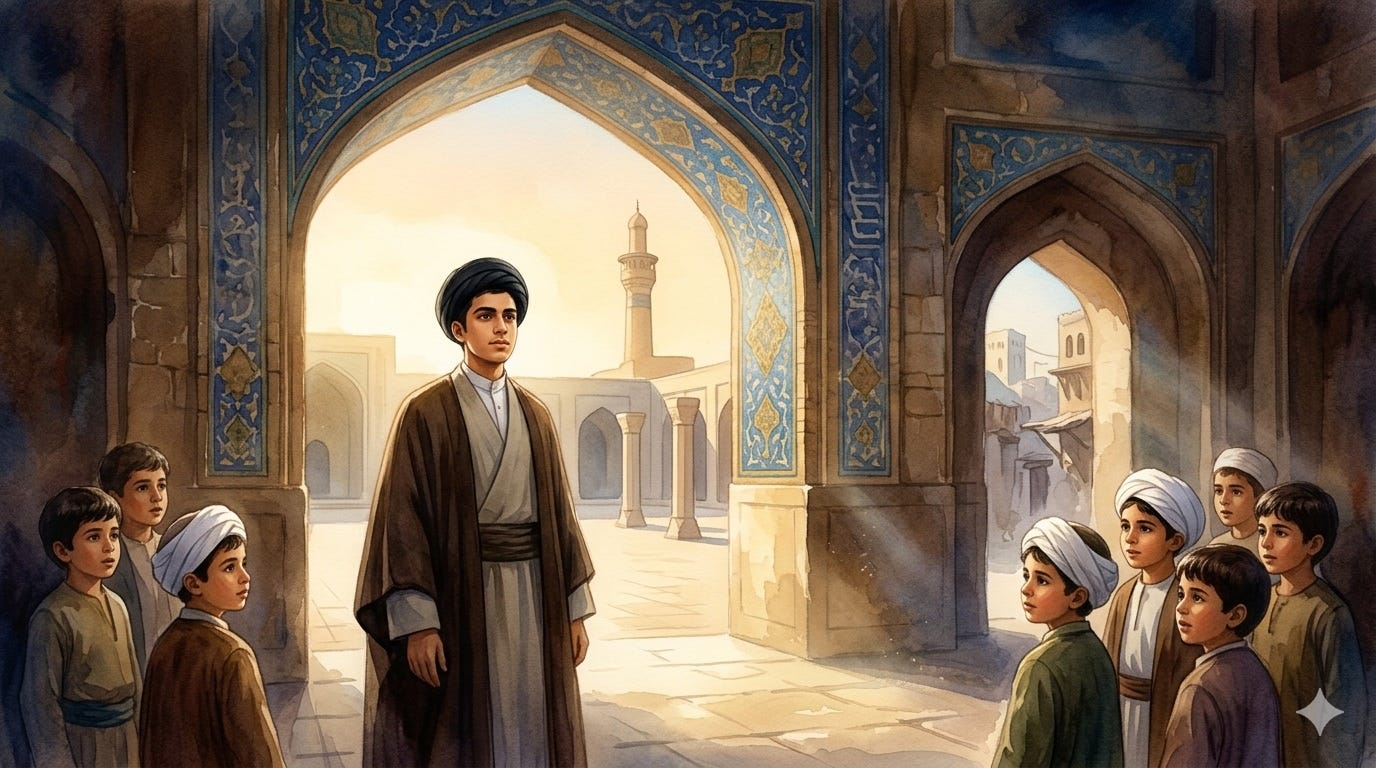
Last week, in the first session of this four-part journey, we met two boys.
We met their mother — Sayyedah Fatima bint Husayn — the noblewoman of the al-Nasir line, granddaughter of the Alid warrior-scholar al-Hasan al-Atrush, who knew exactly what her two sons carried in their veins and exactly what she wanted them to become.
We met their father — Sayyed Abu Ahmad Husayn ibn Musa al-Musawi — the Naqib al-Talibiyin of Baghdad, the official representative of the Prophet’s descendants at the Abbasid court, a man so trusted by both the caliph and the Buyid princes that he held that office seven separate times across his long life.
We met the household into which the two brothers were born — a house of wealth and political standing in the dangerous Karkh quarter of fourth-century Baghdad, where Shi’i scholars walked past the ashes of burned libraries on their way to the mosque, and where an Alid family was expected — by everyone — to produce leaders, scholars, judges, men who could hold the line.
We met the names their father chose for them: al-Murtadha, the Chosen One, from the verse of Surah al-Jinn that speaks of the messengers God has approved; and al-Radhi, the Content One, from the verse of Surah al-Fajr that addresses the soul at peace returning to its Lord, well-pleased and well-pleasing.
We met the dream — Sayyedah Fatimah al-Zahra, peace and blessings be upon her, holding the hands of her two young sons al-Hasan and al-Husayn, peace be upon them, and saying to Shaykh al-Mufid:
Take my two sons. Teach them jurisprudence.
And we met the morning that followed, when Sayyedah Fatima bint Husayn walked her two children to the mosque of al-Karkh, and Shaykh al-Mufid wept, and took them on as his students.
We sat with the lessons of that household and that morning — the lesson that the family is the first institution of learning, that no school and no Hawza can ever replace what a mother and a father plant in a child, and that the work of every believing parent in every age is the same work Sayyedah Fatima bint Husayn did when she walked her sons to the gate of the mosque.
And we left the two brothers there — at the threshold of their lives, the soil prepared, ready for what was about to grow.
Tonight we watch what grew in the younger brother.
The Contribution — The Pen and the Sword of the Intellect
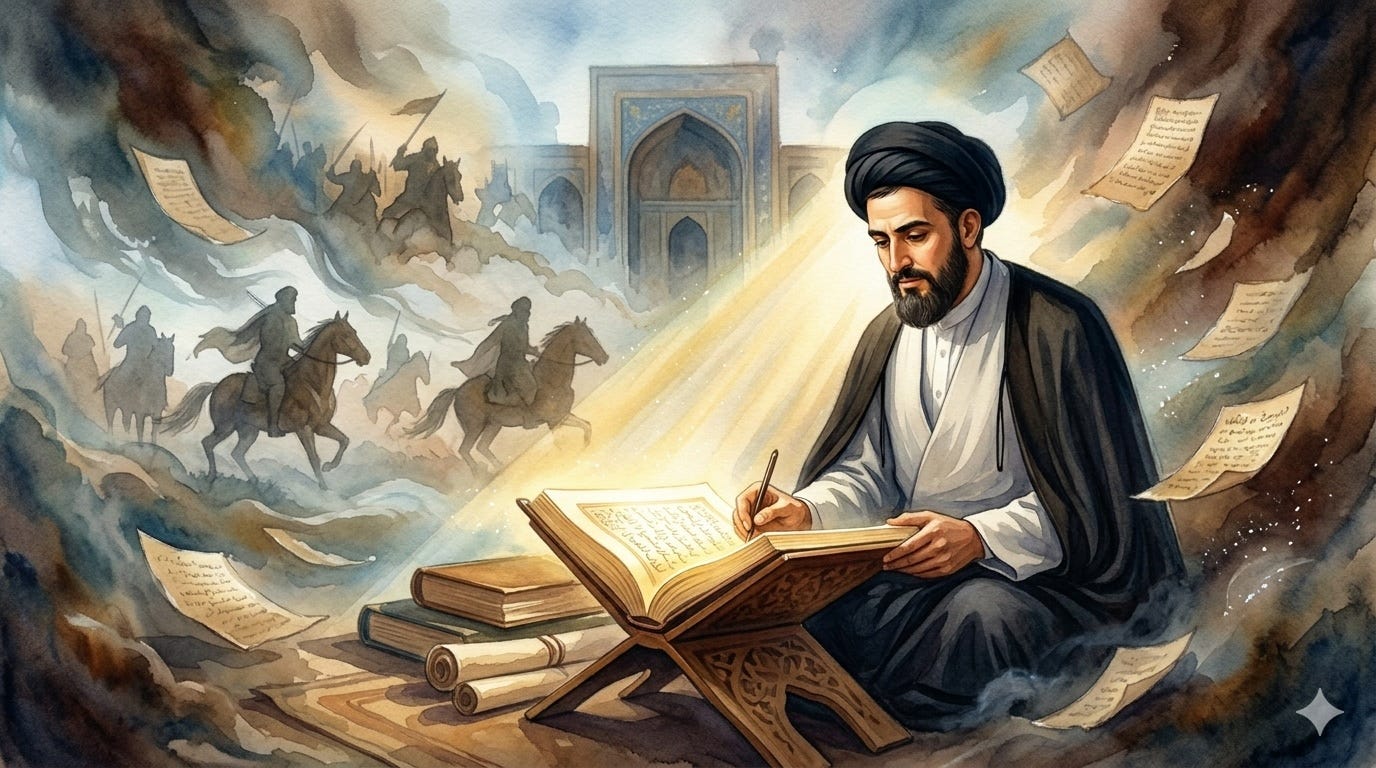
In every age, there are scholars who preserve, and there are scholars who produce.
There are those who carry the tradition faithfully to the next generation — and there are those who give the tradition something it did not have before.
In the early sessions of this sub-series, we met three of the preservers.
Shaykh al-Kulayni.
Shaykh al-Saduq.
And, by extension through the Four Books, Shaykh al-Tusi — whom we will meet properly in a future session, God willing.
Tonight, we meet the first of two producers.
A scholar who, in his short life, took the scattered eloquence of the Commander of the Faithful, peace and blessings be upon him — sermons delivered in the heat of political crisis, letters written on horseback between battles, short sayings caught by a companion on the road — and gathered it all together, for the first time, into a single book.
This is not a small contribution.
What this one brother did, in forty-seven years — redrew the intellectual map of Shi’ism for every century that would come after.
Let us meet him.
Sayyed al-Radhi and the Book That Was Always Going to Be Written
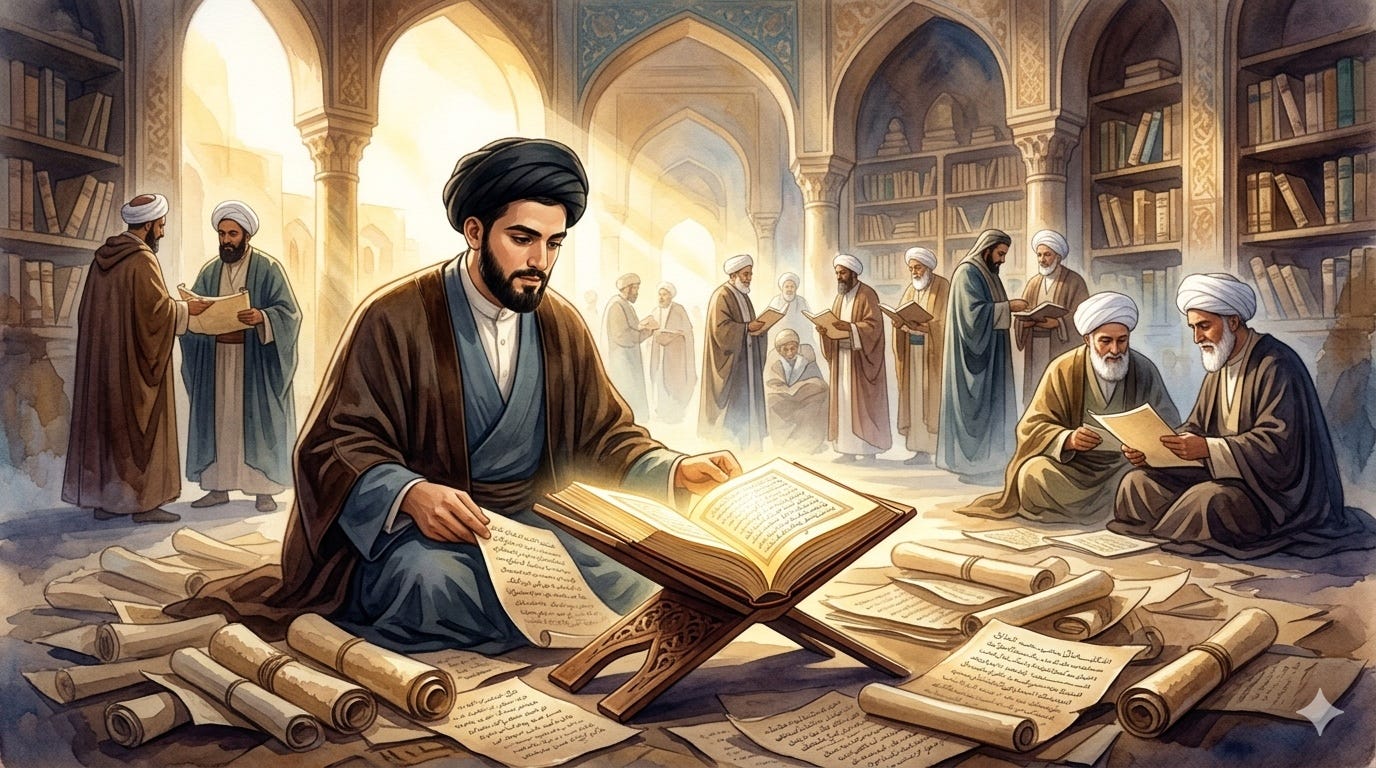
Sayyed al-Radhi died young.
He was forty-seven years old when he passed away in the year 406 of the Hijra — which is to say, nine years before his teacher Shaykh al-Mufid would follow him to the grave, and thirty years before his elder brother would finally be laid beside him.
Of the three giants of their generation — Shaykh al-Mufid, Sayyed al-Murtadha, and Sayyed al-Radhi — the youngest was the first to go.
And yet.
In those forty-seven years, he produced a body of work that any scholar of any century would have been proud to leave behind.
Three separate commentaries on the Holy Qur’an.
The first — Talkhis al-Bayan ʿan Majazat al-Qur’an, which translates as The Distillation of the Statement on the Figurative Language of the Qur’an — addressed those verses where the literal sense alone could not unlock the meaning, and where the Arabic of the Book of God was working at a level deeper than its surface.
The second — Haqa’iq al-Ta’wil fi Mutashabih al-Tanzil, The Realities of Interpretation in the Ambiguous Verses of the Revelation — addressed those verses whose meanings the early scholars had disputed.
Only the fifth chapter of this great work has come down to us, but those who read it in his lifetime considered it without parallel in its time.
And a third, a more general work of exegesis, simply titled Tafsir al-Qur’an.
A treatise on the distinctive features of the Imams — Khasa’is al-A’immah.
A work on the figurative sayings of the Prophet — Majazat al-Athar al-Nabawiyya — the literary counterpart to his Qur’anic studies, applying the same method of analysis to the prophetic tradition.
An extensive Diwan of his own poetry, which his contemporaries considered the finest of the age, and which in some later assessments has been ranked alongside the greatest Arabic poets of the Islamic tradition.
A jurisprudential work — Ta’liq ʿala Khilaf al-Fuqaha’ — Notes on the Disagreements of the Jurists — through which he engaged the legal debates of his age.
And — perhaps as enduring as any of his books — a founding role in a house of learning in Baghdad.
He established the Dar al-Ilm, the House of Knowledge.
A school that he funded from his own resources.
Equipped with manuscripts.
Opened to scholars of every persuasion — Shi’i, Sunni, Mu’tazilite, Ash’arite, jurist, poet, theologian, philologist.
And taught in himself while still a young man.
And listen to this, because it is one of the quiet ironies of Islamic intellectual history: the Dar al-ʿIlm of Sayyed al-Radhi was founded fully eighty years before the famed Nizamiyyah of Baghdad — the celebrated school of the Seljuq vizier Nizam al-Mulk al-Tusi, the school that is usually remembered, in the standard histories, as the great prototype of the Islamic madrasah.
The biographical sources have suggested that when Nizam al-Mulk came to design his own great institution, he modeled it upon what Sayyed al-Radhi had built in Baghdad before him.
The institution that the standard histories credit as the founding model of the madrasah — was, in fact, modeled on a Shi’i institution that came eighty years earlier.
Any one of these achievements would have been enough for a scholarly reputation.
And he produced all of them before he was fifty.
But it is none of these for which we remember him tonight.
We remember him for one book.
One book that he completed in the year 400 of the Hijra — six years before his death.
One book that he did not so much write as gather — patiently, source by source, manuscript by manuscript, across years of scholarly reading.
One book whose purpose, as he tells us in his own preface to it, was simple:
“كان أمير المؤمنين (عليه السلام) مَشْرَعَ الفَصَاحَةِ وَمُورِدَهَا، وَمَنْشَأَ البَلاغَةِ وَمَوْلِدَهَا، ومِنْهُ ظَهَرَ مَكْنُونُهَا، وَعَنْهُ أُخِذَتْ قَوَانِينُهَا.”
“Amir al-Muminin (peace be upon him) was the fountainhead of eloquence and its source, the birthplace of rhetoric and its origin. From him appeared its hidden secrets, and from him its rules were extracted.”
— Sayyed al-Radhi, Nahj al-Balagha, Preface
To paraphrase:
“There exists in the Arabic language no prose, and no rhetoric, and no oratory, more beautiful than the words of the Commander of the Faithful, Imam Ali ibn Abi Talib, peace and blessings be upon him.”
And yet these words were scattered — across histories, across chronicles, across the papers of narrators, across the margins of books.
No one had ever pulled them together into a single volume.
No one had ever let the reader see, in one place, the full range of the eloquence of the Commander of the Faithful.
So Sayyed al-Radhi did it.
He called it Nahj al-Balagha.
The Path of Eloquence.
Or — as it has more often been rendered into English — The Peak of Eloquence.
And into it he put what he judged to be the most eloquent of the sermons of Imam Ali, the most powerful of his letters, and the most striking of his shorter sayings.
He organised the book into three parts: the sermons first, the letters second, the sayings third.
He did not add to the words.
He did not modify them.
He did not paraphrase them.
He selected them, he arranged them, he titled them — and he presented them to the world.
And the world has not stopped reading them since.
Lessons Woven In

Pause with me here, because there is something in the way Sayyed al-Radhi approached this work that is worth learning from.
He did not write his own book.
He could have.
He had the literary gift for it — the biographical sources are unanimous on this.
He composed poetry that the greatest literary minds of his age, including many who were not Shi’i, praised without reservation.
He could have built his reputation on his own voice, and that alone would have carried his name for centuries.
But he chose, instead, to submerge his own voice entirely — so that the voice of his ancestor, of his Imam, could be heard.
He did not put his name over the sermons.
He did not insert his opinions between them.
He did not paraphrase Imam Ali into easier language.
He trusted that the words themselves, laid out plainly and beautifully, would do their own work.
This is the mark of a scholar who understands what he is serving and what he is not.
Sayyed al-Radhi did not compile Nahj al-Balagha to make himself famous.
Nahj al-Balagha made him famous because he was willing to disappear into it.
There is a lesson in this for everyone who teaches, writes, speaks, or carries the tradition in any form.
The moment we start making ourselves the centre of the story — our interpretations, our cleverness, our personal brand — we have misunderstood our job.
The job is to be the conduit.
The job is to carry the words of those who are infinitely greater than us, as clearly and as faithfully as we can, and to let them do the work on the listener’s heart.
And remember — Sayyed al-Radhi understood this not as a young student still finding his voice.
He understood it as a mature scholar at the height of his powers.
A man who had already written three commentaries on the Qur’an, a treatise on the features of the Imams, a book on the figurative sayings of the Prophet, a jurisprudential work of his own, and a Diwan of poetry that his own contemporaries had placed among the greatest of the age.
A man who had already founded a school in Baghdad before he was thirty years old.
A man who, if he had wanted to, could have spent the last decade of his life adding a dozen more books to his own name.
Instead, he chose to spend those years gathering the words of another.
And he completed the gathering six years before his death — in the full knowledge, perhaps, that the book he had just finished would outlive everything else he had ever written.
Outlive him by over a thousand years and counting.
That is the mark of a scholar who has stopped trying to build a reputation.
He was too busy serving a tradition.
And God, in His way with such servants, gave him a reputation that no amount of self-promotion could ever have purchased.
God help us, in our own lives and in our own work, to understand what Sayyed al-Radhi understood.
The Significance of Nahj al-Balagha
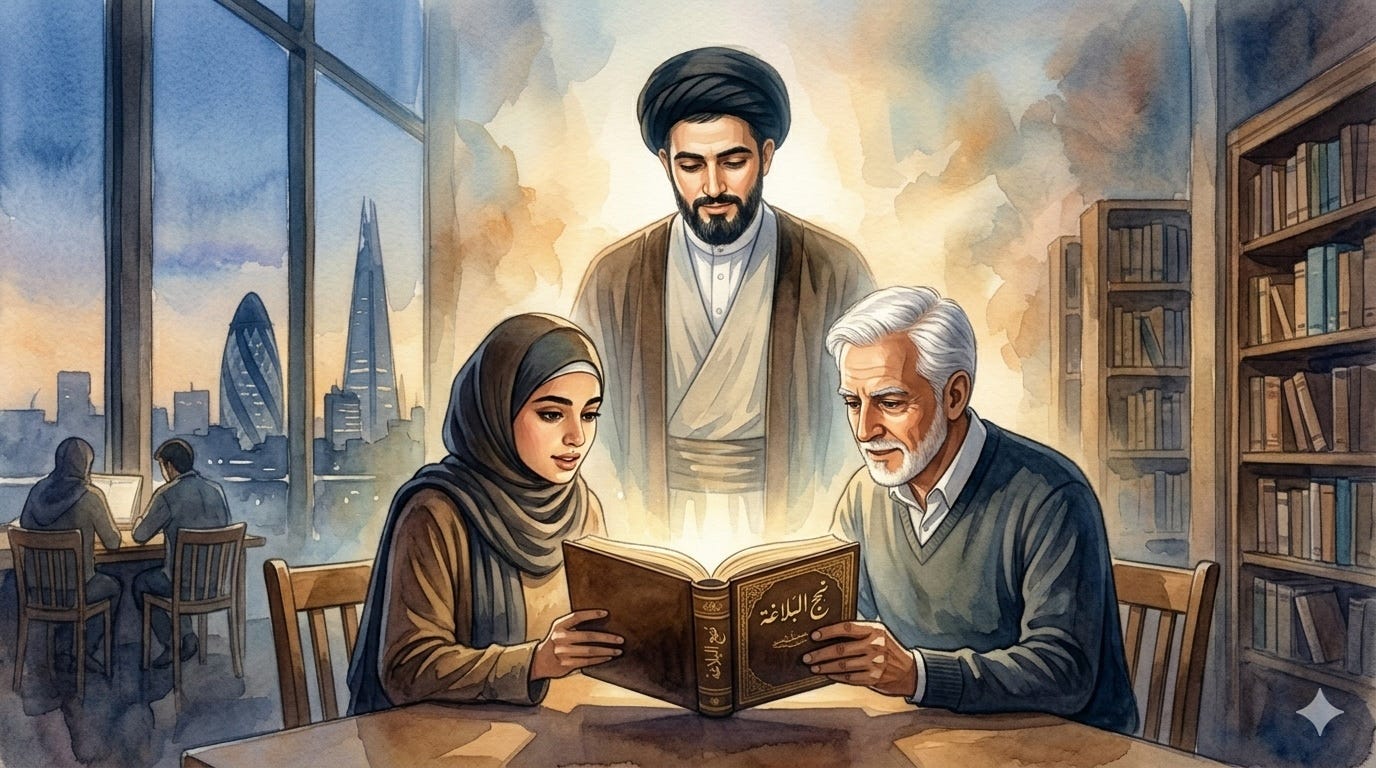
So what is actually in this book that, a thousand years later, is still being taught at Oxford and Leiden and al-Azhar?
It contains, among many other things, three texts that changed the intellectual trajectory of Islamic civilisation.
The first is Letter 53 — the letter of Imam Ali to Malik al-Ashtar, whom the Imam had appointed as his governor over Egypt.
This letter is not a short letter.
In most printings it runs to ten or fifteen pages.
And in it, Imam Ali lays out — point by point, class by class, principle by principle — the entire theory and practice of just governance.
How a ruler should treat his subjects.
How a ruler should manage his army.
How a ruler should organise the collection of taxes.
How a ruler should conduct himself with the poor and the weak.
How a ruler should appoint judges, select advisors, reward merit, and punish wrongdoing.
How a ruler should communicate directly with the people, and why no ruler is safe who cuts himself off behind a wall of ministers and guards.
Listen to one short passage from it, so you can hear the register in which the Commander of the Faithful was writing:
وَأَشْعِرْ قَلْبَكَ الرَّحْمَةَ لِلرَّعِيَّةِ، وَالْمَحَبَّةَ لَهُمْ، وَاللُّطْفَ بِهِمْ، وَلَا تَكُونَنَّ عَلَيْهِمْ سَبُعًا ضَارِيًا تَغْتَنِمُ أَكْلَهُمْ، فَإِنَّهُمْ صِنْفَانِ: إِمَّا أَخٌ لَكَ فِي الدِّينِ، وَإِمَّا نَظِيرٌ لَكَ فِي الْخَلْقِ.
“Infuse your heart with mercy for your subjects, and love for them, and kindness toward them. And do not be over them a ravenous beast, counting their devouring as gain — for they are of two kinds: either a brother to you in religion, or your equal in creation.”
— Imam Ali, Letter 53 to Malik al-Ashtar, compiled by Sharif al-Radhi in Nahj al-Balagha
Either a brother to you in religion, or your equal in creation.
That single sentence, fourteen centuries ago, settled a question that Western political philosophy did not settle until the twentieth century, and in some of its institutions has not settled yet.
Every human being under your governance — believer or not, of your tribe or not, of your language or not — is either your brother in faith, or your equal in humanity.
There is no third category.
There is no category of human being whom the ruler may treat as less than human.
This letter has been studied in departments of political theory from Tehran to Toronto.
The United Nations Development Programme, in a report on Arab governance published in the early 2000s, recommended Letter 53 to world leaders as a foundational text on just administration.
And it came to us only because a scholar in Baghdad, at the height of his prowess, chose to spend his years gathering what others had allowed to scatter.
One man.
One decision.
And a book that the community — the Ummah — and indeed the world, has not stopped reading for a thousand years.
And we pray, with every heart in this gathering tonight, that the reading of it would not remain only reading.
That the words of the Commander of the Faithful — on justice, on mercy, on governance, on the treatment of the weak, on the accountability of the powerful, on the discipline of the soul — would not remain only words on a page, admired from a distance.
That they would be lived.
That they would be applied.
That the rulers of this world would govern by them.
That the communities of this world would be shaped by them.
That the hearts of this world would be softened by them.
Because if they were — and only if they were — then the world our children are to inherit would be a world worth inheriting.
The second text is the Sermon of al-Shiqshiqiyya — Sermon 3 in the arrangement of Nahj al-Balagha.
In this sermon, Imam Ali speaks, with a candour that startles the reader even today, about the events after the passing of the Prophet.
About the caliphate.
About who took it, and how, and with what consequences for the community.
About his own patience across twenty-five years.
About the moment, finally, when the community turned to him — and what he found when he assumed the caliphate he had never sought.
This sermon is the theological and political heart of the Shi’a position on the events of early Islam, preserved in the voice of the Commander of the Faithful himself.
Without this sermon in our hands, a great deal of what we understand about the early tragedy of this ummah would be lost.
The third is the body of the maxims — the short sayings, gathered in the third part of the book.
Last week’s session opened with one of them:
النَّاسُ أَعْدَاءُ مَا جَهِلُوا
“People are the enemies of what they do not know.”
— Nahj al-Balaghah, compiled by al-Sharif al-Radhi, Maxims/Sayings (al-Hikam), Saying 172
There are four hundred and eighty of these maxims in the collection.
Each one, on its own, is a small universe.
Together, they are the distilled practical wisdom of the Commander of the Faithful on every matter of human life — from governance to friendship to wealth to death to the discipline of the soul.
Three texts.
One book.
One young man who did not live to see his fiftieth birthday.
And this is why, when we walk into a library in Qom, or Najaf, or Tehran, or Beirut, or Cairo, or London, or Jakarta — and we see Nahj al-Balagha sitting on the shelf in whatever language that library speaks — we should feel, quietly, the presence of a young scholar in Baghdad, a thousand years ago, who chose to spend his short life as a conduit for a greater voice.
The Scholar Who Was Also a Public Man
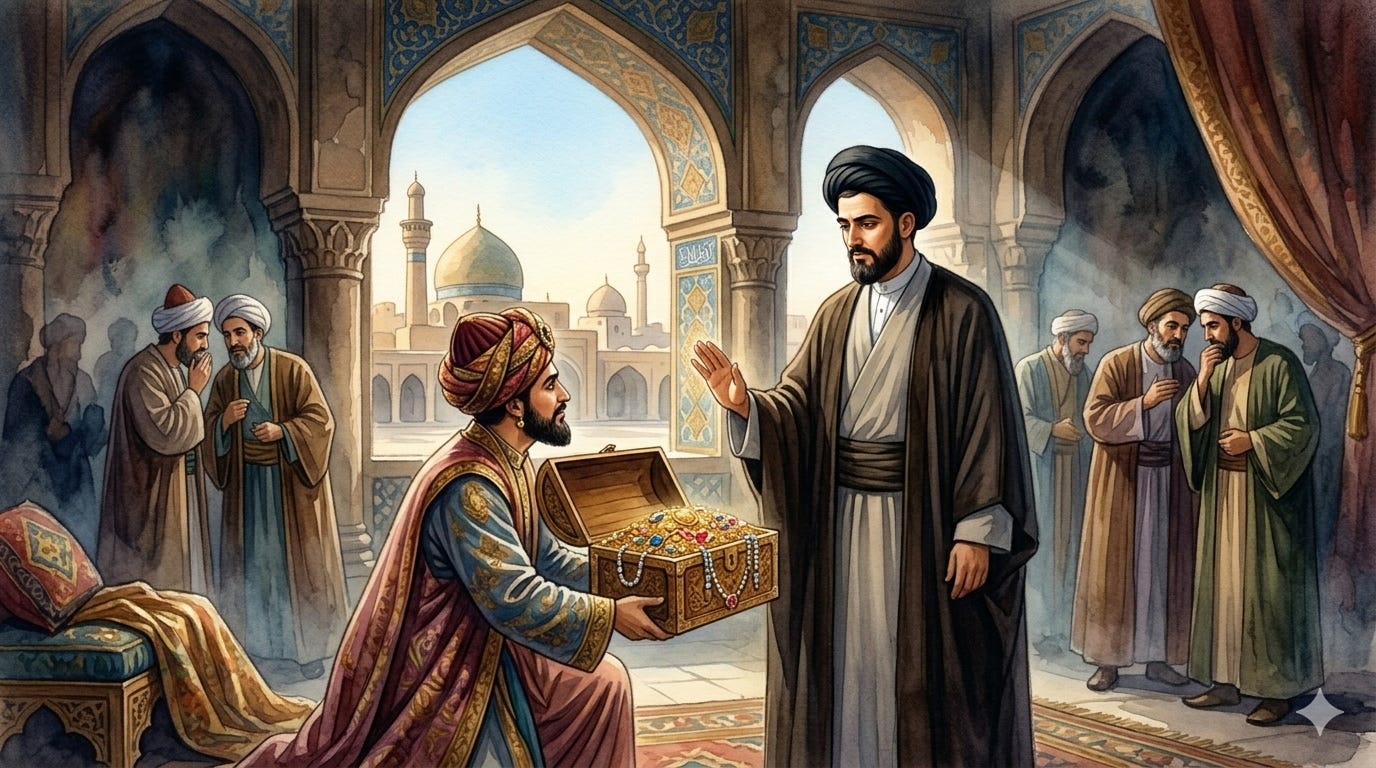
And there is one more thing to say about Sayyed al-Radhi before we walk him to his grave, because it matters for everything we have just heard about Nahj al-Balagha.
He did not live the life of a retreating scholar.
He did not spend his days in the solitude of a private library, beyond the reach of the city.
Sayyed al-Radhi lived at the centre of public life in Baghdad — and to understand the weight of what that meant, we need only remind ourselves, briefly, of the political world we have been walking through in this sub-series.
You will recall from our sessions on Shaykh al-Kulayni and Shaykh al-Mufid the story of the Buyid golden window — the sons of the Daylamite mountain fishermen, the memory of the Alid refugees, the conquest of Baghdad in 334 AH, the installation of a compliant Abbasid caliph who reigned in name while the Buyid amir ruled in substance.
We have watched that window open under Mu’izz al-Dawla and come to its peak under ʿAdud al-Dawla.
Sayyed al-Radhi and Sayyed al-Murtadha were born into its flourishing — and lived their entire adult lives within it.
But there is a detail about this arrangement that we must name here, because it bears directly on what we are about to discuss.
The Buyid amir was the real power in Baghdad — but he was not the only power.
The Abbasid caliph still sat on the throne.
The caliph’s name was still on the coinage.
His name was still invoked in the Friday sermon.
Foreign embassies were still received in his court.
And most importantly for our story tonight — the institutional machinery of the caliphate still operated under the caliph: the judiciary, the chancery, the offices of state.
If you wanted to hold a public office in Baghdad, you held it as a servant of the caliph — even if the caliph himself held nothing but a crown the Buyid had let him keep.
And here is where the arrangement sharpened into danger.
The Abbasid caliphs during this window — Ta’i’ al-Billah, and after him al-Qadir — were, by institutional memory and personal conviction, the heads of the Sunni world, and their theological commitments did not soften simply because a Daylamite prince held the real sword.
They despised the Shi’a.
They despised the Fatimids in Egypt even more.
And they resented the Buyids for placing them in a position where they had to tolerate both.
So when Sayyed al-Radhi stepped, at the age of twenty-one, into the offices of the Abbasid caliphal administration — he stepped into a political arrangement that was, by any measure, a minefield.
He served under caliphs who privately despised everything he stood for, while being protected by Buyid princes who privately revered it.
He signed documents issued in the name of one power while drawing his security from another.
He made that arrangement work for the next twenty-six years.
And he held, from the age of twenty-one until his death at forty-seven, three of the most significant public offices available to a member of the Alid family in Abbasid Baghdad.
The first was the Naqib al-Talibiyin — the guardianship of the descendants of Abu Talib.
This was the office his father Sayyed Abu Ahmad had held.
It was the office we described at the opening of last week’s session.
The official overseer of every registered descendant of the Prophet’s family living in Baghdad and its surrounding regions — their welfare, their disputes, their standing at the caliph’s court.
The second was the Amir al-Hajj — the supervisor of the Hajj pilgrimage.
In the fourth century of the Hijra, the caravan that travelled from Iraq to Makkah was one of the largest annual pilgrimages in the Islamic world, gathering Muslims from across the Abbasid domain, the Fatimid domain, and the Shi’a territories of Persia and the Levant.
The man appointed to lead it had to be a figure whom the entire Muslim world — Sunni and Shi’a alike — could accept.
The Caliph al-Qadir, whom Sayyed al-Radhi despised and who despised him, still entrusted him with this office — because there was no one else in Baghdad of sufficient scholarly and moral standing to hold it.
And the third was the head of the Diwan al-Mazalim — the presiding judge of the High Court of Grievances.
In the judicial structure of the Abbasid state, this was the highest appellate court of the caliphate.
The court of last resort for those who had been wronged by the powerful.
A position which required both jurisprudential mastery and the kind of moral courage that could deliver a verdict against a minister, a general, or a prince.
Sayyed al-Radhi held these three offices, with only brief interruptions, from the age of twenty-one until his death at forty-seven.
And he held them on his own terms.
When the vizier Abu Muhammad al-Mahlabi sent him a thousand gold dinars as a gift on the birth of his son, Sayyed al-Radhi refused the gift — returning it with a note that the minister already knew he would not accept it.
When the Caliph al-Qadir summoned him to explain a poem in which he had praised the Fatimid caliph of Egypt, Sayyed al-Radhi refused to attend the meeting, and refused to sign the statement cursing the Fatimids that the Caliph had prepared.
The Caliph dismissed him from all three of his offices in retaliation.
Sayyed al-Radhi responded with a poem of his own, declaring that the dismissal had cost him nothing, and that his dignity was untouched.
This was a scholar who compiled Nahj al-Balagha.
And this was a man who lived Nahj al-Balagha.
In the same body.
In the same forty-seven years.
The Departure
And now, we must walk him to his grave.
Because every biography, no matter how glorious, has its final chapter.
And the final chapter of this biography is the most instructive of all — because it is in how a scholar departs this world, and what he leaves behind, that we see what his life was truly for.
The First Departure — Sayyed al-Radhi
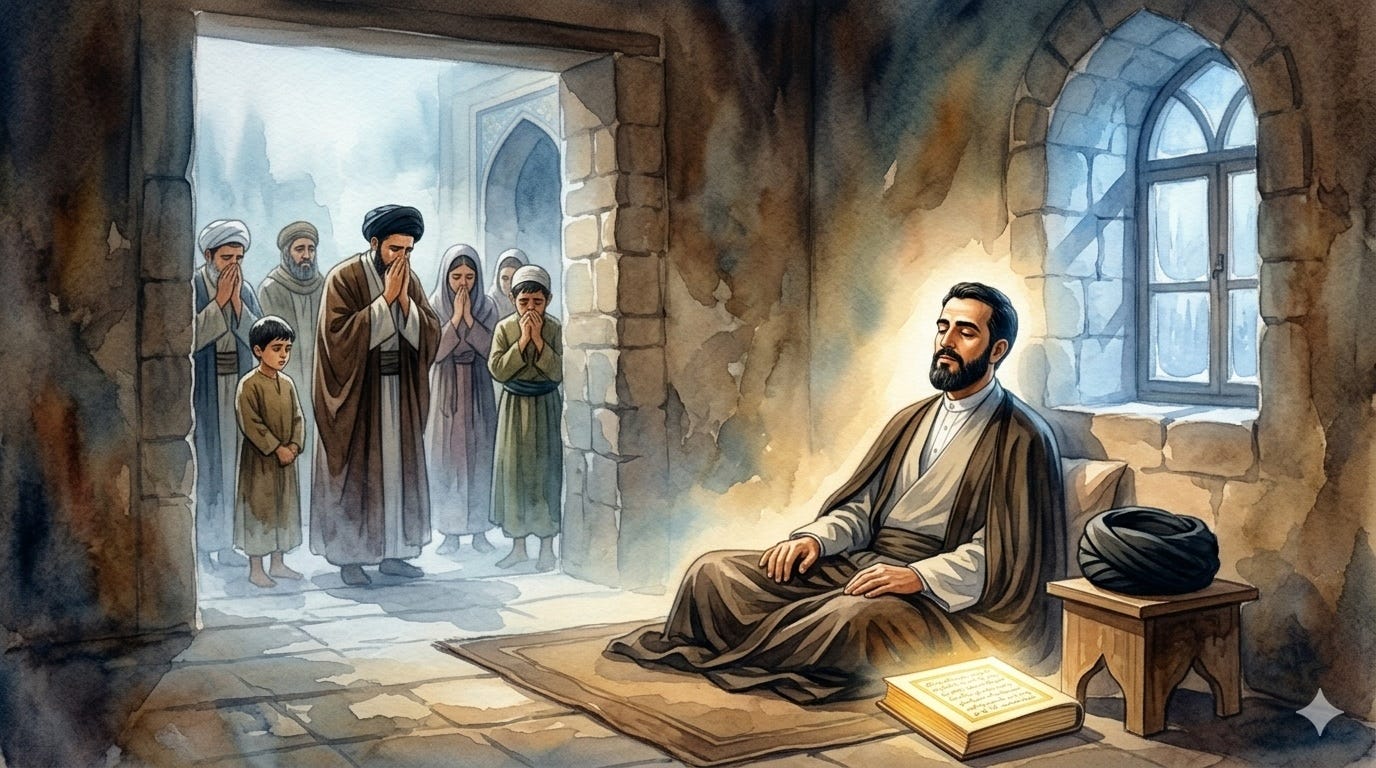
It was the year 406 of the Hijra.
The month was Muharram.
Baghdad was in the grip of winter.
Sayyed al-Radhi — compiler of Nahj al-Balagha, poet of the Alid house, Naqib al-Talibiyin, Amir al-Hajj, founder of the Dar al-Ilm, the scholar who had lived Nahj al-Balagha as well as gathered it — was forty-seven years old.
Forty-seven.
The biographical sources record that he had been in ill health for some time.
We are not given a precise diagnosis.
What we are told is that he declined steadily through the early weeks of the year, and that he died on the sixth of Muharram, 406 AH — corresponding to the year 1015 of the Gregorian calendar.
Forty-seven years old.
Think about that age for a moment.
By the standards of the Hawza tradition, forty-seven is a scholar’s prime.
It is the age at which most great scholars are just reaching the fullness of their powers — the age at which Shaykh al-Tusi, God willing we will see in a future session, had only just begun his long partnership with Sayyed al-Murtadha.
The age at which Imam Khomeini, in our own tradition, was still a decade away from becoming a marja’.
The age at which most scholars still have thirty or forty years of teaching, writing, and guidance still ahead of them.
And Sayyed al-Radhi was gone.
He left behind, as we have already heard, one book.
One book that will be read until the Day of Judgment.
But he also left behind — and this is the detail that tells us something about him — something the biographical sources record with great tenderness.
He left behind no wealth.
Despite holding three of the most lucrative offices in the Abbasid administration — the Niqaba, the Amir al-Hajj, the Diwan al-Mazalim — despite the stipends, the lands, the gifts, the honours that came with those offices — Sayyed al-Radhi died without accumulating a personal fortune.
What he had earned, he had given away.
To his students.
To the poor of the Talibid family he supervised.
To the Dar al-Ilm he had founded.
To the free copying of manuscripts for young scholars.
To the support of the Hajj pilgrims he had led year after year.
A scholar who had lived Nahj al-Balagha had also died living it.
The Grief That Could Not Walk to the Grave
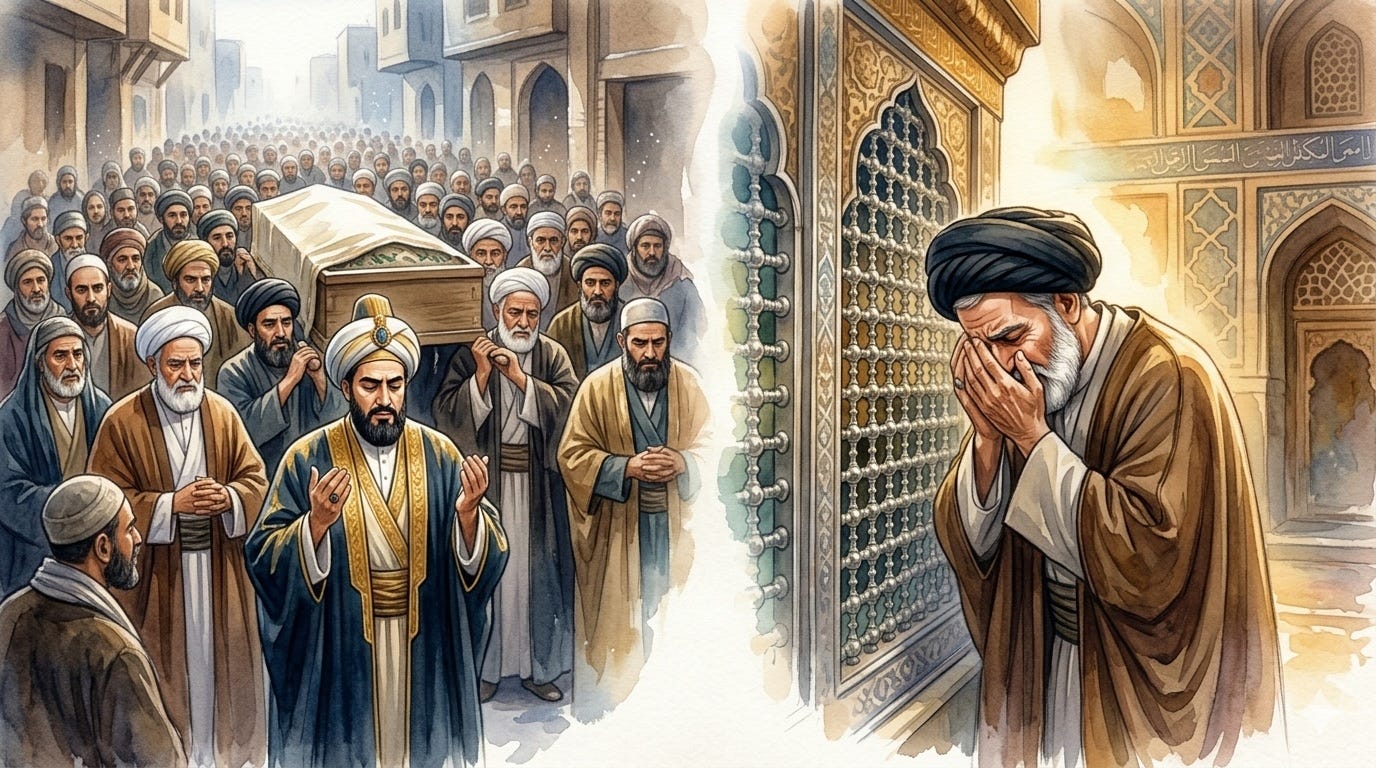
And here, we must pause on a detail that the biographical sources preserve with extraordinary tenderness — because it tells us something about the love between these two brothers that no list of collaborations and co-authored achievements ever could.
When Sayyed al-Radhi’s body was prepared for burial, and the community of Baghdad gathered to pray the funeral prayer, Sayyed al-Murtadha — the elder brother, the senior scholar, the man who by every custom and every expectation should have led the prayer over his own brother’s body — could not bring himself to attend.
The biographical sources tell us, quite plainly, that his grief overwhelmed him.
He could not look at the coffin.
He could not stand at the front of the congregation.
He could not, in his own words, bear what was being asked of him.
And so he withdrew — not far, but far enough.
He fled to the shrine of his ancestor Imam Musa al-Kadhim, peace and blessings be upon him, just north of Baghdad, and there, at the grave of his Imam, he grieved.
And because Sayyed al-Murtadha could not lead the funeral prayer, another man stepped in to lead it in his place.
That man was Fakhr al-Mulk — the vizier of the Abbasid caliph.
A man of the state.
A man of the ruling order.
Not a scholar of Sayyed al-Radhi’s school, not a jurist, not an Alid — but the chief minister of the government itself, stepping forward to lead the funeral prayer over one of the greatest Shi’i scholars of the age, because the dead man’s own brother could not bear to.
Let me ask you to sit with that image for a moment.
What kind of a man must Sayyed al-Radhi have been, that when he died, the vizier of the Abbasid caliphate — the government that had privately despised everything Sayyed al-Radhi stood for — would stand before the congregation of Baghdad and lead the prayer over his body?
And what kind of a love must the elder brother have felt, that he could not even stand in the back row of that prayer, and had to flee to the shrine of Imam al-Kadhim to weep?
This is how the great Sunni historian Ibn Khallikan — the thirteenth-century judge of Damascus — records the moment in his Wafayat al-A’yan.
He confirms the date, he confirms the place of death in Karkh, and he confirms the detail we have just described: that the grief of Sayyed al-Murtadha was such that he could not attend the prayer, and that Sayyed al-Radhi was, because of his station and the sheer suddenness of the loss, initially buried inside his own residence in the Karkh district of Baghdad.
The first grave of Nahj al-Balagha’s compiler was in his own home.
The Transfer to Karbala
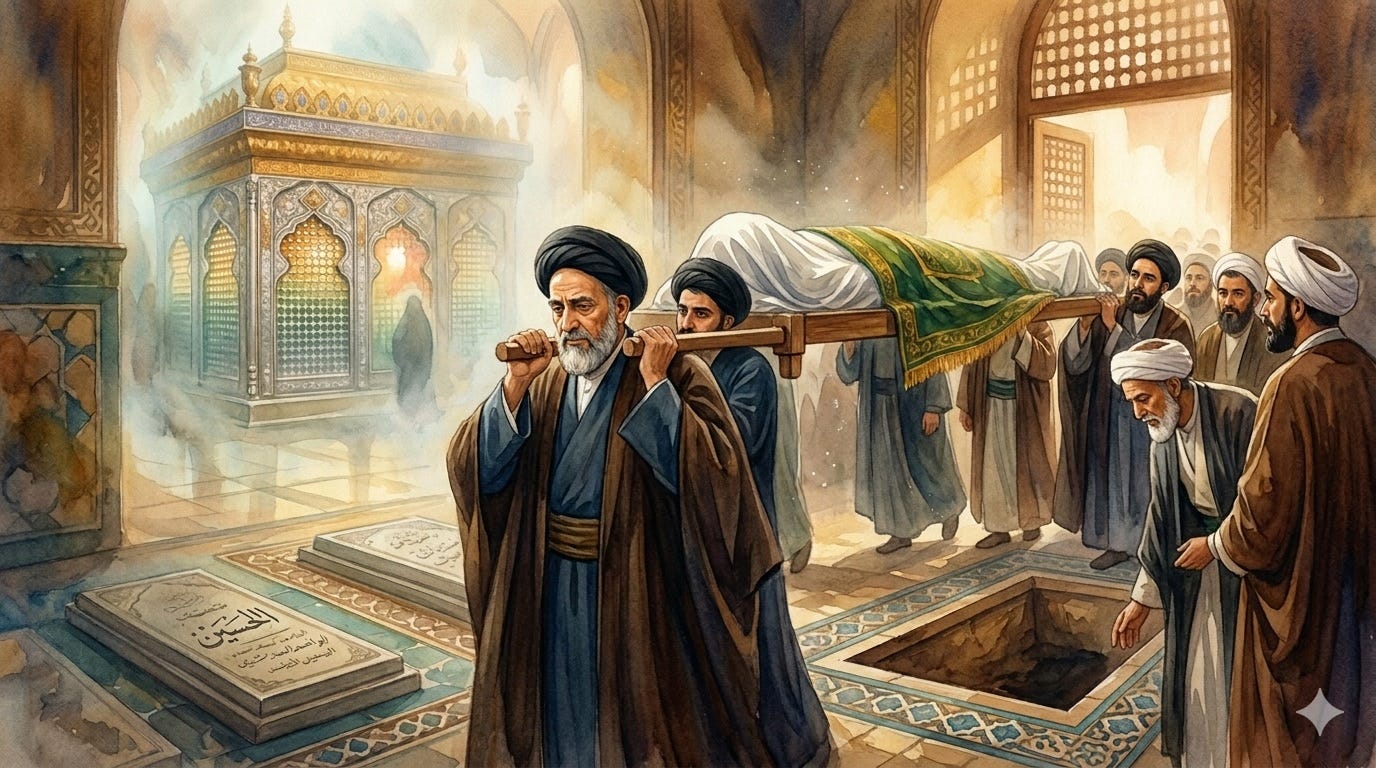
But the grave in Karkh was not to be his final resting place.
In our tradition, there is no higher honour for a believer’s body than to rest in the sacred precincts of Karbala, in the Ha’ir — the inner sanctuary — of the shrine of Imam Husayn, peace and blessings be upon him.
And the family of Sayyed al-Radhi and Sayyed al-Murtadha — Husayni on their father’s side, tracing their lineage through Imam Musa al-Kadhim to the Master of the Martyrs himself — had already established this as their family’s final custom.
Their father, Sayyed Abu Ahmad al-Husayn al-Musawi — the great Naqib we have spoken of earlier — had himself been transferred to Karbala after his death, and buried within the sacred enclosure of his grandfather’s shrine.
And sometime after Sayyed al-Radhi’s initial burial in his Karkh residence, his body was exhumed and transferred to Karbala, where he was laid to rest beside his father, within the Ha’ir of Imam Husayn.
This is confirmed by one of the greatest commentators on Nahj al-Balagha itself — Ibn Maytham al-Bahrani, a thirteenth-century scholar whose Sharh Nahj al-Balagha is one of the classic commentaries on Sayyed al-Radhi’s compilation.
In the biographical introduction to his Sharh, Ibn Maytham records that although Sayyed al-Radhi died in Karkh, his final resting place — alongside his brother Sayyed al-Murtadha, who would join him there thirty years later — is in the precincts of Imam Husayn in Karbala.
دُفِنَ مَعَ أَخِيهِ الْمُرْتَضَى فِي جِوَارِ جَدِّهِ الْحُسَيْنِ عَلَيْهِ السَّلَامُ
“He was buried with his brother al-Murtadha in the vicinity of his grandfather al-Husayn, peace be upon him.”
— Ibn Maytham al-Bahrani (d. 679 AH / 1280 CE), Sharh Nahj al-Balagha, biographical introduction on al-Sharif al-Radhi
And the modern encyclopaedic authority Allamah Abd al-Husayn al-Amini — whose monumental work al-Ghadir gathers together virtually the entire classical historical record on the great figures of the Shi’a tradition — confirms this transfer directly in his biographical section on Sayyed al-Radhi.
Allamah al-Amini writes that many historians have recorded the transfer of Sayyed al-Radhi’s body to Karbala after his initial burial in his Karkh home, and that throughout the medieval centuries the graves of the two brothers and their father were famous destinations for pilgrims inside the Ha’ir of Imam Husayn.
ذَكَرَ جَمَاعَةٌ مِنَ الْمُؤَلِّفِينَ نَقْلَ جُثْمَانِهِ الشَّرِيفِ إِلَى كَرْبَلَاءَ الْمُعَلَّاةِ بَعْدَ دَفْنِهِ فِي دَارِهِ بِالْكَرْخِ، فَدُفِنَ إِلَى جَنْبِ وَالِدِهِ أَبِي أَحْمَدَ الْحُسَيْنِ
“A group of authors have mentioned the transfer of his noble body to the honoured Karbala after his burial in his house in Karkh — so he was buried beside his father, Abu Ahmad al-Husayn.”
— Allamah Abd al-Husayn al-Amini (d. 1390 AH / 1970 CE), al-Ghadir, Volume 4, in the biographical section on al-Sharif al-Radhi
And — because some of you may have made pilgrimage to Iraq, to Baghdad and seen, right outside the main gates of the al-Kadhimiyya shrine, two famous dome-topped structures bearing the names of Sayyed al-Radhi and Sayyed al-Murtadha — let me clarify one thing.
Those shrines in al-Kadhimiyya are maqams, memorial sites, marking the place of the brothers’ original burials in their Baghdad homes.
They are sites of reverence and deserve the pilgrim’s respect.
But the bodies themselves, according to the classical historical consensus, rest not in Baghdad — but in Karbala, within the sacred precincts of the shrine of Imam Husayn, peace and blessings be upon him, the very Grandfather in whose shadow the two brothers had asked to be laid.
There is a deep poetic closure in this.
The compiler of the words of Imam Ali rests beside the body of Imam Husayn.
The son of Sayyedah Fatimah — through a lineage stretching across centuries — returned, at the last, to the side of the son of Sayyedah Fatimah himself.
The Eulogy — To Sayyed al-Radhi
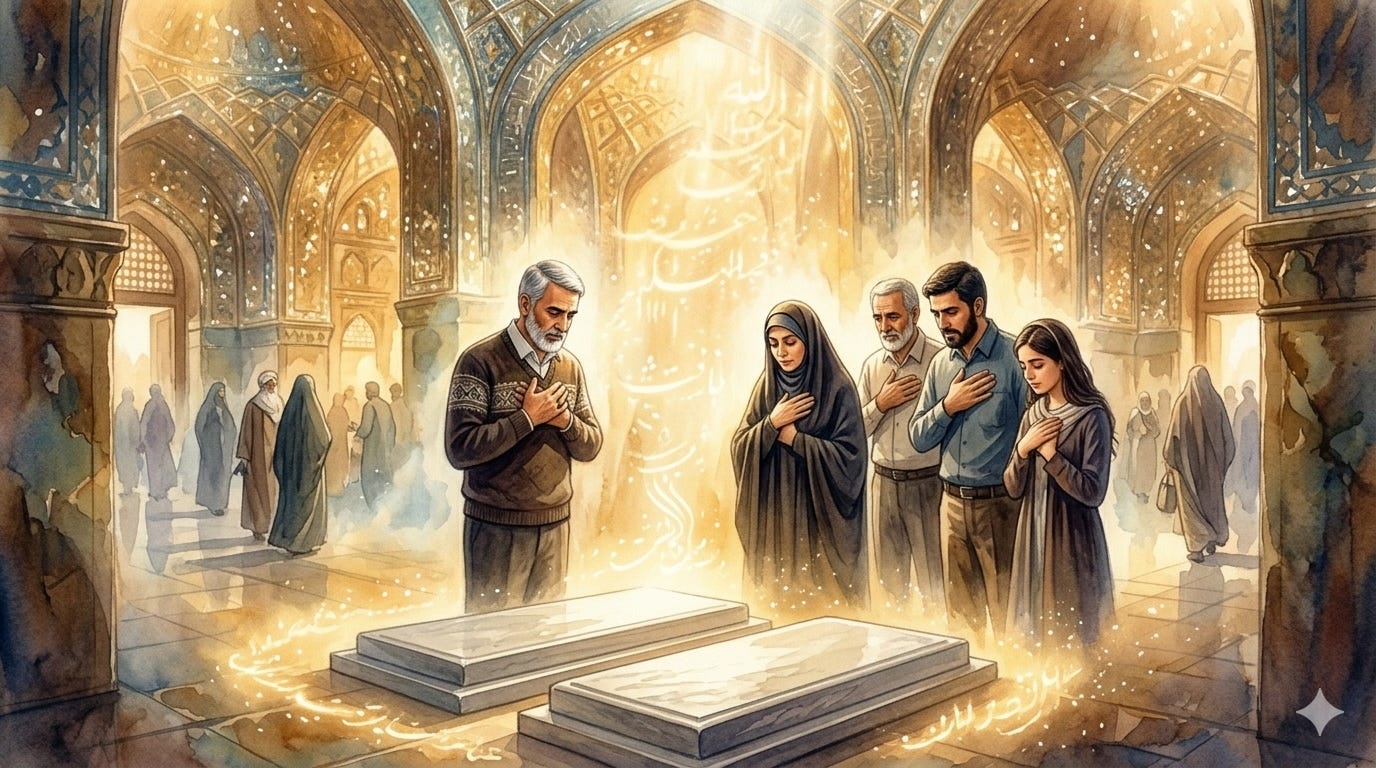
Before we close, let us stand, in our hearts, at the grave.
Let us make the short journey, together, from this gathering to Karbala.
Let us walk through the streets of the Holy City, past the pilgrims and the traders and the mourners, past the great golden dome of the Grandfather whose martyrdom we mark with our tears every Muharram, nay every day even.
Let us enter the sacred precincts of the Ha’ir.
And let us stand, in the stillness within, at two graves laid side by side — a young scholar laid beside his father, the Naqib who had walked the Alid community of Baghdad through seven turns of his office and now lay at rest beside the son who had inherited it from him.
This is where our story has led us tonight.
Not to a conclusion in a library in Baghdad.
Not to a final lecture in the Dar al-Ilm.
But to a quiet patch of soil in Karbala, where a forty-seven-year-old scholar — gone too soon, leaving an elder brother who could not even walk to his funeral — now lies in the eternal company of the Imam in whose service he spent every breath of his life.
Let us greet him.
Peace be upon you, O Sayyed Abu al-Hassan, Muhammad ibn al-Husayn al-Musawi.
Peace be upon you, O noble son of the Prophet’s household.
Peace be upon you — you who left us at forty-seven, when the scholars of your age believed you had only just begun.
Peace be upon you — you who refused a thousand dinars rather than curse a people, and who refused to hold in your heart what your tongue could not honestly say.
Peace be upon you — you who gathered the scattered words of your Grandfather from every letter, every sermon, every counsel, and bound them into a single book that we are still reading a thousand years later.
Peace be upon you — you who founded a House of Knowledge without walls between Muslim and Muslim, between Shi’a and Sunni, between believer and seeker, and who taught us by your life that knowledge is not a fortress to defend but a lamp to pass on.
Peace be upon you — you who lived Nahj al-Balagha before you compiled it, and who compiled it because you had first lived it.
Peace be upon you, O Sharif al-Radhi — the Content, the one whose name your Lord chose for you in a verse of the Qur’an, before you were ever born.
O God — we ask You, by his love of Imam Ali, by his devotion to the Ahl al-Bayt, by the book he left behind that has guided millions of Your servants — elevate his station among the righteous.
Place him beside his Grandfather in the highest Paradise.
And let every word of Nahj al-Balagha that is read until the end of time be a light that rises to his soul.
The Closing Supplication
O God — Lord of Sayyed al-Radhi, who lived forty-seven years and gave us a book that has not stopped speaking for a thousand.
We thank You, tonight, for the gift of his short life and the long shadow it has cast over every century since.
We thank You for the sermons he preserved, for the letters he gathered, for the maxims he chose, and for the silence he kept — submerging his own voice so that the voice of his ancestor could be heard.
O God — make us, in our own work, like Sayyed al-Radhi was in his.
Make us willing to disappear into the tradition we serve, rather than parading ourselves across it.
Make us, in our own short lives — and they are all short, every one of them, however long they seem — willing to do one thing well for Your sake, even if no one ever knows our name.
O God — we ask You, by Your love for Imam Ali ibn Abi Talib whose words filled this scholar’s heart, grant us tawfeeq.
Grant us success in the work You have entrusted to us.
Grant us the honour Sayyed al-Radhi carried into every act of his life — the honour that refused a thousand dinars, that refused to curse a people, that refused to hold in his heart what his tongue could not honestly say.
Let us not arrive at our own final hour with that honour traded away for the cheap currencies of this world.
And O God — for our beloved Master, the Imam of this Age, the Proof of God upon His earth, the son of al-Hasan al-Askari, peace be upon him and upon his fathers — be, in this hour and in every hour, his guardian, his protector, his leader, his helper, his guide, and his watchful eye.
Hasten his relief.
Make his hardship easy.
And count us, by Your mercy, among those who labour, as Sayyed al-Radhi laboured, to prepare the ground for the day of his return.
For the occultation continues, O Lord, because we are not yet ready.
Make us ready.
Let every word we speak, every truth we defend, every act of service we offer to Your creation — be a stone we lay in the foundation of the community he will one day lead.
Let our households become like the households of the Naqib’s family in Karkh — where the words of the Imams were read with such love that the children grew up unable to imagine a life that did not serve them.
And O God — when our own time comes, as it came for Sayyed al-Radhi at forty-seven, grant us husn al-khatima.
A good ending.
The ending of those whom You have chosen and who have chosen You.
Let us depart this world with our work given to those who would carry it forward, and our hearts at peace with the One who created us.
Let us, by Your mercy, be remembered as Sayyed al-Radhi is remembered tonight — not for the wealth we accumulated, but for the wealth we gave away.
Not for the offices we held, but for the dignity with which we held them.
Not for the books we wrote with our own names on the cover, but for the truth we transmitted from those who were greater than us.
And let us be reunited, by Your mercy, with the ones we have loved in this life and with the ones we have only loved from afar — beside Sayyed al-Radhi and beside his Grandfather, in a Paradise where the soil of Karbala lies open beneath our feet and the face of the Imam, may our souls be his ransom and may You, O God, hasten his return, is the first sight our eyes meet.
O God, send Your blessings upon Muhammad and the family of Muhammad — and hasten their relief — and may their enemies, all of them, be excluded from Your mercy.
Amen, O Lord, Sustainer of the Universes.
Amen, O Most Merciful of the Merciful.
Teaser for Next Week
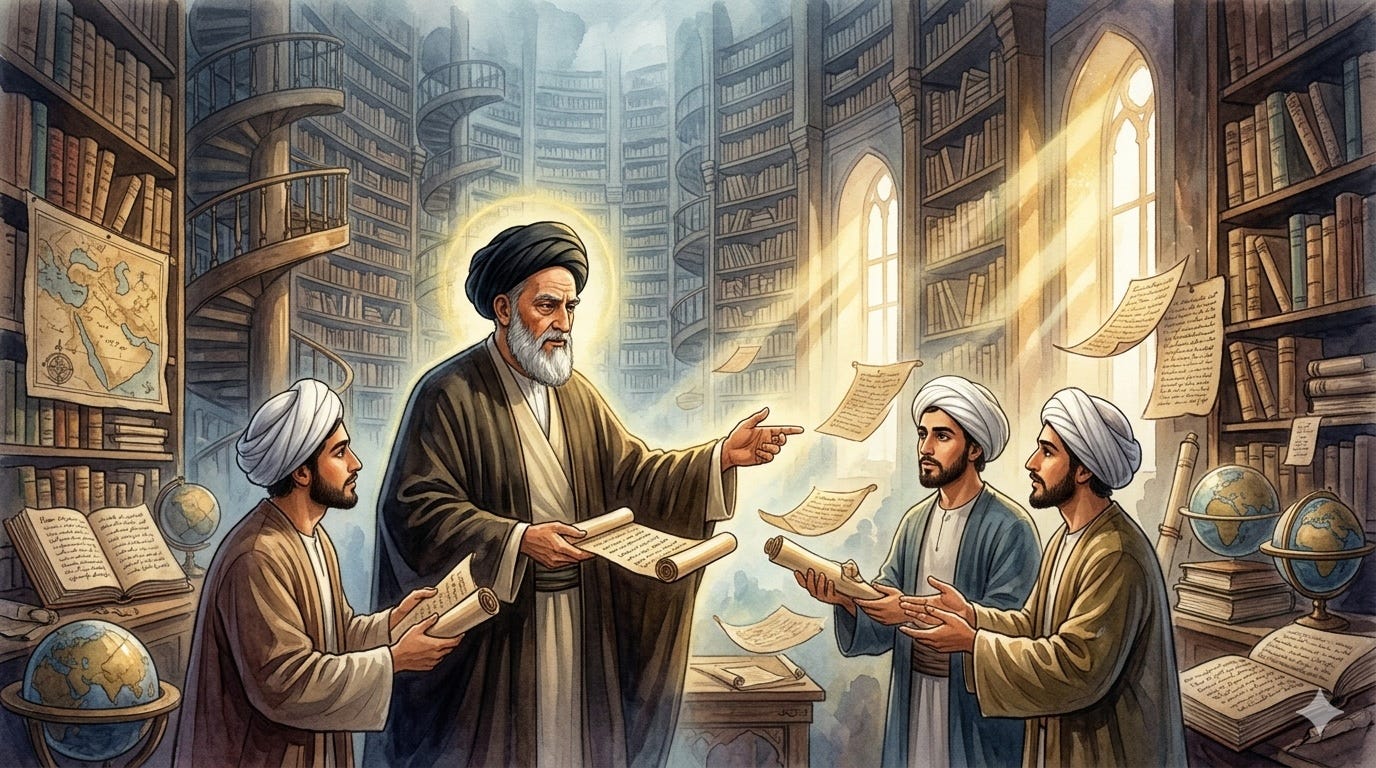
Next week, God willing, we walk the full life of the elder brother — Sayyed al-Murtadha — across the thirty years he carried the work forward alone after Sayyed al-Radhi’s death.
We will meet the five books he wrote that became the foundations of every Hawza in the world.
We will meet the dream through which his great ancestor gave him a title he refused before he accepted.
We will walk through his library of eighty thousand handwritten manuscripts — and we will meet the four students he dispatched, from Baghdad, to plant the seed of his teaching in soil that fire could not reach: in Tripoli, in Aleppo, across the whole of greater Syria, and in the desert town that would one day become Najaf.
Until then, may God keep you and your loved ones in His care, and may He grant us the courage Sayyed al-Radhi carried into every day of his short life.
And from Him alone is all ability, and He has authority over all things.