

In His Name, the Most High
Preamble
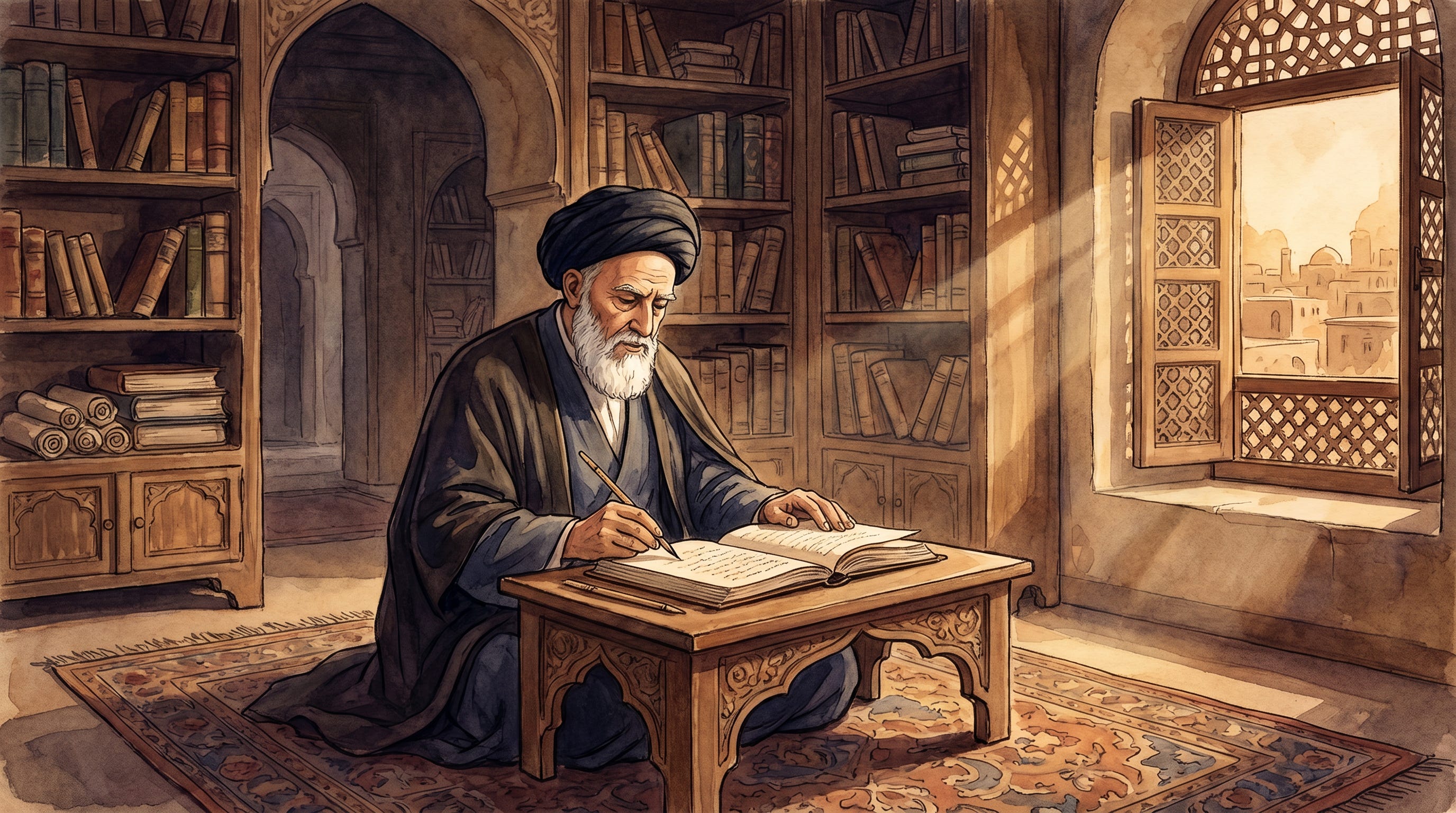
Tonight, we do not begin with a book.
We begin with thirty years.
Thirty years of a man who outlived his younger brother and never quite got over it.
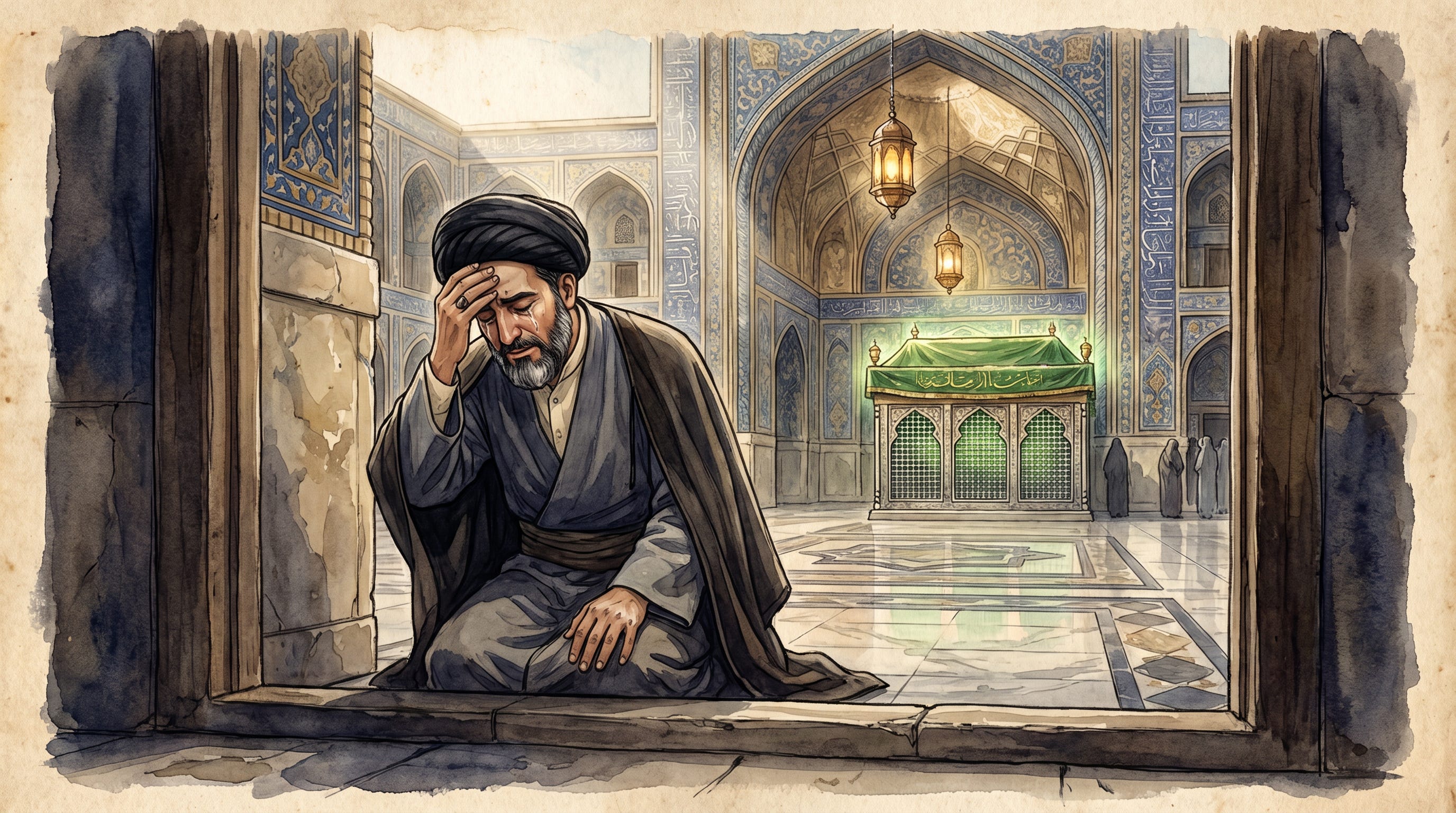
Thirty years of the elder, who, when his younger died at forty-seven, could not even walk to the funeral — who fled instead to the shrine of Imam Musa al-Kadhim, peace and blessings be upon him, and let the vizier of the Abbasid caliph lead the prayer in his place.
Thirty years of the senior scholar of his age, the most influential single Shi’a teacher of the fifth century of the Hijra, the man whose books would form the intellectual foundation of every Hawza that has ever taught in any city in the Shi’a world.
And yet — even as he carried that grief — those thirty years became the most productive years of his life.
His scholarly output expanded.
His students multiplied.
His library grew to a size the Islamic world had not seen in private hands before.
His authority spread, in his own lifetime, from Baghdad westward to Aleppo and Tripoli and across the whole of the Mediterranean Levant.
Listen to one short saying, preserved by his younger brother in Nahj al-Balagha — a saying of Imam Ali, peace and blessings be upon him, on what kind of life is worthy of the name living:
لَا تَكُنْ مِمَّنْ يَرْجُو الْآخِرَةَ بِغَيْرِ عَمَلٍ، وَيُؤَخِّرُ التَّوْبَةَ بِطُولِ الْأَمَلِ
“Do not be of those who hope for the Hereafter without action, and who postpone repentance through the length of their hopes.”
— Nahj al-Balaghah, compiled by al-Sharif al-Radhi, Maxim (al-Hikam), Saying 150
Twenty-two words.
The mark of a wasted life: hoping for what comes next while doing nothing in this one.
The man we sit with tonight refused that mark.
He had every excuse for it.
He had grief.
He had age.
He had wealth and station and the kind of public exhaustion that, in lesser men, would have been a perfectly understandable reason to slow down.
He did not slow down.
He gave the next thirty years of his life — every day of them, until his death at the age of eighty years and eight months — to the work his younger brother could no longer do.
Tonight, we walk the full life of Sayyed al-Murtadha.
Alam al-Huda.
The Banner of Guidance.
Video of the Majlis (Sermon/Lecture)
Audio of the Majlis (Sermon/Lecture)
Recap
In Session 65, two weeks ago, we met the two brothers as boys.
We met their mother walking them to the mosque of al-Karkh.
We met the dream that brought them to Shaykh al-Mufid.
We met the household into which they were born and the names their father whispered into their ears at the call to prayer.
And we left them at the threshold of their lives — the soil prepared, ready for what was about to grow.
Last week, in Session 66, we walked the full life of the younger brother — Sayyed al-Radhi.
We sat with what he produced in just forty-seven years: three commentaries on the Holy Qur’an, treatises on the figurative sayings of the Prophet, peace and blessings be upon him, his family and his righteous companions, a Diwan of poetry that the literary critics of his age placed among the finest of the century, the founding of the Dar al-Ilm in Baghdad eighty years before the Nizamiyyah was built — and the one book for which the world would remember him, Nahj al-Balagha, the Peak of Eloquence, completed in the year 400 of the Hijra, six years before his death.
We sat with the three public offices he held from the age of twenty-one until his death — the Naqib al-Talibiyin, the Amir al-Hajj, the head of the Diwan al-Mazalim — and with the dignity he carried into all three.
We watched him refuse a thousand gold dinars from the vizier al-Mahlabi, and refuse to sign the Caliph al-Qadir’s denunciation of the Fatimids, and respond to his dismissal from all three offices with a poem declaring that his dignity remained untouched.
And we walked him to his grave.
The sixth of Muharram, 406 of the Hijra.
Forty-seven years old.
Dying without wealth, having given everything away — to his students, to the poor of the Talibid family he supervised, to the Dar al-Ilm he had founded, to the free copying of manuscripts for young scholars.
We sat with the funeral.
We watched Sayyed al-Murtadha, his elder brother, unable to bring himself to attend — fleeing instead to the shrine of Imam Musa al-Kadhim, peace and blessings be upon him, and weeping there.
We watched Fakhr al-Mulk, the vizier of the Abbasid caliph — the chief minister of the very government that had privately despised everything Sayyed al-Radhi stood for — step in to lead the prayer in his place.
And we followed Sayyed al-Radhi’s body, after its initial burial in his Karkh home, through its final transfer to Karbala — to the Ha’ir of Imam Husayn, peace and blessings be upon him, where he was laid to rest beside his father, the Naqib Sayyed Abu Ahmad al-Husayn al-Musawi.
Two graves, in Karbala, beside the Master of the Martyrs.
The compiler of the words of Imam Ali, resting beside the body of Imam Husayn.
That is where we left him.
Tonight, we turn to the brother who buried him, and to the thirty years that followed.
Sayyed al-Murtadha and the Twenty-Three Years
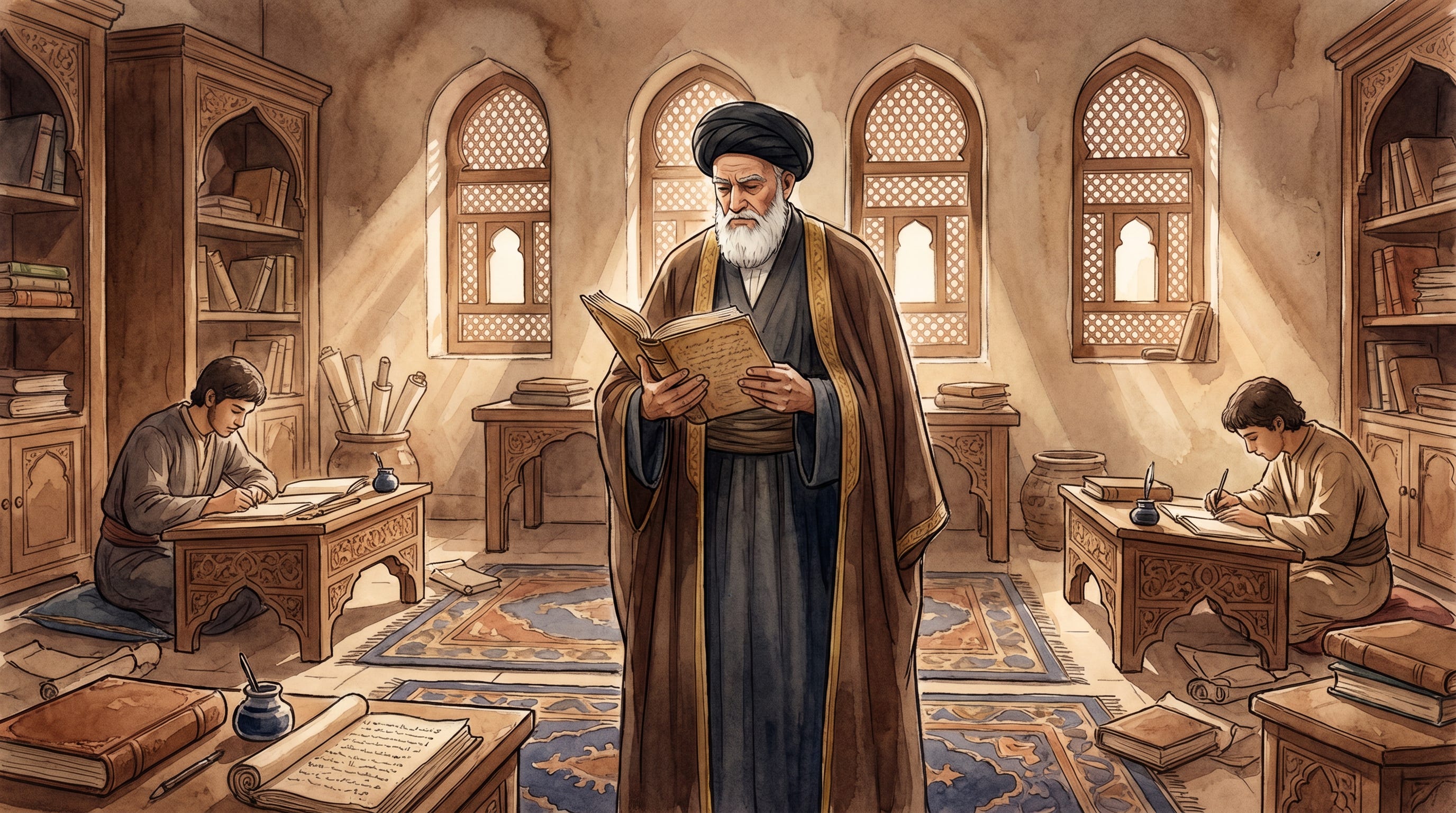
If Sayyed al-Radhi was the poet, Sayyed al-Murtadha was the architect.
If Sayyed al-Radhi gave us a book, Sayyed al-Murtadha gave us the structures — intellectual, institutional, spiritual — that would carry the Shi’a community forward through the next two centuries and beyond.
And where Sayyed al-Radhi’s life was cut short at forty-seven, Sayyed al-Murtadha was given a long life.
He lived to be eighty years and eight months old — passing away in the year 436 of the Hijra, thirty years after his younger brother, and twenty-three years after the death of their teacher Shaykh al-Mufid in 413 of the Hijra.
Those twenty-three years, between Shaykh al-Mufid’s death and his own, are the years in which Sayyed al-Murtadha became what history remembers him as:
the single most important figure in Shi’i scholarship of his generation.
And what he did with those years is the substance of tonight’s session.
The Master of the House
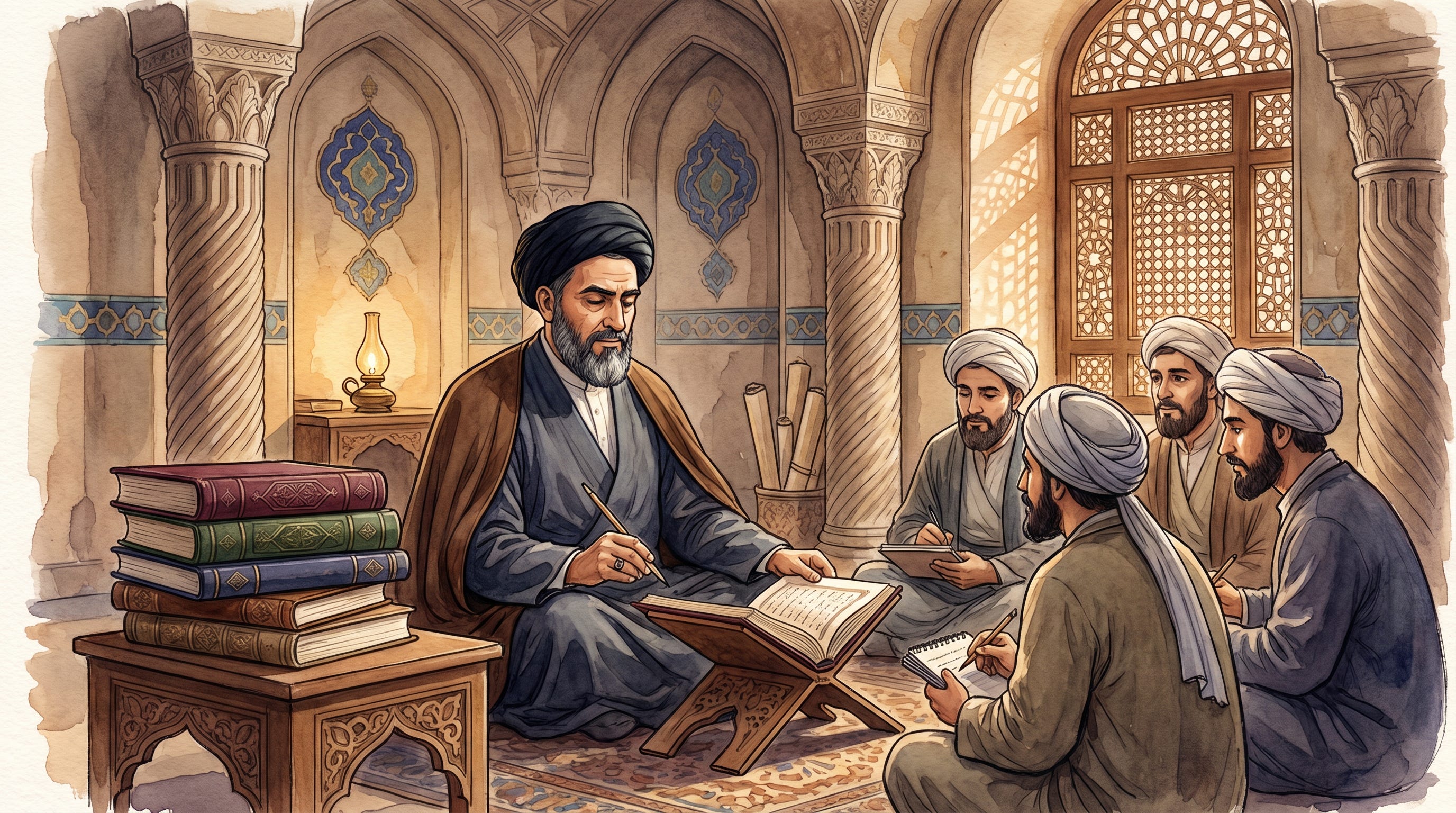
When Shaykh al-Mufid passed away in 413 AH, the question of who would lead the Shi’a community after him was, in one sense, already answered.
Shaykh al-Mufid himself had prepared his successor.
Sayyed al-Murtadha had studied under him for decades, had already authored major works of theology and jurisprudence, had long been recognised as Shaykh al-Mufid’s most brilliant student, and had been functioning as a senior scholar in his own right for years.
When Shaykh al-Mufid died, the students of the Karkh mosque did not need to look elsewhere.
They had their new teacher.
But the leadership Sayyed al-Murtadha inherited was not only a scholarly leadership.
It was also an administrative one — and it had already begun, as we saw last week, with Sayyed al-Radhi.
But before we speak of the offices he held, we need to pause on the books he wrote.
Because the books are the reason the man is still known.
And they are not remembered only by historians.
They are remembered by every advanced student, in the two great seminaries of our tradition, who has ever sought to reach the rank of ijtihad — the rank of an independent jurist capable of deriving the rulings of our faith from their sources.
Let me put it as plainly as I can.
In the Hawza of Najaf, and in the Hawza of Qom, as we sit in this majlis tonight — a thousand years after Sayyed al-Murtadha’s death — his books are still being opened, still being debated, still being dissected line by line.
They are not the textbooks of the first-year student.
A first-year student in Qom or Najaf carries other, later, introductory books in his bag.
But the day a student in Qom or Najaf reaches the highest level of study — what is called Bahth al-Kharij, the advanced lectures given by the senior scholars of our age — the day that student sits at the feet of a Marja al-Taqlid and seeks to derive a ruling from its roots, five books sit open on the table in front of him.
And all five of those books were written, in Baghdad, in the first third of the fifth century of the Hijra — by a scholar whose title we will soon hear, and hear properly, in the dream through which he received it.
Let me name them for you.
Because each one of them is a world.
The first is al-Dharia ila Usul al-Sharia — The Path to the Principles of the Sacred Law — one of the earliest comprehensive Shi’i works on the science of Usul al-Fiqh, the principles by which a jurist derives law from its sources.
Every discussion of how Shi’i jurisprudence reasons about revelation — how the scholar moves from a verse or a hadith to a ruling — begins, at its roots, with Sayyed al-Murtadha’s Dharia.
A thousand years on, the senior scholars of Qom and Najaf still trace the origins of their own jurisprudential principles back to this book.
The second is al-Intisar — The Victory — a work of comparative jurisprudence, written to document the rulings on which the Imami Shi’a school stood apart from the schools of our Sunni brethren.
When a scholar today teaches a lesson on what distinguishes the Shi’a legal position — on ablution, on prayer, on marriage, on inheritance — al-Intisar is the foundational reference to which he will return.
The third is Tanzih al-Anbiya — The Vindication of the Prophets — a rigorous theological defence of the doctrine of isma — the infallibility of the Prophets and the Imams.
Whenever a student is faced with a Qur’anic verse that seems, on its surface, to attribute a mistake to a Prophet — whether to Prophet Adam, or to Prophet Moses, or to others — Sayyed al-Murtadha’s Tanzih al-Anbiya is the book that teaches him how to read the verse properly, with the tools of Arabic grammar and theological precision.
The fourth is al-Shafi fi al-Imama — The Sufficient Treatise on the Imamate — a monumental defence of the succession of Imam Ali ibn Abi Talib, written specifically in response to the great Mu’tazilite scholar Qadi ʿAbd al-Jabbar, who had challenged the Shi’a doctrine in his own encyclopaedic work al-Mughni.
Al-Shafi is considered, by the scholars of our tradition, to be one of the most rigorous defences of the doctrine of Imamah ever written.
So important was this book that Sayyed al-Murtadha’s own student Shaykh al-Tusi later wrote a condensed version of it called Talkhis al-Shafi — and that summary, too, is still studied in the Hawza today.
And the fifth is Amali al-Murtadha, also known as Ghurar al-Fawa’id wa Durar al-Qala’id — The Dictations of al-Murtadha, or The Choice Benefits and Pearl Necklaces — a vast literary and exegetical work that stands, in the library of his brother’s Nahj al-Balagha, as its theological counterpart.
Where Nahj al-Balagha preserves the eloquence of the Commander of the Faithful, Sayyed al-Murtadha’s Amali preserves the depth of classical Arabic, the nuance of Qur’anic exegesis, and the literary horizon in which the Imams spoke.
It is a masterclass in the Arabic of the revelation.
Five books.
Each one of them, on its own, would have secured a scholar’s reputation for a century.
Together, they have been the intellectual foundation of Shi’i jurisprudence for a thousand years.
Every serious Mujtahid, every Marjaʿ, every Ayatullah — in Najaf, in Qom, and in every Hawza that descends from these two — has built his training on them.
This is what Sayyed al-Murtadha produced.
And he produced it alongside — not instead of — the public responsibilities he carried.
Remember from last week: Sayyed al-Radhi had held three official positions during his lifetime.
The Naqib al-Talibiyin — the leadership of the descendants of Abu Talib, the office their father had held before them.
The Amir al-Hajj — the supervision of the pilgrimage caravan to Makkah.
And the head of the Diwan al-Mazalim — the chief of the High Court of Grievances, which, in the judicial structure of Abbasid Baghdad, was the highest appellate court of the caliphate.
The court of last resort for those who had been wronged by the powerful.
When Sayyed al-Radhi died in 406, these three positions passed to Sayyed al-Murtadha.
And Sayyed al-Murtadha held them — with a gap of only the briefest transition — for the remaining thirty years of his life.
The biographical sources record that he served as head of the Diwan al-Mazalim for thirty years.
Thirty years as the chief justice of the highest court in Baghdad.
Thirty years ruling on the complaints of those who had been wronged.
Thirty years handing down verdicts in a city where the political winds could shift overnight and a verdict against the wrong man could cost a scholar his position, his wealth, even his life.
And through all of this, he was also teaching.
Writing.
Leading the Shi’a community.
Training the generation of scholars who would carry the tradition into the fifth century of the Hijra — a generation that would include, most notably, a young man who arrived in Baghdad from the Persian city of Tus: Shaykh al-Tusi, whom we will meet in a future session, God willing.
The man Sayyed al-Murtadha trained for twenty-three years.
The man who would carry everything he learned from Sayyed al-Murtadha out of Baghdad when the city turned on the Shi’a — and plant it, afresh, in the soil of Najaf.
But we are getting ahead of ourselves.
The Dream That Gave Him His Name
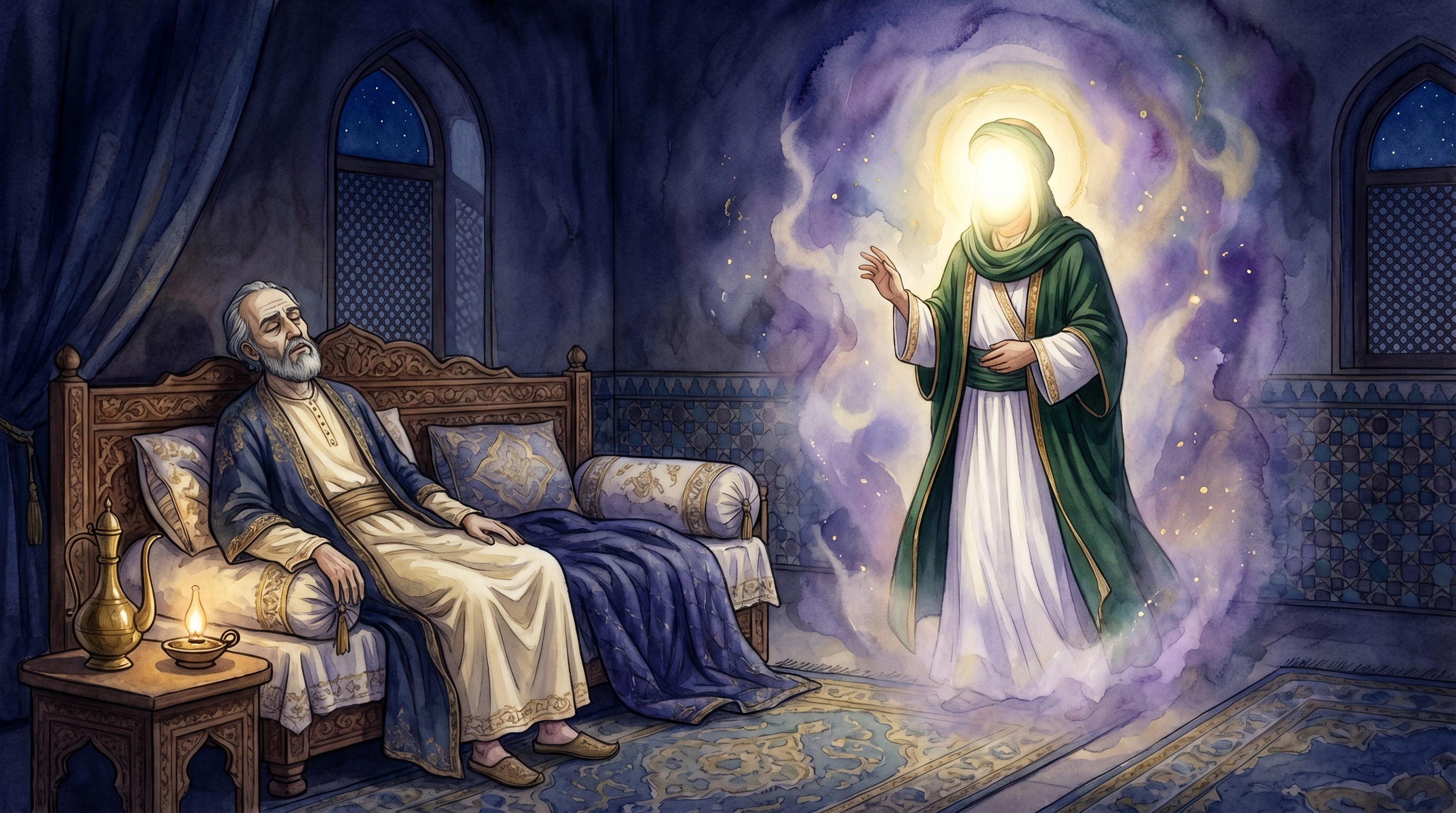
Of all the titles that Sayyed al-Murtadha carried in his lifetime — Sharif al-Murtadha, Sayyed al-Murtadha, Dhu al-Majdayn (the Possessor of Two Glories, given to him by the Buyid prince Baha’ al-Dawla) — the title by which he is most remembered, and the one under which his books are still catalogued in every Shi’i library in the world, came to him through a dream.
A dream that was not his own.
The classical biographical sources preserve the incident with remarkable consistency.
The earliest to record it, as far as we can trace, was Shahid al-Awwal — the First Martyr — whose given name was Muhammad ibn Makki al-Ameli, a great jurist of the eighth century of the Hijra from the Jabal Amel region of what is today southern Lebanon.
He earned his title — the First Martyr — because he was executed by the Mamluk authorities in Damascus in the year 786 of the Hijra, for the crime of being a Shi’i scholar who would not renounce his faith.
We will meet him properly, God willing, in a future session of this sub-series — and may God rest his pure soul.
He recorded the story of Sayyed al-Murtadha’s title in a work of his called Kitab al-Arba’in — The Book of Forty — which, in the tradition of our scholars, was a genre: a collection of forty hadith, chosen with care, each one accompanied by the scholar’s own reflections, intended to transmit to future generations the narrations a scholar most wanted to safeguard.
From Shahid al-Awwal’s Kitab al-Arba’in, the story travelled.
It was picked up by Ibn Khallikan — the thirteenth-century Sunni historian and judge from what is today Iraqi Kurdistan, who served as chief judge of Damascus under the Mamluks.
We have already met him last week, in the funeral of Sayyed al-Radhi, where he preserved the detail of Sayyed al-Murtadha’s grief.
He compiled one of the most celebrated biographical dictionaries in the Arabic language, Wafayat al-A’yan — The Obituaries of the Notables — a vast collection of the lives of the prominent figures of Islamic civilisation, drawn from both Sunni and Shi’i sources.
He included the entry on Sayyed al-Murtadha, and he included the story of the dream.
That a Sunni judge in Mamluk Damascus would carry this narration forward, without polemic, is itself a testimony to the power of the account.
It was carried forward again by Ibn Abi al-Hadid — whom we met in Session 65, the Mu’tazilite scholar whose twenty-volume commentary on Nahj al-Balagha preserved so much of our own tradition for us — who recorded it in the biographical material at the opening of his Sharh — Commentary.
And centuries later, it was gathered into the great encyclopaedic project of Allamah al-Majlisi — the great scholar — whose massive compilation Bihar al-Anwar — The Oceans of Lights — running to one hundred and ten volumes, sought to preserve, in one place, every narration, every account, every biographical detail that the Shi’a tradition had produced in a thousand years.
The dream of the vizier, and the title given to Sayyed al-Murtadha, found its permanent home on his shelves.
Four sources, across four centuries, telling the same story.
Let me tell you what they say.
It was the year 420 of the Hijra.
Sayyed al-Murtadha was sixty-five years old.
He had already been leading the Shi’a community for seven years since Shaykh al-Mufid’s death, and his reputation had reached every corner of the Abbasid capital.
The vizier of the Abbasid Caliph al-Qadir — a man by the name of Muhammad ibn al-Husayn — fell gravely ill.
His illness continued.
No treatment seemed to help.
And one night, in the depth of his illness, the minister saw a dream.
In the dream, he saw the Commander of the Faithful, Imam Ali.
And the Imam said to him:
Tell Alam al-Huda — the Banner of Guidance — to recite over you, that you may be healed.
The minister, in the dream, was confused.
He asked:
O Commander of the Faithful, and who is Alam al-Huda?
And the Imam answered, plainly:
Ali ibn al-Husayn al-Musawi.
The biographical sources preserve the Arabic of this exchange as follows:
فَرَأَى فِي مَنَامِهِ أَمِيرَ الْمُؤْمِنِينَ عَلِيَّ بْنَ أَبِي طَالِبٍ (ع)، يَقُولُ لَهُ: «قُلْ لِعَلَمِ الْهُدَى يَقْرَأُ عَلَيْكَ حَتَّى تَبْرَأَ». فَقَالَ: يَا أَمِيرَ الْمُؤْمِنِينَ، وَمَنْ عَلَمُ الْهُدَى؟ فَقَالَ: «عَلِيُّ بْنُ الْحُسَيْنِ الْمُوسَوِيُّ».
“And he saw in his dream the Commander of the Faithful, Ali ibn Abi Talib (peace be upon him), who said to him: ‘Tell Alam al-Huda to recite over you, that you may be healed.’ He said: ‘O Commander of the Faithful, and who is Alam al-Huda?’ He answered: ‘Ali ibn al-Husayn al-Musawi.’”
— Shahid al-Awwal (Muhammad ibn Makki al-’Ameli, d. 786 AH), Kitab al-Arba’in, recorded also in Ibn Khallikan, Wafayat al-A’yan wa Anba’ Abna’ al-Zaman, entry on al-Sharif al-Murtadha; Ibn Abi al-Hadid, Sharh Nahj al-Balagha, Volume 1; and al-Majlisi, Bihar al-Anwar
And the minister awoke.
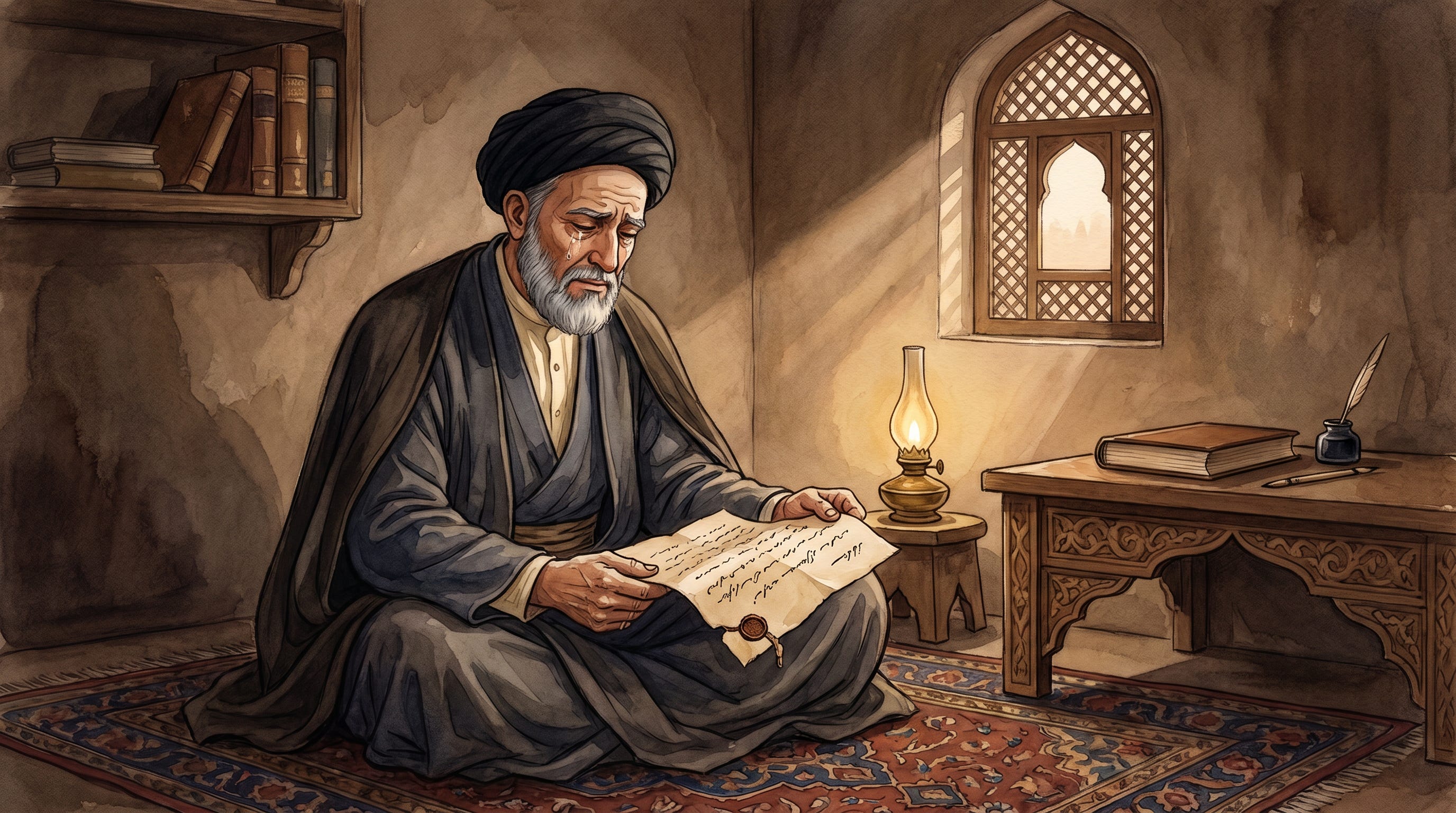
He wrote a letter.
He addressed it to Sayyed al-Murtadha.
He recorded what he had seen in his dream.
And he wrote, at the head of the letter, the name by which the Imam had instructed him to address his healer:
Alam al-Huda.
And when Sayyed al-Murtadha received the letter, and read the title by which the minister had addressed him — he refused it.
He wrote back.
He said, in effect:
I am not worthy of this name. This name is too great for me. To bear such a title would be to belittle the station it names. And he asked the minister not to use it.
The minister, in reply, explained what had happened.
I did not choose this name. I was commanded to use it. By the Commander of the Faithful himself, in a dream.
Sayyed al-Murtadha made the recitation.
The minister was healed.
And when news of the incident reached the Caliph al-Qadir, the Caliph summoned Sayyed al-Murtadha — a Caliph, we should remember, whose government Sayyed al-Murtadha did not consider legitimate — and said to him:
O Sayyed al-Murtadha. Accept what your great ancestor has nicknamed you.
And the Caliph ordered the government scribes, from that day forward, to record the name Alam al-Huda in every document that referred to him.
From that day, Sayyed al-Murtadha became known, across the Islamic world, by the title his ancestor had given him in a dream.
Alam al-Huda.
The Banner of Guidance.
Lessons Woven In
Pause with me here, because there is something worth sitting with in this story.
Sayyed al-Murtadha, when he received the letter, refused the title.
Think about that.
A man in his sixties.
A scholar at the peak of his powers.
The undisputed head of the Shi’a community.
A man who could have taken a glorious title and worn it openly, and no one would have objected.
And his first instinct, upon receiving it — was to say he did not deserve it.
This name is too great for me.
This is the posture of a man who understood something about titles that our age, desperate as it is for recognition, has largely forgotten.
Titles are not achievements.
They are responsibilities.
A title does not tell you what you have done — it tells you what you are now obliged to become.
And the bigger the title, the heavier the obligation.
Alam al-Huda — the Banner of Guidance — is not a casual laqab or title.
It is a declaration that the one who bears it stands, in his age, as a sign by which the faithful orient themselves.
That is a burden, a duty, a responsibility.
And Sayyed al-Murtadha felt the burden before he felt the honour.
And even when he accepted it — because his Imam had commanded it through a dream, and the Caliph had confirmed it, and the scribes were already writing it — he accepted it as a man accepts an assignment, not as a man accepts a prize.
He spent the next sixteen years of his life, until his death in 436, carrying that title in the way titles are meant to be carried: by making himself, day after day, a little more worthy of it.
There is a lesson here for our age — for our communities, for our scholars, for those who carry titles of their own.
Shaykh.
Allamah.
Hujjat al-Islam.
Ayatullah.
These are not trophies.
They are not ranks to be competed for.
They are assignments — given by a tradition, confirmed by a community, and carrying an obligation to live up to them that does not lighten for a single day the bearer walks this earth.
The one who takes such a title lightly, or wears it arrogantly, has misunderstood what he has been given.
Sayyed al-Murtadha wept when he received his.
And that weeping is the beginning of the wisdom by which such titles are supposed to be carried.
The Library, the Mosque, and the Eighty Thousand Volumes
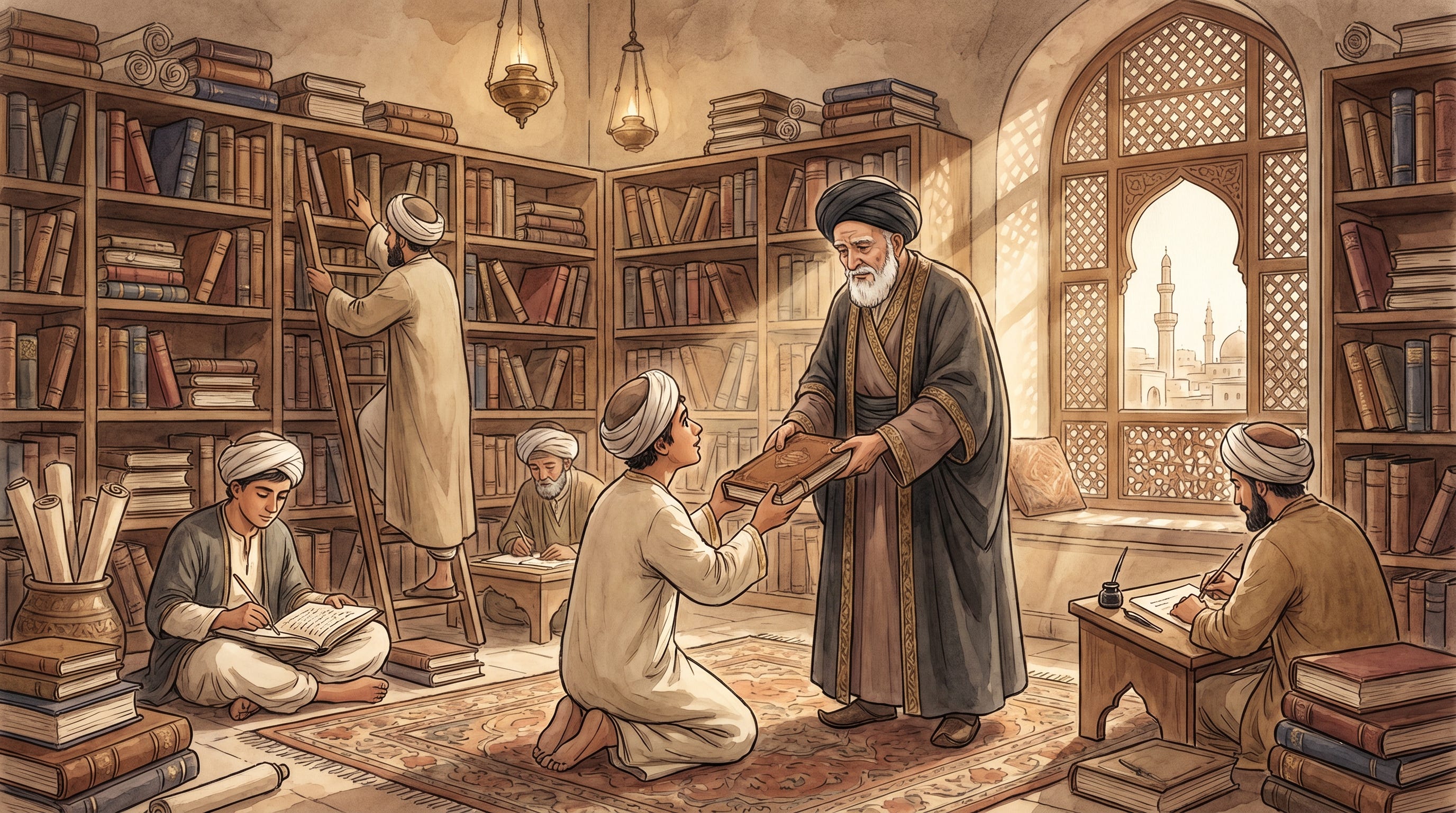
I want to pause now on one detail about Sayyed al-Murtadha that I think, more than any of his books or his titles or his positions, tells us what kind of scholar he was.
His personal library, at the time of his death, was estimated at eighty thousand volumes.
Let me pause on that number, because in the fifth century of the Hijra, it is genuinely staggering.
Eighty thousand handwritten manuscripts.
In an age before printing.
In an age when a single copy of a single book was the labour of weeks or months by a professional scribe.
In an age when entire scholarly communities might share a few hundred volumes between them.
One man, in Baghdad, had assembled eighty thousand.
The figure is preserved in the great biographical collections of our tradition — most prominently in Qadi Nurullah al-Shushtari’s Majalis al-Mu’minin — The Assemblies of the Believers — a sixteenth-century biographical work on the great scholars of the Shi’a, and in Sayyed Ali Khan al-Madani’s al-Darajat al-Rafi’a fi Tabaqat al-Shi’a — The Elevated Degrees in the Classes of the Shi’a — a seventeenth-century biographical compendium.
وَكَانَ لَهُ فِي دَارِهِ خِزَانَةٌ عَظِيمَةٌ مِنَ الْكُتُبِ بَلَغَتْ ثَمَانِينَ أَلْفَ مُجَلَّدٍ مِنْ مُصَنَّفَاتِهِ وَمُصَنَّفَاتِ غَيْرِهِ
“And he had in his house a great library of books, which reached eighty thousand volumes — both of his own compositions and of the compositions of others.”
— Preserved in Qadi Nurullah al-Shushtari, Majalis al-Mu’minin, Volume 1, Page 501; and in Sayyed Ali Khan al-Madani, al-Darajat al-Rafi’a fi Tabaqat al-Shi’a, Page 463
And what did he do with that library?
He did not hoard it.
He did not wall it off behind a private door, as lesser men with private treasures have always done.
The biographical sources tell us — with some tenderness — that he opened his library to every serious student who walked through his gate.
Shi’i or Sunni or Mu’tazili, jurist or theologian or grammarian — if the student had come to learn, the manuscripts were opened to him.
And Sayyed al-Murtadha went further than opening.
He funded the students themselves.
He sold parts of his inherited estates — land, property, assets that had come down to him from his noble father — to provide paper, ink, and copying materials so that his students could reproduce the manuscripts they were studying and carry the copies away with them.
The account is preserved in al-Khwansari’s Rawdat al-Jannat — The Gardens of Paradise — the great nineteenth-century biographical encyclopedia of Shi’i scholars:
وَكَانَ السَّيِّدُ الْمُرْتَضَى رَحِمَهُ اللَّهُ قَدْ بَاعَ بَعْضَ ضِيَاعِهِ لِيُنْفِقَ ثَمَنَهُ عَلَى الطَّلَبَةِ وَفِي شِرَاءِ الْوَرَقِ وَالْأَدَوَاتِ لَهُمْ لِيَكْتُبُوا بِهَا
“And Sayyed al-Murtadha, may God have mercy upon him, sold some of his estates in order to spend the proceeds upon his students, and in purchasing paper and copying materials for them, so that they could write with them.”
— Al-Khwansari, Rawdat al-Jannat fi Ahwal al-‘Ulama’ wa al-Sadat, Volume 4, Page 296
And he paid his students regular monthly stipends, so that poverty would never be a barrier to their pursuit of knowledge.
The biographical sources preserve even the specific sums — which is remarkable, because in the ordinary course of things, the monthly stipends paid by one scholar to his students are not the kind of detail that survives a thousand years of transmission.
That these figures survived tells us how extraordinary they were considered in their own time.
The account reaches us through Sayyed Ali Khan al-Madani’s al-Darajat al-Rafi’a fi Tabaqat al-Shi’a — The Elevated Degrees in the Classes of the Shi’a — the seventeenth-century biographical compendium we named a moment ago:
وَكَانَ يُجْرِي عَلَى تَلَامِذَتِهِ الْأَرْزَاقَ، فَأَجْرَى عَلَى الشَّيْخِ الطُّوسِيِّ فِي كُلِّ شَهْرٍ اثْنَيْ عَشَرَ دِينَارًا، وَعَلَى الْقَاضِي ابْنِ الْبَرَّاجِ ثَمَانِيَةَ دَنَانِيرَ، وَعَلَى غَيْرِهِمَا بِحَسَبِ حَالِهِمْ
“And he would disburse regular stipends upon his students: he allotted to Shaykh al-Tusi, every month, twelve dinars; and to Qadi Ibn al-Barraj, eight dinars; and to the others according to their circumstances.”
— Sayyed Ali Khan al-Madani, al-Darajat al-Rafi’a fi Tabaqat al-Shi’a, Page 460
To put those sums in perspective for a modern audience: a gold dinar in fifth-century Baghdad was a substantial coin.
Twelve dinars a month was not pocket change — it was a genuine salary, enough for a young scholar to live, house himself, and concentrate on his studies without distraction.
Sayyed al-Murtadha was not offering tokens.
He was underwriting the formation of the next generation of Shi’i scholarship out of his own pocket.
And when, in the year 422 of the Hijra, the Hanbali faction in Baghdad rioted against the Shi’a community — one of several periodic eruptions of sectarian violence that the Buyid protection could never fully prevent — they burned his father’s house, the house Sayyed al-Murtadha had inherited, along with much of what it contained.
He lost property.
He lost manuscripts.
He lost decades of gathered possessions.
The account is preserved by Ibn Inaba in his ’Umdat al-Talib fi Ansab Al Abi Talib — The Principal Treatise on the Lineages of the Family of Abi Talib — a fourteenth-century genealogical work by a Sunni descendant of the Hasanid Sayyeds, which remains one of the most cited references across both Sunni and Shi’i traditions for the lineages and biographies of the Prophet’s family.
وَفِي سَنَةِ اثْنَتَيْنِ وَعِشْرِينَ وَأَرْبَعِمِائَةٍ احْتَرَقَتْ دَارُ أَبِيهِ فِي فِتْنَةِ الْحَنَابِلَةِ، فَانْتَقَلَ إِلَى دَارٍ أُخْرَى فِي الْكَرْخِ، وَعَادَ إِلَى دُرُوسِهِ
“And in the year 422, his father’s house was burned in the Hanbali rioting. So he moved to another house in Karkh, and he returned to his lessons.”
— Ibn Inaba, ’Umdat al-Talib fi Ansab Al Abi Talib, Pages 209–210
Read that final phrase again, because the biographical sources, for all their density of detail, preserve it in four Arabic words:
وَعَادَ إِلَى دُرُوسِهِ — wa ʿada ilaa durusihi — and he returned to his lessons.
He did not close the school.
He did not stop teaching.
He did not announce a period of mourning for his losses.
He picked himself up, moved his surviving books and his students to a new location in the same neighbourhood, and continued.
He was sixty-seven years old at the time.
He would live and teach for another fourteen years after the fire.
This was the measure of the man.
And the scholars he trained — sitting in his classes, drawing his stipends, copying manuscripts from his library — carried what they had learned into every corner of the Shi’a world.
Four of them deserve, at minimum, to be named.
Qadi Ibn al-Barraj — the Judge of Tripoli
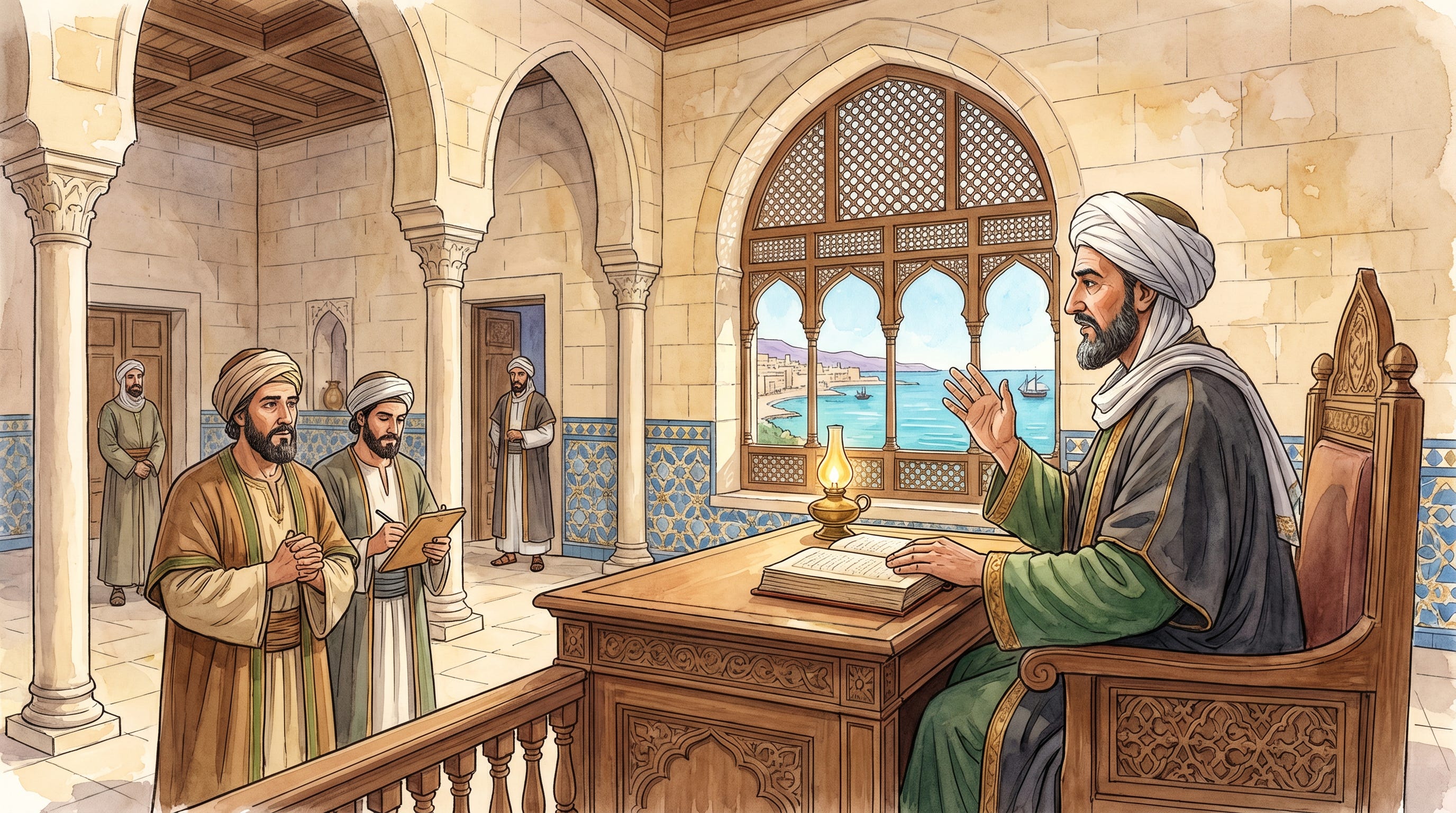
The first is the man whose stipend we have already heard — the eight gold dinars that Sayyed al-Murtadha paid him every month.
His full name was Sa’d al-Din Abu al-Qasim Abd al-Aziz ibn al-Barraj, born around the year 400 of the Hijra, and died in 481.
The biographical sources almost never call him by his full name.
They call him simply al-Qadi Ibn al-Barraj — Ibn al-Barraj the Judge — because of the office he would come to hold, and hold for decades.
Ibn al-Barraj made the journey that so many scholars of his age made.
From his home region, he travelled to Baghdad, to sit in the classroom of Sayyed al-Murtadha.
He became one of Sayyed al-Murtadha’s most brilliant students — so brilliant that Sayyed al-Murtadha underwrote his studies with the stipend we have named, so that he could focus on his learning without the distraction of worldly worry.
When Sayyed al-Murtadha died in 436, Ibn al-Barraj continued his studies under Shaykh al-Tusi — whom we will meet properly in a future session, God willing — completing his mastery of jurisprudence under the next generation of the chain.
And then Sayyid al-Murtadha’s plan for him unfolded.
Sayyed al-Murtadha sent him westward — across the Iraqi desert, into the mountains of Syria, to the coastal city of Tripoli, in what is today northern Lebanon.
To understand why this was such a significant posting, you have to understand what Tripoli was at that moment.
In the eleventh century of the Gregorian calendar, Tripoli was not the provincial city that later history would reduce it to.
It was a thriving, independent intellectual hub, ruled by the Banu Ammar — the Ammarid dynasty — who were themselves Twelver Shi’a.
They had established their own great Dar al-Ilm — House of Knowledge — in Tripoli, modelled on the one Sayyed al-Radhi had founded in Baghdad a generation earlier, and reputed to hold hundreds of thousands of manuscripts.
Tripoli, under the Banu Ammar, was one of the great Shi’i scholarly centres of the Mediterranean world.
And into that world, Ibn al-Barraj was sent — not merely as a teacher, but as the Chief Judge, the Qadi, of Tripoli.
He held that office for between twenty and thirty years.
He was the highest legal authority in a major Mediterranean state.
He did not simply teach Shi’a jurisprudence in a classroom — he applied it, day by day, in the governance of a Shi’a-ruled city.
Marriage, inheritance, commerce, criminal law, the organisation of public life: all of it passed across his desk.
And he wrote.
Two of his works are still considered classics in the Hawza today:
Al-Muhadhdhab — The Refined — his magnum opus.
A comprehensive encyclopedia of Shi’a jurisprudence that would deeply influence Allamah al-Hilli and the generations of scholars who came after him.
And Jawahir al-Fiqh — The Jewels of Jurisprudence — a systematic treatment of specific rulings and complex legal questions.
Through Ibn al-Barraj, the scholarly inheritance of Sayyed al-Murtadha’s classroom in Baghdad reached across the Fertile Crescent and took root on the shores of the Mediterranean.
Sallar al-Daylami — the Jurist of Aleppo
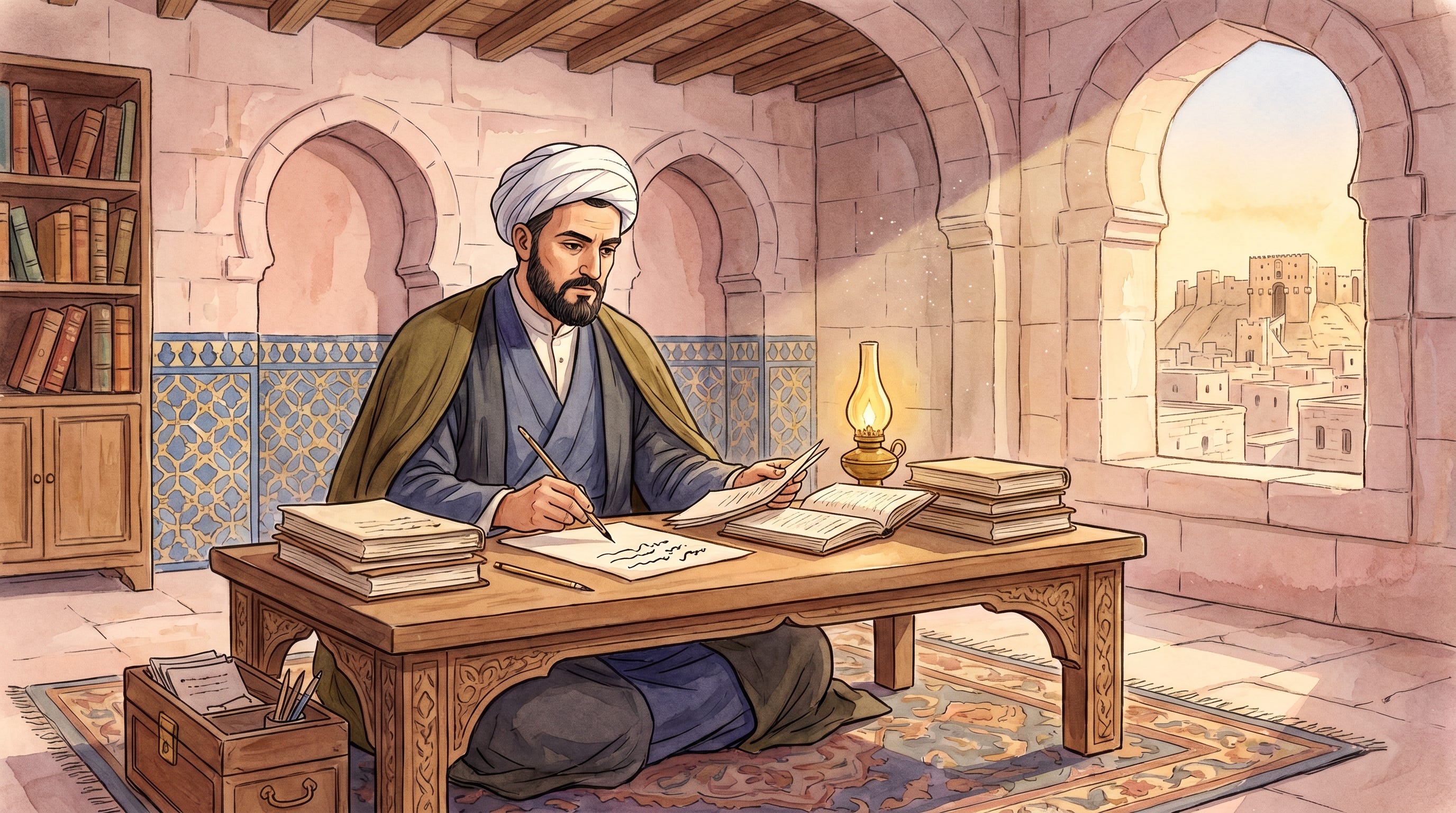
The second is a man whose Persian title tells you exactly where he came from.
His actual name was Abu Ya’la Hamza ibn Abd al-Aziz.
But the biographical sources almost never use it.
They call him Sallar al-Daylami — Sallar from the Persian salar, meaning commander or chief, al-Daylami marking him out as a son of the mountains we have heard so much about already in this sub-series:
Daylam, the highland region south of the Caspian Sea in northern Iran.
The same mountains from which the Buyid dynasty had emerged three generations earlier.
Like Ibn al-Barraj, Sallar made the scholarly migration from his homeland to Baghdad.
And like Ibn al-Barraj, he studied under the full chain — first under Shaykh al-Mufid, then under Sayyed al-Murtadha after Shaykh al-Mufid’s passing, and he maintained a lifelong intellectual relationship with his peer Shaykh al-Tusi.
Sayyed al-Murtadha trusted Sallar’s jurisprudential capabilities so deeply that he would sometimes permit Sallar to teach his own classes in Baghdad on his behalf — to stand in the master’s place before the master’s students.
And then Sayyed al-Murtadha sent him, as he had sent Ibn al-Barraj, westward. Sallar was appointed as a judge in the region of Aleppo — Halab, in northern Syria.
And here, too, we must pause, because Aleppo was not an accidental Shi’a setting.
It was the fruit of a scholarly and political inheritance that reached back a full century.
For most of the tenth century of the Gregorian calendar, northern Syria had been ruled by the Hamdanid dynasty — an Arab Shi’a Muslim house descended from the Banu Taghlib tribe of upper Mesopotamia, whose most celebrated prince, Sayf al-Dawla — the Sword of the Dynasty — ruled Aleppo from 945 to 967 of the Gregorian calendar — approximately 333 to 357 of the Hijri era.
And Sayf al-Dawla’s court at Aleppo was one of the great cultural capitals of the Islamic classical age.
The greatest Arabic poet of the century — al-Mutanabbi — lived at his court for nine years and wrote his finest verse there.
The great philosopher al-Farabi, whom we have already named in this sub-series as “the Second Teacher,” died in Aleppo under Sayf al-Dawla’s patronage.
The grammarian Ibn Jinni, the historian al-Isfahani, the preacher Ibn Nubata — the brightest intellectual lights of tenth-century Arab civilisation gathered at the Hamdanid court.
Aleppo, under Sayf al-Dawla, was to the tenth century what Baghdad under the Buyids would shortly become to the eleventh: the undisputed intellectual capital of its region, under Shi’a political patronage.
The Hamdanids were broken, eventually, by Byzantine military pressure from the north and by Fatimid pressure from the south, and their dynasty effectively ended in 1004 of the Gregorian calendar — approximately 394 of the Hijri calendar.
For two decades after their fall, Aleppo was contested territory.
And then, in 1024 (around 414 AH) — the year we have fixed on in this sub-series as the moment of Shi’a flourishing at its peak — another Shi’a Arab tribal dynasty, the Mirdasids, took the city.
The Mirdasids were a family of the Banu Kilab tribe, a Bedouin Arab tribe of northern Syria, and their founder Salih ibn Mirdas captured Aleppo from its Fatimid governor in that same year.
They would rule Aleppo — as a Shi’a tribal emirate, carefully balancing the pressures of Fatimid Cairo, Byzantine Constantinople, and Buyid Baghdad — for most of the next fifty-six years, until their dynasty was, under later Seljuq pressure, compelled to convert to Sunnism and eventually absorbed into the rising Seljuq order.
It was into this living Shi’a Aleppo — successor to the Hamdanid century, now governed by the Mirdasids, still a great intellectual centre of the Levant — that Sayyed al-Murtadha sent Sallar al-Daylami as a judge.
And there Sallar produced the work for which the Hawza still honours him a thousand years later: al-Marasim al-Alawiyya fi al-Ahkam al-Nabawiyya — The Alawid Decrees Regarding the Prophetic Rulings — almost always referred to, in Hawza parlance, simply as al-Marasim.
Al-Marasim is not merely a book of legal rulings.
It is a book of legal architecture.
Sallar was one of the very first Shi’a scholars to systematically organise the entire body of Islamic jurisprudence into a logical structure — separating acts of worship, ibadat, from everyday transactions and contracts, mu’amalat.
This classification, which Sallar helped pioneer, remains the organising principle by which every Hawza in the world structures its jurisprudential curriculum today.
When a senior scholar says, in a Hawza lecture,
“according to the author of al-Marasim…”
— they are speaking, across a thousand years, to Sallar al-Daylami.
Abu al-Salah al-Halabi — the Deputy of Sayyed al-Murtadha
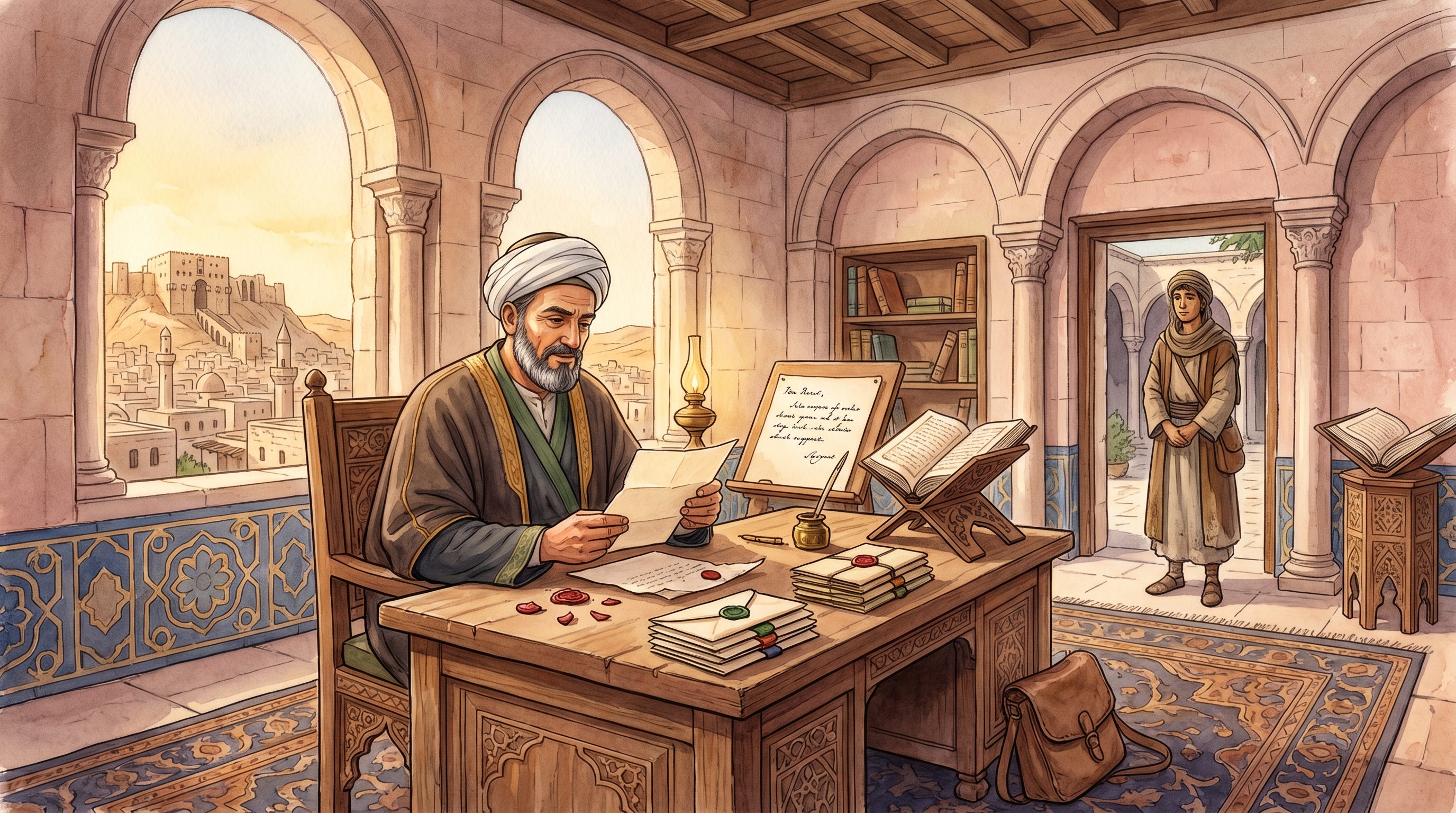
The third student is a man whose very title tells you what Sayyed al-Murtadha thought of him.
His name was Taqi al-Din Abu al-Salah Taqi ibn Najm al-Halabi, born around 374 of the Hijra, died in 447.
His epithet al-Halabi tells us his origin: he was a native of Aleppo — the same city we have just walked through, where his contemporary Sallar al-Daylami would later serve as a judge under Sayyed al-Murtadha’s appointment.
But Abu al-Salah was not a visitor to that city.
Abu al-Salah was of it.
When he was born, around the year 984 of the Gregorian calendar — around 373 AH, Aleppo was still living in the memory of the Hamdanid century — Sayf al-Dawla had been dead only seventeen years, and his court’s glories were the stories told in the homes of Aleppo when Abu al-Salah was a boy.
And by the time Abu al-Salah reached his forties, the Mirdasids had taken the city and opened the Shi’a flourishing we have just described.
He lived through both.
The Hamdanid memory formed his childhood.
The Mirdasid flourishing enabled his career.
That is the man Baghdad was about to meet.
Abu al-Salah made the journey from Aleppo to Iraq in search of the highest scholarship of his age.
And he had the rare distinction, which few scholars of any generation ever match, of studying under all three of the great teachers of the Shi’a chain of his lifetime.
He attended the lectures of Shaykh al-Mufid toward the end of Shaykh al-Mufid’s life.
He became a devoted student of Sayyed al-Murtadha.
And he later studied under Shaykh al-Tusi.
Three teachers, any one of whom would have been the making of a scholar.
Abu al-Salah sat at the feet of all three.
And Sayyed al-Murtadha, recognising what this man was, did something for him that he did not do for any other student.
He sent Abu al-Salah back to Aleppo — back to his home city, back to the Mirdasid Shi’a emirate that had just opened — but not merely as a judge, and not merely as a teacher.
He sent him as his own official representative — his khalifa, his deputy — for the Shi’a communities of the entire region of Aleppo and Bilad al-Sham, greater Syria.
Think about what this meant, politically.
Sayyed al-Murtadha in Baghdad, the most senior Shi’a scholar in the Islamic world, was appointing his own personal deputy to the Shi’a emirate of Aleppo — across a frontier, across a political boundary, across the realm of one Shi’a power and into another.
And the Mirdasid emirs received him.
The scholarship of Baghdad and the scholarship of Aleppo were being stitched together by one man.
And Sayyed al-Murtadha gave this appointment operational weight.
The scope of the network Sayyed al-Murtadha was running from Baghdad was genuinely extraordinary.
His surviving correspondence — preserved in a body of writings that later biographers call his Masa’il, his Answers to Questions — shows us that inquiries reached him from Shi’a communities across the Levant and upper Mesopotamia.
Questions came from Tiberias on the Sea of Galilee, from Sidon and Tripoli on the Lebanese coast, from Mosul in the Jazira, and of course from Aleppo.
Sayyed al-Murtadha was not merely the head of a Baghdad seminary.
He was the central scholarly authority for the Shi’a of half the Islamic world.
And when letters came from Aleppo and the Levantine regions around it, Sayyed al-Murtadha made a practice — deliberately, consistently, and publicly — of redirecting the questioners back to Abu al-Salah.
The biographical sources record his position clearly.
Shahid al-Awwal — whom we have met tonight, the First Martyr who preserved the dream of Alam al-Huda — referred to Abu al-Salah in his own writings as Sayyed al-Murtadha’s deputy in scholarship.
And Shahid al-Thani — the Second Martyr, Zayn al-Din al-Ameli of the tenth century of the Hijra, whom we will meet in a future session of this sub-series — expanded upon this and explicitly described Abu al-Salah as Sayyed al-Murtadha’s deputy — khalifa — in Aleppo itself.
As Shahid al-Thani records:
كَانَ أَبُو الصَّلَاحِ الْحَلَبِيُّ خَلِيفَةَ السَّيِّدِ الْمُرْتَضَى عَلَمِ الْهُدَى فِي بِلَادِ حَلَبَ، وَكَانَ السَّيِّدُ يُرَدُّ إِلَيْهِ مَسَائِلَ أَهْلِ الشَّامِ
“Abu al-Salah al-Halabi was the deputy of Sayyid al-Murtadha, ʿAlam al-Hudā, in the region of Aleppo — and al-Sayyid would refer to him the questions of the people of greater Syria.”
— Shahid al-Thani (Zayn al-Din al-Ameli, d. 966 AH), preserved in his Ijazat as gathered by Allamah al-Majlisi in Bihar al-Anwar, Kitab al-Ijazat (Vol. 105 in the standard Beirut Mu'assasat al-Wafa' 110-volume edition); independently cited by Allamah Bahr al-Ulum in al-Fawa'id al-Rijaliyya; cited in standard references including al-Khwansari, Rawdat al-Jannat, Volume 2, and discussed in the entry on Abu al-Salah al-Halabi in Encyclopaedia Iranica (Hassan Ansari)
So when the believer in Aleppo, or in Sidon, or in Tripoli, or in Tiberias, had a legal or theological question — Sayyed al-Murtadha, in far-off Baghdad, would write back with the same answer he gave again and again:
You do not need to write to me. As long as Abu al-Salah is among you, your answer is there.
The appointment was so significant that Abu al-Salah came to be known, in the biographical literature, as Khalifat al-Murtadha — the Deputy of al-Murtadha.
And after Sayyed al-Murtadha’s death, Shaykh al-Tusi confirmed him in the same role, so that Abu al-Salah came to be known also as Khalifat al-Shaykh — the Deputy of the Shaykh.
Two of the greatest scholars of the tradition, across two generations, delegated their own authority to one man in one city.
Abu al-Salah’s masterpiece is the book we mentioned earlier in tonight’s session without naming him — al-Kafi fi al-Fiqh — The Sufficient in Jurisprudence.
And note the title: al-Kafi.
The same word Shaykh al-Kulayni had chosen for his hadith collection a century earlier.
The same humility.
The Sufficient.
Not the complete, not the comprehensive — the sufficient, for the believer who needed to live his faith in the streets and markets of a Shi’a Aleppo under the Mirdasids.
And characteristically for a student of Sayyed al-Murtadha’s school, Abu al-Salah did not open al-Kafi fi al-Fiqh with legal rulings.
He opened it with theology — with ilm al-kalam, the foundational doctrines of the faith — because, as he understood from his teacher:
A person cannot live the laws of the faith without first standing on the rock of its beliefs.
Shaykh al-Tusi — the greatest of all
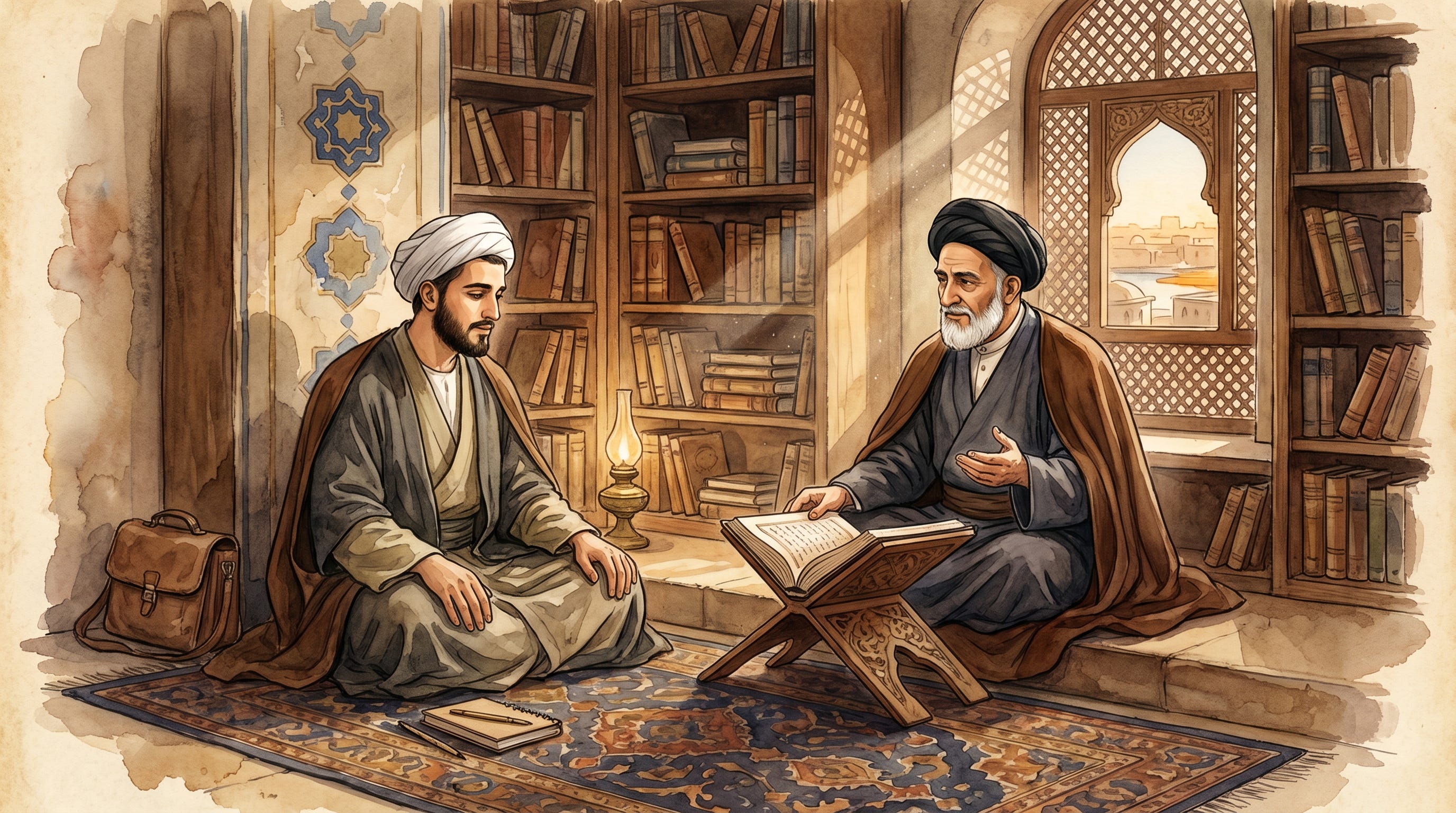
And finally — and only briefly, because the greatest of them all deserves his own session and will receive it in the coming weeks, God willing — we must name the young scholar who arrived in Baghdad in the year 408 of the Hijra, from the Persian city of Tus in Khorasan, near what is today the holy city of Mashhad.
His name was Abu Ja’far Muhammad ibn al-Hasan al-Tusi.
He was twenty-three years old when he arrived in Baghdad.
He joined the circle of Shaykh al-Mufid, and studied at his feet for five years, until Shaykh al-Mufid’s death in 413.
And then — and for the next twenty-three years, until Sayyed al-Murtadha’s own death in 436 — he became the closest disciple of Sayyed al-Murtadha.
Twenty-three years at the feet of one teacher.
Long enough to inherit everything.
And when Sayyed al-Murtadha died, the leadership of the Shi’a community — the teaching, the Dar al-Ilm, the network of students, the fragile relationship with the Abbasid court, the entire inheritance of Baghdad’s Shi’a renaissance, the bonds with Ibn al-Barraj in Tripoli and Sallar in Aleppo and Abu al-Salah across greater Syria — fell upon Shaykh al-Tusi’s shoulders.
The Abbasid Caliph al-Qa’im himself recognised what had happened, and appointed Shaykh al-Tusi to the Chair of Theology in Baghdad — a formal caliphal recognition that the young man from Tus had become the successor to the lineage.
What Shaykh al-Tusi would do with that inheritance — how he would complete the Four Books by writing the third and fourth with his own hand, how he would face the Seljuq conquest of Baghdad, how he would watch his own library burn, and how he would, in the burning rubble of that catastrophe, plant the seed of what would become the Hawza of Najaf, the scholarly institution that still stands today — all of that, God willing, is in the coming weeks.
For tonight, it is enough to say: Sayyed al-Murtadha, on his deathbed in 436, knew exactly whom he was leaving his life’s work to.
Four students.
Four regions.
Three dynasties.
One teacher.
Ibn al-Barraj as judge in Tripoli, under the Twelver Shi’a Ammarids.
Sallar al-Daylami as judge in Aleppo, under the Shi’a Mirdasids, in the living shadow of the Hamdanid century.
Abu al-Salah al-Halabi as Khalifat al-Murtadha across the whole of Mirdasid-era Aleppo and greater Syria.
And Shaykh al-Tusi in Baghdad — in what was still, for another eleven years, a Buyid-protected Shi’a flourishing — and then, after the Seljuq conquest, in the desert town of Najaf.
One teacher had taught them all.
The Thirty Years Alone
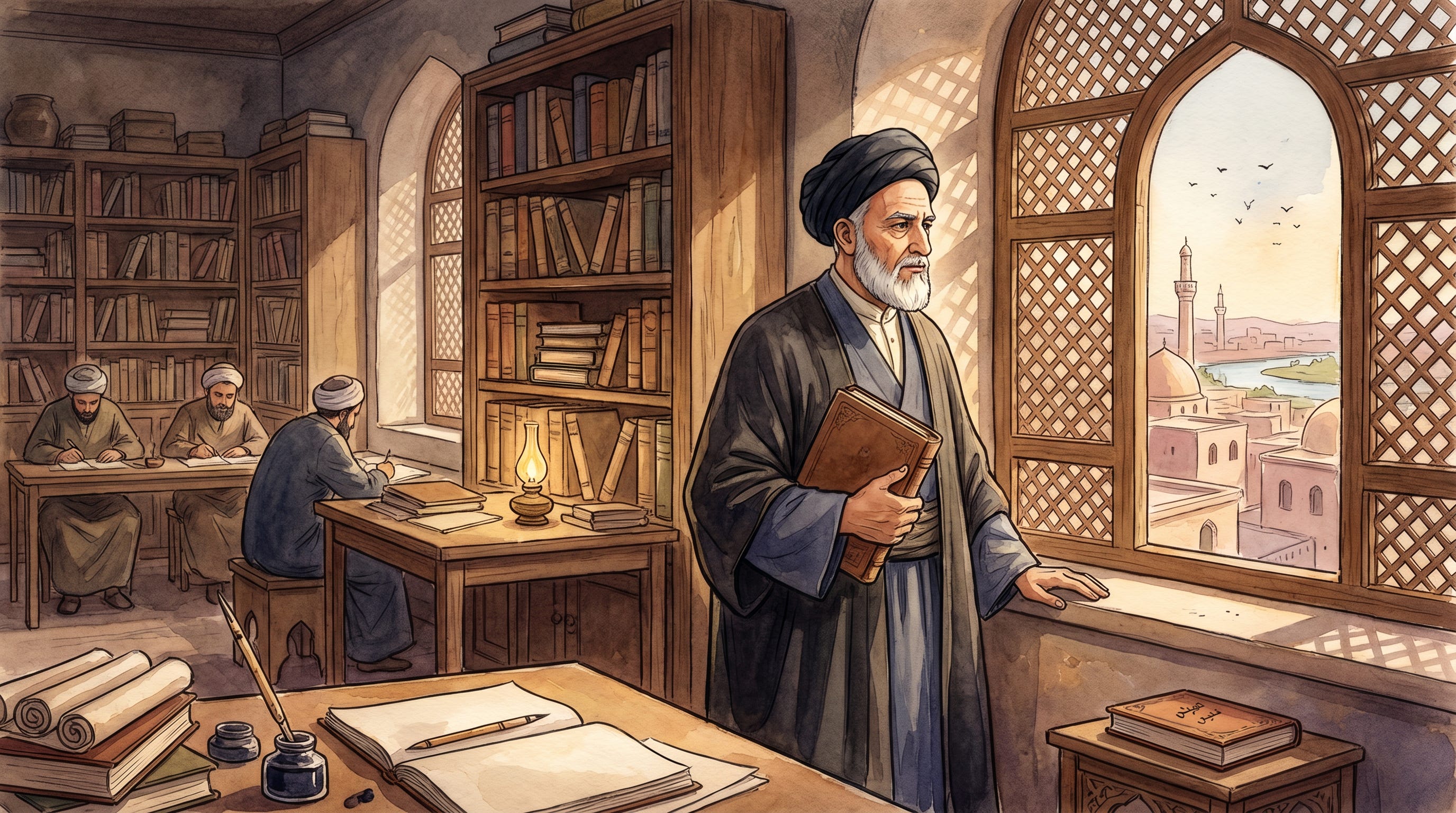
And so Sayyed al-Murtadha carried on.
He was fifty-one when his brother died.
He would live for another thirty years — dying in the year 436 of the Hijra, at the age of eighty years and eight months.
Thirty years is a long time to carry grief.
Thirty years is a long time to be the elder who outlived the younger.
And yet the biographical sources record that Sayyed al-Murtadha did not shrink from the task that now fell to him.
If anything, his scholarly output expanded after his brother’s death.
He took over all three of Sayyed al-Radhi’s offices — the Niqaba, the Amir al-Hajj, the Diwan al-Mazalim — and held them, as Judge al-Tanukhi recorded, for the next thirty years.
He continued to teach at the Dar al-Ilm.
He continued to write.
He dispatched his four great students, as we have heard, across the Levant.
And the library that he had been building for decades grew to its staggering eighty thousand volumes.
In a sense, Sayyed al-Murtadha carried his brother’s absence the way a man might carry a wound that never quite healed — working around it, teaching through it, living in the knowledge that the younger brother who should have outlived him did not.
And then came his own time.
The Second Departure — Sayyed al-Murtada
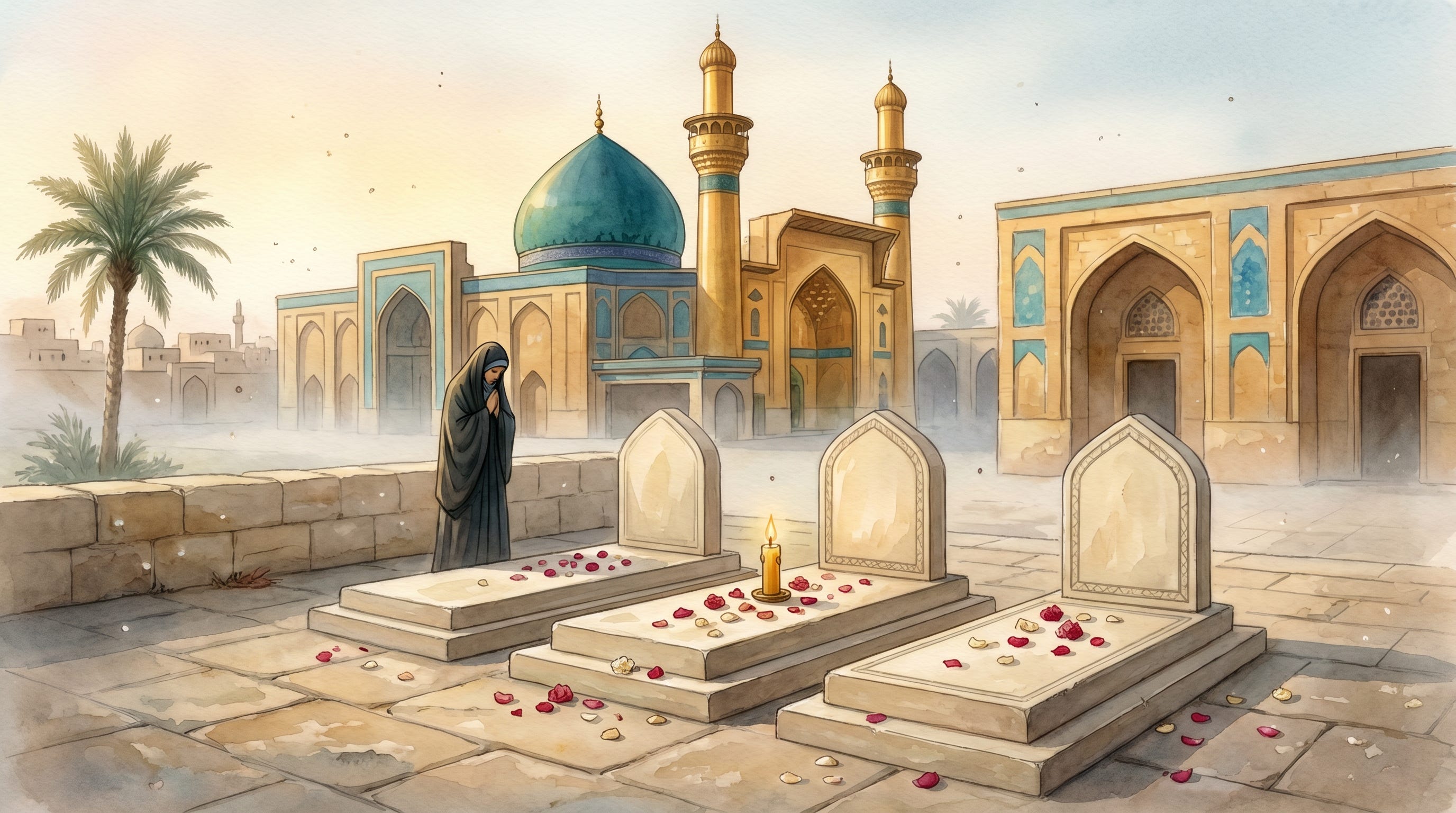
It was the twenty-fifth day of Rabi’ al-Awwal, in the year 436 of the Hijra.
The Gregorian date was 1044 of the Common Era.
Sayyed al-Murtadha was eighty years and eight months old.
The biographical sources tell us that al-Najashi — his student, the great biographer of the Shi’a scholarly tradition, whose Rijal would become one of the foundational reference works of Shi’i scholarship — was present at his master’s deathbed and afterwards washed his body for burial.
Sallar al-Daylami — the Persian student we have met tonight, who had sometimes taught in Sayyed al-Murtadha’s place — was also present and assisted.
What did Sayyed al-Murtadha see, in his final hours, as he looked back across eighty years?
He had seen the Buyid golden window open in his childhood, flourish through his middle years, and begin to fray at its eastern edges as the Ghaznavids pressed in.
He had seen three Abbasid caliphs.
He had studied under Shaykh al-Mufid.
He had buried his mother, his father, and — thirty years before his own death, and perhaps most painfully of all — his younger brother.
He had watched his house burn in the Hanbali riots of 422 and built a new one.
He had written the books that would, for the next thousand years, form the intellectual foundation of Shi’i Islam.
He had trained the scholars who would carry that inheritance across the Mediterranean world.
He had been given a title from his great ancestor in a dream.
And now he was ready to meet that ancestor face to face.
He died peacefully, the sources tell us, surrounded by his students.
He too was buried, initially, in his own residence in the Karkh quarter of Baghdad — the same house, the same Karkh, where he had lived and taught for his entire adult life.
And then, following the same custom his father and his brother had followed before him, his body was transferred to Karbala.
He was laid to rest beside his father Sayyed Abu Ahmad, and beside his brother Sayyed al-Radhi — the three of them together, under the shadow of the shrine of Imam Husayn, in the Ha’ir — inner sanctuary — that had drawn generations of Alid scholars to its holy soil.
The two brothers, who had been born four years apart in Baghdad, and had been separated by thirty years of Sayyed al-Murtada’s lonely labour — were, at the last, reunited.
Not in Baghdad where they had lived and worked and taught.
But in Karbala, beside the Grandfather whose love had shaped every line of every book either of them had ever written.
The Eulogy — To Sayyed al-Murtadha
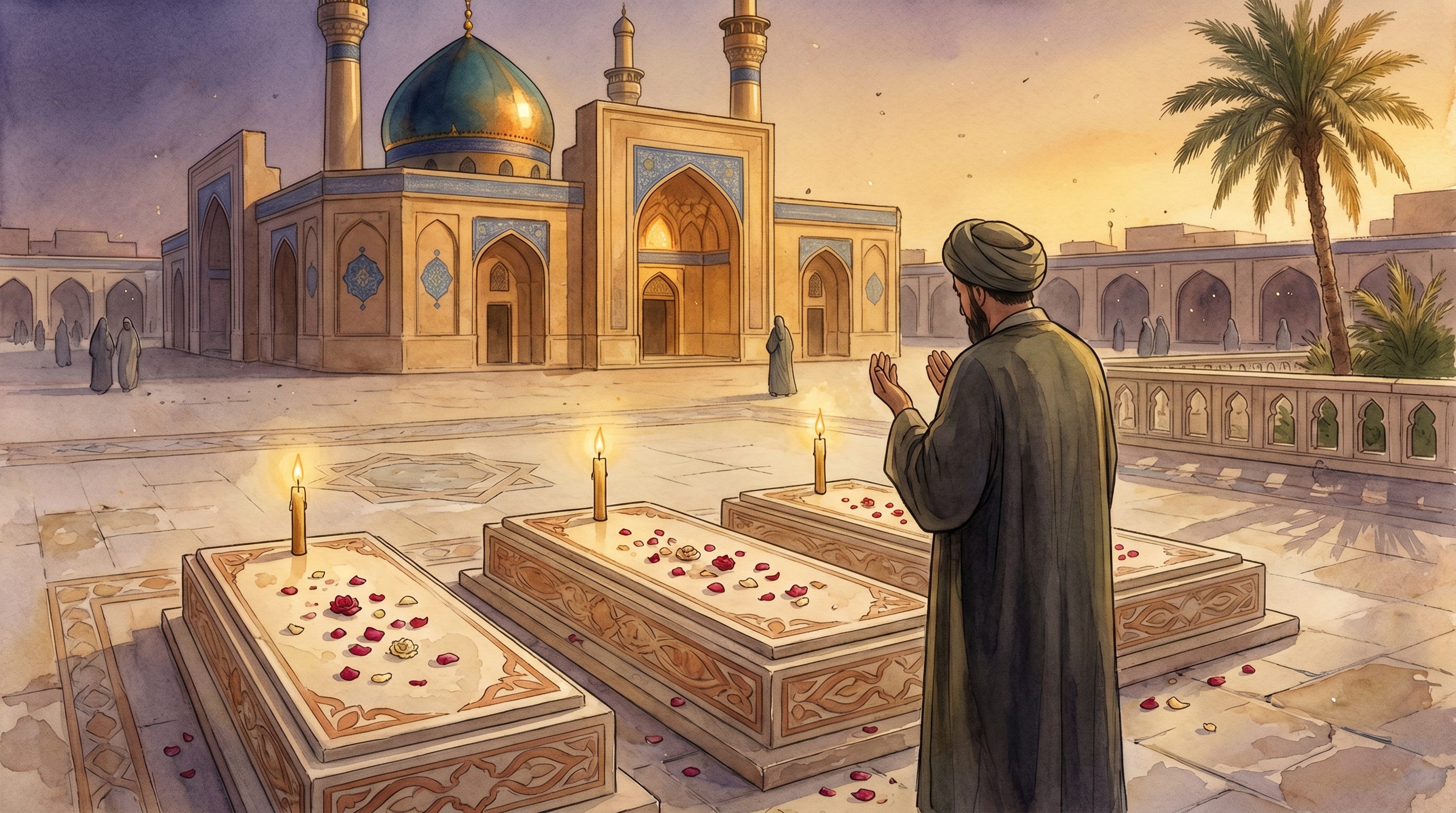
Before we close, let us stand, in our hearts, at the grave.
Let us make the short journey, together, from this gathering to Karbala.
Let us walk through the streets of the Holy City, past the pilgrims and the traders and the mourners, past the great golden dome of the Grandfather whose martyrdom we mark with our tears every Muharram.
Let us enter the sacred precincts of the Ha’ir.
And let us stand, in the stillness within, at the third grave laid beside the two we visited last week — an elder brother who carried thirty years of grief and never let it stop him, now reunited with the younger brother he could not bring himself to bury, and with the father whose office he inherited and held with honour for thirty years.
Let us greet him.
Peace be upon you, O Sayyed Abu al-Qasim, Ali ibn al-Husayn al-Musawi.
Peace be upon you, O Alam al-Huda — the Banner of Guidance, whose title the Commander of the Faithful himself chose for you, in a dream given to another man at his point of deepest need.
Peace be upon you — you who studied under Shaykh al-Mufid for twenty-three years and carried his inheritance for another twenty-three after him.
Peace be upon you — you who wrote the books that became the foundations of the Hawza, and whose words are still opened in every seminary of the Shi’a world a thousand years later.
Peace be upon you — you who sold your lands to buy paper for the students who had no means, who paid stipends to the young scholars who would become the architects of our tradition, who built a library of eighty thousand volumes and opened it to every serious seeker who walked through your gate.
Peace be upon you — you whose house was burned in the riots of 422, and who moved to another house in Karkh and resumed your lessons the very next day.
Whose four Arabic words — wa ada ila durusihi — and returned to his lessons — teach us how a scholar responds to catastrophe.
Peace be upon you — you who could not bear to walk to your brother’s grave, and who carried his absence for thirty years while continuing to build, to teach, to give.
Peace be upon you — you who dispatched your students across the Mediterranean and the Persian world, and whose teaching still echoes from Tripoli to Aleppo to Najaf to Qom to every city where a student of the Ahl al-Bayt opens a book tonight.
Peace be upon you, O Sharif al-Murtadha — the Beloved of God, the one whose very name was written in the verses of the Qur’an before you were given it.
O God — we ask You, by his love of the Ahl al-Bayt, by his thirty years of patient labour after his brother’s departure, by the scholars he trained and the library he built and the students he fed — elevate his station among the saints.
Place him beside his brother, beside his father, beside his Grandfather, in the highest Paradise.
And let every word of every book he left behind — al-Shafi, al-Dhakhira, Tanzih al-Anbiya, al-Dhari’a, the Amali — be a light that rises to his soul.
The Closing Supplication
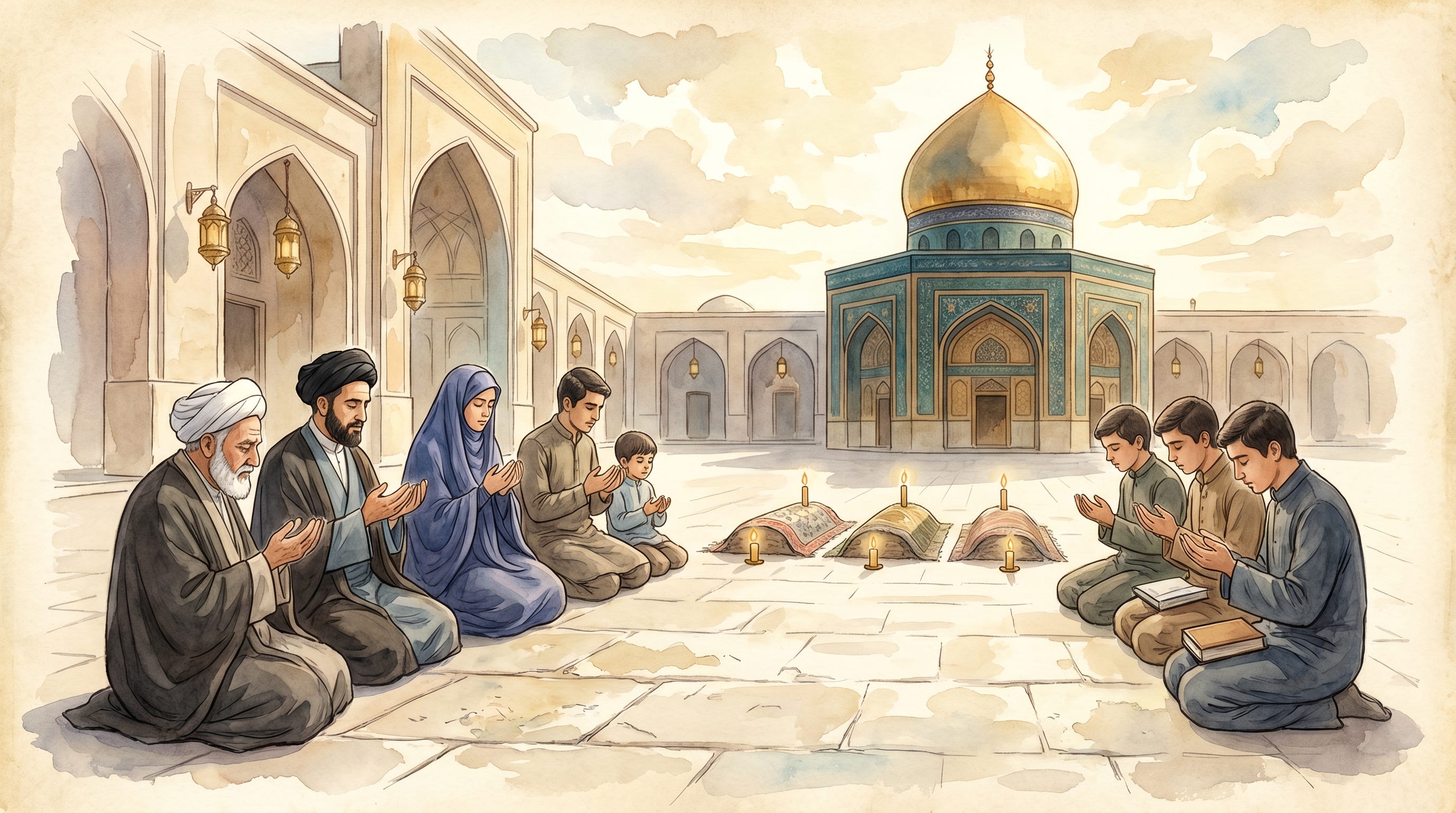
O God — Lord of Sayyed al-Murtadha, who lived eighty years and eight months and gave every one of those years to a work greater than himself.
We thank You, tonight, for the gift of his long life and for the patience with which he carried it.
We thank You for the five books that became the foundations of our scholarly tradition, for the eighty thousand manuscripts he gathered and shared, for the stipends he paid to students who could not afford their own studies, for the four students he dispatched across the Mediterranean to plant the seed of his teaching in soil that fire could not reach.
And we thank You — most of all — for the thirty years.
The thirty years he carried alone.
The thirty years he bore his brother’s absence without ever making it a reason to stop.
The thirty years in which he became, through patient labour and quiet grief, the architect of every Hawza that has ever taught in any city in the Shi’a world.
O God — make us, in our own work, like Sayyed al-Murtadha was in his.
When titles are placed upon us — Shaykh, Allamah, Hujjat al-Islam, scholar, teacher, parent, leader — let us receive them as he received Alam al-Huda.
Let us weep at the burden before we accept the honour.
Let us spend the rest of our days, however many You grant us, becoming a little more worthy of what we have been called.
When fire comes for what we have built — and fire comes for every life, in some form, sooner or later — let us respond as he responded.
Not by closing the school.
Not by announcing a season of mourning.
But by moving to a new house in Karkh and returning, that very day, to our lessons.
Wa ada ila durusihi. And he returned to his lessons.
Let those four Arabic words be the rule of our lives in every season of loss.
When grief sits beside us, as it sat beside him for thirty years, let us not let it stop us.
Let us carry it the way he carried his — working around it, teaching through it, giving more of ourselves precisely because the one who would have shared the burden is no longer at our side.
O God — we ask You, by Your love for the Ahl al-Bayt, peace be upon them all, grant us tawfeeq.
Grant us success in the work You have entrusted to us.
Grant us the stamina Sayyed al-Murtadha carried into every one of his eighty years.
Grant us the generosity that opened his library to every serious seeker, regardless of what tradition that seeker came from.
Grant us the wisdom to dispatch what we have learned outward — into our families, into our communities, into the wider world — rather than hoarding it for ourselves.
And O God — for our beloved Master, the Imam of this Age, the Proof of God upon His earth, the son of al-Hasan al-Askari, peace be upon him and upon his fathers — be, in this hour and in every hour, his guardian, his protector, his leader, his helper, his guide, and his watchful eye.
Hasten his relief.
Make his hardship easy.
And count us, by Your mercy, among those who labour, as Sayyed al-Murtadha laboured for thirty years after his brother’s death, to prepare the ground for the day of his return.
For the occultation continues, O Lord, because we are not yet ready.
Make us ready.
Let every act of patient teaching, every act of quiet generosity, every act of carrying on through grief and through fire and through the closing of windows we thought would never close — be a stone we lay in the foundation of the community he will one day lead.
And O God — when our own time comes, as it came for Sayyed al-Murtadha at eighty years and eight months, surrounded by the students he had trained, washed by the disciples he had taught — grant us husn al-khatima.
A good ending.
The ending of those whom You have chosen and who have chosen You.
Let us depart this world having transferred everything we carried to the hands of those who will carry it after us.
Let us depart with our work given away, our libraries opened, our students fed, our hearts at peace with the One who created us.
And let us be reunited, by Your mercy, with our beloved Sayyed al-Murtadha, beside his brother and his father and his Grandfather, in a Paradise where the soil of Karbala lies open beneath our feet and the face of the Imam, may our souls be his ransom, and may You, O our Lord, hasten his return, is the first sight our eyes meet.
O God, send Your blessings upon Muhammad and the family of Muhammad — and hasten their relief — and curse their enemies, all of them.
Amen, O Lord, Sustainer of the Universes.
Amen, O Most Merciful of the Merciful.
Teaser for Next Week
Next week, God willing — in the fourth and final session of this journey through the brothers of Baghdad — we step back to meet the world that surrounded them.
We will meet Ibn Sina, the philosopher who was their close contemporary.
We will meet the Mu’tazilite Qadi Abd al-Jabbar, whose twenty volumes Sayyed al-Murtadha answered in his own twenty volumes of al-Shafi.
We will meet the rising Ash’ariyya, and the looming shadow of al-Ghazali.
We will watch the library burn — eleven years after Sayyed al-Murtadha’s death, when the Seljuq Turks took Baghdad and reduced eighty thousand handwritten manuscripts to ash.
We will see what survived the burning.
And then, gravely and honestly, we will pause to ask what the whole story of these two brothers is for — what it teaches us about the difference between the genuine theological commitments of Sunni and Shi’a believers across history, and the political projects, ancient and modern, that have draped themselves in religion’s clothing while serving entirely different masters.
And we will close our four-week journey, by God’s permission, at the graves of the two brothers in Karbala, with our eyes raised toward the One in Whose service they lived and died — our beloved Imam, the Mahdi of this age, may our souls be his ransom and may God hasten his return.
Until then, may God keep you and your loved ones in His care, and may He grant us the patience Sayyed al-Murtadha carried into every one of his eighty years.
And from Him alone is all ability, and He has authority over all things.