[9] Shahada (Witness) - The False Shahada (Witness)
A series of discussions on the theology of witness and the grades of martyrdom; rooted in the Qur'an and the teachings of the Ahl al-Bayt. These sessions are for Muharram and Arbaeen 2026/1448.
Peace be upon you, O Aba Abdillah (O Husayn), and upon the souls who have gathered in your courtyard.
Upon you, from us all, is the peace of God—forever, for as long as we remain and as long as night and day endure.
And may God never make this our last pledge to visit you.
Peace be upon al-Husayn, and upon Ali, son of al-Husayn, and upon the children of al-Husayn, and upon the companions of al-Husayn.
— Adapted from Ziyarat Ashura
Video of the Sermon (Majlis/Lecture)
This is a video of the sermon, the maqtal — lamentation — referenced in this session can be found here.
Introduction
Eight nights, we have walked.
We recovered the word — shahada means witness.
We traced its lineage from Abel, peace and blessings be upon him, through the prophets, through the Ahl al-Bayt, to a plain in Iraq.
We learned the theology of Shaheed Mutahhari’s five kinds of death; the sociology of Doctor Shariati’s shahada of the tongue and shahada of the life.
We honoured the Christian neighbour, the secular revolutionary, the anti-colonial cause, the seductive aesthetic of the cherry blossom — and the seventy-two whose loyalty was to God and to the Truth, not to a flag or an emperor.
Eight nights of building.
Tonight we draw the line.
Not what is shahada — we have built the answer over eight nights.
Tonight: what is NOT shahada that calls itself shahada?
This is the corrective night.
This is the night the Master of Witnesses, peace and blessings be upon him, requires of every preacher who claims his name: know the counterfeits, and refuse to bless them.
And it is the night I would, rather not preach — because tonight we will name practices that some in our own communities perform; claims that some in our own scholarly traditions have made; forms that some in our own century have come to mistake for the substance.
But we will speak with great gentleness.
I make a pact with you tonight: I will speak with firmness on the truth, and with gentleness on the people.
The people who perform these practices are not enemies.
They are loved by Imam Husayn, and they are loved by us.
Tabyeen — clarification — is not the work of singling people out.
It is the work of raising the level so that we walk together, more clearly, towards what the witnesses themselves were calling us to.
Firm on the truth.
Tender with the people.
This is not my framing.
It is the Qur’an’s description of the Prophet’s true companions in Surah al-Fath:
“Muhammad is the Messenger of God; and those with him are firm of heart against those who reject the truth — compassionate among themselves.”
— Qur’an, Surah al-Fath (the Chapter of Victory) #48, Verse 29
Ashiddā’u ‘ala al-kuffār — ruḥamā’u baynahum.
Firm against falsehood — compassionate among themselves.
Allamah Tabataba’i, in al-Mizan, names the pairing as structurally theological: the second clause is meant to dispel the notion that hardness towards falsehood might entail harshness amongst themselves.
Firmness with falsehood is not — must not be — harshness with the people.
Tonight we hold the dyad as God Himself paired it.
And the verse continues —
“You see them bowing down, prostrating themselves; their marks are in their faces from the effect of prostration.”
Imam al-Sadiq, peace and blessings be upon him, was asked what mark this names, and he said:
al-sahr fī al-ṣalāt — wakefulness in prayer.
The mark on the believer’s face is what consistent night-prayer does to it over years.
Hold that.
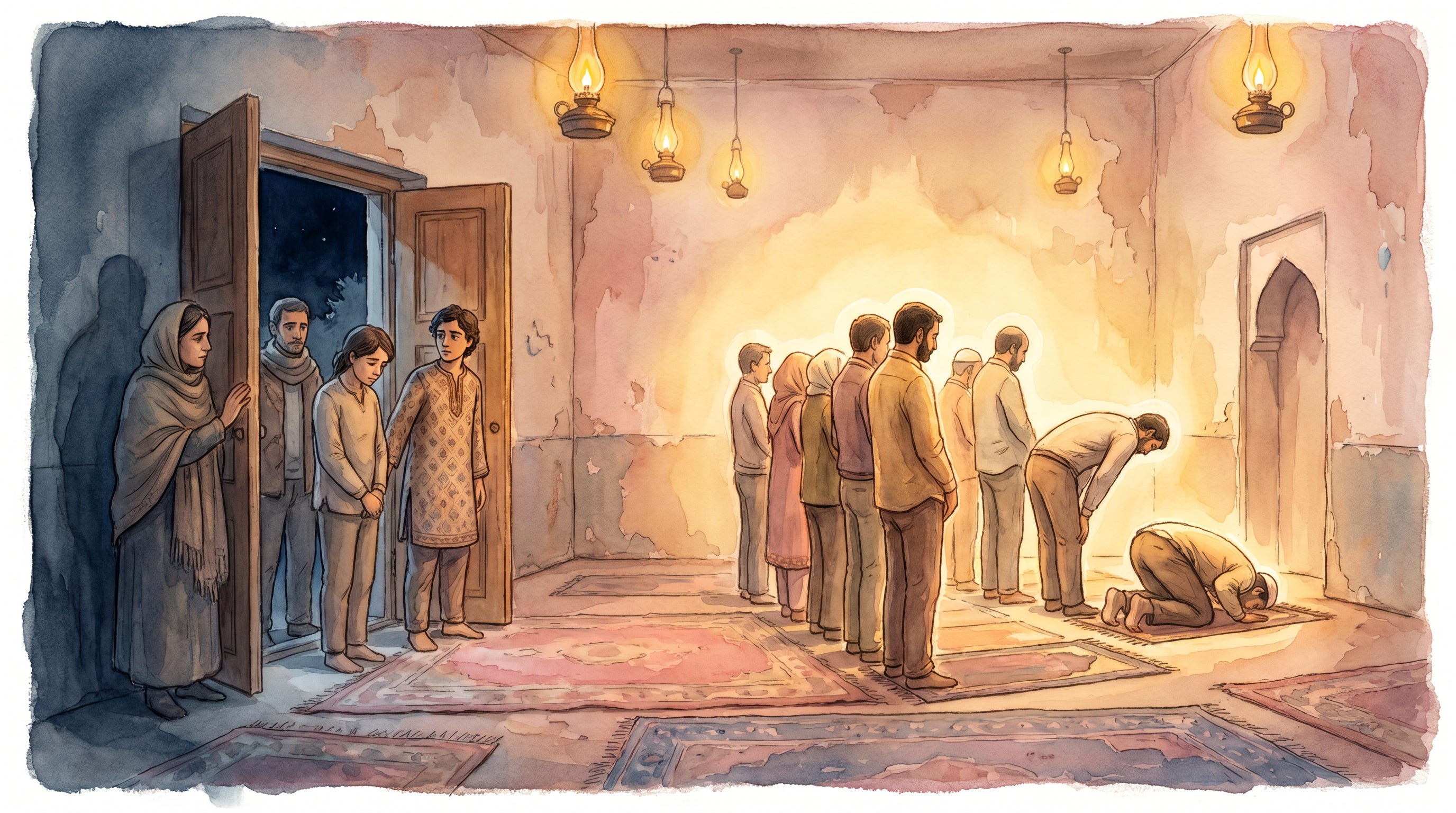
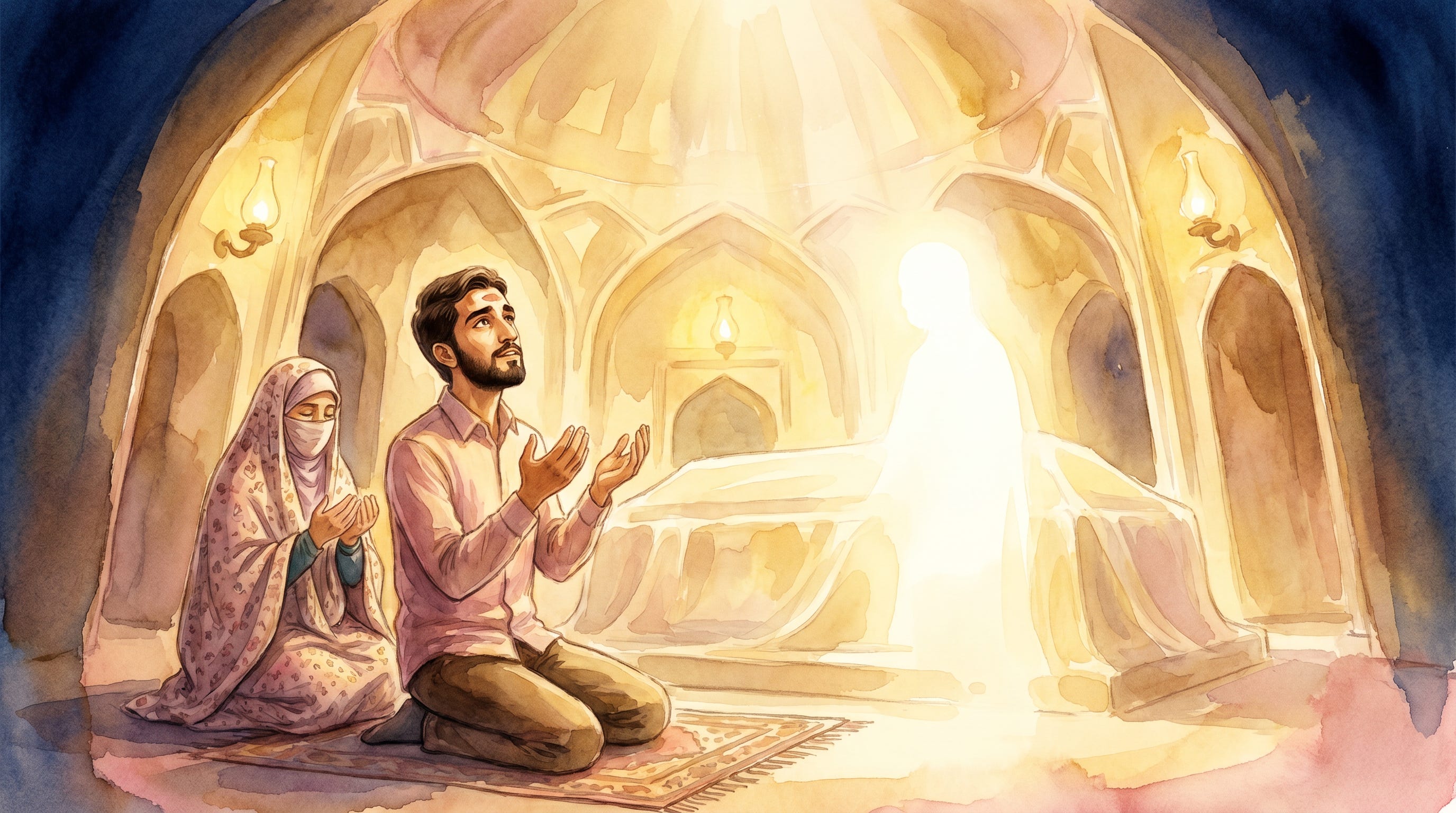
We will return to this mark when we speak of the young Iranian named in honour of the first martyr of the Ahl al-Bayt after the passing of the Prophet, who stood at the shrine of Imam Reza on the 21st Night of the month of Ramadhan and asked his mother to pray for his shahada.
The mark of the prostration was on his face when ISIS led him by the rope.
that is their description in the Torah, and their description in the Gospel.
The dyad of firmness-with-falsehood and tenderness-with-the-people is announced in the prophetic chain.
In the law of Moses.
In the gospel of Jesus son of Mary.
Fulfilled in the community of Muhammad.
The same character of the true believer in every revealed Book.
That is the honour-without-conflation we locked at Session 5 — Quranically grounded, prophetically continuous.
A short cross-reference, before we begin, to the third night — Five Kinds of Death.
Just as modern culture has normalised certain criminal deaths by re-labelling them — abortion as choice, assisted suicide as mercy — so it has normalised certain false martyrdoms by borrowing the word.
The same theological move; the language of dignity laid over an act dignity does not bless.
Tonight we name the move in its other direction: the language of witness laid over forms the witness himself would not have blessed.
Hold one word in your hearts the entire night.
The word is hujjat — proof.
The Hidden Imam, may our souls be his ransom and may God hasten his return, is al-Hujjah — the Proof.
The seventy-two of last night were named by Sayyedah Zaynab, peace and blessings be upon her, as the loyalty to God Himself, to the Truth God revealed, and to her brother as the proof of that Truth on earth — they were hujjat in their bodies.
And tonight, you will hear that same word placed by Hajj Qasem Soleimani on the throat of a young Iranian named Mohsen Hojaji — whose surname carries the H-J-J root, the very root of the word hujjat; whose first name his mother gave him in honour of Mohsen ibn Ali, peace and blessings be upon him, the first martyr of the Ahl al-Bayt after the passing of the Prophet.
Hajj Qasem said:
Hojaji became a hujjat — a proof — on how to live and how to die.
Imam Sayyed Ali Khamenei sealed it:
Martyr Hojaji became God’s proof before everyone’s eyes.
The night sits between this proposition and the takeaway: a true witness is one who has become a hujjat.
A counterfeit is what claims the word shahada without the substance of hujjat.
Three movements tonight, and a fourth that closes a road we have been walking together for nights.
First — Shaheed Mutahhari’s catalogue: the methodology and the historical corruptions.
Second — the four counterfeits walked out into our own century: the political, the ritual, the cultural, and — for the first time in this series — the imperial.
Between the second movement and the third, I will return us to the four-stage road we have been walking with one man since the third night, and I will complete the road.
And then third — the three tests of true witness.
And then, the maqtal — and tonight the maqtal is for the witness no counterfeiter can ever steal: the suckling infant in his father’s arms.
“Say: Shall We inform you about the biggest losers in regard to works? Those whose endeavour goes awry in the life of the world, while they suppose they are doing good.”
— Qur’an, Surah al-Kahf (the Chapter of the Cave) #18, Verses 103–104
Listen to what God names.
He does not say:
the worst losers are those who knew they were wrong and acted anyway.
He says:
the worst losers are those whose works have gone astray — while they themselves believe they are doing good.
The verse names the most dangerous category of human action:
the sincere counterfeit.
The takfiri who beheaded Mohsen Hojaji believed he was doing the work of God — that the captive at his feet was murtadd — an apostate, and the blade in his hand was an instrument of jihad.
The kamikaze pilot whose letter we read last night believed he was offering himself for the emperor in a sacred act.
The tatbir-practitioner whose blood soaks his clothes believes he is mourning the Master of Witnesses.
The American president who signed the order to bomb Hiroshima believed he was saving lives.
The empire that invokes Amalek over Gaza believes it is fulfilling a sacred duty.
Every counterfeit — by definition — is sincerely held.
That is what makes it dangerous.
That is what tonight is for: not to convict the counterfeiter of malice, but to teach the eye to see what the counterfeit is, even when its practitioner cannot.
The Three Tests — A Preview
Before we walk into the four counterfeits, hear the criterion we will apply to each one.
Three tests, and we will return to them in full at the end of the night.
First — is the witness in service of the covenant with God Himself; not a flag, not an ideology, not a self-image, not a state?
Second — is the act consistent with the law God has revealed to His Prophet, peace and blessings be upon him, his family, and his righteous companions?
Third — did the witness choose, in full awareness of what the choice cost —
āgāhāneh — awareness,
bīdārāneh — wakefulness,
bā sho’ūr — consciousness,
as Shaheed Mutahhari names it?
Three doors.
One criterion underneath.
We will apply them as we go.
The Honest Pulpit
The spine of tonight is a book.
Two books, in fact, by the same author — the martyred scholar Ayatollah Murtadha Mutahhari, whose blood was on the steps of his own university in Tehran on the second of May, 1979.
Tahrifat al-Ashura — Misrepresentations and Distortions in the Rituals of Ashura, and Hamasah-yi Husayni — The Husayni Epic.
He wrote them not as an academic, but as a man who had heard the false sayings from too many minbars.
Listen to how Shaheed Mutahhari names the disease:
“Tahrif is an indirect blow and a stab in the back.”
— Ayatollah Murtadha Mutahhari, Hamasah-yi Husayni, Sermon 4, Part 2
Listen to the choice of words.
The distortion of Karbala has done more damage to the Shia of Imam Ali, than every sword Yazid ever sent.
Yazid killed seventy-two on a plain.
The distorters have killed the lessons of Karbala in millions of hearts who heard the story without ever being told what it was for.
The discipline has four steps.
Honour.
Name.
Lift.
Restore.
Honour the love that produced the embellishment.
Name where it came from.
Lift it away from the canonical narration.
Restore the witness to its actual integrity.
Karbala does not need decoration.
And the line we opened the series with on the very first night — Shaheed Mutahhari’s indictment of the pulpit:
“Most of the preachers who narrate the story of Karbala call Imam Husayn the Master of Martyrs — and yet they have little analytical insight into the question of martyrdom. They describe the events in such a way as though he lost his life in vain.”
— Ayatollah Murtadha Mutahhari, The Martyr
The disease of the pulpit Shaheed Mutahhari named at the start of our series is the same disease whose symptoms we catalogue tonight.
In Tahrifat al-Ashura he names four corruptions.
One. The exaggerated narrations that contradict the Qur’an and authentic hadith — folkloric inflation.
Two. The rituals that contradict Islamic law — bladed self-flagellation that injures the body and impedes the obligatory worship.
Three. The reduction of Imam Husayn’s witness to weeping without content — tears without theology; professional grief that flatters itself by its volume and never asks what the grief is for.
Four. The fabricated sayings that everyone knows — narrations whose first attestation is in a sixteenth- or nineteenth-century text. Kashifi’s Rawdat al-Shuhada, al-Darbandi’s Asrar al-Shahadat.
We honour the love that produced these texts.
We do not, in this pulpit, teach their narrations as canonical.
Shaheed Mutahhari named the disease of his own century.
Tonight we ask the harder question:
What does the disease look like in our century?
The political claim, the ritual claim, the cultural claim, and the imperial claim — four counterfeits walked out into our time.
The Same Word, the Opposite Content
The first counterfeit is easy to name; almost impossible to argue out of, once it has captured a young man’s heart, because it speaks the holiest words our tradition has.
ISIS (aka DAESH).
Al-Qaeda.
Jabhat al-Nusra.
The takfiri network — the network that takes the takfir-of-the-Muslim-by-the-Muslim as its theology and the suicide-bombing-of-the-mosque-and-the-market as its tactic.
They call their own suicide-attackers’ deaths istishhad.
They label their captives murtadd — apostates — and call the act of beheading them jihad, performed under the black flag bearing the shahada itself.
They use the same vocabulary, claim the same flag, invoke the same God the Master of Witnesses invoked.
And it means the opposite thing.
The senior scholars of our tradition have already done the work.
The Society of Seminary Teachers of the Hawza of Qom, on 17 February 2015, within forty-eight hours of the takfiris’ beheading of the twenty-one Coptic Christians on the beach in Libya, condemned the takfiris by name and called their action “anti-Islamic.”
بسم الله الرحمن الرحیم
جامعه مدرسین حوزه علمیه قم اقدام اخیر گروه تروریستی داعش در سر بریدن گروهی از شهروندان مسیحی مصری در لیبی را محکوم میکند و تأکید مینماید که تنها راه مبارزه با تروریستهای داعش، وحدت جهان اسلام است.
چنین رویدادهایی ماهیت ضداسلامی عوامل تکفیری و تهدید تمامعیار آنان را بیش از پیش آشکار خواهد ساخت.
“In the Name of God, the Most Merciful, the Most Compassionate.
The Society of Seminary Teachers of the Hawza of Qom condemns the recent action of the terrorist group DAESH in the beheading of a group of Egyptian Christian citizens in Libya, and emphasises that the only path of struggle against the terrorists of DAESH is the unity of the Islamic world.
Such events will further disclose the anti-Islamic nature of the takfiri agents and the full extent of their threat.”
— Statement of the Society of Seminary Teachers of the Hawza of Qom, 28 Bahman 1393 SH / 17 February 2015 (Islamic Republic News Agency)
And five days before — on 12 February 2015 — the Hawza of Najaf had already spoken. Ayatollah Sayyed Ali al-Sistani, in his official document Advice and Guidance to the Fighters on the Battlefields, point six:
لا تتّهموا أحداً في دينه لكي تستحلّوا دمه، كما يفعل الخوارج ومن تبعهم في هذا العصر.
“Do not accuse anyone of apostasy or heresy in their religion to justify shedding their blood, as the Kharijites and their modern followers do.”
— Ayatollah Sayyed Ali al-Sistani, Advice and Guidance to the Fighters on the Battlefields, point 6, Najaf, 12 February 2015
Listen to what the Najaf Marja’iyya has placed on the takfiri network: the way of the Kharijites, returned in our age.
The Kharijites — the sect that struck the Commander of the Faithful, in the mihrab of Kufa in year forty of the Hijri.
The Hawza of Qom has spoken.
The Hawza of Najaf has spoken.
The takfiri claim that the killing of civilians is the work of God — performed under the shahada on the flag — is rejected by every senior marja’ alive today.
But we do not refuse this counterfeit only with rulings.
We refuse it with a face.
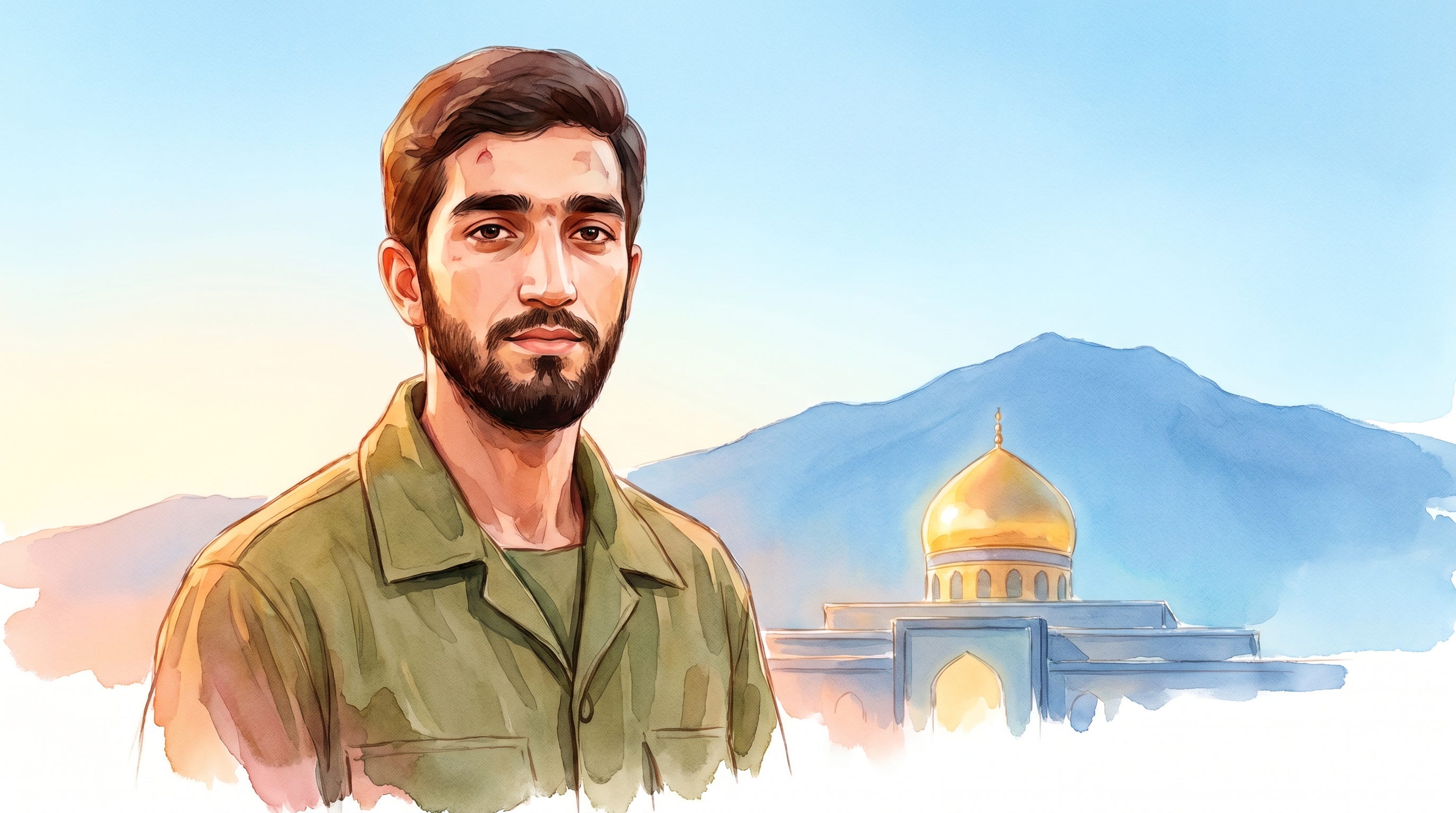
The figure who stands in the mirror against the takfiri counterfeit — whose face the world saw on the very same day — was a young Iranian named Shaheed Mohsen Hojaji.
A Defender of the Holy Shrine of Sayyedah Zaynab, at Damascus.
Captured at the Tanf border crossing in Syria on the 7th of August 2017.
Beheaded by ISIS two days later.
He was twenty-six years old.
His son Ali was one year and four months old, asleep in their home in Najafabad.
The viral photograph:
The calm face, the wounded right arm, the captor’s hand on his neck, the knife held just out of the frame, the black smoke billowing from the airstrike that broke the position.
And in the centre of all of it, his eyes.
His wife — Zahra Abbasi — spoke about that photograph:
به چشمهای شوهر من نگاه کنید، اصلاً ترس در این چشمها نیست، همهاش شجاعت است، دلیری است. محسن توی این عکس مثل کوه با صلابت است.
“Look at my husband’s eyes — there is no fear in these eyes at all. It is all bravery; it is daring. Mohsen, in this photo, is like a mountain — steadfast.”
— Zahra Abbasi, wife of Shaheed Mohsen Hojaji
Mesle kuh ba salabat ast — like a mountain, steadfast.
The wife of a twenty-six-year-old who has been beheaded last week, looking at the photograph the world has just seen, finds in his eyes not fear but the mountain.
That is the eye trained on shahada.
The takfiris labelled Hojaji murtadd — apostate.
They did not call his death shahada; they reserved that word for their own dead.
But they performed the killing as a religious act under their black flag bearing the shahada itself — claiming the work of God in the destruction of the one we know was a witness for God.
The world’s eye, on that day, saw what shahada actually looked like — and it was Hojaji’s face, not the man holding the knife.
The same word.
The opposite content.
Apply the Tests
Test one fails — loyalty is to sect-purity, not to God.
Test two fails — the deen requires evidence and due process before a Muslim's blood may be shed; takfir declared on whim, without trial and without proof, is precisely what Ayatollah Sistani named as
"the way of the Kharijites and their modern followers."
Test three fails — the script is the system’s, not the conscience’s.
Counterfeit at all three doors.
What Hajj Qasem said about Hojaji that day is the line that opens the door we walk through tonight.
Hold the word hujjat — we will return to it in a few minutes.
A Hard Topic, with Love
The second counterfeit is harder than the first.
Because it lives among us — in the homes of people who love Imam Husayn as much as you do.
The practice sometimes called the blood-mourning — tatbir, with blades or chains or swords on the day of Ashura, until the clothes are soaked with the believer’s own blood.
This is not a practice of the Imams, peace and blessings be upon them.
It does not appear in the biography of Sayyedah Zaynab — and she walked the captives’ road from Karbala to Damascus and back to Medina.
She had every reason in human history to mourn dramatically.
She did not do this.
It does not appear in the worship of Imam Zayn al-Abidin.
It does not appear in any narration from any of the Twelve Imams, the Prophet of Sayyedah Zahra, peace and blessings be upon them all.
It entered our community in the late Safavid and Qajar period — sixteenth, seventeenth, eighteenth centuries — under specific cultural pressures we can trace.
The question is never:
“what has always been done?”
The question is always:
“what is the practice of the Family the Prophet left us as our criterion?”
Across one hundred years of Hawza scholarship — four voices, four generations, one principle.
Ayatollah Sayyed Muhsin al-Amin of Lebanon, in Risalat al-Tanzih li-A’mal al-Shabih, Sidon, 1928 — the striking of heads with knives and the striking of backs with iron chains: self-harm, religiously forbidden.
Imam Ruhollah Khomeini, in Istifta’at-e Imam Question 37: if these acts cause disrepute to the school of thought, they are not permissible. And in any case — they should refrain from such acts.
In oral teaching in Nahdat-e Ashura, he named the practice: qameh-zani — which causes disrepute to Islam — perform the processions and the chest-beating in their more dignified form instead.
Ayatollah Sayyed Ali al-Sistani of Najaf has not issued a numbered istifta’ specifically on tatbir, and that pastoral abstention is itself wisdom.
But his universal principle is unambiguous: whatever causes significant harm, or causes disrepute to the religion and the school of thought, is not permissible.His office has confirmed: the principle applies to tatbir.
And the binding hukm — edict — of the the martyred Wali al-Faqih — Imam Sayed Ali Khamenei, which is carried by the current Wali al-Faqih — Imam Sayyed Mujtaba Khamenei.
Imam Sayyed Ali Khamenei, Ajwibat al-Istifta’at, Question 1461 — indexed under tatbir:
ما يوجب ضرراً على الإنسان من الأمور المذكورة، أو يوجب وهن الدين والمذهب، فهو حرام يجب على المؤمنين الإجتناب عنه. ولا يخفى ما في كثير من تلك المذكورات من سوء السمعة والتوهين عند الناس لمذهب أهل البيت، وهذا من أكبر الضرر وأعظم الخسارة.
“Whatever, of the mentioned matters, causes harm to a person, or causes disrepute to the religion and the school of thought — it is forbidden, and the believers must refrain from it. And it is not hidden how much, in many of those mentioned matters, brings ill-repute and diminishment, in the eyes of the people, to the school of the Ahl al-Bayt — and this is among the greatest of harms and the gravest of losses.”
— Imam Sayyed Ali Khamenei, Ajwibat al-Istifta’at, Question 1461
Four voices.
Four generations.
One principle.
The scholarly cover for this practice does not exist in our age.
But there is a second argument that closes this matter for any Shia who has ever sat at the feet of an honest zakir.
A believer cuts themselves on the day of Ashura, until their clothes are soaked with their own blood.
That blood makes the clothes ritually impure.
They cannot pray the obligatory Dhuhr — noon — prayer in those clothes.
They have performed a ritual — and they have missed a pillar of Islam.
And here is the question that closes the matter:
What was the substance of Ashura?
It was not the blood.
It was the prayer.
At noon on the tenth, in the heat of Karbala, with the swords of the enemy raining around them, Imam Husayn and his companions stopped, faced the qiblah, and prayed.
Sa’id ibn Abdullah al-Hanafi — one of the seventy-two we honoured last night — took arrows in his back so that the prayer could be completed.
That is Ashura.
The standing, mid-slaughter, before God.
Not the cutting of one’s own head.
If the form you are calling mourning Imam Husayn stops you from doing what Imam Husayn himself stopped to do —
the form is the counterfeit, no matter how bloody.
I will tell you something I watched, in one of our own communities, in 2012.
I spoke against tatbir from the pulpit at a centre — a primarily Pakistani and Indian congregation — and the reaction was angry.
They were sure I had insulted them.
And then on the day of Ashura, many of those same brothers performed tatbir.
They were bloodied.
And — exactly as the rulings predicted — they could not pray Dhuhr.
The day whose substance was the prayer in the midst of battle, they missed the prayer because of a ritual they had performed in his name.
And I have to say something harder, with love.
Tatbir done with sincere love is still navel-gazing love.
It is an aesthetic of loyalty without the substance of loyalty.
Last night we said it about the kamikaze: the form looks like loyalty; the content is the state’s.
The same architecture is at work in the bladed mourning.
And then the line.
Imam Husayn does not need our blood.
He has more than enough of his own and his family’s.
The Master of Martyrs has the blood of his brother al-Abbas, of his son Ali al-Akbar, of his nephew Qasim, of his nephews Aun and Muhammad — peace and blessings be upon them all — of seventy-two sworn companions; and as we will hear in tonight’s maqtal, of an infant in his own arms.
He does not need ours.
What he needs is for us to be like the seventy-two — to be loyal to God Himself, and to the Truth God revealed, and to the Imam God appointed.
Today, that loyalty is loyalty to the Hidden Imam — and to the Wali al-Faqih — Imam Sayyed Mujtaba Khamenei — who holds his line until the appointed hour
The witness is not in the cutting.
The witness is in the loyalty.
Apply the Tests
Test one diverted — the form serves self-display, not God.
Test two fails — a pillar of Islam missed for a ritual the deen never asked for.
Test three fails — sincerity without consciousness.
Counterfeit.
To anyone who has done this practice — we honour the love.
The love is real.
The Master of Witnesses sees it.
The blood you shed for Imam Husayn — if you turned it instead into the prayer he stopped to perform; into the worship he died to preserve — that is what the love is FOR.
The form is what we adjust.
The love is what we keep.
The Borrowed Cross
The third counterfeit walks in a different way.
It does not live in a community.
It lives in the air of our age.
And we draw the line here with great care, because this is where the most confusion enters.
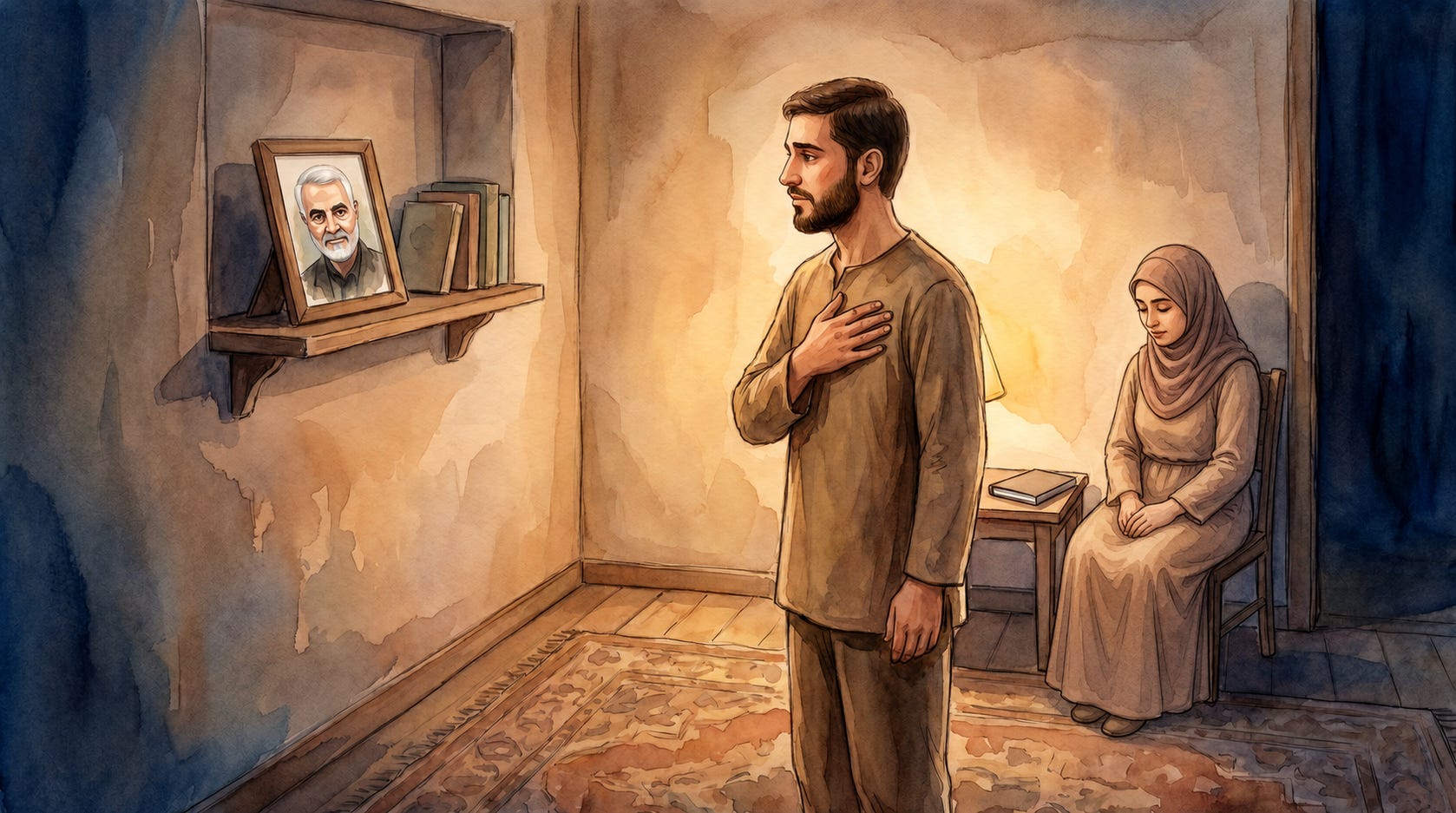
The believer who keeps the photograph of Imam Husayn’s Maqam, or of Hajj Qasem, or of Shaheed Hojaji, on their phone or on their wall as a reminder — as the call back to the witness when the day is heavy — is not the counterfeit.
The Master of Witnesses is honoured by the eye that returns to him.
The counterfeit is when the photograph stops being a reminder of him and becomes a presentation of me.
When the martyr’s face on the profile picture is no longer for the martyr, but for the followers; no longer the remembrance, but the badge.
So too with the visit to the shrine.
The believer who travels to Karbala, to Najaf, to Mashhad, to Damascus — who walks the pilgrimage road with sore feet and a bleeding heart, for the love of the Imam alone — this is the highest of acts.
Ziyarah is not the counterfeit.
The Imams, peace and blessings be upon them all, have asked us to come to them.
The counterfeit is when the ziyarah stops being for the Imam and becomes for the feed.
When the visit becomes the post; when the post becomes the self; when the self travels nowhere but to the next post.
And it is the same disease, the same architecture, that lets the wealthy man perform Hajj every year as a badge of his standing — while the poor man at the end of his own street has never seen Mecca; that lets him send a family on Umrah and then remind them, year after year, of the kindness done to them — when the truth of it is the inverse.
The wealth was God’s gift, given through the opportunity of the other.
The believer of substance kisses the feet of the one through whom God gave him the chance.
The believer of form puts the receipt on the wall.
Theology reduced to a mood.
Imam Husayn reduced to a hashtag.
The form remains; the substance leaks out into the algorithm.
A second form this counterfeit takes deserves naming carefully.
Years ago in Tanzania, in Dar es Salaam, I sat in a Muharram majlis and heard a zakir deliver a narration I have never been able to find in any classical chronicle — that on the day of Ashura, Imam Husayn had asked Yazid’s army to be permitted to go to India, because the people there had a good religion.
The intent was kind.
The substance is a tahrif.
The historical record.
Authenticated across the chronicles — Sheikh al-Mufid’s al-Irshad, Ibn A’tham al-Kufi, Tabari, the Lohoof of Sayyid Ibn Tawus, Ayatollah Reyshahri’s Chronicles — Imam Husayn offered Umar ibn Sa’ad’s army three alternatives:
let me return;
let me go to a frontier of the Muslim lands — arḍ baʿīdah, a distant land;
or let me go to Yazid himself.
India is not in the classical Arabic.
The phrase is “a distant land” — left unspecified.
A question may have surfaced.
Why did the Master of Witnesses offer these alternatives at all?
Has he not come this far precisely to refuse the regime?
The answer is
itmaam-e-hujjat — the completion of the proof.
The Master of Witnesses did not come to Karbala to die.
He came to be the proof of God on earth in his age — and the proof requires that the regime be given the choice.
The proof is not the witnessing of the crime; the proof is the removal of every excuse.
This is the methodology God names in a verse you recite every morning if you say Du’a al-Ahd:
“Corruption has appeared in the land and the sea by what the hands of men have wrought, that He may make them taste a part of that which they have done — so that they may return.”
— Qur’an, Surah al-Rum (the Chapter of the Romans) #30, Verse 41
Bi-ma kasabat aydi al-nas — by what the hands of men have wrought.
La’allahum yarji’oon — so that they may return.
Every consequence, every trial, every overturning, is itself an invitation back.
And in Du’a al-Ahd — the supplication of the Covenant attributed to Imam Ja’far al-Sadiq, recited every morning by the believer pledged to the Imam of our Age — this very verse is invoked, alongside the petition for the zuhoor — return — of the Hidden Imam.
Where the hands of men have wrought destruction, God restores through the appointed proof.
So when Imam Husayn offered Yazid’s army return, frontier, or Yazid himself — he was extending la’allahum yarji’oon to a regime whose refusal was their own conviction.
They refused.
They sealed their refusal with the throat of his infant son.
We will return to Du’a al-Ahd itself at Session 15, at Arbaeen, when this whole series closes.
Tonight we plant the seed.
The Lucknow scholar Sayyed Ali Naqi Naqvi — Naqqan Sahib — corrected the geographic specification a century ago:
“Imam Husayn asked Hurr to let him go to some distant land.
The Imam did not mention Hind — India.
But some people in India took that as a reference to Hindustan.”
— Ayatollah Sayyed Ali Naqi Naqvi (Naqqan Sahib), Lucknow Hawza
The second step — that Imam Husayn endorsed Hindu religion — first appears in a nineteenth-century Punjabi Jangnama composed around 1850.
A folk-epic.
Not a chronicle.
And the Master of Witnesses is the proof of God on earth in his age.
To put in his mouth “the people of India have a good religion” is to do to him what the kamikaze script did to the Japanese boy in the cockpit — to use his voice to say what he did not say.
Let me distinguish, with love.
There is a real community I honour separately, by name.
The Husayni Brahmins — the Mohyal Brahmins of the Punjab — a real Hindu community whose oral tradition preserves the memory of Rishab Dutt having led a small band of Indian career-soldiers and fought alongside Imam Husayn at Karbala.
The Twelver maqtal canon does not strongly attest the narration — but the community is a community; the love across thirteen centuries is real; the Muharram observance every year is real.
We honour the Husayni Brahmins.
The first is a community that came to Imam Husayn — and that remain.
The second puts words in Imam Husayn’s mouth that are not his.
The first we honour.
The second we lift, gently — with the gentleness we lifted the wedding-henna of Qasim and the perfume-shop of Habib ibn Muzahir.
A particular form this counterfeit takes deserves naming further — because it appears, increasingly, in our own pulpits.
The borrowed-iconography move: the use of one tradition’s iconography of suffering to dignify another’s claim, without theological accountability.
When a community whose own tradition has produced the witness — Karbala, the seventy-two, Ali al-Asghar in his father’s arms, Sayyedah Zaynab in the courts of the tyrant — borrows the iconography of another tradition’s suffering, on the grounds that the borrowing will give us political standing in a contemporary conversation, we have decorated the witness with someone else’s clothing.
One example.
I will not name the speaker; we critique the move, we never attack the person.
Some years ago, a sermon was delivered in our community in Britain that attempted to draw equivalence between Karbala and the Holocaust — the Nazi extermination of European Jewry.
The intention may have been solidarity.
The result was a tabyeen failure on three fronts.
Failure One
First. Quranic cherry-picking.
The sermon cited only part of Surah Aal Imran 3:64 —
“O People of the Book, come to a common word”
— and stopped before the verse continues:
“that we worship none but God, and we associate no partners with Him.”
The “common word” is the worship of the One God.
Cherry-picking the verse to make it mean “we are all the same” is a tahrif.
The same sermon cited al-Asr 103:2 —
“mankind is in loss”
— without Verse 3,
“except those who believe and do righteous deeds, and counsel one another to truth, and counsel one another to patience.”
A cherry-picked Qur’an is a tahrif.
Failure Two
Second. Inflated and conflated numbers.
The sermon framed the Holocaust as a Jewish-only catastrophe of six million.
The documented record, from the United States Holocaust Memorial Museum, is 17,383,900 souls who returned to their Lord in the camps and the killing fields of the Nazi terror.
About six million were Jewish.
About eleven point four million were not — Roma and Sinti, Polish civilians, Soviet prisoners of war, the disabled, religious dissenters, political prisoners, gay men and women, others.
To frame the Holocaust as a single-people catastrophe is to obscure the dead the framing did not need.
Failure Three
Third — and this is the line that closes this counterfeit.
The categorical-difference theological argument.
The dead of the Holocaust did not choose.
They were rounded up, boarded onto trains, stripped, gassed, burned.
Not one of them stood at a doorway, like Hurr ibn Yazid on the morning of Ashura, and said:
I will not bow.
They were victims of an industrial atrocity that did not give them a choice.
We honour them.
We mourn them.
We name the system that killed them.
And we do not equate them with the Master of Witnesses — who had a choice; who refused the pledge of allegiance to Yazid even when refusing meant his death and the death of his family.
The Holocaust was atrocity.
Karbala was witness.
To equate them is to flatten both.
And here is the line that forecloses the borrowing.
When Sayyedah Zaynab, stood in the court of Ibn Ziyad — may the mercy of God be distant from him — in the days after Ashura, and was asked how she had seen what was done to her family, she said:
مَا رَأَيْتُ إِلَّا جَمِيلًا
“I saw nothing but beauty.”
— Sayyedah Zaynab, peace and blessings be upon her, in response to Ubaydullah ibn Ziyad; Ibn Tawus, al-Luhuf
What she saw was the loyalty of the seventy-two to God, to the Truth God revealed, and to her brother as the proof of that Truth on earth.
Not the loyalty of a flag.
Not the loyalty of an ethnos.
Not the loyalty of a state or a state’s enemy.
She saw God-loyalty.
And that is what closes the equivalence.
Karbala is not interchangeable with any other suffering, however vast, however terrible — because Karbala’s substance is not the suffering.
Karbala’s substance is the witness.
Apply the Tests
Test one disqualified — no God-anchor; the loyalty is to a contemporary political claim.
Test two fails — cherry-picked revelation, inflated numbers, conflated categories.
Test three fails — the borrowing is not consciousness, it is the inheritance of someone else’s framing.
Counterfeit.
The Two Empires of Our Hour
And the fourth counterfeit is the one this series has been building toward.
The most expensively dressed counterfeit.
The one that clothes itself in the most respectable garments of all:
The moral language of the modern empire.
Last night I planted the seed when we spoke of Hiroshima and Nagasaki.
Tonight I open the seed.
The state-manufactured “righteous nation” claim — the form of empire that justifies its wars by wrapping them in the vocabulary of dignity, freedom, civilisation, democracy, the chosen people, the city on a hill.
The structure is the same as Yazid’s claim — I am the legitimate heir of the Prophet’s family while I slaughter the Prophet’s family.
Imam Husayn refused the form at Karbala.
We refuse it tonight.
Two registers.
Honour without conflation applies between them too.
We name both.
We do not collapse them.
The American Imperial Register
The rhetoric:
“city on a hill,”
“leader of the free world,”
“the indispensable nation,”
“the arsenal of democracy.”
These phrases have been deployed for two centuries to dignify what would otherwise be naked imperial action.
The record.
More thanfour hundred and sixty-nine documented military interventions abroad — verified by the Costs of War Project at Brown and the Congressional Research Service.
The bombs over Hiroshima and Nagasaki, August 1945.
The Iran-Iraq dual-arms supply of the 1980s — we sold weapons to both sides of an eight-year war that killed a million people.
The sanctions — Iraq under Oil-for-Food, where five hundred thousand children died by the UN’s own estimate; and a Secretary of State, asked about it on national television, said: “the price was worth it.”
The twelve and more Gaza-ceasefire vetoes since October 2023.
And the tone-lock.
We honour the American mother who lost her son to Iraq.
We honour the American teacher whose schools are starved while bombs are sent to Tel Aviv.
We honour the American worker whose taxes have built nine hundred overseas military bases while their own roads crumble.
The witness against the American regime IS the witness for the American people the regime betrays.
This is not anti-American sentiment.
It is the same sentiment America’s own honest dissenters have voiced for a century — from Major General Smedley Butler’s
“war is a racket”
in 1935, to El-Hajj Malik El-Shabazz — Malcolm X —
“if violence is wrong in America, violence is wrong abroad,”
assassinated for the truth of it on the 21st of February 1965; to Dr Martin Luther King’s
“the greatest purveyor of violence in the world today is my own government”
in 1967; to Aaron Bushnell’s last words at the Israeli embassy on the 25th of February 2024
“Free Palestine”
None of them were anti-American.
They were the most American voices their century had to offer.
The Zionist Imperial Register
The rhetoric:
“the only democracy in the Middle East,”
“a light unto the nations,”
— and the move we name explicitly:
the invocation of the biblical Amalek narrative as theological cover for state violence against civilian populations.
The founding logic — written into the diaries and the essays before the entity existed.
Theodor Herzl, in his diary on 12 June 1895 — two years before the First Zionist Congress, fifty-three years before the UN partition vote:
“We shall try to spirit the penniless population across the border by procuring employment for it in the transit countries, while denying it any employment in our own country... Both the process of expropriation and the removal of the poor must be carried out discreetly and circumspectly.”
— Theodor Herzl, Diaries, 12 June 1895; The Complete Diaries, ed. Patai (Herzl Press, 1960)
The transfer-logic of the Nakba is in the diary of the founder, fifty-three years before the trains and the trucks and the burnt villages of 1948.
Ze’ev Jabotinsky — founder of Revisionist Zionism, ideological father of the Likud party — in The Iron Wall, 4 November 1923:
“Zionist colonisation must either be terminated or carried out in defiance of the will of the native population... only under the protection of a force independent of the local population — an iron wall which the native population cannot break through.”
— Ze’ev Jabotinsky, The Iron Wall (We and the Arabs), 4 November 1923
David Ben-Gurion — first prime minister of the entity — in his diary in June 1937, eleven years before he gave the order:
“We must expel the Arabs and take their places.”
— David Ben-Gurion, diary entry, June 1937 (in Benny Morris, Righteous Victims, Knopf, 1999)
The transfer is in the diary of the founder.
The wall of force is in the essay of his ideological successor.
The expulsion is in the diary of the man who gave the order eleven years later.
And then the dehumanisation language entered the mouths of the politicians, and stayed there.
Menachem Begin, 1982, Knesset speech during the Lebanon war — Palestinians as
“two-legged beasts” — chayot dorsot.
Rafael Eitan, in 1983, then Chief of Staff of the Israeli Defence Forces —
Palestinians as “crocodiles.”
Ehud Barak, in 2000 —
speaking of the resistance: “a war against beasts.”
Moshe Ya’alon, in 2002, then Chief of Staff —
Palestinian nationalism as “a cancerous manifestation.”
Ayelet Shaked, in 2014, then a Knesset member, posted on Facebook during the Gaza assault:
“a war against the Amalekites.”
Yoav Gallant, on the 9th of October 2023, then Defence Minister:
“human animals” — chayot adam.
Benjamin Netanyahu, on the 28th of October 2023, in his speech announcing the ground invasion:
“remember what Amalek did to you”
— the explicit invocation of the biblical genocidal command of First Samuel, chapter 15, verse 3.
The pattern is more than eighty years long — older than the Zionist entity’s own UN recognition, reaching back to Jabotinsky’s Iron Wall and to Herzl himself.
The pattern is in their own mouths.
And then the operations followed.
Sabra and Shatila 1982.
Cast Lead 2008-9.
Protective Edge 2014.
Swords of Iron from October 2023, in which, by the most conservative documented count, more than seventy thousand have returned to their Lord — at least half of them women and children.
And the tone-lock again.
The witness against the Zionist regime is not anti-Jewish.
It is anti-the-rhetoric-that-prepares-the-massacre.
We honour the Jewish family that opposes the Zionist regime — and there are many.
The Jewish dissenters from Hannah Arendt to Norman Finkelstein to Naomi Klein to the rabbis of Neturei Karta.
The thousands of Jewish students arrested at Columbia and UCLA in 2024 for refusing this rhetoric in their own community at great personal cost.
The witness against the regime IS the witness for these peoples.
The Mandate of Awareness
And here, we bring in our series-wide voice.
Sayyed Abbas al-Musawi — the Secretary-General of Hizbullah, martyred with his wife Sayyeda Siham and their five-year-old son Sayyed Husayn by an Israeli helicopter strike on 16 February 1992.
From the pulpit, in the Bekaa Valley, February 1986, in The Mandate of Awareness:
قد يجذر بنا الأعداء ولكن نحن.. نحن على خط إمامنا الخميني نؤمن بالقاعدة التي سنها هذا الإمام: أقتلونا فإن شعبنا سيعي أكثر فأكثر.
“The enemies may root themselves against us — but we... we are on the path of our Imam Khomeini. We believe in the principle established by this Imam: kill us, for indeed our nation will become more and more aware.”
— Sayyed Abbas al-Musawi, The Mandate of Awareness, Bekaa Valley, February 1986
The mandate of the believer in our time is to know, and to name.
The mandate against the imperial counterfeit is not hatred of any people; it is the disavowal — the bara’a — of every system that calls itself righteous while it kills the children of God.
The fuller treatment of how the Resistance slogans function as bara’a — not baghdh (hatred) — belongs to the Arbaeen body of this series.
Tonight we name the structural critique.
Apply the Tests
Test one inverted — the loyalty is to the throne and the chosen-people claim, not to God.
Test two fails — the oppression of peoples is forbidden in the deen; the Qur’an at al-Hajj 22:39–40 grants the wronged the right to resist.
Those who are fought against are permitted [to fight] because they have been wronged, and God is indeed able to help them
—those who were expelled from their homes unjustly, only because they said, ‘God is our Lord.’ Had not God repulsed the people from one another, ruin would have befallen the monasteries, churches, synagogues and mosques in which God’s Name is much invoked. God’s will surely help those who help Him. Indeed God is all-strong, all-mighty.
— Qur’an, Surah al-Hajj (the Chapter of the Pilgrimage) #22, Verses 39-40
Test three fails — the script is the empire’s, the consciousness is what the empire cannot allow.
Counterfeit on every door.
And the figure killed by this very counterfeit — not by ISIS, not by the takfiri who beheaded Hojaji, but by the imperial counterfeit at the next layer up of the same system — was killed three days into a new year, on the airport road in Baghdad, by direct order of an American president, by a missile fired from an MQ-9 Reaper drone operated out of Creech Air Force Base in Nevada, USA
We turn to him now.
And we close the four-stage road we have been walking with him since the third night.
A Stage on the Road — Shahadat
Three stages led us here.
Talab in Night Three — the Quest.
Eshgh in Night Five — Love.
Ma’rifat in Night Seven — Knowledge, gnosis.
Tonight, the fourth stage, the one that empties the spiritual life out into the body’s witness — Shahadat.
And the figure who walks us through this stage — Hajj Qasem — does not walk us through it as a teacher.
He walks us through it as one who passed through it himself.
Six years ago, on the airport road in Baghdad.
And the love that prepared him for it, the grief that sealed him, was the love Sayyedah Zaynab named the night before —
First the love of God; then the love of the Truth He revealed; and then the love of the Imam He appointed, the Proof of God, the Hujjat of God, the Awaited Master.
And through that triple loyalty, the love of a young Iranian named in honour of the first martyr of the Ahl al-Bayt after the passing of the Prophet — Mohsen ibn Ali, peace and blessings be upon him
Listen — listen carefully — to the names in this family.
His mother, Zahra Mokhtarpour, named him Mohsen — the doer of beauty — in honour of Mohsen ibn Ali, the unborn son of Sayyedah Fatimah al-Zahra, and the Commander of the Faithful, Imam Ali.
In the year eleven of the Hijri, in the days that followed the passing of the Prophet, there was a moment at the threshold of a house in Medina that the husayniyya tradition has carried in its grief for fourteen centuries.
The house of the Prophet’s daughter, Sayyedah Fatimah al-Zahra.
The house where the Commander of the Faithful lived.
And at the threshold of that house, something happened that should never have happened.
Sayyedah Fatimah was carrying a child — a son — whom the Prophet himself had named Mohsen.
In the violence at that threshold, the unborn child did not survive.
The first martyr of the Ahl al-Bayt after the passing of the Prophet himself — Mohsen ibn Ali — fell at the threshold of his mother’s house, in the womb of his mother.
The architecture of Karbala did not begin at Karbala.
It began at that threshold.
— al-Dinawari, Al-Imama wa al-Siyasa, Vol. 1; Sulaym ibn Qays, Kitab Sulaym ibn Qays, hadith 4; al-Majlisi, Bihar al-Anwar, Vol. 28
Let me pause here and speak from the heart, with the firmness on truth and the tenderness with the people the dyad of al-Fath demands.
We carry this sorrow as a community.
We do not carry it as a weapon.
The grand marja’ of our age — Ayatollah Sayyed Ali al-Sistani, may God preserve him — has taught us, when speaking of our Sunni brothers and sisters:
Do not say “our Sunni brothers”; say rather “our very selves” — anfusana.
They are not other to us; they are us, the body of the Muslim community.
And the Qur’an itself teaches us, in al-An’am 6:164 —
وَلَا تَزِرُ وَازِرَةٌ وِزْرَ أُخْرَىٰ
“No soul-bearing-burden bears the burden of another.”
— Qur’an, Surah al-An’am (the Chapter of the Cattle) #6, Verse 164
The grandchildren of those who were at the threshold are not the ones who stood at the threshold.
The Commander of the Faithful — having walked through the sorrow at the threshold — cooperated with the three caliphs who came before him.
He gave his counsel.
He defended the third caliph against the rioters.
He sent his sons Imams Hasan and Husayn as well as Abul Fadhl Abbas and others from the youth of the family of Hashim, to stand at Uthman’s door in his defence.
The Commander of the Faithful did not let his personal grief become a permanent civil war.
That is the model.
And — open the books our Sunni brothers themselves hold most authoritative, and the recognition of the Commander of the Faithful is right there, in the highest Sunni canon.
In Sahih al-Bukhari — Hadith 4481 — the second caliph ‘Umar ibn al-Khattab himself says:
أَقْرَؤُنَا أُبَيٌّ، وَأَقْضَانَا عَلِيٌّ
“Our best reciter of the Qur’an is Ubayy, and our best judge is ‘Ali.”
— Sahih al-Bukhari, Hadith #4481
That is ‘Umar’s own words.
In the Sunni canon’s highest authority.
With no dispute over the chain.
The second caliph, in his own voice, naming the Commander of the Faithful as the best judge of the entire community —
aqdana ‘Aliyyun — our best judge is Ali
And the Prophet himself, in another sahih hadith in the highest Sunni canon — at Khaybar, Sahih al-Bukhari 2975 and Sahih Muslim 2406 — named the Commander of the Faithful as the man whom God loves and who loves God in return, the man to whom the flag is given.
“Tomorrow I will surely give the flag to a man who loves God and His Messenger, and God and His Messenger love him in return.”
— Sahih al-Bukhari, Hadith #2975; Sahih Muslim, Hadith #2406
And the flag was given to the Commander of the Faithful.
The man whom God loves and who loves God in return — that is the Sunni canon’s own attestation.
And in Sahih Muslim Hadith 2404a, and Sahih al-Bukhari Hadith 3708, at the expedition of Tabuk, the Prophet, peace and blessings be upon him, said to him:
“You are to me in the position of Aaron to Moses, except that there is no prophet after me.”
— Sahih Muslim, Hadith #2404a; Sahih al-Bukhari, Hadith #3708
The deputy of the Prophet.
The brother of his mission.
Aaron to Moses.
That is the place of the Commander of the Faithful in the Sunni canon’s own attestation.
We do not borrow it; the Sunni canon gives it.
We name Mohsen ibn Ali, not in order to make grievance against our Sunni brothers and sisters who are our very selves.
We name him because it is the truth of what happened, and the truth of what happened is the seed of Karbala.
The architecture rhymes across fourteen centuries — and the rhyme is in the names and the thresholds, not in the violence.
The hands at the threshold in Medina in year eleven were not the hands that struck at Tanf in year 1438; the takfiri ideology of DAESH descends from the Khawarej of Nahrawan — the very sect that arose against the Commander of the Faithful and would, 29 years after the Medina threshold, strike him down in the mihrab of Kufa.
Different historical sorrows.
Different ideological currents.
The same architectural shape.
The mother of the young Iranian we are speaking of named him for the first martyr of the Ahl al-Bayt after the passing of the Prophet.
And he died as the first martyr died — at a threshold; at the hands of those who would not bear the witness he bore.
Hold that.
Mohsen Hojaji was born on the 12th of July 1991 in Najafabad, Isfahan Province.
His father, Mohammad-Reza Hojaji, was a veteran of the Sacred Defence.
From his teenage years he was active at the Shahid Ahmad Kazemi cultural centre — volunteer work, teaching literacy in underserved villages, organising book-reading programmes.
The kind of young man who would visit his parents and kiss their hands every day when he came home.
He met Zahra Abbasi at the Shahid Kazemi centre during Sacred Defence Week in 2012.
He was twenty-one; she was eighteen.
They were both volunteering as cultural activists.
They married.
And listen to the dowry he gave her:
124,000 salawats — sending blessings on the Prophet and his family — the memorisation of the Qur’an with its meaning, and a single gold coin.
That is the dowry of the man we are speaking of.
That is the eshgh of Session 5 made literal in the life of a young couple from Najafabad.
She married a young man at a Sacred Defence cultural exhibition who would, six years later, be the figure she would speak of with the words:
“Look at my husband’s eyes.”
In April 2016, they had a son.
They named him Ali — for Imam Ali ibn Abi Talib, the Commander of the Faithful, the father of Imam Husayn.
The naming-chain reaches both backward and forward.
Three generations; the names of the Prophet, the eighth Imam, the Commander of the Faithful, and the first martyr of the Ahl al-Bayt after the passing of the Prophet — woven into one Iranian family from Najafabad.
One chain of witness reaching backward to the threshold of Sayyedah Fatimah’s house and forward into the present hour.
In Ramadan of 1438 — June 2017 — Mohsen took his mother on pilgrimage to the shrine of Imam Reza, in Mashhad.
They went together for the holy nights of the month of Ramadhan, and specifically the nights of Qadr.
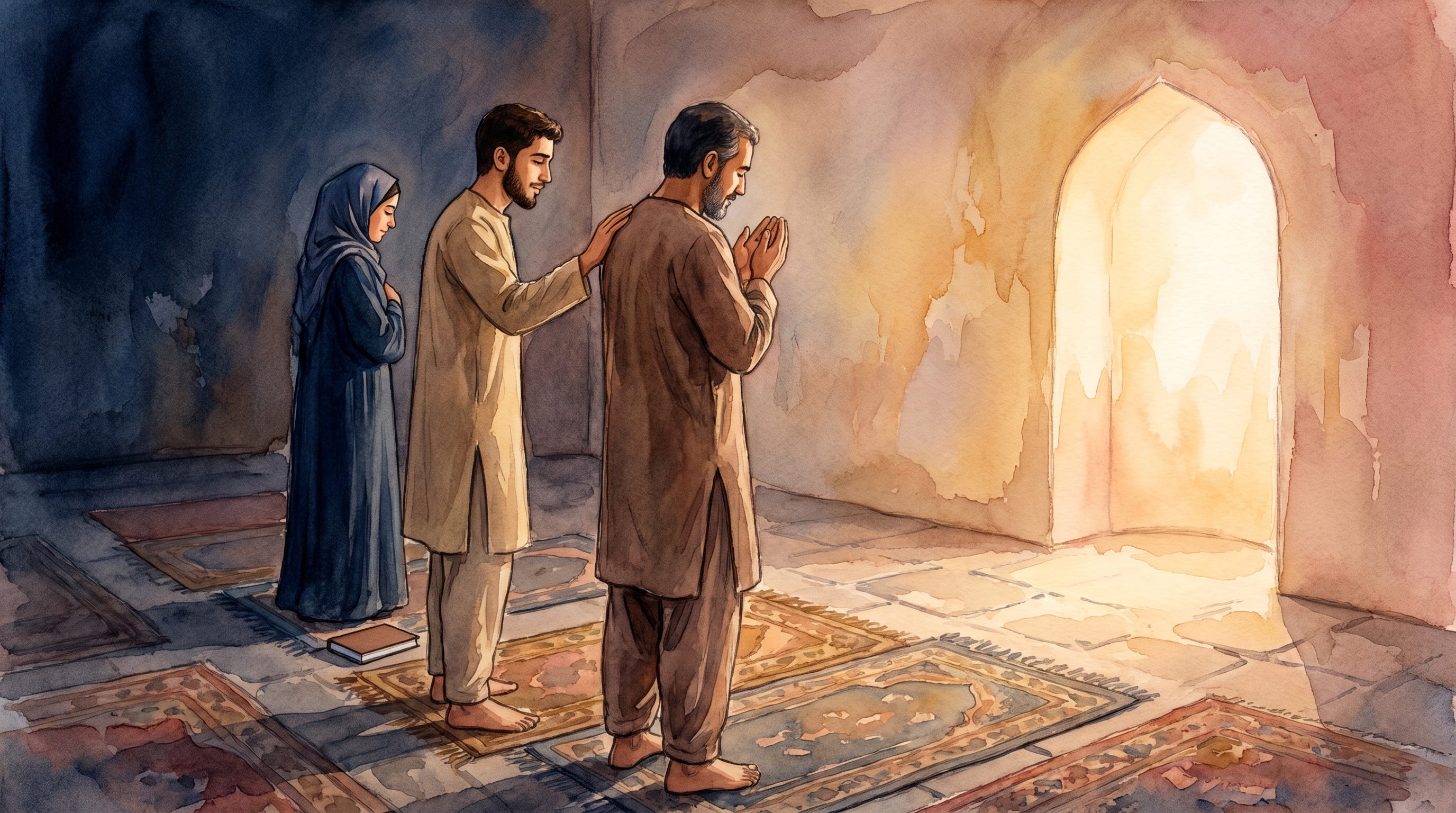
On the 21st Night of Ramadhan — the night the Commander of the Faithful, having been struck two nights before in the mihrab of Kufa during the Fajr prayer while he was in prostration, returned to his Lord — on that night, in the shrine of his eighth descendant, Mohsen sent his mother a message asking her to pray that he be permitted to return to Syria, and to be honoured in the presence of Sayyedah Zaynab.
Listen to that.
The night the Commander of the Faithful received his shahada became the night Mohsen Hojaji asked for his.
The receiving and the asking on the same night, almost fourteen centuries apart.
His mother gave her blessing.
This is what is called, in the language of our tradition,
aaqibat-bekheiri — the good end.
The young man asked God for the good end on the night the Commander of the Faithful received it.
He deployed for his second tour of Syria on the 17th of July 2017.
On the 7th of August — the 16th of Mordad 1396 — his unit was ambushed by ISIS at the Tanf border crossing.
He was wounded and captured alive.
We have already named what the world’s eye saw in that face.
Two days later, on the 9th of August, he was beheaded by his captors.
He was twenty-six years old.
His son Ali was one year and four months old, asleep in Najafabad.
And on the 10th of August — the very day after the news of the beheading was confirmed — Hajj Qasem issued a public vow:
به حلقوم بریده این شهید عزیز محسن حججی، راه اباعبدالله (ع)، سوگند یاد میکنیم که از تعقیب این شجره ملعونه و نابودی این غده خطرناک برآمده در پیکر جهان اسلام تا آخرین نفرشان از پای نخواهیم نشست.
“I swear by the severed throat of this dear martyr, Mohsen Hojaji — who walked the path of Aba Abdullah, peace and blessings be upon him — that we will not rest until we have pursued this cursed progeny and eradicated this dangerous tumour that has emerged in the body of the Islamic world, down to the very last one of them.”
— Hajj Qasem, public vow, 10 August 2017
He swears not on the Qur’an, not on the shrine, not on his own honour.
He swears on the severed throat.
The throat that was slit becomes the witness against the system that slit it.
And then, in a separate personal note that was not for public broadcast — Hajj Qasem writing as a man, not as a commander — he said something that closes the question this whole night turns on.
This is the line of the night.
سلام بر حججی که حجتی شد در چگونه زیستن و چگونه رفتن. فدای آن گلویی که همچون گلوی امام حسین (ع) بریده شد، و سلام بر آن سری که همچون سر مولای شهیدان دفن آن نامشخص و به عرش برده شد.
“Greetings to Hojaji, who became a hujjat — a proof — on how to live and how to die. I sacrifice myself for that throat, which was slit like the throat of Imam Husayn; and greetings to that head, which, like the head of the Master of Martyrs, its burial place is unknown and was taken to the heavens.”
— Hajj Qasem, personal note on the martyrdom of Mohsen Hojaji
The recognition.
Listen to what Hajj Qasem has just done.
The mother named her son for Mohsen ibn Ali — the first martyr of the Ahl al-Bayt after the passing of the Prophet, who fell at the threshold of his mother’s house.
The boy was also born into the family name Hojaji — and that surname carries the H-J-J root, the very root of the word hujjat — proof.
The commander, looking at the calm face in the photograph, said:
hojjati shod — “he became a hujjat.”
The mother’s hope, the surname’s promise, the commander’s recognition — three threads converging in one word.
Hajj Qasem was not using a metaphor.
The young man, named for the first martyr at a threshold, born into the family name that carries the root for “proof,” died at a threshold by hands that, like the hands at the first threshold and like the hands that struck the Commander of the Faithful in the mihrab in year forty, refused the witness the young one bore.
He had become a hujjat. A proof
And then he made the parallel literal: the throat slit like the throat of Imam Husayn.
The head taken to the heavens like the head of the Master of Martyrs.
The body that returned to Iran was incomplete.
Only a leg, parts of the torso, identified by DNA matching and his boots.
The head was never recovered.
ISIS had taken it.
What in Hajj Qasem’s note is poetic — “taken to the heavens” — is also literal.
And one more detail his sister Fatemeh shared in interview.
The gem of his ring read Ya Zahra.
The Defender of the Holy Shrine of Sayyedah Zaynab carried on his finger the name of her mother — Sayyedah Fatima al-Zahra, the Mother of the Imams.
And the martyred leader of the Muslim Ummah — Imam Sayyed Ali Khamenei — sealed it.
He attended Hojaji’s funeral in Tehran on the 27th of September 2017, prayed beside the casket, met privately with the family.
To the family on the 3rd of October 2017 he said:
خداوند شهید شما را عزیز کرد… یک خصوصیّتی در این جوان بود — خداوند هیچوقت کارش بدون حکمت نیست — اخلاص این جوان و آن نیّت پاک او و به موقع حرکت کردن این جوان و نیازی که جامعه به اینجور شهادتی داشت، این موجب شد که خدای متعال، نام این جوان شما را، شهید شما را، بلندمرتبه کرد.
“God cherished your martyr… there was a special quality in this young man — God’s work is never without wisdom — this young man’s sincerity, his pure intention, his timely action, and the society’s need for such a martyrdom; this caused God Almighty to elevate the name of your young man, your martyr, and to make him highly esteemed.”
— Imam Sayyed Ali Khamenei, meeting with the family of Shaheed Hojaji, 3 October 2017
And on the photograph itself — the very photograph the world had seen — the leader wrote, by his own hand:
بسمه تعالی. سلام و درود حق بر این شهید سرفراز و سربلند که در حساسترین و خطیرترین لحظهی زندگی، نماد حق پیروز و آشکار در برابر باطل رو به زوال شد.
“In the Name of God, the Most High. The peace and blessings of God be upon this proud and eminent martyr who, at the most sensitive and critical moment of his life, became a symbol of victorious and manifest truth against decaying falsehood.”
— Imam Sayyed Ali Khamenei, handwritten note on the photograph of Shaheed Hojaji (tabnak.ir)
And in public, the leader gave him the title that Hajj Qasem had given him, and made it the verdict of the entire community:
شهید حججی حجت خدا در مقابل چشم همگان شد.
“Martyr Hojaji became God’s proof before everyone’s eyes.”
— Imam Sayyed Ali Khamenei, public address (khamenei.ir / yjc.ir)
Hujjat khoda — The Proof of God.
The same word the Hidden Imam carries.
The same word the seventy-two carried last night.
The same word the mother had given the son.
And on the 21st of September 2017 — at Hojaji’s arbaeen commemoration, exactly forty days after his beheading — Hajj Qasem made the second public vow of that year, the vow we already used in Session 5 of this gathering, when we did not yet know whose chehlom it was:
“Less than three months from now, the end of DAESH and the DAESH government on this earth will be announced.”
— Hajj Qasem, 30 Shahrivar 1396 / 21 September 2017, at the chehlom of Shaheed Hojaji (Rafiq-e Khoshbakht-e Ma, Astan-e Quds-e Razavi, Mashhad, 1399 SH, p. 14, “The Last Nail in the Coffin of DAESH”)”
Three months later, in November 2017, the vow was kept.
The Session 5 anchor we used in this gathering was a Hojaji moment all along.
Tonight we name it.
And the takfiri counterfeit — the enemy Hojaji had died facing as a Defender of the Holy Shrines — Hajj Qasem broke within months.
But the network that had killed Hojaji was the next layer up.
Three years and three months after Hojaji’s beheading — on the 3rd of January 2020, by direct order of an American president, by an American MQ-9 Reaper drone, on the access road as the convoy left Baghdad International Airport — the imperial counterfeit at the next layer up killed Hajj Qasem himself, alongside Hajj Abu Mahdi al-Muhandis.
Listen to the architecture.
The Master of Martyrs killed by Yazid’s army.
Hojaji killed by ISIS, the takfiri form of the same architecture in our age.
Hajj Qasem killed by the imperial regime that armed and funded both — and that, when the takfiri form had been broken, killed the man who had broken it.
Hajj Qasem’s own last words, in the handwritten note found in his pocket at the scene, two hours before his shahada:
“O Lord, do not abandon me to myself. O Lord, I love the meeting with You — the meeting that left Moses, peace and blessings be upon him, unable to stand or breathe. O Lord, accept me purified.”
— Hajj Qasem, last handwritten note, 3 January 2020 (Rafiq-e Khoshbakht-e Ma, Chapter 8)
And here, two voices from the Hojaji household — voices that speak forward.
Fatemeh Hojaji, his sister, has spoken in multiple interviews of her brother’s death not as a loss but as a chosen love.
As the aaqibat-bekheiri he had been preparing for, in his way, since boyhood.
As his arrival at the place he had been walking toward.
That is Shaheed Mutahhari’s third condition of conscious witness —
āgāhāneh — awareness,
bīdārāneh — wakefulness,
bā sho’ūr — consciousness
— in a sister’s voice.
And Ali Hojaji, his son.
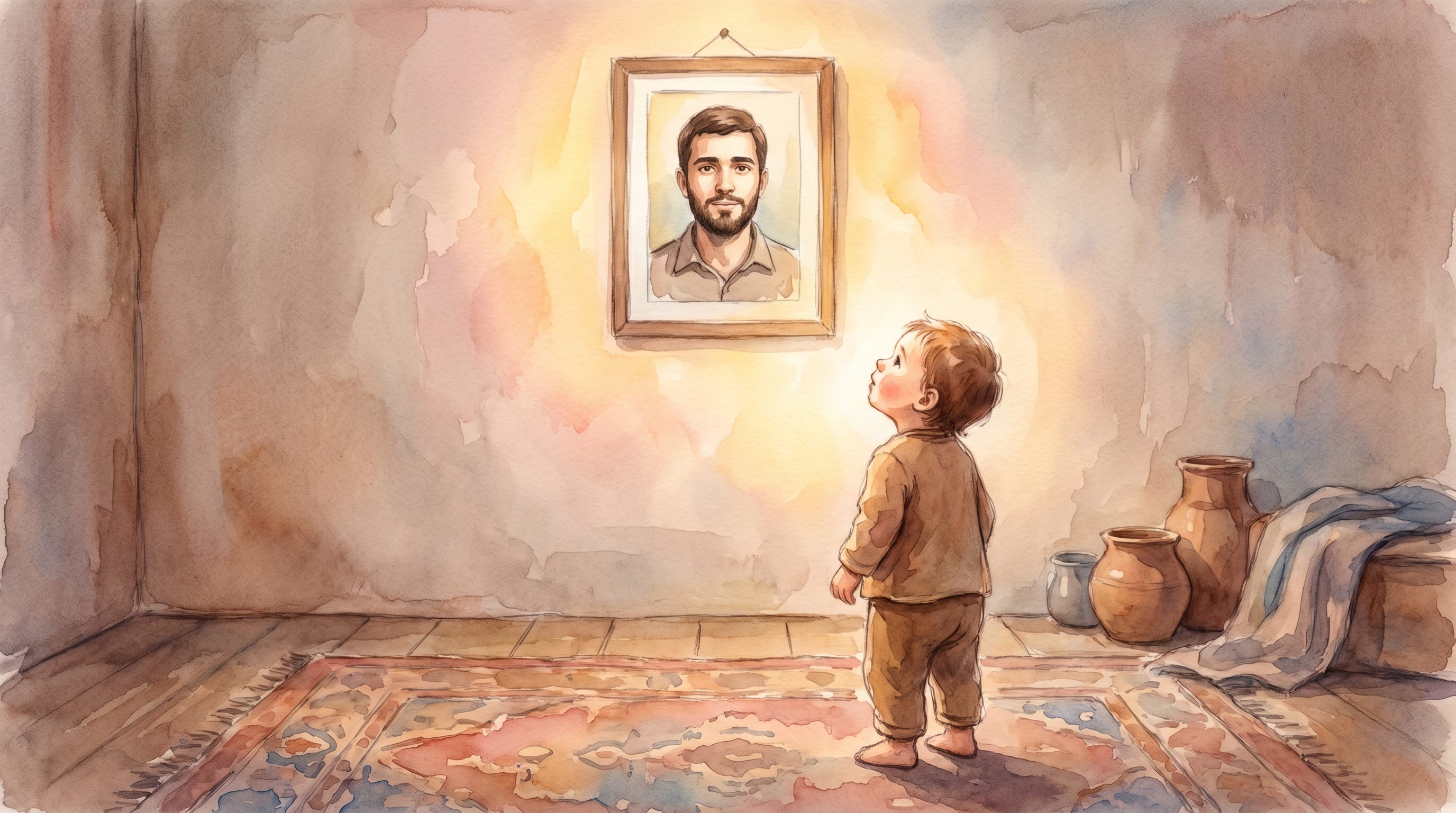
Ali was one year and four months old when his father went.
He knows his father only through photographs and letters and the community’s memory.
There is a question that lives in the elegiac tradition of every shaheed-family in our age.
The question that lives in the poetry of the families of the Defenders of the Holy Shrines.
The question that lives in the children of the Sacred Defence, of Karbala in our own hour, of Gaza, of South Lebanon, of every place where a young father went forward and did not return.
The question is:
بابا، چرا رفتی؟
“Baba — why did you go?”
— the elegiac refrain of the families of the Defenders of the Holy Shrines
We do not put this question, by attribution, in the mouth of Ali Hojaji specifically.
We honour the tradition the question lives in.
We know it is somewhere in his heart, as he grows up looking at his father’s photograph; we know it is in the heart of every child of every shaheed across our communities.
And we know it is the same question God asked Cain at the field, and the same question we have been asking for nine nights, and the same question we will ask the Master of Witnesses tomorrow night at noon on the tenth.
Where is your brother?
The chain holds.
The witness, after the witness, after the witness, holds.
Hojaji passed every test we are about to learn.
So did Imam Sayyed Ali Khamenei.
So did Sayyed Hassan Nasrallah.
So did Hajj Qasem.
So did Hajj Imad Mughniyeh and Hajj Abu Mahdi.
So did the seventy-two of last night.
So did al-Abbas and Qasim and Ali al-Akbar and Aun and Muhammad and Hurr and Wahab al-Nasrani — peace and blessings be upon them all.
The test is the test by which we know who is walking the road and who is wearing the costume.
We turn to it now.
The Three Tests
We have walked the four counterfeits and applied the tests beat by beat.
Now we name them clean — the three doors through which every claim must pass.
The First Test
First. Is the witness in the service of the covenant with God?
Not with a flag, an emperor, a state, an aesthetic, a party, an ethnos, a market, a peer group, a “righteous nation,” a sect-purity, a self-image.
La ilaha illa Allah — there is no god but God.
Any death whose content is loyalty to anything below God is a counterfeit by definition.
The Second Test
Second. Is the act consistent with the law God has revealed?
Not just any cause; not just any grievance; not just any sincerity.
The death must be in service of the deen and the amr bi’l-ma’ruf wa nahy ‘an al-munkar, within the boundaries the law sets.
The Qur’an, at al-Maidah 5:32, names the killing of the non-combatant as the killing of all mankind.
That is why We decreed for the Children of Israel that whoever kills a soul, without [its being guilty of] manslaughter or corruption on the earth, is as though he had killed all mankind, and whoever saves a life is as though he had saved all mankind. Our apostles certainly brought them manifest signs, yet even after that, many of them commit excesses on the earth.
— Qur’an, Surah al-Maidah (the Chapter of the Table-Spread) #5, Verse 32
And at al-Hajj 22:39–40, the verses revealed precisely to permit the resistance of the oppressed against the oppressor —
Those who are fought against are permitted [to fight] because they have been wronged, and God is indeed able to help them
—those who were expelled from their homes unjustly, only because they said, ‘God is our Lord.’ Had not God repulsed the people from one another, ruin would have befallen the monasteries, churches, synagogues and mosques in which God’s Name is much invoked. God’s will surely help those who help Him. Indeed God is all-strong, all-mighty.
— Qur’an, Surah al-Hajj (the Chapter of the Pilgrimage) #22, Verses 39-40
The empire that oppresses cannot also claim to be the righteous nation.
The takfiri who kills the non-combatant cannot also claim to be the soldier of God.
The Third Test
Third. Shaheed Mutahhari’s third condition of conscious witness — āgāhāneh, bīdārāneh, bā sho’ūr.
Awareness.
Wakefulness.
Consciousness.
The witness must know — fully, soberly, without the script-clicks of the system that wrote his interiority — what he is dying for and why.
The kamikaze pilot was sincere.
He was not conscious.
The state had written his script and he was reading it.
Hojaji was conscious.
He signed his martyrdom-permit, by his own hand, on the 21st Night of the month of Ramadhan, in his mother’s presence, at the shrine of Imam Reza.
Witness.
Three tests.
Three doors.
One criterion underneath.
And the criterion — the one always under all three — is the Imam of the Age.
The proof of God on earth.
The criterion against whom every claim is weighed. In our age, the Hidden Imam, may our souls be his ransom and may God hasten his return.
And in the chain of those who have prepared his return: from Imam Khomeini, to Imam Sayyed Ali Khamenei, to Imam Sayyed Mujtaba Khamenei, may God protect him, the present Wali al-Faqih.
To die for any other authority — even a beautiful one, even a sincere one, even a popular one — is the way of beasts.
Inujini — a dog’s death.
The Hagakure name for it from last night.
The Yosano name for it.
Chikushōdō — the way of beasts.
The corrective of the night.
The Pact We Make Tonight
Three propositions to carry home.
First.
We will know the counterfeits — political, ritual, cultural, imperial — so well that we cannot be fooled.
The eye that has seen Hojaji’s face cannot mistake the takfiri’s claim.
The eye that has seen the seventy-two cannot mistake the cherry blossom of the empire.
The eye that has seen Sayyedah Zaynab’s vision cannot mistake the borrowed cross.
Second.
We will speak with firmness on truth and gentleness with the people — tabyeen, not singling-out.
We honour the love.
We adjust the form.
We walk together.
Third.
We will apply the three tests to every claim of “martyrdom” before we bless it.
Loyalty to God.
Consistency with the law — God’s law.
Full consciousness of why.
Before we ever say the word shaheed again — about anyone, in any context — we apply the three tests.
If we cannot answer all three — we hold our tongue.
We do not bless the word until we know it.
Shaheed Mutahhari named the disease of the pulpit at the start of our series, eight nights ago.
Tonight we name the medicine.
Know the real thing so well that you cannot be fooled by the counterfeit.
The Road Ahead
Tomorrow night — at noon — the criterion himself.
The one against whom every counterfeit is weighed.
The one whose face the takfiri’s photograph could not approach.
The one whose loyalty the empire could not manufacture.
The one whose consciousness the system could not script.
Imam Husayn ibn Ali ibn Abi Talib, peace and blessings be upon him.
Tomorrow we stand at his grave.
Tonight — we mourn the one his body folded around at the very last.
The suckling infant in his father’s arms.
The Question to Carry Home
The question we leave with you — the question that has been ours for nine nights, and is ours tonight in a child’s voice:
Where is your brother?
The child of every martyr asks his father — at three years old, at four years old, at the age he is now.
The question every child of every martyr has asked since Cain stood on the empty field.
We ask the Hidden Imam, may our souls be his ransom and may God hasten his return, every morning we wake.
The Hidden Imam will ask each of us on the day we are asked to give our account.
Are we still walking, brother?
Or are we wearing the costume?
The Silent Witnesses
And tonight I bring you, to the witness no counterfeiter can ever steal.
The witness so small that the chronicles barely preserve his name.
The witness whose only word was a cry.
The witness whose only hand was the hand of the father who carried him out toward the river.
To him — and to his mother, who stood, when the tents had burned and the captives were released and the road back had been walked, and who would not move from the grave for a year.
To Ali al-Asghar, also called Abdullah ibn al-Husayn, al-Radhee — the suckling — son of Imam Husayn. And to Sayyedah Rabab, his mother — the wife of Imam Husayn —
the mother who became the witness after the witness.
Peace upon Abel the first witness of the earth. Peace upon every witness in every tradition who refused to bow to other than God. Peace upon every man and every woman who has been wronged, expelled from their home, only because they said: Our Lord is God.
O God, we have nowhere to go but Your door.
O God, we come to You tonight on the verse You revealed in the Cave:
Shall we inform you about the biggest losers in regard to works? Those whose endeavour goes awry in the life of the world, while they suppose they are doing good.
Make us not of those whose works have gone astray while they thought they were doing good. Open our eyes to the counterfeit. Open our hearts to the witness. Open our hands to the work that the witness was for.
Give us the three locks the night taught — loyalty above whom; consistency with which law; chosen by what consciousness. Make these locks the doors of our hearts. Make us refuse, in our generation, what Imam Husayn refused in his.
Peace upon the prophets, O God — Adam, Abel, Noah, Abraham, Ishmael and Isaac, Moses and Aaron, David and Solomon, John the Baptist and Zechariah, Jesus son of Mary, and our beloved Muhammad — and peace upon every prophet whose name we know and whose name only You know.
Peace upon Sayyed Abbas al-Musawi — the man who taught us, in the Bekaa, in 1986, that the duty of the believer is to know, and to name; that we are on the path of Imam Khomeini; that the principle that closes every counterfeit is: kill us, for indeed our nation will become more and more aware. Peace upon his wife Sayyeda Siham. Peace upon their son Sayyed Husayn, the five-year-old taken with them on that road in February 1992. And peace upon his teacher in the line, Shaykh Ragheb Harb — the Shaykh of the Resistance martyrs, who taught us silence is the position of the cowards.
And peace, O God, upon Hajj Qasem — the man whose four-stage road we have closed tonight.
The boy from Kerman whose father worked with water. The lover whose breath was bound to Imam Husayn’s. The discerner who knew what is worth dying for and what is not. The witness, finally, on the airport road in Baghdad on the third of January 2020.
We honour him with the word he gave to the young man whose arbaeen triggered the vow; we honour him with the word the leader of his community gave to him:
hujjat-e khoda — proof of God.
O Lord — accept his last prayer, the prayer he wrote two hours before his shahada:
O Lord, do not abandon me to myself. O Lord, I love the meeting with You — the meeting that left Moses, peace and blessings be upon him, unable to stand or breathe. O Lord, accept me purified.
Peace upon Hajj Imad Mughniyeh, the architect of the Islamic resistance, who fell in Damascus in 2008. Peace upon Hajj Abu Mahdi al-Muhandis, who met Hajj Qasem at the terminal and walked into the convoy beside him. Peace upon Sayyed Hassan Nasrallah, taken from us on the 27th of September 2024 — the resistance leader whose voice carried the Husayni cause across forty years.
Peace upon Imam Ruhollah Khomeini — the Imam of the Revolution, the principle-giver of the Resistance. Peace upon Imam Sayyed Ali Khamenei — the leader who stood with the Resistance for thirty-six years and whose final saying was the saying of Imam Husayn:
someone like me does not give allegiance to someone like him.
The night that takes him as its subject is Session 14; tonight he is named with us in passing.
And peace upon the young men of the Resistance.
Peace upon Shaheed Mohsen Hojaji, the hujjat-e khoda — God’s proof before everyone’s eyes.
Peace upon the wider Defenders of the Holy Shrines — the Mudafi’in al-Haram. The Iranian young men who left their homes for the shrines of Sayyedah Zaynab and Sayyedah Ruqayyah. The Afghan Fatemiyoun Division. The Pakistani Zaynabiyoun Brigade. The Iraqi Hashd al-Sha’bi. The Lebanese resistance. The Syrian Defenders. The medics in Gaza, The Sunni families like the family of Boukamal, who were present at our seventh night, The children of Minab — the one hundred and sixty-three young souls of one Iranian town, Every young man and every young woman of the Resistance who took his father’s place and his grandfather’s burden in his hands.
And peace, O God, upon the Master of Witnesses, Husayn ibn Ali, his brother Hasan al-Mujtaba, their father Ali ibn Abi Talib, the Commander of the Faithful, and their mother Sayyedah Fatima al-Zahra, the daughter of the Prophet, The Imams of guidance, The Imam of our Age — may our souls be his ransom and may God hasten his return.
And peace upon the women of the household — Sayyedah Khadija, Sayyedah Fatimah al-Zahra, Sayyedah Zaynab, Sayyedah Umm al-Banin, Sayyedah Layla bint Abi Murra, the wife of Imam Hasan, Sayyedah Ruqayyah
And tonight especially, peace and blessings be upon Sayyedah Rabab, the wife of Imam Husayn, the mother of Sukaynah and the suckling infant — the woman who heard her husband write love-poetry about her, and who would not move from his grave for a year.
The unnamed women of the household whose names the chronicles did not preserve — peace and blessings be upon them all.
And peace, O God, upon the suckling infant Ali al-Asghar / Abdullah ibn al-Husayn — the witness no counterfeiter can ever steal. The arrow took your throat; the sky caught your blood; your father’s hands buried what your mother could not be there to bury.
O God. We pray to You for Imam Sayyed Mujtaba Khamenei — the new Wali al-Faqih. Preserve him. Strengthen him. Guide him. Make him the leader his father trained him to be, until the Imam of our Age returns and the line he carries is handed back to its rightful holder.
O God. Hasten the return of the Imam of our Age. Make us of his helpers. Make us of his soldiers. Make us of those who, when he calls, are already standing.
O God — we have nowhere to go but to You, and no one to ask but You, and no words enough except the ones You have placed on the tongues of Your friends.
إِنَّا لِلَّهِ وَإِنَّا إِلَيْهِ رَاجِعُونَ
“We belong to God, and to Him we return.”
— Qur’an, Surah al-Baqarah (the Chapter of the Cow) #2, Verse 156
And we repeat Your promise, an eternal promise for justice, and a warning for the wrongdoers: