

In His Name, the Most High
We gather tonight to resume our journey along the Lantern of the Path, continuing our ascent toward the understanding of the Imam of our Time.
However, before we open the pages of history, we must address a matter of methodology.
Some may ask:
“Why do we recap? Why do we repeat the principles of the Occultation that we discussed in previous weeks? Surely once is enough?”
And others may notice, as we proceed through these sessions on Mahdawiyyah and Imamah, that certain themes resurface again and again.
Certain principles are revisited.
Certain truths are restated.
This is not an illusion.
It is not a mistake.
It is not a failure of planning.
It is by design.
To understand why, we must look to the Quran itself.
God does not call the Revelation merely “Information.” He calls it The Reminder (Al-Dhikr).
وَذَكِّرْ فَإِنَّ الذِّكْرَىٰ تَنفَعُ الْمُؤْمِنِينَ
“And remind, for surely the reminder benefits the believers.”
—Quran, Surah al-Dhariyaat (the Chapter of the Scattering Winds) #51, Verse 55
Why does the believer need reminding?
If he already knows, why must he be reminded?
Allamah Tabatabai, in his monumental exegesis of the Quran, Tafsir al-Mizan, addresses this very question in his commentary on this verse.
He explains that the human being is afflicted by a disease called Ghafalah — Heedlessness.
He writes:
وَالذِّكْرَى هِيَ التَّذْكِيرُ بِمَا يَرْكُزُ فِي الْعَقْلِ وَالْفِطْرَةِ مِنَ الْحَقَائِقِ الَّتِي غَفَلَ عَنْهَا الْإِنْسَانُ بِسَبَبِ الِانْغِمَاسِ فِي الشَّهَوَاتِ وَالْمَادِّيَّاتِ. فَإِنَّ التَّذْكِيرَ يَنْفَعُ الْمُؤْمِنِينَ لِأَنَّ قُلُوبَهُمْ مُسْتَعِدَّةٌ لِقَبُولِ الْحَقِّ إِذَا أُزِيلَ عَنْهَا غُبَارُ الْغَفْلَةِ.
”The Reminder (al-Dhikra) is the act of reminding one of the truths that are rooted in the Intellect (Aql) and the Primordial Nature (Fitrah) — truths which the human being has become heedless of due to immersion in desires and material concerns. Surely, the reminder benefits the believers, because their hearts are prepared to accept the Truth once the dust of heedlessness (Ghubar al-Ghafalah) is removed from them.”
— Allamah Tabatabai, Al-Mizan Fi Tafsir al-Quran, Commentary on Surah al-Dhariyaat (the Chapter of the Scattering Winds) #51, Verse 55
Notice the metaphor: the dust of heedlessness.
The truth is not absent from the soul — it is buried beneath the sediment of daily life.
Repetition is not about teaching you something new; it is about blowing the dust off what you already know, so that what resides in the Intellect becomes the state of the Heart.
Ayatullah Jawadi-Amoli, the distinguished student of Allamah Tabatabai, expands on this principle in his exegesis, Tafsir-e Tasnim.
He argues that there is a vast chasm between knowing and becoming — between the perception of a concept and the transformation of the soul.
He writes:
«بین علم و ایمان، بون بعیدی است. علم، انباشتن صورتها در ذهن است، اما ایمان، گره خوردن آن با جان است. بسیارند کسانی که انبار علماند اما مومن نیستند. عقل باید محصول کارگاه علم را به بارگاه دل ببرد و با تکرار و ذکر، آن را با جان گره بزند. تا این عقد (گره) بسته نشود، ایمان حاصل نمیشود.»
”There is a vast distance between Knowledge (Ilm) and Faith (Iman). Knowledge is the perception of concepts, while Faith is the binding of the heart. A person may know the Truth with his intellect, yet not believe in it with his heart. Repetition and Remembrance (Dhikr) are what cause knowledge to descend from the mind to the heart, so that it becomes a witnessed reality (Shuhud).”
— Ayatullah Jawadi-Amoli, Tafsir-e Tasnim, Volume 11 (Commentary on Surah al-Hujuraat (the Chapter of the Chambers) #49, Verse 15, discussing the verse where God states: “The Bedouins say 'We have believed.' Say: 'You have not believed; but say "We have submitted," for Faith has not yet entered your hearts.')
A person can possess a library of theology in their mind and still be a stranger to God in their heart. Repetition is the bridge that carries knowledge from the classroom of the brain to the sanctuary of the soul.
And here, remarkably, even modern science confirms this ancient wisdom.
In 1885, the German psychologist Hermann Ebbinghaus conducted the first experimental study on human memory.
He discovered what he called the Forgetting Curve — a mathematical representation of how quickly the mind discards information it does not revisit.
His findings were sobering, and were published in his seminal work, Über das Gedächtnis (On Concerning the Memory):
Im Allgemeinen nimmt die einmal erworbene Fähigkeit der Reproduction, wenn sie unbenutzt liegen bleibt, mit der Zeit allmählich ab.
Eine Stunde nach dem Abschlusse des Lernens musste für das Wiedererlernen ... beträchtlich mehr als die Hälfte der ursprünglichen Arbeit aufgewendet werden.
”Left to itself, every mental content gradually loses its capacity for being revived...
One hour after the end of the learning, more than half of the original work had to be expended before the series could be reproduced.”
— Hermann Ebbinghaus, Memory: A Contribution to Experimental Psychology, trans. Henry A. Ruger and Clara E. Bussenius (New York: Teachers College, Columbia University, 1913), Chapter 7: "Retention and Obliviscence as a Function of the Time." Originally published as Über das Gedächtnis: Untersuchungen zur experimentellen Psychologie (Leipzig, 1885)
His data revealed that without deliberate repetition, the human mind loses over 50% of new information within one hour, and nearly 70% within twenty-four hours.
The only antidote he found was what psychologists now call Spaced Repetition — returning to the material at strategic intervals to cement it in long-term memory.
The Quran knew this fourteen centuries before the laboratory confirmed it.
The Divine Methodology: The Path, Not the Destination
But we must go deeper still.
We must understand that this method of repetition is not merely a teaching tactic; it is the Divine Methodology itself — it is what we call the Sunnat Allah.
Consider: God sent one hundred and twenty-four thousand Prophets to humanity. From Adam to Noah, from Abraham to Moses, from Jesus to Muhammad — peace be upon them all.
If you examine their missions, you find a singular, repetitive baseline. They did not come to bring one hundred and twenty-four thousand different truths.
They came to repeat the Same Truth to one hundred and twenty-four thousand different contexts.
And what was that truth?
That there is no god but God.
That the human being is a traveller, and the destination is Divine Presence.
That religion itself — Judaism, Christianity, Islam — is not the destination.
These are the Pathways (Tariq).
The destination is God-Awareness (Taqwa).
The tragedy of human history is that we confused the Means with the End.
We turned the telescope into the object of worship, rather than looking through it to see the stars.
We began to venerate the road instead of walking upon it.
All divine scriptures, in their original essence, declared that they are merely maps for the one who wishes to walk toward the Divine.
Let us look at the evidence from the three great Monotheistic books — the Torah, the Gospel and the Quran — to see this unified message.
The Torah: Walking the Way
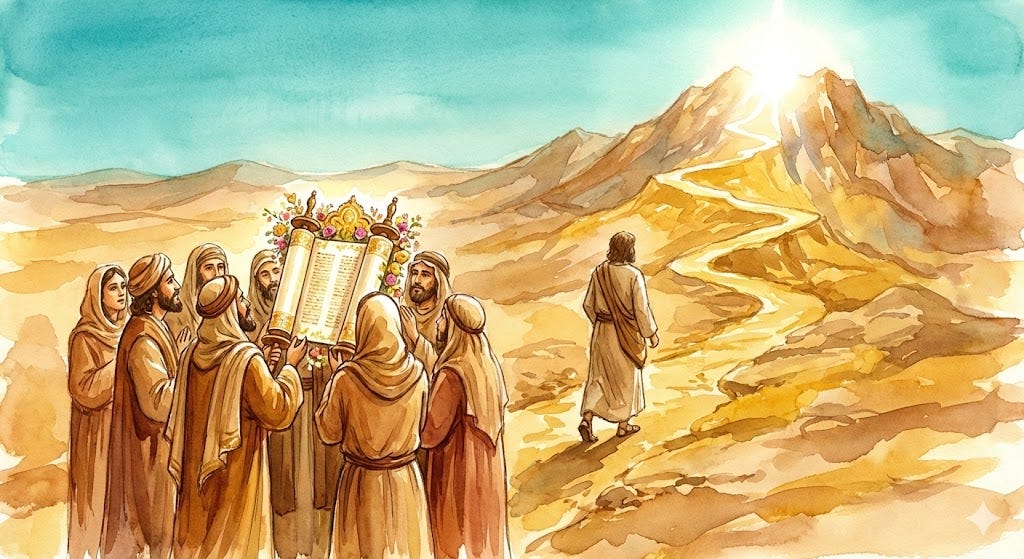
We begin with the oldest of the Abrahamic scriptures — the Torah.
In the Hebrew tradition, God does not ask for a label.
He does not say, “Call yourself a Jew and you are saved.”
He asks for a state of being — to “walk in His ways.”
וְעַתָּה יִשְׂרָאֵל מָה יְהוָה אֱלֹהֶיךָ שֹׁאֵל מֵעִמָּךְ כִּי אִם־לְיִרְאָה אֶת־יְהוָה אֱלֹהֶיךָ לָלֶכֶת בְּכָל־דְּרָכָיו
Ve-atah Yisrael, mah Adonai Eloheicha sho’el me-imach, ki im-le-yir’ah et-Adonai Eloheicha, la-lechet be-chol-derachav...
“And now, Israel, what does the Lord your God ask of you but to fear the Lord your God, to walk in all His ways, and to love Him...”
— The Book of Deuteronomy 10:12
The key word here is Derech — the Way, the Road, the Path.
The Torah presents itself as a road to be walked, not a trophy to be displayed.
You do not worship the road; you walk upon it to reach the King.
The Gospel: The Way to the Father

Centuries later, Prophet Jesus — Isa, peace be upon him, may our souls be his ransom, and may God hasten his return — came to a people who had begun to worship the road itself.
The letter of the Law had eclipsed its spirit. And so, in the Gospel, he redirects their gaze back to the destination.
While the New Testament was written in Greek, Jesus himself spoke Aramaic.
Here is the verse from the Syriac Peshitta — the Aramaic Bible used by Eastern Christians, which preserves the Semitic tongue of Christ:
ܐܶܢܳܐ ܐ̱ܢܳܐ ܐܽܘܪܚܳܐ ܘܫܪܳܪܳܐ ܘܚܰܝܶܐ ܠܳܐ ܐ̱ܢܳܫ ܐܳܬ݂ܶܐ ܠܘܳܬ݂ ܐܰܒ݂ܳܐ ܐܶܠܳܐ ܐܶܢ ܒ݁ܺܝ
Ena na Urkha, wa-Shrara, wa-Khaye. La nash ate lwat Aba ela en bi.
“I am the Way (Urkha), the Truth, and the Life. No one comes to the Father except through me.”
— The Gospel of John 14:6, Peshitta
Listen carefully to the language. Jesus calls himself Urkha — the Way, the Road.
And where does the road lead?
To Aba — the Father, God.
Even here, even in Christianity, the central figure does not present himself as the final destination.
He presents himself as the Means to reach the Absolute.
The Quran: Guidance for the Aware

And then came the final revelation.
The Holy Quran does not say it is a guide for “The Muslims” or “The Arabs.”
In its second chapter, in its very first description of itself, it defines its audience not by tribe or label, but by spiritual state: those who possess God-Consciousness.
ذَٰلِكَ ٱلْكِتَٰبُ لَا رَيْبَ ۛ فِيهِ ۛ هُدًى لِّلْمُتَّقِينَ
“This is the Book about which there is no doubt, a Guidance for those conscious of God (Al-Muttaqin).”
— Quran, Surah al-Baqarah (the Chapter of the Cow) #2, Verse 2
The word here is Huda — Guidance.
A guide is not a destination; a guide is what keeps you on the road when you are lost.
The Quran is the Map.
The Muttaqi — the God-Aware soul — is the Traveller.
And the Book exists to keep the traveller moving toward the destination.
It is not itself the destination.
Whether it is the Derech of the Torah, the Urkha of the Gospel, or the Huda of the Quran — the message across the ages is one:
The Scripture is the Means.
God is the End.
Why Different Paths?
But if the truth is one, why did God send different scriptures?
Why not one book for all of humanity from the beginning?
Think of it this way.
When a child is in kindergarten, how do we teach them about the world?
With pictures.
With toys.
With songs.
We do not hand a five-year-old a university textbook on physics.
Not because the laws of physics are different for children — they are the same — but because the child is different.
The capacity is not yet there.
Then the child grows.
Primary school arrives.
The pictures give way to words.
The toys give way to concepts.
Secondary school comes, and the concepts become more abstract.
University arrives, and the same truths that were taught with building blocks are now taught with differential equations.
The truth did not change.
The student matured.
This is precisely how God educated humanity.
The Torah was revealed to a people emerging from slavery, a tribal society that needed concrete laws, physical symbols, and tangible rituals.
It was the right operating system for that hardware.
The Gospel came to a people drowning in legalism, and so it emphasised the spirit over the letter, love over law.
It was an upgrade for a community that had begun to worship the code instead of the Coder.
And then came the Quran.
ٱلْيَوْمَ أَكْمَلْتُ لَكُمْ دِينَكُمْ وَأَتْمَمْتُ عَلَيْكُمْ نِعْمَتِى وَرَضِيتُ لَكُمُ ٱلْإِسْلَـٰمَ دِينًا
“This day I have perfected for you your religion, completed My favour upon you, and have chosen for you Islam as your way of life.”
— Quran, Surah al-Maidah (the Chapter of the Table Spread) #5, Verse 3
But notice: perfection does not mean we have arrived at the destination.
It means the road is now fully paved.
The path is complete.
The map is finalised.
But we — the travellers — still have to walk it.
And how do we walk it?
The Quran tells us to pray, every single day, multiple times a day:
ٱهْدِنَا ٱلصِّرَٰطَ ٱلْمُسْتَقِيمَ
“Guide us upon the Straight Path.”
— Quran, Surah al-Fatihah (the Chapter of the Opening) #1, Verse 6
This is not a one-time request.
It is a perpetual plea.
Keep us on the road. Do not let us wander.
Do not let us worship the signposts instead of following them.
And who is the best model for walking this path?
The Quran answers:
لَّقَدْ كَانَ لَكُمْ فِى رَسُولِ ٱللَّهِ أُسْوَةٌ حَسَنَةٌ لِّمَن كَانَ يَرْجُوا۟ ٱللَّهَ وَٱلْيَوْمَ ٱلْـَٔاخِرَ وَذَكَرَ ٱللَّهَ كَثِيرًا
“Indeed, in the Messenger of God you have an excellent example — for whoever hopes in God and the Last Day, and remembers God often.”
— Quran, Surah al-Ahzaab (the Chapter of the Confederates) #33, Verse 21
Look carefully at this verse.
It does not say the Prophet is an example for “Muslims.”
It says he is an example for whoever hopes in God and the Last Day.
The Prophet himself is not the destination — he is the Uswah, the model, the exemplar of how to walk the road.
And the destination? God and the Last Day.
And the Prophet did not leave us without a vessel for this crossing.
He said:
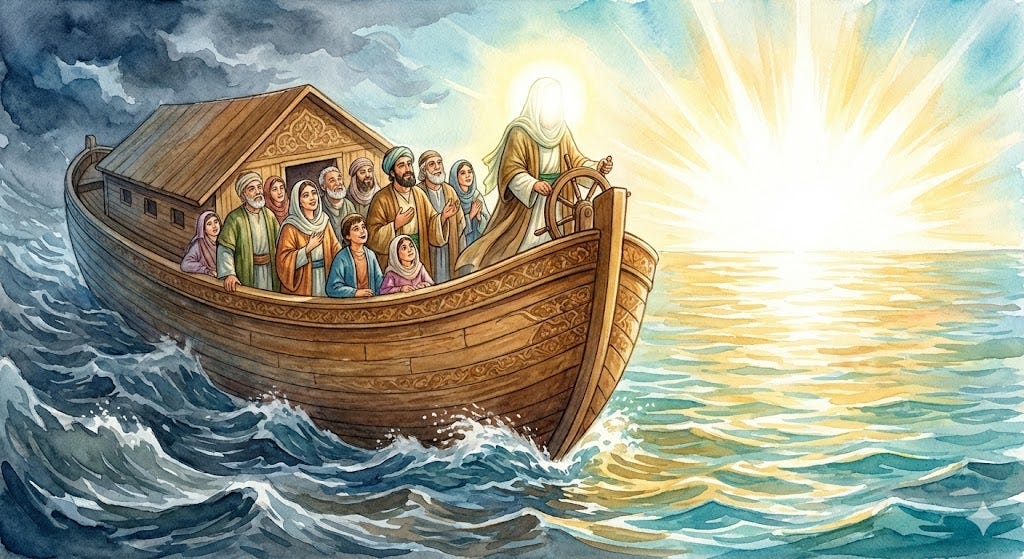
مَثَلُ أَهْلِ بَيْتِي فِيكُمْ كَمَثَلِ سَفِينَةِ نُوحٍ، مَنْ رَكِبَهَا نَجَا، وَمَنْ تَخَلَّفَ عَنْهَا غَرِقَ
“The likeness of my Ahl al-Bayt among you is like the Ark of Noah — whoever boards it is saved, and whoever stays behind is drowned.”
— Al-Nayshabouri, Al-Mustadrak ‘ala al-Sahihayn, Volume 3, Hadeeth 4720
— Al-Tabarani, Al-Mu’jam al-Kabir, Volume 3, Hadeeth 2636
— Al-Majlisi, Bihar al-Anwar, Volume 23, Chapter 7
Notice the image: a ship.
Not a throne.
Not a temple.
A ship.
You do not worship a ship.
You do not build your home upon it and forget the shore.
A ship exists to carry you across — from the turbulent waters of this world to the tranquil shores of the Divine Presence.
The Ahl al-Bayt are the vessel.
The destination remains God.
Even the Greatest of Creation, the Seal of the Prophets, is presented as a means, not an end.
He is the finest road ever laid — but he is still a road.
His family are the safest ship ever built — but they are still a ship.
And roads are for walking, not for worshipping.
Ships are for sailing, not for anchoring upon forever.
And if we walk the road faithfully, if we sail the ship truly — where does it lead?
The mystics whisper to us: not merely to the presence of God, but to the realisation that there was never anything other than Him.
That the journey and the destination were always One.
But that is a station for the end of the voyage, not its beginning.
For now, we walk.
For now, we sail.
Realigning the Compass
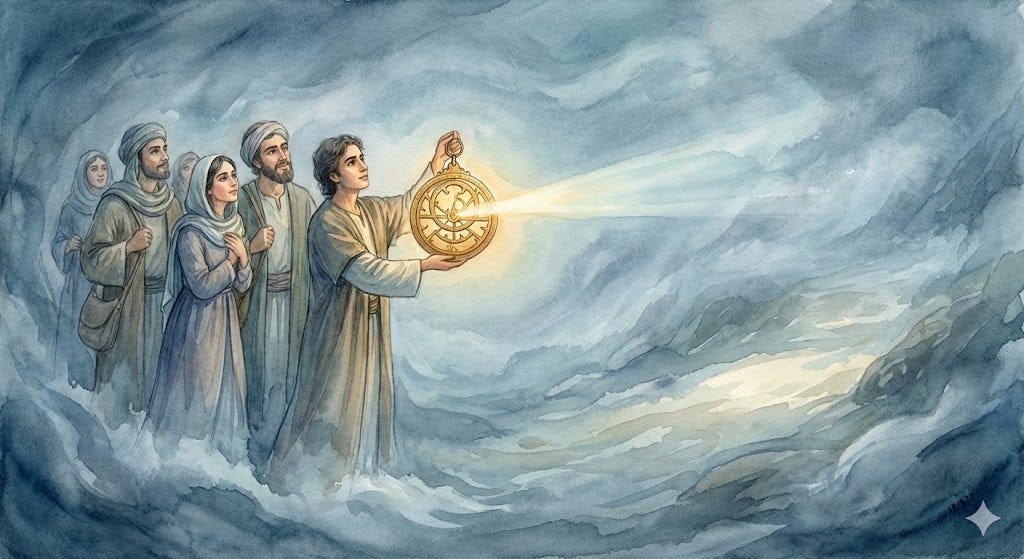
This is why we repeat.
We repeat these lessons tonight — and in every session — not to bore you, but because we, like all human beings, are prone to worshipping the map and forgetting the journey.
We are prone to mistaking the religion for the Lord, the path for the destination, the finger pointing at the moon for the moon itself.
Our recaps are not redundancies.
They are not the stuttering of a forgetful teacher.
They are the Divine Methodology made manifest in this gathering.
We are driving the pillars of belief deep into the soil of your memory, so that when the storms of doubt come, the structure does not move.
So, with hearts open to remembrance, let us look back before we move forward.
Let us recap — to realign our compass, and do so invoking His name, that perchance He give us the ability (tawfeeq) to always move towards Him, to keep Him at the centre of all our thoughts and works, and to ensure we walk upon the road that He perfected for us.
Video of the Majlis (Sermon/Lecture)
This is the video presentation of this write-up as a Majlis (part of the Truth Promoters Weekly Wednesday Majlis Program)
Audio of the Majlis (Sermon/Lecture)
This is the audio presentation of this write-up as a Majlis (part of the Truth Promoters Weekly Wednesday Majlis Program)
Recap
The First Deputy: The Crisis Manager
In our previous session, we stood in the streets of Samarra in the year 260 AH.
The Eleventh Imam had just been martyred.
The house was surrounded.
The spies were circling.
And a community of believers — scattered across the lands — was teetering on the edge of collapse.
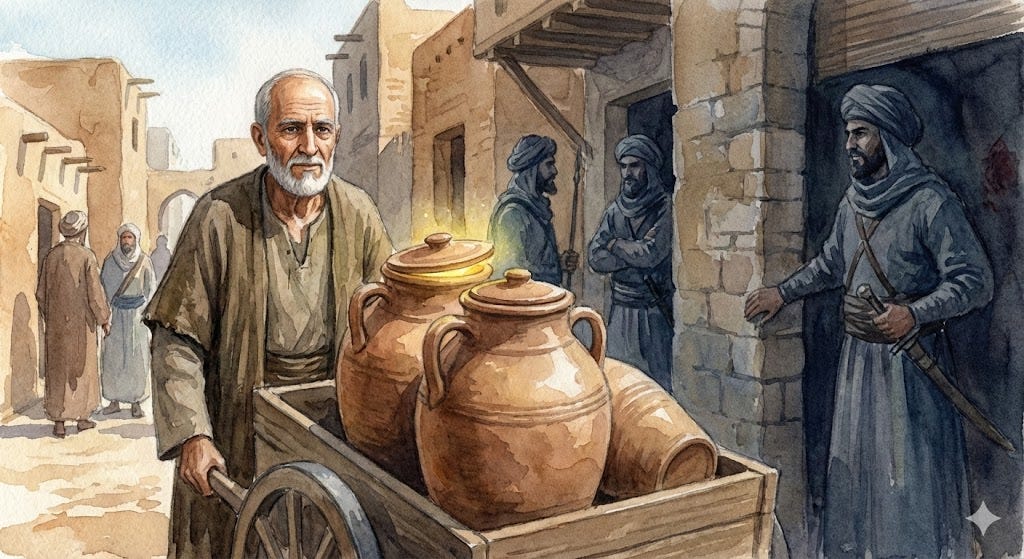
Into this storm stepped a man the world knew only as an oil merchant.
His name was Uthman ibn Sa’id al-Amri.
We examined his credentials — not the credentials of fame or wealth, but the credential that matters in the school of the Ahl al-Bayt: Trust (Thiqah).
For fifty years, he had served under three Imams.
Fifty years of carrying letters, collecting the religious dues, relaying questions and delivering answers — all while the eyes of the Abbasid state watched every shadow.
The Tenth Imam pointed to him and declared:
“This is Abu Amr — the Trustworthy, the Faithful. Whatever he says to you, he says on my behalf.”
Fifty years of proving himself. And not a single stain on his record.
We examined his method — the tradecraft of the Oil Seller.
He hid the secrets of the Imamate inside canisters of cooking fat and carried them through military checkpoints, right past the guards who were hunting for the very Imam he served.
He taught us that sometimes, the most sacred work is done in disguise.
That operational security is not paranoia — it is wisdom.
That the Mission matters more than the Image.
And then we witnessed the crisis.
The funeral of Imam Hasan al-Askari.
A figure named Ja’far — the Imam’s own brother — positioned himself at the front, ready to lead the prayer, ready to claim the mantle of leadership.
History would remember him by a damning title: al-Kadhdhab — the Liar.
We traced his spiritual lineage back to Musaylamah, the false prophet who wrote to the Messenger of God demanding half the earth.
Both men looked at sacred authority and saw a commodity.
Both wanted the title without the burden, the position without the substance.
Ja’far went to the Abbasid Vizier and offered twenty thousand dinars to be recognised as Imam.
When a delegation from Qom tested him with a simple question —
“Tell us what is in these sealed bags”
— he could not answer.
He shook his garments in anger and said:
“Do you expect us to know the Unseen?”
The true Imam had always answered such questions.
Ja’far could not.
And then, at the funeral itself, just as Ja’far raised his hands to begin the Takbir — a child emerged.
Radiant.
Calm.
Carrying an authority that silenced the room.
He pulled his uncle’s cloak and said:
“Step back. I am more worthy to pray over my father.”
The Boy led the prayer.
And then he vanished.
The community was left reeling.
The Imam was now hidden.
The Liar was still present.
Confusion was spreading.
And it was Uthman ibn Sa’id who held the line.
He took charge of the burial.
He calmed the representatives who had travelled from distant lands.
He absorbed the shock and gave the community direction.
He became the visible anchor while the Imam became the Hidden Sun.
We concluded by examining the hierarchy he established.
We saw how the great scholar Ahmad ibn Ishaq — a man who had spent decades in the presence of the Imams themselves — submitted to Uthman the oil merchant.
Not because Uthman knew more about Islamic Jurisprudence and Law (fiqh), but because the Imam had designated him as the channel of authority.
Knowledge bowed to the appointed deputy.
This is the principle of Tasleem — submission not of ignorance, but of wisdom.
Uthman ibn Sa’id was the Emergency Responder.
He stabilised the ship during the storm.
He saved the community from the Liar.
He carried the Imam’s secrets through the checkpoints of tyranny hidden beneath cooking fat.
But emergency measures cannot last forever.
A community cannot live in a permanent state of crisis.
It needs stability.
It needs infrastructure.
It needs an architect.
The Transition
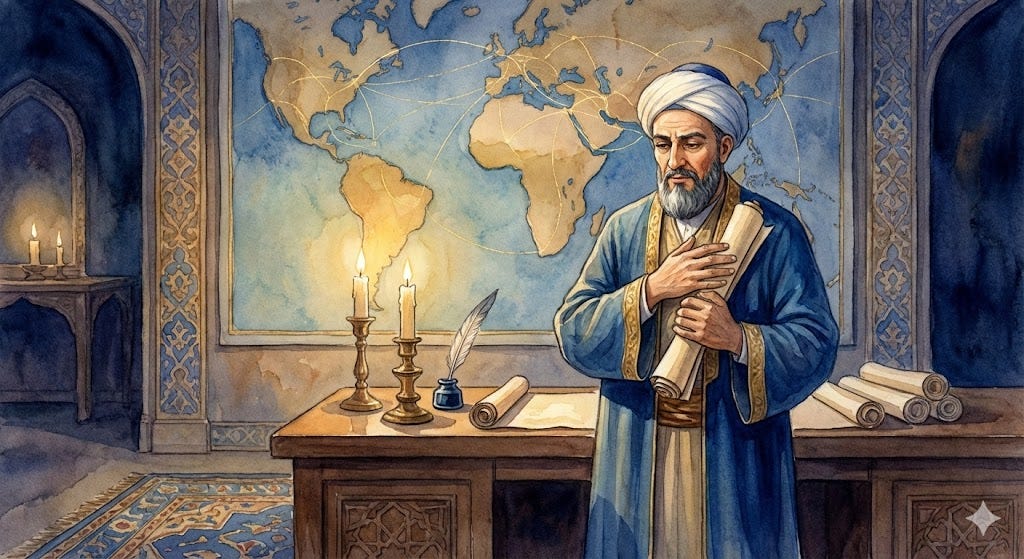
Tonight, we meet the man who served for nearly forty years — longer than any other Deputy.
The man who transformed a secret network into a global institution.
The man who received letters from the Hidden Imam and delivered them to the believers across the world.
The man who buried his father with his own hands, and years later — by the command of the Imam — dug his own grave beside him.
We examine the life and legacy of the Second Deputy: Muhammad ibn Uthman al-Amri.
In His most beautiful name we proceed, and we beg Him to grant us the ability (tawfeeq), the patience (sabr), and steadfastness (istiqamah) to learn and follow the path perfected by God, taught by Ahl al-Bayt, and explained by the honourable scholars and teachers …
Mahdawiyyah (The Culminating Guidance) - The Four Deputies - Part 2 - The Institution Builder
The Inheritance of Merit: The Burden of Genius
The first challenge Muhammad ibn Uthman faced was not the Abbasid spies.
It was his own last name.
He was the son of the First Deputy.
To a cynic looking from the outside, this arrangement has an uncomfortable appearance — a “family business” where power is handed from father to son to keep the secrets and the wealth within the tribe.
A monarchy dressed in religious clothing.
But the Imam did not choose Muhammad ibn Uthman because of his biology.
He chose him because of his genius.
The Divine Stamp: Selection, Not Inheritance
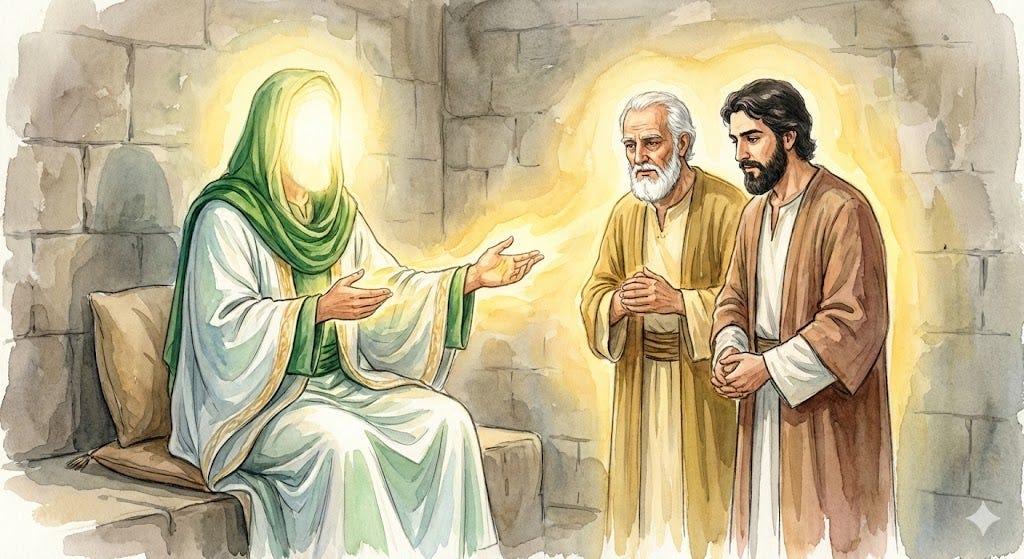
Decades before the Occultation began — while the First Deputy was still alive and active — Imam Hasan al-Askari gathered a group of his elite companions and issued what we might call a “blank cheque” of authority.
He endorsed both the father and the son in a single declaration:
الْعَمْرِيُّ وَابْنُهُ ثِقَتَانِ، فَمَا أَدَّيَا إِلَيْكَ فَعَنِّي يُؤَدِّيَانِ... فَاسْمَعْ لَهُمَا وَأَطِعْهُمَا
“Al-Amri [Uthman] and his son [Muhammad] are both Trustworthy (Thiqatan). Whatever they deliver to you, they deliver on my behalf... So listen to them and obey them.”
— Al-Kulayni, al-Kafi, Volume 1, Kitab al-Hujjah, “Chapter on the Excellence of Knowledge and the Authority of the Narrators.”
— Shaykh al-Tusi, Kitab al-Ghaybah, Section on the Praiseworthy Deputies, report of Ahmad ibn Ishaq al-Qummi. (Also cited in al-Hilli, Zubdat al-Aqwal, Volume 1, Page 469)
Pause and notice the wisdom embedded in this timing.
The Imam did not wait for the father to die before naming the son.
He appointed both simultaneously, while both were serving, so that the community would understand: this is not inheritance — this is selection.
The son was not receiving a privilege he had not earned.
He was being acknowledged for a burden he had already been carrying for decades — silently, faithfully, in the shadow of his father.
The Intellectual Heavyweight: Not Just a Courier

We often picture the Deputies as mere postmen — delivery men shuttling letters back and forth between the Imam and the community.
This is a mistake.
Muhammad ibn Uthman was a giant of jurisprudence in his own right.
Shaykh al-Tusi, in his Kitab al-Ghaybah, records that Muhammad ibn Uthman authored foundational texts on Islamic Law.
He compiled the teachings of the Imams into books — works such as Kitab al-Ashribah (The Book of Drinks) — which served as reference manuals for the scholars of his age.
These books were later passed to the Third Deputy, and then to the Fourth, forming a continuous chain of codified knowledge.
He did not merely carry the knowledge of the Imams.
He embodied it.
When the scholars of Qom had a dispute, they did not simply ask him to forward their question to the Imam and wait for a reply.
They looked to him for the initial guidance, because his mind had become a mirror of the Imam’s teachings.
He was not just the administrator of the network — he was its intellectual anchor.
The Master of the Double Life: Forty Years in the Shadows
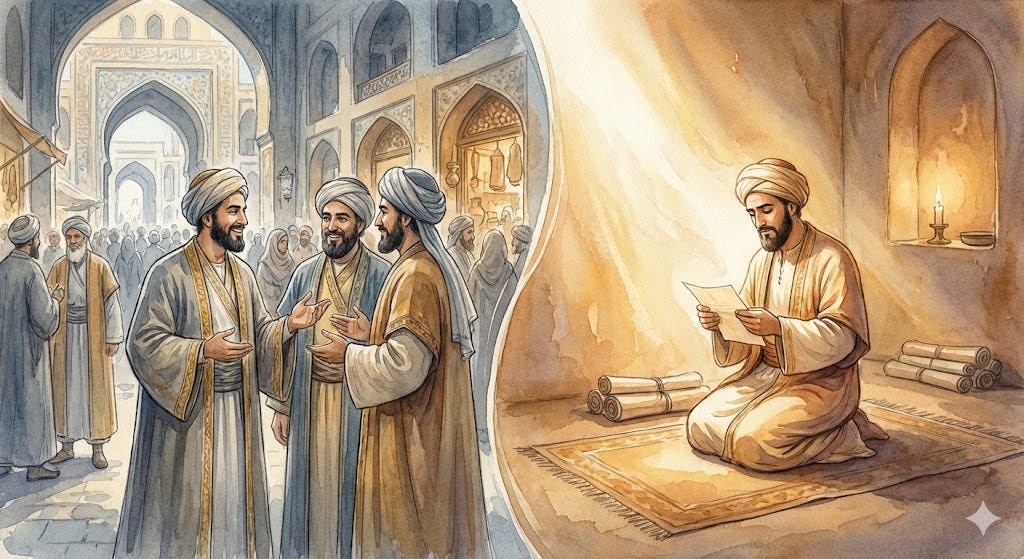
But perhaps the greatest proof of his merit was simply this: he survived.
To lead an underground network for forty years — nearly six times longer than his father — under the relentless surveillance of the Abbasid intelligence apparatus, requires a level of strategic brilliance that is difficult to comprehend.
The historians record that Muhammad ibn Uthman mastered the art of Taqiyyah — strategic prudence/precaution — to a degree that bordered on artistry.
He lived a double life.
To the Abbasid court and the public of Baghdad, he was a wealthy, respectable merchant.
A man of no political ambition.
A Sunni notable who attended their gatherings, participated in their debates, and sometimes even appeared to agree with their positions.
To the Shia — scattered across the vast expanse of the world — he was the Gate to the Hidden Imam.
The channel through which their questions reached Heaven and through which Heaven’s answers returned.
He would deliberately attend the gatherings of the opponents, listen to their arguments, and deflect suspicion by blending in.
This was not cowardice.
This was the height of Hikmah — wisdom.
He sacrificed his public image among the ignorant in order to protect the network that served the guided.
The Transition: From Emergency to System
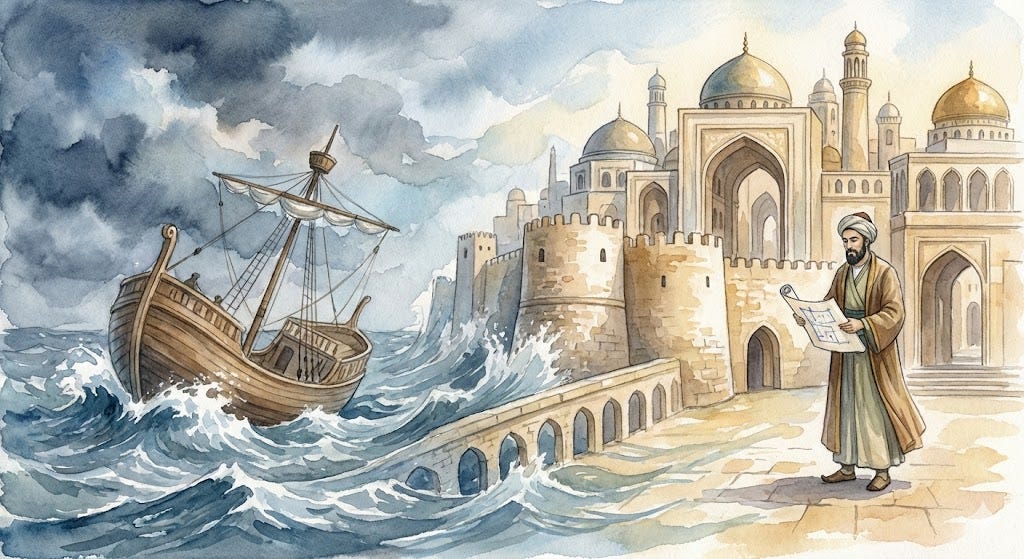
His father, Uthman ibn Sa’id, had been the Emergency Responder — the man who stabilised the ship during the initial storm.
He saved the community from the chaos of the funeral, faced down the Liar, and established the first secure channels of communication between the Hidden Imam and his followers.
But emergency measures cannot sustain a community for decades.
What Muhammad ibn Uthman achieved was something far more significant: the transformation of a crisis-management operation into a permanent institution.
Two of the greatest minds of contemporary Islamic thought — the Martyr, Ayatullah Sayyed Muhammad Baqir al-Sadr and Imam Khamenei — have analysed this transition, and their insights form a powerful convergence.
The Political Success: The Unbreakable Network
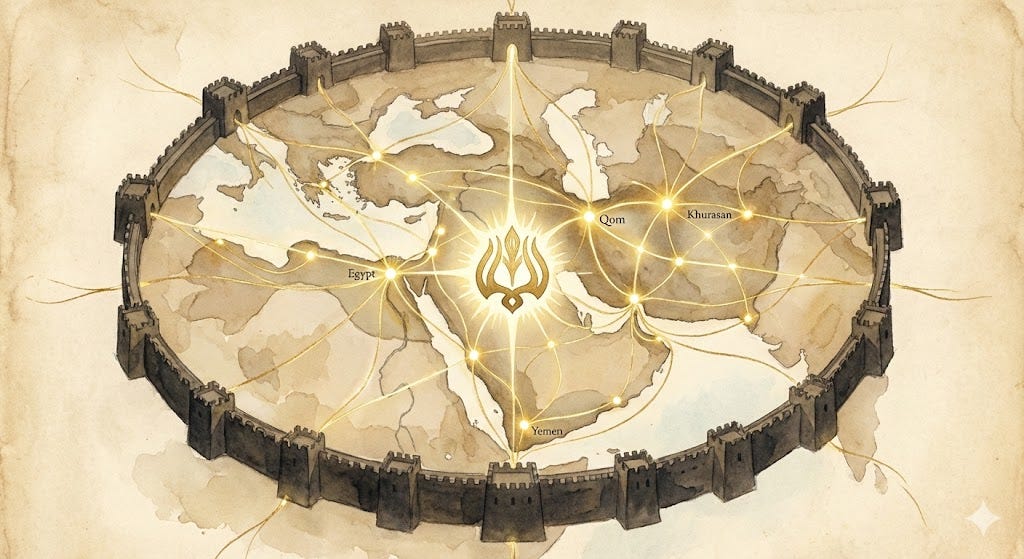
Imam Khamenei, in his seminal work The 250-Year-Old Person, identifies the era of the Deputies — and specifically the long tenure of Muhammad ibn Uthman — as the moment the Shia organisation matured from a survival network into a global system.
He writes:
«در دوران غیبت صغری، این شبکه ارتباطی و تشکیلاتی به اوج انسجام و فعالیت خود رسید. این تشکیلات پنهانی و قدرتمند، شیعیان را در اقصی نقاط دنیای اسلام، از قم و خراسان تا یمن و مصر، به مرکزیت امامت متصل میکرد، بدون آنکه دشمن بتواند در آن نفوذ کند یا رشتههای آن را بگسلد.»
“During the era of the Minor Occultation, this communicative and organisational network reached the peak of its cohesion and activity. This powerful, secret organisation connected the Shia in the farthest corners of the Islamic world — from Qom and Khurasan to Yemen and Egypt — to the centrality of the Imamate, without the enemy being able to infiltrate it or sever its threads.”
— Imam Khamenei, Insan-e 250 Saleh, Chapter: The Era of the Minor Occultation
From Qom to Yemen.
From Khurasan to Egypt.
Thousands of miles.
Dozens of agents.
Forty years of operation.
And not a single breach that compromised the Imam.
This was the political achievement: an unbreakable network spanning the Islamic world, functioning under the nose of a hostile empire.
For forty of the sixty-nine years of the Minor Occultation, Muhammad ibn Uthman was the unseen pivot around which this network revolved.
This was not luck.
This was operational genius.
The Intellectual Success: Training the Community to Survive
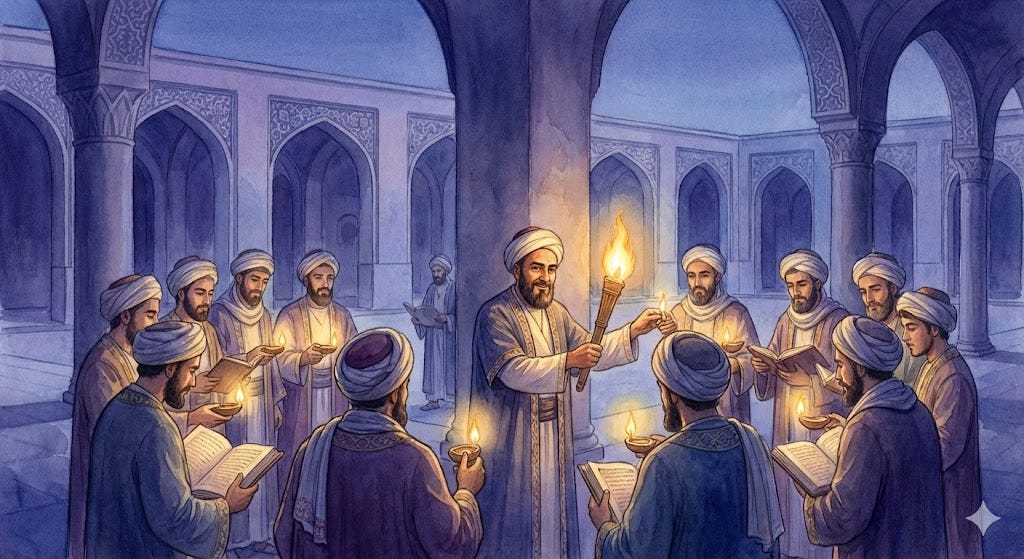
But Ayatullah Shaheed Sayyed Muhammad Baqir al-Sadr, in his profound introduction to Tarikh al-Ghaybah al-Sughra (The History of the Minor Occultation), reveals the deeper purpose of this era.
The Minor Occultation was not merely a holding pattern — it was a training operation.
The community was being weaned off dependence on a visible, named leader and prepared for the long night of the Major Occultation.
He writes:
إِنَّ الْغَيْبَةَ الصُّغْرَى كَانَتْ بِمَثَابَةِ عَمَلِيَّةِ تَدْرِيبٍ وَتَمْهِيدٍ لِلشِّيعَةِ لِلِانْتِقَالِ مِنَ مَرْحَلَةِ الِاتِّصَالِ الْمُبَاشِرِ بِالْإِمَامِ إِلَى مَرْحَلَةِ الِانْقِطَاعِ التَّامِّ، وَالِاعْتِمَادِ عَلَى الْخَطِّ الْعَامِّ لِلنِّيَابَةِ (الْمَرْجَعِيَّةِ) بَدَلاً عَنِ التَّعْيِينِ الشَّخْصِيِّ.
“Verily, the Minor Occultation served as an operation of training and preparation for the Shia — to transition from the stage of direct contact with the Imam to the stage of total disconnection, and to rely on the General Line of Deputyship (the Marjaiyyah) instead of specific personal appointment.”
— Ayatullah Muhammad Baqir al-Sadr, Muqaddimat Tarikh al-Ghaybah al-Sughra (Introduction to the History of the Minor Occultation)
This is the key insight.
The First Deputy kept the community alive during the crisis.
The Second Deputy trained the community to survive without him.
He was not building an empire around his own person.
He was building a system — a methodology of leadership, a structure of religious authority — that could function even after the door of specific appointment closed forever.
The Architect of What Endures
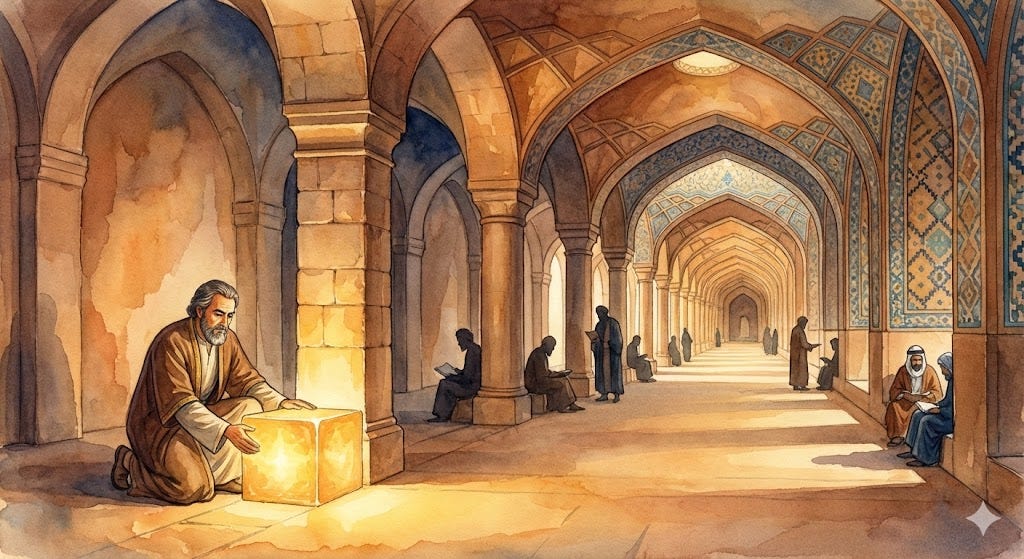
When we combine these two analyses, we see the full picture of Muhammad ibn Uthman’s achievement:
Imam Khamenei shows us the political success: a network that spanned continents, moved wealth and information across hostile borders, and remained impenetrable to the enemy for four decades.
Shaheed al-Sadr shows us the intellectual success: a community that was gradually weaned from dependence on a specific, named deputy and trained to follow the institution of scholarly leadership — the Marjaiyyah — that would guide them through the centuries of the Major Occultation.
The First Deputy saved the community from collapse.
The Second Deputy gave it a structure that could endure for a thousand years.
He was not merely the son of a great man.
He was the architect who transformed his father’s emergency scaffolding into the permanent edifice of Shia institutional life — an edifice that stands to this day in the hawzas of Najaf and Qom, in the system of taqlid, in the very structure of how we relate to religious authority in the absence of the visible Imam.
This is the structure that sustains us now — during the time when our beloved Imam is forced to live in anonymity...
Lesson for the Present: The Crisis of Dynastic Leadership
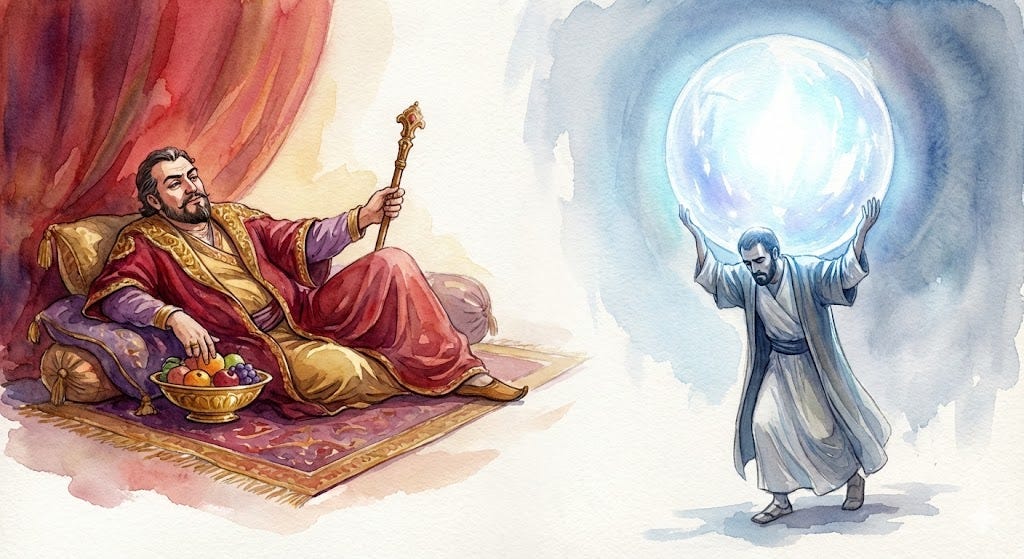
We need to have a difficult conversation about our own communities.
Today, we often treat our mosques, our Hussayniyahs, our Islamic centres and our Islamic foundations as family heirlooms.
The “son of the founder” becomes the president — regardless of his competence.
The “son of the sheikh” is given the pulpit — regardless of his knowledge or piety.
Positions are passed down like antique furniture, from generation to generation, with the assumption that the bloodline carries the qualification.
We have confused biology with theology.
The martyred thinker, Ayatullah Murtadha Mutahhari, in his penetrating analysis Sayri dar Nahj al-Balagha (A Journey through Nahjul Balaghah), addresses this disease directly.
In his chapter on Government and Justice, he contrasts two visions of power: the aristocratic view — where a son inherits his father’s privileges — and the Divine view — where a leader inherits a sacred burden.
He writes:
«اسلام با تفکر اشرافی و قبیلهای که حکومت را حق ارثی میداند، مبارزه کرده است. در منطق علی (ع)، مقام و منصب “طعمه” (شکار و وسیله نان خوردن) نیست؛ بلکه “امانت” است. “وَ إِنَّ عَمَلَكَ لَيْسَ لَكَ بِطُعْمَةٍ وَ لَكِنَّهُ فِي عُنُقِكَ أَمَانَةٌ.” یعنی این پست برای تو وسیله آب و نان نیست، بلکه بار سنگین امانت است که بر گردن تو نهاده شده است. کسی شایستگی این بار را دارد که تقوا و کفایت داشته باشد، نه آنکه صرفاً فرزند کسی باشد.»
“Islam has fought against the aristocratic and tribal mindset which views governance as a hereditary right. In the logic of Ali, a position or office is not ‘Prey’ (Tu’mah) — a means of eating and exploitation. Rather, it is a ‘Trust’ (Amanah). As Imam Ali wrote to his governor: ‘Verily, your work is not a morsel for you to eat; rather, it is a Trust around your neck.’ This means: the position is not a means for your bread and water — it is a heavy burden of trust placed upon your shoulders. The only one qualified for this burden is he who possesses piety and competence, not merely he who is the son of someone.”
— Shaheed Ayatullah Murtadha Mutahhari, Sayri dar Nahjul Balaghah (Journey into Nahjul Balaghah), Chapter: Hukumat wa Adalat (Government and Justice), Section: Maqam-ha wa Amanat-ha (Positions and Trusts). The quote from Imam Ali is from Letter 5 in Nahjul Balaghah.
Tu’mah or Amanah.
Prey or Trust.
A morsel to be devoured, or a weight to be carried.
This is the question that distinguishes the legitimate leader from the imposter.
A Necessary Clarification: The Lineage of Light

Now, a sharp listener might raise a hand and ask:
“You criticise dynastic leadership — yet the Imams themselves were a family.
Ali was the cousin and son-in-law of the Prophet.
Hasan and Husayn were his grandsons.
The Twelve Imams all descended from a single line.
Is this not the very thing you are condemning?”
We must be crystal clear: No.
There is a fundamental difference between a Monarchy and the Imamate.
In a monarchy, the son inherits power simply because he is the son.
His merit is irrelevant.
He could be a tyrant, a fool, or a drunkard — but because he carries the blood, he receives the throne. The criterion is biology. The qualification is the family tree.
In the Imamate, the son is chosen — not because he is a son — but because he possesses the Merit of Infallibility (Ismah). The lineage is incidental. The qualification is the soul.
The Quran explains this pattern of Divine Selection explicitly. God chooses lines of guidance — but He chooses them based on His knowledge of their spiritual capacity, not their tribal status.
إِنَّ ٱللَّهَ ٱصْطَفَىٰٓ ءَادَمَ وَنُوحًا وَءَالَ إِبْرَٰهِيمَ وَءَالَ عِمْرَٰنَ عَلَى ٱلْعَٰلَمِينَ
“Indeed, God chose Adam and Noah and the family of Abraham and the family of Imran over the worlds.”
— Quran, Surah Aal-e-Imran (the Chapter of the Family of Imran) #3, Verse 33
Why did He choose them? Was it random favouritism? Was it tribal privilege? The Quran answers elsewhere:
ٱللَّهُ أَعْلَمُ حَيْثُ يَجْعَلُ رِسَالَتَهُ
“God knows best where He places His message.”
— Quran, Surah al-An’am (the Chapter of the Cattle) #6, Verse 124
God knows which vessels are capable of carrying the weight of Prophethood and Imamate.
He knows which souls possess the purity to reflect the Divine Will without distortion.
And He chose to preserve that purity within specific lines — the line of Abraham, the line of Imran, the line of Muhammad.
The Imams were not leaders because they were the Prophet’s family.
They were leaders because they were the best of creation in their knowledge, their piety, and their connection to the Divine — and God chose to place that light within a single, purified vessel.
Shaheed Mutahhari addresses this distinction directly in his work Imamat wa Rahbari (Imamate and Leadership).
He writes:
«امامت یک مقام ارثی به معنای پادشاهی نیست که پدر شاه باشد و پسر ولیعهد. بلکه امامت، حقیقتی است که دائر مدار “شایستگی ذاتی” و “عصمت” است. اگر این مقام در نسل معینی قرار گرفته، به دلیل آن است که مشیت الهی بر این تعلق گرفته که این طهارت و عصمت در این صلب و رحم پاک حفظ شود، همچنان که در مورد آل ابراهیم چنین بود. پس ملاک، “قرابت” نیست، بلکه “فضیلت” و “انتصاب الهی” است.»
“Imamate is not a hereditary position in the sense of a monarchy, where the father is the King and the son is the Crown Prince. Rather, Imamate is a reality that revolves around ‘Intrinsic Merit’ (Shayestegi-ye Zati) and ‘Infallibility’ (Ismah). If this station has been placed within a specific lineage, it is because Divine Will ordained that this purity and infallibility be preserved within this pure loins and womb, just as it was for the Family of Abraham. Therefore, the criterion is not ‘Kinship’ (Qarabat), but rather ‘Virtue’ (Fazilat) and ‘Divine Appointment’ (Intisab-e Ilahi).”
— Shaheed Ayatullah Murtadha Mutahhari, Imamat wa Rahbari (Imamate and Leadership), Chapter: Imamat dar Quran (Imamate in the Quran), Section: Discussion on the verse of Ibrahim.
The criterion is not Qarabat — kinship.
The criterion is Fazilat — virtue.
The criterion is Intisab-e Ilahi — Divine Appointment.
The Historical Proof: The Treaty and the Tragedy

This distinction between monarchy and Imamate is not abstract theology.
It was written in blood on the plains of Karbala.
When Muawiyyah ibn Abi Sufyan sought to consolidate power, he signed a treaty with Imam Hasan ibn Ali.
Among the conditions of that treaty was a clear stipulation:
Muawiyyah would not appoint a successor.
Upon his death, the matter of leadership would return to consultation — or to Imam Hasan himself if he were still alive, or to Imam Husayn.
But Muawiyyah broke the treaty.
In the final years of his life, he began extracting oaths of allegiance for his son, Yazid — not because Yazid was qualified, not because Yazid was pious, not because Yazid embodied any virtue that would merit leadership — but simply because Yazid was his son.
And what manner of man was Yazid?
The historians — even those sympathetic to the Umayyad cause — record that he was known for drinking wine, for keeping hunting dogs and monkeys, for mockery of sacred things, for a life of indulgence utterly disconnected from the teachings of the Prophet whose community he claimed to lead.
Al-Mas’udi records in Muruj al-Dhahab (Meadows of Gold):
وَكَانَ يَزِيدُ صَاحِبَ طَرَبٍ وَجَوَارِحَ وَكِلَابٍ وَقُرُودٍ وَفُهُودٍ وَمُنَادَمَةٍ عَلَى الشَّرَابِ<
“Yazid was a man of entertainment, hunting birds, dogs, monkeys, and leopards, and of drinking companions over wine.”
— Al-Mas’udi, Muruj al-Dhahab (Meadows of Gold), Volume 3
This was the man chosen to lead the Muslim Ummah — not because he was worthy, but because he was the son.
This is monarchy.
This is Tu’mah — power as prey to be eaten, a throne to be inherited like furniture.
And what was the result?
Within three years of his ascension, Yazid had ordered the massacre of the Prophet’s grandson at Karbala, the assault on Madinah at al-Harrah, and the catapulting of the Ka’bah itself.
The son who inherited power without merit became the instrument of the greatest tragedies in Islamic history.
Now contrast this with Imam Husayn.
Yes, he was the grandson of the Prophet.
Yes, he carried the noble blood of Hashim.
But his claim to leadership did not rest on his genealogy.
It rested on his Ismah — his infallibility.
It rested on his knowledge, his piety, his willingness to sacrifice everything for the truth.
It rested on Divine Appointment, confirmed through the explicit Nass (Designation) of the Prophet and the Imams before him.
Imam Husayn did not say at Karbala:
“I am the grandson of the Prophet — therefore follow me.”
He said:
أَلَا تَرَوْنَ أَنَّ الْحَقَّ لَا يُعْمَلُ بِهِ وَأَنَّ الْبَاطِلَ لَا يُتَنَاهَى عَنْهُ
“Do you not see that the truth is not being acted upon, and that falsehood is not being forbidden?”
— Ibn Tawus, Al-Luhuf fi Qatla al-Tufuf
His argument was truth and falsehood, right and wrong, merit and corruption — not bloodline and inheritance.
The difference between Yazid and Imam Husayn is the difference between monarchy and Imamate.
One inherited a throne because of his father.
The other was designated by God because of his soul.
The Pattern Repeats: Contemporary Lessons

This pattern did not end in the seventh century.
History has delivered the same verdict again and again.
How many kingdoms have collapsed because an incompetent son inherited what a capable father built?
How many dynasties have crumbled because blood was treated as qualification?
Look at the monarchies that fell across the Muslim world in the twentieth century — kings who inherited thrones they could not maintain, who lost their nations because they assumed that sitting in their father’s chair made them their father’s equal.
Look at family businesses — empires built over generations, destroyed in a single decade because the founder’s grandson assumed that sharing the founder’s name meant sharing the founder’s genius.
The pattern is consistent: inheritance without merit is a recipe for destruction.
The Contemporary Standard: Imam Khomeini and Imam Khamenei
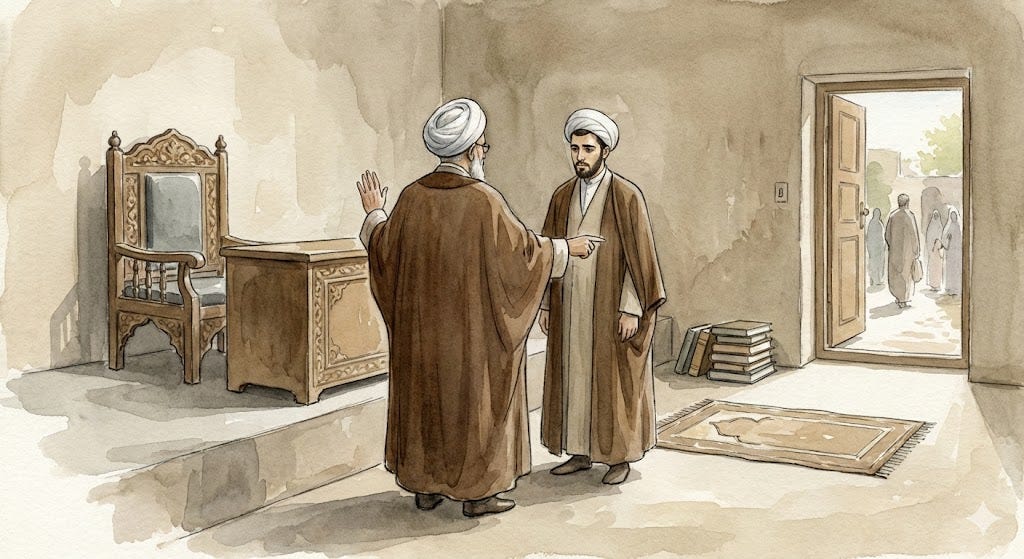
Some may say:
“This is ancient history.
This is the seventh century.
Surely things are different now.”
No. This principle — that lineage does not grant legitimacy — is not a relic of the past.
It is the living standard of the Shia leadership today.
Look at the founder of the Islamic Revolution: Imam Khomeini.
His son, Sayyed Ahmad Khomeini, was a capable and revolutionary figure in his own right.
He had stood by his father through exile, through revolution, through war.
When the first President of the Islamic Republic suggested that Sayyed Ahmad be appointed Prime Minister, Imam Khomeini refused.
He wrote:
«بنا ندارم اشخاص منسوب به من متصدی این امور شوند. احمد، خدمتگزار ملت است و در این مرحله با آزادی بهتر می تواند خدمت کند.»
“It is not my intention that persons related to me should take charge of these affairs. Ahmad is a servant of the nation, and at this stage, he can serve better with freedom from office.”
— Imam Khomeini, Sahifeh-ye Imam, Vol. 13, p. 56, dated 23 July 1980 (1 Mordad 1359), in reply to President Banisadr regarding the Prime Ministership.
In another well-known instruction, preserved in the memoirs of his close companions, he stated even more explicitly:
«من به احمد گفتم که نه رئیس جمهور بشود و نه نخست وزیر.»
“I told Ahmad that he should not become President nor Prime Minister.”
— Hashemi Rafsanjani, Khaterat-e Hashemi Rafsanjani (Memoirs of Hashemi Rafsanjani), Volume Enghelab dar Bohran (Revolution in Crisis) – Covering the year 1359 (1980-81) (Discussing the confusion before the first presidential election when many groups wanted Sayyed Ahmad to run to unify the country)
The founder of the Islamic Revolution — the man who could have established a dynasty with a single word — explicitly forbade his own son from assuming executive power because he was his son.
And look at the current Leader: Imam Khamenei.
He has four sons.
All of them are scholars.
All of them have spent years in the hawza.
Yet not a single one holds a ministry, a governorship, or an executive post in the Islamic Republic.
Gholamali Haddad-Adel, a close associate and relative of the Leader, has related the strict instruction given to the Leader’s children:
«آقا به فرزندانشان فرمودهاند که حق ندارید وارد کارهای اقتصادی یا مسئولیتهای اجرایی شوید.»
“The Leader has told his children: ‘You have no right to enter into economic activities or executive responsibilities.’”
— Gholamali Haddad-Adel, interview with Fars News Agency, discussing the internal conduct of the Bayt al-Rahbari (the Leader’s household).
This is not a slogan.
This is a lived reality at the highest levels of Shia leadership.
When Imam Khomeini died, his son did not inherit the leadership. The position passed to the most qualified — Imam Khamenei — through a process of scholarly evaluation by the Assembly of Experts.
This is the Imamate’s logic applied to the era of fallible leadership.
This is Fazilat over Qarabat — virtue over kinship.
The Standard of the Marjaiyyah
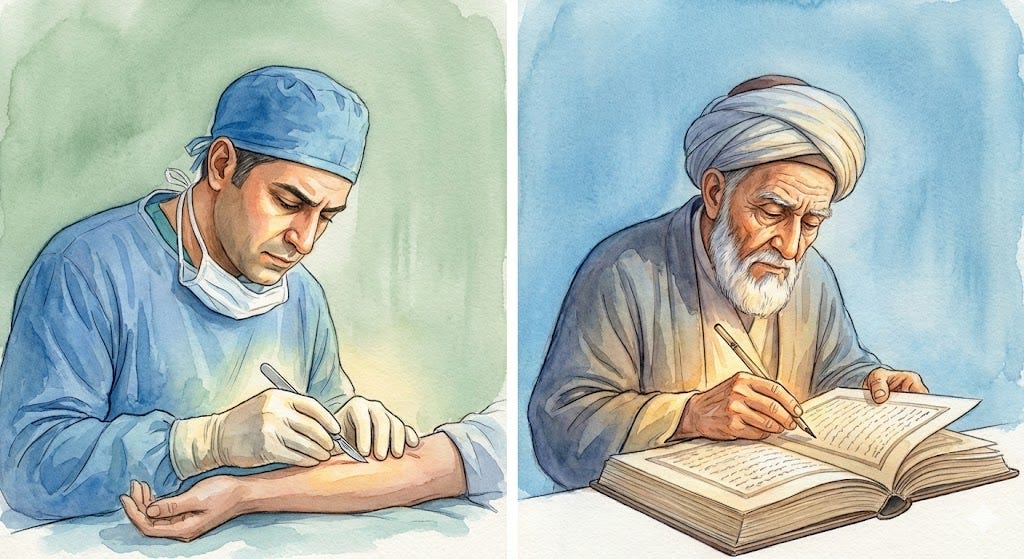
And this principle extends beyond political office to the very heart of our religious structure: the Marjaiyyah itself.
How does one become a Marja’ al-Taqlid — a source of emulation for millions of believers?
Not by being the son of the previous Marja’.
Not by being the wealthiest scholar in the hawza.
Not by being from the most prestigious family or the most powerful tribe.
One becomes a Marja’ by being recognised — through years of teaching, writing, and demonstrating knowledge — as the A’lam: the most learned.
The scholars of the hawza, the students who have sat at the feet of the candidates, the experts who can evaluate jurisprudential depth — they collectively recognise who has reached the highest level of competence.
It is a system built entirely on merit.
Think of it this way:
If - God forbid, and may He grant health to everyones children, parents and loved ones - your child needed surgery, would you want the doctor who is most qualified to operate?
Or would you accept the doctor who happened to be the son of the hospital’s founder?
Would you trust your loved one’s life to someone whose only credential was that his father had been a great surgeon?
Of course not.
You would demand competence.
You would demand the one with the steadiest hands, the deepest knowledge, the most experience.
Why, then, do we accept a lower standard for our souls?
Why do we hand over our mosques, our Islamic centres, our community leadership to people whose primary qualification is their last name or the size of their wallets — when we would never accept such a standard for our bodies?
The Quran itself establishes this principle:
إِنَّ أَكْرَمَكُمْ عِندَ ٱللَّهِ أَتْقَىٰكُمْ
“Indeed, the most noble of you in the sight of God is the most righteous of you.”
— Quran, Surah al-Hujurat (the Chapter of the Chambers) #49, Verse 13
Not the most well-connected.
Not the wealthiest.
Not the son of the previous leader.
The most righteous.
The most competent.
The one with the shoulders to bear the weight.
Call to Clarity: Blood Versus Competence

Muhammad ibn Uthman embodies this principle across fourteen centuries.
He was not the Deputy because he was Uthman’s son.
He was the Deputy because he was the only man capable of carrying the Amanah (Trust) around his neck — outsmarting the Abbasid intelligence apparatus for forty years, unifying the Shia world from Egypt to Khurasan, and transforming an emergency network into an enduring institution.
The Imam tested him.
The Imam observed him.
The Imam designated him while his father was still alive — precisely to demonstrate that this was selection based on merit, not inheritance based on blood.
If the Infallible Imam himself did not take the son’s qualification for granted — why do we hand over our institutions based on last names alone?
If Imam Khomeini refused to let his own son become Prime Minister — why do we allow the “son of the founder” to inherit the presidency of our local Islamic centre without question?
If Imam Khamenei has forbidden his sons from executive positions — why do we treat our community boards as family fiefdoms?
Look honestly at your local committee.
Your board of trustees.
Your community leadership.
Are these positions being filled by the most qualified — the Afqah (most knowledgeable) and the Athqa (most pious)?
Or are they being filled based on who your father was, which village your family comes from, or who has the largest chequebook?
When a position opens, do we ask:
“Who is most capable of serving the Imam’s cause?”
Or do we ask:
“Whose turn is it? Which family hasn’t had a seat at the table recently?”
We must be clear:
Turning a religious institution into a family dynasty is not honouring tradition — it is betraying the very system the Imam established.
The Second Deputy was chosen because he was the best, not simply because he was related to the best.
Imam Khomeini lived this principle.
Imam Khamenei lives this principle.
The question is:
Will we?
But to answer that question, we must understand not only who Muhammad ibn Uthman was — but how he operated.
The Architect of the Network — The Methodology of Survival
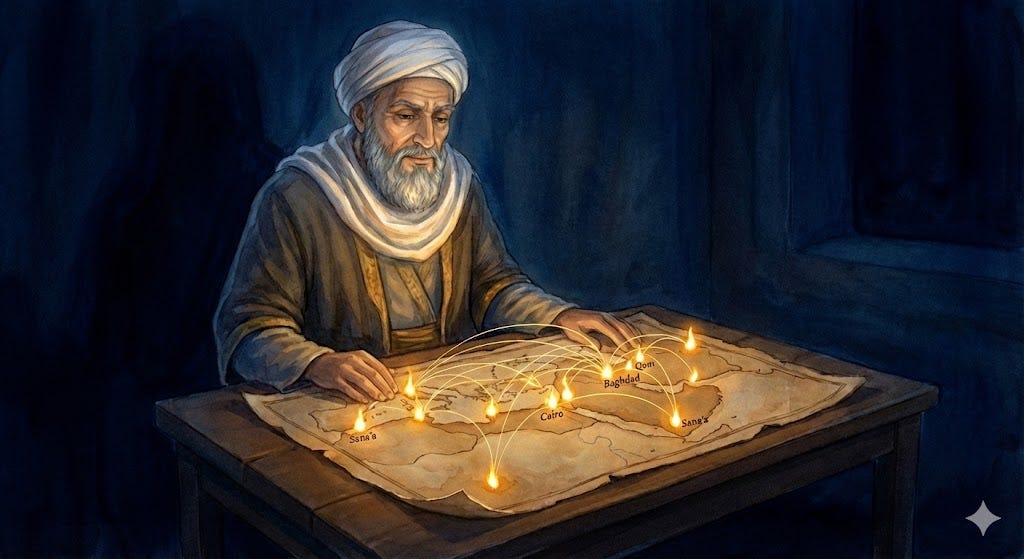
We have established that Muhammad ibn Uthman was chosen for his merit — his scholarship, his strategic brilliance, his decades of proven service.
But how did that merit manifest in the real world?
How did he manage a global organisation for forty years under the nose of a totalitarian regime without being caught?
How did he move money, letters, and secrets across thousands of miles — from Qom to Yemen, from Khurasan to Egypt — without a single breach that compromised the Imam?
To answer this, we must examine not just who he was, but how he operated.
The Government in Exile: Resistance, Not Cult

To the outsider looking at the history of the Wikalah — the Agency, the network of the Deputies — it might resemble a “Secret Society.”
Clandestine meetings.
Code words.
Hidden funds.
Agents operating in disguise.
In the modern world, we are conditioned to view secrecy with suspicion.
We associate it with conspiracies, with nefarious agendas, with things that cannot stand the light of day.
But we must clarify a fundamental political reality of that era:
Secrecy is not always sinister.
Sometimes, it is the only means of survival.
The Abbasid Caliphate was not a benevolant system, it was not the rule of the people, by the people, for the people. It was a regime that served the interests of a tiny clique, while feigning religiosity.
It was a surveillance state.
They were actively hunting the “Son of al-Askari” to execute him.
They had spies in every market, informants in every mosque, soldiers at every gate.
They had already imprisoned and poisoned the previous Imams.
They would have done the same to this one — had they found him.
A Word on “Democracy”

Now, some may think:
“At least we in the modern West — in the modern world — have democracy.
At least our system is different.”
But we must be careful not to be naive.
Even Plato — the towering philosopher of ancient Greece — warned twenty-four centuries ago that democracy carries within it the seeds of its own corruption.
In his masterwork The Republic, he argued that democracy, for all its appeal, is uniquely vulnerable to manipulation by those with wealth and influence.
He wrote:
ὁ δῆμος ἀεί τινα ἑαυτῷ προΐσταται, καὶ τοῦτον τρέφει τε καὶ αὔξει μέγαν.
“The people always have some champion whom they set over themselves and nurse into greatness... This and no other is the root from which a tyrant springs; when he first appears, he is a protector.”
— Plato, The Republic, Book VIII, 565c-d
Plato observed that in a democracy, those with resources — the orators, the wealthy, the influential — can manipulate the masses.
They can shape public opinion.
They can manufacture consent.
The people believe they are choosing freely, but in reality, they are being guided by hands they cannot see.
The form remains “rule of the people.”
But the substance becomes rule by a hidden oligarchy — those who control the media, the funding, the narrative.
Does this not sound familiar?
Look at the modern West.
Look at how elections are funded.
Lobby groups, corporate interests, foreign donors — they pour money into campaigns not for the greater good, but for their own benefit.
Candidates are selected not because they will serve the people, but because they will serve the interests that paid for their victory.
The people vote.
They believe they are exercising power.
But as Plato warned, they are often voting for candidates pre-selected by forces they do not understand, on issues framed by media they do not control, with information filtered through algorithms designed to manipulate their emotions.
This is not informed consent.
This is manufactured consent.
And so, when we compare the Abbasid system to modern democracies, we must not be simplistic.
The Abbasids ruled through open tyranny.
The modern West often rules through the illusion of choice — a softer tyranny, but tyranny nonetheless, when the levers of power are controlled by the few while the many believe themselves free.
In such environments — whether the surveillance state of medieval Baghdad or the manufactured consent of the modern West — the Truth cannot always survive in the open.
Sometimes, it must go underground.
Muhammad ibn Uthman did not build a cult.
He built a Resistance Movement.
He understood that if the Imam was to remain safe, the network had to be compartmentalised.
The agent in Egypt did not know the identity of the agent in Yemen.
The courier in Qom did not know the location of the safe-house in Baghdad.
Information was distributed on a need-to-know basis.
Only the Deputy held the complete picture.
This is what historians call Al-Tanzim al-Sirri — The Secret Organisation.
It was, in effect, a Government in Exile — operating right beneath the feet of the Caliph, collecting taxes, issuing rulings, answering questions, and guiding a global community, all while the official state hunted for its leader.
It was not hiding the truth from the people.
It was hiding the Guide for the people.
The Proof of Connection: The Woman and the Cloth

But a secret network runs a dangerous risk.
If I cannot see the Imam, and I cannot verify the source, how do I know the Deputy is truly speaking for Heaven?
How do I know he is not simply a clever man collecting money for himself?
This is the eternal question of the Occultation:
How do you trust what you cannot see?
Muhammad ibn Uthman did not verify his authority through charisma or eloquent speeches.
He verified it through knowledge — knowledge that could only have come from the Hidden Imam himself.
Shaykh al-Tusi records a remarkable incident in Kitab al-Ghaybah that illustrates this precision.
A woman from the tribe of Banu Asad came to Baghdad.
She was carrying a sealed bag containing religious dues and letters from her community.
She wanted to test the Deputy.
She told no one what was inside the bag.
She did not label the items.
She simply presented herself at the house of Muhammad ibn Uthman and waited.
Before she could speak — before she could even present the bag — the Deputy looked at her and said:
«فِيهَا صُرَّةُ قُمَاشٍ نَسَجْتِهَا بِيَدِكِ، وَفِي طَيَاتِهَا دِينَارَانِ.»
“In this bag is a piece of cloth you wove with your own hands, and inside the folds of the cloth are two gold coins.”
— Al-Tusi, Kitab al-Ghaybah, Section on the Proofs of the Deputies
The woman was stunned.
She broke the seal, unrolled the cloth she had woven in her own home, and there — hidden exactly where he said — were the two dinars.
The Deputy then delivered the message:
«يَقُولُ لَكِ صَاحِبُ الزَّمَانِ: قَبِلَ اللَّهُ مَا فِيهَا لِأَنَّهُ طَيِّبٌ.»
“The Master of the Time says to you: God has accepted what is in it, for it is pure.”
— Al-Tusi, Kitab al-Ghaybah, Section on the Proofs of the Deputies.
This was not a magic trick for entertainment.
This was Verification.
It proved to the community that the “Line” was open — that the channel between Heaven and Earth had not been severed.
The network was not merely moving money; it was moving information from the Imam to his followers.
It gave the believers certainty that although the Imam was unseen, he was not unaware.
He knew their names.
He knew their struggles.
He knew what they had woven with their own hands in the privacy of their homes.
And he accepted their sacrifices.
The Theology of Absence: The Sun Behind the Clouds
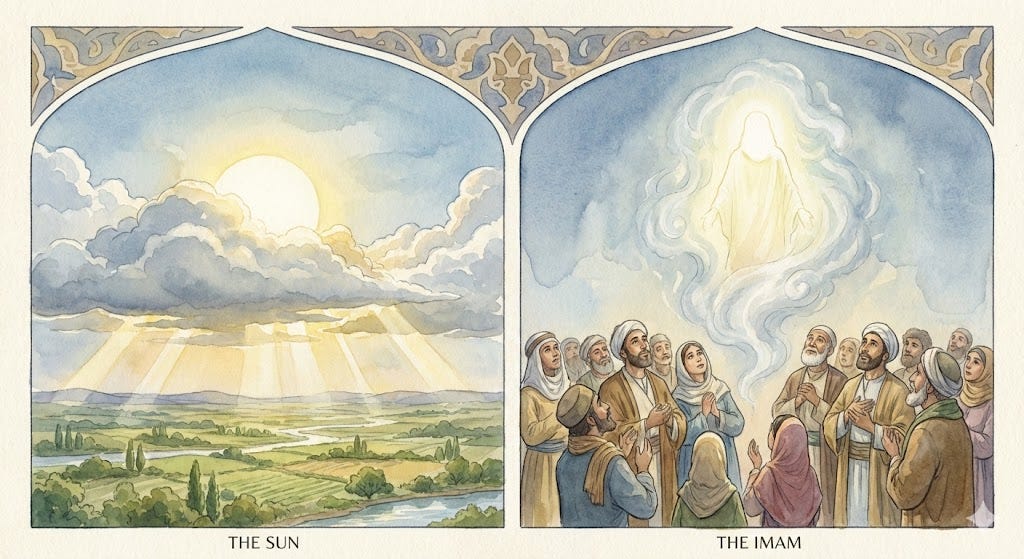
But perhaps Muhammad ibn Uthman’s greatest contribution was not logistical.
It was theological.
The community was struggling with a profound existential question:
“What is the benefit of an Imam we cannot see?”
If he is hidden, how does he guide us?
If he is absent, why do we need him?
What is the point of an Imam who cannot teach us, who cannot lead our prayers, who cannot judge our disputes?
It was through Muhammad ibn Uthman that the answer came — not from a scholar, but from the Imam himself.
A learned man named Ishaq ibn Ya’qub wrote to the Deputy with a series of difficult questions, including this fundamental challenge:
How do we benefit from you when you are hidden from us?
Muhammad ibn Uthman took the letter.
Days later, he returned with a document — a Tawqi’, a signed letter — written in the hand of the Imam himself.
The Imam wrote:
وَأَمَّا وَجْهُ الاِنْتِفَاعِ بِي فِي غَيْبَتِي فَكَالاِنْتِفَاعِ بِالشَّمْسِ إِذَا غَيَّبَهَا عَنِ الأَبْصَارِ السَّحَابُ، وَإِنِّي لَأَمَانٌ لِأَهْلِ الْأَرْضِ كَمَا أَنَّ النُّجُومَ أَمَانٌ لِأَهْلِ السَّمَاءِ.
“As for the way of benefiting from me during my occultation, it is like benefiting from the sun when the clouds conceal it from the eyes. And surely, I am a safeguard for the inhabitants of the earth, just as the stars are a safeguard for the inhabitants of the heaven.”
— Al-Saduq, Kamal al-Din wa Tamam al-Ni’mah, Volume 2, Chapter 45, Hadith 4.
Pause and absorb this metaphor.
The Sun does not cease to exist when a cloud passes before it.
The Sun still provides gravity — it still holds the planets in their orbits.
It still provides heat — it still sustains life on Earth. It still provides light — even on a cloudy day, we see by its diffused rays.
If the Sun were to vanish, the solar system would collapse within minutes.
The Earth would spin off into the void.
Life would end.
The cloud does not diminish the Sun.
The cloud only affects our perception of the Sun.
Likewise, the Imam is the anchor of existence.
We may not see him, but we survive because of him.
The universe holds together because the Proof of God walks upon the Earth.
Muhammad ibn Uthman taught the community a revolutionary idea:
Presence does not require Visibility.
He transformed their understanding from “Waiting for a Leader to appear” to “Living under the leadership of the Unseen.”
This is the theology that has sustained the Shia for over a thousand years.
And it came to us through the network of the Second Deputy.
The Financial Shield: The Price of Freedom
Finally, the Architect secured the community’s independence.
Critics — both historical and modern — often ask:
“Why did the Deputies collect Khums?
Why all this money?”
Some whisper darker accusations:
“The Mullahs just want your cash.”
We must address this directly.
Muhammad ibn Uthman understood a simple political reality that remains true to this day:
He who feeds you, controls you.
If the Shia scholars relied on salaries from the Abbasid court, they would have to preach Abbasid propaganda.
If the seminaries relied on government grants, they would have to remain silent on government oppression.
If the representatives of the Imam ate from the Caliph’s table, they would lose the right to criticise the Caliph’s crimes.
By standardising the collection of Khums — the religious dues owed to the Imam and distributed through his representatives — the Second Deputy created an independent treasury.
This allowed the Shia community to:
Build their own schools without state approval
Support their own poor without begging the tyrant
Fund their own scholars without compromising their teachings
Protect their own families without selling their principles
He built a State within a State — financially independent, and therefore, spiritually free.
This is why the Network mattered.
It was not merely about collecting coins.
It was about ensuring that the voice of Truth would never have to be sold to the highest bidder.
Lesson for the Present: The Crisis of Discontinuity

What does the forty-year tenure of Muhammad ibn Uthman teach us about governance?
It teaches us the difference between Short-Term Politics and Long-Term Guidance.
Look at the systems of governance in the West and indeed across most of the world today.
They are built on the “Election Cycle.”
A leader is elected for three, four, or five years.
They arrive with grand ideas, ambitious reforms, complex projects.
But before they can see those projects through, their term ends.
A new leader arrives — often from an opposing party, often elected precisely because they promised to undo what the previous leader built.
Consider the United States.
The Obama administration spent years crafting the Affordable Care Act — a healthcare reform designed to help millions of Americans who could not afford medical treatment.
They spent further years negotiating the JCPOA — the Iran Nuclear Deal — a complex geopolitical agreement involving multiple world powers.
Whether you agree with these policies or not is irrelevant to the point.
What matters is the effort — the years of negotiation, the due diligence, the institutional energy invested.
And what happened?
The term ended.
A new leader, Mr. Trump, arrived.
And because the system is built on short-term popularity and donor satisfaction, his first acts included tearing down what the previous administration had built.
Years of work erased in a signature.
Geopolitical ramifications that continue to this day.
We see the same pattern in the United Kingdom.
The Conservative Party, driven by the short-term goal of winning an election, gambled with the European Union referendum.
They did not plan for the long-term economic reality; they planned for the short-term ballot box.
The referendum itself was manipulated by media campaigns — this is a matter of public record — and the people voted without full information. The margin was razor-thin.
Yet they proceeded.
And the result was “Brexit” — a decision that plunged the UK economy into decline, that created chaos at borders, that damaged relationships built over decades.
And now?
A new Labour government enters, blaming the Conservatives.
The Conservatives blamed Labour before them.
The cycle continues.
There is no consistency.
There is no long-term horizon.
And who suffers?
The people.
The single mother working two jobs to survive.
The father whose pension has evaporated.
The children in schools who — instead of learning mathematics, reading, writing, and science — are subjected to politicised agendas they are too young to understand, because the current administration needs to score ideological points before the next election.
These are children.
They need to learn how to climb the first rung of the ladder.
They need foundations.
The nuanced, contested, politically charged subjects can come later, when they have the maturity to evaluate them.
But the system does not think in terms of “later.”
The system thinks in terms of “before the next vote.”
The Islamic Alternative: The Strategy of Eternity

The System of the Deputies — and the System of Wilayat al-Faqih that inherited it — is fundamentally different.
It is designed for the Long Game.
Muhammad ibn Uthman did not have to worry about an election every four years.
He did not have to please donors.
He did not have to craft policies that would look good in tomorrow’s headlines but collapse in a decade.
He set a strategy for forty years — and he saw it through.
In the Islamic system, the high-level direction — the policy, the vision, the values — is set by the Leader based on Divine Law.
It is fixed.
It does not change with the winds of popular opinion.
It is oriented toward the genuine, long-term welfare of the people, not the short-term satisfaction of voters.
The Executive Branch — the administration, the president, the ministers — is there to implement the vision, not to cancel it.
They manage the details.
They handle the logistics.
But they do not get to reverse the direction every time there is an election.
This ensures that the nation moves forward, not in circles.
Imam Khamenei articulates this principle in his Second Phase of the Revolution manifesto:
«برای همه چیز میتوان طول عمر مفید و تاریخ مصرف فرض کرد، امّا شعارهای جهانی این انقلاب دینی از این قاعده مستثنا است; آنها هرگز بیمصرف و بیفایده نخواهند شد.»
“It is possible to assume a useful lifespan and an ‘expiry date’ for everything, yet the global mottos of this religious revolution are exceptional; they will never expire or become useless.”
— Imam Khamenei, Bayanieh-ye Gam-e Dovvom-e Enghelab (Statement on the Second Phase of the Revolution), February 11, 2019
The values do not expire.
The direction does not reverse.
The community can plan not just for the next election, but for the next century.
This is what Muhammad ibn Uthman built.
And this is what we inherited.
Call to Clarity: The Trap of “Free Money”

This brings us to a sensitive — but essential — point regarding our own institutions, especially in the West.
Muhammad ibn Uthman established the Khums network for a reason.
He understood that financial independence is the foundation of spiritual freedom.
Today, many Muslim charities and organisations in the West are tempted by “Government Grants.”
They see it as “Free Money.”
“The government is offering funding.
Why not take it?
We can do more good with more resources.”
But we must understand the Quranic reality:
There is no such thing as free money.
As the proverb says:
“He who feeds you, controls you.”
When you take the grant, you take the handcuffs.
You can no longer speak freely against foreign policy.
You can no longer teach certain parts of your faith without scrutiny.
You become a client of the state — and clients do not criticise their patrons.
The Quran warns us explicitly:
وَلَا تَرْكَنُوا إِلَى الَّذِينَ ظَلَمُوا فَتَمَسَّكُمُ النَّارُ وَمَا لَكُم مِّن دُونِ اللَّهِ مِنْ أَوْلِيَاءَ ثُمَّ لَا تُنصَرُونَ
“And do not incline toward those who do wrong, lest you be touched by the Fire, and you would have no protectors other than God; then you would not be helped.”
— Quran, Surah Hud (the Chapter of Prophet Hud) #11, Verse 113
The word here is Rukun — to lean, to incline, to rely upon.
If your charity relies on the oppressor’s money, you have inclined toward them.
You have compromised your independence.
You have traded your voice for their coin.
The Khums is not a “tax” for the scholars to enrich themselves.
It is the Price of Freedom.
It is the financial engine that allows the Marjaiyyah in Najaf and Qom to look the superpowers in the eye and say “No” — because they do not eat from their table.
It is what allowed the Resistance in Lebanon to build schools, hospitals, and infrastructure without waiting for a paralysed government or accepting conditions from foreign powers.
As Shaykh Naim Qassem, the Secretary-General of Hezbollah, explains in his book Hizbullah: The Story from Within:
“المُقَاوَمَةُ لَيْسَتْ مُجَرَّدَ بُنْدُقِيَّةٍ، إِنَّمَا هِيَ مَشْرُوعُ حَيَاةٍ... لَقَدْ أَقَمْنَا المُؤَسَّسَاتِ لِخِدْمَةِ النَّاسِ لِأَنَّنَا لَمْ نَكُنْ نَسْتَطِيعُ انْتِظَارَ دَوْلَةٍ قَدْ لَا تَأْتِي، أَوْ دَوْلَةٍ تَشْتَرِطُ مُسَاعَدَتَهَا بِنَزْعِ سِلَاحِنَا.”
“We established institutions to serve the people because we could not wait for a state that might never arrive, or a state that would condition its aid on our disarmament.”
— Naim Qassem, Hizbullah: Al-Manhaj wa al-Tajribah wa al-Mustaqbal (Hezbollah: The Story from Within), Chapter Al-Amal al-Ijtima’i (Social Work) / The Social and Educational Dimension (Context: Discussing the rationale behind forming Jihad al-Bina (Construction Jihad) and the Islamic Health Society (Al-Hay’a al-Sihhiyya al-Islamiyya))
When you pay your religious dues, do not see it as a burden.
See it as your contribution to the only independent voice left in the world.
Muhammad ibn Uthman carried the gold coins hidden in the folds of cloth not to get rich — but to ensure that the Faith remained free.
A Note on Accountability: The Imam with the Mansion

However — and this must be said clearly — this system works only if there is Trust.
If we critique the West for its volatility and short-sightedness, we must be willing to critique ourselves for corruption.
The system of the Deputies was built on the reputation of men like Uthman ibn Sa’id and Muhammad ibn Uthman — men who lived simply, who carried oil and cloth, who were indistinguishable from the merchants around them.
They did not build palaces.
They did not accumulate wealth.
They served.
Today, if the “representative” of a Marja’ is living in a mansion valued at millions — driving luxury cars, wearing expensive watches, accumulating properties — while the people who pay the Khums are working multiple jobs just to feed their families...
This is not service.
This is betrayal.
Imam Khomeini warned us in terms that leave no room for ambiguity:
«آن روزی که مجلسیان خوی کاخنشینی پیدا کنند خدای نکرده، و از این خوی ارزنده کوخنشینی بیرون بروند، آن روز است که ما برای این کشور باید فاتحه بخوانیم.»
“The day that the leaders acquire the habit of ‘Palace-Dwelling,’ God forbid, and abandon the valuable habit of ‘Hut-Dwelling’ — living simply like the poor — that is the day we must read the funeral prayer for this country.”
— Imam Khomeini, Sahifeh-ye Imam, Volume 17, p. 376
And the standard was set fourteen centuries ago by Imam Ali himself:
إِنَّ اللَّهَ تَعَالَى فَرَضَ عَلَى أَئِمَّةِ الْعَدْلِ أَنْ يُقَدِّرُوا أَنْفُسَهُمْ بِضَعَفَةِ النَّاسِ، كَيْلَا يَتَبَيَّغَ بِالْفَقِيرِ فَقْرُهُ
“Verily, God the Exalted has made it obligatory upon the Just Leaders that they measure themselves against the weakest of their people, so that the poverty of the poor does not drive them to despair.”
— Imam Ali, Nahj al-Balagha, Sermon 209.
If the leader lives in a palace while the people live in poverty, the leader has failed — not the people.
If we damage this trust, we damage the road to God.
The religion is the pathway — as we established in our introduction.
If we corrupt the pathway, if we let the road fall into disrepair, if we allow the signposts to be bought and sold — what hope do we have of reaching the destination?
We will reach not His pleasure, but His wrath.
And that is something no one desires.
Looking Forward

The subject of Khums, of religious dues, of the mechanics of Marjaiyyah and Wilayat al-Faqih — these are vast subjects that deserve their own detailed treatment.
We will, God willing, explore them thoroughly in our future series — when we move from the Minor Occultation to the Major Occultation, when we examine the infrastructure that the Second Deputy helped to build and that sustains us to this day.
For now, know this:
Muhammad ibn Uthman did not build a network to enrich himself.
He built it so that when the dark days came — and they have come, again and again, across the centuries — the Shia would have their own light.
A light funded by their own sacrifices.
A light independent of any tyrant’s favour.
A light that no government grant could purchase and no government sanction could extinguish.
That is the legacy of the Architect.
That is what we inherited.
The question is: will we preserve it — or will we sell it for the illusion of “free money”?
The Charter of the Future — The Birth of the Marjaiyyah

We have spoken about the Man — his merit, his genius, his selection by Divine appointment rather than biological inheritance.
We have spoken about the Network — his methodology, the secret organisation, the financial independence that ensured the community’s survival.
But perhaps the greatest legacy of Muhammad ibn Uthman is neither his personal qualities nor his organisational genius.
It is a single document.
A letter that passed through his hands — a letter that serves as the Constitution of the Shia community to this day.
The Question That Haunted the Community

As the Occultation deepened, the community began to ask a frightening question:
“What do we do when new problems arise?”
The Quran is complete.
The Hadith have been recorded.
The principles are established.
But the world does not stand still.
New political crises emerge.
New economic systems appear.
Wars break out.
Pandemics strike.
Technologies arise that the ancients never imagined.
If we cannot reach the Imam — if we cannot knock on his door and ask him directly — who decides the course of the community?
Who navigates the ship when the Captain is hidden from view?
A scholar named Ishaq ibn Ya’qub wrote a letter to the Second Deputy asking precisely this question.
He presented the problem that would define our existence for over a thousand years:
“What do we do when unprecedented events occur, and we cannot reach you?”
Muhammad ibn Uthman took the letter.
He conveyed it through the hidden channels to the Imam himself.
And days later, he returned with a document — a Tawqi’, a signed letter — written in the hand of the Hidden Imam.
That letter is the Birth Certificate of the Marjaiyyah.
The Constitution
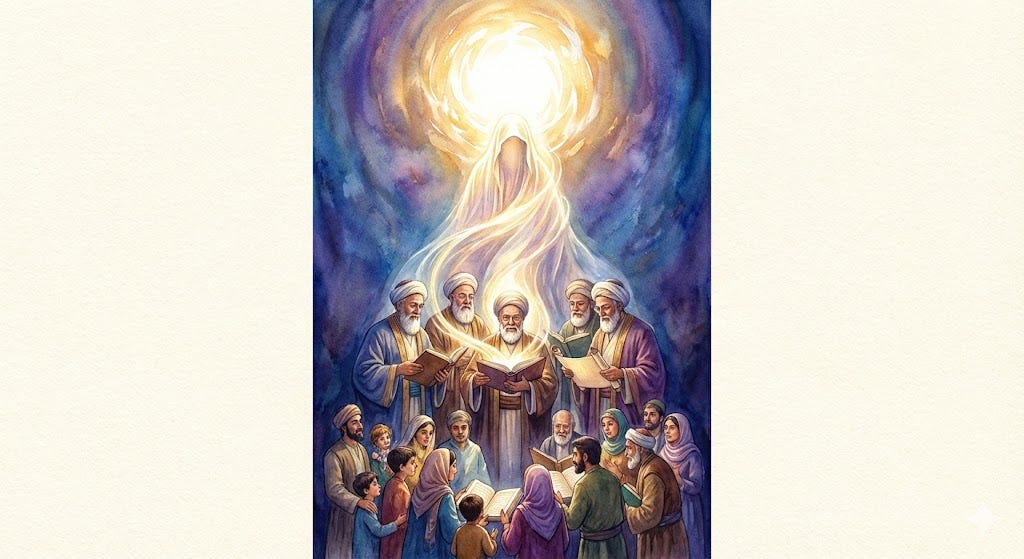
The Imam wrote:
وَأَمَّا الْحَوَادِثُ الْوَاقِعَةُ فَارْجِعُوا فِيهَا إِلَى رُوَاةِ حَدِيثِنَا، فَإِنَّهُمْ حُجَّتِي عَلَيْكُمْ وَأَنَا حُجَّةُ اللَّهِ عَلَيْهِمْ.
“As for the newly occurring events (Al-Hawadith al-Waqi’ah), refer regarding them to the narrators of our traditions (Ruwat Hadithina), for surely they are My Proof (Hujjati) over you, and I am the Proof of Allah over them.”
— Al-Saduq, Kamal al-Din wa Tamam al-Ni’mah, Volume 2, Chapter 45, Hadith 4.
Pause and absorb the weight of this statement.
The Imam did not say:
“Refer to your own reasoning.”
He did not say:
“Figure it out yourselves.”
He did not say:
“Wait passively until I return.”
He said:
Refer to the Narrators. They are My Proof over you.
This is a chain of authority that descends from Heaven to Earth:
God is the ultimate authority.
The Imam is the Proof of God over all creation.
The Scholars are the Proof of the Imam over the community.
To bypass the scholar is to break the chain.
To reject the scholar is to reject the Imam’s explicit command.
The Political Interpretation
Notice the precision of the Imam’s language.
He did not say:
“As for questions about prayer and fasting...”
He said:
Al-Hawadith al-Waqi’ah — The Newly Occurring Events.
Imam Khomeini, in his seminal work Wilayat al-Faqih (Islamic Government), analyses this specific word.
He argues that if the Imam meant only ritual rulings, he would have used the term Ahkam (legal rules).
By using the term Hawadith (events, incidents, crises), he refers to something far broader:
Social and Political Affairs.
Wars.
Treaties.
Economic policies.
Responses to oppression.
The governance of the community itself.
Imam Khomeini writes:
«منظور از “حوادث واقعه” چیست؟ ... حوادث واقعه همین مسائل مستحدثهای است که برای مردم پیش میآید و ما شاهدش هستیم... در این حوادث باید به چه کسی رجوع کنند؟ به “رواة حدیث”؛ یعنی فقها.»
“What is meant by ‘The Newly Occurring Events’? ... These are the newly arising issues that the people face, and we are witnessing them... In these events, to whom should they refer? To the ‘Narrators of Hadith’; meaning the Jurists (Fuqaha).”
— Imam Khomeini, Wilayat-e Faqih: Hukumat-e Islami (Governance of the Jurist, Islamic Governance), Chapter: Dalil-e Naqli (Textual Evidence).
The Second Deputy delivered a system where the community was commanded to follow the Experts — the Jurists — not merely in how to pray, but in how to navigate history itself.
When society shakes, do not look to the kings.
Look to the scholars.
Lesson for the Present: The Disease of Intellectual Anarchy
What does this Tawqi’ mean for us today?
It exposes a modern disease that is eating away at our community from within:
Intellectual Anarchy.
We live in the Information Age.
We have access to more texts, more translations, more lectures than any generation in history.
And this access has bred a dangerous arrogance.
We see a growing trend, especially among the youth and the educated class, of what we might call “Pick-and-Mix Religion” — or “Do-It-Yourself Islam.”
People say:
“I love the Imam... but I don’t follow the Marjaiyyah.”
“I can read the Hadith myself.
I don’t need a scholar to tell me what it means.”
“I follow the Imam in spiritual matters, but I don’t agree with the scholars on politics.”
They believe that because they have a PDF of Bihar al-Anwar on their phone, or because they can search for a verse on Google, they are qualified to derive God’s law for themselves.
They reject the centuries of scholarship in Najaf and Qom, believing that a weekend of internet research is equivalent to fifty years of study in the Hawza.
The Tawqi’ of the Second Deputy shatters this delusion.
The Imam tied our connection to him directly to our connection to the Scholars.
He did not say:
“Refer to your own intellect.”
He said:
“Refer to the Narrators.”
To bypass the Scholar is to bypass the Imam’s direct command.
It is an attempt to have Spirituality without Accountability — to claim the warmth of the destination while refusing to walk the road that leads there.
The Secular Diagnosis: Epistemic Trespassing
This arrogance is not merely a religious problem.
It is a cognitive error that has been identified and named by modern philosophy.
In contemporary epistemology — the study of knowledge — there is a concept called Epistemic Trespassing.
The term was coined by Nathan Ballantyne, a professor of philosophy at Fordham University.
It describes what happens when intelligent people in one field believe they are automatically qualified to make judgments in another field where they have no training.
He writes:
“Epistemic trespassers are thinkers who have competence or expertise in one field but move into another field where they lack competence... They often lack the ‘evidence’ required to make a judgment, but possess an ‘illusion of competence’ due to the Dunning-Kruger effect.”
— Nathan Ballantyne, “Epistemic Trespassing,” Mind, vol. 128, no. 510, 2019, pp. 367–395.
The Dunning-Kruger effect is the phenomenon where people who know a little about a subject believe they know a lot — precisely because they don’t know enough to recognise how much they don’t know.
Think of it this way:
If you are an engineer, you are intelligent.
You have mastered complex mathematics and systems.
But if you attempt to perform heart surgery based on a YouTube video, you are not being independent-minded.
You are being a fool.
You will kill the patient.
If you are a doctor, you are intelligent.
You have spent years mastering the human body.
But if you attempt to derive complex legal rulings from ancient Arabic texts — without understanding the sciences of Rijal (the study of narrator biographies), Usul al-Fiqh (the principles of jurisprudence), Balaghah (Arabic rhetoric), and the intricate methodologies developed over fourteen centuries — you are not being a free thinker.
You are trespassing.
And the patient you will kill is your own soul.
The Religious Diagnosis: Narration vs. Understanding
The Imams themselves warned us against this superficial approach to knowledge.
There is a fundamental difference between someone who quotes a Hadith and someone who understands it.
There is a difference between a tape recorder and a scholar.
There is a difference between Riwayah (narration) and Dirayah (deep comprehension).
Imam Sadiq has said:
حَدِيثٌ تَدْرِيهِ خَيْرٌ مِنْ أَلْفِ حَدِيثٍ تَرْوِيهِ. وَلَا يَكُونُ الرَّجُلُ مِنْكُمْ فَقِيهاً حَتَّى يَعْرِفَ مَعَارِيضَ كَلَامِنَا.
“One Hadith that you understand (Tadrihi) is better than one thousand Hadith that you merely narrate (Tarwihi). And a man among you does not become a Jurist (Faqih) until he understands the hidden meanings and implications (Ma’arid) of our speech.”
— Al-Saduq, Ma’ani al-Akhbar, Page 2
— Al-Majlisi, Bihar al-Anwar, Volume 2, Page 184.
The “Narrators” whom the Imam commanded us to follow in the Tawqi’ are not people who simply recite texts.
They are the experts who possess Dirayah — the deep comprehension that comes from decades of immersion in the sources, the methodology, and the spiritual discipline required to extract guidance from complexity.
When you read a Hadith on your phone, you are seeing the surface.
The scholar who has spent fifty years in the Hawza sees the depths — the chains of transmission, the conflicting reports, the principles of reconciliation, the layers of meaning that are invisible to the untrained eye.
To claim equivalence between your Google search or ChatGPT conversation and his lifetime of study is not intellectual independence.
It is intellectual hubris.
The Spiritual Condition: The Scholar Who Has Conquered Himself

But the Tawqi’ does not command us to follow just anyone with a turban or a certificate.
The Imam set rigorous conditions for who qualifies as a guide.
In the Tafsir attributed to Imam Hasan al-Askari, the father of our Hidden Imam, we find the definition of the scholar who may be followed:
فَأَمَّا مَنْ كَانَ مِنَ الْفُقَهَاءِ صَائِناً لِنَفْسِهِ، حَافِظاً لِدِينِهِ، مُخَالِفاً لِهَوَاهُ، مُطِيعاً لِأَمْرِ مَوْلَاهُ، فَلِلْعَوَامِّ أَنْ يُقَلِّدُوهُ.
“But as for the Jurist (Faqih) who safeguards his soul, preserves his religion, opposes his desires (Mukhalifan li-Hawah), and is obedient to the command of his Master — then it is permitted for the common people to follow him (Taqlid).”
— Al-Hurr al-Ameli, Wasa’il al-Shi’a, Volume 27, Hadith 33401 (Tafsir al-Imam al-Askari)
Four conditions:
Safeguarding his soul — he has purified himself.
Preserving his religion — he has not sold his knowledge for worldly gain.
Opposing his desires — he has conquered his ego.
Obedient to his Master — he is connected to the Imam, not to his own ambition.
Ayatullah Jawadi-Amoli, commenting on these conditions, writes:
«مخالفت با هوای نفس، دشوارترین شرط مرجعیت و رهبری است. فقیهی که علم دارد اما اسیر جاه و مقام است، نمیتواند حجت خدا باشد. عدالت و تقوا یعنی اینکه عالم دین، علم خود را دکان نکند و دین را به دنیا نفروشد.»
“Opposing the desires of the self is the most difficult condition for Marjaiyyah and Leadership. A Jurist who possesses knowledge but is a prisoner of status and position cannot be the Proof of God. Justice and piety mean that the religious scholar does not turn his knowledge into a shop, nor sell the religion for the world.”
— Ayatullah Jawadi-Amoli, Wilayat-e Faqih va Rahbari dar Islam (Governance of the Jurist and Leadership in Islam), Section: Sharayet-e Wali-e Faqih (Conditions of the Guardian Jurist)
The scholar we follow is not merely intelligent.
He is not merely learned.
He has fought the greatest battle — the battle against his own ego — and emerged victorious.
This is what separates the Marja’ from the “Social Media Influencer” who quotes Hadith for likes.
The influencer seeks followers.
The Marja’ has spent a lifetime learning to oppose his own desires.
Call to Clarity: The Bridge, Not the Destination

Now, we must also clarify what the Marjaiyyah is and what it is not.
Critics — both external and internal — sometimes accuse us:
“You Shias have created a priesthood!
You worship your scholars!
You have made them into Popes!”
We must be absolutely clear:
The Marja’ is not a Pope.
We do not believe our scholars are infallible (Ma’sum).
They are human beings.
They can make mistakes.
They can disagree with one another — and they often do.
We do not follow them because they have a mystical hotline to God that bypasses reason and evidence.
We follow them because they are Experts — experts who have met the strict conditions set by the Imam himself: knowledge, justice, self-control, and obedience to the Divine command.
Think of it as a chain of guidance:
God is the Destination — the ultimate goal of all existence, the One to whom we return.
The Prophet and his Ahl al-Bayt are the Perfect Pathway — the Uswat al-Hasanah, the best example of how to reach that Destination.
The Quran establishes this principle explicitly:
لَّقَدْ كَانَ لَكُمْ فِي رَسُولِ اللَّهِ أُسْوَةٌ حَسَنَةٌ لِّمَن كَانَ يَرْجُو اللَّهَ وَالْيَوْمَ الْآخِرَ وَذَكَرَ اللَّهَ كَثِيرًا
“There has certainly been for you in the Messenger of God an excellent example (Uswat al-Hasanah) — for anyone whose hope is in God and the Last Day, and who remembers God often.”
— Quran, Surah al-Ahzaab (the Chapter of the Confederates) #33, Verse 21
And by extension — as the Hadith al-Thaqalayn confirms, where the Prophet bound the Quran and his Ahl al-Bayt together as the two inseparable guides — the Imams are the continuation of that perfect example.
They are the living embodiment of the Quranic path.
The Scholar is the Map to the Pathway — the one who has studied the example so deeply that he can guide others along it without deviation.
If you want to cross an ocean, you need a map.
The mapmaker is not the destination; the mapmaker shows you how to reach the destination.
The map is not perfect — it is a human product, subject to refinement and correction.
But it is far better than sailing blind.
God is the Destination.
The Imam is the Perfect Pathway — the Uswat al-Hasana who shows us how to walk toward God.
The Scholar is the Map — the expert who helps us follow that Pathway in the absence of the visible Imam.
If you tear up the map because you believe you can navigate the ocean by instinct alone, you will not reach the Pathway.
And if you never find the Pathway, you will never reach the Destination.
You will drown.
The Tawqi’ of the Second Deputy is the Imam’s instruction:
Use the map.
Follow the experts.
Stay on the Path.
It ensures that even in the darkness of the Occultation, we are not left to wander in the chaos of our own opinions.
We follow the Narrators because they point us to the Imam. And the Imam points us to God.
To reject them is to reject the hand that the Imam himself extended to us — the hand that guides us, step by step, toward the Divine.
The Second Deputy’s Final Gift
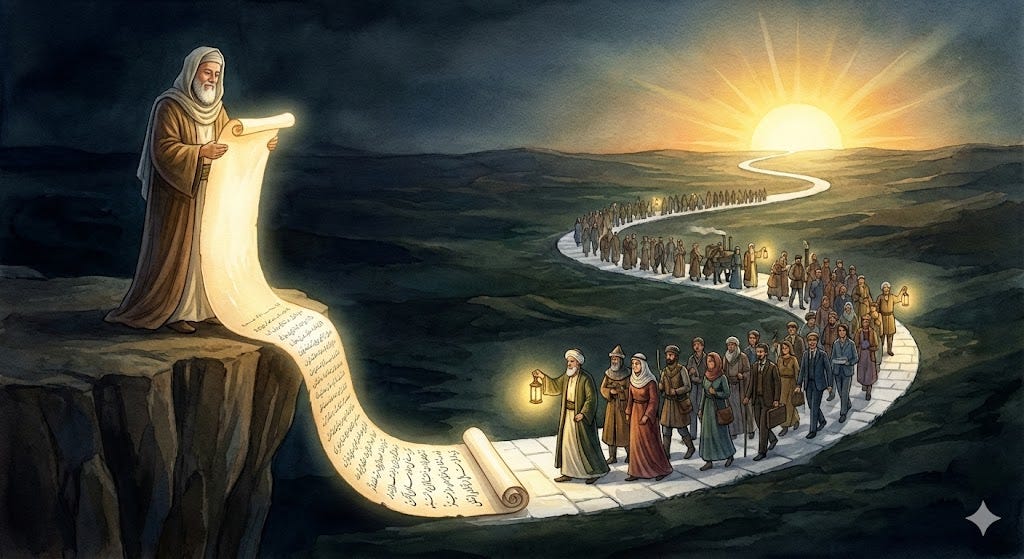
This is the system Muhammad ibn Uthman helped to establish.
He did not say:
“Follow me because I am the son of Uthman.”
He delivered a letter that said:
“Follow the Experts who have conquered their souls.”
He gave us a Constitution that would outlast his own lifetime — a Constitution that has guided the Shia community through eleven centuries of the Major Occultation, through empires and revolutions, through persecution and triumph.
The Scholar is not the destination.
The Scholar is the bridge.
But if you burn the bridge, you will never reach the destination.
You cannot claim to love the Imam while rejecting the system he established to guide you to him.
You cannot claim to await the Mahdi while ignoring the infrastructure he built to prepare you for his return.
The Second Deputy delivered this Charter to ensure that in the darkness of the Occultation, we would never be without a guiding light — provided we are humble enough to follow it.
Conclusion: The Grave Digger and the Lonely Ambassador
What the Architect Leaves Behind
We have walked with Muhammad ibn Uthman through the corridors of history.
We have seen his Merit — how he was chosen not because of his father’s name, but because of his own proven genius.
How the Imam designated him while his father was still alive, precisely to demonstrate that this was selection, not inheritance.
How he embodied the principle that authority in Islam is a burden to be earned, not a privilege to be claimed.
We have seen his Method — how he built a resistance network that spanned from Qom to Yemen, from Khurasan to Egypt, operating for forty years under the surveillance of a hostile empire without a single breach.
How he established financial independence through the Khums system, ensuring that the community would never have to bend the knee to a tyrant for bread.
How he taught us that secrecy in the service of truth is not conspiracy — it is survival.
We have seen his Constitution — how he delivered the Tawqi’ that became the birth certificate of the Marjaiyyah, the charter that commands us to follow the qualified scholars in all the “newly occurring events” of history.
How he gave us a system that would outlast his own lifetime, a bridge to the Imam that we walk upon to this day.
But now we must speak of his final days.
The Grave Digger

After forty years of service — after outsmarting the Abbasid intelligence apparatus, after building a global network, after delivering the Constitution of the Occultation — Muhammad ibn Uthman knew his time was coming.
He did not fear death.
He prepared for it with the calm precision of a man who had lived his entire life in the presence of the Divine.
In the final years of his life, visitors to his home in Baghdad witnessed a strange sight.
He had dug a grave inside his own house.
Shaykh al-Tusi records in Kitab al-Ghaybah that the Deputy would enter this open grave, lie down in the earth, and spend hours reciting the Quran.
He would test its dimensions.
He would inscribe verses upon its wooden planks.
He would accustom his body to the soil that would soon embrace it.
When a companion asked him — with evident concern — why he was doing this while still healthy, he replied with serene certainty:
«لِمَنْ هَذَا؟ هَذَا قَبْرِي، وَقَدْ أُمِرْتُ أَنْ أَجْمَعَ أَمْرِي.»
“For whom is this? This is my grave. And I have been ordered to gather my affairs.”
— Al-Tusi, Kitab al-Ghaybah, Section: Dhikr Wafat Muhammad ibn Uthman (The remembrance of the passing of Muhammad ibn Uthman).
He had received the instruction.
The Imam had told him: your service is nearing its end.
Prepare yourself.
And so he prepared — not with panic, but with the tranquility of a man returning home after a long journey.
The Transition of the Lantern
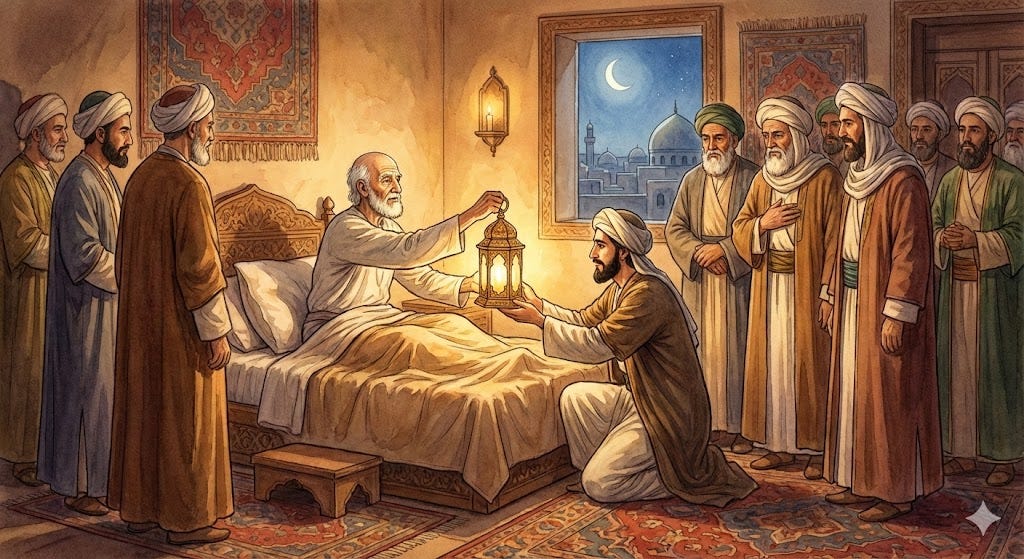
But Muhammad ibn Uthman did not merely prepare his grave.
He prepared his legacy.
He refused to let the community fall into chaos.
He refused to let the institution he had built crumble with his death.
He understood — perhaps better than anyone — that the system was greater than the man.
The Deputyship was not his personal property to take to the grave.
It was an Amanah — a trust — to be passed to the next worthy hand.
On his deathbed, in the year 305 AH, he gathered the elite of the Shia community — the scholars, the tribal elders, the notables of Baghdad.
He did not leave them guessing.
He did not create a vacuum for ambitious men to fill with their own claims.
He pointed to a man sitting among them — Husayn ibn Ruh al-Nawbakhti — and declared:
«هَذَا أَبُو الْقَاسِمِ الْحُسَيْنُ بْنُ رُوحٍ النَّوْبَخْتِيُّ الْقَائِمُ مَقَامِي، فَقَدْ أُمِرْتُ أَنْ أَجْعَلَهُ فِي مَوْضِعِي بَعْدِي، فَارْجِعُوا إِلَيْهِ وَعَوِّلُوا فِي أُمُورِكُمْ عَلَيْهِ.»
“This is Abu al-Qasim Husayn ibn Ruh al-Nawbakhti, who stands in my place. The Master of the Command has ordered me to appoint him in my position after me. So refer to him, and rely upon him in your affairs.”
— Al-Tusi, Kitab al-Ghaybah
With that final duty discharged, the Second Deputy closed his eyes.
He died in his bed, surrounded by loved ones.
His body was washed with dignity.
He was shrouded in the cloth he had prepared.
He was buried in the grave he had dug with his own hands — a shrine that stands in Baghdad to this day, visited by pilgrims who salute the man who saved the community.
Looking Forward: The Third Deputy
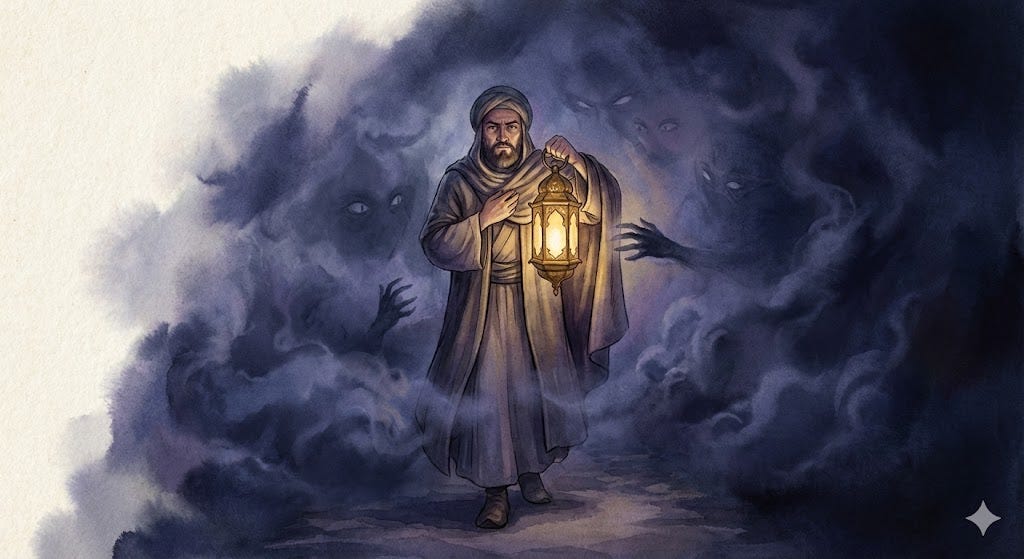
God willing, in our next session, we will turn our attention to this man — Husayn ibn Ruh al-Nawbakhti — the Third Deputy.
He inherited a functioning institution.
But he faced challenges of his own — false claimants who tried to hijack the network, theological controversies that threatened to split the community, and the ever-present danger of the Abbasid surveillance state.
How did he navigate these storms?
What was his particular genius?
And what does his life teach us about our own struggles?
These are the questions we will explore, God willing, when we continue this journey through the Minor Occultation.
But for now, let us return to Muhammad ibn Uthman — and let us pivot from history to heartbreak.
A Supplication-Eulogy for The Second Deputy
The Tale of Two Deputies

Peace be upon you, O Muhammad ibn Uthman.
You served your Imam for forty years.
You died with honour.
Your community respected you.
Your letters were kissed.
Your grave is a sanctuary.
But as I contemplate your dignified funeral, my heart burns for another Deputy.
I remember another Ambassador.
A man sent not to Baghdad, but to Kufa.
A man who was also a trusted representative of an Imam — not the Hidden Imam, but the Master of Martyrs.
The Deputy of Imam Husayn...
Muslim ibn Aqil.
O Muhammad ibn Uthman, you died surrounded by friends.
Let us weep for the one who died surrounded by enemies.
O Muhammad ibn Uthman, you prepared your own grave with your own hands.
Let us weep for the one who had no grave — whose body was thrown from a rooftop and dragged through the streets.
The Loneliness of Kufa
History tells us that Muslim arrived in Kufa carrying the trust of Imam Husayn.
Eighteen thousand people pledged allegiance to him.
Eighteen thousand men signed their names and swore their loyalty.
They wrote letters to the Imam:
“Come, O Husayn! The orchards are green, the fruits are ripe, and we are ready to receive you!”
But the moment the tyrant Ibn Ziyad entered the city...
The moment the threat became real...
The moment loyalty carried a price...
The eighteen thousand vanished like mist before the sun.
Shaykh al-Mufid records the scene in Al-Irshad.
He says that Muslim went to the mosque for Maghreb prayers.
A few rows of men stood behind him.
But when he finished the prayer and turned around...
There was no one.
The mosque was empty.
He walked out into the darkening streets of Kufa. Look at the description:
خَرَجَ يَمْشِي فِي أَزِقَّةِ الْكُوفَةِ لَا يَدْرِي أَيْنَ يَذْهَبُ، لَيْسَ لَهُ مَنْزِلٌ يَأْوِي إِلَيْهِ
“He went out walking in the alleyways of Kufa, not knowing where to go, having no home to shelter him.”
— Al-Mufid, Al-Irshad, Volume 2, Page 54.
Imagine the scene.
The Ambassador of the Grandson of the Prophet. The cousin of the Master of Martyrs. A nobleman of Banu Hashim.
Wandering the streets like a stranger.
Thirsty.
Wounded.
Looking at closed doors.
Every door he knocked on was slammed in his face.
“Go away, Muslim! If Ibn Ziyad finds you here, he will kill us all!”
Where are the letters now?
Where are the promises?
Where are the eighteen thousand men who swore,
“We are with you until death”?
The Tears of the Ambassador
When they finally captured him — after he fought like a lion in the narrow streets, outnumbered and bleeding from a dozen wounds — they dragged him in chains to the Governor’s palace.
The historians record that as he stood before Ibn Ziyad, tears began to flow from his eyes.
One of the guards mocked him:
“O Muslim! Someone who seeks power does not weep like a woman.”
Muslim looked at him — this deputy of Husayn, this lion of Banu Hashim — and he said:
«وَاللَّهِ مَا لِنَفْسِي بَكَيْتُ... وَلَكِنْ أَبْكِي لِأَهْلِيَ الْمُقْبِلِينَ إِلَيَّ، أَبْكِي لِلْحُسَيْنِ وَآلِ الْحُسَيْنِ.»
“By God, I do not weep for myself... I do not fear death. Death is the inheritance of the sons of Aqil.
But I weep for my family who are coming towards me! I weep for Husayn and the family of Husayn!”
— Ibn Tawus, Al-Luhuf fi Qatla al-Tufuf, Page 36.
He was saying:
“I wrote to him! I told him the city was ready! And now he is on his way — bringing Zainab, bringing Sakina, bringing the infant Ali Asghar — into this city of wolves! Into this nest of traitors!”
“I am not crying because I will die. I am crying because of what will happen to them after I am gone!”
The Execution
They took him to the roof of the palace.
He asked for one final request: to pray two units of prayer.
They granted it.
He stood on that rooftop, and he turned — not toward Makkah, but toward the desert. Toward the road from which the caravan of Imam Husayn was approaching.
He called out:
“Assalamu alayka ya Aba Abdillah!”
“Peace be upon you, O Master!”
“Go back! Do not come to Kufa! The people of this city have no loyalty! They will betray you as they betrayed me!”
Did the Imam hear him?
History tells us that somewhere on the road to Karbala, Imam Husayn suddenly stopped his horse.
He bowed his head. And he said:
“Inna lillahi wa inna ilayhi raji’un... Muslim has been killed.”
The message had reached him — not through letters, but through the connection of souls.
They severed his head.
But that was not enough for them.
They took his body — the body of the Deputy of Imam Husayn, the cousin of the Prophet — and they threw it from the roof of the palace to the ground below.
And then...
O believers, listen to what they did...
They tied a rope to his feet.
And they dragged the headless body of Muslim ibn Aqil through the markets of Kufa.
The children threw stones at it.
The crowds cheered.
The same crowds who had signed their names in allegiance.
The Final Connection
O Muslim!
You were lonely in Kufa.
You had no one to wash your body.
You had no one to dig your grave.
But at least you were a man. At least you had a sword in your hand. At least you could fight back.
My heart bleeds for the one who came after you.
My heart bleeds for Sayyedah Zaynab.
She had to stand in that same city.
She had to look at the same governor’s palace.
But she did not see the head of Muslim on a spear...
She saw the head of her brother.
She saw the head of Husayn.
The Supplication
O God, we ask You...
By the service and foresight of Muhammad ibn Uthman, who built an institution that has guided us for eleven centuries...
By the lonely wandering of Muslim ibn Aqil, who died a stranger in a city of traitors...
By the patience of Sayyedah Zaynab, who carried the message when all the men had fallen...
Hasten the Reappearance
O God, bring forth our Imam, the Master of the Time.
End his occultation.
Make us among his helpers, his soldiers, and those who pave the way for his government of justice.
Let us not die before we see his blessed face.
Fix our Hearts
O God, remove the love of this world from our hearts.
Do not let us be like the people of Kufa — who signed their allegiance when it was easy, and fled when it became costly.
Make us firm.
Make us loyal.
Make us among those who would stand with the Imam even if the whole world stood against us.
Protect the Scholars
O God, protect the righteous Maraji’ who guide us.
Protect the Wali al-Faqih who leads the believers.
Protect every sincere scholar who has dedicated his life to preserving the path to You.
Grant them health, grant them long life, and let us not be among those who break the bridge that the Imam himself built for us.
For the Oppressed
O God, help the oppressed across the world.
In Gaza, where the children are buried under rubble.
In Lebanon, where the resistance stands against the arrogant powers.
In Yemen, where the people are starved and bombed.
Grant them victory over the tyrants of our age, as You granted victory to the believers of old.
For the Deceased and Martyred
O God, have mercy on our parents and our departed loved ones, and in these nights send our salutations and shower your mercy on the Commander of Hearts who was martyred by the lowest of the low, by the child killers of these days, exclude those who murdered him from your mercy.
Illuminate their graves with the light of Muhammad and the family of Muhammad.
Forgive their sins.
Elevate their stations.
And reunite us with them in the gardens of Paradise, in the company of the Ahl al-Bayt.
We ask you this for the sake of Muhammad and the family of Muhammad
Amen, O Lord Sustainer of the Universes,
Amen, O Most Merciful of the Merciful.
And from Him alone is all ability, and He has authority over all things.
A wonderful article well connected.
Towards the end, it made me cry.
We pray to Allah Subahanahu to give you tawfiq to continue your mission, guiding us.
Yusuf