

In His Name, the Most High

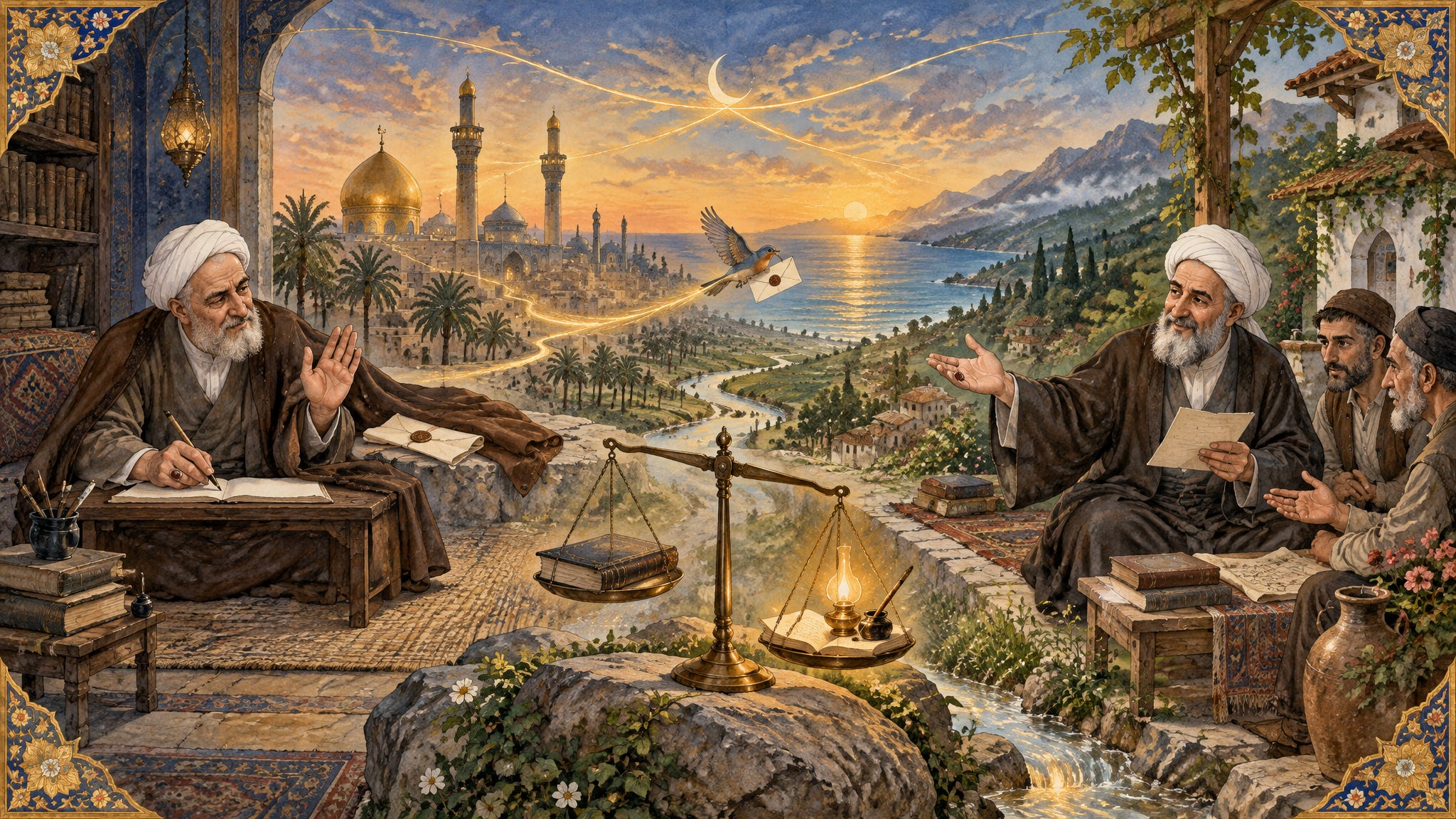
ثُمَّ اخْتَرْ لِلْحُكْمِ بَيْنَ النَّاسِ أَفْضَلَ رَعِيَّتِكَ فِي نَفْسِكَ، مِمَّنْ لَا تَضِيقُ بِهِ الْأُمُورُ، وَلَا تُمَحِّكُهُ الْخُصُومُ، وَلَا يَتَمَادَى فِي الزَّلَّةِ، وَلَا يَحْصَرُمِنَ الْفَيْءِ إِلَى الْحَقِّ إذَا عَرَفَهُ، وَلَا تُشْرِفُ نَفْسُهُ عَلَى طَمَعٍ، وَلَا يَكْتَفِي بِأَدْنَى فَهْمٍ دُونَ أَقصَاهُ، وَأَوْقَفَهُمْ فِي الشُّبُهَاتِ، وَآخَذَهُمْ بِالْحُجَجِ، وَأَقَلَّهُمْ تَبَرُّماً بِمُرَاجَعَةِ الْخَصْمِ، وَأَصْبَرَهُمْ عَلَى تَكَشُّفِ الْأُمُورِ، وَأَصْرَمَهُمْ عِنْدَ اتِّضَاحِ الْحُكْمِ، مِمَّنْ لَا يَزْدَهِيهِ إطْرَاءٌ، وَلَا يَسْتَمِيلُهُ إِغْرَاءٌ، وَأُولَئِكَ قَلِيلٌ.
“Then choose to judge between the people the most excellent of your subjects in your own estimation:
one whom affairs do not overwhelm and disputants do not make obstinate;
who does not persist in a slip, and is not too proud to return to the truth once he recognises it;
whose soul does not stoop to greed;
who is not content with the nearest understanding short of the furthest;
the most cautious of them in matters of doubt, the firmest of them in holding to proofs, the least wearied by the disputant’s going back and forth, the most patient in waiting for matters to come clear, and the most decisive once the ruling is plain; one whom praise does not make vain and enticement does not sway — and such are few.”
— al-Sharif al-Radi, Nahj al-Balagha, Letter 53, to Malik al-Ashtar; my translation
Amir al-Mu’minin, Imam Ali, peace and blessings be upon him, once wrote a long letter to Malik al-Ashtar, the man he had just appointed governor of Egypt.
In one part of it he tells him whom to choose as a judge.
And what he writes is a portrait.
A man whom affairs do not overwhelm.
A man who is not content with the nearest understanding of a matter, when there is a further one to be had.
The most cautious of them when things are doubtful.
The least wearied when the same person comes back to him again and again.
A man whom praise does not make vain, and enticement does not move.
Hold on to three of those phrases tonight.
Not content with the nearest understanding.
The most cautious in matters of doubt.
Enticement does not move him.
Each of them will come back.
A commentator from our own time, from Lebanon, Sayyed ‘Abbas ‘Ali al-Musawi, may God rest his pure soul, reads this passage one quality at a time.
And on the very first, affairs do not overwhelm him, he says something striking.
It means, he says, that the judge can find a way through every problem, so that no door of the law is closed in his face.
And that, he says, depends on one thing: on his being a mujtahid, and not a partial one.
A man versed in every chapter of the law.
So a letter about judges is, in the reading of one of our commentators, a portrait of the man we are speaking about tonight.
— Sayyed 'Abbas 'Ali al-Musawi, Sharh Nahj al-Balagha, volume 5, on Letter 53; narrated1
And the portrait ends with four words.
And such are few.
Who are they?
And what does it cost to be one of them?
God puts that cost in a single question.
قُلۡ أَرَءَيۡتُم مَّآ أَنزَلَ ٱللَّهُ لَكُم مِّن رِّزۡقٖ فَجَعَلۡتُم مِّنۡهُ حَرَامٗا وَحَلَٰلٗا قُلۡ ءَآللَّهُ أَذِنَ لَكُمۡۖ أَمۡ عَلَى ٱللَّهِ تَفۡتَرُونَ
Say, “Have you considered what God has sent down for you of provision, and you have made some of it unlawful and some lawful?” Say, “Has God given you leave, or do you fabricate a lie against God?”
— Qur’an, Surah Yunus (the Chapter of Jonah) #10, Verse 59
Has God given you leave, or do you fabricate a lie against God?
Allamah Tabataba’i, may God rest his pure soul, a scholar of the last century, in his great commentary, al-Mizan, stops on that question.
Judgement, he says, belongs to God alone.
So every ruling that people live by is one of two things.
Either it truly is God’s, taken from Him.
Or it is invented, and laid at His door.
There is no third.
— Allamah Sayyed Muhammad Husayn Tabataba'i, al-Mizan fi Tafsir al-Qur'an, on Surah Yunus 10:59; narrated2
And Ayatullah Jawadi Amoli, may God protect him, in his commentary Tasnim, puts the same thing another way.
To say something about God is either to say it with His leave, or without it.
If it is with His leave, then it must bring its proof.
Produce your proof.
And if it is without His leave, it is fabrication.
And God does not pass over fabrication.
— Ayatullah 'Abd Allah Jawadi Amoli, Tasnim, on Surah al-Baqarah 2:80, where he reads it with Surah Yunus 10:59 (lesson 165, 23 February 1986); narrated3
So there are two sides to that or.
The man we are speaking about tonight is a man who stands on the first side.
And his whole life is spent being able to show the leave.
Now let me take you back thirty-two years.
It is Wednesday, the 14th of December, 1994.
In the Islamic calendar, it is the 10th of Rajab: the birthday of Imam Muhammad al-Jawad, peace and blessings be upon him.
People have come from far away to greet the Leader on the Imam’s birthday.
The man speaking to them already carries the heaviest burden in the Muslim world.
He is the martyred Leader, Imam Sayyed Ali Khamenei, may God rest his pure soul.
In 1994 he is simply the Leader.
And a few days before, something has happened.
The scholars of Qom and Tehran have published their lists: the names of those they judge fit to be followed in matters of religious law.
And his name is on them.
And this is what he tells the people who have come.
Had they asked me, he says, I would have told them: do not.
They did it without my knowledge.
And when the television was going to read out their statement, I asked them not to read my name.
They told me that would be distorting the statement.
— Imam Sayyed Ali Khamenei, speech of 23 Azar 1373 (14 December 1994), on the birthday of Imam al-Jawad; narrated4
Sit with that for a moment.
A man who could say this is God’s ruling asked not to be named.
Why?
Hold that question.
Before the second point is over, he will give you his own answer.
And let me put the question of the whole night beside it.
What does it cost to say, “this is God’s ruling”?
A Faqih by Tomorrow
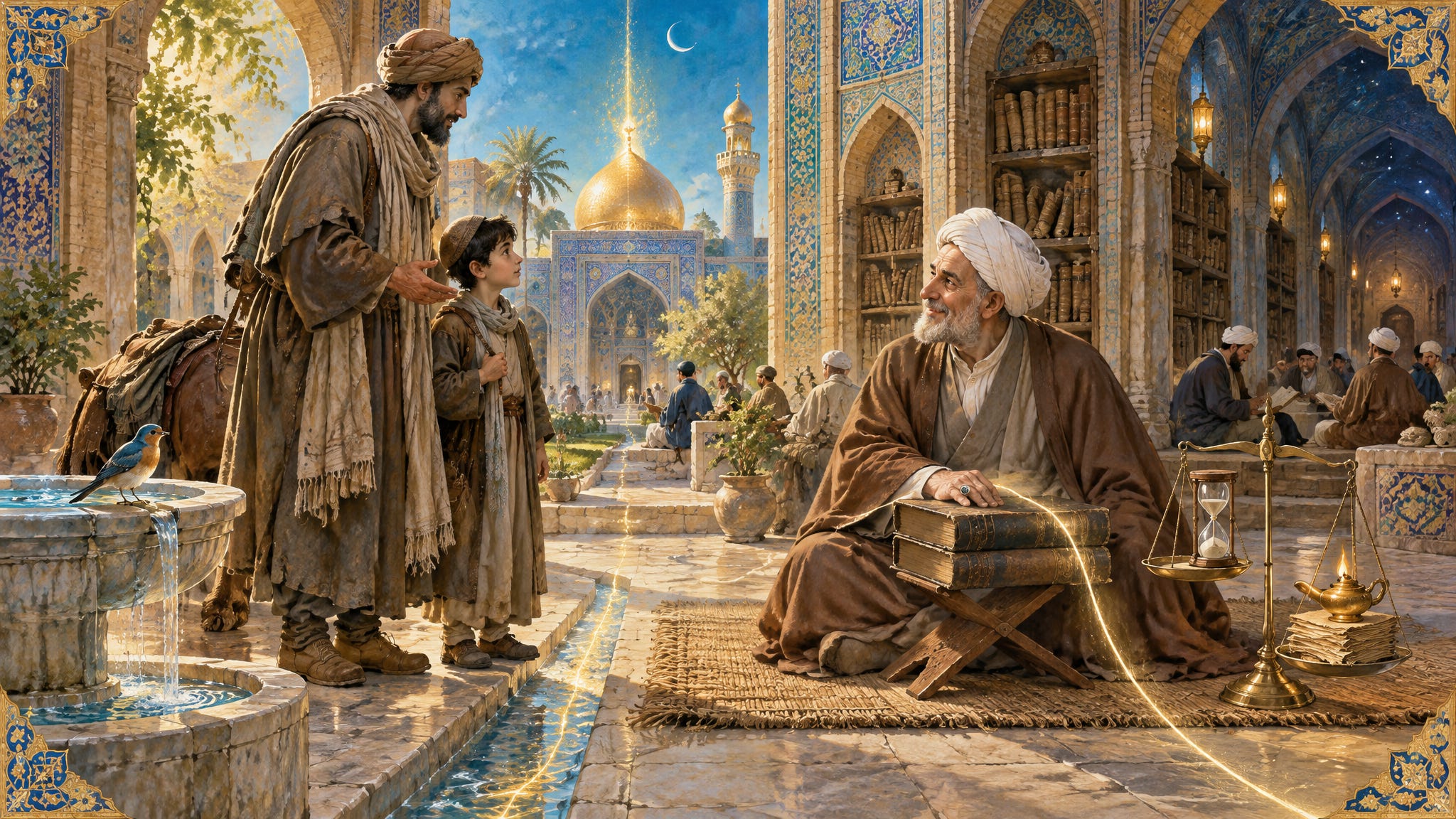
It is well known that, in the time of Shaykh al-Ansari, a man brought his son to Najaf.
He looked around.
He saw the students studying, and he saw some of them become great scholars.
And he wanted that for his son.
So he went to the Shaykh, and he said:
Shaykh, I have brought this young man.
We are leaving tomorrow.
Make him a faqih.
A faqih: a scholar of the law.
By tomorrow.
— Imam Sayyed Ali Khamenei, speech to university students and scientific elites, 4 Shahrivar 1388 (26 August 2009); narrated5
We smile.
And we smile because we recognise him.
Everyone wants the answer.
Nobody wants the years.
And notice how far that father is from the man in 1994.
The father wanted the title without the years.
The man in 1994 had the years, and asked not to be given the title.
The scholar that father went to is the man who will walk with us tonight.
Shaykh Murtada al-Ansari.
A scholar of Najaf in the nineteenth century: Najaf, the shrine city of Imam Ali, in what is today southern Iraq.
He wrote two books that every mujtahid alive today has passed through:
al-Rasa’il, on the principles of the law;
and al-Makasib, on the law of earning and trade.
You heard about them on the night we spoke about the hawza.
Most people know him only by his name.
Tonight we will get to know the man.
And tonight has a spine, in three clauses.
A mujtahid is a man who spends a lifetime earning the right to say, “this is God’s ruling”.
He is the most afraid of anyone to say it, and he will not take it up until it is laid on him.
And then he carries it as a trust, which must reach you as carefully as it was made.
He earns it.
He fears it.
He carries it.
Three clauses, three points.
What We Carry Forward
This is the twenty-fourth part of The Architecture of Guidance, within our series on the Lantern of the Path, and the fifth of twelve nights we have called Those Who Carry It: the people who carry this faith from one generation to the next.
Tonight is Wednesday the 25th of November 2026, the 14th of Jumada al-Thani, 1448.
What we carry forward is short.
Last week ended on two lines:
“Tonight we walked out among the people.
Next week, God willing — the mujtahid.”
— from this majlis, last week: The Architecture of Guidance, Part 23, The Scholar Among the People
Last week we went out with the scholar among the people.
We heard Imam Ali tell his governor to sit for them at both ends of the day.
We heard God tell His Prophet, peace and blessings be upon him, his family, and his righteous companions, to hold himself patiently with the poor.
And we met the man most of us actually meet: the one who marries you, buries your father, and answers the knock at two in the morning.
And last week we said, of tonight’s subject:
not the mujtahid, who spends his life deriving the rulings; he is next week.
So here he is.
Last week was the man who stands beside you at the marriage and at the grave.
Tonight is the man who decides what is permitted in that marriage, and in that burial.
And five weeks ago we asked why anyone should follow a scholar at all.
We will not ask that again tonight.
Tonight we go behind the answer, to the man who made it, and we ask what it cost him.
Upon Us the Principles, Upon You the Branching
The Charter
Before we meet the man, let us hear what his work is.
And let us hear it from an Imam.
Imam ‘Ali al-Rida, peace and blessings be upon him, said:
عَلَيْنَا إِلْقَاءُ الْأُصُولِ إِلَيْكُمْ وَعَلَيْكُمُ التَّفَرُّعُ
“Upon us is the casting of the principles, and upon you the branching out.”
— Imam ‘Ali al-Rida, peace and blessings be upon him, from the Book of Ahmad ibn Muhammad ibn Abi Nasr al-Bazanti, in Ibn Idris al-Hilli, Mustatrafat al-Sara’ir; my translation6
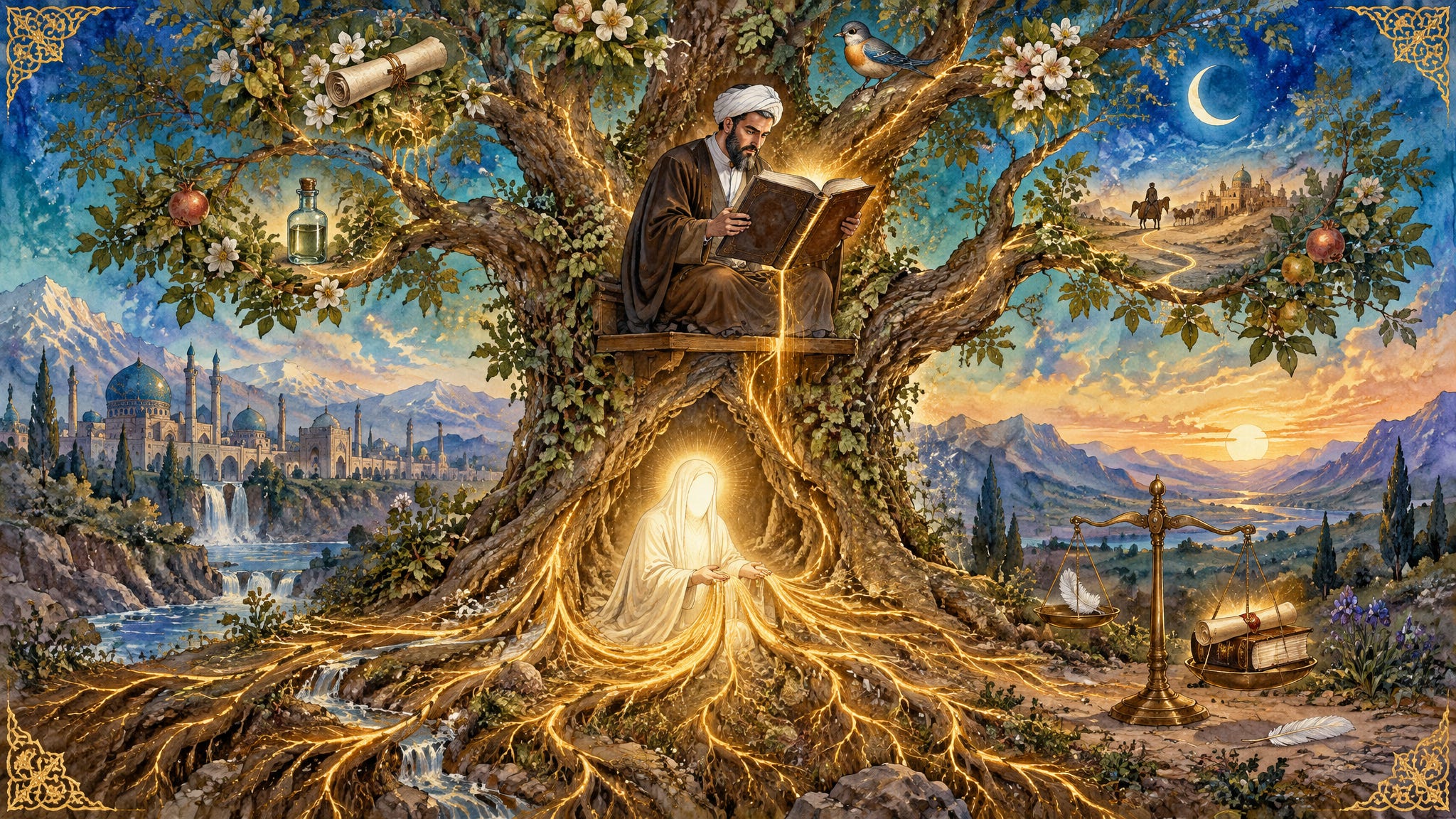
Picture a tree.
The Imams cast the roots.
They lay down the principles: the great rules of what God permits and forbids, and why.
And the scholars trace the branches.
A question comes that nobody asked in the Imam’s lifetime.
A new kind of contract.
A new kind of medicine.
A journey by air.
And the scholar goes back to the roots, and draws out of them what was already there.
Nothing is added to the tree.
What grows on the branch was always in the root.
That is ijtihad.
One of our commentators, writing on this very sentence, says it plainly.
Branching out from the principles is ijtihad, he says, and in our age ijtihad is nothing else.
And then he adds what it is not.
It is not analogy.
It is not judging one case by its resemblance to another.
It is drawing the particular cases out of the universal rules.
— Imam Khomeini, al-Ijtihad wa'l-Taqlid, vol. 1, p. 71; narrated7
And note who wrote that.
Imam Khomeini.
Keep him in mind.
You will meet him again tonight, sitting at home, saying:
Sir, there are gentlemen.
The word ijtihad frightens some people.
They hear it and think it means a man making up his own religion.
So let us take the word itself apart.
Ijtihad comes from the root j-h-d.
It is the same root as jihad.
The great dictionary of the Arabs, Lisan al-’Arab, gives that root two faces.
Juhd is your capacity: what you are able to do.
Jahd is the strain: the furthest point you can reach.
Ijtihad is that effort turned on yourself.
To exert yourself.
To spend all you have.
Al-Muhaqqiq al-Hilli, one of the great jurists of our school, gives it a picture.
الاجتهاد : افتعال من الجهد ، وهو في الوضع : بذل المجهود في طلب المراد مع المشقة ، لأنه يقال : « اجتهد » في حمل الثقيل ، ولا يقال ذلك في حمل الحقير.
“Ijtihad is formed from juhd, effort. In the language it means spending one’s utmost in seeking what one seeks, with hardship; for one says ‘he strained’ of carrying something heavy, and one does not say it of carrying something slight.”
— al-Muhaqqiq al-Hilli, Ma’arij al-Usul, on the reality of ijtihad; my translation
You say a man strained when he lifts something heavy.
You do not say it when he picks up a feather.
So a mujtahid is not a man with opinions.
The word means the one who strains.
The one who carries the heavy thing.
And now hear what the same dictionary — Lisan al-’Arab — says of jihad.
الجهاد محاربة الأعداء، وهو المبالغة واستفراغ ما في الوسع والطاقة من قول أو فعل
“Jihad is fighting the enemy; and it is going to the utmost, and exhausting what lies in one’s reach and capacity, in word or in deed.”
— Ibn Manzur, Lisan al-’Arab, the root j-h-d; my translation
There are people today who say the word jihad as if it were a curse.
Listen to the last words of the dictionary: in word or in deed.
The root names no enemy and no weapon.
It names effort spent to the limit.
When duty calls a believer to defend what is sacred, he spends that effort there, with his life.
And the scholar spends it at the books, all his life, so that he never says of God what God did not say.
That is the opposite of making up a religion.
— Ibn Manzur, Lisan al-'Arab, vol. 2, printed pp. 397 and 395; narrated8
And the Imam’s sentence says the same.
The principles are theirs.
His work is to find what they already contain.
And notice, in one breath, there are two roles here.
The Imam casts.
The scholar branches.
Keep that in your mind.
We will come back to it at the end of the night.
Certainty, Conjecture, Doubt

So how does the scholar actually do it?
Here is how the man who walks with us tonight began.
The first sentence of Shaykh al-Ansari’s great book on the principles of the law, the book every student of those principles still opens, reads like this:
فاعلم أنّ المكلّف إذا التفت إلى حكم شرعي ؛ فإمّا أن يحصل له الشّكّ فيه ، أو القطع ، أو الظنّ ، فإن حصل له الشك.
“Know that the person under the law, when he turns to a ruling of the Shari’a, has either certainty about it, or conjecture, or doubt.”
— Shaykh Murtada al-Ansari, Fara’id al-Usul (al-Rasa’il), the opening; my translation
Before any ruling at all, he asks one question.
What state is your mind in?
Are you certain?
Do you think it is probably so?
Or do you simply not know?
And from each of those three states a different road leads.
Certainty has its road.
Strong probability has its road.
Doubt has its road.
The rest of his book is the map of those roads.
The whole of ijtihad, in a single line.
What He Must Master
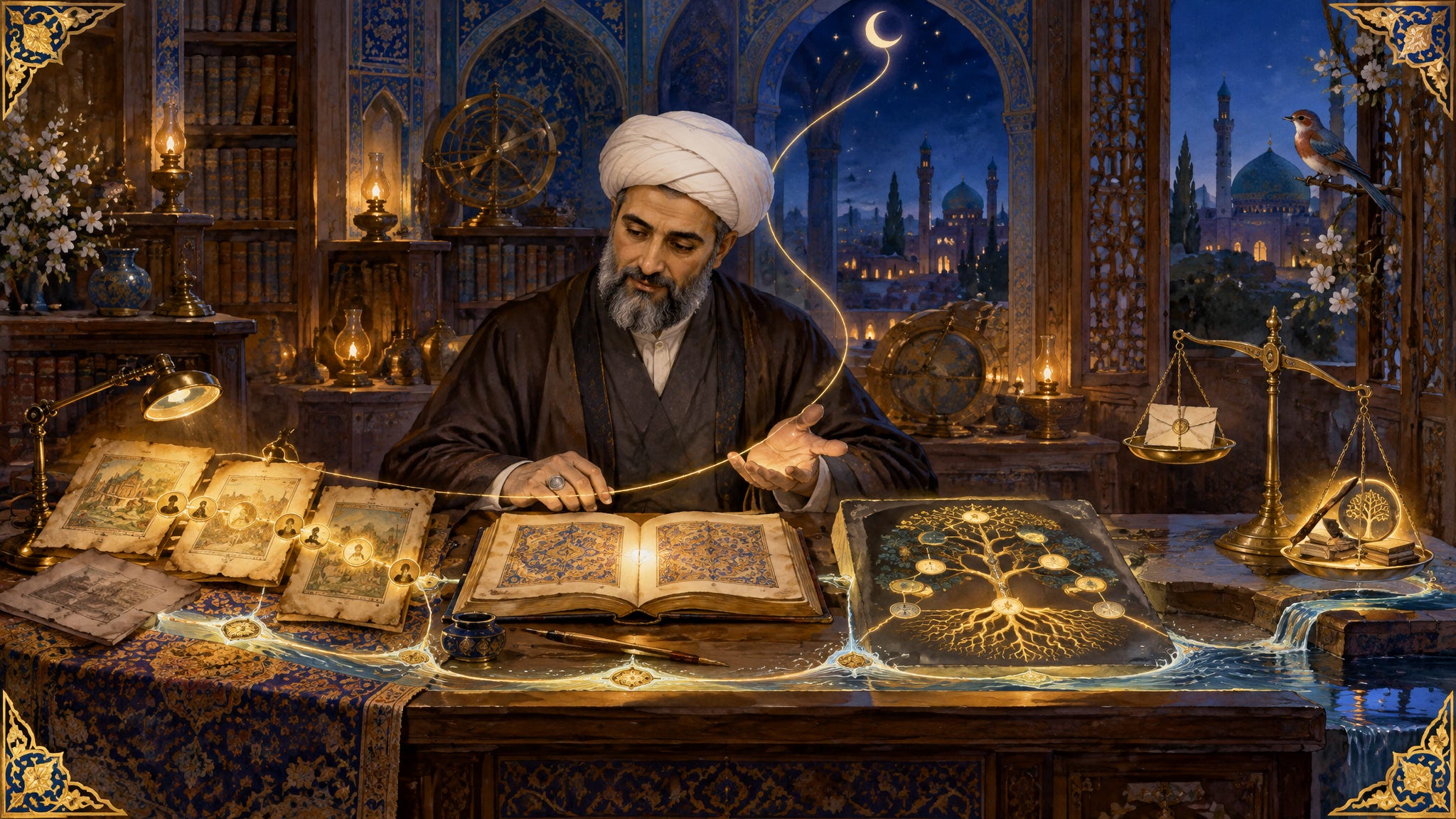
So what does a man need, to walk those roads?
Let us ask a living marja’.
Ayatullah Sayyed ‘Ali al-Sistani, may God protect him, explains to Muslims living in the West what the experts look for when they judge whether someone is a mujtahid.
And he names three things.
The first is whether a report was really said.
That means the sciences of the narrators and of the hadith.
It means knowing that reports were planted.
It means comparing manuscripts.
Call that the historian’s skill.
The second is what a text means: by the rules of the Arabic language, and by the way the Imams themselves used to state their rulings.
Call that the reader’s skill.
And the third, in his words, is soundness in drawing the branches from the roots.
Imam al-Rida’s sentence again, in a living marja’s mouth.
Call that the logician’s skill.
— Ayatullah Sayyed 'Ali al-Husayni al-Sistani, al-Fiqh li-l-Mughtaribin, p. 78; narrated9
Any one of those three is a life’s work for a specialist in a university.
The historian.
The scholar of language.
The logician.
The mujtahid needs all three, in one head, before he may say a single word about what God permits.
And later tonight you will hear of a boy of nine who was asked one question by a judge, and answered it with a dozen.
But that is for later.
So how long does it take to become such a man?
Let us follow one.
The Road from Dezful
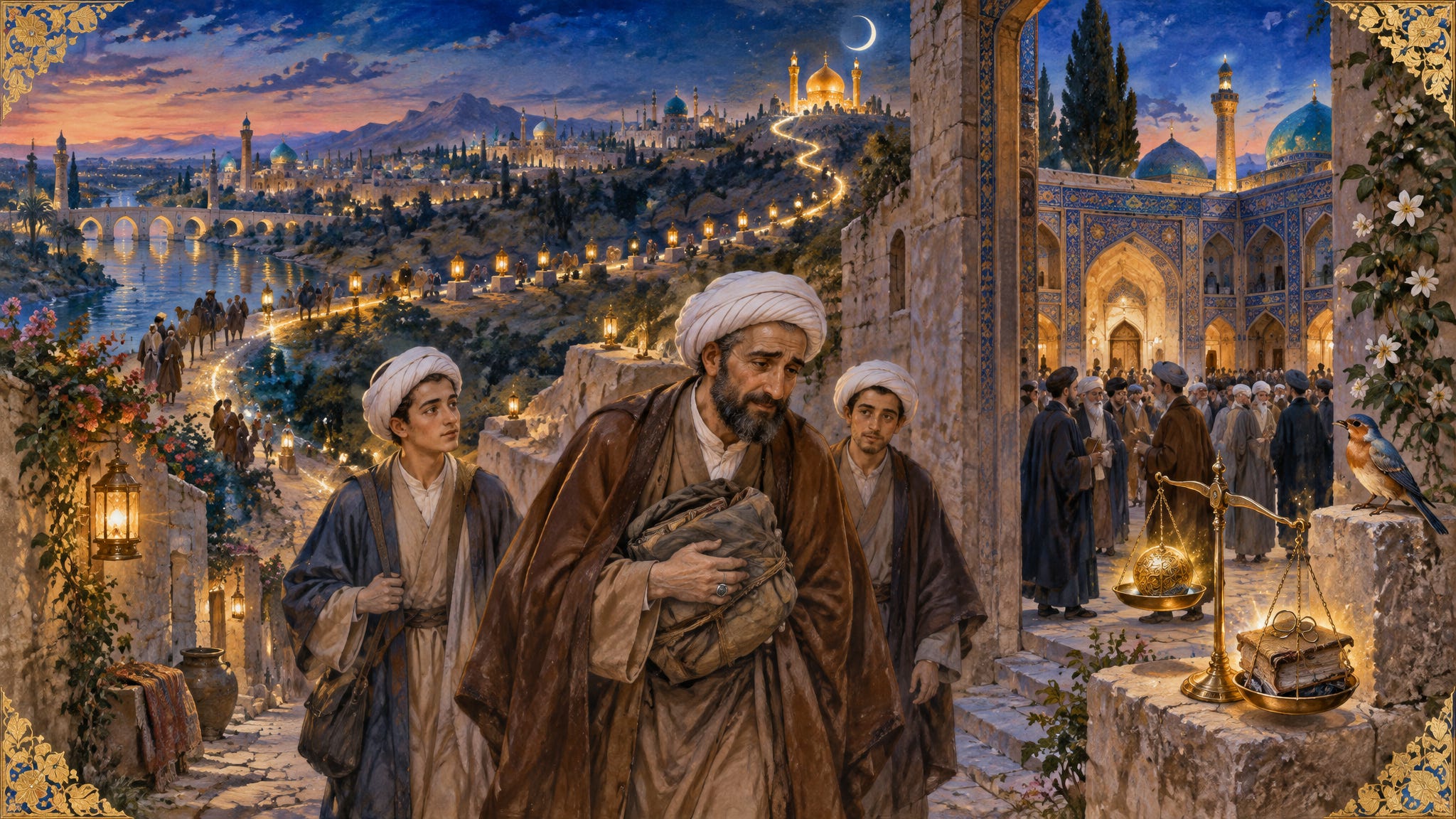
He was born in 1214 of the Hijra, about 240 years ago, in Dezful: a town in the south-west of Iran, in what is today the province of Khuzestan.
At eighteen he went to Karbala, about eighty kilometres north of Najaf, and sat with the great teacher of the principles of the law there, Sharif al-Ulama.
— the editor’s introduction to Shaykh al-Ansari, al-Fawa’id al-Usuliyya, record 18; narrated10
Then the road.
Mashhad, in the far north-east of Iran.
Isfahan, in its centre.
Then Kashan, a town between Tehran and Isfahan.
And there he stayed four years, with one of the great scholars of the age, Mulla Ahmad al-Naraqi.
And al-Naraqi said something about him that you should hear.
In all my travels, he said — especially on my journey to the jihad against the Russians — I have met fifty great scholars and mujtahids.
And not one of them was like Shaykh Murtada.
— the editor's introduction to Shaykh al-Ansari, al-Fawa'id al-Usuliyya, record 22; narrated11
And then, at last, to Najaf.
Picture him arriving.
A small man.
Weak-eyed.
An old turban.
And around him, two or three students.
Nobody knew him.
From eighteen to thirty-five, on the road and at the books, and nobody in Najaf knew his name.
— Shaheed Murtada Mutahhari, Azadi-ye Ma'navi, record 33; narrated12
The Shaykh in the Corner
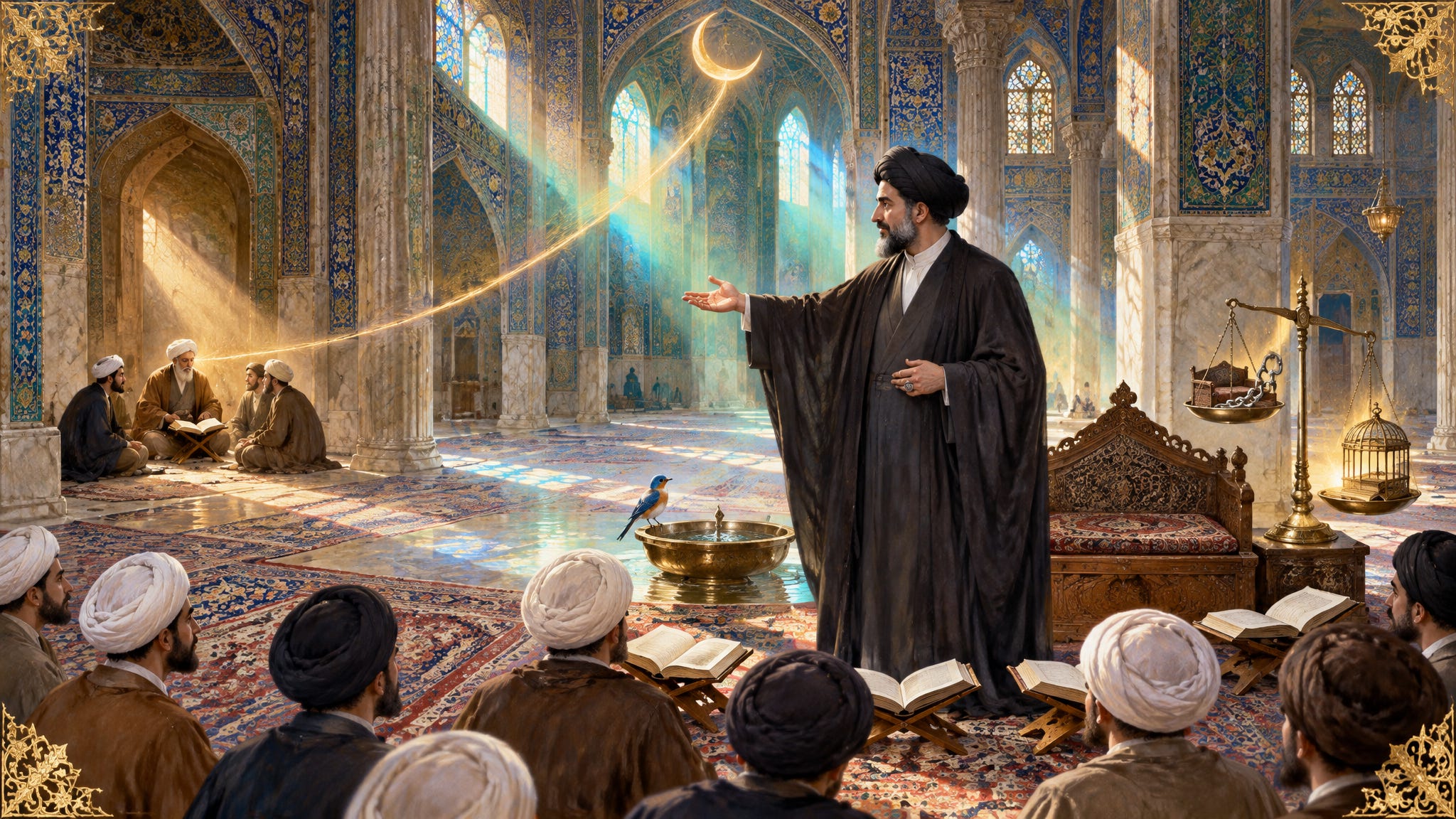
Now, in Najaf at that time there was a great scholar called Sayyed Husayn Kuh-Kamari.
He was close to the leadership of his day.
He had a full circle of students.
One day he came to his mosque an hour early.
And in a corner of the mosque, he saw a shaykh he did not know.
Poorly dressed.
Teaching two or three students.
He stopped.
And he listened.
The next day, he came an hour early again.
And he listened again.
And the day after that.
And then, one day, he turned to his own students and said:
That shaykh in the corner is far more learned than I am.
I have tested it.
I benefit from him myself.
If you want the truth, all of us should go and sit at his lesson.
And he stood up.
And they all went.
— Shaheed Murtada Mutahhari, Azadi-ye Ma'navi, record 34; narrated13
Shaheed Mutahhari, may God rest his pure soul, Imam Khomeini’s student, who was martyred in 1979, tells this story.
And he gives his own verdict on Sayyed Husayn.
He passed a judgement against himself.
And Shaheed Mutahhari is honest about him.
This was not a man who cared nothing for respect.
He liked respect and leadership, he says, as much as any of us.
He just had a freer soul.
And the shaykh in the corner?
The small man in the old turban, from Dezful.
It takes knowledge to recognise knowledge.
And it takes a free soul to stand up in front of your own students and walk them to it.
Forty Years in a Minute

Now bring it home.
The ruling you scroll past in a minute cost someone forty years.
Here, this week.
The answer forwarded in a group.
The clip with no source.
Someone said.
I heard a scholar say.
Set that beside the man in the corner of the mosque, who gave his whole life to learning how to give one answer.
We are not wrong to want answers quickly.
We are only wrong if we forget what an answer cost.
Lessons for Our Time
Lesson One — There Is No Faqih by Tomorrow

Knowledge of God’s law is earned in years.
It is not borrowed in minutes.
What does that look like for us, here, this week?
If you are the one people come to — the madrasa teacher, the brother who leads the prayer, the one in the family who has read a bit —
You will be asked things you do not know.
At a funeral, someone will take you aside and ask how the estate is divided.
You know roughly.
You have heard it explained once.
Say: let me find out exactly.
An inheritance divided on a rough answer is a wrong done to an orphan.
And it is done in God’s name.
So send them to the one who earned it.
Ring the office.
Look it up in the manual of the marja’ they follow.
Come back to them the next day.
Never improvise a ruling to save your face.
Your face will survive I do not know.
Their marriage, their inheritance, their prayer may not survive your guess.
And if you are among the people —
The shortcut will always be there.
The forwarded answer.
The clip.
The confident stranger with a microphone.
Ask the person who will tell you where the answer came from.
And if they cannot tell you, keep asking.
And if your son, or your daughter, wants to study, give them the years.
Do not be the father who came to Najaf and asked for a faqih by tomorrow.
The years are not an obstacle to the knowledge.
The years are the knowledge.
And for anyone here who is not a Muslim: this is how every serious tradition guards its law.
Not with the loudest voice in the room, but with people who give their lives to its method.
That is the first lesson.
No shortcuts to God’s law.
Lesson Two — Recognise Knowledge Wherever It Sits
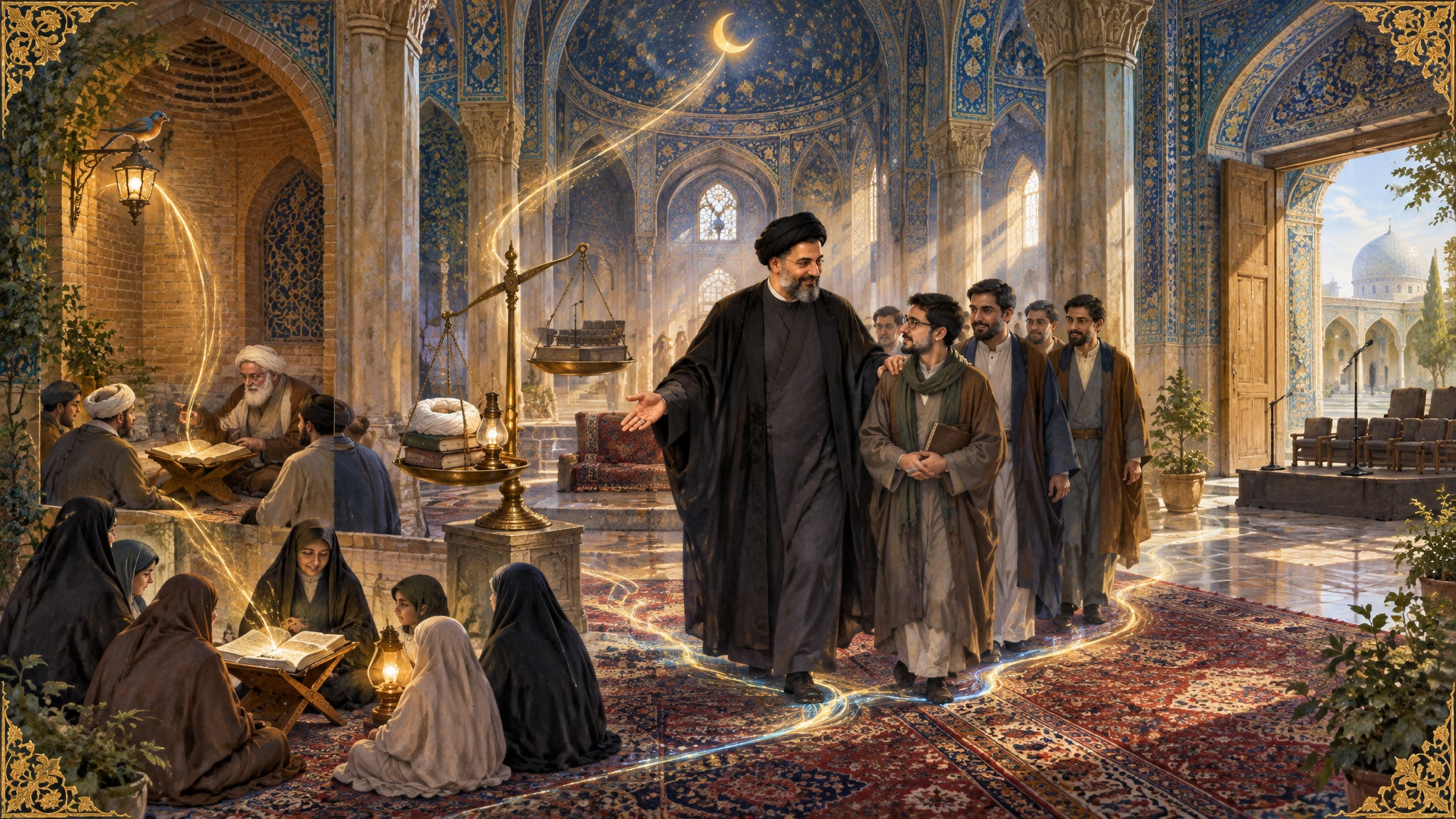
Knowledge sits where it sits.
In a corner of the mosque.
In an old turban.
In someone with no following at all.
If you are the one people come to —
Be Sayyed Husayn Kuh-Kamari.
When someone younger than you, or less known than you, knows a subject better than you, say so.
Out loud.
In front of the people who look up to you.
And send them to that person.
Your students are a trust.
They are not your property.
A teacher who keeps his students from a better teacher is guarding his chair, not their souls.
And it costs something.
He liked respect, Shaheed Mutahhari said, as much as any of us.
Say it anyway.
And if you are among the people —
Do not measure a scholar by his clothes.
Or by his platform.
Or by the number of people who follow him online.
The quiet teacher at the back of the mosque may be the one who has actually read the books.
The sister who teaches the Qur’an class on a weekday morning may know more than the voice on the stage.
And do not measure a scholar by how often he agrees with you.
That is for the second point.
And for anyone here who is not a Muslim: every field has its quiet expert, and every field has its celebrity.
Learn to tell them apart.
That is the second lesson.
Learn to see knowledge where it sits, and walk towards it.
And when the man in the corner was finally recognised, when the leadership of the whole Shi’a world came to him, he did not want it.
I Am Not Fit
Lessen Your Precautions, Shaykh
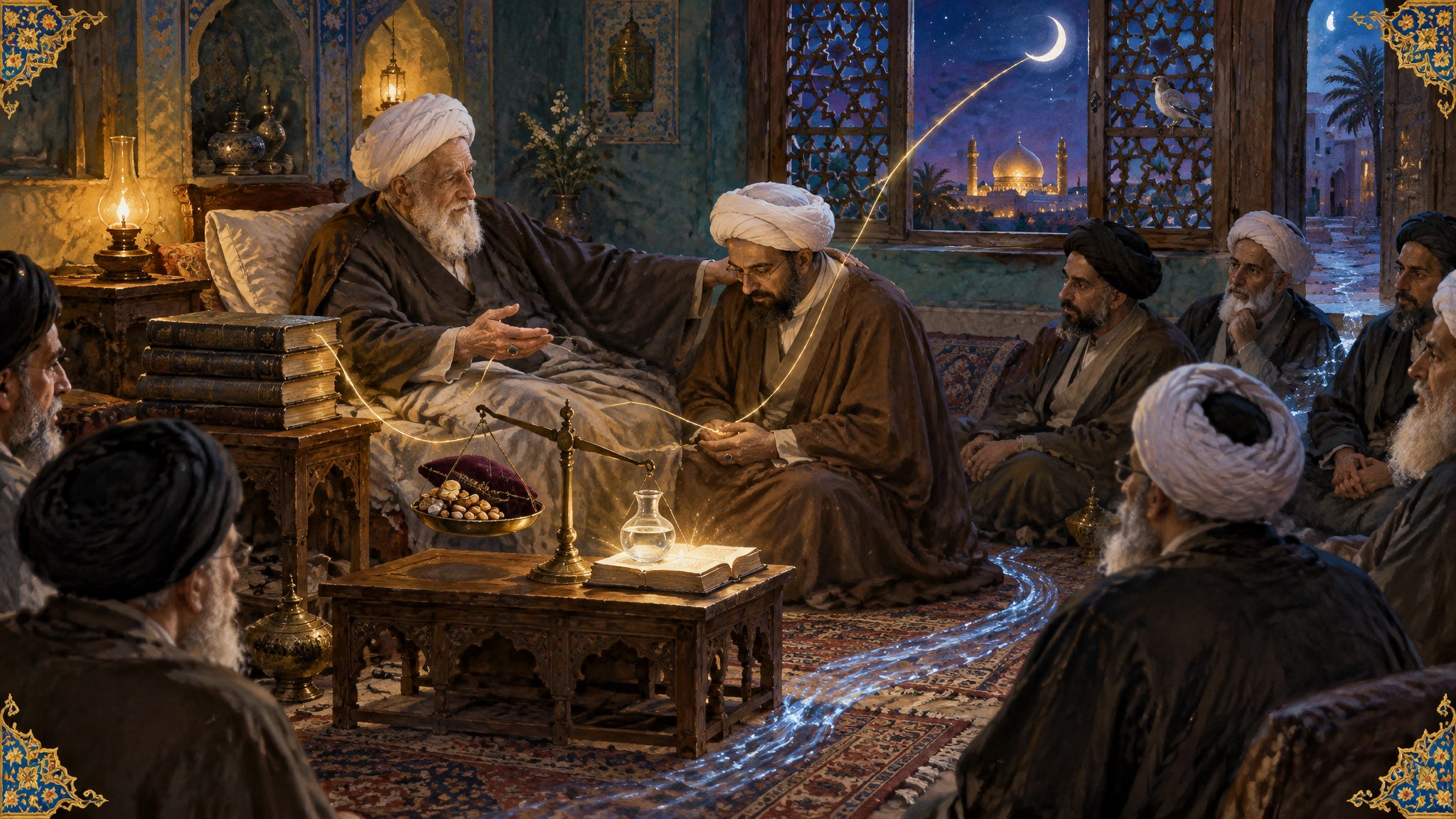
In Najaf, in those years, the leading scholar of the Shi’a world was Shaykh Muhammad Hasan al-Najafi.
People call him Sahib al-Jawahir, the author of the Jewels, after the great encyclopaedia of Shi’a law that he wrote.
Even today, scholars open it every day.
And now he was dying.
The scholars of Najaf gathered in his house.
They had come to settle who would lead after him.
Shaykh al-Ansari was not there.
The dying man noticed.
He had him sent for.
And when he came, he had him seated close beside him.
And he said to them all:
This is your marja’ after me.
Then he turned to Shaykh al-Ansari himself, and said:
Lessen your precautions, Shaykh.
For the Shari’a is generous, and easy.
Because he was a man of very, very many precautions.
— the editor's introduction to Shaykh al-Ansari, al-Fawa'id al-Usuliyya, record 24; narrated14
Think about that.
The man who knew him best did not tell him to be braver.
He told him to be gentler with the people.
But be careful with that sentence, because it can be stolen.
Generous and easy is the ease that the Shari’a itself gives.
It is not the ease that our desires ask for.
Hold on to that difference.
We will need it before this point is over.
You, Not Me
So the leadership of the Shi’a world was put into his hands.
And he gave it back.
I am not fit to be followed, he said.
And he gave his reason.
In my view, he said, it is obligatory to follow the most learned.
And Sa’id al-Ulama, our fellow student when we studied under Sharif al-Ulama in Karbala, was more precise than I am.
Listen to what he is doing.
He is not being polite.
He is not being modest for show.
By his own ruling, the duty of the people is to follow the most learned man.
And he believes that the most learned man is someone else.
He applied his own fatwa against himself.
The people insisted.
He still refused.
And he wrote to Sa’id al-Ulama, in Mazandaran, a province on Iran’s Caspian coast:
come to Najaf, and take up this weighty matter.
And a reply came back.
Yes, wrote Sa’id al-Ulama, it is as you say.
I was the more learned, when I was there, busy with study.
But you have kept on with study, teaching and writing.
And I left the lessons for the people’s affairs, settling their disputes.
So you are more learned than I am.
The community must follow you.
— the editor's introduction to Shaykh al-Ansari, al-Fawa'id al-Usuliyya, records 24–25; narrated15
— the editor's introduction to Shaykh al-Ansari, al-Taqiyya, record 27; narrated16
Two men.
Each one telling the other:
you, not me.
And notice who Sa’id al-Ulama is.
He is the scholar we spoke about last week.
The one who left the books to settle the people’s quarrels.
And here he is, honouring the one who stayed at the books.
Neither of them is less than the other.
Both of them carry it.
And notice what he says about knowledge.
I was the more learned, when I was there.
Knowledge is a practice.
It leaves the man who stops.
To the Shrine

So the letter came back from Mazandaran.
And now there was no one else.
And what did Shaykh al-Ansari do?
He went to the shrine of Imam Ali, peace and blessings be upon him.
And he asked Imam Ali to help him in this grave matter.
And to guard him from falling into error, and from slips.
— the editor's introduction to Shaykh al-Ansari, al-Taqiyya, record 28; narrated17
His first act as the marja’ of the Shi’a world was to ask not to be wrong.
Now remember the portrait we began with.
The most cautious of them in matters of doubt.
The commentator from Lebanon whom we heard at the start explains that quality too.
If the question has not come clear, he says, the judge does not decide it.
He stops.
Because stopping at what is doubtful is better than plunging into destruction.
— Sayyed 'Abbas 'Ali al-Musawi, Sharh Nahj al-Balagha, volume 5, on Letter 53; narrated18
That is what he went to the shrine to ask for.
And one more thing about him.
The biographers say that he never once gave anyone a licence of ijtihad.
Not one.
That is how heavy the word was to him.
— Mirza Muhammad Tunikabuni, Qisas al-Ulama (Arabic translation), record 185; narrated19
Now, this is not one man’s temperament.
It is the way of the Ahl al-Bayt, the household of the Prophet, peace and blessings be upon him and his family.
Leave Me, and Seek Someone Else
Go back thirteen centuries, to Medina.
The third caliph, Uthman, has been killed.
The city is in turmoil.
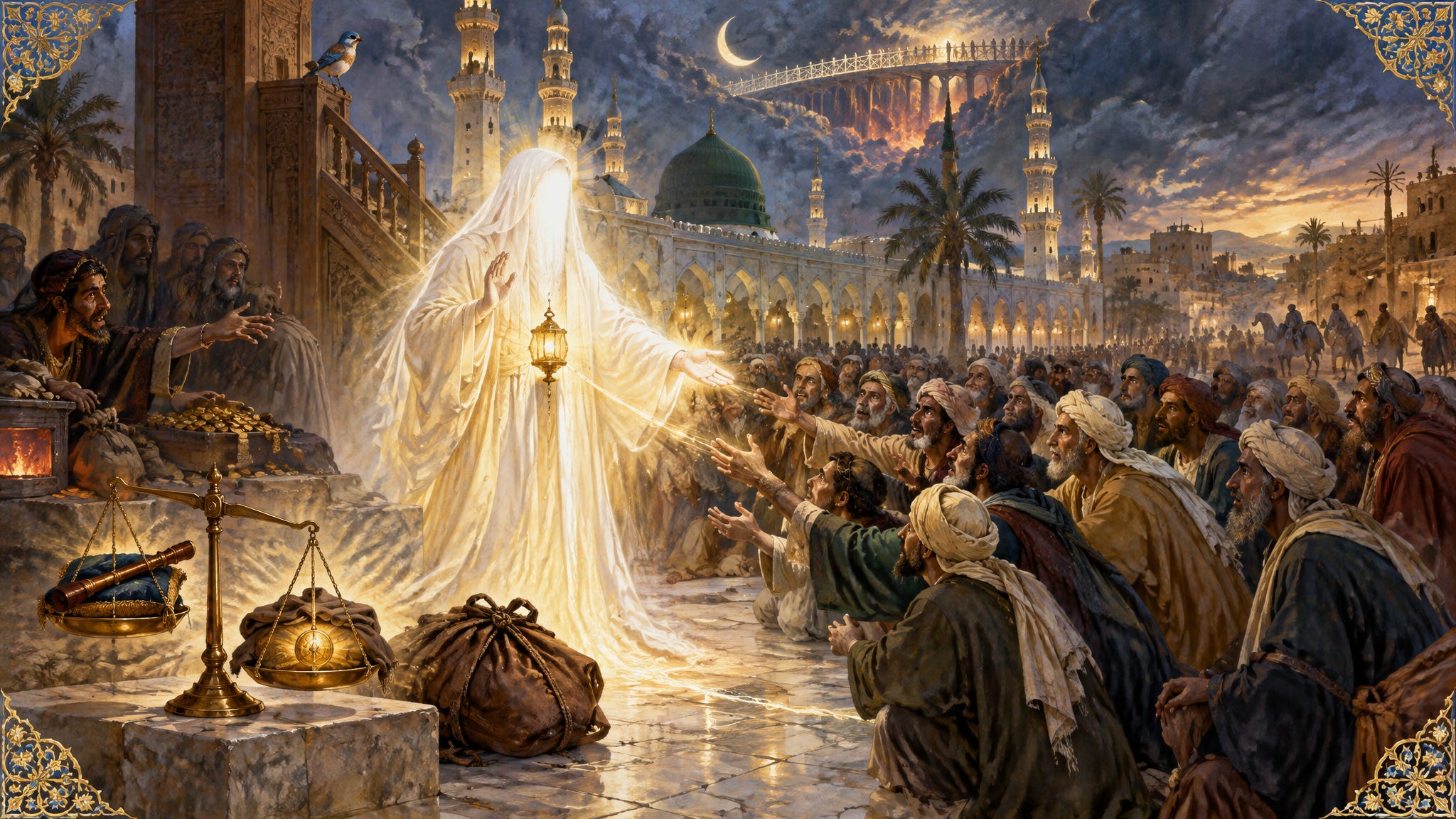
And the people turn to Imam Ali, peace and blessings be upon him.
Shaykh al-Mufid, the great teacher who gave this school its backbone of reason, tells us what Imam Ali did.
He kept apart.
He left his house in Medina, so that nobody could suspect him of wanting it.
They searched for him.
They found him.
He tested them: he pointed them to other men.
They refused anyone else.
And they said to him:
If you do not answer us, a breach will open in Islam that can never be mended.
And only then did he stretch out his hand.
To make the proof firm, Shaykh al-Mufid says, for himself.
— Shaykh al-Mufid, al-Jamal wa al-Nusra li-Sayyid al-'Itra fi Harb al-Basra, records 90–91; narrated20
And here are Imam Ali’s own words to them, in Nahj al-Balagha:
دَعُوني وَالْـتَمِسُوا غَيْرِي; فإِنَّا مُسْتَقْبِلُونَ أَمْراً لَهُ وُجُوهٌ وَأَلْوَانٌ; لاَ تَقُومُ لَهُ الْقُلُوبُ، وَلاَ تَثْبُتُ عَلَيْهِ الْعُقُولُ، وَإِنَّ الاْفَاقَ قَدْ أَغَامَتْ، وَالْـمَحَجَّةَ قَدْ تَنَكَّرَتْ. وَاعْلَمُوا أَنِّي إنْ أَجَبْتُكُمْ رَكِبْتُ بِكُمْ مَا أَعْلَمُ، وَلَمْ أُصْغِ إِلَى قَوْلِ الْقَائِلِ وَعَتْبِ الْعَاتِبِ، وَإِنْ تَرَكْتُمُونِي فَأَنَا كَأَحَدِكُمْ; وَلَعَلِّي أَسْمَعُكُمْ وَأَطْوَعُكُمْ لِمنْ وَلَّيْتُمُوهُ أَمْرَكُمْ، وَأَنَا لَكُمْ وَزِيراً، خَيْرٌ لَكُمْ مِنِّي أَمِيراً!
“Leave me and seek someone else, for we face a matter with many faces and colours, which hearts cannot bear and on which minds cannot stand firm. The horizons have clouded over and the clear road has become unrecognisable.
Know that if I answer you, I will take you along what I know, and will not listen to what anyone says or to the reproach of the reproacher. If you leave me, I am as one of you, and perhaps I would be the one of you who listens and obeys best whomever you put in charge of your affair. I am better for you as a minister than as a commander.”
— al-Sharif al-Radi, Nahj al-Balagha, Sermon 92; my translation
Leave me, and seek someone else.
And then a warning.
If I answer you, I will take you along what I know, and I will not listen to what anyone says.
Ibn Maytham al-Bahrani, a classical commentator of Bahrain, explains what I know.
It means the Shari’a, he says.
The law of God, never bent to anyone’s desire.
You know the story of his brother, Aqil, who came to him in his poverty and asked for more than his share; and how Imam Ali brought a heated iron close to his hand.
That is what I know.
And then: I am better for you as a minister than as a commander.
Ibn Maytham says this is about their comfort, not his.
As their commander he would make them carry what they did not want to carry: equal stipends for all, and the hardships of war.
— Ibn Maytham al-Bahrani, Sharh Nahj al-Balagha, on Sermon 92; narrated21
And the next day, he climbed the minbar.
Listen to the first words of a man who had just been given power over the Muslim world.
I am only a man among you.
Mine is what is yours, and on me is what is on you.
None can carry this affair, he said, but the people of patience, of insight, and of knowledge of where things stand.
Do not rush into any matter until we make it clear to you.
And then he swore an oath.
أَلَا وَ إِنَّ اللَّهَ عَالِمٌ مِنْ فَوْقِ سَمَائِهِ وَ عَرْشِهِ أَنِّى كُنْتُ كَارِهاً لِلْوِلَايَةِ عَلَى أُمَّةِ مُحَمَّدٍ حَتَّى اجْتَمَعَ رَأْيُكُمْ عَلَى ذَلِكَ لِأَنِّى سَمِعْتُ رَسُولَ اللَّهِ ص يَقُولُ أَيُّمَا وَالٍ وَلِىَ الْأَمْرَ مِنْ بَعْدِى أُقِيمَ عَلَى حَدِّ الصِّرَاطِ
“God knows, from above His heaven and His throne, that I was averse to authority over the community of Muhammad until your view came together on it; for I heard the Messenger of God, peace and blessings be upon him and his family, say:
Any governor who takes charge of the affair after me will be stood at the edge of the Sirat.”
— Imam Ali, peace and blessings be upon him, from the minbar the day after the pledge; in Ibn Abi al-Hadid, Sharh Nahj al-Balagha, volume 7, from al-Iskafi; my translation22
Averse.
Not because he was not the one.
He was the one, and he knew it.
He was averse because of the weight of that office before God.
Stood at the edge of the Sirat, the bridge over the Fire.
And hold on to one sentence of that speech:
Do not rush into any matter until we make it clear to you.
It will come back in the third point.
And why did he finally accept?
Because if he had not, the burden would have been left lying on the ground.
The community would have fallen apart, and nobody else could have carried it.
Hold that phrase too:
the burden left on the ground.
In a few minutes, you will hear a man in 1994 use it.
There Are Gentlemen
And that way did not end with Imam Ali.
Come forward to our own century.
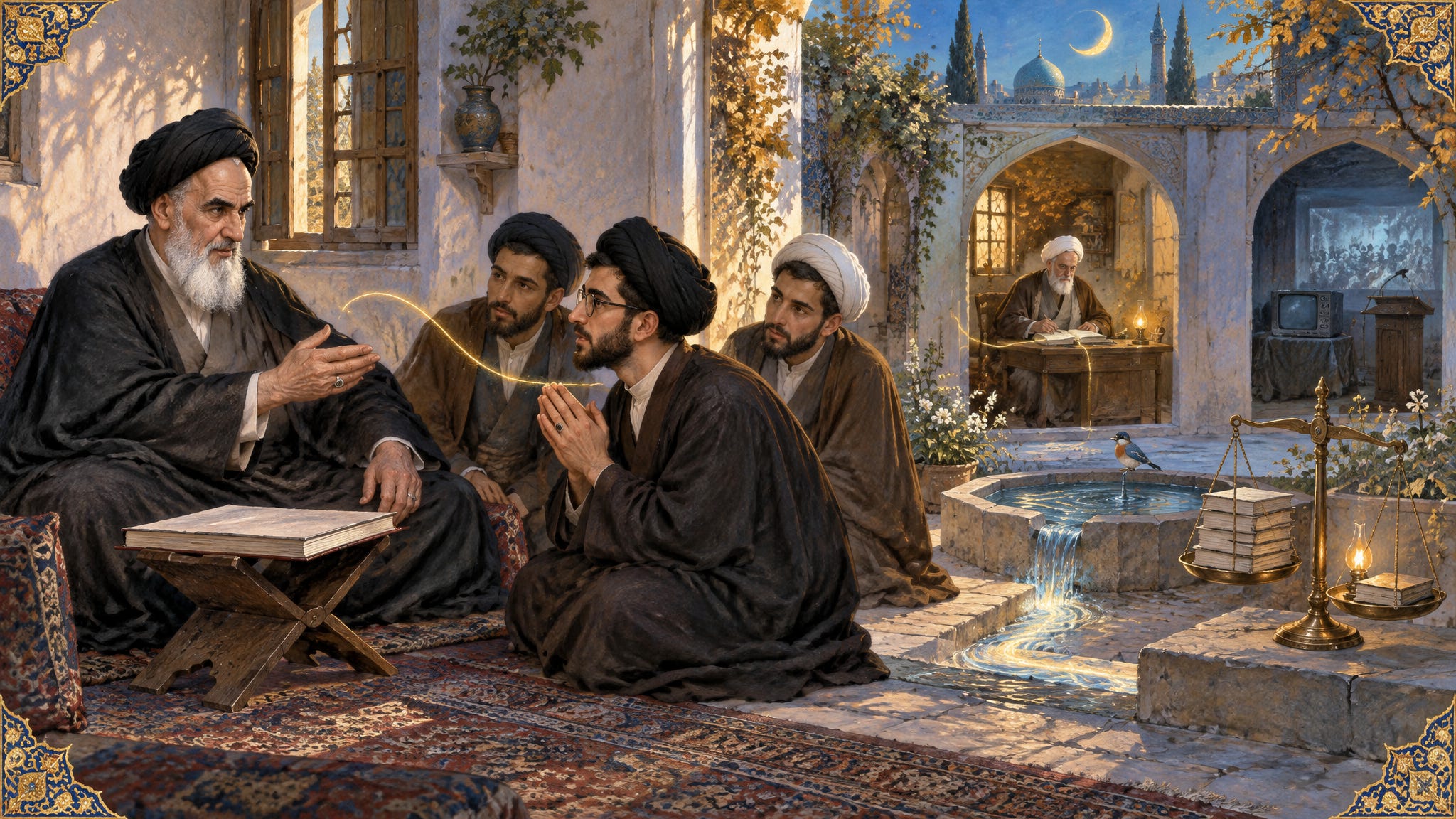
When Ayatullah Borujerdi died, may God rest his pure soul, the marja’ of the whole Shi’a world in the 1950s, people turned to Imam Khomeini, may God rest his pure soul.
And he gave them no manual of rulings.
He went home, and sat.
And however much they insisted, he said:
Sir, there are gentlemen.
There are others.
Until a group of them went to him, and compelled him.
The man who tells us this, in that same speech in 1994, adds one detail.
He was among those who pressed him.
And the eldest marja’ of Qom, Ayatullah Araki, may God rest his pure soul, who died in November 1994, was pressed for thirty or forty years before he would give a manual of rulings.
— Imam Sayyed Ali Khamenei, speech of 23 Azar 1373 (14 December 1994); narrated23
And five weeks ago we heard of another man, at a lectern, who said that he was not worthy.
You remember him.
I will not tell that story again tonight.
So come back with me to the man who asked the television not to read his name.
The Burden Left on the Ground
Here is his reason, in his own words.
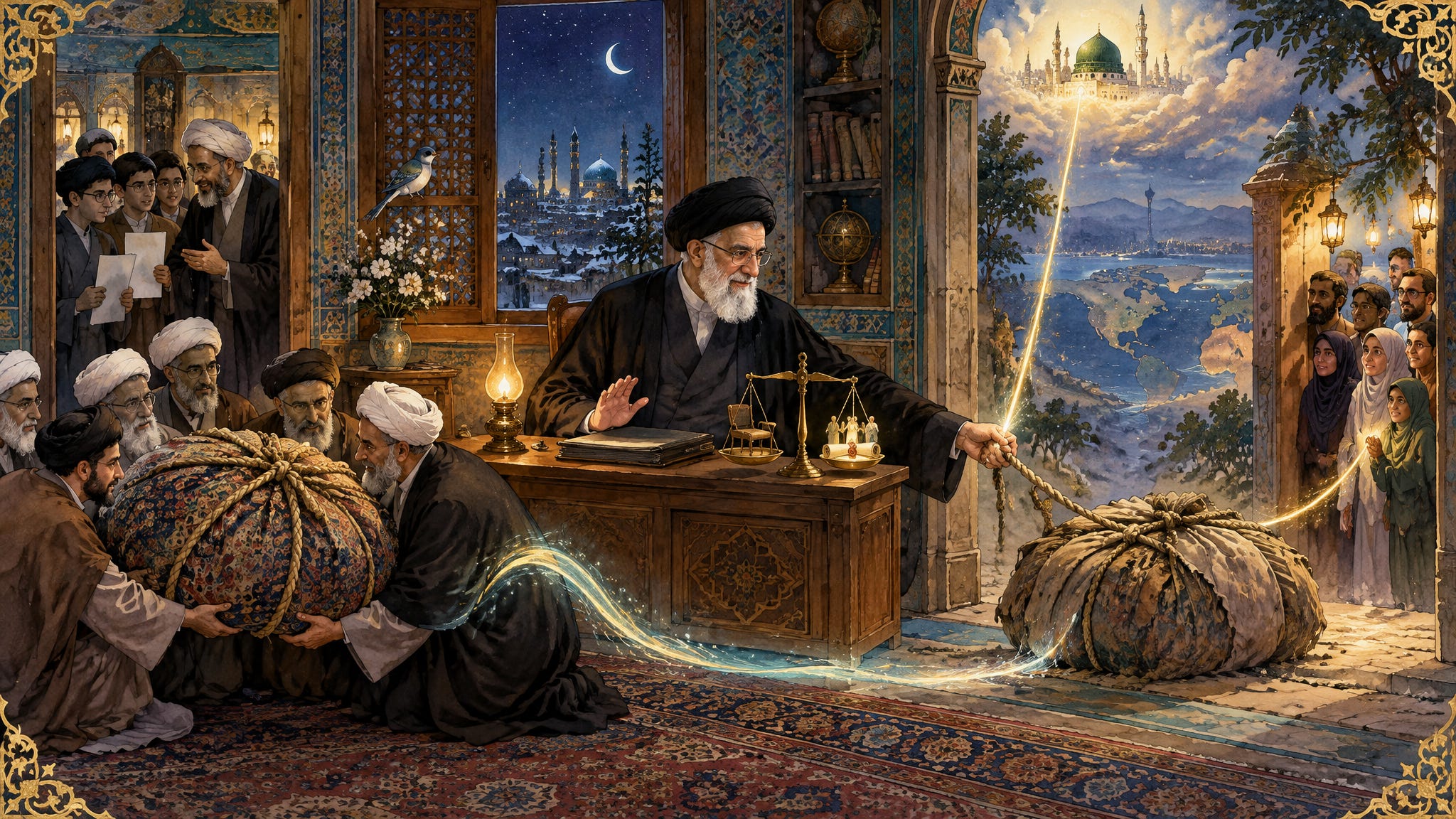
If it is an individual obligation, he said, I will not pull my shoulder out from under any burden.
Here it is not so.
The burden will not be left on the ground.
It does not depend on one person.
Let me explain that, because it is the law speaking.
There is a duty that only you can carry.
That duty is yours alone.
And there is a duty that others can carry.
That one is not yours alone.
And in Iran, there were others who could carry it.
That is Imam Ali’s acceptance, said by his follower.
If the burden would be left on the ground, I will carry it.
And then he said:
Outside Iran, it is another matter.
Their burden I accept.
Because if I do not take it up, it will be lost.
And on the day that others can carry that too, he said, I will step back there as well.
— Imam Sayyed Ali Khamenei, speech of 23 Azar 1373 (14 December 1994); narrated24
His office keeps its own record of those days.
It says that he declined, courteously and with apologies, until the insistence of the believers, and a sense of grave responsibility before God's law.
— Imam Sayyed Ali Khamenei, Ajwibat al-Istifta'at, the preface; narrated25
And there were students in Qom that year who remember it.
They had kept going to his office, and to Tehran when they could, asking him for a manual of rulings, so that they could follow him.
And the answer was always the same.
No.
Before that, such students had stayed with the rulings of Imam Khomeini, with a living mujtahid’s permission, and when a new question came up they wrote to the office.
And even that answer was a refusal:
there is no reason at present.
— Imam Sayyed Ali Khamenei, Ajwibat al-Istifta’at, Question 43; narrated26
And then one day a teacher told them:
He has listened to you all.
And he has agreed.
But only for those outside Iran.
For them, it was like an Eid.
The Office Asks for the Man Who Does Not Want It
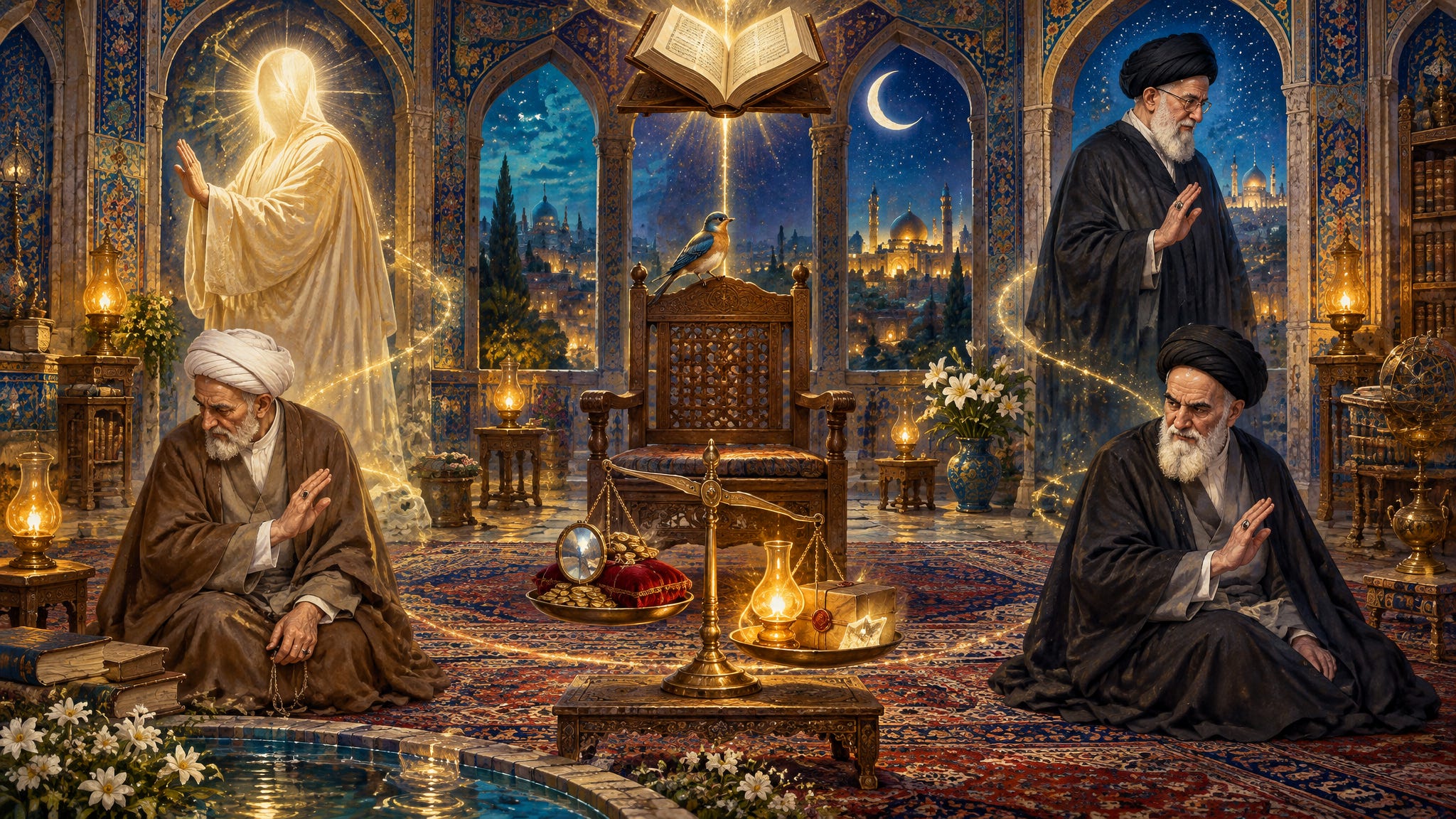
And here is something remarkable.
The law itself asks for this kind of man.
Among the conditions of the one who is followed, the same book of answers says, besides justice, there is this: that he must have mastery over his own rebellious self, and no greed for this world.
And that condition is stated by obligatory precaution.
— Imam Sayyed Ali Khamenei, Ajwibat al-Istifta’at, Question 12; narrated27
The law asks for the man who does not want the office.
Shaykh al-Ansari.
Imam Ali.
Imam Khomeini.
The martyred Leader.
One pattern, across thirteen centuries.
And notice two words in that answer:
obligatory precaution.
They matter more than you think.
The third point will show you why.
Why the Fear

So why are they so afraid?
God answers.
وَلَوِ ٱتَّبَعَ ٱلۡحَقُّ أَهۡوَآءَهُمۡ لَفَسَدَتِ ٱلسَّمَٰوَٰتُ وَٱلۡأَرۡضُ وَمَن فِيهِنَّۚ بَلۡ أَتَيۡنَٰهُم بِذِكۡرِهِمۡ فَهُمۡ عَن ذِكۡرِهِم مُّعۡرِضُونَ
Had the truth followed their desires, the heavens and the earth and whoever is in them would surely have fallen into ruin. Indeed, We have brought them their Reminder, but they are disregardful of their Reminder.
— Qur’an, Surah al-Mu’minun (the Chapter of the Believers) #23, Verse 71
Had the truth followed their desires, the heavens and the earth, and whoever is in them, would surely have fallen into ruin.
Allamah Tabataba’i, may God rest his pure soul, explains why.
Desire, he says, stops at no limit, and settles in no place.
A law that followed desire would have no shape at all.
It would be one thing today and another tomorrow, and the whole order of things would come apart.
— Allamah Sayyed Muhammad Husayn Tabataba’i, al-Mizan fi Tafsir al-Qur’an, on Surah al-Mu'minun 23:71; narrated28
And Ayatullah Jawadi Amoli, may God protect him, adds one sentence.
There must be an order of law, and a clear way, which is the point of reference:
the marja', the one people return to.
— Ayatullah Jawadi Amoli, Tasnim, on Surah al-Mu'minun 23:71; narrated29
Now let me tell you what this looks like in real life.
Someone has a question.
He asks it.
He does not like the answer.
So he asks it again, in different words.
And again.
He leaves out one detail, then another.
He writes it ten different ways, until finally an answer comes back that suits him.
And here is the thing.
That answer is true.
The ruling is right.
But it is the right answer to a different question.
It is not the answer to his life.
He has deceived nobody but himself.
Remember the portrait at the beginning.
The least wearied by the disputant’s going back and forth.
The mujtahid’s task is to keep the people, and himself first of all, in step with the religion.
And never to let the religion be bent to the whims of the age.
We are tuned to it.
It is not tuned to us.
And now go back to the deathbed.
Lessen your precautions, Shaykh.
The Shari’a is generous and easy.
That was the ease the Shari’a gives.
The question asked ten ways is asking for the ease that desire wants.
The mujtahid finds the first.
And he refuses the second.
Lessons for Our Time
Lesson Three — Do Not Seek It; Carry It When It Is Laid on You
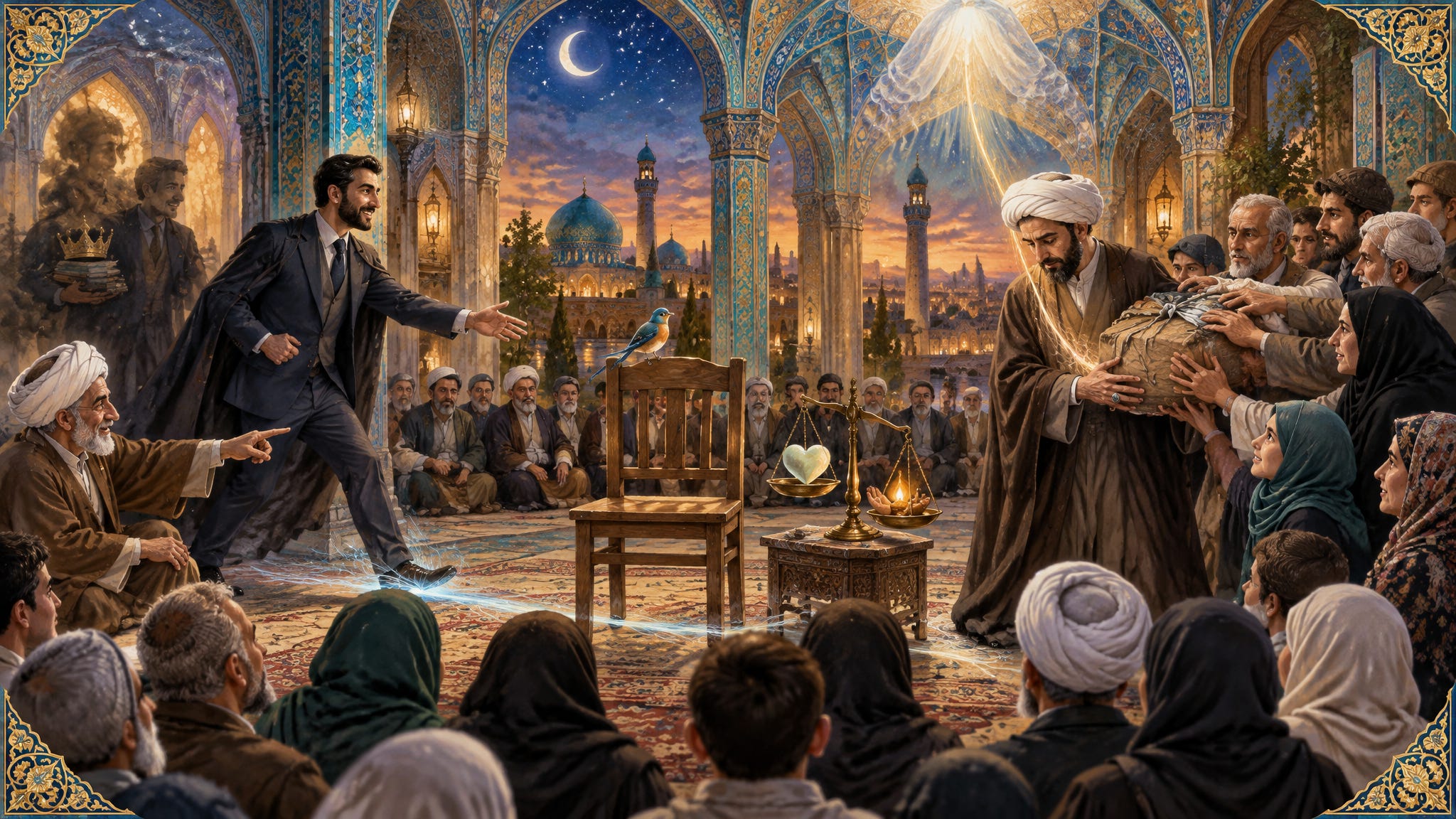
The way of the true scholars is to refuse.
To name someone better.
And to accept only when the duty is laid on them, and nobody else can carry it.
If you are the one people come to — on a committee, on a pulpit, at a madrasa, as a trustee of a mosque —
Do not campaign for it.
If there is someone better, say his name, as Shaykh al-Ansari said Sa’id al-Ulama’s name.
But hear the other half too.
If it is laid on you, and nobody else will carry it, do not leave it on the ground.
Refusing is not a virtue when the burden falls.
Imam Ali refused, and then, when there was no one else, he stretched out his hand.
And if you are among the people —
When you choose who leads your mosque, your committee, your school, look for the one who does not push himself forward.
The man who badly wants the chair is telling you something about himself.
And when the experts differ, do not simply go with whatever feels right.
A settled heart is not enough, the marja’ says, when those who know disagree.
Ask.
— Ayatullah al-Sistani, al-Fiqh li-l-Mughtaribin, issue 29; narrated30
And for anyone here who is not a Muslim: every tradition that has lasted has distrusted the man who wants power over its law.
That is the third lesson.
Do not seek it.
But when it is laid on you, carry it.
Lesson Four — Ask to Learn, Not to Be Agreed With
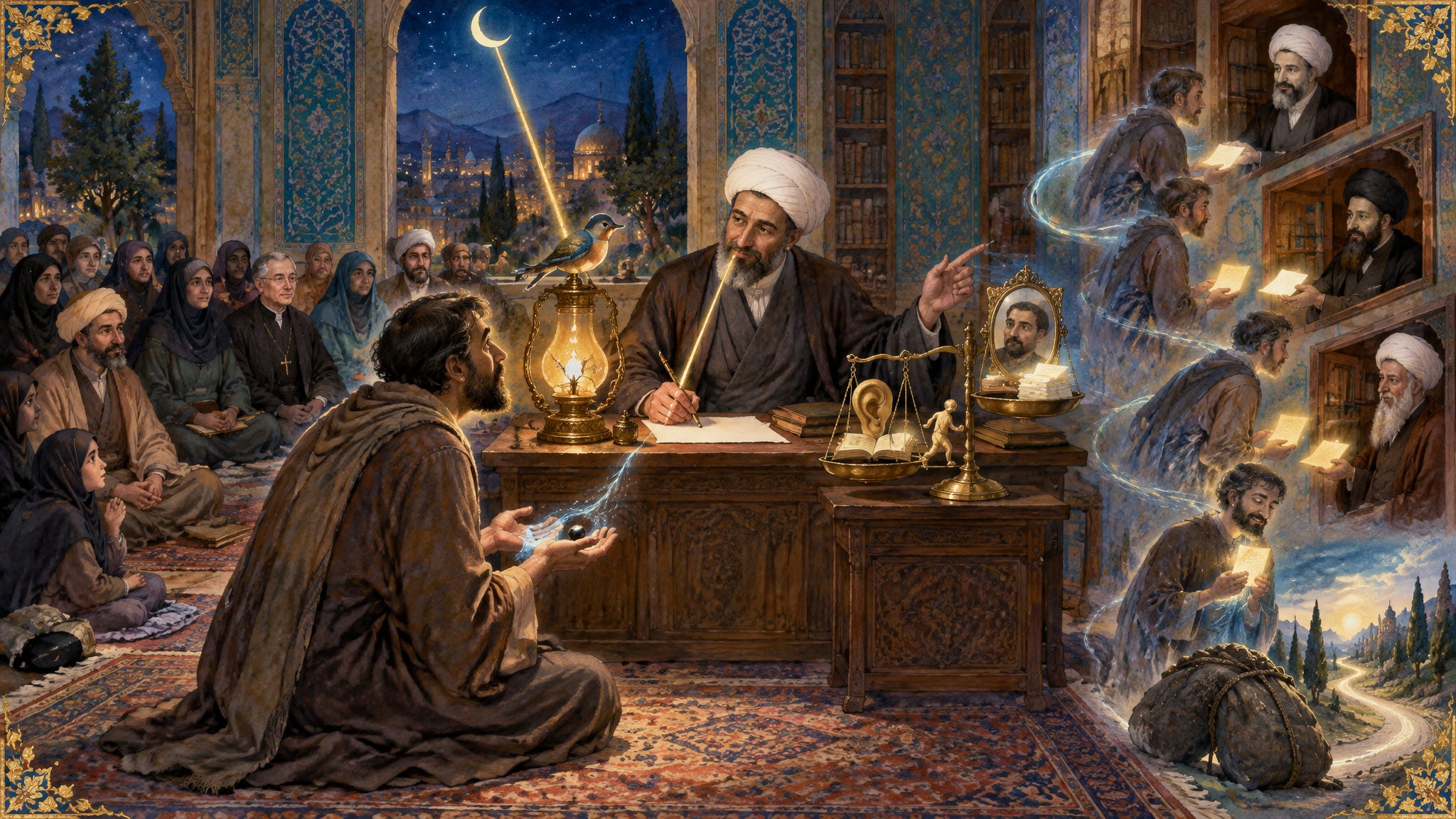
A question is a request to be changed.
It is not a request to be confirmed.
If you are the one people come to —
Answer the question that was asked.
And gently name the one that is being avoided.
And when the same person comes back with the same question in new words, say kindly:
I think you are asking me the same thing.
Do not be wearied.
Be the least wearied of all.
But do not let the answer bend.
And if you are among the people —
Ask once.
Honestly.
With every detail that matters, including the ones you would rather leave out.
If you have written to three offices and two scholars until one of them said yes, that yes is not your answer.
The answer you had to shop for is the answer you gave yourself.
And for anyone here who is not a Muslim: every serious path asks those who walk it to change.
Not to be agreed with.
That is the fourth lesson.
Ask to learn.
So they would not take it.
And when it was laid on them, how did they carry it?
A Trust With Me
Any Common Man of the Market
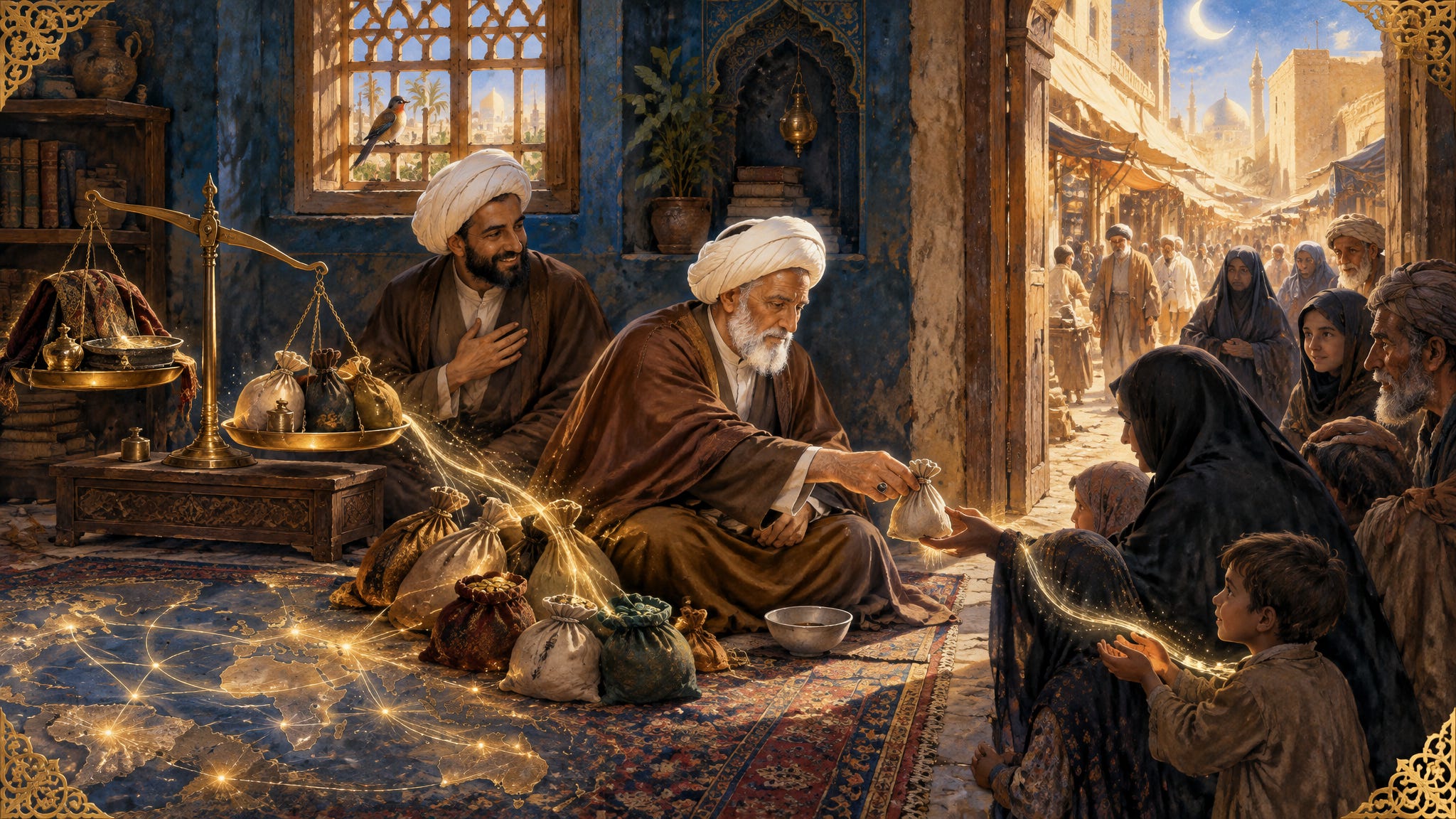
Shaykh al-Ansari now held the religious dues of the whole Shi’a world.
The money came to Najaf from every land where the Shi’a lived.
And a companion of his once said to him, with admiration:
You go to great lengths in getting people’s rights to them.
And Shaykh al-Ansari answered:
There is no pride or honour for me in that.
It is the business of any common man of the market to return trusts to their owners.
And these rights of the poor are a trust with me.
— the editor's introduction to Shaykh al-Ansari, al-Taqiyya, record 28; narrated31
That is the title of this point.
Those are his words.
A trust with me.
All the religious dues of the Shi’a came to him, his biographer writes.
And he lived the life of the poor.
— the editor’s introduction to Shaykh al-Ansari, al-Taqiyya, record 28; narrated32
And Ayatullah Bahjat, may God rest his pure soul, a teacher of Qom in our own time, known for his worship, used to speak about him.
He did not spend the Imam's share on himself, Ayatullah Bahjat said.
— Ayatullah Muhammad Taqi Bahjat, Dar Mahzar-e Bahjat, §401; narrated33
And remember the word market.
We will need it before the night is over.
Like the Teeth of a Comb

Keeping a trust from strangers is one thing.
The test is when your own family asks.
Shaykh al-Ansari had a brother, Shaykh Mansur.
A scholar.
Poor.
With a large family to feed.
And their mother came to Shaykh al-Ansari.
Her son was now holding the funds of the whole Shi’a world.
And her other son was struggling.
So she asked him:
Give your brother more than you give the other students.
And Shaykh al-Ansari took out the keys to the room where the funds were kept.
And he put them in his mother’s hand.
And he said:
Take whatever you wish for your poor son.
On one condition: that I am absolved of it, and that you carry its account.
Mother, these are the rights of the poor.
They are shared among them equally, like the teeth of a comb.
If you will have an answer tomorrow, before God, for the extra you take, then do as you wish.
And his mother trembled.
She gave him back the keys.
And she asked him to forgive her.
— the editor's introduction to Shaykh al-Ansari, al-Fawa'id al-Usuliyya, records 16–17; narrated34
There is nothing wrong in a mother’s love for her struggling son.
Every mother in this room would understand her.
And when she heard the word tomorrow, she understood too.
She turned back.
She is honoured in this story, as much as he is.
But see where the trust was tested.
Not by a stranger.
By his own mother, for his own brother.
Enticement does not move him.
You heard it at the start of the night.
Here it is, with the keys in a mother’s hand.
No Weapons, and No Carpets
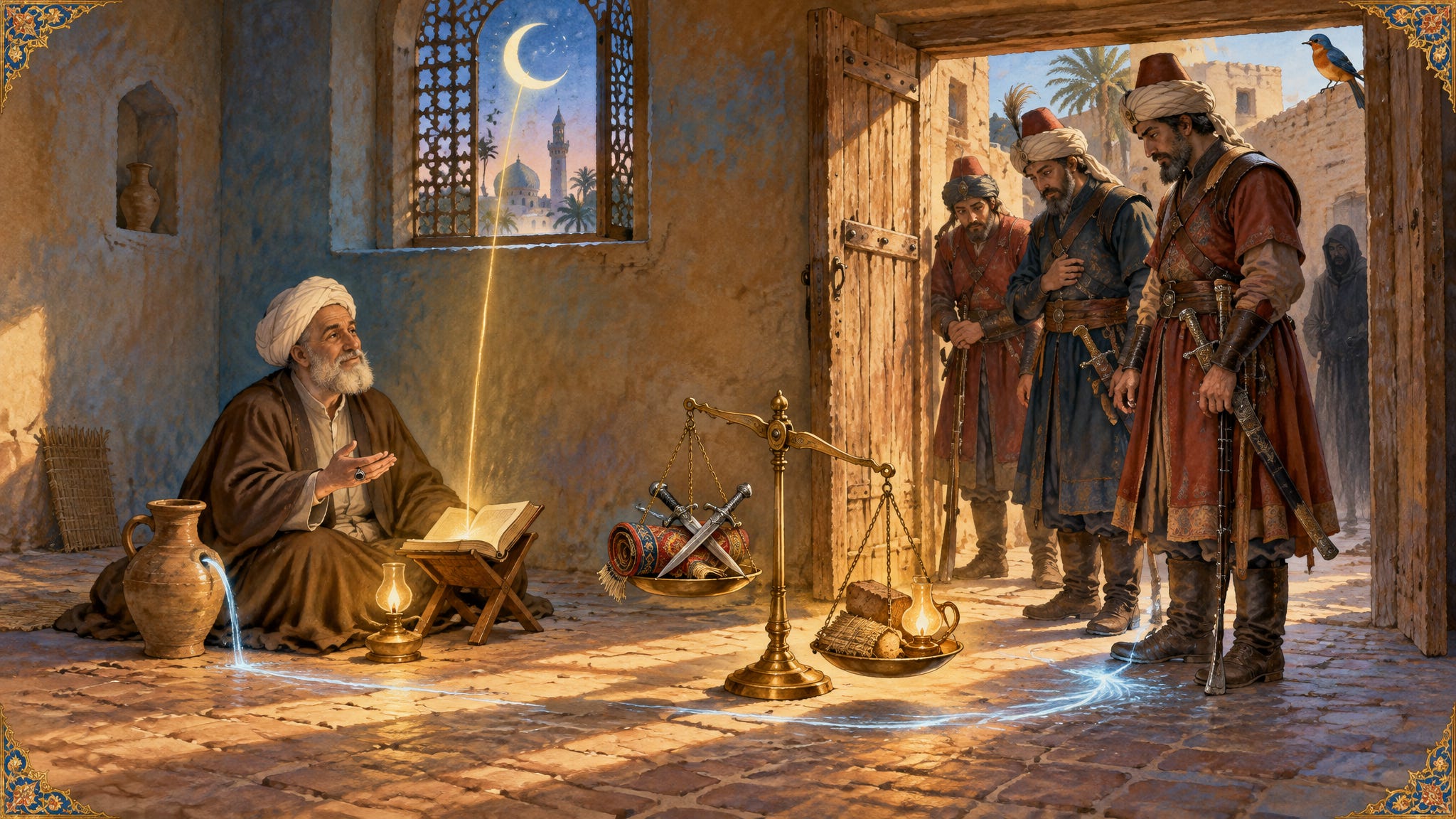
It was once whispered to the authorities that Shaykh al-Ansari was hiding weapons in his house.
The governor of Najaf sent soldiers to search it.
They found no weapons.
And they were astonished.
Because the house was not even carpeted.
— the editor's introduction to Shaykh al-Ansari, al-Taqiyya, record 28; narrated35
They Fulfilled the Trust
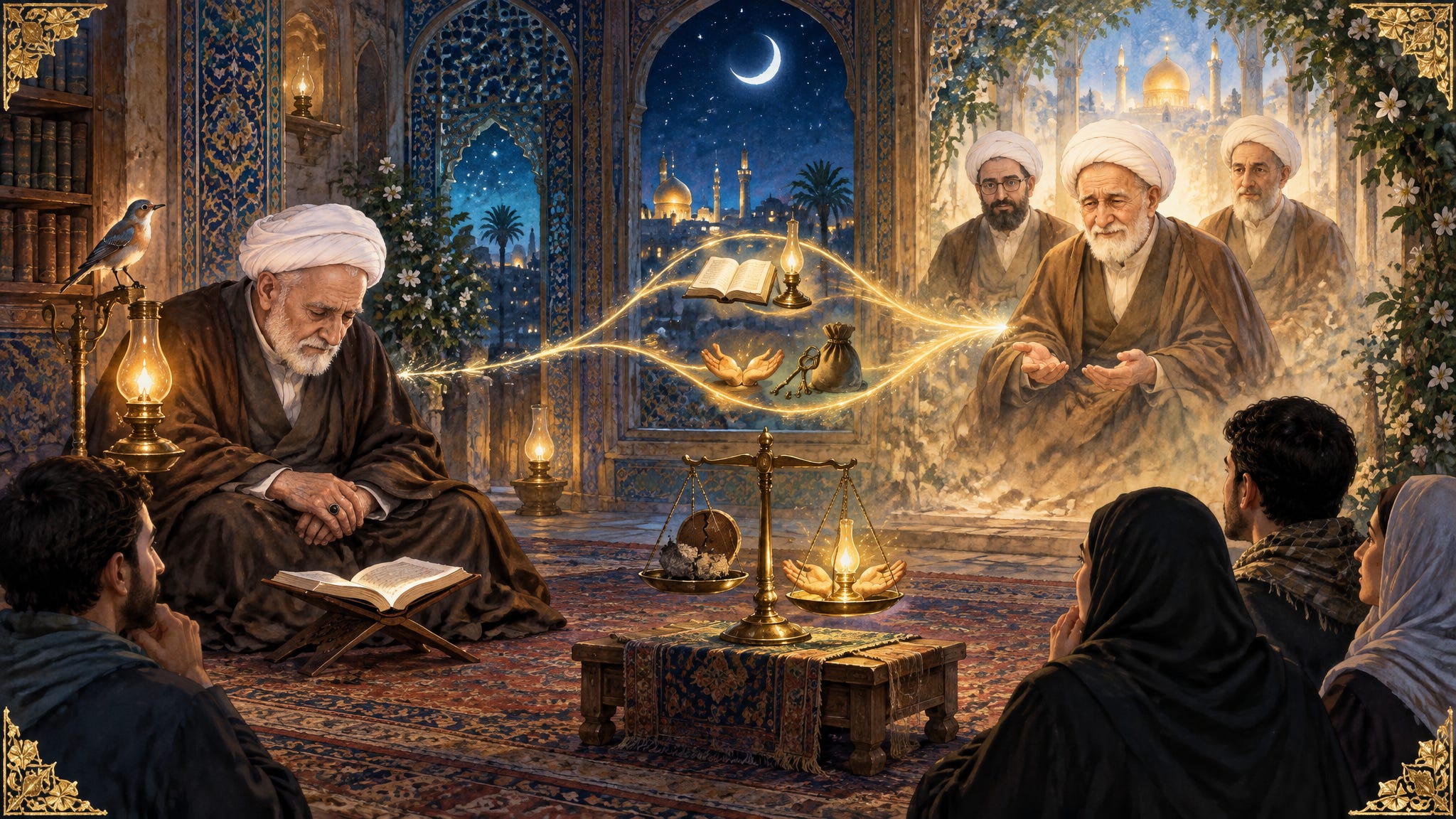
And Ayatullah Bahjat’s verdict on Shaykh al-Ansari and the scholars like him is this:
They fulfilled the trust, in knowledge and in practice.
Woe to us, if we are other than they.
— Ayatullah Bahjat, Dar Mahzar-e Bahjat; §406; narrated36
A Method, Not a Monument
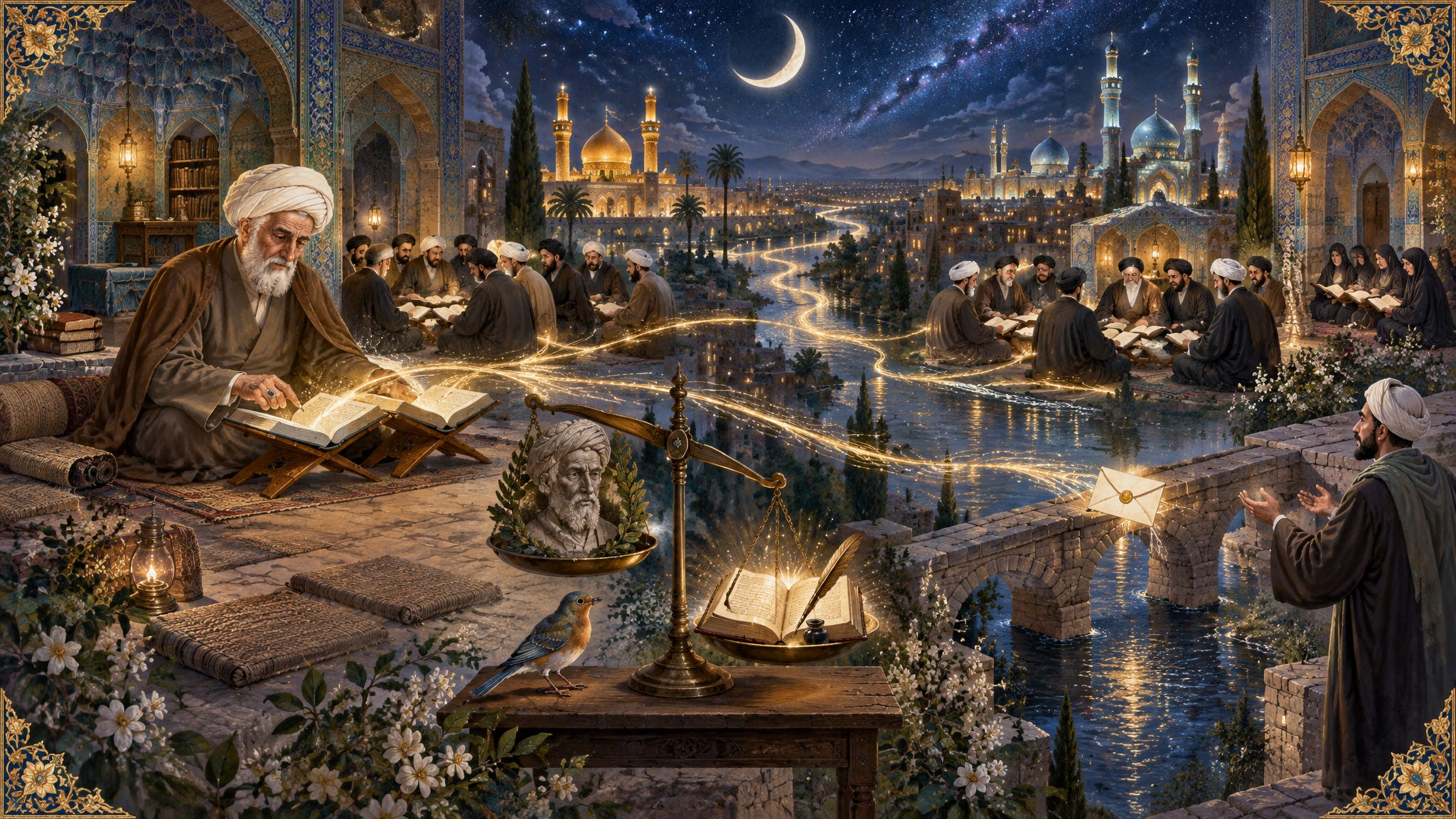
And Shaykh al-Ansari is still teaching.
His followers died long ago.
Nobody alive today follows his rulings.
And yet every mujtahid alive passed through his two books.
His way of reading is in every lesson in Najaf and in Qom tonight.
The legacy of a mujtahid is a method.
Not a following.
But a method is only half of the road.
The ruling still has to reach you.
How His Word Reaches You
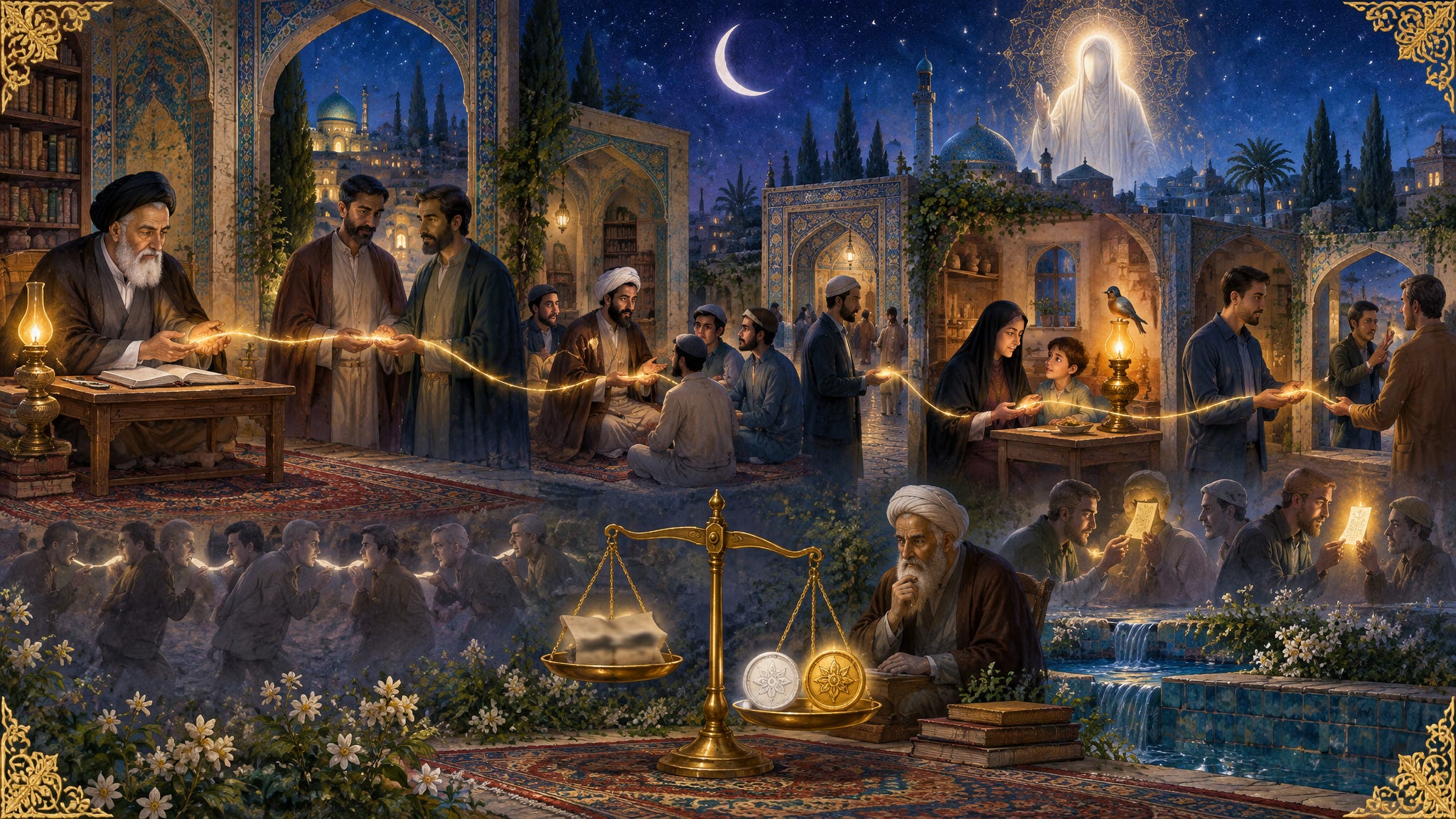
So how does it reach you?
Ayatullah al-Sistani, may God protect him, explains.
A follower learns a ruling in one of three ways.
From the mujtahid himself.
Or from two just men, or one trustworthy man whose word gives assurance.
Or from his manual, when you are assured that it is accurate.
— Ayatullah al-Sistani, al-Fiqh li-l-Mughtaribin, issue 25; narrated37
Look at the middle one.
The chain of the trust does not end at the marja’.
It runs through everyone who passes a ruling on.
Through the teacher.
Through the brother at the mosque.
Through the parent at the kitchen table.
Through you.
And so the one who carries the ruling to you must himself be trustworthy.
Imam Ali, peace and blessings be upon him, said:
وَقَالَ (عليه السلام): اعْقِلُوا الْخَبَرَ إِذَا سَمِعْتُمُوهُ عَقْلَ رِعَايَةٍ لَا عَقْلَ رِوَايَةٍ فَإِنَّ رُوَاةَ الْعِلْمِ كَثِيرٌ وَرُعَاتَهُ قَلِيلٌ.
“Understand a report, when you hear it, with the understanding of one who tends it, not the understanding of one who merely relays it. For those who relay knowledge are many, and those who tend it are few.”
— al-Sharif al-Radi, Nahj al-Balagha, Saying 98; my translation
Shaykh 'Abbas al-Qummi, may God rest his pure soul, the author of Mafatih al-Jinan, the book of prayers you will find in nearly every Shi'a home, explains it.
Imam Ali forbade them, he says, when they heard some piece of knowledge or wisdom, to be content with simply passing it on as a report.
The way most people read the Qur'an by rote, and know of its meanings only a little.
He told them to understand what they hear, with knowledge and with comprehension.
— Shaykh 'Abbas al-Qummi, Sharh Hikam Nahj al-Balagha (he numbers it 22); narrated38
Passing on a ruling without its meaning is reading it by rote.
And here is where the words matter.
In the manual of a marja’, there are two phrases that look almost the same in translation.
Recommended precaution.
And
Obligatory precaution.
They are not the same ruling.
A recommended precaution, the follower may leave.
An obligatory precaution, he may act on, or he may turn to the next most learned mujtahid on that one question.
But he may not simply ignore it.
— Ayatullah al-Sistani, Minhaj al-Salihin, al-'Ibadat, volume 1, issue 31; narrated39
Remember the two words in the second point?
By obligatory precaution, the marja’ must have no greed for this world.
That phrase is a ruling.
Flatten those two phrases into one, and a different ruling reaches the person.
Make the recommended one sound obligatory, and you have laid a burden on someone that God did not lay.
Make the obligatory one sound recommended, and you have taken away a duty that was there.
And think of Shaykh al-Ansari.
The man of very, very many precautions.
His words, more than anyone’s, need this care.
And remember Imam Ali on the minbar, the day after the pledge.
Do not rush into any matter until we make it clear to you.
That is all careful carrying is.
Not rushing.
Not rounding.
Checking.
Saying I will find out.
And if you passed something on wrongly, going back to the people you told, and putting it right.
When We Do Not Understand a Ruling
Now let me ask you something.
When a ruling sounds strange to us, whose fault is that?
It is not the marja’s.
First, it is ours.
We do not have his knowledge.
He has spent forty years on the roots and the branches, and we heard one sentence of the answer, second-hand.
And then it is the local scholar’s.
Because it was his duty to explain it, and he did not.
I may not agree with a ruling.
That is allowed.
But it does not mean the ruling is wrong.
It means I have not understood it the way the marja’ understood it.
And that is my shortcoming, not his.
He may be wrong — he is the first to fear it.
That is why he walked to the shrine, to ask not to be wrong.
But my not understanding is not evidence that he erred.
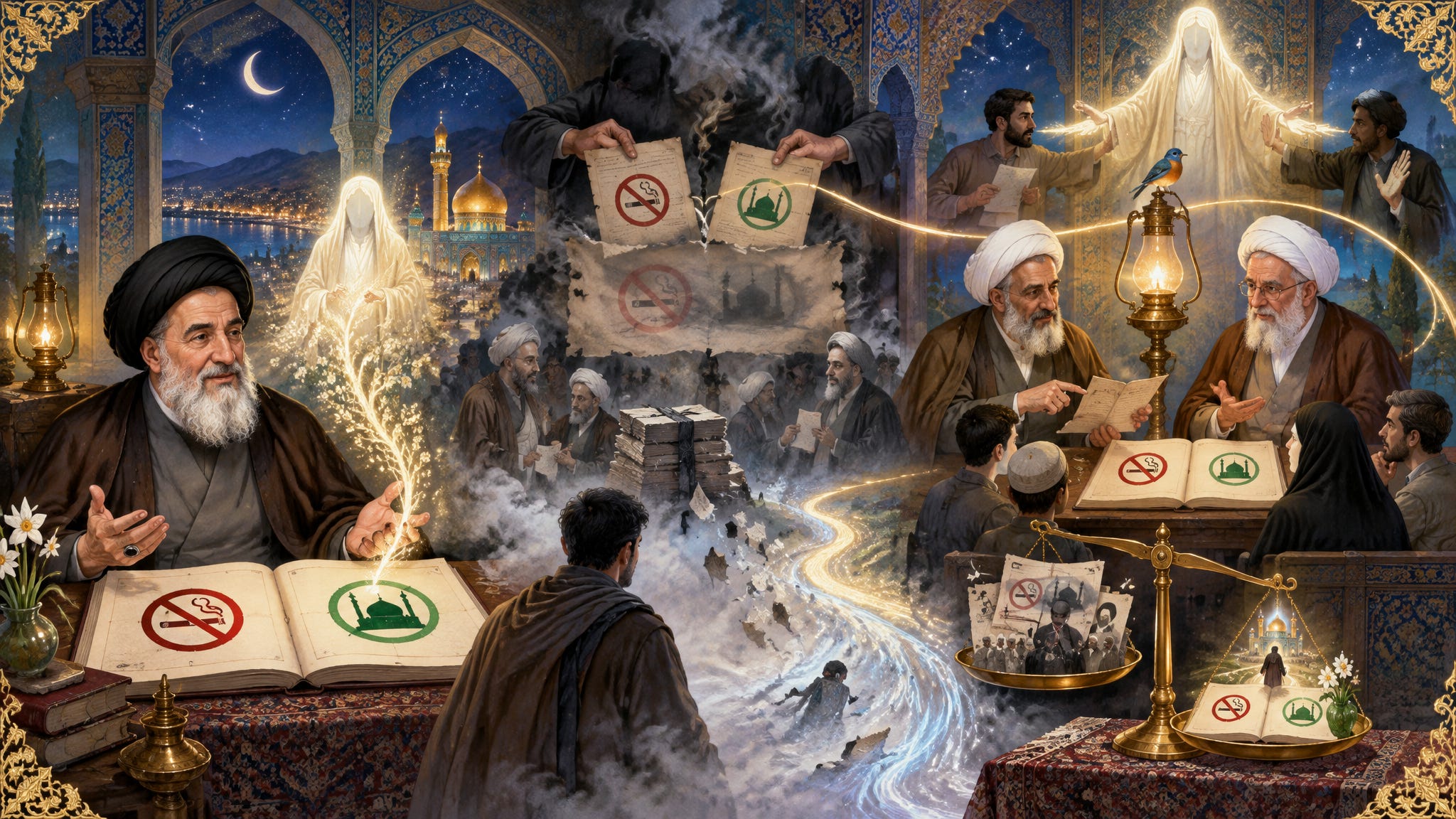
Let me give you one case.
You met him last week: the great scholar and teacher, Ayatullah Sayyed Muhammad Husayn Fadhlullah, may God rest his pure soul, the marja’ of Beirut.
For years it was said about him:
he allows people to smoke while they are fasting.
Here is what his office actually answered.
Smoking is forbidden.
In every month, because of the harm it does.
And it is more forbidden in the month of Ramadan, because it violates the sanctity of the month.
But, the answer goes on, it does not break the fast.
Because Imam al-Rida, peace and blessings be upon him, was asked about a fasting man who took in the smoke of incense-wood, and the Imam said his fast was valid.
— Ibrahim Mustapha, Lies Targeting Grand Ayatollah Sayyed Muhammad Hussein Fadhlullah, edited by the Bayynat Office, Lebanon, Translation Department (2013), Chapter Seven, "Miscellaneous rulings which people misunderstand", Part 2; narrated40
That report is carried by Ayatullah al-Khu’i, may God rest his pure soul, the great marja’ of Najaf in the last century, in his lectures on fasting.
He was Sayyed Fadhlullah’s own teacher.
— Ayatullah Sayyed Abu al-Qasim al-Khu'i, al-Mustanad fi Sharh al-'Urwat al-Wuthqa (his lectures on fasting), volume 11, p. 155; narrated41
So there were two questions.
Is it allowed?
No.
It is forbidden.
Does it break the fast?
No.
On the word of an Imam.
That is his answer, from that report.
Other maraji’ hold a precaution about thick smoke and dust reaching the throat.
So ask the one you follow.
Squash those two questions into one, and what reaches people is:
he allows smoking while fasting.
A lie, built out of two true answers.
Remember the portrait.
Not content with the nearest understanding, short of the furthest.
The people who heard “he allows smoking” stopped at the nearest understanding.
The furthest was two questions, and an Imam’s answer.
And notice where his answer came from.
From a report of Imam al-Rida.
Upon us is the casting of the principles, and upon you the branching out.
The branch drawn from the Imam’s own answer, and heard as a licence.
And there was worse.
Here is how Sayyed Fadhlullah himself described it.
People sent letters to scholars in Qom, he said, asking:
what do you say about someone who says such-and-such?
And they would take out the first and last parts of his words.
As if a man had said, there is no god but God, and they had sent the question:
what do you say about someone who says, “there is no god”?
And what does the marja’ do, when that question reaches him?
He answers the premise in front of him.
Honestly.
If someone says that, then this is the ruling.
He is not wrong.
The question is.
And then the same kind of question goes to many scholars.
Each answers honestly, the premise put in front of him.
And the answers are gathered together, and bound under one title.
And now it reads as though the whole hawza has spoken with one voice.
A handful from this.
A handful from that.
You will hear those words of Imam Ali in a moment.
And what did Sayyed Fadhlullah say, about the people who did this?
They did not even write to me to ask whether this is true or not.
And about himself, he said this:
O Lord, if You put me down, then who can raise me?
And if You raise me, then who can put me down?
— Ayatullah Sayyed Muhammad Husayn Fadhlullah, words recorded by the Bayynat channel, in Ibrahim Mustapha, Lies Targeting Grand Ayatollah Sayyed Muhammad Husayn Fadhlullah, edited by the Bayynat Office, Lebanon (2013), under the heading Words from Sayyed Fadhlullah regarding lies targeting him; narrated42
So here is the duty, in one line.
Read the question, before you read the fatwa.
And God put that duty in His Book.
يَـٰٓأَيُّهَا ٱلَّذِينَ ءَامَنُوٓاْ إِن جَآءَكُمۡ فَاسِقُۢ بِنَبَإٖ فَتَبَيَّنُوٓاْ أَن تُصِيبُواْ قَوۡمَۢا بِجَهَٰلَةٖ فَتُصۡبِحُواْ عَلَىٰ مَا فَعَلۡتُمۡ نَٰدِمِينَ
O you who have faith! If a vicious character brings you some news, verify it, lest you should visit [harm] on some people out of ignorance, and then become regretful for what you have done.
— Qur’an, Surah al-Hujurat (the Chapter of the Chambers) #49, Verse 6
If a vicious character brings you some news, verify it.
Allamah Tabataba’i, may God rest his pure soul, says the verse asks one thing of us.
Remove the ignorance before you act.
Before you act on a report, know what it actually says.
And that, he says, is only what every sensible person already does with news that matters.
— Allamah Sayyed Muhammad Husayn Tabataba'i, al-Mizan fi Tafsir al-Qur'an, on Surah al-Hujurat 49:1–10; narrated43
And Ayatullah Jawadi Amoli, may God protect him, adds something we need tonight.
The falsehood, he says, can be in the one who reports.
Or it can be in the report itself.
Because even a just man can make a mistake.
So a report can be false when nobody lied.
An honest marja’.
An honest answer.
And the report of it, with both its ends cut off, is still false.
We do not need to know anyone’s motive to see that.
We only need to read.
— Ayatullah 'Abd Allah Jawadi Amoli, Tasnim, on Surah al-Hujurat, sessions 7 (18 October 2016) and 11 (24 October 2016); narrated44
And he builds the verse on a saying of Imam al-Sadiq, peace and blessings be upon him.
God singled out His servants with two verses of His Book: that they do not speak until they know, and that they do not reject what they do not know.
— Shaykh Muhammad ibn Ya'qub al-Kulayni, al-Kafi, volume 1, hadith 105, from Imam al-Sadiq; narrated45
Two failures, in one sentence.
The one who passes on the clipped fatwa.
And the one who dismisses the marja’ because of it.
Do not speak until you know.
Do not reject what you do not know.
Everything I have said in this part of the night, the Imam said in one line.
The Name Over the Ruling
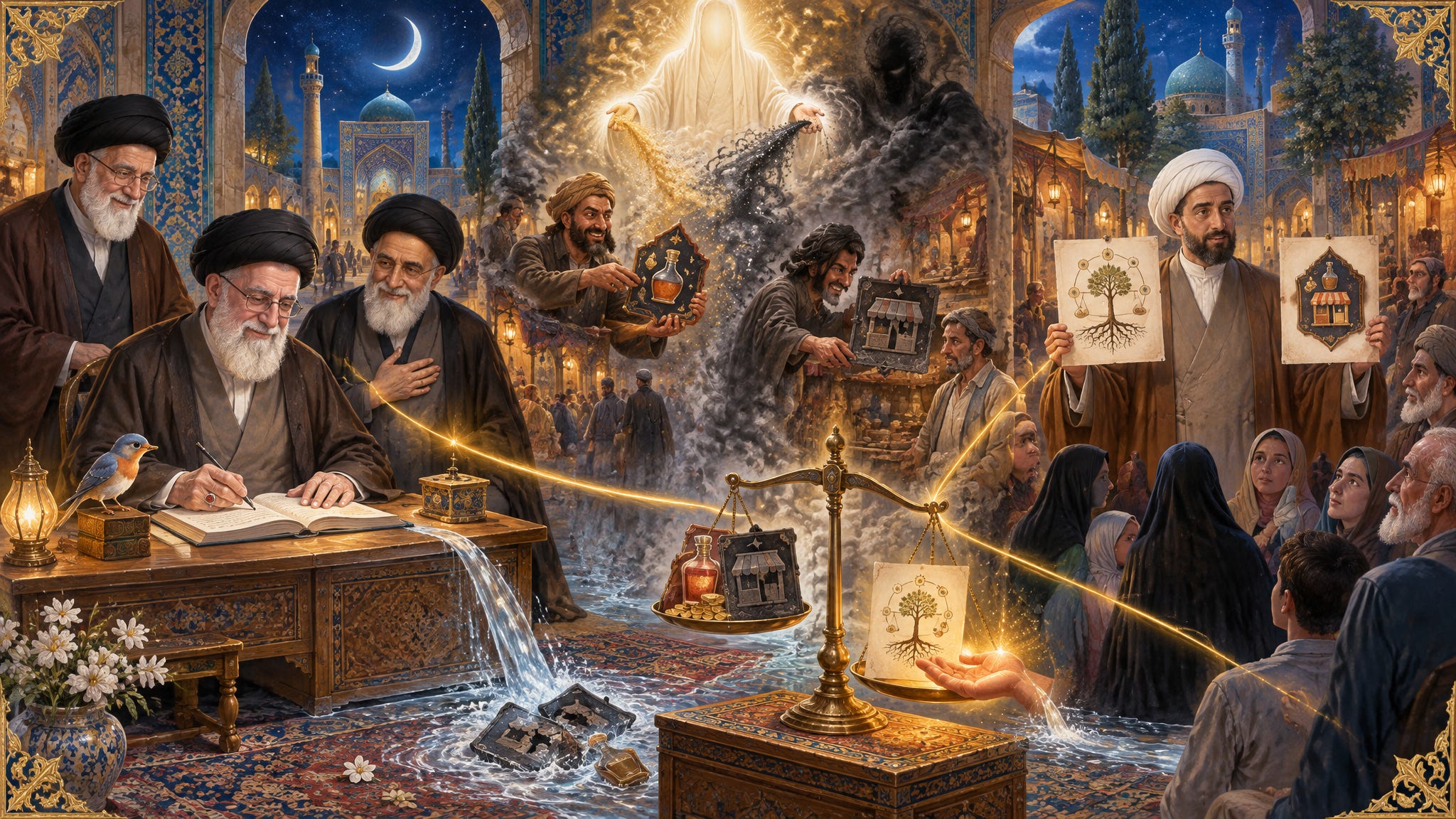
Carelessness changes a ruling by accident.
A shaped question changes the ruling a person receives.
And there is a third way.
It uses the marja’s own honest words.
Let me describe how it works.
I will give you the pattern, because the pattern is what you need to be able to see.
First: someone writes to a marja’ with a question, and the question names a particular product, or a particular company, or a particular scheme.
Second: the answer comes back.
And the answer, quite properly, speaks about the kind of thing.
Whatever meets these conditions is permitted.
It names nothing.
That is as it should be.
Third: the answer is circulated.
But now, on top of it, there is the name.
And so it reads:
the marja’ approves this one.
He never said it.
And it works in a mirror too.
The answer says that kind of thing is forbidden.
And it goes round as:
so-and-so’s business is haram.
Do not buy from them.
One sells.
The other ruins.
Both of them are commerce, wearing the marja’s name.
And the second wrongs a brother as well.
Five weeks ago we spoke about forged rulings: words the marja’ never wrote.
This is harder to see.
These are real words, stretched.
And here is the law of it, in plain words.
Deciding whether this particular thing is of that kind is the follower’s own task.
That is the common position of the jurists: the marja’ tells you the rule, and you identify the case, unless the case is one that itself needs a jurist’s deduction.
A brand, or a rival’s shop, is plainly not such a case.
— Imam Sayyed Ali Khamenei, Ajwibat al-Istifta'at, Question 5; narrated46
And Ayatullah al-Sistani says it in so many words.
The mujtahid states the general rule.
Applying it to a particular case is not among the functions of the mujtahid.
— Ayatullah al-Sistani, from the record of his lectures (Taqrirat), volume 5, p. 283; narrated47
And now hear God’s verse from the beginning of the night again.
قُلۡ أَرَءَيۡتُم مَّآ أَنزَلَ ٱللَّهُ لَكُم مِّن رِّزۡقٖ فَجَعَلۡتُم مِّنۡهُ حَرَامٗا وَحَلَٰلٗا قُلۡ ءَآللَّهُ أَذِنَ لَكُمۡۖ أَمۡ عَلَى ٱللَّهِ تَفۡتَرُونَ
Say, “Have you considered what God has sent down for you of provision, and you have made some of it unlawful and some lawful?” Say, “Has God given you leave, or do you fabricate a lie against God?”
— Qur’an, Surah Yunus (the Chapter of Jonah) #10, Verse 59
To declare a thing lawful or forbidden on your own account, and put God’s name on it.
Has God given you leave?
There is no third.
And God says, in Surah al-Baqarah:
فَوَيۡلٞ لِّلَّذِينَ يَكۡتُبُونَ ٱلۡكِتَٰبَ بِأَيۡدِيهِمۡ ثُمَّ يَقُولُونَ هَٰذَا مِنۡ عِندِ ٱللَّهِ لِيَشۡتَرُواْ بِهِۦ ثَمَنٗا قَلِيلٗاۖ فَوَيۡلٞ لَّهُم مِّمَّا كَتَبَتۡ أَيۡدِيهِمۡ وَوَيۡلٞ لَّهُم مِّمَّا يَكۡسِبُونَ
So woe to those who write the Book with their own hands and then say, “This is from God,” that they may sell it for a paltry gain. So woe to them for what their hands have written, and woe to them for what they earn!
— Qur’an, Surah al-Baqarah (the Chapter of the Cow) #2, Verse 79
Woe to those who write the Book with their own hands, and then say, “This is from God.”
These verses speak of some among the People of the Book.
We take from them only the pattern.
And the pattern is writing, and labelling.
Taking words, and putting a higher name over them.
Allamah Tabataba’i, on these verses, points to two failures that need each other.
The one who writes, and distorts.
And the one who knows nothing of the Book except the distorters’ lies.
— Allamah Sayyed Muhammad Husayn Tabataba’i, al-Mizan fi Tafsir al-Qur’an, on Surah al-Baqarah 2:78–79; narrated48
And Ayatullah Jawadi Amoli calls the second of them blind in following.
— Ayatullah Jawadi Amoli, Tasnim, on Surah al-Baqarah 2:78–79; narrated49
And Imam Ali tells us exactly how it works.
In Nahj al-Balagha he says:
إِنَّمَا بَدْءُ وُقُوعِ الْفِتَنِ أَهْوَاءٌ تُتَّبَعُ، وَأَحْكَامٌ تُبْتَدَعُ، يُخَالَفُ فِيهَا كِتابُ اللهِ، وَيَتَوَلَّى عَلَيْهَا رِجَالٌ رِجَالاً، عَلَى غَيْرِ دِينِ اللهِ، فَلَوْ أَنَّ الْبَاطِلَ خَلَصَ مِنْ مِزَاجِ الْحَقِّ لَمْ يَخْفَ عَلَى الْمُرْتَادِينَ، وَلَوْ أَنَّ الْحقَّ خَلَصَ مِنْ لَبْسِ البَاطِلِ انْقَطَعَتْ عَنْهُ أَلْسُنُ الْمُعَانِدِينَ; وَلكِن يُؤْخَذُ مِنْ هذَا ضِغْثٌ، وَمِنْ هذَا ضِغْثٌ، فَيُمْزَجَانِ!
فَهُنَالِكَ يَسْتَوْلي الشَّيْطَانُ عَلَى أَوْلِيَائِهِ، وَيَنْجُو الَّذِينَ سَبَقَتْ لَهُمْ مِنَ اللهِ الْحُسْنَى.
“The beginning of strife is only desires that are followed and rulings that are invented, in which the Book of God is opposed, and over which men take other men as patrons outside the religion of God.
Had falsehood been free of any admixture of truth, it would not be hidden from those who seek; and had truth been free of the cloak of falsehood, the tongues of its enemies would be cut off from it.
But a handful is taken from this, and a handful from that, and the two are mixed! There Satan takes mastery over his friends, and those for whom the best has gone before from God are saved.”
— al-Sharif al-Radi, Nahj al-Balagha, Sermon 50; my translation
A handful from this.
A handful from that.
And the two are mixed.
Ibn Abi al-Hadid, one of the classical commentators on Nahj al-Balagha, explains it.
False doctrines begin with desire, he says, and then with rulings nobody knew.
And the doubt arises because truth has been mixed with falsehood.
Had it been falsehood alone, its falsehood would have shown itself to anyone who was looking for the truth.
And then he says something you should take home.
When truth and falsehood are mixed together in the premises, Satan finds his room: room to make the false conclusion look right, and to dress it up.
But when every premise is true, he has no room at all.
— Ibn Abi al-Hadid, Sharh Nahj al-Balagha, volume 3, on Sermon 50; narrated50
So see it now.
The marja’s real words are the handful of truth.
The name put on top of them is the other handful.
And the mixture passes, because part of it is true.
That is where Satan finds his room.
So here is the teaching underneath it all, in three lines.
The marja’ rules on the category.
He does not certify the product.
Having an interest is no sin.
Presenting the marja’s word as your advertisement is.
And the duty of the local scholar is to say plainly what the marja’ said.
And what he did not.
The Imam Who Was Tested

The mujtahid labours for forty years, and still he fears that he may be wrong.
There was once a boy of nine, of whom a caliph said:
the knowledge of this House is from God.
He died at twenty-five, far from his home.
The maqtal will tell you the rest.
Lessons for Our Time
Lesson Five — Carry It as Carefully as It Was Made

A ruling is a trust on its way to someone.
And precision is the trust.
If you are the one who explains — the class, the study circle, the answer you give a sister after the prayer, the message you send to the family group —
Say obligatory precaution when he said it.
Say recommended when he said that.
Never round one into the other, to make it sound simpler, or to make it sound stricter.
Both are a change to the ruling.
Say I will check when you do not know.
And then check.
And come back.
And when you find you passed something on wrongly, go back to the people you told, and correct it.
That is not a loss of face.
That is the trust being kept.
And if you are among the people —
The forwarded summary is not the ruling.
Ask to see the words.
Ask the office.
Look in the manual.
And the same is true of the answer a machine gives you.
It may well be right.
But ask it why, and it will give you a reason in the same confident voice, and the reason can be wrong.
And it is the reason that stays with people.
A fluent answer is not a ruling, and its explanation is not the marja’s reasoning.
Use the tools to find the page.
Take the ruling, and the reason for it, from the office.
And when you pass a ruling on yourself, remember Shaykh ‘Abbas al-Qummi.
Do not carry a ruling the way some people read the Qur’an.
By rote.
And for anyone here who is not a Muslim: every field that handles other people’s lives has learned this — medicine, law, engineering.
The copy must match the original.
That is the fifth lesson.
Carry it as carefully as it was made.
Lesson Six — Never Put a Name on a Ruling He Did Not Name
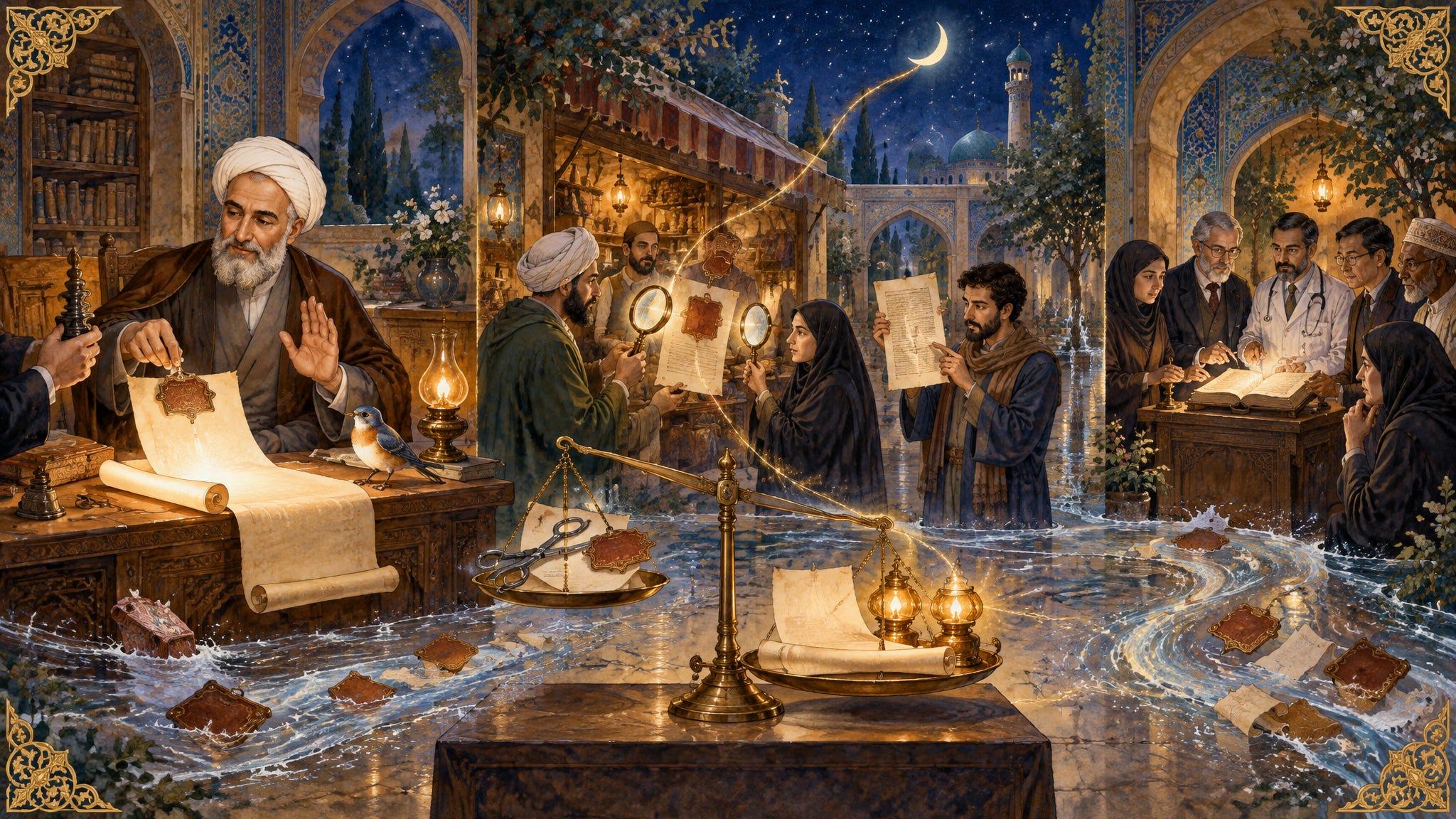
The marja’s word about a kind of thing is not his word about your thing.
If you are the one people come to —
Say what the marja’ said.
And say what he did not.
If a ruling reaches you with a name on top of it, take the name off before you pass it on.
And if someone asks you to put a name on a ruling for them, refuse, kindly and clearly.
And when you write to a marja’ yourself, about anything, write the whole of what was said.
The beginning and the end.
And if you are among the people —
When a ruling arrives with a name on top of it, ask one question.
Did he name it, or did someone put it there?
And if it names a brother’s business as haram, ask that question twice.
And when someone shows you a fatwa about a person, read the question first.
Is this what that person actually said?
All of it?
And was he ever asked?
And never write a question to get the answer you want.
And for anyone here who is not a Muslim: this is the same honesty any profession asks of those who quote its experts.
Quote what they said.
Not what you wish they had said.
That is the sixth lesson.
Never put a name on a ruling he did not name.
And never shape a question to get the answer you want.
The Close — Has God Given You Leave?

We began with a question.
What does it cost to say, “this is God’s ruling”?
Now we can answer it.
Behind those five words stands a lifetime of earning the right to say them.
Eighteen years old, on the road from Dezful.
Thirty-five, unknown, in a corner of a mosque.
Behind them stands a trembling, in the man who has earned that right.
Lessen your precautions, Shaykh.
A walk to the shrine of Imam Ali, to ask not to be wrong.
Behind them stand men who would not take it up until it was laid on them.
I am not fit to be followed. Leave me, and seek someone else.
Sir, there are gentlemen.
Do not read my name.
And then, when it was laid on them, they carried it as a trust.
The keys in a mother’s hand.
A house with no carpets.
Any common man of the market.
That is the cost.
And one more thing must be said, so that nothing tonight is misunderstood.
The knowledge of the Imams is not ijtihad.
Upon us is the casting of the principles, Imam al-Rida said, and upon you the branching out.
Two roles.
The mujtahid labours, for forty years, reading back from what the Imams laid down, because we live in the time of the Imam’s absence.
The Imams did not need to labour in that way.
And in a few minutes, in the maqtal, you will hear of a knowledge that came another way.
A boy at his lesson, who suddenly wept, and said:
the awe of God entered me.
The two are not the same.
And we do not make them the same.
Three Lines
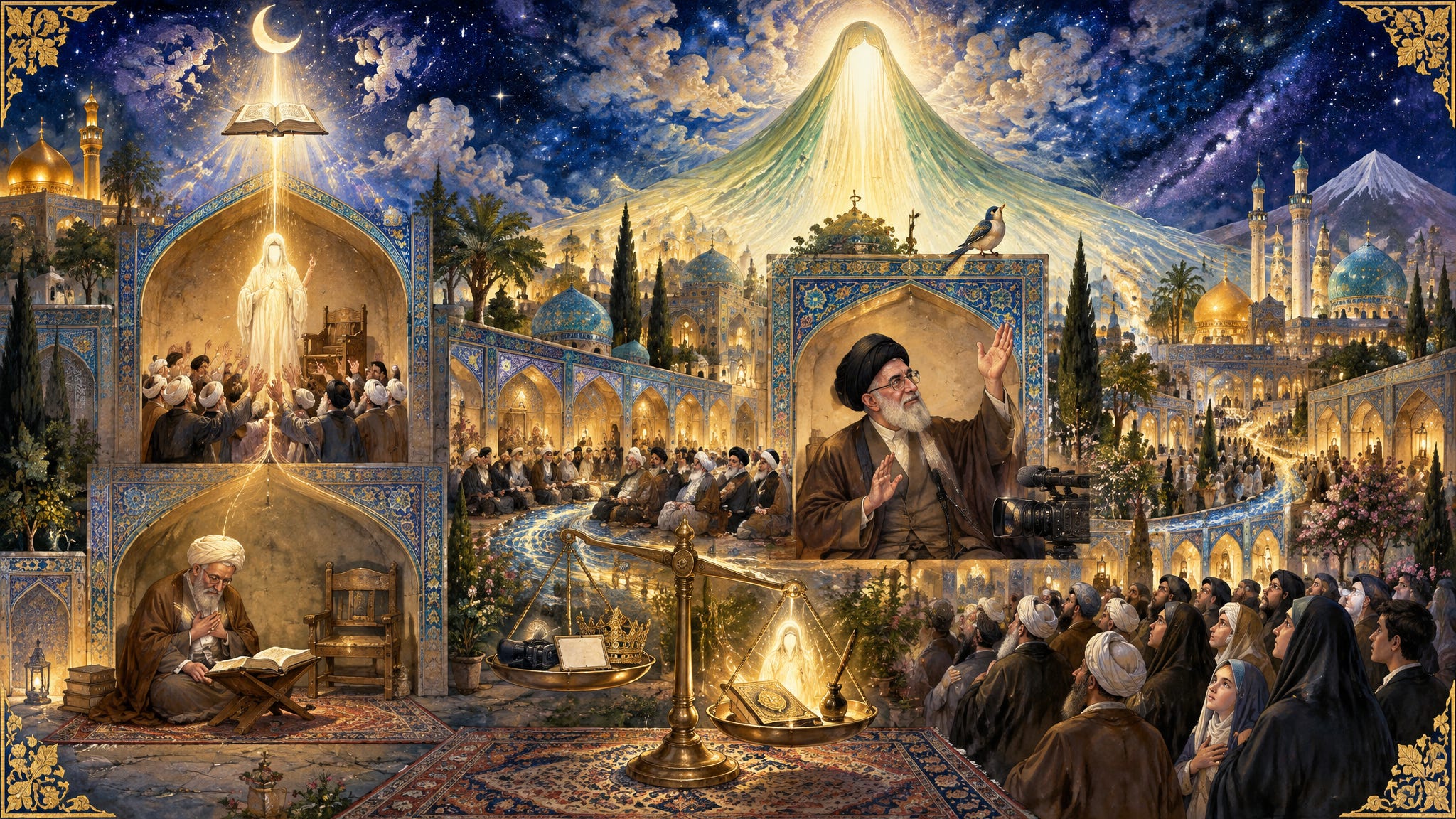
If everything else from tonight goes, keep three lines.
God’s:
Has God given you leave, or do you fabricate against God?
An Imam’s. Imam Ali:
God knows, from above His heaven and His throne, that I was averse to authority over the community of Muhammad, until your view came together on it.
And a scholar’s. Shaykh Murtada al-Ansari:
I am not fit to be followed.
And let the last word of the sermon go back to where we began.
To the man in 1994 who asked the television not to read his name.
Because his speech that day ended like this.
The holy being of the Master of the Age is himself the guardian of the seminaries, the protector of the great scholars, and the guide of the hearts of the maraji’, and of the people.
— Imam Sayyed Ali Khamenei, speech of 23 Azar 1373 (14 December 1994); narrated51
Conclusion — Key Takeaways

Three things to take home.
The first. There is no faqih by tomorrow.

Knowledge of God’s law is earned in years, and recognised wherever it sits, even in a corner.
This week: take one question you were answered by a forward, and find where the answer really came from.
The second. Ask to learn, not to be agreed with.

The true scholars refused the office, and accepted it only when it was laid on them.
Do not shop for the answer you want.
Ask once, honestly.
This week: ask one question once, with every detail that matters, and live with the answer.
And the third. Carry a ruling as carefully as it was made.
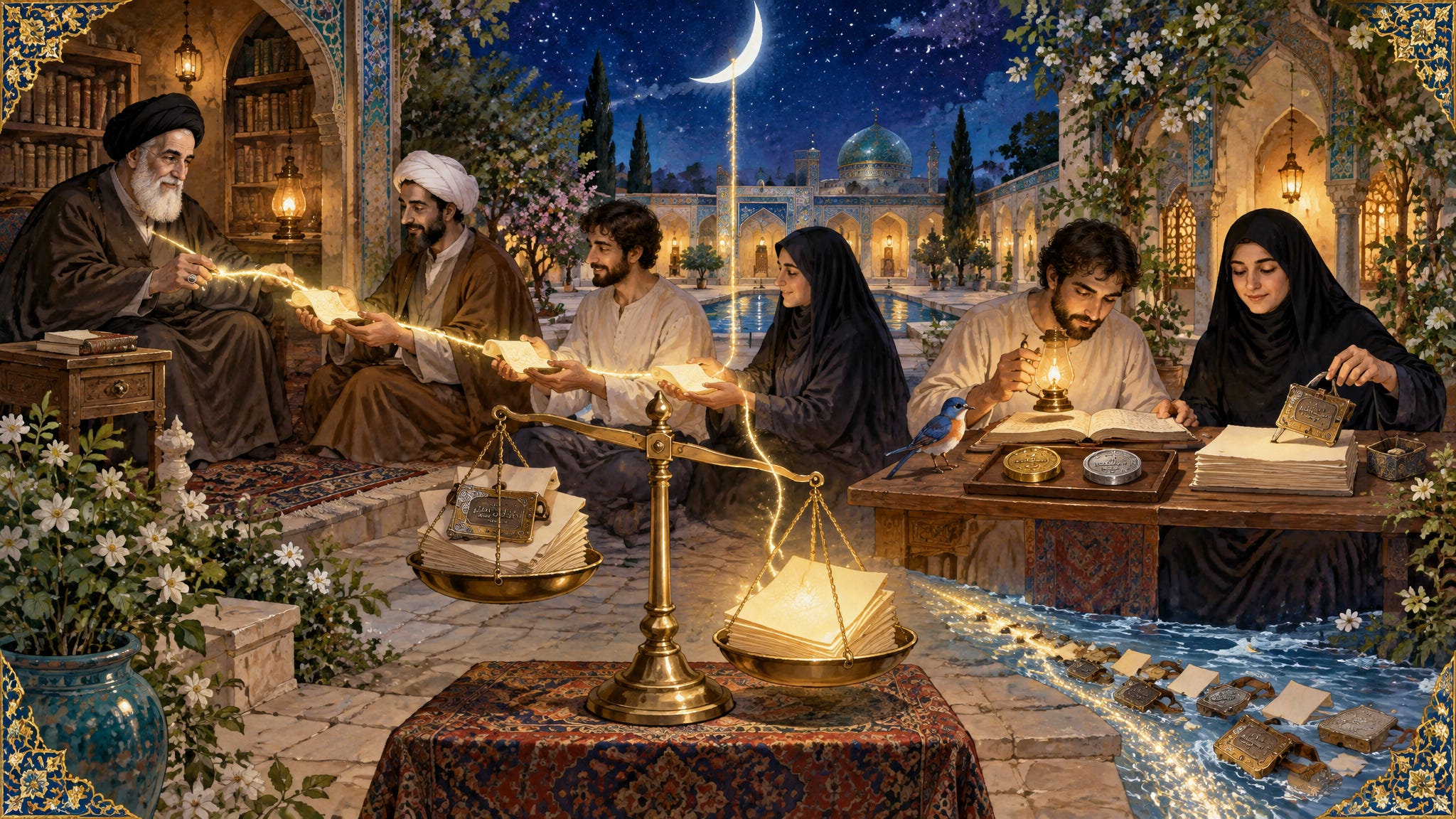
The chain of the trust runs through you.
Say what was said, and what was not.
This week: before you pass a ruling on, check the words.
And never put a name on it that was not there.
The Women Who Carried It

Tonight we sat with the man who earned the right to say this is God’s ruling, and was afraid to say it.
Next week, God willing — the women who carried it.
Eulogy — Shaykh Murtada al-Ansari: The Man Who Asked Not to Be Wrong
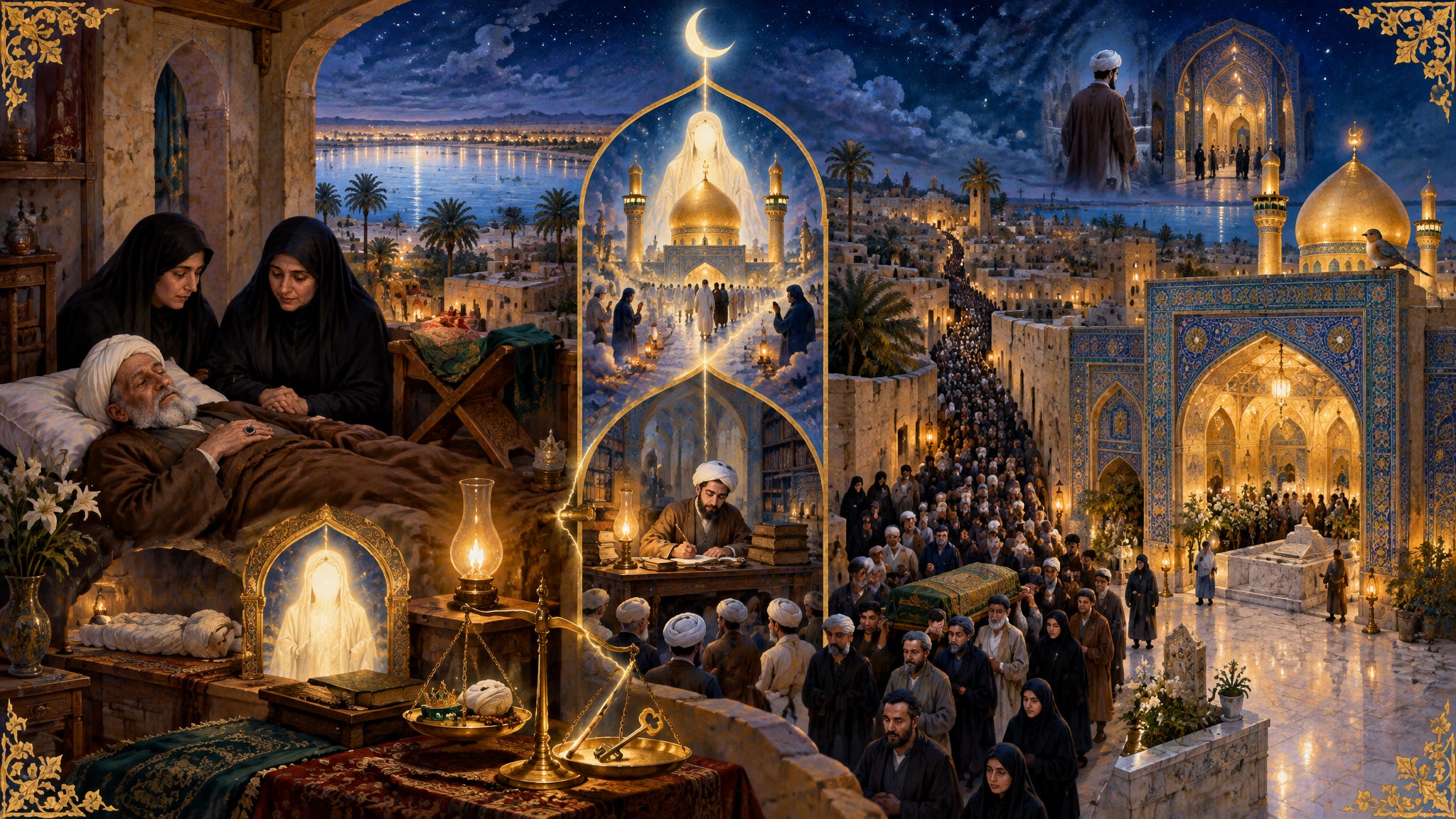
Tonight we remember Shaykh Murtada al-Ansari.
He walked with us all night.
And this weekend is the anniversary of his death.
He died in the year 1281 of the Hijra, about 160 years ago, after an illness.
His biographers say that when he fell ill, the banner of knowledge was folded, and his lessons fell silent.
He lay in his house, in the Huwaysh quarter of Najaf.
And at midnight, on the eve of Saturday, the 18th of Jumada al-Thani, he died.
The eve of the eighteenth falls again this Saturday night.
The news spread through the city.
And the people gathered, of every rank, the scholar and the shopkeeper, the poor and the rich, and grief and weeping ran among them.
— the editor's introduction to Shaykh al-Ansari, al-Fawa'id al-Usuliyya; narrated52
Ayatullah Bahjat, may God rest his pure soul, said that Shaykh al-Ansari joined two things that do not usually go together.
On the one hand, worship.
Every day, the Ziyarat of Ashura, at the head of the shrine of Imam Ali, peace and blessings be upon him.
The night prayer.
The prayer of Ja’far al-Tayyar.
The great Ziyarat al-Jami’a.
A portion of the Qur’an, every day.
And on the other hand, all that study.
All that teaching.
All that writing.
The books every mujtahid alive has passed through.
He joined, Ayatullah Bahjat said, two ordinary contraries.
— Ayatullah Bahjat, Dar Mahzar-e Bahjat, §400; narrated53
And these are said to be his last words.
الموت و الحیاه من عوارض البدن ،و السوء سواد الوجه فی الدارین.
“Death and life are among the accidents of the body. The calamity is a blackened face, in both worlds.”
— Shaykh Murtada al-Ansari, his last words, as Ayatullah Bahjat relates them; my translation54
He was not afraid of dying.
He was afraid of facing God with a blackened face.
They washed his body on the shore of what was called the Sea of Najaf: a great lake to the west of the city in those days, long since dried up.
And the crowd that followed his body stretched without a break, from the walls of Najaf to the shore of that sea.
He had no notable family in the town, the account says.
Nobody of influence to bring the crowds.
Only his piety, and his knowledge.
He left two daughters.
And no son.
— the editor's introduction to Shaykh al-Ansari, al-Fawa'id al-Usuliyya, record 26; narrated55
And they buried him on the Saturday.
In the courtyard of the shrine of Imam Ali.
On the left, as you enter by the Qibla gate — the gate they call the Gate of the Little Market.
The man who said that returning trusts is the business of any common man of the market lies by the gate of the market still.
Remember the first thing he did, when the leadership of the Shi’a world was laid on him?
He went to the shrine of Imam Ali, to ask not to be wrong.
And he lies there still.
In its courtyard.
By the Qibla gate.
May God raise him with Muhammad and the family of Muhammad.
Segue to Maqtal

Do you remember the day that speech was given, in 1994, when a man asked not to have his name read out?
It was a birthday.
The birthday of a boy who was tested before he was ten years old.
A boy who sat on a cushioned seat, while the judge of the age sat before him and asked him a question.
A boy of whom a caliph said:
the knowledge of this House is from God.
All night we have watched scholars labour for forty years for their knowledge, and tremble at the thought of being wrong.
His knowledge came another way.
And he was taken before he was twenty-six.
Our maqtal tonight is given in the voice of the one who carries every one of their griefs: the Imam of our Age, may our souls be his ransom, and may God hasten his return.
Maqtal (Lamentation) for the Twenty-Fourth Part of the Architecture of Guidance
Supplication
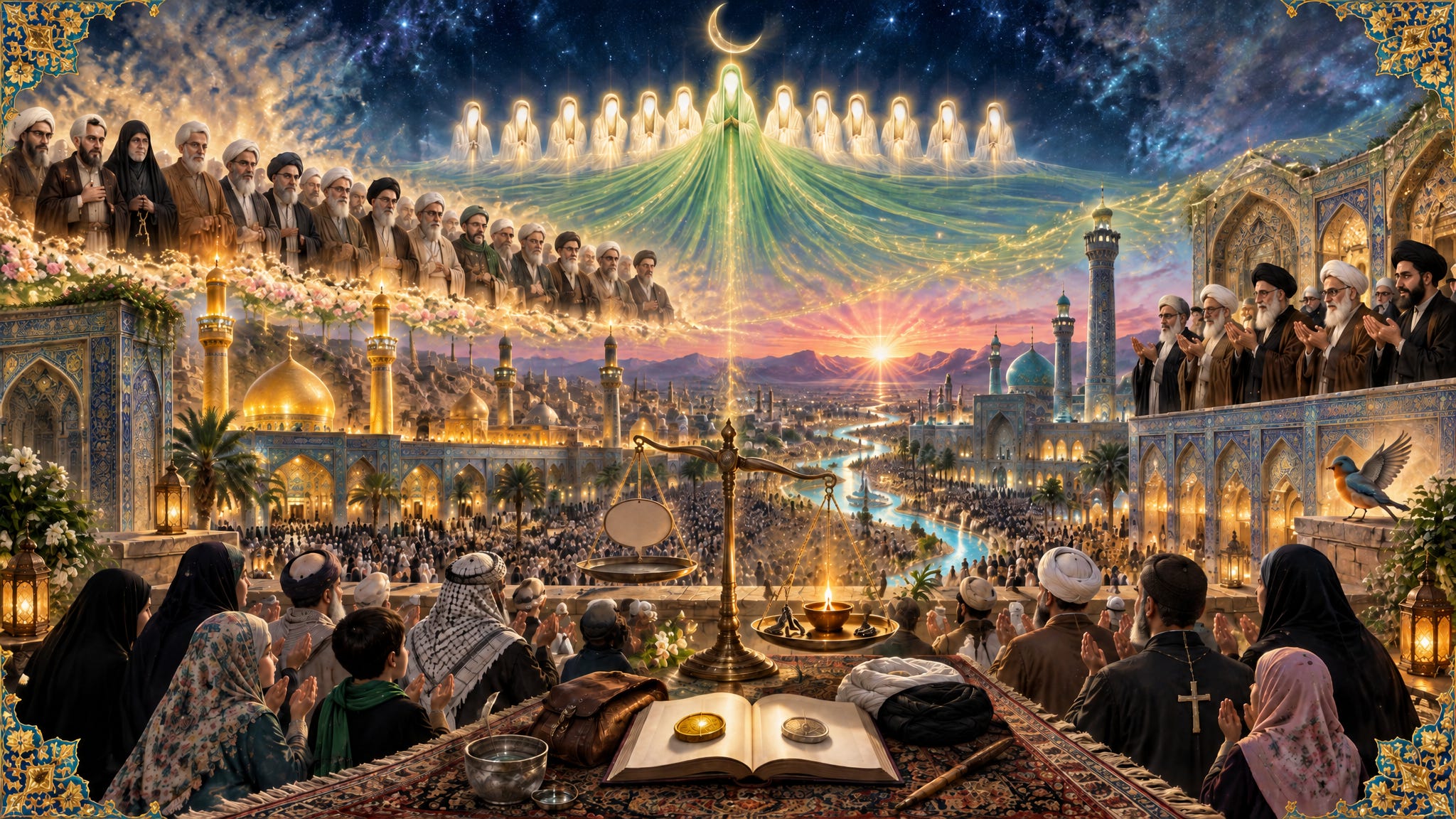
In Your Name, the Lord of the Truthful and the Martyrs, the Scholars and the Righteous
O God, we ask You by the leave that You alone can give, and by those who would not speak in Your name until they could show it.
By Your prophets, peace and blessings be upon them all, who carried Your message and never bent it to the desires of those they were sent to.
By Muhammad, peace and blessings be upon him, his family, and his righteous companions, who said that whoever takes charge of this affair after him will be stood at the edge of the Sirat.
By the fourteen — by Sayyedah Fatimah al-Zahra, peace and blessings be upon her, in this month of her martyrdom and her birth;
by Imam Ali, peace and blessings be upon him, who swore that he was averse to authority until their view came together on it, and who said: leave me, and seek someone else;
by Imam ‘Ali al-Rida, peace and blessings be upon him, who said: upon us the casting of the principles, and upon you the branching out;
by Imam Muhammad al-Jawad, peace and blessings be upon him, on whose birthday a man asked not to be named, and of whom it was said: the knowledge of this House is from God;
by Imam ‘Ali al-Hadi, peace and blessings be upon him, the boy at his lesson into whom the awe of God entered;
and by every Imam to the one we are waiting for.
O God, keep us from saying of anything, this is from God, without Your leave.
Make us ask to learn, and not to be agreed with.
Make us carry Your law as carefully as it was made, and never put a name on it that was not there.
And when a burden is laid on us that no one else will carry, do not let us leave it on the ground.
O God, have mercy on the martyrs we remembered tonight: on Malik al-Ashtar, to whom the letter was written; and on Shaheed Murtada Mutahhari, who told us of the shaykh in the corner.
O God, have mercy on Shaykh Murtada al-Ansari, who asked not to be wrong; on his mother, who gave back the keys,
and on his brother, Shaykh Mansur;
on Sahib al-Jawahir, Shaykh Muhammad Hasan al-Najafi;
on Sa’id al-Ulama,
and on Sharif al-Ulama;
on Mulla Ahmad al-Naraqi;
on Sayyed Husayn Kuh-Kamari, who stood up and walked his students to the corner;
on Shaykh al-Mufid, al-Sharif al-Radi, Ibn Maytham al-Bahrani and Shaykh ‘Abbas al-Qummi;
on Shaykh al-Kulayni, al-Muhaqqiq al-Hilli and Ibn Idris al-Hilli;
on Allamah Tabataba’i;
on Ayatullah Borujerdi and Ayatullah Araki;
on Ayatullah al-Khu’i, and his student, Ayatullah Sayyed Muhammad Husayn Fadhlullah, who asked only that they write to him and ask;
on Ayatullah Bahjat;
on Sayyed ‘Abbas ‘Ali al-Musawi, who read the portrait of the judge one quality at a time;
and on Ayatullah Wahid Khorasani, who returned to You in the last weeks.
And lengthen the lives of those who still carry it among us:
Ayatullah al-Sistani, Ayatullah Shaykh Mohsen Araki, Ayatullah Jawadi Amoli and all of the righteous scholars and teachers from the hawzas of Qom and Najaf.
O God, bless the families of all who sat in this majlis tonight, and the martyrs, and the truthful; and bless our neighbours, of every faith.
O God, have mercy on Imam Khomeini.
O God, we remember before You the martyred Leader, Imam Sayyed Ali Khamenei, from whose lectures on patience this circle of ours first began.
Accept him, and gather him with those he loved.
O God, protect and guide and lengthen the life of our Wali al-Faqih, Imam Sayyed Mujtaba Khamenei, and keep him firm on the straight path until the rising of the one we are waiting for.
O God, hasten the relief of Your friend and the son of Your friend — the Imam of our Age, may our souls be his ransom and may You hasten his return — the guardian of the seminaries, the protector of the scholars, and the guide of their hearts.
Make us among those who carry his trust as carefully as it was made.
And make us among those who wait for him actively — who prepare, and do not only wait.
O God, give us success in whatever we do for Your sake.
And give us a good ending, like the scholars we remembered tonight, who feared nothing so much as a blackened face before You.
And whatever we have said tonight that was true, it is from You; and whatever was wrong in it is from me, and I ask Your forgiveness for it.
Amen, O Lord Sustainer of the Universes
Amen, O Most Merciful of the Merciful
And from Him alone is all ability and He has authority over all things.
Sayyed ‘Abbas ‘Ali al-Musawi on the qualities of the judge.
فأول هذه الصفات أن يكون أفضل الرعية عند الحاكم وهذه الأفضلية يمكن إدراكها بعدة أمور .
الأول : أن يكون القاضي ممن لا تضيق به الأمور يعني أنه يستطيع أن يجد لكل مشكلة حلاً فلا تذتبس عليه الأمور ولا تنسد في وجهه المخارج التشريعية لهذه الخصومة وهذا يتوقف على أن يكون مجتهداً مطلقاً ملماً بجميع أبواب الشريعة ومتفرقاتها، يستطيع أن يقضي في كل مسألة تعترض سبيله وتحتاج إلى حل فلا يقف مكتوف الأيدي أمام ما يعرض عليه من المشاكل والأحداث . . .
الثاني : أن يكون القاضي ممن لا تمحكه الخصوم بحيث لا تجعله منازعة الخصوم لجوجاً يريد أن يقضي في الأمر مسرعاً فإن اللجاجة تفسد الحكم لأنها قد تحمل في طياتها عدم استيعاب جوانب القضية بأجمعها . . .
الثالث : أن لا يتمادي في الذلة بحيث لو أخطأ في حكمه واتضحت لديه علامات أخطائه لا يبقى مستمراً في الانحراف والمعصية بل يرجع إلى الحق ويفيء إلى العدل .
الرابع : لا تشرف نفسه للطمع فإن من طمع بما في أيدي الناس ذل لهم وجار في حكمه لصالح من طمع عنده .
الخامس : أن لا يكتفي بأدنى فهم للقضية دون أقصاه بل يجب أن يستوعب القضية من خيوطها الأولى ويقف على جميع جوانب المسألة وما له علاقة بها فإن هذا الاستيعاب للأمور يكشف عن أمور مهمة لها علاقتها في المشكلة وحلها، وفي هذا الاستيعاب والتقصي لهذه الأمور يحصل غالباً على الحل الحاسم والعادل في القضية . . .
السادس : أن يكون القاضي أوقفهم في الشبهات بحيث لو لم تتضح معالم المسألة وبقي الأمر مشتبهاً لا يقدم على البت والفصل فيها لأن ذلك حرام لا يجوز فإن الوقوف عند الشبهات خير من الاقتحام في الهلكات . . .
السابع : أن لا يترك القاضي الأخذ بالحجج إذا كانت شرعية يمضيها الدين فإن رسول الله (ص) قال : إنما أقضي بينكم بالإيمان والبينات وهذا هو الأقرب في الوصول إلى الحقيقة .
الثامن : أن لا يتبرم القاضي ويضجر بمراجعة الخصم له، فإن طبيعة المتخاصمين أن يثبت كل منهما حقه بما يقدر عليه وقد يستدعي هذا منهما مراجعته أكثر من مرة . . .
The first of these qualities is that he be the best of the subjects in the ruler’s eyes, and that superiority is recognised by several things.
First: that the judge be one whom matters do not overwhelm. That is, he can find a solution for every problem; matters do not become confused for him, and the legal ways out of the dispute are not closed in his face. This depends on his being an absolute mujtahid (mujtahid mutlaq), versed in every chapter of the law and its scattered parts, able to rule on every issue that crosses his path and needs a solution, so that he does not stand with his hands tied before the problems and events brought to him.
Second: that disputants do not make him obstinate, so that their wrangling does not make him stubborn and wanting to decide the matter in haste; for obstinacy spoils judgement, since it may carry within it a failure to take in every side of the case.
Third: that he does not persist in a slip, so that if he errs in his judgement and the signs of his errors become clear to him, he does not carry on in deviation and disobedience but returns to the truth and comes back to justice.
Fourth: his soul does not look out toward greed; for whoever covets what is in people’s hands is humbled before them and is unjust in his judgement in favour of the one he covets.
Fifth: that he is not content with the nearest understanding of the case short of the furthest. He must take in the case from its first threads and stand on every side of the question and whatever bears on it. Taking things in like this uncovers important matters connected to the problem and its solution, and by this taking-in and following-through he mostly reaches the decisive and just solution.
Sixth: that the judge be the most cautious of them in doubtful matters, so that if the features of the question have not come clear and the matter stays doubtful, he does not go ahead to decide and settle it, because that is forbidden and not allowed; for stopping at doubts is better than plunging into destruction.
Seventh: that the judge does not abandon proofs when they are lawful ones the religion upholds; for the Messenger of God (peace be upon him and his family) said: ‘I judge between you only by oaths and evidence.’ This is the nearest way to reach the truth.
Eighth: that the judge does not grow weary and irritated at a disputant coming back to him; for it is the nature of disputants that each establishes his right as best he can, and that may require them to come back to him more than once.
— Sayyed ‘Abbas ‘Ali al-Musawi, Sharh Nahj al-Balagha, volume 5, on Letter 53; my translation
al-Mizan on 10:59.
و من هنا ينحل ما تقدم من العقدتين فإن الحكم لما كان لله سبحانه وحده كان كل حكم دائر بين الناس إما حكما لله حقيقة مأخوذا من لدنه بوحي أو رسالة أو حكما مفترى على الله، و لا ثالث للقسمين.
“From here both knots are untied. Since judgment belongs to God alone, every ruling current among people is either truly God’s ruling, taken from Him by revelation or a message, or a ruling fabricated against God; there is no third.”
— Allamah Sayyed Muhammad Husayn Tabataba’i, al-Mizan fi Tafsir al-Qur’an, on Surah Yunus 10:59; my translation
al-Mizan on why the verse names the forbidden first.
و اللام في قوله:«لكم»للغاية و تفيد معنى النفع أي أنزل الله لأجلكم و لتنتفعوا به، و ليست للتعدية فإن الإنزال إنما يتعدى بعلى أو إلى، و من هنا أفاد الكلام معنى الإباحة و الحل أي أنزلها الله فأحلها، و هذا هو النكتة في تقديم التحريم على الإحلال في قوله:«فجعلتم منه حراما و حلالا»أي كان الله أحله لكم بإنزاله رزقا لكم تنتفعون به في حياتكم و بقائكم و لكنكم قسمتموه قسمين من عند أنفسكم فحرمتم قسما و أحللتم آخر فالمعنى: قل لهم يا محمد: أخبروني عما أنزل الله لكم و لأجلكم من الرزق الحلال فقسمتموه قسمين و جعلتم بعضه حراما و بعضه حلالا ما هو السبب في ذلك؟ و من البين أنه افتراء على الله لا عن إذن منه تعالى.
و قوله:«قل آلله أذن لكم أم على الله تفترون»سؤال عن سبب تقسيمهم الرزق إلى حرام و حلال، و إذ كان من البين أنه ليس ذلك عن إذن منه تعالى لعدم اتصالهم بربهم بوحي أو رسول كان من المتعين أنه افتراء فالاستفهام في سياق الترديد كناية عن إثبات الافتراء لهم و توبيخ و ذم.
“The lam in ‘for you’ marks purpose and benefit: God sent it down for your sake, so that you might benefit from it… So the words carry the sense of permission: God sent it down and so made it lawful. That is why ‘forbidden’ comes before ‘lawful’ in ‘and you made some of it forbidden and some lawful’. God had made it lawful for you by sending it down as provision… but you divided it in two on your own account, forbade one part and permitted the other. So the meaning is: say to them, O Muhammad, tell me about the lawful provision God sent down for you and for your sake, which you divided into two, making some forbidden and some lawful: what is the reason for that? And it is plain that it is a fabrication against God, not by any leave from Him. And His words ‘Say: has God given you leave, or do you fabricate against God?’ ask the reason for their dividing the provision into forbidden and lawful. Since it is plain that it was not by God’s leave, for they had no link with their Lord through revelation or a messenger, it is settled that it is fabrication. So the question, put as an either/or, is a way of affirming the fabrication against them, with rebuke and blame.”
— Allamah Sayyed Muhammad Husayn Tabataba’i, al-Mizan fi Tafsir al-Qur’an, on Surah Yunus 10:59; my translation
Tasnim on 10:59.
در اين كريمه كه فرمود: ﴿أتخذتم عند الله عهداً﴾، ﴿أم تقولون على الله ما لا تعلمون﴾ يك منفصله حقيقهاي است در همين محدودهٴ خاص، چه اينكه مشابه اين در موارد ديگري كه خداي سبحان ميفرمايد كه آيا شما إذن گرفتهايد خدا اذن داد يا داريد افترا ميبنديد؟ ﴿ءَالله أذن لكم أم على الله تفترون﴾[22] اين در سورهٴ مباركهٴ يونس هست آيهٴ 59 اين است كه ﴿قل ءَالله أذن لكم أم على الله تفترون﴾[23]؛ يعني چيزي كه به خدا استناد دارد يا بايد به وحي مربوط باشد يا افترا است، از اين دو حال بيرون نيست. خدا كه إذن نداد شما چيزي را حلال و چيزي را حرام كنيد ﴿فَجَعَلْتُمْ مِنْهُ حَرَاماً وَحَلاَلاً﴾[24]
در همين آيهٴ سورهٴ يونس فرمود: ﴿قل أرأيتم ما أنزل الله لكم من رزق فجعلتم منه حراماً و حلالاً﴾[25]؛ اين تحريم و تحليلتان يعني داريد به خدا استناد ميدهيد، اين استناد يا بايد با اذن باشد يا بي اذن، اگر بي اذن شد ميشود افترا و تشريع و با اذن شد سند ميخواهد سندتان را ارائه بدهيد. ﴿قل ءالله أذن لكم أم على الله تفترون﴾[26] اين بيش از دو حال ندارد در اينجا ميشود منفصلهٴ حقيقيه يعني در اين محدوده بيش از يك مقدم و يك تالي ندارد، در اينجا هم فرمود: ﴿أتخذتم عند الله عهداً﴾ ﴿أم تقلون على الله ما لا تعلمون﴾ يعني يا بايد دليل ارائه بدهيد يا اينكه افترا است و خداي سبحان هم از افترا نميگذرد.
“In this verse, where He says ‘Have you taken a covenant with God… or do you say about God what you do not know?’, there is a true either/or within this particular scope, just like other places where God says: did you get leave, did God give leave, or are you fabricating? ‘Has God given you leave, or do you fabricate against God?’ This is in Surah Yunus, verse 59. That is: whatever is attributed to God must either be tied to revelation or be fabrication; there is no way out of these two. God gave you no leave to make one thing lawful and another forbidden. In the same verse of Surah Yunus He said: ‘Have you considered what God has sent down for you of provision, and you made some of it forbidden and some lawful?’ This forbidding and permitting of yours means you are attributing it to God. That attribution is either with leave or without it. If it is without leave, it becomes fabrication and law-making without leave; if it is with leave, it needs a proof: produce your proof. ‘Has God given you leave, or do you fabricate against God?’ There are no more than two cases… Either you produce a proof, or it is fabrication; and God does not pass over fabrication.”
— Ayatullah ‘Abd Allah Jawadi Amoli, Tasnim, on Surah al-Baqarah 2:80, where he reads it with Surah Yunus 10:59 (lesson 165, 23 February 1986); my translation
The speech of 14 December 1994.
خیلی خوشوقتم از اجتماع شما برادران و خواهران عزیز که در روز ولادت باسعادت حضرت جوادالائمّه (علیه الصّلاة و السّلام) از راههای دور در اینجا گرد آمدهاید؛ و متشکّرم از اینکه مردم عزیزی از شهرستانهای دیگر در جمع شما هستند، مخصوصاً جمع زیادی از مردم عزیز قزوین در اینجا تشریف دارند. امیدواریم که خداوند همهی شما را مشمول رحمت و برکت خود قرار بدهد.
عزیزان من! من اگر واجب عینی باشد، از زیر هیچ باری دوش خودم را خالی نمیکنم. در این قضیّهی مرجعیّت، موضوع اینجوری نیست؛ بار بر زمین نمیمانَد، این قضیّه متوقّف به فرد نیست. بله، آقایان فهرست دادند، اسم این حقیر را هم در آن فهرست آوردند امّا اگر از من سؤال میکردند، من میگفتم نکنید این کار را؛ بدون اطّلاع من این کار را کردند. من بعد از آنکه اعلامیّهشان صادر شده بود خبر شدم، وَالّا نمیگذاشتم. حتّی من به تلویزیون اطّلاع دادم، گفتم اگر آقایان ناراضی نمیشوند، اعلامیّهی آنها را که میخوانید، اسم من را نخوانید؛ گفتند نمیشود، تحریف اعلامیّه است؛ آقایان نشستهاند چند ساعت جلسه کردهاند، نمیشود؛ لذا بود که [اطّلاعیّه را] دادند. من حالا به شما عرض میکنم ملّت عزیز، عزیزان من! آقایان محترم و بزرگانی که از گوشه و کنار گاهی به بنده پیغام میدهند رساله [بدهید]، بار فعلی من خیلی سنگین است؛ بار رهبری نظام جمهوری اسلامی و مسئولیّتهای عظیم دنیایی، مثل بار چند مرجعیّت است؛ این را شما بدانید. چند مرجعیّت را اگر روی همدیگر بگذارند، بارَش ممکن است به این سنگینی بشود؛ ممکن است؛ گمان هم نمیکنم [بشود]. الان ضرورتی نیست. بله، اگر العیاذبالله وضع به جایی میرسید که من میدیدم چارهای نیست، میگفتم عیبی ندارد، شانهی من با همهی ضعف و فقری که دارم، به فضل پروردگار، آنجایی که ناچار باشم، یعنی ضروری باشد، ده تا بارِ اینجوری را هم حرفی نداشتم که روی دوش خودم بگذارم امّا الان آنجوری نیست، الان نیازی نیست؛ اینهمه مجتهدین هستند بحمدالله. حالا من قم را اسم آوردم، غیر قم هم هستند، مجتهدینی هستند، افراد شایستهای هستند؛ چه لزومی دارد که حالا این بار سنگین [رهبری] را که خدای متعال گذاشته است بر دوش نحیف این حقیر ضعیف، این بار را هم بگذارند رویش؟ احتیاجی به این معنا نیست. پس این کسانی که اصرار میکنند رساله بدهید، توجّه بکنند، برای خاطر این است که من استنکاف(۸) میکنم از قبول بار مسئولیّت مرجعیّت، چون بحمدالله آقایان هستند و نیازی به این معنا نیست.
“I am very glad at the gathering of you, dear brothers and sisters, who on the blessed birthday of Imam al-Jawad, the Jawad of the Imams, have come here from far away…”
“My dear ones! If it is an individual obligation, I will not pull my shoulder out from under any burden. In this matter of marja’iyya the case is not like that: the burden will not be left on the ground; it does not depend on one person. Yes, the gentlemen gave a list and put this humble one’s name in it, but had they asked me I would have said, do not do it… I even told the television: if the gentlemen will not mind, when you read their statement, do not read my name… To the respected gentlemen and elders who send me messages from here and there, ‘[give] a risala’: my present burden is very heavy… If, God forbid, things came to a point where I saw there was no other way… where it is necessary, I would not mind putting ten such burdens on my shoulder; but now it is not like that, there is no need; so many mujtahids are here, praise God… So those who insist ‘give a risala’ should note: this is why I decline to take up the burden of the responsibility of marja’iyya.”
— Imam Sayyed Ali Khamenei, speech of 23 Azar 1373 (14 December 1994), on the birthday of Imam al-Jawad; my translation
The anecdote, as the martyred Leader told it.
معروف است یک نفری زمان شیخ انصاری پسرش را آورده بود نجف. دید طلبهها درس میخوانند و ملا میشوند و شیخ انصاری هم خوب، شخص بزرگی بود؛ هوس کرد پسرش را طلبه کند. آمد به پیش شیخ انصاری، گفت شیخنا! این نوجوان را من آوردهام و خواهش میکنم تا فردا که میخواهیم راه بیفتیم برویم، شما او را فقیه کنید!
“It is well known that in Shaykh al-Ansari’s time a man had brought his son to Najaf. He saw the students studying and becoming scholars, and Shaykh al-Ansari, well, was a great man; he took a fancy to making his son a student. He came to Shaykh al-Ansari and said: ‘Our Shaykh! I have brought this youth, and I ask that by tomorrow, when we want to set off, you make him a faqih!’”
— Imam Sayyed Ali Khamenei, speech to university students and scientific elites, 4 Shahrivar 1388 (26 August 2009); my translation
Ibn Idris al-Hilli, Kitab al-Sara'ir, vol. 3, the Mustatrafat, record 575, line 8, carried without its chain. The line before it (line 7) gives the same teaching from Imam Ja'far al-Sadiq, peace and blessings be upon him, through Hisham ibn Salim: "Upon us is to cast the principles to you, and upon you to branch out."
The commentator on the report.
وعنه عن «كتاب أحمد بن محمّد بن أبي نصر» [1] عن الرضا عليه السلام قال:
(علينا إلقاء الاصول، وعليكم التفريع) [2].
ولا ريب في أنّ التفريع على الاصول هو الاجتهاد، وليس الاجتهاد في عصرنا إلّاذلك، فمثل قوله:
(لا ينقض اليقين بالشكّ) [3]
أصل، والأحكام التي يستنبطها المجتهدون منه هي التفريعات، وليس التفريع هو الحكم بالأشباه والنظائر كالقياس، بل هو استنباط المصاديق والمتفرّعات من الكبريات الكلّية.
فقوله:
(على اليد ما أخذت حتّى تؤدّي) [4]
، و
(لا ضرر
“And from him, from the Book of Ahmad ibn Muhammad ibn Abi Nasr, from al-Rida, peace be upon him, who said: ‘Upon us is the casting of the principles, and upon you the branching out.’ There is no doubt that branching out from the principles is ijtihad; and ijtihad in our age is nothing but that. So the like of his saying, ‘Certainty is not broken by doubt’, is a principle, and the rulings the mujtahids derive from it are the branchings. Branching out is not judging by resemblances and likenesses, as in analogy; it is deriving the instances and sub-cases from the universal major premises. So his saying, ‘The hand is liable for what it took until it returns it’, and ‘No harm…’”
— Imam Khomeini, al-Ijtihad wa’l-Taqlid, vol. 1, p. 71; my translation
The dictionary, and the history of the word.
والاجتهاد والتجاهد: بذل الوسع والمجهود.
“Ijtihad and tajahud: spending one’s reach and one’s utmost effort.”
جهد: الجَهْدُ والْجُهْدُ: الطاقة، تقول: اجْهَدْ جَهْدَكَ؛ وقيل: الجَهْدُ المشقة والْجُهْدُ الطاقة.
“Jahd and juhd: capacity; you say, ‘exert your utmost’. And it is said: jahd is hardship, and juhd is capacity.”
وهو بالفتح، المشقة، وقيل: المبالغة والغاية، وبالضم، الوسع والطاقة
“With fatha [jahd] it is hardship; and it is said, going to the utmost and the furthest limit; and with damma [juhd], reach and capacity.” (Ibn al-Athir, as Ibn Manzur quotes him)
— Ibn Manzur, Lisan al-’Arab, vol. 2, printed pp. 397 and 395; my translation
The same entry glosses the report of Mu'adh, I will strive with my own judgement, as referring a case to the Book and the Sunna by way of analogy.
That was the sense of the word in the schools of opinion, and it is why the word once carried a shadow among the followers of the Imams. Al-Muhaqqiq al-Hilli meets this head on.
If ijtihad is the effort to draw out the rulings of the law, he says, then the Imamiyya are indeed people of ijtihad; but since analogy has been counted among its kinds, the word can mislead.
So he says it plainly: with analogy excluded, we are people of ijtihad, by the ways of reasoning of which analogy is not one
— al-Muhaqqiq al-Hilli, Ma'arij al-Usul, records 179–180
Ayatullah al-Sistani on the experts’ measure.
وعن الشرق كله؟ فهل من حل يسهل علينا الأمر فنعرف بواسطته من نقلد؟
أهل الخبرة بالأعلمية : هم المجتهدون ومن يدانيهم في العلم ، المطلعون على مستويات من هم في أطراف شبهة الأعلمية في أهم ما يلاحظ فيها ، وهي أمور ثلاثة : الأول : العلم بطرق إثبات صدور الرواية ، والدخيل فيه : علم الرجال وعلم الحديث بما له من الشؤون كمعرفة الكتب ، ومعرفة الرواية المدسوسة بالاطلاع على دواعي الوضع ، ومعرفة النسخ المختلفة ، وتمييز الأصح عن غيره ، والخلط الواقع أحياناً بين متن الحديث وكلام المصنفين ونحو ذلك .
الثاني : فهم المراد من النص بتشخيص القوانين العامة للمحاورة ، وخصوص طريقة الأئمة عليهم السلام في بيان الأحكام ، ولعلم الأصول والعلوم الأدبية والإطلاع على أقوال من عاصرهم من فقهاء العامة دخالة تامة في ذلك .
الثالث : استقامة النظر في مرحلة تفريع الفروع على الأصول . وطريق الإطلاع على مستويات من هم في أطراف شبهة الأعلمية هو المذاكرة معهم أو الرجوع إلى مؤلفاتهم أو تقريرات محاضراتهم الفقهية والأصولية .
“…and from the whole of the East? Is there a solution that makes it easy for us to know whom to follow? The experts on who is most learned are the mujtahids and those close to them in learning, who know the levels of those among whom the question turns, in the most important things looked for, which are three. First: knowledge of the ways of establishing that a report was really said. This includes the science of narrators and the science of hadith in all its aspects: knowing the books; knowing planted reports by knowing why reports were forged; knowing the different manuscripts and telling the soundest from the rest; and the mixing that sometimes happens between the text of a hadith and the words of the compilers; and the like. Second: understanding what a text means, by identifying the general rules of speech, and especially the Imams’ way of stating rulings. The principles of jurisprudence, the literary sciences, and knowing the views of the Sunni jurists of the Imams’ own time all play a full part in this. Third: soundness of reasoning at the stage of drawing the branches from the roots. The way to learn the levels of those in question is to discuss with them, or to turn to their writings or to the reports of their lectures in fiqh and usul.”
— Ayatullah Sayyed ‘Ali al-Husayni al-Sistani, al-Fiqh li-l-Mughtaribin, p. 78; my translation
At eighteen, in Karbala.
فى سنة 1232 ه قد بلغ الشيخ الاعظم ثمانية عشر سنة ثم عزم مع والده على زيارة الائمة عليهمالسلام فى العراق حتى وصلا كربلا وكانت الرئاسة العلمية فيها للعلمين : السيد محمد المجاهد صاحب المناهل (المتوفى سنة 1242 ه) وشريف العلماء المازندرانى (المتوفى سنة 1246 ه) فورد مع والده مجلس درس السيد وكان حافلا بالافاضل وجلس والد الشيخ الاعظم قريبا من السيد وهو آخر مجلس بمقتضى سنه وادبه ورحّب السيد المجاهد بوالده ، كان بحثه فى جوانب حرمة صلاة الجمعة ووجوبها فى عصر الغيبة ، ثم ان الوجوب عينى او تخييرى ، فجرى الكلام وطال البحث والمناقشة وقال السيد بالحرمة فاخذ الشيخ الاعظم الشاب يبحث فى الموضوع واقام ادلة على القضية واعجب الحاضرين فمال السيد المجاهد الى الوجوب ، ثم شرع الشيخ الاعظم فى نقد الادلة المذكورة واقام ادلة اخرى على حرمة صلاة الجمعة فاز فازداد تعجب السيد المجاهد والحاضرين من كثرة علم الشيخ الاعظم وتدقيقه.
“In the year 1232 AH the Greatest Shaykh had reached eighteen years of age. Then he set out with his father to visit the Imams (peace be upon them) in Iraq, until they reached Karbala, where the scholarly leadership belonged to two eminent men: Sayyid Muhammad al-Mujahid, author of al-Manahil (d. 1242 AH), and Sharif al-Ulama al-Mazandarani (d. 1246 AH). He came with his father to the Sayyid’s lesson, which was crowded with scholars… the Sayyid’s discussion was on whether the Friday prayer is forbidden or obligatory in the age of the Occultation… The young Shaykh began to argue the point and set out proofs, and the gathering was amazed, so that Sayyid al-Mujahid inclined to obligation; then the Shaykh began to criticise those proofs and set out other proofs for its being forbidden, and the astonishment of Sayyid al-Mujahid and those present at the Shaykh’s learning and precision only grew.”
— the editor’s introduction to Shaykh al-Ansari, al-Fawa’id al-Usuliyya, record 18; my translation
Kashan, and al-Naraqi’s word.
استاذا لنفسه لا علميته وللاستفادة من علومه الجمّة وبقى فى مدينة كاشان اربعة اعوام مستفيدا منه ، كذا عرف المولى النراقى مقام علمية الشيخ الاعظم ومرتبته فى العلوم وتحقيق المسائل وغور فهمه وقوته فى اقامة الحجة والبرهان عليها وقال ـ ره ـ فى حقه : «لقيت فى اسفارى الى الاقطار ـ خصوصا فى سفرى الى مجاهدة بنى الاصفر ـ خمسين عالما ومجتهدا لم يكن احدهم مثل الشيخ المرتضى» (1). بعد تكميل دراسته العليا والعروج الى ذروة العلم والاجتهاد اراد مغادرة كاشان واستجاز من استاذه فاجازه المولى النراقى فى الرواية والاجتهاد كما نقل نصّها فى كتب التراجم ، فبلغ الشيخ الاعظم مرتبة الاجتهاد.
“…as a teacher for himself, not for his own learning, and to benefit from his abundant knowledge. He stayed in the city of Kashan four years, benefiting from him. So Mulla al-Naraqi came to know the Greatest Shaykh’s standing in learning, his rank in the sciences, his precision in the questions, the depth of his understanding and his strength in establishing proof and demonstration; and he said of him: ‘In my travels to the regions, especially on my journey to the jihad against the Russians, I met fifty scholars and mujtahids, and not one of them was like Shaykh Murtada.’ After completing his higher studies and rising to the summit of knowledge and ijtihad, he wished to leave Kashan and asked his teacher for a licence; and Mulla al-Naraqi licensed him in narration and in ijtihad, as the biographies record its text. So the Greatest Shaykh reached the rank of ijtihad.”
— the editor’s introduction to Shaykh al-Ansari, al-Fawa’id al-Usuliyya, record 22; my translation
Unknown in Najaf.
شیخ انصاری (اعلیالله مقامه) در آن وقت هنوز شهرتی نداشت، مخصوصاً که ایشان در نجف هم زیاد اقامت نکرده بود؛ مدت کمی در نجف بود، بعد به سیاحت آمد، به این معنا که شهرهای ایران را میگشت، هرجا عالم مبرّزی میدید، مدتی میماند و از خدمت او استفاده میکرد. مدتی در مشهد ماند، مدت بیشتری در اصفهان و مدت زیادتری در کاشان که مرحوم نراقی در آنجا بود. سه سال ایشان در کاشان بود. بعد که برگشته بود براستی مرد مبرّزی بود. و میگویند مرحوم شیخ انصاری هیکل کوچکی داشته و چشمهای ایشان هم مقداری بهمخوردگی داشته است (تراخمی بود مثل بسیاری از مردم خوزستان، چون ایشان خوزستانی بودند). همچنین خیلی مرد زاهدپیشهای بود و لباسهای ژنده و مندرسی میپوشید، مثلاً عمامهٔ کهنه بر سر میگذاشت و از این قبیل. دو سه تا شاگرد هم بیشتر نداشت.
“Shaykh Ansari, may God raise his station, had no fame yet at that time, especially since he had not stayed long in Najaf either. He was in Najaf a short while, then set out travelling: he went round the cities of Iran, and wherever he saw an outstanding scholar he stayed a while and benefited from him. He stayed a while in Mashhad, longer in Isfahan, and longer still in Kashan, where the late Naraqi was. He was three years in Kashan. When he came back he was truly an outstanding man. And they say the late Shaykh Ansari was small in build, and his eyes were somewhat afflicted (it was trachoma, like many of the people of Khuzestan, for he was from Khuzestan). He was also a man much given to asceticism, and wore ragged, worn-out clothes: an old turban on his head, and the like. He had no more than two or three students.”
— Shaheed Murtada Mutahhari, Azadi-ye Ma’navi, record 33; my translation. Shaheed Mutahhari gives three years in Kashan; the editor’s introduction to Shaykh al-Ansari’s al-Fawa’id al-Usuliyya (note 11 above) gives four, which the majlis/sermon follows.
من النجف سنة 1247 ه (1) هاربا من الوبا وترك تدريسه والشيخ الاعظم دخل النجف سنة 1249 ه وما كان للشيخ على مجلس درس فى هذه السنة فى النجف ، من المحتمل عزيمة الشيخ الاعظم الى كربلا وحضوره فى مجلس درسه.
“…[Shaykh Ali left] Najaf in 1247 AH, fleeing the plague, and left his teaching. The Greatest Shaykh entered Najaf in 1249 AH, and Shaykh Ali held no lesson in Najaf that year; it is likely the Greatest Shaykh set out for Karbala to attend his lesson.”
— the editor’s introduction to Shaykh al-Ansari, al-Fawa’id al-Usuliyya, record 24; my translation
The shaykh in the corner.
هنوز حدود یک ساعت به درس مانده بود، گفت میرویم در مسجد مینشینیم تا موقع درس بشود و شاگردان بیایند. رفت، دید یک شیخ به اصطلاح ما جلنبری هم آن گوشه نشسته، برای دو سه نفر تدریس میکند. او هم همان کنار نشست ولی صدایش را میشنید. حرفها یش را گوش کرد، دید خیلی پخته دارد تدریس میکند و رسماً استفاده میکند. حالا آقا سیّد حسین یک عالم متبحّر معروف قریب المرجعیة و او یک مرد مجهولی که آقا سید حسین تا امروز وی را اساساً نمیشناخته است. فردای آن روز گفت حالا امروز هم کمی زودتر بروم ببینم چگونه است، آیا واقعاً همینطور است؟ فردا عمداً یک ساعت زودتر رفت. باز یک کناری نشست، گوش کرد، دید تشخیص همان است که دیروز بود؛ راستی این مرد، مرد ملّای فاضلی است و از خودش فاضلتر. گفت یک روز دیگر هم امتحان میکنیم. یک روز دیگر هم همین کار را کرد. برایش صددرصد ثابت شد که این مرد نامعروف مجهول از خودش عالمتر است و خودش از او میتواند استفاده کند. بعد رفت در جای خود نشست. شاگردانش که آمدند (هنوز آن درس تمام نشده بود) گفت: شاگردان! من امروز حرف تازهای برای شما دارم. آن شیخی که میبینید آن گوشه نشسته، از من خیلی عالمتر و فاضلتر است. من امتحان کردم، خود من هم از او استفاده میکنم. اگر راستش را بخواهید، من و شما همه با همدیگر باید برویم پای درس او. خودش از جا بلند شد و تمام شاگردان هم یکجا رفتند به درس او. این انصاف چیست در بشر؟ صددرصد قیام علیه منافع خود است.
“There was still about an hour before the lesson. He said: we will go and sit in the mosque until it is time for the lesson and the students come. He went in, and saw a shaykh, a shabby one as we would say, sitting in that corner, teaching two or three people. He sat down nearby, where he could hear his voice. He listened to what he said, and saw that he was teaching with great ripeness, and that he himself was plainly benefiting. Now, Aqa Sayyid Husayn was a known and deeply learned scholar, close to the marja’iyya, and this was an unknown man whom Aqa Sayyid Husayn had never even known until that day. The next day he said: let me go a little early today too and see how it is; is it really so? The next day he deliberately went an hour early. Again he sat to one side and listened, and saw that his judgement was the same as the day before: truly this man is an accomplished scholar, and more accomplished than himself. He said: we will test it one more day. The next day he did the same. It was proven to him a hundred percent that this little-known, unknown man was more learned than himself, and that he himself could benefit from him. Then he went and sat in his own place. When his students came (the other lesson had not yet ended), he said: ‘Students! I have something new for you today. That shaykh you see sitting in that corner is far more learned and accomplished than I. I have tested it; I myself benefit from him. If you want the truth, you and I should all go together and sit at his lesson.’ He rose from his place, and all the students went with him, together, to his lesson. What is this fairness in a human being? It is a hundred percent rising up against one’s own interests.”
مسلّم او هم مثل ما از احترام خوشش میآمد، او هم مثل ما از سیادت و آقایی خوشش میآمد، او هم مثل ما از ریاست و مرجعیت خوشش میآمد، نه اینکه خوشش نمیآمد. اما این مرد یک روح عالی متعالی آزادی داشت که توانست دربارهٔ خودش و آن شخص قضاوت کند و علیه خودش حکم صادر کند.
“Of course he too, like us, liked respect; he too, like us, liked being a sayyid and a master; he too, like us, liked leadership and the marja’iyya. It is not that he did not. But this man had a lofty, exalted, free spirit, able to judge between himself and that person, and to pass a judgement against himself.”
— Shaheed Murtada Mutahhari, Azadi-ye Ma’navi, record 34; my translation
The deathbed.
على أي حال ، بعد فوت الشيخ على بزغ نجم الشيخ الاعظم وبلغ قمّة التحقيق والاجتهاد فى علوم الشيعة ، اما بعد ان مرض صاحب الجواهر (فى مرضه الاخير) اجتمعت العلماء فى دار الشيخ محمد حسن النجفى وانتخبوا لجنة تحت نظره لتعيين زعيم المرجعية من بعده لكن الشيخ الاعظم لم يحضر فيها فلم يره صاحب الجواهر بينهم واحضره وقربه وخاطب الجمهور وقال : «هذا مرجعكم من بعدى ثم خاطب الشيخ الاعظم وقال : قلل من احتياطاتك يا شيخ فان الشريعة سمحة سهلة» لان الشيخ الاعظم كان كثير الاحتياط فى المسائل الشرعية.
“In any case, after the death of Shaykh Ali, the star of the Greatest Shaykh rose, and he reached the summit of research and ijtihad in the sciences of the Shi’a. When the author of al-Jawahir fell ill, in his final illness, the scholars gathered in the house of Shaykh Muhammad Hasan al-Najafi and chose a committee, under his eye, to designate the head of the marja’iyya after him. But the Greatest Shaykh did not attend. The author of al-Jawahir, not seeing him among them, had him brought and drew him close, then addressed the gathering and said: ‘This is your marja’ after me.’ Then he addressed the Greatest Shaykh: ‘Lessen your precautions, Shaykh, for the Shari’a is generous and easy’ — for the Greatest Shaykh exercised much precaution in matters of the Shari’a.”
— the editor’s introduction to Shaykh al-Ansari, al-Fawa’id al-Usuliyya, record 24; my translation
The refusal, and the reply.
امّا بعد فوت صاحب الجواهر (ره) قال الشيخ الاعظم : لست اهلا للتقليد وتقليد الاعلم فى نظرى واجب ومن زملائنا فى درس شريف العلماء كان محمد سعيد العلماء وهو كان أدقّ منى فى فهم المسائل الاصولية والفقهية وحاز مرتبة الاجتهاد ، وبعد اصرار القوم لم يقبل الشيخ الاعظم المرجعية واضطر الى مراسلة محمد سعيد العلماء وكتبه : «قد علمت نبأ وفاة الشيخ صاحب الجواهر فاصبحت الطائفة فى حيرة من امر التقليد وقد راجعنى فيه فابيت حيث ارى وجوب تقليد الاعلم واعتقد
فيك حسب معلوماتى عنك حين كنت تحضر معنا بحث الاستاذ شريف العلماء انك الاعلم فالواجب على الطائفة تقليدك.» فاجاب سعيد العلماء : «اجل ، الامر كما تفضلتم وذكرتم وكنت اعلم وادقّ حينما كنت هناك ومشغولا بالدراسات. لكن هناك شيء ميزك عنى : وهو استمرارك فى الاشتغال والبحث والتدريس والتاليف والتصنيف وتركى البحوث والدروس لاشتغالى بمهامّ الامور من حلّ القضايا وفصلها فانت اعلم منى فالواجب على الطائفة تقليدك وتسلّمك امور الزعامة والمرجعية». (1) وصار الشيخ الاعظم زعيما دينيا وانتهت اليه رئاسة الامامية على الاطلاق واطبقت الشيعة على تقليده فى شرق الارض وغربها الّا نادرا.
“After the death of the author of al-Jawahir, the Greatest Shaykh said: ‘I am not fit to be followed in taqlid. Following the most learned is, in my view, obligatory; and among our fellow students in the lessons of Sharif al-Ulama was Muhammad Sa’id al-Ulama, who was more precise than I in understanding questions of usul and fiqh, and who attained the rank of ijtihad.’ When the people insisted, the Greatest Shaykh still would not accept the marja’iyya, and was compelled to write to Muhammad Sa’id al-Ulama: ‘You have learned of the death of the Shaykh, the author of al-Jawahir. The community is now bewildered over the matter of taqlid. They have come to me about it and I have refused, since I hold that following the most learned is obligatory, and I believe …”
“… in you, from what I knew of you when you attended with us the lessons of our teacher Sharif al-Ulama, that you are the most learned; so the community is obliged to follow you.”
“Sa’id al-Ulama replied: ‘Yes, the matter is as you have kindly said. I was the more learned and more precise when I was there, busy with study. But something has set you apart from me: you kept on with study, research, teaching, writing and composing, while I left research and lessons, busy with weighty affairs — resolving and deciding people’s cases. So you are more learned than I; the community is obliged to follow you, and you are to take up the affairs of leadership and the marja’iyya.’ So the Greatest Shaykh became the religious leader; the headship of the Imamiyya came to him absolutely, and the Shi’a in the east and west of the earth agreed on following him, but for a rare few.”
— the editor’s introduction to Shaykh al-Ansari, al-Fawa’id al-Usuliyya, records 24–25; my translation
The same events, in the introduction to his treatise on strategic prudence.
فلما توفي صاحب الجواهر بعد أن ذكر للعلماء أن أعلم الناس بعده هو الشيخ الانصاري ، امتنع الشيخ من الفتوى وأرسل رسالة إلى سعيد العلماء المازندراني وقال له : بأنا لما كنا في كربلاء وكنا نحضر درس شريف العلماء كانت استفادك وفهمك اكثر مني ، فالآن الاولى لك أن تأتي إلى النجف وتستلم هذا الامر المهم. فأجابه سعيد العلماء : بأن قولك صحيح ، لكنك كنت في هذه المدة مشغولا بالدرس والتدريس والمباحثة ، وأنا تسلمت أمور الناس ، فأنت أولى مني.
“When the author of al-Jawahir died — having told the scholars that the most learned of people after him was Shaykh al-Ansari — the Shaykh refrained from issuing fatwas, and sent a letter to Sa’id al-Ulama al-Mazandarani, saying: ‘When we were in Karbala attending the lessons of Sharif al-Ulama, your benefit and understanding were greater than mine; so the more fitting course now is that you come to Najaf and take up this weighty matter.’ Sa’id al-Ulama answered him: ‘What you say is true; but in this period you have been occupied with lessons, teaching and discussion, while I have taken on the affairs of the people; so you are more fitting than I.”
— the editor’s introduction to Shaykh al-Ansari, al-Taqiyya, record 27; my translation
To the shrine.
فلما وصلت رسالة سعيد العلماء إليه ذهب إلى حرم أمير المؤمنين عليه السلام وطلب منه أن يعينه على هذا الامر الخطير ، وأن يحفظه من الوقوع في الخطأ والزلل.
“When Sa’id al-Ulama’s letter reached him, he went to the shrine of the Commander of the Faithful (peace be upon him) and asked him to help him in this grave matter, and to guard him from falling into error and slips.”
— the editor’s introduction to Shaykh al-Ansari, al-Taqiyya, record 28; my translation
Sayyed ‘Abbas ‘Ali al-Musawi’s sixth quality.
السادس : أن يكون القاضي أوقفهم في الشبهات بحيث لو لم تتضح معالم المسألة وبقي الأمر مشتبهاً لا يقدم على البت والفصل فيها لأن ذلك حرام لا يجوز فإن الوقوف عند الشبهات خير من الاقتحام في الهلكات . . .
“Sixth: that the judge be the most cautious of them in doubtful matters, so that if the features of the question have not come clear and the matter stays doubtful, he does not go ahead to decide and settle it, because that is forbidden and not allowed; for stopping at doubts is better than plunging into destruction.”
— Sayyed ‘Abbas ‘Ali al-Musawi, Sharh Nahj al-Balagha, volume 5, on Letter 53; my translation
No licence.
وانتهت إليه رئاسة الإمامية بعد المرحوم الشيخ محمد حسن، ولم يتصدّ للمرافعات أبداً، ولم يعطِ، لأحد إجازة اجتهاد.
“The headship of the Imamiyya came to him after the late Shaykh Muhammad Hasan [the author of al-Jawahir]. He never took up the hearing of lawsuits, and he never gave anyone a licence of ijtihad.”
— Mirza Muhammad Tunikabuni, Qisas al-Ulama (Arabic translation), record 185, line 9; my translation
Shaykh al-Mufid’s account.
قَدْ ثَبَتَ بِمُتَوَاتِرٍ ١ الأخبار ومُتَظَاهِرِ الأحاديث والآثار أن أمير المؤمنين عليه السلام كان مُعْتَزِلًا للفتنة بقتل عثمان، وأنه بعْدَ عن منزله في المدينة ٢ لئلا تَتَطَرَقَ عليه الظنون برغبته في البيعة للإمرَة على الناس. وأن الصحابة - لما كان من أمر عثمان ما كان - الْتَمَسُّوهُ وبَحَثُوا عن مكانِهِ حتَّى وَجَدُوهُ، فصاروا إليه وسألوه القيام بأمر الامُّةِ، وشَكَوْا إليه ما يخافونه من فساد الامُّةِ؛ فَكَرِهَ إجابَتَهم إلى ذلك على الفور والبَدار، لما علِمَهُ من عاقبة الأُمورِ ٣، وإقدام القوم على الخلاف عليه، والمظاهرة له بالعداوة والشنَّآنِ، فلم يَمْنَعْهُم إباوُهُ من الإجابة عن الإلحاجِ فيما دَعَوْهُ إليه، وأذكَرُوهُ
بالله عز وجل، وقالوا له: إنه لا يصلح للإمامة بالمسلمين سواك، ولانجد أحداً يقوم بهذا الأمر غيرك، فأتق الله في الدين وكافة المسلمين.
فامتحنهم عند ذلك بذكر مَنْ نَكَّ بِيَعَتَهُ بعد أن أعطاها بيده على الإيثار، وأوْمأ لهم إلى مباية أحد الرجلين، وضَمِنَ النُّضْرَةَ لهما متى أرادا لإصلاح الدين وحياة الإسلام. فأبى القوم عليه تأمير مَنْ سواه والبيعة لِمَنْ عداه. وبَلَغَ ذلك طلحة والزبير، فصارا إليه راغبين في بيعته، منظرين للرضا بتقدُّمِهِ فيها¹ وإمامته عليها فامتنع الاستظهار، فألَّحا عليه في قبول بيعتها له؛ واتَّفَقَت الجماعة كلُّها على الرضا به، وتَرْكَ العدول عنه إلى سواه، وقالوا: إنَّ لَمْ تُجِبْنا إلى مادَعَوْناك إليه مِنْ تقليد الأمر² وقبول البيعة، إنَّفَّتَقَ في الإسلام مالا يُمْكِنُ رَتْقُهُ، وانْصَدَعَ في الدين مالا يُسْتَطاعُ شَغْبُهُ³. فَلَمَّا سَمِعَ ذلك منهم بعد الذي ذكرناه مِنَ الإباء عليهم والامتناع لِتأكيد الحجَّةِ لِنَفْسِهِ، بَسَطَ عليه السلام يَدَهُ لِبيعتهم، فتَداكُوا عليه تَداكٌ⁴ الإبل على حياضها يَوْمَ وُرُودِها⁵ حتَّى شَقُّوا أعطافَهُ، وَوَطُوُوا ابْنَيْهِ الحسن والحسين عليها السلام بأرْجُلِهِم لِشِدَّةِ ازْدِحَامِهِم عليه، وحِرْصِهِم على البيعة له والصَّفْقَةِ بها على يَدِهِ رَغْبَةً بتقديمه على كافَّتِهِم وتَوْلِيَتِهِ أمر جماعتيهم، لا يجدونَ عنه مَعْدِلاً ولا يَخْطُرُ بِبَالِهِم سواه لَهُم مَوْتِلاً⁶، فَتَمَّتْ بِيَعَتَهُ بالمهاجرين والبَدْريين والأنصار والعقبيين، المجاهدين في الدين، والسابقين إلى الإسلام مِنَ المؤمنين وأهل البلاء الحسن مع النبي صلى الله
“It is established by mass-transmitted reports, and by the agreement of the hadiths and accounts, that the Commander of the Faithful (peace be upon him) kept apart from the turmoil when Uthman was killed, and that he went away from his house in Medina so that no suspicion could reach him of desiring the pledge for command over the people. And that the Companions, when what happened to Uthman had happened, sought him out and searched for where he was until they found him. They came to him and asked him to take up the affair of the umma, and complained to him of the ruin of the umma that they feared. He was averse to answering them on the spot and in haste, because of what he knew of how matters would end, and of the people’s readiness to oppose him and to show him enmity and hatred. His refusal did not stop them pressing him in what they called him to; and they reminded him…”
“…of God, Mighty and Majestic, and said to him: ‘None but you is fit to lead the Muslims, and we find no one but you to take up this affair; so fear God in the religion and for all the Muslims.’ At that he tested them by mentioning those who had broken their pledge after giving it with their own hand willingly, pointed them to pledging to one of the two men, and promised the two of them his support whenever they wished to set the religion right and guard Islam. The people refused to have anyone but him made commander, or to pledge to anyone but him. Talha and Zubayr heard of it and came to him wanting to pledge to him, waiting for him to accept being put before them and leading them. He refused, and they pressed him to accept their pledge. The whole community agreed on him, and on not turning from him to anyone else, and they said: ‘If you do not answer us in what we have called you to, taking the charge upon you (taqlid al-amr) and accepting the pledge, a breach will open in Islam that cannot be mended, and a crack in the religion that cannot be repaired.’ When he heard that from them, after the refusal and holding back we have described, to make the proof firm for himself, he stretched out his hand for their pledge. They crowded on him as camels crowd their troughs on the day they come to water, until they tore the sides of his garment and trod his two sons, al-Hasan and al-Husayn (peace be upon them), under their feet, so hard did they press upon him, so eager were they to pledge to him and to clap his hand in pledge, wanting him put before them all and given charge of their community. They found no turning from him, and no refuge but him crossed their minds. So his pledge was completed by the Emigrants, the men of Badr, the Helpers, the men of al-’Aqaba, those who strove in the religion, the first of the believers to Islam, and those who had done good service alongside the Prophet (God bless him and his family)…”
— Shaykh al-Mufid, al-Jamal wa al-Nusra li-Sayyid al-’Itra fi Harb al-Basra, records 90–91; my translation
Ibn Maytham on Sermon 92.
لما تمنع عليهم وعلم صدق رغبتهم فيه شرع في تقرير ما يريد أن يفعله تقريراً إجمالياً عليهم مع تمنع دوين الأول فاعلمهم أنه على تقدير إجابتهم إلى هذا الأمر لا يركب بهم إلا ما يعلم من أمر الشريعة ولا يصغي إلى قول قائل خالف أمر الله لمقتضى هواه، ولا عتب عاتب عليه في أنه يفضله أو لم يرضه بما يخالف ما يعلم من الشريعة إذ القائل والعاتب في ذلك مفتر على الله وعاتب عليه، ولقد وفي بما وعدهم به من ذلك كما سنذكره في قصة أخيه عقيل، لما استماحه صاعاً من برّ أو شعير فحمى له حديدة وقربها منه فأن عقيل فقال له: ثكلتك الثواكل أَتَيْنُ من حديدة أِحماها إنسان للعبه لا تَيْنُ من نار أَججها جبارٌ لغضبه. ولفظ الركوب مستعار لاستوانه على ما يعلم.
وقوله: وإن تركتموني إلى آخره.
أي كنت كأحدكم في الطاعة لأميركم بل لعلي أكون أطوعكم له: أي لقوة علمه بوجوب طاعته الإمام، وإنما قال لعلي لأنه على تقدير أن يولوا أحداً يخالف أمر الله لا يكون أطوعهم له بل أعصاهم، واحتمال توليتهم لمن هو كذلك قائم فاحتمال طاعته وعدم طاعته له قائم فحسن إيراد لعل، والواو في قوله: وأنا للحال، ووزيراً وأميراً حالان، والعامل ما تعلق بهما الجار والمجرور، وأراد الوزير اللغوي وهو المعين والظهير الحامل لوزر
من يظاهره وثقله، وظاهر أنه كان وزيراً للمسلمين وعضداً لهم، والخيرية مهنا تعود إلى سهولة الحال عليهم في أمر الدنيا فإنه إذا كان أميراً لهم حملهم على ما تكره طباعهم من المصابرة في الحروب والتسوية في العطايا ومنعهم ما يطلبون مما فيه للشريعة أدنى منع، ولا كذلك إذا كان وزيراً لهم فإن حفظ الوزير ليس إلا الشور والرأي الصالح، والمعاضدة في الحروب. وقد يخالف في رأيه حيث لا يتمكن من إلزام العمل به. وإنما كان هذا لتمنع دوين الأول لأن قوله: إن أجبتكم فيه إطماع لهم بالإجابة. وبالله التوفيق.
“When he had held back from them, and knew that their desire for him was true, he began to set out for them in summary what he meant to do, still holding back, though a little less than at first. He told them that if he answered them in this affair he would take them only along what he knew of the Shari’a, and would not listen to anyone who opposed God’s command for his own desire, nor to anyone’s reproach that he had preferred another over him or had not pleased him by going against what he knew of the Shari’a; for such a speaker or reproacher fabricates against God and reproaches Him. He kept what he promised them in this, as we shall mention in the story of his brother Aqil: when Aqil asked him for a measure of wheat or barley, he heated a piece of iron for him and brought it near him, and Aqil groaned, and he said to him: ‘May the bereaved women mourn you! Do you groan at a piece of iron a man heated in play, and not groan at a fire the Almighty has kindled in His wrath?’ ‘Riding’ is borrowed for his keeping firmly to what he knows. His words ‘And if you leave me…’ to the end mean: I would be as one of you in obeying your commander; indeed, perhaps I would be the most obedient of you to him, because he knew so firmly that obeying the imam is obligatory. He said ‘perhaps’ because, were they to appoint someone who opposed God’s command, he would not be the most obedient to him but the most disobedient; that they might appoint such a man was a real possibility, so his obeying or not obeying was a real possibility, and ‘perhaps’ was well placed. The ‘and’ in ‘and I am’ is circumstantial, and ‘minister’ and ‘commander’ are both circumstantial… By ‘minister’ he meant the minister in the lexical sense: the helper and supporter who carries the burden and the weight of the one he supports. It is plain that he (peace be upon him) was a minister to the Muslims and a support to them. ‘Better’ here goes back to how much easier their situation would be in worldly matters. If he were their commander he would make them bear what their natures dislike, such as endurance in war and equal shares in the stipends, and would deny them anything they sought in which the Shari’a has the least objection. Not so if he were their minister, for a minister’s part is only counsel, sound opinion and support in war, and he may be overruled in his opinion where he cannot oblige it to be acted on. This was a holding back a little less than the first, because his saying ‘if I answer you’ gives them hope of an answer. And success is from God.”
— Ibn Maytham al-Bahrani, Sharh Nahj al-Balagha, on Sermon 92; my translation
The rest of the speech from the minbar.
ثُمَّ جِئْتُمُونِى طَائِعِينَ فَطَلَبْتُمْ إِلَىَّ وَ إِنَّمَا أَنَا رَجُلٌ مِنْكُمْ لِى مَا لَكُمْ وَ عَلَىَّ مَا عَلَيْكُمْ وَ قَدْ فَتَحَ اللَّهُ الْبَابَ بَيْنَكُمْ وَ بَيْنَ أَهْلِ الْقِبْلَةِ وَ أَقْبَلَتِ الْفِتَنُ كَقِطَعِ اللَّيْلِ الْمُظْلِمِ وَ لَا يَحْمِلُ هَذَا الْأَمْرَ إِلَّا أَهْلُ الصَّبْرِ وَ الْبَصَرِ وَ الْعِلْمِ بِمَوَاقِعِ الْأَمْرِ وَ إِنِّى حَامِلُكُمْ عَلَى مَنْهَجِ نَبِيِّكُمْ ص وَ مُنَفِّذٌ فِيكُمْ مَا أُمِرْتُ بِهِ إِنِ اسْتَقَمْتُمْ لِى وَ بِاللَّهِ الْمُسْتَعَانُ أَلَا إِنَّ مَوْضِعِى مِنْ رَسُولِ اللَّهِ ص بَعْدَ وَفَاتِهِ كَمَوْضِعِى مِنْهُ أَيَّامَ حَيَاتِهِ فَامْضُوا لِمَا تُؤْمَرُونَ بِهِ وَ قِفُوا عِنْدَ مَا تُنْهَوْنَ عَنْهُ وَ لَا تَعْجَلُوا فِى أَمْرٍ حَتَّى نُبَيِّنَهُ لَكُمْ فَإِنَّ لَنَا عَنْ كُلِّ أَمْرٍ تُنْكِرُونَهُ عُذْراً
“…Then you came to me obedient, and sought me. I am only a man among you: mine is what is yours, and on me is what is on you. God has opened the door between you and the people of the qibla, and the trials have come on like pieces of the dark night. None can carry this affair but the people of patience, of insight, and of knowledge of where things stand. I will carry you on the path of your Prophet (God bless him and his family) and carry out among you what I have been commanded, if you stand firm with me; and God is the One whose help is sought. Lo, my place with the Messenger of God after his death is as my place with him in the days of his life. So go forward with what you are commanded, and stop at what you are forbidden, and do not rush into any matter until we make it clear to you; for we have an excuse for every matter you object to.”
— Ibn Abi al-Hadid, Sharh Nahj al-Balagha, volume 7, printed p. 36, from Abu Ja’far al-Iskafi; my translation
The speech of 1994, on Imam Khomeini and Ayatullah Araki.
در باب مرجعیّت، آن کسانی را که با وجود شایستگی یک کلمه از خودشان اسم نمیآورند تا سی سال میگذرد، بعد از سی سال یا چهل سال به فکر آنها میافتند و میروند پیششان، اصرار میکنند و بعد از اصرار رساله میدهند ــ مثل مرحوم آیتاللهالعظمی اراکی ــ ما زیاد داریم. همین الان در قم کسانی هستند از همین عدّهای که شایستهی مرجعیّتند، اگر هزاران نفر پیششان بروند و بخواهند اینها را بکشانند به میدان، میگویند «ما نمیآییم آقا؛ هستند، الحمدلله هستند»؛ همین الان کسانی هستند که بر زبان هم جاری نمیکنند، خودشان را اعلم از همه میدانند ــ مجتهدین غالباً خودشان را اعلم از دیگران میدانند؛ البتّه همه نمیگویم، غالباً اینجور هستند ــ امّا با وجود اینکه خود را اعلم از دیگران میدانند، این را حتّی بر زبان جاری نمیکنند؛ اینها اینجوری هستند؛ حاضر نیستند خودشان را مطرح کنند، حاضر نیستند به میدان بیایند. بعد از رحلت مرحوم آیتاللهالعظمی بروجردی، همین امام بزرگواری که شما دیدید دنیایی را متوجّه به خود کرد و مشت او آنچنان گنجایش داشت که میتوانست بشریّت را در مشت بگیرد، رساله نداد، رفت در خانه نشست؛ هر چه اصرار کردند، رساله نداد. بنده خودم جزو کسانی بودم که آن وقت به ایشان عرض کردم؛ ایشان جواب نمیداد؛ میگفت آقا! هستند آقایان. تا اینکه بالاخره یک عدّهای رفتند ایشان را وادار کردند، فتاوی ایشان معلوم بود، رسالهی ایشان را تنظیم کردند، دادند بیرون؛ از این قبیل فراوان است. همین الان کسانی هستند از بزرگان در گوشه و کنار حوزهها، سی سال پیش، بیست سال پیش اینها شایسته بودند که اسمشان آورده بشود، [امّا] نه خودشان اسم خودشان را آوردند، نه به آنهایی که میشناختند اجازهی این کار را دادند، دیگران هم که نمیشناختند. چه جنگ قدرتی؟ بیشترین کاری که ممکن است در کسانی که اطراف شبههی مرجعیّتند کسی انجام بدهد، این است که تعدادی رسالهی خودش را چاپ کند، بگذارد آنجا در خانهاش، اگر کسی آمد، بگوید این هم رسالهی ما است، بگیر برو؛ همین؛ بیشترین کاری که میکنند این است؛ بیشتر از این کاری نمیکنند. رادیوها را پُر کردند که «جنگ قدرت، جنگ قدرت»! چه جنگ قدرتی؟
“In marja’iyya we have many who, though worthy, do not say one word of their own name; thirty years pass, and after thirty or forty years people think of them, go to them, insist, and after the insisting they give a risala, like the late Ayatullah Araki. Even now in Qom there are some of those worthy of marja’iyya who, if thousands went to draw them into the field, would say: ‘We will not come, sir; there are others, praise God, there are.’ … After the passing of Ayatullah Borujerdi, this same great Imam… gave no risala; he went and sat at home; however much they insisted, he gave none. I myself was among those who put it to him. He would not answer; he would say, ‘Sir! There are gentlemen.’ Until at last a group went and compelled him; his fatwas were known; they arranged his risala and put it out. Of this kind there is plenty.”
— Imam Sayyed Ali Khamenei, speech of 23 Azar 1373 (14 December 1994); my translation
The reason, and the acceptance.
البتّه خارج از ایران حکم دیگری دارد؛ بار آنها را من قبول میکنم؛ چرا؟ برای خاطر اینکه آن بار را اگر من برندارم، ضایع خواهد شد. آن روزی که احساس بکنم این آقایانی که امروز بحمدالله در اینجا هستند و به عقیدهی من کافی هستند و کفایت لازم و بلکه فوق اندازهی ضروری را هم امروز در قم میبینیم وجود دارد برای تحمّل بار مسئولیّت، میتوانند بار خارج را هم تحمّل کنند، آنجا باز من کنار میکشم. امروز من درخواست شیعیان خارج از ایران را قبول میکنم، برای خاطر اینکه چارهای نیست؛ مثل همان جاهای دیگر است که ناگزیر هستیم، امّا در داخل ایران هیچ احتیاجی نیست. وجود مقدّس ولیّعصر (ارواحنا فداه و عجّل الله تعالی فرجه الشّریف) خود ناظر و حافظ و نگهبان حوزههای علمیّه است، حافظ و پشتیبان علمای بزرگ است، هدایتکنندهی دلهای مراجع و دلهای مردم است. امیدواریم خدای متعال این مرحله را هم برای ملّت ایران مرحلهی مبارکی قرار بدهد.
“Of course, outside Iran is another matter; their burden I accept. Why? Because if I do not take up that burden, it will be lost. The day I feel that the gentlemen who are here today, praise God (who in my view are sufficient, and in Qom today we see more than the necessary sufficiency to bear the burden of responsibility), can bear the burden outside as well, I will step back there too. Today I accept the request of the Shi’a outside Iran, because there is no other way… but inside Iran there is no need at all. The holy being of the Master of the Age (may our souls be his ransom, and may God hasten his relief) is himself the overseer, protector and guardian of the seminaries, the protector and support of the great scholars, the guide of the hearts of the marja’s and the hearts of the people.”
— Imam Sayyed Ali Khamenei, speech of 23 Azar 1373 (14 December 1994); my translation
The office’s record.
ولهذا تلهّفت قلوب جمع من الفضلاء الأجلاء إلى نشرها لتعمّ الفائدة ،ولينتفع بها المؤمنون في أرجاء المعمورة .لكن سماحة القائد )دام ظله( إمتنع في إجمال وإعذار.
إلا أنه وبعد الإلحاح الشديد للمؤمنين من كل بقاع العالم عن نشر رسالة عملية ،والذي بلغ ذروته بعد أن أوكل العلماء الكرام من ذوي الخبرة زمام المرجعية إليه ،وقلّدوه ذلك المنصب العظيم ،وبعد استجابته لطلبهم شعوراً منه بالمسؤولية الشرعية الخطيرة، تكرم سماحته بإجازة نشرها.
“For this reason the hearts of a number of eminent scholars longed for [these answers] to be published, so that the benefit might be general and the believers throughout the world might profit by them. But His Eminence the Leader declined, courteously and with apologies. However, after the intense insistence of the believers from every part of the world on the publication of a manual of practical law, an insistence that reached its peak after the noble scholars of expertise entrusted the reins of the marja’iyya to him and invested him with that great office, and after his response to their request out of a sense of grave shar’i responsibility, His Eminence graciously permitted its publication.”
— Imam Sayyed Ali Khamenei, Ajwibat al-Istifta’at, the preface; my translation
The answer to such students.
س : 43 إننا من مقلّدی الإمام الخمینی )قدّس سرّه( وبقینا علی تقلیده بعد رحیله المؤسف ،ولربما تُستجد لنا بعض المسائل الشرعیة ،خصوصاً ونحن نعیش زمن
مقارعة الإستکبار العالمی ،فنلمس أهمیة الرجوع إلی سماحتکم ،لذا نرید العدول إلیکم وتقلیدکم ،فهل لنا ذلک؟
ج : یجوز لکم البقاء علی تقلید الإمام القائد )طاب ثراه( ،ولا موجب فعلاً لعدولکم عن تقلیده )قدس سره( ،
ولو دعت الحاجة الی استعلام الحکم الشرعی فی بعض الوقائع الحادثة ،کان بـإمکانکم مراسلة مکتبنا،
وفقکم الله تعالی لمراضیه.
“Q43: We are followers of Imam Khomeini, may his soul be sanctified, and have remained on his taqlid after his sad passing. New shar’i questions may arise for us, especially as we live in a time of confronting global arrogance, and we feel the importance of referring to Your Eminence; so we want to transfer to you and follow you. May we?
A: You may remain on the taqlid of the Imam and Leader, may his resting place be fragrant, and there is no reason at present for you to leave his taqlid. If the need arises to learn the shar’i ruling on some new matters, you may write to our office. May God grant you success in what pleases Him.”
— Imam Sayyed Ali Khamenei, Ajwibat al-Istifta’at, Question 43; my translation
The conditions of the marja’.
س : 12 هل العدالة المعتبرة فی المجتهد والمرجع تختلف عن العدالة المعتبرة فی إمام الجماعة شدة وضعفاً؟
ج : نظراً الی حساسیة وأهمیة منصب المرجعیة فی الفتوی ،یُشترط علی الأحوط وجوباً فی مرجع التقلید،
إضافة الی العدالة ،التسلّط علی النفس الطاغیة وعدم الحرص علی الدنیا.
“Q12: Is the justice required in the mujtahid and the marja’ different, in strength or weakness, from the justice required in the leader of congregational prayer?
A: Given the sensitivity and importance of the office of marja’iyya in giving fatwas, it is a condition, by obligatory precaution, that the marja’ of taqlid have, in addition to justice, mastery over the rebellious self and no greed for the world.”
— Imam Sayyed Ali Khamenei, Ajwibat al-Istifta’at, Question 12
al-Mizan on 23:71.
قوله تعالى:«و لو اتبع الحق أهواءهم لفسدت السماوات و الأرض و من فيهن بل أتيناهم بذكرهم فهم عن ذكرهم معرضون»لما ذكر أن أكثرهم للحق كارهون و إنما يكرهون الحق لمخالفته هواهم فهم يريدون من الحق أي الدعوة الحقة أن يتبع أهواءهم و هذا مما لا يكون البتة.
إذ لو اتبع الحق أهواءهم فتركوا و ما يهوونه من الاعتقاد و العمل فعبدوا الأصنام و اتخذوا الأرباب و نفوا الرسالة و المعاد و اقترفوا ما أرادوه من الفحشاء و المنكر و الفساد جاز أن يتبعهم الحق في غير ذلك من الخليقة و النظام الذي يجري فيها بالحق إذ ليس بين الحق و الحق فرق فأعطي كل منهم ما يشتهيه من جريان النظام و فيه فساد السماوات و الأرض و من فيهن و اختلال النظام و انتقاض القوانين الكلية الجارية في الكون فمن البين أن الهوى لا يقف على حد و لا يستقر على قرار.
“’Were the truth to follow their desires, the heavens and the earth and whoever is in them would be corrupted…’ Having said that most of them hate the truth, and that they hate it only because it goes against their desire, [He shows that] they want the truth, the true call, to follow their desires; and that can never be. For if the truth followed their desires, and they were left to the beliefs and deeds they desired… it would be permissible for the truth to follow them in the rest of creation too, and in the order that runs in it by the truth, since there is no difference between one truth and another. Each of them would then be given the running of the order that he craved, and in that is the corruption of the heavens and the earth and whoever is in them: the breakdown of the order, and the collapse of the universal laws that run through the cosmos. For it is plain that desire stops at no limit and settles in no place.”
— Allamah Sayyed Muhammad Husayn Tabataba’i, al-Mizan fi Tafsir al-Qur’an, on Surah al-Mu’minun 23:71; my translation
Tasnim on 23:71.
آنچه شما الآن در خاورميانه ميبينيد كه كُشتار است و سوزاندن است و محروميّت است و فقر همين است دزدان دريايي درياها را ناامن كردند دزدان صحرايي صحراها را ناامن كردند دزدان هوايي هوا را ناامن كردند خب همين است ديگر ﴿ظَهَرَ الْفَسَادُ فِي الْبَرِّ وَالْبَحْرِ بِمَا كَسَبَتْ أَيْدِي النَّاسِ﴾, پس ﴿وَلَوِ اتَّبَعَ الْحَقُّ أَهْوَاءَهُمْ﴾ از لحاظ جهانبيني ﴿لَفَسَدَتِ السَّماوَاتُ وَالْأَرْضُ وَمَن فِيهِنَّ﴾, اگر حق تابع هوايِ اينها باشد نه در جهانبيني [بلكه] در مسائل اخلاقي و حقوقي ميشود ﴿ظَهَرَ الْفَسَادُ فِي الْبَرِّ وَالْبَحْرِ بِمَا كَسَبَتْ أَيْدِي النَّاسِ﴾ چون ﴿إِنَّ الْمُلُوكَ إِذَا دَخَلُوا قَرْيَةً أَفْسَدُوهَا وَجَعَلُوا أَعِزَّةَ أَهْلِهَا أَذِلَّةً﴾[26] كه وضع ملوك همين است كه شما الآن در خاورميانه ميبينيد بنابراين يك نظمِ جهانبيني بايد حاكم باشد كما هو الحق, يك نظم شريعت و منهاج باشد مرجع باشد باز كما هو الحق لذا فرمود اگر حق در جهانبيني تابع اينها باشد كلّ نظام متلاشي ميشود و اگر حق به معناي شريعت و قانون تابع اينها باشد فساد دامنگير ميشود.
“…So an order of world-view must govern, as is the truth, and an order of Shari’a and a clear way must be the reference (marja’), again as is the truth. That is why He said: if the truth followed them in world-view, the whole order would fall apart; and if the truth, meaning the Shari’a and the law, followed them, corruption would take hold.”
— Ayatullah Jawadi Amoli, Tasnim, on Surah al-Mu’minun 23:71; my translation
A settled heart is not enough.
والمكلف الباحث عن الأعلم إذا لم يمكنه التعرف على أهل الخبرة بنفسه ، فيمكنه - بحسب الغالب - أن يتعرف عليهم عن طريق من يعرفه من رجال الدين وغيرهم من الموثوق بهم وبدرايتهم كما تقدم ، والبعد المكاني لا يشكل عائقاً عن الاتصال بهم في هذا العصر الذي تتوفر فيه الكثير من وسائل الإتصال السهلة والسريعة .
م - ٢٩ : تركن النفس أحياناً لمجتهد ما ، فهل يكفي هذا في تقليده فيما لو اختلف أهل الخبرة في تشخيص المجتهد الأعلم؟
إذا اختلف أهل الخبرة في تحديد الأعلم يلزم الأخذ بقول من هو الأكثر خبرة وكفاية منهم ، كما هو الحكم في سائر موارد وقوع الاختلاف بين آراء أهل الخبرة .
“The follower looking for the most learned, if he cannot get to know the experts himself, can usually get to know them through the clerics he knows and others trusted in themselves and in their understanding, as said before. Distance is no obstacle to reaching them in this age, in which there are so many easy and quick means of communication.
Issue 29: Sometimes one’s heart settles on a particular mujtahid. Is that enough to follow him if the experts differ on who is most learned? If the experts differ on who is most learned, one must take the word of the one among them with more expertise and competence, as is the ruling wherever experts’ opinions differ.”
— Ayatullah al-Sistani, al-Fiqh li-l-Mughtaribin, issue 29; my translation
A trust with me.
وقال له بعض أصحابه : إنك مبالغ في إيصال الحقوق إلى أهلها ، فأجابه : ليس لي بذلك فخر ولا كرامة ، إذ من شأن كل عامي وسوقه أن يؤدي الامانات إلى أهلها ، وهذه حقوق الفقراء أمانة عندي.
“One of his companions said to him: ‘You go to great lengths in delivering rights to those they belong to.’ He answered: ‘There is no pride or honour for me in that. It is the business of any common man of the market to return trusts to their owners — and these rights of the poor are a trust with me.’”
— the editor’s introduction to Shaykh al-Ansari, al-Taqiyya, record 28; my translation
His life.
وكان مع وصول جميع حقوق الشيعة إليه ، مع هذا كان يعيش عيشة الفقراء ، ويكتفي من قوته بما يسد رمقه.
“Though all the rights of the Shi’a came to him, he lived the life of the poor, content with food enough to keep him alive.”
— the editor’s introduction to Shaykh al-Ansari, al-Taqiyya, record 28; my translation
Ayatullah Bahjat on the Share of the Imam.
401 شیخ انصاري -رحمه الله -و سهم امام -علیه السلام -
سؤ ال :مرحوم شیخ انصاري در بذل و بخشش از سهم امام -علیه السلام -چگونه بود؟! جواب :خودشان از سـهم امام -علیه السـلام -مصـرف نمی کردند ،ولی درباره ي بذل به دیگران نشـنیده ام که شیخ -رحمه الله -امساك داشته باشد ،هر چند درباره ي کس دیگر شنیده ام.
“§401 Shaykh Ansari and the Share of the Imam. Question: How was the late Shaykh Ansari in giving from the Share of the Imam? Answer: He himself did not spend from the Share of the Imam; but as for giving to others, I have not heard that the Shaykh held back — though I have heard it of someone else.”
— Ayatullah Muhammad Taqi Bahjat, Dar Mahzar-e Bahjat, §401; my translation
The mother and the keys.
الثانية : انه كان للشيخ الاعظم اخ يسمى الشيخ منصور من اهل العلم والفضيلة وكان فقير الحال ـ كما هى شيمة العلماء ـ كثير العيال فرقت عليه والدته فاخبرت ولدها الاكبر الشيخ الاعظم حين ان القت رئاسة الامامية مقاليدها اليه ، واصبح زعيما مطلقا فى الاصقاع الشيعية فدعته لمساعدته باكثر من الرواتب الجارية على روّاد العلم وطلابه التى كان يجريها عليهم الشيخ الاعظم حسب احتياجاتهم. فقالت مخاطبة له : ان اخاك ضعيف الحال ، كثير العيال وراتبه المقرر لا يسدّ مصاريفه اليومية وانت بهذه الحالة والاموال تحت تصرفك وتتمكن من اعطائه اكثر مما تعطى الآخرين. فلما سمع الشيخ الاعظم مقالة أمّه ناولها مفاتيح الغرفة التى فيها الاموال قائلا لها بلهجة المؤمن الذى لم يخضع لمنطق العاطفة : هاك يا امّاه! مفاتيح الغرفة وافتحيها وخذى من الدراهم البيض والدنانير الصفر ما شئت وما يكفى ولدك الفقير على ان اكون انا فى حلّ وتتحملين انت تبعاته ومسئولياته. يا امّاه! ان هذه الاموال التى ترينها مجتمعة عندى هى حقوق الفقراء و
ذوى الحاجات توزع عليهم على حد سواء فكلهم فيها سواسية كاسنان المشط لا تمييز بين احد وآخر. يا امّاه! ان كان لك فى الغد جواب عن الزيادة التى تأخذ فيها لولدك فاعملى ما شئت فان ورائك حسابا دقيقا فما ذا تصنعين؟ فزعت الوالدة من هذه الكلمات وسرت رعدة الخوف من الله ـ عزوجل ـ فى جميع اوصالها ، وعلمت ان لها يوما عسيرا وحسابا دقيقا لا يشابه عالم المادة والشهوات فرفضت المفاتيح وسلمتها الى ولدها وتابت الى الله ـ تبارك وتعالى ـ من تلك المبادرة التى لم تتدبر عواقبها فى بداية الامر وتناسب بؤس ولدها الفقير واملاقه ، اعتذرت منه». (1)
“The second: the Greatest Shaykh had a brother called Shaykh Mansur, a man of learning and merit, poor, as is the way of scholars, with a large family. His mother felt for him, and told her elder son, the Greatest Shaykh, when the leadership of the Imamiyya had handed him its keys and he had become the leader of the Shi’a lands absolutely, and asked him to help his brother with more than the stipends he paid to the students of knowledge according to their needs. She said to him: ‘Your brother is in a poor state, with a large family; his fixed stipend does not cover his daily needs. And you are in this position, with the funds in your hands; you can give him more than you give the others.’ When the Greatest Shaykh heard his mother’s words, he handed her the keys of the room in which the funds were, saying to her, in the voice of a believer who does not yield to the logic of feeling: ‘Here, mother! The keys of the room. Open it, and take of the white silver and the yellow gold whatever you wish and whatever suffices your poor son, on condition that I am absolved, and you bear its consequences and its responsibilities. Mother! These funds you see gathered with me are the rights of the poor and [of] those in need; they are distributed among them equally, all of them alike in it, like the teeth of a comb, no one set above another. Mother! If you have an answer tomorrow for the extra you take for your son, do as you wish; for behind you is an exact reckoning. So what will you do?’ The mother was shaken by these words; a tremor of the fear of God, Mighty and Majestic, ran through all her limbs; she knew that she had a hard day and an exact reckoning ahead, unlike the world of matter and desires. She refused the keys, handed them back to her son, repented to God, Blessed and Exalted, of that step whose consequences she had not weighed at first, moved by the poverty and hardship of her poor son, and asked his pardon.”
— the editor’s introduction to Shaykh al-Ansari, al-Fawa’id al-Usuliyya, records 16–17; my translation
The search of his house.
ولما سعي بالشيخ بأنه يخفي الاسلحة في بيته أرسل والي النجف إلى بيت الشيخ عسكرا ليفتشوا البيت ، فلما ذهبوا لم يجدوا سلاحا وتعجبوا من زهد الشيخ بحيث لم يجدوا بيته مفروشا.
“When it was whispered against the Shaykh that he was hiding weapons in his house, the governor of Najaf sent soldiers to search it. They found no weapons, and were astonished at the Shaykh’s asceticism: they did not even find his house carpeted.”
— the editor’s introduction to Shaykh al-Ansari, al-Taqiyya, record 28; my translation
Ayatullah Bahjat’s verdict.
آن ها علما و عملا اداي امانت کردند .واي بر ما اگر خلاف آن ها باشـیم .
“They fulfilled the trust, in knowledge and in practice. Woe to us, if we are other than they.”
— Ayatullah Bahjat, Dar Mahzar-e Bahjat, §406; my translation
How a ruling reaches the follower.
م - ٢٥ : يستطيع المكلف تحصيل فتوى مقلده بأحد طرق ثلاثة :
أ - أن يسمع حكم المسألة من المجتهد نفسه .
ب - أن يخبره بفتوى المجتهد رجلان عادلان أو ثقة يوجب قوله الإطمئنان .
ج - أن يرجع الى الرسالة العملية لمقلده ، أو ما بحكمها ، مع الإطمئنان بالصحة .
“Issue 25: The follower can obtain the fatwa of the one he follows in one of three ways:
(a) to hear the ruling from the mujtahid himself;
(b) to be told the mujtahid’s fatwa by two just men, or by one trustworthy person whose word gives assurance;
(c) to consult the practical manual of the one he follows, or what stands in its place, with assurance that it is accurate.”
— Ayatullah al-Sistani, al-Fiqh li-l-Mughtaribin, issue 25; my translation
Shaykh Abbas al-Qummi on Saying 98.
٢٢ - اعْقِلُوا الْخَبَرَ إِذَا سَمِعْتُمُوهُ عَقْلَ رِعَايَةٍ لَا عَقْلَ رِوَايَةٍ، فَإِنَّ رُوَاهَ الْعِلْمُ كَثِيرٌ، وَرُعَاهَ قَلِيلٌ (٥).
نهاهم علیہ السلام أن يقتصروا إذا سمعوا منه أو من غيره أطرافاً من العلم والحكمة، على أن يرووا ذلك رواية، كما يقرأ أكثر الناس القرآن دراسة
ولا يدري من معانيه إلا اليسير.
وأمرهم أن يعقلوا ما يسمعونه عقل رعاية أي معرفة وفهم.
ثم قال لهم: «إن رواة العلم كثير، ورعاته قليل»، أي من يراعيه ويتدبره (١).
“22. Understand a report, when you hear it, with the understanding of one who tends it, not the understanding of one who merely relays it; for those who relay knowledge are many, and those who tend it are few.”
“He forbade them, when they heard from him or from someone else some portions of knowledge and wisdom, to confine themselves to relating it as a report, the way most people read the Qur’an by rote, and know of its meanings only a little. And he commanded them to understand what they hear with the understanding of one who tends it: that is, of knowledge and comprehension. Then he said to them: ‘Those who relay knowledge are many, and those who tend it are few’, that is, the one who tends it and reflects on it.”
— Shaykh ‘Abbas al-Qummi, Sharh Hikam Nahj al-Balagha (he numbers it 22); my translation; His note 1 gives his source: Ibn Abi al-Hadid, Sharh Nahj al-Balagha, 18:256
How the manual defines its own words.
مسألة 31 : الاحتياط المذكور في مسائل هذه الرسالة إن كان مسبوقاً بالفتوى أو ملحوقاً بها فهو استحبابي يجوز تركه ، وإلا تخير العامي بين العمل بالاحتياط والرجوع إلى مجتهد آخر الأعلم فالأعلم. وكذلك موارد الإشكال والتأمل ، فإذا قلنا : يجوز على إشكال أوعلى تأمل فالاحتياط في مثله استحبابي. وإن قلنا : يجب على إشكال ، أوعلى تأمل فإنه فتوى بالوجوب.
“Issue 31: The precaution mentioned in the issues of this manual, if it is preceded or followed by a fatwa, is recommended and may be left. Otherwise the layperson chooses between acting on the precaution and referring to another mujtahid, the most learned and then the next most learned. Likewise with ‘difficulty’ and ‘reflection’: if we say ‘it is permitted, with difficulty’ or ‘with reflection’, the precaution in such a case is recommended; and if we say ‘it is obligatory, with difficulty’ or ‘with reflection’, it is a fatwa of obligation.”
— Ayatullah al-Sistani, Minhaj al-Salihin, al-’Ibadat, volume 1, issue 31; my translation
The ruling, as his office gave it.
Chapter Seven: Miscellaneous rulings which people misunderstand
Part 2: Ruling regarding smoking in Ramadan One of the biggest lies targeting the late Sayyed (ra) is that he says it is permissible to smoke while fasting in the month of Ramadan. Question: What is the ruling regarding smoking in the month of Ramadan? Answer: Smoking is prohibited in the month of Ramadan, as well as in all the other months, since it causes severe harm as has been established by specialists. It is prohibited even more in the month of Ramadan, since it violates the sanctity of this blessed month; however, it does not break the fast, because when Imam Ar-Rida (a.s.) was asked about a man who burns certain kinds of branches to inhale their smoke, the Imam said that his fasting was valid. Source: The juristic office at the institution of the late Sayyed (ra)
This is a Hadith narrated on the authority of an infallible Imam, do you want to attack the Imam now? As you can see, the Sayyed never said that it is permissible to smoke while fasting in the month of Ramadan.
— Ibrahim Mustapha, Lies Targeting Grand Ayatollah Sayyed Muhammad Hussein Fadhlullah, edited by the Bayynat Office, Lebanon, Translation Department (2013), Chapter Seven, “Miscellaneous rulings which people misunderstand”, Part 2; the book’s own English, as printed
The report of Imam al-Rida.
وهي موثّقة عمرو بن سـعيد عن الرضا (عليه السلام) ، قال : سألته عن الصائم يتدخّن بعود أو بغير ذلك فتدخل الدخنة في حلقه “فقال : جائز لا بأس به” قال : وسألته عن الصائم يدخل الغبار في حلقه “قال : لا بأس”[1] .
“And it is the reliable report of ‘Amr ibn Sa’id from al-Rida, peace be upon him; he said: I asked him about the fasting person who takes in smoke from incense-wood or something else, so that the smoke enters his throat. He said: ‘It is allowed; there is no harm in it.’ He said: And I asked him about the fasting person into whose throat dust enters. He said: ‘There is no harm.’”
— Ayatullah Sayyed Abu al-Qasim al-Khu’i, al-Mustanad fi Sharh al-’Urwat al-Wuthqa (his lectures on fasting), volume 11, p. 155; my translation
His own words.
Words from Sayyed Fadlullah regarding lies targeting him “Dear loved ones, many people are fabricating lies about me, and due to the responsibility I shoulder; I should set things straight for people. Many people publish books and distribute flyers and move like the whisperer of evil from a gathering to another and say behold the Sayyed, he is saying that the prophets and Imams are not infallible, while the truth is that you have always heard me and I have written in all my books that they were born infallible. They claim that I say Az-Zahraa is not infallible, while I say she is by virtue of the purification Ayah and because she is the Lady of the women of the two worlds. This is what many attribute to me to the extent that it has become a complicated sick issue in which some Sheikhs and some young men who claim to be religious fabricate lies and take my words out of their true context, and they even sent letters to some religious authorities in Qum asking what do you say about he who says so-and-so; what were they actually doing? They used to take bits and pieces of my words by taking out the first and last parts, making me seem as if I don’t agree on Al-Ghadir Hadith. They would omit the first and last parts of my talk about Az-Zahraa and ask them, what do you say about he who says that she is but an ordinary woman; what do you say about he who says: “there is no god?” is this right? Nay, for what he said is: “There is no god but Allah,” but they intentionally omitted the last part. Allah says in the Quran: “O you who have believed, if a wicked person comes to you with any news, ascertain the truth.” (49:6) All those who fabricate lies and take the words out of their context in books or flyers are but wicked people who do not fear Allah.
The issue, dear loved ones, is that I am not personally hurt, for I refer everything to Allah since my early days, but I fear disturbing the Islamic arena and the reality of Ahl El-Beit (a.s.). I fear that the intelligence agencies infiltrate into our arena [and result in a state of chaos]by making us destroy each other and destroy our symbols; this is what I fear the most. On my part, I am not affected in any way, because, as I said, I refer everything to Allah. “O Lord, if you put me down then who can raise me, and if you raise me, then who can put me down?!” I never asked anyone to support me and back me up and I would never do. As I have told many people, if I am faithful to Allah, Allah will never let me down, and if I were unfaithful, then I should be left for my fate. It is impermissible to grant full freedom to many Sheikhs and people who do not fear Allah to let them fabricate lies and take words out of their context. In the way I told you, they deceived two religious authorities and asked them what do you have to say about he who says that Al-Ghadir Hadith is not authentic, while you hear me every year how much I talk about Al-Ghadir,and that Az-Zahraa (a.s.) is not infallible and other things. This is not acceptable as they did not ascertain the truth and they judged me instantly; they did not even write to me to ask whether this is true or not. Actually, this is the work of the intelligence agencies. I do not say that the people doing all that are men of the intelligence, but they are actually benefiting the intelligence agencies even if not intending so.”
— Ayatullah Sayyed Muhammad Husayn Fadhlullah, words recorded by the Bayynat channel, in Ibrahim Mustapha, Lies Targeting Grand Ayatollah Sayyed Muhammad Husayn Fadhlullah, edited by the Bayynat Office, Lebanon (2013), under the heading Words from Sayyed Fadhlullah regarding lies targeting him*; the book’s own English, as printed
al-Mizan on 49:6.
و معنى الآية: يا أيها الذين آمنوا إن جاءكم فاسق بخبر ذي شأن فتبينوا خبره بالبحث و الفحص للوقوف على حقيقته حذر أن تصيبوا قوما بجهالة فتصيروا نادمين على ما فعلتم بهم.
“The meaning of the verse: O you who have faith, if a vicious person brings you a report of weight, make his report clear by searching and examining it, so as to come upon its truth, lest you visit [harm] on a people in ignorance and then become regretful for what you did to them.”
إذا تمهد هذا فقوله تعالى في تعليل الأمر بالتبين في خبر الفاسق:«أن تصيبوا قوما بجهالة»إلخ، يفيد أن المأمور به هو رفع الجهالة و حصول العلم بمضمون الخبر عند ما يراد العمل به و ترتيب الأثر عليه ففي الآية إثبات ما أثبته العقلاء و نفي ما نفوه في هذا الباب، و هو إمضاء لا تأسيس.
“Once this is laid down, His words in giving the reason for the command to verify the vicious man’s report, ‘lest you visit [harm] on a people in ignorance’, show that what is commanded is the removal of ignorance and the gaining of knowledge of what the report says, whenever one means to act on it and draw its consequences. So the verse affirms what reasonable people affirm in this matter, and denies what they deny; it endorses, it does not found.”
— Allamah Sayyed Muhammad Husayn Tabataba’i, al-Mizan fi Tafsir al-Qur’an, on Surah al-Hujurat 49:1–10; my translation
Tasnim on 49:6, the reporter and the report.
گاهی کذب، کذب خبری است؛ یعنی این روایت درست نیست؛ گاهی کذب، کذب مُخبری است؛ یعنی این شخص راستگو نیست. این آیه ناظر به کذب مُخبری است، اوّلاً و کذب خبری را با تعلیل ثابت میکند، ثانیاً. فرمود کسی که فاسق است و شما به حرف او اطمینان ندارید، این کذب مُخبری است؛ یعنی این روایت از جهت رجال مورد اعتبار نیست، پس تحقیق کنید. دلیلی که میآورد کذب خبری را هم شامل میشود. فرمود تا آگاه نشدید و تا به صدق او عالِم نشدید، عمل نکنید. از این دلیل معلوم میشود که کذب خبری هم مَنهی است. یک وقت است که انسانی، فاسق نیست عادل هست، ولی اشتباه کرده است، او که مصون از سهو و نسیان نیست. پس یک بخش از این آیه ناظر به تأمین صدق مخبری است، یک بخش از آیه ناظر به تأمین صدق خبری است، گویندهٴ راست و گزارشِ صحیح، به اینها عمل بکنید! اگر یکی از این دو نقص داشته باشد، چون شما اطمینان ندارید و علم ندارید، ﴿أَنْ تُصیبُوا قَوْماً بِجَهالَةٍ فَتُصْبِحُوا عَلی ما فَعَلْتُمْ نادِمینَ﴾.
“Sometimes the falsehood is in the report: this narration is not sound. Sometimes the falsehood is in the reporter: this person is not truthful. This verse looks first to the reporter’s falsehood, and second, through the reason it gives, it establishes the report’s falsehood too. It said: one who is vicious, and on whose word you cannot rely, that is the reporter’s falsehood; that is, this narration is not reliable as regards its narrator, so investigate. The reason it gives covers the report’s falsehood as well. It said: until you are informed, until you know that it is true, do not act. From this reason it is clear that acting on a false report is also forbidden. There are times when a person is not vicious, he is just, but he has made a mistake; he is not immune from slips and forgetting. So one part of this verse looks to securing a truthful reporter, and one part to securing a true report: a truthful speaker and a sound report, act on these! If either of the two is defective, then, because you have no assurance and no knowledge, ‘lest you should visit [harm] on some people out of ignorance, and then become regretful for what you have done.’”
این اصطلاح جَری که جریان تطبیق کلّی بر مصداق است، از همین حدیث شریف گرفته شده است.
“This term jary (the running of a general principle onto its instance) is taken from this very noble hadith [the Qur’an ‘runs as the sun and the moon run’].”
— Ayatullah ‘Abd Allah Jawadi Amoli, Tasnim, on Surah al-Hujurat, sessions 7 (18 October 2016) and 11 (24 October 2016); my translation
The hadith, in al-Kafi:
إِنَّ الله خَصَّ عِبَادَهُ بِآيَتَيْنِ مِنْ كِتَابِهِ أَنْ لا يَقُولُوا حَتَّى يَعْلَمُوا وَلا يَرُدُّوا مَا لَمْ يَعْلَمُوا وَقَالَ عَزَّ وَجَلَّ أَ لَمْ يُؤْخَذْ عَلَيْهِمْ مِيثاقُ الْكِتابِ أَنْ لا يَقُولُوا عَلَى الله إِلا الْحَقَّ وَقَالَ بَلْ كَذَّبُوا بِما لَمْ يُحِيطُوا بِعِلْمِهِ وَلَمَّا يَأْتِهِمْ تَأْوِيلُهُ.
“God has singled out His servants with two verses of His Book: that they do not speak until they know, and that they do not reject what they do not know. And He, Mighty and Majestic, said: ‘Was not the covenant of the Book taken from them that they would say nothing about God except the truth?’ (7:169) And He said: ‘Rather they deny what they have not encompassed in knowledge, and whose interpretation has not yet come to them.’ (10:39)”
— Shaykh Muhammad ibn Ya’qub al-Kulayni, al-Kafi, volume 1, hadith 105, from Imam al-Sadiq; my translation
and as Tasnim reads it.
یک بیان نورانی از وجود مبارک امام صادق(سلام الله علیه) است که مرحوم کلینی(رضوان الله علیه) آن را نقل کرد که «إِنَّ اللَّهَ(سبحانه و تعالی) «حَصَّنَ[1] أو خَصَّ أو حَضَّ[2]»، با سه نسخه، «عِبَادَهُ بِآیَتَیْنِ مِنْ کِتَابِهِ أَنْ لَا یَقُولُوا حَتَّی یَعْلَمُوا وَ لَا یَرُدُّوا مَا لَمْ یَعْلَمُوا»؛[3] فرمود ذات اقدس الهی جامعه را در دو حِصنِ وزین، یا به دو مطلب خاص، یا به دو امر مخصوص ترغیب کرده است، به هر کدام از این سه نسخه که باشد. ایشان در کتاب علم نقل کرده است که خدا «خَصَّ عِبَادَهُ» یا «حَصَّنَ»؛ اینها را در حِصن و در دو قلعه قرار داد: یکی اینکه جز حق نگویند و دیگر اینکه جز حق را نپذیرند. به هر حال انسان تصدیقی دارد و تکذیبی؛ بعضی از مسائل را قبول دارد و بعضی از مسائل را نکول، فرمود چه در قبول و چه در نکول، عالمانه و محققانه حرکت کنید.
“There is a luminous saying of Imam al-Sadiq (peace be upon him), which the late al-Kulayni (may God be pleased with him) narrated: ‘God (Glorified and Exalted) has fortified’ (or ‘singled out’, or ‘urged’: three readings) ‘His servants with two verses of His Book: that they do not speak until they know, and that they do not reject what they do not know.’ He said: the Most Holy Essence of God has placed society within two weighty fortresses, or singled it out with two particular things, or urged it to two particular matters, whichever of the three readings it is. Al-Kulayni narrated it in the Book of Knowledge: God ‘singled out His servants’, or ‘fortified’ them; He placed them inside two castles: that they say nothing but the truth, and that they accept nothing but the truth. A person affirms and he denies; some things he accepts and some he declines. He said: whether you accept or decline, move with knowledge and with careful investigation.”
پس اگر چیزی را که نمیدانند تصدیق بکنند یا اگر چیزی را که نمیدانند تکذیب بکنند، هر دو مَنهی است. آن اصل کلّی که وجود مبارک حضرت، طبق نقل مرحوم کلینی بیان فرمودند، این آیه شش سوره مبارکه «حجرات» هم در همان مسیر است، ﴿یا أَیُّهَا الَّذینَ آمَنُوا إِنْ جاءَکُمْ فاسِقٌ بِنَبَإٍ﴾.
“So if they affirm what they do not know, or if they deny what they do not know, both are forbidden. That general principle which the Imam set out, as al-Kulayni narrates it, verse six of the blessed Surah al-Hujurat runs along the same path: ‘O you who have faith! If a vicious character brings you some news…’”
— Ayatullah ‘Abd Allah Jawadi Amoli, Tasnim, on Surah al-Hujurat, session 7 (18 October 2016); my translation
Identifying the subject.
س :5المعروف عند الفقهاء أن تشخیص الموضوع بید المکلَّف وتشخیص الحکم بید المجتهد ،فما هو الموقف تجاه التشخیصات التی یقوم بها المرجع؟ فهل یجب
العمل علی طبقها حیث إننا نشاهده فی کثیر من الموارد یتدخل فی ذلک؟
ج :تشخیص الموضوع بید المکلَّف ،فلا یجب علیه اتباع تشخیص مجتهده إلاّ إذا اطمأن بتشخیصه ،أو کان الموضوع من الموضوعات المستنبطة.
Question #5
It is well-known among mujtahids that identifying the subject of a rule is the responsibility of the mukallaf whereas the determination of the rule itself is the duty of the mujtahid. But in many instances we notice that mujtahids give their opinion with respect to the identification of the subject. Is it obligatory to act upon them in this regard?
Answer #5
The responsibility of identifying the subject rests with the mukallaf. Therefore, he is not obliged to follow the identification of his mujtahid unless he feels confident of the mujtahid’s identification or the subject is something the identification of which requires jurisprudential derivation.
— Ajwibat al-Istifta’at, Question 5; the English of our text, Practical Laws of Islam, Rules of Taqlid, Q&A 5
The mujtahid and the particular case.
وأما الطائفة الرابعة: فقد تعرض الفقهاء في رسائلهم العملية لصغريات موارد الأُصول في الشبهات الموضوعية، والحال أنه لا وجه لهذا التعرض.
توضيح ذلك: أنه لا يكون نظر المجتهد في موضوعات الأحكام حجّة إلاَّ أن يكون واجداً لشرائط الشهادة من العدد والعدالة، بمعنى أنَّ تطبيق الأحكام على الموضوعات موكول إلى نظر المقلّد، فيعتبر العلم أو الشك في المقلّد، وعلى المجتهد بيان الكبرى بأن يقول مثلاً: (كلَّ شيء طاهر حتى تعلم أنه قذر ما لم يكن مقترناً بالعلم الإجمالي)، أو (أنَّ الشك بعد الفراغ لا اعتبار له ما لم يكن مقروناً بالعلم الإجمالي المنجز)، وأما بيان أنه شاكَّ بعد الفراغ أو ليس بشاك فهو ليس من وظائف المجتهد،
“As for the fourth group: the jurists have taken up, in their practical manuals, the particular cases of the principles in doubts about subjects, when there is no call for it. To explain: the mujtahid’s view on the subjects of rulings is not authoritative unless he meets the conditions of testimony, in number and in justice. That is, applying the rulings to their subjects is entrusted to the follower’s own view; it is the follower’s knowledge or doubt that counts. On the mujtahid is stating the general rule, for example: ‘everything is pure until you know it is filthy’, so long as it is not tied to knowing that one of several things is impure; or ‘doubt after finishing an act carries no weight’, on the same condition. As for stating whether this man is in doubt after finishing or not, that is not among the functions of the mujtahid…”
— Ayatullah al-Sistani, from the record of his lectures (Taqrirat), volume 5, p. 283; my translation
al-Mizan on 2:78–79.
قوله تعالى: و منهم أميون لا يعلمون الكتاب إلا أماني، الأمي من لا يقرأ و لا يكتب منسوب إلى الأم لأن عطوفة الأم و شفقتها كانت تمنعها أن ترسل ولدها إلى المعلم و تسلمه إلى تربيته، فكان يكتفي بتربية الأم، و الأماني جمع أمنية، و هي الأكاذيب، فمحصل المعنى أنهم بين من يقرأ الكتاب و يكتبه فيحرفه و بين من لا يقرأ و لا يكتب و لا يعلم من الكتاب إلا أكاذيب المحرفين.
قوله تعالى: فويل للذين يكتبون، الويل هو الهلكة و العذاب الشديد و الحزن و الخزي و الهوان و كل ما يحذره الإنسان أشد الحذر و الاشتراء هو الابتياع.
“’And among them are unlettered ones who do not know the Book except as wishful lies.’ The unlettered one is he who neither reads nor writes. The word comes from ‘mother’, because a mother’s tenderness and pity kept her from sending her child to a teacher and handing him over to be trained, so he made do with his mother’s upbringing. Amani is the plural of umniyya, and it means lies. The gist is that they were either those who read the Book and write it and so distort it, or those who neither read nor write and know nothing of the Book but the lies of the distorters. ‘So woe to those who write…’: wayl is ruin, severe punishment, grief, disgrace, humiliation, everything a person fears most; and ishtira’ is buying.”
— Allamah Sayyed Muhammad Husayn Tabataba’i, al-Mizan fi Tafsir al-Qur’an, on Surah al-Baqarah 2:78–79; my translation
Tasnim on 2:78–79.
عوامشان در تقليد كوراند يعني مقلّد كورياند ﴿ومنهم أُميّون لايعلمون الكتاب إلاّ أمانّي﴾ آنچه به عنوان أحاديث مختلق و تفسير به رأي از علماي سوء دريافت كردند به همان مطمئن هستند، ﴿و إن هم إلاّ يظنّون﴾ اينها بايد در مسائل اعتقادي، پاي ايمان را به يقين منتهي كنند، نميكنند، فقط با مظنّه كار ميكنند، مظنّه هم ﴿لا يغني من الحقّ شيئاً﴾[1] پس اينها از حق طرفي نميبندند، كه صغرى و كبرى در بحث قبل مشخص شد. در يك آيهٴ، همين آيهٴ محل بحث فرمود: اينها جز مظنّه چيزي ندارند. در آيهٴ ديگر فرمود: مظنّه مشكلي را حل نميكند ﴿إنّ الظنّ لا يغني من الحق شيئاً﴾[2] پس در نتيجه اينها چيزي از حق بهرهاي ندارند.
“Their common people are blind in their taqlid; that is, they are blind followers. ‘And among them are unlettered ones who know the Book only as wishful lies’: whatever they received from the scholars of evil as fabricated hadith and interpretation by personal opinion, they are sure of it. ‘And they do nothing but guess’: in matters of belief they ought to bring their faith to certainty, and they do not; they work only by guesswork, and guesswork ‘avails nothing against the truth’… So in the end they have no share of the truth.”
— Ayatullah Jawadi Amoli, Tasnim, on Surah al-Baqarah 2:78–79; my translation
Ibn Abi al-Hadid on Sermon 50.
یقول ع إن المـذاهب البـاطله و الآـراء الفاسـده التی یفتتن النـاس بهـا أصـلها اتباع الأهواء و ابتـداع ) (2الأحکـام التی لم تعرف یخـالف فیها الکتاب و تحمل العصبّیه و الهوي علی تولی أقوام قالوا بها علی غیر وثیقه من الـدین و مسـتند وقوع هـذه الشـبهات امتزاج الحق بالباطـل فی النظر الـذي هو الطریق إلی اسـتعلام المجهولات فلو أن النظر تخلص مقـدماته و ترتب قضایاه من قضایا باطله لکان الواقع عنه هو العلم المحض و انقطع عنه ألسن المخالفین و کـذلک لو کان النظر تخلص مقدماته من قضایا صـحیحه بأن کان کله مبنیا
على الفساد لظهر فساده لطلبه الحق و إنّما يقع الاشتباه لامتزاج قضاياه الصادقه بالقضايا الكاذبه.
فإن قيل فما معنى قوله ع فهنالك يستولى الشيطان على أوليائه و ينجو الذين سبقت لهم من اللّه الحسنى أ ليس هذا إشعارا بقول المجبره و تلويحا به.
قيل لا إشعار فى ذلك بالجبر و مراده ع أنّه إذا امتزج فى النظر الحق بالباطل و تركبت المقدمات من قضايا صحيحه و فاسده تمكن الشيطان من الإضلال و الإغواء و وسوس إلى المكلف و خيل له النتيجه الباطله و أماله إليها و زينها عنده بخلاف ما إذا كانت المقدمات حقا كلها فإنّه لا يقدر الشيطان على أن يخيل له ما يخالف العقل الصريح و لا يكون له مجال فى تزيين الباطل عنده أ لا ترى أن الأوليات لا سبيل للإنسان إلى جحدها و إنكارها لا بتخييل الشيطان و لا بغير ذلك.
“He (peace be upon him) says: the false doctrines and corrupt opinions by which people are led astray have as their root the following of desires and the inventing of rulings that were not known, in which the Book is opposed; and partisanship and desire carry men to take as their guardians people who held those opinions without any firm warrant from religion. And the ground on which these doubts arise is the mixing of truth with falsehood in reasoning (nazar), which is the road to finding out what is unknown. Had reasoning had its premises freed, and its propositions ordered, from false propositions, what came of it would be pure knowledge, and the tongues of opponents would be cut off from it; and likewise, had its premises been free of sound propositions, being wholly built…”
“…on corruption, its corruption would show itself to the one who seeks the truth. The confusion arises only because its true propositions are mixed with false ones.”
“If it is said: what then does he (peace be upon him) mean by ‘there Satan takes mastery over his friends, and those for whom the best has gone before from God are saved’? Is this not a hint of the doctrine of the Compulsionists, an allusion to it?”
“It is answered: there is no hint of compulsion in it. His meaning (peace be upon him) is that when truth is mixed with falsehood in reasoning, and the premises are built from propositions both sound and corrupt, Satan is able to mislead and seduce: he whispers to the one under the law, makes the false conclusion appear to him, leans him towards it and adorns it for him. It is otherwise when the premises are all true: then Satan cannot make him imagine what contradicts plain reason, and has no room to adorn falsehood for him. Do you not see that a person has no way to deny or reject first principles, neither by Satan’s suggestion nor by anything else?”
— Ibn Abi al-Hadid, Sharh Nahj al-Balagha, volume 3, on Sermon 50; my translation
The same words, in al-Kafi.
خَطَبَ أَمِيرُ الْمُؤْمِنِينَ (عَلَيْهِ السَّلام) النَّاسَ فَقَالَ أَيُّهَا النَّاسُ إِنَّمَا بَدْءُ وُقُوعِ الْفِتَنِ أَهْوَاءٌ تُتَّبَعُ وَأَحْكَامٌ تُبْتَدَعُ يُخَالَفُ فِيهَا كِتَابُ الله يَتَوَلَّى فِيهَا رِجَالٌ رِجَالاً فَلَوْ أَنَّ الْبَاطِلَ خَلَصَ لَمْ يَخْفَ عَلَى ذِي حِجًى وَلَوْ أَنَّ الْحَقَّ خَلَصَ لَمْ يَكُنِ اخْتِلافٌ وَلَكِنْ يُؤْخَذُ مِنْ هَذَا ضِغْثٌ وَمِنْ هَذَا ضِغْثٌ فَيُمْزَجَانِ فَيَجِيئَانِ مَعاً فَهُنَالِكَ اسْتَحْوَذَ الشَّيْطَانُ عَلَى أَوْلِيَائِهِ وَنَجَا الَّذِينَ سَبَقَتْ لَهُمْ مِنَ الله الْحُسْنَى.
“The Commander of the Faithful (peace be upon him) addressed the people and said: O people, the beginning of strife is only desires that are followed and rulings that are invented, in which the Book of God is opposed, and over which men take other men as patrons. Had falsehood been pure, it would not be hidden from anyone of understanding; and had truth been pure, there would be no disagreement. But a handful is taken from this, and a handful from that, and they are mixed, and they come together. There Satan takes mastery over his friends, and those for whom the best has gone before from God are saved.”
— Shaykh al-Kulayni, al-Kafi, volume 1, hadith 160, through Imam al-Baqir, peace and blessings be upon him, from the Commander of the Faithful; the report without its chain; my translation
The last lines of the speech of 14 December 1994.
وجود مقدّس ولیّعصر (ارواحنا فداه و عجّل الله تعالی فرجه الشّریف) خود ناظر و حافظ و نگهبان حوزههای علمیّه است، حافظ و پشتیبان علمای بزرگ است، هدایتکنندهی دلهای مراجع و دلهای مردم است.
“The holy being of the Master of the Age (may our souls be his ransom, and may God, Exalted, hasten his noble relief) is himself the overseer, protector and guardian of the seminaries; he is the protector and support of the great scholars; he is the guide of the hearts of the maraji’ and the hearts of the people.”
— Imam Sayyed Ali Khamenei, speech of 23 Azar 1373 (14 December 1994); my translation;
His death.
فاشتغل بالزعامة والتدريس وتربية التلامذة وافاضة علومه والتأليف والتصنيف وبالغ فيها ولكثرة تحقيقه وتعميقه فى المسائل العلمية وتأسيساته اجتمعت عليه طائفة كبيرة من العلماء والمجتهدين واستمر نشاطه العلمى والثقافى والدينى الى سنة 1281 ه وفيها مرض وابتلى بالاسهال واشتد مرضه وطويت راية العلم والتحقيق وعطل معهده العلمى وبقى فى داره فى النجف الاشرف فى محلة الحويش فتوفى ـ قدس سرّه ـ فيها فى منتصف ليلة السبت الثامن عشر من جمادى الثانية ووفى ربّه وانتشر خبره فى مدينة النجف واجتمع اهلها على اختلاف طبقاتهم ، وقد سرى بين الناس الحزن والبكاء وقال بعض المترجمين له :
“He occupied himself with leadership, teaching, training students, pouring out his knowledge, and writing and composing, and gave himself to it fully; and because of the depth of his research and the foundations he laid, a great body of scholars and mujtahids gathered around him. His scholarly, cultural and religious work continued until 1281 AH, when he fell ill with dysentery. His illness grew severe, the banner of knowledge and research was folded, his school fell idle, and he remained in his house in holy Najaf, in the Huwaysh quarter. He died there — may his secret be sanctified — at midnight on the eve of Saturday, the eighteenth of Jumada al-Thani, and met his Lord. The news spread through the city of Najaf; its people gathered, of every rank, and grief and weeping ran among them. One of his biographers said: …”
— the editor’s introduction to Shaykh al-Ansari, al-Fawa’id al-Usuliyya; my translation
Two contraries.
400شیخ انصاري -رحمه الله -و جمع بین دو نقیض متعارف
شیـخ انصـاري -رحمه الله -هر روز زیـارت عـاشورا را بـا صـد لعن و سـلام در بالاي سـر حرم حضـرت امیر -رحمه الله -در عرض نیم ساعت می خوانـد و تمام می کرد .البته ایشان سـریع البیان بوده انـد ،زیرا قاعـدتا نمی شود زیارت عاشورا را با صـد لعن و سلام در عرض نیم ساعت تمام کرد. جمع بین آن همه عبـادات و عملیـات و تعبـدیات و آن همه مطالعات و تـدریس و تالیفی که ایشان داشت ،جمع بین دو نقیض متعـارف است .تعبـدیاتی که ایشـان مـداوم انجـام می داد عبارت بود از نوافل ،نماز جعفر ،زیارت جامعه و عاشورا و یک جزء قرآن در هر روز.
“§400 Shaykh Ansari, and the joining of two ordinary contraries. Every day Shaykh Ansari would recite Ziyarat Ashura, with the hundred la’n and the hundred salam, at the head of the shrine of the Commander of the Faithful, and finish it within half an hour. He must have been quick of tongue, for ordinarily one cannot complete Ziyarat Ashura with the hundred la’n and salam in half an hour. To join all those acts of worship and devotion with all that study, teaching and writing he did is to join two ordinary contraries. The devotions he kept up constantly were the supererogatory prayers, the Prayer of Ja’far, Ziyarat al-Jami’a and Ashura, and one juz’ of the Qur’an every day.”
— Ayatullah Bahjat, Dar Mahzar-e Bahjat, §400; my translation
Ibid.
His funeral and his grave.
وغسل على ساحل بحر النجف غربى البلد نصبت له خيمة هناك وهى اوّل خيمة رايناها نصبت فى هذا الشأن وهاج الناس بجميع طبقاتهم من كل جانب ومكان لتشييع جثمانه حتى اتصل السواد من سور النجف الى ساحل البحر ولم يكن له (قده) قرابة وجيه فى البلد سوى تقاه وعلمه الجمّ الذى كان يضيء لمثل هذا فليعمل العاملون وكان عقبه بنتين لا ولد له. ودفن يوم السبت فى دكة الحجرة التى دفن بها الشيخ حسين نجف والشيخ محسن خنفر العفكاوى على يسار الداخل الى الصحن من الباب القبلى المعروفة بباب السوق الصغير ورثته الشعراء واهل الفضل ورثاه وارخ عام وفاته بعض من حاز مرتبتى الفضيلة والادب بقوله :
“He was washed on the shore of the Sea of Najaf, west of the town; a tent was pitched for him there, the first tent we had seen pitched for such a purpose. People of every rank surged from every side and place to follow his body, until the crowd stretched unbroken from the wall of Najaf to the shore of the sea. He (may his secret be sanctified) had no notable kinsman in the town, only his piety and his abundant knowledge, which was shining; for the like of this let the workers work. He left two daughters, and no son. He was buried on the Saturday, on the platform of the chamber in which Shaykh Husayn Najaf and Shaykh Muhsin Khanfar al-Afkawi are buried, on the left of one entering the courtyard by the Qibla gate, known as the Gate of the Little Market. Poets and men of learning mourned him in elegies…”
— the editor’s introduction to Shaykh al-Ansari, al-Fawa’id al-Usuliyya, record 26; my translation
“for the like of this let the workers work”.
لِمِثۡلِ هَٰذَا فَلۡيَعۡمَلِ ٱلۡعَٰمِلُونَ
Let all workers work for the like of this!
— Qur’an, Surah al-Saffat (the Chapter of Those Who Set the Ranks) #37, Verse 61
al-Mizan on 37:61.
و قوله:«لمثل هذا فليعمل العاملون»ظاهر السياق أنه من قول القائل المذكور و الإشارة بهذا إلى الفوز أو الثواب أي لمثل هذا الفوز أو الثواب فليعمل العاملون في دار التكليف، و قيل: هو من قول الله سبحانه و قيل: من قول أهل الجنة.
“’For the like of this let all workers work’: the plain sense of the context is that these are still the words of the speaker mentioned before [the man in the Garden who tells of his old companion, verse 51]; and this points to the triumph, or to the reward: for the like of this triumph, or this reward, let the workers work, in the abode where duties are laid on them. It has also been said that these are the words of God, Glorified is He; and it has been said that they are the words of the people of the Garden.”
— Allamah Sayyed Muhammad Husayn Tabataba’i, al-Mizan fi Tafsir al-Qur’an, on Surah al-Saffat 37:61; my translation
I did not know. Thank you brother
Salam, Sayyid al Musawi who has a commentary is still alive