

In His Name, the Most High
وَإِذَا جَآءَهُمۡ أَمۡرٞ مِّنَ ٱلۡأَمۡنِ أَوِ ٱلۡخَوۡفِ أَذَاعُواْ بِهِۦۖ وَلَوۡ رَدُّوهُ إِلَى ٱلرَّسُولِ وَإِلَىٰٓ أُوْلِي ٱلۡأَمۡرِ مِنۡهُمۡ لَعَلِمَهُ ٱلَّذِينَ يَسۡتَنۢبِطُونَهُۥ مِنۡهُمۡۗ وَلَوۡلَا فَضۡلُ ٱللَّهِ عَلَيۡكُمۡ وَرَحۡمَتُهُۥ لَٱتَّبَعۡتُمُ ٱلشَّيۡطَٰنَ إِلَّا قَلِيلٗا
“When a report of safety or alarm comes to them, they immediately broadcast it; but had they referred it to the Apostle or to those vested with authority among them, those of them who investigate would have ascertained it. And were it not for God’s grace upon you and His mercy, you would have surely followed Satan, [all] except a few.”
— Qur’an, Surah al-Nisa (the Chapter of the Women) #4, Verse 83
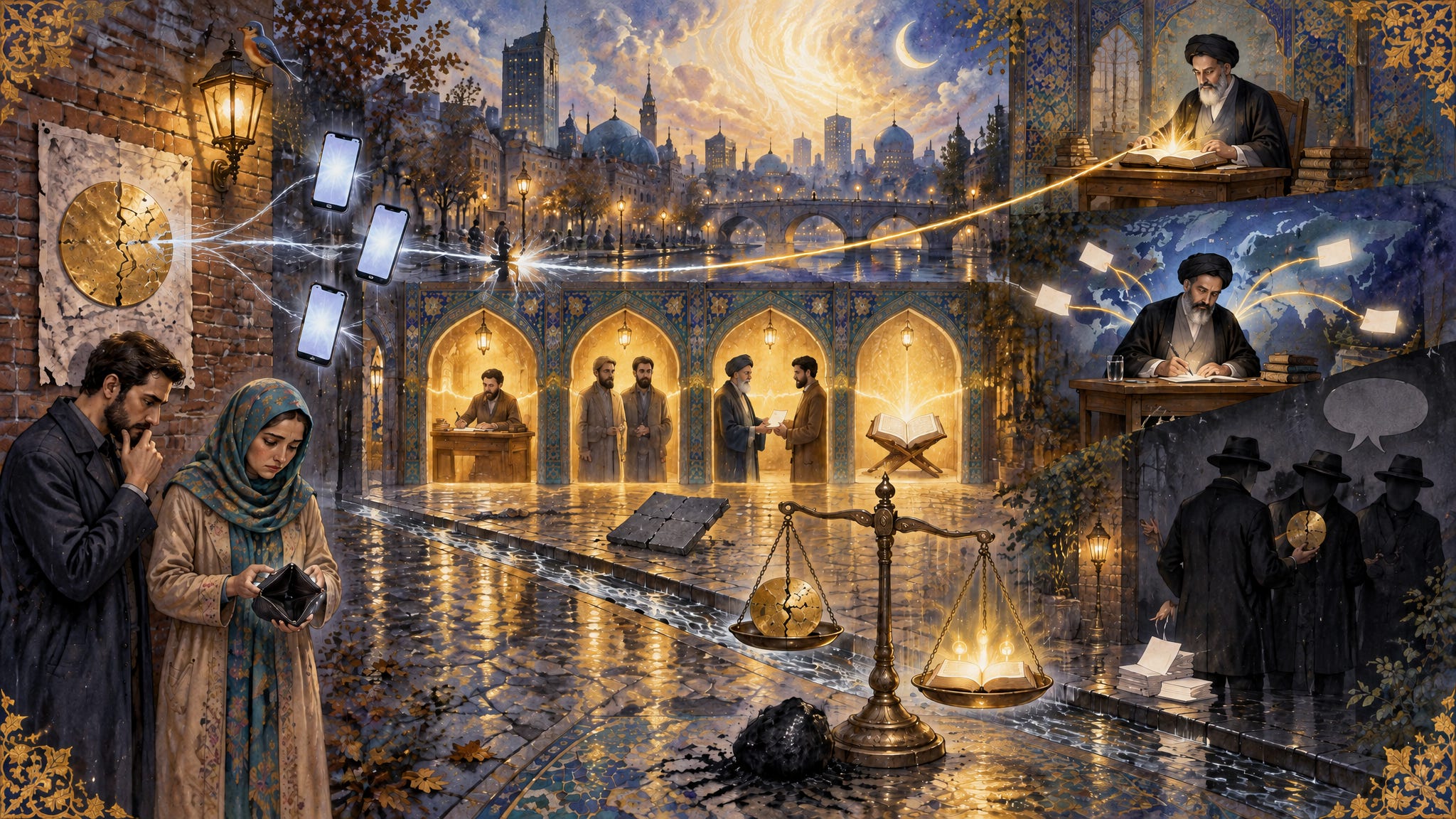
I want to begin tonight with a verse about news.
Three weeks ago, in this room, we opened with a verse about people who followed their scholars past the line God had drawn.
Tonight I want to begin one step before that problem.
Before anybody follows anybody, something has to reach them.
And that is what this verse is about.
Something reaches a community.
It is a matter of safety, or a matter of alarm — something is fine, or something is dangerous.
And the verse describes what some people did the moment it reached them.
They broadcast it.
Allamah Sayyed Muhammad Husayn Tabataba’i, may God rest his pure soul, the author of al-Mizan, tells us what was actually going on.
What reached them, he says, were rumours — brought by the hands of those who opposed the Prophet, and by the messengers they sent out, to create hypocrisy and dissension among the believers.
And the weak among the believers spread them — in his words,
without reflection, and without insight.
And the resolve of the believers was weakened by it.
Now notice what the verse blames.
It does not blame them for hearing the rumour.
Everybody hears things.
It blames them for passing it on.
And then it tells them what they should have done.
Had they taken it back to the Messenger, and to those in authority among them, then those people, Allamah says, could have drawn it out — and told them whether it was sound or sick, true or false.
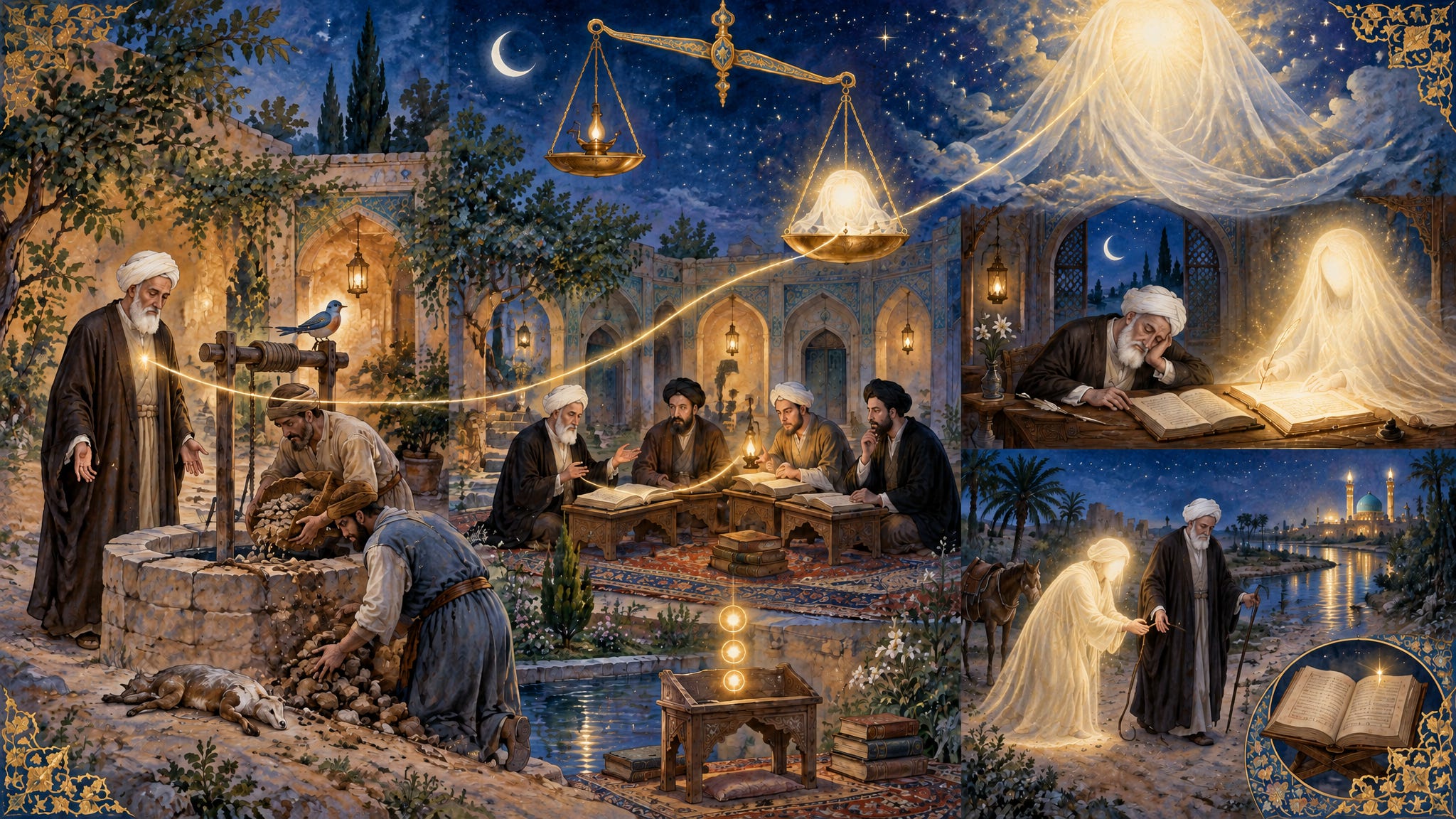
That word — drawn out, in Arabic istinbat — I want you to keep hold of all evening.
Allamah tells us where it comes from.
Its root is nabat: the first water that comes up from a well.
Think about that.
The truth of a matter is down there, under the ground.
Somebody has to dig for it.
And the first clean water that rises — that is istinbat.
— Allamah Sayyed Muhammad Husayn Tabataba’i, al-Mizan fi Tafsir al-Qur’an, on Surah al-Nisa (the Chapter of the Women) #4, Verses 81 to 84 — narrated1
Now I want to be careful here, because Allamah is careful.
You heard him in that second passage: this is about a report spreading among people — news — and not about a disputed ruling of the law.
So I am not going to stand here and tell you that this verse is the proof for following a marja’.
It is not, and I will not widen those in authority to fit tonight’s subject.
But it is the right frame for tonight.
Because something reaches every one of us, every single day, that sounds like religion.
A clip.
A forwarded message.
A screenshot of a ruling.
And this verse asks one question about all of it: what do you do with it — and who do you take it to?
Employed

Last week I ended a point with something one of my teachers said to me, at the very start:
“You are now employed by Imam Mahdi, so understand what that means.”
— from this majlis, last week: The Architecture of Guidance, Part 18, What Is a Hawza?
And I said that we would try to understand what it means — together.
And at the very end of the evening I made you a promise:
“Next week, God willing, the last of these eleven: Why a Marja’? What it means to be employed by the Imam of the Age — and who decides what a school like this teaches.”
— from this majlis, last week: The Architecture of Guidance, Part 18, What Is a Hawza?
So tonight has two halves to keep.
What it means to be employed by the Imam of our Age, may our souls be his ransom and may God hasten his return.
And who decides what is taught.
I want to say something about that word, employed, before we go any further.
When my teacher said it to me, he was not giving me a title.
He was giving me a weight.
An employee does not decide what the work is.
He does not set his own terms.
He answers to someone.
And the one he answers to here is the Proof of God in our time.
Which means that tonight’s question — whom do we follow, and why — is not, in the end, a question about scholars at all.
It is a question about him.
About how his word reaches us while he is hidden.
And about whom we trust to carry it.
And the verse has just told us where to start.
Something reaches us.
It sounds like religion.
And the question is what we do with it, and who we take it to.
So:
Why a marja’?
Why a Middleman?
Let me put the strongest objection first, before I answer anything — and let me put it the way people actually say it:
Why do I need a middleman between me and my religion?
And look at them — one marja’ says you may sight the moon with a telescope, another says only with your own eyes.
If the experts can’t agree, why should I follow any of them?
That is a fair question, and I am not going to sneer at it.
I have heard it from sincere people — often young people, who love their religion and want it to be their own, not something borrowed.
And it has two halves: the middleman, and the disagreement.
We will take the first half now.
The second half we will take after we have built something to stand on.
Nobody Stands Between You and God

There is something right in that objection — and the marja’‘s own book says it before anybody else does.
Open the book of practical rulings of Ayatollah Sistani, may God protect him, and look at the very first ruling.
It says that a Muslim must hold the fundamentals of the religion by his own insight, grounded in reason — and that he cannot follow anyone in them.
He cannot accept them from somebody simply because that person knows more and has said so.
— Ayatollah Sayyed Ali al-Husayni al-Sistani, Islamic Laws, fourth English edition, Ruling 1 — narrated2
So when somebody tells you that following a marja’ means handing your religion over to another man, the marja’ himself is the first to say:
No.
Whether there is a God.
Whether Muhammad, peace and blessings be upon him, his family, and his righteous companions, is His Messenger.
Whether there is an Imam of our Age, alive and watching.
That you come to yourself, with your own mind, and nobody can do it for you.
You follow a jurist in how to pray.
You never follow him in whether there is a God to pray to.
Keep that line.
It is the floor under everything else tonight.
The Answer, Before the Argument
This is the last of the eleven.
We began this sequence beside a grave in Najaf.
We end it tonight at a desk — the desk where a ruling is written, and a seal is pressed onto it.
Last week asked what a school is for.
Tonight asks who decides what it teaches — and why anyone should listen.
So let me give you the answer plainly, before I argue for it, so that you can check me as I go.
Nobody decides the religion.
Not a marja’, not a hawza, not a committee, not a website.
A jurist derives it — he draws it out, like the first water from a well — from the Book and the Sunna, by a discipline that takes decades to learn.
You check him, by a measure the tradition itself gives you.
And — this is the part people forget — someone checks him too.
There is a chain.
At its head is the Imam of our Age.
Below him is the marja’, who draws the ruling out.
Below the marja’ is the one he sends — his representative, the person who actually stands in your city and answers your questions.
And then there is you.
Every link in that chain has a measure.
Know the measure, and the noise cannot move you.
That is the whole evening.
Everything else is showing you that it is true.
And so there are three questions tonight, one for each point.
The first: why should I follow anyone at all?
The second: they don’t even agree — so who is right?
And the third: who brings his word to me — and what do I owe that person?
What We Carry Forward
We are in The Architecture of Guidance, and this is the nineteenth part of it.
And inside it we are working through a smaller sequence called The House Beside the Grave.
Tonight is the eleventh of those, and there are eleven — and so tonight is the last.
It is Wednesday the 21st of October 2026 — the 9th of Jumada al-Ula, 1448.
Last week we went inside the hawza, and I want to give you back what we found there in four strokes.
A school like that exists to make carriers — people who carry the Book of God, and the knowledge of His religion, with the best of carrying.
That was Allamah’s word, and we held on to it all evening.
It teaches the staple before the feast — what is needed before what is wanted.
We watched the Prophet walk into his own mosque, find a crowd gathered around the genealogies of the Arabs, and quietly rank them: surplus.
It trains its students to ask who carried a saying before asking what it means.
And we followed one sentence, hand to hand, all the way to a desk in Najaf — Shaykh al-Tusi’s.
And it is a calling, not a career.
You go to become a human; you come back to serve.
Tonight the carrier comes home.
And the moment he does, a question lands on every one of us — because there is more than one carrier, and they do not all say the same thing.
Which one do you follow?
And why?
That is where we begin.
Why Follow Anyone?
The Physician

Last week I said that we teach what is needed, not what is wanted.
There is a picture behind that sentence, and I have been holding it for tonight: a scholar is like a physician.
He gives people what they need, not only what they want.
Tonight I want to take that picture one step further, because it answers the first half of the objection.
Think about your doctor.
You do not worship him.
You do not think he is infallible — you know perfectly well that doctors make mistakes.
And yet when he writes you a prescription, you take it to the pharmacy and you take the tablets.
Why?
Not because you have studied medicine yourself.
You have not, and you are not going to.
You follow him because, at some point, you checked him.
You asked where he trained.
You asked other people about him.
You watched how he treated you, and how he treated others.
And having checked, you trusted him with something you could not study for yourself.
Nobody calls that blind.
Nobody says that a man who follows his doctor’s prescription has handed his body over to another man.
It is simply how human beings live.
Nobody can be an expert in everything.
The late Ayatollah Mesbah Yazdi, may God rest his pure soul, used exactly this picture.
Everybody needs a physician, he said, and medicine, and treatment — but not everybody goes off to become a physician.
Some people go and study and become doctors, and the rest benefit from them.
They follow the physician, in a way: he writes the prescription and says, go and act on this.
And then he adds something I want you to notice.
This, he says, did not need an infallible to come and set it up.
It is what human beings do in every field of knowledge.
— Ayatollah Muhammad Taqi Mesbah Yazdi, “Our Mission in the Age of Occultation”, 22 December 2019, mesbahyazdi.ir — narrated3
That is all taqlid is4.
The word frightens some people, because in ordinary Arabic it can mean imitation.
But in our books it means something precise: acting on the ruling of a qualified jurist, in matters of practice that you have not studied for yourself.
In matters of practice.
Not in belief — we have already said that.
And not blindly — because, as with the doctor, you check first.
So the real question is not why follow anyone.
Everybody follows somebody.
The real question is:
What do you check?
The Measure
The tradition gives you a measure, and it comes in two kinds.
The first kind is what can be tested: his learning.
You and I cannot examine a jurist in the principles of jurisprudence.
But other scholars can, and the risala — book of practical laws — tells you how their testing reaches you.
You can know a man is a mujtahid by your own certainty, if you are in a position to have it; or by the testimony of two learned and upright people who are in a position to judge; or by confidence that comes to you in other sound, rational ways.
— Ayatollah Sayyed Ali al-Husayni al-Sistani, Islamic Laws, fourth English edition, Ruling 3 — narrated5
The second kind is what can be watched: his conduct.
Some of you will remember a frame we set three weeks ago, on another subject.
His learning, other scholars can test.
His conduct, you can watch.
Where he stands with God, nobody can see.
And the risala works exactly this way.
The jurist you follow must be ‘adil — just, upright6.
And the book defines it.
‘Adalah, it says, is steadfastness on the path of the sacred Law, usually arising from a deep-rooted fear of God in the soul.
It is broken by abandoning an obligation, or doing something forbidden, without an excuse; and it returns with repentance.
— Ayatollah Sayyed Ali al-Husayni al-Sistani, Minhaj al-Salihin, Volume 1, issue 29 — narrated7
And how do you know whether a man has it?
The book tells you that too.
By testing him over time.
By the testimony of two upright witnesses.
Or by what it calls good outward conduct — and it explains what it means: good dealings with people, and religious behaviour.
— Ayatollah Sayyed Ali al-Husayni al-Sistani, Minhaj al-Salihin, Volume 1, issue 20 — narrated8
The English version of his rulings puts it in a way I love.
Its sign, it says, is that he appears good — such that the people around him, his neighbours, the ones who deal with him, would confirm his good character.
— Ayatollah Sayyed Ali al-Husayni al-Sistani, Islamic Laws, fourth English edition, Ruling 2 — narrated9
In other words:
Ask the neighbours.
Not the poster.
Not the follower count.
Not the clip that went round on a Tuesday.
Ask the people who have dealt with him, over years, when nobody was filming.
And there is a report, attributed to Imam al-Hasan al-’Askari, peace and blessings be upon him, which the jurists have long discussed, and which sums up this whole measure in four phrases — and we have also covered this report previously in this series:
As for whoever among the jurists guards his own soul, protects his religion, opposes his desire, and obeys the command of his Master — it is for the people to follow him.
— attributed to Imam al-Hasan al-’Askari, peace and blessings be upon him; al-Tabrisi, al-Ihtijaj, Volume 2, page 458, as relayed in Faqihi’s class on contemporary jurisprudence at Madreseh-ye Feqahat, 30 December 2025, eshia.ir — narrated10
Listen to those four again.
Guards his soul.
Protects his religion.
Opposes his desire.
Obeys his Master.
Not one of them is about how much he knows.
The learning is assumed — he is called one of the jurists.
But every one of the four qualities that makes him worth following is about what he does with himself.
Hold on to those four.
In a moment I am going to show you a man being measured by them — by himself.
The Afternoon He Stood Up
In March, in the days after we lost him, I told you how the Assembly of Experts met the day after the passing of Imam Khomeini, may God rest his pure soul — what Hashemi Rafsanjani told them, and how the maraji’ of Qom stood behind the choice.
I am not going to tell you that again.
Tonight I want to take you back into that same room, a little later that same afternoon, the 4th of June 1989 — to the moment when the man they were about to choose stood up.
One thing first, which I did not tell you in March.
Just before this, the Assembly had debated whether the Leader must himself be a marja’.
And with Imam Khomeini’s own view before them — that ijtihad was enough — the majority decided that he need not be.
— the editor’s note to the record of the session, the Office for the Preservation and Publication of the Works of the martyred leader, farsi.khamenei.ir — narrated11
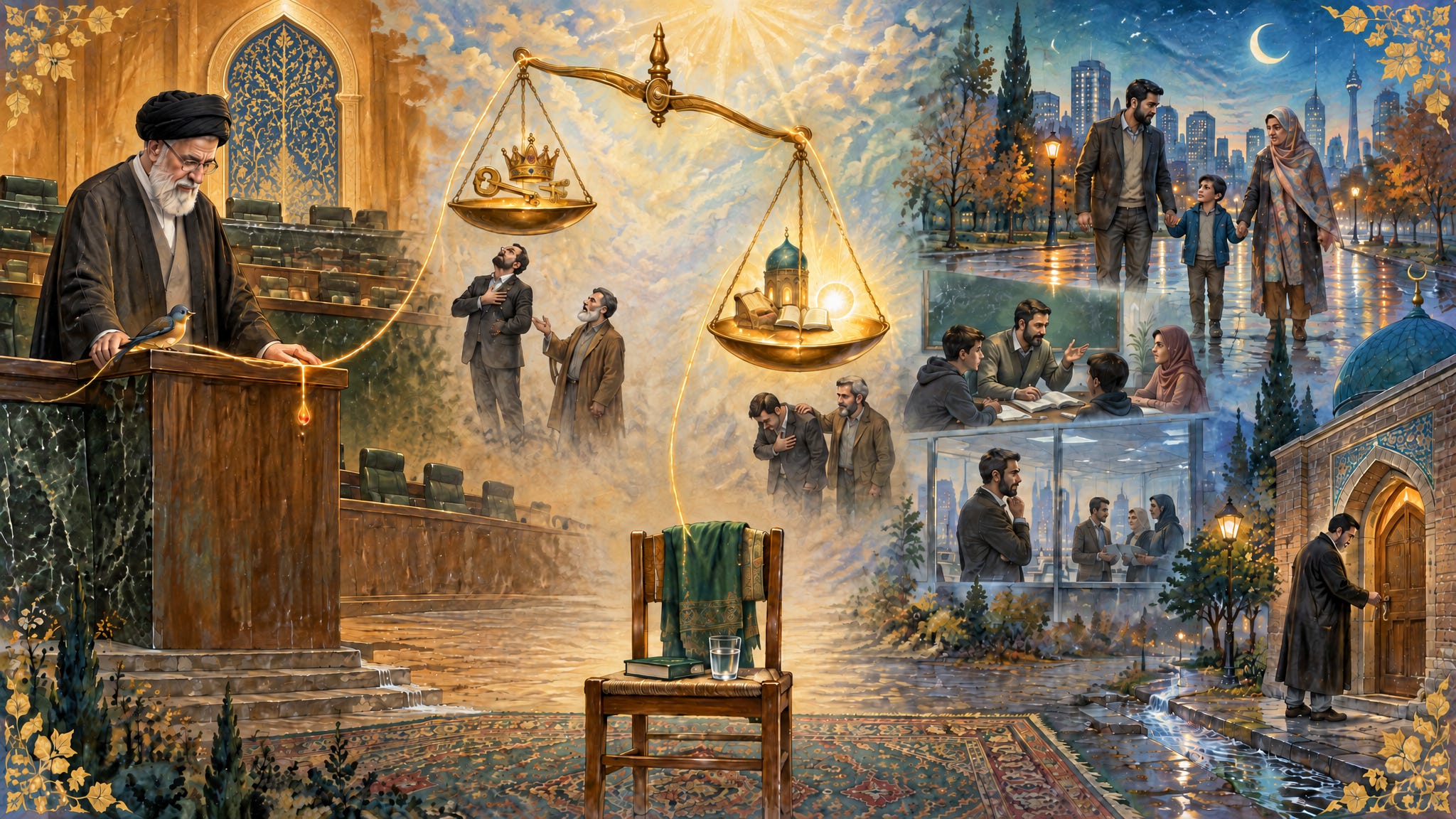
And then the martyred leader, Imam Sayyed Ali Khamenei, may God rest his pure soul, came to the lectern.
This is what he said.
First: truly, we should weep blood for an Islamic society in which even the possibility of someone like me is raised.
The matter has a technical problem. It has a fundamental problem.
He told them he had already said to Hashemi Rafsanjani, a week or two earlier, when the idea was first put to him, that he would not accept it.
Apart from the fact that I am truly not worthy of this station — and I know this, and perhaps you gentlemen know it too — the leadership will be a leadership in form, not a real leadership.
And then he gave his reason.
And listen to what the reason is, because it is the subject of tonight.
A leader’s word carries authority only if the one who is to act on it regards him as a faqih — as someone with an expert view in matters of religion.
And just now, in this very session, several of you gentlemen came and spoke, and said plainly that I am not an expert.
How can this work?
— the martyred leader, Imam Sayyed Ali Khamenei, may God rest his pure soul, at the extraordinary session of the Assembly of Experts, 4 June 1989 (14 Khordad 1368); the Office for the Preservation and Publication of his Works, farsi.khamenei.ir — my translation12
He turned to one of the members, Ayatollah Azari Qomi, who had been the first to put his name forward, and asked:
If I issue a ruling, will he accept it?
And he answered his own question:
Certainly not.
And he finished:
I am opposed, in any case.
Now — I promised you that I would tell this whole, or not at all.
Because there are people who take those lines, cut them out, and circulate them to say:
look, even he admitted he was not qualified.
So here is what happened next.
The room answered him — and it answered him on his own ground.
Ayatollah Azari Qomi stood and said:
Whoever the Assembly elects, as the representatives of the people, has the authority of the office, and obedience to him is obligatory — and I too will obey.
And Hashemi Rafsanjani said:
I have known Mr Khamenei since our youth, in the seminary.
We were together in the discussions, and the great questions are always being raised with him.
I truly regard him as having an expert view — a serious expert view in matters of jurisprudence.
Not, he added, that he had already gone and derived every question himself — but that if a question facing the country were put to him, he could reach a juristic view by the traditional method, with some work, and some help in finding the sources.
And then Rafsanjani called the vote.
And notice how he called it:
For the leadership of Mr Khamenei — until the referendum. This is temporary, not permanent.
— the editor’s account of the session, with the members’ words; farsi.khamenei.ir — narrated13
Sixty of the seventy-four members voted for him — as Leader until the referendum on the revised Constitution.
On the 28th of July 1989, the people approved the revision in a referendum.
And on the 6th of August, the Assembly met again, and voted again — and this time sixty of the sixty-four confirmed him.
— farsi.khamenei.ir, the same record — narrated14
So that is the whole of it.
And now go back to the four qualities.
Guards his soul.
Protects his religion.
Opposes his desire.
Obeys his Master.
You have just watched a man spend his turn at the lectern telling a room that he did not meet the measure.
I will leave that there.
The Hinge
But I do want you to notice one precise thing in what he said, because it is why a marja’ in a single sentence.
He did not say:
My word binds no one.
He said:
A leader’s word binds the one who regards him as a faqih.
A ruling binds you because you have recognised the one who gave it — by the measure.
That is the whole logic of following a jurist.
It is not that he says something and you obey.
It is that you have checked him, and found him to be what the tradition says a jurist must be — and so his ruling becomes your proof before God.
Three weeks ago we heard Imam al-Sadiq, peace and blessings be upon him, on the verse about the rabbis and the monks: nobody prayed to them, and nobody fasted for them — the people simply followed them past the line God had drawn.
We follow a jurist for the opposite reason: because he stays inside the line — and because we have checked that he does.
— Imam Ja’far al-Sadiq, peace and blessings be upon him; Shaykh al-Kulayni, al-Kafi, Volume 1, the Book of the Merit of Knowledge, the chapter on taqlid, hadith 3 — recalled from Session 7615
So two things come out of this room with us.
The measure is real; it is in the marja''s own book, and you can use it.
And the real ones do not carry authority as a prize.
They carry it as a weight.
The Door Out
Before we leave this, I have to tell you about something I have seen with my own eyes — not once, but again and again, for more than twenty-five years.
I am not going to name anybody, and it is not one community.
It is a pattern.
In some places, the marja’ is chosen for the congregation.
I understand why.
It is simpler: one book of rulings, one road for the khums, one set of answers.
And the marja’ they choose is a real marja’ — I have nothing to say against him.
But his is the only name the people are ever given.
Nobody tells them that there is a measure, and that it is theirs to use.
Then some of them begin to look around.
They visit another community, and they hear other names.
They write to the offices, and the answers that give them the most confidence come from another marja’.
So they want to change.
And they go back to the people who told them whom to follow, and they are told: first, you must fast for forty days.
Or: you must pay a sum to the marja’ — and you can pay it through us.
And always: you must write to the marja’ and take his permission, and only if he allows it may you change.
The first time I heard it was around the turn of the century; I was not long back from Qom.
Someone came to my home in real distress.
They wanted to move to a marja’ in Najaf whose office could answer them in their own language — and both of those maraji’ were among the names that the Society of Teachers of the Hawza of Qom, the senior teachers whose word the hawza listens to, had made public as maraji’ the people may follow.
Neither was set above the other.
— the Society of Teachers of the Hawza of Qom, its published list of maraji’ — narrated16
I searched, and I found nothing for any of those conditions.
I asked my own teachers — two of them maraji’ themselves — and they were shocked.
That is not the way, they said.
That is not the case at all.
And before I could explain, that person had already begun to say that this religion is oppressive — that it is all about the elites, and the marja’ is only their tool.
So here is what the marja’‘s own book actually says.
You may move from one living marja’ to another when the second has become more learned, or when you do not know of any difference between them in the questions you are likely to face; and where the two are equal and you do know that they differ, the book gives its own answer.
You establish that the same way you chose the first time — by the measure.
Other maraji’ word this in their own books; whichever one you follow, read what his book says.
— Ayatollah Sayyed Ali al-Husayni al-Sistani, Minhaj al-Salihin, Volume 1, issue 14 — narrated17
Now notice what the book does not say.
No fast.
No fee.
No letter.
Nobody’s permission.
When you began, you did not ask anybody’s permission.
You made your intention before God.
And when you move, by the measure, you make your intention before God again.
You do not even have to tell anyone.
Later tonight I will show you one thing that the marja’‘s rulings do say needs his permission.
It is not this.
When I explained it, that person was relieved — and the respect they had lost for the marja’, and for this school, came back.
It has happened again and again since.
A fortnight ago, a lady came to my wife with exactly the same story.
A condition that the book does not contain serves somebody.
It is not the person who asked.
Lessons for Our Time
Lesson One — Check, Then Trust

The first lesson is the one the physician has already taught us.
Check, then trust.
Choose by the tradition’s measure: learning that others can test, and conduct that you can watch.
Not by noise.
Not by numbers.
Not by who has the better poster, or the most followers, or the clip that everyone in the family group has forwarded this week.
Those things tell you who is famous.
They do not tell you who is ‘adil.
And if you have never asked yourself how you came to your marja’ — whether you chose him, or simply inherited him from your parents, or drifted into him because everybody in your mosque follows him — then ask it this week.
Not to change, necessarily.
Most of you, I expect, will find that the choice you inherited was a good one.
And if, having asked properly, you find that you should change — you may, by the measure the book gives, and with nobody’s permission but God’s.
But ask the way the risala tells you to ask.
Who among the learned, the upright people whose judgement you can trust, says that he is qualified?
What do the people who have dealt with him say about him?
There is nothing disrespectful about that question.
The risala itself asks it of you.
And then — having checked — trust.
Think again about the doctor.
Imagine a patient who goes to his doctor, receives a careful diagnosis, goes home, reads three websites, and decides the doctor was wrong.
And then does it again after the next appointment.
And the next.
That person has not understood what a doctor is for.
He has not become an expert in medicine.
He has simply stopped being anyone’s patient.
There is a version of that in religion, and many of us know it.
Somebody follows a marja’ — until the marja’ says something inconvenient.
Then suddenly he wants a second opinion, and a third, until he finds the answer he wanted in the first place.
That is not checking.
That is shopping.
Check properly, once, and seriously.
Then trust — the way you trust a doctor you have chosen well.
Lesson Two — Authority Is a Burden Held for Another
The second lesson is the one that man at the lectern taught us.
Authority is a burden held for Someone else.
We should weep blood.
That is not the sentence of a man who wanted the office.
It is the sentence of a man who knew exactly what the office would weigh.
And this lesson is not only for maraji’.
Every one of us holds something for Someone else.
A father and a mother hold their children — and they will be asked about them.
A teacher holds a class.
A manager holds the livelihoods of the people who work for him.
The chair of a mosque committee holds a house of God.
Every one of these is a trust.
Not one of them is a prize.
And you can tell which way somebody holds it by a very simple sign.
The one who holds authority as a prize enjoys it, and wants more of it, and is wounded when it is questioned.
The one who holds it as a trust feels its weight, and is a little afraid of it — and is grateful, sometimes, when somebody checks him, because it means he is less alone with it.
And there is a test you can put to yourself this week, wherever your own small trust lies.
When somebody questions how you are carrying it — your child, your colleague, a member of your committee — what is the first thing you feel?
If it is wounded pride, the prize is winning.
If it is something closer to relief — good, someone is watching with me — then you are holding it as a trust.
I am not pointing at anybody.
I hold a small trust myself, in this chair, every Wednesday.
And I would rather hold it the second way than the first.
“They Don’t Even Agree”
The Last Night of Ramadan

Now — the second half of the objection.
You all know the night.
The last night of the month of Ramadan.
Families on rooftops and in car parks, phones out, looking west.
Messages flying between group chats.
Has anyone seen it?
Has the office announced?
And then, the next morning, in the same city, sometimes in the same street, one house is fasting and the next house is at Eid prayers.
And somebody — usually a young person, and usually sincerely — says:
You see?
They don’t even agree.
One marja’ says you can use a telescope.
Another says only with your own eyes.
If the experts can’t agree on whether today is Eid, why should I follow any of them?
I want to take that question seriously, because the answer is much more beautiful than the question.
Three Jurists, One Question
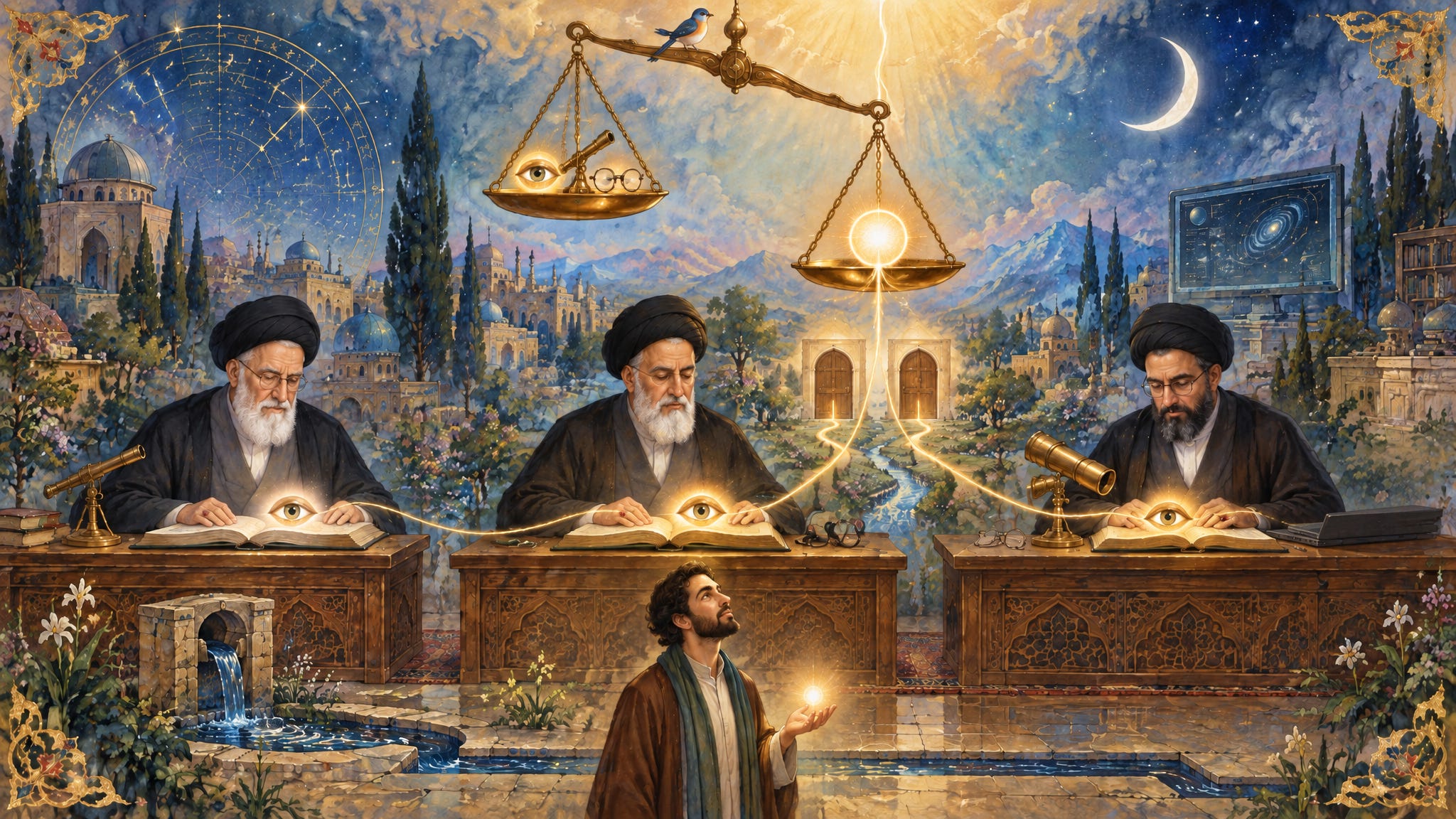
Let me give you the three positions — each from the jurist’s own book — and I want you to listen not for where they disagree, but for what each one is asking.
The first is Ayatollah Sayyed Abu al-Qasim al-Khu’i, may God rest his pure soul — the great teacher of Najaf in the last century, under whom Ayatollah Sistani himself studied.
He says:
The crescent’s real existence in the sky — even if the astronomers can prove it with certainty — has no effect on its own.
Because what counts, according to the texts, is the sighting — witnesses who have seen it, with ordinary sight, not through a scientific craft.
And so, he says, no account is taken of sighting with what he calls the armed eye — through modern magnifiers and strong lenses like the telescope — if it could not be seen by the naked eye.
And then he adds a sentence I want you to hold on to.
Yes — there is no harm in using them to find the place, and then looking with the naked eye.
If it can then be seen, even though the instruments helped with the preliminaries, that is enough, and the month is established.
— Ayatollah Sayyed Abu al-Qasim al-Khu’i, Sharh al-’Urwa al-Wuthqa, the Book of Fasting, on the ways the crescent is established, page 123, issue 5 — narrated18
The second is his student, Ayatollah Sistani, may God protect him.
And he keeps his teacher’s line exactly.
In the sighting, he says, it must be with the eye, not aided by instruments.
So if the crescent was seen through a telescope, for example, and could not have been seen without it, that is not enough to begin the new month.
— Ayatollah Sayyed Ali al-Husayni al-Sistani, Minhaj al-Salihin, Volume 1, the chapter on establishing the crescent, page 373; and Islamic Laws, fourth English edition, Ruling 1699 — narrated19
The third is the martyred leader, Imam Sayyed Ali Khamenei, may God rest his pure soul.
He was asked a very modern question:
Is it enough to establish the new month if the image of the crescent is captured by a digital camera, and the light reflected, and the recorded data read back by a computer?
And his answer begins: sighting with an instrument is no different from ordinary sighting, and it is valid.
The criterion is that the title “sighting” still holds.
So sighting with the eye, with spectacles, and with a telescope all fall under one ruling.
And then — listen — he stops.
But reflection onto a computer, where it is not known that “sighting” truly applies — that is problematic.
— the martyred leader, Imam Sayyed Ali Khamenei, may God rest his pure soul, Ajwibat al-Istifta’at (Persian), question 835 — narrated20
Now put the three side by side.
Is anyone here following the astronomers?
No.
All three say the astronomers’ calculation alone does not make the month.
Has anyone left the texts?
No.
All three are asking what the texts mean by one word:
Seeing.
The first two say:
The texts mean seeing as people ordinarily see
— though even Ayatullah al-Khu’i lets the telescope help the eye to find the crescent.
The third says:
seeing through a lens is still seeing
— and he too draws a line, at the point where a computer is reconstructing an image and it is no longer clear that anybody has seen anything.
All three are asking the same question:
What counts as seeing?
Each one stops exactly where “seeing” stops.
They simply put that line in different places.
That is not a contradiction.
That is three serious people taking the same word of the same Prophet with complete seriousness.
Neither is wrong.
Both are moving in the right direction.
And the practical conclusion, for you, is simple — and I will not go one step past it.
Follow your own marja’.
If you follow one of them, you look with your eyes.
If you follow the other, you may look through the telescope.
Either way, you have done what you were asked21.
Why the Book Expects It
And here is something that surprises people.
The marja’‘s own book expects the jurists to differ — and it tells you what to do when they do.
When the mujtahids differ in their rulings, it says, you must turn to the most learned — and it explains what it means by most learned.
The one who is most able to derive the rulings, through a wider grasp of the sources and of how they apply, so that the likelihood of his rulings reaching the reality is stronger than in the others’.
— Ayatollah Sayyed Ali al-Husayni al-Sistani, Minhaj al-Salihin, Volume 1, issue 8 — narrated22
Notice that phrase:
Reaching the reality.
There is a reality.
There is a right answer, with God.
The jurists are all reaching for it.
And the book is honest enough to say that some will reach it more often than others.
Ayatollah Mesbah Yazdi put this with great plainness.
Not everybody in this room, he once told an audience, follows the same marja’; there may be four or five whose rulings are valid proofs, and people act on them.
But does that mean all their rulings match the reality?
The reality is only one.
So why are there four different rulings on the same matter?
If not all four are mistaken, then three of them certainly are — because the reality is only one.
So what are we to do?
He answers: when we have recognised someone as the most learned, we accept his word, and then we have a proof before God.
If on the Day of Judgement we are asked,
why did you pray like this?,
we say:
my marja’ ruled like this, and I acted on his ruling.
And he reminds his listeners of the well-known report:
the one who strives and reaches the truth has two rewards; and the one who strives and misses it has one.
And then he gives a comparison, to show how wrong it would be to give up because of this.
It would be like saying:
Since the maraji’ have different rulings, I accept none of them — and I will not pray.
When in fact, he says, one must pray according to the ruling of one of them.
— Ayatollah Muhammad Taqi Mesbah Yazdi, “The Necessity of Recognising the Most Fit, and How”, 17 May 2013, mesbahyazdi.ir — narrated23
Last week we went inside the school these men come from, and we saw the years it takes, and how every claim is tested. A difference between two such men is not a crack in the building. It is what the building looks like when it is working.
Those Who Use the Difference
Now — I have to be honest with you about one more thing.
Not everybody who points at these differences is a sincere young person on a rooftop.
There are some people — some of them quite influential, some with motives of their own — who take a difference like the one about the moon, and they turn it into a slogan.
The maraji’ don’t agree.
And they repeat it, and repeat it, until ordinary people stop trusting all of them.
I am not going to name anybody.
That is not what this chair is for.
But I want you to recognise the pattern when you see it.
A real difference, honestly arrived at, is presented as a contradiction.
Then the contradiction is presented as proof that nobody knows anything.
And then, very quietly, somebody else offers to tell you what to think instead.
And there is a close cousin of that pattern, which is even more dangerous.
Let me tell you about it — because I saw it myself.
The Fatwa That Was Never Issued
Many years ago, a group of people produced a fatwa from one of the maraji’.
It looked real.
It had the seal, and everything else.
And it said, more or less, that attending a particular programme they were organising was something the believers must do.
It went viral.
And within days, people were writing to me — people in countries a very long way from here.
Did the marja’ really issue this?
How do we get to this programme?
It will cost us more than we have.
Why has the marja’ done this to us?
The marja’ knew nothing about it.
He had never issued it.
So I wrote back to them.
I said: this is not a ruling.
And you can see that it is not, even without asking his office — because the programme is something recommended, mustahab.
Something good to attend, if you can.
A marja’ does not turn a recommended act into an obligation for the whole world by putting his seal on a poster — and he would not.
This is fake.
Ignore it.
And then I went to the people who had made it, and I tried to reason with them.
And they said to me:
Bro — it’s just marketing.
Nobody’s going to take it seriously.
So I showed them the messages.
Real people, worried about their duty to God, wondering whether to spend money they did not have.
And they told me that I was the one making it up.
Thankfully, it petered out.
But the danger has not gone away.
If anything, it is easier now than it was then.
A seal can be copied onto an image in a minute.
Now listen to how the marja’‘s own book answers every part of that story.
First: how does a fatwa reach you?
The book gives four ways.
From the mujtahid himself.
From two upright people who report it.
From one person whose word you trust.
Or from his book of rulings, when you are confident it is correct.
— Ayatollah Sayyed Ali al-Husayni al-Sistani, Islamic Laws, fourth English edition, Ruling 4 — narrated24
A forwarded image, from a number you do not know, is none of those four.
Second: who may give a fatwa at all?
The book says that giving fatwa is forbidden, absolutely, to anyone who is not a mujtahid.
— Minhaj al-Salihin, Volume 1, issue 21 — narrated25
Third — and this one moves me — what must a person do who has passed on something that is not the marja’‘s ruling?
The book says: he must, as a precaution, tell everyone who heard it from him, where what he passed on led them to act against their religious duty.
— Minhaj al-Salihin, Volume 1, issue 27 — narrated26
That is all we did, that week.
We did what the risala asks of anyone.
And it is exactly what the people who made the fake refused to do.
And fourth: how serious is it?
The book lists the gravest sins.
And among them it names lying — the gravest of which is lying against God, and against His Messenger, and against his successors — and it names giving a fatwa by other than what God has revealed.
— Minhaj al-Salihin, Volume 1, issue 30 — narrated27
It's just marketing.
No.
A forged fatwa is a lie told in the name of God's law.
The very book they were imitating calls it one of the gravest sins there are.
Who Watches Over Them
So — there are differences, and there are people who exploit them, and there are even people who forge them.
And you might reasonably ask:
Is anyone watching over all this?
The first answer is that a real jurist watches over himself.
Shaheed Mutahhari tells a story about Allamah al-Hilli.
The Allamah had been asked a question of law:
If an animal dies in a well, and its carcass is left in the water, what must be done with the well?
There were two ways the ruling could go.
Either the well had to be filled in altogether, and another used — or a set amount of its water could be drawn out, and the rest used without difficulty.
And just then, an animal fell into the well of the Allamah’s own house.
Now he had to derive the ruling for himself, too.
And he realised that on this question he could not judge without his own interest pulling at him — because his own benefit was in it.
So before he gave any answer, he had his well filled in.
Now nothing he decided could benefit him.
And only then, with his mind at rest, free of the pull of his own self, did he give his ruling.
— Shaheed Murtada Mutahhari, Ashnayi ba Qur’an, Volume 1, page 62 — narrated28
Opposes his desire.
That is the third of the four qualities — and that is what it looks like in a man’s own house.
The second answer is that his peers watch over him.
That is what we saw last week: a whole school built so that every claim is tested by people who know enough to test it.
And the third answer is the one that matters most.
You remember — we spent time on it six weeks ago — the letter from the Imam of our Age, may our souls be his ransom and may God hasten his return, which tells us to turn, in the events that befall us, to the narrators of our hadith.
And you remember the line at the end of it:
They are my proof over you, and I am God’s proof over them.
— the Imam of our Age, may our souls be his ransom; Shaykh al-Tusi, Kitab al-Ghayba, report 247 — recalled from Session 7329
Over them.
The chain does not stop at the marja’.
The one who is the proof over us has a Proof over him.
He is watched over too.
Ayatollah Mesbah Yazdi, in that same talk about the physician, says that the whole tradition of jurisprudence in the occultation came about through God’s own arrangements, and the encouragement of the Imams — and through the confirmations that came, he says, from the sacred presence of the Wali al-’Asr, to the scholars.
— Ayatollah Muhammad Taqi Mesbah Yazdi, “Our Mission in the Age of Occultation”, 22 December 2019, mesbahyazdi.ir — narrated30
And the biographers of our scholars record a night that shows you what that looks like.
Allamah al-Hilli — al-Hasan ibn Yusuf ibn al-Mutahhar, the great jurist of Hilla, a city on the Euphrates, about a hundred kilometres south of Baghdad, in what is today Babil in Iraq; he died in the year 726 of the Hijra — needed a certain book — one written against our school, which its author would let nobody see, for fear that it would be answered.
In the end its owner agreed to lend it to him — but for one night only.
So the Allamah sat down to copy it.
He copied, and he copied, through the night, as much as he could.
And at some point in the night, sleep overcame him.
And — so the biographers record — the Imam of the Age came to him and said:
Give me the book, and sleep.
And when the Allamah woke, the copy was complete.
— the biographers of the scholars record it: Qadi Nurullah Shushtari, Majalis al-Mu’minin; Mirza Husayn Nuri, Jannat al-Ma’wa, account 13 — narrated31
And the same biographers record another meeting.
The Allamah was travelling, one Thursday night, on his way to visit the Master of the Martyrs, peace be upon him — and a stranger fell into step beside him, and they talked.
And this stranger answered the hardest questions the Allamah put to him, one after another.
When the Allamah questioned one of his answers, the stranger directed him to a report in Shaykh al-Tusi’s Tahdhib — the book whose desk we sat at last week — and told him exactly where to find it: so many leaves from the start, on such a page, at such a line.
And the Allamah, astonished, asked him:
Can the Master of the Age be seen, in a time like this?
And as he said it, the whip fell from his hand.
And the stranger bent down, picked it up, and put it back into his hand.
And the Allamah understood who had been walking beside him.
And later, when he opened the Tahdhib, he found the report exactly where he had been told — on that leaf, on that page, at that line.
— Mirza Muhammad Tunukabuni, Qisas al-’Ulama, page 276, as cited in a Persian biographical dictionary of the scholars — narrated32
I do not tell you these stories so that you will think every marja’ has the Imam at his elbow, finishing his sentences.
He does not, and they would be the first to tell you so.
That is why they check one another, and why the book tells you to check them.
I tell them to you for one reason.
The one who looks after the people looks after those who look after the people.
Lessons for Our Time
Lesson Three — A Difference Is Not a Contradiction

The third lesson.
A difference is not a contradiction.
When you hear that two maraji’ have ruled differently on something, do not stop at the headline.
Ask what each of them was asking.
Nine times out of ten you will find what we found tonight with the moon: the same question, asked with the same seriousness, of the same texts — and answered at a slightly different point.
And then, follow your own marja’ with a quiet heart.
You are not betting on a horse.
You have a proof before God, whichever way the reality turns out to lie — and the striver who misses still has his reward.
And one more thing — and this is perhaps the most practical thing I will say tonight.
On the night the community splits over Eid, do not sneer at the other house.
Do not mock the family who are still fasting, or the family who are already celebrating.
They are following their marja’, exactly as you are following yours.
They are obeying God, as best they can, exactly as you are.
The day you sneer at your neighbour for following his marja’ faithfully, you have done the exploiters’ work for them — for free.
And this begins at home.
In many families in this room, a husband and a wife follow different maraji’.
Sometimes parents and their grown children do.
That is not a crisis, and it should never be treated as one.
And when your child asks you, on the morning of Eid,
why is our neighbour still fasting?
— that is a gift.
Do not answer,
because they are wrong.
Answer:
because their marja’ asks a slightly different question about seeing the moon — and they are being faithful to him, just as we are being faithful to ours.
You will have taught your child more about this religion in one sentence than a year of classes could.
Lesson Four — Check a Ruling Before You Pass It On

The fourth lesson goes back to the verse we began with tonight.
Check a ruling before you pass it on.
The verse did not blame the believers for hearing a rumour.
It blamed them for broadcasting it — instead of taking it to the people who could draw out the truth of it.
So: four ways.
From the mujtahid himself.
From two upright people.
From one person you trust.
From his own book.
If a “ruling” did not come to you by one of those four, it is not a fatwa — however official the seal looks, and however many times it has been forwarded.
And if you have already passed something on, and it turns out to be wrong — then the risala has told you what you owe.
You owe the correction to everyone you told.
Here is something you can do this week.
The next time a message arrives that says the marja’ has ruled — before you forward it, ask one question:
Where did this come from?
If nobody can tell you — do not send it.
That one habit, practised by every person in this room, would do more for this community than a dozen lectures.
And it applies with special force to some of you.
If you run a family group, or a mosque group, or a page that a few hundred people read — you are not just a person forwarding a message.
You are a gate.
What passes through you reaches people who trust you, and who will not check, because they assume you did.
So check.
And if you get it wrong — and every one of us will, at some point — the risala’s road is a humbling one.
You have to go back and say:
What I sent you was not right.
That costs something.
It costs a little pride.
But listen to the alternative, in the voice of the people who made the fake:
It’s just marketing.
I would rather pay the small price.
The One Who Carries His Word
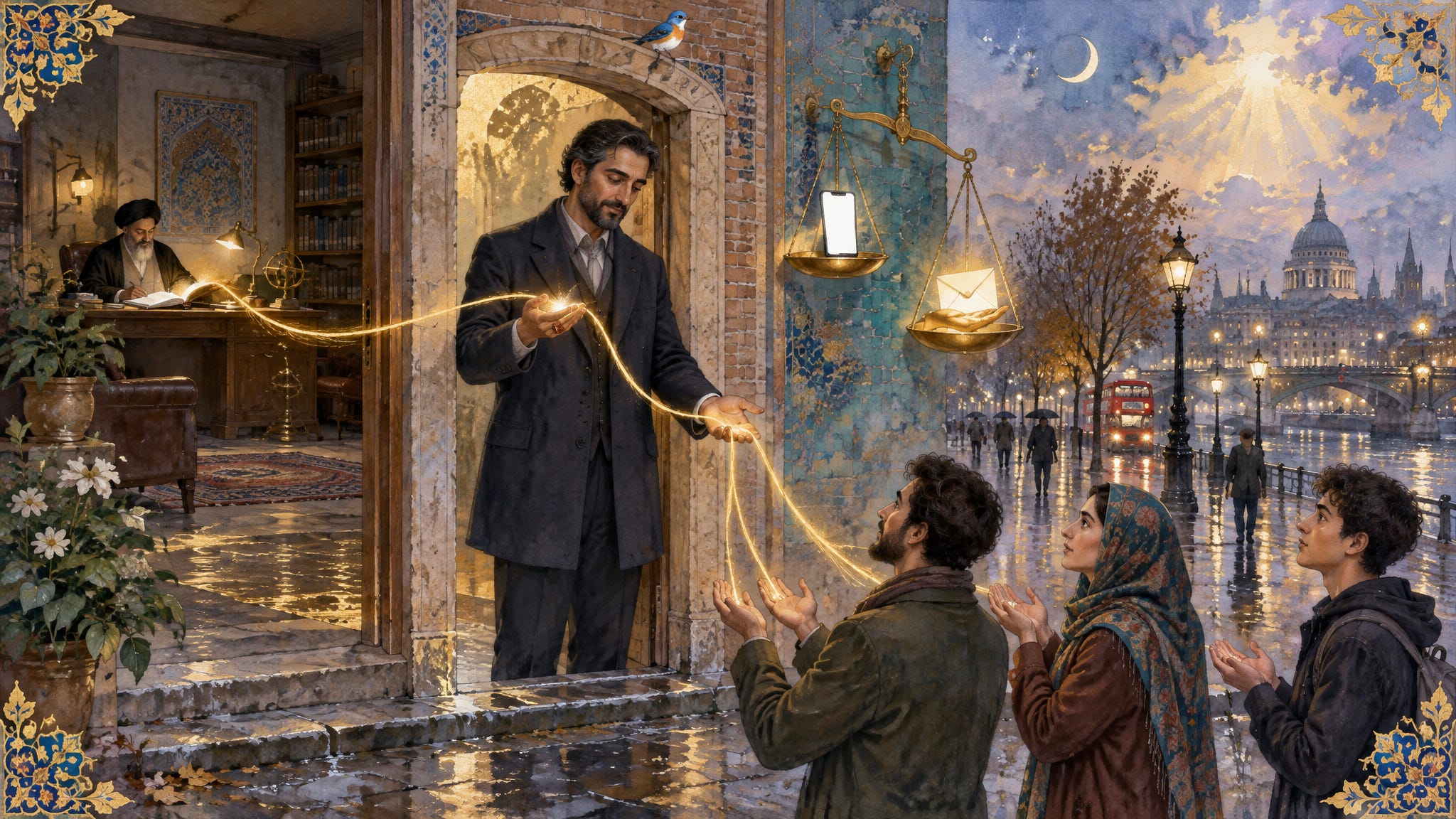
So far tonight we have been talking about the marja’.
But most of us, most of the time, do not meet the marja’.
We meet the one he sends.
Why a marja’ is also a question about that person: who brings his word to you, and what you owe him.
Employed
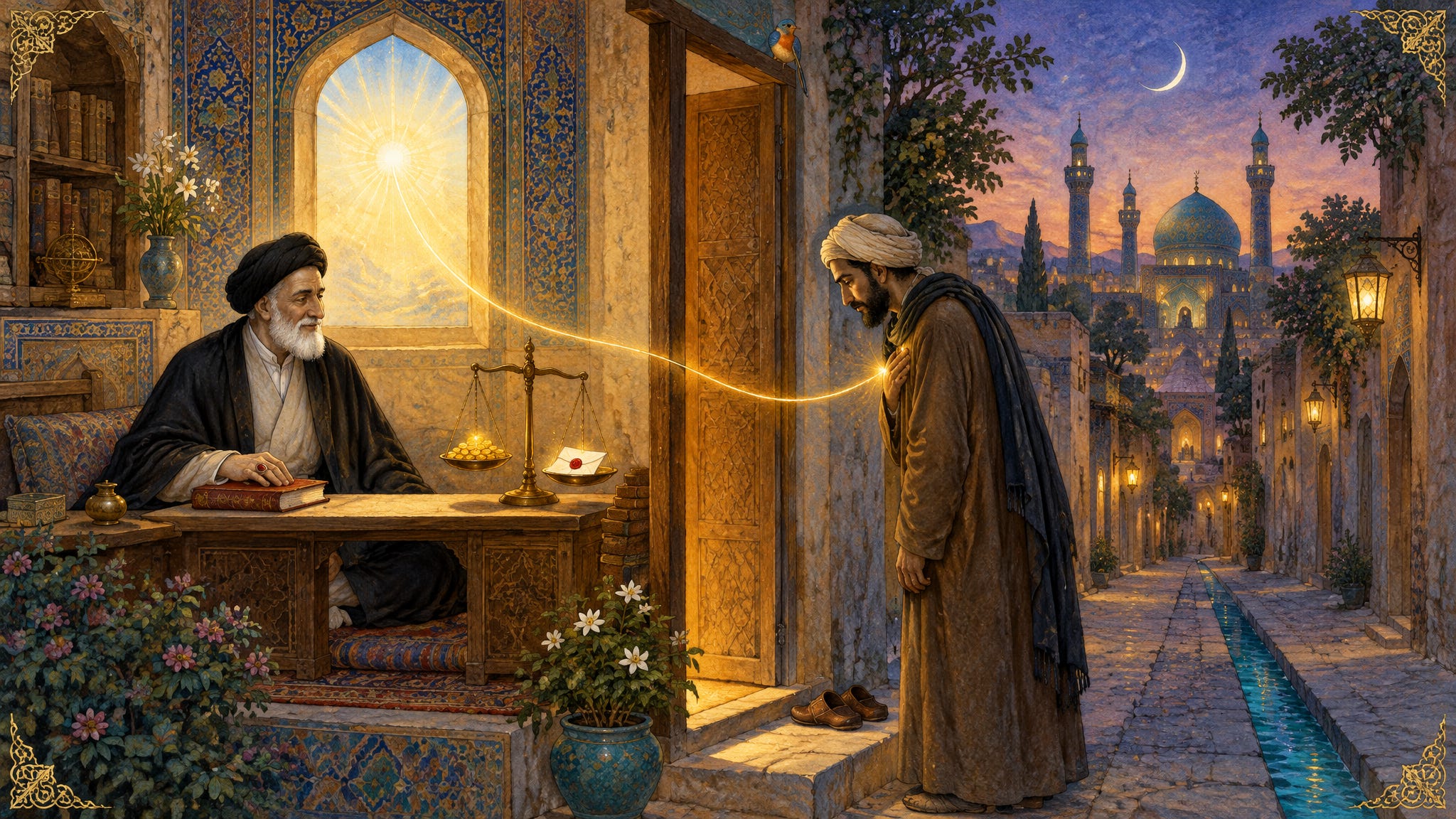
Let me go back to the word we began with.
Employed.
People are sometimes confused by the way the offices of the maraji’ work.
They feel that the office is distant, or forbidding.
They are intimidated by it.
They would not dream of writing to it, or walking into it with a question.
I want to say very plainly: that is not the fault of the offices.
It is a mistake on our side.
The offices of the maraji’, and the maraji’ themselves, are working for Imam Mahdi.
They are at the forefront of Islam.
And — as I know them, from experience — they are open to discuss with everyone.
Naturally, there has to be decorum, and courtesy.
But the door is open.
And here is something from the marja’‘s own rulings that shows you how seriously they take that word, employed.
Ayatollah Sistani was asked whether a person may spend the share of the Imam — the portion of the khums that belongs to the Imam of our Age — on some good cause that he is sure the Imam would be pleased with, without asking the marja’‘s permission.
And the answer was no.
One cannot reach the Imam’s approval, it says, by spending his share without the permission of the most learned marja’ — because it is possible that the marja’‘s permission is itself part of the Imam’s approval.
— Ayatollah Sayyed Ali al-Husayni al-Sistani, A Code of Practice for Muslims in the West (the English of al-Fiqh lil-Mughtaribin, compiled by ‘Abd al-Hadi Muhammad Taqi al-Hakim), page 276 — narrated33
I want to be careful.
That is said about one thing — the Imam’s share of the khums — and I am not going to stretch it any further than that.
It is not about choosing your marja’, or leaving him: nobody’s permission is needed for that, as we saw earlier tonight.
But look at what it tells you about how the marja’ sees his own desk.
Not as his own.
As held for Someone else.
So the office is not employed by us.
Its people do not owe us flattery.
They owe us care — and we owe them courtesy.
The Chain
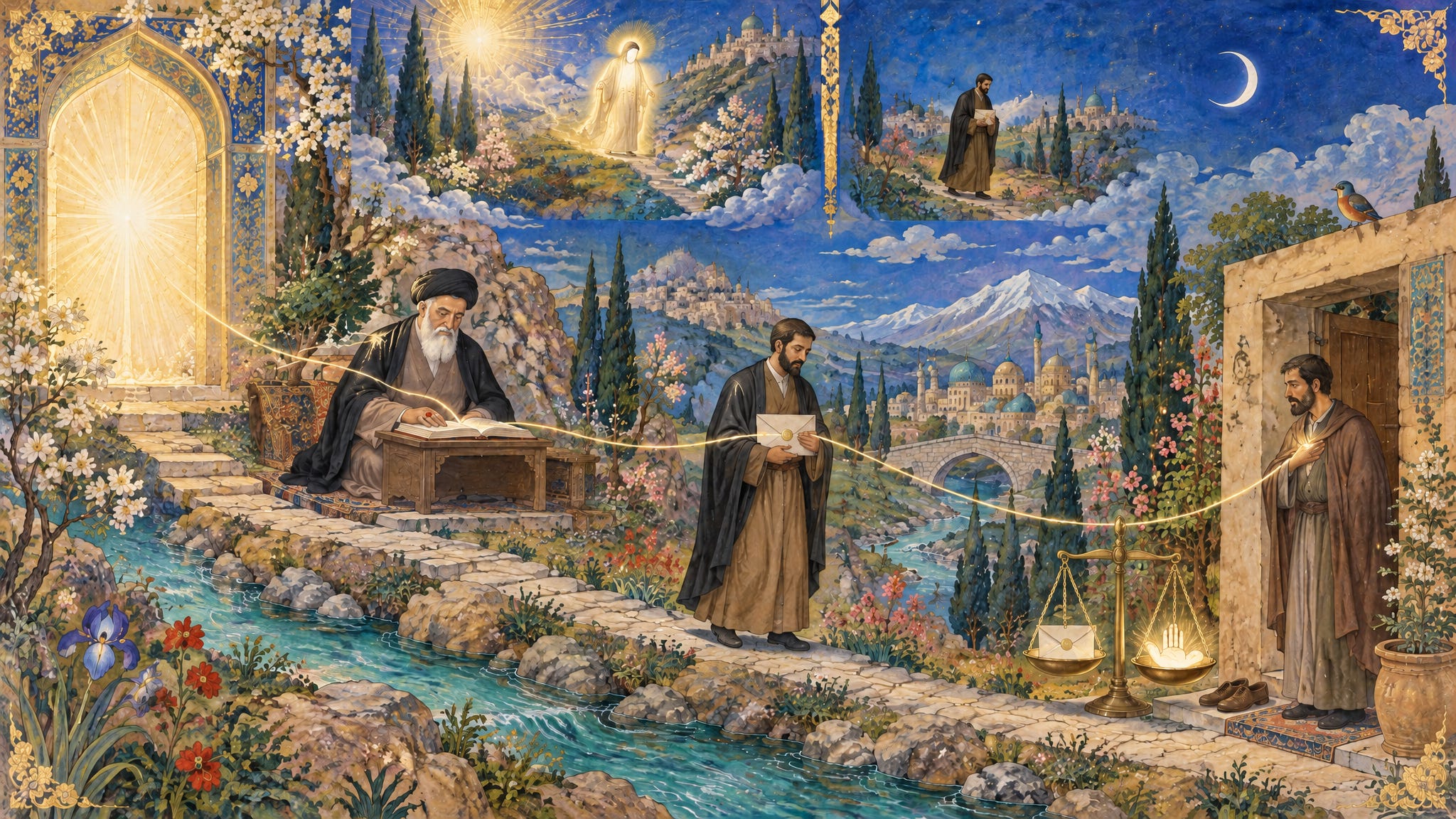
So here is the chain again.
The Imam of our Age.
The marja’, who derives.
The one the marja’ sends.
And you.
And I need to say one thing about rank, once, clearly, so that nobody can take what follows the wrong way.
In a moment I am going to tell you about a man an Imam sent.
He was sent by an Imam who does not err.
A marja’‘s representative is sent by a jurist, who can.
The duty we owe a representative is real — but it is not the same as the duty owed to an infallible Imam’s envoy, and I will not pretend that it is.
What is the same is the shape of the thing.
A trusted person is sent, carrying another’s word, to people who were not there to hear it.
And the people have to decide what to do with him.
What an Imam Writes When He Sends Someone
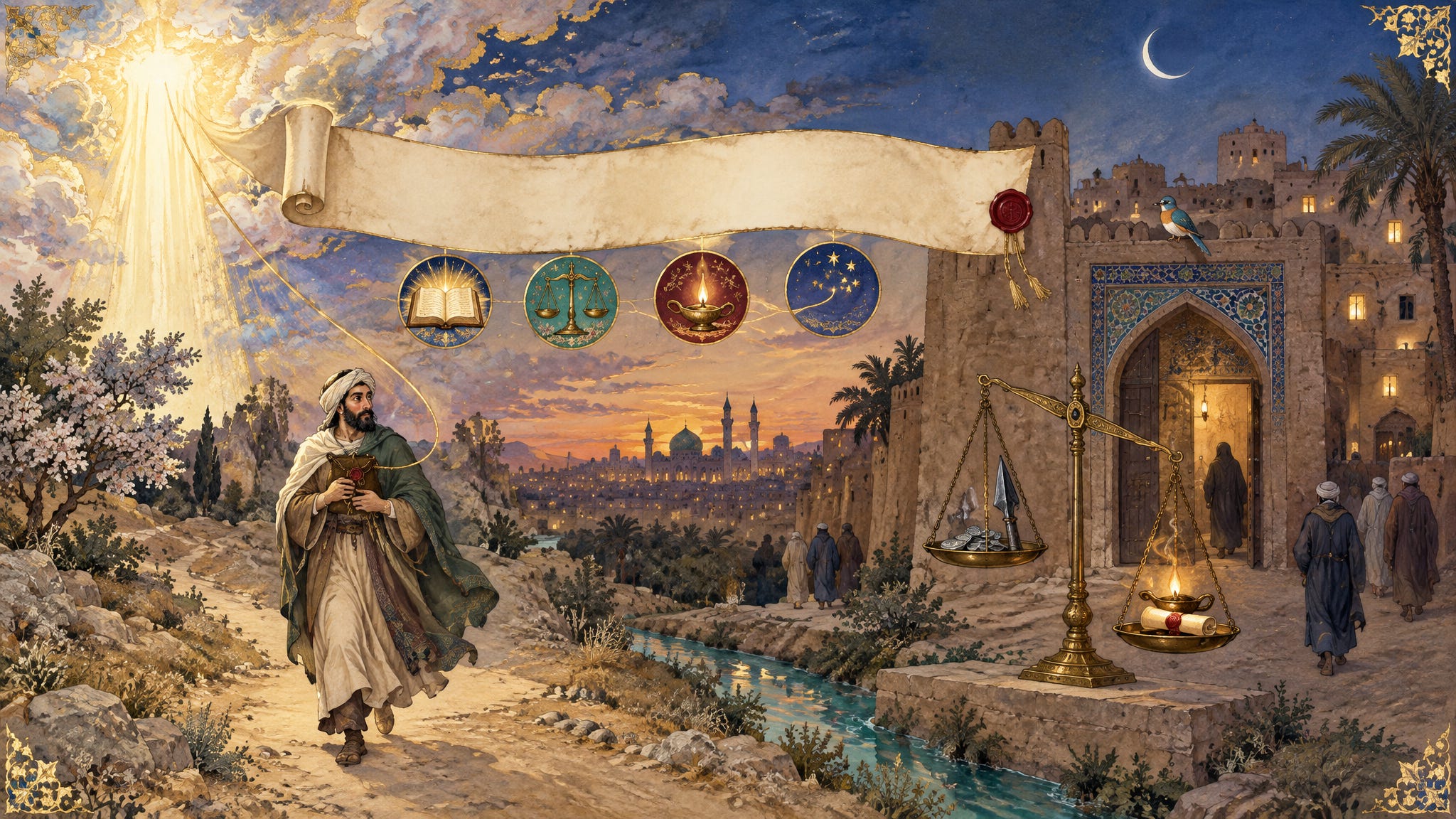
You know how Kufa ended for Muslim ibn ‘Aqil.
We have wept for him in this room more than once, and I am not going to tell that story tonight.
I want to show you something we have never read here: the letter Imam Husayn, peace and blessings be upon him, wrote to the people of Kufa when he sent him.
The Kufans had written to him, letter after letter.
And the Imam answers that he has understood what they wrote — that most of them were saying,
We have no Imam; come to us, and perhaps God will unite us through you on guidance and truth.
And then he says:
I am sending to you my brother, and my cousin, and the trusted one of my household.
If he writes to me that the view of your leaders, and of the people of understanding and virtue among you, is the same as what your messengers brought me and what I read in your letters, I will come to you soon, God willing.
— Imam Husayn ibn ‘Ali, peace and blessings be upon him, to the believers of Kufa; Shaykh al-Mufid, al-Irshad, Volume 2 — my translation
Listen to the three words he uses for the man he is sending.
My brother — he is close to me.
My cousin — he is of my house.
The trusted one — he can be relied on.
And then:
if he writes to me.
The one who is sent reports back to the one who sent him.
Shaykh al-Mufid goes on to record that the Imam told Muslim to be mindful of God, to keep his affairs discreet, and to be gentle — and, if he saw the people gathered and united, to send word quickly.
The envoy does not act for himself.
He is the eyes and the voice of the one who sent him.
And then, at the very end of the same letter, the Imam does something remarkable.
He tells Kufa what an Imam is.
For by my life, the Imam is none other than the one who rules by the Book, who upholds justice, who holds to the religion of truth, and who holds himself bound to God.
— the same letter; Shaykh al-Mufid, al-Irshad, Volume 2 — my translation34
Four qualities again.
Rules by the Book.
Upholds justice.
Holds to the religion of truth.
Holds himself bound to God.
Earlier tonight we heard four qualities for the jurist worth following.
Here, in Imam Husayn’s own hand, are four qualities of the Imam.
I am not equating the two — the Imam is the measure, and everyone else is measured by it.
But you can see where the jurists learned the shape.
Kufa had the letter.
It had the measure.
And it had the man.
And still, when it became frightening and expensive to stand beside him, it went home.
The Duty
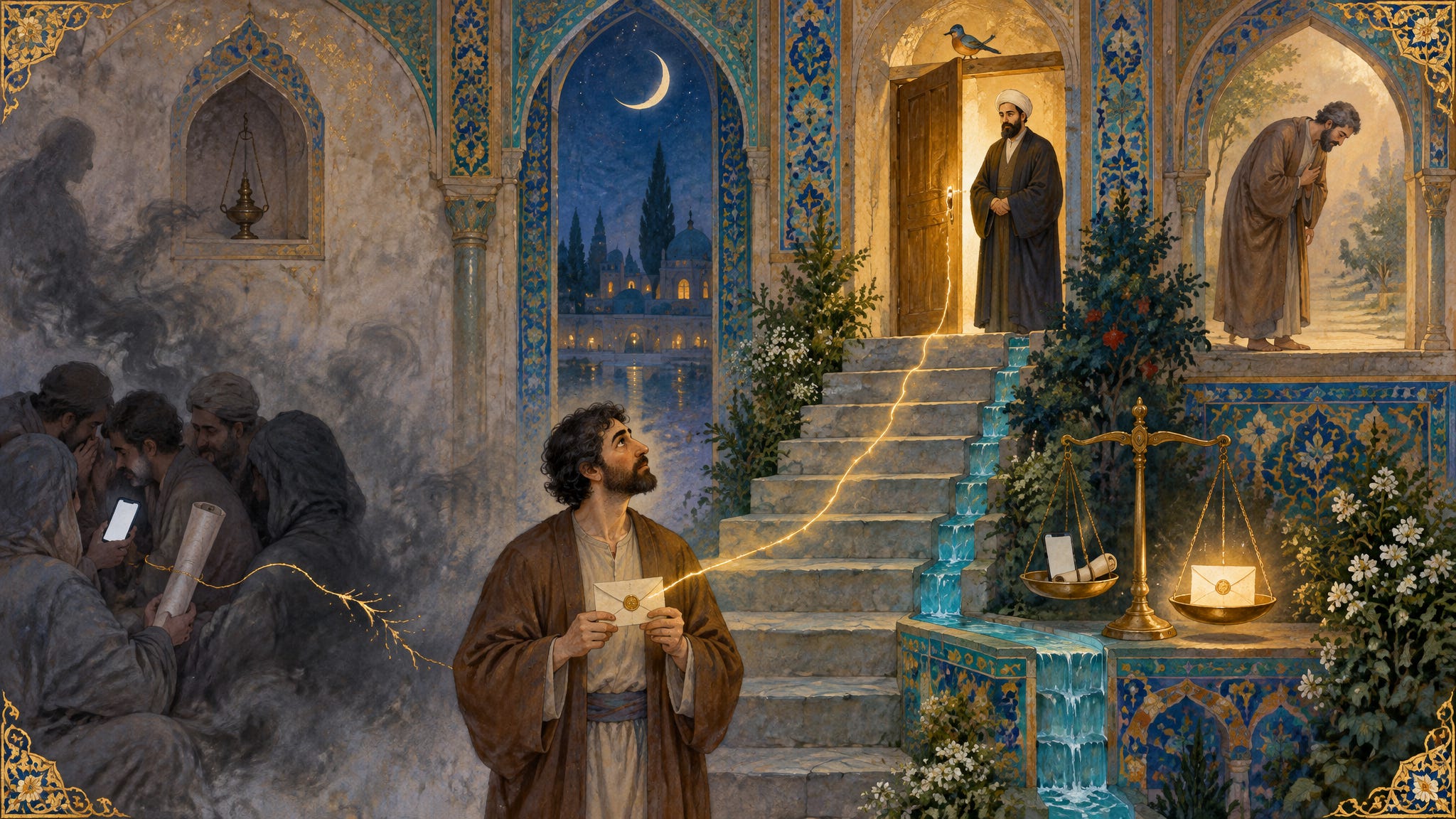
So what do we owe the one who is sent to us?
I could give you my opinion.
Instead I am going to give you a fatwa.
Ayatollah Sistani was asked about a person who has doubts about a representative of the marja’ — because of allegations that he has misused religious dues.
May he talk about it to other people, even if he is not sure the allegations are true?
And what if he is sure?
And the answer is:
It is not permissible for him to talk about it to others — in either case.
If he is certain, he can inform the marja’ directly, in complete confidence, so that the marja’ may take whatever action he sees fit.
— Ayatollah Sayyed Ali al-Husayni al-Sistani, A Code of Practice for Muslims in the West, pages 275–276 — narrated35
Think about what that rules out.
Not the concern itself.
If you have a real concern, there is a road for it, and it goes up the chain, to the one who sent him — quietly.
What it rules out is the campaign.
The whispering.
The group chat.
The poster.
Talking about him around the room, instead of up the chain.
And notice: even if you are certain.
Even then, the road goes up, not around.
So: stand with the one who is sent to you.
If you have a concern, take it to the one who sent him, in confidence.
And when the one who sent him has answered — accept the answer.
Because there is one more thing every community learns, sooner or later, usually the hard way.
A place that is left empty does not stay empty.
Lessons for Our Time
Lesson Five — The Door Is Open

The fifth lesson is a simple one.
The door is open.
Write to the office.
Visit, if you can.
Ask your question — the real one, the one you have been carrying around for years because you assumed nobody important would want to hear it.
With decorum.
With courtesy.
But without fear.
I have watched people go through their whole lives following a marja’ and never once ask his office a single question — and instead ask the internet, or ask the loudest person at the mosque, or ask nobody at all and simply guess.
And when you ask them why, it is almost always the same answer:
I didn’t think they’d want to hear from someone like me.
They do.
That is what the office is for.
It is working for the Imam of our Age — and you are one of the people he has asked it to look after.
And when you write, write well.
Put the question plainly.
Say what you actually did, or what actually happened — not the version that makes you look better.
Ask the question you need answered, not the question that will get you the answer you want.
And then be patient: an office that is answering thousands of people may take time to answer you.
Many of the offices today will take a written question, and many will answer in English.
Most representatives keep open hours, or will make time if you ask.
None of this is hidden.
It is simply that most of us have never tried.
And if anybody ever tells you that you need his permission to write to the office — or to change your marja’ — write to the office, and ask it that too.
The fear is ours.
The door was never shut.
Lesson Six — Do Not Leave the One Sent to You Alone

The sixth lesson is the one Kufa teaches us — and it is not only a lesson about Kufa.
Do not leave the one sent to you alone.
When the representative of your marja’ comes to your city, he is carrying something for Someone else.
He is far from his teachers, often far from his own family, and he is answering questions all day from people who mostly only come to him when something is wrong.
If you have a concern about him — the fatwa has told you the road.
Up the chain, not around the room.
And if he is good — tell him so.
He hears the other kind often enough.
Sit in his class, even when it is a small one.
Invite him to your home.
Bring your children to meet him.
Defend him when he is spoken about unjustly — gently, and without making a new enemy in the process.
And when he is struggling, notice.
And watch what you say about him in front of your children.
A child who hears his parents mock the representative of their marja’ at the dinner table learns two things: that the representative is not to be respected — and, a little later, that the marja’ behind him is not either.
You will have taught a lesson you never meant to teach.
Because when a community lets the one sent to it be driven away, it is not only he who loses.
People lose their link.
Some stop following anyone at all.
Some lose hope.
And into the empty space come people who were never sent by anybody.
The Close
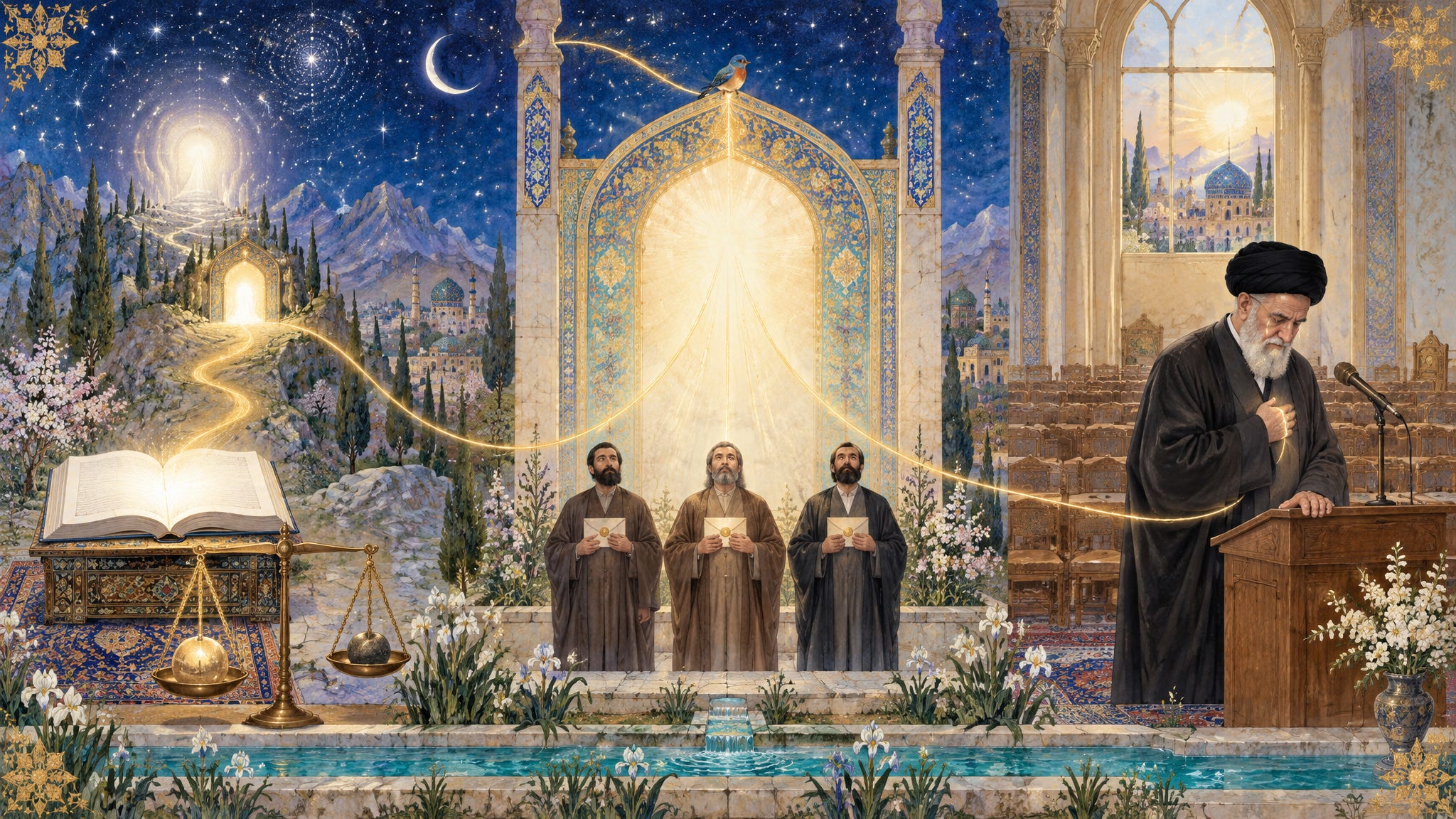
I have given you a great deal tonight, and most of it will go.
That is how sermons work.
So let me leave you three sentences.
If everything else goes, let these stay.
The first is God’s, from the verse we began with:
Had they referred it to the Apostle or to those vested with authority among them, those of them who investigate would have ascertained it.
The second is the Imam of our Age’s, about those who carry his word:
They are my proof over you, and I am God’s proof over them.
And the third is a scholar’s, at a lectern, on an afternoon in June 1989:
We should weep blood for an Islamic society in which even the possibility of someone like me is raised.
Conclusion — Key Takeaways
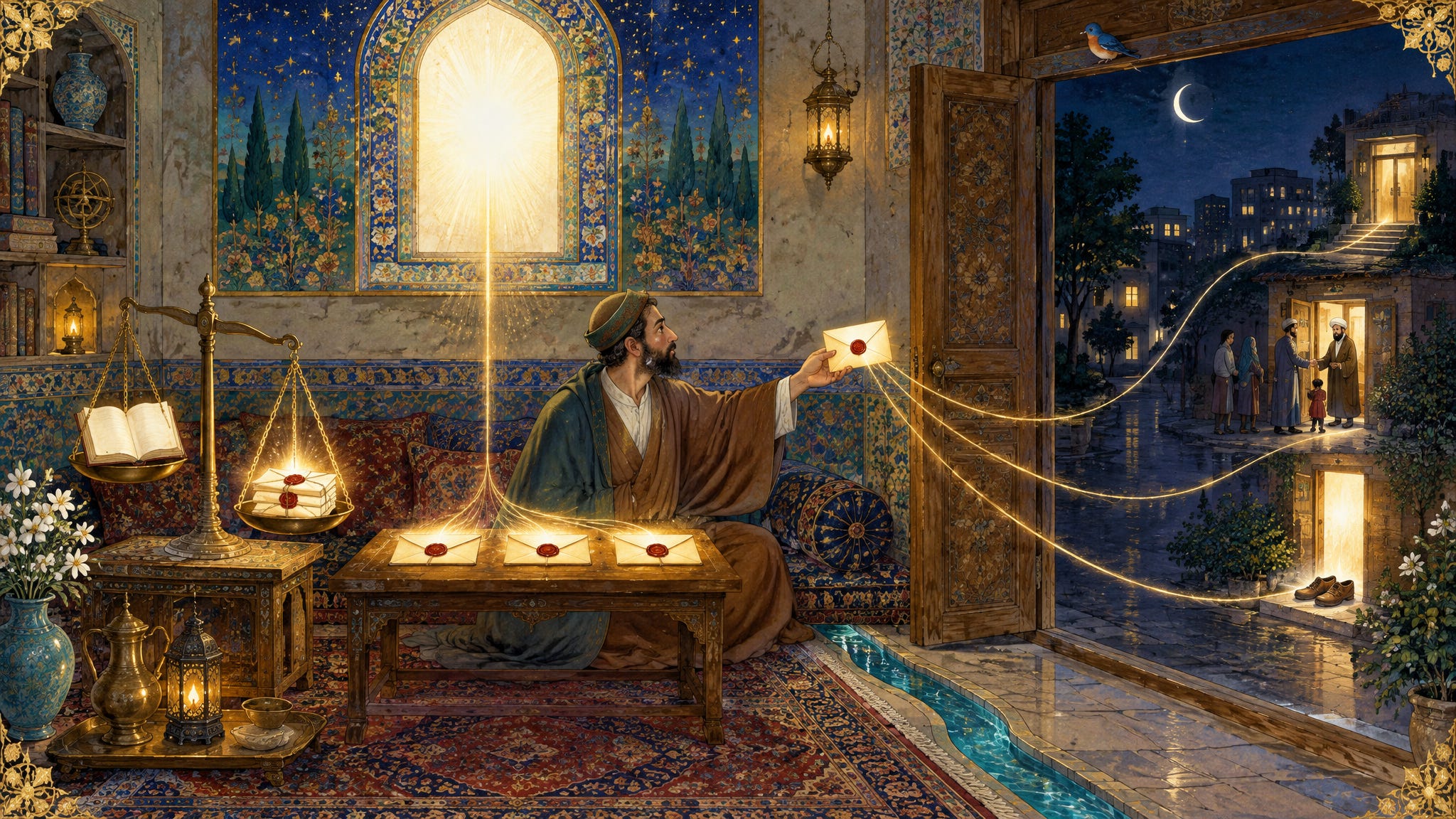
Three things to take out of this room — and they are things to do, not only things to think.
The first. Check, then trust.
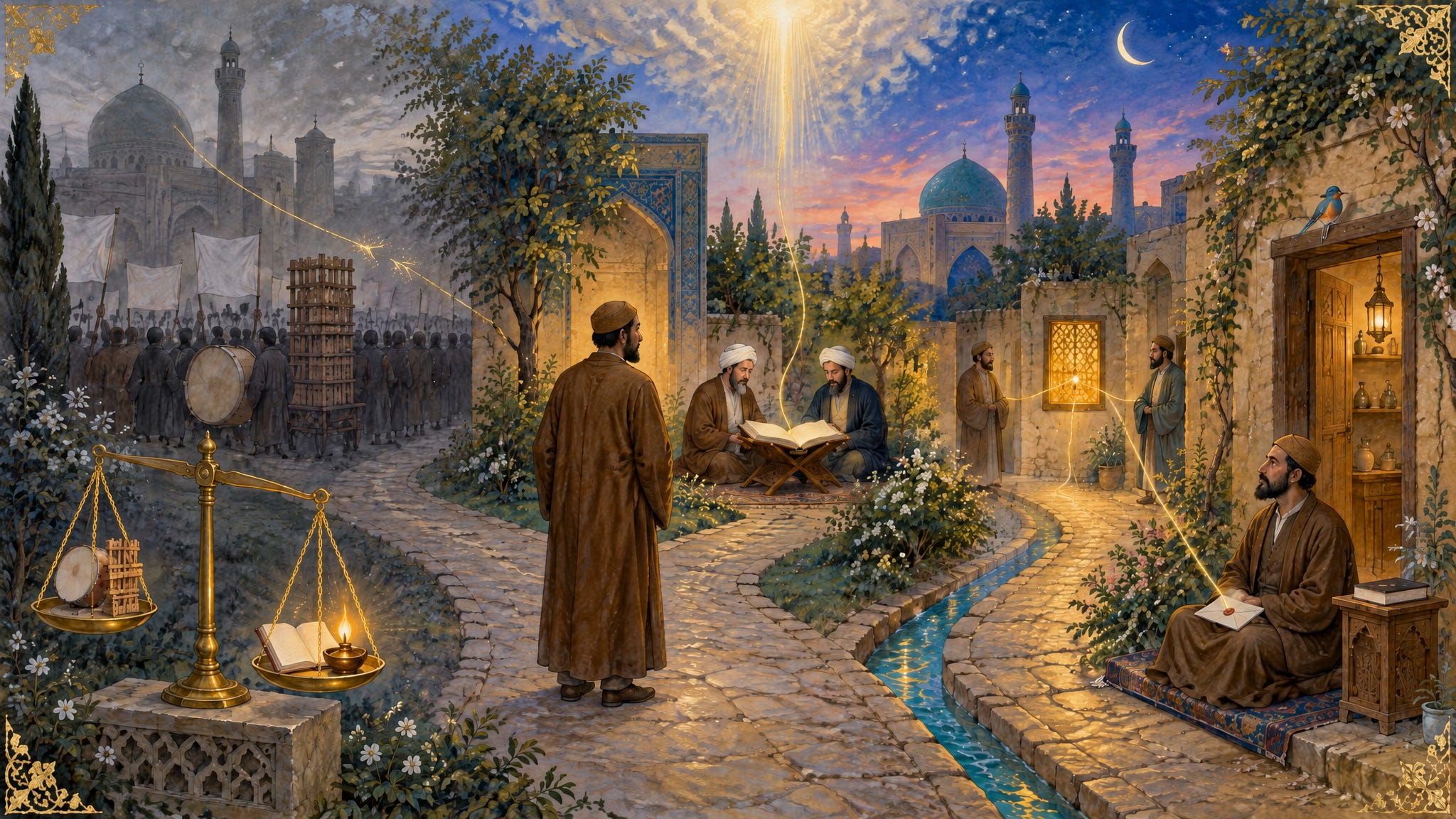
Choose by the measure the tradition gives you: learning that others can test, conduct that you can watch.
Not by noise, not by numbers.
Ask the neighbours.
And having checked — trust, the way you trust a doctor you chose well.
This week: if you have never asked how you came to your marja’, ask it — the way his own book tells you to.
The second. A difference is not a contradiction — and a forwarded image is not a fatwa.

When the maraji’ differ, ask what each one is asking, and you will usually find the same question, honestly answered.
Follow your own with a quiet heart — and never sneer at your neighbour for following his.
And before you pass on any ruling, ask where it came from.
If it did not reach you by one of the four ways, it is not a fatwa.
This week: the next time a “ruling” arrives on your phone, do not forward it until you know where it came from.
And the third. Stand with the one sent to you.
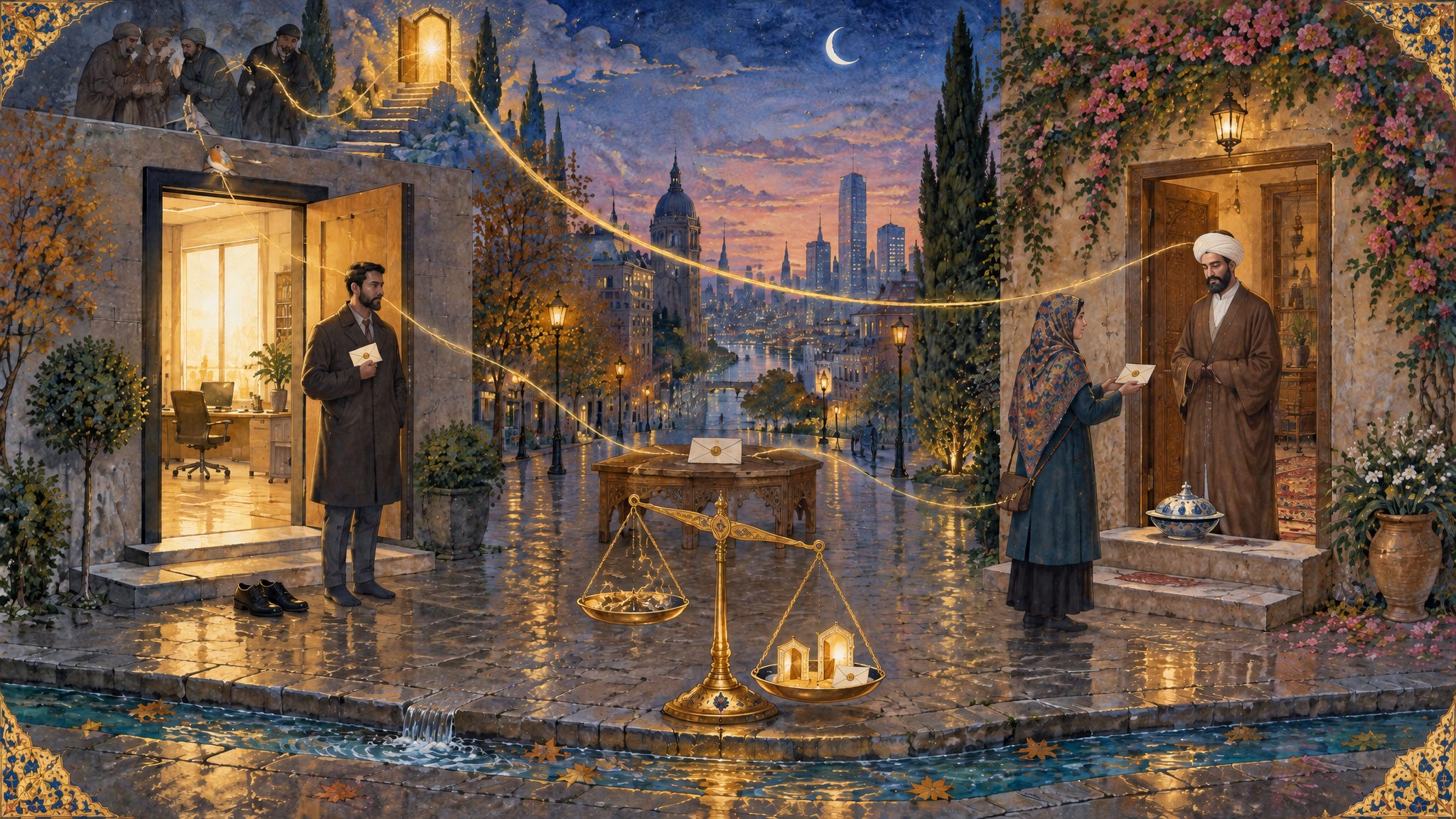
The office is open: use it, with courtesy and without fear.
And the one who is sent to your city is carrying something for Someone else.
If you have a concern, take it up the chain, never around the room. And if he is good, tell him.
This week: write one message — to the office of your marja’, with the question you have been carrying, or to his representative, to say thank you.
Do those three things, and you will have understood, a little, what it means to be employed by the Imam of the Age.
Eleven
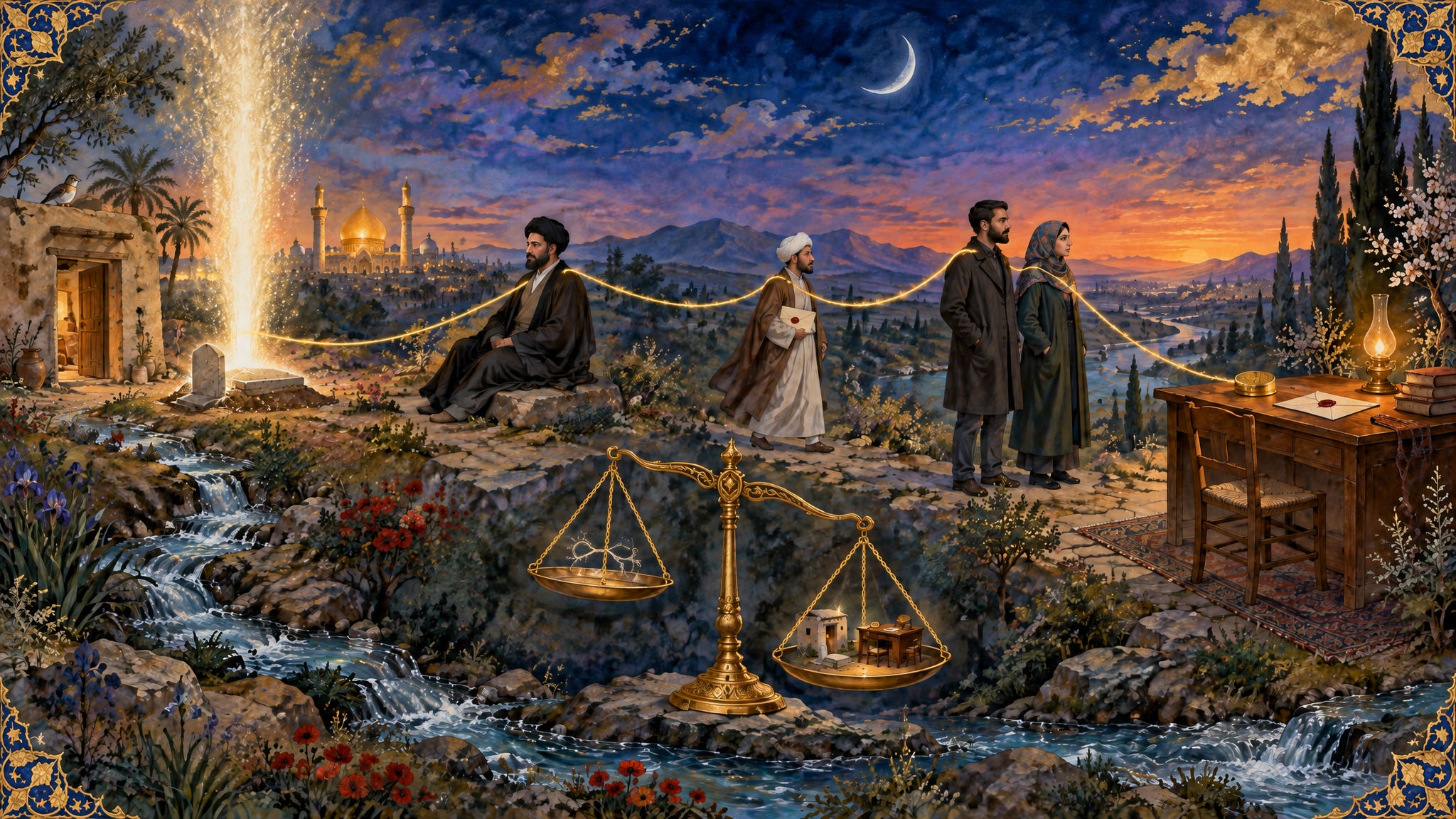
When we began these eleven, we started beside a grave in Najaf.
Tonight we end at a desk with a seal on it — and we have traced the line that runs between them, from the seat of the Imam to the seat of the scholar, and from there to the one he sends, and from there to us.
From next week, God willing, we return to the scholars.
Eulogy — The Maraji’ Who Kept the Lamp
Three weeks ago I told you about three maraji’ who, in my own hearing, asked the same thing of the people in front of them:
Pray for us — that we have a good ending.
I will not tell it again.
But I want you to remember what kind of men ask for that.
Tonight I want to add another name — not a marja’, but a man who honoured the marja’iyyah all his life.
The martyred leader of the Islamic Resistance, Sayyed Hassan Nasrallah, may God rest his pure soul.
When he spoke about how Iraq was saved, in the darkest days of 2014, he named the marja’.
On the 6th of February 2019, at the fortieth anniversary of the Islamic Revolution, he said:
The religious marja’iyyah in Najaf al-Ashraf, and His Eminence Grand Ayatollah Sayyed Ali al-Sistani, may his shadow endure, issued the fatwa.
— Sayyed Hassan Nasrallah, may God rest his pure soul, speech of 6 February 2019, almaaref.org — narrated36
And when he mourned Hajj Abu Mahdi al-Muhandis, on the 3rd of January 2022, he said that he and his brothers were
The first to answer the fatwa of the noble religious marja'iyyah, and its historic call to jihad.
— Sayyed Hassan Nasrallah, may God rest his pure soul, speech of 3 January 2022, almaaref.org — narrated37
The first to answer the fatwa.
Of all the things he might have said about a martyr, he said that.
That is what the marja’iyyah meant to him.
And now the man at the centre of tonight.
On the 4th of June 1989, a man stood at a lectern and told a room that the community should weep blood that someone like him was even mentioned.
And then he carried what they gave him — for nearly thirty-seven years.
He carried it through wars, and sanctions, and slander.
He carried it while the same lines from that afternoon were cut out and passed around by people who wanted them to mean the opposite of what they meant.
He carried it as a weight, because he had said, on the first day, that it was one.
And when he was martyred, on the 28th of February this year, the message his Office gave to the world was a single verse.
مِّنَ ٱلۡمُؤۡمِنِينَ رِجَالٞ صَدَقُواْ مَا عَٰهَدُواْ ٱللَّهَ عَلَيۡهِۖ فَمِنۡهُم مَّن قَضَىٰ نَحۡبَهُۥ وَمِنۡهُم مَّن يَنتَظِرُۖ وَمَا بَدَّلُواْ تَبۡدِيلٗا
“Among the faithful are men who fulfill what they have pledged to God: there are some among them who have fulfilled their pledge, and some of them who still wait, and they have not changed in the least,”
— Qur’an, Surah al-Ahzab (the Chapter of the Confederates) #33, Verse 23
And they have not changed in the least.
The martyred leader, Imam Sayyed Ali Khamenei, may God rest his pure soul.
Some of you will remember the night in March when we spoke of an unbroken chain.
I will not retell it.
But I want to put tonight’s evening next to it, because they belong together.
Think of the maraji’ of the occultation as people passing a lamp.
Not a lamp of their own making — a lamp that was handed to them, and that they will hand on.
Each one holds it for a while.
Each one shields it from the wind.
Each one knows that it is not his.
And each one, when the time comes, hands it on.
Shaykh al-Mufid held it, in Baghdad.
Shaykh al-Tusi held it, and carried it to Najaf, and sat at the desk we visited last week.
Allamah al-Hilli held it — and tonight we heard of a night when he fell asleep holding it, and Someone else held it for him until morning.
And so on, hand to hand, through a thousand years of nights, down to the hands we knew.
Imam Khomeini, may God rest his pure soul.
And the man who stood at that lectern in 1989, and said he was not worthy to hold it — and then held it, without letting it go out, through every wind that blew at it, until the day they took him.
We do not know how the Imam of our Age looked after him through those years.
We were not told, and we do not need to be.
But tonight we said: the one who looks after the people looks after those who look after the people.
I believe that.
And I hope — and I believe — that on the 28th of February he was received by the One he had served, and by the one he had worked for.
We pray for the one who holds it now: our Wali al-Faqih, Imam Sayyed Mujtaba Khamenei, may God protect him.
Segue to Maqtal
Tonight we have talked about people who carry another’s word — the marja’ who carries the Imam’s, and the one he sends, who carries the marja’‘s.
There was a young man who carried the word of Amir al-Mu’minin, peace and blessings be upon him, to Egypt.
He carried a letter from his Imam, to read to its people.
He was the son of Abu Bakr.
And he was raised in the house of Imam ‘Ali.
Our maqtal tonight is for him — Muhammad ibn Abi Bakr.
And it is given in the voice of the one who carries every one of their griefs: the Imam of our Age.
Maqtal (Lamentation) for the Nineteenth Session of the Architecture of Guidance
Supplication
O God, we ask You by the light You placed in the world before there was a world to place it in.
By Your prophets, peace and blessings be upon them all — every one of them sent with Your word to a people who needed it.
By Muhammad, peace and blessings be upon him, his family, and his righteous companions — the one to whom every matter of safety or alarm should have been taken.
By the fourteen — by Sayyedah Fatimah al-Zahra, peace and blessings be upon her, and by every Imam from the Commander of the Faithful, peace and blessings be upon him, to the one we are waiting for.
O God, make us people who take what reaches us to those who can draw out its truth — and not people who broadcast it before we know.
O God, give us the wisdom to check, and the humility to trust. And when those we follow differ, give us quiet hearts, and keep us from sneering at our neighbours.
O God, protect the maraji’ of this ummah — the living and the dead. Give the living long life and strength, and a good ending, as they have asked us to ask for them. And have mercy on those who have gone, who kept the lamp and handed it on.
O God, protect the ones they send to us — in our cities, far from their teachers and their homes. Make us a community that stands with them, and does not leave them alone.
O God, have mercy on the martyred leader of the Islamic Resistance, Sayyed Hassan Nasrallah, may God rest his pure soul, who honoured the marja’iyyah all his life — and on Hajj Abu Mahdi al-Muhandis and his brothers, the first to answer its call.
O God, have mercy on the previous leader, Imam Khomeini, may God rest his pure soul.
O God, we remember before You the martyred leader, Imam Sayyed Ali Khamenei, may God rest his pure soul, who wept that his name was even raised, and then carried what was given him until the end. Accept him, and gather him with those he loved.
O God, protect and guide and lengthen the life of our Wali al-Faqih, Imam Sayyed Mujtaba Khamenei, may God protect him, and keep him firm on the straight path until the rising of the one we are waiting for.
O God, hasten the relief of Your friend and the son of Your friend — the Imam of our Age, may our souls be his ransom and may God hasten his return. Make us among those he would be glad to employ. And make us among those who wait for him actively — who prepare, and do not only wait.
O God, give us success in whatever we do for his sake. And give us, and every one of the scholars who kept this lamp, a good ending.
And whatever we have said tonight that was true, it is from You; and whatever was wrong in it is from me, and I ask Your forgiveness for it.
Amen, O Lord Sustainer of the Universes
Amen, O Most Merciful of the Merciful
And from Him alone is all ability and He has authority over all things.
Allamah’s words.
و يظهر به أن الأمر الذي جاءهم من الأمن أو الخوف كان بعض الأراجيف التي كانت تأتي بها أيدي الكفار و رسلهم المبعوثون لإيجاد النفاق و الخلاف بين المؤمنين فكان الضعفاء من المؤمنين يذيعونه من غير تدبر و تبصر فيوجب ذلك وهنا في عزيمة المؤمنين، غير أن الله سبحانه وقاهم من اتباع هؤلاء الشياطين الجائين بتلك الأخبار لإخزاء المؤمنين.
“And it appears from this that the matter of security or fear which reached them was some of the rumours that the hands of the unbelievers, and their messengers sent out to bring about hypocrisy and dissension among the believers, used to bring. The weak among the believers would broadcast it without reflection or insight, and that caused a weakening in the resolve of the believers — except that God, glory be to Him, protected them from following these devils who came with those reports to disgrace the believers.”
و أما الرد المذكور هاهنا فهو رد الخبر الشائع بين الناس من أمن أو خوف، و لا معنى لرده إلى الله و كتابه، بل الصنع فيه للرسول و لأولي الأمر منهم، لو رد إليهم أمكنهم أن يستنبطوه و يذكروا للرادين صحته أو سقمه و صدقه أو كذبه.
“As for the referral mentioned here, it is the referral of a report spreading among the people, of security or of fear; and there is no sense in referring it to God and His Book. Rather, the work in it belongs to the Messenger and to those in authority among them: were it referred to them, they could draw it out, and tell those who referred it whether it was sound or sick, true or false.”
و الاستنباط استخراج القول من حال الإبهام إلى مرحلة التمييز و المعرفة، و أصله من النبط محركة، و هو أول ما يخرج من ماء البئر، و على هذا يمكن أن يكون الاستنباط وصفا للرسول و أولي الأمر بمعنى أنهم يحققون الأمر فيحصلون على الحق و الصدق و أن يكون وصفا لهؤلاء الرادين لو ردوا فإنهم يعلمون حق الأمر و صدقه بإنباء الرسول و أولي الأمر لهم.
“And istinbat is the drawing out of a statement from a state of vagueness to the stage of discernment and knowledge. Its root is nabat, which is the first water that comes out of a well. On this basis, istinbat may describe the Messenger and those in authority — meaning that they verify the matter and so arrive at what is right and true — or it may describe those who refer it, had they referred it: for they would know the truth of the matter and its veracity through the Messenger and those in authority informing them.”
— Allamah Sayyed Muhammad Husayn Tabataba’i, al-Mizan fi Tafsir al-Qur’an, on Surah al-Nisa (the Chapter of the Women) #4, Verses 81 to 84 — three passages from his commentary; my translation
The text, as the book gives it:
Ruling 1. A Muslim’s belief in the fundamentals of religion (uṣūl al‑dīn) must be based on personal insight [i.e. grounded in reason], and he cannot follow anyone in the fundamentals of religion; i.e. he cannot accept the word of someone who knows about the fundamentals of religion simply because that person says so. However, in the event that a person has certainty (yaqīn) in the rightful beliefs of Islam and expresses them – even though this certainty may not be based on insight – then that person is a Muslim and a believer and all the laws (aḥkām) of Islam and the faith are applicable to him.
— Ayatollah Sayyed Ali al-Husayni al-Sistani, Islamic Laws, fourth English edition, Ruling 1
And the Arabic Minhaj al-Salihin opens the subject of taqlid by placing it in a person’s acts — his worship, his dealings, what he does and what he leaves:
مسألة ١: يجب على كلِّ مكلَّف لم يبلغ رتبة الاجتهاد أن يكون في جميع عباداته ومعاملاته وسائر أفعاله وتروكه مقلَّداً أو محتاطاً، إلَّا أن يحصل له العلم بأنَّه لا يلزم من فعله أو تركه مخالفة لحكم إلزامي ولو مثل حرمة التشريع، أو يكون الحكم من ضروريات الدين أو المذهب - كما في بعض الواجبات والمحرمات وكثير من المستحبَّات والمباحات - ويحرز كونه منها بالعلم الوجداني أو الاطمئنان الحاصل من المناشئ العقلائية كالشياع وإخبار الخبير المطلع عليها.
“Issue 1: Every duty-bound person who has not reached the rank of ijtihad must, in all his acts of worship and his dealings, and in the rest of his actions and omissions, either follow [a mujtahid] or take precaution — unless he knows that his act or omission will not lead to contravening a binding ruling, even such as the prohibition of introducing into the religion what is not of it; or the ruling is among the necessities of the religion or of the school — as with some obligations and prohibitions, and many recommended and permitted acts — and he establishes that it is one of them by direct knowledge, or by confidence arising from rational sources, such as wide report, or the word of an expert who knows them.”
— Ayatollah Sayyed Ali al-Husayni al-Sistani, Minhaj al-Salihin, Volume 1 (1445 edition), issue 1, page 21
The original, and its translation:
بهعنوانمثال در پزشکی؛ همه مردم به پزشک و به دارو و درمان احتیاج دارند اما همه که نمیروند پزشک بشوند. یک عده میروند درس میخوانند و پزشک میشوند، دیگران هم از آنها استفاده میکنند یعنی یک نوع تقلید از پزشک میکنند؛ او نسخه مینویسد و میگوید این را برو عمل کن! این احتیاج به این نداشت که یک معصومی بیاید این کار را انجام دهد.
“For example, in medicine: all people need a physician, and medicine and treatment — but not everyone goes off to become a physician. Some go and study and become physicians, and the others benefit from them; that is, they follow the physician in a kind of taqlid: he writes the prescription and says, go and act on this! This did not need an infallible to come and do it.”
— Ayatollah Muhammad Taqi Mesbah Yazdi, “Our Mission in the Age of Occultation” (Persian), 22 December 2019, mesbahyazdi.ir/node/9063; my translation
Taqlid and marja'. Taqlid here means acting on the ruling of a qualified jurist in matters of practice one has not studied for oneself. It is not taken in matters of belief: the marja''s own book says that the fundamentals must be held by one's own insight (Islamic Laws, 4th English edition, Ruling 1). A marja' al-taqlid is a jurist to whom people refer in this way. On the 1989 session: the Constitution as it then stood required the Leader to be a marja'; the revision approved by referendum on 28 July 1989 required a mujtahid — which is the question the Assembly had just debated before he spoke.
Ruling 3. A mujtahid or the most learned can be identified in one of three ways:
a duty-bound person (mukallaf)3 is certain himself [that someone is a mujtahid or the most learned]. For example, the person is a scholar himself and is able to identify a mujtahid and the most learned;
two learned and dutiful people who are able to distinguish a mujtahid and the most learned confirm that someone is a mujtahid or the most learned, provided that two other learned and dutiful people do not disagree with their statement. In fact, being a mujtahid or the most learned is also established by even one expert (ahl al‑khibrah) whom one trusts;
a mukallaf attains confidence (iṭmiʾnān) that a person is a mujtahid or the most learned by rational means. For example, a group of scholars who are able to distinguish a mujtahid and the most learned and from whose statements one gains confidence confirm that someone is a mujtahid or the most learned.
— Ayatollah Sayyed Ali al-Husayni al-Sistani, Islamic Laws, fourth English edition, Ruling 3
Women and marja'iyyah. Ayatollah Sistani's books of rulings list maleness among the conditions of the jurist one follows (Minhaj al-Salihin, Volume 1, issue 6; Islamic Laws, 4th English edition, Ruling 2), and that is the view of most jurists. A series of classes at Madreseh-ye Feqahat (Faqihi, 2025–2026, eshia.ir) examines the arguments for the condition at length, and argues that the reports usually adduced for it do not establish it. We record both, and decide neither. What is not in dispute is that women have always been among the scholars and teachers of this tradition — and this majlis will give them their own evenings, God willing.
the original, and its translation:
خلاصه جلسه گذشته: در جلسه گذشته گفتیم که بحث مرجعیت زنان مبتنی بر دو دسته روایت است که هیچکدام دلالتی بر منع زنان از مرجعیت ندارند: 1. روایات محدودکننده نقش اجتماعی زنان (مانند وصیت امام علی(ع)): این روایات ماهیتاً توصیههای ارشادی خانوادگی برای حفظ آرامش زندگی هستند، نه احکام الزامی شرعی. از آنجا که مرجعیت به معنای “اخبار از حکم خدا” است، نه دخالت در امور دیگران، این روایات هیچ ارتباطی با نفی صلاحیت علمی زنان برای مرجعیت ندارند.
“Summary of the previous session: in the previous session we said that the discussion of women’s marja’iyyah rests on two sets of narrations, neither of which indicates any prohibition of women from marja’iyyah: 1. Narrations restricting women’s social role (such as the testament of Imam Ali, peace be upon him): these narrations are by their nature advisory family counsels for preserving the peace of life, not binding legal rulings. Since marja’iyyah means ‘reporting the ruling of God’, not intervening in the affairs of others, these narrations have no connection with denying women’s scholarly competence for marja’iyyah.”
— Faqihi, class on contemporary jurisprudence (women and marja’iyyah), Madreseh-ye Feqahat, 3 February 2026, eshia.ir/feqh/archive/text/faqihi/feqh2/1404/14041114; my translation
The original, and its translation:
مسألة ٢٩: العدالة - التي مرّأنّها تعتبر في مرجع التقليد - هي: الاستقامة في جادّة الشريعة المقدّسة الناشئة غالباً عن خوف راسخ في النفس، وينافيها ترك واجب أو فعل حرام من دون مؤمّن، ولا فرق في المعاصي من هذه الجهة بين الصغيرة والكبيرة، وترتفع العدالة بمجرّد وقوع المعصية وتعود بالتوبة والندم.
“Issue 29: ‘Adalah — which, as has been said, is required in the one whose rulings are followed — is steadfastness on the highway of the sacred Shari’ah, usually arising from a deep-rooted fear [of God] in the soul. It is negated by leaving an obligation, or doing a forbidden act, without an excuse; and in this respect there is no difference between minor sins and major. ‘Adalah lapses with the mere occurrence of a sin, and returns with repentance and remorse.”
— Ayatollah Sayyed Ali al-Husayni al-Sistani, Minhaj al-Salihin, Volume 1 (1445 edition), issue 29, pages 28–29
مسألة ٢٠: تقدّم أنّه يشترط في مرجع التقليد أن يكون مجتهدًا عادلاً، وتثبت العدالة بأمور:
الأول: العلم الوجدانيّ أو الاطمئنان الحاصل من المناشئ العقلائية كالاختبار ونحوه.
الثاني: شهادة عادلين بها.
الثالث: حسن الظاهر، والمراد به حسن المعاشرة والسلوك الديني، وهو يثبت أيضاً بأحد الأمرين الأوّلين.
“Issue 20: It has been said that the one whose rulings are followed must be a mujtahid who is ‘adil. ‘Adalah is established by [three] things. First: direct knowledge, or confidence arising from rational sources, such as testing and the like. Second: the testimony of two ‘adil witnesses to it. Third: good outward conduct — meaning good dealings with people, and religious behaviour; and this too is established by one of the first two.”
— Ayatollah Sayyed Ali al-Husayni al-Sistani, Minhaj al-Salihin, Volume 1 (1445 edition), issue 20, pages 26–27, my translation
Ruling 2. Following a jurist in Islamic laws means acting according to a mujtahid’s instructions. Only a mujtahid who is male, of the age of legal responsibility (bāligh), sane (ʿāqil), a Twelver (Ithnā ʿAsharī) Shia, of legitimate birth, living, and dutiful (ʿādil), can be followed. A ‘dutiful’ person is someone who does the things that are obligatory for him and refrains from doing the things that are unlawful for him. The sign of being ‘dutiful’ is that one appears to be a good person, such that if [religious, trustworthy Shia Muslims who are] local to him, his neighbours, or associate with him were to be asked about him, they would confirm his good character.
— Ayatollah Sayyed Ali al-Husayni al-Sistani, Islamic Laws, fourth English edition, Ruling 2
یکی از روایاتی که در جلسات گذشته نیز مورد اشاره قرار گرفت، مقبوله یا روایتی است که ملاکات تقلید صحیح را تبیین مینماید:«فَأَمَّا مَنْ كَانَ مِنَ الْفُقَهَاءِ صَائِناً لِنَفْسِهِ حَافِظاً لِدِينِهِ مُخَالِفاً عَلَى هَوَاهُ مُطِيعاً لِأَمْرِ مَوْلَاهُ فَلِلْعَوَامِّ أَنْ يُقَلِّدُوهُ وَ ذَلِكَ لَا يَكُونُ إِلَّا بَعْضَ فُقَهَاءِ الشِّيعَةِ لَا جَمِيعَهُم ...»[1]
“One of the narrations also mentioned in earlier sessions is the maqbula, or narration, that sets out the criteria of correct taqlid: ‘As for whoever among the jurists guards his soul, protects his religion, opposes his desire, and obeys the command of his Master — it is for the common people to follow him; and that is only some of the jurists of the Shi’a, not all of them…’ [al-Ihtijaj, al-Tabrisi, Abu Mansur, Volume 2, page 458].”
— Faqihi, class on contemporary jurisprudence (women and marja’iyyah), Madreseh-ye Feqahat, 30 December 2025, eshia.ir/feqh/archive/text/faqihi/feqh2/1404/14041009; my translation; the Arabic of the report as the class quotes it
And the report as our own copy of al-Ihtijaj gives it — from the condemnation of blind following to the four qualities:
ﻭﻛﺬﻟﻚ ﻋﻮﺍﻡ ﺃﻣﺘﻨﺎ ﺇﺫﺍ ﻋﺮﻓﻮﺍ ﻣﻦ ﻓﻘﻬﺎﺋﻬﻢ ﺍﻟﻔﺴﻖ ﺍﻟﻈﺎﻫﺮ ،ﻭﺍﻟﻌﺼﺒﻴﺔ ﺍﻟﺸﺪﻳﺪﺓ ﻭﺍﻟﺘﻜﺎﻟﺐ ﻋﻠﻰ ﺣﻄﺎﻡ ﺍﻟﺪﻧﻴﺎ ﻭﺣﺮﺍﻣﻬﺎ ،ﻭﺇﻫﻼﻙ ﻣﻦ ﻳﺘﻌﺼﺒﻮﻥ ﻋﻠﻴﻪ ﻭﺇﻥ ﻛﺎﻥ ﻹﺻﻼﺡ ﺃﻣﺮﻩ ﻣﺴﺘﺤﻘﺎ ،ﻭﺑﺎﻟﺘﺮﻓﺮﻑ ﺑﺎﻟﺒﺮ ﻭﺍﻹﺣﺴﺎﻥ ﻋﻠﻰ ﻣﻦ ﺗﻌﺼﺒﻮﺍ ﻟﻪ ﻭﺇﻥ ﻛﺎﻥ ﻟﻺﺫﻻﻝ ﻭﺍﻹﻫﺎﻧﺔ ﻣﺴﺘﺤﻘﺎ ،ﻓﻤﻦ ﻗﻠﺪ ﻣﻦ ﻋﻮﺍﻣﻨﺎ ﻣﺜﻞ ﻫﺆﻻﺀ ﺍﻟﻔﻘﻬﺎﺀ ﻓﻬﻢ ﻣﺜﻞ ﺍﻟﻴﻬﻮﺩ ﺍﻟﺬﻳﻦ ﺫﻣﻬﻢ ﺍﻟﻠﻪ ﺑﺎﻟﺘﻘﻠﻴﺪ ﻟﻔﺴﻘﺔ ﻓﻘﻬﺎﺋﻬﻢ ،ﻓﺄﻣﺎ ﻣﻦ ﻛﺎﻥ ﻣﻦ ﺍﻟﻔﻘﻬﺎﺀ ﺻﺎﺋﻨﺎ ﻟﻨﻔﺴﻪ ،ﺣﺎﻓﻈﺎ ﻟﺪﻳﻨﻪ ،ﻣﺨﺎﻟﻔﺎ ﻋﻠﻰ ﻫﻮﺍﻩ ،ﻣﻄﻴﻌﺎ ﻷﻣﺮ ﻣﻮﻻﻩ ،ﻓﻠﻠﻌﻮﺍﻡ ﺃﻥ ﻳﻘﻠﺪﻭﻩ ،ﻭﺫﻟﻚ ﻻ ﻳﻜﻮﻥ
“And likewise the common people of our community: if they know of their jurists open sinfulness, fierce partisanship, and scrambling over the debris of this world and its forbidden things; the ruin of those against whom they are partisan, even if he deserves to have his affair set right; and the lavishing of kindness and favour on those for whom they are partisan, even if he deserves humiliation and contempt — then whoever of our common people follows such jurists is like the Jews whom God condemned for following their sinful jurists. But as for whoever among the jurists guards his soul, protects his religion, opposes his desire, and obeys the command of his Master — it is for the common people to follow him. And that is not …”
— attributed to Imam al-Hasan al-’Askari, peace and blessings be upon him; al-Tabrisi, al-Ihtijaj, printed page 263; my translation. The sentence ends on the next page, carried below.
And the sentence’s close, on the next page:
ﺇﻻ ﺑﻌﺾ ﻓﻘﻬﺎﺀ ﺍﻟﺸﻴﻌﺔ ﻻ ﺟﻤﻴﻌﻬﻢ ،ﻓﺈﻧﻪ ﻣﻦ ﺭﻛﺐ ﻣﻦ ﺍﻟﻘﺒﺎﻳﺢ ﻭﺍﻟﻔﻮﺍﺣﺶ ﻣﺮﺍﻛﺐ ﻓﺴﻘﺔ ﺍﻟﻌﺎﻣﺔ ﻓﻼ ﺗﻘﺒﻠﻮﺍ ﻣﻨﺎ ﻋﻨﻪ ﺷﻴﺌﺎ ،ﻭﻻ ﻛﺮﺍﻣﺔ ،ﻭﺇﻧﻤﺎ ﻛﺜﺮ ﺍﻟﺘﺨﻠﻴﻂ ﻓﻴﻤﺎ ﻳﺘﺤﻤﻞ
“… except some of the jurists of the Shi’a, not all of them. For whoever rides, of ugly and shameful deeds, the mounts that the sinners among the common people ride — accept nothing from him in our name; and he has no honour. And the confusion has multiplied only in what is carried …”
— attributed to Imam al-Hasan al-’Askari, peace and blessings be upon him; al-Tabrisi, al-Ihtijaj, printed page 264
The report attributed to Imam al-Hasan al-'Askari. It is carried in al-Tabrisi's al-Ihtijaj (Volume 2, page 458), within a longer passage attributed to the Imam's commentary on the Qur'an, and it goes on to say that this is only some of the jurists of the Shi'a, not all of them. Its attribution is discussed among the scholars: some rely on it, and some do not, because of questions over the commentary in which it is found. It is used tonight as the jurists themselves use it — to express a measure already established by other evidence — and not as the proof of that measure. Its text here is relayed through a class at Madreseh-ye Feqahat (Faqihi, 30 December 2025, eshia.ir); it is also given from our own copy of al-Ihtijaj (Fihrist, record 272; printed page 263 in that printing), where the closing words fall on the next page (record 273), carried as well.
The original, and its translation:
پس از طرح استعفای آیتالله منتظری و پذیرش آن و با توجّه به محتوای جلسات شورای بازنگری قانون اساسی و نظر حضرت امام (قدّس سرّه الشّریف) مبنی بر کفایت شرط اجتهاد برای رهبری، از آنجا که مباحث شورای بازنگری هنوز به پایان نرسیده بود، خبرگان دربارهی شرط مرجعیّت برای رهبری یا کفایت اجتهاد وارد بحث شدند و اکثریّت، شرط اجتهاد را کافی دانستند.
“After the resignation of Ayatollah Montazeri had been raised and accepted — and in view of the content of the sessions of the Council for the Revision of the Constitution, and of the view of the Imam [Khomeini], may his noble soul be sanctified, that the condition of ijtihad suffices for leadership — since the deliberations of the revision council had not yet ended, the Experts entered into debate on whether marja’iyyah is a condition of leadership or ijtihad suffices; and the majority held the condition of ijtihad to be sufficient.”
— the editor’s note to the record of 4 June 1989; farsi.khamenei.ir, speech-content id 43942; my translation
his words, as his Office publishes them.
اوّلاً واقعاً باید خون گریست بر جامعهی اسلامی که حتّی احتمال [رهبری] کسی مثل بنده در آن مطرح بشود که حالا نمیخواهم دربارهی این صحبت کنم. مسئله اشکال فنّی دارد، اشکال اساسی دارد. من قبلاً هم خدمت آقای هاشمی گفتهام -یکی دو هفته قبل از این که همین قضیّه مطرح بود و ایشان فرمودند- من جدّاً به ایشان گفتم که من قاطعاً چنین چیزی را قبول نخواهم کرد. حالا غیر از اینکه خود من حقیقتاً لایق این مقام نیستم -و این را بنده میدانم، شاید آقایان هم میدانید- اصلاً این قضیّه از لحاظ فنّی اشکال پیدا میکند؛ رهبری، رهبریِ صوری خواهد بود؛ نه رهبری واقعی. حرف من، نه از لحاظ قانون اساسی و نه از لحاظ شرعی برای بسیاری از آقایان، حجّیّتِ حرف رهبر را ندارد؛ خب این چه رهبری خواهد بود؟ خب، قانون اساسی که میگوید مرجع -حالا یا مرجع شأنی یا مرجع فعلی- این که هیچ؛ از لحاظ شرعی هم حجّیّت قول رهبر در صورتی است که آن کسی که میخواهد به حرف او عمل کند، او را فقیه و صاحبنظرِ در امور دین بداند. خب الان در همین جلسه چند نفر از آقایان آمدند صحبت کردند و تصریح کردند که بنده صاحبنظر نیستم. این چطور [میشود]؟
“First: truly, we should weep blood for an Islamic society in which even the possibility of [the leadership of] someone like me is raised — which I do not now want to talk about. The matter has a technical problem; it has a fundamental problem. I had already said to Mr Hashemi — a week or two before this, when this same matter was raised and he mentioned it — I told him seriously that I would definitely not accept such a thing. Now, apart from the fact that I am truly not worthy of this station — and I know this, and perhaps you gentlemen know it too — this matter runs into a technical problem altogether: the leadership will be a leadership in form, not a real leadership. My word, neither in terms of the Constitution nor, for many of you gentlemen, in terms of the Shari’ah, has the authority of a leader’s word; so what kind of leadership will this be? The Constitution, which says a marja’ — whether a marja’ in potential or a marja’ in actuality — that is out of the question. And in terms of the Shari’ah too, a leader’s word carries authority only if the one who is to act on his word regards him as a faqih, and as having an expert view in matters of religion. Well, just now, in this very session, several of you gentlemen came and spoke, and stated plainly that I am not an expert. How can this [work]?”
— the martyred leader, Imam Sayyed Ali Khamenei, may God rest his pure soul, the Assembly of Experts, 4 June 1989; farsi.khamenei.ir, speech-content id 43942, my translation;
آیتالله احمد آذریقمی: «من اعتقادم این است، همانجور که امام در آنجا تصریح کردند که هرکسی را خبرگان که نمایندهی مردم است انتخاب بکند، حالا بهعنوان مجتهد باشد، بهعنوان ثقةالمؤمنین باشد، حتّی بالاتر برود، هم ولایت مطلقه دارد، و هم اطاعتش واجب است؛ عقیدهی من این است. یعنی لازم نیست حتماً مجتهد باشید. اگر مجتهد هم نباشد، از باب عدولالمؤمنین است و من هم اطاعت میکنم.»
“Ayatollah Ahmad Azari Qomi: ‘My belief is this — just as the Imam stated plainly there — that whoever the Experts, who are the representatives of the people, elect, whether as a mujtahid, or as one of the trusted believers, or even higher, both holds absolute authority and must be obeyed; that is my belief. That is, it is not necessary that you be a mujtahid. Even if he is not a mujtahid, it is under the heading of the upright believers, and I too will obey.’”
اوّلاً، خب ما با آقای خامنهای از جوانی توی مدرسه خدمتشان بودیم. در بحثها بودیم، حالا هم همیشه مسائل مطرح میشود، مسائل عمده مطرح میشود. من واقعاً آقای خامنهای را صاحبنظر میدانم، صاحبنظرِ جدّی در مسائل فقهی؛ امّا نه اینکه ایشان رفته مسائل را استنباط کرده؛ یعنی الان اگر یک مسئلهی اجتماعی برای کشور مطرح بشود و ایشان بخواهند نظر فقهی پیدا بکند، با همان روش سنّتی، با یک مقدار کار کردن، با یک مقدار کمک گرفتن از کسانی که میتوانند کمک کنند برای پیدا کردن مصادر -چون ممکن است وقت نداشته باشند- ایشان میتوانند به نظر برسد. خیلی خب. حالا ما رأی میگیریم، بحث هم نمیکنیم. آقایانی که با رهبری جناب آقای خامنهای البتّه تا رفراندوم -این موقّت است، دائمی نیست- موافق هستند قیام بفرمایند.»
“[Hojjat al-Islam Akbar Hashemi Rafsanjani:] ‘First — well, we were with Mr Khamenei from our youth, in the seminary. We were in the discussions together, and now too questions are always being raised — major questions. I truly regard Mr Khamenei as having an expert view — a serious expert view in matters of jurisprudence; but not that he has gone and derived the questions; that is, if now a social question were raised for the country and he wished to find a juristic view, by the same traditional method, with some work, with some help from those who can help in finding the sources — since he may not have the time — he can reach a view. Very well. Now we will vote; we will not debate. Gentlemen who agree with the leadership of His Excellency Mr Khamenei — until the referendum, of course; this is temporary, not permanent — please stand.’”
— the members’ words, as the record of 4 June 1989 gives them in its notes; farsi.khamenei.ir, speech-content id 43942; my translation
The vote, as the record gives it.
در نهایت، اعضای مجلس خبرگان با ۶٠ رأی از ۷۴ رأی، ایشان را تا زمان همهپرسی و تصویب نهایی بازنگری قانون اساسی بهعنوان رهبر جمهوری اسلامی ایران برگزیدند. پس از برگزاری همهپرسی بازنگری قانون اساسی کشور در ششم مرداد و تأیید آن از سوی مردم، مجلس خبرگان در اجلاسیهی فوقالعادهی پانزدهم مرداد ماه ۱۳۶۸ مجدّداً در خصوص رهبری معظّمٌٌله رأیگیری کردند که با رأی قاطع اعضای خبرگان (۶٠ رأی از ۶۴ رأی) رهبری حضرت آیتالله خامنهای مجدّداً تأیید شد.
“In the end, the members of the Assembly of Experts, with 60 votes out of 74, chose him as Leader of the Islamic Republic of Iran until the referendum and the final ratification of the revision of the Constitution. After the referendum on the revision of the country’s Constitution was held on the sixth of Mordad and approved by the people, the Assembly of Experts, at its extraordinary session of the fifteenth of Mordad 1368, voted again on his leadership, and with the decisive vote of the members of the Assembly (60 votes out of 64), the leadership of Ayatollah Khamenei was confirmed again.”
— farsi.khamenei.ir, speech-content id 43942, the closing note; my translation; the sixth and fifteenth of Mordad 1368 are 28 July and 6 August 1989;
The original, and its translation:
3 ـ مُحَمَّدُ بْنُ إِسْمَاعِيلَ عَنِ الْفَضْلِ بْنِ شَاذَانَ عَنْ حَمَّادِ بْنِ عِيسَى عَنْ رِبْعِيِّ بْنِ عَبْدِ الله عَنْ أَبِي بَصِيرٍ عَنْ أَبِي عَبْدِ الله (عَلَيْهِ السَّلام) فِي قَوْلِ الله جَلَّ وَعَزَّ اتَّخَذُوا أَحْبارَهُمْ وَرُهْبانَهُمْ أَرْباباً مِنْ دُونِ الله فَقَالَ وَالله مَا صَامُوا لَهُمْ وَلا صَلَّوْا لَهُمْ وَلَكِنْ أَحَلُّوا لَهُمْ حَرَاماً وَحَرَّمُوا عَلَيْهِمْ حَلالاً فَاتَّبَعُوهُمْ.
“Muhammad ibn Isma’il, from al-Fadl ibn Shadhan, from Hammad ibn ‘Isa, from Rib’i ibn ‘Abd Allah, from Abu Basir, from Abu ‘Abd Allah [Imam al-Sadiq], peace be upon him, on the words of God, majestic and mighty, ‘They have taken their rabbis and their monks as lords besides God’: He said: By God, they did not fast for them, nor pray to them; but they made lawful for them what was forbidden, and forbade them what was lawful — and they followed them.”
— Shaykh al-Kulayni, al-Kafi, Volume 1 (Fihrist: vol 1, hadith 159); my translation
The case is my own account, from around 1999–2000. The Society's published list: not yet in our systems — will be updated in the future.
مسألة ١٤: لا يجوز العدول إلى الميت - ثانياً - بعد العدول عنه إلى الحيّ والعمل مستنداً إلى فتواه، إلّا إذا ظهر أنّ العدول عنه لم يكن في محلّه، كما لا يجوز العدول من الحيّ إلى الحيّ إلّا إذا صار الثاني أعلم أو لم يعلم الاختلاف بينهما في المسائل التي في معرض ابتلائه، وأمّا مع التساوي والعلم بالاختلاف ففيه تفصيل يظهر ممّا تقدّم في المسألة (٨).
“Issue 14: It is not permissible to switch back to the dead [mujtahid] — a second time — after having switched from him to the living and acted on the latter’s fatwa, unless it becomes clear that switching from him was not in its proper place; just as it is not permissible to switch from a living [mujtahid] to a living one unless the second has become more learned, or the difference between them is not known in the questions he is likely to face. As for when they are equal and the difference is known, there is a detail in it, which is clear from what was said in issue (8).”
— Ayatollah Sayyed Ali al-Husayni al-Sistani, Minhaj al-Salihin, Volume 1 (1445 edition), issue 14, page 25, my translation
ولكن هذا الوجود الواقعي لا أثر له في تكوّن الهلال وإن علمنا بتحققّه علماً قطعيّاً حسب قواعد الفلك وضوابط علم النجوم، إذ العبرة حسب النصوص المتقدّمة بالرؤية وشهادة الشاهدين بها شهادةً حسّيّةً عن باصرة عادية لا عن صناعة علميّة أو كشفه عن علوّه وارتفاعه في الليلة الآتية.
“But this real existence has no effect on the crescent’s coming into being — even if we know of it with certainty, by the rules of astronomy and the canons of the science of the stars. For what counts, according to the texts already cited, is the sighting, and the testimony of two witnesses to it: a testimony of the senses, from ordinary sight — not from a scientific craft, nor from its being shown by its height and elevation on the following night.”
— Ayatollah Sayyed Abu al-Qasim al-Khu’i, Sharh al-’Urwa al-Wuthqa (al-Mawsu’a), the Book of Fasting, printed page 123 (Fihrist record 9799), the paragraph before the one that follows; my translation
His words.
ومنه تعرف أنّه لا عبرة بالرؤية بالعين المسلّحة المستندة إلى المكّبرات المستحدثة والنظّارات القويّة كالتلسكوب ونحوه. من غير أن يكون قابلاً للرؤية بالعين المجرّدة والنظر العادي.
نعم، لا بأس بتعيين المحلّ بها ثمّ النظر بالعين المجرّدة، فإذا كان قابلاً للرؤية ولو بالاستعانة من تلك الآلات في تحقيق المقدّمات كفي وثبت به الهلال كما هو واضح.
“From this you know that no account is taken of sighting with the armed eye, relying on modern magnifiers and strong lenses such as the telescope and the like, without its being visible to the naked eye and ordinary sight. Yes — there is no harm in fixing the place with them and then looking with the naked eye; so if it is visible, even with the help of those instruments in the preliminaries, that suffices, and the crescent is established by it, as is clear.”
— Ayatollah Sayyed Abu al-Qasim al-Khu’i, Sharh al-’Urwa al-Wuthqa (al-Mawsu’a), the Book of Fasting, printed page 123, issue 2516/5 (Fihrist record 9799); my translation
The original, and its translation:
ويعتبر في الرؤية أن تكون بالعين غير المسلّحة، فلو رئي الهلال بالتلسكوب - مثلاً - ولم يمكن رؤيته بدونه لم يكفِ في دخول الشهر الجديد.
“In the sighting, it is required that it be with the eye not aided by instruments; so if the crescent was seen with a telescope, for example, and could not be seen without it, that does not suffice for the start of the new month.”
— Ayatollah Sayyed Ali al-Husayni al-Sistani, Minhaj al-Salihin, Volume 1 (1445 edition), the chapter on establishing the crescent, the paragraph before issue 1043, page 373; my translation
Ruling 1699.* The first of the month is established in four ways:22
a person sees the moon himself. The seeing must be done with the naked eye, i.e. without any equipment. Therefore, in the event that the crescent moon cannot be sighted with the naked eye, seeing it with the aid of a telescope is not sufficient;
— Ayatollah Sayyed Ali al-Husayni al-Sistani, Islamic Laws, fourth English edition, Ruling 1699, the first of the four ways
س ۸۳۵: آیا رؤیت تصویر هلال ماه با استفاده از دوربین CCD و انعکاس نور و بازخوانی اطلاعات ضبط شده توسط رایانه، برای اثبات اول ماه کفایت می کند؟
ج: رؤیت با وسیله، فرقی با رؤیت به طریق عادی ندارد و معتبر است. ملاک آن است
که عنوان رؤیت محفوظ باشد. پس رؤیت با چشم و با عینک و با تلسکوپ محکوم به حکم واحدند. اما در مورد انعکاس به رایانه که در آن صدق عنوان رؤیت معلوم نیست محل اشکال است.
“Question 835: Is sighting the image of the crescent moon, using a CCD camera and the reflection of light and the reading back of the recorded data by a computer, enough to establish the first of the month? Answer: Sighting with an instrument is no different from sighting in the ordinary way, and it is valid. The criterion is that the title ‘sighting’ is preserved. So sighting with the eye, with spectacles and with a telescope fall under one ruling. But as for reflection onto a computer, where it is not known that the title ‘sighting’ truly applies — that is problematic.”
— the martyred leader, Imam Sayyed Ali Khamenei, may God rest his pure soul, Ajwibat al-Istifta’at (Persian), question 835, my translation
The moon — further reading. The aided and the naked eye are discussed in the classes of the Hawza’s teachers kept in Safina: Ashrafi (16 and 17 September 2017), Alidoust (3 December 2023 — where one jurist’s ruling on the crescent does not bind those who follow another, because of a difference of basis, such as the aided or the naked eye), and Seify. For a companion case, the martyred leader ruled that a partial eclipse visible only with the aided eye still calls, on obligatory precaution, for the prayer of signs (al-Masa’il al-Mustahdatha, question 120).
Locus: al-Masa’il al-Mustahdatha, question 120. The original text: read in our systems — quality inadequate for citing — will be updated in the future.
مسألة ٨: إذا اختلف المجتهدون في الفتوى وجب الرجوع إلى الأعلم (أي الأقدر على استنباط الأحكام بأن يكون أكثر إحاطة بالمدارك وبتطبيقاتها بحيث يكون احتمال إصابة الواقع في فتاواه أقوى من احتمالها في فتاوى غيره).
“Issue 8: If the mujtahids differ in their fatwas, one must turn to the most learned (that is, the one most able to derive the rulings, by having a wider grasp of the sources and of their application, so that the likelihood of his fatwas reaching the reality is stronger than the likelihood of it in the fatwas of others).”
— Ayatollah Sayyed Ali al-Husayni al-Sistani, Minhaj al-Salihin, Volume 1 (1445 edition), issue 8, page 23; my translation
رای مثال، همه افرادی كه اینجا حضور دارند، مقلد یک مرجع تقلید نیستند؛ شاید فتوای چهار یا پنج مرجع حجت باشد و افراد بدان عمل میكنند؛ اما آیا این بدان معناست كه فتوای همه این افراد مطابق با واقع است؟ واقع یکی بیشتر نیست، پس چرا چهار فتوای مختلف در یك زمینه وجود دارد؟ اگر هر چهار فتوا اشتباه نباشد، سه مورد از آنها حتماً اشتباه است؛ زیرا واقع یکی بیشتر نیست؛ اما ما باید چه کار کنیم؟ بههرحال، وقتی فردی را اعلم دانستیم باید سخن او را بپذیریم. در اینصورت، حجت شرعی داریم؛ اگر روز قیامت به ما بگویند چرا نماز را اینگونه خواندید، بگوییم مرجع تقلیدمان اینگونه فتوا داد و من به فتوای او عمل کردم و حجت شرعی دارم. در نتیجه فرد را به جهنم نمیبرند. نه تنها به جهنم نمیبرند، بلكه بهخاطر تلاش و زحمت به او ثواب هم میدهند: **لِلْمُصِیبِ أَجْرَانِ وَ لِلْمُخْطِئِ أَجْرٌ وَاحِدٌ.
“For example, not everyone present here follows one marja’; perhaps the fatwas of four or five maraji’ are valid proofs, and people act on them. But does that mean that the fatwas of all these people match the reality? The reality is only one; so why are there four different fatwas on one matter? If not all four fatwas are mistaken, three of them certainly are — because the reality is only one. But what should we do? In any case, when we have recognised someone as the most learned, we must accept his word. Then we have a proof in the Shari’ah: if on the Day of Resurrection we are asked, why did you pray like this?, we say: our marja’ gave this fatwa, and I acted on his fatwa, and I have a proof in the Shari’ah. As a result, the person is not taken to Hell. Not only is he not taken to Hell — he is even given a reward for his effort and labour: ‘The one who reaches it has two rewards, and the one who misses it has one reward.’”
این مانند آن است كه بگوییم حالا که مراجع فتواهای متفاوتی دارند، پس من هیچ کدام از آنها را قبول ندارم و نماز نمیخوانم؛ درحالیكه باید نماز را طبق فتوای یکی از مراجع خواند.
“This is like saying: now that the maraji’ have differing fatwas, I accept none of them, and I will not pray — whereas one must pray according to the fatwa of one of the maraji’.”
— Ayatollah Muhammad Taqi Mesbah Yazdi, “The Necessity of Recognising the Most Fit, and How” (Persian), 17 May 2013, mesbahyazdi.ir/node/8084; my translation
The text, as the book gives it:
Ruling 4. There are four ways to obtain a fatwa, i.e. an edict issued by a mujtahid:
hearing it from the mujtahid himself;
hearing it from two dutiful people who narrate the mujtahid’s fatwa;
hearing it from someone whose word one trusts;
reading it in the manual of Islamic rulings (risālah) of the mujtahid, on condition that one has confidence in the manual being correct.
— Ayatollah Sayyed Ali al-Husayni al-Sistani, Islamic Laws, fourth English edition, Ruling 4
The original, and its translation:
مسألة ٢١: يحرم الإفتاء على غير المجتهد مطلقاً، وأمّا من يفقد غير الاجتهاد من سائر الشروط فيحرم عليه الفتوى بقصد عمل غيره بها.
“Issue 21: Giving fatwa is forbidden, absolutely, to one who is not a mujtahid; and as for one who lacks any of the other conditions besides ijtihad, giving fatwa is forbidden to him with the intention that others act on it.”
— Ayatollah Sayyed Ali al-Husayni al-Sistani, Minhaj al-Salihin, Volume 1 (1445 edition), issue 21, page 27; my translation
مسألة ٢٧: إذا نقل ناقل ما يخالف فتوى المجتهد وجب عليه - على الأحوط - إعلام من سمع منه ذلك، إذا كان لنقله دخل في عدم جري السامع على وفق وظيفته الشرعيّة، وإلّا لم يجب إعلامه، وكذا الحال فيما إذا أخطأ المجتهد في بيان فتواه.
“Issue 27: If someone transmits something contrary to the mujtahid’s fatwa, he must — as a precaution — inform those who heard it from him, where his transmission had a part in the hearer’s not acting according to his religious duty; otherwise he need not inform him. And the same holds where the mujtahid erred in stating his fatwa.”
— Ayatollah Sayyed Ali al-Husayni al-Sistani, Minhaj al-Salihin, Volume 1 (1445 edition), issue 27, page 28
مسألة ٣٠: إنّ من أعظم المعاصي: الشرك بالله تعالى، واليأس من روح الله تعالى أي رحمته وفرجه، والأمن من مكر الله تعالى أي عذابه للعاصي وأخذه إِيّاه من حيث لا يحتسب، وإنكار ما أنزله الله تعالى، والمحاربة لأولياء الله تعالى، واستحقار الذنب فإنّ أشدّ الذنوب ما استهان به صاحبه، وعقوق الوالدين وهو الإساءة إليهما بأيّ وجه يعدّ تنكّراً لجميلهما على الولد، وقتل المسلم بل كلّ محقون الدم وكذلك التعدّي عليه بجرح أو ضرب أو غير ذلك، وقذف المحصن والمحصنة وهو رميهما بارتكاب الفاحشة كالزناء من دون بيّنة عليه، وأكل مال اليتيم ظلماً، والبخس في الميزان والمكيال ونحوهما بأن لا يوفّى تمام الحقّ إذا كال أو وزن ونحو ذلك، والسرقة وكذلك كلّ تصرّف في مال المسلم ومَنْ بحكمه مِنْ دون رضاه، والفرار من الزحف، وأكل الربا بنوعيه المعامليّ والقرضيّ، والزناء واللواط والسحق والاستمناء وجميع الاستمتاعات الجنسية مع غير الزوج والزوجة، والقيادة وهي السعي بين اثنين لجمعهما على الوطء المحرّم، والدياثة وهي أن يرى زوجته تفجر ويسكت عنها ولا يمنعها منه، والقول بغير علم أو حجّة، والكذب حتّى ما لا يتضرّر به الغير ومن أشدّه حرمة الكذب على الله تعالى أو على رسوله (صلى الله عليه وآله) والأوصياء (عليهم السلام) وشهادة الزور والفتوى بغير ما أنزل الله، واليمين الغَمُوس وهي الحلف بالله تعالى كذباً في مقام فصل الدعوى، وكتمان الشهادة ممن أشهد على أمر ثُمَّ طلب منه أداؤها بل وإن شهده من غير إشهاد إذا ميّز المظلوم من الظالم فإنّه يحرم عليه حجب شهادته في نصرة المظلوم.
“Issue 30: Among the gravest sins are: associating partners with God, exalted is He; … [the list continues] … speaking without knowledge or proof; lying — even lying that harms no one, the gravest of it in prohibition being lying against God, exalted is He, or against His Messenger (God bless him and his family) and the successors (peace be upon them); false testimony; and giving fatwa by other than what God has revealed; …”
— Ayatollah Sayyed Ali al-Husayni al-Sistani, Minhaj al-Salihin, Volume 1 (1445 edition), issue 30, pages 29–30; my translation; the Arabic gives the whole of the list as it runs across the two pages; the translation gives its opening and the items narrated
برای علامهٔ حلّی این مسئلهٔ فقهی مطرح شده بود که اگر حیوانی در چاه بمیرد و باعث شود که میتهٔ نجس در چاه باقی بماند، با آب چاه چه باید کرد؟ اتفاقاً در این هنگام حیوانی در چاه آب خانهٔ علامهٔ حلّی افتاد و او ناگزیر بود برای خود نیز استنباط حکم بکند. در این مورد به دو طریق امکان حکم کردن وجود داشت: اول اینکه چاه را بکلی پر کنند و از چاه دیگری استفاده نمایند و دیگر اینکه مقدار معینی از آب چاه را خالی کنند و از بقیه آب بلااشکال استفاده کنند. علامهٔ حلّی متوجه شد که در مورد این مسئله نمیتواند بدون غرض حکم کند زیرا نفع خود او هم در قضیه مطرح بود. این بود که دستور داد ابتدا چاه را پر کنند و بعد با خیال راحت و بدون فشار وسوسهٔ نفس به صدور حکم و ارائهٔ فتوا پرداخت.
“Allamah al-Hilli had been asked this question of law: if an animal dies in a well, so that its impure carcass remains in the well, what must be done with the well’s water? As it happened, at that very time an animal fell into the well of the Allamah’s own house, and he had no choice but to derive the ruling for himself as well. There were two ways the ruling could go: first, that the well be filled in completely and another well used; and second, that a fixed amount of the well’s water be drawn out, and the rest used without difficulty. Allamah al-Hilli realised that on this question he could not judge without self-interest, because his own benefit was at stake too. So he ordered that the well first be filled in; and then, with a mind at ease, and without the pressure of the self’s whisperings, he went on to issue his ruling and give his fatwa.”
— Shaheed Murtada Mutahhari, Ashnayi ba Qur’an (Persian), Volume 1, page 62; my translation
وأما الحوادث الواقعة فارجعوا فيها إلى رواة حديثنا، فإنهم حجتي عليكم وأنا حجة الله (عليكم).
“As for the events that occur, refer in them to the narrators of our hadith; for they are my proof over you, and I am the proof of God (over you).”
— the Imam of our Age, may our souls be his ransom, in his letter to Ishaq ibn Ya’qub; Shaykh al-Tusi, Kitab al-Ghayba, report 247 (Fihrist: vol 1, hadith 462); my translation. This copy gives the last words, in brackets, as over you*; other copies and those who cite it give over them, which is how it is said aloud.
اگر این دستگاه فقاهت نبود و ما امروز میخواستیم مثل کسانی که اوایل زمان غیبت بودند هرکسی خودش برود استنباط کند، کار بسیار مشکلی بود؛ اما خداوند متعال با تدبیرهایی که فرموده بود و تشویقهایی که ائمه اطهار فرمودند و تأییداتی که از طرف وجود مقدس ولیعصر نسبت به علما انجام گرفت، فقهایی پیدا شدند که تمام عمرشان را صرف کردند برای اینکه این احکام جزئی را استنباط کنند و در اختیار دیگران قرار دهند.
“If this apparatus of jurisprudence did not exist, and today, like those at the start of the occultation, each of us had to go and do the deriving for himself, it would be very hard. But God, exalted, through the arrangements He had made, and the encouragement the pure Imams gave, and the confirmations that came from the sacred presence of the Wali al-’Asr towards the scholars — jurists appeared who spent their whole lives deriving these particular rulings and placing them at the disposal of others.”
— Ayatollah Muhammad Taqi Mesbah Yazdi, “Our Mission in the Age of Occultation” (Persian), 22 December 2019, mesbahyazdi.ir/node/9063; my translation
Al-'Ibada li-hukm al-wad' 'ala al-hadith, page 28, relaying Qadi Nurullah Shushtari's account in his biography of Allamah al-Hilli, and citing Mirza Husayn Nuri, Jannat al-Ma'wa, pages 238–239, the thirteenth account. The author adds that, though the wording suggests the Allamah was awake, it more likely happened in his sleep. The original text: read in our systems — quality inadequate for citing — will be updated in the future.
Another account of the Imam of the Age and the scholars. Shaykh al-Mufid, asked about a woman who had died while pregnant, ruled that she be buried with the child; a rider overtook the funeral with the instruction that the child be delivered, and it was done; later the Shaykh learned that the rider had been sent by the Imam of the Age (Tunukabuni, Qisas al-'Ulama, page 398, as cited in a Persian biographical dictionary of the scholars). The often-quoted closing line of this account has not yet been found on a page in our sources, and so it is not repeated here. The two stories of Allamah al-Hilli told tonight are recorded in the same literature: the night of copying in Qadi Nurullah Shushtari's Majalis al-Mu'minin and in Mirza Husayn Nuri's Jannat al-Ma'wa (account 13); the meeting on the road in Tunukabuni's Qisas al-'Ulama (page 276), where the journey is a Thursday-night visit to Imam Husayn, peace be upon him.
Locus: Fihrist, Noor, page 74 — The original text: read in our systems — quality inadequate for citing — will be updated in the future.
Mirza Muhammad Tunukabuni, Qisas al-'Ulama, page 276, as relayed in a Persian biographical dictionary of the scholars, page 141. The original text: read in our systems — quality inadequate for citing — will be updated in the future.
The text, as the book gives it:
Question: Is it permissible to use the sihm-e Imam (a.s.) without seeking the permission of the marja‘ if a person can ascertain the need of any kind for its use with which the Imam (a.s.) would be pleased? Answer: It is not permissible; and one cannot attain the approval of the Imam (a.s.) by using his portion of the khums without seeking the permission of the most learned marja‘ —in that it is possible that the marja‘’s permission is part of the approval of the Imam (a.s.).
— A Code of Practice for Muslims in the West, page 276 (Fihrist record 276); the English is the book’s own;
The Arabic of these sentences read in our systems — quality inadequate for citing — will be updated in the future. The page’s text layer still misreads several of the very words quoted.
“And I am sending to you my brother, and my cousin, and the trusted one of my household. If he writes to me that the view of your leaders, and of those of understanding and virtue among you, has come together on the like of what your messengers brought me and what I read in your letters, I will come to you soon, God willing. For by my life, the Imam is none other than the one who rules by the Book, who upholds justice, who holds to the religion of truth, and who holds himself bound to God. And peace.”
— Imam Husayn ibn ‘Ali, peace and blessings be upon him; Shaykh al-Mufid, al-Irshad fi Ma’rifat Hujaj Allah ‘ala al-’Ibad, Volume 2 (Fihrist record 39); my translation
The text, as the book gives it:
Question: If a person has doubts about the integrity of a representative of the marja‘ as a result of alleged misappropriation of religious dues; Is he allowed to talk about it to other people, even if he is not certain about the truth of the allegations levelled against the representative? What if he is certain about them? Is he allowed to still pay his religious dues to that representative as long as he is uncertain about his not being trustworthy? Answer: It is not permissible for him [to talk to the others about it] in both situations. In the second case [of certainty], he can inform the marja‘ directly in complete confidence about the real situation so that the marja‘ may take whatever action he deems appropriate. He should rather pay his religious dues to a representative who is known for his integrity and honesty in acting according to his ijaza, i.e. in using some portion of what he has collected of it in their appropriate causes as mentioned earlier and sending the rest to the marja‘.
— A Code of Practice for Muslims in the West, pages 275–276 (Fihrist records 275–276); the English is the book’s own
"المرجعية الدينية في النجف الأشرف، وسماحة آية الله العظمى السيد علي السيستاني دام ظله أصدر الفتوى، الشعب العراقي، قامت الحكومة العراقية تحملت مسؤولية، وكانت الظروف صعبة جداً... تدخل الجمهورية الإسلامية السريع وفي الساعات الأولى... تصوروا لو لم تكن إيران موجودة... المرجعية الدينية هي التي حفظت العراق."
"The Religious Marja'iyyah in Najaf al-Ashraf, and His Eminence Grand Ayatollah Sayyid Ali al-Sistani, may his shadow endure, issued the fatwa. The Iraqi people and the government bore the responsibility, and the circumstances were very difficult... The swift intervention of the Islamic Republic in the first hours... Imagine if Iran was not present... It was the Religious Marja'iyyah that preserved Iraq."
— Sayyed Hassan Nasrallah, speech of 6 February 2019; my translation
“ووقف الحاج أبو مهدي المهندس وكان وإخوانه أول الملبّين لفتوى المرجعية الدينية الشريفة ولندائها التاريخي للجهاد، هذا هو الشهيد...”
"Hajj Abu Mahdi al-Muhandis stood firm, and he and his brothers were the very first to answer the fatwa of the noble Religious Marja'iyyah and its historic call to jihad. This is the martyr..."
— Sayyed Hassan Nasrallah, speech of 3 January 2022; my translation