
In His Name, the Most High
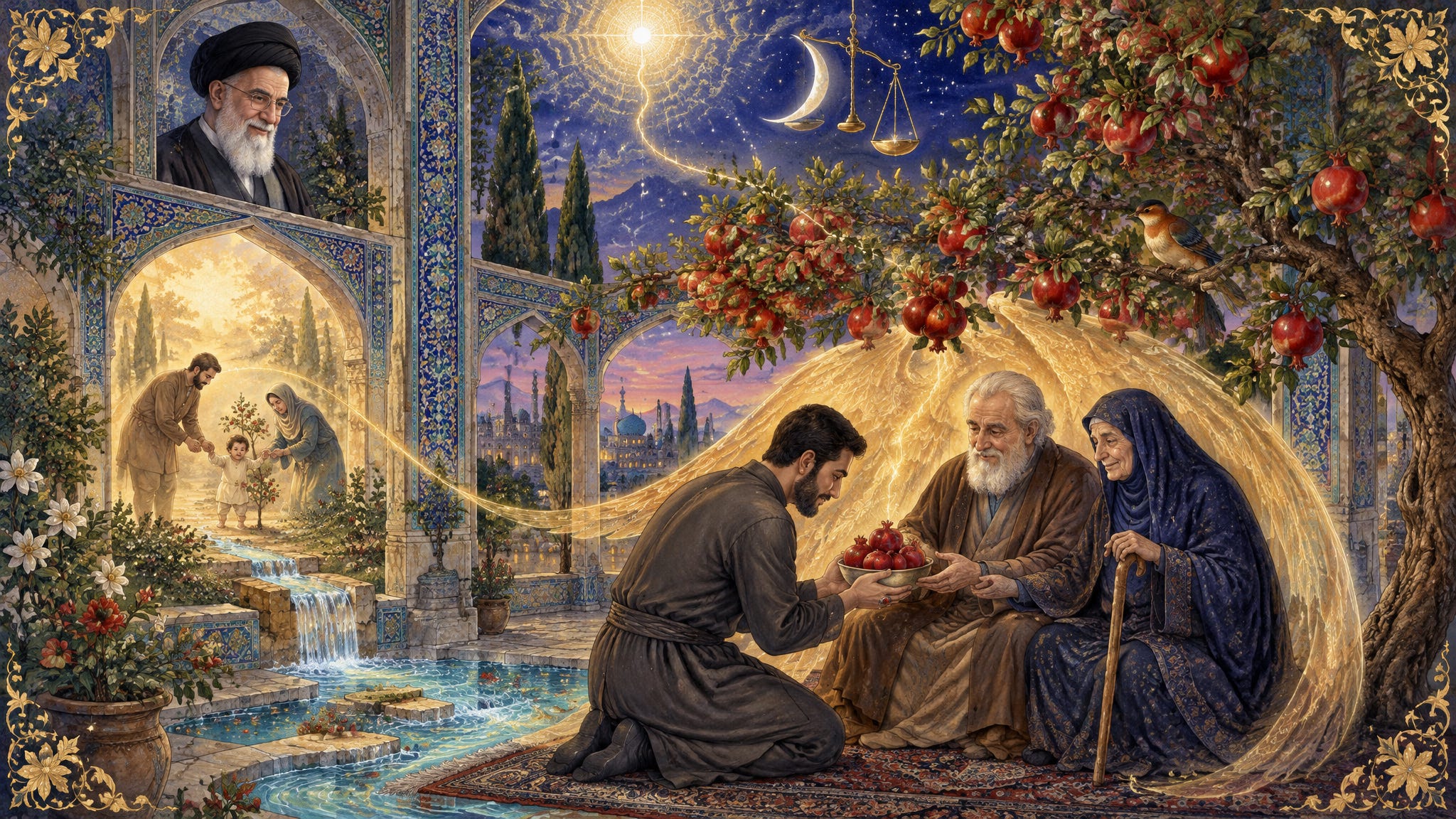
This is session four, the last, in our four-part Fatimiyyah 2026/1448 series, “Fruit of the Heart,” on raising our children — based on the Qur’an, the Tradition of the Ahlulbayt (peace be upon them), and guidance drawn from the teachings of the martyred leader, Imam Sayyed Ali Khamenei, may God rest his pure soul.
It follows Night 1, “Before the Heart Hardens: The Soil, the Seed and the Fitrah,”, Night 2, “A Beautiful Growth: Love and Limits,” Night 3, “The Storm: Slander, Screens and the Children Who Drift,” and last year’s Fatimiyyah series, “Wilayah in the Home,” on marriage and the family.
Each night builds on the one before it, so readers are encouraged to take them in order.
۞وَقَضَىٰ رَبُّكَ أَلَّا تَعۡبُدُوٓاْ إِلَّآ إِيَّاهُ وَبِٱلۡوَٰلِدَيۡنِ إِحۡسَٰنًاۚ إِمَّا يَبۡلُغَنَّ عِندَكَ ٱلۡكِبَرَ أَحَدُهُمَآ أَوۡ كِلَاهُمَا فَلَا تَقُل لَّهُمَآ أُفّٖ وَلَا تَنۡهَرۡهُمَا وَقُل لَّهُمَا قَوۡلٗا كَرِيمٗا
وَٱخۡفِضۡ لَهُمَا جَنَاحَ ٱلذُّلِّ مِنَ ٱلرَّحۡمَةِ وَقُل رَّبِّ ٱرۡحَمۡهُمَا كَمَا رَبَّيَانِي صَغِيرٗا
“Your Lord has decreed that you shall not worship anyone except Him, and [He has enjoined] kindness to parents.
Should any of them or both reach old age at your side, do not say to them, ‘Fie!’ And do not chide them, but speak to them noble words.
Lower the wing of humility to them, mercifully, and say,
‘My Lord! Have mercy on them, just as they reared me when I was [a] small [child]!’”
— Qur’an, Surah al-Isra (the Chapter of the Night Journey) #17, Verses 23 and 24; the English, Ali Quli Qarai’s
As They Reared Me

I want to begin tonight with the last words of this verse.
Just as they reared me when I was a small child.
Listen to who is speaking.
It is not a parent.
It is not a teacher.
It is a grown son, or a grown daughter, standing beside a mother or a father who has become old — and asking God to have mercy on them.
The word for reared is rabbayani.
And it is the word this series has carried for three nights: tarbiyah, the raising of a child.
For three weeks we have spoken about what parents owe the children they raise.
Tonight the Qur’an puts the same word into the mouth of the child.
And listen to how close two of its words are:
Rabbi irhamhuma kama rabbayani saghira.
Rabbi — my Lord.
Rabbayani — they reared me.
The child turns to his Lord, for the two who reared him.
I am not going to say more than that now.
We will come back to this verse before the night is out.
The House of Praise
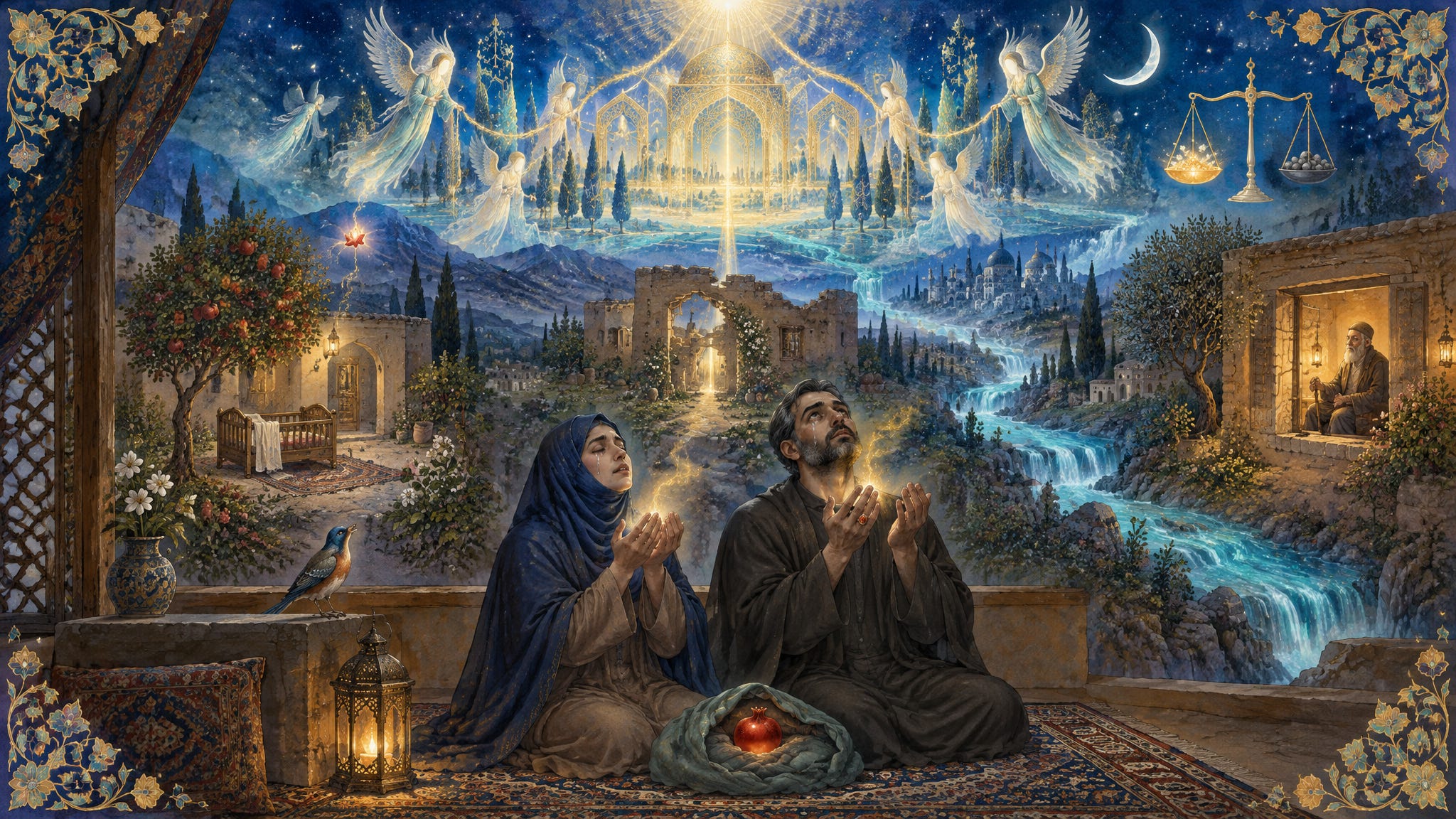
On the first night of this series, we heard what the Messenger of God, peace and blessings be upon him, his family, and his righteous companions, called his daughter.
She is a part of me.
She is the light of my eye.
She is the fruit of my heart.
That is where the name of this series came from.
Fruit of the Heart.
— the Messenger of God, peace and blessings be upon him, his family, and his righteous companions, through Ibn Abbas; Shaykh al-Saduq, al-Amali, hadith 198 (thaqalayn) — narrated1
Tonight, on the last of our four nights, I want to show you that the Prophet is not the only one who uses those words.
God uses them.
Shaykh al-Kulayni gives us this report from the Messenger of God, peace and blessings be upon him, his family, and his righteous companions.
Listen to it slowly.
قَالَ رَسُولُ الله (صلّى اللهُ عَلَيْهِ وَآلِه) إِذَا قُبِضَ وَلَدُ الْمُؤْمِنِ وَالله أَعْلَمُ بِمَا قَالَ الْعَبْدُ قَالَ الله تَبَارَكَ وَتَعَالَى لِمَلاَئِكَتِهِ قَبَضْتُمْ وَلَدَ فُلاَنٍ فَيَقُولُونَ نَعَمْ رَبَّنَا قَالَ فَيَقُولُ فَمَا قَالَ عَبْدِي قَالُوا حَمِدَكَ وَاسْتَرْجَعَ فَيَقُولُ الله تَبَارَكَ وَتَعَالَى أَخَذْتُمْ ثَمَرَةَ قَلْبِهِ وَقُرَّةَ عَيْنِهِ فَحَمِدَنِي وَاسْتَرْجَعَ ابْنُوا لَهُ بَيْتاً فِي الْجَنَّةِ وَسَمُّوهُ بَيْتَ الْحَمْدِ.
“The Messenger of God, God bless him and his family, said:
When the child of a believer dies — and God knows best what the servant said — God, Blessed and Exalted, says to His angels:
Did you take the child of so-and-so?
They say:
Yes, our Lord.
He says:
Then what did My servant say?
They say:
He praised You, and said, ‘To God we return.’
And God, Blessed and Exalted, says:
You took the fruit of his heart and the delight of his eye, and he praised Me, and said, ‘To God we return’? Build for him a house in Paradise, and name it the House of Praise.”
— the Messenger of God, peace and blessings be upon him, his family, and his righteous companions; Shaykh al-Kulayni, al-Kafi, Volume 3, hadith 831 (thaqalayn); my translation2
There are two things in this report, and I want to say each of them once.
The first is in the middle of it, almost hidden.
And God knows best what the servant said.
God already knows.
Nothing that was said in that room, in that hospital corridor, in that car on the way home, was hidden from Him.
He heard every word.
And still He asks them.
What did My servant say?
Notice what He does not ask.
He does not ask how old the child was.
He does not ask what the child would have become.
He does not ask whether the parent had done everything right.
He asks what the parent said.
That is the question of tonight.
Not what happened to you?
God knows what happened to you.
What did you say, when it happened?
The second thing is the name.
You took the fruit of his heart and the delight of his eye.
We took the name of this series from the Prophet’s words about his daughter.
But in this report it is God who says it.
And He does not say it of a prophet’s child.
He says it of the child of any believer.
Your child.
The child you are holding tonight — and the child you are not.
And listen to what the parent said.
He praised You, and said, To God we return.
Two things.
Praise, and return.
Those are words that bereaved mothers and fathers of faith have said in every age.
They are said in hospitals and at gravesides and on prayer mats in the middle of the night, through tears, sometimes in a voice that barely carries.
And for those words, God builds a house.
He gives it a name.
The House of Praise.
So tonight, in these days of the martyrdom of Sayyedah Fatimah al-Zahra, peace and blessings be upon her, I want to take you into three houses.
The house where a child went ahead.
The house that broke.
And the house where a parent grew old.
The report promises the House of Praise to the parent who lost a child and praised God.
I will not promise more than the report promises.
But I want to carry its hope into the other two houses with us.
Because I believe that in each of them, too, the question is the same.
Something has been taken.
And God is asking:
What did My servant say?
The Houses We Stop Visiting
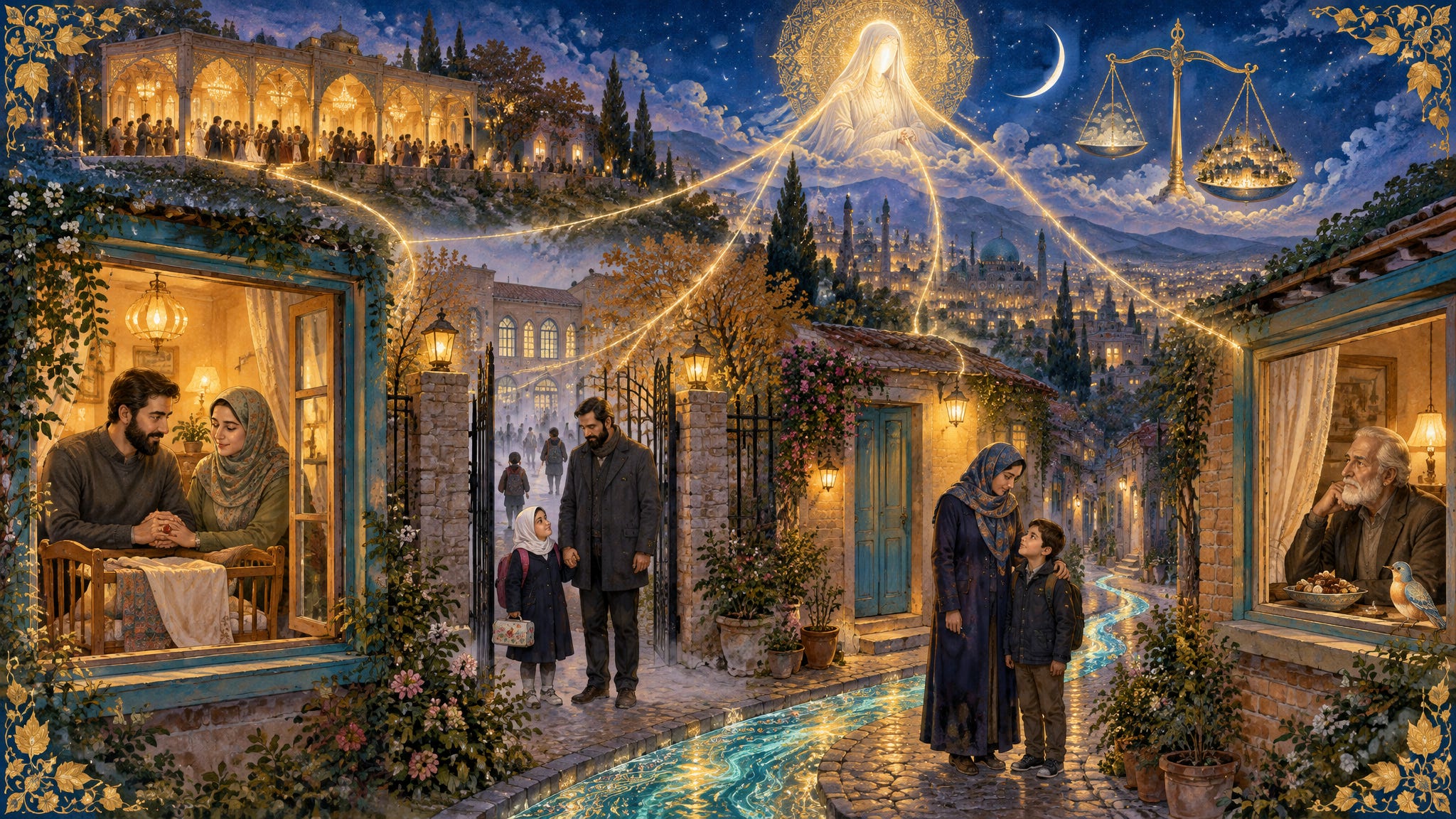
We are very good at visiting some houses.
When there is a wedding, we go.
We dress for it, we bring a gift, we stay late.
When a baby is born and the ‘aqiqa is cooked, we go, and we hold the baby, and we argue about whose side of the family the nose comes from.
When a son or a daughter graduates, we go, and we take the photographs, and we send them round.
Those are the houses that look whole.
And we love to be in them.
But there are other houses in this community.
And we stop visiting them.
When a couple lose a baby before it is born, we do not know what to say.
So we say nothing.
We do not ring, because we do not want to upset them.
We do not go round, because we would not know where to look.
And the mother and the father sit in a house that is suddenly very quiet, and nobody comes.
When a marriage ends, we do the opposite.
We say too much.
And most of it we do not even say out loud.
We say it with our eyes, across the hall, at the next wedding.
When a man’s wife dies, he stands alone at the school gate in the morning, with a lunchbox he packed himself.
The other parents are kind.
But they do not quite know what to say to him, so after a few weeks they stop saying anything at all.
When a mother is raising her children on her own, we say that her son comes from a broken home — and sometimes we say it with the boy standing right there.
When a woman has not married, and the years go by, we ask her at every wedding, when is it your turn?
And we laugh, as if it were a kindness.
And we ask the man who has not married the same question, with a different laugh.
And when an old father is in a care home, he sits by the window on the morning of Eid, in his good clothes, waiting.
And the day goes by.
Look at those houses again.
We think of them as women’s houses.
But there are men in them too.
The father at the miscarriage.
The divorced man.
The widower at the gate.
The man who has not married.
The old father by the window.
And notice what I have not said.
I have not said one word about what the people in those houses did.
I have only described what the rest of us do — what we say, what we stop saying, and the doors we stop knocking on.
The people in those houses are in this room tonight.
Some of you are sitting in one of those houses right now.
So tonight, we visit them.
What We Carry Forward
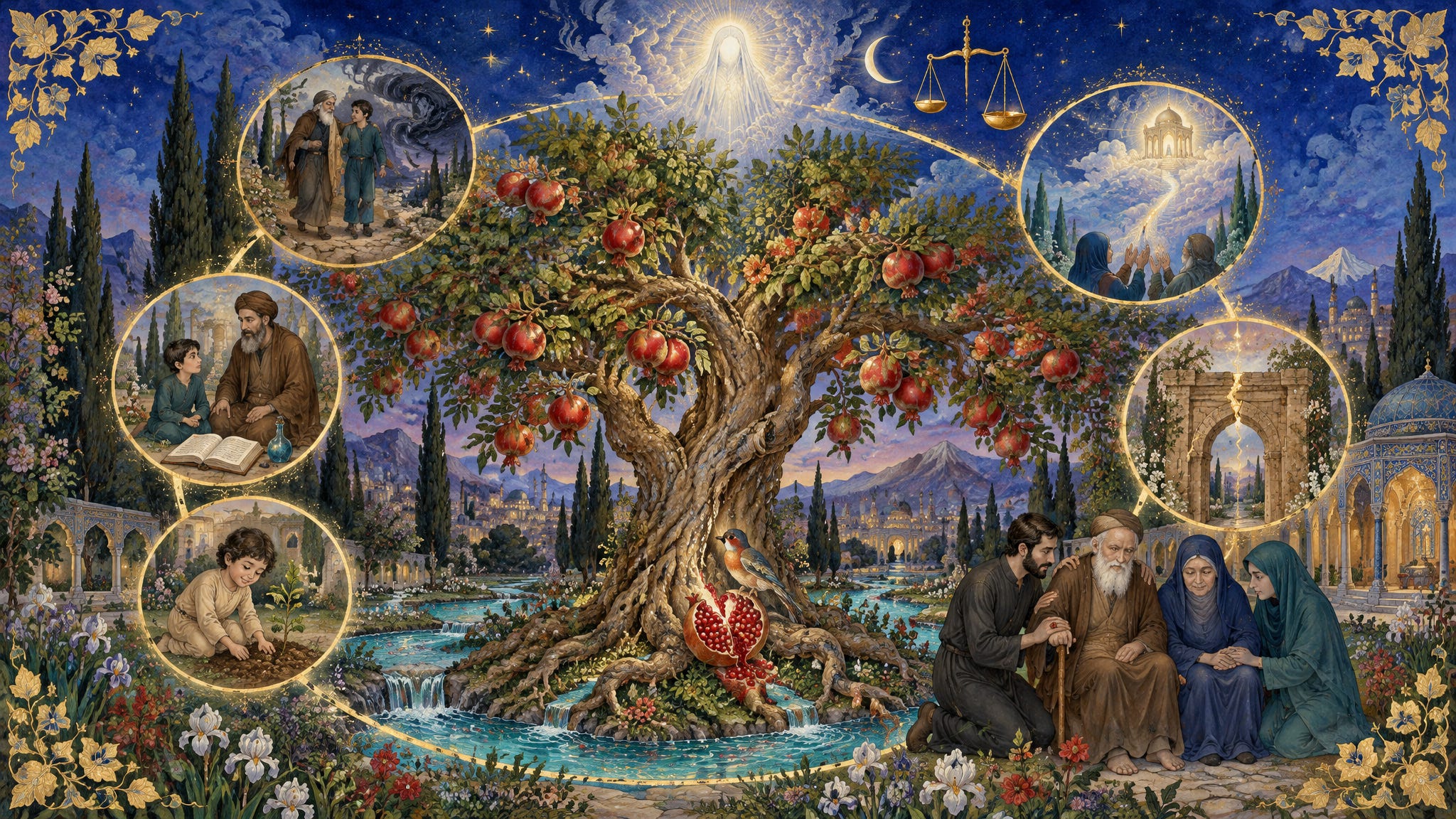
This is the last of our four nights on raising our children, in these days of the martyrdom of Sayyedah Fatimah al-Zahra, peace and blessings be upon her.
Today is Saturday, the 14th of November, 2026, the 3rd of Jumada al-Thani, 1448, in these days of her martyrdom.
On the first night, Before the Heart Hardens, we said that a child is born facing God, that raising a child is cultivation and not manufacture, and that a child’s first school is play and love.
Our maqtal was The Door He Called At.
On the second night, A Beautiful Growth, we met the guardian who asks before he judges, and we said that love must be able to say no — but that the limit is a medicine, never an anger.
Our maqtal was Two Mothers.
Last week, The Storm, we stood with the daughter who comes home talked about, and the son who drifts, and we asked whose account we believe.
Our maqtal was By Night or by Day.
And through all three nights we have been walking with the three sevens of Imam Ja’far al-Sadiq, peace and blessings be upon him: let your son play for seven years; let him be taught adab for seven years; and keep him close to you for seven years.
— Imam Ja’far al-Sadiq, peace and blessings be upon him; Shaykh al-Saduq, Man La Yahduruhu al-Faqih, Volume 3, hadith 1528 (thaqalayn) — narrated3
Play.
Adab.
Companionship.
Three sevens.
And there is no fourth.
At twenty-one the child is grown.
The raising, as the report counts it, is done.
So what comes after the third seven?
The circle turns.
The child who was raised becomes the one who raises — his own children, and one day the parents who raised him.
Tonight is the circle.
And it has three movements.
First, the child who goes ahead of us — and what God is doing with the parent who is left.
Second, the house that breaks — and how it is rebuilt.
And third, the fruit that returns to the root.
When God Raises the Parent — The Child Who Goes Ahead
One Step Further Than Last Year

Last year, on these same nights, we spent an evening in the house where a child has died.
We said three things there.
That grief is not un-Islamic.
That the Prophet himself, peace and blessings be upon him, his family, and his righteous companions, wept over his little son Ibrahim, peace and blessings be upon him. And that the children who go ahead are not lost: that they wait at the doors of Paradise for their mothers and fathers, and will not go in without them4.
I do not want to repeat that tonight. I want to take one step further.
Not may we grieve? We may. We said so, and the Prophet showed us.
The question tonight is a harder one. When we grieve, what is God doing with us?
Hidden Graces
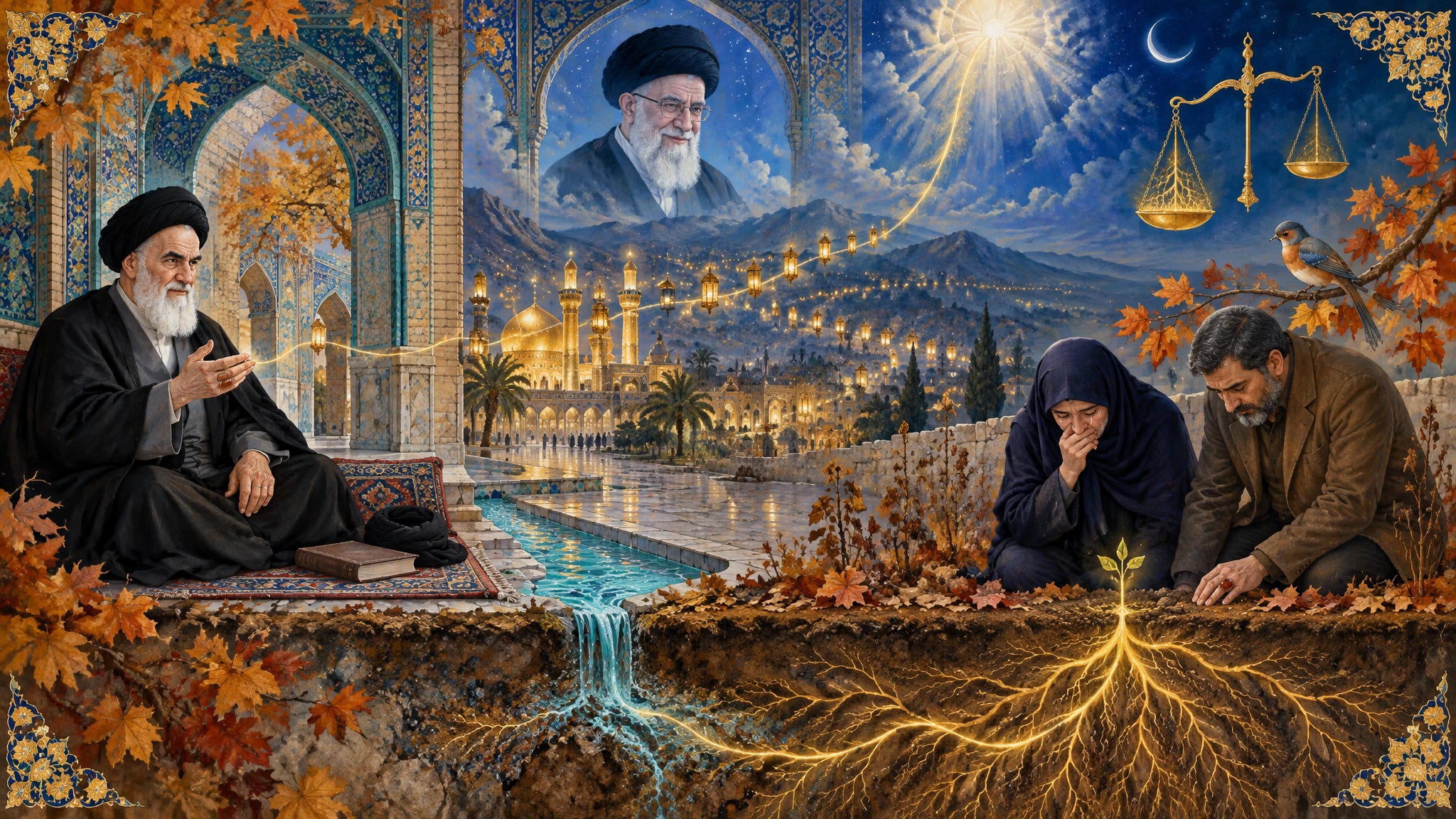
In the autumn of 1977, in Najaf, Imam Khomeini, may God rest his pure soul, lost his eldest son.
Sayyed Mostafa, may God rest his pure soul, was a scholar in his own right. He died suddenly, in Najaf, on the twenty-third of October.
There were suspicions that he had been poisoned.
Nine days later, his father gave a talk in Najaf.
And in the lines we have of it, he does not even name his son.
He calls it matters like this.
اينطور قضايا مهم نيست خيلى، پيش مىآيد. براى همۀ مردم پيش مىآيد. و خداوند تبارك و تعالى الطافى دارد ظاهر و الطافِ خفيه.
“Matters like this are not so very important; they happen. They happen to all people. And God, Blessed and Exalted, has graces — apparent ones, and hidden ones.”
— Imam Khomeini, may God rest his pure soul, in Najaf, 10 Aban 1356 (1 November 1977); my translation
And then he says this:
اگر اطلاع داشتيم از آن الطاف خفيهاى كه خداى تبارك و تعالى نسبت به عبادش دارد و اِنَّهُ لَطيفٌ عَلى عِبادِه و اطلاع بر آن مسائل داشتيم، در اينطور چيزهايى كه جزئى است و مهم نيست اينقدر بىطاقت نبوديم؛ مىفهميديم كه يك مصالحى در كار است، يك الطافى در كار است، يك تربيتهايى در كار است.
“If we knew of those hidden graces that God, Blessed and Exalted, has towards His servants — He is all-attentive to His servants — and knew of those matters, we would not be so unable to bear things like this, which are small and of no great weight. We would understand that there are benefits at work, graces at work, upbringings at work.”
— Imam Khomeini, may God rest his pure soul, in Najaf, 10 Aban 1356 (1 November 1977); my translation
Those were his words about his own son, from his own station.
No one here is being told that their child was a small matter.
Did you hear the last words?
Upbringings at work.
In his Persian the word is tarbiyat — the very word of this series.
A father stood over the loss of his son and said: something is being raised here.
The father.
The family.
Perhaps a whole people.
And no one understood him.
Years later, the martyred leader, Imam Sayyed Ali Khamenei, may God rest his pure soul, told the people of East Azerbaijan that at the time, nobody knew what the phrase meant.
How can a man lose his eldest son, and call it a hidden grace?
And then he said:
بعد که مردم ایران این حرکت را انجام دادند که برای ایشان فاتحه گرفتند و این فاتحه موجب آن عکسالعمل دربار شد، و بعد قضایای قم، قضایای تبریز، این سلسلهی حوادث پیش آمد، آن وقت مردم فهمیدند که این لطف خفی چه بود.
“Later, when the people of Iran made the move of holding memorial gatherings for him, and those gatherings provoked the court’s reaction, and then came the events of Qom and the events of Tabriz, this chain of events — then people understood what this hidden grace was.”
— the martyred leader, Imam Sayyed Ali Khamenei, may God rest his pure soul, to the people of East Azerbaijan, 29 Bahman 1398 (18 February 2020); my translation5
I leave it there.
This is not a night about a revolution.
It is a night about mothers and fathers.
So come back to the parent in this room who has lost a child.
You may never see, in this world, what grace was hidden in your loss.
Imam Khomeini did not say that he could see it.
He said that it was there.
That is what praise is, in the House of Praise.
Not pretending that it does not hurt.
Not saying that it was for the best.
It is trusting that God is still raising someone — even in this.
Even now.
Who Raises Them Now

And the raising does not stop at the grave.
Imam Ja’far al-Sadiq, peace and blessings be upon him, said that God has given the children of the believers into the care of Abraham and Sarah, peace and blessings be upon them.
They feed them in Paradise, in a palace of pearl. And on the Day of Resurrection the children are clothed, and perfumed, and brought to their fathers as gifts.
— Imam Ja’far al-Sadiq, peace and blessings be upon him, through al-Halabi; Shaykh al-Saduq, Man La Yahduruhu al-Faqih, Volume 3, hadith 1517 (thaqalayn) — narrated6
Raises them.
In the Arabic, turabbihim.
Our word again.
And in another report from him, the picture is fuller.
When the child of a believer dies, if his parents, or one of them, or someone of his household among the believers, has already died, the child is handed to them, and they feed him.
And if not, he is handed to Sayyedah Fatimah, peace and blessings be upon her, and she feeds him — until his parents, or one of them, or someone of his household, arrives.
And then she hands him over.
— Imam Ja’far al-Sadiq, peace and blessings be upon him, through Abu Basir, in Shaykh al-Saduq’s al-Tawhid, as Allamah Tabataba’i, may God rest his pure soul, gives it in al-Mizan, at Surah al-Tur, Verses 11 to 28 — narrated7
In these days of her martyrdom, think of that.
The mother who was not given the years to raise all of her own children, raises ours.
Last year we read this verse for the strength of families.
Tonight read it for the children who go ahead.
وَٱلَّذِينَ ءَامَنُواْ وَٱتَّبَعَتۡهُمۡ ذُرِّيَّتُهُم بِإِيمَٰنٍ أَلۡحَقۡنَا بِهِمۡ ذُرِّيَّتَهُمۡ وَمَآ أَلَتۡنَٰهُم مِّنۡ عَمَلِهِم مِّن شَيۡءٖۚ كُلُّ ٱمۡرِيِٕۭ بِمَا كَسَبَ رَهِينٞ
“The faithful and their descendants who followed them in faith—We will make their descendants join them, and We will not stint anything from [the reward of] their deeds. Every person is hostage to what he has earned.”
— Qur’an, Surah al-Tur (the Chapter of the Mount) #52, Verse 21; the English, Ali Quli Qarai’s
We will make their descendants join them.
The first reports say fathers.
The second says it plainly: his parents, or one of them.
Mothers and fathers.
So to every parent in this room whose child went ahead of them: your child is not alone, and not lost.
Your child is held, and fed, and raised.
And one day, your child will be handed back to you.
Name Them

Now listen to Imam Ali, peace and blessings be upon him.
قَالَ أَمِيرُ الْمُؤْمِنِينَ ( عليه السلام ) سَمُّوا أَوْلَادَكُمْ قَبْلَ أَنْ يُولَدُوا فَإِنْ لَمْ تَدْرُوا أَ ذَكَرٌ أَمْ أُنْثَى فَسَمُّوهُمْ بِالْأَسْمَاءِ الَّتِي تَكُونُ لِلذَّكَرِ وَ الْأُنْثَى فَإِنَّ أَسْقَاطَكُمْ إِذَا لَقُوكُمْ يَوْمَ الْقِيَامَةِ وَ لَمْ تُسَمُّوهُمْ يَقُولُ السِّقْطُ لِأَبِيهِ أَلَّا سَمَّيْتَنِي وَ قَدْ سَمَّى رَسُولُ اللَّهِ ( صلى الله عليه وآله ) مُحَسِّناً قَبْلَ أَنْ يُولَدَ .
“The Commander of the Faithful, peace be upon him, said: Name your children before they are born.
If you do not know whether it is a boy or a girl, name them with names that are for both boy and girl.
For when your miscarried children meet you on the Day of Resurrection and you had not named them, the miscarried child will say to its father:
Why did you not name me?
And the Messenger of God, God bless him and his family, named Muhsin before he was born.”
— Imam Ali ibn Abi Talib, the Commander of the Faithful, peace and blessings be upon him; Shaykh al-Kulayni, al-Kafi, Volume 6, hadith 58 (thaqalayn); my translation8
Ayatullah Alireza A’rafi, may God protect him — who teaches the jurisprudence of upbringing in Qom — reads this report to his students when he teaches the duties of parents.
Name even the child who is miscarried, he says.
Do not bury a child without a name.
— Ayatullah Alireza A’rafi, may God protect him, a class on family upbringing: the parents’ duties, and the naming of a child, 22 April 2009 (eshia.ir) — narrated9
There is a mercy hidden in one clause of that hadith.
If you do not know whether it is a boy or a girl.
There are mothers and fathers in this room who never found out.
It was too early.
Or nobody told them, and they did not feel able to ask.
Imam Ali thought of them.
Give them a name that suits both.
And notice who the child asks.
The miscarried child will say to its father: why did you not name me?
It is the father who is asked.
The father has a duty here, and a grief here, and the hadith does not let him stand at the back.
And the hadith ends with one more sentence.
And the Messenger of God, God bless him and his family, named Muhsin before he was born.
Fathers Grieve Too
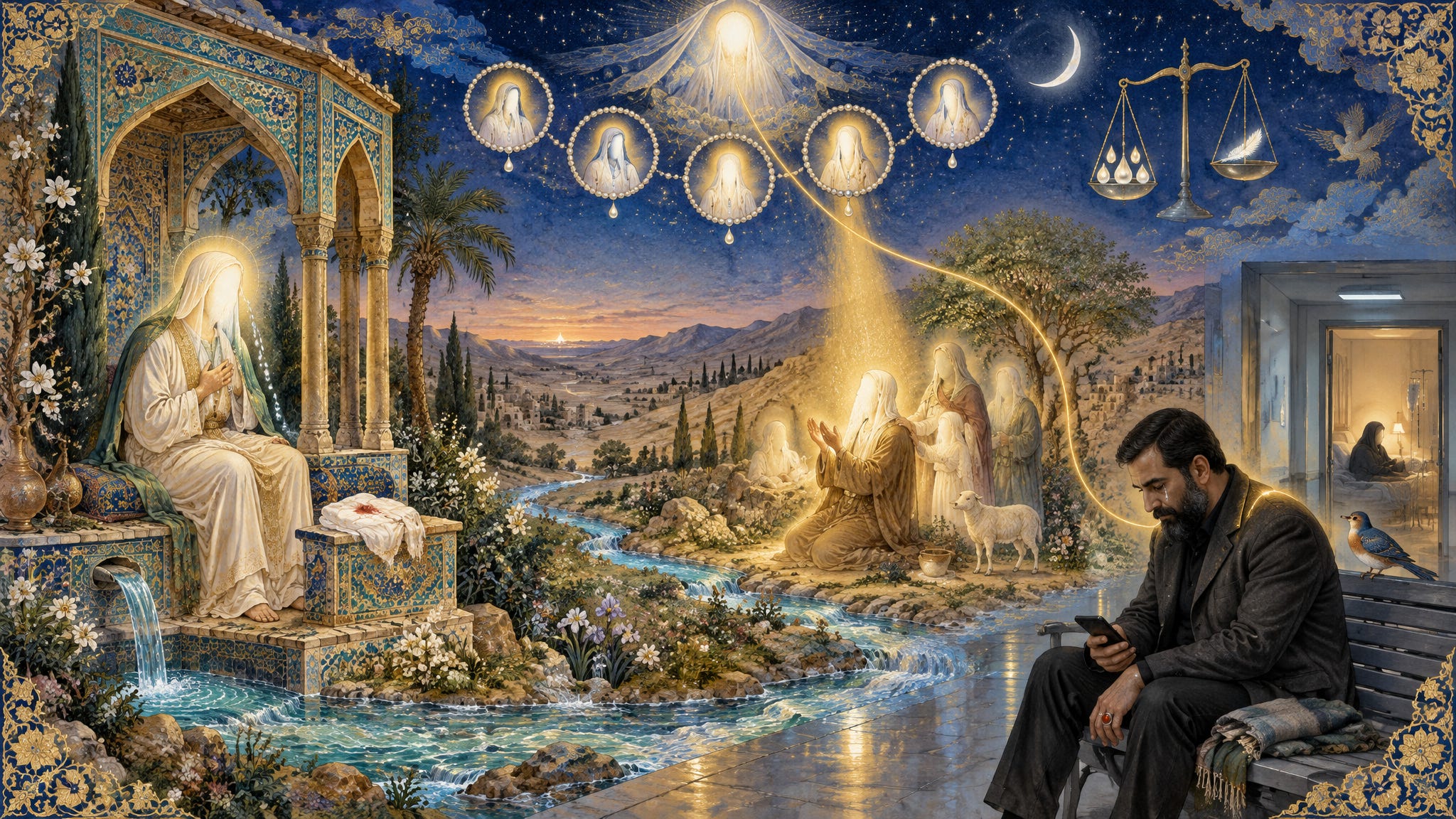
There is a prophet in the Qur’an who is remembered for his grief.
Jacob, peace and blessings be upon him.
When his sons came home without Joseph, peace and blessings be upon him, carrying his shirt with false blood on it, the first thing Jacob said held two words that the Qur’an never lets us forget.
وَجَآءُو عَلَىٰ قَمِيصِهِۦ بِدَمٖ كَذِبٖۚ قَالَ بَلۡ سَوَّلَتۡ لَكُمۡ أَنفُسُكُمۡ أَمۡرٗاۖ فَصَبۡرٞ جَمِيلٞۖ وَٱللَّهُ ٱلۡمُسۡتَعَانُ عَلَىٰ مَا تَصِفُونَ
“And they produced sham blood on his shirt. He said, ‘No, your souls have made a matter seem decorous to you. Yet patience is graceful, and God is my resort against what you allege.’”
— Qur’an, Surah Yusuf (the Chapter of the Prophet Joseph) #12, Verse 18; the English, Ali Quli Qarai’s
Sabrun jamil.
Word for word, it is a beautiful patience.
Years later, when a second son was kept from him in Egypt, he said the same two words again.
قَالَ بَلۡ سَوَّلَتۡ لَكُمۡ أَنفُسُكُمۡ أَمۡرٗاۖ فَصَبۡرٞ جَمِيلٌۖ عَسَى ٱللَّهُ أَن يَأۡتِيَنِي بِهِمۡ جَمِيعًاۚ إِنَّهُۥ هُوَ ٱلۡعَلِيمُ ٱلۡحَكِيمُ
“He said, ‘No, your souls have made a matter seem decorous to you. Yet patience is graceful. Maybe God will bring them all [back] to me. Indeed He is the All-knowing, the All-wise.’”
— Qur’an, Surah Yusuf (the Chapter of the Prophet Joseph) #12, Verse 83; the English, Ali Quli Qarai’s
And then, in the very next verses, the Qur’an shows us what that patience looked like from the outside.
وَتَوَلَّىٰ عَنۡهُمۡ وَقَالَ يَـٰٓأَسَفَىٰ عَلَىٰ يُوسُفَ وَٱبۡيَضَّتۡ عَيۡنَاهُ مِنَ ٱلۡحُزۡنِ فَهُوَ كَظِيمٞ
قَالُواْ تَٱللَّهِ تَفۡتَؤُاْ تَذۡكُرُ يُوسُفَ حَتَّىٰ تَكُونَ حَرَضًا أَوۡ تَكُونَ مِنَ ٱلۡهَٰلِكِينَ
قَالَ إِنَّمَآ أَشۡكُواْ بَثِّي وَحُزۡنِيٓ إِلَى ٱللَّهِ وَأَعۡلَمُ مِنَ ٱللَّهِ مَا لَا تَعۡلَمُونَ
“He turned away from them and said, ‘Alas for Joseph!’ His eyes had turned white with grief, and he choked with suppressed agony. They said, ‘By God! You will go on remembering Joseph until you wreck your health or perish.’ He said, ‘I complain of my anguish and grief only to God. I know from God what you do not know.’”
— Qur’an, Surah Yusuf (the Chapter of the Prophet Joseph) #12, Verses 84 to 86; the English, Ali Quli Qarai’s
A beautiful patience, and eyes that turned white with weeping.
In the same man, in the same years.
Imam Ja’far al-Sadiq, peace and blessings be upon him, counted the great weepers.
There were five:
Adam,
Jacob,
Joseph,
Sayyedah Fatimah,
and his own grandfather, Imam Ali ibn al-Husayn, peace and blessings be upon them.
Jacob, he said, wept over Joseph until his sight was gone.
And Imam Ali ibn al-Husayn said:
I never remember the slaying of the sons of Fatimah but that tears choke me.
— Imam Ja’far al-Sadiq, peace and blessings be upon him, in a report traced to him by Muhammad ibn Sahl al-Bahrani; Shaykh al-Saduq, al-Khisal, Volume 1, hadith 676 (thaqalayn) — narrated10
A father’s tears are not weakness.
In Jacob they were a prophet’s tears.
And the Qur’an remembers another father who lost his family:
Job, peace and blessings be upon him — calling out to his Lord, and being answered.
۞وَأَيُّوبَ إِذۡ نَادَىٰ رَبَّهُۥٓ أَنِّي مَسَّنِيَ ٱلضُّرُّ وَأَنتَ أَرۡحَمُ ٱلرَّـٰحِمِينَ
فَٱسۡتَجَبۡنَا لَهُۥ فَكَشَفۡنَا مَا بِهِۦ مِن ضُرّٖۖ وَءَاتَيۡنَٰهُ أَهۡلَهُۥ وَمِثۡلَهُم مَّعَهُمۡ رَحۡمَةٗ مِّنۡ عِندِنَا وَذِكۡرَىٰ لِلۡعَٰبِدِينَ
“And [remember] Job, when he called out to his Lord, ‘Indeed distress has befallen me, and You are the most merciful of the merciful.’ So We answered his prayer and removed his distress, and We gave him [back] his family along with others like them, as a mercy from Us and an admonition for the devout.”
— Qur’an, Surah al-Anbiya (the Chapter of the Prophets) #21, Verses 83 and 84; the English, Ali Quli Qarai’s
We gave him back his family.
And the Bible remembers the day he lost them: all his children, in a single day.
And the first words out of his mouth were these:
וַיֹּ֩אמֶר֩ עָרֹ֨ם יָצָ֜תִי מִבֶּ֣טֶן אִמִּ֗י וְעָרֹם֙ אָשׁ֣וּב שָׁ֔מָּה יְהֹוָ֣ה נָתַ֔ן וַֽיהֹוָ֖ה לָקָ֑ח יְהִ֛י שֵׁ֥ם יְהֹוָ֖ה מְבֹרָֽךְ׃
“And said, Naked came I out of my mother’s womb, and naked shall I return thither: the LORD gave, and the LORD hath taken away; blessed be the name of the LORD.”
— the Book of Job, chapter 1, verse 21; the King James Version
Blessed be the name of the Lord.
He praised.
It is the Bible’s own House of Praise.
Now think of the father at a miscarriage.
Everyone tells him:
Be strong for your wife.
And he is.
He makes the phone calls.
He deals with the hospital.
He goes back to work on the Monday.
And nobody, ever, asks him how he is.
Lessons for Our Time
Lesson One — Name the Child, and Do Not Stay Away
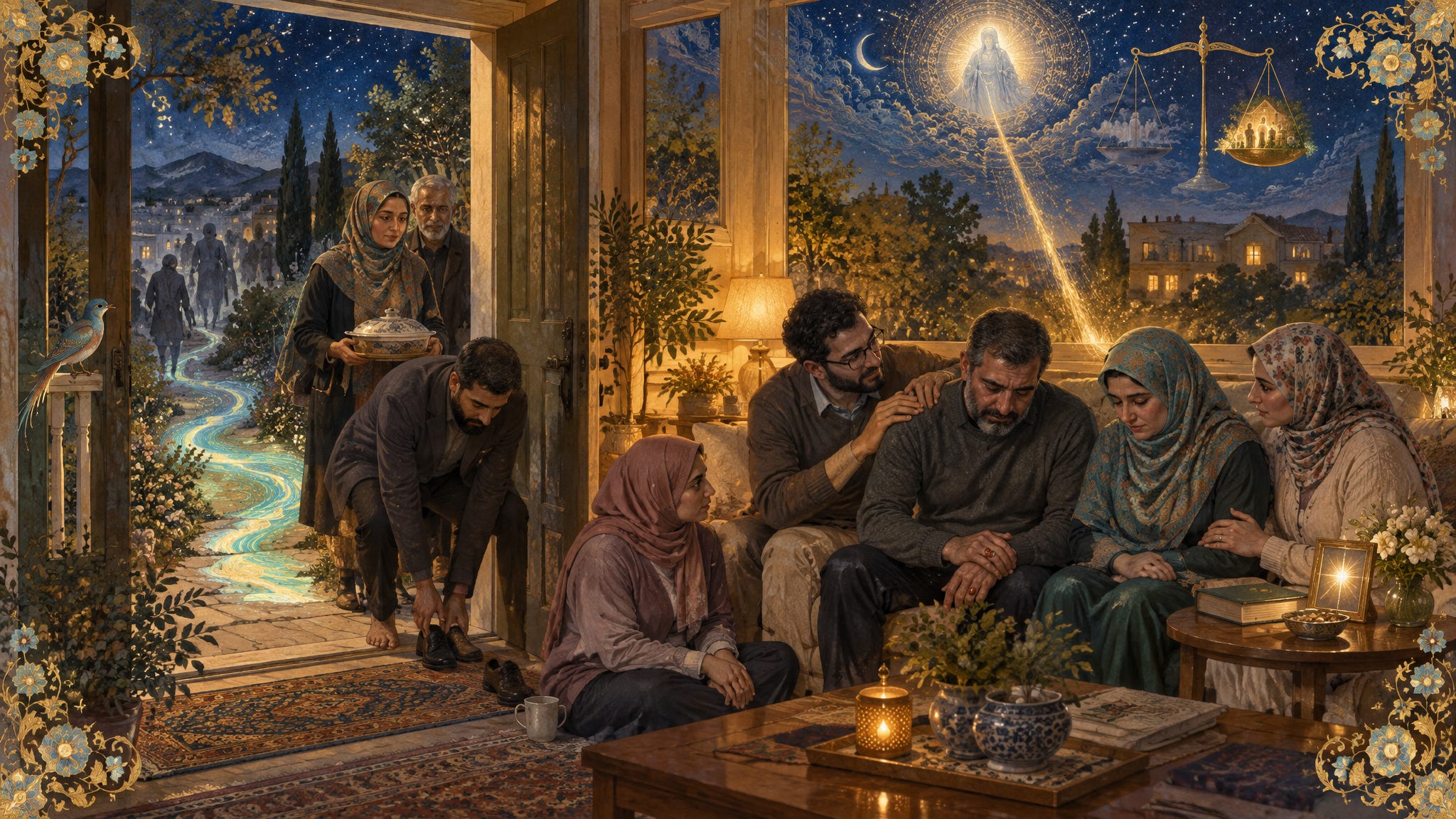
The first lesson is for the house where a child went ahead — before birth, at birth, or after.
If it is your house: name the child.
A boy’s name, a girl’s name, or a name that suits both, as Imam Ali taught.
Pray for the child.
Give something in the child’s name.
Last year we said it from this minbar: name the child before God, and give the Qur’an and charity in their memory.
Say it again tonight, and do it.
And if it is not your house, but it is your sister’s, or your neighbour’s, or your colleague’s: go.
Ring.
Send food.
Sit with them.
You do not need the right words.
There are no right words.
Your being there is the words.
And there is one sentence that should never be said in that house again:
It was for the best.
You do not know that.
God knows what is best, and He did not send you to announce it.
Say that you are sorry.
Say the child’s name, if they have given one.
And then say nothing, and stay.
Lesson Two — Ask the Father Too
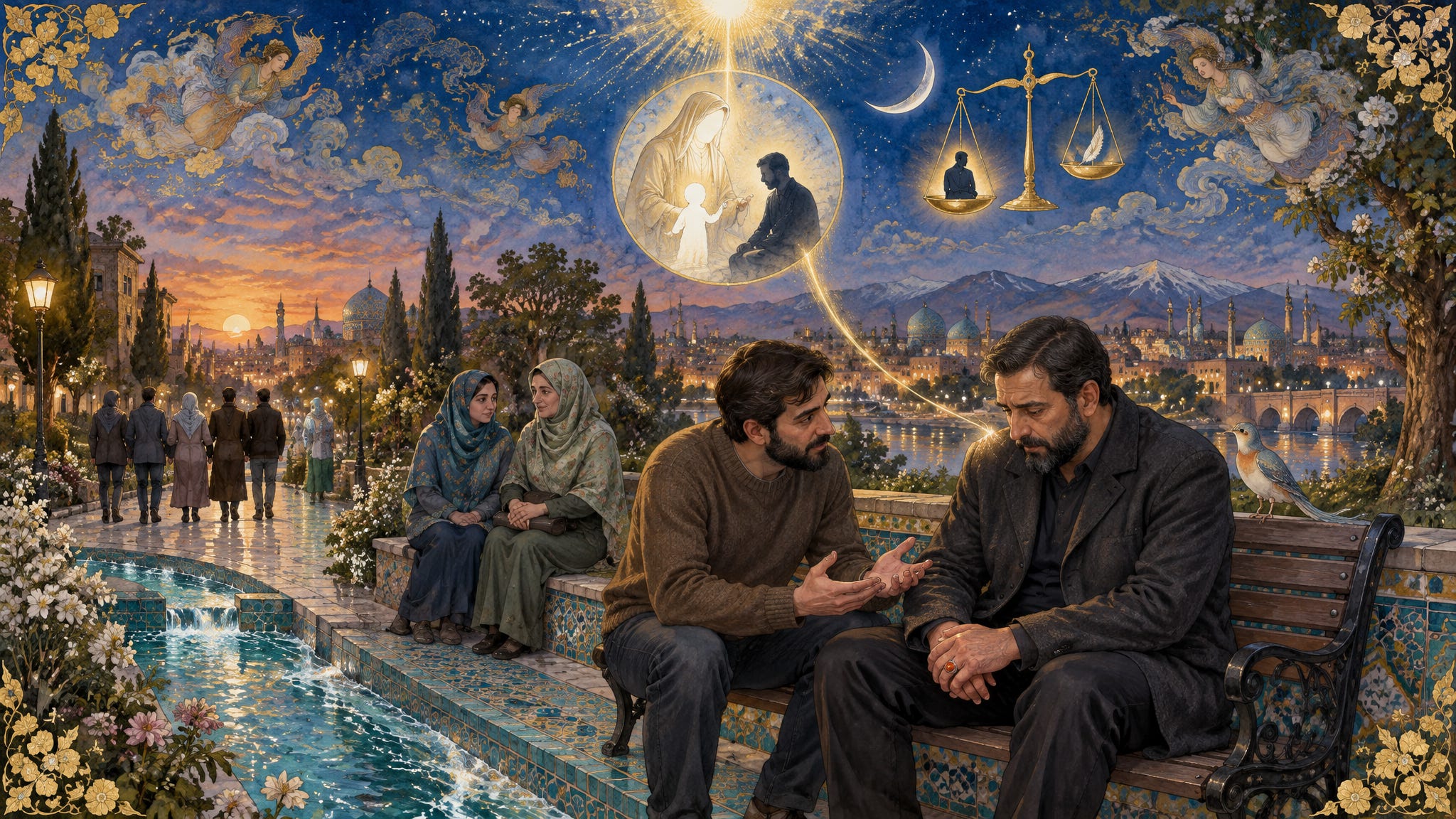
The second lesson is short, and it is for all of us.
When a baby is lost, ask the father how he is.
Not how his wife is — ask her too, of course.
Ask him.
Ask him in a month, when everyone else has stopped asking.
The miscarried child, Imam Ali said, will turn to its father.
Let somebody in this community turn to him first.
Lesson Three — Tears and Praise Sit Together
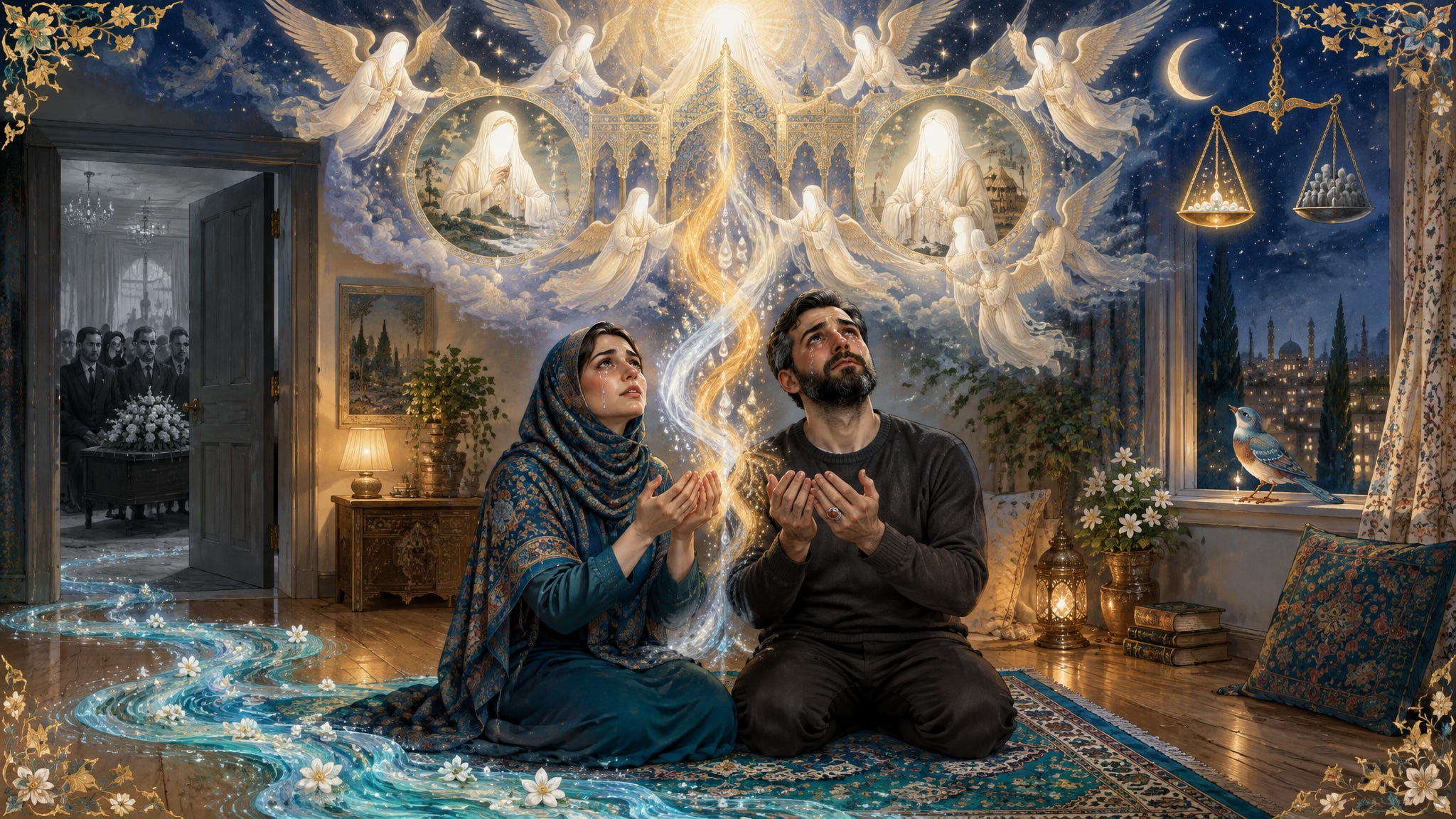
The third lesson is about what praise is.
Praise is not a performance.
It is not a brave face at the funeral and a broken heart at home that nobody is allowed to see.
Jacob said a beautiful patience — and wept until his eyes turned white.
The Prophet, too, wept over his son Ibrahim.
Tears and praise sit together, in the same heart, on the same night.
So to every mother and father here who has lost a child, and who has been told — by someone who meant well — that you grieved too much, or too long, or in the wrong way: no one is going to tell you that tonight.
Your tears are not a failure of your faith.
And if, through those tears, you said what the parent in the report said — praise, and to God we return — then the order has already been given.
Build for him a house.
And if, in that hour, all you could do was weep — He heard that too.
The words can still be said, tonight.
The House That Breaks — And How It Is Rebuilt
Left on the Shelf

Not every house loses a child.
Many houses lose a husband or a wife — to death, or to divorce.
And some houses are never built at all, because the marriage waited, and waited, and did not come.
And if we are honest, our communities are kinder to the house that death has emptied than to the house that divorce has broken, or the house that was never built.
Think of what we say about a woman who has not married by a certain age.
She has been left on the shelf.
Listen to that phrase.
A shelf is in a shop.
What is left on the shelf is what nobody wanted to buy.
We have taken a phrase for unsold goods, and we have put it on a human being.
On a believing woman.
So tonight, let us go to the house of the first believer.
Sayyedah Khadijah, peace and blessings be upon her.
The Reports Differ
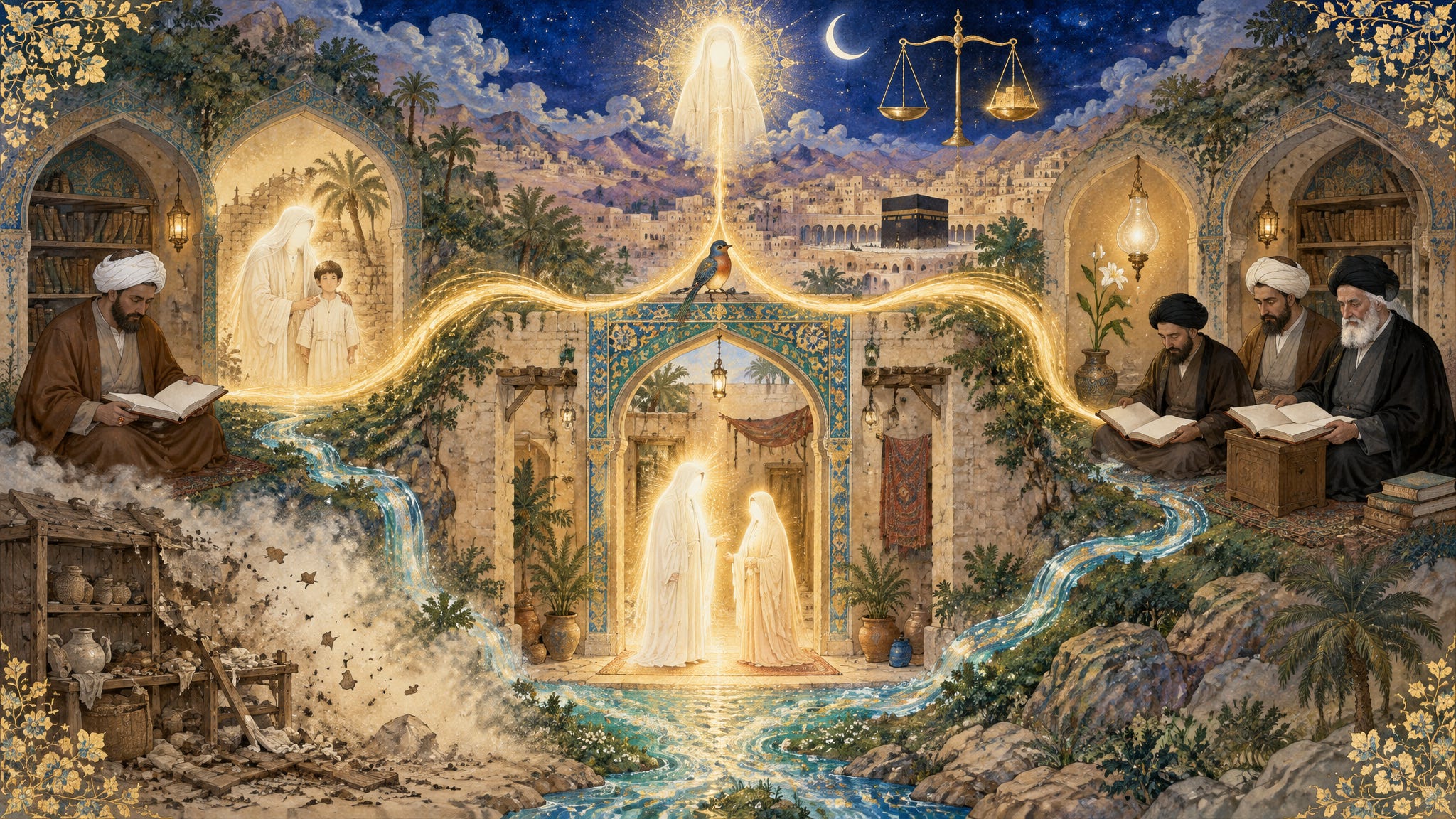
Our historians differ over whether she had been married before the Prophet, peace and blessings be upon him, his family, and his righteous companions.
Many report that she had.
Shaykh al-Tabrisi, in his book on the lives of the Prophet and the Imams, says that she had been married twice before him, and had a child by each husband — and that when the Prophet married her, he raised her son Hind.
— Shaykh al-Tabrisi, I’lam al-Wara bi-A’lam al-Huda, Volume 1, p. 274 — narrated11
Others report that she came to him never having been married.
The scholar Ibn Shahrashub gives that view from two of our great teachers, al-Sharif al-Murtada and Shaykh al-Tusi.
And in our own day the historian Sayyed Ja’far Murtada al-Amili, may God rest his pure soul, has argued it at length.
— Sayyed Ja’far Murtada al-Amili, al-Sahih min Sirat al-Nabi al-A’zam, Volume 2, pp. 207-210 — narrated12
And her age?
The reports run from twenty-five to forty-six.
Many preferred twenty-eight; the one most often heard is forty.
On every one of them, she was at least his age.
Take whichever report you like.
On either one, there was no shelf.
She Was Sought, and She Chose
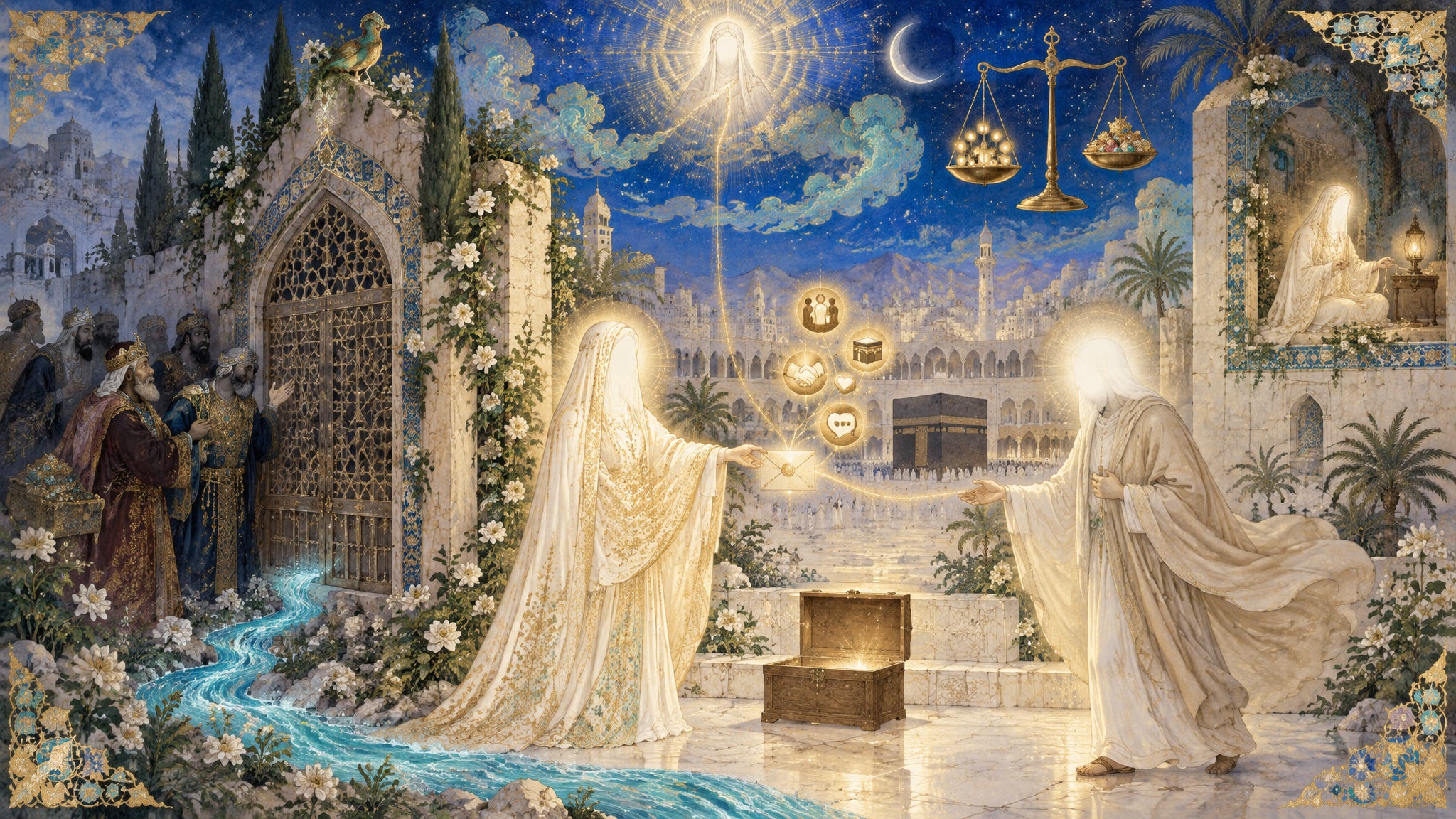
She was a woman of standing, and of wealth.
The chiefs of Quraysh, the reports say, would all have married her if they could.
They asked, and she refused them all.
— Ibn Ishaq, in al-Tabari’s Tarikh al-Rusul wa al-Muluk, record 304; and Abu al-Qasim al-Kufi, as Sayyed al-Amili gives him, al-Sahih, Volume 2, p. 209 — narrated13
Sayyed al-Amili answers those who find it strange that such a woman stayed unmarried for so long.
It is nothing rare, he says, for a noble woman to remain unmarried for a time, if she is waiting patiently for the virtuous and complete man — and in her time, such a man was rare.
— Sayyed Ja’far Murtada al-Amili, al-Sahih min Sirat al-Nabi al-A’zam, Volume 2, pp. 209-210 — narrated14
She was not left.
She was waiting.
And she knew what she was waiting for.
And when she found him, she did not wait for him to come to her.
She sent to him.
Ibn Ishaq gives her words — with his own caution, as they claim — that she wanted him for his kinship, for his standing among his people, for his trustworthiness, his good character, and the truth of his speech.
— Ibn Ishaq, as al-Majlisi gives him in Bihar al-Anwar, Volume 16, p. 9 — narrated15
Not for his wealth.
He had very little of it.
The Wedding
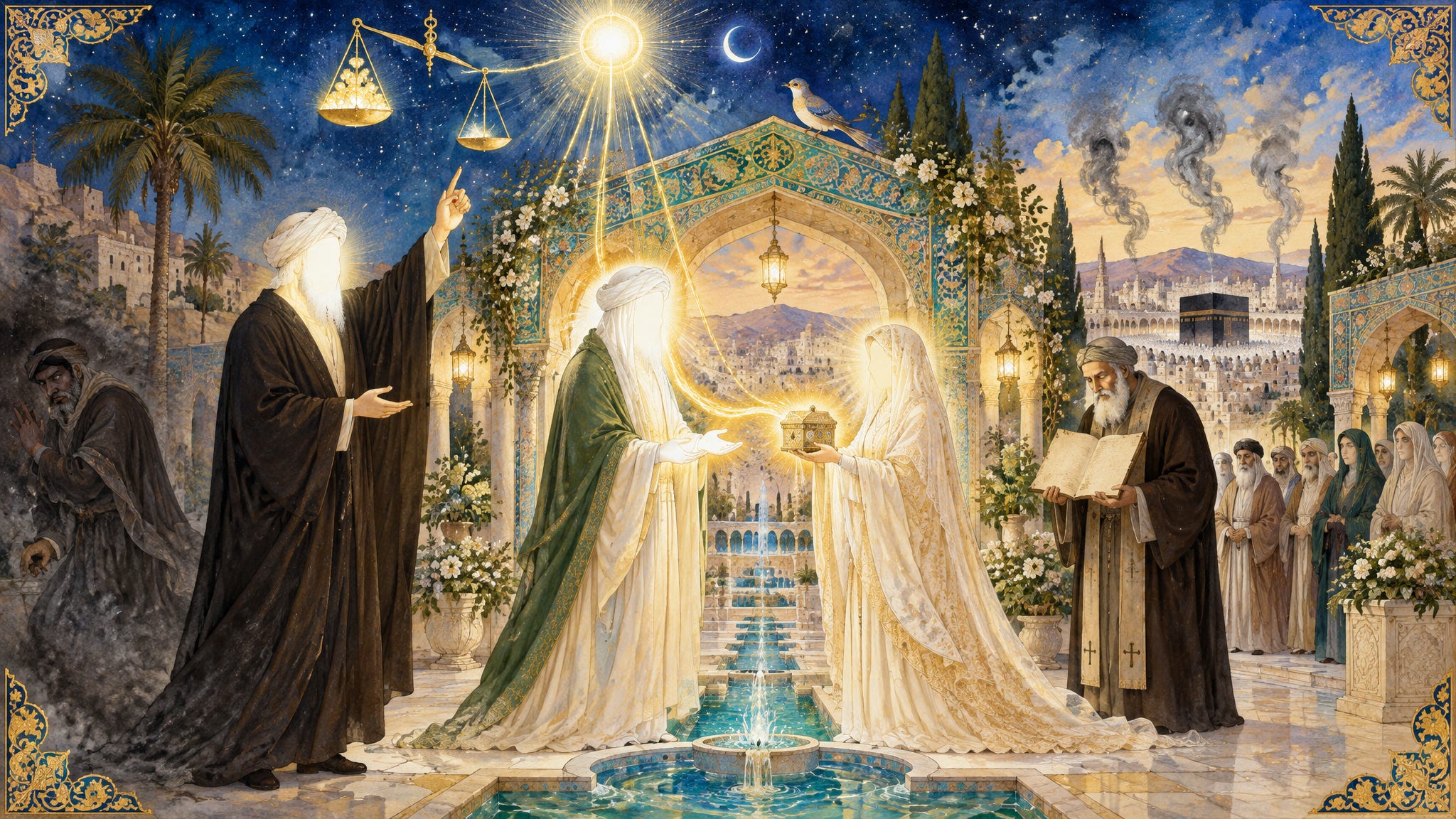
Now listen to the wedding itself, as Imam Ja’far al-Sadiq, peace and blessings be upon him, tells it.
When the Prophet wished to marry her, Abu Talib, peace and blessings be upon him, came with his family and some men of Quraysh to the house of her uncle, Waraqa ibn Nawfal.
And Abu Talib spoke.
He praised the Lord of the House.
And then he said of his nephew: there is no man of Quraysh weighed against him but he outweighs him.
And though he has little wealth
— wealth is a passing gift, and a fading shade.
He has a desire for Khadijah, and she has a desire for him.
We have come to ask you for her, with her consent, and at her command.
Then her uncle began to answer.
He stammered, and faltered, and could not finish.
And the report adds that he was one of the priests — a Christian priest, standing for the bride’s family at this wedding.
And then Sayyedah Khadijah spoke for herself.
Uncle, you may stand for me before the witnesses.
But you have no more right to me than I have to myself.
And then, to the Prophet:
I have given myself to you in marriage, O Muhammad.
And the dowry is on me, from my own wealth.
One of the men of Quraysh said,
How strange!
The women paying the dowry for the men!
And Abu Talib rose to his feet in anger — and he was a man whose anger men feared — and said:
When men are like this nephew of mine, they are sought at the highest price and the greatest dowry.
It is men like you who are married only with a costly dowry.
— Imam Ja’far al-Sadiq, peace and blessings be upon him, through Abd al-Rahman ibn Kathir; Shaykh al-Kulayni, al-Kafi, Volume 5, hadith 1478 (thaqalayn) — narrated16
Did you hear what nobody asked that day?
Nobody asked her age.
Nobody asked whether she had been married before.
Nobody asked why it had taken so long.
There was one question that mattered in that room, and Abu Talib answered it before anyone could ask it.
With her consent, and at her command.
The Widow Who Proposed
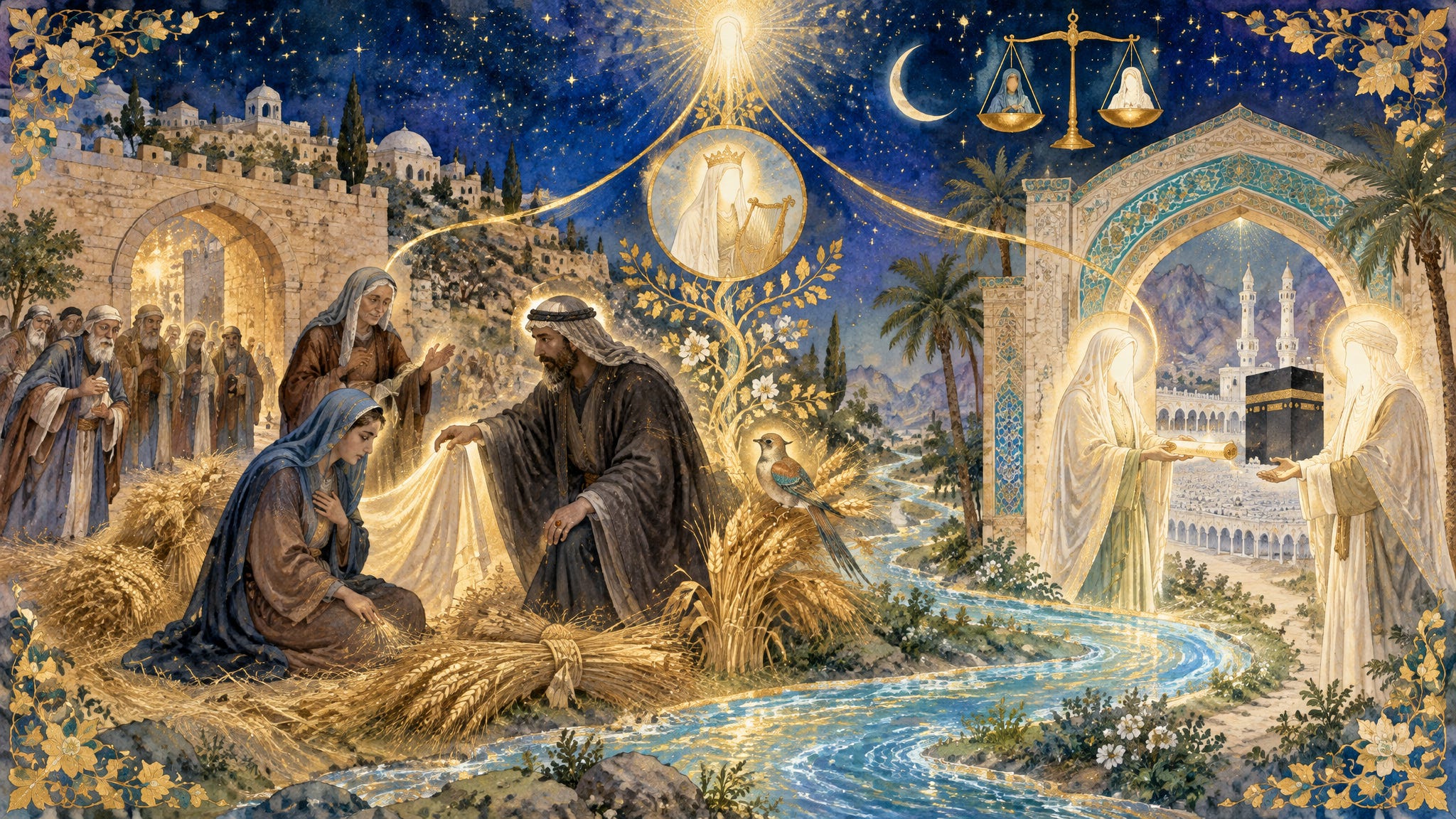
There is a woman in the Bible who did the same.
Ruth was a widow.
And, at her mother-in-law’s counsel, she went to Boaz herself, and asked him to take her in marriage.
35 הָאִישׁ וַיִּלָּפֵת וְהִנֵּה אִשָּׁה שֹׁכֶבֶת מַרְגְּלֹתָיו: וַיֹּאמֶר 36 מִי־אָתִי וַתֹּאמֶר אָנֹכִי רוּת אֲמָתֶךָ וּפָרַשְׂתָּ כְּנָפֶךְ עַל־ 37 אמתך
10 אֲמָתְךָ כִּי נֹאֵל אָתָהּ: וַיֹּאמֶר בְּרוּכָהּ אַתְּ לַיהוָהּ בִּתִּי הֵיטַבְתִּי חַסְדֵּךְ הָאַחֲרוֹן מִן־הָרֹאשׁוֹן לְבִלְתִּי־לֶכֶת 11 אַחֲרֵי הַבַּחוּרִים אִם־דַּל וְאִם־עָשִׁיר: וְעַתָּהּ בִּתִּי אַל־תִּירְאִי כָּל אֲשֶׁר־תֹּאמְרִי אֶעֱשֶׂה־לָךְ כִּי יוֹדֵעַ כָּל־שֵׁעַר 12 עַמִּי כִּי אֵשֶׁת חַיִּל אָתְ: וְעַתָּהּ כִּי אָמְנָם כִּי אִם נֹאֵל
“And he said, Who art thou? And she answered, I am Ruth thine handmaid: spread therefore thy skirt over thine handmaid; for thou art a near kinsman.”
“And now, my daughter, fear not; I will do to thee all that thou requirest: for all the city of my people doth know that thou art a virtuous woman.”
— the Book of Ruth, chapter 3, verses 9 and 11; the King James Version17, in Hebrew; Ketuvim, records 419 and 420 (record numbers, not printed pages)
Spread thy skirt over thine handmaid — in the language of her time, take me as your wife.
And the answer came back:
All the city of my people doth know that thou art a virtuous woman.
A widow who proposed, and the whole city called her virtuous.
She became the great-grandmother of David, peace and blessings be upon him.
The widow who proposed, beside Sayyedah Khadijah, who proposed.
No shelf.
And no blame.
God Has Not Given Me Better
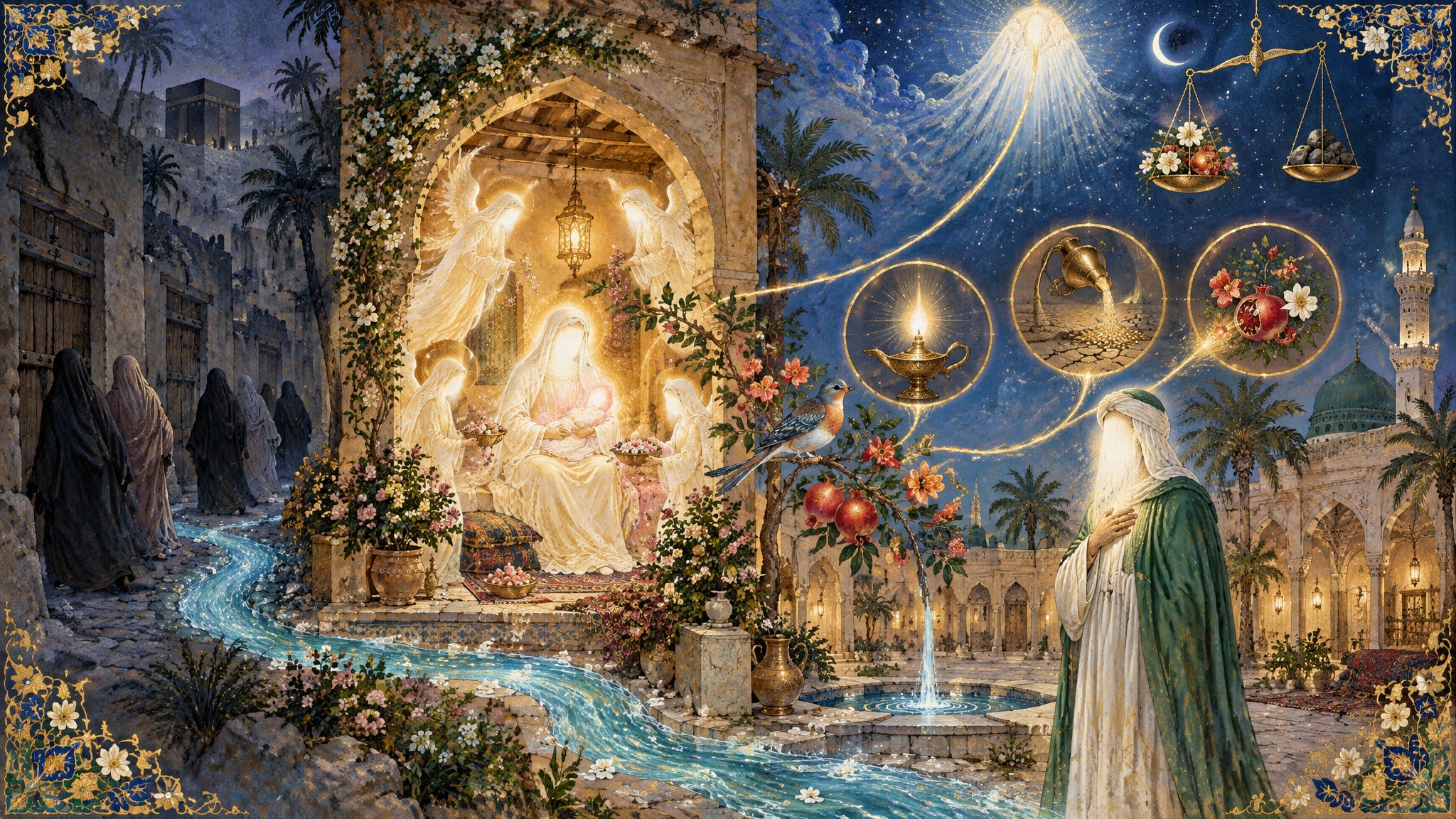
And do you remember what happened after the wedding?
We heard it on the first night of this series.
When Sayyedah Khadijah was in labour with Sayyedah Fatimah, peace and blessings be upon her, she sent for the women of Quraysh, to help her as women help women.
And they refused to come.
You married Muhammad, the orphan of Abu Talib, a poor man with no wealth18.
The same society that had wanted her hand shut its doors on her, because of her choice.
And he?
He married no one else as long as she lived.
And long after she had gone, whenever he spoke of her, he praised her.
Once he said:
God has not given me better than her.
She believed me when people called me a liar.
She consoled me with her wealth when people deprived me.
And God gave me children by her.
— the Messenger of God, peace and blessings be upon him, his family, and his righteous companions, as Aisha reports his words; al-Fattal al-Nisaburi, Rawdat al-Wa’izin, record 289 — narrated19
The Race of Luxury
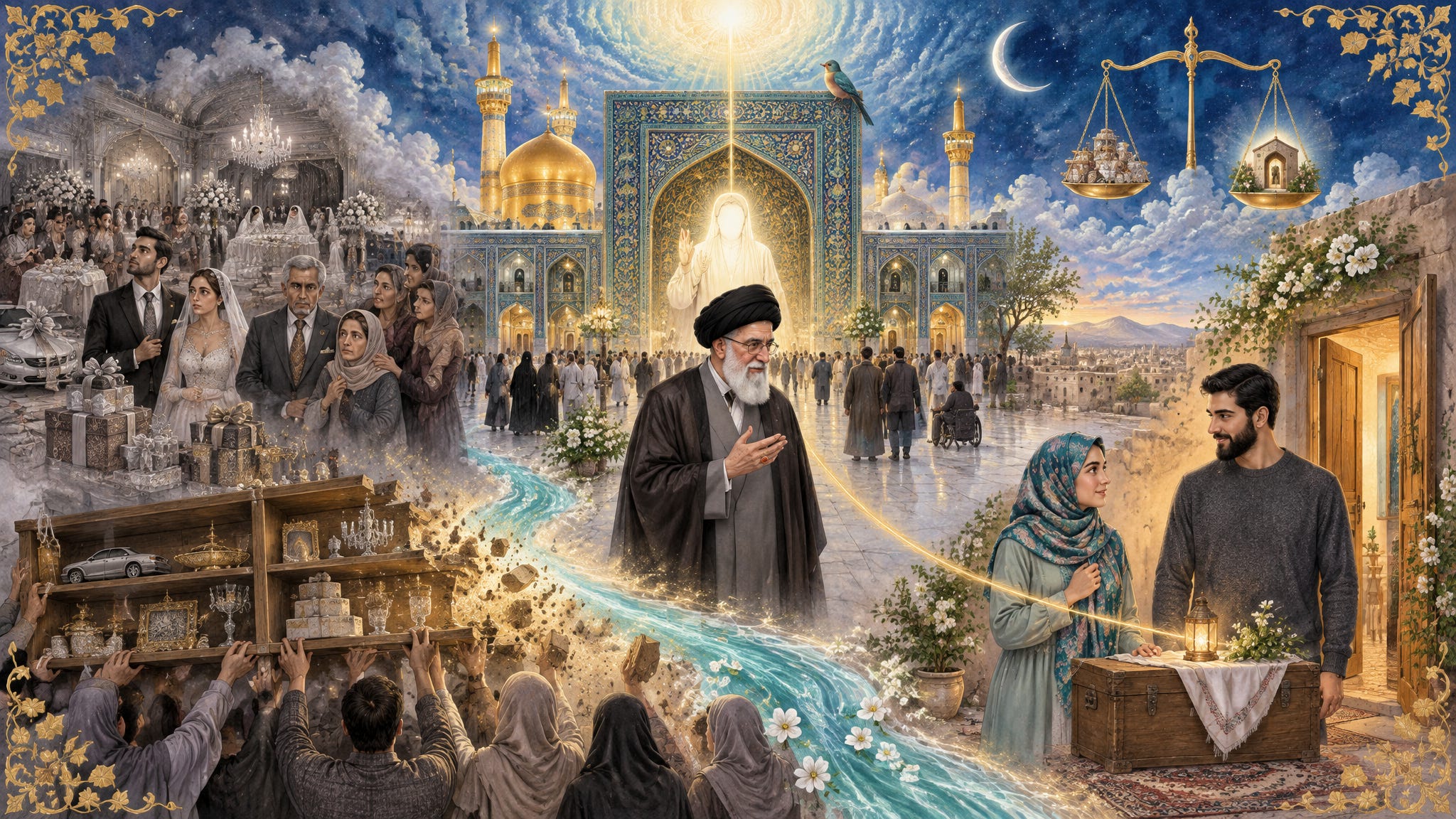
So why, in our own communities, do so many good young people stay unmarried — women and men?
Imam Khamenei, may God rest his pure soul, gave one answer to the pilgrims at the shrine of Imam al-Rida, peace and blessings be upon him, on the first day of the Iranian new year in 2023.
One of our problems, he said, is an extreme love of luxury.
That is why marriage has become hard.
A young person — a girl or a boy — cannot marry.
Why?
Because the parents are embarrassed in front of the relatives.
Such a mahr.
Such a trousseau.
Such a party.
You must get out of this race of luxury, he said.
Take yourselves out of the race.
— Imam Khamenei, may God rest his pure soul, to the pilgrims and residents of the shrine of Imam al-Rida in Mashhad, 1 Farvardin 1402 (21 March 2023) — narrated20
The shelf is not built by the one who waits.
It is built by the rest of us.
The Prophet’s Own House
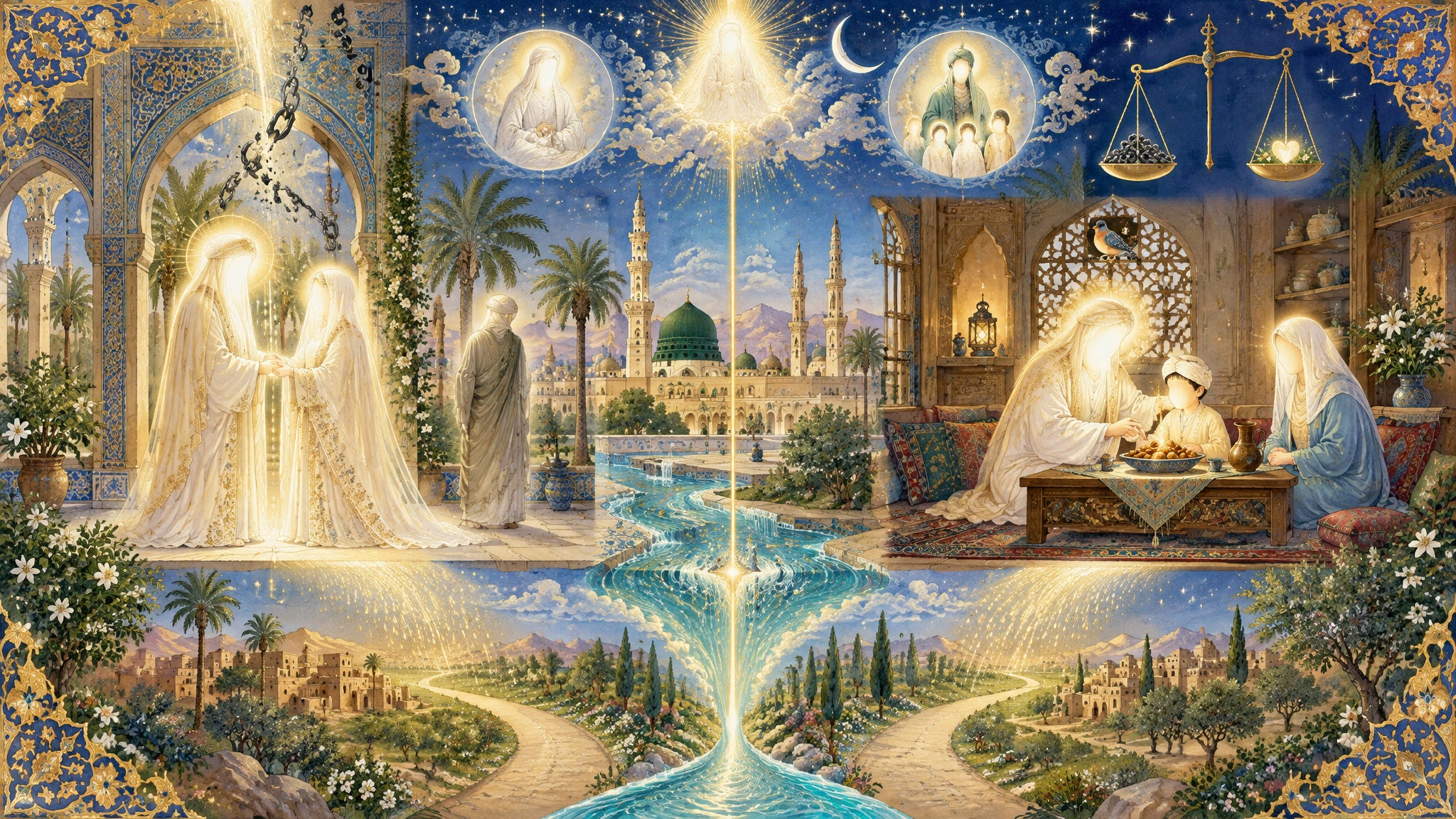
Now look at the Prophet’s own house.
Many of the women he married had been married before him.
And one of them came to him after a divorce.
Zaynab bint Jahsh had been married to Zayd, the young man the Prophet had raised as his own son.
That marriage ended.
And listen to how the Qur’an speaks of what came next21.
وَإِذۡ تَقُولُ لِلَّذِيٓ أَنۡعَمَ ٱللَّهُ عَلَيۡهِ وَأَنۡعَمۡتَ عَلَيۡهِ أَمۡسِكۡ عَلَيۡكَ زَوۡجَكَ وَٱتَّقِ ٱللَّهَ وَتُخۡفِي فِي نَفۡسِكَ مَا ٱللَّهُ مُبۡدِيهِ وَتَخۡشَى ٱلنَّاسَ وَٱللَّهُ أَحَقُّ أَن تَخۡشَىٰهُۖ فَلَمَّا قَضَىٰ زَيۡدٞ مِّنۡهَا وَطَرٗا زَوَّجۡنَٰكَهَا لِكَيۡ لَا يَكُونَ عَلَى ٱلۡمُؤۡمِنِينَ حَرَجٞ فِيٓ أَزۡوَٰجِ أَدۡعِيَآئِهِمۡ إِذَا قَضَوۡاْ مِنۡهُنَّ وَطَرٗاۚ وَكَانَ أَمۡرُ ٱللَّهِ مَفۡعُولٗا
“When you said to him whom God had blessed, and whom you [too] had blessed, ‘Retain your wife for yourself, and be wary of God,’ and you had hidden in your heart what God was to divulge, and you feared the people though God is worthier that you should fear Him, so when Zayd had got through with her, We wedded her to you, so that there may be no blame on the faithful in respect of the wives of their adopted sons, when the latter have got through with them, and God’s command is bound to be fulfilled.”
— Qur’an, Surah al-Ahzab (the Chapter of the Confederates) #33, Verse 37; the English, Ali Quli Qarai’s
What he hid in his heart, our tradition teaches, was what God had already made known to him: that when her marriage to Zayd was over, she would be his wife — to end an old custom.
It was not a desire of his own.
We wedded her to you.
God Himself gave a divorced woman in marriage to His Prophet.
Her divorce was not a stain that He had to look past.
And He said why: so that no believer would ever again be blamed for such a marriage.
Umm Salama was a widow with children when he married her.
And he raised them.
One of her sons remembered it all his life.
٥٣٧٦ - حَدَّثَنَا عَلِيُّ بْنُ عَبْدِ اللَّهِ: أَخْبَرَنَا سُفْيَانُ قَالَ: الْوَلِيدُ بْنُ كَثِيرٍ أَخْبَرْنِي: أَنَّهُ سَمِعَ وَهْبَ بْنَ كَيْسَانَ: أَنَّهُ سَمِعَ عُمَرَ بْنَ أَبِي سَلَمَةَ يَقُولُ: كُنْتُ غُلَامًا فِي حَجْرِ رَسُولِ اللَّهِ وَكَانَتْ يَدِي تَطِيشُ فِي الصَّحْفَةِ، فَقَالَ لِي رَسُولُ اللَّهِ : «يَا غُلَامُ سَمِّ اللَّهِ وَكُلْ بِيَمِينِكَ وَكُلْ مِمَّا يَلِيكَ»، فَمَا زَالَتْ تِلْكَ طِعْمَتِي بَعْدُ.
“Narrated ‘Umar bin Abī Salama: I was a boy under the care of God’s Messenger and my hand used to go around the dish while eating. So God’s Messenger said to me, ‘O boy! Mention the Name of God and eat with your right hand, and eat of the dish what is nearer to you.’ Since then I have applied those instructions while eating.”
— Umar ibn Abi Salama; Sahih al-Bukhari, Volume 7, hadith 5376 (records 188 and 189); the Arabic, with its chain, and the English of our text of the report, as printed22
A stepfather, at the table, teaching a little boy to say God’s name before he eats.
Since then I have applied those instructions.
And the Prophet himself was a widower, after Sayyedah Khadijah.
And Imam Ali, peace and blessings be upon him, was a widower with four young children.
And God has a word for every couple that parts.
وَإِن يَتَفَرَّقَا يُغۡنِ ٱللَّهُ كُلّٗا مِّن سَعَتِهِۦۚ وَكَانَ ٱللَّهُ وَٰسِعًا حَكِيمٗا
“But if they separate, God will suffice each of them out of His bounty, and God is all-bounteous, all-wise.”
— Qur’an, Surah al-Nisa (the Chapter of the Women) #4, Verse 130; the English, Ali Quli Qarai’s
God will suffice each of them.
Each of them.
Not only the one we have decided was in the right.
The Knowing Nod
When a marriage ends, what do we do?
I said it at the beginning.
We say it with our eyes.
There is a surah of the Qur’an that opens with a woe upon the one who does it.
وَيۡلٞ لِّكُلِّ هُمَزَةٖ لُّمَزَةٍ
“Woe to every scandal-monger and slanderer,”
— Qur’an, Surah al-Humazah (the Chapter of the Traducer) #104, Verse 1; the English, Ali Quli Qarai’s
Two words in the Arabic:
humaza and lumaza.
And some of the commentators23 read one of the two as the one who wounds with a look — who narrows his eye at you, nods with his head, signals with his eye.
Slander, without a single word.
The Bible knows that person too.
קֹרֵץ בְּעִינוּ מוֹלֵל בְּגֹלָ֑וּ מֹרֶה בְּאֶצְבְּעֹתָיו: תַּהֲפְכוֹת וּבְלִבּוֹ חֹרֵשׁ רָע בְּכָל־עֵת מְדֹנִים יְשַׁלֵּחַ:
“He winketh with his eyes, he speaketh with his feet, he teacheth with his fingers;”
“Frowardness is in his heart, he deviseth mischief continually; he soweth discord.”
— the Book of Proverbs, chapter 6, verses 13 and 14; the King James Version, in Hebrew; Ketuvim, record 246 (a record number, not a printed page)24
He winketh with his eyes.
He soweth discord.
Now go back to last week, and to the Blessed Saint Mary, peace and blessings be upon her.
The Qur’an gives a name to what was said about her.
وَبِكُفۡرِهِمۡ وَقَوۡلِهِمۡ عَلَىٰ مَرۡيَمَ بُهۡتَٰنًا عَظِيمٗا
“And for their faithlessness, and their uttering a monstrous calumny against Mary,”
— Qur’an, Surah al-Nisa (the Chapter of the Women) #4, Verse 156; the English, Ali Quli Qarai’s
A monstrous calumny.
In the Arabic,
buhtanan ‘aziman.
Last week we spoke about slander received on the tongue.
Tonight I want to speak about slander given with the eyes.
Because the knowing nod across the hall, when a divorced woman walks into a wedding, is the same buhtan.
Nobody said a word.
And everybody heard it.
Imam Khomeini, may God rest his pure soul, issued a decree in December 1982 on the rights of the people — the decree of eight articles.
In it he forbade anyone to go after people’s secrets, or to pry into the sins of others, or to disclose secrets that have reached him from another, even to one person.
And he counted some of these, like the spreading of indecency, among the very great sins.
— Imam Khomeini, may God rest his pure soul, the Eight-Article Decree, Article 6, 24 Azar 1361 (15 December 1982) — narrated25
Even to one person.
Not on the group chat.
Not over tea.
Not to your brother or your sister, just so they know.
And look at who the nod is aimed at.
The divorced woman:
she must have done something.
The divorced man:
he’s no good, that’s why.
The single mother at the school gate — and the single father beside her.
The widow who remarries so soon — and the widower who remarries already.
We have a nod for every one of them.
Men and women alike.
The Father Who Walks Away
Now a house that is hard to speak about.
The house a father has walked out of.
Listen to the verse on the nursing of a child.
۞وَٱلۡوَٰلِدَٰتُ يُرۡضِعۡنَ أَوۡلَٰدَهُنَّ حَوۡلَيۡنِ كَامِلَيۡنِۖ لِمَنۡ أَرَادَ أَن يُتِمَّ ٱلرَّضَاعَةَۚ وَعَلَى ٱلۡمَوۡلُودِ لَهُۥ رِزۡقُهُنَّ وَكِسۡوَتُهُنَّ بِٱلۡمَعۡرُوفِۚ لَا تُكَلَّفُ نَفۡسٌ إِلَّا وُسۡعَهَاۚ لَا تُضَآرَّ وَٰلِدَةُۢ بِوَلَدِهَا وَلَا مَوۡلُودٞ لَّهُۥ بِوَلَدِهِۦۚ وَعَلَى ٱلۡوَارِثِ مِثۡلُ ذَٰلِكَۗ فَإِنۡ أَرَادَا فِصَالًا عَن تَرَاضٖ مِّنۡهُمَا وَتَشَاوُرٖ فَلَا جُنَاحَ عَلَيۡهِمَاۗ وَإِنۡ أَرَدتُّمۡ أَن تَسۡتَرۡضِعُوٓاْ أَوۡلَٰدَكُمۡ فَلَا جُنَاحَ عَلَيۡكُمۡ إِذَا سَلَّمۡتُم مَّآ ءَاتَيۡتُم بِٱلۡمَعۡرُوفِۗ وَٱتَّقُواْ ٱللَّهَ وَٱعۡلَمُوٓاْ أَنَّ ٱللَّهَ بِمَا تَعۡمَلُونَ بَصِيرٞ
“Mothers shall suckle their children for two full years—that for such as desire to complete the suckling—and on the father shall be their maintenance and clothing, in accordance with honourable norms.
No soul is to be tasked except according to its capacity: neither the mother shall be made to suffer harm on her child’s account, nor the father on account of his child, and on the [father’s] heir devolve [duties and rights] similar to that.
And if the couple desire to wean with mutual consent and consultation, there will be no sin upon them.
And if you want to have your children wet-nursed, there will be no sin upon you so long as you pay what you give in accordance with honourable norms, and be wary of God and know that God watches what you do.”
— Qur’an, Surah al-Baqarah (the Chapter of the Cow) #2, Verse 233; the English, Ali Quli Qarai’s
Two things in it.
The nursing mother’s keep and her clothing are on the father,
in accordance with honourable norms.
And then:
neither the mother shall be made to suffer harm on her child’s account, nor the father on account of his child.
It runs both ways.
Now listen to the Messenger of God, peace and blessings be upon him, his family, and his righteous companions.
قَالَ رَسُولُ الله (صلَّى اللهُ عَلَيْهِ وَآلِه) مَلْعُونٌ مَلْعُونٌ مَنْ أَلْقَى كَلَّهُ عَلَى النَّاسِ مَلْعُونٌ مَلْعُونٌ مَنْ ضَيَّعَ مَنْ يَعُولُ.
“The Messenger of God, God bless him and his family, said:
Cursed, cursed is he who throws his burden onto people.
Cursed, cursed is he who neglects those he is bound to provide for.”
— the Messenger of God, peace and blessings be upon him, his family, and his righteous companions; Shaykh al-Kulayni, al-Kafi, Volume 4, hadith 45 (thaqalayn); my translation26
Cursed, cursed.
Twice, and then twice again.
So let me say it plainly.
The father who walks away from his child, and stops providing for that child, is in a sin under a double curse.
And let us not forget what this word, la’n, or mal’un, means, because it is far stronger than the English “curse”.
It means: may God’s mercy be distant from him.
He is someone from whom God’s mercy should be — or is — distant.
He is withholding the right of a mother and the right of a child, while it is due27.
And the law of this land — and most lands — binds him too.
Ayatullah Sayyed Muhammad Husayn Fadhlullah, may God rest his pure soul — who preached in Beirut every Friday for many years — saw it from his own minbar.
وقد رأينا الكثير من الآباء يهجرون أسرهم، ولا يتحمَّلون مسؤوليتهم.
“And we have seen many fathers abandon their families, and not bear their responsibility.”
— Ayatullah Sayyed Muhammad Husayn Fadhlullah, may God rest his pure soul, Friday sermon, 5 October 2007 (bayynat.org.lb); my translation28
And last week we spoke about temporary marriage.
Shaheed Mutahhari, may God rest his pure soul, set it down plainly29:
A child born of a temporary marriage is in no way different from a child of a permanent one.
And there is a report in al-Kafi about that very marriage: when a child comes of it, the man may not deny the child.
And the narrator adds that the Imam was severe about the denial of a child.
— an Imam, peace and blessings be upon him, whom the report does not name, through Ibn Abi Umayr; Shaykh al-Kulayni, al-Kafi, Volume 5, hadith 1844 (thaqalayn) — narrated30
Last week we called it a marriage with reasons, not a licence.
The father who walks away from the child of that marriage has turned it into exactly that.
A licence.
The Father Pushed Out
And now the other side of the same verse.
Because there are fathers in this room who did not walk away.
They were pushed out.
A father who pays, every month, and is kept from his children by bitterness.
Nor the father on account of his child.
The verse protects him too.
I am not going to argue custody from this minbar.
The scholars differ on its details, and the courts have their place.
But this I will say, to every mother and every father: do not teach a child to hate the other parent.
The child is never a weapon — in either parent’s hands.
And to the mother in this room who is raising a child whose father walked away: you are not less.
Your child is not less.
And if you wish to marry again — or if a good man asks for your hand — there is no blame on you.
None.
And to the father who has been kept from his children: you are not less either.
Keep paying.
Keep asking.
Keep praying for them.
One day they will be grown, and they will ask where you were.
Let the answer be:
at the door, the whole time.
The Parent Who Raises Alone
Abraham, peace and blessings be upon him, left his wife Hagar and their baby son Ishmael, peace and blessings be upon them, in a valley where nothing grew — not walking away from them, but entrusting them to God.
And he prayed for them.
رَّبَّنَآ إِنِّيٓ أَسۡكَنتُ مِن ذُرِّيَّتِي بِوَادٍ غَيۡرِ ذِي زَرۡعٍ عِندَ بَيۡتِكَ ٱلۡمُحَرَّمِ رَبَّنَا لِيُقِيمُواْ ٱلصَّلَوٰةَ فَٱجۡعَلۡ أَفۡـِٔدَةٗ مِّنَ ٱلنَّاسِ تَهۡوِيٓ إِلَيۡهِمۡ وَٱرۡزُقۡهُم مِّنَ ٱلثَّمَرَٰتِ لَعَلَّهُمۡ يَشۡكُرُونَ
“Our Lord! I have settled part of my descendants in a barren valley, by Your sacred House, our Lord, that they may maintain the prayer. So make the hearts of a part of the people fond of them, and provide them with fruits, so that they may give thanks.”
— Qur’an, Surah Ibrahim (the Chapter of the Prophet Abraham) #14, Verse 37; the English, Ali Quli Qarai’s
And then she was alone.
A mother, a baby, and no water.
She ran between two hills, looking for water, looking for anyone.
And today her running is a rite of God’s House.
Listen to how the Qur’an names those two hills.
۞إِنَّ ٱلصَّفَا وَٱلۡمَرۡوَةَ مِن شَعَآئِرِ ٱللَّهِۖ فَمَنۡ حَجَّ ٱلۡبَيۡتَ أَوِ ٱعۡتَمَرَ فَلَا جُنَاحَ عَلَيۡهِ أَن يَطَّوَّفَ بِهِمَاۚ وَمَن تَطَوَّعَ خَيۡرٗا فَإِنَّ ٱللَّهَ شَاكِرٌ عَلِيمٌ
“Indeed Safa and Marwah are among God’s sacraments. So whoever makes hajj to the House, or performs the ‘umrah, there is no sin upon him to circuit between them. Should anyone do good of his own accord, then God is indeed appreciative, all-knowing.”
— Qur’an, Surah al-Baqarah (the Chapter of the Cow) #2, Verse 158; the English, Ali Quli Qarai’s
Every pilgrim who walks between Safa and Marwah is retracing the steps of a mother on her own, looking for water for her child.
Every one of them walks in her footsteps.
The Bible remembers her too — alone in a wilderness with her boy, and the water gone.
20 וַתַּשְׁלֵךְ אֶת־הַיֶּלֶד תַּחַת אַחַד הַשִׂיחַם: וַתֵּלֶךְ וַתֵּשֶׁב 21 לָהּ מִנֶּגֶד הַרְחֵק כִּמְטַחֲוֵי כֶשֶׁת כִּי אָמְרָה אַל־אָרֶה 22 בְּמוֹת הַיֶּלֶד וַתֵּשֶׁב מִנֶּגֶד וַתִּשָּׂא אָת־קֹלָה וַתֵּבְךְ:
18 כִּי־שָׁמַע אֱלֹהִים אָל־קוֹל הַנַּעַר בַּאֲשֶׁר הוּא־שָׁם: קּוּמִי שְׁאִי אֶת־הַנַּעַר וְהַחֲזִיקִי אֶת־יָדֵךְ בּוֹ כִּי־לְנוֹי נָדוֹל 19 אֲשִׂימֶנּוּ: וַיִּפְקַח אֱלֹהִים אֶת־עֵינֶיהָ וַתֵּרָא בְּאֵר מָיִם 20 וַתֵּלֶךְ וַתְּמַלֵּא אֶת־הַחֵמֶת מַיִם וַתַּשְׁקִי אֶת־הַנָּעַר: וַיְהִי אֱלֹהִים אֶת־הַנַּעַר וַיִּנְדָּל וַיֵּשֶׁב בַּמִּדְבָּר וַיְהִי רֹבֶה 21 בַּשְׁתַּי: וַיֵּשֶׁב בַּמִּדְבַּר פָּאָרָן וַתִּקַח־לוֹ אִמּוֹ אִשָּׁה מֵאֶרֶץ מִצְרַיִם: 22 וַיְהִי בָּעֵת הַהִוא וַיֹּאמֶר אֲבִימֶלֶךְ וּפִיכַל שֹׂר־צְבָאוֹ אֶל־אַבְרָהָם לֵאֹמֶר אֱלֹהִים עִמְּךָ בְּכַל אֲשֶׁר־אַתָּה עֹשֶׂה: 23 וְעַתָּה הִשָּׁבְעָה לִי בֵּאלֹהִים הֵנָּה אִם־תִּשְׁקֹר לִי וּלְנִינִי וּלְנֶכְדִּי כַּחֶסֶד אֲשֶׁר־עָשִׂיתִי עִמְּךָ תַּעֲשֶׂה עִמָּדִי וְעִם־הָאָרֶץ אֲשֶׁר־גַּרְתָּה בָהּ: וַיֹּאמֶר אַבְרָהָם אָנֹכִי אִשָּׁבֵעַ: 24 וְהוֹכַח אַבְרָהָם אֶת־אֲבִימֶלֶךְ עַל־אֹדוֹת בְּאֵר הַמַּיִם 25 אֲשֶׁר גָּזְלוּ עַבְדֵי אֲבִימֶלֶךְ: וַיֹּאמֶר אֲבִימֶלֶךְ לֹא יָדַעְתִּי מִי עָשָׂה אֶת־הַדָּבָר הַזֶּה וְנַם־אַתָּה לְאִ־הִנַּדְתָּ לִי וְנַם 26 אָנֹכִי לֹא שָׁמַעְתִּי בִּלְתִּי הַיּוֹם: וַיַּקַח אַבְרָהָם צֹאַן וּבָקָר 27 וַיִּתֵּן לַאֲבִימֶלֶךְ וַיִּכְרְתּוּ שְׁנֵיהֶם בְּרִיתָ: וַיַּצֵּב אַבְרָהָם 28 אֶת־שֶׁבַע כִּבְשִׁת הַצֹּאַן לְבַדְּהֵן: וַיֹּאמֶר אֲבִימֶלֶךְ אֶל־אַבְרָהָם מָה הֵנָּה שֶׁבַע כְּבָשֹׁת הָאֵלֶּה אֲשֶׁר הִצַּבְתָּ 30 לְבַדְּהָנָה: וַיֹּאמֶר כִּי אֶת־שֶׁבַע כְּבָשֹׁת תִּקַּח מִיָּדִי בַּעֲבוּר 31 תִּהְיֶה־לִי לְעֵרָה כִּי חָפַרְתִּי אֶת־הַבְּאֵר הַזֹּאת: עַל־כֵּן 32 קָרָא לַמָּקוֹם הַהוּא בְּאֵר שָׁבַע כִּי שָׁם נִשְׁבְּעוּ שְׁנֵיהֶם: 33 וַיִּכְרְתּוּ בְּרִית בִּבְאֵר שָׁבַע וַיָּקָם אֲבִימֶלֶךְ וּפִיכַל שֹׂר־צְבָאוֹ וַיָּשְׁבוּ אֶל־אֶרֶץ פְּלִשְׁתִּים: וַיִּפַּע אֵשֶׁל בִּבְאֵר 34 שָׁבַע וַיִּקְרָא־שָׂם בְּשֵׁם יְהוָה אֵל עוֹלָם: וַיָּגָר אַבְרָהָם בְּאֶרֶץ פְּלִשְׁתִּים יָמִים רַבִּים: וַיְהִי
“And she went, and sat her down over against him a good way off, as it were a bowshot: for she said, Let me not see the death of the child. And she sat over against him, and lift up her voice, and wept.”
“And God opened her eyes, and she saw a well of water; and she went, and filled the bottle with water, and gave the lad drink.”
— the Book of Genesis, chapter 21, verses 16 and 19; the King James Version, the Book of Genesis, chapter 21, from the end of verse 15 to the end of verse 16, and from the end of verse 17 to the first word of chapter 22, in Hebrew; Torah, records 33 and 34 (record numbers, not printed pages)31
And in an earlier chapter, when she was alone in the desert, an angel found her by a spring of water.
And she gave God a name.
13 כָּל־אֶחָיו יִשְׁכֹּן: וַתִּקְרָא שֵׁם־יְהוָה הַדֹּבֵר אֵלֶיהָ אַתָּה 14 אֵל רָאִי כִּי אָמְרָה הַגַּם הֵלָם רָאִיתִי אַחֲרֵי רֹאִי: עַל־כֵּן
“And she called the name of the LORD that spake unto her, Thou God seest me: for she said, Have I also here looked after him that seeth me?”
— the Book of Genesis, chapter 16, verse 13; the King James Version, in Hebrew; Torah, record 24 (a record number, not a printed page)32
Thou God seest me.
To every mother and every father in this room who is raising a child alone, and who feels that nobody sees:
God sees you.
And the Blessed Saint Mary raised Jesus, may our souls be his ransom and may God hasten his return, with no husband at her side — and under slander.
Last week we told of the day she came home.
Think tonight of the years after it.
وَجَعَلۡنَا ٱبۡنَ مَرۡيَمَ وَأُمَّهُۥٓ ءَايَةٗ وَءَاوَيۡنَٰهُمَآ إِلَىٰ رَبۡوَةٖ ذَاتِ قَرَارٖ وَمَعِينٖ
“And We made the son of Mary and his mother a sign, and sheltered them in a level highland with flowing water.”
— Qur’an, Surah al-Mu’minun (the Chapter of the Believers) #23, Verse 50; the English, Ali Quli Qarai’s
And sheltered them.
A mother on her own, and her son.
And God gave them shelter.
And the Prophet himself was raised without his father.
His father died before he was born, and his mother when he was a small boy.
His grandfather raised him, and then his uncle, Abu Talib.
And God reminds him:
أَلَمۡ يَجِدۡكَ يَتِيمٗا فَـَٔاوَىٰ
“Did He not find you an orphan, and shelter you?”
— Qur’an, Surah al-Duha (the Chapter of the Morning Hours) #93, Verse 6; the English, Ali Quli Qarai’s
And shelter you.
The same word again.
God shelters the mother who raises her son alone.
And God shelters the orphan.
And after Ashura, the widows, and the children whose fathers had been killed, were led away from Karbala, with Sayyedah Zaynab, peace and blessings be upon her, standing guard over them.
And in the Prophet’s own house there was a father raising alone.
Listen to Ayatullah Fadhlullah on Sayyedah Fatimah’s childhood.
اشت(ع) طفولتها مع رسول الله(ص) لأنها فقدت أمها مبكراً، فكان النبي(ص) أباها وأمها، وعندما انفتحت في طفولتها على أبيها، وهو يعاني من المشركين، كانت تسير معه وهي الطفلة التي تدرج.
“She, peace and blessings be upon her, lived her childhood with the Messenger of God, peace and blessings be upon him, his family, and his righteous companions, because she lost her mother early; so the Prophet, peace and blessings be upon him, his family, and his righteous companions, was her father and her mother. And when, in her childhood, she opened her eyes on her father as he suffered at the hands of the polytheists, she would walk with him — a little girl, just toddling.”
— Ayatullah Sayyed Muhammad Husayn Fadhlullah, may God rest his pure soul, Friday sermon, 29 July 2005 (bayynat.org.lb); my translation33
Her father and her mother.
A widowed father, raising his little girl.
Her First Request
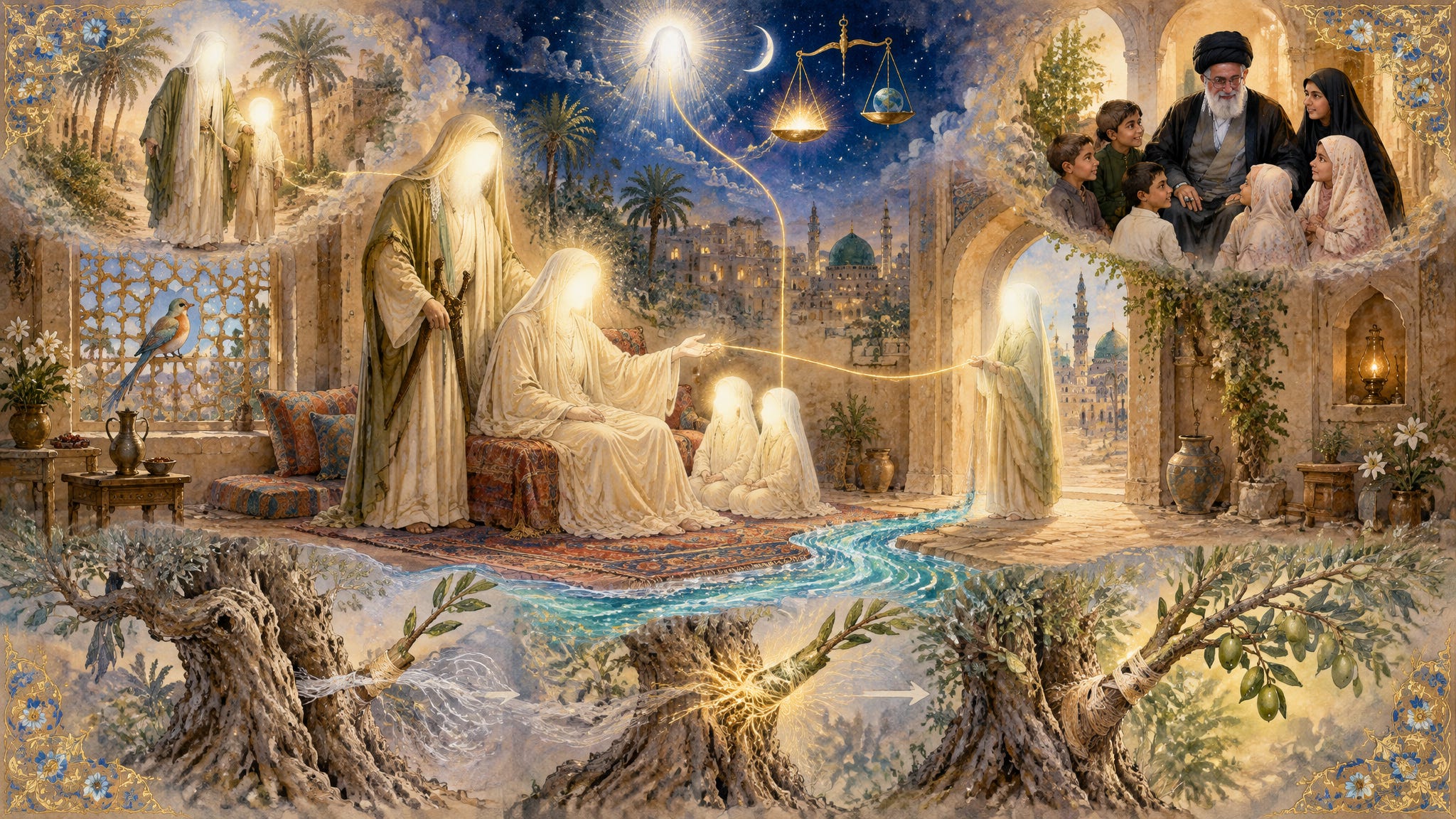
Now come to the house of Imam Ali and Sayyedah Fatimah, peace and blessings be upon them, in her last days.
Among her last wishes to Imam Ali, the first was for her children:
Marry Umama after me, for she will be to my children as I am.
For men cannot do without women.
— Sayyedah Fatimah al-Zahra, peace and blessings be upon her; al-Majlisi, Bihar al-Anwar, Volume 43, p. 192, from al-Fattal al-Nisaburi’s Rawdat al-Wa’izin — narrated34
Think about that.
A wife who knows she is dying gives her husband her blessing to marry again — and makes it her first request.
And she chooses the stepmother herself, for the sake of her children.
She will be to my children as I am.
And Imam Ali kept it.
He would say that there were four he had no way to part from, and Umama was one of them.
Fatimah, the daughter of Muhammad, God bless him and his family, entrusted her to me.
And remember what Shaykh al-Tabrisi told us.
On the report that Sayyedah Khadijah had been married before, the Prophet raised her son Hind.
Sayyedah Fatimah’s own father had been a stepfather.
And she asked for a stepmother.
Imam Khamenei, may God rest his pure soul, once told a group of young people about his own family.
His father had two daughters by his first wife.
She died, and he married again, and Imam Khamenei was one of the children of that second marriage — eight sisters and brothers, he said, from two mothers.
Two of the children had died along the way.
And then he said, simply:
و مادرم هم، پدر و مادر خیلى خوبى بودند.
“My father and my mother, too, were very good parents.”
— Imam Khamenei, may God rest his pure soul, in conversation with young people and with the children’s and teenagers’ department of Iranian television, 14 Bahman 1376 (3 February 1998); my translation35
A blended house, told with love.
And when he spoke to the officials who look after the families of martyrs, about the widows of martyrs marrying again, he began by saying that marriage is a very good thing.
And then he told them how to protect it.
بروند یک چند صباحى با هم باشند، یک چند سالى بگذرد، با همدیگر اُنس بگیرند، مثل این عضوى که پیوند میکنند به بدن، اوایل یک مقدارى پس میزند، اگر توانستید این را یک جورى نگه داشتید که این جوش خورد، بعد دیگر ولش میکنید به حال خودش؛ یعنى همهى همّت را بگذارید براى این اوّل کار؛ هم براى اوّل شهادت و آن مسائل، هم براى اوّل این ازدواج
“Let it be done in such a way that this marriage takes on the colour of permanence: let them be together a while, let a few years pass, let them grow close to one another — like an organ that is grafted onto the body: at first it rejects a little; if you can somehow hold it until it knits, after that you leave it to itself. That is, put all your effort into the start of the work: the start of the martyrdom and those matters, and the start of this marriage.”
— Imam Khamenei, may God rest his pure soul, to officials of the Martyrs Foundation, 23 Dey 1369 (13 January 1991); my translation36
Like an organ grafted onto the body.
A second marriage, and the family it makes, need care at the start.
And then they hold.
Lessons for Our Time
Lesson Four — There Is No Shelf
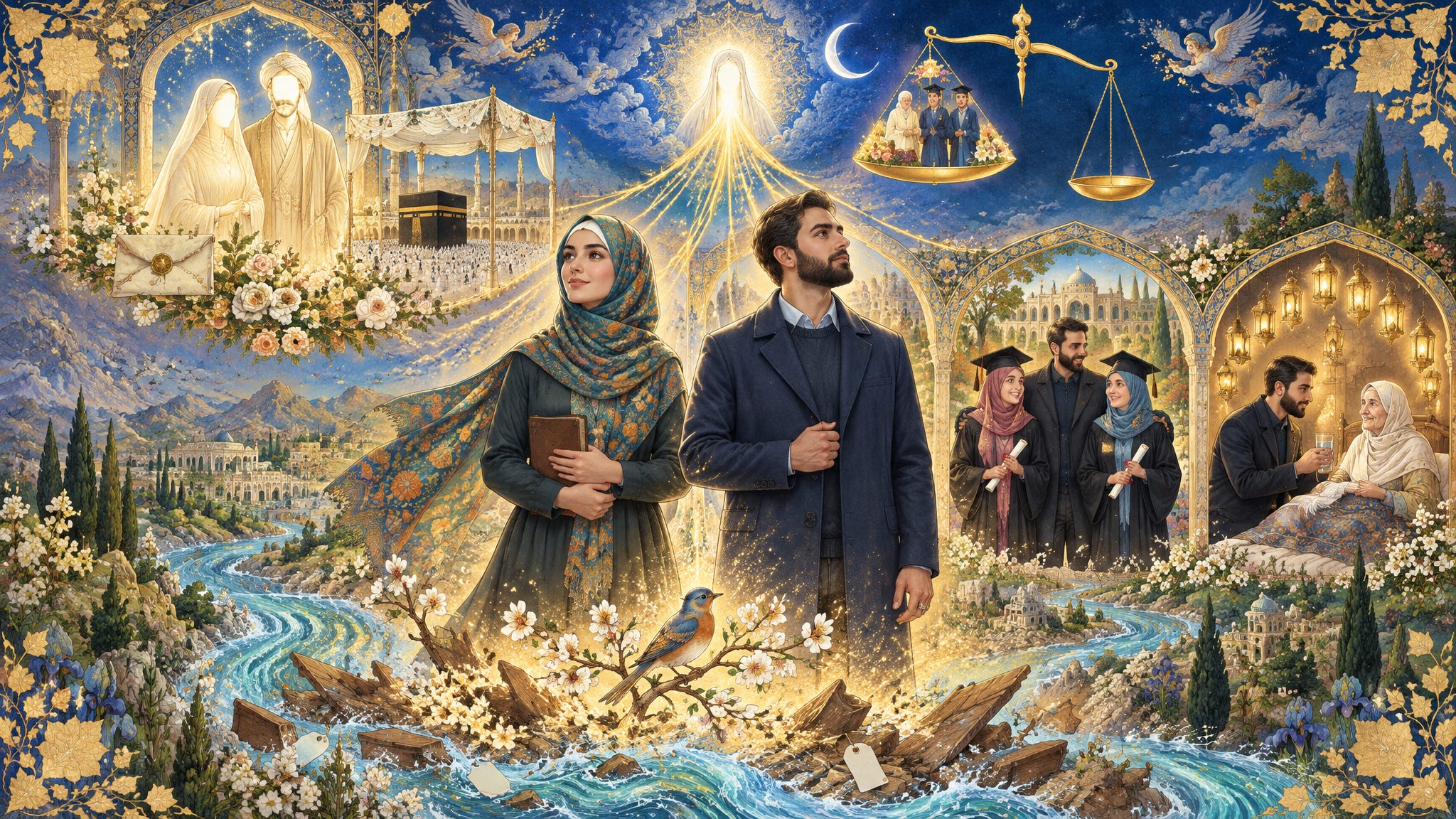
The woman who has not married is not unsold goods.
And nor is the man.
We ask what’s wrong with him?
Of the brother who put his sisters through university before he thought of himself, and of the son who nursed a sick parent for ten years.
What is wrong with him is that he was busy being good.
Last week we said it to the parents: if a suitor comes whose character and religion you are pleased with, do not bury him under conditions.
Tonight say it to everyone else: do not bury the unmarried under questions.
A woman of standing, sought by everyone, who waited for a man of character, chose him, spoke for herself at her own wedding, and was loved by him to the end of her life.
Where is the shelf in that?
Lesson Five — God Promised to Suffice Them
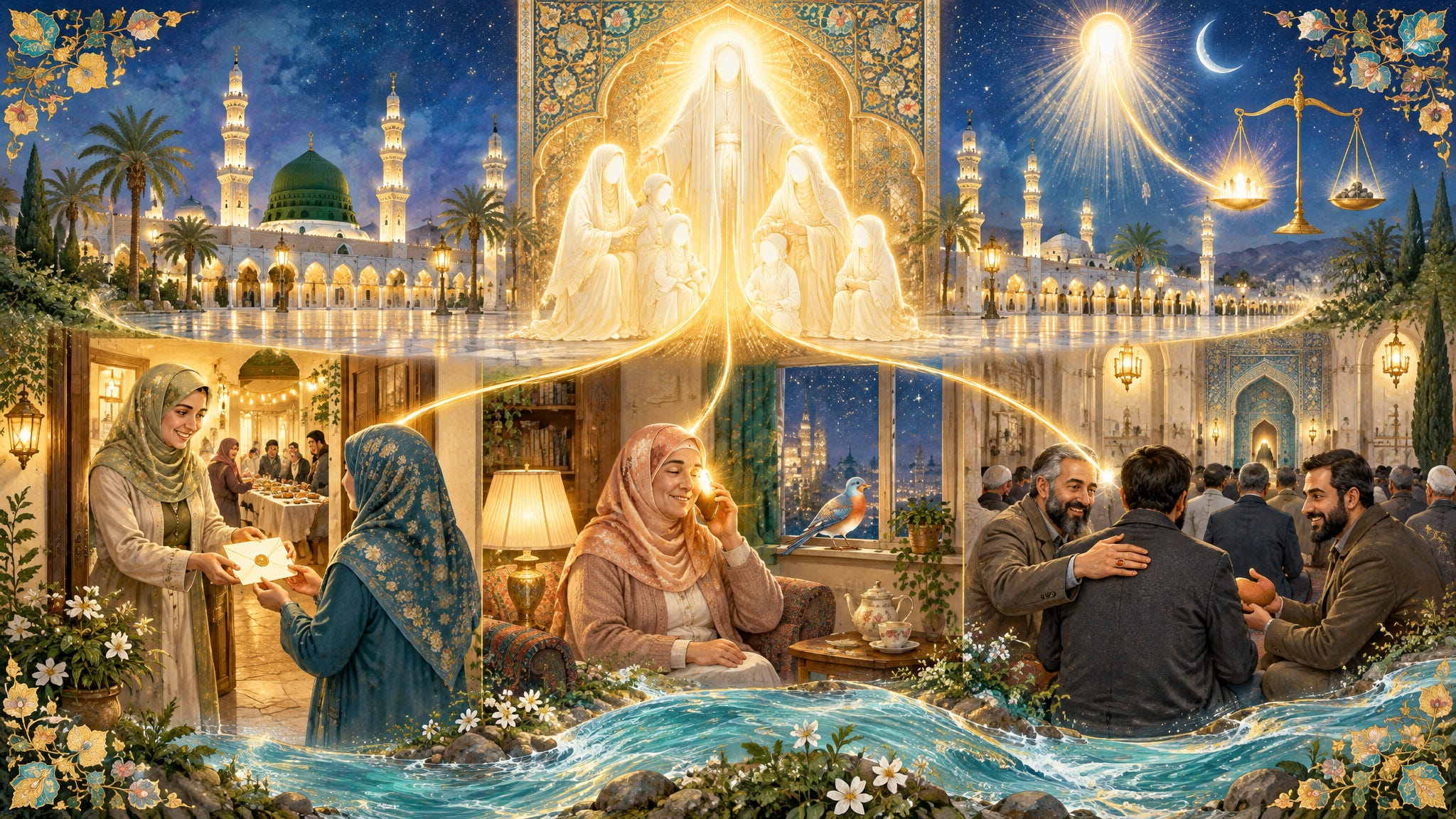
The Prophet’s own house held widows, a divorced woman and stepchildren.
And God promised that when a couple part, He will suffice each of them.
So the community may not make poorer the one God has promised to suffice.
Do not drop the divorced from the invitation list.
Do not stop ringing the widow.
Do not let the man who was left feel that he has nowhere to sit in the mosque.
Lesson Six — A Look Can Be Buhtan, and So Can Mercy
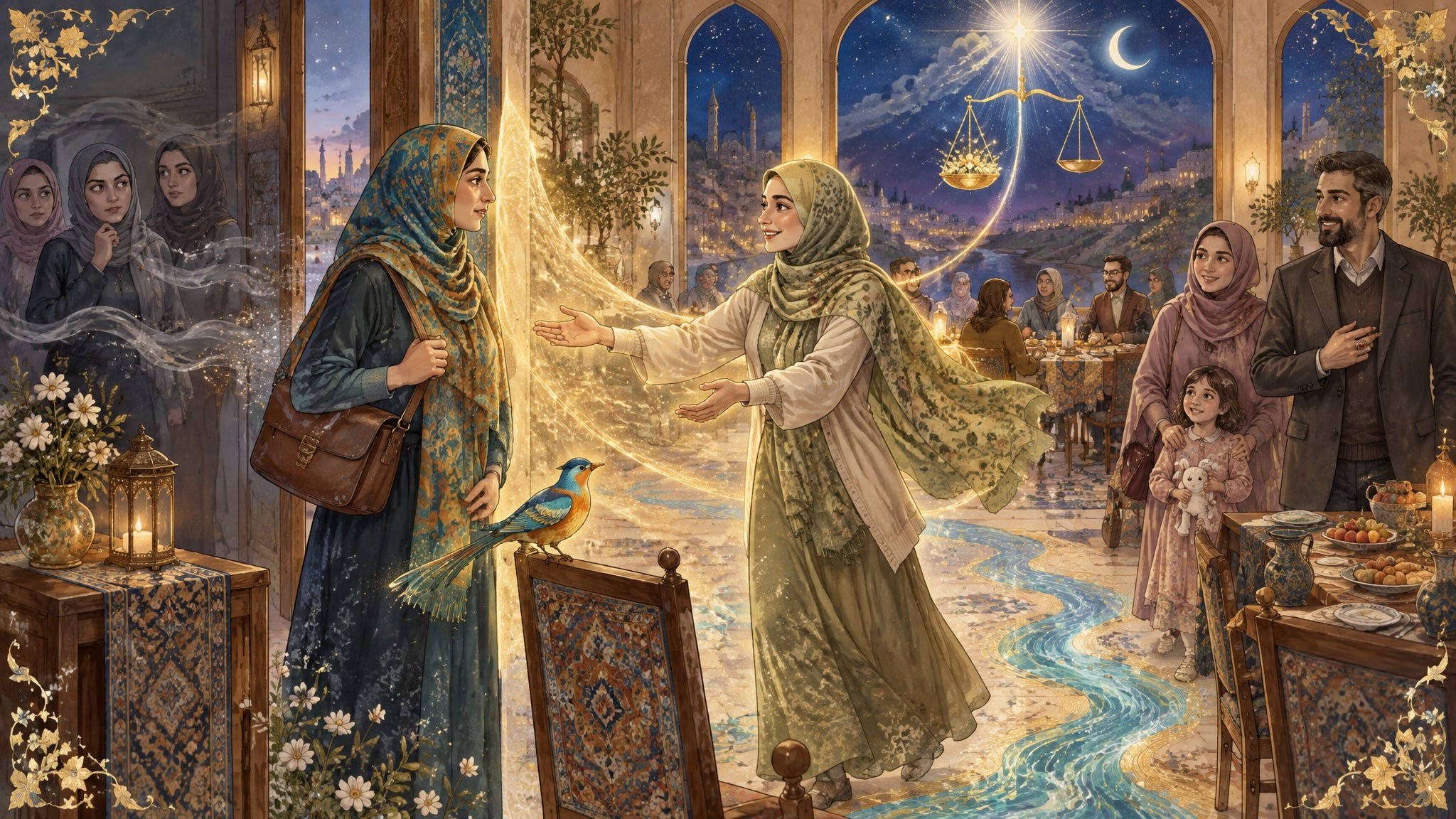
Buhtan can be said with a look.
So can mercy.
The next time someone walks into a gathering carrying a story — a divorce, a separation, a child on their own — do not nod.
Do not raise an eyebrow.
Do not look at the person next to you.
Walk across the room, and say salam.
Let your eyes say:
You are welcome here.
Lesson Seven — The Child Is Never a Weapon
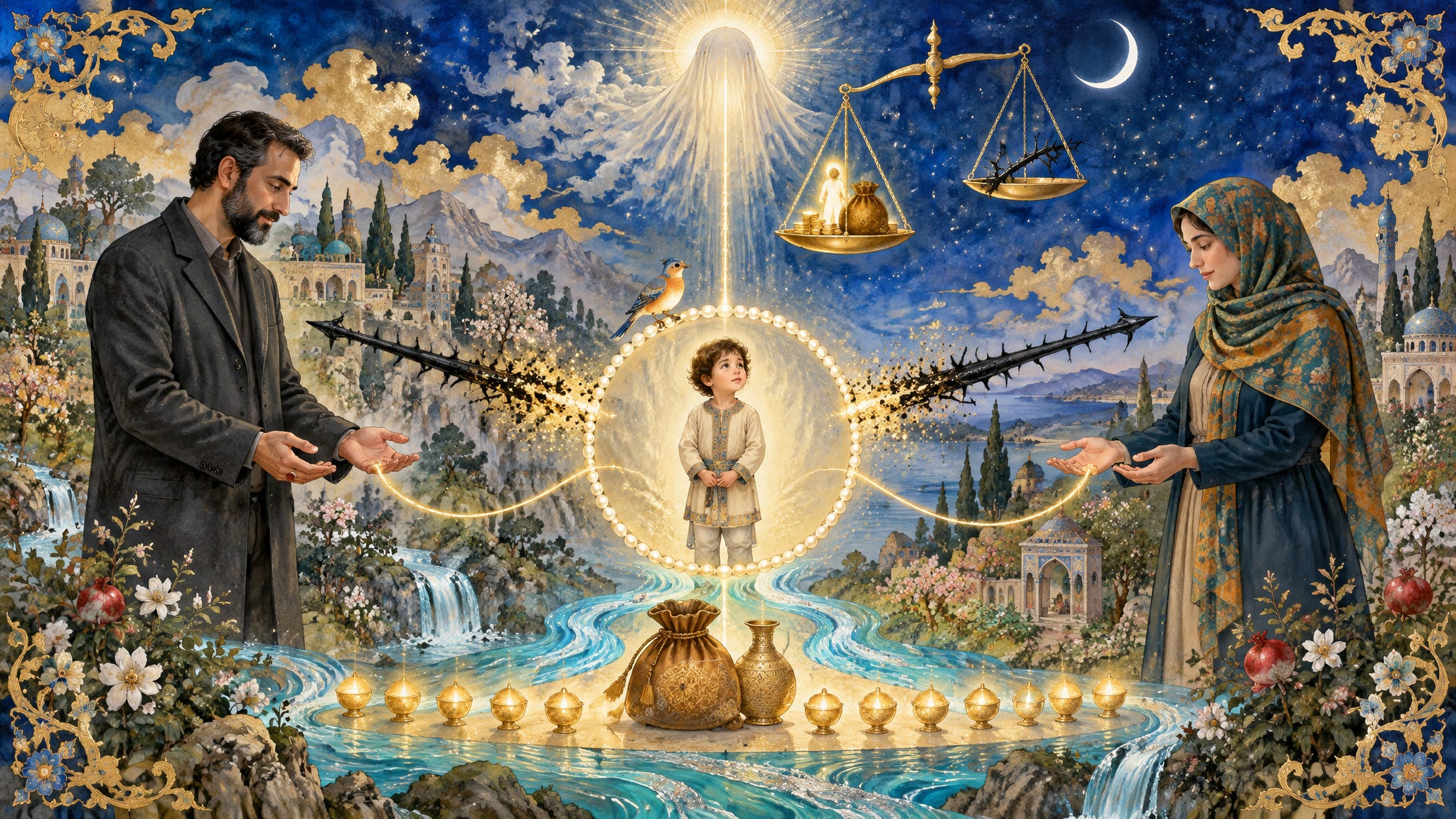
Maintenance is paid.
Every month, in full, without being chased.
And the child is never a weapon — not in the father’s hands, and not in the mother’s.
Lesson Eight — A Home with One Parent Is Not a Broken Home
Last year I said this from this minbar:
“A society built on broken homes becomes brittle — vulnerable to the weight of external pressures and the seductions of alien values.”
— from this majlis: Wilayah in the Home, session 3, “Mending the Tapestry: Trials, Trust, and Turning to God”, 24 November 2025
I stand by it.
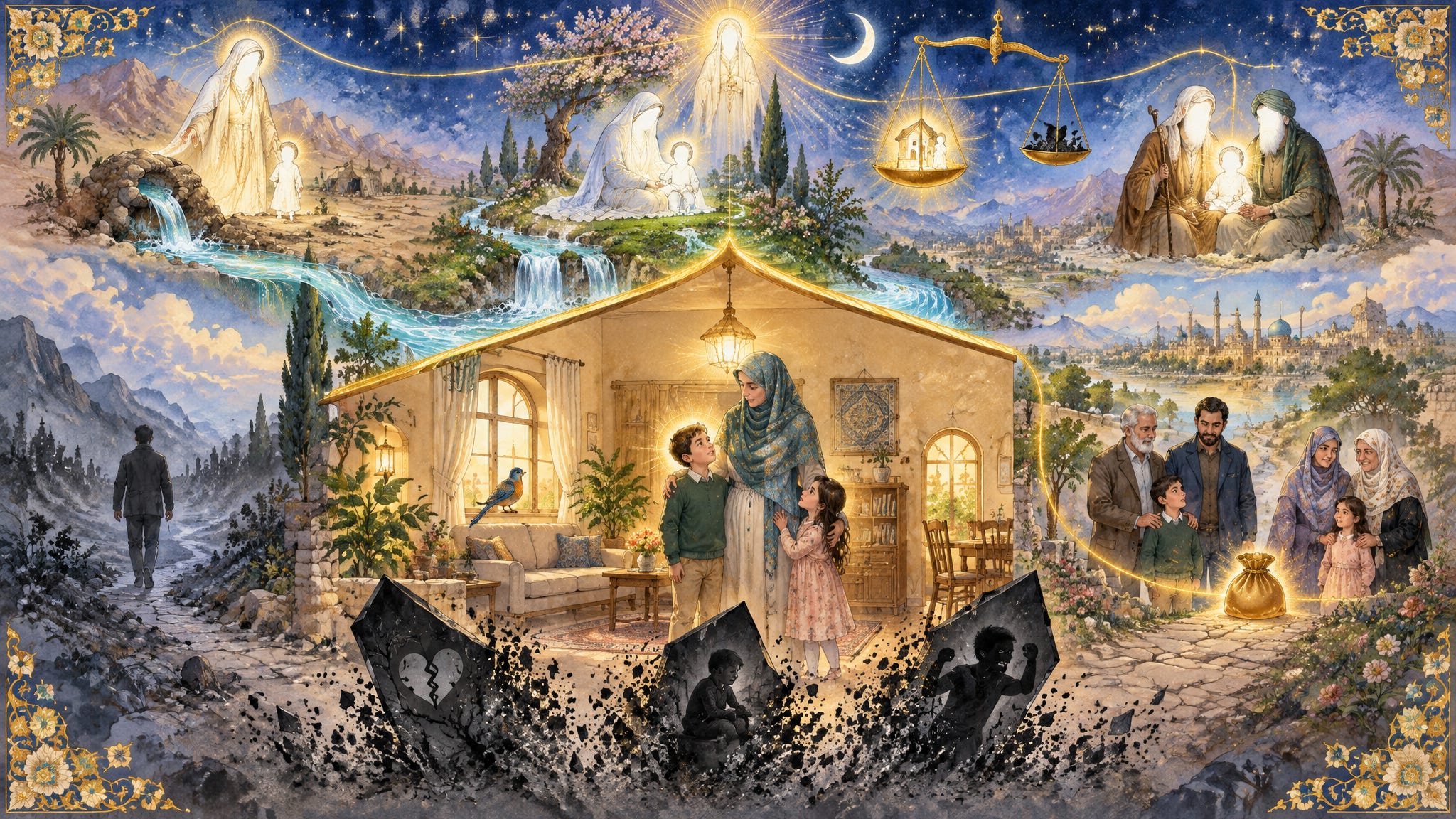
But tonight I want to say clearly what a broken home is, and what it is not.
What breaks a home is injustice.
Neglect.
Cruelty.
The parent who walks away has done a wrong — but the home that parent leaves behind is not broken.
The one who stayed is holding it together.
Nor is the home of the widow, or of the widower, who is raising children alone.
A home with one parent is not a broken home.
Hagar’s home was not broken.
Mary’s was not.
The home where the Prophet was raised by his grandfather and his uncle was not.
So the community has a duty.
Be present.
Let the uncles and the grandfathers be father figures, as the Prophet’s grandfather and his uncle were for him.
Let the aunts and the grandmothers be there too.
Let the maintenance be paid.
And never let a child pay for his parents’ quarrel.
And above all: let the child of a one-parent home leave this hall tonight with their head held high.
Nobody in this room is going to call your home broken again.
Lesson Nine — Remarriage Is No Betrayal
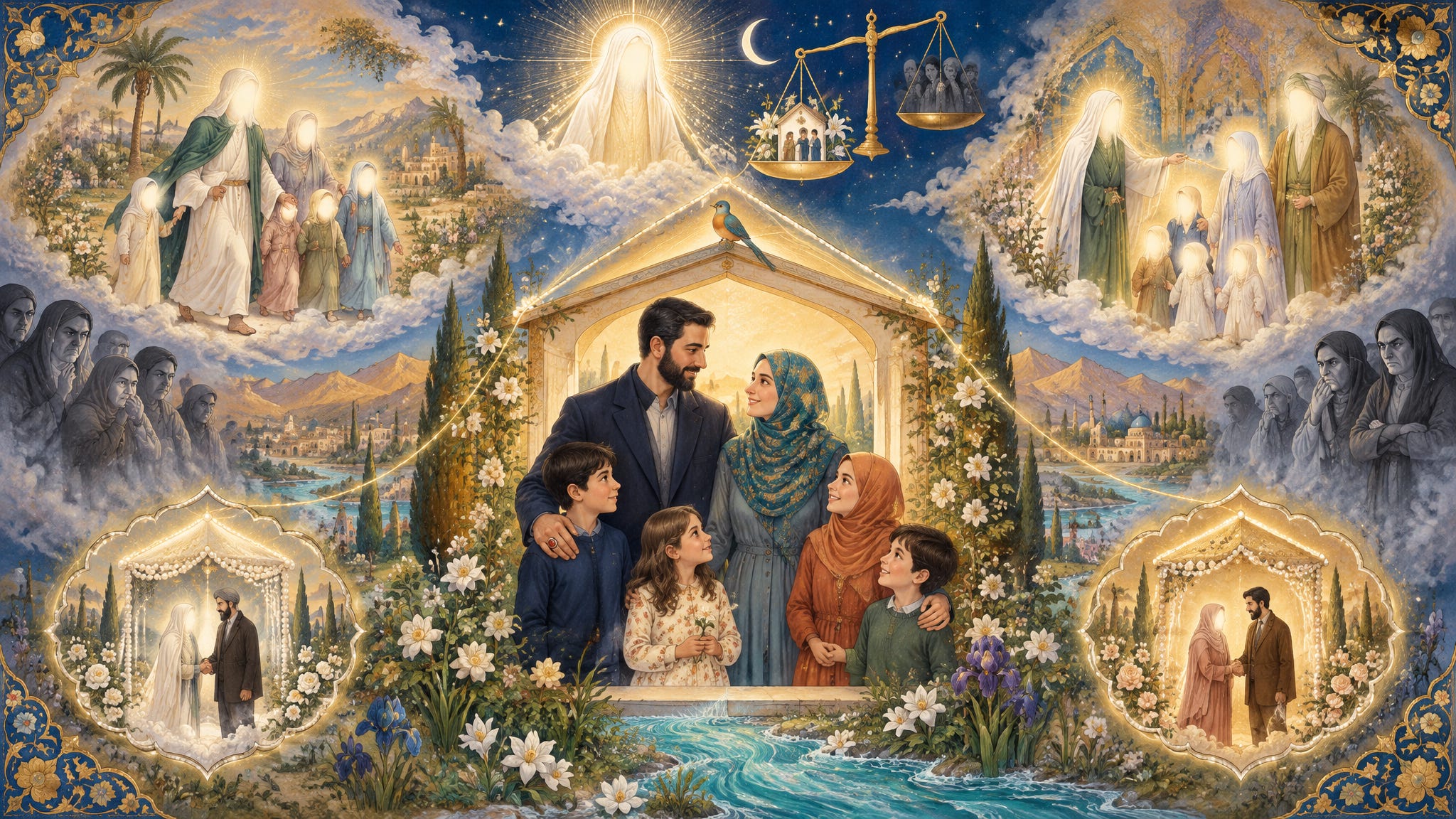
Remarriage after a death, or after a divorce, is no betrayal — for a woman or for a man.
The step-parent who raises another’s child is doing what the Prophet did for Hind, and for the children of Umm Salama.
And it is what Sayyedah Fatimah asked for, at the end of her life, for her own children.
She honoured the widower’s remarriage, and the stepmother, before she asked for anything else.
Who are we to frown at it?
The Fruit Returns to the Root — When the Child Raises the Parent
Back to the Verse
Now the third house.
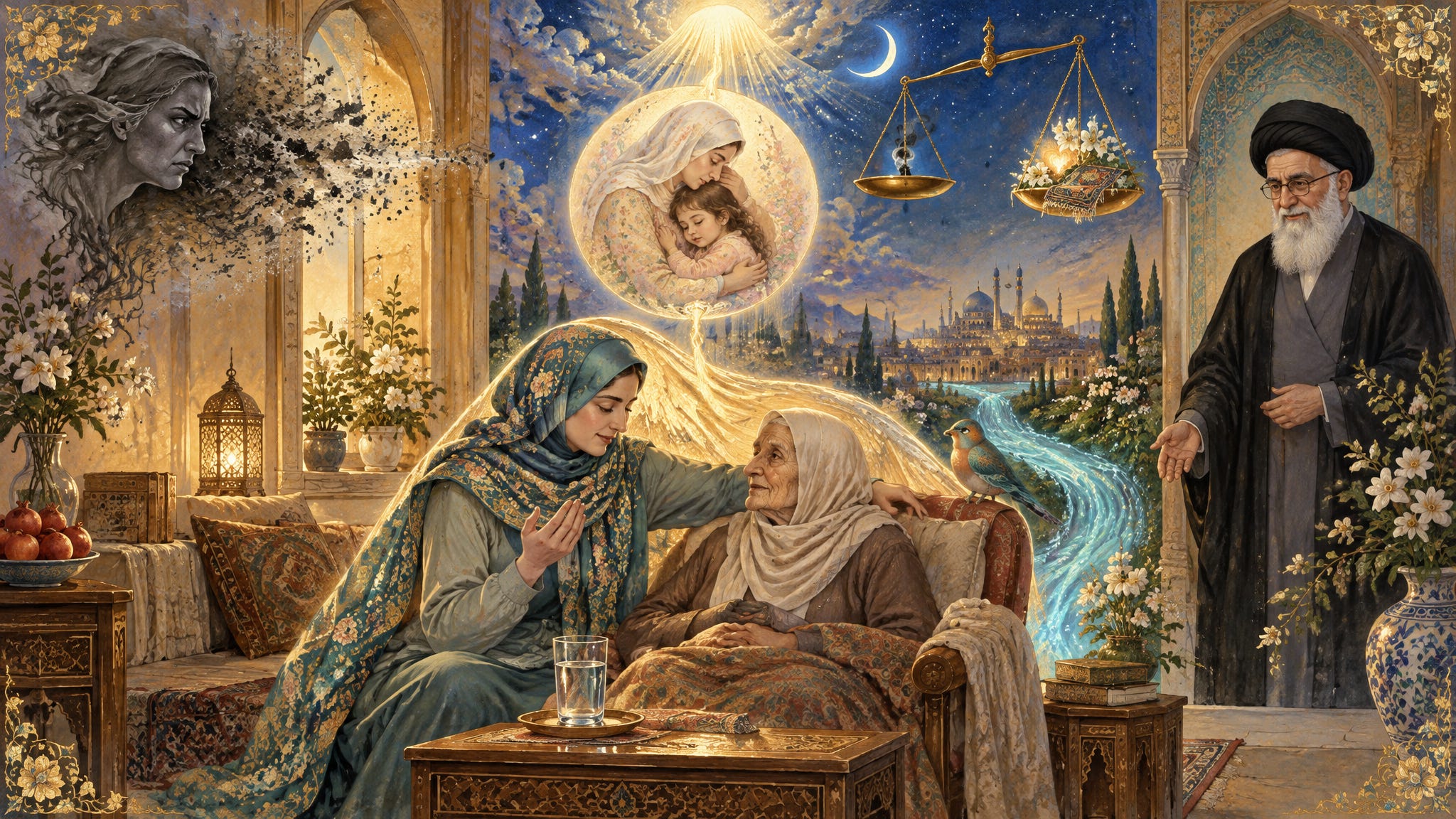
The house where a mother or a father has grown old.
I said at the start of the night that we would come back to the verse we began with.
Here it is again.
۞وَقَضَىٰ رَبُّكَ أَلَّا تَعۡبُدُوٓاْ إِلَّآ إِيَّاهُ وَبِٱلۡوَٰلِدَيۡنِ إِحۡسَٰنًاۚ إِمَّا يَبۡلُغَنَّ عِندَكَ ٱلۡكِبَرَ أَحَدُهُمَآ أَوۡ كِلَاهُمَا فَلَا تَقُل لَّهُمَآ أُفّٖ وَلَا تَنۡهَرۡهُمَا وَقُل لَّهُمَا قَوۡلٗا كَرِيمٗا
وَٱخۡفِضۡ لَهُمَا جَنَاحَ ٱلذُّلِّ مِنَ ٱلرَّحۡمَةِ وَقُل رَّبِّ ٱرۡحَمۡهُمَا كَمَا رَبَّيَانِي صَغِيرٗا
“Your Lord has decreed that you shall not worship anyone except Him, and [He has enjoined] kindness to parents.
Should any of them or both reach old age at your side, do not say to them, ‘Fie!’ And do not chide them, but speak to them noble words.
Lower the wing of humility to them, mercifully, and say, ‘My Lord! Have mercy on them, just as they reared me when I was [a] small [child]!’”
— Qur’an, Surah al-Isra (the Chapter of the Night Journey) #17, Verses 23 and 24; the English, Ali Quli Qarai’s
At the beginning we heard who says these words: the grown child.
Now hear what they ask of that child.
Do not say to them, Fie!
In the Arabic it is uff — the smallest sound of irritation a person can make, a breath through the teeth.
There is a word for turning against one’s parents: ‘uquq.
And Imam Ja’far al-Sadiq, peace and blessings be upon him, said this:
لَوْ عَلِمَ الله شَيْئاً أَدْنَى مِنْ أُفٍّ لَنَهَى عَنْهُ وَهُوَ مِنْ أَدْنَى الْعُقُوقِ وَمِنَ الْعُقُوقِ أَنْ يَنْظُرَ الرَّجُلُ إِلَى وَالِدَيْهِ فَيُحِدَّ النَّظَرَ إِلَيْهِمَا.
“If God had known anything less than ‘uff’, He would have forbidden it. It is the least of ‘uquq.
And of ‘uquq is that a man looks at his parents and fixes a hard stare on them.”
— Imam Ja’far al-Sadiq, peace and blessings be upon him; Shaykh al-Kulayni, al-Kafi, Volume 2, hadith 1275 (thaqalayn); my translation
A hard stare.
Even a look.
And then:
Lower the wing of humility to them, mercifully.
The child who was once gathered under a wing now spreads one.
Ayatullah Fadhlullah, may God rest his pure soul, put it plainly to his congregation:
فكما تتحمَّل طفلك الصَّغير، عليك أن تتحمَّل والديك عندما يكبران، باعتبار أنَّهما يعيشان هذا الضِّيق الَّذي ينشأ من كبر العمر وينعكس على أخلاقهما معك.
“Just as you bear with your small child, you must bear with your parents when they grow old, since they are living through the narrowness that comes with old age, and it shows in the way they treat you.”
— Ayatullah Sayyed Muhammad Husayn Fadhlullah, may God rest his pure soul, Friday sermon, 28 May 1999 (bayynat.org.lb); my translation37
And when it becomes hard, he said, remember how they lived with you when you were the one who made life hard for them.
As they were patient with you, be patient with them.
As they were merciful to you, be merciful to them.
And ask God to have mercy on them.
The Mother of Her Father
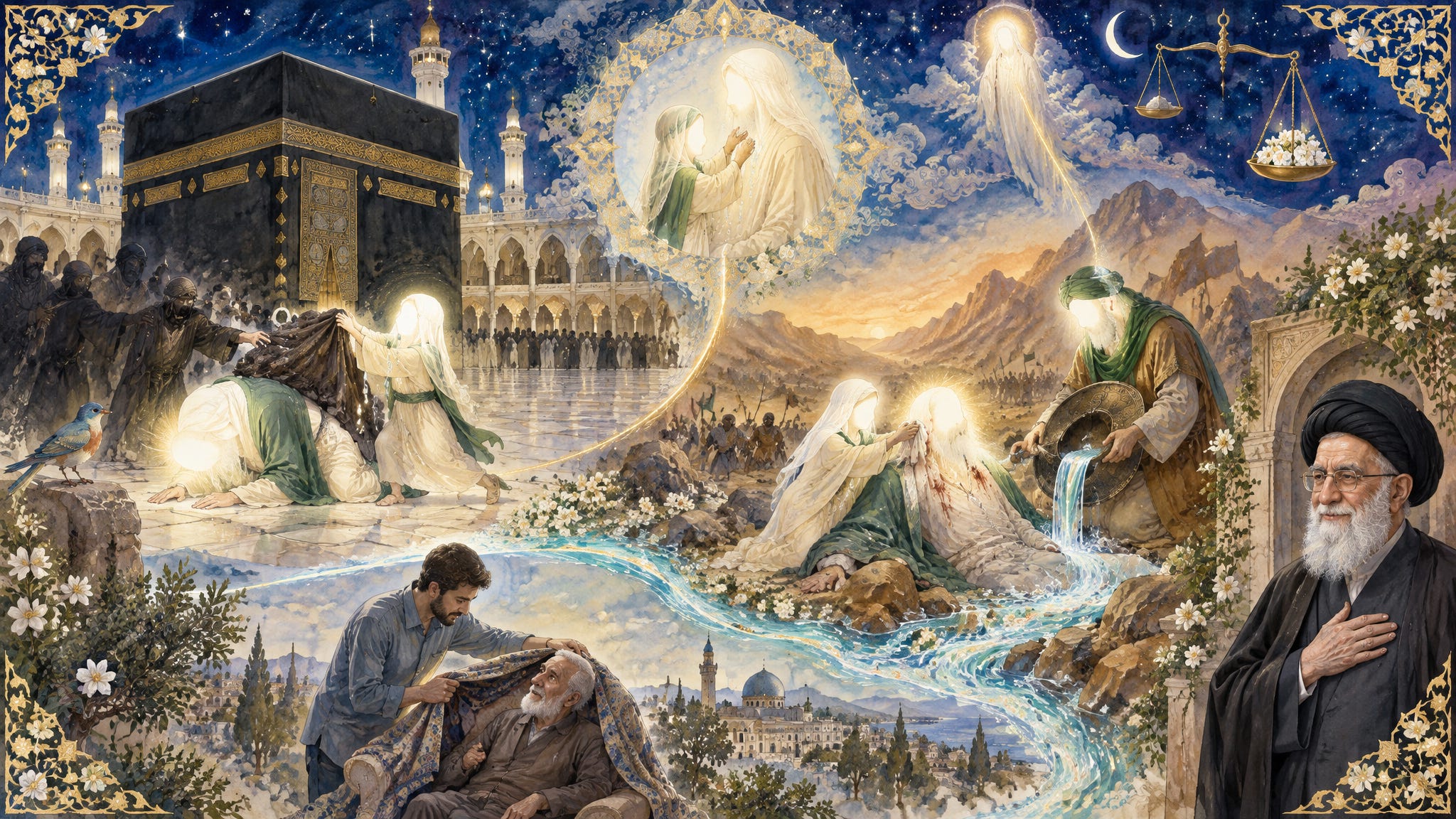
Sayyedah Fatimah, peace and blessings be upon her, was called by many names.
Umm al-Hasan.
Umm al-Husayn.
Umm al-Muhsin.
And one that stops you:
Umm Abiha.
The mother of her father.
— Ibn Shahrashub, al-Manaqib, as al-Majlisi gives it in Bihar al-Anwar, Volume 43, p. 16 — narrated38
How does a daughter become her father’s mother?
Ayatullah Fadhlullah tells it, as the writers of her life tell it.
In Mecca, when the polytheists laid the entrails of a slaughtered animal on the back of the Prophet, peace and blessings be upon him, his family, and his righteous companions, she would come weeping, a little girl, to lift it off her father.
He had lost his own mother’s tenderness in the first years of his life, and she gave it back to him — until, as Ayatullah Fadhlullah tells it39, her father said of her:
She is the mother of her father.
The books of the other schools remember it too.
فَانْطَلَقَ مُنْطَلِقٌ إِلَى فَاطِمَةَ وَهِيَ جُوَيْرِيَةٌ فَأَقْبَلَتْ تَسْعَى وَثَبَتَ النَّبِيُّ ساجِدًا حَتَّى أَلْقَتْهُ عَنْهُ، وَأَقْبَلَتْ عَلَيْهِمْ تَسُبُّهُمْ، فَلَمَّا قَضَى رَسُولُ اللَّهِ الصَّلاةَ قَالَ: «اللَّهُمَّ عَلَيْكَ بِقُرَيْشٍ اللَّهُمَّ عَلَيْكَ بِقُرَيْشٍ» ثُمَّ سَمَّى: «اللَّهُمَّ عَلَيْكَ بِعَمْرِو بْنِ هِشَامٍ، وَعُتْبَةَ بْنِ رَبِيعَةَ، وَشَيْبَةَ بْنِ رَبِيعَةَ، وَالوليد بْنِ عُتْبَةَ، وَأُمَيَّةَ بْنِ خَلَفٍ، وَعُقْبَةَ بْنِ أَبِي مُعَيْطٍ وَعُمَارَةَ بْنِ الْوَلِيدِ».
“A passer-by went to Fāṭima (the daughter of the Prophet ), who was a young girl in those days. She came running and the Prophet was still in prostration. She removed them (the abdominal contents of the camel) and cursed at the Quraish on their faces.”
— Sahih al-Bukhari, Volume 1, record 318; the Arabic, and the English of our text of the report, as printed40
A young girl in those days.
She came running.
And years later, on the day of Uhud, when her father was wounded:
كان علي عليهالسلام يجئ بالماء في ترسه ، وفاطمة عليهاالسلام
تغسل الدم عن وجهه ، أخذ حصيرا فأحرق وحشي به جرحه
“Ali, peace be upon him, would bring the water in his shield, and Fatimah, peace be upon her, would wash the blood from his face. He took a mat, burned it, and packed his wound with it.”
— Sahl, as Ahmad ibn Hanbal gives him in his Musnad; al-Majlisi, Bihar al-Anwar, Volume 20, pp. 102 and 103; my translation41
In these days of her martyrdom, remember that.
The little girl who ran to her father in Mecca.
The daughter who washed his face at Uhud.
The child who raised her parent.
Joseph Raises His Parents
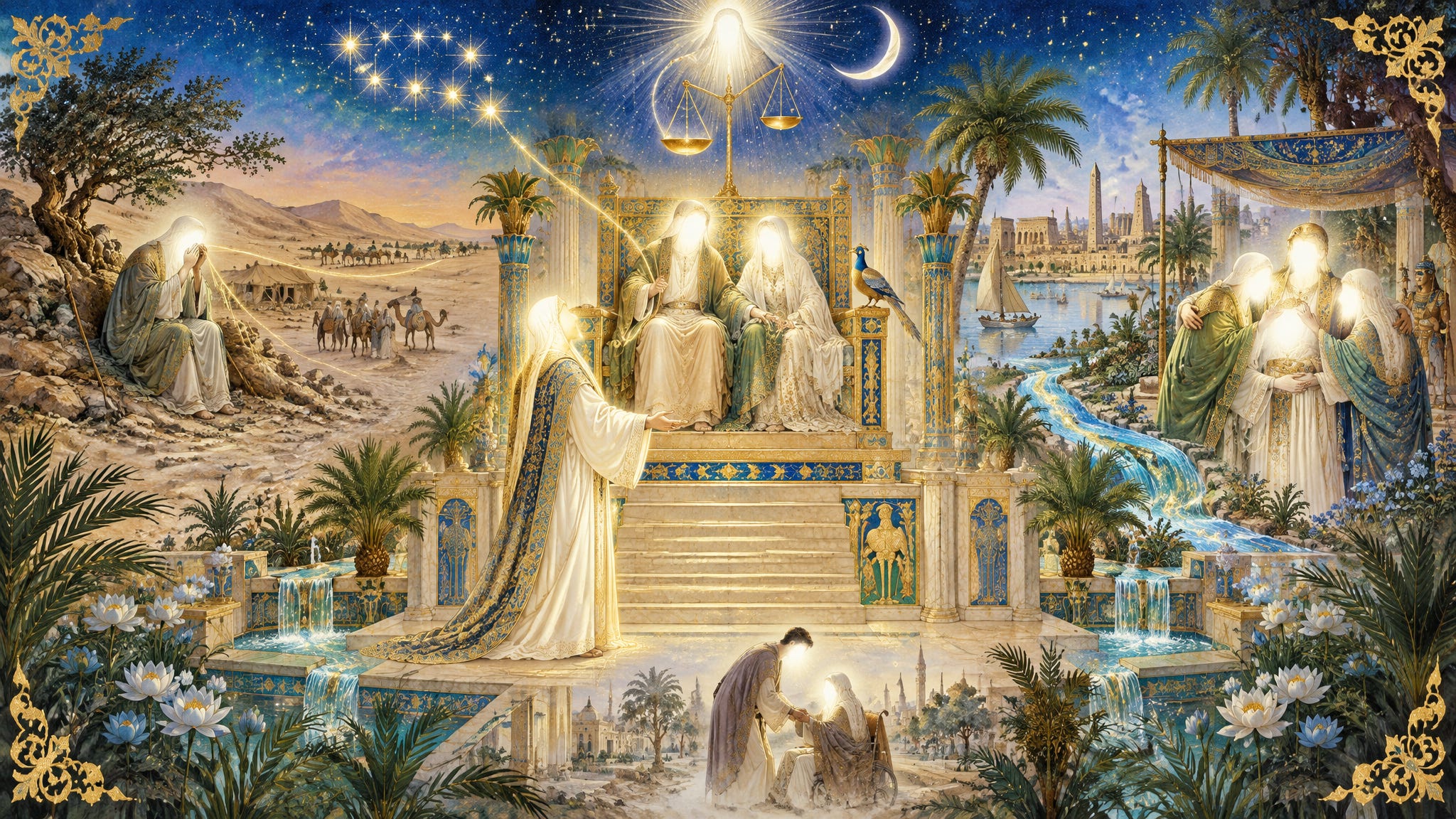
And the Qur’an closes the circle inside one story.
Jacob, peace and blessings be upon him, wept for his son until his eyes turned white.
Years later, that son brings his father and his mother to Egypt.
فَلَمَّا دَخَلُواْ عَلَىٰ يُوسُفَ ءَاوَىٰٓ إِلَيۡهِ أَبَوَيۡهِ وَقَالَ ٱدۡخُلُواْ مِصۡرَ إِن شَآءَ ٱللَّهُ ءَامِنِينَ
وَرَفَعَ أَبَوَيۡهِ عَلَى ٱلۡعَرۡشِ وَخَرُّواْ لَهُۥ سُجَّدٗاۖ وَقَالَ يَـٰٓأَبَتِ هَٰذَا تَأۡوِيلُ رُءۡيَٰيَ مِن قَبۡلُ قَدۡ جَعَلَهَا رَبِّي حَقّٗاۖ وَقَدۡ أَحۡسَنَ بِيٓ إِذۡ أَخۡرَجَنِي مِنَ ٱلسِّجۡنِ وَجَآءَ بِكُم مِّنَ ٱلۡبَدۡوِ مِنۢ بَعۡدِ أَن نَّزَغَ ٱلشَّيۡطَٰنُ بَيۡنِي وَبَيۡنَ إِخۡوَتِيٓۚ إِنَّ رَبِّي لَطِيفٞ لِّمَا يَشَآءُۚ إِنَّهُۥ هُوَ ٱلۡعَلِيمُ ٱلۡحَكِيمُ
“When they entered into the presence of Joseph, he set his parents close to himself, and said, ‘Welcome to Egypt, in safety, God willing!’
And he seated his parents high upon the throne, and they fell down prostrate before him.
He said, ‘Father! This is the fulfillment of my dream of long ago, which my Lord has made come true.
He was certainly gracious to me when He brought me out of the prison and brought you over from the desert after that Satan had incited ill feeling between me and my brothers.
Indeed my Lord is all-attentive in bringing about what He wishes. Indeed He is the All-knowing, the All-wise.’”
— Qur’an, Surah Yusuf (the Chapter of the Prophet Joseph) #12, Verses 99 and 100; the English, Ali Quli Qarai’s
He seated his parents high upon the throne.
The child they had lost, raising them up, above himself.
The Son Who Went Home to His Mother
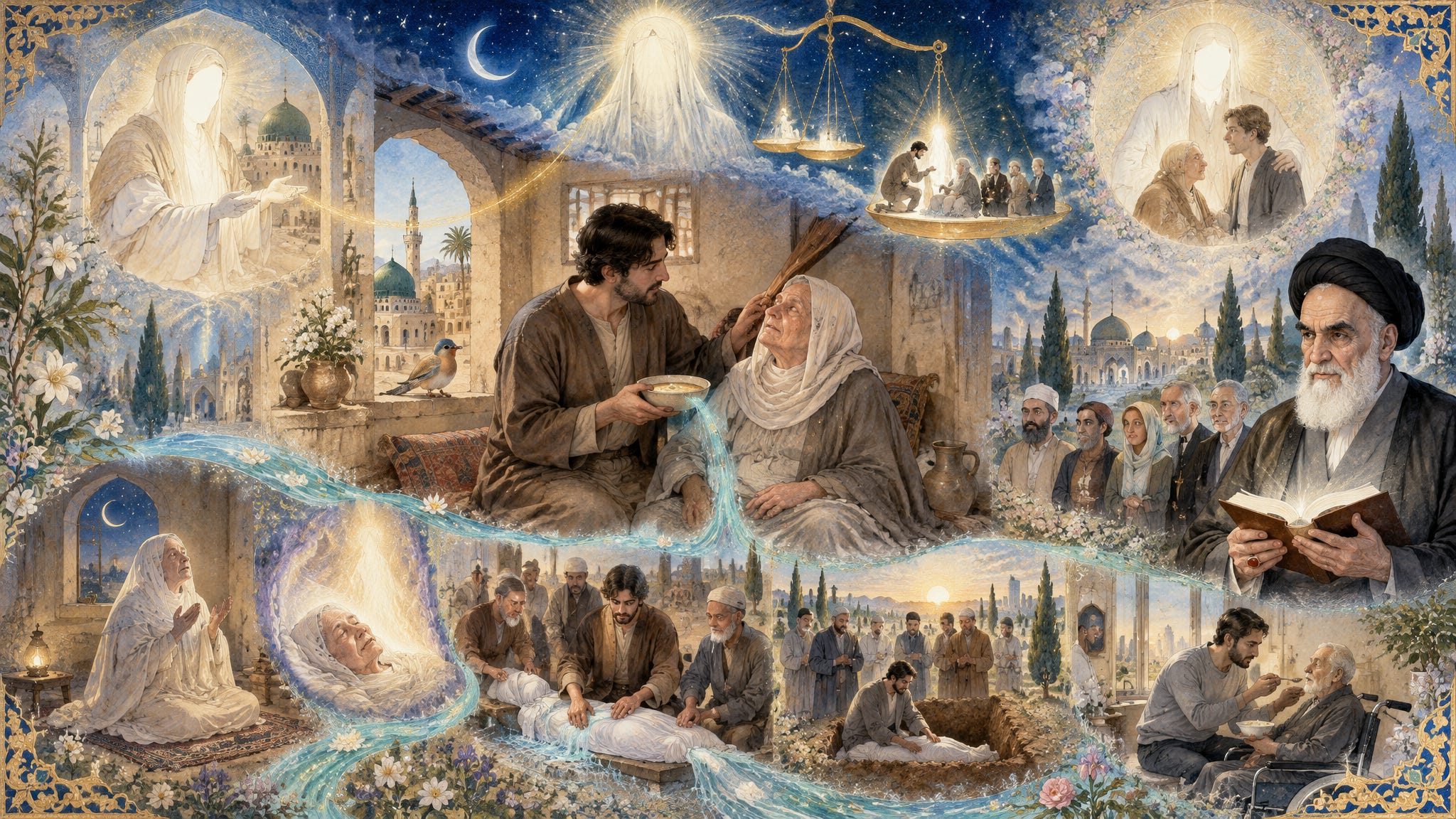
There is a report in al-Kafi about a man from Kufa, Zakariyya ibn Ibrahim.
He had been a Christian, and he became a Muslim, and he went on the hajj, and he came to Imam Ja’far al-Sadiq.
He told the Imam:
My father and my mother are Christians, and so is my whole household.
And my mother is blind.
I live with them, and I eat with them.
And the Imam said to him:
Look after your mother, and be good to her.
And when she dies, do not leave her to anyone else.
Be the one who takes care of her yourself.
So he went home to Kufa.
And he was gentle with her.
He fed her.
He picked the lice from her clothes and her hair.
He served her.
And his mother said to him:
My son, you never did this for me when you were of my religion.
What is this I see in you, since you left and entered the pure faith?
He said:
A man from the descendants of our Prophet told me to.
She said:
Is this man a prophet?
He said:
No. But he is the son of a prophet.
She said:
My son, this is a prophet.
These are the counsels of the prophets.
He said:
Mother, there is no prophet after our Prophet.
But he is his son.
And she said:
My son, your religion is the best of religions.
Teach it to me.
He set Islam before her, and she became a Muslim, and he taught her.
She prayed the noon prayer, the afternoon, the sunset and the night.
And in the night something came over her, and she said:
My son, say again what you taught me.
He said it again, and she affirmed it — and she died.
And in the morning, it was the Muslims who washed her, and it was her son who prayed over her and went down into her grave.
— Imam Ja’far al-Sadiq, peace and blessings be upon him, as Zakariyya ibn Ibrahim reports; Shaykh al-Kulayni, al-Kafi, Volume 2, hadith 566 (thaqalayn) — narrated42
These are the counsels of the prophets.
A mother who did not share her son’s faith heard the voice of the prophets in the way he looked after her.
And the Qur’an itself says it, of parents who would even pull a child away from God:
وَإِن جَٰهَدَاكَ عَلَىٰٓ أَن تُشۡرِكَ بِي مَا لَيۡسَ لَكَ بِهِۦ عِلۡمٞ فَلَا تُطِعۡهُمَاۖ وَصَاحِبۡهُمَا فِي ٱلدُّنۡيَا مَعۡرُوفٗاۖ وَٱتَّبِعۡ سَبِيلَ مَنۡ أَنَابَ إِلَيَّۚ ثُمَّ إِلَيَّ مَرۡجِعُكُمۡ فَأُنَبِّئُكُم بِمَا كُنتُمۡ تَعۡمَلُونَ
“But if they urge you to ascribe to Me as partner that of which you have no knowledge, then do not obey them.
Keep their company honourably in this world and follow the way of those who turn to Me penitently.
Then to Me will be your return, whereat I will inform you concerning what you used to do.”
— Qur’an, Surah Luqman (the Chapter of Luqman the Wise) #31, Verse 15; the English, Ali Quli Qarai’s
Keep their company honourably in this world.
Duty to a parent does not wait on the parent’s faith.
And Imam Khomeini, may God rest his pure soul, rules in his Tahrir al-Wasilah that the duty to provide for one’s parents, on the conditions he sets out there, holds whether they are Muslim or not.
— Imam Khomeini, may God rest his pure soul, Tahrir al-Wasilah, Volume 2, p. 319, as Ayatullah Mirahmadi reads it in his fiqh class of 9 Ordibehesht 1403 (28 April 2024) — narrated43
Honour Thy Father and Thy Mother
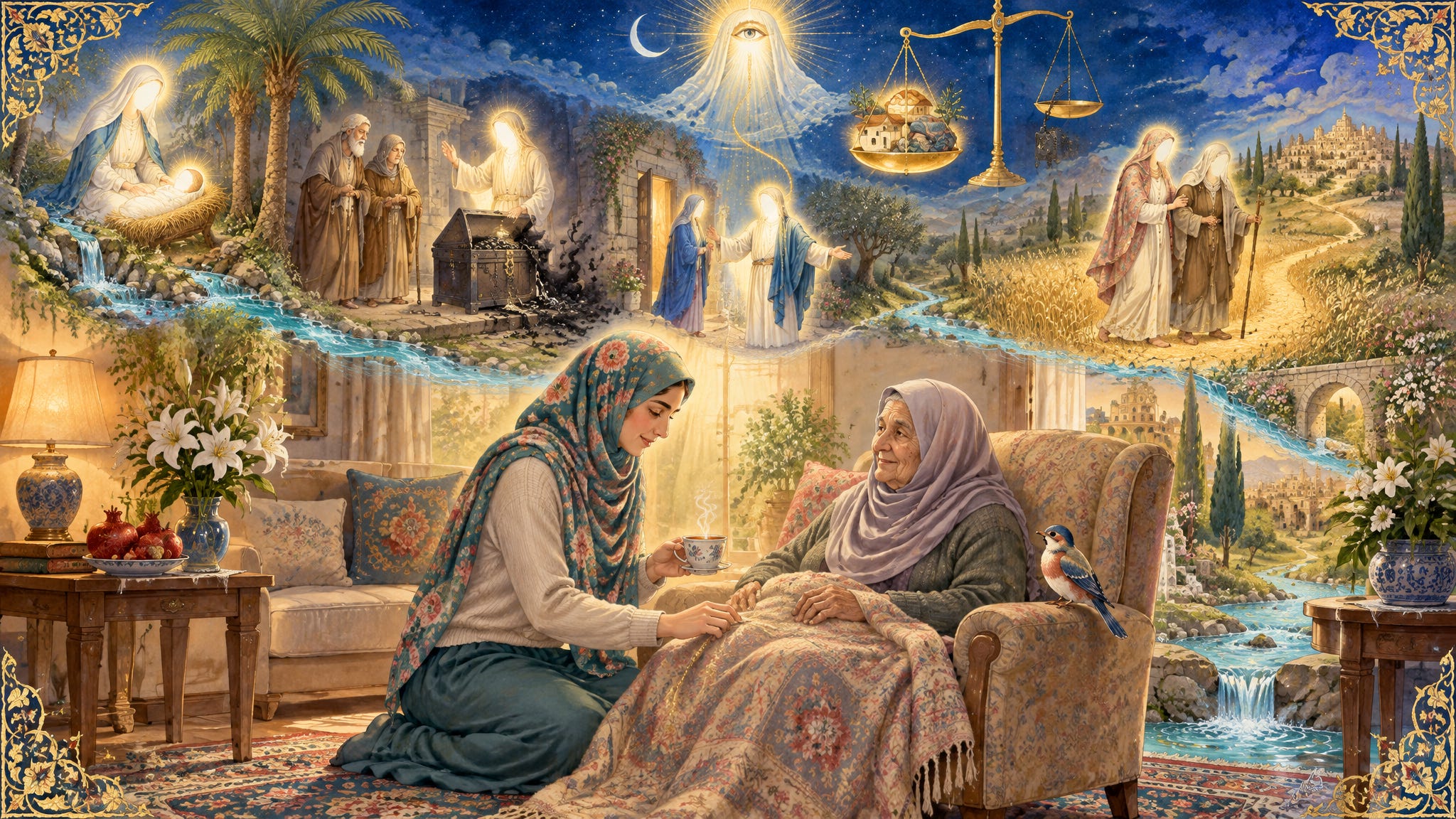
Jesus, may our souls be his ransom and may God hasten his return, kept the same command.
The Qur’an gives us his own words, spoken from the cradle:
وَبَرَّۢا بِوَٰلِدَتِي وَلَمۡ يَجۡعَلۡنِي جَبَّارٗا شَقِيّٗا
“And to be good to my mother, and He has not made me self-willed and wretched.”
— Qur’an, Surah Maryam (the Chapter of the Blessed Saint Mary) #19, Verse 32; the English, Ali Quli Qarai’s
Last week we heard that verse as his defence of his mother.
Tonight, hear it as a son’s duty.
And the other books of God carry the same command.
In the Gospel, he rebukes those who declared their wealth a gift dedicated to God — Corban, as Mark’s Gospel names it — so that they would owe nothing to their own father and mother.
μητέρα, καί· Ὁ κακολογῶν πατέρα ἢ μητέρα θανάτῳ τελευτάτω· 5 ὑμεῖς δὲ λέγετε· Ὃς ἂν εἴπῃ τῷ πατρὶ ἢ τῇ μητρί· Δῶρον ὃ ἐὰν ἐξ ἐμοῦ ὠφεληθῇς, 6 ⸀οὐ μὴ ⸀τιμήσει τὸν πατέρα ⸀αὐτοῦ· καὶ ἠκυρώσατε ⸂τὸν λόγον⸃ τοῦ θεοῦ διὰ τὴν παράδοσιν ὑμῶν.
“But ye say, Whosoever shall say to his father or his mother, It is a gift, by whatsoever thou mightest be profited by me; And honour not his father or his mother, he shall be free. Thus have ye made the commandment of God of none effect by your tradition.”
— the Gospel of Matthew, chapter 15, verses 5 and 6; the King James Version, In Greek, from the end of verse 4 to the end of verse 6, in Greek; the SBL Greek New Testament, Matthew, record 31 (a record number, not a printed page)44
Religion is never the excuse for neglecting a parent.
And the Gospel of John, in its last chapters, remembers him giving his mother into the care of the disciple he loved.
26 Ἰησοῦς οὖν ἰδὼν τὴν μητέρα καὶ τὸν μαθητὴν παρεστῶτα ὃν ἠγάπα λέγει τῇ ⸀μητρί· Γύναι, ⸀ἴδε ὁ υἱός σου· 27 εἶτα λέγει τῷ μαθητῇ· ⸀Ἴδε ἡ μήτηρ σου. καὶ ἀπʼ ἐκείνης τῆς ὥρας ἔλαβεν ὁ μαθητὴς αὐτὴν εἰς τὰ ἴδια.
“When Jesus therefore saw his mother, and the disciple standing by, whom he loved, he saith unto his mother, Woman, behold thy son! Then saith he to the disciple, Behold thy mother! And from that hour that disciple took her unto his own home.”
— the Gospel of John, chapter 19, verses 26 and 27; the King James Version, in Greek; the SBL Greek New Testament, John, record 48 (a record number, not a printed page)
And the Ruth we met tonight, the widow who proposed, had a mother-in-law, Naomi — a widow too, old, and going home with nothing.
Ruth would not leave her.
וַתֹּ֤אמֶר רוּת֙ אַל־תִּפְגְּעִי־בִ֔י לְעׇזְבֵ֖ךְ לָשׁ֣וּב מֵאַחֲרָ֑יִךְ כִּ֠י אֶל־אֲשֶׁ֨ר תֵּלְכִ֜י אֵלֵ֗ךְ וּבַאֲשֶׁ֤ר תָּלִ֙ינִי֙ אָלִ֔ין עַמֵּ֣ךְ עַמִּ֔י וֵאלֹהַ֖יִךְ אֱלֹהָֽי׃
“And Ruth said, Intreat me not to leave thee, or to return from following after thee: for whither thou goest, I will go; and where thou lodgest, I will lodge: thy people shall be my people, and thy God my God:”
— the Book of Ruth, chapter 1, verse 16; the King James Version, in Hebrew the Book of Ruth, chapter 1, verse 16
There are daughters-in-law in this room who have done exactly that.
Who looked after a husband's mother as their own, for years, and were barely thanked.
God has seen it.
And tonight, so have we.
Lessons for Our Time
Lesson Ten — Placement Is Not the Sin
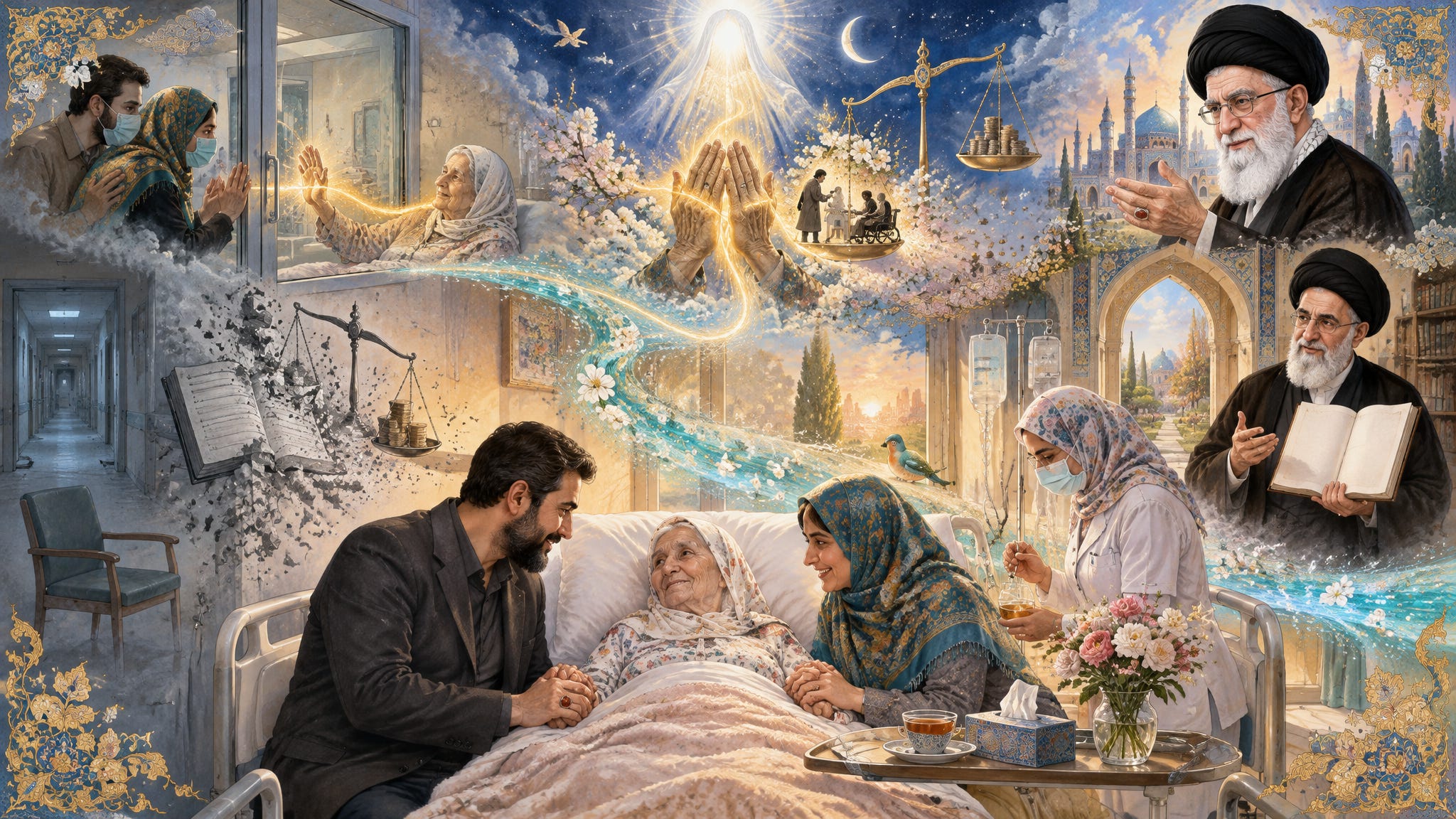
Now a hard question in this house.
The care home.
The Bible keeps a prayer that every child should hear, because it is the prayer of the old:
אַל־תַּשְׁלִיכֵנִי לְעֵת זִקְנָה 9 כִּכְלוֹת כֹּחִי אַל־תַּעוּבֵנִי:
“Cast me not off in the time of old age; forsake me not when my strength faileth.”
— the Book of Psalms, Psalm 71, verse 9; the King James Version, in Hebrew; Ketuvim, record 101 (a record number, not a printed page)
Let me be precise, because this is where families are hurt.
Placing a parent where they can get the medical care they need is not the sin.
There are parents whose needs no family can meet at home.
There are children who nursed a parent until they fell ill themselves.
The sin is abandonment.
Oh well, they are there now.
Let them be.
A home can take on the nursing.
It cannot take the child’s place.
Ayatullah Sayyed Muhammad Hasan Mirahmadi, may God protect him, who teaches the jurisprudence of the family, draws the same line.
His main point is that a parent’s keep is a duty on the children — above all on the sons — and yet some families put their parents in a care home all the same. And then he says:
البته در موارد خاص که پیر مرد و پیرزنی که فرزندی ندارد یا فرزند دارد اما قدرت نگهداری از ایشان را ندارد و أسوأ حالا هستند، در این موارد مجاز بلکه مستحسن است که به خانه سالمندان سپرده شود.
“Of course, in particular cases, where an old man or an old woman has no child, or has a child who is not able to care for them, and they are in a worse state, in these cases it is permitted, indeed commendable, that they be entrusted to a care home.”
— Ayatullah Mirahmadi, may God protect him, fiqh class, 15 Farvardin 1405 (4 April 2026) (eshia.ir); my translation45
And in the spring of 2020, in the months of the pandemic, Imam Khamenei, may God rest his pure soul, spoke about countries where care homes had been neglected until some of the old people in them died.
And he said:
در این کشورها پول معیار است ، همه چیز با پول محاسبه میشود؛ خب وقتی این جور شد، طبعاً به پیرمردی که برای جامعه پول تولید نمیکند نباید اعتنا کرد، به آن پیرزن فرسودهی کهنسال نباید اعتنا کرد، و اعتنا نمیکنند؛ این شکست آن فلسفهی اجتماعی است.
“In these countries money is the measure; everything is reckoned in money. Well, when it is like that, naturally an old man who produces no money for society need not be attended to, that worn-out, aged old woman need not be attended to — and they are not attended to. This is the failure of that social philosophy.”
— Imam Khamenei, may God rest his pure soul, by video link to the National Coronavirus Headquarters, 21 Ordibehesht 1399 (10 May 2020); my translation46
He was speaking of a philosophy, not of the families who grieved in those months.
Some of you lost a mother or a father in a care home then, behind doors you were not allowed to open.
That was not your neglect, and no one here will call it that.
Tonight, turn it inward.
Is money the measure in our homes?
Is a parent worth a visit only while they are useful — while they can mind the children, while they can lend?
Lesson Eleven — Visit, Call, Bring Them Home
So here is what to do.
Visit.
Call.
Bring them home for Eid.
Know the staff by name, and let them know that this mother, this father, has a family.
And if it costs you, remember what you cost them.
And to the family facing advanced dementia — where a mother no longer knows her own son’s face, and a father asks the same question every five minutes: no one in this room will condemn the decision you had to make.
Keep visiting, even when she does not know your name.
You are not visiting to be recognised.
You are visiting for her, and for God.
And this is not only the daughters’ work, and the daughters-in-law’s.
Sons share the load.
And remember the fathers.
Older fathers are often very much alone — men who never learned to ask for company, and so receive none.
Ayatullah Fadhlullah describes what parents give.
They hurt, he says, but there is joy at the heart of the pain.
They tire, but there is rest at the heart of the tiredness.
And then he passes on a saying.
It is said, he tells them, that a man who had given his parents all his effort and all his strength asked whether he had now paid them their due.
And the answer came: no.
They served you, waiting for your life; you give to them, waiting for their death.
That is said to wake the one who serves grudgingly, counting the days — not to wound the one who is worn out from love.
— Ayatullah Sayyed Muhammad Husayn Fadhlullah, may God rest his pure soul, Friday sermon, 23 March 2001 (bayynat.org.lb) — narrated47
Lesson Twelve — The Son Who Carried the Care
So let me end this house with a son for whom the care was never a countdown.
Imam Sayyed Mujtaba Khamenei, may God protect him, told this story in a rare interview he gave in 2021, on the eve of his grandfather’s commemoration: the story of his father, the martyred leader, Imam Khamenei, may God rest his pure soul, and of his father’s father.
In the early 1960s, Imam Khamenei’s father, Ayatullah Sayyed Javad Khamenei, may God rest his pure soul, began to lose his sight — cataract, and glaucoma, which was dangerous.
Someone had to be at his side.
One of his sons had just married and set up his own home.
Their sister was still a teenager.
The younger brothers were still boys.
So the first who could do it was the son who was studying in Qom.
And in Qom he was doing very well.
Some of his teachers did not want him to go.
Scholars there said he would become
either the head of all, or the head of Khorasan — a marja’.
But, says Imam Sayyed Mujtaba,
on the other side was his father’s condition, and he felt responsible toward his father.
He was torn.
And at a friend’s house in Tehran he said it out loud:
Whichever way I look, I see that my world and my hereafter are in Qom; and on the other side, my father’s condition is as it is.
And his friend answered:
If God wills, He will set right your world and your hereafter in Mashhad itself.
Imam Khamenei used to say:
The moment he said it, I thought, how remarkable! I knew this myself — so why had I not paid attention to it?
He decided there and then.
And, says his son,
after that decision, doors opened before him one by one: in teaching, in the mosque, on the minbar, and the like.
Naturally, his son says, such services do not go unanswered.
And the martyred leader’s brother, Sayyed Hasan, stayed beside their parents in Mashhad when the rest of the family had to move to Tehran.
He himself used to say the fruit of that service to father and mother was that ‘I have a very easy and peaceful life.’
One son’s fruit was what the whole world saw.
The brother who stayed said that his was a peaceful life.
Honour the sibling who stays.
Years later, as president, Imam Khamenei phoned his parents every few days.
Once, after the goodbyes, his father thought the receiver had been put down, and said very softly, as if to himself, in his sweet Turkish accent:
Qorbanat, Ali — may I be your ransom, Ali.
And the son was still holding the phone, and heard it.
And this is how Imam Sayyed Mujtaba sums it up:
More than the other children, my father was given a good opportunity to serve his father.
An opportunity.
Not a burden.
Not a countdown.
And one more thing.
Imam Sayyed Mujtaba remembers that after the dawn prayer his father would pray two more rak’as.
When he asked what they were for, his father said:
This is my daily gift to my father and my mother.
And when the interviewer asked whether, after Ayatullah Sayyed Javad died, the martyred leader still did anything for him, he answered:
Yes, both in his lifetime and after it. For example, he prays for them.
— Imam Sayyed Mujtaba Khamenei, may God protect him, in an interview of 1400 SH (2021), given on the eve of his grandfather’s commemoration and published by KHAMENEI.IR, as Eghtesad News (news 794554) reproduces it from Khabaronline — narrated48
A gift every day while they live, and prayer for them after they have gone.
Every one of us can begin it tonight.
And to everyone here whose mother or father has already gone: the verse we began with is still yours.
My Lord! Have mercy on them, just as they reared me when I was small.
Say it tonight.
That is your daily gift now.
And no one leaves this house tonight carrying guilt.
Carry the prayer instead.
Conclusion — Key Takeaways
We began tonight with the question God asks.
What did My servant say?
So here are three things to say, and to do, when these four nights are over.
The first. No child is lost to God — and in the loss, God is raising the parent.
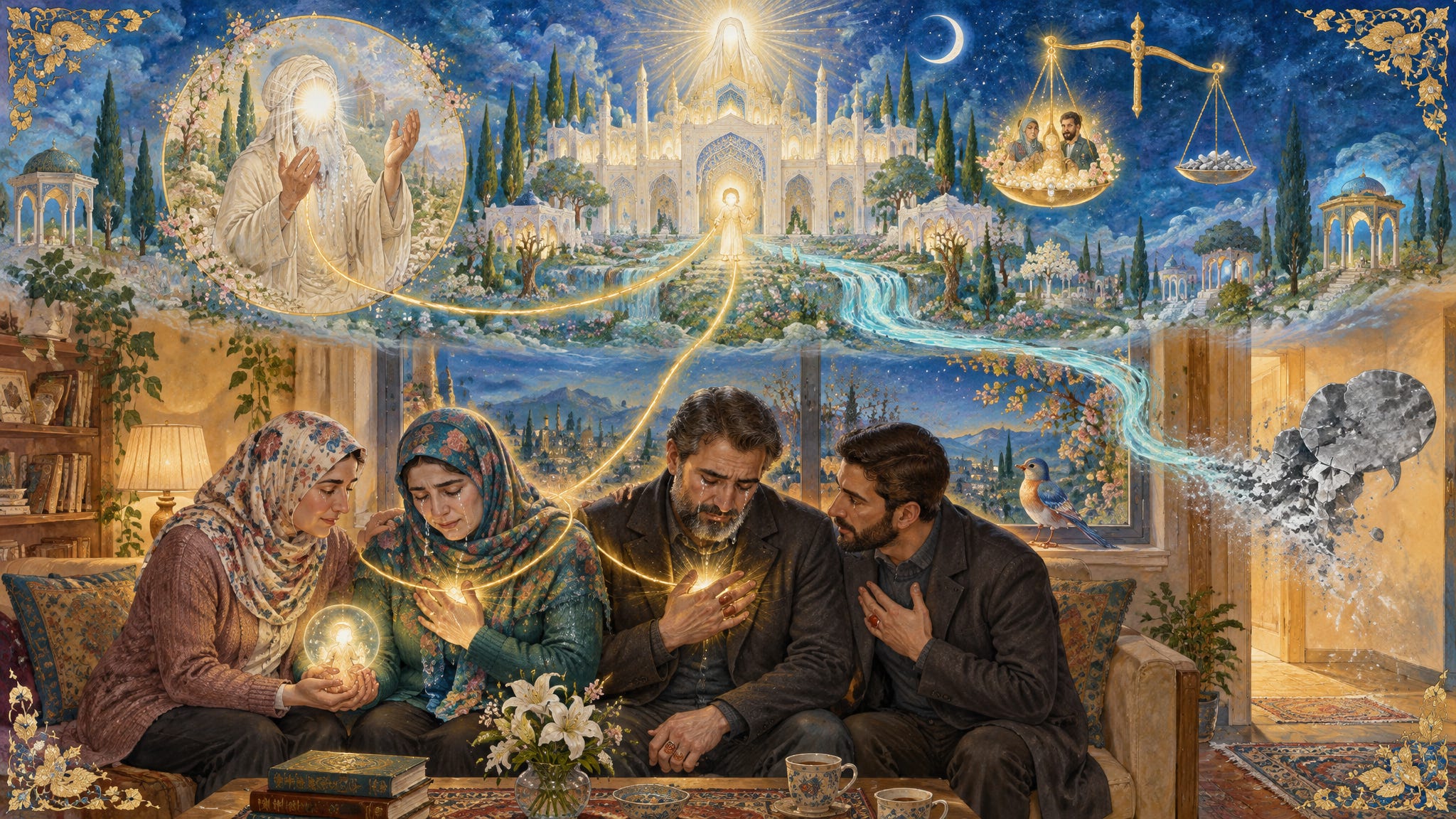
The child who goes ahead does not go into nothing.
And for the parent who praised, God says: Build for him a house, and He names it the House of Praise.
And the parent left behind is still being raised: upbringings at work, even in this. Jacob, peace and blessings be upon him, wept until his eyes turned white, and his patience was still beautiful.
Tears and praise sit together.
So name the child.
Go to the house where a child went ahead, and stay.
Ask the father too.
And never again say it was for the best.
The second. No one is less for a house that broke, or for a marriage that waited — man or woman.
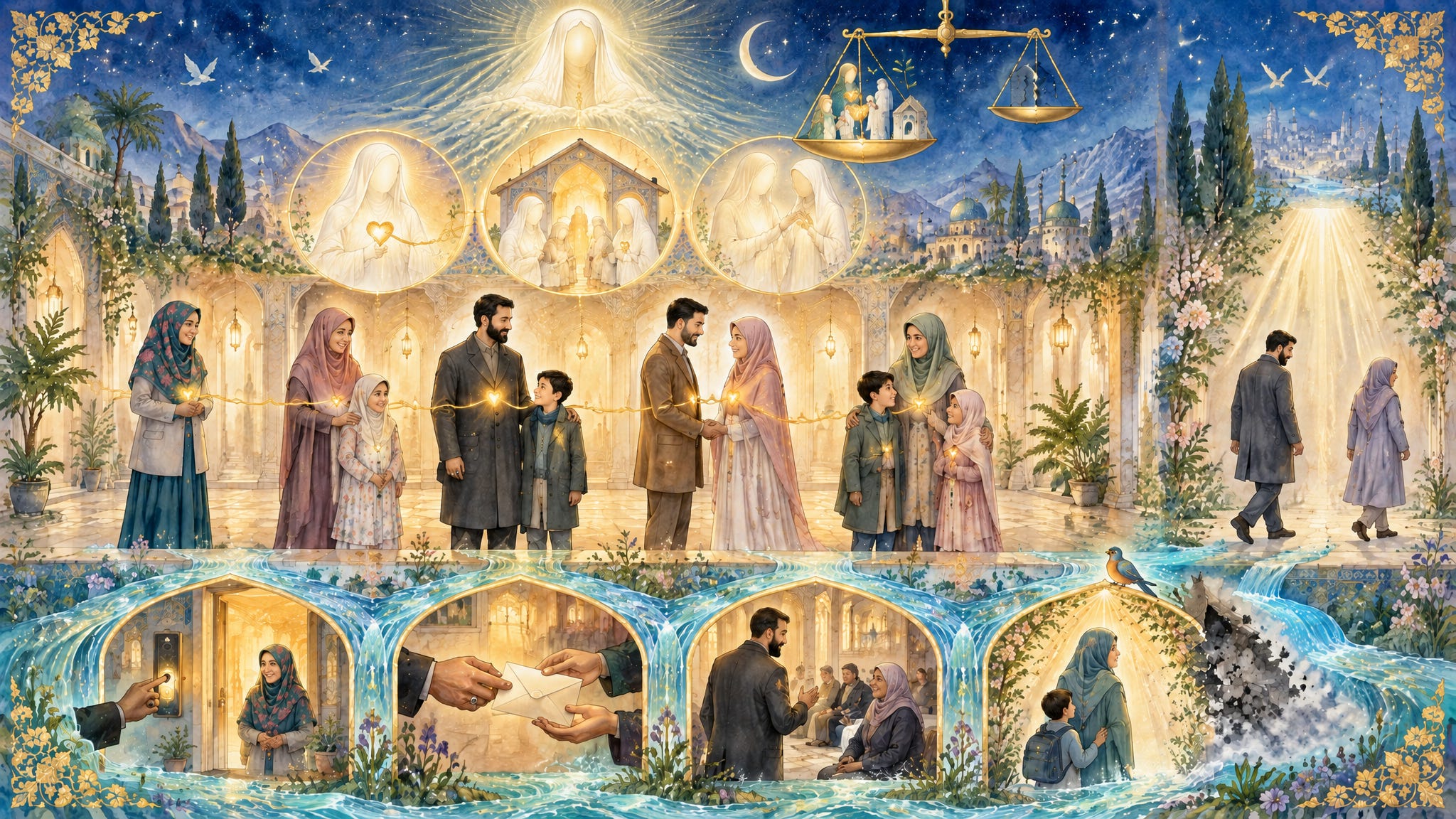
Sayyedah Khadijah, peace and blessings be upon her, waited, and chose, and was loved to the end of her life.
The house of the Prophet, peace and blessings be upon him, his family, and his righteous companions, held widows, a divorced woman and stepchildren.
When a couple part, God has promised to suffice each of them.
And Sayyedah Fatimah, peace and blessings be upon her, chose a stepmother for her own children.
So make the way to rebuilding easy.
There is no shelf.
Ring the widow.
Pay the maintenance, in full, without being chased.
Walk across the room, and say salam.
And never call a home with one parent a broken home.
The third. The fruit returns to the root: the parent who raised you is never stored away.
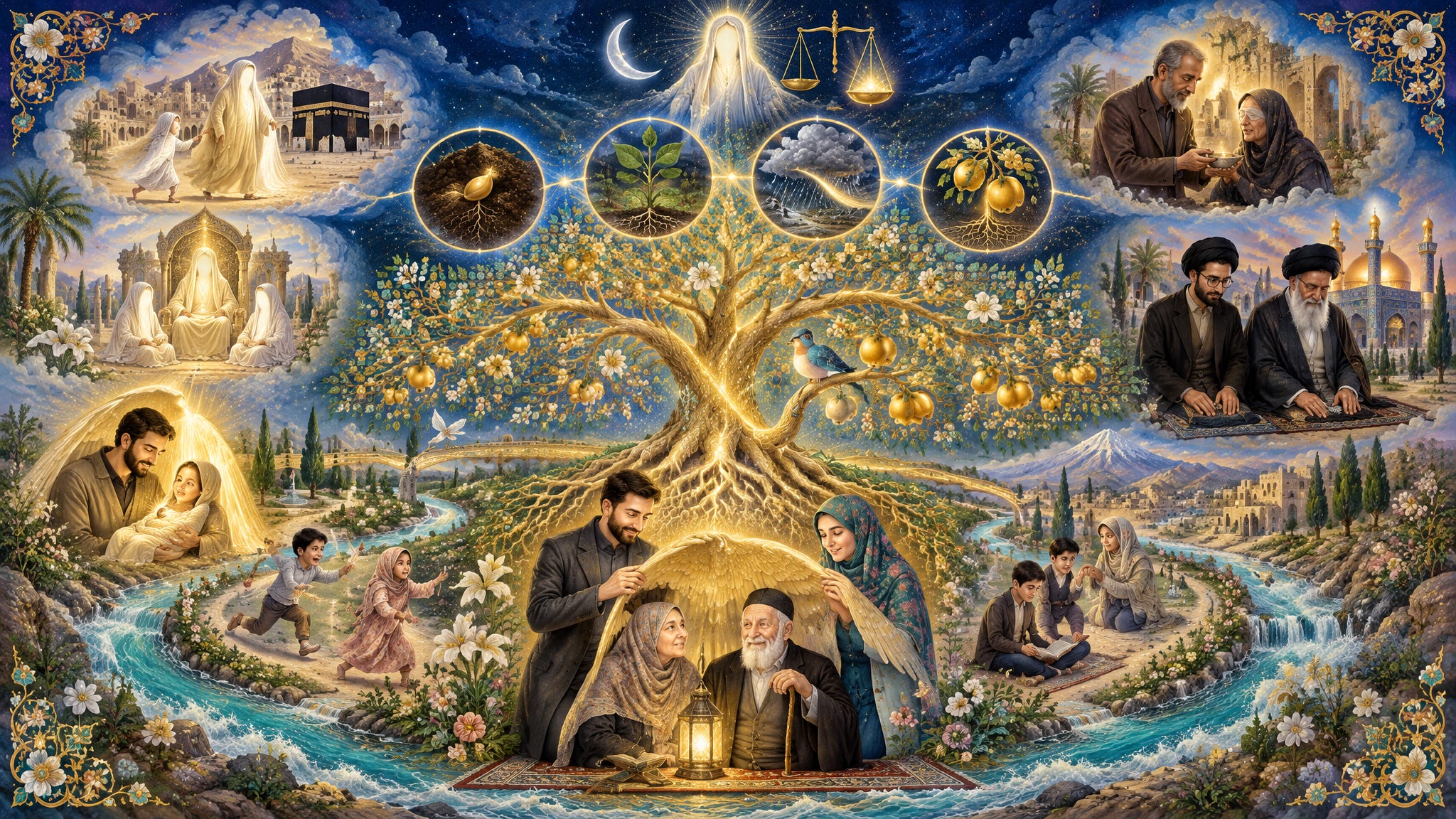
Do not say to them, Fie.
Lower the wing.
A home can take on the nursing; it cannot take the child’s place.
The little girl who ran to her father in Mecca was called the mother of her father.
Joseph, peace and blessings be upon him, seated his parents high upon the throne.
A mother heard the counsels of the prophets in the way her son cared for her.
And a young scholar who seemed to be leaving his future behind him in Qom went home to his father’s side; his own son calls it an opportunity.
So visit.
Call.
Bring them home for Eid.
And give them a daily gift, while they live, and after they have gone.
Four nights.
And tonight, the fruit.
Three sevens — play, adab, companionship — and then the circle.
We began with a child born facing God.
We end with that child grown, lowering the wing over the mother and the father who once gathered him under theirs.
And every one of us is somewhere on that road tonight: still somebody’s child, already somebody’s parent, or both at once.
That is where our four nights end.
Eulogy — She Will Be to My Children As I Am
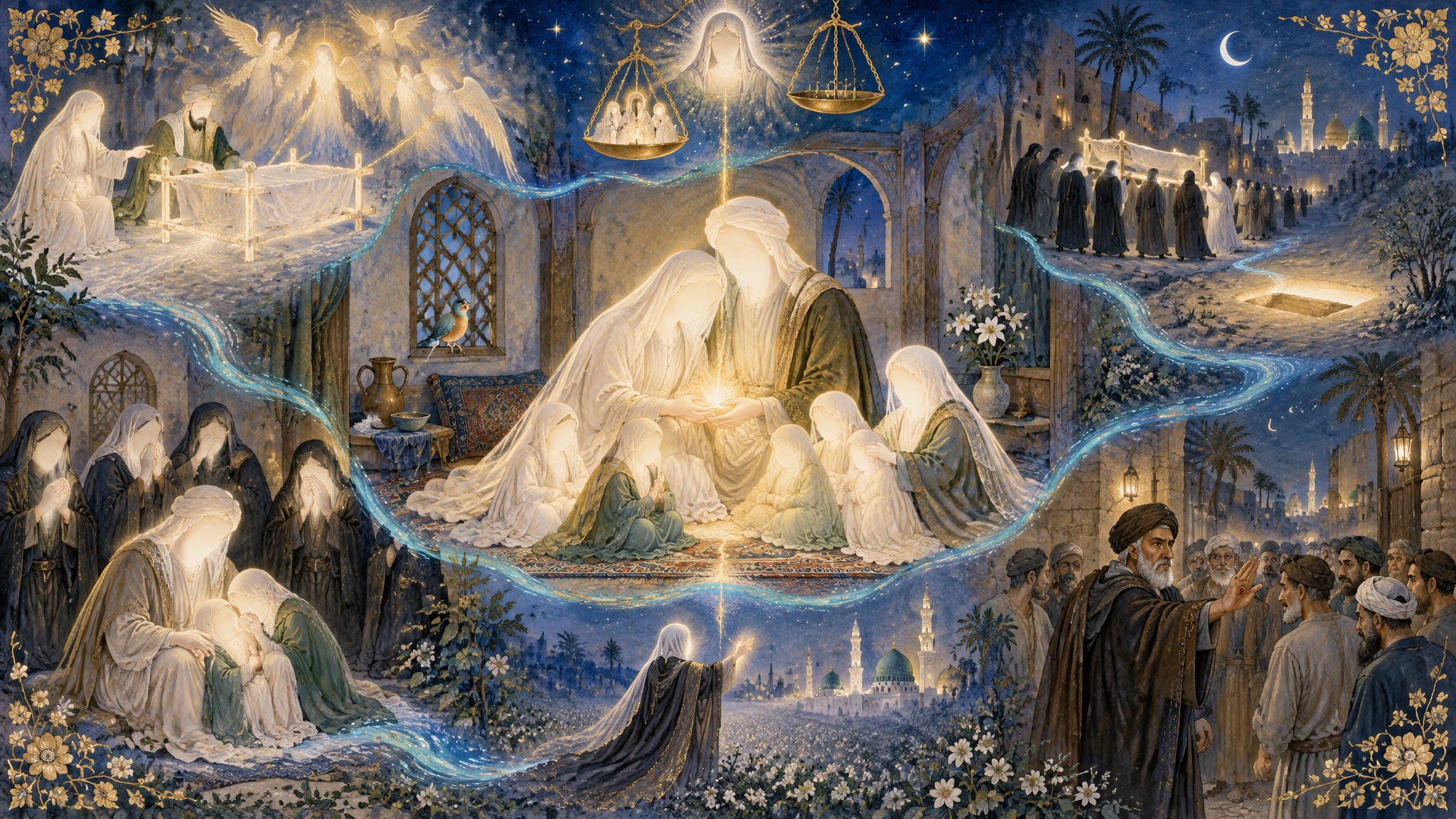
And now, because these are her nights, we go back to the house of Sayyedah Fatimah al-Zahra, peace and blessings be upon her, one last time.
Tonight we heard her first request.
Now hear how she made it.
She knew that she was leaving them.
And Imam Ali, peace and blessings be upon him, sat with her.
And the two of them wept together, for a while.
Then he took her head, and held it to his chest.
And he said:
Charge me with whatever you wish.
You will find me carrying it out just as you command me.
And I will put your command before my own.
The Commander of the Faithful.
And he says to her:
Your command before my own.
And she said:
May God reward you on my behalf with the best of rewards, O son of the uncle of the Messenger of God.
And then her first request.
It was not for herself.
It was for her children.
Marry Umama after me.
For she will be to my children as I am.
For men cannot do without women.
— Sayyedah Fatimah al-Zahra, peace and blessings be upon her, and Imam Ali, peace and blessings be upon him; al-Majlisi, Bihar al-Anwar, Volume 43, p. 192, from al-Fattal al-Nisaburi’s Rawdat al-Wa’izin — narrated49
In these days of her martyrdom, sit with that for a moment.
She had been the mother of her father.
Now she was leaving four children of her own.
Then she said:
I charge you, O son of my uncle, to make a bier for me.
For I have seen the angels, and they gave it its shape.
And he said to her:
Describe it to me.
And she described it.
And he made it for her.
It was the first bier ever made on the face of the earth.
No one had seen one before it.
No one had made one.
She had already seen how she would be carried.
And then she asked that none of those who had wronged her, and taken her right, should attend her funeral, or pray over her.
And then:
Bury me at night, when the eyes are quiet, and the sight is asleep.
And then she died.
— Sayyedah Fatimah al-Zahra, peace and blessings be upon her; al-Majlisi, Bihar al-Anwar, Volume 43, p. 192, from Rawdat al-Wa’izin — narrated50
And Medina cried out, with a single cry.
The women of Banu Hashim — her own family, the clan of her father — were gathered in her house.
And they cried out together, with one cry, so that Medina almost shook with their crying.
O our mistress!
O daughter of the Messenger of God!
And the people came to Imam Ali, pressing in, one after another, like the hair of a horse’s mane.
He was sitting.
And al-Hasan and al-Husayn, peace and blessings be upon them, were in front of him, weeping.
And the people wept at their weeping.
Tonight we spoke of the father who is left to raise his children alone.
Here he is.
Sitting, with his two boys weeping in front of him.
And a whole city weeping at their weeping.
And fourteen centuries later, in this room, we are still weeping at their weeping.
Then Sayyedah Umm Kulthum, her daughter, peace and blessings be upon her, came out — veiled, trailing the hem of her robe, wrapped in a cloak.
And she was calling to her grandfather:
O father!
O Messenger of God!
Now we have truly lost you.
A loss with no meeting after it, ever.
Her grandfather had died only months before.
Now we have truly lost you.
As long as her mother was alive, something of her grandfather was still in that house.
And the people gathered, and sat, crying aloud, waiting for the bier to come out, so that they could pray over her.
Then Abu Dharr, the companion of the Prophet, peace and blessings be upon him, his family, and his righteous companions, came out, and said:
Go home.
The bringing-out of the daughter of the Messenger of God has been put off this evening.
And the people rose, and went home.
They had come to pray over her.
And they were sent home.
— al-Majlisi, Bihar al-Anwar, Volume 43, p. 192, from Rawdat al-Wa’izin — narrated51
We know where the martyred leader, Imam Khamenei, may God rest his pure soul, lies, and where his father lies: in Mashhad, in the shrine of Imam al-Rida, peace and blessings be upon him.
Their graves are known52.
The daughter who was her father’s mother asked to be buried at night.
Fourteen centuries on, no one knows where to stand to greet her.
Segue to Maqtal
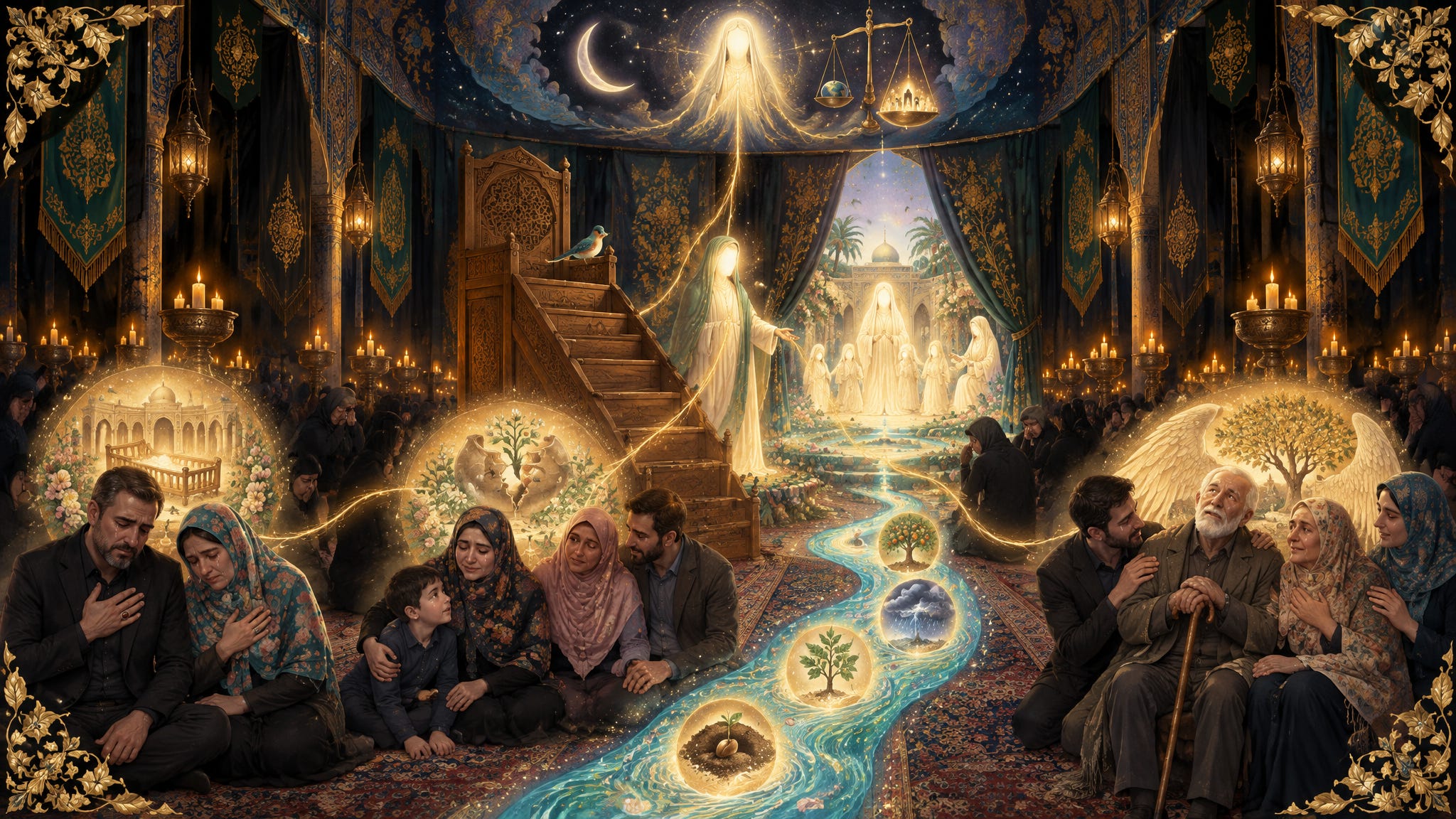
Three houses tonight.
The house where a child went ahead.
The house that broke, and is being rebuilt.
The house where a parent grew old.
And behind every one of them, through all four nights, there has stood one more house: hers — the house of the daughter her father called the fruit of his heart.
So we end there.
Let her son, the one we are waiting for, the Imam of our Age, may our souls be his ransom and may God hasten his return, take us back into her house, to her last day, and to the children she was leaving.
Our maqtal tonight is As I Am.
Supplication
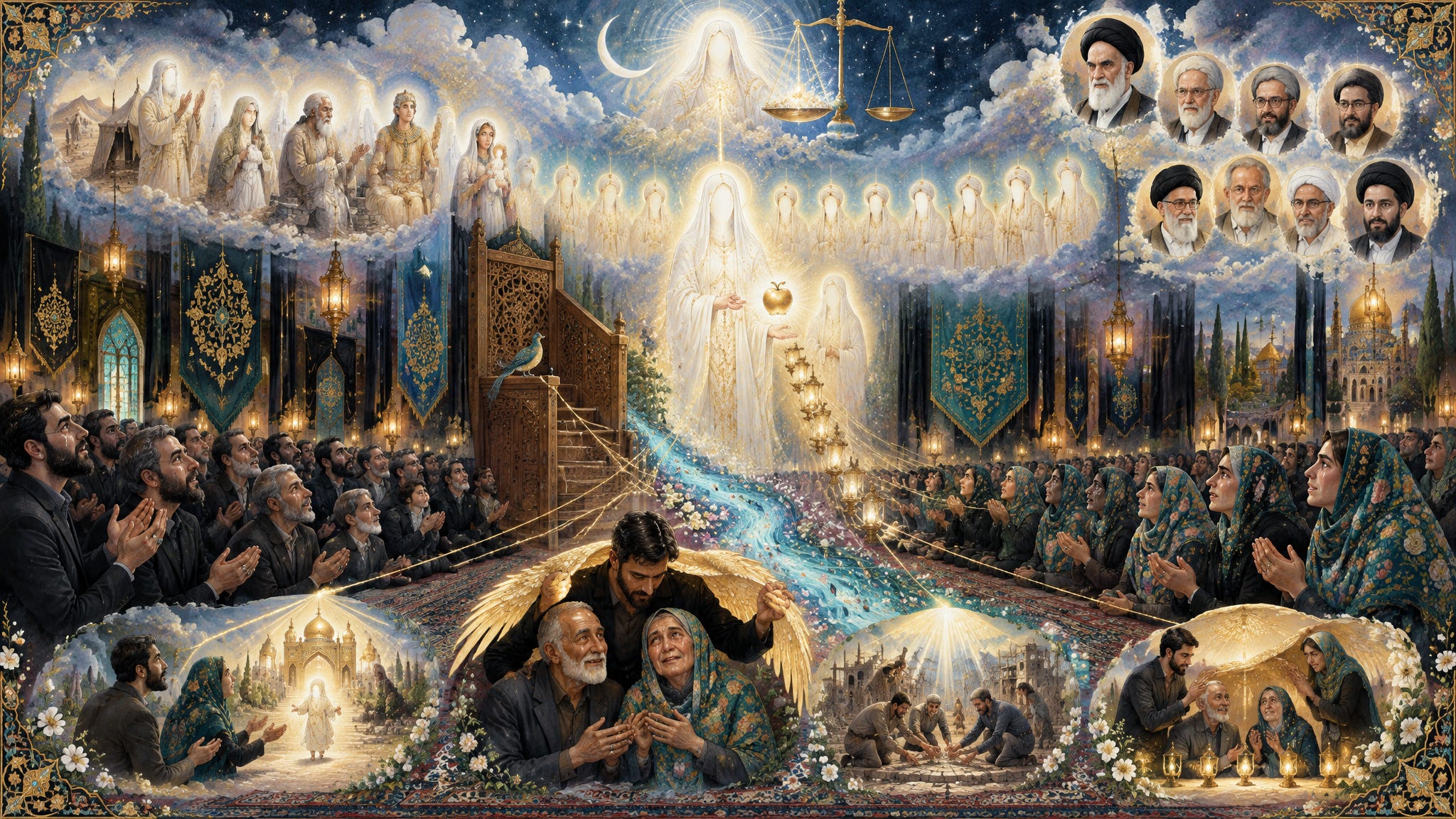
O God, we greet her tonight in the words of her ziyarah.
يَا مُمْتَحَنَةُ امْتَحَنَكِ اللَّهُ الَّذِي خَلَقَكِ قَبْلَ أَنْ يَخْلُقَكِ فَوَجَدَكِ لِمَا امْتَحَنَكِ صَابِرَةً وَ زَعَمْنَا أَنَّا لَكِ أَوْلِيَاءُ وَ مُصَدِّقُونَ وَ صَابِرُونَ لِكُلِّ مَا أَتَانَا بِهِ أَبُوكِ صَلَّى اللَّهُ عَلَيْهِ وَ آلِهِ وَ أَتَى [أَتَانَا] بِهِ وَصِيُّهُ فَإِنَّا نَسْأَلُكِ إِنْ كُنَّا صَدَّقْنَاكِ إِلا أَلْحَقْتِنَا بِتَصْدِيقِنَا لَهُمَا لِنُبَشِّرَ أَنْفُسَنَا بِأَنَّا قَدْ طَهُرْنَا بِوِلايَتِكِ.
O you who were tried!
God who created you tested you before He created you, and in that trial He found you patient.
We believe that we are your friends and those who affirm you, and we are patient with all that your father (may God’s blessings be upon him and his household) and his successor brought to us.
So we ask you, if we have been among those who affirm you, that you join us with those who affirmed your father and his successor, so that we may give ourselves glad tidings that through your guardianship (wilayah) we have been purified.
— the Ziyarah of Sayyedah Fatimah al-Zahra, peace and blessings be upon her; Mafatih al-Jinan, ziyarat-2-2-3 — the English of our text of the Mafatih
O you who were tried.
So were the three houses we sat in tonight.
By Your prophets and Your chosen ones, peace and blessings be upon them all — by Abraham and Sarah, into whose care You have given the children who go ahead;
by Job, who blessed Your name on the day he lost his children,
and by Jacob, whose patience was beautiful;
by Hagar, alone in a barren valley with her son;
by Joseph, who seated his parents high upon the throne;
and by the Blessed Saint Mary, and by her son, who was good to his mother — may our souls be his ransom, and may You hasten his return.By Muhammad, peace and blessings be upon him, his family, and his righteous companions — the orphan You sheltered, who wept over his son Ibrahim, peace and blessings be upon him, and whose daughter was called the mother of her father.
By the fourteen — by Sayyedah Fatimah al-Zahra, peace and blessings be upon her, who thought first of her children; and by every Imam, from the Commander of the Faithful, peace and blessings be upon him, who kept her will, to the one we are waiting for, may our souls be his ransom and may You hasten his return.
O God, have mercy on Imam Khomeini, who stood over the loss of his son and spoke of Your hidden graces; on Allamah Tabataba’i, on Shaheed Mutahhari, on Ayatullah Fadhlullah, and on all the scholars whose words we carried tonight; and protect Ayatullah A’rafi, Ayatullah Mirahmadi, and those of them who are still with us.
O God, we remember before You the martyred leader, Imam Sayyed Ali Khamenei, may You rest his pure soul, and his father, Ayatullah Sayyed Javad Khamenei, may You rest his pure soul.
Accept from the son the care he gave his father, and gather them both with those they loved.O God, protect and guide and lengthen the life of our Wali al-Faqih, Imam Sayyed Mujtaba Khamenei, may You protect him, who told us of his father’s daily gift; and keep him firm on the straight path until the rising of the one we are waiting for.
O God, hasten the relief of Your friend and the son of Your friend — the Imam of our Age, may our souls be his ransom and may You hasten his return.
And let us be among those he would be pleased to find raising their children, and caring for their parents, when he comes.O God, we remember before You the families of those in this majlis, and the martyrs, and the truthful — keep them in Your care, and let none of them be forgotten.
O God, for the mothers and fathers whose children went ahead of them: build for them the House of Praise, as You have promised, and bring their children to them on the Day of Resurrection, as gifts.
O God, for the houses that broke, and are being rebuilt: suffice them from Your abundance, as You have promised, and make us a people who make the way to rebuilding easy.
O God, for the mothers and fathers who have grown old: let none of them be cast off in the time of old age, or forsaken when their strength fails — and never by us.
And for our own mothers and fathers, the living and the gone, we keep the command You gave us, and the words You taught us to say:
وَٱخۡفِضۡ لَهُمَا جَنَاحَ ٱلذُّلِّ مِنَ ٱلرَّحۡمَةِ وَقُل رَّبِّ ٱرۡحَمۡهُمَا كَمَا رَبَّيَانِي صَغِيرٗا
“Lower the wing of humility to them, mercifully, and say, ‘My Lord! Have mercy on them, just as they reared me when I was [a] small [child]!’”
— Qur’an, Surah al-Isra (the Chapter of the Night Journey) #17, Verse 24; the English, Ali Quli Qarai’s
And whatever we have said tonight that was true, it is from You; and whatever was wrong in it is from me, and I ask Your forgiveness for it.
And we end where her ziyarah ends.
O God, bless Fatimah, the daughter of Your Messenger, and the part of his flesh —
وَ صَمِيمِ قَلْبِهِ وَ فِلْذَةِ كَبِدِهِ وَ النُّخْبَةِ [وَ التَّحِيَّةِ] مِنْكَ لَهُ وَ التُّحْفَةِ خَصَصْتَ بِهَا وَصِيَّهُ وَ حَبِيبَةِ [وَ حَبِيبَهُ ] الْمُصْطَفَى وَ قَرِينَةِ [وَ قَرِينَهُ ] الْمُرْتَضَى وَ سَيِّدَةِ النِّسَاءِ وَ مُبَشِّرَةِ الْأَوْلِيَاءِ حَلِيفَةِ الْوَرَعِ وَ الزُّهْدِ وَ تُفَّاحَةِ الْفِرْدَوْسِ وَ الْخُلْدِ الَّتِي شَرَّفْتَ مَوْلِدَهَا بِنِسَاءِ الْجَنَّةِ وَ سَلَلْتَ مِنْهَا أَنْوَارَ الْأَئِمَّةِ وَ أَرْخَيْتَ دُونَهَا حِجَابَ النُّبُوَّةِ اللَّهُمَّ صَلِّ عَلَيْهَا صَلاةً تَزِيدُ فِي مَحَلِّهَا عِنْدَكَ وَ شَرَفِهَا لَدَيْكَ وَ مَنْزِلَتِهَا مِنْ رِضَاكَ وَ بَلِّغْهَا مِنَّا تَحِيَّةً وَ سَلاماً وَ آتِنَا مِنْ لَدُنْكَ فِي حُبِّهَا فَضْلاً وَ إِحْسَاناً وَ رَحْمَةً وَ غُفْرَاناً إِنَّكَ ذُو الْعَفْوِ الْكَرِيمِ.
And the core of his heart, and his own dear child; the choice one, from You to him, and the gift with which You singled out his successor; the beloved of al-Mustafa, and the companion of al-Murtada; the mistress of women, the bearer of glad tidings to the friends of God, the ally of piety and renunciation, the apple of Firdaws and of the Garden of eternity; she whose birth You honoured with the women of Paradise, from whom You drew forth the lights of the Imams, and before whom You let fall the curtain of prophethood.
O God, bless her with a blessing that raises her place with You, her honour in Your presence and her station in Your good pleasure; and convey to her from us greeting and peace; and grant us from Your presence, for our love of her, grace and kindness, mercy and forgiveness. You are the Lord of generous pardon.
— the Ziyarah of Sayyedah Fatimah al-Zahra, peace and blessings be upon her; Mafatih al-Jinan, ziyarat-2-2-3, its closing lines; my translation
Amen, O Lord Sustainer of the Universes
Amen, O Most Merciful of the Merciful
And from Him alone is all ability and He has authority over all things.
Sources Cited
The Qur’an — the Arabic in the Uthmani script; the English, Ali Quli Qarai’s. Set in the text: Surah al-Isra, Verses 23 and 24 (set at the opening and again in Point 3, and Verse 24 a third time in the Supplication); Surah al-Tur, Verse 21; Surah Yusuf, Verses 18, 83, 84, 85, 86, 99 and 100; Surah al-Anbiya, Verses 83 and 84; Surah al-Ahzab, Verse 37; Surah al-Nisa, Verses 130 and 156; Surah al-Humazah, Verse 1; Surah al-Baqarah, Verses 158 and 233; Surah Ibrahim, Verse 37; Surah al-Mu’minun, Verse 50; Surah al-Duha, Verse 6; Surah Luqman, Verse 15; Surah Maryam, Verse 32. Surah al-Ra’d, Verse 25, is set for the reader, with al-Mizan’s comment on it. Surah al-Shura, Verse 52, is given in my rendering inside the report of al-Kafi, Volume 2, hadith 566. In the Appendix, the words of Surah al-Baqarah, Verse 156, and of Surah al-Zumar, Verse 42, as far as each report quotes them, are Qarai’s, set as text inside my translations of the reports and checked against Fihrist’s copy of his English.
Shaykh al-Kulayni, al-Kafi — Volume 1, hadith 1237; Volume 2, hadiths 566 and 1275; Volume 3, hadiths 542, 568 and 831; Volume 4, hadith 45; Volume 5, hadiths 1478 and 1844; Volume 6, hadith 58 (numbered as in the thaqalayn edition).
Shaykh al-Saduq — Man La Yahduruhu al-Faqih, Volume 1, hadith 523; Volume 2, hadith 146; Volume 3, hadiths 1184, 1517, 1528 and 1698; al-Amali, hadiths 198 and 940 (the second, Night 1’s eulogy); al-Khisal, Volume 1, hadiths 676 and 1237 (numbered as in the thaqalayn edition); al-Tawhid and Uyun Akhbar al-Rida, as Allamah Tabataba’i gives them.
al-Majlisi, Bihar al-Anwar (the Rafed edition of the Arabic) — Volume 16, p. 9, from Ibn Ishaq; Volume 20, pp. 102 and 103, Uhud, from Ahmad ibn Hanbal’s Musnad; Volume 43, pp. 16 and 17, her names, from Ibn Shahrashub’s al-Manaqib, and p. 192, her will, the bier, her death and the cry of Medina, from al-Fattal al-Nisaburi’s Rawdat al-Wa’izin; and pp. 174, 178 and 179, the report of Waraqa ibn Abd Allah al-Azdi from Fidda, with al-Majlisi’s caution; Volume 45, pp. 1 to 3, the eve of Ashura, from Shaykh al-Mufid’s al-Irshad, and pp. 117 and 118, Kufa, from al-Mufid, Ibn Tawus and Ibn Nima.
al-Fattal al-Nisaburi, Rawdat al-Wa’izin — records 171 and 289 (cited by their record numbers in the digital edition, not by printed pages).
Shaykh al-Tabrisi — I’lam al-Wara bi-A’lam al-Huda, Volume 1, pp. 274, 456 and 457, and 472 and 473; Majma’ al-Bayan, as Allamah Tabataba’i gives it.
al-Tabari, Tarikh al-Rusul wa al-Muluk — record 304, from Ibn Ishaq (cited by its record number in the digital edition, not by a printed page).
Shaykh al-Mufid — al-Irshad, Volume 2, pp. 93 and 94, and 116 and 117 (the Rafed edition of the Arabic); al-Ifsah, in Mawsu’at al-Shaykh al-Mufid, Volume 8, record 218.
Sayyed Ibn Tawus, al-Malhuf ‘ala Qatla al-Tufuf (the Rafed edition of the Arabic) — pp. 180 and 181.
Ibn Asakir, Tarikh Madinat Dimashq — Volume 3, p. 184, from Ibn Jurayj.
Sahih al-Bukhari — Volume 1, hadith 520 (records 317 and 318); Volume 7, hadith 5376 (records 188 and 189); the Arabic, and the English of our text.
Allamah Sayyed Muhammad Husayn Tabataba’i, al-Mizan fi Tafsir al-Qur’an — the narrations at Surah al-Tur, Verses 11 to 28, from Tafsir al-Qummi and Shaykh al-Saduq’s al-Tawhid; at Surah al-Ahzab, Verses 36 to 40, his reading of Verse 37, with the reports from Uyun Akhbar al-Rida and Majma’ al-Bayan; at Surah al-Humazah, Verses 1 to 9, his comment on Verse 1, from Majma’ al-Bayan; and at Surah al-Ra’d, Verses 17 to 26, his comment on Verse 25, with what la’n means.
Sayyed Ja’far Murtada al-Amili, al-Sahih min Sirat al-Nabi al-A’zam — Volume 2, pp. 200-201 and 207-211, with Abu al-Qasim al-Kufi at p. 209.
Imam Khomeini, may God rest his pure soul — Sahifeh-ye Imam, Volume 3, the talk in Najaf of 10 Aban 1356 (1 November 1977), and Volume 17, the Eight-Article Decree of 24 Azar 1361 (15 December 1982), article 6 and the sentence after it (khomeini.ir); Tahrir al-Wasilah, Volume 2, pp. 306 and 319, as Ayatullah Mirahmadi reads them in his fiqh classes (eshia.ir).
Imam Sayyed Ali Khamenei, may God rest his pure soul — addresses of 23 Dey 1369 (13 January 1991), 14 Bahman 1376 (3 February 1998), 29 Bahman 1398 (18 February 2020), 21 Ordibehesht 1399 (10 May 2020) and 1 Farvardin 1402 (21 March 2023) (farsi.khamenei.ir).
Imam Sayyed Mujtaba Khamenei, may God protect him — the interview of 1400 SH (2021), published by KHAMENEI.IR, as Eghtesad News (news 794554) reproduces it from Khabaronline; the English summary of Tehran Times (news 527905). The Persian of the lines used is set for the reader, as copied from Eghtesad News.
Ayatullah Sayyed Muhammad Husayn Fadhlullah, may God rest his pure soul — Friday sermons of 28 May 1999, 23 March 2001, 29 July 2005 and 5 October 2007 (bayynat.org.lb); used on the family, its duties and its upbringing only.
Shaheed Ayatullah Murtaza Mutahhari, may God rest his pure soul — Nizam-e Huquq-e Zan dar Islam (The System of Women’s Rights in Islam), record 50.
Ayatullah Alireza A’rafi, may God protect him — a class on family upbringing and the naming of children, 22 April 2009 (eshia.ir).
Ayatullah Mirahmadi, may God protect him — fiqh classes of 9 Ordibehesht 1403 (28 April 2024), 30 Ordibehesht 1403 (19 May 2024) and 15 Farvardin 1405 (4 April 2026) (eshia.ir).
Mafatih al-Jinan — the Ziyarah of Sayyedah Fatimah al-Zahra, ziyarat-2-2-3: its opening address and its closing lines (the Arabic, and the English of our text of the Mafatih).
The Bible — the King James Version: Genesis 16:13 and 21:16 and 19; Ruth 1:16, and 3:9 and 11; Job 1:21; Psalm 71:9; Proverbs 6:13 and 14; Matthew 15:5 and 6; John 19:26 and 27; and Mark 7:11 is named, for Corban, and given in Greek with my translation. With them, the Hebrew of Job 1:21, from Fihrist’s Hebrew text of Job; of Ruth 1:16, from its Hebrew text of Ruth; of Ruth 1:8 to 19 and 3:8 to 12, of Psalm 71:9 and of Proverbs 6:13 and 14, from the Ketuvim (records 416, 419, 420, 101 and 246); of Genesis 16:13 and 21:16 and 19, from the Torah (records 24, 33 and 34); and the Greek of Matthew 15:5 and 6, Mark 7:11 and John 19:26 and 27, from the SBL Greek New Testament (records 31, 19 and 48).
WikiShia — “Funeral of Ayatollah Khamenei” (in English; for the reader’s note on the shrine only).
From this majlis — last year’s series, Wilayah in the Home, session 3, “Mending the Tapestry: Trials, Trust, and Turning to God” (24 November 2025; reflections313.com); and Nights 1, 2 and 3 of this series.
His words of her, as the report gives them. Night 1’s maqtal, The Door He Called At, told the whole report.
وأما ابنتي فاطمة، فإنها سيدة نساء العالمين من الاولين والآخرين، وهي بضعة مني، وهو نور عيني، وهي ثمرة فؤادي، وهي روحي التي بين جنبي، وهي الحوراء الانسية، متى قامت في محرابها بين يدي ربها جل جلاله زهر (1) نورها لملائكة السماء كما يزهر نور الكواكب لاهل الارض، ويقول الله عز وجل لملائكته: يا ملائكتي، انظروا إلى أمتي فاطمة سيدة إمائي، قائمة بين يدي ترتعد فرائصها (1) من خيفتي، وقد أقبلت بقلبها على عبادتي، أشهدكم أني قد أمنت شيعتها من النار.
“And as for my daughter Fatimah, she is the mistress of the women of the worlds, of the first and of the last. She is a part of me; she is the light of my eye; she is the fruit of my heart; she is my spirit between my two sides; she is a houri in human form. Whenever she stands in her prayer-niche before her Lord, Majestic is His majesty, her light shines out for the angels of the heaven as the light of the stars shines out for the people of the earth. And God, Mighty and Majestic, says to His angels: O My angels, look at My handmaid Fatimah, the mistress of My handmaids, standing before Me, trembling in awe of Me, her heart turned to My worship. I call you to witness that I have made her followers safe from the Fire.”
— the Messenger of God, peace and blessings be upon him, his family, and his righteous companions, through Ibn Abbas; Shaykh al-Saduq, al-Amali, hadith 198 (thaqalayn); my translation; the text prints the masculine huwa before “the light of my eye”, and the (1)s are the edition’s note marks
Shaykh al-Saduq gives the same report in Man La Yahduruhu al-Faqih, Volume 1, hadith 523, without a chain; here it is.
وَقَالَ رَسُولُ اَللَّهِ صَلَّى اَللَّهُ عَلَيْهِ وَ آلِهِ: «إِذَا قُبِضَ وَلَدُ اَلْمُؤْمِنِ وَ اَللَّهُ أَعْلَمُ بِمَا قَالَ اَلْعَبْدُ فَيَسْأَلُ اَلْمَلاَئِكَةَ قَبَضْتُمْ وَلَدَ فُلاَنٍ اَلْمُؤْمِنِ فَيَقُولُونَ نَعَمْ رَبَّنَا فَيَقُولُ فَمَا ذَا قَالَ عَبْدِيَ اَلْمُؤْمِنُ فَيَقُولُونَ حَمِدَكَ رَبَّنَا وَ اِسْتَرْجَعَ فَيَقُولُ اَللَّهُ عَزَّ وَ جَلَّ اِبْنُوا لَهُ بَيْتاً فِي اَلْجَنَّةِ ‘ وَ سَمُّوهُ بَيْتَ اَلْحَمْدِ.
“And the Messenger of God, God bless him and his family, said: When the child of a believer dies — and God knows best what the servant said — He asks the angels: Did you take the child of so-and-so, the believer? They say: Yes, our Lord. He says: Then what did My believing servant say? They say: He praised You, our Lord, and said, ‘To God we return.’ And God, Mighty and Majestic, says: Build for him a house in Paradise, and name it the House of Praise.”
— the Messenger of God, peace and blessings be upon him, his family, and his righteous companions; Shaykh al-Saduq, Man La Yahduruhu al-Faqih, Volume 1, hadith 523 (thaqalayn); my translation; the stray mark before “and name it” is the edition’s
The report in full; Shaykh al-Saduq gives it without a chain.
قَالَ اَلصَّادِقُ عَلَيْهِ اَلسَّلاَمُ : “دَعِ اِبْنَكَ يَلْعَبْ سَبْعَ سِنِينَ وَ يُؤَدَّبْ سَبْعَ سِنِينَ وَ أَلْزِمْهُ نَفْسَكَ سَبْعَ سِنِينَ فَإِنْ أَفْلَحَ وَ إِلاَّ فَإِنَّهُ مِمَّنْ لاَ خَيْرَ فِيهِ”.
“Al-Sadiq, peace be upon him, said: Let your son play for seven years, and be taught good conduct for seven years, and keep him close to you for seven years; then, if he prospers, well and good; and if not, he is one of those in whom there is no good.”
— Imam Ja’far al-Sadiq, peace and blessings be upon him; Shaykh al-Saduq, Man La Yahduruhu al-Faqih, Volume 3, hadith 1528 (thaqalayn); my translation
Last year’s third session, “Mending the Tapestry: Trials, Trust, and Turning to God”, 24 November 2025, in the series Wilayah in the Home.
His words in full; the [5] is the site’s note mark.
وقتی که مرحوم حاج آقا مصطفیٰ، فرزند بزرگ و فاضل و برجستهی امام در نجف از دنیا رفت -که خب شبهههایی هم وجود داشت که ایشان را مسموم کردهاند و مانند اینها- امام در اوّلین بیانات گفتند که فوت مصطفیٰ از الطاف خفیّهی الهی بود؛(۵) هیچ کس درست نفهمید یعنی چه؛ چطور انسان پسر بزرگش را، بچّهی فاضلش را -[چون] مرحوم حاج آقا مصطفیٰ خیلی برجسته بود؛ جزو امیدهای آینده بود و اگر مانده بود، قطعاً امروز مرجع تقلید بود- از دست بدهد، آن وقت بگوید که این از الطاف خفیّه بود؟ بعد که مردم ایران این حرکت را انجام دادند که برای ایشان فاتحه گرفتند و این فاتحه موجب آن عکسالعمل دربار شد، و بعد قضایای قم، قضایای تبریز، این سلسلهی حوادث پیش آمد، آن وقت مردم فهمیدند که این لطف خفی چه بود.
“When the late Hajj Agha Mostafa, the Imam’s eldest, learned and distinguished son, died in Najaf — and there were suspicions that he had been poisoned, and the like — the Imam said in his first remarks that Mostafa’s death was one of the hidden graces of God. No one properly understood what that meant. How can a man lose his eldest son, his learned child — for the late Hajj Agha Mostafa was very distinguished; he was one of the hopes of the future, and had he lived he would certainly be a marja’ today — and then say that this was one of the hidden graces? Later, when the people of Iran made the move of holding memorial gatherings for him, and those gatherings provoked the court’s reaction, and then came the events of Qom and the events of Tabriz, this chain of events — then people understood what this hidden grace was.”
— the martyred leader, Imam Sayyed Ali Khamenei, may God rest his pure soul, to the people of East Azerbaijan, 29 Bahman 1398 (18 February 2020), farsi.khamenei.ir; my translation
The report.
“إِنَّ اَللَّهَ تَبَارَكَ وَ تَعَالَى كَفَّلَ إِبْرَاهِيمَ وَ سَارَةَ أَطْفَالَ اَلْمُؤْمِنِينَ يَغْذُوَانِهِمْ بِشَجَرَةٍ فِي اَلْجَنَّةِ لَهَا أَخْلاَفٌ كَأَخْلاَفِ اَلْبَقَرِ فِي قَصْرٍ مِنْ دُرَّةٍ فَإِذَا كَانَ يَوْمُ اَلْقِيَامَةِ أُلْبِسُوا وَ طُيِّبُوا وَ أُهْدُوا إِلَى آبَائِهِمْ فَهُمْ مُلُوكٌ فِي اَلْجَنَّةِ مَعَ آبَائِهِمْ وَ هُوَ قَوْلُ اَللَّهِ عَزَّ وَ جَلَّ: اَلَّذِينَ آمَنُوا وَ اِتَّبَعَتْهُمْ ذُرِّيَّتُهُمْ بِإِيمٰانٍ أَلْحَقْنٰا بِهِمْ ذُرِّيَّتَهُمْ
“God, Blessed and Exalted, has given the children of the believers into the care of Abraham and Sarah. They feed them from a tree in Paradise that has udders like the udders of cows, in a palace of pearl. When the Day of Resurrection comes, they are clothed and perfumed and given as gifts to their fathers, and they are kings in Paradise with their fathers. That is the word of God, Mighty and Majestic: ‘Those who have faith, and whose descendants followed them in faith: We will make their descendants join them.’”
— Imam Ja’far al-Sadiq, peace and blessings be upon him, through al-Halabi; Shaykh al-Saduq, Man La Yahduruhu al-Faqih, Volume 3, hadith 1517 (thaqalayn); my translation; the verse he recites is the first part of Qur’an 52:21, set whole below
The two reports, as al-Mizan gives them in its narrations on Surah al-Tur, Verses 11 to 28.
و في تفسير القمي، حدثني أبي عن سليمان الديلمي عن أبي بصير عن أبي عبد الله(عليه السلام)قال: إن أطفال شيعتنا من المؤمنين تربيهم فاطمة(عليها السلام)، و قوله:«ألحقنا بهم ذريتهم»قال: يهدون إلى آبائهم يوم القيامة:.
“And in Tafsir al-Qummi: My father narrated to me, from Sulayman al-Daylami, from Abu Basir, from Abu Abdillah, peace be upon him, who said: The children of our Shi’a among the believers — Fatimah, peace be upon her, raises them. And His words, ‘We will make their descendants join them’: he said, they will be given as gifts to their fathers on the Day of Resurrection.”
و في التوحيد، بإسناده عن أبي بصير قال: قال أبو عبد الله(عليه السلام): إذا مات الطفل من أطفال المؤمنين نادى مناد في ملكوت السماوات و الأرض ألا إن فلان بن فلان قد مات فإن كان قد مات والداه أو أحدهما أو بعض أهل بيته من المؤمنين دفع إليه يغذوه، و إلا دفع إلى فاطمة تغذوه حتى يقدم أبواه أو أحدهما أو بعض أهل بيته من المؤمنين فيدفعه إليه.
“And in al-Tawhid, with his chain, from Abu Basir, who said: Abu Abdillah, peace be upon him, said: When a child from among the children of the believers dies, a caller calls out in the kingdom of the heavens and the earth: Know that so-and-so, son of so-and-so, has died. Then if his parents, or one of them, or someone of his household among the believers, has already died, he is handed to that one, who feeds him. Otherwise he is handed to Fatimah, who feeds him until his parents, or one of them, or someone of his household among the believers, arrives, and she hands him over to him.”
— Imam Ja’far al-Sadiq, peace and blessings be upon him; Allamah Sayyed Muhammad Husayn Tabataba’i, al-Mizan fi Tafsir al-Qur’an, the narrations at Surah al-Tur, Verses 11 to 28, from Tafsir al-Qummi and from Shaykh al-Saduq’s al-Tawhid; my translation
Shaykh al-Saduq gives the same command in al-Khisal, Volume 1, hadith 1237, among the four hundred teachings of the Commander of the Faithful to his companions. The edition runs his sayings together, so the passage holds the saying before the command and the two after it.
يقول الله عز وجل لكم: “وَلاَ تَرْكَنُوا إِلَى الَّذِينَ ظَلَمُوا فَتَمَسَّكُمْ النَّارُ وَمَا لَكُمْ مِنْ دُونِ اللَّهِ مِنْ أَوْلِيَاءَ ثُمَّ لاَ تُنصَرُونَ .”سموا أولادكم، فإن لم تدروا أذكر هم أم انثى فسموهم بالاسماء التي تكون للذكر والانثى، فان أسقاطكم إذا لقوكم في القيامة ولم تسموهم يقول السقط لابيه: ألا سميتني؟ وقد سمى رسول الله صلى الله عليه وآله محسنا قبل أن يولدإياكم وشرب الماء من قيام على أرجلكم، فانه يورث الداء الذي لا دواء له أو يعافي الله عز وجلإذا ركبتم الدواب فاذكروا الله عز وجل وقولوا: “سُبْحانَ الَّذِي سَخَّرَ لَنَا هَذَا وَمَا كُنَّا لَهُ مُقْرِنِينَ.
“God, Mighty and Majestic, says to you: ‘Do not incline towards those who do wrong, lest the Fire touch you; for you have no protectors apart from God, and then you will not be helped.’ Name your children; and if you do not know whether they are male or female, name them with the names that are for both the male and the female; for when your miscarried children meet you at the Resurrection and you had not named them, the miscarried child will say to its father: Why did you not name me? And the Messenger of God, God bless him and his family, named Muhsin before he was born. Beware of drinking water standing on your feet, for it brings on an illness for which there is no cure, unless God, Mighty and Majestic, gives health. When you ride your mounts, remember God, Mighty and Majestic, and say: ‘Glory be to Him who has made this subservient to us, for we could not have mastered it ourselves.’”
— Imam Ali ibn Abi Talib, the Commander of the Faithful, peace and blessings be upon him; Shaykh al-Saduq, al-Khisal, Volume 1, hadith 1237 (thaqalayn); my translation, the verses with it: Surah Hud, Verse 113, and the last words of Surah al-Zukhruf, Verse 13, whose quotation runs on, in the record, into the next sentence
His words, from the class. He reads Imam Ali’s report, then the shorter one, “name your miscarried”, and holds that it has a reliable chain. The bracketed numerals are the site’s note marks, and the “6” is its sign for the blessing on the Prophet.
یک بحث هم این است که میگوید حتی فرزندی هم که سقط میشود نام بگذارید و بدون نام دفن نکنید این هم در باب بیست و یک است «قَالَ أَمِيرُ الْمُؤْمِنِينَ ع سَمُّوا أَوْلَادَكُمْ قَبْلَ أَنْ يُولَدُوا فَإِنْ لَمْ تَدْرُوا أَ ذَكَرٌ أَمْ أُنْثَى فَسَمُّوهُمْ بِالْأَسْمَاءِ الَّتِي تَكُونُ لِلذَّكَرِ وَ الْأُنْثَى فَإِنَّ أَسْقَاطَكُمْ إِذَا لَقُوكُمْ يَوْمَ الْقِيَامَةِ وَ لَمْ تُسَمُّوهُمْ يَقُولُ السِّقْطُ لِأَبِيهِ أَلَّا سَمَّيْتَنِي وَ قَدْ سَمَّى رَسُولُ اللَّهِ 6 مُحَسِّناً قَبْلَ أَنْ يُولَد»[11] . محسن را نام گذاری کرد قبل از اینکه به دنیا بیاید این روایت هم شاید معتبر باشد روایت دوم هم شاید معتبر باشد که «سَمُّوا أَسْقَاطَكُمْ»[12] . این هم حکم دیگری است که سند معتبر دارد. کسی به قصد رجاء انجام دهد ثواب دارد. این هم یک مطلب بود سه حکم است که آخری دلیل معتبر دارد ...
“One more question: that even a child who is miscarried should be given a name, and not be buried without a name. This too is in chapter twenty-one: ‘The Commander of the Faithful, peace be upon him, said: Name your children before they are born. If you do not know whether it is a boy or a girl, name them with names that are for both boy and girl. For when your miscarried children meet you on the Day of Resurrection and you had not named them, the miscarried child will say to its father: Why did you not name me? And the Messenger of God, God bless him and his family, named Muhsin before he was born.’ He named Muhsin before he came into the world. This report may be reliable; and the second report may be reliable too, which says: ‘Name your miscarried.’ This is a further ruling, and it has a reliable chain. Whoever does it in hope of the reward will have the reward. That was one more point: three rulings, the last of which has reliable evidence …”
— Ayatullah Alireza A’rafi, may God protect him, a class on family upbringing: the parents’ duties, and the naming of a child, 22 April 2009 (88/02/02), eshia.ir; my translation
The report, without its chain.
البكاؤون خمسة: آدم، ويعقوب، ويوسف، وفاطمة بنت محمد، وعلي بن الحسين عليهم السلام. فأما آدم فبكى على الجنة حتى صار في خديه أمثال الاودية، وأما يعقوب فبكى على يوسف حتى ذهب بصره، وحتى قيل له: “تَاللَّهِ تَفْتَأُ تَذْكُرُ يُوسُفَ حَتَّى تَكُونَ حَرَضًا أَوْ تَكُونَ مِنْ الْهَالِكِينَ.”
“The weepers are five: Adam, Jacob, Joseph, Fatimah the daughter of Muhammad, and Ali ibn al-Husayn, peace be upon them. As for Adam, he wept over Paradise until there were the like of valleys on his cheeks. And as for Jacob, he wept over Joseph until his sight was gone, and until it was said to him: ‘By God! You will go on remembering Joseph until you wreck your health or perish.’”
وأما يوسف فبكى على يعقوب حتى تأذى به أهل السجن فقالوا له: إما أن تبكي الليل وتسكت بالنهار، وإما أن تبكي النهار وتسكت بالليل، فصالحهم على واحد منهما، أما فاطمة فبكت على رسول الله صلى الله عليه وآله حتى تأذى بها أهل المدينة فقالوا لها: قد آذيتنا بكثرة بكائك، فكانت تخرج إلى المقابرمقابر الشهداء فتبكي حتى تقضي حاجتها ثم تنصرف، وأما علي ابن الحسين فبكى على الحسين عليه السلام عشرين سنة أو أربعين سنة ما وضع بين يديه طعام إلا بكى حتى قال له مولى له: جعلت فداك يا ابن رسول الله إني أخاف عليك أن تكون من الهالكين، قال: “إِنَّمَا أَشْكُو بَثِّي وَحُزْنِي إِلَى اللَّهِ وَأَعْلَمُ مِنْ اللَّهِ مَا لاَ تَعْلَمُونَ.”
“And as for Joseph, he wept over Jacob until the people of the prison were troubled by him, and they said to him: Either weep by night and be silent by day, or weep by day and be silent by night; and he came to terms with them on one of the two. As for Fatimah, she wept over the Messenger of God, God bless him and his family, until the people of Medina were troubled by her, and they said to her: You have troubled us with how much you weep. So she would go out to the graves, the graves of the martyrs, and weep until she had wept her fill, and then go home. And as for Ali ibn al-Husayn, he wept over al-Husayn, peace be upon him, for twenty years, or forty years: no food was ever set before him but he wept, until a freedman of his said to him: May I be your ransom, O son of the Messenger of God, I fear for you that you will be among those who perish. He said: ‘I complain of my anguish and grief only to God. I know from God what you do not know.’”
إني ما أذكر مصرع بني فاطمة إلا خنقتني لذلك عبرة
“I never remember the slaying of the sons of Fatimah but that tears choke me for it.”
— Imam Ja’far al-Sadiq, peace and blessings be upon him, in a report traced to him by Muhammad ibn Sahl al-Bahrani; Shaykh al-Saduq, al-Khisal, Volume 1, hadith 676 (thaqalayn); my translation, with the verses in Qarai’s English (12:85 and 86); “the graves, the graves of the martyrs” follows the edition, which runs the two words together
The passage. The “6” is this edition’s glyph for the blessing on the Prophet, carried as it stands.
أوّل امرأة تزوّجها رسول الله 6 خديجة بنت خويلد بن أسد بن عبد العزّى بن قصي ، تزوّجها وهو ابن خمس وعشرين سنة ، وكانت قبله عند عتيق بن عائذ المخزومي فولدت له جارية ، ثم تزوجهاأبو هالة الأسدي فولدت له هند بن أبي هالة ، ثمّ تزوّجها رسول الله 6 وربّى ابنها هنداً.
“The first woman the Messenger of God (God bless him and his family) married was Khadijah bint Khuwaylid ibn Asad ibn Abd al-Uzza ibn Qusayy. He married her when he was twenty-five years old. Before him she had been with Atiq ibn A’idh al-Makhzumi, and she bore him a girl; then Abu Hala al-Asadi married her, and she bore him Hind ibn Abi Hala; then the Messenger of God (God bless him and his family) married her, and raised her son Hind.”
— Shaykh al-Tabrisi, I’lam al-Wara bi-A’lam al-Huda, Volume 1, p. 274; my translation
Sayyed al-Amili sets out both views on these pages, with Ibn Shahrashub’s report. Here are his question and his whole answer to it, page by page; its fourth point ends at the top of p. 211, and is carried to its end. The numerals in brackets are the edition’s note marks.
هل تزوجت خديجة بأحد قبل النبي صلّى الله عليه وآله؟! ثم إنه قد قيل : أنه «صلى الله عليه وآله» لم يتزوج بكرا غير عائشة ، وأما خديجة ، فيقولون : إنها قد تزوجت قبله «صلى الله عليه وآله» برجلين ، ولها منهما بعض الأولاد ، وهما : عتيق بن عائذ بن عبد الله المخزومي ، وأبو هالة التميمي.
أما نحن فنقول : إننا نشك في دعواهم تلك ، ونحتمل جدا أن يكون كثير مما يقال في هذا الموضوع قد صنعته يد السياسة ، ولا نريد أن نسهب في الكلام عن اختلافهم في اسم أبي هالة ، هل هو النباش بن زرارة أو عكسه ، أو هند ، أو مالك ، وهل هو صحابي أو لا ، وهل تزوجته قبل عتيق ، أو تزوجت عتيقا قبله (1)؟ ولا في كون هند الذي ولدته خديجة هو ابن هذا الزوج أو ذاك ، فإن كان ابن عتيق ، فهو أنثى (2) وإلا فهو ذكر ، وأنه هل قتل مع علي في حرب الجمل ، أو مات بالطاعون بالبصرة (3). لا ، لا نريد أن نطيل بذلك ، وإنما نكتفي بتسجيل الملاحظات التالية : أولا : قال ابن شهر آشوب : «وروى أحمد البلاذري ، وأبو القاسم الكوفي في كتابيهما ، والمرتضى في الشافي ، وأبو جعفر في التلخيص : أن النبي «صلى الله عليه وآله» تزوج بها ، وكانت عذراء. يؤكد ذلك ما ذكر في كتابي الأنوار والبدع : «أن رقية وزينب كانتا ابنتي
هالة أخت خديجة» (1). ثانيا : قال أبو القاسم الكوفي : «إن الإجماع من الخاص والعام ، من أهل الأنال [الآثار ظ] ونقلة الأخبار ، على أنه لم يبق من أشراف قريش ، ومن ساداتهم وذوي النجدة منهم ، إلا من خطب خديجة ، ورام تزويجها ، فامتنعت على جميعهم من ذلك ؛ فلما تزوجها رسول الله «صلى الله عليه وآله» غضب عليها نساء قريش وهجرنها ، وقلن لها : خطبك أشراف قريش وأمراؤهم فلم تتزوجي أحدا منهم ، وتزوجت محمدا يتيم أبي طالب ، فقيرا ، لا مال له؟! فكيف يجوز في نظر أهل الفهم : أن تكون خديجة ، يتزوجها أعرابي من تميم ، وتمتنع من سادات قريش ، وأشرافها على ما وصفناه؟! ألا يعلم ذوو التمييز والنظر : أنه من أبين المحال ، وأفظع المقال»؟! (2). وأما الرد على ذلك بأنه لا يمكن أن تبقى امرأة شريفة وجميلة هذه المدة الطويلة بلا زواج. فليس على ما يرام : لأن ذلك لا يبرر رفضها لعظماء قريش وقبولها بأعرابي من بني تميم. وأما كيف يتركها أبوها أو وليها بلا تزويج؟! فقد قلنا : إن أباها قد قتل في حرب الفجار ، وأما وليها ، فلم يكن له
سلطة الأب ليجبرها على الزواج ممن أراد. وبقاء المرأة الشريفة والجميلة مدة بلا زواج ليس بعزيز ، إذا كانت تصبر إلى أن تجد الرجل الفاضل الكامل ، الذي كان يعز وجوده في تلك الفترة. نعم ، قد يكون من المستغرب أن لا يتقدم لخطبتها أحد ، خصوصا من هي مثل خديجة ، في موقعها ، وفي ميزاتها .. ولكن الأمر بالنسبة لخديجة ليس كذلك ، فقد خطبها عظماء قريش كما هو معلوم. ثالثا : كيف لم يعيّرها زعماء قريش الذين خطبوها فردتهم ، بزواجها من أعرابي بوّال على عقبيه كعتيق أو غيره؟! رابعا : قد ذكروا : أن أول شهيد في الإسلام ابن لخديجة «رحمها الله» ، اسمه الحارث بن أبي هالة ، استشهد حينما جهر رسول الله «صلى الله عليه وآله» بالدعوة (1). ونقول : إن ذلك لا يمكن قبوله ، حيث قد روي بسند صحيح عندهم ، عن قتادة : أن أول شهيد في الإسلام هو سمية والدة عمار (2) ، وكذا روي عن مجاهد (3).
وعن ابن عباس : «قتل أبو عمار وأم عمار ، وهما أول قتيلين قتلا من المسلمين» (1). إلا أن يدّعى : أن سمية كانت أول من استشهد من النساء ، والحارث كان أول من استشهد من الرجال.
“Did Khadijah marry anyone before the Prophet, God bless him and his family?! Now, it has been said that he, God bless him and his family, married no virgin but Aisha; and as for Khadijah, they say that she had married two men before him, God bless him and his family, and had some children by them: Atiq ibn A’idh ibn Abd Allah al-Makhzumi, and Abu Hala al-Tamimi.
As for us, we say: we doubt that claim of theirs, and think it very likely that much of what is said on this subject was made by the hand of politics. We do not wish to dwell on how they differ over the name of Abu Hala — whether he was al-Nabbash ibn Zurara or the reverse, or Hind, or Malik; whether he was a Companion or not; and whether she married him before Atiq, or married Atiq before him (1)? Nor on whether the Hind whom Khadijah bore was the son of this husband or of that — for if Atiq’s, then Hind was a girl (2), and otherwise a boy — and whether he was killed with Ali in the Battle of the Camel, or died of the plague in Basra (3). No, we do not wish to go on at length about that; we will be content to set down the following observations. First: Ibn Shahrashub said: ‘Ahmad al-Baladhuri and Abu al-Qasim al-Kufi narrated in their books, and al-Murtada in al-Shafi, and Abu Ja’far in al-Talkhis, that the Prophet, God bless him and his family, married her, and she was a virgin. That is confirmed by what is mentioned in the two books al-Anwar and al-Bida’: that Ruqayya and Zaynab were the daughters of
Hala, Khadijah’s sister’ (1). Second: Abu al-Qasim al-Kufi said: ‘There is consensus among the elite and the common people, among the people of reports and the transmitters of the narrations, that there remained none of the nobles of Quraysh, of their chiefs and their men of valour, but had proposed to Khadijah and sought to marry her, and she refused them all; and when the Messenger of God, God bless him and his family, married her, the women of Quraysh were angry with her and shunned her, and they said to her: The nobles of Quraysh and their princes proposed to you, and you married none of them; and you married Muhammad, the orphan of Abu Talib, a poor man with no wealth?! So how can it be, in the view of people of understanding, that Khadijah should be married by a Bedouin of Tamim, and refuse the chiefs of Quraysh and its nobles, as we have described?! Do not people of discernment and reflection know that this is the plainest of impossibilities and the most outrageous of claims’?! (2). As for the reply to that — that a noble and beautiful woman could not have stayed so long without marrying — it does not hold: for that does not justify her refusing the great men of Quraysh and accepting a Bedouin of Banu Tamim. And as for how her father or her guardian could leave her unmarried?! We have already said that her father was killed in the War of the Fijar; and as for her guardian, he did not have
a father’s authority, to compel her to marry whomever he wished. And for a noble and beautiful woman to remain for a time without marrying is nothing rare, if she is waiting patiently until she finds the virtuous and complete man, who was rare to find in that time. Yes, it might be thought strange that no one should come forward to ask for her hand, especially one like Khadijah, in her position and with her qualities.. but the matter was not so with Khadijah: the great men of Quraysh proposed to her, as is well known. Third: how is it that the leaders of Quraysh who proposed to her, and whom she turned away, did not taunt her with marrying a Bedouin who urinates on his own heels, like Atiq or another?! Fourth: they have mentioned that the first martyr in Islam was a son of Khadijah, God have mercy on her, named al-Harith ibn Abi Hala, who was martyred when the Messenger of God, God bless him and his family, proclaimed his call openly (1). And we say: that cannot be accepted, since it is narrated with a chain they hold sound, from Qatada, that the first martyr in Islam was Sumayya, the mother of Ammar (2); and the like is narrated from Mujahid (3).
And from Ibn Abbas: ‘Ammar’s father and Ammar’s mother were killed, and they were the first two of the Muslims to be killed’ (1). Unless it be claimed that Sumayya was the first of the women to be martyred, and al-Harith the first of the men.”
— Sayyed Ja’far Murtada al-Amili, al-Sahih min Sirat al-Nabi al-A’zam, Volume 2, pp. 207-211; my translation; where the print reads al-anal, the editor’s bracket proposes al-athar, “reports”, and that is what is translated
And a few pages before, on pp. 200-201, his list of the reports of her age at the marriage, from twenty-five to forty-six. The letters are the edition’s numbering, and the numerals in brackets its note marks.
عمر خديجة حين الزواج : ويلاحظ هنا : مدى الاختلاف والتفاوت في عمر خديجة حين اقترانها بالرسول الأكرم «صلى الله عليه وآله». وهو يتراوح ما بين ال 25 سنة إلى ال 46 سنة وهو على النحو الآتي : ألف ـ 25 سنة وصححه البيهقي (1). ب ـ 28 سنة هو ما رجحه كثيرون (2). ج ـ 30 سنة (3).
د ـ 35 سنة (1). ه ـ 40 سنة (2). و ـ 44 سنة (3). ز ـ 45 سنة (4). ح ـ 46 سنة (5).
“Khadijah’s age at the marriage. It is to be noticed here how far the reports differ and diverge on Khadijah’s age when she was joined to the Most Noble Messenger, God bless him and his family. It ranges from 25 years to 46 years, as follows. A: 25 years, and al-Bayhaqi held it sound (1). B: 28 years, which many preferred (2). C: 30 years (3).
D: 35 years (1). E: 40 years (2). F: 44 years (3). G: 45 years (4). H: 46 years (5).”
— Sayyed Ja’far Murtada al-Amili, al-Sahih min Sirat al-Nabi al-A’zam, Volume 2, pp. 200-201; my translation
Ibn Ishaq’s account, as al-Tabari gives it, from its chain to the marriage. The Tarikh is cited by its record number in the digital edition, not by a printed page; the gaps after the Prophet’s name are where its sign for the blessing on him stands. Abu al-Qasim al-Kufi’s words are in Sayyed al-Amili’s passage, given above (footnote 11).
حدثنا ابن حميد، قال: حدثنا سلمة، عن ابن إسحاق، قال: كانت خديجة بنت خويلد بن أسد بن عبد العزى بن قصي امرأة تاجرة، ذات شرف ومال، تستجر الرجال في مالها، وتضاربهم إياه بشيء تجعله لهم منه، وكانت قريش قوماً تجاراً، فلما بلغها عن رسول الله ما بلغها من صدق حديثه، وعظم أماته، وكرم أخلاقه، بعثت إليه، فعرضت عليه أن يخرج في مالها إلى الشام تاجراً، وتعطيه أفضل ما كانت تعطي غيره من التجار، مع غلام لها يقال له: ميسرة. فقبله منها رسول الله ، فخرج في مالها ذلك، وخرج معه غلامها ميسرة، حتى قدما الشام، فنزل رسول الله في ظل شجرة قريباً من صومعة راهب من الرهبان، فأطلع الراهب، رأسه إلى ميسرة: فقال من هذا الرجل الذي نزل تحت هذه الشجرة؟ فقال له ميسرة: هذا رجل من قريش، من أهل الحرم، فقال له الراهب: ما نزل تحت هذه الشجرة قط إلا نبي، ثم باع رسول الله سلعته التي خرج بها، واشترى ما أراد أن يشتري، ثم أقبل قافلاً إلى مكة، ومعه ميسرة.
فكان ميسرة - فيما يزعمون - إذا كانت الهاجرة واشتد الحر يرى ملكين يظللانه من الشمس، وهو يسير على بعيره. فلما قدم مكة على خديجة بمالها، باعت ما جاء به فأضعفت، أو قريباً من ذلك. وحدثها ميسرة عن قول الراهب، وعما كان يرى من إظلال الملكين إياه - وكانت خديجة امرأة حازمة لبيبة شريفة، مع ما أراد الله بها من كرامته - فلما أخبرها ميسرة بما أخبرها،
بعثت إلى رسول الله ، فقالت له - فيما يزعمون: يا ابن عم، إني قد رغبت فيك لقرابتك وسطتك في قومك، وأمانتك وحسن خلقك وصدق حديثك. ثم عرضت عليه نفسها، وكانت خديجة يومئذ أوسط نساء قريش نسباً، وأعظمهن شرفاً، وأكثرهن مالاً، كل قومها كان حريصاً على ذلك منها لو يقدر عليها.
فلما قالت ذلك لرسول الله ذكر ذلك لأعمامه، فخرج معه حمزة بن عبد المطلب عمه، حتى دخل على خويلد بن أسد، فخطبها إليه فتزوجها، فولدت له ولده كلهم إلا إبراهيم: زينب، ورقية، وأم كلثوم، وفاطمة، والقاسم - وبه كان يكني - والطاهر والطيب. فأما القاسم والطاهر والطيب، فهلكوا في الجاهلية، وأم بناته فكلهن أدركن الإسلام فأسلوبن، وهاجرن معه .
“Ibn Humayd told us: Salama told us, from Ibn Ishaq, who said: Khadijah bint Khuwaylid ibn Asad ibn Abd al-Uzza ibn Qusayy was a merchant woman of standing and wealth. She would hire men to trade with her wealth, and give it to them in partnership for a share of it that she allotted them; and Quraysh were a people of merchants. When there reached her what reached her of the Messenger of God — the truth of his speech, his great trustworthiness and his noble character — she sent to him, and proposed that he go out to Syria as a merchant with her goods, and she would give him more than she used to give other merchants, with a servant of hers called Maysara. The Messenger of God accepted it from her, and went out with those goods of hers, and her servant Maysara went out with him, until they reached Syria. The Messenger of God stopped in the shade of a tree near the cell of one of the monks, and the monk put his head out towards Maysara, and said: Who is this man who has stopped under this tree? Maysara said to him: This is a man of Quraysh, of the people of the Sanctuary. The monk said to him: No one has ever stopped under this tree but a prophet. Then the Messenger of God sold the goods he had taken out, and bought what he wished to buy, and turned back towards Mecca, and Maysara with him.
And Maysara — as they claim — when the midday heat came and the heat grew fierce, would see two angels shading him from the sun as he rode on his camel. When he came to Mecca, to Khadijah, with her goods, she sold what he had brought, and it came to double, or near it. And Maysara told her of what the monk had said, and of the two angels he had seen shading him — and Khadijah was a resolute, intelligent and noble woman, besides the honour God meant to give her — and when Maysara had told her what he told her,
she sent to the Messenger of God, and said to him — as they claim: O cousin, I have come to desire you for your kinship, your high place among your people, your trustworthiness, your good character and the truth of your speech. Then she offered herself to him. And Khadijah was in those days the most central of the women of Quraysh in lineage, the greatest of them in standing and the richest of them in wealth; every man of her people was eager for that, had he been able to attain it.
When she had said that to the Messenger of God, he told his uncles of it, and his uncle Hamza ibn Abd al-Muttalib went out with him, until he came in to Khuwaylid ibn Asad and asked him for her hand; and he married her. And she bore him all his children except Ibrahim: Zaynab, Ruqayya, Umm Kulthum, Fatimah, and al-Qasim — by whom he took his kunya — al-Tahir and al-Tayyib. As for al-Qasim, al-Tahir and al-Tayyib, they died in the Jahiliyya; and as for his daughters, all of them lived to see Islam, and accepted it, and emigrated with him.”
— Ibn Ishaq, in al-Tabari, Tarikh al-Rusul wa al-Muluk, record 304, lines 9 to 15; my translation; three slips of the digital text, amatihi for amanatihi (“his trustworthiness”), umm for amma (“as for”) and aslubna for aslamna (“they accepted Islam”), are carried as they stand, and translated as meant
His words, with what he adds — that her father had died before this, so that no guardian could compel her, and that the great men of Quraysh had proposed to her, as is well known — are given in full above, under The Reports Differ (pp. 209-210) — footnote 11.
The passage, as al-Majlisi gives it from Ibn Ishaq; the “(3)” is the edition’s note mark. al-Tabari’s text of the same account from Ibn Ishaq is given above (record 304, line 13).
فبعثت إلى رسول الله فقالت له فيما يزعمون : يا ابن عم قد رغبت فيك لقرابتك مني ، و شرفك في قومك ، وسطتك (3) فيهم ، وأمانتك عندهم ، وحسن خلقك وصدق حديثك ، ثم عرضت عليه نفسها ، وكانت خديجة امرأة حازمة لبيبة ، وهي يومئذ أوسط قريش نسبا وأعظمهم شرفا ، وأكثرهم مالا ، وكل قومها قد كان حريصا على ذلك لو يقدر عليه ،
“Then she sent to the Messenger of God, and said to him, as they claim: O cousin, I have come to desire you for your kinship with me, for your standing among your people, for your high place among them (3), for your trustworthiness among them, and for your good character and the truth of your speech. Then she offered herself to him. And Khadijah was a resolute and intelligent woman; she was in those days the most central of Quraysh in lineage, the greatest of them in standing and the richest of them in wealth, and every man of her people would have been eager for that, had he been able to attain it.”
— Ibn Ishaq, in al-Majlisi, Bihar al-Anwar, Volume 16, p. 9, lines 14-17; my translation
The report, without its chain. Shaykh al-Saduq gives Abu Talib’s wedding sermon, without the rest of this report, in Man La Yahduruhu al-Faqih, Volume 3, hadith 1184. The report calls Waraqa ibn Nawfal her uncle; the historians make him her cousin. He is not the Waraqa who narrates the report of Fidda.
لَمَّا أَرَادَ رَسُولُ اللهِ (صَلَّى اللهُ عَلَيْهِ وَآلِه) أَنْ يَتَزَوَّجَ خَدِيجَةَ بِنْتَ خُوَيْلِدٍ أَقْبَلَ أَبُو طَالِبٍ فِي أَهْلِ بَيْتِهِ وَمَعَهُ نَفَرٌ مِنْ قُرَيْشٍ حَتَّى دَخَلَ عَلَى وَرَقَةَ بْنِ نَوْفَلٍ عَمِّ خَدِيجَةَ فَابْتَدَأَ أَبُو طَالِبٍ بِالْكَلامِ فَقَالَ الْحَمْدُ لِرَبِّ هَذَا الْبَيْتِ الَّذِي جَعَلَنَا مِنْ زَرْعِ إِبْرَاهِيمَ وَذُرِّيَّةِ إِسْمَاعِيلَ وَأَنْزَلَنَا حَرَماً آمِناً وَجَعَلَنَا الْحُكَّامَ عَلَى النَّاسِ وَبَارَكَ لَنَا فِي بَلَدِنَا الَّذِي نَحْنُ فِيهِ ثُمَّ إِنَّ ابْنَ أَخِي هَذَا يَعْنِي رَسُولَ اللهِ (صَلَّى اللهُ عَلَيْهِ وَآلِه) مِمَّنْ لا يُوزَنُ بِرَجُلٍ مِنْ قُرَيْشٍ إِلا رُجِّحَ بِهِ وَلا يُقَاسُ بِهِ رَجُلٌ إِلا عَظُمَ عَنْهُ وَلا عِدْلَ لَهُ فِي الْخَلْقِ وَإِنْ كَانَ مُقِلا فِي الْمَالِ فَإِنَّ الْمَالَ رِفْدٌ جَارٍ وَظِلٌّ زَائِلٌ وَلَهُ فِي خَدِيجَةَ رَغْبَةٌ وَلَهَا فِيهِ رَغْبَةٌ وَقَدْ جِئْنَاكَ لِنَخْطُبَهَا إِلَيْكَ بِرِضَاهَا وَأَمْرِهَا وَالْمَهْرُ عَلَيَّ فِي مَالِيَ الَّذِي سَأَلْتُمُوهُ عَاجِلُهُ وَآجِلُهُ وَلَهُ وَرَبِّ هَذَا الْبَيْتِ حَظٌّ عَظِيمٌ وَدِينٌ شَائِعٌ وَرَأْيٌ كَامِلٌ ثُمَّ سَكَتَ أَبُو طَالِبٍ وَتَكَلَّمَ عَمُّهَا وَتَلَجْلَجَ وَقَصَرَ عَنْ جَوَابِ أَبِي طَالِبٍ وَأَدْرَكَهُ الْقُطْعُ وَالْبُهْرُ وَكَانَ رَجُلا مِنَ الْقِسِّيسِينَ فَقَالَتْ خَدِيجَةُ مُبْتَدِئَةً يَا عَمَّاهْ إِنَّكَ وَإِنْ كُنْتَ أَوْلَى بِنَفْسِي مِنِّي فِي الشُّهُودِ فَلَسْتَ أَوْلَى بِي مِنْ نَفْسِي قَدْ زَوَّجْتُكَ يَا مُحَمَّدُ نَفْسِي وَالْمَهْرُ عَلَيَّ فِي مَالِي فَأْمُرْ عَمَّكَ فَلْيَنْحَرْ نَاقَةً فَلْيُولِمْ بِهَا وَادْخُلْ عَلَى أَهْلِكَ قَالَ أَبُو طَالِبٍ اشْهَدُوا عَلَيْهَا بِقَبُولِهَا مُحَمَّداً وَضَمَانِهَا الْمَهْرَ فِي مَالِهَا فَقَالَ بَعْضُ قُرَيْشٍ يَا عَجَبَاهْ الْمَهْرُ عَلَى النِّسَاءِ لِلرِّجَالِ فَغَضِبَ أَبُو طَالِبٍ غَضَباً شَدِيداً وَقَامَ عَلَى قَدَمَيْهِ وَكَانَ مِمَّنْ يَهَابُهُ الرِّجَالُ وَيُكْرَهُ غَضَبُهُ فَقَالَ إِذَا كَانُوا مِثْلَ ابْنِ أَخِي هَذَا طُلِبَتِ الرِّجَالُ بِأَغْلَى الأثْمَانِ وَأَعْظَمِ الْمَهْرِ وَإِذَا كَانُوا أَمْثَالَكُمْ لَمْ يُزَوَّجُوا إِلا بِالْمَهْرِ الْغَالِي وَنَحَرَ أَبُو طَالِبٍ نَاقَةً وَدَخَلَ رَسُولُ اللهِ (صَلَّى اللهُ عَلَيْهِ وَآلِه) بِأَهْلِهِ وَقَالَ رَجُلٌ مِنْ قُرَيْشٍ يُقَالُ لَهُ عَبْدُ اللهِ بْنُ غَنْمٍ.
“When the Messenger of God (God bless him and his family) wished to marry Khadijah bint Khuwaylid, Abu Talib came forward with the people of his house, and with him a party of Quraysh, until he came in to Waraqa ibn Nawfal, the uncle of Khadijah. Abu Talib began to speak, and said: Praise be to the Lord of this House, who made us of the seed of Abraham and the offspring of Ishmael, settled us in a secure sanctuary, made us judges over the people, and blessed us in this land of ours in which we live. Now, this son of my brother — meaning the Messenger of God (God bless him and his family) — is one who is weighed against no man of Quraysh but he outweighs him, and against whom no man is measured but he is greater than him; and he has no equal among the people. And though he is of little wealth, wealth is a passing gift and a fading shade. He has a desire for Khadijah, and she has a desire for him. We have come to you to ask you for her, with her consent and at her command; and the dowry is upon me, from my own wealth, whatever you ask, the prompt part of it and the deferred. And he has, by the Lord of this House, a great destiny, a renowned faith and a perfect judgement. Then Abu Talib fell silent. And her uncle spoke, and stammered, and fell short of answering Abu Talib, and faltering and breathlessness overtook him; and he was a man of the priests. Then Khadijah spoke up herself, and said: O my uncle, though you have more right than I to act for me before the witnesses, you have no more right to me than I have to myself. I have given myself to you in marriage, O Muhammad, and the dowry is upon me, from my own wealth. So tell your uncle to slaughter a she-camel and give a wedding feast with it, and go in to your wife. Abu Talib said: Bear witness that she has accepted Muhammad, and has taken the dowry upon herself, from her own wealth. Then one of Quraysh said: How strange! The dowry upon women, for men! And Abu Talib was very angry, and rose to his feet — and he was one whom men held in awe, and whose anger they dreaded — and said: When they are like this son of my brother, men are sought at the highest prices and the greatest dowry; and when they are the likes of you, they are married only with a costly dowry. And Abu Talib slaughtered a she-camel, and the Messenger of God (God bless him and his family) went in to his wife. And a man of Quraysh named Abd Allah ibn Ghanm said:”
— Imam Ja’far al-Sadiq, peace and blessings be upon him, through Abd al-Rahman ibn Kathir; Shaykh al-Kulayni, al-Kafi, Volume 5, hadith 1478 (thaqalayn); my translation; the report ends on the verses Abd Allah ibn Ghanm recited, given below
The verses that close the report. Fihrist’s record holds them only in the edition’s English, which is given here as printed; its Arabic text ends at his name.
A man from Quraysh, called ‘Abd Allah ibn Ghanm, composed the following lines: ‘Congratulations and blessings! O Khadijah, the bird (of your good luck) has flown for you to the one happier than you. You have married the best of all the people. There is no one among people like Muhammad (in excellence). Happy news about him was given to all people by Jesus son of Mary as well as by Moses, son of ‘Imran and how close the promised time is! Writers of long ago in time had determined that from al-Batha there will come a messenger (of God) for guidance well guided.’”
— Abd Allah ibn Ghanm, in the report of Imam Ja’far al-Sadiq, peace and blessings be upon him; Shaykh al-Kulayni, al-Kafi, Volume 5, hadith 1478 (thaqalayn), the edition’s English, as printed
Abu Talib’s wedding sermon, as Shaykh al-Saduq gives it, without a chain.
: وَ خَطَبَ أَبُو طَالِبٍ رَحِمَهُ اَللَّهُ لَمَّا تَزَوَّجَ اَلنَّبِيُّ صَلَّى اَللَّهُ عَلَيْهِ وَ آلِهِ ، خَدِيجَةَ بِنْتَ خُوَيْلِدٍ رَحِمَهَا اَللَّهُ بَعْدَ أَنْ خَطَبَهَا إِلَى أَبِيهَا وَ مِنَ اَلنَّاسِ مَنْ يَقُولُ إِلَى عَمِّهَا فَأَخَذَ بِعِضَادَتَيِ اَلْبَابِ وَ مَنْ شَاهَدَهُ مِنْ قُرَيْشٍ حُضُورٌ فَقَالَ اَلْحَمْدُ لِلَّهِ اَلَّذِي جَعَلَنَا مِنْ زَرْعِ إِبْرَاهِيمَ وَ ذُرِّيَّةِ إِسْمَاعِيلَ وَ جَعَلَ لَنَا بَيْتاً مَحْجُوجاً وَ “حَرَماً آمِناً يُجْبىٰ إِلَيْهِ ثَمَرٰاتُ كُلِّ شَيْءٍ” وَ جَعَلَنَا اَلْحُكَّامَ عَلَى اَلنَّاسِ فِي بَلَدِنَا اَلَّذِي نَحْنُ فِيهِ ثُمَّ إِنَّ اِبْنَ أَخِي مُحَمَّدَ بْنَ عَبْدِ اَللَّهِ بْنِ عَبْدِ اَلْمُطَّلِبِ لاَ يُوزَنُ بِرَجُلٍ مِنْ قُرَيْشٍ إِلاَّ رَجَحَ وَ لاَ يُقَاسُ بِأَحَدٍ مِنْهُمْ إِلاَّ عَظُمَ عَنْهُ وَ إِنْ كَانَ فِي اَلْمَالِ قَلَّ فَإِنَّ اَلْمَالَ رِزْقٌ حَائِلٌ وَ ظِلٌّ زَائِلٌ وَ لَهُ فِي خَدِيجَةَ رَغْبَةٌ وَ لَهَا فِيهِ رَغْبَةٌ وَ اَلصَّدَاقُ مَا سَأَلْتُمْ عَاجِلُهُ وَ آجِلُهُ مِنْ مَالِي وَ لَهُ خَطَرٌ عَظِيمٌ وَ شَأْنٌ رَفِيعٌ وَ لِسَانٌ شَافِعٌ جَسِيمٌ فَزَوَّجَهُ وَ دَخَلَ بِهَا مِنَ اَلْغَدِ فَأَوَّلُ مَا حَمَلَتْ وَلَدَتْ عَبْدَ اَللَّهِ بْنَ مُحَمَّدٍ صَلَّى اَللَّهُ عَلَيْهِ وَ آلِهِ.
“And Abu Talib, God have mercy on him, gave the address when the Prophet, God bless him and his family, married Khadijah bint Khuwaylid, God have mercy on her, after he had asked her father for her hand — and some people say her uncle. He took hold of the two posts of the door, with those of Quraysh who witnessed it present, and said: Praise be to God, who made us of the seed of Abraham and the offspring of Ishmael, and gave us a House to which pilgrimage is made, and ‘a secure sanctuary to which the fruits of all things are brought’, and made us judges over the people in this land of ours in which we live. Now, the son of my brother, Muhammad ibn Abd Allah ibn Abd al-Muttalib, is weighed against no man of Quraysh but he outweighs him, and is measured against none of them but he is greater than him. And though he has little wealth, wealth is a provision that passes from hand to hand, and a fading shade. He has a desire for Khadijah, and she has a desire for him; and the dowry, whatever you ask, the prompt part of it and the deferred, is from my own wealth. And he has a great worth, a lofty place, and a tongue that intercedes and carries great weight. So he married her to him, and he went in to her on the next day; and the first child she conceived and bore was Abd Allah ibn Muhammad, God bless him and his family.”
— Abu Talib, peace and blessings be upon him; Shaykh al-Saduq, Man La Yahduruhu al-Faqih, Volume 3, hadith 1184 (thaqalayn); my translation; the colon that opens it is the edition’s, and the words in quotation marks inside it are from Surah al-Qasas, Verse 57
The Hebrew of verses 9 and 11, as the lines of this edition carry them — from the end of verse 8, through verse 10 between them, to the first words of verse 12. The numerals that open its lines, and the unpointed word at the foot of the first page, are carried exactly as the record gives them, and so are four misread letters: a yod added at the end of “thou” in verse 9 (who art thou) and of “thou hast shewed” in verse 10, and a nun for the gimel of go'el, “near kinsman”, in verses 9 and 12.
The report, without its chain, as Shaykh al-Saduq gives it in al-Amali, hadith 940; Night 1’s eulogy told it.
قلت لابي عبد الله الصادق (عليه السلام): كيف كان ولادة فاطمة (عليها السلام)؟ فقال: نعم، إن خديجة (عليها السلام) لما تزوج بها رسول الله (صلى الله عليه وآله) هجرتها نسوة مكة، فكن لا يدخلن عليها، ولا يسلمن عليها، ولا يتركن امرأة تدخل عليها، فاستوحشت خديجة (عليها السلام) لذلك، وكان جزعا وغمها حذرا عليه (صلى الله عليه وآله). فلما حملت بفاطمة كانت (عليها السلام) تحدثها من بطنها وتصبرها، وكانت تكتم ذلك من رسول الله (صلى الله عليه وآله)، فدخل رسول الله (صلى الله عليه وآله) يوما فسمع خديجة تحدث فاطمة (عليها السلام)، فقال لها: يا خديجة، من تحدثين؟ قالت: الجنين الذي في بطني يحدثني ويؤنسني. قال: يا خديجة، هذا جبرئيل يخبرني (1) أنها أنثى، وأنها النسلة الطاهرة الميمونة، وإن الله تبارك وتعالى سيجعل نسلي منها، وسيجعل من نسلها أئمة، ويجعلهم خلفاءه في أرضه بعد انقضاء وحيه. فلم تزل خديجة (عليها السلام) على ذلك إلى أن حضرت ولادتها، فوجهت إلى نساء قريش وبني هاشم: أن تعالين لتلين مني ما تلي النساء من النساء، فأرسلن إليها: أنت عصيتنا، ولم تقبلي قولنا، وتزوجت محمدا يتيم أبي طالب فقيرا لا مال له، فلسنا نجئ ولا نلي من أمرك شيئا. فاغتمت خديجة (عليها السلام) لذلك، فبينا هي كذلك، إذ دخل عليها أربع نسوة سمر طوال، كأنهن من نساء بني هاشم، ففزعت منهن لما رأتهن، فقالت إحداهن: لا تحزني يا خديجة فإنا رسل ربك إليك، ونحن أخواتك، أنا سارة، وهذه آسية بنت مزاحم، وهي رفيقتك في الجنة، وهذه مريم بنت عمران، وهذه كلثوم (2) اخت موسى بن عمران، بعثنا الله إليك لنلي منك ما تلي النساء من النساء، فجلست واحدة عن يمينها، واخرى عن يسارها، والثالثة بين يديها، والرابعة من خلفها، فوضعت فاطمة (عليها السلام) طاهرة مطهرة، فلما سقطت إلى الارض أشرق منها النور حتى دخل بيوتات مكة، ولم يبق في شرق الارض ولا غربها موضع إلا أشرق فيه ذلك النور. ودخل عشر من الحور العين كل واحدة منهن معها طست من الجنة، وإبريق من الجنة، وفي الابريق ماء من الكوثر، فتناولتها المرأة ألتي كانت بين يديها، فغسلتها بماء الكوثر، وأخرجت خرقتين بيضاوين أشد بياضا من اللبن وأطيب ريحا من المسك والعنبر، فلفتها بواحدة، وقنعتها بالثانية، ثم استنطقتها فنطقت فاطمة (عليها السلام) بالشهادتين، وقالت: أشهد أن لا إله إلا الله، وأن أبي رسول الله سيد الانبياء، وأن بعلي سيد الاوصياء، وولدي سادة الاسباط، ثم سلمت عليهن، وسمت كل واحدة منهن باسمها، وأقبلن يضحكن إليها، وتباشرت الحور العين، وبشر أهل السماء بعضهم بعضا بولادة فاطمة (عليها السلام)، وحدث في السماء نور زاهر لم تره الملائكة قبل ذلك، وقالت النسوة: خذيها يا خديجة طاهرة مطهرة زكية ميمونة، بورك فيها وفي نسلها، فتناولتها فرحة مستبشرة، وألقمتها ثديها، فدر عليها، فكانت فاطمة (عليها السلام) تنمي في اليوم كما ينمي الصبي في الشهر، وتنمي في الشهر كما ينمي الصبي في السنة (1).
“I said to Abu Abd Allah al-Sadiq, peace be upon him: How was the birth of Fatimah, peace be upon her? He said: Yes. When the Messenger of God, God bless him and his family, married Khadijah, peace be upon her, the women of Mecca shunned her: they would not come in to her, nor greet her, nor let any woman come in to her; and Khadijah, peace be upon her, felt desolate because of it, and her distress and grief were out of fear for him, God bless him and his family. When she conceived Fatimah, [the child], peace be upon her, would talk to her from within her womb and console her, and she kept that from the Messenger of God, God bless him and his family. Then the Messenger of God, God bless him and his family, came in one day and heard Khadijah talking with Fatimah, peace be upon her, and he said to her: O Khadijah, who are you talking to? She said: The child in my womb talks to me and keeps me company. He said: O Khadijah, this is Gabriel telling me (1) that she is a girl, and that she is the pure and blessed offspring, and that God, Blessed and Exalted, will make my offspring from her, and will make Imams from her offspring, and make them His vicegerents on His earth after His revelation has come to an end. Khadijah, peace be upon her, remained so until her labour came. Then she sent to the women of Quraysh and of Banu Hashim: Come, and do for me what women do for women. And they sent back to her: You disobeyed us, and would not accept our word, and married Muhammad, the orphan of Abu Talib, a poor man with no wealth; so we will not come, nor take any part in your affair. Khadijah, peace be upon her, was grieved by that. And while she was so, four tall women, dark of skin, came in to her, as though they were women of Banu Hashim, and she was frightened of them when she saw them. One of them said: Do not grieve, O Khadijah, for we are your Lord’s messengers to you, and we are your sisters. I am Sarah; this is Asiya the daughter of Muzahim, and she is your companion in Paradise; this is Maryam the daughter of Imran; and this is Kulthum (2), the sister of Moses the son of Imran. God has sent us to you, to do for you what women do for women. And one sat at her right, another at her left, the third before her and the fourth behind her; and she gave birth to Fatimah, peace be upon her, pure and purified. And when she came down upon the earth, a light shone out from her until it entered the houses of Mecca, and there remained no place in the east of the earth or in its west but that light shone in it. And ten of the houris came in, each of them with a basin from Paradise and a ewer from Paradise, and in the ewer water from al-Kawthar. And the woman who was before her took her, and washed her with the water of al-Kawthar, and brought out two white cloths, whiter than milk and more fragrant than musk and ambergris, and wrapped her in the one and covered her head with the other. Then she bade her speak; and Fatimah, peace be upon her, spoke the two testimonies, and said: I bear witness that there is no god but God, and that my father is the Messenger of God, the master of the prophets, and that my husband is the master of the legatees, and my sons the masters of the grandsons. Then she greeted them, and called each of them by her name; and they turned to her, smiling, and the houris gave one another the good news, and the people of heaven gave one another the good news of the birth of Fatimah, peace be upon her; and there came to be in heaven a shining light such as the angels had not seen before. And the women said: Take her, O Khadijah, pure and purified, chaste and blessed; blessed is she, and blessed is her offspring. And she took her, joyful and glad, and gave her the breast, and its milk flowed for her. And Fatimah, peace be upon her, would grow in a day as a child grows in a month, and in a month as a child grows in a year (1).”
— Imam Ja’far al-Sadiq, peace and blessings be upon him; Shaykh al-Saduq, al-Amali, hadith 940 (thaqalayn); my translation; the (1)s and the (2) are the edition’s note marks; Kulthum, the sister of Moses, is the Bible’s Miriam
The line, as this scanned edition gives it. That he married no one else while she lived is reported by Ibn Asakir (Tarikh Madinat Dimashq, Volume 3, p. 184), among others; and Shaykh al-Mufid gives his words of her too, in al-Ifsah (Mawsu’at al-Shaykh al-Mufid, Volume 8, record 218).
قال انس : اطعم رسول الله (ص) خديجة من عنب الجنة ، قالت عائشة كان النبي (ص) اذا ذكر خديجة أحسن عليها الثنا ، فقلت : مانذكر حمراء الشدق قد ابدل الله لك خيراً قال ما ابدلني الله خيراً منها صدقتنى اذكذبنى الناس وواستنى بمال إذ حرمنى الناس ورزقني الله منها الولد إذ لم يرزقني من غيرها .
“Anas said: The Messenger of God (God bless him and his family) fed Khadijah from the grapes of Paradise. Aisha said: Whenever the Prophet (God bless him and his family) mentioned Khadijah, he praised her highly. So I said: Why do you keep mentioning a red-gummed woman [that is, an old one]? God has given you better in her place. He said: God has not given me better than her in her place. She believed me when people called me a liar, and she consoled me with her wealth when people deprived me, and God gave me children by her when He had given me none by anyone else.”
— the Messenger of God, peace and blessings be upon him, his family, and his righteous companions, as Aisha reports his words; al-Fattal al-Nisaburi, Rawdat al-Wa’izin, record 289, line 11; my translation, reading the scan’s “what we mention” as “why do you keep mentioning”
The two sources named above. First Ibn Asakir, from Ibn Jurayj; then Shaykh al-Mufid’s report of the Prophet’s words, from Aisha.
وقال ابن جريج تزوّجها وهو ابن سبع وثلاثين سنة وهي أول من آمنت بالنبي صلىاللهعليهوسلم ولم يتزوج عليها حتى ماتت وماتت قبل الهجرة بثلاث سنين.
“And Ibn Jurayj said: He married her when he was thirty-seven years old. And she was the first who believed in the Prophet, God bless him and grant him peace, and he married no other wife beside her until she died; and she died three years before the Hijra.”
— Ibn Asakir, Tarikh Madinat Dimashq, Volume 3, p. 184, line 4; my translation
فروى عبد الله بن المبارك، عن مجالد(١)، عن الشَّعْبِي، عن مسروق، عن عائشة، قالت: كان النبي إذا ذكر خديجة أحسن الثناء عليها، فقلت له يوماً: ما تذكر منها وقد أبدلك الله خيراً منها؟! فقال: «ما أبدلني الله خيراً منها، صدقتني إذ كذبني الناس، وواستني بمالها إذ حرمني الناس، ورزقني الله الولد منها ولم يرزقني من غيرها»(٢)
“Abd Allah ibn al-Mubarak narrated, from Mujalid (1), from al-Sha’bi, from Masruq, from Aisha, who said: Whenever the Prophet mentioned Khadijah, he praised her highly. So one day I said to him: What is it you keep recalling of her, when God has given you better than her in her place?! And he said: God has not given me better than her in her place. She believed me when people called me a liar, and she consoled me with her wealth when people deprived me, and God gave me children by her, and gave me none by anyone else (2).”
— the Messenger of God, peace and blessings be upon him, his family, and his righteous companions, as Aisha reports his words; Shaykh al-Mufid, al-Ifsah, in Mawsu’at al-Shaykh al-Mufid, Volume 8, record 218, line 7; my translation; the gap after “the Prophet” is where this edition’s sign for the blessing on him stands, and the (1) and (2) are its note marks
یکی از مشکلات دیگر بین ما مردم تجمّلگرایی افراطی است؛ تجمّلگرایی. همین است که ازدواجها مشکل شده؛ جوان در سنّ ازدواج ــ چه دختر، چه پسر ــ قادر به ازدواج نیست؛ چرا؟ چون پدر و مادرش دچار رودربایستی قوموخویشها هستند؛ مهریّهی فلانجور، جهیزیّهی فلانجور، تجمّلات فلانجور، مهمانی فلانجور! هزینههای ازدواج بالا رفته. از این مسابقهی تجمّلگرایی باید بیرون بیایید؛ یک عدّهای در تجمّلگرایی مسابقه راه انداختهاند؛ باید خودتان را از این مسابقه خارج کنید. این یکی از عیوب کار ما است.
“Another of the problems among us, the people, is an extreme love of luxury — the love of luxury. That is why marriages have become difficult: a young person of marrying age — whether a girl or a boy — is not able to marry. Why? Because the father and mother are held back by embarrassment before their relatives: a mahr of such a kind, a trousseau of such a kind, luxuries of such a kind, a party of such a kind! The costs of marriage have gone up. You must come out of this race of luxury; a group of people have started a race in luxury, and you must take yourselves out of this race. This is one of the faults in our affairs.”
— Imam Khamenei, may God rest his pure soul, to the pilgrims and residents of the shrine of Imam al-Rida in Mashhad, 1 Farvardin 1402 (21 March 2023), farsi.khamenei.ir; my translation
So Allamah Tabataba’i reads the verse in al-Mizan, at Surah al-Ahzab, Verses 36 to 40, against those who claimed it was a desire of his own; and the report he gives there from Imam al-Rida, peace and blessings be upon him, in Shaykh al-Saduq’s Uyun Akhbar al-Rida, says that God had made known to His Prophet the names of his wives, and that Zaynab bint Jahsh was one of them. Here is his reading, and then the reports he gives with it.
و قوله:«و تخفي في نفسك ما الله مبديه»أي مظهره«و تخشى الناس و الله أحق أن تخشاه»ذيل الآيات أعني قوله:«الذين يبلغون رسالات الله و لا يخشون أحدا إلا الله»دليل على أن خشيته(صلى الله عليه وآله وسلم)الناس لم تكن خشية على نفسه بل كان خشية في الله فأخفى في نفسه ما أخفاه استشعارا منه أنه لو أظهره عابه الناس و طعن فيه بعض من في قلبه مرض فأثر ذلك أثرا سيئا في إيمان العامة، و هذا الخوف - كما ترى ليس خوفا مذموما بل خوف في الله هو في الحقيقة خوف من الله سبحانه.
و قوله:«و تخشى الناس و الله أحق أن تخشاه»الظاهر في نوع من العتاب ردع عن نوع من خشية الله و هي خشيته عن طريق الناس و هداية إلى نوع آخر من خشيته تعالى و أنه كان من الحري أن يخشى الله دون الناس و لا يخفي ما في نفسه ما الله مبديه و هذا نعم الشاهد على أن الله كان قد فرض له أن يتروج زوج زيد الذي كان تبناه ليرتفع بذلك الحرج عن المؤمنين في التزوج بأزواج الأدعياء و هو(صلى الله عليه وآله وسلم)كان يخفيه في نفسه إلى حين مخافة سوء أثره في الناس فآمنه الله ذلك بعتابه عليه نظير ما تقدم في قوله تعالى:«يا أيها النبي بلغ ما أنزل إليك من ربك - إلى قوله - و الله يعصمك من الناس»الآية.
فظاهر العتاب الذي يلوح من قوله:«و تخشى الناس و الله أحق أن تخشاه»مسوق لانتصاره و تأييد أمره قبال طعن الطاعنين ممن في قلوبهم مرض نظير ما تقدم في قوله:«عفا الله عنك لم أذنت لهم حتى يتبين لك الذين صدقوا و تعلم الكاذبين»: التوبة: 43.
و من الدليل على أنه انتصار و تأييد في صورة العتاب قوله بعد:«فلما قضى زيد منها وطرا زوجناكها»حيث أخبر عن تزويجه إياها كأنه أمر خارج عن إرادة النبي(صلى الله عليه وآله وسلم)و اختياره ثم قوله:«و كان أمر الله مفعولا».
فقوله:«فلما قضى زيد منها وطرا زوجناكها»متفرع على ما تقدم من قوله: و تخفي في نفسك ما الله مبديه» و قضاء الوطر منها كناية عن الدخول و التمتع، و قوله:«لكي لا يكون على المؤمنين حرج في أزواج أدعيائهم إذا قضوا منهن وطرا»تعليل للتزويج و مصلحة للحكم، و قوله:«و كان أمر الله مفعولا»مشير إلى تحقق الوقوع و تأكيد للحكم.
و من ذلك يظهر أن الذي كان النبي(صلى الله عليه وآله وسلم)يخفيه في نفسه هو ما فرض الله له أن يتزوجها لا هواها و حبه الشديد لها و هي بعد مزوجة كما ذكره جمع من المفسرين و اعتذروا عنه بأنها حالة جبلية لا يكاد يسلم منها البشر فإن فيه أولا: منع أن يكون بحيث لا يقوى عليه التربية الإلهية، و ثانيا: أنه لا معنى حينئذ للعتاب على كتمانه و إخفائه في نفسه فلا مجوز في الإسلام لذكر حلائل الناس و التشبب بهن.
“And His words, ‘and you had hidden in your heart what God was to divulge’ — that is, to make manifest — ‘and you feared the people though God is worthier that you should fear Him’: the close of the verses — I mean His words, ‘those who deliver the messages of God and fear no one except God’ — is proof that his fear of the people, God bless him and his family and grant them peace, was not a fear for himself; it was a fear for God’s sake. He hid in himself what he hid because he sensed that if he disclosed it, people would find fault with him, and some of those in whose hearts is a sickness would attack him, and that this would have a bad effect on the faith of the common people. And this fear — as you see — is not a blameworthy fear, but a fear for God’s sake, which is in truth a fear of God, Glory be to Him.
And His words, ‘and you feared the people though God is worthier that you should fear Him’, which have the look of a kind of reproach, hold him back from one kind of fear of God — fearing Him by way of the people — and guide him to another kind of fear of Him, Exalted is He: that it was more fitting for him to fear God and not the people, and not to hide in himself what God was to divulge. And this is the best of witnesses that God had ordained for him to marry the wife of Zayd, whom he had adopted, so that by it the blame on the believers for marrying the wives of their adopted sons should be lifted; and he, God bless him and his family and grant them peace, was hiding it in himself for a while, fearing its bad effect on the people; so God made him secure from that by His reproach, like what came before in His words, Exalted is He: ‘O Prophet, convey what has been sent down to you from your Lord — up to His words — and God will protect you from the people’, the verse.
So the apparent reproach that shows in His words, ‘and you feared the people though God is worthier that you should fear Him’, is meant to vindicate him and support his cause against the attacks of those who attack, those in whose hearts is a sickness — like what came before in His words: ‘May God pardon you! Why did you give them leave, before it had become clear to you who were truthful, and you had come to know the liars?’ (al-Tawbah: 43).
And among the proofs that it is a vindication and a support in the form of a reproach are His words after it, ‘so when Zayd had got through with her, We wedded her to you’ — where He tells of His marrying her to him as though it were a matter beyond the will and choice of the Prophet, God bless him and his family and grant them peace — and then His words, ‘and God’s command is bound to be fulfilled.’
So His words, ‘so when Zayd had got through with her, We wedded her to you’, follow from what came before in His words, ‘and you had hidden in your heart what God was to divulge’; and having got through with her is a figure for consummation and enjoyment. And His words, ‘so that there may be no blame on the faithful in respect of the wives of their adopted sons, when the latter have got through with them’, give the reason for the marriage and the benefit of the ruling. And His words, ‘and God’s command is bound to be fulfilled’, point to its having come to pass, and confirm the ruling.
And from this it appears that what the Prophet, God bless him and his family and grant them peace, was hiding in himself was what God had ordained for him — that he should marry her — and not a longing for her and a strong love of her while she was still married, as a number of the commentators have said, excusing him on the ground that it is a natural state from which hardly any human being is free. For in that, first, it must be denied that he was such that the divine upbringing could not prevail over it; and second, there would then be no sense in reproaching him for concealing it and hiding it in himself, since there is no licence in Islam for speaking of other men’s wives and making love-poetry about them.”
— Allamah Sayyed Muhammad Husayn Tabataba’i, al-Mizan fi Tafsir al-Qur’an, at Surah al-Ahzab, Verses 36 to 40, lines 21 to 31; my translation, with the words of Surah al-Ahzab, Verse 37, in Qarai’s English as set above; for the reader only
و في العيون،: في باب مجلس الرضا(عليه السلام)عند المأمون مع أصحاب الملل في حديث يجيب فيه عن مسألة علي بن الجهم في عصمة الأنبياء:. قال: و أما محمد(صلى الله عليه وآله وسلم)و قول الله عز و جل:«و تخفي في نفسك ما الله مبديه - و تخشى الناس و الله أحق أن تخشاه»فإن الله عز و جل عرف نبيه(صلى الله عليه وآله وسلم)أسماء أزواجه في دار الدنيا و أسماء أزواجه في الآخرة و أنهن أمهات المؤمنين و أحد من سمي له زينب بنت جحش و هي يومئذ تحت زيد بن حارثة فأخفى(صلى الله عليه وآله وسلم)اسمها في نفسه و لم يبده لكيلا يقول أحد من المنافقين: أنه قال في امرأة في بيت رجل: إنها أحد أزواجه من أمهات المؤمنين و خشي قول المنافقين. قال الله عز و جل:«و تخشى الناس و الله أحق أن تخشاه»يعني في نفسك الحديث.
أقول: و روي ما يقرب منه فيه عنه(عليه السلام)في جواب مسألة المأمون عنه في عصمة الأنبياء.
و في المجمع،: في قوله تعالى:«و تخفي في نفسك ما الله مبديه»قيل: إن الذي أخفاه في نفسه هو أن الله سبحانه أعلمه أنها ستكون من أزواجه و أن زيدا سيطلقها فلما جاء زيد و قال له: أريد أن أطلق زينب قال له: أمسك عليك زوجك، فقال سبحانه: لم قلت: أمسك عليك زوجك و قد أعلمتك أنها ستكون من أزواجك؟: و روي ذلك عن علي بن الحسين(عليهما السلام).
“And in al-Uyun, in the chapter on the gathering of al-Rida, peace be upon him, with al-Ma’mun and the people of the religions, in a report in which he answers Ali ibn al-Jahm’s question on the sinlessness of the prophets: He said: And as for Muhammad, God bless him and his family and grant them peace, and the words of God, Mighty and Majestic, ‘and you had hidden in your heart what God was to divulge — and you feared the people though God is worthier that you should fear Him’: God, Mighty and Majestic, made known to His Prophet, God bless him and his family and grant them peace, the names of his wives in the abode of this world, and the names of his wives in the Hereafter, and that they are the mothers of the believers; and one of those named to him was Zaynab bint Jahsh, who was at that time married to Zayd ibn Haritha. So he, God bless him and his family and grant them peace, hid her name in himself and did not disclose it, so that none of the hypocrites should say that he had said of a woman in another man’s house that she was one of his wives, of the mothers of the believers; and he feared what the hypocrites would say. God, Mighty and Majestic, said: ‘and you feared the people though God is worthier that you should fear Him’ — meaning, in your heart. To the end of the report.
I say: and something close to it is narrated there from him, peace be upon him, in answer to al-Ma’mun’s question to him on the sinlessness of the prophets.
And in al-Majma’, on His words, Exalted is He, ‘and you had hidden in your heart what God was to divulge’: It has been said that what he hid in himself was that God, Glory be to Him, had made known to him that she would be one of his wives, and that Zayd would divorce her; so when Zayd came and said to him, I want to divorce Zaynab, he said to him, Retain your wife for yourself; and God, Glory be to Him, said: Why did you say, Retain your wife for yourself, when I had made known to you that she would be one of your wives? And that is narrated from Ali ibn al-Husayn, peace be upon them both.”
— Imam Ali ibn Musa al-Rida, peace and blessings be upon him, in Shaykh al-Saduq’s Uyun Akhbar al-Rida, and Imam Ali ibn al-Husayn, peace and blessings be upon him, in Shaykh al-Tabrisi’s Majma’ al-Bayan, as Allamah Tabataba’i gives them in al-Mizan, at Surah al-Ahzab, Verses 36 to 40, lines 79 to 83; my translation
The gaps after the Prophet's name are where this printing's sign for the blessing on him stands; the Arabic and the English are carried as they are printed, and the Arabic runs from the foot of record 188 onto record 189. The English leaves out the chain, which runs: Ali ibn Abd Allah told us: Sufyan informed us, he said: al-Walid ibn Kathir informed me that he heard Wahb ibn Kaysan, that he heard Umar ibn Abi Salama say.
Allamah Tabataba’i reports this reading in al-Mizan, at Surah al-Humazah, Verses 1 to 9, from Shaykh al-Tabrisi’s Majma’ al-Bayan, as one view among several. Here is his comment on the verse.
قوله تعالى:«ويل لكل همزة لمزة»قال في المجمع،: الهمزة الكثير الطعن على غيره بغير حق العائب له بما ليس بعيب، و أصل الهمز الكسر.
قال: و اللمز العيب أيضا و الهمزة و اللمزة بمعنى، و قد قيل: بينهما فرق فإن الهمزة الذي يعيبك بظهر الغيب، و اللمزة الذي يعيبك في وجهك.
عن الليث.
و قيل: الهمزة الذي يؤذي جليسه بسوء لفظه، و اللمزة الذي يكسر عينه على جليسه و يشير برأسه و يومىء بعينه.
قال: و فعله بناء المبالغة في صفة من يكثر منه الفعل و يصير عادة له تقول: رجل نكحة كثير النكاح و ضحكة كثير الضحك و كذا همزة و لمزة انتهى.
فالمعنى ويل لكل عياب مغتاب، و فسر بمعان أخر على حسب اختلافهم في تفسير الهمزة و اللمزة.
“His words, Exalted is He: ‘Woe to every humaza lumaza.’ He says in al-Majma’: al-humaza is the one who much attacks another without right, who finds fault with him in what is no fault; and the root of hamz is breaking. He says: And lamz is fault-finding too, and humaza and lumaza have one meaning. And it has been said that there is a difference between them: the humaza is the one who finds fault with you behind your back, and the lumaza the one who finds fault with you to your face. That is from al-Layth. And it has been said: the humaza is the one who hurts the one sitting with him by the evil of his words, and the lumaza the one who narrows his eye at the one sitting with him, and signals with his head, and gestures with his eye. He says: And the form fu’ala is a form of intensity, for the quality of one who does a thing much, until it becomes a habit with him: you say, a man who is a nukaha, much given to marrying, and a dukhaka, much given to laughing; and so too humaza and lumaza. End of his words. So the meaning is: woe to every fault-finder and backbiter. And it has been explained with other meanings, as they differ in explaining al-humaza and al-lumaza.”
— Allamah Sayyed Muhammad Husayn Tabataba’i, al-Mizan fi Tafsir al-Qur’an, at Surah al-Humazah, Verses 1 to 9, lines 5 to 15, from Shaykh al-Tabrisi’s Majma’ al-Bayan; my translation
The Hebrew of the two verses, as the Ketuvim page prints them, in five lines, without their numbers, which the record sets apart from the text. The letters have been checked against the page and the Masoretic text, and the scan misreads two, carried as they stand: in verse 13, a resh dropped from “with his feet”; in verse 14, a vav before “in his heart”, which is the dividing stroke the print sets after the word before, read as a letter. The vav in “he speaketh” is no misreading: the edition prints the word with it, where the Leningrad Codex writes it without. As the edition does, the text gives the written form of “with his eyes”, “with his feet” and “discord”, whose form for reading aloud is in its notes at the foot of the page, not carried. The vowel signs are as the scan reads them.
Article 6, as Sahifeh-ye Imam prints it, with the sentence after it, which runs on across a page; the bracketed “and” is the edition’s.
6ـ هيچ كس حق ندارد به خانه يا مغازه و يا محل كار شخصى كسى بدون اذن صاحب آنها وارد شود يا كسى را جلب كند، يا به نام كشف جرم يا ارتكاب گناه تعقيب و مراقبت نمايد، و يا نسبت به فردى اهانت نموده و اعمال غير انسانى ـ اسلامى مرتكب شود، يا به تلفن يا نوار ضبط صوت ديگرى به نام كشف جرم يا كشف مركز گناه گوش كند، و يا براى كشف گناه و جرم هر چند گناه بزرگ باشد، شنود بگذارد و يا دنبال اسرار مردم باشد، و تجسس از گناهان غير نمايد يا اسرارى كه از غير به او رسيده و لو براى يك نفر فاش كند. تمام اينها جرم [و] گناه است و بعضى از آنها چون اشاعۀ فحشا و گناهان از كباير بسيار بزرگ است، و مرتكبين هر يك از امور فوق مجرم و مستحق تعزير شرعى هستند و بعضى از آنها موجب حد شرعى مىباشد.
“6. No one has the right to enter anyone’s house, shop or private place of work without the owner’s permission, or to arrest anyone, or to follow and watch anyone in the name of uncovering a crime or the committing of a sin; or to insult anyone and commit inhuman and un-Islamic acts; or to listen to another’s telephone or tape in the name of uncovering a crime or a den of sin; or to plant a listening device to uncover a sin or a crime, however great the sin; or to go after people’s secrets, and pry into the sins of others; or to disclose secrets that have reached him from another, even to one person. All of these are crimes [and] sins; and some of them, like the spreading of indecency, and sins, are among the very great major sins; and those who commit any of the matters above are criminals, and deserve a discretionary punishment under the law of Islam, and some of them incur one of its fixed punishments.”
— Imam Khomeini, may God rest his pure soul, Sahifeh-ye Imam, Volume 17, the decree of 24 Azar 1361 (15 December 1982), article 6 and the sentence after it, as khomeini.ir serves it; my translation
Shaykh al-Saduq gives the same words from an Imam, whom these records do not name, in Man La Yahduruhu al-Faqih, Volume 2, hadith 146, and the second sentence alone in Volume 3, hadith 1698.
قَالَ عَلَيْهِ اَلسَّلاَمُ: «مَلْعُونٌ مَلْعُونٌ مَنْ أَلْقَى كَلَّهُ عَلَى اَلنَّاسِ مَلْعُونٌ مَلْعُونٌ مَنْ ضَيَّعَ مَنْ يَعُولُ ».
“He, peace be upon him, said: Cursed, cursed is he who throws his burden onto people. Cursed, cursed is he who neglects those he is bound to provide for.”
— an Imam, peace be upon him; Shaykh al-Saduq, Man La Yahduruhu al-Faqih, Volume 2, hadith 146 (thaqalayn); my translation; for the reader only
وَ قَالَ عَلَيْهِ اَلسَّلاَمُ: “مَلْعُونٌ مَلْعُونٌ مَنْ ضَيَّعَ مَنْ يَعُولُ”.
“And he, peace be upon him, said: Cursed, cursed is he who neglects those he is bound to provide for.”
— an Imam, peace be upon him; Shaykh al-Saduq, Man La Yahduruhu al-Faqih, Volume 3, hadith 1698 (thaqalayn); my translation
The ruling behind that wording. In Imam Khomeini’s Tahrir al-Wasilah, a child’s maintenance, unlike a wife’s, does not become a debt if it lapses, unless a judge has ordered borrowing against the father; so the sin is in withholding a right while it is due. Ayatullah Mirahmadi reads the ruling in his fiqh class.
(1) لا تقضى نفقة الأقارب و لا يتداركها لو فاتت في وقتها و زمانها و لو بتقصير من المنفق، و لا تستقر في ذمته بخلاف الزوجة كما مرّ
(2) نعم لو لم ينفق عليه لغيبته أو امتنع عن إنفاقه مع يساره و رفع المنفق عليه أمره إلى الحاكم فأمره بالاستدانة عليه فاستدان عليه اشتغلت ذمته به، و وجب عليه قضاؤه.[1]
“(1) The maintenance of relatives is not made up, nor is it compensated, if it lapses in its time, even through the provider’s fault; and it does not become a debt upon him, unlike a wife’s, as has passed. (2) Yes: if he did not provide for him because he was absent, or refused to provide although he was able, and the one owed the maintenance took the matter to the judge, who ordered borrowing against him, and it was borrowed against him, then he is liable for it, and must repay it.”
— Imam Khomeini, Tahrir al-Wasilah, Volume 2, p. 306, as Ayatullah Mirahmadi reads it in his fiqh class of 30 Ordibehesht 1403 (19 May 2024), eshia.ir; the bracketed mark at its end is the site’s footnote, giving the book, volume and page; my translation
His words, with the sentence before them.
والإمام(ع) في وصيَّته، يؤكّد على ضرورة أن يتحمَّل المجتمع كلُّه مسؤوليَّة القيام بمهمَّة الإصلاح بين المختلفين بكلِّ الوسائل الإنسانية الممكنة، لأن الخلافات بين الناس قد تقود إلى نتائج سلبية مدمِّرة للمجتمع، فالخلافات بين الزوجين قد تؤدِّي إلى الطلاق، أو إلى سقوط الأسرة وضياع الأولاد، إضافةً إلى الانعكاسات السلبية على كلٍّ من الزوج والزوجة معاً، والاختلافات داخل الأسرة الواحدة بين الأب وأولاده، أو بين الأم وأولادها، ربما تؤدي إلى أن يهجر الأب أولاده، أو يهجر الأبناء آباءهم، أو يتعاطوا مع أهلهم بالقسوة، وهذا ما حرَّمه الله في العلاقة مع الأهل. وقد رأينا الكثير من الآباء يهجرون أسرهم، ولا يتحمَّلون مسؤوليتهم.
“And the Imam, peace be upon him, in his will, stresses that the whole of society must take up the task of making peace between those at odds, by every humane means it can, because quarrels between people can lead to negative results that destroy a society: quarrels between husband and wife can lead to divorce, or to the collapse of the family and the loss of the children, besides the harm they do to husband and wife alike; and disputes within one family, between the father and his children, or between the mother and her children, may lead to the father abandoning his children, or the children abandoning their parents, or treating their family harshly — and this is what God has forbidden in our dealings with our family. And we have seen many fathers abandon their families, and not bear their responsibility.”
— Ayatullah Sayyed Muhammad Husayn Fadhlullah, may God rest his pure soul, Friday sermon, 5 October 2007, bayynat.org.lb; my translation
His sentence, from Nizam-e Huquq-e Zan dar Islam (The System of Women’s Rights in Islam).
اثری که از این ازدواج تولید میشود یعنی فرزندی که به وجود میآید، با فرزند ناشی از ازدواج دائم هیچگونه تفاوتی ندارد.
“The effect that comes of this marriage — that is, the child who comes into being — is in no way different from a child born of permanent marriage.”
— Shaheed Ayatullah Murtaza Mutahhari, may God rest his pure soul, Nizam-e Huquq-e Zan dar Islam, record 50, line 3; my translation
The report. Its chain ends with Ibn Abi Umayr “and others”, and does not name the Imam.
الْمَاءُ مَاءُ الرَّجُلِ يَضَعُهُ حَيْثُ شَاءَ إِلا أَنَّهُ إِذَا جَاءَ وَلَدٌ لَمْ يُنْكِرْهُ وَشَدَّدَ فِي إِنْكَارِ الْوَلَدِ.
“The water is the man’s water; he places it where he wishes. Except that, when a child comes, he does not deny it. And he was severe about the denial of a child.”
— an Imam, peace and blessings be upon him, whom the report does not name, through Ibn Abi Umayr; Shaykh al-Kulayni, al-Kafi, Volume 5, hadith 1844 (thaqalayn); my translation; the last sentence is the narrator’s, about the Imam
The Hebrew of the two verses, as the Torah pages print them. Fihrist's records cut the first page no smaller than whole lines of the print, and the second no smaller than the whole page, so two stretches are given: the first from the last words of verse 15 to the end of verse 16, and the second from the last words of verse 17 to the first word of chapter 22, with verse 19 the third verse in it. The numerals in them are the record's, carried as they stand; they do not always match the verses. The letters have been checked against the page and the Masoretic text, and the scan misreads some, which are carried as they stand: in verse 16, a kaf for a qof in “a bowshot”, and an alef dropped from “let me not see”; in verse 19, a yod added to “gave the lad drink”; and elsewhere in the second stretch, a nun for a gimel six times (in “a great nation”, twice, verse 18; in “grew”, verse 20; and in “neither didst thou tell me, neither yet”, three times, verse 26), “an archer” misread, with a bet for its qof and a yod added (verse 20), the letter he added to “by themselves” (verse 29), a resh for a dalet in “a witness” (verse 30), and a pe for a tet in “planted” (verse 33). The vowel signs are as the scan reads them.
The Hebrew of the verse, as the Torah page prints it. Fihrist's record cuts it no smaller than the two lines of the print that hold it, so they are given whole, from the last words of verse 12 to the first words of verse 14, with the verse numbers 13 and 14 at the head of the lines, as the record gives them. The letters have been checked against the page and the Masoretic text, and agree with both. The vowel signs are as the scan reads them, and in places differ from the Masoretic text.
His words, with the sentence that follows them, which Point 3 draws on.
عاشت(ع) طفولتها مع رسول الله(ص) لأنها فقدت أمها مبكراً، فكان النبي(ص) أباها وأمها، وعندما انفتحت في طفولتها على أبيها، وهو يعاني من المشركين، كانت تسير معه وهي الطفلة التي تدرج. وينقل تاريخها أن المشركين كانوا يأتون إلى رسول الله(ص)، فيضعون على ظهره أمعاء الشاة، فكانت(ع) تأتي وهي تبكي لتزيل ذلك عن أبيها، كانت ـ كما يذكر لنا كتّاب سيرتها وسيرة أبيها ـ تعطي رسول الله(ص) وهو ابن الخامسة والأربعين، من كل قلبها الطاهر، أعمق المشاعر والعواطف، وهو الذي فقد حنان الأمومة وعاطفتها في أول سنيّ عمره، فكانت تعوّضه عما فقده، حتى قال عنها: “إنها أم أبيها”، كأنه(ص) شعر أن أمه بُعثت في شخص الزهراء(ع)، من حيث دفق العاطفة والحنان.
She (peace be upon her) spent her childhood with the Messenger of God (may God bless him and his family), because she had lost her mother early, so the Prophet (may God bless him and his family) was both her father and her mother.
And when she opened up in her childhood to her father, who was suffering from the polytheists, she would walk with him, a little girl toddling along.
Her history relates that the polytheists would come to the Messenger of God (may God bless him and his family) and place sheep intestines on his back, so she (peace be upon her) would come, weeping, to remove it from her father.
She — as the writers of her biography and her father’s biography tell us — gave the Messenger of God (may God bless him and his family), who was forty-five years old, from her entire pure heart, the deepest feelings and emotions, he who had lost the tenderness of motherhood and its emotion in the first years of his life, so she compensated him for what he had lost, until he said about her: “She is the mother of her father,” as if he (may God bless him and his family) felt that his mother had been sent again in the person of al-Zahra (peace be upon her), in terms of the flow of emotion and tenderness.
So what emotion is this emotion that flows into the personality of the Messenger of God so that he might recover his mother in his daughter?
It is a very great word, which gives great meanings.
— Ayatullah Sayyed Muhammad Husayn Fadhlullah, may God rest his pure soul, Friday sermon, 29 July 2005, bayynat.org.lb; my translation
The passage. The bracketed words are the editor’s, with his note marks; on the minbar she is named only as Umama.
ثم بكيا جميعا ساعة وأخذ علي رأسها وضمها إلى صدره ثم قال : أوصيني بما شئت فانك تجدني فيها أمضي كما أمرتني به وأختار أمرك على أمري. ثم قالت : جزاك الله عني خير الجزاء يا ابن عم رسول الله اوصيك أولا أن تتزوج بعدي بابنة [ اختي ] (1) أمامة فانها تكون لولدي مثلي فان الرجال لابدلهم من النساء. قال : فمن أجل ذلك قال أميرالمؤمنين عليهالسلام : أربع ليس لي إلى فراقه سبيل ، بنت [ أبي العاس ] (2) أمامة أوصتني بها فاطمة بنت محمد صلىاللهعليهوآله.
“Then they both wept together for a while, and Ali took her head and held it to his chest; then he said: Charge me with whatever you wish, for you will find me carrying it out as you have commanded me, and I will put your command before my own. Then she said: May God reward you on my behalf with the best of rewards, O son of the uncle of the Messenger of God. I charge you, first, that you marry after me the daughter of [my sister] (1), Umama, for she will be to my children as I am; for men cannot do without women. He said: It is for this that the Commander of the Faithful, peace be upon him, said: Four there is no way for me to part from: the daughter of [Abu al-As] (2), Umama — Fatimah the daughter of Muhammad, God bless him and his family, entrusted her to me.”
— Sayyedah Fatimah al-Zahra, peace and blessings be upon her, and Imam Ali, peace and blessings be upon him; al-Majlisi, Bihar al-Anwar, Volume 43, p. 192, lines 3-9; my translation
The passage, as farsi.khamenei.ir gives it.
ما هشت خواهر و برادر بودیم، از دو مادر؛ یعنى پدرم دو فرزند داشت از یک خانمى که هر دو هم دختر بودند؛ بعد آن خانم که فوت کرده بودند، با یک خانم دیگرى ازدواج کرده بودند که ماها بچّههاى این خانم دوّم بودیم؛ ماها هم پنج برادر و یک خواهر بودیم و در این پنج نفر من دوّمى بودم. البتّه در این بین، دو بچّه هم از دنیا رفته بودند که با آن حساب، من میشدم [فرزند] چهارمى، امّا چون واسطهها کم شده بودند، من بچّهى دوّم خانواده از این پنج نفر بعدى بودم؛ البتّه خواهرهاى بزرگ ما از ما خیلى بزرگتر بودند. پدر و مادرم هم، پدر و مادر خیلى خوبى بودند.
“We were eight sisters and brothers, from two mothers; that is, my father had two children by one lady, both of them girls; then, after that lady had died, he married another lady, and we were the children of this second lady; we were five brothers and one sister, and of these five I was the second. Of course, two children had also died in between, so that by that count I would have been the fourth [child]; but since those in between had become fewer, I was the second child of the family among these later five. Our elder sisters, of course, were much older than us. My father and my mother, too, were very good parents.”
— Imam Khamenei, may God rest his pure soul, in conversation with young people and with the children’s and teenagers’ department of Iranian television, 14 Bahman 1376 (3 February 1998), farsi.khamenei.ir; my translation
The passage, as farsi.khamenei.ir gives it: what he said of marriage first, then the sentence quoted above, and the short one that closes the point. The bracketed “her” is the site’s.
مسئلهى ازدواج البتّه خیلى مسئلهى مثبتى است؛ ازدواج در حقیقت یعنى از سر باز کردن. این خانمى را که شما مجبورید داخل شهرک بیاورید و بنشانید و مأمور بگمارید و هزار مشکل برایش بتراشید، شوهرش میدهید و شوهرش [او] را برمیدارد و میرود؛ منتها من یادم نمىآید راجع به پول نقد صحبتى شده باشد؛ من میگویم کارى کنید که تشویق بشوند و راههاى سوء استفاده هم بسته بشود؛ اینجور نباشد که یک ازدواج صورى انجام بگیرد، یک پولى از ما بگیرند و یا على مدد! یک ازدواجى بر اثر استفاده انجام بگیرد، استفاده که خورده شد و هضم شد، بعد ناگهان از خانم سیر بشود و همان طلاق و برات و همان کارهایى که همیشه بنیاد شهید دردسر آن را داشته که طلاق میدهند و مراجعه میکنند و مانند اینها پیش بیاید. یک جورى باشد که این ازدواج رنگ دائم بگیرد، بروند یک چند صباحى با هم باشند، یک چند سالى بگذرد، با همدیگر اُنس بگیرند، مثل این عضوى که پیوند میکنند به بدن، اوایل یک مقدارى پس میزند، اگر توانستید این را یک جورى نگه داشتید که این جوش خورد، بعد دیگر ولش میکنید به حال خودش؛ یعنى همهى همّت را بگذارید براى این اوّل کار؛ هم براى اوّل شهادت و آن مسائل، هم براى اوّل این ازدواج. این هم یک نکته است.
“The question of marriage, of course, is a very positive one; marriage, in truth, means a weight off your shoulders. This lady whom you are obliged to bring into the housing estate and settle there, and post someone to look after, and make a thousand problems for — you give her a husband, and her husband takes [her] and goes. Only, I do not remember any talk of cash; what I say is: act so that they are encouraged, and so that the ways of abusing it are closed too. Let it not be that a marriage for show takes place, they take some money from us, and away they go! A marriage made for gain, and once the gain has been eaten and digested, he suddenly tires of the lady, and the same divorce and its papers, and the same business the Martyrs Foundation has always had the trouble of — that they divorce, and come back to it, and the like — comes about. Let it be done in such a way that this marriage takes on the colour of permanence: let them be together a while, let a few years pass, let them grow close to one another — like an organ that is grafted onto the body: at first it rejects a little; if you can somehow hold it until it knits, after that you leave it to itself. That is, put all your effort into the start of the work: the start of the martyrdom and those matters, and the start of this marriage. This is one more point.”
— Imam Khamenei, may God rest his pure soul, to officials and directors of the Martyrs Foundation, 23 Dey 1369 (13 January 1991), farsi.khamenei.ir; my translation
The sentence quoted above, and then the one narrated after it, in the same sermon.
فكما تتحمَّل طفلك الصَّغير، عليك أن تتحمَّل والديك عندما يكبران، باعتبار أنَّهما يعيشان هذا الضِّيق الَّذي ينشأ من كبر العمر وينعكس على أخلاقهما معك.
هذا هو التَّوجيه الإلهيّ في التَّعاطي مع الوالدين، يعني إذا ضاقت بك الأمور في معاشرتهما، فانظر كيف كانا يعاشرانك عندما كنت تزعجهما، فكما صبرا عليك اصبر عليهما، وكما رحماك ارحمهما، واطلب من الله أن يرحمهما.
“Just as you bear with your small child, you must bear with your parents when they grow old, since they are living through the narrowness that comes with old age, and it shows in the way they treat you.”
“This is the divine guidance in dealing with parents: that is, if things become hard for you in living with them, look at how they lived with you when you used to trouble them; as they were patient with you, be patient with them, and as they were merciful to you, be merciful to them, and ask God to have mercy on them.”
— Ayatullah Sayyed Muhammad Husayn Fadhlullah, may God rest his pure soul, Friday sermon, 28 May 1999, bayynat.org.lb; my translation
The passage. “Qab” is al-Majlisi’s sign for Ibn Shahrashub’s al-Manaqib; the print breaks Umm Abiha across two lines, and the list of her names runs on to the top of p. 17, where it ends.
15 ـ قب : كناها ام الحسن وام الحسين وام المحسن وام الائمة وام أبيها وأسماؤها على ما ذكره أبوجعفر القمي : فاطمة ، البتول ، الحصان ، الحرة السيدة ، العذراء ، الزهراء ، الحوراء ، المباركة ، الطاهرة ، الزكية ، الراضية المرضية ، المحدثة ، مريم الكبرى ، الصديقة الكبرى ، ويقال لها في السماء النورية السماوية ، الحانية.
“15. Qab: Her kunyas are Umm al-Hasan, Umm al-Husayn, Umm al-Muhsin, Umm al-A’imma and Umm Abiha. And her names, as Abu Ja’far al-Qummi gives them: Fatimah, al-Batul, al-Hasan, al-Hurra, al-Sayyida, al-Adhra, al-Zahra, al-Hawra, al-Mubaraka, al-Tahira, al-Zakiyya, al-Radiya, al-Mardiyya, al-Muhaddatha, Maryam al-Kubra and al-Siddiqa al-Kubra; and in heaven she is called al-Nuriyya al-Samawiyya and al-Haniya.”
— Ibn Shahrashub, al-Manaqib, in al-Majlisi, Bihar al-Anwar, Volume 43, p. 16, lines 21 to 24, and p. 17, line 2; my translation, with her names left as names;
What the names mean. Her kunyas make her the mother of al-Hasan, of al-Husayn, of al-Muhsin, of the Imams, and of her father. Her names: al-Batul, the one set apart; al-Hasan, the chaste (not her son's name, which is written differently); al-Hurra, the free; al-Sayyida, the mistress; al-Adhra, the virgin; al-Zahra, the radiant; al-Hawra, the houri; al-Mubaraka, the blessed; al-Tahira, the pure; al-Zakiyya, the pure of soul; al-Radiya, the content; al-Mardiyya, the one with whom God is content; al-Muhaddatha, the one to whom the angels spoke; Maryam al-Kubra, the greater Mary; al-Siddiqa al-Kubra, the greatest of the truthful; and in heaven, al-Nuriyya al-Samawiyya, the heavenly one of light, and al-Haniya, the tender one.
See Note 32
The gaps after the Prophet's name are where this printing's sign for the blessing on him stands, and the Arabic and the English are carried as they are printed. The Arabic sentence runs on past the English quoted above, to the Prophet's prayer when he had finished; in this printing's English it goes on as follows. The English has him say the first words three times; the Arabic, as this record gives it, has them twice. The rest of the report, which opens on the record before, is given after it.
When Allāh’s Messenger completed his prayer, he said, ‘O Allāh! Destroy the (infidels of) Quraish.’ He said so thrice and added, ‘O Allāh! Destroy ‘Amr bin Hishām, ‘Utba bin Rabī‘a, Shaiba bin Rabī‘a, Al-Walīd bin ‘Utba, Umaiyya bin Khalaf, ‘Uqba bin Abī Mu‘aiṭ and ‘Umāra bin Al-Walīd’.”
— Sahih al-Bukhari, Volume 1, record 318, line 1; the English of our text of the report, as printed
The rest of the report, so that it stands whole. First its opening, with its number and its chain, from the foot of record 317 up to the passage quoted above, in the Arabic and then in the English; then its close, after the Prophet’s prayer. Both are carried as they are printed.
٥٢٠ - حَدَّثَنَا أَحْمَدُ بْنُ إِسْحَاقَ السُّورَمَارِيُّ قَالَ: حَدَّثَنَا عُبَيْدُ اللهِ بْنُ مُوسَى قَالَ: حَدَّثَنَا إِسْرَائِيلَ عَنْ أَبِي إِسْحَاقَ عَنْ عَمْرِو بْنِ مَيْمُونٍ، عَنْ عَبْدِ اللهِ قَالَ: بَيْنَمَا رَسُولُ اللهِ قَائِمٌ يُصَلِّي عِنْدَ الْكَعْبَةِ وَجْمُعْ مِنْ قُرَيْشٍ فِي مَجَالِسِهِمْ: إِذْ قَالَ قَائِلٌ مِنْهُمْ: أَلَا تَنْظُرُونَ إِلَى هَذَا الْمُرَائِي؟
أَيُّكُمْ يَقُومُ إِلَى جَزورِ آلِ فُلانٍ فَيَعْمِدُ إِلَى فَرْثِهَا وَدَمِهَا وَسلاها فَيَجِئُ بِهِ ثُمَّ يُمْهِلُهُ حَتَّى إِذَا سَجَدَ وَضَعَهُ بَيْنَ كَتِفَيْهِ؟ فَانْبَعَثَ أَشْقَاهُمْ، فَلَمَّا سَجَدَ رَسُولُ اللَّهِ وَضَعَهُ بَيْنَ كَتِفَيْهِ وَثَبَتَ النَّبِيُّ ساجِدًا فَضَحِكُوا حَتَّى مَالَ بَعْضُهُمْ إِلَى بَعْضٍ مِنَ الضَّحِكِ.
520. Narrated ‘Amr bin Maimūn: ‘Abdullāh (bin Mas‘ūd) said, “While Allāh’s Messenger was offering Salāt (prayer) near the Ka‘bah, there were some Quraish people sitting in a gathering. One of them said, ‘Don’t you see this Murā’ey (the one who does deeds just to show off)? Who amongst you can go and bring the dung, blood and the abdominal contents (intestines, etc.) of the slaughtered camels of the family of so-and-so and then wait till he prostrates and put that in between his shoulders?’ The most wretched amongst them (’Uqba bin Abī Mu‘aiṭ) went (and brought them) and when Allāh’s Messenger prostrated, he put them between his shoulders. The Prophet remained in prostration and they laughed so-much-so that they fell on each other.
— Sahih al-Bukhari, Volume 1, hadith 520, its opening: the Arabic (record 317, line 19, and record 318, line 5) and the English of our text (record 317, line 9, and record 318, line 1), as printed; for the reader only
قَالَ عَبْدُ اللَّهِ: فَوَاللَّهِ لَقَدْ رَأَيْتُهُمْ صَرْعَى يَوْمَ بَدْرٍ، ثُمَّ سُحِبُوا إِلَى الْقَلِيبِ قَلِيبٍ بَدْرٍ، ثُمَّ قَالَ رَسُولُ اللَّهِ : «وَأُتْبَعَ أَصْحَابُ الْقَلِيبِ لَعْنَةً». [راجع: ٢٤٠]
‘Abdullāh added, “By Allāh! I saw all of them dead in the battlefield on the Day of Badr, and they were dragged and thrown in the Qalīb (a well) at Badr. Allāh’s Messenger then said, ‘Allāh’s Curse has descended upon the people of the Qalīb’”.
— Sahih al-Bukhari, Volume 1, hadith 520, its close: the Arabic (record 318, line 5) and the English of our text (record 318, line 3), as printed
The passage, which breaks across the page. The text does not say who burned the mat; the “(1)” is the edition’s note mark.
وذكر أحمد بن حنبل في مسنده ، عن أبي حازم ، عن سهل بأي شئ دووي جرح رسول الله (ص)؟ قال : كان علي عليهالسلام يجئ بالماء في ترسه ، وفاطمة عليهاالسلام
تغسل الدم عن وجهه ، أخذ حصيرا فأحرق وحشي به جرحه (1).
“And Ahmad ibn Hanbal mentioned in his Musnad, from Abu Hazim, from Sahl: With what was the wound of the Messenger of God (God bless him and his family) treated? He said: Ali (peace be upon him) would bring the water in his shield, and Fatimah (peace be upon her) would wash the blood from his face. He took a mat, burned it, and packed his wound with it (1).”
— al-Majlisi, Bihar al-Anwar, Volume 20, p. 102, lines 19 and 20, and p. 103, line 3; my translation
The report, in Zakariyya’s own words.
كُنْتُ نَصْرَانِيّاً فَأَسْلَمْتُ وَحَجَجْتُ فَدَخَلْتُ عَلَى أَبِي عَبْدِ الله (عَلَيهِ السَّلام) فَقُلْتُ إِنِّي كُنْتُ عَلَى النَّصْرَانِيَّةِ وَإِنِّي أَسْلَمْتُ فَقَالَ وَأَيَّ شَيْءٍ رَأَيْتَ فِي الإسْلامِ قُلْتُ قَوْلَ الله عَزَّ وَجَلَّ ما كُنْتَ تَدْرِي مَا الْكِتابُ وَلا الإيمانُ وَلكِنْ جَعَلْناهُ نُوراً نَهْدِي بِهِ مَنْ نَشاءُ فَقَالَ لَقَدْ هَدَاكَ الله ثُمَّ قَالَ اللهمَّ اهْدِهِ ثَلاثاً سَلْ عَمَّا شِئْتَ يَا بُنَيَّ فَقُلْتُ إِنَّ أَبِي وَأُمِّي عَلَى النَّصْرَانِيَّةِ وَأَهْلَ بَيْتِي وَأُمِّي مَكْفُوفَةُ الْبَصَرِ فَأَكُونُ مَعَهُمْ وَآكُلُ فِي آنِيَتِهِمْ فَقَالَ يَأْكُلُونَ لَحْمَ الْخِنْزِيرِ فَقُلْتُ لا وَلا يَمَسُّونَهُ فَقَالَ لا بَأْسَ فَانْظُرْ أُمَّكَ فَبَرَّهَا فَإِذَا مَاتَتْ فَلا تَكِلْهَا إِلَى غَيْرِكَ كُنْ أَنْتَ الَّذِي تَقُومُ بِشَأْنِهَا وَلا تُخْبِرَنَّ أَحَداً أَنَّكَ أَتَيْتَنِي حَتَّى تَأْتِيَنِي بِمِنًى إِنْ شَاءَ الله قَالَ فَأَتَيْتُهُ بِمِنًى وَالنَّاسُ حَوْلَهُ كَأَنَّهُ مُعَلِّمُ صِبْيَانٍ هَذَا يَسْأَلُهُ وَهَذَا يَسْأَلُهُ فَلَمَّا قَدِمْتُ الْكُوفَةَ أَلْطَفْتُ لأمِّي وَكُنْتُ أُطْعِمُهَا وَأَفْلِي ثَوْبَهَا وَرَأْسَهَا وَأَخْدُمُهَا فَقَالَتْ لِي يَا بُنَيَّ مَا كُنْتَ تَصْنَعُ بِي هَذَا وَأَنْتَ عَلَى دِينِي فَمَا الَّذِي أَرَى مِنْكَ مُنْذُ هَاجَرْتَ فَدَخَلْتَ فِي الْحَنِيفِيَّةِ فَقُلْتُ رَجُلٌ مِنْ وُلْدِ نَبِيِّنَا أَمَرَنِي بِهَذَا فَقَالَتْ هَذَا الرَّجُلُ هُوَ نَبِيٌّ فَقُلْتُ لا وَلَكِنَّهُ ابْنُ نَبِيٍّ فَقَالَتْ يَا بُنَيَّ إِنَّ هَذَا نَبِيٌّ إِنَّ هَذِهِ وَصَايَا الأنْبِيَاءِ فَقُلْتُ يَا أُمَّهْ إِنَّهُ لَيْسَ يَكُونُ بَعْدَ نَبِيِّنَا نَبِيٌّ وَلَكِنَّهُ ابْنُهُ فَقَالَتْ يَا بُنَيَّ دِينُكَ خَيْرُ دِينٍ اعْرِضْهُ عَلَيَّ فَعَرَضْتُهُ عَلَيْهَا فَدَخَلَتْ فِي الإسْلامِ وَعَلَّمْتُهَا فَصَلَّتِ الظُّهْرَ وَالْعَصْرَ وَالْمَغْرِبَ وَالْعِشَاءَ الآخِرَةَ ثُمَّ عَرَضَ لَهَا عَارِضٌ فِي اللَّيْلِ فَقَالَتْ يَا بُنَيَّ أَعِدْ عَلَيَّ مَا عَلَّمْتَنِي فَأَعَدْتُهُ عَلَيْهَا فَأَقَرَّتْ بِهِ وَمَاتَتْ فَلَمَّا أَصْبَحَتْ كَانَ الْمُسْلِمُونَ الَّذِينَ غَسَّلُوهَا وَكُنْتُ أَنَا الَّذِي صَلَّيْتُ عَلَيْهَا وَنَزَلْتُ فِي قَبْرِهَا.
“I was a Christian, and I became a Muslim, and I made the hajj; and I went in to Abu Abdillah (peace be upon him) and said: I was a Christian, and I have become a Muslim. He said: And what did you see in Islam? I said: The words of God, Mighty and Majestic: You did not know what the Book was, nor faith, but We made it a light by which We guide whomever We wish (Qur’an 42:52, in my rendering). He said: God has guided you. Then he said: O God, guide him (three times). Ask whatever you wish, my son. I said: My father and my mother are Christians, and the people of my house, and my mother is blind; so I am with them, and I eat from their vessels. He said: Do they eat the flesh of the pig? I said: No, nor do they touch it. He said: There is no harm in it. Look after your mother, and be good to her; and when she dies, do not leave her to anyone else: be the one who takes care of her yourself. And tell no one that you came to me, until you come to me at Mina, God willing. He said: So I came to him at Mina, and the people were around him as though he were a teacher of children, this one asking him and that one asking him. And when I reached Kufa, I was gentle with my mother; I would feed her, and pick the lice from her clothes and her hair, and serve her. She said to me: My son, you did not do this for me when you were of my religion; so what is this I see in you since you emigrated and entered the pure faith (al-hanifiyya)? I said: A man of the descendants of our Prophet commanded me to do it. She said: This man is a prophet? I said: No, but he is the son of a prophet. She said: My son, this is a prophet; these are the counsels of the prophets. I said: Mother, there will be no prophet after our Prophet; but he is his son. She said: My son, your religion is the best of religions; set it before me. So I set it before her, and she entered Islam, and I taught her; and she prayed the noon, the afternoon, the sunset and the last evening prayer. Then something came upon her in the night, and she said: My son, repeat to me what you taught me. So I repeated it to her, and she affirmed it, and she died. And when morning came, it was the Muslims who washed her, and I was the one who prayed over her and went down into her grave.”
— Zakariyya ibn Ibrahim, from Imam Ja’far al-Sadiq, peace and blessings be upon him; Shaykh al-Kulayni, al-Kafi, Volume 2, hadith 566 (thaqalayn); my translation
The ruling, as the class gives it; the bracketed mark at its end is the site’s footnote, giving the book, volume and page. The conditions it refers to (the parents’ need, and the child’s means) follow it in the book. The class does not read them out, but states them in a sentence of its own, given after the ruling; the book’s own words for them are not carried, since no copy of the Tahrir has been found among the books held.
مسألة يجب على التفصيل الآتي الإنفاق على الأبوين و آبائهما و أمهاتهما و إن علوا، و على الأولاد و أولادهم و إن نزلوا، ذكورا و إناثا صغيرا أو كبيرا مسلما أو كافرا، و لا يجب على غير العمودين من الأقارب و إن استحب خصوصا الوارث منه.[1]
“Issue: It is obligatory, in the detail that follows, to provide for one’s parents, and for their fathers and mothers however far up, and for one’s children and their children however far down, male and female, young or old, Muslim or unbeliever; and it is not obligatory for relatives outside these two lines, though it is recommended, above all for the one who would inherit from him.”
— Imam Khomeini, Tahrir al-Wasilah, Volume 2, p. 319, as Ayatullah Mirahmadi reads it in his fiqh class of 9 Ordibehesht 1403 (28 April 2024), eshia.ir; my translation
The conditions, as the class states them near its end.
علی ای حال عمودین به شرط فقر آنها و شرط تمکن مالی شخص ، واجب النفقه هستند.
“In any case, the two lines are owed their keep on condition that they are poor, and that the person has the means.”
— Ayatullah Mirahmadi, may God protect him, fiqh class, 9 Ordibehesht 1403 (28 April 2024), eshia.ir; my translation
Mark’s Gospel, which the text names for Corban. The sign before one word is the edition’s mark for its note on a variant reading.
11 ὑμεῖς δὲ λέγετε· Ἐὰν εἴπῃ ἄνθρωπος τῷ πατρὶ ἢ τῇ μητρί· Κορβᾶν, ὅ ἐστιν Δῶρον, ὃ ἐὰν ἐξ ἐμοῦ ὠφεληθῇς, 12 ⸀οὐκέτι ἀφίετε αὐτὸν οὐδὲν ποιῆσαι τῷ
“But you say: If a man says to his father or his mother, ‘Whatever help you might have had from me is Corban’ — that is, a gift — you no longer let him do anything for his [father or his mother]”
— the Gospel of Mark, chapter 7, verse 11 and the first words of verse 12, in Greek; the SBL Greek New Testament, Mark, record 19 (a record number, not a printed page); my translation, with the words that finish the sentence, on the next page, in square brackets
His sentence, with the three before it. What is said here is an ethical charge, not a fatwa.
ثانیا : اصل تاسیس موسسات بهزیستی از جهت فقهی چقدر مشروعیت دارد؟ متاسفانه دارالایتام و همچنین خانه سالمندان در برخی موارد دچار چالش فقهی می شوند. خانه سالمندان در بعضی فرهنگ های غلط در خانواده ها مستمسک برای تهدید شده و بلکه عده ای عملی می کنند و والدین خود یا والدین همسر خود را در خانه سالمندان می گذارند و بلکه از طرف مقابل با کمال پوزش، سگ فرزندی را انجام می دهند در حالی که سابقا بحث شد که والدین واجب النفقه فرزند و مخصوصا پسران هستند. البته در موارد خاص که پیر مرد و پیرزنی که فرزندی ندارد یا فرزند دارد اما قدرت نگهداری از ایشان را ندارد و أسوأ حالا هستند، در این موارد مجاز بلکه مستحسن است که به خانه سالمندان سپرده شود.
“Second: how far is the very founding of welfare institutions lawful, from the point of view of fiqh? Unfortunately, orphanages, and care homes for the elderly too, run in some cases into problems in fiqh. In some mistaken cultures within families, the care home has become a pretext for threats; and some even act on it, and put their own parents, or their spouse’s parents, in a care home — and, on the other side, begging your pardon, they even keep a dog as a child — whereas it was discussed earlier that the parents’ keep is obligatory on the child, and above all on the sons. Of course, in particular cases, where an old man or an old woman has no child, or has a child who is not able to care for them, and they are in a worse state, in these cases it is permitted, indeed commendable, that they be entrusted to a care home.”
— Ayatullah Mirahmadi, may God protect him, fiqh class, 15 Farvardin 1405 (4 April 2026), eshia.ir; my translation
His sentence, with the two before it.
در فلسفهی اجتماعی هم شکست خوردند؛ فلسفهی اجتماعی غرب -یعنی در واقع و در روح و محتوا، فلسفهی مادّی که همه چیز را با پول محاسبه میکند- با نوع نگاهشان به سالمندان، به پیران، با نوع نگاهشان به کسانی که فایدهی مالیای برای کشورشان و برای جامعه ندارند، افراد مریض، افراد معلول، افراد عقبمانده، اینها را در دنیا انگشتنما کرد. در بعضی از کشورها خانههای سالمندان مغفولٌعنه ماندند که عدّهای از آنها به خاطر بیاعتنائی جان باختند یا افرادی از پیرمردها و سالمندان و عقبماندهی جسمیِ اجتماعی را راه ندادند؛این نشاندهندهی شکست آن فلسفهی اجتماعی حاکم بر این کشورهای غربی است که ادّعایشان هم خیلی زیاد است. در این کشورها پول معیار است ، همه چیز با پول محاسبه میشود؛ خب وقتی این جور شد، طبعاً به پیرمردی که برای جامعه پول تولید نمیکند نباید اعتنا کرد، به آن پیرزن فرسودهی کهنسال نباید اعتنا کرد، و اعتنا نمیکنند؛ این شکست آن فلسفهی اجتماعی است.
“They failed in social philosophy too: the social philosophy of the West — that is, in reality, in its spirit and content, the materialist philosophy that reckons everything in money — by the way they looked at the elderly, at the old, and by the way they looked at those who bring no financial benefit to their country or to society — the sick, the disabled, the mentally disabled — made them a byword in the world. In some countries the care homes were left neglected, so that a number of those in them lost their lives for want of care; or they turned away some of the old men and the elderly, and the physically and socially disabled; this shows the failure of that social philosophy which rules these Western countries — whose claims, too, are very great. In these countries money is the measure; everything is reckoned in money. Well, when it is like that, naturally an old man who produces no money for society need not be attended to, that worn-out, aged old woman need not be attended to — and they are not attended to. This is the failure of that social philosophy.”
— Imam Khamenei, may God rest his pure soul, by video link to the National Coronavirus Headquarters, 21 Ordibehesht 1399 (10 May 2020), farsi.khamenei.ir; my translation
His words, in two passages of the same sermon. He gives the story with “it is said”, and in his telling the answer is the Prophet’s; it is his telling, without a source, and it is not presented here as a report.
ولذلك فإن الأبوين يعطيان لولدهما من حياتهما الكثير، ويبذلان جهدهما في الحياة من أجل أن يحيى أكثر ويقوى أكثر وينمو أكثر، وهما فرحان بكل هذه المعاناة، وبكل هذا التعب، يتطلعان إليه كيف ينمو بين أيديهما، وهما يتألمان، ولكنه الفرح في قلب الألم، ويتعبان، ولكنها الراحة في قلب التعب، ويضحيان ولكنه الغنى في قلب التضحية.
“And so the parents give their child a great deal of their life, and spend their effort in life so that he may live more, grow stronger and grow more; and they are glad of all this hardship and all this tiredness, watching him grow between their hands; they hurt, but it is joy at the heart of the pain; they tire, but it is rest at the heart of the tiredness; they sacrifice, but it is wealth at the heart of the sacrifice.”
يقال أن شخصاً سأل النبي(ص) أنه أعطى أبويه كل جهده وكل طاقته، فرعاهما رعاية كأفضل ما تكون، فهل أدّى حقهما؟ قال له: لم تؤد حقهما بذلك، لأنهما خدماك وجاهدا في سبيلك وهما ينتظران حياتك وأنت تعطيهما وأنت تنتظر مماتهما، وهذا هو الفرق بينك وبينهما.
“It is said that a person asked the Prophet (God bless him and his family) whether, having given his parents all his effort and all his strength, and cared for them as well as anyone can be cared for, he had fulfilled their right. He said to him: You have not fulfilled their right by that, for they served you and strove for your sake while waiting for your life, and you give to them while waiting for their death; and that is the difference between you and them.”
— Ayatullah Sayyed Muhammad Husayn Fadhlullah, may God rest his pure soul, Friday sermon, 23 March 2001, bayynat.org.lb; my translation
The interview was published in Persian by KHAMENEI.IR in 1400 SH (2021), and Eghtesad News (news 794554) reproduces it from Khabaronline; the English is my translation. The friend in Tehran was Agha Ziya Amoli. In the Persian, the daily gift is “to Agha and Khanum”, the family’s names for his father and mother. Elsewhere, in his son’s telling, “Agha” is the martyred leader himself, and “the late Agha” is his father. Tehran Times (news 527905) gives an English summary; where the two differ, the Persian is followed. The Persian of each line used follows, as published, in the order of the telling, each with my translation.
در اوایل دهه ۴۰، چشم پدربزرگ ما دچار همان بیماریهای آبمروارید و آبسیاه شد که خطرناک بود و لازم بود یک نفر در کنار ایشان باشد و کمک و رسیدگی و پیگیری نماید.
“In the early forties [the early 1340s SH; the early 1960s], our grandfather’s eyes were afflicted with those same illnesses, cataract and glaucoma, which was dangerous; and someone needed to be at his side, to help, to look after him and to follow up his treatment.”
خب عمو محمّدِ ما تازه ازدواج کرده بودند و سرِ زندگی رفته بودند. عمّهمان هم که از عمو هادی بزرگتر بود، در آن ایّام نوجوان بود. پسران کوچکتر مانند عموهادیآقا هم که سنّشان کم بوده است. بنابراین، طبیعتاً اوّلین کسی که میتوانسته این کار را بکند آقا بودند. ایشان امّا در آن زمان قم بودند و به لحاظ علمی و حوزوی وضع خیلی خوبی داشتند و درسهایشان را با جدّیّت میخواندند.
“Well, our Uncle Muhammad had just married and gone off to set up his own home. Our aunt, who was older than Uncle Hadi, was a teenager in those days. And the younger sons, like Uncle Hadi Agha, were young in years. So naturally the first who could do it was Agha. But at that time he was in Qom, doing very well in his learning and in the hawza, and studying his lessons in earnest.”
وقتی آقا بنا را بر برگشت به مشهد میگذارند، برخی از اساتیدشان از جمله مرحوم حاج آقا مرتضیٰ به رفتن ایشان راضی نبودند. البتّه بعضی از فضلای قم در تحسین ایشان میگویند فلانی یا رئیس کل میشود یا رئیس خراسان که منظور از «رئیس»، همان مرجعیّت بوده است. این مسائل نشانگر میزان رشد و ارتقاء علمی حضرت آقا در قم بوده است. لذا ایشان مردّد بودند که باید چه کاری را انجام دهند. از طرف دیگر، وضع پدرشان بود و در قبال پدر، احساس مسئولیّت میکردند.
“When Agha was minded to return to Mashhad, some of his teachers, among them the late Hajj Agha Murtaza [Ha’iri], were not content to see him go. Indeed, some of the learned of Qom would say in his praise: ‘So-and-so will become either the head of all, or the head of Khorasan’; by ‘head’ they meant becoming a marja’. These things show how far his Eminence Agha had grown and advanced in learning in Qom. And so he was torn over what he should do. On the other side was his father’s condition, and he felt responsible toward his father.”
در همان ایّام، یک روز آقا به تهران میآیند و به منزل مرحوم آقا ضیاء آملی، پسر آشیخ محمّدتقی آملی که با هم ارتباط و رفاقت داشتند، میروند. آقا میگویند که من هرچه نگاه میکنم، میبینم دنیا و آخرت من در قم است و از طرف دیگر، وضع پدر من آنگونه است. مرحوم آقا ضیاء میگویند که اگر خدا بخواهد، دنیا و آخرت شما را در همان مشهد درست میکند.
“In those same days, Agha came to Tehran one day and went to the house of the late Agha Ziya Amoli, the son of Shaykh Muhammad Taqi Amoli, with whom he had close ties of friendship. Agha said: ‘Whichever way I look, I see that my world and my hereafter are in Qom; and on the other side, my father’s condition is as it is.’ The late Agha Ziya said: ‘If God wills, He will set right your world and your hereafter in Mashhad itself.’”
آقا میگفتند تا این جمله را گفتند، من دیدم عجب! من که خودم این را میدانستم، امّا چرا به این مطلب توجّه نداشتم. لذا همان جا بسیار راحت تصمیم به بازگشت به مشهد میگیرند. جالب آنکه بعد از این تصمیم، درها یکییکی به روی آقا باز میشود، از لحاظ تدریس، از لحاظ مسجد و منبر و مانند اینها.
“Agha used to say: ‘The moment he said it, I thought, how remarkable! I knew this myself — so why had I not paid attention to it?’ And so, right there, he decided, very easily, to return to Mashhad. What is striking is that after that decision, doors opened before Agha one by one: in teaching, in the mosque and on the minbar, and the like.”
طبیعتاً این خدمات بیجواب نمیماند و به هر ترتیب، آن اقدامی که آقا در نسبت با پدرشان کردند، حتّی اگر مرحوم آقا هم به آن توجّهی نمیداشتند ــ که داشتند ــ تکویناً اثر خودش را در زندگی آقا میگذاشت، که گذاشت. البتّه آثار این خدمت به پدر و مادر هم در هر کسی ممکن است متفاوت باشد. مثلاً عمو حسنِ ما وقتی همه باید میآمدند تهران، کنار مرحوم آقا و خانم در مشهد ماندند؛ خود ایشان میگفت که اثر آن خدمت به پدر و مادر این بود که من زندگی خیلی باآسایش و آرامی دارم.
“Naturally, such services do not go unanswered. And in any case, what Agha did for his father, even if the late Agha had paid it no attention — and he did — would, by the very order of creation, have left its mark on Agha’s life; and it did. Of course, the fruits of this service to father and mother may differ from one person to another. For example, our Uncle Hasan, when everyone had to come to Tehran, stayed beside the late Agha and Khanum in Mashhad; he himself used to say that the fruit of that service to father and mother was that ‘I have a very easy and peaceful life.’”
یک خاطرهای را آقا خودشان از زمان ریاست جمهوری برایمان تعریف میکردند. خب عادت آقا این بود که به صورت مستمر، هر چند روز یک بار، با والدینشان تماس تلفنی میگرفتند و صحبت و احوالپرسی میکردند. یکی از روزها، آقا چند دقیقهای با ایشان صحبت کردند و بعد خداحافظی کردند، مرحوم آقا هم خداحافظی کردند. بعد با این تصوّر که آقا گوشی را گذاشتهاند، خیلی آرام ــ که انگار دارند با خودشان صحبت میکنند ــ با همان لهجهی شیرین ترکی گفتند «قربانت علی». ایشان تصوّر میکردند که آقا گوشی را گذاشتهاند، ولی آقا هنوز گوشی را نگه داشته بودند و این جمله را شنیده بودند.
“Agha himself used to tell us a memory from the time of his presidency. Well, it was Agha’s habit to telephone his parents regularly, every few days, to talk with them and ask after them. One day Agha spoke with him for a few minutes and then said goodbye, and the late Agha said goodbye too. Then, thinking that Agha had put the receiver down, very softly — as if he were talking to himself — in that same sweet Turkish accent, he said: ‘Qorbanat, Ali’ [may I be your ransom, Ali]. He thought that Agha had put the receiver down; but Agha was still holding it, and had heard those words.”
بههرحال، برای پدرم نسبت به دیگر فرزندان فرصت خوبی برای خدمت به پدرشان فراهم میشود. مثلاً ایشان مقیّد بودند که هر روز به خانهی پدرشان بروند و با مرحوم آقا گعده میکردند و برایشان کتاب میخواندند و بحث و گفتوگو داشتند.
“Anyway, more than the other children, my father was given a good opportunity to serve his father. For example, he made a point of going to his father’s house every day, and he would sit with the late Agha, read books to him, and discuss things and talk with him.”
آن موقع میدیدم که آقا بعد از نماز صبح، دو رکعت نماز میخواندند.
“At that time I would see that, after the dawn prayer, Agha prayed two rak’as.”
یک وقتی از ایشان سؤال کردم که این نماز برای چیست، آقا جواب دادند این هدیهی هر روز من به آقا و خانم است. این نماز را آن موقعی میخواندند که هر دوی آنها در قید حیات بودند. احتمال میدهم حالا هم آقا آن را بخوانند، منتها زمانش را تغییر دادهاند و پیش از اذان صبح میخوانند.
“Once I asked him what this prayer was for, and Agha answered: ‘This is my daily gift to Agha and Khanum’ [his father and mother]. He prayed it at the time when both of them were alive. I think it likely that Agha still prays it now, only he has changed its time, and prays it before the call to the dawn prayer.”
بله، هم در زمان حیات ایشان و هم بعد از آن. مثلاً برایشان نماز میخوانند.
“Yes, both in his lifetime and after it. For example, he prays for them [namaz, the ritual prayer].”
— Imam Sayyed Mujtaba Khamenei, may God protect him, interview of 1400 SH (2021), as Eghtesad News (news 794554) reproduces it from Khabaronline; my translation;
The passage, in its Arabic and with its translation, is set out above in footnote 33
The passage, as the report goes on.
ثم قالت : اوصيك يا ابن عم أن تتخذلي نعشا فقد رأيت الملائكة صوروا صورته فقال ها : صفيه لي فوصفته فاتخذه لها فأول نعش عمل على وجه الارض ذاك وما رأى أحد قبله ولا عمل أحد. ثم قالت : اوصيك أن لايشهد أحد جنازتي من هؤلاء الذين ظلموني وأخذوا حقي فانهم عدوي وعدو رسول الله صلىاللهعليهوآله ولا تترك أن يصلي علي أحد منهم ، ولا من أتباعهم ، وادفني في الليل إذا هدأت العيون ونامت الابصار ثم توفيت صلوات الله عليها وعلى أبنيها وبعلها وبنيها.
“Then she said: I charge you, O son of my uncle, to make a bier for me, for I have seen the angels, and they gave it its shape. He said to her: Describe it to me. So she described it, and he made it for her; and that was the first bier made on the face of the earth: no one had seen one before it, and no one had made one. Then she said: I charge you that no one of these who wronged me and took my right should attend my funeral, for they are my enemy and the enemy of the Messenger of God, God bless him and his family; and do not let any one of them pray over me, nor any of their followers; and bury me at night, when the eyes have grown quiet and the sight has gone to sleep. Then she died, God’s blessings be upon her, and upon her father, her husband and her sons.”
— Sayyedah Fatimah al-Zahra, peace and blessings be upon her; al-Majlisi, Bihar al-Anwar, Volume 43, p. 192, lines 10-16; my translation; where the blessing at the end has “her father”, this print of Bihar reads abniha, where Rawdat al-Wa’izin, its source, reads abiha (record 171)
The sentence as Rawdat al-Wa’izin gives it, with that reading, and the cry of Medina that follows it. The scan’s misreadings are carried as they stand and translated as meant: sayyidanah for sayyidatah (“our mistress”), bift for bint (“daughter”), the letters wa’ after Imam Ali’s name, where the sign of the blessing on him is meant, and ‘alayha (“upon her”) for ‘alayhima (“upon them both”) after al-Hasan and al-Husayn.
ثم توفيت صلوات الله عليها وعلى أبيها ، وبعلها وبنيها فصاحت أهل المدينة صيحة واحدة واجتمعت نساء بني هاشم في دارها ، فصرخن صرخة واحدة كادت المدينة ان تزعزع من صراخهن وهن يقلن : يا سيدناه يا بفت رسول الله ، واقبل الناس مثل عرف الفرس الى علي وع وهو جالس ، والحسن والحسين عليها السلام بين يديه يبكيان
“Then she passed away, God’s blessings be upon her and upon her father, her husband and her sons. And the people of Medina cried out with a single cry, and the women of Banu Hashim gathered in her house, and they cried out with a single cry, so that Medina almost shook with their crying, and they were saying: O our mistress! O daughter of the Messenger of God! And the people came, like the mane of a horse, to Ali, peace be upon him, as he sat, with al-Hasan and al-Husayn, peace be upon them, before him, weeping.”
— al-Fattal al-Nisaburi, Rawdat al-Wa’izin, record 171, line 3; my translation; the record ends at this word, and record 172 goes on, as Bihar al-Anwar does in the passage given further on
The passage, as the report goes on.
فصاحت أهل المدينة صيحة واحدة واجتمعت نساء بني هاشم في دارها ، فصرخوا صرخة واحدة كادت المدينة أن تتزعزع من صراخهن وهن يقلن : ياسيدتاه! يا بنت رسول الله! وأقبل الناس مثل عرف الفرس إلى علي عليهالسلام : وهو جالس والحسن والحسين عليهماالسلام بين يديه يبكيان ، فبكى الناس لبكائهما. وخرجت ام كلثوم وعليها برقعة وتجر ذيلها متجللة برداء عليها تسبجها وهي تقول : يا أبتاه يارسول الله الان حقا فقدناك ، فقدا لا لقاء بعده أبدا. واجتمع الناس فجلسوا وهم يضجون وينتظرون أن تخرج الجنازة فيصلون عليها ، وخرج أبوذر وقال : انصرفوا فان ابنة رسول الله صلىاللهعليهوآله قد اخر إخراجها في هذه العشية فقام الناس وانصرفوا.
“And the people of Medina cried out with a single cry; and the women of Banu Hashim gathered in her house, and cried out with a single cry, so that Medina almost shook with their crying, and they were saying: O our mistress! O daughter of the Messenger of God! And the people came to Ali, peace be upon him, like the mane of a horse, while he was sitting, with al-Hasan and al-Husayn, peace be upon them both, in front of him, weeping; and the people wept at their weeping. And Umm Kulthum came out, with a veil upon her, trailing her hem, wrapped in a cloak that was upon her [a word unclear in the print follows]; and she was saying: O father, O Messenger of God, now we have truly lost you: a loss with no meeting after it, ever. And the people gathered and sat, crying aloud, waiting for the bier to come out, so that they could pray over her. And Abu Dharr came out and said: Go home, for the bringing-out of the daughter of the Messenger of God, God bless him and his family, has been put off this evening. So the people rose, and went home.”
— al-Majlisi, Bihar al-Anwar, Volume 43, p. 192, lines 17-25; my translation
His father, Ayatullah Sayyed Javad Khamenei, lies behind the head of Imam al-Rida, in the women’s section of the shrine, as his grandson says in the interview told under Lesson Twelve. The martyred leader lies in the same shrine, in the Dar al-Dhikr porch (WikiShia, “Funeral of Ayatollah Khamenei”).
محلّ دفن مرحوم آقا پشت سر حضرت رضا (علیه السّلام) واقع شده است. آن زمان، چند جای خالی محدود بود که برای برخی از علما بود. با توجّه به اینکه ایشان هیچ گاه و مطلقاً دربارهی محلّ دفنشان فکر و برنامه و پیشنهادی نداشتند، به نظر میرسد این عنایتی بوده است که به هر ترتیب، آن محلّ دفن برای ایشان پیش آمد. از آنجا که این محل در قسمت پشت سر و زنانه است، پدرم فقط در مراسمهای غبارروبی حرم مطهّر میتوانند برای قرائت فاتحه در آنجا حضور پیدا کنند. خانم که فوت کردند نیز در همین قسمت زنانه، کمی دورتر، در دارالضّیافه دفن شدند.
“The late Agha’s burial place is behind the head of Imam al-Rida (peace be upon him). At that time there were only a few empty places, and they were kept for some of the scholars. Since he had never at all given any thought to his burial place, nor made any plan or request for it, it seems that it was a grace that, one way or another, that burial place came to him. Because the place is in the part behind the head, in the women’s section, my father can be present there to recite the Fatiha only at the ceremonies when the holy shrine is dusted. Khanum [my grandmother], when she died, was also buried in this same women’s section, a little further off, in the Dar al-Ziyafa.”
— Imam Sayyed Mujtaba Khamenei, may God protect him, interview of 1400 SH (2021), as Eghtesad News (news 794554) reproduces it from Khabaronline; my translation