

In His Name, the Most High
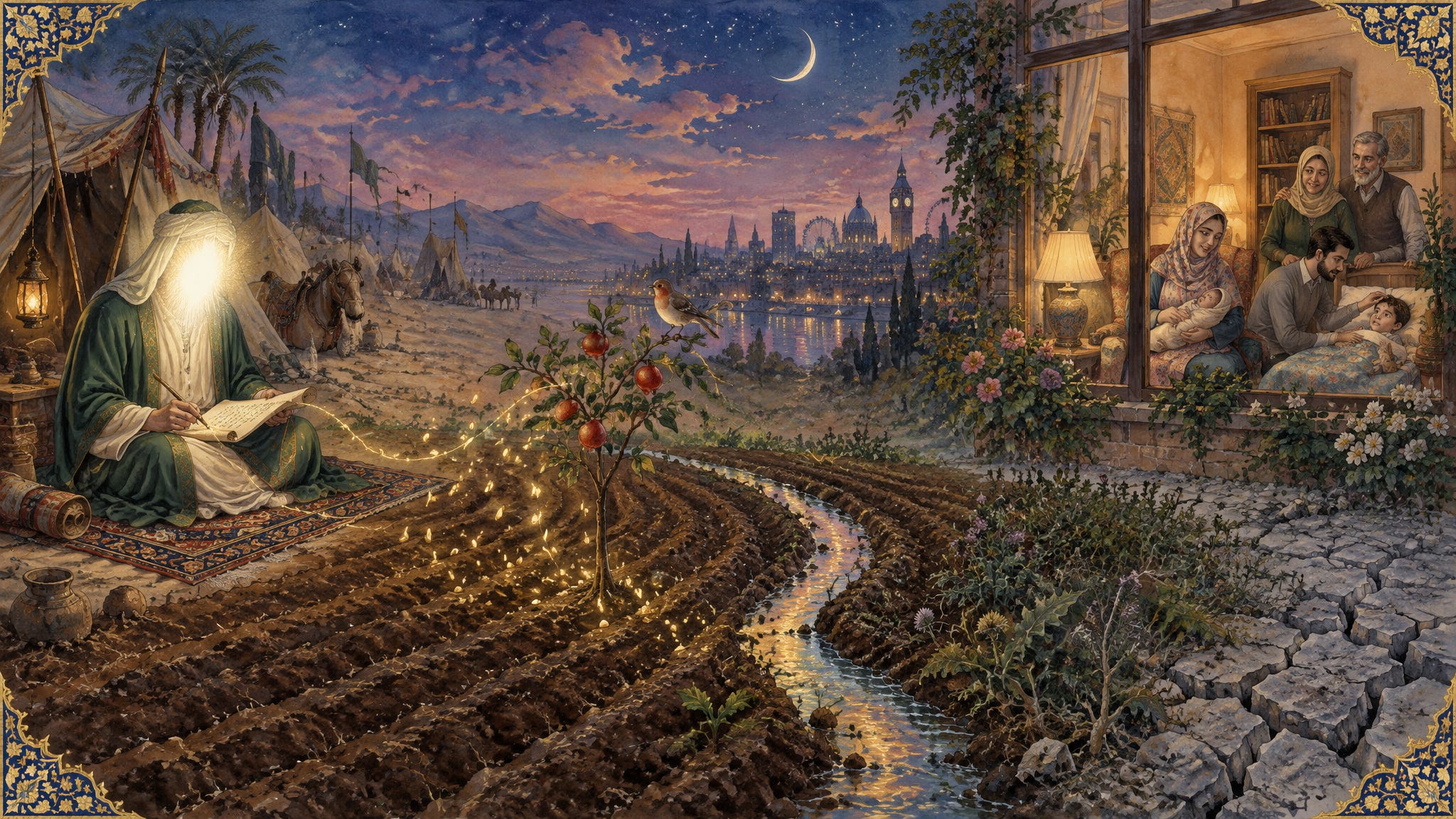
This is session one in our four-part Fatimiyyah 2026/1448 series, “Fruit of the Heart,” on raising our children — based on the Qur’an, the Tradition of the Ahlulbayt (peace be upon them), and guidance drawn from the teachings of the martyred leader, Imam Sayyed Ali Khamenei, may God rest his pure soul.
It follows last year’s Fatimiyyah series, “Wilayah in the Home,” on marriage and the family.
Each session builds on the one before it, so readers are encouraged to take them in order.
ومن وصية له (عليه السلام) للحسن بن علي (عليه السلام) كتبها إليه بحاضرين منصرفا من صفين
وَإِنَّمَا قَلْبُ الْحَدَثِ كَالْأَرْضِ الْخَالِيَةِ مَا أُلْقِيَ فِيهَا مِنْ شَيْءٍ قَبِلَتْهُ، فَبَادَرْتُكَ بِالْأَدَبِ قَبْلَ أَنْ يَقْسُوَ قَلْبُكَ، وَيَشْتَغِلَ لُبُّكَ، لِتَسْتَقْبِلَ بِجِدِّ رَأْيِكَ مِنَ الْأَمْرِ مَا قَدْ كَفَاكَ أَهْلُ التَّجَارِبِ بُغْيَتَهُ وَتَجْرِبَتَهُ، فَتَكُونَ قَدْ كُفِيتَ مَؤُونَةَ الطَّلَبِ، وَعُوفِيتَ مِنْ عِلاَجِ التَّجْرِبَةِ، فَأَتَاكَ مِنْ ذلِكَ مَا قَدْ كُنَّا نَأْتِيهِ، وَاسْتَبَانَ لَكَ مَا رُبَّمَا أَظْلَمَ عَلَيْنَا مِنْهُ.
“From his testament, peace be upon him, to al-Hasan ibn Ali, peace be upon him, which he wrote to him at Hadirin, on his way back from Siffin.”
“The heart of the young is like empty land: whatever is cast into it, it accepts. So I hastened to give you adab before your heart could harden and your mind be taken up, so that you would meet with the full earnestness of your judgement a matter whose seeking and testing the people of experience have spared you — spared the burden of the search and relieved of the toil of trial — so that what we used to come to has come to you, and what was perhaps dark to us has become clear to you.”
— Amir al-Mu’minin, Imam Ali ibn Abi Talib, peace and blessings be upon him; Nahj al-Balagha, Letter 31 — my translation1
Tonight we begin four nights on raising our children — in the days of the martyrdom of Sayyedah Fatimah al-Zahra, peace and blessings be upon her.
Four Saturday nights: for the new parent and the seasoned one, for the parent still waiting, and for every one of us who was once a child.
The letter on the screen is a father writing to his son.
Amir al-Mu’minin, Imam Ali, peace and blessings be upon him, to his son, Imam al-Hasan, peace and blessings be upon him.
And listen to what he compares a young heart to.
Not stone.
Not a slate.
Land.
Empty land, waiting.
Whatever is cast into it, it accepts.
Seed or weed — it accepts.
Then he tells his son why he wrote.
I hastened.
I did not wait.
I hurried to give you adab — formation, upbringing, the making of a person — before your heart could harden, and before your mind was taken up with everything else.
There is tonight’s title, in his own words.
Before the heart hardens.
Notice two things.
He expects the heart to harden.
That is not a complaint; it is how we are made.
Land that is never sown does not stay empty for ever — something grows in it.
And because he knows the window closes, he hurries.
And keep the heading in mind — where he wrote it.
We will come back to that2.
The Vow
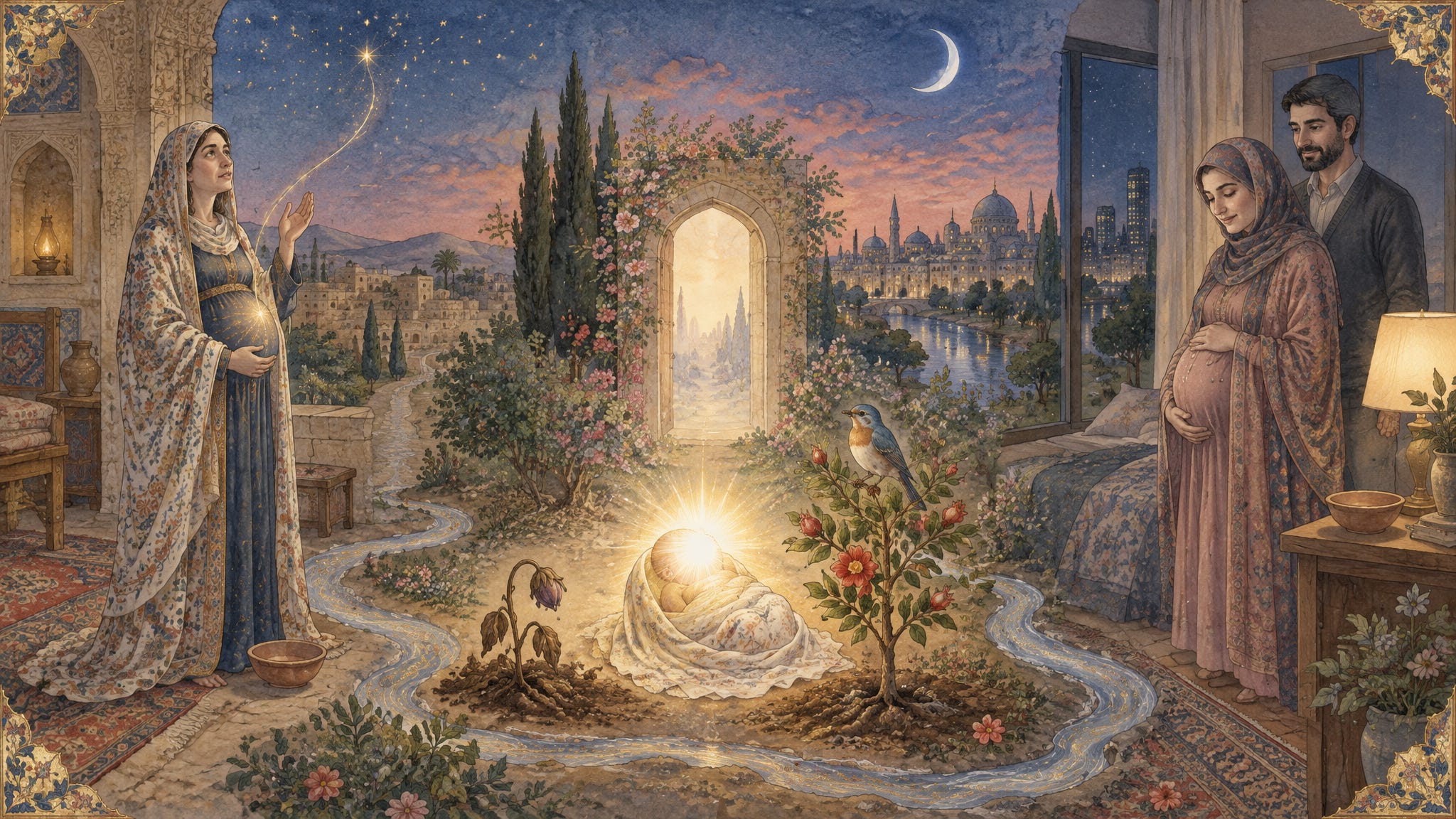
I want to begin with a mother, and a child she has not yet seen.
إِذۡ قَالَتِ ٱمۡرَأَتُ عِمۡرَٰنَ رَبِّ إِنِّي نَذَرۡتُ لَكَ مَا فِي بَطۡنِي مُحَرَّرٗا فَتَقَبَّلۡ مِنِّيٓۖ إِنَّكَ أَنتَ ٱلسَّمِيعُ ٱلۡعَلِيمُ
“When the wife of Imran said, ‘My Lord, I dedicate to You in consecration what is in my belly. Accept it from me; indeed You are the All-hearing, the All-knowing.’”
— Qur’an, Surah Aal Imran (the Chapter of the Family of Imran) #3, Verse 35
She has not held this child.
She does not know whether it is a boy or a girl, what its face will look like, what kind of person it will become.
And before any of that, she gives it away — to God.
In consecration
The Qur’an’s word is muharrar, set free.
Not hers to own.
Set free, for Him.
And notice what she asks for in return.
Nothing for herself.
Not a long life for the child, not success, not even safety.
One thing:
accept it from me.
Some of you are carrying a child tonight.
Some of you remember carrying one.
This is where upbringing begins in the Qur’an — not in a classroom, not at the age of seven, but in the womb, with a mother’s intention.
Hold on to that.
We will come back to it before the night is out.
Then the child is born.
فَلَمَّا وَضَعَتۡهَا قَالَتۡ رَبِّ إِنِّي وَضَعۡتُهَآ أُنثَىٰ وَٱللَّهُ أَعۡلَمُ بِمَا وَضَعَتۡ وَلَيۡسَ ٱلذَّكَرُ كَٱلۡأُنثَىٰۖ وَإِنِّي سَمَّيۡتُهَا مَرۡيَمَ وَإِنِّيٓ أُعِيذُهَا بِكَ وَذُرِّيَّتَهَا مِنَ ٱلشَّيۡطَٰنِ ٱلرَّجِيمِ
“When she bore her, she said, ‘My Lord, I have borne a female [child]’—and God knew better what she had borne, and the male [child she expected] was no match for the female [child she had borne] —‘and I have named her Mary, and I commend her and her offspring to Your care against [the evil of] the outcast Satan.’”
— Qur’an, Surah Aal Imran (the Chapter of the Family of Imran) #3, Verse 36
Why was she surprised?
Imam Ja’far al-Sadiq, peace and blessings be upon him, tells us.
God had revealed to her husband, Imran, that He would give him a son — sound and blessed, who would heal the blind and the leper and bring the dead to life by God’s leave, a messenger to the Children of Israel.
Imran told his wife, Hanna.
And while she carried the child, she thought it was that boy.
Then she gave birth — to a girl.
And the Imam says: when God gave Mary her son, Jesus, peace be upon him — he was the son whose good news God had given Imran.
— Imam Ja’far al-Sadiq, peace and blessings be upon him, through Abu Basir; Shaykh al-Kulayni, al-Kafi, Volume 1, hadith 1408 (thaqalayn) — narrated in part3
The promise was kept.
Not the way anyone foresaw — through the daughter.
Allamah Sayyed Muhammad Husayn Tabataba’i, may God rest his pure soul, reads the same verse, and he notices something in the words.
Her My Lord, I have borne a female is not news — God knows already.
It is sorrow.
But the two short sentences that follow —
God knew better what she had borne, and the male is not like the female
— are God’s words, he says, not hers.
Had they been hers, she would have put it the other way round:
the female is not like the male
— what I was given is not what I hoped for.
Nobody in disappointment says, what I hoped for is not like what I was given.
So God is answering her.
I knew she was a girl.
And through her He meant to give her mother what she longed for, in the best way there is.
The son she was hoping for could never have become what this daughter would be.
At most he would have been a prophet who heals the blind and the leper.
Through her, God’s word is completed — and Jesus himself is born.
And Allamah adds: Imran had died while she was carrying the child.
So when a daughter came, she became certain that the promised son would come through her daughter’s line — and she turned her vow to the daughter.
— Allamah Sayyed Muhammad Husayn Tabataba’i, al-Mizan fi Tafsir al-Qur’an, on Surah Aal Imran (the Chapter of the Family of Imran) #3, Verses 35 to 41 — narrated4
Shaykh Rizwan Arastu, who tells this whole story in English in his God’s Emissaries, puts it in one line:
“Little did she know that the boy she had expected was nothing like this girl she had been given.”
— Shaykh Rizwan Arastu, God’s Emissaries: Adam to Jesus, page 5395
The boy she expected — he means the son she thought she was carrying, not Jesus.
As he says himself in his notes: the comparison is between the son she expected and Mary, never between Jesus and his mother.
— Shaykh Rizwan Arastu, God’s Emissaries: Adam to Jesus, note 14, pages 539 to 540 — narrated6
And if there is a father here tonight who went quiet when they told him it was a girl — this verse is God’s own answer to him.
It is not a ranking of sons and daughters.
It is God saying:
I knew what I was giving you.
The same vow is in the Hebrew Bible.
Hannah prayed for a son, and when he came she lent him to the Lord for as long as he lived.
— 1 Samuel 1:27-28 (King James Version) — narrated7
And here is what God did with this girl.
فَتَقَبَّلَهَا رَبُّهَا بِقَبُولٍ حَسَنٖ وَأَنۢبَتَهَا نَبَاتًا حَسَنٗا وَكَفَّلَهَا زَكَرِيَّاۖ كُلَّمَا دَخَلَ عَلَيۡهَا زَكَرِيَّا ٱلۡمِحۡرَابَ وَجَدَ عِندَهَا رِزۡقٗاۖ قَالَ يَٰمَرۡيَمُ أَنَّىٰ لَكِ هَٰذَاۖ قَالَتۡ هُوَ مِنۡ عِندِ ٱللَّهِۖ إِنَّ ٱللَّهَ يَرۡزُقُ مَن يَشَآءُ بِغَيۡرِ حِسَابٍ
“Thereupon her Lord accepted her with a gracious acceptance, and made her grow up in a worthy fashion, and He charged Zechariah with her care. Whenever Zechariah visited her in the sanctuary, he would find provisions with her. He said, ‘O Mary, from where does this come for you?’ She said, ‘It comes from God. God provides whomever He wishes without any reckoning.’”
— Qur’an, Surah Aal Imran (the Chapter of the Family of Imran) #3, Verse 37
This is the verse of our whole series.
Listen to its three movements.
Her Lord accepted her — that is tonight.
He made her grow up in a worthy fashion — in the Arabic, nabatan hasanan, a beautiful growth — that is next week’s title.
And He charged Zechariah with her care — the guardian; the second and the third nights.
The second half of the verse — the sanctuary, the provision he found with her, and his question, where does this come from? — belongs to next week.
I name it tonight.
I will not tell it.
Allamah Tabataba’i, in one sentence: her beautiful growth was right guidance and purity — not size; and the gracious acceptance comes back to God choosing her, the beautiful growth to God purifying her — the very two words the angels would later say to her:
God has chosen you, and purified you.
— Allamah Sayyed Muhammad Husayn Tabataba’i, al-Mizan fi Tafsir al-Qur’an, on Surah Aal Imran (the Chapter of the Family of Imran) #3, Verses 35 to 41 — narrated8
Ayatullah Abdullah Jawadi Amoli, may God protect him, reads the verse like this.
Her mother has brought a pure child from the womb to the lap, and handed her over: the rest is Yours.
And God answered both of her requests — He accepted her, and He raised her well — and then He showed how the raising would be done.
For a righteous child to come to fruit, a teacher like Zechariah is needed.
God can raise the righteous in the foulest of places — He raised Moses, peace be upon him, in Pharaoh’s house — but that is the extraordinary way.
The ordinary way is a good educator.
— Ayatullah Abdullah Jawadi Amoli, Tasnim, his commentary on Surah Aal Imran, session 105, 15 August 1989 — narrated9
A teacher like Zechariah — hold that thought.
It is next week’s question.
And Moses in Pharaoh’s house will come back to us before the night is over.
Ayatullah Sayyed Muhammad Husayn Fadhlullah, may God rest his pure soul, draws the line from Mary to the daughter whose nights these are.
If God made Mary grow a beautiful growth and placed her in Zechariah’s care, He made Fatimah grow a beautiful growth and placed her in Muhammad’s care — and where is Zechariah beside Muhammad?
Her mind grew from what the Messenger of God, peace and blessings be upon him, his family, and his righteous companions, planted in it; her heart, through his upbringing; her life, through his care.
— Ayatullah Sayyed Muhammad Husayn Fadhlullah, Friday sermon, 17 September 1999 — narrated10
So here is the first thing I want you to carry out of this story.
The child you are given is not the child you planned.
Accept — then cultivate.
What Was Sown in Us
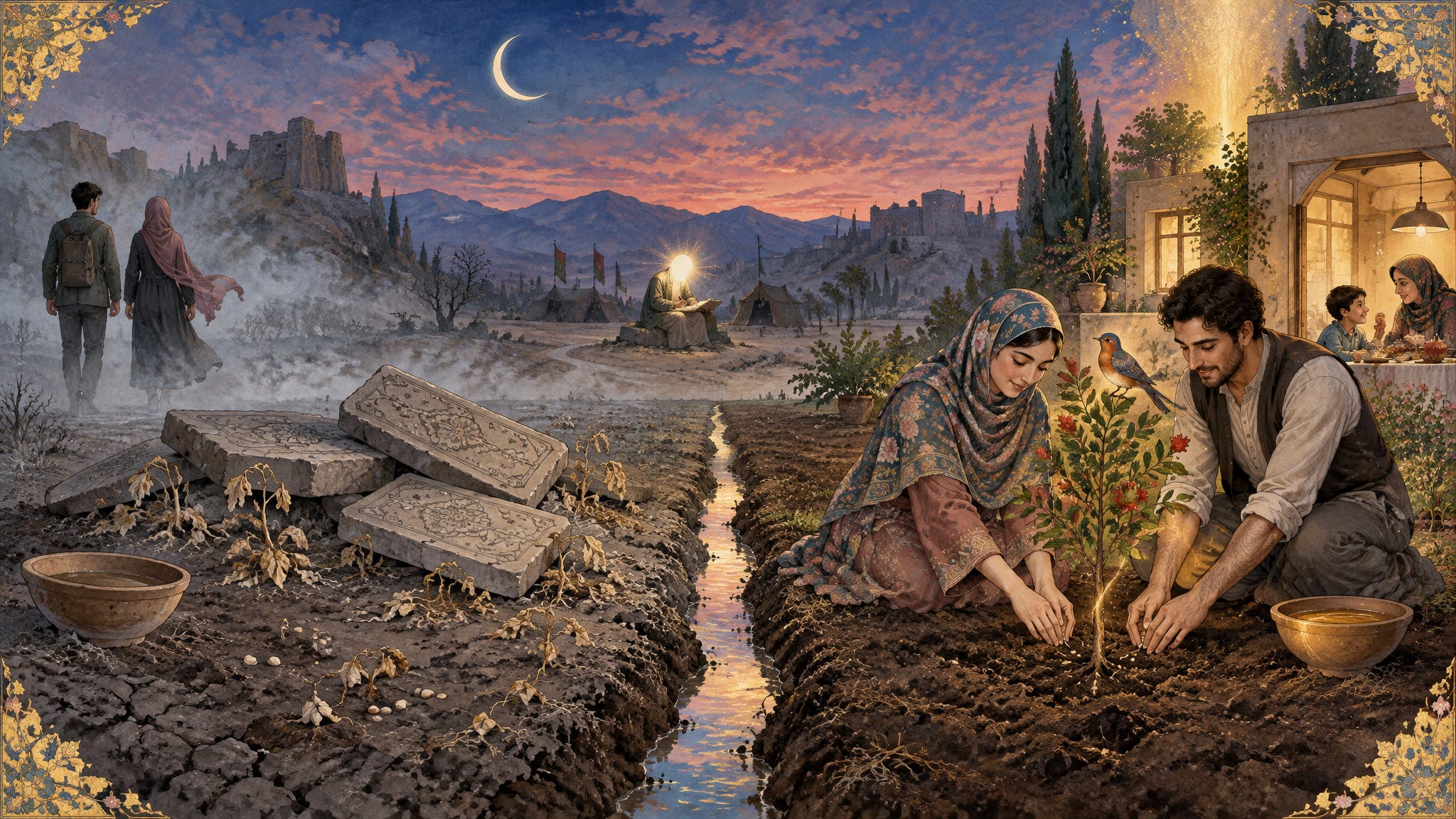
Let me say something about this room — about us.
Many of us were raised on rules without reasons.
Do this.
Don’t do that.
Pray — because I said so.
Cover — because people will talk.
Don’t ask — because asking is disrespect.
And some of us stayed.
Thank God, we stayed.
But too many stayed out of fear: fear of a father’s anger, of the community’s tongue, of a Hellfire described to us as if it were the only thing God had to say.
And some of us left.
Not because the religion failed us.
Because of how it was sown.
I want to be careful here.
I am not blaming the parents in this room, or the generation before us.
Most of them did their best with what they had been given — and many of them had been given rules without reasons too.
They passed on what they had received, and they passed it on with love.
And many of us were raised beautifully, by mothers and fathers who explained, who were gentle, who lived what they taught.
But if we are honest, we all know the other story.
We know the young man who can recite the rulings and cannot tell you why any of them is beautiful.
We know the young woman who put down her prayer the week she left home — because nobody ever planted it in her.
It had only ever been placed on her.
That is not a failure of the soil.
It is a failure of the sowing.
And it is not new.
Shaheed Ayatullah Murtaza Mutahhari, may God rest his pure soul, telling a story about a schoolmaster and his pupils, stops for a moment — in brackets — to remark that in the old days they used to torment children a great deal.
He does not dwell on it.
He does not need to.
— Shaheed Ayatullah Murtaza Mutahhari, Ta’lim va Tarbiyat dar Islam (Education and Upbringing in Islam), page 38 — narrated11
Now go back to the heading of the letter we began with.
Where did Amir al-Mu’minin, peace and blessings be upon him, write it?
At Hadirin — on his way back from Siffin.
He was governing a state.
He was coming home from a war — a war against people who prayed as he prayed.
And on the road, with all of that on his shoulders, he sat down and wrote to his son about the heart of the young.
If he made the time then, every one of us can find some time for it.
What kind of family does this sowing?
The martyred leader, Imam Sayyed Ali Khamenei, may God rest his pure soul, describes it.
In the English of The Compassionate Family:
خانوادهی خوب؛ یعنی زن و شوهری که با هم مهربان باشند، باوفا و صمیمی باشند و به یکدیگر محبّت و عشق بورزند، رعایت همدیگر را بکنند، مصالح همدیگر را گرامی و مهم بدارند، این در درجهی اوّل. بعد، اولادی که در آن خانواده به وجود میآید، نسبت به او احساس مسؤولیّت کنند، بخواهند او را از لحاظ مادّی و معنوی سالم بزرگ کنند. بخواهند از لحاظ مادّی و معنوی او را به سلامت برسانند، چیزهایی به او یاد بدهند؛ به چیزهایی او را وادار کنند، از چیزهایی او را باز دارند و صفات خوبی را در او تزریق کنند. یک چنین خانوادهای اساس همهی اصلاحات واقعی در یک کشور است؛ چون انسانها در چنین خانوادهای خوب تربیت میشوند، با صفات خوب بزرگ میشوند. با شجاعت، با استقلال عقل، با فکر، با احساس مسؤولیّت، با احساس محبّت، با جرأت، جرأت تصمیمگیری، با خیرخواهی – نه بدخواهی – با نجابت، خب وقتی مردم جامعهای این خصوصیات را داشته باشند، یعنی خیرخواه و نجیب و شجاع و عاقل و متفکّر باشند، این جامعه دیگر روی بدبختی را نخواهد دید.۱
“A good family, then, is one in which both partners are kind, faithful, and intimate with one another; they show one another love and affection; they look out for one another; and they respect and give importance to each other’s best interests. This is the first step. Next, they feel a sense of responsibility towards the children that are born into their family; they help them maintain their physical and spiritual wellbeing; they educate them, encourage them to engage in certain things and keep away from other things, and imbue virtuous qualities within them. Such a family becomes the source of all true reforms in a country.”
— Imam Sayyed Ali Khamenei, may God rest his pure soul, The Compassionate Family, page 34: the published English of Zan va Khanevadeh (Woman and Family), pages 88 to 89, from his marriage sermon of 1377/09/12 — 3 December 1998, as the book’s note 1 gives it
And in his own Persian he gives the reason — and there the word is not source but basis.
In a family like that, he says, people are raised well.
They grow up with courage, with independence of mind, with thought, with a sense of responsibility, with love, with daring — the daring to decide — with goodwill, and with nobility.
And a society whose people are like that, he says, will never again see the face of misfortune.
— Imam Sayyed Ali Khamenei, may God rest his pure soul, Zan va Khanevadeh (Woman and Family), pages 88 to 89 — narrated12
So this is the stake.
Raising children is raising a society.
The soil did not fail; the sowing did.
And the sowing is done before the heart hardens — which is the whole of tonight's subject.
What We Carry Forward
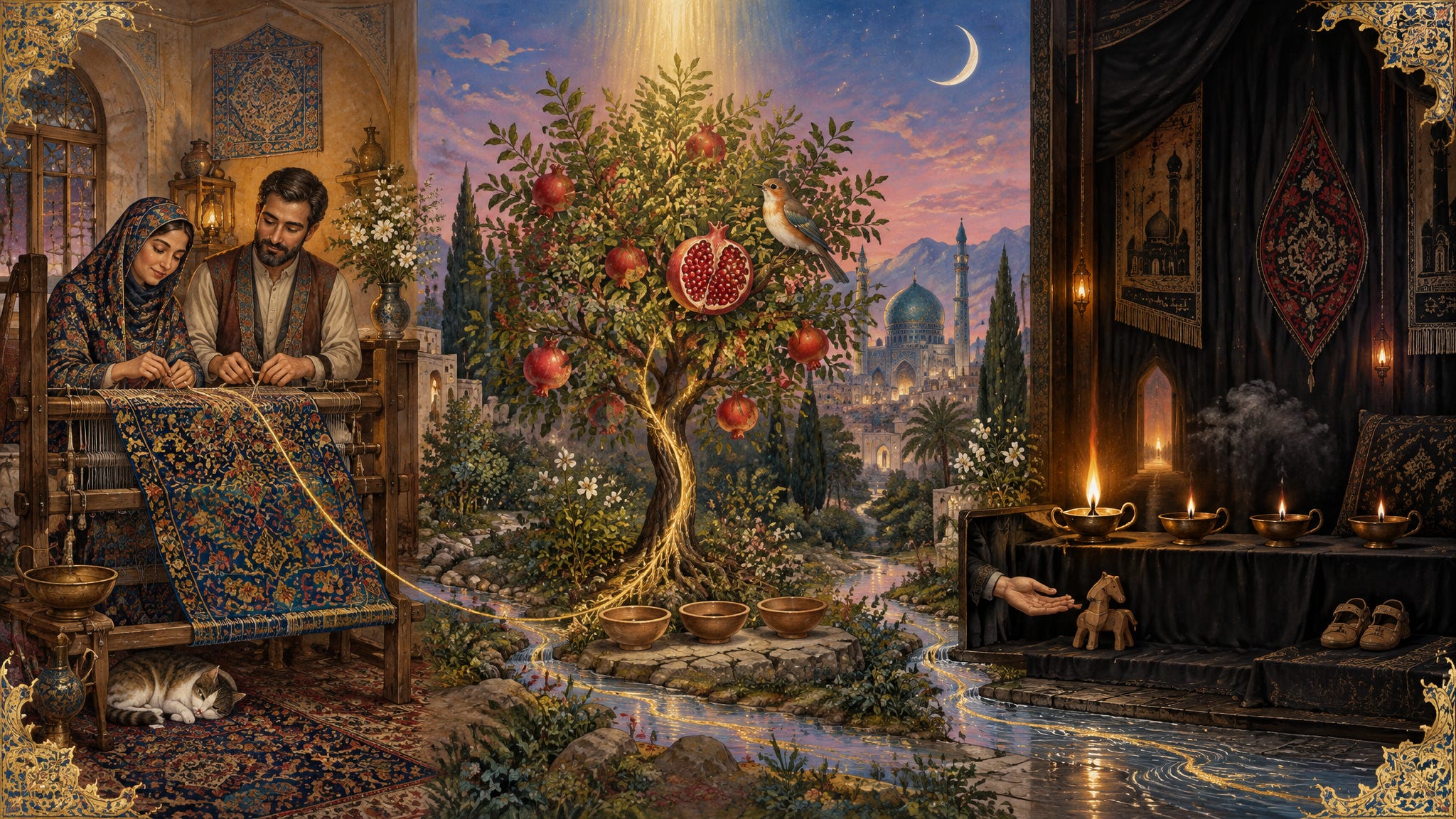
Last year, in these same days, we spent our Fatimiyyah nights on marriage — marriage as a covenant, and the home as a tapestry, woven thread by thread.
And on the second of those nights, in the supplication and eulogy for Sayyedah Fatimah al-Zahra, peace and blessings be upon her, I said this:
“And that the ultimate fruit of the tapestry is tarbiyyah, the sacred duty of raising righteous servants of God — a jihad for mothers and a duty for fathers.”
— from this majlis, last year: Wilayah in the Home, session 2, “The Unfolding Tapestry”, 23 November 202513
That line was not in the body of that night’s talk.
It came at the very end, almost in passing, in the supplication.
This year begins where last year ended — with its fruit.
Today is Saturday, the 12th of Jumada al-Ula, 1448 — the 24th of October, 2026.
And tonight is the night of the thirteenth: the night of her martyrdom, in the report that she lived seventy-five days after her father.
This is the first of four nights.
The last falls on or just after the 3rd of Jumada al-Thani — the date of the ninety-five days.
And the narrations give us a map for the first three of them.
They give a child three sevens: seven years of play, seven of learning, and seven of companionship — you will hear the words themselves later tonight.
Tonight is the first seven.
Next week, the guardian — Zechariah, and the question he asked her.
Then the storm years.
And on the last night, Karbala: grief, and the children who go ahead of us.
So tonight has three movements.
First, the soil — what a child is when she arrives.
Is she clay?
A blank page?
Or something else?
Second, the gardener — what it actually means to raise a child; what tarbiyah is, and what it is not.
And third, the first school — what the first seven years are for, and who the first teachers are.
Video of the Majlis (Sermon/Lecture)
Living Soil, Not Clay — The Fitrah
Born Facing Him

So — what is a child, when she arrives?
Zurara, one of the great companions of the Imams, once asked Imam Muhammad al-Baqir, peace and blessings be upon him, about a phrase in the Qur’an:
Hunafa’ for God — people turned, wholly, towards God.
And the Imam said: that turning is the fitrah — the original nature on which God created people.
There is no altering God’s creation.
God created them, he said, upon knowing Him.
Then Zurara asked him about the covenant — the verse in which God brings the children of Adam out of their fathers’ loins and asks them:
Am I not your Lord? — and they say: Yes.
And the Imam said: God brought out the offspring of Adam, every one of them until the Day of Resurrection, like tiny particles; and He made Himself known to them, and showed them Himself.
Were it not for that, no one would know his Lord.
And then the Imam said: the Messenger of God, peace and blessings be upon him, his family, and his righteous companions, said:
Every newborn is born upon the fitrah — that is, knowing that God is his Creator.
As the Qur’an says:
Ask them who created the heavens and the earth, and they will say: God.
— Zurara, from Imam Muhammad al-Baqir, peace and blessings be upon him; Shaykh al-Kulayni, al-Kafi, Volume 2, hadith 21 (thaqalayn), the first report — narrated14
The verse he quoted is this:
فَأَقِمۡ وَجۡهَكَ لِلدِّينِ حَنِيفٗاۚ فِطۡرَتَ ٱللَّهِ ٱلَّتِي فَطَرَ ٱلنَّاسَ عَلَيۡهَاۚ لَا تَبۡدِيلَ لِخَلۡقِ ٱللَّهِۚ ذَٰلِكَ ٱلدِّينُ ٱلۡقَيِّمُ وَلَٰكِنَّ أَكۡثَرَ ٱلنَّاسِ لَا يَعۡلَمُونَ
“So set your heart as a person of pure faith on this religion, the original nature endowed by God according to which He originated mankind (There is no altering God’s creation; that is the upright religion, but most people do not know.)”
— Qur’an, Surah al-Rum (the Chapter of the Romans) #30, Verse 30
And in the same place Shaykh al-Kulayni records a second report, from Imam Ja’far al-Sadiq, peace and blessings be upon him, on the same verse — in one line:
God created them upon tawhid, upon His oneness.
— Imam Ja’far al-Sadiq, peace and blessings be upon him; Shaykh al-Kulayni, al-Kafi, Volume 2, hadith 21 (thaqalayn), the second report — narrated15
The same teaching comes again and again in Shaykh al-Saduq’s book al-Tawhid, and Ayatullah Muhammad Asif Muhsini includes it in his collection of reports he judges reliable.
This is not a stray narration.
It is a foundation.
— Shaykh al-Saduq, al-Tawhid, hadiths 373, 374, 377 and 378 (thaqalayn); Ayatullah Muhammad Asif Muhsini, Mu’jam al-Ahadith al-Mu’tabara, Volume 1, hadith 504 (thaqalayn) — narrated16
Now think about what that means for the child in your arms.
She did not arrive empty of God.
She arrived turned towards Him.
Before she can say a word, before she can tell her right hand from her left, the seed of knowing Him is already in her — placed there by the One who made her.
We do not install faith in a child.
We find it there — and we protect it.
That changes everything about how we do this.
If a child is an empty container, then raising her means filling her — and the more you pour in, the faster, the better.
But if she is born facing God, then our first job is not to pour.
It is to keep the blight off what is already growing.
Empty Land Is Not a Blank Page
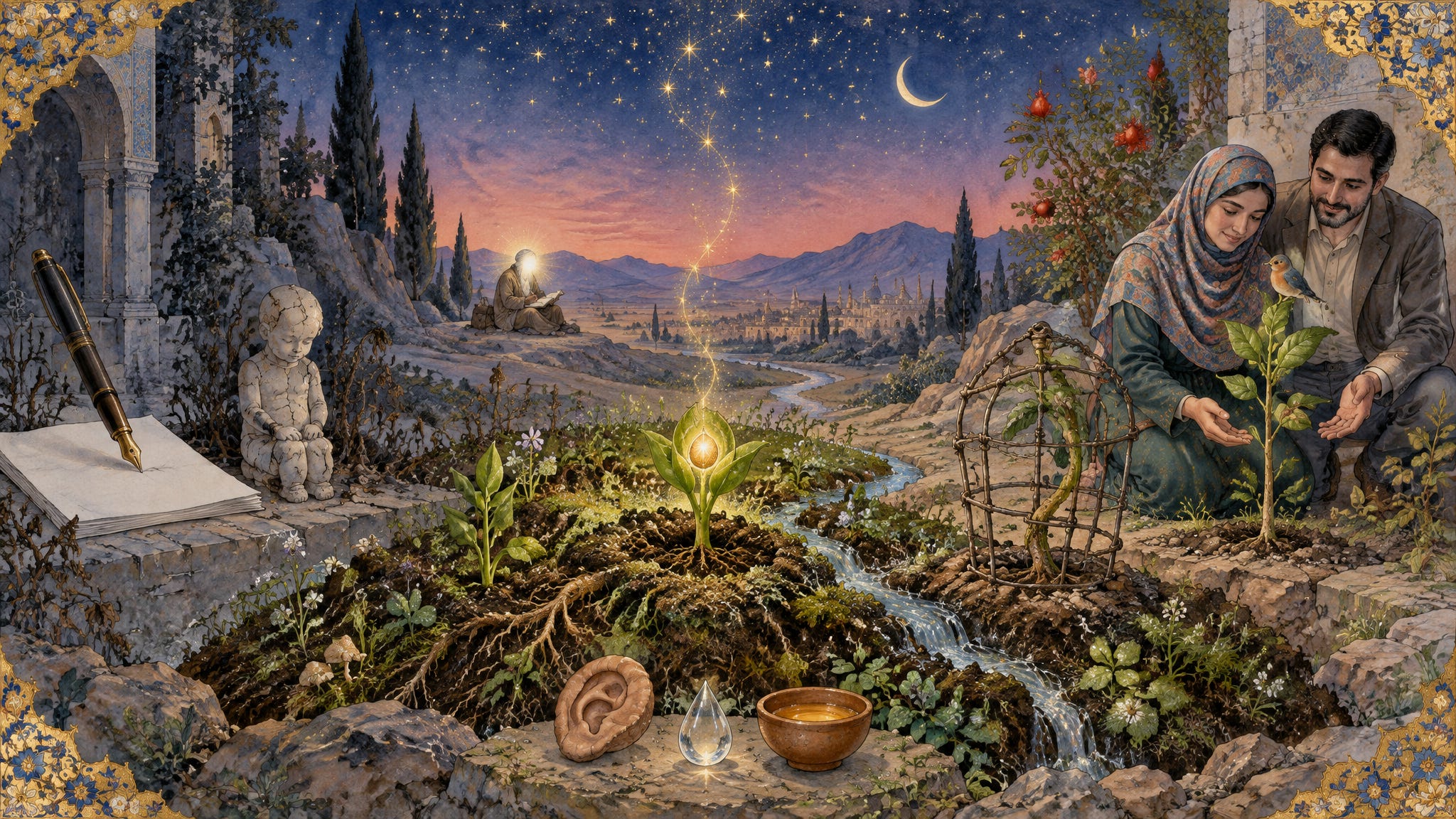
Go back to the letter.
The heart of the young is like empty land.
Empty land is not nothing.
Anyone who has ever had a garden knows this.
Leave a patch of earth alone for one season, and see what happens: it is full of life.
Empty land is living soil — and that is exactly why it takes whatever is cast into it.17
Shaheed Mutahhari, may God rest his pure soul, puts this in the language of philosophy.
Everything else in creation, he says, was created in act — already what it is, and already how it is to be.
The human being alone was created in potential.
The seed of his humanity is in him; and if it meets no blight, it sprouts, little by little, from the ground of his own being.
These are his innate traits — and later they build his conscience.
— Shaheed Ayatullah Murtaza Mutahhari, Moqaddame-i bar Jahan-bini-ye Eslami (An Introduction to the Islamic Worldview), Volume 4, Ensan dar Qur’an (Man in the Qur’an), page 66 — narrated18
And in a footnote on the same page, he closes off two mistakes.
The first is the idea that a newborn is like a white page — a white page, which stands equal to whatever imprint is recorded on it.
That, he says, is the view of those who deny the fitrah altogether, and he rejects it.
The second mistake is the opposite one: that a child is born with ideas and wants already formed, ready-made.
No, he says.
A child is born seeking — moving towards what he can become, with a force inside him driving him that way.
If he reaches the actuality that is his own, he has reached his humanity.
And if an actuality that is not his own is forced on him from outside — by pressure and compulsion — he will be, in his word, disfigured.
— Shaheed Ayatullah Murtaza Mutahhari, Moqaddame-i bar Jahan-bini-ye Eslami, Volume 4, page 66, note 1 — narrated19
Disfigured.
That is a strong word for what we do when we force a child into a shape that is not his.
Someone may say:
But doesn’t the Qur’an tell us we were born knowing nothing?
وَٱللَّهُ أَخۡرَجَكُم مِّنۢ بُطُونِ أُمَّهَٰتِكُمۡ لَا تَعۡلَمُونَ شَيۡـٔٗا وَجَعَلَ لَكُمُ ٱلسَّمۡعَ وَٱلۡأَبۡصَٰرَ وَٱلۡأَفۡـِٔدَةَ لَعَلَّكُمۡ تَشۡكُرُونَ
“God has brought you forth from the bellies of your mothers while you did not know anything. He made for you hearing, eyesight, and hearts so that you may give thanks.”
— Qur’an, Surah al-Nahl (the Chapter of the Bee) #16, Verse 78
Yes — and listen to the verse closely.
You did not know anything — nothing learned, nothing taught.
And in the same breath:
He made for you hearing, eyesight, and hearts.
Not knowing anything is not the same as being blank.
A child is born without lessons, but not without a compass — and not without the tools to learn.
The report we heard from Imam al-Baqir, peace and blessings be upon him, is the bridge between the two: no lessons yet, but a face already turned towards its Lord.
So a child is not clay, waiting for our hands.
And she is not a blank page, waiting for our handwriting.
She is living soil, with a seed already in it.
It Begins Before Birth
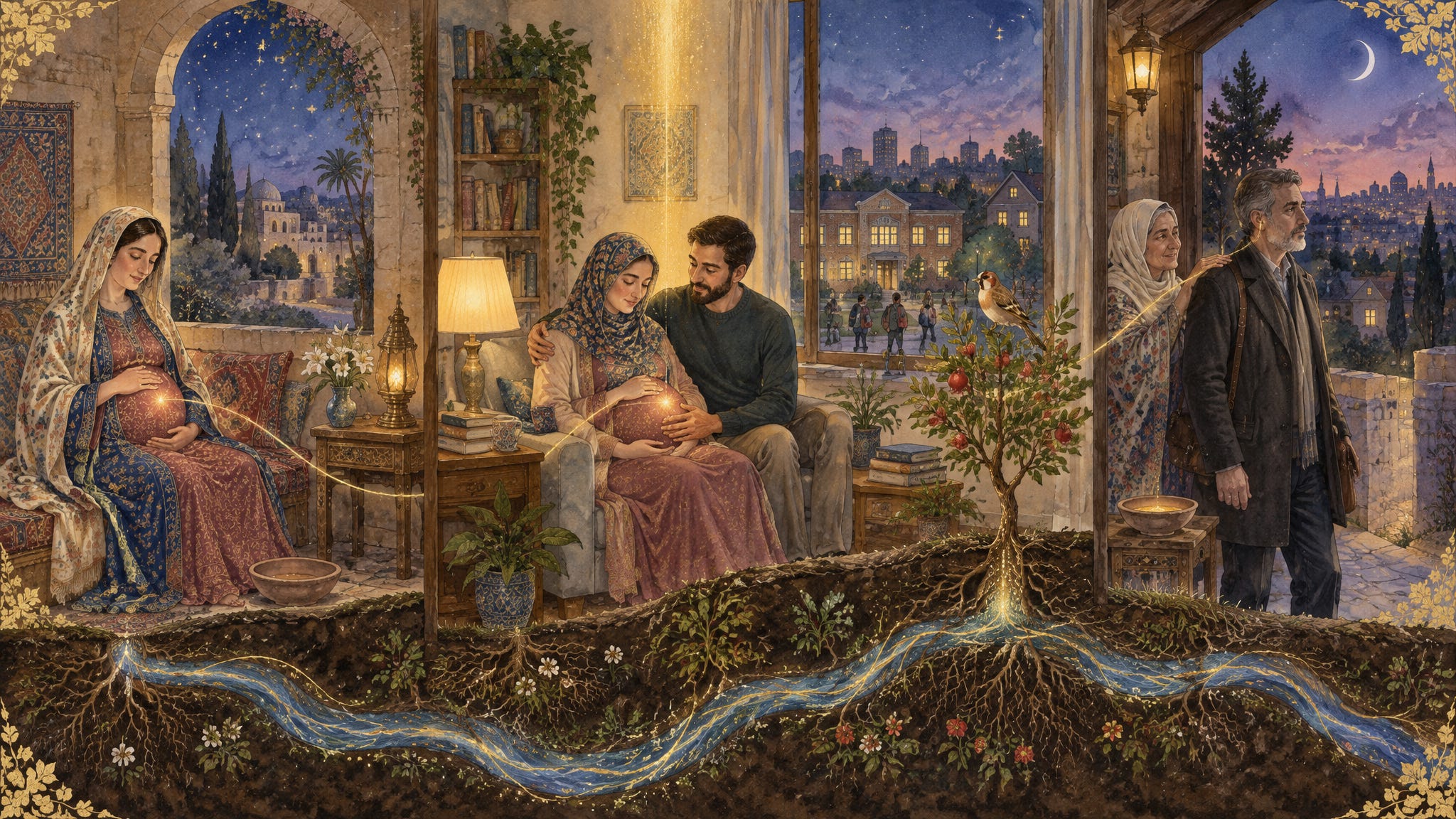
And when does all this begin?
Go back to the mother of Mary.
Ayatullah Jawadi Amoli draws two things from her vow.
The first is that a vow is valid even over a child still in the womb.
And the second is deeper: that the mother has a guardianship — a wilayah — over her child even before it is born.
The child does not have to come into the world to be under the care and authority of its mother and father.
— Ayatullah Abdullah Jawadi Amoli, Tasnim, his commentary on Surah Aal Imran, session 106, 16 August 1989 — narrated20
The martyred leader, Imam Sayyed Ali Khamenei, may God rest his pure soul, says the same in plain words.
The first place where a person’s soul, emotions and thoughts can be kindled, he says, is the family — and in fact it begins before the person is born.
And notice how honest he is: the school, the friends, the neighbourhood, the teachers, the books — yes, they matter; sometimes they can even override the home.
And still, he says, what ultimately sets the stage is the family ambience.
— Imam Sayyed Ali Khamenei, may God rest his pure soul, The Compassionate Family, page 49 — narrated21
And on the birthday of Sayyedah Fatimah al-Zahra, peace and blessings be upon her, in 2005, he went further.
The mother’s role, he said, begins in the time of carrying the child, in pregnancy — and it lasts to the end of a person’s life.
A grown man, a man past his youth, is still living under the influence of his mother’s tenderness.
— Imam Sayyed Ali Khamenei, may God rest his pure soul, speech of 27 July 2005 (1384/05/05) — narrated22
Some of the men in this room are fifty, sixty years old.
Ask yourselves whose voice you still hear when you are about to do something you shouldn’t.
So the soil is living, the seed is already in it, and the sowing begins before the child has even arrived.
For some of you, it has already begun.
Lessons for Our Time
Lesson One — Your Child Arrives Turned Towards God. Protect and Tend; Do Not Install.
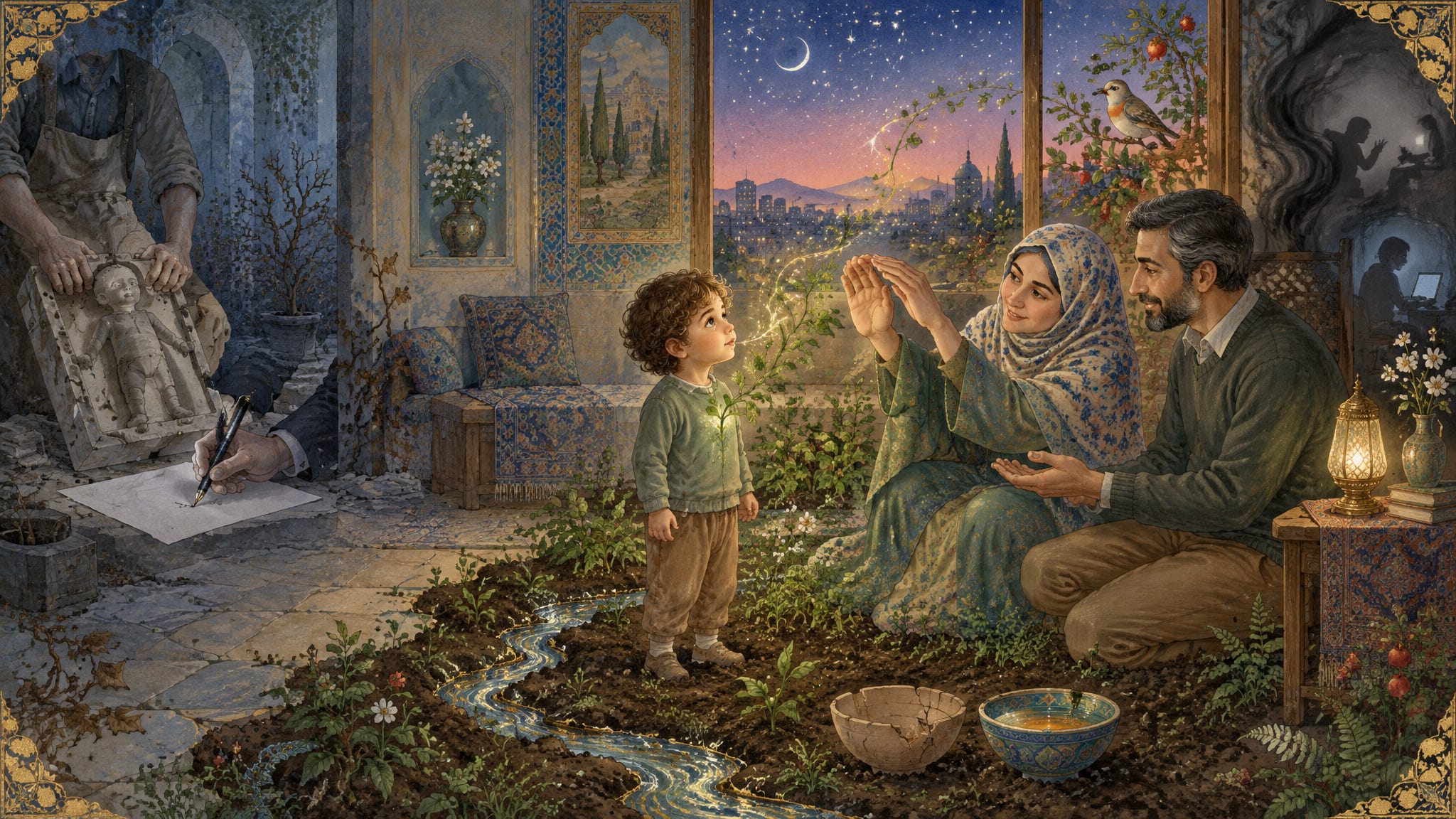
The first lesson is about what we think our job is.
If you believe a child is clay, you will spend your parenting pressing.
If you believe she is a blank page, you will spend it writing — as much as you can, as fast as you can, before somebody else writes on her first.
And both of those parents, however much they love their child, are working against what she already is.
What you have been given is not clay.
It is a seedling already facing the light.
So your work is a gardener’s work.
Keep the blight off it: what she watches, what she hears, what is said in front of her, what she sees you do when you think she is not looking.
And give it what it needs: warmth, attention, time, and a home where the remembrance of God is natural — not a performance, and not a punishment.
Notice what is not on that list.
Manufacturing faith from the outside.
Frightening a four-year-old with the Fire so that she will pray.
Treating every question she asks about God as a threat to be silenced, rather than the fitrah doing exactly what it was made to do.
When your small child asks you who made the sky, or where her grandfather went, or whether God can see her under the blanket — that is not a problem to be managed.
That is the seed sprouting.
Kneel down, and answer her.
Lesson Two — To the Wounded Adult: the Fitrah Is Buried, Not Gone.
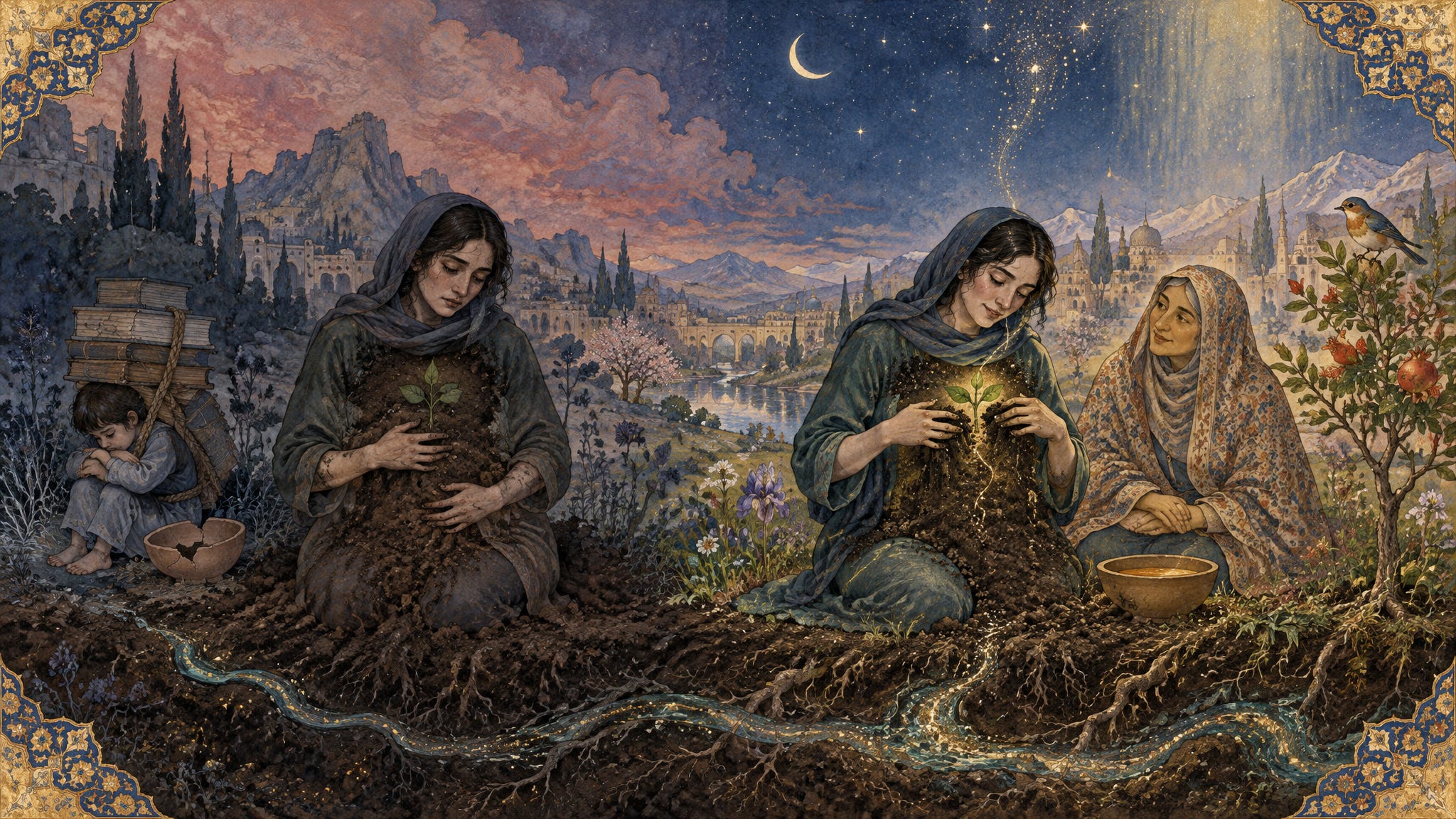
The second lesson is not for the children.
It is for some of us.
Some of you were not raised as a garden.
You were raised as a project — or as a problem.
Some of you carry a religion that was pressed on you so hard that, for years, you could not hear its voice at all.
And perhaps you sit here tonight thinking: it is too late for me; whatever was in me is dead.
Listen to Ayatullah Jawadi Amoli.
Explaining the Qur’an’s word for burying something in the earth, he says: you poured soil on your fitrah.
A soil of aims, a soil of instincts, a soil of lust and of anger, a soil of fancy and imagination.
You buried it — and its voice no longer reaches your ears.
But it is there.
It does not perish.
And so the Qur’an says, in effect:
take hold of your fitrah.
Do not bury it.
And if you have poured soil on it, take the soil away.
We gave you such a thing, he says, and no one can change it.
— Ayatullah Abdullah Jawadi Amoli, Tasnim, his commentary on Surah al-Ma’arij, session 6, 16 January 2019 — narrated23
That is the word of this series to every parent here who carries a wound of their own.
What was sown badly can be sown again.
The soil is still alive.
And you are not only raising your children — God willing, over these four nights, you may find something in yourself that you thought had gone.
The Gardener, Not the Potter — What Tarbiyah Means
The Goldsmith and the Gardener
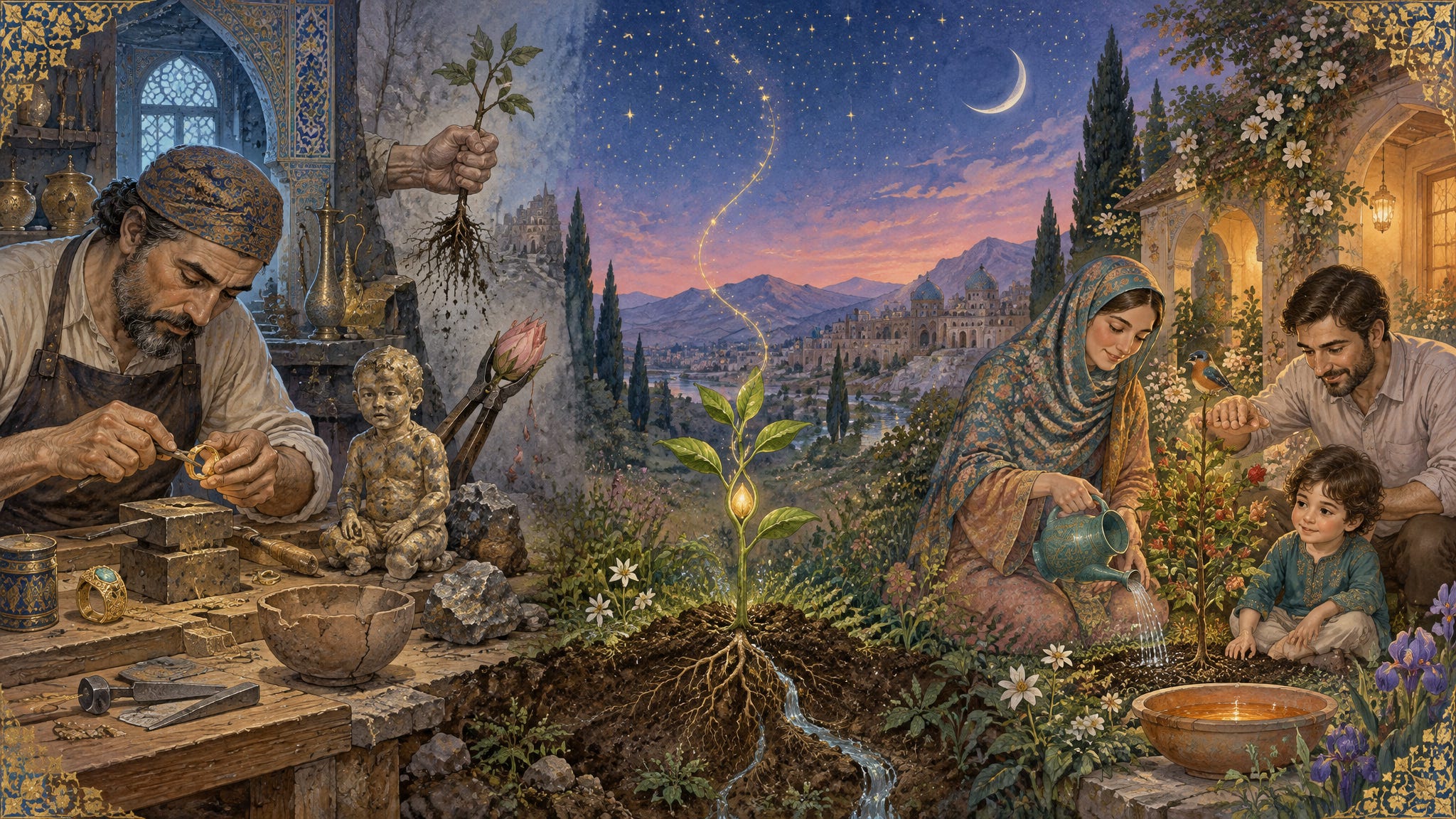
If a child is living soil with a seed already in it, then what does it mean to raise her?
Our word for it is tarbiyah — in Persian, tarbiyat.
And Shaheed Mutahhari begins by telling us what it is not.
Upbringing, he says, is not making.
Making is building from the outside.
A goldsmith takes a piece of gold and makes a ring out of it: he cuts, he joins, he shapes, he polishes — and the gold becomes the thing he wanted.
Upbringing is something else.
It is raising: bringing out, into reality, the capacities that are already inside a thing in potential.
That is why, he says, upbringing belongs only to living things — a plant, an animal, a human being.
You cannot raise a stone.
You cannot raise a piece of metal.
You can only make something out of it.
And from that, he says, one thing follows:
upbringing must follow the fitrah — the nature and the make of the one being raised.
Then he draws the conclusion that matters most for us.
Fear, intimidation and threats, he says, raise nothing in a human being.
You cannot pull a bud open to make it a flower.
You cannot take hold of a sapling and pull it upwards to make it grow.
Growth does not come by pulling.
It needs soil, water, air, light and warmth — given with gentleness and softness, by its own way.
Force has no rule there.
And hitting, frightening and threatening are among the things he names that raise nothing at all.
— Shaheed Ayatullah Murtaza Mutahhari, Ta’lim va Tarbiyat dar Islam, pages 43 to 44 — narrated24
The Gardener and the Carpenter
In another of his books, he gives us the picture that sits at the heart of tonight.
His subject there is the individual and society — but the picture he uses to explain it is a garden, and it fits our homes exactly.
The one who raises, he says, is more than fifty per cent subject to the one he raises.
Sit with that for a moment.
More than half of the work is not you deciding; it is you learning — learning the capacities of the one you are raising, and working in their direction.
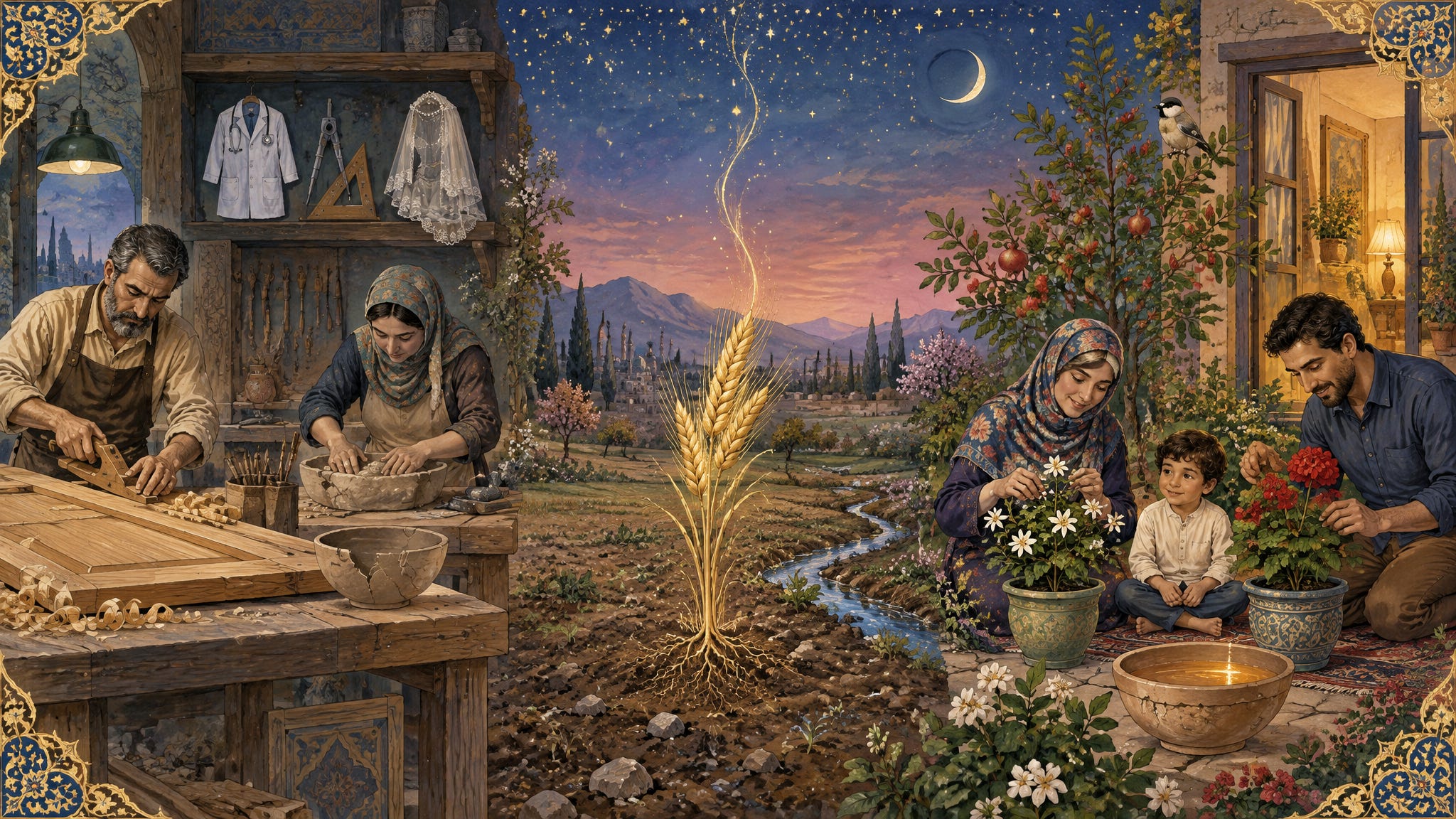
He is like a gardener.
A gardener cannot make a jasmine out of a geranium, or a geranium out of a jasmine.
What he does is learn each flower — by experience, by patience: this one opens best if I approach it this way; that one, that way.
And with each, he works with what is already in it.
This, he says, is the work of upbringing.
The carpenter is different.
When a carpenter makes a door out of wood, the wood was never moving towards being a door.
He does not learn the law of its becoming a door and help it on its way; he imposes on it the form he wants.
The maker, he says, always imposes his own idea on the thing he makes.
And then the line I want you to take home.
A person, he says, is not a body you dress in whatever garment you choose.
He is wheat — and wheat has to be raised.
You must see what it has the capacity to become.
This has the capacity to become wheat; you cannot make rice of it, nor can you make barley.
— Shaheed Ayatullah Murtaza Mutahhari, Falsafe-ye Tarikh (The Philosophy of History), Volume 1, page 143 — narrated25
So the title of this point is ours, not his: the gardener, not the potter.
A potter is a maker.
He takes clay that has no wish of its own and turns it into the pot he has in mind.
Many of us parent like potters.
We decide the doctor, the engineer, the husband, the wife — the whole shape — and then we press.
And when the clay resists, we press harder.
But you do not have clay.
You have wheat.
Or jasmine.
Or a geranium.
Your work is to find out which — and to raise that.
The Sheep
He has one more picture, and it is a hard one.
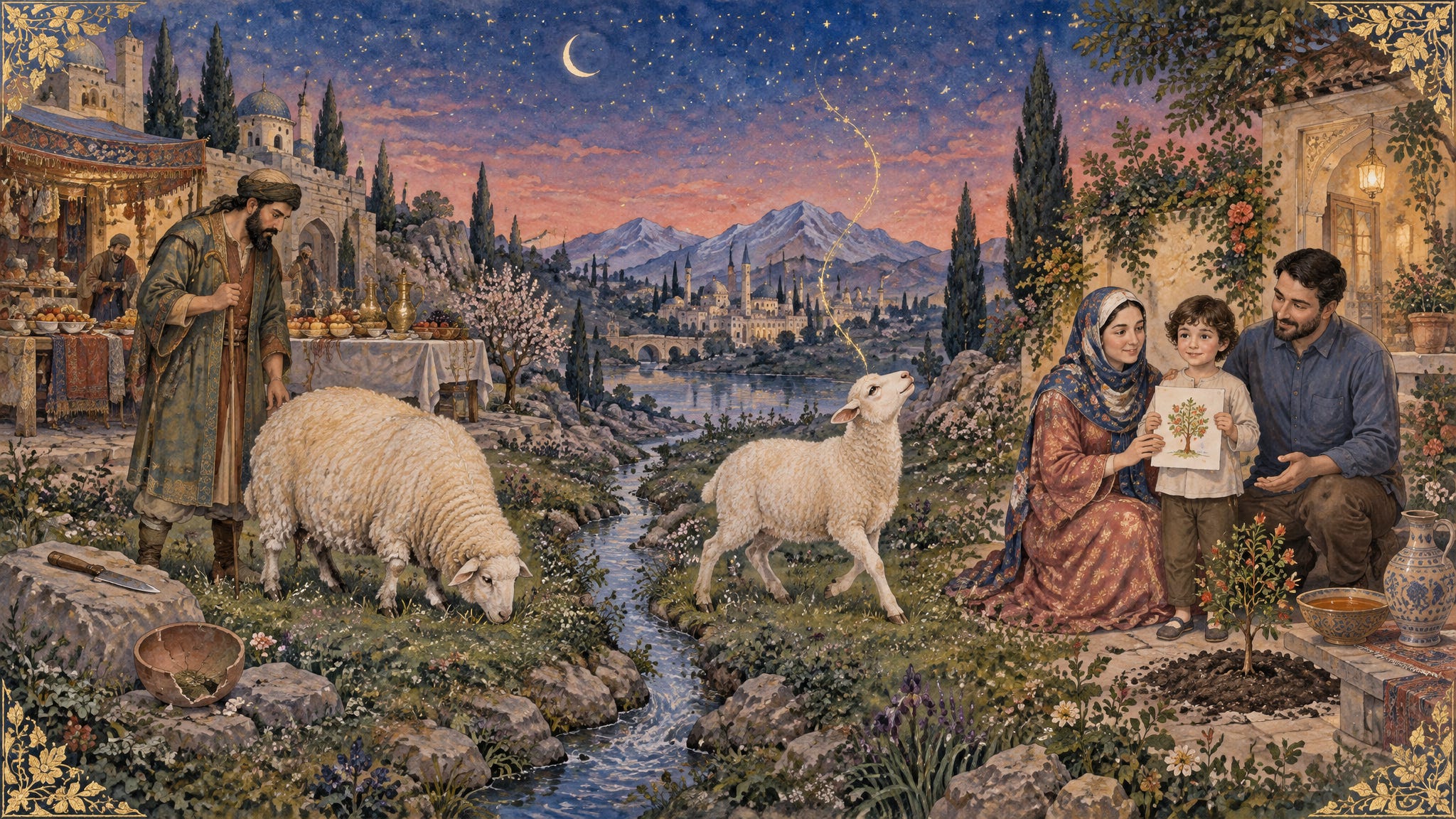
A man wants to fatten his sheep — to sell it, or to eat it.
But a sheep in its natural state, he says, will not keep its head down and graze; its urges keep pulling it this way and that.
So the man castrates it.
And now the animal keeps its head down, busies itself with nothing but grazing, and grows fat.
From the man’s point of view, he has perfected his sheep.
From the sheep’s point of view?
He has made a defect in it.
A school of upbringing, he says, can be like that man: it can have an aim outside the human being, and shape him for that aim.
But a humane school has no aim outside the one it raises.
Its goal is the person himself — to bring him to his own perfection.
— Shaheed Ayatullah Murtaza Mutahhari, Ta’lim va Tarbiyat dar Islam, PDF page 180 — narrated26
Our children are not raised for anyone else’s use — not for our pride, and not for the family’s name.
God’s Flower
Ayatullah Muhammad Taqi Misbah Yazdi, may God rest his pure soul, speaking to those who teach and raise children, put the same thing in words a child could understand:
عزیزانی که به دست شما سپرده میشوند امانتهای الهی هستند. خدا یک گل زیبا، خوشرنگ، خوشبو و خوشمنظره را به دست شما میسپارد و میگوید این را نگهداری کنید، به موقع آبیاری شود، جای کثیف قرار نگیرد، نور و حرارتش متناسب باشد تا این رشد کند. شما از طرف من این کارها را انجام دهید.
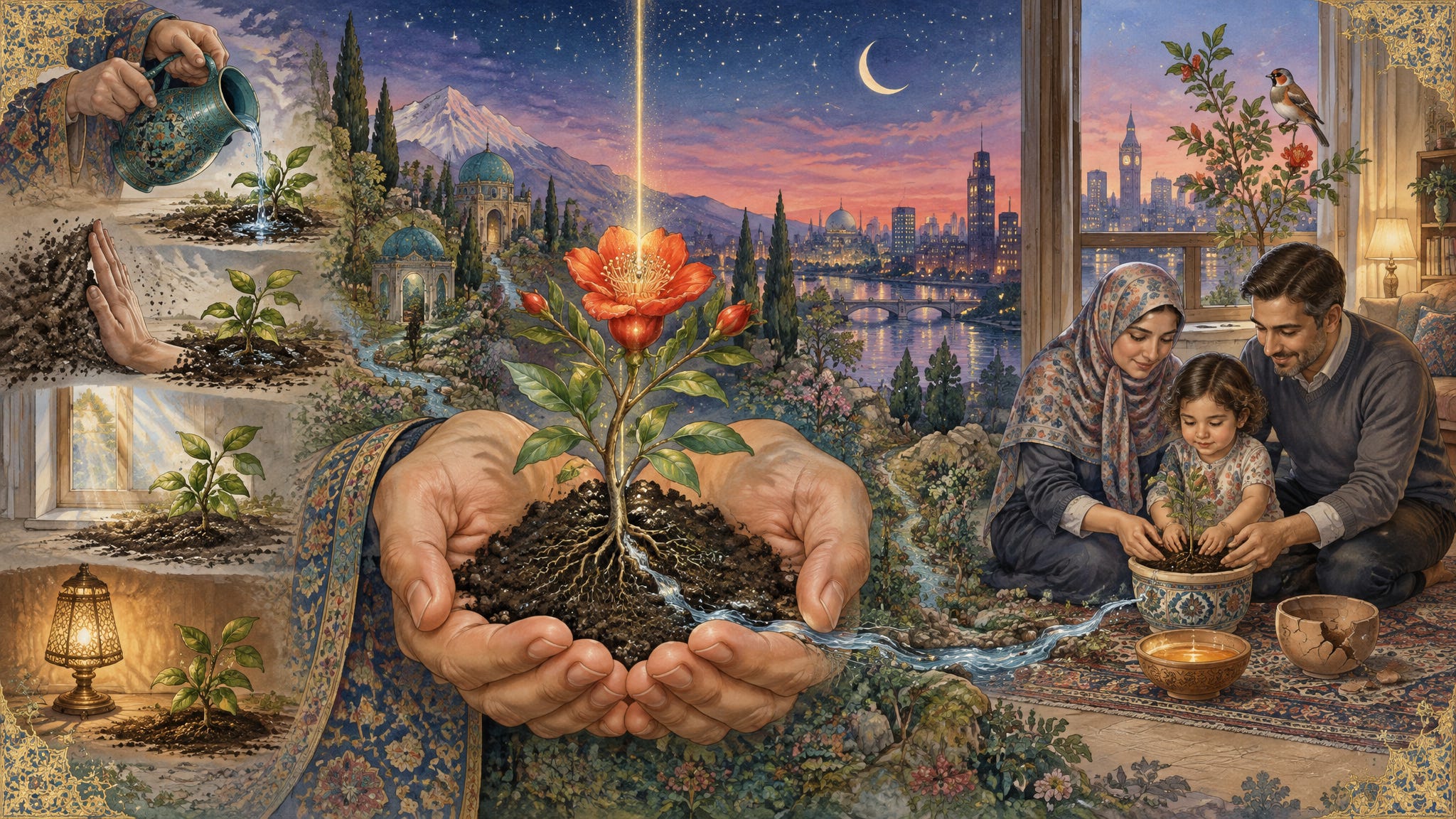
“The dear ones entrusted to your hands are divine trusts. God entrusts a beautiful flower to your hands — lovely in colour, scent and look — and says: Look after this; let it be watered on time, let it not be put in a dirty place, let its light and warmth be right, so that it grows. Do these things on My behalf.”
— Ayatullah Muhammad Taqi Misbah Yazdi, may God have mercy on him, a talk of 22 May 2017 (1 Khordad 1396; mesbahyazdi.ir) — my translation
On My behalf.
You are not the owner of this flower.
You are the one God has asked to tend it — for Him.
Kindling, Not a Storehouse

Shaheed Mutahhari has one more distinction, and though he makes it about teaching, it applies to every home.
In mere teaching, he says, the learner is treated as a storehouse — a store into which a series of facts is poured, until his mind is like a pool where some water has collected.
But the teacher’s real work is higher: to raise the learner’s own power of thought, to give it independence, to bring his initiative to life.
The teacher’s work, in truth, is to give kindling.
— Shaheed Ayatullah Murtaza Mutahhari, Ta’lim va Tarbiyat dar Islam, page 16 — narrated27
And he takes us to a saying of Amir al-Mu’minin, peace and blessings be upon him:
knowledge is two — the natural, and the heard; and the heard does not profit where the natural is not there.
— Amir al-Mu’minin, Imam Ali ibn Abi Talib, peace and blessings be upon him; Nahj al-Balagha, Saying 338 — narrated28
The natural knowledge, he explains, is what springs from a person’s own make — his own power to think.
And then he says something that should make every parent pause.
There are people, he says, in whom that natural knowledge seems to be missing altogether.
And the cause, mostly, is not that they lacked the capacity.
It is bad teaching and bad upbringing — upbringing that never set that power moving.
— Shaheed Ayatullah Murtaza Mutahhari, Ta’lim va Tarbiyat dar Islam, page 17 — narrated29
And he gives an image you will not forget.
The mind, he says, is like the stomach.
A stomach has to take its food in measure, and work on it, and make it its own — and for that it needs room.
A stomach that is stuffed, constantly, as full as it will go, cannot digest anything.
So it is with the mind: if the facts press too hard, the child’s mind goes stagnant.
Give him room to think, and encourage him to think.
— Shaheed Ayatullah Murtaza Mutahhari, Ta’lim va Tarbiyat dar Islam, page 19 — narrated30
His subject on these pages is the classroom.
But take it home as a picture.
A child who is only ever told — told what to think, told what to feel, told the answer before he has finished asking the question — is being fed past the point of digestion.
Give him kindling.
Let him catch light.
A Beautiful Growth
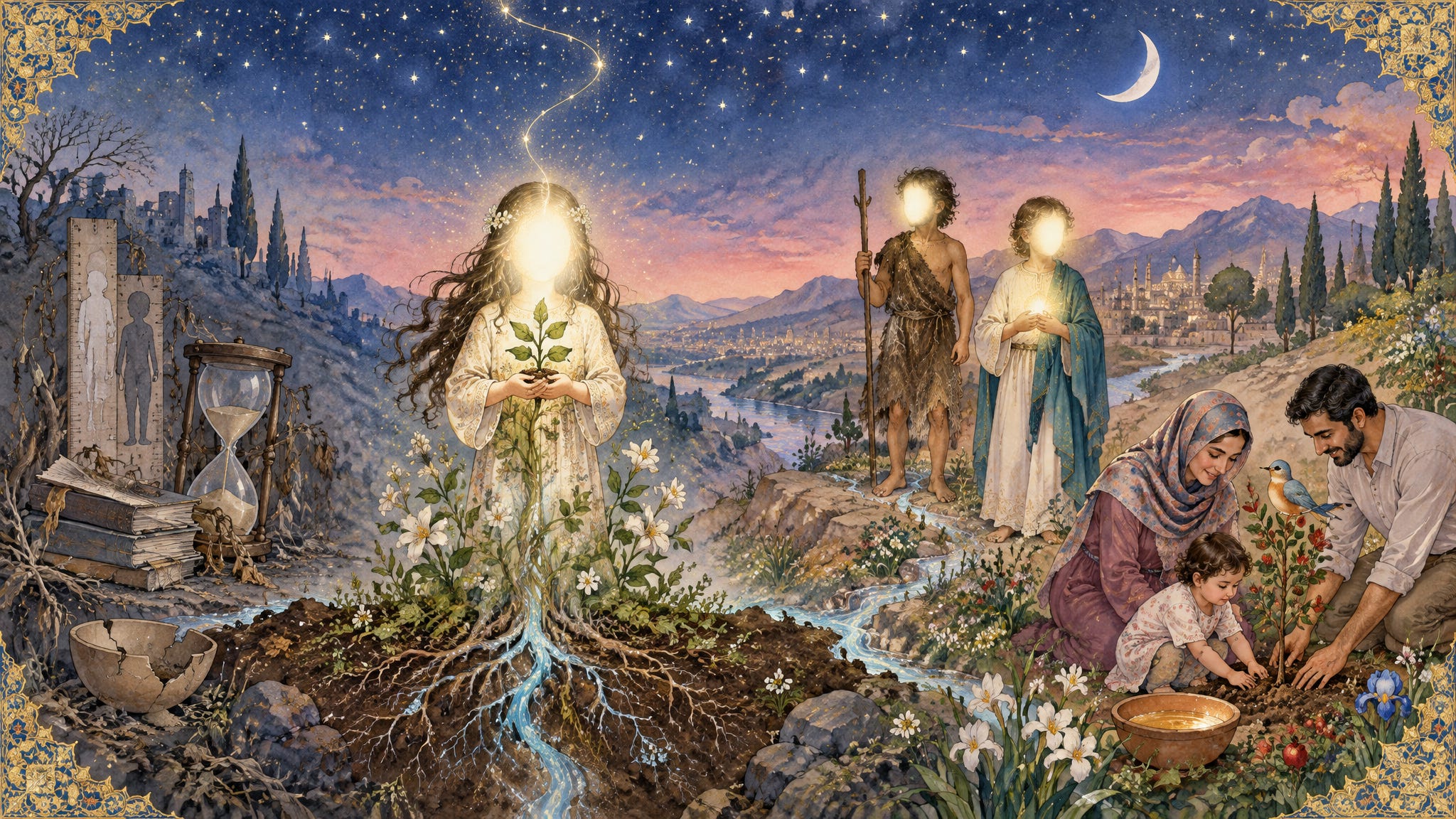
Now go back to Mary, and to the verse of our series.
He made her grow up in a worthy fashion — a beautiful growth.
And remember what Allamah Tabataba’i said that growth was:
right guidance, and purity.
Not size.
Not speed.
Not how early she could read.31
The Gospel of Luke uses the same kind of words for two children of her family.
Of John the Baptist, peace be upon him — the son of Zechariah, who raised her:
“And the child grew, and waxed strong in spirit, and was in the deserts till the day of his shewing unto Israel.”
— Luke 1:80 (King James Version)
And of her own son, Jesus, peace be upon him:
“And the child grew, and waxed strong in spirit, filled with wisdom: and the grace of God was upon him.”
— Luke 2:40 (King James Version)
Waxed strong in spirit.
Filled with wisdom.
In favour with God and man.
That is what a beautiful growth looks like.
That is what we are tending.
Lessons for Our Time
Lesson Three — Fear Restrains. It Does Not Grow.
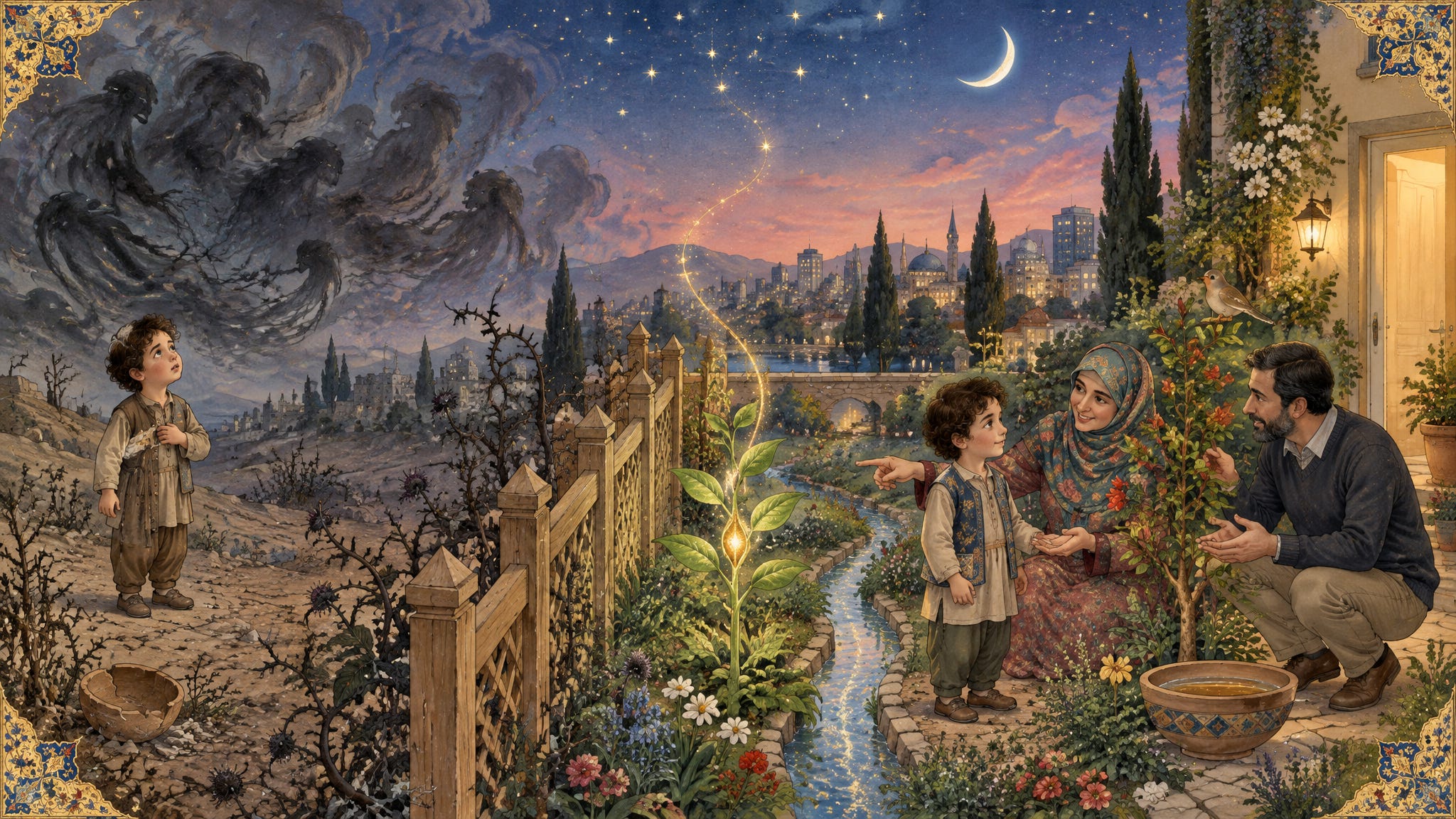
The third lesson is about fear, and I want to give you Shaheed Mutahhari on both sides of it, because he is careful, and we should be too.
Can fear make a child grow?
No, he says.
That is not its role.
Fear raises no high capacity in anyone.
But is fear ever to be used at all, in raising a child or a society?
And here he says: yes — not to grow anything, but to hold back.
Fear can restrain the lower urges; it can hold back a rebellion.
It is not a factor that grows; it can be a factor that restrains.
And for that, he counts it necessary.
And then comes the condition, and it is the part we forget.
A child, he says, must know what the encouragement is for, and what the warning is for.
If a child does not understand why he is being threatened, his spirit is thrown into complete confusion.
And it is now understood, he says, that many mental illnesses come from frightening, beating and misplaced intimidation in childhood.
— Shaheed Ayatullah Murtaza Mutahhari, Ta’lim va Tarbiyat dar Islam, page 46 — narrated32
So this is not a case against all discipline. It is a case against fear without reasons — which is exactly what so many of us were raised on. A boundary that a child understands is a fence around a garden. A threat that a child does not understand is a storm.
Discipline itself — when, how, and its limits — is next week’s subject, with the narrations that speak to it directly. Tonight, only this: fear restrains; it does not grow.
Lesson Four — The Child God Gives Is Not the Child You Ordered.
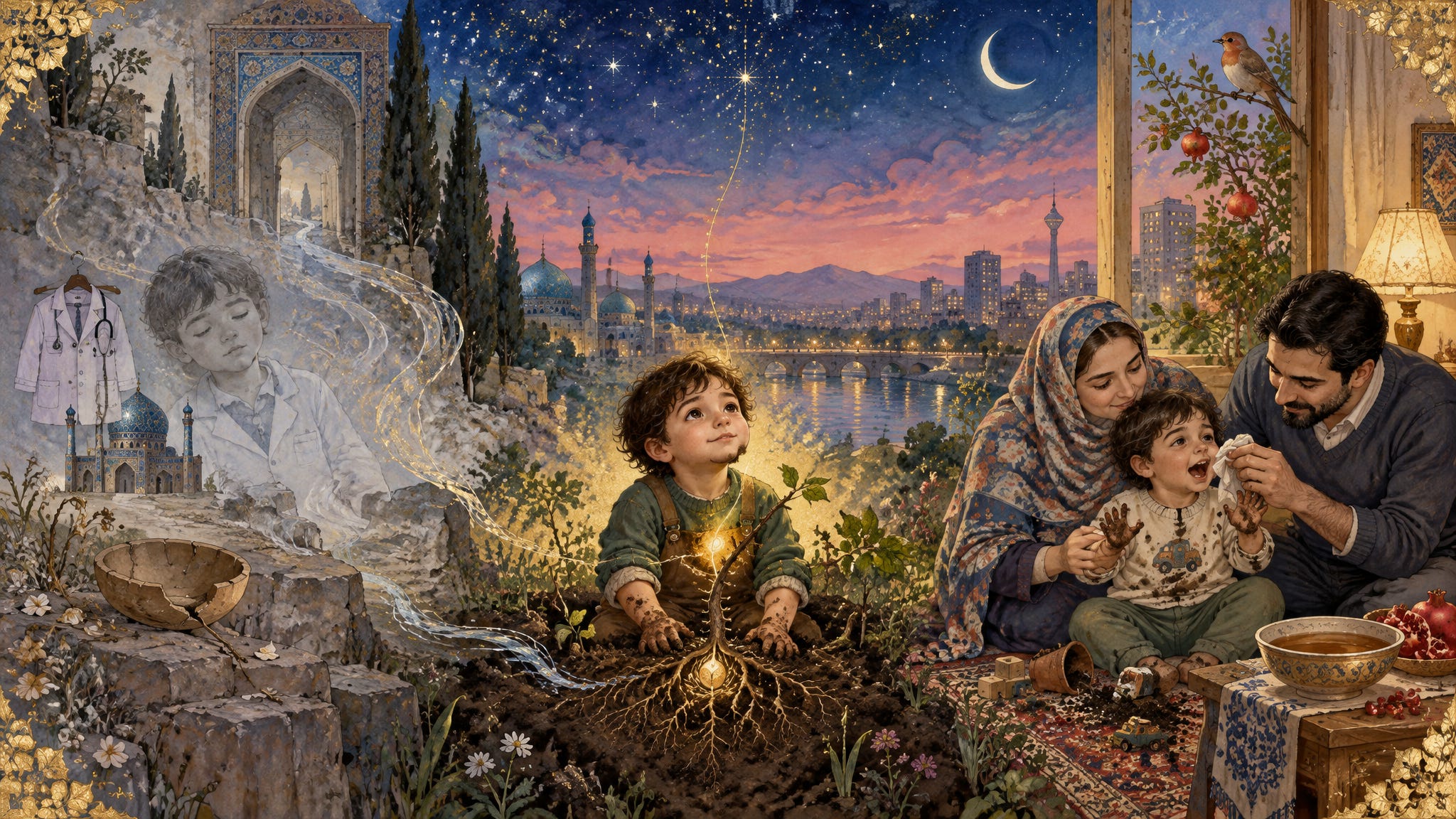
The fourth lesson takes us back to Imran’s house.
She expected a messenger, and she was given a daughter.
And the promise came — through the daughter, in a way no one foresaw.
Allamah Tabataba’i told us that the son she hoped for could never have become what this daughter would be.
Every parent here has, somewhere inside, a child they ordered.
A child who is calm, who sleeps, who loves the mosque, who does well at school, who will be a doctor.
And then God gives you the child He gives you.
Louder than you planned.
Slower.
Different.
Sometimes, much harder.
Ayatullah Misbah Yazdi, speaking of the children we teach and raise, says it plainly.
Some children behave badly — after all, they do not have an adult’s understanding.
They make a noise.
They do not learn their lessons well.
And you grow bitter.
But if you see that this child is a bouquet of flowers God has entrusted to you, to make it grow, then you will always look at him with the eye of love.
You will work to mend the fault — not take him to task, and not humiliate him — and do what will help him grow more.
— Ayatullah Muhammad Taqi Misbah Yazdi, may God have mercy on him, a talk of 22 May 2017 — narrated33
The child God gives is not the child you ordered.
Accept — then cultivate.
The First School — Play, Love and the First Seven Years
What a School Is
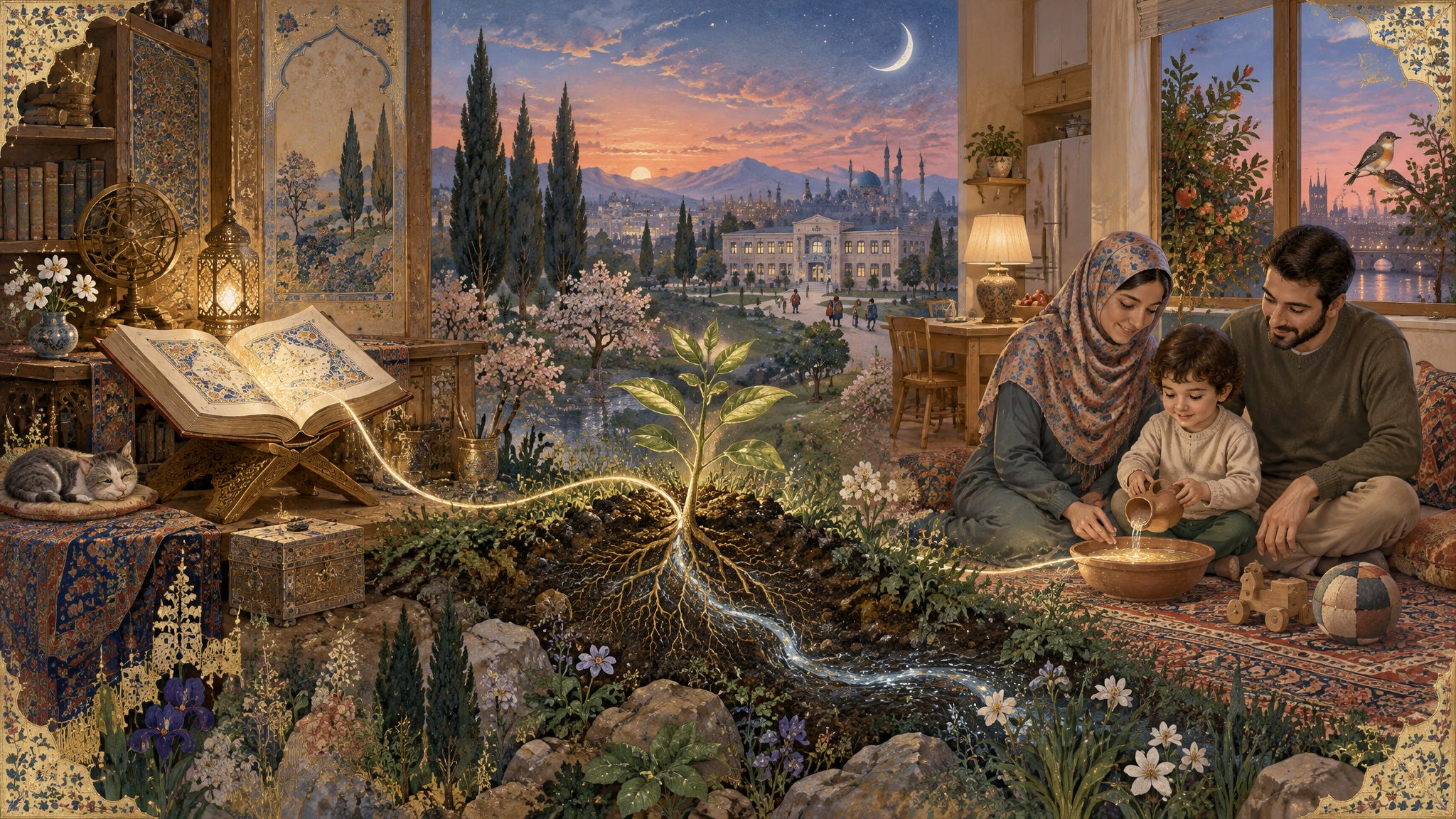
We call it a madrasa, and the word simply means school.
But listen to its root, because the root is a lesson in itself: d-r-s.
The great dictionary Lisan al-’Arab explains it like this:
وَدَرَسَتْ الْكِتَابُ أَدْرُسُهُ دَرْساً أَي ذَلِلَتَهُ بِكَثْرَةِ الْقَرَاءَةِ حَتَّى خَفَّ حَفْظَهُ عَلَيَّ، مِن ذَلِكَ، قَالَ
“‘I studied the book, I study it, a studying’: that is, I made it docile by much reading, until memorising it became light for me.”
— Ibn Manzur, Lisan al-’Arab, Volume 4, the entry d-r-s, page 329 — my translation
I made it docile, by much reading.
To study a book is to go over it, and over it, patiently, until it stops resisting you and gives itself up to your memory.
A school, at its root, is a place where something is made to yield — not by force, but by patience and repetition.
Hold on to that.
Because the first school any of us ever attended was not a building.
The Mother’s Lap
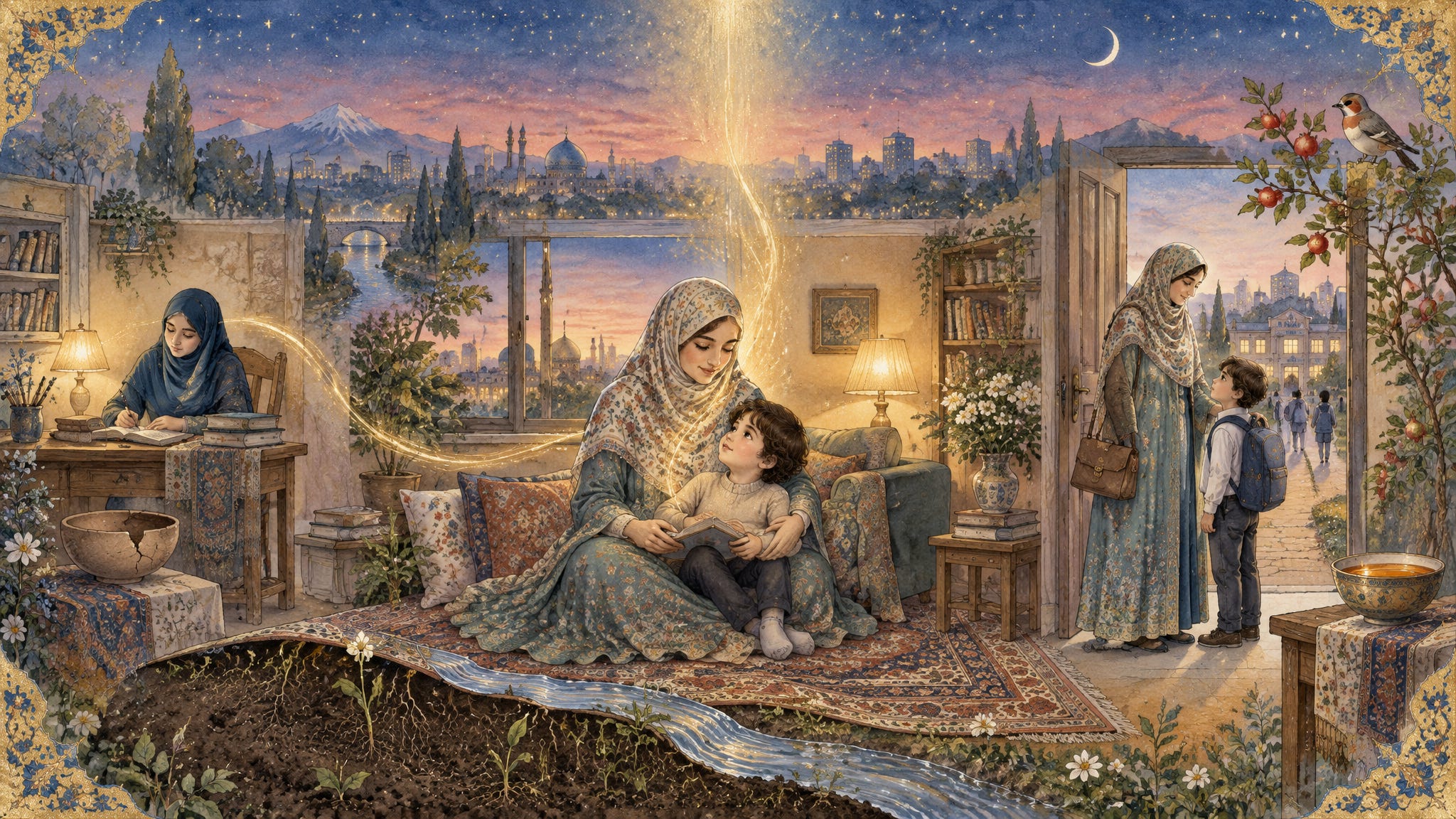
Imam Khomeini, may God sanctify his soul, said it in words that many of you will have heard: the lap of the mother is the greatest school, where the child is raised.
— Imam Khomeini, may God sanctify his soul, to the training seminar of the Islamic associations of teachers, Qom, 18 August 1979; Sahifeh-ye Imam (the English edition), Volume 9, page 267 — narrated34
And again, three months earlier, to the women who came to see him in Qom: the first classroom a child has is the bosom of the mother.
— Imam Khomeini, may God sanctify his soul, to women of Tehran, Shahzadeh Ibrahim and Shahsavar, Qom, 14 May 1979; Sahifeh-ye Imam (the English edition), Volume 7, page 264 — narrated35
And a month after that, he said it at more length to a group of women from Dezful — women who were themselves teachers.
You ladies, he told them, have two noble occupations.
One of them is raising children — and that is higher than every other occupation.
A good child, handed over to society, is better for you than the whole world.
And then:
If you raise one human being, it is an honour for you that I cannot put into words.
The first stage of upbringing, he said, is in the mother’s lap — because no attachment is higher than the attachment between a mother and her child.
Children are not under the influence of the father, or the teacher, or the master, as much as they are under the mother’s.
So give them an Islamic upbringing, a human upbringing, in your laps — so that when you hand this child over to the school, you hand over a sound child, with good character and good manners.
— Imam Khomeini, may God sanctify his soul, to a group of women of Dezful, 11 June 1979 (21 Khordad 1358); Sahifeh-ye Noor, Volume 7, page 76 — narrated36
This majlis has said it before, and it bears saying again:
the home is the first school.
— from this majlis: The Art of Supplication, session 20, 25 October 2025; and Wilayah in the Home, session 2, 23 November 202537
Seven Years of Play

So what does this first school teach?
Imam Ja’far al-Sadiq, peace and blessings be upon him, gives the curriculum of the first years in one word — and it is not the word most of us expect.
دَعِ ابْنَكَ يَلْعَبُ سَبْعَ سِنِينَ وَ أَلْزِمْهُ نَفْسَكَ سَبْعاً فَإِنْ أَفْلَحَ وَ إِلَّا فَإِنَّهُ مِمَّنْ لَا خَيْرَ فِيهِ .
“Let your son play for seven years, and keep him with you for seven years; if he succeeds, [well and good]; otherwise he is one in whom there is no good.”
— Imam Ja’far al-Sadiq, peace and blessings be upon him, through Yunus and a narrator he does not name; Shaykh al-Kulayni, al-Kafi, Volume 6, hadith 188 (thaqalayn) — my translation38
Play.
The first seven years are for play.
And here are the three sevens, as I promised you — first in Shaykh al-Kulayni’s book:
الْغُلَامُ يَلْعَبُ سَبْعَ سِنِينَ وَ يَتَعَلَّمُ الْكِتَابَ سَبْعَ سِنِينَ وَ يَتَعَلَّمُ الْحَلَالَ وَ الْحَرَامَ سَبْعَ سِنِينَ .
“The boy plays for seven years, learns the Book for seven years, and learns the lawful and the unlawful for seven years.”
— Imam Ja’far al-Sadiq, peace and blessings be upon him, through Ya’qub ibn Salim; Shaykh al-Kulayni, al-Kafi, Volume 6, hadith 190 (thaqalayn) — my translation39
And in Shaykh al-Saduq’s:
4743 - قَالَ اَلصَّادِقُ عَلَيْهِ اَلسَّلاَمُ : “دَعِ اِبْنَكَ يَلْعَبْ سَبْعَ سِنِينَ وَ يُؤَدَّبْ سَبْعَ سِنِينَ وَ أَلْزِمْهُ نَفْسَكَ سَبْعَ سِنِينَ فَإِنْ أَفْلَحَ وَ إِلاَّ فَإِنَّهُ مِمَّنْ لاَ خَيْرَ فِيهِ”.
“Al-Sadiq, peace be upon him, said: Let your son play for seven years, be taught adab for seven years, and keep him with you for seven years; if he succeeds, [well and good]; otherwise he is one in whom there is no good.”
— Imam Ja’far al-Sadiq, peace and blessings be upon him; Shaykh al-Saduq, Man La Yahduruhu al-Faqih, Volume 3, hadith 1528 (thaqalayn) — my translation
Play.
Then learning.
Then companionship — keep him with you.
Those are the first three nights of this series.
And there is a saying that many of you know, narrated from the Prophet, peace and blessings be upon him, his family, and his righteous companions, in later books, without a chain: that the child is a master for seven years, a servant for seven years, and a minister for seven years.
— narrated from the Messenger of God, peace and blessings be upon him, his family, and his righteous companions, without a chain: al-Tabrisi, Makarim al-Akhlaq, page 222; al-Hurr al-’Amili, Wasa’il al-Shi’a, Volume 21, page 476; al-Majlisi, Bihar al-Anwar, Volume 101, page 95 — narrated in part40
A master — in the first seven years, the child leads, and the home follows his growing.
That is not spoiling.
It is the season.
The Noisy Child
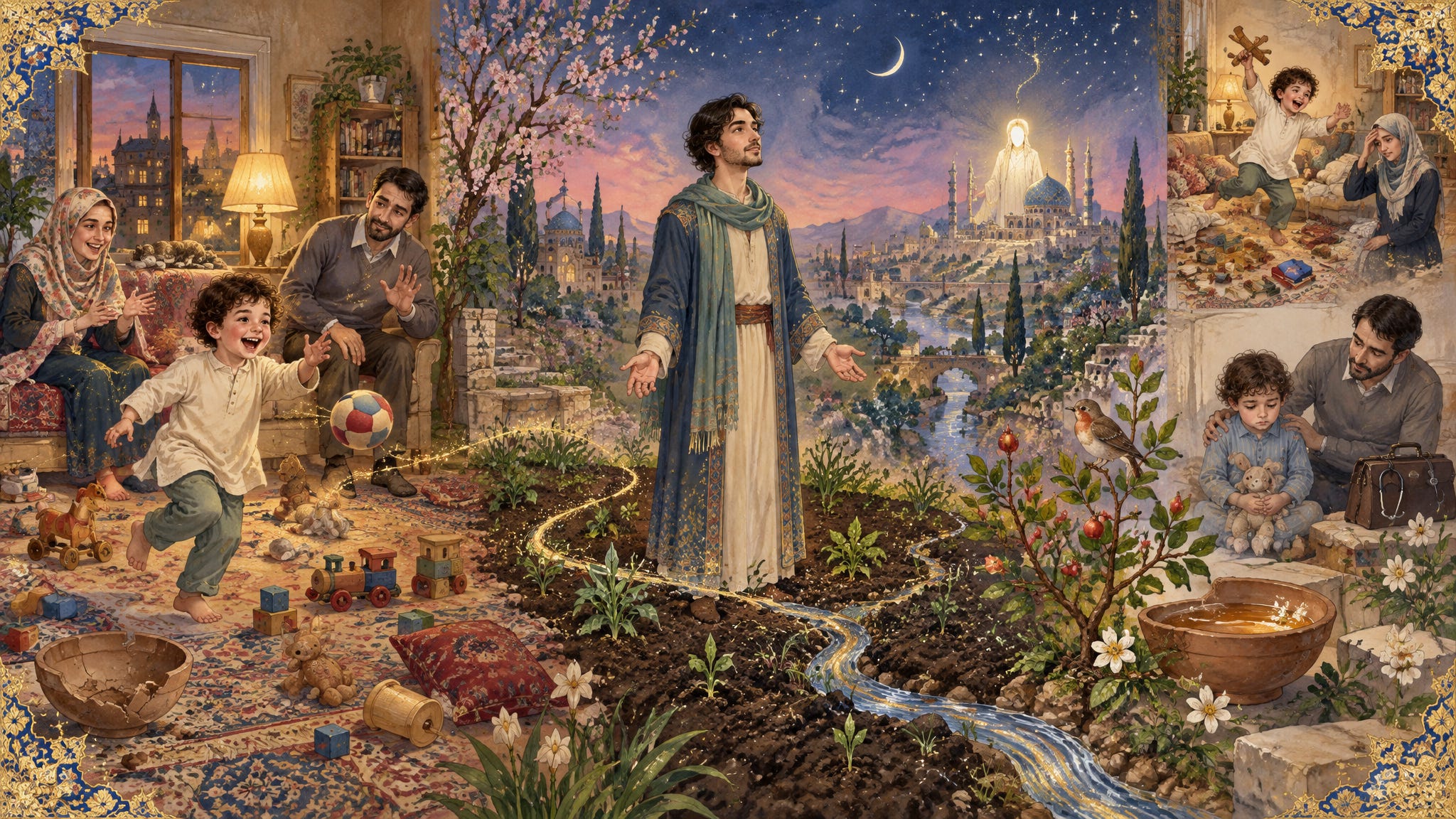
And if your house is loud tonight — listen to this. Imam Musa al-Kazim, peace and blessings be upon him — the Righteous Servant, as the report calls him — said:
سَمِعْتُ الْعَبْدَ الصَّالِحَ ( عليه السلام ) يَقُولُ تُسْتَحَبُّ عَرَامَةُ الصَّبِيِّ فِي صِغَرِهِ لِيَكُونَ حَلِيماً فِي كِبَرِهِ ثُمَّ قَالَ مَا يَنْبَغِي أَنْ يَكُونَ إِلَّا هَكَذَا .
“A child’s boisterousness when he is small is to be wished for, so that he is forbearing when he is grown.” Then he said: “It ought not to be otherwise.”
— Imam Musa al-Kazim, peace and blessings be upon him, through Salih ibn Uqba; Shaykh al-Kulayni, al-Kafi, Volume 6, hadith 213 (thaqalayn) — my translation41
To be wished for.
The noise you are trying to stop may be the very thing that makes your child patient and gentle when he is grown.
Shaheed Mutahhari gives a picture that every parent will recognise.
If your child plays all day long — even when it is time for other things — you will be upset with him.
But if that same child does not play for one day, you take him to the doctor.
On his page it is an analogy, about the harm of doing only one thing; and notice that he says one day, not never.
Still, the picture stays with you: a child who never plays is telling us something.
— Shaheed Ayatullah Murtaza Mutahhari, Ta’lim va Tarbiyat dar Islam, page 50 — narrated42
Small Words, Spaced Over Years
So is there no teaching at all in the first seven years?
There is — but listen to how it is done.
Imam al-Baqir or Imam al-Sadiq, peace and blessings be upon them, describes it.
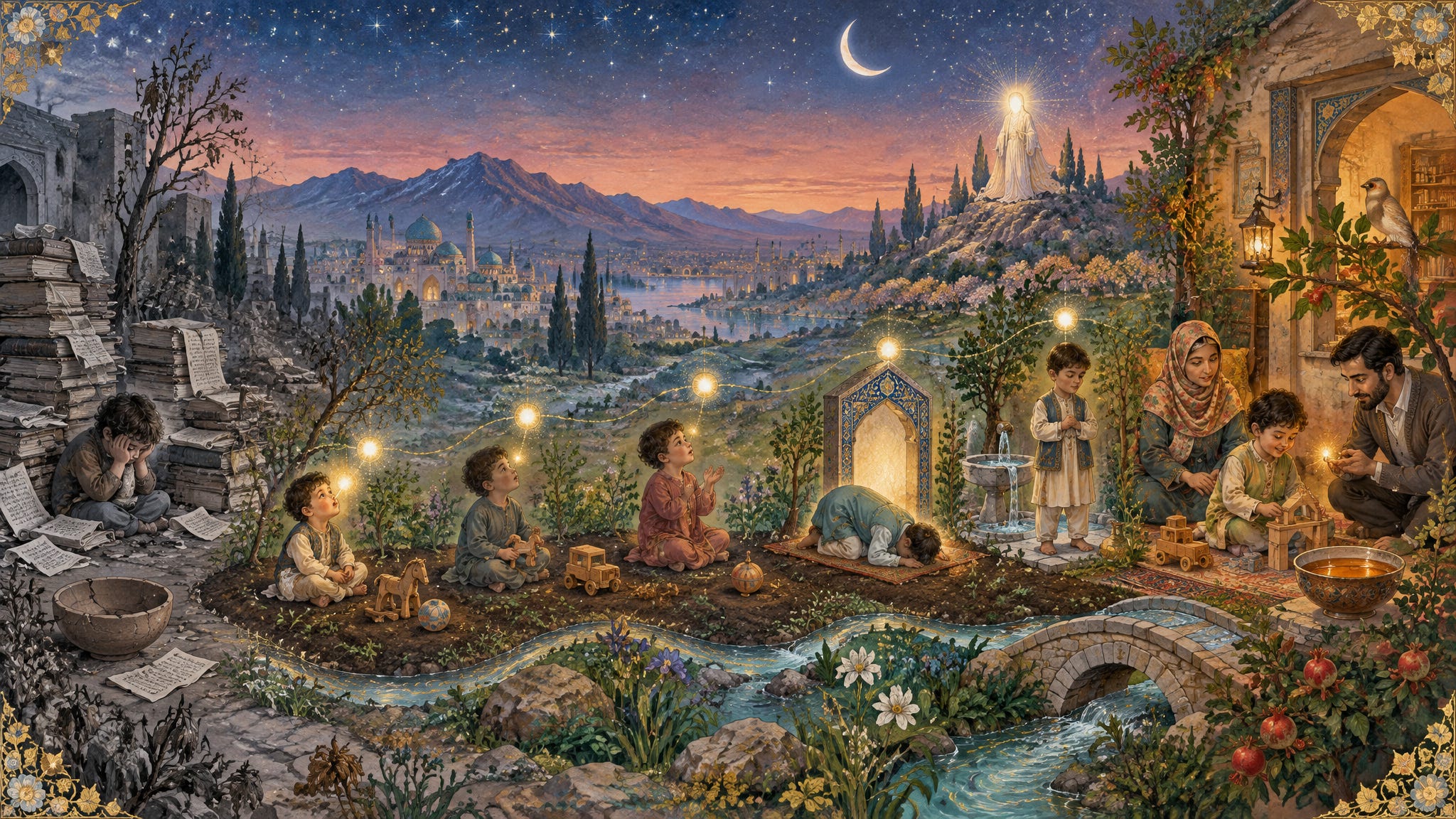
When the child reaches three, he is taught to say there is no god but God — seven times.
Then he is left until he is three years, seven months and twenty days, and taught to say Muhammad is the Messenger of God.
At four, he is taught to send blessings on Muhammad and his family.
At five, he is asked which is his right hand and which is his left — and when he knows, he is turned towards the qibla and told: prostrate.
And at seven, he is told to wash his face and his hands, and then: pray.
— Imam Muhammad al-Baqir or Imam Ja’far al-Sadiq, peace and blessings be upon them, through Abdullah ibn Fadala; Shaykh al-Saduq, Man La Yahduruhu al-Faqih, Volume 1, hadith 862 (thaqalayn) — narrated in part43
Do you hear the rhythm of it?
One small phrase — and then he is left.
Another — and then he is left.
Months between them.
Years.
Small words, repeated, spaced over years — not forced.
The words are sown into the play, not pressed onto the child.
Two Sons, One Mother
Some of you were with us in the spring, when we told the story of a dream.
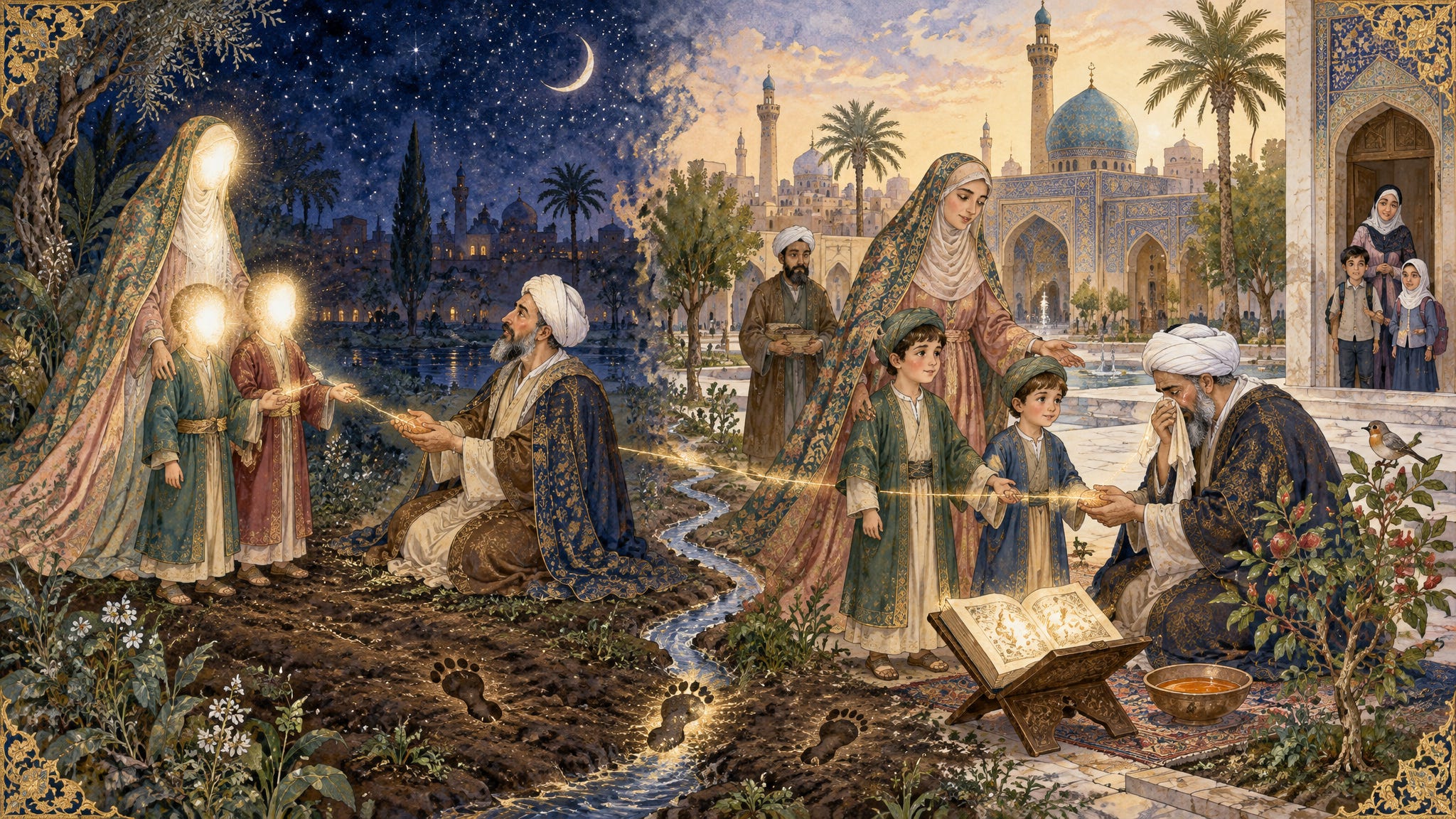
Shaykh al-Mufid — the great teacher of Baghdad — saw Sayyedah Fatimah al-Zahra, peace and blessings be upon her, in a dream.
She came to him leading her two sons, al-Hasan and al-Husayn, peace and blessings be upon them, and she asked him to teach them jurisprudence.
The next morning, a mother came to him in the mosque, leading her own two small sons.
They were the boys we know as Sayyed al-Murtada and Sayyed al-Radi.
And Shaykh al-Mufid wept, and told her the dream, and took her sons as his students.
Sayyed al-Radi grew up to compile Nahj al-Balagha.
And in it, the letter that began our night tonight —
the heart of the young is like empty land.
— from this majlis: The Lantern of the Path, sessions 64 (15 April 2026) and 65 (22 April 2026), after Ibn Abi al-Hadid, Sharh Nahj al-Balagha, Volume 1 — narrated44
The sources record that Shaykh al-Mufid saw, in a dream, the Lady of Light — Sayyedah Fatimah al-Zahra, peace be upon her.
She came to him holding the hands of two young boys — Imam al-Hasan and Imam al-Husayn, peace be upon them — and she said:
يَا شَيْخُ، عَلِّمْهُمَا الْفِقْهَ
“O Shaykh — teach them jurisprudence.”
— The account of Shaykh al-Mufid’s dream of Sayyedah Fatimah; recorded in the biographical sources; see also Zabihzadeh, “Shi’ite Authorities: Shaykh al-Mufid”
Shaykh al-Mufid awoke, shaken by what he had seen.
That morning, he went to the mosque in the al-Karkh quarter of Baghdad — the Shi’i neighbourhood we have described.
And there, waiting for him, was a woman — accompanied by her servants — holding the hands of her two young sons.
She said:
“O Shaykh — teach them jurisprudence.”
The two boys were Sayyed al-Murtada and Sayyed al-Radhi — Ali and Muhammad, sons of al-Husayn, descendants of Imam al-Kadhim, peace be upon him.
The dream was actualised.
The mother had brought her sons to Shaykh al-Mufid — and Sayyedah Fatimah had already instructed him to receive them.
— from this majlis: The Lantern of the Path, session 64, 15 April 2026 (reflections313.com)45
The first school knows where to send its children next.46
The Mother and the Father
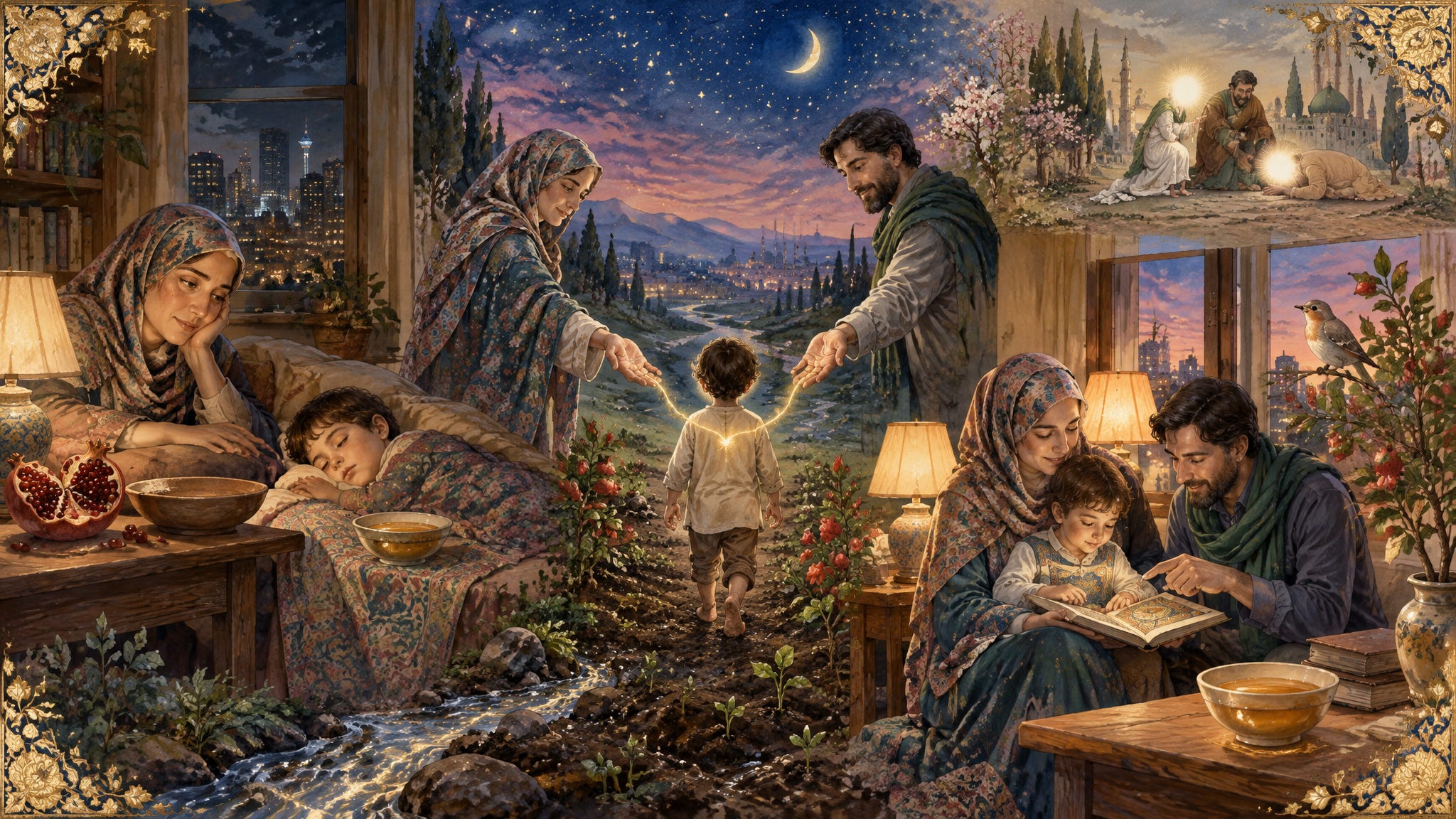
Now listen to how Imam Ali ibn al-Husayn al-Sajjad, peace and blessings be upon him, describes the first teacher.
This is from his Treatise on Rights, in William C. Chittick’s English:
أما حَقُّ أُمِّكَ، فَأَنْ تَعْلَمَ أَنَّهَا حَمَلَتكَ حَيْثُ لا يحتمل أحدٌ أحداَ، وأعْطَتْكَ مِن ثَمْرَةِ قَلبِها ما لا يُعطي أحدٌ أحداَ، ووَقَتْكَ بِجَمِيعِ جَوارحِها، ولَمْ تبال أن تجوع وتطعمك، وتعطش وتسقيك، وتعرى وتكسوك، وتضحى وتظلك، وتهجر النوم لأجلك، ووَقَتْكَ الحَرَّ والبَردَ، لتكون لها، فانك لا تُطيق شُكرها إلّا بِعَونِ اللهِ وتَوفيقه.
“The right of your mother is that you know that she carried you where no one carries anyone, she gave to you of the fruit of her heart that which no one gives to anyone, and she protected you with all her organs. She did not care if she went hungry as long as you ate, if she was thirsty as long as you drank, if she was naked as long as you were clothed, if she was in the sun as long as you were in the shade. She gave up sleep for your sake, she protected you from heat and cold, all in order that you might belong to her. You will not be able to show her gratitude, unless through God’s help and giving success.”
— Imam Ali ibn al-Husayn al-Sajjad, peace and blessings be upon him; Risalat al-Huquq (the Treatise on Rights), the right of the mother (thaqalayn, Risalat al-Huquq, hadith 23), in William C. Chittick’s English
Did you hear it?
She gave to you of the fruit of her heart.
That is the name of this series — and here it is in the mouth of the fourth Imam, describing every mother in this room.
And then the right of the child:
وَأمَّا حَقُّ وَلَدِكَ فَان تَعْلَمَ أنَّهُ مِنْكَ وَمُضَافٌ إلَيكَ فِي عَاجِلِ الدُنْيَا بخَيْرِهِ وَشَرِّهِ، وَأَنَّكَ مَسْئولٌ عَمَّا ولِّيتَهُ بِهِ مِنْ حُسْنِ الأَدَب وَالدّلالَةِ عَلَى رَبهِ وَالْمَعُونةِ لَهُ عَلَى طَاعَتِهِ فَاعْمَلْ فِي أَمْرِهِ عَمَلَ من يعلم أنه مثاب على الإحسان إليه مُعاقِب على الإساءةِ إليه.
“The right of your child is that you should know that he is from you and will be ascribed to you, through both his good and his evil, in the immediate affairs of this world. You are responsible for what has been entrusted to you, such as educating him in good conduct (husn al-adab), pointing him in the direction of his Lord, and helping him to obey Him. So act toward him with the action of one who knows that he will be rewarded for good doing toward him and punished for evildoing.”
— Imam Ali ibn al-Husayn al-Sajjad, peace and blessings be upon him; Risalat al-Huquq (the Treatise on Rights), the right of the child (thaqalayn, Risalat al-Huquq, hadith 25), in William C. Chittick’s English
Pointing him in the direction of his Lord.
Not dragging him.
Pointing.47
The martyred leader, Imam Sayyed Ali Khamenei, may God rest his pure soul, tells us why the mother matters so much in this.
It is the mother, he says, who passes on to the child — with her body, her spirit, her character and her conduct, knowingly and unknowingly — the culture, the knowledge and the moral traits of a whole people.
— Imam Sayyed Ali Khamenei, may God rest his pure soul, speech of 27 July 2005 — narrated48
And I want to give you his frame for this, in his own words, because these words are often heard wrongly.
Speaking to women in 1997, he said that the best way to raise a human being is in a mother’s embrace, with a mother’s love.
And his rebuke was for those who leave a child’s upbringing for work that does not greatly depend on them.
Raising a child that way, he said, is the woman’s art — and it does not conflict with studying, teaching, working, entering politics and the like.
Some, he said, give up the home for public work; some give up public work for the home.
Both are wrong.
— Imam Sayyed Ali Khamenei, may God rest his pure soul, to women of Khuzestan, 10 March 1997 (1375/12/20) — narrated49
And in 2023 he said: in the home, the duties are different.
Bearing children, keeping them, and the lap of their upbringing are the woman’s; the man’s work is outside the home, and seeing to the home’s problems.
But in their rights in the family, they are equal — and he recited the Qur’an:
they have rights like the duties upon them, in fairness.
— Imam Sayyed Ali Khamenei, may God rest his pure soul, to women, 27 December 2023 (1402/10/06), citing Qur’an, Surah al-Baqarah (the Chapter of the Cow) #2, Verse 228 — narrated50
And he never leaves the father out.
The human being, he says, needs a safe home in which, from childhood, he is placed under the right and natural teaching of two teachers who are kinder to him than all the people of the world — that is, the father and the mother.
— Imam Sayyed Ali Khamenei, may God rest his pure soul, Zan va Khanevadeh (Woman and Family), page 82 — narrated51
Two teachers.
The mother’s lap, and the father’s side.
Fathers, you are not an assistant in this school.
You are the second teacher.
Now I want to give you one more passage from him, and I want to frame it first, because there are parents here who have no choice about work, and parents raising children alone, and I do not want anyone to hear this as a verdict on them.
What follows describes what a small child needs.
It is not a judgement on any parent here who has no choice.
The charge is to give it as fully as we can.
The family, he says, is a centre for the growth and nourishment of several souls.
If a child is taken young and placed in an institution or a day care, like an incubator for chicks, he will not be raised as a human being should be.
But a child brought up with his parents’ love, their friendship and their attention will not be devoid of anything from a spiritual point of view.
— Imam Sayyed Ali Khamenei, may God rest his pure soul, The Compassionate Family, page 31 — narrated52
And look at the one who was raised in exactly that way.
Ayatullah Fadhlullah reminds us that Sayyedah Fatimah al-Zahra, peace and blessings be upon her, lost her mother in her early childhood — and the Messenger of God, peace and blessings be upon him, his family, and his righteous companions, became her mother and her father.
A small child, she watched over him; when the idolaters threw filth on his back as he prostrated, she would come and clear it away, weeping for her father.
His mind raised her mind, he says.
His heart spoke to her heart.
She grew up in the school of the Messenger.
— Ayatullah Sayyed Muhammad Husayn Fadhlullah, Friday sermons of 4 September 1998 and 7 September 2001 — narrated53
Lessons for Our Time
Lesson Five — Play Is the Curriculum of the First Seven Years.
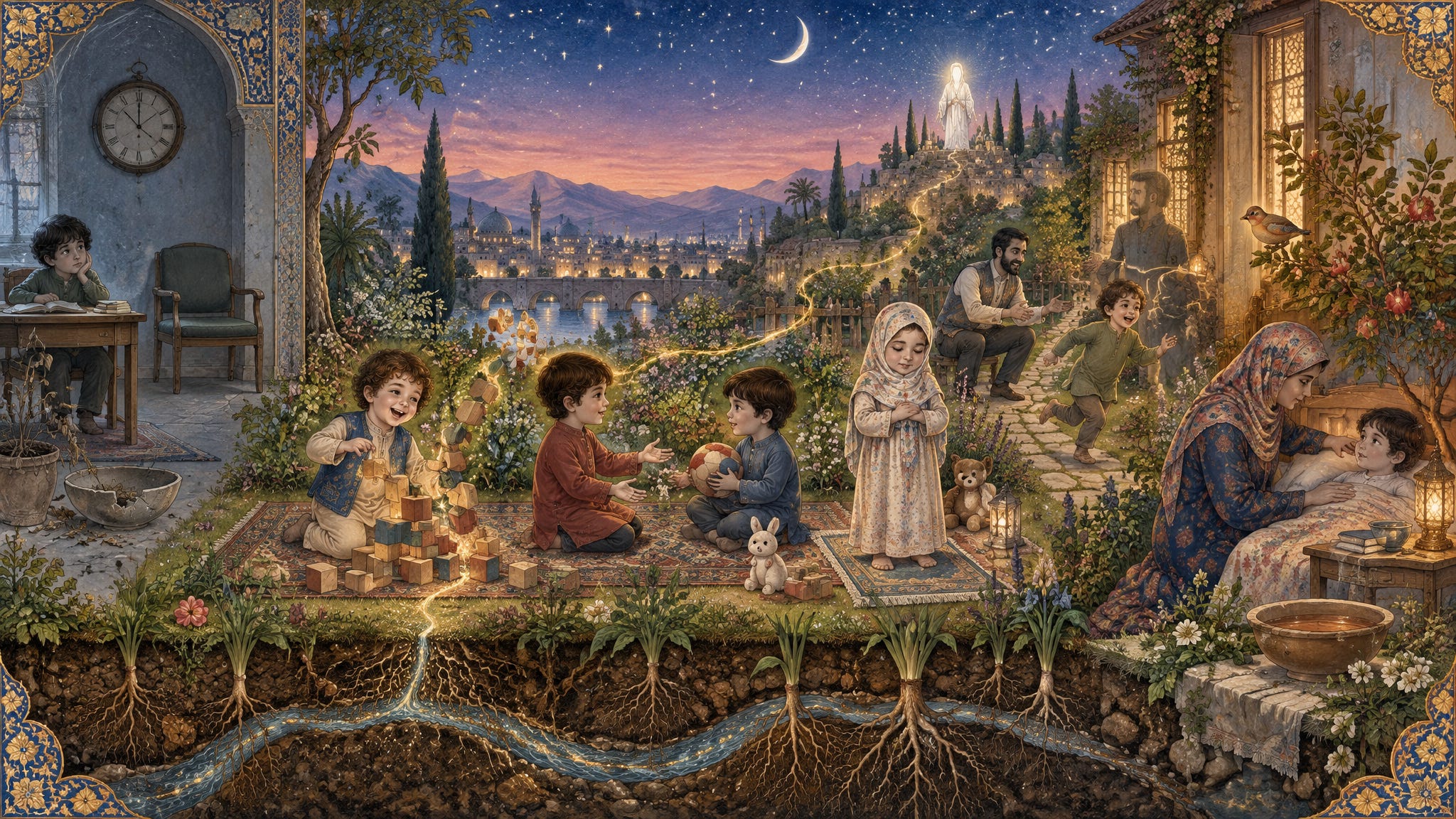
The fifth lesson is for every parent who feels that a child who is playing is wasting time.
The first seven years are not a waiting room before the real lessons begin.
Play is the lesson.
When a three-year-old builds a tower and knocks it down, and builds it again, she is learning patience, cause and effect, and how to begin again after failure.
When two brothers argue over a game and then make it up, they are learning justice and forgiveness.
When a child plays at being a mother, a doctor, a teacher, an Imam leading the prayer — she is rehearsing the person she will become.
So the small words of tawhid are not a separate subject to be drilled at a desk.
They are sown into the play — a phrase at bedtime, a prayer said together, a story of the prophets told on the way to school.
One small word, and then he is left.
And in that leaving, the seed takes root.
And the noisy child is not a problem to be solved.
Imam al-Kazim, peace and blessings be upon him, told us his boisterousness is to be wished for.
So the next time the house is loud and you feel your patience going, remember: you may be listening to the sound of a future forbearance being built.
That does not mean no boundaries.
It means the boundaries serve the play, and not the other way round.
Lesson Six — Spoiling Is Not Too Much Love.

The sixth lesson answers a fear.
Some of you are thinking:
if I let him play, if I let him lead, if I am gentle — won’t I spoil him?
Listen to Amir al-Mu’minin, peace and blessings be upon him:
وَقَالَ (عليه السلام): إِنَّ لِلْوَلَدِ عَلَى الْوَالِدِ حَقّاً، وَإِنَّ لِلْوَالِدِ عَلَى الْوَلَدِ حَقّاً: فَحَقُّ الْوَالِدِ عَلَى الْوَلَدِ أَنْ يُطِيعَهُ فِي كُلِّ شَيْءٍ إِلَّا فِي مَعْصِيَةِ اللهِ سُبْحَانَهُ، وَحَقُّ الْوَلَدِ عَلَى الْوَالِدِ أَنْ يُحَسِّنَ اسْمَهُ وَيُحَسِّنَ أَدَبَهُ وَيُعَلِّمَهُ الْقُرْآنَ.
“And he, peace be upon him, said: The child has a right over the parent, and the parent has a right over the child. The parent’s right over the child is that he obey him in everything except disobedience to God, glory be to Him; and the child’s right over the parent is that he give him a good name, give him good adab, and teach him the Qur’an.”
— Amir al-Mu’minin, Imam Ali ibn Abi Talib, peace and blessings be upon him; Nahj al-Balagha, Saying 399 — my translation
A good name.
Good adab.
The Qur’an.
Those are what a child is owed.
So spoiling is not too much love.
A child cannot be loved too much.
Spoiling is love that withholds — the parent who gives the child every toy and every screen, and withholds what he is owed: formation.
Who gives him everything except adab.
Who gives him every word except the words of God.
Love him as much as you can.
And give him what he is owed.
Conclusion — Key Takeaways
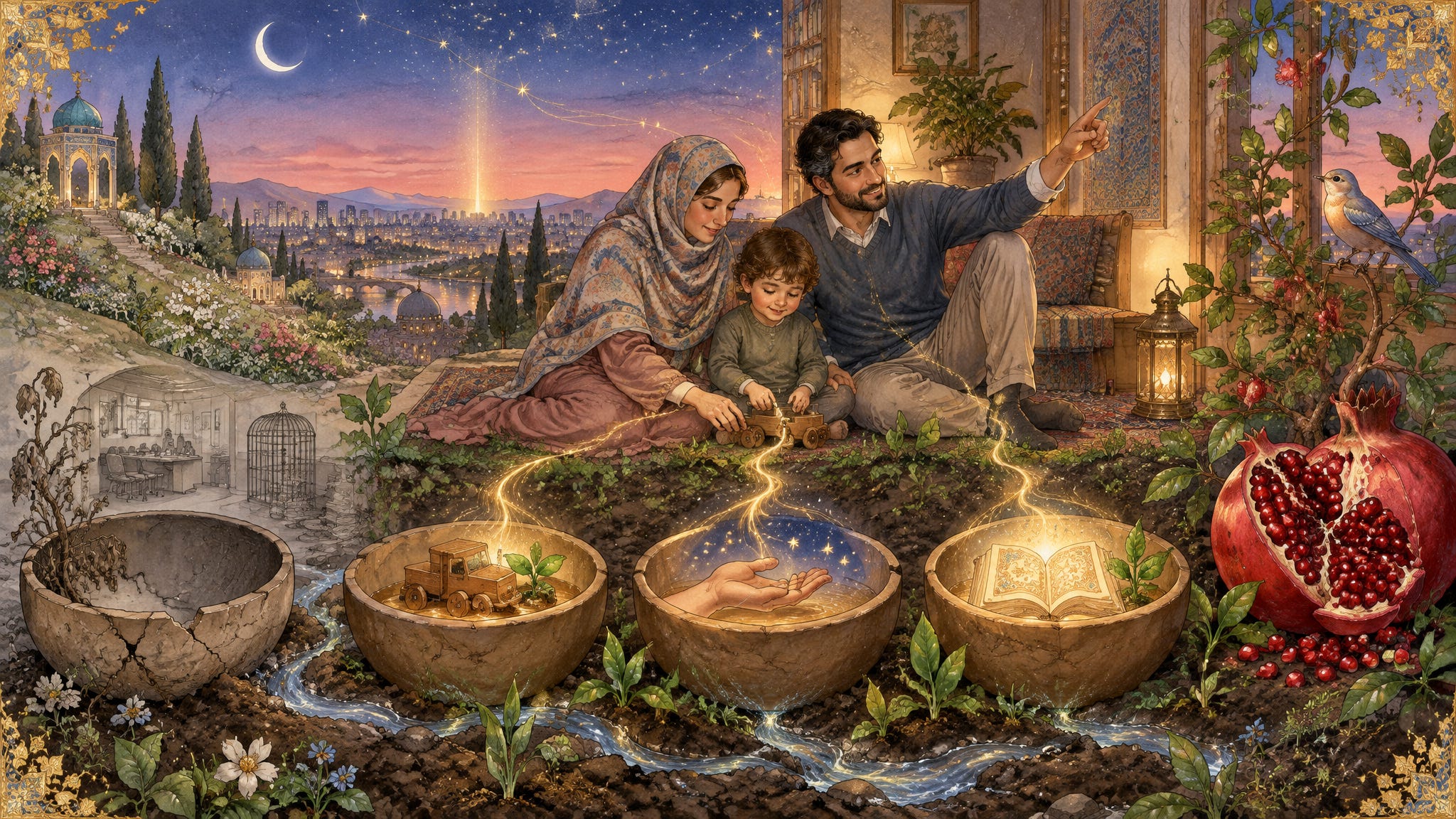
Three things to take out of this room tonight — and they are things to do, not only things to think.
The first.
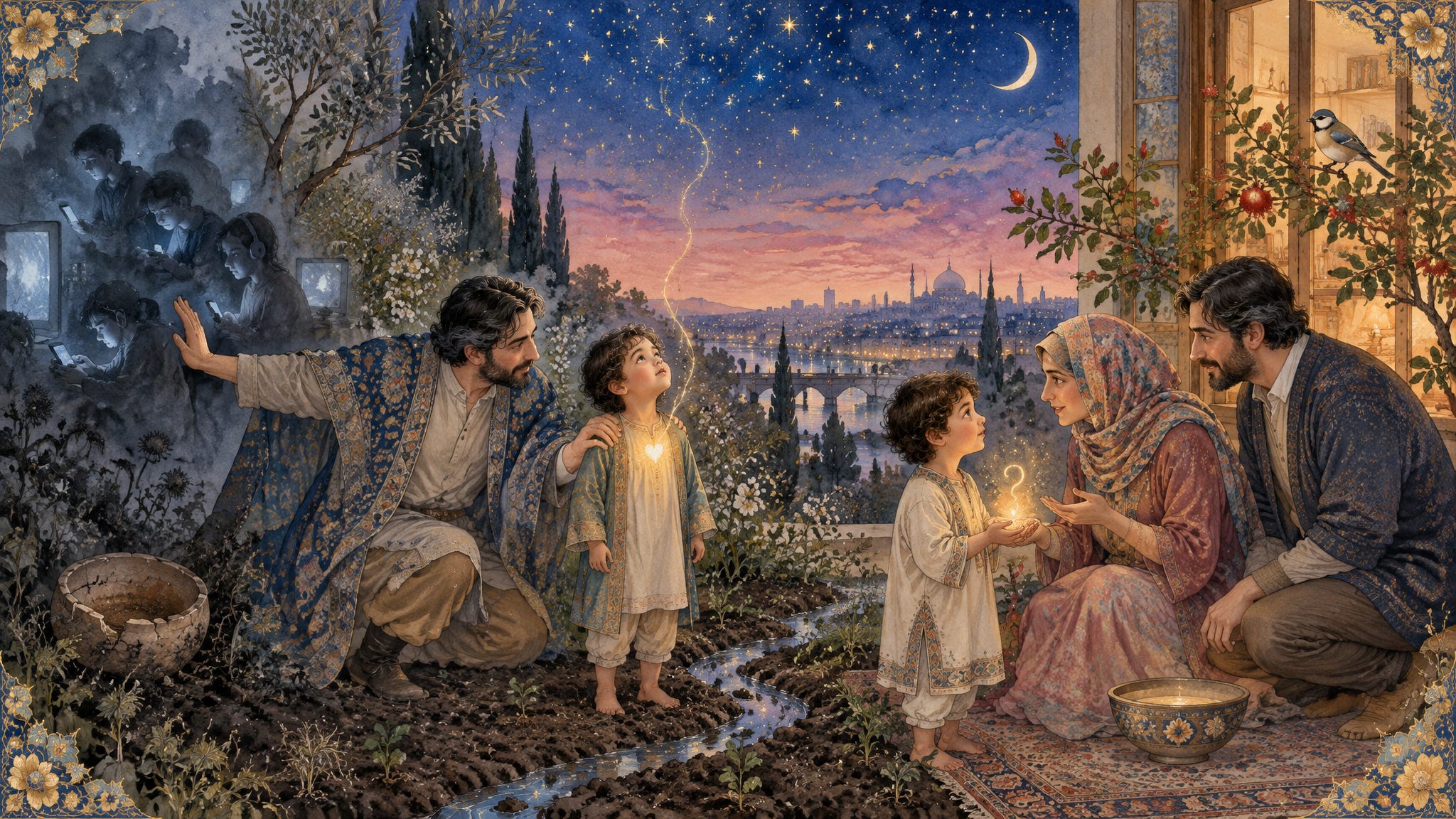
Your child is born facing God.
You do not install faith in your child; you find it there, and you protect it.
So this week, keep the blight off.
Look at what your child watches, and hears, and sees you do.
And when she asks you a question about God — however small, however strange — kneel down and answer her.
That question is the fitrah, doing exactly what it was made to do.
The second.
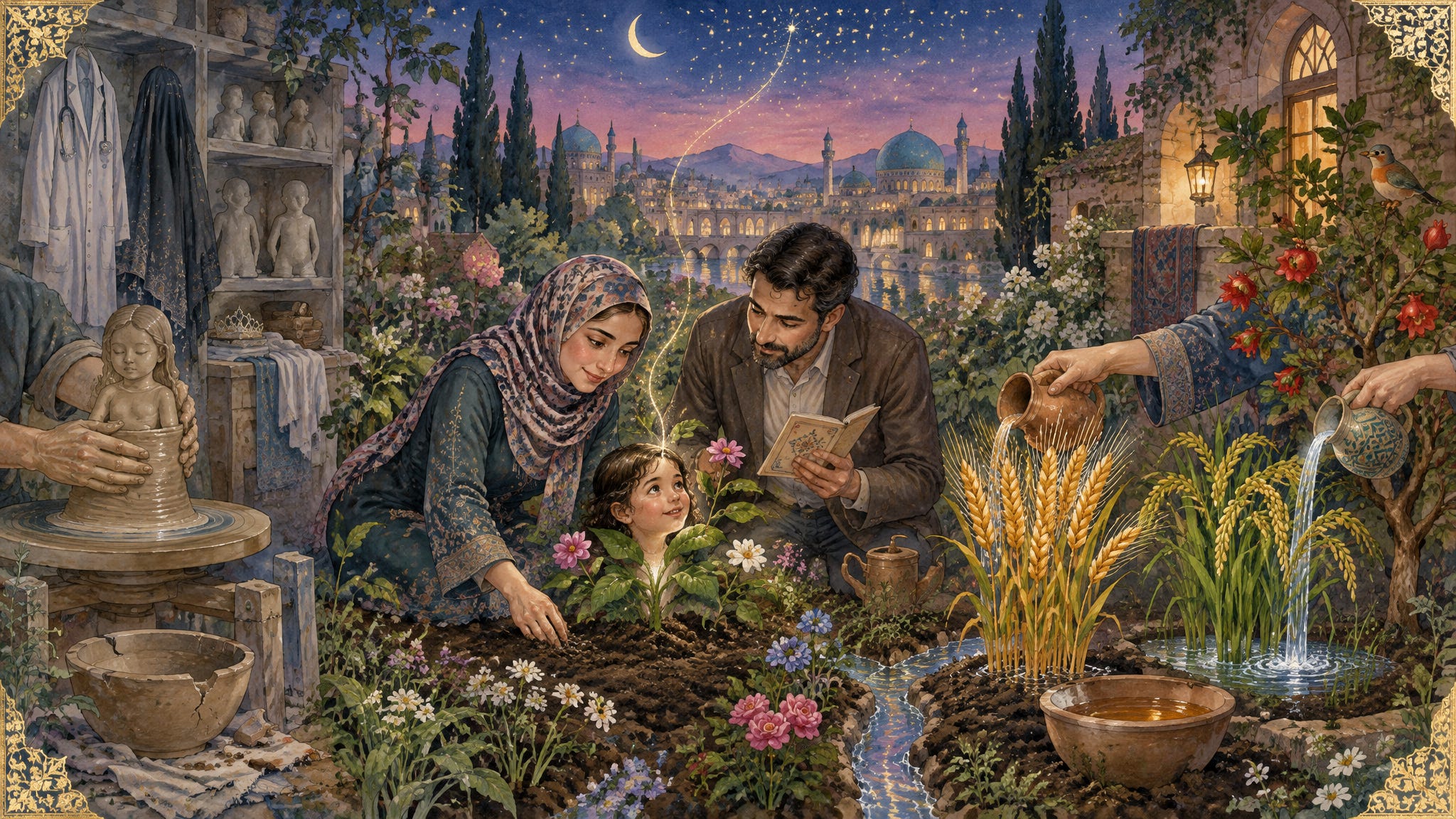
Tarbiyah is cultivation, not manufacture.
You are a gardener, not a potter — and more than half of the work is learning the plant.
So this week, study your child the way a gardener studies a flower.
What does she love?
What frightens her?
When does she open, and when does she close?
Write it down if you have to.
And if you catch yourself pressing her into a shape that is yours and not hers — stop, and ask whether you are raising wheat, or trying to make rice out of it.
And the third.

The first school is play and love, not pressure.
For the little ones, give them their seven years of play — and sow the small words into it: a phrase of tawhid at bedtime, a prayer said together, a story of the prophets.
One small word, and then leave it to grow.
And mothers and fathers: you are the two teachers who are kinder to this child than anyone in the world.
Be the school.
Do those three things, and you will have done the work of the first seven years — whatever the age of your child, and whatever your own age.
Next week, God willing, we meet the guardian.
He charged Zechariah with her care.
We will go with Zechariah into the sanctuary, and see what he found with her — and hear the question he asked her:54
O Mary, from where does this come for you?
Eulogy — The Women at the Cradle
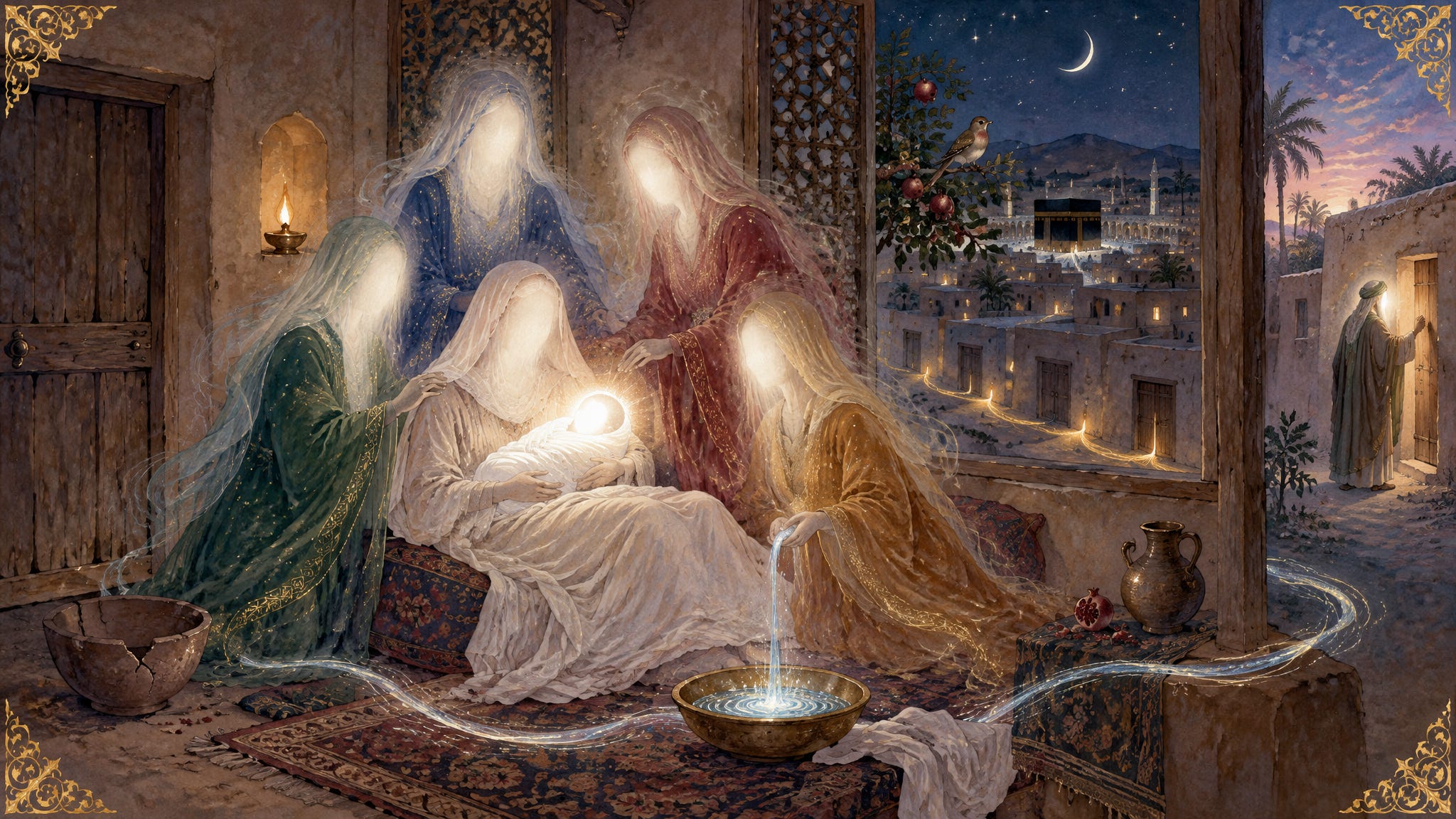
Some of you were with us on a Wednesday night earlier this month, when we stood at her mother’s house and heard of her birth.
— from this majlis: The Lantern of the Path, session 77, “Her Mother’s House”, 7 October 202655
Tonight I want to go back to that house — and ask who came in.
Imam Ja’far al-Sadiq, peace and blessings be upon him, told al-Mufaddal ibn Umar the story.
When the Messenger of God, peace and blessings be upon him, his family, and his righteous companions, married Sayyedah Khadijah, peace be upon her, the women of Mecca turned away from her.
They would not visit her.
They would not greet her.
And they would let no other woman visit her either.
She was lonely.
And the Imam says her grief was for him — she was afraid for him.
Then she carried Fatimah, peace and blessings be upon her.
And the child in her womb would speak to her, and give her patience.
She kept it to herself.
Until one day the Messenger of God, peace and blessings be upon him, his family, and his righteous companions, came in and heard her talking, and asked:
Khadijah, who are you talking to?
And she said:
The child in my womb talks to me, and keeps me company.
And he told her:
This is Gabriel, telling me that she is a girl — that she is the pure and blessed offspring; that God will make my progeny from her, and Imams from her progeny, His successors on His earth.
Hold that picture.
A mother whom the whole town has shut out — and in that silence, her unborn daughter is the one who keeps her company.
And then her time came.
She sent to the women of Quraysh and of Banu Hashim:
Come, and do for me what women do for women.
And they sent back:
You disobeyed us.
You would not listen to us.
You married Muhammad, the orphan of Abu Talib, a poor man with no wealth. We will not come, and we will do nothing for you.
Think of it.
A woman in labour, alone in her house, and the women of her own town refusing to cross her threshold.
And while she grieved, four tall women came in to her.
She was alarmed when she saw them. And one of them said:
Do not grieve, Khadija; we are your Lord’s messengers to you, and we are your sisters.
I am Sarah, she said.
And this is Asiya, daughter of Muzahim, who is your companion in Paradise.
And this is Mary, daughter of Imran.
And this is Kulthum, sister of Moses son of Imran.
God has sent us to you, to do for you what women do for women.
And one sat at her right, and one at her left, one before her and one behind her.
And she gave birth to Fatimah, peace and blessings be upon her — pure, and purified.
And when the child came into the world, a light shone from her until it entered the houses of Mecca — every house that had shut its door — and there was no place in the east of the earth or in its west that the light did not reach.
— Imam Ja’far al-Sadiq, peace and blessings be upon him, through al-Mufaddal ibn Umar; Shaykh al-Saduq, al-Amali, hadith 940 (thaqalayn) — narrated in part; the words of the four, my translation56
Who were they?
The one who spoke was Sarah, peace be upon her — the wife of the Prophet Abraham, peace be upon him.
The Qur’an calls her only his wife; the report gives her name.
And when the angels came to her house and brought her the news of a son in her old age, they greeted her as one of the household:
God’s mercy and His blessings be upon you, members of the household.
— Qur’an, Surah Hud (the Chapter of the Prophet Hud) #11, Verse 73 — narrated57
Asiya, daughter of Muzahim, peace be upon her — the believer in Pharaoh’s palace.
When the infant Moses was taken out of the river, it was she who said:
A comfort to me and to you — do not kill him.
And it was she who prayed:
My Lord, build me a home near You in paradise.
The Qur’an calls her the wife of Pharaoh; the reports give her name.
— Qur’an, Surah al-Qasas (the Chapter of the Narrations) #28, Verse 9; and Surah al-Tahrim (the Chapter of the Prohibition) #66, Verse 11 — narrated58
Mary, daughter of Imran, peace be upon her.
You know her now.
She is the girl we began with tonight — vowed in the womb, accepted, grown a beautiful growth.
The angels told her:
God has chosen you and purified you, and chosen you above the women of the world.
And the Qur’an sets her beside Asiya, as the example of the faithful.
— Qur’an, Surah Aal Imran (the Chapter of the Family of Imran) #3, Verse 42; and Surah al-Tahrim (the Chapter of the Prohibition) #66, Verse 12 — narrated59
And the fourth.
In Shaykh al-Saduq’s report, she is Kulthum, the sister of Moses — the girl who followed her baby brother from a distance along the river, and when he would take no nurse, said to Pharaoh’s household:
shall I show you a household that will take care of him for you?
— and so God brought him back to his mother,
that she might be comforted and not grieve.
— Qur’an, Surah al-Qasas (the Chapter of the Narrations) #28, Verses 11 to 13 — narrated60
And in another version of the same report, recorded by Allamah Majlisi, the fourth woman is Safra’ — whom many of you know as Safura — the daughter of the old man of Midian, who came to Moses walking bashfully with her father’s invitation, and whom Moses married.
— Allamah Muhammad Baqir al-Majlisi, Bihar al-Anwar, Volume 16, chapter 5, hadith 20 — narrated61
— Qur'an, Surah al-Qasas (the Chapter of the Narrations) #28, Verses 25 and 27 — narrated62
Does it matter which?
I do not think it does.
Either way, these were women from among the most chosen of women.
And they came because those who should have come had chosen a path of darkness and cruelty.
The women of Mecca meant to leave her alone at the hardest hour of a woman’s life.
God did not let their plan bear fruit.
He sent her the finest midwives in creation.
God has sent us to you.
And notice something.
Two of the four belong to the story of Moses: Asiya, who raised him, and the fourth — his sister, or his wife.
Three of them are tied in the Qur’an to a house: Sarah, greeted as one of the household; Asiya, asking for a home near You; Moses’s sister, offering a household that will take care of him.
And they all came to one house in Mecca, whose door the town had closed.
And listen to the first words the four spoke to her:
Do not grieve.
That is a word we have heard before.
It is the word God sent to the mother of Moses, when she had to give her baby to the river:
Do not fear or grieve, for We will restore him to you
— a promise He kept through Moses’s sister.
— Qur’an, Surah al-Qasas (the Chapter of the Narrations) #28, Verse 7 — narrated63
And it is the word that reached Mary, alone in a far place, in the pains of giving birth:
Do not grieve!
— Qur’an, Surah Maryam (the Chapter of the Blessed Saint Mary) #19, Verse 24 — narrated64
That link is mine, not the report’s.
But think of it.
Mary, who gave birth with no woman beside her, now stands beside a mother whom the women of Mecca refused.
And then — the report goes on — she was washed with the water of al-Kawthar, and wrapped in white cloth, whiter than milk.
She spoke the two testimonies.
And then, she greeted them, and called each one of them by her name.
A newborn, who already knew them.
And she grew in a day as a child grows in a month, and in a month as a child grows in a year.
— Imam Ja’far al-Sadiq, peace and blessings be upon him, through al-Mufaddal ibn Umar; Shaykh al-Saduq, al-Amali, hadith 940 (thaqalayn) — narrated in part65
That is the beautiful growth of our verse, in a single sentence.
Two of the women at her cradle were among the best of the women of Paradise.
The Messenger of God, peace and blessings be upon him, his family, and his righteous companions, once drew four lines on the ground, and asked his companions:
Do you know what this is?
And he said:
The best of the women of Paradise are four — Khadijah, daughter of Khuwaylid; Fatimah, daughter of Muhammad; Mary, daughter of Imran; and Asiya, daughter of Muzahim.
— the Messenger of God, peace and blessings be upon him, his family, and his righteous companions, as Ibn Abbas narrates; Shaykh al-Saduq, al-Khisal, hadith 536 (thaqalayn) — narrated66
Two of the four were at that cradle.
One was in labour.
And one was being born.
And there is a difference between Mary and Fatimah, and the Imam explained it.
Al-Mufaddal — the same al-Mufaddal who told us the story of her birth — asked Imam al-Sadiq, peace and blessings be upon him:
When the Prophet, peace and blessings be upon him, his family, and his righteous companions, called Fatimah the mistress of the women of the worlds, did he mean the women of her own world?
And the Imam said:
That is Mary — she was the mistress of the women of her world. And Fatimah is the mistress of the women of the worlds, from the first to the last.
— Imam Ja’far al-Sadiq, peace and blessings be upon him, through al-Mufaddal ibn Umar; Shaykh al-Saduq, Ma’ani al-Akhbar, hadith 134 (thaqalayn); and compare al-Amali, hadith 216 (thaqalayn) — narrated67
And the Messenger of God, peace and blessings be upon him, his family, and his righteous companions, described a day to come: on the Day of Resurrection, his daughter will lead the believing women of his community into Paradise. And he said:
She stands in her prayer-niche, and the angels call to her with what the angels called to Mary — O Fatimah, God has chosen you and purified you, and chosen you above the women of the worlds.
— the Messenger of God, peace and blessings be upon him, his family, and his righteous companions, as Ibn Abbas narrates; Shaykh al-Saduq, al-Amali, hadith 781 (thaqalayn) — narrated in part68
Allamah Tabataba’i adds a fine point.
The verse speaks of choosing; the reports speak of mastery.
And mastery, he says, is one of the ranks of the perfection of choosing.
— Allamah Sayyed Muhammad Husayn Tabataba’i, al-Mizan fi Tafsir al-Qur’an, on Surah Aal Imran (the Chapter of the Family of Imran) #3, Verses 42 to 60 — narrated69
And one more door.
When the verse came down —
And bid your family to prayer, and be steadfast in it
— something began that the Household never forgot.
— Qur’an, Surah Ta-Ha (the Chapter of Ta-Ha) #20, Verse 13270
Imam Ali ibn Musa al-Rida, peace and blessings be upon him, in Marv, counting the distinctions of the Pure Family, said:
وأما الثانية عشرة: فقول الله عز وجل: (وأمر أهلك بالصلاة واصطبر عليها) (1) فخصنا الله بهذه الخصوصية، أن أمرنا مع الامة بإقامة الصلاة، ثم خصنا من دون الامة، فكان رسول الله (صلى الله عليه وآله) يجيئ إلى باب علي وفاطمة بعد نزول هذه الآية تسعة أشهر كل يوم عند حضور كل صلاة خمس مرات، فيقول: الصلاة رحمكم الله.
“As for the twelfth: the words of God, mighty and majestic, ‘And bid your family to prayer, and be steadfast in it.’ God singled us out with this distinction: He commanded us, with the community, to establish the prayer, then singled us out apart from the community. After this verse came down, the Messenger of God, God bless him and his family, would come to the door of Ali and Fatimah for nine months, every day at the time of every prayer, five times, and say: The prayer — may God have mercy on you.”
— Imam Ali ibn Musa al-Rida, peace and blessings be upon him, at Marv, the twelfth distinction of the Pure Family; Shaykh al-Saduq, al-Amali, hadith 836 (thaqalayn) — my translation71
Five times a day.
For nine months.
The Messenger of God, peace and blessings be upon him, his family, and his righteous companions, standing at the door of his daughter’s house, calling her household to prayer.
The first school had a door.
And he came to it, five times a day.72
Segue to Maqtal
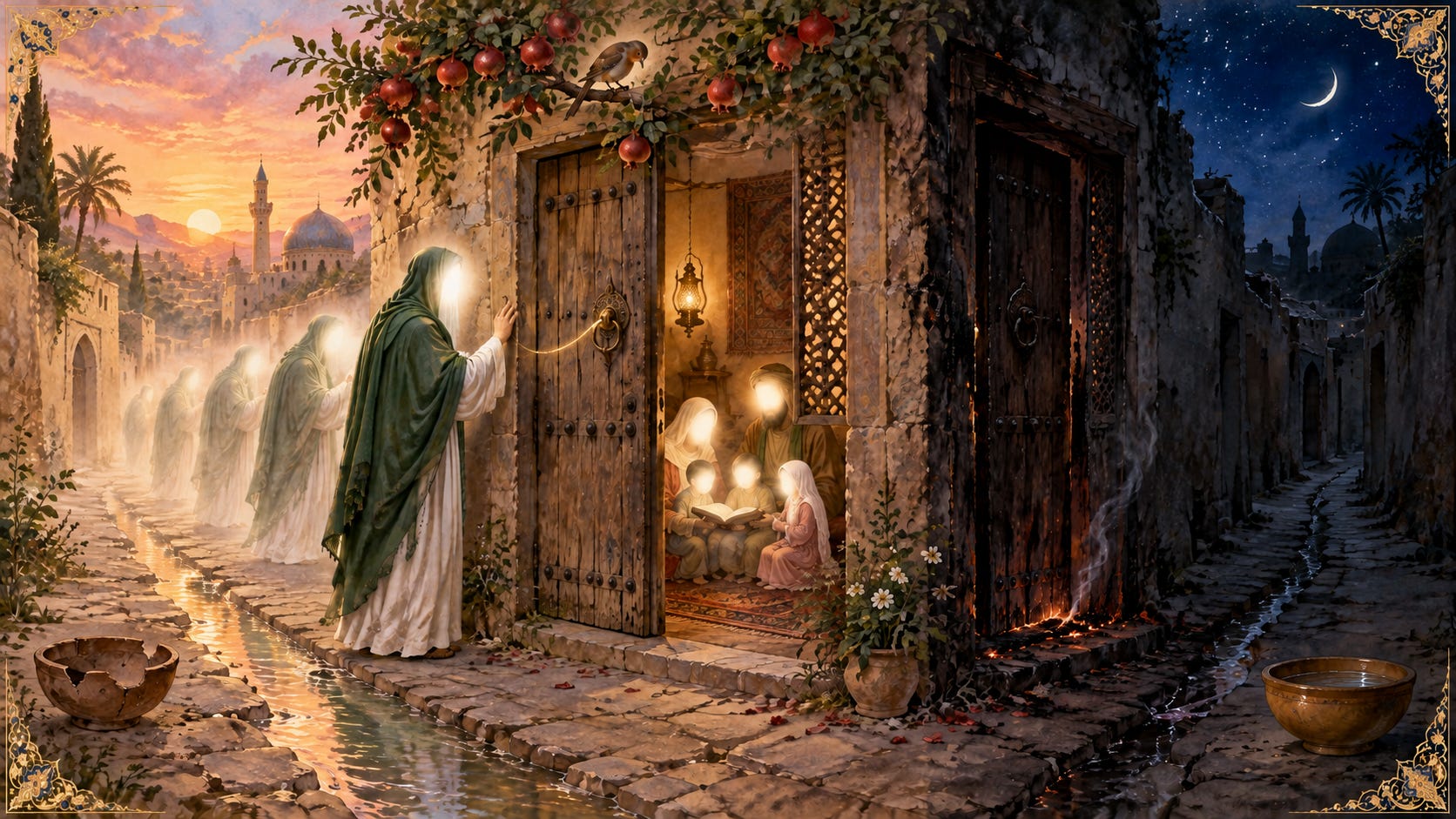
Five times a day, for nine months, he came to that door.
The prayer — may God have mercy on you.
It was the door of the first school of this community.
Behind it, a mother and a father were raising the children who would carry everything after them.
Behind it, the small words of God were sown into a childhood.
And on the day he wept when he saw her, he said what would come to that house after him.
Tonight is the night of the 13th of Jumada al-Ula — seventy-five days after her father.
From the door he came to at every prayer — to the day others came to it with fire.
Our maqtal tonight is The Door He Called At.
Supplication
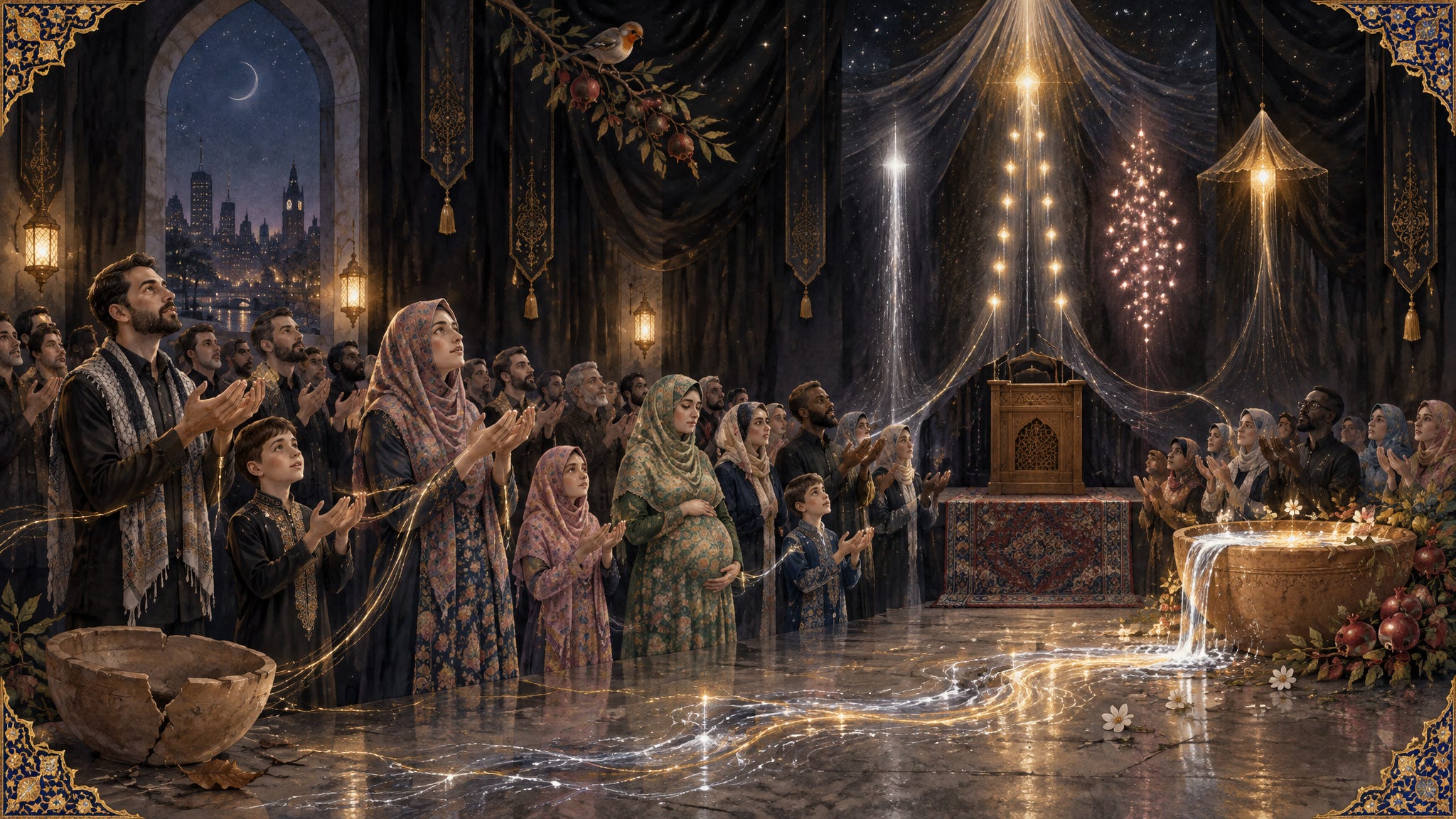
O God, we ask You by the light You placed in her before she was born — the light that kept her mother company in her loneliness, and that reached every house in Mecca that had shut its door.
By Your prophets, peace and blessings be upon them all — by Abraham and Sarah, by Moses and the women who saved him, by Zechariah, who was charged with Mary’s care, and by Mary and her son.
By Muhammad, peace and blessings be upon him, his family, and his righteous companions — who was a mother and a father to his daughter, and who came to her door five times a day.
By the fourteen — by Sayyedah Fatimah al-Zahra, peace and blessings be upon her, the fruit of his heart, and by every Imam from the Commander of the Faithful, peace and blessings be upon him, to the one we are waiting for.
We ask You with the words of her grandson, Imam Ali ibn al-Husayn al-Sajjad, peace and blessings be upon him, in his supplication for his children:
اللَّهُمَّ وَمُنَّ عَلَيَّ بِبَقَاءِ وُلْدِي وَبِإِصْلَاحِهِمْ لِي و بِإِمْتَاعِي بِهِمْ
“O God, be kind to me through the survival of my children, setting them right for me, and allowing me to enjoy them!”
إِلَهِي امْدُدْ لِي فِي أَعْمَارِهِمْ، وَزِدْ لِي فِي آجَالِهِمْ، وَرَبِّ لِي صَغِيرَهُمْ، وَقَوِّ لِي ضَعِيفَهُمْ، وَأَصِحَّ لِي أَبْدَانَهُمْ وَأَدْيَانَهُمْ وَأَخْلَاقَهُمْ، وَعَافِهِمْ فِي أَنْفُسِهِمْ وَفِي جَوَارِحِهِمْ وَفِي كُلِّ مَا عُنِيتُ بِهِ مِنْ أَمْرِهِمْ، وَأَدْرِرْ لِي وَعَلَى يَدِي أَرْزَاقَهُمْ
“My God, make long their lives for me, increase their terms, bring up the smallest for me, strengthen the weakest for me, rectify for me their bodies, their religious dedication, and their moral traits, make them well in their souls, their limbs, and everything that concerns me of their affair, and pour out for me and upon my hand their provisions!”
وَأَعِنِّي عَلَى تَرْبِيَتِهِمْ وَتَأْدِيبِهِمْ، وَبِرِّهِمْ، وَهَبْ لِي مِنْ لَدُنْكَ مَعَهُمْ أَوْلَاداً ذُكُوراً، وَاجْعَلْ ذَلِكَ خَيْراً لِي، وَاجْعَلْهُمْ لِي عَوْناً عَلَى مَا سَأَلْتُكَ
“Help me in their upbringing, their education, and my devotion toward them, give me among them from Yourself male children, make that a good for me, and make them a help for me in that which I ask from You!”
— Imam Ali ibn al-Husayn al-Sajjad, peace and blessings be upon him; al-Sahifa al-Sajjadiyya, Supplication 25, his supplication for his children — the English of our text of the Sahifa73
O God, for every child in this hall, and every child still in the womb: accept them with a gracious acceptance, and make them grow a beautiful growth. And for every mother and father raising a child alone tonight: be the second teacher in their home.
O God, make us gardeners, and not potters. Give us the patience to learn the children You have entrusted to us, and keep us from pressing them into shapes that are ours and not Yours.
O God, for those of us who were raised in fear, and in whom what You placed was buried: help us take the soil away. Let what was sown badly be sown again.
O God, have mercy on our mothers and fathers, who were our first school; on those who are with us, and those who have gone before us.
O God, have mercy on Shaheed Mutahhari, on Allamah Tabataba’i, on Imam Khomeini and on all the scholars whose words we carried tonight; and protect those of them who are still with us.
O God, we remember before You the martyred leader, Imam Sayyed Ali Khamenei, may God rest his pure soul — and we ask You to accept him, and to gather him with those he loved.
O God, protect and guide and lengthen the life of our Wali al-Faqih, Imam Sayyed Mujtaba Khamenei, may God protect him, and keep him firm on the straight path until the rising of the one we are waiting for.
O God, hasten the relief of Your friend and the son of Your friend — the Imam of our Age, may our souls be his ransom and may God hasten his return. And let us be among those he would be pleased to find raising their children for him when he comes.
O God, by the tears of her father on the day he saw her, and by the door he came to five times a day, make us of her lovers, and of those who weep for her tonight.
And whatever we have said tonight that was true, it is from You; and whatever was wrong in it is from me, and I ask Your forgiveness for it.
Amen, O Lord Sustainer of the Universes
Amen, O Most Merciful of the Merciful
And from Him alone is all ability and He has authority over all things.
Sources Cited
The Qur’an — the Arabic in the Uthmani script; the English, Ali Quli Qarai’s.
Nahj al-Balagha — Letter 31; Sayings 338 and 399 (the Arabic as our library holds it; the English said in the majlis is mine; Sayed Ali Raza’s English of Letter 31 for the reader).
Shaykh al-Kulayni, al-Kafi — Volume 1, hadiths 1232, 1234 and 1408; Volume 2, hadith 21; Volume 6, hadiths 188, 189, 190 and 213 (numbered as in the thaqalayn edition).
Shaykh al-Saduq — Man La Yahduruhu al-Faqih, Volume 1, hadith 862, and Volume 3, hadith 1528; al-Amali, hadiths 198, 216, 781, 836 and 940; al-Khisal, hadith 536; Ma’ani al-Akhbar, hadith 134; al-Tawhid, hadiths 373, 374, 377 and 378 (numbered as in the thaqalayn edition).
Shaykh al-Mufid, al-Amali — hadith 350 (numbered as in the thaqalayn edition).
Ayatullah Muhammad Asif Muhsini, Mu’jam al-Ahadith al-Mu’tabara — Volume 1, hadith 504, with the English of our text.
Imam Ali ibn al-Husayn al-Sajjad — Risalat al-Huquq (the Treatise on Rights), the rights of the mother and of the child, in William C. Chittick’s English; al-Sahifa al-Sajjadiyya, Supplication 25.
Allamah Sayyed Muhammad Husayn Tabataba’i, al-Mizan fi Tafsir al-Qur’an — on Surah Aal Imran, Verses 35 to 41 and 42 to 60; on Surah Ta-Ha, Verses 127 to 135.
Ibn Manzur, Lisan al-’Arab — Volume 4, the entry d-r-s.
Shaheed Ayatullah Murtaza Mutahhari — Ta’lim va Tarbiyat dar Islam (Education and Upbringing in Islam); Falsafe-ye Tarikh (The Philosophy of History), Volume 1; Moqaddame-i bar Jahan-bini-ye Eslami (An Introduction to the Islamic Worldview), Volume 4, Ensan dar Qur’an (Man in the Qur’an).
Imam Khomeini — Sahifeh-ye Imam, the English edition, Volumes 7 and 9; Sahifeh-ye Noor, Volume 7.
Imam Sayyed Ali Khamenei — Zan va Khanevadeh (Woman and Family); The Compassionate Family; speeches of 10 March 1997, 27 July 2005 and 27 December 2023 (farsi.khamenei.ir).
Ayatullah Abdullah Jawadi Amoli — Tasnim: commentary on Surah Aal Imran, sessions 105 and 106 (15 and 16 August 1989); commentary on Surah al-Ma’arij, session 6 (16 January 2019) (tasnim.esra.ir).
Ayatullah Muhammad Taqi Misbah Yazdi — a talk of 22 May 2017 (mesbahyazdi.ir).
Ayatullah Sayyed Muhammad Husayn Fadhlullah — Friday sermons of 4 September 1998, 17 September 1999 and 7 September 2001 (bayynat.org.lb).
Ibn Abi al-Hadid, Sharh Nahj al-Balagha — Volume 1, the life of al-Sharif al-Radi (Shaykh al-Mufid’s dream).
Shaykh Rizwan Arastu, God’s Emissaries: Adam to Jesus — page 539, and note 14 (pages 539 to 540).
The Bible — 1 Samuel 1:27-28, in the Hebrew (from Sefaria) and the King James Version; Luke 1:80, 2:40 and 2:52, in the King James Version (the Greek is still to be added); and, in the reader’s notes on the names, Exodus 2:4-8, 2:18, 2:21, 3:1, 6:20 and 15:20, and Numbers 26:59, with the Protoevangelium of James, the second-century text that names Mary’s parents Joachim and Anna.
Allamah Muhammad Baqir al-Majlisi, Bihar al-Anwar — Volume 16 (the version of the birth report that names Safra’) and Volume 101 (the saying of the master, the servant and the minister, with al-Tabrisi, Makarim al-Akhlaq, and al-Hurr al-’Amili, Wasa’il al-Shi’a).
From this majlis — Wilayah in the Home, session 2, “The Unfolding Tapestry” (23 November 2025); The Art of Supplication, session 20 (25 October 2025); The Lantern of the Path, sessions 64 and 65 (April 2026) and 77, “Her Mother’s House” (7 October 2026).
The same lines in Sayed Ali Raza’s published English.
“Certainly, the heart of a young man is like uncultivated land. It accepts whatever is strewn on it. So, I hastened to mould you properly before your heart hardened up and your mind became occupied, so that you might be ready to accept through your intelligence the results of the experience of others and be saved from going through these experiences yourself.”
— Nahj al-Balagha, Letter 31, in Sayed Ali Raza’s English (thaqalayn, Nahj al-Balagha, Volume 1, hadith 1336); for the reader only
The English said in the majlis is mine. The letter’s word is al-hadath — the young, sons and daughters alike — not only “a young man”; and its bi-l-adab is “with adab”, formation, rather than “to mould”.
1ـ مُحَمَّدُ بْنُ يَحْيَى عَنْ أَحْمَدَ بْنِ مُحَمَّدٍ وَعَلِيُّ بْنُ إِبْرَاهِيمَ عَنْ أَبِيهِ جَمِيعاً عَنِ ابْنِ مَحْبُوبٍ عَنِ ابْنِ رِئَابٍ عَنْ أَبِي بَصِيرٍ عَنْ أَبِي عَبْدِ الله (عَلَيْهِ السَّلام) قَالَ إِنَّ الله تَعَالَى أَوْحَى إِلَى عِمْرَانَ أَنِّي وَاهِبٌ لَكَ ذَكَراً سَوِيّاً مُبَارَكاً يُبْرِئُ الاكْمَهَ وَالابْرَصَ وَيُحْيِي الْمَوْتَى بِإِذْنِ الله وَجَاعِلُهُ رَسُولاً إِلَى بَنِي إِسْرَائِيلَ فَحَدَّثَ عِمْرَانُ امْرَأَتَهُ حَنَّةَ بِذَلِكَ وَهِيَ أُمُّ مَرْيَمَ فَلَمَّا حَمَلَتْ كَانَ حَمْلُهَا بِهَا عِنْدَ نَفْسِهَا غُلامٌ فَلَمَّا وَضَعَتْها قالَتْ رَبِّ إِنِّي وَضَعْتُها أُنْثى... وَلَيْسَ الذَّكَرُ كَالانْثى أَيْ لا يَكُونُ الْبِنْتُ رَسُولاً يَقُولُ الله عَزَّ وَجَلَّ وَالله أَعْلَمُ بِما وَضَعَتْ فَلَمَّا وَهَبَ الله تَعَالَى لِمَرْيَمَ عِيسَى كَانَ هُوَ الَّذِي بَشَّرَ بِهِ عِمْرَانَ وَوَعَدَهُ إِيَّاهُ فَإِذَا قُلْنَا فِي الرَّجُلِ مِنَّا شَيْئاً وَكَانَ فِي وَلَدِهِ أَوْ وَلَدِ وَلَدِهِ فَلا تُنْكِرُوا ذَلِكَ.
“1 – Muhammad ibn Yahya, from Ahmad ibn Muhammad; and Ali ibn Ibrahim, from his father; all of them from Ibn Mahbub, from Ibn Ri’ab, from Abu Basir, from Abu Abdillah, peace be upon him, who said: God, exalted, revealed to Imran: I am giving you a son, sound and blessed, who will heal the blind and the leper and bring the dead to life by God’s leave, and I am making him a messenger to the Children of Israel. Imran told his wife Hanna of this; she was the mother of Mary. When she conceived, she thought to herself that what she carried was a boy. ‘When she bore her she said, My Lord, I have borne a female ... and the male is not like the female’ — that is, a girl would not be a messenger. God, mighty and majestic, says: ‘And God knew better what she had borne.’ When God, exalted, gave Mary Jesus, he was the one whose good news He had given Imran and whom He had promised him. So when we say something about a man among us and it turns out to be in his son or his son’s son, do not deny it.”
— Imam Ja’far al-Sadiq, peace and blessings be upon him, through Abu Basir; Shaykh al-Kulayni, al-Kafi, Volume 1, hadith 1408 (thaqalayn); my translation
The “...” inside the verse is the report’s own — it quotes 3:36 in part. The report reads “the male is not like the female” as the mother’s words — “that is, a girl would not be a messenger” — where Allamah Tabataba’i, below, and Qarai’s English take them as God’s; the majlis hears Allamah’s reading. The report’s last line is about the Imams themselves, and is not said in the majlis.
On the names. Prophets and others who appear in the Bible are called here by the names an English Bible gives them: Mary (in the Qur’an’s Arabic, Maryam), Jesus (Isa), Zechariah (Zakariyya), John the Baptist (Yahya), Moses (Musa) and Abraham (Ibrahim). Mary’s parents are not named in the Bible. The Qur’an calls her the daughter of Imran (66:12), and her mother the wife of Imran (3:35); the report above names her mother Hanna; Christian tradition knows them as Joachim and Anna — the names a second-century text, the Protoevangelium of James, gives them, and the names Shaykh Rizwan Arastu uses in God’s Emissaries, quoted below. Anna is the same name as Hanna.
قوله تعالى: فلما وضعتها قالت رب إني وضعتها أنثى، في وضع الضمير المؤنث موضع ما في بطنها إيجاز لطيف، و المعنى فلما وضعت ما في بطنها و تبينت أنه أنثى قالت: رب إني وضعتها أنثى، و هو خبر أريد به التحسر و التحزن دون الإخبار و هو ظاهر.
قوله تعالى: و الله أعلم بما وضعت و ليس الذكر كالأنثى، جملتان معترضتان و هما جميعا مقولتان له تعالى لا لامرأة عمران، و لا أن الثانية مقولة لها و الأولى مقولة لله.
أما الأولى فهي ظاهرة لكن لما كانت قولها رب إني وضعتها أنثى، مسوقا لإظهار التحسر كان ظاهر قوله: و الله أعلم بما وضعت، أنه مسوق لبيان أنا نعلم أنها أنثى لكنا أردنا بذلك إنجاز ما كانت تتمناه بأحسن وجه و أرضى طريق، و لو كانت تعلم ما أردناه من جعل ما في بطنها أنثى لم تتحسر و لم تحزن ذاك التحسر و التحزن و الحال أن الذكر الذي كانت ترجوه لم يكن ممكنا أن يصير مثل هذا الأنثى التي وهبناها لها، و يترتب عليه ما يترتب على خلق هذه الأنثى فإن غاية أمره أن يصير مثل عيسى نبيا مبرئا للأكمه و الأبرص و محييا للموتى لكن هذه الأنثى ستتم به كلمة الله و تلد ولدا بغير أب، و تجعل هي و ابنها آية للعالمين، و يكلم الناس في المهد، و يكون روحا و كلمة من الله، مثله عند الله كمثل آدم إلى غير ذلك من الآيات الباهرات في خلق هذه الأنثى الطاهرة المباركة و خلق ابنها عيسى(عليه السلام).
و من هنا يظهر: أن قوله: و ليس الذكر كالأنثى، مقول له تعالى لا لامرأة عمران، و لو كان مقولا لها لكان حق الكلام أن يقال: و ليس الأنثى كالذكر لا بالعكس و هو ظاهر فإن من كان يرجو شيئا شريفا أو مقاما عاليا ثم رزق ما هو أخس منه و أردأ إنما يقول عند التحسر: ليس هذا الذي وجدته هو الذي كنت أطلبه و أبتغيه، أو ليس ما رزقته كالذي كنت أرجوه، و لا يقول: ليس ما كنت أرجوه كهذا الذي رزقته البتة، و ظهر من ذلك أن اللام في الذكر و الأنثى معا أو في الأنثى فقط للعهد.
“His words, exalted: ‘When she bore her, she said: My Lord, I have borne a female.’ Putting the feminine pronoun in place of ‘what is in her belly’ is a fine concision; the meaning is: when she had borne what was in her belly and saw that it was a female, she said: My Lord, I have borne a female. It is a statement meant as regret and sorrow, not as news; and that is plain.
His words, exalted: ‘And God knew better what she had borne, and the male is not like the female’ — two interjected sentences, both of them said by Him, exalted, not by the wife of Imran; nor is the second hers and the first God’s.
As for the first, it is plain; but since her words ‘My Lord, I have borne a female’ were said to voice her sorrow, the plain sense of His words ‘and God knew better what she had borne’ is that they are said to show: We know she is a female, but by that We meant to fulfil what she was longing for in the best way and by the most pleasing path; and had she known what We meant by making what was in her belly a female, she would not have felt that sorrow and that grief — when the male she was hoping for could not possibly have become like this female whom We gave her, nor would there follow from him what follows from the creation of this female. For the utmost of his affair would be to become, like Jesus, a prophet who heals the blind and the leper and brings the dead to life; but through this female the word of God will be completed: she will bear a child without a father; she and her son will be made a sign for the worlds; he will speak to people in the cradle, and be a spirit and a word from God, his likeness with God as the likeness of Adam — and other dazzling signs in the creation of this pure and blessed female and the creation of her son Jesus, peace be upon him.
From here it is clear that His words ‘and the male is not like the female’ are said by Him, exalted, not by the wife of Imran. Had they been hers, the right way to say it would have been ‘and the female is not like the male’, not the reverse; and that is plain, for one who was hoping for something noble, or a high station, and was given what is lower and poorer than it, says in his sorrow: ‘this that I found is not what I was seeking and wanting’, or ‘what I was given is not like what I was hoping for’; he never says ‘what I was hoping for is not like this that I was given’. And it is clear from this that the article in ‘the male’ and ‘the female’ together, or in ‘the female’ alone, points to the ones already in view.”
و الكلام في قولها: و ذريتها، من حيث إنه قول مطلق من شرط و قيد لا يصح انتفوه به في حضرة التخاطب ممن لا علم له به مع أن مستقبل حال الإنسان من الغيب الذي لا يعلمه إلا الله سبحانه، نظير الكلام في قولها رب إني نذرت لك ما في بطني محررا، على ما تقدم بيانه فليس إلا أنها كانت تعلم أن سترزق من عمران ولدا ذكرا صالحا ثم لما حملت و توفي عمران لم تشك أن ما في بطنها هو ذلك الولد الموعود، ثم لما وضعتها و بان لها خطأ حدسها أيقنت أنها سترزق ذلك الولد من نسل هذه البنت المولودة فحولت نذرها من الابن إلى البنت، و سمتها مريم العابدة، الخادمة و أعاذتها و ذريتها بالله من الشيطان الرجيم هذا ما يعطيه التدبر في كلامه تعالى.
“And what is to be said of her words ‘and her offspring’ — said absolutely, with no condition or qualification, which no one could rightly utter in the presence of the One addressed without knowing it, when the future of a human being is of the unseen that none knows but God, glory be to Him — is like what was said of her words ‘My Lord, I have vowed to You what is in my belly, dedicated’, as explained before. It can only be that she knew she would be given from Imran a righteous male child; then, when she conceived and Imran died, she did not doubt that what was in her belly was that promised child; then, when she bore her and the error of her guess became clear to her, she became certain that she would be given that child from the line of this newborn daughter, and so she turned her vow from the son to the daughter, named her Mary — the worshipper, the servant — and sought refuge for her and her offspring with God from Satan the outcast. This is what reflection on His words gives.”
— Allamah Sayyed Muhammad Husayn Tabataba’i, al-Mizan fi Tafsir al-Qur’an, on Surah Aal Imran (the Chapter of the Family of Imran) #3, Verses 35 to 41 — the commentary on “and the male is not like the female”, and on “her offspring”; my translation
“When she bore a girl, she was perplexed. In utter incredulousness she told God, “My Lord, I have borne a female child!”12 It was not that she was misogynistic, as is common in many primitive societies. On the contrary, Anna was perplexed by the birth of a girl in light of Joachim’s prophecy. She had submitted so wholly to her husband’s prophecy that she was certain her child would be its fulfillment. Indeed, he had explicitly promised her this. But now she had borne a girl, and, for a moment, she was both disappointed that she had somehow failed to play her part and bewildered that the prophecy was left unfulfilled.13 Little did she know that the boy she had expected was nothing like this girl she had been given.14”
— Shaykh Rizwan Arastu, God’s Emissaries: Adam to Jesus, page 539 (Fihrist, PDF page 540); his telling calls Mary’s parents Joachim and Anna, and the numbers 12, 13 and 14 in the paragraph are the book’s note marks
“14. Qurʾān 3:36. The vast majority of commentators believe the phrase “wa laysa al-dhakaru ka al-unthā” to be a continuation of what Anna said to God. ʿAllāmah al-Ṭabāṭabāʾī and al-Marāghī believe it is God who says this as an aside to us, and that if Anna had said it, she would have said it the other way around, “This female I have borne is not like the male I had hoped for.” God’s statement, “The boy she had expected was nothing like this girl she had been given,” is not meant to debase Jesus in any way or to say that Jesus’ status was less than his mother’s. Anna had expected her child to be a messenger and a worker of miracles as per Joachim’s prophecy. However, she had not expected him to be one of the Messengers of Great Resolve and one of God’s greatest messengers. Thus, the comparison is between the prophet she expected and Mary, not Jesus and Mary.”
— Shaykh Rizwan Arastu, God’s Emissaries: Adam to Jesus, note 14, pages 539 to 540 (Fihrist, PDF pages 540 to 541);
The two verses in the Hebrew, with the King James Version.
אֶל־הַנַּ֥עַר הַזֶּ֖ה הִתְפַּלָּ֑לְתִּי וַיִּתֵּ֨ן יְהֹוָ֥ה לִי֙ אֶת־שְׁאֵ֣לָתִ֔י אֲשֶׁ֥ר שָׁאַ֖לְתִּי מֵעִמּֽוֹ׃
וְגַ֣ם אָנֹכִ֗י הִשְׁאִלְתִּ֙הוּ֙ לַֽיהֹוָ֔ה כׇּל־הַיָּמִים֙ אֲשֶׁ֣ר הָיָ֔ה ה֥וּא שָׁא֖וּל לַיהֹוָ֑ה וַיִּשְׁתַּ֥חוּ שָׁ֖ם לַֽיהֹוָֽה׃ {ס}
“For this child I prayed; and the LORD hath given me my petition which I asked of him: Therefore also I have lent him to the LORD; as long as he liveth he shall be lent to the LORD. And he worshipped the LORD there.”
— 1 Samuel 1:27-28: the Hebrew as our library holds it (from Sefaria; the letter in braces after verse 28 is the text’s own paragraph mark, the setumah); the English, the King James Version
و المراد بإنباتها نباتا حسنا إعطاء الرشد و الزكاة لها و لذريتها، و إفاضة الحيوة لها و لمن ينمو منها من الذرية حيوة لا يمسها نفث الشيطان و رجس تسويله و وسوسته، و هو الطهارة.
و هذان أعني القبول الحسن الراجع إلى الاصطفاء، و النبات الحسن الراجع إلى التطهير هما اللذان يشير إليهما قوله تعالى في ذيل هذه الآية: و إذ قالت الملائكة يا مريم إن الله اصطفاك و طهرك الآية و سنوضحه بيانا إن شاء الله العزيز.
“What is meant by His making her grow a goodly growth is His granting right guidance (rushd) and purity (zakat) to her and to her offspring, and pouring life upon her and upon the offspring that grows from her — a life that Satan’s breath, and the filth of his insinuation and whispering, do not touch; and that is purity (tahara).
These two — the goodly acceptance, which comes back to selection (istifa’), and the goodly growth, which comes back to purification (tathir) — are what His words at the end of this passage point to: ‘And when the angels said, O Mary, God has chosen you and purified you’ (3:42). We shall explain it, God willing.”
— Allamah Sayyed Muhammad Husayn Tabataba’i, al-Mizan fi Tafsir al-Qur’an, on Surah Aal Imran (the Chapter of the Family of Imran) #3, Verses 35 to 41; my translation; for the reader only
من فرزند صالح و پاك را از رحم به دامن آوردم و به تو تحويل دادم بقيهاش به عهده شماست شما او را حفظ بكن. اينكه در جملههاي بعد آمده است ﴿وَإِنِّي أُعِيذُهَا بِكَ وَذُرِّيَّتَهَا مِنَ الشَّيْطَانِ الرَّجِيمِ﴾ يعني همانطوري كه من محرر تحويل دادهام شما هم محرر او را تربيت كنيد و ذات اقدس الهي سه مسئله را اينجا بازگو كرد; هم به آن سؤال اول پاسخ داد هم به سؤال دوم پاسخ داد و هم راه انجام اين سؤال دوم را هم ارائه داد يعني مريم(عليها السّلام) را خدا قبول كرد, چون مادرش گفت: ﴿فَتَقَبَّلْ مِنِّي﴾ خدا هم فرمود: ﴿فَتَقَبَّلَهَا رَبُّهَا بِقَبُولٍ حَسَنٍ﴾ عرض كرد: ﴿إِنِّي أُعِيذُهَا بِكَ وَذُرِّيَّتَهَا مِنَ الشَّيْطَانِ الرَّجِيمِ﴾ خدا هم فرمود: ﴿وَأَنْبَتَهَا نَبَاتاً حَسَناً﴾ يعني خوب تربيت كرد; اما حالا چگونه تربيت كرد و چگونه خدايا تو او را تربيت بكن, اين در كلمات امرائه عمران و مادر مريم نيست اين را خدا نشان داد. فرمود براي اينكه يك فرزند صالح به بار بيايد يك معلمي چون زكريا لازم است; گرچه خدا ميتواند افراد صالح را در پليدترين دستگاهها بپروراند ـ چون كه موسيٰ را در بيت فرعون تربيت كرد ـ اما اين يك راه غيرعادي است ولي راه عادياش آن است كه انسان يك مربي خوبي داشته باشد; منتها رسيدن آن مربي به آدم يك توفيقهاي غيرعادي را طلب ميكند.
“[Her mother is saying:] I have brought a righteous, pure child from the womb to the lap and handed her over to You; the rest is Yours — You keep her. When the next words say, ‘and I commend her and her offspring to You against Satan the outcast’, it means: just as I have handed her over consecrated, You too raise her consecrated. And the Holy Essence of God set out three things here: He answered the first request, He answered the second, and He showed the way the second would be carried out. That is, God accepted Mary, peace be upon her: her mother said ‘so accept from me’, and God said ‘so her Lord accepted her with a goodly acceptance’; she said ‘I commend her and her offspring to You against Satan the outcast’, and God said ‘and He made her grow a goodly growth’ — that is, He raised her well. But how He raised her, and how one says ‘O God, raise her’ — that is not in the words of Imran’s wife, Mary’s mother; God showed it. He said: for a righteous child to come to fruit, a teacher like Zechariah is needed. Although God can raise righteous people in the foulest of systems — as He raised Moses in Pharaoh’s house — that is an extraordinary way; the ordinary way is that a person has a good educator (morabbi); and for that educator to reach a person needs extraordinary help from God.”
— Ayatullah Abdullah Jawadi Amoli, Tasnim, commentary on Surah Aal Imran, session 105, 15 August 1989 (tasnim.esra.ir); my translation
في ذكرى الزهراء (ع) نرتفع ونسمو ونحصل على الصفاء والنقاء لأنها كانت سيدة نساء العالمين، كانت المعصومة في عقلها وقلبها وفي كل حياتها، كانت النموذج الأمثل، وإذا كان الله تعالى قد أنبت مريم نباتاً حسناً وكفّلها زكريا، فإنه تعالى أنبت فاطمة نباتاً حسناً وكفّلها محمداً، وأين زكريا (ع) من محمد (ص)؟! لقد نبتت نباتاً حسناً؛ نبت عقلها من خلال غراس رسول الله (ص)، ونبت قلبها من خلال تربية رسول الله(ص)، ونبتت حياتها من خلال رعاية رسول الله (ص)..
“In the remembrance of al-Zahra, peace be upon her, we rise, we are lifted, and we attain clarity and purity, for she was the Mistress of the Women of the Worlds, protected from error in her mind, her heart and all her life, the most perfect model. And if God, exalted, made Mary grow a goodly growth and placed her in Zechariah’s care, He, exalted, made Fatimah grow a goodly growth and placed her in Muhammad’s care — and where is Zechariah, peace be upon him, beside Muhammad, God bless him and his family?! She grew a goodly growth: her mind grew from what the Messenger of God planted, her heart grew through the upbringing of the Messenger of God, and her life grew through the care of the Messenger of God.”
— Ayatullah Sayyed Muhammad Husayn Fadhlullah, Friday sermon of 17 September 1999 (bayynat.org.lb); my translation
The remark is a parenthesis inside the tale the Mathnawi tells of a maktab teacher and his pupils. The passage, from the start of the tale to the children’s plan:
داستانی که مثنوی نقل کرده معروف است که یک آخوند مکتبی بود که بچههای زیادی را درس میداد. (در قدیم بچهها را خیلی اذیت میکردند). بچهها دلخوشیشان این بود که روزی از چنگ این آخوند خلاص و آزاد بشوند. بچههای زرنگ با خود گفتند که ما چکار کنیم که آخوند ما را رها کند؟ نقشهای کشیدند.
“The story the Mathnawi tells is well known: there was a maktab teacher — an akhund — who taught a great many children. (In the old days they used to torment children a great deal.) The children’s one comfort was the hope that some day they would be rid of this akhund’s clutches, and free. The clever ones said to themselves: what shall we do, so that the akhund lets us go? They drew up a plan.”
— Shaheed Ayatullah Murtaza Mutahhari, Ta’lim va Tarbiyat dar Islam, page 38, lines 25 to 28, to the children’s plan (the tale runs on to page 39); my translation
The whole passage, in his Persian, with my translation.
خانوادهی خوب؛ یعنی زن و شوهری که با هم مهربان باشند، باوفا و صمیمی باشند و به یکدیگر محبّت و عشق بورزند، رعایت همدیگر را بکنند، مصالح همدیگر را گرامی و مهم بدارند، این در درجهی اوّل. بعد، اولادی که در آن خانواده به وجود میآید، نسبت به او احساس مسؤولیّت کنند، بخواهند او را از لحاظ مادّی و معنوی سالم بزرگ کنند. بخواهند از لحاظ مادّی و معنوی او را به سلامت برسانند، چیزهایی به او یاد بدهند؛ به چیزهایی او را وادار کنند، از چیزهایی او را باز دارند و صفات خوبی را در او تزریق کنند. یک چنین خانوادهای اساس همهی اصلاحات واقعی در یک کشور است؛ چون انسانها در چنین خانوادهای خوب تربیت میشوند، با صفات خوب بزرگ میشوند. با شجاعت، با استقلال عقل، با فکر، با احساس مسؤولیّت، با احساس محبّت، با جرأت، جرأت تصمیمگیری، با خیرخواهی – نه بدخواهی – با نجابت، خب وقتی مردم جامعهای این خصوصیات را داشته باشند، یعنی خیرخواه و نجیب و شجاع و عاقل و متفکّر باشند، این جامعه دیگر روی بدبختی را نخواهد دید.۱
“A good family: that is, a wife and husband who are kind to each other, faithful and sincere, who show each other love and affection, who look out for each other, and who hold each other’s good dear and important — this first of all. Then, towards the child born in that family, they feel responsible; they want to raise him sound, materially and spiritually. They want to bring him through safely, materially and spiritually: to teach him things, to set him to some things and hold him back from others, and to instil good qualities in him. Such a family is the basis of all real reforms in a country, because in such a family people are raised well; they grow up with good qualities — with courage, with independence of mind, with thought, with a sense of responsibility, with a sense of love, with daring, the daring to decide, with goodwill — not ill will — with nobility. Well, when the people of a society have these qualities — that is, when they are well-wishing, noble, brave, wise and thoughtful — that society will never again see the face of misfortune.”
— Imam Sayyed Ali Khamenei, may God rest his pure soul, Zan va Khanevadeh (Woman and Family), pages 88 to 89; my translation
The digit at the end of the Persian is the book's own note mark.
Where The Compassionate Family says “the source of all true reforms”, the Persian says “the basis”
We have strived to understand:
That the threads of Mawaddah and Rahmah must be actively nurtured, not just felt.
That spouses are Libas (garments) for one another, a sacred trust to protect and conceal faults, but never to conceal or enable dhulm (abuse).
That the Divine Pattern holds honour for both:
the husband as a just qawwam (protector),
and the wife as the cherished rayhanah,
and honoured modir (manager) of the home’s tranquility.That accommodation (sazegari) is the key to enduring conflict,
but that this virtue must never be manipulated to demand patience in the face of abuse,
which is a haram violation of the covenant.And that the ultimate fruit of the tapestry is tarbiyyah,
the sacred duty of raising righteous servants of God—
a jihad for mothers and a duty for fathers.— from this majlis, last year: Wilayah in the Home, session 2, “The Unfolding Tapestry”, 23 November 2025, from its supplication (reflections313.com)
4ـ عَلِيُّ بْنُ إِبْرَاهِيمَ عَنْ أَبِيهِ عَنِ ابْنِ أَبِي عُمَيْرٍ عَنِ ابْنِ أُذَيْنَةَ عَنْ زُرَارَةَ عَنْ أَبِي جَعْفَرٍ (عَلَيهِ السَّلام) قَالَ سَأَلْتُهُ عَنْ قَوْلِ الله عَزَّ وَجَلَّ حُنَفاءَ لله غَيْرَ مُشْرِكِينَ بِهِ قَالَ الْحَنِيفِيَّةُ مِنَ الْفِطْرَةِ الَّتِي فَطَرَ الله النَّاسَ عَلَيْهَا لا تَبْدِيلَ لِخَلْقِ الله قَالَ فَطَرَهُمْ عَلَى الْمَعْرِفَةِ بِهِ قَالَ زُرَارَةُ وَسَأَلْتُهُ عَنْ قَوْلِ الله عَزَّ وَجَلَّ وَإِذْ أَخَذَ رَبُّكَ مِنْ بَنِي آدَمَ مِنْ ظُهُورِهِمْ ذُرِّيَّتَهُمْ وَأَشْهَدَهُمْ عَلى أَنْفُسِهِمْ أَ لَسْتُ بِرَبِّكُمْ قالُوا بَلى الآيَةَ قَالَ أَخْرَجَ مِنْ ظَهْرِ آدَمَ ذُرِّيَّتَهُ إِلَى يَوْمِ الْقِيَامَةِ فَخَرَجُوا كَالذَّرِّ فَعَرَّفَهُمْ وَأَرَاهُمْ نَفْسَهُ وَلَوْ لا ذَلِكَ لَمْ يَعْرِفْ أَحَدٌ رَبَّهُ وَقَالَ قَالَ رَسُولُ الله (صَلَّى اللهُ عَلَيْهِ وآلِه) كُلُّ مَوْلُودٍ يُولَدُ عَلَى الْفِطْرَةِ يَعْنِي الْمَعْرِفَةَ بِأَنَّ الله عَزَّ وَجَلَّ خَالِقُهُ كَذَلِكَ قَوْلُهُ وَلَئِنْ سَأَلْتَهُمْ مَنْ خَلَقَ السَّماواتِ وَالأرْضَ لَيَقُولُنَّ الله.
“4 – Ali ibn Ibrahim, from his father, from Ibn Abi Umayr, from Ibn Udhayna, from Zurara, from Abu Ja’far, peace be upon him. He [Zurara] said: I asked him about the words of God, mighty and majestic, ‘Hunafa’ for God, not associating anything with Him’ (22:31). He said: Hanifiyya is of the fitrah upon which God originated people — ‘there is no altering God’s creation’ (30:30). He said: He originated them upon knowing Him. Zurara said: And I asked him about the words of God, mighty and majestic, ‘And when your Lord took from the children of Adam, from their loins, their offspring, and made them bear witness over themselves: Am I not your Lord? They said: Yes indeed’ — and the rest of the verse (7:172). He said: He brought out from Adam’s loins his offspring until the Day of Resurrection, and they came out like tiny particles; He made Himself known to them and showed them Himself; were it not for that, no one would know his Lord. And he said: The Messenger of God, God bless him and his family, said: Every newborn is born upon the fitrah — meaning, knowing that God, mighty and majestic, is his Creator; and so His words: ‘And if you ask them who created the heavens and the earth, they will surely say: God’ (31:25).”
— Zurara, from Imam Muhammad al-Baqir, peace and blessings be upon him; Shaykh al-Kulayni, al-Kafi, Volume 2, hadith 21 (thaqalayn), the first report, with its chain; my translation
عَلِيُّ بْنُ إِبْرَاهِيمَ عَنْ أَبِيهِ عَنِ ابْنِ فَضَّالٍ عَنِ ابْنِ أَبِي جَمِيلَةَ عَنْ مُحَمَّدٍ الْحَلَبِيِّ عَنْ أَبِي عَبْدِ الله (عَلَيهِ السَّلام) فِي قَوْلِ الله عَزَّ وَجَلَّ فِطْرَتَ الله الَّتِي فَطَرَ النَّاسَ عَلَيْها قَالَ فَطَرَهُمْ عَلَى التَّوْحِيدِ.
“Ali ibn Ibrahim, from his father, from Ibn Faddal, from Ibn Abi Jamila, from Muhammad al-Halabi, from Abu Abdillah, peace be upon him, on the words of God, mighty and majestic, ‘the fitrah of God, upon which He originated people’ (30:30): He said: He originated them upon tawhid.”
— Muhammad al-Halabi, from Imam Ja’far al-Sadiq, peace and blessings be upon him; Shaykh al-Kulayni, al-Kafi, Volume 2, hadith 21 (thaqalayn), the second report, with its chain; my translation
The four reports of al-Tawhid, each with its chain, and Ayatullah Muhsini’s entry.
4 - حدثنا محمد بن الحسن بن أحمد بن الوليد رحمه الله، قال: حدثنا محمد بن الحسن الصفار، عن إبراهيم بن هاشم، ويعقوب بن يزيد، عن ابن فضال، عن بكير عن زرارة، عن أبي عبد الله عليه السلام في قوله عز وجل: (فطرة الله التي فطر الناس عليها) قال: فطرهم على التوحيد.
“4 – Muhammad ibn al-Hasan ibn Ahmad ibn al-Walid, may God have mercy on him, narrated to us: Muhammad ibn al-Hasan al-Saffar narrated to us, from Ibrahim ibn Hashim and Ya’qub ibn Yazid, from Ibn Faddal, from Bukayr, from Zurara, from Abu Abdillah, peace be upon him, on His words, mighty and majestic, ‘the fitrah of God, upon which He originated people’: He said: He originated them upon tawhid.”
— Imam Ja’far al-Sadiq, peace and blessings be upon him, through Zurara; Shaykh al-Saduq, al-Tawhid, hadith 373 (thaqalayn); my translation
5 - أبي رحمه الله، قال: حدثنا علي بن إبراهيم بن هاشم، عن أبيه، عن ابن فضال، عن أبي جميلة، عن محمد الحلبي، عن أبي عبد الله عليه السلام في قول الله عز وجل (فطرة الله التي فطر الناس عليها) قال: فطرهم على التوحيد.
“5 – My father, may God have mercy on him, said: Ali ibn Ibrahim ibn Hashim narrated to us, from his father, from Ibn Faddal, from Abu Jamila, from Muhammad al-Halabi, from Abu Abdillah, peace be upon him, on the words of God, mighty and majestic, ‘the fitrah of God, upon which He originated people’: He said: He originated them upon tawhid.”
— Imam Ja’far al-Sadiq, peace and blessings be upon him, through Muhammad al-Halabi; Shaykh al-Saduq, al-Tawhid, hadith 374 (thaqalayn) — the same report as al-Kafi’s second, above; my translation
8 - أبي رحمه الله، قال: حدثنا سعد بن عبد الله، عن أحمد بن محمد، عن أبيه، عن عبد الله بن المغيرة، عن ابن مسكان، عن زرارة قال: قلت لأبي جعفر عليه السلام: أصلحك الله، قول الله عز وجل في كتابه: (فطرة الله التي فطر الناس عليها)؟ قال: فطرهم على التوحيد عند الميثاق على معرفته أنه ربهم، قلت: وخاطبوه؟ قال: فطأطأ رأسه، ثم قال: لولا ذلك لم يعلموا من ربهم ولا من رازقهم (٢).
“8 – My father, may God have mercy on him, said: Sa’d ibn Abdillah narrated to us, from Ahmad ibn Muhammad, from his father, from Abdullah ibn al-Mughira, from Ibn Muskan, from Zurara, who said: I said to Abu Ja’far, peace be upon him: May God set you right — the words of God, mighty and majestic, in His Book: ‘the fitrah of God, upon which He originated people’? He said: He originated them upon tawhid, at the covenant, upon knowing Him — that He is their Lord. I said: And they spoke to Him? He [Zurara] said: He lowered his head; then he said: Were it not for that, they would not know who their Lord is, nor who provides for them. (2)”
— Imam Muhammad al-Baqir, peace and blessings be upon him, through Zurara; Shaykh al-Saduq, al-Tawhid, hadith 377 (thaqalayn); my translation; the (2) is the edition’s note mark
9 - أبي رحمه الله، قال: حدثنا سعد بن عبد الله، عن إبراهيم بن هاشم ومحمد بن الحسين بن أبي الخطاب ويعقوب بن يزيد جميعا، عن ابن أبي عمير، عن ابن أذينة، عن زرارة، عن أبي جعفر عليه السلام قال: سألته عن قول الله عز وجل: ﴿حنفاء لله غير مشركين به﴾ وعن الحنيفية، فقال: هي الفطرة التي فطر الله الناس عليها لا تبديل لخلق الله، وقال: فطرهم الله على المعرفة، قال زرارة: وسألته عن قول الله عز وجل: (وإذا أخذ ربك من بني آدم من ظهورهم - الآية) قال: أخرج من ظهر آدم ذريته إلى يوم القيامة فخرجوا كالذر، فعرفهم وأراهم صنعه، ولولا ذلك لم يعرف أحد ربه، وقال: قال رسول الله صلى الله عليه وآله: كل مولود يولد على الفطرة. يعني على المعرفة بأن الله عز وجل خالقه، فذلك قوله: ﴿ولئن سألتهم من خلق السماوات والأرض ليقولن الله﴾ .
“9 – My father, may God have mercy on him, said: Sa’d ibn Abdillah narrated to us, from Ibrahim ibn Hashim, Muhammad ibn al-Husayn ibn Abi al-Khattab and Ya’qub ibn Yazid, all of them, from Ibn Abi Umayr, from Ibn Udhayna, from Zurara, from Abu Ja’far, peace be upon him. He [Zurara] said: I asked him about the words of God, mighty and majestic, ‘Hunafa’ for God, not associating anything with Him’, and about the hanifiyya. He said: It is the fitrah upon which God originated people — there is no altering God’s creation. And he said: God originated them upon knowing [Him]. Zurara said: And I asked him about the words of God, mighty and majestic, ‘And when your Lord took from the children of Adam, from their loins —’ and the rest of the verse. He said: He brought out from Adam’s loins his offspring until the Day of Resurrection, and they came out like tiny particles; He made Himself known to them, and showed them His handiwork; were it not for that, no one would know his Lord. And he said: The Messenger of God, God bless him and his family, said: Every newborn is born upon the fitrah — meaning, upon knowing that God, mighty and majestic, is his Creator; and that is His saying: ‘And if you ask them who created the heavens and the earth, they will surely say: God.’”
— Imam Muhammad al-Baqir, peace and blessings be upon him, through Zurara; Shaykh al-Saduq, al-Tawhid, hadith 378 (thaqalayn) — the same report as al-Kafi’s first, above; my translation
[385/8] التوحيد: أبي، عن سعد، عن ابن هاشم وابن أبي الخطاب وابن يزيد جميعا، عن ابن أبي عمير، عن ابن اذينة، عن زرارة، عن أبي جعفر عليه السلام قال: سألته عن قول الله عزوجل حُنَفَاءَ لِلَّهِ غَيْرَ مُشْرِكِينَ بِهِ وعن الحنيفية فقال: هي الفطرة التي فطر الناس عليها، لا تبديل لخلق الله، قال: فطرهم الله على المعرفة. قال زرارة: وسألته عن قول الله وَإِذْ أَخَذَ رَبُّكَ مِنْ بَنِي آدَمَ مِنْ ظُهُورِهِمْ ذُرِّيَّتَهُمْ الآية قال: أخرج من ظهر آدم ذريته إلى يوم القيامة فخرجوا كالذر فعرفهم وأراهم صنعه و لولا ذلك لم يعرف أحد ربه. وقال: قال رسول الله صلى الله عليه وآله: كل مولود يولد على الفطرة، يعني على المعرفة بأن الله عزوجل خالقه، فذلك قوله وَلَئِن سَأَلْتَهُم مَّنْ خَلَقَ السَّمَاوَاتِ وَالْأَرْضَ لَيَقُولُنَّ اللَّهُ
“8. [8/385] al-Tawhid: My father from Sa’d from Ibn Hashim, Ibn Abi al-Khattab and Ibn Yazid from Ibn Abi Umayr from Ibn Udhayna from Zurara from Abi Ja’far عليه السلام. He (Zurara) said: I asked him about the words of GodMighty and Majestic: “Hunafa for God, not associating with Him (anything)” (22:31) and about the Hanifiyya (what is it)? He said: It is the Fitra which He created the people upon, there is no change in the creation of God. He (also) said: God created them upon the Ma’rifa (Recognition). Zurara said: and I asked him about the words of God: “and when your Lord took from the children of Adam from their backs …” (7:172). He said: He removed from the back of Adam his descendants up to the Day of Judgment, they came out like particles, then he made known to them and showed them His creation, and if it were not for that then no one would recognise (know) his Lord. He (the Imam) also said: The Messenger of God صلى الله عليه وآله said: “Every new born is born upon the Fitra”, that is, with the Ma’rifa (Recognition) that God Mighty and Majestic is his Creator. This then is His (God’s) words: “and if you were to ask them - who created the heavens and the earth - they will say God” (39:38)”
— Ayatullah Muhammad Asif Muhsini, Mu’jam al-Ahadith al-Mu’tabara, Volume 1, hadith 504 (thaqalayn): his entry for al-Tawhid’s report, hadith 378 above, with the English of our text of the Mu’jam
وَإِنَّمَا قَلْبُ الْحَدَثِ كَالْأَرْضِ الْخَالِيَةِ مَا أُلْقِيَ فِيهَا مِنْ شَيْءٍ قَبِلَتْهُ، فَبَادَرْتُكَ بِالْأَدَبِ قَبْلَ أَنْ يَقْسُوَ قَلْبُكَ، وَيَشْتَغِلَ لُبُّكَ، لِتَسْتَقْبِلَ بِجِدِّ رَأْيِكَ مِنَ الْأَمْرِ مَا قَدْ كَفَاكَ أَهْلُ التَّجَارِبِ بُغْيَتَهُ وَتَجْرِبَتَهُ، فَتَكُونَ قَدْ كُفِيتَ مَؤُونَةَ الطَّلَبِ، وَعُوفِيتَ مِنْ عِلاَجِ التَّجْرِبَةِ، فَأَتَاكَ مِنْ ذلِكَ مَا قَدْ كُنَّا نَأْتِيهِ، وَاسْتَبَانَ لَكَ مَا رُبَّمَا أَظْلَمَ عَلَيْنَا مِنْهُ.
“The heart of the young is like empty land: whatever is cast into it, it accepts. So I hastened to give you adab before your heart could harden and your mind be taken up, so that you would meet with the full earnestness of your judgement a matter whose seeking and testing the people of experience have spared you — spared the burden of the search and relieved of the toil of trial — so that what we used to come to has come to you, and what was perhaps dark to us has become clear to you.”
— Amir al-Mu’minin, Imam Ali ibn Abi Talib, peace and blessings be upon him; Nahj al-Balagha, Letter 31 — my translation
به عبارت دیگر، هر چیزی از نظر ماهیت که چیست و از نظر کیفیت که چگونه باشد، «بالفعل» آفریده شده، اما انسان از این نظر «بالقوّه» آفریده شده است؛ یعنی بذر انسانیت در او به صورت امور بالقوّه موجود است که اگر به آفتی برخورد نکند آن بذرها تدریجاً از زمینهٔ وجود انسان سر بر میآورد و همینها فطریات انساناند و بعدها «وجدان» فطری و انسانی او را میسازند.
“In other words, every thing was created ‘in act’ (bil-fi’l) as to its quiddity — what it is — and as to its quality — how it is to be; but the human being, in this respect, was created ‘in potential’ (bil-quwwa). That is, the seed of humanity is in him as things in potential, which, if they meet no blight, sprout little by little from the ground of the human being’s existence; these are the human being’s innate traits (fitriyyat), and later they build his innate and human ‘conscience’ (vijdan).”
— Shaheed Ayatullah Murtaza Mutahhari, Moqaddame-i bar Jahan-bini-ye Eslami, Volume 4 (Ensan dar Qur’an), page 66, the main text; my translation
The footnote in his own words.
در اینجا همین قدر میخواهیم مطلب روشن شود که نظریهٔ فطرت، در مفهوم اسلامی آن، برخلاف مفهوم دکارتی و کانتی و غیره به معنی این نیست که انسان از بدو تولد، پارهای از ادراکات یا گرایشها و خواستها را بالفعل دارد و به تعبیر فلاسفه با عقل و ارادهٔ بالفعل متولد میشود، همچنان که دربارهٔ انسان نظریهٔ منکران فطرت از قبیل مارکسیستها و اگزیستانسیالیستها را نمیپذیریم که انسان در آغاز تولد پذیرا و منفعل محض است و هر نقشی به او داده شود بیتفاوت است نظیر یک صفحهٔ سفید که نسبتش با هر نقشی که روی آن ثبت شود متساوی است؛ بلکه انسان در آغاز تولد، بالقوّه و به نحو امکان استعدادی خواهان و متحرک به سوی یک سلسله دریافتها و گرایشهاست و یک نیروی درونی او را به آن سو سوق میدهد (با کمک شرایط بیرونی) و اگر به آنچه بالقوّه دارد برسد، به فعلیتی که شایستهٔ اوست و «انسانیت» نامیده میشود رسیده است و اگر فعلیتی غیر آن فعلیت در اثر قَسر و جبر عوامل بیرونی بر او تحمیل شود، یک موجود «مسخ شده» خواهد بود.
“[Note 1:] Here we want only this much to be clear: that the theory of the fitrah, in its Islamic sense — unlike the Cartesian, the Kantian and other senses — does not mean that a human being has, from the moment of birth, certain perceptions or inclinations and wants in act, and, as the philosophers put it, is born with reason and will in act; just as, about the human being, we do not accept the theory of those who deny the fitrah, such as the Marxists and the existentialists, that the human being at birth is purely receptive and passive, and indifferent to whatever imprint is given him, like a white page, which stands equal to whatever imprint is recorded on it. Rather, the human being at birth is, in potential and by way of capacity, seeking and moving towards a series of perceptions and inclinations, and an inner force drives him that way (with the help of outward conditions); if he reaches what he has in potential, he has reached the actuality that befits him, which is called ‘humanity’; and if an actuality other than that one is imposed on him by the coercion and compulsion of outward factors, he will be a ‘disfigured’ (maskh-shode) being.”
— Shaheed Ayatullah Murtaza Mutahhari, Moqaddame-i bar Jahan-bini-ye Eslami, Volume 4 (Ensan dar Qur’an), page 66, note 1, its third sentence; my translation
از اين آيات تلاوت شده چند نكته استفاده ميشود: يكي اينكه نذر به همين معناي معهود است گذشته در حالت جنيني هم منعقد ميشود. يك وقت نذر به لحاظ مقام امتثال مقدور است [و] يك وقت به لحاظ اصل ايقاء ظرف ايقاء اين نذر كه نسبت به ما فيالبطن است معلوم ميشود كه مادر كه قيّم باشد مثلاً, ولايت دارد بر كودك ولو در قبل از مرحلهٴ زايمان و اين را ميتواند نذر بكند; لازم نيست كودك به دنيا بيايد تا تحت ولايت پدر يا مادر باشد, اين نذر به عمل آمد و مقبول شد اينكه عرض كرد: ﴿فَتَقَبَّلْ مِنِّي إِنَّكَ أَنْتَ السَّمِيعُ الْعَلِيمُ﴾ خدايا!
“Several points are drawn from these verses. One is that a vow (nadhr), in its familiar sense, is valid even in the embryonic stage. A vow may be possible in respect of fulfilling it, or in respect of the very making of it; the setting of this vow, over what is in the womb, shows that the mother — as guardian, say — has wilayah over the child even before birth, and can make this vow; the child need not have come into the world to be under the wilayah of father or mother. This vow was made and accepted, as she said: ‘So accept from me; indeed You are the All-hearing, the All-knowing’ — O God!”
— Ayatullah Abdullah Jawadi Amoli, Tasnim, commentary on Surah Aal Imran, session 106, 16 August 1989 (tasnim.esra.ir); my translation
The passage in The Compassionate Family’s English.
[The section’s heading:] Positive Upbringing of Children
“Another important issue to consider is children. The first place in which a person’s soul, emotions, and thoughts can be kindled is within the family. In fact, it begins before the person is born and is influenced by a number of different factors. There are, undoubtedly, external forces as well-a person’s school, neighbourhood, friends, teachers, books, etc.-which can influence children in their youth and adolescence. All of these can certainly change a child’s way of thinking and can sometimes override the influence of the family. Nevertheless, what ultimately sets the stage is the family ambience. It is within the family that a child can be nurtured to be decent, inquisitive, helpful, affectionate, and considerate, or they could be raised to be the opposite.”
— Imam Sayyed Ali Khamenei, may God rest his pure soul, The Compassionate Family, page 49 (Fihrist, PDF page 61), with the heading of its section
نقش مادر از دوران حمل و بارداری شروع میشود و تا آخر زندگی انسان ادامه دارد. مردی که به دوران جوانی رسیده یا از دوران جوانی هم عبور کرده، باز تحت تأثیر عطوفت و محبت و شیوههای خاص مادرانهی مادر است. اگر زنان ما از لحاظ رتبهی معرفتی و بینش و معلومات، سطح خود را ارتقاء دهند، این نقش با هیچ نقش دیگری، با هیچ مؤثر دیگری از مؤثرات فرهنگی و اخلاقی تا آخر قابل مقایسه نیست. یک وقت مادری از لحاظ معرفت سطحاش پایین است؛ البته این نمیتواند در دوران بزرگی اثرگذاری کند؛ این گناهِ کم بودن معلومات یک انسان است؛ این نقصِ تأثیر مادری نیست. مادر است که فرهنگ و معرفت و تمدن و ویژگیهای اخلاقىِ یک قوم و جامعه را با جسم خود، با روح خود، با خُلق خود و با رفتارِ خود، دانسته و ندانسته به فرزند منتقل میکند.
“The mother’s role begins in the period of carrying and pregnancy and continues to the end of a person’s life. A man who has reached youth, or passed beyond it, is still under the influence of his mother’s tenderness, love and particular motherly ways. If our women raise their level of knowledge, insight and learning, this role cannot be compared, to the very end, with any other role or any other cultural and moral influence. Sometimes a mother’s level of knowledge is low, and then of course it cannot have its influence in the later years; that is the fault of a person’s little learning, not a deficiency in a mother’s influence. It is the mother who passes on to the child — with her body, her spirit, her character and her conduct, knowingly and unknowingly — the culture, knowledge, civilisation and moral traits of a people and a society.”
— Imam Sayyed Ali Khamenei, may God rest his pure soul, speech of 27 July 2005 (1384/05/05), on the birthday of Sayyedah Fatimah al-Zahra (farsi.khamenei.ir); my translation
این تدسیس مبالغه همان دسیسه است، دسیسه این است که انسان این خاکها را کنار میبرد، چیزی را در آن دفن کند بعد روی آن را خاک میریزد، میگویند: ﴿یَدُسُّهُ فِی التُّرَابِ﴾،[8] فرمود شما این فطرت را تدسیس کردید، یک خاک اغراض ریختید، یک خاک غرائز ریختید، یک خاک شهوت ریختید، یک خاک غضب ریختید، یک خاک وهم ریختید، یک خاک خیال ریختید، این بیچاره را زنده به گور کردید، صدای آن به گوش شما نمیرسد؛ ولی این هست، از بین نمیرود، این فطرت این منصوب به اغراء است؛ یعنی «خُذُوا فِطرَتکُم»، این را زنده به گور نکنید و اگر قدری خاک روی آن ریختید، این خاکها را بردارید. ما به شما چنین چیزی را دادیم و کسی هم نمیتواند عوض کند.
“This tadsis, the intensive form, is the same as dasisa: dasisa is when a person pushes the soil aside, buries something in it, then pours soil over it — they say ‘yadussuhu fi al-turab’ (he buries it in the dust). He said: you have buried this fitrah; you poured on it a soil of aims, a soil of instincts, a soil of lust, a soil of anger, a soil of fancy, a soil of imagination; you buried the poor thing alive, and its voice does not reach your ears. But it is there; it does not perish. This ‘fitrah’ is in the accusative of exhortation — that is, ‘take hold of your fitrah’: do not bury it alive, and if you have poured some soil on it, take that soil away. We gave you such a thing, and no one can change it.”
— Ayatullah Abdullah Jawadi Amoli, Tasnim, commentary on Surah al-Ma’arij, session 6, 16 January 2019 (tasnim.esra.ir); my translation
His own phrase is “buried alive”. On a night about daughters, with the Qur’an’s girl buried alive in the background, the majlis hears only “buried”. The verses are these.
وَإِذَا بُشِّرَ أَحَدُهُم بِٱلۡأُنثَىٰ ظَلَّ وَجۡهُهُۥ مُسۡوَدّٗا وَهُوَ كَظِيمٞ
“When one of them is brought the news of a female [newborn], his face becomes darkened, and he chokes with suppressed agony.”
يَتَوَٰرَىٰ مِنَ ٱلۡقَوۡمِ مِن سُوٓءِ مَا بُشِّرَ بِهِۦٓۚ أَيُمۡسِكُهُۥ عَلَىٰ هُونٍ أَمۡ يَدُسُّهُۥ فِي ٱلتُّرَابِۗ أَلَا سَآءَ مَا يَحۡكُمُونَ
“He hides from the people out of distress at the news he has been brought: shall he retain it in humiliation, or bury it in the ground! Behold! Evil is the judgement that they make.”
— Qur’an, Surah al-Nahl (the Chapter of the Bee) #16, Verses 58 and 59;
تربیت به طور کلی با صنعت یک فرق دارد که از همین فرق، انسان میتواند جهت تربیت را بشناسد. صنعت عبارت است از «ساختن» به معنی اینکه شیء یا اشیائی را تحت یک نوع پیراستنها و آراستنها قرار میدهند، میان اشیاء و میان قوای اشیاء ارتباط برقرار میکنند، قطع و وصلهایی در جهت مطلوب انسان صورت میگیرد و آنگاه این شیء میشود مصنوعی از مصنوعهای انسان. فرض کنید که از طلا یک حلقهٔ انگشتر یا یک زیور دیگری میسازیم، آن را شکل میدهیم یا به قول معروف پرداخت میکنیم، وضع مخصوصی به آن میدهیم و میشود یک مصنوع برای ما.
ولی تربیت عبارت است از پرورش دادن، یعنی استعدادهای درونیای را که بالقوه در یک شیء موجود است به فعلیّت درآوردن و پروردن. و لهذا تربیت فقط در مورد جاندارها یعنی گیاه و حیوان و انسان صادق است و اگر این کلمه را در مورد غیرجاندار به کار ببریم مجازاً به کار بردهایم، نه اینکه به مفهوم واقعی، آن شیء را پرورش دادهایم؛ یعنی یک سنگ و یا یک فلز را نمیشود پرورش داد آنطور که یک گیاه یا یک حیوان و یا یک انسان را پرورش میدهند. این پرورش دادنها به معنی شکوفا کردن استعدادهای درونی آن موجودها است که فقط در مورد موجودهای زنده صادق است. و از همین جا معلوم میشود که تربیت باید تابع و پیرو فطرت، یعنی تابع و پیرو طبیعت و سرشت شیء باشد.
و باز از همینجا معلوم میشود که ترس و ارعاب و تهدید، در انسانها عامل تربیت نیست (تربیت به همان معنی پرورش)؛ یعنی استعدادهای هیچ انسانی را از راه ترساندن، زدن، ارعاب و تهدید نمیشود پرورش داد، همانطور که یک غنچه گل را نمیشود به زور به صورت گل درآورد، مثلاً غنچه را بکشیم تا گل بشود یا نهالی را که به زمین کردهایم و میخواهد رشد بکند، با دست خودمان بگیریم به زور بکشیم تا رشد بکند. رشد آن به کشیدن نیست. اعمال زور آنجا مفید نیست. فقط از راه طبیعی که احتیاج دارد به قوّهٔ زمینی و خاک، آب، هوا، نور و حرارت [رشد میکند.] همانهایی را که احتیاج دارد باید به او بدهیم، خیلی هم با لطافت و نرمش و ملایمت - یعنی از راه خودش - تا رشد بکند. ولی اگر بخواهیم به زور گیاهی را رشد بدهیم [نتیجه نمیگیریم.] اصلاً اینجا عامل زور حکمفرما نیست. از نظر تربیت انسانها هم ترس و ارعاب عامل پرورش نیست.
“Upbringing (tarbiyat), in general, differs from making (san’at), and from that very difference one can see which way upbringing faces. Making is ‘building’: a thing, or things, are put through a kind of trimming and adorning, links are made between things and between their powers, cuts and joins are made in the direction a person wants, and then the thing becomes one of man’s made things. Suppose we make a ring, or some other ornament, out of gold: we shape it, or as they say we finish it, we give it a particular form, and it becomes a thing made, for us.
But upbringing is raising (parvaresh): bringing into actuality, and nurturing, the inner capacities that exist in a thing in potential. That is why upbringing is true only of living things — plant, animal and human — and if we use the word of something lifeless we use it figuratively, not in its real sense: a stone or a metal cannot be raised the way a plant, an animal or a human being is raised. This raising means bringing the inner capacities of those beings to bloom, which is true only of living beings. And from this it is clear that upbringing must follow the fitrah — that is, follow the nature and make of the thing.
[Page 44:] And from this too it is clear that fear, intimidation and threat are not a factor of upbringing in human beings (upbringing in the sense of raising): the capacities of no human being can be raised by frightening, hitting, intimidating and threatening — just as a flower bud cannot be forced into a flower, by pulling the bud, say, so that it becomes a flower; or a sapling we have planted in the ground, which wants to grow, by taking hold of it with our own hands and pulling it so that it grows. Its growth is not by pulling. Force is of no use there. Only by the natural way, for it needs the power of the soil — earth, water, air, light and warmth — [does it grow.] We must give it the very things it needs, and with great gentleness, softness and mildness — that is, by its own way — so that it grows. But if we want to make a plant grow by force [we get nothing.] Force has no rule here at all. In the upbringing of human beings too, fear and intimidation are not a factor of raising.”
— Shaheed Ayatullah Murtaza Mutahhari, Ta’lim va Tarbiyat dar Islam, page 43 and page 44 (the words in square brackets are the editor’s, as printed); my translation
فرق تربیت و صنعت
فرق بین تربیت و صنعت چیست؟ تربیت یعنی پرورش دادن استعدادهای درونی. مربی بیش از صدی پنجاه تابع موضوع تربیت است؛ یعنی مربی باید استعدادهای موضوع تربیت را بشناسد، در جهت استعدادهای اوکارکند و او را رشد بدهد. مثل یک گلکار است. یک گلکار نمیتواند طبیعت گل شمعدانی یا گل یاس را عوض کند، از شمعدانی یاس بسازد و از یاس شمعدانی، بلکه کوشش میکند با تجربیات خود، طبیعت آن گل را بشناسد که این را از چه راه وارد بشویم بهتر میتوانیم شکوفا کنیم و آن را از چه راه وارد بشویم بهتر، و در مورد هر کدام، از استعدادهای و فطریات خودش استفاده میکند. این، کار تربیت است.
ولی کار صنعت مثل کاری است که نجار روی چوب میکند. درست است که کاری که نجار روی چوب میکند روی آهن نمیتواند بکند، ولی این به معنای آن نیست که استعدادهای چوب را پرورش میدهد؛ یعنی اگر از این چوب «در» میسازد، این جور نیست که این چوب خودش به سوی «در» شدن در حرکت است، او کوشش میکند قانون «در» شدن آن را بشناسد و آن را در راه خودش کمک کند؛ بلکه صورتی را که دل خودش میخواهد بر این چوب تحمیل میکند. صنعتگر همیشه فکر خودش را بر موضوع صنعتش تحمیل میکند. فرق موضوعات این است که بعضی موضوعات، فکر صنعتگر بهتر بر آنها تحمیل میشود و بعضی کمتر. مثلاً از آلومینیم یا پروفیل میخواهند «در» بسازند، این بهتر قابل تحمیل است و آن کمتر، ولی هیچ کدام اینها «شدن» نیست و این طور نیست که این میخواهد آن بشود. در باب «جامعه و فرد» هم عیناً همین طور است. یک وقت ما میگوییم «فرد» پیکرهای است که هر لباسی را که ما از خارج به تنش بپوشانیم میپذیرد؛ بستگی دارد ما چه لباسی به او بدهیم، این لباس را یا آن لباس را. و یک وقت میگوییم خیر، این جور نیست، این «تن» نیست که بخواهی به آن لباس بپوشانی، این گندم است که باید پرورشش بدهی. چون گندم را باید پرورش بدهی تو باید صدی پنجاه تابع آن باشی، یعنی باید ببینی استعداد چه چیزی را دارد. این استعداد گندم شدن را دارد، تو نمیتوانی از آن برنج بسازی، جو هم نمیتوانی بسازی.
“The difference between upbringing and manufacture.
What is the difference between upbringing (tarbiyat) and manufacture (san’at)? Upbringing means raising the inner capacities. The one who raises is more than fifty per cent subject to the one he raises: that is, he must know the capacities of the one he raises, work in the direction of those capacities, and make him grow. He is like a gardener (golkar). A gardener cannot change the nature of a geranium or a jasmine — make a jasmine of a geranium, or a geranium of a jasmine; rather, by his experience he tries to know the nature of that flower: by what way to approach this one to bring it best to bloom, and by what way that one; and with each he makes use of its own capacities and innate traits. This is the work of upbringing.
But the work of manufacture is like the work a carpenter does on wood. True, what the carpenter does on wood he cannot do on iron; but that does not mean he raises the capacities of the wood. That is, if he makes a ‘door’ of this wood, it is not that this wood is itself moving towards becoming a door, and he tries to know the law of its becoming a door and to help it on its own way; rather, he imposes on this wood the form his own heart wants. The maker always imposes his own idea on the thing he makes. The difference between materials is that on some the maker’s idea is imposed more easily, and on some less. Say they want to make a ‘door’ of aluminium or of profile (metal section): this one takes the imposition better, that one less; but none of these is ‘becoming’, and it is not that this one wants to become that. It is exactly the same in the matter of ‘society and the individual’. At one time we say the ‘individual’ is a figure that accepts whatever garment we put on its body from outside: it depends on what garment we give it — this garment or that. And at another time we say: no, it is not like that; this is not a ‘body’ you want to dress in a garment; this is wheat, which you must raise. Because you must raise wheat, you must be fifty per cent subject to it: that is, you must see what it has the capacity for. This has the capacity to become wheat; you cannot make rice of it, nor can you make barley.”
— Shaheed Ayatullah Murtaza Mutahhari, Falsafe-ye Tarikh, Volume 1, page 143: the heading, the paragraph under it, and the first ten sentences of the next; my translation
اگر این گوسفند به حال طبیعی باشد، آن تحریکات جنسی دائماً او را به این طرف و آن طرف میکشاند و اینجور نیست که سرش پایین باشد و علف بخورد تا چاق شود. میآید گوسفند را اخته میکند. وقتی که اخته شد، این حیوان دیگر سرش را پایین میاندازد و فقط به علف خوردن مشغول میشود و شروع میکند با خیال راحت و بدون حواسپرتی از علفهای صحرا استفاده کردن. بعد چاق میشود و انسان از گوشت او استفاده میکند. از نظر یک انسان، اخته کردن گوسفند کامل کردن اوست، ولی از نظر خود گوسفند چطور؟ آیا از نظر خود گوسفند تکمیلش کردهاند یا نقصی در او به وجود آوردهاند؟ از نظر گوسفند مسلّم نقصی در او به وجود آوردهاند.
اما یک وقت هست که مکتب در خدمت انسان است، یعنی منظوری بیرون از انسان ندارد، هدف او به سعادت رساندن و تکمیل انسان است نه اینکه منظور دیگری داشته باشد و انسان را برای آن منظور بخواهد بسازد. به اصطلاح، مکتبی میشود انسانی. مکتب تربیتی انسانی، مکتبی است که هدف آن بیرون از خود انسان نیست، یعنی براساس به کمال رساندن انسان است.
“If this sheep is in its natural state, its sexual urges keep pulling it this way and that; it is not the kind to keep its head down and graze until it is fat. He comes and castrates the sheep. Once it is castrated, the animal keeps its head down, busies itself only with grazing, and begins to feed on the grass of the plain at ease and without distraction. Then it grows fat, and man makes use of its meat. From a man’s point of view, castrating the sheep is perfecting it; but from the sheep’s own point of view? Have they perfected it, from its own point of view, or made a defect in it? From the sheep’s point of view they have certainly made a defect in it.
[Further down the same page:] But sometimes the school is in the service of the human being: it has no aim outside the human being; its goal is to bring him to happiness and to perfect him, not to have some other aim and want to build the human being for that aim. It becomes, as they say, a humane school. A humane school of upbringing is a school whose goal is not outside the human being himself; that is, it rests on bringing the human being to his perfection.”
— Shaheed Ayatullah Murtaza Mutahhari, Ta’lim va Tarbiyat dar Islam, PDF page 180, line 1, sentences 2 to 8, and line 9, sentences 1 to 3; my translation
از نظر تعلیم، متعلّم فقط فراگیرنده است و مغز او به منزله انباری است که یک سلسله معلومات در آن ریخته میشود. ولی در آموزش، کافی نیست که هدف این باشد. امروز هم این را نقص میشمارند که هدف آموزگار فقط این باشد که یک سلسله معلومات، اطلاعات و فرمول در مغز متعلّم بریزد، آنجا انبار بکند و ذهن او بشود مثل حوضی که مقداری آب در آن جمع شده است. هدف معلم باید بالاتر باشد و آن این است که نیروی فکری متعلّم را پرورش و استقلال بدهد و قوّه ابتکار او را زنده کند، یعنی کار معلم در واقع آتشگیره دادن است.
“From the point of view of teaching (ta’lim), the learner is only a receiver, and his brain is like a storehouse into which a series of facts is poured. But in education it is not enough for that to be the aim. Today too they count it a defect if the teacher’s aim is only to pour a series of facts, information and formulas into the learner’s brain and store them there, so that his mind becomes like a pool in which some water has collected. The teacher’s aim must be higher: to raise the learner’s power of thought and give it independence, and to bring his power of initiative to life; that is, the teacher’s work is in truth to give kindling.”
— Shaheed Ayatullah Murtaza Mutahhari, Ta’lim va Tarbiyat dar Islam, page 16, line 9, sentences 3 to 6; my translation
وَقَالَ (عليه السلام): الْعِلْمُ عِلْمَانِ: مَطْبُوعٌ وَمَسْمُوعٌ وَلَا يَنْفَعُ الْمَسْمُوعُ إِذَا لَمْ يَكُنِ الْمَطْبُوعُ.
“And he, peace be upon him, said: Knowledge is two — the natural (matbu’) and the heard (masmu’); and the heard does not profit when the natural is not there.”
— Amir al-Mu’minin, Imam Ali ibn Abi Talib, peace and blessings be upon him; Nahj al-Balagha, Saying 338 (numbered Hikmat 331 in the edition Shaheed Mutahhari cites); my translation
علم مطبوع یعنی آن علمی که از طبیعت و سرشت انسان سرچشمه میگیرد، علمی که انسان از دیگری یاد نگرفته و معلوم است که همان قوّه ابتکار شخص است. بعد میفرماید: و علم مسموع اگر علم مطبوع نباشد فایده ندارد، و واقعاً هم همینجور است. این را در تجربهها درک کردهاید؛ افرادی هستند که اصلاً علم مطبوع ندارند. منشأ آن هم اغلب سوء تعلیم و سوء تربیت است، نه اینکه استعدادش را نداشتهاند. تربیت و تعلیم جوری نبوده که آن نیروی مطبوع او را به حرکت درآورد و پرورش بدهد.
“[On Imam Ali’s ‘knowledge is two’:] Natural knowledge is the knowledge that springs from a person’s nature and make, knowledge he has not learned from another; clearly, it is the person’s own power of initiative. Then he says: and heard knowledge is of no use if there is no natural knowledge — and truly it is so. You have seen it in experience: there are people who have no natural knowledge at all. Its source, mostly, is bad teaching and bad upbringing, not that they lacked the capacity. The upbringing and teaching were not such as to set that natural power of theirs moving and raise it.”
— Shaheed Ayatullah Murtaza Mutahhari, Ta’lim va Tarbiyat dar Islam, page 17, line 7, sentences 1 to 5; my translation
The sentence that begins at the foot of page 18, the passage on the stomach, and the page’s footnote.
این مسئله که باید در افراد و در جامعه رشد شخصیت فکری و عقلانی پیدا بشود یعنی قوّهٔ تجزیه و تحلیل در مسائل پیدا بشود¹، یک مطلب اساسی است؛ یعنی در همین آموزشها و تعلیم و تربیتها در مدرسهها وظیفهٔ معلم بالاتر از اینکه به بچه یاد میدهد این است که کاری بکند که قوّهٔ تجزیه و تحلیل او قدرت بگیرد نه اینکه فقط در مغز وی معلومات بریزد، که اگر معلومات خیلی فشار بیاورد ذهن بچه راکد میشود.
مغز انسان، درست حالت معدّهٔ انسان را دارد. معدّهٔ انسان باید غذا را از بیرون به اندازه بگیرد و با ترشحاتی که خودش روی غذا میکند آن را بسازد. و باید معده اینقدر آزادی و جای خالی داشته باشد که به آسانی بتواند غذا را زیر و رو کند، اسیدها و شیرههایی را که باید، ترشح نماید و بسازد. ولی معدهای که مرتب بر آن غذا تحمیل میکنند و تا آنجا که جا دارد به آن غذا میدهند، دیگر فراغت، فرصت و امکان برایش پیدا نمیشود که این غذا را درست حرکت بدهد و بسازد. آنوقت میبینید اعمال گوارشی اختلال پیدا میکند و عمل جذب هم در رودهها درست انجام نمیگیرد.
مغز انسان هم قطعاً همینجور است. در تعلیم و تربیت باید مجال فکر کردن به دانشآموز داده بشود و او به فکر کردن ترغیب گردد.
۱. حالا کار نداریم که اسلام گفته یا نگفته. ما استنباطمان این است که آنچه که اسلام راجع به عقل میگوید همین مطلب است.
“[Page 18:] This matter — that in individuals and in society the growth of a thinking and rational character must come about — [page 19:] that is, that a power of analysis should come about in matters¹ — is a basic point: in these very lessons, teaching and upbringing in the schools, the teacher’s duty, higher than teaching the child, is to act so that the child’s power of analysis grows strong — not only to pour facts into his brain; for if the facts press too hard, the child’s mind goes stagnant.
The human brain is exactly like the human stomach. The stomach must take food from outside in measure and make it its own with the juices it pours on it; and it must have so much freedom and empty space that it can easily turn the food over and secrete and make the acids and juices it must. But a stomach on which food is forced constantly, and which is fed as far as it has room, finds no leisure, chance or possibility to move the food properly and make it its own. Then you see the digestion disturbed, and absorption in the intestines not done properly.
The human brain is certainly the same. In teaching and upbringing the learner must be given room to think, and be encouraged to think.
[The page’s footnote:] 1. Here we are not concerned with whether Islam has said it or not; our inference is that what Islam says about reason is this very point.”
— Shaheed Ayatullah Murtaza Mutahhari, Ta’lim va Tarbiyat dar Islam, the last line of page 18, and page 19, lines 1, 7 and 9, with the page’s footnote; my translation
فَتَقَبَّلَهَا رَبُّهَا بِقَبُولٍ حَسَنٖ وَأَنۢبَتَهَا نَبَاتًا حَسَنٗا وَكَفَّلَهَا زَكَرِيَّاۖ كُلَّمَا دَخَلَ عَلَيۡهَا زَكَرِيَّا ٱلۡمِحۡرَابَ وَجَدَ عِندَهَا رِزۡقٗاۖ قَالَ يَٰمَرۡيَمُ أَنَّىٰ لَكِ هَٰذَاۖ قَالَتۡ هُوَ مِنۡ عِندِ ٱللَّهِۖ إِنَّ ٱللَّهَ يَرۡزُقُ مَن يَشَآءُ بِغَيۡرِ حِسَابٍ
“Thereupon her Lord accepted her with a gracious acceptance, and made her grow up in a worthy fashion, and He charged Zechariah with her care. Whenever Zechariah visited her in the sanctuary, he would find provisions with her. He said, ‘O Mary, from where does this come for you?’ She said, ‘It comes from God. God provides whomever He wishes without any reckoning.’”
— Qur’an, Surah Aal Imran (the Chapter of the Family of Imran) #3, Verse 37
نه، نقش ترس این نیست که عامل رشددهنده باشد. ولی یک بحث دیگر این است که آیا عامل ترس جزء عواملی است که باید برای تربیت کودک یا تربیت اجتماع از آن استفاده کرد یا نه؟ جواب این است: بله، ولی نه برای رشد دادن و پرورش استعدادها بلکه برای بازداشتن روح کودک یا روح بزرگسال در اجتماع از برخی طغیانها. یعنی عامل ترس عامل فرونشاندن است؛ عامل رشد دادن و پرورش دادن استعدادهای عالی نیست ولی عامل جلوگیری [از رشد] استعدادهای پست و پایین و عامل جلوگیری از طغیانها هست.
در عین اینکه ما عامل ترس را عاملی رشددهنده و پرورشدهنده نمیدانیم ولی عامل لازمی میدانیم، اما مخصوصاً در مورد کودک این نکته باید مورد توجه باشد ـ و نکتهٔ خوبی است که امروز بیشتر توجه دارند ـ که کودک کاملاً باید آگاه باشد که تشویق یا تهدیدی که میشود برای چیست. اگر کودک نفهمد که برای چه تشویق میشود و بالخصوص اگر نفهمد که برای چه تهدید میشود روحش بکلی مشوّش میگردد، و امروز به این نکته پی بردهاند که بسیاری از بیماریهای روانی در اثر ترساندنها یا کتکزدنها و ارعابهای بیجا در کودکی پیدا میشود.
“No; the role of fear is not to make grow. But another question is whether fear is among the factors that should be used in raising a child, or a society. The answer is: yes — not to make grow and to raise capacities, but to hold back the spirit of a child, or of an adult in society, from certain rebellions. That is, fear is a factor that subdues: it is not a factor that grows and raises the high capacities, but it is a factor that holds back [the growth of] the low and base capacities, and holds back rebellions.
While we do not count fear a factor that grows and raises, we count it a necessary one; but, especially with a child, this point must be heeded — and it is a good point, which people heed more today — that the child must be fully aware what the encouragement or the threat is for. If a child does not understand what he is encouraged for, and above all if he does not understand what he is threatened for, his spirit is thrown into complete confusion; and today it has been understood that many mental illnesses come from frightening, beating and misplaced intimidation in childhood.”
— Shaheed Ayatullah Murtaza Mutahhari, Ta’lim va Tarbiyat dar Islam, page 46, line 1, sentences 4 to 7, and line 5, sentences 2 to 3; my translation
بالاخره بعضی از بچهها یک رفتارهایی دارند، بالاخره آن مرتبه رشد عقلانی بزرگترها را ندارند، یک کاری انجام میدهند، شلوغ میکنند یا درسشان را خوب یاد نمیگیرند، آدم اوقاتش تلخ میشود؛ اما اگر ببیند که این یک دسته گلی است که خدا به او سپرده تا این را رشد بدهد، همیشه با چشم محبت به او نگاه میکند؛ یک کاری میکند که اگر یک عیبی دارد، عیبش را برطرف کند، نه اینکه او را مؤاخذه و تحقیر کند بلکه سعی میکند یک کاری کند که بیشتر رشد کند.
“After all, some children have certain ways of behaving; after all, they do not have the level of rational growth that adults have; they do something, they make a noise, or they do not learn their lessons well, and a person grows bitter. But if he sees that this is a bouquet of flowers that God has entrusted to him so that he may make it grow, he will always look at him with the eye of love; he will act so that, if he has a fault, the fault is put right — not take him to task and humiliate him, but try to do what will make him grow more.”
— Ayatullah Muhammad Taqi Misbah Yazdi, a talk of 22 May 2017 (1 Khordad 1396; mesbahyazdi.ir), the second sentence of a passage about the children in a class; my translation
[The editor’s heading:] The lap of the mother: the greatest place for rearing the child
“The lap of the mother is the greatest school for the rearing of the child. That which the child hears from the mother is other than what it hears from the teacher. The child can hear from the mother better than from the teacher.”
— Imam Khomeini, may God sanctify his soul, Sahifeh-ye Imam (the English edition), Volume 9, page 267 (Fihrist, PDF page 297), with the editor’s heading
[The editor’s heading:] The foremost classroom of children
“You women have the honor of motherhood, and in this respect you are ahead of men; you have the responsibility of rearing a child in your bosom. The foremost classroom that a child has is the bosom of the mother. A good mother rears a good offspring and if the mother is a deviant one the child comes out deviant right from inside her bosom. Because the children have such an attachment to the mother that they have to no one else, and are reared in the bosom of the mother totally … and the aspirations that they have are manifested in the mother, and they see everything in their mothers; the words of the mother, the behavior of the mother, and the actions of the mother, all have an effect on the children. For this reason, a child reared in the bosom of his mother which is the first classroom, if this bosom is a clean and pure and refined one, then right from the beginning he grows with that correct behavior and with that refined soul and with that good deed. When the child is in the bosom of its mother it watches the good behavior of the mother, her correct deeds, and her agreeable words, so that this child right from that place, imitates the mothers actions and words which is in fact, the highest form of imitation; the child is trained with the inputs of the mother which is the most effective of all inputs.”
— Imam Khomeini, may God sanctify his soul, Sahifeh-ye Imam (the English edition), Volume 7, page 264 (Fihrist, PDF page 296), with the editor’s heading; the ellipsis is the edition’s
شما خانمها به طوری که حالا خودتان میگوئید معلم هستید، دو شغل شریف دارید، شما خانمها دو تا شغل بسیار شریف دارید. یکی شغل تربیت فرزند که این از همه شغلها بالاتر است. یک فرزند خوب، شما اگر به جامعه تحویل بدهید برای شما بهتر است از همه عالم. اگر یک انسان شما تربیت کنید، برای شما به قدری شرافت دارد که من نمیتوانم بیان کنم. پس شما یک شغلتان این است که بچههای خوب تربیت کنید. دامن مادرها، دامنی است که انسان از آن باید درست بشود یعنی اول مرتبه تربیت، تربیت بچه است در دامن مادر برای اینکه علاقه بچه به مادر بیشتر از همه علائقهاست و هیچ علاقهای بالاتر از علاقه مادری و فرزندی نیست، بچهها از مادر بهتر چیز اخذ میکنند. آنقدری که تحت تأثیر مادر هستند، تحت تأثیر پدر نیستند، تحت تأثیر معلم نیستند، تحت تأثیر استاد نیستند. از این جهت بچههایتان را در دامنتان تربیت اسلامی، تربیت انسانی بکنید تا وقتی تحویل میدهید شما این بچه را به دبستان، یک بچه صحیح، اخلاق خوب، آداب خوب، آنطور تحویل بدهید.
“You ladies — who, as you say yourselves, are teachers — have two noble occupations; you ladies have two very noble occupations. One is the occupation of raising children, which is higher than every other occupation. A good child, if you hand it over to society, is better for you than the whole world. If you raise one human being, it is an honour for you that I cannot put into words. So one of your occupations is to raise good children. The lap of mothers is the lap from which a human being must come out right: that is, the first stage of upbringing is the child’s upbringing in the mother’s lap, because the child’s attachment to its mother is greater than every other attachment, and no attachment is higher than that of mother and child — children take things best from their mother. They are not under the influence of the father, or the teacher, or the master, as much as they are under the mother’s. For this reason, give your children an Islamic upbringing, a human upbringing, in your laps, so that when you hand this child over to primary school, you hand over a sound child, with good character and good manners.”
— Imam Khomeini, may God sanctify his soul, to a group of women of Dezful, 21 Khordad 1358 (11 June 1979), under the editor’s heading “the grave and noble responsibility of mothers and teachers: raising human beings”; Sahifeh-ye Noor, Volume 7, page 76, line 11, sentences 1 to 8; my translation
The home is the first school (madrasa) and the first fortress where the believer’s soul is nurtured.
— from this majlis: The Art of Supplication, session 20, “The Hearth, The Hub, and The Horizon”, 25 October 2025 (reflections313.com)
The family, in the Islamic worldview, is the first, most essential, and most powerful school (madrasa) for humanity.
— from this majlis: Wilayah in the Home, session 2, “The Unfolding Tapestry”, 23 November 2025 (reflections313.com)
عَلِيُّ بْنُ إِبْرَاهِيمَ عَنْ مُحَمَّدِ بْنِ عِيسَى بْنِ عُبَيْدٍ عَنْ يُونُسَ عَنْ رَجُلٍ عَنْ أَبِي عَبْدِ اللَّهِ ( عليه السلام ) قَالَ دَعِ ابْنَكَ يَلْعَبُ سَبْعَ سِنِينَ وَ أَلْزِمْهُ نَفْسَكَ سَبْعاً فَإِنْ أَفْلَحَ وَ إِلَّا فَإِنَّهُ مِمَّنْ لَا خَيْرَ فِيهِ .
“Ali ibn Ibrahim, from Muhammad ibn Isa ibn Ubayd, from Yunus, from a man, from Abu Abdillah, peace be upon him, who said: Let your son play for seven years, and keep him with you for seven; if he succeeds, [well and good]; otherwise he is one in whom there is no good.”
— Imam Ja’far al-Sadiq, peace and blessings be upon him, through Yunus and a narrator he does not name; Shaykh al-Kulayni, al-Kafi, Volume 6, hadith 188 (thaqalayn); my translation
أَحْمَدُ بْنُ مُحَمَّدٍ الْعَاصِمِيُّ عَنْ عَلِيِّ بْنِ الْحَسَنِ عَنْ عَلِيِّ بْنِ أَسْبَاطٍ عَنْ عَمِّهِ يَعْقُوبَ بْنِ سَالِمٍ عَنْ أَبِي عَبْدِ اللَّهِ ( عليه السلام ) قَالَ الْغُلَامُ يَلْعَبُ سَبْعَ سِنِينَ وَ يَتَعَلَّمُ الْكِتَابَ سَبْعَ سِنِينَ وَ يَتَعَلَّمُ الْحَلَالَ وَ الْحَرَامَ سَبْعَ سِنِينَ .
“Ahmad ibn Muhammad al-Asimi, from Ali ibn al-Hasan, from Ali ibn Asbat, from his uncle Ya’qub ibn Salim, from Abu Abdillah, peace be upon him, who said: The boy plays for seven years, learns the Book for seven years, and learns the lawful and the unlawful for seven years.”
— Imam Ja’far al-Sadiq, peace and blessings be upon him, through Ya’qub ibn Salim; Shaykh al-Kulayni, al-Kafi, Volume 6, hadith 190 (thaqalayn); my translation
عِدَّةٌ مِنْ أَصْحَابِنَا عَنْ أَحْمَدَ بْنِ مُحَمَّدِ بْنِ خَالِدٍ عَنْ عِدَّةٍ مِنْ أَصْحَابِنَا عَنْ عَلِيِّ بْنِ أَسْبَاطٍ عَنْ يُونُسَ بْنِ يَعْقُوبَ عَنْ أَبِي عَبْدِ اللَّهِ ( عليه السلام ) قَالَ أَمْهِلْ صَبِيَّكَ حَتَّى يَأْتِيَ لَهُ سِتُّ سِنِينَ ثُمَّ ضُمَّهُ إِلَيْكَ سَبْعَ سِنِينَ فَأَدِّبْهُ بِأَدَبِكَ فَإِنْ قَبِلَ وَ صَلَحَ وَ إِلَّا فَخَلِّ عَنْهُ .
“A number of our companions, from Ahmad ibn Muhammad ibn Khalid, from a number of our companions, from Ali ibn Asbat, from Yunus ibn Ya’qub, from Abu Abdillah, peace be upon him, who said: Give your boy time until he is six years old; then take him to yourself for seven years, and form him with your own adab. If he accepts it and comes right, [well and good]; if not, let him go.”
— Imam Ja’far al-Sadiq, peace and blessings be upon him, through Yunus ibn Ya’qub; Shaykh al-Kulayni, al-Kafi, Volume 6, hadith 189 (thaqalayn); my translation
عَلِيُّ بْنُ مُحَمَّدِ بْنِ بُنْدَارَ عَنْ أَبِيهِ عَنْ مُحَمَّدِ بْنِ عَلِيٍّ الْهَمَذَانِيِّ عَنْ أَبِي سَعِيدٍ الشَّامِيِّ قَالَ أَخْبَرَنِي صَالِحُ بْنُ عُقْبَةَ قَالَ سَمِعْتُ الْعَبْدَ الصَّالِحَ ( عليه السلام ) يَقُولُ تُسْتَحَبُّ عَرَامَةُ الصَّبِيِّ فِي صِغَرِهِ لِيَكُونَ حَلِيماً فِي كِبَرِهِ ثُمَّ قَالَ مَا يَنْبَغِي أَنْ يَكُونَ إِلَّا هَكَذَا .
“Ali ibn Muhammad ibn Bundar, from his father, from Muhammad ibn Ali al-Hamadhani, from Abu Sa’id al-Shami, who said: Salih ibn Uqba told me: I heard the Righteous Servant, peace be upon him, say: A child’s boisterousness when he is small is to be wished for, so that he is forbearing when he is grown. Then he said: It ought not to be otherwise.”
— Imam Musa al-Kazim, peace and blessings be upon him, through Salih ibn Uqba; Shaykh al-Kulayni, al-Kafi, Volume 6, hadith 213 (thaqalayn); my translation
Its words for boisterousness and forbearing are ‘arama and halim
مثالی میزنم: شما اگر بچهای را ببینید که همواره بازی میکند، یعنی وقت کارهای دیگر را هم به بازی میگذراند، یقیناً خیلی ناراحت میشوید، ولی این معنایش این نیست که شما با بازی کردن طفل مطلقاً مخالف هستید. اگر همان بچه یک روز بازی نکند او را پیش طبیب میبرید.
“I give an example: if you see a child who plays all the time — who spends the time for other things on play as well — you will surely be very upset; but that does not mean you are against a child’s playing altogether. If that same child does not play for one day, you take him to the doctor.”
— Shaheed Ayatullah Murtaza Mutahhari, Ta’lim va Tarbiyat dar Islam, page 50, line 3, sentences 3 to 4; my translation
863 - وَ رَوَى عَبْدُ اَللَّهِ بْنُ فَضَالَةَ عَنْ أَبِي عَبْدِ اَللَّهِ وَ أَبِي جَعْفَرٍ عَلَيْهِمَا اَلسَّلاَمُ قَالَ سَمِعْتُهُ يَقُولُ: «إِذَا بَلَغَ اَلْغُلاَمُ ثَلاَثَ سِنِينَ يُقَالُ لَهُ قُلْ لاَ إِلَهَ إِلاَّ اَللَّهُ سَبْعَ مَرَّاتٍ ثُمَّ يُتْرَكُ حَتَّى يَتِمَّ لَهُ ثَلاَثُ سِنِينَ وَ سَبْعَةُ أَشْهُرٍ وَ عِشْرُونَ يَوْماً فَيُقَالَ لَهُ قُلْ مُحَمَّدٌ رَسُولُ اَللَّهِ سَبْعَ مَرَّاتٍ وَ يُتْرَكُ حَتَّى يَتِمَّ لَهُ أَرْبَعُ سِنِينَ ثُمَّ يُقَالَ لَهُ قُلْ سَبْعَ مَرَّاتٍ: صَلَّى اَللَّهُ عَلَى مُحَمَّدٍ وَ آلِهِ - ثُمَّ يُتْرَكُ حَتَّى يَتِمَّ لَهُ خَمْسُ سِنِينَ ثُمَّ يُقَالَ لَهُ أَيُّهُمَا يَمِينُكَ وَ أَيُّهُمَا شِمَالُكَ فَإِذَا عَرَفَ ذَلِكَ حُوِّلَ وَجْهُهُ إِلَى اَلْقِبْلَةِ وَ يُقَالُ لَهُ اُسْجُدْ ثُمَّ يُتْرَكُ حَتَّى يَتِمَّ لَهُ سَبْعُ سِنِينَ فَإِذَا تَمَّ لَهُ سَبْعُ سِنِينَ قِيلَ لَهُ اِغْسِلْ وَجْهَكَ وَ كَفَّيْكَ فَإِذَا غَسَلَهُمَا قِيلَ لَهُ صَلِّ ثُمَّ يُتْرَكُ حَتَّى يَتِمَّ لَهُ تِسْعُ سِنِينَ فَإِذَا تَمَّتْ لَهُ عُلِّمَ اَلْوُضُوءَ وَ ضُرِبَ عَلَيْهِ وَ أُمِرَ بِالصَّلاَةِ وَ ضُرِبَ عَلَيْهَا فَإِذَا تَعَلَّمَ اَلْوُضُوءَ وَ اَلصَّلاَةَ غَفَرَ اَللَّهُ عَزَّ وَ جَلَّ لَهُ وَ لِوَالِدَيْهِ إِنْ شَاءَ اَللَّهُ.
“863 – And Abdullah ibn Fadala narrated from Abu Abdillah and Abu Ja’far, peace be upon them both. He said: I heard him say: When the boy reaches three years, he is told: Say, There is no god but God — seven times. Then he is left until he completes three years, seven months and twenty days, and he is told: Say, Muhammad is the Messenger of God — seven times. And he is left until he completes four years; then he is told: Say seven times, God bless Muhammad and his family. Then he is left until he completes five years; then he is asked: Which is your right hand, and which is your left? And when he knows that, his face is turned towards the qibla, and he is told: Prostrate. Then he is left until he completes seven years; and when he has completed seven years, he is told: Wash your face and your hands; and when he has washed them, he is told: Pray. Then he is left until he completes nine years; and when he has completed them, he is taught the ablution and struck for it, and commanded to pray and struck for it. And when he has learned the ablution and the prayer, God, mighty and majestic, forgives him and his parents, if God wills.”
— Imam Muhammad al-Baqir or Imam Ja’far al-Sadiq, peace and blessings be upon them, through Abdullah ibn Fadala; Shaykh al-Saduq, Man La Yahduruhu al-Faqih, Volume 1, hadith 862 (thaqalayn; numbered 863 in its text); my translation
The majlis takes the report to the seventh year; its ninth year, and the striking it mentions, are next week's subject, with the rulings on discipline.
The account is Ibn Abi al-Hadid's, in his life of al-Sharif al-Radi at the start of his Sharh Nahj al-Balagha; the second passage — footnote 45 — gives his Arabic for the next morning.
فَلَمَّا تَعَالَى النَّهَارُ فِي صَبِيحَةِ تِلْكَ اللَّيْلَةِ الَّتِي رَأَى فِيهَا الرُّؤْيَا، دَخَلَتْ عَلَيْهِ الْمَسْجِدَ فَاطِمَةُ بِنْتُ النَّاصِرِ، وَحَوْلَهَا جَوَارِيهَا، وَبَيْنَ يَدَيْهَا ابْنَاهَا مُحَمَّدٌ الرَّضِيُّ وَعَلِيٌّ الْمُرْتَضَى صَغِيرَيْنِ، فَقَامَ إِلَيْهَا وَسَلَّمَ عَلَيْهَا، فَقَالَتْ لَهُ: أَيُّهَا الشَّيْخُ، هَذَانِ وَلَدَايَ قَدْ أَحْضَرْتُهُمَا لِتُعَلِّمَهُمَا الْفِقْهَ، فَبَكَى أَبُو عَبْدِ اللَّهِ وَقَصَّ عَلَيْهَا الْمَنَامَ، وَتَوَلَّى تَعْلِيمَهُمَا.
“The next morning, after the night in which he had seen the dream, Fatima bint al-Nasir entered the mosque to see him, surrounded by her servants, and with her two young sons, Muhammad al-Radhi and Ali al-Murtadha, walking before her. He rose and greeted her. She said to him: O Shaykh, these are my two sons, whom I have brought to you so that you may teach them jurisprudence. Abu Abdillah wept, and recounted to her the dream, and undertook their education.”
— Ibn Abi al-Hadid, Sharh Nahj al-Balagha, Volume 1, on the compiler’s biography; cited by Allamah Majlisi in Bihar al-Anwar
— from this majlis: The Lantern of the Path, session 64, 15 April 2026 (reflections313.com)
وَإِنَّمَا قَلْبُ الْحَدَثِ كَالْأَرْضِ الْخَالِيَةِ مَا أُلْقِيَ فِيهَا مِنْ شَيْءٍ قَبِلَتْهُ، فَبَادَرْتُكَ بِالْأَدَبِ قَبْلَ أَنْ يَقْسُوَ قَلْبُكَ، وَيَشْتَغِلَ لُبُّكَ، لِتَسْتَقْبِلَ بِجِدِّ رَأْيِكَ مِنَ الْأَمْرِ مَا قَدْ كَفَاكَ أَهْلُ التَّجَارِبِ بُغْيَتَهُ وَتَجْرِبَتَهُ، فَتَكُونَ قَدْ كُفِيتَ مَؤُونَةَ الطَّلَبِ، وَعُوفِيتَ مِنْ عِلاَجِ التَّجْرِبَةِ، فَأَتَاكَ مِنْ ذلِكَ مَا قَدْ كُنَّا نَأْتِيهِ، وَاسْتَبَانَ لَكَ مَا رُبَّمَا أَظْلَمَ عَلَيْنَا مِنْهُ.
“The heart of the young is like empty land: whatever is cast into it, it accepts. So I hastened to give you adab before your heart could harden and your mind be taken up, so that you would meet with the full earnestness of your judgement a matter whose seeking and testing the people of experience have spared you — spared the burden of the search and relieved of the toil of trial — so that what we used to come to has come to you, and what was perhaps dark to us has become clear to you.”
— Amir al-Mu’minin, Imam Ali ibn Abi Talib, peace and blessings be upon him; Nahj al-Balagha, Letter 31 — my translation
Chittick's English of the right of the mother ends, in the file, with the file's own footnote mark, which is not reproduced; his “(husn al-adab)” in the right of the child is his own.
مادر است که فرهنگ و معرفت و تمدن و ویژگیهای اخلاقىِ یک قوم و جامعه را با جسم خود، با روح خود، با خُلق خود و با رفتارِ خود، دانسته و ندانسته به فرزند منتقل میکند.
“It is the mother who passes on to the child — with her body, her spirit, her character and her conduct, knowingly and unknowingly — the culture, knowledge, civilisation and moral traits of a people and a society.”
— Imam Sayyed Ali Khamenei, may God rest his pure soul, speech of 27 July 2005 (1384/05/05; farsi.khamenei.ir), paragraph 5, sentence 14 — the last sentence of the passage set under It Begins Before Birth; my translation
کسانی که فرزند را، تربیت فرزند را، شیر دادن به بچّه را، تربیت کردن و در آغوش مهر و عطوفت خود بزرگ کردن فرزند را رها میکنند ــ برای کارهایی که خیلی هم متوقّف به وجود آنها نیست ــ اشتباه میکنند. بهترین روش تربیت انسان و فرزند انسان این است که در آغوش مادر و با استفاده از مهر و محبّت مادر پرورش پیدا کند؛ زنهایی که فرزند خود را محروم میکنند از یک چنین موهبت الهی و طبیعی، اشتباه میکنند؛ هم به ضرر فرزندشان، هم به ضرر خودشان، هم به ضرر جامعه اقدام کردهاند؛ و اسلام این را اجازه نمیدهد.
علّت اینکه اسلام اینقدر به نقش زن در داخل خانواده اهمّیّت میدهد، همین است که زن اگر به خانواده پایبند شد، به خانواده علاقه نشان داد، به تربیت فرزند اهمّیّت داد، به بچّههای خود رسید، آنها را شیر داد، آنها را در آغوش بزرگ کرد، از آذوقههای فرهنگی ــ قصص، احکام، حکایات قرآنی، ماجراهای آموزنده ــ در هر فرصتی به فرزندان خود مثل غذای جسمانی چشانید، نسلها در آن جامعه بالنده و رشید خواهند شد. این، هنر زن است؛ منافاتی هم با درس خواندن و درس گفتن و کار کردن و ورود در سیاست و مانند اینها ندارد. زنِ صدر اسلام گاهی در میدان جنگ هم شرکت میکرد؛ حتّی در میدان جنگ علاوهی بر بستن زخم مجروحان ــ که این کار بیشتر بر عهدهی زنها بود در زمان صدر اسلام ــ حتّی گاهی با نقاب، در میدان جنگ شمشیر هم میزد، با آن رزمهای دشوار آن روز! در عین حال در داخل خانه، فرزندان خود را هم در آغوش میگرفت، تربیت اسلامی میکرد، حجاب خود را هم حفظ میکرد. منافاتی ندارد؛ اگر کسی درست توجّه بکند، خواهد دید منافاتی ندارد. بعضی افراط میکنند، بعضی تفریط میکنند؛ بعضی میگویند چون فعّالیّت اجتماعی اجازه نمیدهد به خانه و شوهر و فرزند برسیم، پس فعّالیّت اجتماعی نباید بکنیم، بعضی میگویند چون خانه و شوهر و فرزند اجازه نمیدهد فعّالیّت اجتماعی بکنیم، پس شوهر و فرزند را باید رها کنیم به خاطر فعّالیّت اجتماعی؛ هر دو غلط است؛ نه این را به خاطر آن و نه آن را به خاطر این نباید از دست داد.
“Those who abandon the child — the child’s upbringing, nursing the infant, raising and bringing up the child in the embrace of their own love and tenderness — for work that does not greatly depend on them are making a mistake. The best way of raising a human being, a human child, is that it be nurtured in the mother’s embrace, with the benefit of the mother’s love and affection; women who deprive their child of such a divine and natural gift are making a mistake: they act against the good of their child, of themselves and of society; and Islam does not permit this.
The reason Islam gives such importance to the woman’s role within the family is precisely this: if the woman is committed to the family, shows love for it, gives importance to raising the children, attends to her children, nurses them, raises them in her embrace, and at every opportunity gives her children a taste of the provisions of culture — stories, rulings, the narratives of the Qur’an, instructive episodes — like bodily food, then the generations in that society will grow up flourishing and mature. This is the woman’s art; and it does not conflict with studying, teaching, working, entering politics and the like. The woman of early Islam would sometimes take part even on the battlefield; there, besides dressing the wounds of the injured — which in early Islam was mostly the women’s work — she would sometimes even fight with a sword, veiled, in the hard battles of that day! And at the same time, inside the home, she held her children in her embrace, gave them an Islamic upbringing, and kept her hijab. There is no conflict; if one looks properly, one will see there is no conflict. Some go to excess and some fall short: some say, because social activity does not let us attend to home, husband and children, we must not engage in social activity; others say, because home, husband and children do not let us engage in social activity, we must leave husband and children for the sake of social activity. Both are wrong: neither this should be given up for that, nor that for this.”
— Imam Sayyed Ali Khamenei, may God rest his pure soul, to women of Khuzestan, 10 March 1997 (1375/12/20; farsi.khamenei.ir), paragraph 39, sentences 3 to 4, and paragraph 43, sentences 4 to 9; my translation
The speech, in his own Persian, and the verse he recites.
فرزندآوری، فرزندداری و دامانِ پرورشِ فرزند، کار زن است؛ از مرد این کار برنمیآید، و خدای متعال او را برای این کار خلق نکرده؛ او برای یک کار دیگر است؛ کار بیرون خانه، کار [رفع] مشکلات خانه. امّا در حقوق خانوادگی یکسانند: وَ لَهُنَّ مِثلُ الَّذی عَلَیهِنَّ بِالمَعروف؛(۱۶) یعنی همان قدر که مرد در خانواده حق دارد، زن همان اندازه در خانواده حق دارد؛ این آیهی قرآن است. پس در حقوق خانوادگی یکسان، امّا در وظایف خانوادگی نه.
“Bearing children, keeping children and the lap of their upbringing are the woman’s work; this work does not come from the man, and God the Exalted did not create him for this work; he is for another work — work outside the home, the work of [removing] the home’s problems. But in family rights they are equal: ‘and they have the like of what is upon them, in accordance with what is honourable’ (16) — that is, as much right as the man has in the family, the woman has the same in the family; this is a verse of the Qur’an. So: equal in family rights, but not in family duties.”
— Imam Sayyed Ali Khamenei, may God rest his pure soul, to women, 27 December 2023 (1402/10/06; farsi.khamenei.ir), paragraph 37, sentences 8 to 10; my translation
وَٱلۡمُطَلَّقَٰتُ يَتَرَبَّصۡنَ بِأَنفُسِهِنَّ ثَلَٰثَةَ قُرُوٓءٖۚ وَلَا يَحِلُّ لَهُنَّ أَن يَكۡتُمۡنَ مَا خَلَقَ ٱللَّهُ فِيٓ أَرۡحَامِهِنَّ إِن كُنَّ يُؤۡمِنَّ بِٱللَّهِ وَٱلۡيَوۡمِ ٱلۡأٓخِرِۚ وَبُعُولَتُهُنَّ أَحَقُّ بِرَدِّهِنَّ فِي ذَٰلِكَ إِنۡ أَرَادُوٓاْ إِصۡلَٰحٗاۚ وَلَهُنَّ مِثۡلُ ٱلَّذِي عَلَيۡهِنَّ بِٱلۡمَعۡرُوفِۚ وَلِلرِّجَالِ عَلَيۡهِنَّ دَرَجَةٞۗ وَٱللَّهُ عَزِيزٌ حَكِيمٌ
“Divorced women shall wait by themselves for three periods of purity [after menses], and it is not lawful for them to conceal what God has created in their wombs if they believe in God and the Last Day; and their husbands have a greater right to restore them during this [duration], if they desire reconcilement. The wives have rights similar to the obligations upon them, in accordance with honourable norms; and men have a degree above them, and God is all-mighty and all-wise.”
— Qur’an, Surah al-Baqarah (the Chapter of the Cow) #2, Verse 228
The “(16)” in the speech is the site’s footnote mark, giving the verse as Qur’an 2:228; the square brackets are the site’s.
Zan va Khanevadeh, page 82, in full.
انسان برای تربیت است؛ انسان برای هدایت و تعالی و کمال است. این نمیشود مگر در یک محیط امن؛ محیطی که در آن عقده به وجود نیاید، انسان اشباع بشود، در آن تعلیمات هر نسلی به نسل بعد منعکس بشود و از کودکی یک انسان تحت تعلیم صحیح، روان، طبیعی و فطری دو معلم که نسبت به او از همهی انسانهای عالم مهربانترند؛ یعنی پدر و مادر قرار بگیرد.
“The human being is for upbringing; the human being is for guidance, ascent and perfection. This cannot be except in a safe environment: an environment in which no complex (oqde) forms and a person is fulfilled; in which the teachings of each generation are passed on to the next; and in which, from childhood, a human being is placed under the right, smooth, natural and innate teaching of two teachers who are kinder to him than all the people of the world — that is, the father and the mother.”
— Imam Sayyed Ali Khamenei, may God rest his pure soul, Zan va Khanevadeh, page 82 (from his marriage sermon of 1376/05/20, as the book’s note 3 gives it); my translation
“The family is a source of tranquillity for a human being, and no one can truly enjoy the sweetness of life without a tranquil family environment. Each family is a centre for the growth and nourishment of several souls. If you break up the family unit and have the children raised by friends and associates, as opposed to being raised within the family unit, they will not grow well. If you take them and place them in an institution or a day care like an incubator for chicks, where a [foreign] person is tasked with nurturing them, they will not be raised as human beings. This is simply the nature of a human being. God created human beings in a way that is very different from other creatures. There are some species of animals in which the newborn never sees its parents; some parents die after releasing their eggs and this is their nature. And whether these animals meet their parents or not, they will still grow up to be just like them. But humans are not like this. God created man as a learner; he must learn many things. Moreover, if he is brought up in the company of his parents-with their love, their friendship, and their attention-then he will not be devoid of anything from a spiritual point of view. However, if from a young age, he is taken from his small [personal] environment and placed in a large [impersonal] one, he will not blossom as this flower is meant to blossom.”
— Imam Sayyed Ali Khamenei, may God rest his pure soul, The Compassionate Family, page 31 (Fihrist, PDF page 43); the words in square brackets are the book’s
وكانت علاقتها برسول الله علاقة مميَّزة، بحيث إنَّها تتجاوز العلاقة العاديَّة بين كلّ أب وابنته، وبين كلّ ابنة وأبيها، وهي الَّتي خسرت أمَّها وكانت في طفولتها الأولى، فكان رسول الله أمَّها وأباها، فيما أعطاها من روحه وعاطفته، كما كانت هي في عاطفتها الطَّاهرة الواعية، تراقبُ رسول الله (ص) في كلّ أحزانه وآلامه، وهي طفلة تدرج، فكانت إذا رأت المشركين يضعون القذارات على ظهره وهو ساجد، تأتي وتدفع ذلك عنه، فكانت (ع) تعيش عقليَّة الشَّباب وهي طفلة، وتبكي حزناً على أبيها الَّذي يعاني في رسالته.
والسيدة الزهراء(ع)، هي الإنسان التي انطبعت بطابع رسول الله(ص)، فكان عقله يربي عقلها، فعقلها من عقل رسول الله (ص)، وكان قلبه يخاطب قلبها، فكان قلبها يتسع لكل الناس كما اتّسع قلب رسول الله لكل الناس، وكان علمها من علم رسول الله، فكانت وهي في السنّ التي لم تتجاوز فيه بدايات الشباب، العالمة التي عاشت العلم مع عليّ (ع) في مدرسة رسول الله، وكانت تعلّم الناس، وتهتم بالعلم اهتماماً كبيراً.
“Her relationship with the Messenger of God was a distinctive one, going beyond the ordinary relationship between every father and his daughter and every daughter and her father. She lost her mother when she was in her early childhood, and so the Messenger of God was her mother and her father, in what he gave her of his spirit and his tenderness; just as she, in her pure and aware tenderness, watched over the Messenger of God, God bless him and his family, in all his sorrows and pains while she was a toddling child: when she saw the idolaters put filth on his back while he was prostrating, she would come and push it off him. She, peace be upon her, lived with the mind of a grown youth while still a child, and wept in grief for her father, who was suffering in his mission.
And Sayyedah al-Zahra, peace be upon her, is the human being who was stamped with the stamp of the Messenger of God, God bless him and his family: his mind raised her mind, so her mind is from the mind of the Messenger of God; his heart spoke to her heart, so her heart grew wide enough for all people, as the heart of the Messenger of God was wide enough for all people; and her knowledge was from the knowledge of the Messenger of God — so that, at an age that had not passed the first years of youth, she was the learned one who lived knowledge with Ali, peace be upon him, in the school of the Messenger of God; she taught people, and gave great attention to knowledge.”
— Ayatullah Sayyed Muhammad Husayn Fadhlullah, Friday sermons of 4 September 1998 and 7 September 2001 (bayynat.org.lb); my translation
The Vow.
فَتَقَبَّلَهَا رَبُّهَا بِقَبُولٍ حَسَنٖ وَأَنۢبَتَهَا نَبَاتًا حَسَنٗا وَكَفَّلَهَا زَكَرِيَّاۖ كُلَّمَا دَخَلَ عَلَيۡهَا زَكَرِيَّا ٱلۡمِحۡرَابَ وَجَدَ عِندَهَا رِزۡقٗاۖ قَالَ يَٰمَرۡيَمُ أَنَّىٰ لَكِ هَٰذَاۖ قَالَتۡ هُوَ مِنۡ عِندِ ٱللَّهِۖ إِنَّ ٱللَّهَ يَرۡزُقُ مَن يَشَآءُ بِغَيۡرِ حِسَابٍ
“Thereupon her Lord accepted her with a gracious acceptance, and made her grow up in a worthy fashion, and He charged Zechariah with her care. Whenever Zechariah visited her in the sanctuary, he would find provisions with her. He said, ‘O Mary, from where does this come for you?’ She said, ‘It comes from God. God provides whomever He wishes without any reckoning.’”
— Qur’an, Surah Aal Imran (the Chapter of the Family of Imran) #3, Verse 37
Shaykh al-Saduq records that when Sayyedah Khadija’s time came, she sent for the women of Quraysh and of Banu Hashim to come to her, and they would not come; and that four women came in to her.
فلم تزل خديجة (عليها السلام) على ذلك إلى أن حضرت ولادتها، فوجهت إلى نساء قريش وبني هاشم: أن تعالين لتلين مني ما تلي النساء من النساء، فأرسلن إليها: أنت عصيتنا، ولم تقبلي قولنا، وتزوجت محمدا يتيم أبي طالب فقيرا لا مال له، فلسنا نجئ ولا نلي من أمرك شيئا. فاغتمت خديجة (عليها السلام) لذلك، فبينا هي كذلك، إذ دخل عليها أربع نسوة سمر طوال، كأنهن من نساء بني هاشم، ففزعت منهن لما رأتهن، فقالت إحداهن: لا تحزني يا خديجة فإنا رسل ربك إليك، ونحن أخواتك، أنا سارة، وهذه آسية بنت مزاحم، وهي رفيقتك في الجنة، وهذه مريم بنت عمران، وهذه كلثوم (2) اخت موسى بن عمران، بعثنا الله إليك لنلي منك ما تلي النساء من النساء، فجلست واحدة عن يمينها، واخرى عن يسارها، والثالثة بين يديها، والرابعة من خلفها، فوضعت فاطمة (عليها السلام) طاهرة مطهرة، فلما سقطت إلى الارض أشرق منها النور حتى دخل بيوتات مكة، ولم يبق في شرق الارض ولا غربها موضع إلا أشرق فيه ذلك النور.
“And Khadija, peace be upon her, remained so until the time of her delivery came. Then she sent to the women of Quraysh and of Banu Hashim: ‘Come, and attend to me as women attend to women.’ And they sent back to her: ‘You disobeyed us, and did not accept our word, and married Muhammad, the orphan of Abu Talib, a poor man with no wealth; so we will not come, nor attend to anything of yours.’ Khadija, peace be upon her, was grieved at that. And while she was so, four tall women, dark of complexion, came in to her, as if they were women of Banu Hashim; and she was alarmed at them when she saw them. And one of them said: ‘Do not grieve, O Khadija, for we are the messengers of your Lord to you, and we are your sisters: I am Sarah; and this is Asiya, daughter of Muzahim, and she is your companion in Paradise; and this is Maryam, daughter of Imran; and this is Kulthum, sister of Musa son of Imran. God has sent us to you, to attend to you as women attend to women.’ And one sat at her right, and another at her left, and the third before her, and the fourth behind her; and she gave birth to Fatimah, peace be upon her, pure and purified. And when she came down to the earth, a light shone from her until it entered the houses of Mecca, and there remained no place in the east of the earth or in its west but that light shone in it.”
— Imam Ja’far al-Sadiq, peace and blessings be upon him; Shaykh al-Saduq, al-Amali, Assembly 87, hadith 1
— from this majlis: The Lantern of the Path, session 77, “Her Mother’s House”, 7 October 2026 (reflections313.com); its “(2)” is the printed edition’s note mark
The report of her birth in full, with its chain.
1 - حدثنا الشيخ الجليل أبو جعفر محمد بن علي بن الحسين بن موسى ابن بابويه القمي (رضي الله عنه)، قال: حدثنا الحسين بن علي بن أحمد الصائغ، قال: حدثنا أبو عبد الله أحمد بن محمد الخليلي، عن محمد بن علي بن أبي بكر الفقيه، عن أحمد ابن محمد النوفلي، عن إسحاق بن يزيد، عن حماد بن عيسى، عن زرعة بن محمد، عن المفضل بن عمر، قال: قلت لابي عبد الله الصادق (عليه السلام): كيف كان ولادة فاطمة (عليها السلام)؟ فقال: نعم، إن خديجة (عليها السلام) لما تزوج بها رسول الله (صلى الله عليه وآله) هجرتها نسوة مكة، فكن لا يدخلن عليها، ولا يسلمن عليها، ولا يتركن امرأة تدخل عليها، فاستوحشت خديجة (عليها السلام) لذلك، وكان جزعا وغمها حذرا عليه (صلى الله عليه وآله). فلما حملت بفاطمة كانت (عليها السلام) تحدثها من بطنها وتصبرها، وكانت تكتم ذلك من رسول الله (صلى الله عليه وآله)، فدخل رسول الله (صلى الله عليه وآله) يوما فسمع خديجة تحدث فاطمة (عليها السلام)، فقال لها: يا خديجة، من تحدثين؟ قالت: الجنين الذي في بطني يحدثني ويؤنسني. قال: يا خديجة، هذا جبرئيل يخبرني (1) أنها أنثى، وأنها النسلة الطاهرة الميمونة، وإن الله تبارك وتعالى سيجعل نسلي منها، وسيجعل من نسلها أئمة، ويجعلهم خلفاءه في أرضه بعد انقضاء وحيه. فلم تزل خديجة (عليها السلام) على ذلك إلى أن حضرت ولادتها، فوجهت إلى نساء قريش وبني هاشم: أن تعالين لتلين مني ما تلي النساء من النساء، فأرسلن إليها: أنت عصيتنا، ولم تقبلي قولنا، وتزوجت محمدا يتيم أبي طالب فقيرا لا مال له، فلسنا نجئ ولا نلي من أمرك شيئا. فاغتمت خديجة (عليها السلام) لذلك، فبينا هي كذلك، إذ دخل عليها أربع نسوة سمر طوال، كأنهن من نساء بني هاشم، ففزعت منهن لما رأتهن، فقالت إحداهن: لا تحزني يا خديجة فإنا رسل ربك إليك، ونحن أخواتك، أنا سارة، وهذه آسية بنت مزاحم، وهي رفيقتك في الجنة، وهذه مريم بنت عمران، وهذه كلثوم (2) اخت موسى بن عمران، بعثنا الله إليك لنلي منك ما تلي النساء من النساء، فجلست واحدة عن يمينها، واخرى عن يسارها، والثالثة بين يديها، والرابعة من خلفها، فوضعت فاطمة (عليها السلام) طاهرة مطهرة، فلما سقطت إلى الارض أشرق منها النور حتى دخل بيوتات مكة، ولم يبق في شرق الارض ولا غربها موضع إلا أشرق فيه ذلك النور. ودخل عشر من الحور العين كل واحدة منهن معها طست من الجنة، وإبريق من الجنة، وفي الابريق ماء من الكوثر، فتناولتها المرأة ألتي كانت بين يديها، فغسلتها بماء الكوثر، وأخرجت خرقتين بيضاوين أشد بياضا من اللبن وأطيب ريحا من المسك والعنبر، فلفتها بواحدة، وقنعتها بالثانية، ثم استنطقتها فنطقت فاطمة (عليها السلام) بالشهادتين، وقالت: أشهد أن لا إله إلا الله، وأن أبي رسول الله سيد الانبياء، وأن بعلي سيد الاوصياء، وولدي سادة الاسباط، ثم سلمت عليهن، وسمت كل واحدة منهن باسمها، وأقبلن يضحكن إليها، وتباشرت الحور العين، وبشر أهل السماء بعضهم بعضا بولادة فاطمة (عليها السلام)، وحدث في السماء نور زاهر لم تره الملائكة قبل ذلك، وقالت النسوة: خذيها يا خديجة طاهرة مطهرة زكية ميمونة، بورك فيها وفي نسلها، فتناولتها فرحة مستبشرة، وألقمتها ثديها، فدر عليها، فكانت فاطمة (عليها السلام) تنمي في اليوم كما ينمي الصبي في الشهر، وتنمي في الشهر كما ينمي الصبي في السنة (1).
“1 – The eminent Shaykh Abu Ja’far Muhammad ibn Ali ibn al-Husayn ibn Musa ibn Babawayh al-Qummi, may God be pleased with him, narrated to us: al-Husayn ibn Ali ibn Ahmad al-Sa’igh narrated to us: Abu Abdillah Ahmad ibn Muhammad al-Khalili narrated to us, from Muhammad ibn Ali ibn Abi Bakr al-Faqih, from Ahmad ibn Muhammad al-Nawfali, from Ishaq ibn Yazid, from Hammad ibn Isa, from Zur’a ibn Muhammad, from al-Mufaddal ibn Umar, who said: I said to Abu Abdillah al-Sadiq, peace be upon him: How was the birth of Fatimah, peace be upon her? He said: Yes. When the Messenger of God, God bless him and his family, married Khadija, peace be upon her, the women of Mecca shunned her: they would not visit her or greet her, and would let no woman visit her. Khadija, peace be upon her, was lonely because of it, and her distress and grief were for him, fearing for him, God bless him and his family. When she carried Fatimah, Fatimah, peace be upon her, would speak to her from her womb and give her patience, and she kept this from the Messenger of God, God bless him and his family. One day the Messenger of God, God bless him and his family, came in and heard Khadija talking to Fatimah, peace be upon her, and said: Khadija, who are you talking to? She said: The child in my womb talks to me and keeps me company. He said: Khadija, this is Gabriel telling me (1) that she is a girl, that she is the pure and blessed offspring, that God, blessed and exalted, will make my progeny from her, will make Imams from her progeny, and will make them His successors on His earth after His revelation has ended. Khadija, peace be upon her, remained so until her delivery came. She sent to the women of Quraysh and Banu Hashim: Come, and do for me what women do for women. They sent back: You disobeyed us, did not accept our word, and married Muhammad, the orphan of Abu Talib, a poor man with no wealth; we will not come, nor do anything for you. Khadija, peace be upon her, grieved at that. While she was so, four tall, dark-skinned women came in to her, as if they were women of Banu Hashim, and she was alarmed when she saw them. One of them said: Do not grieve, Khadija; we are your Lord’s messengers to you, and we are your sisters. I am Sarah; this is Asiya, daughter of Muzahim, who is your companion in Paradise; this is Mary, daughter of Imran; and this is Kulthum (2), sister of Moses son of Imran. God has sent us to you to do for you what women do for women. One sat at her right, another at her left, the third before her and the fourth behind her, and she gave birth to Fatimah, peace be upon her, pure and purified. When she came down to the earth, a light shone from her until it entered the houses of Mecca, and there remained no place in the east of the earth or its west but that light shone in it.
And ten of the houris came in, each with a basin from Paradise and a ewer from Paradise, and in the ewer water of al-Kawthar. The woman who was before her took her and washed her with the water of al-Kawthar, and brought out two white cloths, whiter than milk and more fragrant than musk and ambergris; she wrapped her in one and veiled her with the other. Then she bade her speak, and Fatimah, peace be upon her, spoke the two testimonies: I bear witness that there is no god but God, and that my father is the Messenger of God, master of the prophets, and that my husband is master of the successors, and my sons the masters of the grandsons. Then she greeted them, and called each one of them by her name, and they came towards her laughing. The houris gave one another the glad news; the people of heaven gave one another the glad news of the birth of Fatimah, peace be upon her; and there appeared in heaven a radiant light such as the angels had not seen before. And the women said: Take her, Khadija, pure, purified, chaste and blessed; blessed is she, and blessed her offspring. She took her, joyful and glad, and gave her the breast, and the milk flowed for her. And Fatimah, peace be upon her, grew in a day as a child grows in a month, and in a month as a child grows in a year. (1)”
— Imam Ja’far al-Sadiq, peace and blessings be upon him, through al-Mufaddal ibn Umar; Shaykh al-Saduq, al-Amali, hadith 940 (thaqalayn), the whole report, with its chain; my translation; the numbers in brackets are the edition’s note marks
On the names.
Kulthum is the name this report gives Moses's sister.
The Bible does not name her in the story of the river (Exodus 2:4-8), but elsewhere names Moses's sister Miriam (Numbers 26:59; at Exodus 15:20 she is “the sister of Aaron”).
And the Imran named here, the father of Moses, is the man the Bible calls Amram (Exodus 6:20; Numbers 26:59).
قَالُوٓاْ أَتَعۡجَبِينَ مِنۡ أَمۡرِ ٱللَّهِۖ رَحۡمَتُ ٱللَّهِ وَبَرَكَٰتُهُۥ عَلَيۡكُمۡ أَهۡلَ ٱلۡبَيۡتِۚ إِنَّهُۥ حَمِيدٞ مَّجِيدٞ
“They said, ‘Are you amazed at God’s dispensation? [That is] God’s mercy and His blessings upon you, members of the household. Indeed He is all-laudable, all-glorious.’”
— Qur’an, Surah Hud (the Chapter of the Prophet Hud) #11, Verse 73
وَقَالَتِ ٱمۡرَأَتُ فِرۡعَوۡنَ قُرَّتُ عَيۡنٖ لِّي وَلَكَۖ لَا تَقۡتُلُوهُ عَسَىٰٓ أَن يَنفَعَنَآ أَوۡ نَتَّخِذَهُۥ وَلَدٗا وَهُمۡ لَا يَشۡعُرُونَ
“Pharaoh’s wife said [to him], ‘[This infant will be] a [source of] comfort to me and to you. Do not kill him. Maybe he will benefit us, or we will adopt him as a son.’ But they were not aware.”
— Qur’an, Surah al-Qasas (the Chapter of the Narrations) #28, Verse 9
وَضَرَبَ ٱللَّهُ مَثَلٗا لِّلَّذِينَ ءَامَنُواْ ٱمۡرَأَتَ فِرۡعَوۡنَ إِذۡ قَالَتۡ رَبِّ ٱبۡنِ لِي عِندَكَ بَيۡتٗا فِي ٱلۡجَنَّةِ وَنَجِّنِي مِن فِرۡعَوۡنَ وَعَمَلِهِۦ وَنَجِّنِي مِنَ ٱلۡقَوۡمِ ٱلظَّـٰلِمِينَ
“God cites an example of the faithful: the wife of Pharaoh, when she said, ‘My Lord! Build me a home near You in paradise, and deliver me from Pharaoh and his conduct, and deliver me from the wrongdoing lot.’”
— Qur’an, Surah al-Tahrim (the Chapter of the Prohibition) #66, Verse 11;
وَإِذۡ قَالَتِ ٱلۡمَلَـٰٓئِكَةُ يَٰمَرۡيَمُ إِنَّ ٱللَّهَ ٱصۡطَفَىٰكِ وَطَهَّرَكِ وَٱصۡطَفَىٰكِ عَلَىٰ نِسَآءِ ٱلۡعَٰلَمِينَ
“And when the angels said, ‘O Mary, God has chosen you and purified you, and He has chosen you above the world’s women.”
— Qur’an, Surah Aal Imran (the Chapter of the Family of Imran) #3, Verse 42
وَمَرۡيَمَ ٱبۡنَتَ عِمۡرَٰنَ ٱلَّتِيٓ أَحۡصَنَتۡ فَرۡجَهَا فَنَفَخۡنَا فِيهِ مِن رُّوحِنَا وَصَدَّقَتۡ بِكَلِمَٰتِ رَبِّهَا وَكُتُبِهِۦ وَكَانَتۡ مِنَ ٱلۡقَٰنِتِينَ
“And Mary, daughter of Imran, who guarded the chastity of her womb, so We breathed into it of Our spirit. She confirmed the words of her Lord and His Books, and she was one of the obedient.”
— Qur’an, Surah al-Tahrim (the Chapter of the Prohibition) #66, Verse 12
وَقَالَتۡ لِأُخۡتِهِۦ قُصِّيهِۖ فَبَصُرَتۡ بِهِۦ عَن جُنُبٖ وَهُمۡ لَا يَشۡعُرُونَ
“She said to his sister, ‘Follow him.’ So she watched him from a distance, while they were not aware.”
۞وَحَرَّمۡنَا عَلَيۡهِ ٱلۡمَرَاضِعَ مِن قَبۡلُ فَقَالَتۡ هَلۡ أَدُلُّكُمۡ عَلَىٰٓ أَهۡلِ بَيۡتٖ يَكۡفُلُونَهُۥ لَكُمۡ وَهُمۡ لَهُۥ نَٰصِحُونَ
“Since before We had forbidden him to be suckled by any nurse. So she said, ‘Shall I show you a household that will take care of him for you and they will be his well-wishers?’”
فَرَدَدۡنَٰهُ إِلَىٰٓ أُمِّهِۦ كَيۡ تَقَرَّ عَيۡنُهَا وَلَا تَحۡزَنَ وَلِتَعۡلَمَ أَنَّ وَعۡدَ ٱللَّهِ حَقّٞ وَلَٰكِنَّ أَكۡثَرَهُمۡ لَا يَعۡلَمُونَ
“That is how We restored him to his mother so that she might be comforted and not grieve, and that she might know that God’s promise is true, but most of them do not know.”
— Qur’an, Surah al-Qasas (the Chapter of the Narrations) #28, Verses 11 to 13
PENDING: this version of the report, which names Safra', daughter of Shu'ayb, is to be set here. Bihar al-Anwar is held in our library, but its page is not yet promoted, so it cannot yet be quoted.
The report given above is Shaykh al-Saduq's, which names Kulthum.
فَجَآءَتۡهُ إِحۡدَىٰهُمَا تَمۡشِي عَلَى ٱسۡتِحۡيَآءٖ قَالَتۡ إِنَّ أَبِي يَدۡعُوكَ لِيَجۡزِيَكَ أَجۡرَ مَا سَقَيۡتَ لَنَاۚ فَلَمَّا جَآءَهُۥ وَقَصَّ عَلَيۡهِ ٱلۡقَصَصَ قَالَ لَا تَخَفۡۖ نَجَوۡتَ مِنَ ٱلۡقَوۡمِ ٱلظَّـٰلِمِينَ
“Then one of the two women approached him, walking bashfully. She said, ‘Indeed my father invites you to pay you the wages for watering [our flock] for us.’ So when he came to him and recounted the story to him, he said, ‘Do not be afraid. You have been delivered from the wrongdoing lot.’”
— Qur’an, Surah al-Qasas (the Chapter of the Narrations) #28, Verse 25
قَالَ إِنِّيٓ أُرِيدُ أَنۡ أُنكِحَكَ إِحۡدَى ٱبۡنَتَيَّ هَٰتَيۡنِ عَلَىٰٓ أَن تَأۡجُرَنِي ثَمَٰنِيَ حِجَجٖۖ فَإِنۡ أَتۡمَمۡتَ عَشۡرٗا فَمِنۡ عِندِكَۖ وَمَآ أُرِيدُ أَنۡ أَشُقَّ عَلَيۡكَۚ سَتَجِدُنِيٓ إِن شَآءَ ٱللَّهُ مِنَ ٱلصَّـٰلِحِينَ
“He said, ‘Indeed I desire to marry you to one of these two daughters of mine, on condition that you hire yourself to me for eight years. And if you complete ten, that will be up to you, and I do not want to be hard on you. God willing, you will find me to a righteous person.’”
— Qur’an, Surah al-Qasas (the Chapter of the Narrations) #28, Verse 27
On the names. Safura — this version of the report has Safra' — is the Arabic form of the name the Bible gives Moses's wife, Zipporah (Exodus 2:21).
Her father, the old man of Midian, is Reuel in the Bible (Exodus 2:18) and Jethro (Exodus 3:1); this version of the report calls him Shu'ayb.
وَأَوۡحَيۡنَآ إِلَىٰٓ أُمِّ مُوسَىٰٓ أَنۡ أَرۡضِعِيهِۖ فَإِذَا خِفۡتِ عَلَيۡهِ فَأَلۡقِيهِ فِي ٱلۡيَمِّ وَلَا تَخَافِي وَلَا تَحۡزَنِيٓۖ إِنَّا رَآدُّوهُ إِلَيۡكِ وَجَاعِلُوهُ مِنَ ٱلۡمُرۡسَلِينَ
“We revealed to Moses’ mother, [saying], ‘Nurse him; then, when you fear for him, cast him into the river, and do not fear or grieve, for We will restore him to you and make him one of the apostles.’”
— Qur’an, Surah al-Qasas (the Chapter of the Narrations) #28, Verse 7
فَنَادَىٰهَا مِن تَحۡتِهَآ أَلَّا تَحۡزَنِي قَدۡ جَعَلَ رَبُّكِ تَحۡتَكِ سَرِيّٗا
“Thereupon he called her from below her [saying,] ‘Do not grieve! Your Lord has made a spring to flow at your feet.”
— Qur’an, Surah Maryam (the Chapter of the Blessed Saint Mary) #19, Verse 2
ودخل عشر من الحور العين كل واحدة منهن معها طست من الجنة، وإبريق من الجنة، وفي الابريق ماء من الكوثر، فتناولتها المرأة ألتي كانت بين يديها، فغسلتها بماء الكوثر، وأخرجت خرقتين بيضاوين أشد بياضا من اللبن وأطيب ريحا من المسك والعنبر، فلفتها بواحدة، وقنعتها بالثانية، ثم استنطقتها فنطقت فاطمة (عليها السلام) بالشهادتين، وقالت: أشهد أن لا إله إلا الله، وأن أبي رسول الله سيد الانبياء، وأن بعلي سيد الاوصياء، وولدي سادة الاسباط، ثم سلمت عليهن، وسمت كل واحدة منهن باسمها، وأقبلن يضحكن إليها، وتباشرت الحور العين، وبشر أهل السماء بعضهم بعضا بولادة فاطمة (عليها السلام)، وحدث في السماء نور زاهر لم تره الملائكة قبل ذلك، وقالت النسوة: خذيها يا خديجة طاهرة مطهرة زكية ميمونة، بورك فيها وفي نسلها، فتناولتها فرحة مستبشرة، وألقمتها ثديها، فدر عليها، فكانت فاطمة (عليها السلام) تنمي في اليوم كما ينمي الصبي في الشهر، وتنمي في الشهر كما ينمي الصبي في السنة (1).
“And ten of the houris came in, each with a basin from Paradise and a ewer from Paradise, and in the ewer water of al-Kawthar. The woman who was before her took her and washed her with the water of al-Kawthar, and brought out two white cloths, whiter than milk and more fragrant than musk and ambergris; she wrapped her in one and veiled her with the other. Then she bade her speak, and Fatimah, peace be upon her, spoke the two testimonies: I bear witness that there is no god but God, and that my father is the Messenger of God, master of the prophets, and that my husband is master of the successors, and my sons the masters of the grandsons. Then she greeted them, and called each one of them by her name, and they came towards her laughing. The houris gave one another the glad news; the people of heaven gave one another the glad news of the birth of Fatimah, peace be upon her; and there appeared in heaven a radiant light such as the angels had not seen before. And the women said: Take her, Khadija, pure, purified, chaste and blessed; blessed is she, and blessed her offspring. She took her, joyful and glad, and gave her the breast, and the milk flowed for her. And Fatimah, peace be upon her, grew in a day as a child grows in a month, and in a month as a child grows in a year. (1)”
— Imam Ja’far al-Sadiq, peace and blessings be upon him, through al-Mufaddal ibn Umar; Shaykh al-Saduq, al-Amali, hadith 940 (thaqalayn), the report’s last part; my translation; the (1) is the edition’s note mark
4-22 أخبرني محمد بن علي بن إسماعيل قال: أخبرنا أبوالعباس ابن منيع قال: حدثنا شيبان بن فروخ قال: حدثنا داود بن أبي الفرات قال: حدثنا علباء بن أحمـرقال: حدثنا عكرمة، عن ابن عباس قال: خط رسول الله صلى الله عليه وآله أربع خطط في الارض وقال: أتدرون ما هذا: قلنا الله ورسوله أعلم فقال رسول الله صلى الله عليه وآله: أفضل نساء [أهل] الجنة أربع: خديجة بنت خويلد، وفاطمة بنت محمد، ومريم بنت عمران، وآسية بنت مزاحم امرأة فرعون
“4-22 – Muhammad ibn Ali ibn Isma’il informed me: Abu al-Abbas ibn Mani’ informed us: Shayban ibn Farrukh narrated to us: Dawud ibn Abi al-Furat narrated to us: Ilba’ ibn Ahmar narrated to us: Ikrima narrated to us, from Ibn Abbas, who said: The Messenger of God, God bless him and his family, drew four lines on the ground and said: Do you know what this is? We said: God and His Messenger know best. Then the Messenger of God, God bless him and his family, said: The best of the women of [the people of] Paradise are four: Khadija daughter of Khuwaylid, Fatimah daughter of Muhammad, Mary daughter of Imran, and Asiya daughter of Muzahim, the wife of Pharaoh.”
— the Messenger of God, peace and blessings be upon him, his family, and his righteous companions, through Ibn Abbas; Shaykh al-Saduq, al-Khisal, hadith 536 (thaqalayn); my translation; the square brackets are the edition’s
the two reports in full, each with its chain.
حدثنا أحمد بن زياد بن جعفر الهمداني - رحمه الله - قال: حدثنا علي بن إبراهيم بن هاشم، عن أبيه، عن محمد بن سنان، عن المفضل بن عمر قال: قلت لأبي عبد الله عليه السلام: أخبرني عن قول رسول الله صلى الله عليه وآله في فاطمة: “ أنها سيدة نساء العالمين “ أهي سيدة نساء عالمها؟ فقال: ذاك لمريم كانت سيدة نساء عالمها، وفاطمة سيدة نساء العالمين من الأولين والآخرين.
“Ahmad ibn Ziyad ibn Ja’far al-Hamadani — may God have mercy on him — narrated to us: Ali ibn Ibrahim ibn Hashim narrated to us, from his father, from Muhammad ibn Sinan, from al-Mufaddal ibn Umar, who said: I said to Abu Abdillah, peace be upon him: Tell me about the words of the Messenger of God, God bless him and his family, about Fatimah, ‘She is the mistress of the women of the worlds’ — is she the mistress of the women of her own world? He said: That is for Mary: she was the mistress of the women of her world; and Fatimah is the mistress of the women of the worlds, from the first to the last.”
— Imam Ja’far al-Sadiq, peace and blessings be upon him, through al-Mufaddal ibn Umar; Shaykh al-Saduq, Ma’ani al-Akhbar, hadith 134 (thaqalayn); my translation
7 - حدثنا محمد بن الحسن بن أحمد بن الوليد (رحمه الله)، قال: حدثنا محمد بن الحسن الصفار، عن العباس بن معروف، عن أبي إسحاق، عن الحسن بن زياد العطار، قال: قلت لابي عبد الله (عليه السلام): قول رسول الله: فاطمة سيدة نساء أهل الجنة، أسيدة نساء عالمها؟ قال: ذاك مريم، وفاطمة سيدة نساء أهل الجنة من الاولين والآخرين. فقلت: فقول رسول الله (صلى الله عليه وآله): الحسن والحسين سيدا شباب أهل الجنة؟ قال: هما والله سيدا شباب أهل الجنة من الاولين والآخرين (3).
“7 – Muhammad ibn al-Hasan ibn Ahmad ibn al-Walid, may God have mercy on him, narrated to us: Muhammad ibn al-Hasan al-Saffar narrated to us, from al-Abbas ibn Ma’ruf, from Abu Ishaq, from al-Hasan ibn Ziyad al-Attar, who said: I said to Abu Abdillah, peace be upon him: The words of the Messenger of God, ‘Fatimah is the mistress of the women of the people of Paradise’ — is she the mistress of the women of her world? He said: That is Mary; and Fatimah is the mistress of the women of the people of Paradise, from the first to the last. I said: And the words of the Messenger of God, God bless him and his family, ‘al-Hasan and al-Husayn are the two masters of the youth of the people of Paradise’? He said: They are, by God, the two masters of the youth of the people of Paradise, from the first to the last. (3)”
— Imam Ja’far al-Sadiq, peace and blessings be upon him, through al-Hasan ibn Ziyad al-Attar; Shaykh al-Saduq, al-Amali, hadith 216 (thaqalayn); my translation; the (3) is the edition’s note mark
18 - حدثنا أحمد بن زياد بن جعفر الهمداني (رحمه الله)، قال: حدثنا علي ابن إبراهيم بن هاشم، قال: حدثنا جعفر بن سلمة الاهوازي، قال: حدثنا إبراهيم بن محمد الثقفي، عن إبراهيم بن موسى ابن اخت الواقدي، قال: حدثنا أبو قتادة الحراني، عن عبد الرحمن بن العلاء الحضرمي، عن سعيد بن المسيب، عن ابن عباس، قال: إن رسول الله (صلى الله عليه وآله) كان جالسا ذات يوم وعنده علي وفاطمة والحسن والحسين (عليهم السلام)، فقال: اللهم إنك تعلم أن هؤلاء أهل بيتي وأكرم الناس علي فأحبب من أحبهم، وأبغض من أبغضهم، ووال من والاهم، وعاد من عاداهم، وأعن من أعانهم، واجعلهم مطهرين من كل رجس، معصومين من كل ذنب، وأيدهم بروح القدس. ثم قال (صلى الله عليه وآله): يا علي، أنت إمام امتي، وخليفتي عليها بعدي، وأنت قائد المؤمنين إلى الجنة، وكأني أنظر إلى ابنتي فاطمة قد أقبلت يوم القيامة على نجيب من نور، عن يمينها سبعون ألف ملك، وعن يسارها سبعون ألف ملك، وبين يديها سبعون ألف ملك، وخلفها سبعون ألف ملك، تقود مؤمنات أمتي إلى الجنة، فأيما امرأة صلت في اليوم والليلة خمس صلوات، وصامت شهر رمضان، وحجت بيت الله الحرام، وزكت مالها، وأطاعت زوجها، ووالت عليا بعدي، دخلت الجنة بشفاعة ابنتي فاطمة، وإنها لسيدة نساء العالمين. فقيل له: يا رسول الله، أهي سيدة نساء عالمها؟ فقال النبي (صلى الله عليه وآله): ذاك لمريم بنت عمران، فأما ابنتي فاطمة فهي سيدة نساء العالمين من الاولين والآخرين، وإنها لتقوم في محرابها فيسلم عليها سبعون ألف ملك من الملائكة المقربين، وينادونها بما نادت به الملائكة مريم فيقولون: يا فاطمة (إن الله اصطفاك وطهرك واصطفاك على نساء العالمين) (1). ثم التفت إلى علي (عليه السلام)، فقال: يا علي، إن فاطمة بضعة مني، وهي نور عيني، وثمرة فؤادي، يسوءني ما ساءها، ويسرني ما سرها، وإنها أول من يلحقني من أهل بيتي فأحسن إليها بعدي، وأما الحسن والحسين فهما ابناي وريحانتاي، وهما سيدا شباب أهل الجنة، فليكرما عليك كسمعك وبصرك. ثم رفع (صلى الله عليه وآله) يده إلى السماء، فقال: اللهم إني أشهدك أني محب لمن أحبهم، ومبغض لمن أبغضهم، وسلم لمن سالمهم، وحرب لمن حاربهم، وعدو لمن عاداهم، وولي لمن والاهم (2).
“18 – Ahmad ibn Ziyad ibn Ja’far al-Hamadani, may God have mercy on him, narrated to us: Ali ibn Ibrahim ibn Hashim narrated to us: Ja’far ibn Salama al-Ahwazi narrated to us: Ibrahim ibn Muhammad al-Thaqafi narrated to us, from Ibrahim ibn Musa, the son of al-Waqidi’s sister, who said: Abu Qatada al-Harrani narrated to us, from Abd al-Rahman ibn al-Ala’ al-Hadrami, from Sa’id ibn al-Musayyib, from Ibn Abbas, who said: The Messenger of God, God bless him and his family, was sitting one day, and with him were Ali, Fatimah, al-Hasan and al-Husayn, peace be upon them, and he said: O God, You know that these are the people of my house, and the most honoured of people to me; so love whoever loves them, and hate whoever hates them; befriend whoever befriends them, and be the enemy of whoever is their enemy; help whoever helps them; make them purified of every filth, protected from every sin; and support them with the Holy Spirit. Then he, God bless him and his family, said: O Ali, you are the Imam of my community and my successor over it after me, and you are the leader of the believers to Paradise. And it is as if I see my daughter Fatimah coming on the Day of Resurrection on a noble mount of light, seventy thousand angels on her right, seventy thousand on her left, seventy thousand before her and seventy thousand behind her, leading the believing women of my community to Paradise. So any woman who prays the five prayers in the day and the night, fasts the month of Ramadan, makes the pilgrimage to God’s Sacred House, gives the alms of her wealth, obeys her husband and takes Ali as her guardian after me, will enter Paradise by the intercession of my daughter Fatimah. And she is the mistress of the women of the worlds. Someone said to him: O Messenger of God, is she the mistress of the women of her world? The Prophet, God bless him and his family, said: That is for Mary daughter of Imran. As for my daughter Fatimah, she is the mistress of the women of the worlds, from the first to the last; and she stands in her prayer-niche (mihrab), and seventy thousand of the angels brought near greet her, and call to her with what the angels called to Mary, saying: O Fatimah, ‘God has chosen you and purified you, and chosen you above the women of the worlds’ (3:42). (1) Then he turned to Ali, peace be upon him, and said: O Ali, Fatimah is a part of me; she is the light of my eye and the fruit of my heart; what grieves her grieves me, and what gladdens her gladdens me; and she is the first of my household to join me — so be good to her after me. As for al-Hasan and al-Husayn, they are my two sons and my two sweet basils, and they are the two masters of the youth of the people of Paradise; so let them be as dear to you as your hearing and your sight. Then he, God bless him and his family, raised his hand to the sky and said: O God, I call You to witness that I love whoever loves them, and hate whoever hates them; I am at peace with whoever is at peace with them, and at war with whoever wars against them; the enemy of whoever is their enemy, and the friend of whoever befriends them. (2)”
— the Messenger of God, peace and blessings be upon him, his family, and his righteous companions, through Ibn Abbas; Shaykh al-Saduq, al-Amali, hadith 781 (thaqalayn), the whole report; my translation; the (1) and (2) are the edition’s note marks
Allamah’s words in full; and the verse he cites, whose quotation his “...” closes.
أقول: و الروايات فيما يقرب من هذا المضمون من طرق الفريقين كثيرة، و كون هؤلاء سيدات النساء لا ينافي وجود التفاضل بينهن أنفسهن كما يظهر من الخبر السادس المنقول من الدر المنثور و أخبار أخرى، و قد مر نظير هذا البحث في تفسير قوله تعالى:«إن الله اصطفى آدم و نوحا»الآية: آل عمران - 33.
و مما ينبغي أن يتنبه له أن الواقع في الآية هو الاصطفاء، و قد مر أنه الاختيار، و الذي وقع في الأخبار هو السيادة، و بينهما فرق بحسب المعنى فالثاني من مراتب كمال الأول.
“I say: The reports close to this meaning, by the paths of both schools, are many. That these women are the mistresses of women does not rule out degrees of excellence among them, as the sixth report quoted from al-Durr al-Manthur and other reports show; a discussion like this has already passed at His words, ‘God chose Adam and Noah...’ (3:33).
And it should be noticed that what is in the verse is choosing (istifa’), which we have said is selection, while what is in the reports is mastery (siyada); and between them there is a difference in meaning: the second is one of the ranks of the perfection of the first.”
— Allamah Sayyed Muhammad Husayn Tabataba’i, al-Mizan fi Tafsir al-Qur’an, on Surah Aal Imran (the Chapter of the Family of Imran) #3, Verses 42 to 60, from his section of reports; my translation
۞إِنَّ ٱللَّهَ ٱصۡطَفَىٰٓ ءَادَمَ وَنُوحٗا وَءَالَ إِبۡرَٰهِيمَ وَءَالَ عِمۡرَٰنَ عَلَى ٱلۡعَٰلَمِينَ
“Indeed God chose Adam and Noah, and the progeny of Abraham and the progeny of Imran above all the nations;”
— Qur’an, Surah Aal Imran (the Chapter of the Family of Imran) #3, Verse 33
وَأۡمُرۡ أَهۡلَكَ بِٱلصَّلَوٰةِ وَٱصۡطَبِرۡ عَلَيۡهَاۖ لَا نَسۡـَٔلُكَ رِزۡقٗاۖ نَّحۡنُ نَرۡزُقُكَۗ وَٱلۡعَٰقِبَةُ لِلتَّقۡوَىٰ
“And bid your family to prayer and be steadfast in maintaining it. We do not ask any provision of you: it is We who provide for you, and to Godwariness belongs the ultimate outcome [in the Hereafter].”
— Qur’an, Surah Ta-Ha (the Chapter of Ta-Ha) #20, Verse 132
The report’s chain, and its twelfth distinction in full. Between them runs the whole of Imam al-Rida’s account, at Marv, of the distinctions of the Pure Family — many pages, not set here.
حدثنا الشيخ الجليل أبو جعفر محمد بن علي بن الحسين بن موسى ابن بابويه القمي (رحمه الله)، قال: حدثنا علي بن الحسين بن شاذويه المؤدب وجعفر بن محمد بن مسرور (رضي الله عنهما)، قالا: حدثنا محمد بن عبد الله بن جعفر الحميري، عن أبيه، عن الريان بن الصلت، قال:
“The eminent Shaykh Abu Ja’far Muhammad ibn Ali ibn al-Husayn ibn Musa ibn Babawayh al-Qummi, may God have mercy on him, narrated to us: Ali ibn al-Husayn ibn Shadhawayh al-Mu’addib and Ja’far ibn Muhammad ibn Masrur, may God be pleased with them both, narrated to us: Muhammad ibn Abdillah ibn Ja’far al-Himyari narrated to us, from his father, from al-Rayyan ibn al-Salt, who said: …”
وأما الثانية عشرة: فقول الله عز وجل: (وأمر أهلك بالصلاة واصطبر عليها) (1) فخصنا الله بهذه الخصوصية، أن أمرنا مع الامة بإقامة الصلاة، ثم خصنا من دون الامة، فكان رسول الله (صلى الله عليه وآله) يجيئ إلى باب علي وفاطمة بعد نزول هذه الآية تسعة أشهر كل يوم عند حضور كل صلاة خمس مرات، فيقول: الصلاة رحمكم الله.
“As for the twelfth: the words of God, mighty and majestic, ‘And bid your family to prayer, and be steadfast in it.’ God singled us out with this distinction: He commanded us, with the community, to establish the prayer, then singled us out apart from the community. After this verse came down, the Messenger of God, God bless him and his family, would come to the door of Ali and Fatimah for nine months, every day at the time of every prayer, five times, and say: The prayer — may God have mercy on you.”
— Imam Ali ibn Musa al-Rida, peace and blessings be upon him, through al-Rayyan ibn al-Salt; Shaykh al-Saduq, al-Amali, hadith 836 (thaqalayn): its chain, and the twelfth distinction; my translation; the (1) in the Arabic is the edition’s note mark
The same coming, in two other books. In Shaykh al-Mufid’s Amali it is every morning, in Amir al-Mu’minin’s own words — with no door named, and Sayyedah Fatimah not named.
4 - قال: حدثنا أبو بكر محمد بن عمر الجعابي رحمه الله قال: حدثني أحمد بن عيسى بن أبي موسى بالكوفة قال: حدثنا عبدوس بن محمد الحضرمي قال: حدثنا محمد بن فرات، عن أبي إسحاق، عن الحارث، عن علي بن أبي طالب عليه السلام قال: كان رسول الله صلى الله عليه وآله وسلم يأتينا كل غداة فيقول: الصلاة رحمكم الله الصلاة “ إنما يريد الله ليذهب عنكم الرجس أهل البيت ويطهركم تطهيرا “.
“4 – He said: Abu Bakr Muhammad ibn Umar al-Ji’abi, may God have mercy on him, narrated to us: Ahmad ibn Isa ibn Abi Musa narrated to me, in Kufa: Abdus ibn Muhammad al-Hadrami narrated to us: Muhammad ibn Furat narrated to us, from Abu Ishaq, from al-Harith, from Ali ibn Abi Talib, peace be upon him, who said: The Messenger of God, God bless him and his family and grant them peace, used to come to us every morning and say: The prayer — may God have mercy on you — the prayer: ‘God only desires to repel all impurity from you, O People of the Household, and to purify you thoroughly’ (33:33).”
— Amir al-Mu’minin, Imam Ali ibn Abi Talib, peace and blessings be upon him, through al-Harith; Shaykh al-Mufid, al-Amali, hadith 350 (thaqalayn); my translation
And Allamah Tabataba’i, on the verse, gives eight months at the door of Ali from al-Durr al-Manthur, then nine from Majma’ al-Bayan — and says the number is only what the narrator saw:
و فيه، أخرج ابن مردويه و ابن عساكر و ابن النجار عن أبي سعيد الخدري قال: لما نزلت«و أمر أهلك بالصلاة»كان النبي(صلى الله عليه وآله وسلم)يجيء إلى باب علي ثمانية أشهر يقول: الصلاة رحمكم الله إنما يريد الله ليذهب عنكم الرجس أهل البيت و يطهركم تطهيرا.
أقول: و رواه في مجمع البيان، عن الخدري و فيه تسعة أشهر مكان ثمانية أشهر، و روى هذا المعنى في العيون، في مجلس الرضا مع المأمون عنه،(عليه السلام)و رواه القمي أيضا في تفسيره، مرفوعا، و التقييد بتسعة أشهر مبني على ما شاهده الراوي لا على تحديد أصل إتيانه(صلى الله عليه وآله وسلم)و الشاهد عليه ما رواه الشيخ في الأمالي، بإسناده عن أبي الحميراء قال: شهدت النبي(صلى الله عليه وآله وسلم)أربعين صباحا يجيء إلى باب علي و فاطمة فيأخذ بعضادتي الباب ثم يقول: السلام عليكم أهل البيت و رحمة الله و بركاته الصلاة يرحمكم الله إنما يريد الله ليذهب عنكم الرجس أهل البيت و يطهركم تطهيرا.
و ظاهر الرواية كون الآية مدنية و لم يذكر ذلك أحد فيما أذكر و لعل المراد بيان إتيانه(صلى الله عليه وآله وسلم)الباب في المدينة عملا بالآية و لو كانت نازلة بمكة و إن كان بعيدا من اللفظ و في رواية القمي التي أومأنا إليها ما يؤيد هذا المعنى ففيها: فلم يزل يفعل ذلك كل يوم إذا شهد المدينة حتى فارق الدنيا، و حديث أمره أهل بيته بالصلاة مروي بطرق أخرى أيضا غير ما مرت الإشارة إليه.
“And in it [al-Durr al-Manthur]: Ibn Mardawayh, Ibn Asakir and Ibn al-Najjar have narrated from Abu Sa’id al-Khudri, who said: When ‘And bid your family to prayer’ came down, the Prophet, God bless him and his family and grant them peace, would come to the door of Ali for eight months, saying: The prayer — may God have mercy on you: ‘God only desires to repel all impurity from you, O People of the Household, and to purify you thoroughly.’
I say: Majma’ al-Bayan narrates it from al-Khudri, and there it has nine months in place of eight; al-’Uyun narrates the same meaning, from al-Rida, peace be upon him, in his session with al-Ma’mun; and al-Qummi too narrates it in his Tafsir, without its full chain. The limit of nine months rests on what the narrator witnessed, not on fixing how long he, God bless him and his family and grant them peace, kept coming. The witness to this is what the Shaykh [al-Tusi] narrates in al-Amali, with his chain, from Abu al-Humayra’, who said: I witnessed the Prophet, God bless him and his family and grant them peace, for forty mornings coming to the door of Ali and Fatimah, taking hold of the two posts of the door, and saying: Peace be upon you, People of the Household, and the mercy of God and His blessings. The prayer — may God have mercy on you: ‘God only desires to repel all impurity from you, O People of the Household, and to purify you thoroughly.’
The plain sense of the report is that the verse is Medinan, and no one has said so, as far as I recall. Perhaps what is meant is his coming, God bless him and his family and grant them peace, to the door in Medina, acting on the verse, even if it came down in Mecca — though that is far from the wording. And in al-Qummi’s report, to which we pointed, there is what supports this meaning: in it, ‘he did not cease doing that every day, whenever he was in Medina, until he left the world.’ And the report of his bidding his household to prayer is narrated by other paths too, besides those we have pointed to.”
— Allamah Sayyed Muhammad Husayn Tabataba’i, al-Mizan fi Tafsir al-Qur’an, on Surah Ta-Ha (the Chapter of Ta-Ha) #20, Verses 127 to 135, from his section of reports; my translation
The whole supplication, in its Arabic and in the English of our text of the Sahifa.
The English headings between its passages are the file’s own, not the Imam’s.
دُعَاؤُهُ لِوُلدِهِ (عليه السلام)
His Supplication for his Children
Petition for Divine Kindness Through Children’s Flourishing
اللَّهُمَّ وَمُنَّ عَلَيَّ بِبَقَاءِ وُلْدِي وَبِإِصْلَاحِهِمْ لِي و بِإِمْتَاعِي بِهِمْ
O God, be kind to me through the survival of my children, setting them right for me, and allowing me to enjoy them!
Comprehensive Supplication for Children’s Longevity, Health, and Provision
إِلَهِي امْدُدْ لِي فِي أَعْمَارِهِمْ، وَزِدْ لِي فِي آجَالِهِمْ، وَرَبِّ لِي صَغِيرَهُمْ، وَقَوِّ لِي ضَعِيفَهُمْ، وَأَصِحَّ لِي أَبْدَانَهُمْ وَأَدْيَانَهُمْ وَأَخْلَاقَهُمْ، وَعَافِهِمْ فِي أَنْفُسِهِمْ وَفِي جَوَارِحِهِمْ وَفِي كُلِّ مَا عُنِيتُ بِهِ مِنْ أَمْرِهِمْ، وَأَدْرِرْ لِي وَعَلَى يَدِي أَرْزَاقَهُمْ
My God, make long their lives for me, increase their terms, bring up the smallest for me, strengthen the weakest for me, rectify for me their bodies, their religious dedication, and their moral traits, make them well in their souls, their limbs, and everything that concerns me of their affair, and pour out for me and upon my hand their provisions!
Prayer for Children’s Piety, Fear of God, and Enmity Toward Evil
وَاجْعَلْهُمْ أَبْرَاراً أَتْقِيَاءَ بُصَرَاءَ سَامِعِينَ مُطِيعِينَ لَكَ، وَلِأَوْلِيَائِكَ مُحِبِّينَ مُنَاصِحِينَ، وَلِجَمِيعِ أَعْدَائِكَ مُعَانِدِينَ وَمُبْغِضِينَ، آمِينَ
Make them pious, fearing, insightful, hearing, and obedient toward You, loving and well-disposed toward Your friends, and stubbornly resistant and full of hate toward all Your enemies! Amen!
Petition for Children as Source of Strength, Honour, and Filial Devotion
اللَّهُمَّ اشْدُدْ بِهِمْ عَضُدِي، وَأَقِمْ بِهِمْ أَوَدِي، وَكَثِّرْ بِهِمْ عَدَدِي، وَزَيِّنْ بِهِمْ مَحْضَرِي، وَأَحْيِ بِهِمْ ذِكْرِي، وَاكْفِنِي بِهِمْ فِي غَيْبَتِي، وَأَعِنِّي بِهِمْ عَلَى حَاجَتِي، وَاجْعَلْهُمْ لِي مُحِبِّينَ، وَعَلَيَّ حَدِبِينَ مُقْبِلِينَ مُسْتَقِيمِينَ لِي، مُطِيعِينَ، غَيْرَ عَاصِينَ وَلَا عَاقِّينَ وَلَا مُخَالِفِينَ وَلَا خَاطِئِينَ
O God, through them strengthen my arm, straighten my burdened back, multiply my number, adorn my presence, keep alive my mention, suffice me when I am away, help me in my needs, and make them loving toward me, affectionate, approaching, upright, obedient, never disobedient, disrespectful, opposed, or offenders!
Seeking Divine Aid in Upbringing and the Gift of Righteous Male Offspring
وَأَعِنِّي عَلَى تَرْبِيَتِهِمْ وَتَأْدِيبِهِمْ، وَبِرِّهِمْ، وَهَبْ لِي مِنْ لَدُنْكَ مَعَهُمْ أَوْلَاداً ذُكُوراً، وَاجْعَلْ ذَلِكَ خَيْراً لِي، وَاجْعَلْهُمْ لِي عَوْناً عَلَى مَا سَأَلْتُكَ
Help me in their upbringing, their education, and my devotion toward them, give me among them from Yourself male children, make that a good for me, and make them a help for me in that which I ask from You!
Plea for Refuge from Satan’s Indwelling Authority and Ceaseless Scheming
وَأَعِذْنِي وَذُرِّيَّتِي مِنَ الشَّيْطَانِ الرَّجِيمِ، فَإِنَّكَ خَلَقْتَنَا وَأَمَرْتَنَا وَنَهَيْتَنَا وَرَغَّبْتَنَا فِي ثَوَابِ مَا أَمَرْتَنَا وَرَهَّبْتَنَا عِقَابَهُ، وَجَعَلْتَ لَنَا عَدُوّاً يَكِيدُنَا، سَلَّطْتَهُ مِنَّا عَلَى مَا لَمْ تُسَلِّطْنَا عَلَيْهِ مِنْهُ، أَسْكَنْتَهُ صُدُورَنَا، وَأَجْرَيْتَهُ مَجَارِيَ دِمَائِنَا، لَا يَغْفُلُ إِنْ غَفَلْنَا، وَلَا يَنْسَى إِنْ نَسِينَا، يُؤْمِنُنَا عِقَابَكَ، وَيُخَوِّفُنَا بِغَيْرِكَ
Give me and my progeny refuge from the accursed Satan, for You have created us, commanded us, and prohibited us, and made us desire the reward of what You have commanded, and fear its punishment! You assigned to us an enemy who schemes against us, gave him an authority over us in a way that You did not give us authority over him, allowed him to dwell in our breasts and let him run in our blood vessels; he is not heedless, though we be heedless, he does not forget, though we forget; he makes us feel secure from Your punishment and fills us with fear toward other than You.
Satan’s Emboldening of Sin and Obstruction of Righteous Deeds Described
إِنْ هَمَمْنَا بِفَاحِشَةٍ شَجَّعَنَا عَلَيْهَا، وَإِنْ هَمَمْنَا بِعَمَلٍ صَالِحٍ ثَبَّطَنَا عَنْهُ، يَتَعَرَّضُ لَنَا بِالشَّهَوَاتِ، وَيَنْصِبُ لَنَا بِالشُّبُهَاتِ، إِنْ وَعَدَنَا كَذَبَنَا، وَإِنْ مَنَّانَا أَخْلَفَنَا، وَإِلَّا تَصْرِفْ عَنَّا كَيْدَهُ يُضِلَّنَا، وَإِلَّا تَقِنَا خَبَالَهُ يَسْتَزِلَّنَا
If we are about to commit an indecency, he gives us courage to do so, and if we are about to perform a righteous work, he holds us back from it. He opposes us through passions, and sets up for us doubts. If he promises us, he lies, and if he raises our hopes, he fails to fulfil them If You do not turn his trickery away from us, he will misguide us, and if You do not protect us from his corruption, he will cause us to slip
Petition That God’s Authority Defeat Satan’s Power Through Frequent Supplication
اللَّهُمَّ فَاقْهَرْ سُلْطَانَهُ عَنَّا بِسُلْطَانِكَ حَتَّى تَحْبِسَهُ عَنَّا بِكَثْرَةِ الدُّعَاءِ لَكَ فَنُصْبِحَ مِنْ كَيْدِهِ فِي الْمَعْصُومِينَ بِكَ
O God, so defeat his authority over us through Your authority, such that You hold him back from us through the frequency of our supplication to You and we leave his trickery and rise up among those preserved by You from sin!
Comprehensive Plea for All Requests, Needs, and Divine Responsiveness
اللَّهُمَّ أَعْطِنِي كُلَّ سُؤْلِي، وَاقْضِ لِي حَوَائِجِي، وَلَا تَمْنَعْنِي الْإِجَابَةَ وَقَدْ ضَمِنْتَهَا لِي، وَلَا تَحْجُبْ دُعَائِي عَنْكَ وَقَدْ أَمَرْتَنِي بِهِ، وَامْنُنْ عَلَيَّ بِكُلِّ مَا يُصْلِحُنِي فِي دُنْيَايَ وَآخِرَتِي مَا ذَكَرْتُ مِنْهُ وَمَا نَسِيتُ، أَوْ أَظْهَرْتُ أَوْ أَخْفَيْتُ أَوْ أَعْلَنْتُ أَوْ أَسْرَرْتُ
O God, grant me my every request, accomplish for me my needs, withhold not from me Your response when You have made Yourself accountable for it to me, veil not my supplication from Yourself, when You have commanded me to make it, and be kind to me through everything that will set me right in this world and the next, in everything that I remember or forget, display or conceal, make public or keep secret!
Prayer to Be Numbered Among Those Whose Trust in God Is Answered
وَاجْعَلْنِي فِي جَمِيعِ ذَلِكَ مِنَ الْمُصْلِحِينَ بِسُؤَالِي إِيَّاكَ، الْمُنْجِحِينَ بِالطَّلَبِ إِلَيْكَ غَيْرِ الْمَمْنُوعِينَ بِالتَّوَكُّلِ عَلَيْكَ
In all of this, place me through my asking You among those who set things right, those who are answered favourably when they request from You and from whom is not withheld when they put their trust in You,
Enumeration of the Blessed States Sought Through Divine Mercy and Justice
الْمُعَوَّدِينَ بِالتَّعَوُّذِ بِكَ، الرَّابِحِينَ فِي التِّجَارَةِ عَلَيْكَ، الْمُجَارِينَ بِعِزِّكَ، الْمُوَسَّعِ عَلَيْهِمُ الرِّزْقُ الْحَلَالُ مِنْ فَضْلِكَ، الْوَاسِعِ بِجُودِكَ وَكَرَمِكَ، الْمُعَزِّينَ مِنَ الذُّلِّ بِكَ، وَالْمُجَارِينَ مِنَ الظُّلْمِ بِعَدْلِكَ، وَالْمُعَافَيْنَ مِنَ الْبَلَاءِ بِرَحْمَتِكَ، وَالْمُغْنَيْنَ مِنَ الْفَقْرِ بِغِنَاكَ، وَالْمَعْصُومِينَ مِنَ الذُّنُوبِ وَالزَّلَلِ وَالْخَطَاءِ بِتَقْوَاكَ، وَالْمُوَفَّقِينَ لِلْخَيْرِ وَالرُّشْدِ وَالصَّوَابِ بِطَاعَتِكَ، وَالْمُحَالِ بَيْنَهُمْ وَبَيْنَ الذُّنُوبِ بِقُدْرَتِكَ، التَّارِكِينَ لِكُلِّ مَعْصِيَتِكَ، السَّاكِنِينَ فِي جِوَارِكَ
those accustomed to seek refuge in You, those who profit through commerce with You, those granted sanctuary through Your might, those given lawful provision in plenty from Your boundless bounty through Your munificence and generosity, those who reach exaltation after abasement through You, those granted sanctuary from wrong through Your justice, those released from affliction through Your mercy, those delivered from need after poverty through Your riches, those preserved from sins, slips, and offenses through reverential fear toward You, those successful in goodness, right conduct, and propriety through obeying You, those walled off from sins through Your power, the refrainers from every act of disobedience toward You, the dwellers in Your neighbourhood!
Universal Supplication Extended to All Muslims Invoking Seven Divine Names
اللَّهُمَّ أَعْطِنَا جَمِيعَ ذَلِكَ بِتَوْفِيقِكَ وَرَحْمَتِكَ، وَأَعِذْنَا مِنْ عَذَابِ السَّعِيرِ، وَأَعْطِ جَمِيعَ الْمُسْلِمِينَ وَالْمُسْلِمَاتِ وَالْمُؤْمِنِينَ وَالْمُؤْمِنَاتِ مِثْلَ الَّذِي سَأَلْتُكَ لِنَفْسِي وَلِوُلْدِي فِي عَاجِلِ الدُّنْيَا وَآجِلِ الْآخِرَةِ، إِنَّكَ قَرِيبٌ مُجِيبٌ سَمِيعٌ عَلِيمٌ عَفُوٌّ غَفُورٌ رَءُوفٌ رَحِيمٌ
O God, give me all of that through Your bestowal of success and Your mercy, grant us refuge from the chastisement of the burning, and give to all the Muslims, male and female, and all the faithful, male and female, the like of what I have asked for myself and my children, in the immediate of this world and the deferred of the next! Verily You are the Near, the Responder, the All-hearing, the All-knowing, the Pardoner, the Forgiving, the Clement, the Merciful!
Quranic Petition for Worldly Good, Eschatological Good, and Protection from Hellfire
وَآتِنَا فِي الدُّنْيَا حَسَنَةً، وَفِي الْآخِرَةِ حَسَنَةً وَقِنَا عَذَابَ النَّارِ
And give to us in this world good, and in the next world good, and protect us from the chastisement of the Fire!
— Imam Ali ibn al-Husayn al-Sajjad, peace and blessings be upon him; al-Sahifa al-Sajjadiyya, Supplication 25, his supplication for his children, whole — the English of our text of the Sahifa; for the reader only