

In His Name, the Most High
The Journey Continues

This series has never been a collection of disconnected talks.
From the first session, we declared that each discussion would build upon the last — brick upon brick, until the structure stands complete.
We began with the foundations:
Tawheed, the Oneness that demands everything else fade before it.
We moved to Adalah, the Justice that governs every divine decree.
We traced Nubuwwah, the chain of messengers who marked the road.
We immersed ourselves in Wilayah and Imamah, learning that guidance did not end with the Seal of Prophethood but continued through those who inherited his mantle.
And now we walk through Mahdawiyyah — the doctrine of the Awaited One who stands at the culmination of this journey.
Within this section, we have arrived at a multi-part arc — three movements that form their own cumulative structure within the larger series.
Due to the depth of material, one of these movements spans two sessions.
Last week, we announced that the question driving this phase —
How did the community live during the long night of the Occultation?
— could not be answered in a single session.
The material was too dense.
The connections too important.
The contemporary applications too urgent.
And so we divided the answer into three movements — each building upon the last, just as the series itself has always built.
The second movement, due to its depth, requires two sessions to complete.
The first movement — which we covered last week in our previous session (session 54) — was the Negative:
What must be avoided?
We examined the False Dawn.
The Qarmatian catastrophe that filled the Well of Zamzam with corpses.
The Zaydi dilemma that wasted righteous blood without achieving the goal.
The neo-Khawarij of our own time — ISIS and their ilk — who slaughter in the name of Islam while never once striking the enemies of Islam.
We learned to distinguish.
To see through the mask of revolution when it covers the face of heresy.
To recognise prematurity when it wears the costume of courage.
But discernment alone is not enough.
Once you can see the True Dawn on the horizon, you must still survive long enough to reach it.
The night is long.
The enemies are many.
The believer who stands exposed, broadcasting his faith to those who wish to destroy him, will not live to see the sunrise.
And so tonight, we turn to the second movement: the Defensive.
How did they protect themselves?
The answer is a single word — a word that has been slandered for centuries, reduced to a caricature, weaponised against the Shia by those who do not understand it and those who understand it all too well.
That word is Taqiyyah.
For fourteen hundred years, the enemies of the Ahl al-Bayt have mocked this concept. They say:
“The Shia are liars.
Their religion permits them to lie.
You cannot trust anything they say, because they practise Taqiyyah.”
This slander has been repeated so often that even some Muslims have internalised it.
Even some Shia are embarrassed by the word, unsure how to defend it, half-convinced that there is something shameful in it.
Tonight, we reclaim it.
We will show that Taqiyyah is not a Shia invention — it is a Quranic permission, revealed by God Himself, validated by the Prophet, practised by the Companions, and written into the Fitrah (innate nature) of creation itself.
We will show that Taqiyyah is not lying — it is shielding.
The very word comes from the same root as Taqwa, the piety that every Muslim is commanded to cultivate.
We will show that Taqiyyah is not the opposite of courage — it is the companion of wisdom.
The Imams who practised it were not cowards; they were strategists who understood that survival is the precondition for victory.
And we will show that Taqiyyah has limits — hard limits, divine limits — beyond which it becomes not only permitted but forbidden to remain silent.
The community survived the Occultation because they learned to protect themselves.
They learned when to speak and when to remain silent.
They learned when to stand exposed and when to blend into the shadows.
They learned the difference between the concealment that preserves faith and the hypocrisy that destroys it.
This is the Shield.
And without it, there would be no Shia today.
No Hawza.
No Marjaiyyah.
No Islamic Revolution.
No Islamic Republic.
No Resistance.
The kernel would have been crushed before it could grow.
Tonight, we study this Shield — its Quranic foundations, its linguistic roots, its jurisprudential boundaries, and its contemporary applications.
We ask God, the Most High, to grant us the wisdom to know when silence protects and when it betrays.
To grant us the courage to speak when speaking is obligatory, and the patience to remain silent when silence serves the Truth.
May we be among those who carry the Shield without becoming cowards, and who lower the Shield without becoming reckless.
And may the peace and blessings of God be upon Muhammad and the Family of Muhammad.
Video of the Majlis (Sermon/Lecture)
This is the video presentation of this write-up as a Majlis (part of the Truth Promoters Weekly Wednesday Majlis Program)
Audio of the Majlis (Sermon/Lecture)
This is the audio presentation of this write-up as a Majlis (part of the Truth Promoters Weekly Wednesday Majlis Program)
Recap
The False Dawn
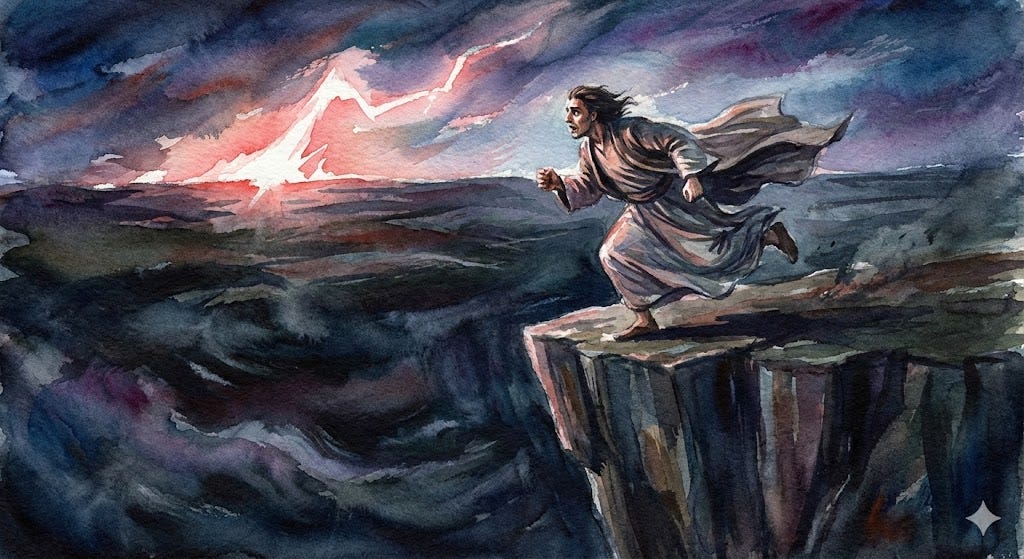
In the previous session, last week, we opened this arc with a warning.
We anchored ourselves in the Quranic diagnosis of human nature — the flaw of hastiness that God names in Surah al-Isra:
وَكَانَ الْإِنسَانُ عَجُولًا
“And man is ever hasty.”
— Quran, Surah Al-Isra (the Chapter of the Night Journey) #17, Verse 11
This ‘Ajala — this impatience, this rushing — is the root of the False Dawn.
The hasty man sees a glimmer on the horizon and runs toward it, convinced it is the sunrise.
He does not wait to see if the light will spread or fade.
He does not consult the guides who have walked this path before.
He rushes — and in his rushing, he often runs straight into destruction.
We examined two archetypes of this failure.
The Heretical Model: The Qarmatians
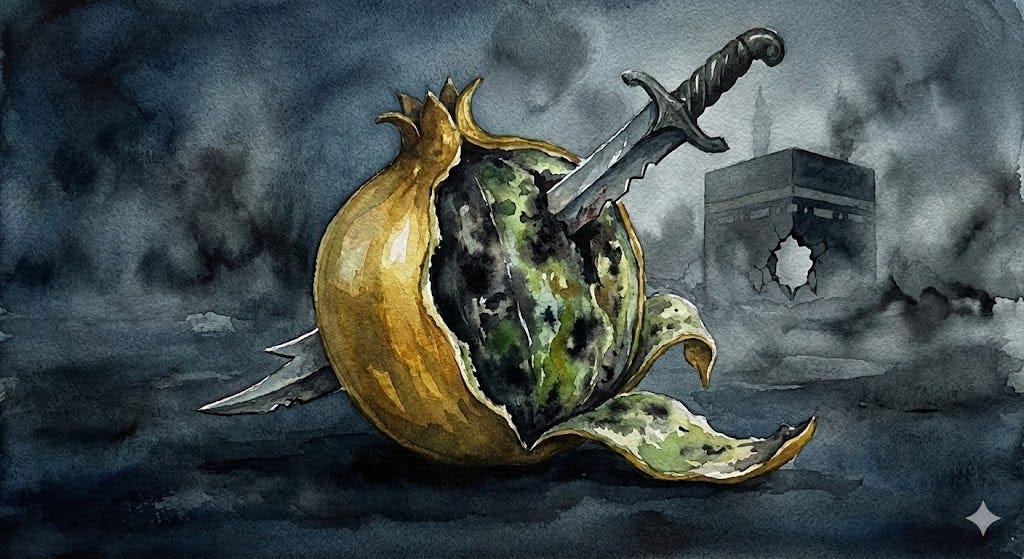
The first was heresy wearing the mask of revolution.
In 317 AH, the Qarmatians attacked Makkah during the Hajj.
They slaughtered thirty thousand pilgrims in the Haram.
They filled the Well of Zamzam with corpses.
They stole the Black Stone and kept it for twenty-two years.
And their leader, Abu Tahir, stood on the threshold of the Ka’bah and recited:
أَنَا بِاللَّهِ وَبِاللَّهِ أَنَا ... يَخْلُقُ الْخَلْقَ وَأُفْنِيهِمْ أَنَا
“I am by God, and God is by me... He creates the creation, and I annihilate them.”
— Ibn Kathir, Al-Bidaya wa al-Nihaya, Volume 11, Events of 317 AH
This was where Batinism led — the belief that the “inner truth” abrogates the outer law.
They stripped the shell from the kernel, and the kernel rotted.
They claimed to possess the spirit of Islam while massacring its body.
We invoked Shaheed Mutahhari’s warning: you cannot preserve a kernel by destroying its shell.
The Shariah is not an obstacle to spiritual truth; it is the vessel that carries spiritual truth through time.
The Premature Model: The Zaydis

The second archetype was not heresy, but prematurity.
Zayd ibn Ali — may God bless his soul — was sincere.
He was brave.
He was righteous.
He raised his sword against the Umayyad tyranny in 122 AH, calling the people to justice and to the family of the Prophet.
And he was killed.
His body was crucified and left to rot.
His nephew, Imam al-Sadiq, peace be upon him, validated his intent:
رَحِمَ اللَّهُ عَمِّي زَيْداً، إِنَّهُ دَعَا إِلَى الرِّضَا مِنْ آلِ مُحَمَّدٍ، وَ لَوْ ظَفِرَ لَوَفَى
“May God have mercy on my uncle Zayd. Indeed, he invited to ‘The Pleasing One from the Family of Muhammad,’ and had he been victorious, he would have fulfilled his promise.”
— Al-Majlisi, Bihar al-Anwar, Volume 46, Page 174
Zayd was a martyr.
But his timing was wrong.
The capacity was not there.
The people were not ready.
And so his noble blood watered the earth without achieving the goal.
This is the tragedy of the Premature Dawn: it wastes the righteous without advancing the cause.
The Three Placements
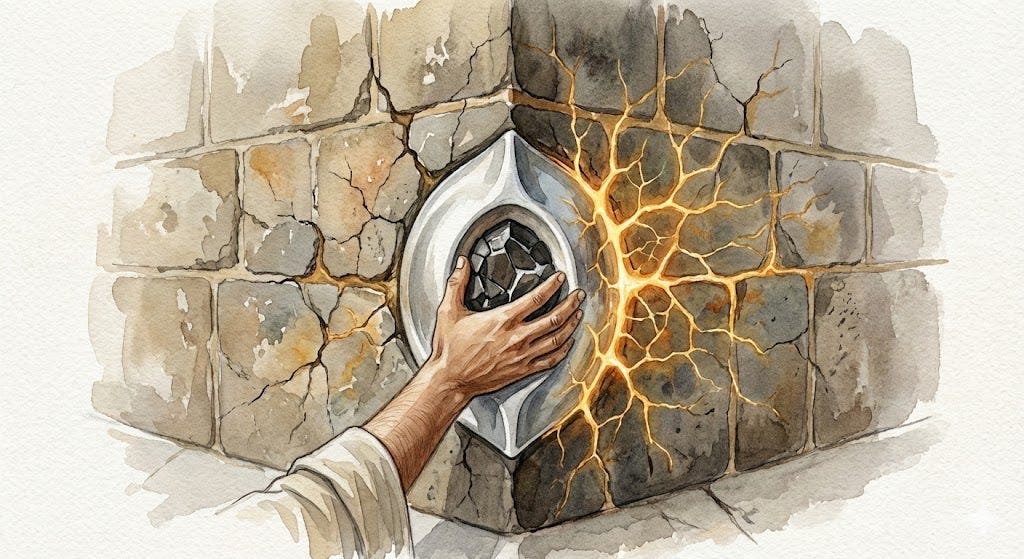
We then examined the theological proof that power does not equal authority.
Three times in Islamic history, the Black Stone was displaced — and three times, only the hand of the Divinely-appointed could restore it.
The Quraysh could build the walls of the Ka’bah, but they could not place its Heart — that required the hand of the Prophet before his mission.
Al-Hajjaj could conquer Makkah with catapults, but the Stone rejected his mortar — it settled only when Imam al-Sajjad, peace be upon him, placed it with the name of God.
The Qarmatians could steal the Stone for twenty-two years, but they could not make it mean anything — it was the Hidden Imam, may our souls be his ransom, who appeared briefly to place it and declare:
“By God it came to us, and by God it is placed.”
The lesson: the Architects of Chaos can displace reality, but they cannot stabilise it.
Only the one whom God has chosen can do that.
The Rehabilitation

Finally, we examined how the Premature Dawn of the Zaydis has been transformed in our own time.
Ansarallah — the movement in Yemen — comes from the Zaydi tradition.
But by integrating into the Axis of Resistance, by adopting the discipline of strategic patience and the framework of Wilayat al-Faqih, they have transcended the old categories.
They are no longer the isolated uprising that burns out.
They are the Morning Light that Shaykh Panahian identifies as “the obligatory introduction to the Reappearance” — constructing the zamineh, the foundation, for whatever is to come.
The hadith promises:
وَلَيْسَ فِي الرَّايَاتِ رَايَةٌ أَهْدَى مِنْ رَايَةِ الْيَمَانِيِّ
“There is no flag among the flags more guiding than the flag of the Yamani.”
— Al-Nu’mani, Kitab al-Ghaybah, Chapter 14, Hadith 13
Whether Ansarallah is that flag or the preparation for it, they have proven that Yemen can produce a resistance that endures — that neither fades like the False Dawn nor burns itself out like the Premature.
The Lesson: Discernment
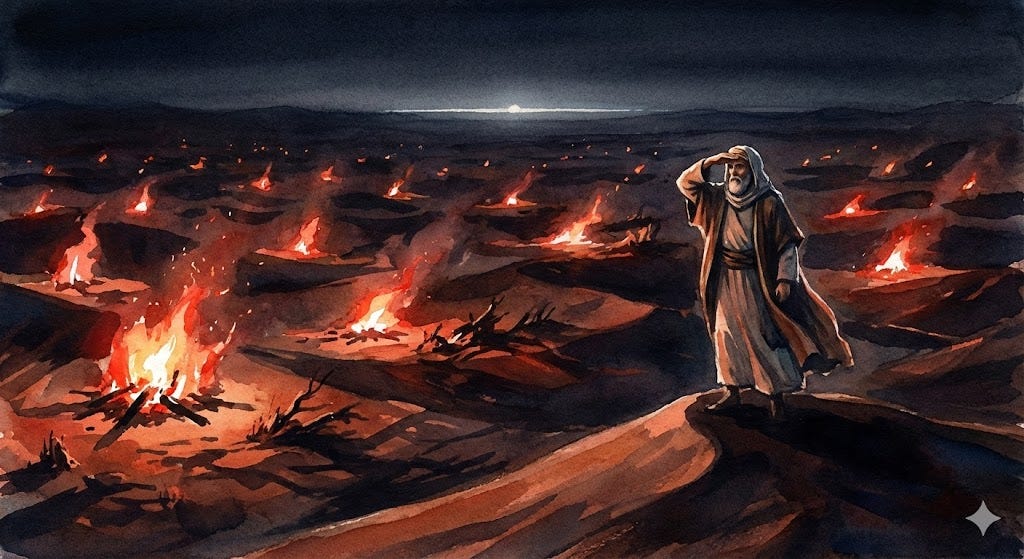
This was the first movement of our arc: the Negative — learning what to avoid.
Before the Waiter can protect, before the Waiter can build, the Waiter must first learn to see.
To distinguish the False Dawn from the True.
To recognise heresy when it wears the mask of revolution.
To recognise prematurity when it wears the mask of courage.
This is the knowledge of what not to do.
And it is essential — because the night is long, and the glimmers are many, and the hasty man will be deceived a hundred times before the True Dawn finally breaks.
The Question That Remains
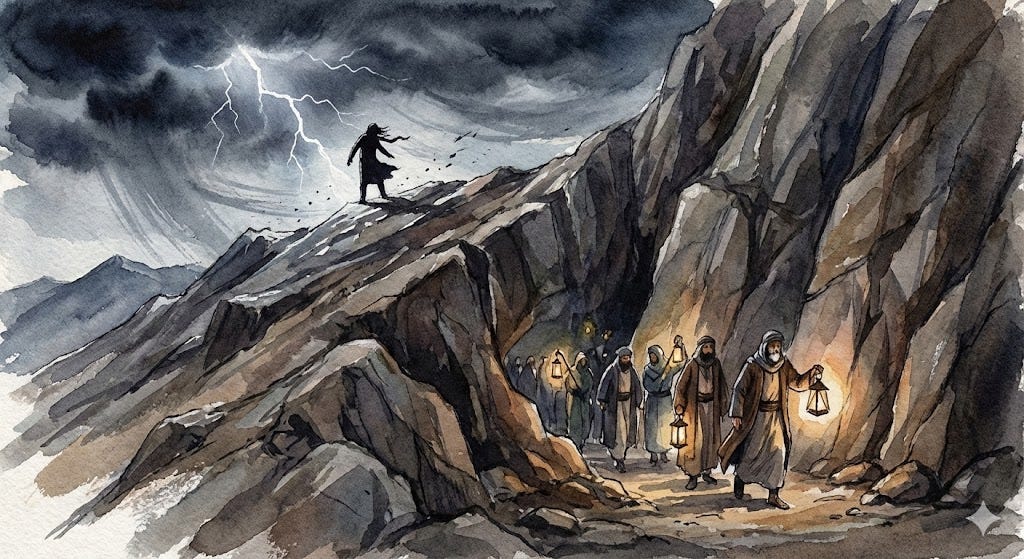
But discernment alone does not guarantee survival.
You may see the True Dawn clearly.
You may recognise every False Dawn for what it is.
You may possess perfect clarity about where the path leads.
And still be killed before you reach it.
The believer who stands in the open, broadcasting his faith to every ear, declaring his allegiance to every enemy, refusing every form of caution — this believer may be brave.
But he may also be dead.
And the dead do not build.
The dead do not raise the next generation.
The dead do not preserve the kernel for those who come after.
The community did not survive the Occultation through discernment alone.
They survived because they learned to protect themselves.
They learned the art of the Shield.
And it is to this Shield that we now turn.
Mahdawiyyah (The Culminating Guidance) - The Era of Establishment - The Geopolitics of Waiting - The Shield (Taqiyyah) - Forging the Shield
The Quranic Anchor: The Permission to Shield

Before we examine the history, before we trace the jurisprudence, before we defend Taqiyyah against its slanderers — we must first anchor ourselves in the Quran.
For if Taqiyyah were merely a Shia invention, a cultural practice, a historical convenience — then perhaps the critics would have a point.
Perhaps it would be something to outgrow, something to apologise for, something to quietly set aside in the modern age.
But Taqiyyah is none of these things.
It is a Quranic permission.
Revealed by God.
Validated by the Prophet.
Demonstrated by the Companions.
And it remains in force until the Day of Judgment.
Let us examine the evidence.
The Primary Verse: The Exception Clause
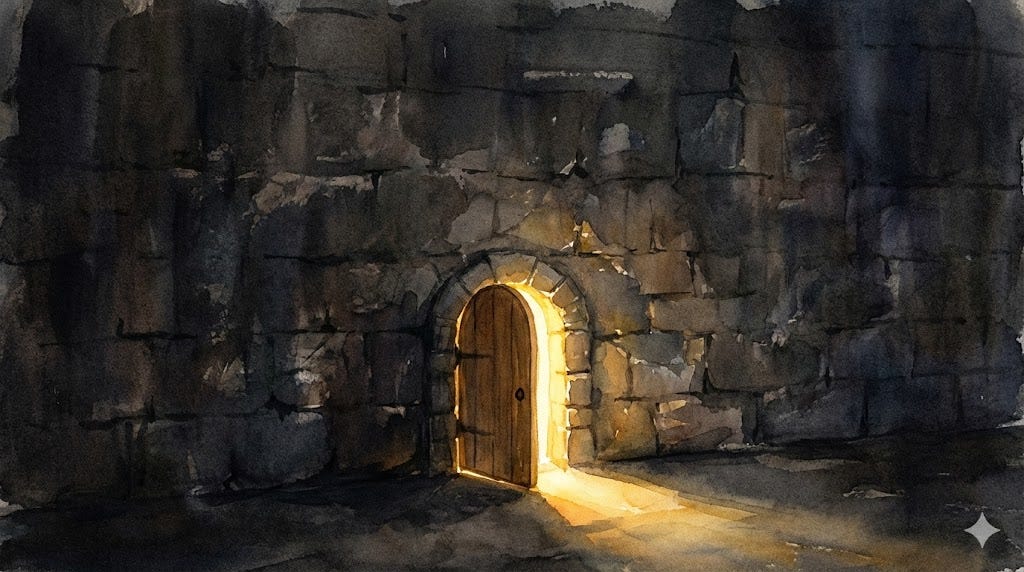
In Surah Aal-e-Imran, God establishes a general prohibition — and then opens a door:
لَّا يَتَّخِذِ الْمُؤْمِنُونَ الْكَافِرِينَ أَوْلِيَاءَ مِن دُونِ الْمُؤْمِنِينَ ۖ وَمَن يَفْعَلْ ذَٰلِكَ فَلَيْسَ مِنَ اللَّهِ فِي شَيْءٍ إِلَّا أَن تَتَّقُوا مِنْهُمْ تُقَاةً ۗ وَيُحَذِّرُكُمُ اللَّهُ نَفْسَهُ ۗ وَإِلَى اللَّهِ الْمَصِيرُ
“Let not the believers take the disbelievers as allies rather than the believers. And whoever does that has nothing with God — except when you protect yourselves from them as a precaution (illa an tattaqu minhum tuqah). And God warns you of Himself, and to God is the final destination.”
— Quran, Surah Aal-e-Imran (the Chapter of the Family of Imran) #3, Verse 28
Notice the structure.
The verse begins with a prohibition: do not take the disbelievers as allies instead of the believers.
This is the general rule.
The believer’s loyalty belongs to the community of faith, not to those who oppose it.
But then comes the exception:
illa an tattaqu minhum tuqah —
“except when you protect yourselves from them as a precaution.”
The word used here is tattaqu — from the same root as Taqiyyah and Taqwa.
It means to shield, to guard, to protect oneself.
And God Himself has placed this exception into the verse.
He has opened the door.
Allamah Tabatabai, in Al-Mizan, explains the scope of this permission:
الاستثناء في قوله: «إِلَّا أَنْ تَتَّقُوا مِنْهُمْ تُقاةً» من النهي المتقدم، والمعنى: لا تتخذوهم أولياء إلا أن تخافوا منهم خوفاً يجوز معه التقية، فحينئذٍ يجوز لكم إظهار الموالاة لهم باللسان مع إضمار العداوة والبغضاء، حفظاً لأنفسكم من شرهم.
“The exception in His saying, ‘except when you protect yourselves from them as a precaution,’ is from the preceding prohibition. The meaning is: Do not take them as allies — unless you fear from them a fear that permits Taqiyyah. In that case, it is permissible for you to outwardly display allegiance to them with the tongue while concealing enmity and aversion inwardly, in order to protect yourselves from their harm.”
— Allamah Tabatabai, Al-Mizan fi Tafsir al-Quran, Volume 3, Commentary on Verse 3:28
This is not a Shia interpretation imposed upon the text.
This is the plain meaning of the Arabic.
God prohibited one thing, then created an exception for situations of danger.
The believer who finds himself under threat is permitted — by God’s own word — to display outwardly what does not reflect his inward reality.
This is the Quranic foundation of Taqiyyah.
The Story of Ammar: When the Tongue Betrays Under Torture

But perhaps someone will say:
“This is theory.
Show us an example.
Show us that the Prophet accepted this in practice.”
Very well. Let us turn to Surah al-Nahl and the story of Ammar ibn Yasir — may God rest his pure soul.
Ammar was among the earliest converts to Islam.
His parents, Yasir and Sumayyah, were the first martyrs in Islamic history — killed by the Quraysh for refusing to renounce their faith.
Sumayyah was stabbed by Abu Jahl himself.
They died with the shahada on their lips.
But Ammar survived.
And the Quraysh took him.
They tortured him.
They beat him.
They demanded that he renounce Muhammad and praise their idols.
And under the unbearable pressure of that torture — with his flesh torn and his spirit crushed — Ammar spoke the words they demanded.
He uttered words of disbelief with his tongue.
And then he wept.
He came to the Prophet, peace be upon him and his family, broken with shame.
He confessed what he had said.
He feared that he had left the fold of Islam, that his words under torture had destroyed everything.
And revelation descended:
مَن كَفَرَ بِاللَّهِ مِن بَعْدِ إِيمَانِهِ إِلَّا مَنْ أُكْرِهَ وَقَلْبُهُ مُطْمَئِنٌّ بِالْإِيمَانِ وَلَـٰكِن مَّن شَرَحَ بِالْكُفْرِ صَدْرًا فَعَلَيْهِمْ غَضَبٌ مِّنَ اللَّهِ وَلَهُمْ عَذَابٌ عَظِيمٌ
“Whoever disbelieves in God after his belief — except for one who is compelled while his heart is secure in faith — but whoever opens his breast to disbelief, upon them is wrath from God, and for them is a great punishment.”
— Quran, Surah Al-Nahl (the Chapter of the Bee) #16, Verse 106
The verse makes a distinction that changes everything.
There are two types of people who might speak words of disbelief:
The first is the one who opens his breast to disbelief — who welcomes it, who means it, whose heart has turned.
For this person, there is the wrath of God.
The second is the one who is compelled — whose tongue speaks under duress while his heart remains mutma’inn, settled, secure in faith.
For this person, there is no blame.
The Prophet, peace be upon him and his family, looked at Ammar and asked:
“How do you find your heart?”
Ammar replied:
“Secure in faith.”
The Prophet said:
“Then if they return you to it, return to it.”
This is explicit prophetic permission.
The tongue under duress does not bind the heart.
The words spoken to preserve life do not nullify the faith held within.
And if the torture resumes, the believer may speak those words again — because God Himself has made the exception.
This is not a Shia hadith.
This is recorded across the traditions of all Muslims.
The story of Ammar is proof that Taqiyyah was practised in the time of the Prophet, validated by the Prophet, and enshrined in the Quran as a permanent dispensation.
The Believer of Pharaoh’s Family: Concealment as a Quranic Model
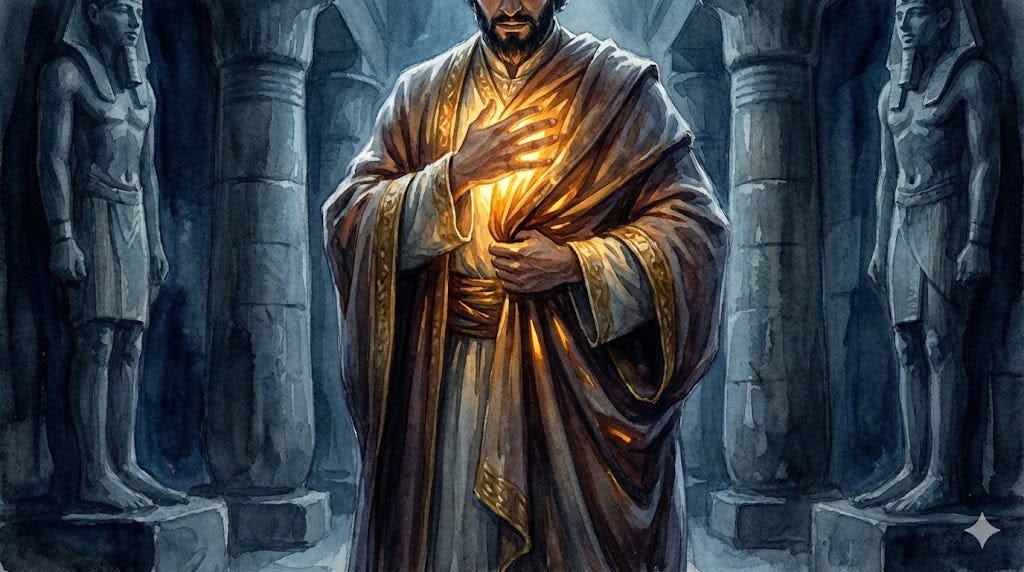
But there is another verse — perhaps even more striking — that establishes concealment not merely as a permission but as a praiseworthy model.
In Surah al-Ghafir, God tells us of a man who lived in the household of Pharaoh himself:
وَقَالَ رَجُلٌ مُّؤْمِنٌ مِّنْ آلِ فِرْعَوْنَ يَكْتُمُ إِيمَانَهُ أَتَقْتُلُونَ رَجُلًا أَن يَقُولَ رَبِّيَ اللَّهُ وَقَدْ جَاءَكُم بِالْبَيِّنَاتِ مِن رَّبِّكُمْ
“And a believing man from the family of Pharaoh who concealed his faith said: ‘Would you kill a man because he says, “My Lord is God,” while he has brought you clear proofs from your Lord?’”
— Quran, Surah al-Ghafir (the Chapter of the Forgiver) #40, Verse 28
Consider what this verse tells us.
Here is a man living in the innermost circle of the greatest tyrant of his age.
Pharaoh, who claimed divinity.
Pharaoh, who enslaved an entire people.
Pharaoh, who murdered the children of the Israelites and built his throne on their bones.
And in his own household — among his own family — there was a believer.
But this believer did not stand up on the first day and announce his faith.
He did not broadcast his allegiance to Moses in the court of the tyrant.
He concealed.
The Quran uses the word yaktumu — he was hiding, covering, keeping secret his belief.
Was he a coward?
Was he a hypocrite?
Was he condemned for this concealment?
On the contrary — God preserves his story in the Quran as an example for all generations.
God tells us that this man was mu’min — a believer.
His concealment did not negate his faith; it protected it.
And notice what happened next.
The man did not remain silent forever.
When the moment came — when Pharaoh moved to kill Moses — the believer spoke.
He emerged from concealment.
He challenged the tyrant in his own court.
He risked everything to defend the truth.
This is the model: concealment until the moment demands speech.
Silence until silence becomes betrayal.
The Shield carried until the Shield must be lowered and the Sword drawn.
Allamah Tabatabai comments:
كان يكتم إيمانه عن فرعون وملئه، ولما بلغ الأمر إلى أن يُقتل موسى أظهر إيمانه، ودافع عنه بما استطاع.
“He used to conceal his faith from Pharaoh and his chiefs. But when the matter reached the point where Moses would be killed, he revealed his faith and defended him with all that he could.”
— Allamah Tabatabai, Al-Mizan fi Tafsir al-Quran, Volume 17, Commentary on Verse 40:28
This is Taqiyyah in its fullness: concealment when concealment serves the Truth, and revelation when revelation becomes obligatory.
A Necessary Clarification: Who Are “The Disbelievers”?

Before we proceed, we must pause on a word.
The verses we have cited speak of al-kafirun — “the disbelievers.”
And it would be easy, reading these verses in isolation, to conclude that Islam views all non-Muslims as enemies from whom the believer must hide.
This is not the case.
The Shia theological tradition — rooted in the Quran itself — draws a careful distinction between types of disbelief.
Not all who stand outside Islam stand there for the same reason, and God, the Most Just, does not judge them by the same measure.
The Quranic Foundation: The Mustad’af
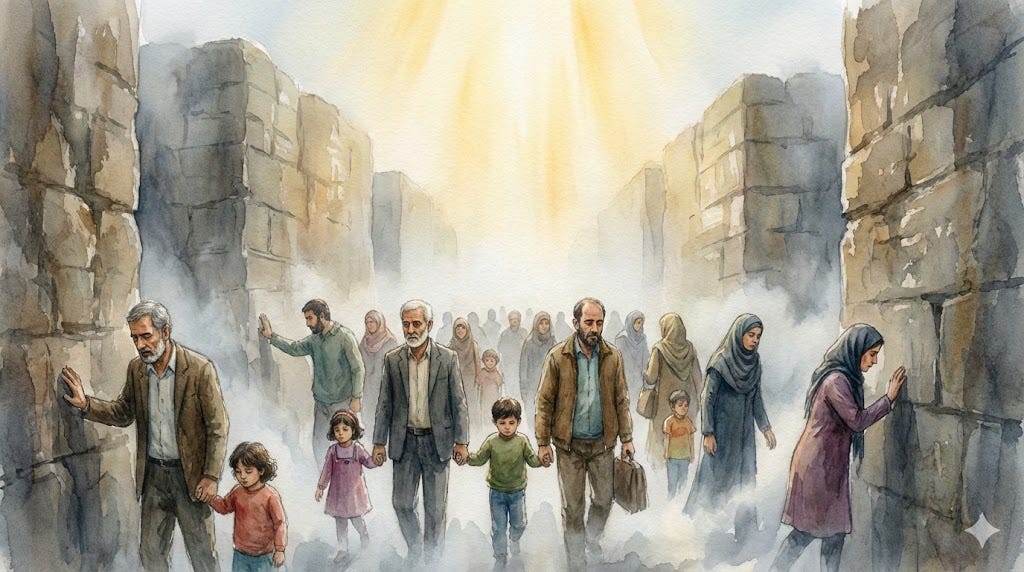
In Surah al-Nisa, God describes a category of people who are neither believers nor punishable disbelievers:
إِلَّا الْمُسْتَضْعَفِينَ مِنَ الرِّجَالِ وَالنِّسَاءِ وَالْوِلْدَانِ لَا يَسْتَطِيعُونَ حِيلَةً وَلَا يَهْتَدُونَ سَبِيلًا فَأُولَٰئِكَ عَسَى اللَّهُ أَن يَعْفُوَ عَنْهُمْ ۚ وَكَانَ اللَّهُ عَفُوًّا غَفُورًا
“Except for the oppressed among men, women, and children who cannot devise a plan nor are they guided to a way. For those, it is expected that God will pardon them, and God is ever Pardoning and Forgiving.”
— Quran, Surah Al-Nisa (the Chapter of the Women) #4, Verses 98-99
The word is Mustad’af — the weakened, the oppressed, the incapacitated.
These are people who do not believe, but not because they saw the truth and rejected it.
They do not believe because they could not find the way.
The path was blocked.
The message was distorted.
The truth never reached them in a form they could recognise.
And God says:
“It is expected that God will pardon them.”
This is not a minor exception.
This is an entire category of humanity — and as we shall see, the scholars of the Hawza argue that it includes the majority of non-Muslims in the world today.
The Theological Distinction: Qasir and Muqassir
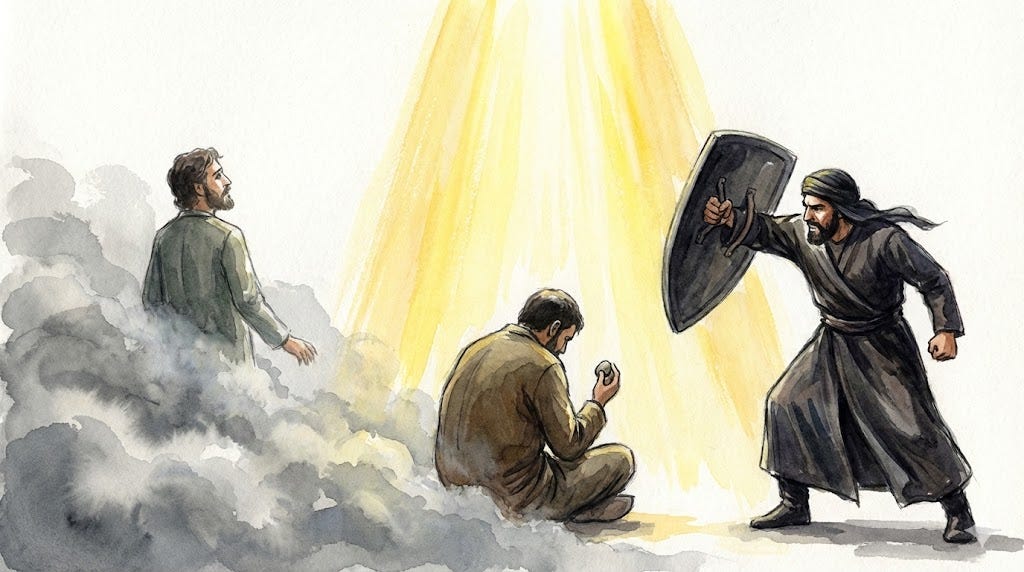
The scholars of Qom and Najaf have systematised this Quranic insight into a precise distinction:
Al-Jahil al-Qasir — the Inculpable Ignorant
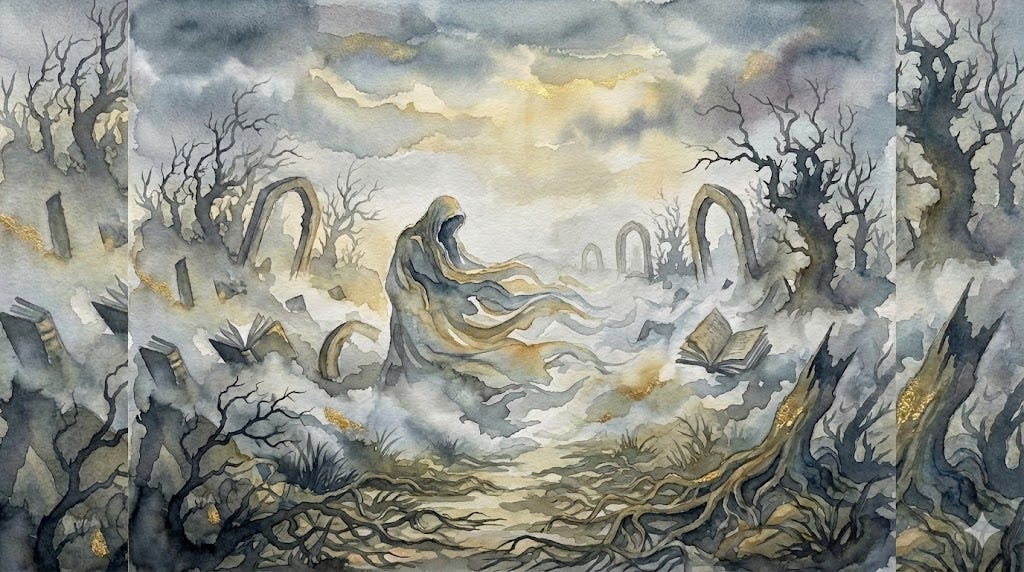
This is someone whose failure to believe is due to factors outside their control: no proper access to authentic information, massive misrepresentation of Islam, an environment where falsehood is presented as obvious truth and they have no realistic path to the alternative.
Al-Jahil al-Muqassir — the Culpable Ignorant
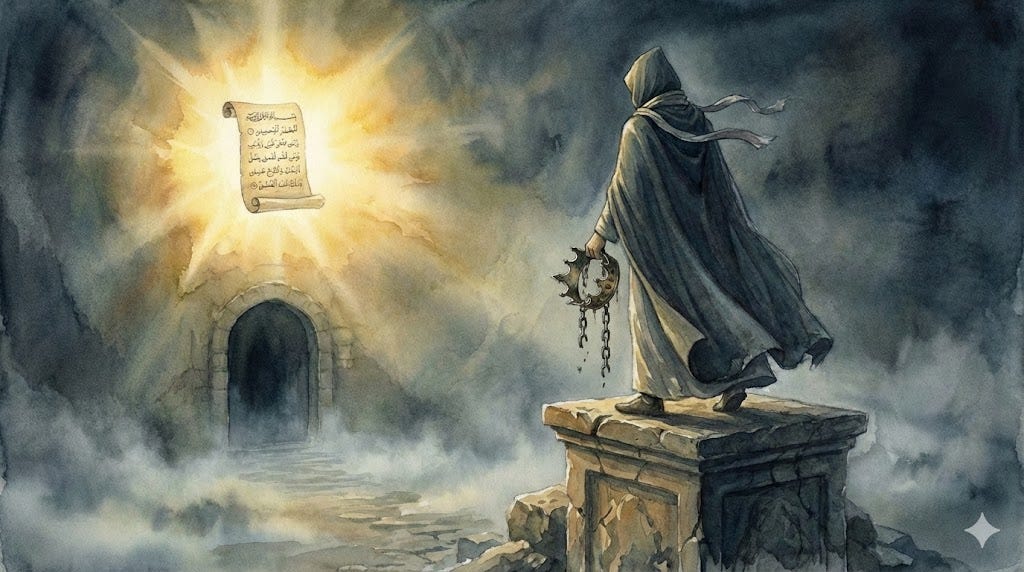
This is someone who had the means and opportunity to discover the truth but chose to remain in denial out of arrogance, stubbornness, or love of worldly position.
Al-Kafir al-Mu’anid — the Obstinate Disbeliever
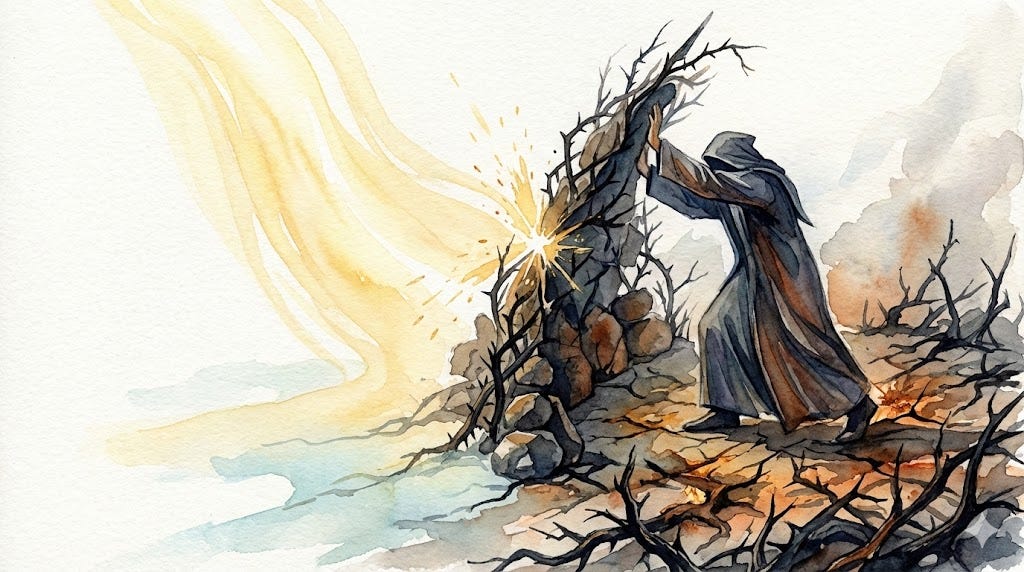
This is someone who knows the truth — or strongly suspects it — and actively rejects it out of malice, who fights against it, who works to suppress it.
The Quranic threats — the Fire, the Wrath, the Punishment — are directed at the third category, and to some extent the second.
They are not directed at the first.
Imam al-Sadiq, peace be upon him, clarifies the principle:
لَوْ أَنَّ الْعِبَادَ إِذَا جَهِلُوا وَقَفُوا وَلَمْ يَجْحَدُوا، لَمْ يَكْفُرُوا
“If the servants of God, when they were ignorant, had paused and had not denied, they would not have become disbelievers.”
— Al-Kulayni, Usul al-Kafi, Volume 2, Kitab al-Iman wa al-Kufr, Chapter on Interpretations of Kufr, Hadith 1
The key word is jahadu — denied, rejected, actively suppressed.
Disbelief that warrants punishment is not mere ignorance; it is denial after knowledge, rejection after clarity.
The Contemporary Application: Most of the World Are Mustad’af
Now consider the implications for our age.
A person born in Manchester or Toronto or Sydney, raised on a diet of media that presents Islam as terrorism and oppression, who has never once encountered the authentic teachings of the Ahl al-Bayt, who has never met a Muslim who embodied the Prophetic character — is this person a Kafir Mu’anid?
An enemy of God who deserves the Fire?
Or is this person Mustad’af — a victim of circumstance, someone who “cannot devise a plan nor are they guided to a way”?
Imam Khomeini — may God rest his soul — addressed this directly:
إنّ الكفّار على قسمين: أحدهما الجاهل القاصر... وهم الذين لم تقم عليهم الحجة... وأكثر الناس من هذا القسم. فإنّهم إذا ماتوا على كفرهم لا يعاقبون... بل يرجى لهم النجاة.
“Disbelievers are of two types: One is the Inculpable Ignorant... these are the ones against whom the Proof has not been established... And the majority of people in the world are of this type. If they die in their disbelief, they are not punished... rather, salvation is hoped for them.”
— Imam Khomeini, Al-Tanqih fi Sharh al-Urwah al-Wuthqa, Volume 3
— Imam Khomeini, Forty Hadith, Hadith 26
The majority.
Not a small exception — the majority.
Imam Khamenei — may God protect him — extends this analysis to the modern context:
ما با ملتهای غیرمسلمان هیچ دشمنی نداریم. ما با استکبار دشمنیم. بسیاری از این مردمی که در غرب زندگی میکنند، اسلام به گوششان نرسیده، یا واژگونه رسیده است. اینها «مستضعف» هستند. حساب اینها با حساب سردمداران کفر جداست.
“We have no enmity with non-Muslim nations. We are enemies with Arrogance (Istikbar). Many of these people living in the West — Islam has not reached their ears, or it has reached them in an inverted, distorted manner. These people are Mustad’af. Their account is separate from the account of the leaders of Kufr.”
— Imam Khamenei, Speech to Clerics, Qom, 1391 (2012)
Ayatullah Sistani — may God prolong his life — echoes this:
وأما إذا لم يكن معانداً للحق، بل كان جهله عن قصور لا عن تقصير، فالظاهر أنه لا يعاقب في الآخرة
“If he is not obstinate towards the Truth, but rather his ignorance is due to inability and not negligence, then it is apparent that he will not be punished in the Hereafter.”
— Ayatullah al-Sistani, Minhaj al-Salihin, Volume 1, Rulings on Beliefs
And Ayatullah Jawadi-Amoli — may God protect him — captures the linguistic essence:
کفر در لغت به معنای پوشاندن است. کافر کسی است که حق را میبیند و میشناسد، اما روی آن پرده میاندازد. کسی که اصلا حق را ندیده، مصداق کامل «کافر» به معنای قرآنی که مستوجب آتش است، نیست.
“Kufr in language means ‘to cover.’ A Kafir is one who sees and recognises the Truth, but throws a curtain over it. Someone who has never seen the Truth is not the complete manifestation of ‘Kafir’ in the Quranic sense that deserves the Fire.“
— Ayatullah Jawadi-Amoli, Tafsir-e Tasnim, Exegesis of Surah Al-Baqarah, Verse 6
The Implication for Taqiyyah
Why does this matter for our discussion of Taqiyyah?
Because the Shield is not meant for everyone.
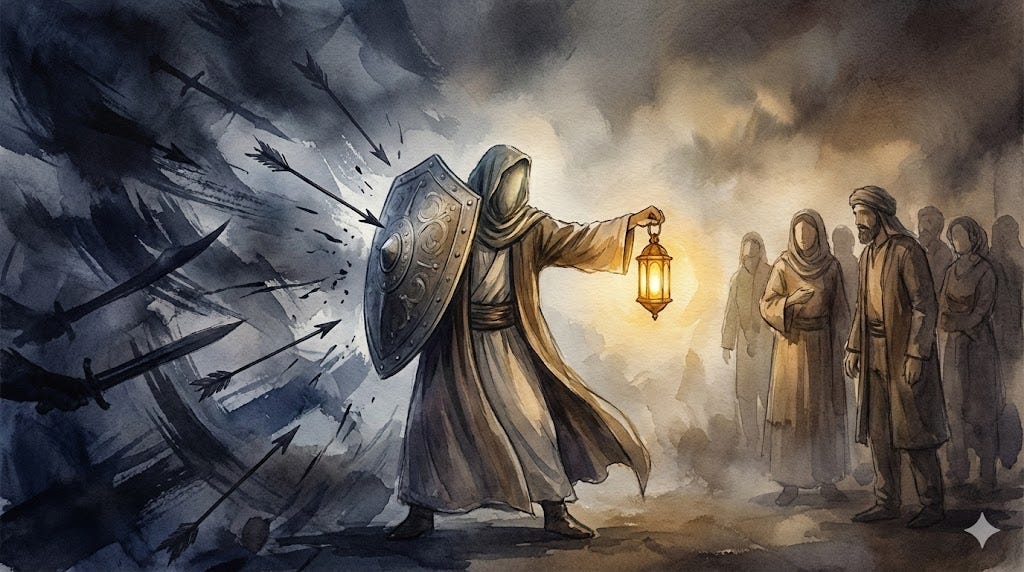
Taqiyyah is protection from hostile enemies — from the Kafir Mu’anid who knows the truth and seeks to destroy it, from the tyrant who will kill the believer for his faith, from the persecutor who hunts the followers of the Ahl al-Bayt.
Taqiyyah is not a posture of permanent suspicion toward every non-Muslim on earth.
It is not a licence to treat all of humanity as enemies.
It is not a wall between the believer and the ordinary person who simply does not know.
When the Quran says “illa an tattaqu minhum tuqah” — “except when you protect yourselves from them as a precaution” — the “them” refers to those who pose a threat.
The hostile.
The malicious.
The powerful who would use their power to crush the faith.
It does not refer to your colleague at work who has never heard of Imam Ali.
It does not refer to your neighbour who thinks “Shia” is a kind of cuisine.
It does not refer to the billions of human beings who, in the words of Imam Khamenei, have received Islam “in an inverted, distorted manner” and are victims, not enemies.
This distinction will become crucial when we reach the contemporary applications — when we discuss how to engage with the West not through defensive hiding but through Makarim al-Akhlaq, the Noble Character that reveals the truth rather than concealing it.
The Shield is for enemies.
For the Mustad’af, we have a different obligation: to show them the truth they have never seen, in a form they can recognise, through conduct that refutes the lies they have been told.
With this clarification in place — that the Shield is for enemies, not for the Mustad'af — we can now appreciate the full weight of what the Quran has established.
The Principle Established
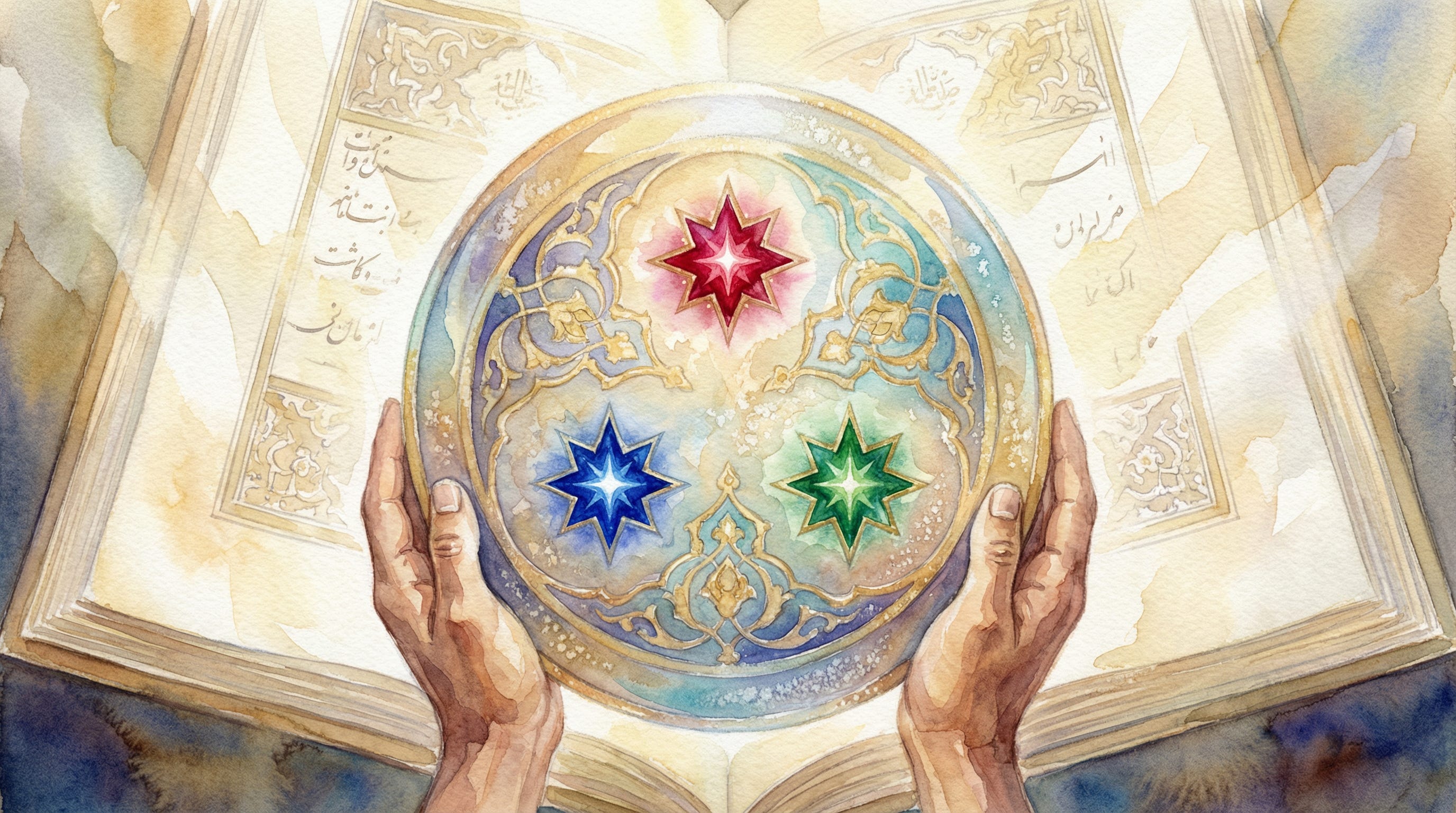
Three Quranic witnesses.
Three proofs.
Surah Aal-e-Imran 3:28 — the explicit exception clause permitting protective concealment in the face of danger.
Surah al-Nahl 16:106 — the validation of Ammar ibn Yasir, proving that words spoken under compulsion do not nullify faith.
Surah al-Ghafir 40:28 — the model of the Believer in Pharaoh’s household, demonstrating that concealment can coexist with — and even protect — the highest levels of iman.
This is not a Shia peculiarity.
This is the Quran.
The one who mocks Taqiyyah mocks these verses.
The one who claims that Taqiyyah is “religiously sanctioned lying” has not read the Book he claims to follow.
The one who uses Taqiyyah as a slur against the Shia must first contend with Ammar, with the Believer of Pharaoh’s family, with the explicit words of God Himself.
We did not invent this.
We inherited it.
We preserved it.
And we are not ashamed of it.
The Shield is Quranic.
And tonight, we learn how to carry it.
The Linguistic Proof: Taqiyyah and Taqwa Share a Root

We have established the Quranic foundation.
Now let us examine the word itself.
Because language is not arbitrary.
In Arabic — the language of revelation — words carry their meanings in their bones.
The root system that structures the language embeds concepts into syllables, so that related words echo each other across centuries of use.
And when we examine the word Taqiyyah, we discover something that should silence its critics forever.
The Root: و-ق-ي (W-Q-Y)
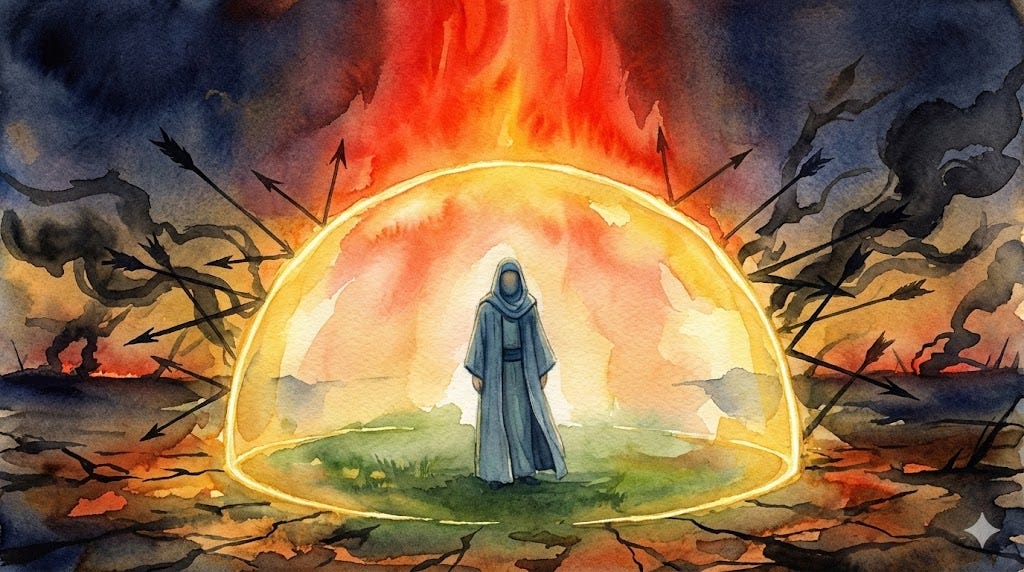
The Arabic root و-ق-ي (Waw-Qaf-Ya) carries a single, consistent meaning across all its derivatives:
To shield.
To protect.
To guard.
From this root, Arabic derives:
وِقَايَة (Wiqayah) — protection, guarding, shielding.
The word used for protective equipment, for barriers, for anything that stands between a person and harm.
تَقْوَى (Taqwa) — the most celebrated virtue in Islam.
Usually translated as “piety” or “God-consciousness,” but its linguistic meaning is: to shield oneself from the displeasure of God.
The Muttaqi is the one who places a barrier between himself and Divine anger — through obedience, through righteousness, through careful avoidance of sin.
تَقِيَّة (Taqiyyah) — to shield oneself from harm at the hands of persecutors.
The Mutaqi (in this sense) is the one who places a barrier between himself and those who would destroy him for his faith.
The same root.
The same meaning.
The same act of shielding — directed at different threats.
The Connection: Two Forms of the Same Virtue

Consider what this means.
When the Quran commands us to have Taqwa of God, it commands us to shield ourselves from His wrath by obeying His commands.
This is universally praised.
No Muslim considers Taqwa to be cowardice.
No Muslim mocks the Muttaqi for “hiding” from God’s punishment.
On the contrary — Taqwa is the highest virtue, the criterion by which God distinguishes between human beings:
إِنَّ أَكْرَمَكُمْ عِندَ اللَّهِ أَتْقَاكُمْ
“Indeed, the most noble of you in the sight of God is the most righteous (Atqakum) of you.”
— Quran, Surah Al-Hujurat (the Chapter of the Chambers) #49, Verse 13
Atqakum — the one with the most Taqwa.
From the same root: و-ق-ي.
Now, when the same root produces Taqiyyah — shielding oneself from the harm of persecutors — why should this suddenly become shameful?
If it is noble to shield oneself from Divine anger through obedience, why is it shameful to shield oneself from human violence through discretion?
If the Muttaqi who fears God is praised, why is the Mutaqi who fears the tyrant mocked?
The logic of the critics collapses under the weight of the language itself.
The Slander Refuted
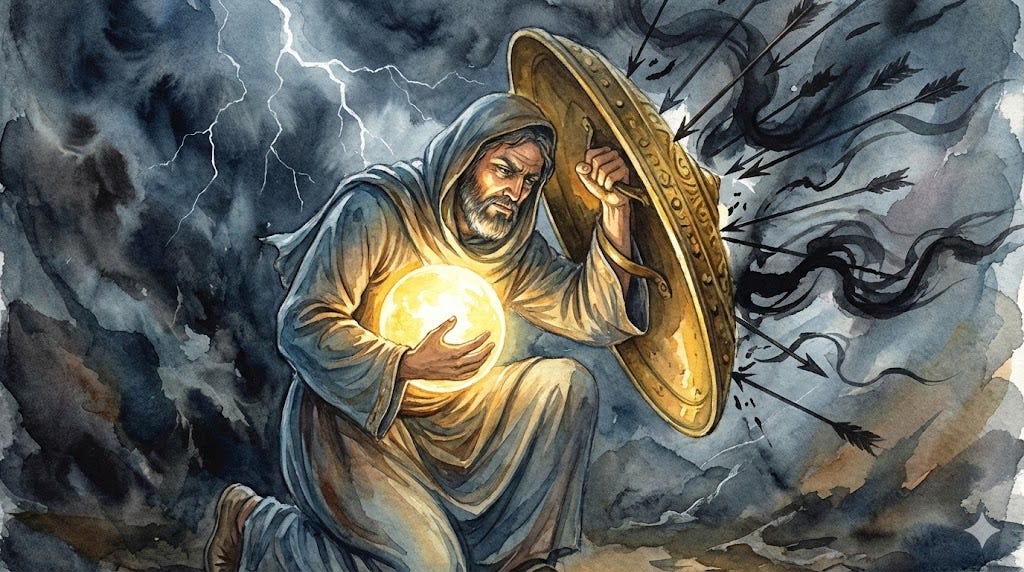
Those who attack Taqiyyah translate it as “religiously sanctioned lying.”
They present it as a licence for deception, a permission to say anything, a blank cheque for falsehood.
This is not translation.
It is slander.
The word Taqiyyah does not come from the root ك-ذ-ب (K-DH-B), which means “to lie.”
It does not come from the root غ-ش-ش (GH-SH-SH), which means “to deceive.”
It does not come from the root خ-د-ع (KH-D-’), which means “to trick.”
It comes from و-ق-ي — to shield.
A shield is not a lie.
A shield is a barrier.
It does not create a false reality; it protects a true one.
The soldier who raises his shield against an arrow is not “lying” to the archer.
He is surviving.
The believer who conceals his faith from those who would kill him for it is not lying about reality.
He is protecting reality — the reality of his iman (faith), the reality of his family, the reality of his community’s survival — from those who would destroy it.
This is not semantics.
This is the difference between understanding a concept and caricaturing it.
The Testimony of the Imams

The linguistic connection is not merely an observation of grammarians.
The Imams of the Ahl al-Bayt themselves — the authoritative interpreters of the Quran — taught this principle explicitly.
Al-Kulayni dedicates an entire chapter of Al-Kafi to Taqiyyah, and the narrations contained therein leave no room for doubt about its centrality to the faith.
The Religion of the Ahl al-Bayt
Imam Ja’far al-Sadiq, peace be upon him, declared:
التَّقِيَّةُ دِينِي وَدِينُ آبَائِي، وَلَا إِيمَانَ لِمَنْ لَا تَقِيَّةَ لَهُ
“Taqiyyah is my religion and the religion of my forefathers, and there is no faith for the one who has no Taqiyyah.”
— Al-Kulayni, Al-Kafi, Volume 2, Kitab al-Iman wa al-Kufr, Bab al-Taqiyyah, Hadith 1
Consider the weight of this statement.
The Imam does not say Taqiyyah is permitted.
He does not say it is tolerated.
He says it is his religion — and the religion of his forefathers, meaning the Prophet himself, Imam Ali, Imam Hasan, Imam Husayn, Imam Sajjad, and Imam Baqir, peace be upon them all.
And then he inverts the accusation that the enemies make.
They say:
“The one who practises Taqiyyah has no real faith — he is a hypocrite, a liar.”
The Imam says the opposite:
“There is no faith for the one who has no Taqiyyah.”
The person without Taqiyyah is not more faithful — he is faithless.
Because faith includes wisdom.
Faith includes the protection of what is sacred.
Faith includes the refusal to throw pearls before swine, to hand the enemy the weapons with which to destroy you.
Nine-Tenths of Religion

In another narration, Imam al-Sadiq, peace be upon him, quantifies the matter:
تِسْعَةُ أَعْشَارِ الدِّينِ فِي التَّقِيَّةِ، وَلَا دِينَ لِمَنْ لَا تَقِيَّةَ لَهُ
“Nine-tenths of religion is in Taqiyyah, and there is no religion for the one who has no Taqiyyah.”
— Al-Kulayni, Al-Kafi, Volume 2, Kitab al-Iman wa al-Kufr, Bab al-Taqiyyah, Hadith 4
Nine-tenths.
This is not a minor dispensation.
This is not an embarrassing exception that we wish we could hide.
According to the Imam, the overwhelming majority of practical religion — in an era of persecution and danger — consists of knowing when to speak and when to remain silent, when to reveal and when to conceal, when to stand exposed and when to take shelter.
Why nine-tenths?
Because the Shia have always lived under threat.
From the time of Imam Ali to the time of Imam al-Askari, the followers of the Ahl al-Bayt were hunted, imprisoned, tortured, and killed.
To survive — to preserve the teachings, to raise the next generation, to maintain the community — required constant vigilance.
The one who could not navigate this terrain did not survive to pass on the faith.
Nine-tenths of religion, in such conditions, is the wisdom of survival.
The Shield of the Believer
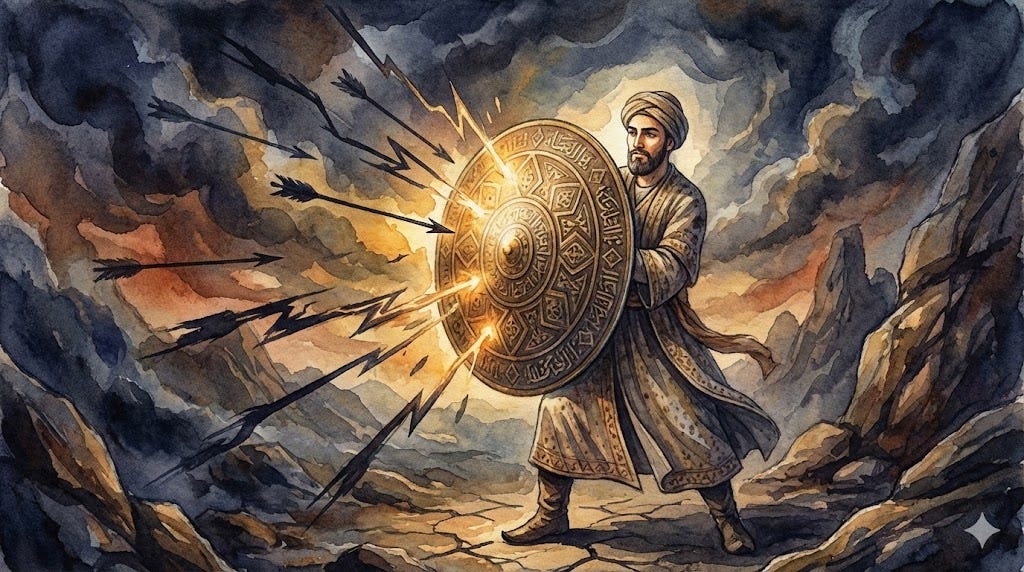
Imam Muhammad al-Baqir, peace be upon him, employed the very metaphor we have been developing:
التَّقِيَّةُ تُرْسُ الْمُؤْمِنِ، وَلَا إِيمَانَ لِمَنْ لَا تَقِيَّةَ لَهُ
“Taqiyyah is the shield (turs) of the believer, and there is no faith for the one who has no Taqiyyah.”
— Al-Kulayni, Al-Kafi, Volume 2, Kitab al-Iman wa al-Kufr, Bab al-Taqiyyah; also in Al-Saduq, Al-Amali
Turs — a shield.
The same word used for the physical shield that a warrior carries into battle.
The Imam does not say Taqiyyah is a mask.
He does not say it is a disguise.
He says it is a shield.
A mask creates a false identity.
A shield protects a true one.
A disguise deceives about who you are.
A shield preserves who you are from those who would destroy you.
This is the image that the Imam himself chose.
And it is the image we carry forward tonight:
Taqiyyah as the Shield of the Believer.
The Completion of Faith
Imam al-Sadiq, peace be upon him, also said:
مَنْ لَمْ يَكُنْ لَهُ تَقِيَّةٌ لَمْ يَكُنْ لَهُ إِيمَانٌ، وَإِنَّ أَكْرَمَكُمْ عِنْدَ اللَّهِ أَعْمَلُكُمْ بِالتَّقِيَّةِ
“The one who has no Taqiyyah has no faith, and indeed the most noble of you in the sight of God is the one who acts most upon Taqiyyah.”
— Al-Majlisi, Bihar al-Anwar, Volume 72, Kitab al-Iman wa al-Kufr, Bab al-Taqiyyah
Notice how the Imam echoes the Quranic verse we cited earlier —
إِنَّ أَكْرَمَكُمْ عِندَ اللَّهِ أَتْقَاكُمْ
“Indeed, the most noble of you in the sight of God is the most righteous (Atqakum) of you.”
— Quran, Surah Al-Hujurat (the Chapter of the Chambers) #49, Verse 13
— but applies it to Taqiyyah.
The Quran says the most noble is the one with the most Taqwa.
The Imam says the most noble is the one who acts most upon Taqiyyah.
Because both are from the same root.
Both are forms of the same protection.
Both are expressions of the same wisdom that shields what is sacred from what would destroy it.
The Practical Instruction
And Imam al-Sadiq, peace be upon him, gave practical instruction to his companions:
خَالِطُوهُمْ بِالْبَرَّانِيَّةِ، وَخَالِفُوهُمْ بِالْجَوَّانِيَّةِ، إِذَا كَانَتِ الْإِمْرَةُ صِبْيَانِيَّةً
“Mix with them outwardly, and differ from them inwardly, when the rule is childish (tyrannical/immature).”
— Al-Kulayni, Al-Kafi, Volume 2, Kitab al-Iman wa al-Kufr, Bab al-Taqiyyah
The outward and the inward.
The Barraniyyah (external conduct) and the Jawwaniyyah (internal reality).
The Imam instructs his followers to maintain the distinction — to navigate the external world with wisdom while preserving the internal truth with vigilance.
And he specifies the condition: “when the rule is childish” — meaning tyrannical, immature, oppressive.
When the political authority cannot be trusted with the truth.
When exposure means destruction.
This is not permanent deception.
This is strategic survival under tyranny.
When the tyranny ends — when the rule is just, when the danger passes — the instruction changes.
The external and internal can align.
The Shield can be lowered.
But while the tyranny persists, the Shield remains raised.
The Scholar’s Testimony

Allamah Tabatabai — may God rest his pure soul — draws this connection explicitly in Al-Mizan:
التقية والتقوى من أصل واحد، وهو الوقاية. فالتقوى وقاية النفس من سخط الله بامتثال أوامره واجتناب نواهيه، والتقية وقاية النفس من ضرر الأعداء بإظهار ما يوافقهم ظاهراً مع المحافظة على الإيمان باطناً.
“Taqiyyah and Taqwa are from a single origin, which is Wiqayah (protection). Taqwa is protecting the soul from the anger of God by fulfilling His commands and avoiding His prohibitions. Taqiyyah is protecting the soul from the harm of enemies by outwardly displaying what agrees with them while preserving faith inwardly.”
— Allamah Tabatabai, Al-Mizan fi Tafsir al-Quran, Volume 3, Commentary on Verse 3:28
One origin.
Two applications.
The same act of protection — turned toward God in one case, toward the tyrant in the other.
Shaheed Mutahhari — may God rest his pure soul — reinforces this:
تقیه از ریشه «وقایه» است، یعنی خود را حفظ کردن. همانطور که تقوا یعنی خود را از عذاب خدا حفظ کردن، تقیه یعنی خود را از ضرر دشمن حفظ کردن. این دو مفهوم، دو شاخه از یک درختاند.
“Taqiyyah is from the root ‘Wiqayah,’ meaning to protect oneself. Just as Taqwa means protecting oneself from the punishment of God, Taqiyyah means protecting oneself from the harm of the enemy. These two concepts are two branches of a single tree.”
— Ayatullah Murtadha Mutahhari, Collected Works, Volume 22, Discussion on Taqiyyah
Two branches of a single tree.
The one who has Taqwa protects his soul from God’s anger by righteous conduct.
The one who practises Taqiyyah protects his soul from the enemy’s sword by wise discretion.
Both are engaged in the same essential act: Wiqayah — shielding what is precious from what would destroy it.
The Implication

This linguistic analysis is not merely academic.
It has practical consequences.
If Taqiyyah were truly “lying,” it would be a sin — because lying is forbidden in Islam.
The Prophet, peace be upon him and his family, said:
إِيَّاكُمْ وَالْكَذِبَ، فَإِنَّ الْكَذِبَ يَهْدِي إِلَى الْفُجُورِ
“Beware of lying, for lying leads to wickedness.”
— Sahih Muslim, Kitab al-Birr
If Taqiyyah were lying, it would contradict the Quran’s permission.
God cannot permit what He forbids.
The verses we examined — Surah Aal-e-Imraan (The Family of Imran) 3:28, Surah al-Nahl (The Bee) 16:106, and Surah al-Ghafir (The Forgiver) 40:28 — would be commanding Muslims to sin.
But Taqiyyah is not lying.
It is shielding.
And shielding is not forbidden — it is the very essence of Taqwa, the virtue that God praises above all others.
The critics have confused categories.
They have taken a concept rooted in protection and relabelled it as deception.
They have taken a permission for survival and twisted it into a licence for falsehood.
The language itself refutes them.
و-ق-ي does not mean “to lie.”
It means “to protect.”
And protection — of faith, of family, of community, of life — is not a sin.
It is a duty.
The Crucial Distinction: Kitman vs. Kidhb

We have established that Taqiyyah is Quranic.
We have shown that it shares its root with Taqwa — that both are forms of shielding, both expressions of the same protective wisdom.
But the accusation persists.
And it takes a specific form:
“Taqiyyah is lying.
The Shia are permitted to lie about their beliefs.
Therefore nothing they say can be trusted.”
This accusation is not merely wrong.
It is linguistically ignorant.
And tonight, we dismantle it at the level of Arabic itself.
Two Words, Two Realities
The Arabic language — the language of the Quran, the language of precision — distinguishes between two very different acts:
Kitman (كتمان) — to conceal, to withhold, to cover.
Kidhb (كذب) — to lie, to fabricate, to state what is false.
These are not synonyms.
They are not interchangeable.
They describe fundamentally different moral acts.
Kitman is the act of not revealing.
The one who practises Kitman does not manufacture a false reality.
He does not invent beliefs he does not hold.
He does not claim to worship idols when he worships God.
He simply withholds.
He remains silent.
He redirects.
He gives an answer that is true but incomplete — an answer that protects the kernel without fabricating a lie.
Consider: if someone asks you a question and you say,
“I would prefer not to discuss that,”
have you lied?
No.
You have concealed.
You have practised Kitman. The questioner has learned nothing false from you — he has simply learned nothing at all.
Or consider: if a hostile interrogator asks,
“Are you a Shia?”
and you respond,
“I am a Muslim who follows the Quran and the Sunnah”
— have you lied?
No.
Every word is true.
You have simply not disclosed the full picture.
You have given a true answer that does not expose you to danger.
This is Kitman.
This is what Taqiyyah actually involves.
Kidhb is the act of stating falsehood.
The one who practises Kidhb fabricates. He says
“X is true”
when he knows X is false.
He creates a false reality in the mind of the listener.
He deceives not by withholding but by manufacturing.
If the same interrogator asks,
“Are you a Shia?”
and you respond,
“No, I hate the Shia, I curse Ali and his family”
— this is Kidhb.
You have not merely concealed; you have fabricated.
You have placed a falsehood into the world.
And this — let us be absolutely clear — is not what Taqiyyah permits in ordinary circumstances.
The Prophetic Model: Silence and Redirection
The Prophet himself, peace be upon him and his family, taught the art of Kitman without Kidhb.
When he made the Hijrah to Madinah, he and Abu Bakr passed through the desert.
People along the way asked:
“Who is this man with you?”
Abu Bakr responded:
هَذَا الرَّجُلُ يَهْدِينِي السَّبِيلَ
“This is a man who guides me on the way.”
— Al-Bukhari, Sahih al-Bukhari, Kitab Manaqib al-Ansar, Hadith 3911
The questioners assumed he meant a guide through the desert roads.
Abu Bakr meant the guide to the Path of God.
Every word was true.
Nothing was fabricated.
But the full reality was concealed.
This is the model.
This is how the Companions understood protective speech.
Not lying — layering.
Not fabrication — strategic ambiguity.
A Note for the Honest Inquirer

We should acknowledge: there are those who ask about Taqiyyah not from malice but from genuine confusion.
They have heard the accusation.
They have seen it repeated.
They do not know Arabic.
They have never read Al-Kafi or Al-Mizan.
They simply want to understand.
To these sincere seekers, we say: your question is welcome. And here is the answer.
Taqiyyah is not a programme of universal deception.
It is a specific permission for specific circumstances — circumstances of genuine danger, where the choice is between concealment and destruction.
The ordinary Shia Muslim, living his life, interacting with his neighbours, working with his colleagues, raising his children — this person is not walking around in a state of permanent Taqiyyah, lying about everything to everyone.
He is simply a Muslim.
His “yes” means yes.
His “no” means no.
His word is his bond.
But if — God forbid — he finds himself in a situation where revealing his faith would mean death, or the destruction of his family, or the annihilation of his community, then the Quran has given him permission to shield himself.
Not to become a liar.
Not to fabricate a false identity.
But to withhold what the enemy has no right to demand.
This is Kitman.
This is Taqiyyah.
This is the Shield.
The Art of Strategic Ambiguity: Tawriyah

The scholars call this technique Tawriyah (تورية) — the use of words that are technically true but carry a meaning different from what the listener assumes.
In an earlier session in this sub-series — session 51 — when we studied the life of the Third Deputy, Husayn ibn Ruh al-Nawbakhti, we examined this art in detail.
Tonight, we recall it briefly to establish the distinction between Tawriyah and lying.
The Prophetic Precedent: “We Are From Water”
The Prophet himself, peace be upon him and his family, taught this art during the Hijrah to Madinah.
As he and Abu Bakr travelled through the desert, evading the bounty hunters of Quraysh, they encountered a Bedouin man who asked:
“Who are you? Where are you from?”
To reveal their identity meant death.
To claim they were from a different tribe would be a lie.
The Prophet replied with a single phrase:
نَحْنُ مِنْ مَاءٍ
“We are from water.”
— Al-Bukhari, Sahih al-Bukhari, Kitab Manaqib al-Ansar, Hadith 3911
— Al-Majlisi, Bihar al-Anwar, Volume 19, Page 83
The Bedouin, interpreting this through his tribal knowledge, assumed they meant they were from the tribe of “Ma’ al-Sama’” or from a region known for its wells.
He let them pass.
But the Prophet intended the Quranic reality — that humanity itself is created from water:
وَجَعَلْنَا مِنَ الْمَاءِ كُلَّ شَيْءٍ حَيٍّ
“And We made from water every living thing.”
— Quran, Surah Al-Anbiya (the Chapter of the Prophets) #21, Verse 30
Every word was true.
Nothing was fabricated.
But the full reality was concealed.
This is Tawriyah.
The Deputy’s Application: “The Muslims Have Agreed...”
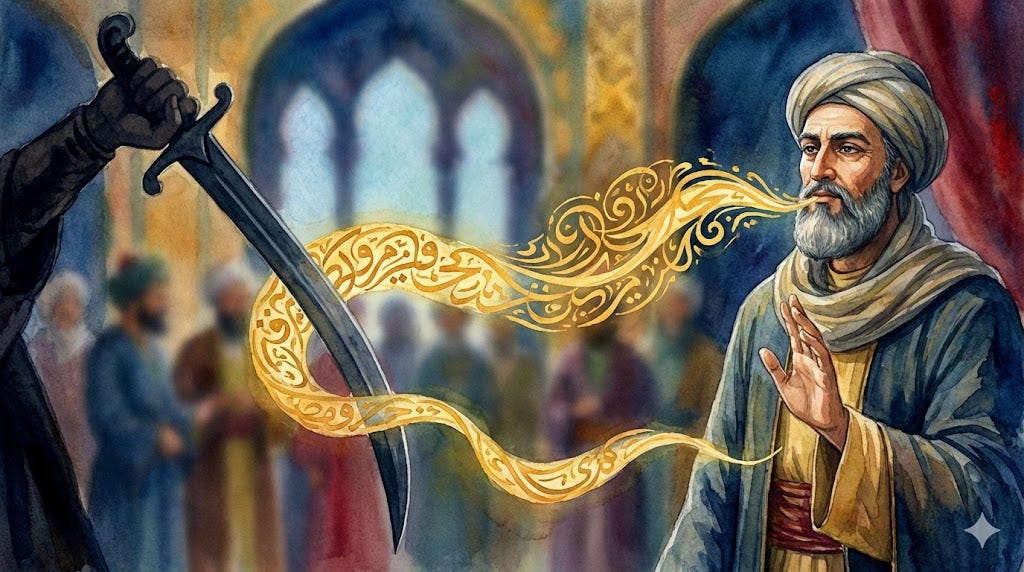
Husayn ibn Ruh al-Nawbakhti wielded this same “wand of words” in the Abbasid court.
As we detailed in Session 51, a gathering was convened in the presence of Abbasid officials and Sunni scholars.
The enemies of the Ahl al-Bayt were attempting to trap him into making a statement that would expose him as the secret head of the Shia network — which would lead to his execution and the dismantling of the entire organisation.
Husayn ibn Ruh preempted them.
In that crowded assembly, he rose and made a public declaration:
قَالَ الْحُسَيْنُ بْنُ رُوحٍ فِي مَجْلِسٍ حَافِلٍ: “أَجْمَعَ الْمُسْلِمُونَ عَلَى أَنَّ خَيْرَ هَذِهِ الْأُمَّةِ بَعْدَ نَبِيِّهَا صَلَّى اللَّهُ عَلَيْهِ وَآلِهِ وَسَلَّمَ: أَبُو بَكْرٍ، ثُمَّ عُمَرُ، ثُمَّ عُثْمَانُ، ثُمَّ عَلِيٌّ.”
“Husayn ibn Ruh declared in a crowded gathering: ‘The Muslims have agreed by consensus that the best of this community after its Prophet — may the peace and blessings of God be upon him and his family — is Abu Bakr, then Umar, then Uthman, then Ali.’”
— Al-Tusi, Kitab al-Ghaybah, Section: Akhbar Husayn ibn Ruh
The Shia attendees were horrified.
They thought their Deputy had apostatised.
But notice the precision of his statement.
He did not say:
“I believe that the best of this community is Abu Bakr...”
He said:
“The Muslims have agreed by consensus that the best of this community is...”
This is Tawriyah.
He stated a fact about what the majority of Muslims publicly claimed to believe.
The Sunni officials heard it as a personal confession of faith.
But the statement itself was a description of public opinion, not a declaration of his own heart.
When the confused Shia approached him privately, demanding an explanation, he replied:
فَقَالَ لَهُمْ: “وَيْحَكُمْ! إِنَّمَا قُلْتُ هَذَا لِأَدْفَعَ عَنْكُمُ السَّيْفَ، وَلَوْلَا ذَلِكَ لَقُتِلْتُ وَقُتِلْتُمْ.”
“Woe to you! I only said this to deflect the sword from you. Had it not been for that statement, I would have been killed, and you would have been killed.”
— Al-Tusi, Kitab al-Ghaybah, Section: Akhbar Husayn ibn Ruh
He used the wand of words to deflect the physical sword of the tyrant.
The Principle Established
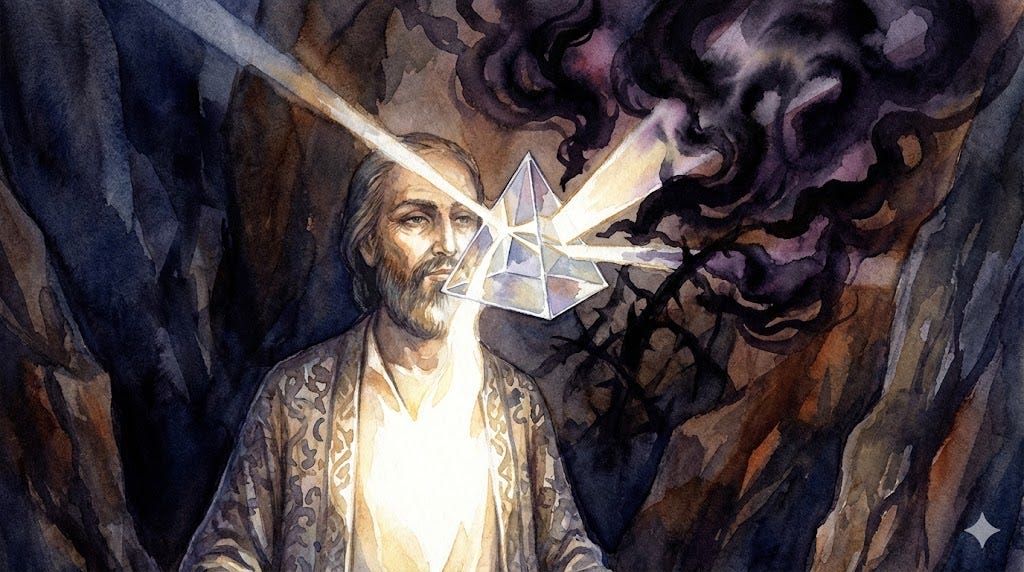
This is the difference between Tawriyah and lying.
The liar says:
“X is true”
when he knows X is false.
He manufactures a false reality in the mind of the listener.
The practitioner of Tawriyah says something that is technically true — but the listener, interpreting through his own assumptions, draws a conclusion that the speaker did not explicitly state.
The Prophet did not lie when he said
“We are from water.”
Every human being is from water.
Husayn ibn Ruh did not lie when he said
“The Muslims have agreed by consensus...”
He was describing public opinion, not his personal belief.
Shaheed Murtadha Mutahhari, in his analysis of Islamic ethics, explains the purpose of this discipline:
برای اینکه روحت عادت نکند به دروغ گفتن، در آنجا که اجبار پیدا میکنی، چیزی به ذهنت خطور بده و به زبانت چیز دیگری بیاور... اسم این “توریه” است... ذهنت را هرگز مستقیم با دروغ مواجه نکن که به دروغ گفتن عادت نکند.
“So that your soul does not become habituated to lying, in situations where you are compelled to conceal the truth, let one meaning cross your mind while you bring something else to your tongue... The name of this is ‘Tawriyah’... Never confront your mind directly with a lie, so that it does not become accustomed to lying.”
— Shaheed Murtadha Mutahhari, Falsafah-ye Akhlaq (The Philosophy of Ethics), Volume 1, Page 88, Section: Dorough-e Maslahat-amiz
The soul must be protected from the habit of falsehood.
Even in extreme circumstances, the believer trains himself to speak truth — layered truth, ambiguous truth, truth that conceals while not fabricating — rather than to manufacture lies.
This is the discipline of the tongue that Taqiyyah demands.
The Jurisprudential Hierarchy: Tawriyah Before Lying
A Primer on Jurisprudential Reasoning
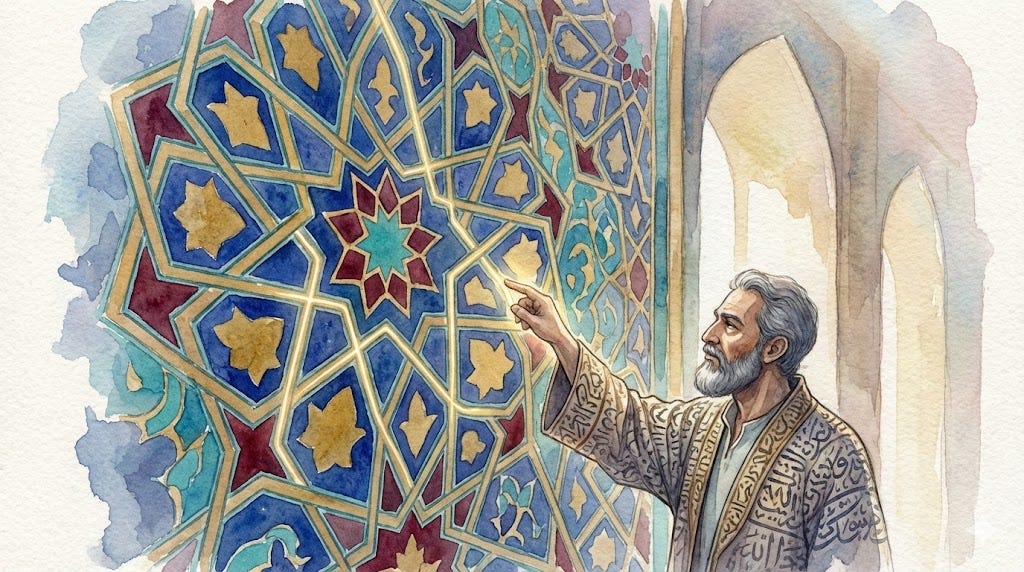
Before examining the specific rulings on Tawriyah, we must understand how Islamic jurisprudence operates. This is not mere academic formality — it is essential for grasping why scholars may differ and what that means for the believer.
The Five Categories of Action (al-Ahkam al-Khamsah)

Every human action falls into one of five categories:
Wajib (Obligatory) — Must be performed; sin to omit
Mustahabb (Recommended) — Rewarded if performed, no sin if omitted
Mubah (Permissible) — Neither rewarded nor punished
Makruh (Disliked) — Better to avoid, no sin if performed
Haram (Forbidden) — Must be avoided; sin to perform
When a scholar issues a ruling, they are placing an action into one of these categories based on their analysis of the Quran, the Sunnah of the Prophet, the teachings of the Ahl al-Bayt, and rational principles.
Obligatory Precaution (Ehtiyat Wajib) vs. Recommended Precaution (Ehtiyat Mustahabb)

When you see the phrase “Ehtiyat Wajib” in a scholar’s ruling, it means:
“The precautionary position is obligatory — you must follow this unless you refer to another qualified marja’ who rules otherwise.”
When you see “Ehtiyat Mustahabb”, it means:
“It is better to be cautious, but not strictly required.”
This distinction matters greatly.
When three of the most followed living maraji’ rule that attempting Tawriyah is Ehtiyat Wajib, they are saying: this is not optional piety — it is the required course of action.
The Stronger Position (al-Aqwa) vs. The More Precautionary Position (al-Ahwat)

In jurisprudential texts, you will encounter two key phrases:
al-Aqwa — “The stronger position” based on textual evidence
al-Ahwat — “The more precautionary position”
Sometimes these align; sometimes they diverge.
A scholar might say:
“The stronger position based on the texts is X, but the more precautionary position is Y.”
This reflects the reality that jurisprudence involves weighing evidence, and scholars may reach different conclusions while acknowledging the merit in alternative views.
Understanding this framework prevents the simplistic error of cherry-picking one phrase from a ruling while ignoring its full context.
The Ontological Consensus — Tawriyah is Not Lying

Before debating whether Tawriyah is obligatory, we must establish what Tawriyah is.
On this point, there is no disagreement among the scholars: Tawriyah is not lying.
The Definition

Tawriyah (تورية) — sometimes called Iham (إيهام) — is the use of language that conveys one meaning to the listener while the speaker intends another, valid meaning.
The speaker does not utter a falsehood; rather, they employ the natural ambiguity of language to protect themselves or others from harm.
Ayatullah al-Khoei’s Foundational Ruling
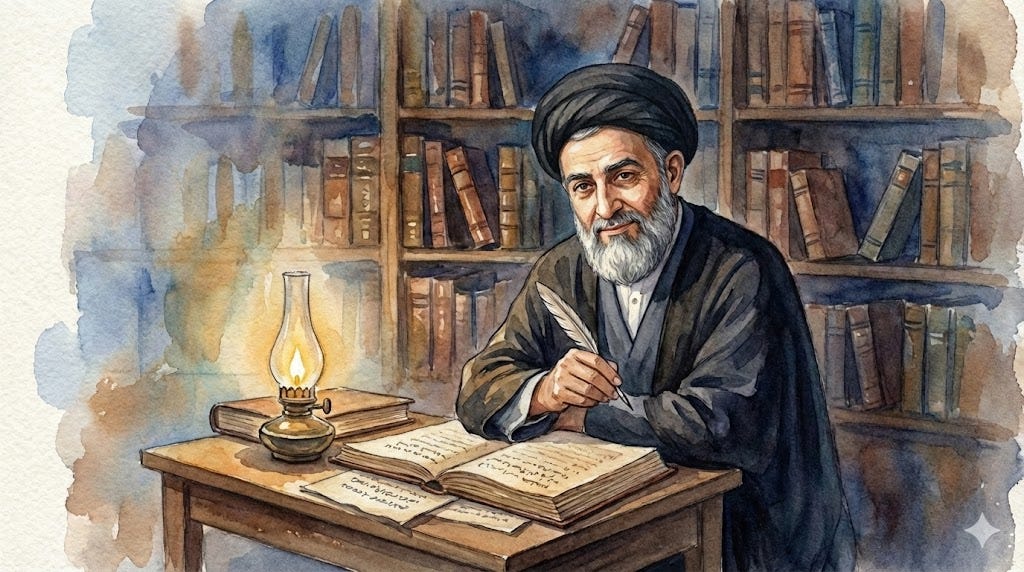
The great Ayatullah al-Khoei established the definitive position in his Misbah al-Faqahah:
لا شبهة في خروج التورية عن الكذب موضوعاً.
“There is no doubt that Tawriyah is excluded from the legal subject of lying.”
— Ayatullah al-Khoei, Misbah al-Faqahah (al-Makasib al-Muharramah), Section on Tawriyah
He explains that lying (al-kadhib) is realised when the speaker’s true intention contradicts reality — not merely when the outward wording could be misunderstood.
Accordingly, Tawriyah, where the true intention accords with reality, is not a form of lying.
This is a matter of ontology — the very nature of what constitutes a lie.
A lie requires the speaker to state what they know to be false.
In Tawriyah, the speaker states what they know to be true according to one valid meaning of their words, even if the listener understands differently.
Imam Khamenei’s Explanation

The Leader of the Islamic Revolution, Imam Khamenei (حفظه الله), provides the standard definition in his Resaleh-ye Amuzeshi:
توریه آن است که سخنی بگوید که ظاهر آن معنای خلاف واقع دارد، ولی مقصود گوینده، معنای دیگری است که مطابق واقع میباشد.
“Tawriyah is to speak a statement whose apparent meaning is contrary to reality, but the speaker’s intended meaning is something else which corresponds to reality.”
— Imam Khamenei, Resaleh-ye Amuzeshi, Volume 2, Lesson 55: The Rules of Lying (Ahkam-e Dorough)
In his Arabic jurisprudential responses, he renders the definition:
التورية: أن يقصد بكلامه معنى غير ما يفهمه المخاطب مما يحتمله اللفظ.
“Tawriyah: That he intends by his speech a meaning other than what the addressee understands, from what the wording allows.”
— Imam Khamenei, Ajwibat al-Istifta’at
This is crucial: Tawriyah is classified as Sidq — an act of truthfulness.
The truth is located in the speaker's intended meaning, not the listener's apparent understanding.
It belongs to an entirely different category than lying.
Why This Matters
The accusation that Taqiyyah makes Shia "liars" collapses at this first hurdle.
The primary mechanism available to the believer — Tawriyah — is not lying at all.
It is a sophisticated use of language that preserves both safety and truthfulness simultaneously.
The Contemporary Majority Position
Having established that Tawriyah is not lying, we now examine what the living maraji’ say about its use.
The contemporary consensus is striking in its uniformity.
Imam Khamenei
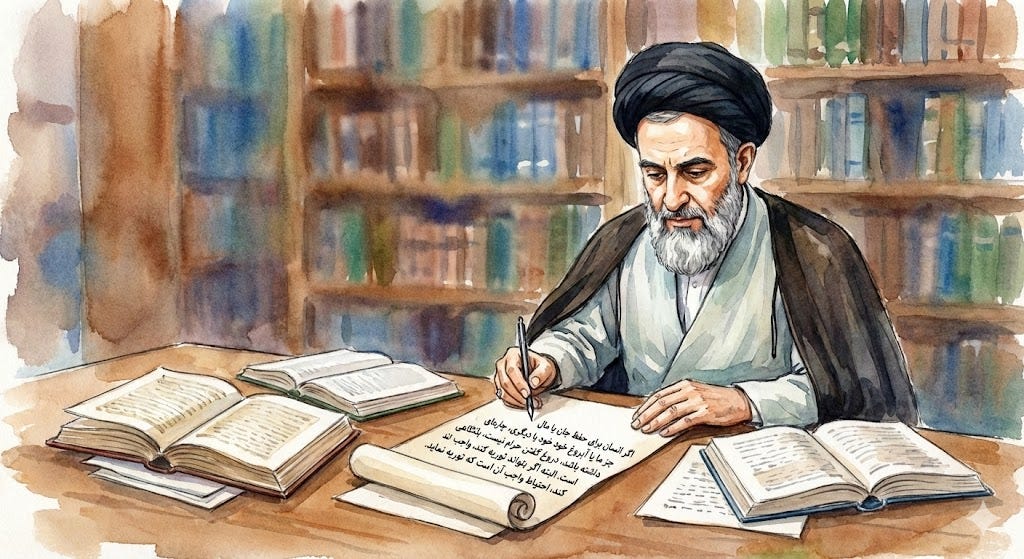
اگر انسان برای حفظ جان یا مال یا آبروی خود یا دیگری، چارهای جز دروغ گفتن نداشته باشد، دروغ گفتن حرام نیست، بلکه گاهی واجب است. البته اگر بتواند توریه کند، احتیاط واجب آن است که توریه نماید.
“If a person has no choice but to lie in order to preserve life, property, or honour of themselves or another, lying is not forbidden; rather, sometimes it is obligatory. However, if one is able to use Tawriyah, Obligatory Precaution (Ehtiyat Wajib — meaning this is required unless you follow another marja' who rules otherwise) dictates that one must use Tawriyah.“
— Imam Khamenei, Resaleh-ye Amuzeshi, Volume 2, Section on Exceptions to Lying (Lessons 55-56)
Ayatullah Sistani

و جایز است دروغ در مورد دفع ضرر از خود یا از مؤمنی دیگر بلکه قسم خوردن بر آن نیز جایز است. و جایز است دروغ در مورد اصلاح بین مؤمنین ولی به احتیاط واجب در این دو مورد، تا توریه ممکن است دروغ نگوید.
“Lying is permissible for repelling harm from oneself or another believer — even swearing an oath on it is permissible. And lying is permissible for reconciliation between believers. However, by Obligatory Precaution (Ehtiyat Wajib — meaning this is required unless you follow another marja' who rules otherwise), in these two cases, as long as Tawriyah is possible, one should not lie.“
— Ayatullah al-Sistani, Official Website (sistani.org), Section on Lying
Ayatullah Makarem-Shirazi
در صورتی که از طریق توریه امکان خلاصی از دروغ باشد، احتیاط واجب آن است که از این راه استفاده کنند.
“If it is possible to escape from lying through Tawriyah, Obligatory Precaution (Ehtiyat Wajib — meaning this is required unless you follow another marja' who rules otherwise) dictates that one must use this method.“
— Ayatullah Makarem-Shirazi, Istifta’at Jadid (New Rulings), Volume 2, Questions 745-747
The Significance
Three of the most widely followed living maraji’ in the Shia world — representing tens of millions of followers across Iran, Iraq, Lebanon, the Persian Gulf, and beyond — have all ruled that Tawriyah is not merely recommended but obligatorily precautionary.
This means that for the vast majority of practicing Shia Muslims today, the instruction from their religious authority is clear: seek the truthful path first.
Even when necessity permits concealment, the believer is obligated to attempt the method that preserves both safety and truthfulness.
How, then, can anyone claim this is “a community of liars”?
The very authorities who guide this community have made the avoidance of lying a matter of obligatory precaution.
Understanding Imam Khomeini’s Position — The Full Context
No discussion of this topic would be complete without addressing Imam Khomeini’s position, which has sometimes been cited — inaccurately — to suggest that Tawriyah is optional or unimportant.
A careful examination of his actual rulings reveals a far more nuanced picture.
The Primary Ruling in the Book of Oaths (Kitab al-Ayman)
In Tahrir al-Wasilah, Volume 2, Kitab al-Ayman (Book of Oaths), Issue 17, Imam Khomeini writes:
وَالأَقْوَى عَدَمُ وُجُوبِ التَّوْرِيَةِ وَإِنْ أَحْسَنَهَا
“The stronger position (al-Aqwa) is that Tawriyah is not obligatory, even though it is the better path (Ahsanuha).”
— Imam Khomeini, Tahrir al-Wasilah, Volume 2, Kitab al-Ayman (Book of Oaths), Issue 17
Notice three critical elements:
He uses “al-Aqwa” — the stronger position based on textual evidence — not a definitive fatwa that closes the matter
He explicitly acknowledges that Tawriyah is “Ahsanuha” — the better, more excellent path
He is addressing the legal obligation, not the ethical recommendation
The Contextual Limitation in Kitab al-Bay’
Even more revealing is Imam Khomeini’s discussion in Volume 1, in the section on Ikrah (compulsion) in contracts.
Here he explains when his leniency applies:
الظَّاهِرُ أَنَّهُ لَا يُعْتَبَرُ فِي صِدْقِ الْاِكْرَاهِ عَدَمُ إِمْكَانِ التَّفَصِّي بِالتَّوْرِيَةِ... يَكُونُ مُكْرَهاً إِذَا كَانَ التَّفَصِّي مُشْكِلٌ وَمُحْتَمَلاً لِوُقُوعِهِ فِي الْمَحْذُورِ... وَأَمَّا مَعَ الْتِفَاتِهِ إِلَى التَّوْرِيَةِ وَسُهُولَتِهَا لَهُ بِلَا مَحْذُورٍ فَمَحَلُّ إِشْكَالٍ
“It is apparent that the validity of compulsion does not require the impossibility of escape through Tawriyah... one is still considered compelled if escape [through Tawriyah] was difficult and there was a possibility of falling into harm... However, if he was aware of Tawriyah and it was easy for him without any problem, then there is disagreement (ishkal).“
— Imam Khomeini, Tahrir al-Wasilah, Volume 1, Kitab al-Bay’ (Book of Sales), Issue 1 on Ikrah
This passage is transformative.
Imam Khomeini is NOT saying “skip Tawriyah whenever you want.”
He is making a contextual distinction:
He is saying, that if Tawriyah is difficult or carries a risk, then there is - according to Imam Khomeini’s ruling, no strict obligation in attempting it first — because it is unlikely to bear fruit.
He also says, that if Tawriyah is possible and doable, then there is an ishkal (disagreement) as to whether it should be ignored, rather the implication is that it may be required.
The key phrase is:
“إِذَا كَانَ التَّفَصِّي مُشْكِلٌ وَمُحْتَمَلاً لِوُقُوعِهِ فِي الْمَحْذُورِ”
“If escape [through Tawriyah] was difficult and there was a possibility of falling into harm.”
— Imam Khomeini, Tahrir al-Wasilah, Volume 1, Kitab al-Bay’ (Book of Sales), Issue 1 on Ikrah
The Revolutionary Realist
Why would Imam Khomeini — himself a man of uncompromising principle — allow this flexibility?
Because he understood the reality of extreme duress.
Consider the situations he was addressing:
A scholar being interrogated by SAVAK.
A believer hiding a fugitive from oppressors.
A revolutionary facing torture.
In such moments, the human mind does not operate with the calm precision of a courtroom.
To demand perfect linguistic craftsmanship from someone whose life hangs by a thread might be setting them up for failure — or death.
Imam Khomeini’s ruling accounts for human frailty without abandoning ethical aspiration.
He says: in extreme difficulty, the absence of Tawriyah does not invalidate the necessity.
But he also says: Tawriyah remains the better path.
And he further implies: when Tawriyah is actually accessible, the calculus changes.
This is not laxity.
This is wisdom.
The Theological Foundation — Islamic Realism

We now arrive at the deepest layer of this discussion: why is Islamic law structured this way?
The answer lies in the very nature of the Divine Legislator and His relationship with His creation.
The Quranic Foundation: No Burden Beyond Capacity
The Quran establishes three foundational principles that govern all of Islamic law.
These are not mere comforting words — they are legislative principles (qawa’id fiqhiyyah) that shape how every ruling is applied.
There first is from Surah al-Hajj, the Chapter of the Pilgrimage, the 22nd chapter of the Quran:
وَمَا جَعَلَ عَلَيْكُمْ فِي الدِّينِ مِنْ حَرَجٍ
“And He has not placed upon you in the religion any difficulty (haraj).”
— Quran, Surah al-Hajj (the Chapter of the Pilgrimage) #22, Verse 78
The second is from Surah al-Baqarah, the Chapter of the Cow, the 2nd chapter of the Quran:
يُرِيدُ اللَّهُ بِكُمُ الْيُسْرَ وَلَا يُرِيدُ بِكُمُ الْعُسْرَ
“God intends for you ease and does not intend for you hardship.”
— Quran, Surah al-Baqarah (the Chapter of the Cow) #2, Verse 185
And the third is also from Surah al-Baqarah, the Chapter of the Cow, the 2nd Chapter of the Quran:
لَا يُكَلِّفُ اللَّهُ نَفْسًا إِلَّا وُسْعَهَا
“God does not burden a soul beyond its capacity.”
— Quran, Surah al-Baqarah (the Chapter of the Cow) #2, Verse 286
Now, how do our scholars understand these verses?
Let us turn to two of the greatest exegetes of our time.
Allamah Tabatabai in Tafsir Al-Mizan
On the first verse — Surah al-Hajj 22:78 — Allamah Tabatabai writes:
قَوْلُهُ: (وَمَا جَعَلَ عَلَيْكُمْ فِي الدِّينِ مِنْ حَرَجٍ)... هَذَا اللِّسَانُ هُوَ لِسَانُ التَّنْزِيهِ، فَيَدُلُّ عَلَى أَنَّهُ تَعَالَى لَمْ يَشْرَعْ حُكْمًا يَسْتَلْزِمُ الْحَرَجَ وَالضِّيقَ عَلَى عِبَادِهِ. فَمَتَى كَانَ الْحُكْمُ حَرَجِيًّا ارْتَفَعَ عَنِ الْمُكَلَّفِ، وَهَذِهِ قَاعِدَةٌ عَامَّةٌ فِي الْأَبْوَابِ الْفِقْهِيَّةِ
“This language is the language of declaring transcendence (Tanzih), indicating that He, the Exalted, did not legislate any ruling that necessitates hardship or constriction upon His servants. Therefore, whenever a ruling becomes difficult (Haraji), it is lifted from the person obligated. This is a general rule applicable across all chapters of jurisprudence.”
— Allamah Tabatabai, Al-Mizan fi Tafsir al-Quran, Volume 14, Page 404
Do you hear what Allamah Tabatabai is saying?
Whenever a ruling becomes a source of genuine hardship, it is lifted.
Not bent, not adjusted — lifted entirely.
And this is not an exception; it is a general rule across all of fiqh.
On the second verse — Surah al-Baqarah 2:185 — he explains:
وَالْجُمْلَةُ (يُرِيدُ اللَّهُ بِكُمُ الْيُسْرَ...) تَعْلِيلٌ لِلتَّرْخِيصِ السَّابِقِ فِي الْمَرِيضِ وَالْمُسَافِرِ... فَإِذَا صَارَ التَّكْلِيفُ شَاقًّا وَعَسِيرًا، سَقَطَ عَنِ الْعَبْدِ لِأَنَّ اللَّهَ لَا يُرِيدُ الْعُسْرَ
“The sentence (God intends for you ease...) is the rationale for the previous concession regarding the sick and the traveler... Thus, if the obligation becomes arduous and difficult, it falls from the servant, because God does not intend hardship.“
— Allamah Tabatabai, Al-Mizan fi Tafsir al-Quran, Volume 2, Page 22
The principle extends beyond fasting.
It is the very logic of Divine legislation: when hardship arises, the obligation falls.
And on the third verse — Surah al-Baqarah 2:286 — Allamah Tabatabai cuts to the heart of the matter:
الْوُسْعُ: هُوَ الطَّاقَةُ وَالسَّعَةُ... وَالْآيَةُ تَنْفِي تَكْلِيفَ مَا لَا يُطَاقُ. فَإِنَّ التَّكْلِيفَ بِمَا لَا يَسَعُهُ الْإِنْسَانُ وَلَا يَقْدِرُ عَلَيْهِ سَفَهٌ وَظُلْمٌ، وَاللَّهُ سُبْحَانَهُ مُنَزَّهٌ عَنْ ذَلِكَ
“Al-Wus’ refers to energy and capacity... The verse negates the obligation of what is unbearable. For imposing a duty that a human cannot encompass or has no power over is foolishness and injustice, and God — Glory be to Him — is free from that.”
— Allamah Tabatabai, Al-Mizan fi Tafsir al-Quran, Volume 2, Page 443
Listen to what he is saying: to demand the impossible is not piety — it is safah (foolishness) and dhulm (injustice).
And God is munazzah — transcendent, purified — from such injustice.
This is theology with teeth.
Ayatullah Jawadi-Amoli in Tafsir-e Tasnim
Now let us turn to Ayatullah Jawadi-Amoli and see how he applies these principles.
On the first verse — Surah al-Hajj 22:78 — he writes:
دین اسلام، دین «سَمحَة و سَهلَة» است. خداوند در تشریع احکام، توان و طاقت مکلفین را در نظر گرفته است. «حَرَج» یعنی تنگی و ضیق که تحمل آن عادتاً دشوار است. نفی حرج در این آیه، نفی حکم است؛ یعنی حکمی که موجب حرج باشد، در اسلام وضع نشده است
“The religion of Islam is a religion of ‘Magnanimity and Ease’ (Samhah wa Sahlah). God, in legislating the laws, has considered the power and endurance of those obligated. ‘Haraj’ means a constriction and tightness that is habitually difficult to bear. The negation of Haraj in this verse is the negation of the ruling itself — meaning, any ruling that causes Haraj has not been enacted in Islam.”
— Ayatullah Jawadi-Amoli, Tafsir-e Tasnim, Volume 44
Samhah wa Sahlah — magnanimity and ease.
This is not a religion that corners you.
This is not a system that traps you.
On the second verse — Surah al-Baqarah 2:185 — he explains:
اراده تشریعی خداوند بر آسانی است. احکام الهی برای کمال انسان است، نه برای رنج و مشقت او. اگر حکمی در شرایط خاص (مثل خطر جانی یا بیماری) موجب «عُسر» شود، آن حکم برداشته میشود. یُسر در اینجا یعنی احکام دین با نرمش و سهولت همراه است و بنبست ندارد
“The Legislative Will of God is based on ease. Divine laws are for human perfection, not for his suffering and toil. If a ruling in specific conditions (like mortal danger or illness) causes hardship, that ruling is removed. ‘Yusr’ here means that the rulings of religion are accompanied by flexibility and facility, and there is no dead-end.“
— Ayatullah Jawadi-Amoli, Tafsir Tasnim, Volume 9, Pages 480-485
Listen to that phrase:
“there is no dead-end.”
The religion does not corner you.
It does not trap you between death and damnation.
There is always a way.
And now, on the third verse — Surah al-Baqarah 2:286 — Ayatullah Jawadi-Amoli makes the direct connection to Taqiyyah:
خداوند حق دارد که عبادت شود، اما این حق را به اندازه «وُسع» بنده مطالبه میکند. وُسع یعنی آن مقدار از توان که به کار گیری آن موجب حرج و ضرر نشود. در تقیه، وقتی اظهار ایمان خارج از وُسع است (یعنی موجب قتل میشود)، تکلیف ساقط است. این نشاندهنده رأفت مولی نسبت به عبد است
“God has the Right to be worshipped, but He demands this right only to the extent of the servant’s capacity (Wus’). Wus’ means that amount of power the usage of which does not cause hardship or harm. In the case of Taqiyyah, when declaring one’s faith is outside of one’s capacity (meaning it leads to murder), the obligation falls. This demonstrates the Master’s compassion toward the servant.”
— Ayatullah Jawadi-Amoli, Tafsir Tasnim, Volume 12, Pages 620-625
The obligation falls.
Not because God’s right to be worshipped has diminished.
Not because the truth has become less true.
But because God, in His infinite mercy, does not demand from His servant what would destroy that servant.
the tender mercy of the Master toward His slave.
This is what Taqiyyah is rooted in.
Not deception.
Not cowardice.
But the mercy of a Lord who knows His creation and refuses to break it.
The Prophets and Imams as Revolutionary Realists

This is not a peripheral principle.
It reflects the very character of prophethood and Imamate.
The Prophet Muhammad instructed:
يَسِّرُوا وَلَا تُعَسِّرُوا، وَبَشِّرُوا وَلَا تُنَفِّرُوا
“Make things easy and do not make them difficult; give glad tidings and do not drive people away.”
— Al-Bukhari, Sahih, Book of Knowledge, Hadith 69
— Al-Hajjaj Al-Nayshabouri, Sahih Muslim, Book of Jihad, Hadith 1734
— Al-Majlisi, Bihar al-Anwar, Volume 72, Page 352
— Ibn Abi Jumhur Al-Ahsa’i, Awali al-La’ali
The Prophets and Imams were not detached idealists living in ivory towers.
They were revolutionaries who understood the crushing weight of oppression, the terror of persecution, the limits of human endurance under torture.
They calibrated their teachings to human capacity — not to some impossible ideal that would crush souls rather than elevate them.
Imam Khomeini himself embodied this synthesis: revolutionary in principle, realist in application.
He did not lower the standards of Islam; he understood that true standards must be achievable, or they become instruments of despair rather than paths to salvation.
A Critical Warning: Hardship Has a Jurisprudential Meaning
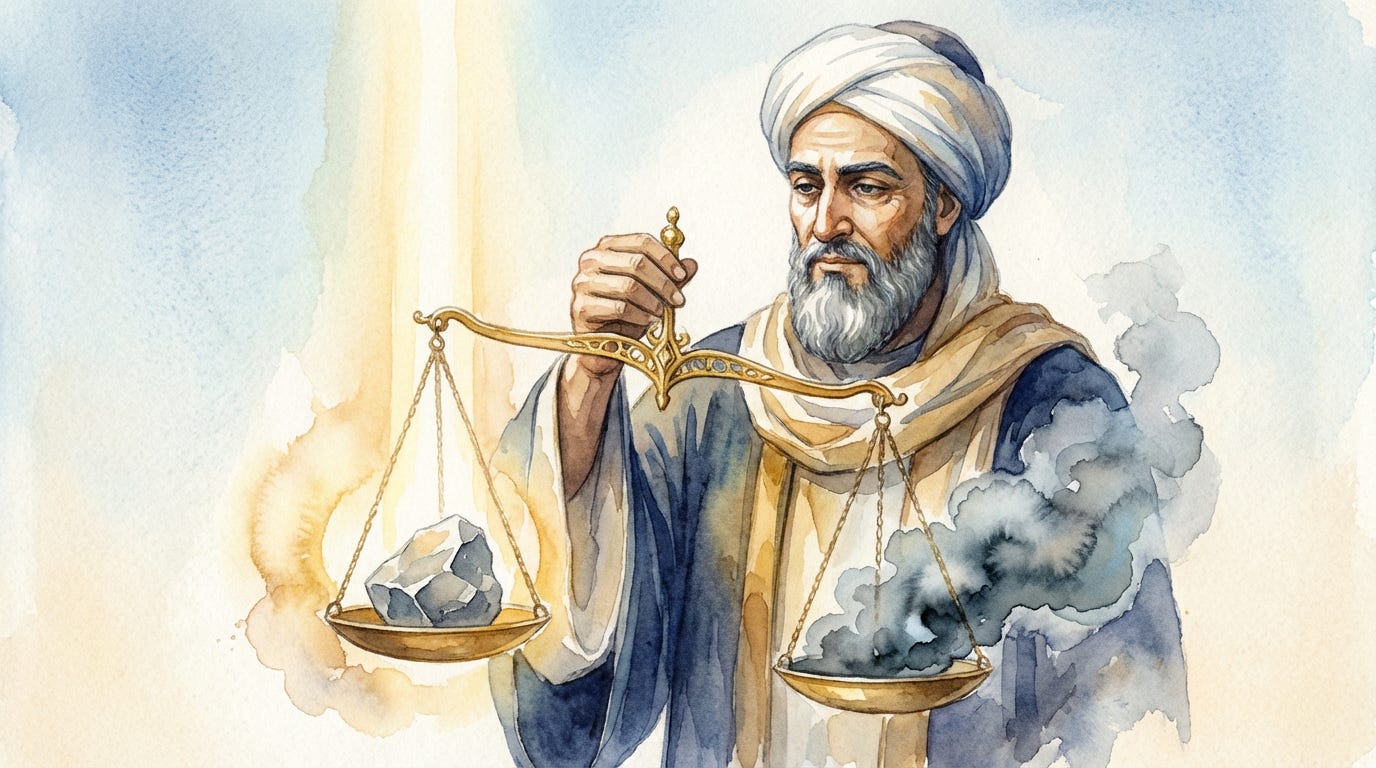
This mercy, however, is not a blank cheque.
It has a specific scope — and we must understand that scope to honour it properly.
Now, before anyone takes these principles and runs in the wrong direction, we must be absolutely clear about something.
The principle of “no burden beyond capacity” is not a blank cheque to abandon obligations whenever we find them inconvenient.
When the scholars speak of haraj (hardship) and ‘usr (difficulty), they are using technical jurisprudential terms with specific meanings.
They are referring to:
Genuine threat to life — like the believer facing execution for declaring his faith
Severe illness — where performing an obligation would cause serious medical harm
True impossibility — where the action literally cannot be performed
They are not referring to:
Discomfort — fasting is difficult, but that difficulty does not lift the obligation
Inconvenience — waking for the morning prayer (Fajr) is hard, but that hardship does not permit abandoning it
Self-imposed difficulty — the smoker who finds fasting unbearable has created his own problem; his addiction does not transform a universal obligation into a personal exemption
This distinction is crucial.
The person who says,
“Fasting is too hard for me because I smoke, and God does not burden a soul beyond its capacity, so I don’t have to fast”
— this person has fundamentally misunderstood the principle.
The haraj that lifts an obligation is objective hardship recognised by the Shariah, not subjective discomfort determined by the individual.
A traveler is genuinely exempt from fasting — not because travel is “hard” in some vague sense, but because the Shariah itself has designated travel as a recognised category of exemption.
A person with diabetes whose doctor confirms that fasting would endanger their health is exempt — because genuine medical necessity is a recognised category.
But the person who simply finds an obligation unpleasant?
The one who would rather sleep than pray?
The one whose lifestyle choices have made obedience difficult?
These are not cases of haraj.
These are cases of nafs — the ego resisting its discipline.
The concession exists for genuine necessity, not for convenience.
And here is the deeper point: the very fact that these dispensations are limited is what makes them meaningful.
If everyone could simply opt out of any obligation they found difficult, there would be no religion left.
The dispensation for the genuinely endangered believer has value precisely because it is not available to the merely lazy one.
The person of Taqwa understands this.
They do not look for loopholes.
They do not twist principles of mercy into excuses for abandonment.
They fulfil their obligations to the best of their ability, and they accept the genuine dispensations with gratitude when true necessity arises — not before.
Equality is Not Equivalence
With that warning firmly in place, we can now appreciate the deeper wisdom of this principle.
True justice does not mean treating everyone identically; it means treating each according to their nature and capacity.
To demand from a person under torture the same linguistic precision as someone in calm contemplation is not justice — it is cruelty disguised as piety.
To require the same verbal dexterity from a terrified believer facing execution as from a scholar in his study is not upholding standards — it is ignoring the reality that God Himself has acknowledged.
But equally — and this is the balance — to allow the comfortable person to claim the exemptions meant for the endangered is not mercy; it is corruption of the law.
The law is calibrated to human capacity precisely because it comes from the One who created that capacity.
This is not a deficiency in the law; it is its perfection.
And this is precisely what elevates those who follow it — because they are following the best way, not an impossible way.
The one who practices Tawriyah when able, and resorts to concealment only when Tawriyah is beyond reach, is walking the path that God Himself has designated as the path of wisdom.
The one who fulfils obligations when able, and accepts dispensations only when genuine necessity arises, is walking that same path.
This is the balance of Islam: rigour without cruelty, mercy without laxity.
The Precedent of the Infallibles
This framework is not an invention of later jurists.
It is the practice of the Prophets and Imams themselves.
Consider Prophet Ibrahim, peace be upon him.
When the idolaters demanded to know who had destroyed their idols, he replied:
قَالَ بَلْ فَعَلَهُ كَبِيرُهُمْ هَٰذَا فَاسْأَلُوهُمْ إِن كَانُوا يَنطِقُونَ
“He said: Rather, this big one did it — so ask them, if they can speak.”
— Quran, Surah Al-Anbiya (the Chapter of the Prophets) #21, Verse 63
Did Ibrahim lie?
The exegetes explain: he made a conditional statement.
“He did it... if they can speak.”
Since they cannot speak, the condition fails.
The pagans heard
“He did it,”
but Ibrahim meant
“Ask them — and when they cannot answer, you will have your proof.”
This is Tawriyah.
Every word was technically true.
The listeners drew their own false conclusion.
The Prophet did not need to lie.
He found the truth that protected.
And this is the model the scholars preserve: find the truth first.
Craft the statement that your heart can stand behind.
Resort to fabrication only when no other path remains — and even then, only to repel genuine harm.
The Hard Limit: When Concealment Becomes Forbidden
But here is where the critics fail to read the full tradition.
Taqiyyah is not a blank cheque.
It is not permission to say anything under any circumstances.
The Imams themselves set boundaries — hard limits beyond which taqiyyah becomes betrayal.
The Principle of Preservation
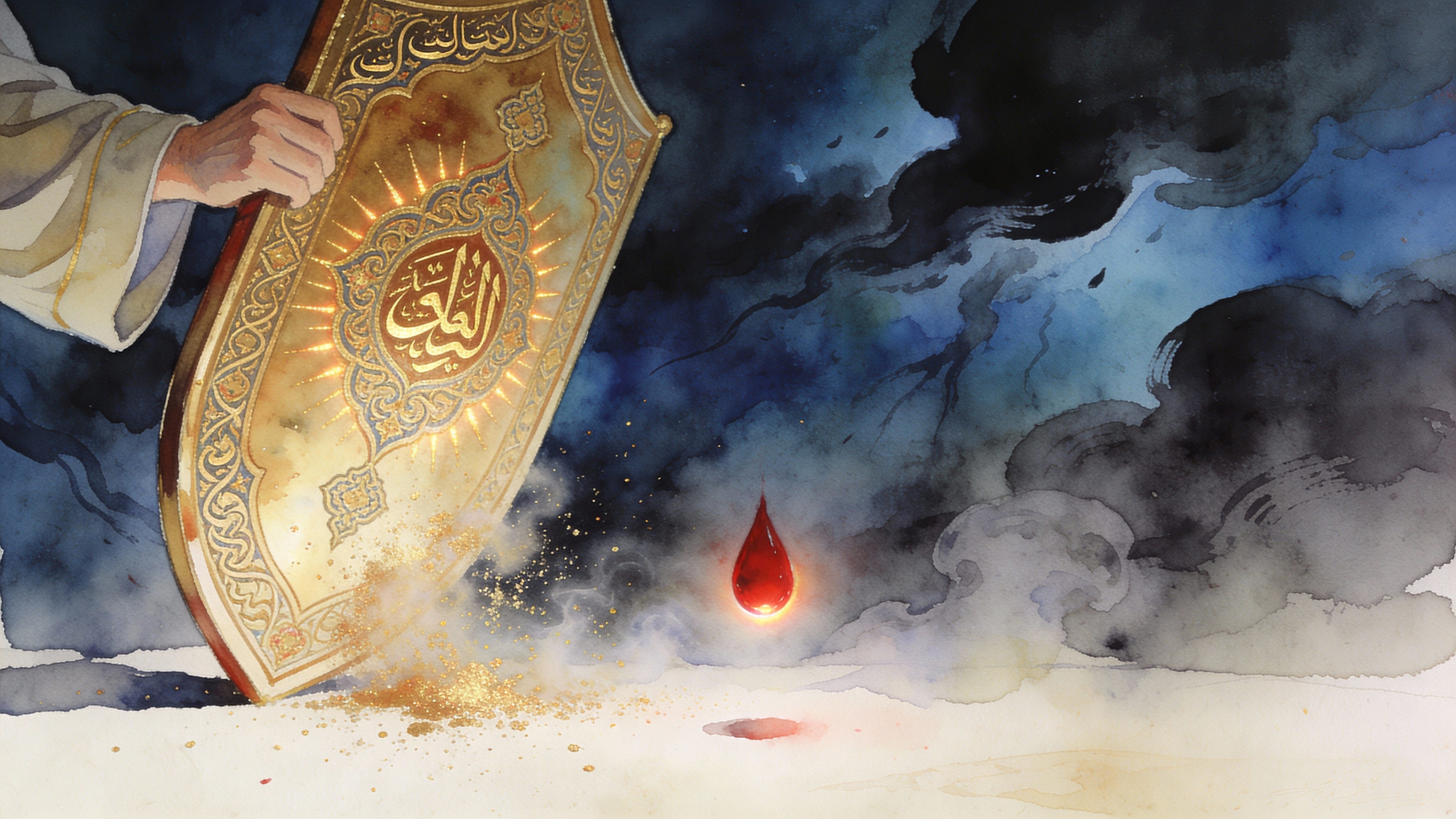
Imam al-Sadiq, peace be upon him, declared:
إِنَّمَا جُعِلَتِ التَّقِيَّةُ لِيُحْقَنَ بِهَا الدَّمُ، فَإِذَا بَلَغَتِ التَّقِيَّةُ الدَّمَ فَلَا تَقِيَّةَ
“Taqiyyah was only instituted to preserve blood. But if Taqiyyah itself reaches the point of [causing] blood to be shed, then there is no Taqiyyah.”
— Al-Kulayni, Al-Kafi, Volume 2, Kitab al-Iman wa al-Kufr, Bab al-Taqiyyah, Hadith 2
This is the governing principle: Taqiyyah exists to protect.
The moment it would destroy — the moment your silence causes an innocent person to be killed, the moment your concealment enables a crime against the faith or against humanity — Taqiyyah is not merely suspended.
It becomes forbidden.
The Shield exists to preserve life.
You cannot use the Shield as a weapon to take it.
The Principle of Capacity
Imam Khomeini — may God rest his pure soul — articulated the second boundary with characteristic clarity:
قدرت نداشتن عذر است، اما اگر قدرت پیدا کردیم، تقیه حرام است
“Lacking power is an excuse. But if we acquire the power, Taqiyyah becomes forbidden.”
— Imam Khomeini, Sahifeh-ye Imam, Volume 21, Page 408
This transforms our understanding.
Taqiyyah is not a permanent posture.
It is not a lifestyle.
It is a response to a specific condition: the condition of inability.
When you lack the capacity to resist openly, concealment is permitted — even obligatory.
But when the capacity exists, when the power to speak and act has been granted, then Taqiyyah ceases to be a virtue and becomes a vice.
The one who has the power to defend the Truth and chooses silence is not practising Taqiyyah.
He is practising cowardice.
The Ali-Hasan-Husayn Distinction
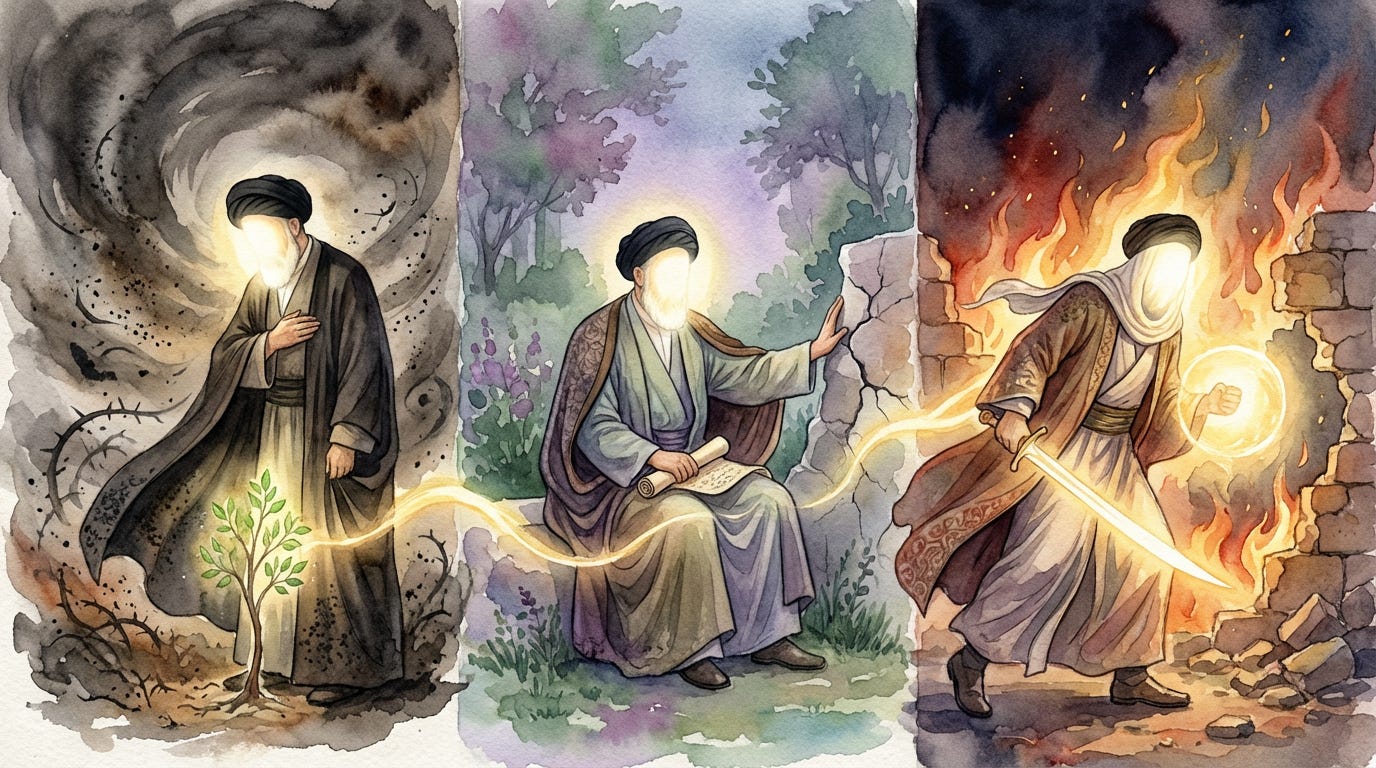
Consider the twenty-five years of silence maintained by the Commander of the Faithful, Ali ibn Abi Talib, peace be upon him.
This was not the silence of a man with nothing to say.
It was the silence of a man holding a Shield over the entire Ummah.
He himself described this period — not with bitterness, but with the precision of one who understood exactly what he was doing:
صَبَرْتُ وَفِي الْعَيْنِ قَذًى، وَفِي الْحَلْقِ شَجًا
“I remained patient while there was a thorn in my eye and a bone in my throat.”
— Nahj al-Balagha, Sermon al-Shiqshiqiyyah
Why did he endure this?
Because he understood that the young tree of Islam was still fragile.
Had he drawn the sword to claim his right, the friction would have sparked a fire that consumed the entire forest.
The community would have been torn apart before it had taken root.
This is the highest form of Taqiyyah — what we might call the Imamic Silence.
The Imam did not lose his right through silence; he exercised his duty through silence.
It is the choice to let one’s own heart bleed so that the blood of the community is not spilled.
It extends the Shield beyond the self to cover an entire civilisation.
He protected the unity of the Muslims because he knew that without a community, there would be no one left to receive the Truth.
And this pattern — silence when silence preserves, speech when speech becomes obligatory — was inherited by his sons.
We touched on their example last week, in session 54, when we examined the False Dawn.
Let us recall it now, for it illuminates the boundary we are discussing.
Imam Hasan, peace be upon him, made a treaty with Muawiyah.
He withdrew from open confrontation.
He practised what we might call strategic patience — a form of Taqiyyah at the political level.
Why?
Because Muawiyah, for all his corruption, maintained the outward shell of Islam.
He prayed.
He fasted.
He did not openly call people to abandon the Shariah.
He corrupted the kernel — the spiritual and political truth of Wilayah — while preserving the shell — the external structures of Islamic practice.
In such conditions, the Imam judged that open war would destroy the community without achieving the goal.
The kernel could be preserved through patience, even as the shell was being hollowed out.
But Yazid was different.
Yazid did not merely corrupt the kernel.
He sought to destroy both kernel and shell.
He mocked the prayer.
He drank openly.
He demanded not mere political submission but the legitimisation of his rule by the family of the Prophet — a legitimisation that would have annihilated the very meaning of Islam.
And so Imam Husayn, peace be upon him, rose.
He did not practise Taqiyyah.
He could not.
Because in that moment, Taqiyyah would not have preserved the religion — it would have buried it.
Silence would not have protected the kernel — it would have handed the enemy the shovel to dig its grave.
This is the line.
When the shell is being corrupted but the kernel can still be preserved through patience — Taqiyyah is permitted.
When both shell and kernel are under assault, when the very foundations of the religion face annihilation — Taqiyyah becomes forbidden, and resistance becomes obligatory.
The Principles Summarised

From these foundations, the scholars derive the conditions under which Taqiyyah is forbidden:
First: When your silence would cause innocent blood to be shed.
If your concealment enables murder, oppression, or injustice against others, you have crossed the line.
Taqiyyah exists to preserve life, not to become complicit in its destruction.
Second: When the core of the religion is under open attack.
If the enemy seeks not merely political power but the annihilation of Tawheed, of Prophethood, of Wilayah itself — then silence is not protection.
It is surrender.
Third: When you possess the capacity to resist.
If God has granted you the power, the platform, the resources, the safety to speak — and you choose silence out of comfort rather than necessity — you have abandoned your post.
Fourth: When a qualified authority issues a ruling that requires public stance.
When the Marjaiyyah declares a matter to be of existential importance — as in the fatwa against Daesh, or the defence of the oppressed — the individual’s personal Taqiyyah is overridden by the collective obligation.
These are not arbitrary rules.
They are the logical extension of the principle: Taqiyyah is a means, not an end.
The end is the preservation and advancement of the Truth.
When Taqiyyah serves that end, it is obligatory.
When it betrays that end, it is forbidden.
The Test: Would the Imam Approve?

Here is a practical test that the scholars offer:
Before any act of Taqiyyah, ask yourself:
If Imam al-Sadiq were watching, would he approve of what I am about to say or do?
If the answer is yes — if you are protecting life, protecting family, protecting the community, protecting the sacred knowledge from those who would destroy it — then proceed.
If the answer is no — if you are using “Taqiyyah” as an excuse for cowardice, for abandoning principle, for gaining worldly advantage through deception — then you have left the path.
Taqiyyah is not a licence for opportunism.
It is not a tool for climbing social ladders by pretending to be what you are not.
It is not permission to deny your identity when the only cost of honesty is discomfort.
Taqiyyah is the Shield of the believer under genuine threat.
It is the fortress of the one who would be killed for his faith.
It is the protection of the kernel when the enemies are at the gate.
Use it for anything else, and you have betrayed its purpose.
The Accusation Answered
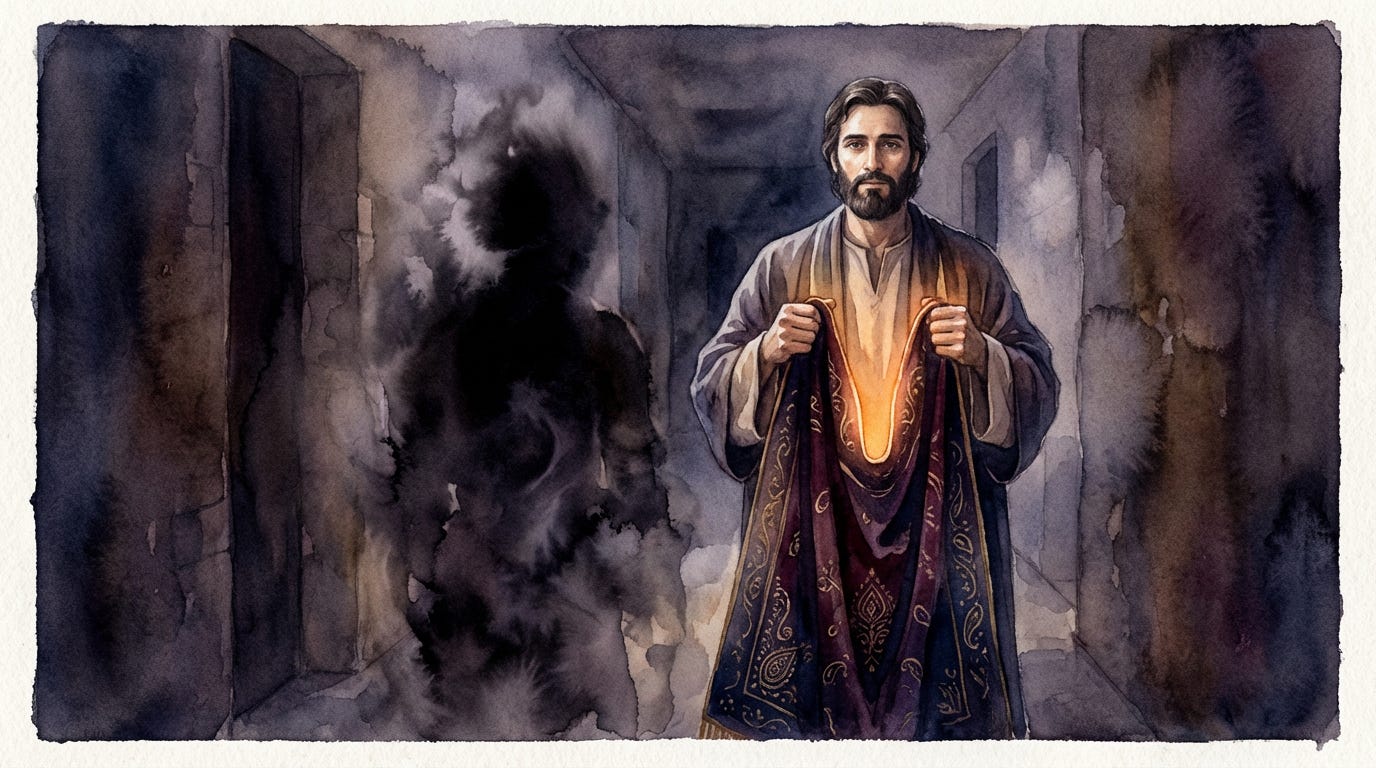
So when the critic says,
“Taqiyyah is lying,”
we respond:
No. Taqiyyah is shielding.
Lying is the fabrication of falsehood.
Taqiyyah is the concealment of truth.
Lying creates a false reality in the mind of the listener.
Taqiyyah simply refuses to hand the listener a weapon.
Lying is the act of the Munafiq (Hypocrite) — who says “I believe” while his heart rejects.
Taqiyyah is the act of the Mu’min (Believer) — who guards what he believes from those who would destroy it.
The Prophet permitted it.
The Quran enshrines it.
The Imams taught it.
The scholars codified it.
And the one who cannot distinguish between Kitman (concealment) and Kidhb (fabrication) has no business lecturing anyone about Arabic, about Islam, or about ethics.
The Lesson: Three Principles for the Waiter

We have covered much ground tonight.
Before we close, let us distil the essence into principles that can be carried forward — not merely as knowledge, but as practice.
First Principle: The Shield Protects Truth — It Does Not Replace It
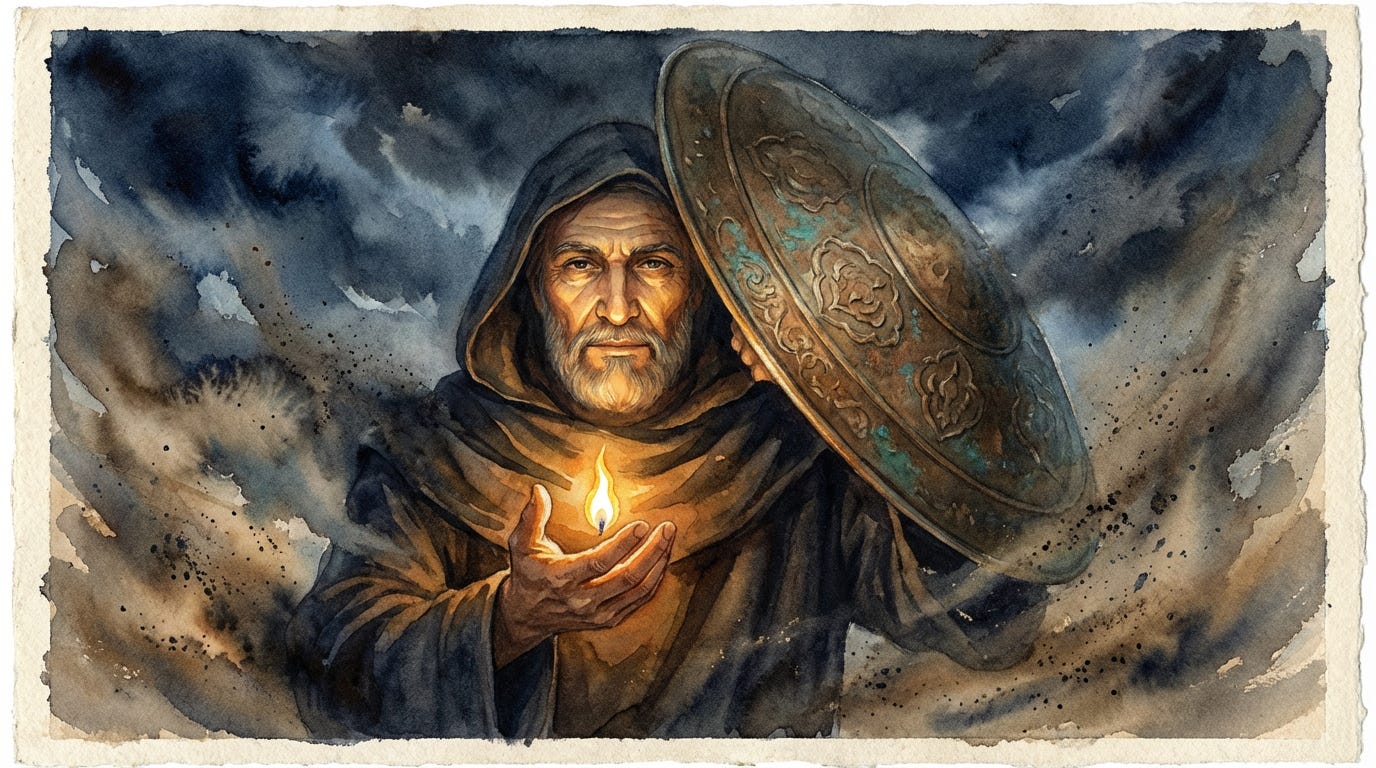
Taqiyyah exists to preserve what is real, not to create what is false.
The believer who practises Taqiyyah is not building an alternative identity.
He is not becoming someone else.
He is guarding who he truly is from those who would destroy it.
This means that Taqiyyah is always temporary.
It is always in service of a future unveiling.
The Believer of Pharaoh’s household concealed — but when the moment came, he spoke.
Husayn ibn Ruh deflected the sword with words — but the organisation he protected eventually built the Hawza, the Marjaiyyah, the institutions that today proclaim the Truth openly.
Ask yourself:
Is my concealment protecting something real that will one day emerge?
Or have I made the Shield into a permanent home, forgetting that I was supposed to be guarding a treasure?
The Shield is not the treasure.
The Shield protects the treasure.
Never confuse the two.
Second Principle: The Hierarchy Demands Discipline
We learned tonight that the scholars — from Ayatullah al-Khoei to Imam Khamenei — agree on a fundamental point: Tawriyah is not lying.
It is Sidq — truthfulness — because the speaker’s intended meaning matches reality.
This is not a minor technicality.
It is a discipline of the tongue and the soul.
The easy path is to lie.
When the interrogator asks his question, when the hostile colleague probes your beliefs, when the situation demands an answer — the easy path is to simply fabricate.
But the tradition teaches: find the truth that protects first.
Craft the statement that is technically accurate while concealing what need not be revealed.
Train your tongue to speak words that your heart can stand behind.
This requires preparation.
This requires presence of mind.
This requires the cultivation of linguistic intelligence — the ability to think in layers, to speak in meanings, to find the narrow path between exposure and fabrication.
The Prophet said “We are from water” because he had the presence of mind, in that moment of danger, to find a phrase that was true at every level.
Husayn ibn Ruh said “The Muslims have agreed by consensus...” because he had the political genius to describe a fact without confessing a belief.
This is a skill.
And like all skills, it must be practised.
Third Principle: Know Your Line
Imam al-Sadiq said:
إِنَّمَا جُعِلَتِ التَّقِيَّةُ لِيُحْقَنَ بِهَا الدَّمُ، فَإِذَا بَلَغَتِ التَّقِيَّةُ الدَّمَ فَلَا تَقِيَّةَ
“Taqiyyah was only instituted to preserve blood. But if Taqiyyah itself reaches the point of [causing] blood to be shed, then there is no Taqiyyah.”
— Al-Kulayni, Al-Kafi, Volume 2, Kitab al-Iman wa al-Kufr, Bab al-Taqiyyah, Hadith 2
Imam Khomeini said:
قدرت نداشتن عذر است، اما اگر قدرت پیدا کردیم، تقیه حرام است
“Lacking power is an excuse. But if we acquire the power, Taqiyyah becomes forbidden.”
— Imam Khomeini, Sahifeh-ye Imam, Volume 21, Page 408
Every believer must know where their line is.
There are things you will conceal to survive.
And there are things you will die before concealing.
There are situations where silence is wisdom.
And there are situations where silence is betrayal.
The line is not the same for everyone.
The scholar has a different line than the layperson.
The one with a platform has a different line than the one in obscurity.
The one whose words would rally thousands has a different obligation than the one whose words would reach only his executioner.
But everyone has a line.
And if you do not know where yours is, you will discover it only when you have already crossed it — when you have already said the thing that should never have been said, or remained silent when speech was obligatory.
Sit with this question:
What will I never deny, even under threat?
What truths are so central to my identity, my faith, my humanity, that concealing them would be worse than death?
The one who knows his line can practise Taqiyyah with a clean conscience — because he knows that he is protecting, not betraying.
He knows that his Shield has edges, and that beyond those edges, he will drop the Shield and draw the Sword.
The one who does not know his line will drift — will find himself conceding more and more, rationalising more and more, until one day he discovers that he has protected his body by surrendering his soul.
Know your line.
And when the moment comes — when the Yazid of your age demands what cannot be given — be prepared to stand with Husayn.
Conclusion
The Shield Forged
We have covered much ground tonight — perhaps more technical ground than usual.
We traced the Quranic foundations: the exception clause in Surah Aal-e-Imran, the validation of Ammar under torture, the model of the Believer in Pharaoh’s household.
We examined the linguistic roots: Taqiyyah and Taqwa as two branches of the same tree — both meaning protection, both expressions of the wisdom that shields what is sacred.
We distinguished Kitman from Kidhb: concealment from fabrication, the withholding of truth from the manufacturing of falsehood.
We learned the jurisprudential hierarchy: that the greatest living maraji’ have ruled Tawriyah to be obligatorily precautionary — that this community is bound to seek truth first, even in danger.
We understood the theological foundation: that God does not burden a soul beyond its capacity, that the religion has no dead-ends, that the dispensation exists for genuine necessity rather than convenience.
And we learned the limits: that Taqiyyah ends where innocent blood begins, that the Shield must be lowered when the Sword becomes obligatory, that possessing power transforms silence into betrayal.
This was necessary work.
The accusation against our community — that we are “liars,” that our religion “permits deception,” that nothing we say can be trusted — has been levelled for fourteen centuries.
It has confused sincere seekers, embarrassed some of our own youth, and been weaponised by enemies who understand it all too well and critics who do not understand it at all.
Tonight, we returned to the sources — the Quran, the Sunnah, the teachings of the Ahl al-Bayt, the rulings of the scholars — and forged the Shield anew.
The one who carries this knowledge can now respond to the accusation with the confidence of one who knows his tradition:
Taqiyyah is not lying. It is shielding.
Tawriyah is not fabrication.
It is the discipline of finding truth that protects.
And the community that practises these arts is not a community of liars.
It is a community of survivors — survivors who preserved the kernel through fourteen centuries of persecution, who passed the light from hand to hand through the long night, who ensured that there would still be followers of the Ahl al-Bayt when the True Dawn finally breaks.
That is not cowardice.
That is wisdom.
That is the Shield.
What Remains: Taqiyyah in Action
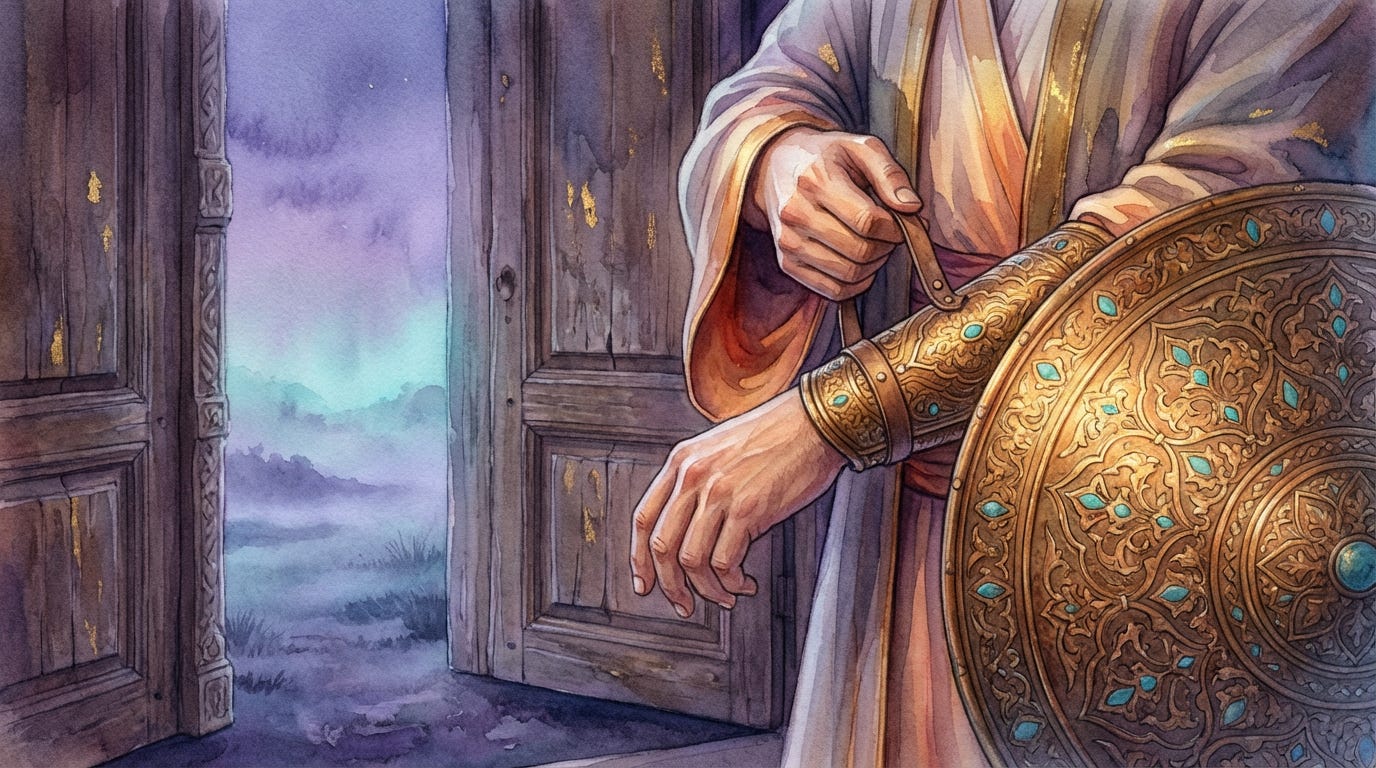
But we are not finished.
Tonight we forged the Shield.
We understand its materials — the Quranic permissions, the linguistic roots, the jurisprudential principles, the theological foundations.
But a Shield that sits in the armoury protects no one.
Next week, in the second part of the Defensive movement, we take the Shield into the field.
We will examine Taqiyyah in Action — how this principle has actually been applied across history and into our own time.
We will study:
The Historical Record
How did the community actually survive?
What strategies did the scholars employ?
How did the Hawza endure under the Abbasids, the Mongols, the Ottomans, the Safavids, the Qajars, and the Pahlavis?
The Hasan-Husayn Spectrum
We touched on this tonight, but we will develop it fully.
When is patience obligatory?
When does resistance become obligatory?
How do we read the signs of our own time?
Taqiyyah vs. Nifaq
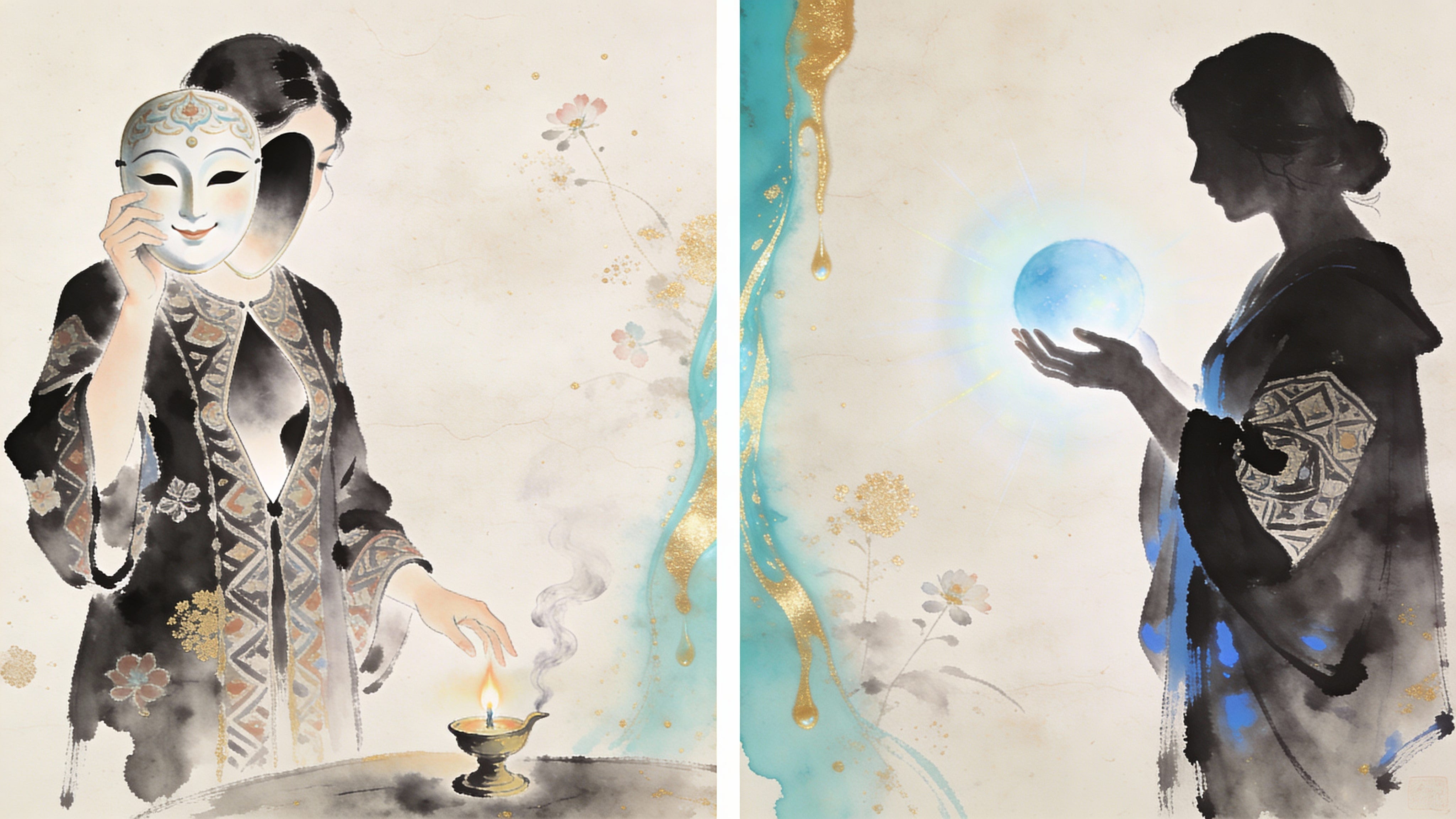
The enemies claim that Taqiyyah is simply “religious hypocrisy.”
We will dismantle this accusation at the root, showing the fundamental difference between the believer who conceals to protect and the hypocrite who conceals to betray.
The Nuclear Fatwa
Perhaps the most striking contemporary example of anti-Taqiyyah.
When Imam Khamenei declared nuclear weapons forbidden — not merely unwise, but Haram — he demonstrated what happens when the community possesses power.
The Shield is lowered.
The truth is declared openly.
The world is told what we actually believe, regardless of strategic cost.
Makarim al-Akhlaq — The Noble Character
We will explore how the community’s posture toward the non-Muslim world has shifted from defensive concealment to active demonstration.
In the age of the Islamic Revolution, the primary mode is no longer hiding the truth — it is showing the truth through conduct that refutes the lies.
And we will address the question that haunts every conscious believer in the West:
How do I live as a Shia in a society that does not persecute me — but does not know me?
Is Taqiyyah even relevant in Manchester, in Toronto, in Sydney?
Or has the dispensation ended, and the obligation to speak begun?
These are the questions for next week.
Tonight, the Shield is forged.
Next week, we learn to carry it.
A Supplication-Eulogy for Wisdom
We ask God, the Most High, the Protector, the Guardian —
Grant us the wisdom to know when silence serves the Truth and when it betrays it.
Grant us the discipline to find the words that protect without fabricating — to speak truth in layers when necessary, and to speak it plainly when possible.
Grant us the courage to lower the Shield when the moment demands — to stand with Husayn when the Yazid of our age crosses the line that cannot be crossed.
Protect us from using Your dispensation as an excuse for cowardice.
Protect us from abandoning Your dispensation out of recklessness.
Make us among those who preserve the kernel without losing the shell — who guard the treasure without forgetting that the Shield is not the treasure.
And hasten the appearance of the one for whom this Shield has been carried —
The Imam of our Time,
The Proof of God upon His creation,
The one whose emergence will end the need for concealment forever,
Because on that Day, the Truth will fill the earth as it has been filled with falsehood,
And there will be no more hiding,
And no more fear,
And the believers will finally be able to declare what they have carried in their hearts through the long, long night.
O God, hasten his relief and make us among his helpers and supporters.
And may the peace and blessings of God be upon Muhammad —
The one who said “We are from water” when the enemy sought his blood,
The one who taught Ammar that the tongue under torture does not bind the heart,
The one who calibrated his teachings to human capacity because he was sent as a mercy, not a burden.
And upon the Family of Muhammad —
Upon Ali, who concealed his right for twenty-five years to preserve the unity of the Ummah,
Upon Hasan, who made the treaty that preserved the kernel when war would have destroyed both shell and seed,
Upon Husayn, who lowered the Shield and drew the Sword when silence would have meant the death of Islam itself,
Upon Sajjad, who carried the teachings through the darkest hour in the language of supplication,
Upon Baqir and Sadiq, who built the school of the Ahl al-Bayt in the brief window when building was possible,
Upon Kadhim, who endured the prisons of the tyrants with patience that outlasted their power,
Upon Ridha, who navigated the court of Ma’mun without surrendering his soul,
Upon Jawad, Hadi, and Askari — who preserved the line until the Proof could be hidden,
And upon the Hidden Imam —
The one who waits as we wait,
The one who watches as we struggle,
The one for whose sake the Shield has been carried across fourteen centuries,
And who will one day emerge to end the need for shields forever.
May our souls be sacrificed for him.
May our efforts be accepted in his service.
And may we be among those who greet him when he comes.
Amen, O Most Merciful of the Merciful
Amen, O Lord Sustainer of the Universes
And from Him alone is all ability and He has authority over all things.