

In His Name, the Most High
From Principle to Proof
Last week, we laid foundations.
We descended into the bedrock of Islamic jurisprudence and established why weapons of mass destruction are forbidden.
We traced the prohibition from the Quran’s articulation of military purpose — turhibuna, to deter, not to annihilate — through the Prophet’s explicit instructions to his commanders, through a thousand years of jurisprudential reasoning, to the rational recognition that such weapons constitute dhulm on a scale that admits no justification.
We expanded the category beyond nuclear weapons alone.
Chemical agents that linger and burn.
Biological pathogens that spread without control.
Depleted uranium that poisons the soil for millennia.
Any weapon that cannot distinguish combatant from civilian, that cannot be controlled once deployed, that continues killing after the war ends — any such weapon falls under the prohibition that the Prophet articulated when he said:
“Do not cast poison into their lands.”
And we witnessed the principle tested in fire.
Imam Khomeini, with Iranian soldiers dying from chemical attacks, with the full capability to retaliate in kind, saying simply: Haram.
“If we also use chemical bombs, what is the difference between us and Saddam?”
The foundations are laid.
The why is established.
Tonight, we build upon those foundations.
Tonight, we examine the how.
The Questions That Remain
How has this ancient prohibition been codified in our time?
When a contemporary scholar issues a fatwa on nuclear weapons, what exactly is he saying?
What category of ruling is this?
Can it change with circumstances, or is it permanent?
Is this the opinion of one man — Imam Khamenei — or is it the consensus of the tradition’s highest authorities?
What do the other maraji’ say?
Does Ayatullah Sistani in Najaf agree with the scholars in Qom?
And if the prohibition is genuine, how has it shaped actual policy?
What did Iran build instead of nuclear weapons?
Why invest billions in precision missiles if you secretly desire weapons of mass destruction?
Then there is the objection that must be addressed:
Pakistan.
A Muslim-majority nation possesses nuclear weapons.
Does this not prove that Islamic law permits them?
And finally — the accusation that haunts every discussion of the Nuclear Fatwa:
“It’s Taqiyyah.”
“Iran says it doesn’t want nuclear weapons, but that’s just religious deception.”
“They’re saying one thing publicly while secretly pursuing the bomb.”
“You can’t trust anything they say because they’re permitted to lie.”
This accusation is made by Western politicians seeking justification for aggression.
It is made by Zionist officials manufacturing pretexts for war.
It is made by hostile media seeking to demonise.
It is made by ordinary people who have absorbed the propaganda without examining it.
Tonight, we answer it.
Not with assertion.
Not with counter-accusation.
Not with rhetoric.
With demonstration.
We will show that the accusation is not merely false but logically impossible.
We will show that for the Fatwa to be Taqiyyah, there would have to be a hidden truth being concealed — and there is no hidden truth.
We will show that any jurist, anywhere in the Muslim world, who genuinely applies the sources of Islamic law would reach the same conclusion the Fatwa expresses.
The accusation of Taqiyyah does not reveal Iranian deception.
It reveals the accuser’s inability to imagine a value system that places principle above power.
By session’s end, that will be clear.
The Arc of the Argument
Let us be precise about what we will establish tonight.
First, we examine Imam Khamenei’s formal fatwa — not as a soundbite but as a jurisprudential document.
We look at its precise language, its classification as a Primary Ruling, its distinction between rational calculation and religious prohibition.
Second, we survey the consensus of the living maraji’. Ayatullah Sistani in Najaf.
Ayatullah Makarim Shirazi, Ayatullah Jawadi-Amoli, Ayatullah Subhani in Qom.
We find that this is not one man’s opinion but the agreed position of the tradition’s highest authorities — scholars who differ on many things but unite on this.
Third, we examine the Precision Doctrine — Noqte-zani.
We trace how the prohibition shaped Iran’s actual military development.
We see why a country accused of secretly wanting nuclear weapons has instead built the most accurate conventional missiles in the region.
The policy makes sense only if the theology is sincere.
Fourth, we address the Pakistan objection.
We show that the existence of Pakistani nuclear weapons proves nothing about Islamic law — only that Pakistan is not applying Islamic law in this domain.
And fifth, we answer the Taqiyyah accusation.
We show that it collapses under the weight of everything we have established.
Taqiyyah conceals a truth that exists.
But when there is only one possible jurisprudential conclusion — when the sources yield no alternative — there is no hidden truth to conceal.
The Fatwa is not hiding a secret desire.
It is expressing an inevitable conclusion.
Video of the Majlis (Sermon/Lecture)
This is the video presentation of this write-up as a Majlis (part of the Truth Promoters Weekly Wednesday Majlis Program)
Audio of the Majlis (Sermon/Lecture)
This is the audio presentation of this write-up as a Majlis (part of the Truth Promoters Weekly Wednesday Majlis Program)
Recap: The Foundations
Let us briefly recall what we established last week, for it is the ground upon which tonight’s argument stands.
The Nature of Conflict
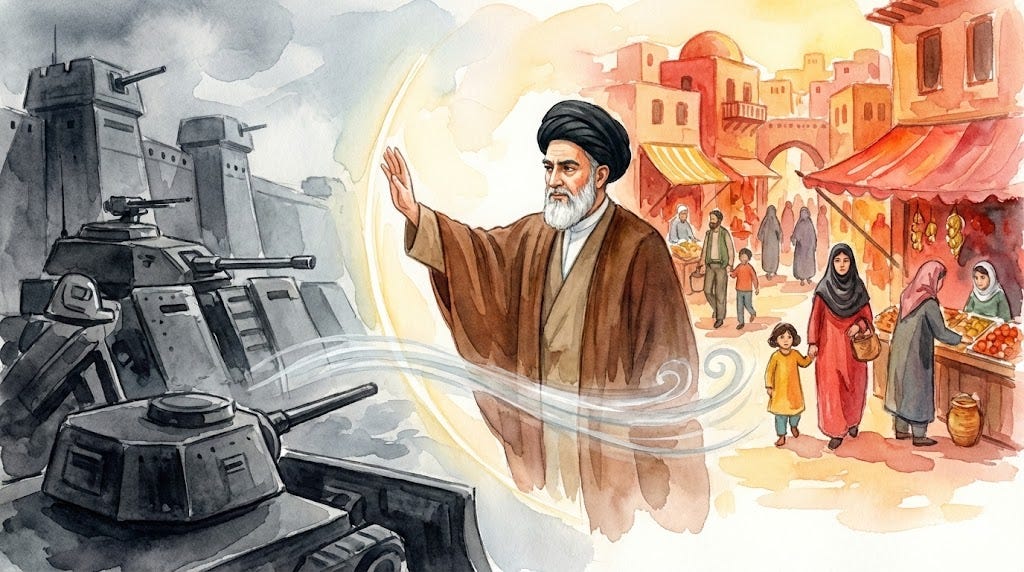
We began with a reframing.
Islam does not view warfare as a clash between peoples — Americans against Iranians, Israelis against Palestinians, the West against Islam.
We established a framework resting on three pillars:
First: Wars are initiated by systems of oppression — the Zalimin, the Mustakbirin.
Second: The just respond through legitimate defence — a sacred duty, not merely a right.
Third: Yet even in the most righteous struggle, civilian populations retain their God-given sanctity.
We recognised that some conflicts are genuinely Haqq against Batil — Truth against Falsehood.
Karbala was not a power struggle between competing elites; it was the Proof of God standing against the erasure of Islam itself.
The tradition does not flatten moral distinctions.
Yet we also established that moral culpability before God does not transform a civilian into a legitimate target.
The silent citizen of an oppressor nation may bear spiritual burden — the Ziyarat Ashura warns of those who “heard of this and were pleased with it” — but the warrior cannot execute divine judgment.
The criterion remains: combatant or non-combatant.
And we distinguished the aggressor’s soldier from the defender’s soldier.
The one who fights in an unjust war bears culpability for that choice, even if misled.
The one who defends his home fulfils a sacred obligation — Wajib Mutlaq, as Shaheed al-Thani establishes in Sharh al-Lum’ah.
The defender retains a duty of care toward the aggressor’s civilian population.
You fight the oppressive system, not the nation.
You target the military apparatus, not the marketplace.
This principle shapes everything that follows.
The Quranic Purpose
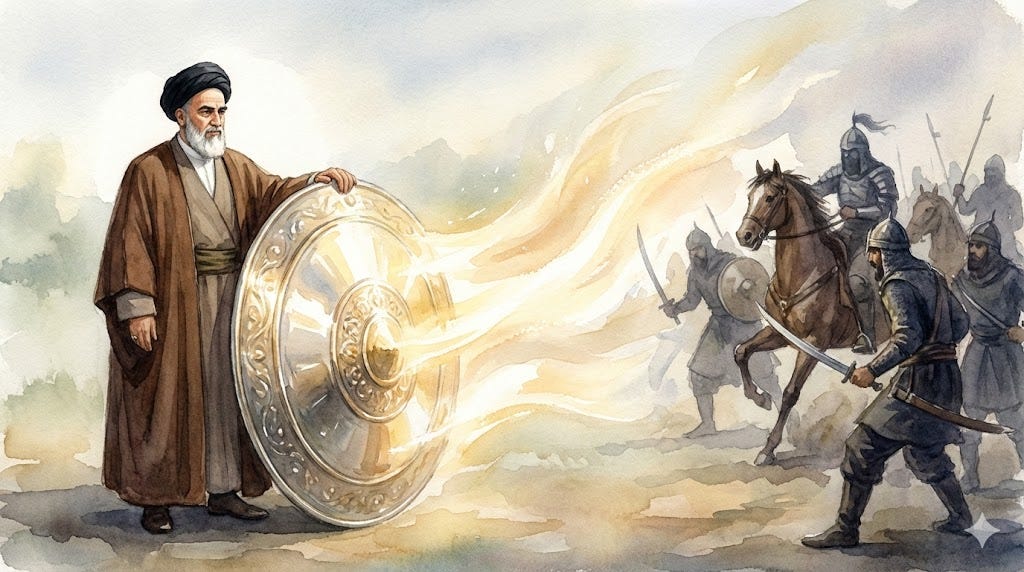
We turned to Surah Al-Anfal (the Chapter of the Spoils) and found the purpose of military preparation stated explicitly:
“Prepare against them whatever you are able of power... turhibuna — by which you may strike awe into the enemy of God and your enemy.”
The key word is turhibuna — to deter, to create in the enemy a psychological state that makes aggression unthinkable.
Not taqtuluna — to kill.
Not tudammiruna — to destroy.
The goal of military preparation is to prevent war, not to wage it.
To make the enemy abandon his plans before they manifest.
To render aggression too costly to attempt.
Allamah Tabatabai explained: the fear is instrumental —
“so that he may refrain from the evil and corruption he intends.”
Ayatullah Makarim Shirazi stated it plainly:
“The ultimate goal is the prevention of war, not the execution of war.”
A weapon that can only massacre — that cannot deter without annihilating — falls outside this Quranic purpose.
The Classical Prohibition

We descended to the jurists and found, a thousand years before nuclear weapons existed, the principle already articulated.
Shaykh Al-Tusi:
“It is permissible to fight with all types of killing... except poison; for it is certainly not permissible to cast poison into their lands.”
Shaheed Al-Awwal in Al-Lum’ah al-Dimashqiyyah:
“Forbidden to cast poison into their lands... Absolutely forbidden is the more apparent view.”
Even necessity — that powerful legal tool that permits many otherwise forbidden acts — does not override this prohibition.
The scholars ruled it absolute.
Why?
Because poison cannot distinguish.
It cannot be controlled.
It continues killing after the battle ends.
It harms the innocent.
It poisons the land itself.
The Prophetic Instructions
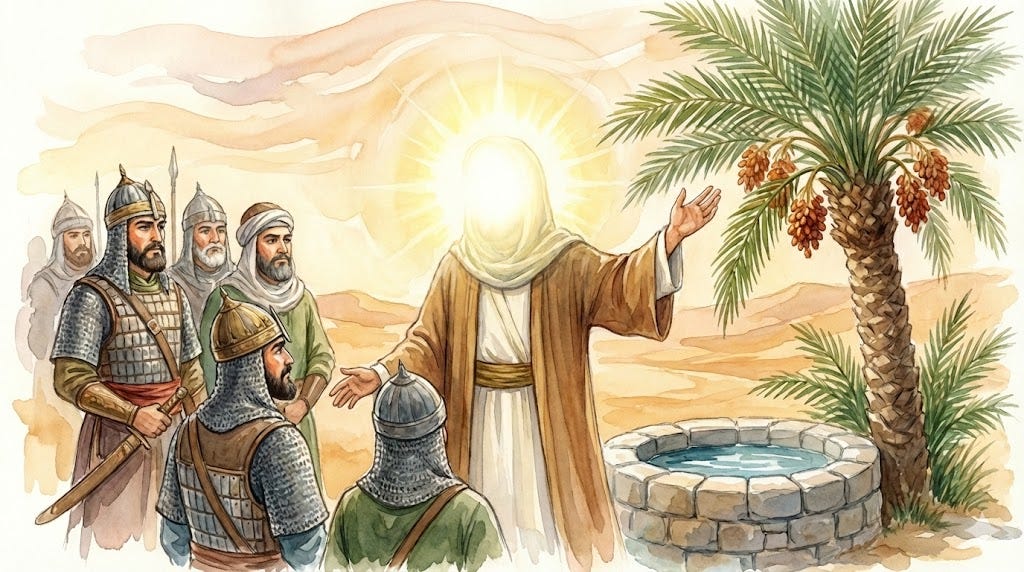
We heard the Prophet’s own words to his commanders:
“Do not kill a decrepit old man, nor a child, nor a woman... Do not burn the palm trees, nor drown them with water, nor cut down a fruit-bearing tree, nor burn the crops... And do not cast poison into the lands of the polytheists.”
The limits of legitimate warfare, established fourteen centuries ago.
If you cannot burn one tree, you cannot incinerate a forest.
If you cannot poison one well, you cannot irradiate a city.
Rational Necessity
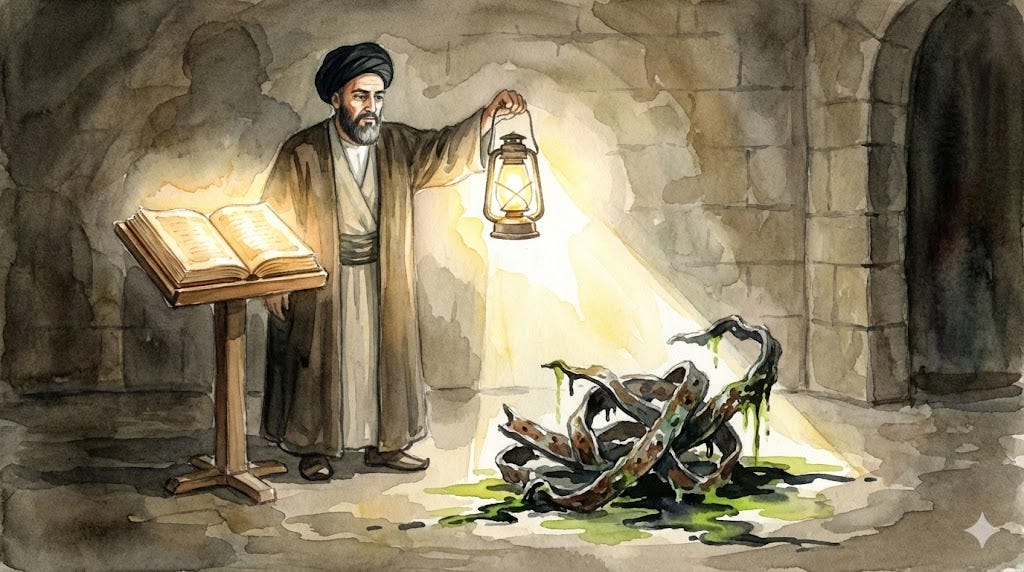
We applied al-mustaqillat al-’aqliyya — independent rational judgment — and recognised that the prohibition is not mere analogy but recognition.
The reason poisoning a well is forbidden is because it constitutes dhulm — indiscriminate harm to the innocent, destruction of what sustains life.
A nuclear weapon is dhulm.
Directly.
Manifestly.
Undeniably.
Sound reason recognises this.
And via mulazama, what reason recognises with certainty as dhulm, the Shariah necessarily forbids.
The Expanded Category
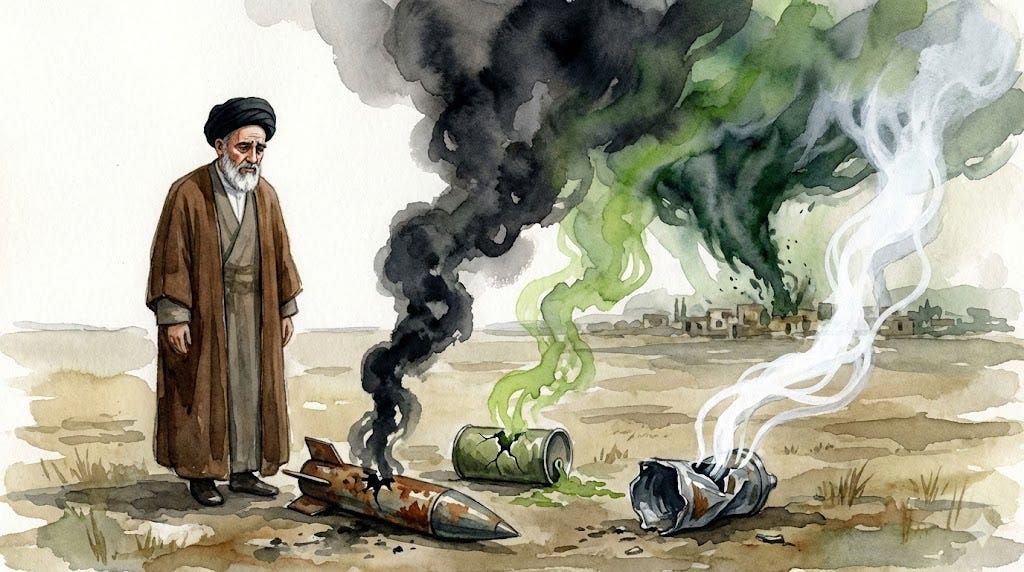
We named the weapons: nuclear, chemical, biological, radiological, incendiary.
Different technologies, different delivery mechanisms — but the same essential nature.
Indiscriminate.
Uncontrollable.
Residual.
A weapon that cannot stop killing is not a weapon.
It is a curse.
And Islam does not permit the believer to unleash curses upon the earth.
The Precedent
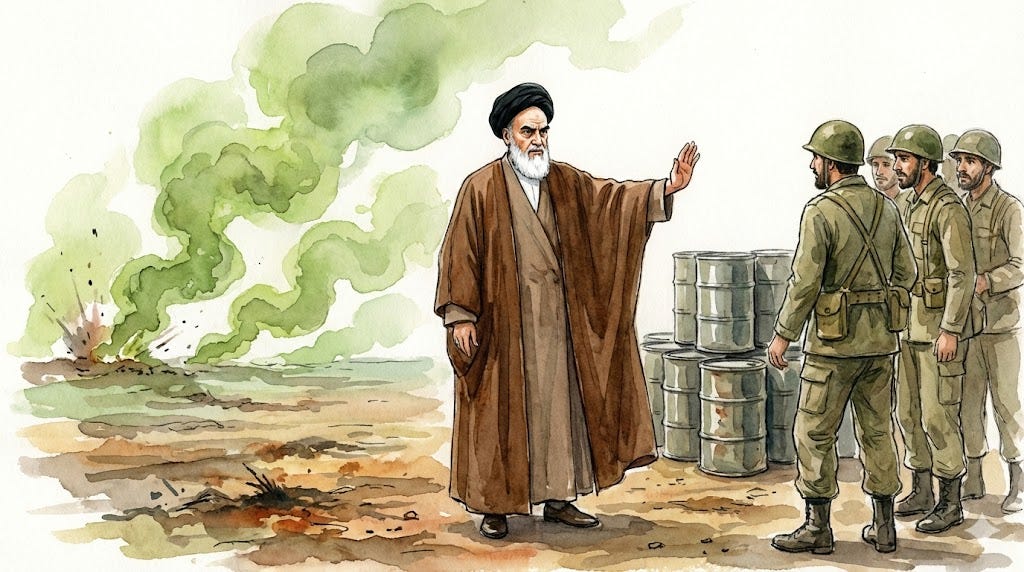
We witnessed Imam Khomeini, under chemical attack, with the capability to retaliate, refusing:
“No! We are opposed to these things. These are Haram. If we also use chemical bombs, then what is the difference between us and Saddam?”
The principle tested in fire — and it held.
These are the foundations. Quran, hadith, classical jurisprudence, rational necessity, historical precedent.
Now we build upon them.
Now we examine how these ancient principles have been codified in formal fatwas, confirmed by scholarly consensus, translated into policy, and tested against every objection.
And we answer the accusation that will not go away — until tonight, when we lay it to rest.
Mahdawiyyah (The Culminating Guidance) - The Era of Establishment - The Geopolitics of Waiting - The Shield (Taqiyyah) - The Shield Lowered - The Contemporary Codification
Imam Khamenei’s Fatwa: The Formal Codification
We have traced the prohibition through its sources — Quran, hadith, classical jurisprudence, rational necessity.
Now we examine how these ancient principles have been formally codified by the highest religious authority of the Islamic Republic, by the Wali al-Faqih, by the Leader of the Muslim Ummah.
This is not a matter of political statements or diplomatic posturing.
This is a fatwa — a binding religious ruling issued by a qualified jurist for those who follow his authority.
And the nature of this fatwa — its classification, its scope, its permanence — reveals why the accusation of Taqiyyah cannot stand.
The Official Statement
On April 17, 2010, Imam Khamenei issued a formal message to the International Conference on Nuclear Disarmament and Non-Proliferation, held in Tehran.
This message contained the explicit articulation of the ruling that has come to be known as the “Nuclear Fatwa”:
به اعتقاد ما افزون بر سلاح هستهای، دیگر انواع سلاحهای کشتار جمعی، نظیر سلاح شیمیایی و میکروبی نیز تهدیدی جدی علیه بشریت تلقی میشوند... ما کاربرد این سلاحها را حرام، و تلاش برای مصونیت بخشیدن به بشریت از این بلای بزرگ را وظیفهی همگان میدانیم.
“We believe that besides nuclear weapons, other types of weapons of mass destruction such as chemical and biological weapons also constitute a serious threat to humanity... We consider the use of such weapons as Haram (religiously forbidden) and believe that it is everyone’s duty to make efforts to secure humanity against this great disaster.”
— Imam Khamenei, Message to the International Conference on Nuclear Disarmament and Non-Proliferation, Tehran, April 17, 2010 (28 Farvardin 1389). Official Archive: Khamenei.ir. This document was officially circulated as a document of the United Nations General Assembly and Security Council (A/64/752–S/2010/203).
Let us examine this statement with care.
Notice the precision of the language.
Haram.
This is a technical term in Islamic jurisprudence.
It does not mean “inadvisable” or “better to avoid” or “problematic.”
It means forbidden — categorically, religiously, with the full weight of divine law behind the prohibition.
To violate a haram is not merely to make a mistake.
It is to sin.
It is to transgress the boundaries that God has established.
It is to earn His displeasure and, without repentance, His punishment.
When a jurist of Imam Khamenei’s standing declares something haram, he is not offering a suggestion.
He is issuing a binding ruling for the millions who follow his religious authority.
Notice also the scope.
The ruling does not address nuclear weapons alone.
It explicitly encompasses
“other types of weapons of mass destruction such as chemical and biological weapons.”
This is the expanded category we established in Session 57 — now formally codified in a single ruling.
And notice the framing of responsibility:
“it is everyone’s duty to make efforts to secure humanity against this great disaster.”
This is not merely prohibition; it is obligation.
The believer is not only forbidden from using such weapons — he is required to work toward their elimination.
The Triad of Prohibition
Some might argue — and some have argued — that this statement addresses only the use of such weapons.
Perhaps, the reasoning goes,
Iran could still produce and stockpile nuclear weapons, holding them in reserve, as long as it never actually deployed them.
This interpretation was explicitly closed by subsequent clarification.
In statements made in 2019 and 2021, Imam Khamenei addressed the question of production and stockpiling directly:
ساختن و نگه داشتن بمب اتمی غلط است، چون به کار بردنش حرام است... ما با وجود اینکه میتوانستیم در این راه قدم برداریم، بر اساس حکم اسلام گفتیم حرام است. بنابراین هیچ دلیلی ندارد که ما برای ساخت و نـگهـداشت سلاحی که بکار بردن آن مطلقاً حرام است، هزینه کنیم.
“Building and stockpiling a nuclear bomb is wrong, because using it is Haram... Although we could have stepped into this path, we declared it Haram according to Islamic ruling. Therefore, there is no reason for us to spend money on producing and stockpiling a weapon whose use is absolutely forbidden.”
— Imam Khamenei, Clarification on the Nuclear Fatwa, 2019/2021
The logic is precise and inescapable.
If using the weapon is absolutely forbidden, then producing the weapon is preparing for a forbidden act.
If using the weapon is absolutely forbidden, then stockpiling the weapon is maintaining readiness for a forbidden act.
One cannot say:
“I will never commit this sin, but I will keep the instrument of the sin always at hand, polished and ready.”
The prohibition extends backward from the act to its preparation.
This gives us what we may call the Triad of Prohibition:
Production (Tawlid) — forbidden
Stockpiling (Anbasht) — forbidden
Use (Karbord) — forbidden
The Fatwa closes every door.
There is no permissible path to nuclear weapons within this framework — not acquisition, not maintenance, not deployment.
And notice the remarkable admission embedded in the clarification:
“Although we could have stepped into this path...”
Iran had the capability.
This is not a case of a nation without options declaring that it never wanted what it could not obtain.
Iran could have pursued nuclear weapons.
Iran chose not to — and that choice was made on religious grounds.
“We declared it Haram according to Islamic ruling.”
Not according to political calculation.
Not according to international pressure.
Not according to strategic assessment.
According to Islamic ruling.
The Repeated Affirmations
This was not a one-time statement, issued for diplomatic convenience and quietly forgotten.
Imam Khamenei has returned to this ruling repeatedly, in multiple contexts, across many years.
In February 2012, addressing nuclear scientists and officials in Tehran, he elaborated:
جمهوری اسلامی از نظر منطقی هم هیچگاه به دنبال سلاح هستهای نیست... اما علاوه بر این منطق، از نظر اعتقادی و شرعی هم ما سلاح هستهای را حرام میدانیم و ملت ایران و مسئولین جمهوری اسلامی هیچگاه قصد تولید سلاح هستهای ندارند.
“The Islamic Republic, from a logical standpoint, has never sought nuclear weapons... But in addition to this logic, from a doctrinal and religious (shar’i) standpoint as well, we consider nuclear weapons haram, and the Iranian nation and officials of the Islamic Republic have no intention whatsoever of producing nuclear weapons.”
— Imam Khamenei, Speech to Nuclear Scientists and Officials, February 22, 2012
In 2014, in response to continued accusations from Western powers:
ما مخالف سلاح اتمی هستیم، نه به خاطر آنچه آمریکا و دیگران میگویند، بلکه به خاطر اعتقادات خودمان. حکم اسلام، حکم عقل و حکم منطق همه میگوید که ما نباید به دنبال سلاح هستهای برویم.
“We are opposed to nuclear weapons, not because of what America and others say, but because of our own beliefs. The ruling of Islam, the ruling of reason, and the ruling of logic all say that we should not pursue nuclear weapons.”
— Imam Khamenei, Speech on the Anniversary of the Passing of Imam Khomeini, June 4, 2014
The consistency is striking.
Across years, across contexts, across different audiences — the message does not waver.
This is not the behaviour of someone engaged in deception.
A person practicing Taqiyyah calibrates his statements to his audience, adjusting the message to serve immediate purposes.
But here we find the same ruling, articulated in the same terms, whether the audience is an international conference, domestic scientists, or the general public at a commemorative gathering.
The message does not change because the message is not calculated.
It is believed.
The Classification: Primary Ruling
Here we must understand a critical distinction in Islamic jurisprudence — the difference between a Primary Ruling (Hukm Awwali) and a Secondary Ruling (Hukm Thanawi).
Secondary Rulings are modifications that apply under specific circumstances.
The classic example is the permission to eat pork when facing starvation.
Eating pork is normally forbidden — but when the alternative is death, the prohibition is temporarily lifted.
The ruling changes because the circumstances change.
Secondary rulings are where Taqiyyah operates.
Under threat of death, the believer may conceal his faith.
Under extreme necessity, the forbidden may become permitted.
These are accommodations to human weakness and extreme circumstance.
Primary Rulings are different.
They are based on the inherent nature of the act itself — not on circumstance, not on consequence, but on what the act is.
Murder is forbidden not because of circumstance but because of essence.
Adultery is forbidden not situationally but absolutely.
These rulings do not change because circumstances do not alter the nature of the act.
Imam Khamenei has classified the prohibition on weapons of mass destruction as a Primary Ruling.
This is crucial.
A Primary Ruling cannot be overridden by necessity.
A Primary Ruling cannot be suspended by Taqiyyah.
A Primary Ruling reflects not a calculation about consequences but a recognition of essential nature.
The ruling that nuclear weapons are haram is not:
“Nuclear weapons are forbidden because, in current circumstances, their use would cause more harm than benefit.”
The ruling is:
“Nuclear weapons are forbidden because their use constitutes indiscriminate massacre of innocents, which is dhulm, which is intrinsically evil, which no circumstance can make permissible.”
The circumstances could change.
The strategic calculus could shift.
The pressure could intensify.
The threats could multiply.
None of this would affect a Primary Ruling.
Because the ruling is not based on circumstance.
It is based on essence.
And the essence of nuclear weapons — their indiscriminate nature, their uncontrollable effects, their residual harm — does not change.
The Rational and Religious Distinction
In his various statements, Imam Khamenei has consistently distinguished between two arguments against nuclear weapons.
The first is rational (‘aqli / mantiqi).
Nuclear weapons, he argues, do not actually grant the security they promise.
They create instability.
They invite pre-emptive strikes.
They generate arms races.
They make the world more dangerous for everyone, including those who possess them.
This is a calculation — a pragmatic assessment of costs and benefits.
The second is religious (shar’i / i’tiqadi).
Nuclear weapons are forbidden by Islamic law.
Their use would constitute indiscriminate massacre.
Their production would be preparation for sin.
Their possession would be complicity in potential atrocity.
This is a ruling — a binding determination of divine law.
And here is the critical point: the religious ruling stands independent of the rational calculation.
Even if we were to assume — contrary to evidence — that nuclear weapons provide security, the religious prohibition would remain.
The Fatwa clarification states this explicitly:
“Although we could have stepped into this path, we declared it Haram according to Islamic ruling.”
The decision was not:
“We calculated that nuclear weapons were not worth the cost.”
The decision was:
“We recognised that Islamic ruling forbids this path, regardless of what it might cost or gain.”
This distinction is essential for understanding why the Fatwa cannot be Taqiyyah.
If the prohibition were merely rational — merely a calculation that currently, in these circumstances, the costs outweigh the benefits — then it could change when circumstances change.
And one might suspect that the public statement conceals a private willingness to recalculate if the situation shifts.
But the prohibition is not merely rational.
It is religious.
It is based on the intrinsic nature of the act, not on shifting calculations of consequence.
Even if the rational calculation changed — even if, somehow, nuclear weapons could provide security without the instability they normally generate — the religious prohibition would remain.
Because the religious prohibition is not about consequences.
It is about essence.
And the essence of indiscriminate massacre does not change with circumstance.
International Recognition
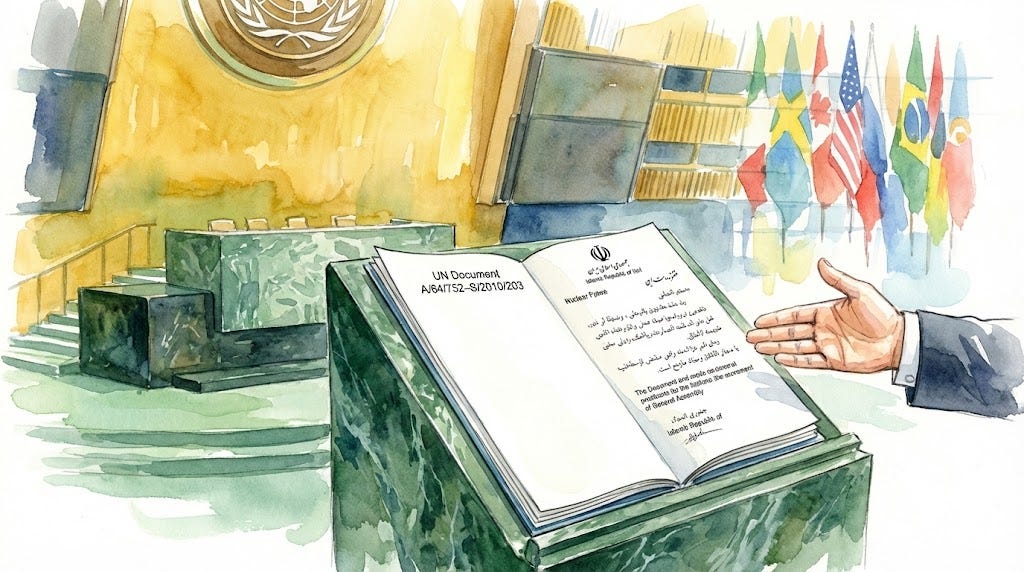
It is worth noting that this Fatwa did not remain an internal Iranian matter.
The 2010 message was officially circulated as a document of the United Nations General Assembly and Security Council, bearing the reference number A/64/752–S/2010/203.
This means the Fatwa is not merely a domestic religious ruling.
It is an internationally documented statement, recorded in the archives of the United Nations, available for any nation, any researcher, any sceptic to examine.
The Islamic Republic did not whisper this ruling in private.
It declared it to the world.
It submitted it to the formal record of international institutions.
This is not the behaviour of a state engaged in deception.
This is the behaviour of a state that believes what it is saying and wants the world to know it.
The Weight of the Ruling
Let us step back and consider what we have established.
This is not a political statement dressed in religious language.
This is not a diplomatic gesture aimed at easing international pressure.
This is not a temporary position adopted for strategic advantage.
This is a fatwa — a binding religious ruling — issued by the highest religious authority of the Islamic Republic, classifying the prohibition as a Primary Ruling based on the inherent nature of the act, standing independent of circumstantial calculation, covering the full triad of production, stockpiling, and use, extending to all weapons of mass destruction, documented in the archives of the United Nations.
The person who violates this ruling does not merely make a political miscalculation.
He commits a sin.
He earns divine displeasure.
He betrays the principles of the faith he claims to serve.
And the ruling cannot be reversed by changing circumstances.
It cannot be suspended by necessity.
It cannot be overridden by strategic calculation.
Because it is not based on calculation.
It is based on recognition — recognition that certain acts are intrinsically evil, that certain weapons are inherently impermissible, that some lines cannot be crossed regardless of what might be gained by crossing them.
This is the formal codification.
This is the Fatwa.
Now let us see whether it stands alone — or whether the entire tradition confirms it.
The Maraji’ Consensus: The Tradition Speaks as One
We have examined Imam Khamenei’s Fatwa in detail. But a question remains:
Is this one man’s opinion — the view of a particular scholar who happens to hold political authority?
Or is it the consensus of the tradition itself — the agreed position of the highest religious authorities across the Shia world?
The answer to this question matters enormously.
If the prohibition were merely Imam Khamenei’s personal view, one might argue that other scholars disagree, that the matter is disputed, that a different jurist might rule differently.
But if the major maraji’ — scholars of the highest rank, based in different cities, representing different methodological approaches, holding different political relationships with the Islamic Republic — all agree on this ruling, then we are witnessing something more significant.
We are witnessing ijma’ — consensus.
And consensus, in Islamic jurisprudence, carries weight that individual opinion cannot claim.
Why Consensus Matters
In Shia jurisprudence, the ruling of a qualified mujtahid is binding on those who follow his authority (taqlid).
Different scholars may reach different conclusions on matters where the sources admit multiple interpretations.
But when all the major scholars agree — when the tradition speaks with one voice — this indicates something beyond individual reasoning.
It suggests that the conclusion is not merely plausible but compelled by the sources.
It suggests that any qualified jurist, examining the evidence honestly, would reach the same result.
This is particularly significant when the scholars in question differ on other matters.
The maraji’ we will examine do not agree on everything.
They have different methodological emphases.
They are based in different locations — Najaf and Qom, the two great centres of Shia learning.
They have different relationships with political authority.
Yet on this question — the prohibition of weapons of mass destruction — they speak as one.
This unanimity is itself evidence.
It tells us that the prohibition is not a matter of political convenience or individual interpretation.
It is what the sources require.
Ayatullah Al-Udhma Sayyed Ali Al-Sistani

We begin with the most widely followed marja’ in the Shia world.
Ayatullah Sistani, based in Najaf, Iraq, is followed by tens of millions of Shia Muslims across the globe.
His authority is recognised not only in Iraq but throughout the Gulf, in South Asia, in Western diaspora communities.
He represents the Najaf scholarly tradition — historically distinct from Qom, with its own methodological characteristics and institutional independence.
Ayatullah Sistani has not issued a formal fatwa specifically titled “On Nuclear Weapons” — his style tends toward addressing principles rather than issuing targeted political statements.
But his rulings on warfare provide the framework within which such weapons must be evaluated.
In 2014, when Iraqi forces and volunteer fighters (Hashd al-Shaabi) mobilised to defend against the onslaught of Daesh,
Ayatullah Sistani issued detailed guidance on the conduct of warfare.
This guidance, known as the “Advice to Fighters,” articulates the principles that govern legitimate combat:
«فَاللهَ اللهَ فِي النُّفُوسِ، فَلَا يُسْتَبَاحَنَّ قَتْلُ امْرِئٍ لَا يَحِلُّ قَتْلُهُ ... فَإِنَّ قَتْلَ النَّفْسِ الزَّكِيَّةِ عِنْدَ اللهِ مِنْ أَعْظَمِ الْخَبَائِرِ»
«وَلَا تَقْطَعُوا شَجَراً إِلَّا أَنْ تُضْطَرُّوا إِلَيْهَا»
“For God’s sake regarding lives! Do not permit the killing of anyone whose killing is not lawful. Killing an innocent soul is among the greatest of sins.
Do not cut down trees unless compelled by absolute necessity.”
— Ayatullah Sistani, Advice to Fighters (Hashd al-Shaabi), February 12, 2015, Sistani.org
Consider the implications.
If killing a single innocent soul is “among the greatest of sins,” what of a weapon that kills thousands of innocent souls in an instant — that cannot, by its very nature, distinguish the guilty from the innocent?
If cutting down a tree requires “absolute necessity” to be permissible, what of a weapon that incinerates entire forests, that renders the land barren for generations, that poisons the soil for longer than human civilisation has existed?
The logic is inescapable.
The principles Ayatullah Sistani articulates — protection of innocent life, proportionality, care for the environment even in warfare — make the use of weapons of mass destruction impossible to justify.
A scholar who rules that you need “absolute necessity” to cut a single tree cannot simultaneously permit the detonation of a nuclear warhead.
A scholar who declares the killing of one innocent “among the greatest sins” cannot simultaneously permit weapons that kill innocents by the tens of thousands.
The specific fatwa may not exist in name.
But the principles that would generate it are explicitly stated.
And no one who understands Ayatullah Sistani’s methodology could imagine him reaching a different conclusion.
Ayatullah Shaykh Naser Makarim-Shirazi
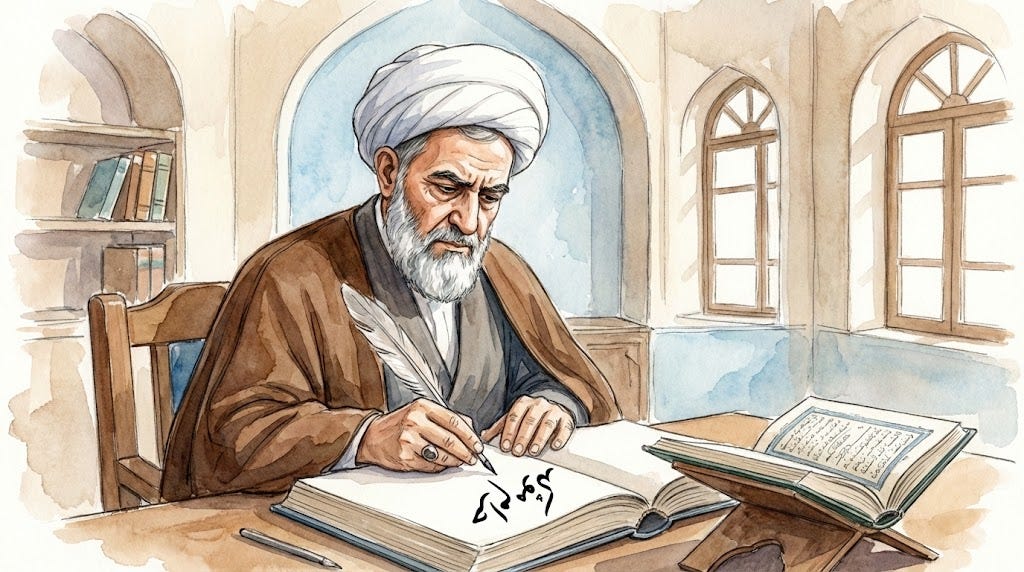
From Najaf, we turn to Qom — the great centre of Shia learning in Iran.
Ayatullah Shaykh Naser Makarim-Shirazi is among the most prominent maraji’ in Qom.
He is the author of Tafsir-e Namuneh, the widely-used Quranic commentary we cited in Session 57.
He has trained generations of scholars.
His rulings are followed by millions.
On the question of weapons of mass destruction, Ayatullah Makarim Shirazi has been explicit:
بدون شک تولید و انباشت سلاحهای کشتار جمعی مشکل شرعی ایجاد میکند و استفاده از آنها حرام مؤکد است.
“Without doubt, the production and stockpiling of weapons of mass destruction creates a religious problem, and their use is emphatically forbidden (Haram Mu’akkad).”
— Ayatullah Makarim Shirazi, Makarem.ir
Notice the strength of the language.
Haram Mu’akkad — emphatically forbidden.
This is not a mild disapproval or a cautious reservation.
This is categorical prohibition, stated with emphasis.
And notice the scope: “production and stockpiling,” not merely use.
Like Imam Khamenei’s clarification, this ruling closes the door on the argument that one might produce and hold such weapons without intending to use them.
Ayatullah Makarim Shirazi grounds this ruling in the Quranic principle that human life is sacred — he cites:
مَن قَتَلَ نَفْسًا بِغَيْرِ نَفْسٍ أَوْ فَسَادٍ فِي الْأَرْضِ فَكَأَنَّمَا قَتَلَ النَّاسَ جَمِيعًا
“Whoever kills a soul, unless for a soul or for corruption in the land, it is as if he had killed all mankind.”
— Quran, Surah al-Maidah (the Chapter of the Table Spread) #5, Verse 32
If killing one innocent is equivalent to killing all mankind, what is the killing of actual thousands?
What is the deployment of a weapon designed to massacre without distinction?
The principle admits only one conclusion.
Ayatullah Jawadi-Amoli
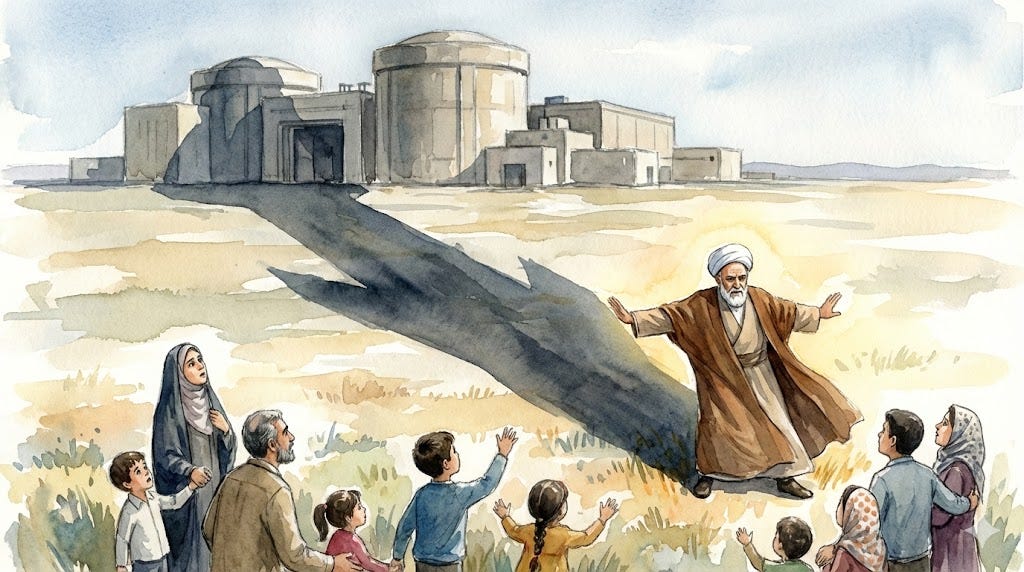
Ayatullah Abdullah Jawadi-Amoli is one of the most philosophically sophisticated scholars in Qom.
His Tafsir-e Tasnim is a monumental work of Quranic exegesis.
His teachings integrate the intellectual traditions of philosophy, mysticism, and jurisprudence in ways that few contemporary scholars can match.
On weapons of mass destruction, his position is perhaps the most absolute of all:
سلاحهای هستهای حقالناس را نقض میکنند. حتی نگهداری آنها حرام است، حتی برای بازدارندگی.
“Nuclear weapons violate Haqq al-Nas (the Rights of Humanity). Even keeping them is forbidden — even for deterrence.”
— Ayatullah Jawadi-Amoli
Consider the radicality of this position.
Some might argue — and some have argued — that possessing nuclear weapons without intending to use them could serve as a deterrent, preventing war rather than causing it.
This is the logic of “mutually assured destruction” that governed Cold War strategy.
Ayatullah Jawadi-Amoli rejects this entirely.
Even possession for deterrence is forbidden.
Why?
Because the very existence of such weapons violates Haqq al-Nas — the rights that human beings hold simply by virtue of being human.
The population that lives under the shadow of nuclear weapons — even weapons that are “only” held for deterrence — has their rights violated.
Their security is compromised.
Their lives are placed at risk.
Their future is mortgaged to the calculations of strategists who might, under pressure, decide to use what they have built.
The weapon that exists can be used.
The weapon that is possessed can be deployed.
The deterrent can become the instrument of massacre.
And therefore, even possession — even stockpiling — even the maintenance of “unused” arsenals — is forbidden.
This is the most stringent formulation of the prohibition.
And it comes from one of the most respected philosophical minds in the contemporary Hawza.
Ayatullah Ja’far Subhani
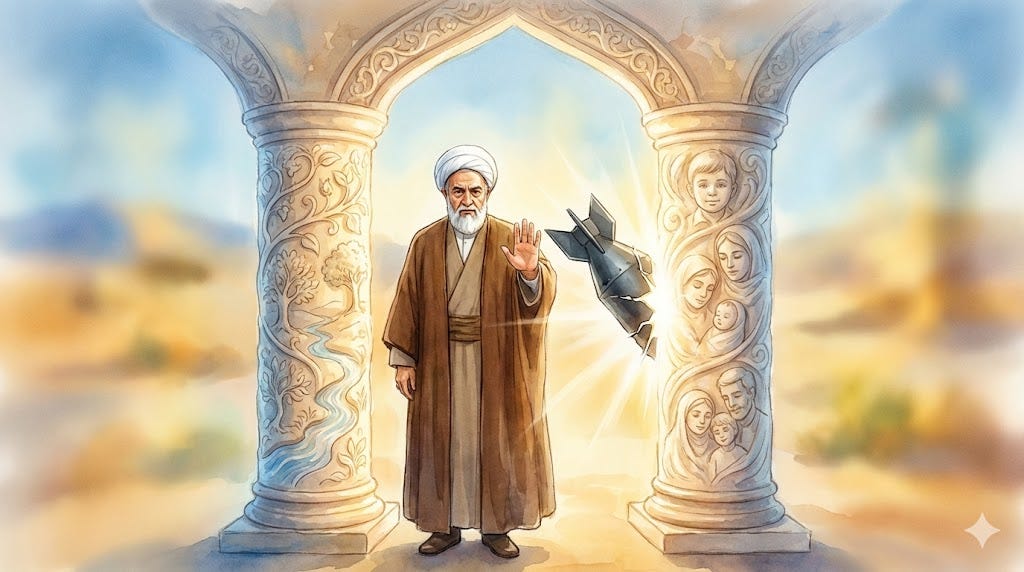
Ayatullah Ja’far Subhani is a specialist in usul al-fiqh — the principles of jurisprudence.
His expertise lies precisely in the methodology by which rulings are derived from sources.
When he speaks on a matter, he speaks with the authority of one who has spent a lifetime studying how Islamic law actually works.
His position on weapons of mass destruction:
اسلام کشتن افراد بیگناه و تخریب محیط زیست را حرام میداند. بنابراین تولید و استفاده از بمب اتمی حرام است.
“Islam prohibits the killing of innocent people and the destruction of the environment. Therefore, the production and use of atomic bombs are forbidden.”
— Ayatullah Ja’far Subhani
Notice the structure of the argument.
This is not an appeal to political expedience or contemporary circumstance.
This is usul — the methodology of jurisprudence — applied with precision.
Premise 1: Islam prohibits the killing of innocent people.
Premise 2: Islam prohibits the destruction of the environment.
Premise 3: Atomic bombs kill innocent people and destroy the environment.
Conclusion: Therefore, the production and use of atomic bombs are forbidden.
This is the argument we have been building across two sessions, stated with the elegance that only a master of usul can achieve.
The conclusion is not a matter of interpretation or opinion.
It follows necessarily from premises that no Muslim can deny.
The Significance of Consensus
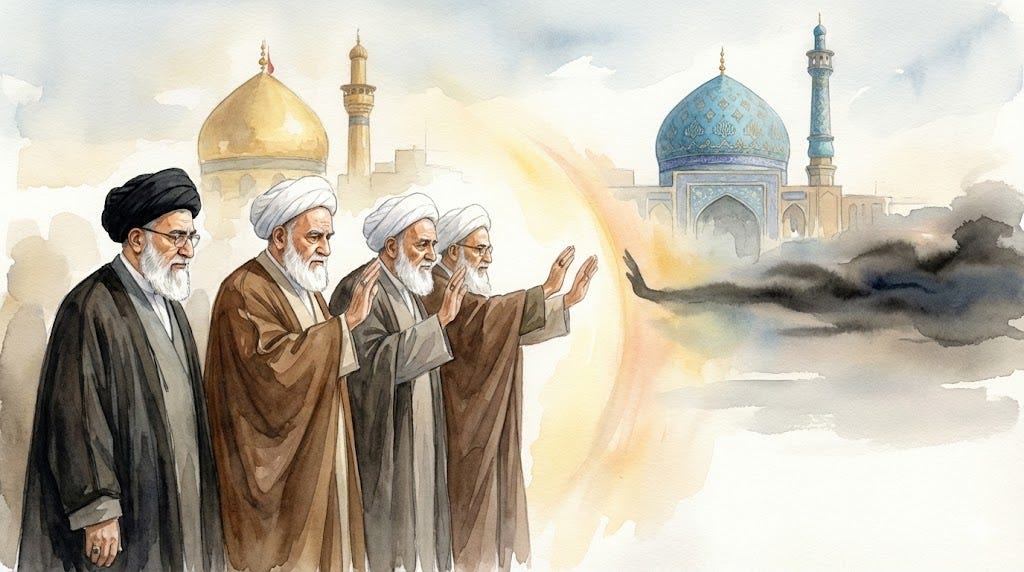
Let us step back and consider what we have witnessed.
Four scholars.
Different locations — Najaf and Qom.
Different methodological emphases — the hadith-focused approach of Ayatullah Sistani, the philosophical depth of Ayatullah Jawadi-Amoli, the usul precision of Ayatullah Subhani, the comprehensive scholarship of Ayatullah Makarim-Shirazi.
Different relationships with political authority.
Ayatullah Sistani has maintained careful distance from the Islamic Republic.
Ayatullah Jawadi Amoli and Ayatullah Makarim Shirazi operate within Iran but maintain scholarly independence.
Their agreement is not the product of political coordination.
Yet they all reach the same conclusion.
Weapons of mass destruction are forbidden.
Their production is forbidden.
Their stockpiling is forbidden.
Their use is forbidden.
This is not one man’s opinion.
This is not a politically convenient position adopted by scholars loyal to a particular government.
This is the tradition speaking.
This is the sources compelling a conclusion.
This is ijma’ — consensus — on a matter of fundamental importance.
What Consensus Means for the Taqiyyah Accusation
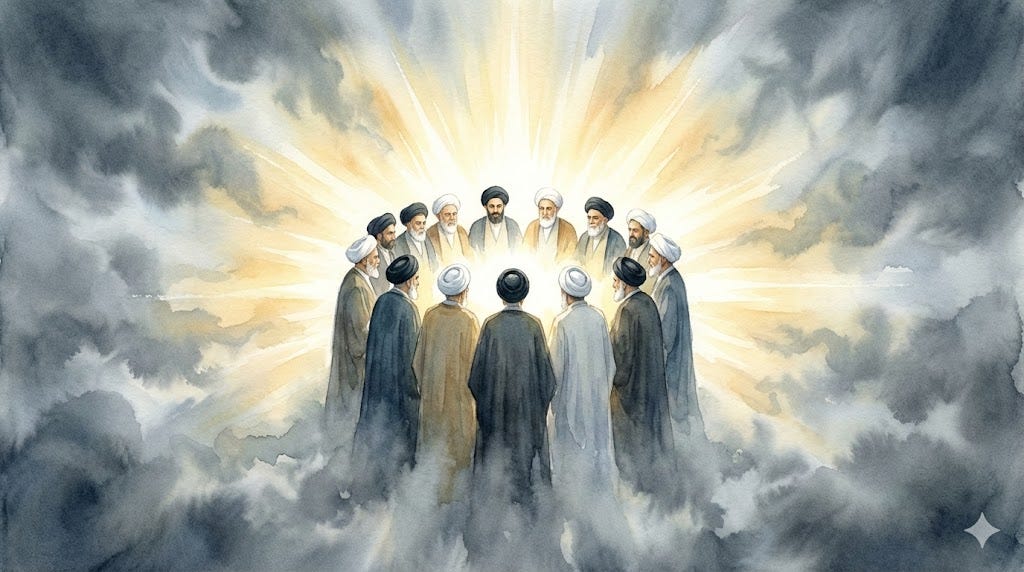
The existence of this consensus has profound implications for the accusation that the Nuclear Fatwa is merely Taqiyyah.
For Taqiyyah to be operative, there would need to be a hidden truth — a secret position that differs from the public statement.
But what would that hidden position be?
Would it be that Ayatullah Sistani secretly believes nuclear weapons are permissible — but says otherwise publicly?
Would it be that Ayatullah Jawadi-Amoli secretly believes possession for deterrence is acceptable — but teaches otherwise?
Would it be that Ayatullah Subhani secretly believes the usul argument he articulated is flawed — but presents it anyway?
This is not merely implausible.
It is absurd.
These scholars have spent their lives in pursuit of truth.
They have sacrificed worldly comfort for the sake of knowledge.
They have built reputations over decades of careful, honest scholarship.
The idea that all of them — independently, in different cities, with different methodologies, with different political relationships — are engaged in coordinated deception strains credulity beyond breaking.
The far simpler explanation is the true one:
They all reach the same conclusion because the sources compel the same conclusion.
They all issue the same ruling because the tradition generates the same ruling.
There is no hidden position because there is no alternative position that the sources could support.
The consensus is real.
The prohibition is genuine.
And the accusation of Taqiyyah dissolves in the face of scholarly unanimity.
The Precision Doctrine: The Alternative Path
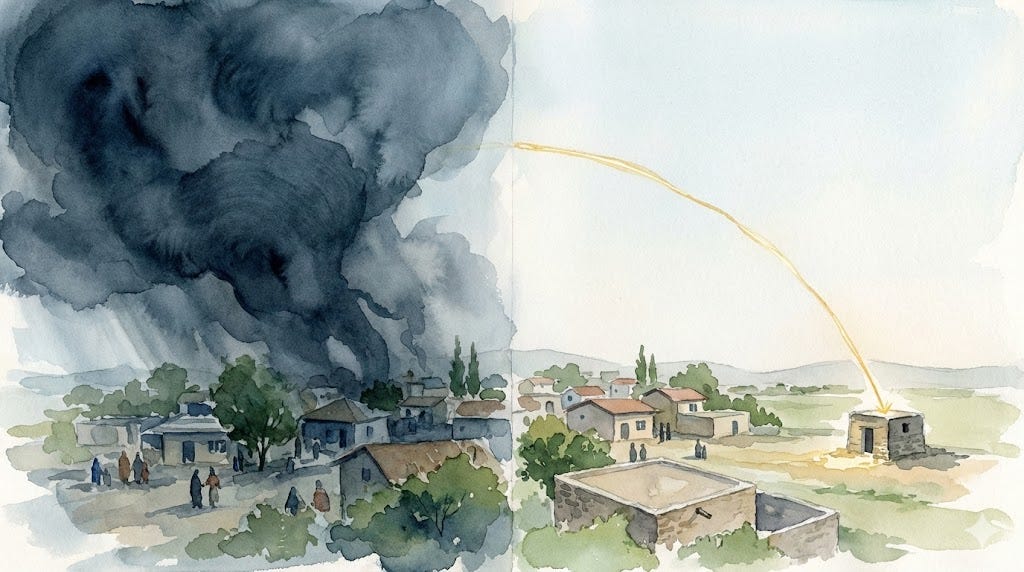
We have established the prohibition — from Quran and hadith, through classical jurisprudence, to contemporary fatwa and scholarly consensus.
But a prohibition, however well-grounded, remains theoretical until it shapes actual behaviour.
The critic might say:
“Fine, Iran issues fatwas. Iran’s scholars agree. But what does Iran actually do? Words are cheap. Show me the policy.”
This is a fair challenge.
And it has a remarkable answer.
The prohibition on weapons of mass destruction did not merely prevent Iran from pursuing a certain path.
It actively shaped the path Iran chose instead.
If you cannot build weapons of mass destruction, what do you build?
If you cannot deter through the threat of indiscriminate annihilation, how do you deter?
If the massacre of civilians is forbidden, but the defence of your nation is obligatory, what military doctrine emerges?
The answer is written in the trajectory of Iran’s missile programme.
And that trajectory tells a story that only makes sense if the prohibition is genuine.
The Directive
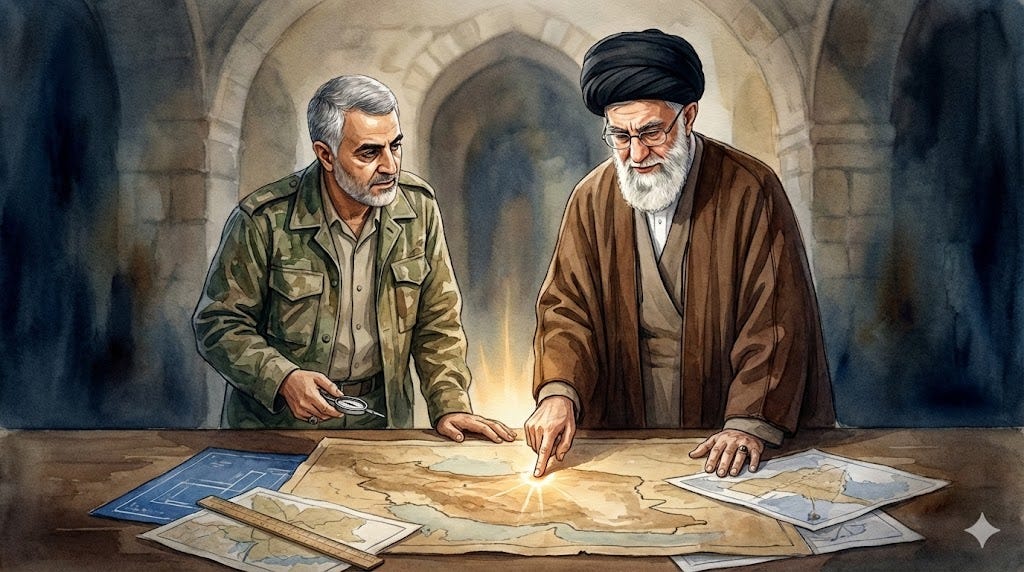
The story begins with a directive from Imam Khamenei to the architects of Iran’s missile programme.
General Hassan Tehrani-Moghaddam — known as the “Father of Iran’s Missile Programme” — dedicated his life to building Iran’s deterrent capability.
He was martyred in 2011 in an explosion at a missile facility, a loss that Iran mourned deeply.
In the early years of the programme, the focus was on what one might expect: range.
Could the missiles reach further?
Could they threaten targets at greater distance?
This is the natural metric of missile development — how far can you strike?
But Imam Khamenei intervened with a different priority.
The recently martyred commander of the IRGC Aerospace Force, General Amir Ali Hajizadeh, recounts the directive:
تمام تلاش ما افزایش برد موشکها بود... رهبر انقلاب فرمودند: «روی دقت کار کنید.» ما توانایی اصابت به اهداف را داشتیم ولی با خطای زیاد. ایشان فرمودند: «این بیفایده است؛ باید نقطهزنی کنید.»
“All our effort was to increase the range of the missiles... The Leader of the Revolution said: ‘Work on accuracy.’ We had the ability to hit targets but with high error. He said: ‘This is useless; you must strike the point (Noqte-zani).’”
— General Amir Ali Hajizadeh, Commander of IRGC Aerospace Force, recounting Imam Khamenei’s directive
Consider the implications of this directive.
A missile with long range but poor accuracy can hit a city.
It can land somewhere within a metropolitan area and cause destruction.
But it cannot hit a specific building.
It cannot strike a military headquarters while sparing the hospital next door.
It cannot target the enemy’s command centre while leaving the residential neighbourhood untouched.
Such a missile is, in effect, a weapon of indiscriminate harm.
It will kill whoever happens to be near its point of impact — soldier or civilian, combatant or child.
And that is precisely why Imam Khamenei called it “useless.”
Not useless strategically — a missile that can hit a city still has deterrent value in conventional military thinking.
Useless Islamically.
Useless for a military doctrine that must respect the limits God has placed on warfare.
Useless for a nation that has declared the killing of innocents to be haram.
The directive was not:
“Build more missiles.”
The directive was:
“Build missiles that can strike the point.”
Noqte-zani — precision targeting.
The ability to hit exactly what you aim at and nothing else.
This is the alternative path.
The Theological Logic

Why does precision matter so much from an Islamic perspective?
We have established that the prohibition on weapons of mass destruction rests on their indiscriminate nature — their inability to distinguish between combatant and non-combatant, their uncontrollable effects, their residual harm.
Precision inverts each of these characteristics.
A precision weapon can distinguish.
It strikes what it is aimed at.
The military headquarters is destroyed; the school across the street is untouched.
The enemy’s air defence installation is eliminated; the village beside it continues its life.
A precision weapon can be controlled.
Its effects are limited to its target.
There is no fallout spreading across the countryside, no contamination seeping into groundwater, no poison drifting on the wind.
A precision weapon’s harm is not residual in the way that WMDs are.
When the strike is complete, the destruction is complete.
The surrounding area is not rendered uninhabitable for generations.
In jurisprudential terms, precision converts a weapon from an instrument of Fasad (corruption) to a potential instrument of Adl (justice).
A weapon of mass destruction is Fasad by its nature — it corrupts, it destroys indiscriminately, it violates the rights of those who have committed no wrong.
A precision weapon is not inherently Adl — it can still be used unjustly, for aggression rather than defence, against illegitimate targets.
But it is capable of serving Adl.
It can be used to strike military targets while sparing civilians.
It can be employed in ways that respect the limits Islam places on warfare.
The same technology that could deliver a nuclear warhead can also deliver a conventional explosive with pinpoint accuracy.
The difference is not in the delivery system but in the payload — and in the intention, the doctrine, the moral framework within which the weapon is employed.
Iran chose precision.
Iran chose the path that remains within Islamic limits.
And that choice was not accidental.
It was directed — from the highest level of religious authority, shaping the technical development of the programme from its foundations.
The Technical Evolution
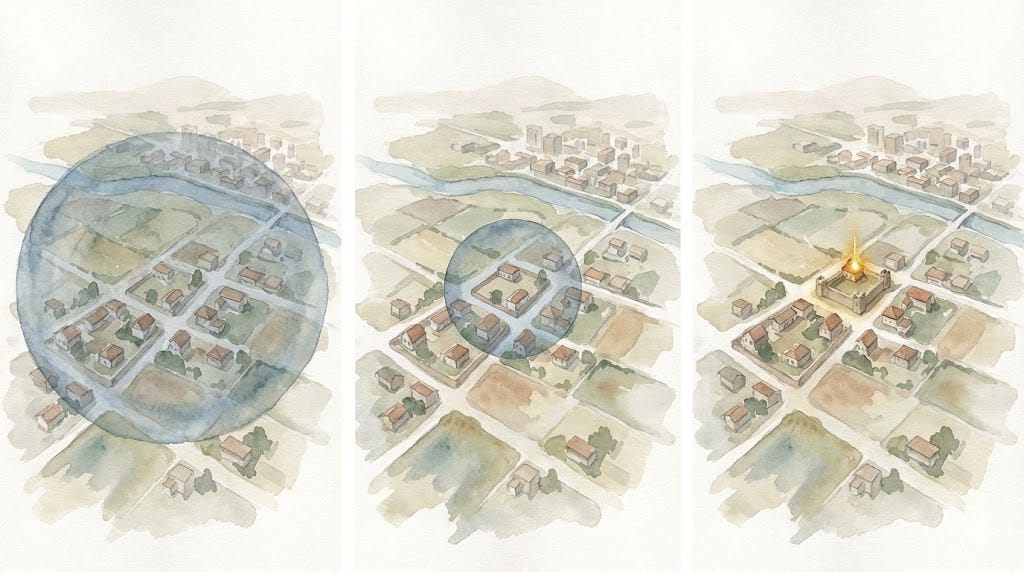
The directive to pursue precision was not merely rhetorical.
It generated a technical revolution.
In the early stages of Iran’s missile programme, accuracy was measured in kilometres.
The Shahab-3, developed in the 1990s and early 2000s, had a Circular Error Probable (CEP) of approximately 1,000 to 2,000 metres.
This means that half the missiles fired would land within one to two kilometres of the intended target.
For striking a city, this is sufficient.
For striking a specific building, it is useless — exactly as Imam Khamenei said.
The programme evolved.
The Fateh-110, introduced in the 2000s, brought CEP down to approximately 100 metres.
A significant improvement — but still insufficient for true precision.
A 100-metre error still risks striking the wrong building, still endangers the civilians who might be just beyond the intended target.
And so the development continued.
The current generation of Iranian missiles represents a transformation.
The Fateh-313 achieves a CEP under 10 metres.
The Khaybar Shekan — a medium-range ballistic missile — reportedly achieves similar precision at much greater distances.
The Fattah, Iran’s hypersonic missile unveiled in 2023, combines speed that makes interception nearly impossible with precision guidance that allows it to strike specific targets.
Under 10 metres.
Often under 5 metres.
To understand what this means: a modern Iranian precision missile can strike a specific room in a specific building.
It can hit the general’s office while leaving the barracks across the compound undamaged.
It can destroy an air defence battery while the village 500 metres away continues sleeping.
These are not weapons of mass destruction.
These are, in effect, “sniper rifles” at the scale of strategic warfare.
The entire trajectory of development — from 2,000-metre CEP to under 10 metres — makes sense only if the precision directive was genuine.
Only if the prohibition on indiscriminate weapons was real.
Only if the theological framework actually shaped the technical programme.
Why would a nation secretly pursuing nuclear weapons invest billions in precision guidance systems?
Why would a nation that intended to build city-destroying warheads care whether its missiles could hit specific buildings?
The investment in precision is evidence of sincerity.
It is the prohibition made manifest in engineering.
Mass Precision, Not Mass Destruction
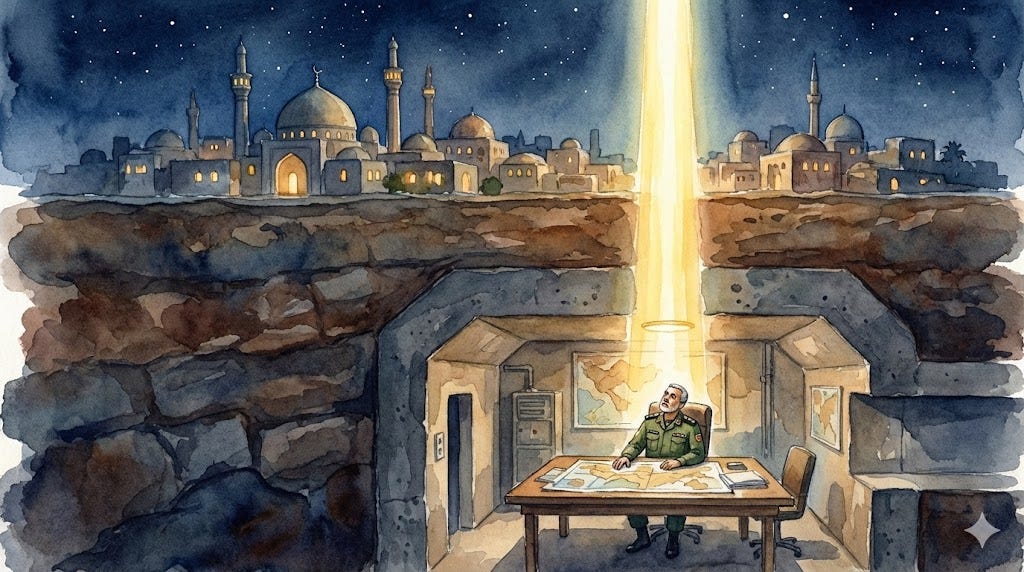
The doctrine that emerged from this development has been articulated by Iranian military officials in explicit contrast to the doctrine of mass destruction.
Imam Khamenei himself has stated:
ما سلاحهایی داریم که از سلاح هستهای دقیقتر و مؤثرتر است؛ سلاحهایی که فقط دشمن را هدف میگیرند، نه بیگناهان را.
“We possess weapons more precise than nuclear weapons and more effective; weapons that target only the enemy, not the innocent.”
— Imam Khamenei, Speech to Commanders of the Armed Forces (General doctrinal summary often cited in Khat-e Hezbollah)
This is not merely a claim of capability.
It is an articulation of doctrine.
The purpose of military power is deterrence — turhibuna, as the Quran states.
The enemy must know that aggression will be met with response, that attack will be answered, that the costs of war will be unacceptable.
But deterrence does not require the threat of indiscriminate massacre.
Deterrence can be achieved — perhaps more effectively achieved — through demonstrated precision.
The enemy general in his bunker is not personally deterred by the threat of nuclear war.
He has his shelter.
He may survive.
His family may be evacuated.
The masses who would die in a nuclear exchange are abstractions to him — statistics, not people he knows.
But that same general is very personally deterred by a missile that can strike his specific bunker.
By a weapon that can target the command centre where he sits.
By a capability that says:
“We know where you are, and we can reach you — you specifically, not just your population.”
Precision creates personal deterrence.
It holds decision-makers accountable as individuals, not just as representatives of nations whose populations can be massacred.
And it does so while remaining within Islamic limits.
No innocent civilians incinerated.
No children vaporised.
No grandmothers burned in their homes.
Only the military targets.
Only the infrastructure of aggression.
Only those who plan and execute attacks against the Islamic Republic.
This is Mass Precision — the alternative to Mass Destruction.
And it is, arguably, more effective while being immeasurably more moral.
Case Study: Operation Martyr Soleimani
Theory must be tested in practice.
Doctrine must be demonstrated in action.
On January 3, 2020, the United States assassinated General Qassem Soleimani — commander of the IRGC Quds Force, architect of the Axis of Resistance, one of the most significant military figures in the region — in a drone strike at Baghdad International Airport.
The assassination was an act of war.
It demanded response.
But what kind of response?
The Islamic Republic possessed the capability to cause mass casualties.
It could have struck populated areas.
It could have targeted soft targets — embassies, commercial facilities, civilian infrastructure.
It could have unleashed attacks designed to maximise death.
It did not.
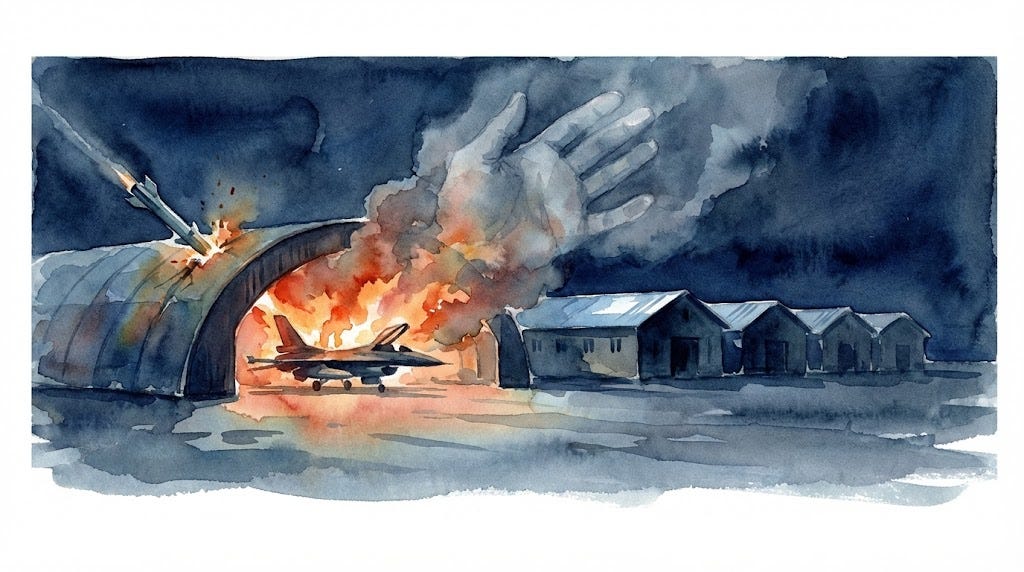
On January 8, 2020, the IRGC launched Operation Martyr Soleimani — a precision missile strike against the Ayn al-Asad airbase in Iraq, the largest US military installation in the country.
General Hajizadeh described the operation’s design:
ما به دنبال کشتن کسی نبودیم... میتوانستیم عملیات را طوری طراحی کنیم که در گام اول ۵۰۰ کشته داشته باشد... اما هدف ما زدن ماشین جنگی و مرکز فرماندهی و کنترل آنها بود.
“We were not looking to kill anyone... We could have designed the operation to have 500 deaths in the first step... but our goal was to strike the war machine and their Command and Control centre.”
— General Amir Ali Hajizadeh, Press Conference following Operation Martyr Soleimani
Consider what this statement reveals.
Iran had the capability to kill hundreds of Americans.
The missiles were precise enough to hit barracks, dining facilities, any location where personnel were concentrated.
The operation could have been designed as a massacre.
Instead, it was designed as a demonstration.
The missiles struck specific hangars.
They destroyed aircraft.
They cratered runways.
They eliminated military infrastructure.
They did not target the sleeping quarters.
The result: extensive material damage, a clear demonstration of capability, and — according to Iranian statements — no intended American deaths.
The US later acknowledged that over 100 service members suffered traumatic brain injuries from the concussive effects of the blasts, but there were no direct fatalities from the strikes themselves.
Imam Khamenei’s characterisation of the operation was precise:
دیشب یک سیلیای به اینها زده شد. این مسئلهی دیگری است. کارهای نظامیِ به این شکل، کفایت قضیه را نمیکند. آنچه مهم است این است که بایستی حضور فسادبرانگیز آمریکا در این منطقه تمام بشود.
“Last night, a slap (Sili) was delivered to them. That is a separate matter. Military actions of this kind are not sufficient for the issue. What is important is that the corruption-breeding presence of America in this region must end.“
— Imam Khamenei, Speech following Operation Martyr Soleimani, January 8, 2020
A slap — not a knockout blow.
A measured response — not uncontrolled escalation.
A demonstration of capability — not an exercise in massacre.
This is the Precision Doctrine in action.
The Days of God
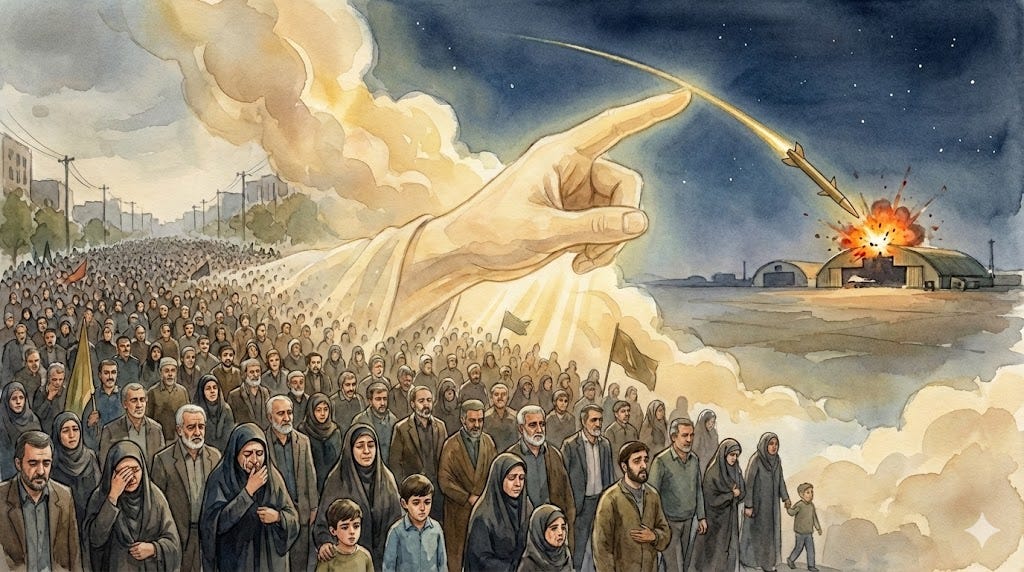
But the theological significance of these events extends beyond military doctrine.
On January 17, 2020, Imam Khamenei led the Friday Prayers in Tehran — for the first time in eight years.
In his sermon, he interpreted the events not through a political lens but through a divine one, referencing the Quranic phrase from Surah Ibrahim:
وَذَكِّرْهُم بِأَيَّامِ اللَّهِ
“And remind them of the Days of God”
— Quran, Surah Ibrahim (the Chapter of Prophet Abraham) #14, Verse 5
He declared two specific days as “Days of God” (Ayyam Allah):
آن روزی که دهها میلیون در ایران، و صدها هزار در عراق و بعضی کشورهای دیگر به پاس خون فرمانده سپاه قدس به خیابانها آمدند و بزرگترین بدرقهی جهان را شکل دادند، این یکی از ایامالله است.
آن روزی هم که موشکهای سپاه پاسداران انقلاب اسلامی پایگاه آمریکایی را در هم کوبید، آن روز هم یکی از ایامالله است.
چه شد که پس از ۴۰ سال، شما این برادر عزیز [سلیمانی] را، این مجاهد بزرگ را اینجور به میدان آوردید؟ این دست خدا است؛ این را جز با عامل معنوی و دست قدرت الهی نمیشود تحلیل کرد.
“That day when tens of millions in Iran, and hundreds of thousands in Iraq and some other countries, came into the streets to honour the blood of the Commander of the Quds Force and formed the largest farewell procession in the world — this is one of the Days of God.
The day when the missiles of the Islamic Revolutionary Guard Corps crushed the American base — that day is also one of the Days of God.
...How did it happen that after 40 years, You [God] brought this dear brother [Soleimani], this great Mujahid, into the arena like this? This is the Hand of God. This cannot be analysed except through spiritual factors and the Hand of Divine Power.”
— Imam Khamenei, Friday Prayer Sermon, Imam Khomeini Musalla, Tehran, January 17, 2020 (27 Dey 1398)
Consider the framing.
Two “Days of God” — not one.
The first: the funeral processions.
Tens of millions pouring into the streets.
The largest farewell in human history.
This was the demonstration of the people’s power — their love, their loyalty, their unbreakable bond with those who defend them.
The second: the missile strike.
The precision weapons striking the heart of American military power in the region.
This was the demonstration of military capability — but a capability exercised within limits, a power wielded with restraint.
Both are “Days of God.”
The funeral and the strike.
The mourning and the response.
The tears and the missiles.
And notice how Imam Khamenei interprets the entire sequence:
“This is the Hand of God.”
Not merely human planning.
Not merely military capability.
Not merely political calculation.
Divine providence working through human agency.
The response was not just strategically sound.
It was not just militarily effective.
It was not just politically calibrated.
It was Islamic.
It was a response that the tradition could bless — because it remained within the limits the tradition demands.
A massacre would not have been a “Day of God.”
An indiscriminate slaughter of American soldiers and Iraqi civilians would not have merited that sacred designation.
But a precise strike — powerful enough to demonstrate capability, restrained enough to avoid unnecessary death, targeted enough to distinguish military infrastructure from human beings — this could be called a Day of God.
This is the Precision Doctrine elevated to theology.
The Proof of Sincerity
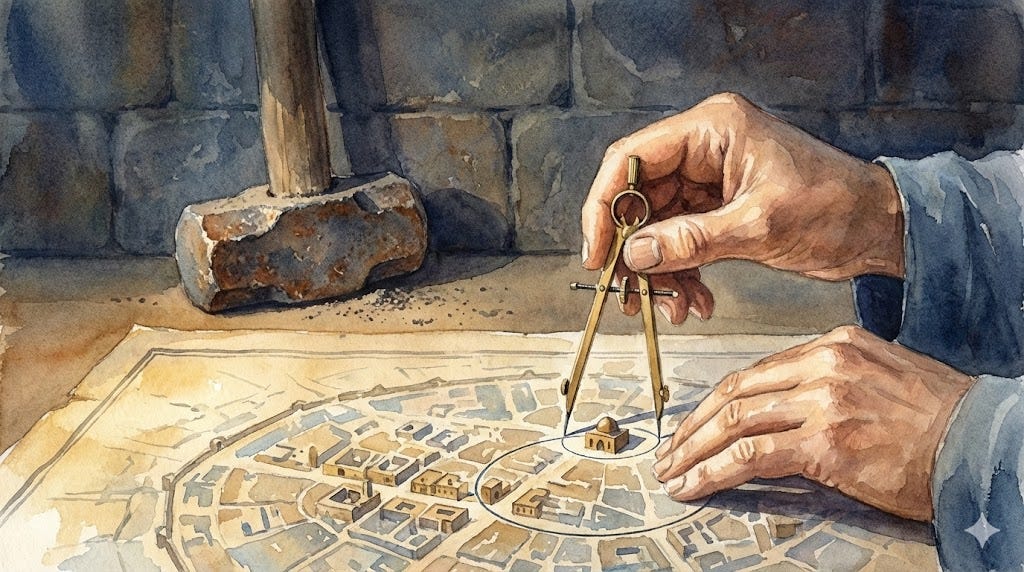
Now let us ask the question that the Taqiyyah accusation cannot answer:
If Iran secretly desires nuclear weapons — if the Fatwa is merely a deception, a cover story for a clandestine programme — why would Iran invest decades of effort and billions of dollars in precision missile technology?
The development of precision guidance systems is not a side project.
It is the central focus of Iran’s strategic development.
The finest engineers, the most significant resources, the sustained attention of the highest leadership — all directed toward building missiles that can hit specific targets.
This makes no sense if Iran is secretly pursuing weapons of mass destruction.
If your actual goal is a nuclear warhead, you do not need precision.
A nuclear bomb destroys everything within kilometres of its detonation point.
Whether it lands 10 metres or 1,000 metres from the aim point is irrelevant — the city is incinerated either way.
The only reason to pursue precision is if you intend to use conventional warheads — and if you intend to use them in ways that discriminate between legitimate and illegitimate targets.
The investment in precision is evidence.
The doctrine of Mass Precision instead of Mass Destruction is evidence.
The conduct of Operation Shahid Soleimani is evidence.
All of it points to the same conclusion:
The prohibition is real.
The Fatwa is sincere.
The theology has shaped the technology.
And Iran has built exactly the military capability that an Islamic state, bound by Islamic limits, should build — powerful enough to deter aggression, precise enough to respond without massacre, effective enough to defend without becoming the evil it opposes.
The Pakistan Objection: Anticipated and Answered
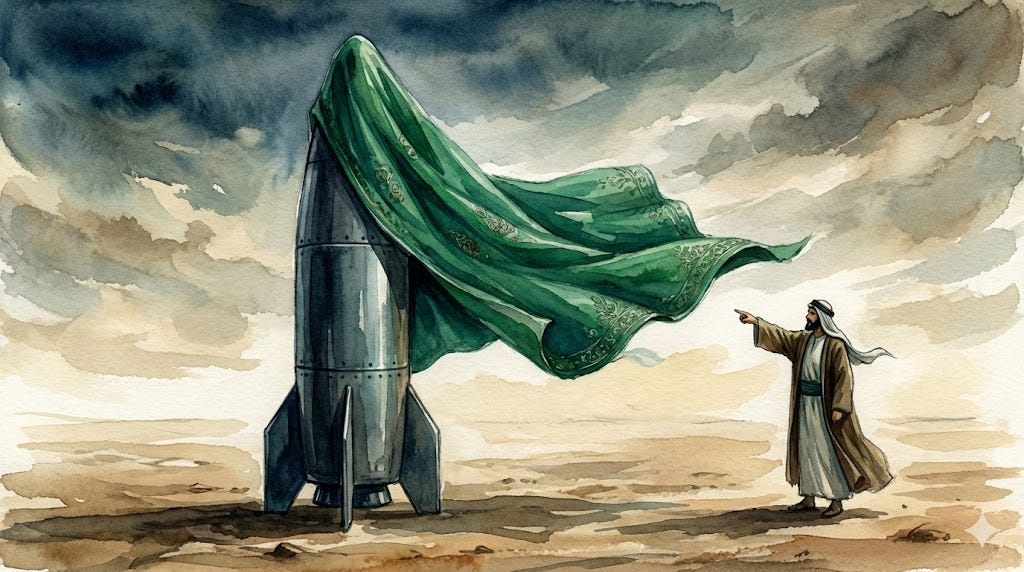
We have established the prohibition from multiple angles — Quranic, Prophetic, classical, contemporary.
We have witnessed the consensus of the maraji’.
We have seen the prohibition made manifest in the Precision Doctrine.
But there is an objection that always arises.
It is raised by critics who wish to dismiss the Fatwa as mere politics.
It is raised by those who have absorbed it from hostile media without examining it.
It is even raised, sometimes, by Muslims who are genuinely confused.
The objection is simple:
“Pakistan has nuclear weapons.
Pakistan is an Islamic Republic.
Therefore, Islamic law must permit nuclear weapons.”
Tonight, we answer this objection — and in answering it, we expose the confusion that underlies it.
The Objection Stated Fully
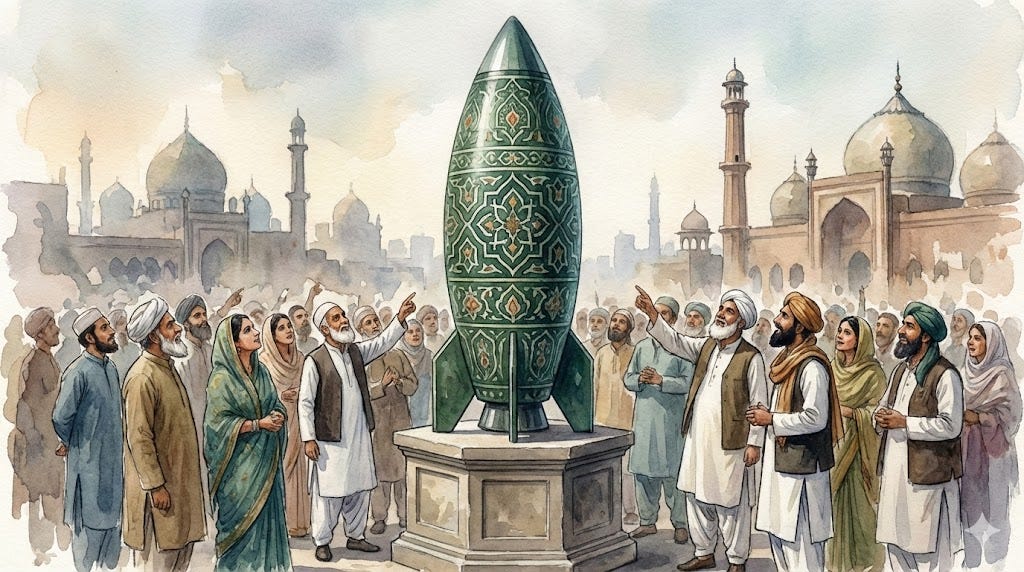
Let us be fair to the objection and state it in its strongest form.
Pakistan is a Muslim-majority nation.
It declares itself an Islamic Republic.
Its constitution invokes Islamic principles.
Its nuclear programme was developed with explicit reference to Islamic identity — the “Islamic bomb,” as it was sometimes called, a counterweight to Hindu India and Zionist Israel.
Pakistani leaders have framed the nuclear programme in religious terms. General Zia-ul-Haq spoke of defending the Ummah.
Zulfikar Ali Bhutto famously declared that Pakistanis would “eat grass” if necessary to achieve nuclear capability.
And Pakistan succeeded.
It tested nuclear weapons in 1998.
It possesses an arsenal estimated at over 150 warheads.
It is a nuclear-armed state.
If Islamic law truly prohibited nuclear weapons — the objection runs — how could a Muslim nation have pursued them?
How could Islamic scholars in Pakistan have remained silent?
Does not Pakistan’s possession prove that the prohibition is, at most, one interpretation among many — and perhaps not even a mainstream one?
This objection deserves a serious answer.
The Logical Fallacy
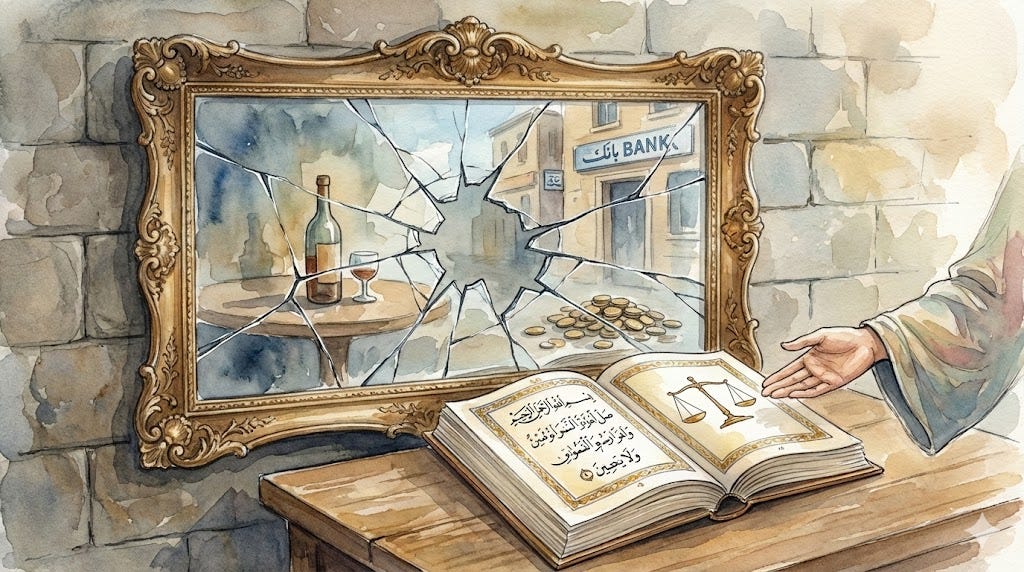
The first problem with this objection is logical.
It commits what philosophers call the “is-ought fallacy” — the error of deriving moral conclusions from factual observations.
The fact that something is done does not establish that it ought to be done.
The fact that a Muslim-majority nation does something does not prove that Islamic law permits that thing.
Consider parallel examples.
Many Muslim-majority nations permit the sale of alcohol.
Does this prove that Islamic law permits alcohol?
Of course not.
It proves only that those nations are not fully implementing Islamic law in that domain.
Many Muslim-majority nations have banking systems based on interest (riba).
Does this prove that Islamic law permits usury?
No.
It proves only that economic pressures and colonial legacies have led to compromises that the tradition does not endorse.
Many Muslim-majority nations have political systems involving corruption, oppression, and injustice.
Does this prove that Islamic law permits tyranny?
Obviously not.
The existence of a practice in the Muslim world does not legitimise that practice.
The question is not:
“What do Muslim-majority states do?”
The question is:
“What do the sources of Islamic law require?”
And we have spent two sessions establishing what the sources require.
Pakistan’s possession of nuclear weapons proves nothing about Islamic jurisprudence.
It proves only that Pakistan, in this domain, is not operating according to Islamic jurisprudence.
The Pakistani Reality
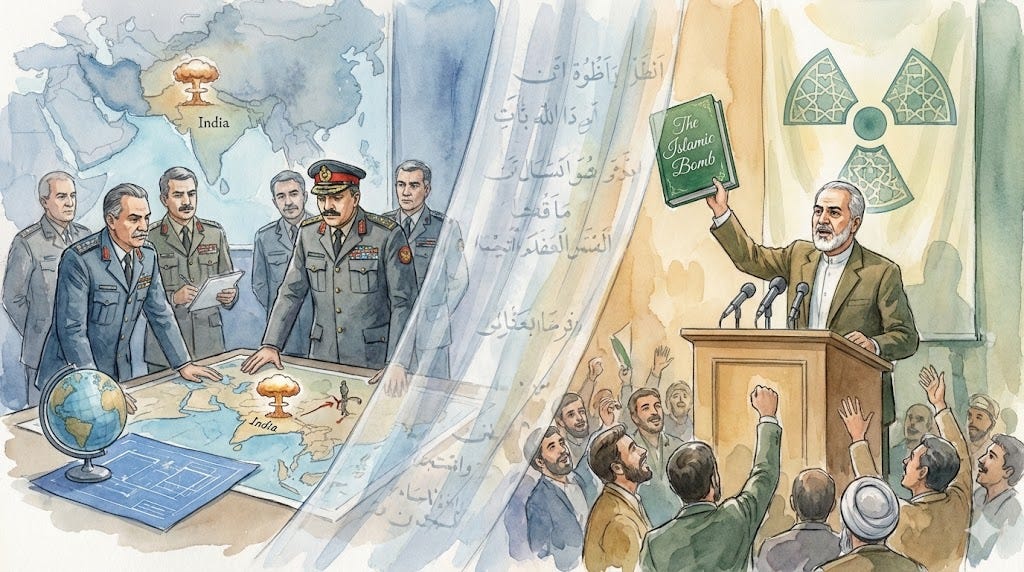
Let us look honestly at how Pakistan’s nuclear programme actually developed.
Was it the product of scholarly deliberation?
Did the maraji’ and muftis of Pakistan convene to examine the sources and issue a collective ruling that nuclear weapons were permissible?
They did not.
Pakistan’s nuclear programme was driven by geopolitical calculation, not theological reasoning.
The impetus was India.
When India tested a nuclear device in 1974, Pakistan’s leadership determined that national survival required a matching capability.
The trauma of 1971 — the loss of East Pakistan, the humiliation of military defeat — haunted the strategic establishment.
Never again, they resolved, would Pakistan be so vulnerable.
This is understandable as statecraft.
A nation that has been dismembered by its neighbour has reason to seek deterrence.
But statecraft is not theology.
The decision to pursue nuclear weapons was made by generals and politicians — by Bhutto, by Zia, by the military establishment.
It was a strategic decision wrapped in religious rhetoric, not a religious decision derived from strategic necessity.
General Zia-ul-Haq was skilled at using Islamic language for political purposes.
His “Islamisation” programme served to legitimate military rule and mobilise popular support.
The framing of the nuclear programme as “the Islamic bomb” served similar purposes — it rallied domestic support and positioned Pakistan as the defender of the global Muslim community.
But rhetoric is not ruling.
The fact that a military dictator called something “Islamic” does not make it so.
What Pakistani Scholars Actually Said
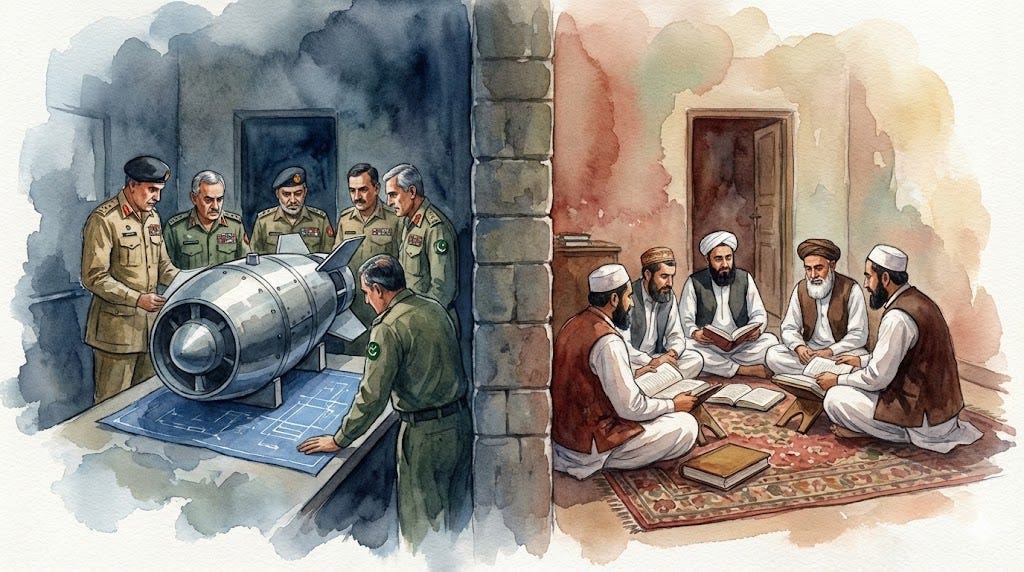
It is worth asking: what did the actual religious scholars of Pakistan say about the nuclear programme?
The honest answer is: very little.
The programme was developed in secrecy, under military control, without public scholarly consultation.
By the time the tests occurred in 1998, the weapons existed as a fait accompli.
Scholars were not asked to rule on their permissibility before the fact; they were presented with an accomplished reality after the fact.
Some scholars offered post-hoc justifications.
Some remained silent.
Some voiced private reservations that never entered the public discourse.
But there was no equivalent of the process we have traced in the Shia world — no systematic examination of sources, no formal fatwas from the highest authorities, no scholarly consensus built through deliberation.
The absence of prohibition is not the same as the presence of permission.
Pakistan’s scholars did not rule that nuclear weapons are halal.
They simply did not rule — and in the absence of ruling, the state did what states do: it pursued power by whatever means seemed effective.
The Sunni Scholarly Position
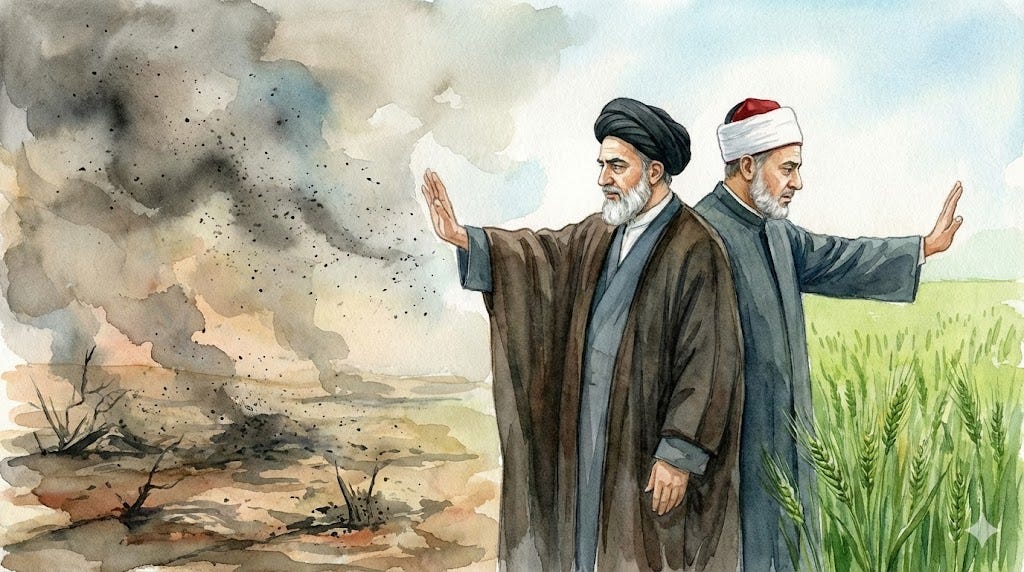
But let us broaden the question.
What do Sunni scholars — not just in Pakistan, but across the Muslim world — actually say about weapons of mass destruction?
Here we find something significant.
The Grand Mufti of Egypt, Sheikh Ali Gomaa, issued a ruling on weapons of mass destruction that parallels the Shia position:
لا يجوز شرعاً استخدام أسلحة الدمار الشامل... لأنها تهلك الحرث والنسل
“It is not religiously permissible to use weapons of mass destruction... because they destroy crops and lineage.”
— Shaykh Ali Gomaa, Grand Mufti of Egypt, Fatwa on WMDs, Dar al-Ifta al-Misriyyah
Notice the reasoning:
“They destroy crops and lineage.”
This is precisely the logic we traced in Session 57 — the Prophetic prohibition on burning trees, destroying crops, harming the environment.
The Grand Mufti applies this logic to its obvious conclusion: weapons that destroy on a massive scale, that render land uninhabitable, that harm generations yet unborn, are forbidden.
Dar al-Ifta al-Misriyyah — the official institution for Islamic rulings in Egypt, one of the most authoritative Sunni bodies in the world — has issued formal guidance against weapons of mass destruction, citing the prohibition on killing non-combatants as the foundational principle.
These are not Shia scholars.
These are not allies of Iran.
These are mainstream Sunni authorities, based in Cairo, representing the oldest continuous tradition of Islamic scholarship in the world.
And they reach the same conclusion.
The prohibition on weapons of mass destruction is not a Shia peculiarity.
It is not an Iranian political position dressed in religious garb.
It is what the sources require — and honest scholars, Sunni or Shia, examining those sources, reach the same conclusion.
The Maslahah Argument

Some have attempted to justify Pakistan’s weapons through the principle of Maslahah — public interest or general welfare.
The argument runs as follows:
Maslahah permits actions that serve the greater good of the Muslim community, even if those actions are not explicitly endorsed by the texts.
Nuclear weapons serve the Maslahah of the Ummah by providing deterrence against enemies who possess such weapons.
Therefore, Maslahah permits their acquisition.
This argument fails on multiple levels.
First, Maslahah is a contested principle even within Sunni jurisprudence.
It is not a blank check that permits anything a ruler deems beneficial.
It operates within limits — and one of those limits is that Maslahah cannot override explicit prohibitions.
You cannot invoke “public interest” to permit alcohol if alcohol is explicitly forbidden.
You cannot invoke “public interest” to permit usury if usury is explicitly forbidden.
And you cannot invoke “public interest” to permit indiscriminate massacre if indiscriminate massacre is explicitly forbidden.
The Prophetic command — “Do not cast poison into their lands” — is not a suggestion to be weighed against competing interests.
It is a prohibition.
Maslahah does not override prohibitions; it operates in the space where the texts are silent.
Second, the Maslahah argument proves too much. If “public interest” can justify nuclear weapons, what can it not justify?
Could it justify biological weapons?
After all, a devastating plague unleashed on the enemy might serve “public interest” by ending a war quickly.
Could it justify targeting civilians directly?
After all, breaking the enemy’s will through terror might serve “public interest” by avoiding prolonged conflict.
Could it justify torture?
Assassination?
Any atrocity that might plausibly contribute to victory?
The logic of unrestricted Maslahah leads to the abandonment of all moral limits.
It becomes a justification for whatever the powerful wish to do.
This is not Islamic jurisprudence.
This is the negation of Islamic jurisprudence — the replacement of divine limits with human calculation.
Third, even on its own terms, the Maslahah argument for nuclear weapons is questionable.
Do nuclear weapons actually serve the welfare of the Muslim Ummah?
Or do they invite pre-emptive strikes, trigger arms races, divert resources from development, create risks of catastrophic accidents, and place Muslim populations under the shadow of annihilation?
Pakistan’s nuclear weapons have not brought peace to the subcontinent.
They have not resolved the Kashmir dispute.
They have not prevented Indian aggression.
They have created a permanent state of tension, a constant risk of escalation, a sword hanging over hundreds of millions of people.
The Maslahah is far from clear — even before we consider the moral dimensions.
The Honest Conclusion

Let us state the conclusion plainly.
Pakistan’s possession of nuclear weapons proves nothing about Islamic law.
It proves that a Muslim-majority nation, under military leadership, pursuing geopolitical objectives, framed its actions in religious language without subjecting them to rigorous religious scrutiny.
It proves that statecraft can wear the mask of theology without being theology.
It proves that the absence of scholarly prohibition, in conditions of secrecy and military control, does not constitute scholarly permission.
The question is not what Pakistan did.
The question is what the sources require.
And the sources — Quran, hadith, classical jurisprudence, contemporary fatwa, Shia and Sunni scholarly consensus — require prohibition.
Pakistan is not evidence against this prohibition.
Pakistan is evidence that Muslim-majority states, like all states, sometimes act in ways that contradict the principles they claim to uphold.
This is not a judgment on the Pakistani people, who are as much victims of their government’s decisions as anyone else.
It is not a judgment on Pakistani scholars, many of whom may have harboured reservations they could not safely express.
It is simply a recognition that the existence of a practice does not legitimate the practice.
And the Islamic prohibition on weapons of mass destruction stands — regardless of what any state has done or failed to do.
Why the Fatwa Cannot Be Taqiyyah: The Culmination
We have arrived at the heart of the matter.
We have traced the prohibition from its Quranic roots to its contemporary codification.
We have heard the Prophet’s instructions and the classical jurists’ rulings.
We have witnessed the consensus of the maraji’ across Qom and Najaf.
We have seen the prohibition made manifest in the Precision Doctrine.
We have dissolved the Pakistan objection.
Now we face the accusation directly — the accusation that has been hurled at the Islamic Republic for decades, the accusation that poisons every diplomatic negotiation, the accusation that is used to justify sanctions, threats, and the constant drumbeat toward war.
“The Nuclear Fatwa is Taqiyyah.”
“Iran says it doesn’t want nuclear weapons, but that’s just religious deception.”
“They’re permitted to lie, so nothing they say can be trusted.”
“The Fatwa is a smokescreen concealing a secret weapons programme.”
This accusation is made by American politicians seeking to justify aggression.
It is made by Zionist officials manufacturing pretexts for attack.
It is made by hostile media seeking to demonise.
It is repeated by ordinary people who have absorbed the propaganda without examining it.
Tonight, we dismantle it.
Not with counter-accusations.
Not with rhetoric.
Not with appeals to trust.
With logic.
We will show that the accusation is not merely false but logically impossible.
We will show that for the Fatwa to be Taqiyyah, conditions would have to obtain that demonstrably do not obtain.
We will show that the accusation, far from revealing Iranian deception, reveals the accuser’s own moral blindness — an inability to imagine that anyone, anywhere, might genuinely place principle above power.
What Taqiyyah Actually Is

Let us begin by recalling what we established in Sessions 55 and 56.
Taqiyyah is not a license to lie whenever convenient.
It is not a blank check for deception.
It is not — as the Islamophobes imagine — a doctrine that permits Muslims to say anything to non-Muslims while secretly believing the opposite.
Taqiyyah is a specific dispensation, with specific conditions, for specific circumstances.
At its core, Taqiyyah is this: the concealment of a truth that exists, under conditions of genuine threat, to protect life, community, or faith.
The key phrase is: a truth that exists.
Taqiyyah conceals something real.
It hides a genuine belief, a genuine identity, a genuine commitment that the believer holds internally but cannot safely express externally.
When Ammar ibn Yasir spoke words of disbelief under torture, he concealed his true faith — which continued to exist in his heart.
When the Believer in Pharaoh’s household hid his faith, he concealed his true commitment to God — which remained his inner reality.
When Shia Muslims throughout history practiced Taqiyyah under hostile rule, they concealed their true allegiance to the Ahl al-Bayt — which never wavered internally.
In each case, there was a hidden truth.
There was an internal reality that differed from the external presentation.
This is what Taqiyyah is.
And this is precisely what cannot be the case with the Nuclear Fatwa.
The Question of the Hidden Truth

For the Nuclear Fatwa to be Taqiyyah, there would have to be a hidden truth being concealed.
What would that hidden truth be?
It would have to be something like:
“We actually believe nuclear weapons are permissible in Islamic law, but we publicly claim they are forbidden to deceive the international community.”
Let us examine whether this hidden truth could plausibly exist.
For such a hidden truth to exist, there would have to be a legitimate Islamic argument for the permissibility of nuclear weapons — an argument that Iran’s scholars secretly believe but publicly deny.
We have spent two sessions examining the sources.
Where is this argument?
The Quran establishes the purpose of military preparation as deterrence (turhibuna), not annihilation.
The Prophet explicitly forbade poisoning enemy lands, killing non-combatants, destroying the environment.
The classical jurists codified these prohibitions as absolute — not even necessity overrides them.
Rational necessity (al-mustaqillat al-’aqliyya) recognises that indiscriminate massacre of innocents is dhulm — intrinsic injustice that no circumstance can make permissible.
Every contemporary marja’ who has addressed the question — in Qom and Najaf, Shia and Sunni — has reached the same conclusion: weapons of mass destruction are forbidden.
Where, in all of this, is the secret argument for permissibility?
What source would it cite?
What principle would it invoke?
What reasoning would it employ?
The accusation assumes that such an argument exists — that Iran’s scholars secretly believe it — but publicly deny it.
But we have examined the sources.
The argument does not exist.
There is no Quranic verse that permits indiscriminate massacre.
There is no hadith that endorses weapons that cannot distinguish combatant from civilian.
There is no classical jurist who ruled that poisoning lands is acceptable.
There is no contemporary marja’ who has issued a secret fatwa permitting nuclear weapons.
The hidden truth that Taqiyyah would conceal does not exist.
And you cannot conceal something that does not exist.
The Nature of Primary Rulings

Recall the distinction we established earlier in this session: the difference between Primary Rulings (Hukm Awwali) and Secondary Rulings (Hukm Thanawi).
Secondary rulings are circumstantial.
They change when conditions change.
Eating pork is forbidden — unless you are starving.
Praying standing is required — unless you are incapable of standing.
Fasting is obligatory — unless illness makes it harmful.
Taqiyyah operates in the realm of secondary rulings.
Under extreme threat, the obligation to publicly profess faith may be temporarily suspended.
The believer may conceal what he would normally express, because the circumstances make expression dangerous.
Primary rulings are different.
They are based on the intrinsic nature of acts, not on circumstantial calculations.
Murder is forbidden because killing an innocent human being is intrinsically wrong — not because of any calculation of consequences.
This does not change when circumstances change.
There is no circumstance in which murdering an innocent becomes permissible.
The prohibition on weapons of mass destruction is a Primary Ruling.
It is based on the intrinsic nature of such weapons: their indiscriminate character, their uncontrollable effects, their residual harm.
These characteristics are not circumstantial.
They are essential.
A nuclear weapon is not indiscriminate in some circumstances and discriminate in others.
It is indiscriminate by its very nature.
And therefore, the prohibition is not circumstantial.
It does not change when the pressure increases or the threat intensifies.
It is permanent, because it is based on essence.
Taqiyyah does not apply to Primary Rulings.
You cannot “conceal” a Primary Ruling because Primary Rulings are not about what you express — they are about what is.
The intrinsic evil of indiscriminate massacre does not become less evil because you hide your recognition of it.
The Fatwa is not a tactical statement that could be adjusted if circumstances change.
It is a recognition of moral reality — and moral reality does not shift with circumstance.
The Consistency Argument
Consider how the prohibition has been expressed over time.
Imam Khomeini forbade chemical weapons in the 1980s — during a war of national survival, when Iran was being gassed by Saddam Hussein, when the international community was silent or complicit in Iraq’s crimes.
At that moment, there was no international pressure on Iran to refrain from chemical weapons.
The world was not demanding Iranian restraint.
The United Nations was not threatening sanctions if Iran retaliated in kind.
If anything, the strategic logic pointed toward retaliation.
Deterrence theory would suggest that matching the enemy’s capabilities would prevent further attacks.
And yet Imam Khomeini said: Haram.
“If we produce chemical weapons, what is the difference between us and Saddam?”
This was not Taqiyyah.
There was nothing to be gained by the “deception.”
No international audience was demanding this statement.
No sanctions would be lifted by making it.
No diplomatic advantage would be secured.
The statement was made because it was believed.
Fast forward to 2010.
Imam Khamenei issues the Nuclear Fatwa.
The international context is entirely different — now there is immense pressure, sanctions, threats of military action.
One might argue that this statement is Taqiyyah, designed to ease international pressure.
But consider: the content of the ruling is identical.
The same prohibition.
The same reasoning.
The same classification as haram.
The ruling does not change to match the audience.
The ruling does not shift to serve diplomatic purposes.
The ruling remains the same — in the 1980s when no one was watching, and in 2010 when everyone was watching.
If the Fatwa were Taqiyyah — if it were a deception calibrated to external pressure — we would expect it to appear when pressure appears and disappear when pressure disappears.
Instead, we find consistency.
The same ruling, across decades, across different contexts, across different leaders.
This is not the behaviour of deceivers.
This is the behaviour of believers.
The Consensus Argument
Consider the consensus we documented earlier.
Ayatullah Sistani in Najaf.
Ayatullah Makarim Shirazi in Qom.
Ayatullah Jawadi Amoli.
Ayatullah Subhani.
The Grand Mufti of Egypt.
These scholars differ on many things.
They represent different methodological approaches.
They have different relationships with political power.
They are based in different countries, subject to different pressures, serving different communities.
Yet they all reach the same conclusion.
For the Fatwa to be Taqiyyah, we would have to believe that all of these scholars — independently, in different cities, across Shia and Sunni traditions — are engaged in coordinated deception.
We would have to believe that Ayatullah Sistani, who has maintained careful distance from the Islamic Republic, is participating in an Iranian deception.
We would have to believe that Sunni scholars in Cairo, with no allegiance to Tehran, are participating in an Iranian deception.
We would have to believe that scholars who have spent their lives pursuing truth, who have sacrificed worldly comfort for knowledge, who have built reputations on integrity — are all secretly lying about the same thing.
This is not plausible.
The far simpler explanation is the true one: they all reach the same conclusion because the sources compel the same conclusion.
The consensus is evidence of truth, not conspiracy.
The Precision Doctrine Argument
Consider what Iran has actually built.
If the Fatwa were Taqiyyah — if Iran secretly intended to acquire nuclear weapons — why would Iran invest decades of effort and billions of dollars in precision missile technology?
Nuclear weapons do not require precision.
A warhead that destroys everything within kilometres does not need to hit a specific building.
Whether it lands 10 metres or 1,000 metres from the aim point is irrelevant.
The obsessive focus on accuracy — the Supreme Leader’s personal directive to “strike the point” — makes sense only if the intention is to use conventional warheads.
Only if the goal is to deter through precision rather than through mass destruction.
Only if the prohibition is genuine.
The entire trajectory of Iran’s military development is evidence.
The Shahab-3 with its 2,000-metre CEP — deemed “useless” by the Supreme Leader.
The progressive refinement to 100 metres, then 10 metres, then 5 metres.
The development of hypersonic vehicles with precision guidance.
The conduct of Operation Martyr Soleimani — designed for demonstration, not massacre.
This is not the behaviour of a nation secretly pursuing weapons of mass destruction.
This is the behaviour of a nation that genuinely believes in the prohibition and has built its entire military doctrine around that belief.
The Precision Doctrine is the Fatwa made manifest in engineering.
And it is proof that the Fatwa is real.
The Impossibility of the Accusation
Let us now state the argument formally.
For the Fatwa to be Taqiyyah, the following would have to be true:
There exists a legitimate Islamic argument that nuclear weapons are permissible.
Iran’s scholars secretly believe this argument.
They publicly deny it to deceive the international community.
We have established:
No such argument exists. The sources — Quran, hadith, classical jurisprudence, rational necessity — unanimously prohibit weapons of mass destruction.
Therefore, there is no hidden belief for the scholars to hold. You cannot secretly believe an argument that does not exist.
Therefore, there is nothing to conceal. Taqiyyah requires a hidden truth; but there is no hidden truth here.
Furthermore:
The prohibition is a Primary Ruling based on intrinsic nature, not circumstance. Taqiyyah does not apply to Primary Rulings.
The prohibition has been consistently maintained across decades, across different leaders, across contexts where no external pressure existed. This is inconsistent with calculated deception.
The prohibition is confirmed by scholarly consensus across Qom, Najaf, and Cairo — scholars with different allegiances, different methodologies, different relationships to power. Coordinated deception across this breadth is implausible.
Iran’s actual military development — the Precision Doctrine — is consistent only with a genuine prohibition, not with secret pursuit of mass destruction.
Conclusion:
The Fatwa cannot be Taqiyyah.
Not merely “is not” — cannot be.
The logical conditions for Taqiyyah are not met.
The accusation is not merely false.
It is incoherent.
What the Accusation Reveals
If the accusation is incoherent, why is it made?
Why do Western politicians repeat it?
Why does hostile media amplify it?
Why do ordinary people believe it?
The answer reveals something important — not about Iran, but about the accusers.
The accusation rests on an assumption: that everyone, everywhere, operates by the same amoral calculus.
The assumption is:
“If we had Iran’s enemies, we would pursue nuclear weapons.
If we faced Iran’s threats, we would seek the ultimate deterrent.
Any rational actor in Iran’s position would want nuclear weapons.
Therefore, Iran must want nuclear weapons.
And if Iran says otherwise, Iran must be lying.”
This assumption cannot imagine a value system that places principle above power.
It cannot conceive of leaders who would accept strategic disadvantage rather than violate religious law.
It cannot fathom a nation that would endure sanctions, threats, and the constant risk of attack rather than cross a moral line.
And so it concludes: they must be lying.
The accusation is projection.
Those who would lie in Iran’s position assume that Iran is lying.
Those who would abandon principle under pressure assume that Iran has abandoned principle.
Those who cannot imagine genuine religious commitment assume that all religious language is manipulation.
The accusation reveals not Iranian deception but the accuser’s impoverished moral imagination.
It reveals a worldview in which power is the only value, in which principle is always subordinate to expedience, in which religious conviction is merely a tool for manipulation.
And when such a worldview encounters a nation that actually behaves according to its stated principles — that refuses weapons it could build, that develops precision instead of mass destruction, that maintains consistency across decades of pressure — it cannot comprehend what it is seeing.
So it reaches for the only explanation its cramped imagination can generate:
“They must be lying.”
But they are not lying.
The Fatwa is real.
The prohibition is genuine.
The principle is actually believed and actually followed.
And the accusation, in the end, tells us nothing about Iran.
It tells us everything about the accusers.
The Final Word

Let us conclude this section with clarity.
The Nuclear Fatwa is not Taqiyyah.
It cannot be Taqiyyah.
Taqiyyah conceals a truth that exists.
But there is no hidden truth here.
There is no secret argument for permissibility.
There is no alternative jurisprudential position being concealed.
There is only the prohibition — derived from Quran, from hadith, from classical jurisprudence, from rational necessity, from contemporary consensus.
There is only the recognition that weapons of mass destruction constitute dhulm — indiscriminate harm to the innocent — and that dhulm is forbidden absolutely, permanently, without exception.
There is only the conclusion that any honest jurist, examining the sources, would reach.
The Fatwa does not conceal a secret desire for nuclear weapons.
The Fatwa expresses the only conclusion Islamic jurisprudence can reach.
It is not hiding a truth.
It is speaking a truth — a truth the accusers cannot hear because their ears are closed to the possibility that anyone means what they say.
But the inability of the deaf to hear does not make the speaker mute.
The Fatwa stands.
The prohibition is real.
And history will record who told the truth and who could not recognise it.
Conclusion: The Complete Argument
We have completed what we set out to do.
Across two sessions — fifty-seven and fifty-eight — we have built an argument brick by brick, layer by layer, until no gap remains.
Let us stand back and see what we have constructed.
The Foundations (Session 57)
We began with the nature of conflict itself.
Islam does not view warfare as a clash between peoples — the American farmer against the Iranian farmer, population against population.
Wars are initiated by systems of oppression — the Zalimin, the Mustakbirin — and the just respond through legitimate defence.
We recognised that some conflicts are genuinely Haqq against Batil, and the tradition does not pretend otherwise.
Karbala was not a power struggle; it was the battle for the soul of Islam itself.
Yet even at Karbala, the civilian population of Damascus was not the enemy.
We established that moral culpability exists on a spectrum — the Ziyarat Ashura warns of those who knew and remained silent — but moral culpability before God does not equal legitimate target status.
And we distinguished the aggressor’s soldier, who bears the weight of his choice even if misled, from the defender’s soldier, who fulfils a sacred duty established in Sharh al-Lum’ah as Wajib Mutlaq.
The defender retains a duty of care even toward the aggressor’s civilians.
You fight the oppressive system, not the nation.
We turned to the Quran and found the purpose of military preparation stated explicitly: turhibuna — to deter, to strike awe, to make aggression unthinkable before it begins.
Not to kill.
Not to destroy.
Not to annihilate.
To deter.
We descended to the classical jurists and found, a thousand years before Hiroshima, the principle already articulated:
“Do not cast poison into their lands.”
Shaykh Al-Tusi said it.
Shaheed al-Awwal in Al-Lum’ah codified it.
The scholars ruled — with emphasis — that even necessity does not override this prohibition.
We heard the Prophet’s own instructions:
Do not kill the elderly, the children, the women.
Do not burn trees.
Do not destroy crops.
Do not poison wells.
The limits of legitimate warfare, established fourteen centuries ago.
We applied rational necessity — al-mustaqillat al-’aqliyya — and recognised that indiscriminate massacre of innocents is dhulm.
Not by analogy, but by recognition: these weapons are the injustice the Prophet identified, scaled to industrial proportions.
We expanded the category: nuclear, chemical, biological, radiological, incendiary.
Any weapon that cannot distinguish combatant from civilian, that cannot be controlled once deployed, that continues killing after the war ends — any such weapon is poison in modern form.
And we witnessed the principle tested in fire:
Imam Khomeini, under chemical attack, with the capability to retaliate, saying simply: Haram.
“If we produce chemical weapons, what is the difference between us and Saddam?”
The foundations were laid.
The Contemporary Codification (Session 58)
Tonight, we built upon those foundations.
We examined Imam Khamenei’s formal Fatwa — not as a soundbite but as a jurisprudential document.
The full Triad of Prohibition: production, stockpiling, and use — all forbidden.
The classification as a Primary Ruling that cannot change with circumstances.
The distinction between rational calculation and religious prohibition.
The submission of the Fatwa to the United Nations, recorded for all history.
We surveyed the consensus of the maraji’. Ayatullah Sistani in Najaf, whose principles of warfare make weapons of mass destruction impossible to justify.
Ayatullah Makarim Shirazi, who declared their use “emphatically forbidden.”
Ayatullah Jawadi Amoli, who ruled that even possession for deterrence is prohibited.
Ayatullah Subhani, who demonstrated the usul logic with precision.
The Grand Mufti of Egypt, who reached the same conclusion from the Sunni tradition.
Different scholars.
Different cities.
Different methodologies.
Different political relationships.
Same conclusion.
This is not one man’s opinion.
This is ijma’ — consensus.
This is what the sources require.
We traced the Precision Doctrine — Noqte-zani — and saw the prohibition made manifest in engineering.
The Supreme Leader’s directive to “strike the point.”
The evolution from 2,000-metre accuracy to under 10 metres.
The doctrine of Mass Precision instead of Mass Destruction.
The conduct of Operation Martyr Soleimani — designed for demonstration, not massacre. The “Days of God” — when even military response became an act of worship because it remained within divine limits.
We dissolved the Pakistan objection.
The existence of a practice does not legitimise the practice.
Pakistan’s nuclear weapons prove only that Pakistan is not applying Islamic law in this domain — not that Islamic law permits what Pakistan has done.
And we answered the accusation that haunts every discussion.
The Fatwa is not Taqiyyah.
It cannot be Taqiyyah.
Taqiyyah conceals a truth that exists.
But there is no hidden truth here.
There is no secret argument for permissibility.
The sources yield only one conclusion, and that conclusion is prohibition.
The accusation reveals not Iranian deception but the accuser’s moral blindness — an inability to imagine a value system that places principle above power.
The Architecture Complete
The argument is complete.
From Quran to hadith to classical fiqh to contemporary fatwa.
From principle to policy to proof.
From the Prophet’s instructions to his seventh-century commanders to the Supreme Leader’s directive to his twenty-first-century missile engineers.
An unbroken chain of reasoning.
A prohibition established, codified, confirmed, and demonstrated.
Not hiding a secret desire.
Expressing an inevitable conclusion.
The Shield and the Theology of Warfare
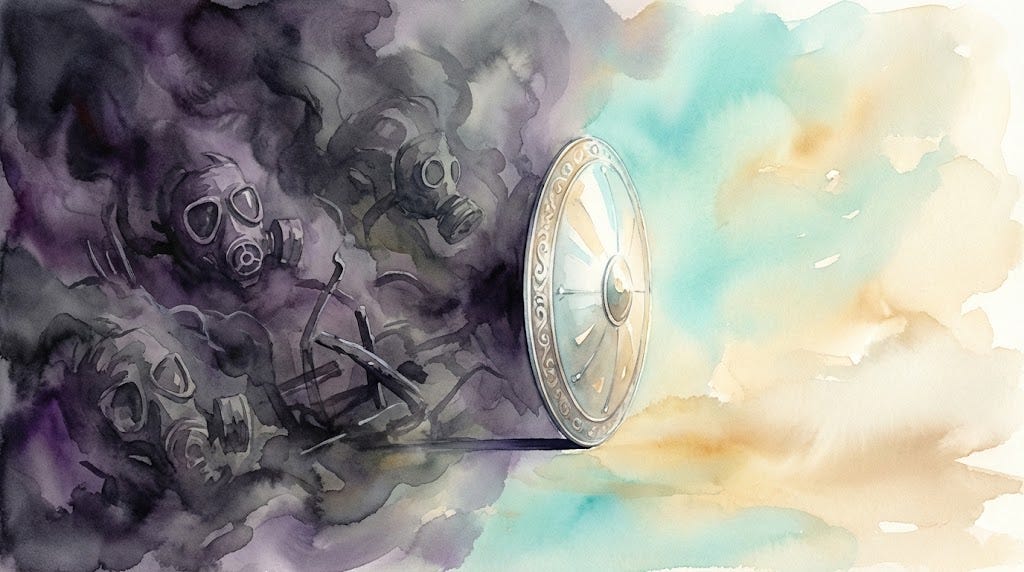
We have been exploring the Shield — Taqiyyah — across multiple sessions.
We forged it in Session 55.
We traced its historical application in Session 56.
And now, in Sessions 57 and 58, we have examined when the Shield is lowered — and what limits remain even when concealment ends.
The Theology of Warfare is part of this exploration because it shows us something crucial: there are things the Shield cannot cover.
Taqiyyah permits concealment when concealment protects.
But it does not permit becoming what we claim to oppose.
It does not permit crossing lines that define who we are.
The Islamic Republic could have pursued nuclear weapons.
It had the capability.
It had the pressure.
It had, arguably, the strategic justification.
But it did not.
Because some things cannot be done, even in the name of survival.
Because becoming Saddam to defeat Saddam is not victory — it is surrender of a different kind.
Because the difference between us and them is not merely which flag we fly, but which principles we honour.
The Shield protects.
But the Shield has limits.
And one of those limits is that you cannot use the Shield to hide the abandonment of everything the Shield was meant to protect.
What Comes Next
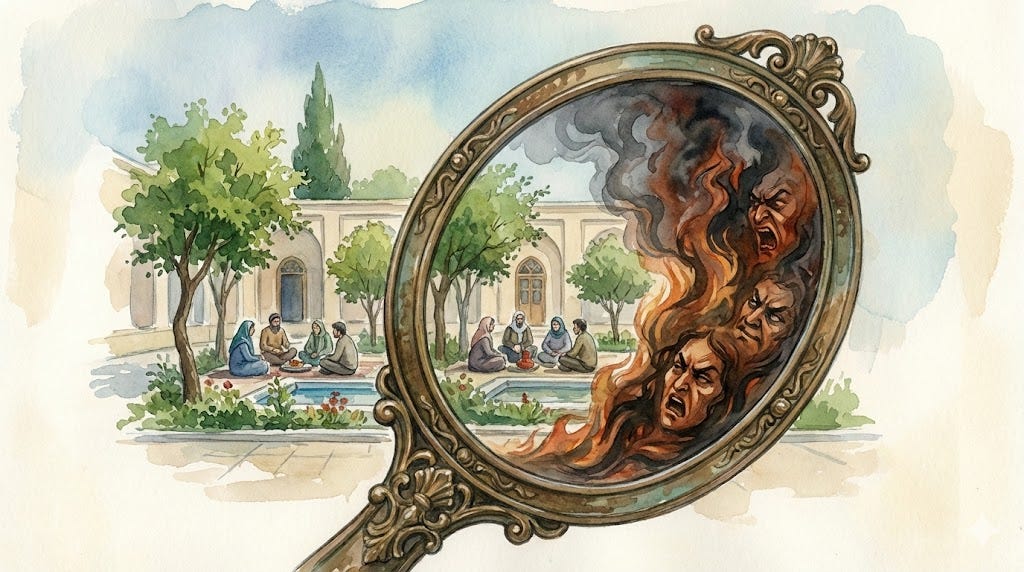
We have completed the Theology of Warfare.
But the Shield Lowered has one more dimension to explore.
We have examined weapons that poison the land.
But there are weapons that poison the mind.
Information warfare.
Propaganda.
The manipulation of truth.
The incitement of sedition.
The transformation of legitimate grievance into destructive chaos.
These weapons cannot irradiate a city — but they can collapse a society from within.
They cannot contaminate groundwater — but they can contaminate the very capacity for trust that makes community possible.
How does Islam distinguish legitimate protest from sedition?
What is the difference between the citizen who demands justice and the agent who exploits grievance for destruction?
How do we recognise when the “freedom fighter” is actually a foreign operative, when the “spontaneous uprising” is actually a manufactured colour revolution, when the “voice of the people” is actually a weapon aimed at the people?
These questions await us in Session 59: The Theology of Dissent.
And beyond the defensive — beyond both physical weapons and informational weapons — what happens when the Shield is lowered for good?
What does the believer show when concealment is no longer necessary?
What is Makarim al-Akhlaq — the Noble Character — and how does it manifest?
And for those of us in the West — in Manchester, in Toronto, in Sydney — is Taqiyyah even relevant?
What is our obligation when we are not persecuted, when we have the freedom to demonstrate our faith, when the only cost is social discomfort rather than mortal danger?
These questions also await us.
Session 59 will conclude the Defensive Movement.
And then — God willing — we begin to build.
A Supplication-Eulogy for Those Who Speak When Silence Would Be Easier, For Those Who Witness

In the Name of God, the Most Merciful, the Most Compassionate
O Lord of Truth,
You who created the heavens and the earth in truth,
You who sent the Messengers with truth,
You who revealed the Book in truth,
You who will judge between Your servants in truth —
Grant us the courage to speak truth when silence would be easier.
Grant us the wisdom to recognise truth when falsehood wears its mask.
Grant us the strength to stand by truth when standing costs everything.
We remember tonight those who spoke when silence would have been safer.
We remember the Prophet, peace be upon him and his family,
Who stood in Makkah surrounded by enemies and declared:
“There is no god but God.”
No Taqiyyah in that moment. No concealment. No strategic ambiguity.
Just the truth — spoken plainly, at the cost of everything.
We remember Ali, Commander of the Faithful, peace be upon him,
Who could have won supporters with flattery and kept power with compromise,
But who said: “By God, even if I am given all the domains of the seven heavens with all that exists under the skies, in order that I may disobey God to the extent of snatching one grain of barley from an ant, I would not do it.”
The truth of justice — spoken when injustice would have been rewarded.
We remember Husayn, Master of Martyrs, peace be upon him,
Who could have given bay’ah and lived in comfort,
But who said: “One like me does not give allegiance to one like him.”
The truth of legitimacy — spoken at the cost of his life and the lives of those he loved most.
We remember Zaynab, peace be upon her,
Who stood in the court of Yazid — captive, bereaved, surrounded by those who had slaughtered her family —
And spoke truth to power with words that still burn:
“By God, you will never erase our memory, and you will never extinguish our revelation.”
The truth of dignity — spoken in chains, in grief, in the palace of the murderer.
O Lord, these are our exemplars.
These are the ones who showed us what it means to speak when silence would be easier.
We are not them. We do not claim their stations. We do not presume to their courage.
But we ask You to grant us a portion — even a small portion — of what You granted them.
When the world demands that we deny what we know to be true,
Let us remember Ammar — who was permitted to conceal, but whose heart never wavered.
When the world rewards those who abandon principle for advantage,
Let us remember Khomeini — who said Haram when retaliation was in his grasp.
When the world cannot imagine that anyone means what they say,
Let us be among those who mean what we say.
We remember tonight the scholars who carried the truth across centuries.
Shaykh Al-Tusi, who articulated the prohibition a thousand years before it would be tested by nuclear fire.
Shahid al-Awwal and Shahid al-Thani — the First and Second Martyrs — who wrote the texts that still govern the Hawza, and who died for the truth they taught.
Allamah Tabatabai, who showed us that Taqiyyah itself is written in creation — and who showed us also its limits.
Imam Khomeini, who proved that the ruling was real by honouring it when honouring it was costly.
Imam Khamenei, who bears the accusation of liars with patience, knowing that history will vindicate the truthful.
The maraji’ of Qom and Najaf, who speak with one voice on this question — not because they were commanded to, but because the truth compels agreement.
O Lord, we are living in the age of accusation.
The truthful are called liars. The honest are called deceivers. Those who refuse to build weapons of mass destruction are accused of secretly building them. Those who speak principle are assumed to speak strategy.
This is the age of projection — when those who would lie assume that everyone lies, when those who worship power assume that everyone worships power.
How do we navigate this age, O Lord?
How do we speak truth to those who cannot hear it?
How do we maintain integrity when integrity is assumed to be impossible?
We turn to the one who will vindicate all truth.
We turn to the Imam of our Age, the Proof of Your existence, the Hidden One whose appearance we await.
Al-Mahdi, may our souls be his ransom.
He is the Truth that will expose all falsehood.
He is the Justice that will overturn all oppression.
He is the Answer to every accusation — because when he appears, the world will see what it means for truth to have authority, for principle to hold power.
O Lord, we await him.
Not passively — not sitting idle while the world burns.
But actively — preparing the ground, building what can be built, refusing to become what we oppose.
We await him by being worthy of him.
We await him by speaking truth in an age of lies.
We await him by maintaining principle in an age of calculation.
We await him by proving — through our actions, through our restraint, through our precision and our mercy — that another way is possible.
O Lord, hasten his appearance.
The accusations are loud. The pressure is immense. The threats are constant.
But we do not despair.
Because we know that truth has a Lord who will defend it.
Because we know that falsehood, however powerful it seems, is destined to perish.
Because we know that the morning follows the night — and we are waiting for the dawn.
Let our words be true.
Let our actions match our words.
Let us be among those who, when they speak, speak what they believe —
And when they believe, believe what the sources require —
And when the sources require, submit with the submission of those who know that God is watching.
And may the peace and blessings of God be upon Muhammad,
The Truthful One, the Trustworthy One,
Who never spoke except with truth,
Who was called “Al-Amin” even by those who rejected his message,
Who proved that integrity and prophecy are inseparable.
And upon the Family of Muhammad —
Upon Fatimah, the Truthful, daughter of the Truthful,
Who spoke truth to those who stole what was hers,
And whose sermon in the Mosque of Madinah still echoes as testimony.
Upon Ali, the speaking Quran,
Whose tongue never departed from truth,
Whose sword never fell except on falsehood,
Whose life was proof that power and principle can coexist.
Upon Hasan, who kept his covenant when others broke theirs,
And whose patience was the patience of truth waiting for its moment.
Upon Husayn, who declared: “I see death as nothing but happiness, and living with oppressors as nothing but grief,”
And who proved it at Karbala, where truth was written in blood that can never be erased.
Upon Sajjad, who spoke truth through tears and prayers,
Whose supplications taught us that even whispers to God are testimony.
Upon Baqir and Sadiq, who built the school of truth in the shadows,
Who transmitted the knowledge that we still study tonight,
Who showed that truth can be preserved even when it cannot be proclaimed.
Upon Kadhim, patient in prison, whose silence was louder than any speech.
Upon Ridha, navigating the court without losing his soul.
Upon Jawad, Hadi, and Askari — who kept the flame alive in the wind.
And upon the Hidden Imam —
The Seal of the Proofs,
The Remnant of God,
The Treasury of Truth,
The one whose appearance will be the final answer to every lie.
O God, count us among his helpers.
Count us among those who prepared the way.
Count us among those who spoke truth while waiting for Truth to appear.
Count us among those who, when he emerges, he will recognise —
Because our words matched our beliefs,
And our beliefs matched the sources,
And the sources led us to him.
O Lord, accept this from us.
Forgive our shortcomings.
Overlook our weakness.
And let the truth we have tried to speak tonight be a witness for us, not against us.
Amen, O Most Merciful of the Merciful.
Amen, O Lord Sustainer of the Universes.
And from Him alone is all ability and He has authority over all things.