

In His Name, the Most High
يُرِيدُونَ لِيُطْفِئُوا نُورَ اللَّهِ بِأَفْوَاهِهِمْ وَاللَّهُ مُتِمُّ نُورِهِ وَلَوْ كَرِهَ الْكَافِرُونَ
“They desire to extinguish the light of God with their mouths — and God will perfect His light, however much the disbelievers hate it.”
— Qur’an, Surah al-Saff (the Chapter of the Ranks) #61, Verse 8
The Same Verse, and the Half We Did Not Read
Last week we opened on that verse, and we spent the whole night inside the first half of it.
They desire to extinguish the light of God with their mouths.
We watched them do it.
We watched them do it well — with a list, and a chisel, and an order signed by the caliph’s own chief minister.
And we left it there, on purpose, with the fire still warm.
Tonight we read the rest of the sentence.
وَاللَّهُ مُتِمُّ نُورِهِ
Wa Allahu mutimmu nurihi
And God is the completer of His light.
Not God will relight it.
Not God will protect it.
The One who brings it to completion — mutimm, the active participle of itmam, the bringing of a thing to its full term, the way a debt is discharged or a period of days is served out.
Which means the light was already on its way somewhere when they arrived with the fire.
They walked in halfway through a sentence God was still finishing.
And tonight I am going to show you, with dates and names and a signature on the flyleaf of a book, exactly where it had already got to.
Where the Fire Did Not Reach
Let me put the question of the evening in front of you before we start, because it is a practical one and it is about you.
Last week ended with everything gone.
The notebooks.
The teaching chair.
The banners.
The words off the doors.
A man in hiding, in fear for his life, in a city that had decided it did not want him.
By every visible measure, they won.
And here is the thing I want you to hold, because it is the strangest fact in this entire sub-series:
Not one of his major works is lost.
Not one page.
A thousand years later, two of the four books our entire jurisprudence stands on are his, and you can buy them anywhere this afternoon.
So they burned everything, and they destroyed nothing.
How?
That is the whole of tonight, and the answer is not a miracle, and it is not luck, and it is not that somebody hid a box in a cellar.
The answer is a piece of paper, and a habit, and the fact that they had already lost before they lit the fire.
Video of the Majlis (Sermon/Lecture)
Recap — What We Carry Forward
Let me set us down gently, because tonight is the second half of a night we started last week, and some of you were not here for the first half.
We are in The Architecture of Guidance — this is the eleventh part — and inside it we are in a sequence of ten sessions called The House Beside the Grave, asking one question from every side:
How does the guidance of the Imam of our Age, may our souls be his ransom and may God hasten his return, reach us while he is absent?
Tonight is the third of those ten.
And it is the direct continuation of last week.
So — three things from last week, and you need all three.
First, the man.
Shaykh Abu Ja’far Muhammad ibn al-Hasan al-Tusi, whom our tradition calls Shaykh al-Ta’ifa, the Shaykh of the Community.
A boy from Tus who came to Baghdad in the year 408 of the Hijra, and never went home.
Two of the four books of our jurisprudence, by his own hand.
A chair of theology in the capital of the Muslim world.
Second, the fire.
Between 447 and 449, that city turned.
Black banners raised over Karkh by order.
A line struck out of the call to prayer at the shrine of the seventh and ninth Imams, peace and blessings be upon them.
Muhammad and Ali are the best of humankind chiselled off the doors of private houses.
A draper killed at his own shop door for what he was displaying openly.
And in Safar of 449, his house forced, his notebooks and his teaching chair dragged into the street with three white banners the pilgrims of Karkh carried to Najaf — and all of it burned.
More than once.
In front of a crowd.
Third, and this is the one tonight turns on — we said last week that what a tyranny reaches for first is a precise inventory of what it is afraid of.
They took the voice, the confession, the direction and the transmission.
Somebody had understood us, and made a list.
And tonight we find out that the list was incomplete.
Because there was a fifth thing, and it was not in the house, and it was not in the city, and there was no way to put it on any list at all.
And it brings us, as every week does, to the question this series has been asking since Session Sixty-One:
What are you building?
And what are you becoming?
Tonight: what he had built, without anybody noticing, that could not be reached.
He Left — and He Sat Down Again
What is documented, and it is enough.
A Correction I Owe You From A Fortnight Ago
Before I go a single step further tonight, I have to correct something I told you two weeks ago — not last week, in the first of these sessions, the night we spent building the man — Shaykh al-Ta’ifa.
And I want to say plainly why I am doing it here, out loud, at the front of everyone, rather than quietly amending a document and hoping nobody notices.
We do not edit what we have published.
We correct it, we say that we have corrected it, and we leave the mistake where anybody can see it.
That is not modesty.
It is the only way this works.
This series asks you every week to check us — I stand here and give you the volume and the page precisely so that you can go and look.
I say ‘the reference is in the write-up’ and that is not just a pleasantry, it is serious.
More so, every word I say is on my neck in the eyes of God, and so when I write or deliver a sermon, it must be with responsibility, and that requires when I have made an error, a mistake, that I am open and honest about it, that perchance He will forgive me, and none will be misguided or misled by it.
A man who asks to be checked and then quietly fixes his own record has withdrawn the offer.
Every researcher who has ever lived has been wrong in print.
The honourable ones say so and move on.
The other kind attempt to defend it — and by the second defence they are no longer looking for what is true.
They are looking for what saves them.
So.
Two things.
The First Mistake
One of them is a mistake of fact.
The first is straightforwardly wrong.
That night I told you that Shaykh al-Tusi spent thirty-nine years visiting a grave in Baghdad, every month.
That figure is not in the text.
I made it — by taking the first date in the sentence and the last date in the sentence and subtracting one from the other.
They are not the two ends of one span.
I will show you exactly where I went wrong, because how a mistake is made is more useful to you than the mistake.
The Second Mistake
The second is not a false statement, and it is the one I am more disturbed by.
I never told you whose grave it was.
Go back and check me.
I said “walking across Baghdad to stand at a grave” — and Baghdad is correct — and I had said three paragraphs earlier that I was not going to explain Najaf that night.
Every individual sentence is defensible.
And people left that room thinking he walked to Najaf every month.
Which he did not — and the passage itself tells you so, in the sentence I abridged.
He is describing a wall with the mosque’s prayer-niche built into it, a door at the side, a narrow dark room, and the neighbours of the quarter.
That is a building on a named street in Baghdad, and he gives you the street.
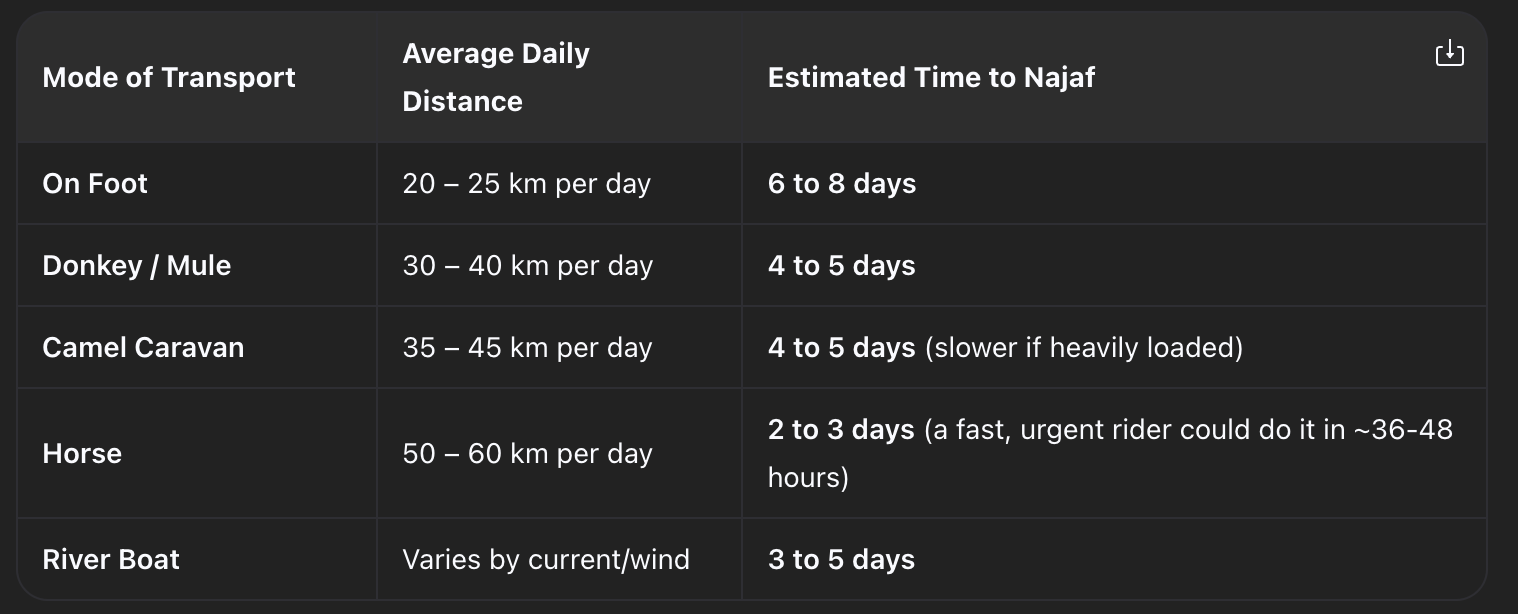
And while I am correcting numbers: Najaf is about a 150 kilometres south of Baghdad — some 90 miles — a journey of days in each direction.
Had he gone on foot, which was the most common mode of transport for such journeys in that time, it would have taken him anything between 6 and 8 days - travelling at around 20 to 25km per day.
Even if he had gone by horse — the fastest mode of transport available at the time — it would have taken him between 2 to 3 days, perhaps if he rode urgently he could make it in 2 days.
I have provided a table breaking down these times and distance as a reference, and you can find it in the write-up:
A sentence can be true and still hand somebody the wrong picture — and when it does, the fault belongs to the speaker and not to the listener.
I left a hole where a name should have been, eleven lines from the word Najaf, and the mind does with a hole what it always does.
It fills it with whatever is nearest.
And there is a reason that hole was there, and it is the same reason the arithmetic went wrong.
I abridged the passage.
I put an ellipsis into the middle of a transmitted text.
The clause I cut is the clause that names where the visiting stops.
The report I did not read out is the one that gives the man’s name.
We have a rule in this series that transmitted text is never abridged.
I broke it — and the abridgement is precisely what hid the error from me.
That is not a coincidence.
That is what the rule is for.
So here is the passage again.
This time complete, and this time with the name.
The report immediately before it, in the same book, gives the address:
قَالَ أَبُو نَصْرٍ هِبَةُ اللهِ بْنُ مُحَمَّدٍ: وَقَبْرُ عُثْمَانَ بْنِ سَعِيدٍ بِالْجَانِبِ الْغَرْبِيِّ مِنْ مَدِينَةِ السَّلَامِ، فِي شَارِعِ الْمَيْدَانِ، فِي أَوَّلِ الْمَوْضِعِ الْمَعْرُوفِ بِدَرْبِ جَبَلَةَ فِي مَسْجِدِ الدَّرْبِ يَمْنَةَ الدَّاخِلِ إِلَيْهِ، وَالْقَبْرُ فِي نَفْسِ قِبْلَةِ الْمَسْجِدِ
“Abu Nasr Hibatullah ibn Muhammad said: The grave of Uthman ibn Sa’id is on the western side of the City of Peace, in the Street of the Maydan, at the head of the place known as Darb Jubala, in the mosque of the darb, on the right of the one entering — and the grave is in the very qibla of the mosque.”
— Shaykh al-Tusi, Kitab al-Ghayba, Hadith 320
عُثْمَانُ بْنُ سَعِيدٍ
Uthman ibn Sa’id al-Amri
Not a grave in Najaf.
A grave in Baghdad — and it belongs to the first of the Four Deputies of the Imam of our Age, may God hasten his return, Uthman ibn Sa’id al-Amri, who we met in Session Forty-Nine.
And I am not going to tell you what the eleventh Imam said about him.
I am going to read it to you, because this series does not paraphrase an Imam.
The setting is Surra Man Ra’a.
A delegation has arrived from Yemen carrying money, and the Imam has sent his servant to fetch Uthman ibn Sa’id and told him in front of the room:
Go, Uthman, for you are the agent and the trusted one entrusted with the wealth of God, and take from these Yemeni men what they have brought.
And then the room speaks.
ثُمَّ سَاقَ الْحَدِيثَ إِلَى أَنْ قَالَا: ثُمَّ قُلْنَا بِأَجْمَعِنَا: يَا سَيِّدَنَا! وَاللهِ إِنَّ عُثْمَانَ لَمِنْ خِيَارِ شِيعَتِكَ، وَلَقَدْ زِدْتَنَا عِلْمًا بِمَوْضِعِهِ مِنْ خِدْمَتِكَ، وَأَنَّهُ وَكِيلُكَ وَثِقَتُكَ عَلَى مَالِ اللهِ تَعَالَى. قَالَ: نَعَمْ، وَاشْهَدُوا عَلَى أَنَّ عُثْمَانَ بْنَ سَعِيدٍ الْعَمْرِيَّ وَكِيلِي، وَأَنَّ ابْنَهُ مُحَمَّدًا وَكِيلُ ابْنِي مَهْدِيِّكُمْ
“Then he carried the report on until the two of them said: Then we said, all of us together: ‘Our master! By God, Uthman is indeed among the best of your Shi’a, and you have increased our knowledge of his standing in your service, and that he is your agent and your trusted one over the wealth of God, exalted is He.’ He said: ‘Yes — and bear witness that Uthman ibn Sa’id al-Amri is my agent, and that his son Muhammad is the agent of my son, your Mahdi.’”
— Shaykh al-Tusi, Kitab al-Ghayba, Hadith 317, continuing the report of the Yemeni delegation at Surra Man Ra’a
وَكِيل
Wakil
An agent — the one who acts for you when you are not there to act for yourself.
It is a legal word before it is a devotional one; you appoint a wakil to sell your house or to conclude your marriage.
The word carries no mystery in it at all.
It is the language of power of attorney.
And it is said twice in one breath.
وَكِيلِي
— my agent.
وَكِيلُ ابْنِي مَهْدِيِّكُمْ
— the agent of my son, your Mahdi.
An office named while the office-holder’s principal is still alive, and the next holder named in the same sentence, for a principal who has not yet needed one.
That is whose door he was knocking on every month.
And now the sentence I misread.
Here it is complete:
قَالَ مُحَمَّدُ بْنُ الْحَسَنِ مُصَنِّفُ هَذَا الْكِتَابِ: رَأَيْتُ قَبْرَهُ فِي الْمَوْضِعِ الَّذِي ذَكَرَهُ، وَكَانَ بُنِيَ فِي وَجْهِهِ حَائِطٌ وَبِهِ مِحْرَابُ الْمَسْجِدِ، وَإِلَى جَنْبِهِ بَابٌ يُدْخَلُ إِلَى مَوْضِعِ الْقَبْرِ فِي بَيْتٍ ضَيِّقٍ مُظْلِمٍ، فَكُنَّا نَدْخُلُ إِلَيْهِ وَنَزُورُهُ مُشَاهَرَةً، وَكَذَلِكَ مِنْ وَقْتِ دُخُولِي إِلَى بَغْدَادَ، وَهِيَ سَنَةُ ثَمَانٍ وَأَرْبَعِمِائَةٍ إِلَى سَنَةِ نَيِّفٍ وَثَلَاثِينَ وَأَرْبَعِمِائَةٍ. ثُمَّ نَقَضَ ذَلِكَ الْحَائِطَ الرَّئِيسُ أَبُو مَنْصُورٍ مُحَمَّدُ بْنُ الْفَرَجِ وَأَبْرَزَ الْقَبْرَ إِلَى بَرَّا وَعَمِلَ عَلَيْهِ صُنْدُوقًا، وَهُوَ تَحْتَ سَقْفٍ يَدْخُلُ إِلَيْهِ مَنْ أَرَادَهُ وَيَزُورُهُ، وَيَتَبَرَّكُ جِيرَانُ الْمَحَلَّةِ بِزِيَارَتِهِ وَيَقُولُونَ: هُوَ رَجُلٌ صَالِحٌ، وَرُبَّمَا قَالُوا: هُوَ ابْنُ دَايَةِ الْحُسَيْنِ عَلَيْهِ السَّلَامُ، وَلَا يَعْرِفُونَ حَقِيقَةَ الْحَالِ فِيهِ، وَهُوَ إِلَى يَوْمِنَا هَذَا — وَذَلِكَ سَنَةُ سَبْعٍ وَأَرْبَعِينَ وَأَرْبَعِمِائَةٍ — عَلَى مَا هُوَ عَلَيْهِ
“Said Muhammad ibn al-Hasan, the author of this book: I saw his grave in the place which he mentioned. A wall had been built across the face of it, and the mihrab of the mosque was in that wall; and beside it a door through which one enters to the place of the grave, in a narrow dark room. And we used to go in to him and visit him month by month — and so it was from the time of my entering Baghdad, which is the year four hundred and eight, to the year four hundred and thirty-odd. Then the chief Abu Mansur Muhammad ibn al-Faraj pulled that wall down and brought the grave out into the open and made a casket over it, and it is under a roof, and whoever wishes goes in to it and visits it. And the neighbours of the quarter seek blessing by visiting it, and they say: he is a righteous man — and sometimes they say: he is the son of the wet-nurse of Husayn, peace and blessings be upon him. And they do not know the truth of his case. And it remains, to this day of ours — and that is the year four hundred and forty-seven — as it is.”
— Shaykh al-Tusi, Kitab al-Ghayba — the author’s own comment, appended immediately after Hadith 320. It carries no hadith number of its own: it is not a report he is transmitting, it is Shaykh al-Tusi speaking in the first person inside his own book. Hadith 321 is a different report altogether
Look at where the sentence actually stops.
إِلَى سَنَةِ نَيِّفٍ وَثَلَاثِينَ
Ila sanati nayyifin wa-thalathin.
To the year four hundred and thirty-odd.
Nayyif is the classical Arabic for “and a bit” — he will not give you the year, because he does not remember the year.
And then the sentence turns:
ثُمَّ نَقَضَ ذَلِكَ الْحَائِطَ
— then he pulled that wall down.
The visiting has a terminus, and the terminus is a building works.
The 447 at the end is not the end of his visiting.
It is the date he is writing — and it remains, to this day of ours, as it is.
He is telling you the state of the grave, not the span of his devotion.
I read the first date and the last date, subtracted, and got thirty-nine.
The real figure is around twenty years, and he will not be more precise than that, so neither will I.
Now — the corrected version is a better sermon than the one I preached.
Because look at what the wall means.
For more than twenty years he was not visiting a shrine.
There was no shrine.
There was a wall with a prayer-niche built into it, and a door at the side, and a narrow dark room behind it, and you had to let yourself in.
And the people living on that street took blessing from it without the first idea whose it was.
That is not my inference — it is the clause I just read you, and here it is on its own:
وَيَتَبَرَّكُ جِيرَانُ الْمَحَلَّةِ بِزِيَارَتِهِ وَيَقُولُونَ: هُوَ رَجُلٌ صَالِحٌ، وَرُبَّمَا قَالُوا: هُوَ ابْنُ دَايَةِ الْحُسَيْنِ عَلَيْهِ السَّلَامُ، وَلَا يَعْرِفُونَ حَقِيقَةَ الْحَالِ فِيهِ
“And the neighbours of the quarter seek blessing by visiting it, and they say: he is a righteous man — and sometimes they say: he is the son of the wet-nurse of Husayn, peace and blessings be upon him. And they do not know the truth of his case.”
— the same passage: Shaykh al-Tusi’s own comment following Kitab al-Ghayba, Hadith 320
يَتَبَرَّكُ
Yatabarrak
They seek baraka from it.
Not curiosity — devotion or blessings.
وَلَا يَعْرِفُونَ حَقِيقَةَ الْحَالِ فِيهِ
Wa la ya’rifuna haqiqat al-hali fih
And they do not know the truth of his case.
Which is, if you think about it for a moment, the condition of every one of us in front of the Imam of our Age, may God hasten his return.
A hidden grave, visited monthly, by a man who would spend his life serving the cause of, teaching and indeed writing one of the most seminal books on a hidden Imam.
Twenty-odd years of standing in the dark in front of somebody who is not there and whose importance nobody around you can see.
He was not preparing to write Kitab al-Ghayba.
But nobody has ever been better prepared.
The Year He Wrote It Down Himself
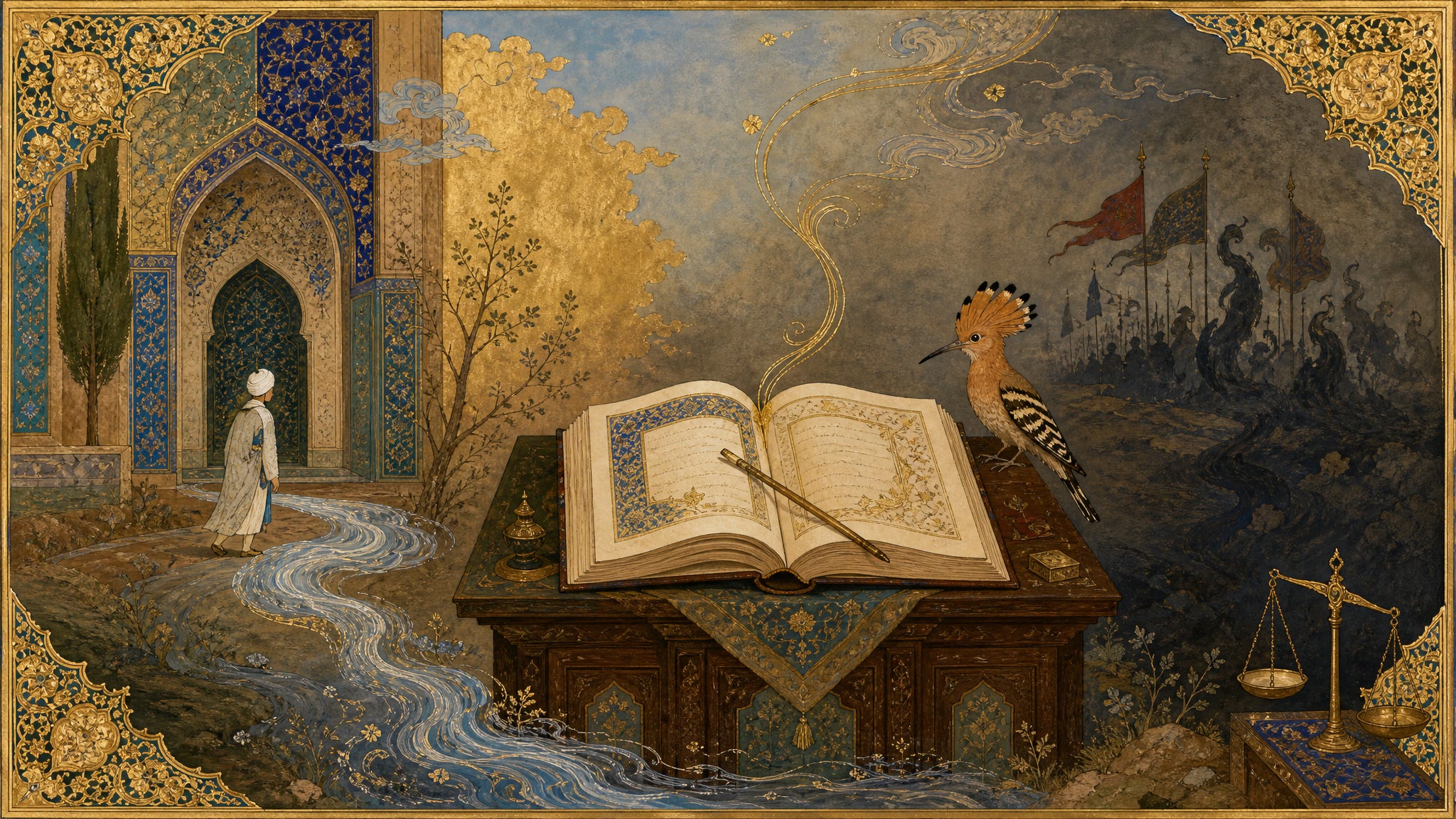
Before he lost anything, he left us a date in his own hand.
In Kitab al-Ghayba — the foundational work of our school on the Occultation — he is answering an objection about the age of the Imam of our Age, may our souls be his ransom and may God hasten his return.
And in the middle of the answer he stops to say what year it is.
لِأَنَّهُ عَلَىٰ قَوْلِكُمْ لَهُ فِي هَٰذَا الْوَقْتِ الَّذِي هُوَ سَنَةُ سَبْعٍ وَأَرْبَعِينَ وَأَرْبَعِمِائَةٍ مِائَةٌ وَإِحْدَىٰ وَتِسْعُونَ سَنَةً، لِأَنَّ مَوْلِدَهُ عَلَىٰ قَوْلِكُمْ سَنَةَ سِتٍّ وَخَمْسِينَ وَمِائَتَيْنِ
“…because, on your account, he is at this present time — which is the year four hundred and forty-seven — a hundred and ninety-one years old; for his birth, on your account, was in the year two hundred and fifty-six.”
— Shaykh al-Tusi, Kitab al-Ghayba
447.
That is the year Tughril Beg entered Baghdad.
He is writing the book in the middle of it.
And there is a second passage, later in the same work, and it is the one I cannot get out of my head.
He is talking about a grave in Baghdad — the grave of one of the four deputies — and he says:
رَأَيْتُ قَبْرَهُ فِي الْمَوْضِعِ الَّذِي ذَكَرَهُ… فَكُنَّا نَدْخُلُ إِلَيْهِ وَنَزُورُهُ مُشَاهَرَةً، وَكَذَٰلِكَ مِنْ وَقْتِ دُخُولِي إِلَىٰ بَغْدَادَ، وَهِيَ سَنَةُ ثَمَانٍ وَأَرْبَعِمِائَةٍ إِلَىٰ سَنَةِ نَيِّفٍ وَثَلَاثِينَ وَأَرْبَعِمِائَةٍ… وَهُوَ إِلَىٰ يَوْمِنَا هَٰذَا — وَذَٰلِكَ سَنَةُ سَبْعٍ وَأَرْبَعِينَ وَأَرْبَعِمِائَةٍ — عَلَىٰ مَا هُوَ عَلَيْهِ
“I saw his grave in the place he mentioned… and we used to go in to him and visit him month by month — and so it was from the time of my entering Baghdad, which is the year four hundred and eight, until the year four hundred and thirty-something… and it is, to this day of ours — and that is the year four hundred and forty-seven — as it was.”
— Shaykh al-Tusi, Kitab al-Ghayba
مُشَاهَرَة
Mushaharatan
Month by month.
The word is built on shahr, a month, in the pattern Arabic keeps for things done by arrangement between two parties — the way muqatala is fighting between two sides.
He is not saying he went often.
He is saying he and that grave had an arrangement.
He came to Baghdad as a young man in 408 and he went to that grave every month.
And within two years of writing that sentence he will have to leave it.
He Left
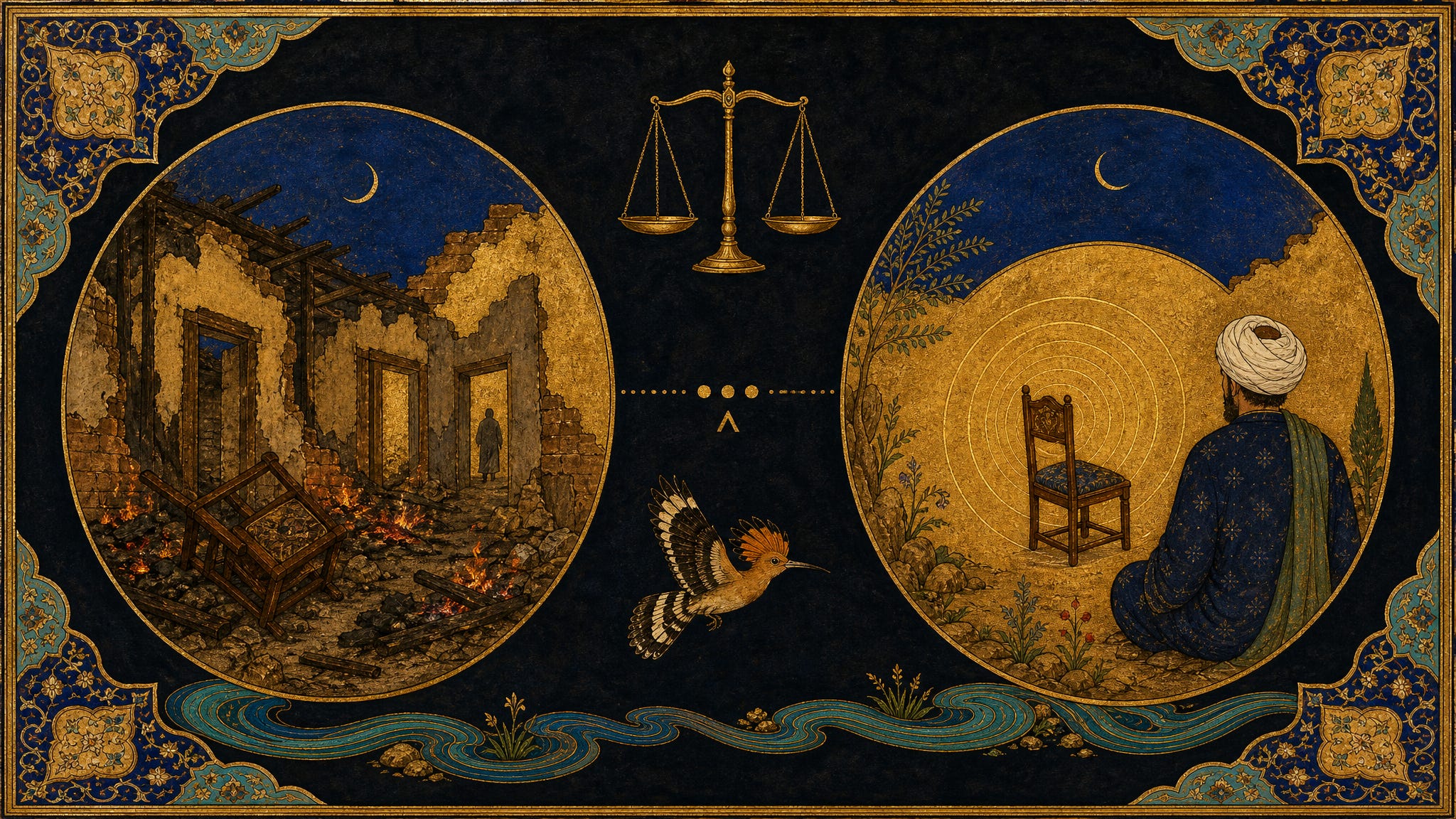
The chronicles record the fire.
And then they record that he left.
He went into hiding — and he went into hiding, in fear for his life, as we read — and then he moved south, and settled at the shrine, and taught.
And now I have to tell you something about that move, and it is the kind of thing we normally leave out.
Not one chronicle says and therefore he went to Najaf.
They record the fire.
Then, separately, they record that he left.
The line between those two facts is drawn by us.
It is not drawn by them.
It is a very reasonable line to draw.
A man’s house is broken into twice in two years, his life’s tools are burned in the street, and then he leaves the city.
You do not need a document for that.
But I am telling you it is an inference and not a record — because I would rather you trusted me on the next thing I say.
What Is Documented, And It Is Enough
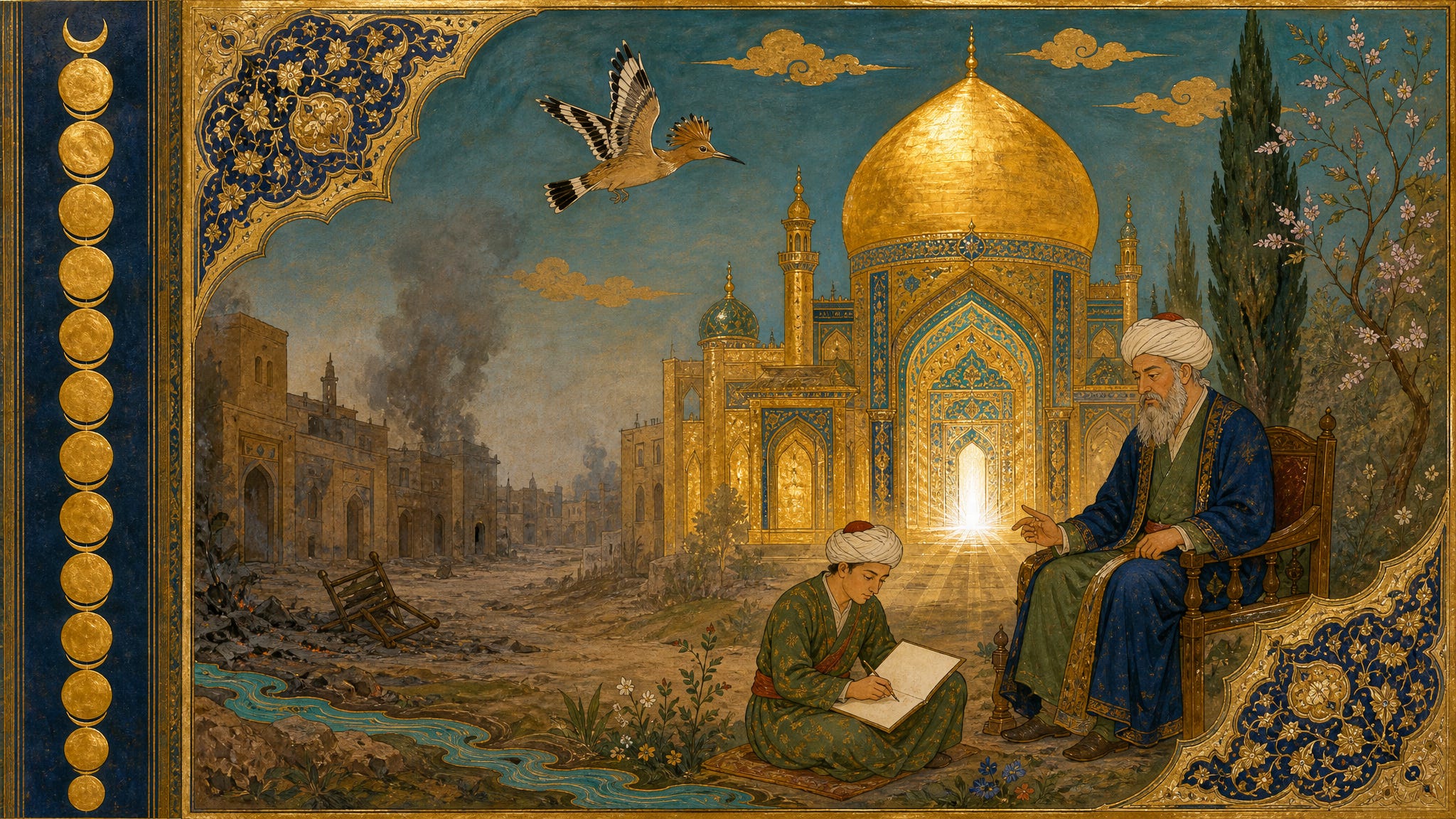
447: he is working in Baghdad, and dates the book himself.
448: he flees; the house is plundered.
Safar, 449: the burning.
450: he goes out with his family and his children to the grave of Imam Ali ibn Abi Talib, peace and blessings be upon him, at Najaf.
455: he is at the shrine, dictating — and I will come back in a moment to exactly how firmly I can say that.
Six years after the fire, he has a class again.
456 to 458, and probably earlier: he is dictating the Amali, and his son is writing them down.
And I can put the book in front of you, because I have had it open.
Volume One is arranged in parts, and every part is headed with the month he dictated it in.
الْجُزْءُ الثَّامِنُ أَمْلَاهُ فِي صَفَرٍ سَنَةَ سِتٍّ وَخَمْسِينَ وَأَرْبَعِمِائَةٍ وَفِيهِ أَرْبَعٌ وَخَمْسُونَ حَدِيثًا
“The eighth part, which he dictated in Safar of the year four hundred and fifty-six, and in it are fifty-four hadith.”
الْجُزْءُ الْحَادِي عَشَرَ أَمْلَاهُ فِي جُمَادَى الْأُولَى سَنَةَ سِتٍّ وَخَمْسِينَ وَأَرْبَعِمِائَةٍ وَفِيهِ مِائَةٌ وَسِتَّةُ أَحَادِيثَ
“The eleventh part, which he dictated in Jumada al-Ula of the year four hundred and fifty-six, and in it are one hundred and six hadith.”
— Shaykh al-Tusi, Amali al-Shaykh al-Tusi, Volume One, from the index of parts. Al-Maktaba al-Ahliyya, Baghdad; Matba’at al-Nu’man, Najaf al-Ashraf, 1384/1965, with an introduction by Sayyid Muhammad Sadiq Bahr al-Ulum
أَمْلَاهُ
Amlahu
He dictated it.
That is the verb the book is named for — amali, dictations.
Not he wrote it.
A man speaking slowly enough for a room to keep up.
And now turn to where that eleventh part actually begins, on page 291, and read the first line of it — because the chain tells you where the room was.
( أَخْبَرَنَا ) الشَّيْخُ الْأَجَلُّ الْإِمَامُ الْمُفِيدُ أَبُو عَلِيٍّ الْحَسَنُ بْنُ مُحَمَّدٍ الطُّوسِيُّ رَضِيَ اللهُ عَنْهُ بِمَشْهَدِ مَوْلَانَا أَمِيرِ الْمُؤْمِنِينَ عَلِيِّ بْنِ أَبِي طَالِبٍ صَلَوَاتُ اللهِ عَلَيْهِ وَآلِهِ، قَالَ: حَدَّثَنَا الشَّيْخُ الْإِمَامُ السَّعِيدُ الْوَالِدُ أَبُو جَعْفَرٍ مُحَمَّدُ بْنُ الْحَسَنِ بْنِ عَلِيٍّ الطُّوسِيُّ رِضْوَانُ اللهِ عَلَيْهِ بِمَشْهَدِ مَوْلَانَا أَمِيرِ الْمُؤْمِنِينَ عَلِيِّ بْنِ أَبِي طَالِبٍ صَلَوَاتُ اللهِ عَلَيْهِ وَآلِهِ فِي جُمَادَى الْأُولَى مِنْ سَنَةِ سِتٍّ وَخَمْسِينَ وَأَرْبَعِمِائَةٍ
“We were informed by the most illustrious shaykh, the Imam al-Mufid, Abu Ali al-Hasan ibn Muhammad al-Tusi, may God be pleased with him — at the shrine of our master the Commander of the Faithful, Ali ibn Abi Talib, God’s blessings be upon him and his family — who said: There narrated to us the shaykh, the felicitous Imam, my father, Abu Ja’far Muhammad ibn al-Hasan ibn Ali al-Tusi, God’s pleasure be upon him — at the shrine of our master the Commander of the Faithful, Ali ibn Abi Talib, God’s blessings be upon him and his family, in Jumada al-Ula of the year four hundred and fifty-six.“
— Shaykh al-Tusi, Amali al-Shaykh al-Tusi, Volume One, Page 291, opening the eleventh part
Stop on that, because it is the whole session in one sentence.
بِمَشْهَدِ مَوْلَانَا أَمِيرِ الْمُؤْمِنِينَ
Bi-mashhadi mawlana amir al-mu’minin
At the shrine of our master, the Commander of the Faithful.
Mashhad — the place where somebody is witnessed.
It is the same root as shahada.
Notice who is speaking.
الْوَالِدُ
— al-walid
my father.
This is not a clerk minuting a venue.
This is his son, writing down where he took the book from his own father.
And notice what is being recorded, because a man does not write this unless it matters to him: not just the date — the place.
Twice.
He puts the shrine in the chain itself, the way another man would put a city or a mosque.
Seven years earlier they carried that father’s chair into a street in Karkh and burned it in front of a crowd, so that there would be nowhere for him to sit and nobody to sit in front of.
And here is his son, at a grave in the desert, writing down the address.
And then look at what happens by Volume Two.
The parts become a weekly class, and the headings start giving the day.
مَجْلِسُ يَوْمِ الْجُمُعَةِ — الرَّابِعُ مِنَ الْمُحَرَّمِ سَنَةَ سَبْعٍ وَخَمْسِينَ وَأَرْبَعِمِائَةٍ
“Session of Friday — the fourth of Muharram, in the year four hundred and fifty-seven.”
— the same work, Volume Two, Page 138
And then the next Friday.
And the one after that.
The index of that volume is a list of Fridays — the twenty-sixth of Muharram, the eleventh of Safar, the seventeenth, the twenty-fourth, the ninth of Rabi al-Awwal, the sixteenth, the twenty-third, the thirtieth — on through Rajab and Sha’ban and Ramadan and out the other side of the year:
مَجْلِسُ يَوْمِ الْجُمُعَةِ — السَّادِسُ مِنْ صَفَرٍ سَنَةَ ثَمَانٍ وَخَمْسِينَ وَأَرْبَعِمِائَةٍ
“Session of Friday — the sixth of Safar, in the year four hundred and fifty-eight.”
— the same work, Volume Two, Page 343
Stop and see what you are looking at.
That is not a man who has survived something.
That is a diary.
Friday.
Friday.
Friday.
A room, a date, a number of hadith, and a son at the side with a pen — for more than a year without a gap.
They took his chair in Safar of 449.
By Muharram of 457 he is running a weekly class and someone is minuting it.
Muharram of the year 460 — 1067 of the common era — he dies.
Our later biographers give the 22nd of the month; the chronicles do not, so I will say Muharram and leave the day where I found it.
And by his own will he is buried in his own house.
And the house is made a mosque.
Now count with me.
From the fire in the street to the first dated dictation at the shrine: six years.
Then he taught there another five, and died in the room.
From the fire to the grave: ten years and eleven months.
Call it nearly eleven years.
They emptied a house in Karkh.
And he answered by building a house beside a grave, and never leaving it.
The Books Are Still Here
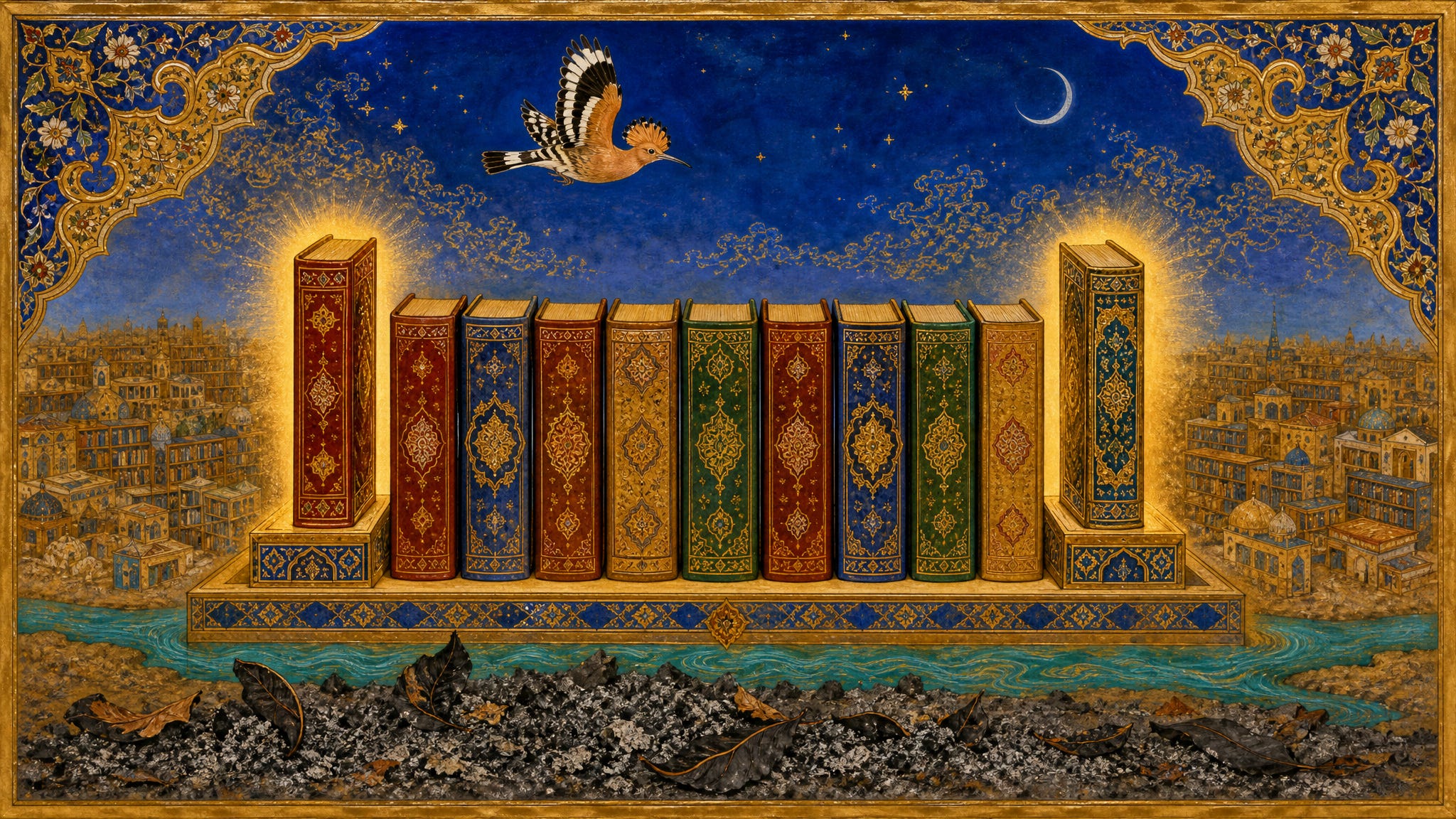
Tahdhib al-Ahkam.
Al-Istibsar.
Al-Tibyan.
Al-Nihaya.
Al-Mabsut.
Al-Fihrist.
Al-Rijal.
Kitab al-Ghayba.
Misbah al-Mutahajjid.
The Amali.
Every one of those is on shelves across the world tonight.
Two of them are among the four books on which our entire jurisprudence stands.
Not one work of his first rank is lost.
They burned his notebooks in the street, publicly, more than once — and the corpus did not lose a page.
Now.
How?
Lessons For Our Time
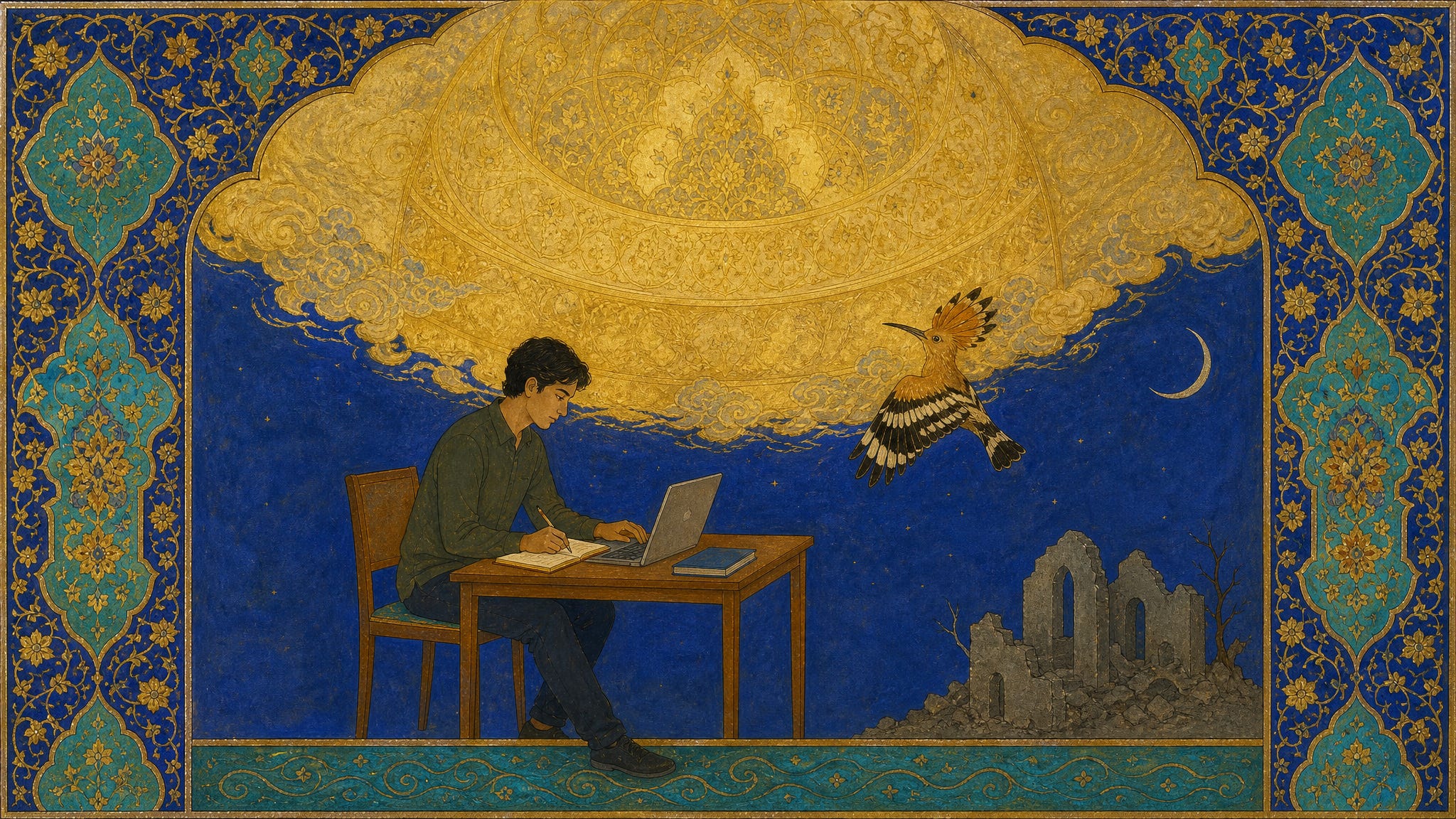
And one lesson, and it is the only one this point needs — a defeat becomes a founding when somebody keeps working inside it.
Not because it was a defeat.
Exile is usually just exile.
Most people driven out of a city are simply people who were driven out of a city, and nothing is founded, and we do not know their names.
He did not go south to found anything.
He went because his house had been broken into twice and his life’s tools were ash in a street.
And six years later he sat down on the floor beside a grave and began dictating again.
That is the whole of it.
He did not preserve.
He did not wait for conditions to improve.
He did not write an account of what had been done to him, and God knows he had the material.
He went back to the ordinary work — in a worse room, in front of fewer people.
A thousand years later that room is one of the two or three most consequential places in our history.
He died with no way of knowing that.
You do not get to know, at the time, which of your defeats is a founding.
You only get to choose whether you are still working when the answer arrives.
The Answer Is A Piece Of Paper
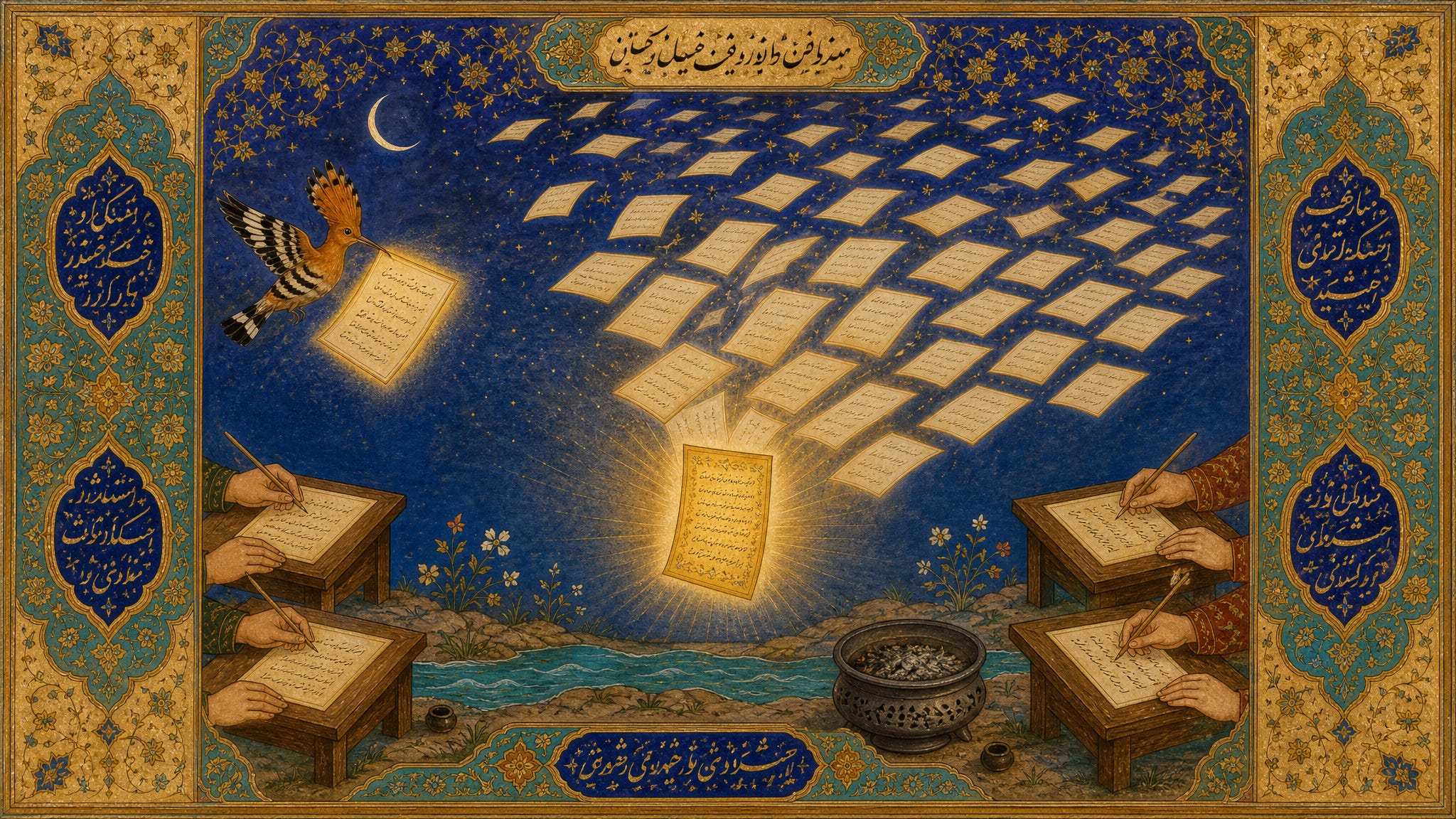
Why the fire failed before it was lit.
The Answer Is A Piece Of Paper
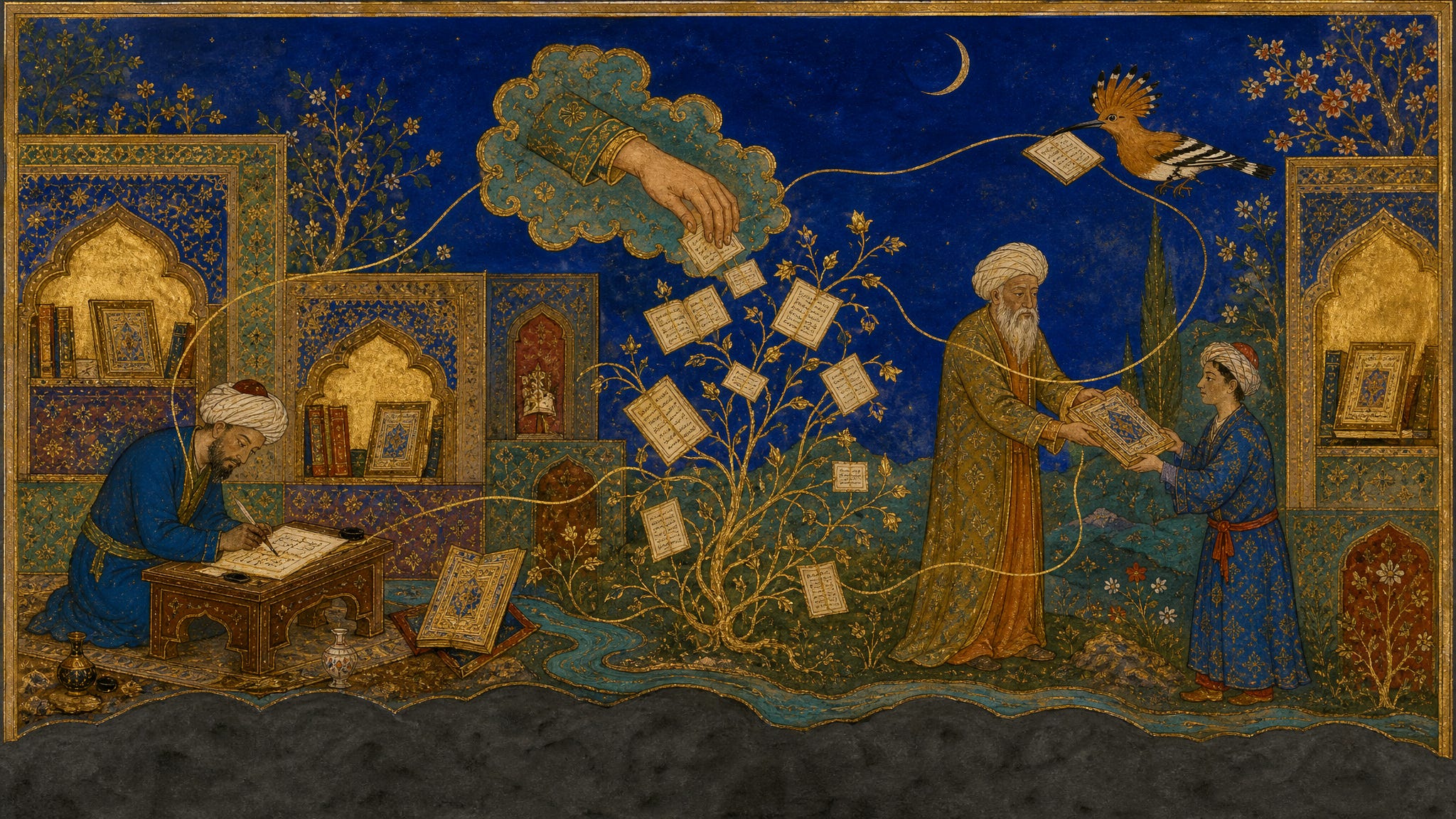
Because the books were never in the house.
I do not mean he kept spare copies somewhere, though he may have.
I mean something much more fundamental about how this religion moves.
And I am not going to argue it from a modern history of manuscripts.
I am going to argue it from our own hadith — because it turns out the instruction was given to us three centuries before anybody set fire to anything.
There is a chapter in al-Kafi, in the Book of the Excellence of Knowledge, called the Chapter on the Transmission of Books and Hadith.
Listen to what is in it.
عَنْ عُبَيْدِ بْنِ زُرَارَةَ قَالَ: قَالَ أَبُو عَبْدِ اللهِ عَلَيْهِ السَّلَامُ: احْتَفِظُوا بِكُتُبِكُمْ فَإِنَّكُمْ سَوْفَ تَحْتَاجُونَ إِلَيْهَا
“From Ubayd ibn Zurara, who said: Abu Abdillah, peace and blessings be upon him, said: ‘Guard your books carefully, for you will have need of them.’”
— Al-Kulayni, Al-Kafi, Kitab Fadl al-Ilm, chapter on the transmission of books and hadith, Hadith 10; graded موثق كالصحيح — trustworthy, like the sound — by al-Majlisi
Guard your books.
You will need them.
Imam Ja’far al-Sadiq, peace and blessings be upon him, said that in the second century.
Somebody wrote it down.
Somebody copied it.
And three hundred years later a man in Baghdad watched his own burn in the street — and the sentence survived, because it had been copied out by people who were told to guard it.
And it goes further.
There is an instruction in that same chapter about what to do with your books when you die.
عَنِ الْمُفَضَّلِ بْنِ عُمَرَ قَالَ: قَالَ لِي أَبُو عَبْدِ اللهِ عَلَيْهِ السَّلَامُ: اكْتُبْ وَبُثَّ عِلْمَكَ فِي إِخْوَانِكَ، فَإِنْ مِتَّ فَأَوْرِثْ كُتُبَكَ بَنِيكَ، فَإِنَّهُ يَأْتِي عَلَى النَّاسِ زَمَانُ هَرْجٍ لَا يَأْنَسُونَ فِيهِ إِلَّا بِكُتُبِهِمْ
“From al-Mufaddal ibn Umar, who said: Abu Abdillah, peace and blessings be upon him, said to me: ‘Write, and scatter your knowledge among your brethren; and if you die, then bequeath your books to your sons — for there will come upon people a time of turmoil in which they will find comfort in nothing but their books.’”
— Al-Kafi, Kitab Fadl al-Ilm, chapter on the transmission of books and hadith, Hadith 11; the chain is graded ضعيف على المشهور — weak according to the well-known view — and I tell you that because I would rather you knew it
Now. I have quoted that sentence to you before and I quoted it short, and I was wrong to, so here is the end of it, which is the part that matters tonight.
فَإِنَّهُ يَأْتِي عَلَى النَّاسِ زَمَانُ هَرْجٍ
Fa-innahu ya’ti ala’l-nasi zamanu harjin
For there will come upon people a time of harj.
Harj is not ordinary trouble.
It is the word for the killing time — the tumult in which order goes and people cannot tell who is who.
لَا يَأْنَسُونَ فِيهِ إِلَّا بِكُتُبِهِمْ
La ya’nasuna fihi illa bi-kutubihim.
They will find no uns — no companionship, no being-at-ease — except with their books.
Sit with the shape of that sentence for a moment.
Write.
Scatter.
Bequeath.
Because a time is coming when the only thing left in the room with you will be the pages.
Said in the second century, in Madinah.
Read aloud in a house in Karkh three hundred years later by a man who was about to watch his own go up in the street.
And one more, from the same chapter, and it is short:
عَنْ أَبِي بَصِيرٍ قَالَ: سَمِعْتُ أَبَا عَبْدِ اللهِ عَلَيْهِ السَّلَامُ يَقُولُ: اكْتُبُوا فَإِنَّكُمْ لَا تَحْفَظُونَ حَتَّى تَكْتُبُوا
“From Abu Basir, who said: I heard Abu Abdillah, peace and blessings be upon him, saying: ‘Write — for you will not retain until you write.’”
— Al-Kafi, same chapter, Hadith 9; the chain is likewise graded ضعيف على المشهور
اكْتُبُوا
Uktubu
Write (plural form)
Now it is plural, and now it is everybody.
Not if you are scholarly.
Not if you have a good hand.
Write — because the head does not hold it.
And there is one in that chapter that is almost unbearable in the light of what happened to this man.
قُلْتُ لِأَبِي جَعْفَرٍ الثَّانِي عَلَيْهِ السَّلَامُ: جُعِلْتُ فِدَاكَ، إِنَّ مَشَايِخَنَا رَوَوْا عَنْ أَبِي جَعْفَرٍ وَأَبِي عَبْدِ اللهِ عَلَيْهِمَا السَّلَامُ، وَكَانَتِ التَّقِيَّةُ شَدِيدَةً فَكَتَمُوا كُتُبَهُمْ وَلَمْ تُرْوَ عَنْهُمْ، فَلَمَّا مَاتُوا صَارَتِ الْكُتُبُ إِلَيْنَا. فَقَالَ: حَدِّثُوا بِهَا فَإِنَّهَا حَقٌّ
“I said to Abu Ja’far the Second, peace and blessings be upon him: ‘May I be made your ransom — our shaykhs narrated from Abu Ja’far and Abu Abdillah, peace and blessings be upon them, and prudence was severe, so they concealed their books and they were not narrated from them. And when they died, the books came down to us.’ He said: ‘Narrate from them, for they are true.’”
— Al-Kafi, same chapter, Hadith 15; chain graded مجهول — its narrator unknown.
فَكَتَمُوا كُتُبَهُمْ
Fa-katamu kutubahum
They concealed their books.
Men who could not teach in their own lifetimes, writing anyway.
Books that sat in houses unread while their owners were alive, because it was not safe.
And then the owners died — and the books walked.
That is the mechanism, stated by an Imam, peace and blessings be upon him, in the third century.
A book can outlive the silence of the man who wrote it.
وَبُثَّ
Wa buththa
And scatter.
Bathth is not the word for handing something over; it is the word for strewing seed, for a thing let loose in every direction at once — the same root the Qur’an uses for creatures scattered across the earth.
Not pass it on, which is one hand to one hand.
Broadcast it.
Do not keep it in one place.
That is the whole of tonight, and it is an instruction from an Imam, peace and blessings be upon him, and it is three hundred years early.
And there is one more, and this one is the ijaza — permission — itself, in the form of a question somebody actually asked:
قُلْتُ لِأَبِي الْحَسَنِ الرِّضَا عَلَيْهِ السَّلَامُ: الرَّجُلُ مِنْ أَصْحَابِنَا يُعْطِينِي الْكِتَابَ وَلَا يَقُولُ ارْوِهِ عَنِّي، يَجُوزُ لِي أَنْ أَرْوِيَهُ عَنْهُ؟ قَالَ: إِذَا عَلِمْتَ أَنَّ الْكِتَابَ لَهُ فَارْوِهِ عَنْهُ
“I said to Abu al-Hasan al-Rida, peace and blessings be upon him: ‘A man from our companions gives me a book but does not say “narrate it from me.” Is it permitted for me to narrate it from him?’ He said: ‘If you know the book is his, then narrate it from him.’”
— Al-Kafi, Kitab Fadl al-Ilm, same chapter, Hadith 6; the chain is مرسل — broken — and I say so rather than let you find out
Do you understand what that question is?
That is a man asking about a licence.
That is somebody in the third century worrying about whether he has permission to transmit a book — which is the exact machinery that saved this corpus two hundred years later.
The system was already running.
Books written.
Books scattered.
Books inherited.
Permission asked for, and granted, person to person.
And a licence lives in a person.
You cannot raid a licence.
What The Thing Actually Was, And Who Was Not Allowed To Issue One
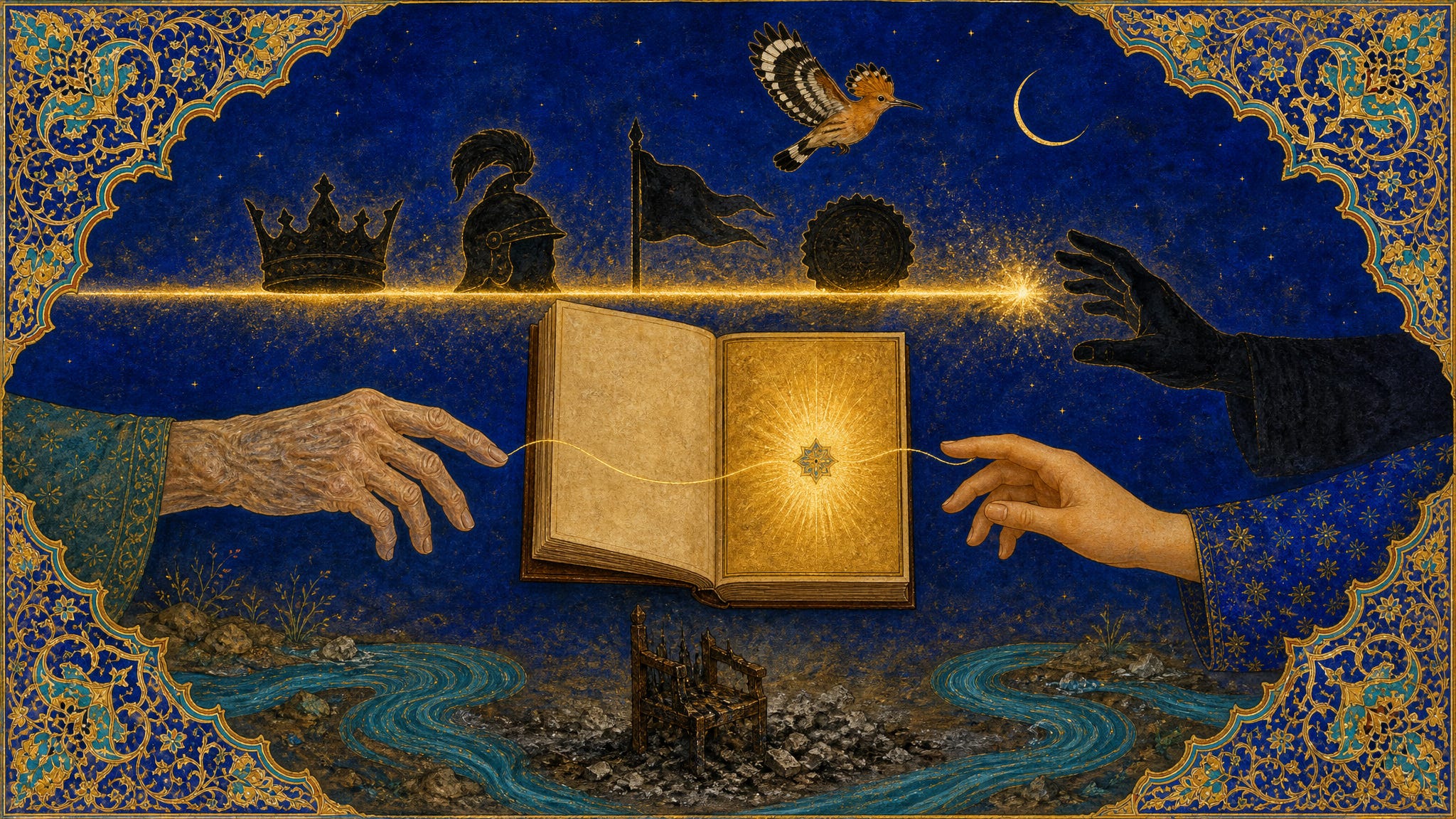
Let me stop being poetic and tell you what an ijaza physically looked like, because it matters.
It was a few lines of writing.
And in this period it was usually not filed anywhere at all — it was written on the book itself.
“During the early period, the ijāzah (licence) was usually written upon the fly-leaf of the book studied.”
— Mesut Idriz, “Educational Tradition of Ijāzah in Islamic History”, Journal of Islamic Thought and Civilization, Volume 12, Number 2 (2022), Page 183
Understand what that means practically.
The permission and the text travel in the same bag.
There is no separate register to seize, no office to raid, no archive to burn.
If a man has the book, the book is carrying its own authorisation on the inside of the front cover.
And what is written on it?
“Finally, the ijāzah normally ends with a prayer, date of issue, and professor’s ratification of the ijāzah either by seal or signature, or both. Yet the institution where the teaching has taken place is rarely mentioned.”
— Idriz, Page 186
The institution is rarely mentioned.
A prayer, a date, and a man’s name.
And now the sentence that I want you to take home from this whole point, and it is written by a modern historian of Islamic education, not by us:
“Interestingly and uniquely, the authority and competence resided in the ʿālim, the learned man... Throughout its history down to modern times, the ijāzah remained a personal act of authorisation, from authorising ʿālim to the newly authorised one. The sovereign power had no part in the process: neither caliph, nor sultan, nor amīr, nor qādī, nor anyone else, could grant such an ijāzah.“
— George Makdisi, The Rise of Colleges (1981), Page 271, as quoted in Idriz, Page 184
Read that list again, slowly, and think about the year 449.
Not the caliph.
The caliph’s own chief minister signed the order that took the names off the doors.
Not the sultan.
The sultan was the new power in the city and had entered it in the month of Ramadan two years before.
Not the amir.
Not the judge.
Every single authority that could reach into Karkh and burn a chair — not one of them could issue, revoke, cancel or invalidate a single one of these pieces of paper.
They did not have the power.
It was never theirs to have.
The state can burn a building because the state can reach a building.
It has never once been able to reach a licence, because a licence is not a place — it is a relationship between two men, one of whom has already left.
And this is not a devotional reading.
It is how modern historians decide, from a distance of a thousand years, whether a scholarly community was alive at all:
“A good indicator of which ḥawza was the most prominent at a given time is the location in which influential scholars studied, lived, worked, and received and distributed teaching licenses (ijāzas). The issuance of ijāzas and scholarly output are both good indicators of how active a ḥawza is. A scholar on his own, however, without students, is not a ḥawza.”
— Zackery Heern, “One Thousand Years of Islamic Education in Najaf: Myth and History of the Shiʿi Ḥawza”, Iranian Studies (2017), Pages 2–3
The historians do not count buildings.
They count licences.
Hold that last clause, though, because it is a discipline and not a flourish —
a scholar on his own, without students, is not a hawza.
One man with a book is not a tradition.
The unit that survives is a man plus the people he has handed to.
Which is exactly why the next thing I show you is not a book.
It is a handover.
And Here Is One, With A Street Address
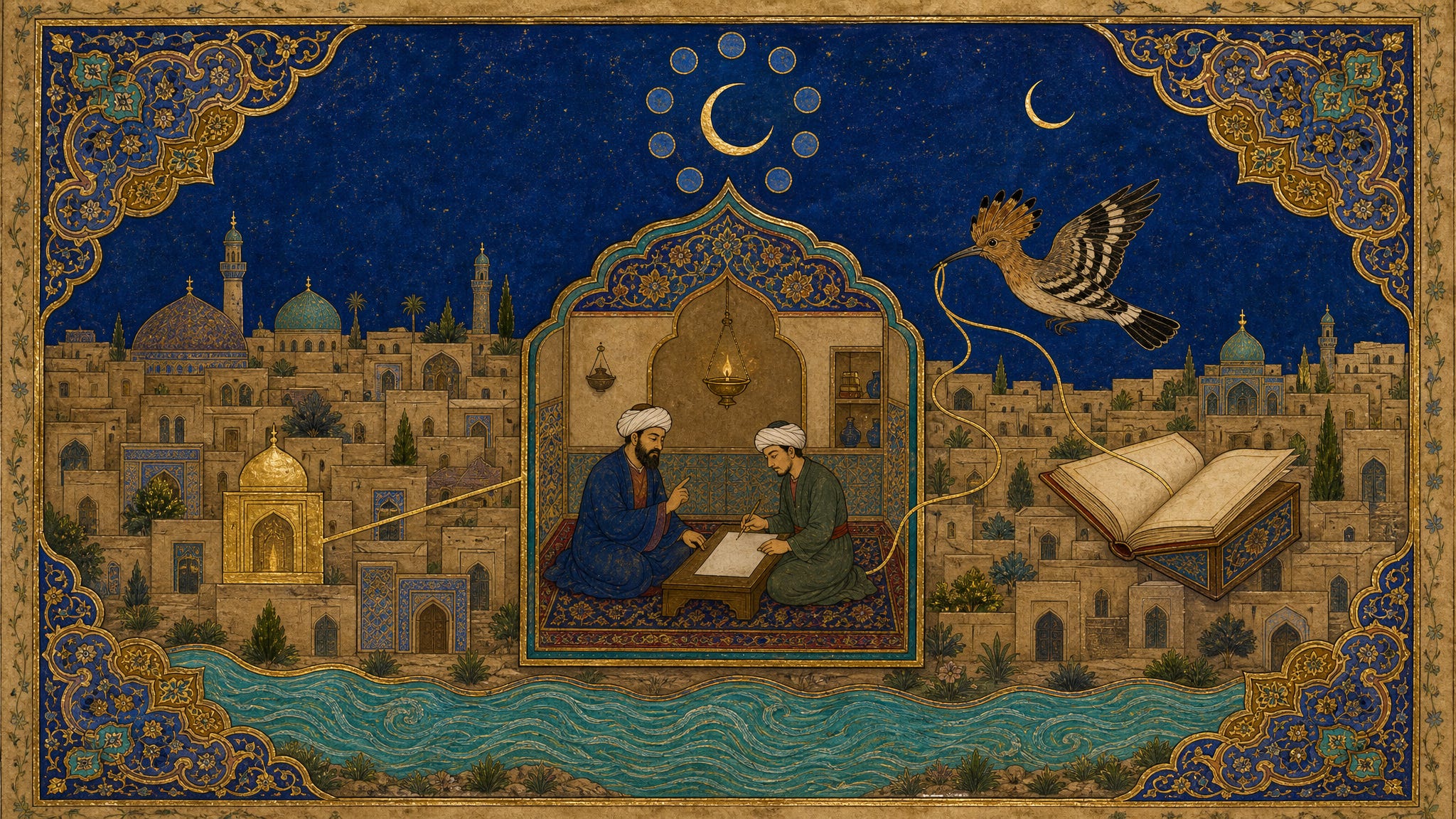
I said the licence carries a date and a name.
Let me prove it from the same book we have been reading all night — Kitab al-Ghayba, the book he was finishing in 447 while the city came apart.
وَأَخْبَرَنِي بِهَذِهِ الْحِكَايَةِ جَمَاعَةٌ عَنْ أَبِي غَالِبٍ أَحْمَدَ بْنِ مُحَمَّدِ بْنِ سُلَيْمَانَ الزُّرَارِيِّ رَحِمَهُ اللهُ إِجَازَةً، وَكَتَبَ عَنْهُ بِبَغْدَادَ أَبُو الْفَرَجِ مُحَمَّدُ بْنُ الْمُظَفَّرِ فِي مَنْزِلِهِ بِسُوَيْقَةِ غَالِبٍ فِي يَوْمِ الْأَحَدِ لِخَمْسٍ خَلَوْنَ مِنْ ذِي الْقَعْدَةِ سَنَةَ سِتٍّ وَخَمْسِينَ وَثَلَاثِمِائَةٍ
“And a group informed me of this account from Abu Ghalib Ahmad ibn Muhammad ibn Sulayman al-Zurari, God have mercy on him, by licence — and Abu al-Faraj Muhammad ibn al-Muzaffar wrote it down from him in Baghdad, in his house at Suwayqat Ghalib, on Sunday, five nights gone of Dhu al-Qa’da, in the year three hundred and fifty-six.”
— Shaykh al-Tusi, Kitab al-Ghayba, Hadith 257
إِجَازَةً
Ijazatan
By licence.
There is the word.
And look at what comes with it.
A city.
A street.
A house on that street.
A day of the week.
A date.
Sunday, the 25th of Dhu al-Qa’da, 356.
Somebody sat in somebody’s front room in Baghdad and wrote a thing down, and named the room.
That is a receipt.
And Shaykh al-Tusi is copying it out, ninety years later, into a book about an absent Imam — because for him that is not a curiosity.
That is how you show a thing is real.
Two Exhibits, And The Second One Is Signed
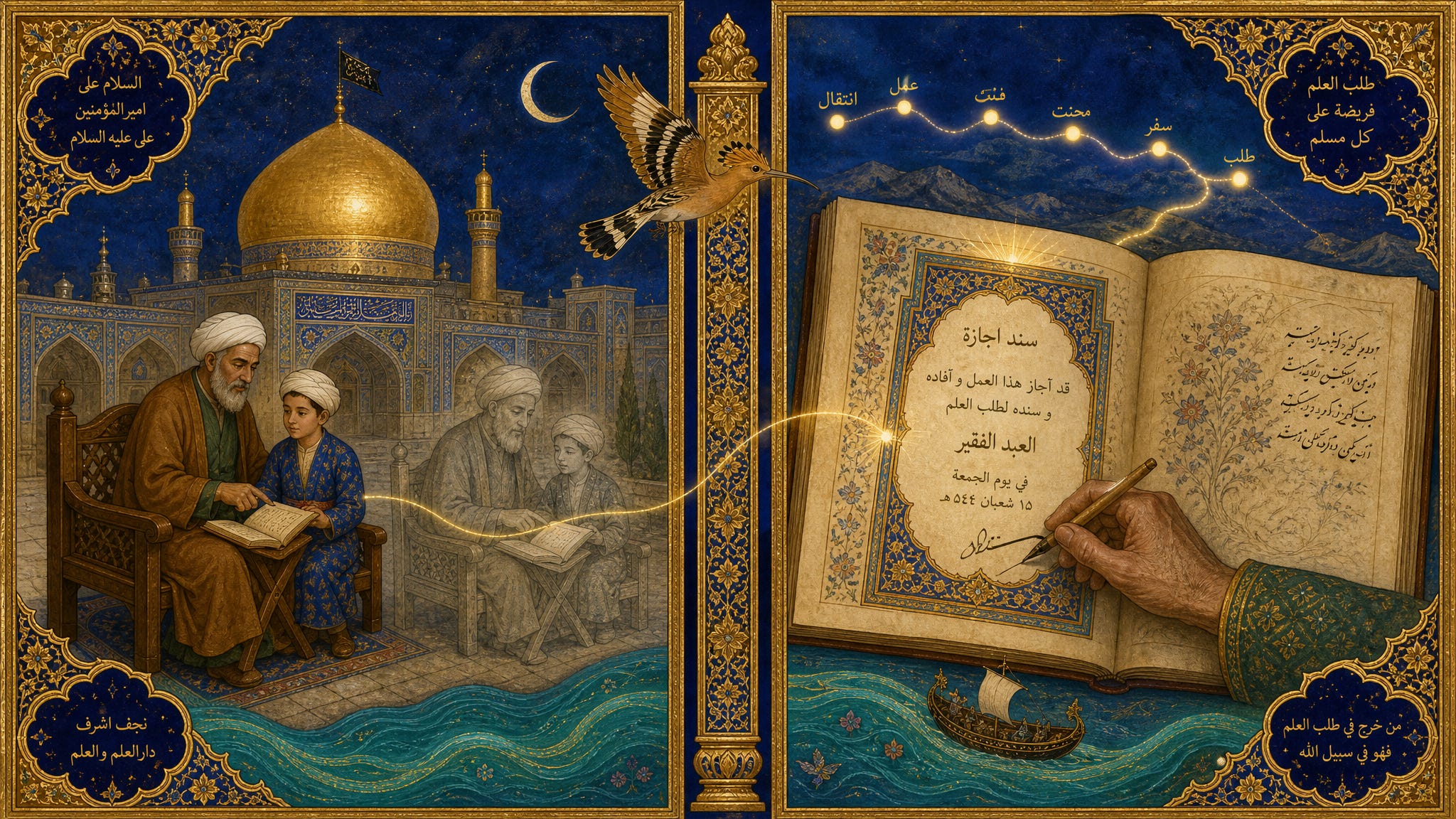
Exhibit one — the chair reappears, in the desert, twice.
Follow the teaching, not the man.
Four hundred and fifty-five.
Shaykh al-Tusi is at the shrine at Najaf, dictating the Amali, and his son is writing them down.
Six years after the fire.
The circle has re-formed — ninety miles south of where it was broken up, at a grave in the desert, in front of a new set of students.
Now go forward fifty-six years.
The Month of Ramadan, 511.
In the same shrine, his son Abu Ali al-Tusi is teaching — and the man taking from him writes down how he took it:
بِقِرَاءَتِي عَلَيْهِ
by my reading to him.
Not passively.
He read the text aloud to the teacher and the teacher confirmed it.
And from whom does the son transmit?
عَنْ أَبِيهِ أَبِي جَعْفَرٍ الطُّوسِيِّ
— from his father, Abu Ja’far al-Tusi.
The father teaching at that shrine in 455.
The son teaching at that shrine in 511, from his father.
They burned the chair in Karkh in 449.
Sixty-two years later the chair is in Najaf and the son is sitting on it.
Exhibit two — a certificate, dated, placed, and signed.
Now follow one book.
Follow al-Mabsut.
One of his students was a man called Hasaka, of the family of Ibn Babawayh.
His son ‘Ubaydallah — the father of the man who wrote the Fihrist — carries it on.
And it reaches a scholar from a village outside Rayy who has settled far to the south, at Kashan.
And there, in the month of Shawwal, in the year 584 — a hundred and thirty-five years after they carried that chair into the street — an old man with a shaky hand writes this on the flyleaf of the first volume.
قَرَأَ عَلَيَّ هَذِهِ الْمُجَلَّدَةَ بِأَسْرِهَا الشَّيْخُ الْأَجَلُّ الْعَالِمُ الْأَوْحَدُ الْبَارِعُ مُرْشِدُ الدِّينِ زَيْنُ الْإِسْلَامِ جَمَالُ الْأُدَبَاءِ عَلِيُّ بْنُ الْحُسَيْنِ بْنِ أَبِي الْحُسَيْنِ الْمُكَنَّىٰ بِأَبِي الْحَسَنِ الْوَارَانِيُّ، أَدَامَ اللهُ تَوْفِيقَهُ، وَرَوَيْتُهُ لَهُ عَنِ الشَّيْخِ الرَّئِيسِ عُبَيْدِ اللهِ بْنِ الْحَسَنِ بْنِ الْحُسَيْنِ بْنِ بَابَوَيْهِ عَنْ أَبِيهِ عَنْ مُصَنِّفِهِ رَحِمَهُمَا اللهُ وَإِيَّانَا. وَكَتَبَ الْحَسَنُ بْنُ الْحُسَيْنِ بْنِ عَلِيٍّ الدُّورَيْسْتِيُّ نَزِيلُ قَاسَانَ بِخَطِّهِ فِي شَوَّالِ سَنَةَ أَرْبَعٍ وَثَمَانِينَ وَخَمْسِمِائَةٍ، حَامِدًا لِلَّهِ تَعَالَىٰ مُصَلِّيًا عَلَىٰ نَبِيِّنَا مُحَمَّدٍ وَآلِهِ الطَّاهِرِينَ
“There read to me this entire volume the most noble Shaykh — the learned, the singular, the accomplished — Murshid al-Din, Zayn al-Islam, Jamal al-Udaba, Ali ibn al-Husayn ibn Abi al-Husayn, known by the kunya Abu al-Hasan, al-Warani; may God perpetuate his success. And I have narrated it to him from al-Shaykh al-Ra’is ‘Ubaydallah ibn al-Hasan ibn al-Husayn ibn Babawayh, from his father, from its author — may God have mercy upon them both, and upon us. Written by al-Hasan ibn al-Husayn ibn Ali al-Duryasti, resident of Kashan, in his own hand, in Shawwal of the year five hundred and eighty-four, praising God Almighty and calling down blessings upon our Prophet Muhammad and his pure family.”
— Al-Afandi, Riyad al-Ulama wa Hiyad al-Fudala, Volume 3, Pages 417–418; the notice at Volume 1, Pages 179–180
Read what that document actually describes, because it is not paperwork.
A man sat down and read the whole volume out loud.
Not consulted it.
Not borrowed it.
Not copied it.
Read it.
Cover to cover.
To a teacher who sat with his own copy and checked it as it went.
And when it was finished, the teacher wrote on the book:
he read it to me
— and here is who I had it from.
From ‘Ubaydallah.
From his father.
From its author.
Four names.
And the fourth is the man whose chair they burned.
Now look at where these men are standing.
The book was written in Baghdad.
It is signed at Kashan — four hundred miles east.
And the man who came to read it had travelled down from a village outside Tabriz — another four hundred miles.
Four hundred miles in.
Four hundred miles out.
And the thing in the middle is a book a mob was ordered to burn.
That is the answer.
You cannot burn that.
There is no house to break into, no library to raid, no chair to carry into the street.
There is no building, because there was never a building.
There is an old man with a bad hand, in a town nobody was watching, certifying to a man who had walked four hundred miles that he had read the book properly — and here is the line it comes down.
A hundred and thirty-five years.
And the fire had not reached it.
Because the fire was never going to be able to.
And That Is Doctrine, Not An Accident
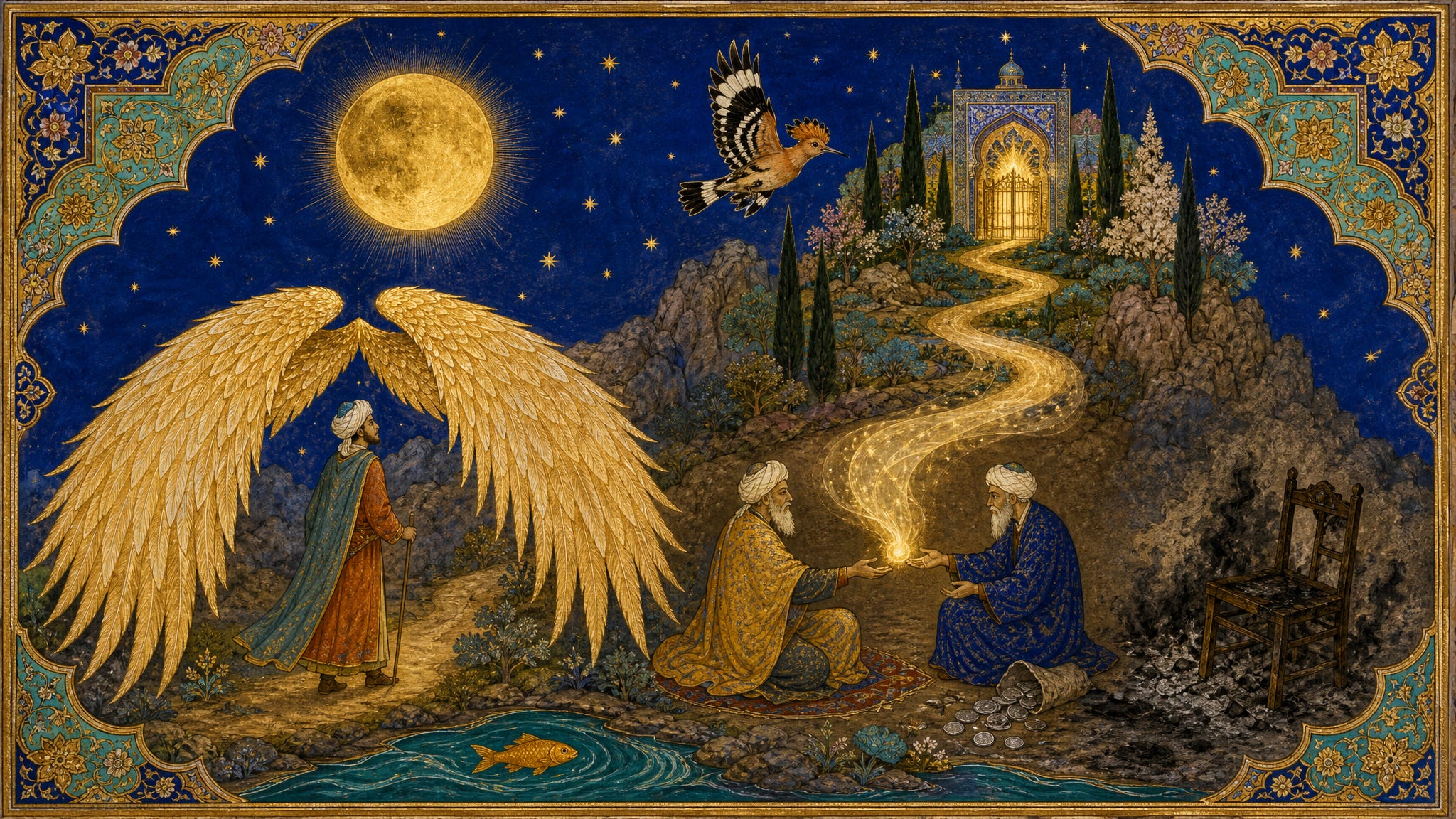
Now the hadith that says so.
And I am going to read it complete, because it is longer than the line everybody quotes, and the rest of it is the proof.
عَلِيُّ بْنُ إِبْرَاهِيمَ عَنْ أَبِيهِ عَنْ حَمَّادِ بْنِ عِيسَىٰ عَنِ الْقَدَّاحِ عَنْ أَبِي عَبْدِ اللهِ عَلَيْهِ السَّلَامُ قَالَ: قَالَ رَسُولُ اللهِ صَلَّى اللهُ عَلَيْهِ وَآلِهِ: مَنْ سَلَكَ طَرِيقًا يَطْلُبُ فِيهِ عِلْمًا سَلَكَ اللهُ بِهِ طَرِيقًا إِلَى الْجَنَّةِ، وَإِنَّ الْمَلَائِكَةَ لَتَضَعُ أَجْنِحَتَهَا لِطَالِبِ الْعِلْمِ رِضًا بِهِ، وَإِنَّهُ يَسْتَغْفِرُ لِطَالِبِ الْعِلْمِ مَنْ فِي السَّمَاءِ وَمَنْ فِي الْأَرْضِ حَتَّى الْحُوتِ فِي الْبَحْرِ، وَفَضْلُ الْعَالِمِ عَلَى الْعَابِدِ كَفَضْلِ الْقَمَرِ عَلَىٰ سَائِرِ النُّجُومِ لَيْلَةَ الْبَدْرِ، وَإِنَّ الْعُلَمَاءَ وَرَثَةُ الْأَنْبِيَاءِ، إِنَّ الْأَنْبِيَاءَ لَمْ يُوَرِّثُوا دِينَارًا وَلَا دِرْهَمًا وَلَٰكِنْ وَرَّثُوا الْعِلْمَ، فَمَنْ أَخَذَ مِنْهُ أَخَذَ بِحَظٍّ وَافِرٍ
“Ali ibn Ibrahim, from his father, from Hammad ibn Isa, from al-Qaddah, from Abu Abdillah, peace and blessings be upon him, who said: The Messenger of God, peace and blessings be upon him, his family, and his righteous companions, said: ‘Whoever travels a road seeking knowledge upon it, God travels with him a road to the Garden. And the angels lower their wings for the seeker of knowledge, in approval of him. And there seeks forgiveness for the seeker of knowledge everyone in the heaven and everyone on the earth — even the fish in the sea. And the excellence of the scholar over the worshipper is like the excellence of the moon over the rest of the stars on the night of the full moon. And truly the scholars are the heirs of the prophets. The prophets bequeathed neither dinar nor dirham — they bequeathed knowledge. So whoever takes of it has taken an abundant portion.’”
— Al-Kulayni, Al-Kafi, Kitab Fadl al-Ilm, bab thawab al-alim wa’l-muta’allim, Hadith 1; of its two chains al-Majlisi writes in Mir’at al-Uqul, Volume 1, Page 113, that the second is حسن أو موثق لا يقصران عن الصحيح — fair or trustworthy, neither falling short of the sound
Heirs.
Not curators.
Not librarians.
Not caretakers of a collection.
لَمْ يُوَرِّثُوا دِينَارًا وَلَا دِرْهَمًا
— they left no money.
Money can be seized.
وَلَٰكِنْ وَرَّثُوا الْعِلْمَ
— they left knowledge.
Inheritance is a transfer between persons.
It does not happen in a building, and it cannot be held in one.
That hadith is not a compliment paid to scholars.
It is a description of the delivery system.
And Karkh is the field test.
Lessons For Our Time
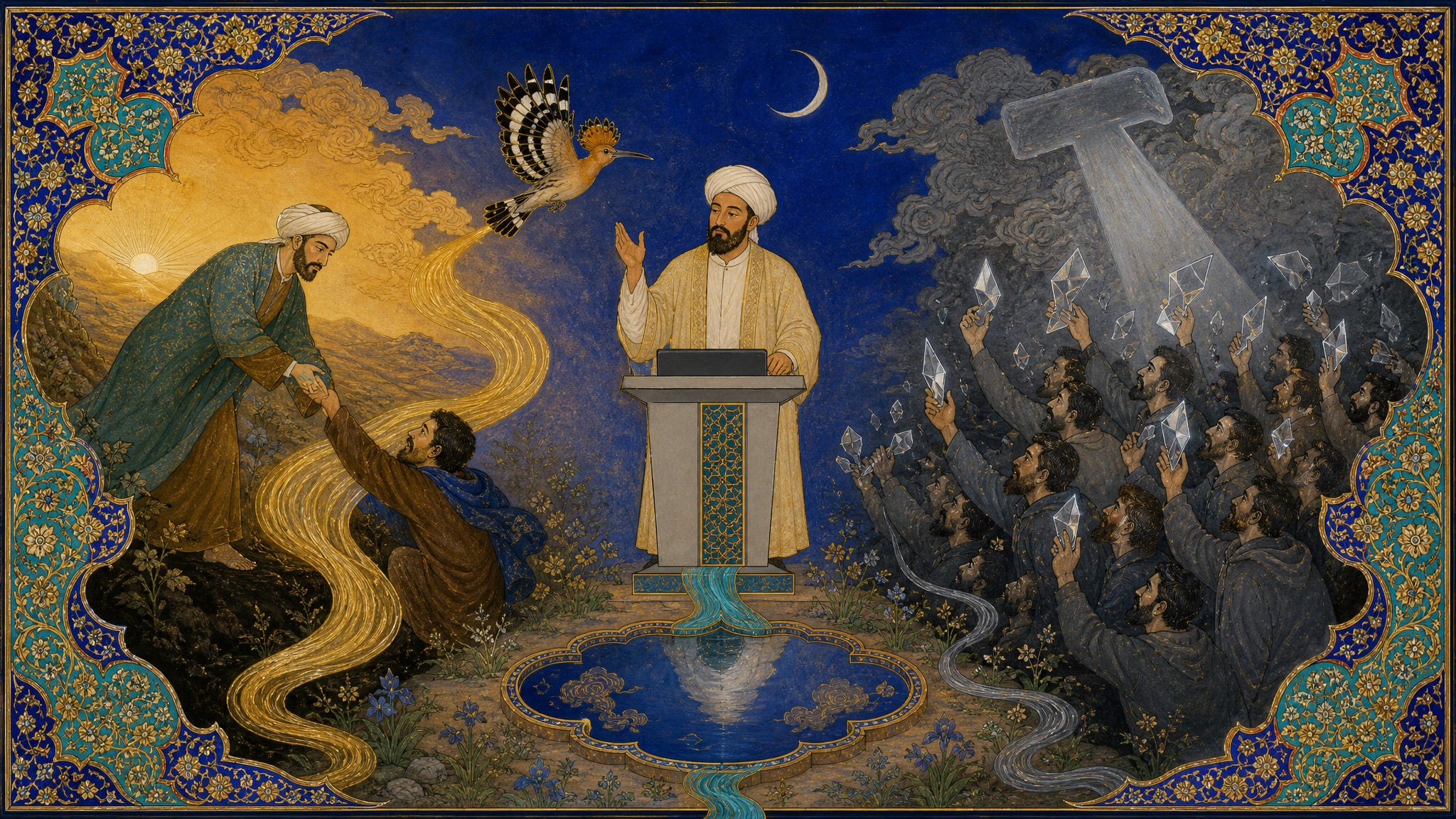
Three, and they get progressively harder.
The first — and it is the answer to the question this whole session asked.
What protects a people when the state turns on them is not a building.
Not a licence from the authorities.
Not a bank balance.
And not a good relationship with whoever happens to be in power — because every one of those is held at somebody else’s pleasure, and can be withdrawn in an afternoon.
What protects them is how many people are carrying it, and how far apart they are standing.
That is the whole answer.
It is not complicated.
It is just slow.
And it has to be done before you need it.
The second — the ijaza is a question addressed to you.
Every one of us has received something.
Somebody taught you to pray.
Somebody taught you who Imam Husayn is, peace and blessings be upon him.
Who have you handed it to?
Not who have you told.
Handed.
In a form that would survive you.
Scatter your knowledge among your brethren, which we read complete earlier tonight.
It is an imperative verb.
Somebody was told to do it, and did, or none of this would have reached us.
Because the honest position for a great many of us is that we are the last link in a chain that has run for fourteen hundred years — and we are holding it loosely.
The third — and underneath that one, what are you handing on?
Because a chain carries whatever you put into it.
I want to tell you about something I have watched happen from a pulpit.
Not this one.
And I am not going to tell you where, or when, or who — because the moment I do, you will spend the rest of the evening working out the name, and you will lose the lesson.
A speaker stood up, at a time when a certain group was in the news for atrocities that turned the stomach of every Muslim on earth.
And he told the gathering that the first three caliphs were the originators of that group.
That is garbage.
It is not history.
It is not scholarship.
It is not even a serious argument.
It is centuries of complicated events flattened into a sentence you can shout.
And do you know what the room did?
They loved it.
They loved it because it fitted.
It slotted into a shape that had already been built in them, over years, by men exactly like him.
And a thing that fits does not have to be true to be swallowed.
It only has to fit.
And his qualifications?
He was popular.
That was the entire credential.
Popularity is not learning.
Popularity is not responsibility.
Popularity is not a licence.
Now — I am not the first to notice this man.
The Commander of the Faithful described him, and he did it in the same conversation I am going to close this majlis with.
He said he had knowledge in his breast, and could not find anyone fit to carry it.
And then he listed the men who were not fit.
Listen to the second one:
بَلَىٰ أَصَبْتُ لَقِنًا غَيْرَ مَأْمُونٍ عَلَيْهِ، مُسْتَعْمِلًا آلَةَ الدِّينِ لِلدُّنْيَا، وَمُسْتَظْهِرًا بِنِعَمِ اللهِ عَلَىٰ عِبَادِهِ، وَبِحُجَجِهِ عَلَىٰ أَوْلِيَائِهِ
“Yes — I do find a quick learner, but he is not to be trusted with it: one who uses the instrument of religion for the world, who takes God’s blessings as a means of superiority over God’s servants, and God’s proofs as a means of superiority over God’s friends.”
— Nahj al-Balagha, Saying 147, to Kumayl ibn Ziyad
لَقِنًا غَيرَ مَأمُونٍ عَلَيهِ
Quick to learn. Not safe to be trusted with it.
Fourteen hundred years ago, and he has the man exactly.
And our books are blunter still about what such a man does:
مَنْ أَفْتَى النَّاسَ بِغَيْرِ عِلْمٍ وَلَا هُدًى لَعَنَتْهُ مَلَائِكَةُ الرَّحْمَةِ وَمَلَائِكَةُ الْعَذَابِ، وَلَحِقَهُ وِزْرُ مَنْ عَمِلَ بِفُتْيَاهُ
“Whoever gives the people a verdict without knowledge and without guidance — the angels of mercy and the angels of punishment alike call down upon him the distance of God’s mercy; and the burden of everyone who acts on his verdict follows him.”
— Al-Kafi, Kitab Fadl al-Ilm, chapter forbidding speech without knowledge, Hadith 3; graded صحيح — sound — by both al-Majlisi and al-Behbudi
وَلَحِقَهُ وِزرُ مَنْ عَمِلَ بِفُتْيَاهُ
And the burden of everyone who acts on his verdict follows him.
Every person in that hall who went home and repeated what he said — their share of it goes back to him.
Now take the hadith I read you twenty minutes ago and use it the other way.
I gave it to you as a description of the delivery system.
The scholars are the heirs of the prophets.
Use it as a test.
If he is an heir, he has inherited a mission — and we spent nine weeks on that mission in this series, so I will put it in one line and you can go back to those sessions for the rest.
Every prophet was sent to bring people out of the darknesses and into the light.
That is the job.
That is the entire job description of the office he is claiming to stand in.
So ask it.
Did that sermon raise anybody?
Did one person leave more merciful?
More careful with a story?
Better able to answer an objection?
More likely to be trusted by a neighbour who does not share their faith?
Or did a whole load of people leave with their existing anger polished, and handed back to them?
If it is the second, then whatever that man is, he is not carrying the inheritance.
He is carrying something else.
And he is handing that to your children.
Let me put it another way.
A scholar is supposed to be a physician of the soul.
So picture it properly.
You go to your doctor and you say:
“Doctor, I have a headache.”
And he does not ask you when it started.
He does not ask what you have eaten, or how you have slept, or how much water you have drunk, or what has been worrying you at night.
He does not diagnose anything at all.
He reaches under the desk, takes out a hammer, hits you over the head with it, and says:
“There. That will take your mind off it.”
Would you go back?
Would you send your mother to him?
Then why do we go back?
Why do we keep filling the hall for the man with the hammer — and why, when somebody actually diagnoses us, do we come away feeling he was a bit dry?
And here is the part that should frighten us most.
A great many of the men holding hammers do not know they are holding a hammer.
They think they are healing.
They go home believing they did good work tonight.
And the Qur’an has a sentence for that.
Let me read the passage, and then let me be careful with it in front of you.
قُلْ هَلْ نُنَبِّئُكُم بِالْأَخْسَرِينَ أَعْمَالًا • الَّذِينَ ضَلَّ سَعْيُهُمْ فِي الْحَيَاةِ الدُّنْيَا وَهُمْ يَحْسَبُونَ أَنَّهُمْ يُحْسِنُونَ صُنْعًا • أُولَـٰئِكَ الَّذِينَ كَفَرُوا بِآيَاتِ رَبِّهِمْ وَلِقَائِهِ فَحَبِطَتْ أَعْمَالُهُمْ فَلَا نُقِيمُ لَهُمْ يَوْمَ الْقِيَامَةِ وَزْنًا • ذَٰلِكَ جَزَاؤُهُمْ جَهَنَّمُ بِمَا كَفَرُوا وَاتَّخَذُوا آيَاتِي وَرُسُلِي هُزُوًا
“Say: shall We inform you of the greatest losers in deeds? Those whose striving goes astray in the life of this world, while they reckon that they are doing good work. Those are the ones who rejected the signs of their Lord and the meeting with Him, so their deeds came to nothing, and We shall assign them no weight on the Day of Rising. That is their recompense — Hell — for what they rejected, and for taking My signs and My messengers in mockery.”
— Qur’an, Surah al-Kahf (the Chapter of the Cave) #18, Verses 103 to 106
Now.
The Qur’an is not talking about a bad preacher there.
And I am not saying that to be generous.
I am saying it because the commentary settles it.
Allamah Tabataba’i is explicit that the third verse is not a new subject but a definition of the second:
تَعْرِيفٌ ثَانٍ وَتَفْسِيرٌ بَعْدَ تَفْسِيرٍ لِلْأَخْسَرِينَ أَعْمَالًا
“A second definition, and an interpretation upon an interpretation, of ‘the greatest losers in deeds.’”
— Allamah Tabataba’i, Al-Mizan fi Tafsir al-Qur’an, on Surah al-Kahf (the Chapter of the Cave) #18, Verse 105
And he says who they are:
فَآلَ تَعْرِيفُ الْأَخْسَرِينَ أَعْمَالًا إِلَىٰ أَنَّهُمُ الْمُنْكِرُونَ لِلنُّبُوَّةِ وَالْمَعَادِ
“So the definition of ‘the greatest losers in deeds’ comes down to this: they are those who deny prophethood and the Return.”
— Allamah Tabataba’i, Al-Mizan fi Tafsir al-Qur’an, on Surah al-Kahf (the Chapter of the Cave) #18, Verse 105
He even refuses the popular applications — the readings that make it about one sect or another — calling them application rather than referent.
So I am not putting a single living person inside that verse.
I do not have that authority.
Neither does anybody else in this hall, and neither does the man with the hammer.
What I am pointing at is the sentence in the middle.
وَهُمْ يَحْسَبُونَ أَنَّهُمْ يُحْسِنُونَ صُنْعًا
— and they reckon that they are doing good work.
And listen to what Allamah Tabataba’i says makes such a man — the greatest loser — rather than merely a loser.
It is not the error.
It is the satisfaction.
و إن أخطأ الطريق و هو لا يعلم بخطئه فهو خاسر سعيا لكنه مرجو النجاة، و إن أخطأ الطريق و أصاب غير الحق و سكن إليه فصار كلما لاح له لائح من الحق ضربت عليه نفسه بحجاب الإعراض… فهو أخسر عملا و أخيب سعيا لأنه خسران لا يرجى زواله
“If he takes the wrong road and does not know his error, he is a loser in his striving — but his rescue is still hoped for. But if he takes the wrong road and settles into it, so that whenever something of the truth gleams before him his own soul draws a veil of aversion over it… then he is the greatest loser in deed and the most disappointed in striving — because it is a loss whose lifting is not hoped for.”
— Allamah Tabataba’i, Al-Mizan fi Tafsir al-Qur’an, on Surah al-Kahf (the Chapter of the Cave) #18, Verse 104
Do you see the difference?
Being wrong is survivable.
Being wrong and comfortable is not — because comfort closes the door that being wrong leaves open.
That is the most frightening thing I know.
It is possible to work hard, and mean it, and be admired for it — and to be spending your life going backwards.
The verse does not describe a man who knows he is a fraud.
It describes a man who is certain that he is not.
And that man is not only found on pulpits.
Take the clause home with you tonight.
It was not written about the speaker.
It was written about the reader.
It was written about all of us.
What He Actually Built — And What He Did Not
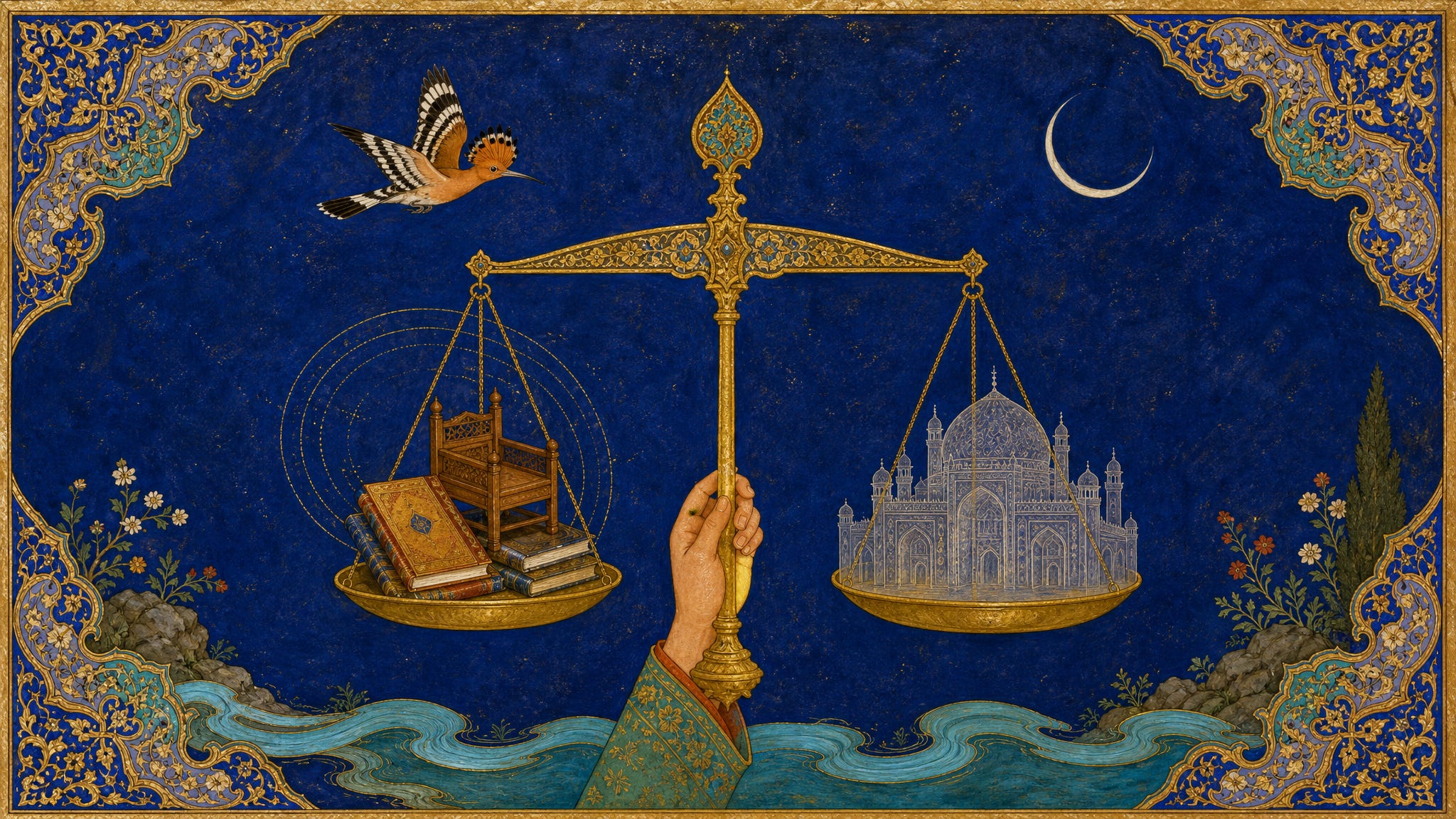
The honest version, which loses nothing.
What He Actually Built — And What He Did Not
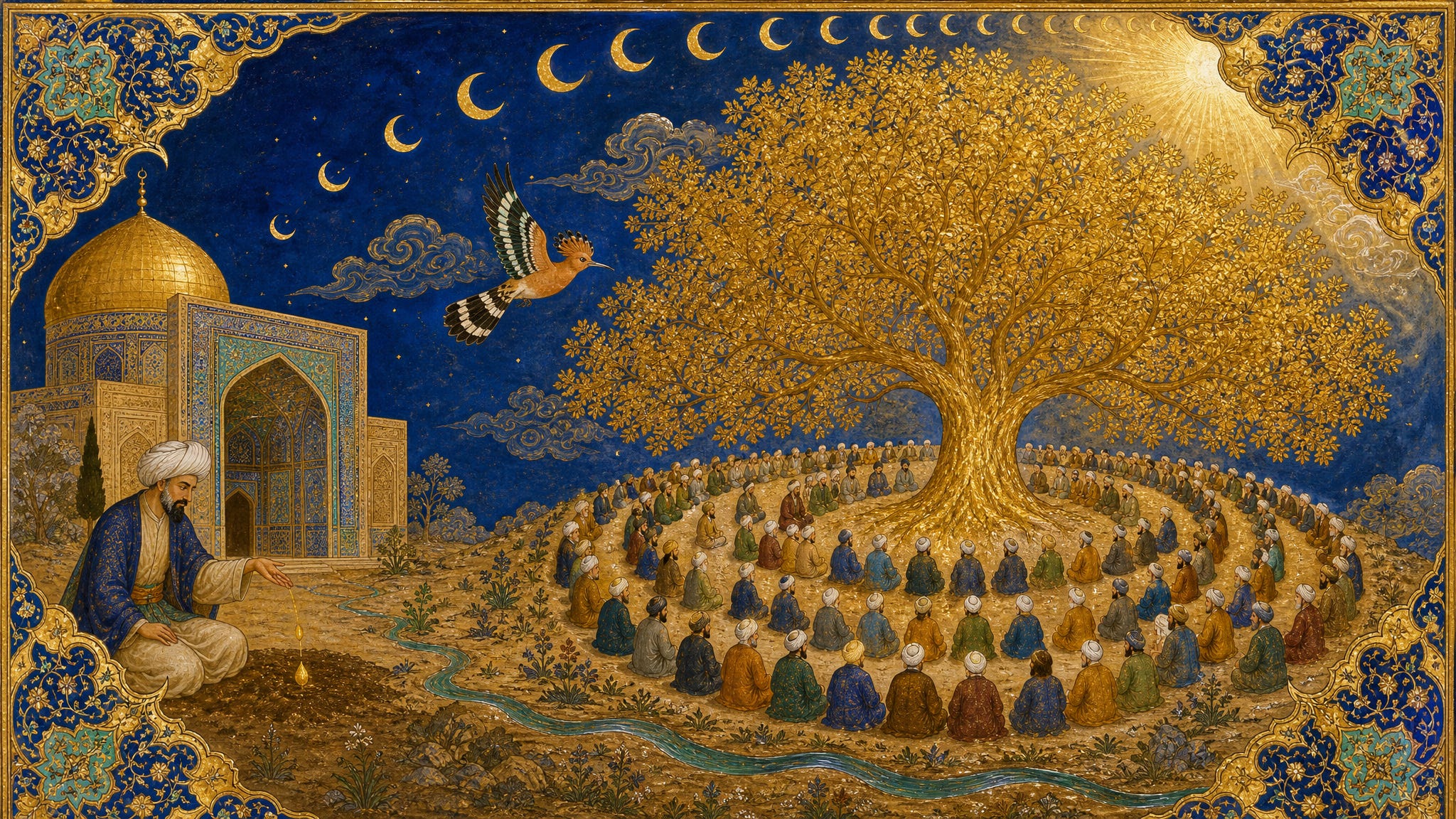
There is a story we tell about this man, and I want to give you the accurate version, which loses us nothing at all.
The story is that Shaykh al-Tusi went to Najaf and founded the hawza.
A serious historian went looking for the evidence.
What he reports is this: he could find no primary source showing that Shaykh al-Tusi put up a building for teaching.
And whether he founded an educational institution at all is, in that historian’s own word, unsettled.
Another scholar calls the founding story the genesis myth of the hawza — a story told later, to establish him as the father of the tradition.
And they are right.
And it costs us nothing.
And here is the true version.
He was the first great scholar to go and live there.
Students came, because he was there.
Circles formed on the floor around him.
And the seminary that grew in that place traces itself back to him — correctly, because he is the reason there was anything there to grow.
He did not build the hawza.
He was the reason there was somewhere for it to be built.
And do you see this is the same point as the ijaza?
He did not leave an institution — because an institution can be burned.
He left himself, in a place.
And people came.
And they left again carrying licences.
The hawza was not founded.
It accumulated.
And one more honest clause, because it makes something visible we usually rush past.
In that fifth century there were perhaps fifteen Shi’a scholars at Najaf.
Fifteen.
And Najaf did not become the pre-eminent centre of our learning until the thirteenth century after the Hijra.
It was a seed.
And it took eight hundred years.
Sit with that.
It is a Mahdawi point, and we need it before the night is out.
The House Beside The Grave
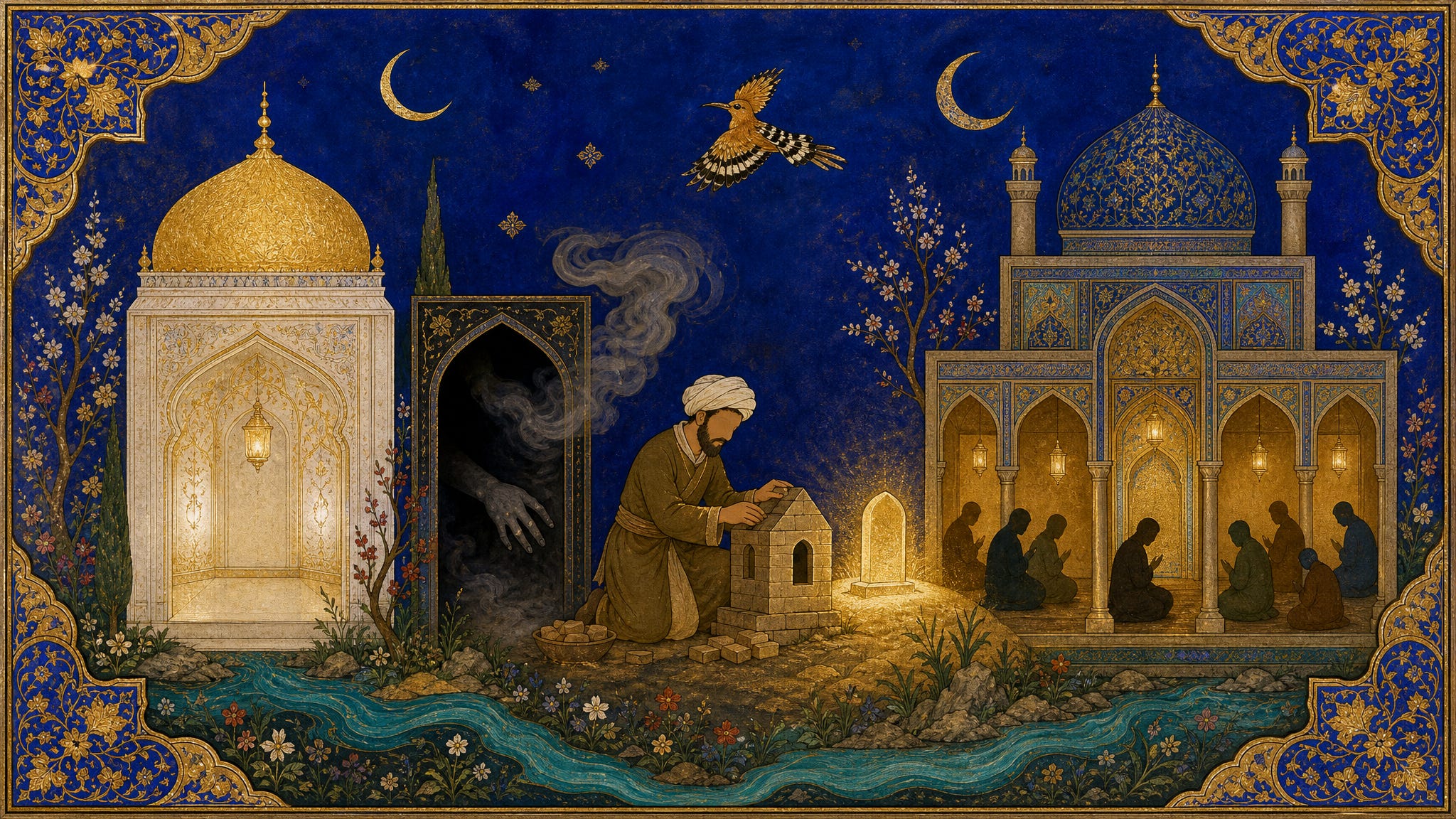
A fortnight ago this little series was given its title by the calendar.
The Prophet, peace and blessings be upon him, his family, and his righteous companions, was buried in the room he died in.
That was the first house beside a grave.
Tonight it is given to us by an arson.
They took his house.
He built another one, next to a grave, and would not leave it, and told them to bury him inside it.
And they did.
And the house became a mosque.
It is standing this evening.
People are praying in it while we sit here.
Lessons For Our Time
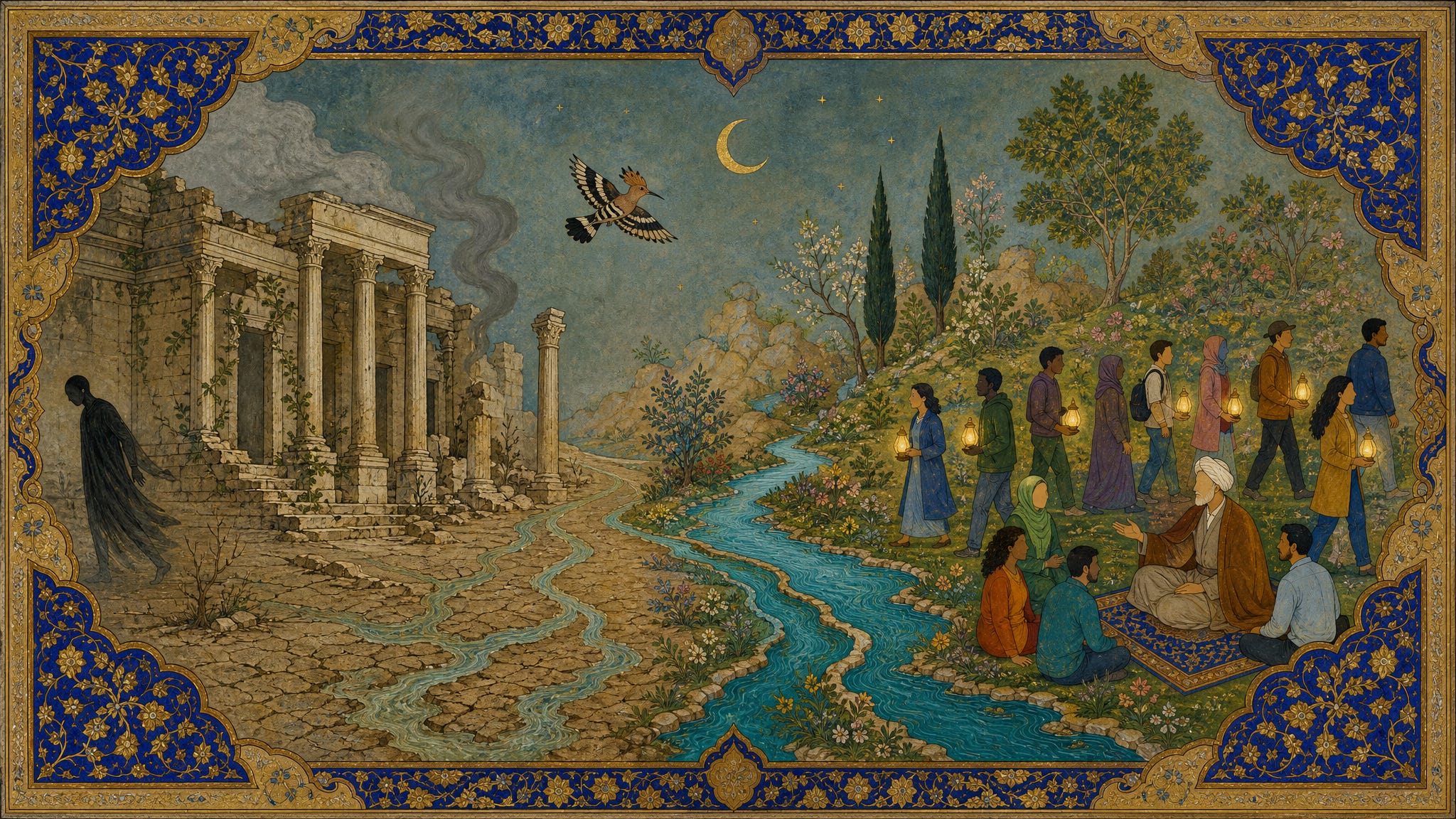
And the last lesson of the night — build the unburnable thing.
Everything in this religion built to be impressive has been levelled at some point.
What has survived is what was distributed.
So when you are deciding where to put your effort — and this is a real decision this community makes every single year — ask which of the two you are building.
A building is a target.
A person who has been properly taught is a copy that walks.
The Turn
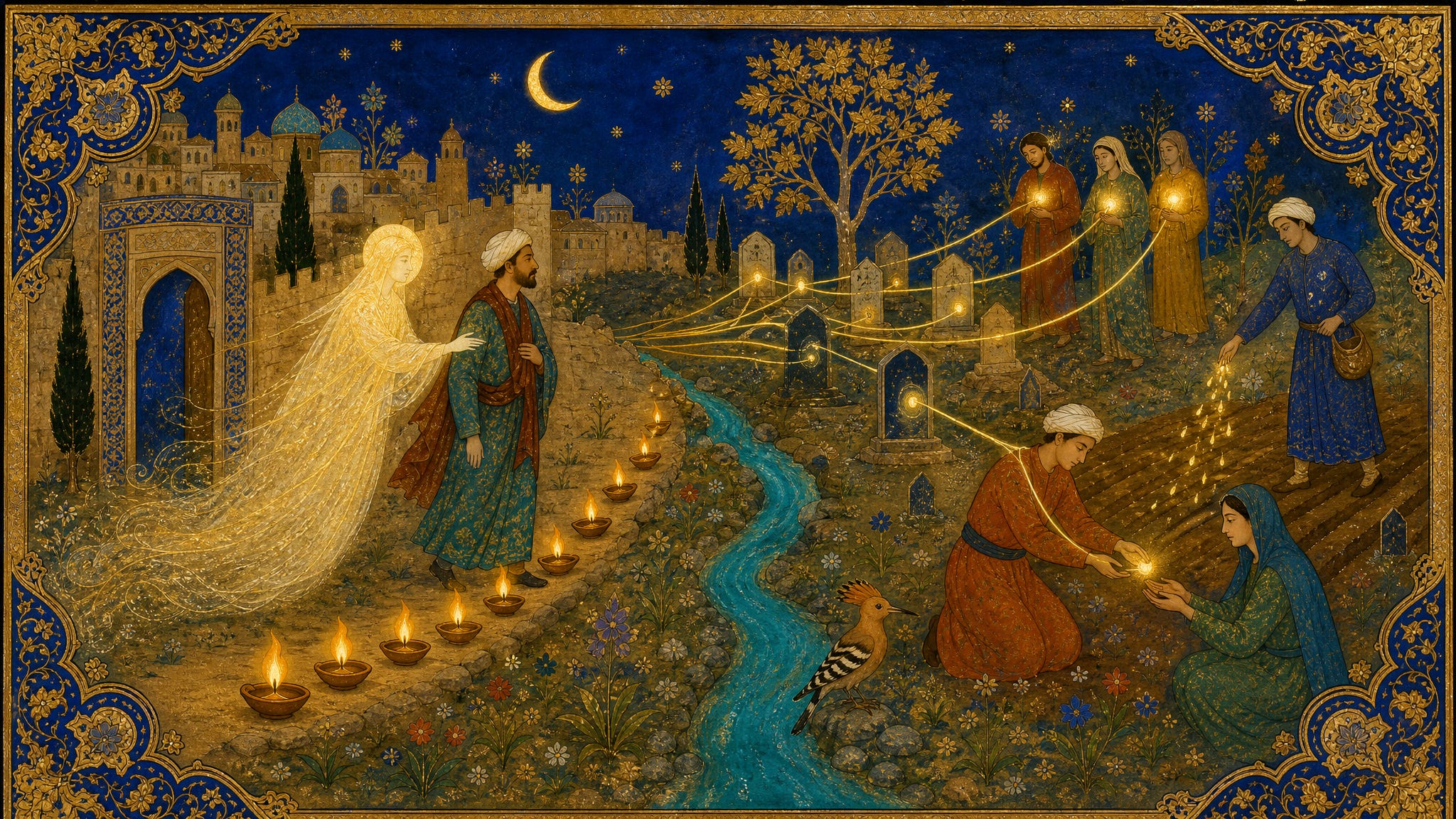
There is a conversation in the Nahj al-Balagha, and I have already read you one line of it tonight.
The Commander of the Faithful, peace and blessings be upon him, took Kumayl ibn Ziyad al-Nakha’i by the hand and led him out of the city, towards the graveyard.
And when they reached open country he drew a long breath, and he talked to him about knowledge.
He told him that hearts are vessels, and the best of them is the one that holds the most.
He told him people are of three kinds — a scholar devoted to God, a learner on the path of deliverance, and a swarm of flies who follow every shouter and lean with every wind, who have never lit a lamp from the light of knowledge and never taken shelter beside anything solid.
And then this:
يَا كُمَيْلُ، هَلَكَ خُزَّانُ الْأَمْوَالِ وَهُمْ أَحْيَاءٌ، وَالْعُلَمَاءُ بَاقُونَ مَا بَقِيَ الدَّهْرُ، أَعْيَانُهُمْ مَفْقُودَةٌ وَأَمْثَالُهُمْ فِي الْقُلُوبِ مَوْجُودَةٌ
“O Kumayl — the hoarders of wealth are dead while they are still alive; and the scholars endure as long as time itself endures. Their persons are lost, and their likenesses are present in hearts.”
— Nahj al-Balagha, Saying 147
أَعْيَانُهُمْ مَفْقُودَةٌ وَأَمْثَالُهُمْ فِي الْقُلُوبِ مَوْجُودَةٌ
Their bodies are gone.
Their likenesses are inside people.
That is the sentence this entire majlis has been walking towards.
You cannot burn a likeness that is inside somebody.
He goes on — the knowledge in his breast that he cannot find a carrier for; the quick learner who cannot be trusted with it, whom we met a few minutes ago; the man who follows the truthful but has no insight of his own, in whose heart doubt catches at the first shadow of a difficulty.
And then those given over to pleasure, or to hoarding — neither of them shepherds of religion in any respect; the nearest thing to them is grazing cattle.
كَذَٰلِكَ يَمُوتُ الْعِلْمُ بِمَوْتِ حَامِلِيهِ
— thus does knowledge die with the death of those who carry it.
That is the danger stated at its full strength.
Knowledge does die, if the carriers die and nobody was licensed.
And then he answers it.
اللَّهُمَّ بَلَىٰ! لَا تَخْلُو الْأَرْضُ مِنْ قَائِمٍ لِلَّهِ بِحُجَّةٍ، إِمَّا ظَاهِرًا مَشْهُورًا، وَإِمَّا خَائِفًا مَغْمُورًا، لِئَلَّا تَبْطُلَ حُجَجُ اللهِ وَبَيِّنَاتُهُ. وَكَمْ ذَا وَأَيْنَ أُولَٰئِكَ؟ أُولَٰئِكَ وَاللهِ الْأَقَلُّونَ عَدَدًا، وَالْأَعْظَمُونَ عِنْدَ اللهِ قَدْرًا، يَحْفَظُ اللهُ بِهِمْ حُجَجَهُ وَبَيِّنَاتِهِ، حَتَّىٰ يُودِعُوهَا نُظَرَاءَهُمْ، وَيَزْرَعُوهَا فِي قُلُوبِ أَشْبَاهِهِمْ
“O God, yes! The earth is never left empty of one who stands for God with a proof — either manifest and well known, or fearful and hidden — so that God’s proofs and clear signs shall not come to nothing. And how many are they, and where are they? Those, by God, are the fewest in number and the greatest with God in worth. God preserves through them His proofs and His clear signs, until they deposit them with their peers, and sow them in the hearts of those like themselves.”
— Nahj al-Balagha, Saying 147
Do you hear the two verbs at the end?
يُودِعُوهَا
— until they deposit it.
A deposit.
A thing handed over for safekeeping.
وَيَزْرَعُوهَا
— and sow it.
In hearts.
That is the ijaza, described centuries years before anybody wrote one on the back of a copy of al-Mabsut in Kashan.
And notice the phrase in the middle.
إِمَّا ظَاهِرًا مَشْهُورًا، وَإِمَّا خَائِفًا مَغْمُورًا
— either manifest and well known, or fearful and hidden.
Fearful and hidden.
وَاسْتَتَرَ هُوَ خَوْفًا عَلَىٰ نَفْسِهِ
— and he went into hiding, in fear for his life.
That is the same phrase.
That is the man in Karkh in the year 449, and the Commander of the Faithful described the category more than three hundred years before he was born.
The Close
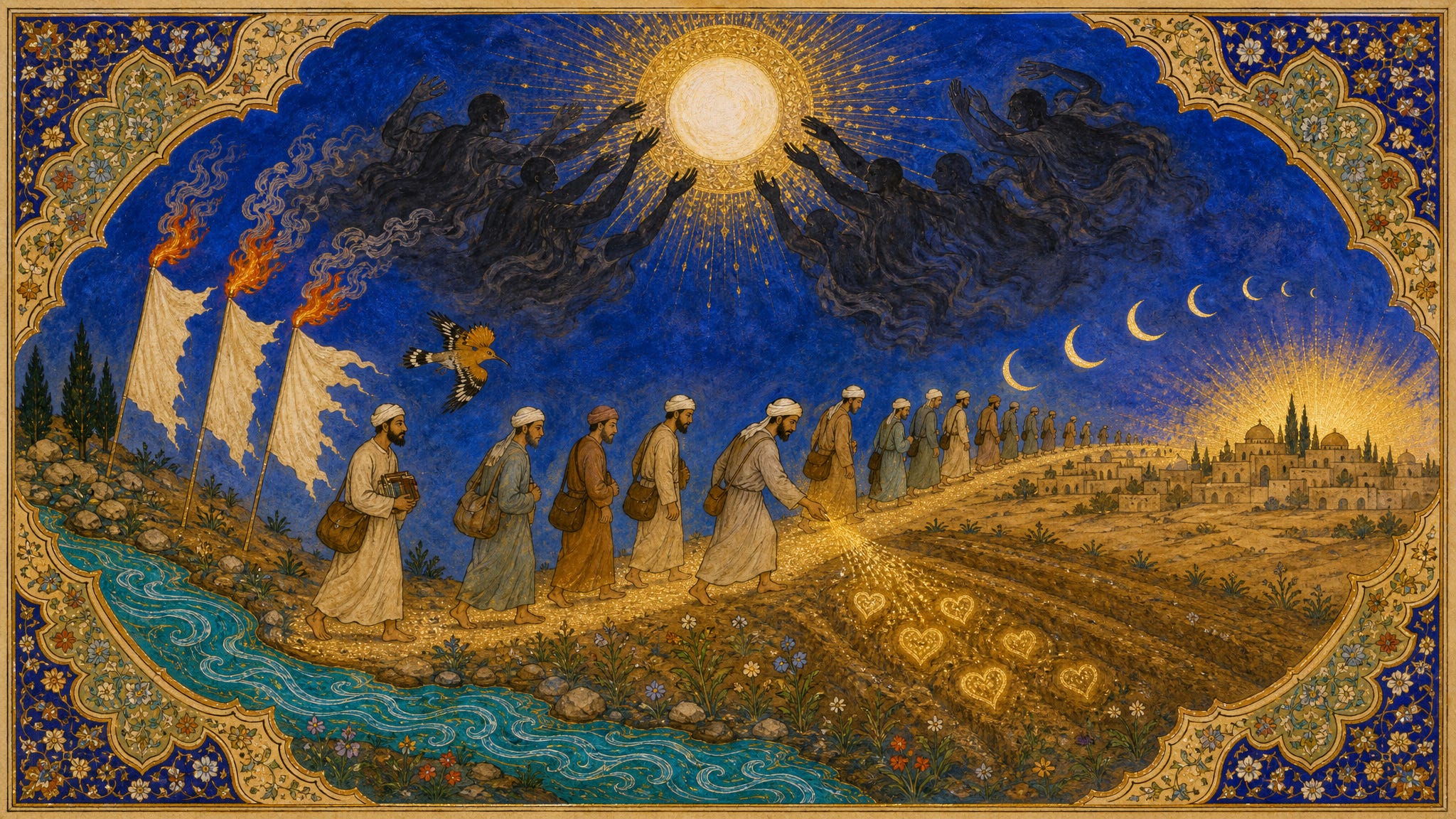
That is the architecture.
That is why this sub-series is called what it is called.
The Imam of our Age, may our souls be his ransom and may God hasten his return, is in occultation.
And guidance in his absence was not left in a vault, or a library, or a capital city — because every single one of those has been burned at some point in the last thousand years, and some of them more than once.
It was left in people.
Deliberately.
Because it was going to be tested by fire.
And it was.
And it held.
They burned three white banners, because those banners pointed at a shrine.
And I want to say this as carefully as I can.
They were not wrong about the banners.
They understood exactly what those banners were for.
They were not stupid and they were not random.
They looked at a community, identified the thing that gave it a direction, and went for it.
They were wrong about what a direction is made of.
You cannot burn a road when the road is people.
And every man who walked out of Baghdad in those years with a licence in his bag was a yard of it.
اِحْتَفِظُوا بِكُتُبِكُمْ
Guard your books, for you will have need of them.
And
وَبُثَّ عِلْمَكَ فِي إِخْوَانِكَ
Scatter your knowledge among your brethren.
— both read complete earlier, from al-Kafi, Hadith 10 and Hadith 11.
Until they deposit it with their peers, and sow it in the hearts of those like themselves.
It was all written down in advance.
And now the verse, the second time — and this is the thing I promised you would hear in it.
يُرِيدُونَ لِيُطْفِئُوا نُورَ اللَّهِ بِأَفْوَاهِهِمْ وَاللَّهُ مُتِمُّ نُورِهِ وَلَوْ كَرِهَ الْكَافِرُونَ
“They desire to extinguish the light of God with their mouths — and God will perfect His light, however much the disbelievers hate it.”
— Qur’an, Surah al-Saff (the Chapter of the Ranks) #61, Verse 8
وَاللَّهُ مُتِمُّ نُورِهِ
And God will perfect His light.
We opened tonight on that clause.
Now you have seen what it meant, in a signature on a flyleaf at Kashan.
And this is where I have to tell you the honest ending, because it is better than a triumphant one.
It took eight hundred years.
Fifteen scholars in a desert town, and eight centuries before anybody could see what it had become.
وَاللَّهُ مُتِمُّ نُورِهِ
And God will perfect His light.
— does not promise you that you will live to see it.
It promises that it gets finished.
The occultation was not his absence from us.
It was our unreadiness to receive him.
And the work of getting ready has never once been done in a building.
Conclusion — Key Takeaways
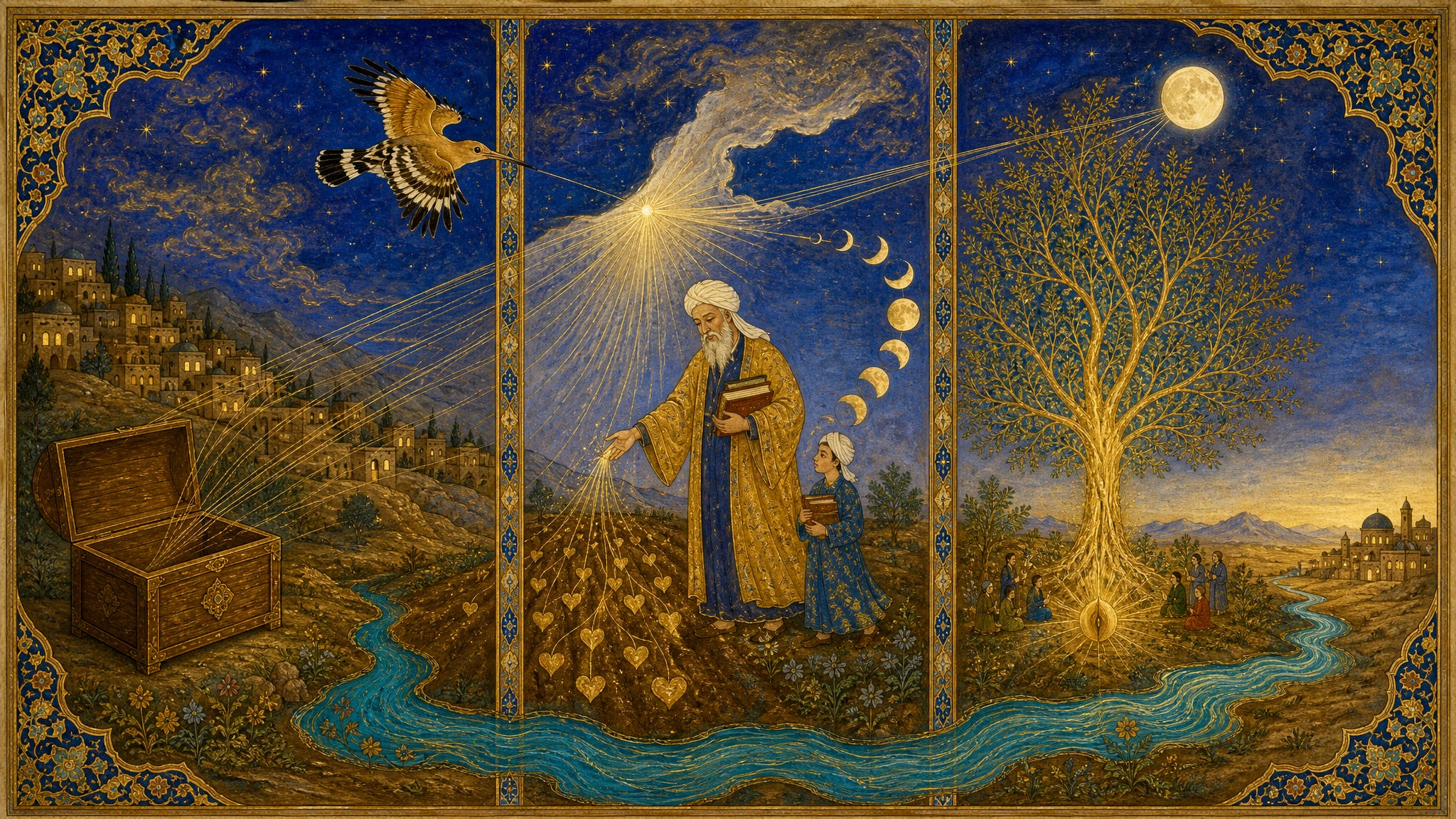
Three things to carry home.
One.
They burned the container and never touched the contents — because the contents were not in a container.
Not one work of his first rank is lost.
And the reason is not that somebody hid a box.
It is that the books had already been read aloud, cover to cover, by named men who were given written permission to carry them onward — and those men were in Aleppo, and Tripoli, and Rayy, and Qom, and Kashan, and a village outside Tabriz.
You cannot raid a licence.
There is no house to break into.
Two.
This was not an accident of history.
It was instructed.
عَنْ عُبَيْدِ بْنِ زُرَارَةَ قَالَ: قَالَ أَبُو عَبْدِ اللهِ عَلَيْهِ السَّلَامُ: احْتَفِظُوا بِكُتُبِكُمْ فَإِنَّكُمْ سَوْفَ تَحْتَاجُونَ إِلَيْهَا
“From Ubayd ibn Zurara, who said: Abu Abdillah, peace and blessings be upon him, said: ‘Guard your books carefully, for you will have need of them.’”
— Al-Kulayni, Al-Kafi, Kitab Fadl al-Ilm, chapter on the transmission of books and hadith, Hadith 10; graded موثق كالصحيح — trustworthy, like the sound — by al-Majlisi
And
عَنِ الْمُفَضَّلِ بْنِ عُمَرَ قَالَ: قَالَ لِي أَبُو عَبْدِ اللهِ عَلَيْهِ السَّلَامُ: اكْتُبْ وَبُثَّ عِلْمَكَ فِي إِخْوَانِكَ، فَإِنْ مِتَّ فَأَوْرِثْ كُتُبَكَ بَنِيكَ، فَإِنَّهُ يَأْتِي عَلَى النَّاسِ زَمَانُ هَرْجٍ لَا يَأْنَسُونَ فِيهِ إِلَّا بِكُتُبِهِمْ
“From al-Mufaddal ibn Umar, who said: Abu Abdillah, peace and blessings be upon him, said to me: ‘Write, and scatter your knowledge among your brethren; and if you die, then bequeath your books to your sons — for there will come upon people a time of turmoil in which they will find comfort in nothing but their books.’”
— Al-Kafi, Kitab Fadl al-Ilm, chapter on the transmission of books and hadith, Hadith 11; the chain is graded ضعيف على المشهور — weak according to the well-known view — and I tell you that because I would rather you knew it
Those are not observations about what happened.
They are commands, given three centuries before the fire, by an Imam, peace and blessings be upon him, to people who obeyed them.
The system that saved this corpus was built long before anybody needed it.
Three.
It took eight hundred years, and it still counts.
Fifteen scholars in a desert town.
A seed, and eight centuries before anybody could see what it had become.
وَاللَّهُ مُتِمُّ نُورِهِ
And God will perfect His light.
— does not promise you that you will live to see it.
It promises that it gets finished.
Which is the most Mahdawi sentence in the Book, and it is the reason we are able to sit here at all.
Next week, we go to the place he walked to — and ask the question nobody has asked yet.
Why Najaf?
Eulogy — The Man Who Sat Down Again
Let me stay with him for a moment before we finish, because we have been using him to prove something, and he was a man.
He came to Baghdad at the very start of the fifth century, a young man from Khurasan, and he stayed forty years.
He sat under one teacher for twenty-three of them.
He wrote until two of the four books this whole school stands on were his.
He was given a chair — an actual seat, in the capital of the world — and men came to it from six provinces.
And he had a grave he visited, every single month, for over twenty years.
He wrote that down himself.
Month by month.
He and that grave had an arrangement.
And then he lost all of it in under two years.
The house.
The notebooks.
The chair.
The city.
The grave he had been visiting since he was young.
He went into hiding, in fear for his life.
We are not told where.
We are not told with what.
Six words in the chronicle of his own city, and one of them is fled.
And then, somewhere out on the road south, at an age when most men would have stopped — he sat down again.
That is the whole of it.
That is the entire eulogy.
He sat down again, in a desert town beside a grave, with a fraction of the audience and none of the standing, and started teaching.
And a student wrote down the date and the place, because that is what they did:
By dictation, at the shrine of our master, the Commander of the Faithful, peace and blessings be upon him.
Six years after the fire.
He had a class again.
He never went back to Baghdad.
He died in Muharram of the year 460.
And by his own will they buried him in his own house — and the house became a mosque, and people are praying in it tonight.
May God bless his pure soul and be pleased with him, and raise him with those he spent his life serving.
Segue to the Maqtal
Maqtal (Lamentation) for the Eleventh Session of the Architecture of Guidance
The Voice You Are About to Hear
Before it begins, let me tell you honestly what you are about to hear, because you should never be in any doubt.
That is not a reciter.
It is not a person.
It is a voice made for this series, in clear English, belonging to no living man — an imagining of the voice of the Imam of our Age, may our souls be his ransom and may God hasten his return, speaking from behind the veils of his absence.
It is a vessel for his words.
It is nothing more than that, and we will not pretend it is anything more than that.
Last week he spoke about the workman with the chisel.
Tonight he speaks about the chair.
About standing in that street and watching two men turn it sideways to get it through a doorframe.
About what he could see from where he was standing that the man with the torch could not — the men asleep in Aleppo and awake in Tripoli, each with a piece of paper in his bag.
And then he does something we have not asked him to do before.
He tells us how he knows.
Because they came for a house before that one.
They came for a door.
They set fire to tents on a plain by a river with children inside them.
They left the bodies three days.
They carried heads through two cities.
And the thing inside those tents walked out on the feet of the women.
The Chair.
Supplication — For the Ones Who Carried It
A prayer for the people in tonight’s account who have no monument: the ones who copied, and carried, and handed on.
O God.
We have nowhere to go but Your door.
O God — peace upon Your prophets.
Upon Adam, and Noah, and Abraham, and Ishmael and Isaac, and Moses and Aaron, and David and Solomon, and Zechariah and John, and Jesus son of Mary — peace and blessings be upon them all.
Every one of them was sent to bring people out of the darknesses and into the light, and every one of them left no dinar and no dirham behind him.
And peace and blessings upon Muhammad, and upon his family, and upon his righteous companions — who was buried in the room he died in, and gave this little series its name.
O God, peace upon Sayyedah Fatimah al-Zahra, peace and blessings be upon her, in whose house this whole inheritance began.
Peace upon the Commander of the Faithful, peace and blessings be upon him, at whose grave a broken man built a house and would not leave it.
Peace upon Imam Hasan and upon Imam Husayn, the Master of Witnesses, peace and blessings be upon them.
Peace upon Imam Musa al-Kadhim and upon Imam Muhammad al-Jawad, peace and blessings be upon them, over whose graves a government altered the call to prayer, and could not alter what was in the mouths that said it.
Peace upon the Imams of guidance, one after another, peace and blessings be upon them all — who told us to guard our books, and to scatter our knowledge among our brethren, and who said it three hundred years before anybody came with a fire.
O God.
Tonight we ask You for the ones who carried it.
For the draper at his shop door, killed for what he was displaying openly.
For the families who stood in their doorways and watched a workman take a sentence off the lintel, and who said nothing, because they were afraid of the government — and who put it back the moment they could.
For the children of that quarter who learned the call to prayer with a line missing from it, and for the ones who never learned the line at all.
For the copyists.
For the men who gave their eyesight to a page so that somebody they would never meet could read it.
For everything that burned in Bayn al-Surayn in an afternoon, and for every hand that had written it.
For the old man in Kashan with the shaky hand, certifying a book to a stranger who had walked four hundred miles to read it aloud to him.
For the ones on the roads with paper in their bags, who did not know there had been a fire, and who were the reason it did not matter.
Accept it from them, O God.
They did it for us and they never met us.
O God — a teacher of ours lost everything he owned in the space of two years, and went into hiding in fear for his life, and walked south, and sat down again in a desert town, and started teaching before the ash was cold.
Make us people who sit down again.
O God. We pray to You for Imam Sayyed Mujtaba Khamenei — may God protect him — the Wali al-Faqih of our time.
Preserve him for us.
Strengthen him.
Guide him.
Make him the leader You have appointed him to be, until the Imam of our Age returns and the trust he carries is handed back to its rightful holder.
O God.
Hasten the return of the Imam of our Age, may our souls be his ransom.
They thought Your light was a candle, and they brought a fire to it, and they were still standing in the street when it had already gone past them in forty directions.
يُرِيدُونَ لِيُطْفِئُوا نُورَ اللَّهِ بِأَفْوَاهِهِمْ وَاللَّهُ مُتِمُّ نُورِهِ وَلَوْ كَرِهَ الْكَافِرُونَ
“They desire to extinguish the light of God with their mouths — and God will perfect His light, however much the disbelievers hate it.”
— Qur’an, Surah al-Saff (the Chapter of the Ranks) #61, Verse 8
O God — complete it.
And whether or not we live to see it completed, let us be found carrying it.
Make us of his helpers.
Make us of his soldiers.
Make us of those who, when he calls, are already standing.
Amen, O Lord Sustainer of the Universes.
Amen, O Most Merciful of the Merciful.
And from Him alone is all ability, and He has authority over all things.