

In His Name, the Most High
إِنَّا غَيْرُ مُهْمِلِينَ لِمُرَاعَاتِكُمْ، وَلَا نَاسِينَ لِذِكْرِكُمْ
“We are not neglectful of attending to you, nor forgetful of remembering you.”
— From a letter of the Imam of our Age, may our souls be his ransom and may God hasten his return, to Shaykh al-Mufid; al-Tabarsi, Al-Ihtijaj, Volume 2, Page 322
The Ring on Your Right Hand
Look at your right hand.
Some of you are wearing a ring on it.
Not on the left — on the right.
And if I asked you why, right now, without warning, I think most of you would give me a version of the same answer.
That is what we do.
It is not a bad answer.
It is an honest one.
But it is worth knowing that it is not the whole answer, and that there is a sentence underneath it, and that the sentence is a thousand years old.
Here it is.
رُوِيَ عَنْ أَبِي مُحَمَّدٍ الْحَسَنِ بْنِ عَلِيٍّ الْعَسْكَرِيِّ عَلَيْهِ السَّلَامُ أَنَّهُ قَالَ: عَلَامَاتُ الْمُؤْمِنِ خَمْسٌ: صَلَاةُ الْخَمْسِينَ، وَزِيَارَةُ الْأَرْبَعِينَ، وَالتَّخَتُّمُ فِي الْيَمِينِ، وَتَعْفِيرُ الْجَبِينِ، وَالْجَهْرُ بِبِسْمِ اللَّهِ الرَّحْمَٰنِ الرَّحِيمِ
“The distinguishing signs of the believer are five: the fifty prayers; the visitation of al-Arba’in; wearing a ring on the right hand; placing the forehead in the dust; and reciting ‘In the Name of God, the All-Merciful, the Especially Merciful’ aloud.”
— Imam Hasan al-Askari, peace and blessings be upon him; Tahdhib al-Ahkam, Volume 6, Bab Fadl Ziyaratihi, Page 52 (Dar al-Kutub al-Islamiyya, Tehran); Page 47, Hadith 122 (Dar al-Adwa’)
You heard that sentence a few weeks ago.
On the night of Arbaeen.
It was the anchor of that night, and some of you will remember it, and some of you will have forgotten it, and that is fine — that is what nights are for.
Two things about it, before we go on, and I want to say both of them out loud because this series does not hide its working.
The first.
The chain of that narration is what the scholars call mursal — it is transmitted without the full sequence of names that would let us trace it back link by link.
That does not make it false.
It means it comes to us with a gap in the paperwork.
Our tradition has a whole science for measuring exactly that kind of gap, and we are going to meet the man who built that science in about forty minutes.
But I am not going to stand here and present it to you as though it were airtight, because it is not, and you deserve to be told.
The second.
The wording.
Salat al-khamsin. The fifty prayers.
That is what the Tahdhib gives us — fifty.
On the night of Arbaeen I said fifty-one.
And I was not wrong, because Misbah al-Mutahajjid and most of the other transmissions read ihda wa khamsin — fifty-one, the seventeen units of the daily obligation plus the thirty-four of the recommended prayers that surround them.
Two books.
Two numbers.
One word of difference.
I could have quietly said fifty-one again tonight and none of you would ever have known.
I am telling you instead, because a community that only hears the tidy version of its own sources eventually stops being able to tell the difference between a source and a slogan.
So.
Fifty in one book.
Fifty-one in the other.
Now let us get to the question.
Somebody had to write that sentence down.
Somebody had to hear it, and check it, and decide it belonged in a book, and copy the book, and get the copies out of the city before the city was taken apart.
Otherwise you would be wearing that ring on that hand for a reason you could not name, and your grandchildren would be wearing it for no reason at all.
So who kept it?
You have already met him.
You just did not know his name.
A Man You Have Been Quoting All Your Life
Go home tonight and take down your Mafatih al-Jinan.
Every house here has one.
It is on a shelf somewhere, probably with a broken spine, probably with a bookmark in it that has not moved for two years.
Open it anywhere.
A great deal of what is in that book — the supplications for the nights, the visitations, the prayers of the months — comes to Shaykh Abbas al-Qummi through one earlier collection.
Misbah al-Mutahajjid wa Silah al-Muta’abbid.
The Lamp of the One Who Keeps Vigil, and the Weapon of the Devoted Worshipper.
That is the book.
When you recite from Mafatih, you are very often reciting somebody else’s book at one remove.
Now think back to Session Sixty-Three, when we met the compilers.
Shaykh al-Kulayni and his al-Kafi.
Shaykh al-Saduq and his Man La Yahduruh al-Faqih.
Two of the four foundational collections of hadith in this school.
There are four.
Two of them are the work of one man, and it is not Shaykh al-Kulayni and it is not Shaykh al-Saduq.
And one more.
This series — this whole series, all forty-one sessions of it, from Session Sixty-One to Session One Hundred and One — has a single subject underneath it.
How does the guidance of the Imam of our Age reach us while he is absent?
That is the question.
Everything else is a chapter of it.
The first great book our tradition wrote on that absence is also his.
Not a footnote.
Not a minor transmitter.
Not one voice among many.
Abu Ja’far Muhammad ibn al-Hasan al-Tusi.
Born in Tus, in Khurasan, in the month of Ramadan, in the year 385 of the Hijra.
Which is, in the calendar most of us live by, the autumn of the year 995.
And the community that came after him did not, in the end, call him by that name at all.
Video of the Majlis (Sermon/Lecture)
Recap — What We Carry Forward

From Sessions Sixty-Seven and Sixty-Eight we carry three things, and I am going to state them and then leave them alone, because we did that work and I am not going to do it again.
First, he was Sayyid al-Murtada’s closest student, and when his teacher died he inherited the seminary, the Dar al-Ilm, the library, and the network of students that reached from Baghdad to the Mediterranean coast.
Second, the Chair of Theology, given to him by the Caliph al-Qa’im bi-Amr Allah.
The most senior teaching appointment the Abbasid capital had to offer, given to a Shi’i scholar.
Third — and this one I am going to state and then refuse to explain.
He ended his life in Najaf.
That is the fact.
He left the greatest city he had ever known, the city he had lived in for nearly forty years, and he went south into the desert, and he lived out his life beside a grave, and he was buried in the house he lived in there.
We are going to spend three entire sessions on that one fact, and I am not going to touch it tonight.
But hold this while we go.
He had choices.
Ibn al-Barraj was in Tripoli — his own student, established, with a community around him.
Al-Sallar was in Aleppo — his own student.
Abu al-Salah was in greater Syria.
He could have gone home to Khurasan, where he was born and where his family was.
He walked a hundred and fifty kilometres into a desert, to live next to a grave.
Hold that.
We come back to it in two weeks.
Tonight we do something simpler.
Tonight we learn his name.
And then we find out that it is not a name.
The Word That Became His Name
If you go looking for this man in English, you will find him under a title rather than a name.
You will find him as Shaykh al-Ta’ifa.
And nine times out of ten, the English books will translate that for you as the Shaykh of the Sect.
I want you to put that translation down and step away from it.
It is wrong.
Not slightly wrong — wrong in the direction that matters.
Sect is very close to the opposite of what that word means, and by the time we finish this section you will hear why.
And the man himself would have been baffled by it, because the word in his title is not a sociological term.
It is a word out of the Qur’an, and it comes with a job attached.
So let us take it apart.
Four steps, and then we will go and meet him.
What The Word Is Built From
Start underneath the word, at its root.
Ta’ifa is built on three letters — ط و ف — ta, waw, fa.
And if those three letters sound familiar to you, they should.
They are the root of tawaf.
The circling of the House.
What you do in Mecca.
What Abraham and Ishmael, peace and blessings be upon them both, built the House for.
That root.
وَالطَّائِفَةُ: الْجَمَاعَةُ، مِنْ طَافَ يَطُوفُ
“And the ta’ifa is the group — from tafa, yatufu: to circle, to go around.”
— Al-Qurtubi, Al-Jami’ li-Ahkam al-Qur’an, on Surah Aal Imran (the Chapter of the Family of Imran) #3, Verse 72
Hear what that means.
A ta’ifa is not a group defined by its edges.
It is not a group defined by who is outside it, or by what it has broken away from, or by the wall around it.
A ta’ifa is a group defined by what it goes around.
And there is a second thing the lexicographers give us, which I want you to hold alongside the first.
Ibn Manzur, in Lisan al-Arab, under this same root:
وَالطَّائِفَةُ مِنَ الشَّيْءِ: جُزْءٌ مِنْهُ
“And the ta’ifa of a thing: a portion of it.”
— Ibn Manzur, Lisan al-Arab, Volume 9, Pages 160–161
A ta’ifa is a portion of something larger.
Not the whole.
It never claims to be the whole.
Built into the word, at the level of its grammar, is the admission that there is more than you.
Now hold those two things together, because between them they have already destroyed the translation.
A group defined by what it circles, which is only ever a part of something bigger.
That is not a sect.
A sect is exactly the reverse:
A group defined by its boundary, which believes it is the whole.
The Portion That Stands Guard
Now the Qur’an.
Because this word is not neutral vocabulary.
When the Qur’an uses it, it hands it an assignment.
Two verses do the work tonight, and the first one is a battlefield.
وَإِذَا كُنتَ فِيهِمْ فَأَقَمْتَ لَهُمُ ٱلصَّلَوٰةَ فَلْتَقُمْ طَآئِفَةٌ مِّنْهُم مَّعَكَ وَلْيَأْخُذُوٓاْ أَسْلِحَتَهُمْ فَإِذَا سَجَدُواْ فَلْيَكُونُواْ مِن وَرَآئِكُمْ وَلْتَأْتِ طَآئِفَةٌ أُخْرَىٰ لَمْ يُصَلُّواْ فَلْيُصَلُّواْ مَعَكَ وَلْيَأْخُذُواْ حِذْرَهُمْ وَأَسْلِحَتَهُمْ
“And when you are among them and lead them in prayer, let a group of them stand with you and let them carry their arms. And when they have prostrated, let them be behind you; and let the other group come forward, which has not yet prayed, and let them pray with you, taking precaution and carrying their arms.”
— Qur’an, Surah al-Nisa (the Chapter of Women) #4, Verse 102
This is salat al-khawf.
The prayer of fear.
The army is exposed, the enemy is watching, and the Prophet, peace and blessings be upon him, his family, and his righteous companions, is going to lead the prayer anyway.
So the community splits.
One ta’ifa prays.
The other ta’ifa stands behind them with its weapons in its hands, facing outward, not praying — watching.
And when the first group has prostrated, they change places.
Read it again and hear what is actually being described.
The ta’ifa is the portion of the community that stands watch so that the rest can pray.
That is the cleanest definition of a hawza you will ever hear in your life.
It is in the Qur’an.
It has nothing whatsoever to do with sects.
And notice what it is not: it is not a privilege, and it is not a retreat.
The ones standing guard are the ones who do not get to pray yet.
They are facing the wrong way, holding a weapon, while everyone else has their forehead on the ground.
The Portion That Goes Out
Now the second verse, and this is the one that matters most.
وَمَا كَانَ ٱلْمُؤْمِنُونَ لِيَنفِرُواْ كَآفَّةً ۚ فَلَوْلَا نَفَرَ مِن كُلِّ فِرْقَةٍ مِّنْهُمْ طَآئِفَةٌ لِّيَتَفَقَّهُواْ فِى ٱلدِّينِ وَلِيُنذِرُواْ قَوْمَهُمْ إِذَا رَجَعُوٓاْ إِلَيْهِمْ لَعَلَّهُمْ يَحْذَرُونَ
“It is not for the believers to go forth totally; but why should not a party of every section of them go forth, to become learned in religion, and to warn their people when they return to them, that haply they may beware?”
— Qur’an, Surah al-Tawbah (the Chapter of Repentance) #9, Verse 122 (Arberry translation)
I have to be honest with you about this verse before I preach it, because there is an old argument inside it and you should hear that the argument exists.
The dispute is over one word — nafara, to go forth.
Who is the ta’ifa?
Is it the group that goes out, in order to learn?
Or is it the group that stays behind, while the others go out, and it is the ones who stay who do the learning?
The translators split down the middle.
Arberry, Qarai and Qaribullah have the ta’ifa going forth to learn.
Saheeh International and Yusuf Ali have the learning done by the ones who stay.
Among the classical commentators it splits again, and — mark this, because it matters more than the answer — it does not split along the lines you would expect.
Qatada and Mujahid say the learning is done by those who stay, and al-Qurtubi — who is going to be very important to us in about five minutes — agrees with them.
Al-Hasan al-Basri says the ones who go forth are the ones who learn.
And al-Tabari — a Sunni, the greatest of the early commentators — says the same.
And so does Allamah Tabataba’i.
فَالْآيَةُ تَنْهَىٰ مُؤْمِنِي سَائِرِ الْبِلَادِ غَيْرِ مَدِينَةِ الرَّسُولِ أَنْ يَنْفِرُوا إِلَى الْجِهَادِ كَافَّةً، بَلْ يُحَضِّضُهُمْ أَنْ يَنْفِرَ طَائِفَةٌ مِنْهُمْ إِلَى النَّبِيِّ صَلَّى اللَّهُ عَلَيْهِ وَآلِهِ وَسَلَّمَ لِلتَّفَقُّهِ فِي الدِّينِ وَيَنْفِرَ إِلَى الْجِهَادِ غَيْرُهُمْ
“This verse forbids the faithful in all of the regions other than the city of the Messenger to go forth to fight altogether. Instead, it urges them to send a party of their people to the Prophet, may God bless him and his family, to become learned in religion — while others go out to fight.”
— Allamah Sayyed Muhammad Husayn Tabataba’i, Al-Mizan fi Tafsir al-Qur’an, on Surah al-Tawbah #9, Verse 122
So there it is.
The ta’ifa goes out.
It does not go out to fight — it goes out to understand.
And somebody else does the fighting.
And Allamah Tabataba’i draws two conclusions from that, and I want both of them in this room tonight.
The first.
أَنَّ الْمُرَادَ بِالتَّفَقُّهِ تَفَهُّمُ جَمِيعِ الْمَعَارِفِ الدِّينِيَّةِ مِنْ أُصُولٍ وَفُرُوعٍ، لَا خُصُوصُ الْأَحْكَامِ الْعَمَلِيَّةِ
“That what is meant by ‘becoming learned’ is the understanding of the whole of religious knowledge, roots and branches — not specifically the practical rulings.”
— Al-Mizan, same passage
Tafaqquh does not mean fiqh in the narrow sense we use it now.
It is not “learn the rules.” It is the whole of it.
Theology and law, exegesis and history, the roots and the branches.
Hold that — in twenty minutes I am going to show you a shelf, and you will understand why I made you hold it.
The second, and this one is a ruling, not an observation.
أَنَّ النَّفْرَ إِلَى الْجِهَادِ مَوْضُوعٌ عَنْ طَلَبَةِ الْعِلْمِ الدِّينِيِّ بِدَلَالَةٍ مِنَ الْآيَةِ
“That the duty of going forth to fight is lifted from the students of religious knowledge, by the indication of the verse.”
— Al-Mizan, same passage
Somebody has to stand guard.
And somebody has to be excused from standing guard, so that they can study — because a community that has only fighters forgets, inside one generation, what it was fighting for.
And notice, please, that the verse does not rank them.
It does not say the students are better.
It does not say the fighters are better.
It splits the work and it assigns both halves and it tells you that the community needs both or it dies.
And Now I Must Shut a Door
Because there is a way of hearing what I have just said which is completely wrong — and it is, I am afraid, the way a great many people do hear it.
There is a class of men who are excused from the fighting.
A holy class.
They study while other men bleed.
No.
Not in this religion.
And I want to be as blunt about this as I know how, because we have neighbours whose faith is built the other way, and the shape of their arrangement has leaked into ours.
There is no priesthood in Islam.
A scholar is not a different kind of human being.
He receives no sacrament that changes what he is.
He is not ordained.
He holds no power to forgive you your sins, and he stands between you and God at no point whatsoever — because there is no point at which anything stands between you and God.
He is a layman who studied.
That is the whole of it.
He learned jurisprudence and theology and Qur’anic commentary, in the way another man learns medicine, and he is to you what a physician is to a patient: an expert you consult, not an intermediary you require.
And the turban and the cloak are not a holy garment.
They are a qualification.
They are the letters after a surgeon’s name, worn on the head because our tradition is older than paper certificates.
Ayatollah Murtadha Mutahhari — who thought harder about the structure of the seminary than almost anyone in the last century — argued exactly this: that Islam has no clerical class in the sense that word carries elsewhere.
The religious scholar is a teacher.
Not a caste, and not a guild set apart from everyone else.
Now hear what the Prophet said the scholar actually inherits:
…إِنَّ الْعُلَمَاءَ وَرَثَةُ الْأَنْبِيَاءِ، إِنَّ الْأَنْبِيَاءَ لَمْ يُوَرِّثُوا دِينَاراً وَلَا دِرْهَماً، وَلَكِنْ وَرَّثُوا الْعِلْمَ، فَمَنْ أَخَذَ مِنْهُ أَخَذَ بِحَظٍّ وَافِرٍ
“The scholars are the heirs of the prophets. The prophets did not leave behind a dinar or a dirham as inheritance — they left knowledge. So whoever takes of it has taken an abundant share.”
— The Messenger of God, peace and blessings be upon him, his family, and his righteous companions, narrated by Imam Ja’far al-Sadiq, peace and blessings be upon him; al-Kulayni, Al-Kafi, Volume 1, Book of the Merit of Knowledge, Chapter on the Reward of the Scholars and the Seekers of Knowledge, Hadith 1
Heirs of the prophets.
And the very first thing the Prophet does with that sentence is tell you what the estate does not contain.
No dinar.
No dirham.
Hold on to that, because we are coming back to it before the hour is out.
So the exemption in the verse is not a privilege and it is not a permanent condition.
It is a posting.
And postings change.
When the danger to a community is to its mind — when its young people are being argued out of their faith and nobody in the room can answer — then the scholar’s place is at the desk, and going to the front instead would be desertion.
And when the danger is to its body, he goes.
That is not a theory.
Look at what actually happened.
In the Iraqi rising against the British in nineteen-twenty, the men who led it were maraji’ — Mirza Muhammad Taqi Shirazi, and after him Shaykh al-Shari’a al-Isfahani — not blessing the fighting from a safe distance, but ordering it and directing it.
The fatwa that began that revolt was Mirza Muhammad Taqi Shirazi’s, and he died in the middle of it.
Imam Sayyed Mujtaba Khamenei — may God protect him — who saw the Iran–Iraq war with his own eyes, has spoken about the seminarians killed at that front, and about two of them he had known personally.
One of them had been his own study partner for years: they had worked through Sharh al-Lum’a and al-Makasib together, page by page, before he went and did not come back.
And Imam Khomeini put the standard on the seminaries themselves, in one of the last things he ever wrote to them:
حقاً از روحانیت راستین اسلام و تشیع جز این انتظاری نمیرود که در دعوت به حق و راه خونین مبارزهی مردم، خود اولین قربانیها را بدهد و مُهر ختام دفترش شهادت باشد
“In truth, nothing else is expected of the authentic scholars of Islam and of Shi’ism, except that in calling to the truth and on the bloodied road of the people’s struggle, they should themselves give the first of the sacrifices — and that the closing seal upon their ledger should be martyrdom.”
— Imam Ruhollah Khomeini, Manshur-e Ruhaniyat, message to the seminaries, Sahifeh-ye Imam, Volume 21, 22 February 1989
The first of the sacrifices.
Not the last, and not the exempt.
And the seminaries did not send their students to watch.
They buried a great many of their own, and their names are on the walls of the schools they studied in.
There is one more thing, and I do not want it to slip past you.
It was not only the men, and they did not all go to fight.
Some went so that the fighting would stay clean.
Scholars and students — and women among them — went to the front lines to make certain the soldiers knew the law of war: what may be struck and what may never be; what is done with a prisoner; where the limit is, and that it is not moved when you are winning.
Their job was to stop an army becoming the thing it was fighting.
That is the ta’ifa standing guard, in the other direction. And there is no version of it that involves a holy class, in a safe room, at a distance.
The Promise, And Where We Find It
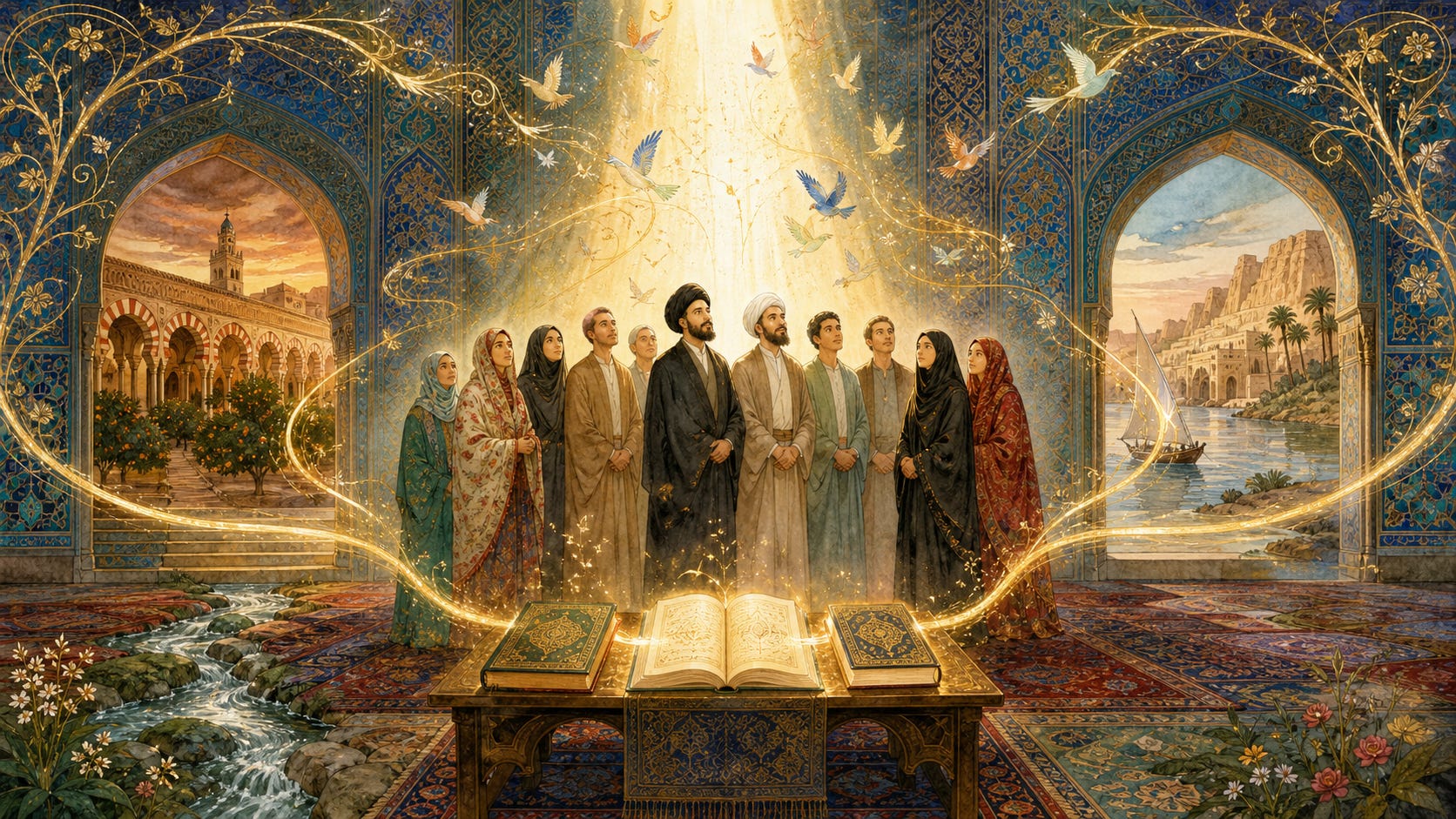
Now the third step, and this is the one I have been waiting to give you.
Al-Qurtubi — a jurist of the Maliki school, of Cordoba in Muslim Spain, who was driven out of it and wrote his great commentary in Upper Egypt in the seventh century of the Hijra — comes to this verse.
And on this verse, of all the verses in the Qur’an, he reaches for the Prophet:
لَا تَزَالُ طَائِفَةٌ مِنْ أُمَّتِي ظَاهِرِينَ عَلَى الْحَقِّ، لَا يَضُرُّهُمْ مَنْ خَذَلَهُمْ، حَتَّى يَأْتِيَ أَمْرُ اللَّهِ وَهُمْ كَذَلِكَ
“A ta’ifa of my community will not cease to be manifest upon the truth. Those who abandon them will not harm them, until the command of God comes, and they are still so.”
— Sahih Muslim, Hadith 1920, Book of Leadership, Chapter 53, narrated by Thawban
There is a promise in this religion that a portion of this community will always be standing on the truth.
Always.
Whatever happens to the rest of it.
And that promise is not our private property.
It is not in our books alone.
It is in Sahih Muslim, in a chapter whose title is the hadith itself.
But al-Qurtubi does something more than quote it, and this is the moment I want you to catch.
He goes to a longer report in the same collection — one in which two things the Prophet said sit inside a single sentence.
The first half is about being given understanding in religion.
The second half is the promise of the enduring band.
مَنْ يُرِدِ اللَّهُ بِهِ خَيْرًا يُفَقِّهْهُ فِي الدِّينِ، وَلَا تَزَالُ عِصَابَةٌ مِنَ الْمُسْلِمِينَ يُقَاتِلُونَ عَلَى الْحَقِّ ظَاهِرِينَ عَلَى مَنْ نَاوَأَهُمْ إِلَى يَوْمِ الْقِيَامَةِ
“Whomever God wishes good for, He gives him understanding in the religion. And a band of the Muslims will not cease to fight upon the truth, manifest over those who oppose them, until the Day of Resurrection.”
And then he makes one observation about it:
وَظَاهِرُ هَذَا الْمَسَاقِ أَنَّ أَوَّلَهُ مُرْتَبِطٌ بِآخِرِهِ
“And the apparent sense of this sequence is that its beginning is connected to its end.”
— Al-Qurtubi, Al-Jami’ li-Ahkam al-Qur’an, on Surah al-Tawbah (the Chapter of Repentance) #9, Verse 122
Let me say plainly what he is arguing, and let me be careful to say that it is an argument and not a fact.
He is saying:
Do not read that as two separate sayings that happen to have been recorded together.
Read it as one movement.
The beginning of it is connected to its end.
Which means:
The ones who are given understanding in religion are the enduring band.
The promise that a portion of this community will always be standing on the truth is a promise about the people who go out and learn.
That is his reading, and I want you to hold it as his and not as mine.
And one more caution, because somebody here will check and should:
The report in Sahih al-Bukhari that joins those two halves — the one narrated from Mu’awiya — does not say ta’ifa at all.
It says this nation.
The whole community.
The word ta’ifa is in the other reports.
So this is a mufassir — an exegetist — putting texts side by side and drawing a conclusion.
It is not a single sentence handed down whole.
I would much rather you heard that from me than found it on your own.
But now sit for a second with what has just happened.
A Maliki jurist, driven out of Cordoba, working in Upper Egypt, reading a Sunni collection of hadith — arrives at the theology of the hawza.
And he arrives at it while disagreeing with us about what the verse means.
That is not a Shi’a argument.
That is the argument, sitting in their books, made by their scholar, and we did not have to reach for it.
And Then He Used It Himself
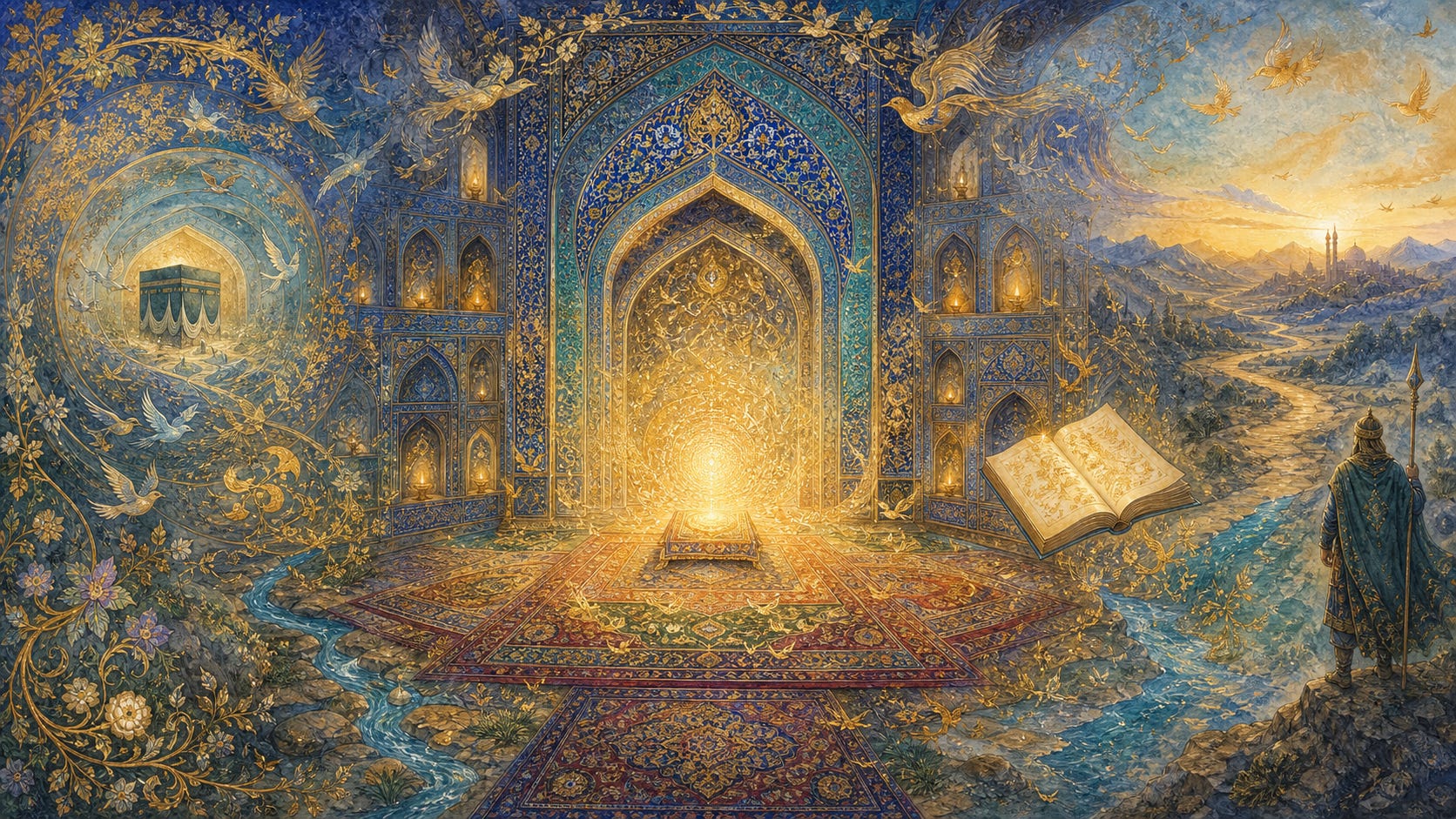
Last step.
Because there is one more layer.
In the classical literature of this school, al-ta’ifa — with the definite article, unqualified, no adjective — meant us.
When a jurist writes ijma’ al-ta’ifa, the consensus of the ta’ifa, everyone knows exactly which group is meant.
It was the word the community used for itself, from the inside.
And he — Shaykh al-Tusi — used it.
Here he is, in his own book, in his own voice:
عَلَى أَنَّ الْمَشْهُورَ الَّذِي لَا مِرْيَةَ فِيهِ بَيْنَ الطَّائِفَةِ أَنَّ الْإِمَامَةَ لَا تَكُونُ فِي أَخَوَيْنِ بَعْدَ الْحَسَنِ وَالْحُسَيْنِ عَلَيْهِمَا السَّلَامُ
“Moreover, that which is well-known, in which there is no doubt among the Ta’ifa, is that the Imamate is not in two brothers after Imam Hasan and Imam Husayn, peace and blessings be upon them both.”
— Shaykh al-Tusi, Kitab al-Ghayba
He used the word for his community.
And then his community used it for him.
Now.
I went looking for the first man to do that — for the first person to write Shaykh al-Ta’ifa down and mean this man by it.
And I want to tell you honestly that I could not find him.
There is no decree.
There is no year you can point to.
Nobody stood up in a mosque in Najaf and announced it.
It simply appears, in the biographical dictionaries, being used as though everybody already knew.
I thought that was a failure of my research.
I have decided it is the point.
A title given by a committee is an award.
A title that simply accretes, over generations, because nobody can think of anything else to say — that is a different kind of thing entirely.
So here is where we have got to.
Every scholar in this tradition is a shaykh.
Many of them are a shaykh of a school, or a city, or a generation.
We have met several already in this series and we will meet several more.
One man, in a thousand years, is called the Shaykh of the Ta’ifa.
Not of a faction.
Not of a party.
Not of a sect, whatever the English books tell you.
Of the portion that goes around the House.
Of the ones who went out to understand and came back to warn.
Of the group that stands guard, facing the wrong way, holding a weapon, while the rest of us pray.
And by the end of tonight you will know exactly why it was him.
The Long Apprenticeship — Twenty-Eight Years a Student
A Boy in Tus
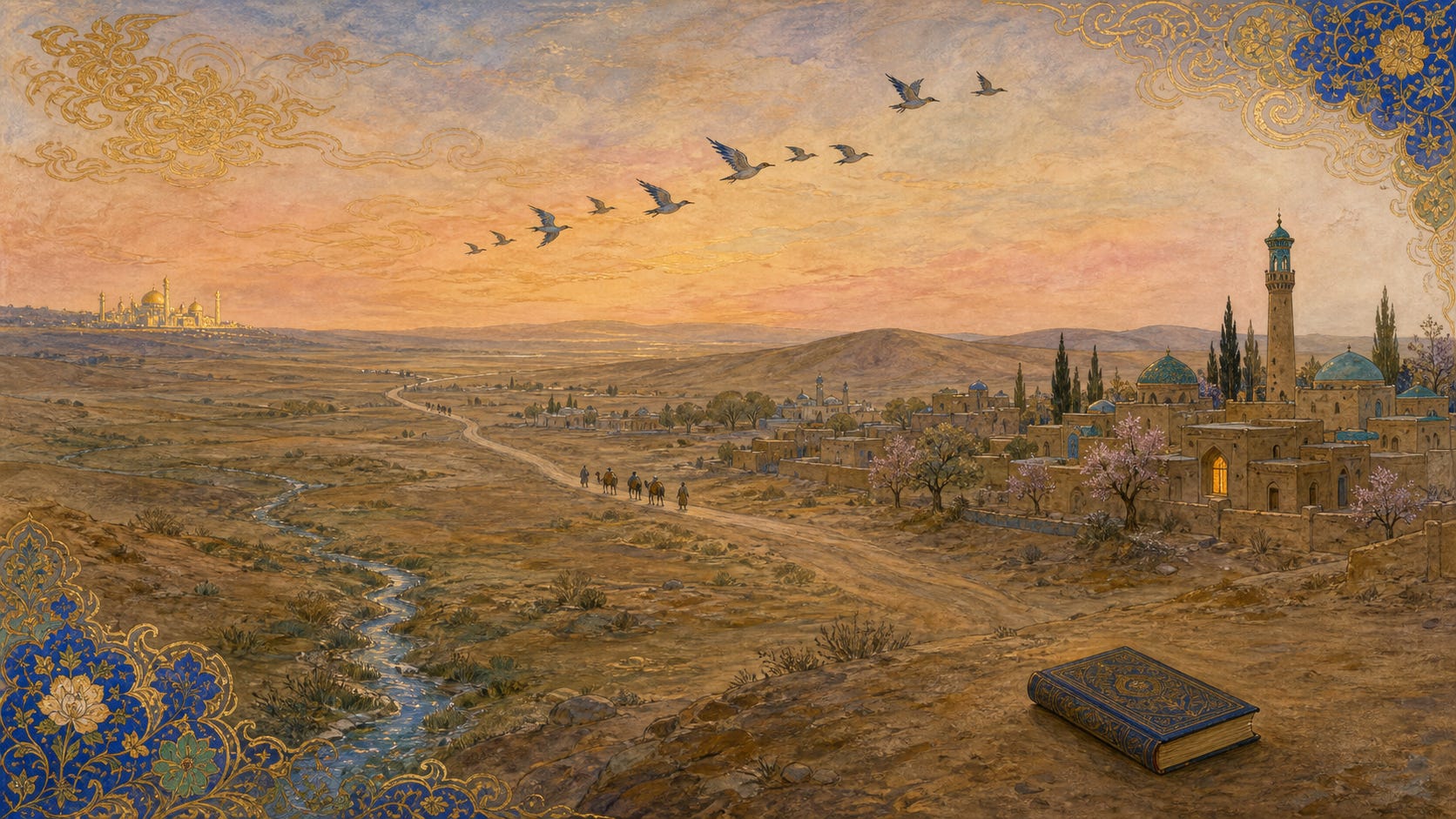
Ramadan, 385 of the Hijri calendar.
Tus, in Khurasan.
Khurasan is not a place most of us can picture, so let me try to put it in your hands.
Take a map of the Muslim world in the fourth century of the Hijra.
Find Baghdad, in the middle of it, one of the great cities of the world, the seat of the caliphate, the place where the money and the books and the arguments are.
Now go east.
Keep going.
Past Rayy — the southern part of modern day Tehran’s, past Nishapur, out to where the Persian world runs into the steppe and the caravan roads come down out of Central Asia.
That is Khurasan.
And Tus is a town in it.
It was not a backwater — I do not want to give you that impression.
Khurasan in that century was producing extraordinary people; it is the country of Firdawsi, and it would give us al-Ghazali within a lifetime, and — two hundred years later — Khwaja Nasir al-Din al-Tusi, another al-Tusi entirely.
But it was a very long way from the centre, and everybody who lived there knew it, and every ambitious young man in Khurasan grew up knowing that the road to anything ran west.
He was born there in the month of Ramadan, in a family we know almost nothing about.
That is worth pausing on for a moment.
We have no story of his childhood.
No account of a precocious boy astonishing his teachers, no dream his mother had before he was born, no miracle at the cradle.
Our tradition loves those stories and it did not produce one for him.
What we have instead is a birth date and a town.
The record of this man begins the day he starts working.
The Road He Took at Twenty-Three
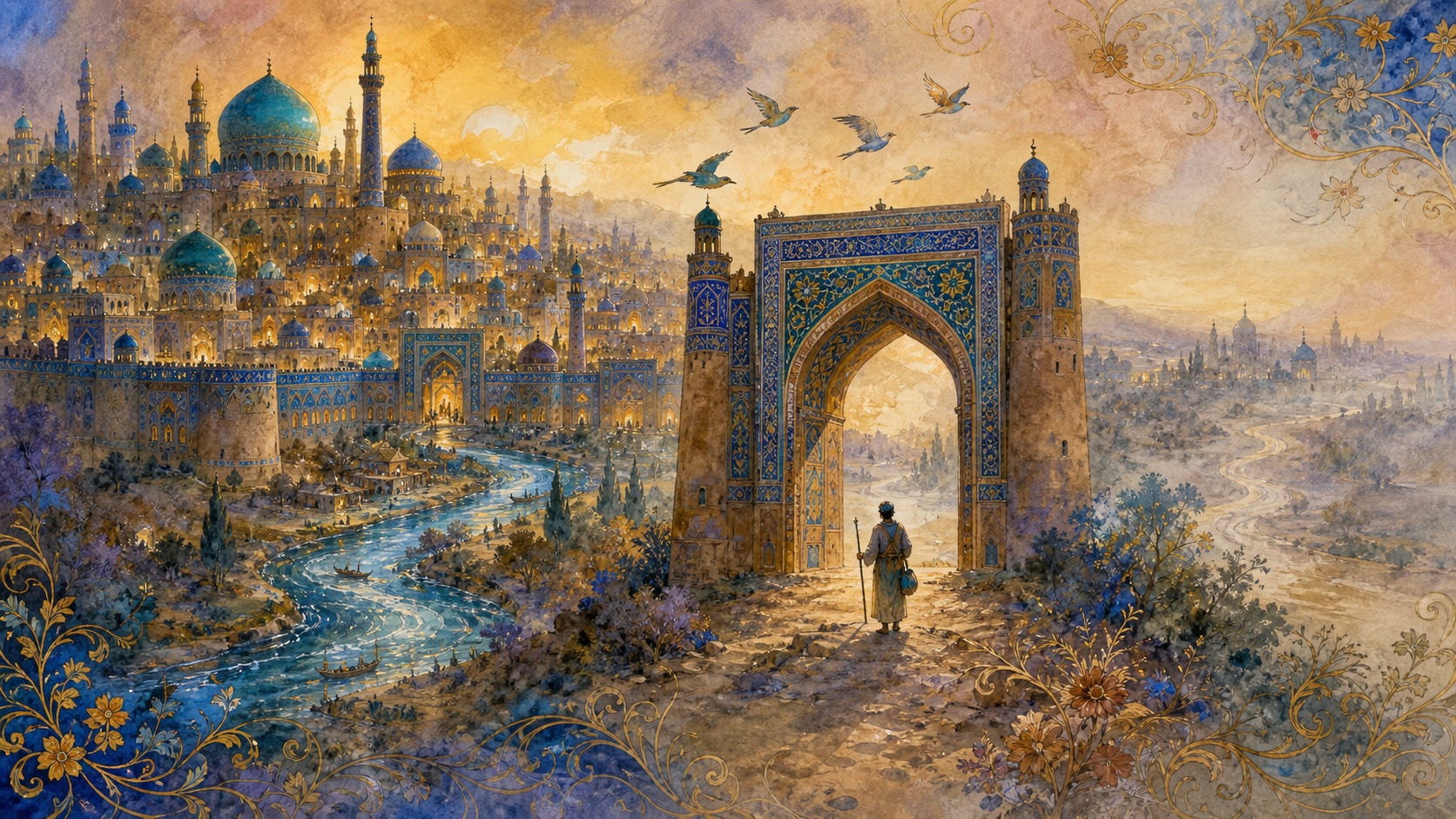
408 of the Hijra.
He is twenty-three years old, and he leaves.
One account has it that he came west by the obvious road — up through Nishapur, then Rayy, then down to Qom, and from Qom to Baghdad.
I say one account has it because that is exactly what it is: a single report, and I have not been able to corroborate it anywhere else, and I would rather tell you that than draw you a map I cannot defend.
But the arrival — the arrival we do not have to guess about.
Because he tells us himself.
Thirty-nine years later, deep inside one of his own books, he writes this:
مِنْ وَقْتِ دُخُولِي إِلَى بَغْدَادَ، وَهِيَ سَنَةُ ثَمَانٍ وَأَرْبَعِمِائَةٍ
“...from the time of my entering Baghdad, which is the year four hundred and eight.”
— Shaykh al-Tusi, Kitab al-Ghayba
We are not estimating.
We are not reconstructing from later biographers.
He wrote it down, in the first person, in his own book.
Four hundred and eight.
Hold on to that sentence.
There is more of it, and we come back to it in the third point tonight, and when we do it will be the strongest thing I say all evening.
For now, just the young man on the road.
Twenty-three.
Coming out of Khurasan into one of the great cities of the world, carrying whatever a student carried, arriving in a city of hundreds of thousands of people where nobody was waiting for him.
And going to find one particular teacher.
Five Years, and Then Twenty-Three
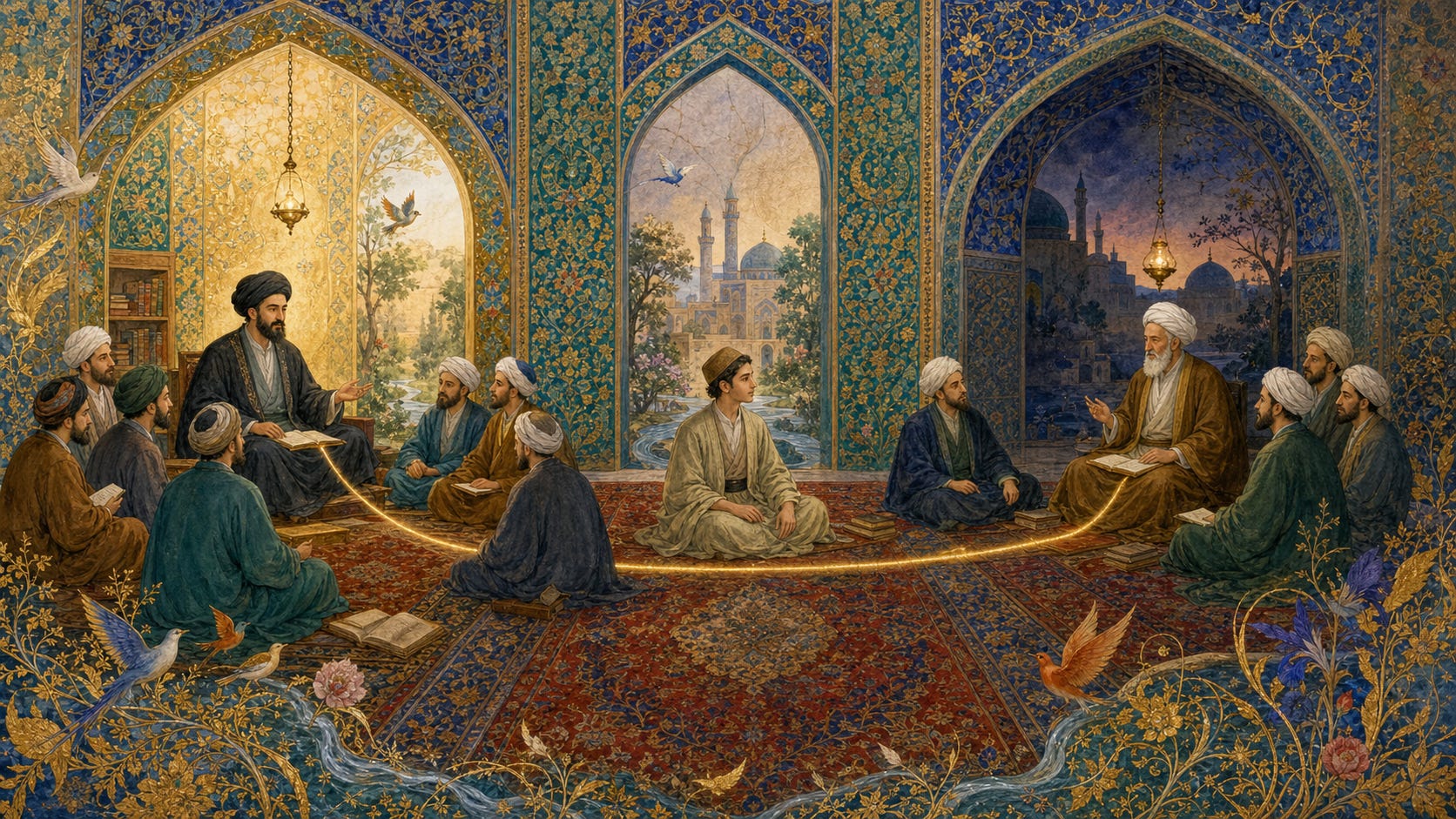
The teacher was Shaykh al-Mufid.
We met him in Session Sixty-Six and I am not going to re-narrate him, but hold three things: he was the most formidable theologian this school had produced up to that point; his house in Baghdad was a destination for scholars of every school in the city; and he was, by then, an old man.
Shaykh al-Tusi studied with him for five years.
Five.
That is all he got.
Because on the eve of Friday, three nights into the month of Ramadan, in the year 413 of the Hijra, Shaykh al-Mufid died.
And the young man from Khurasan, now twenty-eight, buried his teacher and stayed.
The man who took over the circle was Sayyid al-Murtada — Shaykh al-Mufid’s own student, a descendant of the Prophet, peace and blessings be upon him, his family, and his righteous companions, a jurist and a poet and the brother of the man who compiled Nahj al-Balagha.
And Shaykh al-Tusi sat down in front of him.
For twenty-three years.
Until, with five nights remaining of the month of Rabi’ al-Awwal in the year 436 of the Hijra, Sayyid al-Murtada died too.
Now do the arithmetic with me, because this is the point of the whole section.
Five, and then twenty-three.
Twenty-eight years.
He arrived in Baghdad at twenty-three years old, and he was fifty before there was nobody left in the room above him.
Twelve Dinars a Month
There is a detail in the biographies about that second stretch that I did not expect to find, and I want to give it to you because it changes the texture of the thing.
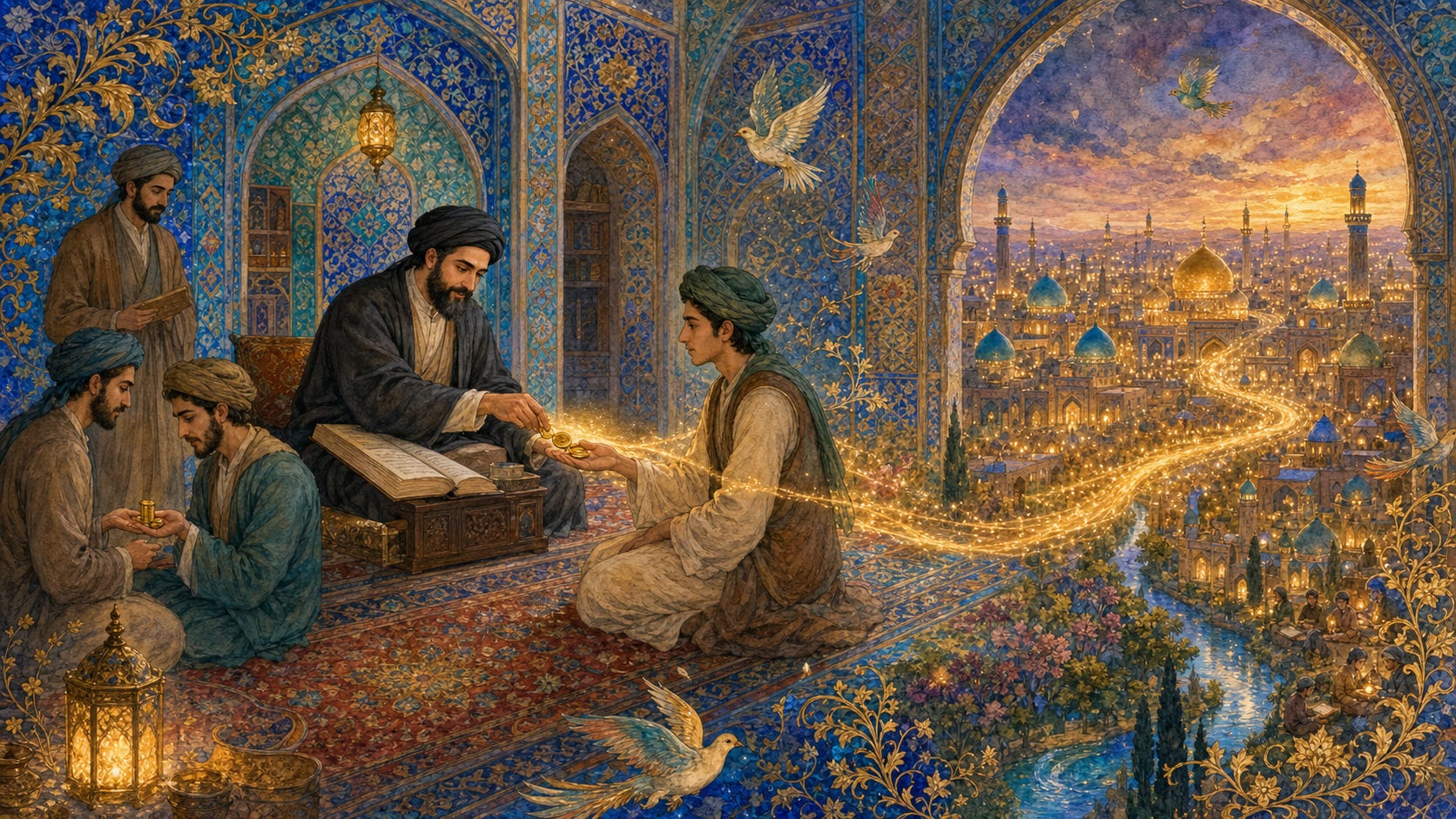
Sayyid al-Murtada paid him.
Every month, a stipend.
Twelve dinars.
And the biographers record — this is the part that made me stop — who else was on the payroll.
Ibn al-Barraj.
The same man I mentioned twenty minutes ago, who ends up as the judge of Tripoli, on the Mediterranean coast, running a community of his own.
He was in that room too, and he was getting eight.
Shaykh al-Tusi was getting twelve.
I should be honest with you twice over here.
The sources argue about the coin — one page says twelve dirhams, two say twelve dinars, and the dinar reading is the one the standard biographies carry.
And they argue about the comparison: one report gives us the twelve-against-eight, and another says simply that twelve was what he paid his students, all of them.
Either way, the thing underneath does not move.
But do not let the money be the point.
The point is underneath the money.
Somebody had decided that a student should not have to choose between learning and eating.
That is not charity.
Charity is what you give a man because you feel sorry for him.
This is something else.
This is a man with money and a seminary looking at a twenty-eight-year-old and making a judgement about the next forty years, and then putting his hand in his pocket every single month for twenty-three of them.
We are going to come back to this.
In Session Seventy-Six, when we finally sit down and ask what a hawza actually is, we are going to talk about khums, and about the shahriyya — the monthly stipend that keeps students in the seminaries of Najaf and Qom to this day, more than a thousand years later.
That system has a beginning.
You are looking at it.
The Year He Was Left Everything
436 of the Hijra.
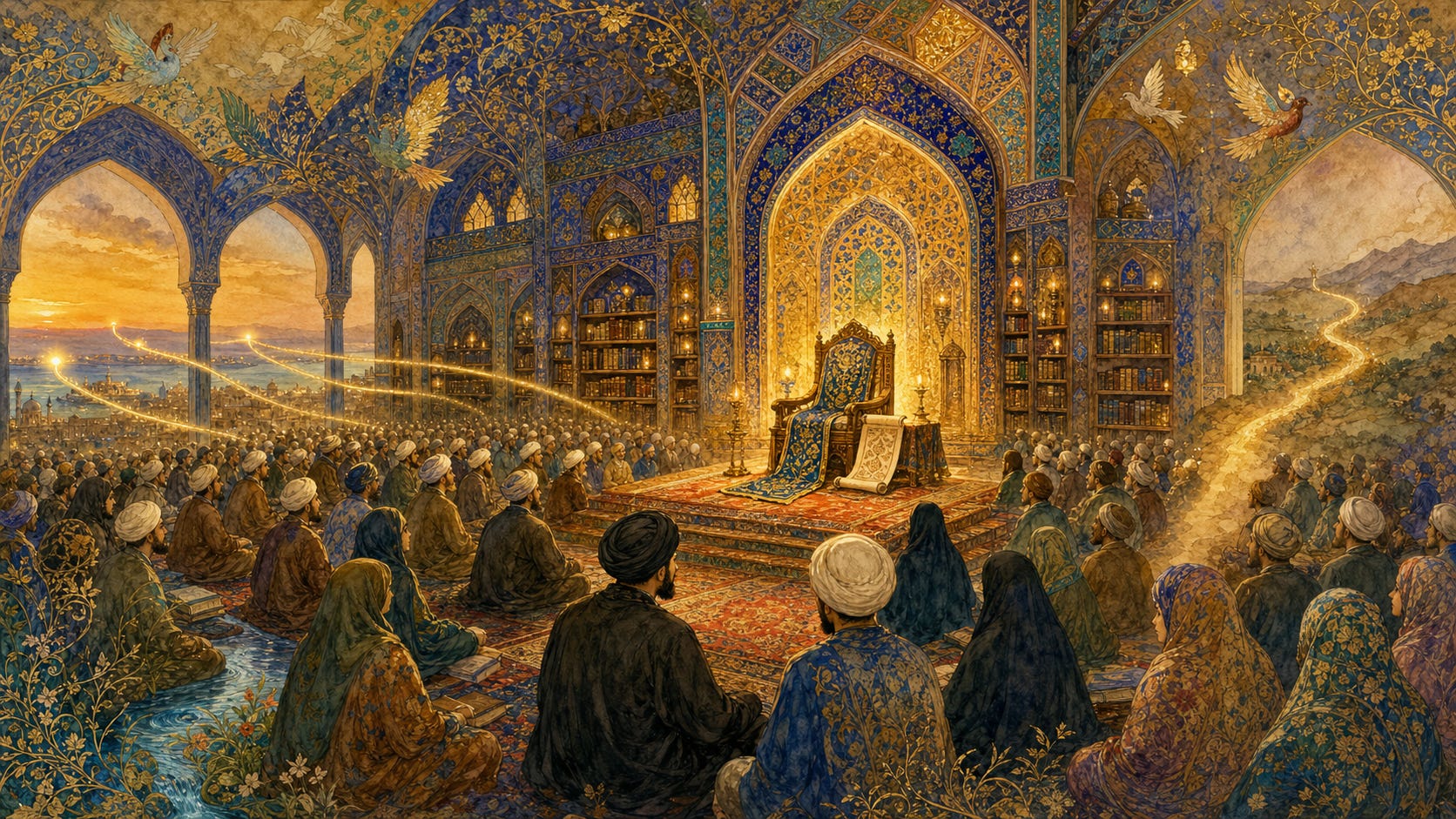
Sayyid al-Murtada is dead, and Shaykh al-Tusi is fifty years old, and everything is his.
The seminary.
The Dar al-Ilm — the House of Knowledge, with its library.
The students.
The correspondence.
The network that ran west through Syria to the coast: Ibn al-Barraj in Tripoli, al-Sallar in Aleppo, Abu al-Salah in greater Syria, all of them his, all of them looking to Baghdad.
And then the Chair of Theology, from the Caliph al-Qa’im bi-Amr Allah himself.
Around three hundred students in his circle at its height — and I give you that number as an order of magnitude and not as a register, because nobody was keeping an attendance list and anyone who tells you they know the exact figure is selling you something.
That is the position.
That is what he inherited.
And it took him twenty-eight years to get there.
Lessons for Our Time
Three things, and they all come out of that number.
The first is the number itself.
Twenty-eight years a student.
Five under one master and twenty-three under another, in the same room, in the same city, with the same books.
He was not Shaykh al-Ta’ifa at thirty.
He was not Shaykh al-Ta’ifa at forty.
At forty he was a distinguished student, and the man teaching him was still alive, and he still sat where students sit.
I want you to feel the distance between that and the world your children are growing up in.
Our age has built machinery that will hand a nineteen-year-old a platform and a twenty-five-year-old an authority, and it will do it before either of them has read anything all the way through.
And the machinery is not evil — it is just fast, and speed is the only virtue it has.
So the question is not “why doesn’t anyone study for twenty-eight years any more.”
People do.
The question is sharper than that, and it is for the person who has already started.
What does it mean to sit for twenty-three years in the same room, in front of the same teacher, and still — at fifty — call yourself a student?
The second is the money — and I want to be very careful here, because this is the most misusable thing I will say to you tonight.
That stipend has a name.
It is called the shahriyya — the monthly — and it did not stop in the eleventh century.
It is paid in Najaf and Qom this month, to students sitting in rooms exactly like the one Shaykh al-Tusi sat in.
And here is the thing almost everybody gets wrong about it.
It is not a rich man’s gift.
It does not come out of a patron’s pocket as a favour.
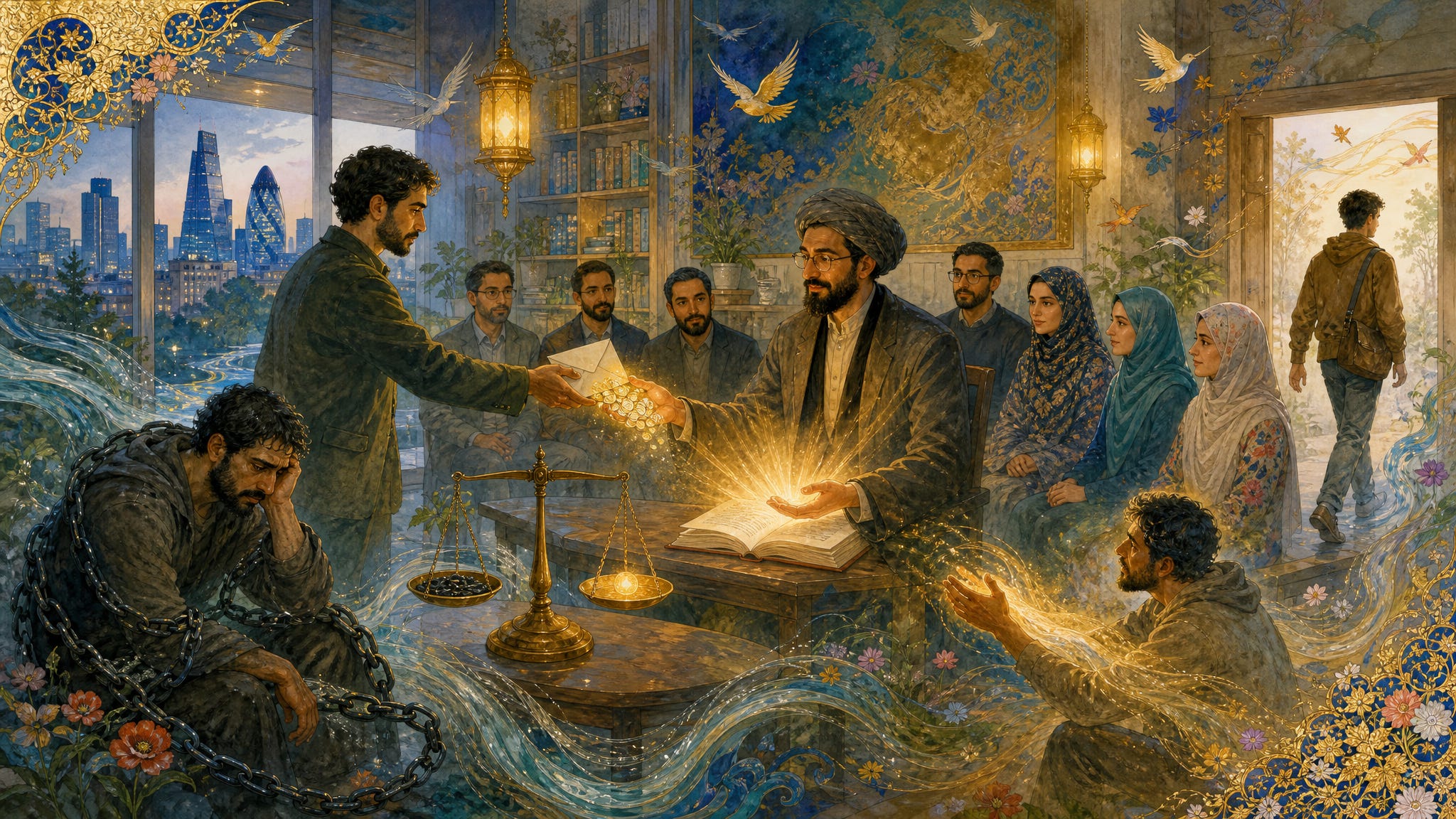
It comes out of the obligatory giving of ordinary believers — and principally out of sahm al-Imam, the Imam’s own portion of the khums.
Which means the money is not the donor’s money by the time it arrives.
It is a trust, held on behalf of the Imam of our Age, may our souls be his ransom and may God hasten his return, and passed on through the hands of a marja’.
Now hold that, because everything turns on it.
The man who hands the money over is a courier.
He is not a paymaster.
He cannot buy anything with it, because it was never his.
And that is exactly what one of my teachers meant when he told me, years ago:
“When you enter the hawza, you enter the employ of the Imam of our Age.”
Not the employ of a committee.
Not the employ of whoever paid for the carpet.
So the shahriyya exists for one purpose, and the purpose is not comfort.
It exists to make a scholar free.
Free of the need to please anyone.
Free to say the thing that will not be popular.
Free to answer the question that has no comfortable answer.
And when it stops doing that, it has failed — and the honest teachers know it.
I know of a student, in our own age, who agreed with his mentor about everything.
Every opinion, every ruling, every time.
To his face, always yes.
Behind his back, doubts.
And one month his stipend simply stopped.
He went and asked why, and his teacher said to him:
Because when I say something wrong, you do not correct me.
This money is turning you into a hypocrite where I am concerned.
So I am taking it away — perhaps then you will be able to push back against me.
Sit with that.
A teacher withdrew a man’s income in order to restore his honesty.
That is what it is for.
That is the whole institution in one sentence.
And the Qur’an gives you a test you can carry out of this room tonight and use for the rest of your life.
It is one line long.
ٱتَّبِعُواْ مَن لَّا يَسْـَٔلُكُمْ أَجْرًا وَهُم مُّهْتَدُونَ
“Follow those who ask of you no wage — and who are rightly guided.”
— Qur’an, Surah Ya-Sin (the Chapter of Ya-Sin) #36, Verse 21
And notice who is speaking.
This is not a prophet.
It is a man who came running from the far side of the city — an ordinary believer, with no title — and the test he hands his people is not “follow the guided, and by the way they take no fee.”
The two are joined.
The absence of the fee is offered as part of the evidence of the guidance.
And now I have to say the hard part, and I am going to say it plainly, because I have sat in my own front room with people this has been done to.
There are places — not here, but not far from here either — where the whole thing has been turned upside down.
Where a speaker is booked for a sum of money that would keep a family for a year or even more.
Where a centre then goes to its congregation and asks each household for a figure — seventy-two pounds a head, or three hundred and thirteen, or whatever number has been made to sound holy this year — and where the asking is done in such a way that a man who cannot afford it cannot say so out loud.
And I have seen what that does.
I have sat with men who work two jobs and who have gone to lenders no bank would let them near, and borrowed at interest rates you would not believe me if I said them, so that they could pay what they had been told their love for Imam Husayn required.
Listen to what God says about preachers who put people in that position:
أَمْ تَسْـَٔلُهُمْ أَجْرًا فَهُم مِّن مَّغْرَمٍ مُّثْقَلُونَ
“Or do you ask of them a wage — so that they are weighed down with debt?”
— Qur’an, Surah al-Qalam (the Chapter of the Pen) #68, Verse 46
Maghram.
Debt.
God raises the only kind of reason that would excuse a man for turning away — you must be charging them, and they must be in debt because of it — and then rules it out, because the Prophet asked for nothing.
Which tells you exactly what it means when the charge is true.
Fourteen hundred years ago — and it names a loan taken out last year, at an interest rate no one should ever have been offered.
So let me say three things as clearly as I know how.
God needs nothing from you.
Not your money, not your meat, not your blood.
لَن يَنَالَ ٱللَّهَ لُحُومُهَا وَلَا دِمَآؤُهَا وَلَٰكِن يَنَالُهُ ٱلتَّقْوَىٰ مِنكُمْ
“Their flesh will not reach God, nor their blood — but what reaches Him is the God-consciousness from you.”
— Qur’an, Surah al-Hajj (the Chapter of the Pilgrimage) #22, Verse 37
That is said about the sacrifice at the Hajj — the single most expensive act of devotion in the religion.
The animal does not reach God.
Only what was in you when you gave it.
And Imam Husayn, peace and blessings be upon him, needs nothing from you.
He needed nothing at Karbala; he certainly needs nothing from a man in in any part of the world with two jobs and a child to feed.
If anyone ever tells you otherwise — however large his turban, however grand his title — you are hearing something that God has already answered:
لَّقَدْ سَمِعَ ٱللَّهُ قَوْلَ ٱلَّذِينَ قَالُوٓاْ إِنَّ ٱللَّهَ فَقِيرٌ وَنَحْنُ أَغْنِيَآءُ
“God has certainly heard the saying of those who said: ‘God is poor, and we are rich.’”
— Qur’an, Surah Aal Imran (the Chapter of the Family of Imran) #3, Verse 181
And third — the giving itself is not a tax.
It is ta’awun.
…وَتَعَاوَنُواْ عَلَى ٱلْبِرِّ وَٱلتَّقْوَىٰ ۖ وَلَا تَعَاوَنُواْ عَلَى ٱلْإِثْمِ وَٱلْعُدْوَٰنِ
“And cooperate with one another in righteousness and God-consciousness; and do not cooperate with one another in sin and aggression.”
— Qur’an, Surah al-Ma’idah (the Chapter of the Table Spread) #5, Verse 2
Feel both halves of that verse.
Because if giving to keep a scholar free is ta’awun upon righteousness — and it is — then giving to a man who will use it to keep his mouth shut is cooperation in the other thing.
Money handed over to buy a silence is not charity.
It has changed category.
And the Imams put the mutual duty in language nobody can misread.
Imam al-Sadiq, peace and blessings be upon him:
الْمُسْلِمُ أَخُو الْمُسْلِمِ… وَيَحِقُّ عَلَى الْمُسْلِمِينَ الِاجْتِهَادُ فِي التَّوَاصُلِ وَالتَّعَاوُنُ عَلَى التَّعَاطُفِ وَالْمُوَاسَاةُ لِأَهْلِ الْحَاجَةِ
“The Muslim is the brother of the Muslim... and it is a duty upon the Muslims to strive in keeping bonds, and to cooperate in compassion, and to share what they have with the people of need.”
— Imam Ja’far al-Sadiq, peace and blessings be upon him, al-Kulayni, Al-Kafi, Volume 2, Book of Belief and Disbelief, Chapter on the Right of the Believer upon his Brother, Hadith 15
Sharing with the people of need.
That is the direction the money is supposed to run in a healthy community — toward the man who is struggling, not out of his pocket and into an envelope.
Imam al-Baqir, peace and blessings be upon him, once put it as a question to his own followers.
Does one of you go to his brother, put his hand into his purse, and take what he needs — and the other does not push him away?
They told him: we do not know of that among us.
And he said: then you have nothing.
I will tell you honestly that our scholars do not rate that report’s chain among the strongest. I give it to you for the standard the Imam is setting, not to settle a ruling.
So — what do you give?
If God has given you means, give, and give generously, and give to what makes a scholar free rather than to what makes him comfortable, and ask afterwards what your money bought.
And if He has not given you means — hear me.
Your contribution is not smaller.
It is arguably the more important half.
You pray for him.
You ask him hard questions and you make him work — because a scholar who is never questioned rots, and a congregation that never asks has already agreed to be managed.
You carry what he teaches out of the room and into your house and your workplace.
And when somebody tells you that God or the Imam needs your money, you do not believe him.
That is how you keep a scholar free.
Not by paying more.
By needing him to be honest, and letting him see that you do.
We will come back to all of this properly — what a hawza actually is, where the khums goes, how a scholar is made and how one is ruined.
That is Session Seventy-Six, and I promised you that night on the thirteenth night of the Shahada (Witness) series, the third of our Arbaeen sessions, and I have not forgotten.
And the third is a word.
Nafara.
Go back to the verse.
Fa-lawla nafara min kulli firqatin minhum ta’ifa — why should not a ta’ifa of every group go forth.
Nafara means: he went out.
He left.
He got up from where he was sitting and went.
The boy who left Tus at twenty-three, and went west, and did not come back — was doing the thing that verse describes.
Nobody had thought to call him by its word yet.
He was just a young man on a road.
He Did Not Write a Rebuttal. He Wrote the Library.
The List a Friend Made

I could stand here and read you a list of his books.
I would rather somebody else did it.
There was a man in Baghdad called Ahmad ibn Ali al-Najashi.
He sat in the same circles.
He studied under the same teacher — Shaykh al-Mufid — at the same time.
He was, as far as we can tell, a contemporary and something like a colleague, and he was compiling a biographical dictionary of the scholars of this school, and he came to the entry for Shaykh al-Tusi and he wrote this.
مُحَمَّدُ بْنُ الْحَسَنِ بْنِ عَلِيٍّ الطُّوسِيُّ أَبُو جَعْفَرٍ، جَلِيلٌ مِنْ أَصْحَابِنَا، ثِقَةٌ، عَيْنٌ، مِنْ تَلَامِذَةِ شَيْخِنَا أَبِي عَبْدِ اللَّهِ. لَهُ كُتُبٌ مِنْهَا كِتَابُ تَهْذِيبِ الْأَحْكَامِ وَهُوَ كِتَابٌ كَبِيرٌ، وَكِتَابُ الِاسْتِبْصَارِ… وَكِتَابُ الْعُدَّةِ فِي أُصُولِ الْفِقْهِ، وَكِتَابُ الرِّجَالِ مَنْ رَوَى عَنِ النَّبِيِّ وَعَنِ الْأَئِمَّةِ، وَكِتَابُ فِهْرِسْتِ كُتُبِ الشِّيعَةِ وَأَسْمَاءِ الْمُصَنِّفِينَ، وَكِتَابُ الْمَبْسُوطِ فِي الْفِقْهِ… كِتَابُ التِّبْيَانِ فِي تَفْسِيرِ الْقُرْآنِ
“Muhammad ibn al-Hasan ibn Ali al-Tusi, Abu Ja’far. Distinguished, from among our companions. Trustworthy. Eminent. One of the students of our shaykh, Abu Abdillah. He has books, among them: the Book of the Refinement of the Rulings, and it is a large book; and the Book of Reflection; ... and the Book of the Apparatus in the Principles of Jurisprudence; and the Book of Men — those who narrated from the Prophet and from the Imams; and the Book of the Catalogue of the Books of the Shi’a and the Names of the Authors; and the Book of the Extensive Work in Jurisprudence; ... the Book of the Elucidation in the Exegesis of the Qur’an.”
— Ahmad ibn Ali al-Najashi, Rijal al-Najashi, Page 316
Read it slowly and let the titles fall.
Tahdhib al-Ahkam.
Al-Istibsar.
Uddat al-Usul.
Al-Rijal.
Al-Fihrist.
Al-Mabsut.
Al-Tibyan.
And note who is speaking.
This is not a devotee three centuries later, polishing a legend.
This is a man who sat in the same room.
Our shaykh, Abu Abdillah — that is Shaykh al-Mufid.
He is saying: he and I had the same teacher.
Jalil.
Thiqa.
Ayn.
Distinguished.
Trustworthy.
Eminent.
Those are technical words, by the way.
In this science they are grades, not compliments.
Thiqa means: you may rely on what he transmits.
And then a colleague, writing in the same city, in the same lifetime, simply lists what the man has produced — and the list is a library.
Two Of The Four
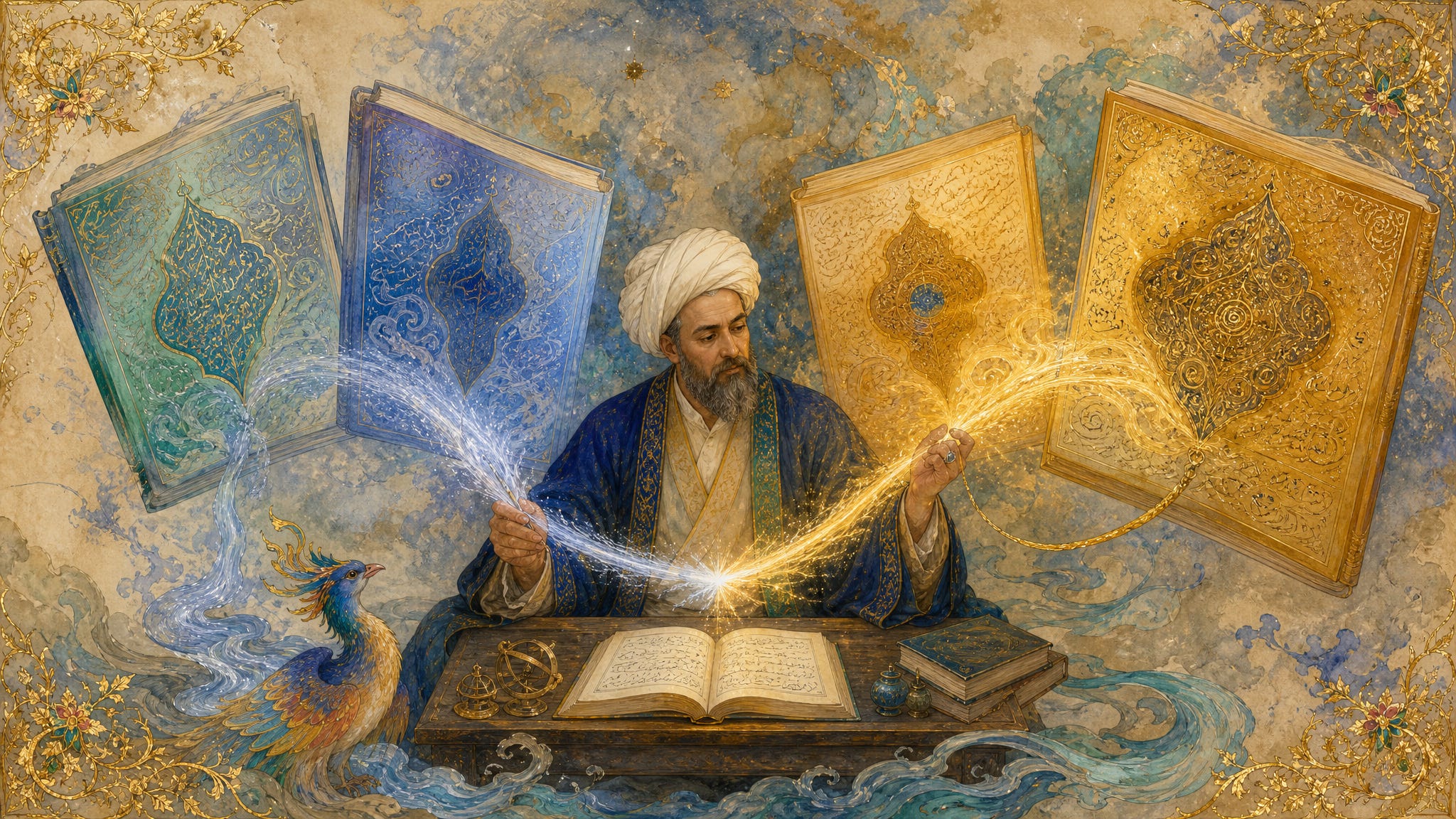
Take the first two.
Tahdhib al-Ahkam.
The Refinement of the Rulings.
It began as a commentary on his own teacher’s book — Shaykh al-Mufid’s al-Muqni’a — and it grew into something else entirely.
Roughly thirteen and a half thousand narrations.
And it is the book with the ring in it.
The sentence I read you at the beginning of this evening, about your right hand, is in there.
Al-Istibsar.
The Reflection.
Around five and a half thousand narrations, and this one is stranger, and I want you to sit with what it is for.
He did not compile it to collect the reports that agreed with each other.
He compiled it to collect the ones that fought.
That is its stated purpose.
Reports that appear to contradict one another — where one narration says this and another says that, and both are in our books, and a jurist trying to derive a ruling has to do something about it.
He gathered them.
And then he spent an entire book working out what to do.
Sit with that for a second.
That is not the behaviour of a man building a case.
A man building a case buries the contradictions.
That is the behaviour of a man building a discipline — someone who has decided that the difficulties belong in the open, catalogued, with his name on the cover.
Now go back to Session Sixty-Three.
Shaykh al-Kulayni gave us al-Kafi.
Shaykh al-Saduq gave us Man La Yahduruh al-Faqih.
There are four foundational collections of hadith in this school.
Four books that every jurist in this tradition, for a thousand years, has had to work through before he could open his mouth.
Two of them are the work of this one man.
The Book Nobody Asked For
Now the third one, and this is where the pattern starts.
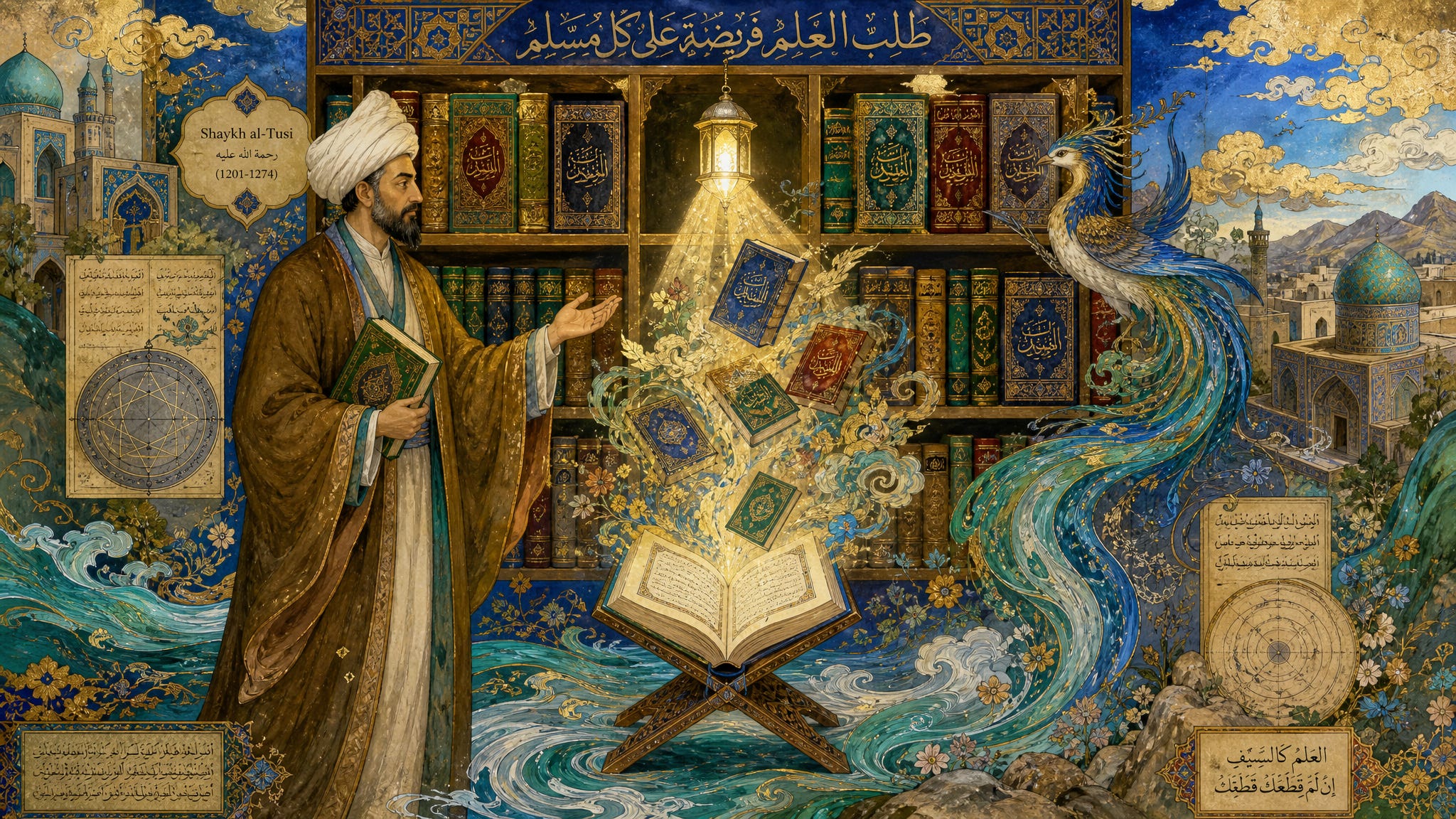
Al-Tibyan fi Tafsir al-Qur’an.
The Elucidation.
Ten volumes of commentary on the Qur’an.
Here is how it opens.
أَمَّا بَعْدُ، فَإِنَّ الَّذِي حَدَانِي عَلَى الشُّرُوعِ فِي عَمَلِ هَٰذَا الْكِتَابِ أَنِّي لَمْ أَجِدْ أَحَدًا مِنْ أَصْحَابِنَا — قَدِيمًا وَحَدِيثًا — مَنْ عَمِلَ كِتَابًا يَحْتَوِي عَلَى تَفْسِيرِ جَمِيعِ الْقُرْآنِ، وَيَشْتَمِلُ عَلَى فُنُونِ مَعَانِيهِ
“To proceed: what prompted me to begin the work of this book was that I did not find anyone among our companions — early or late — who had produced a book containing an exegesis of the whole of the Qur’an, and encompassing the various branches of its meanings.”
— Shaykh al-Tusi, Al-Tibyan fi Tafsir al-Qur’an, Volume 1, Page 1
Three words in there that I do not want you to walk past.
قَدِيمًا وَحَدِيثًا. Qadiman wa hadithan.
Early or late.
Ancient and modern.
He did not assume nobody had done it.
He looked.
Backwards through everything the school had produced since the time of the Imams, peace and blessings be upon them, and forwards through everything his own generation was writing.
And he came up empty.
Four hundred years of scholarship in this school, and not one complete commentary on the Qur’an.
Nobody commissioned this book.
Nobody was complaining about the gap.
Nobody had noticed there was a gap — that is what a gap is.
He noticed.
And then he filled it.
And it took him ten volumes.
The Insult, and the Eight Volumes
Now the fourth, and for this one you need to hear what was being said about us.
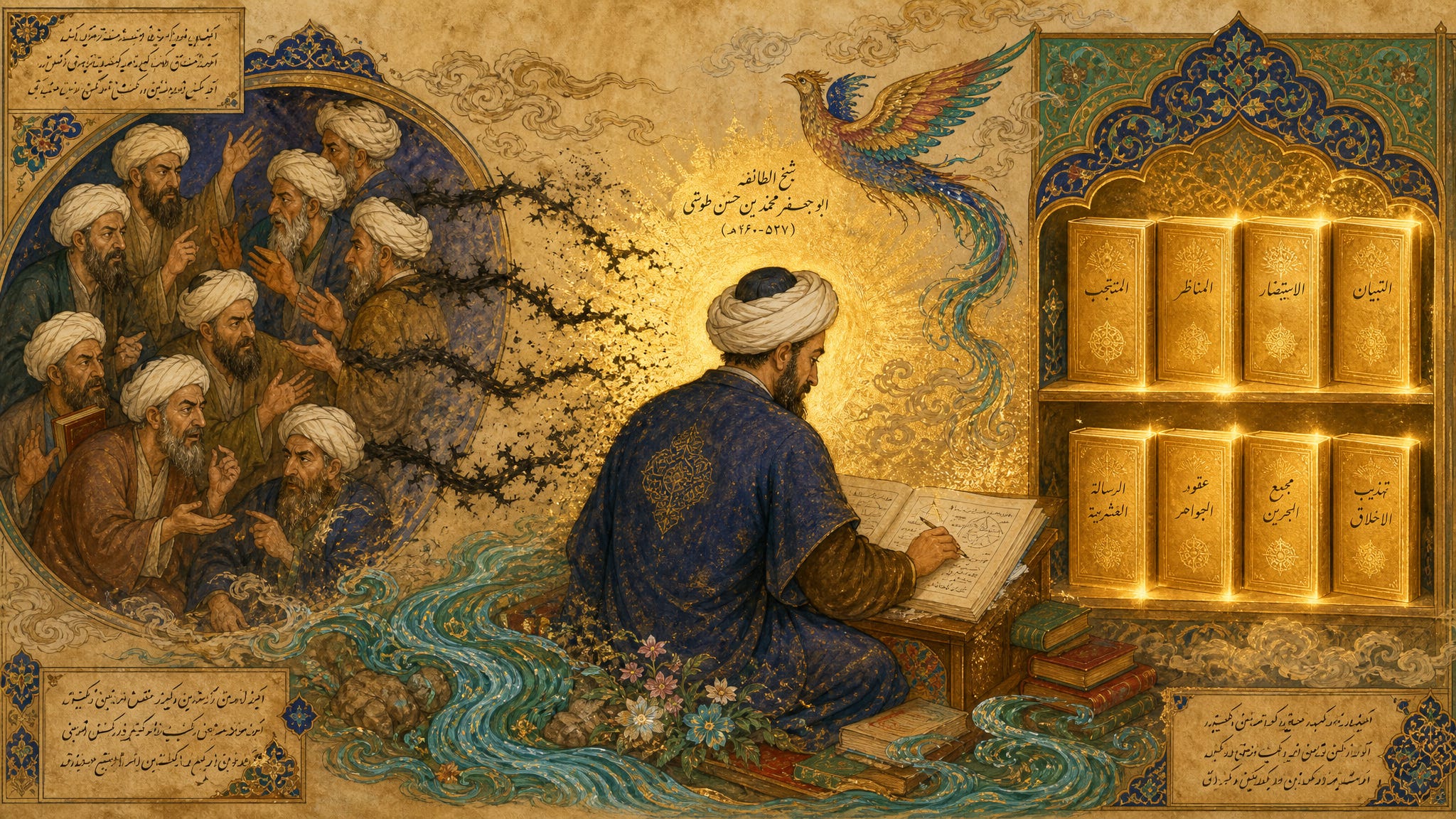
Al-Mabsut.
The Extensive Work.
Eight volumes of jurisprudence.
And in the preface he does something scholars almost never do.
He tells you exactly what was said to him, in the words in which it was said.
أَمَّا بَعْدُ، فَإِنِّي لَا أَزَالُ أَسْمَعُ مَعَاشِرَ مُخَالِفِينَا مِنَ الْمُنْتَسِبِينَ إِلَىٰ عِلْمِ الْفُرُوعِ يَنْسُبُونَ فِقْهَ أَصْحَابِنَا الْإِمَامِيَّةِ إِلَىٰ قِلَّةِ الْفُرُوعِ وَالْمَسَائِلِ، وَيَقُولُونَ: إِنَّهُمْ أَصْحَابُ حَشْوٍ وَمُنَاقَضَةٍ، وَأَنَّ مَنْ يَنْفِي الْقِيَاسَ وَالِاجْتِهَادَ لَا طَرِيقَ لَهُ إِلَىٰ كَثْرَةِ الْمَسَائِلِ وَلَا التَّفْرِيعِ عَلَيْهَا
“To proceed: I do not cease to hear our opponents, among those affiliated with the science of the branches, ascribing to the jurisprudence of our Imami companions a paucity of branches and of questions. And they say: they are people of padding and contradiction; and that whoever rejects analogy and independent reasoning has no path to a multiplicity of questions, nor to branching them out.”
— Shaykh al-Tusi, Al-Mabsut fi’l-Fiqh al-Imami, Volume 1, Preface
That is not one insult.
Count them.
One: you have very little.
Qillat al-furu’.
A paucity of branches.
Your jurisprudence is thin — there simply is not much of it.
Two: what you do have is padding, and it contradicts itself.
Ashab hashwin wa munaqada.
That is the sharpest of the three, and it is the one that would have hurt.
It is not saying you are wrong.
It is saying you are not serious.
You have filler where argument should be, and where you do have arguments they do not agree with each other.
Three: and you could not have more, because you have refused the tools.
You reject qiyas, analogy.
You reject ijtihad as they understood it.
So of course you have nothing — you have thrown away the instruments that produce something.
And now look at the first four words of that passage.
لَا أَزَالُ أَسْمَعُ. La azalu asma’.
I do not cease to hear it.
Not “I once heard.”
Not “it has been said.”
I do not cease to hear it.
This was the weather he lived in.
Decades of it, in the mosques and the markets and the debating circles of Baghdad, from men who were his neighbours.
So what does he do?
He does not write a letter to the editor.
He does not write a defence, or a rebuttal, or a treatise on why the insult is unfair.
He writes eight volumes of jurisprudence and he puts them on the table.
And there is a lesson sitting in that which I do not want to over-explain, so I will say it once.
The answer to “you have nothing” is never “yes we do.”
The answer is a shelf.
Knowing Them Better Than They Knew Themselves
But al-Mabsut is not the remarkable one.
This is.
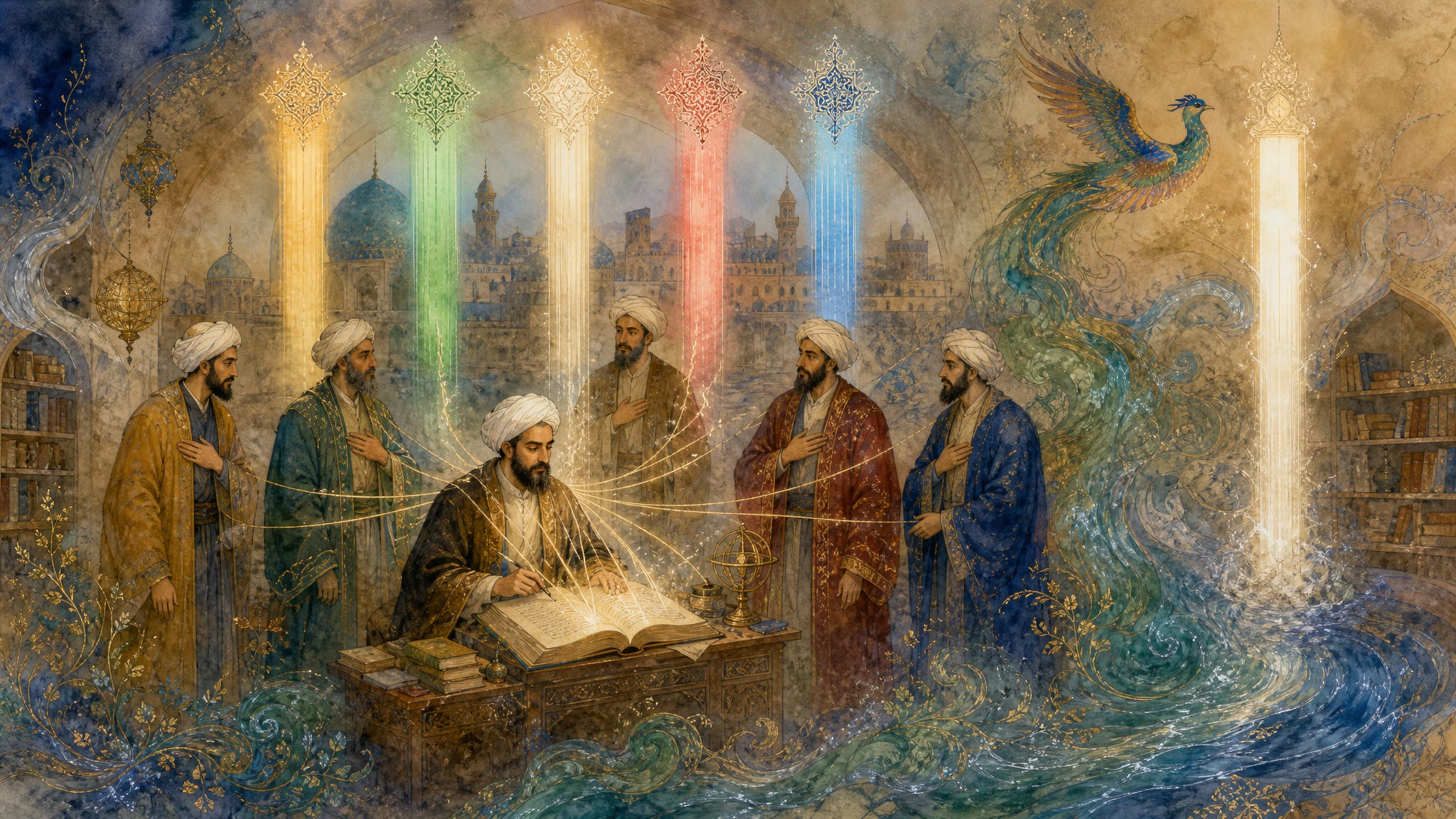
Al-Khilaf.
The Book of Disagreement.
Comparative jurisprudence, running the positions of all the schools side by side, question by question.
Think about what that book required of the man who wrote it.
To produce it he had to know the Hanafi position — not a caricature of it, the actual position, with its reasoning.
And the Maliki.
And the Shafi’i.
And the Hanbali.
Four schools he disagreed with, in their own terms, with their own arguments, well enough that a Hanafi jurist could pick up the book and read his own school’s case and say:
“Yes. That is what we hold. And that is why we hold it.”
He had to be able to state the argument of the man across the room better than most of that man’s own students could.
That is the standard.
And I want to be transparent with you, because I would rather you knew: it is also the method of this series.
In a few weeks we are going to arrive at the sharpest objection our tradition faces — the accusation that what we do at the shrines is idol worship.
And when we get there I am going to put that objection in front of you at full strength, in its best form, with its best evidence, before I say a single word in answer to it.
Not the weak version.
Not the version that is easy to knock over.
We did not invent that method.
We learned it from him.
Peer Review, Centuries Early
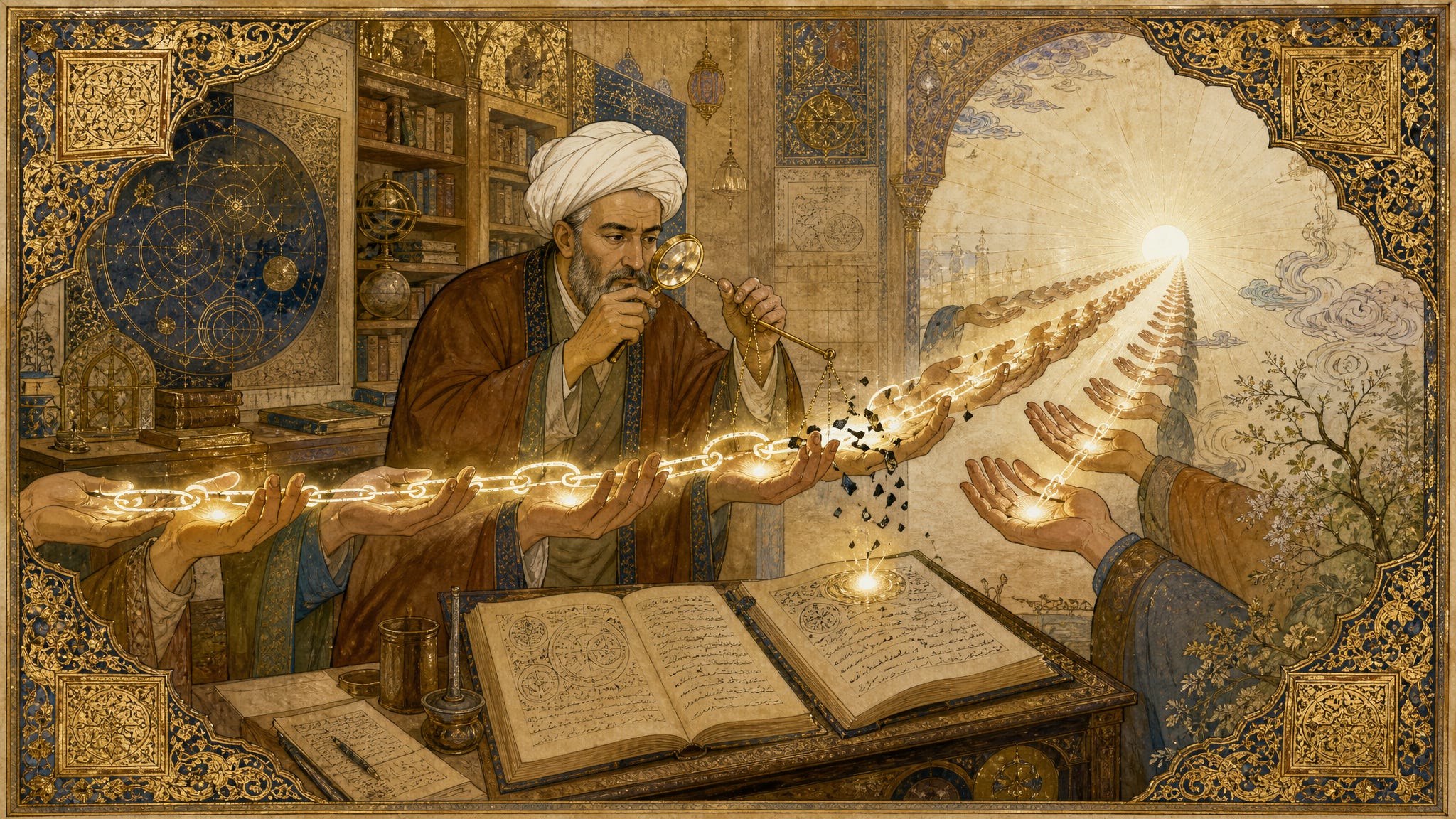
Two more books, and then a third thing that turns out to be the same thing.
Al-Rijal — the Book of Men.
And al-Fihrist — the Catalogue.
What are they?
They are books about the people who transmitted the reports.
Who was this man?
When did he live?
Who did he study with?
Is he reliable — and if he is not, why not, and who says so?
Stop and consider what kind of a mind produces that.
Here is a religion that runs on transmitted reports.
Somebody said something; somebody else wrote it down; it came down a chain of hands for four hundred years and arrived in your book.
And this man’s response to that situation is to build an entire science whose only subject is: how do we know we can trust this?
Not
“Here is the truth.”
But
“Here is the machinery by which we test claims to truth, and here is what it says about every single link in the chain, including the links we would rather it did not.”
That is peer review.
Centuries before anybody in the world had the phrase.
And it is why, an hour ago, I was able to stand here and tell you that the hadith about your right hand comes to us mursal — with a gap in the chain.
I could tell you that because he built the tools that let me see the gap.
He gave us the instrument we use to audit him.
And Then There Is a Third Book Nobody Had Written
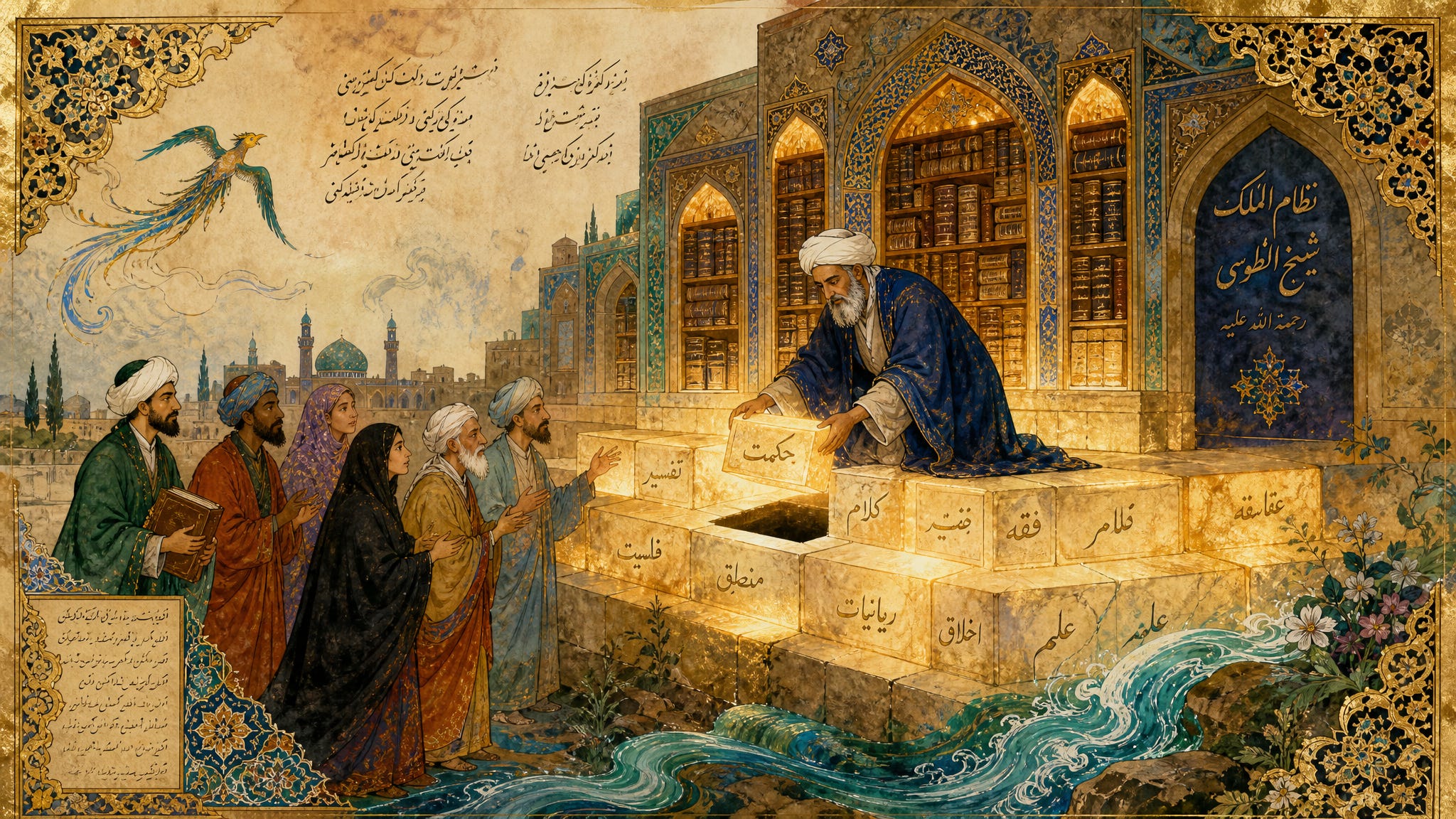
Last one.
Uddat al-Usul — the Apparatus, his work on the principles of jurisprudence.
The theory underneath the law: what counts as evidence, how you reason from a text, what to do when two sound sources point different ways.
And in its preface he does the same thing he did in al-Mabsut — he tells you what was said to him.
Except this time it is not an insult.
It is a request.
وَقُلْتُمْ: إِنَّ هَذَا فَنٌّ مِنَ الْعِلْمِ لَا بُدَّ مِنْ شِدَّةِ الِاهْتِمَامِ بِهِ، لِأَنَّ الشَّرِيعَةَ كُلَّهَا مَبْنِيَّةٌ عَلَيْهِ، وَلَا يَتِمُّ الْعِلْمُ بِشَيْءٍ مِنْهَا مِنْ دُونِ إِحْكَامِ أُصُولِهَا، وَمَنْ لَمْ يُحْكِمْ أُصُولَهَا فَإِنَّمَا يَكُونُ حَاكِيًا وَمُقَلِّدًا، وَلَا يَكُونُ عَالِمًا… وَأَنَا مُجِيبُكُمْ إِلَى مَا سَأَلْتُمْ
“And you said: this is a discipline of knowledge which must be attended to with the utmost seriousness, because the whole of the Shari’ah is built upon it; and knowledge of none of it is complete without mastering its principles; and whoever does not master its principles is merely a reciter and an imitator, and is not a scholar. ... And I am answering you in what you have asked.”
— The petition put to Shaykh al-Tusi, as he records it in the preface to Uddat al-Usul, Volume 1, Pages 3–4
I want to be precise about who is speaking there, because it would be very easy to get it wrong and I have seen it got wrong.
That is not him.
That is not Shaykh al-Tusi announcing the importance of his own subject.
Look at the first word — wa qultum, and you said.
He is quoting the people who came to him.
He is putting their words in the mouth they came out of, and then he says:
“Fine. I will answer.”
Which is better.
Because it means what you are hearing is not a scholar advertising.
It is a community walking up to a man and telling him what it lacks.
“Nobody has written this.
And without it we are reciters and imitators, and not scholars.”
And he says:
“I am answering you in what you have asked.”
The Shape You Have Now Seen Three Times
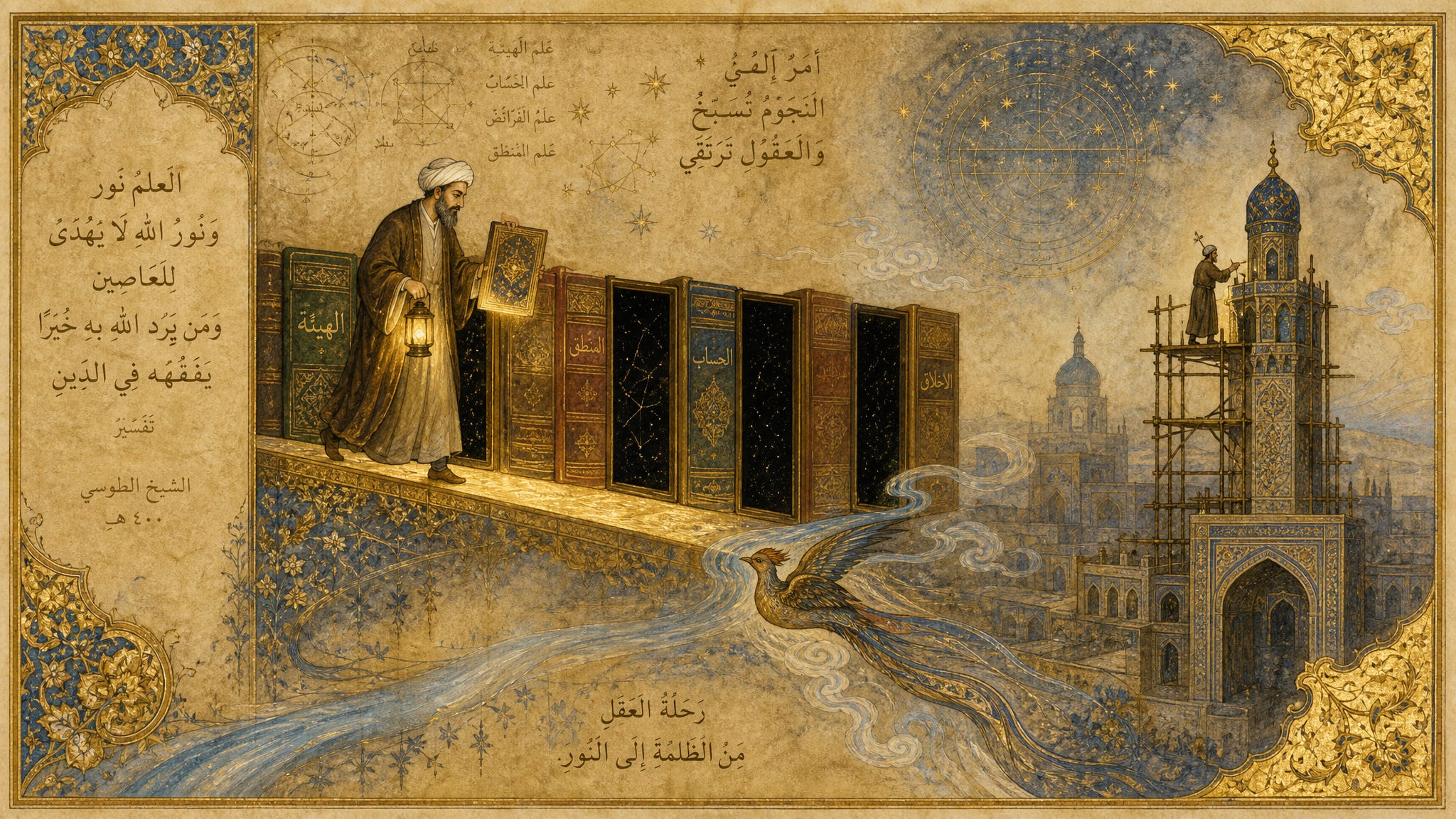
Stop.
Go back over the last twenty minutes and look at what actually happened.
Al-Tibyan:
I did not find anyone who had produced a book containing an exegesis of the whole Qur’an.
Al-Mabsut:
They say we have a paucity of branches — and that we could not have more.
Uddat al-Usul:
You said: nobody has written this, and without it we are imitators.
Three books.
Three prefaces.
The same sentence underneath all of them, in three different keys.
He wrote the books that were missing.
Not the books he wanted to write.
Not the books that would have been easiest, or most admired, or most his own.
He went looking for the holes — in the tafsir, in the fiqh, in the theory underneath the fiqh, in the science of who can be trusted — and he filled them, one after another, for forty years.
There is a kind of person who asks what do I want to build?
And there is a kind of person who asks what is missing?
They do not produce the same life.
Lessons for Our Time

The first — how a community answers contempt.
He was told his tradition was thin, padded and self-contradictory, and he answered with jurisprudence rather than with grievance.
I do not think that is only a lesson about scholarship.
Our community has been told a great many things about itself, in this country and elsewhere, and there is always a choice about how to answer, and the loudest option is almost never the one that lasts.
Nobody now reads what those men said about us in the markets of Baghdad.
Everybody who studies this law still opens al-Mabsut.
The second — al-Khilaf is the harder book.
Anyone can make their own case.
Making your opponent’s case, accurately, in a book with your name on the cover, and doing it so well that he recognises himself in your pages — that is a different order of thing entirely.
It requires you to have actually listened.
And the reason most of us cannot do it is not that we lack the ability.
It is that somewhere along the way we decided we already knew what the other person was going to say.
And the third — go back to the verse.
لِّيَتَفَقَّهُوا فِي الدِّينِ — that they may gain deep understanding in religion.
Allamah Tabataba’i told us, an hour ago, that this word means the whole of it.
Roots and branches.
Not a speciality.
Now look at the list one more time.
Hadith — twice.
Qur’anic commentary.
Jurisprudence.
Comparative jurisprudence.
Legal theory.
Biographical evaluation.
Theology.
The Occultation.
That is not a man with a career.
That is a man carrying out an instruction.
The Book About Waiting, Written While the City Fell
Thirty-Nine Years of Visiting a Grave
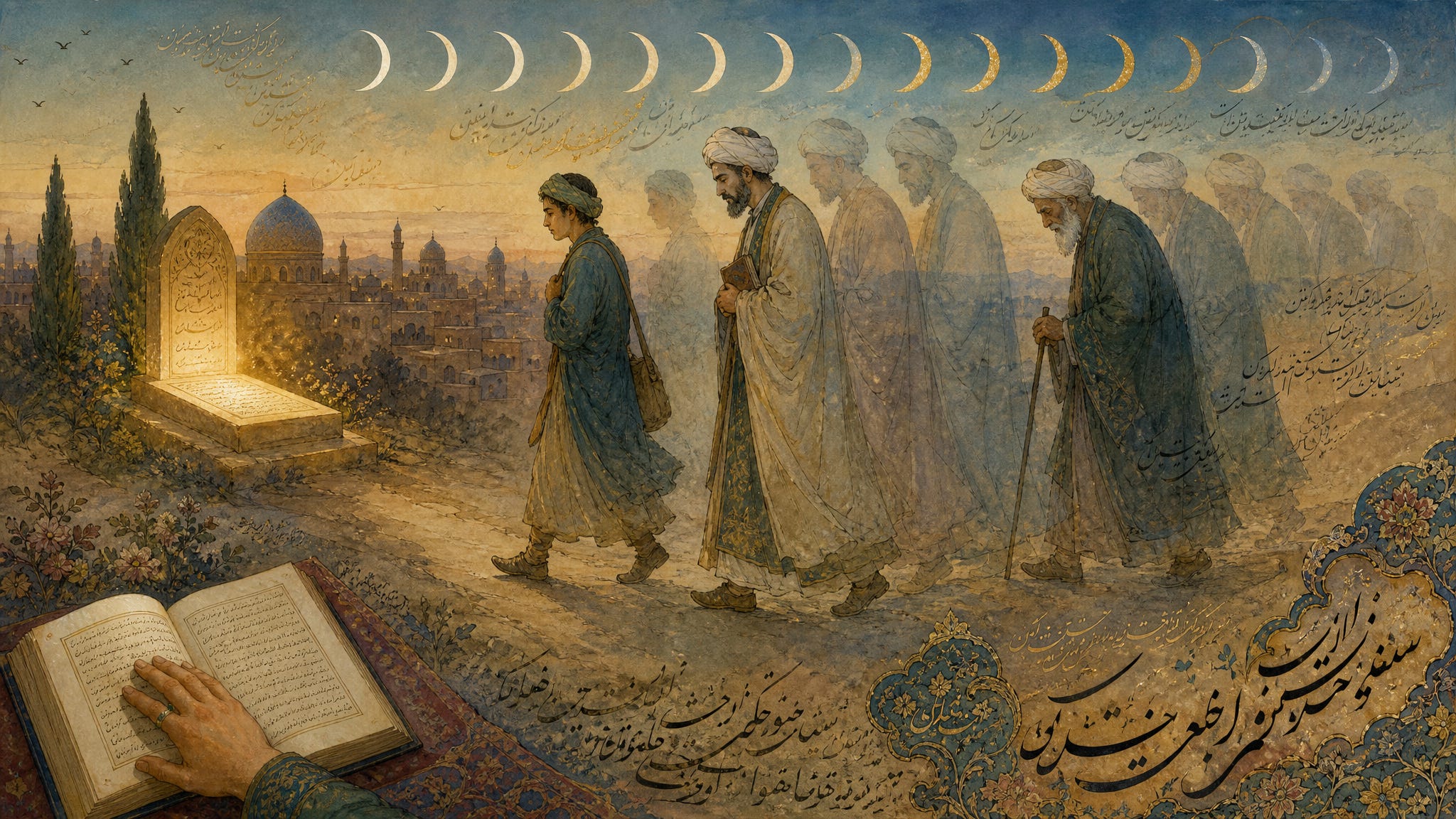
I told you at the start of Point One to hold on to a sentence, and that we would come back to it.
Here is the rest of it.
It sits deep inside Kitab al-Ghayba — the Book of the Occultation — in a passage where he is discussing where a particular grave is.
And in the middle of a technical discussion he stops being an author and becomes a man.
قَالَ مُحَمَّدُ بْنُ الْحَسَنِ مُصَنِّفُ هَذَا الْكِتَابِ: رَأَيْتُ قَبْرَهُ فِي الْمَوْضِعِ الَّذِي ذَكَرَهُ… فَكُنَّا نَدْخُلُ إِلَيْهِ وَنَزُورُهُ مُشَاهَرَةً، وَكَذَلِكَ مِنْ وَقْتِ دُخُولِي إِلَى بَغْدَادَ، وَهِيَ سَنَةُ ثَمَانٍ وَأَرْبَعِمِائَةٍ إِلَى سَنَةِ نَيِّفٍ وَثَلَاثِينَ وَأَرْبَعِمِائَةٍ… وَهُوَ إِلَى يَوْمِنَا هَذَا — وَذَلِكَ سَنَةُ سَبْعٍ وَأَرْبَعِينَ وَأَرْبَعِمِائَةٍ — عَلَى مَا هُوَ عَلَيْهِ
“Said Muhammad ibn al-Hasan, the author of this book: I saw his grave in the place which he mentioned. ... And we used to go in to him and visit him month by month — and so it was from the time of my entering Baghdad, which is the year four hundred and eight, until the year four hundred and thirty-something. ... And it is, to this day of ours — and that is the year four hundred and forty-seven — as it was.”
— Shaykh al-Tusi, Kitab al-Ghayba, Hadith 564
Take it apart with me.
قَالَ مُحَمَّدُ بْنُ الْحَسَنِ مُصَنِّفُ هَذَا الْكِتَابِ.
Said Muhammad ibn al-Hasan, the author of this book.
He signs his own name.
Inside his own book.
In the third person, the way a man does when he wants you to know that this next part is not transmitted from anybody — it is his, he saw it, he was there.
Four hundred and eight.
The year he arrived.
Four hundred and forty-seven.
The year he is writing.
Thirty-nine years.
In one sentence.
In his own hand.
And what is he telling you he did with them?
مُشَاهَرَةً.
Mushaharatan.
Month by month.
Every month.
For thirty-nine years, this man went to visit a grave.
Not once.
Not on the anniversaries.
Not when there was a crowd going.
Monthly, from the year he arrived in the city as a twenty-three-year-old student until the year he was sixty-two and everything was about to be taken away from him.
Now — I told you at the start of the evening that I was not going to explain Najaf tonight, and I am not going to.
That is Session Seventy-One and I want you to arrive there with the question still sharp.
But hold this one thing.
The man who ended his life living beside a grave in the desert had been walking across Baghdad to stand at a grave, every month, for thirty-nine years first.
That is all I am going to say.
Take it home.
Four Hundred and Forty-Seven
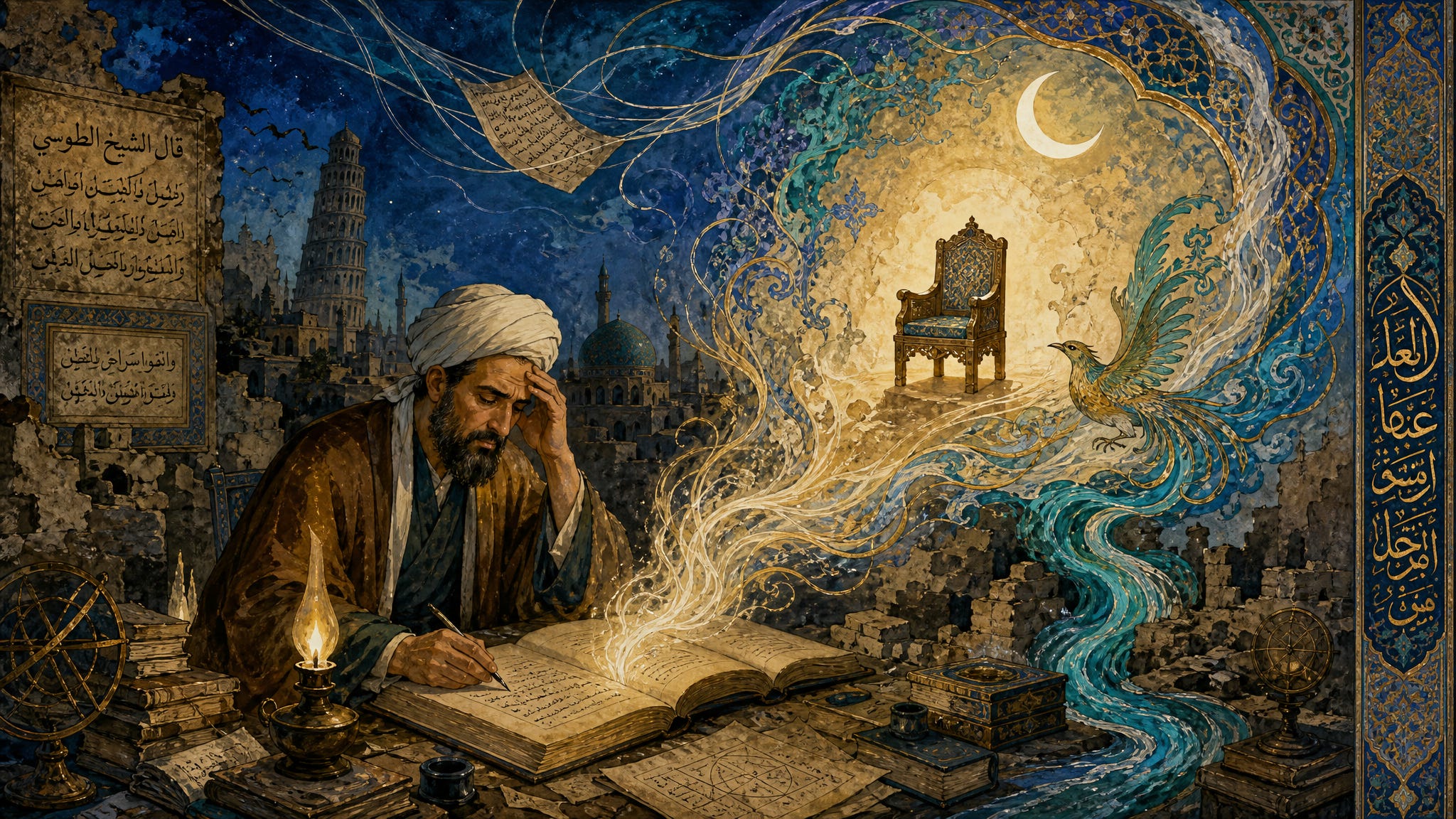
Now.
The book that sentence is sitting in.
Kitab al-Ghayba.
The Book of the Occultation.
This is the foundational early work of our tradition on the absence of the Imam of our Age, may our souls be his ransom and may God hasten his return.
Why he is absent.
What the absence is for.
Why it has gone on so long.
What it means to live inside it.
And — because he was a working scholar and not a preacher — every objection that anybody had ever raised against the whole idea, set out and answered.
Now, before I read you the opening, one correction.
You will hear it said, and you will read it in perfectly respectable places, that he dated the book in his preface.
He did not.
The preface tells you the conditions.
The date appears twice, later, inside the body of the book — in the middle of arguments, the way a man mentions the year when he needs it for a calculation and is not thinking about posterity.
Which is better, when you think about it.
It means he was still writing when the year turned.
He did not sit down and inscribe four hundred and forty-seven at the top of a page as a monument.
He was in the middle of a sentence and the year came up.
Here is the preface.
وَأَنَا مُجِيبٌ إِلَى مَا سَأَلَهُ، وَمُمْتَثِلٌ مَا رَسَمَهُ، مَعَ ضِيقِ الْوَقْتِ، وَشَعَثِ الْفِكْرِ، وَعَوَائِقِ الزَّمَانِ، وَصَوَارِفِ الْحَدَثَانِ
“And I am answering what he asked, and complying with what he laid down — despite the narrowness of the time, and the dishevelment of thought, and the obstacles of the age, and the distractions of calamity.”
— Shaykh al-Tusi, Kitab al-Ghayba, Introduction, Hadith 1
Four conditions.
Take them one at a time, because he chose them one at a time.
ضِيقِ الْوَقْتِ.
Dhiq al-waqt.
The narrowness of the time.
Not “I was busy.”
Dhiq is the word you use for a space that has closed in on you.
The time itself had got tight around him.
شَعَثِ الْفِكْرِ.
Sha’th al-fikr.
The dishevelment of thought.
Sha’th is what you say about hair that has not been combed, about a house that has not been kept.
A mind that will not lie flat.
A mind with things blowing through it.
عَوَائِقِ الزَّمَانِ.
Awa’iq al-zaman.
The obstacles of the age — the things outside him that were in the way.
صَوَارِفِ الْحَدَثَانِ.
Sawarif al-hadathan.
The distractions of calamity.
Hadathan — the blows that time deals out.
The things that happen to you.
Now hear the whole of it together.
A man wrote the foundational book of this tradition on the absence of the Imam of our Age with an uncombed mind, in a narrow hour, in a city that was coming apart around him.
And then he apologised for it.
He apologised.
In the preface.
He is telling his patron: this is not my best work, I did not have the conditions, forgive the state of it.
That book is a thousand years old and we are still reading it.
I do not know what to do with that except to say it plainly: some of the most important things any of us will ever make will be made badly, in a bad year, with an uncombed mind.
And we will apologise for them.
And they will outlive us.
Why Anyone Asks
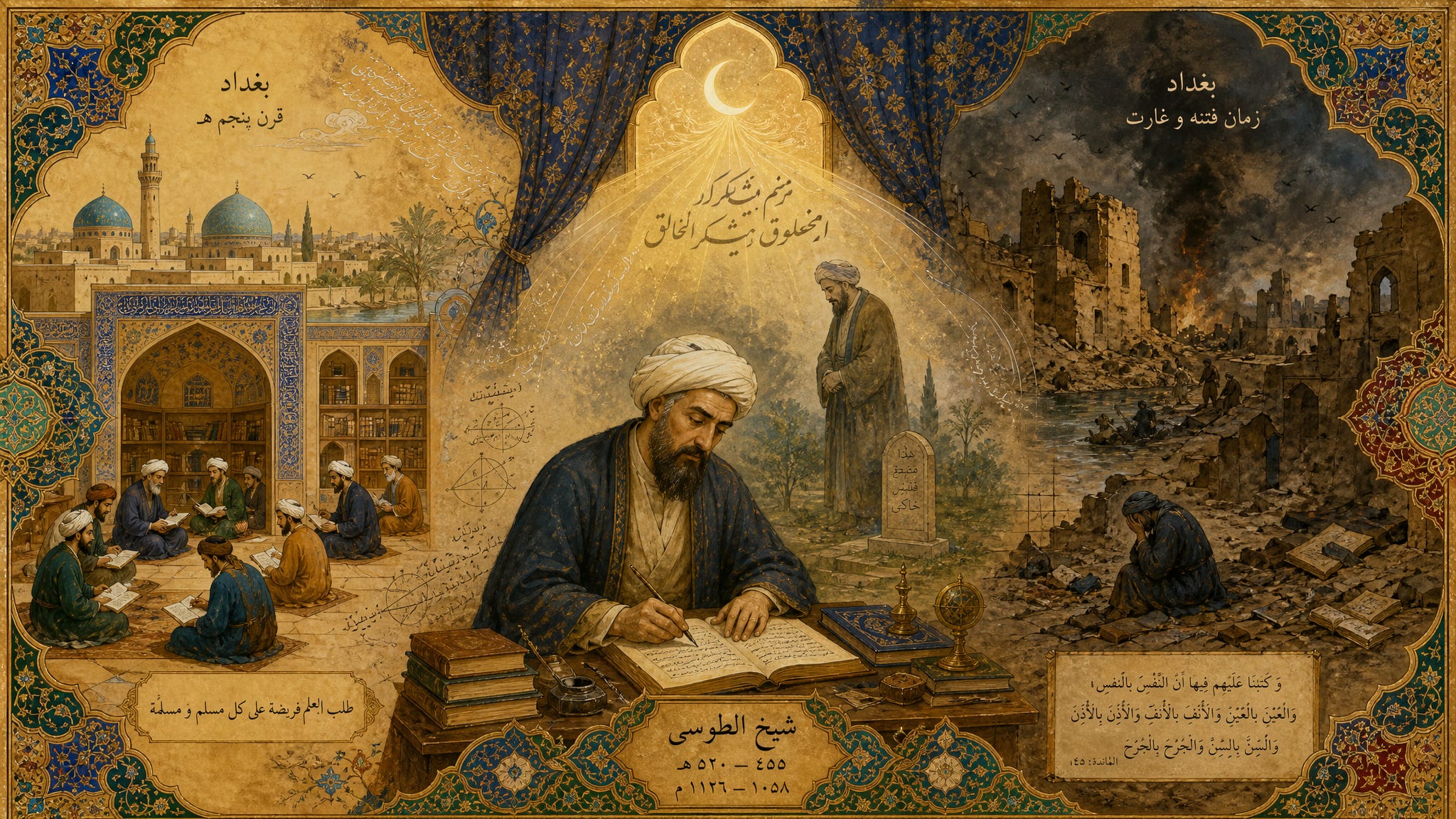
But the real question about that book is not how he wrote it.
It is why then.
Why does a man write a book about the absence of the Imam while his city is being taken apart?
He had lived through the good years.
Nearly forty of them.
He had the Chair of Theology, three hundred students, a library, the ear of the caliph.
He could have written this book at any point in two decades of relative stability.
He wrote it in four hundred and forty-seven.
And I think the answer is not that he chose the moment.
I think the moment chose him — because that is when the question gets asked.
Nobody asks where God’s Proof is when the harvest is good.
Nobody sits in a comfortable house, in a functioning city, with the children fed and the streets safe, and says:
Where is he?
Why has he not come?
What is the absence for?
Those questions do not arrive in easy years.
They arrive when the roof comes off.
They arrive in the hospital corridor.
They arrive when the phone rings at four in the morning.
They arrive when you watch, on a screen in your own living room, a people being destroyed while the world explains why nothing can be done — and something in you says where is he.
That is not a weakness in the question.
That is the nature of the question.
The absence is only ever felt as an absence when you need the presence.
And so a book about waiting gets written by a man who is running out of time, in a city he is about to lose, because that is the only condition under which anybody actually wants to know the answer.
And here is what I find almost unbearable about the timing.
He had been visiting a grave every month for thirty-nine years.
Standing in front of somebody who was not there.
Practising, without knowing he was practising, the exact discipline the book is about.
He was, it turns out, the right man to write it.
The Eve
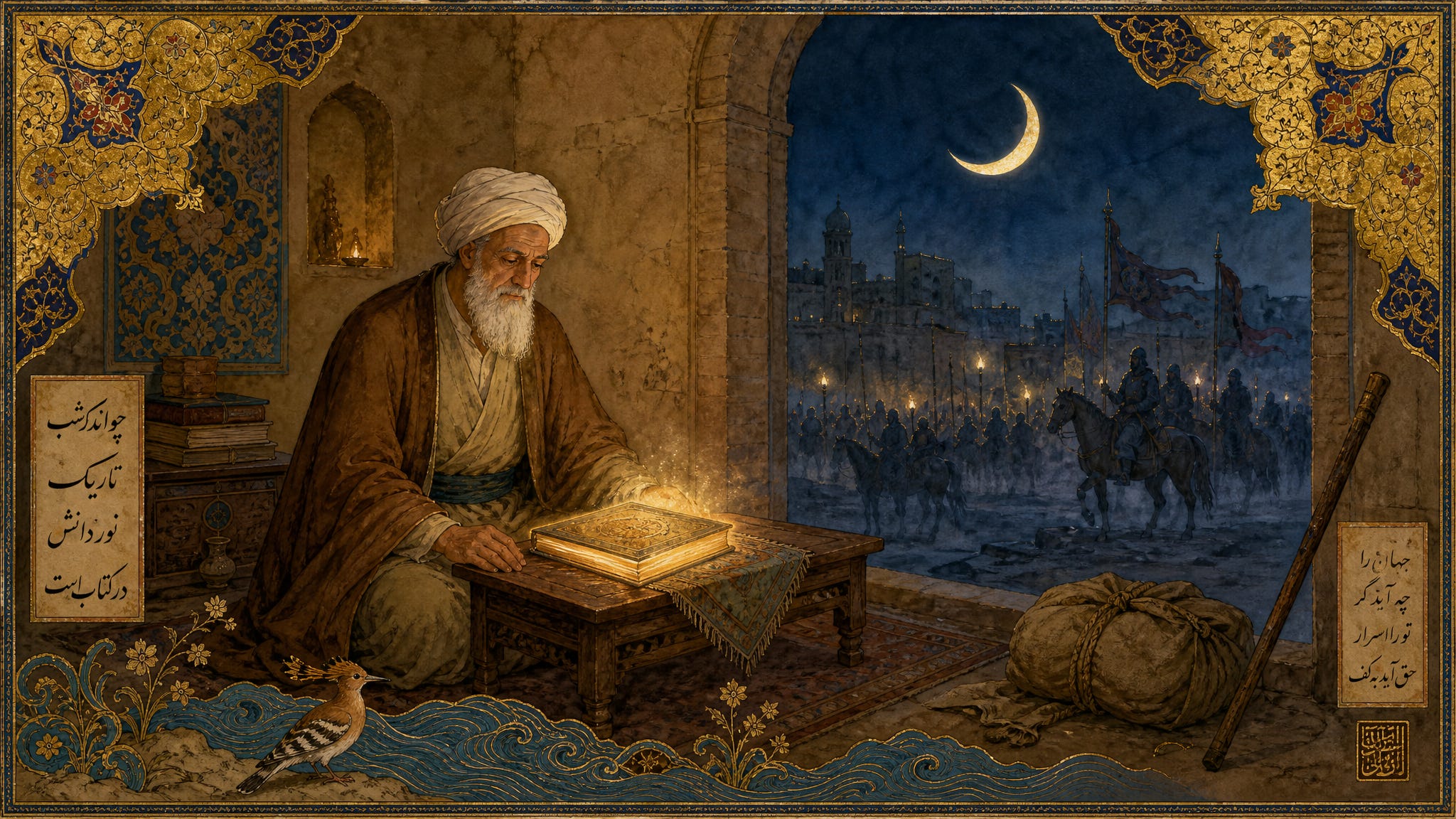
The month of Ramadan, 447 of the Hijra.
December, in the year 1055.
Tughril Beg enters Baghdad.
He does not fight his way in.
He is invited — by the Caliph al-Qa’im bi-Amr Allah himself, the same caliph who gave Shaykh al-Tusi his Chair.
Invited in against the Buyid amir, al-Malik al-Rahim, whose family had held the real power in Baghdad for over a century.
I am not going to introduce the Seljuqs to you tonight.
Who they were, where they came from, what they wanted, and what happens to this city because of them — that is next week, and it deserves a proper hour.
Tonight I only want you to see the picture.
A quarter of Baghdad called Karkh.
A house in it.
An old man of about sixty-two, who came to this city forty years ago from a town in Khurasan, and who has spent every month of those forty years walking to a grave and back.
On the table in front of him, a finished manuscript about waiting.
And outside, in the streets, a new army.
Lessons for Our Time
The first.
He wrote about absence while he was losing everything — which is the only condition under which a book about absence is worth reading.
Anybody can write about patience in a good year.
Nobody needs it.
The second, and hold this one lightly, because next week it becomes the whole evening.
The manuscript outlived the house.
What is written into a book — and what is written into other people — is simply not the same category of thing as what is kept in a building.
A building can be taken from you in an afternoon.
We will watch that happen next Wednesday.
And the third — the verse, one last time.
وَلِيُنذِرُوا قَوْمَهُمْ إِذَا رَجَعُوا إِلَيْهِمْ
— and to warn their people when they return to them.
That is the second half of the assignment.
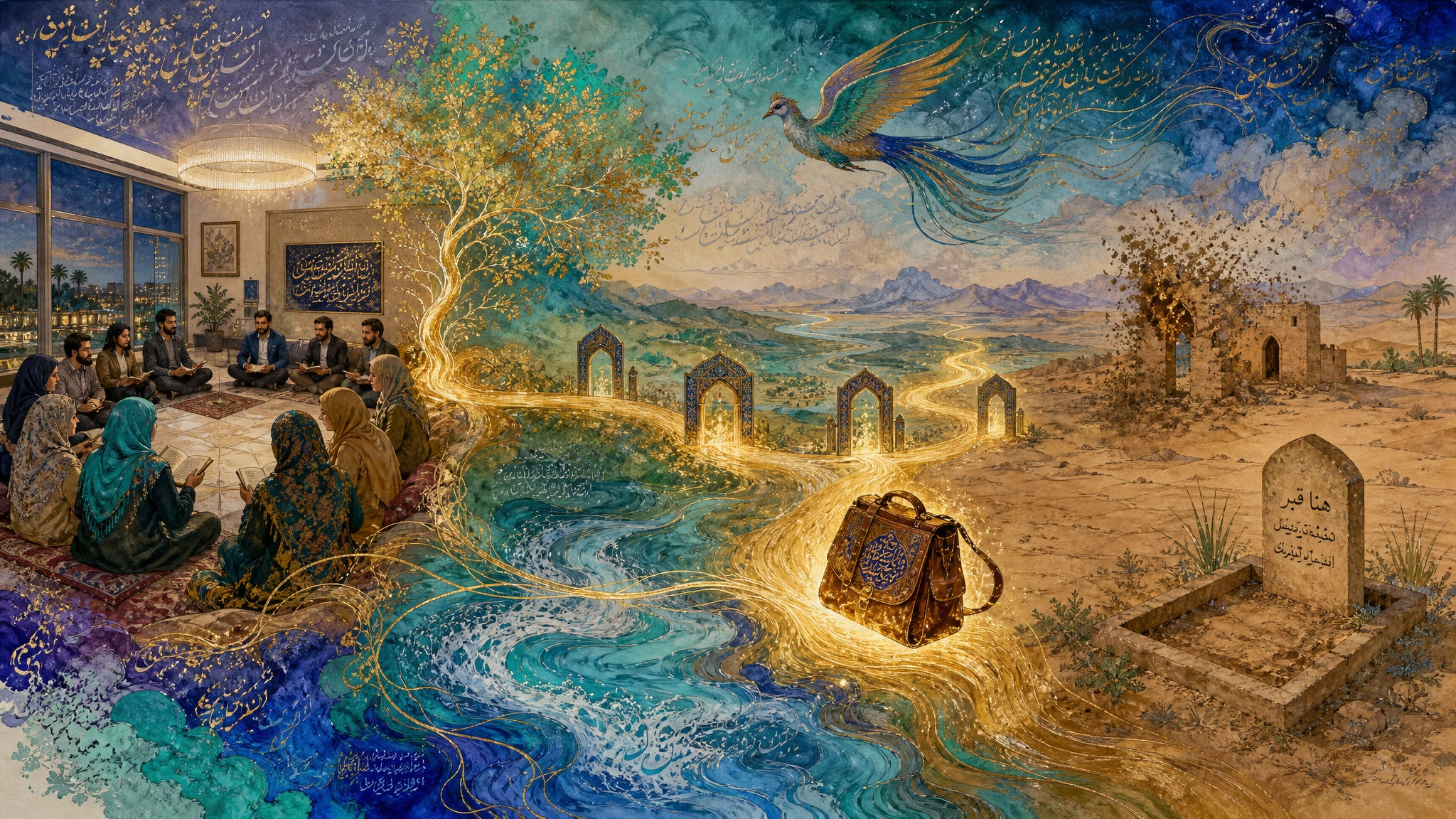
The ta’ifa goes out, learns, and comes back.
He never went back.
He left Tus at twenty-three and he never saw Khurasan again.
He died beside a grave in the Iraqi desert, more than a thousand miles the other way.
So the warning travelled instead.
Down the road to Najaf in a saddlebag, and out from there — to Tripoli, to Aleppo, to Syria, to Persia, to India, across a thousand years and about five thousand miles.
And it reached this room.
You are his people.
He is still coming back to you.
Conclusion — Key Takeaways
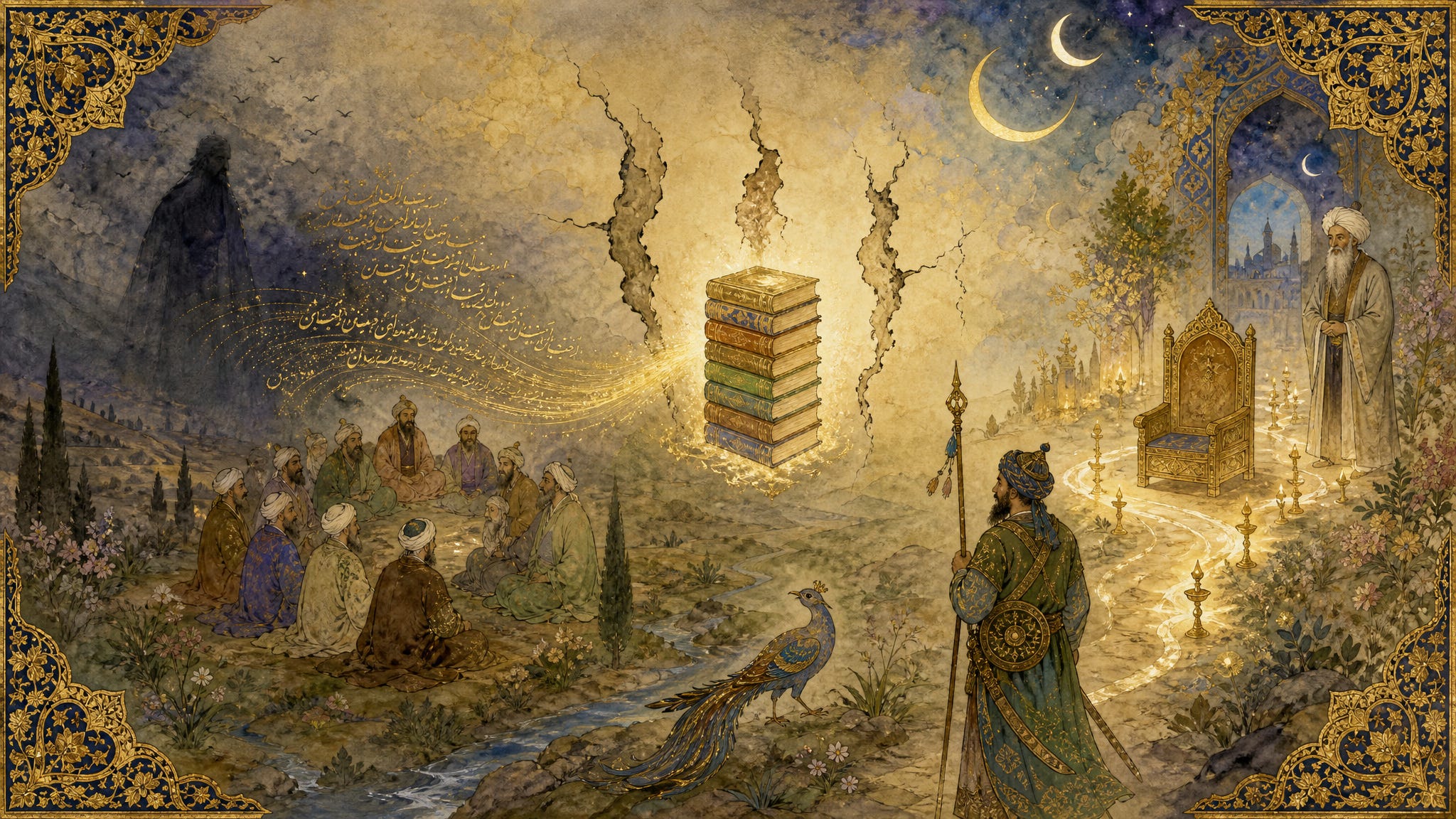
Three things to carry home.
One.
Authority is a function of time spent under instruction.
Twenty-eight years.
Five and then twenty-three.
He was fifty before there was nobody left above him in the room, and the community that eventually gave him its own name did not give it to him until he had spent his whole life earning it for everybody else.
Two.
A community answers contempt by building, not by arguing.
They said our jurisprudence was thin, padded, and self-contradictory.
He wrote eight volumes.
Nobody now reads the insult.
Everybody still opens the answer.
Three.
The work that survives an empire is the work that was already inside other people.
We will find out next week exactly how true that is, and what it costs.
And then the title, which is where we started.
He went out to understand.
He came back to warn.
He stood guard, facing the wrong way, holding a weapon, so that the rest could pray.
That is the ta’ifa of the verse.
And he did it so completely, for so long, in so many directions at once, that a community simply stopped looking for another word.
Next week, they come for the house.
Eulogy — The Two Teachers, and the Square That Was Not Big Enough
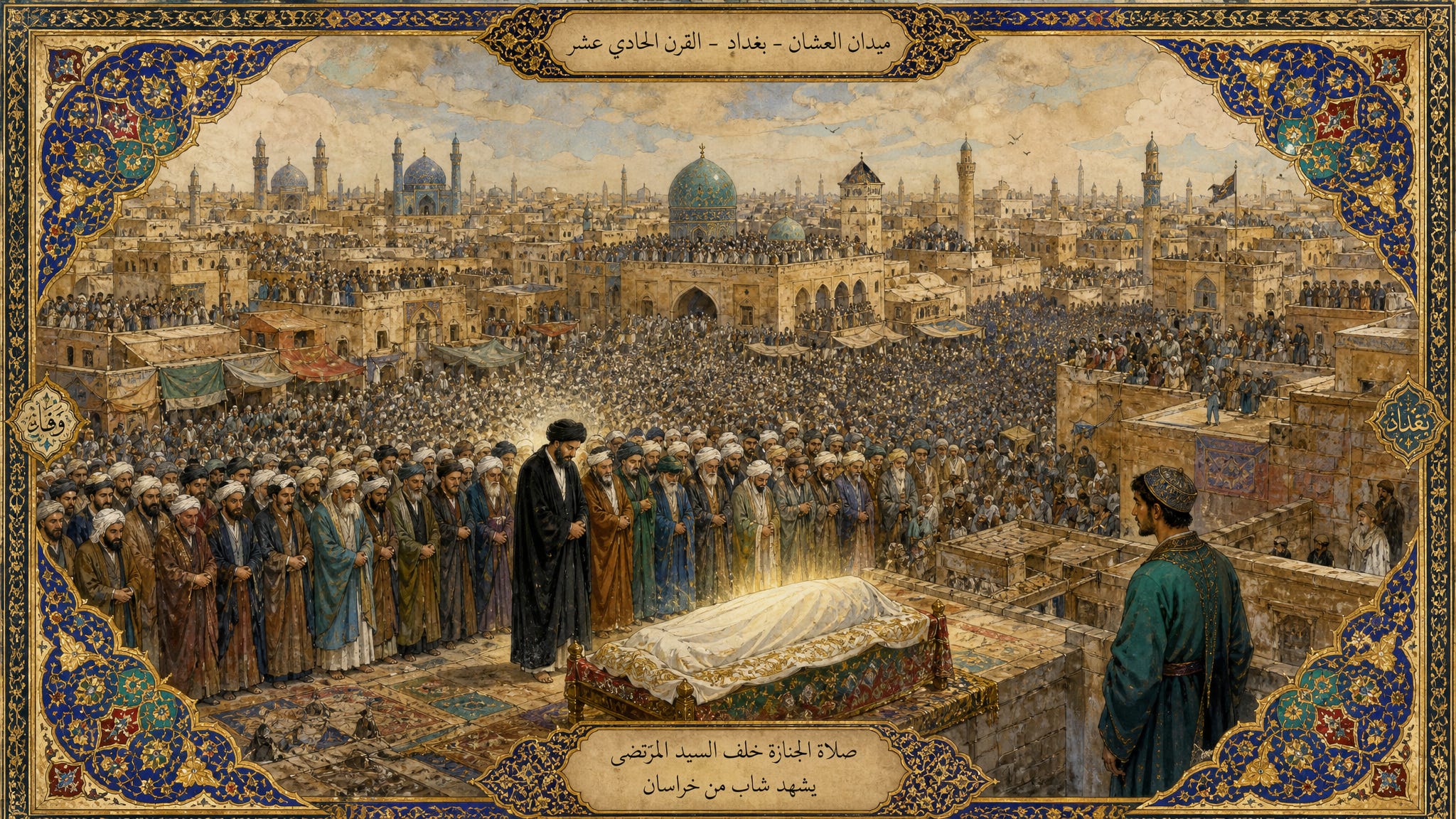
Come back with me to the beginning.
Before the library, before the title, before the desert.
413 of the Hijra.
The eve of Friday, three nights into the month of Ramadan — the 30th of November, in the year 1022.
Shaykh al-Mufid dies in Baghdad.
He is seventy-six years old.
He has been the head of this school for a generation.
And the man who leads the funeral prayer over him is his own student, Sayyid al-Murtada — a descendant of the Prophet, peace and blessings be upon him, his family, and his righteous companions — standing in front of the body of the man who taught him everything.
They do not do it in a mosque.
They do it in the Maydan al-Ushnan — the potash-sellers’ square, one of the open market squares of Baghdad, the kind of place built to hold a crowd.
And his own student al-Najashi — who was there, in that city, in that year — wrote this:
وَصَلَّى عَلَيْهِ الشَّرِيفُ الْمُرْتَضَى، وَضَاقَ عَلَى النَّاسِ مَعَ سَعَتِهِ
“And al-Sharif al-Murtada led the prayer over him — and it was too narrow for the people, wide as it was.”
— Ahmad ibn Ali al-Najashi, Rijal al-Najashi, quoted in Hayat al-Shaykh al-Tusi, Page 251
Eighty thousand, they say.
And here I want to stop and tell you where that number comes from, because it matters more than the number does.
It does not come from us.
The earliest sources that carry it are the Sunni chronicles of Baghdad — Ibn al-Jawzi, in al-Muntazam, under the events of the year 413 of the Hijra.
Ibn Kathir repeats it in al-Bidaya wa’l-Nihaya.
Our own books get it from theirs.
And Ibn Kathir, when he records it, adds a line of his own.
He writes that eighty thousand of the Rafida and the Shi’a followed the bier — and God gave us relief from him.
Hear that.
The number our community repeats about our own teacher’s funeral comes to us from men who did not like him.
One of them stood in that city, counted the crowd, wrote the figure down — and then thanked God the man was dead.
He still counted the crowd.
And that is why I believe the number.
A friend might round up.
Nobody in the history of the world has ever exaggerated the size of a funeral he was glad to see.
They buried him in his own house.
Years later they moved him to the Quraysh cemetery, and he lies there now among the graves of the Imams, peace and blessings be upon them.
Now — somewhere in that square, in that crowd too big for it, there is a young man from Khurasan.
He is twenty-eight years old.
He has been in this city for five years.
He came a very long way to sit in front of that man, and he got five years, and now he is standing in a market square in a crowd of strangers watching his teacher be carried out.
He does not know that the man leading the prayer will teach him for twenty-three more years.
He does not know that he will bury him too.
He does not know that thirty-five years from now he will be an old man on a road going south, and that he will be carrying a manuscript, and that people not yet born will call him by a name that is not his.
He is just a young man in a crowd who has lost his teacher.
And years later — decades later — when he came to write the catalogue of the scholars of this school, he reached the entry for Shaykh al-Mufid.
And what he wrote was not an assessment.
حَسَنُ الْخَاطِرِ، دَقِيقُ الْفِطْنَةِ، حَاضِرُ الْجَوَابِ
“Excellent of mind. Subtle of perception. Ready in reply.”
— Shaykh al-Tusi, on Shaykh al-Mufid, in Al-Fihrist
Hadir al-jawab.
Ready in reply.
The answer was always there.
That is not biography.
That is a man remembering what it was like to be in the room.
That is what you write about somebody when you can still hear his voice.
And both of them — the teacher who received letters from behind a veil, and the Sayyid of the House of the Prophet who prayed over him in a market square — both of them spent their lives on behalf of one man who was not there.
The same one who is not here tonight.
Segue To The Maqtal

Maqtal (Lamentation) for the Ninth Session of the Architecture of Guidance
What Day This Is
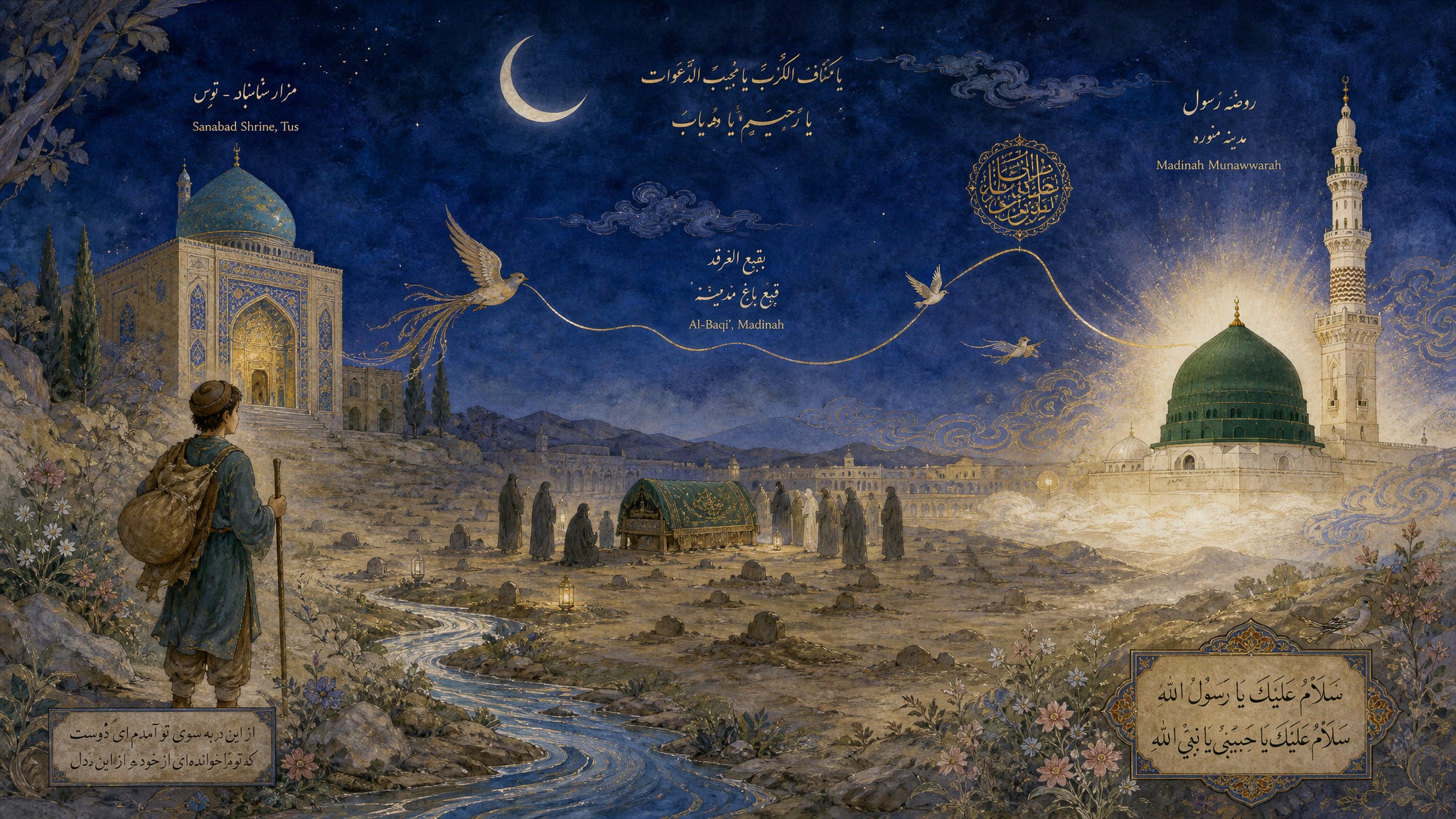
Before you hear it, I have to tell you what day this is.
Tonight is the twenty-eighth of Safar.
You already know what that means, but say it out loud with me anyway, because we have just spent an hour on the machinery of this religion and we should not close without naming the wound it exists to bind.
On this day, in the eleventh year after the Hijra — which in the reckoning of the West is the year 632 of the common era — the Messenger of God, peace and blessings be upon him, his family, and his righteous companions, died in Madinah.
He was buried where he died.
Not carried out to a cemetery.
Buried in the room he died in, inside the house.
The first house beside a grave.
That is the name of this run of sessions, and I want to be honest with you:
I did not plan that.
The calendar did it.
And on this same day, thirty-nine years later, in the year fifty after the Hijra, his grandson Imam Hasan al-Mujtaba, peace and blessings be upon him, was killed by poison in that same city.
He asked for one thing as he was dying.
To be buried near his grandfather.
He did not get it.
The books record that when they carried the body toward that house, people came out with arrows to stop it — and that Imam Husayn, peace and blessings be upon him, who had been made to promise that not one drop of blood would be spilled over this funeral, kept the promise, turned the bier aside, and buried him in Baqi’.
And that is not only in our books.
Al-Mufid has it in al-Irshad, and Abu’l-Faraj al-Isfahani in Maqatil al-Talibiyyin — and Ibn Abi’l-Hadid and al-Mas’udi carry it too.
Hold on to that cemetery.
We will stand in it later in this series, and look at what was done to it, and at how a thing like that becomes possible.
And at the end of this same month, we mark the martyrdom of Imam Ali al-Rida, peace and blessings be upon him — who was buried in a village called Sanabad, on the edge of a city in Khurasan called Tus.
Tus.
The city this entire evening walked out of.
Think about what that means.
The boy we have followed all night grew up in the district that holds an Imam’s grave.
He left it.
He spent forty years in Baghdad — five at the feet of one teacher, twenty-three at the feet of the next — then lost everything he owned, walked south, and died beside a different grave, in a different desert, with a school around him.
Some men are born beside a grave and spend their lives learning what to do with one.
The Thursday
Now. I have spent this whole session telling you that this religion survives because people wrote things down and refused to lose them.
So let me tell you what happened four days before the Messenger of God died.
And I am going to tell it to you out of a book that is not ours.
Sahih al-Bukhari.
Ibn Abbas was a boy at the time.
He lived another fifty-seven years, and he could not tell this story without weeping — Bukhari records, in the same report, that he wept until his tears wet the pebbles on the ground.
He used to begin it the same way every time:
يَوْمُ الْخَمِيسِ، وَمَا يَوْمُ الْخَمِيسِ
“Thursday. And what is Thursday!”
— Sahih al-Bukhari, Kitab al-Jizya wa’l-Muwada’a, Hadith 3168
Thursday.
The Prophet was in the last illness.
And he said to the men in that room:
ائْتُونِي بِكَتِفٍ أَكْتُبْ لَكُمْ كِتَابًا لاَ تَضِلُّوا بَعْدَهُ أَبَدًا
“Bring me a shoulder-blade, and I will write for you a writing after which you will never go astray.”
— Sahih al-Bukhari, Kitab al-Jizya wa’l-Muwada’a, Hadith 3168
A shoulder-blade.
A flat piece of bone, scraped clean.
That is what a man wrote on when there was nothing else.
He asked for something to write on.
There was an argument in the room about whether he should be given it.
The voices rose.
And he said:
“Leave me.”
And nothing was written.
I am not going to spend the last minutes of tonight on who said what in that room.
You know the argument.
It is not the lesson.
That argument has had fourteen hundred years, and it is not what tonight is for.
The lesson is what the boy in the corner said about it for the rest of his life:
إِنَّ الرَّزِيَّةَ كُلَّ الرَّزِيَّةِ مَا حَالَ بَيْنَ رَسُولِ اللَّهِ وَبَيْنَ كِتَابِهِ
“The calamity — the whole calamity — was what came between the Messenger of God and his writing.”
— Sahih al-Bukhari, Kitab al-Ilm (Bab Kitabat al-Ilm), Hadith 114
Al-raziyya kull al-raziyya — The calamity — the whole calamity
Not a disaster.
The disaster.
The whole of it.
As though everything that went wrong afterwards had one address, and that was it.
Now sit with that for a moment, on this night, in this session.
The last thing the Prophet of God asked for was something to write on.
And it did not come.
And Everything After
Everything you have heard tonight is what happens next.
Because from that Thursday onward, this community has had exactly one method available to it.
Not a finished document handed down from a height.
People.
Keeping things.
By hand.
A daughter kept it, and was buried where nobody could find her.
A grandson kept it, and was refused a grave for his trouble.
An aunt kept it, standing in a court in Damascus with her brother’s head in front of her.
And after them — a thousand years of men in rooms with paper.
A house in Karkh.
A tired old man in it.
A folded letter he did not throw away.
And a boy from Tus at the back of the room, carrying other men’s books, who would grow up to spend fifty years copying, checking, correcting and keeping, and who would die beside a grave in the desert with a school around him.
Every single thing we have handled tonight — the hadith about the ring on the right hand, the book about the occultation, the prayer we are about to close with — is in this room because somebody wrote it down and somebody else refused to lose it.
That is not a small administrative thing that scholars do in the background.
That is the repair.
That is what the whole ta’ifa has been doing, without stopping, since the Thursday the bone never came.
And that is why, on the anniversary of the day the writing was refused, we are going to sit and listen to a letter that was kept.
The Voice You Are About to Hear
Before it begins, let me tell you honestly what you are about to hear, because you should never be in any doubt.
That is not a reciter.
It is not a person.
It is a voice made for this series, in clear English, belonging to no living man — an imagining of the voice of the Imam of our Age, may our souls be his ransom and may God hasten his return, speaking from behind the veils of his absence, looking back across the years at people he was watching the whole time.
It is a vessel for his words.
It is nothing more than that, and we will not pretend it is anything more than that.
And tonight, of all nights, it is not a device.
We have just spent an hour with a man who wrote a book about the absence of the Imam of our Age.
Tonight, that Imam speaks.
He speaks about two letters that came to a house in Baghdad — one in the month of Safar in the year 410 of the Hijra, and one on a Thursday in Dhu al-Hijja in the year 412 of the Hijra.
Letters addressed to Shaykh al-Mufid, by name.
And one honest word before you hear it, in the manner of everything else tonight.
Those letters carry no chain.
There is no line of transmitters to weigh, no he told me, from him, from him.
All the text says is that the man who delivered the first one stated that he had brought it from a district adjoining the Hijaz — and then he is never mentioned again.
Al-Tabarsi gives a full chain for the passage on the very next page of the same book. For these he had none, and he did not pretend otherwise.
A letter with no chain.
From a place not quite named.
Carried by a man nobody identifies.
Which is, when you think about it, very nearly what correspondence from behind a veil would have to look like.
And in that house at that time, twenty-four years old, two years into his studies, there was a young man from Khurasan.
The Letters He Kept.
Supplication — From Ziyarat Amin Allah
The prayer that Imam Zayn al-Abidin, peace and blessings be upon him, said at the grave of his grandfather, the Commander of the Faithful.
It reaches us because Shaykh al-Tusi wrote it into Misbah al-Mutahajjid — the Lamp of the One Who Keeps Vigil.
A man who spent thirty-nine years visiting graves preserved the prayer an Imam said at a grave. We will close with it.
O God.
We have nowhere to go but Your door.
السَّلَامُ عَلَيْكَ يَا أَمِينَ اللَّهِ فِي أَرْضِهِ وَحُجَّتَهُ عَلَى عِبَادِهِ، أَشْهَدُ أَنَّكَ جَاهَدْتَ فِي اللَّهِ حَقَّ جِهَادِهِ، وَعَمِلْتَ بِكِتَابِهِ، وَاتَّبَعْتَ سُنَنَ نَبِيِّهِ
“Peace be upon you, O trustee of God in His earth, and His proof over His servants. I bear witness that you strove in God as is His due, and acted by His Book, and followed the ways of His Prophet.”
— Ziyarat Amin Allah; narrated from Imam Zayn al-Abidin, peace and blessings be upon him, through Imam al-Baqir, peace and blessings be upon him; preserved in Shaykh al-Tusi, Misbah al-Mutahajjid
اللَّهُمَّ إِنَّ قُلُوبَ الْمُخْبِتِينَ إِلَيْكَ وَالِهَةٌ، وَسُبُلَ الرَّاغِبِينَ إِلَيْكَ شَارِعَةٌ
“O God, the hearts of those who humble themselves are stricken with longing for You, and the paths of those who desire You are open.”
O God — peace upon Your prophets. Upon Adam, and Noah, and Abraham, and Ishmael and Isaac, and Moses and Aaron, and David and Solomon, and Zechariah and John, and Jesus son of Mary — peace and blessings be upon them all.
Upon every one of them whose names we know, and upon every one whose names only You know.
And peace and blessings upon Muhammad, and upon his family, and upon his righteous companions.
O God — tonight we stand in the day of his going.
The 28th of Safar.
The day the light went out of Madinah.
The day his household became a household without him, and the community became a community that had to remember instead of ask.
And the day, thirty-nine years on, that they poisoned his grandson Imam Hasan al-Mujtaba, peace and blessings be upon him — and would not let him lie beside the man he had asked to lie beside.
We were not there.
And we are honest enough tonight to say that we do not know we would have been any use if we had been.
But we are here.
And we are still saying his name, fourteen hundred years later, in a language he never heard, in a country he never saw, in a room he could not have imagined.
Accept that from us, O God.
It is what we have.
O God — in his last days he asked for something to write on, and it was not brought to him.
We have been given the writing.
Do not let us be the generation that had it and did not read it.
O God, peace upon Sayyedah Fatimah al-Zahra, peace and blessings be upon her, the mother of her father, in whose house this whole inheritance began.
Peace upon the Commander of the Faithful, at whose grave this prayer was first said.
Peace upon Imam Hasan, and upon Imam Husayn, the Master of Witnesses.
Peace upon the Imams of guidance, one after another, peace and blessings be upon them all — who taught, and were poisoned, and taught again.
O God.
Tonight we ask You for the ones who carried it.
For the teachers — the ones who sat in rooms in Baghdad and Qom and Najaf and Aleppo and Tripoli, and copied, and checked, and corrected, and taught men younger than themselves and did not live to see what became of them.
For the two we spoke of tonight — the teacher who received letters he was told to keep, and the Sayyid of the House of the Prophet who prayed over him in a square too small for the crowd.
For the student who sat for twenty-eight years, and inherited everything, and lost it, and walked south with what he could carry.
O God — for every one of them whose name we still say, and for the far greater number whose names nobody remembers: the copyists, the students who never became scholars, the ones who fed them, the ones who paid the twelve dinars and never saw what it bought.
Accept it from them.
They did it for us and they never met us.
O God. We pray to You for Imam Sayyed Mujtaba Khamenei — may God protect him — the Wali al-Faqih of our time. Preserve him for us.
Strengthen him.
Guide him.
Make him the leader You have appointed him to be, until the Imam of our Age returns and the trust he carries is handed back to its rightful holder.
O God.
Hasten the return of the Imam of our Age, may our souls be his ransom.
He wrote to a man in Baghdad a thousand years ago and told him:
We are not neglectful of attending to you, nor forgetful of remembering you.
O God, let us not be forgetful of him.
Make us of his helpers.
Make us of his soldiers.
Make us of those who, when he calls, are already standing.
إِنَّا لِلَّهِ وَإِنَّا إِلَيْهِ رَاجِعُونَ
“Indeed we belong to God, and indeed to Him we return.”
— Qur’an, Surah al-Baqarah (the Chapter of the Cow) #2, Verse 156
وَسَيَعْلَمُ الَّذِينَ ظَلَمُوا أَيَّ مُنقَلَبٍ يَنقَلِبُونَ
“And those who have wronged are going to know to what return they will be returned.”
— Qur’an, Surah al-Shu’araa (the Chapter of the Poets) #26, Verse 227
حَسْبُنَا اللَّهُ وَنِعْمَ الْوَكِيلُ
“God is sufficient for us, and He is the best of guardians.”
— Qur’an, Surah Aal Imran (the Chapter of the Family of Imran) #3, Verse 173
Amen, O Lord Sustainer of the Universes.
Amen, O Most Merciful of the Merciful.
And from Him alone is all ability, and He has authority over all things.