

In His Name, the Most High
ذَٰلِكَ وَمَن يُعَظِّمْ حُرُمَاتِ اللَّهِ فَهُوَ خَيْرٌ لَّهُ عِندَ رَبِّهِ ۗ وَأُحِلَّتْ لَكُمُ الْأَنْعَامُ إِلَّا مَا يُتْلَىٰ عَلَيْكُمْ ۖ فَاجْتَنِبُوا الرِّجْسَ مِنَ الْأَوْثَانِ وَاجْتَنِبُوا قَوْلَ الزُّورِ
حُنَفَاءَ لِلَّهِ غَيْرَ مُشْرِكِينَ بِهِ ۚ وَمَن يُشْرِكْ بِاللَّهِ فَكَأَنَّمَا خَرَّ مِنَ السَّمَاءِ فَتَخْطَفُهُ الطَّيْرُ أَوْ تَهْوِي بِهِ الرِّيحُ فِي مَكَانٍ سَحِيقٍ
ذَٰلِكَ وَمَن يُعَظِّمْ شَعَائِرَ اللَّهِ فَإِنَّهَا مِن تَقْوَى الْقُلُوبِ
“That — and whoever venerates the sanctities of God, it is better for him with his Lord. And the cattle have been made lawful to you, except what is recited to you. So shun the filth of idols, and shun false speech.
Upright towards God, not associating anything with Him. And whoever associates anything with God, it is as though he had fallen from the sky and the birds snatched him away, or the wind cast him down into a remote place.
That — and whoever venerates the signs of God, that is from the God-fearing of hearts.”
— Qur’an, Surah al-Hajj (the Chapter of the Pilgrimage) #22, Verses 30, 31 and 32
Listen to the Order He Puts Them In
Three verses, one after the other, in the chapter of the Pilgrimage.
I want to read you nothing else for a moment.
I want you only to look at how they are arranged.
The first one opens with two words —
that, and whoever.
And then:
whoever venerates the sanctities of God.
Veneration.
Holding something in honour because of what God has attached to it.
And before that verse is finished, He says:
shun the filth of idols, and shun false speech.
Then the middle verse.
Upright towards God, not associating anything with Him.
And then the image — and it is one of the most violent pictures in the whole Qur’an.
A man falls out of the sky.
The birds take him in the air.
Or the wind carries him off to somewhere remote and drops him.
That is what associating partners with God does to a person.
He is not corrected.
He is not warned.
He is snatched out of the air in pieces.
And then the third verse opens — and listen to it — with exactly the same two words as the first.
That, and whoever.
The same construction.
And the same verb: yu’azzim, he holds in honour.
Whoever venerates.
Whoever venerates the sanctities of God.
Whoever venerates the signs of God.
And sitting in between them, wedged in the middle, is a man falling out of the sky.
Now. I am not going to tell you yet what any of that means.
We will spend an hour getting there properly.
I only want you to notice the arrangement, because the arrangement is doing something.
The Book has not laid out veneration and idolatry as two points on a single nervous scale, with a careful line drawn somewhere in the middle that you might accidentally step over.
It has put one on either side of the other.
It says venerate, then it shows you what shirk — polytheism — looks like, then it says venerate again — and it never once stops to reconcile the two or to reassure you that they are different things.
It does not seem to think they are the same kind of thing at all.
Hold that.
We are leaving it there for an hour, and we will come back to it.
What Is Said About You for Going
Last week we ended with an instruction.
We said: go.
We spent an evening on why people stand at graves, and what our own books say is happening when they do, and we ended by telling you that the going is not a weakness in you and it is not a failure of faith, and that you should go.
Tonight is the week you find out what is said about you for going.
Some of you have already had this said to your face.
By a cousin.
By somebody at work.
By a brother-in-law at a wedding who had found a video.
Some of you have read it in a comment under something you posted, from a stranger, phrased as unkindly as it is possible to phrase a thing.
And some of you did not have an answer.
You knew it was wrong.
You could feel that it was wrong.
But you could not say why it was wrong, and so you changed the subject, and then you thought about it in the car on the way home.
And I know how that conversation goes, because it is the same every time.
It does not go badly because you are wrong.
It goes badly because they have three sentences ready and you have none, and three ready sentences will beat an hour of being right every time.
So they say their piece, and you say that’s not what we do, and they say then why do you kiss it, and there is a pause, and somebody changes the subject, and everybody in the room privately decides that the one with the sentences won.
By the end of tonight you will have an answer, God willing.
I want to say one thing about the kind of answer it is going to be, because it governs everything that follows.
It is not going to be an argument you win.
It is going to be four texts — and three of the four come from outside our own tradition.
Two of them are in the books of the people making the objection.
And the point of having it is not so that you can use it on somebody.
The point is so that when it is said to you, you are not frightened, and you can answer kindly, and the person walks away having learned something instead of having been beaten.
That is the whole shape of the evening.
Let me now put the objection in front of you properly.
Recap — What We Carry Forward
We are in The Architecture of Guidance, and this is the 14th part of it.
And inside it we are working through a smaller sequence called The House Beside the Grave.
Tonight is the sixth of those, and there are eleven.
Eleven.
If you were counting ten, the count changed this week.
We found more in one of the subjects than would fit in an evening, and rather than rush it we gave it its own week.
You will have that week shortly, with His grace and His will.
Tonight is Wednesday the 16th of September 2026, and it is the 4th of Rabi al-Thani, of the year 1448.
What we carry forward is short.
We asked why a scholar would leave the capital of the Muslim world to live in a village.
We asked what happened when they burned his books, and what could not be burned.
We asked why Najaf — why that ground and no other.
And last week we asked why people go at all, and we found an answer in our own earliest collection:
they take comfort in you.
And we ended on a phrase I want back in your hands tonight, because we are going to need it.
A grave is an address.
The Charge, Put Properly
The Objection, and I Am Not Going to Soften It
I am going to say the thing that is said about us.
I am going to say it in the strongest form I know, in the words the people who say it actually use, and I am not going to put a single soothing word around it.
I want you to hear it at full weight.
Because an objection that has been made gentle before it is answered has not been answered.
It has been avoided, and everybody in the room can tell.
Here it is.
You pray at graves.
You travel across the world to stand in front of a box of dead bones and you weep.
You have built domes over them and covered them in gold.
You kiss the metal.
You press your face against it.
You write letters and push them through the lattice.
You ask a dead man for a child, for a job, for a cure — things that only God gives.
You circle the tomb the way people circle the House of God.You worship them.
That is the word they use — you worship them.
And you worship the grave itself: the stone, the marble, the silver, the shrine.
You have made a religion out of masonry.And you did not invent this quietly in a corner.
You did it in the face of your own Prophet, peace be upon him, his family and righteous companions, who cursed those who took the graves of their prophets as places of prayer.
Who forbade the plastering of a grave and the building over it.
Who sent Ali himself — the man you love above every other companion — and commanded him: leave no raised grave without levelling it.He told you not to do it.
He sent the one you follow to undo it wherever he found it.
And you have done it anyway, on a scale he could not have imagined, and you have called it love.And the worst of it is that you have taught it to your children.
You take them at four years old and you lift them up so they can touch the silver, and you tell them to ask.
You have raised a generation who reach for a grave before they reach for God.
That is the charge.
And I want you to notice something about it before we go any further, because it will matter in about forty minutes.
That is not one accusation.
That is two, wearing the same coat.
One of them is:
you worship the dead.
You direct to a human being what belongs only to God.
The other is:
you worship the grave.
The object.
The stone.
The building.
The thing made by masons out of rock.
They are not the same claim.
They do not stand or fall together.
And by the end of tonight, one of them will have been answered by a scholar in the objector’s own school, and the other will have been answered by walking through a door.
But not yet.
First we read what the charge is built on, because it is built on something, and it is not built on nothing.
The Two Reports It Rests On
There are two narrations that carry almost the whole weight of this, and both of them are in Sahih Muslim, which is one of the two collections the Sunni tradition holds to be the soundest books it possesses.
The first is narrated from a man named Abu al-Hayyaj al-Asadi, who is reporting what he was sent to do — and he was sent by the Commander of the Faithful, Ali ibn Abi Talib, peace and blessings be upon him:
قَالَ لِي عَلِيُّ بْنُ أَبِي طَالِبٍ: أَلَا أَبْعَثُكَ عَلَىٰ مَا بَعَثَنِي عَلَيْهِ رَسُولُ اللَّهِ صَلَّى اللَّهُ عَلَيْهِ وَسَلَّمَ: أَنْ لَا تَدَعَ تِمْثَالًا إِلَّا طَمَسْتَهُ، وَلَا قَبْرًا مُشْرِفًا إِلَّا سَوَّيْتَهُ
“Ali ibn Abi Talib said to me: shall I not send you on the same errand that the Messenger of God, may God’s blessings be upon him, sent me on? That you leave no image without effacing it, and no raised grave without levelling it.”
— Muslim ibn al-Hajjaj, Sahih Muslim, the Book of Funerals
And the second, from Jabir:
نَهَىٰ رَسُولُ اللَّهِ صَلَّى اللَّهُ عَلَيْهِ وَسَلَّمَ أَنْ يُجَصَّصَ الْقَبْرُ، وَأَنْ يُقْعَدَ عَلَيْهِ، وَأَنْ يُبْنَىٰ عَلَيْهِ
“The Messenger of God, may God’s blessings be upon him, forbade that a grave be plastered, or sat upon, or built over.”
— Muslim ibn al-Hajjaj, Sahih Muslim, the Book of Funerals
Those are real reports in a real book and I am not going to pretend otherwise.
One thing, said once, and then I am moving on.
The hadith that this objection leans on hardest — the one that is quoted at us most often, the one about levelling the raised grave — reaches the people who quote it through Imam Ali ibn Abi Talib, peace be upon him.
That is all.
I am not going to make anything of it.
I only want it noted.
The Man Who Answers This Is Not One of Ours
Now, we could spend the evening on our own scholars explaining these two reports to us.
And that would be a comfortable hour, and it would convince nobody in the world who was not already convinced, and you would not be able to use a word of it on Thursday.
So we are going to do something else.
We are going to answer this the way you would want a serious charge answered against anybody — not by finding a friendly witness, but by going to the most hostile competent source available and reading what it actually says.
We are going to read the standard commentary on Sahih Muslim, written by a scholar of the Sunni tradition, on these exact pages, and we are going to let him tell us what these two reports mean.
His name is Yahya ibn Sharaf al-Nawawi.
He was a jurist of the Shafi’i school, from Damascus, in the seventh century of the hijrah — and in the seventy-three sessions of this series I have never once mentioned him, which tells you how far outside our usual conversation he stands.
Most of you know one thing he wrote.
If you have ever been handed a small green book of forty hadith in a study circle, that was him.
That book is the least of what he did.
What he is actually known for, among people who work in that tradition, is this: al-Minhaj, his commentary on Sahih Muslim.
When a Sunni scholar wants to know what a hadith in Muslim means, this is the book he reaches for.
It has been the standard for seven hundred years.
The copy we are reading tonight was printed in Cairo, at the Egyptian Press at al-Azhar, first edition, in the year 1347 of the hijrah.
And he does not begin by defending anything.
He begins somewhere else entirely, thirty pages earlier, and I want to take you there first — because once you have heard it, you cannot hear the rest the same way.
First — Which Daughter
Before I read you that page I have to stop for one minute, because of something I am about to say that would confuse half this room if I said it without warning.
The report is about a funeral.
A daughter of the Prophet, may God’s blessings be upon him, his family and his righteous companions, has died, and the women of the household are washing her body.
And if I say that sentence and go no further, some of you will immediately think of Sayyedah Fatimah al-Zahra, peace and blessings be upon her — and you will be confused, and rightly, because she did not die before her father.
She outlived him.
So let me tell you which daughter it is.
And I do not have to work it out, because al-Nawawi tells us himself, on that same page — and he tells us that his own tradition argued about it:
وَأَمَّا بِنْتُ رَسُولِ اللَّهِ صَلَّى اللَّهُ عَلَيْهِ وَسَلَّمَ هَذِهِ الَّتِي غَسَّلَتْهَا فَهِيَ زَيْنَبُ رَضِيَ اللَّهُ عَنْهَا، هَكَذَا قَالَهُ الْجُمْهُورُ. قَالَ الْقَاضِي عِيَاضٌ: وَقَالَ بَعْضُ أَهْلِ السِّيَرِ أَنَّهَا أُمُّ كُلْثُومٍ، وَالصَّوَابُ زَيْنَبُ كَمَا صَرَّحَ بِهِ مُسْلِمٌ فِي رِوَايَتِهِ الَّتِي بَعْدَ هَذِهِ
“As for this daughter of the Messenger of God, may God’s blessings be upon him, whom she washed — she is Zaynab, may God be pleased with her. This is what the majority said. Qadi Iyad said: and some of the biographers said that she was Umm Kulthum. And the correct view is Zaynab, as Muslim stated explicitly in the report that comes after this one.”
— Yahya ibn Sharaf al-Nawawi, al-Minhaj Sharh Sahih Muslim, Volume 7, printed page 3
It is Zaynab.
Now, there is a difference between us and them here, and I would rather put it in front of you plainly than let you trip over it.
In their books, the Prophet had four daughters — Zaynab, Ruqayyah, Umm Kulthum and Fatimah — and three of them died in his lifetime.
The position most of our scholars have held is that Sayyedah Fatimah, peace and blessings be upon her, is his daughter by birth, and that the other three were the children of Sayyedah Khadijah, peace and blessings be upon her, raised in the Prophet’s house and called his daughters in the ordinary Arabic of that time.
And that is not a strange way to speak, and the Qur’an itself does it.
When God lists the women a man may not marry, this is in the list:
وَرَبَائِبُكُمُ الَّاتِي فِي حُجُورِكُم مِّن نِّسَائِكُمُ الَّاتِي دَخَلْتُم بِهِنَّ
“And your stepdaughters who are in your care, from your wives to whom you have gone in.”
— Qur’an, Surah al-Nisa (the Chapter of the Women) #4, Verse 23
The Book has a word for a child raised in your house who is not yours by birth, and it puts her in the list of those you may never marry — which is to say it treats her as family, in law, at the point where it costs something.
The relation is real and it is honoured.
Nobody in that century would have blinked at hearing them called his daughters.
Two things, and then we go back to the page.
The first is that this is not one tradition being careless and another being careful.
Look again at what we just read: their scholars could not agree whether it was Zaynab or Umm Kulthum.
Qadi Iyad records the disagreement and al-Nawawi settles it from the wording of the next report.
They are doing exactly what we do — working out who is who, from the texts, and disagreeing on the way.
And the second is that none of it touches the ruling.
Whoever she was, the Messenger of God took the cloth off his own body and gave it for her shroud, and al-Nawawi tells us why he did it.
That sentence survives the disagreement completely intact.
Which is the whole method of tonight, and now you have seen it done.
You can differ with a man about a fact, say so without heat, and still read his book honestly and take what is true in it.
Thirty-Three Pages Earlier, He Says the Strongest Thing in the Book
So: Zaynab has died.
The women are washing her body, and Umm Atiyya is among them.
And the Messenger of God, may God’s blessings be upon him, his family and righteous companions, hands them something of his own to shroud her in — his own waist-wrapper, the cloth he wore.
Al-Nawawi stops on that, and asks what the wisdom in it was.
And here is his answer:
وَالْحِكْمَةُ فِي إِشْعَارِهَا بِهِ تَبْرِيكُهَا بِهِ، فَفِيهِ التَّبَرُّكُ بِآثَارِ الصَّالِحِينَ وَلِبَاسِهِمْ
“And the wisdom in wrapping her in it was seeking blessing for her through it — so in this there is the seeking of blessing through the relics of the righteous and their clothing.”
— Yahya ibn Sharaf al-Nawawi, al-Minhaj Sharh Sahih Muslim, Volume 7, printed page 3
Sit with that for a second.
Seeking blessing through the relics of the righteous and their clothing.
The word he uses is tabarruk.
It means to seek blessing through a thing because of what it has been near, or who it belonged to.
A cloth.
A place.
A trace.
Now look at what kind of sentence that is.
Everything we are about to read from him on pages 36 and 37 is going to be permissive —
this is disliked, that is forbidden, this other thing is allowed.
That is a jurist ruling on the edges of behaviour.
This sentence is not that.
This sentence is positive.
He is not tolerating tabarruk.
He is not conceding it.
He is naming it as the wisdom that the Messenger of God was acting on when he handed over his own cloth for Zaynab’s shroud.
And the generalisation is his, not mine.
He does not say
In this case there was a blessing.
He says
The relics of the righteous.
Plural.
As a category.
He has taken one act and stated the principle underneath it.
Now, I have to draw a line here, sharply, and then we move on.
What we have just read is tabarruk — seeking blessing through a thing associated with the righteous.
That is one question.
It is not tawassul — asking a person to intercede for you with God.
That is a different question, with different texts and different arguments, and it is not tonight’s.
I am not going to let the two of them slide into each other, because that is exactly how this conversation usually goes wrong, and it usually goes wrong on our side.
Tonight is the place.
Not the asking.
The asking has its own evening and it is coming, God willing.
A Hand’s Width of Earth
Now to the pages themselves.
Printed page 36, and the running head across the top of it reads
The command to level the grave.
This is the page that comments on the report from Abu al-Hayyaj — the one about the raised grave.
Here is the question that hangs on it.
What is a raised grave?
Because the way the objection uses it, a raised grave is a dome.
A shrine.
A building.
Something with a roof on it.
Here is al-Nawawi:
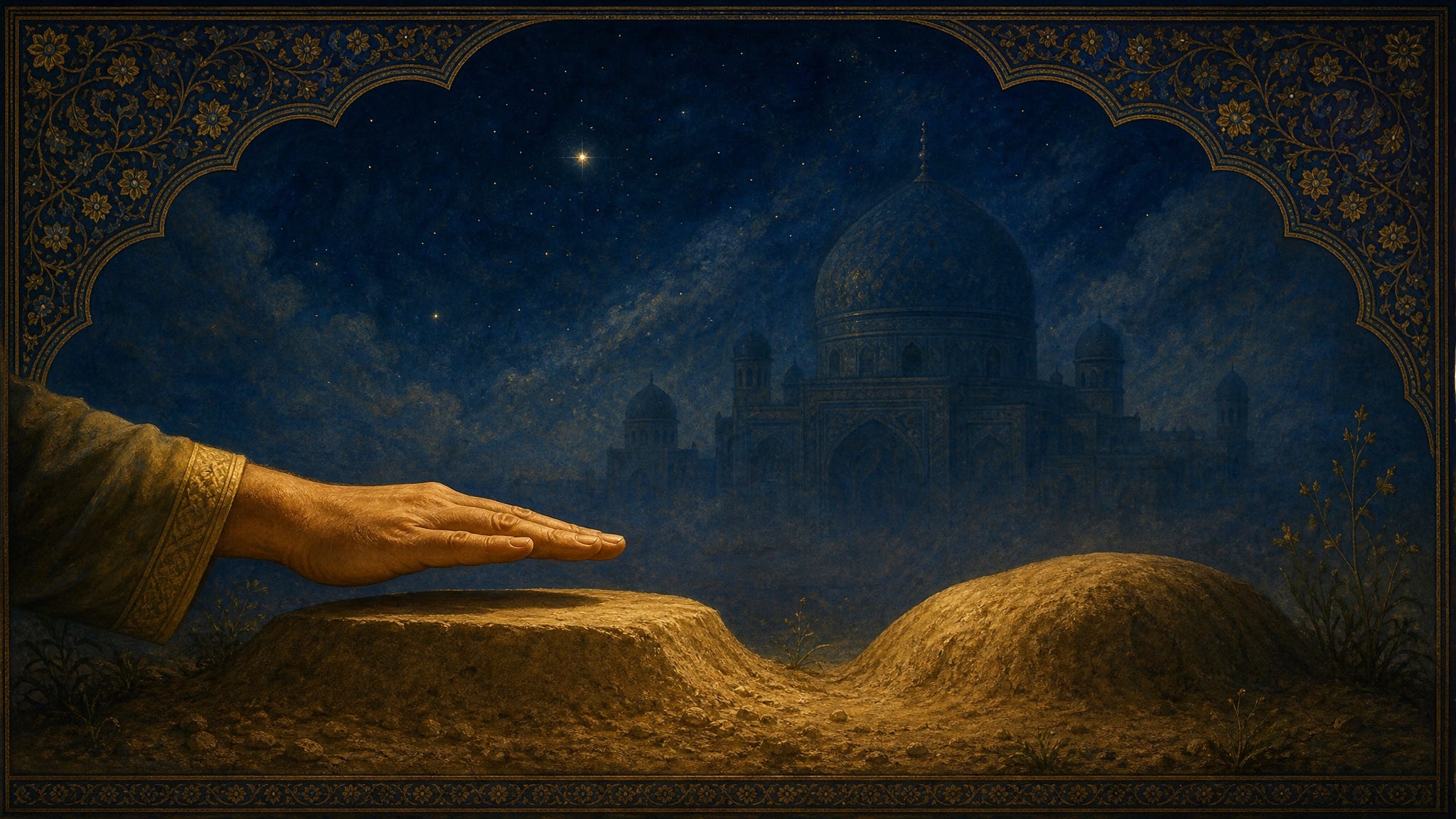
فِيهِ أَنَّ السُّنَّةَ أَنَّ الْقَبْرَ لَا يُرْفَعُ عَلَى الْأَرْضِ رَفْعًا كَثِيرًا وَلَا يُسَنَّمُ، بَلْ يُرْفَعُ نَحْوَ شِبْرٍ وَيُسَطَّحُ، وَهَذَا مَذْهَبُ الشَّافِعِيِّ وَمَنْ وَافَقَهُ. وَنَقَلَ الْقَاضِي عِيَاضٌ عَنْ أَكْثَرِ الْعُلَمَاءِ أَنَّ الْأَفْضَلَ عِنْدَهُمْ تَسْنِيمُهَا، وَهُوَ مَذْهَبُ مَالِكٍ
“In it is that the way of the Prophet is that the grave is not raised above the ground by a great raising, nor humped — rather it is raised about a hand-span and made flat. This is the position of al-Shafi’i and those who agreed with him. And Qadi Iyad related from most of the scholars that in their view the better thing is to hump it, and that is the position of Malik.”
— Yahya ibn Sharaf al-Nawawi, al-Minhaj Sharh Sahih Muslim, Volume 7, printed page 36
A hand-span.
The whole dispute, in the hands of the man who wrote the standard commentary on this book, is about whether the earth over a grave should be raised the width of your hand and left flat on top, or heaped up into a hump.
That is the argument.
Inches of soil.
Flat or rounded.
And notice who is on which side.
Al-Shafi’i says flat.
Malik says humped.
And al-Nawawi reports, from Qadi Iyad, that most of the scholars were with Malik.
So the majority position, in the tradition the objection comes from, is the more raised grave.
I want to leave one phrase with you before we move on, and I am not going to do anything with it tonight for another forty minutes.
Look at what he actually wrote.
Rather, it is raised.
Just hold that.
We will come back for it.
And there is one more thing on this page, and it is a piece of ordinary care that the objection loses.
That report has two commands welded into one sentence —
no image without effacing it, and no raised grave without levelling it
— and they get quoted together as though they are one ruling about graves.
Al-Nawawi separates them.
On the first half he says simply:
فِيهِ الْأَمْرُ بِتَغْيِيرِ صُوَرِ ذَوَاتِ الْأَرْوَاحِ
“In it is the command to alter the images of ensouled beings.”
— Yahya ibn Sharaf al-Nawawi, al-Minhaj Sharh Sahih Muslim, Volume 7, printed page 36
That is a ruling about making images of living creatures.
It is an entire separate discussion in Islamic law with its own literature.
It has nothing to do with graves at all; it simply happened to be in the same sentence because the Commander of the Faithful was sent to do two jobs on one journey.
Two rulings.
One sentence.
And al-Nawawi keeps them apart, because that is what a careful reader does.
Neither half carries the charge.
And Then Page Thirty-Seven, Where It Turns
The next page carries the report from Jabir — the plastering, the sitting, the building.
The running head reads
The prohibition of plastering the grave, and building over it, and sitting on it.
And here al-Nawawi gives us the rulings of his school, one by one.
I am going to read them and then I am going to ask you to look at the last one very carefully.
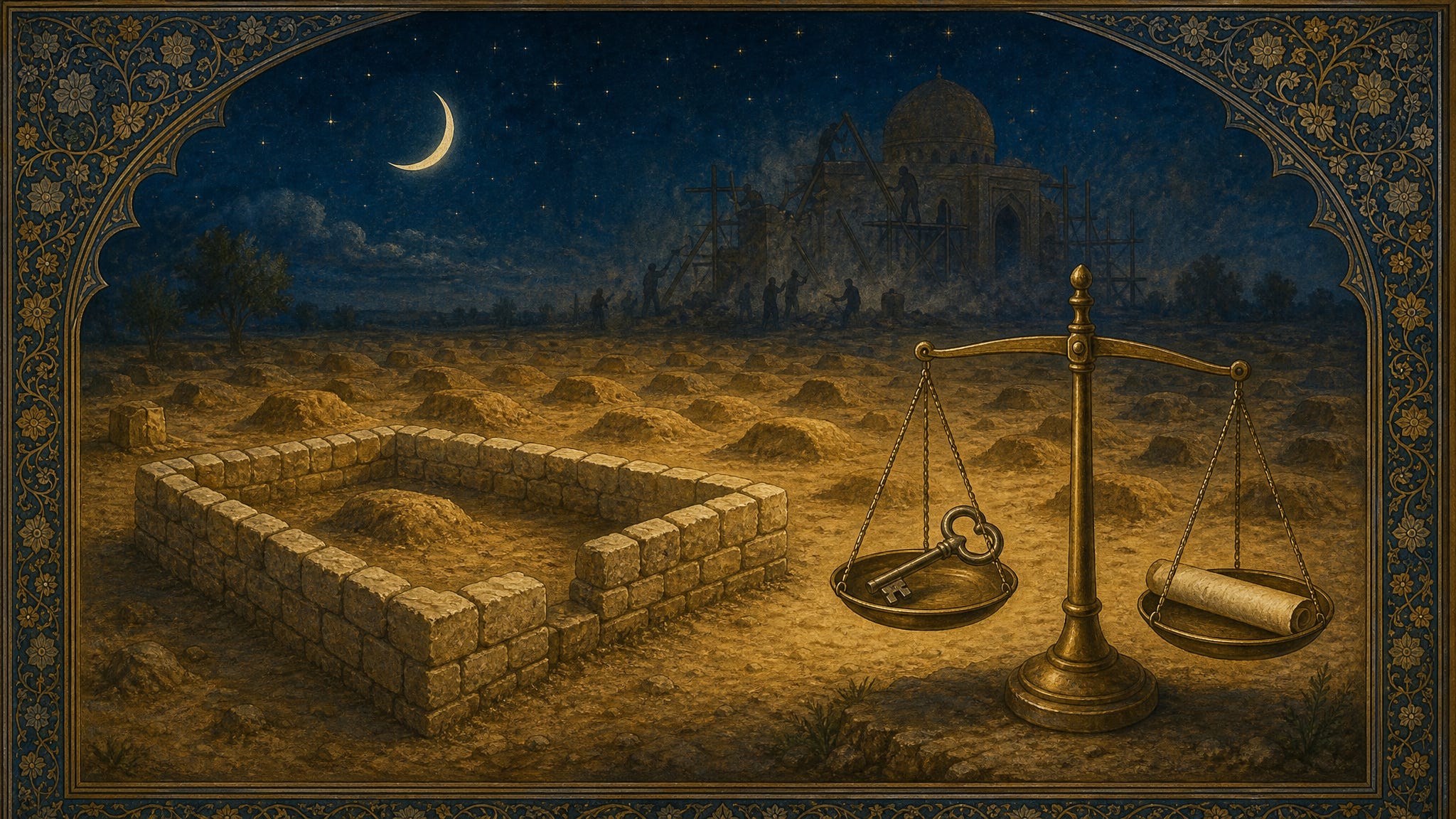
قَالَ أَصْحَابُنَا: تَجْصِيصُ الْقَبْرِ مَكْرُوهٌ، وَالْقُعُودُ عَلَيْهِ حَرَامٌ، وَكَذَا الِاسْتِنَادُ إِلَيْهِ وَالِاتِّكَاءُ عَلَيْهِ. وَأَمَّا الْبِنَاءُ عَلَيْهِ: فَإِنْ كَانَ فِي مِلْكِ الْبَانِي فَمَكْرُوهٌ، وَإِنْ كَانَ فِي مَقْبَرَةٍ مُسَبَّلَةٍ فَحَرَامٌ، نَصَّ عَلَيْهِ الشَّافِعِيُّ وَالْأَصْحَابُ
“Our companions said: plastering the grave is disliked, and sitting upon it is forbidden, and likewise leaning against it or reclining upon it. As for building over it — if it is on land the builder owns, it is disliked; and if it is in an endowed cemetery, it is forbidden. Al-Shafi’i and the companions stated this explicitly.”
— Yahya ibn Sharaf al-Nawawi, al-Minhaj Sharh Sahih Muslim, Volume 7, printed page 37
Four rulings.
Let me lay them out.
Plastering a grave — disliked.
Sitting on a grave — forbidden.
Building over a grave, on land you own — disliked.
Building over a grave, in an endowed cemetery — forbidden.
Now.
The last one is the strong one.
It is the only forbidden in the list that touches building at all.
It is the one the whole objection needs.
So look at what it is made of.
A maqbara musabbala — an endowed cemetery — is a particular thing in Islamic law.
It is ground that has been given away in endowment — made waqf — for the common burial of the Muslims.
It belongs to everybody and to nobody.
It is set aside so that every person in the town who dies has somewhere to be put.
And you may not take a piece of it for yourself.
That is why building there is forbidden.
Not because of what you might do at the grave.
Not because of what is in your heart when you stand at it.
Because the ground is not yours, and putting a structure on it takes a share of something that was given to all the Muslims and fences it off for one family.
It is a ruling about property.
It is a question of endowment.
Read the whole passage again and look for the word shirk.
Look for idolatry.
Look for worship.
Look for any suggestion — any — that what is at stake here is the oneness of God.
It is not there.
It is not there because that is not the kind of ruling this is, and the man writing it knew exactly what kind of ruling it was.
There is one more line on that page, and honesty requires that I read it to you, because it is the strongest thing in the passage for the other side and I am not going to step over it:
قَالَ الشَّافِعِيُّ فِي الْأُمِّ: وَرَأَيْتُ الْأَئِمَّةَ بِمَكَّةَ يَأْمُرُونَ بِهَدْمِ مَا يُبْنَى
“Al-Shafi’i said in al-Umm: and I saw the authorities at Mecca ordering the demolition of what was built.”
— Yahya ibn Sharaf al-Nawawi, al-Minhaj Sharh Sahih Muslim, Volume 7, printed page 37
There it is.
Structures were pulled down at Mecca, and al-Shafi’i saw it, and al-Nawawi records it approvingly in the middle of this passage.
And it sits exactly where the sentence before it put it: in the endowed cemetery, on ground that was not the builder’s to build on.
That is the honest shape of it, and you now have both edges of the thing in your hands.
Lessons for Our Time
The Charge Was Never About the Oneness of God, and Their Own Books Say So
Here is the first thing to carry out of this room.
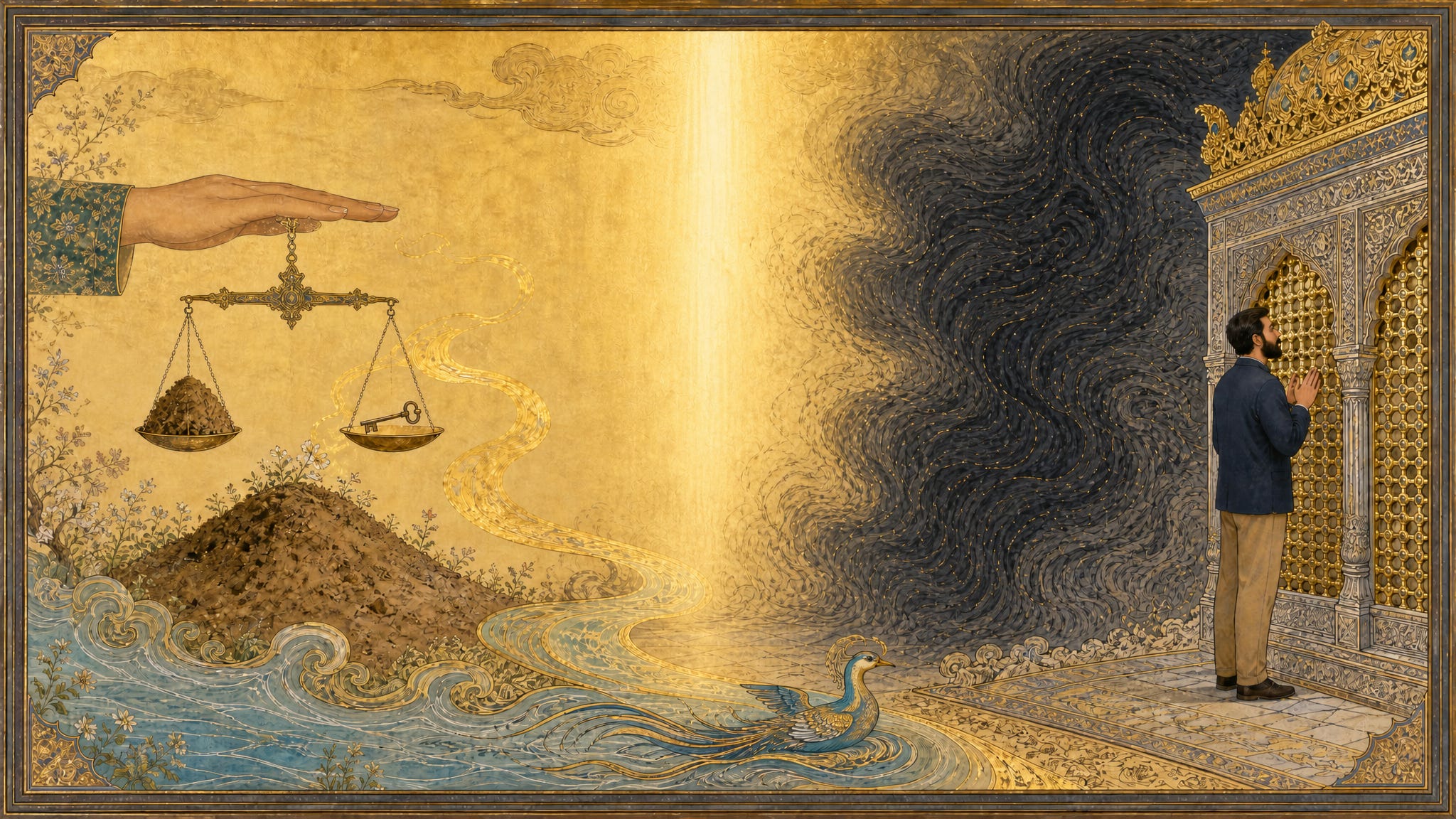
You were told that this is a question about tawhid — monotheism.
That when you stand in front of that lattice in Mashhad or in Najaf you are doing something that touches the oneness of God — the one thing in this religion that cannot be touched.
And then we opened the standard commentary on one of the two books that tradition holds soundest, at the two pages where it deals with exactly these reports, and what did we find it arguing about?
How high the earth is heaped over a grave.
Whether the top of it should be flat or rounded.
Who owns the ground it sits in.
That is it.
That is the whole of it, on the page, in the hands of the man the tradition trusts most to tell it what its own hadith mean.
And I want to be careful here, because this is where it would be easy to score a point and I do not want to.
I am not saying al-Nawawi would approve of everything that is done at a shrine.
I have no idea what he would say about the dome at Karbala; he never saw it and he never wrote about it.
That is not the claim.
The claim is narrower and it is stronger for being narrow.
It is this: when the man who wrote the standard commentary on Sahih Muslim sat down with these two reports, he put them in the chapter on funeral law, and he discussed them under the headings of disliked and forbidden, and he reasoned about them using the law of endowments.
He did not put them anywhere near the oneness of God.
So when somebody tells you that this is a tawhid question, you are allowed to know — gently, and without any need to say it loudly — that their own tradition did not treat it as one.
And here is what that actually looks like on a Thursday, because a lesson you cannot use is not a lesson.
You do not say:
al-Nawawi disagrees with you.
That is a name being thrown, and it will be met with another name, and you will both be there an hour later having thrown eleven names at each other.
You say something much smaller.
You say:
What do you think the Prophet meant by a raised grave?
And you wait.
Because most people who say this have never been asked that question, and they will discover, in the middle of answering you, that they had assumed it meant a dome, and that nobody ever told them it meant that — they simply filled the gap in.
And if they want to know what the scholars of their own school said it meant, you can tell them: a hand’s width of earth, and an argument about whether the top of it is flat or rounded.
That is it.
That is the whole intervention.
You have not won anything and you have not humiliated anybody.
You have put one honest question into a place where there had only ever been a slogan, and you have left it there to do its work.
A Disagreement Is Not an Accusation
And here is the second thing, and it is the one I would most like you to take home.
Look again at what we read on page 36.
Al-Shafi’i held that the grave should be flat.
Malik held that it should be humped.
And most of the scholars, as Qadi Iyad reports it, were with Malik.
Two Imams of the Sunni tradition.
Founders of schools that hundreds of millions of Muslims follow to this day.
In open disagreement, in writing, about the shape of the earth over a dead man.
And here is what did not happen.
Neither of them called the other an idolater.
Neither of them said the other had left Islam, or was praying to stone, or had made a religion out of masonry.
They disagreed the way scholars disagree — in books, with evidence, for a century, in front of everybody — and then they went on being two Imams of the same religion.
Something happened between then and now.
And I want to be very careful about how I say the next part, because there is an easy version of it that I am not going to give you.
The easy version names somebody.
It picks a movement, or a century, or a country, and it puts the blame there, and everybody in this room feels a little better for ten seconds and a little worse for a week.
We are not doing that.
We have never done that here and we are not starting tonight.
I will say only this, and then I will stop.
Something happened between Malik and now.
And whatever it was, it did not happen in the books.
The books are still there.
You can read them.
The argument in them is about hand-spans and endowed ground, and it is conducted between men who never once suggested that the other one had left the religion.
What we are dealing with today is not in those books.
It came from somewhere else.
And you do not have to know where it came from, or name it, or fight about it, to know that it is not what you were handed by the tradition.
And I want to say one more thing, and it is for the people in this room who have been hurt by this — because some of you have, and not by strangers on the internet.
By family.
By somebody whose opinion mattered to you.
It would be very easy to carry this the wrong way.
To let it settle into a grievance you take out and turn over.
To become somebody who is always half-waiting for the next time it gets said, so you can be ready.
Do not do that.
It will cost you far more than it costs them.
The person who says this to you has almost always been handed it.
They did not sit down with the commentary on Sahih Muslim and reason their way to it over a winter.
Somebody gave it to them in three sentences, the same way somebody might have given it to you, and it felt like defending God, which is not a contemptible thing to want to do.
So when you answer — and you will now be able to answer — answer the way you would want to be answered if you were the one who had been handed the three sentences.
Which, on some other subject, in some other week, you almost certainly have been.
That is enough for one point.
Let us go to the Book.
What the Book Actually Does
Back to the Three Verses
Now we go back to where we started.
Earlier, I read you three verses from the chapter of the Pilgrimage and asked you to notice only the arrangement.
You have been carrying them.
Let me put the third one back in front of you, because now you have the charge in your hands and it will sound different.
ذَٰلِكَ وَمَن يُعَظِّمْ شَعَائِرَ اللَّهِ فَإِنَّهَا مِن تَقْوَى الْقُلُوبِ
“That — and whoever venerates the signs of God, that is from the God-fearing of hearts.”
— Qur’an, Surah al-Hajj (the Chapter of the Pilgrimage) #22, Verse 32
Whoever venerates the signs of God.
Not
whoever tolerates.
Not
whoever is permitted.
Not
whoever, within careful limits, and provided he is very careful, may be allowed to.
Whoever venerates.
It is put to us as something good, in a sentence of praise, and it is not hedged.
So the first question is the obvious one.
What is a sign of God?
What a Sign Is
For this we go to al-Mizan fi Tafsir al-Qur’an — the commentary of Allamah Sayyed Muhammad Husayn Tabataba’i, a scholar of the last century whose reading of the Qur’an is the one this tradition has leaned on more than any other., and who we have cited from many times across these sessions.
Here is his definition:
الشَّعَائِرُ جَمْعُ شَعِيرَةٍ وَهِيَ الْعَلَامَةُ، وَشَعَائِرُ اللَّهِ الْأَعْلَامُ الَّتِي نَصَبَهَا اللَّهُ تَعَالَىٰ لِطَاعَتِهِ
“The signs are the plural of a sign, and a sign is a mark. And the signs of God are the markers that God, exalted is He, has set up for His obedience.”
— Allamah Sayyed Muhammad Husayn Tabataba’i, al-Mizan fi Tafsir al-Qur’an, on Surah al-Hajj #22, Verse 32
A marker.
A thing set up so that you will know where you are and what you are doing.
And he immediately gives us an example, and he gives it from the Qur’an itself —
The Safa and the Marwa are among the signs of God.
I want to be careful here, and I want to be careful in public, because there is a shortcut available at this point and I am not going to take it.
The shortcut is to say: a sign of God is any marker God sets up for His obedience, and therefore the places where His friends are buried are signs of God, and therefore venerating them is commanded by this verse.
I am not saying that, and I want to tell you exactly why, because the reason is better than the shortcut.
Allamah Tabataba’i does not read this verse that way himself.
When he comes to the question of what the signs of God refers to in this particular verse, he holds — on the reading of the Imams, peace and blessings be upon them — that it refers to the sacrificial animals of the pilgrimage.
And he mentions the general reading, the one that says it means every marker set up for obedience, and he sets it aside for this verse.
His words are that the context does not suit it.
So I will not put a reading into his mouth that he specifically declined to make.
What we have from him is a definition, and it is his.
And what we have from the Qur’an is an instance, and it is the Qur’an’s.
And we are going to work from those two, honestly, and see where they take us.
Because they take us somewhere, and we do not need to overstate a thing that is already strong.
Two Hills, and a Woman Looking for Water
So let us go to the instance the Book gives us.
The Safa and the Marwa.
They are two rocky rises at the edge of the sanctuary at Mecca.
Every one of you who has been for Hajj or for Umrah has walked between them, seven times, back and forth.
It is not optional.
It is part of the rite.
Here is Allamah Tabataba’i on that verse:
لَيْسَتِ الشَّعَائِرُ التَّكْوِينِيَّةَ، بَلْ هُمَا شَعِيرَتَانِ بِجَعْلِهِ تَعَالَىٰ إِيَّاهُمَا مَعْبَدَيْنِ يُعْبَدُ فِيهِمَا، فَهُمَا يُذَكِّرَانِ اللَّهَ سُبْحَانَهُ
“They are not signs by their created nature — rather they are two signs by God’s making them two places of worship in which He is worshipped, so that they call God, glory be to Him, to mind.”
— Allamah Sayyed Muhammad Husayn Tabataba’i, al-Mizan fi Tafsir al-Qur’an, on Surah al-Baqarah #2, Verse 158
And then the phrase I want you to hold for the rest of the night:
فَلَا يَضُرُّكُمْ أَنْ تَعْبُدُوهُ فِيهِمَا
“So it does no harm to you that you worship Him in them.”
— Allamah Sayyed Muhammad Husayn Tabataba’i, al-Mizan fi Tafsir al-Qur’an, on Surah al-Baqarah #2, Verse 158
Read that again, and look at the small words, because the small words are the whole argument.
That you worship Him — in them.
Not
that you worship them.
There is a pronoun there and it does not point at the hills.
And there is a preposition there and it puts you inside a place rather than in front of an object.
You worship God in the place.
You do not worship the place.
That is the answer to one half of tonight’s charge, and it did not come from us.
It came from a commentary on a verse about two hills in Mecca that has nothing to do with graves at all.
Now — and this is the question I think is the honest one — what made those two hills into signs?
They are rocks.
There is nothing in the geology.
God did not build them differently from the ridge next to them.
What happened there is that a woman was left in a valley with a baby and no water, and she ran.
Seven times, back and forth, up one rise and down and up the other, looking for anything.
She was not performing a rite.
She was a mother in a desert who was about to watch her son die.
And God took that — that particular half hour of one woman’s desperation — and He held it so dear that He wrote it into the pilgrimage, and made every believer who comes to His House walk the path her feet made, for as long as the House stands.
That is what makes a stone a sign.
It is not the stone.
It was never the stone.
It is what was done there, and who did it, and what God thought of them for doing it.
And I have to put the limit next to it, in the same breath, because otherwise I am doing the very thing I have spent an hour objecting to.
A sign is a sign because God appointed it.
He appointed those two hills.
We do not get to appoint anything.
Nobody in this room, and nobody in any room, has the authority to look at a place and decide that it has become a sign of God.
That is not ours.
So I am not going to stand here and tell you that a shrine is one of the signs of God.
I am not going to use that word of it, and you should not either, and if you hear somebody using it you can tell them gently that they have overreached.
What I am telling you is something different and I think it is stronger.
I am telling you that the mechanism is the same.
That when God makes something honoured, the honour never sits in the material.
It sits in the connection.
And that a man who cannot see how veneration works when he is walking between the Safa and the Marwa has not understood his own Hajj.
The Titles We Give Our Own Scholars
And while we are standing on what makes a sign a sign, let me deal with something you have every right to ask about, because it is the same mechanism and it is sitting in plain view.
We call our senior scholars Ayatullah.
We call others Hujjat al-Islam.
And somebody has said to you, or somebody will:
Who gave them those titles?
Let me answer that the honest way first.
Nobody did.
No Imam handed anybody those words.
They are not in al-Kafi and they are not in Man La Yahduruh al-Faqih.
They grew up in the seminaries, centuries afterwards.
The first man our histories record being called Ayatullah is Allamah al-Hilli, the jurist of Hilla, who died in the year 726 of the Hijrah — some seven centuries after the Prophet, peace and blessings be upon him, his family, and his righteous companions.
These titles are ours.
We made them. I am not going to stand here and pretend they came down from heaven.
But look at what we made them out of.
اللَّهُمَّ ارْحَمْ خُلَفَائِي — ثَلَاثَ مَرَّاتٍ — قِيلَ لَهُ: وَمَنْ خُلَفَاؤُكَ؟ قَالَ: الَّذِينَ يَأْتُونَ مِنْ بَعْدِي وَيَرْوُونَ أَحَادِيثِي وَسُنَّتِي فَيُعَلِّمُونَهَا النَّاسَ مِنْ بَعْدِي
“O God, have mercy on my successors — three times. It was said to him: and who are your successors? He said: those who come after me, and narrate my hadith and my sunnah, and teach it to the people after me.”
— the Messenger of God, peace and blessings be upon him, his family, and his righteous companions; Shaykh al-Saduq, Uyun Akhbar al-Rida, Volume 2, hadith 94
Mercy on my successors.
And when they asked him who those were, he did not say
the ones who inherit my house,
and he did not say
the ones who carry my name.
He said:
the ones who carry the words.
Not what they are.
What runs through them.
And last week we read the letter the Imam of our Age, may our souls be his ransom and may God hasten his return, sent to Ishaq ibn Ya’qub.
He said the narrators of our hadith are his proof upon us — and that he himself is the proof of God.
Two possessives, one sentence apart, and the whole architecture is in them.
Which is why the title says what it says.
Listen to it properly.
Hujjat al-Islam — a proof of Islam.
Not a proof of God.
That rung has names on it already and the tradition has never once let anybody climb to it.
Every time you use that title you are putting a man one step down and pointing at the step above him.
And Ayatullah — a sign of God.
Which sounds enormous, until you remember what the word means.
A sign is a marker.
And every one of us is a sign of God; that is not a rank, it is what it means to have been created at all.
The title is not a claim that God appointed him.
It is a claim about what the man is for.
And a marker that points at itself is a broken marker.
It is the same mechanism you have just heard on two hills outside Mecca.
The honour never sits in the material.
It sits in what runs through.
And I will tell you where Allamah al-Hilli is buried.
He is inside the shrine of the Commander of the Faithful, peace and blessings be upon him, at Najaf.
The first man we ever called a sign of God is lying inside one of the buildings we are on trial for tonight.
He Did Not Say Pray There
There is one more verse in this chapter of the argument and it is the sharpest sentence in the whole evening.
It is about the standing place of Abraham, peace and blessings be upon him, at the House.
وَاتَّخِذُوا مِن مَّقَامِ إِبْرَاهِيمَ مُصَلًّى
“And take, from the standing place of Abraham, a place of prayer.”
— Qur’an, Surah al-Baqarah (the Chapter of the Cow) #2, Verse 125
Now watch what Allamah Tabataba’i does with the grammar of that.
لَمْ يَقُلْ: وَصَلُّوا فِي مَقَامِ إِبْرَاهِيمَ، بَلْ قَالَ: وَاتَّخِذُوا مِنْ مَقَامِ إِبْرَاهِيمَ مُصَلًّى، فَلَمْ يُعَلِّقِ الْأَمْرَ بِالصَّلَاةِ فِي الْمَقَامِ، بَلْ عَلَّقَ عَلَىٰ اتِّخَاذِ الْمُصَلَّىٰ مِنْهُ
“He did not say: and pray at the standing place of Abraham. Rather He said: and take, from the standing place of Abraham, a place of prayer. So He did not attach the command to praying at the standing place; He attached it to making a place of prayer out of it.”
— Allamah Sayyed Muhammad Husayn Tabataba’i, al-Mizan fi Tafsir al-Qur’an, on Surah al-Baqarah #2, Verse 125
Do you see the difference?
It is one preposition and it changes everything.
If God had said
pray at the standing place of Abraham,
then the standing place would be the thing you are facing.
The object of the exercise.
You would be there for it.
He did not say that.
He said: take it, and make of it a musalla — a place where prayer happens.
The place is not what you are facing.
The place is where you are standing while you face God.
That is the difference between an idol and an address, and it is the whole of the difference, and the Qur’an drew it with a preposition in a verse about a footprint in a stone.
Remember that.
I am going to ask you to look at something later and I want this sentence in your pocket when you do.
The Cave, and the Two Parties
And now the verse I have been waiting all night to read you, because it is the only verse in the Qur’an that is directly about what to do with a burial place — and the polarity in it is the exact reverse of everything you were told.
You know the story of the companions of the cave.
Young men who fled a tyrant and took shelter in a cave, and God put them to sleep for three hundred years, and then woke them.
And the people of the city found them — and the finding was a sign, because a man who has seen the dead come back does not argue about the resurrection any more.
And then they died, properly this time, in the cave.
And the people standing outside had a decision to make about the bodies.
فَقَالُوا ابْنُوا عَلَيْهِم بُنْيَانًا ۖ رَّبُّهُمْ أَعْلَمُ بِهِمْ ۚ قَالَ الَّذِينَ غَلَبُوا عَلَىٰ أَمْرِهِمْ لَنَتَّخِذَنَّ عَلَيْهِم مَّسْجِدًا
“And they said: build over them a structure — their Lord knows best about them. Those who prevailed in the matter said: we shall certainly take over them a place of prayer.”
— Qur’an, Surah al-Kahf (the Chapter of the Cave) #18, Verse 21
Two proposals.
Two parties.
And the verse does not tell you who is who.
Allamah Tabataba’i does, and he tells you how he knows.
الْقَائِلُونَ هُمُ الْمُشْرِكُونَ مِنَ الْقَوْمِ بِدَلِيلِ قَوْلِهِ بَعْدَهُ: قَالَ الَّذِينَ غَلَبُوا عَلَىٰ أَمْرِهِمْ
“The ones speaking are the idolaters among the people — by the evidence of His saying afterwards: those who prevailed in the matter said.”
— Allamah Sayyed Muhammad Husayn Tabataba’i, al-Mizan fi Tafsir al-Qur’an, on Surah al-Kahf #18, Verse 21
The first party — the ones who say build over them a structure — are the idolaters.
He does not guess at that.
He says by the evidence of, and points at the wording of the very next clause.
Now.
Before you hear the second proposal, I want you to know what the first one actually is.
Because when I first read this verse I assumed, as I think most people do, that
build over them a structure
— meant putting up a monument.
A tomb.
Something grand.
It does not mean that.
Here is what it means:
وَالْمُرَادُ بِبِنَاءِ الْبُنْيَانِ عَلَيْهِمْ أَنْ يُضْرَبَ عَلَيْهِمْ مَا يُجْعَلُونَ بِهِ وَرَاءَهُ وَيُسْتَرُونَ عَنِ النَّاسِ فَلَا يَطَّلِعَ عَلَيْهِمْ مُطَّلِعٌ مِنْهُمْ
“What is meant by building a structure over them is that something be raised over them by which they are put behind it and screened away from people, so that no one of them may look upon them.”
— Allamah Sayyed Muhammad Husayn Tabataba’i, al-Mizan fi Tafsir al-Qur’an, on Surah al-Kahf #18, Verse 21
It is a wall.
They are not proposing to honour these men.
They are proposing to seal them up.
To put something across the mouth of that cave so that nobody can see in and nobody can get to them.
And Allamah Tabataba’i gives their sentence in full, with the part the verse compresses:
ابْنُوا عَلَيْهِمْ بُنْيَانًا وَاتْرُكُوهُمْ عَلَىٰ حَالِهِمْ يَنْقَطِعُ عَنْهُمُ النَّاسُ
“Build over them a structure and leave them as they are — let people be cut off from them.”
— Allamah Sayyed Muhammad Husayn Tabataba’i, al-Mizan fi Tafsir al-Qur’an, on Surah al-Kahf #18, Verse 21
Let people be cut off from them.
That is the proposal of the idolaters.
Wall them up.
Make them unreachable.
Let nobody come.
And here is the other party:
وَقَالَ الْمُوَحِّدُونَ: أَمْرُهُمْ ظَاهِرٌ وَآيَتُهُمْ بَيِّنَةٌ، وَلَنَتَّخِذَنَّ عَلَيْهِمْ مَسْجِدًا يُعْبَدُ فِيهِ اللَّهُ وَيَبْقَىٰ بِبَقَائِهِ ذِكْرُهُمْ
“And the people of God’s oneness said: their affair is plain and their sign is clear — and we shall certainly take over them a place of prayer, in which God is worshipped, and by its remaining their memory remains.”
— Allamah Sayyed Muhammad Husayn Tabataba’i, al-Mizan fi Tafsir al-Qur’an, on Surah al-Kahf #18, Verse 21
In which God is worshipped.
You have heard that construction before tonight.
Forty minutes ago, about two hills at Mecca:
that you worship Him in them.
The same shape, in a different commentary on a different verse about a different place.
The building is where God is worshipped.
The men lying in it are not.
And Allamah Tabataba’i says the context supports reading the second speech as a refutation of the first.
These are not two groups agreeing on a plan.
One says
seal them away,
and the other says
no — we will put a place of prayer here.
And then he gives his evidence for who the second group are, and it is a single word choice, which is exactly the kind of argument we have been doing all evening.
وَمِنَ الشَّاهِدِ عَلَيْهِ التَّعْبِيرُ عَمَّا اتَّخَذُوهُ بِالْمَسْجِدِ دُونَ الْمَعْبَدِ، فَإِنَّ الْمَسْجِدَ فِي عُرْفِ الْقُرْآنِ هُوَ الْمَحَلُّ الْمُتَّخَذُ لِذِكْرِ اللَّهِ وَالسُّجُودِ لَهُ
“And among the evidence for it is the describing of what they took as a masjid rather than as a temple — for the masjid, in the usage of the Qur’an, is the place taken for the remembrance of God and prostration to Him.”
— Allamah Sayyed Muhammad Husayn Tabataba’i, al-Mizan fi Tafsir al-Qur’an, on Surah al-Kahf #18, Verse 21
A masjid, not a ma’bad.
Not a temple.
A place of prostration.
And he proves what masjid means in the Qur’an’s own usage by quoting another verse —
and places of prostration in which the name of God is mentioned
— and that verse is from the chapter of the Pilgrimage, verse forty.
I am going to leave that where it lies.
Now, there is a reply that always comes at this point and I would rather meet it than have somebody meet me with it afterwards.
The reply is:
The Qur’an is only reporting what those people said.
It is not approving of it.
And the answer is the word.
If the Qur’an were merely reporting, it would have used the word they would have used.
It says masjid.
In the Book’s own vocabulary that is a place where God is remembered and prostrated to — and it is the word the Book chose to describe what the people of God’s oneness built over a grave.
One more thing, and then we move, and this one is a matter of honesty about how much weight this verse can carry.
Allamah Tabataba’i says of this verse, in so many words, that it is one of the battlegrounds of the commentators’ opinions.
He says the combinations of readings run into the thousands, and that he has indicated the ones that suit the context.
So I am not going to tell you that what I have just read you is the settled meaning of this verse, because he does not say that and I am not going to improve on him.
What I will tell you is exactly what he did.
He identified the two parties from the wording and told us what his evidence was.
He said the context supports it.
And he said plainly that the verse as a whole is contested.
That is what an honest man does with a difficult verse, and it is more useful to you than a certainty would have been.
Because when somebody tells you this verse means the opposite, you will not be knocked over.
You will know that the verse is argued about, and you will know what the strongest reading is and who held it and why.
And Now the Sentence That Explains Everything
We are nearly at the end of Point Two, and I want to give you the piece of machinery underneath all of it.
It is in the same commentary, on our own verse, on the last three words of it:
that is from the God-fearing of hearts.
حَقِيقَةُ التَّقْوَىٰ أَمْرٌ مَعْنَوِيٌّ يَرْجِعُ إِلَى الْقُلُوبِ، وَلَيْسَتْ هِيَ جَسَدَ الْأَعْمَالِ، فَإِنَّهَا مُشْتَرَكَةٌ بَيْنَ الطَّاعَةِ وَالْمَعْصِيَةِ — كَالْمَسِّ فِي النِّكَاحِ وَالزِّنَا، وَإِزْهَاقِ الرُّوحِ فِي الْقَتْلِ قِصَاصًا أَوْ ظُلْمًا، وَالصَّلَاةِ الْمَأْتِيِّ بِهَا قُرْبَةً أَوْ رِيَاءً
“The reality of God-fearing is an inward matter that goes back to the hearts. It is not the body of the actions — for the body of the actions is shared between obedience and disobedience: like the touch, in marriage and in fornication; and the taking of the soul, in a killing that is justice and in one that is wrong; and the prayer performed to draw near to God and the prayer performed to be seen.”
— Allamah Sayyed Muhammad Husayn Tabataba’i, al-Mizan fi Tafsir al-Qur’an, on Surah al-Hajj #22, Verse 32
Three examples.
Not one of them is about a grave.
The same touch, between the same two people, is a lawful marriage or it is fornication, and you cannot tell which by watching.
The same act of taking a life is a just execution or it is murder, and the blade does not know the difference.
The same prayer, the same words, the same movements, performed by a man who wants God, or performed by a man who wants to be seen praying — and if you filmed both you could not tell them apart.
The body of the act is shared.
What separates them is not in the act at all.
It is inside.
So when somebody stands in front of you and says:
the thing you are doing at that grave is idolatry
— they are making a claim about the body of an act.
And the Qur’an has just told you, in the very verse that commands veneration, that the body of an act does not settle anything.
It never did.
It cannot.
The difference was never in the stone.
And Our Own Book Drew the Line First
One last text, and it is ours, and I am giving it to you because it constrains us and not only them.
In al-Kafi — the earliest of the great collections of our narrations — there is a chapter called Visiting of the Graves.
We read from it last week.
Here is the second report in it.
A man named Sama’a asks the Imam a question:
سَأَلْتُهُ عَنْ زِيَارَةِ الْقُبُورِ وَبِنَاءِ الْمَسَاجِدِ فِيهَا، فَقَالَ: أَمَّا زِيَارَةُ الْقُبُورِ فَلَا بَأْسَ بِهَا، وَلَا تُبْنَىٰ عِنْدَهَا الْمَسَاجِدُ
“I asked him about visiting the graves, and about building mosques in them. He said: as for visiting the graves, there is no harm in it. And mosques are not to be built at them.”
— Imam Ja’far al-Sadiq, peace and blessings be upon him; Shaykh al-Kulayni, al-Kafi, Volume 3, the Book on Dying People, the chapter on Visiting of the Graves, second hadith
There it is, in our own earliest collection, in the same chapter that tells us to go.
Visiting — no harm in it.
Building mosques at them — no.
Now look carefully at what he is being asked, because it matters and it is easy to miss.
He is not asked about a grave.
He is asked about the graves, plural, and about building mosques in them.
He is asking about a burial ground.
And where was al-Nawawi’s one firm prohibition, an hour ago?
In an endowed cemetery.
The common burial ground of the Muslims.
Two traditions.
Two books that owe each other nothing.
The same question, about the same place, and very nearly the same answer.
And neither of them — neither of them — puts it anywhere near the oneness of God.
I am going to stop there and not push it further, because there is a further step available and it would not be honest.
Whether a building that has one honoured grave inside it falls under this report is a question of jurisprudence.
It is argued properly, by people qualified to argue it, using tools I am not going to pretend to deploy from the pulpit on a Wednesday evening.
What I will say is what the report says.
Our own book draws a limit.
It is not a licence for everything, and anybody who tells you our tradition has never drawn a line here has not opened it.
Lessons for Our Time
Veneration Is Commanded, and the Measure of It Is Inside You
The verse does not say
whoever avoids the signs of God.
It does not say
whoever is careful around the signs of God.
It says
whoever venerates them
— and then it tells you where the value of that is:
that is from the God-fearing of hearts.
Not from the correctness of the object.
Not from the architecture.
Not from how much marble.
From the hearts.
Which means two things at once, and you have to hold both or you have only understood half of it.
It means nobody can look at you and convict you.
They cannot see the thing that the verse says is decisive.
When a man tells you that what you are doing is idolatry, he is telling you something about an action he can see, and the Book has just told you that what he can see is not where the answer lives.
And it means nobody can acquit you either — including you.
Because if the measure is in the heart, then the question
am I doing this rightly
is a real question, and it is yours, and it does not get answered by winning an argument with a cousin.
What Makes a Place a Sign Is What Was Done There, and Who Did It
Every one of you who has been on Hajj has walked between two hills because a woman ran there.
Think about that the next time this is put to you.
Nobody has ever accused you of worshipping a hill.
Nobody stands at the Safa and worries that they have gone too far.
And yet by any test the objection uses — you go to a specific place, you perform a specific act there, and you do it because of a human being who was there long ago — the Safa and the Marwa are the harder case, not the easier one.
The difference is that God appointed that one, and everybody knows it, and so nobody is frightened of it.
Which tells you that the fear is not really about the act.
And We Do Not Get to Manufacture Signs
And now the limit, and I want to say it before anybody says it to me.
God appoints a sign.
We do not.
There is no ceremony by which a community decides that a place has become holy.
There is no amount of love, or history, or number of visitors, that converts a piece of ground into something God has marked.
The Safa and the Marwa are signs because He said so, in a Book, in words we can all read.
So when you defend what we do, defend it accurately.
Do not reach for the biggest word available.
Do not tell somebody that a shrine is one of the signs of God, because you cannot show them that, and the moment they ask you to, you will have handed them the argument.
Say the true thing, which is smaller and which holds:
The honour that is shown there is not shown to stone. It is shown because of a connection to God — and the Book has just told you that the measure of that is in the heart, where you cannot see it, and neither can I.
You do not need to claim more than that.
And a claim you cannot support is worse than no claim at all, because it will be the only part of the conversation anybody remembers.
And one more thing, because I have been careful tonight and you are entitled to know that I have been.
Allamah Tabataba’i, whose commentary we read from an hour ago, is strict on this: a sign is a sign because God made it one.
Shaheed Mutahhari, who studied under him and whose name most of you know, reads it more widely than I have read it tonight.
And where exactly that line falls is a live discussion, among people far better equipped to have it than me.
So do not hear me saying the question is closed.
It is not.
What I have handed you is the claim you can defend at a wedding when somebody puts a phone in front of you — and that is a smaller thing than the whole of what our scholars have said about it.
We will do that properly, God willing, when we come to what a hawza actually is, and what stands behind a scholar.
What We Actually Built
We have spent an hour in books.
Now let us stop arguing and just open the door and look at the thing.
Describe It. Do Not Defend It.
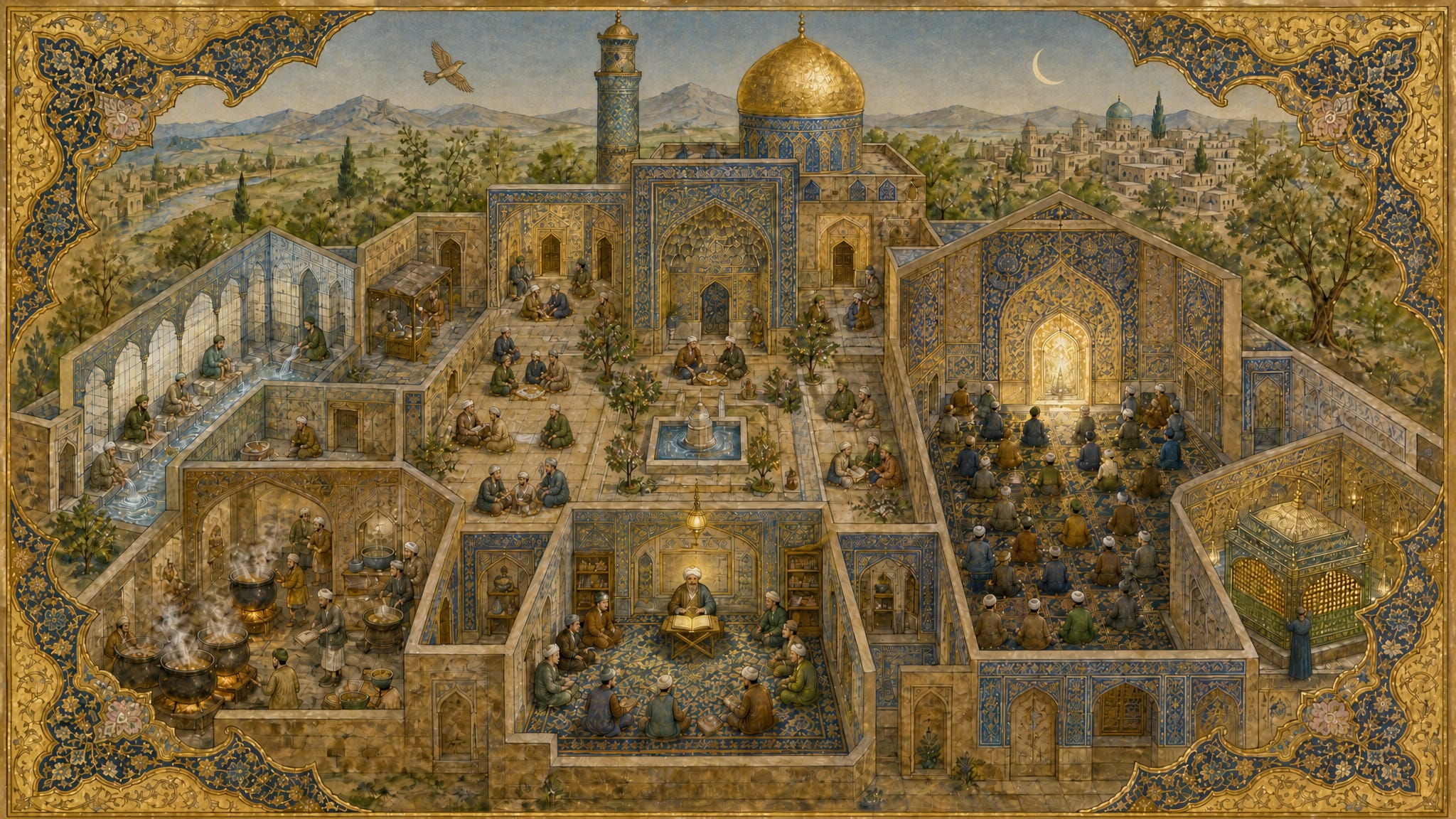
I want to walk you through one of these buildings, and I am not going to defend anything while I do it.
I am only going to tell you what is there.
You have been in one.
Check what I say against what you remember.
You come in through a gate, and you take your shoes off, and you are in a courtyard.
It is very large.
There are people sitting on the floor of it in every direction.
Some of them are reading.
Some of them are asleep.
There are families who have come a long way and are eating out of a bag.
Off the courtyard there are rooms.
In one direction there are washrooms, and a place to do your wudu — ablution.
In another there is somewhere for travellers to sleep, because people arrive at two in the morning with nowhere to go and nobody is turned out.
There is a kitchen.
In some of them the kitchen is enormous and it feeds tens of thousands of people a day and it does not ask anybody for money.
There is, more often than not, a school.
Rooms where students sit on the floor in a half circle in front of a teacher with a book open.
In the larger ones this is not a room, it is a seminary, and it has been running for centuries.
And there is a prayer hall.
Or several.
Enormous ones, with carpet the whole way across and lines marked in the weave, and at the appointed time they fill up, shoulder to shoulder, ten thousand deep, and everybody stands.
And somewhere inside all of that, off to one side, in a chamber with a doorway you have to look for, there is a lattice with a grave inside it.
That is the building.
Now, here is the sentence, and it is the only argument I am going to make in this section, and it takes four seconds to say:
Everybody in that building is facing Makkah.
Every one of them.
The ten thousand in the hall.
The families in the courtyard.
The students in the seminary when the call goes.
The woman at the lattice with her hands on the metal — when the prayer begins she turns, like everybody else, towards the same city everybody else turns towards.
Nobody in that building is facing the grave.
The charge was architectural.
You have built temples to the dead.
And the answer is architectural, and it is available to anybody who walks in through the gate: these are not tombs with a prayer hall attached.
They are prayer halls with a grave in them.
Which is the sentence I read you forty minutes ago about the standing place of Abraham.
He did not attach the command to praying at the standing place.
He attached it to making a place of prayer out of it.
That is what that verse looks like when somebody builds it out of stone.
And it is the same everywhere.
The resting place of the late leader, Imam Khomeini, may God rest his pure soul, outside Tehran — there is a mosque in it, and a small seminary, and lodging for pilgrims, and above all an enormous hall for prayer.
In Mashhad, Imam al-Rida, peace and blessings be upon him, and a great many of the companions of the Household, peace and blessings be upon them, around him, and at Dar al-Zikr the martyred leader, Imam Sayyed Ali Khamenei, may God rest his pure soul, and those who were martyred alongside him.
Every one of them is a place people come to pray.
And Now I Want to Ask You Something
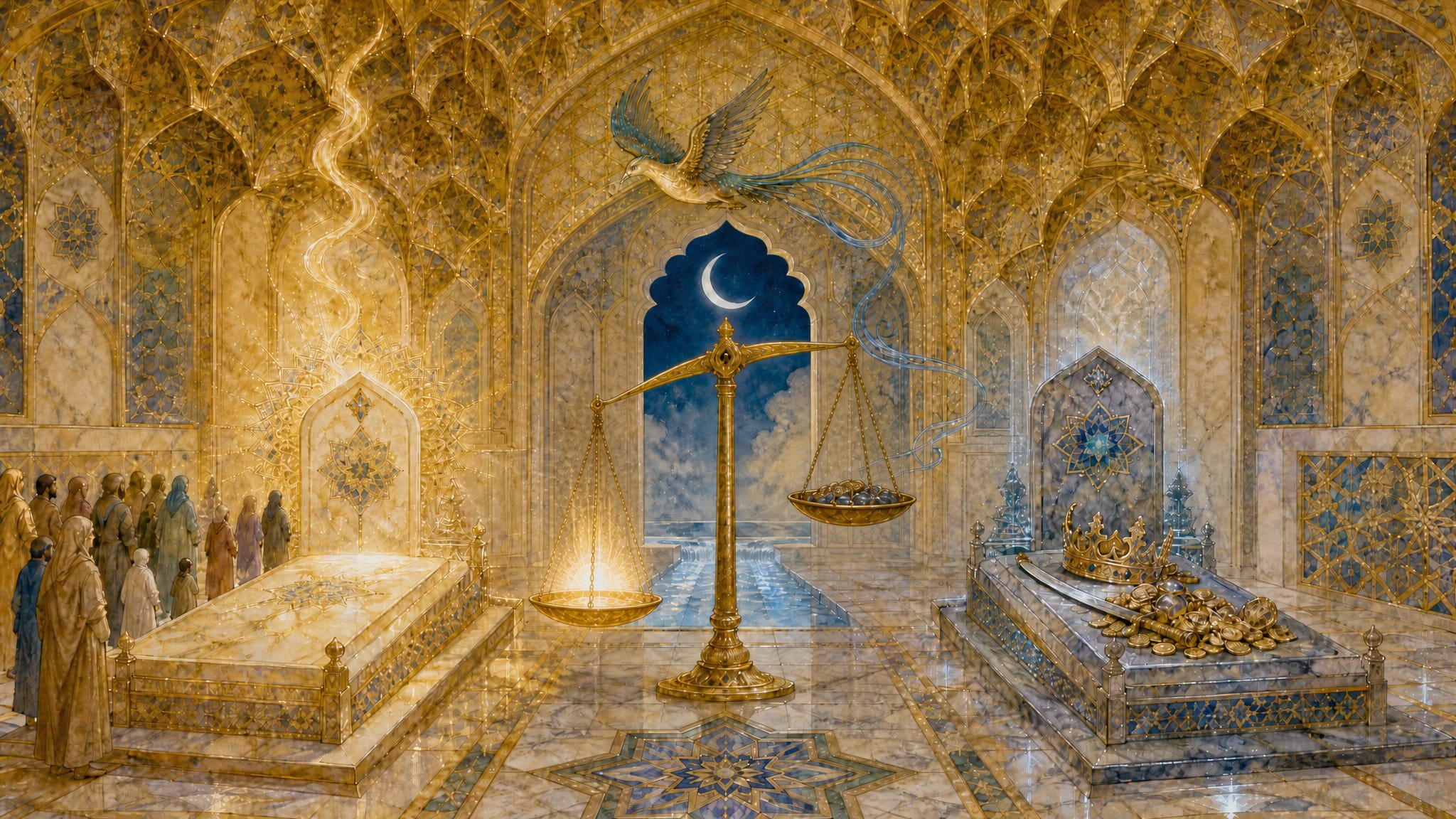
Here is a question, and I would like you to actually answer it in your head before I go on.
How many of you have been to Mashhad?
Good.
Keep your hand up for one more.
Can you tell me where Harun al-Rashid is buried?
Because he is buried in that building.
He is under the same roof you walked around under.
He is, in fact, a few feet away from the grave you travelled to see.
Harun al-Rashid was the caliph of the Muslims.
He ruled from the Atlantic to the edge of India.
He was, by any reckoning, the wealthiest and most powerful man alive in his century.
And that ground was his family’s ground before it was anything else — he was buried there first.
The Imam was brought to him, not the other way round.
So the two of them are lying side by side.
Same soil.
Same roof.
Same marble over the top of both.
And twenty million people a year come through that building, and almost none of them could tell you within fifty feet where the caliph is.
Why?
If this were about the building, Harun would be getting it.
He has the better claim.
He got there first, it was his land, and he had more money to spend on a tomb than the Imam’s family had ever seen.
If what draws people is masonry, then the masonry is right there and it is his.
Nobody goes.
And Our Own Books Set That Up on Purpose
Now I want to show you something, because what I have just said to you is not a clever observation that occurred to me.
Our own books put the caliph in that sentence deliberately, twelve hundred years ago, and I do not think they did it by accident.
There is a report in Uyun Akhbar al-Rida — a collection assembled by Shaykh al-Saduq, one of the great gatherers of our narrations in the fourth century, devoted entirely to the reports about the eighth Imam.
In it, the Imam’s father — Imam Musa ibn Ja’far, peace and blessings be upon him — says this, years before any of it happened:
إِنَّ ابْنِي عَلِيًّا مَقْتُولٌ بِالسُّمِّ ظُلْمًا، وَمَدْفُونٌ إِلَىٰ جَنْبِ هَارُونَ بِطُوسَ، مَنْ زَارَهُ كَمَنْ زَارَ رَسُولَ اللَّهِ صَلَّى اللَّهُ عَلَيْهِ وَآلِهِ
“My son Ali will be killed by poison, wrongfully, and buried beside Harun at Tus. Whoever visits him is like one who has visited the Messenger of God, may God’s blessings be upon him and his family.”
— Imam Musa ibn Ja’far, peace and blessings be upon him; Shaykh al-Saduq, Uyun Akhbar al-Rida, Volume 2
Read the two halves of that against each other.
Buried beside Harun.
And then, in the same breath, without a pause:
whoever visits him.
The neighbour is named.
And then the visiting is named.
In one sentence.
Whoever preserved that report was not filling in geography.
He was putting two men in the same ground in front of you and telling you in advance which one would be visited — and leaving you to notice, twelve centuries later, when you are standing in that building yourself, that he was right.
And there is another report in the same collection, and this one I love, and I am going to give it to you as a gift rather than as an argument.
A man is standing near Imam al-Rida, peace and blessings be upon him, at Mina — or at Arafat, the narrator is not certain — during the Hajj. And the Imam is looking across at Harun.
And he says:
أَنَا وَهَارُونُ هَكَذَا — وَضَمَّ بَيْنَ إِصْبَعَيْهِ
“I and Harun are like this — and he put his two fingers together.”
— Imam al-Rida, peace and blessings be upon him; Shaykh al-Saduq, Uyun Akhbar al-Rida, Volume 2
And the man who heard it says:
We did not know what he meant by that, until what happened at Tus happened.
Two fingers, pressed together, in the middle of the Hajj, with the caliph in view.
So: same soil, same roof, same marble, same century.
Two men.
One of them is visited by twenty million people a year and the other one cannot be found.
The difference is not the dome.
It was never going to be the dome.
Ultimately, it is God who is the differentiator.
That is the whole of it.
One of those two men spent his life in the direction of God, and God let people know it, and they came.
The other one had everything a man can have and nothing that God valued, and the building does not help him at all.
And the Prophet Carried the Stone Himself
Now I want to close Point Three with a report from Sunan Abu Dawud — one of the six collections the Sunni tradition relies on, and a book that has been in their hands since the third century of the hijrah.
And I want to start with the title Abu Dawud himself gave the chapter, because it tells you what he thought it was about before you read a word of the report.
He called it:
On gathering the dead in one grave, and the grave being marked.
The grave being marked.
That is the chapter heading, in their book, written by the man who assembled it.
And here is the report.
Uthman ibn Mazh’un has died.
He was one of the earliest Muslims, one of the ones who went to Abyssinia, and the Prophet, peace and blessings be upon him, his family, and his righteous companions, loved him.
He is buried.
And then this happens:
فَأَمَرَ النَّبِيُّ رَجُلًا أَنْ يَأْتِيَهُ بِحَجَرٍ فَلَمْ يَسْتَطِعْ حَمْلَهُ، فَقَامَ إِلَيْهَا رَسُولُ اللَّهِ وَحَسَرَ عَنْ ذِرَاعَيْهِ — كَأَنِّي أَنْظُرُ إِلَىٰ بَيَاضِ ذِرَاعَيْ رَسُولِ اللَّهِ حِينَ حَسَرَ عَنْهُمَا — ثُمَّ حَمَلَهَا فَوَضَعَهَا عِنْدَ رَأْسِهِ، وَقَالَ: أَتَعَلَّمُ بِهَا قَبْرَ أَخِي، وَأَدْفِنُ إِلَيْهِ مَنْ مَاتَ مِنْ أَهْلِي
“So the Prophet ordered a man to bring him a rock, but he was not able to carry it. So the Messenger of God rose to it and pushed back his sleeves — it is as though I can see the whiteness of the forearms of the Messenger of God when he pushed them back — then he carried it and set it down at his head, and he said: by it I mark the grave of my brother, and I shall bury beside him whoever of my family dies.”
— Abu Dawud, al-Sunan, the Book of Funerals, hadith 3206
Slow down with me.
He did not order it done.
He asked a man to fetch a stone, and the man went, and the man could not lift it.
And so the Messenger of God — in the sixth decade of his life, for a man he had just called his brother — got up, pushed his sleeves back up his arms, and carried the stone himself.
And look at what the man who reported it remembered.
He did not remember the ruling.
He did not come away with a principle about grave markers.
He came away with:
It is as though I can see the whiteness of his forearms when he pushed his sleeves back.
Fourteen hundred years, and that is the detail that survives.
A man watching his Prophet lift a rock.
And then the sentence.
By it I mark the grave of my brother.
Now remember what I asked you to hold an hour ago, on page 36of al-Nawawi.
I told you I would come back for it.
Here it is.
He wrote:
Rather, it is raised.
About a hand-span, and made flat.
So when the report says
level the raised grave,
it cannot mean erase it, because the same passage, in the same sentence, says the grave is raised.
It means level the top of it.
Flatten the hump.
That is all it has ever meant.
Nobody in the classical tradition ever said let a grave sink into the ground and vanish.
The Prophet marked one with a rock he carried himself.
And I will give you the last word on this from the people who printed that book, because it is their footnote and not mine.
The edition we are reading is a modern one, published by a press that would not agree with much of what is in this room.
Underneath that report, they wrote this:
“It is permissible to put some sort of a mark on someone’s grave so it will be known that it is a grave and where it is.
But putting inscriptions on an erected stone, or pitching a flag on it is not permissible.”
Read both sentences.
I am not going to read you the first and skip the second.
The first one concedes the headstone.
Completely, and without argument, in their own edition, underneath their own hadith.
And the second one tells you where the live disagreement actually is.
It is about what you may write on the stone.
Whether an inscription is allowed.
Whether you may put a flag up.
That is the argument.
Engraving.
It is not idolatry.
It is not the oneness of God.
It is a question about lettering, and there are scholars on both sides of it, and it has been argued politely for a very long time by people who did not accuse each other of leaving the religion.
The Stone Is for the Living
There is a second half of the Prophet’s sentence and I have not touched it yet.
Here it is again:
By it I mark the grave of my brother — and I shall bury beside him whoever of my family dies.
Why does he want it marked?
So that he can find it again.
So that when somebody else he loves dies, he can bring them here, and put them next to Uthman, and they will be together.
The stone is not for Uthman.
Uthman has gone to his Lord, and last week we spent an evening on what our books say he receives there, and none of it depends on a rock.
The stone is for the people who are still here.
And you have heard this in a harder form tonight and you may not have noticed.
In the eulogy that is coming I am going to tell you about a man in Kufa with minutes to live who was permitted three last requests.
He spent one of them on a debt.
He spent one of them trying to save his cousin’s life.
And he spent one of them on this:
Look for my body, ask Ibn Ziyad for it, and cover it.
He did not need it.
He was minutes from his Lord.
He asked because somebody was going to come looking.
A grave is an address.
Go and stand in Wadi al-Salam, outside Kufa, and look at it — one of the largest burial grounds anywhere on earth, and it goes to the horizon in every direction and then keeps going.
Or Behesht-e Zahra outside Tehran.
Or the cemeteries here where some of you have people.
Fields of headstones, as far as you can see.
Not one of them is a place of prayer.
Nobody prays towards them.
Nobody circles them.
There is no dome over any of them and nobody has ever suggested there should be.
Every single one of them is an address.
And I want to finish Point Three by finishing something we started last week, because we left it half-said and I have been aware of it for seven days.
Last week I told you there is solace for the one in the grave.
That was the whole evening —
they take comfort in you
— and it is true and our books say it plainly.
What I did not say is the other half, and some of you needed the other half more than you needed the first one.
There is solace for the one standing over it too.
That is not a lesser thing.
That is not the sentimental part that we allow you because you are grieving and we do not want to be unkind.
The Messenger of God marked a grave so his family could be laid beside a man they loved.
That is not a concession to human weakness.
That is a prophet building for the living, with his own arms, on the day of a burial.
So if you go because you cannot bear not to go — that is not a failure in you.
If you go and you find that something in you settles that had not settled in months — that is not a trick your mind is playing.
It is what the marker was for.
Lessons for Our Time
The Answer to You Built a Temple Is to Open the Door
Here is the first thing to carry home from Point Three, and it is the easiest thing you will ever be asked to do in an argument.
Invite them.
When somebody tells you that we have built temples to the dead, you do not need a text for the first move.
You say: have you been?
And when they say no — and they will nearly always say no — you say: go.
Go to Mashhad, or to Karbala, or to Kazimayn, or to Samarra, or to Najaf, or to Qom, and walk in through the gate, and look at what is actually in front of you.
Because the thing they are describing is not there.
There is no altar.
There is nothing anybody bows to.
There is a courtyard full of exhausted families, and a kitchen, and a school, and an enormous hall where several thousand people stand in lines facing Makkah five times a day.
And I want to say the honest version of this, because it cuts both ways and it should.
Do not take my description on trust either.
I have told you what is in that building.
I believe every word of it and you can check every word of it.
But the lesson is not
Believe your teacher instead of believing the video.
The lesson is: when somebody describes a place to you, and you have the means to go and look at the place, go and look at the place.
That applies to their description.
And it applies to mine.
And If It Were the Building, the Caliph Would Be Getting It
And here is the last one, and it is the whole evening in a sentence.
Harun al-Rashid is in that room.
He has the marble.
He has the dome over him — the same dome.
He got there first and it was his family’s ground.
Twelve hundred years of pilgrims have walked past him, most of them within a few feet, and almost none of them knew he was there and none of them came for him.
So whatever it is that brings twenty million people a year to that building, it is demonstrably not the building.
And that is not an argument I have constructed.
It is a fact about a floor plan, and anybody can go and check it, including the person who is accusing you.
Which brings us back to where we began, and to the three verses I read you at the start, and to the man falling out of the sky.
The same act is worship, or it is idolatry.
The identical touch is a marriage or it is a sin.
The identical prayer is devotion or it is display.
The identical dome stands over a caliph nobody visits and over a man twenty million people come to see.
The difference was never in the stone.
It was never going to be in the stone.
And the people who told you it was have been looking in the one place the Qur’an told them, in the verse that commands veneration, they would not find it.
The Close

I want to give you three sentences to take out of this room, and not one of them is mine.
The first is from the chapter of the Pilgrimage, and it is the verse we opened on:
Whoever venerates the signs of God — that is from the God-fearing of hearts.
The second is from a commentary on two hills at Mecca, and it is six words long, and every one of them is load-bearing:
That you worship Him in them.
And the third is from a man standing at a graveside in Medina with his sleeves pushed back and a rock in his arms:
By it I mark the grave of my brother.
That is the evening.
A command to venerate.
A pronoun that tells you who is being worshipped and a preposition that tells you where you are standing.
And a prophet, marking a grave, so that the people who loved a man could find him again.
If you remember nothing else, remember that none of the three is a defence.
Not one of them is arguing with anybody.
They are a verse, a definition and a report, and they were all sitting there, in books that anybody can open, the whole time this was being said about us.
Conclusion — Key Takeaways
So let me put in your hands what you came for, and then three things to do with it.
The charge was that this is a question about the oneness of God.
And we went to the standard commentary on Sahih Muslim — written by a scholar of the tradition the charge comes from — and we found the whole matter filed under funeral law and endowment law, discussed in terms of disliked and forbidden, argued over in hand-spans of earth.
Al-Shafi’i said flat.
Malik said humped.
Most of the scholars were with Malik.
And neither of them ever suggested the other had left the religion over it.
Then the Book.
A verse that commands veneration, with the severest image of shirk in the whole chapter sitting between two halves of it.
A commentary that says of two hills in Mecca:
That you worship Him in them.
A verse about the standing place of Abraham that attaches the command not to the place but to making a place of prayer out of it.
And the one verse in the Qur’an that is directly about what to do with a burial place — where the ones who wanted the dead walled off and forgotten are named as the idolaters, and the ones who said
We shall take a place of prayer over them
are named as the people of God’s oneness.
And then a building.
Which turns out, when you walk into it, to be a mosque with a grave in it and ten thousand people facing Makkah.
With a caliph under the same dome that nobody has come for in twelve hundred years.
Three things to do.
Know the answer well enough to give it kindly.
That is the whole point of having spent this hour.
Not so you can win.
So that when it is put to you, you are not frightened, and you do not get angry, and the person in front of you leaves knowing something they did not know.
If you use tonight to humiliate somebody at a wedding, you have taken four texts and made them into a weapon, and I would rather you had never heard them.
Keep the limit our own books set.
We read it tonight and it constrains us.
Do not defend more than is ours to defend.
Do not call a shrine a sign of God.
Do not claim ground is holy because we love it.
When somebody finds the overreach — and they will look for it — let them find that we had already marked it ourselves.
And when you go, go as someone whose heart God can see.
Because that is the one thing in this entire evening that nobody else can check, and the verse says it is the only thing that counts.
Not the distance travelled.
Not the tears.
Not how long you stood there.
What was in you while you stood.
Eulogy
There is a man buried in Kufa tonight, and there is a ziyarah written for him, and people stand at his grave and say it.
I want to tell you how he got there.
The Man Who Opened His Door
His name was Hani ibn Urwa.
He was the chief of a great tribe, Madhhij, and he was old, and he had been a companion of the Commander of the Faithful, peace and blessings be upon him, in his youth.
When the Imam’s envoy came to Kufa to take the pledge of the people — Muslim ibn Aqil, the son of the Prophet’s uncle’s son, sent ahead to see whether the city meant what its letters had said — Hani ibn Urwa opened his house to him and hid him in it.
That is the whole of what he did.
He gave a man a room.
The governor found out.
And Hani was brought to the palace and struck across the face with a cane, so hard that it split his forehead and the blood ran down into his beard, and then he was taken away and held.
And the word went out into the city:
Hani ibn Urwa has been killed.
So his tribe came.
Armed, and in numbers, and they surrounded the governor’s palace, and they were not going away.
The Judge at the Gate
And the governor sent out a judge.
He was the judge of Kufa, Shurayh, and I am going to name him once, now, and then not again — because it is not the name that matters here, it is what the office was for.
He had been a good judge.
That is not a mitigation, it is the mechanism.
He was believed because he was worth believing.
A man who had spent thirty years giving honest rulings is a man whose word a crowd will accept, and that was precisely why he was the one sent out.
They took him in to see Hani first.
And Hani, bleeding, said to him:
Those are the voices of Madhhij out there, my people.
If ten of them could get to me, they would get me out.
Ten men.
That is what he was asking for.
And then the judge walked out of the cell, through the gate, and stood in front of the crowd — on foot, with the governor’s own bodyguard at his elbow.
I want you to hold that detail, because it changes what kind of story this is.
He was not a free man in that moment.
There was a soldier standing next to him whose job it was to be standing next to him.
And here is what he said to them.
The governor heard about your concern for your chief. He sent me in to see him and to come out and tell you his condition. I have seen him. He is alive. The report you have had of his death is false.
— as Reyshahri gives it, from Tarikh al-Tabari, Volume 5, page 364, and Ibn al-Athir, al-Kamil fi’l-Tarikh, Volume 2, page 538
Now.
Every word of that was true.
Hani was alive.
The report of his death was false.
The judge had gone in, and he had seen him, and he came out and reported exactly what he had seen, and there is not one syllable in it that a court could call a lie.
And the crowd praised God, and dispersed, and went home.
The chronicle that carries this — Ayatullah Muhammad Muhammadi Reyshahri, in his collected chronicles of the martyrdom — describes what the judge did in one phrase, and I have not been able to put it down since I read it.
He says the judge went out to them
without elaborating on what he had seen and heard.
He did not lie.
He told the truth and stopped.
And he left out a man asking for ten men.
And I want to say what this is, because Ayatollah Reyshahri names it himself and it is not my reading.
He describes the method plainly:
The exploitation of members of the clergy, who were trusted by the people.
The governor did not send a soldier out to that crowd.
A soldier would have been shouted down and possibly torn apart.
He sent the man the people believed.
The credibility was the instrument.
That is what it was for.
And that is why a scholar’s trustworthiness is not his own private property to spend as he likes.
It was built out of other people’s trust, and it can be picked up by somebody else and used, and on that afternoon it was worth more to the governor of Kufa than a hundred armed men.
And What They Did With the Bodies
Muslim ibn Aqil was killed a short time later, on the roof of the palace.
Before he died he was allowed to make his will, and he called for a man from the governor’s own circle who happened to be his distant relative, and he asked for three things.
He had seven hundred dirhams of debt in that city — pay it.
Send someone to warn the Imam to turn back.
And:
وَانْظُرْ جُثَّتِي فَاطْلُبْهَا مِنِ ابْنِ زِيَادٍ فَوَارِهَا
“And look for my body, and ask Ibn Ziyad for it, and cover it.”
— as Ayatollah Reyshahri gives it, from al-Baladhuri, Ansab al-Ashraf, Volume 2, page 339
Minutes from his Lord.
Three requests permitted.
And one of them is spent asking somebody to put him in the ground.
And the request went to the governor.
And here is what the governor said back — and he uses the same word for a body that Muslim had used, in the same conversation:
وَأَمَّا جُثَّتُهُ فَإِنَّا لَا نُشَفِّعُكَ فِيهَا، لِأَنَّهُ قَدْ جَهَدَ أَنْ يُهْلِكَنَا. ثُمَّ قَالَ: وَمَا نَصْنَعُ بِجُثَّتِهِ بَعْدَ قَتْلِنَا إِيَّاهُ؟
“As for his body, we will not grant your intercession in it, because he strove to destroy us. Then he said: and what would we do with his body, after we have killed him?”
— as Ayatollah Reyshahri gives it, from al-Baladhuri, Ansab al-Ashraf, Volume 2, page 339
What would we do with his body, after we have killed him?
Sit with that question a moment, because you have heard it before tonight in another accent.
It is over.
It is finished.
There is nothing there.
It is meat.
What could you possibly want with it.
And Hani ibn Urwa was killed a short time after that, and his body was not buried either.
It was dragged through the streets of Kufa to the rubbish tip at the edge of the city — the place where the sweepings went — and hung up there.
Now I want to make one observation about that, and only one, and then I am going to leave it alone.
A man who genuinely believed that a grave is nothing would simply have buried him.
It is cheaper.
It is quieter.
It takes two men and an afternoon and nobody ever comes.
He did not do that.
He had the body dragged across a city and put on a midden where everybody could see it, and he did that on purpose, at some effort, because he understood exactly what a grave becomes and he was determined that this man would not have one.
That is all I am going to say about it.
What He Said, and What Is Said to Him
Hani ibn Urwa was taken out to the sheep market with his hands tied.
He called out to his tribe, asking whether there was not one man of Madhhij for him that day, and nobody came.
He got his hands loose and asked whether there was a stick, a knife, a stone, a bone, anything a man could defend himself with, and there was not.
They tied him again, tighter, and told him to stretch out his neck — and he told them he would not be generous with his neck and would not help them to kill him.
And a slave of the governor’s struck him with a sword, and the blow did nothing.
And in the moment between the first blow and the second, this is what he said:
إِلَى اللَّهِ الْمَعَادُ، اللَّهُمَّ إِلَىٰ رَحْمَتِكَ وَرِضْوَانِكَ، اللَّهُمَّ اجْعَلْ هَذَا الْيَوْمَ كَفَّارَةً لِذُنُوبِي، فَإِنِّي إِنَّمَا تَعَصَّبْتُ لِابْنِ بِنْتِ نَبِيِّكَ
“To God is the return. O God — to Your mercy and to Your good pleasure. O God, make this day an expiation for my sins. For I took my stand only for the son of the daughter of Your Prophet.”
— as Ayatollah Reyshahri gives it, from Ibn A’tham, al-Futuh, Volume 5, page 61
Look at the last thing he says.
The word he uses for taking a stand is the word for tribal partisanship — the thing the Qur’an condemns, the thing the Prophet came to break.
They would have used it against him.
You are just being tribal.
And he picks the word up himself, on the block, and hands it back with the only object attached to it that redeems it.
If you want to call it partisanship — then yes. I was partisan for the son of the daughter of your Prophet.
He asked for two things as he died.
Mercy, and God’s good pleasure.
Now.
There is a grave in Kufa, joined to the great mosque, a little way north of where they buried Muslim ibn Aqil.
And there is a ziyarah for it, and it is in the book that every one of you has on a shelf at home, and people have been going there and saying it for a very long time.
And it opens like this:
السَّلَامُ عَلَيْكَ أَيُّهَا الْعَبْدُ الصَّالِحُ النَّاصِحُ لِلَّهِ وَلِرَسُولِهِ
“Peace be upon you, O righteous servant — the one who gave sincere counsel to God and to His Messenger.”
— the Ziyarah of Hani ibn Urwah, Shaykh Abbas al-Qummi, Mafatih al-Jinan
The one who gave sincere counsel.
That is what they call him.
And the word runs through the whole of it — it comes back twice more before the ziyarah is finished.
And then this:
أَشْهَدُ أَنَّكَ لَقِيتَ اللَّهَ وَهُوَ رَاضٍ عَنْكَ بِمَا فَعَلْتَ وَنَصَحْتَ
“I bear witness that you met God and He was pleased with you, for what you did and for the counsel you gave.”
— the Ziyarah of Hani ibn Urwah, Shaykh Abbas al-Qummi, Mafatih al-Jinan
And near the end:
فَرَحِمَكَ اللَّهُ وَرَضِيَ عَنْكَ
“So may God have mercy on you, and be pleased with you.”
— the Ziyarah of Hani ibn Urwah, Shaykh Abbas al-Qummi, Mafatih al-Jinan
Mercy, and good pleasure.
He asked for two things as the sword came down.
And for fourteen hundred years, the people who stand at his grave have given him those two things, in that order.
I am not going to tell you that the ziyarah was written to answer his last words.
Those are ordinary words of prayer and they are said over a great many people.
I will only tell you the true thing, which is enough on its own:
he asked, and they answer, and they have not stopped.
And that is what there is to say to the governor of Kufa.
He asked what you would do with a body after you had killed the man.
This is what you do with it.
You find it.
You cover it.
You mark the place.
And then for fourteen centuries people come and stand there and tell him that he was heard.
Segue to the Maqtal
There were two of them in that city that week.
One of them is buried where people can find him and one of them was thrown from a roof.
And there was a young man on a road somewhere between Mecca and Kufa who did not yet know that either of them was dead.
Let us go to him.
Maqtal (Lamentation) for the Fourteenth Session of the Architecture of Guidance
Supplication
In His Name, the Lord of the Martyrs and the Truthful
O God, send blessings upon Muhammad and the family of Muhammad.
O God, we ask You for the martyred leader, Imam Sayyed Ali Khamenei — may You rest his pure soul — that You raise his station, and gather him with those he loved, and accept from him what he gave.
O God, protect the living leader, Imam Sayyed Mujtaba Khamenei — may You protect him — and steady his hand, and put barakah in his years.
O God, we ask You for the ones who are asked for something true and say it, and are asked to stop, and do not stop.
Make us of them.
And if we cannot be of them, do not let us be the other thing.O God, we ask You for everyone in this room who has somebody in the ground they cannot get to.
The ones whose people are buried in another country.
The ones who have not been able to go for years.
The ones who were not there when it happened and have not forgiven themselves for it.Let it reach them anyway.
O God, we ask You to keep our answers kind.
Give us the words when they are needed, and keep the sharpness out of them, and let nobody walk away from us smaller than they came.O God, hasten the relief of our master, the Imam of our Age — may our souls be his ransom — and let us be among those who see him.
And until that day, let us be people who know what we are doing when we stand at a grave, and who could say so gently if anybody asked.
Amen, O Lord Sustainer of the Universes
Amen, O Most Merciful of the Merciful
And from Him alone is all ability and He has authority over all things.