

In His Name, the Most High
اللَّهُ نُورُ السَّمَاوَاتِ وَالْأَرْضِ ۚ مَثَلُ نُورِهِ كَمِشْكَاةٍ فِيهَا مِصْبَاحٌ ۖ الْمِصْبَاحُ فِي زُجَاجَةٍ ۖ الزُّجَاجَةُ كَأَنَّهَا كَوْكَبٌ دُرِّيٌّ يُوقَدُ مِن شَجَرَةٍ مُّبَارَكَةٍ زَيْتُونَةٍ لَّا شَرْقِيَّةٍ وَلَا غَرْبِيَّةٍ يَكَادُ زَيْتُهَا يُضِيءُ وَلَوْ لَمْ تَمْسَسْهُ نَارٌ ۚ نُّورٌ عَلَىٰ نُورٍ ۗ يَهْدِي اللَّهُ لِنُورِهِ مَن يَشَاءُ ۚ وَيَضْرِبُ اللَّهُ الْأَمْثَالَ لِلنَّاسِ ۗ وَاللَّهُ بِكُلِّ شَيْءٍ عَلِيمٌ
فِي بُيُوتٍ أَذِنَ اللَّهُ أَن تُرْفَعَ وَيُذْكَرَ فِيهَا اسْمُهُ يُسَبِّحُ لَهُ فِيهَا بِالْغُدُوِّ وَالْآصَالِ
“God is the Light of the heavens and the earth. The likeness of His light is as a niche, and within it a lamp; the lamp in a glass; the glass as it were a brilliant star, kindled from a blessed tree, an olive neither of the East nor of the West, whose oil would almost glow though no fire touched it — light upon light. God guides to His light whom He wills, and God strikes similitudes for the people, and God is Knower of all things.
In houses which God has permitted to be raised, and His name to be remembered in them; He is glorified therein in the mornings and the evenings.”
— Qur’an, Surah al-Nur (the Chapter of Light) #24, Verses 35 and 36
The Half of the Title We Have Never Opened
This sub-series is called The House Beside the Grave, and we are four sessions into it, and I have never once shown you where the first half of that name comes from.
It comes from there.
فِي بُيُوتٍ أَذِنَ اللَّهُ أَن تُرْفَعَ
In houses which God has permitted to be raised.
And I want to be careful with you before we go one step further, because the word everybody hears in that verse is not the word that is in it.
Raised.
You hear that word and you think of masonry.
Walls going up.
A dome.
Allamah Tabataba’i — a scholar of the last century, whose commentary on the Qur’an is the one this tradition has leaned on more than any other — will not let us have it that way.
He glosses it in a single clause: what is meant by the raising is the raising of worth and standing.
The honouring of them.
Not the height of the building.
The standing of the place.
And before that, he does something to the word permitted that I had read past a hundred times.
الْإِذْنُ فِي الشَّيْءِ هُوَ إِعْلَامُ ارْتِفَاعِ الْمَانِعِ عَنْ فِعْلِهِ
“Permission for a thing is the announcement that the impediment to doing it has been lifted.”
— Allamah Sayyed Muhammad Husayn Tabataba’i, Al-Mizan fi Tafsir al-Qur’an, on Surah al-Nur (the Chapter of Light) #24, Verse 36
Permission is not a licence being issued.
It is an obstacle being removed.
Something was in the way, and now it is not.
Hold that.
You are going to need it in about forty minutes.
And then the clause that made me stop and read the page again — because it changes the verse from a category into a scale:
وَإِذْ كَانَتِ الْعَظَمَةُ وَالْعُلُوُّ للهِ تَعَالَىٰ لَا يُشَارِكُهُ فِي ذَلِكَ غَيْرُهُ إِلَّا أَنْ يَنْتَسِبَ إِلَيْهِ، وَبِمِقْدَارِ مَا يَنْتَسِبُ إِلَيْهِ
“And since greatness and loftiness belong to God, exalted is He, and no other shares in that except by being ascribed to Him — and to the measure that it is ascribed to Him.”
— Allamah Sayyed Muhammad Husayn Tabataba’i, Al-Mizan fi Tafsir al-Qur’an, on Surah al-Nur (the Chapter of Light) #24, Verse 36
وَبِمِقْدَارِ مَا يَنْتَسِبُ إِلَيْهِ
And to the measure that it is ascribed to Him.
A house is not raised because it is a house.
It is raised in proportion to how much of God is in what happens there.
That is not a list you are either on or off.
That is a scale.
Now — I have to say the honest thing, and I would rather say it in the first three minutes than have somebody find it out at the end.
Allamah Tabataba’i does not mention Najaf.
Not here, not anywhere in the entire tafsir, not once.
The join between this verse and the ground we are going to spend tonight on is ours.
It is a join I think holds, and I will show you why I think so, but it is ours and I am not going to pretend otherwise.
So here is the question of the evening, and I am going to ask it and then stop.
If a house is raised to the measure it is ascribed to Him — then here is a piece of ground this community has honoured for fourteen hundred years.
And for the better part of a century, nobody outside a handful of people could tell you where it was.
Why would anyone hide that?
A Grave With No Address
Let me set the stake plainly, and I am going to use no sources at all for the next two minutes, because I want you to feel the shape of the problem before we start proving anything.
Najaf is one of the most visited places on the face of the earth.
Not one of the most visited in the Muslim world.
On the earth.
On foot and by coach and by air, and in one season a number so large that the roads themselves become the story.
And there is a grave at the centre of it, and every one of them knows exactly where it is.
There is a dome on it you can see from a long way out.
Now go back to the beginning.
For the better part of a hundred years after that man was put in the ground, nobody outside that family knew where he was.
Not
“it was a bit unclear.”
Not
“the records were lost.”
I mean that people who had prayed behind him came and asked to be shown the place, and were told there was no place to be shown.
And that was not an accident, and it was not something that happened to his family.
It was a decision.
His own.
Carried out by his two sons, on his instructions, the same night.
So the question tonight is not why is Najaf holy.
Everybody in this room could answer that.
The question is:
Why did the man who chose that ground want nobody to be able to find it — and how did a grave with no address turn into a city?
Three points.
And I am not going to preview them.
What We Carry Forward
Three weeks, three sessions, and they are really one movement.
In Session Sixty-Nine we met the man — Shaykh al-Ta’ifa, the Shaykh of the whole Community.
Twenty-eight years a student.
And when the attacks came, he did not write a rebuttal.
He wrote the library.
In Session Seventy we watched them come for it.
They carried his teaching chair out into the street in Karkh, in Safar of the year 449, and they burned it.
The notebooks first, because paper takes.
In Session Seventy-One we asked what survived, and the answer was that the wrong thing had been attacked.
You cannot raid a licence.
The ijaza is not in the shelves.
It is in men, and men walk.
And then he did something we have not yet explained.
He left.
He was in his sixties.
He had lost his house, his books and his city.
And he went out of Baghdad — and he did not go to Qom, and he did not go to Rayy, and he did not go home to Khurasan where he was born and where there were people who would have taken him in.
He went to a grave in the desert.
And I will show you a date tonight that I could not have shown you a week ago — a date which says he was already gone when they carried that chair out into the street.
But that is Point Three, and I am not spending it here.
Tonight is about why.
Video of the Majlis (Sermon/Lecture)
The Grave They Hid
The Night They Carried Him Out
I want to start as close to the event as our books can put us, and that turns out to be very close indeed — because the report that puts us closest to the event is not a report about the burial.
It is the burial, answered by one of the men who carried the body.
There is an early collection of visitation reports, gathered by a scholar of Qom about a thousand years ago, and it has a chapter — chapter nine — with a title that is, word for word, the subject of tonight:
The indication of the location of the grave of the Commander of the Believers.
Twelve reports in it.
The second is this:
حَدَّثَنِي مُحَمَّدُ بْنُ الْحَسَنِ عَنْ مُحَمَّدِ بْنِ الْحَسَنِ الصَّفَّارِ عَنْ أَحْمَدَ بْنِ مُحَمَّدِ بْنِ عِيسَى عَنْ مُحَمَّدِ بْنِ أَبِي عُمَيْرٍ عَنِ الْحُسَيْنِ الْخَلَّالِ عَنْ جَدِّهِ قَالَ قُلْتُ لِلْحُسَيْنِ بْنِ عَلِيٍّ عَلَيْهِ السَّلَامُ أَيْنَ دَفَنْتُمْ أَمِيرَ الْمُؤْمِنِينَ عَلَيْهِ السَّلَامُ قَالَ خَرَجْنَا بِهِ لَيْلًا حَتَّى مَرَرْنَا عَلَى مَسْجِدِ الْأَشْعَثِ حَتَّى خَرَجْنَا إِلَى ظَهْرِ نَاحِيَةِ الْغَرِيِّ
“Muhammad ibn al-Hasan narrated to me, from Muhammad ibn al-Hasan al-Saffar, from Ahmad ibn Muhammad ibn Isa, from Muhammad ibn Abi Umayr, from al-Husayn al-Khallal, from his grandfather, who said: I said to al-Husayn ibn Ali, peace and blessings be upon him — where did you bury the Commander of the Faithful, peace and blessings be upon him? He said: we carried him out by night, until we passed the mosque of al-Ash’ath, and then we went out to the back of the district of al-Ghari.”
— Kamil al-Ziyarat, Ibn Qulawayh al-Qummi, Bab 9, Hadith 2
Somebody asked Imam Husayn, peace and blessings be upon him, a direct question.
أَيْنَ دَفَنْتُمْ أَمِيرَ الْمُؤْمِنِينَ عَلَيْهِ السَّلَامُ؟
Where did you buy the Commander of the Faithful?
And he answered it.
خَرَجْنَا بِهِ لَيْلًا
We carried him out by night.
Not he was buried at night.
We carried him.
First person.
A son describing carrying his father’s body in the dark, past a landmark he names, out to open ground.
One thing before we lean on it, because somebody in this room will check.
Shaykh al-Mufid — the teacher of the man this whole sub-series is about — carries the same report, and the manuscripts are not unanimous about which son was asked.
Most of them read al-Husayn.
One reads al-Hasan.
It is one of the two sons either way, which is all the argument needs.
But you should hear that from me and not find it yourself.
And it is worth knowing who else carries it.
Two of the men who record this night burial are not ours at all: one a Shafi’i scholar, the other a historian of the family of Abu Talib whose work Sunni and Shia alike still use.
Neither of them is on our side of the argument.
Both of them carry it.
One Clause, and Then I Am Leaving It
Before we go on, one observation, and I am deliberately not developing it.
Our books know how to ask this question.
They ask it about her.
Where is Sayyedah Fatimah al-Zahra, peace and blessings be upon her, buried?
Our tradition asks that, and argues about it, and has never closed it.
And notice how differently it went with him.
The question was asked — you have just heard it asked, of his own son.
And it was answered.
And then the answer was withheld from everybody else for a hundred years.
Two concealments, and they do not work the same way.
We will sit with her concealment properly in a few weeks, and it deserves the whole evening it will get.
Tonight I only want you to notice the asymmetry — that the question we are asking about this grave is a question our books already know how to ask.
They Levelled the Ground
So they carried him out.
What did they do when they got there?
From the chapter on the birth of the Commander of the Faithful:
سَعْدُ بْنُ عَبْدِ اللهِ عَنْ أَحْمَدَ بْنِ مُحَمَّدِ بْنِ عِيسَى عَنِ الْحَسَنِ بْنِ عَلِيِّ بْنِ فَضَّالٍ عَنْ عَبْدِ اللهِ بْنِ بُكَيْرٍ عَنْ بَعْضِ أَصْحَابِنَا عَنْ أَبِي عَبْدِ اللهِ عَلَيْهِ السَّلَامُ أَنَّهُ سَمِعَهُ يَقُولُ لَمَّا قُبِضَ أَمِيرُ الْمُؤْمِنِينَ عَلَيْهِ السَّلَامُ أَخْرَجَهُ الْحَسَنُ وَالْحُسَيْنُ وَرَجُلَانِ آخَرَانِ حَتَّى إِذَا خَرَجُوا مِنَ الْكُوفَةِ تَرَكُوهَا عَنْ أَيْمَانِهِمْ ثُمَّ أَخَذُوا فِي الْجَبَّانَةِ حَتَّى مَرُّوا بِهِ إِلَى الْغَرِيِّ فَدَفَنُوهُ وَسَوَّوْا قَبْرَهُ فَانْصَرَفُوا
“Sa’d ibn Abdillah, from Ahmad ibn Muhammad ibn Isa, from al-Hasan ibn Ali ibn Faddal, from Abdullah ibn Bukayr, from some of our companions, from Abu Abdillah, peace and blessings be upon him, that he heard him say: when the Commander of the Faithful, peace and blessings be upon him, was taken, Imam al-Hasan and Imam al-Husayn, peace and blessings be upon them, and two other men carried him out. When they had left Kufa they kept it on their right, then took the road through the burial-ground until they brought him to al-Ghari. They buried him, and levelled his grave flat, and turned back.”
— Al-Kafi, al-Kulayni, Volume 1, Kitab al-Hujja, Bab Mawlid Amir al-Mu’minin, Hadith 11
وَسَوَّوْا قَبْرَهُ
And they levelled his grave.
Taswiya.
To make even.
To bring a surface flush with what is around it.
They put the earth back and pressed it flat and made it look like the rest of the desert, so that a man walking over it the next morning would feel nothing under his foot but stones.
Then they went home.
And there is one more report in that same chapter, and it is the strongest thing we have all evening.
Where almost everything else tonight has to be handled carefully, this one does not.
عِدَّةٌ مِنْ أَصْحَابِنَا عَنْ أَحْمَدَ بْنِ مُحَمَّدٍ عَنْ عَلِيِّ بْنِ الْحَكَمِ عَنْ صَفْوَانَ الْجَمَّالِ قَالَ كُنْتُ أَنَا وَعَامِرٌ وَعَبْدُ اللهِ بْنُ جُذَاعَةَ الْأَزْدِيُّ عِنْدَ أَبِي عَبْدِ اللهِ عَلَيْهِ السَّلَامُ قَالَ فَقَالَ لَهُ عَامِرٌ جُعِلْتُ فِدَاكَ إِنَّ النَّاسَ يَزْعُمُونَ أَنَّ أَمِيرَ الْمُؤْمِنِينَ عَلَيْهِ السَّلَامُ دُفِنَ بِالرَّحْبَةِ قَالَ لَا قَالَ فَأَيْنَ دُفِنَ قَالَ إِنَّهُ لَمَّا مَاتَ احْتَمَلَهُ الْحَسَنُ عَلَيْهِ السَّلَامُ فَأَتَى بِهِ ظَهْرَ الْكُوفَةِ قَرِيباً مِنَ النَّجَفِ يَسْرَةً عَنِ الْغَرِيِّ يَمْنَةً عَنِ الْحِيرَةِ فَدَفَنَهُ بَيْنَ رَكَوَاتٍ بِيضٍ قَالَ فَلَمَّا كَانَ بَعْدُ ذَهَبْتُ إِلَى الْمَوْضِعِ فَتَوَهَّمْتُ مَوْضِعاً مِنْهُ ثُمَّ أَتَيْتُهُ فَأَخْبَرْتُهُ فَقَالَ لِي أَصَبْتَ رَحِمَكَ اللهُ ثَلَاثَ مَرَّاتٍ
“Safwan al-Jammal said: I, and Amir, and Abdullah ibn Judha’a al-Azdi were with Abu Abdillah, peace be upon him. Amir said to him: may I be your ransom — people claim that the Commander of the Faithful, peace be upon him, was buried at al-Rahba. He said: No. He said: then where was he buried? He said: when he died, Imam al-Hasan, peace be upon him, took him up and brought him to the back of Kufa, near Najaf, to the left of al-Ghari, to the right of Hira — and buried him among white gravel-mounds. He said: afterwards I went to the place, and formed a guess about a spot in it; then I came to him and told him, and he said to me: you got it right — God have mercy on you, three times.”
— Al-Kafi, al-Kulayni, Volume 1, Kitab al-Hujja, Bab Mawlid Amir al-Mu’minin, Hadith 5
Two things in there.
First, that flat no.
People were already claiming the wrong place, and it is being corrected.
So the confusion is not a later thing — it is running while the family is still alive.
Second, look at how the man is told he is right.
You got it right — God have mercy on you.
Said three times.
Keep that.
You will hear the same word said to a different man, twenty years later, before the night is out.
A note on the ground itself, because the books differ on the word.
One report has him buried among white gravel-mounds.
Another chapter has the same report with a different word for those mounds, and a third reading makes them red rather than white.
Three readings, in two books.
It is unsettled, and I will give you what the strongest report says and tell you the others are there.
And Now the Reason — Which Is Not the Word Everybody Uses
Here is where I have to correct something, and I have to correct it in myself first, because I have said the wrong version of it from this position before.
Ask almost anyone why the grave was hidden and you will get the same answer.
“So that his enemies could not dig him up.”
I want to show you two witnesses, and they are two different kinds of thing, and keeping them apart is most of the intellectual work of this session.
The first is a transmitted report with a chain.
It comes to us through Sayyid Ibn Tawus — a scholar of the seventh Islamic century who wrote an entire book on this one question, the determining of this grave.
Somebody puts the question to an Imam directly:
فَقُلْتُ: يَا ابْنَ رَسُولِ اللهِ، مَا مَنَعَ الْأَبْرَارَ مِنْ أَهْلِ بَيْتِهِ مِنْ إِظْهَارِ مَشْهَدِهِ؟ قَالَ: حَذَراً مِنْ بَنِي مَرْوَانَ وَالْخَوَارِجِ أَنْ تَحْتَالَ فِي أَذَاهُ
“I said: O son of the Messenger of God — what prevented the righteous of his household from making his resting-place known? He said: out of caution against the Banu Marwan and the Kharijites — lest they contrive at harming him.”
— Sayyid Ibn Tawus, Farhat al-Ghari fi Ta’yin Qabr Amir al-Mu’minin, Page 93 (second edition, al-Matba’a al-Haydariyya, Najaf al-Ashraf, 1963)
أَنْ تَحْتَالَ فِي أَذَاهُ
Lest they contrive at harming him.
Tahtal — from hila.
A stratagem.
A device.
The word for finding a way round something.
Not lest they dig him up.
Lest they contrive at harming him.
Do you feel the difference?
“Exhume” names one act.
You can defend against one act.
What the Imam names is not an act at all. It is a capability.
A house that will find a way.
And you do not defend against a capability by guarding a spot.
You defend against it by removing the spot.
The second witness is not a report at all, and that is exactly why it matters.
It is Shaykh al-Mufid — the teacher — writing in his own voice, explaining rather than transmitting:
وَقَدْ كَانَ عَلَيْهِ السَّلَامُ يَعْلَمُ ذَلِكَ قَبْلَ أَوَانِهِ وَيُخْبِرُ بِهِ النَّاسَ قَبْلَ زَمَانِهِ، وَتَوَلَّىٰ غُسْلَهُ وَتَكْفِينَهُ ابْنَاهُ الْحَسَنُ وَالْحُسَيْنُ عَلَيْهِمَا السَّلَامُ بِأَمْرِهِ، وَحَمَلَاهُ إِلَى الْغَرِيِّ مِنْ نَجَفِ الْكُوفَةِ، فَدَفَنَاهُ هُنَاكَ وَعَفَّيَا مَوْضِعَ قَبْرِهِ، بِوَصِيَّةٍ كَانَتْ مِنْهُ إِلَيْهِمَا فِي ذَلِكَ، لِمَا كَانَ يَعْلَمُهُ عَلَيْهِ السَّلَامُ مِنْ دَوْلَةِ بَنِي أُمَيَّةَ مِنْ بَعْدِهِ، وَاعْتِقَادِهِمْ فِي عَدَاوَتِهِ، وَمَا يَنْتَهُونَ إِلَيْهِ بِسُوءِ النِّيَّاتِ فِيهِ مِنْ قَبِيحِ الْفِعَالِ وَالْمَقَالِ بِمَا تَمَكَّنُوا مِنْ ذَلِكَ
“And he, peace be upon him, knew that before its time and told the people of it before its hour. His two sons al-Hasan and al-Husayn, peace be upon them, undertook the washing and the shrouding of him by his command, and carried him to al-Ghari of the Najaf of Kufa, and buried him there and effaced the place of his grave — by a bequest that had come from him to the two of them concerning that — because of what he knew of the Umayyad state that would come after him, and their settled conviction in enmity to him, and what their evil intentions would carry them to of vile deed and vile speech, to whatever extent they were able.”
— Shaykh al-Mufid, Al-Irshad, Arabic edition, Volume 1, Page 10 — Shaykh al-Mufid’s own words, not a transmitted report
And the words in there.
And the two of them effaced it.
The word is stronger than “removed the traces”.
It means obliteration.
They wiped the place out.
By a bequest.
This was instructed.
In advance.
By him - by the Commander of the Faithful, peace and blessings be upon him.
And then the reason: vile deed and vile speech.
قَبِيحِ الْفِعَالِ وَالْمَقَالِ
Vile deed — and vile speech.
Shaykh al-Mufid is not afraid of a shovel either.
He says they feared what that house would do and what it would say.
Speech is listed as a weapon, in the fifth century, in a sentence about a grave.
Now — I must not overplay this.
These two witnesses are not two independent sources agreeing.
They are different kinds of thing: one transmits a report with a chain, the other is an author explaining in his own voice.
And they are not independent of each other either — the later man is transmitting inside a tradition the earlier one helped shape.
What I can honestly say is this: the correction is available twice, from two different directions.
And neither of them says “exhume.”
They Dug, and Found Nothing
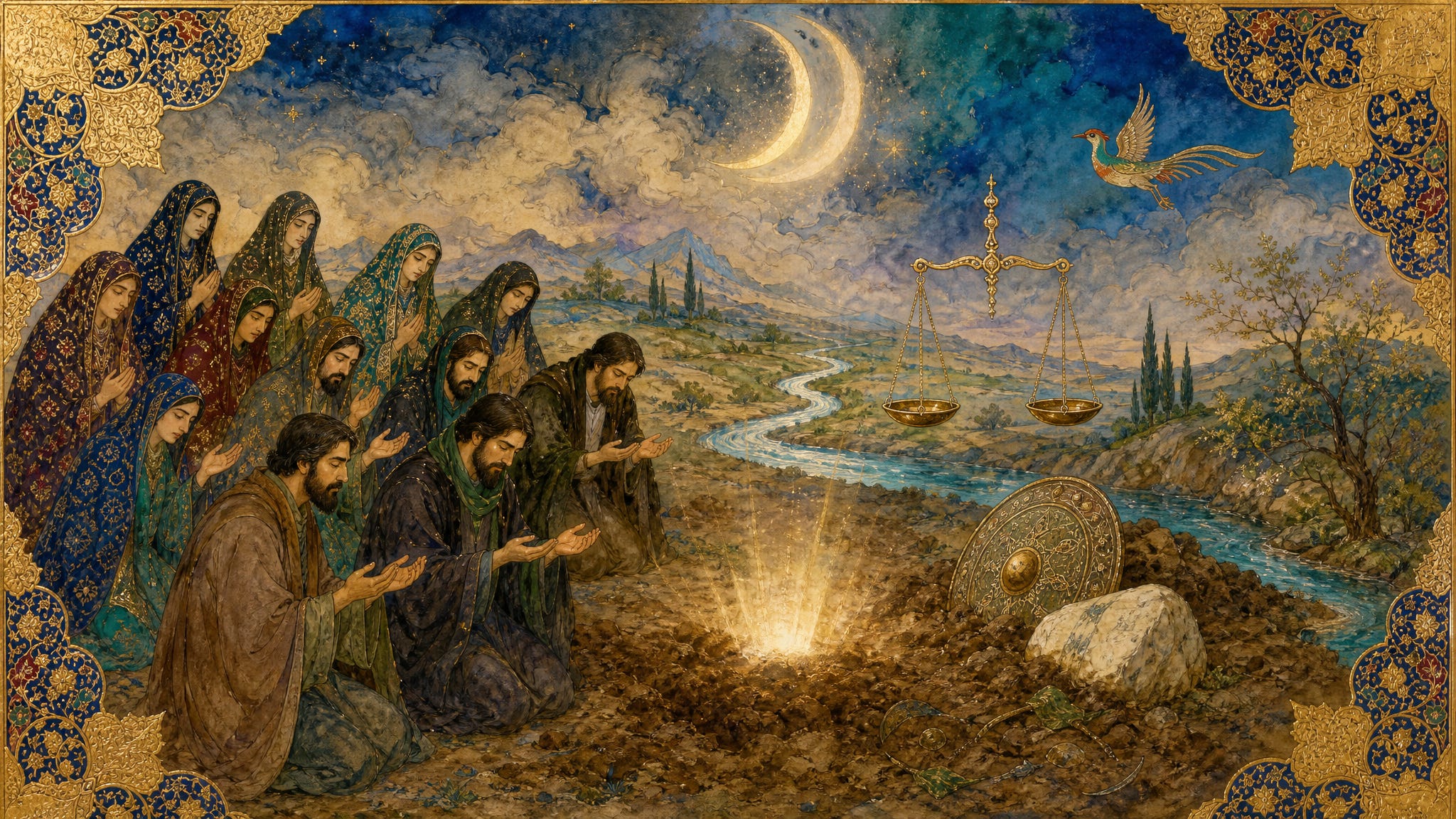
Did it work?
Kitab Al-Irshad, a few pages on.
After the burial, a group of the Shi’a who had not been at the prayer come and ask to be shown the place.
They are told the traces were removed, by his own bequest.
And they kept coming back.
And they said that they had dug, and had found nothing.
I want you to sit inside that for a moment, because it is the only place in the evening where you can watch the mechanism actually running.
These are not enemies.
These are his own people, who loved him, who wanted nothing in the world except to know where he was — and the arrangement his sons made held against them.
It worked.
It worked well enough that it worked on the people it hurt most.
The same passage carries a marvel — a white rock, and an inscribed shield said to have been stored there by Noah, peace and blessings be upon him.
It is in the book.
I am telling you it is there, and I am leaving it at the temperature the tradition gives it.
And Now a Witness Who Was Not on Our Side
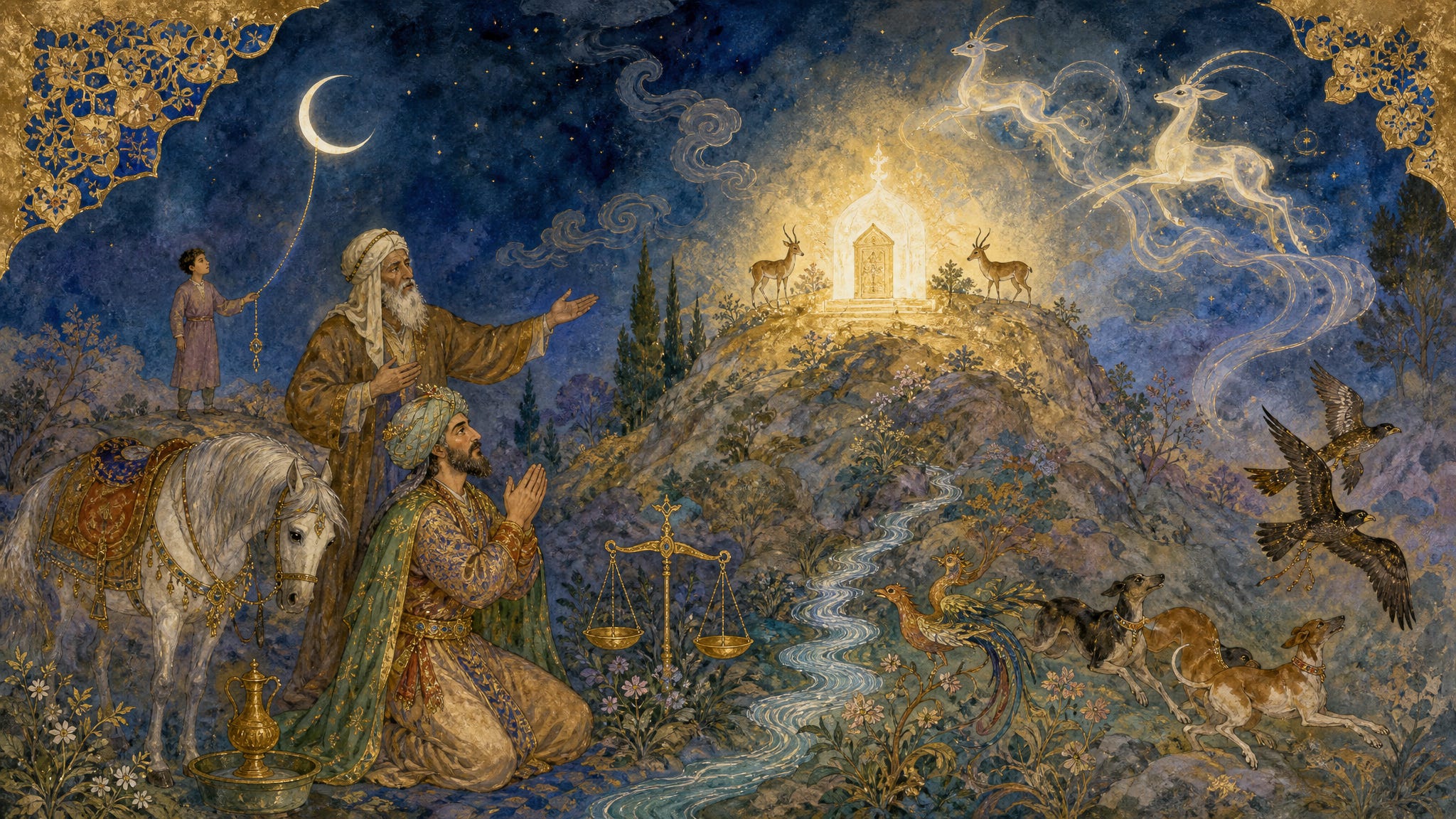
I want to close this point with somebody from outside, because our charter says to take witnesses from outside where we can — and outside does not have to mean friendly.
This is the head of the house — the regime — that was persecuting the family.
Harun al-Rashid.
The report comes from one of his own companions, a man who was there.
They ride out of Kufa to hunt.
They come to a district near al-Ghariyyayn, and they put up gazelles, and they loose the falcons and the dogs.
And the gazelles run to a low hill and go up onto it — and the dogs will not follow, and the falcons come down and settle away from it.
Three times.
Harun is astonished, and asks for somebody local, and an old man of the Bani Asad is brought and given safe conduct before he will speak.
And he tells him what the hill is: that God has made it a sanctuary, so that whatever takes refuge there is safe.
Harun gets down off his horse.
He calls for water and makes ablution, and prays at the hill, and rolls in the ground of it, and weeps.
The gazelles and the falcons are a marvel, and you should hear them at that temperature.
And then the second half, from Yasir, one of his own men — coming back from Makkah, stopping at Kufa, and Harun rides out at night to al-Ghariyyayn.
And this is what he says:
يَا عَمِّ! أَنَا وَاللهِ أَعْرِفُ فَضْلَكَ وَسَابِقَتَكَ، وَبِكَ وَاللهِ جَلَسْتُ مَجْلِسِيَ الَّذِي أَنَا فِيهِ، وَأَنْتَ أَنْتَ، وَلَكِنَّ وَلَدَكَ يُؤْذُونَنِي وَيَخْرُجُونَ عَلَيَّ
“O uncle! By God, I know your excellence and your precedence — and by God it is through YOU that I sit in this seat of mine that I am in — and you are what you are. But your children harm me and rise against me.”
— Shaykh al-Mufid, Al-Irshad, Arabic edition, Volume 1, Pages 26–28, on the authority of Abdullah ibn Khazim
The main text has him say uncle.
One manuscript has him say cousin.
I am saying what the main text says and telling you the other exists — because eleven lines from now he will call the same man his son’s cousin, and you would be right to notice.
وَبِكَ وَاللهِ جَلَسْتُ مَجْلِسِيَ الَّذِي أَنَا فِيهِ
And by God, it is through you that I sit in this seat of mine.
The Abbasid caliph, on the ground at that grave in the dark, saying that his own throne is held through the man buried under him — and then, in the same breath, complaining about that man’s descendants.
He is not converted.
He is not repenting.
He gets up in the morning and carries on doing exactly what he was doing.
That is precisely why he is worth quoting: I am not asking you to believe a friendly witness.
And then he prays, and repeats the whole speech, and supplicates, and weeps — over and over, until the last third of the night.
And then he wakes his son. Get up and pray at the grave of your cousin.
And the boy says:
And which of my uncles is this?
He does not know.
The caliph’s own son, standing on that ground in the dark, does not know whose grave he is standing on — and it is the caliph himself who has to tell him.
That is the second century.
The concealment is still working, inside the ruling house.
Lessons For Our Time
Hiding a Thing Is Not Losing It
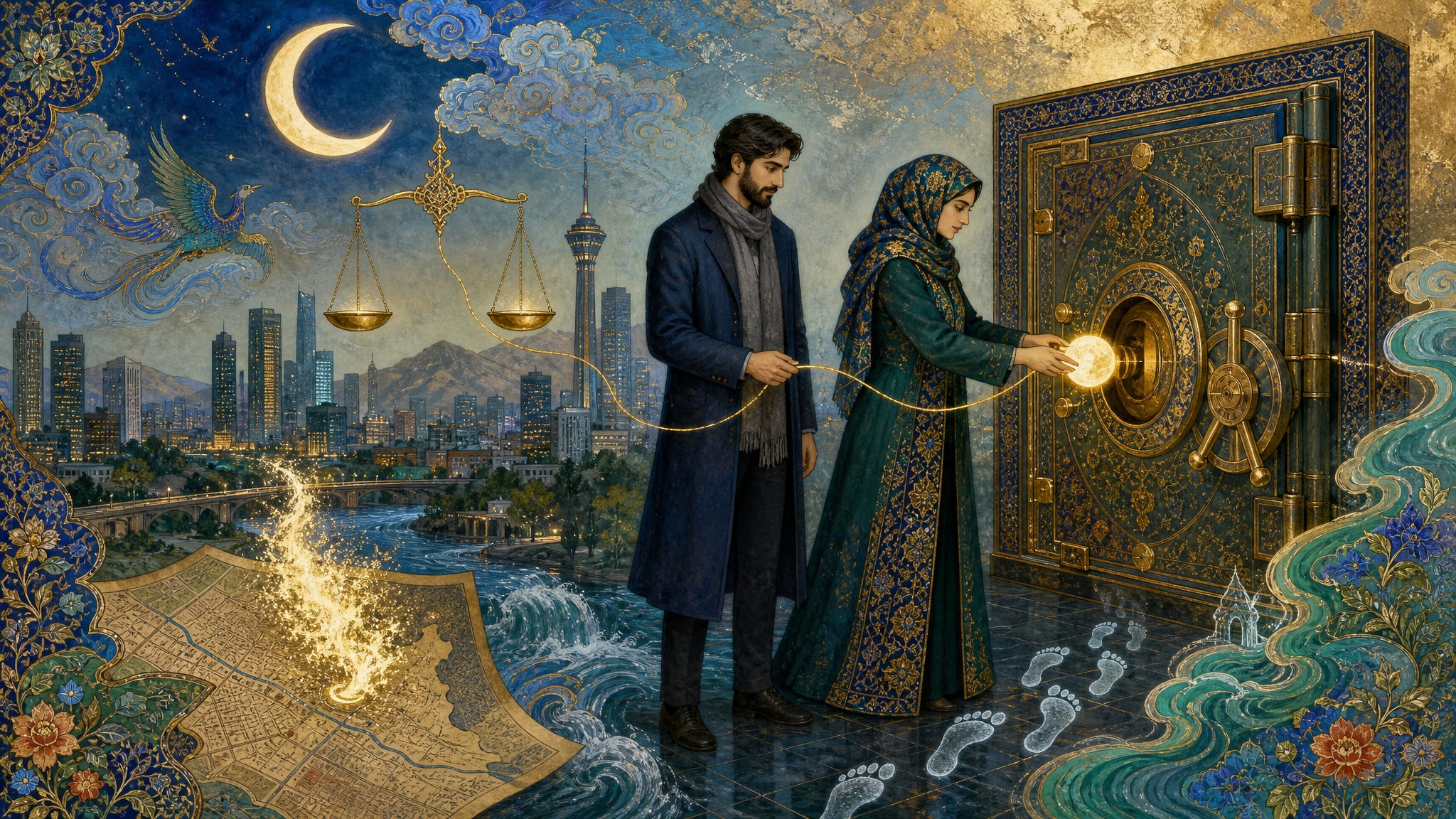
Here is the sentence this whole sub-series has been walking toward, and our first point has just earned it.
Concealment, in this tradition, is not an absence.
It is a security arrangement.
Look at what we actually watched.
The grave was effaced by instruction — his own.
Carried out by the two people on earth who loved him most.
Because they could calculate what was coming and take a decision in advance about it.
That is not panic.
That is not flight.
That is not something that was done to them.
That is the most careful thing a family can do, done well, at the worst possible moment.
And notice the shape of it, because it is the shape of something much larger: the thing was not lost.
It was placed.
They knew exactly where he was.
They went back.
What was withheld was not the knowledge — it was the address.
You will have seen where that is going.
I am going to leave it as one clause, because it has its own evening coming: that is the grammar of the Occultation, and our books have been speaking it since the first century.
We of All People Should Know This
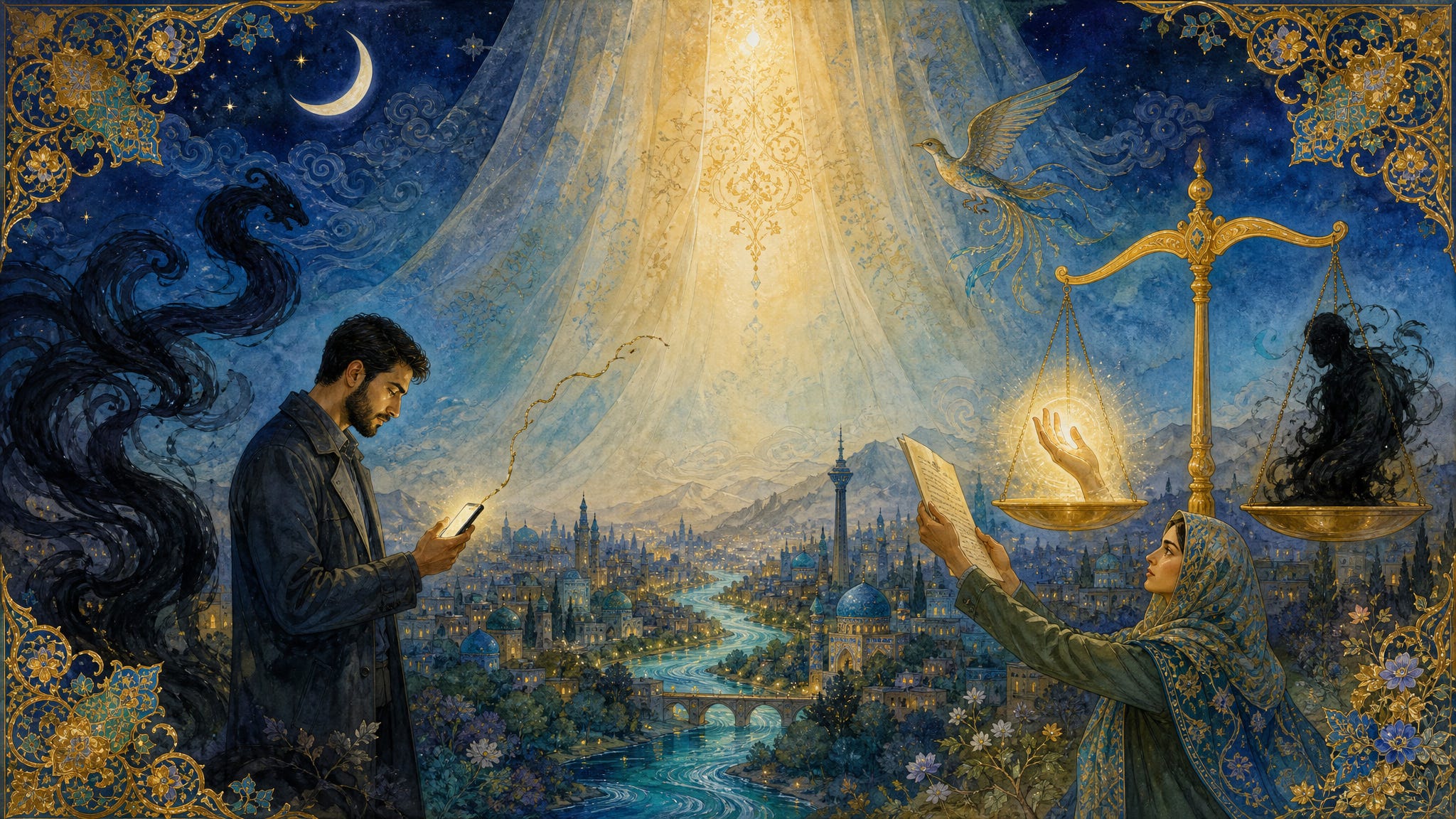
And that brings me to something harder, and I am going to say it in the general, and I am not going to apply it, and I would ask you not to make me.
We are people who have believed, for more than eleven centuries, that the most important man alive is one that nobody can see.
That is not a footnote to our creed.
That is a core principle of our creed.
We say it in our supplications.
We name him — may our souls be his ransom, and may God hasten his return — every time we pray for the age we live in.
And still — when we cannot see a man, we find ourselves repeating what somebody told us about where he has gone.
I will leave that there.
It is not a failure of belief.
It is a habit of the age.
We have been formed, all of us, by a world in which a man who is not visible is a man who is not there — and our own tradition has known better than that for eleven hundred years.
And there is a second half to this, and Shaykh al-Mufid handed it to us tonight without meaning to.
قَبِيحِ الْفِعَالِ وَالْمَقَالِ
Vile deed — and vile speech.
They did not only fear what that regime would do.
They feared what it would say.
Now — we sat properly with the verse on this a few weeks ago, in Session Seventy, and I am not going to make you do that work again.
But there is one turn in it we did not take, and it is the one that bites tonight.
﴿يَا أَيُّهَا الَّذِينَ آمَنُوا إِن جَاءَكُمْ فَاسِقٌ بِنَبَإٍ فَتَبَيَّنُوا أَن تُصِيبُوا قَوْمًا بِجَهَالَةٍ فَتُصْبِحُوا عَلَىٰ مَا فَعَلْتُمْ نَادِمِينَ﴾
“O you who believe — if a corrupt person comes to you with a report, then verify it, lest you afflict a people in ignorance and become regretful over what you have done.”
— Qur’an, Surah al-Hujurat (the Chapter of the Chambers) #49, Verse 6
Look at what the verse makes the condition.
It is not only —
Is the report true.
It is the word for a person who is corrupt.
It is —
Who handed it to you.
The obligation is triggered by the character of the person who brought it through your door.
So the question is not whether the Umayyads or the Abbasids used speech as a weapon.
Of course they did.
The question is whether we would recognise vile speech if we were the ones doing it — forwarding a thing we have not checked, about a man we cannot see, on the word of somebody we would not trust with our empty chocolate wrapper.
Giving It Back, One Man at a Time
What Changed
So the grave is hidden, and it stays hidden.
For how long?
Shaykh al-Mufid finishes the sentence we started in the first point - above, and the last third of it is this point — point two — in miniature:
فَلَمْ يَزَلْ قَبْرُهُ عَلَيْهِ السَّلَامُ مُخْفِيّاً حَتَّىٰ دَلَّ عَلَيْهِ الصَّادِقُ جَعْفَرُ بْنُ مُحَمَّدٍ عَلَيْهِمَا السَّلَامُ فِي الدَّوْلَةِ الْعَبَّاسِيَّةِ، وَزَارَهُ عِنْدَ وُرُودِهِ إِلَىٰ أَبِي جَعْفَرٍ — وَهُوَ بِالْحِيرَةِ — فَعَرَفَتْهُ الشِّيعَةُ وَاسْتَأْنَفُوا إِذْ ذَاكَ زِيَارَتَهُ عَلَيْهِ السَّلَامُ وَعَلَىٰ ذُرِّيَّتِهِ الطَّاهِرِينَ
“So his grave, peace be upon him, did not cease to be hidden until al-Sadiq Ja’far ibn Muhammad, peace be upon them both, pointed it out under the Abbasid state — and visited it when he came to Abu Ja’far, he being at Hira — and the Shi’a came to know it, and from that point they resumed the visitation of him, peace be upon him, and of his pure descendants.”
— Shaykh al-Mufid, Al-Irshad, Arabic edition, Volume 1, Page 10 — the same passage, continued
وَاسْتَأْنَفُوا
And they resumed.
Now, both myself and many others glossed that word wrongly the first time they work on it, and the correct reading is much more interesting.
Ista’naf does not mean to start.
It means to resume.
To take up again something that had been going on and had stopped.
Which tells you something the sentence does not say out loud: there was an earlier visiting.
You cannot resume what never happened.
So when Shaykh al-Mufid says the grave “did not cease to be hidden,” he is not telling you that nobody on earth knew where it was.
He is telling you it was hidden from the public.
It was never hidden from the family.
They knew exactly where he was, and they went, and we will see one of them standing at it before the end of tonight.
That distinction is the whole of this point.
What was given back was not knowledge the Imams had lost.
It was access, handed over deliberately, to people who could be trusted with it.
One more piece of care.
Shaykh al-Mufid names the caliph only as Abu Ja’far.
His editor identifies that as al-Mansur, the second of the Abbasid caliphs, and gives a full biography in the footnote — but that identification is the editor’s, not his.
And our own chapter names Abu al-Abbas, the first of them.
So the disclosing ran across two reigns, and I am giving you both rather than picking one.
So the honest sentence is: the disclosing ran across two reigns, and our sources name both.
I am not going to tidy that into one.
The Community Still Split Three Ways
Here is how slow this was, and it is slower than anybody expects.
A man named al-Hasan ibn al-Jahm is speaking to Imam al-Kadhim, the seventh Imam, peace and blessings be upon him — the very next Imam after that disclosure.
And he tells the Imam what the Shi’a are saying about where the grave is.
And there are three different answers in circulation.
Some of our companions say it is at the mosque.
Some say it is at the palace.
And he himself has taken a third position — that which Imam al-Sadiq has taught.
The Imam’s reply is one of those sentences that arrives sideways and turns out to be the method of an entire school:
أَنْتَ أَصْوَبُ مِنْهُمْ أَخَذْتَ بِقَوْلِ جَعْفَرِ بْنِ مُحَمَّدٍ
“You are more correct than they are — you took the word of Ja’far ibn Muhammad.”
— Kamil al-Ziyarat, Ibn Qulawayh al-Qummi, Bab 9, Hadith 8
Read that again.
He is not told:
You are right because you reasoned better.
He is not told:
Your evidence is stronger.
He is told:
You are more correct because of whose word you took.
Understand what that means about the state of things.
A generation and more after Imam al-Sadiq pointed the place out, the community was still divided three ways about where it was.
The disclosure did not settle it.
It started something that took decades to settle.
The Imam Who Went at Night
So how was it given back?
Imam al-Sadiq, peace and blessings be upon him, speaking about his own practice when he was summoned by the Abbasid regime to al-Hira:
حَدَّثَنِي مُحَمَّدُ بْنُ جَعْفَرٍ الرَّزَّازُ عَنْ مُحَمَّدِ بْنِ الْحُسَيْنِ بْنِ أَبِي الْخَطَّابِ الزَّيَّاتِ عَنِ الْحَسَنِ بْنِ مَحْبُوبٍ عَنْ إِسْحَاقَ بْنِ جَرِيرٍ عَنْ أَبِي عَبْدِ اللهِ عَلَيْهِ السَّلَامُ قَالَ إِنِّي لَمَّا كُنْتُ بِالْحِيرَةِ عِنْدَ أَبِي الْعَبَّاسِ كُنْتُ آتِي قَبْرَ أَمِيرِ الْمُؤْمِنِينَ عَلَيْهِ السَّلَامُ لَيْلًا وَهُوَ بِنَاحِيَةِ النَّجَفِ إِلَى جَانِبِ الْغَرِيِّ النُّعْمَانِ فَأُصَلِّي عِنْدَهُ صَلَاةَ اللَّيْلِ وَأَنْصَرِفُ قَبْلَ الْفَجْرِ
“Muhammad ibn Ja’far al-Razzaz narrated to me, from Muhammad ibn al-Husayn ibn Abi al-Khattab al-Zayyat, from al-Hasan ibn Mahbub, from Ishaq ibn Jarir, from Abu Abdillah, peace be upon him, who said: when I was at Hira with Abu al-Abbas, I used to come to the grave of the Commander of the Faithful, peace be upon him, by night — and it is in the district of Najaf, beside al-Ghari of al-Nu’man — and I would pray the night prayer beside it, and leave before dawn.”
— Kamil al-Ziyarat, Ibn Qulawayh al-Qummi, Bab 9, Hadith 11
I want you to notice what that is not.
It is not a proclamation.
There is no announcement, no gathering, no delegation.
The man who is giving the grave back to the community is still arriving in the dark and leaving before it gets light.
Think about the symmetry for a moment.
His forefathers carried the body out at night and flattened the ground behind them.
And four generations later, the man undoing that arrangement is doing it at exactly the same hour, with exactly the same care.
Even the disclosure was conducted as a security operation.
One Companion at a Time
And the rest of the chapter is the same thing happening, over and over, to different people.
There are three more reports — hadiths 3, 4 and 7 of that chapter — and they are scenes rather than statements.
So I am going to tell them to you rather than read them at you, and give you the numbers so you can check me.
Hadith 3 — Umar ibn Yazid
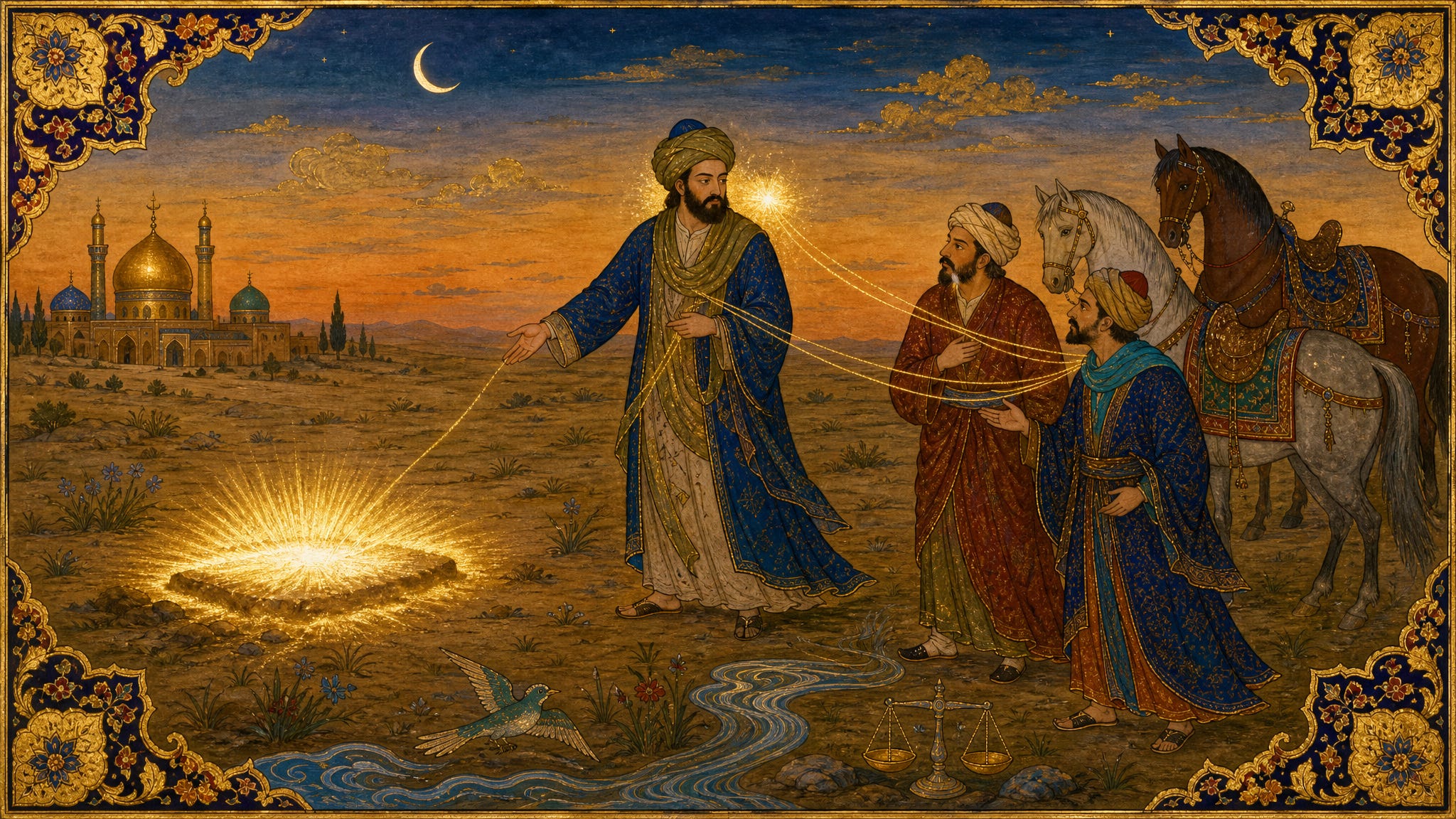
He rides two men out into the desert and stops them and says:
Get down. This grave is the grave of the Commander of the Faithful, peace be upon him.
And they ask him — reasonably enough — how do you know that?
And his answer is the whole method in one line:
I came to it with Abu Abdillah, peace be upon him, when he was at Hira, more than once — and he told me it was his grave.
I was taken.
By him.
More than once.
And he told me.
That is not scholarship and it is not deduction.
It is a man passing on something he was personally shown — and now he is standing in the desert doing for two other men exactly what was done for him.
Hadith 4 — Yazid ibn Umar ibn Talha
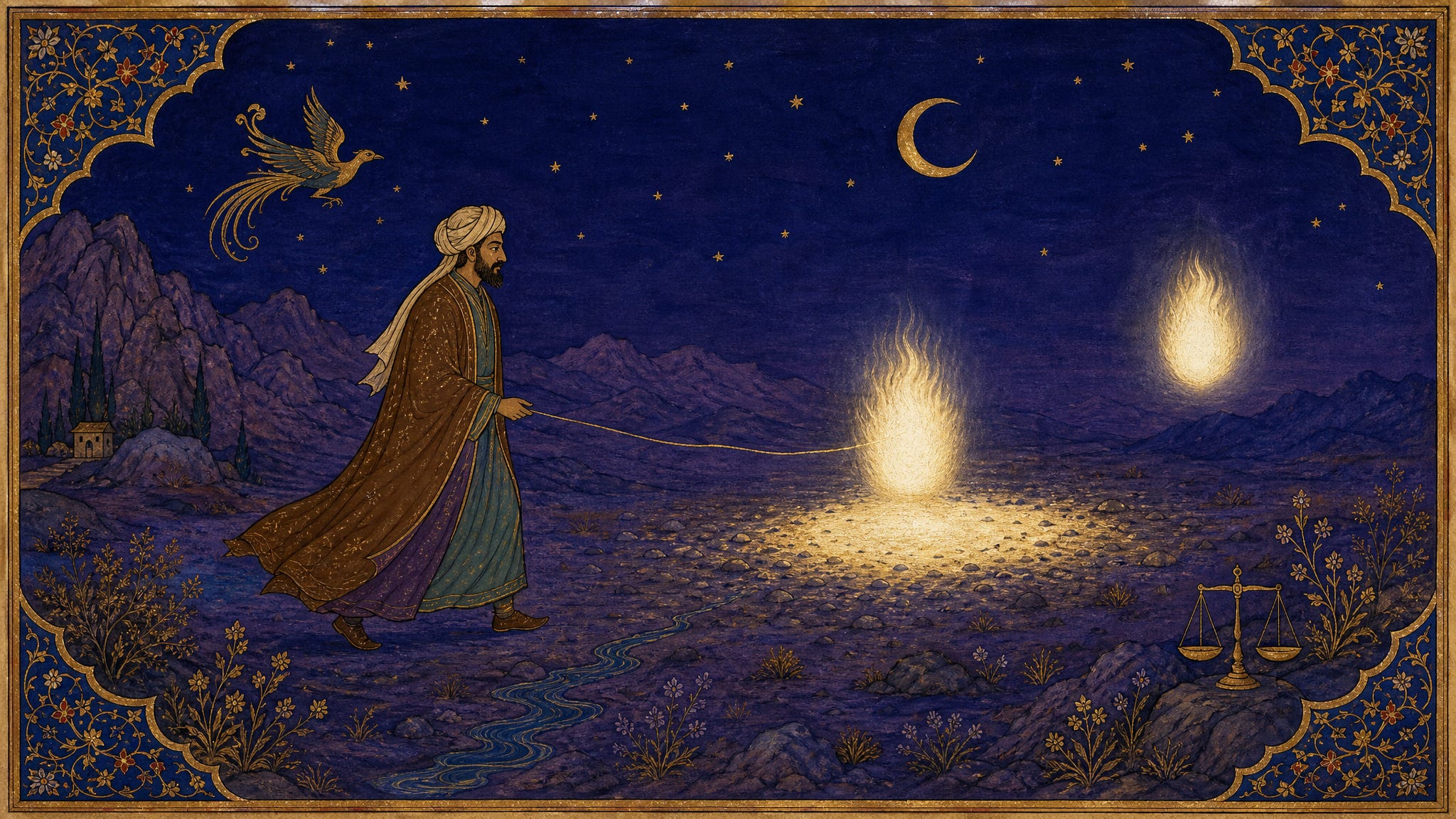
The Imam is at Hira, and he says to him — and I love this line, because of what it tells you about how these things were arranged:
Do you not want what I promised you?
There was a promise.
At some earlier point, this man had been told he would be taken, and the Imam had been waiting for the right night, and now it had come.
And they go out — the Imam and his son Isma’il and this one man — past al-Thuwayya, out to the ground between Hira and Najaf, to the white gravel.
Hadith 7 — Safwan ibn Mihran
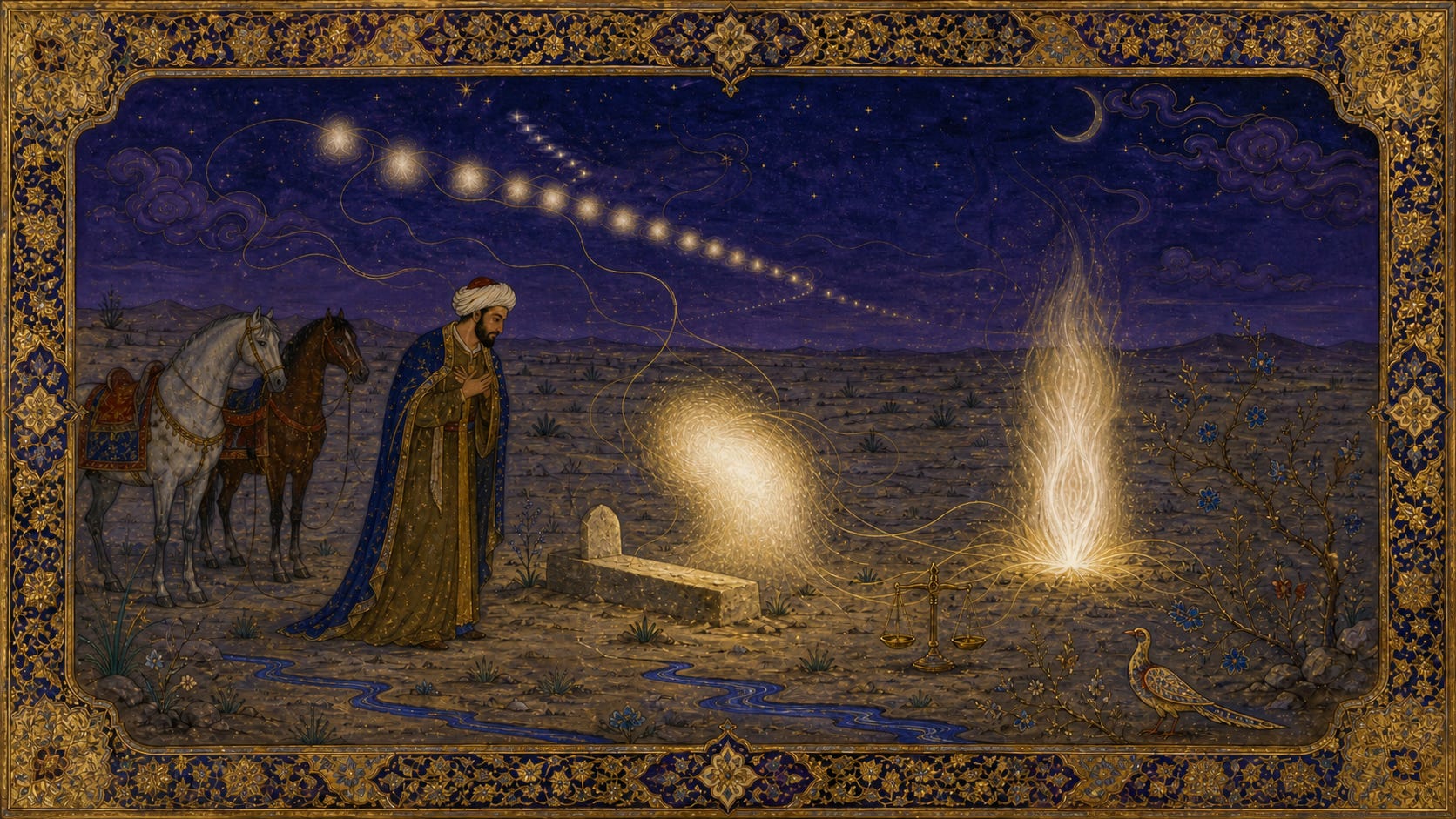
They ride from Qadisiyya.
And when they arrive, the Imam does not begin by saying whose grave it is.
He begins by saluting the prophets.
Every one of them.
From Adam onward.
And then:
خَرَّ عَلَى الْقَبْرِ فَسَلَّمَ عَلَيْهِ وَعَلَا نَحِيبُهُ
“He fell upon the grave, and greeted him, and his weeping rose.”
— Kamil al-Ziyarat, Ibn Qulawayh al-Qummi, Bab 9, Hadith 7
Then four rak’ahs — four units of prayer.
And only after all of that is Safwan told whose grave he has been standing at.
Think about the order of that.
The man is taken to a flat piece of ground in the desert.
He watches his Imam greet every prophet from the first man onward, and then break down on the earth.
And then he is told.
He is not given a fact.
He is given the fact after he has been made to feel the weight of it.
Now look at the three of them together.
Not a public disclosure.
Not a map.
Not a proclamation.
A name, a night, one companion, a location.
And then another one.
And then another one — by an Imam who is himself only in the neighbourhood because a caliph has summoned him to a town a few miles away, and who is using the summons.
You could not design a slower way of releasing a piece of information if you sat down and tried.
And I want to suggest that the slowness is not a limitation of the method.
It is the method.
The grave was hidden because a house that would find a way was coming into power.
That house had not gone anywhere.
The Abbasids were in power now, and they were summoning this Imam to al-Hira and asking him questions.
Giving the location back to the whole community at once would have handed it to precisely the people it was hidden from.
So it went back the way it had been protected: carefully, to people who could carry it, at a pace that looks agonising from outside.
Twenty Years
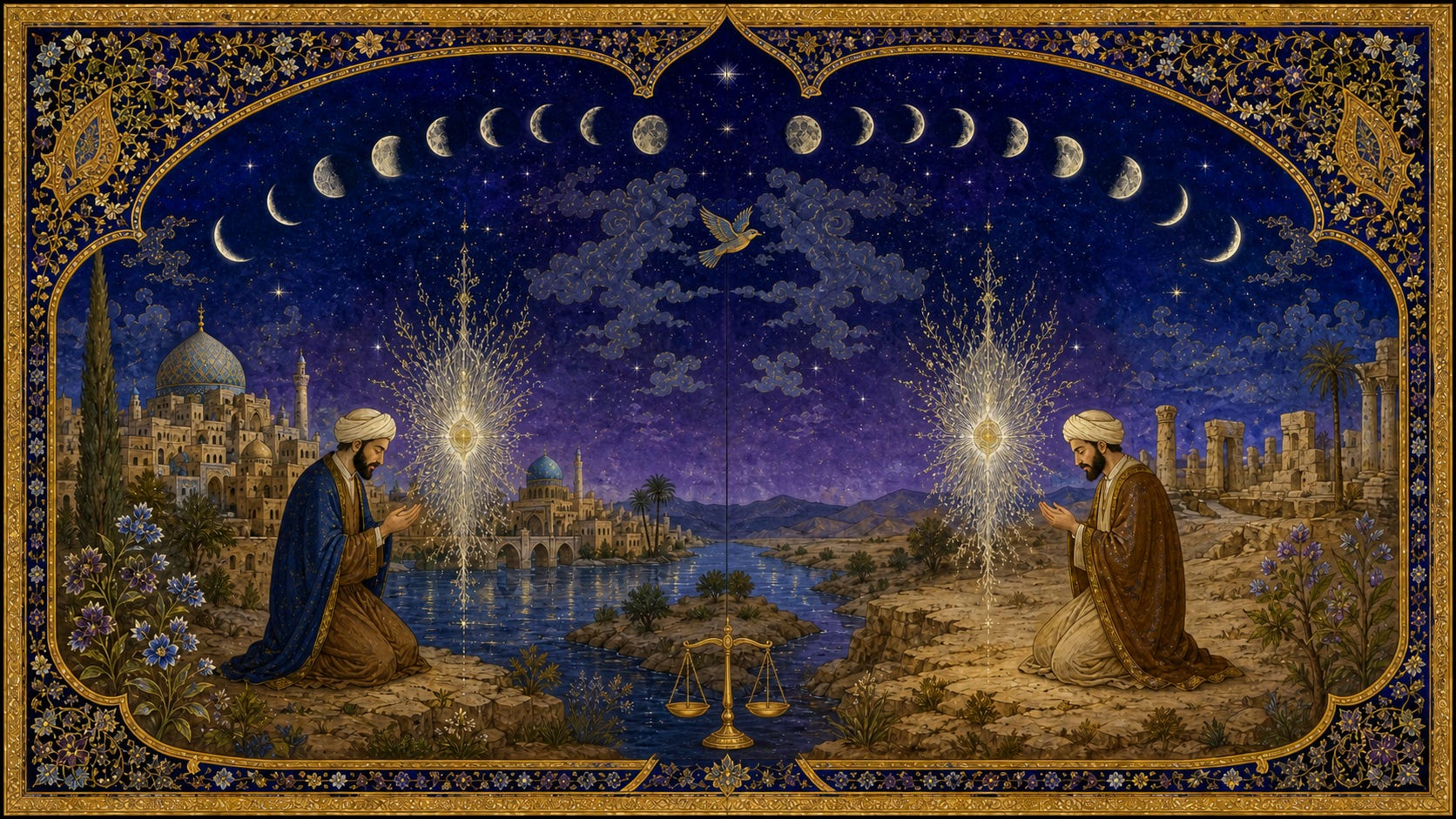
And then there is hadith 12, and I have been waiting three sessions to put this next to something.
Safwan is told where to go.
He goes.
He prays.
He comes back and describes what he did, and the Imam tells him:
You got it right.
And then Safwan says this:
فَمَكَثْتُ عِشْرِينَ سَنَةً أُصَلِّي عِنْدَهُ
“So I remained twenty years, praying beside it.”
— Kamil al-Ziyarat, Ibn Qulawayh al-Qummi, Bab 9, Hadith 12
Twenty years.
Nobody watching.
Nothing to see.
No building, no dome, no lamp, no gathering.
A flat piece of desert that looked like every other piece of desert, and a man who knew, going back to it, for twenty years.
Now hold that next to something you heard from this position seven days ago.
Shaykh al-Tusi, in his own Book of the Occultation, on a grave in Baghdad that had no marker on it — month after month, for upwards of twenty years.
Two men.
Two hundred and fifty to two hundred and ninety years apart.
One in the second century, one in the fifth.
Neither of them could have known the other would keep the same appointment.
And they are keeping the same appointment, at the same kind of place, for the same length of time.
The Family Never Lost It
And now the piece that closes the point.
Kitab Al-Irshad once more.
Jabir al-Ju’fi asks Imam al-Baqir, peace and blessings be upon him, where his great-grandfather is buried.
And the answer is precise:
In the region of al-Ghariyyayn — buried before the dawn rose.
And he names who went down into the grave:
Imam al-Hasan.
Imam al-Husayn.
Muhammad ibn al-Hanafiyya.
And Abdullah ibn Ja’far.
Peace and blessings be upon them all.
Do you see what that does?
The earlier report told us “and two other men” and left it there.
This fills in the names.
A careful report that would not name them gets completed by an Imam speaking two generations later, who simply knows.
So let me put the shape of this our second point in front of you plainly, because there are three different clocks running in it and they are easy to confuse.
The grave was hidden for the better part of a century — from the burial until Imam al-Sadiq pointed it out at al-Hira.
That is five Imam: Imam al-Hasan, Imam al-Husayn, Imam Zayn al-Abidin, Imam al-Baqir, and Imam al-Sadiq, peace and blessings be upon them all.
It was given back across the imamate of two of them — Imam al-Sadiq’s own, and Imam al-Kadhim’s after him.
And it was still being argued about while it was being handed back, which is why al-Hasan ibn al-Jahm is asking the seventh Imam — Imam al-Kadhim — a question the sixth — Imam al-Sadiq — had already answered.
Four generations of that family to hide it.
Two imamates to hand it back.
And the disagreement running the whole length of the handing-back.
The grave was never lost.
It was withheld.
And then it was handed back, by hand, to one man at a time.
And now I want you to give me back the thing I asked you to hold at the start of the evening.
Permission for a thing is the announcement that the impediment to doing it has been lifted.
That is exactly what Imam al-Sadiq, peace and blessings be upon him, did at al-Hira.
He did not issue a licence.
He removed an obstacle — one man at a time, at night, over years.
The houses God permits to be raised are houses where something that was in the way has been taken out of the way.
Lessons For Our Time
You Are More Correct, Because of Whose Word You Took

Go back to that sentence to al-Hasan ibn al-Jahm, because I do not think we hear it properly.
أَنْتَ أَصْوَبُ مِنْهُمْ أَخَذْتَ بِقَوْلِ جَعْفَرِ بْنِ مُحَمَّدٍ
“You are more correct than they are — you took the word of Ja’far ibn Muhammad.”
— Kamil al-Ziyarat, Ibn Qulawayh al-Qummi, Bab 9, Hadith 8
He is not praised for being clever.
He is not praised for having better evidence, or for having thought it through, or for having gone and looked.
He is praised for having taken the right man’s word.
We are the first people who can look everything up.
You have in your pocket more of this tradition than a fourth-century scholar could reach in a lifetime of travelling.
And it has quietly stopped being true that the question is —
What did you find.
The question is what it has always been:
Whose word did you take.
Because you took somebody’s.
Everybody does.
The only question is whether you know whose, and whether you chose.
Twenty Years of Turning Up
فَمَكَثْتُ عِشْرِينَ سَنَةً أُصَلِّي عِنْدَهُ
“So I remained twenty years, praying beside it.”
— Kamil al-Ziyarat, Ibn Qulawayh al-Qummi, Bab 9, Hadith 12
I keep coming back to this because it is so unimpressive.
Nobody watched Safwan do it.
There was nothing to watch.
There was no building.
There was, on purpose, nothing there at all.
He went out to a flat piece of ground, and prayed, and came home, and did it again the next month, for twenty years.
No moment in it.
No arrival.
Nothing you could photograph.
And it is one of the most consequential things anybody did in this whole story — because a place that is visited becomes a place, and a place that is not, does not.
Most of what actually holds this tradition together looks like that.
It looks like nothing.
It looks like somebody turning up.
Given Back the Way It Was Protected
And the last one from this point, and it is about how you hand things on.
Nothing here was announced.
The concealment was careful, deliberate, and slow.
And so was the disclosure.
Same hour of the night.
Same one-at-a-time.
Same judgement being exercised about who could carry it.
There is a principle in that, and it is not only about graves.
A thing worth protecting gets handed over the way it was protected — carefully, to people who can carry it, at a pace that looks far too slow from outside and turns out, from inside, to be exactly right.
And you will have noticed by now that this is the same grammar we met in the first lesson of tonight, and that it has a much larger application, and that I keep declining to make it.
I will make it in a few weeks.
Tonight it is enough that you have watched a family do it with a grave.
Why He Went
What Was Actually There
Before we ask why he went, I have to tell you what he went to, because I think most of us picture it wrongly.
We hear “Najaf” and we see the city.
The dome.
The courtyards.
The seminary that has trained the scholars of this tradition for hundreds of years.
None of that was there.
A study of a thousand years of learning at Najaf puts it carefully, and I want to keep its hedge, because the hedge is doing work:
“Although there seems to have been some scholarly activity in Najaf prior to Shaykh al-Tusi, he was the first great scholar to reside there.”
— Zackery Heern, “One Thousand Years of Islamic Education in Najaf: Myth and History of the Shiʿi Ḥawza”, Iranian Studies (2017), Pages 2–3
And the same study finds no primary-source evidence of a teaching building — not that there was none, but that nothing survives to say there was.
As for how many people were living out there: the secondary literature says “a handful” near the shrine at the end of the fourth century.
That is not a number, and I am not going to pretend it is one.
Here is the figure that actually tells you what the place was.
Najaf to Kufa is about nine kilometres.
A little under six miles.
Najaf was not a city.
It was Kufa’s back door — the open ground behind the town.
Which is exactly what makes it good for burying somebody you do not want found, and exactly what makes it strange to move to.
And two lines about what that ground became.
The late leader of the Islamic Revolution, and founder of the Islamic Republic, Imam Khomeini, may God rest his pure soul, was exiled to that city in 1965 and lived there for thirteen years.
It was there, beside that grave, that he delivered the lectures that became Hukumat-e Islami — the system of Islamic Government, the system of Wilayat al-Faqih — the Governance of the Jurist — that we will be discussing in future sessions and in depth, God willing.
And this is how he spoke of the place:
نجف اشرف، مرکز علم و تقوا و پایگاه امیرالمؤمنین است
“Najaf al-Ashraf is the centre of knowledge and piety, and the base of the Commander of the Faithful.”
— Imam Khomeini, may God rest his pure soul; Sahifeh-ye Imam, the Najaf period, Volume 3
پایگاه
A base.
Not the city of — a base.
The word he chooses is the word you use for a place that operations are run from.
And the martyred leader, Imam Sayyed Ali Khamenei, may God rest his pure soul:
نجف اشرف تنها یک شهر نیست، بلکه مرکز علم و معنویت و مرقد نورانی امیرالمؤمنین است
“Najaf al-Ashraf is not merely a city; rather it is the centre of knowledge and spirituality, and the radiant resting place of the Commander of the Faithful, peace be upon him.”
— The martyred leader, Imam Sayyed Ali Khamenei, may God rest his pure soul, October, 2010
تنها یک شهر نیست
Not merely a city.
Hold that next to where we started tonight.
A piece of open ground behind Kufa, with nothing standing on it, that nobody outside one family was permitted to find.
The Ground With Three Places On It
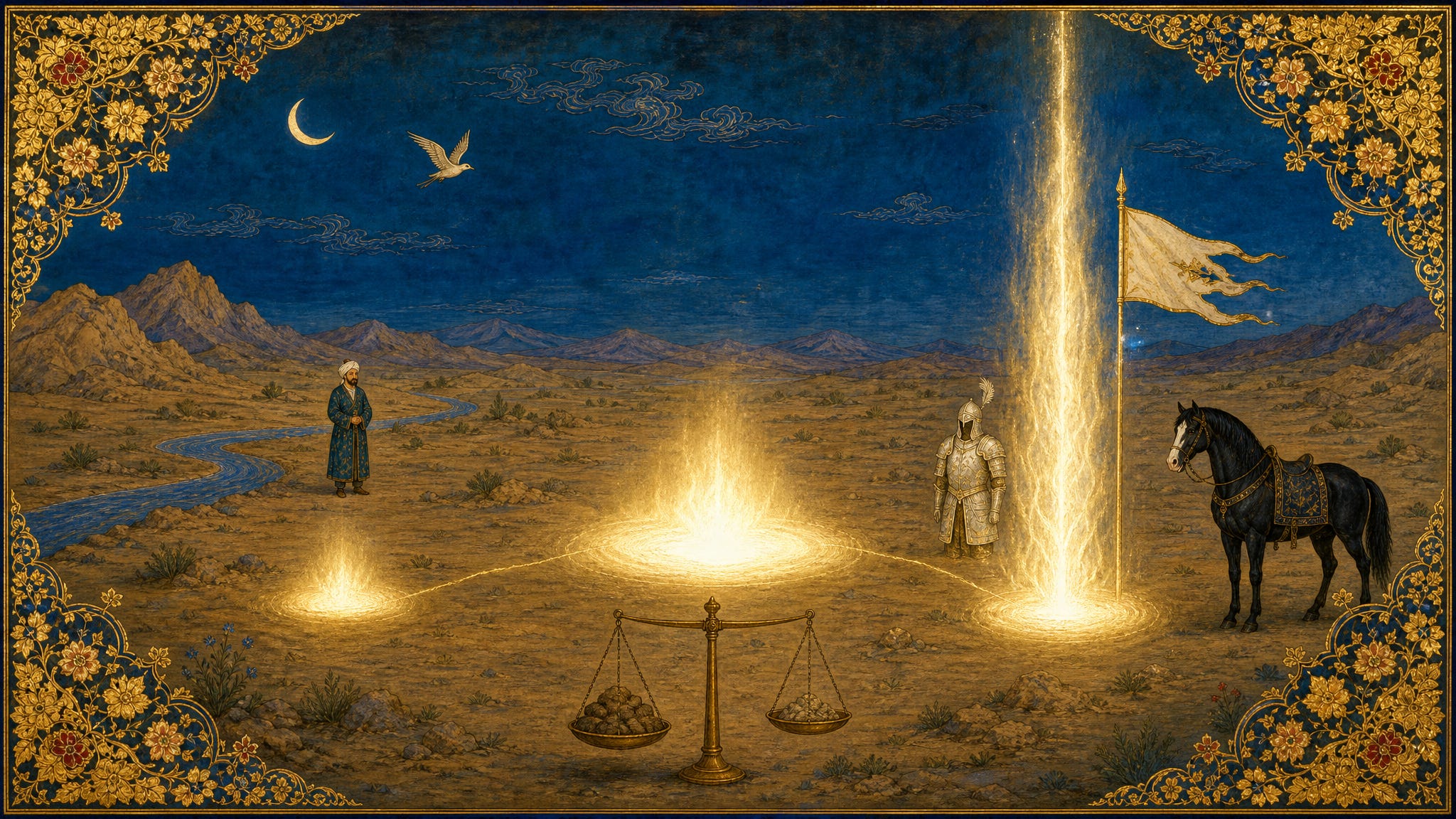
Now, something was known about that ground long before he got there.
Imam al-Sadiq, peace and blessings be upon him, is riding out, and he stops three times, and prays two units of prayer at each stop.
فَنَزَلَ وَصَلَّى رَكْعَتَيْنِ ثُمَّ تَقَدَّمَ قَلِيلًا فَصَلَّى رَكْعَتَيْنِ ثُمَّ سَارَ قَلِيلًا فَنَزَلَ فَصَلَّى رَكْعَتَيْنِ ثُمَّ قَالَ هَذَا مَوْضِعُ قَبْرِ أَمِيرِ الْمُؤْمِنِينَ قُلْتُ جُعِلْتُ فِدَاكَ فَمَا الْمَوْضِعَيْنِ اللَّذَيْنِ صَلَّيْتَ فِيهِمَا قَالَ مَوْضِعُ رَأْسِ الْحُسَيْنِ عَلَيْهِ السَّلَامُ وَمَوْضِعُ مِنْبَرِ الْقَائِمِ عَلَيْهِ السَّلَامُ
“So he dismounted and prayed two rak’ahs; then went forward a little and prayed two rak’ahs; then travelled a little and dismounted and prayed two rak’ahs. Then he said: this is the place of the grave of the Commander of the Faithful. I said: may I be your ransom — and the two places in which you prayed? He said: the place of the head of al-Husayn, peace be upon him — and the place of the pulpit of the Qa’im, peace be upon him.”
— Kamil al-Ziyarat, Ibn Qulawayh al-Qummi, Bab 9, Hadith 5
Three spots on one piece of empty desert.
A grave nobody could find.
A relic of a killing that had not yet happened when the grave was dug.
And a pulpit that has not been set up yet.
And the same report reaches us by a second route — and that route runs through Shaykh al-Tusi, from his own teacher.
The report naming the ground where the Imam of our Age sets up his pulpit comes down to us through the teacher and the student this whole sub-series has been about.
And there is one more, and it is the one I want to leave with you.
Imam al-Sadiq, peace and blessings be upon him, describing the day this ground stops being a place people come to, and becomes a place something begins from:
كَأَنِّي بِالْقَائِمِ، فَإِذَا اسْتَوَىٰ عَلَىٰ ظَهْرِ النَّجَفِ لَبِسَ دِرْعَ رَسُولِ اللهِ صَلَّى اللهُ عَلَيْهِ وَآلِهِ الْأَبْيَضَ، فَيَنْتَفِضُ هُوَ بِهَا فَيَسْتَدِيرُهَا عَلَيْهِ فَيَغْشَاهَا بِخُدْعَةٍ مِنْ إِسْتَبْرَقٍ، وَيَرْكَبُ فَرَساً لَهُ أَدْهَمَ أَبْلَقَ، بَيْنَ عَيْنَيْهِ شِمْرَاخٌ، فَيَنْتَفِضُ بِهِ انْتِفَاضَةً لَا يَبْقَىٰ أَهْلُ بَلَدٍ إِلَّا وَهُمْ يَرَوْنَ أَنَّهُ مَعَهُمْ فِي بَلَدِهِمْ، وَيَنْشُرُ رَايَةَ رَسُولِ اللهِ صَلَّى اللهُ عَلَيْهِ وَآلِهِ، عَمُودُهَا مِنْ عَمَدِ عَرْشِ اللهِ وَسَائِرُهَا مِنْ نَصْرِ اللهِ، مَا يَهْوِي بِهَا إِلَىٰ شَيْءٍ إِلَّا أَهْلَكَهُ اللهُ
“It is as though I see the Qa’im, may God hasten his return: when he rises upon the back of Najaf, he puts on the white armour of the Messenger of God, peace and blessings be upon him and his family, and shakes himself in it until it settles about him, and covers it over with a mantle of heavy silk. And he mounts a horse of his — black, with white markings, a blaze between its eyes — and surges forward upon it, so that there is no people of any land but they see him as though he were with them, in their own land. And he unfurls the banner of the Messenger of God, peace and blessings be upon him and his family: its pole is from the pillars of the Throne of God, and the rest of it is from the help of God. It does not sweep down upon anything but that God destroys it.”
— Imam Ja’far al-Sadiq, peace and blessings be upon him; Kitab al-Ghayba, al-Nu’mani, the chapter of the Prophet’s banner, Hadith 5
عَلَىٰ ظَهْرِ النَّجَفِ
On the back of Najaf.
You heard that phrase an hour ago, and it was doing the opposite work.
The back of Kufa.
The open ground behind the town, where four men carried a body out at night because there was nothing there and nobody would look.
That is the ground he stands up on.
The place chosen because nobody could find it is the place he becomes visible from.
And the first thing he does when he stands there is put on armour that has been waiting, and raise a flag that has been kept — and a man in a town a thousand miles away looks up and thinks he is standing next to him.
Every part of that is something being given back.
The grave was given back one man at a time.
The armour was kept.
The flag was kept.
Nothing in this religion is ever thrown away.
It is put somewhere, and it is held, until the day it is needed.
And that is the whole answer to the question we started with tonight.
What the Sources Say About Why He Went
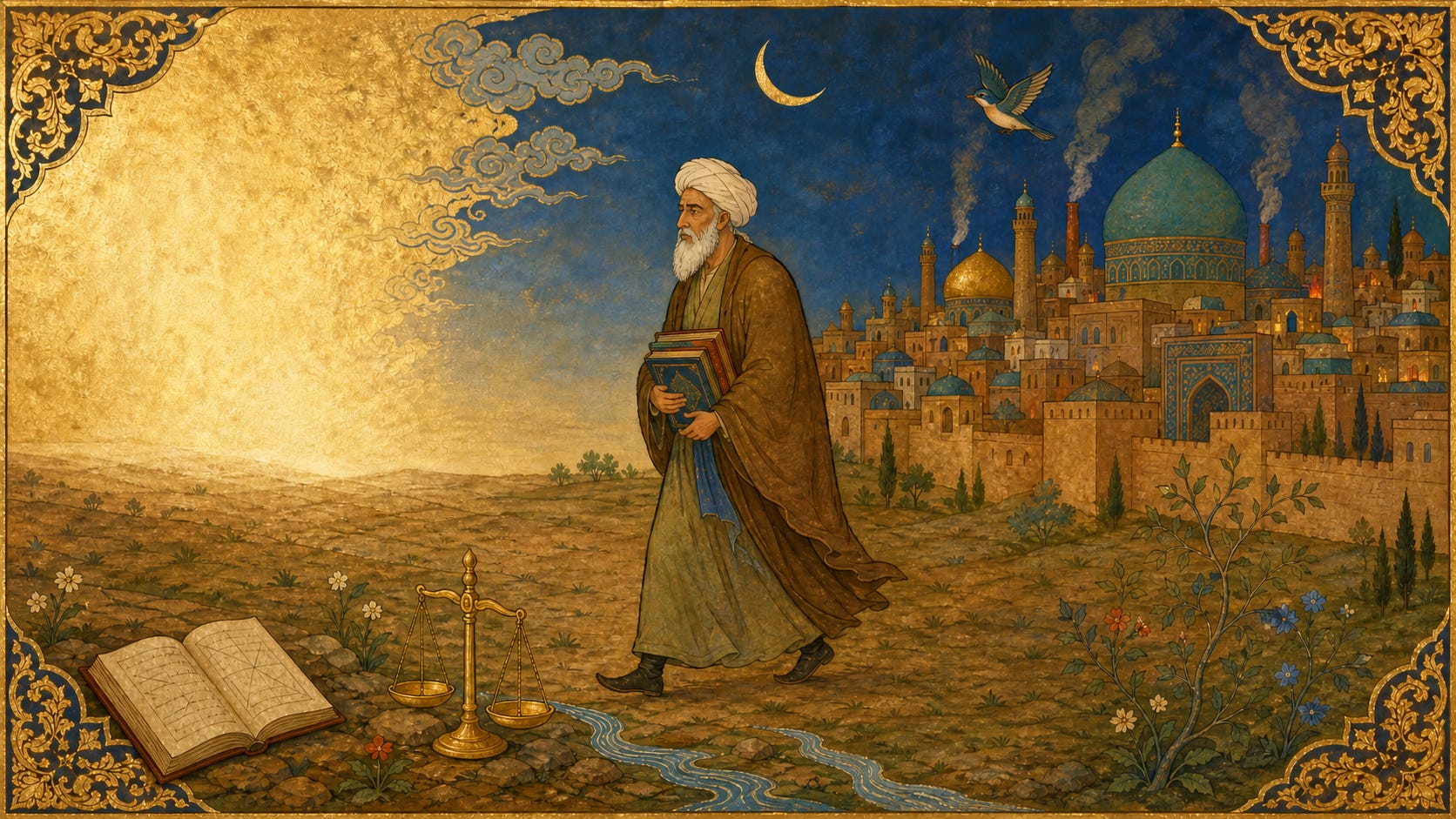
Now.
Why did he go?
And I want to give you what the books say first, before I give you what I noticed, because those are two different kinds of thing and I have caught myself putting them in the wrong order.
What is transmitted is that he fled the strife.
One biographical source has it that when the strife of the year 448 broke out, the Shaykh migrated to Najaf.
And one of our standard biographical works says he migrated to the shrine of the Commander of the Faithful, peace and blessings be upon him, out of fear of that strife.
So, a man in his sixties left the capital because it was no longer safe for him.
Say that plainly and do not diminish it.
That is a real reason, and it is what the books actually give.
And I owe you a correction, a clarification if you will, on something we have said twice from this position.
Sessions Seventy and Seventy-One both said that not one chronicle says
And therefore he went to Najaf.
That is still true as worded — a biographical notice is not a chronicle.
But our own biographical tradition draws that line explicitly, and you should hear that from me rather than find it.
And What He Had in Front of Him When He Chose
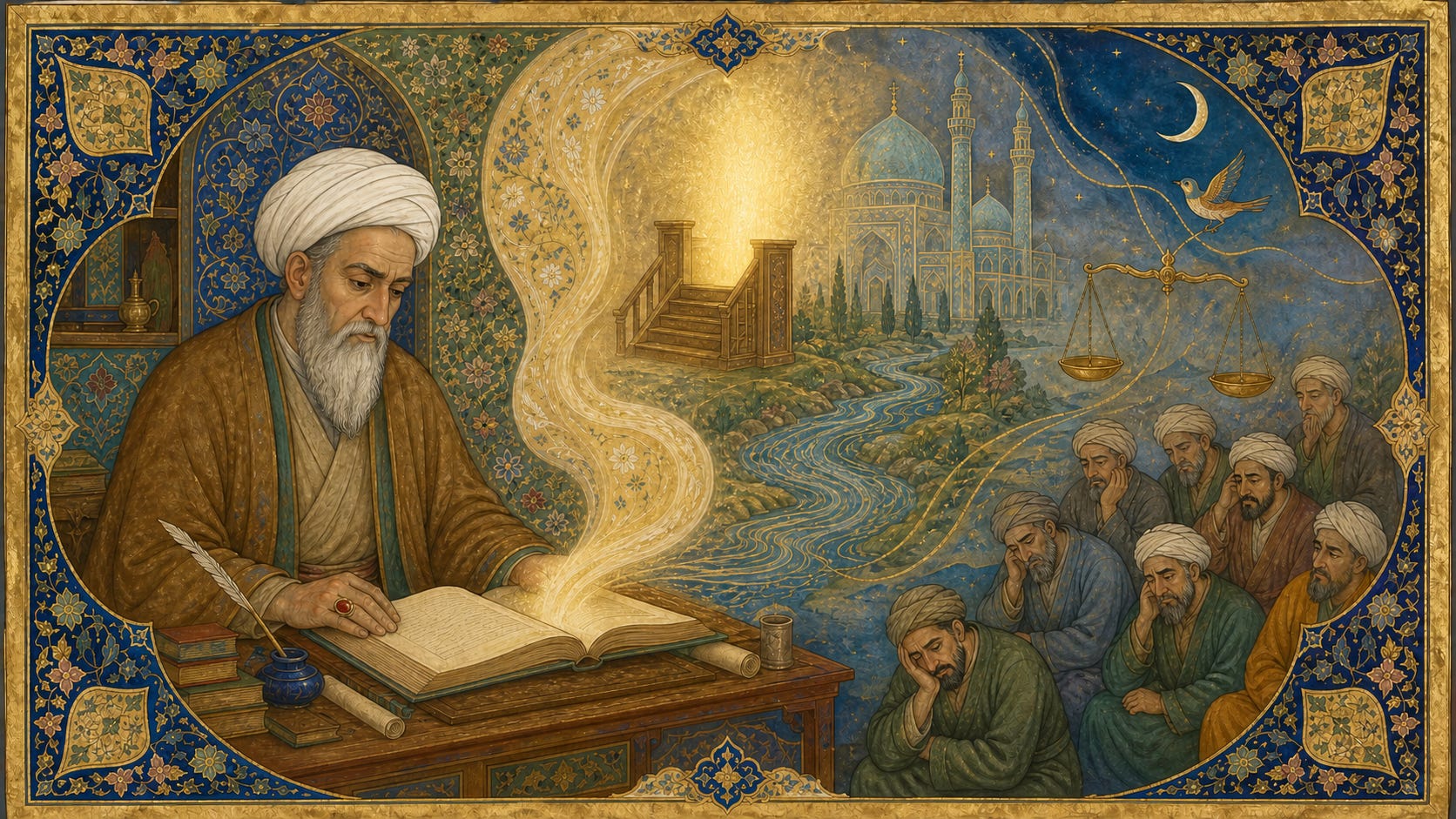
Here is the thing I noticed, and I am telling you it is a noticing and not a motive.
Among the books Shaykh al-Tusi wrote is his Book of the Occultation.
And in it is this.
٤٨٥ - أَخْبَرَنَا أَبُو مُحَمَّدٍ الْمُحَمَّدِيُّ، عَنْ مُحَمَّدِ بْنِ عَلِيِّ بْنِ الْفَضْلِ، عَنْ أَبِيهِ، عَنْ مُحَمَّدِ بْنِ إِبْرَاهِيمَ بْنِ مَالِكٍ، عَنْ إِبْرَاهِيمَ بْنِ بَنَانٍ الْخَثْعَمِيِّ، عَنْ أَحْمَدَ بْنِ يَحْيَى بْنِ الْمُعْتَمِرِ، عَنْ عَمْرِو بْنِ ثَابِتٍ، عَنْ أَبِيهِ، عَنْ أَبِي جَعْفَرٍ عَلَيْهِ السَّلَامُ — فِي حَدِيثٍ طَوِيلٍ — قَالَ: يَدْخُلُ الْمَهْدِيُّ الْكُوفَةَ، وَبِهَا ثَلَاثُ رَايَاتٍ قَدِ اضْطَرَبَتْ بَيْنَهَا، فَتَصْفُو لَهُ فَيَدْخُلُ حَتَّى يَأْتِيَ الْمِنْبَرَ وَيَخْطُبَ، وَلَا يَدْرِي النَّاسُ مَا يَقُولُ مِنَ الْبُكَاءِ، وَهُوَ قَوْلُ رَسُولِ اللهِ صَلَّى اللهُ عَلَيْهِ وَآلِهِ: كَأَنِّي بِالْحَسَنِيِّ وَالْحُسَيْنِيِّ وَقَدْ قَادَاهَا فَيُسَلِّمُهَا إِلَى الْحُسَيْنِيِّ فَيُبَايِعُونَهُ. فَإِذَا كَانَتِ الْجُمُعَةُ الثَّانِيَةُ قَالَ النَّاسُ: يَا ابْنَ رَسُولِ اللهِ، الصَّلَاةُ خَلْفَكَ تُضَاهِي الصَّلَاةَ خَلْفَ رَسُولِ اللهِ صَلَّى اللهُ عَلَيْهِ وَآلِهِ وَسَلَّمَ وَالْمَسْجِدُ لَا يَسَعُنَا. فَيَقُولُ: أَنَا مُرْتَادٌ لَكُمْ، فَيَخْرُجُ إِلَى الْغَرِيِّ فَيَخُطُّ مَسْجِداً لَهُ أَلْفُ بَابٍ يَسَعُ النَّاسَ، عَلَيْهِ أَصِيصٌ، وَيَبْعَثُ فَيَحْفِرُ مِنْ خَلْفِ قَبْرِ الْحُسَيْنِ عَلَيْهِ السَّلَامُ لَهُمْ نَهْراً يَجْرِي إِلَى الْغَرِيَّيْنِ حَتَّى يَنْبُذَ فِي النَّجَفِ وَيُعْمَلَ عَلَى فُوَّهَتِهِ قَنَاطِرُ وَأَرْحَاءٌ فِي السَّبِيلِ، وَكَأَنِّي بِالْعَجُوزِ وَعَلَى رَأْسِهَا مِكْتَلٌ فِيهِ بُرٌّ حَتَّى تَطْحَنَهُ بِكَرْبَلَاءَ
“485 — Abu Muhammad al-Muhammadi informed us, from Muhammad ibn Ali ibn al-Fadl, from his father, from Muhammad ibn Ibrahim ibn Malik, from Ibrahim ibn Banan al-Khath’ami, from Ahmad ibn Yahya ibn al-Mu’tamir, from Amr ibn Thabit, from his father, from Abu Ja’far, peace be upon him — within a long hadith — he said: The Mahdi enters Kufa, and in it are three banners that have fallen into confusion among themselves, and they become clear for him. He enters until he comes to the pulpit and preaches — and the people cannot make out what he is saying, for the weeping. And that is the saying of the Messenger of God, peace and blessings be upon him and his family: it is as though I see the Hasani and the Husayni, and they have led it, and he hands it over to the Husayni and they give him their allegiance. And when the second Friday comes, the people say: O son of the Messenger of God — prayer behind you is like prayer behind the Messenger of God, peace and blessings be upon him and his family, and the mosque does not hold us. So he says: I will seek out a place for you — and he goes out to al-Ghari and lays out a mosque with a thousand doors, to hold the people, with a rim upon it. And he sends and digs for them, from behind the grave of al-Husayn, peace be upon him, a river running to al-Ghariyyayn until it pours out into Najaf, and bridges and mills are built at its mouth for public use — and it is as though I see the old woman with a basket on her head with wheat in it, until she grinds it at Karbala.”
— Shaykh al-Tusi, Kitab al-Ghayba, Hadith 485
I want to stop on one clause, because it was inside a gap in my own earlier notes and I nearly lost it.
وَلَا يَدْرِي النَّاسُ مَا يَقُولُ مِنَ الْبُكَاءِ
And the people did not know what he was saying, for the weeping.
وَلَا يَدْرِي النَّاسُ مَا يَقُولُ مِنَ الْبُكَاءِ
And the people cannot make out what he is saying, for the weeping.
He comes to the pulpit at last, and he preaches — and they cannot hear him.
The Arabic does not say whose weeping it is.
And neither will I.
Now, three things about that report, said out loud before it is used, because saying them costs nothing:
And he marks it himself as coming from within a longer hadith.
What he wrote is a piece of something bigger, and he tells you so.
And there is a third thing, which is a divergence, and it must be said because it cuts against us.
His teacher — Shaykh al-Mufid — carries the same report — and his version does not have the going-out to al-Ghari in it.
Where the student’s text has the mosque with a thousand doors, the teacher’s has the Qa’im ordering a prayer-place marked out for him in red dye, and praying there.
So I cannot tell you that Shaykh al-Tusi and Shaykh al-Mufid both record that the Qa’im goes out to al-Ghari.
They do not.
And that sharpens the point rather than blunting it — because he — Shaykh al-Tusi — is the one who recorded the version with al-Ghari in it.
There is another report in the same book which has the Qa’im building a mosque with a thousand doors at the back of Kufa.
One says the back of Kufa; the other says al-Ghari.
Same ground, different words, and I am telling you both rather than harmonising them.
So here is what I am claiming, and it is narrower than it sounds:
The sources say he fled the strife.
That is the reason, and I have given it to you first.
And separately — the man who went to that ground had, somewhere in his working life, copied out a report about that ground into his own book.
Those are two different kinds of knowing.
I am not telling you what was in his mind.
I am telling you what was on his desk.
The Year
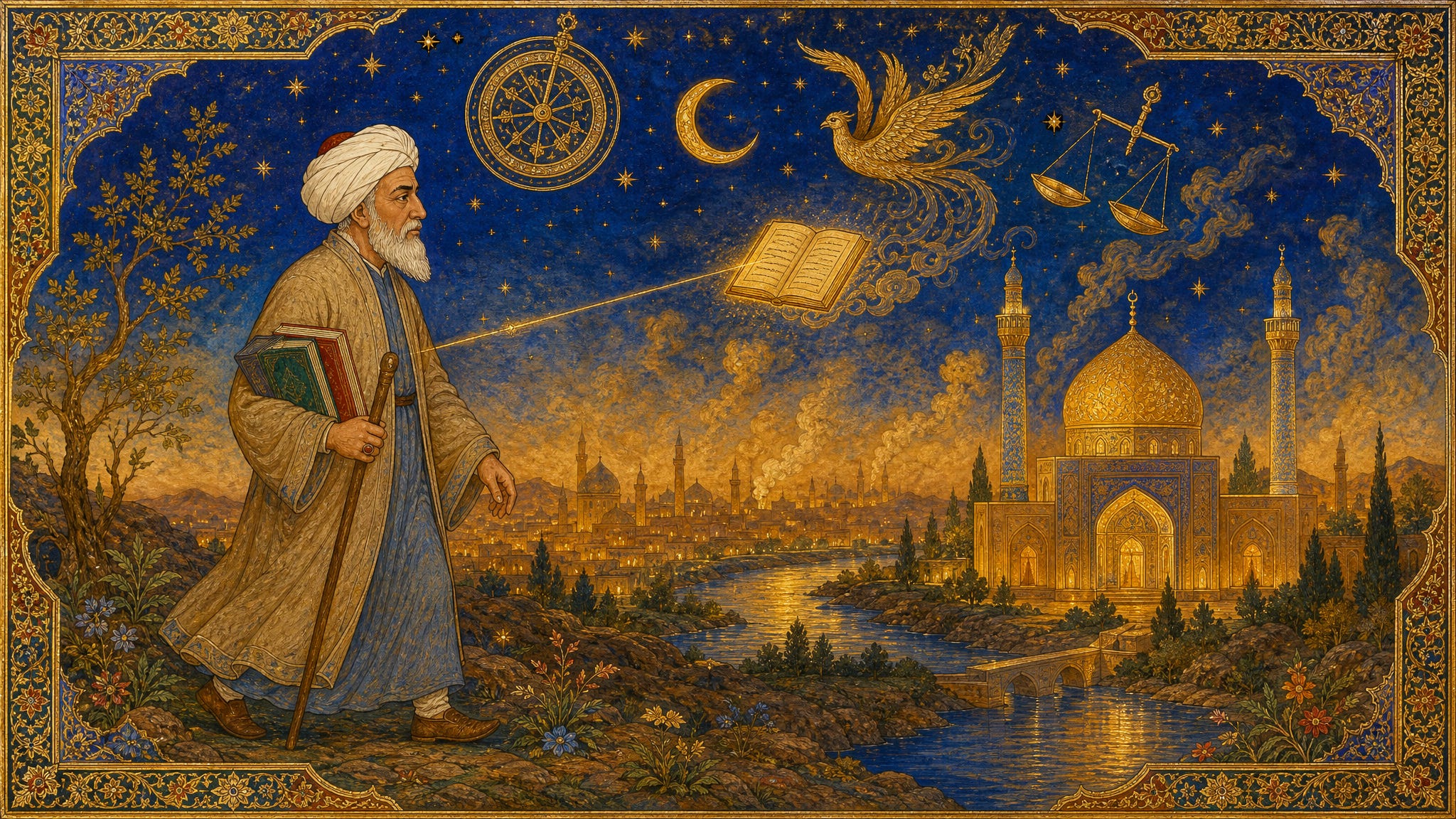
And now the date, which has been the single hardest thing in this session to establish, and which I could not have said to you a week ago.
There is a bibliography — a catalogue of everything the Shi’a have ever written, compiled in the last century by a scholar who gave his life to it.
Its entry for one of our four foundational books of law, the one Shaykh al-Tusi wrote, opens with a line about the man rather than the book:
And in the middle of a bibliographic entry, this:
قَدِمَ مِنْ خُرَاسَانَ إِلَى الْعِرَاقِ سَنَةَ ٤٠٨ وَهَاجَرَ مِنْ بَغْدَادَ إِلَى الْغَرِيِّ سَنَةَ ٤٤٨ وَهُوَ أَوَّلُ مَنْ جَعَلَ النَّجَفَ مَرْكَزاً عِلْمِيّاً تَأْوِي إِلَيْهِ النَّاسُ مِنْ كُلِّ فَجٍّ عَمِيقٍ، تُوُفِّيَ فِيهَا سَنَةَ ٤٦٠
“Al-Istibsar, on what has differed among the reports, by the Shaykh of the Community Abu Ja’far Muhammad ibn al-Hasan ibn Ali al-Tusi, born in the year three hundred and eighty-five. He came from Khurasan to Iraq in the year 408, and migrated from Baghdad to al-Ghari in the year 448 — and he is the first to make Najaf a centre of learning, to which people take shelter from every deep ravine. He died there in the year 460.”
— Agha Buzurg al-Tihrani, Al-Dhari’a ila Tasanif al-Shi’a, Volume 2, Page 14, entry 43
448.
Born 385.
Khurasan to Iraq, 408.
Baghdad to al-Ghari, 448.
Died there, 460.
They took his chair in Safar of 449 — and that is the year after.
Which means the move was not the flight from the fire.
He went first.
And the Verse Comes Back
But it is the tail of that sentence I want to end this point on.
He does not write people came to it.
تَأْوِي إِلَيْهِ النَّاسُ
People take shelter in it.
From awā.
To take shelter.
To take refuge.
تَأْوِي إِلَيْهِ النَّاسُ
People take shelter in it.
Now hold that against where we started tonight.
Point one was a grave that was deliberately made into a place where nobody could shelter.
They flattened it so that there would be nothing there to come to.
And four hundred years after they flattened that ground, this is what it had become — and our own bibliographer reaches for the verb take shelter to say so.
And then he does something else, and I am going to be precise about exactly how much of it is his.
مِنْ كُلِّ فَجٍّ عَمِيقٍ
From every deep ravine.
Those three words are the Qur’an.
They occur in one place, and one place only:
وَأَذِّنْ فِي النَّاسِ بِالْحَجِّ يَأْتُوكَ رِجَالاً وَعَلَىٰ كُلِّ ضَامِرٍ يَأْتِينَ مِنْ كُلِّ فَجٍّ عَمِيقٍ
“And proclaim to the people the Pilgrimage: they will come to you on foot and on every lean beast, coming from every deep ravine.”
— Qur’an, Surah al-Hajj (the Chapter of the Pilgrimage) #22, Verse 27
That is the verse of the call to the Hajj.
To describe what Najaf became, a scholar of our own tradition reached for the Qur’an’s words for the pilgrimage to the House.
Be careful with me here.
Only those last few words are revelation —
مِنْ كُلِّ فَجٍّ عَمِيقٍ
From every deep ravine.
lifted straight out of the verse of the call to the Hajj.
تَأْوِي إِلَيْهِ النَّاسُ
People take shelter in it.
is his own wording, not the Qur’an’s.
And the first to make Najaf a centre of learning is his judgement, not a report he is passing on.
I am showing you a man reaching for the language of the pilgrimage to describe a seminary.
I am not telling you God said it.
But it is his tradition’s judgement, and not ours.
We did not have to build that join.
We found it already made.
Lessons For Our Time
A Valley With Nothing In It
He did not go to a city.
There was no hawza as we would recognise one.
There was barely a town.
He went to a grave, and the town grew up around what he did there.
We choose institutions.
He chose ground.
And this is a pattern God has used before.
رَبَّنَا إِنِّي أَسْكَنْتُ مِنْ ذُرِّيَّتِي بِوَادٍ غَيْرِ ذِي زَرْعٍ عِنْدَ بَيْتِكَ الْمُحَرَّمِ رَبَّنَا لِيُقِيمُوا الصَّلَاةَ فَاجْعَلْ أَفْئِدَةً مِنَ النَّاسِ تَهْوِي إِلَيْهِمْ وَارْزُقْهُمْ مِنَ الثَّمَرَاتِ لَعَلَّهُمْ يَشْكُرُونَ
“Our Lord — I have settled some of my offspring in a valley without cultivation, by Your sacred House. Our Lord, that they may establish the prayer; so make hearts of the people incline toward them, and provide them with fruits, that they may be thankful.”
— Qur’an, Surah Ibrahim (the Chapter of (Prophet) Abraham) #14, Verse 37
And the same commentary — al-Mizan, on the phrase
بِوَادٍ غَيْرِ ذِي زَرْعٍ
a valley without cultivation
teaches us:
وَالْمُرَادُ بِغَيْرِ ذِي زَرْعٍ غَيْرُ الْمَزْرُوعِ، وَهُوَ آكَدُ وَأَبْلَغُ لِأَنَّهُ يَدُلُّ — كَمَا قِيلَ — عَلَىٰ عَدَمِ صَلَاحِيَتِهِ لِأَنْ يُزْرَعَ لِكَوْنِهِ أَرْضاً حَجَرِيَّةً رَمْلِيَّةً خَالِيَةً عَنِ الْمَوَادِّ الصَّالِحَةِ لِلزَّرْعِ
“What is meant by ‘without cultivation’ is that it is not cultivated — and that is stronger and more emphatic, because it indicates — as has been said — its unfitness to be cultivated: it being stony, sandy ground, empty of anything in which a thing will grow.”
— Allamah Sayyed Muhammad Husayn Tabataba’i, Al-Mizan fi Tafsir al-Qur’an, on Surah Ibrahim #14, Verse 37
Not merely uncultivated.
Unfit for it.
Stone and sand, and nothing in it that will grow.
And then the clause that answers the verse we opened on tonight — same author, different sura:
وَنِسْبَةُ الْبَيْتِ إِلَى اللهِ سُبْحَانَهُ لِأَنَّهُ مَبْنِيٌّ لِغَرَضٍ لَا يَصْلُحُ إِلَّا لَهُ تَعَالَىٰ وَهُوَ عِبَادَتُهُ
“And the House is ascribed to God because it is built for a purpose fit for none but Him — His worship.”
— Allamah Sayyed Muhammad Husayn Tabataba’i, Al-Mizan fi Tafsir al-Qur’an, on Surah Ibrahim #14, Verse 37
We opened tonight on that clause — a house is raised to the measure it is ascribed to Him.
And here is the same man, in a different chapter of the Qur’an, telling us what ascription means: it is built for something only He is fit for.
He supplied both halves himself.
We did not build a single join between them.
And that is the answer to a question some of you have been holding since the opening.
The criterion was never:
which ground is holiest.
That is not a question this verse asks and it is not a competition we should be running.
The question is:
what is this ground for?
And let me be exact about what I am and am not saying.
I am not telling you Najaf is like the Ka’bah.
The Ka’bah is the Ka’bah.
I am telling you that God has used a shape before: a barren place, a house given over to His worship, and hearts drawn toward it.
That is all.
The pattern, not a ranking.
And one last thing on this, from a living scholar, and I hold it lightly and at his own weight.
Ayatollah Shaykh Mohsen Araki, in Dar Maktab-e Pedar — In My Father’s School, his memoir of his father — describes the working life of that seminary in the last century.
He says of his father, flatly and in passing, inside a chapter on humility:
با وجود اینکه ایشان از مجتهدین طراز اول حوزه بودند
“even though he was among the first-rank mujtahids of the seminary”
— Ayatollah Shaykh Mohsen Araki, Dar Maktab-e Pedar (In My Father’s School), Page 51
And that same man gives away the household’s money to a neighbour who has fallen ill — a hostile neighbour, whose sons had burgled their house — and tells his daughter why:
فرزندم ما میتوانیم چند روزی تا آخر ماه با آنچه داریم گذران کنیم. سر ماه میرسد و شهریه میگیریم
“My child, we can get by for a few days until the end of the month on what we have. The month turns, and we receive the shahriyya”
— Ayatollah Shaykh Mohsen Araki, Dar Maktab-e Pedar (In My Father’s School), Pages 46–47
A mujtahid of the first rank in Najaf, living month to month on the students’ stipend.
And then Ayatullah Sayyed Muhsin al-Hakim’s reform.
A marja’ looks at that seminary and sees that ethics, exegesis and theology have stopped being taught — not neglected: stopped — so he builds a school called Dar al-Hikmah and summons the seniors of the hawza to teach them again.
راه انداختن برخی دروس و رشتههای تعطیل شده و مورد نیاز حوزۀ علمیه از قبیل: اخلاق، تفسیر، کلام و امثال ذلک
“the restarting of certain lessons and disciplines that had been discontinued and were needed by the seminary — such as: ethics, tafsir, theology and the like”
— Ayatollah Shaykh Mohsen Araki, Dar Maktab-e Pedar (In My Father’s School), Page 32
He asks Shaykh Araki’s father to teach the ethics.
The man refuses.
Then he accepts, on one condition — that he may read it out of a book rather than deliver it from himself.
And when his son asks him why, he answers:
خوف آن دارم که مطلبی را بگویم که خودم از عهدۀ عمل به آن برنیامده باشم
“I am afraid of saying something that I myself have not managed to live up to.”
— Ayatollah Shaykh Mohsen Araki, Dar Maktab-e Pedar (In My Father’s School), Page 33
A handful of people near a shrine in 378.
And a seminary still arguing about its own syllabus a thousand years later.
The Reason They Give, and the Reason We Notice
I did something in point three tonight that I want to name, because it is the most useful thing in this session and it is not about Najaf at all.
I gave you the sources’ reason first.
Then I gave you mine, and I labelled it as mine.
The books say he fled the strife.
That is transmitted, it is what they actually say, and it is not a small thing.
What I noticed — that the man who fled to that ground had copied a report about that ground into his own book — is an observation.
It is mine.
It might be nothing.
The discipline that makes any of this trustworthy is the willingness to say
this part is reported, and this part is me.
And I do not mean that for scholars.
I mean it for the thing in your hand.
Almost everything that reaches you now arrives with those two already blended — what happened, and what somebody concluded — and the blending is usually invisible and often deliberate.
Learn to feel the seam.
Raised to the Measure
And back to where we started.
To the measure that it is ascribed to Him.
Not a category.
A scale.
Which means the question is never is this a holy place or an ordinary one.
The question is how much of Him is in what happens here — and that question can be asked of a shrine, and of a mosque, and of a seminary.
And of a house.
And of a business.
And of an hour of your evening.
Conclusion
The Three Sentences
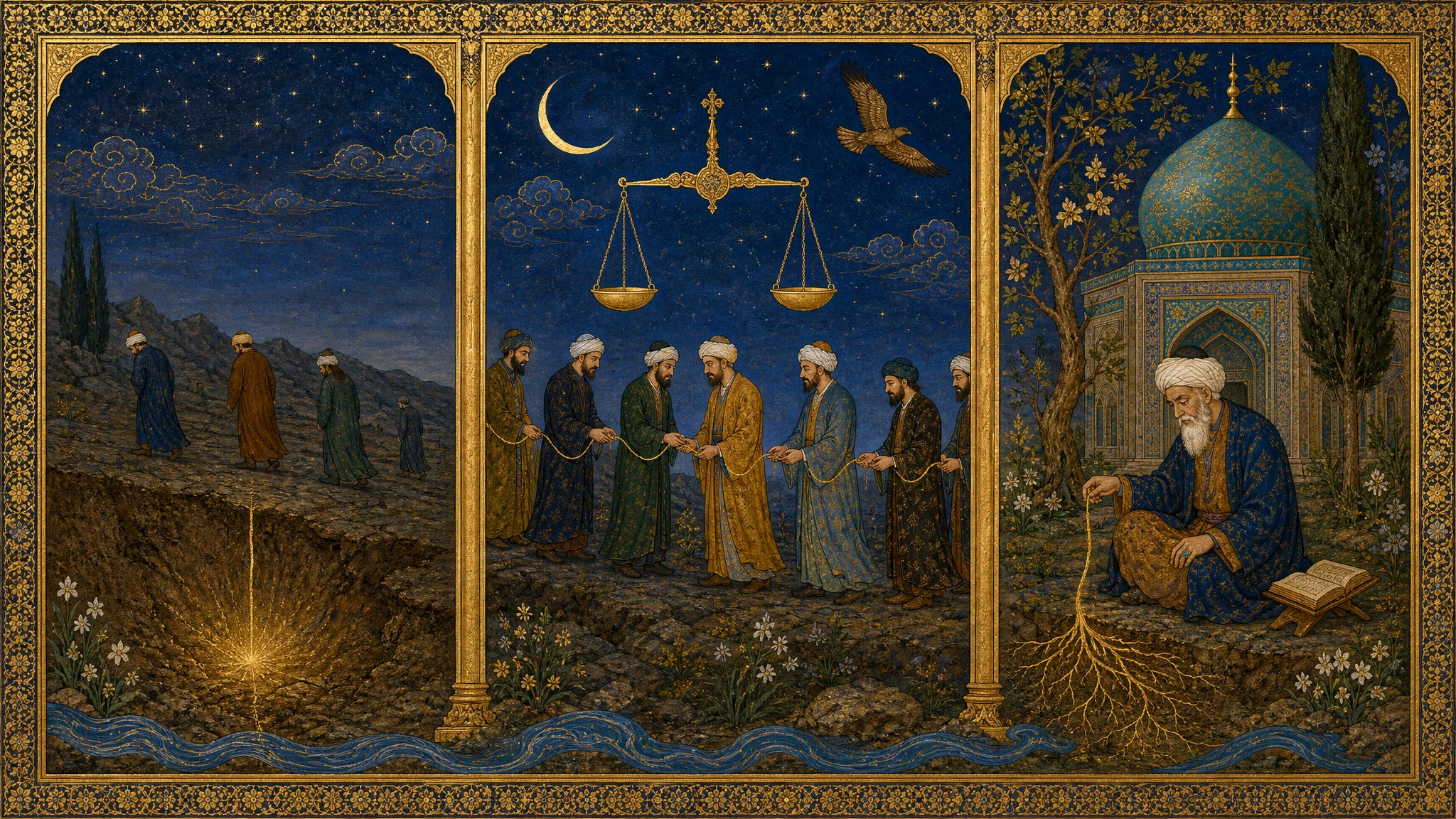
Three sentences.
One for each point.
And then I am going to stop.
They hid it so that it could not be reached.
They gave it back by hand — one man at a time, at night, over generations — and a 140 years after the burial it was still being argued about.
And a man who had spent his whole life writing about the one who is hidden went out, and sat down beside it, and stayed.
Key Takeaways
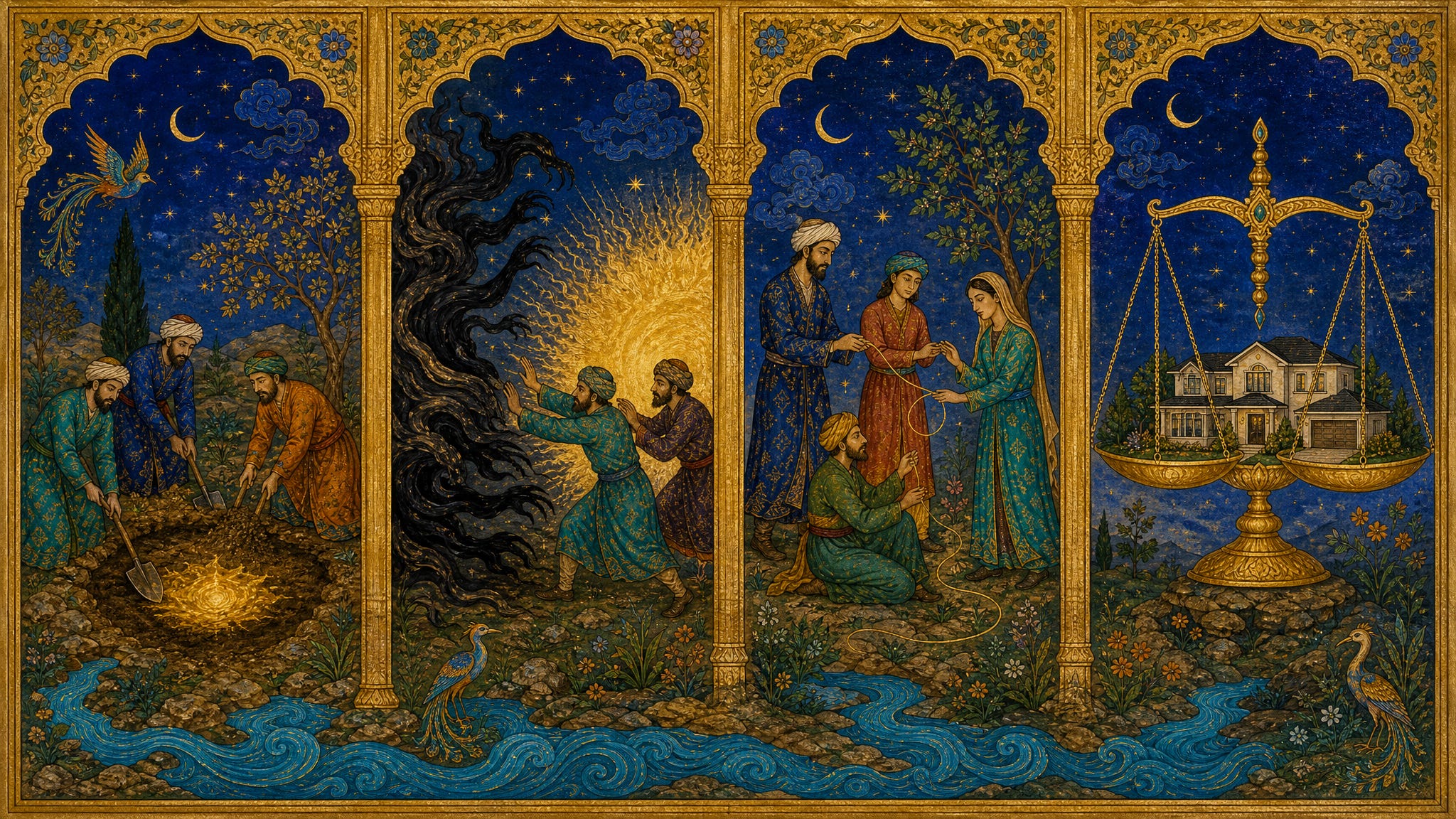
One.
Concealment in this tradition is not absence. It is a security arrangement
— instructed, deliberate, and carried out by the people who loved him most.
Two.
The fear was never one specific act.
Lest they contrive at harming him — a capability, not a shovel.
And the reason his own teacher gives:
قَبِيحِ الْفِعَالِ وَالْمَقَالِ
Vile deed — and vile speech.
Three.
A thing worth protecting is handed back the way it was protected
— carefully, slowly, to people who can carry it.
Four.
A house is raised to the measure it is ascribed to Him.
Not a ranking. A scale — and it applies to your house too.
The Bridge
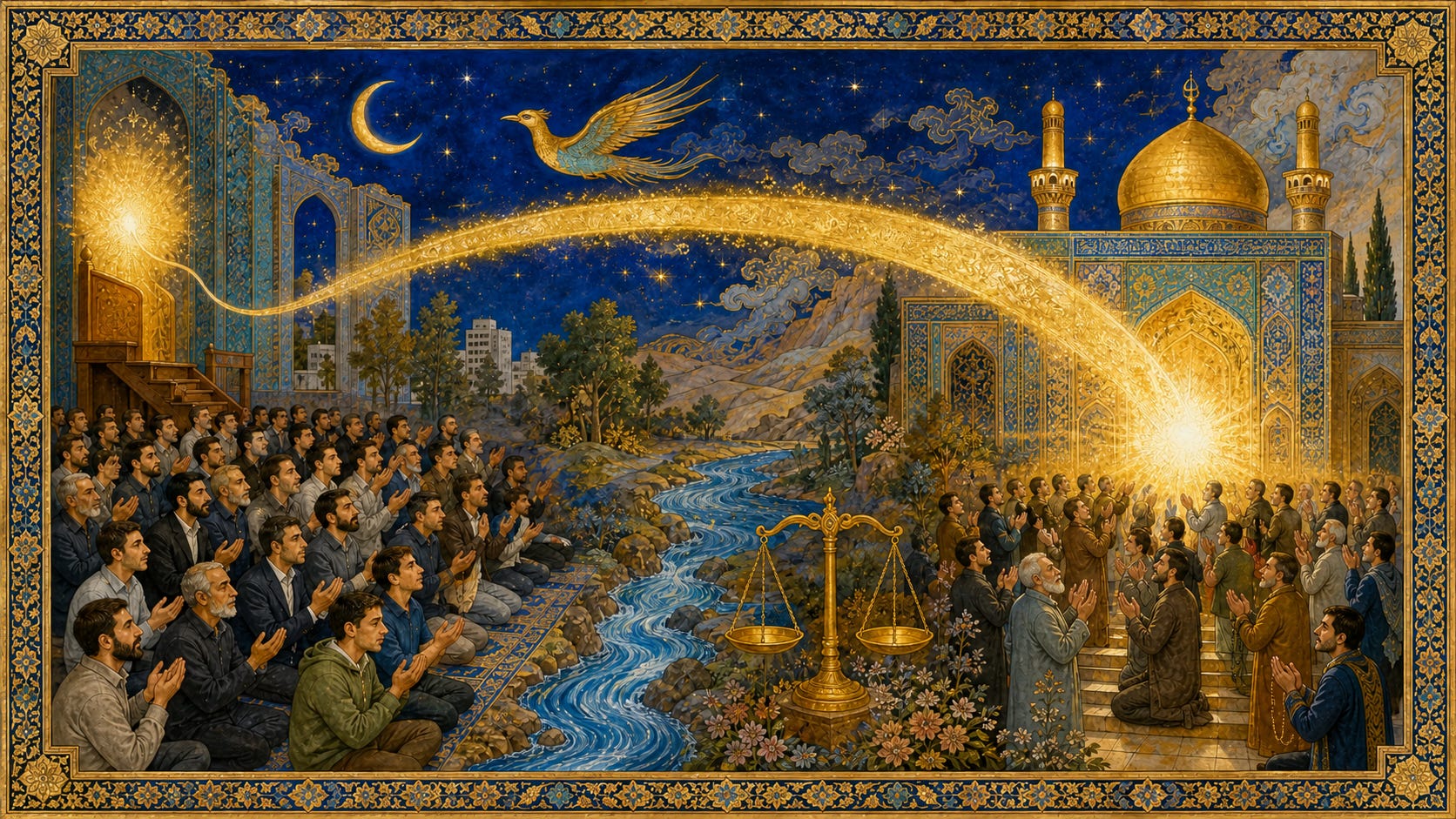
Almost everything I have told you tonight happened between the first century and the fifth.
Let me bring it into this room.
On the 15th of Aban, 1383 — the 5th of November, 2004 — the day of the martyrdom of the Commander of the Faithful — our martyred leader, Imam Sayyed Ali Khamenei, may God rest his pure soul, was delivering the Friday sermon.
And at the very end, turning to the remembrance of the affliction, he said this:
امروز، روز شهادت امیرالمؤمنین است. من میخواهم یک جمله هم ذکر مصیبت کنم. «صلّی الله علیک یا امیرالمؤمنین». خوشابه حال کسانی که امروز در نجف و در کنار مرقد امیرالمؤمنین هستند و میتوانند به آن قبر مطهّر و پاک از نزدیک سلام کنند. ما هم از دور بار دیگر عرض میکنیم: «السّلام علیک یا امیرالمؤمنین، السّلام علیک یا امام المتّقین، السّلام علیک یا سیّد الوصیّین»
“Today is the day of the martyrdom of the Commander of the Faithful. I want to say one sentence of remembrance of the affliction. ‘God’s blessings upon you, O Commander of the Faithful.’ Blessed are those who today are in Najaf, beside the resting place of the Commander of the Faithful, and are able to greet that pure and holy grave from close by. And we too, from afar, say once more: ‘Peace be upon you, O Commander of the Faithful; peace be upon you, O Imam of the God-fearing; peace be upon you, O master of the legatees.’”
— The martyred leader, Imam Sayyed Ali Khamenei, may God rest his pure soul; Friday sermon of 15 Aban 1383 / 5 November 2004, the day of the martyrdom of the Commander of the Faithful
از نزدیک
From close by.
از دور
From afar.
That is this entire session, in two prepositions, and they are not mine.
Point one was a grave effaced so that the public could not reach it.
Point two was that closeness given back, one man at a time.
And here is the wali al-faqih, the leader of the Muslim Ummah, now martyred, fourteen centuries downstream, still dividing the world into those who can stand at it and those who greet it from a distance.
And putting himself in the second group.
And I will tell you what he said immediately before that, because it would be dishonest to take the greeting and leave the sentence above it.
He had just spent that sermon insisting that the Commander of the Faithful is a point of unity, and not a point of division.
Tonight I have put an Abbasid caliph face-down at that grave in the dark.
That sentence is the honest neighbour of this one.
Nobody in this room is in Najaf tonight.
So let us do the thing he describes.
The Eulogy - Ziyārat Aminallah
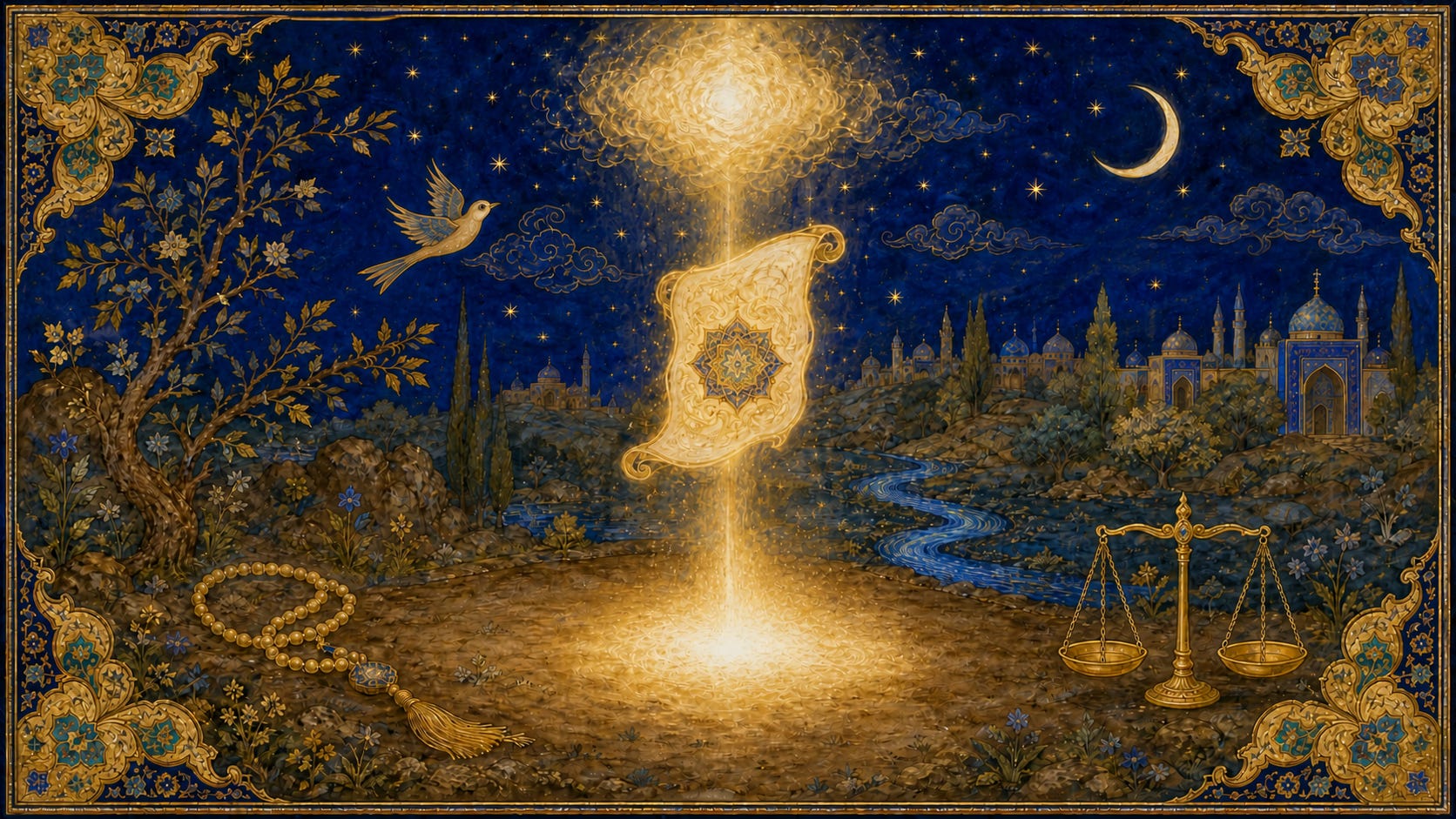
And here is where it closes, and I could not have arranged this if I had tried.
The eulogy tonight comes out of a book Shaykh al-Tusi wrote himself — a book of prayers for the one who keeps vigil at night — written for the grave he moved to.
And it opens like this:
رَوَى جَابِرٌ الْجُعْفِيُّ قَالَ: قَالَ أَبُو جَعْفَرٍ عَلَيْهِ السَّلَامُ: مَضَىٰ أَبِي عَلِيُّ بْنُ الْحُسَيْنِ عَلَيْهِمَا السَّلَامُ إِلَىٰ مَشْهَدِ أَمِيرِ الْمُؤْمِنِينَ عَلِيٍّ صَلَوَاتُ اللهِ عَلَيْهِ، فَوَقَفَ عَلَيْهِ ثُمَّ بَكَىٰ وَقَالَ:
“Jabir al-Ju’fi related: Abu Ja’far, peace be upon him, said: my father Ali ibn al-Husayn, peace be upon them both, went to the shrine of the Commander of the Faithful Ali, God’s blessings upon him, and stood at it, and then wept, and said:”
— Shaykh al-Tusi, Misbah al-Mutahajjid, Pages 738–739, under the day of Ghadir
Imam Zayn al-Abidin, peace and blessings be upon him.
At that grave.
A generation after the burial — and two generations before Imam al-Sadiq pointed the place out to anybody.
That is why the word is resumed.
They had never lost it.
It was hidden from the public and never from the family — and here is one of them, standing at it, weeping.
And this is what he said:
اَلسَّلَامُ عَلَيْكَ يَا أَمِينَ اللهِ فِي أَرْضِهِ وَحُجَّتَهُ عَلَىٰ عِبَادِهِ! اَلسَّلَامُ عَلَيْكَ يَا أَمِيرَ الْمُؤْمِنِينَ! أَشْهَدُ أَنَّكَ جَاهَدْتَ فِي اللهِ حَقَّ جِهَادِهِ وَعَمِلْتَ بِكِتَابِهِ وَاتَّبَعْتَ سُنَنَ نَبِيِّهِ صَلَّى اللهُ عَلَيْهِ وَآلِهِ حَتَّىٰ دَعَاكَ اللهُ إِلَىٰ جِوَارِهِ فَقَبَضَكَ إِلَيْهِ بِاخْتِيَارِهِ وَأَلْزَمَ أَعْدَاءَكَ الْحُجَّةَ مَعَ مَا لَكَ مِنَ الْحُجَجِ الْبَالِغَةِ عَلَىٰ جَمِيعِ خَلْقِهِ. اَللَّهُمَّ! فَاجْعَلْ نَفْسِي مُطْمَئِنَّةً بِقَدَرِكَ، رَاضِيَةً بِقَضَائِكَ، مُولَعَةً بِذِكْرِكَ وَدُعَائِكَ، مُحِبَّةً لِصَفْوَةِ أَوْلِيَائِكَ، مَحْبُوبَةً فِي أَرْضِكَ وَسَمَائِكَ، صَابِرَةً عَلَىٰ نُزُولِ بَلَائِكَ، مُشْتَاقَةً إِلَىٰ فَرْحَةِ لِقَائِكَ، مُتَزَوِّدَةً التَّقْوَىٰ لِيَوْمِ جَزَائِكَ، مُسْتَنَّةً بِسُنَنِ أَوْلِيَائِكَ، مُفَارِقَةً لِأَخْلَاقِ أَعْدَائِكَ، مَشْغُولَةً عَنِ الدُّنْيَا بِحَمْدِكَ وَثَنَائِكَ.
“Peace be upon you, O Trustee of God in His earth and His proof over His servants! Peace be upon you, O Commander of the Faithful! I bear witness that you strove in God as is the right of striving in Him, and acted by His Book, and followed the ways of His Prophet, peace and blessings be upon him and his family, until God called you to His nearness and took you to Himself by His own choosing — and bound your enemies with the proof, together with what you have of conclusive proofs over all His creation.
O God! Make my soul at rest with what You decree, content with what You ordain, in love with Your remembrance and Your supplication, loving toward the choicest of Your friends, beloved in Your earth and Your heaven, patient under the descent of Your trial, longing for the joy of meeting You, provisioned with God-consciousness for the day of Your recompense, following the ways of Your friends, departed from the character of Your enemies, occupied away from this world with Your praise and Your commendation.”— Shaykh al-Tusi, Misbah al-Mutahajjid, Page 738
And then — and this is the line I want you to hold —
ثُمَّ وَضَعَ خَدَّهُ عَلَىٰ قَبْرِهِ وَقَالَ
“Then he laid his cheek upon his grave, and said:”
— Shaykh al-Tusi, Misbah al-Mutahajjid, Pages 738–739
A grave that was flattened so that nobody would ever find it.
And the fourth Imam, peace and blessings be upon him, with his cheek on it.
اَللَّهُمَّ! إِنَّ قُلُوبَ الْمُخْبِتِينَ إِلَيْكَ وَالِهَةٌ، وَسُبُلَ الرَّاغِبِينَ إِلَيْكَ شَارِعَةٌ، وَأَعْلَامَ الْقَاصِدِينَ إِلَيْكَ وَاضِحَةٌ، وَأَفْئِدَةَ الْعَارِفِينَ مِنْكَ فَازِعَةٌ، وَأَصْوَاتَ الدَّاعِينَ إِلَيْكَ صَاعِدَةٌ، وَأَبْوَابَ الْإِجَابَةِ لَهُمْ مُفَتَّحَةٌ، وَدَعْوَةَ مَنْ نَاجَاكَ مُسْتَجَابَةٌ، وَتَوْبَةَ مَنْ أَنَابَ إِلَيْكَ مَقْبُولَةٌ، وَعَبْرَةَ مَنْ بَكَىٰ مِنْ خَوْفِكَ مَرْحُومَةٌ، وَالْإِغَاثَةَ لِمَنِ اسْتَغَاثَ بِكَ مَوْجُودَةٌ، وَالْإِعَانَةَ لِمَنِ اسْتَعَانَ بِكَ مَبْذُولَةٌ، وَعِدَاتِكَ لِعِبَادِكَ مُنْجَزَةٌ، وَزَلَلَ مَنِ اسْتَقَالَكَ مُقَالَةٌ، وَأَعْمَالَ الْعَامِلِينَ لَدَيْكَ مَحْفُوظَةٌ، وَأَرْزَاقَكَ إِلَى الْخَلَائِقِ مِنْ لَدُنْكَ نَازِلَةٌ، وَعَوَائِدَ الْمَزِيدِ إِلَيْهِمْ وَاصِلَةٌ، وَذُنُوبَ الْمُسْتَغْفِرِينَ مَغْفُورَةٌ، وَحَوَائِجَ خَلْقِكَ عِنْدَكَ مَقْضِيَّةٌ، وَجَوَائِزَ السَّائِلِينَ عِنْدَكَ مُوَفَّرَةٌ، وَعَوَائِدَ الْمَزِيدِ مُتَوَاتِرَةٌ، وَمَوَائِدَ الْمُسْتَطْعِمِينَ مُعَدَّةٌ، وَمَنَاهِلَ الظِّمَاءِ مُتْرَعَةٌ. اَللَّهُمَّ! فَاسْتَجِبْ دُعَائِي، وَاقْبَلْ ثَنَائِي، وَاجْمَعْ بَيْنِي وَبَيْنَ أَوْلِيَائِي بِحَقِّ مُحَمَّدٍ وَعَلِيٍّ وَفَاطِمَةَ وَالْحَسَنِ وَالْحُسَيْنِ، إِنَّكَ وَلِيُّ نَعْمَائِي وَمُنْتَهَىٰ مُنَايَ وَغَايَةُ رَجَائِي فِي مُنْقَلَبِي وَمَثْوَايَ.
“O God! The hearts of the humble are bewildered with love toward You; the paths of those who desire You are open; the signposts of those who make for You are clear; the hearts of those who know You are in awe of You; the voices of those who call upon You rise up; the doors of response are opened to them; the prayer of one who confides in You is answered; the repentance of one who turns to You is accepted; the tear of one who weeps out of fear of You is met with mercy; aid for one who seeks aid from You is at hand; help for one who seeks help from You is freely given; Your promises to Your servants are fulfilled; the slips of one who seeks Your pardon are pardoned; the deeds of the doers are preserved with You; Your provisions descend to the creatures from You; the returns of increase reach them; the sins of those who seek forgiveness are forgiven; the needs of Your creation are fulfilled with You; the gifts of those who ask are made abundant with You; the returns of increase come one after another; the tables for those who seek food are set; and the watering-places for the thirsty are brimming.
O God! Answer my supplication, and accept my praise, and join me with my friends — by the right of Muhammad and Ali and Fatimah and al-Hasan and al-Husayn. Truly You are the Guardian of my blessings, the utmost of my desire, and the limit of my hope, in my returning and in my resting-place.”
— Shaykh al-Tusi, Misbah al-Mutahajjid, Page 739
And on the very same page, immediately after that, Imam al-Baqir, peace and blessings be upon him, says this:
قَالَ الْبَاقِرُ عَلَيْهِ السَّلَامُ: مَا قَالَهُ أَحَدٌ مِنْ شِيعَتِنَا عِنْدَ قَبْرِ أَمِيرِ الْمُؤْمِنِينَ صَلَوَاتُ اللهِ عَلَيْهِ أَوْ عِنْدَ قَبْرِ أَحَدٍ مِنَ الْأَئِمَّةِ عَلَيْهِمُ السَّلَامُ إِلَّا وُقِّعَ فِي دَرْجٍ مِنْ نُورٍ وَطُبِعَ عَلَيْهِ بِطَابَعِ مُحَمَّدٍ صَلَّى اللهُ عَلَيْهِ وَآلِهِ حَتَّىٰ يُسَلَّمَ إِلَى الْقَائِمِ عَلَيْهِ السَّلَامُ، فَيَلْقَىٰ صَاحِبَهُ بِالْبُشْرَىٰ وَالتَّحِيَّةِ وَالْكَرَامَةِ إِنْ شَاءَ اللهُ تَعَالَىٰ
“Al-Baqir, peace be upon him, said: nothing has any of our Shi’a said at the grave of the Commander of the Faithful, God’s blessings upon him, or at the grave of any of the Imams, peace be upon them, but that it is entered upon a scroll of light and sealed with the seal of Muhammad, peace and blessings be upon him and his family, until it is delivered to the Qa’im, peace be upon him — and he meets its author with good tidings, and greeting, and honour, if God the Exalted wills.”
— Imam Muhammad al-Baqir, peace and blessings be upon him; Shaykh al-Tusi, Misbah al-Mutahajjid, Page 739, immediately following the ziyarah
I need to give you one word carefully, because I had it wrong until three days ago and the right one is far better.
وُقِّعَ
And it was signed.
I had read that as raised — lifted up in a scroll of light.
It is not.
The word is the one a chancery uses when a ruler puts his mark on a document.
It is the word for signing something off.
It is the chancery word.
To sign.
To endorse.
To enter a rescript over a signature.
And it is the technical term for the written rescripts of the Imam of our Age himself.
The tawqi’at are what he sends out.
So the report does not say your words are carried upward.
It says they are countersigned onto a scroll of light, sealed with the Prophet’s seal, and delivered to the Qa’im — in the exact vocabulary of the documents he issues.
The traffic runs both ways down the same channel.
And it is the same word.
That reading of the word is mine.
The Imam does not gloss it.
I am telling you what the word is, and letting you feel the rhyme; I am not telling you he meant it.
They hid the grave so that it could not be reached.
And what is said at it goes to the one person nobody can reach.
Segue to the Maqtal
Maqtal (Lamentation) for the Twelfth Session of the Architecture of Guidance
Supplication
O God — send blessings upon Muhammad and the family of Muhammad.
O God, we ask You by the right of those You made a proof over Your creation: by the prophets, from Adam to Your beloved Muhammad, peace and blessings be upon him and his family; by the fourteen infallibles, peace and blessings be upon them all.
O God — we pray for the scholars of this chain. Not by name, because the list is longer than any evening. By station: the ones who sat down to teach and were not thanked for it; the ones who copied out books in rooms nobody has recorded; the ones who kept an appointment with a grave for twenty years and were never once observed doing it.
O God — we pray for our late leader, and the great reviver of Islam, Imam Khomeini, may You rest his pure soul. He lived thirteen years beside that grave. Raise him with the ones he studied under, and with the ones he taught.
O God — we pray for the martyred leader, Imam Sayyed Ali Khamenei, may You rest his pure soul. Accept from him what he carried, and count him among those who greeted that grave from afar and were not turned away.
O God — we pray for Imam Sayyed Mujtaba Khamenei, may You protect him — the Wali al-Faqih of our time. Preserve him for us. Strengthen him. Guide him. Make him the leader You have appointed him to be, until the Imam of our Age returns and the trust he carries is handed back to its rightful holder.
O God — we pray for the Imam of our Age, may our souls be his ransom and may You — our beloved Lord — hasten his return.
Tonight we have spent an evening on a grave that men hid on purpose, and gave back one at a time, and that a scholar chose over a capital.
O God — we are the ones greeting from afar.
Make what was said in this room tonight one of those things that is signed onto a scroll of light, and sealed, and delivered.
And let him meet its author with good tidings, and greeting, and honour.
O God, hasten his relief. And make us of his companions, and of those who are steadfast toward him, and of those who seek his pleasure.
By the right of Muhammad and his pure family.
Amen, O Lord Sustainer of the Universes.
Amen, O Most Merciful of the Merciful.
And from Him alone is all ability and He has authority over all things.