

In His Name, the Most High
يَا أَهْلَ الْكِتَابِ لَا تَغْلُوا فِي دِينِكُمْ وَلَا تَقُولُوا عَلَى اللَّهِ إِلَّا الْحَقَّ ۚ إِنَّمَا الْمَسِيحُ عِيسَى ابْنُ مَرْيَمَ رَسُولُ اللَّهِ
“O People of the Book, do not go to excess in your religion, and do not say of God other than the truth. The Messiah, Jesus son of Mary, is only the Messenger of God.”
— Qur’an, Surah al-Nisa (the Chapter of the Women) #4, Verse 171
A Verse About People Who Loved a Prophet Too Much
I want you to notice what that verse is actually about.
It is the verse in the Qur’an that forbids religious excess.
Do not go to excess in your religion.
If you have ever heard somebody quote a verse at you about going too far, it is very likely this one.
And look at what follows it.
It is not about a statue.
It is not about a stone.
It is not about people who hated God and wanted an idol instead.
It is about people who loved a prophet.
They loved Jesus son of Mary, may our souls be his ransom, and may God hasten his return.
They loved him truly.
And the verse does not tell them to stop loving him.
Read it again and see what it actually forbids:
do not say of God other than the truth.
The prohibition is not on the affection.
The prohibition is on the claim.
That word — ghuluww — means to go past the limit of a thing.
Not to have a thing.
To go past it.
You can go past the limit of praise, of grief, of loyalty, of love.
And the Qur’an’s own example of it, chosen by God to teach us what the word means, is not a people who despised a prophet.
It is a people who could not stop raising one.
Now hold that, and let me ask you something, and I am not going to answer it yet.
Is that a verse about somebody else?
The Sentence That Has No Good Answer

Last week we went into other people’s houses and we read their books, and we found that everyone who ever took this question seriously attached a limit to it.
We did that honestly.
We refused the cheap points that were available to us, and we did not take a single one.
Tonight I have to do the harder half, and I am going to start by saying the thing that is said about us in the sharpest form I know how to say it.
Not a soft version.
Not a version I have already quietly beaten before you hear it.
Here it is.
You have no limits.
You say it is about intention, and intention is invisible — so your answer can never be checked and it can never be wrong.
You will never rule anything out.
Which means you have not actually drawn a line at all; you have drawn a line that moves.
I want you to sit with that for a second, because it is not stupid.
It is not a slogan.
A serious person can say that sentence and mean it.
And if the only answer we have is how dare you, then the person who said it will go home entirely unconvinced, and they will be right to.
And I will tell you why that objection has teeth, and it is not because the people making it are clever.
It is because a rule you cannot fail is not a rule.
Think about any actual standard you have ever been held to.
A speed limit.
A dose on a bottle.
The line on a form that says what you may and may not claim.
Every one of them has a case that breaks it.
That is what makes it a limit rather than a preference — you can point at the thing that would be over the line, and you can point at it before anybody has done it.
So when somebody asks this community where its line is, and the honest answer that comes back is well, it depends on the heart, they are not being unreasonable when they say:
that is not a line, that is a mood.
I think they are wrong.
I am going to spend an hour showing you why they are wrong.
But they are not wrong because they are hostile, and if you leave here tonight thinking the only thing standing behind that question is malice, then I have wasted your evening.
So I am not going to answer it by being offended.
I am going to answer it by producing our limits.
And before I produce one, take the word — because it is not mine and it is not the objector’s.
The Qur’an has a term for a limit and it uses it constantly.
Ḥudūd Allāh, the limits of God.
You will find it in the second chapter, Surah al-Baqarah, in the verse on the nights of the fast:
… تِلْكَ حُدُودُ اللَّهِ فَلَا تَقْرَبُوهَا …
“… Those are the limits of God, so do not come near them …”
— Qur’an, Surah al-Baqarah (the Chapter of the Cow) #2, Verse 187
Here is what our own commentator says it means at its root.
أصل الحد هو المنع و إليه يرجع جميع استعمالاته و اشتقاقاته كحد السيف و حد الفجور و حد الدار و الحديد إلى غير ذلك
“The root of ḥadd is PREVENTION. Every use of it and every derivation returns to that: the ḥadd of a sword, the ḥadd of transgression, the ḥadd of a house, and ḥadīd — iron — and so on.”
— Allamah Sayyed Muhammad Husayn Tabataba’i, al-Mizan fi Tafsir al-Qur’an, on Surah al-Baqarah #2, Verse 187
The edge of a blade.
The penalty that holds transgression back.
The boundary of a property.
And the word for iron.
That is the vocabulary God chose for a limit.
Not one word of it is soft, nothing in it moves, and nothing in it depends on how anybody feels.
So when somebody tells this community that its line is a mood — the Book they are holding us to has already answered them, and it answered them in metal.
And the Book does not leave the word abstract.
الطَّلَاقُ مَرَّتَانِ ۖ فَإِمْسَاكٌ بِمَعْرُوفٍ أَوْ تَسْرِيحٌ بِإِحْسَانٍ ۗ وَلَا يَحِلُّ لَكُمْ أَنْ تَأْخُذُوا مِمَّا آتَيْتُمُوهُنَّ شَيْئًا إِلَّا أَنْ يَخَافَا أَلَّا يُقِيمَا حُدُودَ اللَّهِ ۖ فَإِنْ خِفْتُمْ أَلَّا يُقِيمَا حُدُودَ اللَّهِ فَلَا جُنَاحَ عَلَيْهِمَا فِيمَا افْتَدَتْ بِهِ ۗ تِلْكَ حُدُودُ اللَّهِ فَلَا تَعْتَدُوهَا ۚ وَمَنْ يَتَعَدَّ حُدُودَ اللَّهِ فَأُولَٰئِكَ هُمُ الظَّالِمُونَ
“Divorce is twice; then keep her honourably or release her with kindness. And it is not lawful for you to take back anything of what you have given them — unless the two of them fear that they will not keep within the limits of God. And if you fear that they will not keep within the limits of God, there is no blame on either of them in what she gives up to free herself. Those are the limits of God, so do not transgress them. And whoever transgresses the limits of God — those are the wrongdoers.”
— Qur’an, Surah al-Baqarah (the Chapter of the Cow) #2, Verse 229
Notice where God plants that phrase.
Not in a chapter on doctrine — in a marriage ending, among money and who keeps what.
A limit is not a thing you announce when you are feeling devotional.
It is a thing that holds when everything else has come apart.
And the word for the man who crosses — not mistaken, not unwise, but ẓālimūn, the wrongdoers — comes from the word we ended on last week,
zulm: a thing put somewhere it does not belong.
So hold that against
you have no limits.
We have the word, we have its root, and we have the name for the man who goes past it.
And one more thing, which settles the argument before it starts.
There is exactly one being in existence with no limit.
Not a scholar, not a saint, not an Imam.
One — and read what He does.
قُلْ لِمَنْ مَا فِي السَّمَاوَاتِ وَالْأَرْضِ ۖ قُلْ لِلَّهِ ۚ كَتَبَ عَلَىٰ نَفْسِهِ الرَّحْمَةَ ۚ لَيَجْمَعَنَّكُمْ إِلَىٰ يَوْمِ الْقِيَامَةِ لَا رَيْبَ فِيهِ ۚ الَّذِينَ خَسِرُوا أَنْفُسَهُمْ فَهُمْ لَا يُؤْمِنُونَ
“Say: to whom belongs what is in the heavens and the earth? Say: to God. He has written mercy upon Himself. He will surely gather you to the Day of Resurrection, in which there is no doubt. Those who have lost their own souls — they do not believe.”
— Qur’an, Surah al-An’am (the Chapter of the Cattle) #6, Verse 12
كَتَبَ عَلَىٰ نَفْسِهِ الرَّحْمَةَ.
He has written mercy upon Himself.
He owns everything in the heavens and the earth.
Nothing outside Him constrains Him, and nothing could.
And He put something in writing anyway, binding Himself, with nobody to enforce it.
So if the only unlimited being there is chose to bind Himself — then a community that says its Imams have no limit is not being generous to them.
It is saying something about them that God did not say about Himself.
And here is what I want you to watch for as I do.
Our limits are older than the objection.
They are sharper than anything the objector has ever proposed.
And — this is the part that costs us something, and it is the reason tonight is not a comfortable evening —
they were enforced by our own Imams against our own people.
So let me give you the honest answer to the question in the title, and give it to you now rather than making you wait an hour for it.
Can it become that?
Yes. It can.
It has — among people our Imams disowned.
We said so first.
Recap — What We Carry Forward

We are in The Architecture of Guidance, and this is the sixteenth part of it.
And inside it we are working through a smaller sequence called The House Beside the Grave.
Tonight is the eighth of those, and there are eleven.
Tonight is Wednesday the 30th of September 2026, and it is the 18th of Rabi al-Thani, of the year 1448.
What we carry forward is short.
From the seventy-fourth: the charge of idolatry, taken to its source and examined there, turns out never to have been a question about the oneness of God at all.
From the seventy-fifth, three things.
That every serious house which ever asked this question attached a limit to it.
That the adversary, when he described his own work, said he would sit on the straight path and not the crooked one — because there is no point ambushing a road nobody travels.
And a word we spent time on: zulm, which we are taught to hear as oppression, and which underneath means something simpler and stranger —
a thing put where it does not belong.
And there is one more sentence I left you with last week, and I left it deliberately, because it is tonight’s whole reason for existing.
If every system God gave can be corrupted — has ours been, at this particular point, and how would you know?
That is the night.
Three Corrections, One Afternoon
He Said It Himself, About Himself
I am going to start with one line, and it is not from a book of theology or a work of refutation.
It is from the collection of the sermons and letters and sayings of the Commander of the Faithful, peace and blessings be upon him — Nahj al-Balagha, the Path of Eloquence, gathered about a thousand years ago by a scholar of Baghdad called Sayyed al-Radhi — who we met in session, who went through everything that had come down and arranged it.
Saying number one hundred and seventeen.
It is one line long.
وَقَالَ (عليه السلام): هَلَكَ فِيَّ رَجُلَانِ مُحِبٌّ غَالٍ وَمُبْغِضٌ قَالٍ.
“Two men were destroyed on my account: one who loved me past the limit, and one who hated me past the limit.”
— Amir al-Mu’minin Ali ibn Abi Talib, peace and blessings be upon him; Nahj al-Balagha, gathered by Sayyed al-Radhi, Saying 117
Halaka fiyya rajulan — two men were destroyed on my account.
Because of me.
Over me.
Listen to which one he names first.
Not the enemy.
Not the one who fought him, not the one who cursed him from a pulpit, not the one who came at him with a sword at Siffin.
Those men exist and he knows exactly who they are.
He names the admirer first.
Muhibbun ghalin — a lover who goes past the limit.
That word again, ghuluww, the same root as the verse we opened on.
And then mubghidun qalin — a hater whose hatred has curdled.
The two words rhyme in the Arabic, which is why this line has been remembered for nearly fourteen centuries and why you will hear it quoted by people who have read nothing else.
Two ditches.
One road.
And the man in the middle of the road is telling you about both of them.
I want to be careful here, because there is a second version of this saying — the wording is slightly different, and in that one the second man is not a hater but a slanderer, somebody who makes things up.
وَقَالَ (عليه السلام): يَهْلِكُ فِيَّ رَجُلاَنِ: مُحِبٌّ مُفْرِطٌ، وَبَاهِتٌ مُفْتَرٍ.
“Two men will be destroyed on my account: an excessive lover, and a slanderer who fabricates.”
— Amir al-Mu’minin Ali ibn Abi Talib, peace and blessings be upon him; Nahj al-Balagha, gathered by Sayyed al-Radhi, Saying 469
And the remarkable thing is that Sayyed al-Radhi, compiling the book, had both in front of him and said so on the page.
He did not quietly choose one and bury the other.
He wrote a note: this one is on the lines of that one.
قال السيد الرضي: وهذا مثل قوله (عليه السلام): هَلَكَ فِيَّ رَجُلَانِ مُحِبٌّ غَالٍ ومُبْغِضٌ قَالٍ.
“Sayyed al-Radhi says: and this is like his saying, peace be upon him: two men were destroyed on my account — one who loved me past the limit, and one who hated me past the limit.”
— Sayyed al-Radhi, Nahj al-Balagha, his note after Saying 469
A thousand years ago, a man assembling one of our most famous books noticed he had two versions of a sentence and told his readers.
That is the house we are from.
Hold on to that, because later tonight it is going to matter.
And Then He Gives You the Road

Now the same man, on a different day, in a longer speech.
And the speech is addressed to the Khawarij.
I need to tell you who they were, in one sentence, because it changes everything about what you are about to hear.
The Khawarij were the faction that broke away from the Commander of the Faithful, peace and blessings be upon him, and fought him — men of enormous religiosity, prayers all night, Qur’an memorised, and a certainty about their own correctness so total that they declared everybody outside their group an unbeliever.
They are the extreme on the far side.
They are the ones who went past the limit against him.
And he is standing in front of them.
And in the middle of telling them what they have done wrong, he says this:
وَسَيَهْلِكُ فِيَّ صِنْفَانِ: مُحِبٌّ مُفْرِطٌ يَذْهَبُ بِهِ الْحُبُّ إِلَى غَيْرِ الْحَقِّ، وَمُبْغِضٌ مُفْرِطٌ يَذْهَبُ بِهِ الْبُغْضُ إِلَى غَيْرِ الْحَقِّ، وَخَيْرُ النَّاسِ فِيَّ حَالاً النَّمَطُ الأَوْسَطُ فَالْزَمُوهُ، وَالْزَمُوا السَّوَادَ الاَعْظَم فَإِنَّ يَدَ اللهِ مَعَ الْجَمَاعَةِ، وَإِيَّاكُمْ وَالْفُرْقَةَ!
“Two classes will be destroyed on my account: an excessive lover, whose love carries him away from the truth, and an excessive hater, whose hatred carries him away from the truth. And the best of people in their standing toward me is the middle course — so hold fast to it; and hold to the great mass, for the hand of God is with the community; and beware of division!”
— Amir al-Mu’minin Ali ibn Abi Talib, peace and blessings be upon him; Nahj al-Balagha, gathered by Sayyed al-Radhi, Sermon 127, addressed to the Khawarij
He is saying this to the Khawarij — the men who had declared everybody outside their own ranks an unbeliever.
The great mass is everybody they had written off.
Do you see what he has done?
He is speaking to the people who hate him, and he warns them about the people who love him, and he uses exactly the same words for both.
Read the two clauses again.
Yadhhabu bihi al-hubbu ila ghayri al-haqq — the love carries him away from the truth.
Yadhhabu bihi al-bughdu ila ghayri al-haqq — the hatred carries him away from the truth.
Same verb.
Same destination.
He has not softened the one about his own supporters to make a point against his enemies, which is what every one of us would have done, and which is what politics is.
And notice what he has just told you about the nature of the fault.
He did not stop at too much.
He said the love carries you somewhere.
The problem is not only the size of the affection.
It is where it takes you, and the measure is al-haqq — the truth.
That is a far more useful thing to be told than steady on.
It means the question is not only
how much do I love them?
It is
where is this love taking me?
— and the second is the one you can actually answer.
And then — and this is the part almost nobody quotes, because the rhyming line is more memorable — he gives you the road.
Khayru al-nasi fiyya halan al-namatu al-awsat — the best of people in their standing toward me is the middle course.
Fa-alzamuh — so hold fast to it.
Two ditches, one road.
That has been the shape of this whole sub-series, and I want to be clear with you: it is not my framing.
I did not build it.
It is his, and it is in one sentence, and both ditches get the same verb and the road gets an imperative.
A Man Walks In to Check on Somebody Else
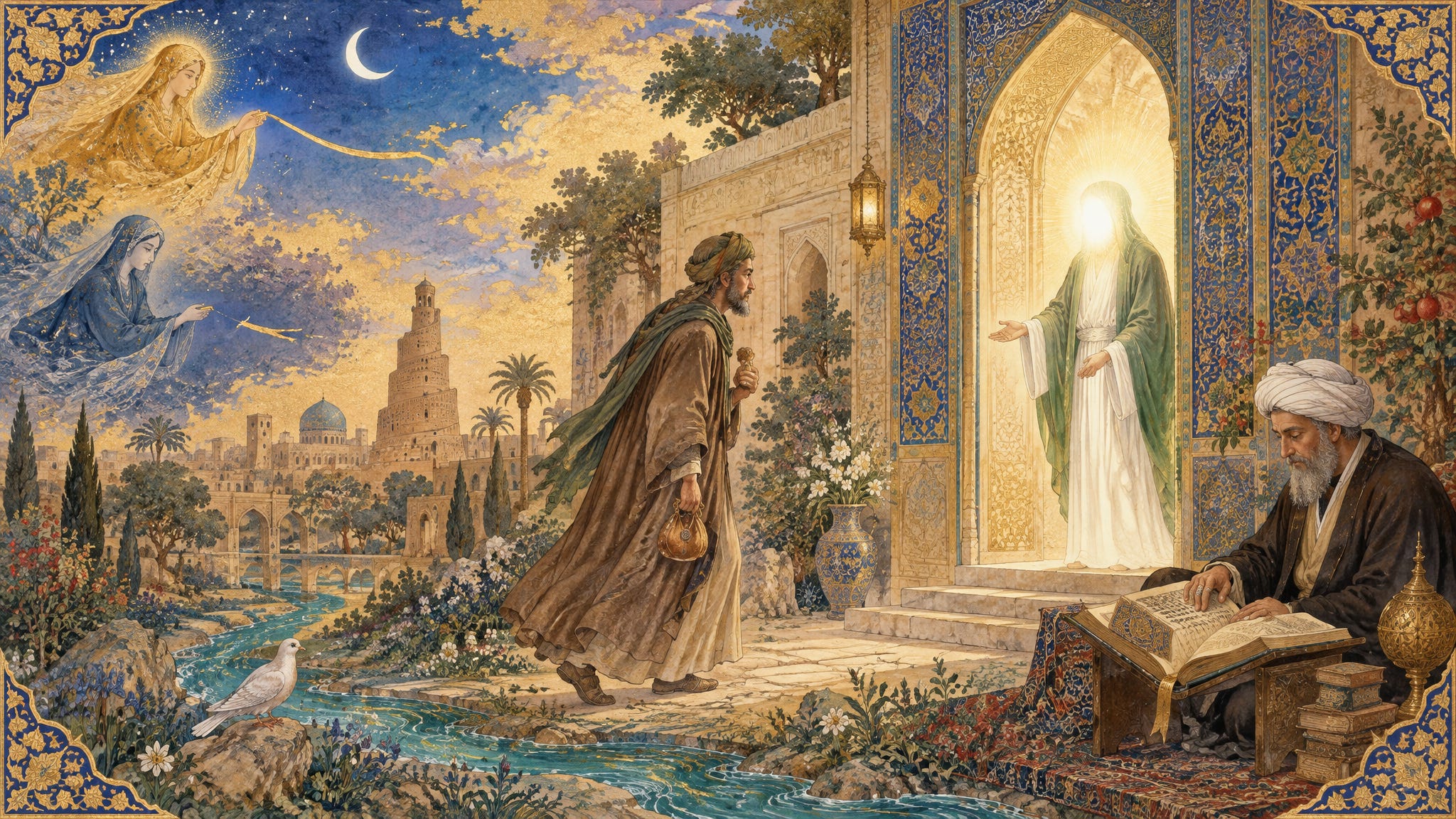
Now I want to take you into a house in Samarra, on one afternoon, in the middle of the third century after the Hijrah.
The record is in Kitab al-Ghayba — the Book of the Occultation — written by Shaykh al-Tusi, the man this entire sub-series is built around.
It is in his chapter on the evidence for the birth of the Master of the Age.
A man named Kamil ibn Ibrahim travels from Medina to see the eleventh Imam, Imam Hasan al-Askari, peace and blessings be upon him.
He has been sent.
He is a delegate.
And the book tells you who sent him — and this is the detail I want you to hold — he was sent by both sides.
By the ones who were making the Imams more than they are, and by the ones who were cutting them down below what they were.
And the two words the book uses are the two ditches, side by side in one line, before the story has even started.
وجه قوم من المفوضة والمقصرة كامل بن إبراهيم المدني إلى أبي محمد عليه السلام
“A people of the over-claimers and the under-claimers sent Kamil ibn Ibrahim al-Madani to Abu Muhammad, peace be upon him.”
— Abu Nu’aym Muhammad ibn Ahmad al-Ansari, narrating; Shaykh al-Tusi, Kitab al-Ghayba, the chapter on the evidence of the birth of the Master of the Age, report 216
Al-mufawwida and al-muqassira.
The ones who hand the Imams a power that is not theirs, and the ones who cut them short of what is.
One clause.
Both named.
Neither spared.
Two factions, at war with each other about the same house, and they pool their money and send one man between them to get a ruling.
So Kamil arrives with a question in his pocket.
It is not his question.
It is theirs.
But Kamil also has a question of his own — one nobody sent him with, one he has never said out loud to anybody, and one he has told himself he will ask.
Keep that in mind.
He is going to be corrected three times in one afternoon, and the question he came with is the last of the three.
The First Correction: Before He Has Even Sat Down
He is shown in.
And before a word of business is spoken, Kamil looks at the Imam and sees that he is wearing fine, soft clothing.
And a thought goes through him.
You know this thought.
The friend of God, dressed like that — and they tell the rest of us to share what we have with our brothers?
He has been in the room for a matter of seconds and he has already made a judgement, on the evidence of his own eyes, about a man’s inner state.
And the Imam smiles at him.
Fa-qala mutabassiman — the book keeps the smile.
Not a rebuke.
Not anger.
He smiles, and he pulls back his sleeve.
And underneath, against the skin, is coarse black haircloth.
Here is the whole of it, in the words Kamil used — his thought and the answer to it, together, because in the report they are barely a breath apart.
فقلت في نفسي:ولي الله وحجته يلبس الناعم من الثياب ويأمرنا نحن بمواساة الاخوان وينهانا عن لبس مثله!فقال متبسما: يا كامل، وحسر عن ذراعيه، فإذا مسح أسود خشن على جلده
“So I said within myself: the friend of God and His proof wears the soft of clothing, and commands us to share with our brothers, and forbids us from wearing the like of it! And he said, smiling: O Kamil — and he bared his forearms, and there was a coarse black haircloth against his skin.”
— Kamil ibn Ibrahim al-Madani, and Imam Hasan al-Askari, peace and blessings be upon him; Shaykh al-Tusi, Kitab al-Ghayba, the chapter on the evidence of the birth of the Master of the Age, report 216
And then the four words.
هذا لله وهذا لكم.
“This is for God, and this is for you.”
— Imam Hasan al-Askari, peace and blessings be upon him; Shaykh al-Tusi, Kitab al-Ghayba, the chapter on the evidence of the birth of the Master of the Age, report 216
That is the whole correction.
Four words in Arabic.
The man came to audit somebody else’s doctrine.
And the first thing that is taken away from him is his confidence about the thing he thought he could see with his own two eyes.
I am going to leave that there.
Do not let me tell you what to do with it.
The Second Correction: The Question He Never Asked

Now the unasked one.
Before he went in, Kamil had told himself — not aloud, to himself — that he would ask something like this:
Does anybody enter Paradise except the one who knows what I know, and says what I say?
Be honest about what that thought is.
It is not stupidity and it is not malice.
It is a man who holds correct positions and has come to the quiet conclusion that his correct positions are the door.
And a voice answers the question before it is spoken — from behind a curtain that the wind has just moved.
It is a child’s voice.
The report says he looked about four years old.
I am not going to hold back who he was, because this series does not do that: it is the Imam of our Age, may our souls be his ransom and may God hasten his return, and his own father will say so out loud before the afternoon is over.
جئت إلى ولي الله وحجته وبابه تسأله هل يدخل الجنة إلا من عرف معرفتك وقال بمقالتك؟ فقلت: إي والله. قال: إذن والله يقل داخلها.
“You came to the friend of God, His proof and His door, to ask him: does anyone enter the Garden except one who knows what you know and says what you say? I said: yes, by God. He said: then by God, few would enter it.”
— the Imam of our Age, may our souls be his ransom and may God hasten his return, from behind the curtain; Shaykh al-Tusi, Kitab al-Ghayba, the chapter on the evidence of the birth of the Master of the Age, report 216
And then the voice tells him who does enter.
And it does not describe them the way you would expect a correction to describe them.
والله إنه ليدخلها قوم يقال لهم الحقية. قلت: يا سيدي ومن هم؟ قال: قوم من حبهم لعلي يحلفون بحقه ولا يدرون ما حقه وفضله
“By God, a people will enter it who are called al-Haqqiyya. I said: my master, and who are they? He said: a people who, out of their love for Ali, swear by his right — and do not know what his right is, nor his merit.”
— the Imam of our Age, may our souls be his ransom and may God hasten his return, from behind the curtain; Shaykh al-Tusi, Kitab al-Ghayba, the chapter on the evidence of the birth of the Master of the Age, report 216
People who love the Commander of the Faithful, peace and blessings be upon him.
Who swear by his right.
And who could not tell you what his right actually is.
They are in.
People who love him, and swear by his right, and could not tell you what his right actually is.
They are in.
I want to be very careful with this, because it is the single most misusable sentence in tonight’s material and I am not going to hand it to you unguarded.
This is not
doctrine does not matter, only love matters.
It cannot be, and I will show you why in ninety seconds, because the same voice is about to correct a doctrinal error using a verse of the Qur’an.
What it says is something narrower and much harder.
You have made the door narrower than its Owner made it.
That is not an answer about doctrine.
That is an answer about you.
And it lands on a man who was, at that moment, quietly doing exactly what the two factions who sent him were doing at scale: using a position as a boundary fence, and standing inside it.
Remember the first saying I read you tonight.
Two men were destroyed on my account: one who loved me past the limit, and one who hated me past the limit.
Excessive love is in that sentence.
It is the first thing in it.
Nobody is telling you the love is the safe direction.
The love has to arrive somewhere true.
That is all.
And there is still a door.
The Third Correction: What He Actually Came to Ask
And only now — after his judgement of what he could see has been corrected, and after the question he never spoke has been answered — does the matter he was actually sent about get addressed.
وجئت تسأله عن مقالة المفوضة. كذبوا! بل قلوبنا أوعية لمشيئة الله، فإذا شاء شئنا، والله يقول:﴿وَمَا تَشَآؤُونَ إِلاَّ أَنْ يَشَآءَ اللهُ﴾.
“And you came to ask him about what the over-claimers say. They lied. Rather, our hearts are vessels for the will of God — when He wills, we will. And God says: ‘And you do not will except that God wills.’”
— the Imam of our Age, may our souls be his ransom and may God hasten his return, from behind the curtain; Shaykh al-Tusi, Kitab al-Ghayba, the chapter on the evidence of the birth of the Master of the Age, report 216
They lied.
Not
they are mistaken.
Not
they have a point but overstate it.
And then look at what he does next, because this is the thing I most want you to take home from this report.
He does not settle it by authority.
He does not say because I say so, which he of all people could have said.
He grounds it in a verse.
وَمَا تَشَاءُونَ إِلَّا أَنْ يَشَاءَ اللَّهُ …
“And you do not will except that God wills …”
— Qur’an, Surah al-Insan (the Chapter of Man) #76, Verse 30
That is Surah al-Insan, the seventy-sixth chapter, verse thirty.
The man came to ask whether the Imams have independent power, and the Imam answers him out of the Book — the same Book the man has in his own house.
And then the wind drops, and the curtain goes back, and Kamil finds he cannot lift it again.
ثم رجع الستر إلى حالته فلم أستطع كشفه، فنظر إلي أبومحمد عليه السلام متبسما فقال: يا كامل، ما جلوسك وقد أنبأك بحاجتك الحجة من بعدي؟
“Then the curtain went back to how it had been, and I could not draw it aside. And Abu Muhammad, peace be upon him, looked at me, smiling, and said: O Kamil — why are you still sitting there? The Proof after me has already told you what you came for.”
— Imam Hasan al-Askari, peace and blessings be upon him; Shaykh al-Tusi, Kitab al-Ghayba, the chapter on the evidence of the birth of the Master of the Age, report 216
The Proof after me.
That is the father, naming his son, in a house the state had under watch.
And notice what he has just certified.
The answer that put the over-claimers in their place, and the answer that put a good man’s narrow door back to its proper width, did not come from the eleventh Imam.
They came from a four-year-old behind a curtain — and his father’s only comment is to ask the visitor why he is still sitting down.
So count them.
One man.
One afternoon.
Three corrections.
He was corrected about what he thought he saw, corrected about a thought he never spoke, and only then given the answer to the question he had travelled from Medina to ask.
And here is what I want you to notice about the order.
The question he was sent with — the doctrinal one, the one the two factions were fighting about — came last.
It was the least urgent thing in the room.
And Now the Hard Edge

I have given you a scene.
Now I owe you the ruling, because a scene can be explained away and a ruling cannot.
Imam al-Rida, peace and blessings be upon him, the eighth of the Imams, was asked about this directly.
The record is in ʿUyun Akhbar al-Rida — the Sources of the Reports of al-Rida — a collection made by Shaykh al-Saduq, one of the great gatherers of our tradition, about a thousand years ago.
It is in the chapter on the proofs for the divine leaders and the rejection of the exaggerators.
And he answers in four words.
الْغُلَاةُ كُفَّارٌ وَالْمُفَوِّضَةُ مُشْرِكُونَ
“The exaggerators are disbelievers, and the over-claimers are associators.”
— Imam Ali ibn Musa al-Rida, peace and blessings be upon him; Shaykh al-Saduq, ʿUyun Akhbar al-Rida, Volume 2, the chapter on the proofs for the divine leaders and the rejection of the exaggerators, report 4
Mushrikun.
I want you to hear what has just happened.
That word — shirk, associating something with God — is the word that is used at us.
It is the accusation.
It is the thing that is painted on us from a thousand pulpits and a hundred thousand videos:
they are people of shirk.
And here is an Imam of our house, twelve hundred years before any of those videos existed, using that same word about our own people.
Not about outsiders.
Not about another community.
About men who claimed too much for him and for his fathers.
The accusation is not new to us.
The category is not new to us.
And we did not need to be told.
And he does not stop there.
The same report goes straight on, in the same breath, and it becomes a list — eleven things — and I am going to give you all eleven, because the force of this one is in how ordinary the first ten are.
مَنْ جَالَسَهُمْ أَوْ خَالَطَهُمْ أَوْ وَاكَلَهُمْ أَوْ شَارَبَهُمْ أَوْ وَاصَلَهُمْ أَوْ زَوَّجَهُمْ أَوْ تَزَوَّجَ إِلَيْهِمْ أَوْ أَمِنَهُمْ أَوِ ائْتَمَنَهُمْ عَلَى أَمَانَةٍ أَوْ صَدَّقَ حَدِيثَهُمْ أَوْ أَعَانَهُمْ بِشَطْرِ كَلِمَةٍ خَرَجَ مِنْ وَلايَةِ اللَّهِ عَزَّ وَجَلَّ وَوَلايَةِ الرَّسُولِ صَلَّى اللهُ عَلَيْهِ وَآلِهِ وَوَلايَتِنَا أَهْلَ الْبَيْتِ
“Whoever sat with them, or mixed with them, or ate with them, or drank with them, or kept up ties with them, or married a woman to them, or took a wife from them, or trusted them, or left something in their keeping, or believed what they said, or helped them with half a word — he has gone out of the loyalty of God, mighty and majestic, and the loyalty of the Messenger, God bless him and his family, and out of our loyalty, the People of the House.”
— Imam Ali ibn Musa al-Rida, peace and blessings be upon him; Shaykh al-Saduq, ʿUyun Akhbar al-Rida, Volume 2, the chapter on the proofs for the divine leaders and the rejection of the exaggerators, report 4
Go back over the first ten.
Sitting.
Mixing.
Eating.
Drinking.
Keeping up the relationship.
Marrying into them, or marrying them into you.
Trusting them.
Leaving something in their keeping.
Believing what they tell you.
That is not a list of crimes.
That is a list of ordinary life.
He is not describing how you join them.
He is describing how you get close enough to stop noticing.
And then the eleventh.
Or helped them with half a word.
Half a word.
Not wrote a book defending them.
Not joined them.
Half a word of help.
And there is a second report, from the same chapter, and I am going to give you all of it, because the force of it is in the list and a list with things taken out of it is not a list.
It opens on the transmigration of souls, and then it turns to the exaggerators:
مَنْ قَالَ بِالتَّنَاسُخِ فَهُوَ كَافِرٌ ثُمَّ قَالَ: لَعَنَ اللَّهُ الْغُلاةَ أَلا كَانُوا مَجُوساً أَلا كَانُوا نَصَارَى أَلا كَانُوا قَدَرِيَّةً أَلا كَانُوا مُرْجِئَةً أَلا كَانُوا حَرُورِيَّةً ثُمَّ قَالَ عَلَيْهِ السَّلامُ: لا تُقَاعِدُوهُمْ وَلا تُصَادِقُوهُمْ وَابْرَءُوا مِنْهُمْ بَرِئَ اللَّهُ مِنْهُمْ.
“Whoever holds to the transmigration of souls is a disbeliever. Then he said: May the mercy of God be distant from the exaggerators. Would that they had been Magians. Would that they had been Christians. Would that they had been Qadariyya. Would that they had been Murjiʼa. Would that they had been Haruriyya. Then he, peace be upon him, said: do not sit with them, and do not befriend them, and disavow them — God has disavowed them.”
— Imam Ali ibn Musa al-Rida, peace and blessings be upon him; Shaykh al-Saduq, ʿUyun Akhbar al-Rida, Volume 2, the chapter on the proofs for the divine leaders and the rejection of the exaggerators, report 2, on the authority of al-Husayn ibn Khalid al-Sayrafi
Five.
Five other groups he would have preferred, and some of them are groups this tradition regards as being in serious error.
He is not saying those five are fine.
He is saying he would rather these men had belonged to any one of them than that they did what they did in his family’s name.
And I want you to notice the last of the five, because it closes a circle I opened at the beginning of tonight.
Haruriyya.
That is a name for the Khawarij — the faction we met earlier tonight, the ones who broke away and fought the Commander of the Faithful, peace and blessings be upon him, and declared everybody outside their group an unbeliever.
So think about where we are.
The Commander of the Faithful stood in front of the Khawarij and warned them about the people who loved him too much.
And six generations later his descendant says he would rather the people who loved him too much had been Khawarij.
Each of them, facing one ditch, named the other.
That is not a community being soft on its own.
That is the opposite, and it is in our books, and nobody made us keep it.
That is our own house.
That is our own book.
That is an Imam whose name is on the door of a shrine that millions of us travel to every year.
Nobody came from outside and told us to write that down.
We wrote it.
We kept it.
We still read it.
And one more, and this one is not a ruling.
It is a warning, and it is about your children.
It is recorded by Allamah Muhammad Baqir al-Majlisi in Bihar al-Anwar — the Oceans of Lights, the great encyclopaedia of our reports, gathered more than three hundred years ago — and it comes, through Shaykh al-Tusi, from Imam al-Sadiq, peace and blessings be upon him.
And what the Imam says is this.
احْذَرُوا عَلَى شَبَابِكُمُ الْغُلَاةَ لَا يُفْسِدُوهُمْ، فَإِنَّ الْغُلَاةَ شَرُّ خَلْقِ اللَّهِ، يُصَغِّرُونَ عَظَمَةَ اللَّهِ وَيَدَّعُونَ الرُّبُوبِيَّةَ لِعِبَادِ اللَّهِ. وَاللَّهِ إِنَّ الْغُلَاةَ أَشَرُّ مِنَ الْيَهُودِ وَالنَّصَارَى وَالْمَجُوسِ وَالَّذِينَ أَشْرَكُوا — الْخَبَرَ
“Guard your young people against the exaggerators, so that they do not corrupt them. For the exaggerators are the worst of God’s creation: they make the greatness of God small, and they claim lordship for God’s servants. By God, the exaggerators are worse than the Jews and the Christians and the Magians and those who associate others with Him” — and the report goes on.
— Imam Ja’far al-Sadiq, peace and blessings be upon him, narrated by Fudayl ibn Yasar; Shaykh al-Tusi, al-Amali, carried by Allamah Muhammad Baqir al-Majlisi in Bihar al-Anwar, volume 76, chapter 97, report 14
And that last word is not the Imam’s.
Al-khabar — the report.
It is Allamah al-Majlisi’s own mark that he has stopped short and left the rest of it where he found it.
He is not hiding anything from you.
He is telling you there is more.
Sit with the first clause.
Not guard yourselves.
Guard your young people.
He is not worried about the scholar in the room who can see the argument coming.
He is worried about a nineteen-year-old who has just discovered how much he loves this family, and who has no measuring stick yet, and who is going to meet somebody online this week who will tell him that the love he feels is a starting point rather than a destination.
And look at the mechanism he names, because it is the same one we have been tracing all night:
they make the greatness of God small.
Not
they insult God
— nobody does that.
They shrink Him, quietly, by the size of what they attach to somebody else.
And you can see for yourself where the report goes next — a comparison of the same kind you have just heard from Imam al-Rida, peace and blessings be upon him.
It is in front of you and I am not going to run that move twice in one evening.
You have the shape of it.
What I want from this one is the first four words, and they are a duty.
Guard your young people.
One more thing, and then I am done with this point.
There is a scholar of the last century, Ayatollah Murtadha Mutahhari, may God rest his pure soul — a thinker and teacher in Iran who was assassinated shortly after the revolution, and whose books are still, for many people, their first real introduction to Islamic thought.
He wrote a small book on exactly this, called
The Attraction and Repulsion of Ali,
and it turns on the very saying I opened this point with.
And he makes one observation I want to leave with you.
The exaggerators were not random.
They did not scatter themselves evenly across history, attaching to whoever was nearest.
They clustered around him.
Because he was the kind of man about whom nobody could be neutral.
The pull was real.
What the Imam is warning you about is not the pull. It is what the pull can turn into if nothing is holding it.
Lessons for Our Time
Lesson One — A House That Polices Itself Does Not Need You to Police It

Look back at everything I have just read you.
Every single text was ours.
Our compiler.
Our Imams.
Our collections.
The book of the occultation written by the man this sub-series is built around.
The volume of reports about Imam al-Rida gathered by a scholar of Qom a thousand years ago.
Not one line of it came from an opponent, and not one line of it was extracted from us under pressure.
Nobody outside came and told us that excessive love was a danger.
We worked that out.
We wrote it down in the words you have just heard, disbelievers and associators, about the ones among us who claimed too much, and then — and this is the part that matters — we kept it in the books we still read.
We could have quietly lost those pages.
Traditions do that.
It is the easiest thing in the world to let an uncomfortable report fall out of the manuscripts over a few centuries.
We kept them.
So when somebody tells you that this community has no limits, you are not required to invent one on the spot to satisfy them.
You are required to know where they already are.
And now the honest half, because I am not going to give you only the comfortable side of this.
Writing a limit down is not the same as keeping it.
A rule that sits in a book that nobody applies is not a rule.
It is a museum piece.
And it is perfectly possible for a community to be extremely proud of a condemnation it wrote down in the tenth century while doing a milder version of it on a Thursday night.
I am not naming anybody.
I am not describing a group in this town or any other.
I am telling you what the shape of that failure looks like so that you can watch for it in the only place you are actually responsible for, which is yourself.
Lesson Two — There Are Two Ditches, and You Have Only Ever Been Warned About One
You have been warned about one edge of this road your whole life.
Do not go too far.
Do not say too much.
Be careful.
Now go back and look at what the Commander of the Faithful, peace and blessings be upon him, actually did.
He named two edges.
He put them in the same sentence.
He gave them the same verb.
And then he told you where to stand.
And I want to be precise about the test he gave, because it is not the test we usually give each other.
The test is not only
do I love them too much?
On its own, nobody can answer that — ask yourself whether you love your mother too much and see how far you get.
It produces either guilt or defensiveness, and neither of those has ever made anybody more careful about anything.
And the second ditch is not something we invented tonight to balance a sentence.
There is a verse that forbids it outright, and it uses the same verb as the verse on the limits of God.
يَا أَيُّهَا الَّذِينَ آمَنُوا لَا تُحَرِّمُوا طَيِّبَاتِ مَا أَحَلَّ اللَّهُ لَكُمْ وَلَا تَعْتَدُوا ۚ إِنَّ اللَّهَ لَا يُحِبُّ الْمُعْتَدِينَ
“O you who believe: do not forbid the good things God has made lawful to you, and do not transgress. God does not love those who transgress.”
— Qur’an, Surah al-Ma’idah (the Chapter of the Table Spread) #5, Verse 87
Forbidding yourself something God permitted is itself a transgression of the limit.
Not a lesser piety, not an excess of caution God quietly admires — the same word, i’tidā’, as crossing in the other direction:
… تِلْكَ حُدُودُ اللَّهِ فَلَا تَعْتَدُوهَا …
“… Those are the limits of God, so do not transgress them …”
— Qur’an, Surah al-Baqarah (the Chapter of the Cow) #2, Verse 229
The line runs both ways.
It always did.
And our commentator carries the occasion of that verse, from Imam Ja’far al-Sadiq, peace and blessings be upon him.
Three men made three vows.
One swore he would never sleep at night.
One swore he would never break his fast by day.
One swore he would never marry.
Not one of them was running from God.
Every one was trying to get closer, and thought he had found the way.
And the report names the three.
Bilal.
Uthman ibn Mazh’un.
And the first of the three named is the Commander of the Faithful, peace and blessings be upon him — it was he who swore he would never sleep at night.
نزلت هذه الآية في أمير المؤمنين(عليه السلام) و بلال و عثمان بن مظعون فأما أمير المؤمنين(عليه السلام)فحلف أن لا ينام بالليل أبدا، و أما بلال فإنه حلف أن لا يفطر بالنهار أبدا، و أما عثمان بن مظعون فإنه حلف أن لا ينكح أبدا.
“This verse came down concerning the Commander of the Faithful, peace be upon him, and Bilal, and Uthman ibn Mazh’un. As for the Commander of the Faithful, peace be upon him, he swore that he would never sleep at night; as for Bilal, he swore that he would never break his fast by day; and as for Uthman ibn Mazh’un, he swore that he would never marry.”
— Ali ibn Ibrahim al-Qummi, Tafsir al-Qummi, on the authority of Imam Ja’far al-Sadiq, peace and blessings be upon him; carried by Allamah Sayyed Muhammad Husayn Tabataba’i in al-Mizan fi Tafsir al-Qur’an, on Surah al-Ma’idah #5, Verses 87–89
So nobody in this room gets to file what follows under
that is for weak believers.
The wife of the third man was asked why she looked so neglected.
She said:
For whom should I adorn myself?
My husband has not come near me — he has taken to monasticism, put on coarse haircloth, and turned his back on the world.
And when word reached the Messenger of God, peace and blessings be upon him, his family, and his righteous companions, he did not send a private note.
He called the congregation to prayer, waited until they had gathered, went up the pulpit, praised God, and said this.
ما بال أقوام يحرمون على أنفسهم الطيبات؟ ألا إني أنام بالليل و أنكح و أفطر بالنهار، فمن رغب عن سنتي فليس مني
“What is the matter with people who forbid themselves the good things? Truly I sleep at night, and I marry, and I break my fast by day — and whoever turns away from my way is not of me.”
— the Messenger of God, peace and blessings be upon him, his family, and his righteous companions; Ali ibn Ibrahim al-Qummi, Tafsir al-Qummi, on the authority of Imam Ja’far al-Sadiq, peace and blessings be upon him; carried by Allamah Sayyed Muhammad Husayn Tabataba’i in al-Mizan fi Tafsir al-Qur’an, on Surah al-Ma’idah #5, Verses 87–89
Not of me.
From the Messenger of God, from the pulpit — and it was not aimed at someone who drank, or stole, or abandoned the prayer.
It was said to everyone, about trying to be more religious than the religion.
And notice the garment, because it came up earlier tonight and I did not point at it then.
Coarse haircloth.
Al-musūḥ.
… فإنه قد ترهب و لبس المسوح و زهد في الدنيا.
“… for he has taken to monasticism, and put on coarse haircloth, and renounced the world.”
— the wife of Uthman ibn Mazh’un; Ali ibn Ibrahim al-Qummi, Tafsir al-Qummi, on the authority of Imam Ja’far al-Sadiq, peace and blessings be upon him; carried by Allamah Sayyed Muhammad Husayn Tabataba’i in al-Mizan fi Tafsir al-Qur’an, on Surah al-Ma’idah #5, Verses 87–89
The same cloth Imam Hasan al-Askari, peace and blessings be upon him, had against his skin when Kamil ibn Ibrahim walked in and judged him for the fine clothes on top of it.
فقال متبسما: يا كامل، وحسر عن ذراعيه، فإذا مسح أسود خشن على جلده، فقال: هذا لله وهذا لكم.
“And he said, smiling: O Kamil — and he bared his forearms, and there was a coarse black haircloth against his skin; and he said: This is for God, and this is for you.”
— Kamil ibn Ibrahim al-Madani, and Imam Hasan al-Askari, peace and blessings be upon him; Shaykh al-Tusi, Kitab al-Ghayba, the chapter on the evidence of the birth of the Master of the Age, report 216
Same cloth.
Two men.
Opposite verdicts.
Worn underneath, with this is for God and this is for you — a man inside the limit.
Worn instead of what God permitted, as a public renunciation — not of me, from the pulpit, to the whole congregation.
The cloth was never the point.
The Commander of the Faithful’s test is not what you wear, and not only how much you love.
It is this:
Where is this love taking me?
Because the love that carries you toward the truth and the love that carries you away from it feel exactly the same from the inside.
That is the whole problem.
Nobody has ever gone past the limit while feeling like a person who is going past the limit.
They felt like a person who loved correctly, and slightly more than the people around them, and they were rather pleased about it.
Only the destination tells them apart.
And one last thing, because I know what the word middle does to a room.
Al-namat al-awsat — the middle course — is not lukewarm.
It does not mean love them a medium amount.
It does not mean hedge, or keep your enthusiasm in reserve, or be the person in the majlis who is too sophisticated to weep.
That is not moderation.
That is just a smaller version of the second ditch.
It is a road.
A road is a place you travel with everything you have.
It has ditches on both sides, and the reason you stay on it is not that you are being careful with your love.
It is that you would like to arrive.
Where the Line Actually Falls
Look Again at Who the Verse Is About

Come back to the verse we opened on.
يَا أَهْلَ الْكِتَابِ لَا تَغْلُوا فِي دِينِكُمْ وَلَا تَقُولُوا عَلَى اللَّهِ إِلَّا الْحَقَّ ۚ إِنَّمَا الْمَسِيحُ عِيسَى ابْنُ مَرْيَمَ رَسُولُ اللَّهِ
“O People of the Book, do not go to excess in your religion, and do not say of God other than the truth. The Messiah, Jesus son of Mary, is only the Messenger of God.”
— Qur’an, Surah al-Nisa (the Chapter of the Women) #4, Verse 171
Last week we spent an entire evening inside that house.
We read their books.
We gave Jesus son of Mary, may our souls be his ransom, and may God hasten his return, the honour we owe him.
And there were half a dozen cheap points available to us over the course of that hour and we took none of them.
So I am not going to stand here tonight and ask you to look down on anybody.
I am asking you to look at a mechanism.
Here is a community that loved a prophet.
Genuinely loved him.
Nothing in the Qur’an suggests otherwise, and the verse does not accuse them of hating God or of wanting an idol.
They loved him, and the loving went past the limit, and what came out the other end was a claim about God that was not true.
That is the mechanism.
Love, then a claim, then a false claim about God.
And the only honest question a person can ask after watching that happen in somebody else’s house is whether the same mechanism has any purchase in ours.
Because a mechanism does not care whose house it is in.
One Author, One Book, Two Verdicts

Now I want to read you two passages, and they are from the same man, in the same work, about the same act.
The man is Allamah Sayyed Muhammad Husayn Tabataba’i, may God rest his pure soul — a scholar and philosopher of Tabriz who taught for decades in Qom and died about forty-five years ago, and whose commentary on the Qur’an, al-Mizan, is the one this congregation has heard from almost every week of this sub-series.
Here he is on the second chapter, Surah al-Baqarah, on these two verses:
وَاسْتَعِينُوا بِالصَّبْرِ وَالصَّلَاةِ ۚ وَإِنَّهَا لَكَبِيرَةٌ إِلَّا عَلَى الْخَاشِعِينَ الَّذِينَ يَظُنُّونَ أَنَّهُمْ مُلَاقُو رَبِّهِمْ وَأَنَّهُمْ إِلَيْهِ رَاجِعُونَ
“And seek help through patience and prayer; and it is indeed hard, except for the humble — those who are certain that they will meet their Lord, and that to Him they will return.”
— Qur’an, Surah al-Baqarah (the Chapter of the Cow) #2, Verses 45 and 46
And here he is, drawing out what an Imam took from those verses — the ordinary things a believer legitimately does at a time of hardship:
قد استفاد(عليه السلام)استحباب الصوم و الصلاة عند نزول الملمات و الشدائد، و كذا التوسل بالنبي و الولي عندها، و هو تأويل الصوم و الصلاة برسول الله و أمير المؤمنين.
“He, peace be upon him, drew from it that fasting and prayer are recommended when calamities and hardships come down — and likewise, seeking a means through the Prophet and the friend of God at such times; and that is the inner reading of fasting and prayer as the Messenger of God and the Commander of the Faithful.”
— Allamah Sayyed Muhammad Husayn Tabataba’i, al-Mizan fi Tafsir al-Qur’an, on Surah al-Baqarah #2, Verses 45 and 46
Al-tawassul — seeking a means.
Asking through somebody.
Placed by him among the normal furniture of a believing life.
No caveat, no warning label, no defensive paragraph.
It sits in a list.
And hear his last clause properly, because it is the kind of line that gets clipped.
It is ta’wil, the inner reading of the verse, and it replaces nothing — he has just told you that the fasting and the prayer are recommended.
In hardship you also seek help through the Messenger of God, peace and blessings be upon him, his family, and his righteous companions, and through the Commander of the Faithful, peace and blessings be upon him.
Through them. The help is still God’s.
Now the third chapter, Surah Al Imran, on verses seventy-nine and eighty.
Same author.
Same commentary.
مَا كَانَ لِبَشَرٍ أَنْ يُؤْتِيَهُ اللَّهُ الْكِتَابَ وَالْحُكْمَ وَالنُّبُوَّةَ ثُمَّ يَقُولَ لِلنَّاسِ كُونُوا عِبَادًا لِي مِنْ دُونِ اللَّهِ وَلَٰكِنْ كُونُوا رَبَّانِيِّينَ بِمَا كُنْتُمْ تُعَلِّمُونَ الْكِتَابَ وَبِمَا كُنْتُمْ تَدْرُسُونَ وَلَا يَأْمُرَكُمْ أَنْ تَتَّخِذُوا الْمَلَائِكَةَ وَالنَّبِيِّينَ أَرْبَابًا ۗ أَيَأْمُرُكُمْ بِالْكُفْرِ بَعْدَ إِذْ أَنْتُمْ مُسْلِمُونَ
“It is not for any human being that God should give him the Book, and judgement, and prophethood, and that he should then say to people: be servants of mine, apart from God. Rather: be devoted to the Lord, by what you have been teaching of the Book and by what you have been studying. Nor would he command you to take the angels and the prophets as lords. Would he command you to disbelief, after you have submitted?”
— Qur’an, Surah Al Imran (the Chapter of the Family of Imran) #3, Verses 79 and 80
And here is what he says on them:
فرد عبادة من يعبد مع عبادته غيره حتى بعنوان التقرب و التوسل و الاستشفاع.
“So God rejected the worship of one who worships another alongside his worship of Him — even under the heading of drawing near, and seeking a means, and asking for intercession.”
— Allamah Sayyed Muhammad Husayn Tabataba’i, al-Mizan fi Tafsir al-Qur’an, on Surah Al Imran #3, Verses 79 and 80
Hatta bi-ʿunwan — even under the heading of.
Read those two passages one after the other and let the difficulty land properly, because I do not want to make this easier than it is.
The same man.
The same book.
The same word — tawassul, both times.
And in one place it is what believers do, and in the other it is worship of something other than God.
He is not contradicting himself.
He is doing something far more useful, and far more uncomfortable.
He is telling you that the act does not carry its own verdict.
And on that same page in Surah Al Imran, he is reading the formula the Qur’an puts in the mouths of the idolaters —
we do not worship them except that they may bring us nearer to God
— and setting it beside the believer’s practice, and drawing the line between the two.
The pagan formula and the believer’s practice, in one breath, from one pen.
Two Men at the Same Grave

So here is what those two passages, put together, actually say.
Two men can stand at the same grave, on the same afternoon, and do the identical thing with their hands and their mouths — and for one of them it is worship, and for the other it is not.
And I know exactly what that sounds like.
It sounds like the objection I read you at the start of the evening.
You say it is about intention, and intention is invisible, so your answer can never be checked.
But notice who said it.
That is not a defence lawyer for our community.
That is a commentator, writing a commentary, who was not answering anybody’s accusation.
He wrote that sentence because it is what the verse means, and he wrote the other one for the same reason.
And I want you to feel which direction this cuts.
An invisible line is not a licence.
An invisible line is harder.
It is a line you can cross without anyone seeing you do it, including yourself.
That is not a comfortable thing to be handed.
It is just true.
And the Limit Comes from the Book, Not from Me

Now I owe you something, because it is not enough to tell a congregation that a line is hard to see and then sit down.
That is a sermon that leaves people more anxious than it found them, and I have no interest in giving one.
So where is the line?
Not from me.
From the Qur’an.
In the tenth chapter, Surah Yunus, and in the thirty-ninth, Surah al-Zumar, God quotes the idolaters describing their own practice in their own words.
And what they say is not we hate God.
Nobody in the Qur’an says that.
What they say is: these are our intercessors with God.
وَيَعْبُدُونَ مِنْ دُونِ اللَّهِ مَا لَا يَضُرُّهُمْ وَلَا يَنْفَعُهُمْ وَيَقُولُونَ هَٰؤُلَاءِ شُفَعَاؤُنَا عِنْدَ اللَّهِ ۚ قُلْ أَتُنَبِّئُونَ اللَّهَ بِمَا لَا يَعْلَمُ فِي السَّمَاوَاتِ وَلَا فِي الْأَرْضِ ۚ سُبْحَانَهُ وَتَعَالَىٰ عَمَّا يُشْرِكُونَ
“And they worship, apart from God, what neither harms them nor benefits them, and they say: these are our intercessors with God. Say: would you inform God of something He does not know, in the heavens or on the earth? Glory be to Him, and exalted is He above what they associate with Him.”
— Qur’an, Surah Yunus (the Chapter of Jonah) #10, Verse 18
And:
أَلَا لِلَّهِ الدِّينُ الْخَالِصُ ۚ وَالَّذِينَ اتَّخَذُوا مِنْ دُونِهِ أَوْلِيَاءَ مَا نَعْبُدُهُمْ إِلَّا لِيُقَرِّبُونَا إِلَى اللَّهِ زُلْفَىٰ إِنَّ اللَّهَ يَحْكُمُ بَيْنَهُمْ فِي مَا هُمْ فِيهِ يَخْتَلِفُونَ ۗ إِنَّ اللَّهَ لَا يَهْدِي مَنْ هُوَ كَاذِبٌ كَفَّارٌ
“Truly, to God belongs the sincere religion. And those who take protectors apart from Him — ‘we do not worship them except that they may bring us nearer to God in rank’ — God will judge between them in what they differ over. God does not guide one who is a liar, ungrateful.”
— Qur’an, Surah al-Zumar (the Chapter of the Throngs) #39, Verse 3
Read that sentence as though you had never been told whose it is.
We do not worship them except that they may bring us nearer to God.
There is no denial of God in it anywhere.
God is named, God is the destination, and the entire stated purpose of the practice is to get closer to Him.
That is the theology of idolatry, in the Qur’an’s own quotation of it.
And it does not look like what you were taught idolatry looks like.
They are not denying God.
They have Him at the top.
They have simply built a structure underneath Him and put their confidence into it.
And I want to be honest with you about why that verse is uncomfortable rather than reassuring.
It is uncomfortable because the sentence is so reasonable.
If somebody said it to you at a dinner table you would not flinch.
You might even agree with it.
Now watch how God answers.
He does not say
there is no such thing as intercession.
That answer was available and He did not give it.
Intercession is in the Qur’an.
It is not in dispute.
What He says, in the twenty-first chapter, Surah al-Anbiya, is that it runs only for the one He is pleased with, and only by His command.
وَقَالُوا اتَّخَذَ الرَّحْمَٰنُ وَلَدًا ۗ سُبْحَانَهُ ۚ بَلْ عِبَادٌ مُكْرَمُونَ لَا يَسْبِقُونَهُ بِالْقَوْلِ وَهُمْ بِأَمْرِهِ يَعْمَلُونَ يَعْلَمُ مَا بَيْنَ أَيْدِيهِمْ وَمَا خَلْفَهُمْ وَلَا يَشْفَعُونَ إِلَّا لِمَنِ ارْتَضَىٰ وَهُمْ مِنْ خَشْيَتِهِ مُشْفِقُونَ
“And they say: the All-Merciful has taken offspring. Glory be to Him! Rather, they are honoured servants. They do not speak before He speaks, and they act by His command. He knows what is before them and what is behind them, and they do not intercede except for one He is pleased with, and they tremble in awe of Him.”
— Qur’an, Surah al-Anbiya (the Chapter of the Prophets) #21, Verses 26 to 28
Read that twice, because it is the whole of tonight in one clause.
The limit is not on the asking.
The limit is on the granting.
You may ask.
Of course you may ask — you ask your mother to pray for you, you ask the man next to you in the majlis to remember you, and nobody has ever thought that was a theological crisis.
Asking somebody God loves to ask for you is asking.
What you may not do is treat the asking as though it had settled something.
As though a transaction had been completed.
As though the one you asked were now obliged, or able on his own, to deliver.
Because he is not the one who grants.
And neither are you.
That is a line a fourteen-year-old can hold, and it does not require anybody to look inside anybody’s heart.
And He Does Not Leave It with Them
One last thing in this point, and it is short, and it is the reason the rest of tonight is allowed to happen.
You could read the verse we opened on and conclude that it is a historical remark.
O People of the Book — so it is about them, it was about them then, and the file is closed.
Allamah Tabataba’i does not read it that way.
In his commentary on the eleventh chapter, Surah Hud, he takes that prohibition and applies it beyond the People of the Book — treating anyone who credits a prophet or a friend of God with knowledge or power in his own right as having fallen under the same word.
The verse he is reading has the Prophet Noah, peace and blessings be upon him, telling his people what he does not claim:
وَلَا أَقُولُ لَكُمْ عِنْدِي خَزَائِنُ اللَّهِ وَلَا أَعْلَمُ الْغَيْبَ وَلَا أَقُولُ إِنِّي مَلَكٌ وَلَا أَقُولُ لِلَّذِينَ تَزْدَرِي أَعْيُنُكُمْ لَنْ يُؤْتِيَهُمُ اللَّهُ خَيْرًا ۖ اللَّهُ أَعْلَمُ بِمَا فِي أَنْفُسِهِمْ ۖ إِنِّي إِذًا لَمِنَ الظَّالِمِينَ
“And I do not say to you that I hold the treasuries of God, and I do not know the unseen, and I do not say that I am an angel; nor do I say of those whom your eyes look down upon that God will never give them any good — God knows best what is in their souls — for then I would surely be among the wrongdoers.”
— Qur’an, Surah Hud (the Chapter of Prophet Hud)#11, Verse 31
And this is what he says on it:
فمن أثبت شيئا من العلم المكنون أو القدرة الغيبية أعني العلم من غير طريق الفكر و القدرة من غير مجراها العادي الطبيعي لغيره تعالى من أنبيائه و أوليائه كما وقع كثيرا في الأخبار و الآثار و نفى معه الأصالة و الاستقلال بأن يكون العلم و القدرة مثلا له تعالى و إنما ظهر ما ظهر منه بالتوسيط و وقع ما وقع منه بإفاضته وجوده فلا حجر عليه.
و من أثبت شيئا من ذلك على نحو الأصالة و الاستقلال طبق ما يثبته الفهم العامي و إن أسنده إلى الله سبحانه و فيض رحمته لم يخل من غلو و كان مشمولا لمثل قوله:«لا تغلوا في دينكم و لا تقولوا على الله إلا الحق:»النساء: - 171.
“So whoever affirms something of hidden knowledge or unseen power — I mean knowledge that does not come by way of thought, and power that does not run its ordinary, natural course — for other than Him, exalted is He, among His prophets and His friends, as occurs often in the reports and traditions, and denies along with it that it is theirs in their own right and independently, so that the knowledge and the power, for instance, belong to Him, exalted is He, and whatever of it appeared, appeared only through intermediation, and whatever of it occurred, occurred by His bestowing its existence — there is no objection against him.
And whoever affirms something of that as theirs in their own right and independently, the way the common understanding affirms it — even if he ascribes it to God, glorified is He, and to the outpouring of His mercy — is not free of excess, and falls under the like of His word: ‘Do not go to excess in your religion, and do not say of God other than the truth’ (Surah al-Nisa, 171).”
— Allamah Sayyed Muhammad Husayn Tabataba’i, al-Mizan fi Tafsir al-Qur’an, on Surah Hud #11, Verses 25 to 35
So the verse we opened on is not a description of somebody else’s history.
It is a rule, and rules do not stop at a border.
Which means I am now permitted to do the thing I have been building towards all evening, and it is the last third of the night, and it is not about anybody else.
Lessons for Our Time
Lesson Three — The Gesture Is Not the Test
I want to give you something practical, because a great deal of what gets said about this subject is unusable.
The test is not
what did you do at the grave.
It is not whether you stood or sat, whether you touched the lattice or kept your hands at your sides, whether you wept or stayed dry, whether you went in a crowd of two million or alone on a Thursday afternoon in any town or city.
None of those is the test, because — as we have just read from a man nobody can accuse of being soft on this — the identical gesture goes either way.
The test is the grammar of the request.
Whose is it to give, and whose is it to grant?
And here is the form of words.
I want you to be able to say it, and I want it to be short enough that you could say it to a colleague at work without a preamble:
I am asking someone God loves to ask for me.
I am not asking him to decide.
That is it.
That is the whole line, and you can carry it in one breath.
Now test it against the pagans in the verse.
These are our intercessors with God — said of what they worship, apart from God.
Not
these are people who will intercede if God permits it.
A relationship that has been secured, a channel that has been opened, an outcome that is now in hand.
And test it against the Prophet, peace and blessings be upon him, his family, and his righteous companions, standing at al-Baqi’ and greeting the dead — which we spent an evening on, three sessions ago, and which nobody has ever called idolatry.
كَانَ رَسُولُ اللَّهِ (ص) يَخْرُجُ فِي مَلَإٍ مِنَ النَّاسِ مِنْ أَصْحَابِهِ كُلَّ عَشِيَّةِ خَمِيسٍ إِلَى بَقِيعِ الْمَدَنِيِّينَ فَيَقُولُ ثَلَاثاً- السَّلَامُ عَلَيْكُمْ يَا أَهْلَ الدِّيَارِ وَ ثَلَاثاً رَحِمَكُمُ اللَّهُ ثُمَّ يَلْتَفِتُ أَصْحَابَهُ وَ يَقُولُ هَؤُلَاءِ خَيْرٌ مِنْكُمْ فَيَقُولُونَ يَا رَسُولَ اللَّهِ وَ لِمَ آمَنُوا وَ آمَنَّا وَ جَاهَدُوا وَ جَاهَدْنَا فَيَقُولُ إِنَّ هَؤُلَاءِ آمَنُوا وَ لَمْ يَلْبِسُوا إِيمانَهُمْ بِظُلْمٍ وَ مَضَوْا عَلَى ذَلِكَ وَ أَنَا عَلَى ذَلِكَ شَهِيدٌ وَ أَنْتُمْ تَبْقَوْنَ بَعْدِي وَ لَا أَدْرِي مَا تُحْدِثُونَ بَعْدِي
“The Messenger of God, God bless him and his family, would go out, in a crowd of people from among his companions, every Thursday evening, to the Baqi’ of the people of Medina, and say three times: peace be upon you, O people of these dwellings; and three times: may God have mercy on you. Then he would turn to his companions and say: these are better than you. And they would say: O Messenger of God, why? They believed and we believed; they struggled and we struggled. And he would say: these believed, and did not dress their faith in wrongdoing, and they went on that — and to that I am a witness. And you remain after me, and I do not know what you will bring about after me.”
— the Messenger of God, peace and blessings be upon him, his family, and his righteous companions; narrated by Safwan al-Jammal, from Imam Ja’far al-Sadiq, peace and blessings be upon him; Ibn Qulawayh, Kamil al-Ziyarat, the chapter on the Merits of Visiting the Believers, sixth hadith
Everything after the greeting is what we sat with that evening — their account is closed, and ours is still open.
Tonight, look at the greeting.
The words in your mouth can be almost identical.
The grammar underneath them is not.
And I want to give you one more handle on this, because I think it is the most useful thing in tonight’s whole evening for ordinary life.
Ask what happens if the answer is no.
If you stand at a grave, and you ask, and what you asked for does not come — what then?
Does the relationship survive it?
Because if it does, you were asking.
And if it does not — if there is anger, or a sense of a bargain broken, or a quiet conclusion that the visit did not work and next time you will go somewhere it does — then something had been built that was never in the request you thought you were making.
Nobody can see that from outside.
Not the man questioning you, not the person next to you in the majlis, and not me.
You can see it.
That is not a loophole.
That is the most demanding form this could possibly take, and it is the one our own commentator handed us when he said the same act goes either way.
Lesson Four — Be Able to Say What You Are Not Doing

And now the harder one, and it is the answer to the objection I read you at the beginning.
The objection said we have no limits.
And I told you that we do, and I have spent an hour showing them to you.
But there is one half of that objection which is true, and I am not going to pretend it away.
A limit that a community cannot state out loud is, in practice, not a limit.
If you ask somebody what their boundary is and they say well, it’s about the intention, and they cannot go one sentence further, then whatever is in their heart, what they have given you is not a boundary.
It is a way of ending the conversation.
So here is the discipline, and it is a discipline for you and not for them.
Be able to say what you are not doing.
Not
I am fine.
Not
my intention is correct,
which is the one sentence nobody on earth can check, including the person saying it.
Say the thing you would be wrong to say — out loud, in your own words — and then say that you do not say it.
I do not believe the granting is his.
I do not believe he has power of his own.
I do not believe that standing here has put anything beyond God’s decision.
I am asking somebody God loves to ask for me, and God grants or God does not.
Say that, and something has happened that did not happen before.
You have handed somebody a stick to hit you with.
You have described the exact failure that would count against you, and you have put it in their hand, and you have said:
hold me to that.
And a person who does that is a person who can be corrected — which means, and this is the point, that they can also be trusted.
That is what a real limit looks like.
Not a shield.
A handle, offered to somebody else.
And I will tell you what it protects you from, and it is not the man on the internet.
It protects you from yourself in twenty years.
Because nobody goes past the limit in a single evening.
Nobody stands up one day and decides to attach to a servant of God something that belongs to God.
It is not a decision.
It is a drift, and a drift is only ever visible against something fixed.
A sentence you said out loud in front of people, ten years ago, about what you were not doing — that is something fixed.
That is the entire function of writing a limit down, and it is why our own house wrote theirs down in language so severe that we are still slightly embarrassed to read it aloud.
They were not describing their enemies.
They were leaving a mark on the wall for their own children to measure against.
We have spent the last stretch of this evening standing at a grave.
We have talked about the danger of handing the one in the grave a power to decide that belongs only to God.
But I told you earlier that a mechanism does not care whose house it is in.
And it does not care whether the one you raise too high was buried more than a thousand years ago, or is a scholar alive in our own time.
Because there is another way to go past the limit, and it does not need a grave at all.
The Turn, and It Is Aimed at Us
The Verse They Point At
There is a verse in the ninth chapter, Surah al-Tawbah, that gets used against this community more than almost any other.
اتَّخَذُوا أَحْبَارَهُمْ وَرُهْبَانَهُمْ أَرْبَابًا مِنْ دُونِ اللَّهِ وَالْمَسِيحَ ابْنَ مَرْيَمَ وَمَا أُمِرُوا إِلَّا لِيَعْبُدُوا إِلَٰهًا وَاحِدًا ۖ لَا إِلَٰهَ إِلَّا هُوَ ۚ سُبْحَانَهُ عَمَّا يُشْرِكُونَ
“They took their rabbis and their monks as lords apart from God — and the Messiah, son of Mary — when they were commanded only to worship one God. There is no god but He. Glory be to Him above what they associate with Him.”
— Qur’an, Surah al-Tawbah (the Chapter of Repentance) #9, Verse 31
And here is the argument that comes with it, and I am going to state it at full strength, the way I did at the beginning, because a warning I soften is a warning you will correctly ignore.
That verse is about you.
You have a living man in Najaf or Qom.
You do not know him.
You have never met him.
You cannot check his reasoning, and most of you could not follow it if you could.
He issues rulings and you follow them — what you eat, what you wear, what you do with your money, who you may marry.
You call it religion.
The Christians called it religion too.
Do not look away from that.
It is a serious argument, a great deal better than the one about shrines, and I have never once heard it answered properly in a majlis.
I am not going to answer it yet either.
First I want to read you what our own tradition says the verse actually means — because as I have done all night, our own authority goes first.
Our Own Commentator, First

Allamah Tabataba’i, on the fifth chapter, Surah al-Ma’idah, tells you how this verse was read, and by whom:
و قد فسر النبي(صلى الله عليه وآله وسلم)قوله تعالى في أهل الكتاب:«اتخذوا أحبارهم و رهبانهم أربابا من دون الله»أنهم اتبعوهم فيما يحلون و يحرمون لا أنهم سموهم أربابا.
“And the Prophet, God bless him and his family and grant them peace, explained His word about the People of the Book — ‘They took their rabbis and their monks as lords apart from God’ — to mean that they followed them in what they made lawful and unlawful — not that they called them lords.”
— Allamah Sayyed Muhammad Husayn Tabataba’i, al-Mizan fi Tafsir al-Qur’an, on Surah al-Ma’idah #5, Verses 116 to 120
Stop there.
La annahum sammawhum arbaban — not that they called them lords.
Nobody in that verse ever said the word.
Not one of them stood up and said this man is my lord.
If you had gone to them and accused them of it they would have been horrified, and they would have been sincere.
The lordship was not a title anybody claimed and it was not a title anybody conferred.
It was a pattern of obedience, and God looked at the pattern and named it for what it was, and the people inside the pattern had no idea.
And notice where that reading comes from.
It is not Allamah Tabataba’i’s invention, and he does not present it as one.
He gives it to the Prophet himself, peace and blessings be upon him, his family, and his righteous companions.
And an Imam Said It Harder
And Imam al-Sadiq, peace and blessings be upon him, the sixth of the Imams, spoke on this same verse — and his word on it is the one I wish I could put on a wall.
It is recorded by Shaykh al-Kulayni — the compiler, the man who gathered the reports into the collection this tradition has leaned on ever since — in al-Kafi, the earliest of the four great collections.
And he placed it in the chapter on taqlid: on following another man’s opinion.
وَالله مَا صَامُوا لَهُمْ وَلا صَلَّوْا لَهُمْ وَلَكِنْ أَحَلُّوا لَهُمْ حَرَاماً وَحَرَّمُوا عَلَيْهِمْ حَلالاً فَاتَّبَعُوهُمْ.
“By God, they did not fast for them, and they did not pray to them. But they made lawful for them what was unlawful, and made unlawful for them what was lawful — and so they followed them.”
— Imam Ja’far al-Sadiq, peace and blessings be upon him, narrated by Abu Basir; Shaykh al-Kulayni, al-Kafi, Volume 1, the Book on Virtue of Knowledge, the chapter on Taqlid, third hadith
By God, he said — they did not fast for them, and they did not pray to them.
They followed them.
That is the whole distinction, and it is brutal, and it removes every comfortable exit.
Because you were about to reach for one.
You were about to say:
well, we do not worship our scholars, so the verse cannot be about us.
And an Imam of your own house has just told you that
nobody in the verse worshipped anybody the way you mean either.
They did not fast for a rabbi.
They did not pray to a monk.
They would have said, with total sincerity, exactly what you were about to say.
The Sentence This Whole Evening Was Built to Deliver

So here it is, and it is the sentence I have been walking towards for an hour.
The line is not crossed by loving somebody.
It is crossed by letting a man make lawful what God made unlawful.
Which means — and I want you to actually take this in, because it reverses the whole argument of the evening — the charge in that verse was never about shrines at all.
It was never about graves, or domes, or standing somewhere and greeting somebody.
It is about obedience.
And that lands on us.
Not on a community across town, not on somebody on the internet.
On a congregation that follows a marja’.
Let it land.
I am not going to catch it for you.
And Now the Words I Have Been Reading Past
Now go back to the verse and look at the four words I have been quoting without pressing them.
Arbaban min duni Llah.
Lords apart from God.
Not lords.
Lords apart from God.
And that changes the accusation completely, because it means the fault was never obedience as such.
Obedience is everywhere.
You obey a doctor.
You obey the man who teaches you to drive.
Every functioning human life is full of obedience and none of it is idolatry.
The fault is obedience that terminates.
An authority that answers to nobody above it.
A word that is the end of the matter.
Somebody whose because I said so is where the chain stops.
And now set beside it the words that this whole series stands on — a written instruction of the Imam of our Age, may our souls be his ransom and may God hasten his return, sent out through the second of his four deputies, about where the community was to turn:
وأما الحوادث الواقعة فارجعوا فيها إلى رواة حديثنا، فإنهم حجتي عليكم وأنا حجة الله (عليكم).
“As for the events that occur, refer in them to the narrators of our hadith; for they are my proof over you, and I am the proof of God (over you).”
— the Imam of our Age, may our souls be his ransom and may God hasten his return, in his written answer to Ishaq ibn Ya’qub, carried by Muhammad ibn Uthman al-Amri; Shaykh al-Tusi, Kitab al-Ghayba, the chapter on the letters issued by the Master of the Age, report 247
Hear the possessive.
Hujjati — my proof.
Not a proof.
Not the proof.
Not an authority standing on its own feet.
A proof that belongs to somebody else, held on behalf of somebody else, and answerable to somebody else.
And the same sentence names the next link itself:
and I am the proof of God.
That is a link in a chain.
The verse is describing a chain that stopped.
A Man Who Had a Real Command, and It Did Not Save Him
And now somebody in this room is thinking the obvious thing, and it is a fair thing, and I am not going to leave you with it.
How am I supposed to know when the scholar is wrong?
That is the entire reason I follow one.
There is a report carried in al-Mizan, in the commentary on the thirty-first chapter, Surah Luqman, and it is the best answer I have ever found to that question, because it does not answer it with a principle.
وَإِذْ قَالَ لُقْمَانُ لِابْنِهِ وَهُوَ يَعِظُهُ يَا بُنَيَّ لَا تُشْرِكْ بِاللَّهِ ۖ إِنَّ الشِّرْكَ لَظُلْمٌ عَظِيمٌ
وَوَصَّيْنَا الْإِنسَانَ بِوَالِدَيْهِ حَمَلَتْهُ أُمُّهُ وَهْنًا عَلَىٰ وَهْنٍ وَفِصَالُهُ فِي عَامَيْنِ أَنِ اشْكُرْ لِي وَلِوَالِدَيْكَ إِلَيَّ الْمَصِيرُ
وَإِن جَاهَدَاكَ عَلَىٰ أَن تُشْرِكَ بِي مَا لَيْسَ لَكَ بِهِ عِلْمٌ فَلَا تُطِعْهُمَا ۖ وَصَاحِبْهُمَا فِي الدُّنْيَا مَعْرُوفًا ۖ وَاتَّبِعْ سَبِيلَ مَنْ أَنَابَ إِلَيَّ ۚ ثُمَّ إِلَيَّ مَرْجِعُكُمْ فَأُنَبِّئُكُم بِمَا كُنتُمْ تَعْمَلُونَWhen Luqman said to his son, as he advised him, “O my son, do not associate anything with God, for idolatry is a terrible wrong.”
We have entrusted the human being with the care of his parents. His mother carried him through hardship upon hardship, weaning him in two years. So give thanks to Me, and to your parents. To Me is the destination.
But if they strive to have you associate with Me something of which you have no knowledge, do not obey them. But keep them company in this life, in kindness, and follow the path of him who turns to Me. Then to Me is your return; and I will inform you of what you used to do.— Qur’an, Surah Luqman (the Chapter of Luqman) #31, Verses 13, 14 and 15
It answers it with a man.
Imam Husayn, peace and blessings be upon him, meets a man who fought against him and against his father at Siffin. And he says to him — and I want you to hear how the question is put:
أَتَعْلَمُ أَنِّي أَحَبُّ أَهْلِ الأَرْضِ إِلَى أَهْلِ السَّمَاءِ وَتُقَاتِلُنِي وَأَبِي يَوْمَ صِفِّينَ؟ وَاللَّهِ إِنَّ أَبِي لَخَيْرٌ مِنِّي
“Do you know that I am the most beloved of the people of the earth to the people of heaven — and you fought me and my father on the day of Siffin? By God, my father is better than I am.”
— Imam Husayn ibn Ali, peace and blessings be upon him; carried by Allamah Sayyed Muhammad Husayn Tabataba’i in al-Mizan fi Tafsir al-Qur’an on Surah Luqman #31, Verses 12 to 19, from al-Manaqib
And the man gives his defence.
And his defence is not a bad one.
He says this:
فاستعذر و قال إن النبي (صلى الله عليه وآله وسلم) قال لي: أطع أباك.
“He made his excuse, and said: the Prophet, God bless him and his family and grant them peace, said to me: obey your father.”
— the man, answering Imam Husayn, peace and blessings be upon him; carried by Allamah Sayyed Muhammad Husayn Tabataba’i in al-Mizan fi Tafsir al-Qur’an on Surah Luqman #31, Verses 12 to 19, from al-Manaqib
Sit with that for a moment.
Take his defence at its strongest.
Suppose the command was genuine — that he had not made it up, had not misremembered it, and had heard it from the Prophet himself, peace and blessings be upon him, his family, and his righteous companions.
It still did not save him.
Here is the answer he is given, and it is three things in one breath:
أ ما سمعت قول الله عز و جل:«و إن جاهداك على أن تشرك بي ما ليس لك به علم فلا تطعهما»و قال رسول الله(صلى الله عليه وآله وسلم): إنما الطاعة بالمعروف، و قوله: لا طاعة لمخلوق في معصية الخالق
“Have you not heard the word of God: ‘And if the two of them strive to make you associate with Me that of which you have no knowledge, do not obey them’ — and the Messenger of God, God bless him and his family and grant them peace, said: obedience is only in what is right; and his word: there is no obedience to a creature in disobedience to the Creator.”
— Imam Husayn ibn Ali, peace and blessings be upon him; carried by Allamah Sayyed Muhammad Husayn Tabataba’i in al-Mizan fi Tafsir al-Qur’an on Surah Luqman #31, Verses 12 to 19, from al-Manaqib
La ta’ata li-makhluqin fi ma’siyati al-Khaliq.
There is no obedience to a creature in disobedience to the Creator.
That sentence is also in Nahj al-Balagha, in the mouth of the Commander of the Faithful, peace and blessings be upon him, one line long, saying one hundred and sixty-five:
وَقَالَ (عليه السلام): لَا طَاعَةَ لِمخْلُوقٍ فِي مَعْصِيَةِ الْخَالِقِ.
“There is no obedience to a creature in disobedience to the Creator.”
— Amir al-Mu’minin Ali ibn Abi Talib, peace and blessings be upon him; Nahj al-Balagha, gathered by Sayyed al-Radhi, Saying 165
This is not a sectarian position, and nobody coined it to win an argument.
It is the principle of the Prophet himself — and the Commander of the Faithful said it in the same words.
Now — the verse he quotes is about parents.
And it does not stop where the objection would like it to.
Read the rest of it:
… فَلَا تُطِعْهُمَا ۖ وَصَاحِبْهُمَا فِي الدُّنْيَا مَعْرُوفًا …
“… do not obey them — and keep their company in this world honourably …”
— Qur’an, Surah Luqman #31, Verse 15
Both halves.
One verse.
About the first human authority any of us ever knows.
Nobody in this room hears that verse and concludes
do not listen to your parents.
Nobody has ever heard it that way in the history of this religion.
Which is exactly why nobody should hear tonight as
do not listen to scholars.
And notice, finally, what the man’s failure actually was.
It was not ignorance.
He was not confused, he was not badly informed, he did not lack access to the sources.
He knew.
He was standing in front of the grandson of the Prophet, on a battlefield, and he knew.
What he had was deference.
So Here Is the Test, and It Is Two Questions
You cannot check your marja’s reasoning.
I am not going to pretend you can, and any scholar who tells you otherwise is flattering you.
So the test is not
can you audit him.
It is two other questions, and a fourteen-year-old can answer both.
The first: can you tell me who he answers to?
Not whether you follow him.
Whether the chain goes anywhere above him.
If you can name what governs him — the Book, the transmitted word, the fact that his authority is held on behalf of somebody else and not owned — then you are not in the verse, whatever else is true of you.
And if the honest answer is
nothing, really; he just knows
— then you are, and it does not matter how correct his rulings happen to be.
The second: there is one thing you do not follow him into, and you have known what it is since you were a child.

Not a subtle thing.
Not a point of law you would need training to see.
The plain, obvious, God-said-otherwise thing.
That is the only case the limit covers, and it is the only case you were ever equipped to judge.
And on the eighth night of Muharram this year I opened on a verse, and it belongs here.
وَلَا تَقْفُ مَا لَيْسَ لَكَ بِهِ عِلْمٌ ۚ إِنَّ السَّمْعَ وَالْبَصَرَ وَالْفُؤَادَ كُلُّ أُولَٰئِكَ كَانَ عَنْهُ مَسْئُولًا
“And do not pursue that of which you have no knowledge. Indeed the hearing, the sight and the heart — about all of these one will be questioned.”
— Qur’an, Surah al-Isra (the Chapter of the Night Journey) #17, Verse 36
Look at the phrase in the middle of it:
ma laysa laka bihi ʿilm — that of which you have no knowledge.
That is the same phrase as in the verse about the parents.
وَإِنْ جَاهَدَاكَ عَلَىٰ أَنْ تُشْرِكَ بِي مَا لَيْسَ لَكَ بِهِ عِلْمٌ فَلَا تُطِعْهُمَا ۖ وَصَاحِبْهُمَا فِي الدُّنْيَا مَعْرُوفًا ۖ وَاتَّبِعْ سَبِيلَ مَنْ أَنَابَ إِلَيَّ ۚ ثُمَّ إِلَيَّ مَرْجِعُكُمْ فَأُنَبِّئُكُمْ بِمَا كُنْتُمْ تَعْمَلُونَ
“And if the two of them strive to make you associate with Me that of which you have no knowledge, do not obey them in that — and keep their company in this world honourably, and follow the way of the one who turns back to Me. Then to Me is your return, and I will inform you of what you used to do.”
— Qur’an, Surah Luqman (the Chapter of Luqman) #31, Verse 15
Word for word.
One says:
do not follow anyone into what you have no knowledge of, not even your mother and father.
The other says:
your hearing and your sight and your heart are yours, and you will be asked about them.
So put them together and they answer the question you started with.
How would I know?
— you would be answerable for your own hearing and your own sight and your own heart, and you do not get to hand them to anybody.
The question itself is the thing the verse forbids.
And this congregation already has the frame, because we spent a whole night of Muharram on it.
A counterfeit is never exposed by suspicion.
Suspicion catches nothing and exhausts everybody.
A counterfeit is exposed by knowing the real thing.
Lessons for Our Time
Lesson Five — A Scholar Is Not a Holy Man. And the Imam Never Asked You to Obey One.
I want to separate two things that this community runs together constantly, and the separation is the whole of tonight’s last third.
A scholar is not a holy man.
He is an educated one.
That is real and it is specific and it is worth a great deal — and inside the field he is educated in, he carries more responsibility than you do, not less, precisely because of that education.
Think about how obvious this is with a doctor.
Your doctor knows medicine.
Inside medicine his word carries weight and it should, and if he tells you to stop eating something you should probably stop.
And not one of us would conclude from any of that that he is closer to God than the man who cleans his surgery.
With a scholar, we draw that conclusion almost without thinking.
And I want to be fair about why, because it is not a foolish thought.
His sciences are not medicine.
They exist to bring a person nearer to God.
The hawza — the seminary — is not only study; it is tazkiyah, the refining of the self, and the serious ones give their lives to it as much as to the law.
The aspiration of the path is nearness to God, for the women who walk it as much as for the men.
And the Qur’an says what that learning is meant to produce.
وَمِنَ النَّاسِ وَالدَّوَابِّ وَالْأَنْعَامِ مُخْتَلِفٌ أَلْوَانُهُ كَذَٰلِكَ ۗ إِنَّمَا يَخْشَى اللَّهَ مِنْ عِبَادِهِ الْعُلَمَاءُ ۗ إِنَّ اللَّهَ عَزِيزٌ غَفُورٌ
“And among people, and creatures, and cattle, there are likewise differing colours. It is only the scholars among His servants who fear God. Indeed God is Mighty, Forgiving.”
— Qur’an, Surah Fatir (the Chapter of the Originator) #35, Verse 28
But listen to whom the verse means.
Shaykh al-Kulayni records Imam al-Sadiq, peace and blessings be upon him, on this very verse:
يَعْنِي بِالْعُلَمَاءِ مَنْ صَدَّقَ فِعْلُهُ قَوْلَهُ وَمَنْ لَمْ يُصَدِّقْ فِعْلُهُ قَوْلَهُ فَلَيْسَ بِعَالِمٍ.
“By ‘the scholars’ He means the one whose deeds confirm his words. And the one whose deeds do not confirm his words is not a scholar.”
— Imam Ja’far al-Sadiq, peace and blessings be upon him, narrated by al-Harith ibn al-Mughirah al-Nasri; Shaykh al-Kulayni, al-Kafi, Volume 1, the Book on Virtue of Knowledge, the chapter on the Qualities of the Scholars, second hadith
Is not a scholar.
Whatever he is wearing.
So nearness to God is the aspiration.
It is not a guarantee.
And it is not something you can see.
His learning, other scholars can test.
His conduct, you can watch for yourself.
Where he stands with God, you cannot see.
Nobody can.
Very often, not even he can.
I have heard it with my own ears.
From Grand Ayatollah Shaykh Muhammad Taqi Bahjat — one of the great maraji’ of Qom in our time, and a teacher of the inner life — may God rest his pure soul:
pray that we have a good ending.
From the martyred leader, Imam Sayyed Ali Khamenei, may God rest his pure soul, at his office, many years ago: the same.
And from Grand Ayatollah Sayyed Ali al-Husayni al-Sistani — the senior marja’ in Najaf — may God protect him, to my face:
pray for us.
That was not modesty for effect.
You could feel it when they said it.
They knew how much road was left, and that nobody walks it on a title.
If they did not take their own ending for granted, you do not get to take it for granted on their behalf.
And I am labouring this for a reason.
For generations we have been taught that the scholar is better than you because he is a scholar.
That one sentence is how, tragically, men have worn the garb of the Prophet, peace and blessings be upon him, his family, and his righteous companions, or only worn it, and done things even Abu Jahl — among the cruellest persecutors of the first Muslims in Mecca — would have shied away from, and been shielded by the very people they wronged.
The garb is not a verdict.
It never was.
And Imam Zayn al-Abidin, peace and blessings be upon him — the fourth Imam, the son of Imam Husayn, peace and blessings be upon him, who survived Karbala as a young man too ill to fight — settled it in a document he wrote called Risalat al-Huquq, the Treatise of Rights.
It is exactly what it sounds like: a list of everybody who has a claim on you, and what the claim is.
And he settles this one by what he does not say.
Listen to what he asks of you toward the one who teaches you:
وأَمَّا حَقُّ سَائِسِكَ بالعِلْمِ التَّعْظِيمُ لَهُ والتَّوْقِيرُ لِمَجْلِسِهِ وَحُسْنُ الاسْتِمَاعِ إليهِ وَالإقْبَالُ عَلَيْه وأن لا ترفع عليه صوتك، ولا تجيب أحدا يسأله عن شئ حتى يكون هو الذي يجيب، ولا تحدث في مجلسه أحدا ولا تغتاب عنده أحدا وأن تدفع عنه إذا ذكر عندك بسوء وأن تستر عيوبه وتظهر مناقبه ولا تجالس له عدوا ولا تعادي له وليا فإذا فعلت ذلك شهدت لك ملائكة الله بأنك قصدته، وتعلمت علمه لله جل اسمه لا للناس.
“And as for the right of the one who has charge of you through knowledge: to magnify him, and honour his gathering, and listen well to him, and attend to him with devotion; and that you do not raise your voice at him, and do not answer anyone who asks him about something, so that he is the one who answers; and that you do not speak to anyone in his gathering, and do not speak ill of anyone in his presence; and that you defend him if he is spoken ill of in front of you, and conceal his faults and make his virtues plain; and that you do not sit with an enemy of his, nor show enmity to a friend of his. If you do that, the angels of God bear witness for you that you went straight to him, and learned his knowledge for God — whose name is exalted — and not for the people.”
— Imam Zayn al-Abidin, peace and blessings be upon him; Risalat al-Huquq, the Rights of Leaders, the right of the one who has charge of you through knowledge
That is an enormous amount.
Do not raise your voice at him.
Do not answer for him when somebody asks him a question.
Defend him when he is maligned.
Conceal his faults.
That is more deference than most of us actually give.
And not one word of it is about obeying him.
Now look at the very next right in the same list — the one about a man who has charge of you through ownership.
Same construction.
Same chapter.
One after the other.
And that one uses the word:
وأمَّا حَقُّ سَائِسِكَ بالمِلْكِ فأن تطيعه ولا تعصيه إلا فيما يسخط الله عز وجل فانه لا طاعة لمخلوق في معصية الخالق.
“And as for the right of the one who has charge of you through ownership: that you obey him and do not disobey him, except in what angers God, Mighty and Majestic — for there is no obedience to a creature in disobedience to the Creator.”
— Imam Zayn al-Abidin, peace and blessings be upon him; Risalat al-Huquq, the Rights of Leaders, the right of the one who has charge of you through ownership
There it is.
The word appears — and the limit arrives in the same sentence, attached, before you have finished the thought.
I want to be exact, because this is a contrast the text draws and not a prohibition it utters.
He did not forbid obeying your teacher.
He described the relationship differently.
Look at what he asks for, and look at what he does not.
And listen to the clause he closes on — it is the last thing in the list and it tells you what the whole list was for:
You learned his knowledge for God, whose name is exalted, and not for the people.
The teacher is the route.
The knowledge is God’s.
And then the same treatise turns around and bills the scholar.
This is what he owes the people he teaches:
وأمَّا حَقُّ رَعِيَّتِكَ بالعِلْمِ فَأَنْ تَعْلَمَ أن الله عز وجل إنما جعلك قيما لهم فيما آتاك من العلم وفتح لك من خزائنه فان أحسنت في تعليم الناس، ولم تخرق بهم، ولم تضجر عليهم، زادك الله من فضله، وإن أنت منعت الناس علمك أو خرقت بهم عند طلبهم العلم منك كان حقا على الله عز وجل أن يسلبك العلم وبهاءه ويسقط من القلوب محلك.
“And as for the right of those in your charge through knowledge: it is that you know that God, Mighty and Majestic, made you a caretaker for them only in what He gave you of knowledge and opened to you of His treasuries. If you do well in teaching people, and are not harsh with them, and do not grow impatient with them, God will increase you from His bounty. But if you withhold your knowledge from people, or are harsh with them when they seek knowledge from you, it is incumbent upon God, Mighty and Majestic, to strip you of the knowledge and its splendour, and to make your place fall from people’s hearts.”
— Imam Zayn al-Abidin, peace and blessings be upon him; Risalat al-Huquq, the Rights of Subjects, the right of those in your charge through knowledge
Qayyiman lahum — a caretaker for them, not a lord over them.
And if he withholds it, or is harsh with the people who come to him for it, God strips the knowledge from him, and its splendour, and drops him out of people’s hearts.
More accountable.
Not less.
So let me say the misreading out loud, because if I do not, somebody will leave here with it.
Nothing tonight said do not follow scholars.
Follow them.
Surah Luqman said of your parents:
do not obey them in that — and keep their company honourably.
Both halves are in the same verse and I am not going to hand you one without the other.
And one last thing, and it is the protection at both ends.
The verse about honour before God is in the forty-ninth chapter, Surah al-Hujurat.
يَا أَيُّهَا النَّاسُ إِنَّا خَلَقْنَاكُمْ مِنْ ذَكَرٍ وَأُنْثَىٰ وَجَعَلْنَاكُمْ شُعُوبًا وَقَبَائِلَ لِتَعَارَفُوا ۚ إِنَّ أَكْرَمَكُمْ عِنْدَ اللَّهِ أَتْقَاكُمْ ۚ إِنَّ اللَّهَ عَلِيمٌ خَبِيرٌ
“O people: We created you from a male and a female, and made you peoples and tribes so that you may know one another. The most honoured of you before God is the one of you most mindful of Him. God is Knowing, Aware.”
— Qur’an, Surah al-Hujurat (the Chapter of the Chambers) #49, Verse 13
It ends on four words we usually skip:
God is Knowing, Aware.
God knows.
Which cuts both ways, and the second way is the one you were not expecting.
You do not get to decide that a man is holy.
And you do not get to decide that he is lost.
What he does, you can see.
Where he stands with God, you cannot.
You only get to refuse the one thing.
Lesson Six — Displacement, Again

Last week we opened a word and we did not spend it.
Zulm.
A thing put where it does not belong.
An authority put where it does not belong is the same fault as a love put where it does not belong.
It is the same word, at a different address.
That is all I am going to say about it tonight, because there is a door there that I promised you we would open properly, and this is not the night, and I am not going to half-open it on my way past.
The Close
I have given you a great deal tonight and most of it will go.
That is how sermons work and I have made my peace with it.
So let me leave you three sentences, and none of them is mine.
Every one of them was written down by our own house, and kept by our own house.
Three sentences, and then I will stop.
The first, from the Commander of the Faithful, peace and blessings be upon him, about himself:
Two men were destroyed on my account: one who loved me past the limit, and one who hated me past the limit.
The second, from a commentator this congregation has heard from almost every week of this sub-series, about the act itself:
So God rejected the worship of one who worships another alongside his worship of Him — even under the heading of drawing near, and seeking a means, and asking for intercession.
And the third, which he carries from the Prophet himself, peace and blessings be upon him, his family, and his righteous companions, about the thing the verse was actually describing:
They followed them in what they made lawful and unlawful — not that they called them lords
Conclusion — Key Takeaways

Three things to take out of this room, and they are things to do rather than things to think.
The first. Keep going.

Nothing I said tonight told you to stop.
Not one sentence of it.
Go to the shrines, go to your parents’ graves on a Thursday, take the children, say the greeting out loud.
The verse we opened on did not tell a community to stop loving a prophet and I am not going to tell you to stop loving the Household.
That was never the correction and it has never once been the correction.
The second. Be able to say what you are not doing.

Out loud.
In your own words.
Short enough to say to somebody at work.
I am asking someone God loves to ask for me. I am not asking him to decide.
And then the harder half — name the thing you would be wrong to say, and say that you do not say it, and let somebody hold you to it.
And the third, and this one is not for sharing.

Ask yourself the first question of the test.
Can you say who your marja’ answers to?
Answer it honestly, tonight, on your own.
And do not tell anybody what you concluded — not me, not the person next to you, not anybody.
This one is not a debate and it is not a test of somebody else.
It is a question about the shape of your own obedience, and the only person who benefits from your answer is you.
Eulogy — Imam Ali ibn Musa al-Rida, peace and blessings be upon him
There was a letter, and it was an invitation, and it could not be refused.
The caliph al-Ma’mun wanted the eighth of the Imams, peace and blessings be upon him, brought from Medina to Khurasan — from the city of his grandfather to the far north-east of the empire, a journey of months.
And the Imam went.
He left the house he had lived in.
He left the mosque where the Messenger of God, peace and blessings be upon him, his family, and his righteous companions, is buried.
And he travelled without his family.
I want you to hold that detail, because it is the one that tells you what everybody involved already understood.
A man summoned to be honoured takes his household with him.
A man who knows he is not coming back does not.
Think about the geography for a moment, because we say Medina to Khurasan as though it were a sentence rather than a long stretch of a man’s life.
It is the width of the world as it then was.
Out of Arabia, across Iraq, across the Iranian plateau, into the north-east of everything the Abbasids held.
Months of it.
Stages, and stops, and towns where the people came out to see him — and every one of those towns is a place where somebody still tells you, today, that he passed through.
And he was going away from the mosque where his grandfather is buried, and away from the graves of his fathers, and he knew he would not be laid beside any of them.
He was not being sent into exile.
That is the thing I keep coming back to.
Exile you can name.
Exile has a shape and the community knows what has been done to you.
He was being sent into promotion.
And when he arrived, he was not imprisoned.
He was elevated.
He was made heir apparent to the caliphate.
His name was struck on the coinage.
The black of the Abbasids was set aside for the green of his house.
He was given a station that no member of the Household had held since Karbala, and it was given to him publicly, generously, with every appearance of reverence.
Now put that beside what you heard tonight.
Because this is the man — the same man, in the same years — who was asked about people making excessive claims for his family and answered in four words that the exaggerators are disbelievers and the over-claimers are associators.
This is the man who listed eleven things that put somebody outside the loyalty of his house and ended the list with or helped them with half a word.
This is the man who asked that the mercy of God be distant from those people, and then said he would rather they had been any of five other groups, the Khawarij among them.
His whole life said it, in every way a life can say it:
do not make me more than I am.
And he was killed by a man who had made him more than he was.
Do you see it?
The honouring was the weapon.
Not a cell.
Not a chain.
A title, a coin, a robe, and a seat beside the throne — and a court full of people who found it much easier to destroy him with reverence than they would have found it with iron.
That is the shape of it, and I do not think this congregation has ever been told it.
And he knew.
He said so before it happened.
واللَّهِ مَا مِنَّا إِلا مَقْتُولٌ شَهِيدٌ.فَقِيلَ لَهُ فَمَنْ يَقْتُلُكَ يَا ابْنَ رَسُولِ اللَّهِ قَالَ شَرُّ خَلْقِ اللَّهِ فِي زَمَانِي يَقْتُلُنِي بِالسَّمِّ ثُمَّ يَدْفِنُنِي فِي دَارِ مَضِيعَةٍ وَبِلادِ غُرْبَةٍ
“By God, there is not one of us except that he is killed, a martyr. It was said to him: and who will kill you, O son of the Messenger of God? He said: the worst of God’s creation in my time. He will kill me with poison, and then he will bury me in a house of desolation and a land of estrangement.”
— Imam Ali ibn Musa al-Rida, peace and blessings be upon him; Shaykh al-Saduq, ʿUyun Akhbar al-Rida, Volume 2, the chapter on the reward of visiting him, report 9, on the authority of Abu al-Salt al-Harawi
Bilad ghurba. A land of estrangement.
Ghurba is not simply abroad.
It is the condition of being a stranger — of being where your people are not, where nobody knows your face, where there is no one who would recognise the sound of your name.
And he is not describing a fear.
He is describing an outcome.
He said that sentence about himself, in advance, and then it happened exactly.
He died at Tus.
And he was buried in that house — and in the same room, already in the ground, was Harun al-Rashid. Al-Ma’mun’s own father.
The grandson of the Prophet, laid down beside the man whose son had summoned him.
That is the dar madi’a.
The house of desolation.
It was not a metaphor.
And now the part that this session, of all sessions, cannot pass over.
Because the report does not stop with the burial.
He keeps speaking, and what he says next is for whoever comes.
أَلا فَمَنْ زَارَنِي فِي غُرْبَتِي كَتَبَ اللَّهُ عَزَّ وَجَلَّ لَهُ أَجْرَ مِائَةِ أَلْفِ شَهِيدٍ وَمِائَةِ أَلْفِ صِدِّيقٍ وَمِائَةِ أَلْفِ حَاجٍّ وَمُعْتَمِرٍ وَمِائَةِ أَلْفِ مُجَاهِدٍ وَحُشِرَ فِي زُمْرَتِنَا وَجُعِلَ فِي الدَّرَجَاتِ الْعُلَى مِنَ الْجَنَّةِ رَفِيقَنَا
“Now — whoever visits me in my estrangement, God, Mighty and Majestic, writes for him the reward of a hundred thousand martyrs, a hundred thousand of the truthful, a hundred thousand who made the pilgrimage and the lesser pilgrimage, and a hundred thousand who strove in His way; and he is gathered in our company, and made our companion in the highest ranks of the Garden.”
— Imam Ali ibn Musa al-Rida, peace and blessings be upon him; Shaykh al-Saduq, ʿUyun Akhbar al-Rida, Volume 2, the chapter on the reward of visiting him, report 9, on the authority of Abu al-Salt al-Harawi
He speaks to whoever will visit him.
We have spent eight weeks on what it is to go to a grave and greet somebody.
We have spent tonight on where the limit of that falls.
And here is a man who spent his life refusing to be raised above what he was, saying — knowing where he was going to be buried and how far it would be from anybody who loved him — whoever comes to me there.
He is not asking to be made more than he was.
He asked us not to do that, in four words and a list of eleven, and we read them tonight.
He does not want to be left alone.
And they come.
In their millions, every year — some on foot, some having sold things they could not afford to sell — to a city in the north-east of Iran that exists because he is under it.
He said a land of estrangement.
Twelve hundred years later, the land of estrangement is never empty.
Segue to the Maqtal
Tonight we sat in a house in Samarra and watched a man be corrected three times in one afternoon — a man sent by two factions who could not agree about the family they both claimed to serve.
The house was the eleventh Imam’s, Imam Hasan al-Askari, peace and blessings be upon him.
And what we did not say is what happened to the eleventh Imam afterwards.
He lived under a surveillance so complete that when he died, the community that had been arguing about how much to claim for him could not even agree that he had a son.
The ones who claimed too much and the ones who claimed too little failed him on the same afternoon, in the same house — and then failed him again at his grave.
Our maqtal tonight is for him.
And it is given in the voice of the one who would know: his son.
Maqtal (Lamentation) for the Sixteenth Session of the Architecture of Guidance
Supplication
In Your Name, O Lord of the Universes, of the Martyrs and the Truthful
O God, we ask You by the light You placed in the world before there was a world to place it in.
By Your prophets, peace and blessings be upon them — by Noah who was mocked while he built, by Abraham who was thrown into a fire and came out of it, by Moses who stood in front of a tyrant with nothing but a staff, by Jesus son of Mary, may our souls be his ransom, and may God hasten his return, who was raised to God and kept clear of what men said of him, and did not say it of himself.
By Muhammad, peace and blessings be upon him, his family, and his righteous companions.
By the fourteen — by Sayyedah Fatimah al-Zahra, peace and blessings be upon her, and by every Imam from the Commander of the Faithful, peace and blessings be upon him, to the one we are waiting for.
O God, we ask You tonight by the eighth of the Imams, Imam Ali ibn Musa al-Rida, peace and blessings be upon him — who refused to be made more than he was, and was made more, and was killed for it, and was buried among strangers, and told us of the reward God writes for whoever would come.
O God, keep us on the road.
Not in the ditch of the ones who love past the limit, and not in the ditch of the ones whose hearts have gone cold.
Keep us on the middle course that Your friend commanded us to hold fast to, and let our love for his house carry us toward You and never away.O God, make us people who can say what we are not doing.
Make us people who can be corrected.
Make us the kind who hear a hard thing and go quiet and think, rather than the kind who reach for a reply.
And keep us from ever becoming a people who obey a man where You have already spoken.O God, have mercy on our dead, and on those who have no one left to visit them.
O God, we remember before You the martyred leader, Imam Sayyed Ali Khamenei, may You rest his pure soul — and we ask You to accept him, and to gather him with those he loved.
O God, protect and guide and lengthen the life of our Wali al-Faqih, Imam Sayyed Mujtaba Khamenei, may You protect him, and keep him firm on the straight path until the rising of the one we are waiting for.
O God, hasten the relief of Your friend and the son of Your friend — the Imam of our Age, may our souls be his ransom and may You hasten his return.
Let us be among those he would be pleased to find here when he comes, and not among those he would have to correct.And whatever we have said tonight that was true, it is from You; and whatever was wrong in it is from me, and I ask Your forgiveness for it.
Amen, O Lord Sustainer of the Universes
Amen, O Most Merciful of the Merciful
And from Him alone is all ability and He has authority over all things.