

In His Name, the Most High
هُوَ ٱلَّذِي بَعَثَ فِي ٱلۡأُمِّيِّـۧنَ رَسُولٗا مِّنۡهُمۡ يَتۡلُواْ عَلَيۡهِمۡ ءَايَٰتِهِۦ وَيُزَكِّيهِمۡ وَيُعَلِّمُهُمُ ٱلۡكِتَٰبَ وَٱلۡحِكۡمَةَ وَإِن كَانُواْ مِن قَبۡلُ لَفِي ضَلَٰلٖ مُّبِينٖ
“It is He who raised among the unlettered a Messenger from among them, who recites His verses to them, and purifies them, and teaches them the Book and wisdom — though before that they were in manifest error.”
— Qur’an, Surah al-Jumu’ah (the Chapter of Friday) #62, Verse 2
I want to begin tonight with a verse about a teacher.
It describes what the Prophet, peace and blessings be upon him, his family, and his righteous companions, was sent to do among an unlettered people.
Three things.
He recites God’s verses to them.
He purifies them.
And he teaches them the Book and wisdom.
Allamah Sayyed Muhammad Husayn Tabataba’i, may God rest his pure soul — the author of al-Mizan, the commentator this majlis returns to almost every week — reads this verse with one word in his hand, and I want you to keep hold of it all evening.
The Messenger, he says, was sent to load them with the Book of God and the knowledge of His religion — them, and whoever joins them, or comes after them. And so, he says: let them carry it, with the best of carrying.
— Allamah Sayyed Muhammad Husayn Tabataba’i, al-Mizan fi Tafsir al-Qur’an, on Surah al-Jumu’ah (the Chapter of Friday) #62, Verses 1 to 8 — narrated1
Some of you heard, in Muharram, where he takes a verse a little further on in the same chapter — the donkey that carries books — and you heard him turn it into a warning to us. I am not going to tell that again. I only want the word.
Carry.
A School Like His

Last week I finished with this:
“You met a marja’ of Najaf tonight who answered a letter with a book. Next week we ask what a school like his is for.”
— from this majlis, last week: The Architecture of Guidance, Part 17, The Empire That Called Itself Islam
So that is tonight’s question.
What is a school like his for?
And I want to begin with something honest about this room.
Most of us have never been inside one.
We hear the word every week.
The hawza.
He studied in the hawza.
The hawza says.
He is in kharij now.
Four weeks ago we spoke about the titles we give our own scholars.
But the place itself — what actually happens inside it, day after day, and why — almost nobody has ever sat down and told you.
We follow the rulings that come out of it.
Some of us have children, brothers or cousins, who have gone to study there.
We argue about it at dinner.
And yet if somebody asked us, plainly, what a student actually learns in his first year — and why he learns that, and not something else — most of us would not know where to begin.
A great many people love the hawza the way you can love a house you have only ever seen from the street.
Tonight I want to open the door.
So start with the word.
In the old dictionaries of the Arabic language, a hawza is ground that is held, and guarded.
The great dictionary Lisan al-’Arab, explaining a report that speaks of someone who protected the hawza of Islam, says it means its borders, and its sides.
— Ibn Manzur, Lisan al-'Arab, Volume 3, the entry h-w-z, page 389 — narrated2
So the place where our scholars are made carries the name of guarded ground.
Some of you will remember that at the very start of this series, in the spring, we called the hawza a protected garden of knowledge — and we said that what keeps it alive is not its curricula and its syllabi, but the radiance of teachers whose hearts are connected to God.
That is still true.
Tonight I want to show you what that radiance works with, day after day — and what every part of it is guarding.
And ground that is guarded has an edge.
A frontier.
We will stand at that frontier next week.
Tonight we go inside.
On the stand tonight there is an open book, on a wooden reading-stand, and beside it a smaller notebook.
Look at them for a moment.
The book is the text — what has come down to us.
It is open, because it is being read.
The notebook is the student — somebody learning to carry it.
It sits beside the book, not on top of it. That is the whole hawza, in two objects.
And we are not going in empty-handed.
We are going to take one sentence in with us — and we are going to carry it from the first room to the last.
Needed, Not Wanted

Let me put the strongest objection to all of this first, in one sentence, before I answer anything:
I can read.
The Qur’an is on my phone, in English.
Why should years of grammar and logic stand between me and my Lord’s words?
There is something right in that, and I want to say so before I say anything else.
The instinct is a good one.
Nobody should stand between you and your Lord.
Two weeks ago I said to you that a scholar is not a holy man, and I meant every word of it.
But the answer to that objection is not an argument.
It is one sentence — and what happens to that sentence in untrained hands.
You will hear it before long.
The Prophet in His Own Mosque
First, I want you to see that the question of what knowledge is for is not a question we invented.
The Prophet met it, in his own mosque.
دَخَلَ رَسُولُ الله (صَلَّى اللهُ عَلَيْهِ وَآلِه) الْمَسْجِدَ فَإِذَا جَمَاعَةٌ قَدْ أَطَافُوا بِرَجُلٍ فَقَالَ مَا هَذَا فَقِيلَ عَلامَةٌ فَقَالَ وَمَا الْعَلامَةُ فَقَالُوا لَهُ أَعْلَمُ النَّاسِ بِأَنْسَابِ الْعَرَبِ وَوَقَائِعِهَا وَأَيَّامِ الْجَاهِلِيَّةِ وَالاشْعَارِ الْعَرَبِيَّةِ قَالَ فَقَالَ النَّبِيُّ (صَلَّى اللهُ عَلَيْهِ وَآلِه) ذَاكَ عِلْمٌ لا يَضُرُّ مَنْ جَهِلَهُ وَلا يَنْفَعُ مَنْ عَلِمَهُ ثُمَّ قَالَ النَّبِيُّ (صَلَّى اللهُ عَلَيْهِ وَآلِه) إِنَّمَا الْعِلْمُ ثَلاثَةٌ آيَةٌ مُحْكَمَةٌ أَوْ فَرِيضَةٌ عَادِلَةٌ أَوْ سُنَّةٌ قَائِمَةٌ وَمَا خَلاهُنَّ فَهُوَ فَضْلٌ.
“The Messenger of God, God bless him and his family, entered the mosque, and there was a crowd gathered around a man. He said: What is this? It was said: A very learned man. He said: And what is a very learned man? They said to him: The most knowing of people in the genealogies of the Arabs and their battles, and the days of the Age of Ignorance, and Arabic poetry. He said: So the Prophet, God bless him and his family, said: That is knowledge that does not harm whoever is ignorant of it, nor benefit whoever knows it. Then the Prophet, God bless him and his family, said: Knowledge is only three — a decisive verse, or a just obligation, or an established sunna; and whatever is beyond them is surplus.”
— Imam Musa ibn Ja’far al-Kadhim, peace and blessings be upon him, from the Messenger of God, peace and blessings be upon him, his family, and his righteous companions; Shaykh al-Kulayni, al-Kafi, Volume 1, the Book of the Merit of Knowledge, the chapter on the description of knowledge, its merit and the merit of the scholars, hadith 13
Picture the scene.
The Prophet walks into his own mosque and finds a crowd — not around the Qur’an, not around the prayer, but around a man.
And when he asks what this is, they tell him:
this man is the most knowing of people in the genealogies of the Arabs — who descended from whom — and in their battles, and in the old days before Islam, and in their poetry.
That was the most impressive knowledge in that society.
That was what made people gather.
And notice what the Prophet does not say.
He does not say the man’s knowledge was forbidden.
He does not say it was a sin to know the genealogies of the Arabs, or to love their poetry.
He ranks it.
It does not harm you if you do not have it.
It does not benefit you if you do.
Surplus.
Extra.
Not the thing a person’s life stands on.
And then notice what he puts in its place.
Three things — and listen to the little word in front of them: only.
Knowledge is only three.
A decisive verse — the Qur’an’s own word for its clear verses, the ones that anchor everything else.
A just obligation — what God has required of us, fairly.
An established sunna — what His Messenger set in place, and what was kept.
The Book, the law, and the way of the Prophet.
That is the staple.
Everything else may be good, and may even be beautiful — and it is surplus.
The crowd had gathered around the surplus.
That is not a new problem.
It is the oldest problem a teacher has.
Every age has its genealogies — the knowledge that impresses, that gathers a crowd, that changes nothing about how a person lives or dies.
And every age needs someone to walk into the room and quietly ask:
and what is this?
The Staple, Not the Feast

I want to say something now that this majlis has been holding back for weeks, because tonight is the night it belongs to.
We teach what is needed, not what is wanted.
Think of a child.
A child given only what it wants will make itself ill.
What it needs is ordinary food, and study, and exercise — and it may resist all three.
Every parent in this room knows this.
Nobody who loves a child feeds it only sweets.
And nobody who loves a child pretends that the vegetables are sweets, either.
You put the food in front of them, and you explain, and you are patient, and you keep putting it there — night after night — long after it would have been easier to give in.
And notice: you do not hate the child for wanting the sweets.
That is what children want.
You simply love the child more than you love the child’s approval.
Now — I want to be careful, because there is an easy version of this that I am not going to give you.
The easy version sneers.
It looks down on people who enjoy the sweet things.
I am not doing that.
Everybody wants a burger sometimes, and this majlis is not a rebuke to anybody’s appetite.
The genealogist in the Prophet’s mosque was not committing a sin.
He was full.
The point is what the staple is.
And there is one thing I will say once, plainly, and then leave.
The English-speaking part of this community has been fed, for a long time, on what its donors and its elites find comfortable — and the result is a congregation that has been left dependent, rather than built up.
I am not naming anybody.
I am describing a pressure — and it is a pressure on this majlis too, every single week.
The easiest thing in the world, from a chair like this one, is to give people what will land well.
So let me tell you how we measure ourselves here.
Not by what lands well.
A session that pleases you and teaches you nothing has failed at the only thing we are for.
If you go home tonight surprised, and then find yourself arguing about it in the car, that is a good night.
If you go home pleased and unchanged, it was not.
We are not in the business of giving people what they want.
We are in the business of leaving them stronger than we found them.
And the door stays open.
If you were never taught the basics — if nobody ever sat with you and went through the prayer properly, or the Arabic of the Qur’an, or the reasons for what you believe — that is not your shame.
Nobody should be embarrassed to begin at the beginning, at any age.
A great deal of that work is owed to this community.
It is owed to you.
What It Takes to Carry
So when somebody asks:
Do we really need scholars?
Do we need a whole school, and years of it, between people and their religion?
— I think it is the wrong question.
The Prophet has already told us what knowledge is: a
decisive verse, a just obligation, an established sunna.
The real question is a different one.
What does it take to carry those three without dropping them?
Four weeks ago, in this majlis, we heard whom the Prophet called his successors:
the ones who carry the words.
And I said this to you then:
“Not what they are. What runs through them.”
— from this majlis, four weeks ago: The Architecture of Guidance, Part 14, Is This Idol Worship?
Put that beside Allamah’s word from the beginning of tonight.
Let them carry it, with the best of carrying.
It is one thought.
And there are two ways to fail at carrying.
You can drop it.
And you can bend it.
Dropping is easy to picture.
A report forgotten.
A ruling that nobody remembers how to reach any more.
A whole generation that never learned to pray properly, because the people who knew did not pass it on.
The words simply fall out of the community’s hands.
Bending is harder to see, and it is far more dangerous.
When something is bent, all the words are still there.
Nothing is missing.
But they have been made to say what somebody wanted them to say.
A verse read half-way.
A report stretched over a case it was never about.
A true sentence put to work for a purpose it was never given.
So here is the thought this whole evening is built on.
A school is for making carriers — people who can carry the words without dropping them, and without bending them.
And every subject on its timetable is there because of one particular way a carrier can fail.
That is what I want to show you tonight.
Not a list of books.
A list of dangers — and the guard that was posted against each one.
What We Carry Forward
Tonight is Wednesday, the 2nd of Jumada al-Ula, 1448 — the 14th of October, 2026.
This is the eighteenth part of The Architecture of Guidance, and the tenth of eleven sessions in the part of it we have called The House Beside the Grave.
This run of sessions began, nine weeks ago, with one man — Shaykh al-Tusi.
Tonight, at the end, we come back to him, at his grave.
Two weeks ago we asked the hardest question we could ask about ourselves — can it become that, here? — and our own house answered first.
It said yes, it can.
And it showed us where the line runs:
between asking and deciding.
Last week we looked at somebody else’s house.
We watched a true word put to work for an emirate — and our house answered with a book.
So what is the house that answers with a book for?
Tonight has three movements.
First, the formation: what a student is made to learn, and why nobody wants it.
Second, the contribution: who carried our one sentence to us, and what the great teachers did with it.
And third, what the school makes of the one who enters it — and what it makes him owe.
The Staple Nobody Wants
The Sentence
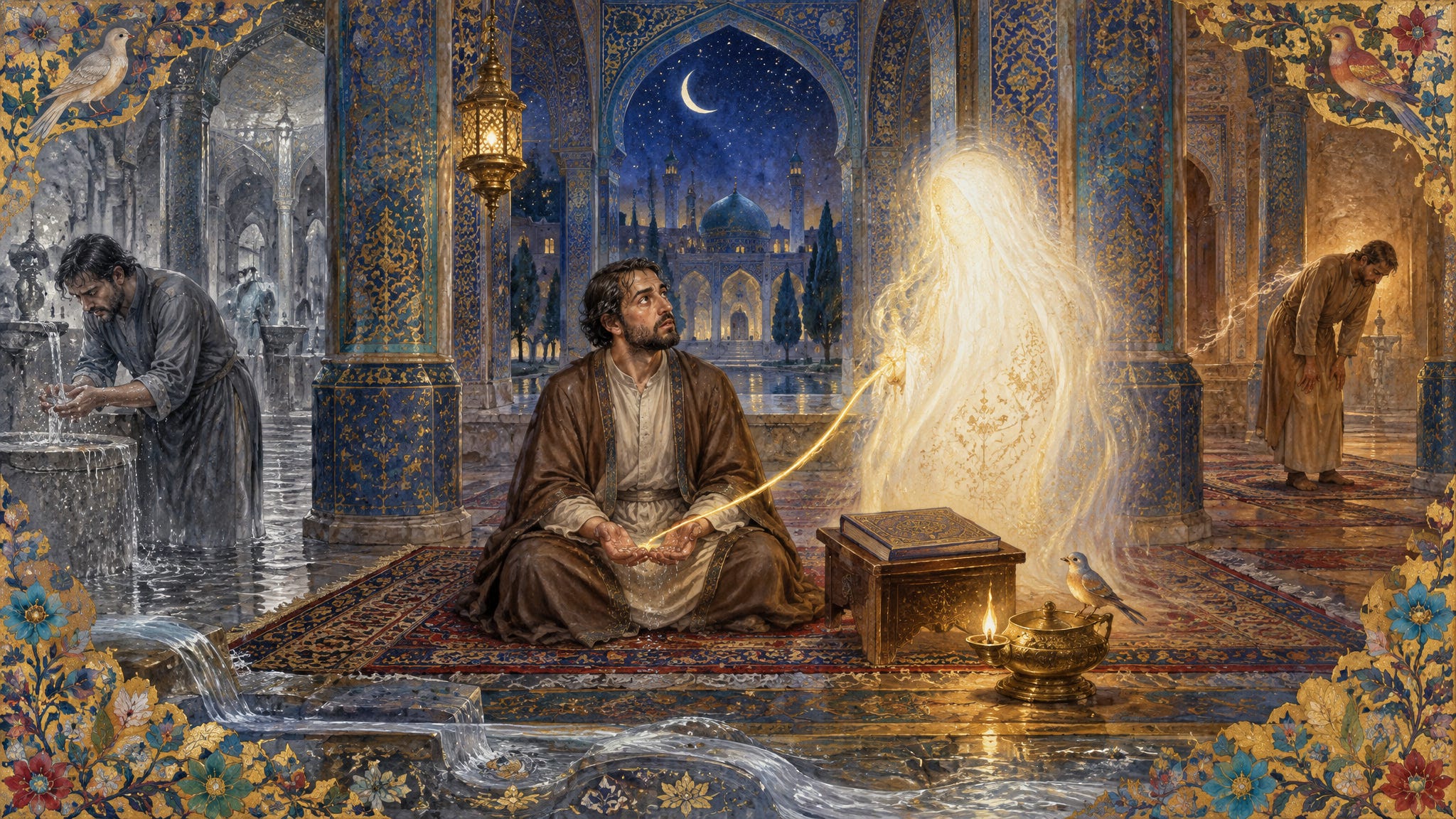
Here is the sentence we are taking in with us.
It comes from Zurara — a companion of the Imams; you will meet him properly later tonight.
And it is about something that has happened to every one of us.
You are in wudu — the ritual ablution required for prayer.
You are sitting in the mosque — perhaps after one prayer, waiting for the next — and you nod off.
One nod.
Two.
Your head drops and comes up again.
Is your wudu gone?
Zurara put exactly that question.
Listen to it, and to the answer he was given:
قلت له: الرجل ينام وهو على وضوء أتوجب الخفقة والخفقتان عليه الوضوء؟ فقال يا زرارة: قد تنام العين ولا ينام القلب والاذن فإذا نامت العين والاذن والقلب فقد وجب الوضوء، قلت فان حرك إلى جنبه شئ ولم يعلم به قال: لا حتى يستيقن انه قد نام حتى يجيئ من ذلك أمر بين وإلا فانه على يقين من وضوئه، ولا ينقض اليقين أبدا بالشك ولكن ينقضه بيقين آخر
“I said to him: a man sleeps while he is in wudu — do a nod, or two nods, make wudu obligatory on him? He said: O Zurara, the eye may sleep while the heart and the ear do not sleep; when the eye and the ear and the heart sleep, then wudu has become obligatory. I said: and if something is moved beside him and he does not know of it? He said: No — not until he is certain that he has slept, until a clear sign of it comes; otherwise, he is certain of his wudu, and he does not ever break certainty with doubt; rather, he breaks it with another certainty.”
— Zurara ibn A’yan; Shaykh al-Tusi, Tahdhib al-Ahkam — the Arabic as Ayatollah Muhammad Asif Muhsini gives it, Mu’jam al-Ahadith al-Mu’tabara, Volume 1, hadith 158
That is the whole sentence, and I am going to come back to it again and again tonight.
So let me tell you plainly why one sentence is enough to explain an entire school.
Read badly, this sentence sends the anxious man back to the tap for a third wudu — and then a fourth — because he cannot be sure.
Or it lets the careless man pray with no wudu at all, because he has decided, without much thought, that he probably did not sleep.
Read well, it frees the first man, and it holds the second.
Everything in the hawza — every subject on its timetable — exists so that sentences like this one are read well.
It reaches us through the book of a man you have met many times in this series: Shaykh al-Tusi, in his Tahdhib al-Ahkam — one of the books this whole school stands on.
Keep that in your mind.
We will come back to him at the end of the night.
And notice one more thing now, because a careful school does not hide it.
Zurara says only:
I said to him.
He does not name the Imam.
Hold on to that as well.
We will come back to it.
The Ladder
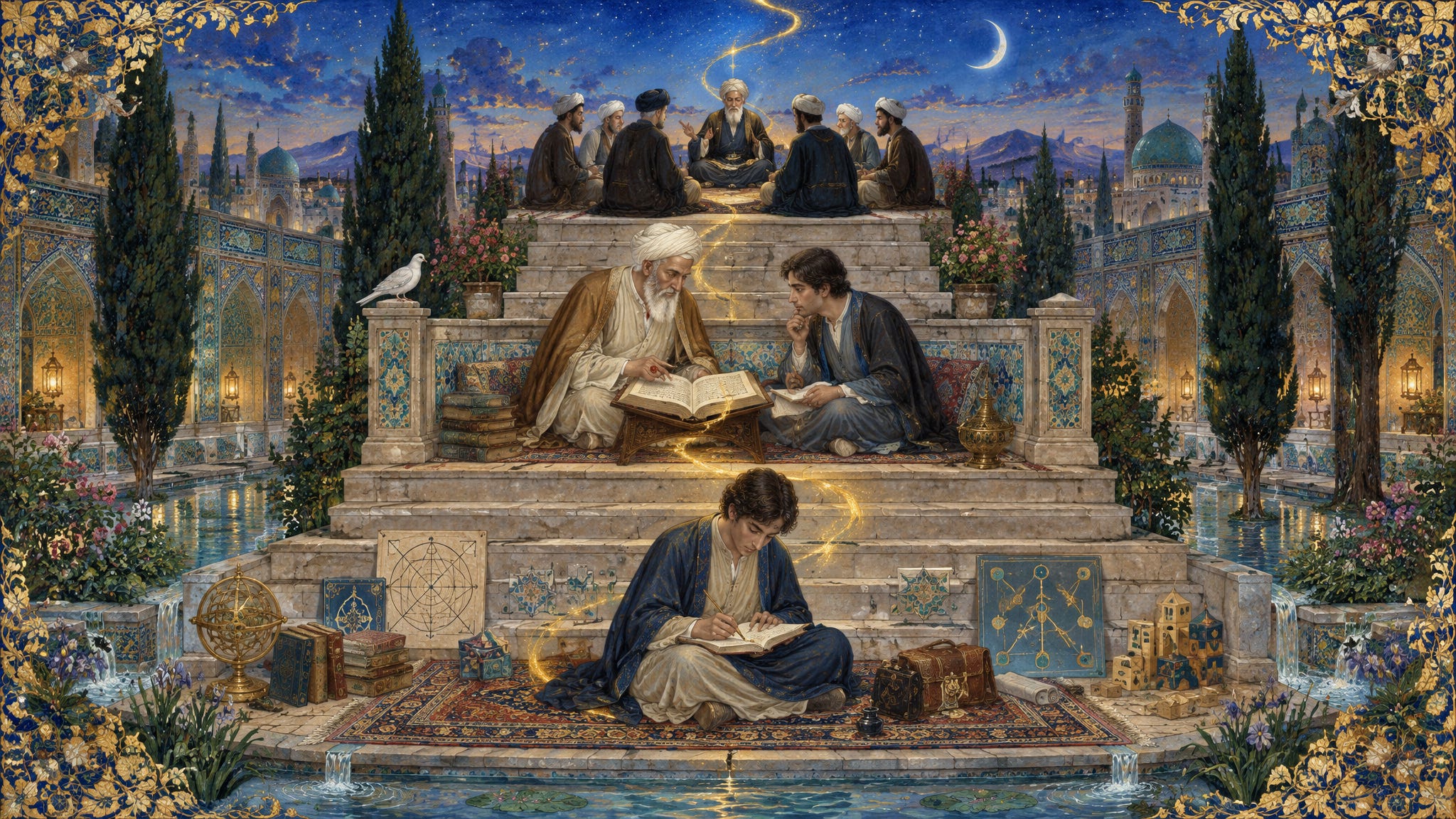
So — what is inside?
There are three stages, and their names will help you, because you hear them all the time.
The first is the muqaddimat — the introductions.
The tools for reading.
The Arabic language — how its words are built, how its sentences hold together, how it puts weight where it means to — and logic, and the foundations of belief, and practice, and character.
This is where a young student spends his days learning the patterns of verbs by heart, and taking sentences apart word by word, and asking of every word: what is this doing here?
The second is the sutuh — the set texts.
Here a student sits with a teacher and works through the great books of law, and of the principles of law, line by line.
Not to memorise them.
To understand why each argument is made, and where it might fail.
The teacher reads a line; he explains it; he asks why the author said it this way and not another; and the student’s notebook fills up beside the book.
Some people count a fourth stage here, splitting off the higher set texts from the rest; that is a difference in how you count, not in what is taught.
And the third is kharij — which means outside.
Outside the set text.
We will get there, because that is where our sentence ends up.
I want to be careful, because I am giving you a map, not a fixed schedule.
Qom and Najaf share this core; they differ in how they organise it, in the language of the classroom, and in the teachers you will find there.
Schools change their books.
Teachers choose different routes.
But the direction never changes.
First, learn to read the sources.
Then, learn to understand the arguments the great scholars have made about them.
And only then — if you are able and willing — learn to judge those arguments yourself.
What It Costs
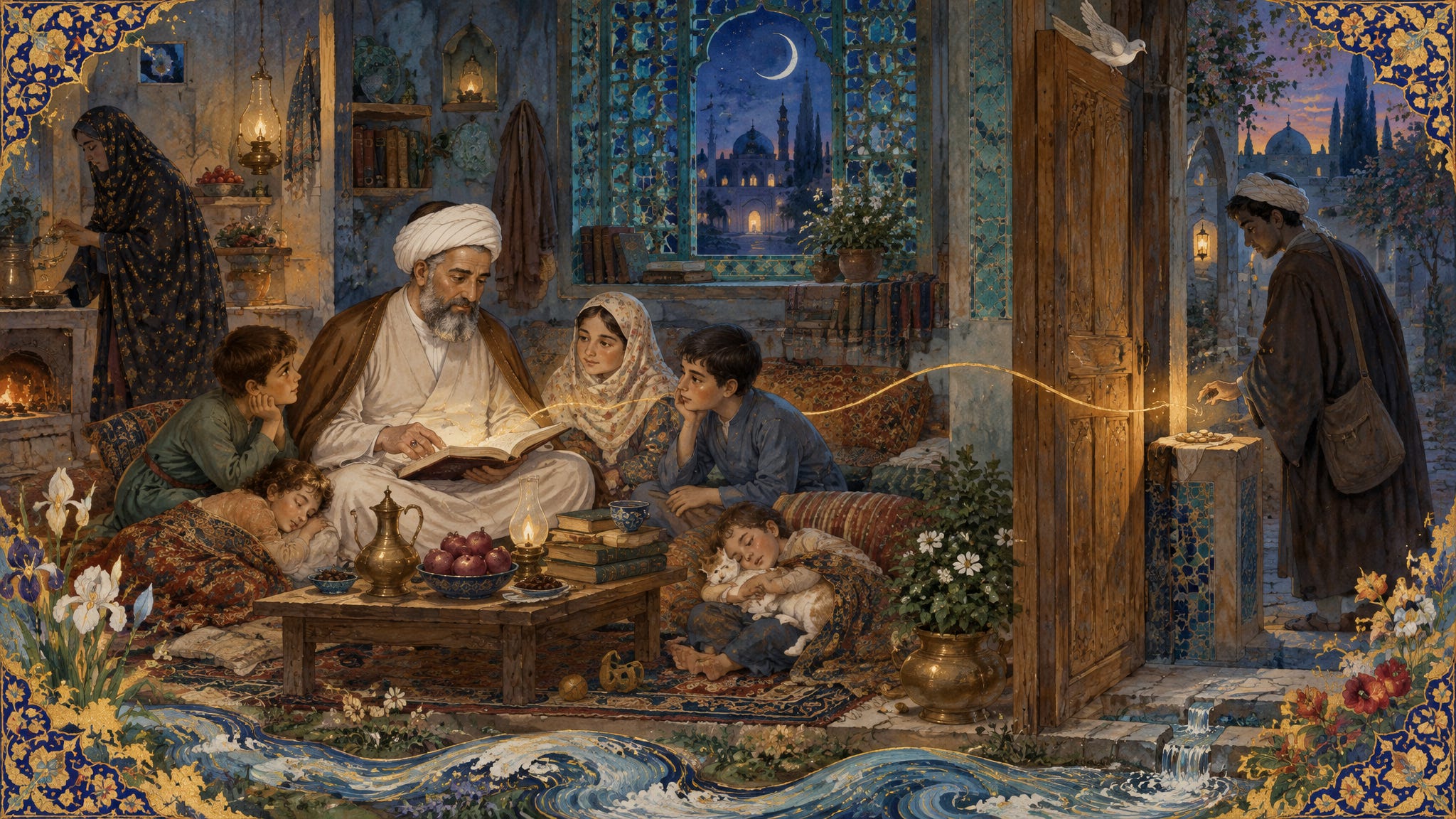
And before we go any further, I want you to see what this ladder can cost the people who climb it.
Ayatollah Muhsin Araki, may God protect him — one of our honourable teachers and whose memoir of his father some of you will remember from this majlis — describes in that memoir a mujtahid’s household: a house of under eighty square metres, and eleven children, all in one room.
— Ayatollah Muhsin Araki, Dar Maktab-e Pedar (In My Father’s School), page 44 — narrated4
And he describes money left on the ledge of a student’s room, with the door left open — so that any student in need could come in, take what he needed, and put it back when he could.
— Ayatollah Muhsin Araki, Dar Maktab-e Pedar (In My Father’s School), page 50 — narrated5
An open door, and a ledge with money on it. The school does not only teach the law of brotherhood. At its best, it makes you live it — in one room, with the door open.
How a Day Runs
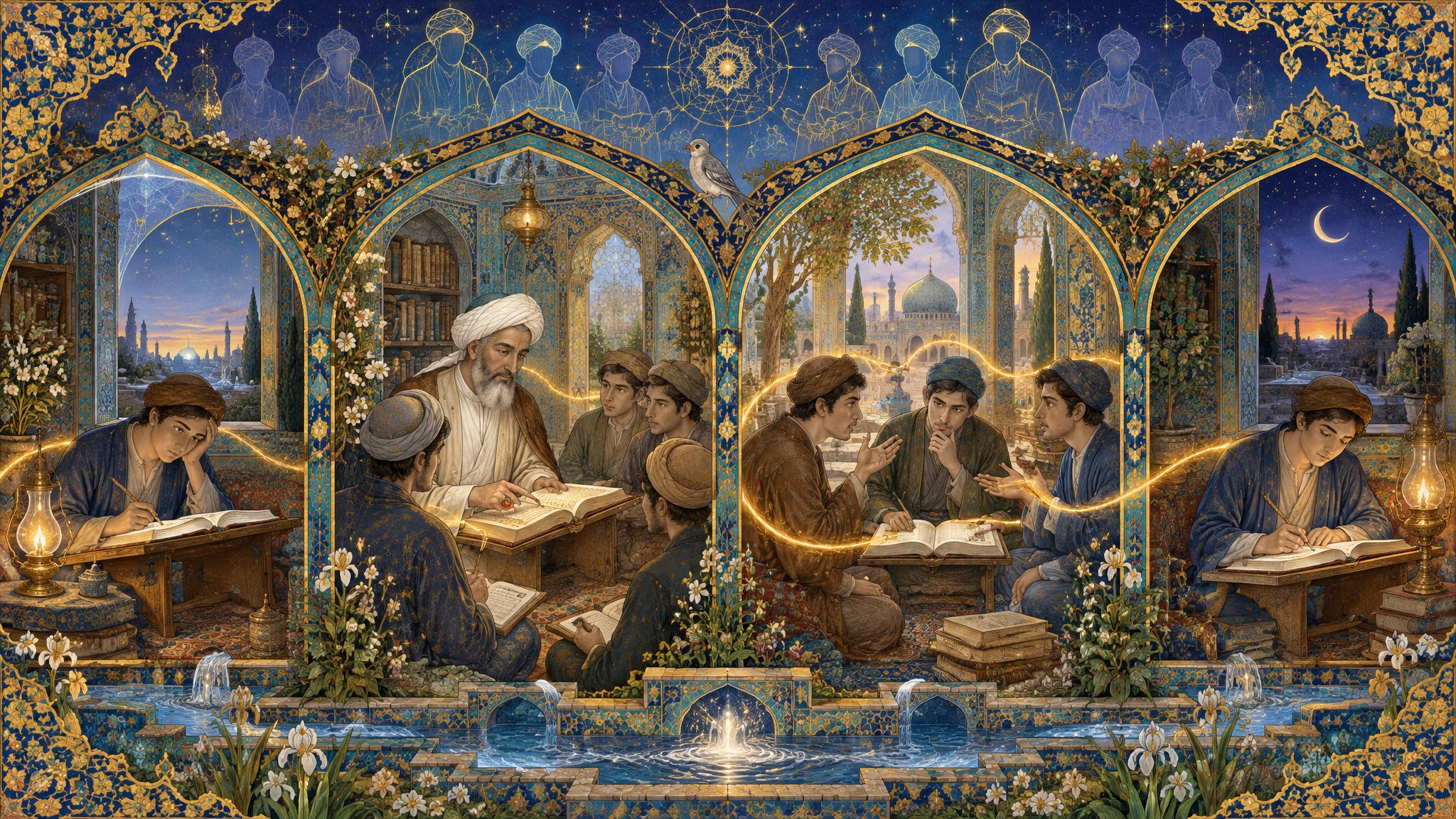
And here is something almost nobody tells you about the hawza.
It may be the most useful thing you take home tonight.
There is a rhythm to a student’s day, and it has four parts.
You prepare.
You read the passage before the class, and you find exactly where you are stuck.
You sit the lesson — the dars — and you hear the teacher take the passage apart.
Then you do the thing most people skip.
You sit with another student, or two, and you argue it — the mubahatha.
You try to rebuild the argument without the teacher in the room.
You raise the objection.
You find out whether you actually understood it, or whether you only followed it.
And then you review, and you write it down.
That third step is where a great deal of the learning happens.
A student who can follow an explanation may still be quite unable to rebuild the argument, or to answer a serious objection to it.
The person sitting opposite you exposes that — very quickly, and very usefully.
It is humbling.
It is meant to be.
You discover, every day, the distance between nodding along and actually knowing.
And Allamah Tabataba’i found this in the Qur’an.
The last verse of Surah Al Imran tells the believers to be patient, to outdo one another in patience, and — the word is rabitu — to stand guard together.
يَـٰٓأَيُّهَا ٱلَّذِينَ ءَامَنُواْ ٱصۡبِرُواْ وَصَابِرُواْ وَرَابِطُواْ وَٱتَّقُواْ ٱللَّهَ لَعَلَّكُمۡ تُفۡلِحُونَ
“O you who have faith! Be patient, stand firm, and close [your] ranks, and be wary of God so that you may be felicitous.”
— Qur’an, Surah Al Imran (the Chapter of the Family of Imran) #3, Verse 200
In his long essay on that verse, he says that the verses require the believers to gather over the teachings of the religion, to bind their thoughts together, and to mingle in teaching and in learning — and that reflecting on the Qur’an, or turning to the one who reflects on it, is what removes their disagreements.
— Allamah Sayyed Muhammad Husayn Tabataba'i, al-Mizan fi Tafsir al-Qur'an, on Surah Aal Imran (the Chapter of the Family of Imran) #3, Verse 200 — from his essay on binding together in the Islamic community6
Standing guard together — and our own commentator reads it to include a circle of study.
You do not need to be in Qom to do this.
You need a text, a friend, and the honesty to say:
I followed that — but I could not rebuild it.
Language — the First Guard
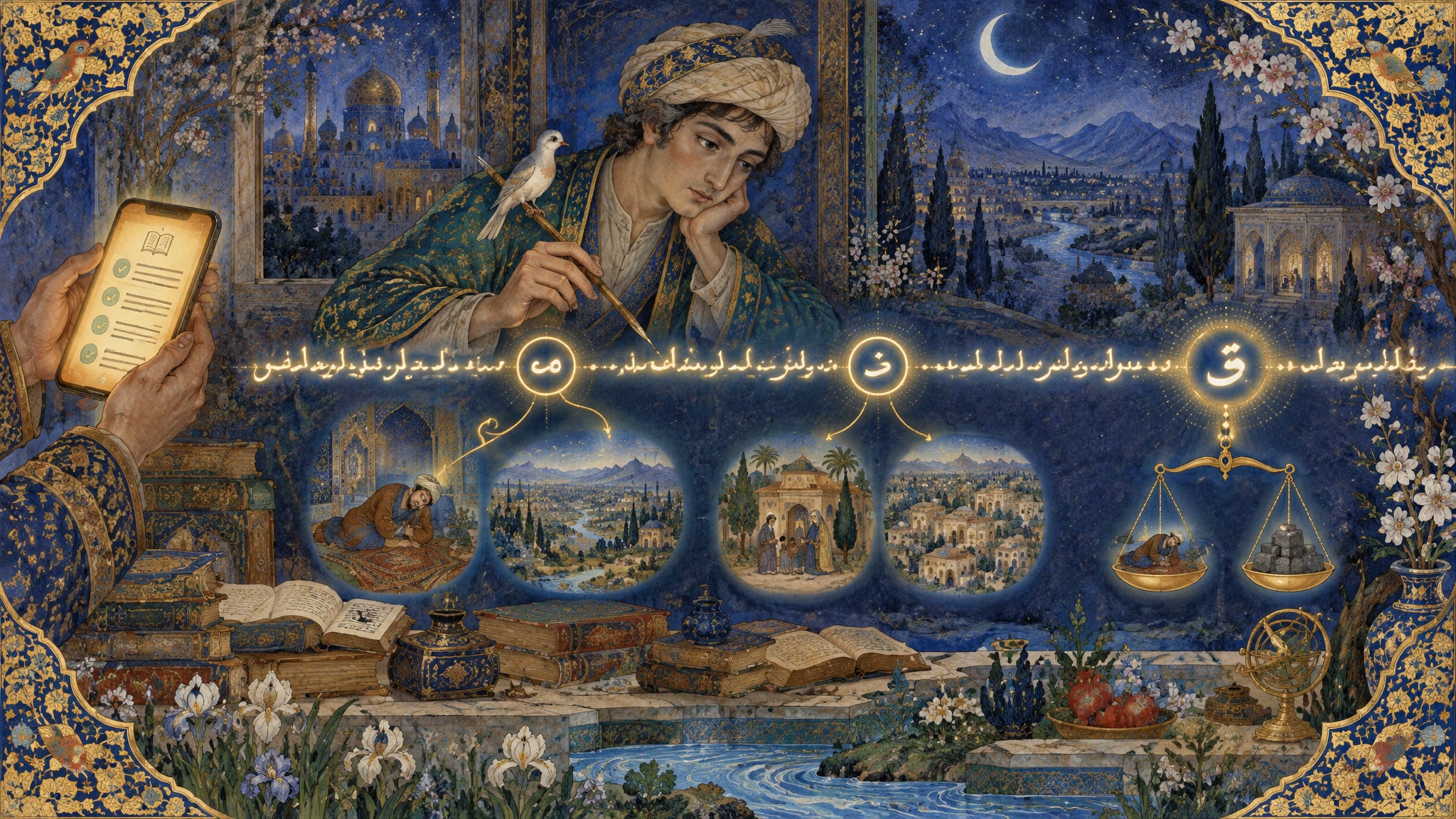
Now let us take our sentence through the school.
The first thing a student meets is the Arabic language — not to chat in it, but to read it exactly.
How a word is built: who acts, and who is acted upon.
How the words of a sentence hold on to one another.
How a sentence means — where it puts its weight, what it leaves out, what it limits.
And what all of that guards against is simple to say.
Misreading.
Getting wrong who did what to whom.
You might think our sentence is too simple to misread.
Let me show you three places where it is not.
The first is a little word: and.
And he does not ever break certainty with doubt.
Is that and finishing what the Imam is saying about this one man and his nap?
Or is it opening a rule of its own — something larger than this man, this wudu, this afternoon?
A great deal of the rest of tonight hangs on that one letter.
The second is the word the.
He does not ever break the certainty with doubt.
Which certainty?
His certainty — the one he had about his wudu before he dozed off?
Or certainty as such — any certainty, about anything at all?
If you think that is a small difference, imagine it in a will.
I leave the house to my son — and I leave a house to my son.
One word, and a family can end up in court for a generation.
The difference between the and a is the difference between one thing and anything.
And the third is a question about how the sentence means.
Not ever.
Abadan.
Why would anybody say ever about one man’s nap?
Words like that are not wasted in speech like this.
They put weight on something — and the student’s job is to ask:
on what?
Three questions.
And nobody in this room can answer them by having the Qur’an on a phone, in English — because the English has already answered them for you, one way or the other, before you ever saw the sentence.
That is not an insult to the person who raised the objection.
It is the answer to it.
The translation you are reading has already been through somebody’s grammar, and therefore somebody’s understanding.
The only question is whether it was a careful one — and whether you would know if it was not.
Logic — the Second Guard
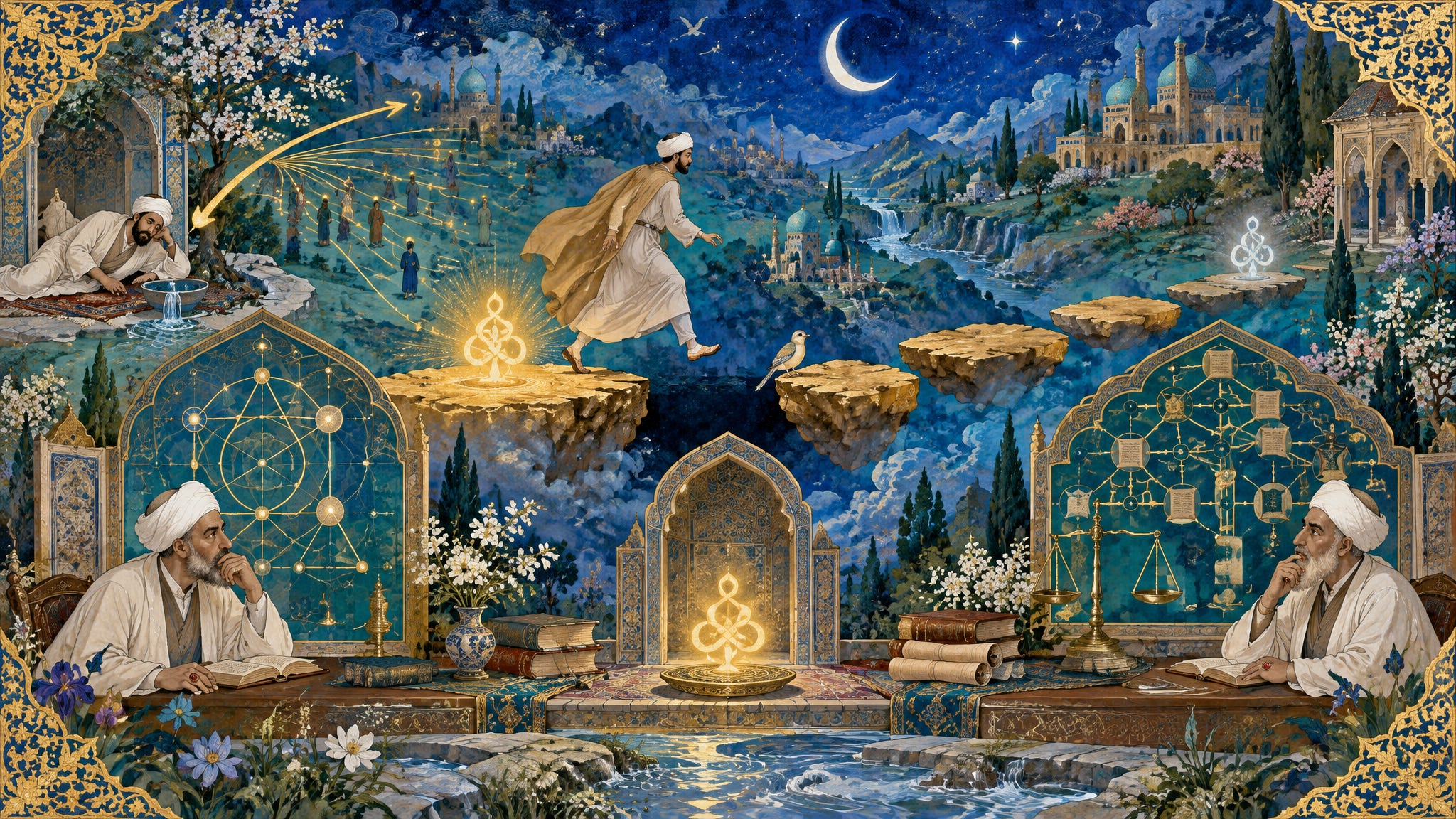
The second guard is logic.
What logic guards against is arguing badly from true words — starting from something true, and stepping, without noticing, to something that does not follow from it.
Every one of you has heard an argument like this.
God is merciful
— which is true —
and so nothing I do really matters.
Every word of the first half is true.
The second half does not follow from it at all.
And yet people walk across that gap every day without noticing that there was a gap.
Our sentence is about one man.
A man sleeps while he is in wudu.
But the people who teach it want to say something about everybody — about every certainty and every doubt: in your prayer, in your fast, in your purity, in your dealings.
That is a step.
From this man to any man.
From this certainty to every certainty.
Logic can tell you what a valid step looks like.
It can tell you when a conclusion follows from its premises, and when it only looks as though it does.
What logic cannot tell you is whether the Imam meant a rule.
Whether this answer, given to one man about one nap, was meant to carry that weight.
Logic and the principles of the law — usul al-fiqh — are not the same thing.
Logic is about valid reasoning in general.
The principles of the law ask a narrower and much harder question:
what reasoning, and what evidence, can justify a religious ruling at all?
And that is the question the next stage of the school was built to answer.
So we will leave our sentence there for a moment — waiting at the door of the next room.
Lessons for Our Time
Lesson One — The Staple First. Difficulty Is Not a Defect.

The first lesson is about the hard part.
Nobody wants the grammar.
I mean that.
Nobody goes to the hawza dreaming of tables of verb forms.
And yet you have just seen what the grammar is for.
The grammar nobody wants is what lets you read the sentence everyone needs.
We understand this perfectly well everywhere else in life.
Nobody wants to fly with a pilot who skipped his training because he found it boring.
Nobody wants a building put up by an engineer who did not bother with the mathematics.
We do not call those years of training a barrier between the passenger and his journey.
We call them the reason we can trust the pilot at all.
So when something we teach you here is hard, do not take the difficulty as a sign that it is wrong, or that it is not for you.
Difficulty is not a defect.
Hard material, said plainly, is a form of respect: it means we think you are capable of it — and you are.
Easy material said impressively is the real failure.
It flatters you, and it leaves you exactly where you were.
I say this to myself as much as to you.
And here is what to do with difficulty when it comes.
Do not pretend.
The worst thing a student can do — in Qom, or in Najaf, or in this room — is to nod at something he has not understood, because he is embarrassed to say so.
Say it.
I did not follow that.
That one honest sentence has done more for knowledge than a thousand polite nods.
And a word to anybody who has heard it said that the hawza is needlessly hard — that it makes simple things complicated in order to keep people out.
You have just watched three real questions come out of one short sentence.
The difficulty is not a wall around the religion.
The difficulty is the guard.
Lesson Two — Why You Seek It Decides What It Makes of You

The second lesson is about the student, not the subject.
Imam Ja’far al-Sadiq, peace and blessings be upon him, said that the seekers of knowledge are three — and that you can know each of them by his person and by his marks.
One seeks it for ignorance and for wrangling.
One seeks it to lord it over people, and to deceive them.
And one seeks it for understanding, and for reason.
— Imam Ja’far al-Sadiq, peace and blessings be upon him; Shaykh al-Kulayni, al-Kafi, Volume 1, the Book of the Merit of Knowledge, hadith 131 (thaqalayn) — narrated7
The same subjects.
The same books.
The same teacher.
And three completely different people at the end of it.
The school can give you the tools.
It cannot give you the reason you picked them up.
Why you seek it decides what it makes of you.
And that is not only a question for students in Qom and Najaf.
Ask it of yourself tonight, sitting here.
Why did you come?
To have something to say in the next argument?
To know a little more than the people around you?
Or to understand?
None of us is only one of the three.
But we know, if we are honest, which one is winning.
And here is the practical edge of tonight, because I do not want this to stay a lesson about other people in another country.
You can learn the way they learn.
Take a text — a few verses, a page of a book, a single hadith — with one or two friends.
Read it before you meet.
Sit with it together.
Then argue it: try to say it back without looking, and let the other person ask you the hard question.
And afterwards, write down what you now understand that you did not understand before.
Prepare.
Sit.
Argue.
Review.
Bind your thoughts together
— that is Allamah’s phrase, from his reading of the Qur’an’s verse.
Keep it small.
Two or three people.
A text short enough to finish.
The same time every week.
And when you argue, argue to understand, not to win.
The moment a circle becomes a place for winning arguments, it has become the first seeker’s circle — the one who seeks knowledge for wrangling.
And do it for the third reason.
Not the first two.
Who Carried It, and What It Proves

We left our sentence waiting at the door of the next room, with a question hanging over it:
is it an answer about one man’s wudu, or is it a rule?
We will get to that question.
But before we do, I want to ask a different one — not about what the sentence means, but about how it got here.
The Subject That Asks Who Carried This
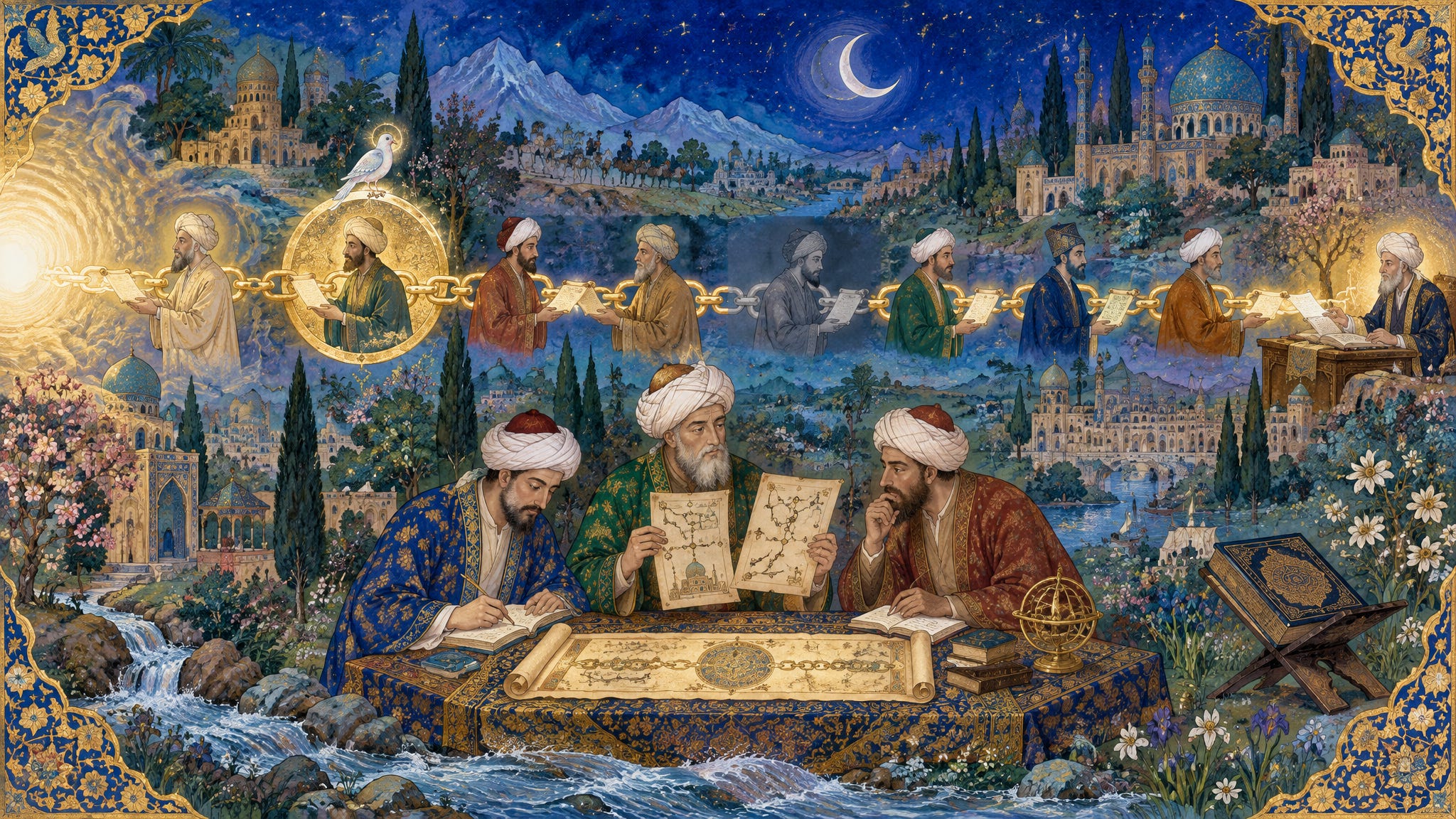
The second room is the room of the set texts — and the first subject I want to show you there is one most people have never heard of.
And yet this majlis has used it in front of you every single week.
It is called rijal — literally, men.
The science of the people who carried the reports.
And it exists to ask one question:
who carried this?
Every sentence that reaches us from the Prophet or from the Imams reaches us through people.
Not through the air.
A man heard it, and told another man, who wrote it down, who taught it to a third — and somewhere along the line it was copied into a book, and the book reached us.
And of every one of those people, a careful community asks:
Who was he?
Was he truthful?
Was he careful?
Did he actually hear it from the one before him — or is there a gap?
So the scholars of this subject read everything that earlier scholars said about each man.
They compare.
They check dates and places: could this man even have met the one he claims to have heard it from?
They notice when a name turns up in a chain where it does not belong.
Think of how a court treats a piece of evidence.
It is not enough that the evidence is on the table.
The court wants to know who found it, who held it, who handed it to whom — and whether there was any moment when nobody was watching it.
If that chain breaks, the evidence may be perfectly genuine.
But nobody can show that it is.
Our scholars have been asking that question about the words of the Prophet and the Imams for more than a thousand years.
And notice what the subject is for.
It is not there to make us doubt everything.
Most of what reached us was carried faithfully, by people who gave their lives to carrying it.
It is there so that, when something was not carried faithfully, we have a way of knowing.
That is not suspicion.
It is love.
A community that cares about the words cares about the hands they passed through.
The chain is how a community checks what it receives.
Every week in this majlis, when I read you a report, somebody has asked those questions about it before I read it to you.
Tonight I just want you to see the question itself.
The Relay
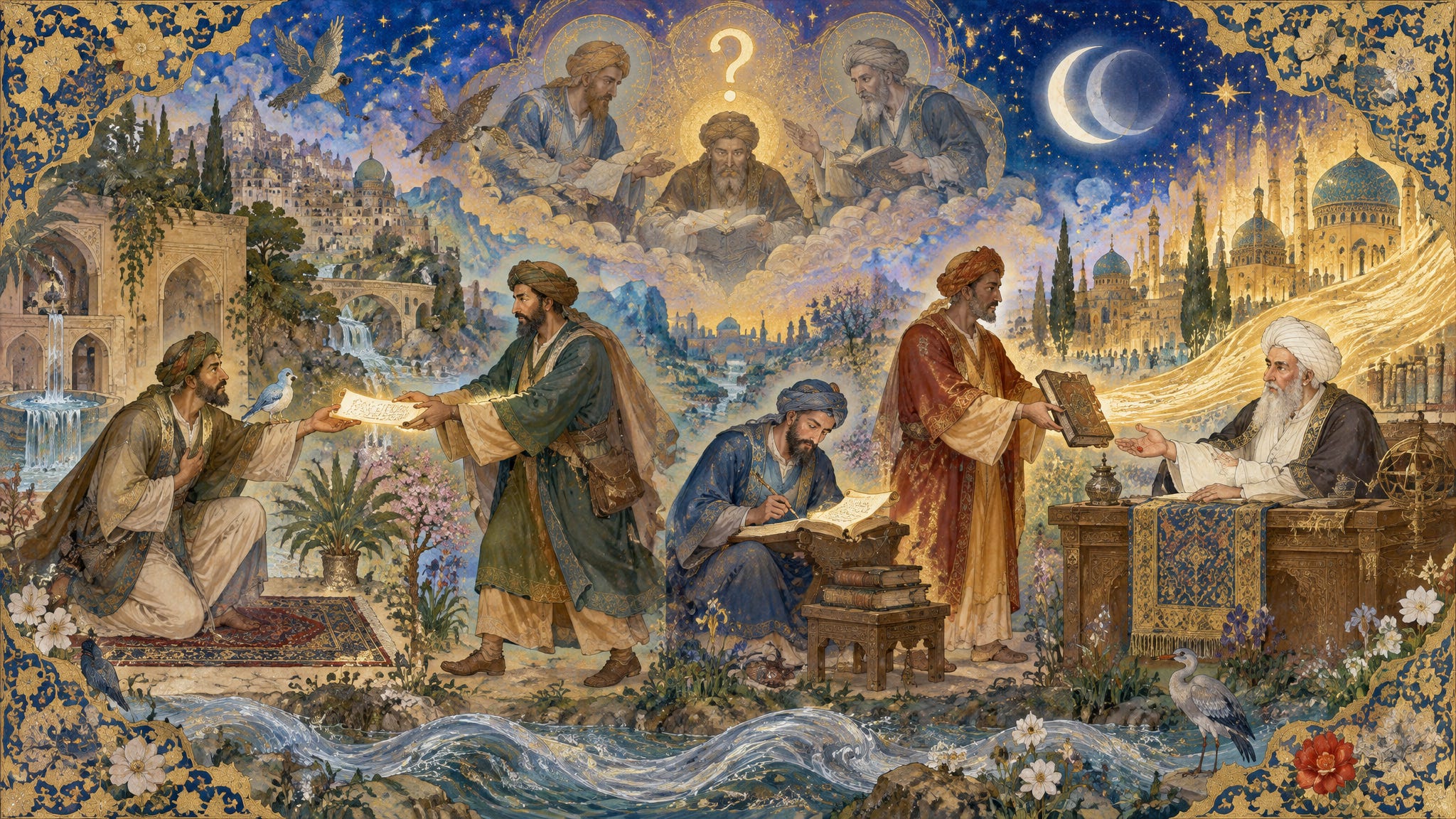
So — who carried our sentence?
The first is the man who asked it:
Zurara — Zurara ibn A’yan, a companion of two Imams, Imam Muhammad al-Baqir and Imam Ja’far al-Sadiq, peace and blessings be upon them both.
And remember what you watched him do in the first room.
He did not take the first answer and go home.
He asked again:
and if something is moved beside him, and he does not know of it?
The sentence we are carrying tonight came in the answer to that second question.
If Zurara had not asked twice, we would not have it.
From Zurara the sentence passed to a man called Hariz.
From Hariz to Hammad.
From Hammad to al-Husayn ibn Sa’id.
And from al-Husayn ibn Sa’id, by Shaykh al-Tusi’s own chain, it reached Shaykh al-Tusi’s desk — and from his desk, every school after him.
— footnote 4 to Shaykh al-Tusi, Tahdhib al-Ahkam, Volume 1, page 7, in the edition annotated by Ali Akbar al-Ghaffari8
Four names, and then a book.
You do not need to remember them.
You need to remember that there are names — that the sentence did not float down to us.
It was carried.
Hand to hand.
And now the thing I asked you to hold.
Zurara says only:
I said to him.
He never names the Imam.
A careless school would hide that.
A careful one explains it — and ours has.
Let me give you the two reasons a teacher gave his class, not long ago, on this very report.
The first is who Zurara was.
A man of his standing did not go round putting questions about the fine detail of the law to anybody but an Imam.
The scholars cannot imagine him carrying a ruling in such detail from anyone else.
And the second: later scholars of great standing — Allamah Bahr al-’Ulum, al-Naraqi, Ayatullah al-Wahid al-Behbahani — carry this same report with the Imam’s name in it.
It may well be that they had reached Zurara’s own notebook, and read it there.
— a kharij lesson on the proofs of istishab, Madreseh-ye Feqahat (eshia.ir), 16 December 2024, citing Bahr al-'Ulum, al-Fawa'id al-Rijaliyya, Volume 1, page 110; al-Wahid al-Behbahani, al-Fawa'id al-Ha'iriyya, Volume 1, page 277; and Mawsu'at al-Imam al-Khoei, Volume 48, page 14 — narrated9
That is all. I am not going to give you a grade for the report, and I am not going to tell you which Imam.
I want you to see something more important than either:
a careful community does not hide a gap.
It explains it.
And it explains it in the open.
Those two reasons were not whispered in a corridor.
They were given in a class, in front of students who were free to object to them — and written down, so that anybody could check them.
The Principles of the Law — the Guard Against Making It Up
Now we can go back to the question we left waiting at the door.
Is our sentence an answer about one man’s wudu — or is it a rule?
The subject that answers that kind of question is called usul al-fiqh — the principles of the law.
It asks how a jurist can move, responsibly, from evidence to a ruling.
When does a command bind?
When a verse speaks in general terms, and a report speaks about one particular case, which governs which?
What happens when two reports seem to say different things?
And what do you do when the evidence runs out — when you have searched, and there is no verse and no report that settles the case in front of you?
That last question is where our sentence lives.
Because the great teachers drew from it a principle with a name:
istishab.
I will say the word once, and then explain it.
It means this:
what was certain stays certain, until another certainty ends it.
You were certain you had wudu.
Now you are not sure.
The doubt is real — but it is not a certainty.
So the certainty you had stays with you, until something certain ends it.
Why does that need a whole discipline?
Because without one, anybody can turn any sentence into any rule.
If you are allowed to take an answer given to one man about one matter, and stretch it over whatever you like, then the religion becomes whatever the person doing the stretching wants it to be.
Let me show you how easily it happens.
Hand our sentence to somebody who would like a quiet life.
I was certain, once, that I was a good person.
Now somebody has given me a reason to doubt it.
But certainty is not broken by doubt — so I need not look.
Every word of the sentence is still there.
And it has been bent into an excuse never to examine yourself.
That is exactly what this discipline was built to stop.
What counts as certainty?
What counts as doubt?
Does the principle reach every kind of question, or only some?
What happens when it meets a stronger piece of evidence?
The principles of the law are not slogans that let you decide whatever you please.
They are disciplines, with conditions — and the conditions are where the real work is.
So the step we could not take with logic alone — from this man to any man — is licensed, or refused, by method.
Not by appetite.10
Fiqh — the Guard Against Untrained Hands
And then, finally, the subject everybody has heard of: fiqh — the law itself.
What it guards against is untrained application: taking a true principle and applying it clumsily to the case in front of you.
A principle is not yet a ruling.
Between certainty is not broken by doubt and what should this man do, this afternoon, in this mosque there is still work to be done.
Was he really certain to begin with?
Is what he has now really a doubt — or has a sign come?
Does anything else in the evidence speak to this exact case?
That is the jurist’s work.
So what do the jurists find, in our case?
He still has his wudu.
He prays.
If he nodded off, and something was moved beside him and he did not notice, that is not yet certainty that he slept — and his wudu stands, until a clear sign comes.
Notice the word I used.
The jurists find.
They do not make the law, and they do not set it.
They find it, and derive it from the evidence, and give what they have found to the people who follow them.
So, for your own practice, I am not giving you a ruling from this chair tonight.
Follow your marja’‘s rulings.
Here is the whole chain in one sentence, and it is worth writing down:
Language identifies the evidence; the study of the sources assesses it; the principles establish the method; and the law applies that method to a real problem.
The Rest of the Timetable
There are other rooms in this house, and I am going to walk you past them quickly, because each of them deserves an evening of its own.
The commentary of the Qur’an, and the sciences of the Qur’an, guard against reading the Book by opinion — making it say what you already think.
Theology guards against belief that has never been examined — faith that is inherited rather than held.
Philosophy and ‘irfan — the deeper study of existence, and of the soul’s way to God — are taught in some places and argued about in others, and I will name them tonight and leave them there.
And ethics runs through every stage, because knowledge without character is the most dangerous thing a school can produce.
You heard that already, in the three seekers.
Notice that I have named every one of those rooms by what it protects against — not by what it adds.
That is the shape of the whole house.
The whole map, stage by stage, with the books typically read at each one in Qom and in Najaf, is at the end of the written version of tonight, for anybody who wants it.
Kharij — Beyond the Book
And now the third stage — the one you have heard the most about, and been told the least about.
Kharij, I told you, means outside.
Outside what?
Not outside Islam, and not outside the seminary.
Outside the set text.
Until now, a student has been working through a book, with a teacher explaining it. In kharij, the book stops deciding the answer.
A senior scholar takes up a question.
He may still follow the order of a famous book — a great manual of the law like al-’Urwa al-Wuthqa, or the dense text on the principles of the law called the Kifaya.
But he does not explain the book.
He takes the question back to its sources, rebuilds what the great scholars before him argued, tests each of their arguments, and then says what he thinks — and why.
And the student’s job changes.
He is no longer learning what the book says.
He is checking the references, weighing the reasoning, finding the objection — and slowly learning to reach a position he could defend.
The students do not only listen.
They are expected to think aloud: to raise the objection in the room, and to hear it answered.
And many of them write.
Some of the great books of the hawza were never sat down and written by their teachers at all.
They are a student’s written account of his teacher’s lessons — the argument as it was heard, set down for everybody who was not in the room.
The hawza even has a name for them: taqrirat.
So the circle we met in the first room — prepare, sit, argue, review — does not stop at the top of the ladder.
At the top, it becomes a book.
Ayatollah Muhsin Araki, in that same memoir, describes how such a lesson began: his father, the one closest to the master, would read the passage aloud from the book, and then the master would begin.
— Ayatollah Muhsin Araki, Dar Maktab-e Pedar (In My Father’s School), page 20 — narrated11
The passage is read. And then a man who has spent his life with these questions stands up inside it.
The Great Teachers on One Clause
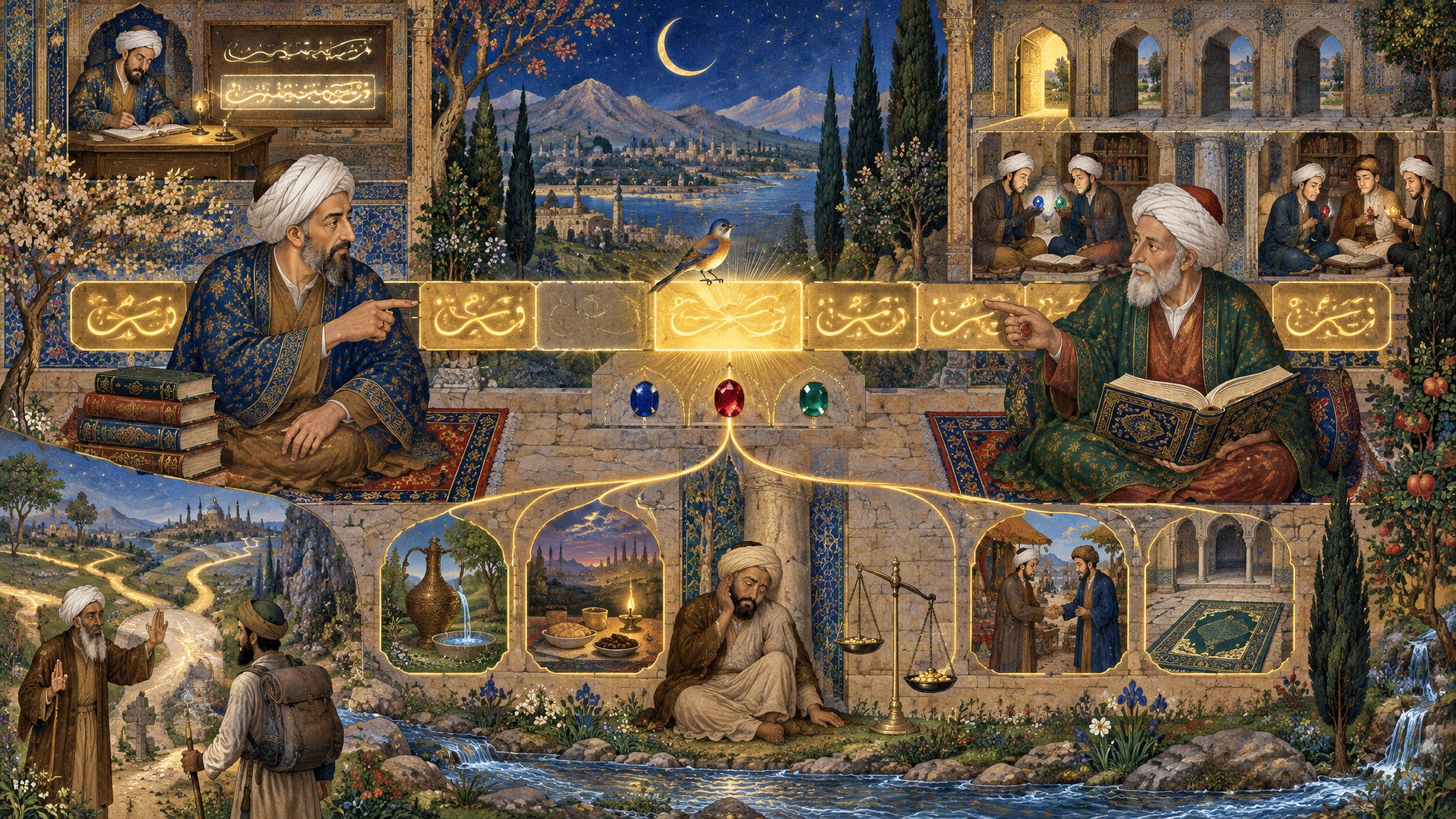
And here, in kharij, our sentence finally arrives — and I want to show you what the great teachers did with it.
Two names, and I will tell you why you should care about them.
The first is Shaykh Murtadha al-Ansari, whose books — the one students call the Rasa’il, and the Makasib — are still the higher set texts of the hawza.
The second is the scholar known simply as the Akhund — Akhund Muhammad Kazim al-Khurasani — whose Kifaya is the densest of those set texts, and the book that many classes of kharij in the principles of the law still follow.
They argued over one clause.
Listen to it again.
Otherwise, he is certain of his wudu.
When the Imam says that, is it the answer — or is it the reason for an answer he did not need to say out loud?
Is he saying: no, he does not need a new wudu — because he is certain of his wudu — and leaving the first half unspoken, because it is obvious?
Shaykh al-Ansari, and the Akhund with him, read it that way: the reason, standing in the place of an answer.
— a kharij lesson on istishab, Madreseh-ye Feqahat (eshia.ir), 17 January 2024, citing Shaykh Murtadha al-Ansari, Fara’id al-Usul, Volume 3, page 56 — narrated12
Why does that matter so much?
Because of what a reason does.
When somebody tells you, do not take that road tonight — it is flooded, he has not told you something about one road.
He has told you something about every flooded road.
A reason travels further than the case it was given for.
That is what reasons do.
So if he is certain of his wudu is the reason, then the words that follow it — and he does not ever break certainty with doubt — are what that reason stands on.
And on Shaykh al-Ansari’s reading, those words are no longer only about wudu.
They become a rule for everything.
A principle that runs through the whole of the law.
One clause, read one way, and a sentence about a man dozing in the mosque becomes one of the great rules of the religion.
And a scholar of our own time puts the argument for that reading very simply.
If he does not ever break certainty with doubt were only about this one man, and whether he had slept, it would add nothing at all — the Imam would just be saying again what he had already said.
And the Imams do not waste words.
So the extra sentence must be teaching something larger than the case in front of it.
A rule.
— a kharij lesson on istishab, Madreseh-ye Feqahat (eshia.ir), 17 January 2024, its footnote citing al-Mughni fi al-Usul, Volume 1, page 84 — narrated13
Do you remember the three little questions from the room of language — the and, the the, and the ever? This is where questions like those stop being little. They are the ground the great teachers have argued over.
Others have read that clause differently. There are, in fact, four readings of it, and the written version of tonight sets them out for anybody who wants to follow them further.
And the argument did not stop with those two men. In January 2024, in the hawza, a class was still arguing over this very clause. In December of the same year, another class was arguing over it again.
Not because nobody can decide. Because this is how a living tradition carries its sentences. It keeps turning them over, in the light, in front of everybody — so that nobody can bend them without being noticed.
My Own Word
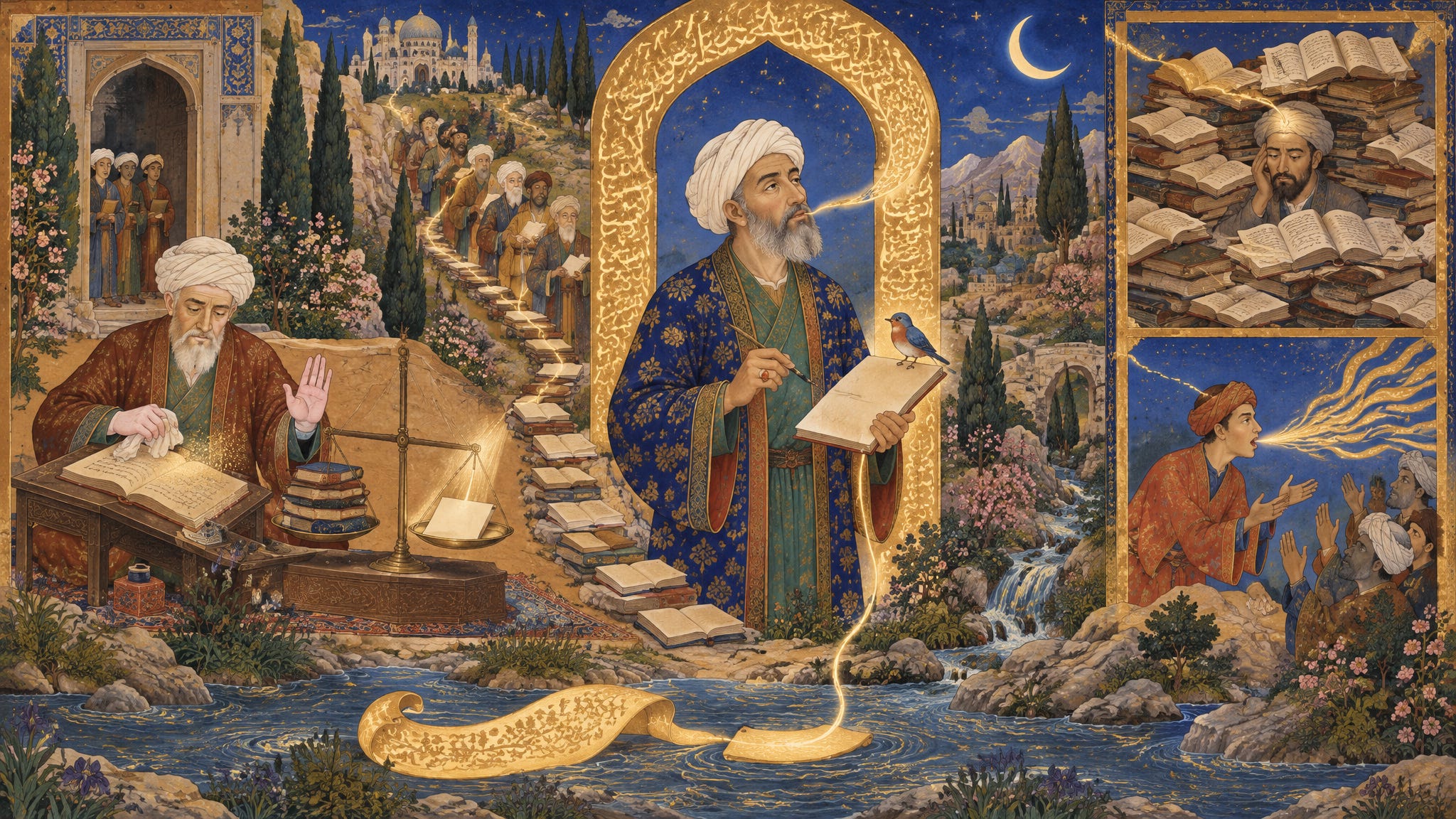
And now the last thing about kharij — and it is my favourite thing in the whole evening.
What does kharij guard against?
Not misreading — the first room did that.
Not making it up — the principles did that.
Kharij guards against something quieter: dependence.
A scholar who has spent his whole life inside other people’s books, and has never once said his own word.
The whole ladder leads here.
The hawza does not want to make people who can only repeat.
In the end, it wants people who can stand up inside a question and say what they think — and why.
And yet — listen to this.
Ayatollah Muhsin Araki’s father was a scholar of real learning.
And his son records that he refused to teach kharij — and the reason he gave was this.
In the other lessons, he said, I report the words of others; if there is an error in them, the responsibility is not mine.
But in the kharij lessons, I must say my own word.
His son records something else, too: that his father erased the notes he had written in the margins of his own copy of a famous textbook, the Lum’a.
— Ayatollah Muhsin Araki, Dar Maktab-e Pedar (In My Father’s School), pages 52 to 54 — narrated14
I cannot tell you everything that was in his heart.
But I can tell you what that sentence says to me.
Kharij is the place where you must say your own word.
Not the book’s word.
Not your teacher’s.
Your own — and you will answer for it.
And a man of real learning looked at that responsibility, and treated it with fear.
That is very nearly the opposite of the world we live in.
We live in a time when everybody says his own word about everything, immediately, to everybody — and almost nobody has learned anybody else’s word first.
The hawza makes a man wait a long time before it lets him say his own word — and even then, a man like that hesitated.
We do not wait at all.
So the school is guarding against two failures at once: the man who never says his own word, and the man who says it before he has earned it.
And here is the line I want you to keep from this part of the evening:
say your own word — after you have learned theirs.
Lessons for Our Time
Lesson Three — Ask Who Carried It

The third lesson is a habit, not a science.
Before you believe a saying — and certainly before you pass it on — ask who carried it to you.
You know how it happens.
A saying arrives on your phone.
It is beautifully set, on a beautiful background, and at the bottom there is a great name — an Imam’s name.
It is wise.
It is moving.
It sounds exactly like something he might have said.
And you are about to send it on to forty people.
Stop for one moment, and ask the questions the second room taught us.
Where did this come from?
Who said it first?
Is there a book, and a page?
Is there a gap — and if there is, has anybody explained it?
Not to be suspicious of everybody.
To be careful with the words.
A saying attributed to an Imam is either his words or it is not.
And if it is not, then every time you pass it on, you are putting words in his mouth — and inviting forty other people to do the same.
You do not need to know the science of the narrators to have the habit.
You only need to care more about the words than about how they make you feel.
And the habit will serve you far beyond sayings.
With every piece of news that reaches you — about a public figure, about a neighbour, about a whole community — ask the same questions before you believe it, and before you pass it on.
And keep hold of what the hawza showed us tonight with Zurara.
A careful community does not hide the gap.
It explains it.
If somebody hands you a beautiful saying and cannot tell you where it is from — hold it gently, and do not pass it on as an Imam’s.
Lesson Four — Certainty Is Not Broken by Doubt
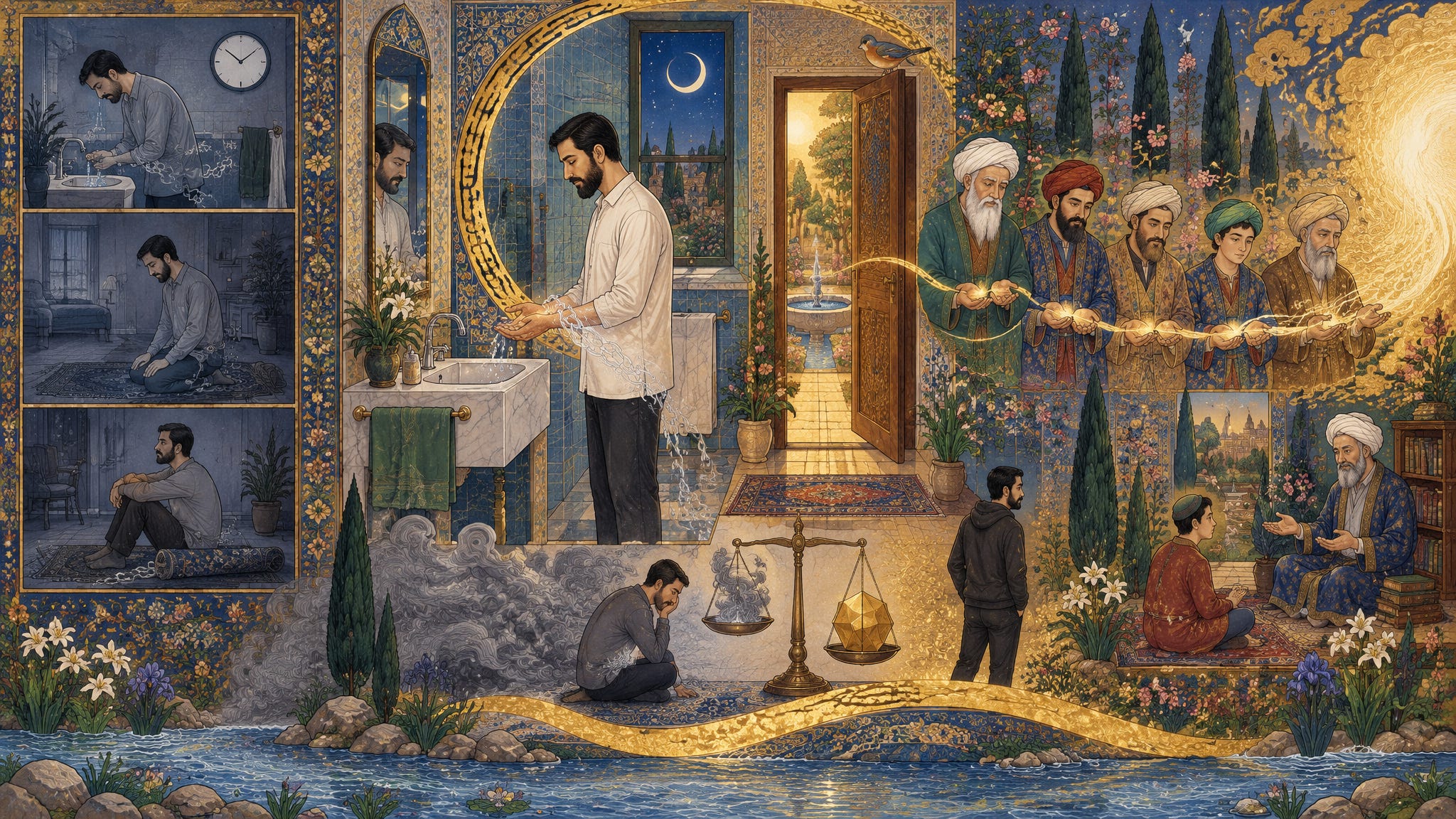
The fourth lesson is a mercy — and some of us need it more than we let on.
There are people in every community — and I suspect in this room — who are tormented by doubt in their worship.
Did my wudu break?
Did I wash that properly?
Did I say that word of the prayer correctly?
Was that prayer valid?
They repeat, and they repeat, and the doubt does not go away; it grows.
They are late for work because of their wudu.
They come to dread the prayer instead of longing for it.
It turns the most beautiful acts of the day into a kind of prison.
If that is you, I want you to hear something tonight.
You are not a worse believer because of it.
And it is not a sign that you care more than other people, either.
It is a weight — and this sentence lets you put it down.
Listen to the sentence we have carried all night as though it had been addressed to you.
He does not ever break certainty with doubt; rather, he breaks it with another certainty.
You were certain.
Now you doubt.
The doubt does not break the certainty.
And notice what the answer to Zurara did not say.
It did not say: go and make wudu again, just to be safe.
It did not say: better a second wudu than a doubtful prayer.
It said: no.
Not until he is certain.
The answer that sounds more cautious is not the answer he was given.
That is not a licence for carelessness — the careless man who never checks anything has misread it just as badly as the anxious one.
But for the one who is tormented, this sentence is a door out.
And if you carry this weight, do not carry it alone.
Take your questions to somebody who knows the rulings well, and let them help you set it down.
The details — which doubts count, and which do not; what to do in the middle of a prayer, and what to do after it — belong to the rulings of your marja’, and I am not going to give rulings from this chair.
What I am giving you is the principle the jurists derive them from, so that you know where your freedom comes from.
It comes from one sentence, carried to you hand to hand for more than a thousand years.
A Calling, Not a Career
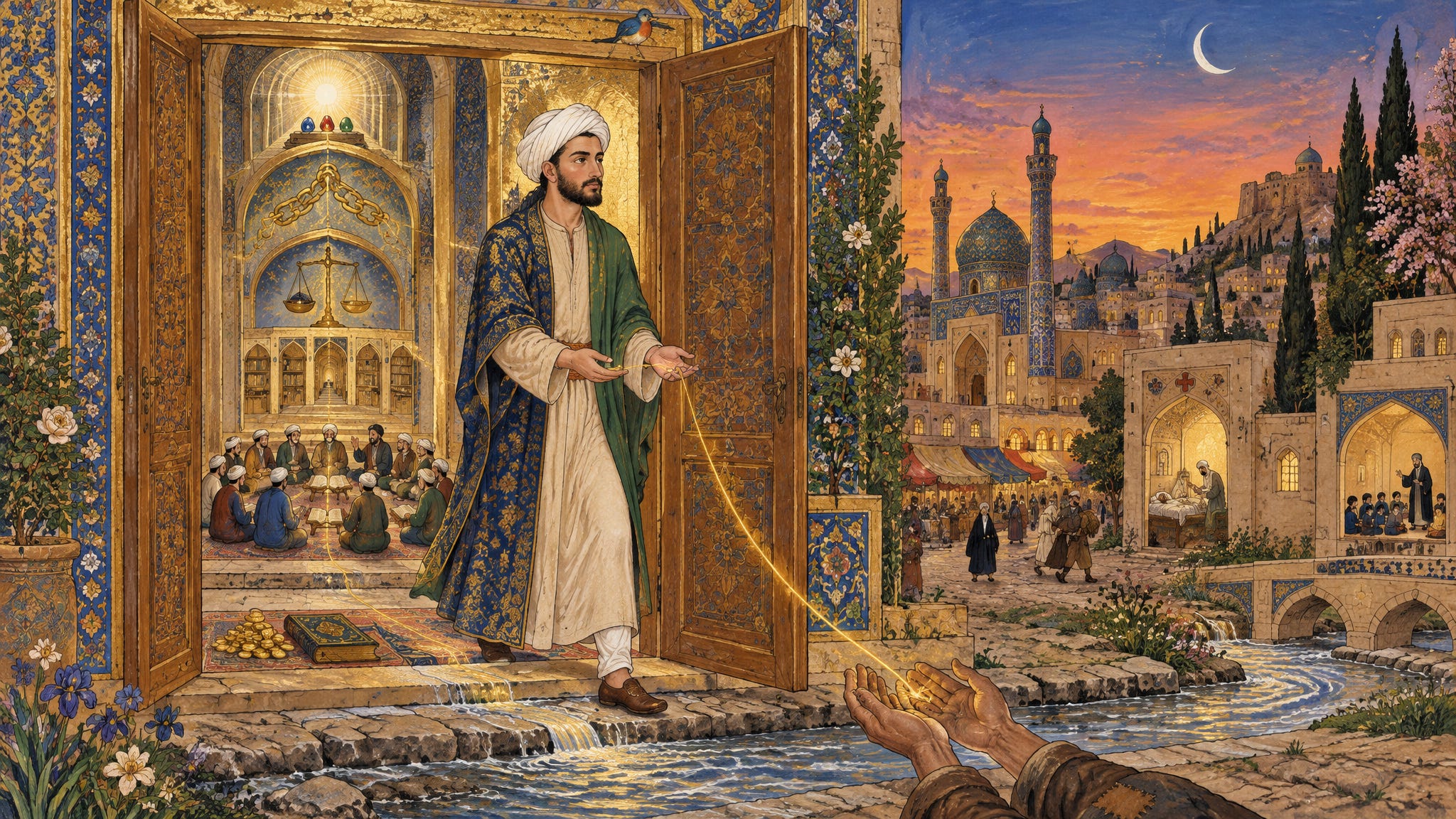
We have followed our sentence through the school — from the first room, where it was taken apart word by word, to the last, where great teachers argued over a single clause of it.
Now I want to follow the student out of the school — and ask what it makes of the one who enters it, and what it makes him owe.
The Door Is Open
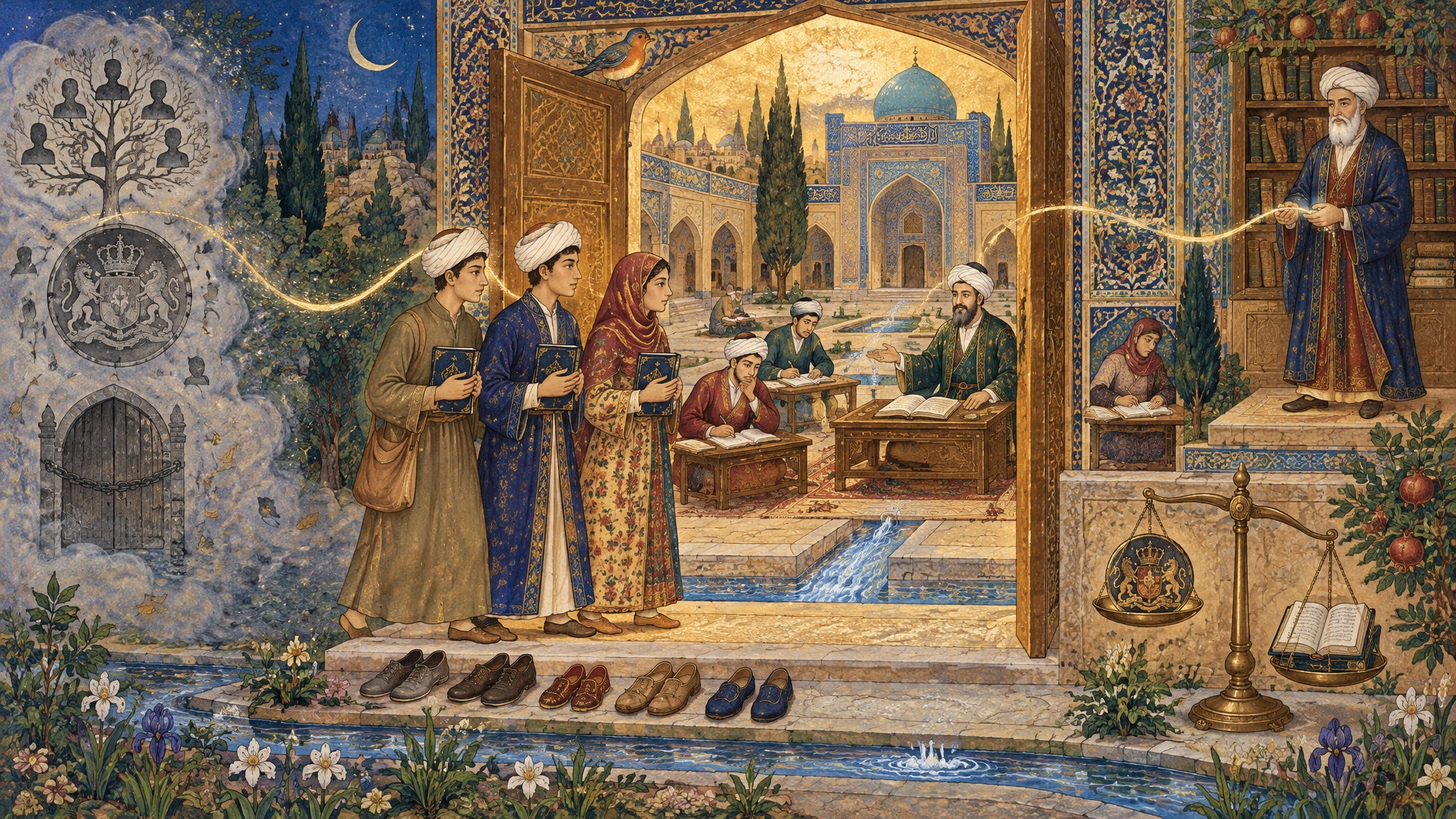
The first thing to know about the hawza is who is allowed in.
And the answer is: anybody who will study.
It asks for no lineage.
There is no ordination, and no family it belongs to by birth.
Whoever will study may enter — and it is hard for every one of them.
There is no shortcut for the clever, and no exemption for the well-connected.
The son of a great scholar sits down with the same grammar as the son of a farmer, and struggles with it just the same.
The verbs do not know whose son (or daughter) you are.
That is why — as I reminded you at the start tonight — a scholar’s only standing is what he has learned, and how he lives it.
That is not a slight on scholars.
It is the most demanding thing you could say about them.
It means nobody carries the name on his family’s account.
He carries it on his own — and he can lose it on his own.
And it is a word for every one of us, too.
Nobody in this room is too ordinary for this knowledge.
And nobody is too important to begin at the beginning.
To Become a Human
So why would anybody go?
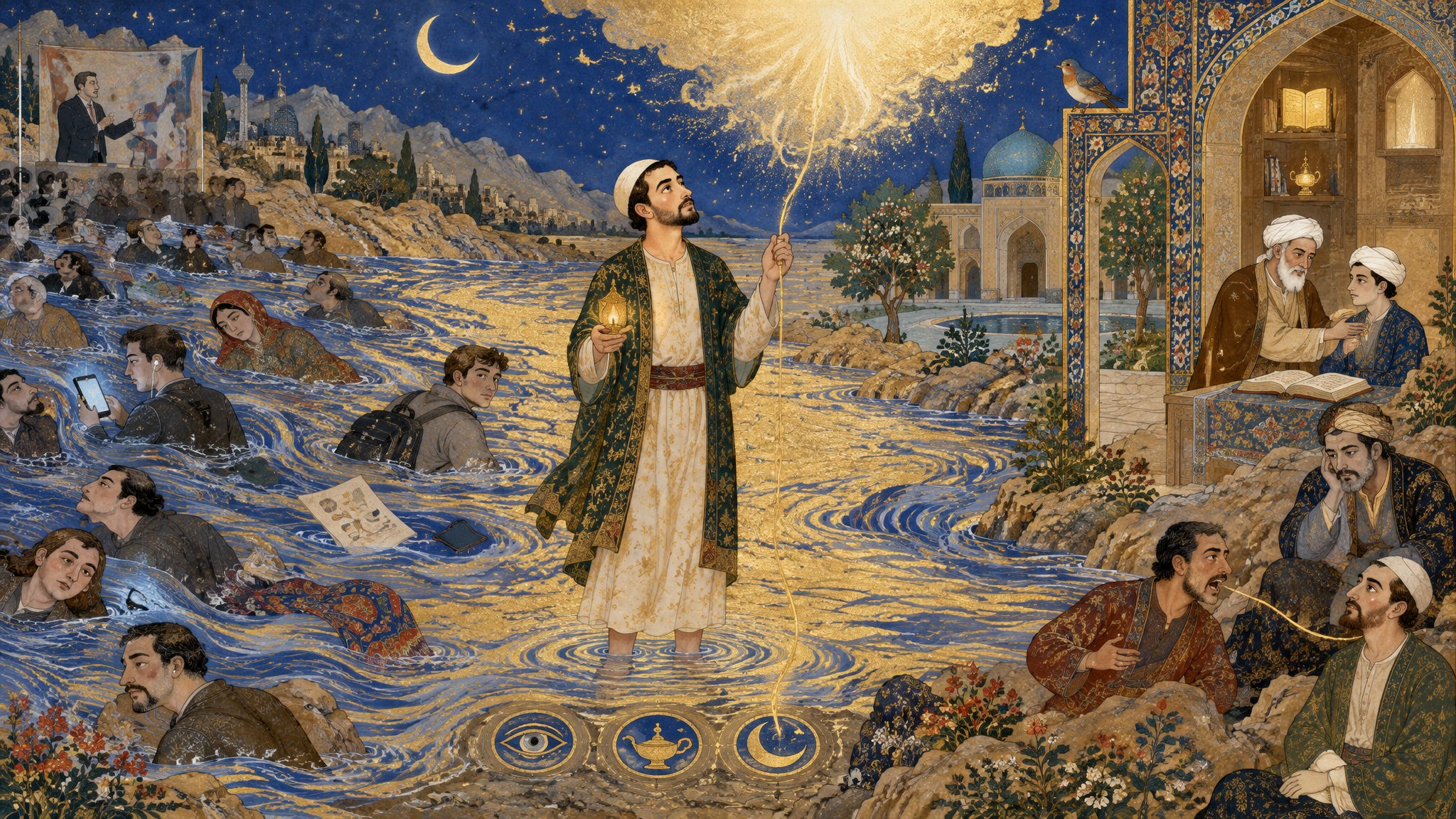
I went to the hawza to become a human being.
Not to go on drifting with the flow.
Drifting is the easiest thing in the world.
Most of us do not choose most of what we think, or most of what we want.
We pick it up from the people around us, from what everybody is saying this year, from whatever happens to be in front of our eyes.
The current carries us — and we call it our life.
To become a human being, in the full sense, is to stop drifting: to know what you are doing, and why, and before Whom.
And the verse we began with already holds it.
The Messenger does not only teach them the Book and wisdom.
He purifies them.
A school of the Prophet’s kind is not only a place where you learn things.
It is a place where you are made into somebody.
And you have already met the person who goes for that reason.
He was the third of the three seekers: the one who seeks knowledge for understanding, and for reason.
That is the one who goes to become a human being.
The other two go to become something else.
What It Makes You Owe
And going makes you owe something.
I want to put this as sharply as I can, because I think it is the hinge of the whole evening.
A career is owed something by the people it serves.
A calling owes them.
A career says:
I have studied — so now you owe me.
Respect.
A position.
A living.
A title.
A calling says:
I have been given something — so now I owe it, to the people I was given it for.
From the outside, the two can look exactly alike.
The same books, the same teachers, the same long nights.
You can only tell them apart by what they expect of the people around them.
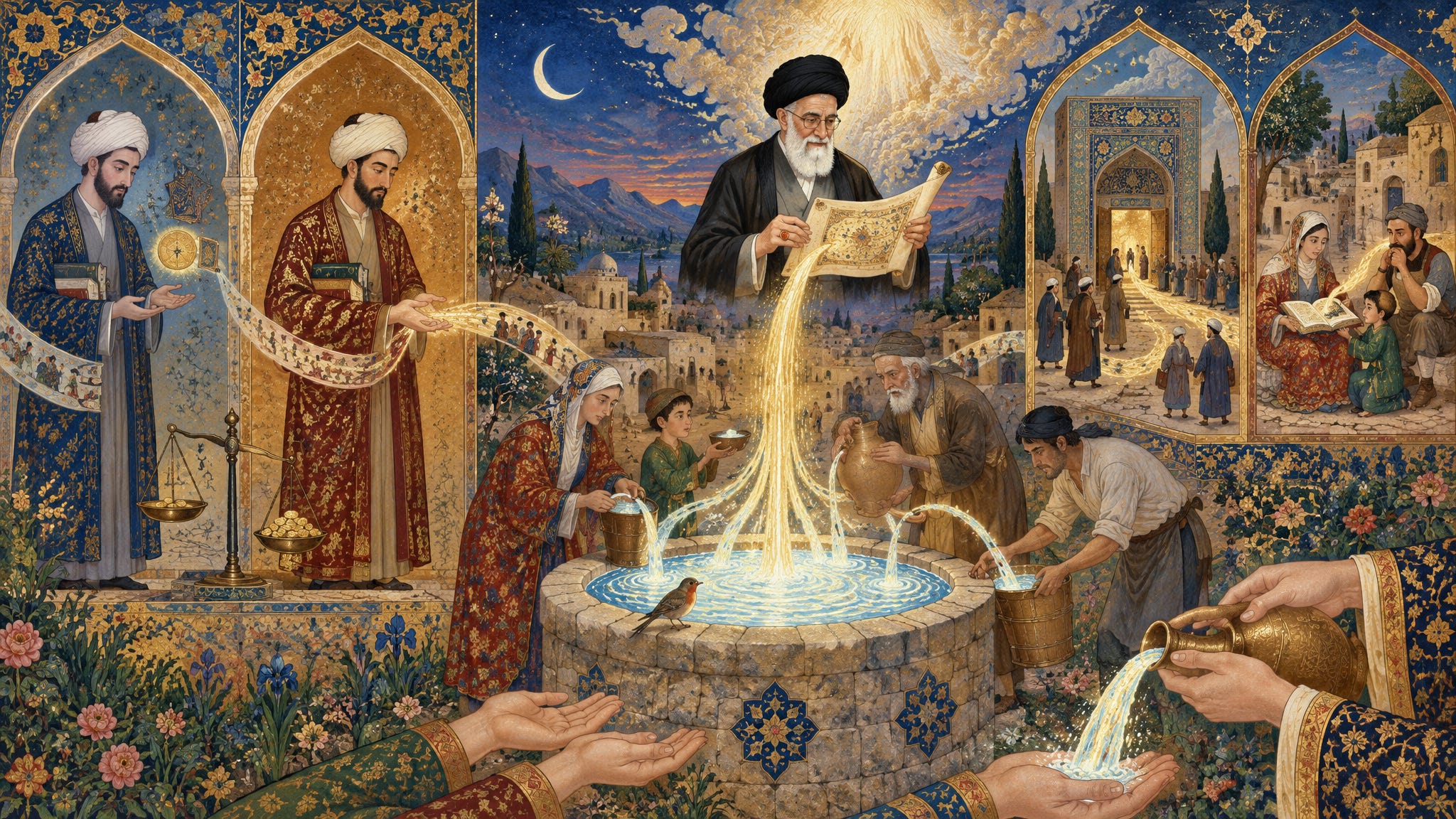
In the spring of last year, the martyred leader, Imam Sayyed Ali Khamenei, may God rest his pure soul, sent a message to a conference marking the centenary of the re-establishment of the hawza of Qom.
Three sentences of it say it in his own terms:
حوزه نهادی برونگرا است. خروجی حوزه در همهی سطوح، در خدمت فکر و فرهنگ جامعه و انسانها است. حوزه موظّف به «بلاغ مبین» است.
“The hawza is an outward-facing institution. The hawza’s output, at every level, is in the service of the thought and the culture of society, and of people. The hawza is duty-bound to ‘balagh-e mubin’.”
— Imam Sayyed Ali Khamenei, may God rest his pure soul, message to the international conference for the centenary of the re-establishment of the hawza of Qom (signed 28 April 2025; published 7 May 2025), my translation
Outward-facing.
Not a school that exists for itself, or for the people inside it.
Think of a well, dug in the middle of a village.
Nobody digs a well so that the well can have water.
Everything it holds is for the people who come to it with their buckets.
That is what he is saying about the hawza:
everything it produces, at every level, is for the people outside it.
And notice the words he uses for the duty:
balagh-e mubin — clear conveyance.
Those words come from the Qur’an, which uses them for the duty of the Messenger himself: what rests on the Messenger, it says, is only the clear conveyance.
قُلۡ أَطِيعُواْ ٱللَّهَ وَأَطِيعُواْ ٱلرَّسُولَۖ فَإِن تَوَلَّوۡاْ فَإِنَّمَا عَلَيۡهِ مَا حُمِّلَ وَعَلَيۡكُم مَّا حُمِّلۡتُمۡۖ وَإِن تُطِيعُوهُ تَهۡتَدُواْۚ وَمَا عَلَى ٱلرَّسُولِ إِلَّا ٱلۡبَلَٰغُ ٱلۡمُبِينُ
“Say, ‘Obey God, and obey the Apostle.’ But if you turn your backs, [you should know that] he is only responsible for his burden and you are responsible for your own burden, and if you obey him, you will be guided, and the Apostle’s duty is only to communicate in clear terms.”
— Qur’an, Surah al-Nur (the Chapter of the Light) #24, Verse 54
So the duty he names for the hawza is the Prophet’s own duty — handed on.
And notice that he does not say the hawza may convey, or that it would be good if it did.
He says it is duty-bound.
A duty is not a hobby.
It is something you will be asked about.
And there are two halves to it.
Conveyance: it has to reach the people.
And
Clear: it has to reach them in a form they can actually take hold of.
A truth that never leaves the building has not been conveyed.
And a truth delivered in a form nobody can understand has not been conveyed clearly.
The Measure of the One Who Comes Back
So how do you measure the one who comes back?
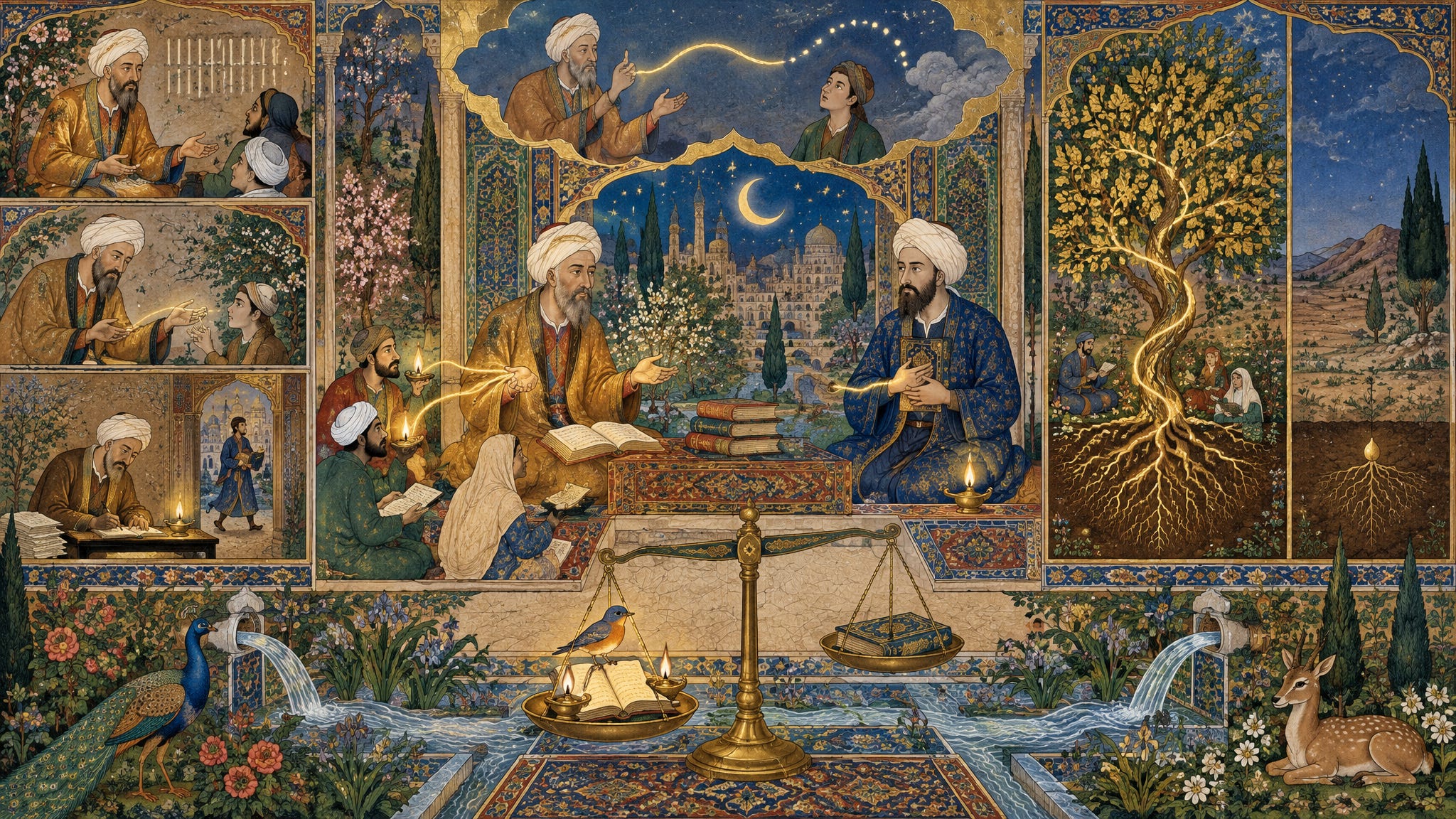
Not by what he learned.
By whether he wants to teach.
In this majlis, back in April, I said something that I want to say again tonight, whole:
“In our age, we have tools al-Kulayni could never have imagined: digital archives, printing presses, the internet, artificial intelligence.”
“The question is not whether we have the means to preserve and transmit knowledge.”
“The question is whether we have the will.”
— from this majlis, in April: The Architecture of Guidance, Part 3, When the Light Was Hidden
The will.
That is the measure — and it is a measure I hold myself to before I hold it to anybody else.
Here, I am not describing anybody’s community.
I am describing a standard.
And the will shows itself in small things.
In the scholar who answers the same question for the hundredth time as patiently as he answered it the first.
In the one who takes the trouble to say a hard thing simply, so that the youngest person in the room can carry it home.
In the one who writes it down, so that the people who were not in the room can have it too.
Knowledge is a strange thing.
It does not grow by being kept.
It grows by being given.
The one who teaches finds out, every week, what he actually knows — and what he only thought he knew.
The one who keeps it never finds out.
So the school gave you something to carry.
Do you want to set it down in front of other people — or do you want to keep it?
The Tools Serve the Calling
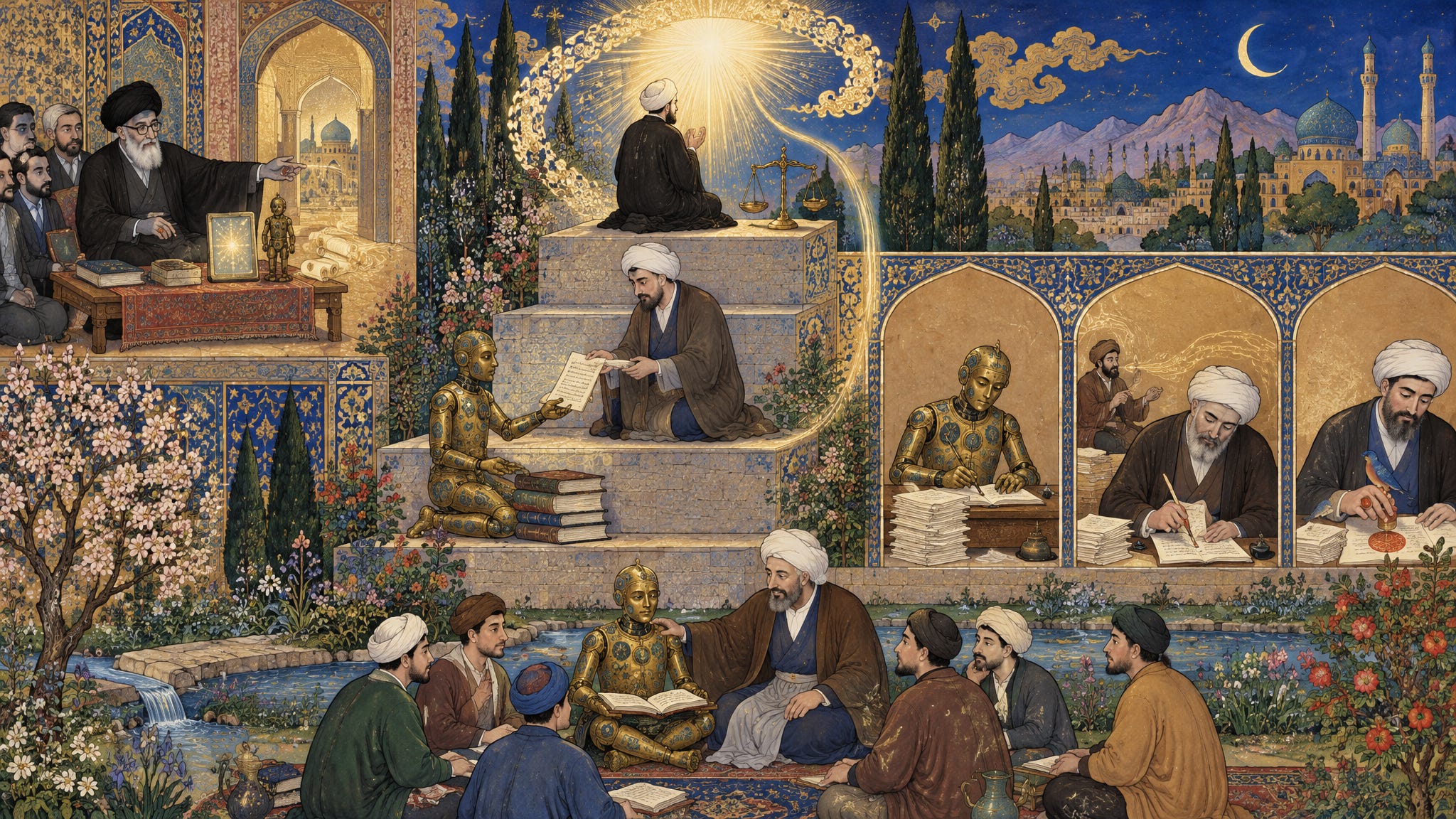
And the first line of that passage brings me to something I promised myself I would speak about tonight: the tools.
In June of last year, the martyred leader spoke to the members of the Iranian parliament about the work of refining the country’s laws.
And he told them that some people had explained to him how they wanted to use artificial intelligence in that work.
I want you to hear exactly what he said — and I want you to hear that he said it to members of parliament, about the laws:
اخیراً هم از برنامهی هوش مصنوعی و وسایل الکترونیکی و مانند این چیزها میخواهند استفاده کنند برای اینکه این کار انجام بگیرد؛ برای من شرح دادند. من به آن برادرانی که آنجا توضیح میدادند گفتم که اینها همه مقدّمه است، اینها همه مقدّمات تنقیح قوانین است، اینها تنقیح قوانین نیست؛ اگر چنانچه این مقدّمات را درست به کار بگیرید و بروید در دل قضیّه، تنقیح قوانین میشود.
“Recently they also want to use AI programmes and electronic tools and the like to get this work done; they explained it to me. I told those brothers who were explaining it there: these are all preliminaries — these are all preliminaries of refining the laws; they are not the refining of the laws. If you put these preliminaries to proper use and go into the heart of the matter, the refining of the laws happens.”
— Imam Sayyed Ali Khamenei, may God rest his pure soul, to the members of the Islamic Consultative Assembly, 11 June 2025, my translation
Preliminaries.
And you will have noticed the word, because it is the name of the hawza’s first stage:
The muqaddimat.
That connection is mine, not his — he was speaking to members of parliament about laws.
But I think it is exactly right.
The machine’s work is a preliminary.
It is not the thing itself.
And the hawza already works this way.
Its own archive of lessons now carries a note at the head of a transcript:
«این متن توسط هوش مصنوعی پیادهسازی و سپس توسط انسان برای مستندسازی و تطبیق با فایل صوتی استاد، بازبینی و تأیید شده است.»
“This text was transcribed by artificial intelligence, and then reviewed and approved by a human — for documentation, and for matching against the teacher’s audio file.”
— the archive of the hawza’s lessons, Madreseh-ye Feqahat (eshia.ir), a lesson of 30 September 2026, my translation
The machine first.
Then a person.
And the teacher’s own voice as the measure.
Why a person?
Because a person can be asked.
A person can be held to what he said — and he will answer for it, here, and before God.
A machine can be fast, and tireless, and very often right.
But it cannot stand behind what it produces.
So in the hawza’s own archive, the machine does the preliminary work — and a human being signs for it.
So — can a machine do ijtihad?
I want to answer that in the hawza’s own terms, and not as a guess about the future.
Here is how I would put it.
Ijtihad is the effort of a mukallaf — a person under God’s obligation — to reach a proof that will stand as his excuse before his Lord.
That is what it is for.
A machine has no obligation, and no Lord to answer to.
It cannot be certain, and it cannot doubt.
So the very sentence we have carried all night — he does not ever break certainty with doubt — is not even addressed to it.
That is not a sneer at the tools.
I am grateful for them.
They can sift the books, and find the page, and save a scholar a week of searching.
They serve.
And in our own small way, we have sent a student to the hawza who will never become a mujtahid — and that is the point.15
On the Desk
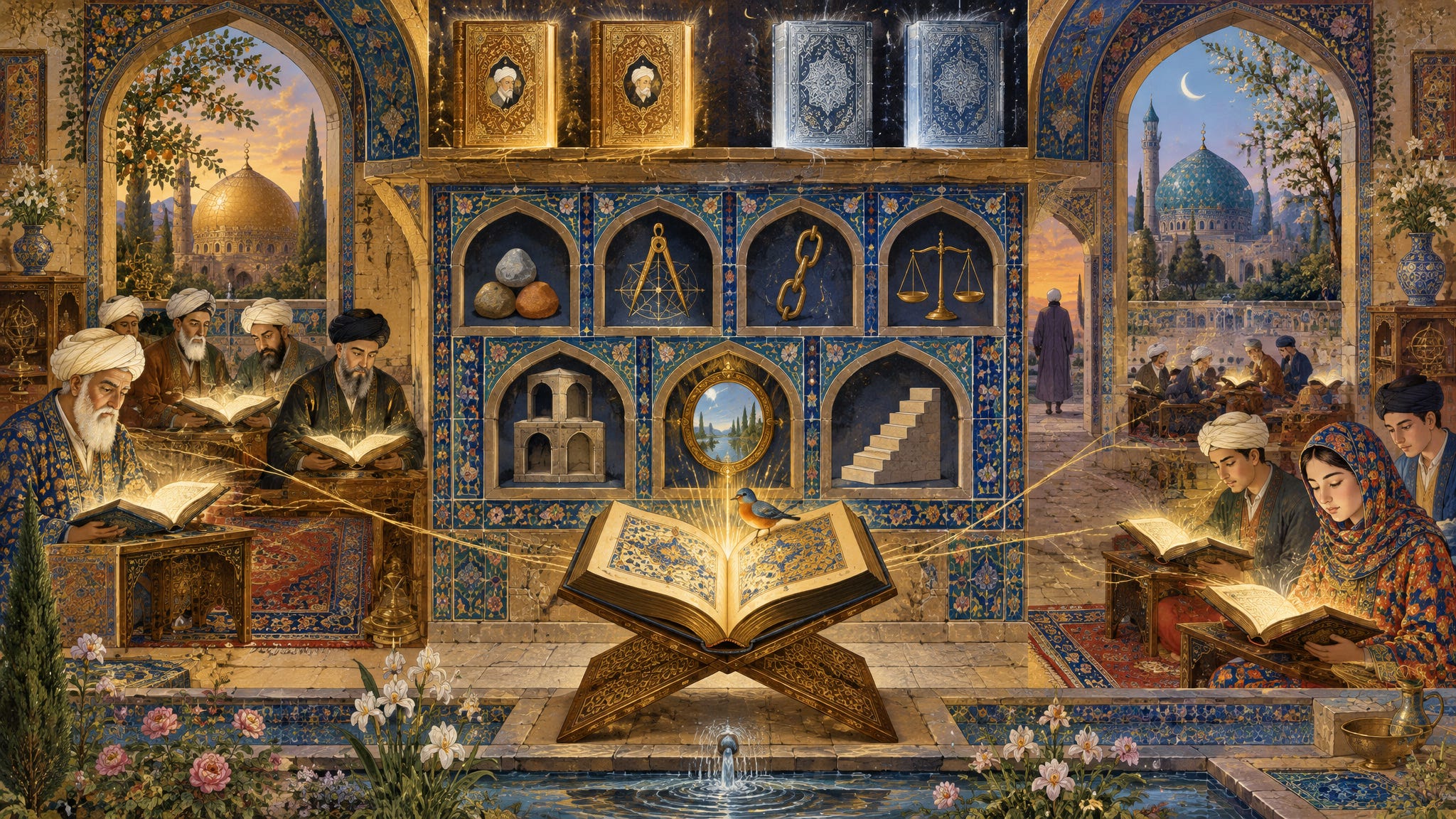
And now one more look at where our sentence came from — because that is where we are going next.
The sentence you have carried all evening came to us through Shaykh al-Tusi’s Tahdhib.
And every class that reads it — in Najaf, in Qom, anywhere at all — reads it from his book, or from a later book that took it from his.
In this majlis we have said that two of the four books this whole school stands on were his.
So if you went looking for Shaykh al-Tusi in the hawza’s course of study, you would not find him as one subject among the others.
He is not on the timetable.
He is on the desk.
Employed
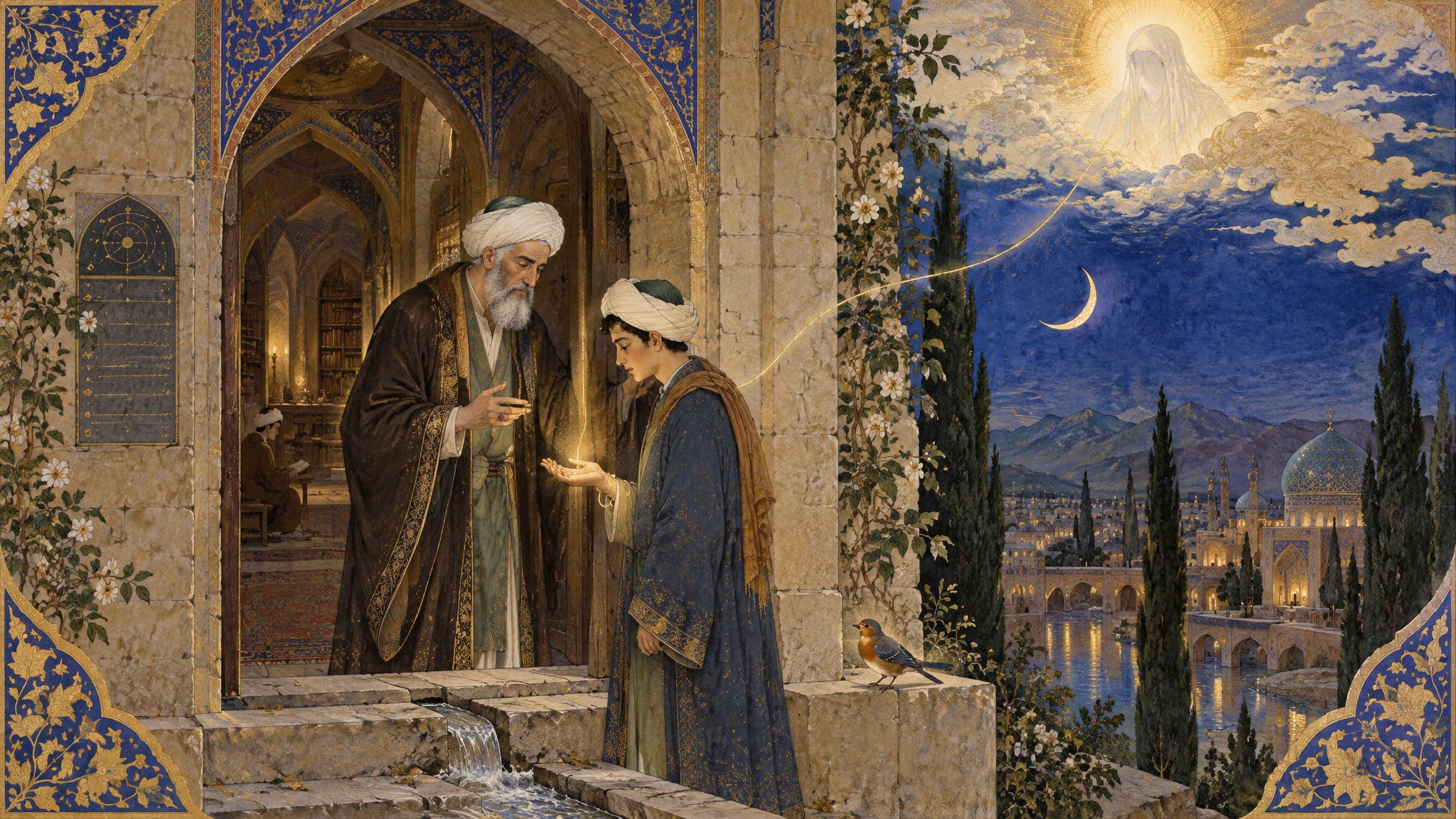
I want to end this point with something that was said to me by one of my teachers, at the very start:
“You are now employed by Imam Mahdi, so understand what that means.”
Next week, God willing, we try to understand what it means — together.
Lessons for Our Time
Lesson Five — A Calling, Not a Career
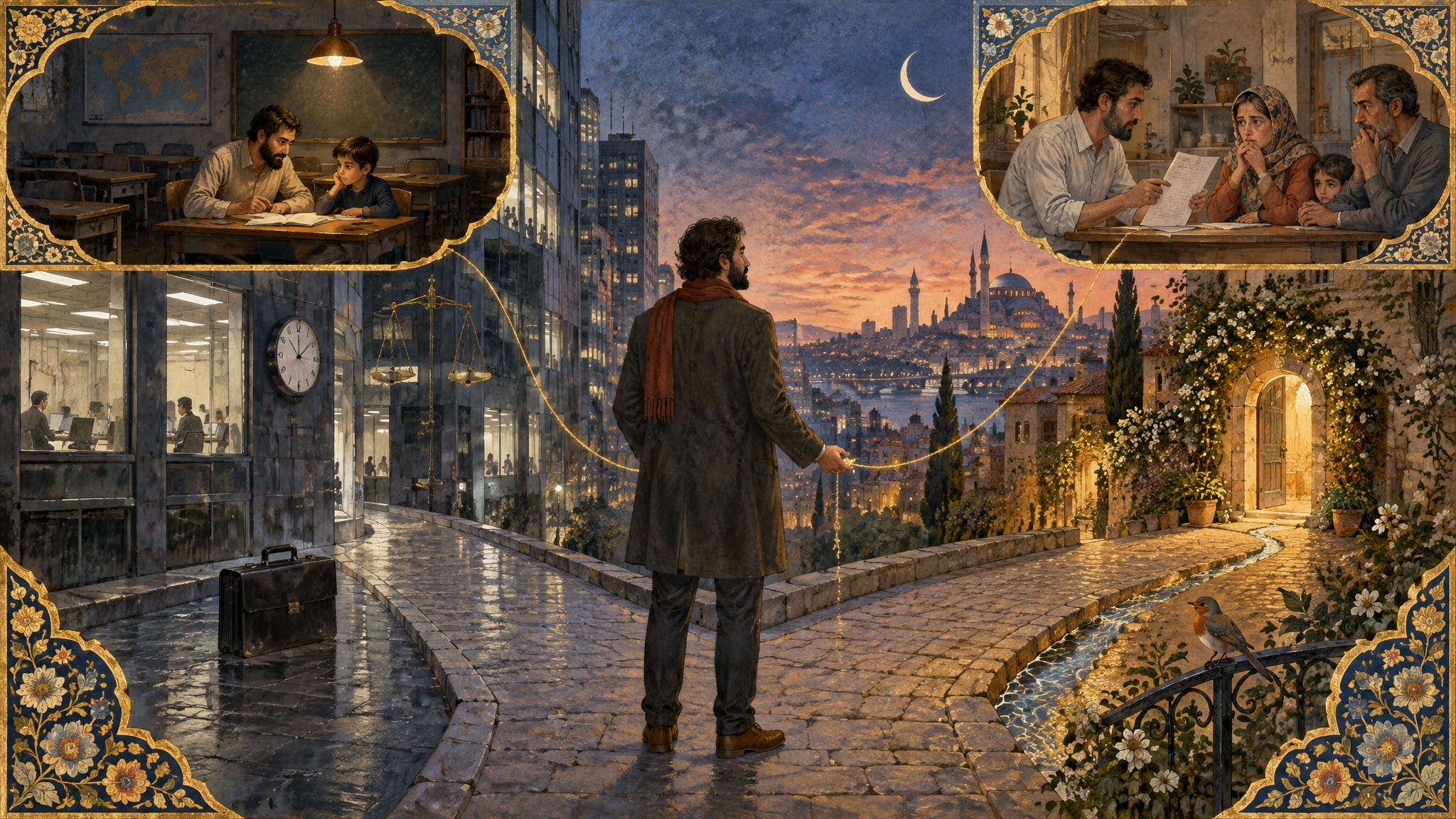
The fifth lesson is the shortest thing I will say tonight.
You go to become a human.
You come back to serve.
What a career takes from people, a calling gives to them.
And it is not only scholars who stand at that fork.
Every one of us who has been given anything — an education, a skill, a profession, a little knowledge of our religion — stands at exactly the same place.
Does what I was given make people owe me?
Or do I owe it to them?
The teacher, the engineer, the accountant, the one who learned a little Arabic, the one who knows how to read a contract — every one of us carries something somebody else needs.
And every one of us can carry it as a career, or as a calling.
Think of the teacher who stays behind for the one child who did not understand.
Or the one who knows how these things work, and sits down with a frightened family to explain, in plain words, the letter they cannot make sense of — when he could have handed it back and moved on.
Nobody is paying them for those minutes.
That is the calling, showing itself.
Here is a simple test, and you can try it on yourself on the way home.
When somebody needs what you know — at the worst possible time, when it is inconvenient, when there is nothing in it for you — what is the first thing you feel?
If it is irritation, the career is winning.
If it is something like gratitude — that you have something to give — the calling is.
I am not pointing at anybody.
This is the standard I hold myself to, from this chair, every week.
I fall short of it, and I come back to it.
That is what a standard is for.
Lesson Six — To Return and Warn
And the sixth lesson is the one the Qur’an gives us, in a verse this majlis has already spent time on — so I will give you only words from its second half.
Of those who go out to understand the religion, God says that they go to
warn their people when they return to them.
— Qur’an, Surah al-Tawbah (the Chapter of the Repentance) #9, Verse 122 — words from its second half, recalled16
When they return to them.
The one who studies owes it back.
And the measure, as I said, is whether he wants to teach.
And notice the word warn.
Not impress.
Not entertain.
Warn — the way a friend who has already travelled a road warns you about what lies along it.
But there is a half of this that belongs to you, in this room — not to the scholars.
Two things.
Make room for what is needed.
When the one who comes back offers you the staple — the grammar, the method, the hard sentence said plainly — make room for it, even on the nights when you would rather have something lighter.
Come to the class that is difficult.
Stay in it.
Ask the question you are embarrassed to ask.
A teacher who wants to teach needs a room that wants to learn.
And ask him the hard question.
A scholar who is only ever thanked does not grow.
The best gift you can give the one who comes back is a real question — one he has to go away and think about.
And let the tools carry the books, so that the scholar can carry the people.

Do not ask a machine for what only a human being can give you — a ruling, a judgement about your own life, a word of counsel from somebody who will answer for it.
And do not spend the human being on what the machine can carry for him.
Every hour a scholar spends hunting for a page that a tool could find in a moment is an hour he did not spend with you.
The Close

I have given you a great deal tonight, and most of it will go.
That is how sermons work, and I have made my peace with it.
So let me leave you three sentences.
If everything else goes, let these stay: God’s word, the Prophet’s — and the sentence the school was built to carry.
The first is God’s, about His Messenger:
And he teaches them the Book and wisdom.
The second is the Prophet’s, in his own mosque:
Knowledge is only three — a decisive verse, or a just obligation, or an established sunna; and whatever is beyond them is surplus.
And the third is the sentence we carried all night:
He does not ever break certainty with doubt; rather, he breaks it with another certainty.
Conclusion — Key Takeaways
Three things to take out of this room — and they are things to do, not only things to think.
The first.

The staple before the feast.
You cannot read what you cannot parse.
When something you are taught is hard, do not walk away from it because it is hard.
The difficulty is the guard.
So make room, in your own week, for the staple.
A text, a friend, an hour.
Read it before you meet.
Argue it when you do.
Write down afterwards what you understood.
And if you do not know where to begin, begin with the prayer you pray every day — and learn what every word of it means.
The second.
Ask who carried it before you ask what it means — and say your own word only after you have learned theirs.
Before you believe a saying, or pass it on, ask where it came from.
If nobody can tell you, hold it gently.
And before you give your own opinion about the religion — at the dinner table, at work, anywhere — learn what the people who carried it before you have said. Then say your word. It will be a better word.
And the third.
A calling, not a career.
You go to become a human; you come back to serve.
Whatever you have been given — knowledge, a skill, a little understanding — ask whether it makes people owe you, or whether you owe it to them.
And then, this week, do one thing that you owe.
Do those three things, and you will have been inside the hawza tonight — not as a visitor, but as a student.
Next week, God willing, the last of these eleven:
Why a Marja’?
What it means to be employed by the Imam of the Age — and who decides what a school like this teaches.
Eulogy — Shaykh al-Tusi, at His Grave, Inside the School He Built
Seven weeks ago we left him in his own house — the house that became a mosque, where people are praying tonight.
I am not going to tell that story again.
I want to tell you something new about him.
You have spent this whole evening inside his book.
The sentence you carried all night — about a man who nods off in his wudu, and a certainty that doubt cannot break — came to us through his hand, and on his chain.
Whoever meets it in Najaf, or in Qom, or in a class anywhere in the world tonight, meets it from his book — or from a later book that took it from his.
Every class that has argued over that clause — Shaykh al-Ansari, the Akhund, the classes in the hawza in 2024 — was arguing over words that had passed across his desk.
Think back over the rooms we walked through tonight.
In the room of language, it was the sentence from his book that we took apart, word by word.
In the room of the narrators, it was the chain he wrote down that we followed, hand to hand. In the room of the principles, it was the report in his book that the great teachers argued over.
He was in every room — not as a subject on the timetable, but as the page on the desk.
That is the school he built.
Not a building.
The desk.
Buildings can be taken.
They can be emptied, or closed, or brought down.
A desk travels.
Wherever somebody opens his book tonight, his school is open.
He did not hold the sentence for himself.
He did not keep his teachers’ words in a drawer.
He wrote them down, with the names of the people who had carried them, so that a student he would never meet could check every hand they had passed through.
Think of what that means.
Every question the second room taught us to ask tonight — who carried this, and did he hear it from the one before him — we can ask of our sentence because he wrote the names down.
He did not only hand us the sentence.
He handed us the means of checking it.
And think of what it took.
Every word written by hand.
Every name copied, and checked, and copied again.
Page after page, report after report — so that, almost a thousand years later, a class in the hawza could argue over a single clause of what he wrote down, and still follow the hands it had passed through.
Those were his deeds.
And they are still being read.
And tonight, when you go home and make your wudu for the night — or tomorrow, for the dawn — and for a moment you wonder whether it is still with you, remember where your freedom came from.
Not from a feeling.
From a sentence.
And from a man at a desk, who wrote it down so that it would reach you.
That is what it looks like to carry something with the best of carrying.
And the Imams have told us what it means when a man like that dies.
إِذَا مَاتَ الْمُؤْمِنُ الْفَقِيهُ ثُلِمَ فِي الاسْلامِ ثُلْمَةٌ لا يَسُدُّهَا شَيْءٌ.
“When the believing jurist dies, a breach is made in Islam that nothing fills.”
— Imam Ja’far al-Sadiq, peace and blessings be upon him; Shaykh al-Kulayni, al-Kafi, Volume 1, the Book of the Merit of Knowledge, the chapter on the loss of the scholars, hadith 2
And from his son, Imam Musa ibn Ja’far:
سَمِعْتُ أَبَا الْحَسَنِ مُوسَى بْنَ جَعْفَرٍ (عَلَيْهما السَّلام) يَقُولُ إِذَا مَاتَ الْمُؤْمِنُ بَكَتْ عَلَيْهِ الْمَلائِكَةُ وَبِقَاعُ الارْضِ الَّتِي كَانَ يَعْبُدُ الله عَلَيْهَا وَأَبْوَابُ السَّمَاءِ الَّتِي كَانَ يُصْعَدُ فِيهَا بِأَعْمَالِهِ وَثُلِمَ فِي الاسْلامِ ثُلْمَةٌ لا يَسُدُّهَا شَيْءٌ لانَّ الْمُؤْمِنِينَ الْفُقَهَاءَ حُصُونُ الاسْلامِ كَحِصْنِ سُورِ الْمَدِينَةِ لَهَا.
“I heard Abu al-Hasan Musa ibn Ja’far, peace be upon them both, say: When the believer dies, the angels weep for him, and the places on earth on which he used to worship God, and the gates of heaven through which his deeds used to be raised; and a breach is made in Islam that nothing fills — because the believing jurists are the fortresses of Islam, as the wall of a city is its fortress.”
— Ali ibn Abi Hamza, from Imam Musa ibn Ja’far al-Kadhim, peace and blessings be upon him; Shaykh al-Kulayni, al-Kafi, Volume 1, the Book of the Merit of Knowledge, the chapter on the loss of the scholars, hadith 3
He was buried in his own house — among the places on earth on which he used to worship God: the ground he stood on, and bowed on, and laid his forehead on.
And it is in that same ground that he lies now.
His grave is in the mosque that bears his name.
— the editor’s note on Shaykh al-Tusi, in the Arabic edition of Imam Khomeini’s Adab al-Salat, page 337 — narrated17
People come there.
They pray beside him.
Somewhere tonight, his book is open on a stand like the one in front of you — and our sentence is being read from it.
Segue to Maqtal
Our sentence came from Zurara.
And Zurara learned from two Imams.
Tonight we sit with the first of them — the boy to whom the last of the Prophet’s companions carried the Prophet’s own greeting.
Imam Muhammad al-Baqir, peace and blessings be upon him.
The one who split knowledge open.
Think of that greeting for a moment — carried across a lifetime, from one hand to the next, until it reached the one it was meant for.
That is what we have been talking about all night.
That child spent his life among his people, teaching them.
And when he came to the end of it, he left an instruction for his own memory — and it was not for a building.
Our maqtal tonight is for him.
And it is given in the voice of the one who carries every one of their griefs: the Imam of our Age.
Maqtal (Lamentation) for the Eighteenth Session of the Architecture of Guidance
Supplication
O God, we ask You by the light You placed in the world before there was a world to place it in.
By Your prophets, peace and blessings be upon them all — every one of them sent to teach a people who did not yet know.
By Muhammad, peace and blessings be upon him, his family, and his righteous companions — who recited Your verses to an unlettered people, and purified them, and taught them the Book and wisdom.
By the fourteen — by Sayyedah Fatimah al-Zahra, peace and blessings be upon her, and by every Imam from the Commander of the Faithful, peace and blessings be upon him, to the one we are waiting for.
O God, make us carriers of Your words, who do not drop them and do not bend them. Give us knowledge that benefits, and keep us from gathering around what does not.
O God, when we doubt, let our doubt not break what You have made certain for us. And when we are certain, keep us humble enough to learn.
O God, when we do not understand, give us the humility to ask. And when we understand, give us the will to teach.
O God, for those who sit in the circles of knowledge tonight — the students, and their teachers, and the ones who will go — make their study a calling and not a career. Make them outward-facing. And bring them home to their people, to serve them.
O God, bless Imam Muhammad al-Baqir, peace and blessings be upon him, who split knowledge open.
O God, have mercy on Shaykh al-Tusi, who sat at his desk so that we could sit at ours; and on Zurara, and Hariz, and Hammad, and al-Husayn ibn Sa’id; and on every hand our sentence passed through on its way to this room.
O God, have mercy on our own teachers, living and dead — those who taught us to read, and those who taught us to pray — and on our mothers and fathers, who were our first teachers.
O God, we remember before You the martyred leader, Imam Sayyed Ali Khamenei, may God rest his pure soul — and we ask You to accept him, and to gather him with those he loved.
O God, protect and guide and lengthen the life of our Wali al-Faqih, Imam Sayyed Mujtaba Khamenei, may God protect him, and keep him firm on the straight path until the rising of the one we are waiting for.
O God, hasten the relief of Your friend and the son of Your friend — the Imam of our Age, may our souls be his ransom and may God hasten his return. Let us be among those he would be pleased to find carrying Your words when he comes.
And whatever we have said tonight that was true, it is from You; and whatever was wrong in it is from me, and I ask Your forgiveness for it.
Amen, O Lord Sustainer of the Universes
Amen, O Most Merciful of the Merciful
And from Him alone is all ability and He has authority over all things.
Appendix — The Subjects of the Hawza, and What Each One Guards Against
A reference for the written record.
It is an orientation map, not a timetable: the classic pathway as it is commonly described for Qom and Najaf. Schools, teachers and books vary, and the two centres organise the same core differently.
The texts named are representative, not a list every student reads.
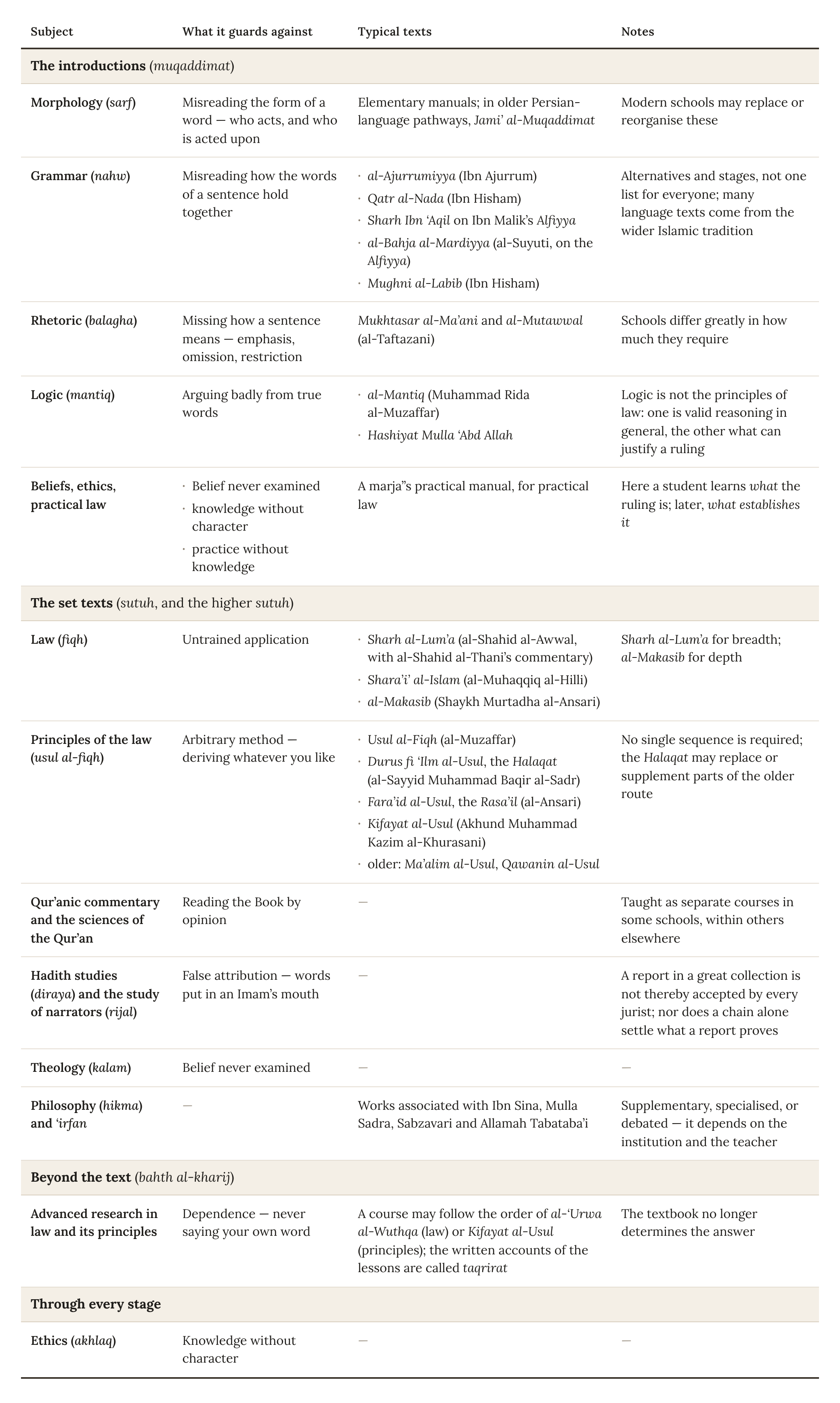
You can also find more information at Ilmflow.
One sentence through the whole school.
Language identifies the evidence; the study of the sources assesses it; the principles of the law establish the method; and the law applies that method to a concrete problem.
The one clause, four readings.
Otherwise, he is certain of his wudu:
(1) the answer to the if is left unsaid, and this is the reason standing in its place — Shaykh al-Ansari, the Akhund, and Sayyed Abu al-Qasim al-Khoei;
(2) the clause is itself the answer, read as a command — Mirza al-Na’ini;
(3) the clause is a preamble, and the answer is he does not ever break certainty with doubt;
(4) the clause is the answer, kept as a statement.
On the first reading, certainty is not broken by doubt becomes a rule for everything, not only for wudu. (As set out in a kharij lesson of 17 January 2024, Madreseh-ye Feqahat, eshia.ir — citing al-Ansari, Fara’id al-Usul, Volume 3, page 56, and al-Na’ini, Fawa’id al-Usul, Volume 4, page 336.)18
The sentence in two forms.
The text set above is the Tahdhib‘s, as Ayatollah Muhsini gives it: he does not ever break certainty with doubt; rather, he breaks it with another certainty.
Al-Hurr al-’Amili’s Wasa’il al-Shi’a (Volume 1, page 245, the Al al-Bayt edition) gives the last clause as a command: and do not ever break certainty with doubt; you break it only with another certainty — as quoted in a kharij lesson of 16 December 2024 (Madreseh-ye Feqahat, eshia.ir)19.
This is the reason copies are compared.20
غرض السورة هو الحث البالغ على الاهتمام بأمر صلاة الجمعة و القيام بواجب أمرها فهي من شعائر الله المعظمة التي في تعظيمها و الاهتمام بأمرها صلاح أخراهم و دنياهم، و قد سلك تعالى إلى بيان أمره بافتتاح الكلام بتسبيحه و الثناء عليه بما من على قوم أميين برسول منهم أمي يتلو عليهم آياته و يزكيهم بصالحات الأعمال و الزاكيات من الأخلاق و يعلمهم الكتاب و الحكمة فيحملهم كتاب الله و معارف دينه أحسن التحميل هم و من يلحق بهم أو يخلفهم من بعدهم من المؤمنين فليحملوا ذلك أحسن الحمل، و ليحذروا أن يكونوا كاليهود حملوا التوراة ثم لم يحملوا معارفها و أحكامها فكانوا مثل الحمار يحمل أسفارا.
“The purpose of the surah is the most earnest urging to give weight to the matter of the Friday prayer, and to carry out what it requires — for it is one of the great sha’a’ir of God [the markers He has set up], in the honouring of which, and in giving weight to which, lies the good of their hereafter and of their world. He, exalted, has gone about setting out its matter by opening the speech with His own glorification, and with praise of Him for His favour to an unlettered people: a Messenger from among them, unlettered, who recites His verses to them, and purifies them with righteous deeds and pure qualities, and teaches them the Book and wisdom — and so loads them with the Book of God and the knowledge of His religion, with the best of loading: them, and whoever joins them or comes after them among the believers. So let them carry it, with the best of carrying; and let them beware of being like the Jews, who were loaded with the Torah and then did not carry its knowledge and its rulings, and so were like the donkey carrying books.”
— Allamah Sayyed Muhammad Husayn Tabataba’i, al-Mizan fi Tafsir al-Qur’an, on Surah al-Jumu’ah (the Chapter of Friday) #62, Verses 1 to 8 — the opening of his commentary on the chapter
وفي الحديث: فَحَمَى حَوْزَةَ الإسلام أي حدوده ونواحيه. وفلان مانع لحَوْزَتَه أي لما في حَيْزه. والحَوْزَة، فَعْلَةٌ، منه سميت بها الناحية. وفي الحديث: أنه أتى عبد الله بن رواحة يعوده فماتَحَوْز له عن فراشه أي ما تَنَحَّى؛ التَّحَوْز: من الحَوْزَة، وهي الجانب كالتَّنَحُّي من الناحية. يقال: تَحَوْز وَتَحَيْز إلا أن التَّحَوْز تَفَعَّل والتَّحَيْز تَفَيَّعُل، وإنما لم يَتَنَحَّحَ له عن صدر فراشه لأن السنَّة في ترك ذلك. والحَوْز: موضع يَحُوزه الرجل يَتَّخِذُ حَوَالِيه مُسْنَاهُ، والجمع أَحْواز، وهو يَحْمِي حَوْزَتَه أي ما يليه ويَحُوزه. والحَوْزَة: الناحية. والمُحَاوَزَةُ: المخالطة. وَحَوْزَةُ المُلْكِ: بَيْضَتُهُ.
“In the hadith: ‘He protected the hawza of Islam’ — that is, its borders and its sides. ‘So-and-so guards his hawza’ — that is, what lies within his bounds. Hawza is on the pattern fa’la; from it the side of a place takes its name. In the hadith: ‘He came to visit ‘Abdullah ibn Rawaha in his illness, and he did not move aside for him from his bed’ — that is, he did not draw aside. Tahawwuz comes from hawza, which is the side — as tanahhi, drawing aside, comes from nahiya, the side of a place. One says tahawwaza and tahayyaza, except that tahawwuz is on the pattern tafa’‘ul and tahayyuz on tafay’ul. The only reason he did not draw aside for him from the head of his bed is that the sunna lies in not doing so. The hawz is a place a man takes possession of, raising an embankment around it; its plural is ahwaz. And he guards his hawza — that is, what lies next to him and is his to hold. The hawza: the side. Muhawaza: mixing together. And the hawza of a realm is its heartland.”
— Ibn Manzur, Lisan al-’Arab, Volume 3, the root h-w-z, page 389; my translation
The same saying is carried outside our books. Abu Dawud opens his Book of Inheritance with it, from ‘Abdullah ibn ‘Amr ibn al-’As: knowledge is in three categories, and whatever is beyond that is surplus — a decisive verse, an established sunna, and justice in inheritance (Sunan Abi Dawud, Volume 3, the Book of Inheritance, chapter 1, hadith 2885, printed page 428 of the Darussalam English–Arabic edition, which grades its chain weak; also in Sunan Ibn Majah, the Introduction, the chapter on avoiding opinion and analogy, hadith 54, per that edition’s notes — narrated).
Our book files the saying under knowledge and reads its middle words as a just obligation; his files it under inheritance and reads the same words as just shares of inheritance.
The same two words, two readings — the first guard of this evening, shown by the witness itself. Setting the two side by side ranks neither book.
On our own report’s chain: Allamah al-Majlisi grades it weak (Mir’at al-’Uqul, Volume 1, page 102), and Allamah al-Behbudi leaves it out of his selection.
In each case the grade is a judgment on the chain, not on the content — ours runs through narrators such as Sahl ibn Ziyad, whom some scholars of rijal weaken.
We report the gradings; we do not adjudicate them.
Its content was tested against the Qur’an for this session, and nothing in it goes against it.
The two outside witnesses in full (Abu Dawud’s and Ibn Majah’s Arabic, their English, their grading and their notes) go here once their pages are promoted in Fihrist.
Allamah al-Majlisi’s grading, in his words.
بَابُ صِفَةِ الْعِلْمِ وَفَضْلِهِ وَفَضْلِ الْعُلَمَاءِ.
الْحَدِيثُ الْأَوَّلُ ضَعِيفٌ
“The chapter on the description of knowledge, its merit, and the merit of the scholars.
The first hadith: weak.”
— al-Allamah Muhammad Baqir al-Majlisi, Mir’at al-’Uqul, Volume 1, page 102
خانۀ کوچکی داشتیم که بیش از هشتاد متر مساحت نداشت. یازده فرزند بودیم؛ ده دختر و یک پسر. من تنها پسر خانواده بودم. این خانۀ کوچک و محقر برای ما به وسعت یک دنیا به نظر میرسید. ما بچهها همگی در یک اتاق میخوابیدیم. چارهای نداشتیم، خانۀ ما بیش از این گنجایش نداشت؛ لکن آنچنان صمیمی بودیم که همان چهاردیواری تنگ برای ما بهشت کوچکی بهشمار میآمد.
“We had a small house, of no more than eighty square metres. We were eleven children — ten girls and one boy; I was the only son of the family. This small, humble house seemed to us as wide as a world. We children all slept in one room. We had no choice — our house had no more room than that; but we were so close to one another that those same cramped four walls counted, for us, as a little paradise.”
— Ayatollah Muhsin Araki, Dar Maktab-e Pedar (In My Father’s School), page 44; my translation.
رسم ما بر این بود که هر پولی که دست ما میرسید، روی طاقچهٔ حجره میگذاشتیم و درب حجره را باز میگذاشتیم. هر طلبهای که نیاز پیدا میکرد به مقداری که نیاز داشت برمیداشت و بعد از مدتی که نیازش برطرف میشد و شهریهای یا پولی از محلی به دستش میرسید پول را بجای خود باز میگرداند. سایر طلبهها نیز عادت پیدا کرده بودند که هرگاه پولی زائد بر خرج روزانهشان داشتند روی همان طاقچه برای استفاده سایر طلاب میگذاشتند.
“[Ayatollah Araki’s father, on the time in his student days when he shared a room at the Sadr school in Najaf with Ayatollah Aqa Mirza Ahmad Dashti:] Our custom was this: whatever money came into our hands, we would put on the ledge of the room, and leave the door of the room open. Any student who was in need would take as much as he needed; and some time later, when his need had passed and a stipend, or money from somewhere, had reached him, he would put the money back in its place. The other students, too, had come into the habit: whenever they had money beyond their daily expenses, they would put it on that same ledge, for the other students to use.”
— Ayatollah Muhsin Araki, Dar Maktab-e Pedar (In My Father’s School), page 50 — his father’s own account; my translation
تدل الآيات على لزوم أن يجتمعوا على معارف الدين و يرابطوا أفكارهم و يمتزجوا في التعليم و التعلم فيستريحوا في كل حادث فكري أو شبهة ملقاة إلى الآيات المتلوة عليهم و التدبر فيها لحسم مادة الاختلاف و قد قال تعالى: أ فلا يتدبرون القرءان و لو كان من عند غير الله لوجدوا فيه اختلافا كثيرا:«النساء: 82»، و قال: و تلك الأمثال نضربها للناس و ما يعقلها إلا العالمون:«العنكبوت: 43»و قال: فاسئلوا أهل الذكر إن كنتم لا تعلمون:«النحل: 43»فأفاد أن التدبر في القرآن أو الرجوع إلى من يتدبر فيه يرفع الاختلاف من البين.
“The verses show that they must gather together over the teachings of the religion, and bind their thoughts together, and mingle in teaching and learning — so that, in every new question of thought, or doubt that is cast to them, they find their rest in the verses recited to them, and in reflecting on them, to cut off the very root of disagreement. And He, the Exalted, has said: ‘Do they not reflect on the Qur’an? Had it been from other than God, they would surely have found much disagreement in it’ (al-Nisa: 82); and He said: ‘And these are the parables We strike for the people, and none understand them but those who know’ (al-’Ankabut: 43); and He said: ‘So ask the people of remembrance, if you do not know’ (al-Nahl: 43). So He has conveyed that reflection on the Qur’an, or turning to the one who reflects on it, removes the disagreement from between them.”
— Allamah Sayyed Muhammad Husayn Tabataba’i, al-Mizan fi Tafsir al-Qur’an, on Surah Aal Imran (the Chapter of the Family of Imran) #3, Verse 200 — from his essay on binding together in the Islamic community
و منه يظهر أن هذا الدين كما يعتمد بأساسه على التحفظ على معارفه الخاصة الإلهية كذلك يسمح للناس بالحرية التامة في الفكر، و يرجع محصله إلى أن من الواجب على المسلمين أن يتفكروا في حقائق الدين و يجتهدوا في معارفه تفكرا و اجتهادا بالاجتماع و المرابطة، و إن حصلت لهم شبهة في شيء من حقائقه و معارفه أو لاح لهم ما يخالفها فلا بأس به و إنما يجب على صاحب الشبهة أو النظر المخالف أن يعرض ما عنده على كتاب الله بالتدبر في بحث اجتماعي، فإن لم يداو داءه عرضه على الرسول أو من أقامه مقامه حتى تنحل شبهته أو يظهر بطلان ما لاح له إن كان باطلا، قال تعالى الذين يستمعون القول فيتبعون أحسنه أولئك الذين هداهم الله و أولئك هم أولوا الألباب:«الزمر: 18».
“And from this it becomes clear that this religion, just as it rests at its foundation on safeguarding its own divine teachings, likewise permits people complete freedom of thought. What it comes to is this: it is obligatory upon the Muslims to think about the realities of the religion, and to strive in its teachings — a thinking and a striving done in company, and binding one another. And if a doubt comes to them about anything of its realities and teachings, or something appears to them that contradicts them, there is no harm in it; rather, what is obligatory on the one with the doubt, or with the contrary view, is to present what he has to the Book of God, reflecting on it in a shared inquiry; and if that does not cure his ailment, he presents it to the Messenger, or to the one he has set in his place, until his doubt is resolved, or the falsity of what appeared to him becomes clear, if it was false. He, the Exalted, has said: ‘Those who listen to the word and follow the best of it — those are the ones God has guided, and those are the people of understanding’ (al-Zumar: 18).”
— Allamah Sayyed Muhammad Husayn Tabataba’i, al-Mizan fi Tafsir al-Qur’an, on Surah Aal Imran (the Chapter of the Family of Imran) #3, Verse 200 — the same essay, a few lines on
طَلَبَةُ الْعِلْمِ ثَلاثَةٌ فَاعْرِفْهُمْ بِأَعْيَانِهِمْ وَصِفَاتِهِمْ صِنْفٌ يَطْلُبُهُ لِلْجَهْلِ وَالْمِرَاءِ وَصِنْفٌ يَطْلُبُهُ لِلاسْتِطَالَةِ وَالْخَتْلِ وَصِنْفٌ يَطْلُبُهُ لِلْفِقْهِ وَالْعَقْلِ فَصَاحِبُ الْجَهْلِ وَالْمِرَاءِ مُوذٍ مُمَارٍ مُتَعَرِّضٌ لِلْمَقَالِ فِي أَنْدِيَةِ الرِّجَالِ بِتَذَاكُرِ الْعِلْمِ وَصِفَةِ الْحِلْمِ قَدْ تَسَرْبَلَ بِالْخُشُوعِ وَتَخَلَّى مِنَ الْوَرَعِ فَدَقَّ الله مِنْ هَذَا خَيْشُومَهُ وَقَطَعَ مِنْهُ حَيْزُومَهُ وَصَاحِبُ الاسْتِطَالَةِ وَالْخَتْلِ ذُو خِبٍّ وَمَلَقٍ يَسْتَطِيلُ عَلَى مِثْلِهِ مِنْ أَشْبَاهِهِ وَيَتَوَاضَعُ لِلاغْنِيَاءِ مِنْ دُونِهِ فَهُوَ لِحَلْوَائِهِمْ هَاضِمٌ وَلِدِينِهِ حَاطِمٌ فَأَعْمَى الله عَلَى هَذَا خُبْرَهُ وَقَطَعَ مِنْ آثَارِ الْعُلَمَاءِ أَثَرَهُ وَصَاحِبُ الْفِقْهِ وَالْعَقْلِ ذُو كَآبَةٍ وَحَزَنٍ وَسَهَرٍ قَدْ تَحَنَّكَ فِي بُرْنُسِهِ وَقَامَ اللَّيْلَ فِي حِنْدِسِهِ يَعْمَلُ وَيَخْشَى وَجِلاً دَاعِياً مُشْفِقاً مُقْبِلاً عَلَى شَأْنِهِ عَارِفاً بِأَهْلِ زَمَانِهِ مُسْتَوْحِشاً مِنْ أَوْثَقِ إِخْوَانِهِ فَشَدَّ الله مِنْ هَذَا أَرْكَانَهُ وَأَعْطَاهُ يَوْمَ الْقِيَامَةِ أَمَانَهُ.
“The seekers of knowledge are three — so know them by their persons and their marks. One kind seeks it for ignorance and wrangling; one kind seeks it to lord it over others, and to deceive; and one kind seeks it for understanding and for reason. The one of ignorance and wrangling is hurtful and quarrelsome, thrusting himself forward to speak in the gatherings of men, rehearsing knowledge and describing forbearance; he has put on humility like a garment, and stripped himself of scruple — so may God crush this one’s nose, and cut him through the breast. The one of lording-it and deceit is a man of cunning and flattery: he lords it over his equals among his kind, and humbles himself before the rich who are beneath him; so he digests their sweets, and demolishes his religion — so may God blind this one’s knowing, and cut his trace from the traces of the scholars. And the one of understanding and reason is a man of sorrow, and grief, and sleepless nights: he has wound his turban beneath his chin in his hooded cloak, and stood the night through in its deepest dark; he works, and he fears — trembling, praying, anxious — turned to his own affairs, knowing the people of his time, wary of the most trusted of his brothers — so may God make firm this one’s pillars, and grant him his safety on the Day of Resurrection.”
— Imam Ja’far al-Sadiq, peace and blessings be upon him; Shaykh al-Kulayni, al-Kafi, Volume 1, the Book of the Merit of Knowledge, hadith 131 (thaqalayn)
٤ - يعنى حماد بن عيسى الجهني البصري الثقة .
“That is, Hammad ibn ‘Isa al-Juhani al-Basri, the reliable.”
— footnote 4 to Shaykh al-Tusi, Tahdhib al-Ahkam, Volume 1, page 7, in the edition annotated by Ali Akbar al-Ghaffari; my translation
حث سندی : باتوجه به اینکه تمام روایان این روایت عدل امامی هستند، این روایت از حیث سندی صحیحة میباشد و مضمرة بودن این روایت با توجه به جلالت قدر زرارة و مبرّی بودن او از نقل نمودن حکم فقهی با این تفصیل از غیر معصوم از یک سو، و منقول بودن همین روایت از امام باقر علیه السلام در نقل بزرگانی نظیر مرحوم علامه بحرالعلوم[6] و فاضل نراقی و وحید بهبهانی[7] از سوی دیگر ضرری به اعتبار سند آن نمیرساند، چرا که ممکن است این بزرگان به اصل زرارة دست یافته و در آنجا روایت مذکور را منقول از امام باقر علیه السلام دیده باشند و احتمال اجتهاد کردن در این زمینه و نسبت دادن یک روایت مضمرة به یک معصوم بدون مستند شرعی از جانب آنها بسیار بعید به ذهن میرسد. [8]
“On the chain: since every narrator of this report is a just Imami, the report is, as to its chain, sahih. And its being mudmara [Zurara naming no Imam] does no harm to the reliability of its chain, given, on the one side, the greatness of Zurara’s standing, and that he is far above carrying a legal ruling in such detail from anyone but an Infallible; and, on the other, that this same report is carried from Imam al-Baqir, peace be upon him, in the transmission of great scholars such as the late Allamah Bahr al-’Ulum [6], and the Fadil al-Naraqi, and al-Wahid al-Behbahani [7]. For it may be that these great scholars reached Zurara’s own asl [his original notebook] and saw the report there, carried from Imam al-Baqir, peace be upon him; and that they should have exercised ijtihad in this, and attributed a mudmara report to an Infallible without a valid basis, seems very far from likely [8].
The footnotes:
[6] al-Fawa’id al-Rijaliyya (the Rijal of al-Sayyid Bahr al-’Ulum), al-Sayyid Bahr al-’Ulum, Volume 1, page 110. al-Fawa’id al-Madaniyya — al-Astarabadi, Muhammad Amin — the library of Madreseh-ye Feqahat (eshia.ir);
[7] al-Wahid al-Behbahani, al-Fawa’id al-Ha’iriyya, Volume 1, page 277;
[8] Mawsu’at al-Imam al-Khoei, Volume 48, page 14.”— the same lesson of 16 December 2024 (Madreseh-ye Feqahat, eshia.ir): its paragraph on the report’s chain, with its footnotes 6 to 8; my translation
١ ـ هذا أصل متين ، نافع في كثير من المواضع ، وهو أن اليقين بالشيء مستصحب ، لا يخرج من حكمه و أثره إلا بيقين آخر مثله . (في) و أقول : الظاهر من الخبر أن مقدمات التوم لا تنقض الوضوء .
“[From al-Wafi:] This is a firm principle, useful in many places: that certainty about a thing is carried forward, and does not leave its ruling and its effect except through another certainty like it.[The editor’s own note:] And I say: the plain sense of the report is that the onset of sleep does not break wudu.”
— footnote 1 to Tahdhib al-Ahkam, Volume 1, page 8 — al-Fayd al-Kashani in al-Wafi, then the editor, Ali Akbar al-Ghaffari; my translation
ایشان عنایت خاصی به مرحوم ابوی بنده داشتند تا آنجایی که مرحوم پدرم نزدیکترین فرد به ایشان میشوند و در درس، مرحوم پدرم متن درس را که از عروة و یا شرایع بوده را بلند میخواندند و ایشان بحث درس را شروع میکردند.
“He [Sayyid ‘Abd al-Hadi Shirazi] had a special regard for my late father — so much so that my late father became the person closest to him; and in the lesson, my late father would read aloud the text of the lesson, which was from the ‘Urwa or the Shara’i’, and he would begin the discussion of the lesson.”
— Ayatollah Muhsin Araki, Dar Maktab-e Pedar (In My Father’s School), page 20; my translation
قال الشیخ: إنّ جواب الشرط في قوله: “وَ إلّا فَإِنَّهُ عَلَى يَقِينٍ” محذوف [و الجزاء المحذوف هو “لایجب علیه الوضوء”] قامت العلّة مقامه لدلالتها علیه، و جعلها نفس الجزاء یحتاج إلى تكلّف و إقامة العلّة مقام الجزاء لاتحصى كثرةً في القرآن و غیره، مثل قوله تعالى: ﴿وَ إِن تَجْهَرْ بِالْقَوْلِ فَإِنَّهُ يَعْلَمُ السِّرَّ وَ أَخْفَى﴾([4] ) و [قوله تعالى:] ﴿إِن تَكْفُرُوا فَإِنَّ اللَّهَ غَنِيٌّ عَنكُمْ﴾([5] ) [و الجزاء المحذوف: لاتضرّوا الله تعالى شیئاً] و [قوله تعالى:] ﴿مَن كَفَرَ فَإِنَّ رَبِّي غَنِيٌّ كَرِيمٌ﴾([6] ) [و الجزاء المحذوف: لایضرّ الله شیئاً] و [قوله تعالى:] ﴿مَن كَفَرَ فَإِنَّ اللَّهَ غَنِيٌّ عَنِ الْعَالَمِينَ﴾([7] ) و [قوله تعالى:] ﴿فَإِن يَكْفُرْ بِهَا هَٰؤُلَاءِ فَقَدْ وَكَّلْنَا بِهَا قَوْمًا لَّيْسُوا بِهَا بِكَافِرِينَ﴾([8] ) و [قوله تعالى:] ﴿إِن يَسْرِقْ فَقَدْ سَرَقَ أَخٌ لَّهُ مِن قَبْلُ﴾([9] ) [و الجزاء المحذوف: فهو غیر مستبعد أو فلا عجب فیه] و [قوله تعالى:] ﴿وَإِن يُكَذِّبُوكَ فَقَدْ كُذِّبَتْ﴾([10] ) [و لعلّ الجزاء المحذوف: فلاتحزن] إلى غیر ذلك.
فمعنی الروایة: إن لمیستیقن أنّه قد نام، فلایجب علیه الوضوء، لأنّه على یقین من وضوئه في السابق، و بعد إهمال تقیید الیقین بالوضوء و جعل العلّة نفس الیقین، یكون قوله: «لَايَنْقُضُ الْيَقِينَ» بمنزلة كبری كلّیة للصغری المزبورة.([11] )
“The Shaykh said: The answer to the condition in his words, ‘otherwise, fa- he is certain…’ [fa-: the particle that can mean ‘for’ or ‘then’; which it means here is the whole question], is omitted [the omitted answer being: wudu is not obligatory on him]; the reason has stood in its place, because it points to it. To make the reason the answer itself needs strain; and a reason standing in the place of an answer is past counting, in the Qur’an and elsewhere — as in His words, exalted: ‘And if you speak aloud — He knows the secret, and what is more hidden’ [4: Ta Ha, verse 7]; and [His words, exalted:] ‘If you disbelieve — God is free of any need of you’ [5: al-Zumar, verse 7] [the omitted answer: you will not harm God, exalted, in anything]; and [His words, exalted:] ‘Whoever disbelieves — my Lord is free of need, and generous’ [6: al-Naml, verse 40] [the omitted answer: it does not harm God in anything]; and [His words, exalted:] ‘Whoever disbelieves — God is free of any need of the worlds’ [7: Aal Imran, verse 97]; and [His words, exalted:] ‘If these disbelieve in it, We have already entrusted it to a people who do not disbelieve in it’ [8: al-An’am, verse 89]; and [His words, exalted:] ‘If he steals — a brother of his stole before’ [9: Yusuf, verse 77] [the omitted answer: then it is not unlikely — or, then there is nothing strange in it]; and [His words, exalted:] ‘And if they deny you — [messengers before you] were denied’ [10: Fatir, verse 4, and al-Hajj, verse 42] [and perhaps the omitted answer is: so do not grieve]; and so on.
So the meaning of the report is: if he has not become certain that he has slept, wudu is not obligatory on him, because he is certain of his wudu from before; and once the tying of the certainty to wudu is set aside, and the reason is made certainty itself, his words ‘he does not break certainty’ stand as a universal major premise for that minor premise [11: Shaykh Murtadha al-Ansari, Fara’id al-Usul, Volume 3, page 56 — the note goes on to quote al-Mughni fi al-Usul; it is given in full below].”
— the same lesson of 17 January 2024 (Madreseh-ye Feqahat, eshia.ir), in its Arabic edition: Shaykh al-Ansari’s reading, with the lesson’s footnotes 4 to 11; my translation (footnotes expanded)
[11] فرائد الأصول، الشيخ مرتضى الأنصاري، ج3، ص56.و استصوب بعض الأساطين هذا الاحتمال و قال - على ما في المغني في الأصول، ج1، ص84-: «و الأقرب للظهور العرفي من بين هذه الاحتمالات هو ما أفاده الشيخ و المحقق الخراساني؛ فإن قيام العلة مقام الجزاء أمر شائع في الاستعمال الفصيح، و عدم الترتب بين مدخول الفاء و الشرط يدلّ على حذف الجزاء، و أن العلة قائمة مقامه.و على هذا الاحتمال لاتبقى شبهة في أن الرواية دالّة على حجية الاستصحاب مطلقاً؛ إذ لو لمتقم على حجية الاستصحاب مطلقاً لاختصّت بباب الوضوء، و في باب الوضوء احتمالان:أحدهما: حجية الاستصحاب في خصوص صورة الشك في حصول النوم.و الآخر: حجيته في حالة الشك في الناقض مطلقاً.أما على الأول فيلزم كون جملة الشرط لغواً؛ لأن الإمام. قد أجاب عن السؤال بقوله: «لا حتى يستيقن أنه قد نام، حتى يجيء من ذلك أمر بيّن»، فلو كان مراده من جملة الشرط و الجزاء و ما بعدها نفس ما في الجواب المتقدم لكان لغواً، و هو لايصدر من الحكيم، فهذا الاحتمال باطل بالضرورة.و أما الثاني فباطل بالتأمل؛ فإن ظهور الرواية يقضي بأن الإمام عليه السلام لا في صدد إلقاء كبرى، فهو يريد بالبيان الزائد بیان مطلب زائد، و هو التنبيه على أنه إذا حصل يقين بشيء فلاينقض بالشك فيه.أو فقل: إن عدم نقض اليقين السابق بالشك اللاحق في أي متيقّن كان، سواء أ كان المتيقن و المشكوك موضوعاً للحكم أم كان حكمة، و هذه القضية غير مختصة بباب الوضوء، بل بیان القاعدة كلية»
“[11] Fara’id al-Usul, Shaykh Murtadha al-Ansari, Volume 3, page 56. And one of the great masters judged this reading right, and said — as given in al-Mughni fi al-Usul, Volume 1, page 84: ‘Of these readings, the nearest to the plain sense that people take is what the Shaykh and al-Muhaqqiq al-Khurasani set out; for a reason standing in the place of the answer is common in eloquent usage, and the fact that what the fa’ introduces does not follow from the condition shows that the answer has been omitted, and that the reason stands in its place. And on this reading no doubt remains that the report shows istishab to be a proof without restriction. For if it did not establish istishab as a proof without restriction, it would be confined to the chapter of wudu; and within the chapter of wudu there are two possibilities: one, that istishab is a proof only where there is doubt over whether sleep has occurred; the other, that it is a proof wherever there is doubt over anything that breaks wudu. On the first, the conditional sentence would be idle — for the Imam had already answered the question with his words, “No — not until he is certain that he has slept, until a clear sign of it comes”; so if what he meant by the condition and its answer, and by what follows them, were the very same as that earlier answer, it would be idle; and that does not come from a wise speaker. So this possibility is false by necessity. And the second is false on reflection; for the plain sense of the report requires that the Imam, peace be upon him, is indeed laying down a major premise [the copy reads ‘not’, most likely a slip for an emphatic ‘indeed’; the argument requires the affirmative]: by the further statement he means a further point — to make it known that when certainty about a thing has come, it is not broken by doubt about it. Or say: a prior certainty is not broken by a later doubt, in any object of certainty whatever — whether what is certain and doubted is the subject of a ruling or a ruling itself; and this proposition is not confined to the chapter of wudu: rather, it states a universal rule.’”
— the same lesson, its footnote 11 in full, quoting al-Mughni fi al-Usul, Volume 1, page 84; my translation
در فرصت مناسبی که دست داد – با آنکه شرم حضور مانع بود – دل به دریا زدم و این درخواست را با پدرم در میان گذاشتم و به ایشان عرض کردم: حالا که به درس خارج رسیدهام و با عنایتی که شما در حق بنده روا داشتهاید، مناسب است درس روزانۀ خارج فقه یا اصول یا هر دو را برای بنده تدریس بفرمایید و تعدادی از فضلا نیز به شدت مایلاند از این درس استفاده کنند. ایشان در پاسخ فرمود:
پسرم! استادان درس خارج در حوزه فراوانند. در حوزه، درسهای بسیار خوبی وجود دارد و استادان به امر تدریس خارج فقه و اصول اشتغال دارند. هیچ نیازی به تدریس خارج توسط من وجود ندارد. برو و در درسهای خارج استادان بزرگ شرکت کن.
در هر صورت هرچه اصرار کردم سودی نبخشید، احساس کردم مایلند به تدریس مراحل پایینتر در حوزه، اشتغال داشته باشند. تدریس مراحل پایینتر از خطر بزرگ جاهطلبی و عنوانطلبی دورتر بود. روزی به ایشان عرض کردم: شما که به تدریس مراحل پایینتر اشتغال دارید، چرا از تدریس درس خارج امتناع میورزید؟ ایشان فرمود:
پسرم! درس خارج با درسهای دیگر فرق میکند؛ در درسهای دیگر حرف دیگران را نقل میکنم اگر خطا و اشتباهی در کار باشد مسئولیتش به عهده من نیست، ولی در دروس خارج باید حرف خودم را بزنم. خوف آن دارم که در اثر خطای من عدهای به خطا افتند، و مسئولیت آن به دوش من افتد و نتوانم روز قیامت پاسخگوی به خطا انداختن دیگران باشم.
سپس اضافه فرمود:
در یکی از دورههای تدریس لمعه، نکاتی که به نظرم میرسید در حاشیۀ لمعه نوشتم. در دورۀ بعد که تدریس لمعه را شروع کردم همان حواشی را مجدداً مرور میکردم. روزی به حاشیهای برخورد کردم و متوجه شدم نظری که دادهام اشتباه است. فکر کردم اگر همۀ مطالبی که در این حاشیه نوشتهام درست باشد، تبعات این یک اشتباه از ثواب آن مطالب، ممکن است بیشتر باشد؛ زیرا ثواب و نفع اخروی مطالب درست، مشروط به صدق نیّت و اخلاص است که برای من محرز و معلوم نیست، ولی ضرر اخروی آن خطا محرز است؛ لذا تصمیم گرفتم تمام آنچه که در حاشیۀ لمعه نوشته بودم را پاک کنم، تا نکند خطای دیگری نیز در آن باشد که امروز بر من معلوم نیست و موجب اشتباه و خطای دیگران شده و مسئولیتش گریبانگیر من شود.
“At a suitable moment — though shyness in his presence held me back — I took my courage in both hands and put this request to my father, and said to him: Now that I have reached the kharij lessons, and given the kindness you have shown me, it would be fitting for you to teach me a daily kharij lesson in fiqh, or in usul, or in both — and a number of the learned are also very keen to benefit from such a lesson. He said in reply:
My son! The teachers of kharij in the hawza are many. In the hawza there are very good lessons, and teachers engaged in teaching kharij in fiqh and usul. There is no need at all for kharij to be taught by me. Go, and attend the kharij lessons of the great teachers.
At any rate, however much I insisted, it was no use. I sensed that he preferred to teach the lower stages in the hawza: teaching the lower stages lay further from the great danger of seeking rank and seeking titles. One day I said to him: You teach the lower stages — why do you refuse to teach the kharij lesson? He said:
My son! The kharij lesson is different from the other lessons. In the other lessons I relate the words of others; if there is an error or a mistake in it, the responsibility for it is not mine. But in the kharij lessons I must say my own word. I fear that through my error a number of people will fall into error, and that the responsibility for it will fall on my shoulders, and that on the Day of Resurrection I will not be able to answer for having led others into error.
Then he added:
In one of the rounds in which I taught the Lum’a, I wrote in the margin of the Lum’a the points that occurred to me. In the next round, when I began teaching the Lum’a, I was going over those same notes again. One day I came upon a note, and saw that the view I had given in it was mistaken. I thought: even if all the points I have written in this margin are right, the consequences of this one mistake may be greater than the reward of all of them; for the reward and benefit, in the hereafter, of points that are right depends on the truthfulness of one’s intention, and on sincerity — which, for me, is neither established nor known — while the harm, in the hereafter, of that error is established. So I decided to erase all that I had written in the margin of the Lum’a — lest there be another error in it, not known to me today, that leads others into mistake and error, and its responsibility come to seize me by the collar.”
— Ayatollah Muhsin Araki, Dar Maktab-e Pedar (In My Father’s School), pages 52 to 54; my translation
The student is IlmFlow — tpilmflow.com; how it began: truthpromoters.com/ilmflow.
۞وَمَا كَانَ ٱلۡمُؤۡمِنُونَ لِيَنفِرُواْ كَآفَّةٗۚ فَلَوۡلَا نَفَرَ مِن كُلِّ فِرۡقَةٖ مِّنۡهُمۡ طَآئِفَةٞ لِّيَتَفَقَّهُواْ فِي ٱلدِّينِ وَلِيُنذِرُواْ قَوۡمَهُمۡ إِذَا رَجَعُوٓاْ إِلَيۡهِمۡ لَعَلَّهُمۡ يَحۡذَرُونَ
“Yet it is not for the faithful to go forth en masse. But why should not there a group from each of their sections go forth to become learned in religion, and to warn their people when they return to them, so that they may beware?”
— Qur’an, Surah al-Tawbah (the Chapter of the Repentance) #9, Verse 122
وبقي بعد السيد اربعا وعشرين سنة ، اثنتا عشرة سنة منها في بغداد ثم انتقل الى النجف الاشرف وبقي هناك الى أن توفي ليلة الاثنين الثاني والعشرين من شهر المحرم سنة ٤٦٠ ( تس ) وكان مدة عمره الشريف خمسا وسبعين سنة ودفن في داره وقبره الان معروف في المسجد الموسوم بالمسجد الطوسي .
“He remained after the Sayyid [al-Murtada] twenty-four years, twelve of them in Baghdad; then he moved to Najaf al-Ashraf, and remained there until he died, on the night of Monday, the twenty-second of the month of Muharram, in the year 460 [the year given again in abjad letters]; the span of his noble life was seventy-five years. He was buried in his house, and his grave is known today in the mosque called the Tusi Mosque.”
— the editor’s endnote on Shaykh al-Tusi, Imam Khomeini, Adab al-Salat (the Arabic edition), page 337; my translation
The editor’s date — the night of Monday, 22 Muharram 460 — is the date widely accepted for the Shaykh’s passing.
For the reader — write-up only, not read in the majlis: the lesson’s own words.
قد اختلف الأعلام في تفسیر هذه الجملة، و المحتملات فیها أربعة:
الاحتمال الأوّل: أن یكون الجزاء محذوفاً و یكون قوله: «فَإِنَّهُ عَلَى يَقِينٍ مِنْ وُضُوئِهِ» علّة للجزاء المحذوف قامت مقامه.
و هذا مختار العلامة الأنصاري و صاحب الكفایة و المحقّق الخوئي.
الاحتمال الثاني: أن یكون «الجزاء هو نفس قوله: “فَإِنَّهُ عَلَى يَقِينٍ مِنْ وُضُوئِهِ” بتأویل الجملة الخبریة إلى الجملة الإنشائیة، فمعنی قوله:”فَإِنَّهُ عَلَى يَقِينٍ مِنْ وُضُوئِهِ” هو أنّه یجب البناء و العمل على طبق الیقین بالوضوء»([3] ) و هذا الاحتمال هو مختار المحقّق النائیني.
الاحتمال الثالث: أن تكون جملة: «فَإِنَّهُ عَلَى يَقِينٍ مِنْ وُضُوئِهِ»تمهیداً و توطئةً للجزاء، و أمّا الجزاء فهو قوله: «وَ لَايَنْقُضُ الْيَقِينَ بِالشَّكِّ».
الاحتمال الرابع: أن تكون جملة: «فَإِنَّهُ عَلَى يَقِينٍ مِنْ وُضُوئِهِ» نفس الجزاء مع بقائها على معنی الخبریة.
“The great scholars have differed over how this sentence is to be read, and the possibilities in it are four.
The first possibility: that the answer is omitted, and his words ‘fa- he is certain of his wudu’ [fa-: ‘for’ or ‘then’, the point at issue] are the reason for the omitted answer, standing in its place.
This is the reading chosen by al-’Allama al-Ansari, the author of the Kifaya, and al-Muhaqqiq al-Khoei.
The second possibility: that ‘the answer is his words “fa- he is certain of his wudu” themselves, the statement being taken as a command; so the meaning of “fa- he is certain of his wudu” is that one must build on the certainty of wudu, and act in accordance with it’ [3: al-Na’ini, Fawa’id al-Usul, Volume 4, page 336]. This possibility is the reading chosen by al-Muhaqqiq al-Na’ini.
The third possibility: that the sentence ‘fa- he is certain of his wudu’ is a preamble, preparing the way for the answer; and the answer is his words ‘and he does not break certainty with doubt’.
The fourth possibility: that the sentence ‘fa- he is certain of his wudu’ is itself the answer, while keeping its sense as a statement.”
— the kharij lesson of 17 January 2024, Madreseh-ye Feqahat (eshia.ir), in its Arabic edition: the four readings, with its footnote 3; my translation
روایت اول — مُحَمَّدُ بْنُ اَلْحَسَنِ بِإِسْنَادِهِ عَنِ اَلْحُسَيْنِ بْنِ سَعِيدٍ عَنْ حَمَّادٍ عَنْ حَرِيزٍ عَنْ زُرَارَةَ قَالَ: قُلْتُ لَهُ اَلرَّجُلُ يَنَامُ وَ هُوَ عَلَى وُضُوءٍ أَتُوجِبُ اَلْخَفْقَةُ وَ اَلْخَفْقَتَانِ عَلَيْهِ اَلْوُضُوءَ، فَقَالَ: يَا زُرَارَةُ قَدْ تَنَامُ اَلْعَيْنُ وَلاَ يَنَامُ اَلْقَلْبُ وَ اَلْأُذُنُ، فَإِذَا نَامَتِ اَلْعَيْنُ وَ اَلْأُذُنُ وَ اَلْقَلْبُ وَجَبَ اَلْوُضُوءُ، قُلْتُ: فَإِنْ حُرِّكَ إِلَى جَنْبِهِ شَيْءٌ وَ لَمْ يَعْلَمْ بِهِ، قَالَ: لاَ حَتَّى يَسْتَيْقِنَ أَنَّهُ قَدْ نَامَ حَتَّى يَجِيءَ مِنْ ذَلِكَ أَمْرٌ بَيِّنٌ وَ إِلاَّ فَإِنَّهُ عَلَى يَقِينٍ مِنْ وُضُوئِهِ وَ لاَ تَنْقُضِ اَلْيَقِينَ أَبَداً بِالشَّكِّ وَ إِنَّمَا تَنْقُضُهُ بِيَقِينٍ آخَرَ. [5]
“The first report — Muhammad ibn al-Hasan [al-Tusi], by his chain from al-Husayn ibn Sa’id, from Hammad, from Hariz, from Zurara, who said: I said to him: a man sleeps while he is in wudu — do a nod, and two nods, make wudu obligatory on him? He said: O Zurara, the eye may sleep while the heart and the ear do not sleep; when the eye and the ear and the heart sleep, wudu has become obligatory. I said: and if something is moved beside him and he does not know of it? He said: No — not until he is certain that he has slept, until a clear sign of it comes; otherwise, he is certain of his wudu; and do not ever break certainty with doubt — you break it only with another certainty. [5: Wasa’il al-Shi’a, al-Shaykh al-Hurr al-’Amili, Volume 1, page 245, the Al al-Bayt edition.]”
— the kharij lesson of 16 December 2024, Madreseh-ye Feqahat (eshia.ir): the report as it quotes it, with its footnote 5 — al-Hurr al-’Amili, Wasa’il al-Shi’a, Volume 1, page 245, the Al al-Bayt edition; my translation; for the reader only
The map above follows the classic pathway as described in: Alessandro Cancian, “Past and Present in Shi’ite Religious Schools”, Oasis (2019, updated 2022); Abbas Zaryab, “Education v. The Madrasa in Shi’ite Persia”, Encyclopaedia Iranica; the Library of the Haydariyya Shrine, Manahij al-Dirasa al-Hawzawiyya; and Sayyed Mohammad al-Musawi, on the differences between Qom and Najaf, Al-Islam.org — each with the limits its own description states. As well as my own personal experience in the Hawza of Qom.