

In His Name, the Most High
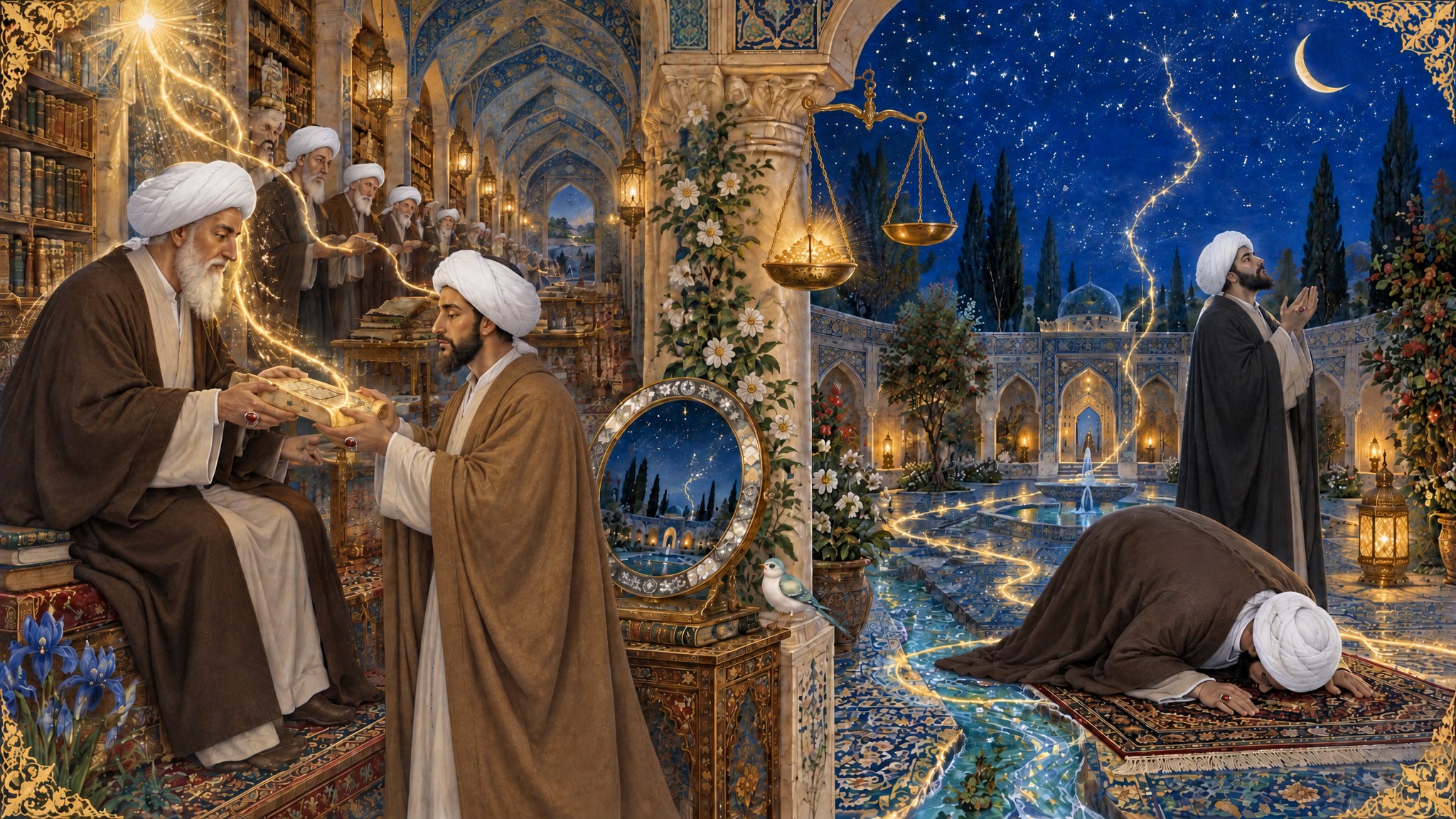
وَقَالَ (عليه السلام): الْعِلْمُ وِرَاثَةٌ كَرِيمَةٌ وَالْآدَابُ حُلَلٌ مُجَدَّدَةٌ وَالْفِكْرُ مِرْآةٌ صَافِيَةٌ.
“Knowledge is a noble inheritance; good manners are garments ever new; and reflection is a clear mirror.”
— al-Sharif al-Radi, Nahj al-Balagha, Saying 5; my translation
Before the verse tonight, I want to give you one sentence of Amir al-Mu’minin, peace and blessings be upon him — because the whole evening is folded up inside it.
Knowledge is a noble inheritance.
Notice the word he chose.
Not a possession.
Not an achievement.
An inheritance.
And an inheritance is a particular kind of thing.
You do not make it.
You receive it — from someone who held it before you.
And you do not keep it forever.
One day, whether you mean to or not, you hand it on.
So if knowledge is an inheritance, then every person who has ever truly known something of this religion has stood somewhere in a line — with someone in front of him who gave it, and someone behind him who would receive it.
Tonight we are going to meet one man who stood in that line.
And we are going to ask what it means to stand there well.
And keep the other two halves of the sentence as well.
Good manners are garments that never grow old, and reflection is a clear mirror.
An inheritance is carried better by someone with good manners — and checked better by someone who is willing to look in the mirror.
And now the verse.
أَمَّنۡ هُوَ قَٰنِتٌ ءَانَآءَ ٱلَّيۡلِ سَاجِدٗا وَقَآئِمٗا يَحۡذَرُ ٱلۡأٓخِرَةَ وَيَرۡجُواْ رَحۡمَةَ رَبِّهِۦۗ قُلۡ هَلۡ يَسۡتَوِي ٱلَّذِينَ يَعۡلَمُونَ وَٱلَّذِينَ لَا يَعۡلَمُونَۗ إِنَّمَا يَتَذَكَّرُ أُوْلُواْ ٱلۡأَلۡبَٰبِ
“Is he who supplicates in the watches of the night, prostrating and standing, apprehensive of the Hereafter and expecting the mercy of his Lord...? Say, ‘Are those who know equal to those who do not know?’ Only those who possess intellect take admonition.”
— Qur’an, Surah al-Zumar (the Chapter of the Troops) #39, Verse 9
Most of you know the second half of this verse, even if you did not know where it was.
Say: are those who know equal to those who do not know?
It is painted on the walls of schools.
It is the obvious verse for a night called What Is a Scholar?
But I want you to notice where the question is standing.
Before God asks anything about knowing, He shows you a man.
A man in the watches of the night — on his face, and then on his feet.
Afraid of what is coming.
Hoping for the mercy of his Lord.
And only then:
Are those who know equal to those who do not know?
The verse asks its question about knowledge only after it has shown you a man on his face in the night.
It will not let you separate the two.
Hold that picture.
We will need it before the evening is done.
We Return to the Scholars
Last week, at the very end, I said one line:
“From next week, God willing, we return to the scholars.”
— from this majlis, last week: The Architecture of Guidance, Part 19, Why a Marja’?
Tonight we keep that promise.
And there is a reason to begin tonight, and to begin with this man.
Tomorrow is Thursday night.
In this city, and in mosques and homes across the world, people will sit with a prayer book and say one man’s name:
Dua Kumayl.
They will say it thousands upon thousands of times.
And most of them, if you stopped them at the door and asked, could not tell you who he was.
Some of you were here for the night in our ‘the Art of Supplication’ series when we heard what Amir al-Mu’minin said to him, once, out in the desert beyond Kufa.
That night was about what was said.
Tonight is about the man it was said to.
Because underneath this whole new block of evenings there is a question — and it is the plainest question there is.
So:
What is a scholar?
Those Who Carry It
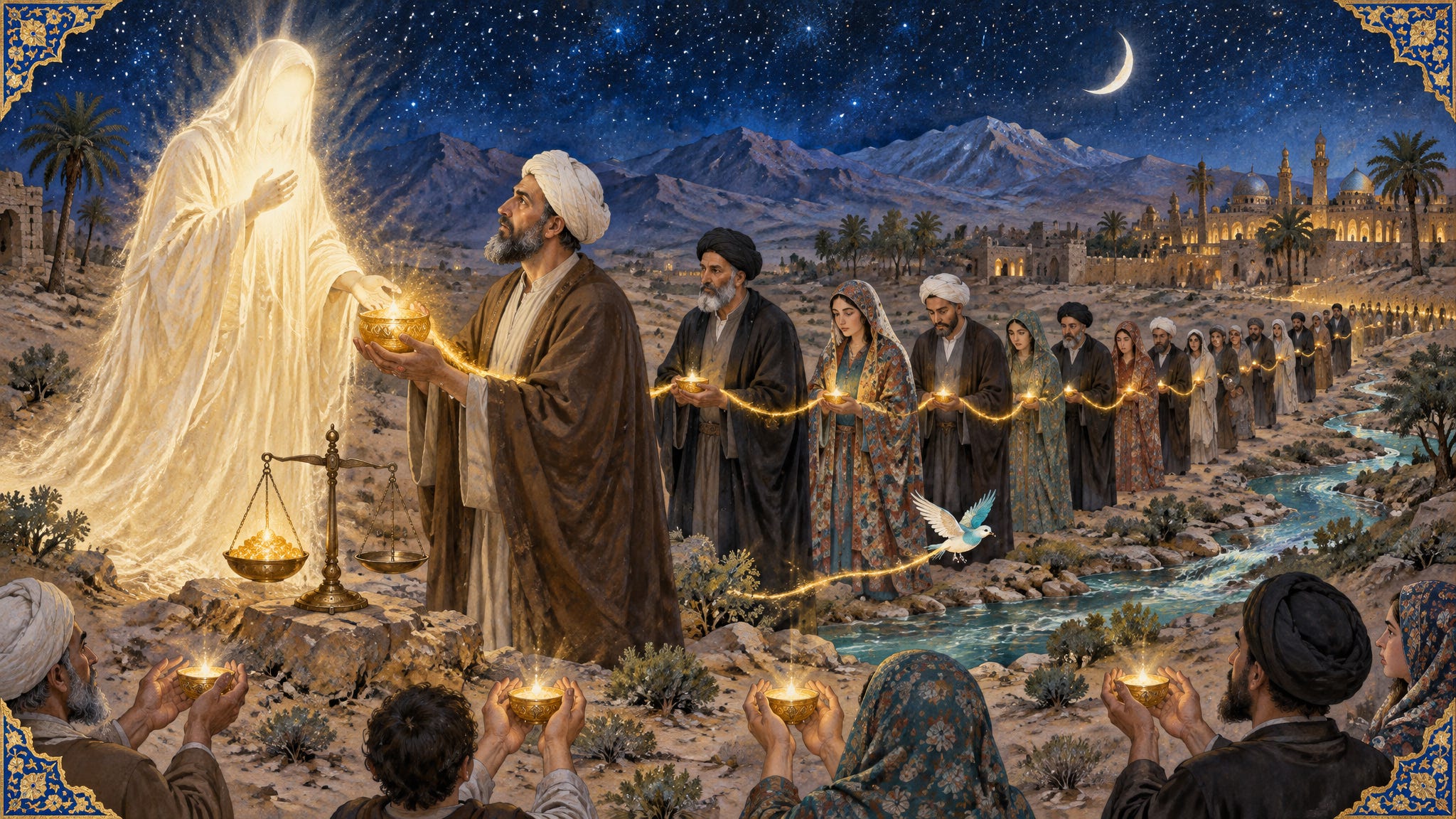
You heard in this room the night Amir al-Mu’minin took Kumayl by the hand, led him out past the graves into the open desert, breathed a long sigh, pointed to his own chest, and said:
There is knowledge here, in abundance — if only I could find those to carry it.
If only I could find carriers.
In Arabic, hamala — those who carry.
I want to name the next twelve weeks after that sigh.
We are calling them
Those Who Carry It.
Twelve evenings, each with a carrier at its centre — men and women who took what was handed to them and carried it, without dropping it and without bending it.
Because that sigh is a complaint, and it is also a description of a job.
Amir al-Mu’minin was never short of people who could listen.
What he could not find were people who could carry — who could hold something that heavy, keep it whole, and hand it to the next person without adding to it or taking from it.
There are layers to that word, and tonight I will only touch them.
There is the Trust that the heavens and the earth and the mountains refused to carry.
We gave a whole series to it, and I will not open it again.
There is what Imam al-Sadiq, peace and blessings be upon him, says about the just ones in every generation who carry this religion and strip away what others have done to it.
You will hear his own words within the half hour.
And there is the simplest layer of all: a man carrying something for someone else.
That is all a carrier is.
Not the owner.
Not the author.
Someone who has been handed a thing that is not his — and who knows that it is not his.
And that layer is the one I want you to keep, because it is the one that applies to you.
Most of us will never be the author of anything in this religion.
But every one of us is carrying something in it — a prayer, a practice, a way of speaking about the Ahl al-Bayt — that someone handed us, and that we will hand to someone else.
Twelve weeks.
One carrier each night.
And we begin with the man the sigh was spoken to.
The Clergy Calling Us Cattle?
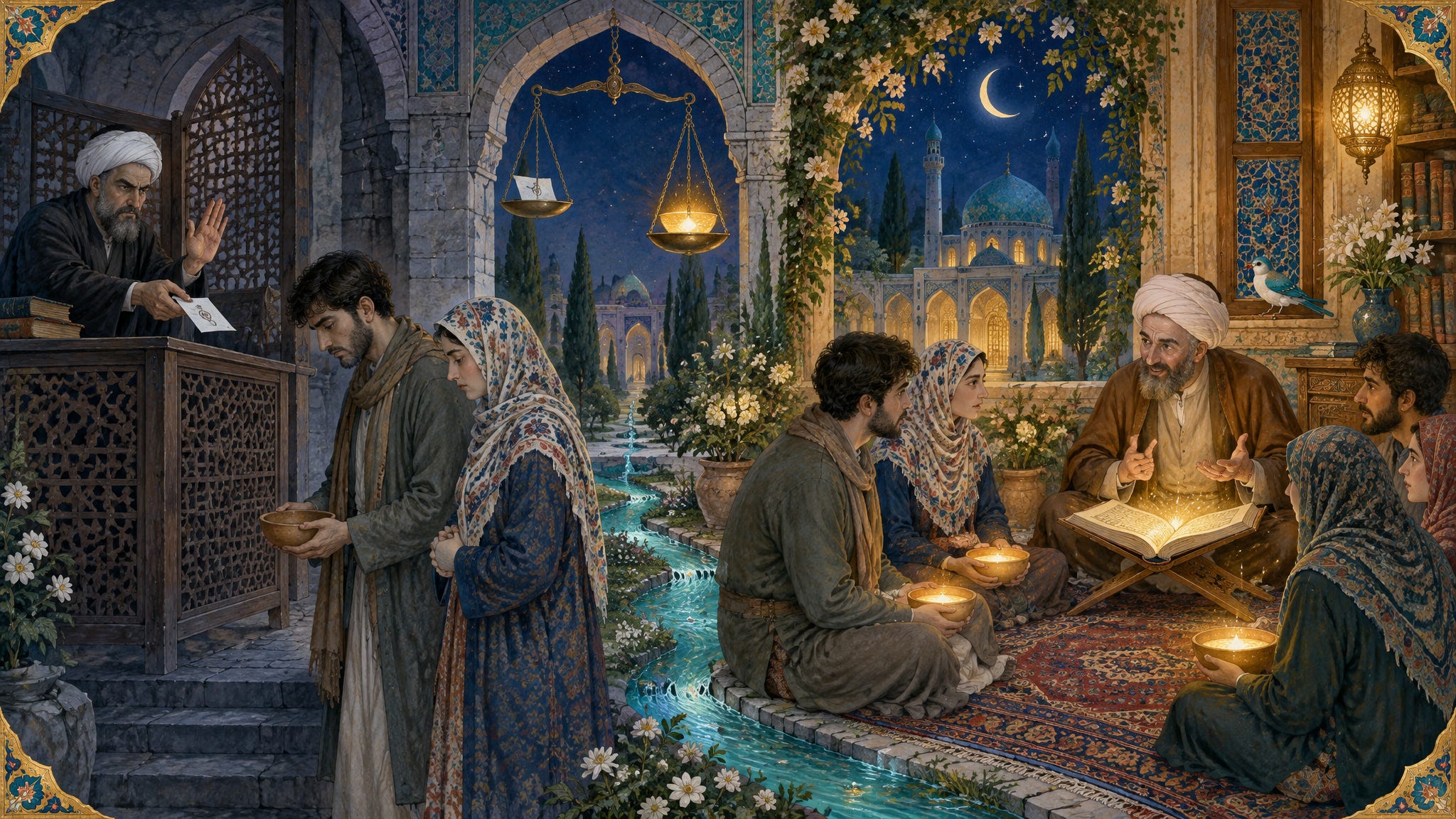
Let me put the strongest objection first, before I answer anything — and let me put it the way people actually say it:
Scholar, learner, rabble — isn’t that just the clergy telling ordinary people that they’re cattle?
Why should a turban make him better than me?
And when we do go and ask, we get a one-line ruling — or we’re told not to ask.
Rarely an answer that explains.
I have heard every part of that, and I am not going to sneer at it.
Some of you are sitting in this room precisely because you went to ask somewhere, and came away with a ruling and a frown, and nothing that explained.
Amir al-Mu’minin’s Own Measure
So before I defend anybody, let me give you a measure — and it is not mine.
It is Amir al-Mu’minin’s.
He once described a man he had known.
He calls him a brother in God.
And listen to what he admired in him:
وَقَالَ (عليه السلام): كَانَ لِى فِيمَا مَضَى أَخٌ فِى اللَّهِ وَكَانَ يُعْظِمُهُ فِى عَيْنِى صِغَرُ الدُّنْيَا فِى عَيْنِهِ وَكَانَ خَارِجاً مِنْ سُلْطَانِ بَطْنِهِ فَلَا يَشْتَهِى مَا لَا يَجِدُ وَلَا يُكْثِرُ إِذَا وَجَدَ وَكَانَ أَكْثَرَ دَهْرِهِ صَامِتاً فَإِنْ قَالَ بَذَّ الْقَائِلِينَ وَنَقَعَ غَلِيلَ السَّائِلِينَ وَكَانَ ضَعِيفاً مُسْتَضْعَفاً فَإِنْ جَاءَ الْجِدُّ فَهُوَ لَيْثُ غَابٍ وَصِلُّ وَادٍ.
“I had, in the past, a brother in God, and what made him great in my eyes was how small the world was in his. He was free of the rule of his stomach: he did not crave what he could not find, and he did not take too much when he found it. Most of his time he was silent — but when he spoke, he silenced the speakers, and he quenched the thirst of those who asked. He was weak, and taken for weak — but when the serious hour came, he was a lion of the thicket and a viper of the valley.”
— al-Sharif al-Radi, Nahj al-Balagha, Saying 289; my translation
And it goes on.
He would not blame anyone for something that might have an excuse, until he had heard the excuse.
He was more eager to listen than to speak.
And Amir al-Mu’minin ends:
لَا يُدْلِى بِحُجَّةٍ حَتَّى يَأْتِيَ قَاضِياً وَكَانَ لَا يَلُومُ أَحَداً عَلَى مَا يَجِدُ الْعُذْرَ فِى مِثْلِهِ حَتَّى يَسْمَعَ اعْتِذَارَهُ وَكَانَ لَا يَشْكُو وَجَعاً إِلَّا عِنْدَ بُرْئِهِ وَكَانَ يَقُولُ مَا يَفْعَلُ وَلَا يَقُولُ مَا لَا يَفْعَلُ وَكَانَ إِذَا غُلِبَ عَلَى الْكَلَامِ لَمْ يُغْلَبْ عَلَى السُّكُوتِ وَكَانَ عَلَى مَا يَسْمَعُ أَحْرَصَ مِنْهُ عَلَى أَنْ يَتَكَلَّمَ وَكَانَ إِذَا بَدَهَهُ أَمْرَانِ يَنْظُرُ أَيُّهُمَا أَقْرَبُ إِلَى الْهَوَى فَيُخَالِفُهُ.
“These qualities are incumbent upon you: hold to them, and compete with one another in them. And if you cannot manage them, then know that taking a little is better than leaving a great deal.”
— al-Sharif al-Radi, Nahj al-Balagha, Saying 289; my translation
He quenched the thirst of those who asked.
The questioner’s thirst is not an inconvenience to the man of knowledge.
Quenching it is how Amir al-Mu’minin measured him.
So the objection is right to expect an answer that explains.
Amir al-Mu’minin expected it too.
And who was this brother?
The commentators asked.
Some said the Prophet himself, peace and blessings be upon him and his family; some said Abu Dharr; some said al-Miqdad.
And Ibn Abi al-Hadid1 — the Mu’tazili scholar who wrote one of the great commentaries on the Nahj al-Balagha — concluded that he was no one man at all, but a portrait Amir al-Mu’minin drew for all of us to become.
Which is why he ends the way he does:
فَعَلَيْكُمْ بِهَذِهِ الْخَلَائِقِ فَالْزَمُوهَا وَتَنَافَسُوا فِيهَا فَإِنْ لَمْ تَسْتَطِيعُوهَا فَاعْلَمُوا أَنَّ أَخْذَ الْقَلِيلِ خَيْرٌ مِنْ تَرْكِ الْكَثِيرِ.
These qualities are incumbent upon you. So, you should acquire them and excel each other in them. Even if you cannot acquire them you should know that acquiring a part is better than giving up the whole.
— al-Sharif al-Radi, Nahj al-Balagha, Saying 289; my translation
These qualities are incumbent upon you.
What Is Right in It
So let me say plainly what is right in the objection.
A turban makes no one anything.
And an answer that does not explain has not yet done the scholar’s work.
The texts do not measure a scholar by his dress, or his title, or the size of his following.
They measure him by three things:
whether what he knows has made him afraid of God;
what he does with what he knows;
and whom he took it from.
And the hardest words Amir al-Mu’minin spoke that night in the desert were not for ordinary people at all.
They were for men of learning who use the religion to get the world.
So here is my answer, before I argue for it, so that you can check me as I go.
A scholar is not a title.
He is someone knowledge has driven to fear God, who carries what he was given without bending it, and who gives it away.
That is the measure for a marja’, and for the man at the back of this room alike — because, as you will hear tonight from Imam al-Sadiq himself, every one of us is meant to be the Imam’s student.
And so there are three questions tonight, one for each point.
What makes someone a scholar at all?
Where do I stand?
And what does the real one look like — and why does it matter while the Imam of our Age, may our souls be his ransom and may God hasten his return, is hidden?
What We Carry Forward
We are in The Architecture of Guidance, and this is its twentieth part.
And tonight we open a new sequence inside it — Those Who Carry It — and this is the first of twelve.
It is Wednesday the 28th of October 2026 — the 16th of Jumada al-Ula, 1448.
And we are in the days of Sayyedah Fatimah al-Zahra, peace and blessings be upon her.
Which is why, on Saturday nights, we have been meeting for something else as well: our Fatimiyyah series, Fruit of the Heart.
Four nights on raising our children — based on the Qur’an, on the Tradition of the Ahl al-Bayt, peace be upon them, and on guidance drawn from the teachings of the martyred leader, Imam Sayyed Ali Khamenei, may God rest his pure soul — and, with him, the great scholars that series quotes throughout.
The first night was last Saturday: Before the Heart Hardens — The Soil, the Seed and the Fitrah.
The second is this coming Saturday, the 31st of October: A Beautiful Growth.
And two more will follow, on the Saturdays after that.
I mention it here for a reason.
There, as here, and in every one of our sessions, what we are doing is carrying the words of the scholars to you — which is tonight’s whole subject.
Tonight is about how a carrier is formed.
On Saturdays, it is about how a child is.
Please come, and bring the people who are raising children with you.
And last week we closed eleven evenings that began beside a grave in Najaf — The House Beside the Grave — at a desk, with a seal on it.
We asked why anyone should follow a marja’, and the answer came down to two words:
check, then trust.
Check by the measure the tradition gives you — and having checked, trust, the way you trust a doctor you chose well.
And we traced a chain: the Imam of our Age at its head; below him the marja’, who draws the ruling out; below the marja’, the one he sends; and then you.
Last week asked how you check a scholar.
Tonight asks what a scholar is.
And we are going to answer it the best way there is — by meeting one.
The Man Ali Took by the Hand
Who He Was
His name was Kumayl, the son of Ziyad — of the tribe of Nakha’, a tribe whose roots were in Yemen and who had settled in Kufa.
Kufa: on the Euphrates, about ten kilometres from Najaf — the city Amir al-Mu’minin made his capital.
He was a companion of Amir al-Mu’minin, and after him of Imam al-Hasan, peace and blessings be upon him.
That is how Shaykh al-Tusi lists him.
Shaykh al-Mufid counts him among the foremost of Amir al-Mu’minin’s companions — among, in his word, those brought near.
And in the entry on al-Asbagh ibn Nubata — himself one of Amir al-Mu’minin’s closest companions — Kumayl is counted among Amir al-Mu’minin’s trusted ones.
And Ibn Dawud — a scholar of al-Hilla, a contemporary of Allamah al-Hilli, who wrote on the narrators and their reliability — places him among the intimates.
Now, some of you know the science we call rijal — the study of the men who carried the narrations, and whether they can be trusted.
And if you know it, you know that in rijal almost everyone is argued over.
One scholar says trustworthy, another says weak, and the rest weigh the two.
The great rijal scholar of the last century, Ayatollah Sayyed Abu al-Qasim al-Khoei, may God rest his pure soul — the teacher of Ayatollah Sistani and of a whole generation of jurists — came to Kumayl in his great dictionary of the narrators, and said, in effect: there is nothing to argue about here.
His eminence, and his special place with Amir al-Mu’minin, he writes, are among the plain matters.
— Ayatollah Sayyed Abu al-Qasim al-Khoei, Mu'jam Rijal al-Hadith, Volume 15, entry 9776 — narrated2
Among the plain matters.
In a science that argues about nearly everyone, that is a remarkable sentence.
And it is not only our scholars.
When Ibn ‘Asakir — the great historian of Damascus, of the other school — came to write his entry on Kumayl, he recorded the grading of their own critics.
Al-’Ijli: a Kufan, one of the Successors, trustworthy.
And Ibn ‘Ammar called him a Rafidi — their hard word for one of us — and he is trustworthy.
Even the man who reached for the hard word could not take away the second.
— Ibn ‘Asakir, Tarikh Madinat Dimashq, Volume 50, entry 5829, page 251; narrated3
So both schools, looking at the same man, came to the same word.
Whatever else people argued about in Kufa, they did not argue about him.
Why Him?
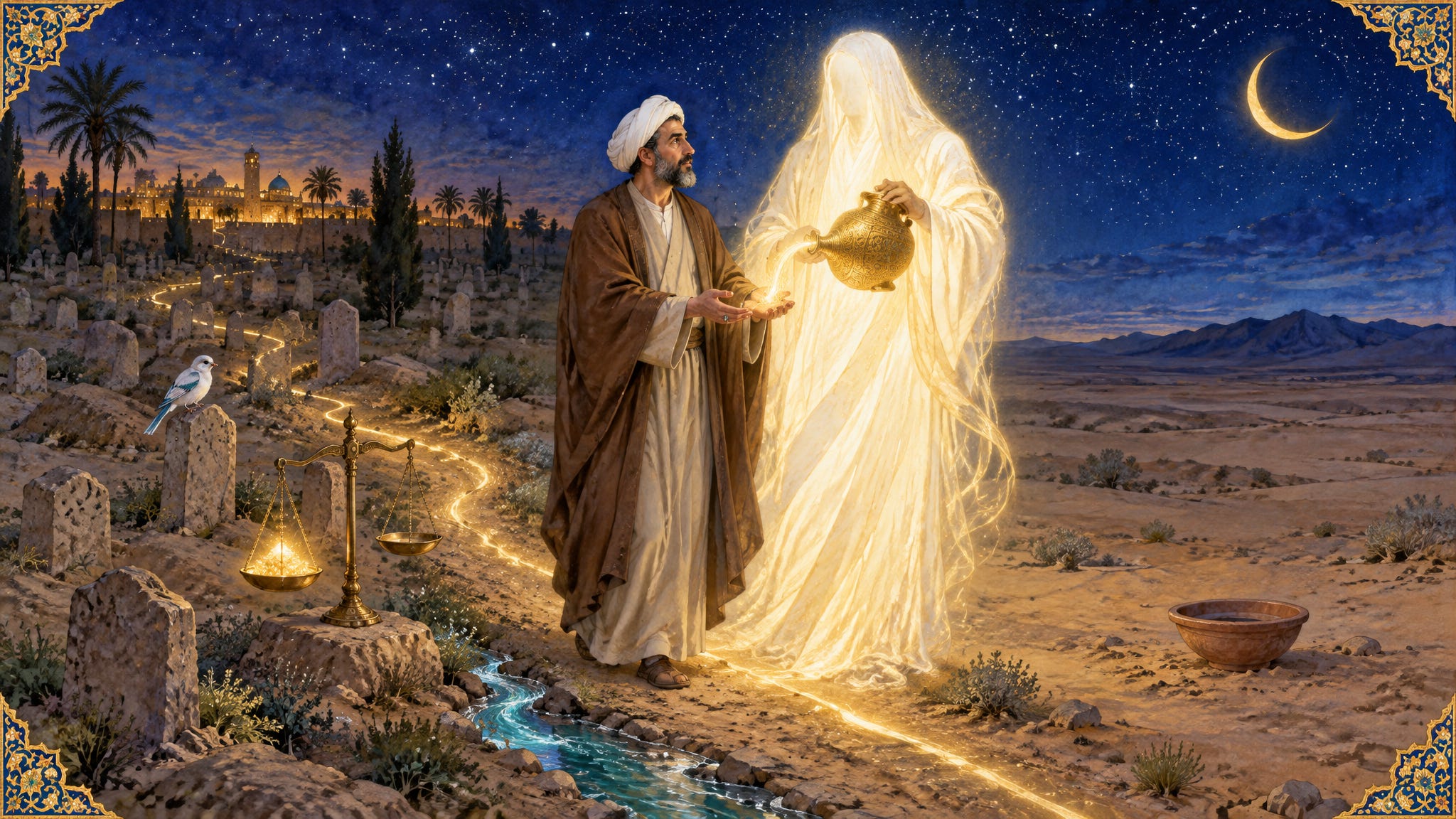
You heard in this room what was said to him that night — the hearts that are vessels, the three kinds of people, the earth that is never left empty.
I will not tell it again.
But tonight I want to turn the camera.
Not onto what Amir al-Mu’minin said — onto the man he said it to.
Because Kumayl says it himself, in the very first line of the report:
Amir al-Mu’minin took me by the hand.
Ali chose whom to take by the hand.
A man is not led out past the graves, into the open desert, and told
there is knowledge here — if only I could find those to carry it
— by accident.
He was chosen to hear that complaint because he was one of the few who might one day answer it.
And notice where he took him.
Not into the mosque.
Not into his house.
Out past the graves — and the report uses a word for the burial ground at the edge of the city — and then out into the open, where there was nothing but sky.
He taught him about knowledge with the dead on one side and the desert on the other.
A man who has just walked past the graves of people he knew is ready to hear what lasts.
So the first question is:
What was Amir al-Mu’minin looking for?
The Measure
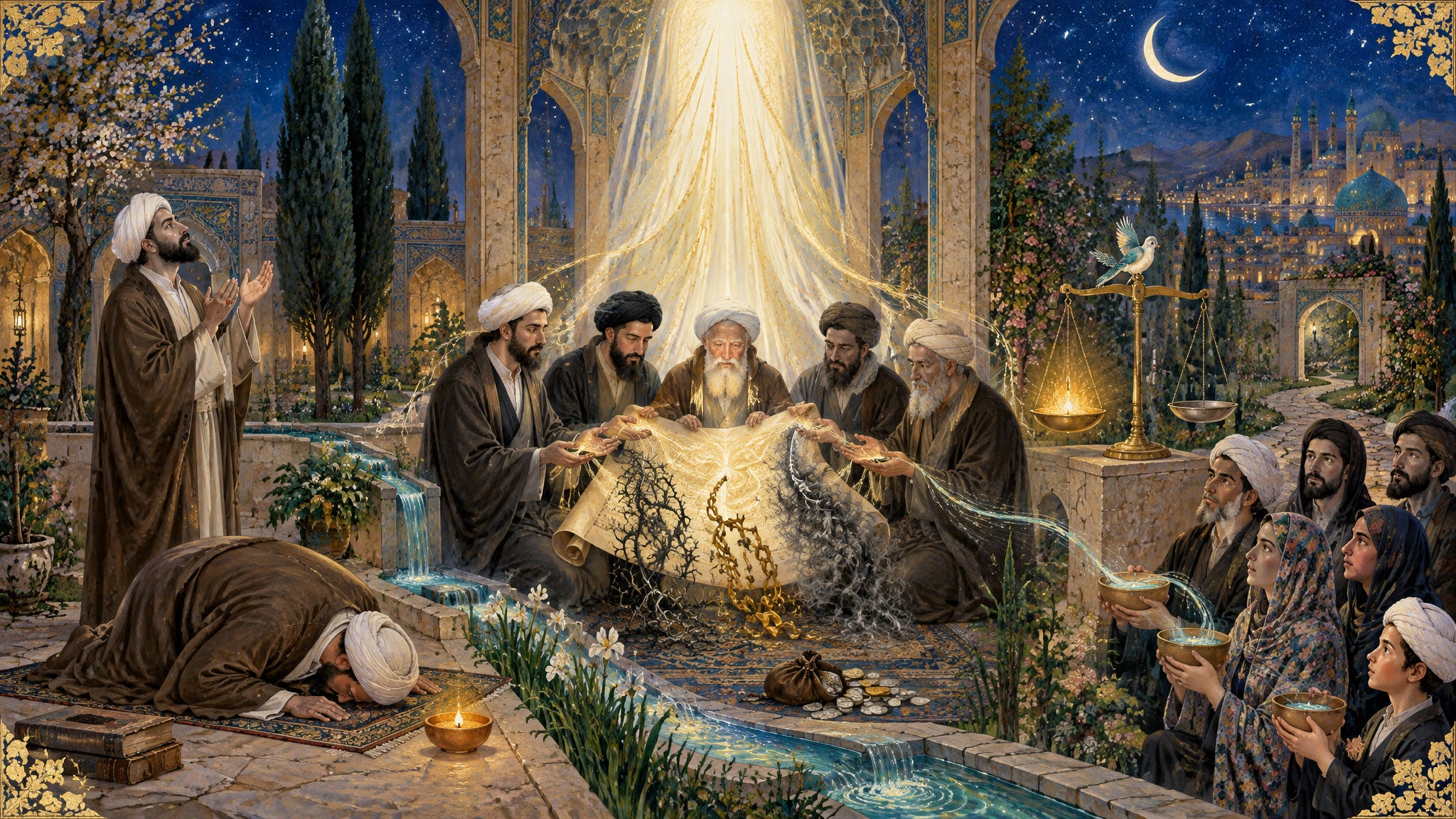
Go back to the verse we began with.
أَمَّنۡ هُوَ قَٰنِتٌ ءَانَآءَ ٱلَّيۡلِ سَاجِدٗا وَقَآئِمٗا يَحۡذَرُ ٱلۡأٓخِرَةَ وَيَرۡجُواْ رَحۡمَةَ رَبِّهِۦۗ قُلۡ هَلۡ يَسۡتَوِي ٱلَّذِينَ يَعۡلَمُونَ وَٱلَّذِينَ لَا يَعۡلَمُونَۗ إِنَّمَا يَتَذَكَّرُ أُوْلُواْ ٱلۡأَلۡبَٰبِ
“Is he who supplicates in the watches of the night, prostrating and standing, apprehensive of the Hereafter and expecting the mercy of his Lord...? Say, ‘Are those who know equal to those who do not know?’ Only those who possess intellect take admonition.”
— Qur’an, Surah al-Zumar (the Chapter of the Troops) #39, Verse 9
The question about knowing —
are those who know equal to those who do not know?
— is standing inside the picture of a man awake in the night.
The verse will not let you take the one without the other.
Session 76 gave you another verse on this, and I will only recall it in a clause:
only those of God’s servants who have knowledge fear Him.
The knowing are the ones who fear.
Which means that knowledge which does not end in the fear of God has not finished its work.
And now listen to Imam al-Sadiq, peace and blessings be upon him.
You know how this saying begins: the scholars are the heirs of the prophets, and the prophets left no dirham and no dinar — they left words.
It is how it ends that I want tonight, because this room has never heard it:
2ـ مُحَمَّدُ بْنُ يَحْيَى عَنْ أَحْمَدَ بْنِ مُحَمَّدِ بْنِ عِيسَى عَنْ مُحَمَّدِ بْنِ خَالِدٍ عَنْ أَبِي الْبَخْتَرِيِّ عَنْ أَبِي عَبْدِ الله (عَلَيْهِ السَّلام) قَالَ إِنَّ الْعُلَمَاءَ وَرَثَةُ الانْبِيَاءِ وَذَاكَ أَنَّ الانْبِيَاءَ لَمْ يُورِثُوا دِرْهَماً وَلا دِينَاراً وَإِنَّمَا أَوْرَثُوا أَحَادِيثَ مِنْ أَحَادِيثِهِمْ فَمَنْ أَخَذَ بِشَيْءٍ مِنْهَا فَقَدْ أَخَذَ حَظّاً وَافِراً فَانْظُرُوا عِلْمَكُمْ هَذَا عَمَّنْ تَأْخُذُونَهُ فَإِنَّ فِينَا أَهْلَ الْبَيْتِ فِي كُلِّ خَلَفٍ عُدُولاً يَنْفُونَ عَنْهُ تَحْرِيفَ الْغَالِينَ وَانْتِحَالَ الْمُبْطِلِينَ وَتَأْوِيلَ الْجَاهِلِينَ.
“So look at whom you take this knowledge of yours from. For in us, the Ahl al-Bayt, in every generation there are just ones who strip from it the distortion of the extremists, the false claims of those who deal in falsehood, and the interpretations of the ignorant.”
— al-Kulayni, al-Kafi, Volume 1; my translation
Look at whom you take it from.
That is last week’s
check, then trust
— in the Imam’s own mouth.
And notice the three things the just ones strip away.
The distortion of those who go too far.
The false claims of those who attach things to the religion that were never in it.
And the interpretations of people who do not know.
Two of those three are not lies told by enemies.
They are what happens to a religion in the hands of people who love it — too much, or too carelessly.
Keep that.
In a few minutes I am going to tell you about one of them happening to me.
A Channel, Not a Reservoir
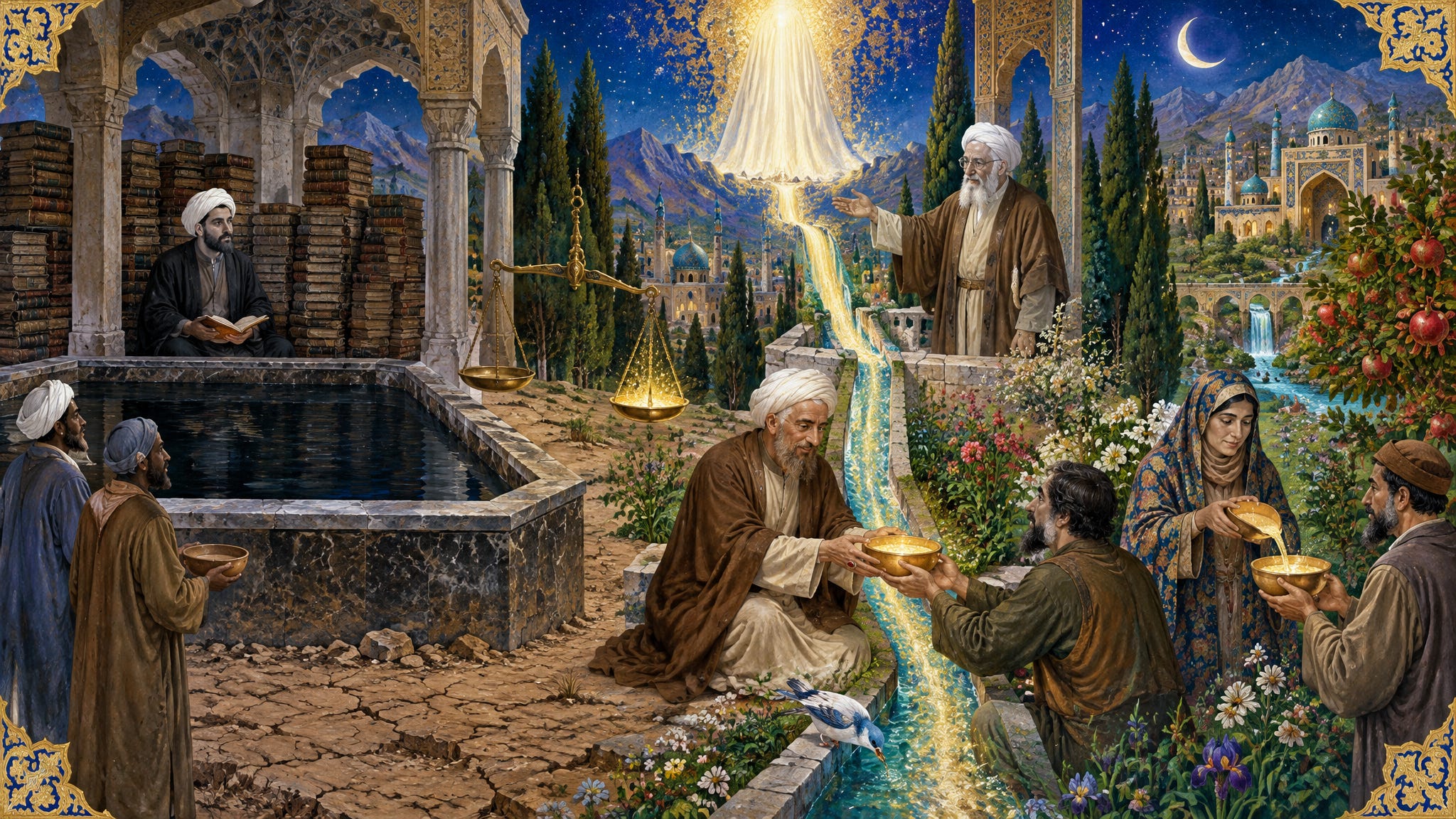
In that conversation in the desert, Amir al-Mu’minin calls the first kind of person ‘alim rabbani — a scholar devoted to the Lord.
Ayatollah Jawadi Amoli, may God protect him, has been teaching that saying lesson by lesson, and he stops on that word, rabbani.
Amir al-Mu’minin, he says, did not leave the word in the abstract.
He named who it was:
I am the rabbani of this umma.
And he explains the word in Amir al-Mu’minin’s own voice:
I am rabbani — that is, intensely bound to the Lord. I receive abundantly, and I give abundantly.
— Ayatollah Abdullah Jawadi Amoli, lessons on Nahj al-Balagha, Saying 147, 6 November 2024; narrated4
Receives abundantly, and gives abundantly.
Hold the two halves together.
A scholar is not a man who has collected a great deal.
He is a man through whom a great deal passes.
A scholar is a channel, not a reservoir.
A reservoir is impressive.
It is deep, and it is full, and it is still.
A channel is narrow, and you hardly notice it.
But everything downstream of it lives.
And here is Kumayl doing exactly that.
Years later, a man came to him and asked him about the merits of Amir al-Mu’minin — the virtues, the stories, the things people love to hear.
And Kumayl did not list them.
He said, in effect: let me give you instead something he gave me one day — something better for you than the world and everything in it.
— Imad al-Din al-Tabari, Bisharat al-Mustafa li-Shi’at al-Murtada, page 51 —narrated5
He did not talk about the source.
He passed on what came from it.
And before the night is out, you will hear what it was.
And this is the test you can apply to any teacher — and to yourself.
A reservoir wants you to admire how much it holds.
A channel wants you to drink.
When you come away from a class impressed by how much the teacher knows, that is a reservoir.
When you come away having understood something you did not understand before — and wanting to pass it on — that is a channel.
Check What You Carry
Now I want to tell you a story — and then I want to tell you something about the story.
For years I carried a beautiful story about Amir al-Mu’minin and Kumayl.
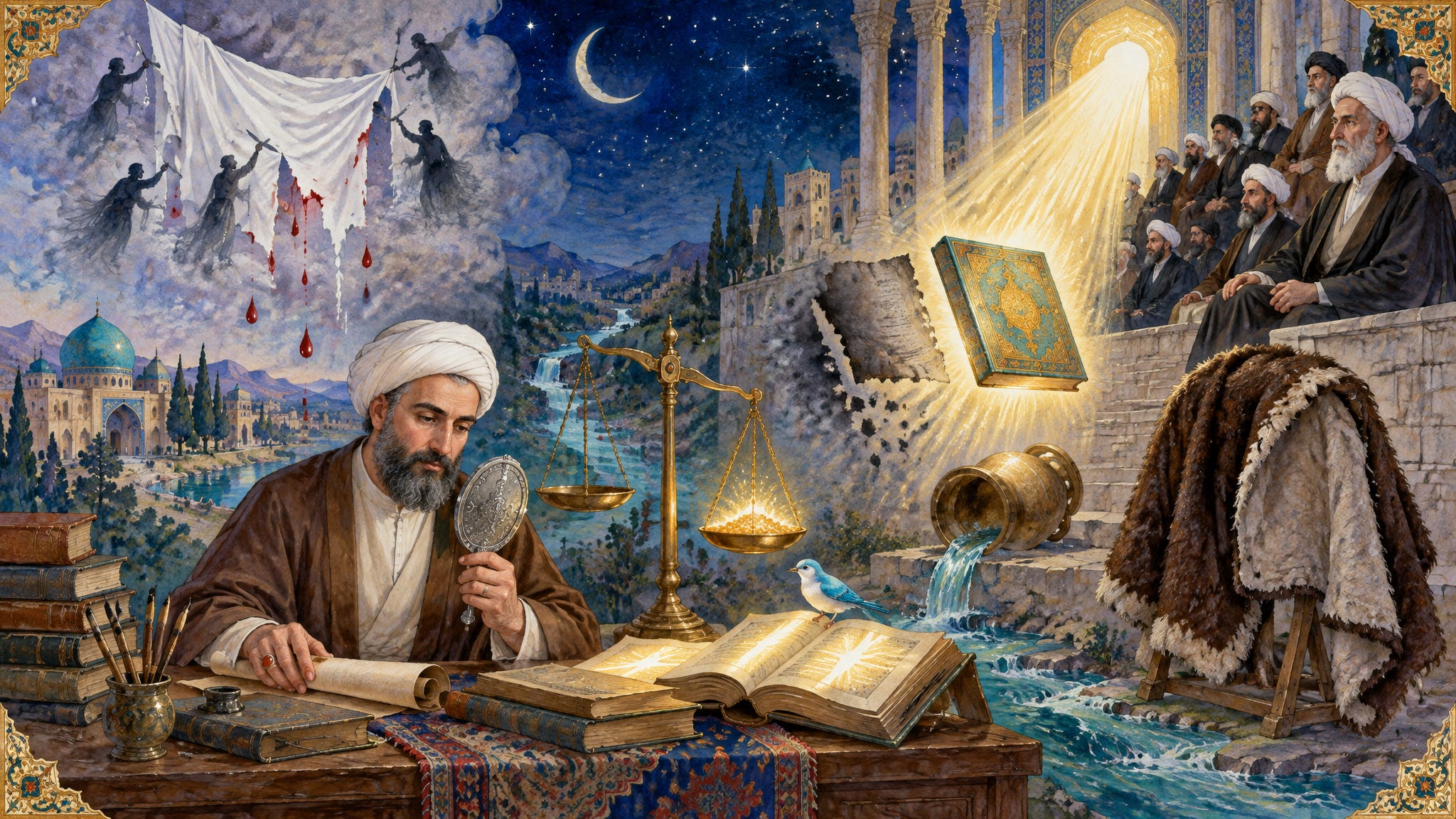
In it, Kumayl is shown a vision: a white cloth hanging down from the sky.
Below it, a great swarm of people.
One by one they rise up to it, and each one comes back down with a piece cut away.
And the cloth bleeds.
The cloth is Islam.
The swarm is the Muslims of the last days — each one taking the piece he likes, and leaving the rest.
It is a powerful picture, and I taught it.
I believed it.
I am fairly sure some of you have heard me tell it.
This week, preparing for tonight, I went looking for its reference.
I wanted to give you the book and the page.
There is none.
It is not in our books.
It was a teacher’s parable — a good one, told to make a true point — and it had been told so often beside real narrations that, in my memory and in many people’s, it had become a hadith.
I want you to sit with that for a moment, because it is the whole of tonight’s first point in miniature.
I did not lie to you.
I loved the story, and I trusted where it came from.
And it still was not what I said it was.
And listen to what Amir al-Mu’minin told Kumayl, in the same counsel we will come to later tonight.
Do not teach our reports to the disbelievers,
he said —
lest they add to them.
— Imad al-Din al-Tabari, Bisharat al-Mustafa li-Shi’at al-Murtada, page 54 — narrated6
Lest they add to them.
Reports get added to.
He said so, fourteen centuries ago.
Tonight I have shown you it happening — to me.
Now, the meaning of that parable is true, and the sources carry it — which is why it lasted.
The Qur’an puts a question to the Children of Israel that every generation needs to hear:
ثُمَّ أَنتُمۡ هَـٰٓؤُلَآءِ تَقۡتُلُونَ أَنفُسَكُمۡ وَتُخۡرِجُونَ فَرِيقٗا مِّنكُم مِّن دِيَٰرِهِمۡ تَظَٰهَرُونَ عَلَيۡهِم بِٱلۡإِثۡمِ وَٱلۡعُدۡوَٰنِ وَإِن يَأۡتُوكُمۡ أُسَٰرَىٰ تُفَٰدُوهُمۡ وَهُوَ مُحَرَّمٌ عَلَيۡكُمۡ إِخۡرَاجُهُمۡۚ أَفَتُؤۡمِنُونَ بِبَعۡضِ ٱلۡكِتَٰبِ وَتَكۡفُرُونَ بِبَعۡضٖۚ فَمَا جَزَآءُ مَن يَفۡعَلُ ذَٰلِكَ مِنكُمۡ إِلَّا خِزۡيٞ فِي ٱلۡحَيَوٰةِ ٱلدُّنۡيَاۖ وَيَوۡمَ ٱلۡقِيَٰمَةِ يُرَدُّونَ إِلَىٰٓ أَشَدِّ ٱلۡعَذَابِۗ وَمَا ٱللَّهُ بِغَٰفِلٍ عَمَّا تَعۡمَلُونَ
“Then there you were, killing your folks and expelling a part of your folks from their homes, backing one another against them in sin and aggression! And if they came to you as captives, you would ransom them, though their expulsion itself was forbidden you. What! Do you believe in part of the Book and deny another part? So what is the requital of those of you who do that except disgrace in the life of this world? And on the Day of Resurrection, they shall be consigned to the severest punishment. And Allah is not oblivious of what you do.”
— Qur’an, Surah al-Baqarah (the Chapter of the Cow) #2, Verse 85
Do you believe in part of the Book, and deny another part?
And Amir al-Mu’minin, in his own sermons, says what will happen to Islam.
A time will come upon you,
he says,
when Islam will be overturned, as a vessel is overturned with all that is in it.
— al-Sharif al-Radi, Nahj al-Balagha, Sermon 103 — narrated7
And elsewhere:
Islam will be worn the way a fur is worn — inside out.
— al-Sharif al-Radi, Nahj al-Balagha, Sermon 108 — narrated8
So the meaning was never the problem.
The problem was the label.
I had put Amir al-Mu’minin’s name on a teacher’s words — and Amir al-Mu’minin’s own words were sitting there all along, stronger than the parable, waiting for me to go and find them.
There is an old line people say about learning:
We see further because we stand on the shoulders of giants.
Good.
I believe it.
But I need to know where the giant’s shoulders are — or I fall.
Lessons for Our Time
Lesson One — Measure by Fear, Not by Title

The first lesson is a question to carry out of this room, and to ask of anyone who teaches you — including me.
Does what he knows make him more afraid of God, or more sure of himself?
Not: how many books has he read.
Not: how many people follow him.
Not: how well does he speak.
The verse could have asked about any of those, and it did not.
It asked about a man on his face in the night.
And in the same counsel Kumayl carried, Amir al-Mu’minin says:
The matter is not that you pray and fast and give charity.
The matter is that the prayer comes from a pure heart.
— Imad al-Din al-Tabari, Bisharat al-Mustafa li-Shi’at al-Murtada, page 57 — narrated9
A turban does not make a pure heart, and the lack of one does not prevent it.
And be honest about the other side of it.
There are people with no title at all who are more afraid of God than many who have one — the grandmother who has never missed her night prayer, the man in the corner who never speaks in a gathering but is the first to help.
The texts would call them closer to the measure than a great many speakers.
Measure by fear, not by title.
And measure yourself that way first.
Lesson Two — The Heir Is Judged by What He Hands On
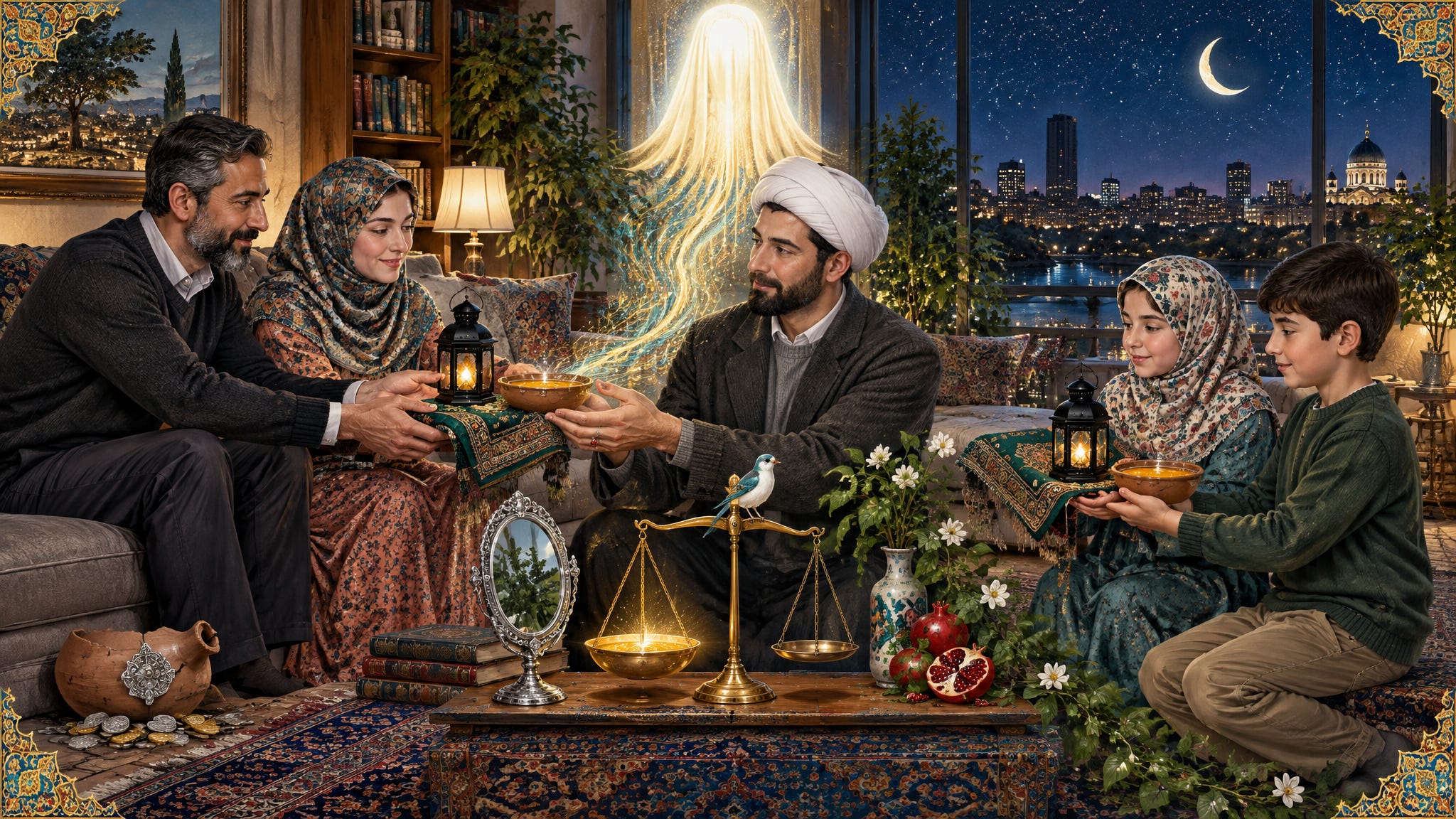
The second lesson is about inheritance.
Imam al-Sadiq said the prophets left words.
An heir is someone who receives words — and the question about any heir is not how much he received, but what he passed on, and whether it arrived in one piece.
Look at whom you take it from,
the Imam said.
Let me add the sentence that follows from it:
look at what you pass on.
Every one of you is an heir to something.
Your parents gave you a way of praying, a way of grieving on the nights of Muharram, a way of speaking about the Ahl al-Bayt.
Your children are going to receive it from you.
The question is whether they will receive what you received — or what you received, with your additions.
Be a channel.
Let it pass through you clean.
Lesson Three — Check What You Carry, Even From Those You Trust

The third lesson is the one I learned this week.
Love for a teacher is not a reference.
I am not telling you to trust no one.
I am telling you that trusting someone is a reason to check, not a reason not to.
The stories that slip into our religion do not come from people we distrust — we would never believe them.
They come from people we love, told beautifully, in good faith.
And a story is not dishonoured by telling it as what it is.
Tell the parable — and say:
This is a parable.
Tell the hadith — and say where it is.
In that same counsel, Amir al-Mu’minin says to Kumayl:
Take only from us, and you will be of us.
— Imad al-Din al-Tabari, Bisharat al-Mustafa li-Shi’at al-Murtada, page 51 — narrated10
So if you have a story you love — a story about the Ahl al-Bayt that moves you every time — do it the honour of finding where it is.
If it is there, you will tell it with more confidence than ever.
And if it is not, you will have saved it from carrying a name that is not its own.
Take the religion whole.
And take it from its sources.
Where Do I Stand?
Three Kinds
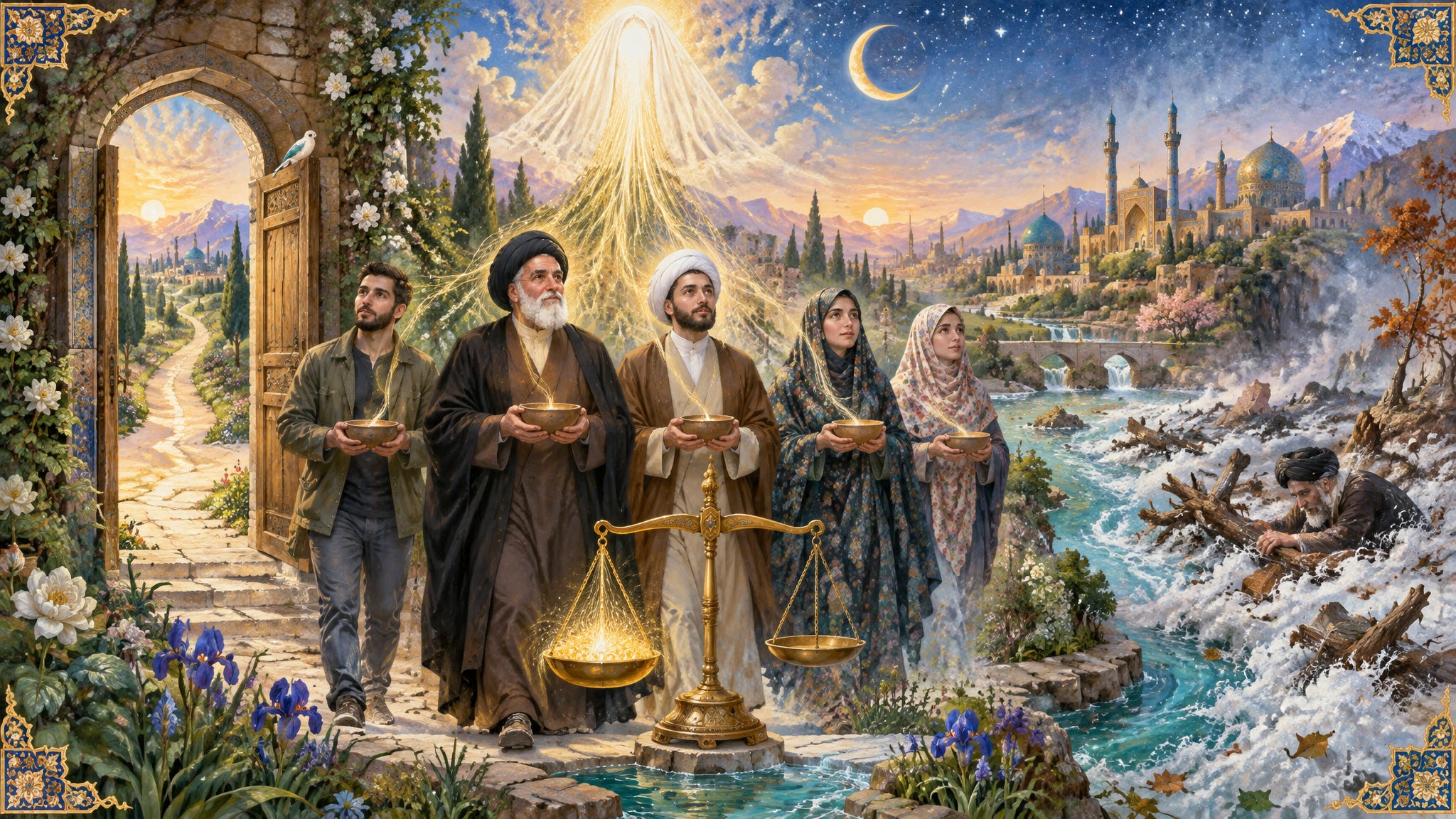
Now the second question — and it is the one the objection was really asking.
Where do I stand?
You remember the three kinds of people from that night in the desert:
a scholar devoted to the Lord;
a learner on the road to salvation;
and the rabble, who follow every caller and lean with every wind. I will not open that again.
But I want to put beside it something this room has not heard.
Imam al-Sadiq, peace and blessings be upon him, said the same thing in fewer words:
2ـ الْحُسَيْنُ بْنُ مُحَمَّدٍ الاشْعَرِيُّ عَنْ مُعَلَّى بْنِ مُحَمَّدٍ عَنِ الْحَسَنِ بْنِ عَلِيٍّ الْوَشَّاءِ عَنْ أَحْمَدَ بْنِ عَائِذٍ عَنْ أَبِي خَدِيجَةَ سَالِمِ بْنِ مُكْرَمٍ عَنْ أَبِي عَبْدِ الله (عَلَيْهِ السَّلام) قَالَ النَّاسُ ثَلاثَةٌ عَالِمٌ وَمُتَعَلِّمٌ وَغُثَاءٌ.
“People are of three kinds: the scholar, the learner, and froth.”
— al-Kulayni, al-Kafi, Volume 1, Fihrist Record 57; my translation
And then, in another report, he says who is who:
4ـ عَلِيُّ بْنُ إِبْرَاهِيمَ عَنْ مُحَمَّدِ بْنِ عِيسَى عَنْ يُونُسَ عَنْ جَمِيلٍ عَنْ أَبِي عَبْدِ الله (عَلَيْهِ السَّلام) قَالَ سَمِعْتُهُ يَقُولُ يَغْدُو النَّاسُ عَلَى ثَلاثَةِ أَصْنَافٍ عَالِمٍ وَمُتَعَلِّمٍ وَغُثَاءٍ فَنَحْنُ الْعُلَمَاءُ وَشِيعَتُنَا الْمُتَعَلِّمُونَ وَسَائِرُ النَّاسِ غُثَاءٌ.
“People set out each morning as one of three kinds: scholar, learner, and froth. We are the scholars. Our Shi’a are the learners. And the rest of the people are froth.”
— al-Kulayni, al-Kafi, Volume 1, Fihrist Record 57; my translation
I want you to hear what that does to the objection.
The objection said: scholar, learner, rabble — isn’t that the clergy putting themselves at the top and the rest of us at the bottom?
And the Imam answers: the top is not the clergy.
We are the scholars — the Ahl al-Bayt.
The scholar he is speaking of is an Imam.
And the middle — the learner, the student — is not a rank below the clergy.
It is the definition of every believer.
The marja’ is in it.
The student in Qom is in it.
The man at the back of this room is in it.
Our Shi’a are the learners.
Being Shi’a is a student’s identity.
So the question is not
Am I a scholar?
Hardly any of us will ever be one in that sense, and that is fine.
The question is:
Am I still learning?
And notice the verb in that second report.
People set out each morning
— in Arabic, yaghdu: to go out early, at the start of the day.
It is not a verdict passed on a person once, for life.
It is something that happens every morning.
Every day you walk out of your door as one of the three.
Yesterday you may have been a learner.
Today, if you stop, you can be froth.
And tomorrow, if you start again, you are a learner again.
The door to the middle is never shut.
And a word on that last word, because I do not want anyone to leave here thinking the Imam was calling people names.
The word is ghutha’.
It is the froth a flood carries on top of it — the foam, the scraps, the bits of wood and leaves that ride the water and go wherever the water goes.
It is not a class of people.
It is a behaviour.
That same night in the desert, Amir al-Mu’minin describes it:
Those who follow every caller, and lean with every wind.
Anybody can become froth — a learned man included — the moment he stops learning and starts drifting.
The Levels
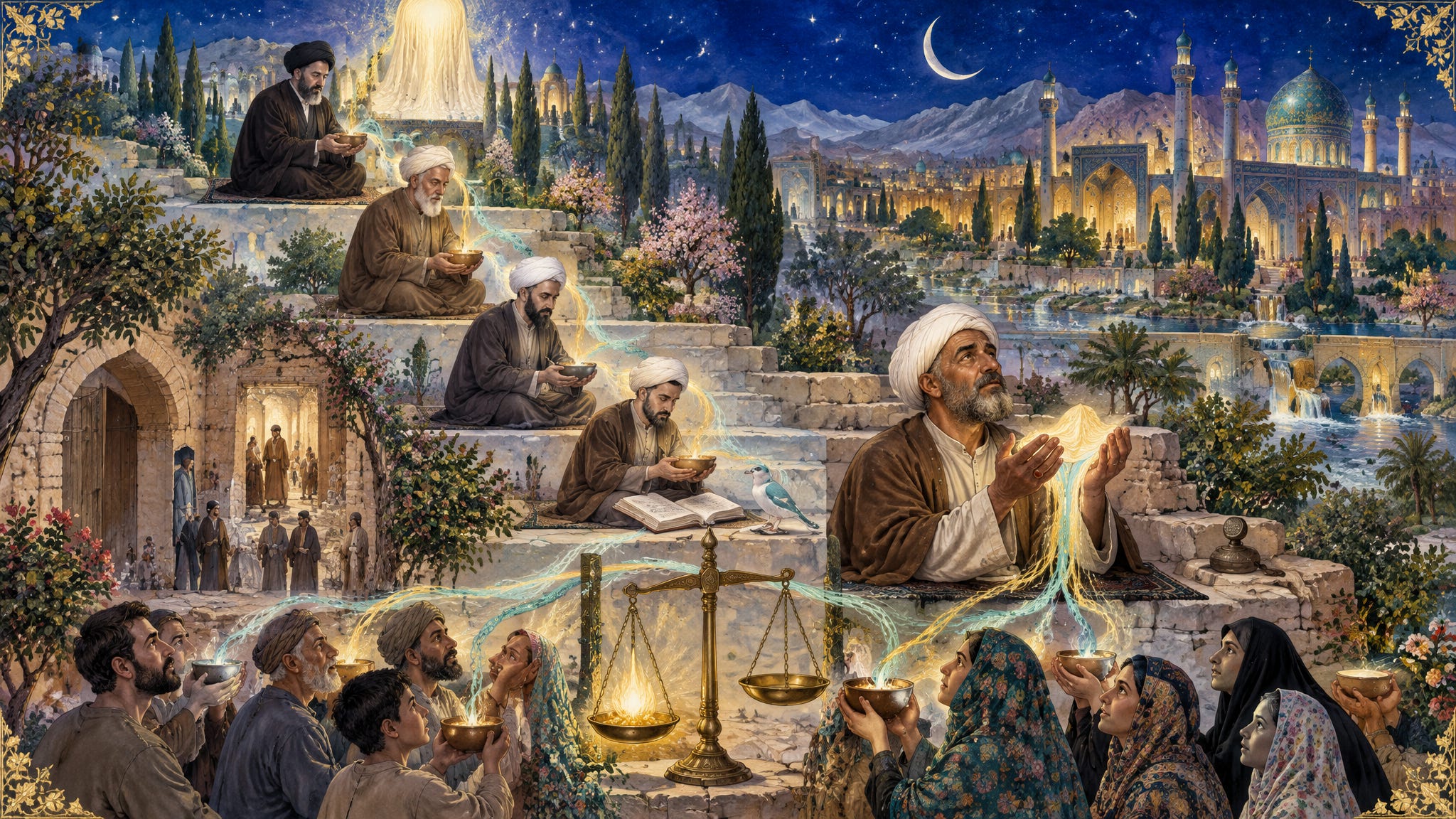
So there are levels, and it is worth seeing them plainly, because the next eleven weeks walk down them.
At the top, the Imam —
We are the scholars.
In our time, the Imam of our Age.
Below him, the carriers: the marja’, the teacher, the scholar who lives among the people, the student on the floor of the dars.
And every one of them, by the Imam’s definition, still a learner before him.
And notice: Kumayl was not a jurist.
We have no book of his rulings.
He was a companion, a governor for a time, and the bearer of a prayer.
A carrier is not always a mujtahid.
Some of the most important things in this religion have been carried by people who never wrote a fatwa in their lives.
The Learner Who Stumbled
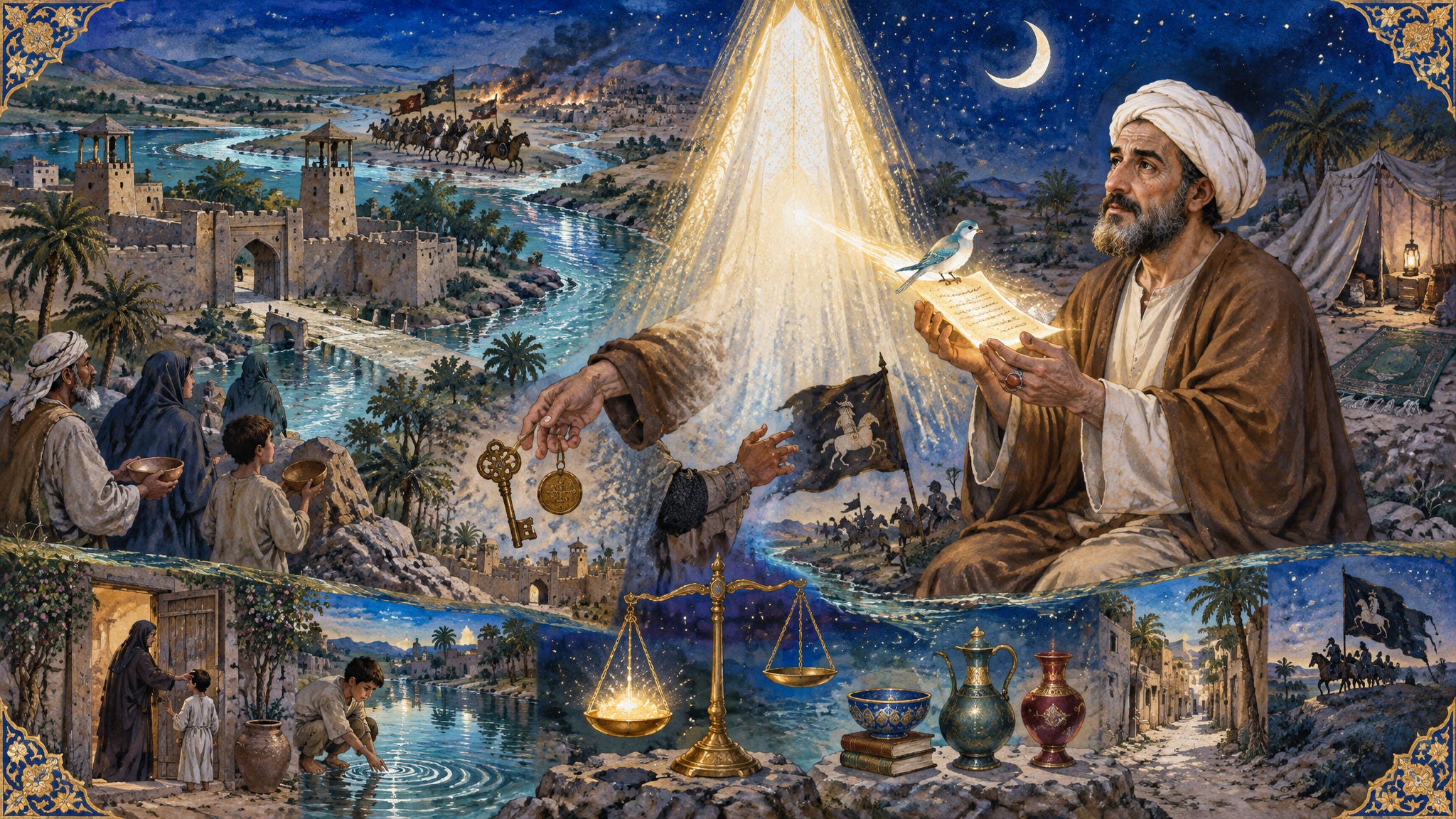
And now I want to tell you something about Kumayl that is not often told from the pulpit — because I think it is one of the most beautiful things about him.
He stumbled.
Amir al-Mu’minin made him governor of Hit — a town on the Euphrates, in what is now western Iraq.
And while he was there, Kumayl left his post to go raiding against Qarqisiya, further up the river, where the Khabur runs into the Euphrates, in what is now eastern Syria.
And while he was away, an enemy force came through the very district he had been set to guard.
And Amir al-Mu’minin wrote to him.
Here is the letter:
أَمَّا بَعْدُ، فَإِنَّ تَضْيِيعَ الْمَرْءِ مَا وُلِّيَ، وَتَكَلُّفَهُ مَا كُفِيَ، لَعَجْزٌ حَاضِرٌ، وَرَأْيٌ مُتَبَّرٌ، وَإِنَّ تَعَاطِيَكَ الْغَارَةَ عَلَى أَهْلِ قِرْقِيسِيَا، وَتَعْطِيلَكَ مَسَالِحَكَ الَّتِي وَلَّيْنَاكَ ـ لَيْسَ بِهَا مَنْ يَمْنعُهَا، وَلَا يَرُدُّ الْجَيْشَ عَنْهَا ـ لَرَأْيٌ شَعَاعٌ. فَقَدْ صِرْتَ جِسرْاً لِمَنْ أَرَادَ الْغَارَةَ مِنْ أَعْدَائِكَ عَلَى أَوْلِيَائِكَ، غَيْرَ شَدِيدِ الْمَنْكِبِ، وَلَا مَهِيبِ الْجَانِبِ، وَلَا سَادٍّ ثُغْرَةً، وَلَا كَاسِرٍ لِعَدُوٍّ شَوْكَةً، وَلَا مُغْنٍ عَنْ أَهْلِ مِصْرِهِ، وَلَا مُجْز عَنْ أَميِرِهِ.
“To proceed. A man’s neglect of what he has been entrusted with, and his taking upon himself what others were charged with, is a plain incapacity and a ruinous judgement. Your setting out to raid the people of Qarqisiya, and your leaving idle the garrisons we placed in your charge — with no one in them to defend them, and none to turn an army back from them — is a scattered judgement. You have become a bridge for those of your enemies who would raid your friends: not strong of shoulder, not feared on any side, closing no breach, breaking no enemy’s thorn, sufficing nothing for the people of your city, and doing nothing for your commander.”
— al-Sharif al-Radi, Nahj al-Balagha, Letter 61; my translation
That is a hard letter.
You have become a bridge for those of your enemies who would raid your friends.
And look at the very first sentence, because it names a fault that is not only Kumayl’s.
A man’s neglect of what he has been entrusted with, and his taking upon himself what others were charged with.
Two faults, side by side.
He left the duty that was his — guarding a town — for a duty that was not — a raid somewhere else.
The raid was more exciting.
It looked braver.
And it was not his to do.
How many of us do exactly that?
We leave the post we were actually given — our parents, our children, our own prayer, our own street — for causes that are more exciting, further away, and somebody else’s.
And while we are away, something comes through the district we were meant to guard.
But I want you to hear why it is hard.
You do not take that kind of trouble over a man who does not matter to you.
The letter is hard because Imam Ali cared about the people of that district — and because he cared about Kumayl.
And here is the beautiful thing.
Kumayl took it.
He did not leave.
He stayed with his Imam.
And the man who received that letter is the same man Amir al-Mu’minin chose for the desert — and for the prayer you will say tomorrow night.
There is a quieter lesson in it too, and I will only plant it tonight, because it belongs to a later week.
A man of the night prayer is not automatically a man for every post.
To carry the affairs of a community takes knowledge, and piety — and competence.
All three.
Precision
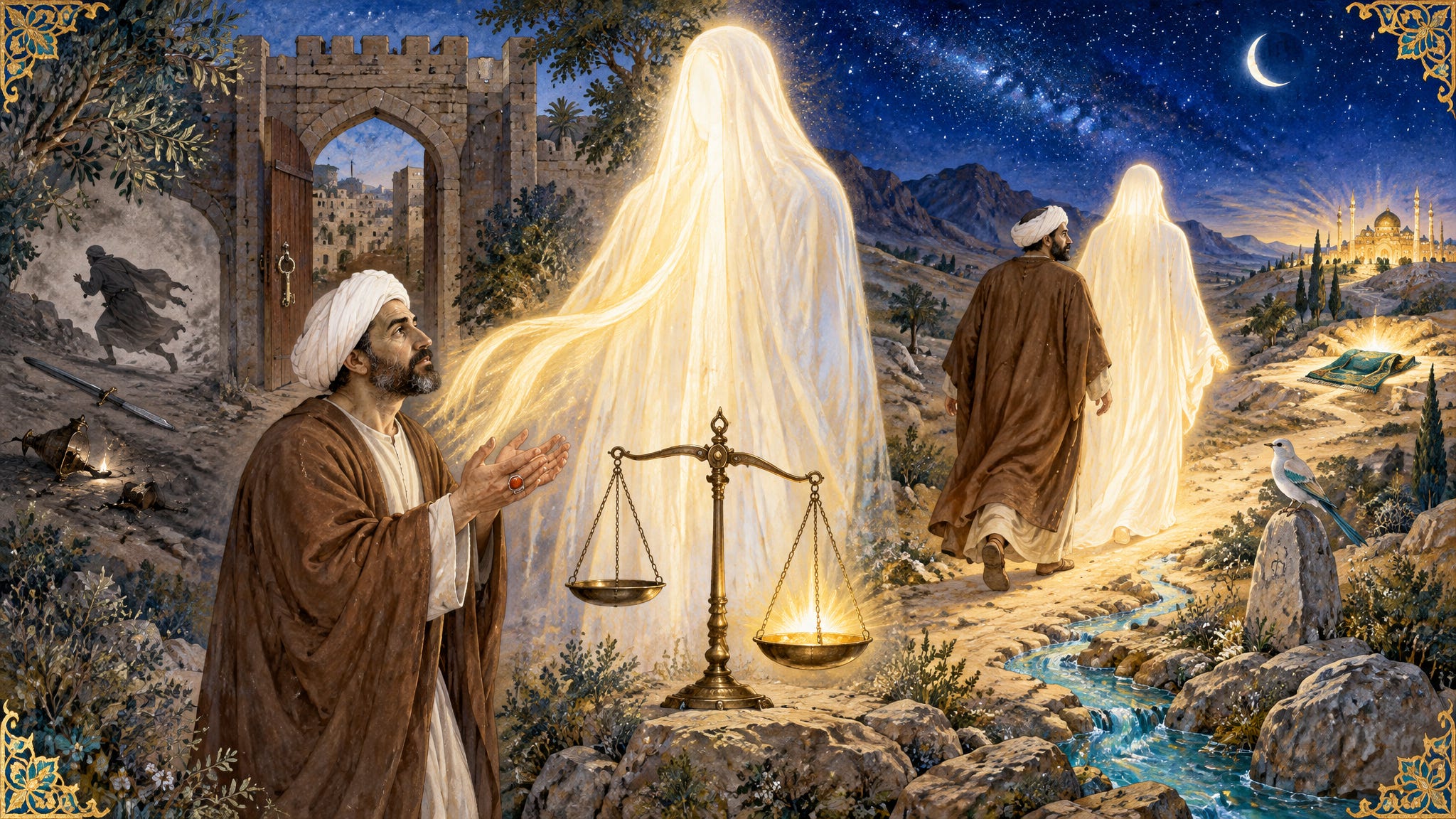
And let me be precise, because a pulpit is a dangerous place to be careless about a companion of Amir al-Mu’minin.
The rebuke is for neglecting an entrusted post.
It is not a rebuke for want of courage — he left his post to go and fight, not to run away.
And it is not a rebuke for want of faith.
Nobody should walk out of here thinking Kumayl was a coward, or a weak believer.
He was a learner who made a mistake in his work, was corrected by his Imam, and took the correction.
Which is exactly what a learner is.
A learner stumbles.
And a learner on the road to salvation is the one who gets up — and stays on the road.
Lessons for Our Time
Lesson Four — Every Shi’a Is Enrolled

The Imam defined us as learners.
That means every one of us is enrolled — and a believer who has stopped learning has, quietly, left the category.
So here is something small and concrete for this week.
Learn one thing — one ruling, one verse and its meaning, one saying of the Imams — from a sound source.
And when someone tells you something about the religion, ask the student’s question, kindly:
Where is that from?
Not to catch anyone out.
Because that is what students do.
And if you have children, enrol them too — not only in classes, but in the habit.
Let them see you look something up.
Let them hear you say,
I don’t know — let’s find out.
A child who watches his father ask where a hadith comes from has been given something no lecture can give him.
Lesson Five — Rebuke Is Part of Formation

The fifth lesson is Kumayl’s.
The one who was corrected and stayed is greater than the one who was never tested.
All of us will be corrected — by a teacher, by a parent, by a friend, sometimes by our own children.
The question is not whether it will happen.
It is what we do in the hour after it happens.
Take correction.
Take it from the right person — someone who knows, and who cares about you.
And when it stings, remember the letter to Hit, and the man who read it, and stayed.
And if you are the one who has to correct — a parent, a teacher, an elder — learn from the letter as well.
It names the fault plainly.
It does not mock.
It does not tell the whole city.
It is written to him, about what he did, so that he can do better.
That is how a correction is given by someone who still wants the person to stay.
What the Real Ones Look Like
Ah, How I Long to See Them
So:
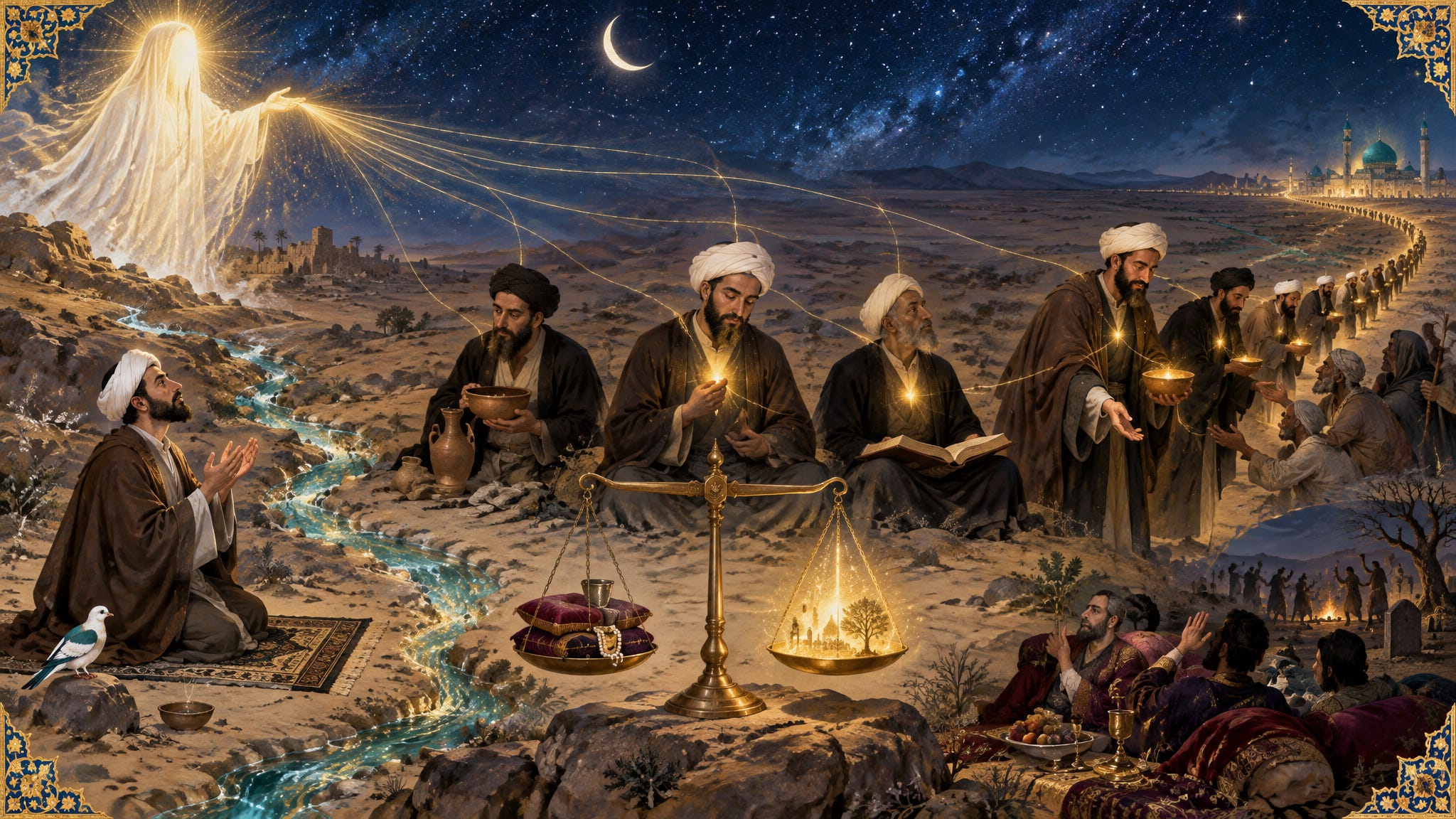
What does the real one look like?
At the end of that night in the desert — after everything this room has heard of it before — Amir al-Mu’minin describes the carriers he was looking for.
This part has never been read here, and I want to read it whole:
“Knowledge has rushed them upon the reality of insight. They have touched the spirit of certainty. They have found gentle what those who live in luxury found rough, and they are at home with what the ignorant find frightening. They keep company with the world in bodies whose souls hang from the highest place. Those are God’s deputies on His earth, and the callers to His religion.”
And then — the line this minbar has never said:
“Ah, ah — how I long to see them!”
— al-Sharif al-Radi, Nahj al-Balagha, Saying 147; my translation11
Amir al-Mu’minin, longing.
Not for a battle won, or a city taken.
For scholars who were yet to come.
And look at what he admired in them.
Not their learning, first.
Knowledge rushed them upon insight
— it carried them somewhere.
They touched certainty.
The things that frighten the ignorant — the night, the grave, what comes after it — they were at home with.
Their bodies were in the world, and their souls were somewhere else.
They have found gentle what those who live in luxury found rough.
Getting up in the night.
Fasting in the heat.
Going without.
To the pampered, those are hardships.
To them, they had become easy — not because they were harder men, but because they wanted what those things lead to.
They are at home with what the ignorant find frightening.
Being alone with God.
Remembering death.
Sitting in silence.
The ignorant run from those things into noise.
They were at home in them.
That is the man in the watches of the night.
That is the verse we began with, described from the inside.
Shaykh al-Saduq’s Reading
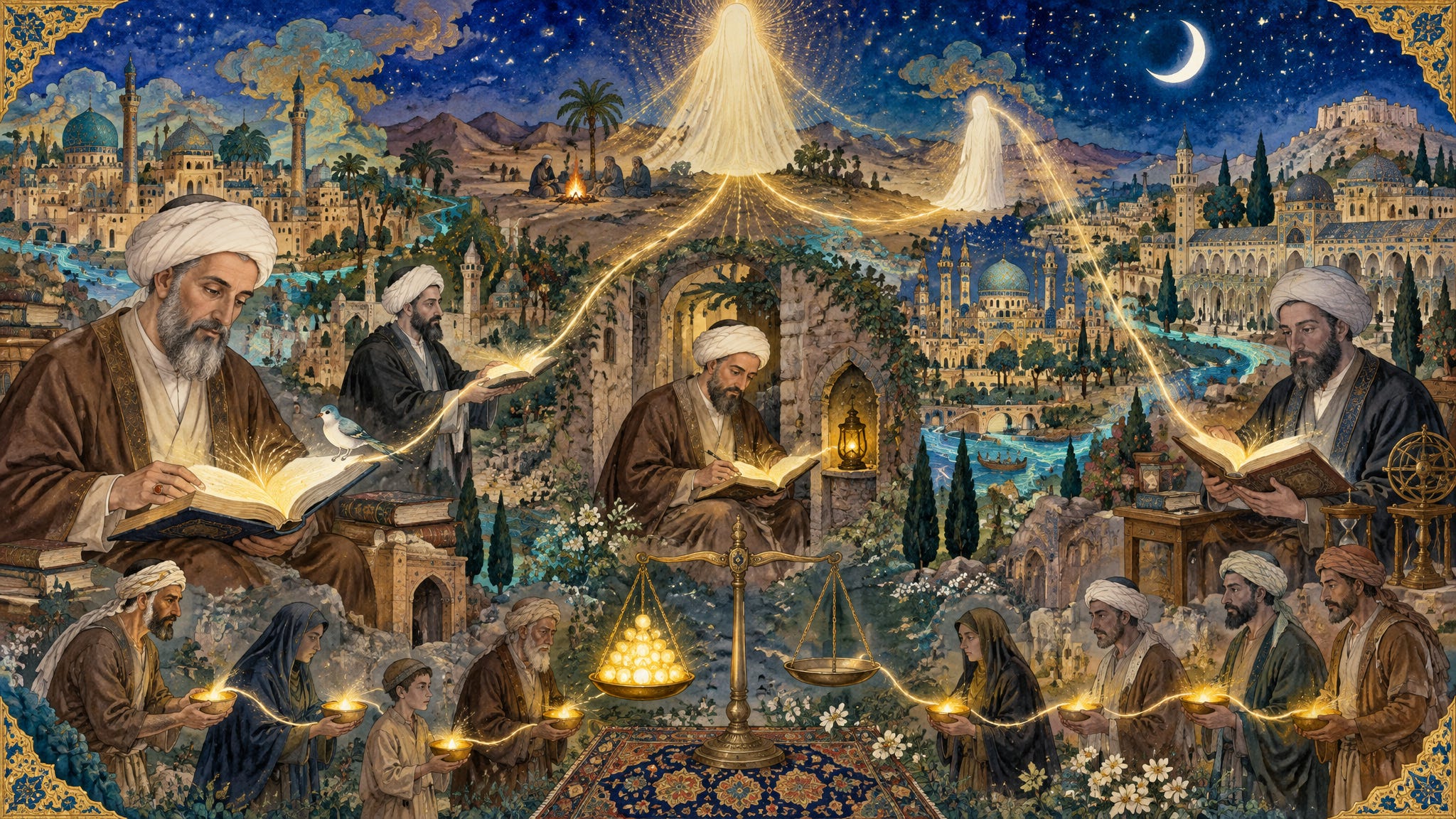
Now, this conversation did not reach us only through the Nahj al-Balagha.
Shaykh al-Saduq — the great scholar of Qom and Rayy in the fourth century, may God rest his pure soul — put the whole of it into his book on the occultation, Kamal al-Din.
And he put it in a particular place: in the chapter on what Amir al-Mu’minin foretold of the occultation of the Qa’im.
He carried it there through several chains — and one of them, which he gives himself, runs through a Shafi’i narrator in Baghdad.
— Shaykh al-Saduq, Kamal al-Din wa Tamam al-Ni’ma, Volume 1, chapter 26, printed pages 322 to 326 — narrated12
And in Shaykh al-Saduq's copy13, after
Ah, ah, how I long to see them,
Amir al-Mu'minin adds a line of his own:
And I seek God's forgiveness, for myself and for you.
And the historians of the other school carried it too.
Ibn ‘Asakir — the great historian of Damascus, in the sixth century — put this same counsel, through several chains, into his History of Damascus. Damascus: the Umayyads’ own city.
— Ibn ‘Asakir, Tarikh Madinat Dimashq, Volume 50, entry 5829, pages 251 to 255 — narrated14
Think about that.
Amir al-Mu’minin sighed that he could not find carriers.
And the counsel he gave in that very sigh was carried — into Qom, into Baghdad, into the capital of the dynasty that fought him.
And why did Shaykh al-Saduq put it in a book about the occultation?
Because of the line you heard in this room once before:
that the earth is never left empty of one who stands for God with a proof — manifest and known, or fearful and hidden.
When we heard it last, we heard it as Shaykh al-Tusi hiding in Karkh.
Shaykh al-Saduq heard it as the Imam of our Age.
Both are right.
There is the proof of God, hidden.
And there are the carriers who keep his word alive while he is hidden.
And if the proof is hidden, the carriers matter more, not less.
Opened and Sealed
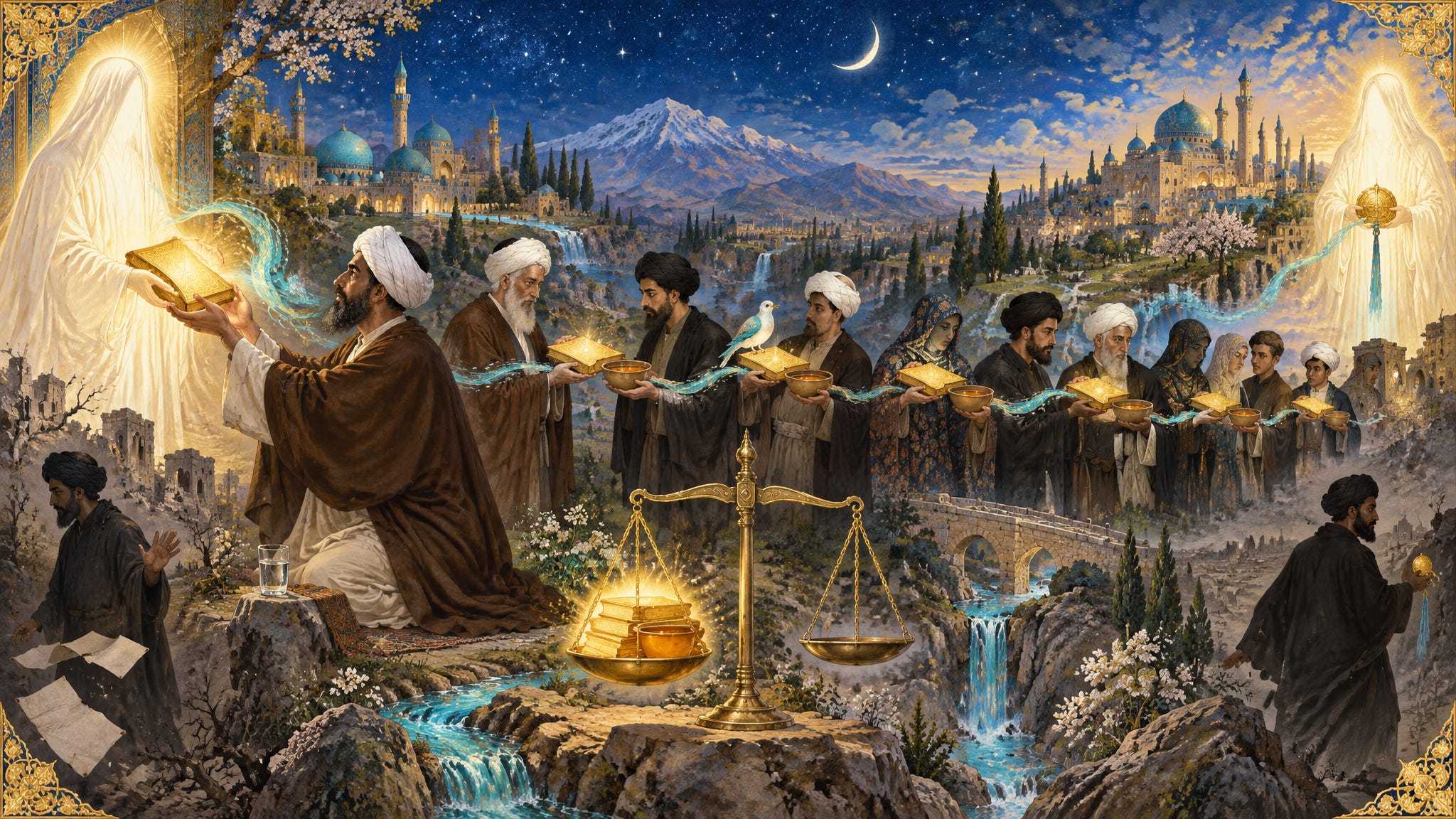
So what are they carrying — and to whom?
Kumayl tells us.
Remember the man who came to him asking about the merits of Ali, and Kumayl said:
let me give you instead something better than the world and all it holds.
Here is that counsel — and almost at its beginning, Amir al-Mu’minin says this:
يا كميل ما من علم إلا وأنا أفتحه، وما من سر إلا والقائم (عليه السلام) يختمه
“O Kumayl: there is no knowledge except that I open it, and there is no secret except that the Qa’im, peace be upon him, seals it.”
— Imad al-Din al-Tabari, Bisharat al-Mustafa li-Shi’at al-Murtada, page 51; my translation
Let me say it again, slowly.
There is no knowledge except that I open it.
And there is no secret except that the Qa’im seals it.
Amir al-Mu’minin opens.
The Qa’im seals.
And everything in between — every century, every city, every teacher and every student — is carried by hand.
Remember the sentence we began with tonight:
Knowledge is a noble inheritance.
Here is the whole line of that inheritance, from its first hand to its last.
It is opened by one, and it will be sealed by another, and in between it is handed on.
It is not the carrier’s to open further, and it is not his to close early.
His whole work is to receive it, to keep it whole, and to hand it to the next.
That is a carrier.
That is what this whole sequence is about.
Twelve weeks of the hands in between.
And it also tells you what a carrier is not.
No carrier opens, and no carrier seals.
A scholar in any age who speaks as though he were the beginning of the religion — as though nothing came before him — has stepped out of the line.
And anyone who speaks as though he were its end — as though he had the final word that only the Qa’im will bring — has stepped out of it too.
The real ones know exactly where they are standing: in between, holding something that is not theirs.
And notice who he said it to.
Not to a crowd.
Not from a minbar.
To one man.
The man whose name you will say tomorrow night — and who, when somebody came asking him for stories about Ali, handed this on instead.
I want to be careful about how I hold this.
It reaches us as the counsel Kumayl handed on, through a chain I have not yet finished checking, and I am giving it to you as exactly that — not as a graded hadith.
But it is in the books of the Shi’a, it was said to Kumayl, and it says in one sentence what this whole series has been trying to say for twenty weeks.
Al-Khidr and Thursday Night
And now the thing he actually carried — the thing his name is known for.
The prayer we call Dua Kumayl.
Amir al-Mu’minin did not call it that.
When he spoke of it, he called it
The supplication of al-Khidr.
— Sayyid Ibn Tawus, al-Iqbal bi-l-A’mal al-Hasana, Volume 3, page 331 — narrated15
Al-Khidr, peace be upon him — the servant of God whom Moses, peace be upon him, followed and learned from, in Surah al-Kahf.
Why the prayer bears his name, the books do not say.
So I will not guess.
But here is something they do say.
Imam al-Rida, peace and blessings be upon him, said that al-Khidr drank of the water of life, and so he lives; that he attends the Hajj; that he says amin to the prayers of the believers — and that through him God will comfort the loneliness of the Qa’im in his occultation.
— Imam al-Rida, in Shaykh al-Saduq, Kamal al-Din wa Tamam al-Ni’ma, the chapter on what is reported of al-Khidr, hadith 4, printed page 421 — narrated16
So every Thursday night, across the Shi’a world, people sit up and recite a prayer that bears the name of the one who keeps the Qa’im company.
I will only plant that tonight.
It has its own evenings, later in this series, God willing.
The Answer to the Sigh

So let me come back to that sigh.
Ah, ah — how I long to see them.
If Amir al-Mu’minin longed to see them, then the next eleven weeks are an attempt to show you some of them.
The student on the floor of the dars.
The teacher.
The scholar who lives among the people.
The mujtahid.
The women of knowledge.
The scholar of the inner life.
The scholar who stood before a ruler.
The ones who were martyred.
The ones who fell.
The scholar of our own age.
And the one who waits.
Some of them he would have longed for.
One or two, he would have warned you about.
And you will be able to tell the difference — because by then you will have the measure.
What the Learner Inherited
And Kumayl himself?
What did the learner inherit, in the end?
Not a library.
We have no book of his.
Not a school.
Not a following.
A prayer.
The learner’s inheritance was a prayer, not a library.
And it has been said on Thursday nights, for longer than anyone can remember, by people who never knew whose name was on it.
How it came to him is for the end of tonight.
Lessons for Our Time
Lesson Six — Long for Them
Amir al-Mu’minin longed for the true scholars before he met them.
That longing is a teaching.
Love the true scholar before you meet him — so that you recognise him when you do.
If you have never wanted to find one, you will walk straight past him.
And if all you want is a scholar who tells you what you already think, you will find plenty of those, and not one of them will be what Amir al-Mu’minin longed for.
And longing changes how you sit in front of a teacher.
If you long for the real thing, you will be patient with an ordinary class, because you are looking for the moment when something real comes through it.
And you will be honest with yourself when it does not.
Pray for them.
Ask God to send them to you, and to your children.
And ask Him to make you able to recognise them when He does.
Lesson Seven — The Proof Is Hidden; the Carriers Are Not
The seventh lesson is the Mahdawi one, and it is the reason this whole series exists.
The Proof of God in our time is hidden.
The carriers are not.
In the occultation, guidance reaches us through people — people you can see, and test, and sit with.
So know the measure — that was the first point.
Stay a learner — that was the second.
And then understand where you are standing: somewhere in a long line of hands, between Amir al-Mu’minin and the Imam of our Age.
What reaches you, you will hand on — to your children, to your friends, to the person who asks you a question at work.
You may not think of yourself as a carrier.
But the line runs through you whether you think of it or not.
The only question is what arrives at the other end.
The hands in between include yours.
The Close
I have given you a great deal tonight, and most of it will go.
That is how sermons work.
So let me leave you two sentences.
If everything else goes, let these stay.
A scholar is someone knowledge has made afraid of God, and generous with what he holds.
And you — by the Imam’s own word — are his student.
Conclusion — Key Takeaways
Three things to take out of this room — and they are things to do, not only things to think.
The first. Measure by fear, not by title.
Ask of anyone who teaches you — and of yourself — whether what he knows has made him more afraid of God, and more generous with what he holds.
This week: before you next listen to a lecture or a clip, ask yourself what you are measuring the speaker by.
The second. Stay a learner.

The Imam called his Shi’a the learners.
Every morning you set out as one of three kinds; choose the middle one again.
This week: learn one thing — one verse, one ruling, one saying — from a sound source.
And the third. Check what you carry.
Love for a teacher is not a reference.
Tell a parable as a parable, and a hadith with its book.
This week: take one story you love about the Ahl al-Bayt, and find where it is.
The Hands in Between
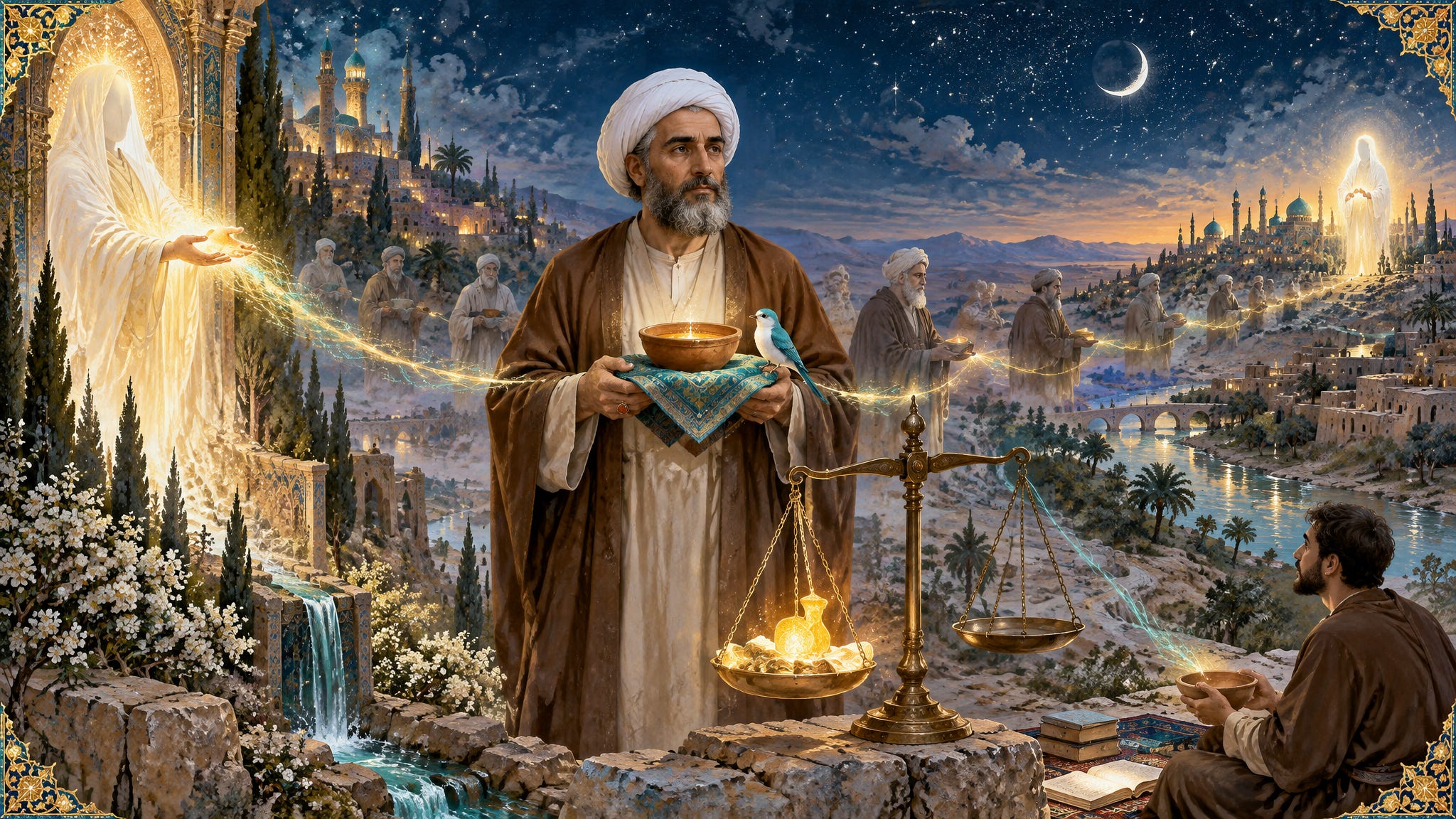
He opened it.
The Qa’im will seal it.
Tonight we met one of the hands in between.
Next week, God willing — the learner: the student on the floor of the dars.
Eulogy — Kumayl: The Place and the Prayer
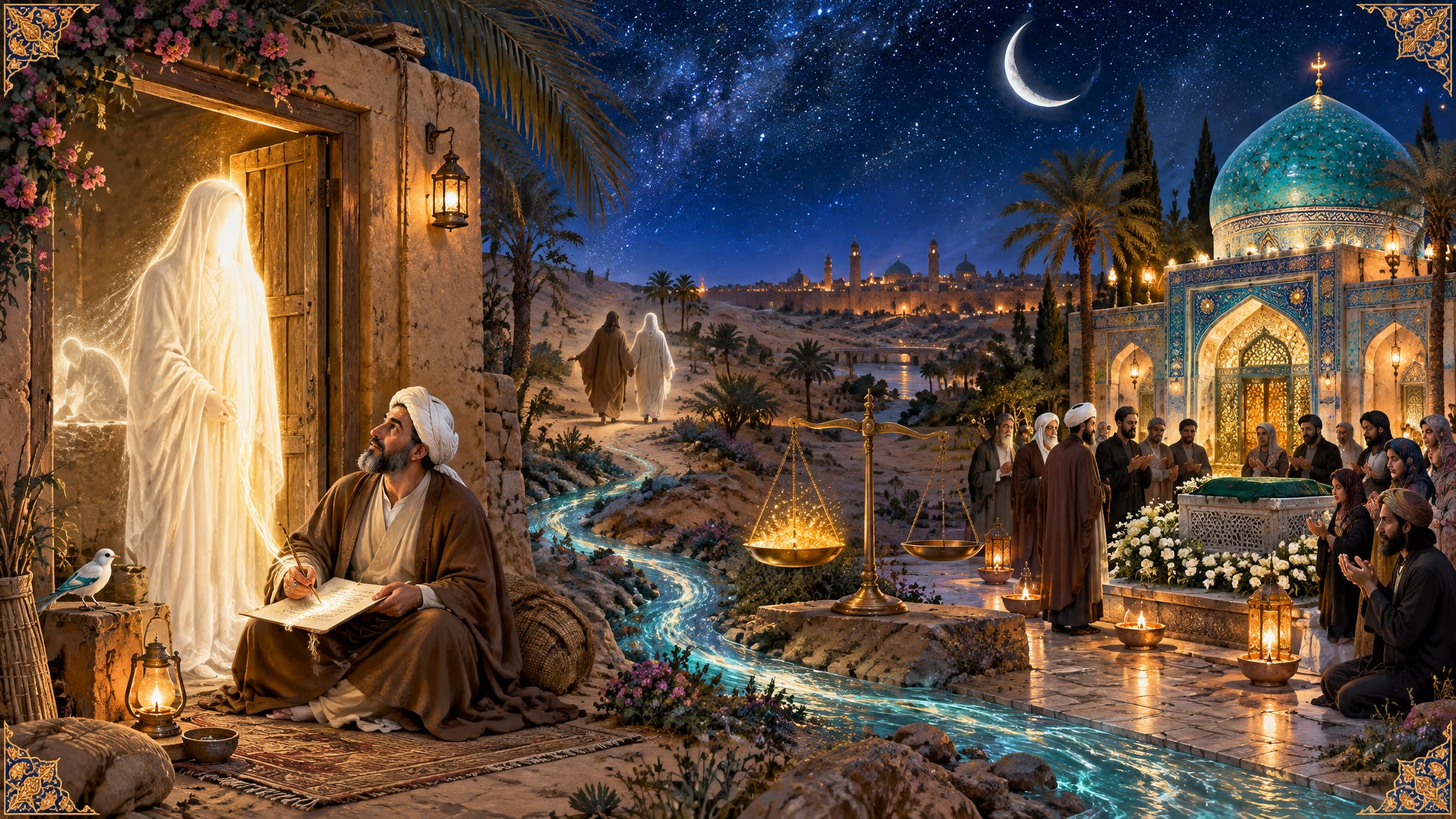
Kumayl, the son of Ziyad, of Nakha’, may God be pleased with him.
A companion of Amir al-Mu’minin, and of Imam al-Hasan after him.
Counted by Shaykh al-Mufid among
those brought near.
The one Amir al-Mu’minin took by the hand out into the desert — and the one he trusted with a prayer.
A man whose standing, the greatest rijal scholar of the last century wrote, is among
the plain matters that admit no doubt.
I am not going to tell you how he died.
That belongs to the maqtal, and it will be told in another voice.
Tonight I want to give you two other things: the night he asked, and the place where he lies.
Do you remember the verse we began with?
A man in the watches of the night — prostrating, and standing.
Sayyid Ibn Tawus, may God rest his pure soul, records it for us — and he records it from the one he calls my grandfather, Shaykh al-Tusi.
It is reported,
Shaykh al-Tusi says,
that Kumayl ibn Ziyad saw Amir al-Mu’minin in prostration, praying with this supplication, on the night of the middle of Sha’ban.
And Ibn Tawus gives a second report, in Kumayl’s own words.
I was sitting with my master, Amir al-Mu’minin,
Kumayl says,
in the mosque at Basra, with a group of his companions.
And Amir al-Mu’minin spoke to them of the night of the middle of Sha’ban — and said that whoever keeps that night awake, and prays with the supplication of al-Khidr, will be answered.
And when he had gone home,
Kumayl says,
I came knocking at his door, at night.
What brings you, Kumayl?
The supplication of al-Khidr, O Amir al-Mu’minin.
Sit, Kumayl. If you memorise this supplication, pray with it every Thursday night — or once a month, or once a year, or once in your life — and you will be protected, and helped, and provided for, and you will never be denied forgiveness.
O Kumayl — your long companionship with us has earned you our generosity in what you asked.
And then he said:
Write.
— Sayyid Ibn Tawus, al-Iqbal bi-l-A’mal al-Hasana, Volume 3, page 331; the same in the single-volume edition, page 220 — narrated17
Your long companionship with us has earned it.
That is how the prayer came to him.
Not by asking once.
By years of staying — through the desert, and through Hit, and through everything that came after.
Think of what he could have said instead.
I have been your companion for years — I deserve it.
He did not say that.
He knocked at the door at night, and asked.
And it was Amir al-Mu’minin who named what he had earned.
The one who stays does not need to announce it.
The Imam sees it.
He asked for it by the name you heard earlier tonight — al-Khidr’s.
And it came down to us with his.
Some of you will remember that in The Art of Supplication we recommended this prayer for the night of the middle of Sha’ban.
You may have known the night.
Now you know the story.
And the place.
He is buried near Kufa — the city he lived in, the city Amir al-Mu’minin led him out of on that night in the desert — and the Shi’a visit him there.
They stand at his grave and greet him, and I would be surprised if many of them have not whispered a line or two of his prayer beside him.
He asked to be taught a prayer, and he was given it because he stayed.
And now, every Thursday night, the whole world says his name — and most of the world does not know it is saying it.
Tomorrow night, when you say his name, you will know whose it is.
Segue to Maqtal
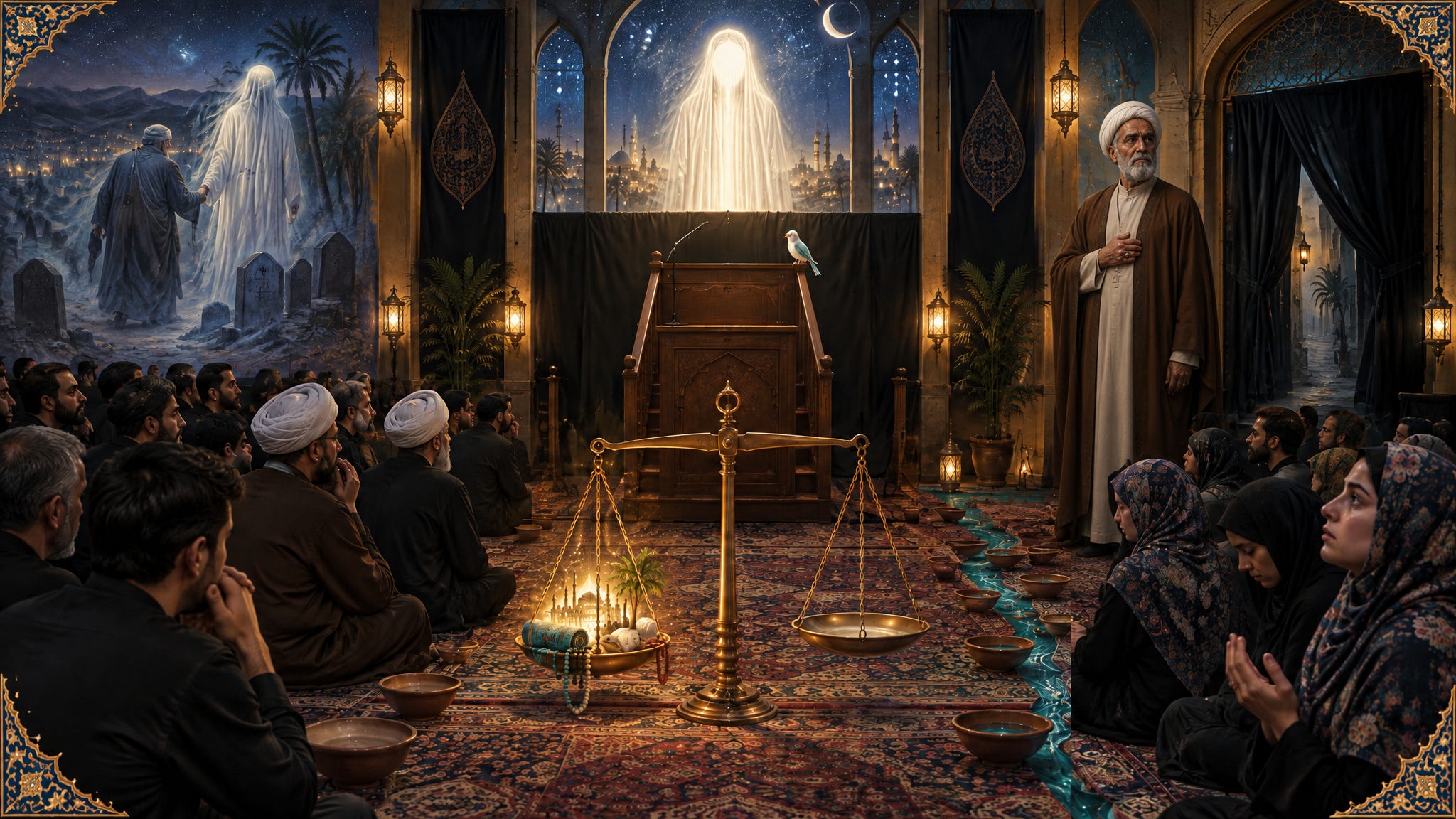
We have told you tonight how he lived, and what he left.
We have not told you how he went.
He lived a long time after that night in the desert.
He outlived Amir al-Mu’minin, and Imam al-Hasan, and Imam al-Husayn, peace and blessings be upon them all.
He was an old man when the governor of Iraq went looking for the men of Ali.
And the man Amir al-Mu’minin had taken by the hand, out past the graves, was one of them still.
Our maqtal tonight is for him — Kumayl, the son of Ziyad.
And it is given in the voice of the one who carries every one of their griefs: the Imam of our Age.
Maqtal (Lamentation) for the Twentieth Session of the Architecture of Guidance
Supplication
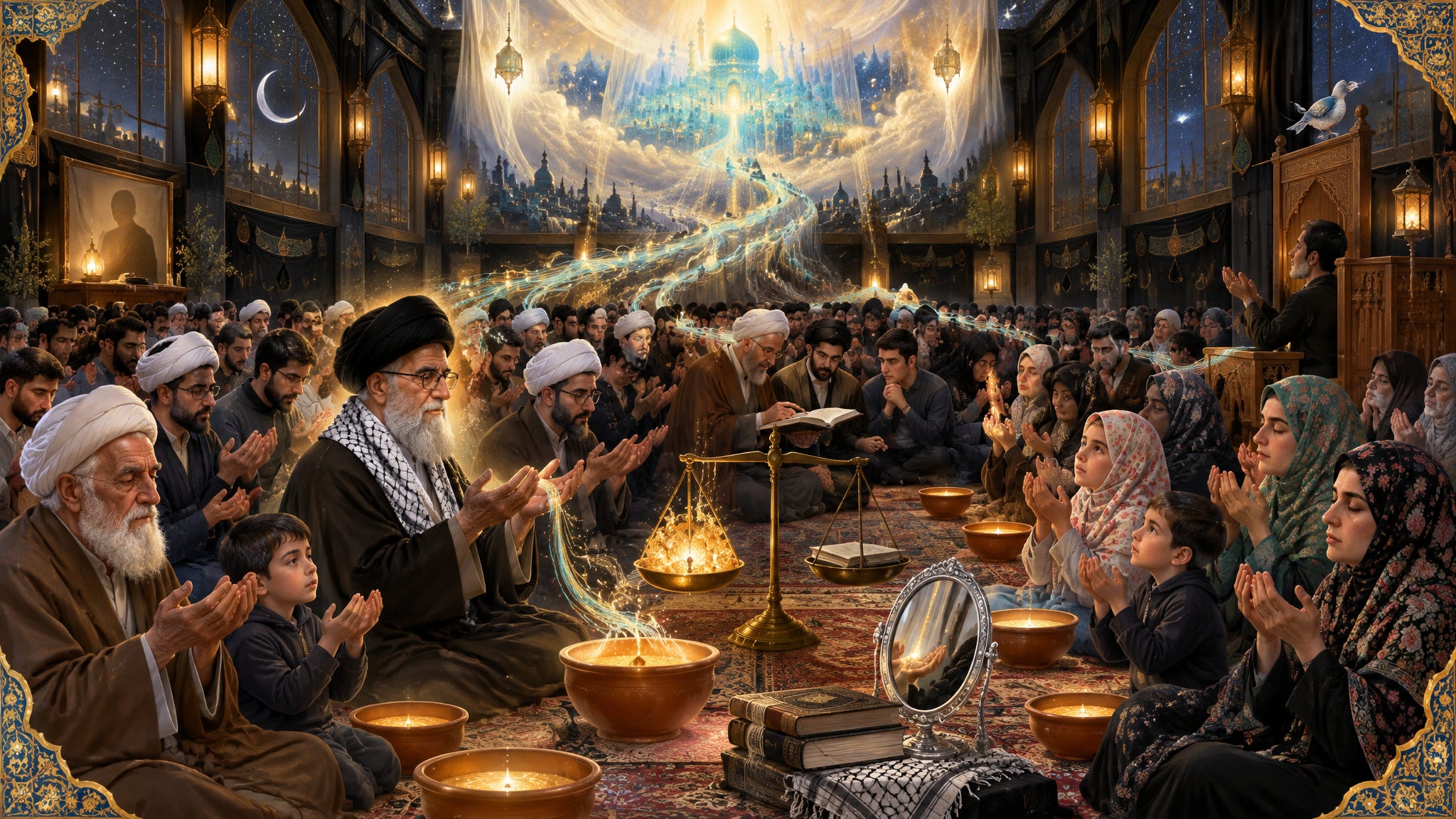
O God, we ask You by the knowledge You placed in the hearts of Your friends, and by the night prayer of those who know.
By Your prophets, peace and blessings be upon them all, who left no dirham and no dinar, but left Your words.
By Muhammad, peace and blessings be upon him, his family, and his righteous companions.
By the fourteen — by Sayyedah Fatimah al-Zahra, peace and blessings be upon her, in these her days; and by every Imam from Amir al-Mu’minin, peace and blessings be upon him, to the one we are waiting for.
O God, make us learners on the road to salvation — and never froth on the water.
O God, let what we know make us afraid of You, and generous with what we hold. Make us channels, and not reservoirs.
O God, keep us from adding to what Your friends said, and from taking away from it. Give us the honesty to check what we carry — even from those we love.
O God, protect the carriers of this religion: the maraji’ and the teachers, the scholars who live among the people, the students on the floor of the dars — all those who carry it unbent.
Give the living long life and a good ending, and have mercy on those who have gone.O God, have mercy on Kumayl, the son of Ziyad — the companion of Your friend, who stayed — and on every companion the pulpits forget.
O God, bless the nights of Fruit of the Heart, and the parents and children who come to them; and raise our children as Sayyedah Fatimah would have them raised.
O God, have mercy on the previous leader, Imam Khomeini, may God rest his pure soul.
O God, we remember before You the martyred leader, Imam Sayyed Ali Khamenei, may God rest his pure soul, whose words we carry to our children on Saturday nights.
Accept him, and gather him with those he loved.O God, protect and guide and lengthen the life of our Wali al-Faqih, Imam Sayyed Mujtaba Khamenei, may You protect him, and keep him firm on the straight path until the rising of the one we are waiting for.
O God, hasten the relief of Your friend and the son of Your friend — the Imam of our Age, may our souls be his ransom and may You hasten his return. Make us among the hands he can trust.
And make us among those who wait for him actively — who prepare, and do not only wait.O God, give us success in whatever we do for his sake.
And give us a good ending, like the righteous scholars who went before us.And whatever we have said tonight that was true, it is from You; and whatever was wrong in it is from me, and I ask Your forgiveness for it.
Amen, O Lord Sustainer of the Universes
Amen, O Most Merciful of the Merciful
And from Him alone is all ability and He has authority over all things.
Who is the “brother in God” of Saying 289? The saying does not name him, and the sermon does not. Ibn Abi al-Hadid (d. 656 AH), a Mu’tazili scholar of Baghdad and the author of one of the great commentaries on the Nahj al-Balagha, records four views and gives his own:
قد اختلف الناس فى المعنى بهذا الكلام و من هو هذا الأخ المشار إليه فقال قوم هو رسول الله ص و استبعده قوم لقوله و كان ضعيفا مستضعفا فإن النبى ص لا يقال فى صفاته مثل هذه الكلمه و إن أمكن تأويلها على لين كلامه و سماحه أخلاقه إلا أنها غير لائقه به ع. و قال قوم هو أبو ذر الغفاري و استبعده قوم لقوله فإن جاء الجد فهو ليث عاد و صل واد فإن أبا ذر لم يكن من الموصوفين بالشجاعه و المعروفين بالبساله. و قال قوم هو المقداد بن عمرو المعروف بالمقداد بن الأسود و كان من شيعه على ع المخلصين و كان شجاعا مجاهدا حسن الطريقه و قد ورد فى فضله حديث صحيح مرفوع. و قال قوم أنه ليس بإشاره إلى أخ معين و لكنه كلام خارج مخرج المثل و عاده العرب جاريه بمثل ذلك مثل قولهم فى الشعر فقلت لصاحبى و يا صاحبى و هذا عندي أقوي الوجوه
“People have differed over what is meant by these words, and over who this brother is to whom he points. Some said he is the Messenger of God, God bless him and his family; others thought it unlikely, because of his words he was weak, regarded as weak — for such a phrase is not said in describing the Prophet; and even if it could be interpreted as the gentleness of his speech and the generosity of his character, it is not befitting of him. Some said he is Abu Dharr al-Ghifari; others thought it unlikely, because of his words when the serious hour came, he was a lion of the thicket and a viper of the valley — for Abu Dharr was not among those described by courage or known for valour. Some said he is al-Miqdad ibn ‘Amr, known as al-Miqdad ibn al-Aswad: he was among the sincere Shi’a of ‘Ali, peace be upon him, brave, a striver, of good conduct, and a sound report traced to the Prophet has come in his virtue. And some said that it does not point to any particular brother, but is speech in the manner of a parable — and the custom of the Arabs runs that way, as in their saying in poetry, so I said to my companion, and O my companion. And this, to me, is the strongest of the views.”
— Ibn Abi al-Hadid, Sharh Nahj al-Balagha, Volume 19, printed pages 183–184, under his no. 295; my translation
Ayatollah al-Khoei’s entry on Kumayl, to his own judgement. His sentence runs on over the page, which is not yet carried here.
٩٧٧٦- كميل بن زياد:
النخعي: عدّه الشيخ في أصحاب علي عليه السلام (٦)، وفي أصحاب الحسن (١).
وعدّه البرقي من أصحاب أمير المؤمنين عليه السلام من اليمن.
وعدّه الشيخ المفيد في الاختصاص من السابقين المقرّبين من أمير المؤمنين عليه السلام عند ذكر السابقين المقرّبين.
وتقدّم في الأصبغ بن نباتة عدّه من ثقات أمير المؤمنين عليه السلام.
قال ابن داود (١٢٢٦): «كميل بن زياد النخعي (ى) (ن) (جخ) من خواصهما» (انتهى).
أقول: جلالة كميل واختصاصه بأمير المؤمنين عليه السلام من الواضحات
“9776 — Kumayl ibn Ziyad. Al-Nakha’i. The Shaykh [al-Tusi] counted him among the companions of Ali, peace be upon him, and among the companions of al-Hasan. Al-Barqi counted him among the companions of Amir al-Mu’minin, peace be upon him, from Yemen. Shaykh al-Mufid, in al-Ikhtisas, counted him among the foremost, those brought near to Amir al-Mu’minin, peace be upon him, where he names the foremost, those brought near. And it has preceded, under al-Asbagh ibn Nubata, that he is counted among the trusted ones of Amir al-Mu’minin, peace be upon him. Ibn Dawud (no. 1226) said: ‘Kumayl ibn Ziyad al-Nakha’i … one of the intimates of the two of them.’ … I say: the eminence of Kumayl, and his special closeness to Amir al-Mu’minin, peace be upon him, are among the plain matters …”
— al-Khoei, Mu’jam Rijal al-Hadith, Volume 15, entry 9776; the numbers in brackets are al-Khoei’s references, and the letters in brackets Ibn Dawud’s signs for the books, kept as printed; my translation
The head of Ibn ‘Asakir’s entry.
قال (١) : كُمَيْل بن زِيَاد، كوفي، تابعي، ثقة.
قرأت على أبي مُحَمَّد السلمي، عَن أبي بكر الخطيب، أَنْبَأَنَا أَبُو بَكْر البرقاني، أَنْبَأَنَا مُحَمَّد بن عَبْد الله بن خميروية، حَدَّثَنَا الحُسَيْن بن إدريس، أَنْبَأَنَا مُحَمَّد بن عَبْد الله بن عمار قال : كُمَيْل بن زِيَاد رافضي، وهو ثقة، من أصحاب علي.
وقال في موضع آخر : كُمَيْل بن زِيَاد هو من رؤساء الشيعة، كان بلاء من البلاء.
“He said: Kumayl ibn Ziyad — a Kufan, a Successor, trustworthy. I read before Abu Muhammad al-Sulami, from Abu Bakr al-Khatib: Abu Bakr al-Barqani told us: Muhammad ibn ‘Abd Allah ibn Khumayrawayh told us: al-Husayn ibn Idris told us: Muhammad ibn ‘Abd Allah ibn ‘Ammar told us; he said: Kumayl ibn Ziyad is a Rafidi, and he is trustworthy, one of the companions of Ali. And he said in another place: Kumayl ibn Ziyad is one of the chiefs of the Shi’a; he was a trial among trials.”
— Ibn ‘Asakir, Tarikh Madinat Dimashq, Volume 50, entry 5829 (Fihrist, record 251, lines 1–5; the editor’s note (1) names the source of the first grading: al-’Ijli, Tarikh al-Thiqat, page 398, number 1423; my translation
Ayatollah Jawadi Amoli’s own words, in Persian.
بعد مصداق هم معين کرده است که من ربّاني اين امت هستم و چون رباني اين امت هستم هم در ارتباط با ربوبيت از ديگران تام هستم . هم در تربيب مردم از ديگران تام هستم. مستحضريد که تربيب مضاعف است و بي ارتباط با تربيت که ناقص است نيست. فرمود من ربّانيام يعني «شديد الربط بالرب» هستم. هم فيوضات فراواني مي گيرم هم افاضات فراواني دارم.
“Then he also named the instance: that I am the rabbani of this umma — and because I am the rabbani of this umma, I am more complete than others both in my bond with the Lord’s nurturing and in the nurturing of people. You will know that ‘tarbib’ is the intensive form, and is not unconnected with ‘tarbiya’, which is the weaker. He said: I am rabbani — that is, ‘intensely bound to the Lord’. I receive abundant outpourings, and I give abundant outpourings.”
— Ayatollah Abdullah Jawadi Amoli, lesson on Nahj al-Balagha, Saying 147, 16 Aban 1403 / 6 November 2024; my translation
How the counsel opens in Bisharat al-Mustafa.
عبد الله بن حفص المدني، قال: أخبرني محمد بن إسحاق، عن سعيد بن زيد بن أرطأة قال: لقيت كميل بن زياد وسألته عن فضل أمير المؤمنين علي بن أبي طالب، فقال: ألا أخبرك بوصية أوصاني بها يوما (هي خير لك من الدنيا بما فيها) فقلت: بلى، قال: قال لي علي (عليه السلام):
“… ‘Abd Allah ibn Hafs al-Madani; he said: Muhammad ibn Ishaq told me, from Sa’id ibn Zayd ibn Arta’a, who said: I met Kumayl ibn Ziyad, and asked him about the merit of Amir al-Mu’minin, Ali ibn Abi Talib. And he said: Shall I not tell you of a counsel he gave me one day — it is better for you than the world and all that is in it? I said: Yes indeed. He said: Ali, peace be upon him, said to me:”
— Imad al-Din al-Tabari, Bisharat al-Mustafa li-Shi’at al-Murtada, page 51, the chain opens mid-way, as the line does; my translation
The two lines in the counsel.
يا كميل وما قالوه لك مطلقا فلا تعلمه إلا مؤمنا موفقا، يا كميل لا تعلم الكافرين من أخبارنا فيزيدوا عليها، فيبدوكم بها يوم يعاقبون عليها
“O Kumayl — and what they have told you without reserve, teach it only to a believer granted success. O Kumayl, do not teach the disbelievers from our reports, lest they add to them, and then come at you with them on the day they are punished for them.”
— Imad al-Din al-Tabari, Bisharat al-Mustafa li-Shi’at al-Murtada, page 54; my translation
The two passages.
أَيُّهَا النَّاسُ، سَيَأْتي عَلَيْكُمْ زَمَانٌ يُكْفَأُ فِيهِ الاْسْلاَمُ، كَمَا يُكْفَأُ الاْنَاءُ بِمَا فِيهِ.
“O people: a time will come upon you in which Islam is overturned, as a vessel is overturned with what is in it.”
— al-Sharif al-Radi, Nahj al-Balagha, Sermon 103; my translation
فَإِذَا كَانَ ذلِكَ كَانَ الْوَلَدُ غَيْظاً، وَالْمَطَرُ قَيْظاً، وَتَفِيضُ اللِّئَامُ فَيْضاً، وَتَغِيضُ الْكِرَامُ غَيْضاً، وَكَانَ أَهْلُ ذلِكَ الزَّمَانِ ذِئَاباً، وَسَلاَطَينُهُ سِبَاعاً، وَأَوْسَاطُهُ أُكَّالاً، وَفُقَرَاؤُهُ أَمْوَاتاً، وَغَارَ الصِّدْقُ، وَفَاض الْكَذِبُ، وَاسْتُعْمِلَتِ الْمَوَدَّةُ بِاللِّسَانِ، وَتَشَاجَرَ النَّاسُ بِالْقُلُوبِ، وَصَارَ الْفُسُوقُ نَسَباً، وَالْعَفَافُ عَجَباً، وَلُبِسَ الاْسْلاَمُ لُبْسَ الْفَرْوِ مَقْلُوباً.
“And when that is so, a child will be a cause of anger, and rain will be scorching heat; the base will flood forth and the noble will dwindle away. The people of that time will be wolves, its rulers beasts of prey, its middling folk devourers, and its poor as good as dead. Truthfulness will sink away and lying will overflow; affection will be used on the tongue while people quarrel in their hearts; sinfulness will become a lineage, and chastity a wonder — and Islam will be worn the way a fur is worn, inside out.”
— al-Sharif al-Radi, Nahj al-Balagha, Sermon 108; my translation
Ibid.
The line in the counsel.
يا كميل ليس الشأن أن تصلي وتصوم وتتصدق، (انما) الشأن أن تكون الصلاة فعلت بقلب نقي وعمل عند الله مرضي وخشوع سوي ابقاء للحد فيها
“O Kumayl, the matter is not that you pray, and fast, and give charity. The matter is that the prayer be performed with a pure heart, and a deed pleasing to God, and a fitting humility — keeping within its bounds.”
— Imad al-Din al-Tabari, Bisharat al-Mustafa li-Shi’at al-Murtada, page 57; my translation
The line in the counsel.
يا كميل لا تأخذ إلا عنا تكن منا
“O Kumayl, take only from us, and you will be of us.”
— Imad al-Din al-Tabari, Bisharat al-Mustafa li-Shi’at al-Murtada, page 51; my translation
The whole saying, as our copy of the Nahj gives it, with that copy’s English.
Saying 147
وَمِنْ كَلَامٍ لَهُ (عليه السلام) لِكُمَيْلِ بْنِ زِيَادٍ النَّخَعِيِّ
Amīr al-mu’minīn’s Conversation with Kumayl Ibn Ziyād an-Nakha‘ī
قَالَ كُمَيْلُ بْنُ زِيَادٍ: أَخَذَ بِيَدِي أَمِيرُ الْمُؤْمِنِينَ عَلِيُّ بْنُ أَبِي طَالِبٍ (عليه السلام)، فَأَخْرَجَنِي إِلَى الْجَبَّانِ فَلَمَّا أَصْحَرَ تَنَفَّسَ الصُّعَدَاءَ ثُمَّ قَالَ:
Kumayl ibn Ziyād has related: Amīr al-mu’minīn, peace be upon him, caught hold of my hand and took me to the graveyard. When he had passed through the graveyard and left the city behind, he breathed a deep sigh and said:
يَا كُمَيْل بْن زِيَادٍ، إِنَّ هذهِ الْقُلُوبَ أَوْعِيَةٌ فَخَيْرُهَا أَوْعَاهَا فَاحْفَظْ عَنِّي مَا أَقُولُ لَكَ:
O Kumayl, these hearts are containers. The best of them is that which preserves (its contents). So, preserve what I say to you:
النَّاسُ ثَلاَثَةٌ: فَعَالِمٌ رَبَّانِيٌّ وَمُتَعَلِّمٌ عَلَى سَبِيلِ نَجَاةٍ، وَهَمَجٌ رَعَاعٌ أَتْبَاعُ كُلِّ نَاعِقٍ يَمِيلُونَ مَعَ كُلِّ رِيحٍ، لَمْ يَسْتَضِيئُوا بِنُورِ الْعِلْمِ، وَلَمْ يَلْجَؤُوا إِلَى رُكْنٍ وَثِيقٍ.
People are of three types: One is the scholar and divine; then the seeker of knowledge who is also on the way to deliverance. Then (lastly) the common rot who run after every caller and bend in the direction of every wind. They seek no light from the effulgence of knowledge and do not take protection of any reliable support.
يَا كُمَيْلُ، الْعِلْمُ خَيْرٌ مِنَ الْمَالِ: الْعِلْمُ يَحْرُسُكَ وَأَنْتَ تَحْرُسُ المَالَ، وَالْمَالُ تَنْقُصُهُ النَّفَقَةُ، وَالْعِلْمُ يَزْكُوعَلَى الْإِنْفَاقِ، وَصَنِيعُ الْمَالِ يَزُولُ بِزَوَالِهِ.
O Kumayl, knowledge is better than wealth. Knowledge guards you, while you have to guard the wealth. Wealth decreases by spending, while knowledge multiplies by spending, and the results of wealth die as wealth decays.
يَا كُمَيْلَ بْنَ زِيَادٍ مَعْرِفَةُ الْعِلْمِ دِينٌ يُدَانُ بِهِ بِهِ يَكْسِبُ الْإِنْسَانُ الطَّاعَةَ فِى حَيَاتِهِ وَجَمِيلَ الْأُحْدُوثَةِ بَعْدَ وَفَاتِهِ وَ الْعِلْمُ حَاكِمٌ وَالْمَالُ مَحْكُومٌ عَلَيْهِ.
O Kumayl, knowledge is belief which is acted upon. With it man acquires obedience during his life and a good name after his death. Knowledge is the ruler while wealth is ruled upon.
يَا كُمَيْلُ هَلَكَ خُزَّانُ الْأَمْوَالِ وَهُمْ أَحْيَاءٌ وَ الْعُلَمَاءُ بَاقُونَ مَا بَقِيَ الدَّهْرُ أَعْيَانُهُمْ مَفْقُودَةٌ وَأَمْثَالُهُمْ فِى الْقُلُوبِ مَوْجُودَةٌ هَا إِنَّ هَاهُنَا لَعِلْماً جَمّاً وَأَشَارَ بِيَدِهِ إِلَى صَدْرِهِ لَوْ أَصَبْتُ لَهُ حَمَلَةً بَلَى أَصَبْتُ لَقِناً غَيْرَ مَأْمُونٍ عَلَيْهِ مُسْتَعْمِلًا آلَةَ الدِّينِ لِلدُّنْيَا وَمُسْتَظْهِراً بِنِعَمِ اللَّهِ عَلَى عِبَادِهِ وَبِحُجَجِهِ عَلَى أَوْلِيَائِهِ أَوْ مُنْقَاداً لِحَمَلَةِ الْحَقِّ لَا بَصِيرَةَ لَهُ فِى أَحْنَائِهِ يَنْقَدِحُ الشَّكُّ فِى قَلْبِهِ لِأَوَّلِ عَارِضٍ مِنْ شُبْهَةٍ.
O Kumayl, those who amass wealth are dead even though they may be living while those endowed with knowledge will remain as long as the world lives. Their bodies are not available but their figures exist in the hearts. Look, here is a heap of knowledge (and Amīr al-mu’minīn pointed to his bosom). I wish I could get someone to bear it. Yes, I did find (such a one); but either he was one who could not be relied upon. He would exploit the religion for worldly gains, and by virtue of Allāh’s favours on him he would domineer over the people and through Allāh’s pleas he would lord over His devotees. Or he was one who was obedient to the hearers of truth but there was no intelligence in his bosom. At the first appearance of doubt he would entertain misgivings in his heart.
أَلَا لَا ذَا وَلَا ذَاكَ أَوْ مَنْهُوماً بِاللَّذَّةِ سَلِسَ الْقِيَادِ لِلشَّهْوَةِ أَوْ مُغْرَماً بِالْجَمْعِ وَالِادِّخَارِ لَيْسَا مِنْ رُعَاةِ الدِّينِ فِى شَيْءٍ أَقْرَبُ شَيْءٍ شَبَهاً بِهِمَا الْأَنْعَامُ السَّائِمَةُ كَذَلِكَ يَمُوتُ الْعِلْمُ بِمَوْتِ حَامِلِيهِ.
So, neither this nor that was good enough. Either the man is eager for pleasures, easily led away by passions, or is covetous for collecting and hoarding wealth. Neither of them has any regard for religion in any matter. The nearest example of these is the loose cattle. This is the way that knowledge dies away with the death of its bearers.
اللَّهُمَّ بَلَى! لَا تَخْلُو الْأَرْضُ مِنْ قَائِمٍ لله بِحُجَّةٍ، إِمَّا ظَاهِراً مَشْهُوراً، وَإِمَّا خَائِفاً مَغْمُوراً لِئَلاَّ تَبْطُلَ حُجَجُ اللهِ وَبَيِّنَاتُهُ. وَكَمْ ذَا وَأَيْنَ أُولئِكَ؟ أُولئِكَ ـ وَاللَّهِ ـ الْأَقَلُّونَ عَدَداً، وَالْأَعْظَمُونَ عِنْدَ اللَّهِ قَدْراً، يَحْفَظُ اللهُ بِهِمْ حُجَجَهُ وَبَيِّنَاتِهِ، حَتَّى يُودِعُوهَا نُظَرَاءَهُمْ، وَيَزْرَعُوهَا فِي قُلُوبِ أَشْبَاهِهِمْ،
O My Allāh! Yes; but the earth is never devoid of those who maintain Allāh’s plea either openly and reputedly or, being afraid, as hidden in order that Allāh’s pleas and proofs should not be rebutted. How many are they and where are they? By Allāh, they are few in number, but they are great in esteem before Allāh. Through them Allāh guards His pleas and proofs till they entrust them to others like themselves and sow the seeds thereof in the hearts of those who are similar to them.
هَجَمَ بِهِمُ الْعِلْمُ عَلَى حَقِيقَةِ الْبَصِيرَةِ، وَبَاشَرُوا رُوحَ الْيَقِينِ، وَاسْتَلاَنُوامَا اسْتَوْعَرَهُ الْمُتْرَفُونَ وَأَنِسُوا بِمَا اسْتَوْحَشَ مِنْهُ الْجَاهِلُونَ، وَصَحِبُوا الدُّنْيَا بِأَبْدَانٍ أَرْوَاحُهَا مُعَلَّقَةٌ بِالْـمَحَلِّ الْأَعْلَى، أُولئِكَ خُلَفَاءُ اللهِ فِي أَرْضِهِ، وَالدُّعَاةُ إِلَى دِينِهِ،
Knowledge has led them to real understanding and so they have associated themselves with the spirit of conviction. They take easy what the easygoing regard as hard. They endear what the ignorant take as strange. They live in this world with their bodies here but their spirits resting in the high above. They are the vicegerents of Allah on His earth and callers to His religion.
آهِ آهِ شَوْقاً إِلَى رُؤْيَتِهِمْ! انْصَرِفْ (يَا كُمَيْلُ) إِذَا شِئْتَ.
Oh, oh, how I yearn to see them! Go away now, O Kumayl, wherever you wish!
— al-Sharif al-Radi, Nahj al-Balagha, Saying 147; the English is that copy’s own
The chain Shaykh al-Saduq gives through the Shafi’i narrator in Baghdad, and the opening it carries.
وأخبرنا بهذا الحديث الحاكم أبو محمّد بكر بن عليّ بن محمّد بن الفضل الحنفي الشاشي [بإيلاق] قال: أخبرنا أبو بكر محمّد بن عبدالله بن إبراهيم البزاز الشافعي (١) بمدينة السلام قال: حدّثنا موسى بن إسحاق القاضي قال: حدّثنا ضرار ابن صرد، عن عاصم بن حميد الحنّاط، عن أبي حمزة الثمالي، عن عبدالرحمن ابن جندب الفزاري عن كميل بن زياد النخعي قال: أخذ عليّ بن أبي طالب (عليه السلام) بيدي فأخرجني إلى ناحية الجبانة، فلمّا أصحر جلس، ثمّ تنفس، ثمّ قال: يا كميل ابن زياد احفظ ما أقول لك: القلوب أوعية فخيرها أوعاها، الناس ثلاثة فعالم ربّاني، ومتعلّم على سبيل نجاة، وهمج رعاع أتباع كلّ ناعق. وذكر الحديث بطوله إلى آخره.
“And al-Hakim Abu Muhammad Bakr ibn ‘Ali ibn Muhammad ibn al-Fadl al-Hanafi al-Shashi told us this hadith [in Ilaq]. He said: Abu Bakr Muhammad ibn ‘Abd Allah ibn Ibrahim al-Bazzaz al-Shafi’i told us, in the City of Peace. He said: Musa ibn Ishaq al-Qadi told us. He said: Dirar ibn Surad told us, from ‘Asim ibn Humayd al-Hannat, from Abu Hamza al-Thumali, from ‘Abd al-Rahman ibn Jundab al-Fazari, from Kumayl ibn Ziyad al-Nakha’i, who said: Ali ibn Abi Talib, peace be upon him, took me by the hand and led me out towards the graveyard. When he reached the open desert he sat, then breathed a long sigh, then said: O Kumayl ibn Ziyad, keep what I say to you. Hearts are vessels, and the best of them is the one that holds the most. People are of three kinds: a scholar devoted to the Lord, a learner on the path of salvation, and the common rabble, followers of every crier. — And he gave the hadith in full, to its end.”
— Shaykh al-Saduq, Kamal al-Din wa Tamam al-Ni’ma, printed page 324; the City of Peace is Baghdad; the (1) is the editor’s note marker, kept as printed; my translation
Shaykh al-Saduq’s close of the conversation.
معلّقة بالمحل الأعلى يا كميل أولئك خلفاء الله في أرضه والدعاة إلى دينه آه آه شوقاً إلى رؤيتهم، وأستغفر الله لي ولكم.
“…hanging from the highest place. O Kumayl, those are God’s deputies on His earth, and the callers to His religion. Ah, ah — how I long to see them! And I seek God’s forgiveness for myself and for you.”
— Shaykh al-Saduq, Kamal al-Din wa Tamam al-Ni’ma, printed page 324; the line opens mid-sentence, as the page does; my translation
The first of Ibn ‘Asakir’s chains for the conversation, and its opening. Notice the fifth name: Muhammad ibn ‘Abd Allah ibn Ibrahim al-Shafi’i — the same Baghdad narrator who stands in Shaykh al-Saduq’s chain above.
أَخْبَرَنَا (٢) أَبُو الحَسَن عَلَي بن أَحْمَد الفقيه، وأَبُو (٣) منصور مُحَمَّد بن عَبْد الملك المقرئ، قال (٤) : أَبُو بَكْر أَحْمَد بن عَلَي الحافظ (٥) ، أَخْبَرَنِي مُحَمَّد بن أَحْمَد بن رزق، حَدَّثَنَا مُحَمَّد بن عَبْد الله بن إِبْرَاهِيم الشافعي، حَدَّثَنَا بشر بن موسى، حَدَّثَنَا عبيد بن الهيثم، حَدَّثَنَا إِسْحَاق بن مُحَمَّد بن أَحْمَد - أَبُو يعقوب النَّخعي - حَدَّثَنَا عَبْد الله بن الفضل بن عَبْد الله ابن أبي الهياج بن مُحَمَّد بن أبي سفيان بن الحارث بن عَبْد المطلب، حَدَّثَنَا هشام بن مُحَمَّد بن السائب - أَبُو المنذر الكلبي - عَن أبي مِخْنَف لوط بن يَحْيَى [عن (٦) فُضَيل (٧) بن حديج عن كُمَيْل بن زِيَاد النخعي قال :
أخذ بيدي أمير المؤمنين عَلَي بن أبي طالب بالكوفة فخرجنا حتى انتهينا إلى الجَبَان (٨)،
“Abu al-Hasan ‘Ali ibn Ahmad al-Faqih and Abu Mansur Muhammad ibn ‘Abd al-Malik al-Muqri’ told us; they said: Abu Bakr Ahmad ibn ‘Ali al-Hafiz said: Muhammad ibn Ahmad ibn Rizq told me: Muhammad ibn ‘Abd Allah ibn Ibrahim al-Shafi’i told us: Bishr ibn Musa told us: ‘Ubayd ibn al-Haytham told us: Ishaq ibn Muhammad ibn Ahmad — Abu Ya’qub al-Nakha’i — told us: ‘Abd Allah ibn al-Fadl ibn ‘Abd Allah ibn Abi al-Hayyaj ibn Muhammad ibn Abi Sufyan ibn al-Harith ibn ‘Abd al-Muttalib told us: Hisham ibn Muhammad ibn al-Sa’ib — Abu al-Mundhir al-Kalbi — told us, from Abu Mikhnaf Lut ibn Yahya, [from] Fudayl ibn Hudayj, from Kumayl ibn Ziyad al-Nakha’i, who said: Amir al-Mu’minin, Ali ibn Abi Talib, took me by the hand in Kufa, and we went out until we came to the open ground of the graves …”
— Ibn ‘Asakir, Tarikh Madinat Dimashq, Volume 50, entry 5829 (Fihrist, record 251, lines 9–11; Abu Bakr Ahmad ibn ‘Ali al-Hafiz is al-Khatib al-Baghdadi; the numbers in brackets are the editor’s note markers, and the square bracket his, kept as printed; my translation
Ibn Tawus’s report, with Kumayl’s own account of the night, is given in Arabic and English in the Eulogy below.
The report, with its chain.
٤ - حدَّثنا المظفر بن جعفر بن المظفر العلوي العمري السمرقندي رضي الله عنه قال: حدَّثنا جعفر بن محمَّد بن مسعود، عن أبيه محمَّد بن مسعود، عن جعفر بن أحمد، عن الحسن بن عليّ بن فضّال قال: سمعت أبا الحسن عليّ بن موسى الرضا علِّيَّ (ع) يقول: إنَّ الخضر علِّيَّ (ع) شرب من ماء الحياة فهو حيّ لا يموت حتَّى ينفخ في الصور، وأنَّه ليأتينا (١) فيسلَّم فنسمع صوته ولا نرى شخصه، وإنَّه ليحضر حيث ما ذكر، فمن ذكره منكم فليسلَّم عليه، وإنَّه ليحضر الموسم كلَّ سنة فيقضي جميع المناسك، ويقف بعرفة فيؤمَّن على دعاء المؤمنين، وسيؤنس الله به وحشة قائمنا في غيبته ويصل به وحدته.
“4 — al-Muzaffar ibn Ja’far ibn al-Muzaffar al-’Alawi al-’Umari al-Samarqandi, may God be pleased with him, told us: Ja’far ibn Muhammad ibn Mas’ud told us, from his father Muhammad ibn Mas’ud, from Ja’far ibn Ahmad, from al-Hasan ibn ‘Ali ibn Faddal, who said: I heard Abu al-Hasan ‘Ali ibn Musa al-Rida, peace be upon him, say: al-Khidr, peace be upon him, drank of the water of life, so he is alive and will not die until the Trumpet is blown. He comes to us and greets us; we hear his voice and do not see his person. He is present wherever he is mentioned — so whoever of you mentions him, let him greet him. He attends the season every year and performs all the rites, and he stands at ‘Arafa and says amin to the prayer of the believers. And through him God will comfort the loneliness of our Qa’im in his occultation, and keep him company in his solitude.”
— Shaykh al-Saduq, Kamal al-Din wa Tamam al-Ni’ma, the chapter on what is reported of al-Khidr, hadith 4, printed page 421; the (1) is the editor’s note: some copies read “he meets us”; my translation
The two reports
ومن الدعوات: في هذه الليلة ما رويناه بإسنادنا إلى جدي أبي جعفر الطوسي رضي الله عنه قال روي أن كميل بن زياد النخعي رأى أمير المؤمنين (عليه السلام) ساجداً يدعُو بهذا الدعاء في ليلة النصف من شعبان.
أقول: ووجدت في رواية أخرى ما هذا لفظها قال كميل بن زياد كنت جالساً مع مولاي أمير المؤمنين (عليه السلام) في مسجد البصرة ومعه جماعة من أصحابه فقال بعضهم ما معنى قول الله عز وجل ﴿فِيهَا يُفَرَّقُ كُلْ أَمْرٍ حَكِيمٍ﴾ قال (عليه السلام): ليلة النصف من شعبان؛ والذي نفسُ عليّ بيده إنه ما من عبد إلا وجميع ما يجري عليه من خير وشرّ مقسوم له في ليلة النصف من شعبان إلى آخر السنة في مثل تلك الليلة المقبلة وما من عبد يحييها ويدعو بدعاء الخضر (عليه السلام) إلا أجيب فلما انصرَفَ طَرَقْتُهُ ليلاً فقال (عليه السلام) ما جاء بك يا كميل قلت يا أمير المؤمنين دعاء الخضر فقال: إجلس يا كميل إذا حفظت هذا الدعاء فادع به كلّ ليلة جمعة أو في الشهر مرّة أو في السنة مرّة أو في عمرك مرّة تكفّ وتنصرّ وترزق ولن تعدم المغفرة يا كميل أوجب لك طول الصحبة لنا أن نجودَ لك بما سألت.
“And among the supplications for this night is what we have narrated through our chain of transmission to my grandfather, Abu Ja’far al-Tusi, may God be pleased with him. He stated that it is reported that Kumayl ibn Ziyad al-Nakha’i saw the Commander of the Faithful (peace be upon him) in prostration, reciting this supplication on the night of the middle of Sha’ban.
I say: I also found in another narration the following wording. Kumayl ibn Ziyad said: ‘I was sitting with my master, the Commander of the Faithful (peace be upon him), in the mosque of Basra, along with a group of his companions. One of them asked, “What is the meaning of God’s words, the Exalted: ‘Therein every wise decree is made distinct’?” He (peace be upon him) replied, “It is the night of the middle of Sha’ban. By the One in Whose hand rests the soul of Ali, there is no servant whose share of all the good and evil that will befall him from the night of the middle of Sha’ban until the end of the coming year is not apportioned to him on this night. And there is no servant who stays awake in worship on this night and supplicates with the supplication of al-Khidr (peace be upon him) except that his prayer will be answered.”
When he left, I went to visit him at night. He (peace be upon him) asked, “What brings you here, O Kumayl?” I said, “O Commander of the Faithful, I came for the supplication of al-Khidr.” He said, “Sit down, O Kumayl. If you memorise this supplication, then recite it every Friday night, or once a month, or once a year, or even just once in your lifetime; you will be sufficed, granted victory, and provided for, and you will not be deprived of forgiveness. O Kumayl, your long companionship with us obligates me to generously grant you what you have asked for.”’ “
— Sayyid Ibn Tawus, Iqbal al-A’mal, single-volume edition, page 220; my translation