

In His Name, the Most High
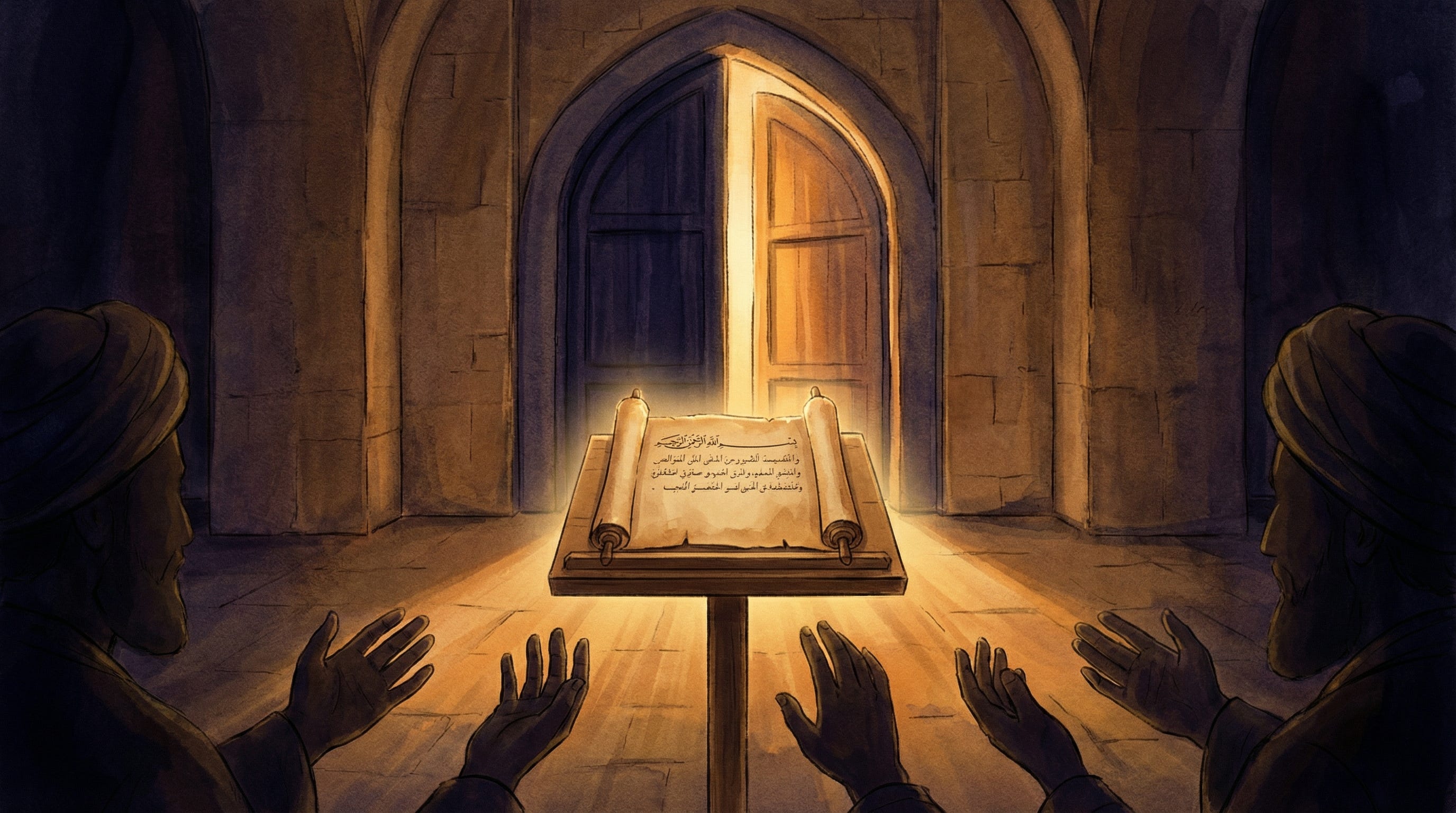
Tonight, we begin with neither a verse of the Qur’an nor a hadith of the Imams — but with something rarer.
We begin with a letter.
A letter written in the hand of the Twelfth Imam — may God hasten his return, and may our souls be his ransom — delivered through his final Deputy, Ali ibn Muhammad al-Samarri, in the year 329 after the Hijrah.
It is the last direct communication from the living Imam to his community. And in it, one sentence changed everything:
وَأَمَّا الْحَوَادِثُ الْوَاقِعَةُ فَارْجِعُوا فِيهَا إِلَى رُوَاةِ حَدِيثِنَا فَإِنَّهُمْ حُجَّتِي عَلَيْكُمْ وَأَنَا حُجَّةُ اللَّهِ عَلَيْهِمْ
“As for the newly occurring events, refer regarding them to the narrators of our hadith, for they are my proof upon you, and I am the proof of God upon them.”
— Al-Saduq, Kamal al-Din wa Tamam al-Ni’mah, Volume 2, Chapter 45, Hadith 4; also recorded in Bihar al-Anwar, Volume 53
Listen to the architecture of this sentence.
The Imam does not say:
wait for me.
He does not say:
the doors are closed, fend for yourselves.
He says:
refer to the narrators of our hadith
— go to the scholars who carry our words.
And then he raises them to a station that no political appointment, no royal decree, no worldly authority could ever confer:
they are my proof upon you.
The scholars are the Imam’s proof.
And the Imam is God’s proof upon them.
This single sentence is the constitutional charter of the Marja’iyyah.
Everything we will study tonight — and in every session that follows in this series — flows from this.
Video of the Sermon (Majlis/Lecture)
Audio of the Sermon (Majlis/Lecture)
Introduction
Imagine, if you can, the year 329 after the Hijrah.
For seventy years — the span of an entire human life — the Shi’a had lived with a thin lifeline.
The Imam was hidden, yes.
But he was not silent.
Through four successive Special Deputies — the Sufara’ — letters came.
Questions were answered.
Guidance was given.
Disputes were settled.
The community could not see its Imam, but it could still hear him.
And then, in that year, the final letter arrived.
And the final letter said: the door is closed.
فَقَدْ وَقَعَتِ الْغَيْبَةُ التَّامَّةُ، فَلَا ظُهُورَ إِلَّا بِإِذْنِ اللَّهِ تَعَالَى ذِكْرُهُ، وَذَلِكَ بَعْدَ طُولِ الْأَمَدِ، وَقَسْوَةِ الْقُلُوبِ، وَامْتِلَاءِ الْأَرْضِ جَوْرًا. وَسَيَأْتِي لِشِيعَتِي مَنْ يَدَّعِي الْمُشَاهَدَةَ، أَلَا فَمَنِ ادَّعَى الْمُشَاهَدَةَ قَبْلَ خُرُوجِ السُّفْيَانِيِّ وَالصَّيْحَةِ فَهُوَ كَذَّابٌ مُفْتَرٍ، وَلَا حَوْلَ وَلَا قُوَّةَ إِلَّا بِاللَّهِ الْعَلِيِّ الْعَظِيمِ
“The complete Occultation has now occurred. There shall be no appearance except by the permission of God, exalted be His mention, and that shall be after a lengthy period, and the hardening of hearts, and the earth being filled with injustice. And there shall come to my Shi’a those who claim to have seen me. Behold — whoever claims to have seen me before the rising of the Sufyani and the heavenly Cry, he is a liar and a fabricator. And there is no power and no strength except through God, the Most High, the Most Great.”
— From the final Tawqi’ (letter) of Imam al-Mahdi (aj) to his Fourth Deputy, Ali ibn Muhammad al-Samarri, in the year 329 AH. Recorded in: Al-Tusi, Kitab al-Ghayba (The Book of Occultation), Hadith 365; Al-Saduq, Kamal al-Din wa Tamam al-Ni’mah; Al-Tabrisi, Al-Ihtijaj
No more letters.
No more Deputies.
No more lifeline.
Now what?
This is not a rhetorical question.
This is the most serious crisis any religious community has ever faced.
Because the Shi’a are not simply a community that reveres a historical figure.
The entire architecture of Shi’ism — its theology, its law, its spirituality — is built on the premise of a living, present, accessible Imam.
Remove that access, and what remains?
A collection of memories?
A library of texts?
A community slowly drifting apart, as communities do when the centre no longer holds?
The answer — and the subject of tonight’s session — is that what remained was not drift.
What remained was construction.
Because the Imam, in his final communication — the Tawqi’ we have just heard — did not leave the community without direction.
He pointed them to the scholars.
And the scholars understood: if we do not act now, if we do not gather, compile, preserve, and transmit everything the Imams taught us — then the light will not merely be hidden.
It will be lost.
Tonight, we meet the men who ensured it was not lost.
Recap
In our previous session — “The University of al-Sadiq: Four Thousand Students and a Living Imam” — we stood in the classroom of Imam Ja’far al-Sadiq, peace be upon him.
We saw the fountainhead: four thousand students, a curriculum that ranged from jurisprudence to chemistry, a circle so vast that even the founders of the four Sunni schools drank from it.
We honoured those schools — Hanafi, Maliki, Shafi’i, Hanbali — as branches from the same tree, and we were careful to distinguish the Hanbali school of Imam Ahmad ibn Hanbal — the man who was imprisoned and flogged rather than compromise his beliefs — from the later Wahhabi deviation that claimed his name while demolishing the graves of the Ahl al-Bayt and declaring the majority of Muslims to be polytheists.
A school must be judged by its founder and its mainstream tradition, not by its most extreme offspring.
And then we traced the darkness that followed: the Abbasid betrayal, the systematic poisoning and imprisonment of the Imams, the escalating persecution that made the Occultation both a divine mercy and an existential crisis.
That session ended at the threshold.
Tonight, we cross it.
If “The University of al-Sadiq” was about what the Imam built, tonight is about what happened when the builder was hidden — and the students had to become builders themselves.
Point 1: The Codification Race — Shaykh al-Kulayni and the Compiling of Al-Kafi
The Man from Kulayn
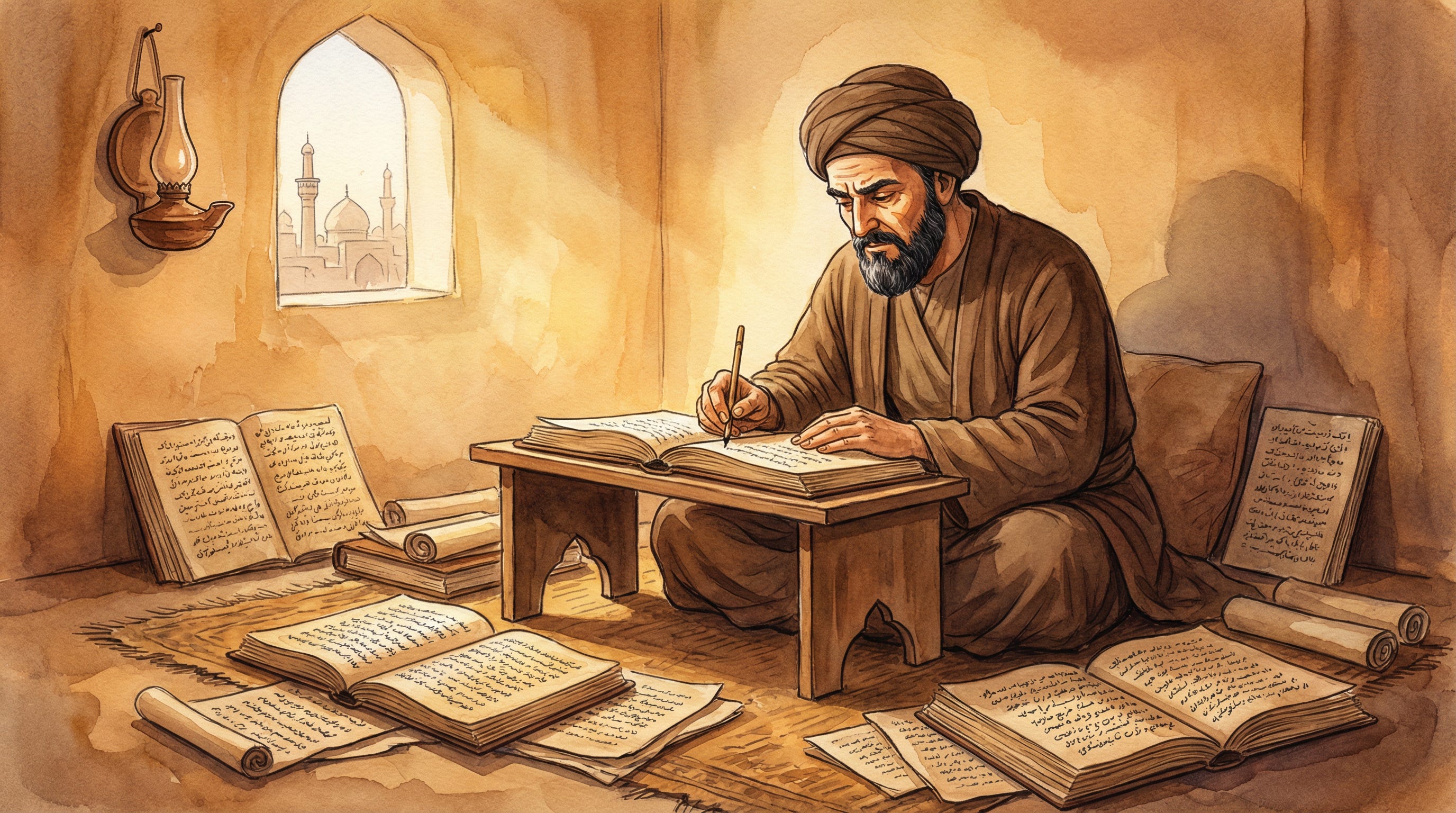
In the village of Kulayn — a small settlement near Rey, south of what is today Tehran — a boy was born who would grow up to save a civilisation’s memory.
His name was Abu Ja’far Muhammad ibn Ya’qub.
History knows him as Shaykh al-Kulayni — simply, “the one from Kulayn.”
It is one of the humilities of this tradition that its greatest compiler is named not after a title or a dynasty, but after a village most people have never heard of.
Shaykh al-Kulayni rose to become the religious leader of the Shi’a in Rey — a major centre of learning in its own right — and later migrated to Baghdad, the capital of the Abbasid caliphate and the most intellectually vibrant city in the world.
The great biographical scholar al-Najashi described him as the most meticulous and trustworthy person of his time in the narration of hadith.
أَوْثَقُ النَّاسِ فِي الْحَدِيثِ وَأَثْبَتُهُمْ
“The most reliable of people in hadith, and the most precise among them.”
— Al-Najashi, Rijal al-Najashi, Entry on Muhammad ibn Ya’qub al-Kulayni, p. 377
And here is the detail that frames everything: Shaykh al-Kulayni was born around the year 250 AH — roughly a decade before the Occultation began.
He lived through the entire seventy years of the Minor Occultation.
His entire adult life was spent watching the connection to the Imam grow thinner — from direct deputyship, to fewer letters, to silence.
He knew what was coming.
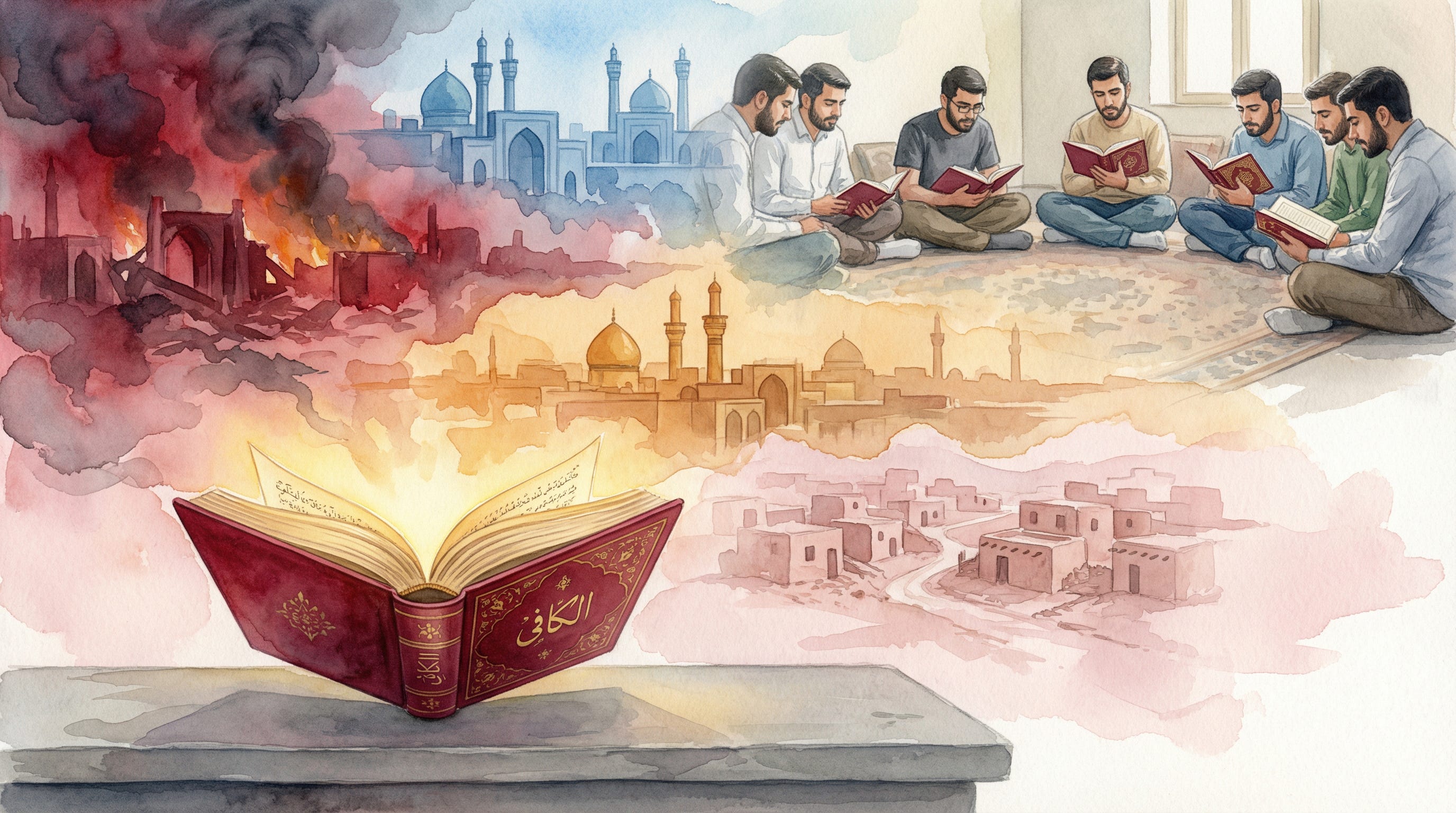
And he responded the only way a scholar can respond: he wrote.
The Crisis — Scattered Notebooks, Fading Voices
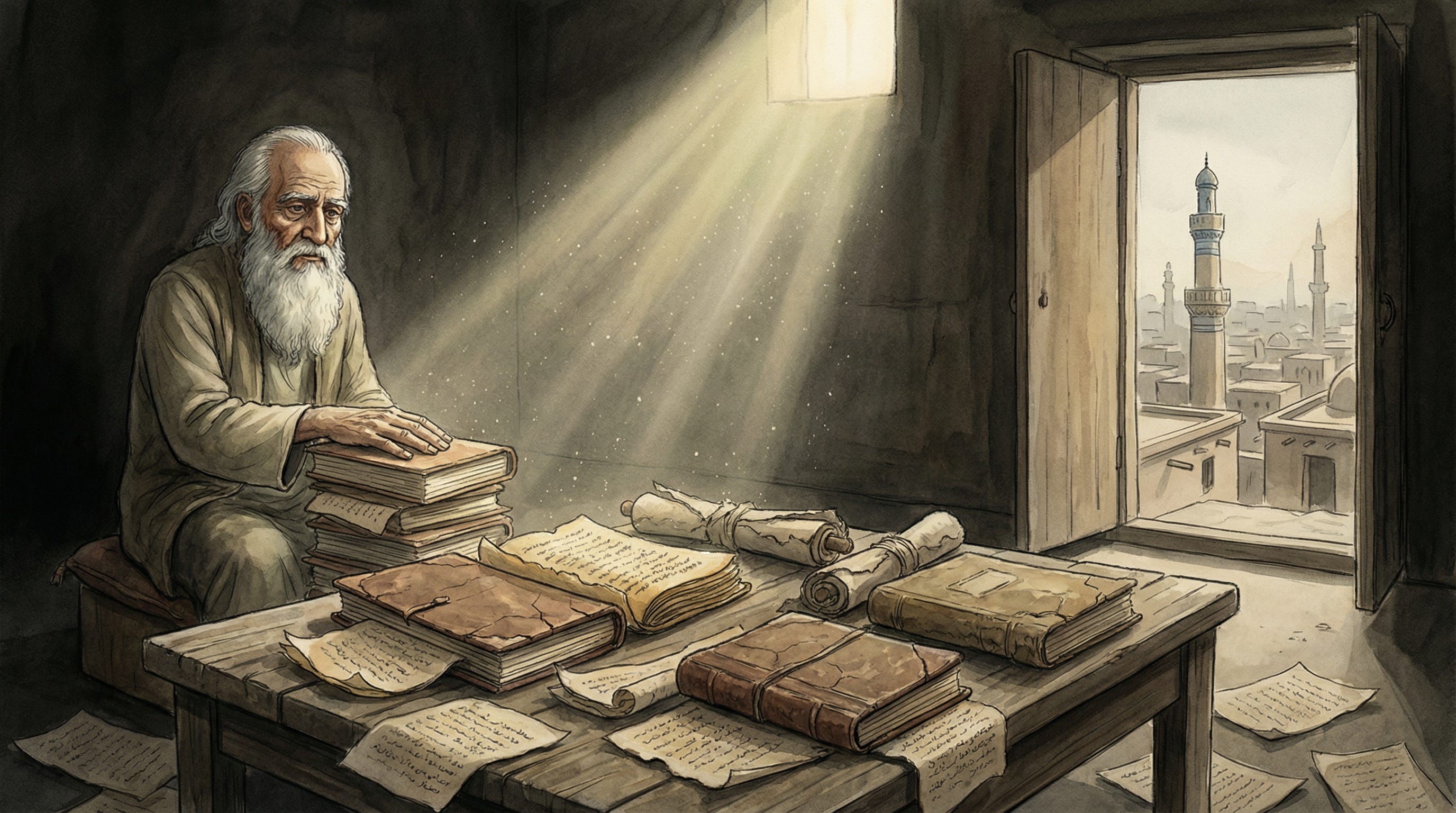
To understand what al-Kulayni did, you must first understand what he was trying to save.
For two centuries, the companions of the Imams — men like Zurara ibn A’yan, Muhammad ibn Muslim, Abu Basir, and hundreds of others whom we discussed in our previous session — had been recording what they heard from the Imams.
These personal notebooks were called the Usul Arba’umi’ah — the “Four Hundred Principles.”
They were not books in the modern sense.
They were handwritten records, individual scrolls, kept by individual companions and passed down through their families and students.
By Shaykh al-Kulayni’s time, these notebooks were scattered across Qum, Kufa, Baghdad, and Rey.
Some were in private collections.
Some were deteriorating.
Some were in the hands of families who did not fully understand their significance.
And the men who could verify them — the living links to the Imams — were dying, one generation after another.
Without compilation, this treasure would not survive.
Not because anyone would destroy it deliberately — but because time itself is a fire, and unorganised knowledge is kindling.
Twenty Years in Baghdad
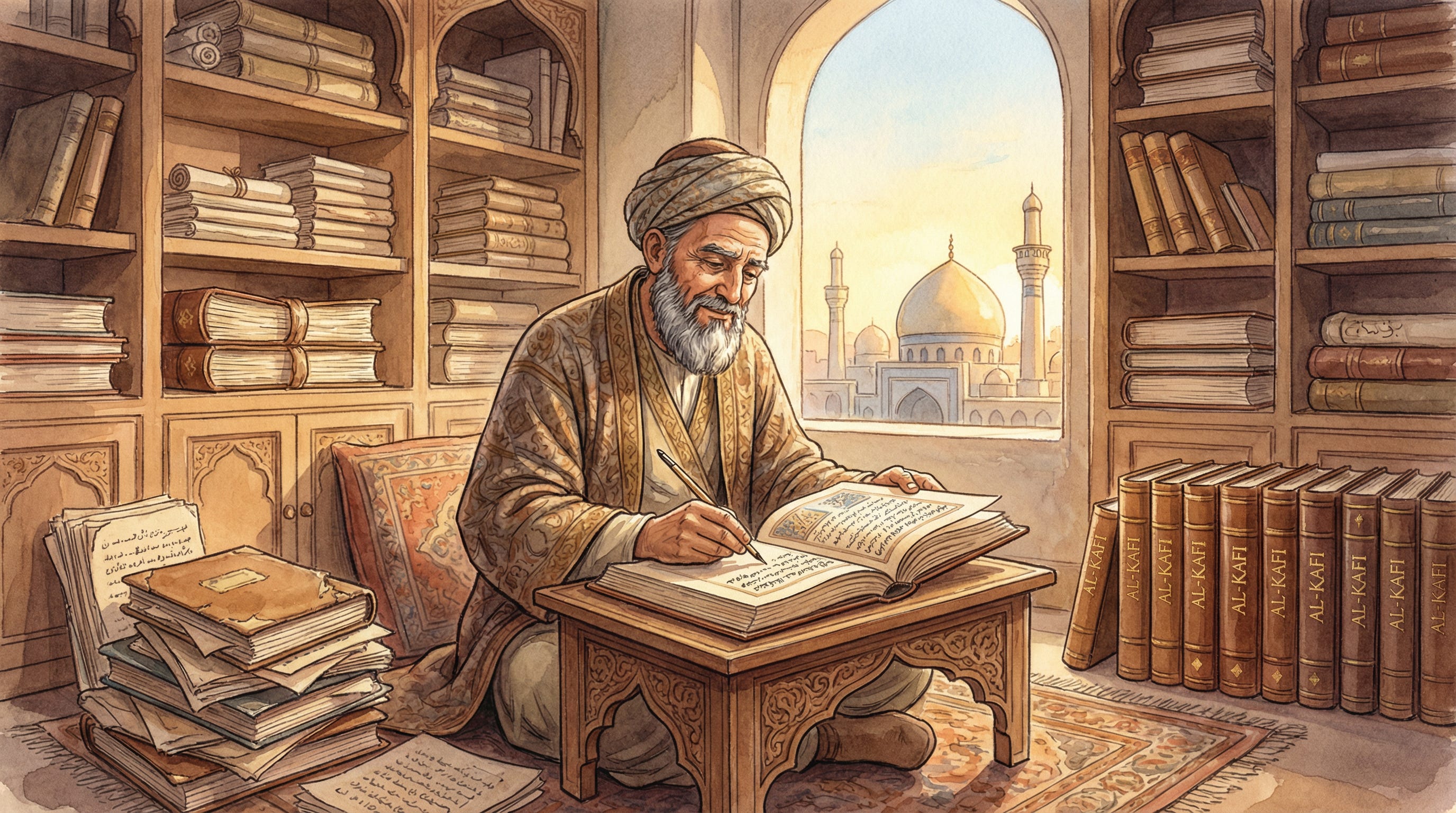
Shaykh al-Kulayni’s response was Al-Kafi — a title that means
“The Sufficient.”
Not
“The Complete.”
Not
“The Encyclopaedic.”
The Sufficient.
There is wisdom embedded in that name: he was not trying to record everything.
He was trying to record enough — enough for the community to function, to worship, to govern its affairs, to understand its theology, to maintain its identity — in the absence of a living, accessible Imam.
He spent twenty years compiling this work in Baghdad.
Twenty years of gathering, verifying, classifying, and organising over sixteen thousand narrations into a coherent structure.
The book is divided into three sections:
Usul al-Kafi, which deals with the foundations — theology, the nature of God, the proof of the Imamate, knowledge and ignorance, faith and disbelief;
Furu’ al-Kafi, which addresses practical law — prayer, fasting, pilgrimage, marriage, commerce, inheritance; and
Rawdat al-Kafi, a collection of miscellaneous narrations, letters, and speeches from the Imams.
In his introduction, Shaykh al-Kulayni preserved the request that set him on this journey — the words of an unnamed fellow believer who saw the community’s need and came to him with a plea:
وَقُلْتَ إِنَّكَ تُحِبُّ أَنْ يَكُونَ عِنْدَكَ كِتَابٌ كَافٍ يَجْمَعُ فِيهِ مِنْ جَمِيعِ فُنُونِ عِلْمِ الدِّينِ، مَا يَكْتَفِي بِهِ الْمُتَعَلِّمُ، وَيَرْجِعُ إِلَيْهِ الْمُسْتَرْشِدُ، وَيَأْخُذُ مِنْهُ مَنْ يُرِيدُ عِلْمَ الدِّينِ وَالْعَمَلَ بِهِ بِالْآثَارِ الصَّحِيحَةِ عَنِ الصَّادِقِينَ عَلَيْهِمُ السَّلَامُ، وَالسُّنَنِ الْقَائِمَةِ الَّتِي عَلَيْهَا الْعَمَلُ، وَبِهَا يُؤَدَّى فَرْضُ اللَّهِ عَزَّ وَجَلَّ وَسُنَّةُ نَبِيِّهِ صَلَّى اللَّهُ عَلَيْهِ وَآلِهِ
“You said that you wished to have a sufficient book — one that gathers all the branches of the knowledge of religion: that which suffices the learner, that which the seeker of guidance may turn to, and from which the one who desires the knowledge of religion and wishes to act upon it may draw — through authentic narrations from the Truthful Ones (peace be upon them), and the established practices upon which action is based, and through which the obligations of God, Mighty and Majestic, and the Sunnah of His Prophet (blessings of God upon him and his family) are fulfilled.”
— Al-Kulayni, Muqaddimat al-Kafi (Introduction to Al-Kafi), Al-Kafi, Volume 1, Pages 8–9 (Tehran edition)
Listen to what is being asked for.
Not a book of theory.
Not a book for specialists.
A book that suffices the learner.
A book that the seeker of guidance may turn to.
A book from which an ordinary believer — far from Medina, far from the Imams, far from anyone who could answer his questions with certainty — could draw what he needed to fulfil his obligations to God and to the Prophet’s Sunnah.
This was not an academic commission.
This was a cry for help.
And Shaykh al-Kulayni heard it.
And when the work was done — twenty years later, sixteen thousand narrations later, a lifetime of verification and classification later — Shaykh al-Kulayni responded with words that carry both the humility of a servant and the resolve of a builder:
وَقَدْ يَسَّرَ اللَّهُ — وَلَهُ الْحَمْدُ — تَأْلِيفَ مَا سَأَلْتَ، وَأَرْجُو أَنْ يَكُونَ بِحَيْثُ تَوَخَّيْتَ. فَمَهْمَا كَانَ فِيهِ مِنْ تَقْصِيرٍ فَلَمْ تُقَصِّرْ نِيَّتُنَا فِي إِهْدَاءِ النَّصِيحَةِ، إِذْ كَانَتْ وَاجِبَةً لِإِخْوَانِنَا وَأَهْلِ مِلَّتِنَا
“God — and to Him belongs all praise — has facilitated the compilation of what you requested. I hope that it is as you had wished. And whatever shortcoming there may be in it, our intention in offering sincere counsel has not fallen short — for such counsel is an obligation to our brethren and the people of our faith.”
— Al-Kulayni, Muqaddimat al-Kafi (Introduction to Al-Kafi), Al-Kafi, Volume 1, Page 9 (Tehran edition)
“Whatever shortcoming there may be in it, our intention has not fallen short.”
This is a man who spent twenty years on a single book — and still presents it with the humility of one who knows that no human effort can fully capture what the Imams poured out.
He does not claim perfection.
He claims sincerity.
And he frames the entire enterprise not as personal achievement, but as obligation —
“an obligation to our brethren and the people of our faith.”
This is the voice of Shaykh al-Kulayni.
Not a scholar seeking fame.
A servant fulfilling a duty.
A man who heard a community crying out for guidance and spent the best years of his life answering that cry.
Scholarly Praise
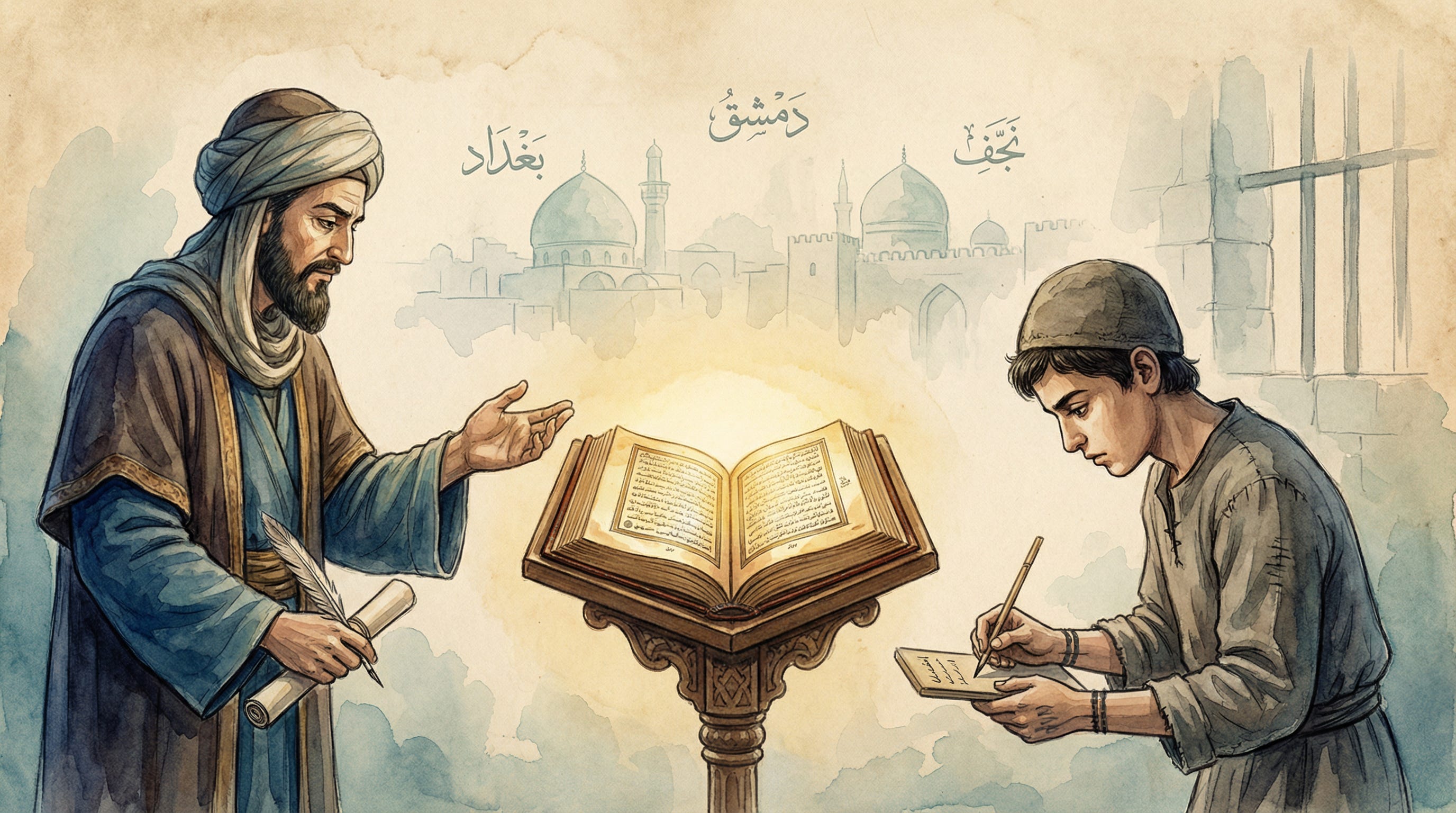
The scholars who came after Shaykh al-Kulayni understood what he had done. Shaykh al-Mufid — whom we will meet in a future session — called Al-Kafi:
إِنَّ كِتَابَ الْكَافِي مِنْ أَجَلِّ كُتُبِ الشِّيعَةِ وَأَكْثَرِهَا فَائِدَةً
“The book Al-Kafi is among the most magnificent of the books of the Shi’a, and the most beneficial of them.”
— Shaykh al-Mufid; cited in biographical sources on al-Kulayni; see also Wiki Shia, entry on Al-Kafi, footnote 3
And Shaheed al-Awwal — the First Martyr, Muhammad ibn Makki, who himself would write one of the Hawza’s most enduring textbooks — Al-Luma’t ad-Dimishqiyyah — from a prison cell in Damascus — said of it:
كِتَابُ الْكَافِي فِي الْحَدِيثِ، الَّذِي لَمْ يُعْمَلْ لِلْإِمَامِيَّةِ مِثْلُهُ
“The book Al-Kafi in hadith — the like of which has not been produced for the Imamiyyah.”
— Shaheed al-Awwal (Muhammad ibn Makki al-Amili, d. 786 AH); cited in biographical sources on al-Kulayni
These are not casual endorsements.
These are the greatest minds of the tradition — a theologian and a martyr — testifying that what Shaykh al-Kulayni built was without precedent.
The Codification Race
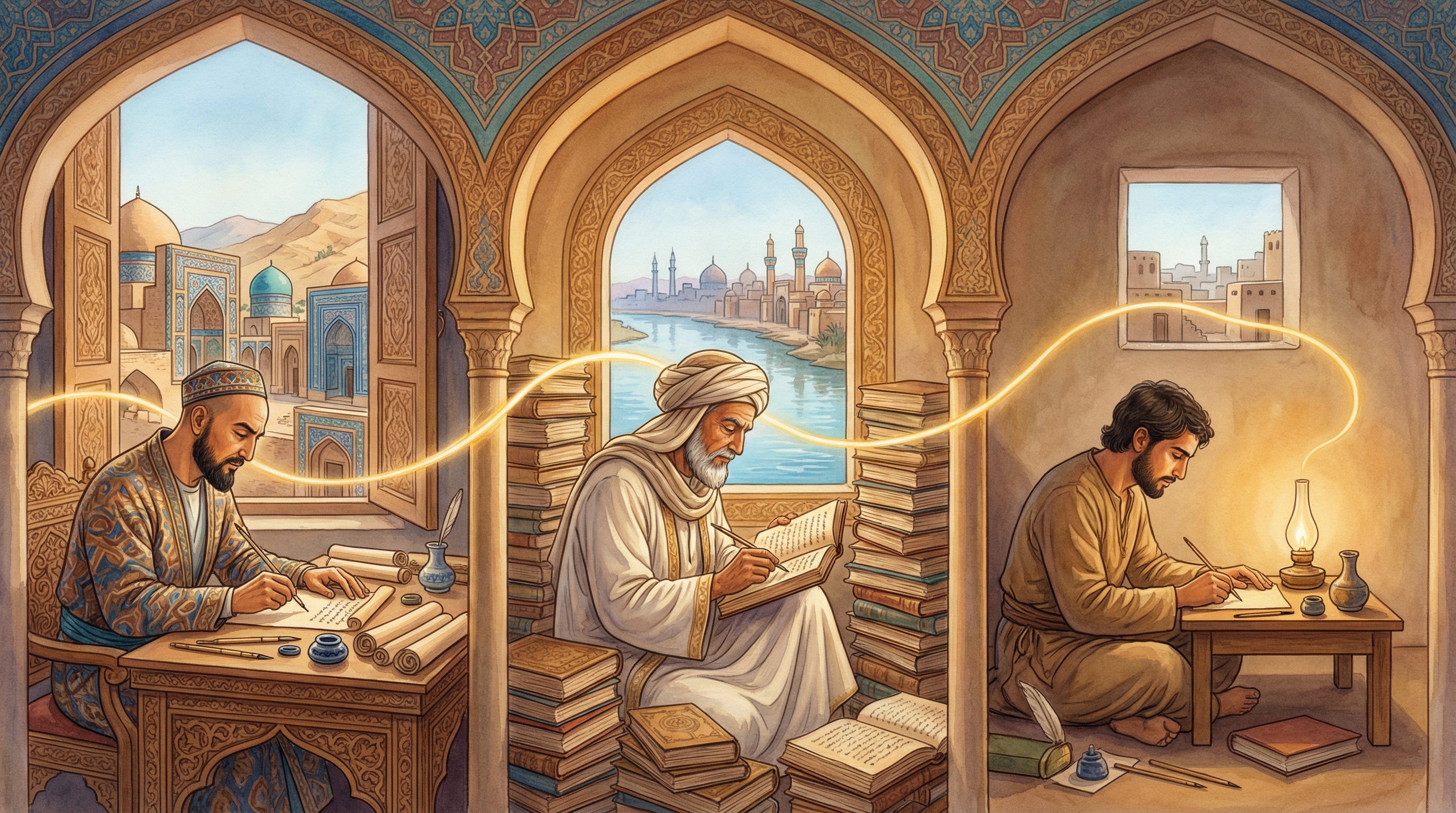
And Shaykh al-Kulayni was not working in isolation.
Across the Muslim world, the same urgency was driving the same project.
Our brethren of the Sunnah were engaged in their own monumental effort to codify the prophetic tradition.
Sahih al-Bukhari had been completed a generation earlier, in 256 AH.
Sahih Muslim followed in 261 AH.
The collections of Abu Dawud, al-Tirmidhi, al-Nasa’i, and Ibn Majah were all compiled in the same century.
The entire ummah — Shi’a and Sunni alike — was racing against time, driven by the same fear: that what was not written would be lost.
But the Shi’a had an additional urgency that the Sunni compilers did not.
The Sunni tradition was losing its narrators — the human chains connecting them to the Prophet.
The Shi’a were losing something more: they were losing the Imam himself.
For a community whose entire theology, law, and spiritual life flowed from a living, divinely guided leader, the Occultation was not merely an inconvenience.
It was an existential crisis.
And Shaykh al-Kulayni knew — as perhaps no one else did — that the crisis demanded not merely a book, but a sufficient book.
One that could carry a community through an absence whose duration no one could predict.
The Providential Timing
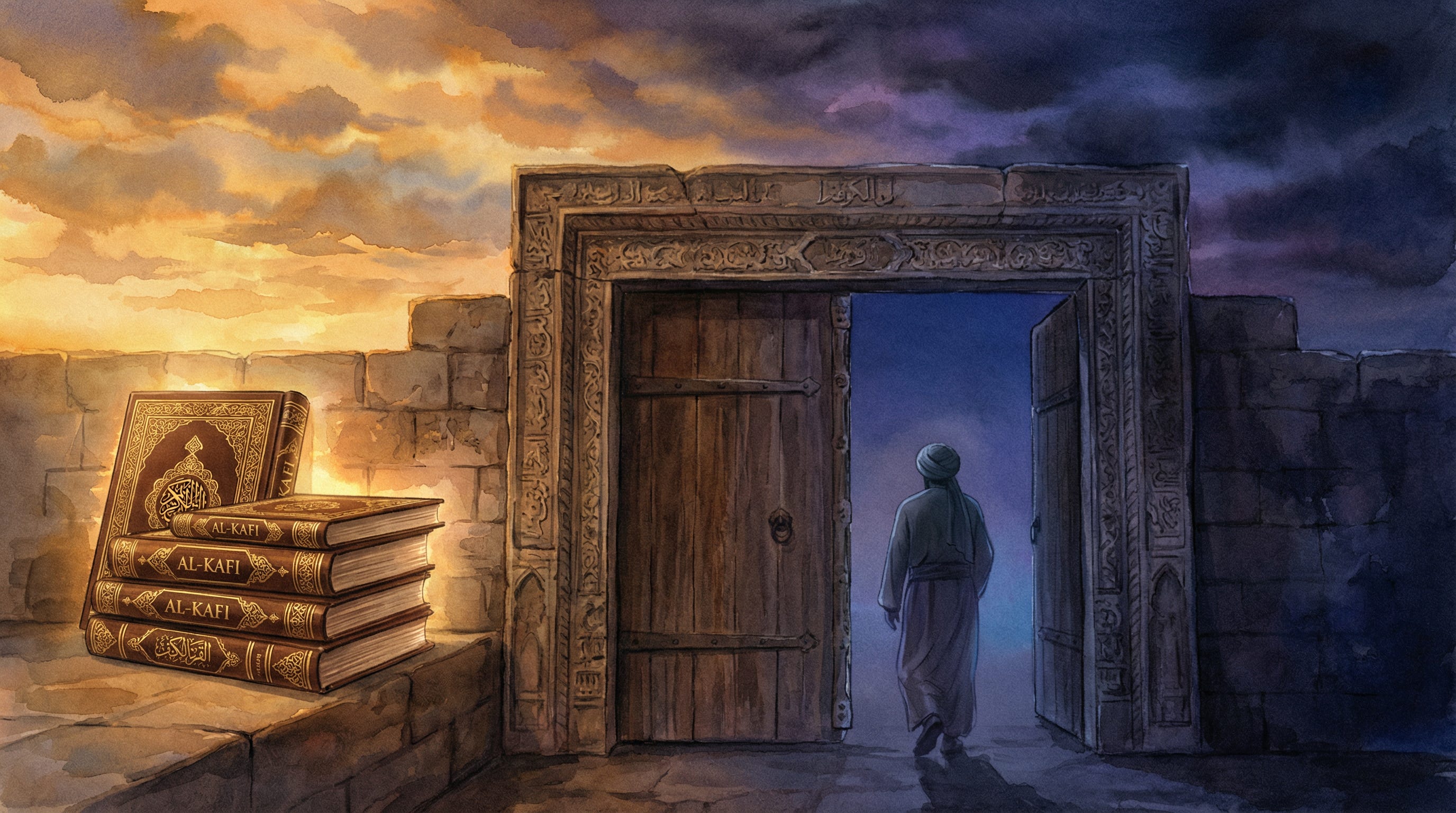
And here is the detail that, once you hear it, you cannot unhear.
Shaykh al-Kulayni died in the year 329 after the Hijrah.
329 AH.
The very year that Ali ibn Muhammad al-Samarri — the Fourth and Final Deputy — received the Tawqi’ we heard tonight, the letter that announced the complete Occultation.
The very year the door closed.
Shaykh al-Kulayni finished his life’s work — and then he died — at the exact moment the community would need it most.
As if God timed his mission: compile the book, complete the book, and then depart — because the book must now do what the Deputy could no longer do — ensure that the voice of the Imams was never silenced, even when the Imam was hidden.
He was buried in Baghdad, at Bab al-Kufa — the Gate of Kufa — as if even in death he stood at the threshold between two cities, two eras, two worlds.
Lessons for Our Time
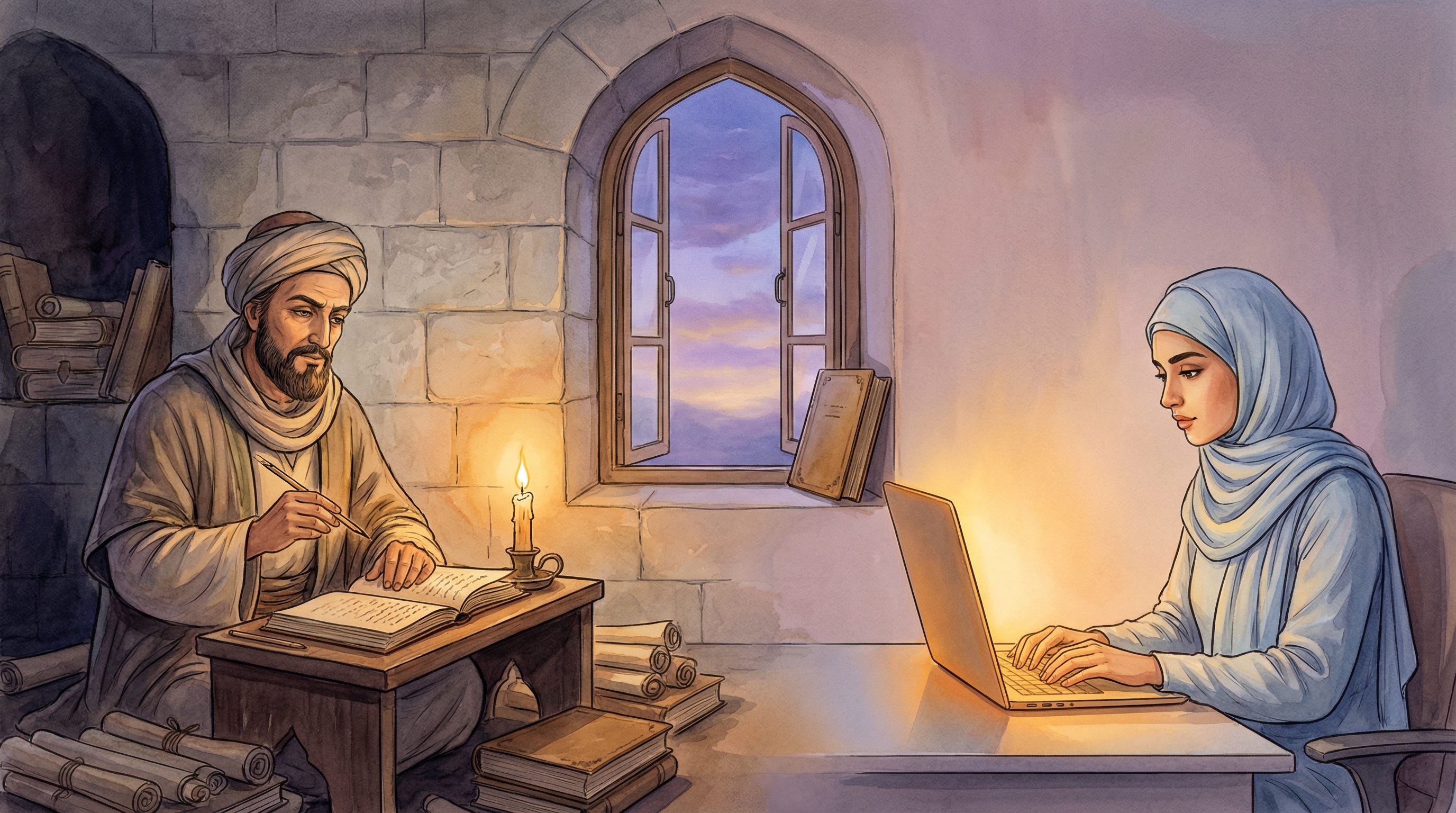
Three things we carry from Shaykh al-Kulayni tonight.
First: he did not wait for perfect conditions.
Baghdad under the Abbasids was not a safe place to be a Shi’a scholar compiling the words of the Imams.
The political environment was hostile.
The resources were limited.
The task was immense.
He did it anyway — for twenty years.
In our age, we have tools al-Kulayni could never have imagined: digital archives, printing presses, the internet, artificial intelligence.
The question is not whether we have the means to preserve and transmit knowledge.
The question is whether we have the will.
Second: the name “Al-Kafi” — “The Sufficient” — carries a lesson in itself.
He did not try to record everything.
He tried to record enough.
In an age of information overload, where we are drowning in content but starving for substance, the discipline of sufficiency — of knowing what is essential and organising it with care — is itself a form of wisdom.
Third: every builder has a window.
Al-Kulayni’s window was the Minor Occultation — seventy years in which the last living links to the Imams could still be traced, the last notebooks could still be gathered, the last narrators could still be questioned.
He used every year of that window.
And when the window closed, the book was ready.
The question for us is: what window are we in?
And what are we building before it closes?
Point 2: Shaykh al-Saduq — The Traveller Who Fought Doubt
A Child Born of a Prayer
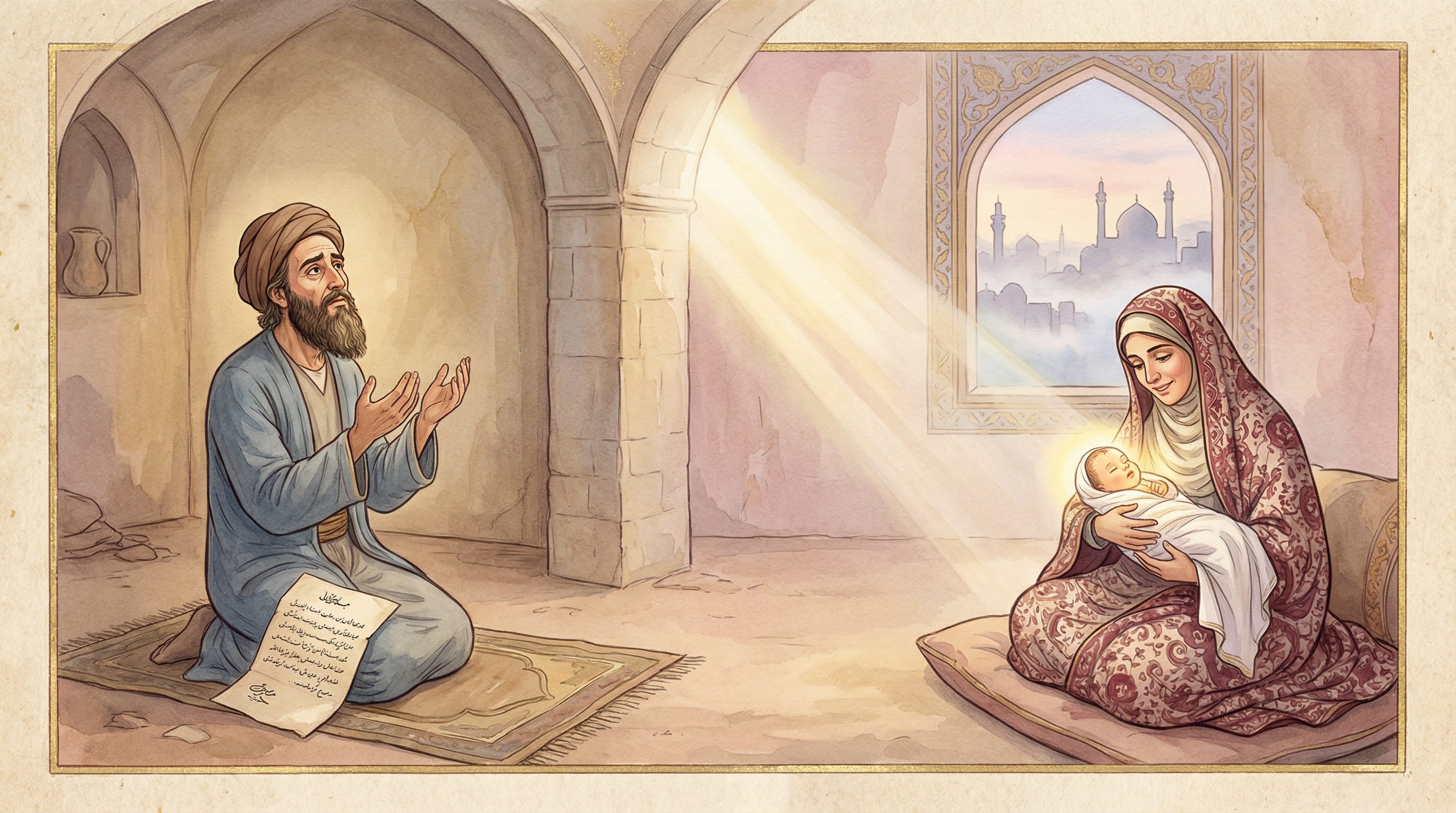
Before we speak of the scholar, we must speak of how he came to exist — because the story of his birth is itself a proof.
His father was Ali ibn al-Husayn ibn Musa ibn Babawaih al-Qummi — a respected scholar in his own right, based in the city of Qum, the heartland of Shi’i learning in Iran.
Ali ibn Babawaih was a contemporary of the Minor Occultation — he lived through the era of the Deputies, and he had access to them.
And he had a request.
He wrote — through Abu Ja’far Muhammad ibn Ali al-Aswad — to the Third Deputy, Husayn ibn Ruh al-Nawbakhti, asking him to convey a petition to the Hidden Imam: pray for me, that God grant me a son.
The reply came back from the Imam:
قَدْ دَعَوْنَا اللَّهَ لَكَ بِذَلِكَ وَسَتُرْزَقُ وَلَدَيْنِ ذَكَرَيْنِ خَيِّرَيْنِ
“We have prayed to God for this on your behalf, and you shall be granted two blessed sons.”
— Recorded in Al-Saduq, Kamal al-Din wa Tamam al-Ni’mah; Al-Tusi, Al-Fihrist; Al-Najashi, Rijal al-Najashi; see also WikiShia, entry on al-Shaykh al-Saduq, citing these sources
Two sons were born: Abu Ja’far Muhammad — our Shaykh al-Saduq — and his brother Abu Abd Allah al-Husayn, who was also a scholar of hadith and jurisprudence.
And Shaykh al-Saduq himself — for his entire life — took pride in this origin.
His brother Husayn reported:
أَنَا وُلِدْتُ بِدُعَاءِ صَاحِبِ الْأَمْرِ وَيَفْتَخِرُ بِذَلِكَ
“I was born by the supplication of the Master of the Age” — and he used to take pride in this.
— Reported by his brother al-Husayn ibn Ali ibn Babawaih; cited in Al-Najashi, Rijal al-Najashi; Al-Tusi, Al-Fihrist; and biographical sources on al-Saduq
Think about what this means.
This is not merely a biographical detail.
It is a theological statement.
The Hidden Imam — the same Imam who had just sent the Tawqi’ we heard in tonight’s preamble, delegating authority to the scholars — prayed for this child to be born.
The scholar who would become the greatest hadith compiler of his generation was, in the Shi’a understanding, a direct answer to the Imam’s supplication.
The chain we traced in Session 61 — from the Imam to the scholars — is not merely institutional.
It is personal.
It is providential.
The Imam prayed, and the compiler was born.
The Man and His Title
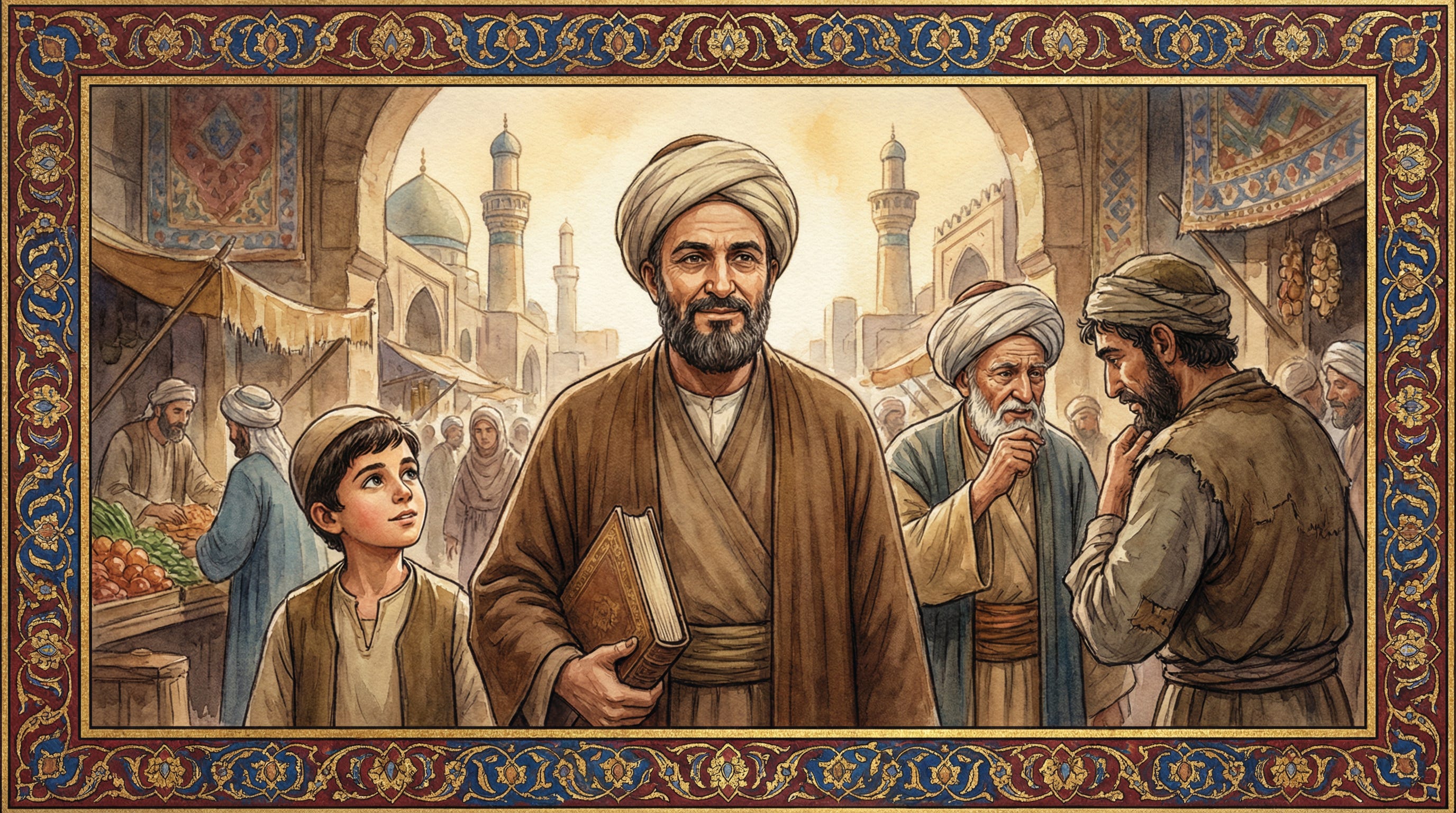
His full name was Abu Ja’far Muhammad ibn Ali ibn al-Husayn ibn Musa ibn Babawaih al-Qummi.
History knows him as al-Saduq — “the Truthful.”
This was not a family name.
It was not inherited.
It was earned — earned through a lifetime of such meticulous honesty in the transmission of hadith that his contemporaries and successors agreed: this man does not lie.
What he narrates, he narrates faithfully.
What he transmits, he transmits exactly as he received it.
In an age when the temptation to fabricate hadith was real — when political factions, theological schools, and ambitious individuals all had reasons to put words in the mouths of the Imams — Shaykh al-Saduq’s reputation for absolute truthfulness was not merely admirable.
It was essential.
Without men like him, the entire hadith tradition would have collapsed under the weight of fabrication.
He was born after the year 305 AH — during the deputyship of Husayn ibn Ruh, the Third Deputy — and he died in 381 AH in the city of Rey — in the south of modern-day Tehran, where he is buried near the shrine of Shah Abd al-Azim al-Hasani.
His life, then, spanned the transition from the Minor Occultation into the first half-century of the Major Occultation.
He was a man of the threshold — born in the last years of the lifeline, and spending his adult life in the silence that followed.
The Crisis He Addressed — A Community in Doubt
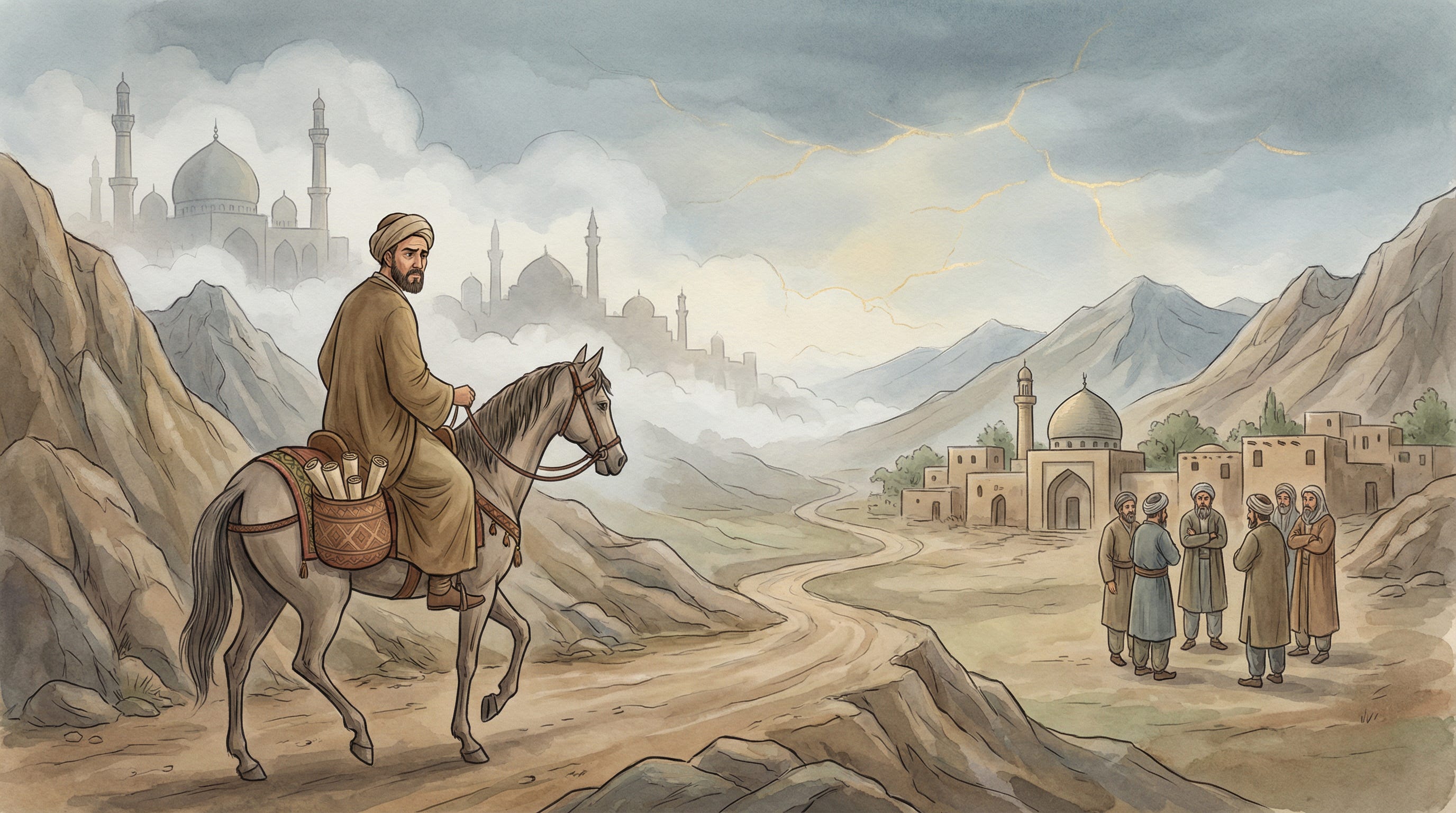
Shaykh al-Kulayni’s crisis — as we saw in Point 1 — was the scattering of the hadith.
The notebooks were dispersed; without compilation, they would be lost.
Shaykh al-Saduq faced a different crisis.
A deeper one.
The hadith were being compiled — Shaykh al-Kulayni had seen to that.
But the community itself was fracturing.
Not over law.
Not over ritual.
Over the most fundamental question of all:
Is the Imam really there?
The Major Occultation had begun.
The Deputies were gone.
No more letters.
No more confirmations.
And in the far-flung communities of the Shi’a world — in Nishapur, in Balkh, in Samarkand, in the remote towns of Central Asia — ordinary believers were asking a question that no hadith compilation could answer by itself:
How do we know this is real?
How do we know the Imam exists?
How do we know we are not following a doctrine that died with the last Deputy?
Shaykh al-Saduq knew this because he went to them.
He did not sit in Qum and write.
He travelled — more extensively than perhaps any Shi’a scholar of his era.
The biographical sources record the scale of his journeys, and they are extraordinary:
Qum to Rey, Rey to Mashhad, Mashhad to Balkh, Balkh to Samarkand, Samarkand to Fergana in what is today southeastern Uzbekistan, then to Ilaq near present-day Tashkent, then back through Nishapur, then to Kufa, to Baghdad — where he met the young Shaykh al-Mufid, whom we will study in a future session — then to Mecca for Hajj.
— See Ali Naghi Zabihzadeh, “Shi’ite Authorities in the Age of Minor Occultation, Part 3: Shaykh Saduq,” published by the Ahlul Bayt World Assembly
He went to the edges of the known Shi’a world.
And what he found there alarmed him.
In his introduction to Kamal al-Din wa Tamam al-Ni’mah — “The Perfection of Religion and the Completion of Divine Grace” — he explicitly states that he travelled to Nishapur and found the Shi’a there deeply troubled about the Occultation.
They were questioning whether the Imam was truly alive.
They were questioning whether the doctrine was real.
This was not abstract theological doubt.
This was an existential crisis — the kind that empties mosques and dissolves communities.
If the Imam is not there, then what are we?
If the chain is broken, then who are we following?
And if no one can answer these questions, then perhaps we have been wrong all along.
Shaykh al-Saduq’s response was not to dismiss the doubters.
It was to address their doubt with the most powerful tools available: rational argument and historical precedent.
Kamal al-Din — The Defence of the Occultation
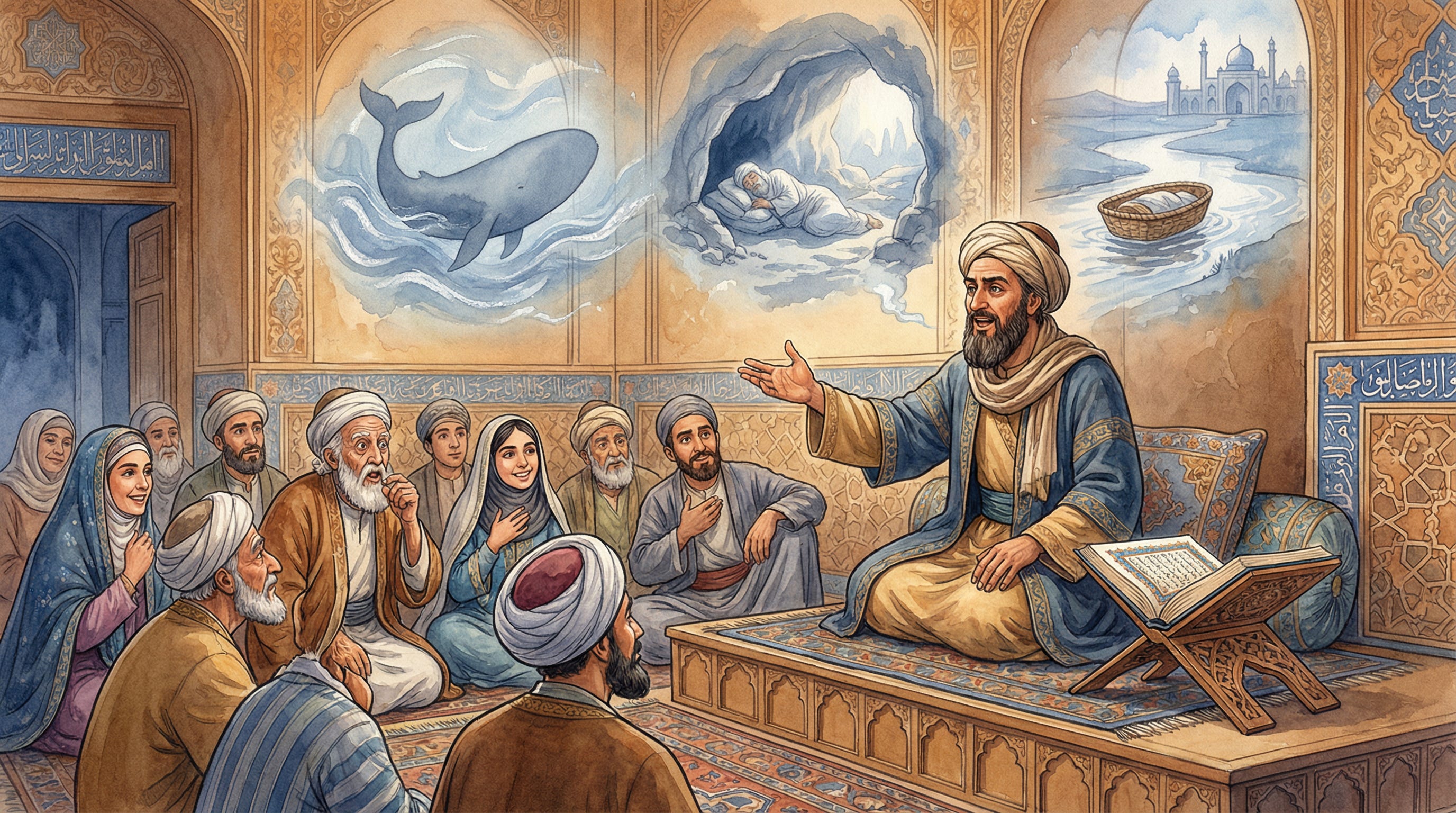
Kamal al-Din wa Tamam al-Ni’mah — “The Perfection of Religion and the Completion of Divine Grace” — is Shaykh al-Saduq’s theological masterpiece.
It is not a hadith compilation in the conventional sense.
It is an argument — a sustained, systematic argument that the Occultation of the twelfth Imam is neither unprecedented nor irrational.
His method was brilliant in its simplicity.
He turned to the Qur’an itself — and to the shared heritage of all the Abrahamic faiths — and asked:
Has God ever hidden His Proof before?
The answer, of course, is yes.
The Prophet Khidr (peace be upon him) — alive, present, hidden from the sight of most people for centuries.
The Prophet Yunus — Jonah — (peace be upon him) — swallowed by the whale, hidden from his people, returned by God when the time was right.
The People of the Cave — known as the Seven Sleepers in the Christian tradition — the young believers described and spoken of by God in Surah al-Kahf (the Chapter of the Cave) — the 18th Chapter of the Quran — who fled persecution and were hidden by God for three hundred years, then awakened.
The Prophet Musa — Moses (peace be upon him) — hidden from Pharaoh as an infant, raised in the house of his enemy, revealed as God’s Proof only when the time was right.
These are not Shi’a stories.
These are Qur’anic stories — accepted by every Muslim, and many of them by Christians and Jews as well.
Shaykh al-Saduq was saying to the doubters: the God who hid Khidr, who hid Jonah in the belly of a whale, who hid the Seven Sleepers for three centuries — this same God has hidden His Proof in our time.
The precedent is not Shi’a theology.
The precedent is the Qur’an itself.
And alongside these Qur’anic arguments, he marshalled hadith — from the Prophet and from the Imams — that had predicted the Occultation long before it occurred.
He demonstrated that the Ghaybah was not an improvisation.
It was foretold.
The Imams had warned their followers, generation after generation, that a time would come when the Proof would be hidden and the believers would be tested.
The book was written, at least in part, in Nishapur — the very city where he had found the community in crisis.
He wrote it where the wound was deepest.
Man la Yahduruhu al-Faqih — A Book for Those Who Have No Scholar
But shaykh al-Saduq was not only a theologian.
He was also a jurist.
And his second great contribution was not a defence of doctrine but a gift to the everyday believer.
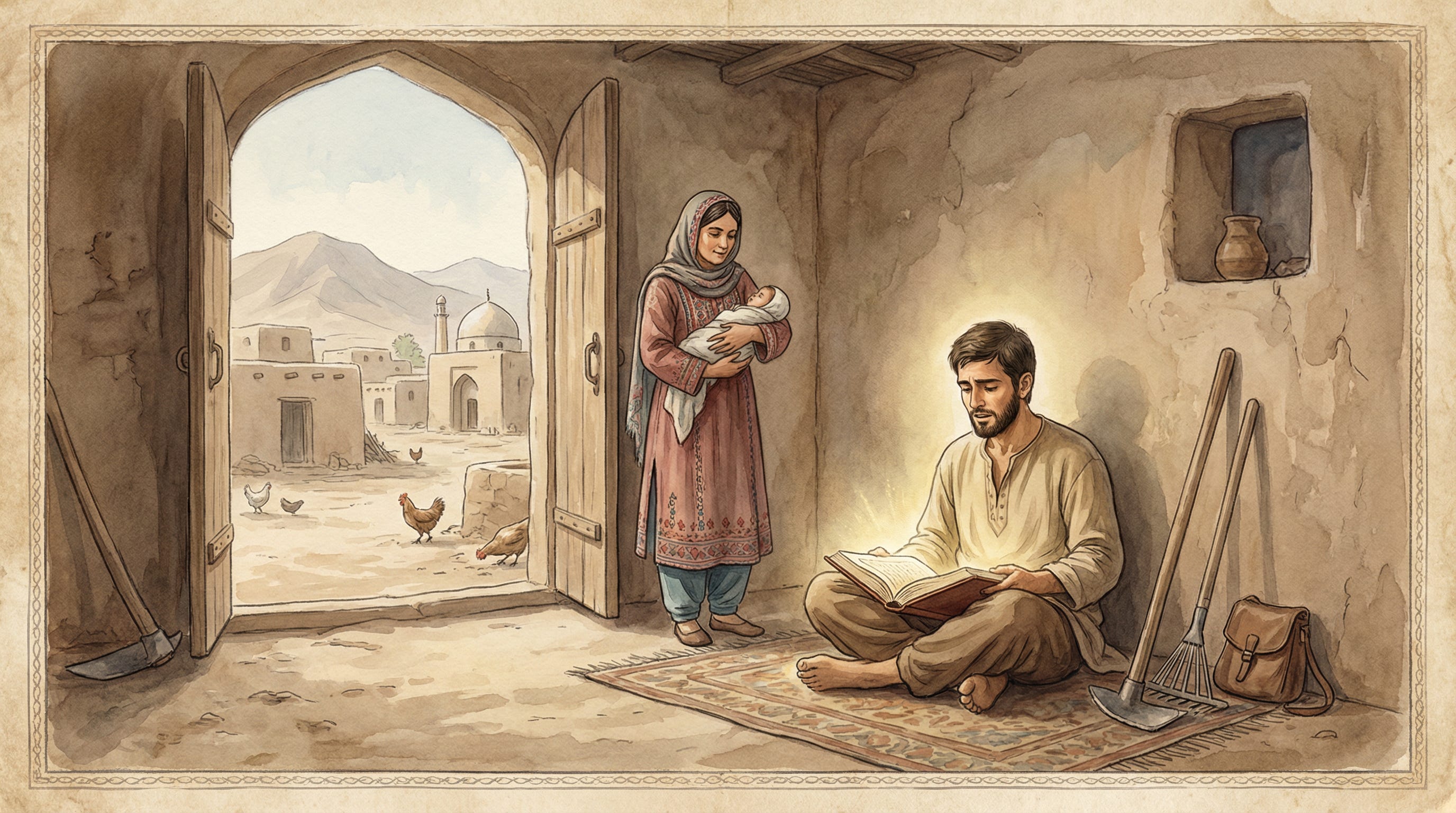
Man la Yahduruhu al-Faqih — “For He Who Has No Access to a Jurist.”
Read that title again.
This is the second of the Four Books — one of the four foundational pillars of the entire Shi’a hadith canon — and its title is an act of compassion.
It was written for the believer in Fergana, in Ilaq, in the remote villages of Central Asia — the believer who had no access to a learned scholar, no seminary nearby, no one to ask about the rules of prayer or fasting or inheritance or commerce.
Shaykh al-Saduq compiled the essential hadith of practical law and organised them so that an ordinary person — not a specialist, not a student of the Hawza, but an everyday Muslim trying to live a correct life — could find what they needed.
It was written, according to the sources, in Ilaq — near present-day Tashkent — during one of his journeys to the furthest edges of the Shi’a world.
The spirit of this book — empowering the layperson with authentic knowledge — is one of the most radical ideas in the history of Islamic scholarship.
It says: you do not need to be a scholar to live a righteous life.
You need access to the words of the Imams, organised with care and transmitted with honesty.
And if no scholar can come to you, then this book will stand in his place.
The Buyid Window — When the Persecuted Found a Patron
Shaykh al-Saduq’s work was made possible — in part — by a political transformation that itself was a consequence of the very persecution we traced in our previous session.
To understand this, we must go back to the mountains.
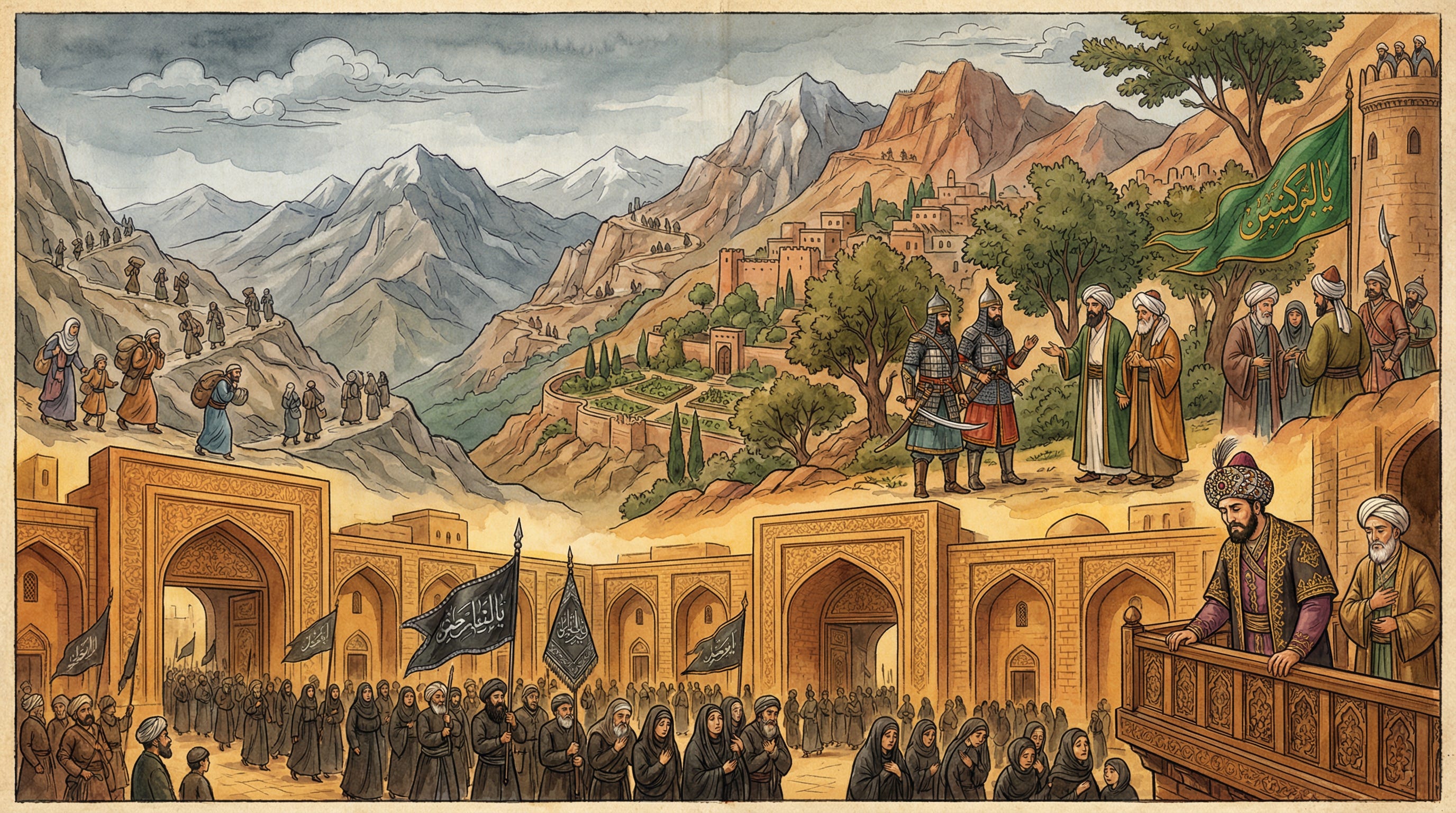
The Daylamites were an Iranian people from the highlands of Daylam — the rugged, mountainous region south of the Caspian Sea, in what is today the province of Gilan in northern Iran.
Their mountains were so remote, so difficult to penetrate, that they were among the last peoples in Iran to be reached by the Arab-Muslim conquests.
While the great cities of Persia — Isfahan, Rey, Shiraz — fell relatively quickly, the Daylamites held out for centuries, maintaining their independence through sheer geography and a fierce warrior culture.
They were renowned as foot soldiers — heavily armed infantry who fought with swords, shields, and a distinctive double-pronged spear, forming shield walls that even cavalry struggled to break.
For a long time, the Daylamites were not Muslim at all — many remained Zoroastrian, some had been exposed to Christianity, and their mountains had never been fully administered by the caliphate.
But then something happened that changed the trajectory of this people forever.
During the reign of Harun al-Rashid — the same Abbasid caliph who imprisoned Imam al-Kadhim (peace be upon him) in dungeons, as we discussed in our last session — persecuted Shi’a Muslims began fleeing from the Abbasid heartlands.
And where do the persecuted flee?
To the places the persecutor cannot reach.
They fled to Daylam.
Among these refugees were descendants of the Ahl al-Bayt themselves — Alids, members of the Prophet’s family, carrying with them their faith, their grief, and their love for the Imams.
These refugees settled among the Daylamite mountain people and began, gradually, to share their beliefs.
The Daylamites — who had resisted the caliphate politically — found in Shi’ism a faith that shared their resistance.
A faith that said: the caliphs are usurpers.
The true authority belongs to the family of the Prophet.
Justice has been denied.
One day, justice will return.
Over the course of the ninth and tenth centuries, the Daylamites embraced Shi’ism — first Zaydism, and eventually, for many, Twelver Shi’ism.
And from these mountains, a dynasty would emerge.
The Buyid dynasty — known in Arabic as Al Buwayh — was founded by three brothers: Ali, Hasan, and Ahmad, the sons of a man named Buya (or Buwayh).
Historical sources describe their father as a fisherman — a man of humble origins from these very mountains.
The brothers rose through military service, first under the Daylamite warlord Mardavij ibn Ziyar, and then independently, conquering one province after another.
Ali took Fars and established himself in Shiraz.
Hasan took the central Iranian provinces and made Rey his capital.
The Abbasid caliph, unable to resist, conferred upon them the honorific titles Imad al-Dawla — "Pillar of the State" — (Ali), Rukn al-Dawla — "Foundation of the State" — (Hasan), and Mu'izz al-Dawla — "Fortifier of the State" — (Ahmad).
And in 334 AH / 945 CE, Ahmad — now Mu’izz al-Dawla — marched into Baghdad itself.
He did not overthrow the Abbasid caliph.
He did something more devastating.
Within months, he discovered that the sitting caliph — al-Mustakfi billah — was plotting against him.
Mu’izz al-Dawla’s response was swift and humiliating: he sent two Daylamite officers to seize al-Mustakfi, who was dragged from his residence, thrown into prison, and blinded.
In his place, Mu’izz al-Dawla installed al-Muti’ lillah — a compliant figurehead who held the title of caliph but answered entirely to the Buyid commander.
From that day forward, the Abbasid caliphs fully obeyed the Buyids.
The caliphate continued in name — but real power belonged to the sons of the fisherman from the mountains.
And here is what matters for our story.
The Buyids remembered where they came from.
They remembered the Alid refugees who had brought Islam to their mountains.
They remembered the Shi’a faith that had given meaning to their resistance.
And when they came to power, they did not persecute the followers of the Ahl al-Bayt — they protected them.
Under Buyid patronage, for the first time in the history of Baghdad, the mourning ceremonies for Imam Husayn (peace be upon him) were held publicly.
In 352 AH, Mu’izz al-Dawla ordered that the day of Ashura be observed as a day of public mourning — markets were closed, lamentation processions filled the streets, and the community was free to grieve openly for the Master of Martyrs.
The celebration of Eid al-Ghadir — the anniversary of the Prophet’s declaration at Ghadir Khumm — was also observed publicly for the first time.
The intellectual consequences were equally profound.
Under Buyid rule, Shi’a scholars could teach openly, debate publicly, publish freely, and build institutions for the first time without fear of state persecution.
The first formal Twelver Shi’i institution of higher learning — al-’Adudiyya — was established in Baghdad in 362 AH / 973 CE by the Buyid ruler ‘Adud al-Dawla, complete with student housing and an endowment (waqf).
The great library of the al-Karkh quarter of Baghdad — the Shi’i neighbourhood — hosted over a hundred bookshops.
Debate sessions were held in courts, mosques, gardens, and markets.
It was the most intellectually vibrant period in Islamic history — and it was made possible because the sons of mountain fishermen remembered the refugees who had once sought shelter in their valleys.
Shaykh al-Saduq himself had a direct relationship with the Buyid rulers.
Rukn al-Dawla — who governed Rey, the city that became Shaykh al-Saduq’s base — respected him deeply, invited him to his court, seated him beside himself in gatherings, and asked him to pray for him at the shrine of Imam al-Rida (peace be upon him) in Mashhad.
Shaykh al-Saduq records this himself:
لَمَّا اسْتَأْذَنْتُ الْأَمِيرَ السَّعِيدَ رُكْنَ الدَّوْلَةِ فِي زِيَارَةِ مَشْهَدِ الرِّضَا (عليه السلام) فَأَذِنَ لِي فِي ذَلِكَ فِي رَجَبٍ سَنَةَ اثْنَتَيْنِ وَ خَمْسِينَ وَ ثَلَاثِمِائَةٍ، فَلَمَّا انْقَلَبْتُ عَنْهُ رَدَّنِي فَقَالَ لِي: هَذَا مَشْهَدٌ مُبَارَكٌ قَدْ زُرْتُهُ وَ سَأَلْتُ اللَّهَ تَعَالَى حَوَائِجَ كَانَتْ فِي نَفْسِي فَقَضَاهَا لِي، فَلَا تُقَصِّرْ فِي الدُّعَاءِ لِي هُنَاكَ وَالزِّيَارَةِ عَنِّي فَإِنَّ الدُّعَاءَ فِيهِ مُسْتَجَابٌ. فَضَمِنْتُ ذَلِكَ لَهُ وَوَفَيْتُ بِهِ
"When I sought permission from the prosperous [or felicitous] Emir Rukn al-Dawla to visit the shrine (mashhad) of al-Ridha (peace be upon him), he granted me permission for that in Rajab of the year 352. But as I turned to leave him, he called me back and said to me: 'This is a blessed shrine. I have visited it and asked God Almighty for needs that were in my soul, and He fulfilled them for me. So do not fall short in praying for me there and visiting on my behalf, for indeed, supplication there is answered.' So I guaranteed that for him, and I fulfilled it."
— Al-Saduq, recorded in his works, specifically in ‘Uyun Akhbar al-Ridha; cited in Zabihzadeh, “Shi’ite Authorities in the Age of Minor Occultation, Part 3: Shaykh Saduq,” published by the Ahlul Bayt World Assembly
This was a golden window — like the Sadiqiyya window we discussed in our previous session, when the chaos between the Umayyad collapse and the Abbasid consolidation gave Imam al-Sadiq space to teach.
The Buyid window gave Shaykh al-Saduq, and the scholars who would follow him — Shaykh al-Mufid, Sayyed al-Murtada, Shaykh al-Tusi — the space to build.
But golden windows do not last.
Within a century, the Seljuq Turks would sweep in from Central Asia, destroy the Shi’i institutions of Baghdad, burn the libraries, and close the window with fire and sword.
That is the subject of a future session.
The pattern is by now familiar: seize the window.
Build while you can.
And build well enough that what you construct survives the closing.
Lessons for Our Time
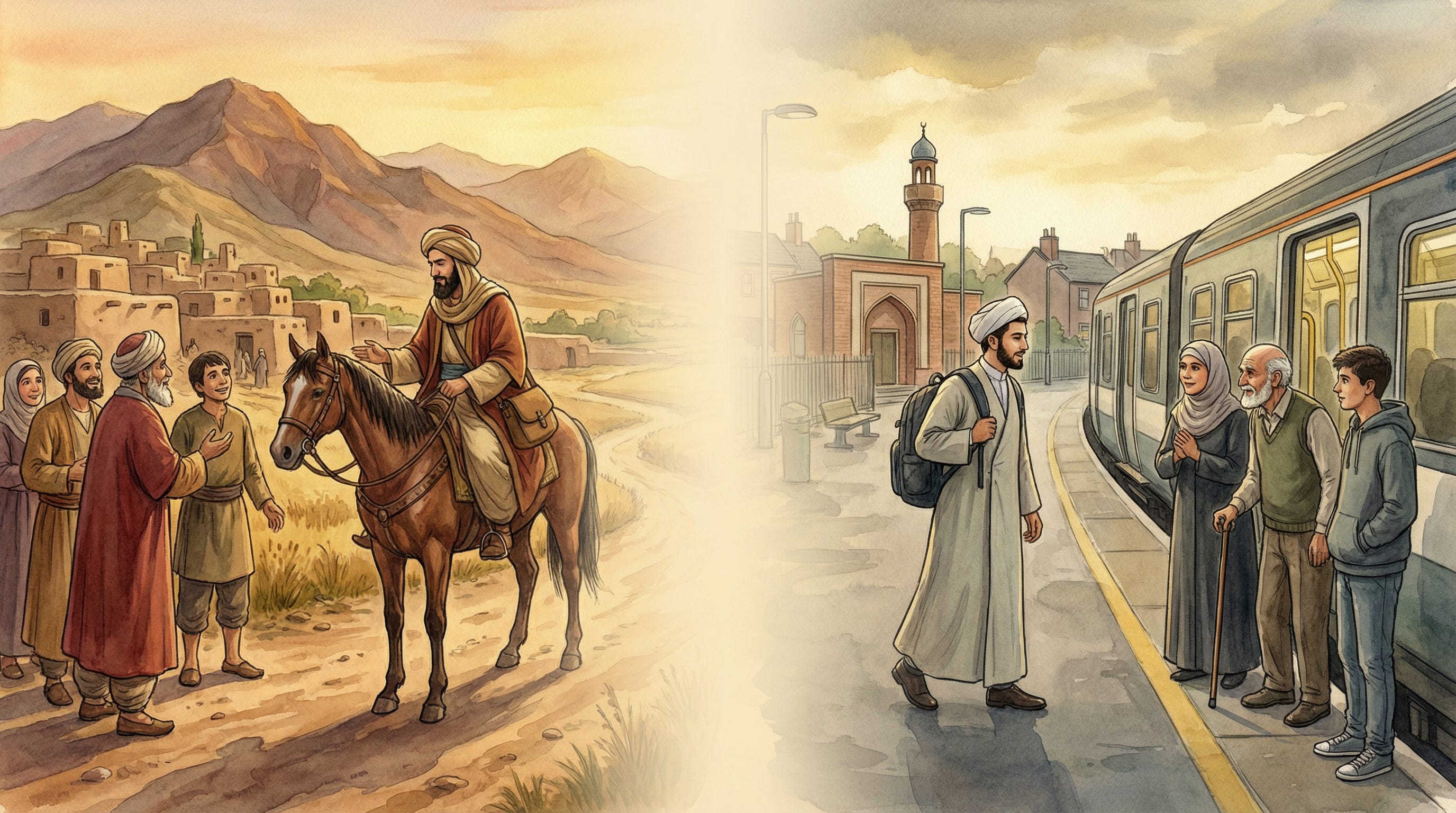
Three things we carry from Shaykh al-Saduq tonight.
First: he went to the people.
He did not wait for them to come to Qum.
He travelled to Nishapur, to Balkh, to Samarkand, to Fergana — because he heard they were struggling, and he believed the scholar’s duty was to go where the need was greatest.
In our age, the diaspora is the new Nishapur.
There are Shi’a communities in Rochdale, in London, in Dearborn, in Sydney, in São Paulo — communities that are struggling with the same questions
Shaykh al-Saduq’s audiences struggled with:
Is this real?
Is this relevant?
Does any of this matter in the modern world?
The answer is the same as Shaykh al-Saduq’s answer: go to them.
Meet them where they are.
Bring the knowledge to the people, not the people to the knowledge.
Second: the doubt he addressed — “Is the Imam really there?” — is the same doubt that faces every generation in a different form.
In Shaykh al-Saduq’s time, it was:
Is the Occultation real?
In our time, it takes different shapes:
Is Islam relevant?
Is religion itself real?
Does God exist?
Is the tradition we’ve inherited worth preserving?
Shaykh al-Saduq’s method — combining rational argument with transmitted proof, drawing on the Qur’an and on historical precedent, meeting doubt with evidence rather than condemnation — remains the model.
He did not curse the doubters.
He answered them.
Third: “Man la Yahduruhu al-Faqih” — a book for those who have no access to a scholar.
In our age of internet fatwas, social media confusion, and self-appointed authorities who issue rulings without qualification, the spirit of this book is more needed than ever.
But let us be clear about something: we are not orphans.
The everyday believer deserves access to authentic, verified, carefully organised knowledge — and in our time, that access exists.
We have the Maraje’.
We have the institution of the Marja’iyyah that this entire series is tracing.
And we have the Wali al-Faqih — the Guardian Jurist — who stands as the supreme point of reference for the community in the absence of the Imam.
Following the martyrdom of Imam Sayyed Ali Khamenei — may God bless his pure soul — that station is now held by Imam Sayyed Mujtaba Khamenei, may God protect him and grant him strength.
The infrastructure of guidance is not theoretical.
It is real and it is alive.
And in our own humble effort — as the Truth Promoters — we are working to make this access even more practical and immediate. Through platforms like IlmFlow — designed to bring structured Islamic learning to believers wherever they are — and FiqhFlow — designed to connect the everyday believer with verified jurisprudential guidance — we are trying, in our small way, to honour the spirit of what Shaykh al-Saduq built.
A book for those who have no access to a scholar.
A system for those who need guidance and cannot travel to Qum or Najaf to find it.
But tools and platforms are not enough on their own.
They need scholars behind them.
And this brings us to a message that must be said clearly — to the students of the Hawza, and especially to those from the collective West: Britain, Europe, North America, Australia.
The Qur’an itself defines the purpose of religious study — and it does not end with the studying:
وَمَا كَانَ الْمُؤْمِنُونَ لِيَنفِرُوا كَافَّةً ۚ فَلَوْلَا نَفَرَ مِن كُلِّ فِرْقَةٍ مِّنْهُمْ طَائِفَةٌ لِّيَتَفَقَّهُوا فِي الدِّينِ وَلِيُنذِرُوا قَوْمَهُمْ إِذَا رَجَعُوا إِلَيْهِمْ لَعَلَّهُمْ يَحْذَرُونَ
“And it is not for the believers to go forth all at once. Rather, from every division of them, a group should go forth to obtain understanding in the religion — and to warn their people when they return to them, that they might be cautious.”
— Qur’an, Surah al-Tawbah (the Chapter of Repentance) #9, Verse 122
Read this verse carefully.
It does not say:
go and study and remain.
It says:
go and study — li-yatafaqqahu fi al-din — obtain deep understanding in the religion. And then — wa li-yundhiru qawmahum idha raja’u ilayhim — and warn their people when they return to them.
When they return.
Not if.
When.
The purpose of the Hawza — as we established in Session 61 — is not merely to produce scholars.
It is to produce human beings.
Human beings who have confronted their egos, who have sat at the feet of masters, who have breathed the air of Najaf or Qum, who have been transformed by the process.
And then — and this is the part that is too often forgotten — those human beings must come back.
They must return to their communities in Rochdale, in London, in Dearborn, in Sydney, in Toronto — and they must do what Shaykh al-Saduq did.
Go to the people.
Shaykh al-Saduq did not stay in Qum.
He did not build a comfortable life in Rey and write books for other scholars to read.
He travelled to Nishapur because the people of Nishapur were in doubt.
He travelled to Fergana because the people of Fergana had no scholar.
He wrote “Man la Yahduruhu al-Faqih” — a book for the one who has no access to a jurist — because he understood that knowledge locked in a seminary is knowledge that has failed its purpose.
That is what Shaykh al-Saduq gave to the believers of Fergana in the fourth century.
It is what we owe to the believers of the twenty-first.
Point 3: The Architecture of Preservation — The Four Books, the Six Books, and the Struggle for Clarification
The Kutub al-Arba’ah — The Shi’a Canon
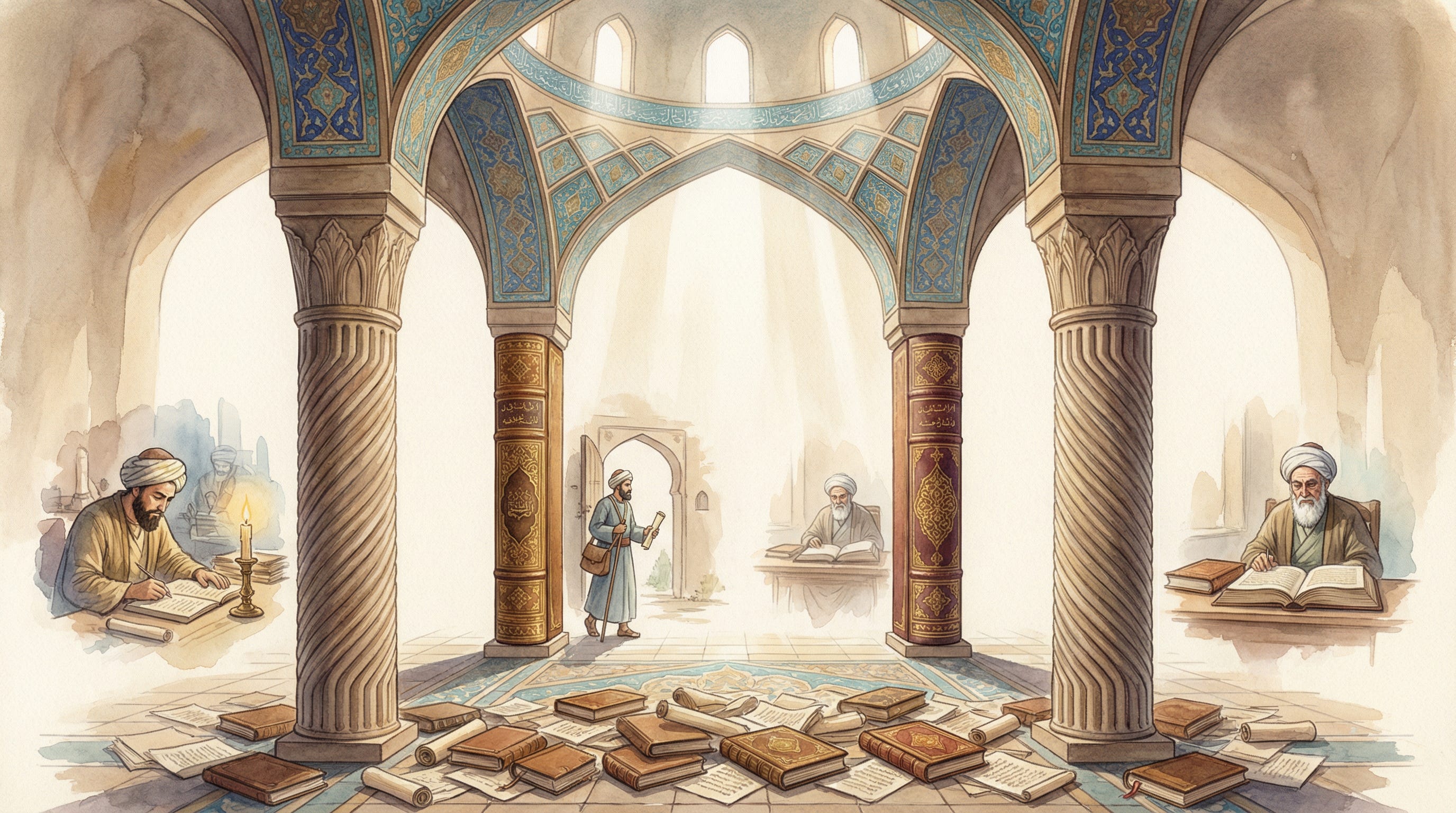
We have met two of the builders tonight — Shaykh al-Kulayni and Shaykh al-Saduq.
Their works form the first two pillars of what the tradition calls the Kutub al-Arba’ah — the Four Books — the canonical hadith collections upon which the entire edifice of Shi’a jurisprudence, theology, and spiritual life rests.
Let us name them together, because they belong together:
First: Al-Kafi — “The Sufficient” — by Shaykh al-Kulayni (d. 329 AH).
Over sixteen thousand narrations, compiled across twenty years in Baghdad.
The most comprehensive collection of hadith from the Imams ever assembled.
We have heard its story tonight.
Second: Man la Yahduruhu al-Faqih — “For He Who Has No Access to a Jurist” — by Shaykh al-Saduq (d. 381 AH).
A practical legal manual for the everyday believer, written in Ilaq, near present-day Tashkent, at the edge of the known Shi’a world.
We have heard its story tonight.
Third: Tahdhib al-Ahkam — “The Refinement of Rulings” — by Shaykh al-Tusi (d. 460 AH).
A systematic legal compendium that resolved contradictions between hadith and organised the jurisprudential tradition into a coherent system.
Fourth: Al-Istibsar — “The Discernment” — also by Shaykh al-Tusi.
A companion work to the Tahdhib, focused specifically on cases where narrations appear to contradict each other, providing methods for resolving the apparent conflict.
We will meet Shaykh al-Tusi — the man who completed the Four Books and founded the Hawza of Najaf — in a future session, God willing.
But his works belong here, named alongside Shaykh al-Kulayni and Shaykh al-Saduq, because the four pillars hold up a single roof.
These Four Books were built upon the foundation of the Usul Arba’umi’ah — the “Four Hundred Principles” — the original notebooks compiled by direct companions of the Imams, personal records of what those companions heard directly from the living Proofs of God.
Shaykh al-Kulayni was the first to systematically gather, classify, and evaluate these scattered notebooks into a unified, organised work.
Without the Usul (the Principles), there would be no Four Books.
And without the Four Books, there would be no Marja’iyyah — because there would be nothing for a Marja’ to derive rulings from.
The act of compilation was itself an act of construction.
The Kutub al-Sitta — The Sunni Canon
And we were not alone in this race.
At virtually the same time — in the same century, driven by the same urgency — our brethren of the Sunnah were completing their own monumental effort of codification.
The entire Muslim world — Shi’a and Sunni alike — was engaged in a race against time, driven by the same fear: that the living links to the prophetic generation were fading, and what was not written would be lost.
The Sunni hadith canon is known as the al-Kutub al-Sitta — the Six Books.
Let us name them, because they deserve to be known — not as rivals to our canon, but as parallel expressions of the same devotion to preserving the words of the Prophet, peace be upon him and his family.
First: Sahih al-Bukhari — compiled by Abu Abdullah Muhammad ibn Isma’il al-Bukhari (d. 256 AH / 870 CE).
Born in Bukhara, in what is today Uzbekistan — a Persian Muslim, like many of the greatest scholars of Islam.
Al-Bukhari reportedly examined some six hundred thousand narrations and selected approximately seven thousand five hundred that met his rigorous criteria for authenticity.
It is the most revered hadith collection in Sunni Islam.
He spent sixteen years travelling across the Muslim world — Iraq, the Hijaz, Egypt, the Levant — gathering and verifying.
He completed his work around 232 AH and died near Samarkand.
His dedication to precision was legendary: it is said that he would not record a single hadith without first performing ritual ablution and praying two units of prayer.
Second: Sahih Muslim — compiled by Muslim ibn al-Hajjaj al-Naysaburi (d. 261 AH / 875 CE).
Born in Nishapur — the very city where, a generation later, Shaykh al-Saduq would find the Shi’a community in crisis.
Muslim reviewed some three hundred thousand narrations and selected approximately seven thousand five hundred for his collection.
Together with Sahih al-Bukhari, the two are referred to as the Sahihayn — “the Two Sahihs” — and are regarded by the Sunni tradition as the most authentic sources after the Qur’an.
Third: Sunan Abu Dawud — compiled by Abu Dawud al-Sijistani (d. 275 AH / 889 CE).
A collection focused on legal hadith, containing approximately four thousand eight hundred narrations.
Fourth: Jami’ al-Tirmidhi — compiled by Abu ‘Isa Muhammad al-Tirmidhi (d. 279 AH / 892 CE).
Notable for its inclusion of the compiler’s own assessment of each hadith’s strength — an early form of critical evaluation.
Fifth: Sunan al-Nasa’i — compiled by Abu Abd al-Rahman Ahmad al-Nasa’i (d. 303 AH / 915 CE).
Known for its particularly strict criteria of narrator evaluation.
Sixth: Sunan Ibn Majah — compiled by Abu Abdullah Muhammad ibn Yazid ibn Majah al-Qazwini (d. 273 AH / 887 CE).
The last of the six to gain canonical status.
These scholars were driven by the same urgency as Shaykh al-Kulayni and Shaykh al-Saduq.
Their labour was immense.
Their sincerity was real.
Their contribution to Islamic civilisation is undeniable.
Al-Bukhari spent sixteen years on his collection; Shaykh al-Kulayni spent twenty.
Muslim scrutinised three hundred thousand narrations; Shaykh al-Saduq travelled from Qum to Fergana gathering his.
The methods differed.
The schools differed.
But the impulse was the same: preserve what the Prophet brought before the living memory of it is gone.
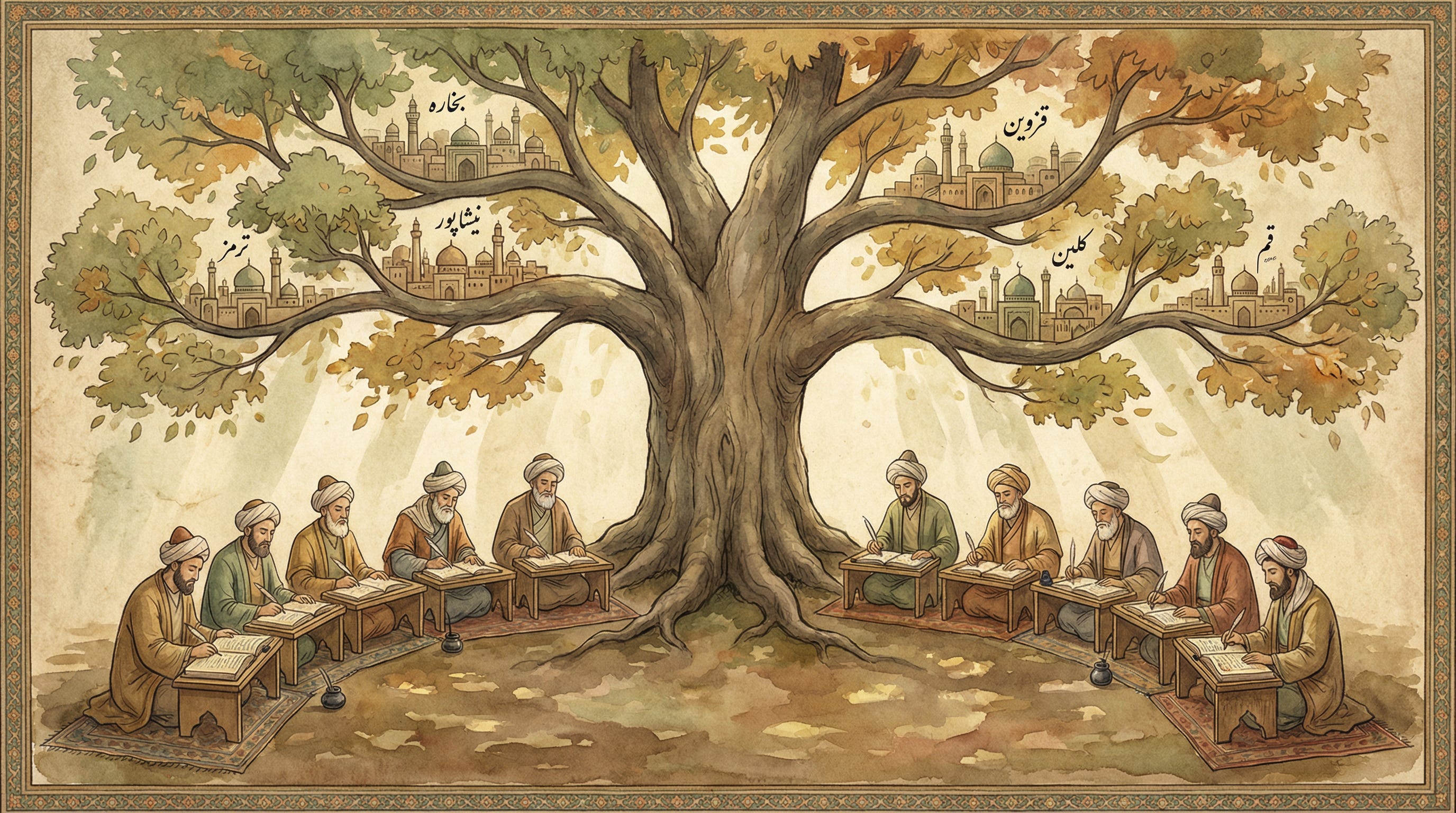
And here is a detail worth pausing on: look at where these scholars came from. Al-Bukhari — from Bukhara.
Muslim — from Nishapur.
Al-Tirmidhi — from Termez.
Ibn Majah — from Qazwin.
Shaykh al-Kulayni — from Kulayn, near Rey.
Shaykh al-Saduq — from Qum.
These are not Arab cities.
These are not Arab cities.
These are Iranian and Central Asian cities — Bukhara, Nishapur, Termez, Qazwin, Qum, Rey.
The preservation of the Prophet’s tradition — Sunni and Shi’a alike — was carried out overwhelmingly by non-Arab Muslims, by the mawali, by converts and their descendants who loved the Prophet’s message so deeply that they dedicated their lives to ensuring not a word of it was lost.
The tree is one.
The branches diverged in methodology and in doctrine.
But the roots — the love of the Prophet, the urgency of preservation, the willingness to spend a lifetime in service of a single book — those roots are shared.
The Critical Distinction — No Book Is Sahih in Its Entirety
We have now named the two canons — four books and six books — side by side.
And in naming them together, we have honoured a shared inheritance.
But here is where the paths diverge.
And the divergence is not minor — it is foundational.
It shapes everything that follows: how each tradition relates to its scholars, how it handles doubt, how it remains alive across the centuries.
In the Sunni tradition, the two Sahihs — Bukhari and Muslim — came to occupy a position of extraordinary authority.
The title Sahih itself — meaning “sound,” “authentic,” “correct” — was understood over time to apply not merely to individual narrations within the collections, but to the collections as a whole.
The great Sunni scholar al-Nawawi wrote:
اتَّفَقَ الْعُلَمَاءُ رَحِمَهُمُ اللَّهُ عَلَى أَنَّ أَصَحَّ الْكُتُبِ بَعْدَ الْقُرْآنِ الْعَزِيزِ الصَّحِيحَانِ: الْبُخَارِيُّ وَمُسْلِمٌ، وَتَلَقَّتْهُمَا الْأُمَّةُ بِالْقَبُولِ
“The scholars, may God have mercy on them, have agreed that the most authentic books after the Noble Qur’an are the two Sahihs — Bukhari and Muslim — and the Ummah has received them with acceptance.”
— Imam al-Nawawi (Muhyi al-Din Abu Zakariyya Yahya ibn Sharaf, d. 676 AH), Muqaddimat Sharh Sahih Muslim (Introduction to his Commentary on Sahih Muslim)
This is not a fringe position.
It is the mainstream Sunni view, held across centuries.
While individual Sunni scholars have always maintained the theoretical right to question specific narrations, the practical reality is that the Sahihayn came to be treated with something approaching sacral reverence — collections whose overall authenticity is not to be questioned.
We say this not to criticise.
We say it to draw a contrast — because the Shi’a approach is fundamentally different.
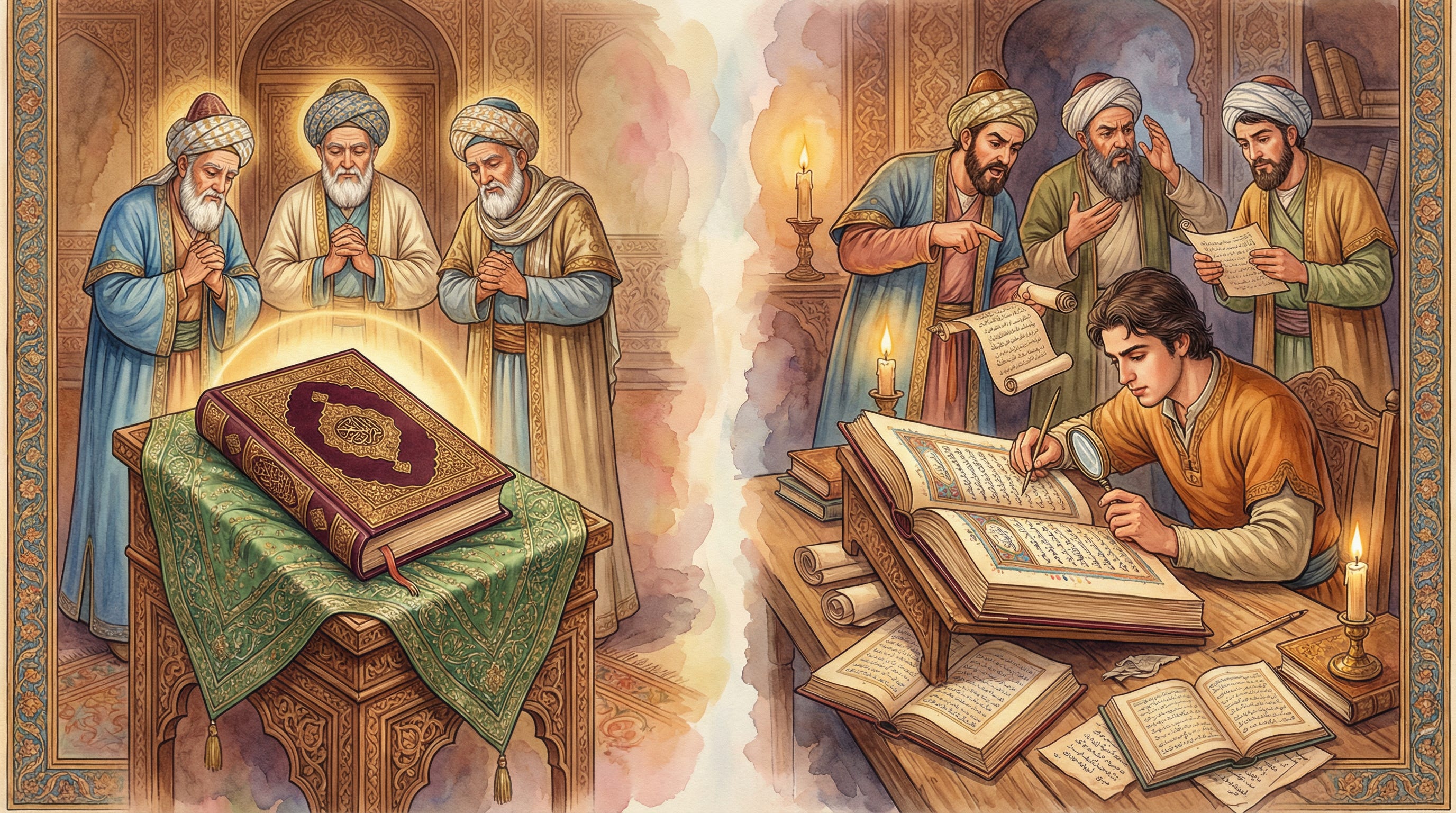
In the Shi’a tradition, no book — not even Al-Kafi — is considered sahih in its entirety.
Let that settle for a moment.
The most magnificent book in the Shi’a hadith canon — the book that Shaykh al-Mufid called
“the most magnificent of the books of the Shi’a and the most beneficial,”
the book that Shaheed al-Awwal said
“the like of which has not been produced for the Imamiyyah”
— is not treated as wholly authentic.
Every individual hadith within it must be evaluated by qualified scholars.
The book is a repository, not a verdict.
The verdict belongs to the scholar who examines each narration against multiple criteria.
The great Marja’ of the twentieth century, Ayatullah Sayyed Abu al-Qasim al-Khoei — may God rest his pure soul — stated this with characteristic clarity:
وَالْمُتَحَصِّلُ أَنَّهُ لَمْ تَثْبُتْ صِحَّةُ جَمِيعِ رِوَايَاتِ الْكَافِي، بَلْ لَا شَكَّ فِي أَنَّ بَعْضَهَا ضَعِيفَةٌ، بَلْ إِنَّ بَعْضَهَا يُطْمَأَنُّ بِعَدَمِ صُدُورِهَا مِنَ الْمَعْصُومِ عَلَيْهِ السَّلَامُ
“The conclusion is that the authenticity of all the narrations of Al-Kafi has not been established. Indeed, there is no doubt that some of them are weak — and some of them one can be confident were not issued by the Infallible, peace be upon him.”
— Ayatullah Sayyed Abu al-Qasim al-Khoei (d. 1413 AH / 1992 CE), Mu’jam Rijal al-Hadith, Volume 1, Page 99
This is not a radical position.
This is not a modern revision.
This is the mainstream Shi’a view — and it has been the mainstream view from the very beginning.
Shaykh al-Kulayni himself, as we heard in his introduction, said:
“whatever shortcoming there may be in it”
— acknowledging, before anyone else could, that his work was a human effort, subject to human limitation.
Why does this matter?
Because it keeps the tradition alive.
If a book is settled — if its contents are beyond question — then what you need are librarians.
People to preserve, to copy, to distribute.
Important work, but static work.
But if every hadith in every book must be individually evaluated — if no collection, however revered, is above scrutiny — then what you need are mujtahids.
Living scholars.
Minds that are trained, qualified, and authorised to examine, to weigh, to judge.
You need an entire system of scholarly authority — teachers and students, verification and debate, qualification and accountability.
You need, in other words, a Marja’iyyah.
The Shi’a insistence that no book is wholly sahih is not scepticism.
It is not disrespect for the compilers.
It is the very engine that keeps the scholarly tradition in motion — because it means the work is never finished.
Every generation must engage with the texts anew.
Every Marja’ must exercise his own judgement.
The tradition does not fossilise, because it is never allowed to settle into the comfort of unquestioned authority.
And this principle — this insistence on perpetual verification — did not emerge from thin air.
It was taught by the Imams themselves.
The Foundational Hadith — Al-’Ard ‘ala al-Kitab: Presenting Hadith to the Qur’an
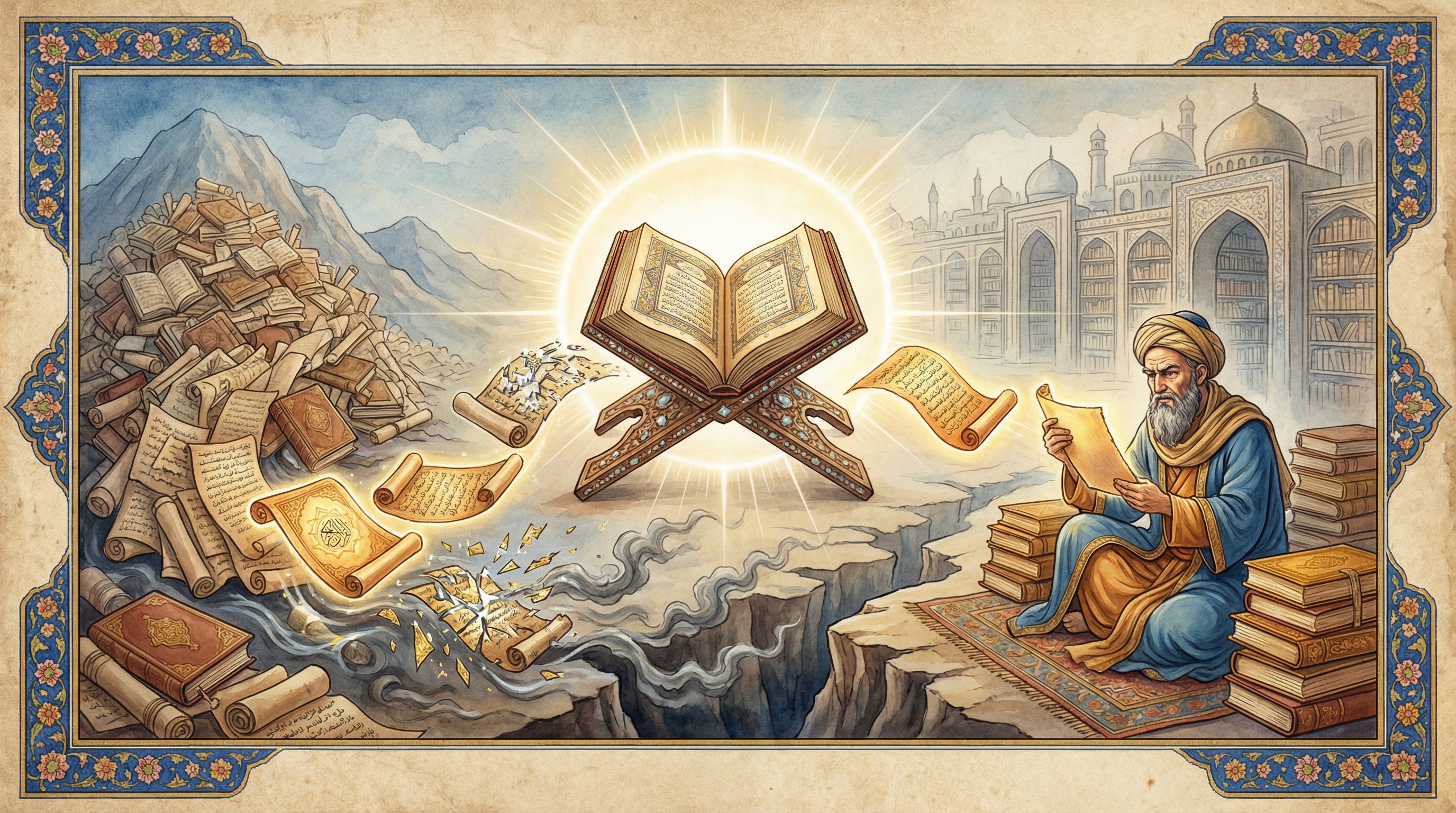
What is the standard by which a hadith is to be evaluated?
The Imams gave the answer.
And the answer is devastatingly simple — and devastatingly demanding.
Imam Ja’far al-Sadiq (peace be upon him) established what the scholars call the principle of al-’ard ‘ala al-Kitab — presenting the hadith to the Qur’an:
مَا وَافَقَ كِتَابَ اللَّهِ فَخُذُوهُ وَمَا خَالَفَ كِتَابَ اللَّهِ فَرُدُّوهُ
“Whatever is in agreement with the Book of God, accept it; and whatever is contrary to it, reject it.”
— Imam Ja’far al-Sadiq (peace be upon him); Al-Kulayni, Al-Kafi, Volume 1, Kitab Fadl al-’Ilm, Chapter on Resolving Contradictory Hadith; also cited in S.H.M. Jafri, The Origins and Early Development of Shi’a Islam, Chapter on Imam al-Sadiq, footnote 58
And in a related narration, Imam al-Sadiq (peace be upon him) was even more direct:
كُلُّ شَيْءٍ مَرْدُودٌ إِلَى الْكِتَابِ وَالسُّنَّةِ، وَكُلُّ حَدِيثٍ لَا يُوَافِقُ كِتَابَ اللَّهِ فَهُوَ زُخْرُفٌ
“Everything is returned to the Book and the Sunnah. And every hadith that does not accord with the Book of God is mere embellishment.”
— Imam Ja’far al-Sadiq (peace be upon him); Al-Kulayni, Al-Kafi, Volume 1, Kitab Fadl al-’Ilm; also recorded in Wasa’il al-Shi’a
Note that word: zukhruf — زُخْرُفٌ.
The Imam’s choice of language here is not accidental.
It is Qur’anic.
In Surah al-An’am — the Chapter of the Cattle, God describes the method of the enemies of every Prophet:
وَكَذَٰلِكَ جَعَلْنَا لِكُلِّ نَبِيٍّ عَدُوًّا شَيَاطِينَ الْإِنسِ وَالْجِنِّ يُوحِي بَعْضُهُمْ إِلَىٰ بَعْضٍ زُخْرُفَ الْقَوْلِ غُرُورًا
“And thus We have made for every Prophet an enemy — devils from among mankind and jinn — inspiring one another with zukhruf al-qawl — decorated speech — as a delusion.”
— Qur’an, Surah al-An’am (the Chapter of Cattle) #6, Verse 112
Zukhruf al-qawl — decorated speech.
Adorned words.
Falsehood made beautiful so that it deceives the one who hears it.
The Qur’an is telling us that this is the weapon of the Satan — not crude lies that anyone could detect, but speech that has been decorated, polished, made to look and sound like truth, so that even sincere people are taken in.
And when Imam al-Sadiq says that a hadith contradicting the Book of God is zukhruf, he is deliberately reaching for this Qur’anic term.
He is saying: a fabricated hadith is not merely an error.
It is the very thing the Qur’an warned us about — the decorated speech of those who oppose the Prophets.
It looks like religion.
It sounds like religion.
It is dressed in the clothing of religion.
But it contradicts the Book of God — and therefore it is zukhruf: ornamentation, deception, the whispering of Satan made to look like sacred tradition.
This is why the Imam’s instruction —
present every hadith to the Qur’an
— is not merely a scholarly methodology.
It is a Qur’anic defence.
The Qur’an itself warned that the enemies of the Prophets would produce beautiful, decorated speech designed to mislead.
And the Imam gave us the antidote: test everything against the Book.
What agrees, take.
What contradicts, leave — no matter how beautifully it is dressed.
And a narration from Imam Ali (peace be upon him), transmitted through Imam al-Baqir and Imam al-Sadiq (peace be upon them), deepens this principle further:
الْوُقُوفُ عِنْدَ الشُّبْهَةِ خَيْرٌ مِنَ الِاقْتِحَامِ فِي الْهَلَكَةِ، وَتَرْكُكَ حَدِيثًا لَمْ تَرْوِهِ خَيْرٌ مِنْ رِوَايَتِكَ حَدِيثًا لَمْ تُحْصِهِ، إِنَّ عَلَى كُلِّ حَقٍّ حَقِيقَةً، وَعَلَى كُلِّ صَوَابٍ نُورًا، فَمَا وَافَقَ كِتَابَ اللَّهِ فَخُذُوهُ وَمَا خَالَفَ كِتَابَ اللَّهِ فَدَعُوهُ
“Pausing at a matter of doubt is better than plunging into destruction. Your leaving a hadith that you have not verified is better than your narrating a hadith that you have not mastered. Verily, upon every truth there is a reality, and above every right thing there is a light. Whatever accords with the Book of God, take it; and whatever contradicts the Book of God, leave it.”
— Imam Ali (peace be upon him), narrated through Imam al-Sadiq from his father Imam al-Baqir from Imam Ali; Al-Kulayni, Al-Kafi, Volume 1, Kitab Fadl al-’Ilm, Chapter 21, Hadith 25; also cited in Wasa’il al-Shi’a, Volume 18, p. 79
Read Imam Ali’s words again — slowly.
“Pausing at a matter of doubt is better than plunging into destruction.”
This is not the language of a tradition that wants you to accept things blindly.
This is the language of a tradition that demands caution, precision, and intellectual courage.
The Imam is saying: if you are not sure, stop.
Do not narrate what you have not verified.
Do not transmit what you have not mastered.
“Upon every truth there is a reality, and above every right thing there is a light.”
This is the test: does the narration carry the light of truth?
And the standard against which that light is measured is the Book of God.
“Whatever accords with the Book of God, take it; and whatever contradicts it, leave it.”
The Qur’an is the touchstone.
A hadith that contradicts the Qur’an — no matter how prestigious the collection in which it appears — must be set aside.
The Book of God is the supreme criterion.
And lest anyone think these warnings are theoretical — that the Imams were guarding against a hypothetical threat — the history of hadith shows us otherwise.
There is a phenomenon well known in the science of hadith called al-Isra’iliyyat (إِسْرَائِيلِيَّات) — narrations that entered the Islamic hadith and tafsir tradition from Jewish, Christian, or Zoroastrian sources.
Sometimes these entered innocently — through early converts from the People of the Book, like Ka’b al-Ahbar and Wahb ibn Munabbih, who brought with them the stories and traditions of their former faith, and whose narrations about the Prophets were eagerly received by a community hungry for detail that the Qur’an, in its characteristic conciseness, chose not to provide.
Sometimes they entered through storytellers who discovered that audiences loved the elaborate, detailed narratives of the Biblical tradition — tales about the lives of the Prophets that were far more colourful and dramatic than what the Qur’an offered.
And sometimes, they were injected deliberately — fabrications designed to confuse, to corrupt, or to import ideas into Islam that had no basis in revelation.
These narrations found their way into tafsir works, into hadith collections, and into the popular imagination of the Muslim community — Sunni and Shi’a alike.
In the Shi’a tradition, the challenge of Isra’iliyyat is particularly visible in the great encyclopaedic collection Bihar al-Anwar — “Seas of Lights” — compiled by Allamah Muhammad Baqir al-Majlisi (d. 1110 AH / 1699 CE) in 110 volumes.
Allamah Majlisi’s project was different from Shaykh al-Kulayni’s or Shaykh al-Saduq’s: he was not selecting and filtering; he was collecting — gathering narrations from every available source, including many that had been scattered, forgotten, or housed in private libraries across the Shi’a world.
His goal was preservation, not certification.
The result is a vast ocean of material — some of it of the highest authenticity, and some of it carrying the unmistakable fingerprints of Isra’iliyyat: stories about the Prophets that echo the Biblical tradition more than the Qur’anic one, narrations whose content sits uncomfortably with established Islamic principles, material that found its way into Shi’a sources through the same channels that introduced it into Sunni ones.
This is not a criticism of Allamah Majlisi — his work of preservation was heroic and necessary.
It is a vindication of the principle the Imams taught.
The ocean he gathered needs the filter the Imams provided.
Without al-’ard ‘ala al-Kitab — without the discipline of presenting every narration to the Qur’an — even the most sincere collection becomes a mixture of gold and tinsel, of truth and zukhruf.
This is why the principle is not academic.
It is not historical.
It is alive, and it has work to do — in every generation, in every collection, in every narration a scholar encounters.
Now — and this is where the audience must lean in — the Imam’s instruction sounds simple.
Test the hadith against the Qur’an.
Accept what agrees.
Reject what contradicts.
But it is not simple at all.
Because it presupposes something enormous.
It presupposes that you understand the Qur’an.
The Door into Tafsir — Because the Qur'an Does Not Interpret Itself
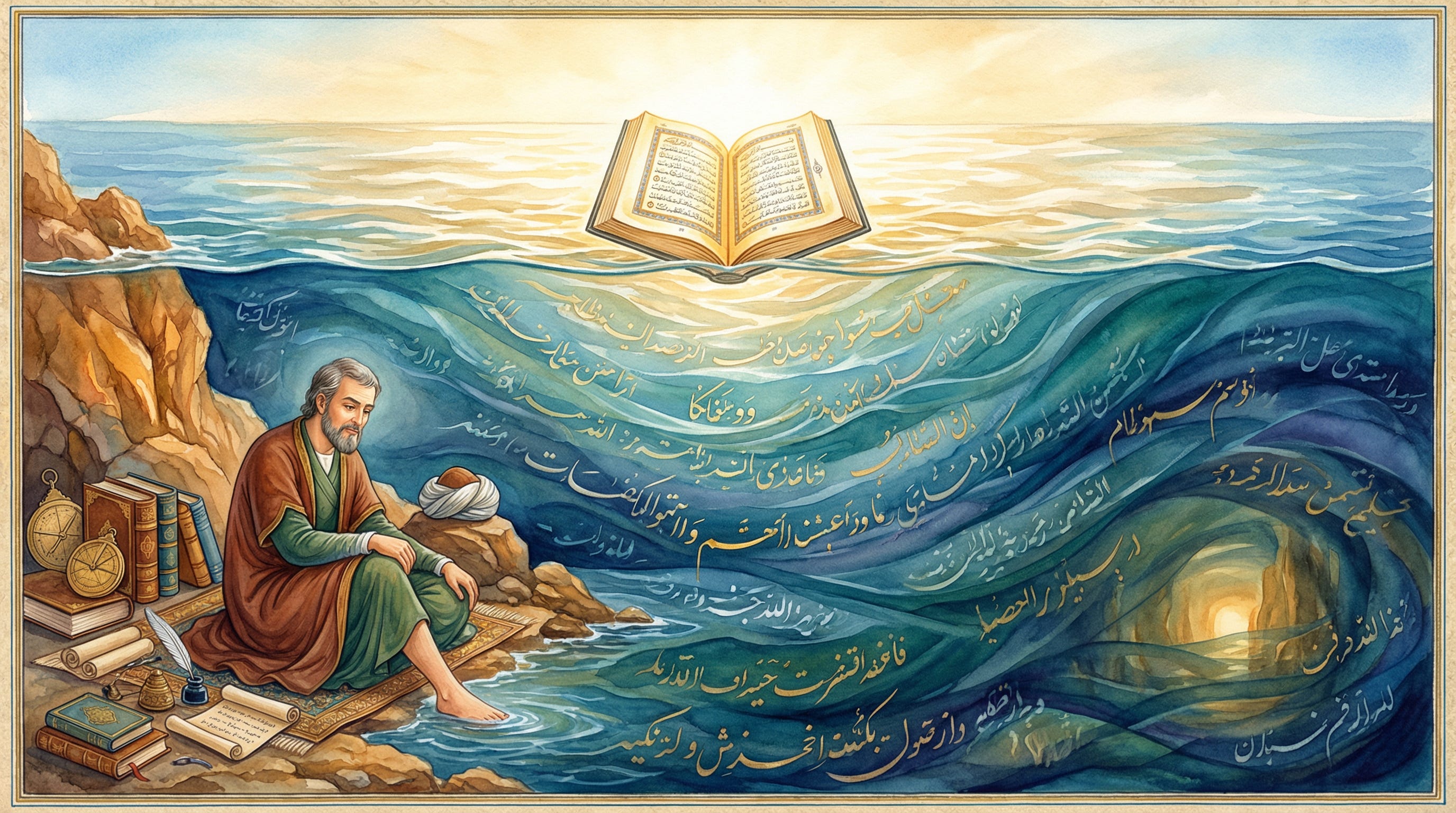
It presupposes that you understand the Qur’an.
And this is where the Imam’s seemingly simple instruction opens a door into an entire universe of scholarship.
Because the Qur’an — while it is clear in its guidance, while it describes itself as a light and a clarification — is not a book that yields all its meanings on a first reading.
It contains verses that are muhkam — clear and unambiguous — and verses that are mutashabih — allegorical, layered, requiring interpretation.
It contains legal rulings that are stated in general terms and require specification.
It contains narratives that are concise and require context.
It contains language of extraordinary depth — words that carry multiple dimensions of meaning, sentences whose grammar opens onto different possible readings, passages whose full significance only becomes clear in light of other passages.
This is not a deficiency.
It is by design.
God says in the Qur’an:
وَنَزَّلْنَا عَلَيْكَ الْكِتَابَ تِبْيَانًا لِّكُلِّ شَيْءٍ وَهُدًى وَرَحْمَةً وَبُشْرَىٰ لِلْمُسْلِمِينَ
“And We have sent down to you the Book as a tibyān — a clarification — of all things, and as guidance, and mercy, and glad tidings for those who submit.”
— Qur’an, Surah al-Nahl (the Chapter of the Bee) #16, Verse 89
Tibyān li-kulli shay’ — a clarification of all things.
Not some things.
All things.
But here is the question that this verse itself raises: if the Qur’an is a clarification of all things, then why do we need hadith?
Why do we need scholars?
Why do we need an entire tradition of interpretation?
The answer is that the Qur’an clarifies all things — but not all of its clarifications are immediately accessible to every reader.
The Qur’an is like a vast ocean: its surface is visible to all, but its depths require diving.
And the science of diving into the Qur’an — of drawing out its meanings, of understanding its layers, of connecting its verses to one another and to the lived reality of the community — is called tafsir.
Tafsir — تَفْسِير — literally means “to uncover,” “to explain,” “to make clear.”
It is the discipline through which qualified scholars engage with the text of the Qur’an and draw out its meanings.
And it is not a free-for-all.
It is a rigorous, disciplined science with its own rules, its own methodologies, and its own qualifications.
Think of it this way.
In the Christian tradition, the discipline of interpreting Scripture is called hermeneutics — and it is one of the oldest and most sophisticated fields of Christian scholarship.
The great theologians of Christianity — Augustine, Aquinas, Luther, Calvin — all understood that Scripture requires interpretation, and that interpretation requires method, training, and accountability.
The text does not interpret itself.
Someone must engage with it.
In the scientific tradition, every claim — no matter how brilliant — must undergo peer review.
A scientist publishes findings; other scientists examine them, test them, challenge them, replicate them.
Knowledge advances not through individual genius alone but through the communal process of verification.
No one’s findings are accepted simply because of who they are.
The work must be tested.
Tafsir operates on a similar logic.
The Qur’an is the supreme text — but the understanding of the Qur’an is a human activity, and human activities require methodology, qualification, and accountability.
A scholar of tafsir must know the Arabic language at the deepest level — its grammar, its morphology, its rhetorical structures, its pre-Islamic poetry.
He must know the circumstances of revelation — asbab al-nuzul — why and when each verse was revealed.
He must know the hadith tradition — what the Prophet and the Imams said about each verse.
He must know the principles of jurisprudence.
He must know logic.
He must know the opinions of previous scholars.
And he must be a person of piety — because the Qur’an does not open its secrets to the arrogant.
And this imperative — to understand, to verify, to sift truth from falsehood — is not merely an academic exercise.
It is a jihad.
The Martyr Imam Sayyid Ali Khamenei — may God bless his soul — spoke extensively about the concept of tabyeen — clarification.
The Ahl al-Bayt and the righteous scholars who followed them did not merely teach that truth exists.
They taught that truth must be struggled for.
That falsehood does not announce itself as falsehood — it comes dressed as truth, as zukhruf, as decorated speech.
And therefore the believer, and especially the scholar, has a duty — a jihad — to clarify: to sift the false from the true, to expose the decorated lies, and to make the truth unmistakably clear for the people.
This is what we call in our work at Truth Promoters the jihad of tabyeen — the struggle for clarification.
It is the subject of a dedicated series, because it deserves sustained attention in its own right.
But its roots are here — in the very principle we have been discussing tonight.
The Imam said: present the hadith to the Qur’an.
That act of presenting — of testing, examining, verifying — is itself an act of tabyeen.
It is the refusal to accept the surface of things.
It is the insistence on clarity.
And it is a duty that never ends.
The series takes its name from this very verse:
وَنَزَّلْنَا عَلَيْكَ الْكِتَابَ تِبْيَانًا لِّكُلِّ شَيْءٍ وَهُدًى وَرَحْمَةً وَبُشْرَىٰ لِلْمُسْلِمِينَ
“And We have sent down to you the Book as a tibyān — a clarification — of all things, and as guidance, and mercy, and glad tidings for those who submit.”
— Qur’an, Surah al-Nahl (the Chapter of the Bee) #16, Verse 89
tibyān li-kulli shay’ — clarification of all things.
The Qur’an clarifies; but the process by which we access that clarification — the process of tabyeen, of making clear — is a science, a discipline, and a lifelong pursuit.
And here is how it connects to everything we have discussed tonight.
The Link to Marja’iyyah — Why Compilation Was Construction
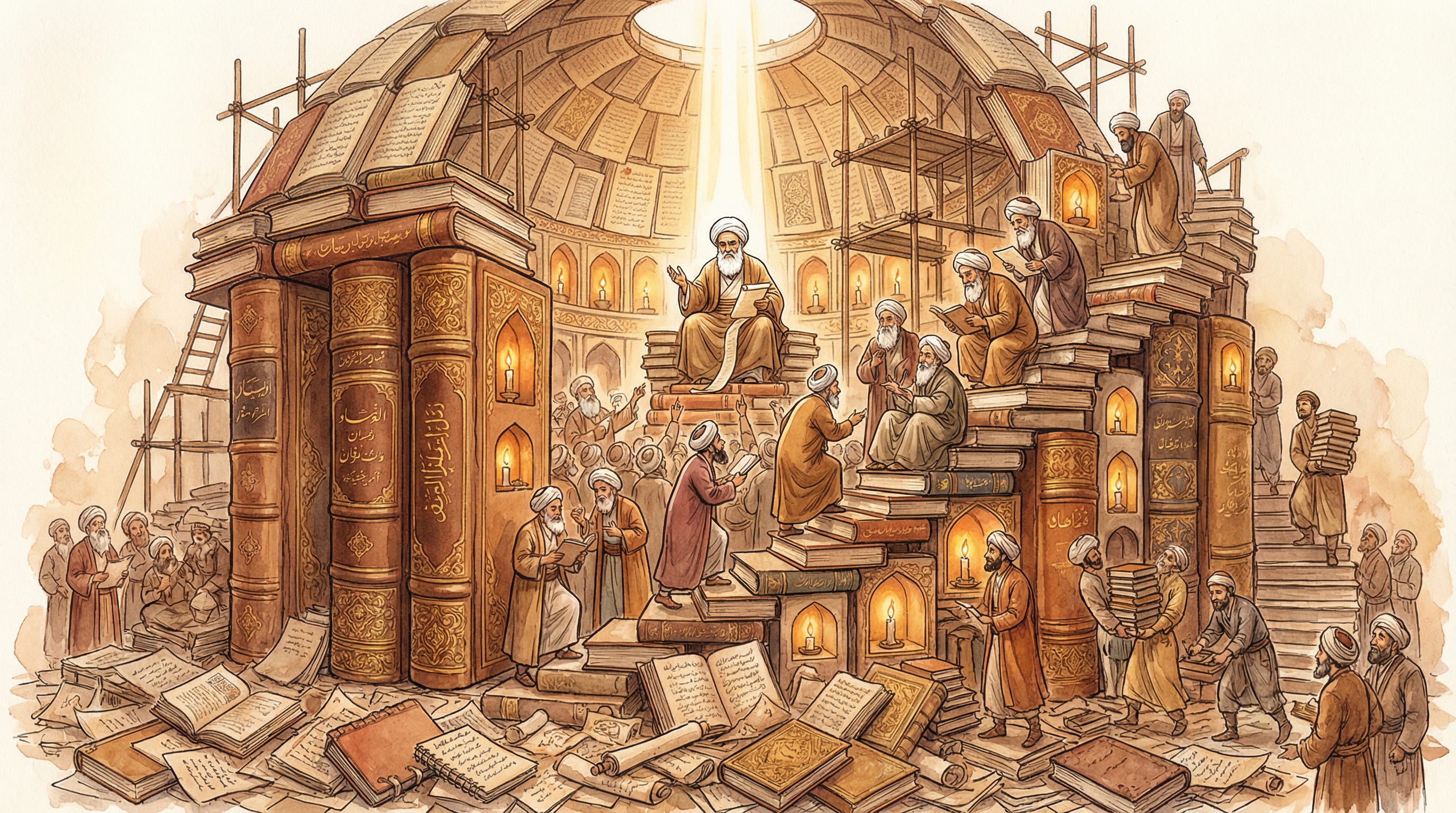
Let us now stand back and see what has been built.
We began tonight with scattered notebooks — the Usul Arba’umi’ah — the raw material of the prophetic tradition, dispersed across the Shi’a world.
We watched Shaykh al-Kulayni gather them into Al-Kafi.
We watched Shaykh al-Saduq travel to the edges of the known world to preserve, defend, and distribute the knowledge of the Imams.
Together with the later works of Shaykh al-Tusi — the Tahdhib and the Istibsar — they gave us the Four Books.
But the Four Books were not the end.
They were the beginning.
Because the Imams did not say:
take whatever is in the books and follow it.
They said:
test it.
Present it to the Qur’an.
Reject what contradicts.
Accept what accords.
And when you encounter doubt — pause.
Do not plunge into destruction.
Verify before you transmit.
And to do that — to test hadith against the Qur’an — you must understand the Qur’an.
And to understand the Qur’an, you must master tafsir.
And to master tafsir, you must spend years — decades — in study:
Arabic, logic, jurisprudence, hadith sciences, history, philosophy, theology, spirituality.
You must sit at the feet of masters.
You must be tested and found qualified.
You must be authorised — not by a certificate, but by the recognition of your peers and your teachers that you have reached the capacity to exercise independent judgement.
Do you see what has happened?
The act of compiling the hadith created the need for evaluating the hadith.
The principle of al-’ard ‘ala al-Kitab created the need for understanding the Qur’an.
The science of tafsir created the need for qualified interpreters.
And the requirement for qualified interpreters created the need for an entire institutional system of training, evaluation, and authorisation.
That system is the Marja’iyyah.
Without the Four Books, there is nothing to derive rulings from.
Without the principle of al-’ard ‘ala al-Kitab — measuring against the Quran, there is no standard by which to evaluate.
Without tafsir, there is no capacity to understand the Qur’an against which everything is measured.
Without the insistence that no book is wholly sahih — that every narration must be individually assessed — there is no need for living scholars.
And without the need for living scholars, there is no Hawza to train them and no Marja'iyyah to channel their authority.
The compilation of the hadith was not merely an act of preservation.
It was an act of construction.
The preservers were building something — whether they knew it or not.
They were laying the foundations of a system that would sustain the community through centuries of Occultation: a system of living scholarly authority, rooted in transmitted knowledge, tested against the Qur’an, exercised by qualified individuals, and renewed in every generation.
The architecture of guidance.
That is what Shaykh al-Kulayni and Shaykh al-Saduq built.
That is what Shaykh al-Tusi would complete.
And that is what the community lives within to this day — in the rulings of the Maraje’, in the guidance of the Wali al-Faqih, in the ongoing, never-finished work of understanding what God has revealed and what the Imams have transmitted.
The building is not complete.
It will not be complete until the Imam himself returns to complete it.
But the foundations are sound.
And they were laid by the men we have met tonight — in the silence of the Occultation, by candlelight, one narration at a time.
Conclusions and Key Takeaways
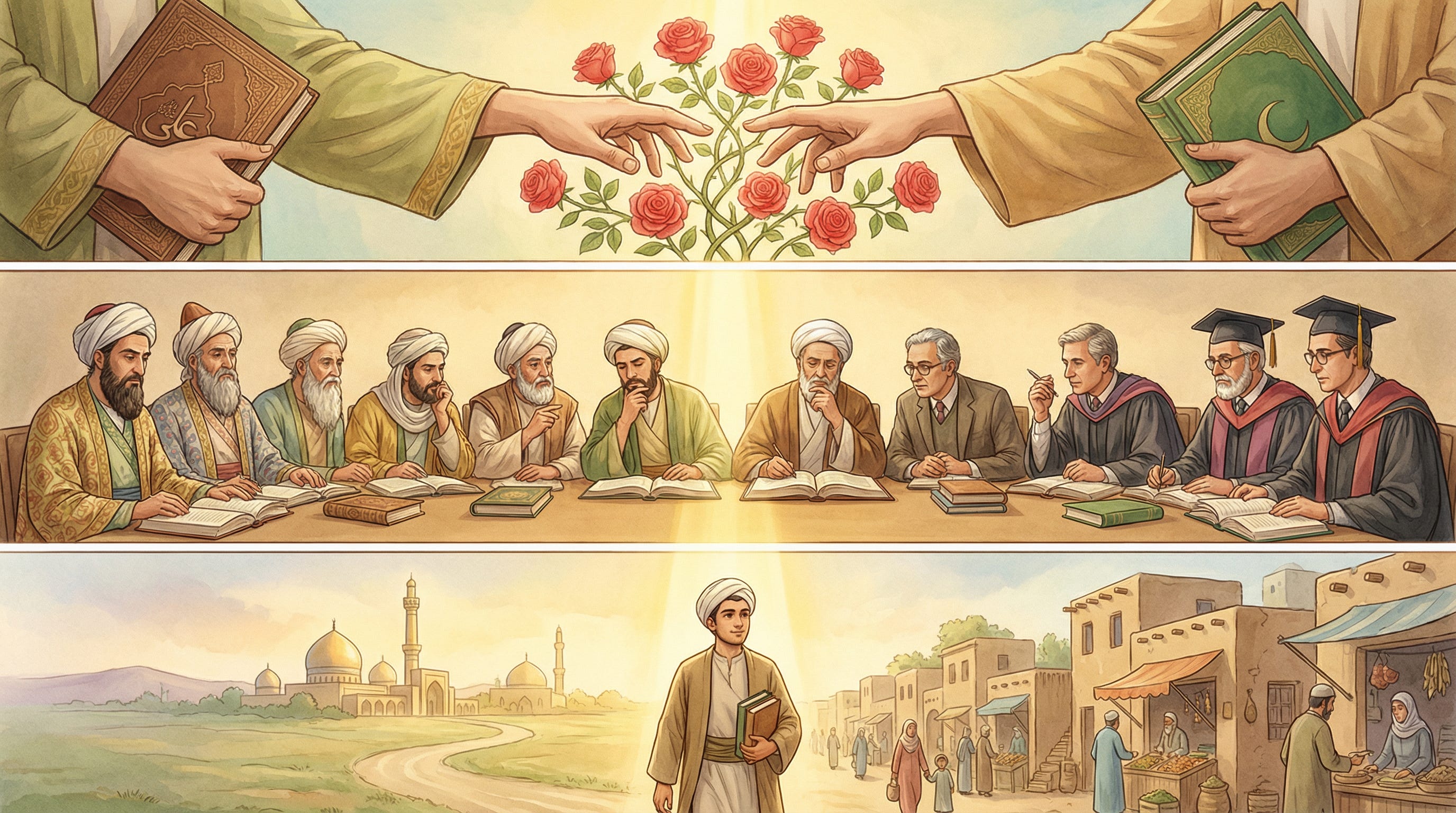
Tonight we have walked through the first phase of the Architecture of Guidance — the phase we called “The Preservers.”
We began with a letter — the Tawqi’ of the Hidden Imam, delegating authority to the scholars who would carry the community through the silence of the Occultation.
We met two men who answered that call.
Shaykh al-Kulayni — the man from Kulayn, who spent twenty years in Baghdad compiling over sixteen thousand narrations into Al-Kafi — “The Sufficient” — completing his life’s work at the exact moment the door of the Minor Occultation closed.
A man who heard a community’s cry for guidance and answered it with a book that would outlast empires.
Shaykh al-Saduq — the child born of the Imam’s own supplication, who travelled from Qum to Fergana, from Rey to Samarkand, who found a community in doubt and answered doubt not with condemnation but with evidence.
A man who wrote “Man la Yahduruhu al-Faqih” — a book for the one who has no access to a jurist — because he believed that no believer should be left without guidance, no matter how far they lived from the centres of learning.
We placed their work alongside the Kutub al-Sitta — honouring the parallel effort of our Sunni brethren — and we drew the critical distinction: in our tradition, no book is wholly sahih.
Every narration must be tested.
And the standard against which it is tested is the Book of God — the principle of al-’ard ‘ala al-Kitab — taught by the Imams themselves.
We heard the Imam say:
Whatever accords with the Book of God, take it.
Whatever contradicts it, leave it.
And we heard him call a hadith that contradicts the Qur’an zukhruf — the very word the Qur’an uses for the decorated speech of the enemies of the Prophets.
And we followed the thread to its conclusion: that this principle — test everything against the Qur’an — presupposes that you understand the Qur’an.
And that presupposition demands tafsir.
And tafsir demands qualified scholars.
And qualified scholars demand a system of training, verification, and authorisation.
And that system is the Hawza — the institution that trains and forms the scholars — and the Marja'iyyah — the authority those scholars exercise.
The one produces; the other guides.
Together, they are the architecture of guidance.
The compilers did not merely preserve.
They built.
One narration at a time, they laid the foundations of the system that sustains us to this day.
Three things to carry with you from tonight:
One: The preservation of the prophetic tradition was a race against time — and it was run by both Shi’a and Sunni scholars, driven by the same love for the Prophet, the same urgency, the same devotion.
The tree is one.
The branches diverged.
But the roots are shared.
Two: The Shi’a insistence that no book is wholly sahih is not scepticism.
It is the engine that keeps the tradition alive — because it means the work is never finished, and every generation must engage with the texts anew.
It is why we need living scholars, not merely libraries.
Three: Shaykh al-Saduq went to the people.
He did not wait for the people to come to him.
In our age — with the Maraje’, with the Wali al-Faqih, with platforms like IlmFlow and FiqhFlow, and with the Hawza students who must one day return to their communities — the duty remains the same.
Go to the people.
Bring the light to where the darkness is deepest.
That is what the Preservers did.
That is what we owe.
Eulogy: The Bridge Between Two Ages
We close tonight, as always, with remembrance.
And tonight the remembrance belongs to the man with whom we began:
Thiqat al-Islam, Shaykh Muhammad ibn Ya’qub al-Kulayni.
He was born in a small village — Kulayn, near Rey, in the heartlands of Persia.
We do not know the year of his birth with certainty, we know it is around 250-260 AH.
We do not know the details of his childhood, his family, his early years, except that he was born into a religious family.
The biographical sources are sparse.
He was not a man who left a trail of personal glory behind him.
He left a book.
He came to Baghdad — the capital of the Muslim world, the city of the Abbasid caliphs, the city of a thousand scholars and a hundred factions — and he sat down and began to compile.
For twenty years, he gathered.
He verified.
He classified.
He organised.
Sixteen thousand narrations, drawn from the scattered notebooks of the companions of the Imams — the Usul Arba’umi’ah — the raw, precious, fragile inheritance of a community that had been persecuted, hunted, and driven underground for generations.
And he finished.
He finished in the year 329 AH — the very year the door of the Minor Occultation closed forever.
The year the last Deputy, Ali ibn Muhammad al-Samarri, received the final Tawqi’ and departed this world.
The year the silence began.
Think about the timing.
Shaykh al-Kulayni completed Al-Kafi — the book that would carry the voice of the Imams through the centuries of Occultation — and then he died.
In the same year.
As if his mission had been precisely calibrated: compile the book, complete the book, and then depart — because the book must now do what the Deputy could no longer do — ensure that the voice of the Imams was never silenced, even when the Imam was hidden.
He was the bridge between two ages.
The age of the Deputies — when the community could still reach the Imam through his representatives — and the age of the scholars — when the community would have to rely on the books, the principles, and the trained minds that the Imam had commanded them to trust.
Shaykh al-Kulayni stood on that bridge.
He gathered everything he could from the first age and carried it — carefully, faithfully, with twenty years of painstaking labour — into the second.
The scholars praised him.
Al-Najashi called him:
أَوْثَقُ النَّاسِ فِي الْحَدِيثِ وَأَثْبَتُهُمْ
“The most trustworthy of the people in hadith and the most reliable of them”
— Al-Najashi, Rijal al-Najashi, Page 377
But perhaps the most fitting tribute is not any scholar’s praise.
It is the simple fact that the book survived.
Al-Kafi survived the fall of the Buyids.
It survived the Seljuq destruction.
It survived the Mongol devastation.
It survived centuries of persecution, war, displacement, and loss.
It is still here — studied in every Hawza in the world, referenced in every ruling of every Marja’, alive in every generation.
The man from Kulayn is gone.
The village itself is barely remembered.
But the book endures.
And through the book, the voice of the Imams endures.
And through that voice, the community endures.
He built well.
May God elevate his station.
May God reward him for every narration he preserved, for every doubt he answered, for every believer who found guidance in the pages he compiled.
May God place him in the company of the Imams whose words he carried — and may those Imams, on the Day of Judgement, testify that this man served them faithfully.
Supplication
We close with a prayer.
O God — You who hid Your Proof from the eyes of the world, and commanded the scholars to carry the light in his absence — bless those who carried it.
Bless Shaykh al-Kulayni and Shaykh al-Saduq and Shaykh al-Tusi and every scholar who sat by candlelight, copying a narration, verifying a chain, preserving a word that might otherwise have been lost.
O God — You who promised that the earth would never be without a Proof — hasten the reappearance of our Master, the Imam of our Time, the one for whose sake these books were compiled, these journeys were undertaken, these lives were spent.
Hasten his return, and make us among his helpers and his servants.
O God — until that day, grant us the wisdom to follow the path the Imams laid down: to test everything against Your Book, to reject the zukhruf no matter how beautifully it is dressed, to seek knowledge even to the edges of the earth, and to bring it back — always to bring it back — to the people who need it most.
And send Your blessings upon Muhammad and the family of Muhammad — the source of every narration, the origin of every light, the purpose of every book — and hasten the victory of their cause.
Amen, O Lord Sustainer of the Universes.
Amen, O Most Merciful of the Merciful.
And from Him alone is all ability and He has authority over all things.