

In His Name, the Most High
Introduction: The Threshold of Silence
The Cumulative Ascent
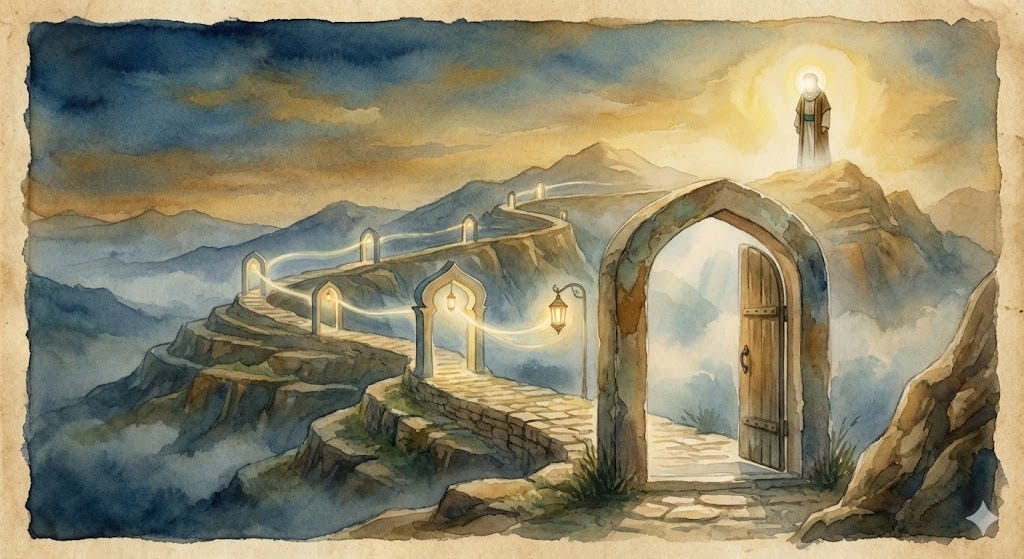
The series The Lantern of the Path was never designed as a collection of isolated lectures.
From the very beginning, we declared that this journey would be cumulative—a fortress built stone upon stone, where each session rests upon the weight of those that came before it.
We began, over fifty sessions ago, with a simple question:
What does it mean to be a servant of God?
To answer that question, we could not simply list rules. We had to build a worldview.
And so we walked.
We walked through the terrain of Tawheed—the Oneness of God—learning that the goal of the believer is not merely to acknowledge that God exists, but to become so absorbed in His reality that everything else fades into shadow.
We walked through Adalah—the Justice of God—understanding that every law, every prophet, every imam, every moment of history operates under the canopy of His perfect equity.
We walked through Nubuwwah—the chain of Prophets—tracing the road signs that God placed throughout human history to guide travellers toward their destination.
We walked through Wilayah and Imamah — Guardianship, Authority, and Leadership — understanding that after the seal of Prophethood, the guidance did not cease; it continued through the Twelve who inherited the mantle."
And now, for the past several sessions, we have been walking through Mahdawiyyah—the Culminating Guidance—the doctrine of the Awaited Imam who stands at the end of this road, the one for whom all of history has been preparation.
This trajectory was never arbitrary.
It mirrors the very structure of the Islamic worldview itself—a structure we illustrated many sessions ago:

We begin at the start of our existence.
We travel the road of Prophethood and Imamah.
We arrive at the crossroads of Ma’ad—the Day of Judgement—where our choices are weighed.
And if we are successful, we reach the goal: absorption into the Tawheed of God, gazing upon the Face of the Beloved.
All of this—every session, every hadith, every scholarly citation—has been in service of one aim: to help us understand what it means to walk this road as true servants, not as serfs compelled by fear, but as lovers drawn by longing.
Tonight, we arrive at a threshold.
We have spent the last three sessions examining the Four Deputies—the men who held the community together during the seventy years of the Minor Occultation.
We saw the Marketplace.
We saw the Court.
Now, we witness the Closing.
The Divine Injunction to Arrive
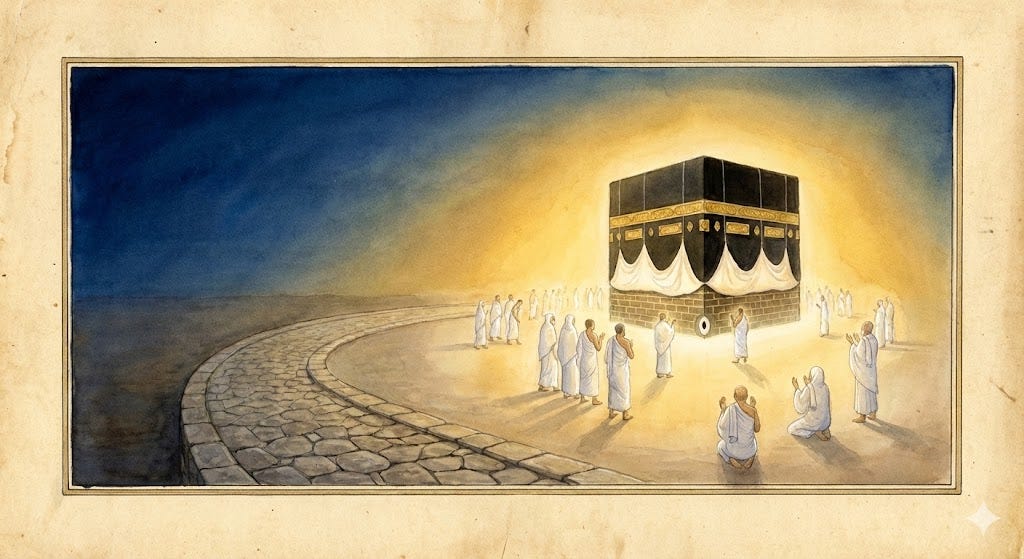
The Holy Quran does not merely command us to begin journeys; it commands us to complete them.
When God speaks of the Hajj pilgrimage, He does not say “start the journey.” He says:
وَأَتِمُّوا الْحَجَّ وَالْعُمْرَةَ لِلَّهِ
“And complete the Hajj and the ‘Umrah for God.”
— Quran, Surah al-Baqarah (the Chapter of the Cow) #2, Verse 196
Atimmu—complete it.
Finish what you started.
Do not abandon the pilgrimage halfway.
This principle extends beyond the physical pilgrimage to Makkah.
Every journey of knowledge, every ladder of understanding, carries within it the obligation of completion.
To have walked through Imamah and then abandon the series before understanding Mahdawiyyah would be to leave the pilgrimage unfinished.
To have studied the First, Second, and Third Deputies and then skip the Fourth would be to stand at the threshold of the House and turn away before entering.
Tonight, we complete this stage of the journey.
We cross the threshold.
We witness the closing of the gates.
The Architecture of Guidance: A Journey in Four Stages
Let us gather the threads of the path we have walked through the Minor Occultation.
The First Stage: The Crisis Manager
In the year 260 AH, the Eleventh Imam—Hasan al-Askari, peace be upon him—was martyred.
The community was in chaos.
The Abbasid spies were watching every shadow.
The house of the Imam was under siege.
And the child who would become the Twelfth Imam had to be hidden from a state that had already killed his father, his grandfather, and his great-grandfather.
Into this storm stepped Uthman ibn Sa’id al-Amri—the First Deputy.
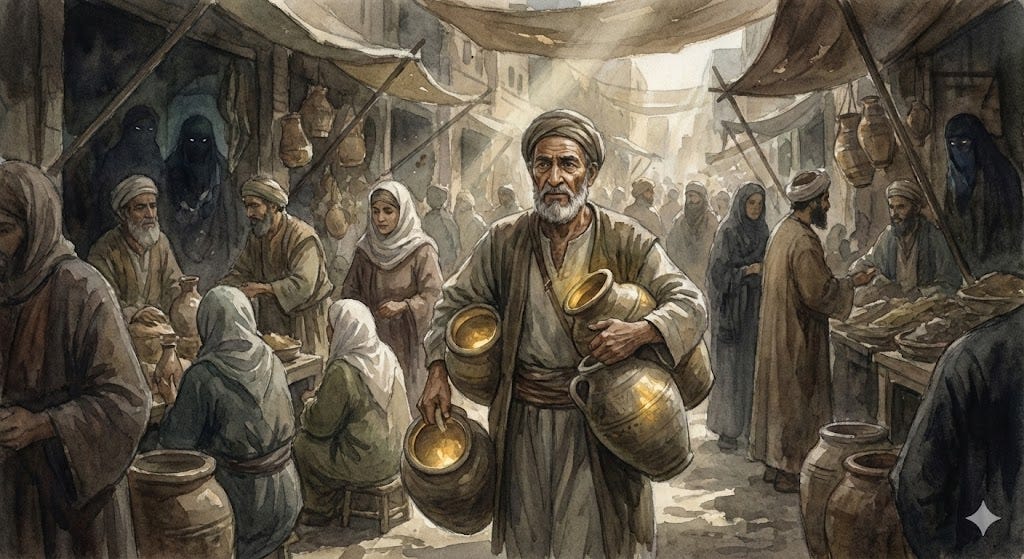
He was not a prince. He was not a philosopher. To the outside world, he was merely a seller of cooking oil—a Samman—moving through the chaotic noise of the bazaar.
But beneath the canisters of fat, he carried the secrets of the Imamate.
He was the Crisis Manager—the one who stabilised the community in the immediate aftermath of catastrophe.
His operational base was the Marketplace: anonymous, noisy, invisible.
The Second Stage: The Institution Builder
When Uthman ibn Sa’id passed away, his son Muhammad ibn Uthman inherited the burden.
But his mission was different.
The First Deputy had saved the community from immediate collapse.
The Second Deputy transformed the emergency measures into a permanent structure.
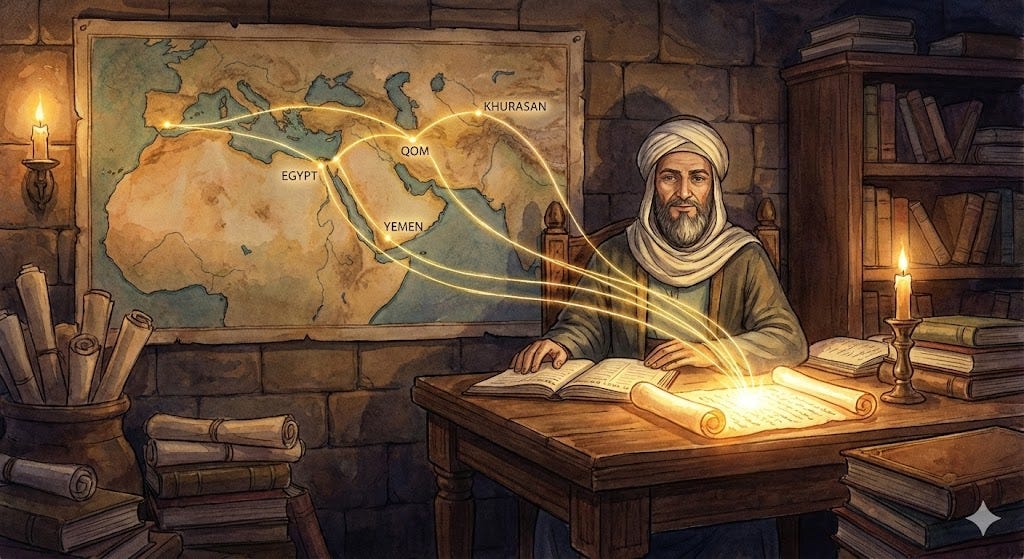
For forty years—longer than any other deputy—he built the Wikalah (The Agency) into a global network.
He institutionalised the collection of Khums, securing financial independence for the scholars.
He perfected the Tanzim al-Sirri (Secret Organisation), managing agents from Qom to Yemen, from Egypt to Khurasan.
And he delivered the foundational Tawqi’ (authoritative signed letter from the Imam) that established the legitimacy of the scholars during the Major Occultation:
وَأَمَّا الْحَوَادِثُ الْوَاقِعَةُ فَارْجِعُوا فِيهَا إِلَى رُوَاةِ حَدِيثِنَا، فَإِنَّهُمْ حُجَّتِي عَلَيْكُمْ وَأَنَا حُجَّةُ اللَّهِ عَلَيْهِمْ
“As for the newly occurring events, refer regarding them to the narrators of our traditions, for surely they are My Proof over you, and I am the Proof of God over them.”
— Al-Saduq, Kamal al-Din wa Tamam al-Ni’mah, Vol. 2, Chapter 45, Hadith 4
His operational base was still the Marketplace—but his reach extended to every corner of the Islamic world.
The Third Stage: The Diplomat in the Lion’s Den
When Muhammad ibn Uthman passed away, the torch was handed to Husayn ibn Ruh al-Nawbakhti.
And with him, the entire operational paradigm shifted.
The Nawbakhtis were not oil sellers.
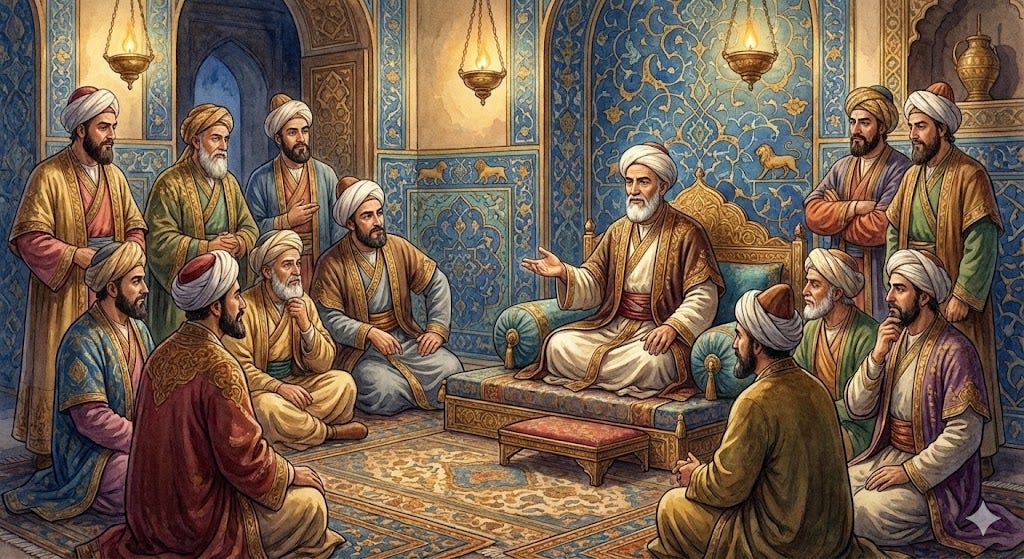
They were the elite power-brokers of the Abbasid Golden Age—astronomers, theologians, administrators who dined with Viziers and debated with philosophers.
By selecting a Nawbakhti, the Imam effectively moved the headquarters of the Resistance from the marketplace to the Court.
We spent our entire previous session examining this extraordinary man.
We saw the Diplomat—who used the “Wand of Words” (Tawriyah — or strategic ambiguity) to deflect the sword, declaring in a crowded assembly what the Sunni officials wanted to hear while never betraying the truth in his heart.
We saw the Social Magnet—who practised Mudarat (Courtesy) so beautifully that even his enemies attended his funeral, proving that the bearer of Truth must be an ornament to the Faith, not a disgrace upon it.
We saw the Ruthless Surgeon—who excommunicated Shalmaghani, the “Celebrity Scholar” who had succumbed to the Iblis Syndrome, cutting out the internal cancer before it could destroy the body.
And we saw the Prisoner—who spent five years in the dungeons of the Caliph, yet smuggled out letters to protect the Imam even from chains.
For twenty-one years, Husayn ibn Ruh navigated the Lion’s Den.
And then, in 326 AH, he passed away.
The Fourth Stage: The Executor of the Estate
Upon his deathbed, Husayn ibn Ruh did not hand the torch to a son.
He did not hand it to a celebrity scholar.
He handed it to an elderly, quiet figure named Ali ibn Muhammad al-Samarri.
And here, the atmosphere shifts entirely.
We are no longer building.
We are no longer negotiating.
We are closing.
The First Deputy stabilised.
The Second Deputy institutionalised.
The Third Deputy navigated.
The Fourth Deputy dismantled.
His tenure was brief—only three years, from 326 AH to 329 AH.
Shaykh al-Tusi records this with a sense of finality:
وَلَمْ تَطُلْ مُدَّةُ أَبِي الْحَسَنِ السَّمُرِيِّ رَضِيَ اللَّهُ عَنْهُ، فَإِنَّهَا كَانَتْ ثَلَاثَ سِنِينَ.
“The duration of the deputyship of Abu al-Hasan al-Samarri, may God be pleased with him, was not long; indeed, it was [only] three years.”
— Shaykh al-Tusi, Kitab al-Ghaybah, Section on the Fourth Deputy
Why appoint a Deputy for such a short time?
Because his mission was not to build.
It was to prepare the community for a world without scaffolding.
The martyred genius, Ayatullah Shaheed Muhammad Baqir al-Sadr, provides the most profound analysis of this transition.
He argues that the Minor Occultation was not merely a “waiting period”—it was a training camp.
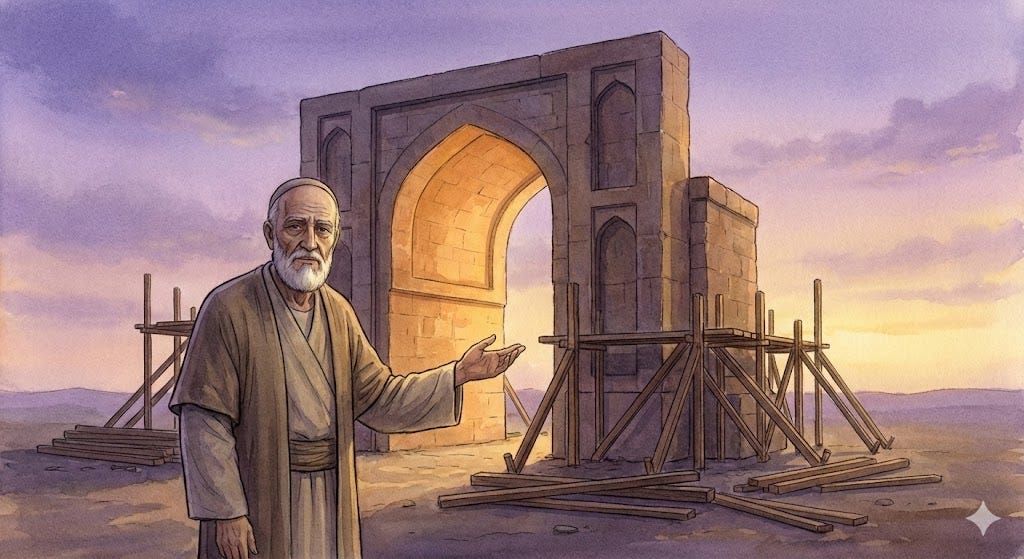
The community was like a building under construction.
The Specific Deputies were the scaffolding holding the structure up while the cement dried.
Once the building was solid—once the hadith books were compiled, once the juristic principles were established, once the community learned to refer to scholars rather than named individuals—the scaffolding had to be removed.
If the scaffolding remained forever, the building would never stand on its own.
إنَّ الغيبةَ الصغرى كانت بمثابةِ مرحلةٍ إعداديةٍ لتمكينِ الشيعةِ من التكيفِ... ونقلِهم تدريجياً من الاعتمادِ على التعيينِ الخاص (السفراء) إلى الاعتمادِ على المعاييرِ العامة (الفقهاء).
“The Minor Occultation served as a preparatory stage to enable the Shia to adapt... and to transition them gradually from reliance on Specific Appointment (The Deputies) to reliance on General Criteria (The Jurists).”
— Shaheed Muhammad Baqir al-Sadr, Bahth hawl al-Mahdi (A Discussion Concerning the Mahdi)
Ali ibn Muhammad al-Samarri was the man charged with removing the scaffolding.
His task was to tell the community:
“You are ready.
You no longer need a hand to hold.
Walk.”
The Lesson Before the Lesson: The System Survives the Person
Before we enter the life and legacy of the Fourth Deputy, we must understand the theological principle his tenure embodies.
Human societies have a tendency to form Personality Cults.
We attach our faith to a specific charismatic leader, a celebrity scholar, a famous commander.
We feel safe because he is there.
But what happens when he dies?
History is littered with movements that collapsed the moment their founder was buried.
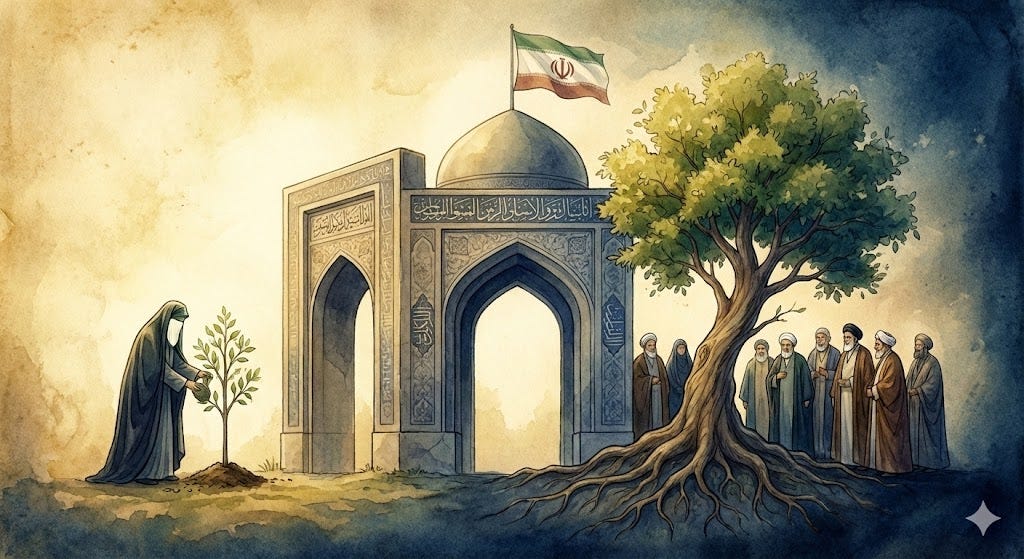
The Fourth Deputy’s tenure was a divine lesson in weaning the community off the Person (the Specific Deputy) and attaching them to the Institution (the General Deputyship / the Marjaiyyah).
We witnessed this test in our own lifetime.
In 1989, when Imam Khomeini passed away, the enemies of the Islamic Revolution celebrated.
Western intelligence agencies predicted the immediate collapse of the Islamic Republic.
They believed the Revolution was a personality cult—that without the charisma of Khomeini, the structure would crumble into civil war.
They were wrong.
Why?
Because Imam Khomeini, following the sunnah of the Deputies, had built an Institution—the Assembly of Experts (Majles-e Khobregan)—to ensure continuity.
He had transferred the loyalty of the people from his “Person” to the “Principle” of Wilayat al-Faqih.
In his Last Will and Testament, he addressed the anxiety of the nation with the calm confidence of a man who knows the System is divine:
«بدانید که با رفتن یک خدمتگزار در سدّ آهنین ملت خللی حاصل نخواهد شد که خدمتگزاران بالا و والاتر در خدمتند و الله نگهدار این ملت و مظلومان جهان است.»
“Know that with the departure of one servant, no crack will appear in the iron dam of the nation, for higher and more exalted servants are in service, and God is the Guardian of this nation and the oppressed of the world.”
— Imam Khomeini, Sahifeh-ye Imam, Vol. 21 (The Last Will and Testament)
Imam Khamenei reinforces this, noting that the institutions of the system are the guarantee that the flag does not fall when the standard-bearer changes:
«مجلس خبرگان... مایهی آرامش دلهای مردم است؛ مایه ثبات و استقرار نظام است...»
“The Assembly of Experts... is the source of tranquility for the hearts of the people; it is the source of the stability and establishment of the System...”
— Imam Khamenei, Speech to the Assembly of Experts, May 26, 2016
The Proof in Blood: When Decapitation Fails
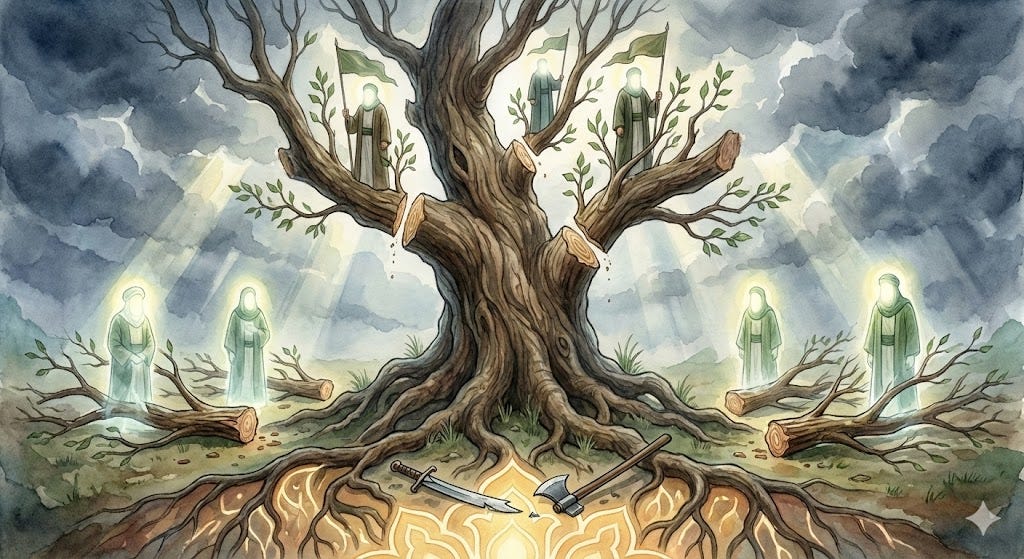
But the Imam Khomeini example, powerful as it is, concerns natural death and institutional succession.
The enemy did not kill him — time did.
There is a darker, more brutal dimension to this lesson — one that has been tested repeatedly in our own era.
The enemies of the Resistance have long believed in the “Decapitation Theory.”
Cut off the head, and the body dies.
Kill the leader, and the movement collapses.
They have tested this theory repeatedly against Hizbullah — and they have failed repeatedly.
In 1984, the Zionist entity assassinated Shaykh Ragheb Harb, the first great mobiliser of the resistance in the South.
They believed it was over.
It was not over.
Sayyed Abbas al-Musawi rose to carry the banner — and the resistance grew stronger.
In 1992, the Zionists assassinated Sayyed Abbas himself, along with his wife and child.
They believed, again, that they had severed the head.
They had not.
Sayyed Hassan Nasrallah took the helm — and under his command, the resistance achieved what no one had achieved: the liberation of 2000, the victory of 2006.
And then, in our own days, the enemy returned to their failed doctrine.
In 2024, they assassinated Sayyed Hassan.
They celebrated.
They declared the resistance “decapitated.”
Within days, Sayyed Hashem Safieddine was the Secretary-General.
And when he too was martyred shortly thereafter, the banner passed to Shaykh Naeem Qassem — who carries it to this day.
The chain did not break.
It has never broken.
Why?
Because decapitation cannot work against the Shia, against the believers.
It is not merely that we have good succession planning.
It is that we have been trained — theologically, spiritually, historically — to absorb the blow of martyrdom and continue walking.
The Theology of Blood
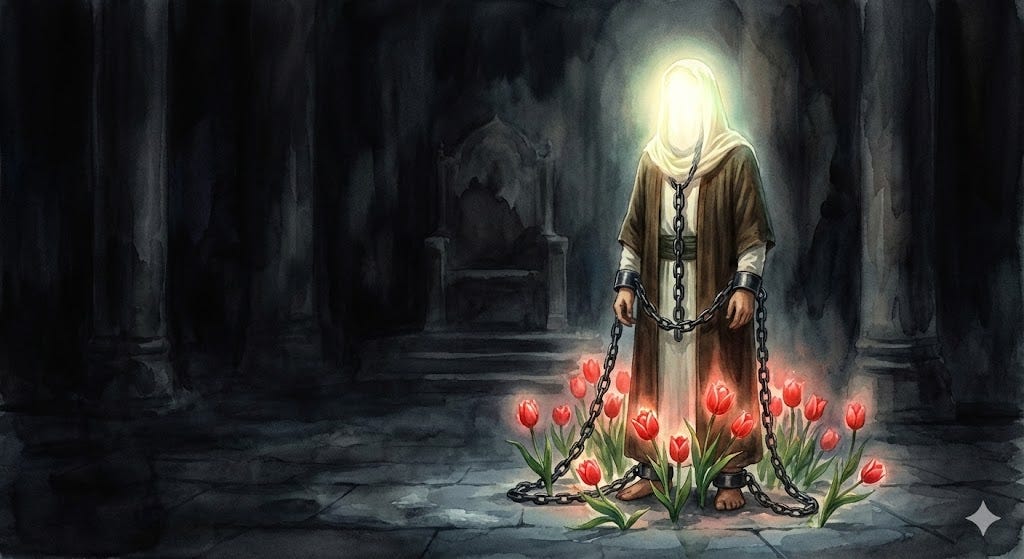
We are the school of Karbala.
We watched Imam Husayn fall — and then watched Sayyedah Zaynab carry the message forward in chains.
We watched Imam after Imam imprisoned, poisoned, martyred by the state — and yet the school survived, grew, deepened.
We are not surprised by the martyrdom of our leaders.
We are prepared for it.
The doctrine was established by the son of the Master of Martyrs himself.
When the captives of Karbala were dragged into the court of Kufa, the tyrant Ubaydullah ibn Ziyad attempted to intimidate the young Imam Sajjad — Ali ibn Husayn, peace be upon him — with threats of execution.
The Imam’s response stripped the tyrant of his only weapon:
«أَبِالْقَتْلِ تُهَدِّدُنِي يَا ابْنَ زِيَادٍ؟ أَمَا عَلِمْتَ أَنَّ الْقَتْلَ لَنَا عَادَةٌ وَ كَرَامَتَنَا الشَّهَادَةُ؟»
“Do you threaten me with death, O son of Ziyad? Do you not know that being killed is our habit, and our honour is martyrdom?”
— Imam Ali ibn Husayn al-Sajjad, peace be upon him, in Bihar al-Anwar by Allamah Majlisi, Vol. 45, Page 118; originally recorded in Al-Luhuf by Sayyed Ibn Tawus, Page 94
Al-Qatl lana ‘adah — “Being killed is our habit.”
This is not rhetoric.
This is identity.
The Imam was declaring to the tyrant:
Your weapon does not work on us.
You threaten us with the very thing we consider our honour.
You cannot intimidate a people who view death on this path as graduation, not termination.
Over thirteen hundred years later, when the President of the United States threatened the Islamic Republic with annihilation, the martyr Hajj Qassem Soleimani stood in Hamedan and echoed the words of his Imam:
«ما ملت شهادتیم، ما ملت امام حسینیم.»
“We are the nation of martyrdom; we are the nation of Imam Husayn.”
— Shaheed Qassem Soleimani, Speech in Hamedan, July 2018
The same spirit.
The same defiance.
The same stripping of the tyrant’s weapon.
From the court of Ibn Ziyad to the threats of Trump — the school of Husayn has not changed its answer.
You cannot frighten those who do not fear death.
You cannot decapitate a body that grows new heads.
You cannot defeat a nation that considers martyrdom its honour.
A Necessary Clarification: Love, Not Morbidity
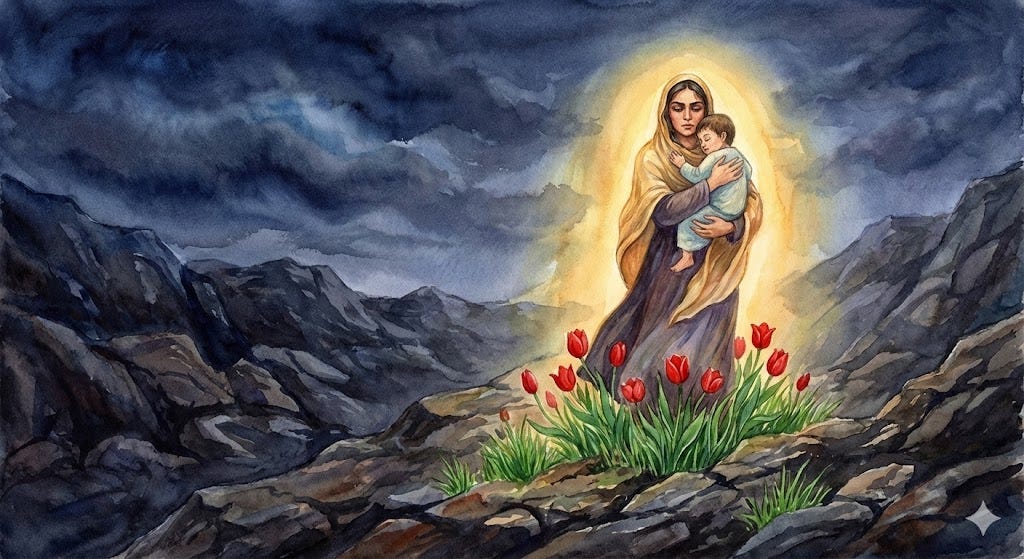
But let us be absolutely clear — lest the theology be misunderstood.
This embrace of martyrdom is not morbidity.
It is not nihilism.
It is not the cry of a people who hate life and seek escape through death.
It is the exact opposite.
The Shia do not yearn for death.
They yearn for justice.
They yearn for truth.
They yearn to establish a heaven on earth for all of humanity — a world where the orphan is fed, the oppressed is liberated, and the name of God is honoured in every corner of the globe.
But if the path to that heaven requires sacrifice — if the road to justice passes through the valley of death — then they will walk it.
Not because they love death.
But because they love life so much — life for their children, life for their community, life for generations yet unborn — that their own individual existence becomes secondary.
Consider the parent whose child is dying and needs an organ.
The parent is a match.
The surgery is dangerous — perhaps fatal.
Does the parent hesitate?
No.
They say:
“Take what you need from me.
Let my child live.”
This is not suicide.
This is not a death wish.
This is love so overwhelming that it overflows the boundaries of the self.
Consider the mother — injured, bleeding, carrying a child in her womb.
The doctors tell her:
“We can try to save you both, but the risk is high.
Or we can deliver the child now — but you may not survive.”
She says:
“Save my child.”
Is this woman morbid?
Does she hate her own life?
No.
She is filled with life — so filled that she pours it out for the one she loves.
This is the spirit of Karbala.
Imam Husayn did not ride toward Kufa because he wanted to die.
He rode because he wanted Islam to live.
He saw that the religion of his grandfather was being strangled by the hands of Yazid — and he knew that if no one stood up, the truth would be buried forever.
His blood was the price of that stand.
Not the goal.
The price.
We have seen this spirit in Gaza — mothers shielding infants with their own bodies, fathers rushing into collapsing buildings to pull out children who are not even their own, entire families choosing to stay in their homes rather than abandon their land, knowing full well what the bombs will bring.
Are these people suicidal?
Or are they so alive, so rooted, so overflowing with love for their land and their people, that they refuse to abandon them even at the cost of everything?
The world calls this madness.
We call it Husayniyat - the line of Imam Husayn.
And so when Imam Sajjad declares, “Being killed is our habit” — he is not expressing a desire for extinction.
He is expressing a freedom from the tyrant’s only weapon.
He is saying:
“You cannot control us with fear, because we have already decided what we are willing to pay.
We have already settled our accounts with death.
Now we are free to live for something greater than ourselves.”
This is the secret the tyrants have never understood.
A people who are willing to die cannot be enslaved.
A people who have transcended the fear of death cannot be intimidated.
A people who view sacrifice as the currency of love — not the end of hope — will outlast every empire that rises against them.
And there are degrees of this honour.
The man who goes out to earn an honest livelihood for his family and dies in that effort — he is a martyr.
The woman who dies in childbirth — she is a martyr.
But the one who falls on the battlefield, who is struck down by the enemy of God while defending the Truth — this is a different station.
And the one who is hunted, targeted, assassinated precisely because he is the head of the Resistance — this is the station of the Imams themselves, most of whom were poisoned by the tyrants of their age.
We do not seek to lose our leaders.
We weep for them.
We feel the wound.
But we do not collapse — because the goal was never the leader.
The goal is God.
The leader was the guide on the path.
When one guide falls, another rises — and the path continues.
The Journey and the Terrain

This brings us to a truth we established at the very beginning of our Wednesday gatherings, in our series on Patience (Sabr).
The journey to God does not promise a single, unchanging landscape.
Consider a traveller walking toward a distant mountain.
At first, he passes through a garden — lush, fragrant, easy.
Then the garden ends, and he finds himself at the edge of a barren desert.
What does he do?
Does he turn back?
Does he sit down and weep for the garden that was?
No.
He adjusts his provisions.
He wraps his face against the sand.
And he continues.
Later, the desert gives way to frozen peaks.
He puts on different shoes.
He takes a different stick.
And he continues.
The terrain changes.
The equipment changes.
The guide may change.
But the destination — the mountain, the Face of God, the Tawheed we have been walking toward since Session One — that does not change.
This is the meaning of Patience.
Not passive waiting.
Not resignation.
But the active continuity of the journey through every shift of landscape.
We covered this in depth in our early sessions — the series on Patience that forms the very foundation of this entire programme.
For those who have not yet engaged with that material, we encourage you to return to it.
Because without Patience, without Sabr, the traveller abandons the journey the moment the terrain becomes difficult.
And the terrain will become difficult.
The martyrdom of a beloved leader is one such shift.
The community that has not been trained in Patience will sit down in the desert and weep.
The community that has been trained will wrap its face, adjust its provisions, and continue walking.
The Lesson Embedded in the Lesson
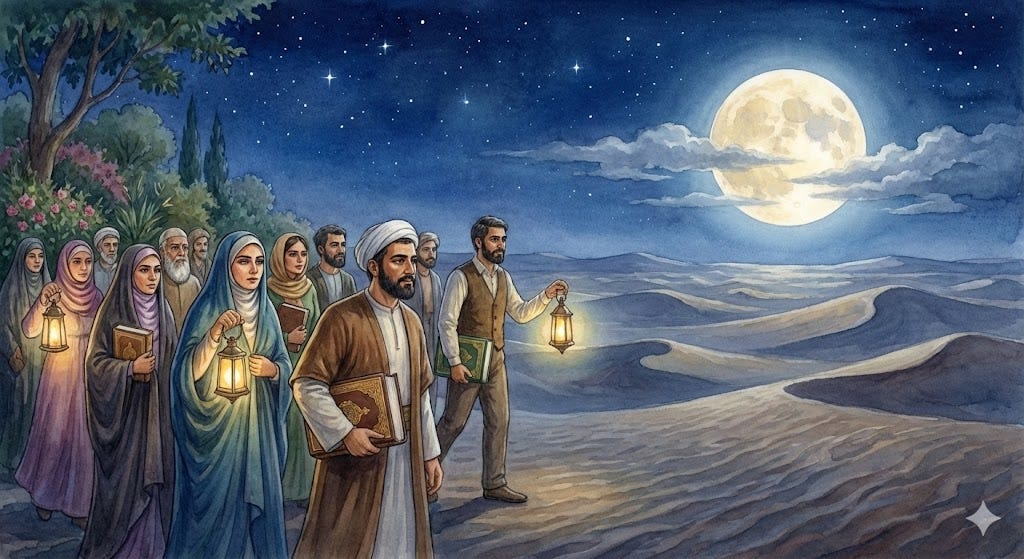
Do you see now why the Fourth Deputy’s tenure was so short?
It was not an accident.
It was not a tragedy.
It was the final stage of training.
For seventy years, the community had been walking with a specific guide holding their hand.
Now the Imam was saying:
“I am removing the guide.
Not because I have abandoned you — but because you are ready.
The path is clear.
The principles are established.
The scholars are trained.
Walk.”
The Minor Occultation was the garden.
The Major Occultation is the desert.
And we have been walking through that desert for over a thousand years — adjusting our equipment, burying our guides, raising new ones, and continuing.
Because the destination has not moved.
Because the Imam, though hidden, has not abandoned us.
Because we are the school that learned, from Karbala onward, that the blood of the martyr is not the end of the story.
It is the fuel for the next chapter.
This forces a question upon us today.
Is our faith attached to personalities, or to principles?
Do we follow a “Celebrity Shaykh” on social media because of his charisma, or do we follow the Marjaiyyah because of its legitimacy?
If your favourite speaker makes a mistake, or falls from grace, or passes away — does your faith shake?
If it does, you are following a Person.
But if your faith remains firm because you know the System of Guidance is intact, then you have learned the lesson of the Fourth Deputy.
You have learned that the Scaffolding is not the Building.
The Deputy may go.
But the Imam remains.
In His name, we proceed.
We beseech Him to guide us through this final gate.
By His grace and taking refuge in Him, we step into the Great Silence.
Video of the Majlis (Sermon/Lecture)
This is the video presentation of this write-up as a Majlis (part of the Truth Promoters Weekly Wednesday Majlis Program)
Audio of the Majlis (Sermon/Lecture)
This is the audio presentation of this write-up as a Majlis (part of the Truth Promoters Weekly Wednesday Majlis Program)
Mahdawiyyah (The Culminating Guidance) - The Four Deputies - Part 4 - The Closing of the Gates
The Personality of the Silent Soldier
The Profile: Service Without Fame
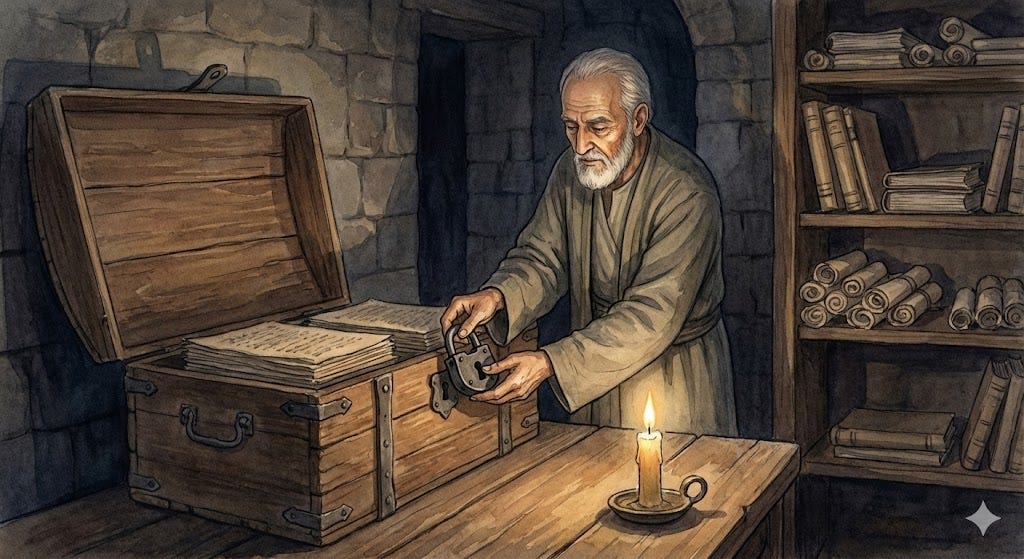
When we search for Ali ibn Muhammad al-Samarri in the pages of history, we find very little.
This is itself significant.
Unlike the Nawbakhtis — aristocrats and philosophers who dined with Viziers, translated Greek texts, and debated in the salons of the Abbasid elite — al-Samarri left no intellectual legacy.
Unlike the Amris — Uthman and Muhammad ibn Uthman — who commanded a marketplace empire built over forty years, who managed a global network of agents from Qom to Yemen, al-Samarri inherited no dynasty.
He came from a family of Khuddam — servants.
The Samarris of Basra and Ahwaz had served the Tenth and Eleventh Imams for generations.
They were not the front-men.
They were the logistics corps of the Imamate — managing the estates, carrying the letters, protecting the funds, ensuring that the infrastructure of guidance remained operational when no one was watching.
Shaykh al-Saduq records that his ancestors were among the trusted agents (Wukala’) of Imam al-Hadi and Imam al-Askari, peace be upon them — men whose names appear in the margins of history, not its headlines.
«عَنِ الصَّدُوقِ، عَنْ سَعْدِ بْنِ عَبْدِ اللَّهِ، قَالَ: كَتَبَ مَوْلَانَا أَبُو مُحَمَّدٍ الْعَسْكَرِيُّ (ع) إِلَى أَبِي الْحَسَنِ السَّمُرِيِّ: 'فِتْنَةٌ تُضِلُّكُمْ، فُكُونُوا عَلَى أُهْبَةٍ'... وَكَانَ مِنْ خَوَاصِّ الشِّيعَةِ وَخُدَّامِهِمْ.»
"Our Master Abu Muhammad [Imam Hasan] al-Askari (peace be upon him) wrote to Abu al-Hasan al-Samarri [referring to the family line/ancestor]: 'A sedition (Fitnah) will mislead you, so be on your guard...' ...And he [Al-Samarri] was among the elite of the Shia and their servants (Khuddam)."
— Al-Saduq, Kamal al-Din Wa Tamam al-Ni’mah, Volume 2, Chapter 45 (Mentions of the Deputies), Hadith 43
There are no dramatic stories of al-Samarri debating in the Abbasid court.
There are no accounts of him dazzling the scholars with theological brilliance.
There are no letters preserved showing his political manoeuvres.
His tenure was quiet, focused, and solemn — like the calm before a storm, or perhaps more accurately, like the calm after the storm, when the task is not to fight, but to assess the damage, secure what remains, and prepare for the long winter ahead.
He represents a specific spiritual archetype that is often overlooked in our celebrity-obsessed culture:
The Bureaucrat of God
The one who does the work, locks the door, and leaves without waiting for applause.
The Spiritual Archetype: The Unknown Soldier
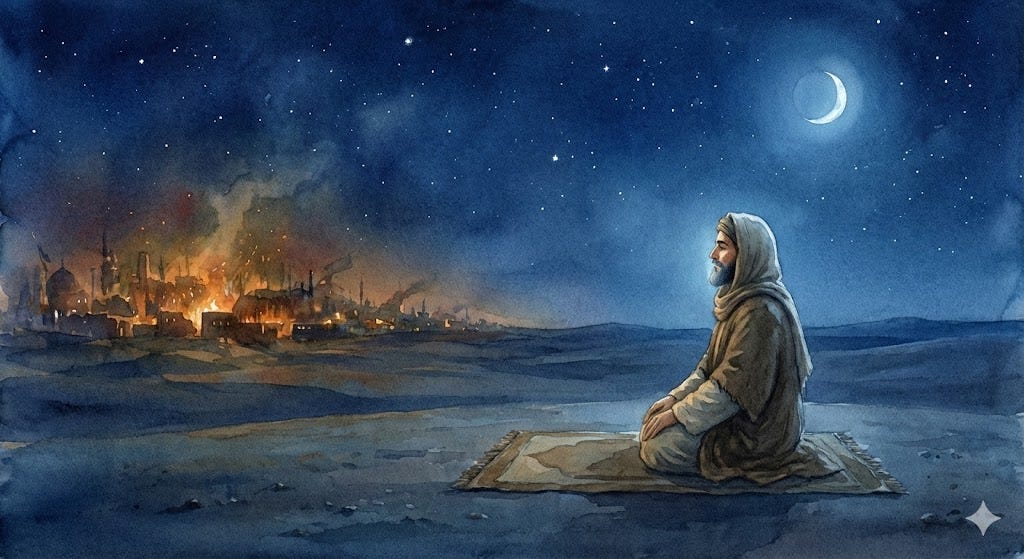
In the worldview of the Ahl al-Bayt, fame is often a veil.
We assume — because the world has trained us to assume — that the most “important” people are the ones with the loudest voices, the largest followings, the most dramatic stories.
But the Fourth Deputy teaches us that the highest station is often found in Gumnami — Anonymity.
Consider:
The most critical task of the entire Minor Occultation — the closing of the gates, the sealing of the mission, the delivery of the final letter, the protection of the Imam’s ultimate secret — was entrusted not to a celebrity, not to a philosopher, not to a courtier who could dazzle with eloquence.
It was entrusted to the man who sought the least attention.
The master of the “Pen of the Revolution,” Shaheed Sayyed Morteza Avini, provides the spiritual commentary for this state of being.
Avini was a man who documented the Sacred Defence — the eight-year war against Saddam — with a camera and a soul.
He walked among the soldiers, captured their faces, recorded their deaths, and transmitted to the world the spirit of a generation that fought not for territory, but for Truth.
And yet, he despised the spotlight.
He believed that fame acts as a barrier between the soul and God — that the ego feeds on recognition like a parasite, growing fat while the spirit withers.
In his masterpiece Ganjineh-ye Asemani (The Heavenly Treasure), he writes:
«گمنامی برای شهرتپرستان دردآور است، اگرنه همه اجرها در گمنامی است... سربازان امام زمان (عج) از هیچ چیز جز گناهان خویش نمیهراسند.»
“Anonymity (Gumnami) is painful for those who worship fame; otherwise, all rewards lie in anonymity... The soldiers of the Imam of the Time, fear nothing but their own sins.”
— Shaheed Sayyed Morteza Avini, Ganjineh-ye Asemani (The Heavenly Treasure)
Pause and absorb this.
The “pain” of anonymity is only felt by the ego.
For the soul that has annihilated itself in God, anonymity is not a punishment — it is a sanctuary.
It is the place where the servant can work without the contamination of praise, without the distortion of public expectation, without the subtle poison of being watched and admired.
Ali ibn Muhammad al-Samarri lived in that sanctuary.
He was the Unknown Soldier who held the line until the order came to withdraw.
The Modern Mirrors: Soldiers Without Titles
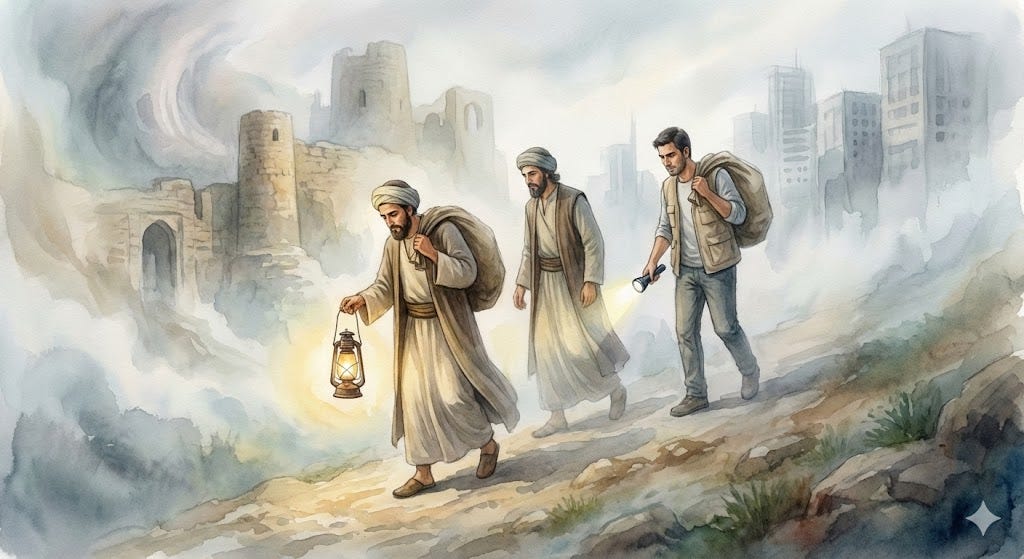
This spirit did not die with the Fourth Deputy.
It has been inherited, generation after generation, by those who understood that true service requires the effacement of the self.
The General Who Wanted to Be a Soldier
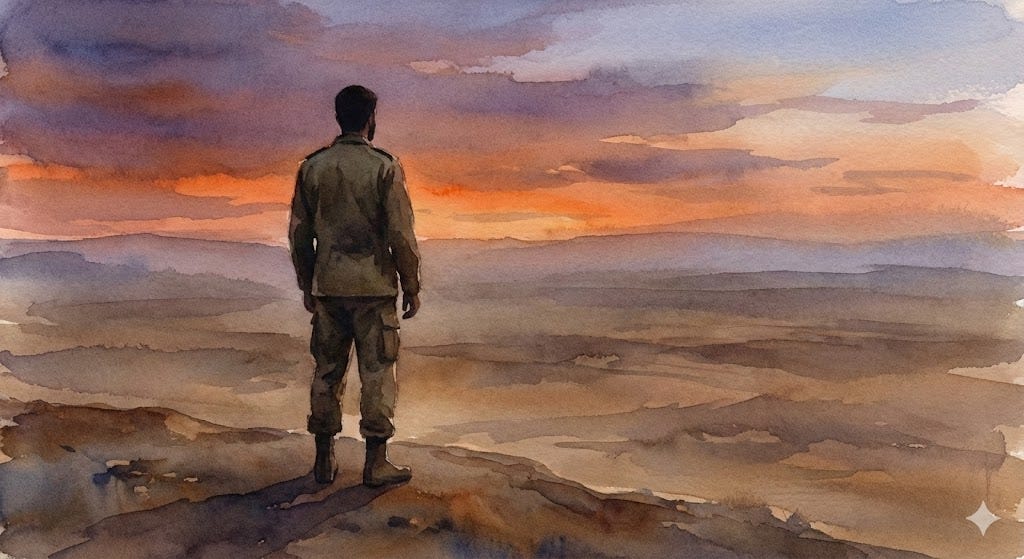
We saw this spirit embodied in our own time by a man who commanded armies that reshaped the entirety of West Asia.
Hajj Qassem Soleimani was, by any material metric, one of the most powerful generals on earth.
He walked with presidents and kings.
His strategic mind liberated cities and broke the back of Daesh.
His name struck terror into the hearts of the CIA and Mossad.
And yet, when it came time to write his Last Will and Testament, he did not ask for a mausoleum.
He did not ask for titles.
He did not ask to be remembered as “General” or “Commander.”
He wrote:
«همسرم، روی سنگ قبرم بنویسید: سرباز قاسم سلیمانی. بدون نام و القاب. من میخواهم مانند سربازانم باشم.»
“My wife, write on my gravestone: Soldier Qassem Soleimani. Without titles or epithets. I want to be like my soldiers.”
— Shaheed Qassem Soleimani, Wasiyyat-nameh (Last Will and Testament)
He requested to be buried in the martyrs’ cemetery of Kerman, next to a simple Basiji — Martyr Yousef Elahi — not in a separate shrine, not with the honours of a commander, but as one soldier among many.
He rejected “General.”
He rejected “Commander.”
He chose the title that Ali ibn Muhammad al-Samarri wore a thousand years before him:
Soldier.
Because in the camp of the Mahdi, there are no Generals.
There is only the Imam, and his soldiers.
The Architect of Victory
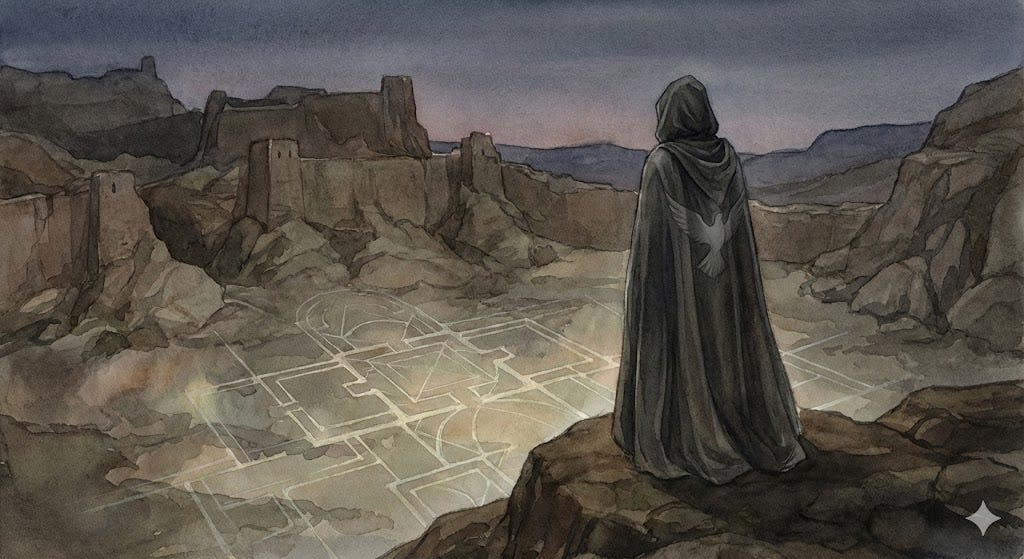
And there was another — a man even more hidden than Hajj Qassem.
Hajj Imad Mughniyeh — known to the Resistance by his operational name, Hajj Radwan — was the military architect behind the liberation of South Lebanon in 2000 and the victory of the July War in 2006.
He was called Qa’id al-Intisarayn — the Commander of the Two Victories.
He was called Muhandis al-Intisar — the Architect of Victory.
But perhaps the most fitting title was given by Sayyed Hassan Nasrallah himself:
Al-Jundi al-Majhul — The Unknown Soldier.
For decades, Hajj Radwan operated in total obscurity.
The enemy did not know his face.
The world did not know his name.
He never sought the podium.
He never gave interviews.
He never appeared on camera.
He built the infrastructure of victory in silence, trained the fighters in silence, planned the operations in silence — and when the victories came, he remained in silence.
He did not live for recognition.
He lived for the mission.
And when he was martyred in 2008, the world discovered that the most dangerous man in West Asia — according to the enemy’s own assessment — had been a ghost walking among them for thirty years.
This is the lineage of the Fourth Deputy.
This is what it means to be a soldier of the Imam.
The True Definition of a Soldier
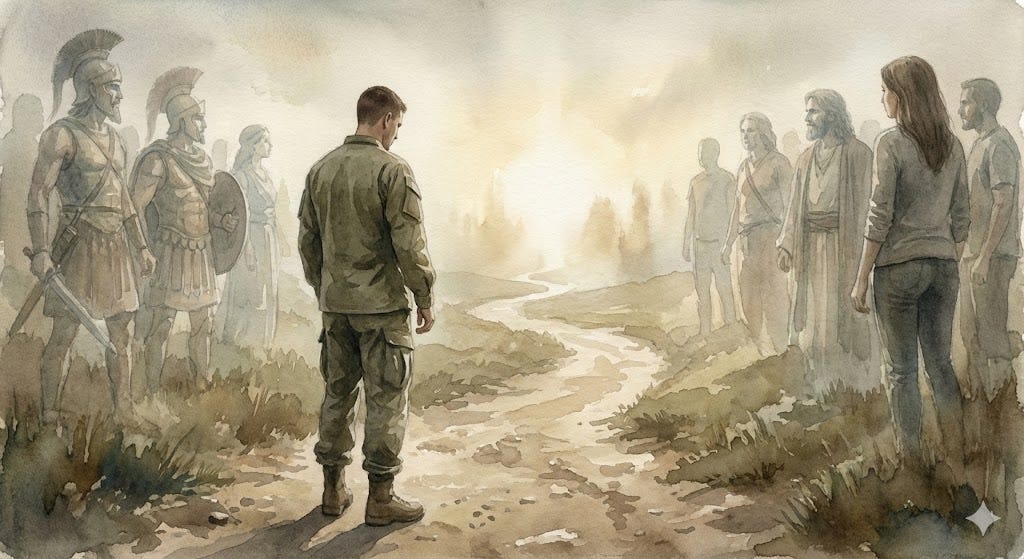
But what does it mean to be a soldier?
In our confused times, we often mistake loyalty to a Person for loyalty to a Cause.
We attach ourselves to charismatic figures, celebrity speakers, famous commanders — and when they fall or fail or die, our loyalty evaporates.
But this is not soldiering.
This is fandom.
Even in the secular world, they understand this distinction.
The American Oath
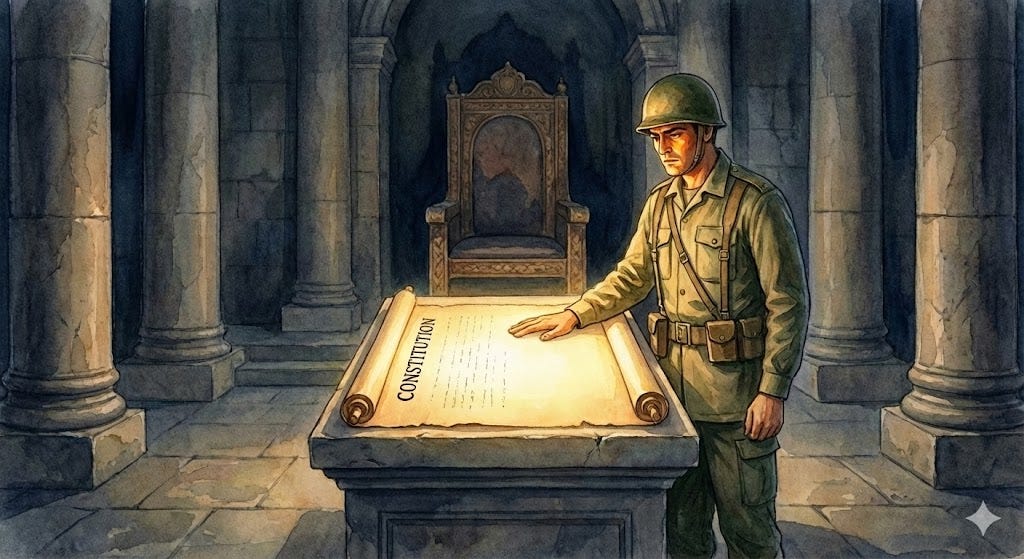
When a soldier enlists in the United States military, he does not swear allegiance to the President.
He swears:
"I do solemnly swear that I will support and defend the Constitution of the United States against all enemies, foreign and domestic; that I will bear true faith and allegiance to the same..."
— United States Armed Forces, Oath of Enlistment
He swears to the System — the Constitution — not the Man.
The President is obeyed only insofar as his orders align with that foundational document.
A soldier is sworn to protect the structure of the nation, even — theoretically — against “domestic enemies,” which could include corrupt leaders who violate the very Constitution they are meant to uphold.
The British Oath
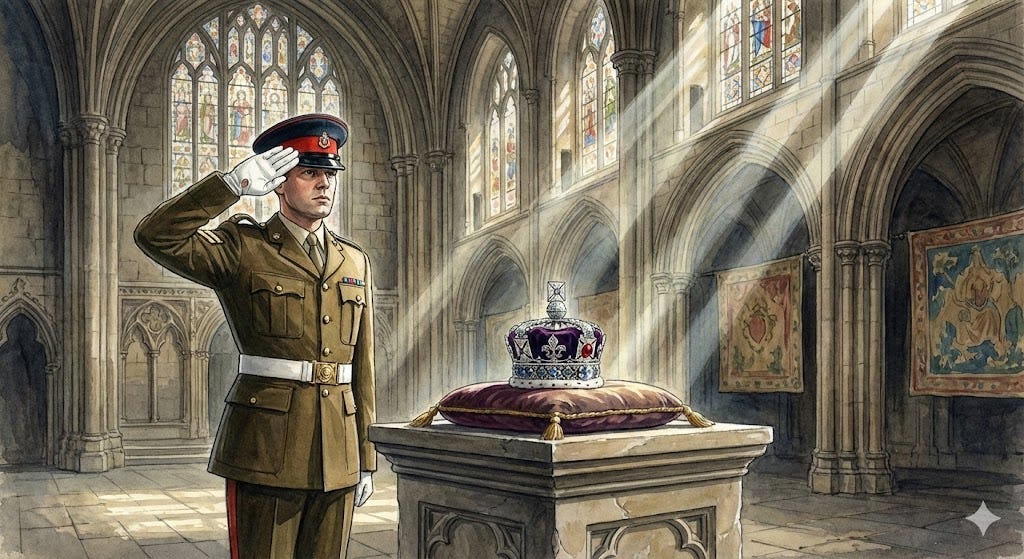
When a soldier enlists in the British Army, he does not swear to the Prime Minister.
He swears:
“I swear by Almighty God that I will be faithful and bear true allegiance to His Majesty King Charles III, his heirs and successors, according to law...”
— British Army, Oath of Allegiance
The Monarch represents the State and the People — the continuity of the nation across generations.
The loyalty is not to the politician of the moment, but to the symbol of enduring nationhood.
The Revolutionary Oath
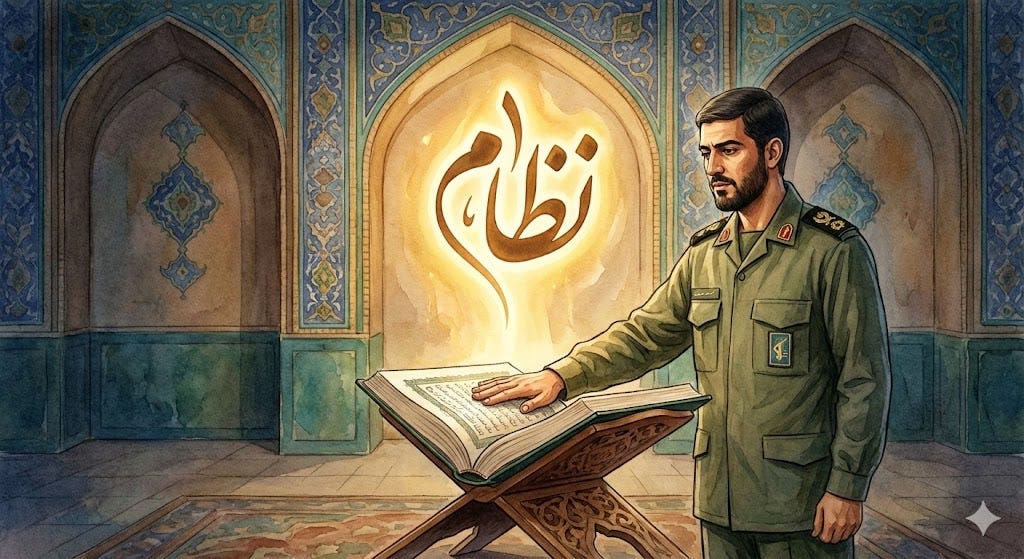
And when we look to the armies of the Resistance — the defenders of the Shrine and the Revolution — we see this principle elevated to its divine reality.
When a soldier of the Islamic Republic takes his oath, he does not swear to a politician.
He places his hand on the Quran and declares:
«من به عنوان یک نظامی در ارتش جمهوری اسلامی ایران به کلام الله مجید سوگند یاد میکنم که... پاسدار استقلال و تمامیت ارضی و نظام جمهوری اسلامی ایران باشم.»
“I, as a military personnel in the Army of the Islamic Republic of Iran, swear by the Glorious Word of God (Quran) that... I shall be a guardian of the independence, territorial integrity, and the System (Nizam) of the Islamic Republic of Iran.”
— The Oath of the Armed Forces of the Islamic Republic of Iran (Artesh)
The loyalty is sworn to the Nizam — the System — and to the Quran.
Not to the President.
Not to any individual commander.
To the System and to God’s Word.
The Statute of the Guards
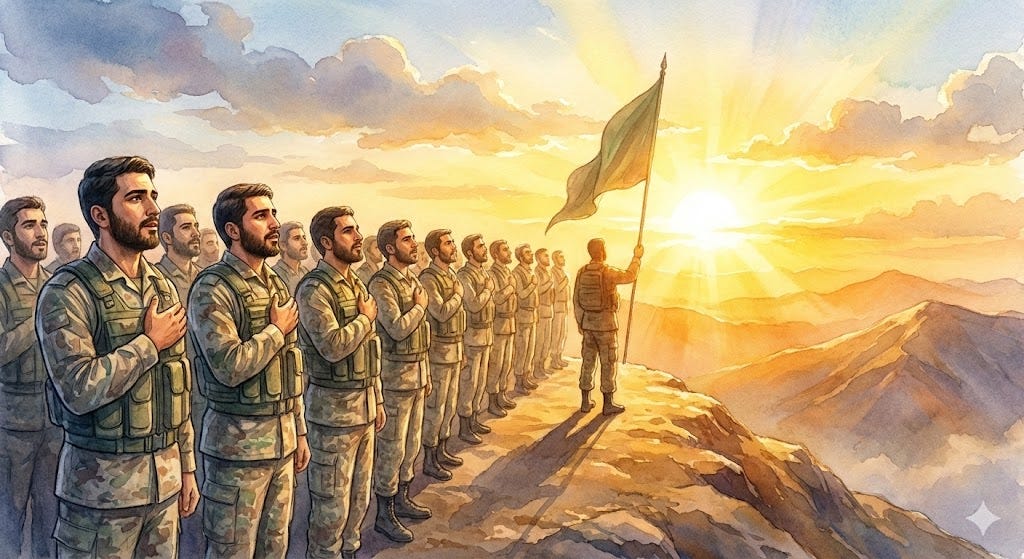
The Islamic Revolutionary Guard Corps takes this even further.
Their founding Statute — the Asasnameh — defines their purpose not as protecting a border or a person, but as protecting the Revolution itself:
«سپاه پاسداران انقلاب اسلامی نهادی است... که هدف آن نگهبانی از انقلاب اسلامی ایران و دستاوردهای آن و کوشش مستمر در راه تحقق آرمانهای الهی و گسترش حاکمیت قانون خدا... میباشد.»
“The Islamic Revolutionary Guard Corps is an institution... whose goal is the guarding of the Islamic Revolution of Iran and its achievements, and continuous striving in the way of realising Divine Ideals and expanding the sovereignty of God’s Law...”
— Statute of the IRGC, Chapter 1, Article 1
And in their morning ceremonies — from the officers in Tehran to the defenders in Lebanon — their ultimate allegiance is not to a mortal commander.
They sing “Salam Farmandeh” — Peace be upon the Commander.
And that Commander is not a President.
It is the Awaited Imam.
They obey the Supreme Leader — the Wali al-Faqih — not because of his personality, not because of his charisma, but because of his position as the General Deputy of the Infallible, the flag-bearer until the Imam arrives.
The Theological Root
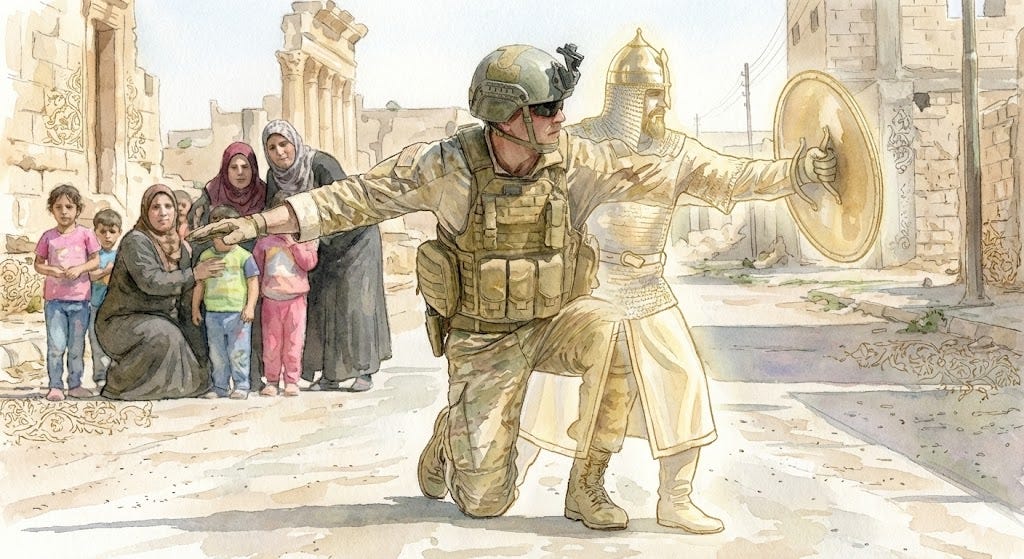
This understanding did not begin with the Islamic Revolution.
It was articulated fourteen centuries ago by the Commander of the Faithful himself.
In his famous letter to Malik al-Ashtar — the constitution of Islamic governance — Imam Ali, peace be upon him, defined the role of the soldier:
«فَالْجُنُودُ، بِإِذْنِ اللهِ، حُصُونُ الرَّعِيَّةِ»
“Soldiers are, by the permission of God, the fortresses of the subjects (the people).”
— Nahj al-Balaghah, Letter 53 to Malik al-Ashtar
Not the fortresses of the king.
Not the fortresses of the politician.
The fortresses of the people.
A true soldier is a shield for the nation and the Truth — not a mercenary for a personality.
The Lesson
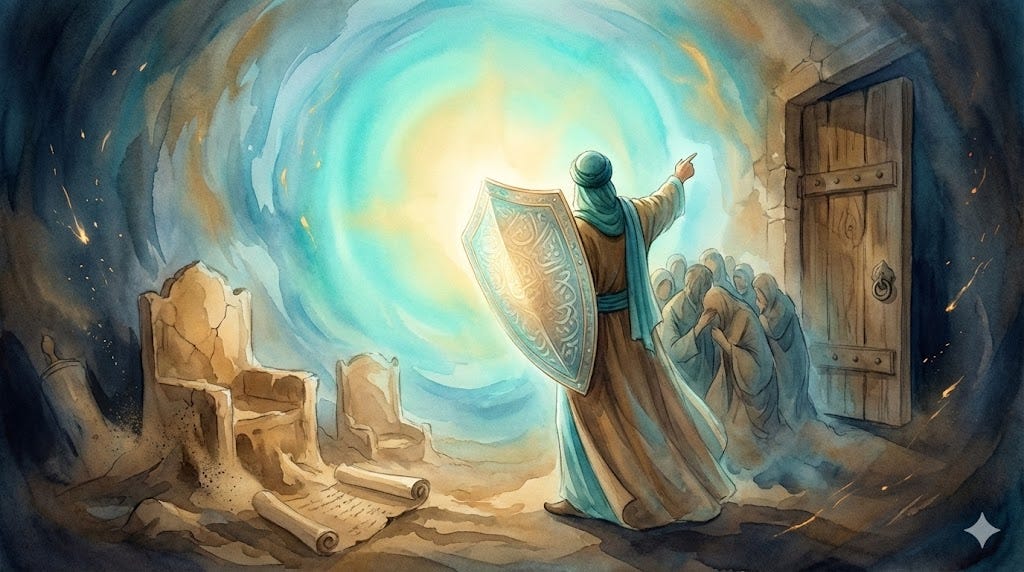
If secular armies — armies built on man-made constitutions and symbolic monarchies — understand that you must fight for a Foundation and not a Personality, how much more so the Army of the Imam?
Our oath is not to a “Celebrity Shaykh.”
It is not to an “Influencer.”
It is not to whoever has the most viral clip this week.
Our oath is to the System of Wilayah — to the Truth itself, and to the defence of the oppressed, wherever they may be.
This is the legacy of the Fourth Deputy.
He was not a celebrity.
He was a shield.
And when his watch ended, he did not point to himself — he pointed to the Imam, and then he closed the door.
The Contemporary Problem: The Celebrity Shaykh

This creates a sharp and uncomfortable contrast with the culture we see developing in parts of our community today.
We live in the age of the “Influencer Scholar.”
We have begun to judge truth by “Likes” and “Views.”
We follow charisma, not knowledge.
We follow eloquence, not piety.
We follow the one who makes us feel good, not the one who makes us become good.
If a scholar isn’t “famous,” if he doesn’t have a viral clip, if he doesn’t speak with the cadence of a performer, we assume he isn’t “important.”
We have confused Influence with Wilayah.
We have confused Popularity with Piety.
We have confused Entertainment with Guidance.
The Fourth Deputy challenges us:
Do you follow the Loudest Voice or the Truest Voice?
Consider:
The Marjaiyyah — the system that al-Samarri prepared us for — often speaks softly.
Ayatullah Sistani sits in a rented house in a narrow alleyway in Najaf, unseen by cameras for decades.
He does not give interviews.
He does not seek publicity.
He issues his rulings, guides his representatives, and continues his work in near-total obscurity — and yet, when Daesh swept through Iraq and the nation teetered on the edge of annihilation, it was his single fatwa that mobilised hundreds of thousands to defend the shrines.
That is weight.
That is authority.
That is Wilayah.
Imam Khamenei speaks with the precision of a jurist, not the theatrics of a performer.
His Friday sermons are not designed to go viral.
They are designed to guide.
Meanwhile, the cult leaders — the imposters, the Shalmaghanis of our age — are always screaming.
They have the flashiest graphics.
They have the most emotional rhetoric.
They have the most aggressive marketing.
They tell you what you want to hear.
They validate your anger without directing it.
They offer you the satisfaction of outrage without the discipline of transformation.
But who held the door?
Who saved the legacy?
Who protected the Imam’s secret when the cost was anonymity and the reward was silence?
It was the Unknown Soldier.
It was the one who feared nothing but his own sins.
The Hijacking of Pain: A Warning
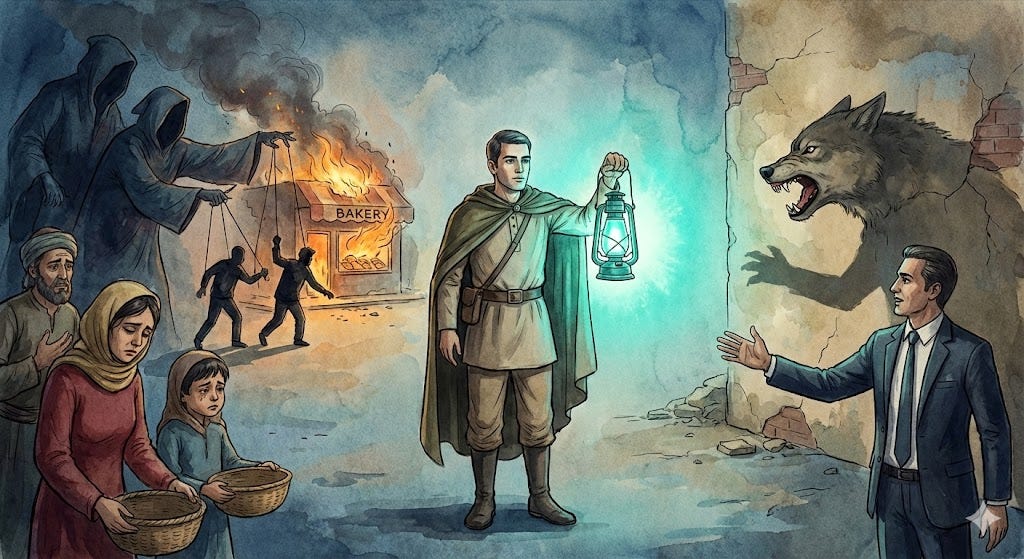
This distinction — between the System and the Agitator — is critical in our present moment.
We see protests erupting across the world — in Iran, in the West, in the Arab world.
People come to the streets with legitimate grievances.
The economy is difficult.
Corruption exists.
Reforms are needed.
These complaints are real.
And the true soldier listens to the pain of the people — because he is their fortress, not their adversary.
But we also see something else.
We see the Hijacking.
We see legitimate cries for reform manipulated by those with ulterior motives.
Just as Shalmaghani used the spiritual hunger of the Shia to build his own cult, modern intelligence agencies and bad actors use the economic pain of the people to fuel chaos.
They do not want to solve the problem.
They want to burn the house down.
The media — those who claim to inform but exist to inflame — do not seek to calm the situation or find solutions.
They pour gasoline.
And the politicians — men like those who scream about “peace” while watching genocide unfold with total impunity — use the chaos to make threats.
They offer ceasefires with one hand while arming the oppressor with the other.
They tell the victim to disarm while the wolf sharpens its teeth.
What sane person would disarm in the face of a wolf?
This is the absence of justice in our world.
And the true soldier — the one modelled after al-Samarri and Hajj Qassem and Hajj Radwan — does not stay silent in the face of this theatre.
But neither does he become its puppet.
He possesses Basirat — Insight.
He knows the difference between a Protester asking for bread and a Rioter paid to burn the bakery.
He knows the difference between a Reformer seeking to improve the system and an Agent seeking to destroy it.
He knows that not every voice crying “Justice!” is just — and not every voice defending the system is a defender of injustice.
He thinks.
He discerns.
He refuses to be a pawn.
Healing the Divide
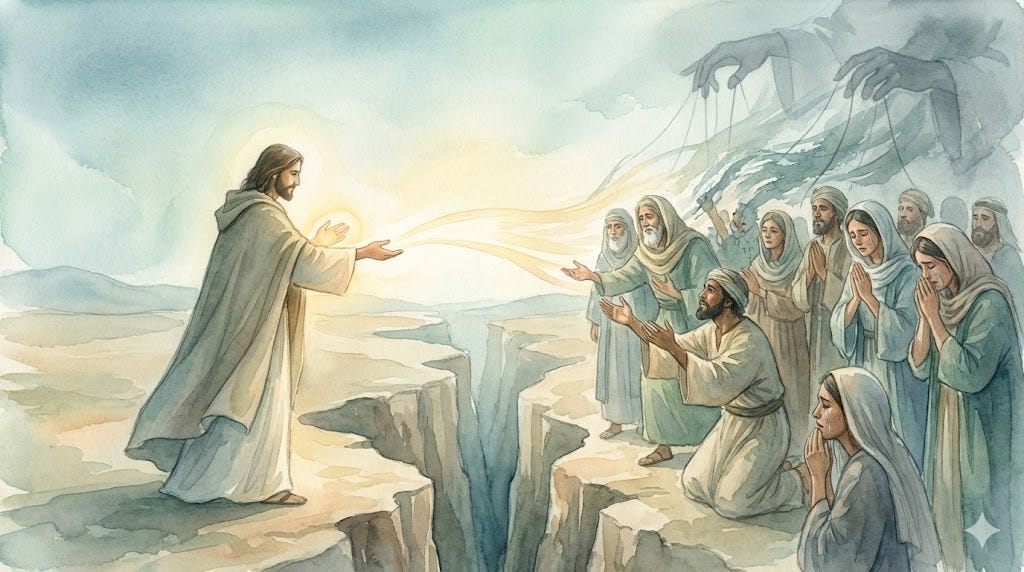
This insight is what we need within our own community.
We spoke in our previous session about the rift between the Revolutionary line and other groups — the legacy of scholarly disputes that metastasised into something far more destructive.
Let us be absolutely clear:
This is not about ostracising our brothers.
We do not condemn entire groups of people.
Many who follow alternative scholarly trends are sincere lovers of the Ahl al-Bayt.
They weep for Imam Husayn.
They serve the poor.
They fast.
They pray.
Their love is real.
The problem is not their love.
The problem is the manipulation of their love.
Just as the rioters hijack the protests of the hungry, the enemies of Islam hijack the sincere emotions of believers.
They weaponise love for the Imam to create hatred against fellow Muslims.
They use the passion of the youth to fracture the community at the moment of its greatest trial.
Our role is not to attack these brothers.
Our role is to offer a hand.
To educate.
To bring clarity.
To say:
“Brother, your love is beautiful.
But do not let your love be used as a sword to stab your own community in the back.
Do not let your grief for Imam Husayn become a weapon against the soldiers of Imam Husayn’s grandson.”
We must be like the Fourth Deputy — quiet, steady, focused on the System, not the noise.
We must be soldiers who shield the people from deception, just as we shield them from bombs.
This is the character of the Final Guard.
Call to Clarity: On Which Side will we Stand?
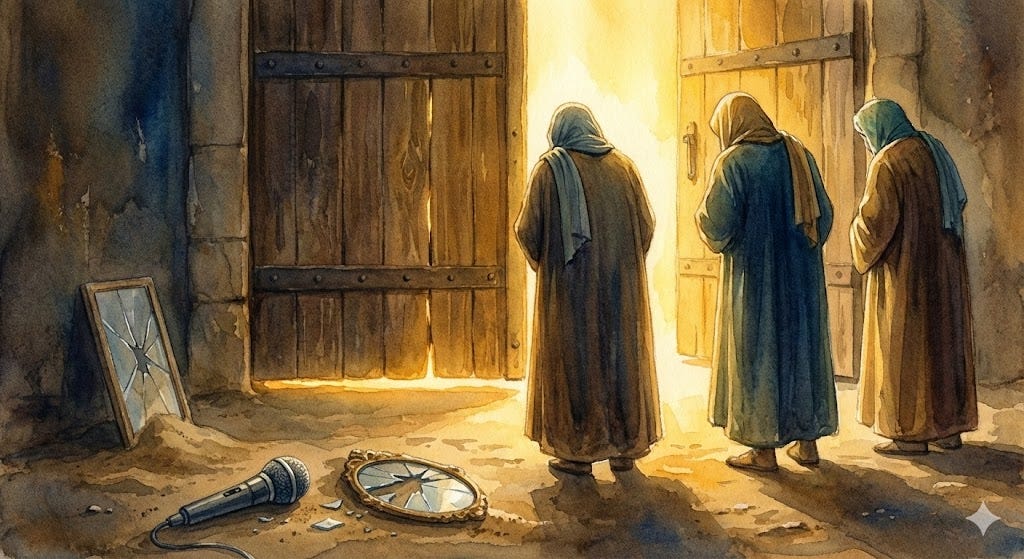
And so we return to the question:
Are we obsessed with the Celebrity Shaykh?
In the age of social media, have we confused “Influence” with “Wilayah”?
Do we follow the one who entertains us, or the one who transforms us?
Do we follow the one who validates our anger, or the one who disciplines our soul?
The Fourth Deputy — the man with no famous books, no court dramas, no viral moments — was entrusted with the most critical task in the history of the Minor Occultation.
He teaches us that the highest station is often the most invisible.
He teaches us that true authority does not need to scream.
He teaches us that in the camp of the Mahdi, there is no room for ego — only service.
When we stand before God, He will not ask us:
“How many followers did you have?”
He will ask:
“Were you loyal? Were you a fortress for My people?
Did you fear Me, or did you fear your own anonymity?”
May we be among those who fear nothing but our own sins.
May we be among the Unknown Soldiers.
May we be counted in the camp of al-Samarri, and Hajj Qassem, and Hajj Radwan — men who held the line, closed the door, and never asked for applause.
The Divine Warning: The Final Tawqi’
The Historical Moment: Six Days Before the End
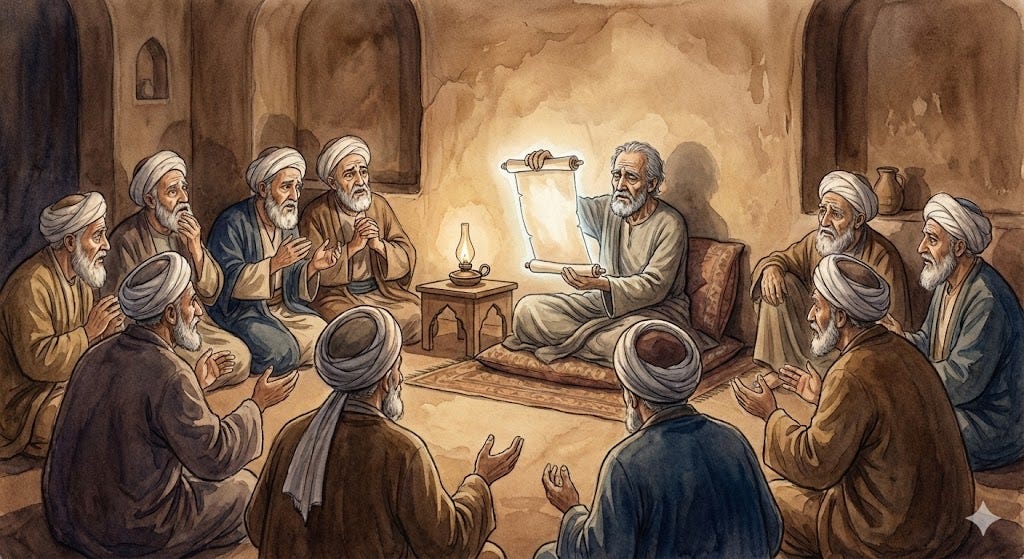
On the 9th of Sha’ban, 329 AH, the leading scholars and elders of the Shia community gathered at the house of Ali ibn Muhammad al-Samarri.
The atmosphere was heavy with anticipation.
For nearly seventy years, the community had operated on a specific rhythm: a Deputy would grow old, the elders would gather, and he would name his successor.
Uthman ibn Sa’id had named Muhammad ibn Uthman.
Muhammad ibn Uthman had named Husayn ibn Ruh.
Husayn ibn Ruh had named Ali ibn Muhammad al-Samarri.
It was a system they trusted.
It was a hand they held.
Now al-Samarri was aging, visibly weakening.
The elders came with the standard question on their lips:
“Who shall be your successor? Who will be the Fifth Deputy?”
They expected a name.
They expected continuity.
They expected another hand to hold.
Instead, al-Samarri produced a letter.
He did not speak of a person.
He spoke of an End.
He read aloud the final communication from the Holy Presence — the Tawqi’ that would change the course of history.
The Document: A Line-by-Line Analysis
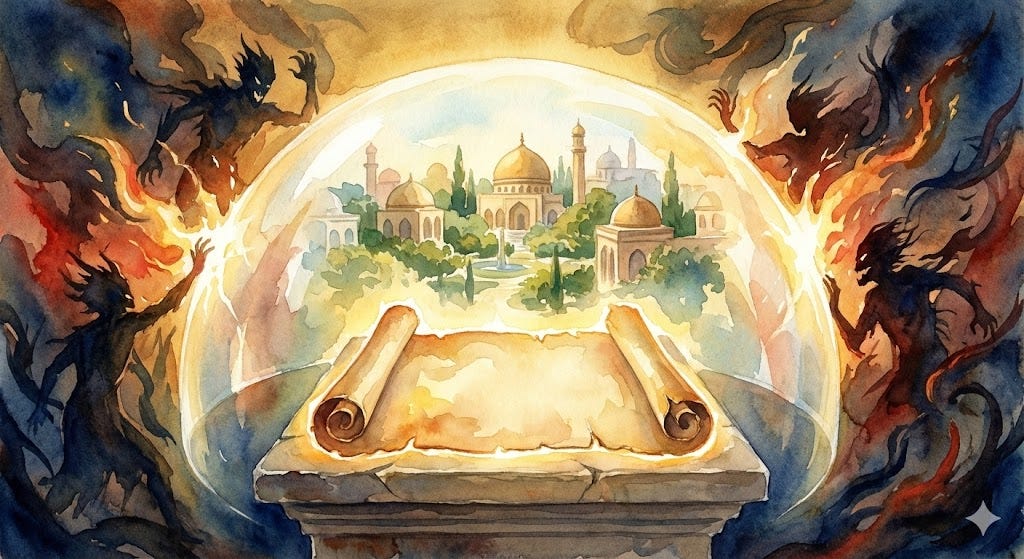
This document is not merely a historical artefact.
It is the legal constitution of the Major Occultation.
It is the firewall that has protected the Shia community from a thousand years of imposters.
Every line carries a profound implication.
Let us examine it with the care it deserves.
The Foreknowledge of Death
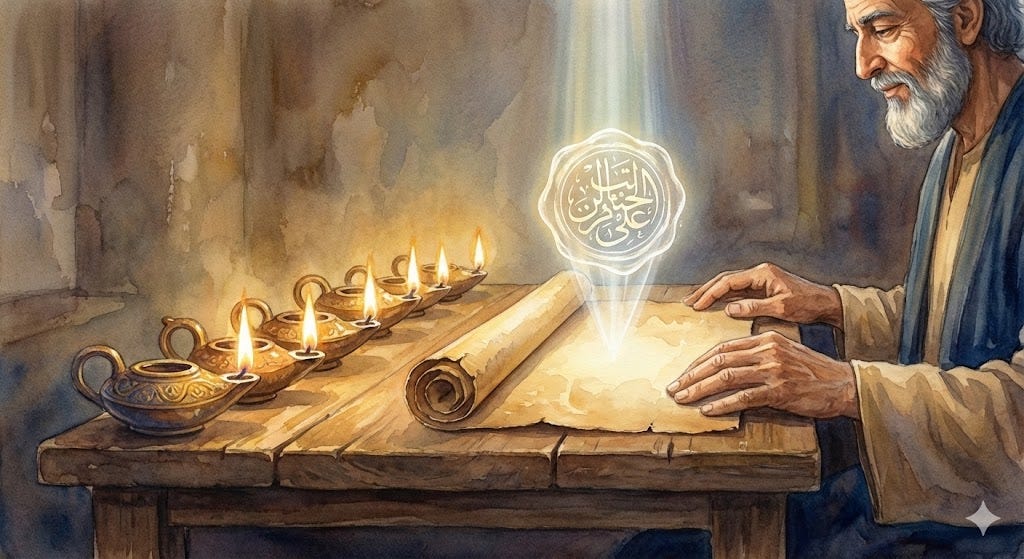
«يَا عَلِيَّ بْنَ مُحَمَّدٍ السَّمُرِيَّ... عَظَّمَ اللَّهُ أَجْرَ إِخْوَانِكَ فِيكَ، فَإِنَّكَ مَيِّتٌ مَا بَيْنَكَ وَبَيْنَ سِتَّةِ أَيَّامٍ.»
“O Ali ibn Muhammad al-Samarri... may God increase the reward of your brothers concerning you, for you shall die within six days.”
—Al-Saduq, Kamal al-Din, Vol. 2, Ch. 45, Hadith 45
—Al-Tusi, Kitab al-Ghaybah by Al-Tusi, Page 395
The letter begins with a miracle.
The Imam predicts the exact moment of his Deputy’s death — not “soon,” not “in the coming weeks,” but six days.
This was the seal of authenticity.
This was proof that the command came from the Knower of the Unseen, through one who had access to knowledge beyond the material world.
No forger could have written this letter after the fact and inserted such precision.
The miracle locks the document into history.
The Closing of the Office
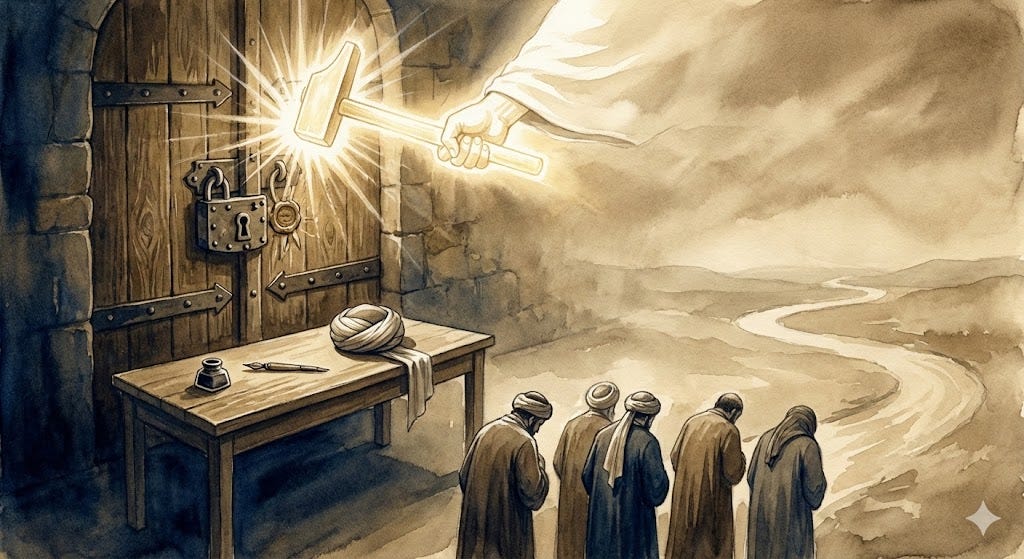
«فَأَجْمِعْ أَمْرَكَ وَلَا تُوصِ إِلَى أَحَدٍ فَيَقُومَ مَقَامَكَ بَعْدَ وَفَاتِكَ.»
“So settle your affairs and do not appoint anyone to take your place after your death.”
—Al-Saduq, Kamal al-Din, Vol. 2, Ch. 45, Hadith 45
—Al-Tusi, Kitab al-Ghaybah by Al-Tusi, Page 395
This is the hammer blow.
La tusi ila ahad — Do not appoint anyone.
The lineage of Niyabah Khassah (Specific Deputyship) ends with you.
There will be no Fifth Deputy.
There will be no “Gate” to knock on.
There will be no name to invoke when seeking direct access to the Imam.
The office is closed.
The door is sealed.
The community must now learn to walk without a specific hand to hold.
The Declaration of the Major Occultation
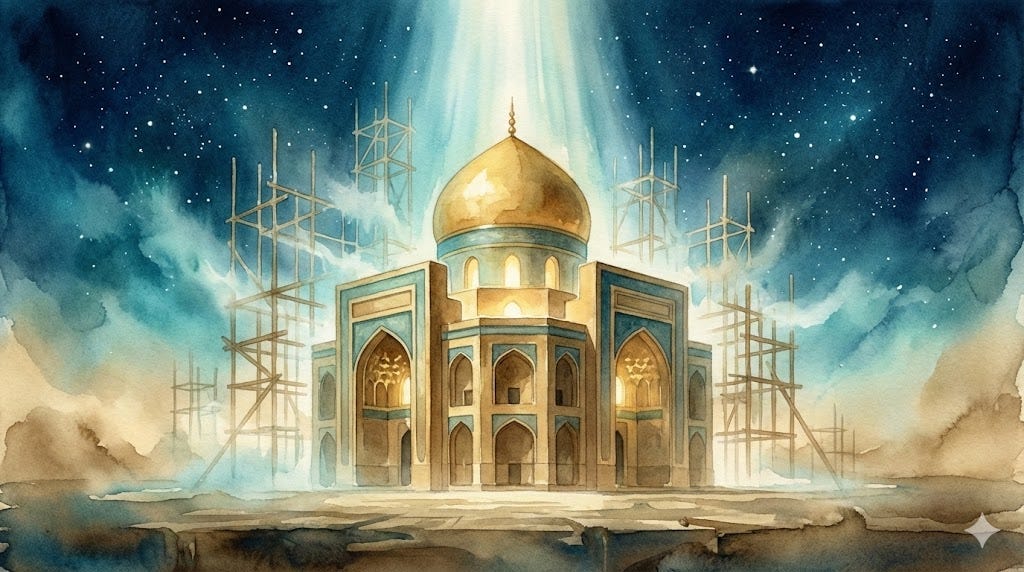
«فَقَدْ وَقَعَتِ الْغَيْبَةُ التَّامَّةُ...»
“For the Complete Occultation (Al-Ghaybah al-Tammah) has occurred.”
—Al-Saduq, Kamal al-Din, Vol. 2, Ch. 45, Hadith 45
—Al-Tusi, Kitab al-Ghaybah by Al-Tusi, Page 395
With this single phrase, the Imam declares the shift from Ghaybat al-Sughra (the Minor Occultation) to Ghaybat al-Kubra (the Major Occultation).
The training wheels are off.
The scaffolding is removed.
The building must now stand on its own.
The Condition for Return
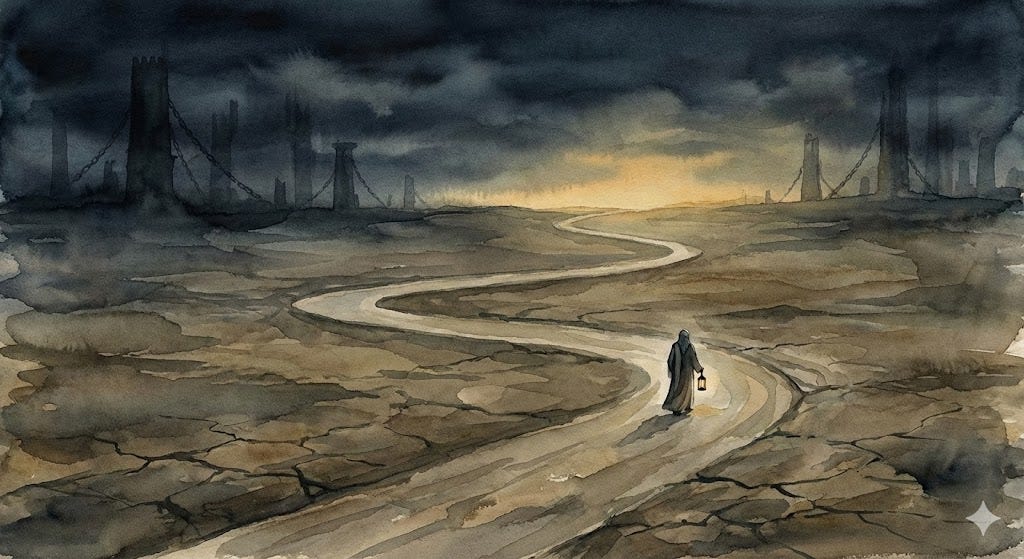
«وَلَا يَكُونُ الظُّهُورُ إِلَّا بَعْدَ إِذْنِ اللَّهِ تَعَالَى ذِكْرُهُ، وَذَلِكَ بَعْدَ طُولِ الْأَمَدِ، وَقَسْوَةِ الْقُلُوبِ، وَامْتِلَاءِ الْأَرْضِ جَوْرًا.»
“And my appearance shall not be until after the permission of God, Exalted be His mention — and that is after a long time, the hardening of hearts, and the filling of the earth with tyranny.”
—Al-Saduq, Kamal al-Din, Vol. 2, Ch. 45, Hadith 45
—Al-Tusi, Kitab al-Ghaybah by Al-Tusi, Page 395
The Imam does not offer false hope.
He does not say, “I will return next year” or “in a generation.”
He says: after a long time.
He says: after hearts have hardened.
He says: after the earth is filled with tyranny.
This is not pessimism.
This is preparation.
He is telling the community:
Do not expect a quick rescue.
Prepare for the long road.
The night will be dark before the dawn.
And we have walked that road for over a thousand years.
We are still walking.
The Litmus Test: The Anti-Cult Clause
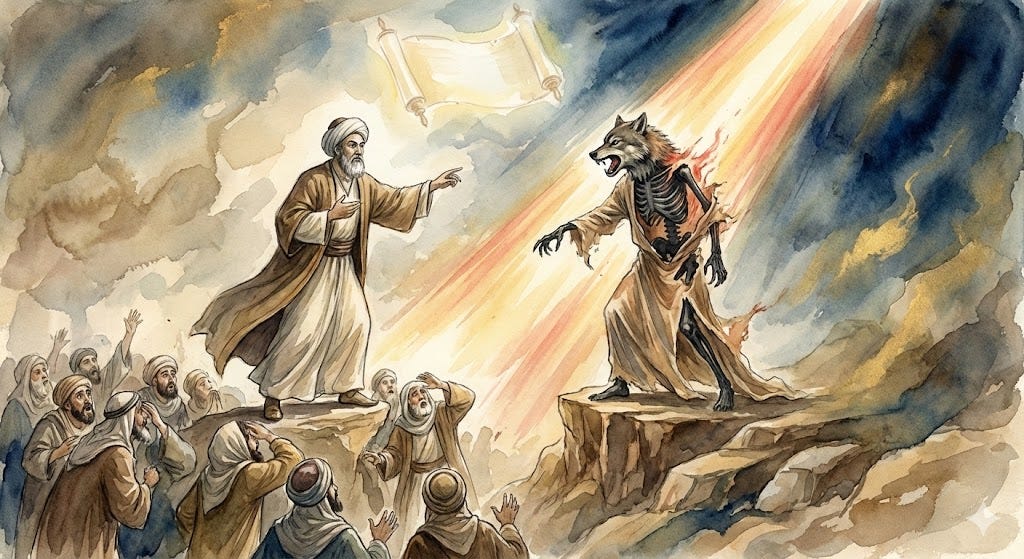
But the most critical part of the letter — the part that protects us today, in this very moment — is the final warning.
The Imam knew that in his absence, wolves would don the clothes of the shepherd.
He knew that charlatans would arise claiming to be his “Special Representative,” his “Son,” his “Ambassador,” his “Messenger.”
He knew that the desperation of the faithful — their longing for connection, for certainty, for a hand to hold — would be exploited by predators.
So he gave us a weapon to destroy them:
«وَسَيَأْتِي لِشِيعَتِي مَنْ يَدَّعِي الْمُشَاهَدَةَ. أَلَا فَمَنِ ادَّعَى الْمُشَاهَدَةَ قَبْلَ خُرُوجِ السُّفْيَانِيِّ وَالصَّيْحَةِ فَهُوَ كَذَّابٌ مُفْتَرٍ.»
“And there will come to my Shia those who claim to have seen me [claiming special deputyship]. Beware! Whoever claims such observation before the rising of the Sufyani and the [Heavenly] Cry is a liar and a slanderer.”
— Al-Saduq, Kamal al-Din wa Tamam al-Ni’mah, Vol. 2, Chapter 45, Hadith 45
— Al-Tusi, Kitab al-Ghaybah, Page 395
Kadhdhab Muftari — a liar and a slanderer.
Not “mistaken.”
Not “possibly sincere but confused.”
A liar.
A slanderer.
The Imam himself pronounced the verdict — fourteen centuries in advance — on every false claimant who would arise.
A Necessary Clarification
We must be precise here, because this passage is often misunderstood.
The Imam is not saying that seeing him is impossible.
Many great scholars throughout history — men of impeccable piety and rigorous scholarship, like Sayyed ibn Tawus, Allamah Hilli, and others — have reportedly met the Imam during the Major Occultation.
These meetings are not denied by the tradition.
But there is a critical difference.
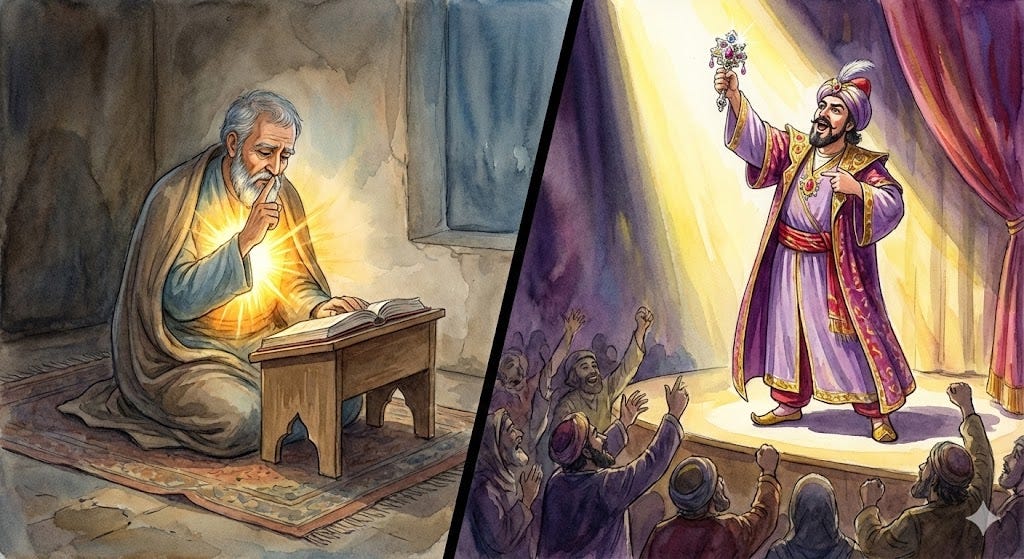
The true scholar — even a true believer — meets the Imam and keeps it a secret.
He does not use the encounter to claim authority.
He does not say,
“I saw the Imam, and he told me to tell you X.”
He does not build a following based on the meeting.
He returns to his work — his teaching, his jurisprudence, his service — and continues as before, perhaps transformed internally, but never using the encounter as a credential.
The liar meets the Imam — or claims to meet him — and uses it to build a cult.
He says:
“I have special access.
I am his representative.
Follow me, not the scholars.”
He leverages the claim of Mushahadah (observation) to bypass the established system of guidance.
This is what the Imam condemned.
This is what makes one a Kadhdhab Muftari.
The distinction is not between “seeing” and “not seeing.”
The distinction is between humility and exploitation.
The Modern Application: The War on “Shortcut Spirituality”
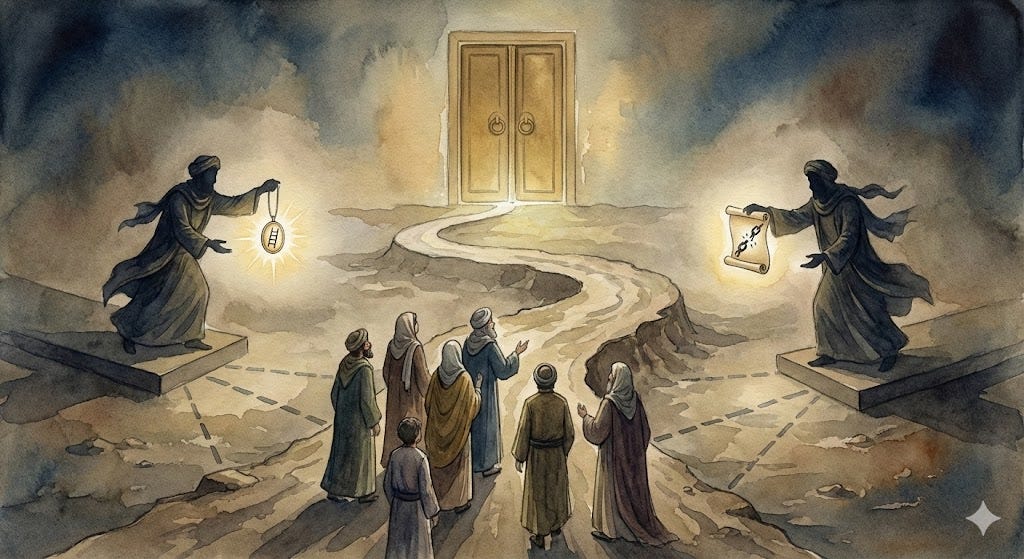
Why did the Imam close the door so firmly?
Why did he pronounce such a severe verdict on those who would claim special access?
Because he knew the weakness of the human soul.
He knew that without a closed door, the community would be torn apart by imposters — each one claiming a “special connection,” each one demanding allegiance, each one fragmenting the unity that the Deputies had spent seventy years building.
And today — in our own time — we see exactly what he warned against.
A Necessary Distinction: The True Yamani
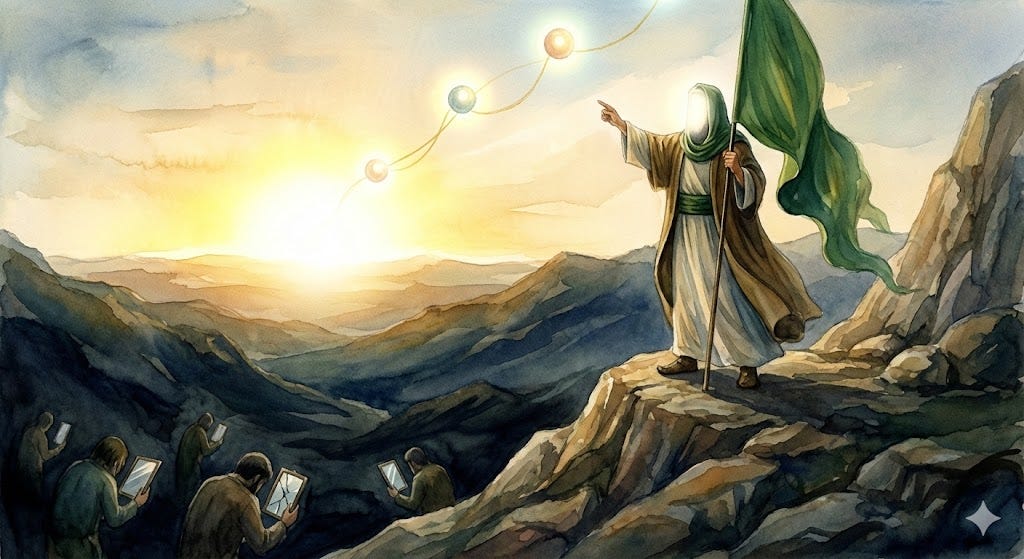
Before we examine the imposters of our age, we must make an important clarification — lest we inadvertently dishonour a hero of our faith.
The authentic narrations of the Ahl al-Bayt speak of a noble figure who will rise in the End Times: Al-Yamani al-Haqiqi — the True Yamani.
Imam al-Baqir, peace be upon him, describes him through Imam al-Sadiq:
«وَلَيْسَ فِي الرَّايَاتِ رَايَةٌ أَهْدَى مِنْ رَايَةِ الْيَمَانِيِّ، هِيَ رَايَةُ هُدًى، لِأَنَّهُ يَدْعُو إِلَى صَاحِبِكُمْ... وَلَا يَحِلُّ لِمُسْلِمٍ أَنْ يَلْتَوِيَ عَلَيْهِ، فَمَنْ فَعَلَ ذَلِكَ فَهُوَ مِنْ أَهْلِ النَّارِ، لِأَنَّهُ يَدْعُو إِلَى الْحَقِّ وَإِلَى طَرِيقٍ مُسْتَقِيمٍ.»
“There is no banner among the banners more guided than the banner of the Yamani. It is a banner of guidance because he calls to your Master [the Imam]... It is not lawful for any Muslim to turn away from him. Whoever does so is from the people of the Fire, because he calls to the Truth and to a Straight Path.”
— Al-Nu’mani, Al-Ghaybah, Chapter 14, Hadith 13
This is a man of immense spiritual rank — one whose banner the Imams themselves have praised.
But note carefully his defining characteristics:
First: He calls to the Imam — not to himself. His entire mission is to point toward the Mahdi, not to gather followers for his own pocket.
Second: He rises simultaneously with the Sufyani and the Khurasani — on the same day, in the same month, in the same year, “like beads on a string,” as the narration states.
«خُرُوجُ الثَّلَاثَةِ: الْخُرَاسَانِيِّ وَالسُّفْيَانِيِّ وَالْيَمَانِيِّ فِي سَنَةٍ وَاحِدَةٍ فِي شَهْرٍ وَاحِدٍ فِي يَوْمٍ وَاحِدٍ...»
“The rising of the three: The Khurasani, the Sufyani, and the Yamani will be in one year, in one month, and on one day...”
— Al-Mufid, Al-Irshad, Vol. 2, Page 375
— Al-Tusi, Al-Ghaybah, Page 446
Third: He rises from Yemen — not metaphorically, but literally, geographically.
«وَخُرُوجُ السُّفْيَانِيِّ مِنَ الشَّامِ وَالْيَمَانِيِّ مِنَ الْيَمَنِ»
“The rising of the Sufyani from Sham (Syria) and the Yamani from Yemen.”
— Al-Saduq, Kamal al-Din, Page 331
Why does this matter?
Because counterfeits only exist when the original has value.
No one forges a worthless currency.
The Shaytan creates “fake Yamanis” precisely because the real Yamani will be a devastating blow against falsehood.
The imposters hijack his name because the name has power.
But they fail every test:
The true Yamani calls to the Imam; the imposter calls to himself.
The true Yamani rises with the Sufyani; the imposter rises decades early.
The true Yamani emerges from Yemen; the imposter emerges from Basra or London or wherever ambition plants him.
This is why, from this point forward, we will not dignify these charlatans with the title “Yamani” — even as “false Yamani.”
They are not Yamanis at all.
They are false messiahs.
They are imposters.
They are claimants to special deputyship — the very category the Imam condemned as “liars and slanderers” in the Final Tawqi’.
Let us not pollute the noble title with their names.
The Imposter of Basra
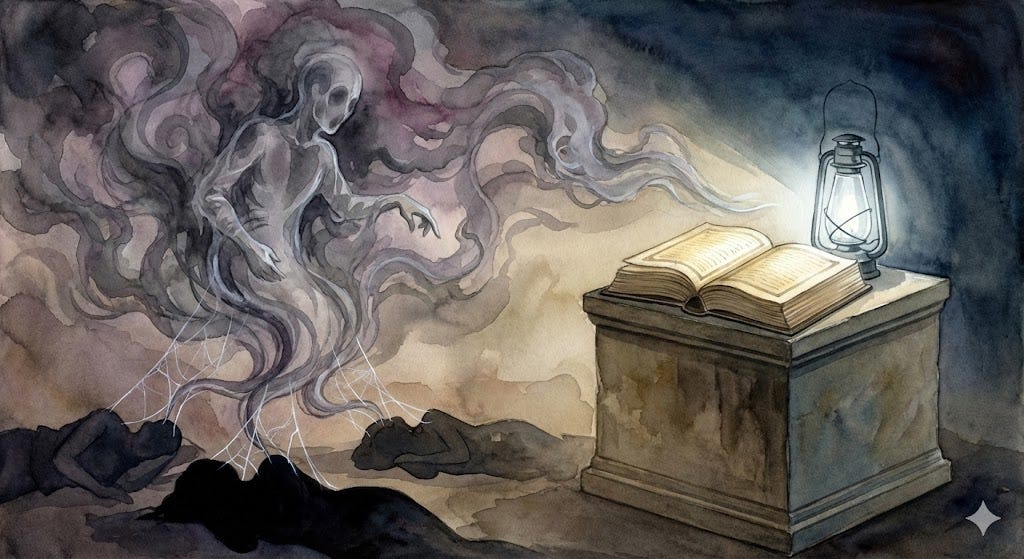
In the chaos of post-2003 Iraq, a man named Ahmed al-Hassan emerged in Basra, claiming to be the “Yamani” — a figure mentioned in the narrations as a helper of the Imam.
But he did not stop there.
He claimed to be the “Messenger” of the Imam.
He claimed to be the “Son” of the Imam.
He built a cult that spread across Iraq, attracted followers in the West, and caused immense confusion among the youth.
His methodology was the exact opposite of the System.
The System — the Marjaiyyah — relies on Fiqh (Jurisprudence) and Aql (Reason).
It asks for proof.
It demands evidence.
It can be questioned, challenged, audited.
The Imposter relies on Ru’ya (Dreams).
He tells his followers:
“Do not listen to the scholars who use logic.
Logic is from Satan.
Listen to your dreams.
If you see me in a dream, that is proof.
Follow me.”
The great researcher of Mahdism, Ayatullah Shaykh Ali al-Korani, diagnosed this disease with precision in his work Dajjal al-Basra (The Imposter of Basra):
«إنَّ حركةَ اليماني المزعومِ تعتمدُ على سلاحِ “الأحلام” و”الرؤى” لتعطيلِ عقولِ الناس... إنهم يقولون للناس: لا تتبعوا الفقهاء، بل اتبعوا مَن رأيتموه في المنام!»
“Indeed, the movement of the alleged Yamani relies on the weapon of ‘Dreams’ and ‘Visions’ to disable people’s intellects... They tell the people: ‘Do not follow the Jurists, but follow the one you saw in your sleep!’”
— Ayatullah Shaykh Ali al-Korani, Dajjal al-Basra
This is a mechanism to bypass the rational leadership of the Shia.
It replaces Law with Hallucination.
It replaces Scholarship with Sensation.
It replaces the hard work of Taqlid (following qualified scholarship) with the easy seduction of “I had a dream.”
The Trap of the Bizarre
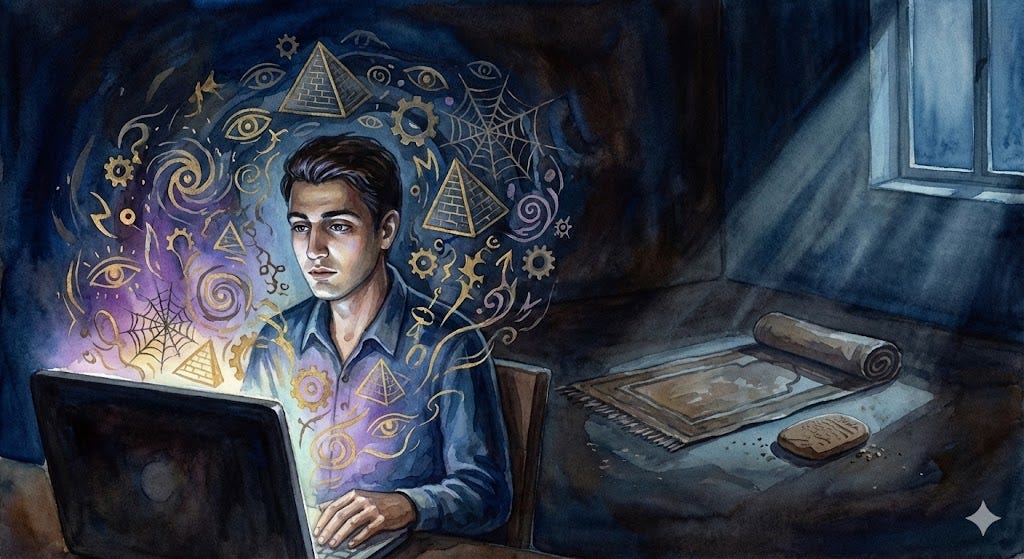
But the Ahmad al-Hasan fake messiah cult is not the only predator.
There is another kind of trap — one that appeals specifically to the educated, English-speaking youth of the West.
We saw the rise and fall of figures who began by “exposing” conspiracies — the Illuminati, the Freemasons, the Dajjal, the hidden hand behind world events.
They captivated millions of minds with videos that promised to reveal
“the truth they don’t want you to know.”
And some of these figures began with sincerity.
But because they lacked Tazkiyah (Purification of the Soul) and Usul (Foundations of Knowledge), they spiralled.
They went from “exposing” the Dajjal to joining cults, and then to forming their own movements, claiming divine status, claiming to be reincarnations of sacred figures.
Why do intelligent people fall for this?
Why do educated youth — people with degrees, people who can think critically about politics and science — surrender their minds to charlatans?
Shaheed Avini gives us the answer.
He explains that the modern soul is bored with the “Obligatory” (Wajib).
Prayer feels mundane.
Fasting feels routine.
The discipline of daily worship — the slow, steady, unglamorous work of building a relationship with God — feels boring.
The soul craves the “Bizarre,” the “Esoteric,” the “Secret Knowledge.”
It wants a shortcut.
It wants to feel special without doing the work.
He writes:
«آن کس که به دنبال “نشانه” میگردد تا از “عمل” فرار کند، سرانجام در دام شیادان گرفتار خواهد شد. دین، “تماشاگری” نیست؛ دین، “مجاهدت” است.»
“The one who searches for a ‘Sign’ in order to escape from ‘Action’ will eventually be trapped in the snares of charlatans. Religion is not ‘Spectatorship’; Religion is ‘Struggle.’”
— Shaheed Sayyed Morteza Avini, Ganjineh-ye Asemani
This is devastating in its precision.
The one who watches conspiracy videos for ten hours but cannot stand for ten minutes of Night Prayer (Salat al-Layl) is not a soldier of the Mahdi.
He is a spectator of the Apocalypse.
He wants the thrill of “hidden knowledge” without the discipline of hidden worship.
He wants to feel enlightened without becoming purified.
And the charlatans know this.
They feed the addiction.
They offer “secrets” instead of obligations.
They offer entertainment instead of transformation.
And the soul, hungry for something beyond the mundane, swallows the poison gladly.
The Intelligence Strategy: Substitute-Making
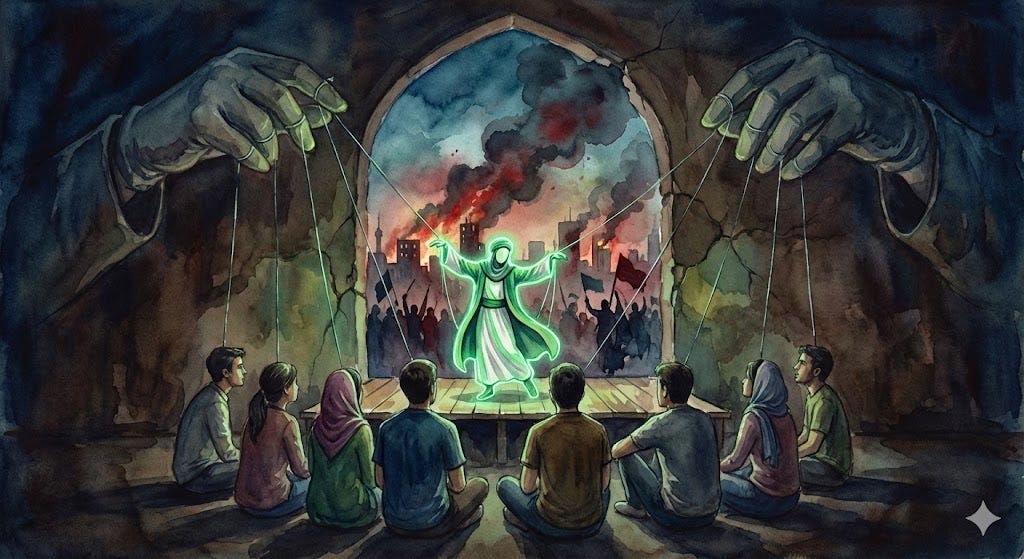
And finally, we must not be naive.
These movements do not emerge in a vacuum.
The late strategic analyst Hajj Nader Talebzadeh — a man who spent decades studying the methods of soft warfare — warned us repeatedly about the concept of Badal-Sazi (Substitute-Making).
He argued that Western intelligence agencies realised they could not defeat the “Political Islam” of Imam Khomeini with tanks and sanctions alone.
The logic of Wilayat al-Faqih was too strong.
The system was too resilient.
The people were too committed.
So they decided to manufacture “Counterfeit Versions.”
They would create alternative forms of “Shia Islam” — forms that looked spiritual, felt mystical, promised secrets — but that had one crucial feature:
They would neutralise the revolutionary spirit.
Hajj Nader explained:
«سرویسهای جاسوسی غرب... به این نتیجه رسیدند که باید “شیعه” را علیه “شیعه” علم کنند... یک جریان، “عرفانهای کاذب” و “مدعیان دروغین” است که جوانان را به انزوا و خلسه میبرد تا کاری به کار سیاست نداشته باشند... هدف نهایی این پروژه این است که جوان شیعه... انقلابی نباشد.»
“Western intelligence services... reached the conclusion that they must prop up ‘Shia’ against ‘Shia’... One current is ‘False Mysticisms’ and ‘False Claimants’ which drive the youth into isolation and trance states so they have nothing to do with politics... The ultimate goal of this project is that the Shia youth... should not be revolutionary.”
— Hajj Nader Talebzadeh, Analysis on Jang-e Narm (Soft Warfare)
Read this carefully.
The goal is not to make the Shia youth atheist.
The goal is to make them distracted.
If the Shia youth are busy fighting over a fake Mahdi in Basra, they are not fighting the real enemy in Tel Aviv.
If the Shia youth are debating conspiracy theories in London, they are not organising to defend the oppressed in Gaza.
If the Shia youth are lost in “esoteric” rabbit holes, searching for “hidden signs” and “secret knowledge,” they are not building institutions, not supporting the Marjaiyyah, not preparing for the real work of the Imam’s return.
They are neutralised.
And the enemy wins without firing a shot.
The Lesson of the Letter
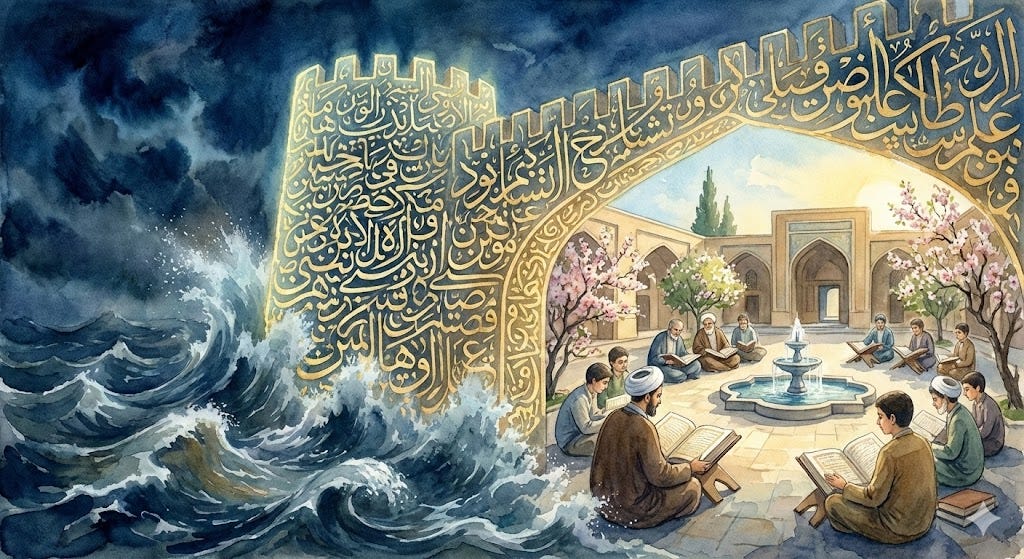
The Final Tawqi’ of the Fourth Deputy was not just a closing of a door.
It was the construction of a firewall.
The Imam was saying:
“After 329 AH, anyone who claims to represent me specially is a liar.
I have told you this in advance.
I have given you the criterion.
You have no excuse.”
He closed the door of Specific Deputyship so that no intelligence agency, no ambitious scholar, no delusional dreamer, no charismatic charlatan could ever claim to speak in his name with special authority.
He forced us to rely on the System — the General Deputyship of the Jurists (Niyabah Ammah) — because the System can be checked.
Dreams cannot be checked.
Visions cannot be audited.
“Special connections” cannot be verified.
But the Jurist can be held to account.
His rulings can be examined against the Quran and the Sunnah.
His methodology can be questioned.
His credentials can be verified.
The System has accountability built into it.
The cult has none.
Al-Samarri delivered this letter, and with it, he saved the community from a thousand years of confusion.
Every false Mahdi who has arisen since 329 AH — from the Baha’is to the Ahmedis to the Ahmad al-Hasan to the countless smaller cults — has crashed against this wall.
The letter stands.
The criterion remains.
Whoever claims special deputyship before the rising of the Sufyani and the Cry is a liar and a slanderer.
The Imam said it.
We believe it.
And we are protected.
Call to Clarity: Dreams vs. Law
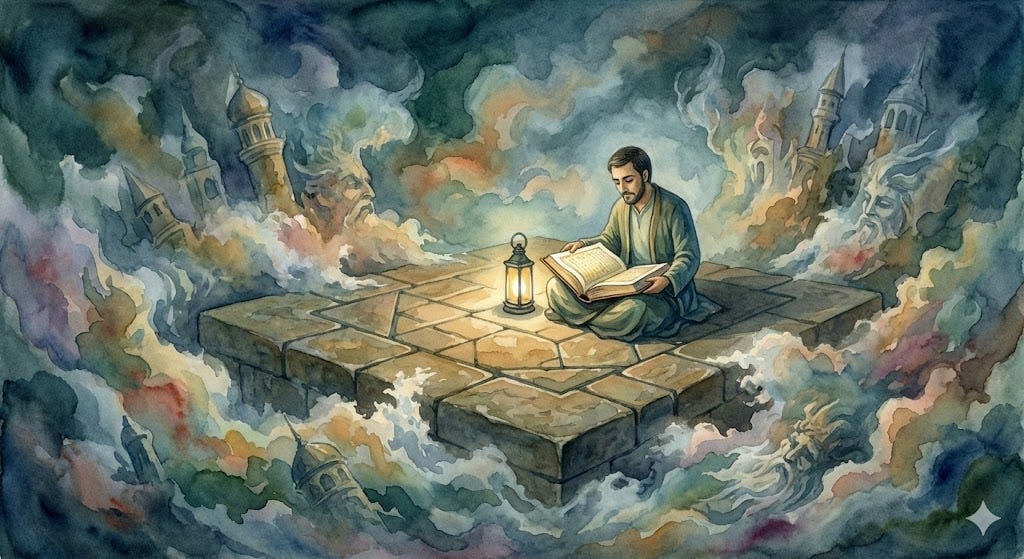
This leaves us with a question we must ask ourselves — honestly, without defensiveness.
Have we been seduced by “Shortcut Spirituality”?
Have we been more interested in “signs” and “secrets” than in the daily discipline of worship?
Have we spent more time watching videos about the End Times than we have spent in Night Prayer?
Have we been attracted to figures who promise “hidden knowledge” while neglecting the scholars who teach us the “open obligations”?
The Imam does not govern by dreams.
He governs by Law.
Shaykh Korani puts it plainly:
Dreams are subjective; Law is objective.
A thousand people can have a thousand dreams, each one contradicting the other.
But the Law — derived from the Quran, the Sunnah, the methodology of the Jurists — is a stable foundation.
It can be studied.
It can be debated.
It can be corrected.
It does not shift with the winds of personal fantasy.
If someone comes to you claiming a “Special Connection” to the Imam — claiming that they have been told secrets, that they have been appointed, that they have a mission — know this:
They have confirmed their own disconnection.
The Imam himself called them liars.
You do not need to investigate their claims.
You do not need to give them a hearing.
You do not need to “keep an open mind.”
The door was closed in 329 AH.
And it will not open until the Sufyani rises and the Cry is heard from the heavens.
Until then, we have the System.
We have the Scholars.
We have the Law.
And that is enough.
The Educational Vacuum
The Diagnosis: Why the Wolves Succeed
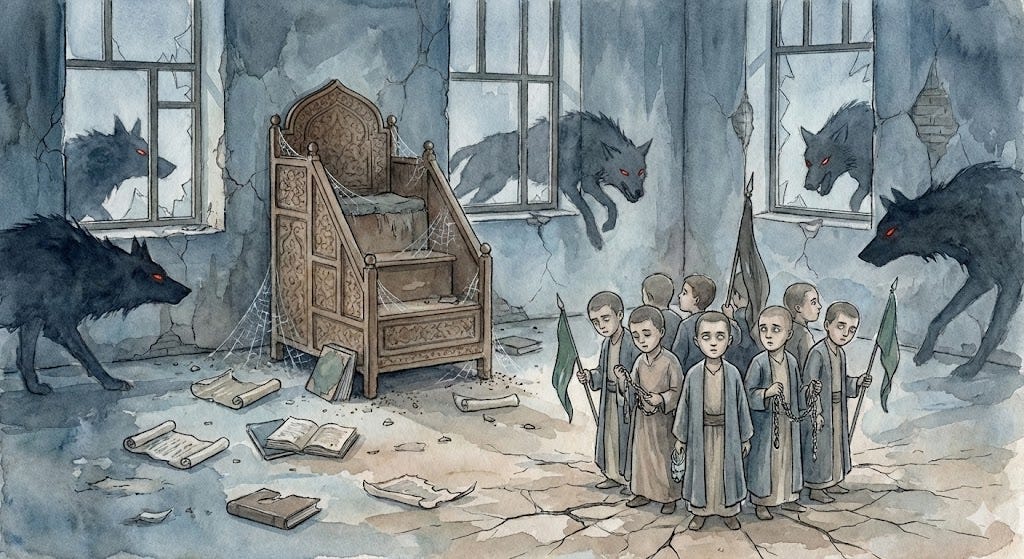
We have spoken about the wolves.
We have spoken about the Ahmad al-Hasan cults, the conspiracy theorists, the fake mystics, and the intelligence agencies that fund them.
We have identified the predators.
But now we must ask a harder question — a question that implicates not the enemy, but ourselves:
Why do they succeed?
Why are so many of our youth — intelligent, university-educated, sincere young men and women who love the Ahl al-Bayt — falling into these traps?
Is it because the wolves are so clever?
No.
It is because the sheep have no immune system.
A healthy body rejects a virus naturally.
It recognises the invader — the foreign protein, the hostile cell — and destroys it before it can take hold.
But a body that is malnourished, weakened, stripped of its defences, will collapse at the first sneeze.
The spiritual body of our community is suffering from a condition we must name honestly, without defensiveness, without excuses:
The Educational Vacuum
For too long, we have allowed our religious culture to drift away from knowledge and toward performance.
We have turned the Minbar — the Pulpit, which was established by the Prophet, peace and blessings be upon him and his family, as a seat of education — into a stage for entertainment.
We teach our children the lyrics of the nohe and latmiyyah (lamentations), but not the logic of the Religion.
We teach them how to cry for Imam Husayn, but not how to think like Imam Husayn.
We teach them the stories of Karbala, but not the Usul (Foundations) that make those stories meaningful.
And a theologically illiterate community is easy prey for any confident liar.
The fake messiah does not need to be a genius.
He only needs to speak with conviction to an audience that has never been taught how to evaluate his claims.
The conspiracy theorist does not need to have evidence.
He only needs to offer “secrets” to an audience that has never been trained in critical thinking.
The cult leader does not need to be right.
He only needs to be charismatic — and the audience, starved of substance, will follow charisma wherever it leads.
This is our failure.
Not the failure of the youth who fall.
The failure of the institutions that never taught them how to stand.
The Cure: The Map and the Road
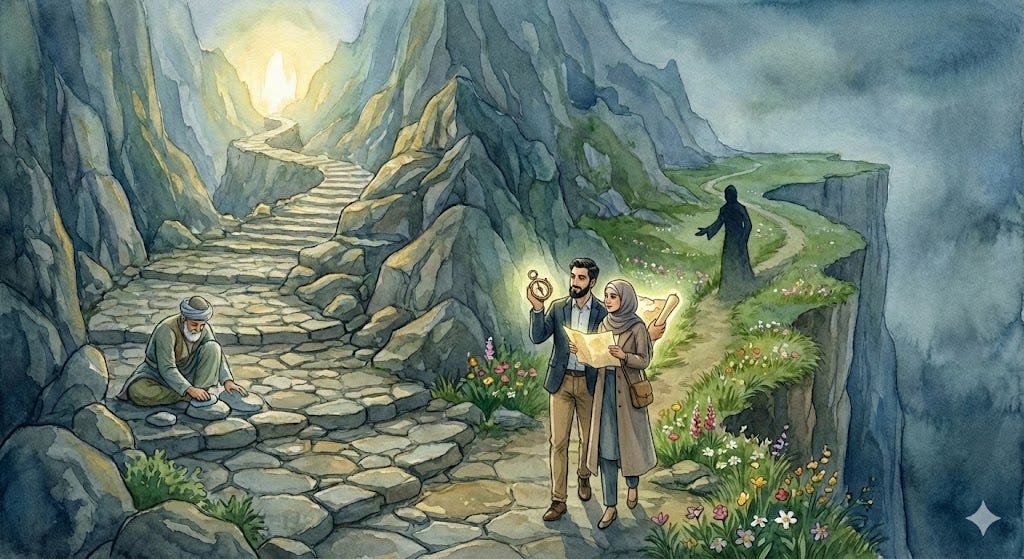
How do we rebuild this immune system?
We must return to the definition of Religion itself.
The great philosopher and exegete, Allamah Sayyed Muhammad Husayn Tabatabai — the author of the monumental Al-Mizan, the most comprehensive Quranic commentary of our age — provides us with the metaphor we desperately need.
He explains that the Sharia is a Tariq — a Road.
A road is not a destination.
A road is a means to get somewhere.
If you stand on the highway admiring the asphalt — marvelling at its smoothness, decorating its edges, writing poetry about its beauty — you will get run over.
You must walk.
But to walk, you need to know how to read the Map.
Allamah Tabatabai writes in Al-Mizan:
«إِنَّ الشَّرِيعَةَ طَرِيقٌ، وَالطَّرِيقُ إِنَّمَا يُرَادُ لِيُسْلَكَ لَا لِيُعْبَدَ. فَمَنْ وَقَفَ عَلَى حُدُودِ الطَّرِيقِ وَشُغِلَ بِزِينَتِهِ عَنِ الْمَسِيرِ، فَقَدْ ضَلَّ...»
“Indeed, the Sharia is a Road (Tariq), and a road is intended to be traversed, not to be worshipped. So whoever stops at the borders of the road and busies himself with its decorations instead of walking — he has gone astray...”
— Allamah Sayyed Muhammad Husayn Tabatabai, Al-Mizan fi Tafsir al-Quran
This is profound.
The Sharia — the Law, the rituals, the obligations — is not the goal.
It is the vehicle.
The goal is God.
The goal is Tawheed.
The goal is to arrive at the Face of the Beloved.
The Sharia is how we get there.
But if we treat the vehicle as the destination — if we become so enamoured with the rituals that we forget their purpose — we have gone astray.
We are standing on the highway, admiring the road, while the journey remains untraveled.
Now, consider the role of the Scholar in this metaphor.
The Scholar is the Map Reader.
His job is not to dazzle you with stories about the destination — to paint beautiful pictures of Paradise, to make you weep with descriptions of the garden at the end.
His job is to teach you how to use the compass.
His job is to show you where you are on the map, to point out the dangers ahead, to explain why this turn leads to safety and that turn leads to a cliff.
If the teacher tells you fairytales but doesn’t teach you Usul al-Din (Foundations of Faith) and Fiqh (Jurisprudence) and Akhlaq (Ethics), he is sending you into the desert blindfolded.
And then what happens?
The fake messiah comes along and says:
“I know a shortcut!
Follow me!”
The student who knows how to read the Map looks at him and says:
“That is not a shortcut.
That is a cliff.
The Map clearly shows that the path does not go that way.”
But the student who only knows stories?
The student who was entertained but never educated?
He has no Map.
He has no compass.
He has no way to evaluate the claim.
He follows the shortcut.
And he falls.
The Role of the Scholar: Teacher, Not Celebrity
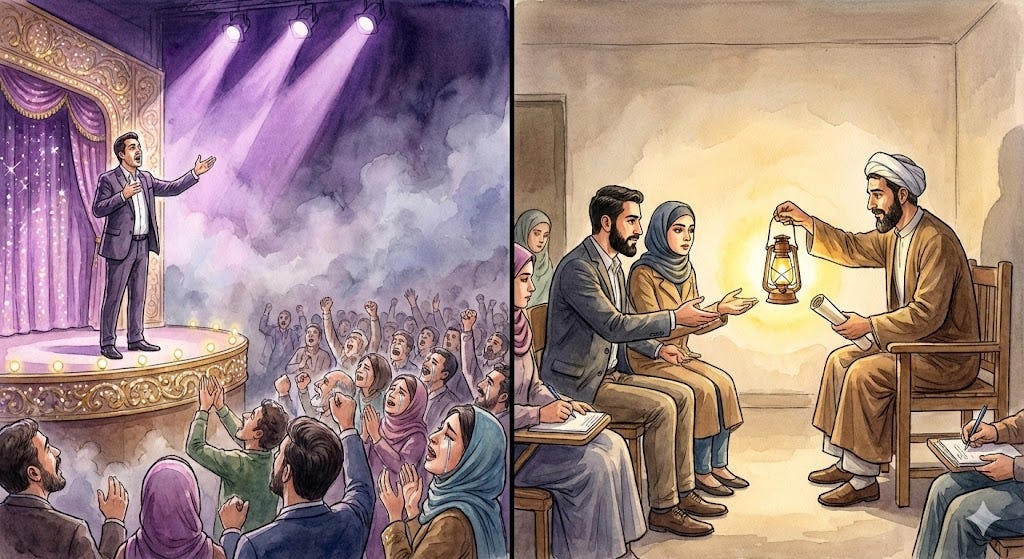
This places a heavy responsibility on the shoulders of the Clergy and the Speakers.
Are we Map Readers?
Or are we merely Entertainers?
Shaheed Murtadha Mutahhari — the ideologue of the Islamic Revolution, the man whose pen shaped the intellectual foundations of the movement — identified this danger decades ago.
He called it Avam-zadegi — Pandering to the Masses.
He warned that if the clergy becomes dependent on the approval of the crowd — if they speak only to get applause, or tears, or donations, or “likes” — then Islam is mutilated.
The scholar who asks,
“What does the audience want to hear?”
instead of
“What does the audience need to hear?”
has betrayed his mission.
He has become a performer, not a teacher.
He has become a servant of the crowd, not a servant of God.
Shaheed Mutahhari declared:
«عوامزدگی، آفت روحانیت است. اگر روحانیت ما به جای هدایت مردم، به دنبال رضایت مردم باشد، اسلام مسخ میشود. منبر باید کلاس درس باشد، نه مجلس گرمکن.»
“Pandering to the masses (Avam-zadegi) is the plague of the clergy. If our clergy, instead of guiding the people, seeks the satisfaction of the people, Islam will be mutilated. The pulpit must be a Classroom, not a place just to warm the gathering [entertain].”
— Shaheed Murtadha Mutahhari, Dah Goftar (Ten Discourses)
A classroom is demanding.
In a classroom, you have to think.
You have to take notes.
You might be challenged.
You might hear things that make you uncomfortable.
You might be told that you are wrong.
But in a theatre, you just sit back and consume.
You are entertained.
You are moved.
You leave feeling good.
But you leave with nothing in your hands.
We have too many theatres and not enough classrooms.
We have become consumers of Majalis — hopping from one lecture to another like we are browsing a streaming service, looking for the speaker who makes us cry the most, or feel the most excited, or tells the most dramatic stories.
But do we leave with a Map?
Do we leave with the tools to deconstruct a heresy when we encounter it?
Do we leave knowing why we believe what we believe — not just that we believe it?
If the answer is no, then the Minbar has failed.
And the failure is shared — by the speakers who chose entertainment over education, and by the audience who demanded entertainment instead of substance.
The Necessity of Insight
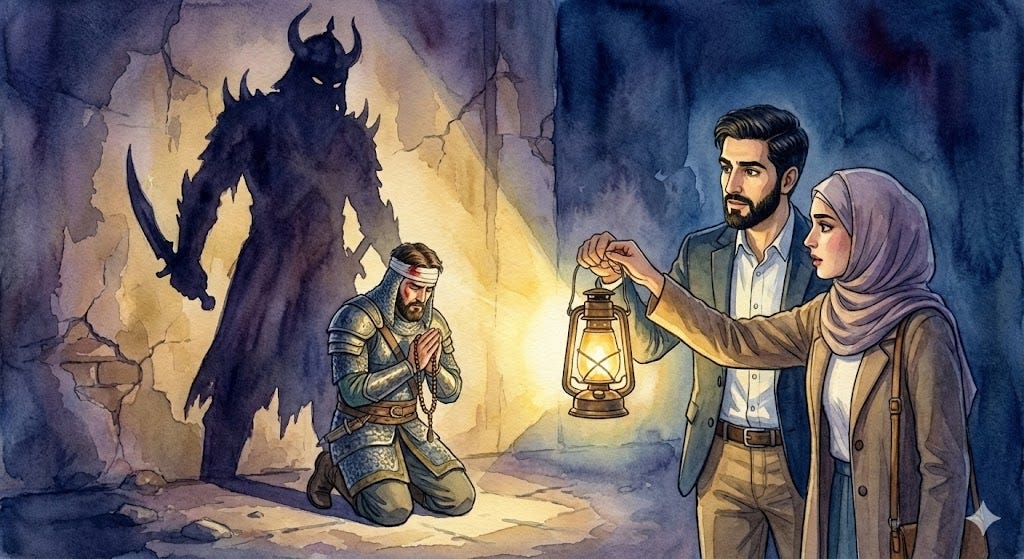
Why is this intellectual rigour so vital?
Because the enemy does not always look like an enemy.
Sometimes, the enemy prays.
Sometimes, the enemy has a mark of prostration on his forehead.
Sometimes, the enemy speaks of the Hidden Imam with tears in his eyes.
Sometimes, the enemy quotes hadith and weeps at the mention of Karbala.
How do you distinguish the sincere believer from the wolf in sheep’s clothing?
Not by emotion.
Emotion can be faked.
Emotion can be manipulated.
Emotion, untethered from intellect, is a compass that spins wildly, pointing wherever the magnetic field of charisma pulls it.
The only defence against this confusion is Basirat — Insight.
Imam Khamenei teaches us this with a chilling history lesson:
«بصیرت یعنی اینکه بدانی شمری که سر حسین (ع) را برید، جانباز جنگ صفین بود که جانبِ علی (ع) جنگیده بود. بدون بصیرت، حتی اگر جانباز باشی، ممکن است قاتل امام زمانت شوی.»
“Insight (Basirat) means knowing that Shimr, who cut the head of Husayn, was a wounded veteran of the Battle of Siffin who had fought on the side of Ali. Without insight, even if you are a wounded veteran, you might become the killer of the Imam of your Time.”
— Imam Khamenei, Speech to Basij Commanders, 2010
Pause and let this sink in.
Shimr — the man whose name we curse, the man who stood over the body of the Master of Martyrs and severed his blessed head — was not a drunkard in a bar.
Shimr was a soldier in the army of Imam Ali.
He fought at Siffin.
He carried wounds from that battle — wounds received in defence of the Commander of the Faithful.
He prayed.
He fasted.
He had credentials.
But he lacked Basirah (Insight).
He lacked the intellectual framework to distinguish the Truth from the Person.
He followed Ali when Ali was winning.
But when the climate changed, when the propaganda shifted, when the “Mouse of Power” appeared — as Shaheed Mutahhari described in the parable we discussed in our previous session — Shimr drifted.
He attached himself to new masters.
He convinced himself that he was still on the right side.
And the man who once fought for Imam Ali ended up butchering Imam Ali’s son.
This is the danger of uneducated piety.
This is the catastrophe of emotion without intellect.
A person can weep at every Majlis.
A person can beat their chest until it bruises.
A person can recite every lamentation (nohe and latmiyyah) from memory.
But if they do not have Basirah, if they do not have Insight — if they do not have the intellectual tools to distinguish truth from falsehood, the Imam from the imposter, the genuine scholar from the charlatan — their emotion is a weapon that can be turned against the very Imam they claim to love.
Shimr is not ancient history.
Shimr is a warning.
Shimr is a possibility that lives in every one of us who substitutes feeling for thinking.
The Call to Action: From Consumers to Students
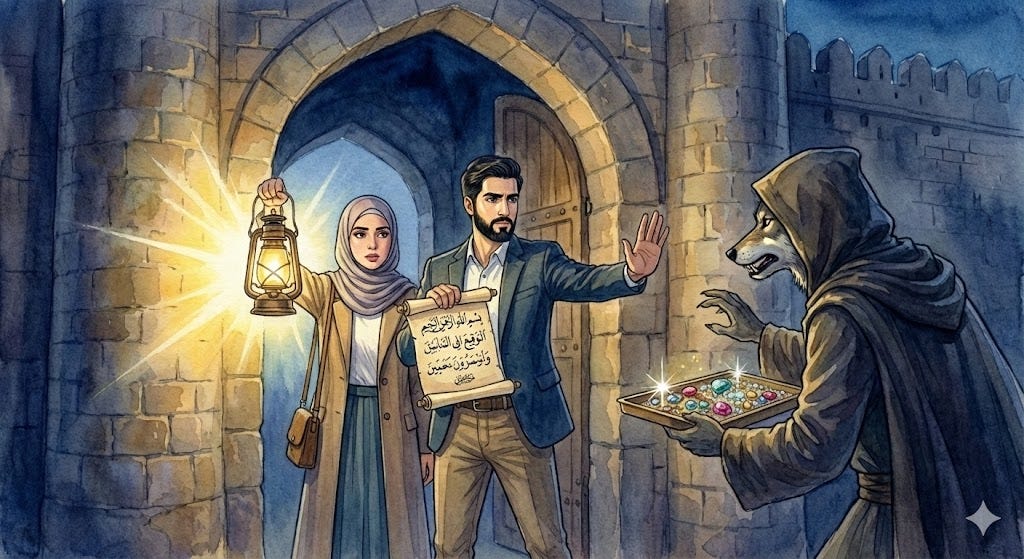
This is the challenge of the Fourth Deputy.
Al-Samarri closed the door of Specific Deputyship to force us to open the books of General Knowledge.
He took away the “Easy Access” — the hand to hold, the name to invoke, the specific gate to knock on — so that we would be forced to do the “Hard Work.”
The Hard Work of learning.
The Hard Work of studying.
The Hard Work of building an intellectual immune system that can reject the virus before it takes hold.
We must stop being consumers.
We must become students.
We must demand substance from our podiums.
We must stop funding “Entertainers” and start funding “Teachers.”
We must ask ourselves honestly:
Would you send your child to a school where the teacher only told emotional stories and never taught mathematics?
Would you trust a school that made your child feel educated but left them unable to solve a basic equation?
Of course not.
You know your child would fail in the real world.
So why do we accept this for our religion?
Why do we accept a spiritual education that leaves us illiterate in the face of the wolves?
Why do we attend Majalis for decades and still not know the difference between Usul al-Din (Roots of Religion - the Underlying Theology and Ideology) and Furu’ al-Din (Branches of Religion - Practical Laws)?
Why do we weep for Husayn but cannot explain why his stand was necessary, what principles he was defending, how his sacrifice connects to the system of Imamah?
Why do we claim to wait for the Mahdi but cannot articulate the theology of Ghaybah, cannot refute the fake messiah when he knocks on our door, cannot distinguish the true from the false?
The time for excuses is over.
The time for blaming the youth is over.
The youth are falling because we failed to build the fortress.
The wolves are succeeding because we left the gate open and the walls unguarded.
The Fourth Deputy handed us a constitution — the Final Tawqi’ — and said:
“Here is your protection.
Learn it.
Teach it.
Use it.”
Have we?
Or have we let it gather dust while we busied ourselves with entertainment?
The time for storytelling without substance is over.
The time for Map Reading has begun.
We must build a community of Critical Thinkers — believers who do not need a fatwa (a religious edict) to know a cult is wrong, because they know the Usul (Foundations) so well that the cult smells wrong to them immediately.
We must raise a generation that can look at the fake messiah, look at the conspiracy theorist, look at the charismatic imposter, and say with confidence:
“I know what you are.
The Imam warned me about you fourteen centuries ago.
The door is closed.
You are a liar.
Now leave.”
This is the immune system we must build.
This is the legacy of the Fourth Deputy.
This is the work that remains.
Conclusion: The Closing of the Gates
The Final Breath
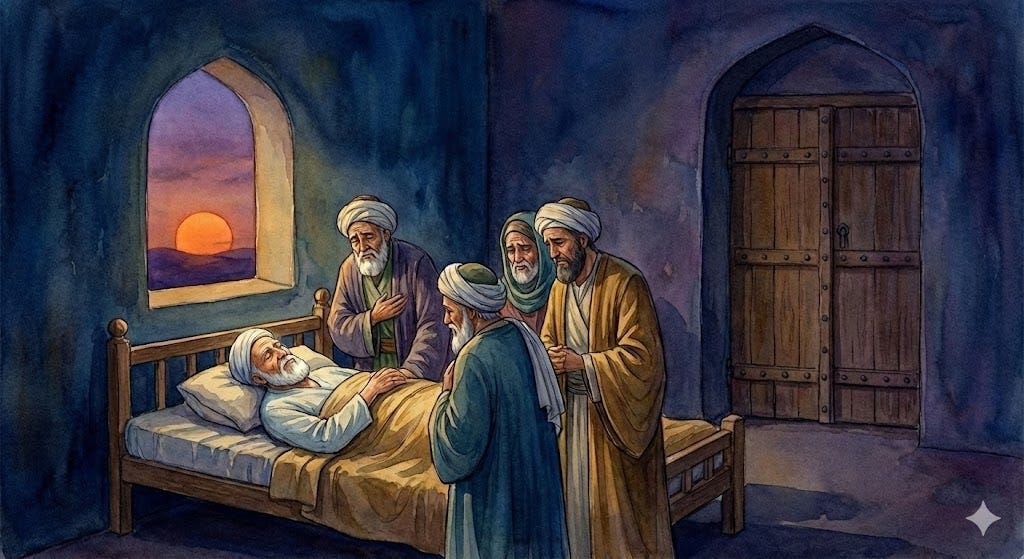
We return, finally, to the bedside of the Fourth Deputy.
It is the 15th of Sha’ban, 329 AH.
Six days have passed since the letter was read.
The prophecy of the Imam is about to be fulfilled.
The elders of the community are gathered around Ali ibn Muhammad al-Samarri.
There is no pomp here.
There are no Viziers or Abbasid generals waiting outside.
There are no crowds chanting his name.
There is only the silence of a mission completed — the stillness of a man who did what he was asked, held what he was given, and is now preparing to return the trust to its Owner.
Al-Samarri is weakening.
His breath is shallow.
The sun of the Minor Occultation is touching the horizon.
The elders ask him one final time — perhaps hoping that the decree has changed, perhaps hoping for one last lifeline, one more hand to hold:
“To whom do you entrust us? Who is your successor?”
Al-Samarri opens his eyes.
He does not give a name.
He does not point to a person.
He repeats the reality of the new era — the era that will last until the Cry from the heavens:
«لِلَّهِ أَمْرٌ هُوَ بَالِغُهُ.»
“To God belongs the affair, and He will fulfil it.”
— Al-Tusi, Kitab al-Ghaybah, Section on the Reports of the Fourth Deputy, Page 395
And with those words, his soul departs.
The Fourth Deputy is gone.
The door is sealed.
The Minor Occultation has ended.
The Great Silence has begun.
The Journey into the Wilderness
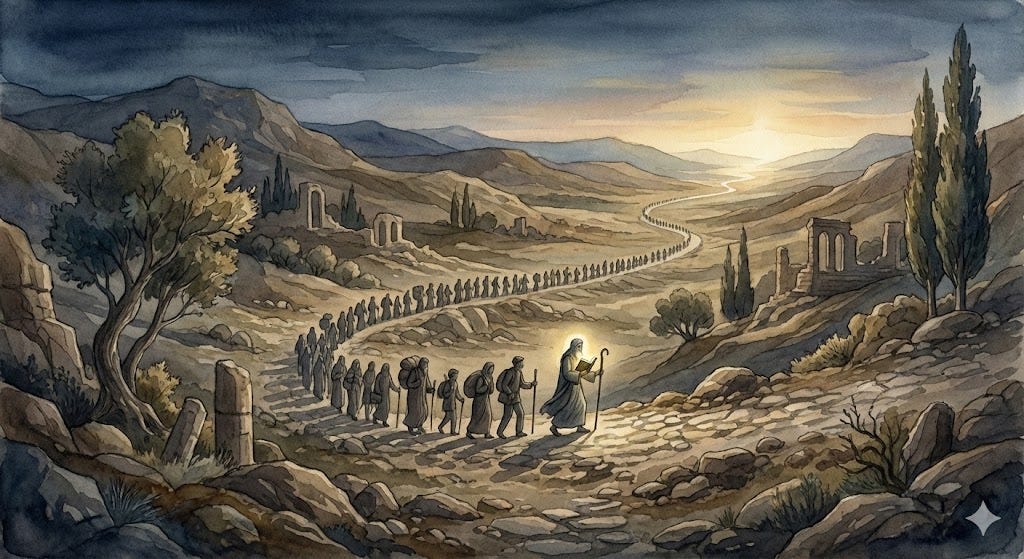
When they buried Ali ibn Muhammad al-Samarri, they did not just bury a man.
They buried the era of Niyabah al-Khassah (The Specific Deputyship).
They buried the specific gate.
They buried the hand they had held for seventy years.
The Shia were now alone in the Occultation — orphans of history, walking without a named guide, navigating without a specific star.
But they were not abandoned.
They were left with a Book.
They were left with a Law.
They were left with a Promise.
Think of this not as an abandonment, but as a deployment.
Imagine a traveller who has been trained in the safety of a fortress for seventy years.
He has learned the terrain.
He has studied the maps.
He has been taught by the greatest guides.
Now, the gates of the fortress open, and he is told:
“Go.”
He must step out into the wilderness.
He must tackle the jungle of confusion, the desert of doubt, the bitter cold of isolation, the wolves who wear the masks of shepherds.
He has his provisions — the Quran and the Sunnah.
He has his Map — the teachings of the Ahl al-Bayt, preserved in the books of hadith, interpreted by the qualified scholars.
He has his compass — the System of Marjaiyyah, the System of Wilayat al-Faqih, the General Deputyship that the Fourth Deputy’s closure made necessary.
But he must walk.
He must navigate the terrain of the world — century after century, generation after generation — ensuring that no matter how thick the fog becomes, he does not lose his way to the Beloved’s Face.
The Occultation is not a pause.
It is not a waiting room.
It is the long march of the faithful through the wilderness of history.
And we are still marching.
The Presence of the Absent
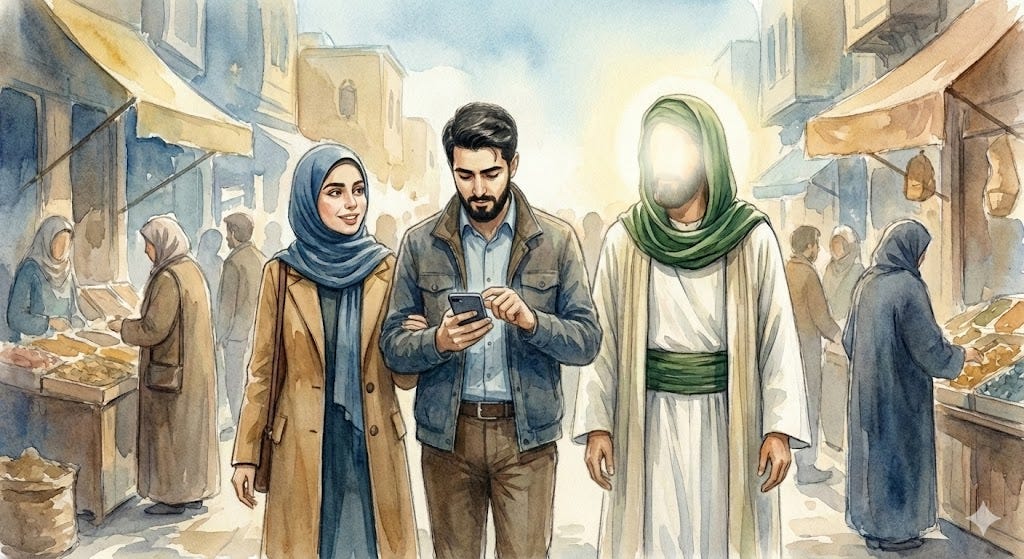
As we walk this path, we must correct a fundamental misunderstanding.
We say the Imam is “Absent” — Ghayb.
But “Absent” does not mean “Gone.”
As we established in our earlier sessions on Mahdawiyyah, he is Anonymous — not invisible.
He is here.
He walks on the same earth we walk on.
He breathes the same air.
He moves among the people — perhaps in the marketplace, perhaps in the mosque, perhaps on the road to Karbala or Makkah.
He sees us.
He is aware of every tear we shed and every sin we commit.
He commiserates with our pain and he celebrates our joy.
He prays for us.
He weeps for us.
It is our misfortune — born of our lack of Basirah, born of the veils we have placed over our own eyes through our sins and our heedlessness — that he could be standing next to us, and we would not know him.
He could be praying beside us in the congregation, and we would not recognise him.
He could extend his hand to help us, and we would walk past without a glance.
He yearns for us more than we yearn for him.
He is waiting — not for his own sake, but for ours — for the command of God to return, to be made known, to step out of anonymity and into the light of manifestation.
But God will not allow him to return until we are ready.
Not partially ready.
Not “ready enough.”
Fully ready.
Ready for him to say
“Jump,”
and instead of asking
“Why?” or “Where?” or “Is it safe?” or “What’s in it for me?”,
we simply ask:
“How high?”
The Standard of Fire: Harun al-Makki
The Imam — peace be upon him — has given us everything we need.
He gave us the Minor Occultation as a training camp.
He gave us the Four Deputies as models.
He gave us the Final Tawqi’ as a constitution.
He has blessed us with the System of Marjaiyyah and Wilayah to guide us through the wilderness.
But following this system requires a battle against the ego — the battle of Tazkiyah, of purifying the self until nothing remains but submission.
We must ask ourselves honestly:
Do we have the obedience required for the Return?
Do we have the faith that does not ask “Why?”
Do we have the trust that steps into the fire without checking the temperature?
There is a narration that answers this question with devastating clarity.
It concerns a man named Harun al-Makki — a companion of Imam Ja’far al-Sadiq, peace be upon him.
One day, a man from Khurasan — Sahl ibn al-Hasan — came to the Imam.
He was a man of action, a man of numbers, a man who believed that victory was a matter of swords and soldiers.
He said to the Imam:
“Why do you sit idle?
There are one hundred thousand Shia in Khurasan, ready to fight for you with their swords.
Rise, and we will follow!”
The Imam did not argue.
He did not debate.
He simply waited.
While they were conversing, Harun al-Makki entered the gathering.
The Imam looked at him and said:
«يَا هَارُونُ، ادْخُلِ التَّنُّورَ.»
“O Harun, enter the oven.”
There was a blazing oven in the room — the kind used for baking bread, filled with fire and heat.
Harun did not ask why.
He did not hesitate.
He did not check the temperature.
He did not negotiate.
«فَوَضَعَ نَعْلَيْهِ ثُمَّ دَخَلَ التَّنُّورَ.»
He simply put down his sandals and climbed into the fire.
The Imam continued his conversation with the Khurasani, speaking calmly, as though nothing had happened.
After some time, the Imam said to the man from Khurasan:
«قُمْ فَانْظُرْ مَا فِي التَّنُّورِ.»
«فَقَامَ وَنَظَرَ إِلَيْهِ وَهُوَ مُتَرَبِّعٌ فِيهِ.»Stand up and look at what is inside the oven.' He stood up and looked inside, and saw him [Harun] sitting cross-legged within the fire [calm and unharmed]
The man stood.
He looked inside.
And he saw Harun al-Makki sitting cross-legged within the flames — calm, unharmed, at peace.
The fire had not touched him.
The fire had submitted to him — just as it had submitted to Prophet Ibrahim, the Friend of God, when Nimrod cast him into the blaze.
As the Quran testifies:
«قُلْنَا يَا نَارُ كُونِي بَرْدًا وَسَلَامًا عَلَىٰ إِبْرَاهِيمَ»
“We said, ‘O Fire, be coolness and safety upon Ibrahim.’”
— Quran, Surah al-Anbiya (the Chapter of the Prophets) #21, Verse 69
The Imam looked at the Khurasani and asked:
«كَمْ تَجِدُ بِخُرَاسَانَ مِثْلَ هَذَا؟»
“How many like this one do you find in Khurasan?”
The man lowered his head.
«وَاللَّهِ وَلَا وَاحِداً.»
“By God, not even one.”
The Imam said:
«لَا نَخْرُجُ فِي زَمَانٍ لَا نَجِدُ فِيهِ خَمْسَةً مُعَاضِدِينَ لَنَا، نَحْنُ أَعْلَمُ بِالْوَقْتِ.»
“We do not rise in a time when we cannot find even five helpers like this. We are more knowledgeable concerning the proper time.”
— Ibn Shahr Ashub, Manaqib Aal Abi Talib (Virtues of the Family of Abu Talib), Volume 4, Page 237
— Al-Majlisi, Bihar al-Anwar, Volume 47, Page 123, Hadith 172
This is the standard.
This is the litmus test.
The delay in the Imam’s return is not because God is withholding him.
The delay is not because the “Signs” have not appeared.
The delay is not because of numbers — we have millions who claim to be Shia.
The delay is because of quality.
The Imam is waiting for Haruns.
He is waiting for those who trust the Pilot so completely that they do not question the course.
He is waiting for those who hear the command and do not say
“Why?”
but say
“Labbayk“ — “I am here, at your service.”
One hundred thousand swords are worthless if the hearts holding them are still negotiating with God.
Five Haruns are worth more than a million questioners.
And the Imam — who knows the time better than we do — will not return until those five are found.
The question is not:
“When will the Imam come?”
The question is:
“Am I becoming a Harun?”
Looking Ahead: The Long Walk Through the Wilderness
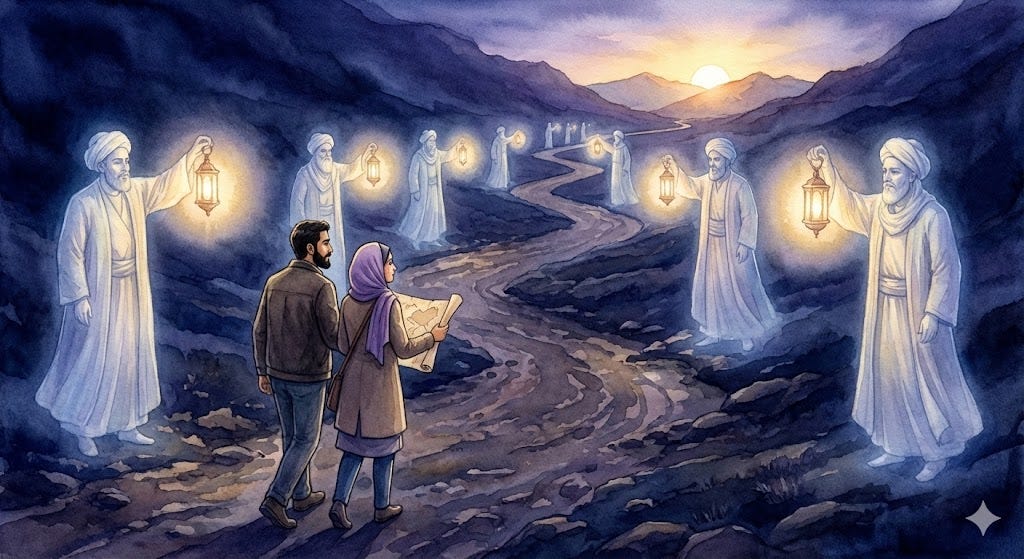
With the passing of the Fourth Deputy, we have reached the end of one chapter — and the beginning of another.
The Minor Occultation is complete.
The Four Deputies have fulfilled their missions.
The door of Specific Representation is sealed.
Now begins the Major Occultation — the Ghaybat al-Kubra — the long walk through the wilderness that has continued for over a thousand years and will continue until God gives permission for the Dawn.
In our next series within a series, from the next session, God willing, we will explore this wilderness.
We will study the Giants who kept the flame alive during the darkest centuries — men like Shaykh al-Mufid, Shaykh al-Tusi, Shaheed al-Awwal, and Shaheed al-Thani — scholars who built the fortress of knowledge that we still inhabit today.
We will examine the System of Authority — the Hakim Shar’i, the Wilayat al-Faqih — that governs us in the absence of the Specific Deputy.
How does it work?
What are its limits?
What is our responsibility toward it?
We will confront the Fetish of Signs — the laziness that looks for the Sufyani and the Dajjal instead of looking for the Oven.
The obsession with
“When will he come?”
that distracts us from
“Am I ready for him?”
And we will ask the hardest question of all:
What does it mean to wait — not passively, not as spectators of the Apocalypse, but as soldiers preparing the ground for the Commander’s return?
The journey continues.
The path stretches ahead.
And we walk — with the Map in our hands and the Promise in our hearts.
A Supplication-Eulogy for the Closing of the Gates
Between Kufa and the Fire

In Your Most beautiful Name, O Lord of all the worlds...
We stand tonight between two examples.
On one side, we see Kufa — the city that claimed to love Husayn, the city that wrote letters of invitation, the city that swore allegiance and then broke it.
They lacked Basirah.
They saw the mask of Ibn Ziyad and thought he was safety.
They saw the gold of Yazid and thought it was provision.
They cheered for the wolf because he spoke the language of religion.
And when the son of Fatimah stood alone on the plains of Karbala, calling for a single drop of water for his infant son, the people of Kufa watched from behind their walls.
On the other side, we see Harun al-Makki — the man who loved the Imam so much, trusted the Imam so completely, that the fire became a garden for him.
He did not ask “Why?”
He asked nothing.
He simply obeyed.
O God...
Do not let us be Kufa.
Do not let us be among those who claim love but lack loyalty.
Do not let us be fooled by the mask — by the imposter who speaks of the Mahdi while leading us away from his path.
Do not let us cheer for the wolf because he wears a turban and quotes hadith.
Do not let us be among those who write letters of allegiance in the morning and break them by nightfall.
You have said in Your Book:
«يَا أَيُّهَا الَّذِينَ آمَنُوا لِمَ تَقُولُونَ مَا لَا تَفْعَلُونَ»
“O you who believe, why do you say what you do not do?”
— Quran, Surah al-Saff (the Chapter of those who Stand in Ranks) #61, Verse 2
O Lord, do not let our tongues outpace our actions.
Do not let our claims exceed our character.
Do not let us be recorded among the hypocrites who spoke of love but lived in betrayal.
And O Lord...
Make us Harun.
Give us the courage to enter the fire when the command comes.
Help us to break our egos — the egos that ask “Why?” and “What’s in it for me?” and “Is it safe?”
Help us to silence the whispers of Satan that dress themselves in the clothing of “reason.”
Help us to replace the question with the answer:
“Labbayk. I am here. Command me.”
O God...
We are taught by Imam Sajjad to implore You:
أَللَّهُمَّ اجْعَلْنِي مِنْ جُنْدِكَ, فَإنَّ جُنْدَكَ هُمُ الْغالِبُونَ
O God, place me amongst your soldiers, for surely your soldiers are the victorious
— Dua of Imam Sajjad for Tuesday
— Quran, Surah al-Saffat (the Chapter of those who line up in Ranks) #37, Verse 173Make us from Your soldiers.
Let us fight under the banner of Your Proof, not under the banners of ego and tribe and faction.
Let us be victorious — not with the victory of this world, but with the victory that matters on the Day we stand before You.
وَاجْعَلْنِي مِنْ حِزْبِكَ, فَإنَّ حِزْبَكَ هُمُ الْمُفْلِحُونَ
(And O God), make us from your party, because your party are the successful
— Dua of Imam Sajjad for Tuesday
— Quran, Surah al-Mujadilah (the Chapter of the Pleading Woman) #58, Verse 22Make us from Your party.
Not from the parties of this world that fracture and fight and forget.
But from the party that is united under Your command, loyal to Your Proof, successful by Your promise.
وَاجْعَلْنِي مِنْ أَوْلِيآئِكَ;, فَإنَّ أَوْلِيَاءَكَ لا خَوْفٌ عَلَيْهِمْ وَلا هُمْ يَحْزَنُونَ
And (O God), make us from your friends, you allies, for they shall not fear, nor shall they grieve.
— Dua of Imam Sajjad for Tuesday
— Quran, Surah Yunus (the Chapter of Prophet Jonah) #10, Verse 62Make us from Your Awliya — your allies, your friends.
Remove from our hearts the fear of everything except You.
Remove from our hearts the grief for everything except distance from You.
Let us fear only Your displeasure.
Let us grieve only for our sins.
And let us walk through this wilderness — through the fire of trial and the desert of doubt — with the certainty that You are with us, and that is enough.
O Imam of the Time...
O Proof of God over His creation...
O Remnant of God on His earth...
We address you with the words your father taught us:
«السَّلَامُ عَلَيْكَ يَا دَاعِيَ اللهِ وَرَبَّانِيَّ آيَاتِهِ»
“Peace be upon you, O Caller to God and Lord of His signs.”
— Ziyarat Aal-e-Yasin
«السَّلَامُ عَلَيْكَ يَا بَابَ اللهِ»
“Peace be upon you, O Gate of God.”
— Ziyarat Aal-e-Yasin
«السَّلَامُ عَلَيْكَ يَا خَلِيفَةَ اللهِ وَنَاصِرَ حَقِّهِ»
“Peace be upon you, O Vicegerent of God and Helper of His Truth.”
— Ziyarat Aal-e-Yasin
We know that you walk among us, unseen but seeing.
We know that you are aware of our weakness — our laziness, our hypocrisy, our endless excuses.
We know that you are aware of our sins — the sins that delay your return, the sins that add to your grief, the sins that make us unworthy of standing in your presence.
We know that you see the community that claims to love you but cannot find five Haruns among its millions.
O Master...
Forgive us for the pain we cause you.
You bear the weight of an entire Ummah that is lost — and we add to that weight daily.
Forgive us for the delay we force upon you.
You yearn to return, to establish justice, to fill the earth with equity as it has been filled with tyranny — and we are the obstacle.
Forgive us for not being ready.
You have given us everything — the Book, the Law, the Deputies, the Scholars, the System — and still we stumble.
Look at us not with the eyes of Justice, but with the eyes of Mercy.
We echo the words of the broken servant in the depths of the night:
«إِلَهِي لَمْ أَعْصِكَ حِينَ عَصَيْتُكَ وَأَنَا بِرُبُوبِيَّتِكَ جَاحِدٌ»
“My God, I did not disobey You when I disobeyed while denying Your Lordship...”
— Dua Abu Hamza
We knew You were watching.
We knew and we sinned anyway.
And yet we return to Your door — because You taught us that Your door is never closed.
«يَا مَنْ أَظْهَرَ الْجَمِيلَ وَسَتَرَ الْقَبِيحَ»
“O You who reveals the beautiful and conceals the ugly...”
— Dua Abu Hamza
Conceal our ugliness.
Reveal whatever beauty You have placed within us — even if we have buried it beneath mountains of sin.
O Imam...
Help us to navigate this wilderness.
Help us to hold onto the Map — even when the fog is thick and the wolves are howling.
Help us to recognise the true scholars and reject the charlatans.
Help us to follow the System you established, not the personalities that distract us.
Help us to be students, not consumers.
Help us to be soldiers, not spectators.
And if we are destined to die before you rise...
If this generation passes and the Dawn has not yet come...
Then raise us from our graves when you call.
Let us hear the Cry from the heavens — even from beneath the earth.
Let us rise to stand in your service — finally, at last, when all excuses are gone and all veils are lifted.
Let us be among those who answer:
“Labbayk, Ya Mahdi. I am here. I am ready. Command me.”
Not as those who ask “Why?”
But as those who have already stepped into the Fire.
O God...
We close with the covenant that Your servants have renewed every morning, afternoon and night since the gates closed:
«اللَّهُمَّ كُنْ لِوَلِيِّكَ الْحُجَّةِ بْنِ الْحَسَنِ — صَلَوَاتُكَ عَلَيْهِ وَعَلَى آبَائِهِ — فِي هَذِهِ السَّاعَةِ وَفِي كُلِّ سَاعَةٍ، وَلِيّاً وَحَافِظاً وَقَائِداً وَنَاصِراً وَدَلِيلاً وَعَيْناً، حَتَّى تُسْكِنَهُ أَرْضَكَ طَوْعاً وَتُمَتِّعَهُ فِيهَا طَوِيلاً.»
“O God, be for Your Deputy, the Hujjah, the son of Hasan — Your blessings be upon him and upon his forefathers — in this hour and in every hour, a Guardian, a Protector, a Leader, a Helper, a Guide, and a Watcher, until You bring him to dwell in Your earth willingly, and let him enjoy therein for a long time.”
— Dua al-Faraj
And the last of our call is: Praise be to God, the Lord of all the worlds.
And may God send blessings upon Muhammad and his Pure Household
Amen, O Lord Sustainer of the Universes,
Amen, O Most Merciful of the Merciful.
And from Him alone is all ability, and He has authority over all things.