

In His Name, the Most High
كُونُوا زَيْنًا لَنَا وَلَا تَكُونُوا شَيْنًا عَلَيْنَا
“Be an ornament for us, and not a disgrace upon us.”
— Imam Ja’far al-Sadiq (peace be upon him), Al-Kulayni, Al-Kafi, Volume 2
Before There Was a Hawza
In the last session, we laid the foundation.
We defined the Hawza — the protected garden of knowledge — and asked what makes it alive.
We said it was not curricula and syllabi, but the spiritual radiance of teachers whose hearts are connected to God.
We said the Hawza does not primarily produce scholars — it produces human beings.
We spoke of sacred geography — of why Najaf and Qum are not interchangeable with London or Dearborn — and we traced the chain of delegated authority from the Imam to the scholars through the Tawqi’:
“They are My Proof upon you.”
وَأَمَّا الْحَوَادِثُ الْوَاقِعَةُ فَارْجِعُوا فِيهَا إِلَى رُوَاةِ حَدِيثِنَا، فَإِنَّهُمْ حُجَّتِي عَلَيْكُمْ وَأَنَا حُجَّةُ اللَّهِ عَلَيْهِمْ
“As for the newly occurring events, refer regarding them to the narrators of our traditions, for surely they are My Proof upon you, and I am the Proof of God upon them.”
— Al-Saduq, Kamal al-Din wa Tamam al-Ni’mah, Volume 2, Chapter 45, Hadith 4
But we did not yet ask the most fundamental question:
Where did the chain begin?
Not in a seminary.
Not in a library.
Not in a city named for its shrine.
It began in a room in Medina.
A room where a man sat — not a professor, not an academic, not a cleric in any sense we would recognise — but a living, breathing Hujjah: a divinely appointed Proof of God upon His creation.
His name was Ja’far.
His title was al-Sadiq — the Truthful.
He was the sixth Imam of the Muslims, the son of Imam Muhammad al-Baqir, the grandson of Imam Ali Zayn al-Abidin, the great-grandson of Imam Husayn, the descendant of Imam Ali and Sayyedah Fatimah — peace be upon them all.
And what he built — in a span of roughly three decades, under conditions of extraordinary political danger — was nothing less than the intellectual DNA of the entire tradition we are tracing in this series.
Tonight, we enter his classroom.
The Scale of What Was Lost
Before we speak of what the Imam built, we must feel — even briefly — the weight of what we lost when he was taken from us.
Because we are speaking tonight about a living Imam.
Not a book.
Not a memory.
Not a tradition passed through intermediaries.
A man you could walk up to and ask a question — and receive an answer that came not from study alone, but from a connection to the Divine that we, in this long night of Occultation, can only dream of.
Imagine it.
Imagine that instead of opening a Risalah, instead of searching through hadith databases, instead of debating whether a narration is sahih or da’if — you could simply go to him.
Sit in his presence.
Ask.
And know, with absolute certainty, that the answer you received was the truth.
This is what the Shi’a had in the era of the Imams.
This is what we lost.
And this is why everything that comes after — every compiler, every theologian, every Marja’ — is, in the deepest sense, an attempt to preserve the echo of that voice.
Tonight, we listen to the original sound.
Recap — What We Carry Forward
From Session 61, we carry three things:
First, the understanding that the Hawza is more than an institution — it is a living organism, animated by the spiritual states of its teachers, rooted in sacred geography, and oriented toward the production of whole human beings who have confronted their egos and emerged purified.
Second, the three-movement structure of what lies ahead: sixteen sessions on the builders of the scholarly tradition (the Architecture), then bridging sessions on the Marja’iyyah, then a future sub-series on Wilayat al-Faqih beginning from the Wilayah of God Himself.
Third, and most importantly, the question that will accompany us through every session:
What are you building?
And what are you becoming?
Tonight, we begin to answer that question — by meeting the man who built first.
Video of the Sermon (Majlis/Lecture)
Audio of the Sermon (Majlis/Lecture)
Point 1: The Imam as the Source — The Scale of the Sadiqiyya School
The Window
Every builder knows that the most important thing about a foundation is when you pour it.
Pour it in the wrong season and the ground shifts.
Pour it too late and the walls have nothing to stand on.
Pour it in the narrow window when the conditions align — and the structure endures for a thousand years.
Imam Ja’far al-Sadiq (peace be upon him) was given a window.
It was not a gift of ease — it was a gift of chaos.
The Umayyad dynasty, which had murdered his great-grandfather Imam Husayn (peace be upon him), sacked the city of Medina, and burned the Ka’ba, was collapsing in on itself.
The last Umayyad caliphs were too busy fighting each other — and too drunk on wine and courtly excess — to pay close attention to a quiet scholar in Medina.
And the Abbasid revolution that would replace them was still being organised in the shadows of Khurasan.
Between these two storms — one dying, one not yet born — there was a stillness.
And in that stillness, the Imam opened his door.
He had inherited this mission from his father, Imam Muhammad al-Baqir (peace be upon him), and his grandfather, Imam Ali Zayn al-Abidin (peace be upon him) — both of whom had laid the groundwork through decades of quiet teaching.
But neither of them had enjoyed the space that history now briefly afforded their successor.
Imam al-Baqir had taught in the shadow of Umayyad surveillance.
Imam Zayn al-Abidin had taught through the language of supplication, encoding doctrine inside du’a because open teaching was too dangerous.
Imam Ja’far al-Sadiq inherited their method — but was given a wider stage.
And he did not waste it.
The Scale
What did this man build in his window?
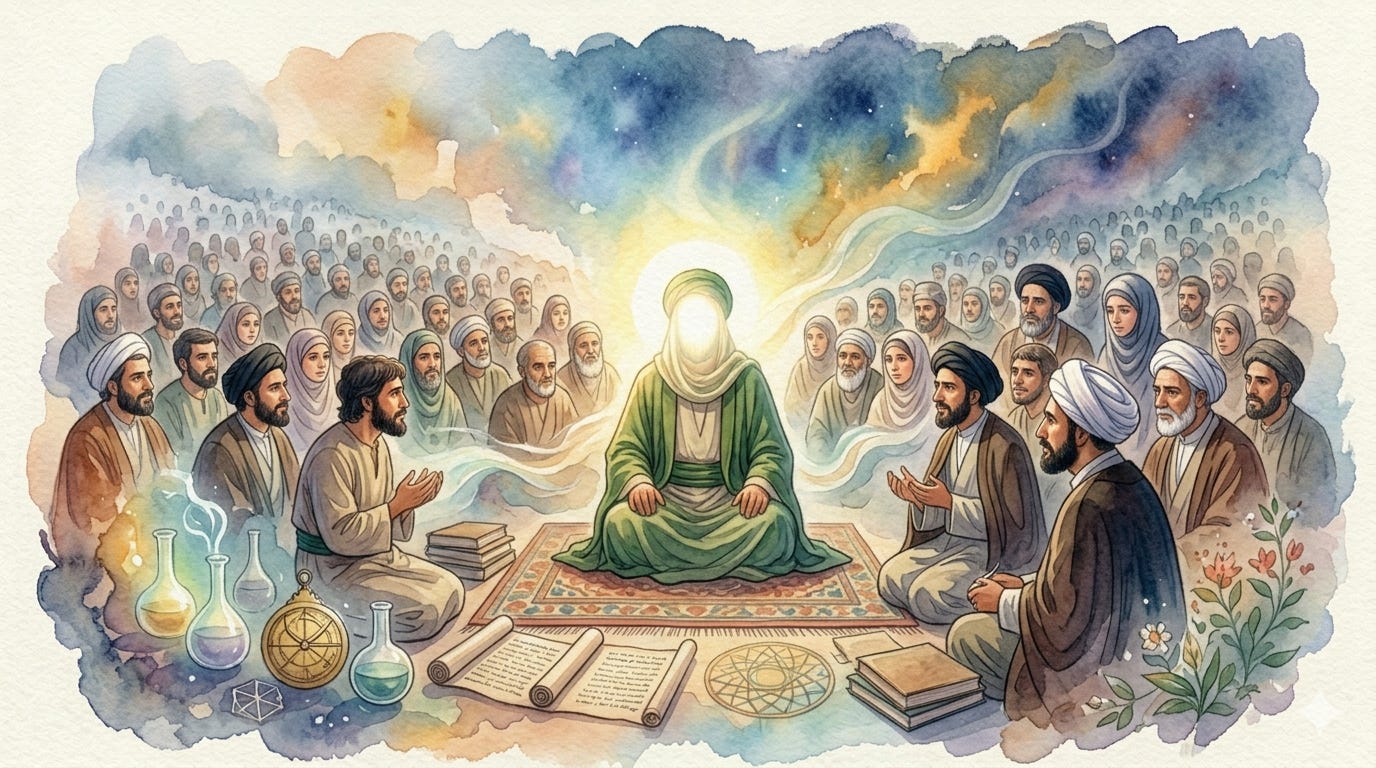
The historians — and these are not only Shi’a historians — record that approximately four thousand students passed through his circle.
Let that number settle.
Four thousand.
In an age without printing presses, without lecture halls, without microphones or livestreams.
Four thousand students who sat on the ground in Medina — and later in Kufa, when the Imam travelled — and learned from the living, breathing Proof of God.
And they did not come to learn one thing.
This was not a fiqh seminar.
This was not a hadith circle in the conventional sense.
The Imam taught jurisprudence, yes — and from him flows the entire Ja’fari school of law that every Shi’a Muslim follows to this day.
But he also taught theology — ’aqidah and kalam.
He taught Qur’anic exegesis — both the apparent (zahir) and the hidden (batin).
He taught philosophy and cosmology.
He taught the sciences of the natural world — chemistry, medicine, astronomy, mathematics.
Even the Sunni heresiographer al-Shahrastani — an Ash’ari Shafi’i with no doctrinal allegiance to the Shi’a, and therefore no reason to flatter a Shi’a Imam — acknowledged this breadth.
He wrote of Imam al-Sadiq:
وَهُوَ ذُو عِلْمٍ غَزِيرٍ فِي الدِّينِ، وَأَدَبٍ كَامِلٍ فِي الْحِكْمَةِ، وَزُهْدٍ بَالِغٍ فِي الدُّنْيَا، وَوَرَعٍ تَامٍّ عَنِ الشَّهَوَاتِ، وَقَدْ أَقَامَ بِالْمَدِينَةِ مُدَّةً يُفِيدُ الشِّيعَةَ الْمُنْتَمِينَ إِلَيْهِ، وَيُفِيضُ عَلَى الْمُوَالِينَ لَهُ أَسْرَارَ الْعُلُومِ
“He was a man of abundant knowledge in religion, of perfect refinement in wisdom, of extraordinary renunciation of the world, and of complete scrupulousness regarding worldly desires. He resided in Medina for a period, benefiting the Shi’a who were devoted to him, and bestowing upon his followers the secrets of the sciences.”
— Al-Shahrastani, Al-Milal wa’l-Nihal (The Book of Sects and Creeds), Volume 1, Page 166
Note that last phrase:
yufidu ’ala al-muwalin lahu asrar al-’ulum
— “bestowing upon his followers the secrets of the sciences.”
Not merely the sciences of religion.
The secrets of the sciences.
This is a Sunni scholar acknowledging that the Imam’s teaching went far beyond fiqh and hadith — into dimensions of knowledge that al-Shahrastani could only describe as hidden.
We introduced Jabir ibn Hayyan briefly in our last session, when we spoke about the Hawza and modernity.
Tonight, we meet him properly.
Jabir — whom the Latin West would later call Geber — is considered the father of early chemistry.
He wrote on the classification of substances, on the processes of distillation and crystallisation, on the transmutation of metals.
He also wrote on philosophy, on cosmology, and on what the ancients called the esoteric sciences.
And he attributed his knowledge to his teacher — Imam Ja’far al-Sadiq.
This attribution is recorded in both Shi’a and Sunni biographical sources.
He was not merely a scientist in the modern sense.
He was a man whose laboratory was an extension of his prayer mat — because his teacher had taught him that the study of God’s creation is itself an act of worship.
But the Imam’s circle was not only a place of scientific inquiry.
It was a place of intellectual combat.
The Soldiers of the Mind
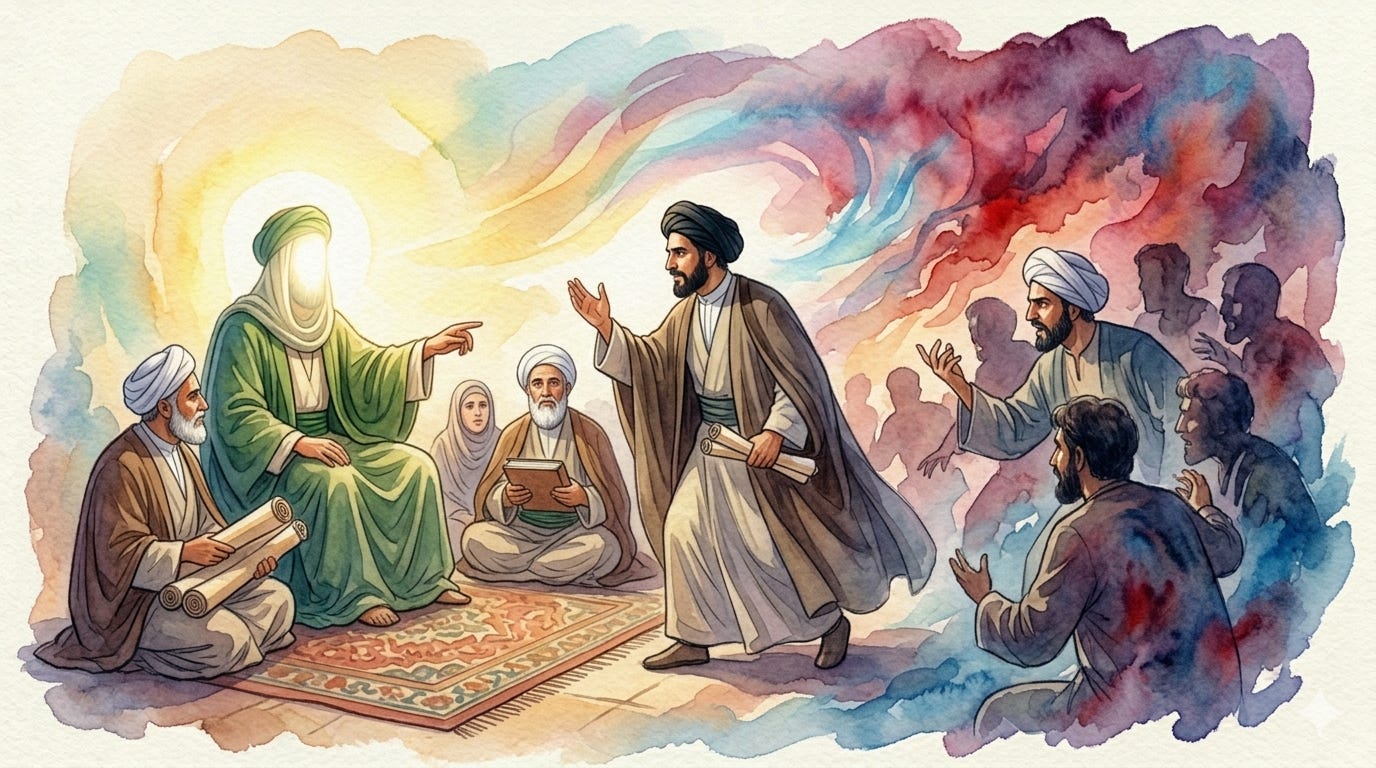
But the Imam’s circle was not only a place where knowledge was received.
It was a place where knowledge was defended.
To understand why this matters, we need to understand the world in which the Imam was teaching.
The second and third centuries of Islam were an age of extraordinary intellectual ferment.
The Muslim community was not merely debating political succession — it was wrestling with the deepest questions of theology.
What is the nature of God?
Does man have free will, or is everything predetermined?
What is the relationship between faith and action?
Can reason lead to God, or only revelation?
And these questions were not academic abstractions.
They were fought over — passionately, publicly, sometimes violently — in the great intellectual salons of Kufa, Basra, and Baghdad. Scholars would gather in open forums, and anyone could challenge anyone.
Reputations were made and destroyed in an afternoon.
To lose a debate was not merely embarrassing — it could discredit your entire school of thought.
Among the most powerful voices in these arenas were two groups that every student of Islamic history should know.
The first were the Mu’tazilites — the rationalists.
They held that human reason, independent of revelation, could arrive at moral and theological truths.
They championed the idea that the Qur’an was created — not eternal — and they insisted on God’s absolute justice, arguing that God cannot do injustice, rather than merely saying He does not.
They were brilliant debaters, and at times they held the ear of the caliphs themselves.
The second were the Murjites — from the Arabic irja’, meaning “to postpone” or “to defer.”
Their central claim was that judgement on a person’s faith should be deferred to God alone — meaning that as long as someone professed belief, their actions (no matter how sinful) could not exclude them from the community of believers.
This had enormous political implications: it effectively gave theological cover to the ruling caliphs, no matter how corrupt, because no one could declare them outside the fold of Islam.
Both groups posed direct challenges to the Shi’a position — the Mu’tazilites by claiming that the Imamate could be decided by rational consensus rather than divine appointment, and the Murjites by neutralising the very grounds on which the Shi’a condemned the usurpers of the Ahl al-Bayt’s rights.
Into this arena, the Imam sent Hisham ibn al-Hakam.
Hisham had not always been a follower of the Imam.
Before coming to al-Sadiq, he had been a disciple of Jahm ibn Safwan — a theologian who denied human free will entirely, teaching that human beings have no agency whatsoever and that all actions are compelled by God.
This is a position the Shi’a tradition firmly rejects — the Imams taught the middle path: neither absolute compulsion (jabr) nor absolute delegation (tafwid), but a station between the two (amrun bayn al-amrayn).
So when Hisham left that school and entered the circle of al-Sadiq, he was not a blank slate.
He was a trained thinker — sharp, experienced in debate, already fluent in the theological language of the age.
He simply needed to be redirected.
And the Imam redirected him with precision.
He was young when he came to Imam al-Sadiq, and he lived long enough to serve not only the sixth Imam, but the seventh and eighth Imams as well — a span of decades in the service of the Ahl al-Bayt.
The Imam did not train Hisham to pray — he trained him to argue.
Hisham debated the Mu’tazilites on the nature of divine justice.
He debated the Murjites on the relationship between faith and action.
He debated the atheists and the dualists — and yes, there were open atheists and Zoroastrian-influenced dualists in the intellectual world of Abbasid Iraq.
He walked into those salons and he defended the doctrine of the Imamate — that leadership of the Muslim community is not a matter of election, consensus, or military power, but of divine appointment through Nass — with a rigour and precision that earned the respect even of those scholars who chronicled the beliefs of rival sects and wrote specifically to refute them.
The late Professor Syed Husain Mohammad Jafri — a Pakistani scholar of Shi’a history whose work The Origins and Early Development of Shi’a Islam remains one of the most respected academic treatments of the subject in the English language — considers Hisham perhaps the greatest of all the Shi’i thinkers in the Imam’s circle.
— S.H.M. Jafri, The Origins and Early Development of Shi’a Islam, Chapter 11
This tells us something extraordinary about the Imam’s pedagogy.
He was not producing one kind of scholar.
He was reading each student, diagnosing their God-given strengths, and deploying them where they were most needed. Zurara was built for transmission and jurisprudence — so the Imam made him a pillar of hadith.
Hisham was built for combat — intellectual combat — so the Imam sharpened him into a blade and sent him into the arenas where the enemies of the Ahl al-Bayt thought they could win with rhetoric alone.
The Imam was not merely a teacher.
He was a commander — marshalling an army of minds.
The Pillars of Transmission
Then there were the narrators — the men without whom we would have nothing.
Zurara ibn A’yan — a mawla of the Banu Shayban in Kufa.
A word on this term, because it causes confusion.
The word mawla (مَوْلَى) carries multiple meanings in Arabic, and the meaning shifts dramatically depending on context.
When the Prophet (peace be upon him and his family) stood at Ghadir Khumm and declared,
“Man kuntu mawlahu fa hadha Aliyyun mawlahu”
— “Whoever I am his mawla, then Ali is his mawla”
— the word there means master, guardian, leader, the one with supreme authority.
It is a declaration of spiritual and political sovereignty.
But in the social vocabulary of early Islamic history, mawla (plural: mawali) has a very different sense.
It refers to a non-Arab convert to Islam who was attached to an Arab tribe as a client or affiliate.
In the tribal society of the time, a convert who had no Arab lineage needed a tribal affiliation in order to function within the social and legal structures of the community.
The Arab tribe would take him under its protection, and he would become their mawla — their client, their affiliate, their freedman.
It did not mean he was a slave — it meant he was not Arab by blood, and had entered the social fabric through adoption rather than birth.
Many of the greatest scholars in Islamic history were mawali.
This is itself significant — because it shows that the Imam’s circle was not an Arab club.
Knowledge in the school of Imam al-Sadiq was not a matter of lineage or ethnicity.
It was a matter of devotion, intellect, and service to the truth.
Zurara’s grandfather was a Greek monk — a Roman Christian — who embraced Islam and became affiliated with the Banu Shayban tribe in Kufa.
From that unlikely beginning, his grandson would become one of the most important figures in the history of the Shi’a tradition.
Zurara started as a disciple of the Zaydite scholars — and here we must pause to explain what this means, because Zayd ibn Ali (peace be upon him) is a figure who is often misunderstood.
Zayd was the son of Imam Zayn al-Abidin (peace be upon him) and the brother of Imam al-Baqir (peace be upon him).
He was not a rival to the Imams — he was of their household, honoured by them, and loved by them.
When the Imam al-Sadiq (peace be upon him) was asked about his uncle Zayd, he said:
كَانَ زَيْدٌ خَيْرَنَا وَسَيِّدَنَا
“Zayd was the best of us and our master.”
— Al-Kashshi, Ikhtiyar Ma’rifat al-Rijal; cited in S.H.M. Jafri, The Origins and Early Development of Shi’a Islam, Chapter 10
And the depth of the Imams’ trust in Zayd is demonstrated by something that every Shi’a Muslim benefits from — whether they know it or not.
The Sahifa al-Sajjadiyyah — the collection of supplications of Imam Zayn al-Abidin (peace be upon him), known as “the Sister of the Qur’an,” “the Gospel of the Folk of the House,” and “the Psalms of the Household of Muhammad” — is one of the most treasured spiritual texts in Islam.
It is one of the oldest prayer manuals in existence, and the hadith scholars classify it as mutawatir: transmitted through so many chains of narration that its authenticity is beyond question.
And its two primary chains of transmission run through the two sons of Imam Zayn al-Abidin:
Imam Muhammad al-Baqir (peace be upon him), and Zayd ibn Ali (peace be upon him).
As the translator William Chittick notes in his introduction to the English edition:
The scholar and translator William C. Chittick notes in his introduction to the English edition that Imam Zayn al-Abidin collected his supplications and taught them to his children — especially to Imam Muhammad al-Baqir and to Zayd.
Zayd kept his own copies of the Sahifa and passed them on to his children, who in turn passed them to the descendants of Abdullah ibn al-Hasan al-Muthanna.
Imam al-Baqir likewise kept copies.
The hadith specialists consider the work mutawatir — transmitted through such numerous and successive chains that its authenticity has never been questioned.
— William C. Chittick, Translator’s Introduction to Al-Sahifat al-Kamilat al-Sajjadiyyah (The Psalms of Islam), published by the Muhammadi Trust, London; see also Baqir Sharif al-Qarashi, The Life of Imam Zayn al-Abidin, Chapter on Al-Sahifa al-Sajjadiyyah
Think about what this means.
The Imam entrusted the preservation of his most intimate conversations with God — his supplications, his whispered prayers, his cries in the night — to both his sons.
Not only to Imam al-Baqir, the designated Imam, but also to Zayd.
This is not the act of a father who considered one son legitimate and the other a renegade.
This is the act of a father who trusted both his sons with the most sacred thing he possessed.
But Zayd’s path was different from the path of his brother Imam al-Baqir.
Imam al-Baqir — and after him Imam al-Sadiq — chose to focus on knowledge, on building the doctrinal and jurisprudential foundations of the school, on training scholars, on preserving the teachings of the Ahl al-Bayt for future generations.
They did not take up the sword — not because they lacked courage, but because they judged that the conditions were not right, and that the long-term survival of the message required a different strategy.
Zayd could not bear to watch the tyranny of the Umayyads and do nothing.
He saw oppression and his conscience drove him to act.
As we discussed in Session 54, the Zaydite impulse was ’ajul — it was born of urgency, of a righteous impatience in the face of injustice.
It was not a betrayal of the Imams.
It was a different response to the same pain.
And the Imams did not condemn all such movements absolutely.
The martyred Imam Khamenei — may God rest his pure soul — makes this point powerfully in his 250-year-old person, a work that formed the backbone of our earlier discussions on the Imamate in this series.
In it, the Imam analyses the political struggles of all fourteen Infallibles as a single, continuous movement toward one goal.
On the question of armed uprisings by members of the Prophet’s family, he writes:
إِنَّ الْأَئِمَّةَ عَلَيْهِمُ السَّلَامُ لَمْ يُخَطِّئُوا هَذِهِ التَّحَرُّكَاتِ بِصُورَةٍ مُطْلَقَةٍ، وَحُكْمُهُمْ عَلَى بَعْضٍ مِنْهَا بِالْخَطَأِ لَمْ يَكُنْ بِدَاعِي كَوْنِهَا حَرَكَاتٍ مُسَلَّحَةً وَإِنَّمَا لِأَسْبَابٍ أُخَرَ مُخْتَلِفَةٍ. لِذَا نَجِدُ أَنَّ مَوَاقِفَ الْأَئِمَّةِ عَلَيْهِمُ السَّلَامُ كَانَتْ مُؤَيِّدَةً لِهَذِهِ الْحَرَكَاتِ فِي بَعْضِ الْأَحْيَانِ، بَلْ وَاشْتَرَكُوا فِي بَعْضِهَا، بِصُورَةٍ غَيْرِ مُبَاشِرَةٍ، عَنْ طَرِيقِ الْمُسَاعَدَاتِ الَّتِي كَانُوا يُقَدِّمُونَهَا لِلثَّوْرَةِ
“The Imams (peace be upon them) did not declare these movements to be in error absolutely. And when they judged some of them as mistaken, it was not on the grounds of their being armed movements, but rather for other, different reasons. Hence we find that the positions of the Imams (peace be upon them) were supportive of these movements on some occasions — indeed, they participated in some of them indirectly, through the assistance they would provide to the revolution.”
— Imam Khamenei, Insan bi-’Umr 250 Sanah (250-year-old person) (Arabic Edition), Pages 9–10
Zayd rose.
He was martyred.
And his followers — the Zaydites — developed over time into a distinct school of thought, one that held that any learned and courageous descendant of Imam Ali and Sayyedah Fatimah who took up the sword against tyranny could be the rightful leader, rather than following the principle of divine designation (Nass) through a specific chain of Imams.
The Zaydite school exists to this day, primarily in Yemen.
Indeed the resistance movement Ansarallah, that is a core component of the Axis of Resistance, has its origins in the Zaydite School.
Zurara had been trained in this environment — influenced also by Mu’tazilite rationalism.
But eventually he found these positions insufficient.
He transferred his allegiance to Imam al-Baqir (peace be upon him) and then to Imam al-Sadiq (peace be upon him) — to the line that taught that the Imamate is not won by the sword but conferred by God, through divine appointment.
He was not merely a transmitter — he was the founder of the Shi’a school of speculative theology in the proper sense, and the first teacher of kalam from within the circle of Imam Ja’far al-Sadiq.
The Imam spoke of him — and of his closest companions — with a love that still echoes across the centuries:
أَحَبُّ النَّاسِ إِلَيَّ أَحْيَاءً وَأَمْوَاتاً أَرْبَعَةٌ: بُرَيْدُ بْنُ مُعَاوِيَةَ الْعِجْلِيُّ، وَزُرَارَةُ، وَمُحَمَّدُ بْنُ مُسْلِمٍ، وَالْأَحْوَلُ
“The most beloved of people to me, whether alive or dead, are four: Burayd ibn Mu’awiya al-’Ijli, Zurara, Muhammad ibn Muslim, and al-Ahwal.”
— Al-Kashshi, Ikhtiyar Ma’rifat al-Rijal, Hadith 135
And in another tradition, the Imam made clear just how much rested on these men’s shoulders:
لَوْلَا زُرَارَةُ وَنُظَرَاؤُهُ لَانْدَرَسَتْ أَحَادِيثُ أَبِي
“Were it not for Zurara and those like him, the traditions of my father would have perished.”
— Al-Kashshi, Ikhtiyar Ma’rifat al-Rijal, Hadith 238
Pause on that.
The Imam — a divinely appointed Proof of God — is telling us that without these human beings, the knowledge his own father transmitted would have been lost.
Not because God could not have preserved it by other means — but because God chose to preserve it through them.
Through their notebooks, their memories, their willingness to travel back and forth between Kufa and Medina — carrying hadith in their hearts like merchants carrying silk on the trade routes.
Without them, we have no Al-Kafi.
No Tahdhib.
No Four Books.
No school.
They are the first links in the chain we described in Session 61.
When Zurara’s activities on behalf of the Imam put him in danger from the Abbasid surveillance apparatus, the Imam — practising taqiyyah, strategic prudence — publicly disavowed him and even cursed him.
Not out of anger — out of protection.
Sayyed Jafri, in the Origins and Early History of Shi’a Islam, records that the Imam compared his own action to that of the Prophet Khidr (peace be upon him), who sank a ship to save it from being seized by a tyrant king — a reference to the Qur’anic narrative in Surah al-Kahf:
فَانطَلَقَا حَتَّىٰ إِذَا رَكِبَا فِي السَّفِينَةِ خَرَقَهَا ۖ قَالَ أَخَرَقْتَهَا لِتُغْرِقَ أَهْلَهَا لَقَدْ جِئْتَ شَيْئًا إِمْرًا
So they went on and when they boarded the boat, he made a hole in it. He said, ‘Did you make a hole in it to drown its people? You have certainly done a monstrous thing!’
— Quran, Surah al-Kahf (the Chapter of the Cave) #18, Verse 71
Think about that.
The Imam damaged Zurara’s reputation in public precisely so that the Abbasid apparatus would lose interest in him — and Zurara would survive to continue transmitting.
The Imam sacrificed his own companion’s reputation to protect the knowledge that companion carried.
That is how seriously he took the chain.
And alongside these great narrators were the jurists.
Al-Kashshi describes six men as the most authoritative legal scholars from among all the followers of the fifth and sixth Imams:
اجْتَمَعَتِ الْعِصَابَةُ عَلَى تَصْدِيقِ هَؤُلَاءِ الْأَوَّلِينَ مِنْ أَصْحَابِ أَبِي جَعْفَرٍ وَأَبِي عَبْدِ اللَّهِ عَلَيْهِمَا السَّلَامُ وَانْقَادُوا لَهُمْ بِالْفِقْهِ فَقَالُوا: أَفْقَهُ الْأَوَّلِينَ سِتَّةٌ: زُرَارَةُ، وَمَعْرُوفُ بْنُ خَرَّبُوذَ، وَبُرَيْدٌ، وَأَبُو بَصِيرٍ الْأَسَدِيُّ، وَالْفُضَيْلُ بْنُ يَسَارٍ، وَمُحَمَّدُ بْنُ مُسْلِمٍ الطَّائِفِيُّ. قَالُوا: وَأَفْقَهُ السِّتَّةِ زُرَارَةُ
“The community is unanimous in affirming the truthfulness of these earliest ones from among the companions of Abu Ja’far and Abu ’Abdillah (peace be upon them both), and they yielded to them in jurisprudence. They said: the most learned among the earliest ones are six — Zurara, Ma’ruf ibn Kharrabudh, Burayd, Abu Basir al-Asadi, al-Fudayl ibn Yasar, and Muhammad ibn Muslim al-Ta’ifi. And they said: the most learned of the six is Zurara.”
— Al-Kashshi, Ikhtiyar Ma’rifat al-Rijal, Page 238
Their consensus on matters of law formed the bedrock of the Ja’fari legal tradition.
Four thousand students.
Dialecticians and chemists.
Jurists and theologians.
Narrators and philosophers.
All drinking from one spring.
The Politics of Teaching
But let us not romanticise this window as if it were a time of peace.
The Imam taught under threat.
When the Abbasid revolution succeeded in 132 AH, the new dynasty — which had ridden to power on the slogan “al-Rida min Aal Muhammad,” the chosen one from the family of Muhammad — immediately turned on the very family it claimed to represent.
The Caliph al-Mansur regarded Imam Ja’far al-Sadiq as the single most dangerous man in the empire — not because the Imam carried a sword, but precisely because he didn’t.
A rebel can be killed on the battlefield.
But a teacher?
A teacher who refuses to take up arms, who claims no political authority, who simply sits and teaches — what do you do with such a man?
You cannot charge him with treason.
You cannot declare war on someone who declares only knowledge.
And yet his very existence — his bloodline, his learning, his quiet authority — was a standing rebuke to every caliph who sat on a throne stolen from his family.
Before the Abbasid revolution had even fully consolidated, Abu Salama — the chief power-broker of the movement in Kufa — is reported by both al-Tabari and al-Mas’udi to have sent a letter to the Imam, inviting him to come and claim the caliphate.
The Imam’s response was reported in our sources — and it was not a polite refusal.
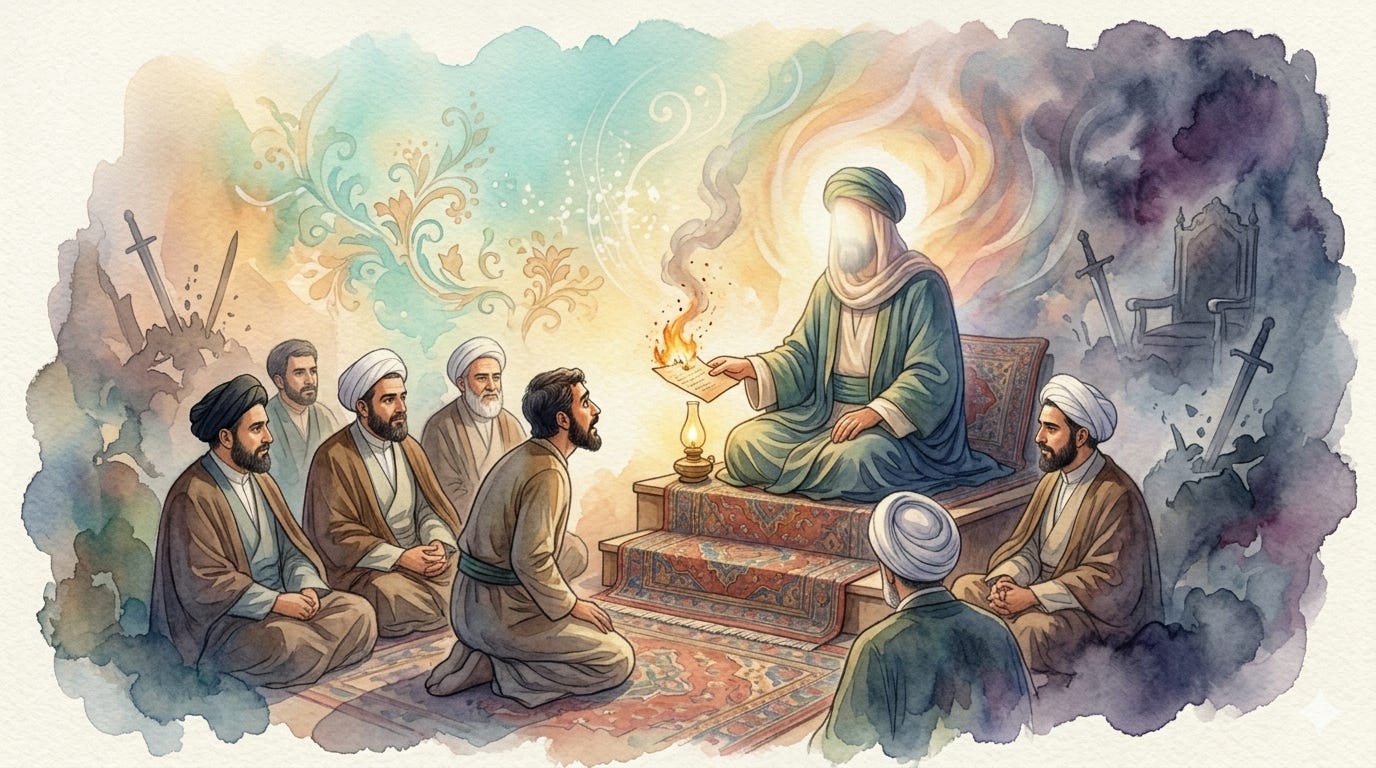
He called for a lamp and burned the letter in front of the messenger.
Then he said:
أَخْبِرْ صَاحِبَكَ بِمَا رَأَيْتَ
“Tell your master what you have seen.”
— S.H.M. Jafri, The Origins and Early Development of Shi’a Islam, Chapter 10, citing al-Tabari and al-Mas’udi
He would not be drawn into politics.
His revolution was of a different kind.
And when his relative, Abd Allah al-Mahd, accepted a similar offer and began plotting a military uprising, the Imam warned him directly.
Sayyed Jafri, drawing on the accounts of al-Ya’qubi, al-Mas’udi, and al-Jahshiyari, records that the Imam severely warned Abd Allah not to endanger his own life and his son’s life in this game of power and treachery — telling him plainly that Abu Salama was not their Shi’a and the Khurasanians were not their followers.
— S.H.M. Jafri, The Origins and Early Development of Shi’a Islam, Chapter 10, citing al-Ya’qubi, Tarikh; al-Mas’udi, Muruj al-Dhahab; al-Jahshiyari, Al-Wuzara’ wa’l-Kuttab
Abd Allah dismissed the warning and retorted bitterly that the Imam was simply jealous of him and his son.
History proved which man was right.
Abd Allah’s son, Muhammad al-Nafs al-Zakiyyah, rose in rebellion and was killed.
The Imam had read the situation correctly — because his reading came not from political calculation, but from a connection to a Source beyond politics.
And yet al-Mansur could not leave the Imam alone.
He summoned him repeatedly.
He schemed to have him killed.
And in the end — as we will hear in tonight’s eulogy — he succeeded in having him poisoned.
The Imam’s response to all of this was not flight, not armed resistance, not even public denunciation.
His response was education.
He chose to build minds, not armies.
He chose to train Zurara rather than raise a militia.
He chose to sharpen Hisham’s tongue rather than a blade.
And here is the lesson: the minds outlasted the swords.
Al-Mansur’s empire fell to the Mongols in 656 AH.
The Imam’s school is still standing.
Lessons for Our Time
Three things we carry from this point.
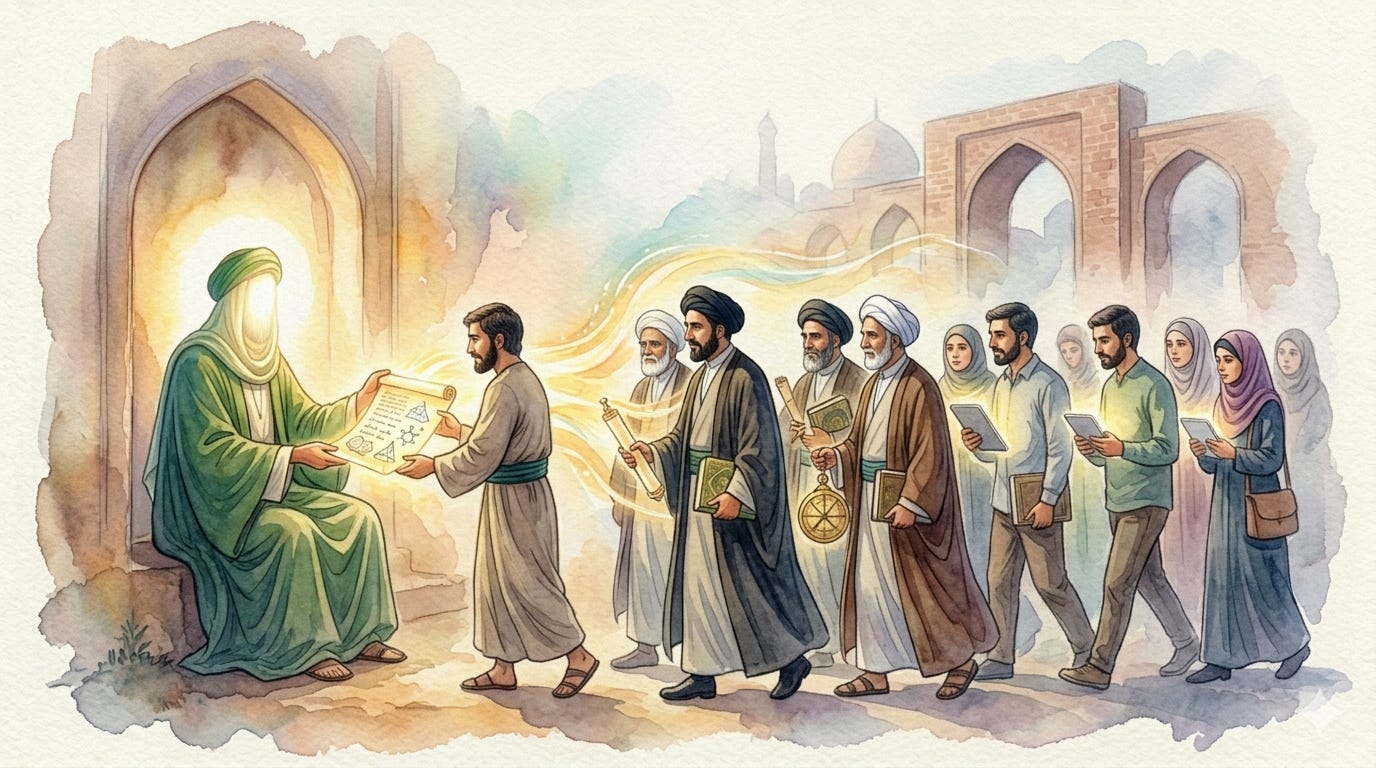
First: the Imam seized a narrow window.
He did not wait for perfect conditions.
He did not say,
“When the political situation improves, I will teach.”
He did not say,
“When the funding comes, I will open a school.”
He looked at the chaos around him and saw — not despair, but opportunity.
The empires were distracted.
The ground was open.
He poured the foundation.
We live in a different kind of window.
We have tools the Imam could not have imagined — the internet, publishing, international travel, instantaneous communication.
The question is not whether we have the tools.
The question is whether we are using them.
Or are we waiting for perfect conditions that will never come?
Second: knowledge in the Imam’s circle was never compartmentalised.
The same teacher who explained the rules of ritual purity also taught the principles of chemistry.
The same circle that produced jurists also produced philosophers.
The modern Muslim who sees religion and science as separate — as if they belong in different buildings, taught by different people, to different students — has departed from the Sadiqiyya methodology.
This connects directly to what we said in Session 61: the Hawza does not live in the past, and the Muslim mind was never meant to be narrow.
Third: the Imam built people, not buildings.
His greatest investment was in human capital.
He did not commission monuments — he commissioned Zurara, and Hisham, and Jabir.
When he needed to protect the knowledge, he protected the person who carried it — even at the cost of his own reputation.
The buildings came later.
The people came first.
This connects to the “becoming human” theme we established in Session 61.
The Hawza — at its root, at its source — was never about bricks.
It was about the transformation of the human being who walked through the door.
And every Hawza that has ever existed since — in Baghdad, in Hillah, in Najaf, in Qum — is an attempt to recreate what happened in that room in Medina.
Where a man sat. Where he taught.
Where four thousand came to drink.
And where the foundation was poured — in the narrow window, in the stillness between two storms — for everything we are about to trace.
Point 2: The Sunni Schools - Branches from the Same Tree
A Word Before We Begin
What follows is not a sectarian argument.
It is not an attempt to claim the Sunni schools for Shi’ism, nor to diminish their independent achievements, nor to suggest that our Sunni brethren are somehow “really Shi’a but don’t know it.”
That would be dishonest and disrespectful — and it would be a betrayal of the very spirit of the Imam whose classroom we are sitting in tonight.
We are unashamedly Shi’a.
We make no apology for our beliefs, our doctrine of the Imamate, or our allegiance to the Ahl al-Bayt.
But being Shi’a does not mean being sectarian — and there is a world of difference between the two.
What we are about to present is a historical observation, acknowledged by major Sunni historians themselves: that the four great schools of Sunni jurisprudence emerged from an era and an environment in which the teaching of the Ahl al-Bayt was the dominant intellectual force.
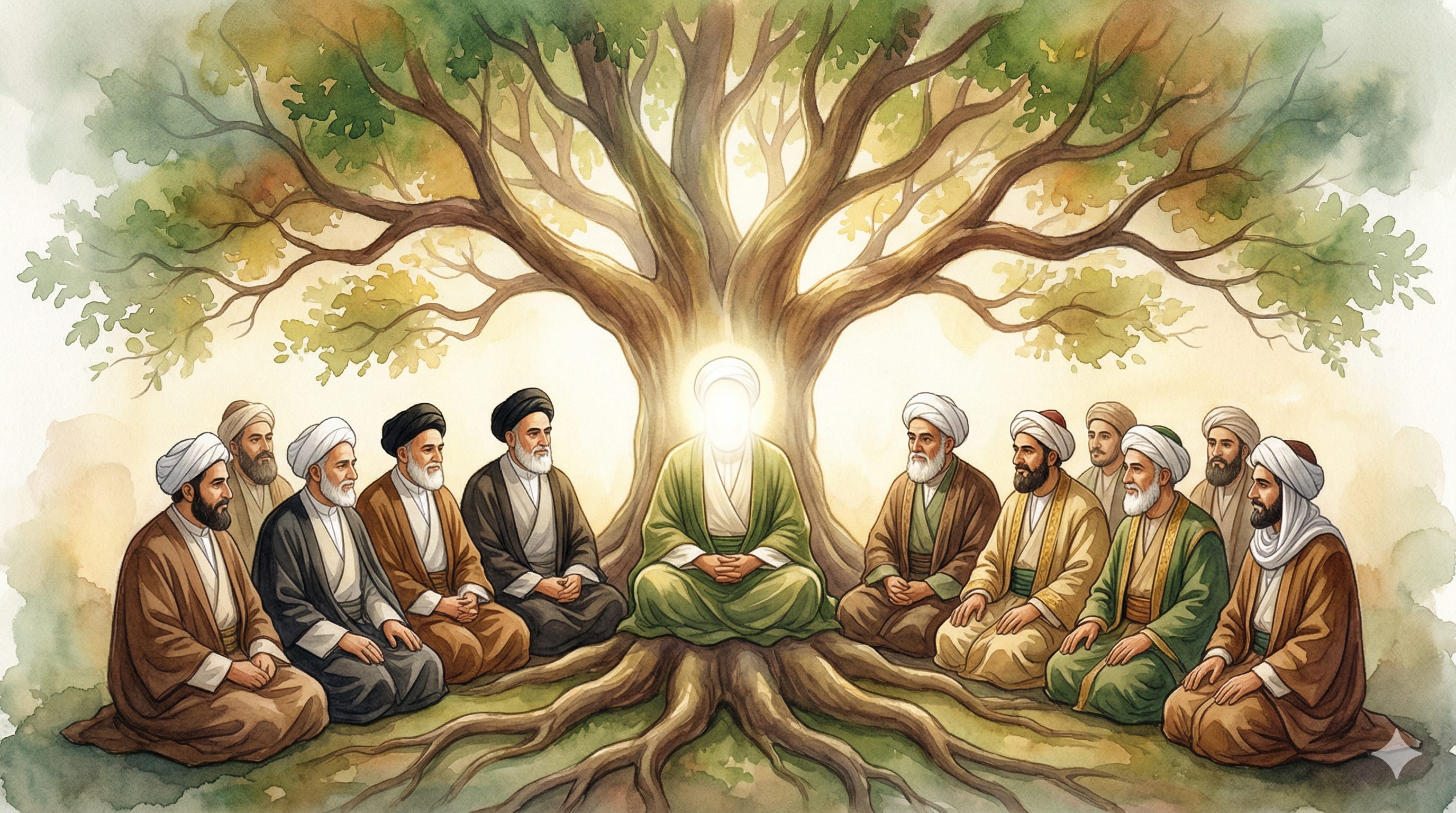
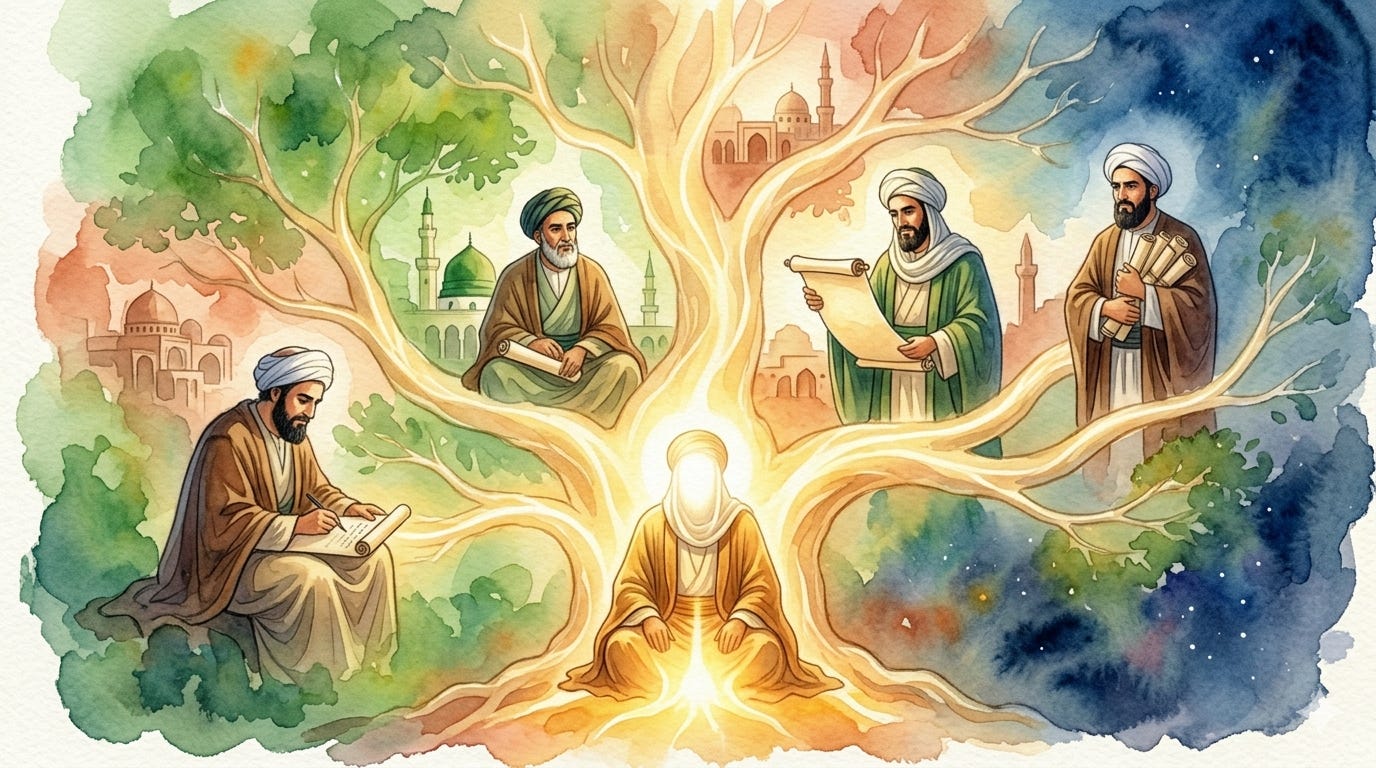
The tree is one.
The branches diverged.
And understanding how they diverged — with respect and honesty — is essential to understanding both the Imam’s legacy and our relationship with the wider Muslim world.
Abu Hanifa — The Man Who Came to Medina
Abu Hanifa al-Nu’man ibn Thabit (d. 150 AH / 767 CE) was the founder of the Hanafi school — the largest Sunni legal school in the world today.
He was based in Kufa, Iraq.
His family origins were non-Arab — most historical sources record him as being of Persian descent, though some accounts differ.
He was a brilliant legal mind, and he is known for his heavy reliance on Qiyas (analogical reasoning) and Ra’y (juristic opinion) — methods he developed in part because, being in Kufa rather than Medina, he had less direct access to the large body of Prophetic hadith that circulated in the Prophet’s own city.
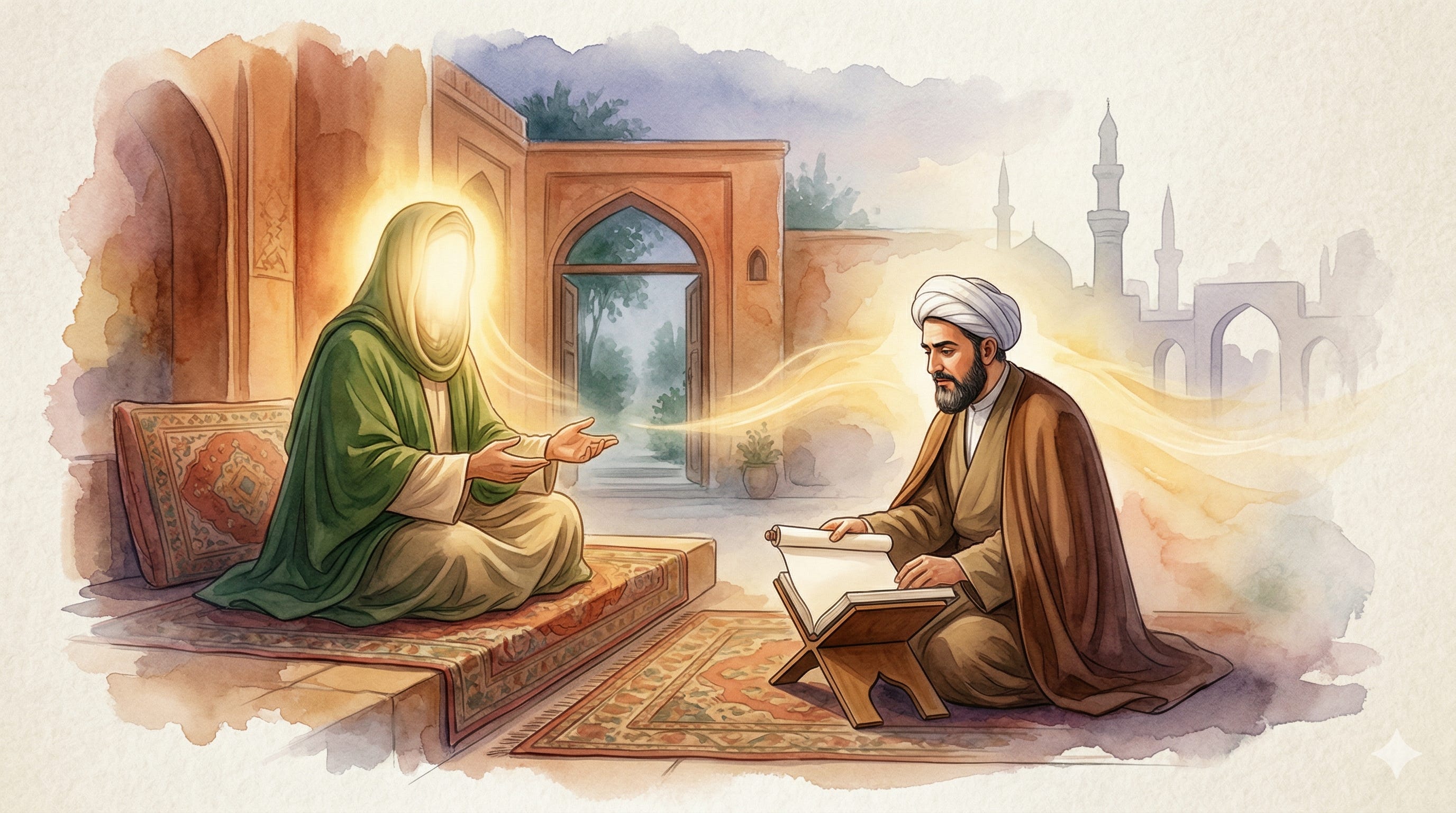
His connection to Imam al-Sadiq (peace be upon him) is recorded by multiple sources.
Ibn Abi al-Hadid al-Mu’tazili — himself a Sunni scholar — explicitly states that Abu Hanifa was a student of the Imam.
And there is a famous statement attributed to Abu Hanifa that has echoed through the centuries:
لَوْلَا السَّنَتَانِ لَهَلَكَ النُّعْمَانُ
“Were it not for the two years, al-Nu’man would have perished.”
— Attributed to Abu Hanifa; cited in Muhammad Rida al-Hakimi, Lawla al-Sanatan la-Halaka al-Nu’man; also referenced in al-Tuhfa al-Ithna ’Ashariyyah. See also: Ibn Abi al-Hadid, Sharh Nahj al-Balagha
A note of scholarly honesty is required here.
This statement, while widely cited, is debated among scholars.
Some interpret “al-sanatan” as “the two years” — referring to a period of study with Imam al-Sadiq.
Others, particularly some Zaydite scholars, argue it refers to two years spent with Zayd ibn Ali.
And some scholars have suggested that the word should be read as “al-sunnatan” — “the two traditions” (i.e., the Qur’an and the Sunnah) — rather than “the two years.”
The attribution cannot be traced with certainty earlier than the 14th/20th century in its current form.
What is well-established, however, is Abu Hanifa’s own testimony regarding the Imam’s knowledge.
He is recorded as having said:
مَا رَأَيْتُ أَفْقَهَ مِنْ جَعْفَرِ بْنِ مُحَمَّدٍ
“I have not seen anyone more knowledgeable in jurisprudence than Ja’far ibn Muhammad.”
— Cited in S.H.M. Jafri, The Origins and Early Development of Shi’a Islam, Chapter 10, footnote 10; also in al-Dhahabi, Tadhkirat al-Huffaz
The Hanafi school became the official legal school of the Ottoman Empire and remains dominant today across Turkey, South Asia, Central Asia, and the Balkans — making it the most widely followed school of Islamic law in the world.
Malik ibn Anas — The Jurist Who Paid in Blood
Malik ibn Anas (d. 179 AH / 795 CE) was the founder of the Maliki school, and he was based in Medina itself — the city of the Prophet.
His approach to jurisprudence leaned heavily on what he called the ’Amal — the living practice of the people of Medina.
He argued that the inherited customs and practices of the Prophet’s own city constituted a form of legal evidence, because they represented an unbroken chain of behaviour going back to the Prophet himself.
This is a distinctive methodology — different from both Abu Hanifa’s reliance on reasoning and the later hadith-centred approach of others.
Malik was a contemporary of Imam al-Sadiq (peace be upon him) in Medina.
Their scholarly interaction is documented in the sources.
Sayyed Jafri notes that the famous jurist Malik ibn Anas, when quoting traditions from the Imam, would use a formula of particular respect, calling him “al-Thiqa” — the Truthful, the Trustworthy:
حَدَّثَنِي الثِّقَةُ جَعْفَرُ بْنُ مُحَمَّدٍ
“The Trustworthy One, Ja’far ibn Muhammad, himself told me…”
— Cited in S.H.M. Jafri, The Origins and Early Development of Shi’a Islam, Chapter 10, footnote 9
But Malik’s significance for our story goes beyond his legal methodology.
He demonstrated something that we discussed in Point 1 — that knowledge demands courage.
When the Alid claimant Muhammad al-Nafs al-Zakiyyah rose in rebellion against the Abbasid Caliph al-Mansur, Malik issued a fatwa — a legal ruling — declaring that the oath of allegiance sworn to the Abbasids was not binding, because it had been extracted under coercion.
In the legal terminology: an oath given under duress (ikrah) carries no legal weight.
This was not an abstract legal opinion.
It was a direct political act.
It told the people of Medina that they were free to support the Alid uprising — because their allegiance to the Abbasids was void.
The consequence was swift.
Sayyed Jafri records that after al-Mansur reconquered Medina and suppressed the revolt, he ordered Malik ibn Anas to be flogged.
— S.H.M. Jafri, The Origins and Early Development of Shi’a Islam, Chapter 10, citing Tabari and other sources
A Sunni jurist.
Flogged by an Abbasid caliph.
For issuing a ruling that supported the rights of the Ahl al-Bayt.
The Maliki school is dominant today across North and West Africa.
Al-Shafi’i — The Systematiser Accused of Love
Muhammad ibn Idris al-Shafi’i (d. 204 AH / 820 CE) was the great systematiser of Sunni jurisprudence.
He studied under Malik in Medina, then travelled extensively, absorbing both the Medinan tradition of reliance on practice and the Iraqi tradition of reliance on reasoning.
His genius was synthesis: he formally created the science of Usul al-Fiqh — the principles of jurisprudence — for Sunni Islam, establishing a framework that mediated between the reliance on hadith and the use of analogical reasoning.
He is, in many ways, the architect of the Sunni legal method as we know it.
Al-Shafi’i did not study directly under Imam al-Sadiq — he was born after the Imam’s martyrdom.
But he studied under Malik, who had studied with the Imam, and he drew deeply from the traditions that flowed from the Imam’s circle.
His connection to the Ahl al-Bayt was not merely academic — it was personal, passionate, and costly.
He was accused of being a Rafidi — a term of abuse meaning “rejecter,” used to slander Shi’a Muslims and anyone suspected of Shi’a sympathies.
His open love for the Ahl al-Bayt drew suspicion and hostility from those who saw any expression of devotion to the Prophet’s family as a political threat.
His response was not to hide.
It was to compose poetry — poetry so defiant and so beautiful that it has survived twelve centuries:
يَا رَاكِبًا قِفْ بِالْمُحَصَّبِ مِنْ مِنًى
وَاهْتِفْ بِقَاعِدِ خَيْفِهَا وَالنَّاهِضِسَحَرًا إِذَا فَاضَ الْحَجِيجُ إِلَى مِنًى
فَيْضًا كَمُلْتَطِمِ الْفُرَاتِ الْفَائِضِإِنْ كَانَ رَفْضًا حُبُّ آلِ مُحَمَّدٍ
فَلْيَشْهَدِ الثَّقَلَانِ أَنِّي رَافِضِي“O rider, halt at the pebble-strewn ground of Mina,
and cry out to those who sit in its valleys and those who rise —At dawn, when the pilgrims surge toward Mina,
a flood like the crashing waters of the Euphrates overflowing —If love of the family of Muhammad is Rafd,
then let the two weighty things bear witness that I am a Rafidi.”— Imam al-Shafi’i; recorded in al-Bayhaqi, Manaqib al-Shafi’i, Volume 2, Page 71; Ibn ’Asakir, Tarikh Dimashq, Volume 51, Pages 317–318; al-Dhahabi, Siyar A’lam al-Nubala
Note the final line:
fal-yashhad al-thaqalan
— “let the two weighty things bear witness.”
The Thaqalayn — the Qur’an and the Ahl al-Bayt — the very hadith we cited in Session 61 and which forms the constitutional basis of our entire tradition.
Al-Shafi’i is invoking our hadith, the Hadith of the Two Weighty Things, as his witness.
He is saying: if loving the Prophet’s family makes me a heretic in your eyes, then I call God’s Book and the Prophet’s Family themselves as my defence.
Al-Bayhaqi, the great Sunni hadith scholar who recorded these lines, added a note explaining that al-Shafi’i composed them when opponents driven by jealousy accused him of being a Rafidi.
The Shafi’i school is dominant today across East Africa, Southeast Asia, and parts of the Middle East.
Ahmad ibn Hanbal — The Man Who Would Not Break
Ahmad ibn Hanbal (d. 241 AH / 855 CE) was the champion of the traditionalists — the Ahl al-Hadith — and the founder of the Hanbali school, the most literalist of the four Sunni schools.
He is known above all for one thing: he would not break.
During the reign of the Abbasid Caliph al-Ma’mun, and continuing under his successors al-Mu’tasim and al-Wathiq, the caliphate imposed a theological inquisition known as the Mihna — a word that means “trial” or “ordeal.”
The caliphs, influenced by Mu’tazilite theology, demanded that all scholars publicly affirm the doctrine that the Qur’an was created — a position the Mu’tazilites held but which the traditionalists rejected, insisting that the Qur’an, as the Word of God, was eternal and uncreated.
The Mihna was not a polite theological debate.
Scholars who refused to affirm the official doctrine were imprisoned, flogged, and in some cases killed.
It was a state-sponsored persecution of religious conscience — and it lasted for approximately fifteen years.
Ahmad ibn Hanbal refused.
He was imprisoned.
He was flogged.
He endured years of suffering.
And he did not recant.
His steadfastness made him a hero of the Sunni tradition — a symbol of the scholar’s duty to stand for truth against power, regardless of the cost.
While his school differs significantly from the Shi’a on theological grounds, Ahmad’s own collections of hadith include narrations in praise of Imam Ali (peace be upon him) and the Ahl al-Bayt.
The love of the Prophet’s family was not a Shi’a monopoly in the early centuries — it was a shared inheritance, acknowledged by scholars across the spectrum.
The Hanbali school is dominant today primarily in Saudi Arabia and parts of the Gulf.
A Necessary Distinction — The Hanbali School Is Not the Wahhabi Movement
And here a clarification is essential — because a grave injustice is done when the Hanbali school of Imam Ahmad ibn Hanbal is conflated with the Wahhabi movement that emerged in the 18th century.
Muhammad ibn Abd al-Wahhab (d. 1206 AH / 1792 CE) was born in the Najd region of central Arabia, from the tribe of Banu Tamim.
He drew selectively from the Hanbali tradition — particularly from the later writings of Ibn Taymiyyah (d. 728 AH) — but his teachings went far beyond anything Ahmad ibn Hanbal taught.
He declared the vast majority of Muslims to be polytheists (mushrikun) for practices like visiting the graves of the Prophet and the righteous, seeking intercession (tawassul) through them, and other acts of devotion that the mainstream scholars of all four Sunni schools — including the Hanbali school itself — had always considered permissible.
His own father, Abd al-Wahhab, who was himself a respected Hanbali jurist, opposed his son’s teachings.
His own brother, Shaykh Sulayman ibn Abd al-Wahhab, wrote one of the earliest refutations of the movement — a treatise called Al-Sawa’iq al-Ilahiyyah fi al-Radd ’ala al-Wahhabiyyah (“The Divine Thunderbolts in Refutation of Wahhabism”).
And his own teachers in Medina warned that he would be a source of misguidance.
The political dimension is equally important.
Ibn Abd al-Wahhab struck a pact with Muhammad ibn Saud, the ruler of Dir’iyyah in the Najd.
Muhammad ibn Saud was from the tribe of Banu Hanifa — and this is significant.
Banu Hanifa was the same tribe that produced Musaylama al-Kadhdhab — the false prophet who rose against the Prophet Muhammad (peace be upon him and his family) during the Wars of Apostasy (Hurub al-Riddah) and was killed by the Muslim armies.
We discussed Musaylama in Session 49 when examining the phenomenon of false claimants.
This connection is documented by Shaykh Ahmad Zayni Dahlan al-Makki al-Shafi’i — who was the Chief Mufti of Mecca during the Ottoman period, and therefore a senior Sunni Shafi’i authority with no sectarian motive.
In his treatise Fitnatu’l-Wahhabiyyah (“The Tribulation of the Wahhabiyyah”), he writes that Muhammad ibn Saud, the prince of Dir’iyyah who became the political arm of the Wahhabi movement, was from Banu Hanifa —
“the people of Musaylama al-Kadhdhab.”
— Shaykh Ahmad Zayni Dahlan al-Makki al-Shafi’i (Chief Mufti of Makkah), Fitnatu’l-Wahhabiyyah, Section: “Alliance with the Su’udiyy Family”
The pact between these two families — the religious ideology of Ibn Abd al-Wahhab and the military power of the House of Saud — produced the movement that would eventually give rise to the modern Saudi state, and that would provide the doctrinal foundations for extremist groups including al-Qaeda and DAESH (ISIS) in our own time.
But — and this is the point we must be clear about — to equate the Hanbali school with Wahhabism is as invalid as equating the school of Abu Hanifa with the Shi’a school simply because Abu Hanifa studied under Imam al-Sadiq.
A school of thought is not responsible for every later movement that selectively draws from it.
Ahmad ibn Hanbal — the man who was imprisoned and flogged rather than compromise his beliefs, whose own hadith collections record the praise of Imam Ali — would not recognise the movement that claims his name while demolishing the graves of the Ahl al-Bayt and declaring the majority of Muslims to be polytheists.
The Hanbali school deserves to be judged by its founder and its mainstream tradition — not by its most extreme deviation.
The Key Point — One Tree, Many Branches
Why have we told these four stories?
Not to claim these scholars as Shi’a.
They were not Shi’a — not in the doctrinal sense of accepting the Imamate of the Twelve.
But to establish a fact that is too often buried beneath centuries of sectarian hostility:
All four Sunni schools trace back — directly or indirectly — to the era and influence of the Ahl al-Bayt.
Abu Hanifa studied under Imam al-Sadiq. Malik was his contemporary in Medina and called him “the Trustworthy.”
Al-Shafi’i studied under Malik and invoked the Hadith of the Two Weighty Things in defence of his love for the Prophet’s family.
Ahmad ibn Hanbal studied under al-Shafi’i and transmitted narrations in praise of Imam Ali.
The chain is:
Imam al-Sadiq → Abu Hanifa → (influence on) → Malik → al-Shafi’i → Ahmad ibn Hanbal.
The tree is one.
It is the branches that diverged.
And this is not a Shi’a claim — it is a historical observation that Sunni and Shi’a scholars alike have acknowledged.
Lessons for Our Time
Three things we carry from this point.
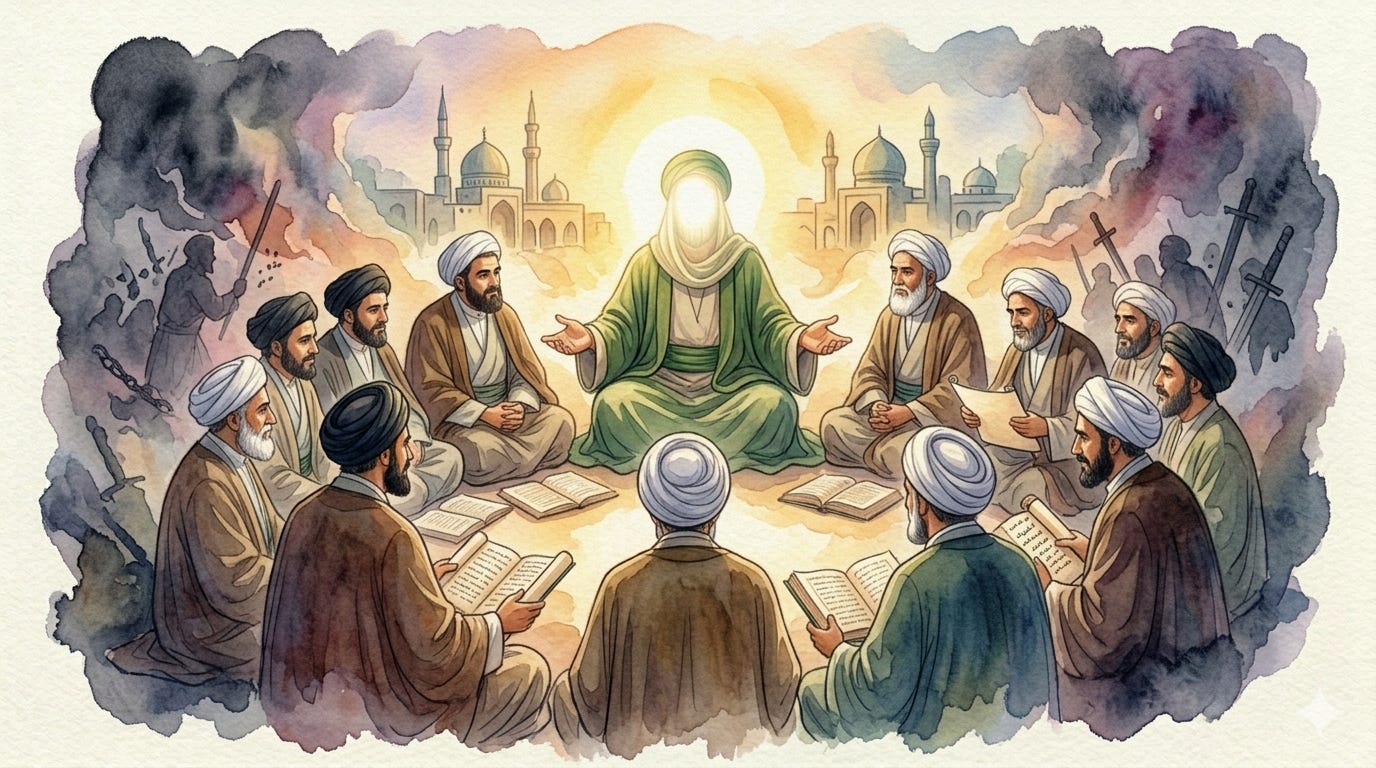
First: the Imam did not teach only Shi’a.
His circle was open.
Abu Hanifa came to him — a man from Kufa, with different methodological instincts, who would go on to found a school that diverged from the Imam’s on many points of law. And the Imam taught him anyway.
The Hawza tradition, at its best, has always been one of engagement, not isolation.
Sectarianism — the refusal to engage with those who disagree — is the antithesis of the Sadiqiyya spirit.
Second: the intellectual diversity of this period — Qiyas, ’Amal, hadith, Usul — shows that Islam encourages rigorous disagreement within a framework of respect.
We should study our Sunni brethren’s methodologies to understand them, not merely to refute them.
Understanding how Abu Hanifa reasoned, how Malik weighed the practice of Medina, how al-Shafi’i synthesised — this is not a betrayal of our school.
It is an enrichment of our own understanding.
Third: the suffering of scholars like Malik — flogged for defending the rights of the Ahl al-Bayt — and Ibn Hanbal — imprisoned for refusing to recant — shows that the demand for courage is not unique to the Shi’a experience.
It is universal.
Every tradition that has produced something worth preserving has demanded that its scholars pay a price.
And the scholars who are remembered — across all schools, across all centuries — are those who paid it.
Point 3: The Abbasid Betrayal and the Seeds of the Occultation
The Great Betrayal
We have spoken tonight about what the Imam built.
We have spoken about the branches that grew from his tree.
Now we must speak about what was done to him — and to every Imam who came after him — because without understanding the darkness, we cannot understand why the light had to be hidden.
In Session 31, we explored the three dimensions of Imam al-Sadiq’s struggle — the open proclamation (al-Jihad), the jihad of clarification (al-’Ilm), and the hidden organisation (al-Tanzim).
Tonight, we have seen the content of those dimensions — the four thousand students, the branches that became the Sunni schools, the companions who carried the flame.
But every revolution meets a counter-revolution.
And the counter-revolution that struck the Imam’s movement was the most cunning and devastating of all — because it came disguised as the revolution itself.
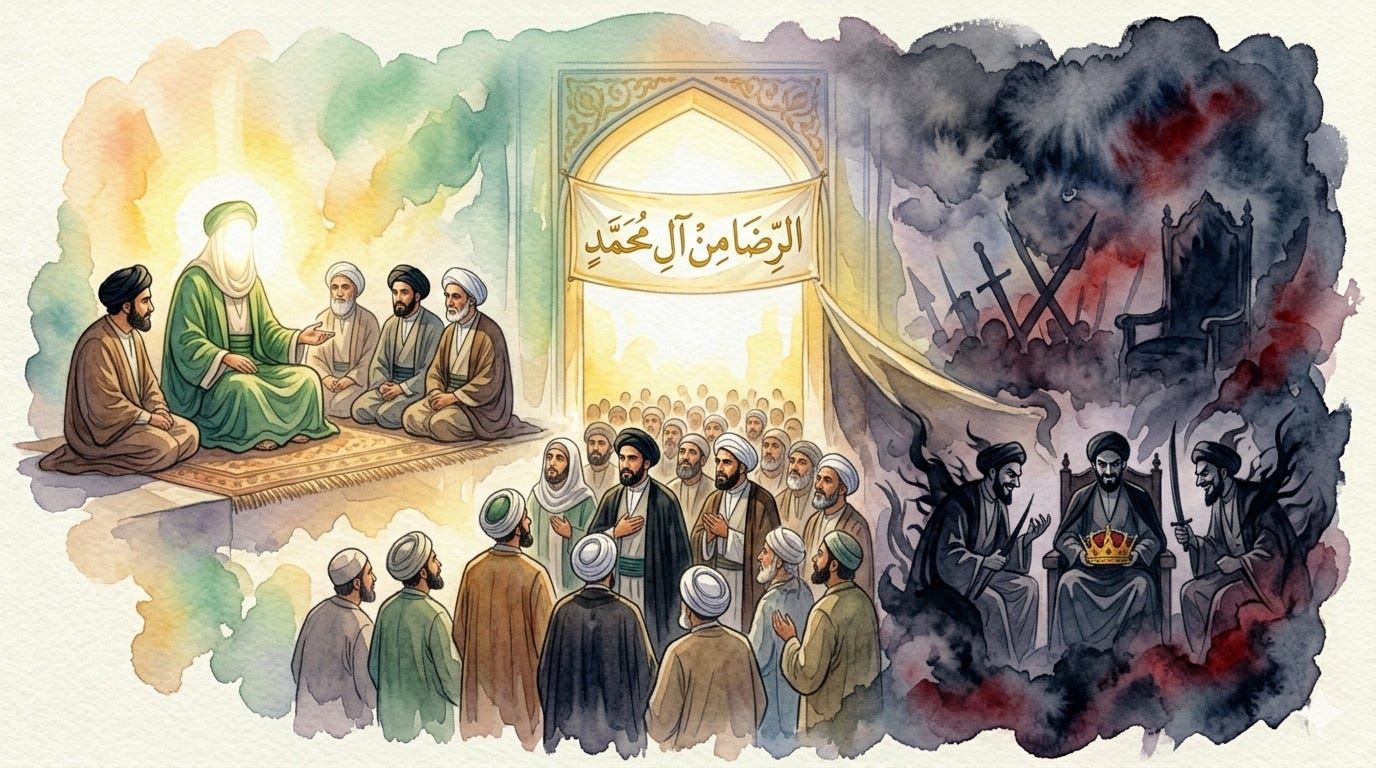
The Abbasid revolution of 132 AH / 750 CE was, on its surface, a revolution in the name of the Prophet’s family.
Its slogan — shouted across Khurasan, Iraq, and beyond — was:
الرِّضَا مِنْ آلِ مُحَمَّدٍ
“The chosen one from the family of Muhammad.”
— The slogan of the Abbasid revolutionary movement; documented extensively in al-Tabari, Tarikh al-Rusul wa’l-Muluk; al-Ya’qubi, Tarikh al-Ya’qubi; and S.H.M. Jafri, The Origins and Early Development of Shi’a Islam, Chapter 10
This phrase was deliberately ambiguous.
It did not name a specific person.
It did not say
“the chosen one from the descendants of Imam Ali and Sayyedah Fatimah.”
It said
“the family of Muhammad”
— and the Abbasids, as descendants of al-Abbas, the Prophet’s uncle, counted themselves as part of that family.
The Shi’a, and many Sunnis, understood this slogan to mean the descendants of Imam Ali and Sayyedah Fatimah — the Ahl al-Bayt in the specific sense that the Qur’an and the Hadith of the Cloak had defined.
The people who bled for this revolution, who fought and died to overthrow the Umayyads, believed they were bringing the Prophet’s true heirs to power.
They were deceived.
Once in power, the Abbasids revealed that “the family of Muhammad” meant their branch — the descendants of al-Abbas, the Prophet’s uncle — not the descendants of Imam Ali and Sayyedah Fatimah.
The revolution that had been built on the blood of pro-Alid sympathisers was hijacked by a different branch of the Hashimite family entirely.
And having stolen the revolution, the Abbasids turned on the very people in whose name it had been fought.
The Qur’an warned of exactly this kind of hypocrisy — and we cited this verse in Session 31 when discussing the Abbasid deception:
وَإِذَا لَقُوا الَّذِينَ آمَنُوا قَالُوا آمَنَّا وَإِذَا خَلَوْا إِلَىٰ شَيَاطِينِهِمْ قَالُوا إِنَّا مَعَكُمْ إِنَّمَا نَحْنُ مُسْتَهْزِئُونَ
“When they meet those who believe, they say, ‘We believe’; but when they are alone with their devils, they say, ‘Indeed, we are with you; we were only mockers.’”
— Qur’an, Surah al-Baqarah (the Chapter of the Cow) #2, Verse 14
Systematic Persecution — From Father to Son, From Imam to Imam
What followed was not a single act of betrayal.
It was a policy — sustained across generations of caliphs, escalating with each decade, designed to crush the line of the Imams.
We traced this persecution in detail across Sessions 31 through 44 of our series on Imamah.
Tonight, let us recall the pattern — because the pattern is the point.
Al-Mansur (r. 136–158 AH) — the second Abbasid caliph and the true architect of the dynasty’s power — regarded Imam al-Sadiq (peace be upon him) as the most dangerous man in the empire.
We heard earlier tonight how the Imam burned Abu Salama’s letter and refused to be drawn into politics.
But al-Mansur could not tolerate even a teacher who commanded more respect than the caliph.
He crushed the Hasani uprisings so savagely that, as we discussed in Session 32, the corpses of the descendants of Imam Hasan were hidden in underground vaults — discovered later only as skeletons.
And in 148 AH, Imam Ja’far al-Sadiq — the man who had taught four thousand, who had poured the foundation for everything we are tracing in this series — was poisoned at the orders of the caliph.
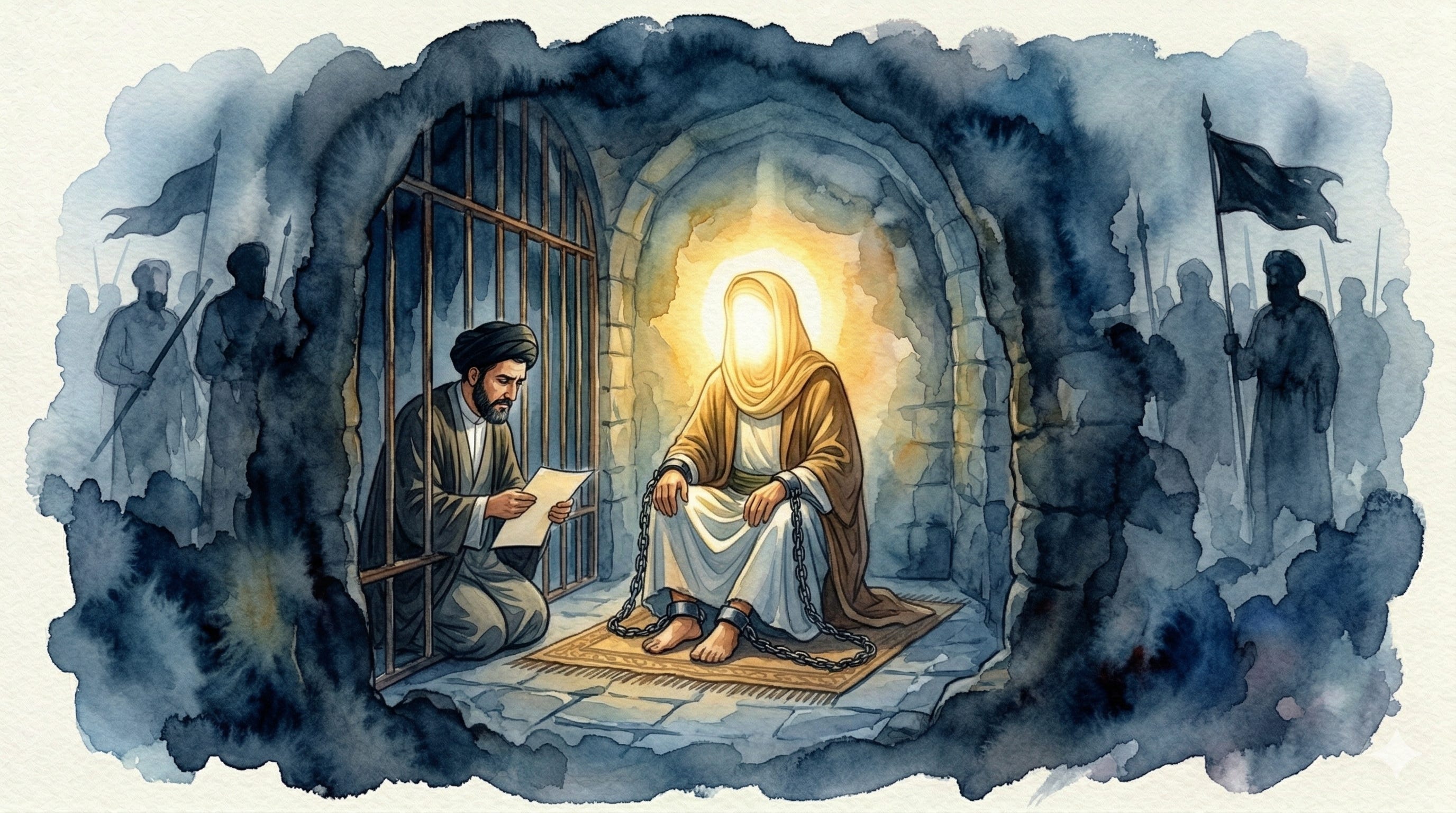
Harun al-Rashid (r. 170–193 AH) — the caliph whom the Western imagination romanticises through the tales of the Thousand and One Nights — imprisoned the seventh Imam, Imam Musa al-Kadhim (peace be upon him), in dungeons for years.
Not for a crime.
Not for a rebellion.
For the simple fact of being who he was.
And who he was is captured in a narration we explored in Session 32 — a moment of devastating clarity.
When Harun visited the grave of the Prophet in Medina, he addressed it with the words:
السَّلَامُ عَلَيْكَ يَا رَسُولَ اللَّهِ، السَّلَامُ عَلَيْكَ يَا ابْنَ الْعَمِّ
“Peace be upon you, O Messenger of God. Peace be upon you, O cousin.”
Then Imam Musa al-Kadhim (peace be upon him) approached and said:
السَّلَامُ عَلَيْكَ يَا أَبَهُ
“Peace be upon you, O my father.”
Harun replied: “This indeed is true honour, O Abu al-Hasan.”
— Al-Kulayni, Al-Kafi, Volume 8, Page 105; Al-Saduq, Uyun Akhbar al-Ridha, Volume 1, Page 88; Al-Mufid, Al-Irshad, Volume 2, Page 242; Al-Arbili, Kashf al-Ghumma, Volume 2, Page 231
O cousin — versus — O my father.
In two words, the Imam exposed the entire fraud of the Abbasid claim.
The caliph was a cousin.
The Imam was a son.
And Harun understood perfectly — acknowledging, even as he seethed, that the Imam’s claim was closer, truer, and unanswerable.
The Imam spent the last years of his life in chains, transferred from dungeon to dungeon, until he was poisoned in the prison of al-Sindi ibn Shahik in Baghdad in 183 AH.
And it was from that dungeon — from the depths of imprisonment, in darkness, in chains — that Imam al-Kadhim spoke words that illuminate the entire theology of the Occultation:
إِنَّ اللَّهَ عَزَّ وَجَلَّ لَا يُخْلِي أَرْضَهُ مِنْ حُجَّةٍ طَرْفَةَ عَيْنٍ، إِمَّا ظَاهِرٌ وَإِمَّا بَاطِنٌ
“Verily God, Mighty and Majestic, does not leave His earth without a Proof — not even for the blink of an eye — either manifest or hidden.”
— Al-Kulayni, Al-Kafi, Volume 1, Kitab al-Hujjah, Chapter: “The Earth Does Not Remain Without a Proof”
Read this again — and remember where it was said.
Not from a pulpit.
Not from a position of power.
From a dungeon.
The Imam is telling us: even now, even in these chains, even when you cannot see me, even when the tyrant thinks he has won — the earth is not empty of God’s Proof.
The Proof may be manifest, teaching openly as al-Sadiq did with his four thousand.
Or the Proof may be hidden — as the twelfth Imam would be, and as the seventh Imam himself was at that moment, buried alive in a prison cell.
Al-Ma’mun (r. 198–218 AH) — the most cunning of the Abbasid caliphs — played a different game with the eighth Imam, Imam Ali al-Rida (peace be upon him).
We devoted four sessions — Sessions 33 through 36 — to the extraordinary chess match between al-Ma’mun and the Imam.
Instead of simply imprisoning him, al-Ma’mun forced him into a political trap.
He named the Imam as his Crown Prince — Wali al-’Ahd — a move designed not to honour the Imam but to neutralise him.
The Imam accepted under duress, and on the explicit condition that he would not participate in governance — a condition that itself was a statement:
I will not legitimise your stolen throne by sitting in its shadow.
We titled Session 35 “A Victory in Refusal” — because the Imam’s refusal to participate, even while nominally holding the title of Crown Prince, exposed the fraud more powerfully than any armed rebellion could have done.
And when the political utility of the arrangement expired, al-Ma’mun had the Imam poisoned in Khurasan in 203 AH.
The later Abbasids went further still.
In Sessions 41 and 42, we traced how the tenth Imam, Imam al-Hadi (peace be upon him), was placed under what we would today call house arrest in Samarra — the Abbasid military capital.
This was a deliberate strategy: remove the Imam from Medina, where his base was strongest, and confine him in a garrison city surrounded by Turkish soldiers loyal only to the caliph.
And yet — as we showed in Session 42, “Networks of Guidance Under Siege” — the Imam adapted.
The hidden organisation (al-Tanzim) that Imam al-Sadiq had built did not collapse.
It evolved.
The wukala (representatives) continued to operate.
The funds continued to flow.
The teaching continued — in secret, through trusted channels, under the shield of strategic prudence.
The third dimension survived the noose.
By the time of the eleventh Imam, Imam al-Askari (peace be upon him) — whose life we explored in Sessions 43 and 44, “The Imam of Preparation” and “Guardian of the Final Proof” — the noose was so tight that the Abbasid apparatus was actively searching for the Imam’s child.
They had heard the traditions about the twelfth Imam, the Mahdi, and they intended to kill the boy before he could grow.
The Shield of Strategic Prudence
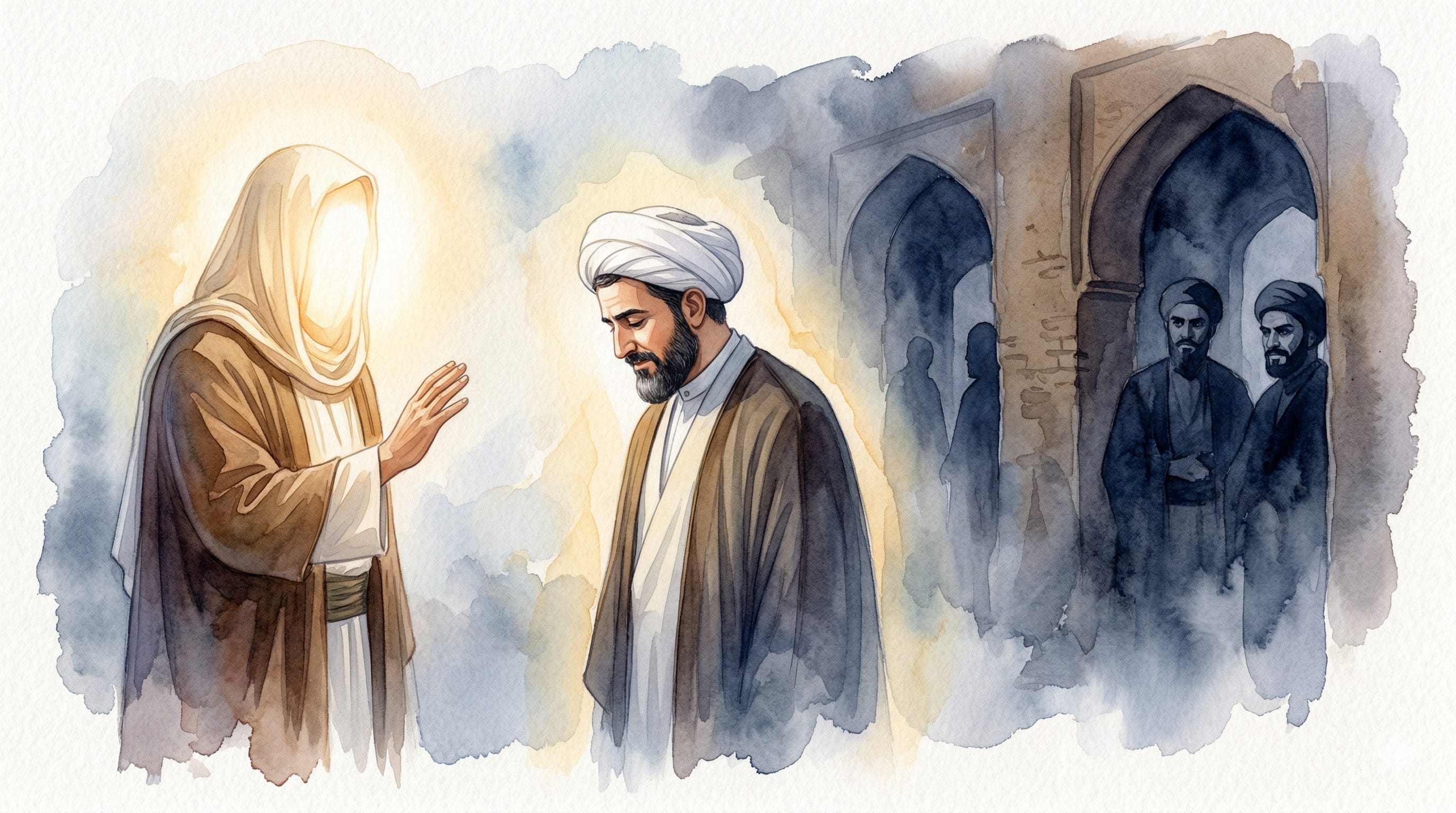
This escalating persecution forced the Shi’a community to develop survival strategies that would become central to its identity.
Chief among these was taqiyyah — strategic prudence.
We have discussed this concept in depth across many sessions, most recently in the Shield sub-series (Sessions 55 through 60).
But let us be precise about what this word means, because it is one of the most misunderstood and deliberately distorted concepts in Islam.
In Session 31, we described taqiyyah as “a shield that preserved the body of believers, and a hidden spear that allowed the truth to strike without exposing the hand that wielded it.”
That is its essence.
It is not lying.
It is not hypocrisy.
It is the religious application of a principle that every resistance movement in human history has understood: you do not hand your enemy a list of your members and your meeting places.
And it is rooted in the Qur’an itself. God says:
إِلَّا مَنْ أُكْرِهَ وَقَلْبُهُ مُطْمَئِنٌّ بِالْإِيمَانِ
“…except for the one who is compelled [to renounce his faith] while his heart remains firm in belief.”
— Qur’an, Surah al-Nahl (the Chapter of the Bee) #16, Verse 106
This verse was revealed regarding Ammar ibn Yasir — one of the earliest and most beloved companions of the Prophet — who, under torture by the Quraysh, verbally renounced Islam to save his life while his heart remained steadfast in faith.
The Prophet did not condemn him.
He affirmed that Ammar had done right.
We saw this principle in action earlier tonight in the story of Zurara — how the Imam publicly cursed his own most devoted companion in order to protect him from the Abbasid surveillance apparatus.
And we saw it in Session 32, in the way Imam al-Kadhim maintained the hidden organisation even while imprisoned — the network continued to function because strategic prudence had made it invisible to the state.
Imam Khomeini — may God rest his pure soul — warned us what happens when piety loses this political dimension:
وقتی تقوا از سیاست جدا شد، همان تقوایی که باید برای خدا باشد، میشود ابزار دست ستمگران
“When piety is separated from politics, that very piety which should be for God becomes a tool in the hands of oppressors.”
— Imam Khomeini, Sahifa-ye Imam, Speech in Qum, January 11, 1979 (Dey 21, 1357), Volume 3, Page 432
The Abbasids understood this.
As we noted in Session 32, they co-opted poetry, art, jurisprudence, and even asceticism (zuhd) as instruments of court propaganda.
Scholars in the pay of the caliphate produced fatwas that sanctified tyranny; poets composed verses glorifying the caliph; even asceticism was marketed as withdrawal from politics, rather than resistance to injustice.
The depoliticisation of religion was itself a political act — and it is a danger that persists to this day.
The Seeds of the Occultation
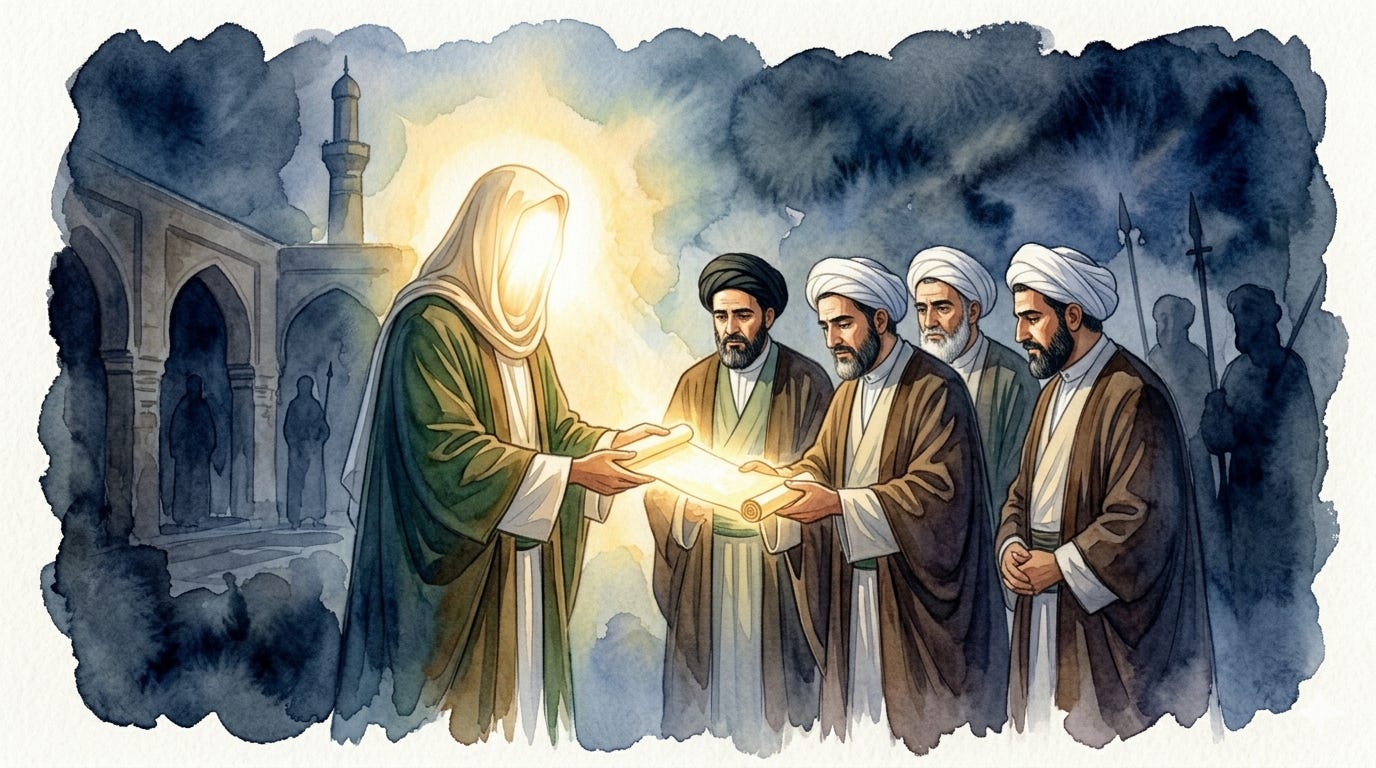
And so the pattern becomes clear.
With each generation, the Abbasid noose tightened.
The Imams were poisoned, imprisoned, placed under surveillance, and confined.
Their followers were hunted.
Their networks were infiltrated.
The space for open teaching — the space that Imam al-Sadiq had seized in his narrow window — was closing, decade by decade.
By the time the twelfth Imam was born — in 255 AH, in Samarra, in a house surrounded by Abbasid agents — the conditions were such that his very existence had to be concealed from the moment of his birth.
Only a handful of the most trusted companions of Imam al-Askari even knew the child existed.
The Occultation — the Ghaybah — was not an accident.
It was not a failure.
It was the culmination of two centuries of escalating persecution that left the community with a choice: either the Imam would be killed, as every Imam before him had been killed, or God would protect His Proof by hiding him from the sight of the tyrants.
God chose to protect.
And the community — trained by two centuries of strategic prudence, equipped with the scholarly infrastructure that al-Sadiq had built, armed with the compiled traditions that Zurara and Muhammad ibn Muslim and their successors had preserved, sustained by the hidden organisation (al-Tanzim) that had survived persecution after persecution — was left to navigate the longest night in the history of any religious community on earth.
As we explored in Session 48, “The Divine Strategy of Absence,” this was not a tragedy — it was, in Imam Khamenei’s analysis, “a masterclass in clandestine leadership and the maturing of a nation.”
The four Deputies we studied in Sessions 49 through 52 — Uthman ibn Sa’id, Muhammad ibn Uthman, Husayn ibn Ruh, Ali ibn Muhammad al-Samarri — were the men who carried the Imam’s light through that darkness.
They were the products of the Tanzim that al-Sadiq had built.
And the Tawqi’ we examined in Session 50 — “they are My Proof upon you” — was the bridge between the visible Imamate and the era of the scholars that we are now beginning to trace.
Everything that follows in this series — every compiler, every theologian, every Marja’, every seminary — is the story of how the community navigated that night.
Lessons for Our Time
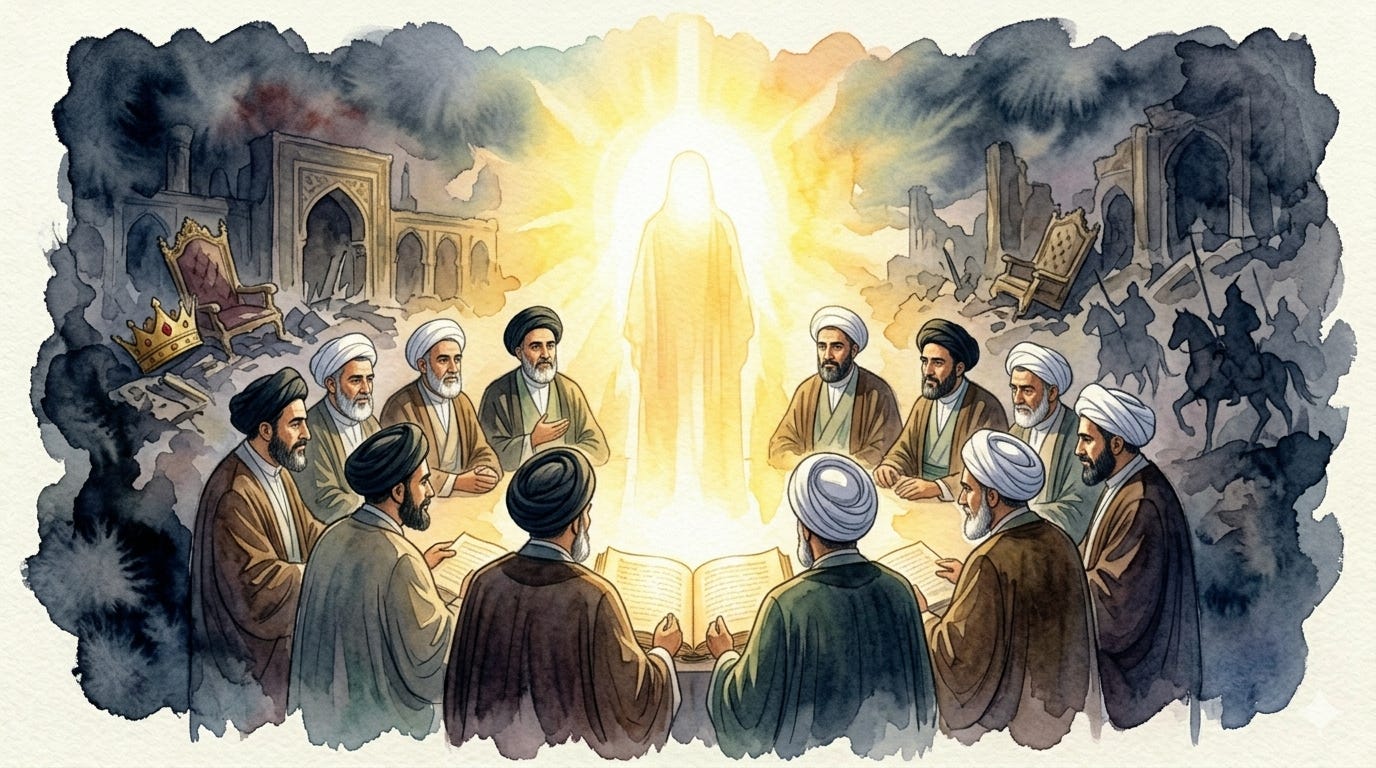
Three things we carry from this point.
First: political power that betrays its founding principles inevitably collapses.
The Abbasids rose to power on a lie — al-Rida min Aal Muhammad — and they fell to the Mongols in 656 AH / 1258 CE, when Hulagu Khan sacked Baghdad and drowned the Tigris in the ink of its libraries.
The dynasty that stole its mandate from the Ahl al-Bayt lasted five centuries.
The construction we are studying — the construction of knowledge, not thrones — has now lasted thirteen centuries and shows no sign of ending.
Second: the escalating persecution forced the Shi’a to develop resilience, institutional memory, and scholarly networks that could function without a visible leader.
Without the Abbasid oppression, the community might never have built the intellectual infrastructure needed to survive the Occultation.
The enemy, in trying to destroy the Shi’a, inadvertently forged them into a community capable of enduring a thousand years without a visible Imam.
This is what the Qur’an means when it says:
وَيَمْكُرُونَ وَيَمْكُرُ اللَّهُ ۖ وَاللَّهُ خَيْرُ الْمَاكِرِينَ
“And they plan, and God plans. And God is the best of planners.”
— Qur’an, Surah al-Anfal (the Chapter of the Spoils) #8, Verse 30
The Abbasids planned destruction.
God planned construction.
And here we are — thirteen centuries later — still teaching, still building, still waiting.
Third: strategic prudence is not hypocrisy.
It is not cowardice.
It is the discipline of a community that has learned, through blood and fire, that there are times when the truth must be protected by concealment, so that it can be proclaimed another day.
The Imam preserved Zurara by cursing him.
The community preserved itself by practising strategic prudence.
And the twelfth Imam was preserved by God through the Occultation itself — the ultimate act of divine protection, hiding the Proof so that the Proof may one day return.
As Imam Khomeini reminded us: piety separated from politics becomes a tool of the oppressor.
The Abbasids tried to separate them.
The Imams refused.
And their refusal — carried forward through the Deputies, through the scholars, through the seminaries, through thirteen centuries of the longest night — is the reason we are sitting here tonight, studying the architecture of guidance that outlasted every throne that tried to destroy it.
Conclusion — Key Takeaways
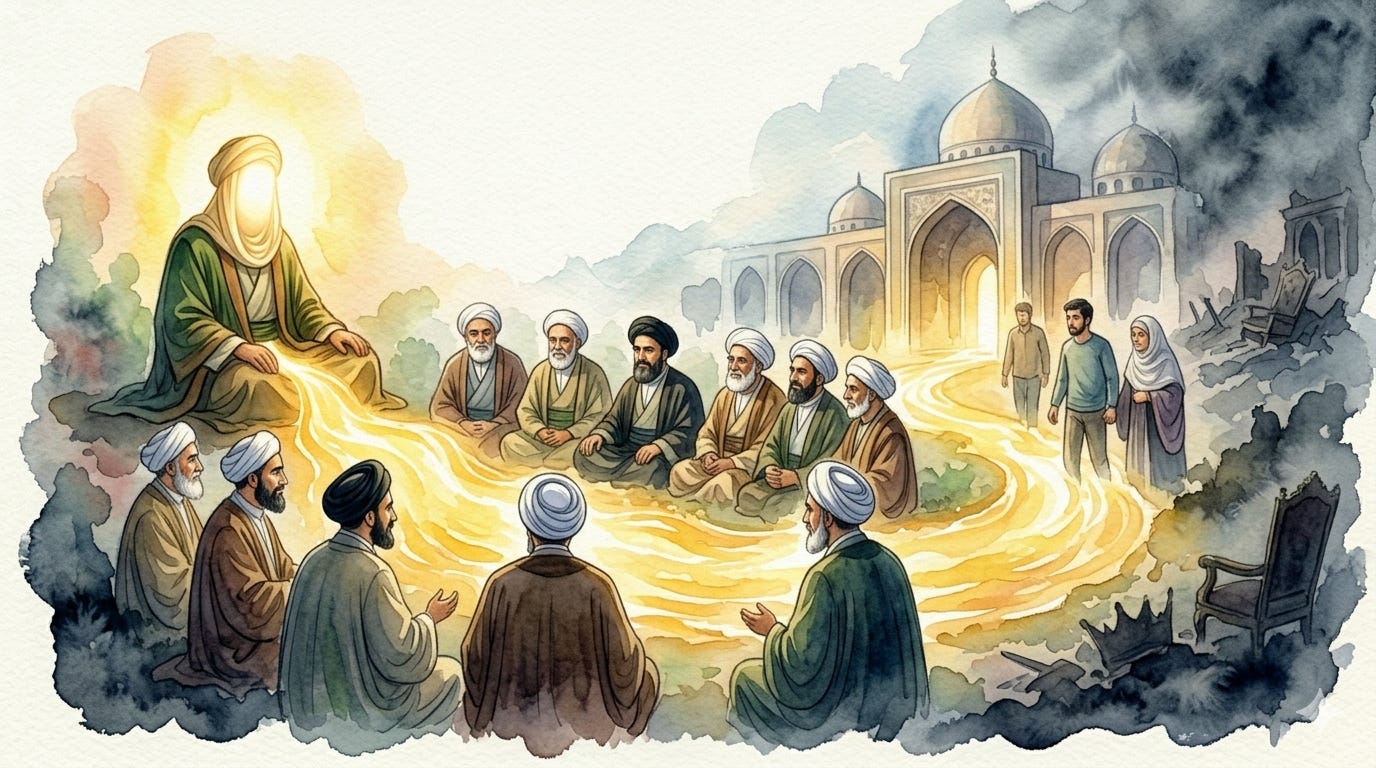
Tonight we have walked through the university of a living Imam — not an abstract institution, but a man who sat and taught, who burned letters and refused thrones, who built minds rather than armies, and whose classroom produced the foundations of Islamic civilisation as we know it.
Let us gather the threads.
From Point 1 — The Imam as the Source:
We learned that the Sadiqiyya school was not merely a seminary.
It was a revolution in knowledge — four thousand students, spanning every discipline from jurisprudence to chemistry, theology to linguistics.
The scale of what the Imam built in a single generation has no parallel in Islamic history.
We met the giants he raised — Hisham the debater, Zurara the jurist, Jabir the scientist — and we understood that the Imam’s purpose was not merely to transmit information, but to produce human beings — people capable of carrying the truth through persecution and darkness.
As we learned in Session 61, the Hawza’s ultimate purpose is not the production of scholars.
It is the production of human beings.
Tonight we have seen where that principle was born.
From Point 2 — The Sunni Schools as Branches from the Same Tree:
We established a historical fact acknowledged by both Sunni and Shi’a scholars: that all four Sunni schools trace back, directly or indirectly, to the era and influence of the Ahl al-Bayt.
Abu Hanifa studied under the Imam.
Malik called him “the Trustworthy.”
Al-Shafi’i invoked the Hadith of the Two Weighty Things in defence of his love for the Prophet’s family.
Ahmad ibn Hanbal transmitted narrations in praise of Imam Ali.
The tree is one — the branches diverged.
And we clarified that the Hanbali school must not be confused with the later Wahhabi deviation, just as no school should be judged by its most extreme offspring.
From Point 3 — The Abbasid Betrayal and the Seeds of the Occultation:
We traced the pattern of escalating persecution — from al-Mansur who poisoned the Imam, through Harun who imprisoned Imam al-Kadhim, to al-Ma’mun who tried to co-opt Imam al-Rida, to the later caliphs who confined the Imams in Samarra.
Each generation tightened the noose.
And each generation, the Shi’a community — armed with the scholarly infrastructure and the hidden organisation (al-Tanzim) that al-Sadiq had built — adapted, survived, and preserved the truth.
The Occultation was not a failure.
It was the culmination of two centuries of divine planning — and the beginning of the era of the scholars that we are now tracing in this series.
The architecture of guidance that we are studying in this sub-series did not emerge from nowhere.
It was poured — stone by stone, student by student, tradition by tradition — by the hands of the sixth Imam, in a window of history that lasted barely thirty-four years. And everything that came after — the compilers, the theologians, the seminaries, the Marja’iyyah, the Wilayat al-Faqih — is the continuation of his construction.
We began tonight’s preamble with his words:
“Be an ornament for us, and not a disgrace upon us.”
The ornament he asked for was not ritual.
It was not piety without substance.
It was the ornament of knowledge put into action — of scholars who stand for truth, of communities that endure, of an architecture of guidance that outlasts every throne.
That is what he built.
That is what we have inherited.
And that is what we must now carry forward.
Eulogy — The Imam Who Taught by Candlelight and Died by Poison
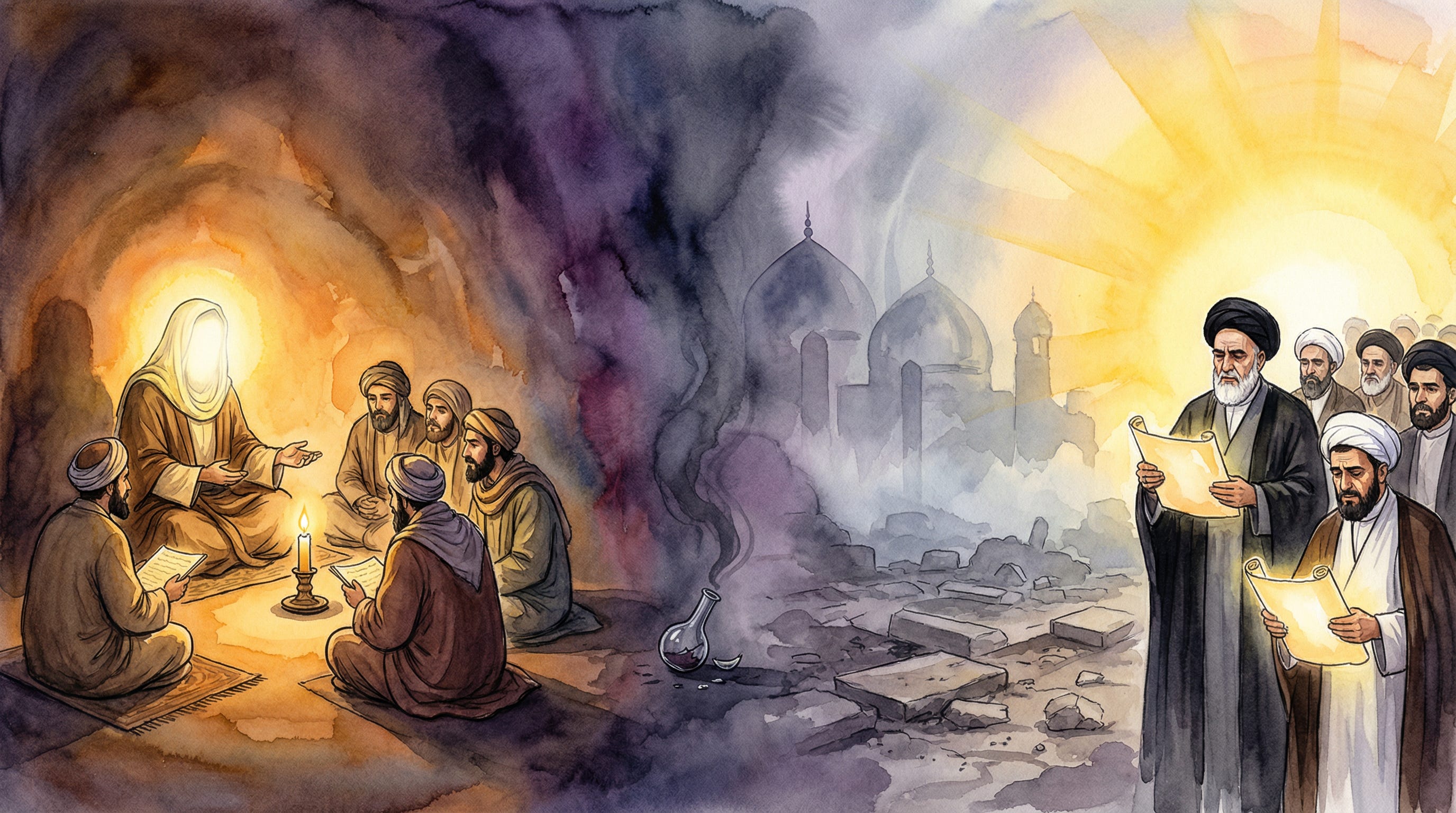
In the name of God, the Compassionate, the Merciful.
We turn now from the lecture hall to the graveyard — from what the Imam built to how the Imam was taken.
He was born in Medina in 83 AH — some say 80 AH — into the house of prophecy and knowledge.
His father was Imam al-Baqir, the Splitter of Knowledge.
His mother was Umm Farwa, a woman of piety and lineage.
From his earliest years, he breathed the air of revelation — not as metaphor, but as inheritance.
The knowledge of the Prophet flowed through his veins as surely as blood.
For thirty-four years, he held the mantle of the Imamate.
In that time — a single human generation — he accomplished what most civilisations take centuries to achieve.
He trained four thousand students.
He laid the foundations of Ja’fari jurisprudence.
He engaged with and influenced every major intellectual current of his age.
He preserved the traditions of the Prophet and the Ahl al-Bayt through the most systematic compilation effort the Muslim world had ever seen.
He built a hidden network of believers that would survive two centuries of persecution and carry the community through the Occultation itself.
And through all of this, he never raised a sword.
He never commanded an army.
He never sat on a throne.
His weapon was knowledge.
His fortress was the classroom.
His army was four thousand minds.
And yet the caliphs feared him more than any general.
Because you can kill a general.
You can scatter an army.
But what do you do with a man who simply teaches?
What do you do with someone whose students carry his words in their hearts, and whose words outlive every dynasty that tries to silence them?
Al-Mansur knew.
And so, in 148 AH — in the holy city of Medina, in the city of the Prophet himself — al-Mansur had the Imam poisoned.
The man who had taught four thousand.
The man whom Abu Hanifa called the most knowledgeable person he had ever met.
The man whom Malik called “the Trustworthy.”
The man whose classroom gave birth to the intellectual foundations of Sunni and Shi’a Islam alike.
The man from whom the knowledge of the Prophet’s family flowed like a river to a parched earth.
They poisoned him.
He died in Medina.
He was buried in al-Baqi’ — the ancient cemetery beside the Prophet’s Mosque — next to his father Imam al-Baqir and his grandfather Imam Zayn al-Abideen.
And al-Baqi’ itself — that sacred ground where four Imams lie buried — was demolished in 1925 by the forces of the Wahhabi movement we discussed tonight.
The domes were torn down.
The graves were levelled.
The site of the greatest teacher in Islamic history was reduced to rubble — by people who claimed to be defending the purity of Islam while destroying the heritage of its greatest scholars.
But the graves can be demolished.
The domes can be torn down.
The stones can be scattered.
What cannot be destroyed is what the Imam poured into the hearts of his students.
Zurara carried it.
Hisham carried it.
Muhammad ibn Muslim carried it.
The four thousand carried it.
The Deputies carried it through the Occultation.
The scholars of Najaf and Qum carry it today.
And we — sitting here tonight, thirteen centuries later, in a city the Imam never visited, speaking a language he never spoke, studying his legacy through a technology he could never have imagined — we carry it too.
That is the miracle of teaching.
You can poison the teacher.
You cannot poison what he taught.
Peace be upon you, O Abu Abd Allah.
Peace be upon you, O son of the Messenger of God.
Peace be upon you, O Lamp of the Darknesses and Key to All Good.
You taught by candlelight, and the light has not gone out.
Supplication — From the Ziyarat of Imam al-Sadiq (peace be upon him)
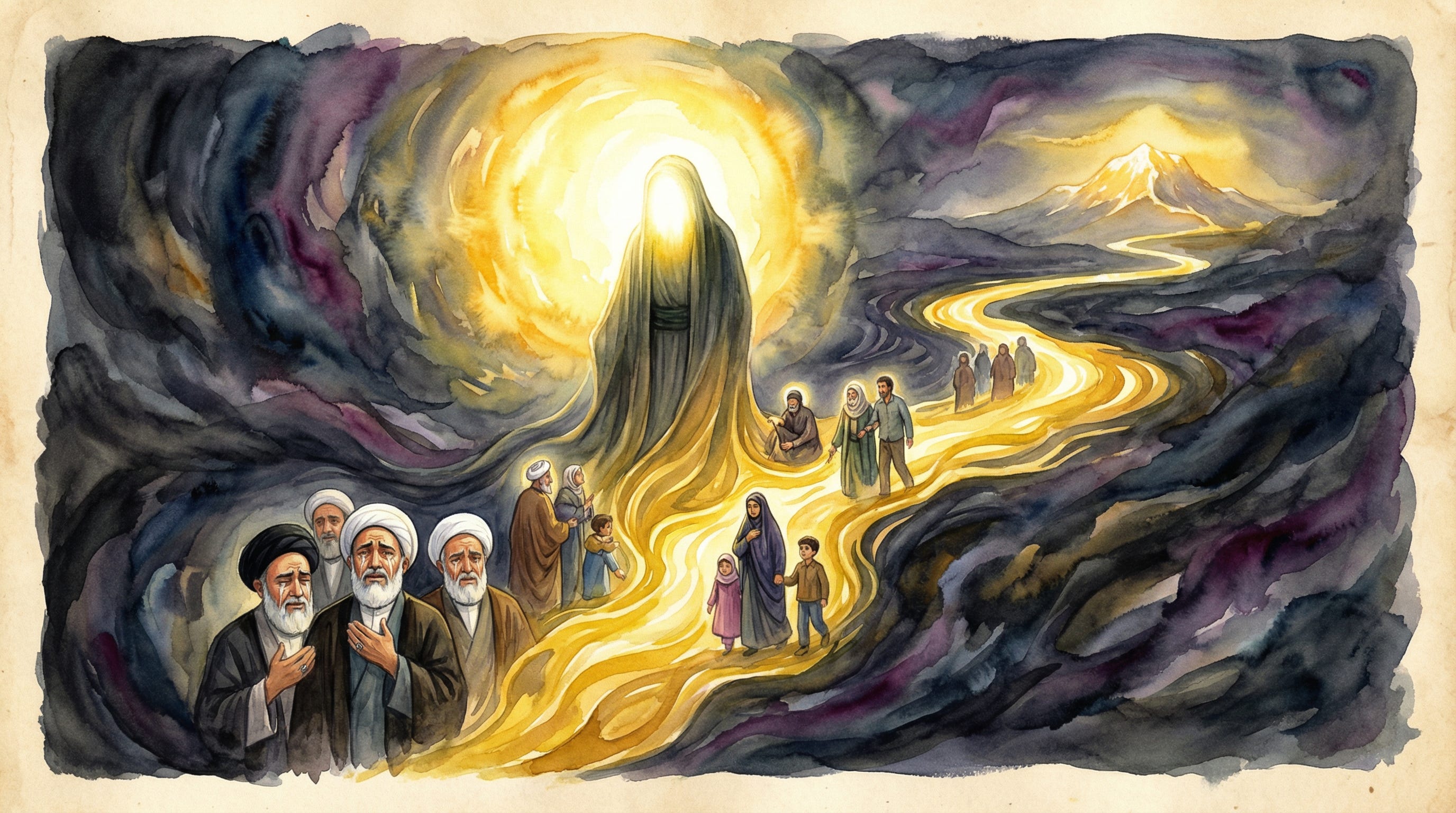
We close tonight with words from the Ziyarat — the salutation of visitation — addressed to the Imam whose university we have been sitting in all evening.
These words are traditionally recited when visiting the graves of the Imams in al-Baqi’.
Tonight, we recite them from wherever we are — because the Imam’s classroom has no walls.
السَّلَامُ عَلَيْكَ أَيُّهَا الْإِمَامُ الصَّادِقُ
السَّلَامُ عَلَيْكَ أَيُّهَا الْوَصِيُّ النَّاطِقُ
السَّلَامُ عَلَيْكَ أَيُّهَا السَّنَامُ الْأَعْظَمُ
السَّلَامُ عَلَيْكَ أَيُّهَا الصِّرَاطُ الْأَقْوَمُ
السَّلَامُ عَلَيْكَ يَا مِصْبَاحَ الظُّلُمَاتِ
السَّلَامُ عَلَيْكَ يَا دَافِعَ الْمُعْضِلَاتِ
السَّلَامُ عَلَيْكَ يَا مِفْتَاحَ الْخَيْرَاتِ
السَّلَامُ عَلَيْكَ يَا مَعْدِنَ الْبَرَكَاتِ
السَّلَامُ عَلَيْكَ يَا نَاصِرَ دِينِ اللَّهِ
السَّلَامُ عَلَيْكَ يَا نَاشِرَ حُكْمِ اللَّهِ
السَّلَامُ عَلَيْكَ يَا كَاشِفَ الْكُرُبَاتِ
السَّلَامُ عَلَيْكَ يَا عَمِيدَ الصَّادِقِينَ
السَّلَامُ عَلَيْكَ يَا كَهْفَ الْمُؤْمِنِينَ
السَّلَامُ عَلَيْكَ يَا هَادِيَ الْمُضَلِّينَPeace be upon you, O Truthful Imam.
Peace be upon you, O Speaking Successor.
Peace be upon you, O Greatest Summit.
Peace be upon you, O Straightest Path.
Peace be upon you, O Lamp of the Darknesses.
Peace be upon you, O Remover of Calamities.
Peace be upon you, O Key of All Good.
Peace be upon you, O Source of Blessings.
Peace be upon you, O Defender of the Religion of God.
Peace be upon you, O Promulgator of the Law of God.
Peace be upon you, O Unveiler of Sorrows.
Peace be upon you, O Pillar of the Truthful.
Peace be upon you, O Refuge of the Believers.
Peace be upon you, O Guide of the Misguided.أَشْهَدُ يَا مَوْلَايَ أَنَّكَ عَلَمُ الْهُدَى وَالْعُرْوَةُ الْوُثْقَى وَبَحْرُ النَّدَى وَكَهْفُ الْوَرَى وَالْمَثَلُ الْأَعْلَى
صَلَّى اللَّهُ عَلَى رُوحِكَ وَبَدَنِكَ وَعَلَى آبَائِكَ الطَّاهِرِينَ وَرَحْمَةُ اللَّهِ وَبَرَكَاتُهُI bear witness, O my Master, that you are the banner of guidance, the firmest handhold, the ocean of generosity, the refuge of all people, and the highest example.
May the blessings of God be upon your soul and your body, and upon your pure forefathers. And the mercy of God and His blessings be upon you.— Ziyarat of Imam Ja’far al-Sadiq (peace be upon him); recorded in the compilations of Ziyarat for the Imams of al-Baqi’
Ya Misbah al-Dhulumat — O Lamp of the Darknesses.
Note this title.
It is what the tradition calls him.
And it is what our entire series is named after: Misbah ash-Sharia — the Lantern of the Path.
The Imam is the Lantern.
The Path is the one he illuminated.
And we — all of us, tonight and every night — are walking by his light.
May God hasten the return of his descendant, the Imam of our Time.
May He grant us the wisdom to be ornaments and not disgraces.
And may He count us among those who carried the light — not for a night, but for a lifetime.
Allahumma salli ’ala Muhammad wa Aali Muhammad, wa ’ajjil farajahum.
O God, send blessings upon Muhammad and the family of Muhammad, and hasten their relief.
Amen, O Most Merciful of the Merciful.
Amen, O Lord Sustainer of the Universes
And from Him alone is all ability and He has authority over all things.