

In His Name, the Most High

٤٧٨. وَقَالَ (عليه السلام): مَا أَخَذَ اللهُ عَلَى أَهْلِ الْجَهْلِ أَنْ يَتَعَلَّمُوا حَتَّى أَخَذَ عَلَى أَهْلِ الْعِلْمِ أَنْ يُعَلِّمُوا.
“Amir al-Mu’minin, peace and blessings be upon him, said:
God did not take a pledge from the people of ignorance that they would learn, until He had taken a pledge from the people of knowledge that they would teach.”
— al-Sharif al-Radi, Nahj al-Balagha, Saying 478; my translation
Before the verse tonight, one sentence of Amir al-Mu’minin, peace and blessings be upon him.
Last week we opened with five of his counsels, and two of them were for the student.
Do not be ashamed to say I do not know.
Do not be ashamed to learn.
Tonight’s sentence is for the one on the other side.
God took a pledge from the people of ignorance, that they would learn.
But before that — before that — He took a pledge from the people of knowledge, that they would teach.
The order is the lesson.
The student’s duty is real.
But it rests on a duty that came first.
Think about what that means in a single home.
A child cannot be blamed for not knowing what no one ever taught him.
If no one sat with him, no one showed him how to pray, no one opened the Qur’an in front of him — then before we ask why he does not know, we have to ask who was supposed to teach him.
The same is true of a community.
Before we complain that the young do not know their religion, Amir al-Mu’minin turns the question round:
Did the people who knew it teach it?
The pledge to teach came first.
And before the people of knowledge, there is the One who taught them.
ٱلرَّحۡمَٰنُ
عَلَّمَ ٱلۡقُرۡءَانَ
خَلَقَ ٱلۡإِنسَٰنَ
عَلَّمَهُ ٱلۡبَيَانَ
“The All-beneficent has taught the Quran. He created man, [and] taught him articulate speech.”
— Qur’an, Surah al-Rahman (the Chapter of the Beneficent) #55, Verses 1 to 4; the English, Ali Quli Qarai’s
The All-beneficent has taught the Qur’an.
Before this surah tells you that God made you, it tells you that God taught.
Hold on to that order. It is the first thing to see tonight.
And look at the shape of these four short verses.
He taught the Qur’an.
Then:
He created man.
Then:
He taught him articulate speech.
Teaching — creating — teaching again.
The creation of the human being sits between two lessons, like a student sitting between two teachers.
And it is the All-beneficent who does it.
Not the name of power, not the name of judgement — the name of mercy.
Teaching, in this surah, is what mercy looks like when it turns towards us.
The One in Front
Last week, at the very end, I said two lines:
“Tonight we sat on the floor of the dars, beside the one who learns. Next week, God willing — the one who teaches.”
— from this majlis, last week: The Architecture of Guidance, Part 21, The Student
So tonight we look up.
Last week we sat on the carpet with the student — the one who leaves home and sits down on the floor of the dars, and stays there for years.
Tonight we look at the one sitting in front of him.
The one whose voice fills the room.
The one the student watches — not only while he is teaching, but when he is not.
How he walks in.
Whom he greets first.
What he does with the student who comes in late, and with the one who asks the same question twice.
Whether he says I don’t know when he doesn’t.
How he speaks about the scholars he disagrees with, when they are not in the room.
A student learns all of that, whether the teacher means to teach it or not.
So tonight is not only about the people who stand at the front of a class.
It is about everyone who is watched while they speak about God — the parent at the table, the elder at the mosque, the older brother whose younger brother copies everything he does.
Who taught him?
What does he owe the young man in front of him?
And what does the young man owe him?
By the end of the night you will have seen what a student owes his teacher.
And what a teacher owes back.
What We Carry Forward

This is the twenty-second part of The Architecture of Guidance, within our series on the Lantern of the Path — and the third of twelve nights we have called Those Who Carry It: the people who carry this faith from one generation to the next.
Tonight is Wednesday the 11th of November 2026 — the last night of Jumada al-Ula, or the 1st of Jumada al-Thani 1448, as the moon decides.
Two weeks ago we asked what a scholar is, and Amir al-Mu’minin gave us the word for the whole block: the scholar is the one who carries it.
Last week we asked how a carrier is made, and sat with a student at a door — ‘Unwan al-Basri, ninety-four years old, turned away by Imam al-Sadiq, peace and blessings be upon him, and coming back.
He heard that knowledge is a light, not a load, and that the one who wants it must begin with servitude — the very word with which this whole series began, eighty sessions ago.
We talked about the clothes the years earn, and about the student’s real dress, which is forbearance and humility.
We asked the community to give the student something to come home to.
And we mourned Mirza Habibullah Araki, with his lamp over his door, and the students of the Fayziyya whose turbans were burned.
We watched Moses keep a flock in Midian for years before he was given anything to carry.
And we heard that the student’s prayer — to ask God for more knowledge — was given first not to a beginner, but to the one who knew the most.
Last week was the floor of the dars: the student’s side.
What he must bring with him, and what he must leave at the door.
On Saturday night, in Fruit of the Heart, came Night Three, The Storm.
And this Saturday, the 14th, comes its last night, The House of Praise — on the second report of the martyrdom of Sayyedah Fatimah al-Zahra, peace and blessings be upon her.
So here is tonight’s question.
If a student is made in the dars — who makes the dars?
Who Teaches First
The First Teacher

Go back to the headline.
The All-beneficent.
The surah opens with one of God’s own names — the name of a mercy that reaches everyone, believer and unbeliever, in this world and the next.
And the very first thing it says that mercy does is this:
He taught the Qur’an.
Only then:
He created man.
Teaching first.
Creating second.
That reading is not mine.
It belongs to a man whose death we will remember at the end of tonight — Allamah Sayyed Muhammad Husayn Tabataba’i, may God rest his pure soul, the author of al-Mizan, the great commentary on the Qur’an of our age.
Writing on these very verses, he says:
و قوله:«علم القرآن»شروع في عد النعم الإلهية، و لما كان القرآن أعظم النعم قدرا و شأنا و أرفعها مكانا - لأنه كلام الله الذي يخط صراطه المستقيم و يتضمن بيان نهج السعادة التي هي غاية ما يأمله آمل و نهاية ما يسأله سائل - قدم ذكر تعليمه على سائر النعم حتى على خلق الإنس و الجن اللذين نزل القرآن لأجل تعليمهما.
“His words ‘He taught the Qur’an’ begin the counting of God’s blessings. And since the Qur’an is the greatest of blessings in worth and in standing, and the highest in place — for it is God’s speech, which marks out His straight path and holds the explanation of the way to felicity, the furthest hope of anyone who hopes and the last thing anyone who asks could ask for — He put the mention of its teaching before every other blessing, even before the creation of humankind and jinn, for whose teaching the Qur’an came down.”
— Allamah Sayyed Muhammad Husayn Tabataba’i, al-Mizan fi Tafsir al-Qur’an, on Surah al-Rahman, Verses 1–4; my translation
Before He made us, He had already decided to teach us.
We were created for the teaching.
And then:
He taught him al-bayan — clear speech.
Allamah1 stops on that word too.
Bayan, he says, is speech that brings out what is in the mind.
It is not the lungs and the throat making a sound.
It is something God placed inside us — and with it, the human being opened what he calls
the door of making-understood, and understanding.
Without it, he says, we would live like the creatures that cannot speak:
a life frozen and still.
Every lesson you have ever had came through that door.
Every teacher who ever stood in front of you — at the Qur’an class, at the madrasa on a Saturday morning, at the kitchen table — was walking through a door God opened before either of you was born.
And one more verse, about the very first human being:
وَعَلَّمَ ءَادَمَ ٱلۡأَسۡمَآءَ كُلَّهَا ثُمَّ عَرَضَهُمۡ عَلَى ٱلۡمَلَـٰٓئِكَةِ فَقَالَ أَنۢبِـُٔونِي بِأَسۡمَآءِ هَـٰٓؤُلَآءِ إِن كُنتُمۡ صَٰدِقِينَ
“And He taught Adam the Names, all of them; then presented them to the angels and said, ‘Tell me the names of these, if you are truthful.’”
— Qur’an, Surah al-Baqarah (the Chapter of the Cow) #2, Verse 31; the English, Ali Quli Qarai’s
The first human being begins as a student.
So here is the first thing to say about every teacher who has ever lived.
Whatever he has, he was given.
He is passing on what was first given to him.
Which is why a teacher has no grounds for pride.
The first virtue of a teacher is that he knows it was given.
The Older Pledge

Now go back to the preamble, because it says the same thing in the language of duty.
God took a pledge from the people of ignorance, that they would learn.
But first He took a pledge from the people of knowledge, that they would teach.
Think about what that means for anyone who knows anything.
Knowledge, in this faith, is not private property.
It is a trust, with a pledge attached.
The one who has it owes it.
A scholar who keeps what he knows to himself is not being modest.
He is holding back what was pledged.
And this is not only for the scholars in Qom and Najaf.
If you can read the Qur’an, and your neighbour’s child cannot, something of that pledge has reached you.
If you know the rulings of prayer, and your friend is too embarrassed to ask, it has reached you too.
Everyone who knows anything is, to that extent, one of the people of knowledge.
And notice which pledge was taken first.
Before anyone was obliged to come and ask, someone was obliged to be ready to answer.
And the first man to keep that pledge in full was the Messenger of God — peace and blessings be upon him, his family, and his righteous companions.
The Gentlest Teacher
Four weeks ago, the verse that opened our night on the hawza told us what the Prophet was sent to do — and teaching was at the heart of it.
But how did he teach?
Last week I mentioned the scholar who wrote the hawza’s handbook on teaching and learning — al-Shahid al-Thani, the Second Martyr, and his Munyat al-Murid, the Seeker’s Desire.
In the half of that book written for teachers, he tells the teacher:
Look at how the Messenger of God guided people, and how gentle he was.
With the Bedouin who relieved himself in the mosque — whom the Prophet corrected without a single harsh word.
And with a man called Mu’awiya ibn al-Hakam2.
Listen to Mu’awiya’s story.
He tells it himself.
He was new to Islam.
He had come to the Prophet and was learning, and one of the things he had been taught was this:
when someone sneezes and praises God, you answer him, may God have mercy on you.
Then one day he is standing in the prayer, behind the Prophet.
A man in the row sneezes, and praises God.
And Mu’awiya, keen to do what he has been taught, answers him.
Out loud.
The whole row turns and stares at him.
He cannot bear it.
Why are you all looking at me like that?
They whisper subhan Allah at him, to make him stop.
The prayer ends.
The Prophet turns.
Who was it that spoke?
This Bedouin.
And the Prophet calls him over.
No anger.
No shaming him in front of the people.
He simply tells him what the prayer is for.
عن معاوية بن الحكم السلمي، قال: لمّا قدمت على رسول الله صلى الله عليه [وآله] وسلم علمت أموراً من أمور الإسلام، فكان فيما علمت أن قال لي: إذا عطستَ فاحمدالله، وإذا عطس العاطف فحمد الله فقل يرحمك الله. قال: فبينما أنا قائم مع رسول الله في الصلاة إذ عطس رجل فحمد الله، فقلت: يرحمك الله رافعاً بها صوتي، فرماني الناس بأبصارهم حتّى احتملني ذلك، فقلت: مالكم تنظرون إليّ بأعيّنٍ شُزر؟ قال: فسبحوا، فلمّا قضى رسول الله الصلاة قال: من المتكلم؟ قيل: هذا الأعرابي، فدعاني رسول الله فقال لي: إنّما الصلاة لقراءة القرآن وذكر الله جلّ وعزّ، فإذا كنت فيها فليكن ذلك شأنك. فما رأيت معلماً قط أرفق من رسول الله .
“Mu’awiya ibn al-Hakam al-Sulami said: When I came to the Messenger of God, I learned things of Islam, and among what I learned was that he said to me: when you sneeze, praise God; and when someone sneezes and praises God, say: may God have mercy on you.
And while I was standing in the prayer with the Messenger of God, a man sneezed and praised God, and I said, ‘May God have mercy on you,’ raising my voice.
The people threw their looks at me until I could not bear it, and I said: ‘Why are you looking at me with sidelong eyes?’
They said ‘subhan Allah.’
When the Messenger of God had finished the prayer, he said: ‘Who was the one who spoke?’
It was said: ‘This Bedouin.’
So the Messenger of God called me, and said to me: ‘The prayer is only for reciting the Qur’an and for the remembrance of God, mighty and majestic; so when you are in it, let that be your concern.’
I never saw a teacher gentler than the Messenger of God.”
— the report of Mu’awiya ibn al-Hakam al-Sulami, in Sunan Abi Dawud, vol. 1, p. 245, hadith 931, as the editor of al-Shahid al-Thani’s Munyat al-Murid gives it (Mawsu’at al-Shahid al-Thani, vol. 1, the editor’s note); my translation
I never saw a teacher gentler than the Messenger of God.
Notice two things.
The room looked daggers at him.
The teacher did not.
And the man he corrected is the one who called him teacher.
That is the title the Prophet earned from the people he taught — not by being the cleverest in the room, but by being the gentlest with the one who got it wrong.
And the Qur’an shows us a prophet on the other side of the table — asking to be taught.
May I Follow You?

In Surah al-Kahf, Moses, peace and blessings be upon him, goes looking for a teacher.
He finds a servant of God whom our tradition calls al-Khidr, peace and blessings be upon him.
And he asks him:
قَالَ لَهُۥ مُوسَىٰ هَلۡ أَتَّبِعُكَ عَلَىٰٓ أَن تُعَلِّمَنِ مِمَّا عُلِّمۡتَ رُشۡدٗا
“Moses said to him, ‘May I follow you for the purpose that you teach me some of the probity you have been taught?’”
قَالَ إِنَّكَ لَن تَسۡتَطِيعَ مَعِيَ صَبۡرٗا
“He said, ‘Indeed you cannot have patience with me!”
وَكَيۡفَ تَصۡبِرُ عَلَىٰ مَا لَمۡ تُحِطۡ بِهِۦ خُبۡرٗا
“And how can you have patience about something you do not comprehend?’”
— Qur’an, Surah al-Kahf (the Chapter of the Cave) #18, Verses 66 to 68; the English, Ali Quli Qarai’s
Moses.
The one God spoke to.
The prophet of the Torah, of the staff and of the sea.
Asking:
may I follow you — so that you teach me?
Al-Shahid al-Thani reads this exchange word by word, and draws one lesson after another out of it3.
Some of them are worth hearing tonight.
May I follow you, so that you teach me.
Moses asks for nothing in return for following him, except to be taught.
As if he said: I ask you for no wealth, and no standing.
Some of what you were taught.
Not all of it. I do not ask to be your equal.
You will always stand above me.
What you were taught.
Even al-Khidr’s knowledge is what he was taught.
So Moses honours the knowledge, and honours the teacher — and names God as the Teacher behind the teacher.
The headline again:
God teaches first.
And then he looks at who is asking.
Al-Khidr knew from the first, he says, who was standing in front of him: the prophet of the Children of Israel.
Moses, master of the Torah — the one God spoke to without any go-between, singled out with miracles.
And he comes with this much humility.
Which shows, he says, that this is how it should be.
The wider a man’s grasp of knowledge, the more he knows its joy, the more fiercely he seeks it — and the more completely he honours the people of knowledge.
The ones who know a little are very often the proudest.
The ones who know a great deal kneel.
Now the teacher’s answer.
You cannot have patience with me — and how can you have patience with what you do not comprehend?
Al-Shahid al-Thani reads that as a lesson too — but this time for the teacher.
Knowledge, he says, needs a great patience — beyond the ordinary habits of people.
For there is no doubt, he says, that Moses was stronger in patience than other men.
And still he was told this.
And then comes the line I want you to keep.
Knowledge, he says, should not be handed to just anyone who wants it —
for it is a light from God.
It is not put down wherever it happens to fall.
The teacher works with the student first, and tries him, and sees whether he is ready to receive it.
Last week you heard what Imam al-Sadiq told ‘Unwan about knowledge and light.
Here is the teacher’s side of the same light.
You do not pour a light into a vessel that cannot hold it.
But al-Shahid al-Thani adds one more thing4, and it matters.
Al-Khidr’s words were a warning, not a verdict.
This will be hard for you to carry — not you can never carry it.
Otherwise, he says, Moses would not have answered him as he did:
قَالَ سَتَجِدُنِيٓ إِن شَآءَ ٱللَّهُ صَابِرٗا وَلَآ أَعۡصِي لَكَ أَمۡرٗا
“He said, ‘You will find me, God willing, to be patient, and I will not disobey you in any matter.’”
— Qur’an, Surah al-Kahf (the Chapter of the Cave) #18, Verse 69; the English, Ali Quli Qarai’s
So a teacher may test.
A teacher may warn.
A teacher does not shut the door.
And what was Moses asking for?
One word:
rushd.
What Moses Was After

Rushd.
Qarai translates it probity.
It means right guidance — being set on the right path, and growing along it.
Al-Shahid al-Thani says it plainly:
Moses asks for rushd — for guidance, without which he would stray and be lost.
And in asking for it, he admits how badly he needs to learn, and lowers himself before his teacher.
Four and a half centuries later, another teacher read the same word the same way.
In September 2009, the philosopher of Qom, Ayatullah Muhammad Taqi Misbah Yazdi, may God rest his pure soul, spoke5 at a school for beginning seminary students named Rushd — and explained that the name came from this very verse.
Moses asked permission to go with al-Khidr, he said, so that he would be taught something of the rushd God had taught him.
What Moses was after was rushd.
And rushd is not only the growth of the body, or of the mind.
Above all, it is the growth of the spirit — the growth that brings a person nearer to God.
In the same speech6 he said something hard about his own profession.
The clergy, he said, are heirs of the prophets — and the work of the prophets was teaching, and purifying.
We limp even in the teaching, he said, let alone the purifying.
So the new school would care for a student’s character as much as for his learning — so that the two wings, knowledge and action, grow together.
A bird with one strong wing, he said, cannot fly properly.
And sometimes it does more harm than good.
So what does a student come to a teacher for?
Not information.
Information is everywhere now; it is in your pocket.
He comes for rushd.
To be grown — nearer to God.
And so a teacher is measured by whether his students grow nearer to God.
Not by how much they can repeat.
A teacher is not a dispenser.
He raises.
The One Who Raises
There is an old explanation of the word rabbani — the godly scholar, the master of souls.
Al-Shahid al-Thani gives it:
وقد روي في تفسير «الربَّاني» أنه الذي يربَّي الناس بصغار العلم قبل كباره ١.
“It has been reported, in explaining ‘rabbani’, that he is the one who raises people with the small things of knowledge before the great.”
— al-Shahid al-Thani, Munyat al-Murid, the teacher’s manners with his students (Mawsu’at al-Shahid al-Thani, vol. 1); my translation
The rabbani is the one who raises — the explanation plays on the word itself.
And look at the order.
The small things before the great.
The teacher who reaches for the great things first, to impress, has it backwards.
The real teacher starts where the student is.
And that is why it has to be a living teacher.
Four weeks ago we walked through the hawza’s circle — prepare, sit, argue, review.
You can read a book on your own.
You cannot be raised by one.
In the dars you learn the man as well as the lesson:
how he answers a hard question,
how he treats the slow student,
what he does when he is wrong.
That is also why the hawza still writes down its chains of permission — the ijaza — teacher to teacher, back through the centuries to the Imams, peace and blessings be upon them.
Knowledge in this school does not come off a shelf.
It comes from someone, who had it from someone.
So if that is what a teacher is — what binds him to the one he raises?
Lessons for Our Time
Lesson One — God Teaches First

Every teacher who has ever stood in front of anyone is passing on what he was given.
So a teacher’s first virtue is that he knows it was given — and a student’s first courtesy is to remember who gave it.
What does that look like for us — here, this week?
If you teach — and almost all of us do, whether we call it that or not —
Remember before you begin.
Before the class, before you sit down with your child over homework, before you speak at a gathering or send a reminder round the family group, take one breath and remember where it came from.
You did not invent al-Fatiha.
You did not discover the rulings of prayer.
Someone handed them to you — and God handed them to him.
So say where it came from.
When you teach something, tell them where you learned it:
this is in the Qur’an;
this is what the books of rulings say;
this is how my teacher taught it to me.
Not to show off.
Because it was never yours.
A teacher who hides where his knowledge came from slowly begins to believe that it is his own.
And remember the order in Amir al-Mu’minin’s sentence: the pledge to teach came first.
If you know how to make wudu properly, and the young man at the next tap does not, that pledge is already on you.
If you can read the Qur’an and the child next door cannot, it is on you.
You do not need a turban, or a title, or a microphone.
You only need to know one thing that someone else does not — and to remember that you were given it so that you could give it on.
And when the one you teach knows something you do not — when your daughter comes home from madrasa and quietly corrects your wudu — that is your moment to be Moses.
Show me.
Remember: the ones who know a great deal kneel.
And if you are learning — and every one of us is, until the day we die —
Ask the First Teacher first.
Before you open the book, or walk into the class, or press play on the lecture, ask Him — the prayer we heard last week, the Prophet’s own prayer, for more knowledge.
It takes one breath.
And when something finally opens for you — a verse you had read a hundred times, a ruling that suddenly makes sense — do not say
I worked it out.
Say
al-hamdu lillah — Praise be to God.
It came from somewhere.
That is all the first lesson asks.
Whatever you have, you were given.
So hold it the way you hold something given — carefully, and ready to hand it on.
Lesson Two — Rushd, Not Information

A student comes for rushd, not for information.
And a teacher is measured by whether his students grow nearer to God — not by how much they can repeat.
Let us be honest about how we usually measure.
We measure a madrasa by how many surahs the children have memorised, by the certificates at the end of the year, by who won the competition.
Those things are good.
But they are one wing.
So if you teach —
Ask the other question as well.
Not only
What does this child know now that he did not know in September?
But:
Is he kinder to his little sister?
Does he tell the truth when it costs him something?
Does he pray when no one is checking?
That is rushd.
That is the second wing — the one that lets the bird fly.
If you teach a Qur’an class, give the meaning a few minutes beside the tajwid — the pronunciation and recitation: what this verse is asking of the one who recites it.
If you run a youth circle, do not only win the argument for them — show them what it looks like to live it.
If you are a parent, the next time you check the homework, check the heart as well.
Ask how they are, not only how they did.
And remember what we said about the dars: they learn the man as well as the lesson.
In your class, in your kitchen, that man — or woman — is you.
Some of the most important things you will ever teach, you will teach without saying a word.
And if you are learning —
Ask yourself why you came.
Information is in your pocket; you could have stayed at home.
If you came to collect facts — to win the next argument online, to have a clever answer ready — you will leave with facts, and nothing else.
Come to be grown.
Before you leave a class, or a majlis — tonight included — ask yourself one thing:
What will I do differently because of this?
If the answer is nothing, you have heard a lecture.
You have not had a lesson.
And measure yourself by the word Moses asked for.
Not
How much more do I know than I did a year ago?
but
Am I nearer to God than I was a year ago?
More patient at home.
Quicker to forgive.
Less hungry to be noticed.
If you have learned a great deal and none of that has moved, one wing has grown strong and the other has not grown at all.
And keep someone in your life who can see you.
A screen can give you information.
It cannot watch you pray, or notice that you have gone quiet, or tell you — gently — that you are wrong.
A screen cannot raise you.
A teacher can.
The Date Palm
The Rights You Have Heard
Six weeks ago, on the night of the rights, you heard Imam Zayn al-Abidin, peace and blessings be upon him, set two rights side by side.
The right of the one who trains you in knowledge. And the right of those you train.
Tonight we will not read them again.
Tonight we watch them kept.
But before Imam Zayn al-Abidin wrote them down, his grandfather Amir al-Mu’minin had already set out the student’s side — one courtesy at a time.
The Date Palm
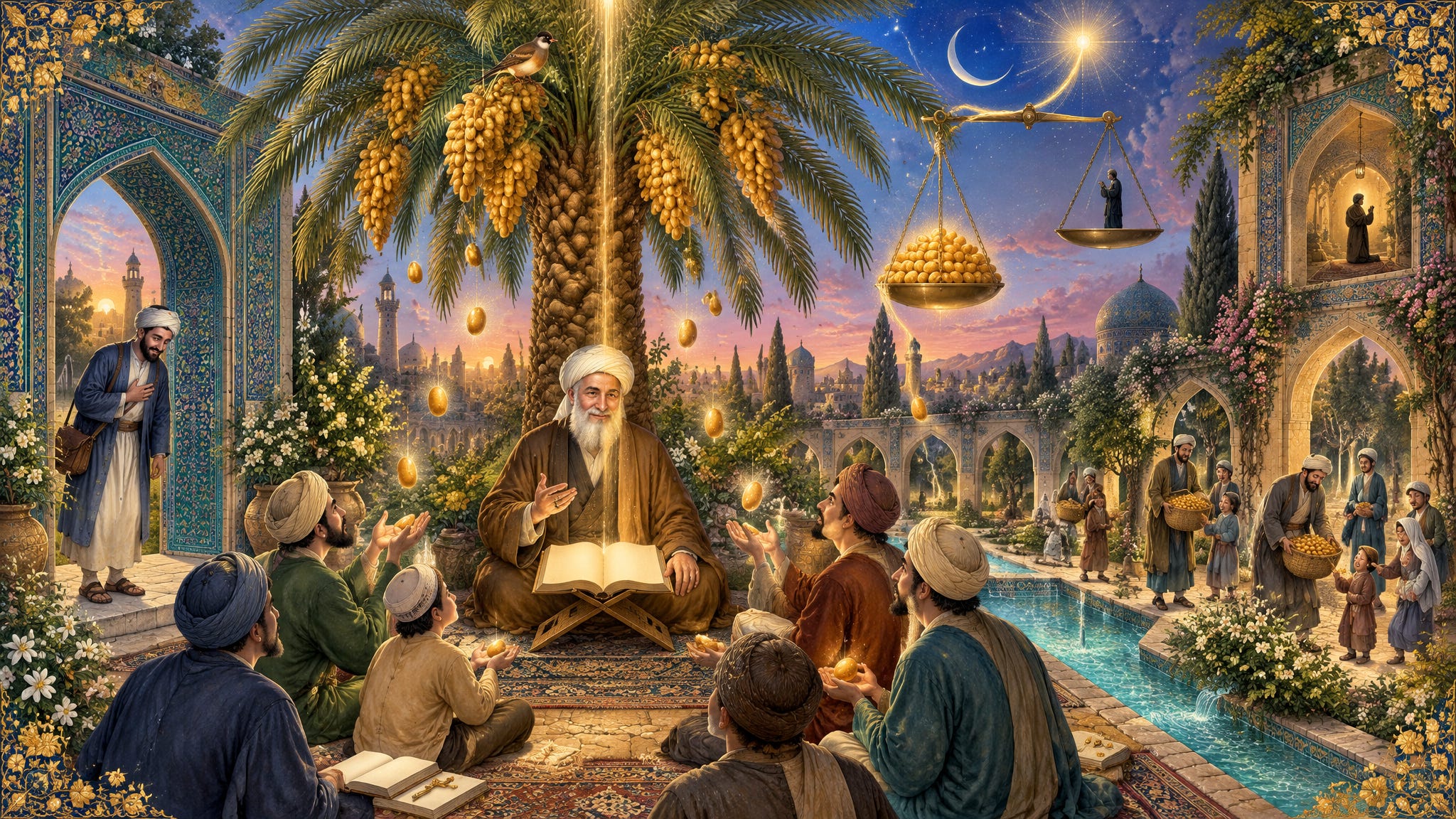
Amir al-Mu’minin used to say:
Among the rights of the scholar over you is this:
Do not press him with too many questions.
Do not tug at his garment.
When you come in and there are people with him, greet them all — and then greet him by himself.
Sit in front of him, not behind him.
Do not wink at others, and do not signal with your hand.
Do not keep saying so-and-so said otherwise, and so-and-so said otherwise, against what he says.
And do not grow weary of keeping his company for a long time.
For the scholar is like a date palm: you wait beneath it until something falls to you.
And the scholar’s reward is greater than the reward of the one who fasts, and stands the night in prayer, and fights in the way of God.
— al-Kulayni, al-Kafi, vol. 1, the Book of the Virtue of Knowledge, hadith 73; from Amir al-Mu'minin, through Imam al-Sadiq; my translation7
Listen to how ordinary these are.
Do not tug at his sleeve.
Do not sit behind him, where he cannot see you.
Do not catch your friend’s eye while he is speaking.
Do not keep throwing other people’s opinions at him to score a point.
These are not the manners of a palace.
They are the manners of a room — the dars, the madrasa, the kitchen table.
Take them one at a time.
Do not press him with too many questions.
Not because questions are bad — we will come to that tonight — but because a man can only pour so much at once.
A question asked to learn is a key.
A pile of questions asked to show off, or to trip him up, is a weight.
Greet them all, then greet him by himself.
Courtesy to the room first; honour to the teacher within it.
You do not walk past everyone else to get to him — and you do not leave him as just one of the crowd.
Sit in front of him, not behind him.
So that he can see you.
A teacher reads faces.
He needs to know whether it landed.
Do not keep saying so-and-so said otherwise.
You may disagree.
You may bring another view.
But there is a difference between a student who asks
what about this other opinion?
and one who uses other people’s names as stones to throw.
And then the image.
The date palm.
You do not shake a date palm.
You do not climb it and strip it.
You sit beneath it, and you wait — and in its season it drops what is ripe into your hand.
A teacher is like that.
Not everything comes on the first day.
Some of it comes in the third year — in a sentence he says on his way out of the room, which you only understand ten years later.
So do not grow weary of his company.
And look at how the hadith ends.
The scholar’s reward is greater than the one who fasts all day, and prays all night, and fights in the way of God.
The one who fasts is nourished by his own fast.
The one who teaches feeds others — and they go on to feed others after him.
One more thing.
When al-Shahid al-Thani came to write the student’s half of his handbook — how a student conducts himself with his teacher — this is the hadith he put first8.
Now watch two men keep it — in a single sentence.
“He Is My Teacher”
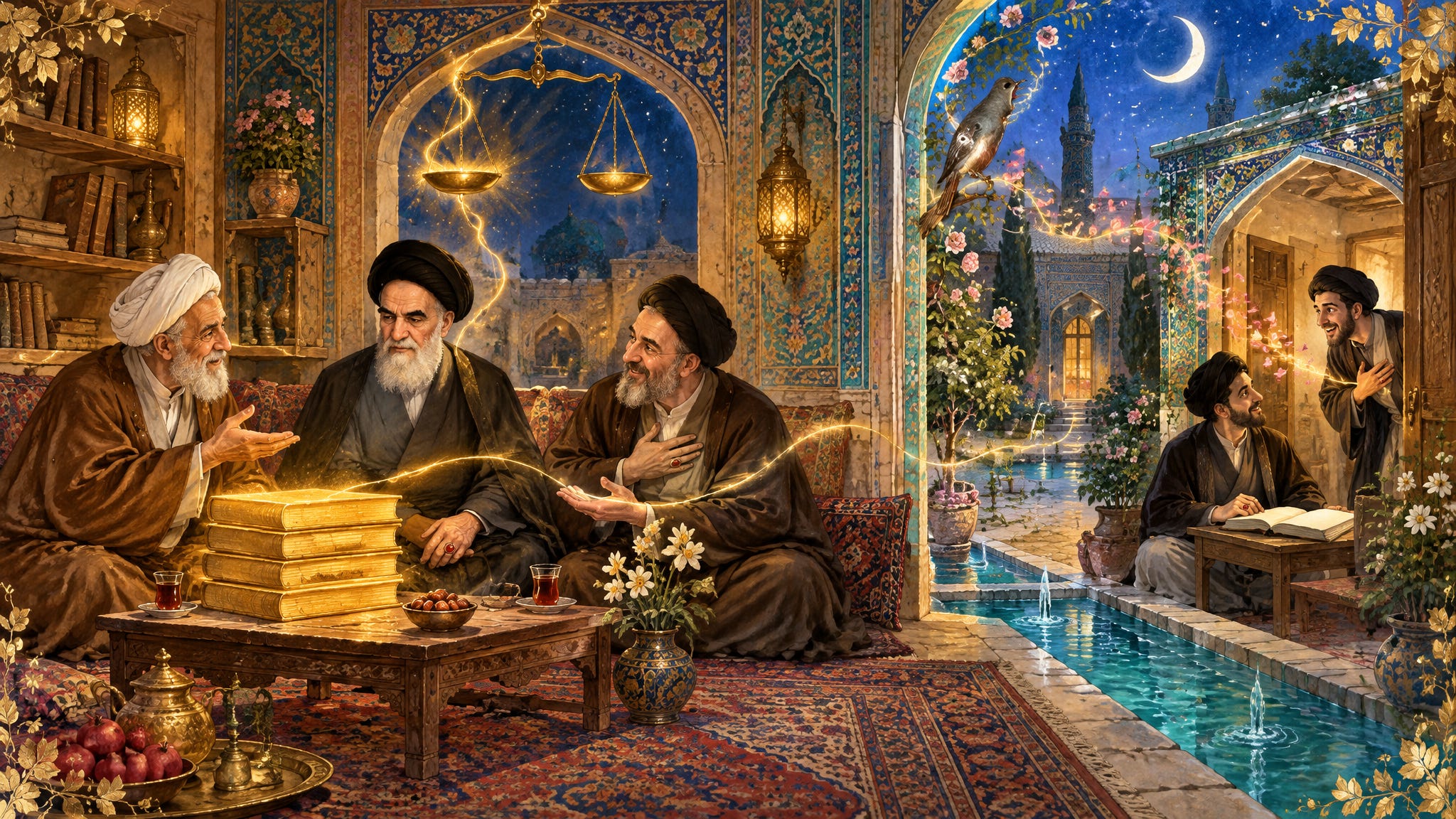
Three years ago, almost to this week, Imam Sayyed Ali Khamenei, may God rest his pure soul, was speaking about Allamah Tabataba’i.
And he told a memory from his own student days in Qom9.
An old scholar, Allamah Semnani — a well-known, respected man from the city of Semnan — had come to Qom, and the scholars were going to visit him.
One day, he said, I was sitting in my room in the madrasa, and a friend of mine burst in.
This friend loved Allamah Tabataba’i.
And he came in reciting a line of Hafez:
In good character and faithfulness,
no one comes near our friend.
What happened? I asked.
He said: we were at Allamah Semnani’s house.
Mr Khomeini was there.
Mr Tabataba’i was there.
Some others too.
And Allamah Semnani turned to Imam Khomeini — may God rest his pure soul — and said:
Sir, we have seen this tafsir of yours, al-Mizan.
It is very good.
It is excellent.
We truly enjoyed it.
And he went on praising al-Mizan — thinking he was speaking to Allamah Tabataba’i.
Imam Khomeini was not a man to be flustered by such things.
He sat there in silence, and said nothing.
And Allamah Tabataba’i, sitting on the other side, turned to Allamah Semnani and said:
Sir, I am Tabataba’i.
He is my teacher — Mr Khomeini.
And the friend kept repeating the line of Hafez.
That was what had moved him.
Look at what happened in that room, in about ten seconds.
The teacher was being praised for his student’s book.
He did not take it.
And he did not make a show of refusing it either.
He let it pass — because it was not his.
And the student would not let his teacher sit there being praised for the wrong thing.
But listen to how he puts it right.
He does not say that book is mine.
He says:
I am Tabataba’i
— and in the same breath,
he is my teacher.
He gave his own name.
And then he gave his teacher’s rank.
Two rights, kept in a single sentence.
And neither man asked for anything for himself.
The Human Teacher
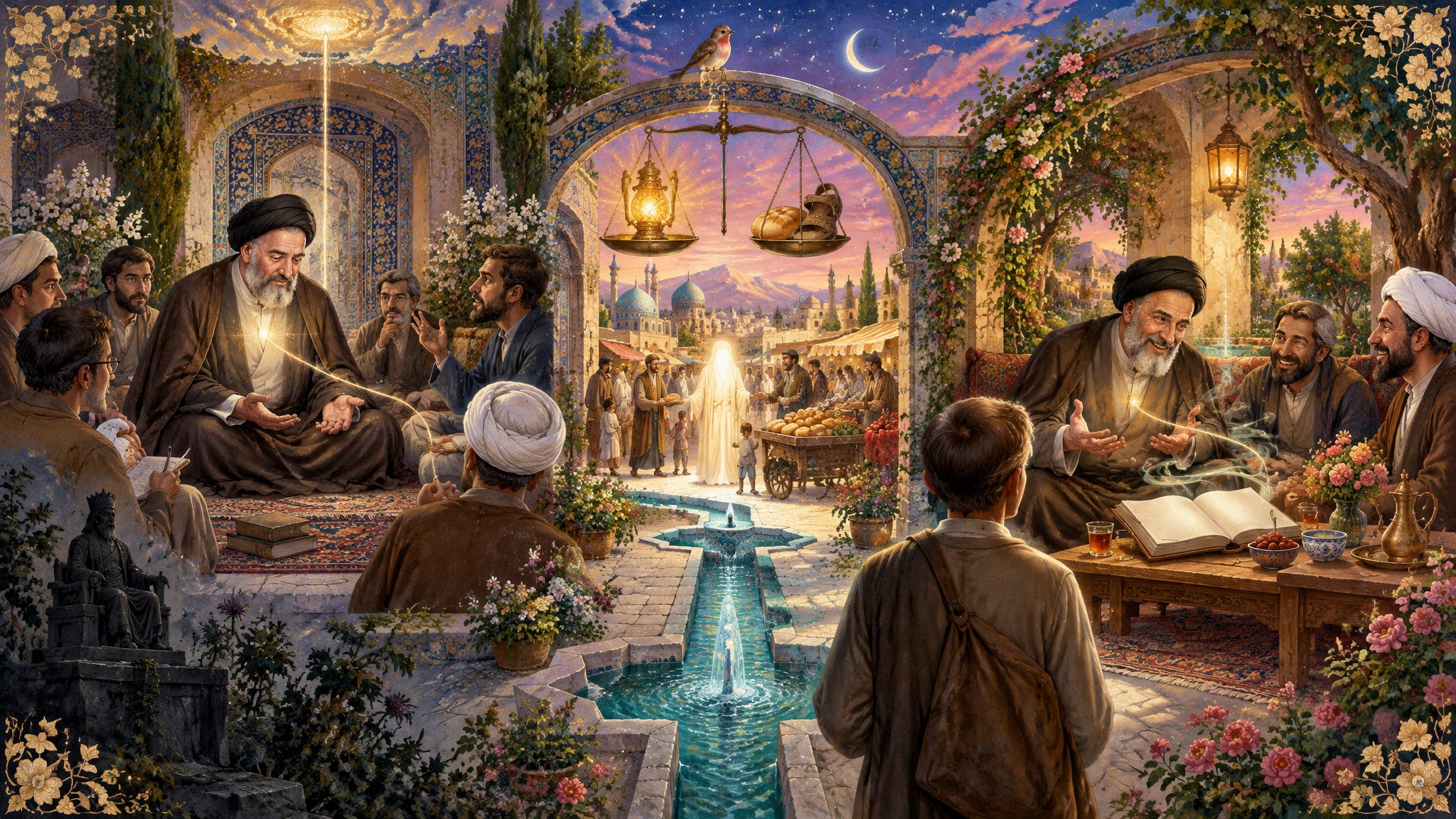
So the man who said he is my teacher — what was he like to sit with?
In the same talk10, Imam Khamenei says that Allamah did not stop at thinking the great truths.
He became them.
He was among the people, he says — but he was with God.
When you met him, you felt he counted himself as no one.
He was forbearing, and gentle — even with those who argued against him and opposed him.
That much you might expect.
But then he says something else11.
Among friends, Allamah was delightful company.
A sweet tongue.
A good talker, a good storyteller.
The silence you saw in him in class, in public, in debate — it was gone.
He was warm.
When he told a story, it came with colour and detail.
He loved poetry.
I want you to hold both pictures together.
The great ones we speak about from this minbar were human beings.
Human beings like all human beings — with the habits and the quirks of human beings.
They ate, and laughed, and told stories, and loved a good line of poetry.
What made them special was not that they were something other than human.
It was that they chose — and went on choosing — to learn for God, and to work for Him, and to move toward Him.
When we make them superhuman, we do two bad things at once.
We make them impossible to follow.
And we excuse ourselves from following them.
The Prophet himself faced this.
The people of Mecca objected:
وَقَالُواْ مَالِ هَٰذَا ٱلرَّسُولِ يَأۡكُلُ ٱلطَّعَامَ وَيَمۡشِي فِي ٱلۡأَسۡوَاقِ لَوۡلَآ أُنزِلَ إِلَيۡهِ مَلَكٞ فَيَكُونَ مَعَهُۥ نَذِيرًا
“And they say, ‘What sort of apostle is this who eats food and walks in the marketplaces? Why has not an angel been sent down to him so as to be a warner along with him?’”
— Qur’an, Surah al-Furqan (the Chapter of the Criterion) #25, Verse 7; the English, Ali Quli Qarai’s
An apostle who eats food, and walks in the markets?
And God answered them, a few verses on:
وَمَآ أَرۡسَلۡنَا قَبۡلَكَ مِنَ ٱلۡمُرۡسَلِينَ إِلَّآ إِنَّهُمۡ لَيَأۡكُلُونَ ٱلطَّعَامَ وَيَمۡشُونَ فِي ٱلۡأَسۡوَاقِۗ وَجَعَلۡنَا بَعۡضَكُمۡ لِبَعۡضٖ فِتۡنَةً أَتَصۡبِرُونَۗ وَكَانَ رَبُّكَ بَصِيرٗا
“We did not send any apostles before you but that they indeed ate food and walked in marketplaces. We have made you a [means of] test for one another, [to see] if you will be patient and steadfast, and your Lord is all-seeing.”
— Qur’an, Surah al-Furqan (the Chapter of the Criterion) #25, Verse 20; the English, Ali Quli Qarai’s
And He told the Prophet to say it himself, plainly:
قُلۡ إِنَّمَآ أَنَا۠ بَشَرٞ مِّثۡلُكُمۡ يُوحَىٰٓ إِلَيَّ أَنَّمَآ إِلَٰهُكُمۡ إِلَٰهٞ وَٰحِدٞۖ فَمَن كَانَ يَرۡجُواْ لِقَآءَ رَبِّهِۦ فَلۡيَعۡمَلۡ عَمَلٗا صَٰلِحٗا وَلَا يُشۡرِكۡ بِعِبَادَةِ رَبِّهِۦٓ أَحَدَۢا
“Say, ‘I am just a human being like you. It has been revealed to me that your God is the One God. So whoever expects to encounter his Lord—let him act righteously, and not associate anyone with the worship of his Lord.’”
— Qur’an, Surah al-Kahf (the Chapter of the Cave) #18, Verse 110; the English, Ali Quli Qarai’s
I am just a human being like you.
The difference is not in the flesh.
It is in what was revealed to him — and in what he did with it.
And none of this takes anything from infallibility.
This summer, in the nights of Shahada, we set out the difference between the infallibility of the Fourteen and a lesser protection God gives to a chosen servant.
Infallibility does not mean superhuman, and it does not mean aloof.
The full treatment will come when we reach the series on wilayah, God willing.
So — human teachers.
And a human teacher owes his students something.
The Basin
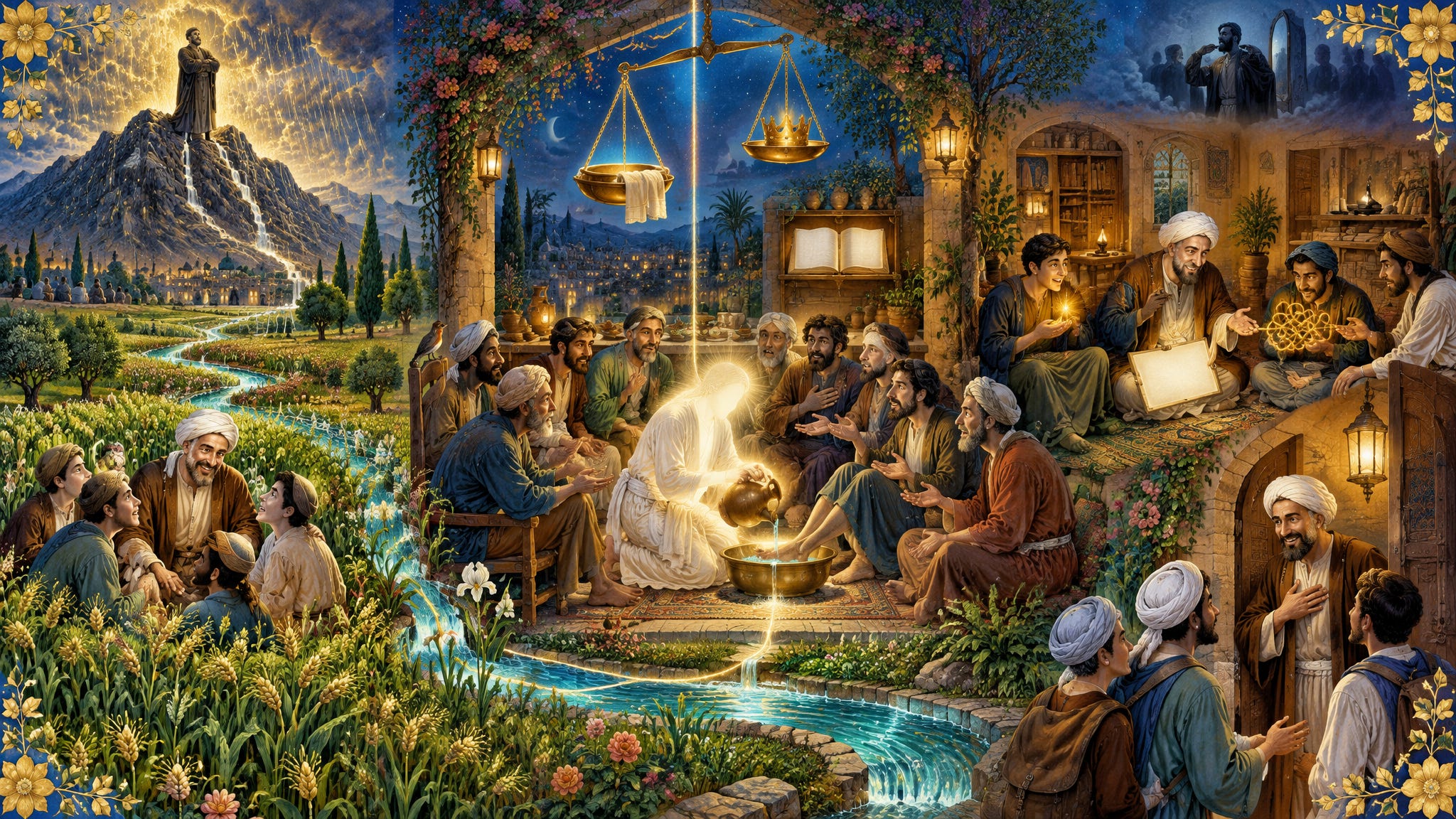
In the half of his handbook written for teachers, al-Shahid al-Thani gives his fifth counsel12 like this:
The teacher must not make himself great over those who learn from him.
He must be gentle with them, and humble.
And then he argues it.
If humility is owed to people in general, he says, how much more to these — who are with him like his own children.
They keep close to him.
They lean on him for knowledge that will help them.
They have the right of companionship, and the honour of love.
So the teacher’s character with his students, he says, must be better than with anyone else.
Gentle when he meets them.
Cheerful.
Open-faced.
Glad to see them.
Letting his love be known.
Letting his love be known.
Not only feeling it — showing it.
And then he points us to a report.
The report of Jesus with the disciples, washing their feet, he writes, has already been given.
وقد تقدَّم ٦ خبر عيسى مع الحواريين وغسله أقدامهم، وغيره من الأخبار.
“And the report of Jesus with the disciples, and his washing their feet, has already been given — and other reports besides.”
— al-Shahid al-Thani, Munyat al-Murid, the fifth counsel (Mawsu’at al-Shahid al-Thani, vol. 1); my translation
He means this one, in al-Kafi.
Jesus son of Mary — may our souls be his ransom, and may God hasten his return — said to his disciples:
O disciples, I have a need of you.
Fulfil it for me.
They said:
Your need is fulfilled, O Spirit of God.
And he stood up, and washed their feet.
They said:
We had more right to do this, O Spirit of God.
He said:
The one with the most right to serve is the scholar.
I humbled myself like this only so that you would humble yourselves among people after me, as I humbled myself to you.
And then he said:
By humility wisdom is built, not by arrogance. It is on the plain that the crop grows — not on the mountain.
— al-Kulayni, al-Kafi, vol. 1, the Book of the Virtue of Knowledge, the chapter on the description of the scholars, hadith 71; narrated13
I have a need of you.
Hold on to those words.
You will hear them again before the night is over.
The crop grows on the plain, not on the mountain.
Rain falls on both.
But water does not stay on a peak.
It runs down to the low ground — and that is where things grow.
The proud teacher is a mountain.
Knowledge falls on him, and runs off.
The humble teacher is the plain.
And here is something that may surprise some of you.
The Gospel tells the same act.
In the Gospel of John, on the last evening with his disciples, Jesus rises from supper.
He lays aside his garments, takes a towel, and ties it round himself.
He pours water into a basin, and begins to wash the disciples’ feet, and to dry them with the towel.
ὅτι ἀπὸ θεοῦ ἐξῆλθεν καὶ πρὸς τὸν θεὸν ὑπάγει, 4 ἐγείρεται ἐκ τοῦ δείπνου καὶ τίθησιν τὰ ἱμάτια καὶ λαβὼν λέντιον διέζωσεν ἑαυτόν· 5 εἶτα βάλλ ει ὕδωρ εἰς τὸν νιπτῆρα, καὶ ἤρξατο νίπτειν τοὺς πόδας τῶν μαθητῶν καὶ ἐκμάσσειν τῷ λεντίῳ ᾧ ἦν διεζωσμένος.
He riseth from supper, and laid aside his garments; and took a towel, and girded himself.
After that he poureth water into a bason, and began to wash the disciples’ feet, and to wipe {them} with the towel wherewith he was girded.
— The Gospel according to John 13:4–5 (the Greek line opens at the end of verse 3); the Greek, the SBL Greek New Testament; the English, the King James Version
And when he has finished, he sits down again and says to them:
12 Ὅτε οὖν ἔνιψεν τοὺς πόδας αὐτῶν ⸀καὶ ἔλαβεν τὰ ἱμάτια αὐτοῦ ⸂καὶ ἀνέπεσεν⸃, πάλιν εἶπεν αὐτοῖς· Γινώσκετε τί πεποίηκα ὑμῖν; 13 ὑμεῖς φωνεῖτέ με Ὁ διδάσκαλος καὶ Ὁ κύριος, καὶ καλῶς λέγετε, εἰμὶ γάρ. 14 εἰ οὖν ἐγὼ ἔνιψα ὑμῶν τοὺς πόδας ὁ κύριος καὶ ὁ διδάσκαλος, καὶ ὑμεῖς ὀφείλετε ἀλλ ήλων νίπτειν τοὺς πόδας· 15 ὑπόδειγμα γὰρ ἔδωκα ὑμῖν ἵνα καθὼς ἐγὼ ἐποίησα ὑμῖν καὶ ὑμεῖς ποιῆτε.
So after he had washed their feet, and had taken his garments, and was set down again, he said unto them, Know ye what I have done to you?
Ye call me Master and Lord: and ye say well; for {so} I am.
If I then, {your} Lord and Master, have washed your feet; ye also ought to wash one another’s feet.
For I have given you an example, that ye should do as I have done to you.
— The Gospel according to John 13:12–15; the Greek, the SBL Greek New Testament; the English, the King James Version
Ye call me Master and Lord.
The word the King James renders Master is, in the Greek of the Gospel, ho didaskalos.
It means the Teacher.
You call me Teacher.
On a night we have called The Teacher.
Two books.
One act.
In al-Kafi:
I humbled myself so that you would humble yourselves among people after me.
In the Gospel:
I have given you an example, that ye should do as I have done to you.
As we said last week — we honour the books that came before, and sometimes they shed light on our own.
Al-Shahid al-Thani’s tenth counsel14 to the teacher takes us from the basin to the lesson itself.
Be eager to teach them, he says.
Hold nothing back from them.
Speak to each at his own level.
For the sharp one who grasps it fully, a hint is enough.
For the others — especially the one who is slow to take it in — make it plain.
And repeat it for the one who only understands it by repetition.
And when you mention a weak opinion, let it be to show the truth — not to raise yourself over another, nor to put another down.
Repeat it for the one who needs it repeated.
Not with a sigh.
Not with
I have already told you this.
And when the question is a hard one — that is a blessing.
A hard question makes the teacher study too.
The one who asks learns — and so does the one who answers.
Last week we heard Imam al-Sadiq tell us to be humble towards the ones we teach.
Tonight we have seen what that looks like: a towel, and a basin, and the feet of every one of them.
So that is the true teacher.
What of the one who only wants to look like one?
The Teacher Who Isn’t

Amir al-Mu’minin says:
٧٣. وَقَالَ (عليه السلام): مَنْ نَصَبَ نَفْسَهُ لِلنَّاسِ إِمَاماً فَلْيَبْدَأْ بِتَعْلِيمِ نَفْسِهِ قَبْلَ تَعْلِيمِ غَيْرِهِ، وَلْيَكُنْ تَأْدِيبُهُ بِسِيرَتِهِ قَبْلَ تَأْدِيبِهِ بِلِسَانِهِ، وَمُعَلِّمُ نَفْسِهِ وَمُؤَدِّبُهَا أَحَقُّ بِالْإِجْلَالِ مِنْ مُعَلِّمِ النَّاسِ وَمُؤَدِّبِهِمْ.
“Amir al-Mu’minin, peace and blessings be upon him, said: Whoever sets himself up as a leader for the people must begin by teaching himself before teaching others; and let his teaching by his conduct come before his teaching by his tongue. The one who teaches and disciplines himself is more worthy of honour than the one who teaches and disciplines others.”
— al-Sharif al-Radi, Nahj al-Balagha, Saying 73; my translation
There is such a thing as a teacher who is not one.
He wants the title, and the front of the room, and the respect — without the teaching.
And without the teaching of himself first.
You can usually tell.
He is quick to correct and slow to explain.
He likes the questions he can answer, and dislikes the ones he cannot.
He talks a great deal about who taught him, and very little about what they taught.
And somehow the room is always about him.
None of this needs a name.
It is a pattern — and the cure for it starts with each of us who teaches anyone anything.
Al-Shahid al-Thani puts it in his ninth counsel15.
The teacher holds himself to what he teaches, first —
so that the student follows his actions first, and only then benefits from his words.
Notice the order.
The actions first.
The words second.
Because that is how students are made.
A student takes on his teacher’s traits.
That is normal, and it is expected.
What the teacher is in the classroom and out of it, in public and in private — it passes into the student, whether either of them means it to or not.
So the student has a duty too.
To choose.
The Qur’an says:
فَلۡيَنظُرِ ٱلۡإِنسَٰنُ إِلَىٰ طَعَامِهِۦٓ
“Let man consider his food:”
— Qur’an, Surah Abasa (the Chapter of He Who Frowned) #80, Verse 24; the English, Ali Quli Qarai’s
Let man consider his food.
Zayd al-Shahham asked Imam al-Baqir, peace and blessings be upon him, about this verse16:
What is his food?
And the Imam said:
His knowledge — the one he takes it from.
You would not let just anyone operate on you.
Before a surgeon touches you, you ask who he is, where he trained, what his record is.
You do your due diligence.
Your soul deserves no less.
Do not take the first man who sounds good.
Take the one of the best character — the one who stands by what is right, always.
Not only when the room is watching.
There is an old saying:
In the land of the blind, the one-eyed man is king.
Perhaps.
But the one-eyed man has no depth perception.
He can see.
He cannot see how far things are, or how deep.
And the student’s question is where you find out.
The Key
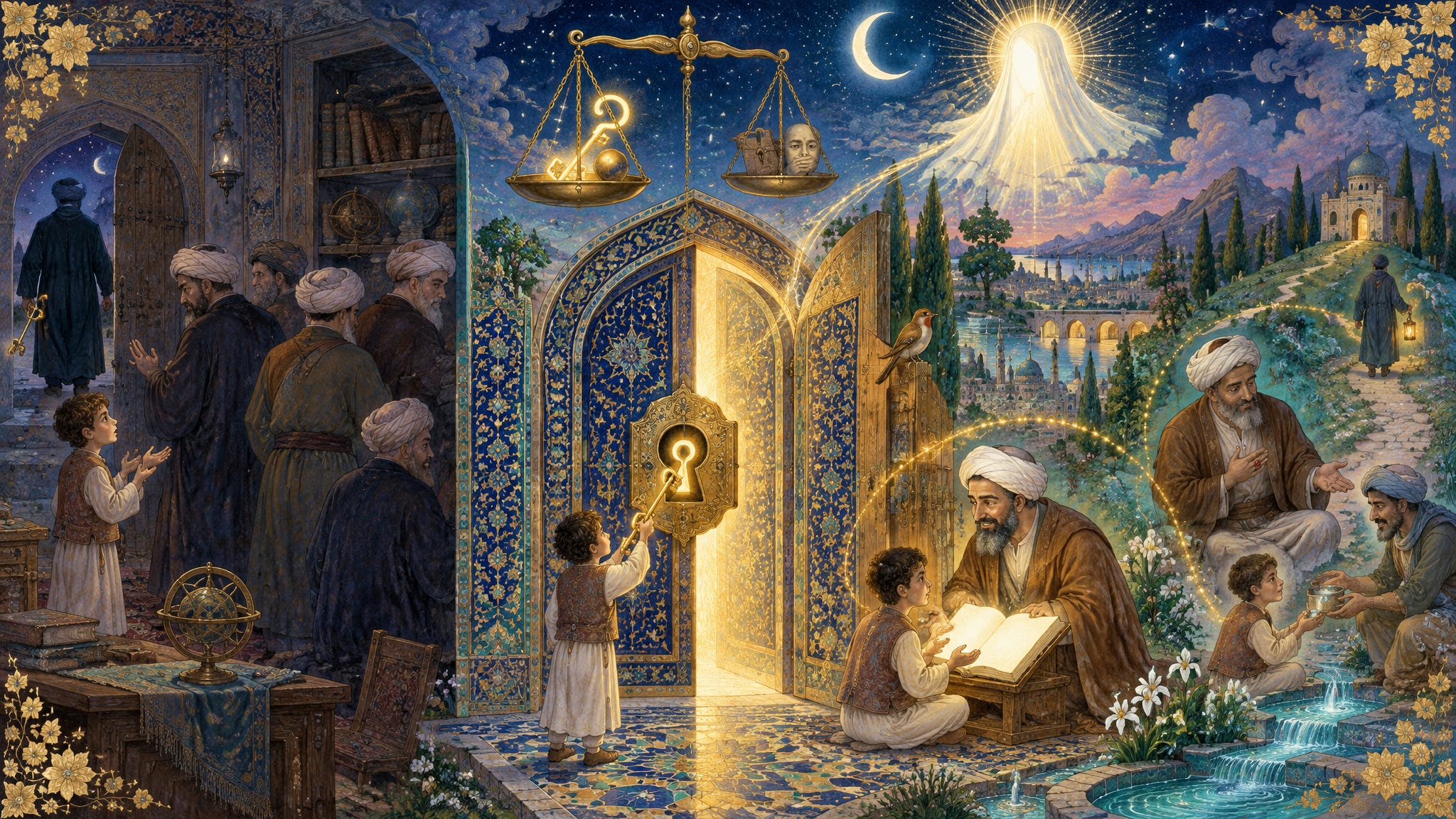
Let me describe something — not a particular place, and not a particular person.
A pattern.
A child, politely — with please, and with thank you — asks why something hurtful was said.
And instead of an answer, the room turns on the child.
A teacher once said what should happen instead.
Make him answer it properly, he said.
And if he cannot, let him say I don’t know — and go and learn, and come back.
Because Imam al-Sadiq, peace and blessings be upon him, said:
قَالَ إِنَّ هَذَا الْعِلْمَ عَلَيْهِ قُفْلٌ وَمِفْتَاحُهُ الْمَسْأَلَةُ.
“He said: This knowledge has a lock upon it, and its key is the question.”
— al-Kulayni, al-Kafi, vol. 1, the Book of the Virtue of Knowledge, the chapter on questioning the scholar, hadith 87; from Imam al-Sadiq; my translation17
This knowledge has a lock, and its key is the question.
You have heard the other two sides of this already.
Last week, Amir al-Mu’minin told us not to be ashamed to say
I do not know.
And two weeks ago we heard of the brother in God who quenched the thirst of those who asked.
Here is the third side.
The question is not rudeness.
It is the key.
And look at what that says about the one who asks.
He is not a nuisance.
He is the one holding the key.
Without him, the knowledge stays behind the lock — even when the teacher has it.
So when a young person asks you something hard about our faith — about why we do what we do, about something they read, about something that hurt them — that is not a threat.
It is a door opening.
Do not slam it.
A teacher who shuts the door on a question has not protected the knowledge.
He has locked it — and walked away with the key.
The Mother Bird
There is one more way to lock that door.
And it is the most dangerous of all, because it sounds like wisdom.
We have said a great deal tonight about teaching slowly.
The rabbani raises people with the small things before the great.
The tenth counsel:
speak to each at his own level.
Knowledge is a light from God, and you do not pour it where it cannot yet be held.
All of that is true.
But there is another voice that uses the very same words.
It goes something like this:
We cannot tell the people everything.
They would not understand.
We are the khawas — the elite.
They are the ‘awam — the common people.
We are not the same.
I have heard it said with a hadith attached.
The scholars are the heirs of the prophets
— and the people are just the people.
The mob.
Listen to the words, and they sound like the rabbani.
Listen to the voice, and they are his opposite.
Let me give you a picture of the difference.
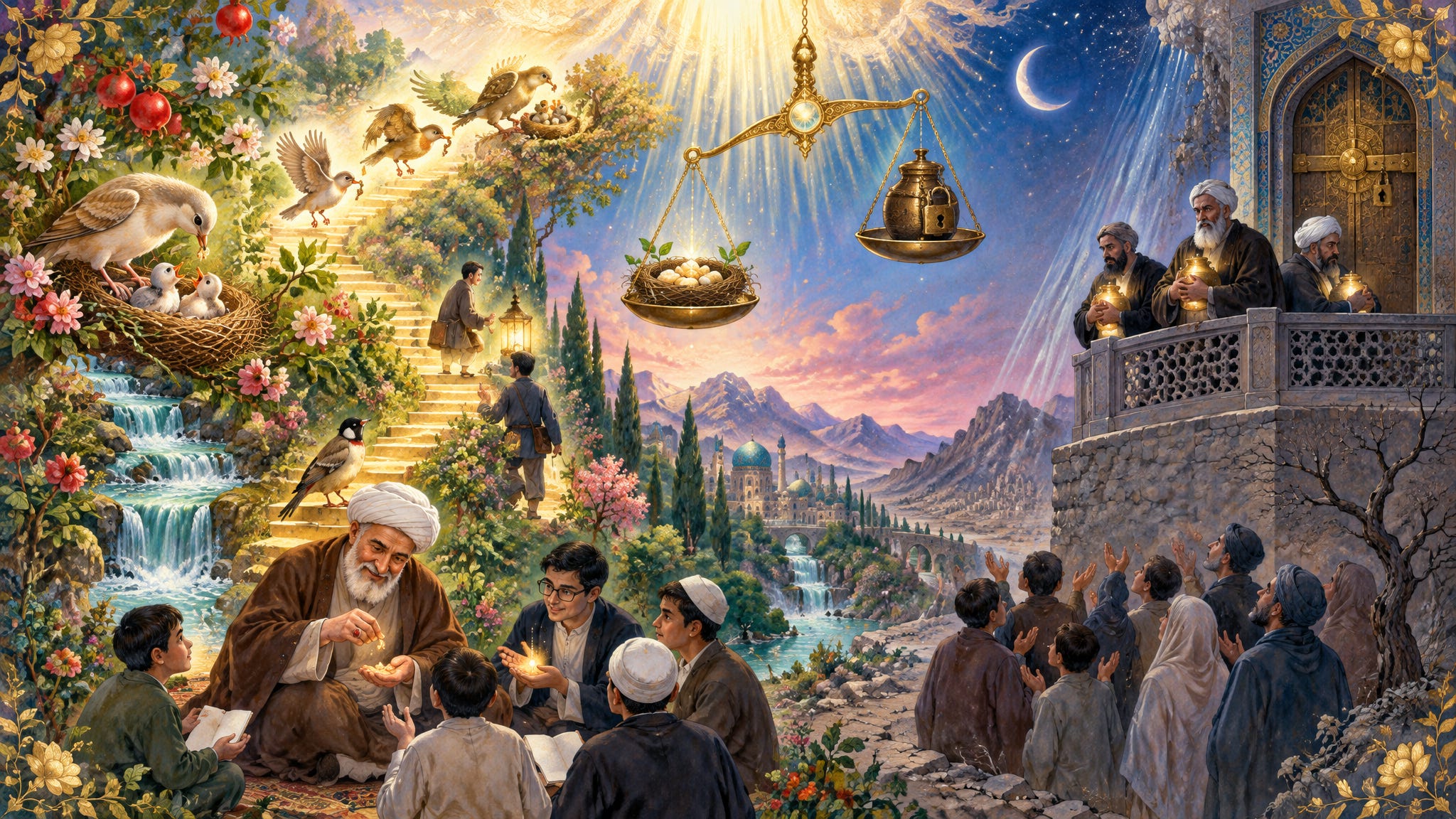
Watch a mother bird with her chicks.
She does not drop a whole worm into a beak that has only just opened.
She takes it, and breaks it down, and softens it — and puts it into the open mouth, a little at a time.
Why?
Not because she thinks the chick is beneath her.
Because she loves it.
And because she wants it — one day — to fly, and find its own food, and feed chicks of its own.
That is teaching slowly.
It is an act of love.
The other voice holds the food back too.
But not so that the chick will grow.
So that the chick stays small — and keeps looking up.
One is a staircase.
The other is a locked door.
Commanded to Speak

And here is how we know which of the two our religion asks for.
Imam al-Sadiq, peace and blessings be upon him, said that the Messenger of God never once spoke to people from the full depth of his own intellect.
And he said that the Messenger of God had said:
We, the company of the prophets, were commanded to speak to people according to the measure of their intellects.
— al-Kulayni, al-Kafi, vol. 1, the Book of Intellect and Ignorance, hadith 16; from Imam al-Sadiq; narrated18
Listen to the word.
Commanded — commanded to speak.
The measure decides how he speaks.
It never decides whether.
The Prophet carried more than any human being has ever carried.
And he never once used it to make a man feel small.
He broke it down, and handed it over — to each according to what he could hold.
That is why he could speak to the chiefs of Mecca in their terms, and turn, and speak to the poorest Bedouin in the mosque in his.
And the Qur’an says the same of every messenger God ever sent:
وَمَآ أَرۡسَلۡنَا مِن رَّسُولٍ إِلَّا بِلِسَانِ قَوۡمِهِۦ لِيُبَيِّنَ لَهُمۡۖ فَيُضِلُّ ٱللَّهُ مَن يَشَآءُ وَيَهۡدِي مَن يَشَآءُۚ وَهُوَ ٱلۡعَزِيزُ ٱلۡحَكِيمُ
“We did not send any apostle except with the language of his people, so that he might make [Our messages] clear to them. Then God leads astray whomever He wishes, and He guides whomsoever He wishes, and He is the All-mighty, the All-wise.”
— Qur’an, Surah Ibrahim (the Chapter of the Prophet Abraham) #14, Verse 4; the English, Ali Quli Qarai’s, with God where his text has Allah
The language of his people.
Not only the tongue they speak — Arabic, or Hebrew, or English.
The language of their understanding.
Where they are.
So when someone asks a question that is beyond where he is now — the teacher’s duty does not disappear.
It changes shape.
You answer it — at his level, in his words, to the measure he can carry tonight.
And you trust that, as his knowledge and his rushd grow, the same answer will open into something deeper, years from now, when he is ready for it.
What you may not do is shut the door.
Or make him feel stupid for knocking.
And if you do not know how to explain it — say so.
I don’t know how to put this properly yet.
Give me a few days, and I will come back to you.
And then make sure you do go back to them.
Do not leave them hanging, or disappointed.
There is no shame in saying I’ll come back to you.
The shame is in the sneer — and in the promise that is never kept.
This series is eighty-two nights old, and we have still not reached the full treatment of servitude — of giving God His due.
That is not because anything is being kept from you.
It is because a house goes up one floor at a time.
And no one who knows that this knowledge belongs to God would dare to hide it from God’s servants.
No Elite
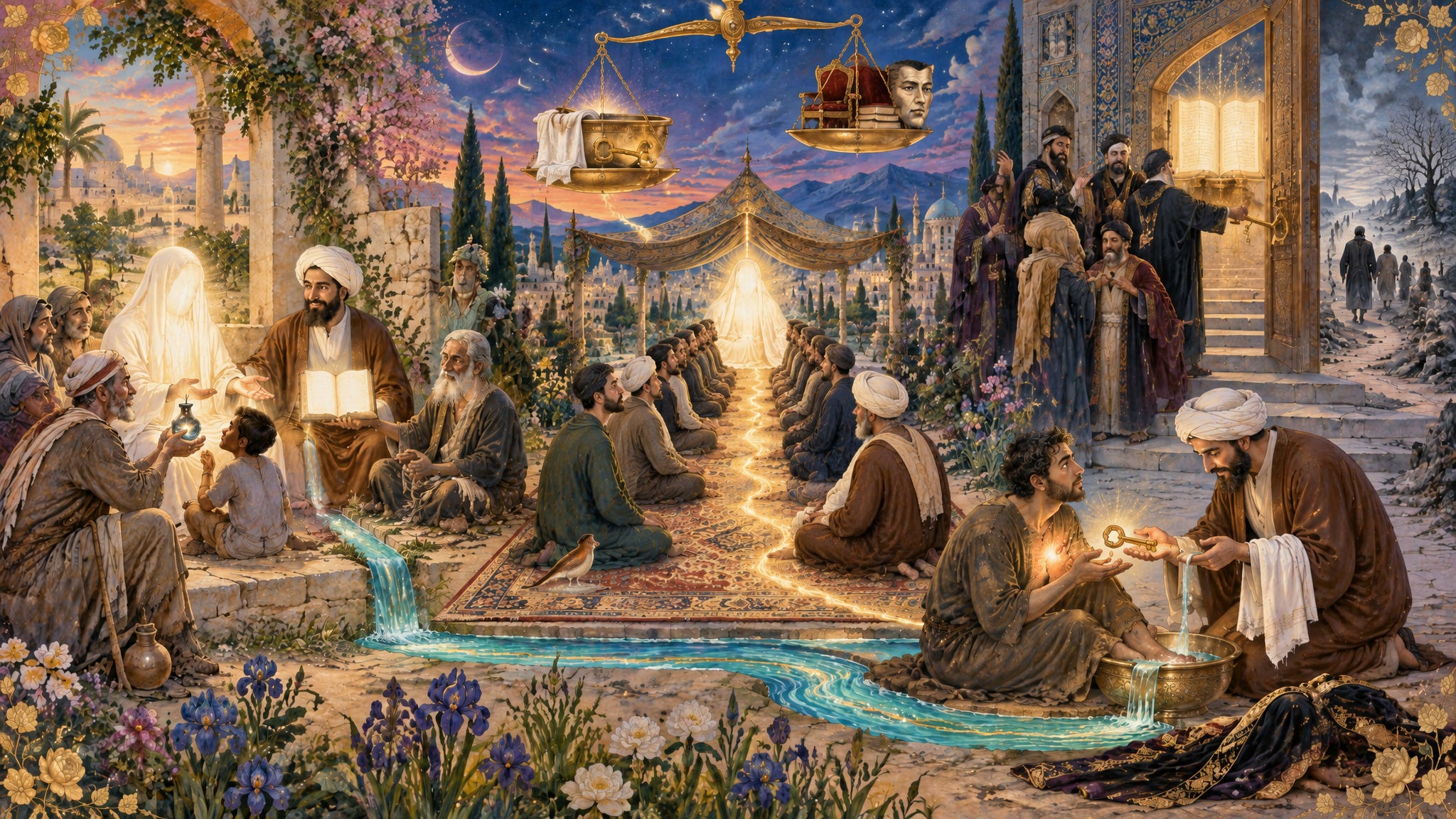
So is there, in this religion, an elite who may look down on the rest?
Hayhat.
Never.
Look at whom the Prophet sat with.
The poor, who called on their Lord morning and evening.
And God told him:
وَلَا تَطۡرُدِ ٱلَّذِينَ يَدۡعُونَ رَبَّهُم بِٱلۡغَدَوٰةِ وَٱلۡعَشِيِّ يُرِيدُونَ وَجۡهَهُۥۖ مَا عَلَيۡكَ مِنۡ حِسَابِهِم مِّن شَيۡءٖ وَمَا مِنۡ حِسَابِكَ عَلَيۡهِم مِّن شَيۡءٖ فَتَطۡرُدَهُمۡ فَتَكُونَ مِنَ ٱلظَّـٰلِمِينَ
“Do not drive away those who supplicate their Lord morning and evening desiring His face.
Neither are you accountable for them in any way, nor are they accountable for you in any way, so that you may drive them away and thus become one of the wrongdoers.”
— Qur’an, Surah al-An’am (the Chapter of the Cattle) #6, Verse 52; the English, Ali Quli Qarai’s
Do not drive them away.
Not to the back.
Not out of the room.
And remember how he treated the newest Bedouin in the row, the one the whole row stared at.
He did not tell him he was too simple for this religion.
He told him what the prayer was for.
The scholars are the heirs of the prophets.
Yes.
But an heir inherits the whole estate.
You cannot take the knowledge and leave the manners behind.
The prophets sat with the poor.
If you are their heir, that is where your seat is too.
And remember the man we heard about earlier tonight, in Imam Khamenei’s words.
He was among the people — but with God.
And in his company you felt that he counted himself as no one.
The greatest teacher of his age, and not a trace of the elite about him.
Two weeks ago, Imam al-Sadiq put every one of us in a single row.
We are the scholars
— the Imams themselves.
Our Shi’a are the learners.
The marja’ is in that row.
The student in Qom is in it.
The man at the back of this room is in it.
Before the Imam of our Age there is no elite.
There are only students — some a little further along than others.
And the further along you are, the lower you kneel.
Jesus, may our souls be his ransom and may God hasten his return, met this same voice in his own day, among the religious lawyers of his people.
Listen to how he described them:
αὐτῶν καὶ μεγαλύνουσι τὰ ⸀κράσπεδα, 6 φιλοῦσι ⸀δὲ τὴν πρωτοκλισίαν ἐν τοῖς δείπνοις καὶ τὰς πρωτοκαθεδρίας ἐν ταῖς συναγωγαῖς 7 καὶ τοὺς ἀσπασμοὺς ἐν ταῖς ἀγοραῖς καὶ καλεῖσθαι ὑπὸ τῶν ἀνθρώπων· ⸀Ῥαββί. 8 ὑμεῖς δὲ μὴ κληθῆτε· Ῥαββί, εἷς γάρ ἐστιν ὑμῶν ὁ ⸀διδάσκαλος, πάντες δὲ ὑμεῖς ἀδελφοί ἐστε· 9 καὶ πατέρα μὴ καλέσητε ὑμῶν ἐπὶ τῆς γῆς, εἷς γάρ ἐστιν ⸂ὑμῶν ὁ πατὴρ⸃ ὁ ⸀οὐράνιος· 10 μηδὲ κληθῆτε καθηγηταί, ⸂ὅτι καθηγητὴς ὑμῶν ἐστιν εἷς⸃ ὁ χριστός· 11 ὁ δὲ μείζων ὑμῶν ἔσται ὑμῶν διάκονος.
And love the uppermost rooms at feasts, and the chief seats in the synagogues,
And greetings in the markets, and to be called of men, Rabbi, Rabbi.
But be not ye called Rabbi: for one is your Master, {even} Christ; and all ye are brethren.
And call no {man} your father upon the earth: for one is your Father, which is in heaven.
Neither be ye called masters: for one is your Master, {even} Christ.
But he that is greatest among you shall be your servant.
— The Gospel according to Matthew 23:6–11 (the Greek line opens at the end of verse 5); the Greek, the SBL Greek New Testament; the English, the King James Version19
He that is greatest among you shall be your servant.
And in the Gospel of Luke, a line that could have been written for tonight:
52 οὐαὶ ὑμῖν τοῖς νομικοῖς, ὅτι ἤρατε τὴν κλεῖδα τῆς γνώσεως· αὐτοὶ οὐκ εἰσήλθατε καὶ τοὺς εἰσερχομένους ἐκωλύσατε.
Woe unto you, lawyers20! for ye have taken away the key of knowledge: ye entered not in yourselves, and them that were entering in ye hindered. {hindered: or, forbad}
— The Gospel according to Luke 11:52; the Greek, the SBL Greek New Testament; the English, the King James Version
Ye have taken away the key of knowledge.
Imam al-Sadiq:
this knowledge has a lock, and its key is the question.
Jesus:
woe to those who take the key away, and stand in the doorway.
Two books — one key.
And we know what happens next, because the West has already lived it.
When people came to feel that their churchmen stood above them rather than among them, many did not leave for another faith.
They left for nothing at all.
Let us not walk that road.
Because understand what the sneer does.
A person who comes with an honest question — who wants to understand his own religion — and is made to feel small for asking does not just go home without an answer.
He goes home with a wound.
Some stop asking.
Some stop coming.
And some, God protect them, decide that the religion itself has no answers — when all it lacked that day was a teacher willing to say,
let me come back to you.
And the voice feeds itself.
Said often enough, in a circle where everyone says it, it begins to sound like knowledge.
It is not knowledge.
It is pride, dressed as knowledge.
We name no one.
It is not the person we have a quarrel with — it is the behaviour, because the behaviour is not of God.
And if any of us who teaches has ever spoken in that voice — and most of us, at some time, have come close — the door is open.
Go back to the one you made feel small.
Answer the question you brushed aside.
That is not weakness.
It is the basin.
A teacher, and a scholar, is a servant — a servant of God, and a servant of His servants.
His work is to teach, to guide, and to protect.
Not to belittle.
Not to malign.
Not to stand above.
And never — hayhat — to take away the key.
Lessons for Our Time
Lesson Three — The Bond Runs Both Ways

The teacher would not take praise meant for his student; the student put it right — and in the same breath gave his teacher’s rank.
And the teacher kneels to wash his students’ feet.
Where both rights are kept, neither has to ask for his own.
If you teach —
Let your love be known.
Al-Shahid al-Thani did not say feel it; he said show it.
Greet the children by name at the door.
Notice the one who has stopped coming — and ask after him, not to tell him off, but because you missed him.
Say well done out loud, in front of the others.
And find your basin.
It will not be a towel and a basin; it will be something smaller.
Put the chairs out yourself.
Stay behind to stack them.
Make the tea for the class instead of waiting for it to be brought to you.
Nothing of your knowledge is lessened by it — that is what the crop grows on the plain means.
And when you are praised for something your students did — the event that went well, the recitation that moved the room — do not take it.
Let it pass to its owner.
Put their names forward, not yours.
And if you are learning —
The date palm’s manners still work; they only need translating.
Arrive before the lesson starts, not ten minutes in.
Put the phone away — the message you send to your friend across the room is the wink Amir al-Mu’minin warned you about.
Sit where he can see your face, not in the back row by the door.
Serve him, too.
Carry his books.
Offer the old Qur’an teacher a lift home.
The disciples said we had more right to do this — so get there first.
And keep his honour when he is not in the room.
When a teacher is being pulled apart in a group chat, do not add your line.
If he got something wrong, tell him — to his face, with courtesy.
Behind his back, cover his faults and speak of his good.
And when someone praises you for what you know, say his name.
I am Tabataba’i — he is my teacher.
It costs you nothing, and it is true.
Lesson Four — The Question Is the Key

A teacher who shuts the door on a question has locked the knowledge.
Answer it — or say I don’t know, and go and learn.
If you teach —
Make room for the key.
Leave the last five minutes of every class for any question at all.
For the shy ones, put a box by the door where a question can be left on a folded piece of paper, with no name on it.
You will be surprised what comes out of that box — and how long some of those questions have been carried.
Thank the one who asks.
Never answer a question with who told you to ask that? — and never let the room laugh at it.
If you do not know, say so — and then come back.
The coming back is the part most of us forget.
Next week, before anything else:
You asked me something last week.
Here is what I found.
The child who sees that has learned more than the answer.
And when the question is beyond where the asker is, do not say
you are not ready for that.
Answer it at his level, in words he can carry tonight — and tell him there is more, for when he is ready.
That is the mother bird.
And at home, take the questions at the table seriously.
Why do we pray?
Why do we cry for someone who died so long ago?
Those are not interruptions to dinner.
They are keys, held out to you.
If you do not know, find out together — and you will have taught them where to go when you are not there.
And if you are learning —
Ask well.
Ask at the right moment — not in the middle of his sentence.
If the question might embarrass someone, ask him afterwards, quietly.
Write your questions down during the week, so that they are still with you when you reach the class.
Take them to the right person.
Let man consider his food
— and every answer you take in is food.
The loudest comment section is not a teacher.
And when you get your answer, act on it.
A question whose answer you never act on is a key you turned — and then never walked through the door.
And when someone else asks the question you think is too basic, do not roll your eyes.
Remember the room that turned on the child.
Do not be that room.
What a Teacher Leaves
The Students He Made
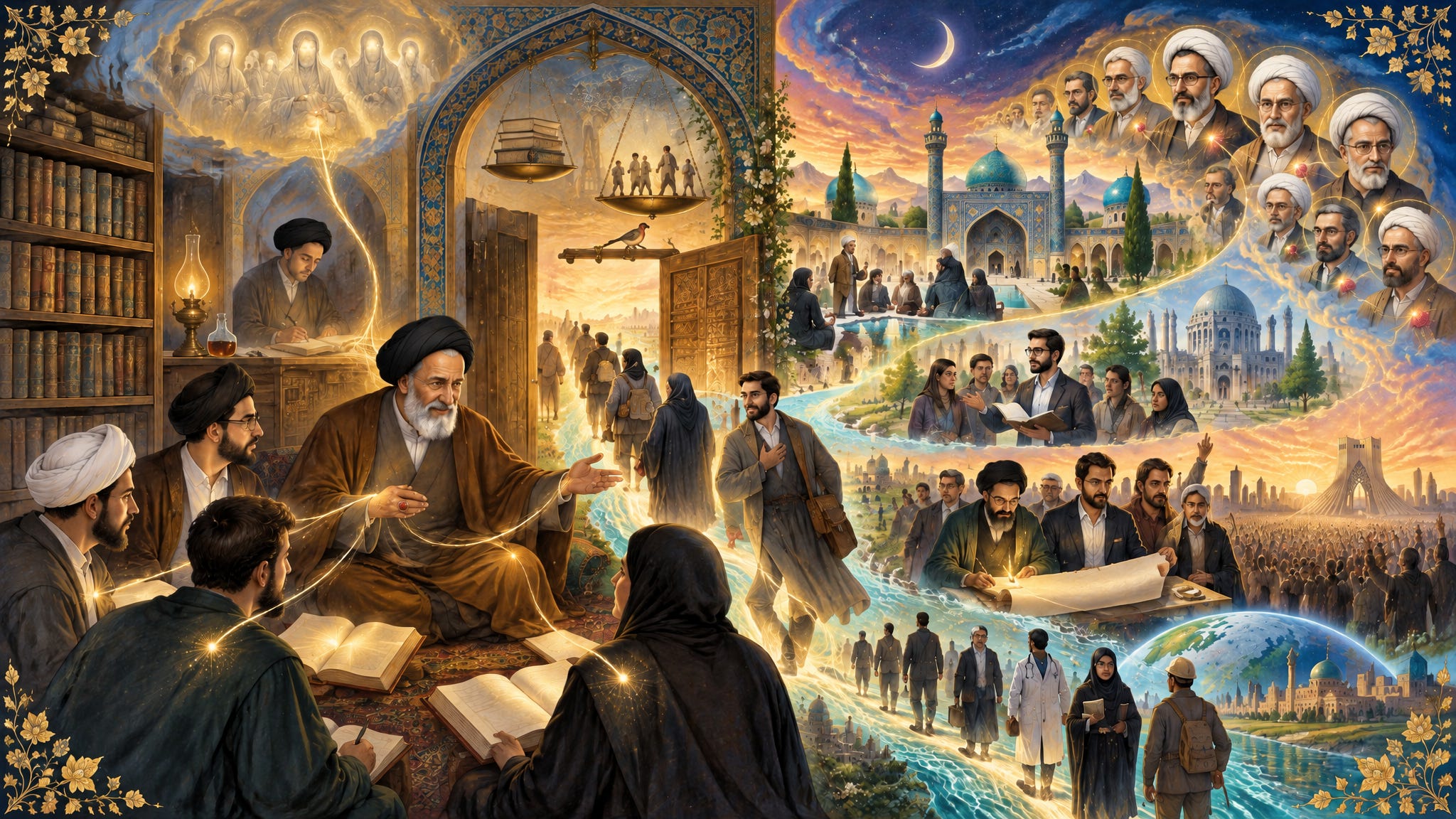
In that same talk, Imam Khamenei says something I want you to hear carefully21.
Of all the philosophers of recent times, he says, he knows of no one from whose class came so many students of this kind — Shaheed Mutahhari, Shaheed Beheshti, the late Ayatullah Misbah, and others.
And some great men who are still alive today.
And then he goes further.
Many of his students, he says, were among the makers of the Islamic Revolution.
Many of the men who wrote its constitution were his students.
And among the best-known martyrs of the revolution — Shaheed Mutahhari, Shaheed Beheshti, Shaheed Quddusi, Shaheed Shaykh Ali Heydari Nahavandi — every one of them was his student.
A teacher is measured by who he leaves behind.
Not by how many books he wrote.
By the people who carry what he taught.
Books stay on a shelf until someone opens them.
Students walk out of the room and into the world — into mosques, and universities, and, in his case, into a revolution.
And they did not all become the same man.
A teacher who raises students does not make copies of himself.
He makes people who can think — and some of them go further than he did.
That is not a loss to the teacher.
It is the whole point of him.
And the man who made all those students was himself a student.
And he kept a bottle closed.
The Perfume
One of Allamah’s students — Allamah Sayyed Muhammad Husayn Husayni Tehrani — wrote a book about his teacher after he died.
And in it he tells this22.
One day, he says, I offered him some perfume.
He took it in his hand.
He paused.
And then he said:
It is two years since our teacher, the late Qadi, passed away.
And I have not worn perfume since.
And to this day, Allamah Tehrani writes23, whenever I have given him perfume, he has closed the lid and put it in his pocket.
I never once saw him wear it — and it is thirty-six years since his teacher died.
Thirty-six years.
A small glass bottle, closed, in a pocket.
Look at the shape of it.
A teacher — the late Sayyid Ali Qadi Tabataba’i, whom, God willing, we will come to know in the sessions ahead.
His student — Allamah Tabataba’i.
And his student’s student — Allamah Tehrani, who tells the story.
Three generations, in one bottle of perfume.
And Allamah Tehrani has his own word for his teacher.
He wrote that book in the days of grief, far away in Mashhad.
And in it he calls Allamah Tabataba’i
this teacher who truly holds over me the right of life.
The right of life.
So why would a man do what Allamah did with that perfume?
Because some debts are not paid in money.
The Debt

In that speech at the opening of the school in Qom, Ayatullah Misbah Yazdi said something that explains it24.
Every blessing is from God, he said.
And yet God loves that the intermediaries — whoever they are — should not be forgotten.
That is why, when the Qur’an commands us to give thanks to God and to our parents, it joins the two with a single word of thanks.
It does not say: thank Me — and then, thank your parents.
It says, in one breath:
Thank Me, and your parents.
So that we notice.
Yes, our existence is from God.
But after God, the part our parents played must not be forgotten.
And so it is, he said, with every other intermediary.
The teacher is one of those intermediaries.
God gave you knowledge — and He gave it through him.
Thanking God does not cancel the debt to him.
God Himself joins the two.
And how does a student pay that debt?
Not with money.
A student pays his teacher by staying true to what he taught.
Not by quoting him.
Not by putting his picture on the wall.
By living the thing he taught — and by passing it on, as carefully as it was passed to you.
Thirty-six years of bottles, closed and put away in a pocket, is one way of saying it.
The Teachers in This Room

And every one of us has such intermediaries.
Some of them are in this room.
The one who taught you your first surah.
The teacher at the madrasa on a Saturday morning, who gave up his weekend for you.
And the parent at the table — the first teacher most of us ever had.
Some of them were not very good at it.
Some were impatient; some were strict when they did not need to be.
And still — you can read the Qur’an, and you know how to pray, and somewhere in you is a voice that tells you when you have done wrong.
Someone put that there.
And some of them are gone now.
Their names are on no book.
No one will hold a congress for them.
But every time you recite al-Fatiha, something of theirs is still going on.
And remember how wide a teacher’s gift is.
Al-Shahid al-Thani says25:
Just as the teacher teaches his students what their religion needs for their dealings with God, he teaches them what their world needs for their dealings with people — so that the excellence of both is complete for them.
A teacher does not only give you the rulings of prayer.
He shows you how to deal with people.
And the teachers we owe are not only the ones who taught us our religion.
The one who taught you to read.
The maths teacher who stayed behind after school because you were not getting it.
The one who taught you a trade with his own hands.
The colleague who showed you how the job is really done.
Whoever taught you anything true and useful is one of those intermediaries.
Amir al-Mu’minin, peace and blessings be upon him, put it in one line:
٨٠. وَقَالَ (عليه السلام): الْحِكْمَةُ ضَالَّةُ الْمُؤْمِنِ فَخُذِ الْحِكْمَةَ وَلَوْ مِنْ أَهْلِ النِّفَاقِ.
“Amir al-Mu’minin, peace and blessings be upon him, said: Wisdom is the lost property of the believer; so take wisdom, even from the people of hypocrisy.”
— al-Sharif al-Radi, Nahj al-Balagha, Saying 80; my translation
Lost property is something that was yours all along.
When the believer comes across it — in a classroom, at work, in a book, from a stranger — he does not first ask whose hands it passed through.
He knows it for his, and he takes it home.
Even from the people of hypocrisy
— you take the wisdom, not the man.
And the one who handed it back to you is owed your thanks.
If one of yours is still living, let them hear from you this week.
Not because they need it.
Because you owe it.
The Imam Who Taught Through Du’a

And at the end of tonight, we will stand with an Imam who was a teacher of a particular kind.
An Imam who could not teach openly — and so taught a whole people through du’a.
And who wrote down, for every one of you, the rights of your teacher and the rights of your student — so that no one would ever have to guess them.
Lessons for Our Time
Lesson Five — A Teacher Is Measured by Who He Leaves Behind
Not by his books — by the people who carry what he taught.
If you teach —
Measure yourself by who they become, not by how much they still need you.
A good teacher is always working himself out of a job.
Teach the child to read the Qur’an for himself, not only to repeat after you.
Teach the teenager to look up a ruling in his marja’s book of rulings, not only to ring you every time.
Train the one who comes after you.
Whoever recites the du’a on Thursday night, whoever leads the children’s class, whoever keeps a centre like this one running — find the younger one and put him beside you.
Let him make his mistakes while you are still here to catch them.
A community whose teachers hold the microphone until their last breath will find, one day, that no one else knows how to hold it.
And when one of them goes further than you — studies more, sees more, serves better — be glad.
That is not a loss to you.
It is your reward, arriving early.
And do not keep them from other teachers.
Allamah’s students did not all become the same man.
And if you are learning —
Take it out of the room.
What you learn here should be visible at work, at university, at the school gate — in how you deal with people, not only in how you pray.
His students walked into mosques and universities and a revolution.
You only have to walk into Monday morning.
And remember that one day you will be somebody’s teacher — your children’s, if no one else’s.
Live so that when people meet you, they ask, who taught you? — and your teacher is honoured by the answer.
Lesson Six — Some Debts Are Paid by Never Forgetting
Thank God — and do not forget the ones He sent it through.
Every bottle he was given, closed and put away in his pocket — for thirty-six years.
If you are learning — and here, that is all of us —
The debt is not paid in money.
It is paid in faithfulness.
For the teachers who have gone: recite something of the Qur’an for them — the first surah they taught you is a good place to start.
Give a little charity in their name.
Visit the grave, if you know where it is.
When their anniversary comes, remember it — or ask their family when it is, and remember it from then on.
For the teachers still living: visit the one who is housebound now.
Stand when the old Qur’an teacher walks in.
Ask his advice, even when you think you no longer need it — it may be the only time in his week that anyone does.
And if a teacher leaves a family behind, look after it.
And the best payment of all: keep doing what they taught you.
A teacher whose student still prays the way he taught him has not finished teaching.
And if you teach —
The debt is your student’s to pay — never yours to collect.
Do not remind them of what you did for them.
Do not teach in order to be remembered.
But do teach them to remember.
Teach the children to thank their parents and their teachers out loud — God Himself joined that thanks to His own.
And when you are thanked, pass it upward:
it came through someone.
Then you are paying your own debt in the same breath.
The Close

If everything else from tonight goes, keep three lines.
The first is the headline:
He taught the Qur’an.
He created man.
He taught him articulate speech.
God taught before He created.
The second is Amir al-Mu’minin’s:
the scholar is like a date palm — you wait beneath it until something falls to you.
And the third is Imam al-Sadiq’s:
this knowledge has a lock, and its key is the question.
Conclusion — Key Takeaways

Three things to take out of this room — and they are things to do, not only things to think.
The first. God teaches first — and a teacher raises.

Whatever a teacher has, he was given.
And he is measured by whether his students grow nearer to God.
This week: the next time you teach anyone anything — your child, a colleague, a younger brother or sister — start with the small things, and be gentle with the one who gets it wrong.
The second. The bond runs both ways — and the question is the key.

The teacher will not take his student’s praise; the student gives his teacher’s rank.
And the teacher kneels to wash his students’ feet.
This week: ask the question you have been holding back.
And when someone asks you one, answer it — or say I don’t know, and go and find out.
And the third. A teacher is measured by who he leaves — and the debt is paid by not forgetting.

This week: name one teacher in your du’a.
By name.
Living, or departed.
The One Among the People
Tonight we looked up, at the one who teaches.
Next week, God willing — the scholar among the people.
Eulogy — Allamah Sayyed Muhammad Husayn Tabataba’i: I Have a Need
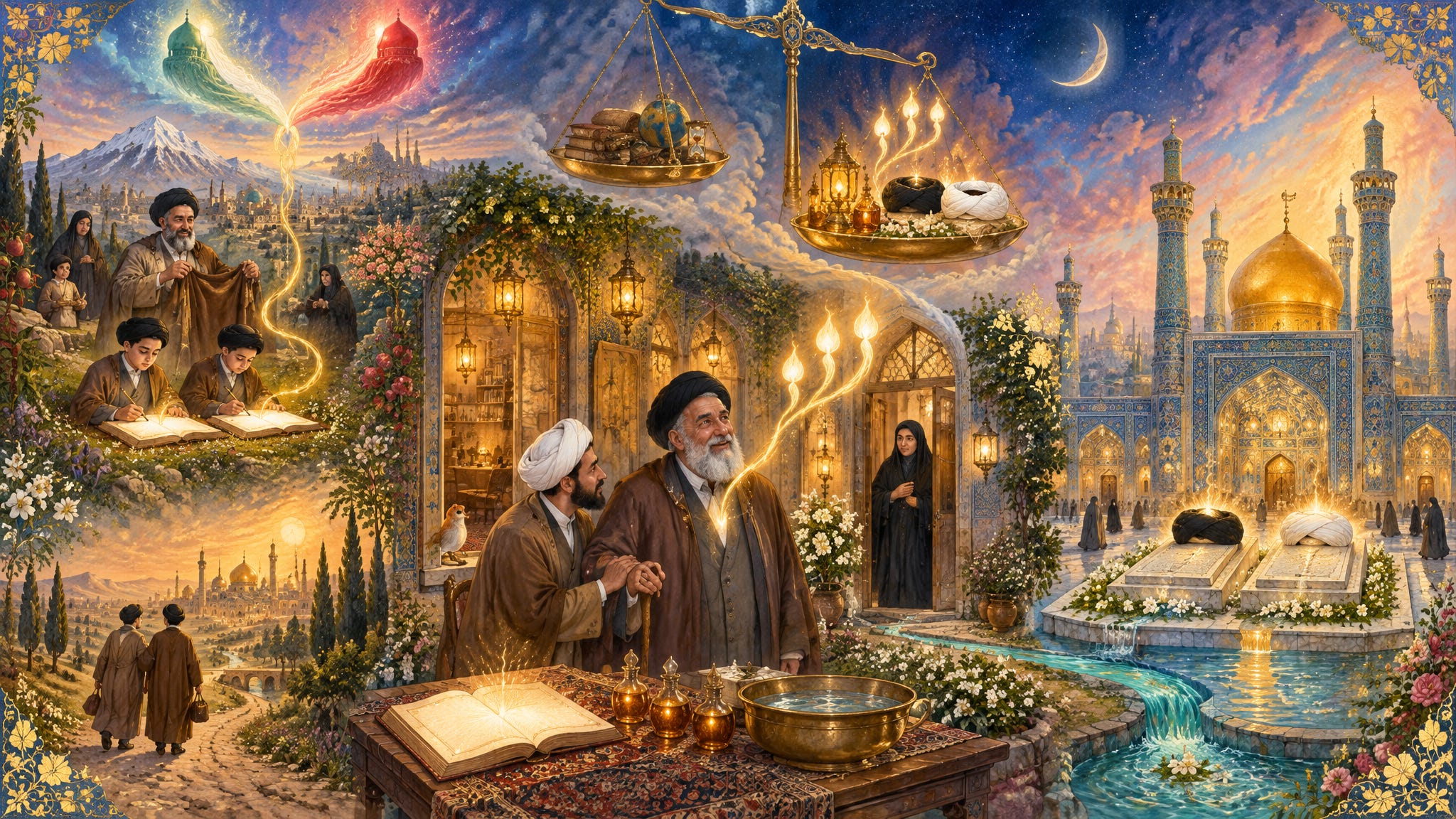
Allamah Sayyed Muhammad Husayn Tabataba’i, may God rest his pure soul.
We have met him three times tonight.
Writing on the verse that opened our night.
Saying, in a room in Qom, he is my teacher.
And, for thirty-six years after his own teacher died, closing the lid on every bottle of perfume he was given.
Let me tell you a little of where he came from26.
He was a small child when his mother died.
He was nine when his father died.
He and his younger brother were left — and the guardian their father had named kept the house as it had been, with a manservant and a maid, and watched over them.
He used to say: many days, my brother and I would go out of Tabriz, and on the green slopes and hills around the city, from morning until sunset, we would practise calligraphy.
Then the two of them went to Najaf together.
Through every stage, his student writes, the two brothers were together — as though they were one soul in two bodies.
And here is something lighter — the name itself27.
The historians tell that one of his forefathers, Ibrahim, had a lisp: where he meant to say qaf, it came out as ta’.
One day he asked for his clothes, and the servant said: shall I bring the long robe?
And he said:
No — tabataba!
He meant
Qaba, qaba — the cloak, the cloak.
And the name stuck.
The great ones were human, remember.
Even their names have a smile in them.
Through his father, his line went back to Imam al-Hasan al-Mujtaba, peace and blessings be upon him.
Through his mother, to Imam al-Husayn, peace and blessings be upon him.
And so the books he wrote as a young man in Tabriz, he signed at the end28:
Sayyed Muhammad Husayn — Hasani, Husayni — Tabataba’i.
Now the end.
In his last year he was gravely ill.
He came home to Qom, and saw only his closest students.
One of them came to the house and found something he never forgot.
Every lamp in the rooms was lit.
And Allamah was dressed — turban and cloak — walking through the rooms with a joy that could not be described.
As though he were waiting for someone to come.
Another, who came in the afternoons to fetch whatever the house needed and to walk him a little in the courtyard, greeted him one day and asked:
Agha, do you need anything?
And he said, again and again:
I have a need.
I have a need.
I have a need.
We heard those words once already tonight — from a teacher kneeling with a basin, who had a need of his disciples.
Here they came from a man who was already somewhere else.
When they moved him to the hospital, he said to his wife as he left the house:
I am not coming back.
Nearly a week in hospital.
Two days without consciousness.
And on Sunday morning, the 18 of Muharram, 1402 — three hours before noon — he left29.
That was forty-five years ago this Sunday.
He lies in Qom, in the shrine of Sayyedah Fatimah Ma’sumah, peace be upon her — near the grave of his student, Shaheed Mutahhari.
The teacher, and the student he made, side by side30.
Segue to Maqtal

Allamah left us on the 18th of Muharram.
And there is a report that Imam Zayn al-Abidin, peace and blessings be upon him, left this world on a Saturday — the 18th of Muharram, too.
Most of our scholars — al-Shaykh al-Mufid and al-Shaykh al-Tusi among them — give the 25th.
That is the date most commonly accepted, and it is the one we keep.
But open al-Majlisi’s Bihar al-Anwar, and on a single page31 he sets the reports side by side.
The 25th, or the 18th.
The year 92, 94 or 95.
57 years old, or 58, or 59.
Why?
News travelled by caravan.
Those who wrote it down wrote what reached them.
Months were counted by the moon that was seen.
Does it change anything?
Not really.
This Saturday we mark the second report of the martyrdom of Sayyedah Fatimah al-Zahra, peace and blessings be upon her — seventy-five days after her father, or ninety-five.
It changes nothing of who she was, or of what was done to her.
A week either way, the teacher we remembered tonight left in the same days of Muharram as Imam Zayn al-Abidin.
And in a moment you will hear how the two are joined.
Our maqtal tonight is given in the voice of the one who carries every one of their griefs: the Imam of our Age, may our souls be his ransom, and may God hasten his return.
Maqtal (Lamentation) for the Twenty-Second Session of the Architecture of Guidance
Supplication
In Your Name, the Lord of Zahra, her Father, her Husband and her Children
O God, we ask You by the One who taught the Qur’an before He made the human being, and by the pledge You took from the people of knowledge before You took it from us.
By Your prophets, peace and blessings be upon them all — by Moses, who asked to follow, and by Jesus, may our souls be his ransom and may God hasten his return, who knelt with a basin.
By Muhammad, peace and blessings be upon him, his family, and his righteous companions — the gentlest teacher anyone ever saw.
By the fourteen — by Sayyedah Fatimah al-Zahra, peace and blessings be upon her, in these her days;
by Amir al-Mu’minin, peace and blessings be upon him, who set out the rights of the scholar;
by Imam Zayn al-Abidin, peace and blessings be upon him, who carried the bread by night and wrote down the rights of the teacher and the student;
and by every Imam to the one we are waiting for.O God, bless every teacher who ever taught us — the one who taught us our first letter, our first surah, our first prayer; the living and the departed.
Reward them for what they gave us, and forgive us for what we forgot.O God, make us students who keep the rights of our teachers, and teachers who keep the rights of our students.
Make us gentle with the one who gets it wrong, and patient with the one who needs it said again.
And give us the key — the courage to ask.O God, have mercy on Allamah Sayyed Muhammad Husayn Tabataba’i, on his teachers, and on the students he made — Shaheed Mutahhari, Shaheed Beheshti, and all who carried what he taught.
O God, bless the last night of Fruit of the Heart this Saturday, and the parents and children who come to it, in the days of Your Prophet’s daughter.
O God, have mercy on the previous leader, Imam Khomeini, may You rest his pure soul.
O God, we remember before You the martyred leader, Imam Sayyed Ali Khamenei, may You rest his pure soul, from whose lectures on patience this circle of ours first began.
Accept him, and gather him with those he loved.O God, protect and guide and lengthen the life of our Wali al-Faqih, Imam Sayyed Mujtaba Khamenei, may You protect him, and keep him firm on the straight path until the rising of the one we are waiting for.
O God, hasten the relief of Your friend and the son of Your friend — the Imam of our Age, may our souls be his ransom and may You, our beloved Lord, hasten his return.
Make us among his students, and among those who work for him.
And make us among those who wait for him actively — who prepare, and do not only wait.O God, give us success in whatever we do for his sake.
And give us a good ending, like the righteous scholars who went before us.And whatever we have said tonight that was true, it is from You; and whatever was wrong in it is from me, and I ask Your forgiveness for it.
Amen, O Lord Sustainer of the Universes
Amen, O Most Merciful of the Merciful
And from Him alone is all ability and He has authority over all things.
Allamah on “He taught him al-bayan”.
و قوله:«علمه البيان»البيان الكشف عن الشيء و المراد به الكلام الكاشف عما في الضمير، و هو من أعجب النعم و تعليمه للإنسان من عظيم العناية الإلهية المتعلقة به فليس الكلام مجرد إيجاد صوت ما باستخدام الرئة و قصبتها و الحلقوم و لا ما يحصل من التنوع في الصوت الخارج من الحلقوم باعتماده على مخارج الحروف المختلفة في الفم.
“His words ‘He taught him al-bayan’: bayan is the uncovering of a thing, and what is meant is speech that discloses what is in the mind. It is among the most wondrous of blessings, and teaching it to the human being is of the great divine care given him. For speech is not merely making a sound with the lungs, the windpipe and the throat, nor the variety of sound that comes from the throat as it leans on the different points of articulation in the mouth.”
و لا يتم للإنسان اجتماعه المدني و لا تقدم في حياته هذا التقدم الباهر إلا بتنبهه لوضع الكلام و فتحه بذلك باب التفهيم و التفهم، و لو لا ذلك لكان هو و الحيوان العجم سواء في جمود الحياة و ركودها.
“The human being’s life in society would not be complete, nor would his life have advanced as brilliantly as it has, but for his awakening to the making of speech — and his opening, by it, of the door of making-understood and understanding. Without it, he and the speechless animals would be alike, in a life frozen and still.”
— Allamah Sayyed Muhammad Husayn Tabataba’i, al-Mizan fi Tafsir al-Qur’an, on Surah al-Rahman, Verse 4; my translation
Al-Shahid al-Thani, on the teacher’s gentleness.
وانظر إرشاد رسول الله ، وتلطفه مع الأعرابي الذي بال في المسجد¹، ومع معاوية بن الحكم لمّا تكلّم في الصلاة².
“And look at the guidance of the Messenger of God, and his gentleness with the Bedouin who relieved himself in the mosque, and with Mu’awiya ibn al-Hakam when he spoke in the prayer.”
— al-Shahid al-Thani, Munyat al-Murid, the teacher’s manners with his students (Mawsu’at al-Shahid al-Thani, vol. 1); my translation
Al-Shahid al-Thani on Moses’ request, the eighth to the twelfth of his readings.
الثامنة: أنه قال: هل أتبعك على أن تعلَّمن؛ أي لم أطلب على تلك المتابعة إلا التعليم، كأنَّه قال: لا أطلب منك على تلك المتابعة مالاً ولا جاهاً.
“The eighth: that he said, ‘May I follow you, so that you teach me’ — that is, I seek nothing in return for this following except the teaching; as if he said: I ask of you, in return for following you, neither wealth nor standing.”
التاسعة: مما علمت إشارة إلى بعض ما علم، أي لا أطلب منك المساواة بل بعض ما علمت، فأنت أبداً مرتفع عليَّ زائد القدر.
“The ninth: ‘of what you were taught’ points to part of what he was taught — that is, I do not ask to be your equal, only some of what you were taught; so you are forever above me, greater in standing.”
العاشرة: قوله: مما علمت اعتراف بأنَّ الله علمه، وفيه تعظيم للمعلم والعلم وتفخيم لشأنهما.
“The tenth: his saying ‘of what you were taught’ is an acknowledgement that God taught him; and in it is honour for the teacher and for knowledge, and the raising of the standing of both.”
الحادية عشرة: قوله «رشداً» طلب الإرشاد، وهو ما لولا حصوله لغوى وضَّل، وفيه اعتراف بشدة الحاجة إلى التعلم، وهضم عظيم لنفسه، واحتياج بين لعلمه.
“The eleventh: his saying ‘rushd’ is the asking to be guided — that without which one would go astray and be lost; and in it is an admission of how greatly one needs to learn, a great lowering of oneself, and a plain need for the other’s knowledge.”
الثانية عشرة: ورد٣ أنَّ الخضر علم أوَّلاً أنه نبي بني إسرائيل، موسى صاحب التوراة الذي كلمه الله عز وجل بغير واسطة، وخصّه بالمعجزات، وقد أتى - مع هذا المنصب - بهذا التواضع العظيم بأعظم أبواب المبالغة، فدلّ على أنّ هذا هو الأليق، لأنّ من كانت إحاطته بالعلوم أكثر، كان علمه بما فيها من البهجة والسعادة أكثر، فيشتد طلبه لها، ويكون تعظيمه لأهل العلم أكمل.
“The twelfth: it is reported that al-Khidr knew from the first that he was the prophet of the Children of Israel — Moses, master of the Torah, to whom God, mighty and majestic, spoke without intermediary, and whom He singled out with miracles. And with all this rank he came with this immense humility, by every means of emphasis; which shows that this is what is most fitting. For the wider one’s grasp of the sciences, the more one knows of the joy and the happiness in them, so the more fiercely one seeks them, and the more complete one’s honouring of the people of knowledge.”
— al-Shahid al-Thani, Munyat al-Murid, the student’s manners with his teacher, on Surah al-Kahf 18:66 (Mawsu’at al-Shahid al-Thani, vol. 1); my translation
Al-Shahid al-Thani on al-Khidr’s reply, the sixth to the eighth of his readings.
السادسة: التنبيه على عظم قدر العلم وجلالة شأنه وتفخيم أمره، وأنّه أمر يحتاج إلى الصبر العظيم، الخارج عن عادات البشر، إذ لا شكّ أنّ موسى كليم الله ونبيّه أعظم شأنًا وأكبر نفساً وأقوى صبراً وأعظم كمالاً من غيره من الناس.
“The sixth: a pointer to the greatness of knowledge’s worth, the majesty of its standing and the weight of its matter — that it is something that needs a great patience, beyond the habits of human beings; for there is no doubt that Moses, the one to whom God spoke and His prophet, was greater in standing, larger in soul, stronger in patience and more complete than other people.”
السابعة: التنبيه على أنه لا ينبغي أن يبذل العلم إلا لمن كان ذا صبر قويّ، ورأي سويّ، ونفس مستقيمةٍ؛ فإنه نور من الله تعالى، لا ينبغي وضعه كيف اتفق، وبذله لمن أراد، بل لا بدّ من ممارسته قبل ذلك واختباره، وقابليته له بكلّ وجهٍ.
“The seventh: a pointer that knowledge should not be given except to one of strong patience, sound judgement and an upright soul; for it is a light from God, exalted is He — it should not be put down anyhow, nor handed to whoever wants it; rather, he must first be worked with and tried, and his readiness for it established in every way.”
الثامنة: التنبيه على أنّ علم الباطن أقوى مرتبةً من علم الظاهر، وأحوج إلى قوة الجنان وعزيمة الصبر، فمن ثمّ كان موسى محيطاً بعلم الظاهر على حسب استعداده، وحاملاً له بقوةٍ، وخوفه الخضر ـ مع ذلك ـ من عجزه عن الصبر على تحمل العلم الباطني، وحذّره من قلّة الصبر، وأراد بهذه المبالغة في نفيه أنه مما يشق تحمله عليك، ويعسر تجشّمه، على جهة التأكيد في أمثال هذه الخطابيّات، لا أنه غير مقدور البتة، وإلّا لما قال له موسى بعد ذلك: ﴿سَتَجِدُنِي إِنْ شَاءَ اللَّهُ صَابِراً﴾١.
“The eighth: a pointer that the knowledge of the inner is of a higher rank than the knowledge of the outer, and needs more strength of heart and resolve of patience. So Moses had grasped the knowledge of the outer as far as his readiness allowed, and carried it with strength; and al-Khidr, even so, warned him that he might not be able to bear the inner knowledge, and cautioned him against too little patience — meaning by this emphatic denial that it would be hard for you to carry and heavy to take on, by way of emphasis, as such speech goes; not that it was beyond him altogether. Otherwise Moses would not have said to him after that: ‘You will find me, God willing, patient.’”
— al-Shahid al-Thani, Munyat al-Murid, on Surah al-Kahf 18:67 (Mawsu’at al-Shahid al-Thani, vol. 1); my translation
Ayatullah Misbah Yazdi on the name “Rushd”.
کلمه رشد هم که به ذهن آمده و روی این مدرسه گذاشته شده به همین مسئله اشاره دارد. این نامگذاری الهام گرفته از آیه شریفه هَلْ أَتَّبِعُكَ عَلَى أَن تُعَلِّمَنِ مِمَّا عُلِّمْتَ رُشْدًا[10] است. حضرت موسی وقتی میخواست همراه خضر برود اجازه گرفت، گفت اجازه میدهید که من همراه شما بیایم تا آنچه خدا از رشد به شما تعلیم کرده به من یاد بدهید؟ آنچه حضرت موسی به دنبال آن بود رشد بود. رشد فقط رشد بدنی و ذهنی نیست؛ عمده، رشد روحی است که موجب تقرب بیشتر به خداوند متعال میشود.
“The word rushd, which came to mind and was given to this school, points to this very matter. The name is inspired by the noble verse ‘May I follow you, so that you teach me of the rushd you have been taught?’ When Moses wanted to go with al-Khidr he asked permission; he said: will you allow me to come with you, so that you teach me what God taught you of rushd? What Moses was after was rushd. And rushd is not only bodily and mental growth; above all, it is spiritual growth, which brings one nearer to God, the Exalted.”
— Ayatullah Muhammad Taqi Misbah Yazdi, speech at the opening of a seminary school in Qom, 4 Mehr 1388 (26 September 2009); my translation
The same speech, on the two wings.
ما حس میکنیم در بخش تعلیم که لااقل باید آن را نیمی از وظایف روحانیت به حساب آورد چون روحانيان وارثان انبيا هستند و وظيفه انبيا تعليم و تزکيه بود، در بخش تعلیم هم لنگ میزنیم چه رسد به مسئله تزکیه. بر اساس تجارب فراوانی که در طول شصت سال به دست آوردهایم و بعد از تفکر و مشورت، به این نتیجه رسیدیم که باید برنامهای جامع بین تعلیم و تربیت از ابتدای طلبگی برای یک طلبه مبتدی فراهم شود و به همان اندازه که به پیشرفت علمی اهتمام میشود به پیشرفت اخلاقی و معنوی هم اهتمام باشد تا این دو بال علم و عمل با هم رشد کنند. اگر پرندهای یک بال قوی داشته باشد و به هر دلیلی رشد نکرده باشد نمیتواند درست بال بزند و حتی گاهی ضررش بیش از منفعتش است.
“We feel that in the work of teaching — which should be counted as at least half the duties of the clergy, since the clergy are the heirs of the prophets, and the duty of the prophets was teaching and purifying — we limp even in the teaching, let alone the matter of purifying. On the basis of the great experience we have gathered over sixty years, and after reflection and consultation, we came to the conclusion that a comprehensive programme joining teaching and upbringing must be provided for a beginning student from the start of his studies, so that as much care is taken over his moral and spiritual progress as over his scholarly progress, and these two wings, knowledge and action, grow together. If a bird has one strong wing, and the other has not grown for whatever reason, it cannot fly properly — and sometimes it does more harm than good.”
— Ayatullah Muhammad Taqi Misbah Yazdi, the same speech, 26 September 2009; my translation
كَانَ أَمِيرُ الْمُؤْمِنِينَ (عَلَيْهِ السَّلام) يَقُولُ إِنَّ مِنْ حَقِّ الْعَالِمِ أَنْ لا تُكْثِرَ عَلَيْهِ السُّؤَالَ وَلا تَأْخُذَ بِثَوْبِهِ وَإِذَا دَخَلْتَ عَلَيْهِ وَعِنْدَهُ قَوْمٌ فَسَلِّمْ عَلَيْهِمْ جَمِيعاً وَخُصَّهُ بِالتَّحِيَّةِ دُونَهُمْ وَاجْلِسْ بَيْنَ يَدَيْهِ وَلا تَجْلِسْ خَلْفَهُ وَلا تَغْمِزْ بِعَيْنِكَ وَلا تُشِرْ بِيَدِكَ وَلا تُكْثِرْ مِنَ الْقَوْلِ قَالَ فُلانٌ وَقَالَ فُلانٌ خِلافاً لِقَوْلِهِ وَلا تَضْجَرْ بِطُولِ صُحْبَتِهِ فَإِنَّمَا مَثَلُ الْعَالِمِ مَثَلُ النَّخْلَةِ تَنْتَظِرُهَا حَتَّى يَسْقُطَ عَلَيْكَ مِنْهَا شَيْءٌ وَالْعَالِمُ أَعْظَمُ أَجْراً مِنَ الصَّائِمِ الْقَائِمِ الْغَازِي فِي سَبِيلِ الله.
“Amir al-Mu’minin, peace and blessings be upon him, used to say: Among the rights of the scholar is that you do not press him with many questions, and do not take hold of his garment. When you come in to him and there are people with him, greet them all, and single him out with a greeting of his own. Sit in front of him, and do not sit behind him. Do not wink with your eye, and do not signal with your hand. Do not keep saying ‘so-and-so said’ and ‘so-and-so said’, against what he says. And do not grow weary of the length of his company — for the scholar is like a date palm: you wait beneath it until something falls to you from it. And the scholar’s reward is greater than that of the one who fasts, stands in prayer, and fights in the way of God.”
— al-Kulayni, al-Kafi, vol. 1, the Book of the Virtue of Knowledge, hadith 73; from Amir al-Mu’minin, through Imam al-Sadiq; my translation
Al-Kulayni's chain for this report reaches Sulayman ibn Ja'far al-Ja'fari, who narrates it from a man he mentioned, from Imam al-Sadiq, from Amir al-Mu'minin. The chain is therefore incomplete; its content is sound. Al-Shahid al-Thani opens the student's manners with his teacher with this very report (see note 2).
Al-Shahid al-Thani, Munyat al-Murid (Mawsu'at al-Shahid al-Thani, vol. 1), the student's manners with his teacher, which opens with Amir al-Mu'minin's rights of the scholar and with Imam Zayn al-Abidin's right of the one who trains you in knowledge
Imam Khamenei’s telling.
بنده یک خاطرهای را به آقایان عرض بکنم. مرحوم علّامهی سمنانی(۹) (رضوان الله علیه) یک ملّای معمّری(۱۰) بود ساکن سمنان، مرد موجّه معروفی بود؛ ایشان آمد قم، علما میرفتند دیدن ایشان و رفتوآمد در منزل ایشان زیاد بود. یک روز من در حجره نشسته بودم، یکی از دوستان ما که ارادتمند به آقای طباطبائی بود و عاشق آقای طباطبائی بود، با هیجان وارد حجره شد و گفت «به حُسن خُلق و وفا کس به یار ما نرسد»؛(۱۱) گفتم قضیّه چیست، گفت منزل علّامهی سمنانی بودیم، آقای خمینی هم بود، آقای طباطبائی هم بود، بعضی دیگر از آقایان هم بودند؛ آقای علّامهی سمنانی رو کرد به آقای خمینی گفت که آقا! این تفسیر المیزان شما را ما مشاهده کردیم، خیلی خوب بود، خیلی عالی بود، واقعاً لذّت بردیم و شروع کرد تعریف از تفسیر المیزان، به خیالی که ایشان آقای طباطبائی است. آقای خمینی هم آدمی نبود که در این قضایا دستپاچه بشود، ساکت نشسته بود و حرفی نمیزد. آقای طباطبائی این طرف نشسته بود، رو کرد به آقای علّامهی سمنانی، گفت آقا! طباطبائی بنده هستم، ایشان استاد من آقای خمینی است. گفت «به حُسن خُلق و وفا کس به یار ما نرسد»؛ یعنی به این خصوص تحت تأثیر قرار گرفته بود.
“Let me tell you gentlemen a memory. The late Allamah Semnani, may God be pleased with him, was an aged scholar who lived in Semnan, a well-known and respected man. He came to Qom; the scholars would go to visit him, and there was a great deal of coming and going at his house. One day I was sitting in my room, and one of our friends — devoted to Mr Tabataba’i, in love with Mr Tabataba’i — came into the room in great excitement and said: ‘In good character and faithfulness, no one comes near our friend.’ I said, what has happened? He said: we were at Allamah Semnani’s house; Mr Khomeini was there, Mr Tabataba’i was there, and some other gentlemen. Allamah Semnani turned to Mr Khomeini and said: ‘Sir! We have seen this tafsir al-Mizan of yours; it was very good, it was excellent, we truly enjoyed it’ — and he began praising tafsir al-Mizan, thinking that he was Mr Tabataba’i. And Mr Khomeini was not a man to be flustered in such matters; he sat in silence and said nothing. Mr Tabataba’i was sitting on this side; he turned to Allamah Semnani and said: ‘Sir! I am Tabataba’i; he is my teacher, Mr Khomeini.’ He kept saying, ‘In good character and faithfulness, no one comes near our friend’ — that is, it was this in particular that had moved him.”
— Imam Sayyed Ali Khamenei, remarks to the organisers of the congress commemorating Allamah Tabataba’i, 17 Aban 1402 (8 November 2023); my translation
The same talk, on his forbearance.
خودش را تربیت کرد، خودش را از این مدارج عالی انسانی و معرفتی توانست بالا بکشد و بالا ببرد؛ لذا بود که در بین مردم بود، ولیکن با خدا بود. واقعاً انسان در برخورد با ایشان احساس میکرد هیچ شخصیّتی برای خودش کأنّه قائل نبود. حلیم بود، برخوردش برخورد نرم بود. حتّی با کسانی که با ایشان محاجّه میکردند و مخاصمه میکردند، با حلم و بردباری برخورد میکرد و از آنها گذشت میکرد.
“He trained himself; he was able to draw himself up through these lofty human and spiritual stages and raise himself — and so it was that he was among the people, but with God. Truly, in dealing with him, one felt that he held no standing for himself at all, as it were. He was forbearing; his manner was gentle. Even with those who argued with him and contended against him, he dealt with forbearance and patience, and let it pass.”
— Imam Sayyed Ali Khamenei, the same remarks, 8 November 2023; my translation
The same talk, on the man among his friends.
مرحوم آقای طباطبائی با همهی این خصوصیّات معنوی و علمی و سلوکی و این چیزهایی که خب دیگر حالاها تقریباً همه در [مورد] ایشان میدانند، از لحاظ برخورد شخصیّتی و رفاقتی یک انسان دلنشین و دلچسب بود؛ جلسهی شیرینی داشت، زبان شیرینی داشت، خوشصحبت بود، خوشتعریف بود. در جلسات اُنسی،(۱۲) یک آدمی بود که آن حالت سکوتی که انسان در جلسات عمومی و بحثی و درسی و مانند اینها از ایشان میدید، آن خصوصیّات در ایشان نبود؛ گرم، گیرا، شیرین و خوشصحبت بود؛ یک قضیّهای را که ایشان نقل میکرد، با رنگ و لعاب و تفصیلات [همراه بود]. یک شخصیّت اینجوری [بود]؛ یک شخصیّت جامع، باذوق، اهل شعر، اهل ادبیّات و جامع خصوصیّاتی که یک انسان برجسته و والا میتواند داشته باشد.
“The late Mr Tabataba’i, with all these spiritual, scholarly and inner qualities — the things that by now nearly everyone knows about him — was, in his personal and friendly dealings, a delightful and endearing man. He had sweet company and a sweet tongue; he was a good talker and a good storyteller. In intimate gatherings he was a man in whom that silence one saw in him in public sessions, in debates, in classes and the like was not there: warm, captivating, sweet and full of talk. A story he told came with colour and detail. That was the kind of person he was — a complete person, with taste, a lover of poetry and of literature, gathering in himself the qualities an outstanding and exalted human being can have.”
— Imam Sayyed Ali Khamenei, the same remarks, 8 November 2023; my translation
Al-Shahid al-Thani’s fifth counsel.
الخامس³: أن لا يتعاظم على المتعلمین، بل یلین لهم ویتواضع، قال تعالى:
“The fifth: that he not make himself great over the learners, but be gentle with them and humble. God, exalted is He, said:”
وهذا في التواضع لمطلق الناس، فكيف بهؤلاء الذين هم معه كالأولاد، مع ما هم عليه من ملازمتهم له، واعتمادهم عليه في طلب العلم النافع، ومع ما هم عليه من حق الصحبة وحرمة التردد وشرف المحبة وصدق التودد.
“That is humility towards people in general — so how much more towards these, who are with him like children: who keep close to him, who rely on him in seeking useful knowledge, and who hold the right of companionship, the sanctity of coming and going to him, the honour of love and the truth of affection.”
فعلى المَعْلَم تحسين خلقه مع المتعلمين زيادة على غيرهم، والتلطَّف بهم إذا لقيهم، والبنشاشة وطلاقة الوجه وإظهار البشر وحسن المودة وإعلام المحبة وإظهار الشفقة، والإحسان إليهم بعلمه وجاهه حسب ما يمكن.
“So the teacher must make his character better with the learners than with anyone else: gentle with them when he meets them, cheerful, open-faced, showing gladness, warm affection, letting his love be known and his tenderness be seen, and doing them good with his knowledge and his standing as far as he can.”
— al-Shahid al-Thani, Munyat al-Murid, the teacher’s manners with his students, the fifth counsel (Mawsu’at al-Shahid al-Thani, vol. 1); my translation
The full passage from al-Kafi
قَالَ عِيسَى ابْنُ مَرْيَمَ (عَلَيْهِ السَّلام) يَا مَعْشَرَ الْحَوَارِيِّينَ لِي إِلَيْكُمْ حَاجَةٌ اقْضُوهَا لِي قَالُوا قُضِيَتْ حَاجَتُكَ يَا رُوحَ الله فَقَامَ فَغَسَلَ أَقْدَامَهُمْ فَقَالُوا كُنَّا نَحْنُ أَحَقَّ بِهَذَا يَا رُوحَ الله فَقَالَ إِنَّ أَحَقَّ النَّاسِ بِالْخِدْمَةِ الْعَالِمُ إِنَّمَا تَوَاضَعْتُ هَكَذَا لِكَيْمَا تَتَوَاضَعُوا بَعْدِي فِي النَّاسِ كَتَوَاضُعِي لَكُمْ ثُمَّ قَالَ عِيسَى (عَلَيْهِ السَّلام) بِالتَّوَاضُعِ تُعْمَرُ الْحِكْمَةُ لا بِالتَّكَبُّرِ وَكَذَلِكَ فِي السَّهْلِ يَنْبُتُ الزَّرْعُ لا فِي الْجَبَلِ.
“Jesus son of Mary, peace be upon him, said: O company of disciples, I have a need of you — fulfil it for me. They said: Your need is fulfilled, O Spirit of God. So he rose and washed their feet. They said: We had more right to do this, O Spirit of God. He said: The one with the most right to serve is the scholar. I humbled myself like this only so that you would humble yourselves among people after me, as I humbled myself to you. Then Jesus, peace be upon him, said: By humility wisdom is built, not by arrogance; and so it is on the plain that the crop grows, not on the mountain.”
— al-Kulayni, al-Kafi, vol. 1, the Book of the Virtue of Knowledge, the chapter on the description of the scholars, hadith 71; my translation
Al-Kulayni gives this report through Muhammad ibn Sinan, who raises it to Jesus without naming every link (marfu'). The chain is incomplete; its content is sound. It is the report al-Shahid al-Thani points to in his fifth counsel; his editor identifies it as al-Kafi, vol. 1, the chapter on the description of the scholars, hadith 6 (Fihrist, Munyat al-Murid, record 154).
The tenth counsel.
العاشر ٢: أن يكون حريصاً على تعليمهم، باذلاً وسعه في تفهيمهم وتقريب الفائدة إلى أفهمهم وأذهانهم، مهتماً بذلك مؤثراً له على حوائجه ومصالحه، ما لم يكن ضرورة إلى ما هو أرجح منه، ولا يدَّخر من نصحهم شيئاً. ويفهم كل واحد منهم بحسب فهمه وحفظه، ولا يعطيه ما لا يحتمله ذهنه، ولا يبسط الكلام بسطاً لا يضبطه حفظه، ولا يقصر به عما يحتمله بلا مشقة، ويخاطب كل واحد منهم على قدر درجته وبحسب فهمه، فيلقي للمتميَّز الحاذق الذي يفهم المسألة فهماً محققاً بالإشارة، ويوضح لغيره لا سيما متوقف الذهن، ويكررها لمن لا يفهمها إلا بتكرار، ويبدأ بتصوير المسألة ثمَّ يوضحها بالأمثلة إن احتيج إليه، ويذكر الأدلَّة والمآخذ لمحتملها، ويبين الدليل المعتمد ليعتمد، والضعيف لئلا يغترَّ به، فيقول: استدلوا بكذا، وهو ضعيف لكذا؛ مراعياً في ذلك ما يجب مراعاته مع من يضعف قوله من العلماء، بأن يقصد مجرَّد بيان الحق حيث يتوقف على ذلك، لا رفع نفسه على غيره ولا هضم غيره.
“The tenth: that he be eager to teach them, spending his effort to make them understand and to bring the benefit close to their minds and understanding, caring about it and putting it before his own needs and interests — unless something weightier presses — and holding back nothing of his sincere counsel from them. He makes each of them understand according to his grasp and his memory: he does not give him what his mind cannot bear, nor stretch the talk beyond what his memory can hold, nor fall short of what he can take without strain. He speaks to each of them at his level and according to his understanding: to the outstanding, sharp student who grasps the question fully, he gives it by a hint; for the others he makes it plain, especially the one who is slow of mind; and he repeats it for the one who only understands it by repetition. He begins by setting out the question, then makes it clear with examples if that is needed; he gives the proofs and the sources to the one who can bear them; he shows the proof that is relied on, so that it may be relied on, and the weak one, so that no one is deceived by it — saying: they argued from such-and-such, and it is weak for such-and-such a reason; observing in that what must be observed with the scholar whose view is weak — that he intends only to show the truth where that depends on it, not to raise himself over another, nor to put another down.”
— al-Shahid al-Thani, Munyat al-Murid, the teacher’s manners with his students, the tenth counsel (Mawsu’at al-Shahid al-Thani, vol. 1); my translation
The ninth counsel.
التاسع: صد المتعلم أن يشتغل بغير الواجب قبله، وبفرض الكفاية قبل فرض العين، ومن فرض العين إصلاح قلبه وتطهير باطنه بالتقوى، ويقدم على ذلك مؤاخذته هو نفسه بذلك ليقتدي المتعلم أوَّلاً بأعماله، ثمَّ يستفيد ثانياً من أقواله، وكذلك يمنعه من علم الأدب قبل السنة وهكذا.
“The ninth: to keep the learner from busying himself with what is not obligatory before what is, and with the collective obligation before the individual one; and among the individual obligations is setting his heart right and purifying his inner self with piety — and before that, he holds himself to it, so that the learner follows his actions first, and only then benefits from his words; and likewise he keeps him from the study of literature before the Sunna, and so on.”
— al-Shahid al-Thani, Munyat al-Murid, the teacher’s manners with his students, the ninth counsel (Mawsu’at al-Shahid al-Thani, vol. 1); my translation
The passage from al-Kafi:
فِي قَوْلِ الله عَزَّ وَجَلَّ فَلْيَنْظُرِ الانْسانُ إِلى طَعامِهِ قَالَ قُلْتُ مَا طَعَامُهُ قَالَ عِلْمُهُ الَّذِي يَأْخُذُهُ عَمَّنْ يَأْخُذُهُ.
“[Zayd al-Shahham, from Imam al-Baqir, peace and blessings be upon him,] on the words of God, mighty and majestic, ‘Then let man look at his food’: I said, what is his food? He said: his knowledge — the one he takes it from.”
— al-Kulayni, al-Kafi, vol. 1, the Book of the Virtue of Knowledge, hadith 134; my translation
Al-Kulayni's chain runs through Muhammad ibn Khalid from someone he mentioned, from Zayd al-Shahham, from Imam al-Baqir. The chain is incomplete; its content is sound.
Al-Kulayni gives these words by two routes: through Sahl ibn Ziyad from 'Abd Allah ibn Maymun al-Qaddah, and through al-Nawfali from al-Sakuni — both from Imam al-Sadiq.
The full passage from al-Kafi:
مَا كَلَّمَ رَسُولُ الله (صَلَّى اللهُ عَلَيْهِ وَآلِه) الْعِبَادَ بِكُنْهِ عَقْلِهِ قَطُّ وَقَالَ قَالَ رَسُولُ الله (صَلَّى اللهُ عَلَيْهِ وَآلِه) إِنَّا مَعَاشِرَ الانْبِيَاءِ أُمِرْنَا أَنْ نُكَلِّمَ النَّاسَ عَلَى قَدْرِ عُقُولِهِمْ.
“[Imam al-Sadiq:] The Messenger of God, peace and blessings be upon him and his family, never once spoke to people from the full depth of his intellect. And he said: The Messenger of God, peace and blessings be upon him and his family, said: We, the company of the prophets, were commanded to speak to people according to the measure of their intellects.”
— al-Kulayni, al-Kafi, vol. 1, the Book of Intellect and Ignorance, hadith 16; from Imam al-Sadiq; my translation
Al-Kulayni's chain runs through al-Hasan ibn 'Ali ibn Faddal from some of our companions, from Imam al-Sadiq. The chain is incomplete; its content is sound.
The Greek is the SBL Greek New Testament and the English the King James Version, as in note 4: the small bracket signs in the Greek are the edition's apparatus marks, and the braces in the English are the King James's own marks for words supplied in translation. In Matthew 23:8 the word the King James renders Master is once again ho didaskalos — one is your Teacher; verse 10's masters is another word, kathēgētai, guides. And in Luke 11:45, a few lines before the woe of verse 52, the lawyer who objects addresses Jesus as Didaskale — Teacher. The lawyers and Pharisees Jesus rebuked are named here as a kind of conduct — found in every religion, ours included — never as a people. Said in honour of the earlier books, and without conflating them with our own.
The reference is the Pharisees, as they were jurists and scholars of the Children of Israel.
Imam Khamenei on the students Allamah made.
تربیتِ شاگردِ فیلسوف مثل شهید مطهّری، مثل شهید بهشتی، مثل مرحوم آقای مصباح و دیگران، و مثل بعضی از بزرگانی که امروز هستند، تربیت امثال اینها را به تعدادی که از درس مرحوم آقای طباطبائی استفاده کردند، بنده هیچ سراغ ندارم در هیچ کس دیگری؛ مسئلهی شاگردپروری.
“The training of philosopher-students like Shaheed Mutahhari, like Shaheed Beheshti, like the late Mr Misbah and others, and like some of the great men who are alive today — the training of such men, in the numbers who benefited from the late Mr Tabataba’i’s class, I know of in no one else: the matter of raising students.”
حالا این نکته هم جالب است که شاگردان ایشان ــ یعنی بسیاری از شاگردان ایشان ــ غالباً جزو نقشآفرینان در انقلاب اسلامیاند. در این مجلس خبرگانی که قانون اساسی را نوشت، تعداد زیادی از آن افراد شاگردهای مرحوم آقای طباطبائی هستند؛ چه در مجلس خبرگان، چه قبل از مجلس خبرگان در آن جمعی که قانون اساسی نوشته میشد که مرحوم آقای مطهّری هم جزو آنها بود، اینها شاگردهای مرحوم آقای طباطبائی هستند. و تعدادی از شهدای بنامِ انقلاب اسلامی از شاگردهای آقای طباطبائیاند؛ شهید مطهّری شاگرد ایشان است، شهید بهشتی شاگرد ایشان است، شهید قدّوسی شاگرد ایشان است، شهید آشیخ علی حیدری نهاوندی شاگرد ایشان است؛ از این قبیل شهدای برجسته شاگردهای آقای طباطبائی (رضوان الله علیه) هستند، بعضی هم بحمدالله در قید حیاتند که منشأ افادات زیادی هستند.
“Now this point is interesting too: his students — that is, many of his students — were for the most part among those who played a part in the Islamic Revolution. In the Assembly of Experts that wrote the constitution, a great many of those men were the late Mr Tabataba’i’s students; both in the Assembly of Experts and, before it, in the group in which the constitution was being written — the late Mr Mutahhari was among them too — these were the late Mr Tabataba’i’s students. And a number of the famous martyrs of the Islamic Revolution are from the students of Mr Tabataba’i: Shaheed Mutahhari is his student, Shaheed Beheshti is his student, Shaheed Quddusi is his student, Shaheed Shaykh Ali Heydari Nahavandi is his student. Outstanding martyrs of this kind are the students of Mr Tabataba’i, may God be pleased with him; and some, praise be to God, are still alive, and are the source of a great deal of benefit.”
— Imam Sayyed Ali Khamenei, the same remarks, 8 November 2023; my translation
The perfume, in Allamah Tehrani’s words.
من یك روز به ایشان عطر تعارف كردم، ایشان عطر را بدست گرفته، و تأمّلى كردند و گفتند: دو سال است كه استاد ما مرحوم قاضى رحلت كردهاند؛ و من تا بحال عطر نزدهام. و تا همین زمان اخیر نیز هر وقت بنده به ایشان عطرى دادهام؛ دَرِ آنرا مىبستند و در جیبشان مىگذاردند. و من ندیدم كه ایشان استعمال عطر كنند، با اینكه از زمان رحلت استادشان سى و شش سال است كه مىگذرد.
“One day I offered him perfume. He took the perfume in his hand, paused, and said: It is two years since our teacher, the late Qadi, passed away — and I have not worn perfume since. And right up to this recent time, whenever I have given him perfume, he would close its lid and put it in his pocket. And I never saw him use perfume — though thirty-six years have passed since his teacher died.”
— Allamah Sayyed Muhammad Husayn Husayni Tehrani, Mehr-e Taban, p. 19 (the Word edition’s page); my translation
Why the book was written.
بارى، چون این حقیر قریب دو سال است كه در مشهد مقدّس رضوى علیه السّلام اقامت گزیده، و بار نیاز را در آستان ملائك پاسبان این امام هُمام فرود آوردهام؛ و طبعاً در هنگام رحلت این استاد بزرگوار در بلده مقدّسه قم نبودهام؛ عشق و شوق بیاد و ذكر و فكر این استادى كه حقّاً بر بنده ناچیز حقّ حیات دارد، مرا بر آن داشت كه در این ایام كه پیوسته بیاد او بودیم؛ مطالب محرّره را كه بخاطر مىآمد در این سطور نگاشته و بعنوان مهر تابان كه یادنامهاى از آن خورشید فروزان علم و معرفت است تقدیم طالبان بصیرت و عاشقان لقاء حضرت احدیت بنمایم.
“In short: since this humble one has for nearly two years made his home in holy Mashhad, of al-Rida, peace be upon him, and laid down the burden of his need at the threshold, guarded by angels, of this noble Imam — and so, naturally, was not in the holy city of Qom at the time of this great teacher’s passing — love and longing for the memory, the mention and the thought of this teacher, who truly holds over this worthless servant the right of life, moved me, in these days when we were constantly remembering him, to set down in these lines the things that came to mind, and to offer them, under the title Mehr-e Taban — a memorial of that blazing sun of knowledge and gnosis — to the seekers of insight and the lovers of meeting the One.”
— Allamah Tehrani, Mehr-e Taban, p. 91; my translation
Ayatullah Misbah Yazdi on the intermediaries.
خدا با اینکه همه نعمتها از اوست دوست دارد واسطهها، هر که باشند، فراموش نشوند. به همین دلیل است که میفرماید أَنِ اشْكُرْ لِی وَلِوَالِدَیكَ.[11] حتی با یک تعبیرِ شکر بیان فرموده است. نفرموده که ان اشکرلی و اشکر لوالدیک بلکه فرموده أَنِ اشْكُرْ لِی وَلِوَالِدَیكَ. این برای این است که ما توجه پیدا کنیم درست است که وجود ما از خداست اما بعد از خدا نقش وساطت پدر و مادر را نباید فراموش کرد؛ وَقَضَى رَبُّكَ أَلاَّ تَعْبُدُوا إِلاَّ إِیاهُ وَبِالْوَالِدَینِ إِحْسَانًا.[12] در سایر وسایط هم همینگونه است.
“Though every blessing is from Him, God loves that the intermediaries, whoever they are, not be forgotten. That is why He says: ‘Give thanks to Me and to your parents.’ He has even expressed it with a single word of thanks. He did not say, ‘Thank Me, and thank your parents’; rather He said, ‘Give thanks to Me and to your parents.’ This is so that we take notice: it is true that our existence is from God, but after God, the intermediary part played by the father and the mother must not be forgotten — ‘Your Lord has decreed that you shall not worship anyone except Him, and to be good to parents.’ And so it is with the other intermediaries as well.”
— Ayatullah Muhammad Taqi Misbah Yazdi, the same speech, 26 September 2009; my translation — the verses inside it are 31:14 and 17:23
Al-Shahid al-Thani’s words:
وبالجملة فكما يعلمهم مصالح دينهم لمعاملة الله تعالى، يعلمهم مصالح دنياهم لمعاملة الناس، فيكمل لهم فضيلة الحالتين.
“In short: just as he teaches them what their religion needs for their dealings with God, exalted is He, he teaches them what their world needs for their dealings with people — so that the excellence of both states is complete for them.”
— al-Shahid al-Thani, Munyat al-Murid, the teacher’s manners with his students (Mawsu’at al-Shahid al-Thani, vol. 1); my translation
The orphan brothers.
علّامه طباطبائى در سنّ پنج سالگى مادرشان، و در سنّ نُه سالگى پدرشان بدرود حیات مىگویند؛ و از آنها اولادى جز ایشان و برادر كوچكتر از ایشان بنام سید محمّد حسن كسى دیگر باقى نمىماند. وصىّ مرحوم پدر براى آنكه زندگى ایشان متلاشى نگردد، وضع آنها را بهمان نحوه سابق سامان مىدهد؛ و براى آنها یك خادم و یك خادمه معین، و پیوسته در امر ایشان مراقبت و نظارت مىنماید، تا این دو كودك كم كم رشد، و تعلیمات ابتدائیه را بپایان مىرسانند و دروس مقدّماتى را نیز در تبریز بپایان مىبرند، و در تعلیم خطّ هر دو برادر مقام شیوائى را حائز مىگردند مرحوم استاد مىفرمودند: روزهاى بسیار با برادر از تبریز بیرون مىآمدیم و در دامنه كوهها و تپّههاى سر سبز أطراف، از صبح تا بغروب بنوشتن خطّ مشغول مىشدیم. و سپس نیز با هم بنجف أشرف مشرّف شدیم. در تمام مراحل و طىّ منازل علمى و عملى، این دو برادر با هم بوده و چنان رفیق و شفیق، در سَرّاء و ضَرّاء با یكدیگر پیوسته بودند كه گوئى حقّاً یك جان در دو قالبند.
“Allamah Tabataba’i lost his mother at the age of five, and his father at the age of nine; and of their children none was left but him and his younger brother, named Sayyid Muhammad Hasan. The late father’s executor, so that their life would not fall apart, kept their affairs in the same order as before; he appointed a manservant and a maidservant for them, and constantly watched over and supervised their affairs, until these two children little by little grew, and completed their primary schooling, and finished the introductory studies in Tabriz as well; and in calligraphy both brothers reached a fine level. The late master used to say: many days, my brother and I would go out of Tabriz, and on the slopes of the mountains and the green hills around, from morning till sunset, we would busy ourselves with writing calligraphy. And then we went together to holy Najaf. Through every stage, and every station of learning and of practice, these two brothers were together, and so close and loving, joined to one another in good times and in hard ones, that they were truly as one soul in two bodies.”
— Allamah Tehrani, Mehr-e Taban, p. 27; my translation
The name.
ولقّب إبراهيم بطباطبا لأنّه كان يلثغ بالقاف طاء. فطلب يوما ثيابه فقال الغلام : أجيء بدرّاعة؟ فقال : لا ، طباطبا ، يعني قباء قباء. فلقّب بذلك (6).
“And Ibrahim was nicknamed Tabataba because he had a lisp, saying ta’ for qaf. One day he asked for his clothes, and the servant said: Shall I bring a durra’a [a long robe]? He said: No — tabataba — meaning qaba’, qaba’ [the cloak, the cloak]. And he was nicknamed by it.”
— al-Dhahabi, Tarikh al-Islam, vol. 25, p. 323; my translation
The signature.
استاد ما علّامه، از طرف پدر از اولاد حضرت امام حسن مجتبى علیه السّلام و از اولاد إبراهیم بن إسمعیل دیباج هستند. و از طرف مادر از اولاد حضرت امام حسین علیه السّلام مىباشند. و لذا كتابهائى را كه در شادآباد تبریز نوشتهاند در آخر كتاب بنام «سید محمّد حسین حسنى حسینى طباطبائى» نویسنده را نام برده و خاتمه دادهاند.
“Our teacher, Allamah, is on his father’s side among the descendants of Imam Hasan al-Mujtaba, peace be upon him, and among the descendants of Ibrahim son of Isma’il al-Dibaj; and on his mother’s side he is among the descendants of Imam Husayn, peace be upon him. And so the books he wrote in Shadabad, Tabriz, he closed by naming their author, at the end of each book: ‘Sayyid Muhammad Husayn, Hasani, Husayni, Tabataba’i.’”
— Allamah Tehrani, Mehr-e Taban, p. 26; my translation
His last days.
سنگین بود، دیدم تمام چراغهاى اطاق ها را روشن نموده، و لباس خود را بر تن كرده با عمامه و عبا و با حالت ابتهاج و سرورى زائد الوصف در اطاق ها گردش مىكنند؛ و گویا انتظار آمدن كسى را داشتند. كیفیت رحلت و تشییع و دفن علّامه طباطبائى رضوان الله علیه از یكى از فضلاء قم كه از اساتید بنده زاده هستند نقل شد كه میگفت: من در روزهاى آخر عمر علّامه عصرها بمنزل ایشان میرفتم، تا اوّلًا اگر چیزى در منزل نیاز داشته باشند تهیه كنم، و ثانیاً قدرى ایشان را در صحن منزل راه ببرم. روزى بمنزل ایشان رفتم و پس از سلام عرض كردم: آقا به چیزى احتیاج دارید؟ ایشان چند مرتبه فرمودند: احتیاج دارم! احتیاج دارم! احتیاج دارم!
“… [his condition] was grave. I saw that he had lit all the lamps of the rooms, and had put on his clothes, with turban and cloak, and was walking about the rooms in a state of joy and gladness beyond description — as though he were expecting someone to come.
How Allamah Tabataba’i, may God be pleased with him, passed, and was carried, and buried
It was related from one of the learned men of Qom, who is among the sons of my teachers, that he said: in the last days of Allamah’s life I would go to his house in the afternoons — first, to get anything the house needed, and second, to walk him a little in the courtyard of the house. One day I went to his house and, after greeting him, said: Agha, do you need anything? He said, several times: I have a need! I have a need! I have a need!”
حال ایشان روز به روز سختتر مىشد؛ تا ایشان را در قم به بیمارستان انتقال دادند. و در وقت خروج از منزل به زوجه مكرّمه خود مىگویند: من دیگر بر نمىگردم! قریب یك هفته در بیمارستان بسترى مىشوند، و در دو روز آخر كاملًا بیهوش بودند تا در صبح یكشنبه هجدهم شهر محرّم الحرام یكهزار و چهارصد و دو هجریه قمریه، سه ساعت به ظهر مانده به سراى ابدى انتقال، و لباس كهنه تن را خَلع و بخلعت حیات جاودانى مخلّع مىگردند.
“His condition grew harder day by day, until they moved him to the hospital in Qom. And as he left the house, he said to his honoured wife: I am not coming back! He lay nearly a week in the hospital, and in the last two days he was wholly unconscious, until on the morning of Sunday, the eighteenth of the month of Muharram al-Haram, 1402 of the lunar Hijra, three hours before noon, he passed to the eternal abode — and put off the worn garment of the body, and was robed in the robe of everlasting life.”
— Allamah Tehrani, Mehr-e Taban, pp. 90–91; my translation
The funeral and the burial, in Allamah Tehrani’s footnote.
١- لأجل نشر الخبر وإعلام الأعلام والأخيار من سائر المدن للمشاركة ، تأجَّلت مراسيم الدفن إلى اليوم التالي . ونقل جثمانه في التاسع عشر من محرَّم قبل الظهر بساعتين من مسجد حضرة الإمام الحسن المجتبى عليه السلام إلى الصحن المطهَّر لحضرة المعصومة سلام الله عليها بحضور جمع غفير ضمِّ مختلف الفئات من الناس وآلاف من الطلاب الغارقين في الحزن والأسى العميقين . وصلى عليه حضرة آية الله العظمى الحاجِّ السيِّد محمدرضا الكلبايكاني دامت بركاته ، ودفن في القسم الأعلى من جهة الرأس للقبر المطهَّر لحضرة المعصومة عليها السلام قرب قبر المرحوم آية الله الحائري اليزدي . وشاءت إرادة الله سبحانه وتعالى أن يكون قبره مجاوراً لقبر المرحوم والد هذا الحقير آية الله الحاجِّ السيِّد محمد صادق الطهراني بحيث لا توجد فاصلة بين القبرين ، قبر المرحوم والدي مقدَّم عليه من جهة القبلة رحمة الله عليهما رحمة واسعة .
“1. So that the news could spread, and the eminent and the good of the other cities could be told and come to take part, the burial rites were put back to the next day. His body was carried on the nineteenth of Muharram, two hours before noon, from the mosque of Imam al-Hasan al-Mujtaba, peace be upon him, to the purified courtyard of Hadrat al-Ma’sumah, God’s peace be upon her, in the presence of a vast gathering of every kind of people, and thousands of students sunk in grief and deep sorrow. The prayer over him was led by Ayatullah al-’Uzma al-Hajj Sayyid Muhammad Rida Golpayegani, may his blessings endure; and he was buried in the upper part, at the head of the purified grave of Hadrat al-Ma’sumah, peace be upon her, near the grave of the late Ayatullah al-Ha’iri al-Yazdi. And the will of God, glorified and exalted is He, was that his grave should lie beside the grave of the late father of this humble one, Ayatullah al-Hajj Sayyid Muhammad Sadiq al-Tehrani, with no space between the two graves — my late father’s grave a little before his, on the side of the qibla. May God have abundant mercy on them both.”
— Allamah Tehrani, al-Shams al-Sati’a (the Arabic of Mehr-e Taban), p. 125, note 1; my translation
Al-Majlisi sets the reports side by side.
أقول : قال ابن الأثير في الكامل (٤) : انه توفّي عليه السلام في أوَّل سنة أربع وتسعين .
وقال صاحب كفاية الطالب (٥) توفّي في ثامن عشر المحرّم من سنة أربع وتسعين ، وقيل : خمس وتسعون .
وقال الكفعمي (٦) في الخامس والعشرين من المحرّم كانت وفاة السجّاد وذكر في الجدول (٧) انه توفّي يوم السبت في الثاني والعشرين من المحرم لخمس و تسعين ، سمّه هشام بن عبد الملك ، و كان في ملك الوليد بن عبد الملك .
وذكر السيد ابن طاوس رحمه الله في كتاب الاقبال (١) في الصلاة الكبيرة التي أوردها فيه : و ضاعف العذاب على من قتله وهو الوليد .
و قال ابن طلمحة في الفصول (٢) : و يقال : إنّ الذي سمّه الوليد بن عبد الملك .
وقال الشيخ في المصباح (٣) في اليوم الخامس والعشرين من المحرّم سنة أربع وتسعين كانت وفاة زين العابدين . ١٧- د : في تاريخ المفيد في اليوم الخامس و العشرين من المحرَّم سنة أربع وتسعين كانت وفاة مولانا الامام السجَّاد زين العابدين أبي محمد و أبي الحسن عليّ ابن الحسين (عليه السلام) .
وفي كتاب تذكرة الخواص توفّي سنة أربع وتسعين ذكره ابن عساكر ، وسنة اثنتين و تسعين قاله أبونعيم ، وسنة خمس وتسعين ، والأوَّل أصحّ لأنّها تسمّى سنة الفقهاء لكثرة من مات من العلماء ، و كان عليّ سيّد الفقهاء مات في أوَّلها وتتابع الناس بعده ، سعيد بن المسيح ، وعرفة بن الزبير ، وسعيد بن جبير ، وعامّة فقهاء المدينة ، وقيل توفّي (عليه السلام) يوم السبّت ثامن عشر المحرَّم سنة خمس وسبعين بالمدينة ، سمّه الوليد بن عبد الملك بن مروان (٢) .
وعمره (عليه السلام) تسعة وخمسون سنة وأربعة أشهروايّام ، وروي أنّ عمره سبعة وخمسون سنة مثل عمر أبيه: أقام مع جدّه سنتين ، ومع عمه عشر سنين، ومع أبيه عشر سنين و بعد وفاة أبيه خمساً وثلاثين سنة .
و روى في الدُّرّ : عمره (عليه السلام) سبع وخمسون سنة ، و قيل : ثمان وخمسون سنة ، و دفن بالبقيع مع عمه الحسن (عليه السلام) .
“I say: Ibn al-Athir said in al-Kamil that he, peace be upon him, died at the beginning of the year ninety-four. And the author of Kifayat al-Talib said: he died on the eighteenth of Muharram, in the year ninety-four — and it is said, ninety-five. And al-Kaf’ami said: on the twenty-fifth of Muharram was the death of al-Sajjad; and he mentioned in al-Jadwal that he died on Saturday, the twenty-second of Muharram, in the year ninety-five — Hisham son of ‘Abd al-Malik poisoned him — and that it was in the reign of al-Walid son of ‘Abd al-Malik. And al-Sayyid Ibn Tawus, may God have mercy on him, mentioned in al-Iqbal, in the great prayer of blessing he gives there: ‘and multiply the punishment upon the one who killed him’ — and that is al-Walid. And Ibn Talha said in al-Fusul: and it is said that the one who poisoned him was al-Walid son of ‘Abd al-Malik. And al-Shaykh [al-Tusi] said in al-Misbah: on the twenty-fifth day of Muharram, in the year ninety-four, was the death of Zayn al-Abidin.
17 — In al-Mufid’s Tarikh: on the twenty-fifth day of Muharram, in the year ninety-four, was the death of our master, the Imam al-Sajjad, Zayn al-Abidin, Abu Muhammad and Abu al-Hasan, ‘Ali son of al-Husayn, peace be upon him. And in Tadhkirat al-Khawass: he died in the year ninety-four, as Ibn ‘Asakir mentions; and in the year ninety-two, as Abu Nu’aym says; and in the year ninety-five. And the first is the more correct, because it is called the year of the jurists, so many of the scholars died in it: ‘Ali, the master of the jurists, died at its beginning, and people followed him one after another — Sa’id ibn al-Musayyab, ‘Urwa ibn al-Zubayr, Sa’id ibn Jubayr, and most of the jurists of Medina. And it is said that he, peace be upon him, died on Saturday, the eighteenth of Muharram, in the year seventy-five [so the page], in Medina; al-Walid son of ‘Abd al-Malik son of Marwan poisoned him. And his age, peace be upon him, was fifty-nine years, four months and some days; and it is reported that his age was fifty-seven years, like his father’s: he was two years with his grandfather, ten years with his uncle, ten years with his father, and thirty-five years after his father’s death. And it is reported in al-Durr: his age, peace be upon him, was fifty-seven years — and it is said, fifty-eight — and he was buried in al-Baqi’ with his uncle al-Hasan, peace be upon him.”
— al-Majlisi, Bihar al-Anwar, vol. 46, printed pp. 152–154 (Fihrist, PDF records 157, ll. 7–11; 158, ll. 1–7; 159, ll. 3–9); my translation; for the reader only. Where the page’s text layer reads Sa’id ibn al-Masih and ‘Arafa ibn al-Zubayr, the printed page has Sa’id ibn al-Musayyab and ‘Urwa ibn al-Zubayr, and the translation follows the print. The year seventy-five in the report of the eighteenth is a slip of the page. The editor notes that al-Fusul is Ibn al-Sabbagh’s, not Ibn Talha’s