

In His Name, the Most High

وَقَالَ (عليه السلام): أُوصِيكُمْ بِخَمْسٍ لَوْ ضَرَبْتُمْ إِلَيْهَا آبَاطَ الْإِبِلِ لَكَانَتْ لِذَلِكَ أَهْلًا. لَا يَرْجُوَنَّ أَحَدٌ مِنْكُمْ إِلَّا رَبَّهُ وَلَا يَخَافَنَّ إِلَّا ذَنْبَهُ وَلَا يَسْتَحِيَنَّ أَحَدٌ مِنْكُمْ إِذَا سُئِلَ عَمَّا لَا يَعْلَمُ أَنْ يَقُولَ لَا أَعْلَمُ وَلَا يَسْتَحِيَنَّ أَحَدٌ إِذَا لَمْ يَعْلَمِ الشَّيْءَ أَنْ يَتَعَلَّمَهُ. وَعَلَيْكُمْ بِالصَّبْرِ فَإِنَّ الصَّبْرَ مِنَ الْإِيمَانِ كَالرَّأْسِ مِنَ الْجَسَدِ وَلَا خَيْرَ فِي جَسَدٍ لَا رَأْسَ مَعَهُ وَلَا فِي إِيمَانٍ لَا صَبْرَ مَعَهُ.
“He said, peace be upon him: I counsel you with five things — if you had to ride your camels hard to reach them, they would be worth the journey.
Let none of you hope in anyone but his Lord. Let him fear nothing but his own sin.
Let none of you, when he is asked about something he does not know, be ashamed to say: I do not know.
Let no one, when he does not know a thing, be ashamed to learn it. And hold fast to patience — for patience is to faith what the head is to the body: there is no good in a body without a head, and no good in a faith without patience.”
— al-Sharif al-Radi, Nahj al-Balagha, Saying 82; my translation
Before the verse tonight, five sentences of Amir al-Mu’minin, peace and blessings be upon him.
He says they are worth a journey.
In his day a journey meant a camel, and days of desert, and a sore back at the end of it.
If you had to ride that hard to reach these five, he says, they would be worth it.
Two of the five are about tonight.
Let no one be ashamed, when he is asked about what he does not know, to say: I do not know.
And let no one be ashamed, when he does not know a thing, to learn it.
The first is the humility to admit you have not got it.
The second is the humility to go and get it.
Every student begins with the first.
You cannot learn what you think you already know.
And every real scholar, however far he goes, never stops doing the second — because the day a man is ashamed to learn is the day he stops being a scholar and becomes a man with opinions.
And keep the fifth one in your pocket as well — patience, which is to faith what the head is to the body.
Before the night is over, you will see why a student needs it more than anyone.
And the student has a prayer of his own.
فَتَعَٰلَى ٱللَّهُ ٱلۡمَلِكُ ٱلۡحَقُّۗ وَلَا تَعۡجَلۡ بِٱلۡقُرۡءَانِ مِن قَبۡلِ أَن يُقۡضَىٰٓ إِلَيۡكَ وَحۡيُهُۥۖ وَقُل رَّبِّ زِدۡنِي عِلۡمٗا
“So exalted is God, the True Sovereign. Do not hasten with the Quran before its revelation is completed for you, and say, ‘My Lord! Increase me in knowledge.’”
— Qur’an, Surah Ta-Ha (the Chapter of Ta-Ha) #20, Verse 114
And say: My Lord, increase me in knowledge.
Notice who is being told to say it.
Not a boy in his first year of study.
Not someone who took his shahada last week.
The Prophet himself, peace and blessings be upon him, his family and his righteous companions — the one the Qur’an was being sent down to, the one who knew more of God than anyone who has ever lived.
And God tells him: ask for more.
If the one who knew the most was told to keep asking, then there is no level of knowledge at which anyone is excused from being a student.
The student’s prayer is not for beginners.
It is for everybody — and it was given first to the greatest of them.
And look at what comes just before it in the same verse:
Do not hasten with the Qur’an before its revelation is completed for you.
Do not run ahead of what is being given to you.
So the student’s prayer comes with the student’s discipline.
Ask for more — and do not rush.
The Floor of the Dars
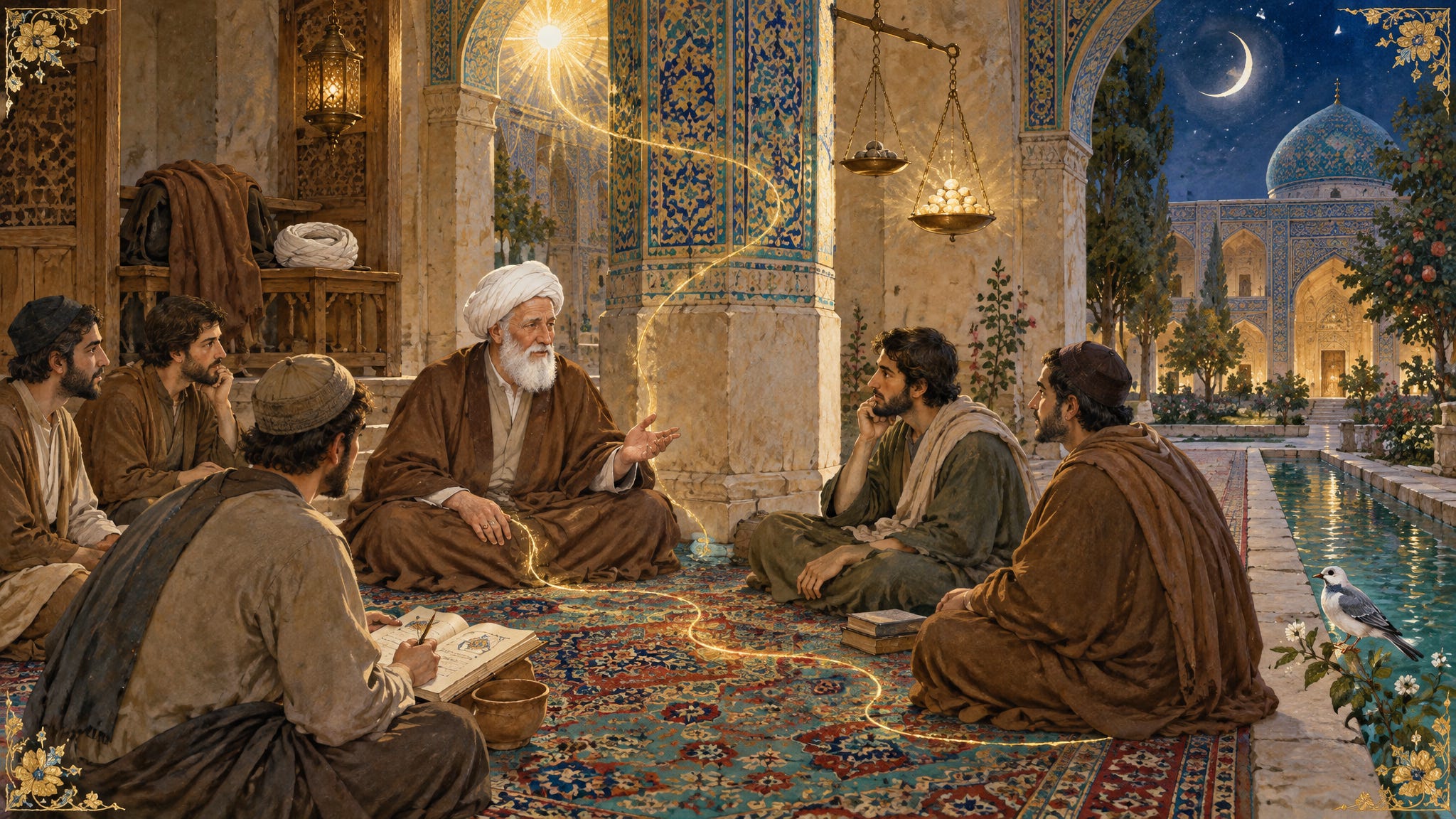
Last week, at the very end, I said one line:
“Next week, God willing — the learner: the student on the floor of the dars.”
— from this majlis, last week: The Architecture of Guidance, Part 20, What Is a Scholar?
So tonight we sit down on that floor.
A dars is a lesson: a teacher, and students gathered round him.
And for most of the history of our seminaries, the students sat on the floor — on a carpet, around a pillar, around a teacher who was very often sitting on the floor himself.
You will remember what Imam al-Sadiq, peace and blessings be upon him, said, which we heard last week:
We are the scholars. Our Shi’a are the learners.
So in one sense every one of us in this room is a student — and that was last week’s lesson.
Tonight I want to look at the one who makes it his whole life.
The one who leaves home, and sits down on that floor, and stays there for years.
And we will talk tonight about the clothes he wears — and about the clothes he should not be in a hurry to wear.
What We Carry Forward
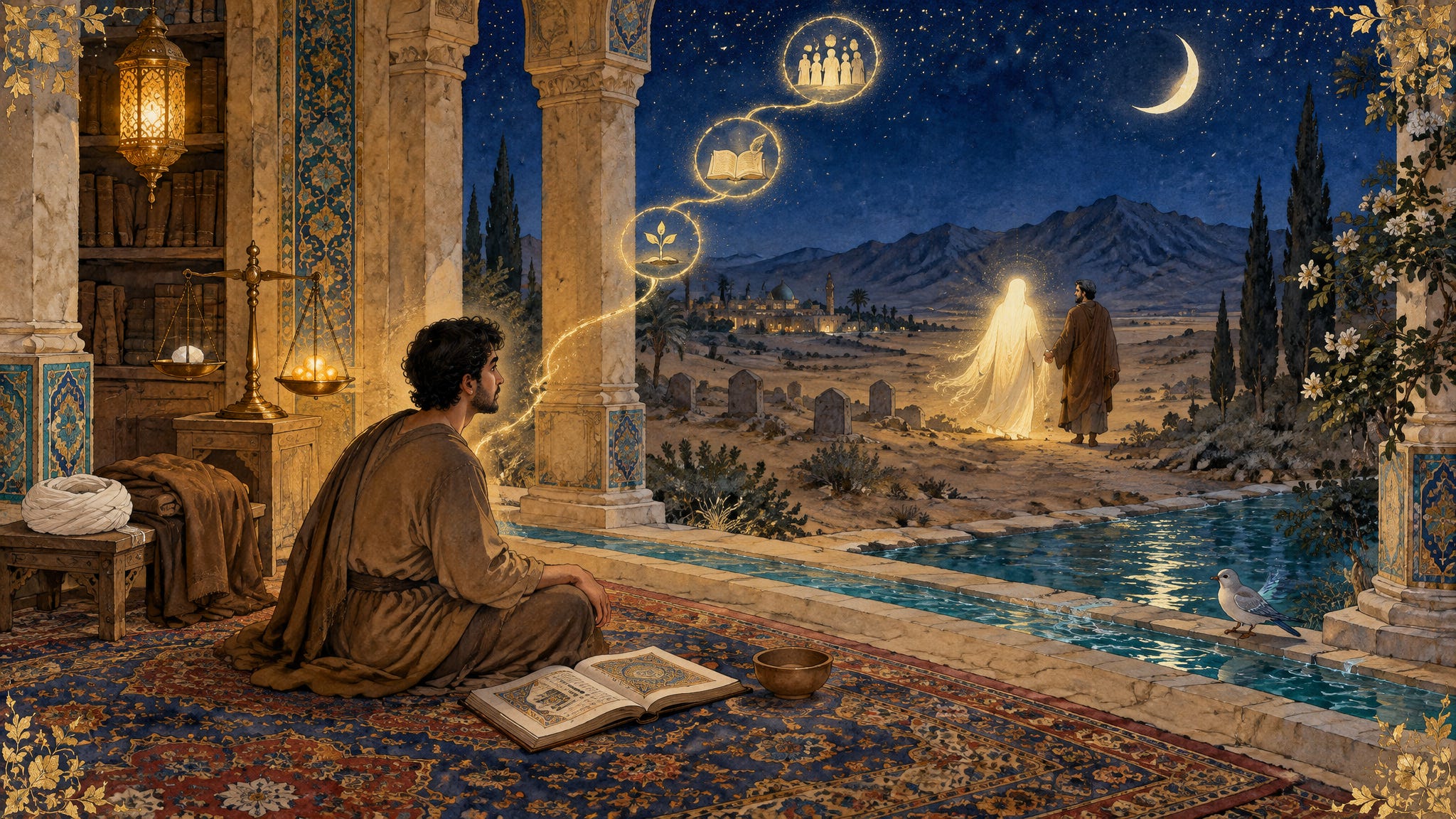
This is the twenty-first part of The Architecture of Guidance, and the second of twelve evenings we have called Those Who Carry It.
Tonight is Wednesday the 4th of November — the 23rd of Jumada al-Ula, 1448.
Last week we met Kumayl ibn Ziyad — the man Amir al-Mu’minin took by the hand and led out past the graves into the open desert.
We heard the sigh:
there is knowledge here, if only I could find those to carry it.
From that sigh these twelve weeks took their name.
They are evenings about the carriers.
We said three things about them.
Measure them by fear, not by title.
Stay a learner — because the Imam called his Shi’a the learners, and every morning you set out as one of three kinds.
And check what you carry, even from those you trust.
And we left with two sentences.
A scholar is someone knowledge has made afraid of God, and generous with what he holds.
And you — by the Imam’s own word — are his student.
For those who are with us on Saturdays as well: Fruit of the Heart goes on.
Last Saturday was the second night, A Beautiful Growth.
The third is this Saturday, the 7th of November.
There as here, we carry the words of the great scholars.
So here is tonight’s question — and it follows straight on from last week.
If a scholar is one who carries it —
How is a carrier made?
Three steps tonight.
First, how a student is formed.
Second, what those years look like from the inside — and the danger that waits at the end of them.
And third, what all of it leaves for the rest of us.
The Light, Not the Load
The Old Man at the Door
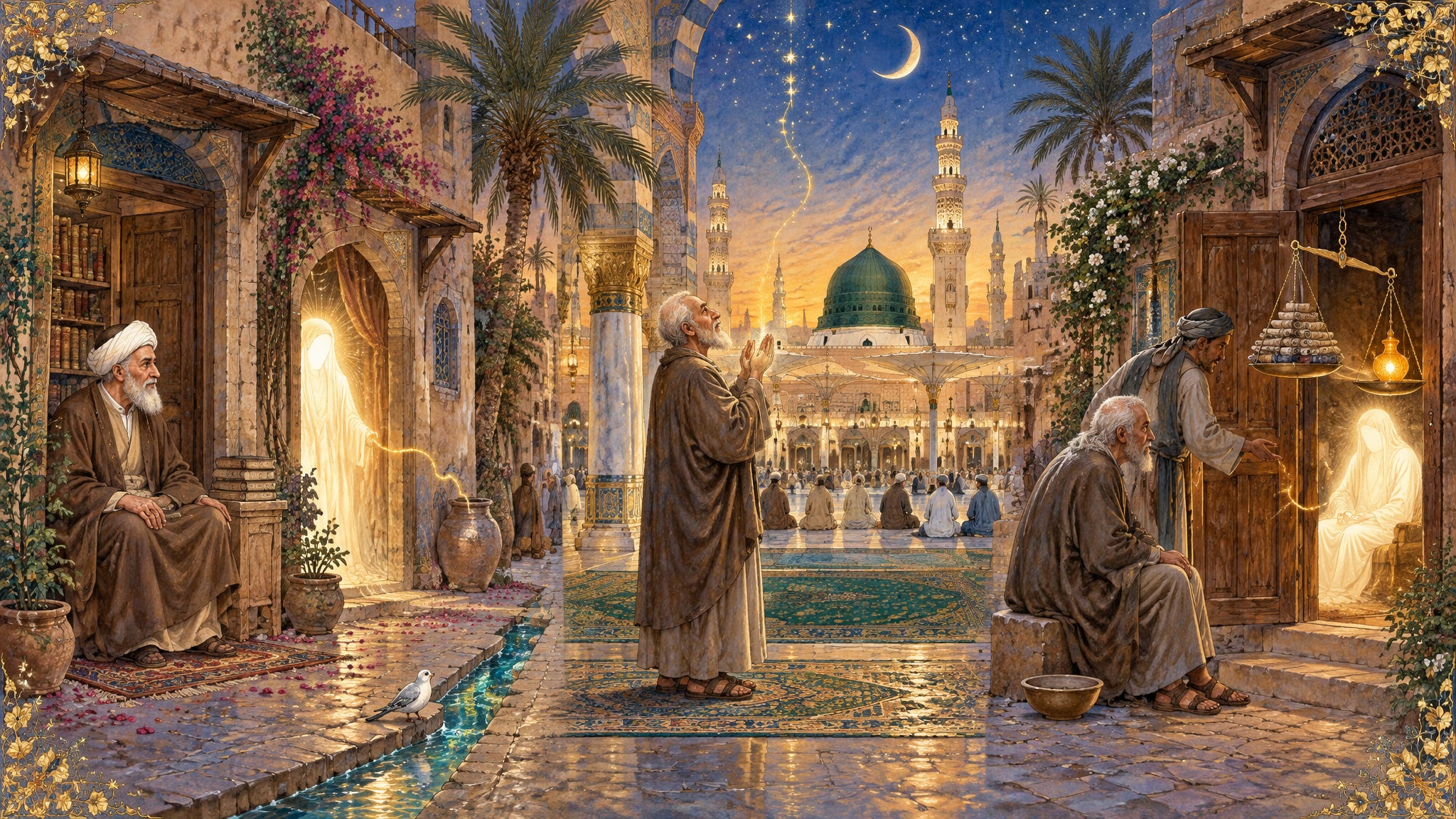
Let me introduce you to a student.
His name was ‘Unwan al-Basri — ‘Unwan, from Basra.
And when he told this story he was an old man.
The report says he had reached ninety-four years.
So before anything else, take this from him: no one is too old to be a student.
For years, he says, he had been going to Malik ibn Anas — the great jurist of Medina, the man whose name one of the four Sunni schools of law still carries.
He went to his door; he took knowledge from him.
Then Ja’far ibn Muhammad al-Sadiq came to Medina.
And ‘Unwan began going to him as well.
I wanted, he says, to take from him as I had taken from Malik.
And one day the Imam said to him:
I am a man who is sought.
And on top of that I have my devotions, at every hour of the night and the day.
Do not keep me from my devotions.
Take from Malik, and keep going to him as you used to.
He was turned away.
Put yourself in his place for a moment.
An old man, at the door of the one he has come to love — and the door is closed to him.
Gently.
But closed.
I was grieved, he says.
I went out from him, and said to myself: if he had seen any good in me, he would not have sent me away from coming to him and taking from him.
And what did he do with that grief?
He did not argue.
He did not go round Medina telling people the Imam had been unkind to him.
He went into the mosque of the Prophet, and greeted the Prophet.
And the next day he came back to the Rawda — the place between the Prophet’s grave and his pulpit — and prayed two rak’as — units of prayer — there, and said:
O God, O God — I ask You to turn the heart of Ja’far towards me, and to grant me from his knowledge something by which I may be guided to Your straight path.
He went home, grieving.
And he did not go back to Malik.
Because, he says, my heart had been made to drink the love of Ja’far.
He had been told to go back to the other door — and he could not.
Something had happened to him that he had not chosen.
So he stayed at home.
He went out only for the obligatory prayers.
Until —
My patience gave out, he says.
My chest grew tight.
And he put on his sandals, and put on his cloak, and set out for Ja’far.
It was after he had prayed ‘Asr.
He came to the door and asked permission.
A servant came out.
What do you want?
Peace be upon the noble one, he said.
He is standing at prayer.
So he sat down opposite the door, and waited.
I had not waited long, he says, when a servant came out and said:
Come in, with the blessing of God.
He went in and greeted him.
The Imam returned the greeting and said:
Sit — may God forgive you.
He sat.
And the Imam lowered his head for a long while.
Then he raised it, and said:
Whose father are you?
— asking him his kunya, the name a man is called by as a father.
Abu ‘Abdillah, he said.
And the Imam said:
May God make your kunya firm, and grant you success.
And ‘Unwan says — and I love this line —
I said to myself: if I had nothing from this visit, and from greeting him, but this prayer, it would be a great deal.
Then the Imam asked him:
What is your question?
And he told him the truth.
I asked God to turn your heart towards me, and to grant me from your knowledge.
And I hope that God has answered me, in you, the thing I asked Him.1
Now go back to the beginning — because I think the most important lesson in the story is the first one.
Why was he turned away?
Not because the Imam had no time for him.
The same Imam is about to sit with him and give him one of the most precious counsels we have from him.
I think the turning-away was the first lesson.
‘Unwan had spent years collecting knowledge from whoever had it, the way he had collected it at Malik’s door.
And the closed door asked him a question:
Do you want knowledge — or do you want the knowledge of the Imam?
And look at how he answered.
He did not try to force the door.
He went to God.
Turn his heart towards me.
He asked the Owner of the knowledge before he asked the one who held it.
That is what he did right — and you are about to hear the Imam tell him so.
Because then he told him what knowledge is.
Not by Learning
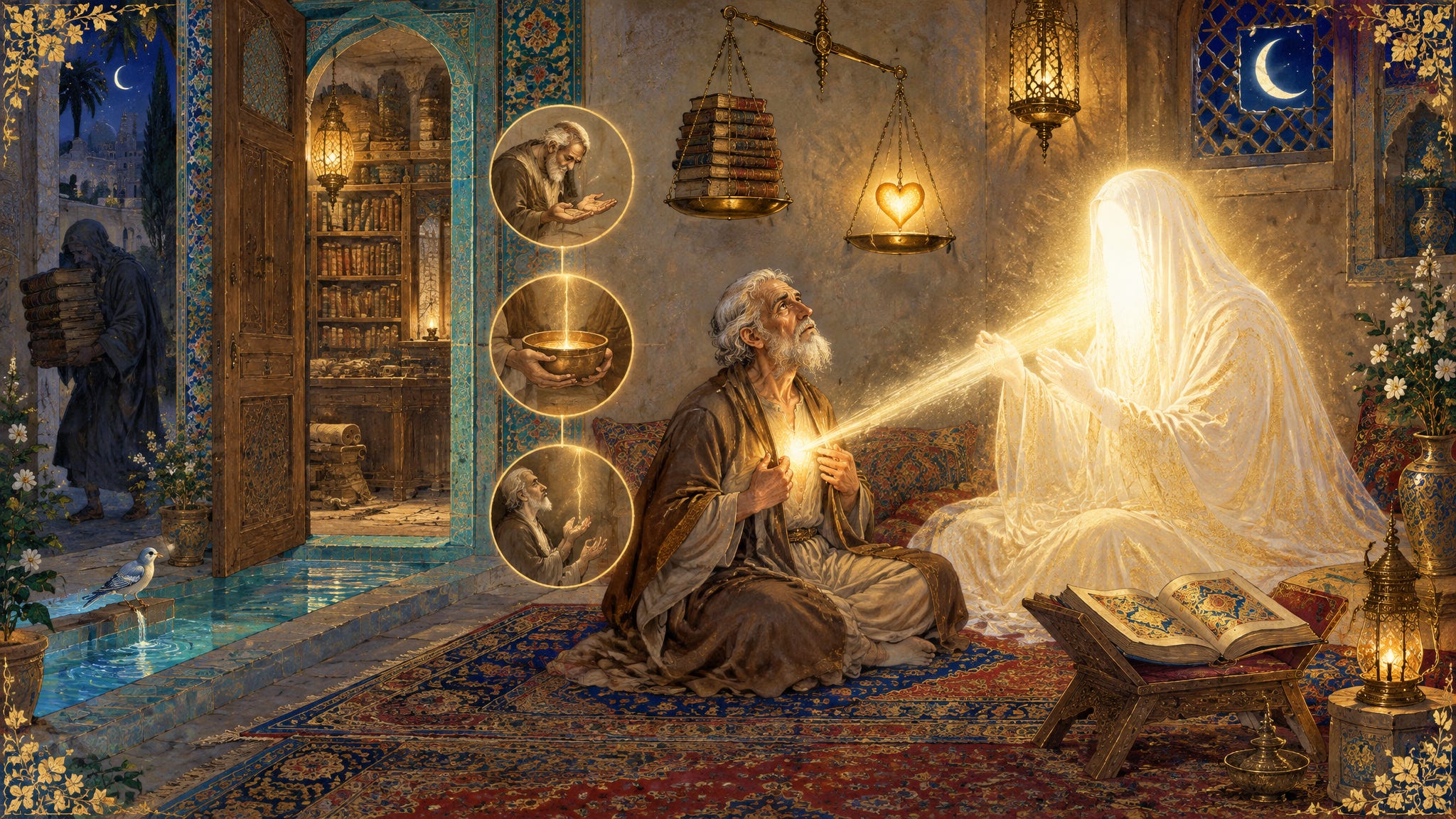
O Abu ‘Abdillah, the Imam said.
Knowledge is not by learning.
It is a light that falls into the heart of whomever God wills to guide.
So if you want knowledge, seek first, in yourself, the reality of servitude.
Seek knowledge by putting it to use.
And ask God for understanding — He will give you understanding.
Be careful with those first words, because they can be misheard.
Somebody could walk out of here tonight and say:
there you are — the Imam told a student that study does not matter.
He did not.
Al-Shahid al-Thani — the great scholar of Jabal ‘Amil, martyred in the tenth century of the hijra — wrote a whole book for students, on the manners of the one who teaches and the one who learns.
He called it Munyat al-Murid, the Seeker’s Desire.
And when he quotes these words of the Imam in it, he reads them like this:
وفي حديث عنوان البصري³ - الطويل - عن الصادق (عليه السلام): «ليس العلم بكثرة التعلم إنما هو نور يقع في قلب من يريد الله أن يهديه، فإن أردت العلم، فاطلب أوّلاً في نفسك حقيقة العبودية. واطلب العلم باستعماله، واستفهم الله يفهمك».
“In the long hadith of ‘Unwan al-Basri, from al-Sadiq, peace be upon him: Knowledge is not by much learning. It is only a light that falls into the heart of whomever God wills to guide. So if you want knowledge, seek first, in yourself, the reality of servitude; and seek knowledge by putting it to use; and ask God for understanding, and He will give you understanding.”
— al-Shahid al-Thani, Munyat al-Murid fi Adab al-Mufid wa al-Mustafid, in Mawsu’at al-Shahid al-Thani, Volume 1 the ³ is the editors’ note marker, kept as printed; my translation
Not by much learning.
Not by the amount of it.
So let no one go home thinking the Imam told a student not to study.
He told him what to study for — and where knowledge actually comes from.
Learning is the door.
The light is what comes through it.
And the light is God’s, given to whomever He wills to guide.
Which is why the three instructions come in the order they do.
Servitude first.
Then action —
seek knowledge by putting it to use,
because knowledge you do not act on does not stay.
And then asking —
ask God, and He will give you understanding.
Which is exactly what ‘Unwan had already done in the Rawda, before he had heard a word of this.
So here is the first thing I want you to take home tonight.
Knowledge is a light you are given, not a load you carry.
A man can carry a great many books and still be in the dark.
What is the reality of servitude?
‘Unwan asked.
So should we.
The Reality of Servitude

He said:
O Abu ‘Abdillah — what is the reality of servitude?
Three things, the Imam said.
That the servant does not see himself as owning what God has placed in his hands — because servants own nothing.
They see wealth as God’s wealth, and they put it where God has commanded them to put it.
That the servant does not arrange his affairs for himself.
And that his whole occupation is with what God has commanded him, and what He has forbidden him.
And then the Imam tells him what follows from each.
When the servant does not see himself as owning what God has entrusted to him, spending where God has commanded becomes easy for him.
When he hands the arranging of his affairs to the One who arranges them, the hardships of this world become easy for him.
And when he is busy with what God has commanded him and forbidden him, he has no leisure left for disputing and showing off before people.
And when God honours a servant with these three, this world becomes easy for him — and Iblis, and people.
He does not seek the world to pile it up and boast of it.
He does not seek, from what people have, honour and high standing.
And he does not let his days go to waste.
This, the Imam said, is the first degree of taqwa2.
And he recited:
تِلۡكَ ٱلدَّارُ ٱلۡأٓخِرَةُ نَجۡعَلُهَا لِلَّذِينَ لَا يُرِيدُونَ عُلُوّٗا فِي ٱلۡأَرۡضِ وَلَا فَسَادٗاۚ وَٱلۡعَٰقِبَةُ لِلۡمُتَّقِينَ
“This is the abode of the Hereafter, which We shall grant to those who do not desire to domineer in the earth nor to cause corruption, and the outcome will be in favour of the Godwary.”
— Qur’an, Surah al-Qasas (the Chapter of the Narrations) #28, Verse 83
Now let me open it a little — because Allamah Tabatabai says something about this verse that changes how it sounds tonight3.
He says it is the end of a story.
It is the lesson drawn from the story of Korah — the man the Qur’an calls Qarun — one of the people of Moses, who was given treasures beyond counting.
His own people counselled him:
Seek the abode of the Hereafter with what God has given you.
And Korah answered — and the whole of his sin is in one line:
قَالَ إِنَّمَآ أُوتِيتُهُۥ عَلَىٰ عِلۡمٍ عِندِيٓۚ أَوَلَمۡ يَعۡلَمۡ أَنَّ ٱللَّهَ قَدۡ أَهۡلَكَ مِن قَبۡلِهِۦ مِنَ ٱلۡقُرُونِ مَنۡ هُوَ أَشَدُّ مِنۡهُ قُوَّةٗ وَأَكۡثَرُ جَمۡعٗاۚ وَلَا يُسۡـَٔلُ عَن ذُنُوبِهِمُ ٱلۡمُجۡرِمُونَ
“He said, ‘I have indeed been given [all] this because of the knowledge that I have.’
Did he not know that God had already destroyed before him some of the generations who were more powerful than him and greater in amassing [wealth]?
The guilty will not be questioned about their sins.”
— Qur’an, Surah al-Qasas (the Chapter of the Narrations) #28, Verse 78
Allamah says4: he denied that it was a gift.
What he was saying was: I earned it.
I know how wealth is made, and others do not.
And if I earned it, then it is mine, to do with as I please.
And notice, Allamah says, that he does not even say who gave it.
His counsellors had said
What God has given you.
Korah says only:
I have been given it.
The Giver has dropped out of the sentence — and that, Allamah says, is a kind of turning away from God.
Then Allamah says something that should stop every one of us.
This, he says, was not Korah’s delusion alone.
It is common among the people of this world.
Each of them looks at what has come to him and sees only himself:
My own self did this, my knowledge brought it to me, my skill keeps hold of it.
Now go back to the first of the Imam’s three.
That the servant does not see himself as owning what God has placed in his hands.
That is Korah, turned inside out.
The Imam gives ‘Unwan the cure for Korah — and then seals it with the verse that ends Korah’s story.
And for a student, it cuts closer still.
Korah said it of his treasure.
A student can say it of his knowledge.
I have this because I studied.
Because I sat the hours.
Because I understood what the others did not.
The Imam has already answered him:
It is a light that falls into the heart of whomever God wills to guide.
The hours were the door.
The light was given.
And the ‘uluww the verse speaks of — this wanting to be high?
Allamah says it is setting yourself above God’s servants.
And it is itself a kind of corruption, he says — named on its own only because it deserves the attention.
How small can it be?
Amir al-Mu’minin, when he was the ruler, used to walk through the markets and recite this verse to the traders.
And in another report he says:
A man may be pleased that the strap of his sandal is finer than the strap of his companion’s — and with that, he falls under this verse.
The strap of a sandal.
For a student, it is the neater turban.
The better place in the circle.
The question asked so that the room will hear it.
And now hear where the Imam puts it.
At the first degree.
Not wanting to be high in the land is not the summit of taqwa — God consciousness.
It is the bottom step.
And keep one line from what you have just heard, because we will need it later tonight:
He has no leisure left for disputing and showing off before people.
The student who is busy with what God asks of him has no time to be seen.
Where We Began

Now I need to take you back — a long way back.
Eighty sessions ago, on the 27th of November 2024, we opened this series with the first teaching in Misbah al-Shari’a — the book these evenings are named after — the Lantern of the Path.
And it was on this same word: ‘ubudiyya, servitude.
That night I said the word means servitude in its highest, most voluntary and loving form.
The book opens with it.
In the Arabic, the first chapter is headed simply On Servitude.
And in it Imam al-Sadiq sets out the roots of conduct: four of them, each resting on seven principles.
Conduct with God.
Conduct with the self.
Conduct with people.
Conduct with the world.
And the first principle of conduct with God is giving Him His due.
In a sense, we have been inside that one principle for eighty nights.
Tonight the same Imam, answering a student at his door, uses the same word.
So listen to how ‘Unwan’s three line up with the book’s four.
The wealth is God’s — that is the world.
He does not arrange his own affairs — that is the self.
His whole occupation is what God commands and forbids — that is God.
And the fruit: this world, Iblis and people become easy for him — and there are the people.
That is my reading; I am not telling you the Imam meant it.
But I wanted you to hear it.
And there is more on that first page.
When the Imam lists the seven roots of conduct with people, the first is hilm — forbearance.
And the third is tawadu’ — humility.
Hold on to those two words.
You will hear both of them again before the night is over.
And the last of the seven roots of conduct with the world is this:
Rejecting its desires — together with rejecting leadership.
Al-riyasa.
Hold on to that one too.
The chapter ends:
When these qualities come together in a single soul, he is among God’s elect, His servants brought near, and His friends in truth.
The very next chapter of the same book opens with a sentence I will not try to unpack tonight:
Servitude is a substance whose essence is lordship.
But a little further on, the same chapter takes the three letters of the word ‘abd — servant.
The ‘ayn is the servant’s knowledge of God.
The ba’ is his separation from everything besides Him.
The dal is his nearness to God — without how, and without veil.5
The first letter of the servant is knowledge.
On a night called The Student, I could not leave that out.
Why Would Anyone Choose This?
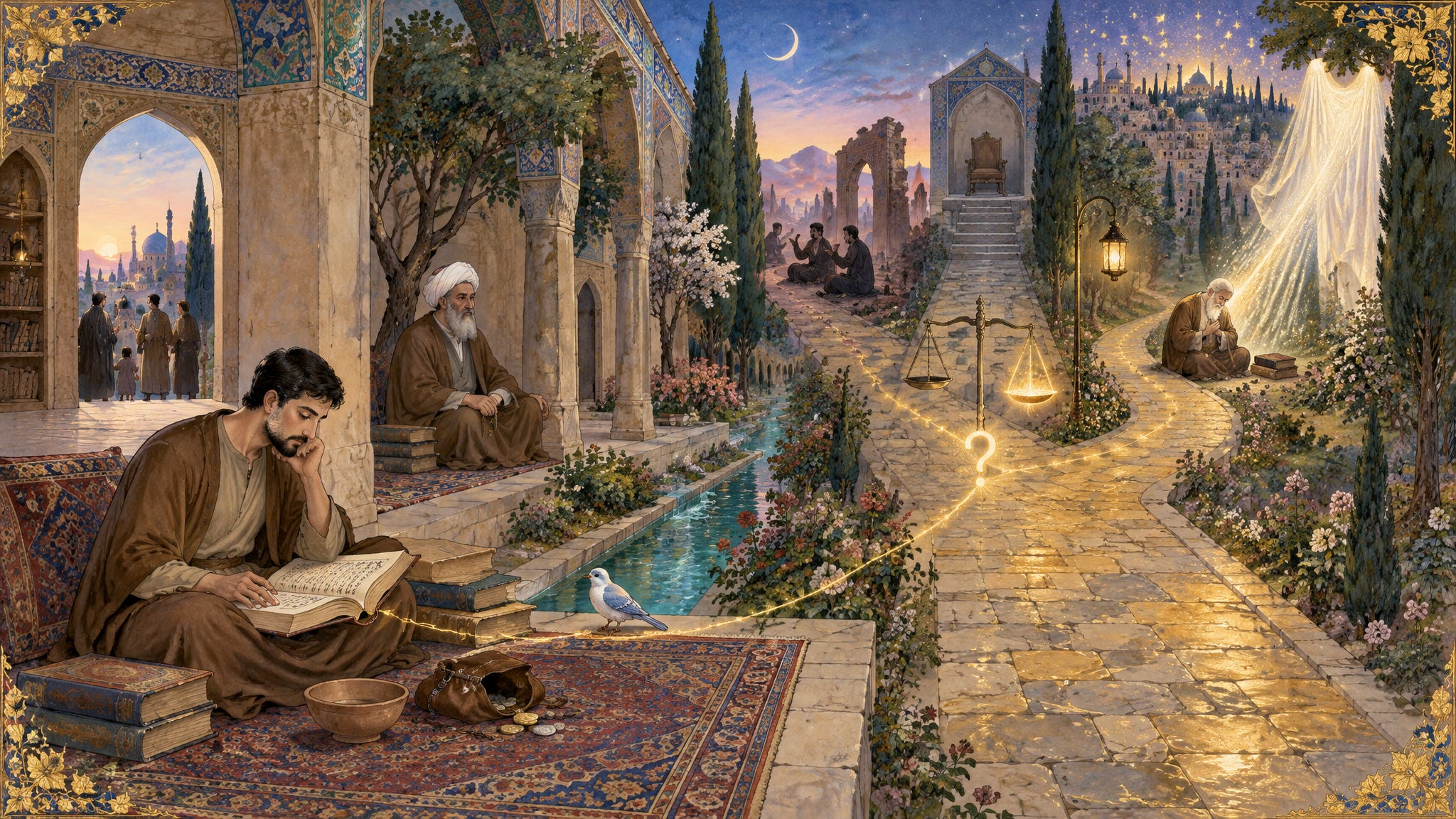
So why would anyone choose this?
Years on the floor.
Very little money.
Books you cannot yet read, in a language that is not your own, and a teacher who will not tell you whether you are any good.
And at the end of it — if you are true to what you have just heard — no wish to be seen.
Three weeks ago we said that the seminary is a calling, not a career.
And we heard the Imam describe three kinds of seekers of knowledge:
the one who seeks it to argue,
the one who seeks it to dominate,
and the one who seeks it to understand.
I will not go over that again.
Tonight I want to go one step deeper.
That fork in the road is not crossed once.
It is not a decision you make on your first day and then put behind you.
It is the first day’s question, and every day’s question after it:
For whom am I doing this?
‘Unwan had been studying for years before he came to that door.
He was not a beginner.
And still the first thing the Imam gave him was not a new book.
It was servitude.
Seek first, in yourself, the reality of servitude.
First — even for a man of ninety-four.
And I want to say something plainly, because I know there are young people in this room who are thinking about the hawza, and parents who are thinking about it for their children.
I don’t want to dissuade anyone from going to the hawza — far from it.
If you hear tonight how hard it is and decide not to go, you have heard me wrong.
The hardness is exactly why it is worth it.
Because the hardship is not a wall.
It is how God forms the ones He brings near.
The Testing Ground
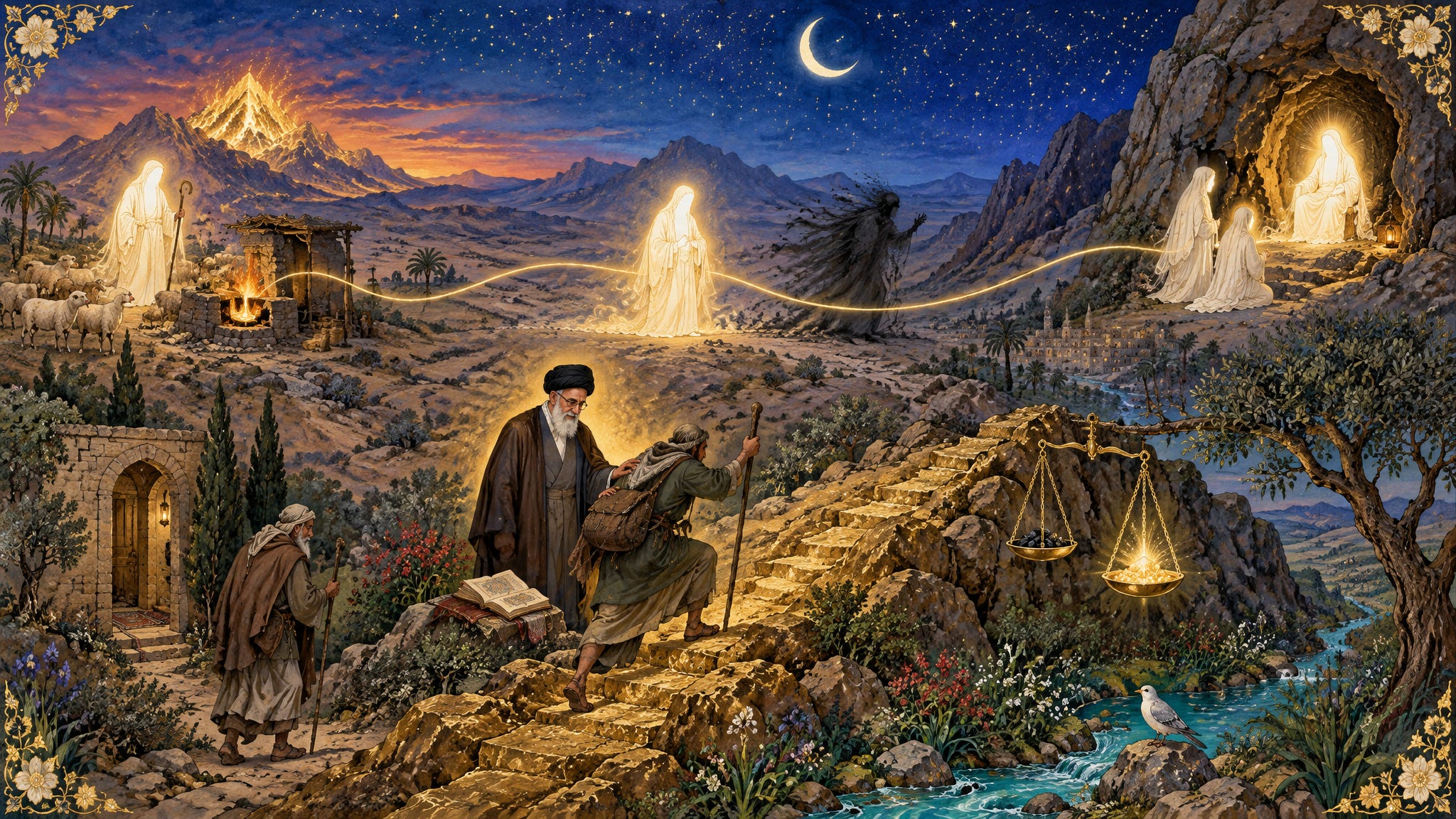
Listen to how God speaks to Moses, peace be upon him, in Surah Ta-Ha.
He is reminding him of his whole life — the river, the palace, his mother’s grief, the man he killed, the flight:
إِذۡ تَمۡشِيٓ أُخۡتُكَ فَتَقُولُ هَلۡ أَدُلُّكُمۡ عَلَىٰ مَن يَكۡفُلُهُۥۖ فَرَجَعۡنَٰكَ إِلَىٰٓ أُمِّكَ كَيۡ تَقَرَّ عَيۡنُهَا وَلَا تَحۡزَنَۚ وَقَتَلۡتَ نَفۡسٗا فَنَجَّيۡنَٰكَ مِنَ ٱلۡغَمِّ وَفَتَنَّـٰكَ فُتُونٗاۚ فَلَبِثۡتَ سِنِينَ فِيٓ أَهۡلِ مَدۡيَنَ ثُمَّ جِئۡتَ عَلَىٰ قَدَرٖ يَٰمُوسَىٰ وَٱصۡطَنَعۡتُكَ لِنَفۡسِي
When your sister walked up [to Pharaoh’s palace] saying, “Shall I show you someone who will take care of him?” Then We restored you to your mother, that she might not grieve and be comforted. Then you slew a soul, whereupon We delivered you from anguish, and We tried you with various ordeals. Then you stayed for several years among the people of Midian. Then you turned up as ordained, O Moses! And I chose you for Myself.’
— Qur’an, Surah Ta-Ha (the Chapter of Ta-Ha) #20, Verses 40 and 41
We tried you with various ordeals.
In the Arabic it is stronger than that:
Fatannaka futuna — We tested you with a testing, the way gold is tested in the fire.
Then you stayed for several years among the people of Midian.
Years.
Not days.
Years away from everything he had known — a fugitive, working for another man.
Then you came, as ordained, O Moses.
And then the line I want you to carry home:
Wastana’tuka li-nafsi.
Qarai renders it, I chose you for Myself.
The word itself comes from the root of making — of a craftsman’s work.
I made you. I fashioned you — for Myself.
That is what the years in Midian were for.
The Torah tells the same years from the other side:
וּמֹשֶׁה הָיָה רֹעֶה אֶת־צֹאַן יִתְּרוּ חֹתְנוּ כֹּהֵן […] הָאֱלֹהִים חֹרֵבָה:
Now Moses kept the flock of Jethro his father in law, the priest of Midian: and he led the flock to the backside of the desert, and came to the mountain of God, {even} to Horeb.
— the Hebrew, partial6, from a printed Hebrew Bible in Fihrist (record 102), with the note below; the English, the King James Version (Fihrist — record 53); the braces mark the translators' added word
He kept another man’s flock.
He led it to the far side of the wilderness.
And there — at the far side, not in the palace — he came to the mountain of God.
Jesus, may our souls be his ransom and may God hasten his return.
The Gospels tell that before he began, he too was led out:
4:1 Τότε ὁ Ἰησοῦς ἀνήχθη εἰς τὴν ἔρημον ὑπὸ τοῦ πνεύματος, πειρασθῆναι ὑπὸ τοῦ διαβόλου. 2 καὶ νηστεύσας ἡμέρας τεσσεράκοντα καὶ νύκτας τεσσεράκοντα ὕστερον ἐπείνασεν.
Then was Jesus led up of the Spirit into the wilderness to be tempted of the devil. And when he had fasted forty days and forty nights, he was afterward an hungred.
— Matthew 4:1–2: the Greek, the SBL Greek New Testament (SBLGNT; Fihrist — Matthew, record 5); the English, the King James Version (Fihrist record 933)
Forty days and forty nights in the wilderness.
I tell it as the Gospels tell it, and I will leave it there.
And the Prophet.
Before the revelation came, he would go out of Mecca to a cave in a mountain — Hira — and stay there.
Some of you have heard this line once before.
Amir al-Mu’minin, who was a boy in his house in those years, says:
وَلَقَدْ كَانَ يُجَاوِرُ فِي كُلِّ سَنَة بِحِرَاءَ، فَأَرَاهُ وَلاَ يَرَاهُ غَيْرِي، وَلَمْ يَجْمَعْ بَيْتٌ وَاحِدٌ يَوْمَئِذ فِي الاْسْلاَمِ غَيْرَ رَسُولِ اللهِ(صلى الله عليه وآله) وَخَدِيجَةَ وَأَنَا ثَالِثُهُمَا، أَرَى نُورَ الْوَحْيِ وَالرِّسَالَةِ، وَأَشُمُّ رِيحَ النُّبُوَّةِ.
“And every year he would stay in seclusion at Hira — and I would see him, and no one else would see him. In those days no single household had come together in Islam except the Messenger of God, God bless him and his family, and Khadija, and I was the third of them. I would see the light of revelation and of the message, and breathe the fragrance of prophethood.”
— al-Sharif al-Radi, Nahj al-Balagha, Sermon 192 (Fihrist, record 965); my translation
Moses had Midian.
Jesus had the wilderness.
The Prophet had Hira.
No one God brought near was spared the wilderness first.
The hard years are the testing ground — not the wall.
And what carries a person across a testing ground has a name.
You heard it at the very start of tonight, in the fifth of Amir al-Mu’minin’s five:
Patience — which is to faith what the head is to the body.
Let me tell you something about this gathering.
In October 2024 — before we had opened Misbah al-Shari’a, before the first of these evenings on The Lantern of the Path — the first thing this group studied together was patience: a series of sessions built on the lectures of our Leader, Imam Sayyed Ali Khamenei, may God rest his pure soul, which we know in English as Discourses on Patience.
And on the first of those nights we said that patience is not putting up with things.
It is this:
The resistance shown by a person, on the road towards perfection. Resistance against mischief, corruption, despondency and degradation.
— from this majlis: Patience, Part 1, 1 October 2024
The climber in that first session, who will not turn back.
At the time, we did not consciously know why we began there.
It simply seemed the right place to start.
Looking back, I find that beautiful.
Patience has become the cornerstone of everything this group has tried to do — because every work worth doing needs it.
And the work of a real student needs a great deal of it.
Moses needed it in Midian.
And remember ‘Unwan, at home, until his patience gave out — and look at what he did when it did.
He did not give up and go back to Malik.
He put on his sandals, went to the door, and sat down to wait again.
That is patience as we learned it two years ago.
Not sitting still.
Refusing to turn back.
And some of you may be asking why I keep reaching for the Torah and the Gospel.
Why We Read the Earlier Books

We have said before what our rule is: honour without conflation.
We honour the earlier books.
We do not confuse them with the Qur’an.
But tonight I want to give you the Qur’an’s own reasons — because it is the Qur’an that sends us to them.
In its very first pages it describes the God-wary like this:
وَٱلَّذِينَ يُؤۡمِنُونَ بِمَآ أُنزِلَ إِلَيۡكَ وَمَآ أُنزِلَ مِن قَبۡلِكَ وَبِٱلۡأٓخِرَةِ هُمۡ يُوقِنُونَ
“and who believe in what has been sent down to you and what was sent down before you, and are certain of the Hereafter.”
— Qur’an, Surah al-Baqarah (the Chapter of the Cow) #2, Verse 4
What was sent down before you.
Belief in the earlier revelations is part of the description of a believer.
In Surah Al ‘Imran, God says that He sent down the Torah and the Gospel before the Qur’an, as guidance for people.
In Surah al-Ma’ida, He calls the Qur’an confirming what was before it of the Book — and a guardian over it.
And the same surah gives the honest half.
It says of some who had received the earlier Book that they twisted words from their places7.
So we hold both halves.
Honour them.
Read them.
And let the Qur’an be the guardian that tells you where they hold and where they were bent8.
And here is what that looks like in practice.
The Qur’an tells you that Moses stayed years among the people of Midian.
Exodus gives you the flock, the far side of the wilderness, and the mountain.
That is what context means.
It adds nothing to the Qur’an.
It helps you see what the Qur’an is pointing at9.
So the student is formed in the wilderness.
What does the wilderness look like from the inside?
Lessons for Our Time
Lesson One — Knowledge Is a Light You Are Given, Not a Load You Carry

The Imam gave ‘Unwan three instructions, and none of them was about how many books to read.
Begin with servitude — with the honest admission that what you hold is not yours, that you do not run your own life, and that your business is what God asks of you.
Seek knowledge by putting it to use.
A ruling you know and do not practise, a verse you can recite and do not live by — that is weight, not light.
And keep asking God for understanding.
‘Unwan asked for it in the Rawda before he had heard a word of the answer.
This is not only for the student in Qom or Najaf.
If you have learned one thing this year and acted on it, you have more light than a man who has memorised a library and changed nothing.
Lesson Two — The Hard Years Are the Testing Ground, Not the Wall

I fashioned you for Myself.
Some of you are in a dry year right now — in your studies, in your work, in your prayer.
It may be your Midian.
Nobody chooses Midian.
Moses did not go there to build a career; he went there running.
And God says:
that is where I was making you.
So do not read the hardness as a closed door.
Read it the way ‘Unwan read the closed door — as a question about what you really want.
And take the answer to God.
The Dry Years and the First Turban
The Room With Many Doors
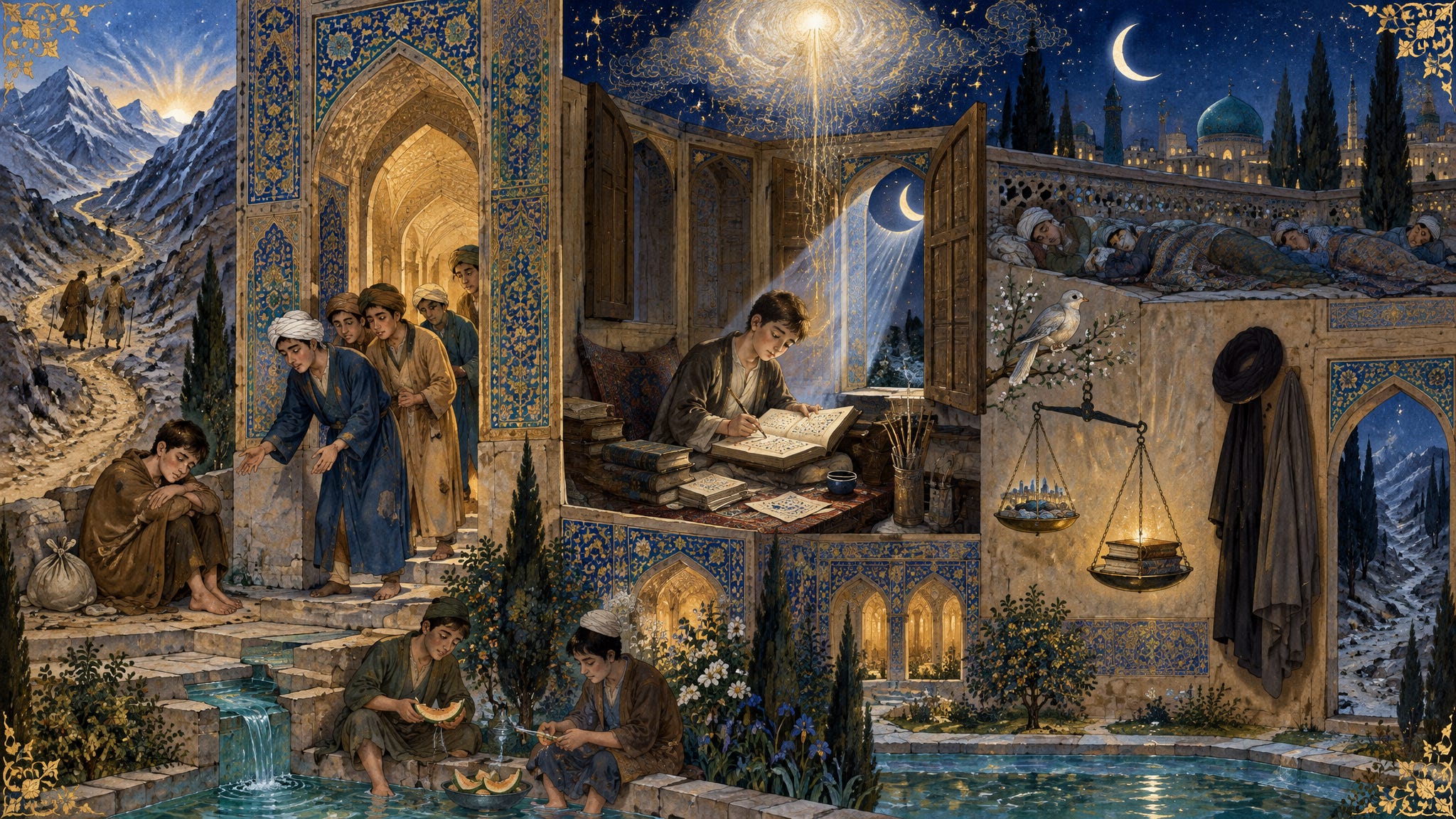
Let me give you a boy.
His name was Ni’matullah — al-Sayyid Ni’matullah al-Jaza’iri — and he became one of the great scholars of his age.
He tells his own story, and it was copied into a book of the lives of the scholars, Qisas al-’Ulama’.
He and his brother left home to study.
They hired a boat without their father knowing, and set out for Shiraz.
There were mountains on the way, and they crossed them on bare feet.
I was eleven years old, he says.
They reached Shiraz at the time of the dawn prayer.
They had been told the name of the madrasa they wanted — the Mansuriyya — but neither of them spoke Persian.
So they split the sentence between them.
He memorised we want, and his brother memorised the Mansuriyya madrasa.
And every time they met someone in the street, one of them said we want, and the other said the Mansuriyya madrasa — until they found it.
He sat down outside the door, too tired to go in, while his brother went inside.
And every student who came out, he says, and saw the exhaustion on him, felt for him.
That was the first morning.
Then came the years.
The madrasa gave them a stipend so small, he says, that it never once sufficed.
His brother and a friend wanted to go home —
Living here is too tight for us.
And he said:
I will copy books for wages — for myself, and for my paper, and for whatever else I need.
In summer, when the other students climbed up to the roof of the madrasa to sit in the cool and sleep, he stayed in his room — reading, writing notes in the margins, correcting his lessons — until the muezzin began the prayers before dawn.
Then he put the book over his face and slept a little.
At dawn he taught.
At noon he went to his own lesson.
Sometimes he bought a piece of bread on the way and ate it walking.
Often, he says, he found no bread until night — and at night he could not remember whether he had eaten that day.
And when he thought about it, he realised he had not.
And he had no lamp.
So he took a room high up, a room with many doors.
When there was moonlight he would open his book and read by it.
And when the moon moved, and the light left that door, he would open the next one.
Two years, he says, like that.
His eyes grew weak — and they were still weak when he wrote this, an old man.
And in winter there was a lesson whose notes he wrote out after the dawn prayer, and the blood would run from his hands with the cold, and he did not feel it.
Two years, or three10.
He did not become one of the great scholars of his age in spite of that room.
That room is where he became one.
I fashioned you for Myself.
Earlier still, in his first years of study, he and a companion ate their meals at the house of a notable; but they would stay at the madrasa till noon in discussion, and arrive to find the meal over, and go without until night.
One day he went looking for his companion and found him sitting at the door eating melon rinds he had picked up off the ground, dust and all.
He laughed.
Why are you laughing? — Because I do the same, and we have been hiding it from each other.
Then from now on, said the friend, we will gather the rinds together, and wash them, and eat them.
And they lived like that for some time11.
But the wilderness has another shape.
The one where they will not let you wear the clothes at all.
The Clothes He Could Not Wear
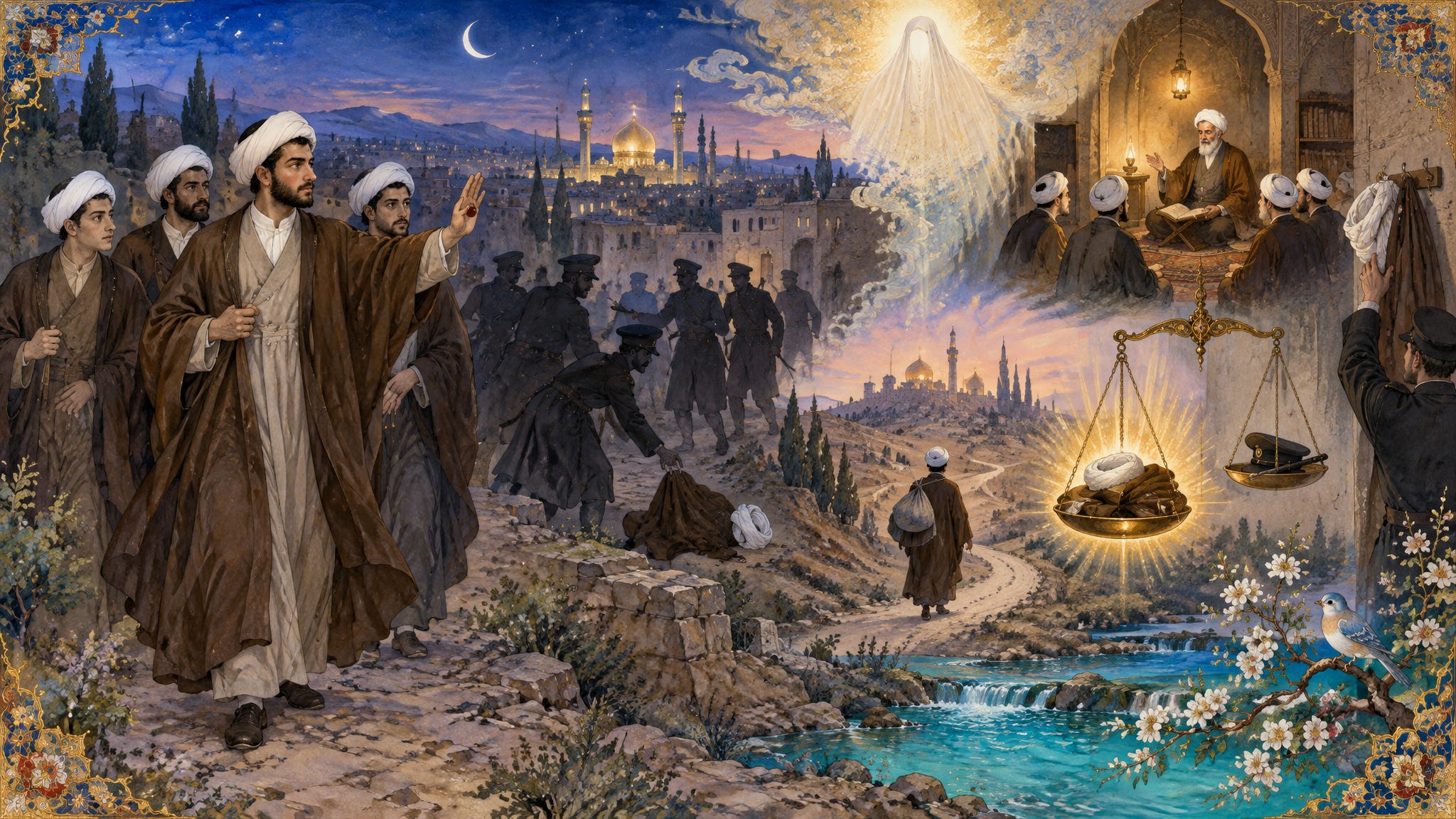
Let me take you to Qom, in the 1930s.
There was a young man from near Arak called Mirza Habibullah Araki.
His son, Ayatullah Shaykh Muhsin Araki, has written a book about him called In My Father’s School, and almost everything I will tell you about him tonight comes from it.
He left home at fifteen to study in Arak — just as the great Shaykh ‘Abd al-Karim Ha’iri was finishing his years of teaching there.
And when Shaykh ‘Abd al-Karim moved to Qom and built the hawza there, this young man went with him, with a group of students, and sat in his lessons.
He completed the highest stage of study, the kharij, in Qom12.
And those were the years of the first Pahlavi — Reza Khan.
Reza Khan had passed a law on the uniformity of dress: everyone in the same clothes.
And wherever his men saw a student, his son writes, they forced him — with violence, and with threats — to take off the clothes of the clergy, and they harassed him.
His father used to say:
We had to leave our rooms before dawn and go out to the edges of Qom, and come back to our rooms only at night, after dark — so that Reza Khan’s men would not arrest us and strip us of our clothes.
And:
We longed to be able to walk the streets of Qom freely, in a student’s clothes.
Then something happened.
One of Reza Khan’s men — as the family tells it — spoke insolently of Lady Fatima, al-Siddiqa al-Tahira.
And this young student struck him across the face.
Hard.
He had to run.
Reza Khan’s men came looking for him.
And in 1935 he left Iran for Najaf13.
A man who could not wear the clothes of a student in daylight, in the city of the hawza.
And some, today, cannot wait to put them on.
What the Clothes Are
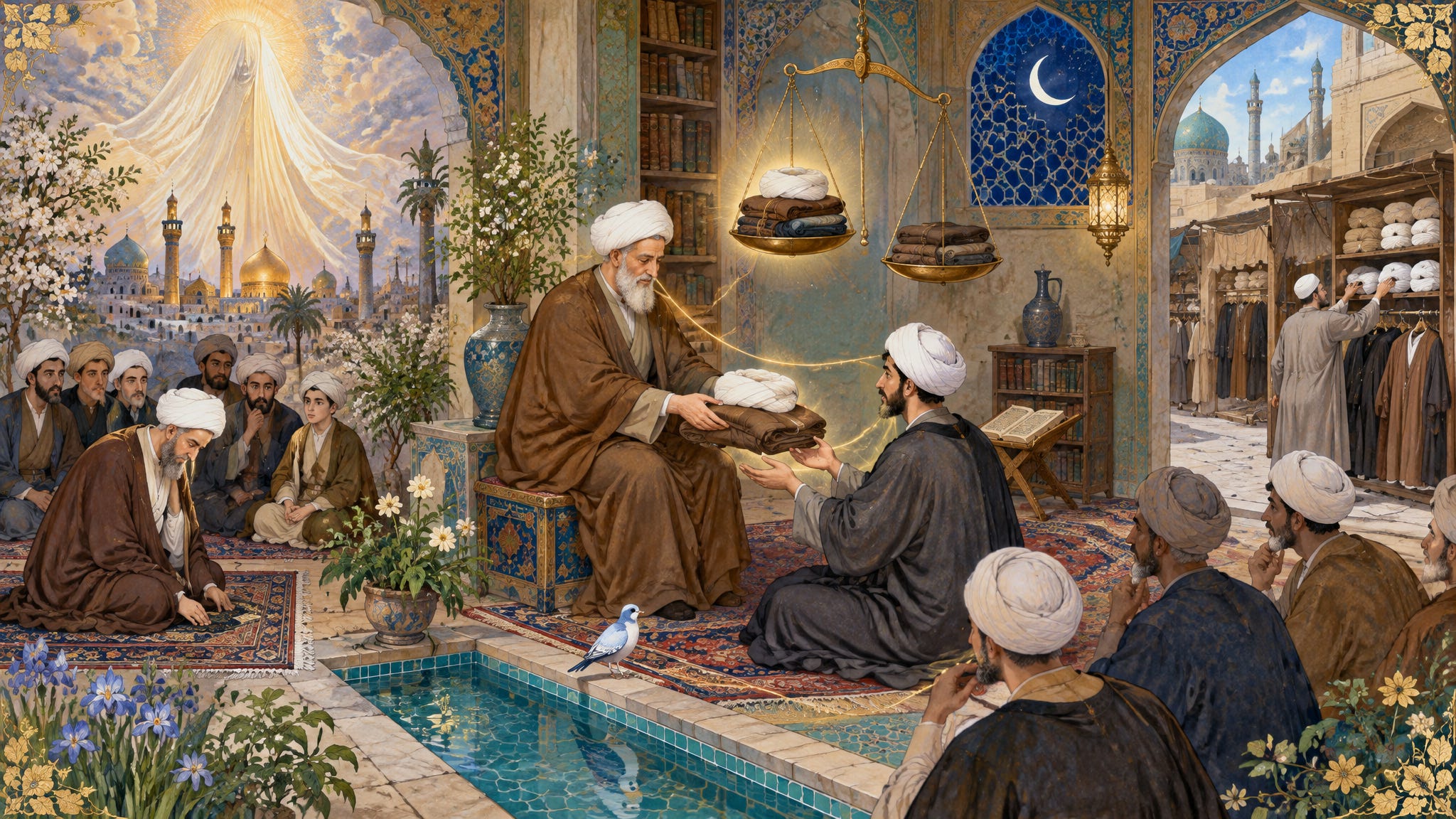
So let me talk about the clothes — the ‘aba and the turban — because there is a great deal of confusion about them, and I would rather we were clear.
They are an honourable dress.
In the hawza, traditionally, they are given — by a student’s teachers, when they judge that he has reached the point where he can carry what the clothes say.
The clothes do not make the scholar.
They are meant to be a sign that the people who taught him think he is one, or on his way to being one.
And they are not locked away.
The shops are open.
Anyone can walk into a shop in Qom or Najaf or Karbala and buy a turban.
And yes — it is recommended to pray in the ‘aba and the turban.
The Prophet wore them.
But understand why: because that was the dress of his time.
It was not the uniform of a class.
And the scholar who wears it today wears it as an heir of the Prophet — which means that every word he says while he is wearing it carries weight.
People hear it as the religion speaking.
How It Goes Wrong
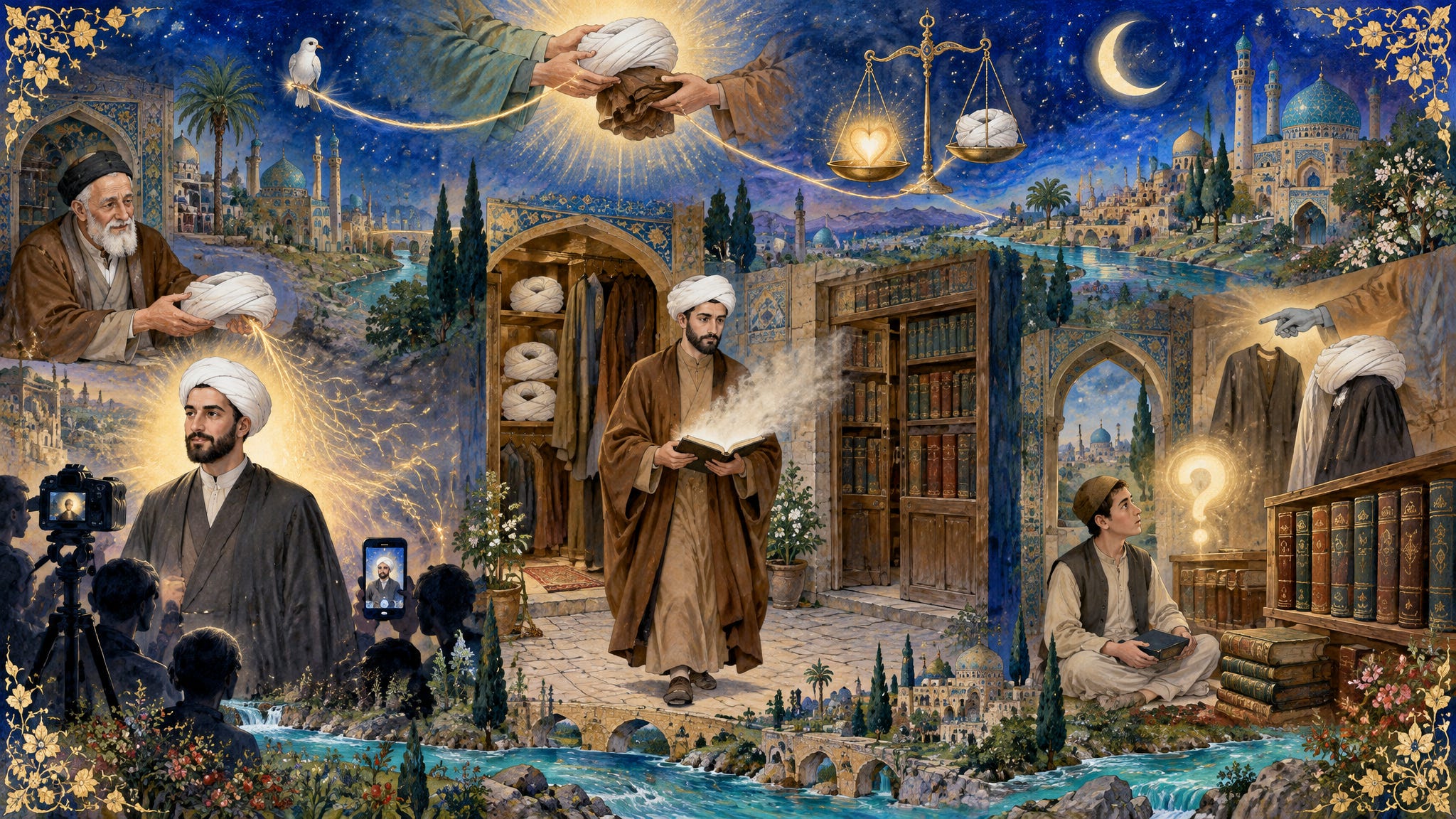
Now let me show you how it goes wrong.
I am going to give you three portraits.
No names, and no places that would point to anyone — I am not interested in any one person.
I am interested in the pattern.
The first is a man who never studied.
Never sat a single year on that floor.
He travelled to Karbala, and because he gave lectures in English, a scholar there, as a kindness, gave him a turban.
And I want to be fair to that scholar: he did nothing wrong.
In Iraq the turban is the ordinary dress of a devout believer; plenty of people wear one who are not clergy at all.
He smiled, and he gave a gift.
But carry that same cloth home, abroad, and it becomes authority.
A photograph goes up online.
An announcement.
And overnight he is Shaykh so-and-so.
The second is a young man who arrives in Qom — and the first shop he goes into is not the bookshop.
It is the turban-seller’s.
Within two days he is fully dressed, before he can put a sentence together in Arabic or in Persian.
The third is a student who has finished the muqaddamat — the introductory years, the grammar and the logic — and is told:
Now you must wear them all the time.
On what basis?
Going through the muqaddamat is not the same as knowing them.
The Real Ones
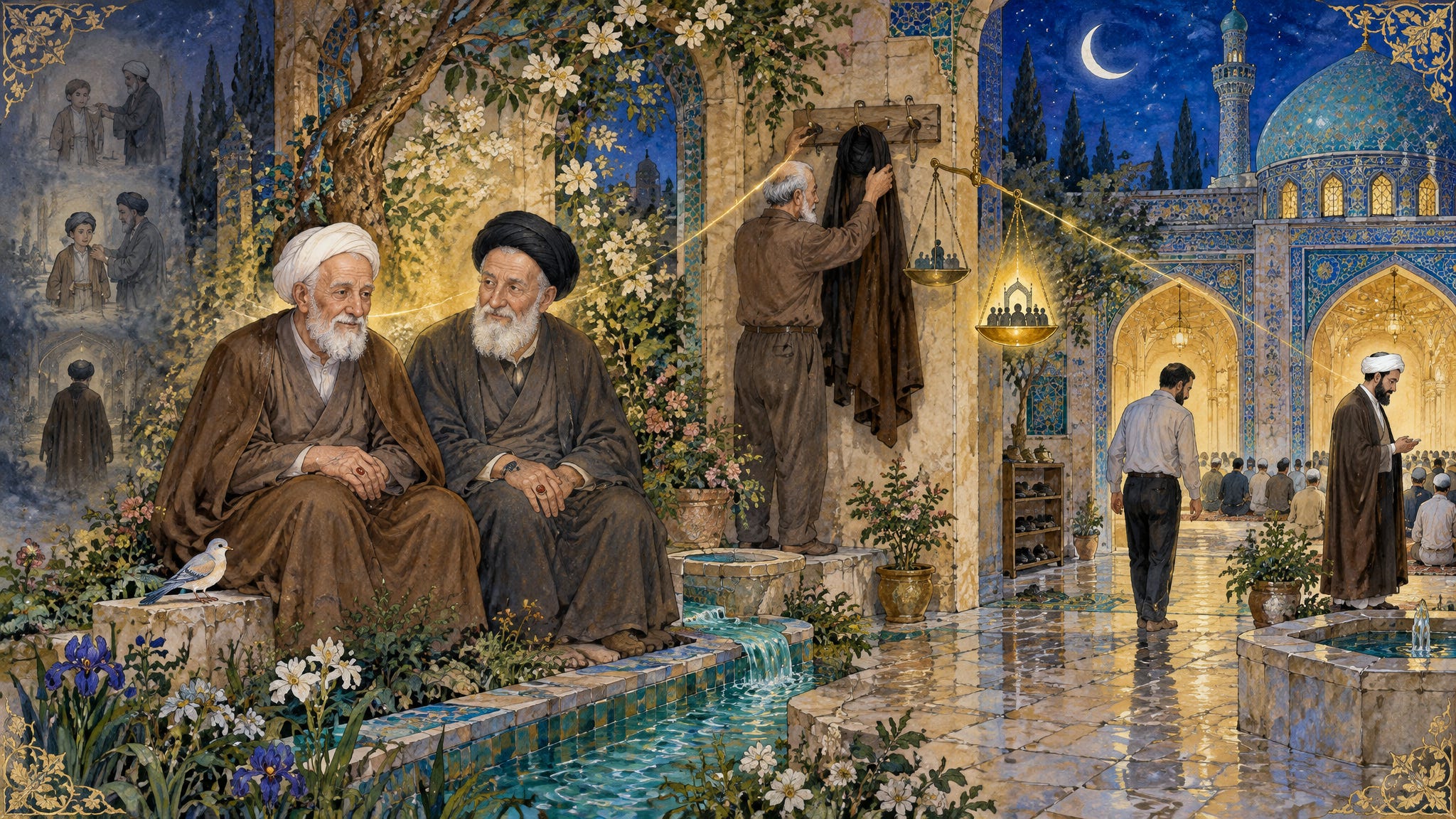
Now set beside those three the real ones.
Think of Ayatullah Bahjat.
Think of Allamah Tabatabai.
If you have seen them, even in photographs, you know: plainly dressed — sometimes almost shabbily.
And glowing with what they knew.
I had a teacher — a senior scholar, the son of a marja’ — and I am not going to name him.
He wore the clothes only when he was there in his official capacity.
He would put them on as he arrived, and take them off as he left.
And it is what I have always done myself.
I wear them when I am somewhere as a shaykh — when I have come to lecture, and if they ask me to lead the prayer while I am there.
But if I have just stopped at a mosque because I was nearby at prayer time, no — I don’t carry them around with me.
They carry a weight.
The Weight
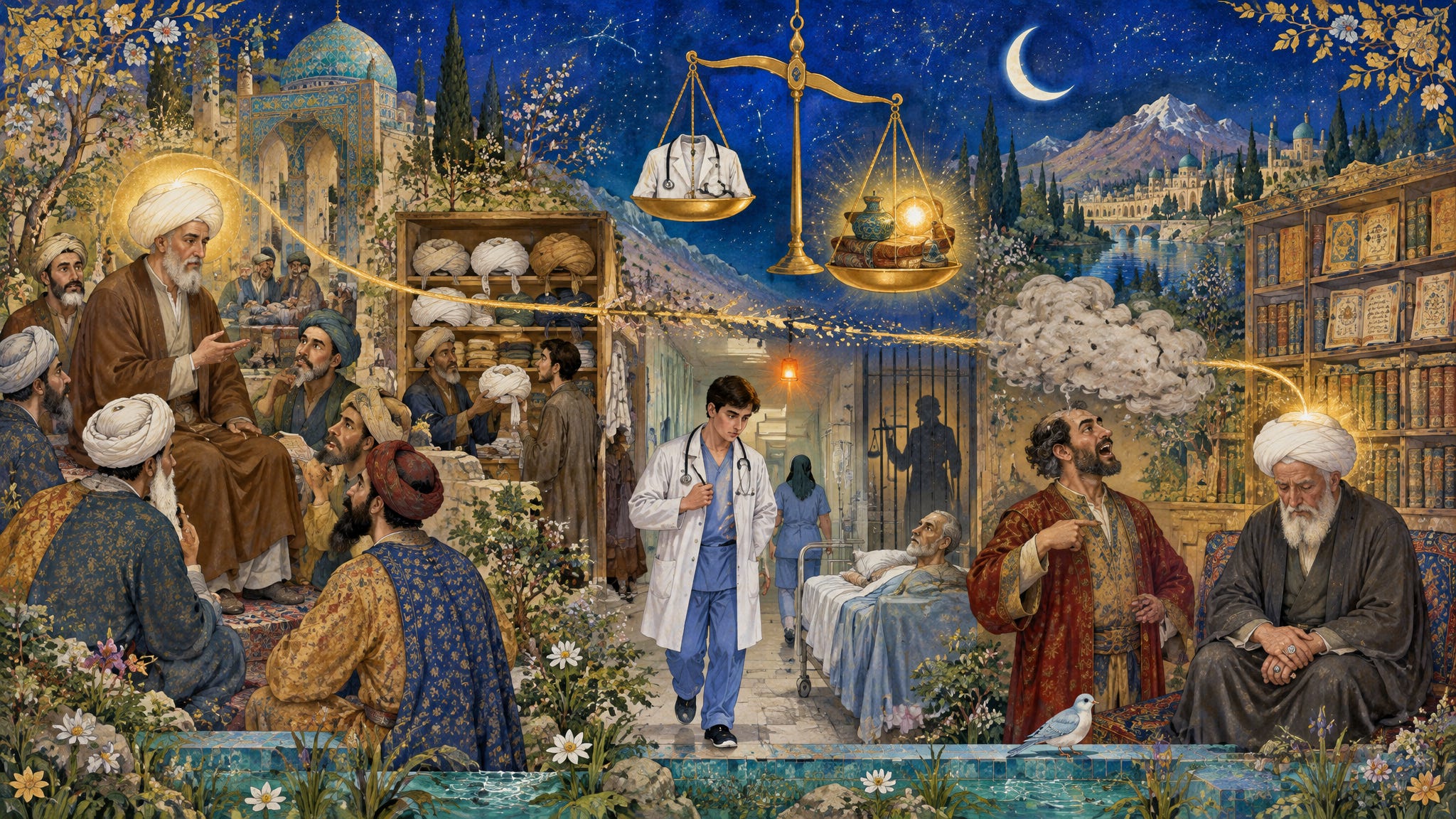
The turban on a man’s head is a weight.
People listen to him differently.
They trust what he says because of what he is wearing.
Think of a junior medical student — first year — who puts on a white coat, hangs a stethoscope round his neck, and walks the wards acting the surgeon.
He puts lives in danger.
And in this and indeed many countries he would go to prison for it.
In the hawza, anyone can buy the coat.
So here is a clue I want you to keep.
The moment someone calls himself an ‘alim — a scholar — that is the clue that he is not one.
Because the more you learn, the more you discover how little you know.
The ones who really know are the last to say it.
Bodies That Impress You
There is a verse about this.
You have heard it in this room twice before14 — so I will quote it once, and add only one thing to it.
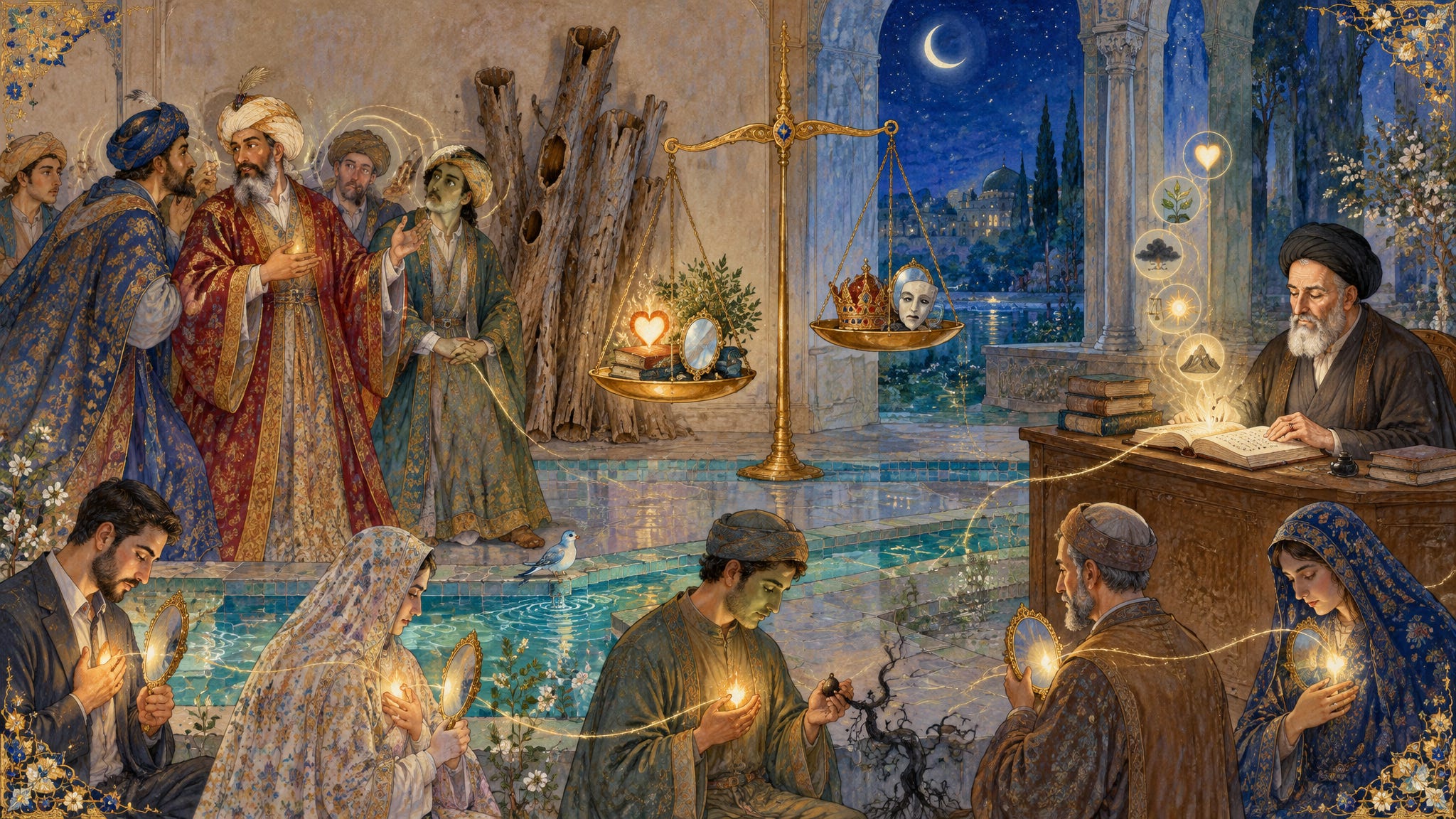
۞وَإِذَا رَأَيۡتَهُمۡ تُعۡجِبُكَ أَجۡسَامُهُمۡۖ وَإِن يَقُولُواْ تَسۡمَعۡ لِقَوۡلِهِمۡۖ كَأَنَّهُمۡ خُشُبٞ مُّسَنَّدَةٞۖ يَحۡسَبُونَ كُلَّ صَيۡحَةٍ عَلَيۡهِمۡۚ هُمُ ٱلۡعَدُوُّ فَٱحۡذَرۡهُمۡۚ قَٰتَلَهُمُ ٱللَّهُۖ أَنَّىٰ يُؤۡفَكُونَ
“When you see them, their bodies impress you, and if they speak, you listen to their speech. Yet they are like dry logs set reclining [against a wall]. They suppose every cry is directed against them. They are the enemy, so beware of them. May Allah assail them, where do they stray?!”
— Qur’an, Surah al-Munafiqun (the Chapter of the Hypocrites) #63, Verse 4
Allamah Tabatabai15 says that the you in when you see them is not only the Prophet.
It is anyone who sees them — because, he says, they were in fine attire, and eloquent.
Their appearance impressed whoever saw them; their speech drew in whoever heard it.
And dry logs propped against a wall, he says, means forms without souls, with no good in them — because they do not understand.
But here is the one thing I want to add tonight, and it is Allamah’s own frame for the whole chapter.
He says the surah describes the hypocrites, and tells the Prophet to beware of them — and that it admonishes the believers to guard themselves against the traits of hypocrisy, so that they do not fall into its ruin.
The traits.
Not the people — the traits.
A man can carry a bad trait without being a bad man; he may believe, sincerely.
So we do not read this verse and look around the room.
We turn it on ourselves.
We label no one.
And a trait left alone does not stay small.
The Cut That Festers
Think of a cut.
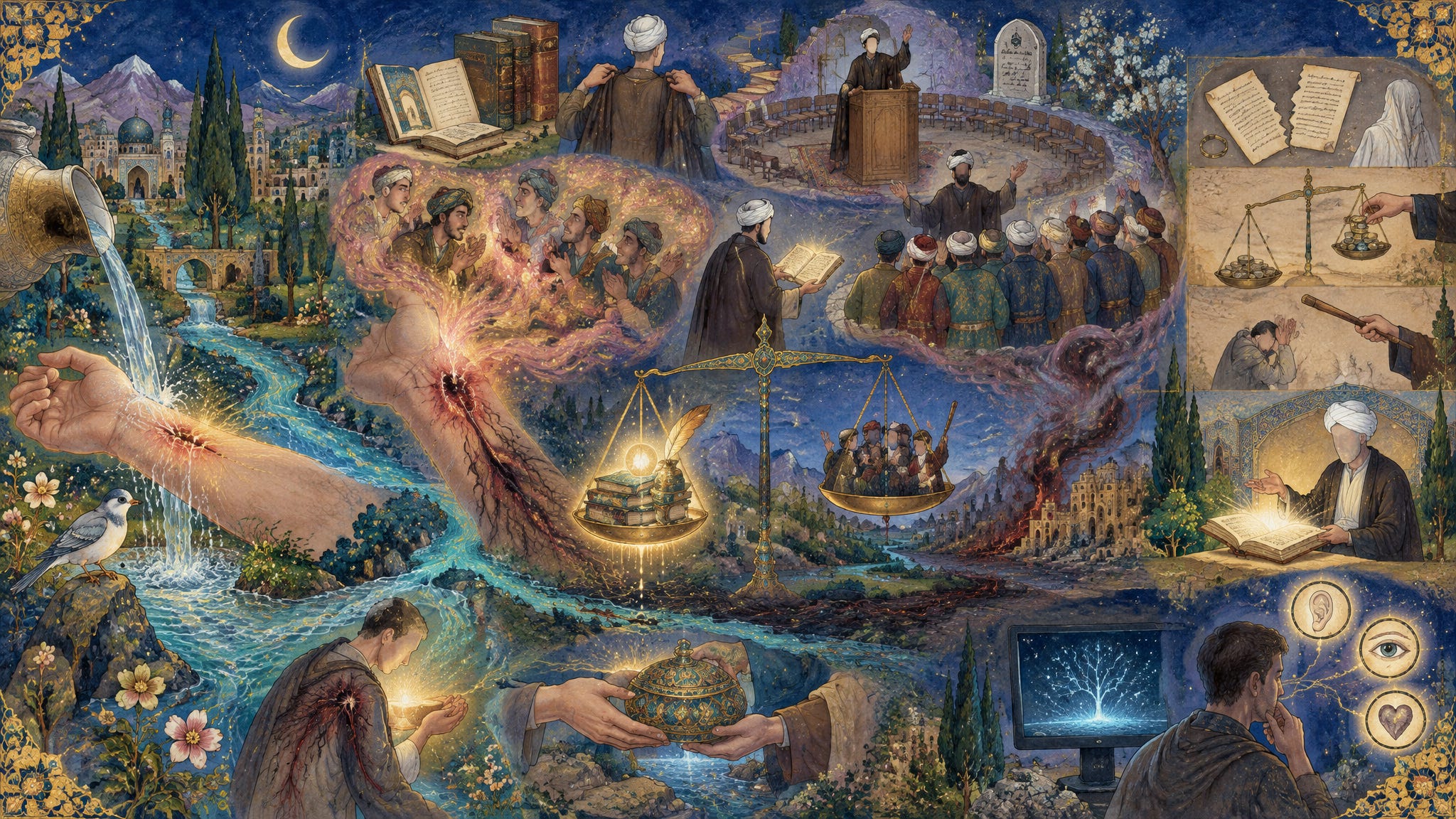
A cut that is cleaned heals — painfully, sometimes; it stings while you clean it — but it heals.
Leave it, and it festers.
And a festering cut can kill you: the infection gets into the blood, and a small wound becomes the thing that takes a life.
Flattery is the infection that keeps the wound from closing.
And I am speaking about the trait.
Not about any person.
The pattern runs like this.
A little learning — and I mean little.
A course in Modern Standard Arabic is a far cry from sarf, nahw and balagha, the grammar and rhetoric a student spends years on; you heard about those three weeks ago.
Then the uniform.
And then mistakes, from the pulpit.
Let me give you one case — stripped of everything that would let you recognise it.
A man once claimed, from a pulpit, to have sat in the class of someone who had never held a class — and who had died long before he was born.
He was corrected.
Politely, with the evidence in hand.
And the people around him — the influential ones, the admiring ones — closed ranks.
They said that the one who corrected him did not know what he was talking about.
And he grew prouder.
That is not harmless.
Men like that, flattered, lend their weight to divorces pushed through that are not valid, and to inheritance disputes settled in favour of whoever happens to be their friend.
Those are matters for the representative of the marja’, or of the wali — someone who has finished the higher levels of study and begun kharij, who has been deemed a mujtahid, and who makes a ruling clear with explanation and with evidence.
Not with a stick.
And people carry wrong teachings for decades.
Religious trauma — when religion came to heal trauma.
Somebody will say:
Actions are by intentions; he means well.
He may.
But a good wish does not give you the capacity to carry what you have picked up.
A man who means well and operates without training is still operating without training.
And one more thing, briefly, because we spoke about it three weeks ago:
I asked ChatGPT.
A machine has no Lord to answer to.
You do: your hearing, your sight and your heart — each of them will be questioned16.
Seduced by the Fine Things Said
Amir al-Mu’minin put the whole of it into one sentence:
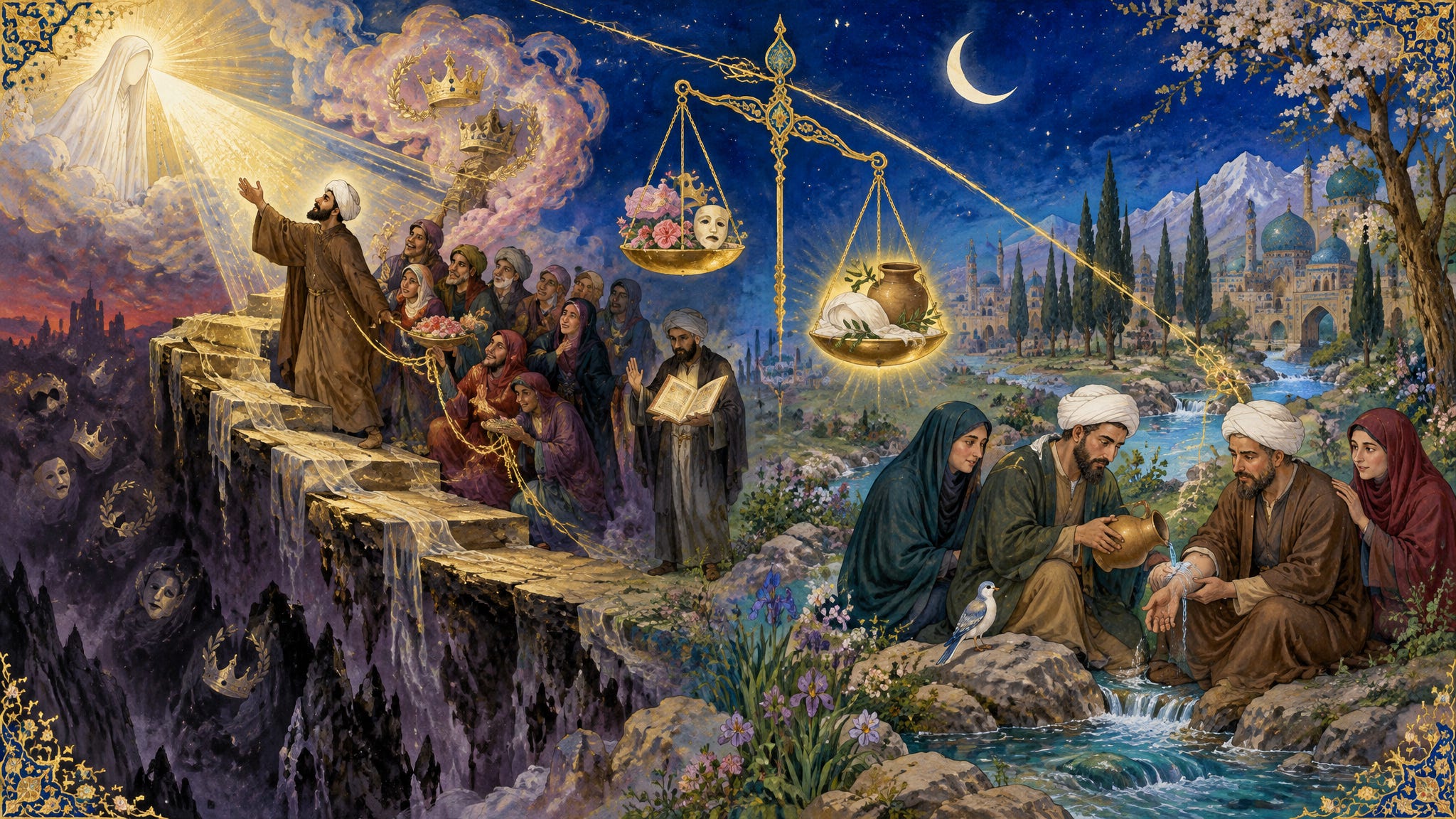
وَقَالَ (عليه السلام): كَمْ مِنْ مُسْتَدْرَجٍ بِالْإِحْسَانِ إِلَيْهِ وَمَغْرُورٍ بِالسَّتْرِ عَلَيْهِ وَمَفْتُونٍ بِحُسْنِ الْقَوْلِ فِيهِ وَمَا ابْتَلَى اللَّهُ أَحَداً بِمِثْلِ الْإِمْلَاءِ لَهُ.
“How many a man is drawn on, step by step, by the kindness shown to him; deceived by the veil drawn over his faults; and seduced by the fine things said about him! And God has tried no one with anything like the respite He grants him.”
— al-Sharif al-Radi, Nahj al-Balagha, Saying 116 (Fihrist, record 1722); my translation
Seduced by the fine things said about him.
That is the flatterer’s work — described thirteen centuries ago.
And the Qur’an names the appetite the flatterer feeds:
لَا تَحۡسَبَنَّ ٱلَّذِينَ يَفۡرَحُونَ بِمَآ أَتَواْ وَّيُحِبُّونَ أَن يُحۡمَدُواْ بِمَا لَمۡ يَفۡعَلُواْ فَلَا تَحۡسَبَنَّهُم بِمَفَازَةٖ مِّنَ ٱلۡعَذَابِۖ وَلَهُمۡ عَذَابٌ أَلِيمٞ
“Do not suppose those who brag about what they have done, and love to be praised for what they have not done—do not suppose them saved from punishment and there is a painful punishment for them.”
— Qur’an, Surah Aal Imran (the Chapter of the Family of Imran) #3, Verse 188
Those who love to be praised for what they have not done.
And it gives us the alternative, in a verse you know:
Help one another in righteousness and in God-wariness — and do not help one another in sin and in aggression17.
So when you flatter a man like that — when you close ranks around him, when you tell the one who corrected him to be quiet — understand what you have done.
Instead of being his brother — or her sister — you have become the one who furthers him in sin.
A real friend does the opposite.
He cleans the wound.
Behind the Pillar
Go back to the boy at the door of the Mansuriyya.
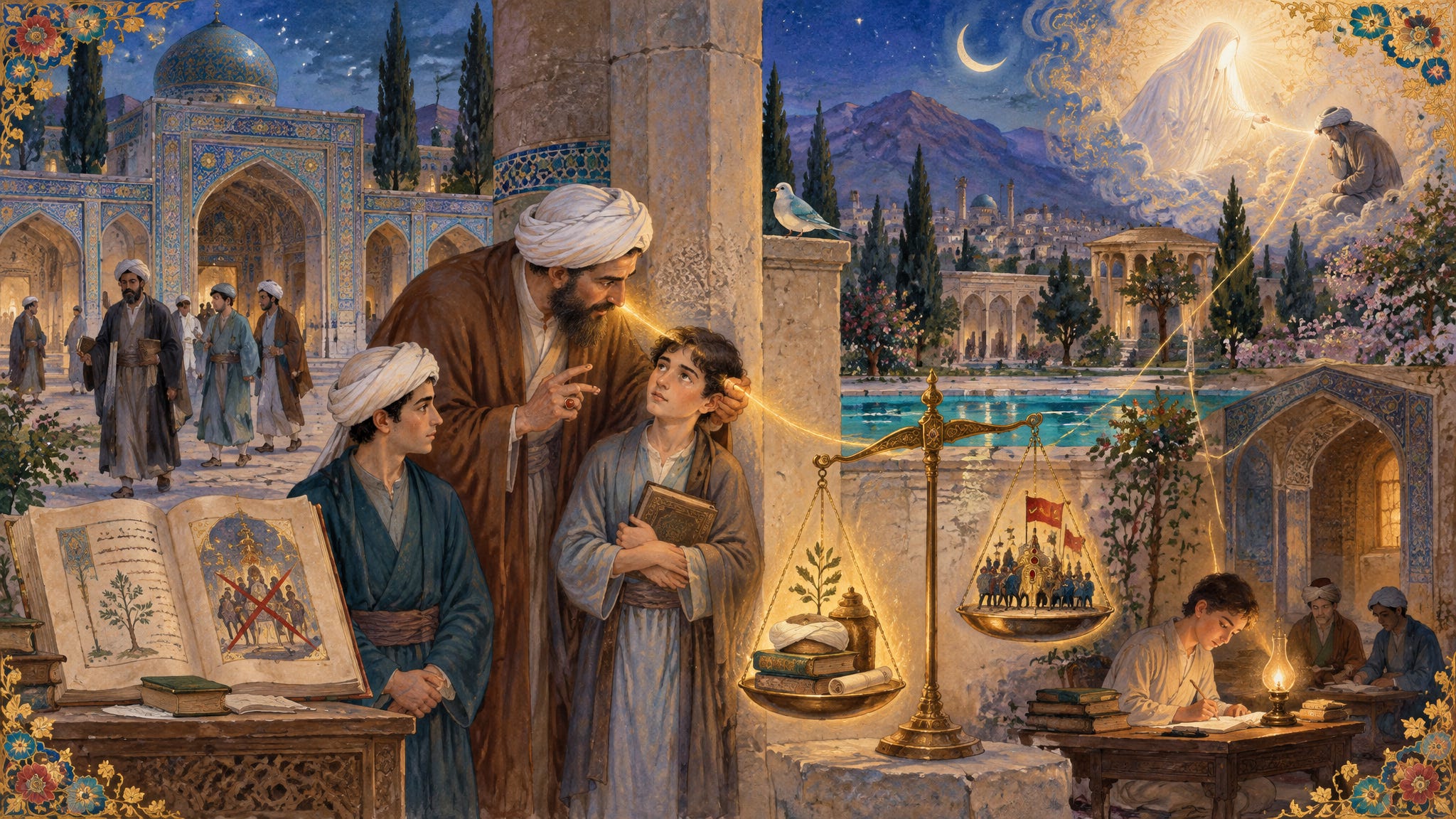
On his second day in Shiraz, he and his brother went to greet a learned man from Bahrain who taught the Alfiyya — the great grammar in verse — and sat in his lesson.
When it was over, the teacher asked about them, and they told him.
Then he stood up — and took the boy behind a pillar of the mosque, and took hold of his ear, hard.
And he said:
My boy — beware of striving to become the Shaykh of the Arabs, and of loving leadership.
Do not waste your time.
If you do this, you will become a man of real worth.
I kept his words, al-Jaza’iri says.
And in the days of study I kept away from my friends18.
Remember the first chapter of Misbah?
The last root of conduct with the world:
Rejecting leadership.
The teacher behind the pillar was teaching the first chapter of Misbah — with his hand on a boy’s ear.
It stung.
It was the kindest thing anyone ever did for him.
And the Imam had given ‘Unwan the same medicine.
The Lion and the Bridge
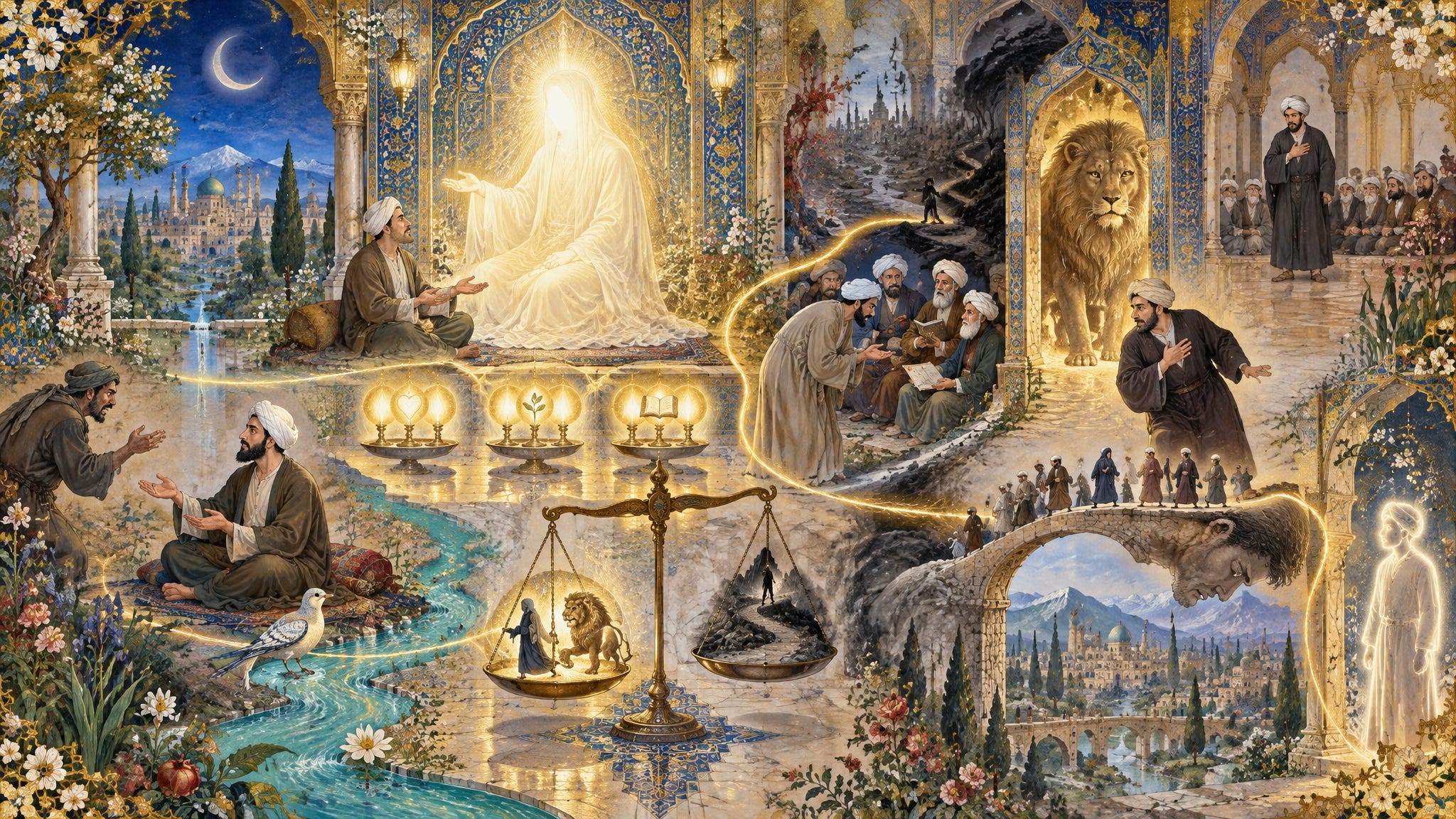
Before Imam al-Sadiq sent ‘Unwan away that afternoon, he gave him nine counsels —
my counsel, he called it, to those who want the road to God.
Three for disciplining the self.
Three for forbearance.
And three for knowledge.
One of the three on forbearance I cannot leave out, because it is so beautiful.
If someone says to you:
Say one word to me and you will hear ten —
Say to him: say ten to me, and you will not hear one.
And here are the three on knowledge:
وأما اللواتي في العلم: فاسأل العلماء ما جهلت، وإيّاك أن تسألهم تَعَنَّتاً وتجربةً، وإيّاك أن تعمل برأيك شيئاً، وخذ بالاحتياط في جميع ماتجد إليه سبيلاً، واهرب من الفُتيا هربك من الأسد، ولا تجعل رقبتك للناس جسراً.
“As for the three on knowledge: ask the scholars what you do not know — and beware of asking them to trip them up, or to test them. Beware of acting on your own opinion in anything. Take the path of caution in everything where you can find a way to it. Flee from giving fatwas as you would flee from a lion. And do not make your neck a bridge for people to cross.”
— Imam al-Sadiq to ‘Unwan al-Basri, from al-Shahid al-Thani, Munyat al-Murid, the editors’ note (Fihrist, PDF page 110); my translation
Do not make your neck a bridge for people.
Every ruling you give, people walk across.
And if it is wrong, they walk across your neck to get there.
You will remember, two weeks ago, the man who stood up in the Assembly of Experts and said:
I am truly not worthy of this station.
That is what fleeing from the lion looks like.
And then the Imam said to him:
Rise, Abu ‘Abdillah. I have counselled you sincerely.
Do not spoil my devotions for me — I am a man who is sparing of himself.
And:
Peace be upon whoever follows the guidance.
So what does the student look like when he is whole?
Its Head Is Humility
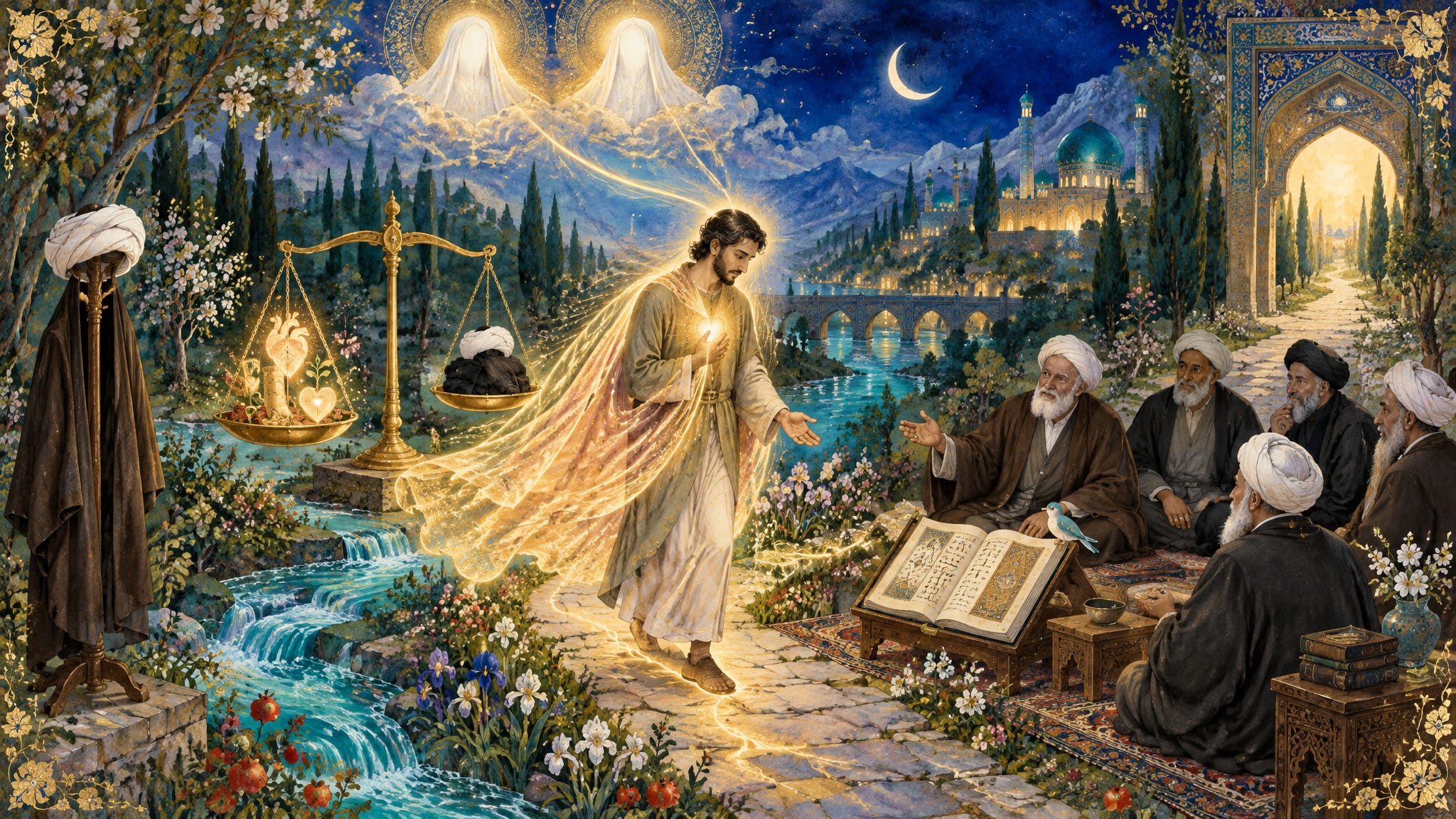
Amir al-Mu’minin answered that, and Imam al-Sadiq reports it from him:
سَمِعْتُ أَبَا عَبْدِ الله (عَلَيْهِ السَّلام) يَقُولُ كَانَ أَمِيرُ الْمُؤْمِنِينَ (عَلَيْهِ السَّلام) يَقُولُ يَا طَالِبَ الْعِلْمِ إِنَّ الْعِلْمَ ذُو فَضَائِلَ كَثِيرَةٍ فَرَأْسُهُ التَّوَاضُعُ وَعَيْنُهُ الْبَرَاءَةُ مِنَ الْحَسَدِ وَأُذُنُهُ الْفَهْمُ وَلِسَانُهُ الصِّدْقُ وَحِفْظُهُ الْفَحْصُ وَقَلْبُهُ حُسْنُ النِّيَّةِ وَعَقْلُهُ مَعْرِفَةُ الاشْيَاءِ وَالامُورِ وَيَدُهُ الرَّحْمَةُ وَرِجْلُهُ زِيَارَةُ الْعُلَمَاءِ وَهِمَّتُهُ السَّلامَةُ وَحِكْمَتُهُ الْوَرَعُ وَمُسْتَقَرُّهُ النَّجَاةُ وَقَائِدُهُ الْعَافِيَةُ وَمَرْكَبُهُ الْوَفَاءُ وَسِلاحُهُ لِينُ الْكَلِمَةِ وَسَيْفُهُ الرِّضَا وَقَوْسُهُ الْمُدَارَاةُ وَجَيْشُهُ مُحَاوَرَةُ الْعُلَمَاءِ وَمَالُهُ الادَبُ وَذَخِيرَتُهُ اجْتِنَابُ الذُّنُوبِ وَزَادُهُ الْمَعْرُوفُ وَمَاؤُهُ الْمُوَادَعَةُ وَدَلِيلُهُ الْهُدَى وَرَفِيقُهُ مَحَبَّةُ الاخْيَارِ.
“I heard Abu ‘Abdillah, peace be upon him, say: Amir al-Mu’minin, peace be upon him, used to say:
O seeker of knowledge — knowledge has many virtues.
Its head is humility.
Its eye is freedom from envy.
Its ear is understanding.
Its tongue is truthfulness.
Its memory is careful inquiry.
Its heart is good intention.
Its intellect is knowing things and their affairs.
Its hand is mercy.
Its foot is visiting the scholars.
Its resolve is soundness.
Its wisdom is scrupulousness.
Its dwelling is salvation.
Its leader is wellbeing.
Its mount is faithfulness.
Its weapon is gentle speech.
Its sword is contentment.
Its bow is courtesy.
Its army is conversation with the scholars.
Its wealth is good manners.
Its treasure is avoiding sins.
Its provision is kindness.
Its water is peaceableness.
Its guide is right guidance.
And its companion is the love of the best of people.”
— al-Kulayni, al-Kafi, Volume 1 (Fihrist, record 128); my translation¹⁰
A body.
Head, eye, ear, tongue, heart, hand, foot.
And every part of it is character.
Not one part of it is clothing.
And look where it begins: its head is humility.
And look at its foot: visiting the scholars.
The student is the one who walks to the teacher — with gentle speech as his only weapon.
And one small thing.
Al-Shahid al-Thani, in his book for students, gives this same report with one word different.
Where we have its provision is kindness, his copy reads: its cloak is kindness19.
If knowledge wears an ‘aba, it is made of kindness.
And Imam al-Sadiq himself told the student what to wear.
Adorned With Forbearance
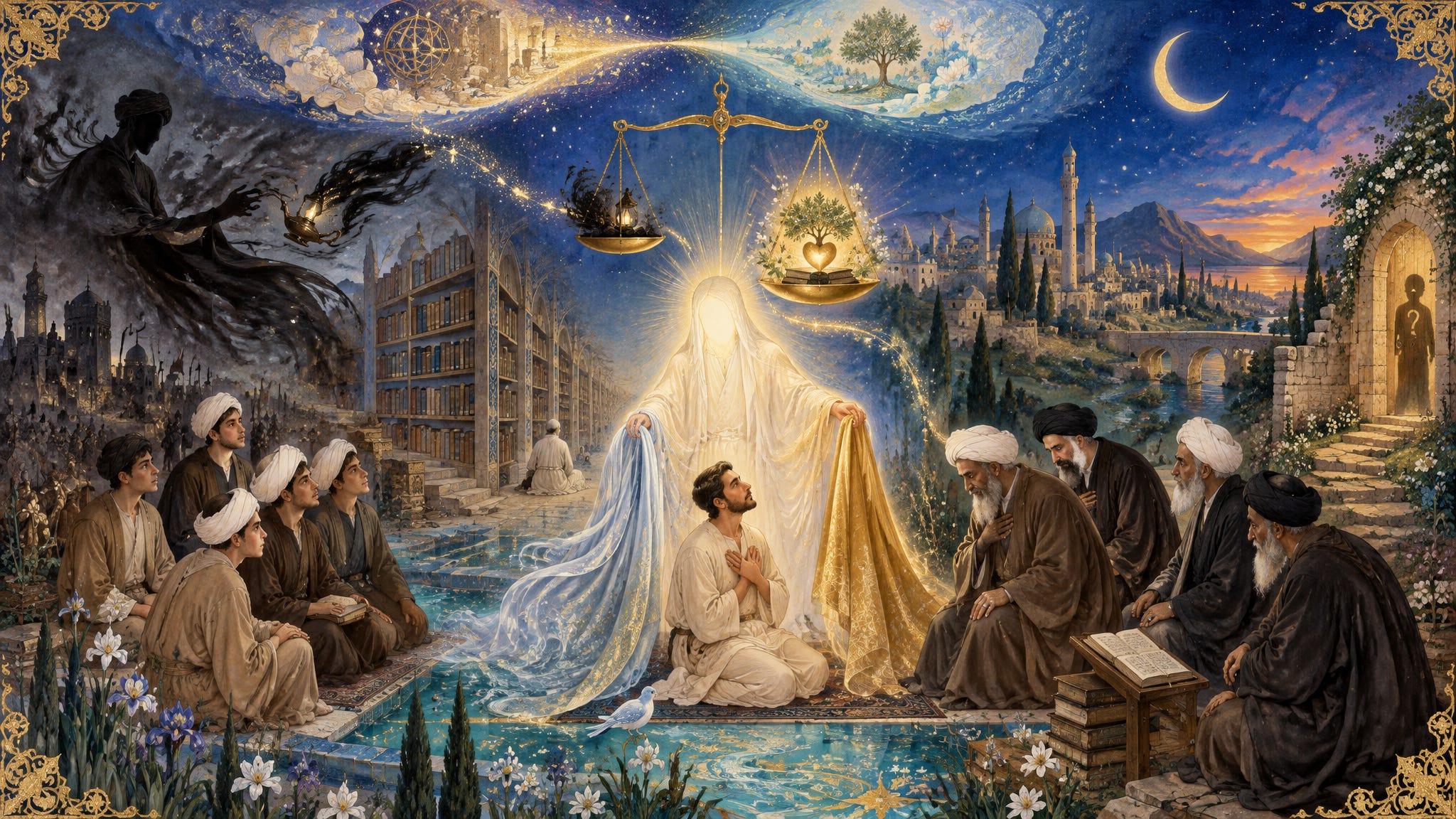
سَمِعْتُ أَبَا عَبْدِ الله (عَلَيْهِ السَّلام) يَقُولُ اطْلُبُوا الْعِلْمَ وَتَزَيَّنُوا مَعَهُ بِالْحِلْمِ وَالْوَقَارِ وَتَوَاضَعُوا لِمَنْ تُعَلِّمُونَهُ الْعِلْمَ وَتَوَاضَعُوا لِمَنْ طَلَبْتُمْ مِنْهُ الْعِلْمَ وَلا تَكُونُوا عُلَمَاءَ جَبَّارِينَ فَيَذْهَبَ بَاطِلُكُمْ بِحَقِّكُمْ.
“I heard Abu ‘Abdillah, peace be upon him, say:
Seek knowledge, and adorn yourselves along with it with forbearance and dignity.
Be humble towards those you teach, and humble towards those from whom you seek knowledge.
And do not be tyrannical scholars — so that your falsehood carries away your truth.”
— al-Kulayni, al-Kafi, Volume 1 (Fihrist, record 66); my translation20
Adorn yourselves.
The word is tazayyanu — dress yourselves up, put on your finery.
The Imam gives the student his clothes.
And they are made of hilm — forbearance — and waqar, dignity.
Remember the first chapter of Misbah: the first root of conduct with people is hilm, and the third is humility.
Here they both are again — in the same Imam’s mouth — as the student’s dress.
Do not be tyrannical scholars, so that your falsehood carries away your truth.
A man can be right about the law and a tyrant in his manner.
And his tyranny will carry off whatever truth he had.
There is a line in a supplication many of you know from the nights of the month of Ramadan, Du’a al-Iftitah:
Praise be to God for His forbearance, after His knowledge21.
Even of God — the forbearance comes after the knowledge.
He knows everything we have done.
And He is forbearing anyway.
Hilm after ‘ilm.
So if that is how God carries His knowledge, what business has the student — who knows so little — carrying his without forbearance?
That is what I meant when I said: the more you learn, the less you know.
Real learning ends in hilm.
So he has studied, and been humbled, and been dressed in hilm.
One fear is left.
What will he come home to?
Lessons for Our Time
Lesson Three — The Clothes Are a Weight, Not a Reward
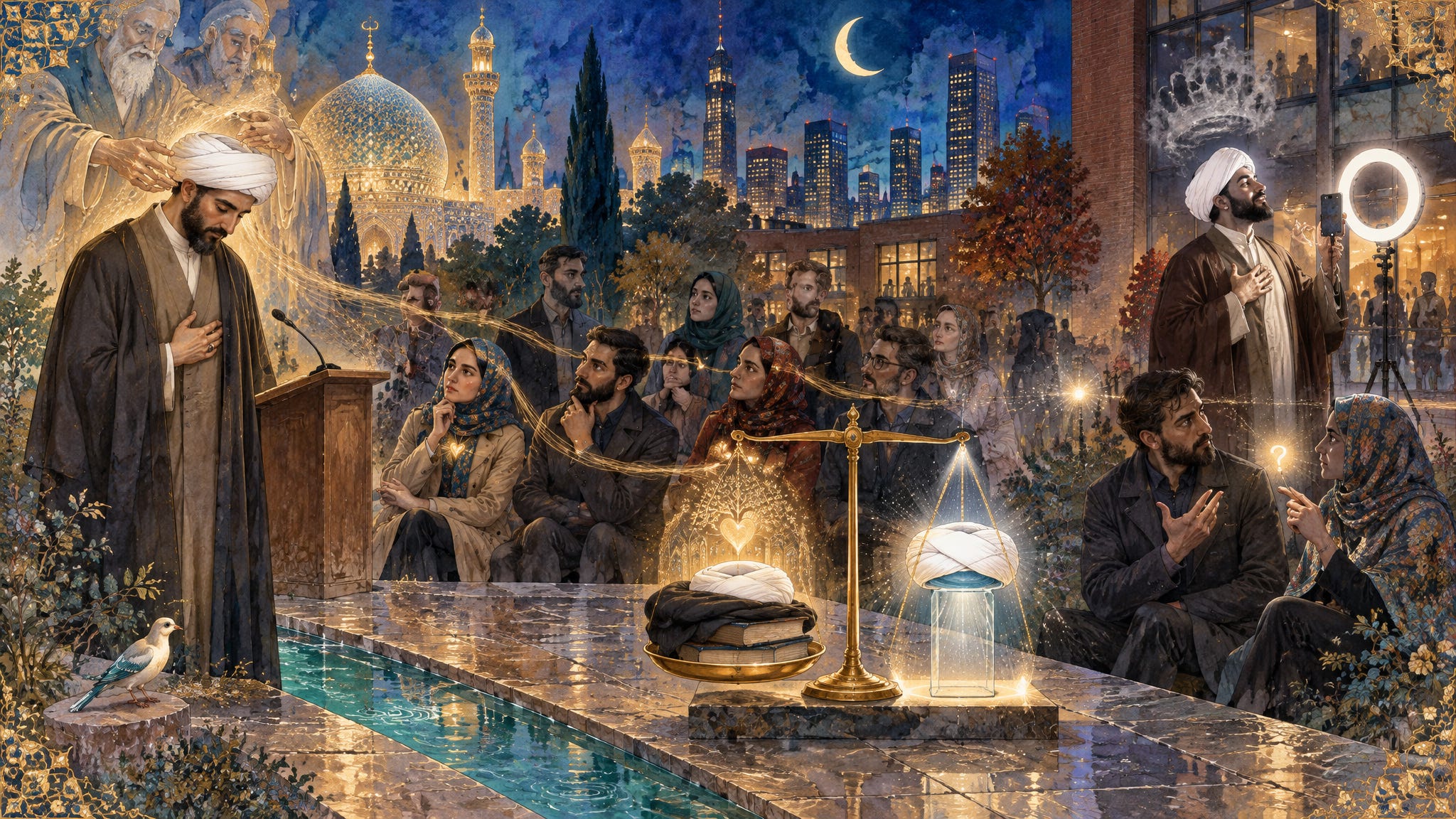
The ‘aba and the turban are given by teachers, not bought in a shop, and they are carried with the fear of God.
Whoever wears them speaks with the weight of the religion behind him, whether he means to or not.
If you wear them, wear them as a weight.
If you do not, do not be dazzled by them.
And remember the clue: the moment someone calls himself an ‘alim, ask why he needed to.
Lesson Four — A Brother Cleans the Wound; a Flatterer Lets It Fester
When someone you admire is corrected with evidence, do not close ranks around him.
Help him in righteousness and God-wariness, not in sin.
And if you are the one being corrected, be grateful for the hand on your ear.
It stings.
It may be the kindest thing anyone ever does for you.
Lesson Five — Its Head Is Humility; Its Clothes Are Hilm
The student’s real dress is forbearance and dignity, and humility towards those who teach him and those he teaches.
And the further he goes, the more forbearing he should become — because even of God we say:
His forbearance, after His knowledge.
Something to Come Back To
The Fear He Does Not Say

There is one more thing a student carries, and he rarely says it out loud.
A young man leaves for Qom, or for Najaf.
Five years.
Ten.
He sits on that floor, he goes through the dry years, he learns to carry what he knows with hilm.
And the whole time, somewhere at the back of his mind, there is a question:
When I come home — will there be anything to come home to?
No salary waiting for him.
No house.
No post.
And a community that may not know what to do with him once he lands.
Some of you have seen it: a young man comes back after ten years of study, and nobody quite knows where to put him.
And I will tell you what worries me most.
If he has nothing to come home to, the flatterers we spoke about will be waiting for him — with something.
A platform.
A following.
A price.
But one man answered that fear long before anyone said it aloud.
Let me take you back to him.
The Half-Dinar
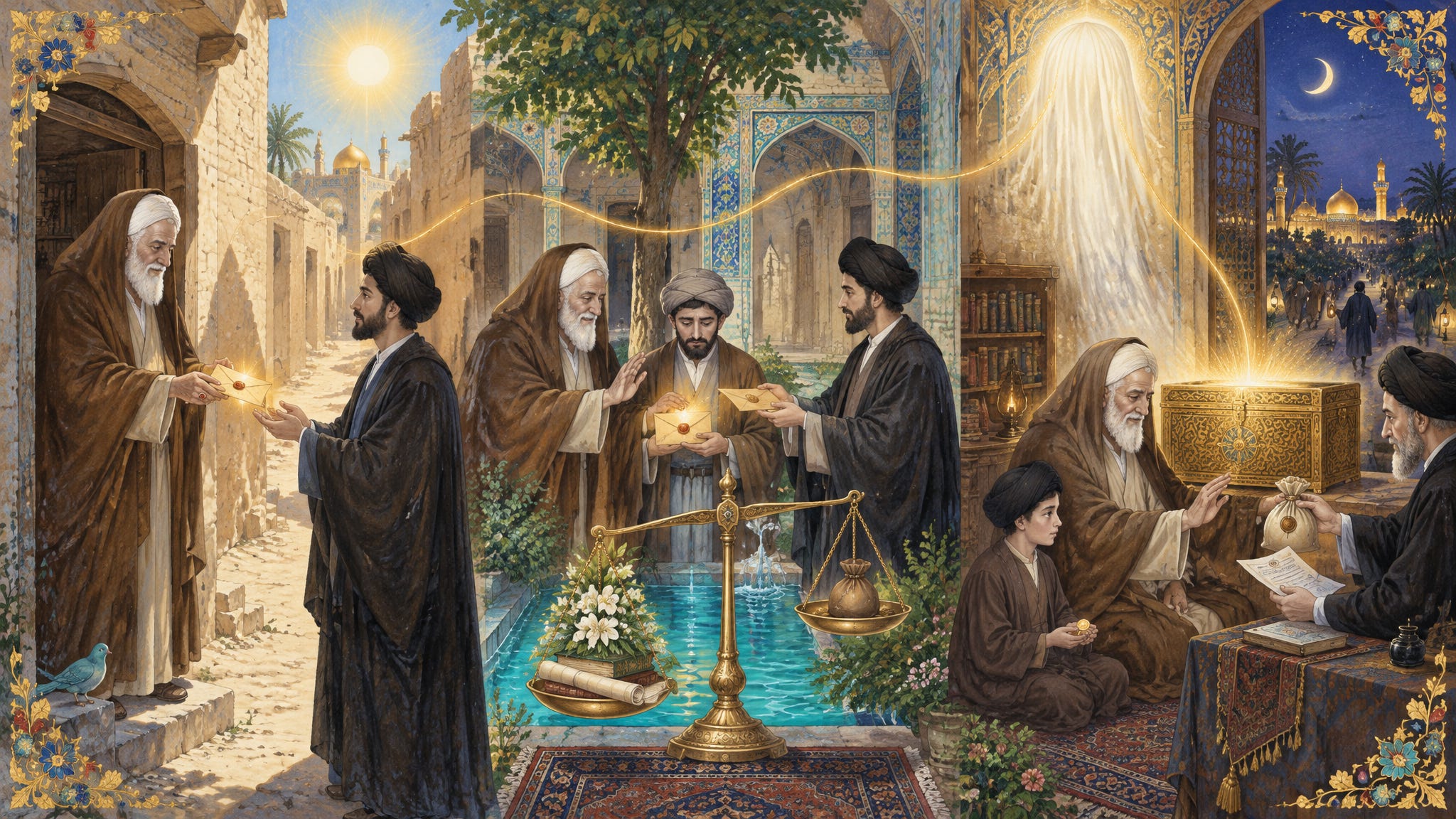
We left Mirza Habibullah Araki as a young man, hiding from Reza Khan’s men in Qom.
Now he is older, and he is in Najaf.
In those years a student arrived in Najaf — the son of a scholar — who would one day be a marja’ himself: Ayatullah Musavi Ardabili, may God have mercy on him.
And he used to tell this story about Mirza Habibullah, again and again.
Mirza Habibullah’s son has written it down.
I had just arrived in Najaf, he said.
I took a room in the madrasa of Sayyid Yazdi.
And though I was a scholar’s son, I was in real hardship.
One afternoon — a scorching Najaf summer afternoon — there was a knock at my door.
Those of you who have been to Najaf in the summer know what an afternoon there is.
Nobody is out in the streets at that hour.
I opened the door, and it was Mirza Habibullah — his ‘aba thrown over his head against the sun.
He handed me an envelope from Ayatullah al-’Uzma Sayyid ‘Abd al-Hadi Shirazi.
I opened it, and inside was half an Iraqi dinar.
And in those days, half a dinar was a considerable sum.
The next day, he said, I was talking with a friend of mine, another student from my own town.
It turned out that an envelope had come to him too, by the same hand.
But his had a quarter of a dinar in it.
And my friend was hurt.
So what did the young Ardabili do?
He went back to Mirza Habibullah and said:
Take a quarter back from mine — so that we are equal.
And Mirza Habibullah said:
No.
This is yours.
We will add to what we gave your friend — and give him half a dinar too.
Ayatullah Musavi Ardabili told that story as a witness to one thing.
He went looking into the students’ circumstances himself, he said, and saw to a man before anyone had voiced a need.
Before anyone had voiced a need.
He did not wait for the student to come and ask.
He knocked on the door — in that heat, with his ‘aba over his head.
And now listen to how the book goes on, because there is a second half to this man.
And all the while, his son writes, my father was severely cautious with religious funds when it came to his own expenses.
Among the students of Najaf it was the custom to go to Karbala, to the ziyara of Imam Husayn, every Thursday night.
Mirza Habibullah loved that ziyara as much as any of them.
But he went on the great nights only — not every week.
And his son kept asking him:
Everyone goes to Karbala every Thursday night. Everyone goes to Iran every summer, to Mashhad, to Imam al-Rida.
Why don’t you go?
Take us with you.
When he had asked enough times, his father told him why:
The money in our hands is the share of the Imam of the Age
— that is, the part of the khums that belongs to the Imam.
And I am not certain that he is pleased for his share to be spent on things that are only recommended.
The great nights of ziyara, he said, he counted as a duty — or as possibly a duty.
Those he went on.
The rest were recommended; and a recommended act he would not pay for with the Imam’s money.
Years later, when the son was living in Iran, one of the notables told him:
I have sent your father a sum from the Imam’s share, and asked him to get permission from a marja’ to spend some of it on you.
Some time after that, his father sent him some money.
And the son asked him:
Is this that money?
And his father said:
No. I do not spend the Imam’s share in cases like this.
I handed the whole of it over to that marja’, and sent the receipt to the gentleman.
Not even on his own son.
Do you see the shape of the man?
Generous with the students — to the point of raising the one who had less, rather than lowering the one who had more.
And strictest of all with himself.
That is what responsibility looks like.
It raises the one who has less; it does not lower the one who has more.
And it is hardest on itself22.
Something to Come Home To
So here is what I would ask of you.
Whoever goes out to learn must have something to come home to.
And if any of you want to help — please do.
Only do it with responsibility and the best of intentions.
And now you know what I mean by responsibility.
It has a face.
It is a man with his ‘aba over his head, knocking on a door in the Najaf heat, before anyone has asked.
What He Comes Home For
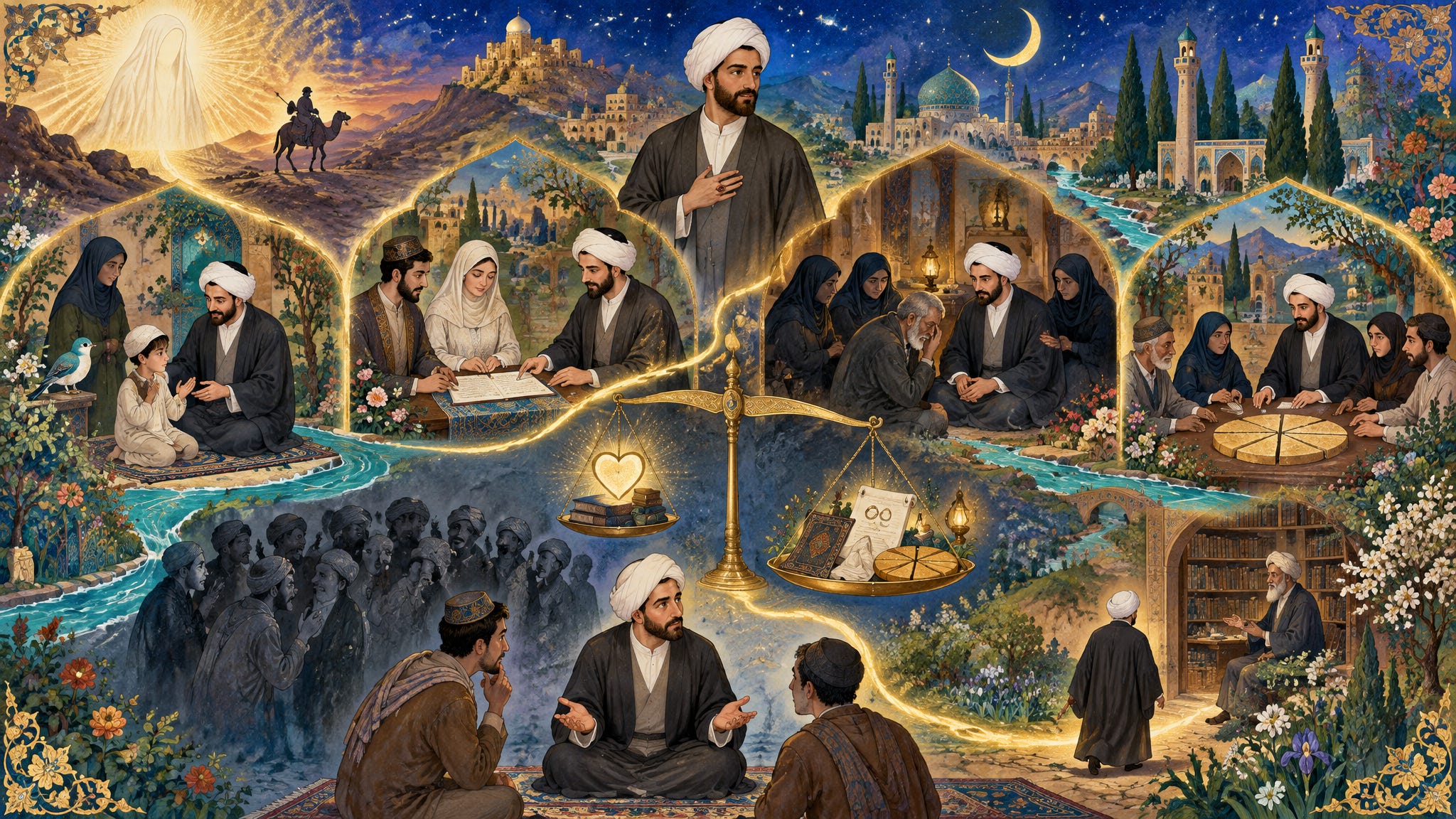
And what does he come home to do?
Two weeks ago I said that a scholar is like a physician:
He gives people what they need, not only what they want.
That is what he comes home for.
Not to be wanted.
To be needed.
He comes home for the child’s first lesson — the little one learning how to pray, who needs someone patient enough to teach him properly.
He comes home for the nikah — marriage contract — done properly, so that a marriage begins on solid ground.
He comes home for the family on the first night after a death — when nobody knows what to do, and somebody has to know.
He comes home for the divorce done right, and the inheritance divided as God divided it — the very things I said earlier tonight that the unqualified must never touch.
Those need someone who has studied.
That is why he went.
And he comes home with the courage to say:
I do not know.
Do you remember where we began tonight?
Five sentences of Amir al-Mu’minin, worth a hard ride on a camel.
Let none of you, when he is asked about something he does not know, be ashamed to say: I do not know.
The man who comes home and can say I do not know — and then goes and finds out — is worth more to a community than ten men who have an answer for everything.
What God Took From the Scholars
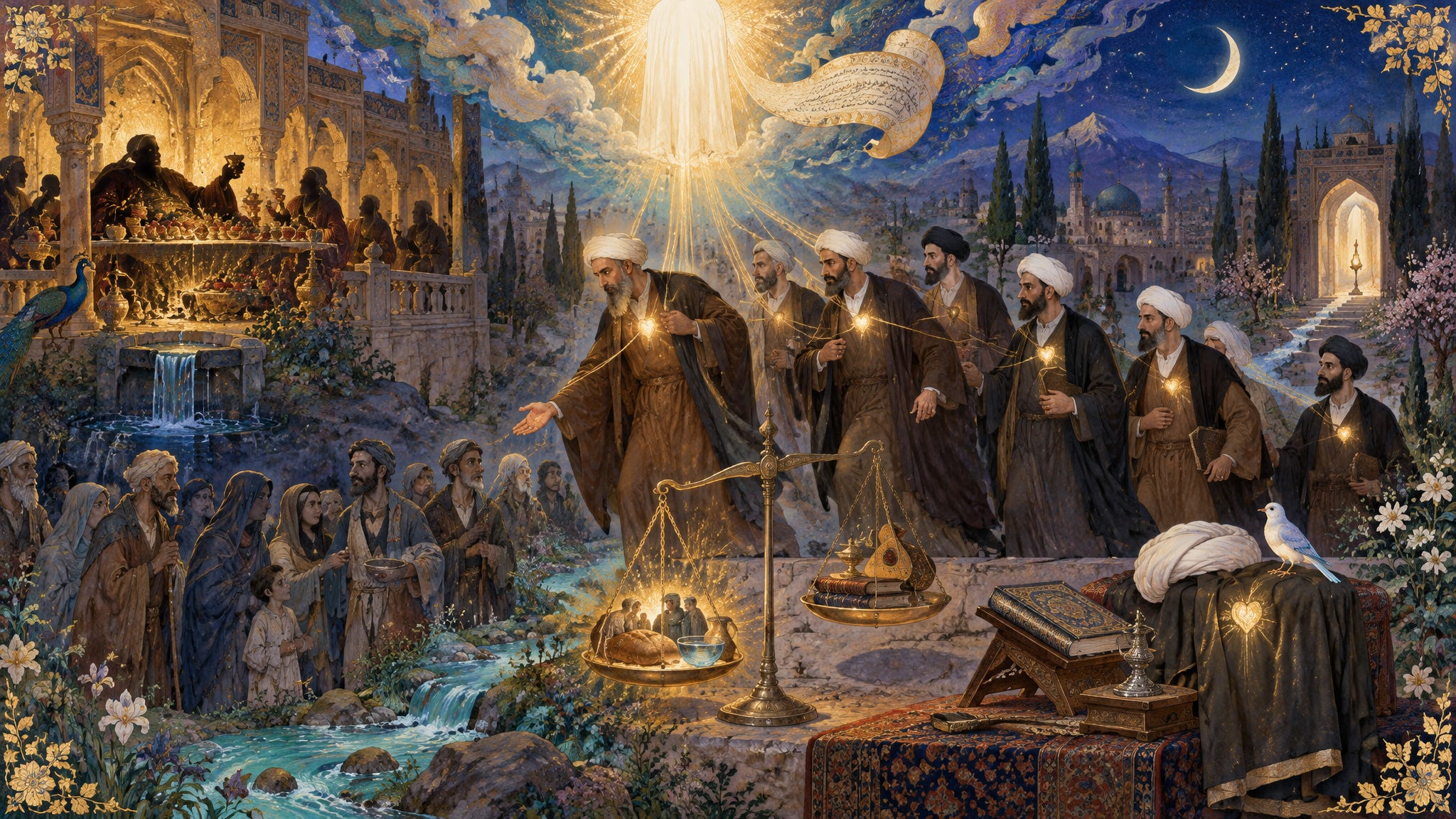
And there is a reason this cannot be left to just anyone.
In one of his most famous sermons, Amir al-Mu’minin speaks of what God has taken from the scholars23 — a covenant: that they will not sit easy while the oppressor gorges himself and the oppressed go hungry.
I will leave that sermon there tonight.
It deserves a night of its own, and it will have one.
But hold on to the phrase:
What God has taken from the scholars.
A scholar is not a man with a hobby.
He is a man under a covenant.
Who Pays Him?
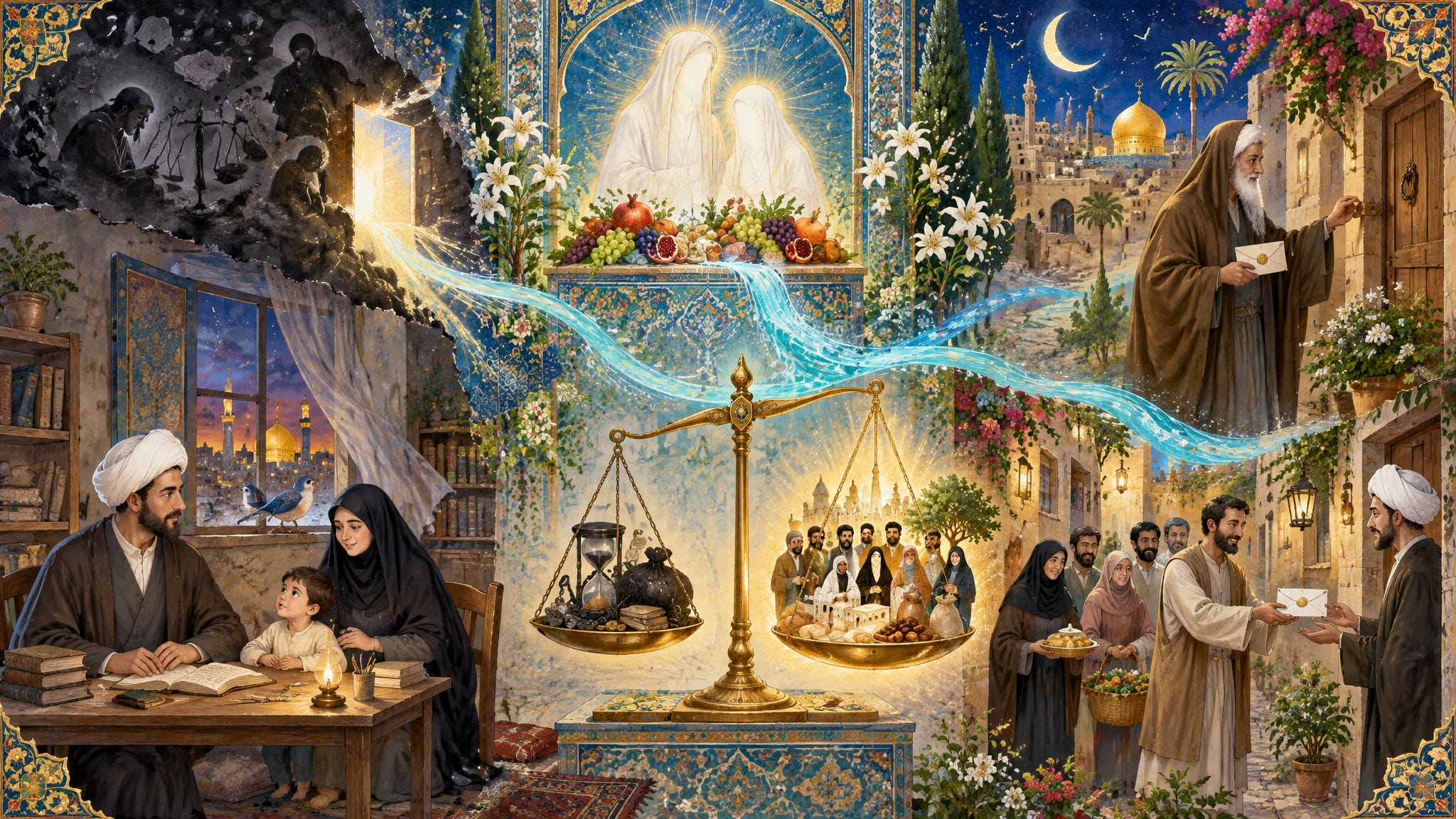
And who pays him?
That is the question underneath the fear, isn’t it?
The young man in Qom, ten years in, wondering how he will feed a family.
Here is one sentence I want you to take home:
The one who works for the Imam of the Age is in his employment.
And an employer like that does not forget his workers.
You heard Mirza Habibullah say it:
The money in our hands is the share of the Imam of the Age.
He knew whose money it was, because he knew whose work it was.
And God Himself has given the promise:
وَمَن يَتَّقِ ٱللَّهَ يَجۡعَل لَّهُۥ مَخۡرَجٗا وَيَرۡزُقۡهُ مِنۡ حَيۡثُ لَا يَحۡتَسِبُۚ وَمَن يَتَوَكَّلۡ عَلَى ٱللَّهِ فَهُوَ حَسۡبُهُۥٓۚ إِنَّ ٱللَّهَ بَٰلِغُ أَمۡرِهِۦۚ قَدۡ جَعَلَ ٱللَّهُ لِكُلِّ شَيۡءٖ قَدۡرٗا
“Whoever is wary of God, He shall make for him a way out [of the adversities of the world and the Hereafter] and provide for him from whence he does not count upon. And whoever puts his trust in God, He will suffice him. Indeed God carries through His commands. Certainly, God has ordained a measure [and extent] for everything.”
— Qur’an, Surah al-Talaq (the Chapter of the Divorce) #65, Verses 2 and 3; verse 2 from its last clause
Those of you who have been with us from the very beginning heard this verse in our first series, on patience — and more than once since24.
I quote it once more because tonight it belongs to the student.
From whence he does not count upon.
And on Saturday night you heard of the Blessed Saint Mary — Sayyedah Maryam — in the sanctuary: every time Zechariah came in to her, he found provision with her.
Mary, where does this come to you from?
And she said: It is from God25.
The one who gives his life to this work is provided for — sometimes from where he never expected.
But listen, because this part is ours.
Very often, the whence he does not count upon is you.
The knock on the door in the Najaf heat.
The envelope.
The community that decided this young man would have something to come home to.
When God provides for those who work for Him, very often He does it through people.
The community that provides for him is part of the provision.
Lessons for Our Time
Lesson Six — Responsibility Is Care Before the Asking
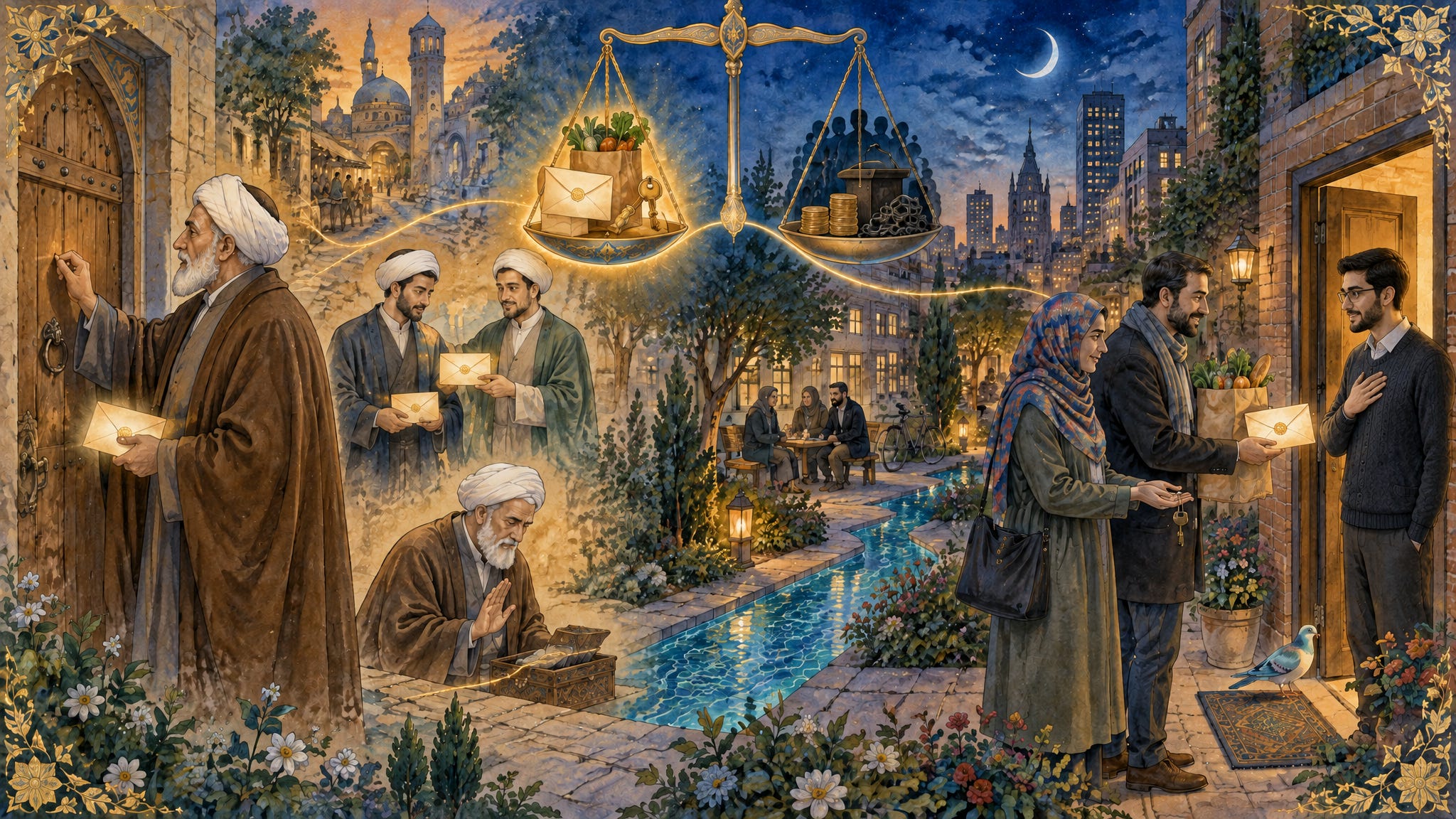
Mirza Habibullah did not wait for the student to come to him.
He went looking, and saw to him before he voiced a need.
When two students were treated unequally, he raised the one who had less; he did not lower the one who had more.
And with himself he was strictest of all.
If you help a student, help him like that: before he has to ask, as a trust from God, and with no strings attached.
Lesson Seven — The One Who Works for God Is Provided For

Whoever is wary of God, He makes a way out for him, and provides for him from whence he does not count upon.
The one who works for the Imam of the Age is in his employment.
And the community that provides for him is part of that provision.
The Close

I have given you a great deal tonight, and most of it will go.
That is how sermons work.
So let me leave you three lines — one from the Qur’an, one from Amir al-Mu’minin, one from Imam al-Sadiq.
If everything else goes, let these stay.
The first is the student’s prayer, given first to the greatest of them:
My Lord, increase me in knowledge.
The second is the head of knowledge:
Its head is humility.
And the third is where knowledge begins — the Imam’s word to an old man of ninety-four at his door:
If you want knowledge, seek first, in yourself, the reality of servitude.
The first word of this whole series, eighty sessions ago.
Tonight it came back to us as the place where every student starts.
Conclusion — Key Takeaways

Three things to take out of this room — and they are things to do, not only things to think.
The first. Never stop being a student.
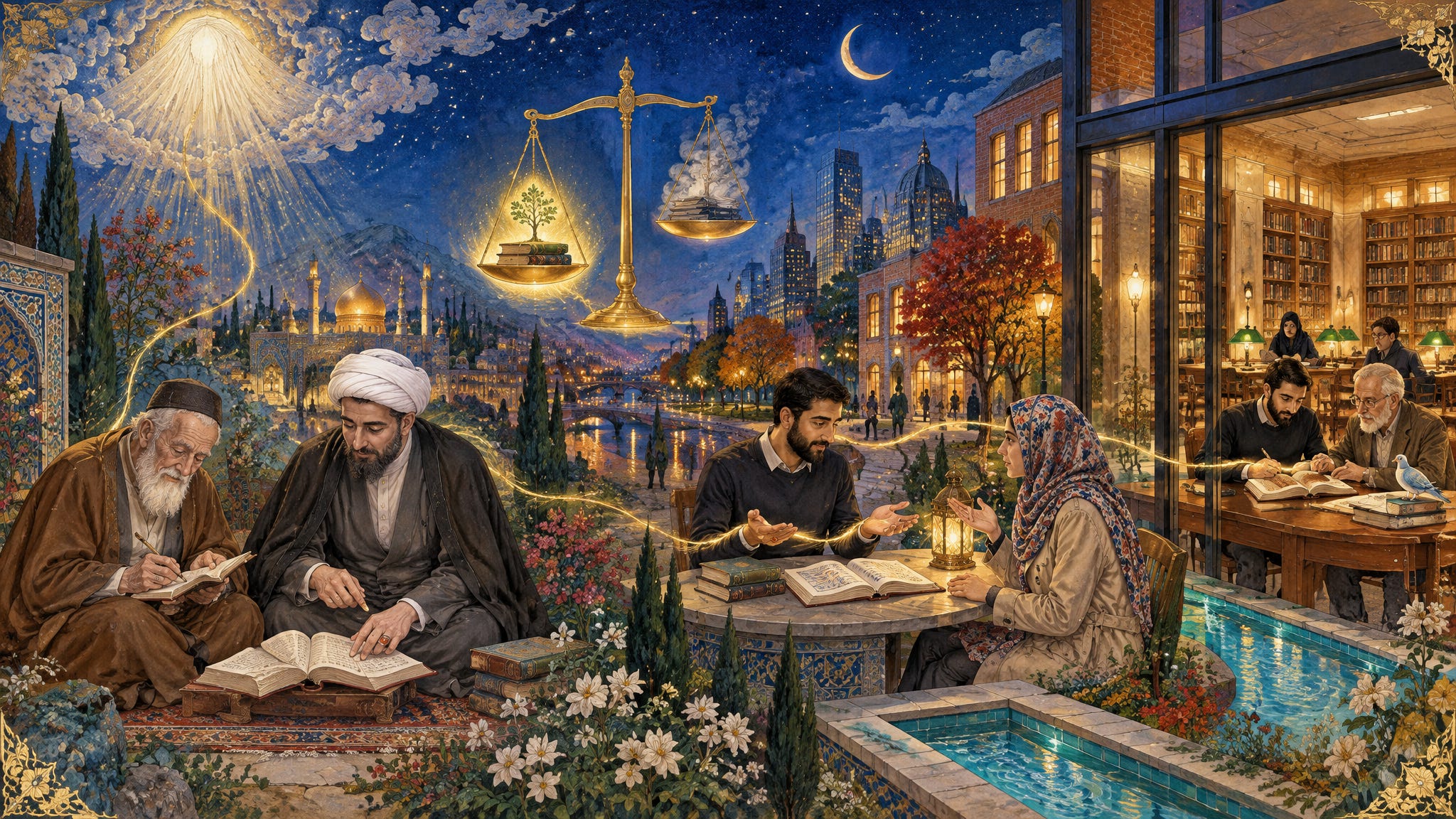
My Lord, increase me in knowledge was given to the one who knew the most.
No one is excused from it — not at ninety-four, and not after ten years in Qom.
This week: when you are asked something you do not know, say I do not know — and then go and find out.
The second. Carry what you know with humility, and dress it in hilm.
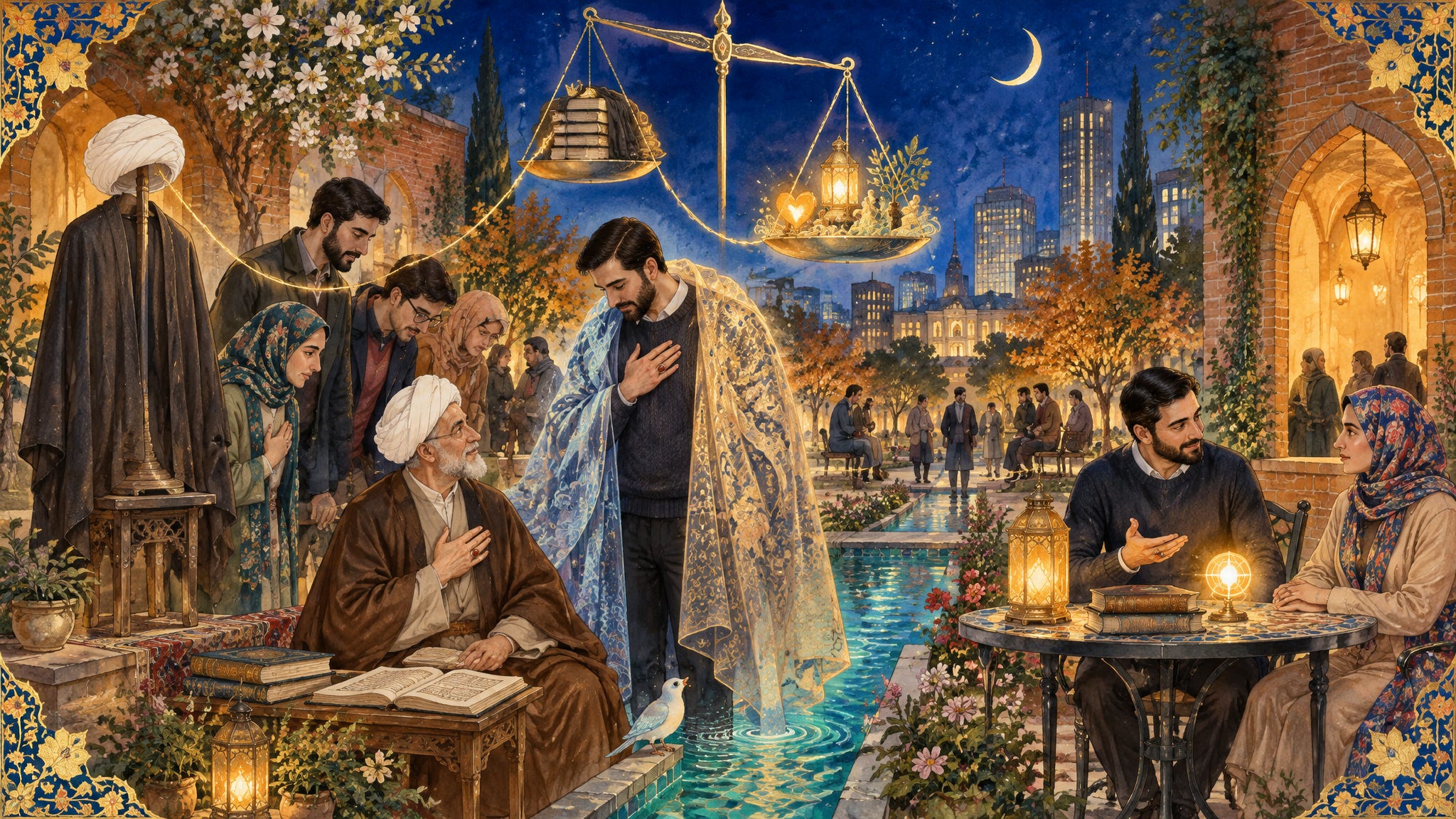
The clothes are a weight, not a reward.
The student’s real dress is forbearance and dignity, and humility towards those who teach him and those he teaches.
This week: the next time you are right, be gentle about it.
And the third. Give him something to come home to.
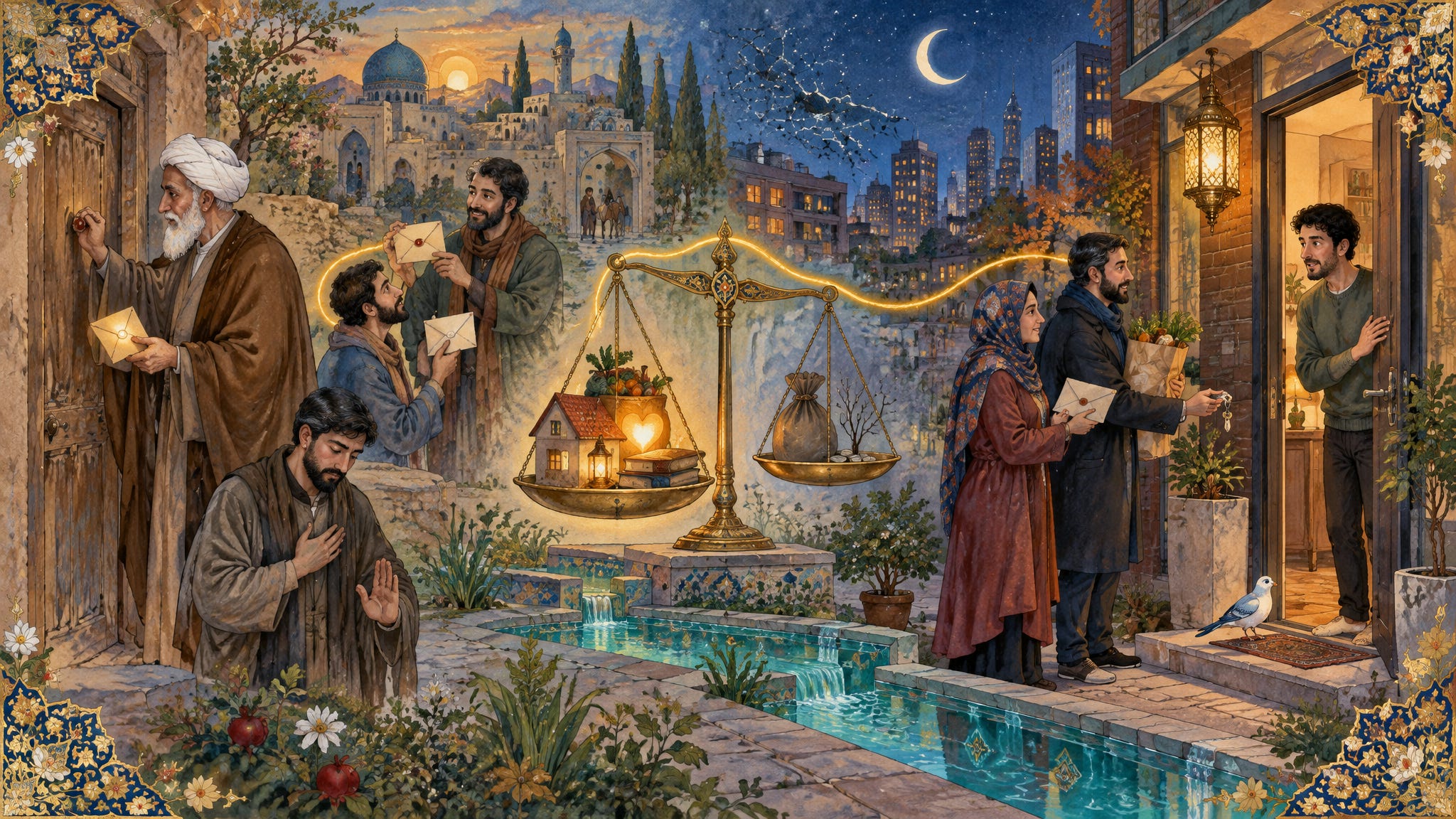
Responsibility is care before the asking.
Raise the one who has less; be strictest with yourself.
This week: think of one person from among us who is studying, or who has come home from study — and ask after him, before he has to ask you for anything.
The One Who Teaches
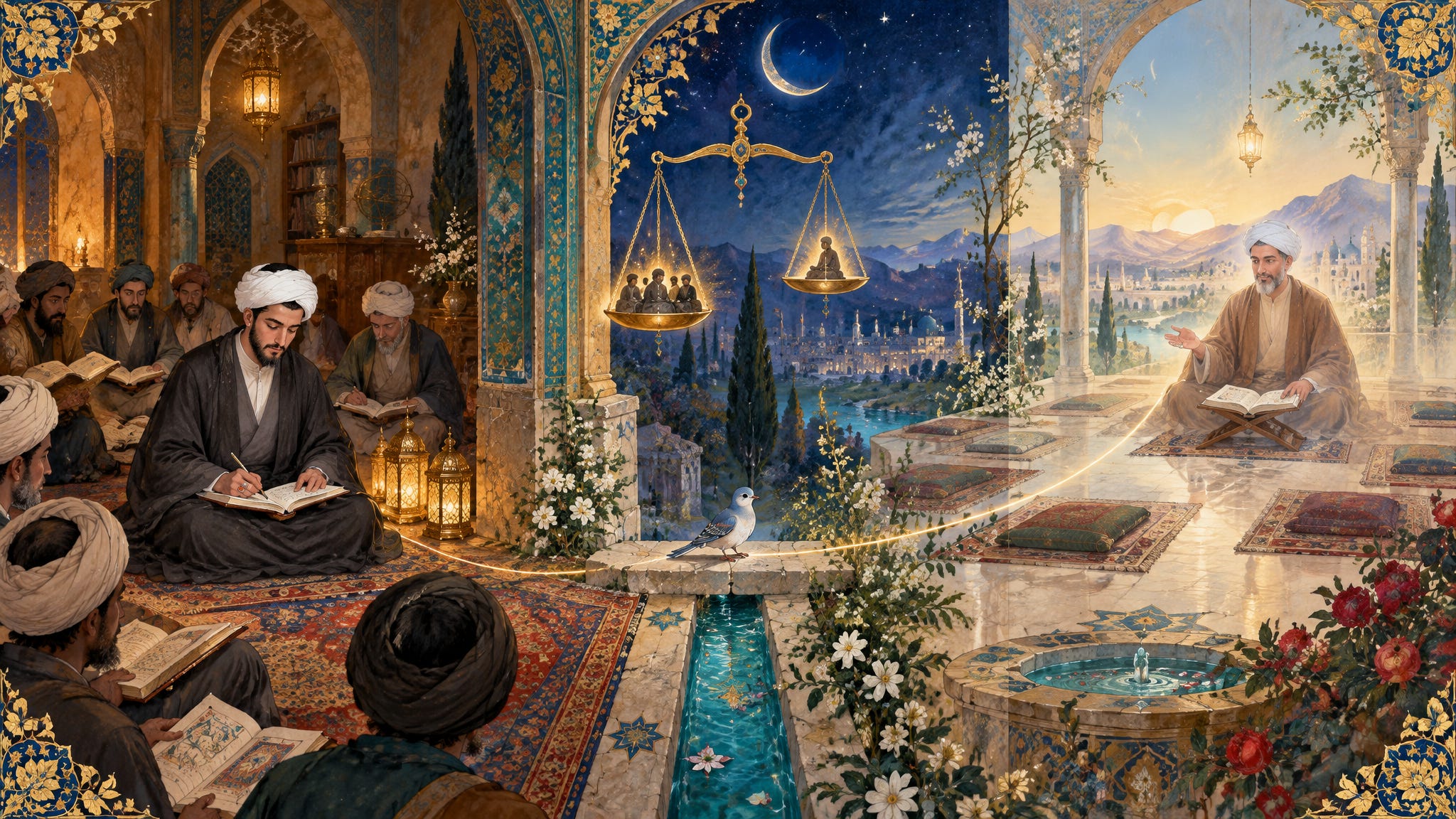
Tonight we sat on the floor of the dars, beside the one who learns.
Next week, God willing — the one who teaches.
Eulogy — Mirza Habibullah Araki: The Lamp Over the Door
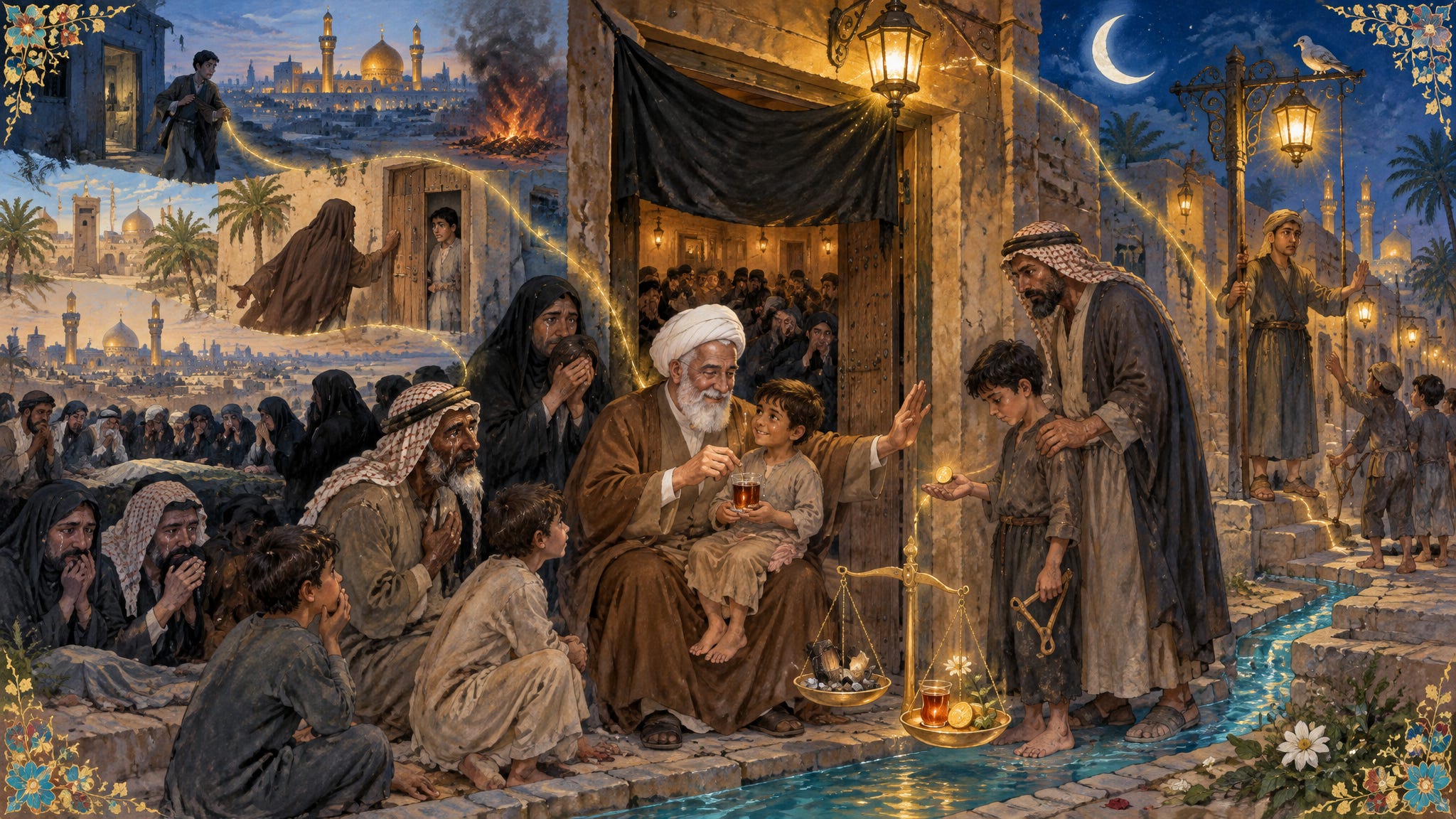
Mirza Habibullah Araki, may God have mercy on him.
We have met him twice tonight.
A young student who could not walk the streets of Qom in his clothes.
And a man in Najaf with his ‘aba over his head, knocking on a student’s door before anyone had to ask.
Let me give you one last picture of him26 — at his own door.
It was the days of the second Fatimiyyah — the days we are coming into now.
Six days of rawda — lamentation commemorations — in his house in Najaf.
The courtyard was full, the rooms were full — every place in the house where a person could sit.
And he sat at the door, welcoming the people as they came in.
And at the door gathered the little children of his Arab neighbours.
Poor children — barefoot, his son says, in every sense of the word.
They came for the tea, and for whatever food was being handed round to the mourners.
And he would sit them on his knee.
Dirty faces, dusty heads — he sat them on his knee, and sweetened their tea with his own hand, and gave it to them with his own hand.
Those neighbours were hard people, his son writes — rough, with the temper of the desert.
But with him they were gentle.
It was as if they felt he was their father.
His son was in Qom when he died.
His sister told him what happened.
Those rough neighbours wept, and lamented, and grieved with the family — so much that the family felt they were part of it.
Men and women, old and young, were beside themselves.
And they kept saying:
He was the father of all of us.
And one of those neighbours, years later, told the son a story.
When he was a boy, he said, he and the other boys of the street used to shoot out the street lamps with catapults — for fun.
And one of their favourite targets was the lamp over Mirza Habibullah’s door.
Whenever they had the chance, they shot it out.
Mirza Habibullah was hurt by it.
Slowly, he worked out who was doing it.
And he let nothing show.
Whenever he saw those boys, he was kind to them.
Then one day the boy’s father found out.
He took his son by the hand and brought him to Mirza Habibullah — to punish him in front of him, to discipline the boy and to clear his own shame.
And the moment Mirza Habibullah saw the boy, he forbade the father to lay a finger on him.
And then, with a smiling, open face, he gave the boy a hundred fils — no small sum in those days.
Leave him be, he said.
He has done nothing.
And he prayed for him.
From then on, the man said, I guarded that lamp — and the lamps of the other houses too. I did not let the other children touch them.
The boy who broke the lamp became the one who guarded it.
His son’s book sets a verse of the Qur’an beside that story, and so shall I:
وَلَا تَسۡتَوِي ٱلۡحَسَنَةُ وَلَا ٱلسَّيِّئَةُۚ ٱدۡفَعۡ بِٱلَّتِي هِيَ أَحۡسَنُ فَإِذَا ٱلَّذِي بَيۡنَكَ وَبَيۡنَهُۥ عَدَٰوَةٞ كَأَنَّهُۥ وَلِيٌّ حَمِيمٞ
“Good and evil [conduct] are not equal. Repel [evil] with what is best. [If you do so,] he between whom and you was enmity, will then be as though he were a sympathetic friend.”
— Qur’an, Surah Fussilat (the Chapter of that Explained in Detail) #41, Verse 34
He between whom and you was enmity will then be as though he were a sympathetic friend.
The enemy of the lamp became its watchman.
Think of everything we have seen of him tonight.
A student in Qom who had to leave his room before dawn so that no one would strip him of his clothes.
A man in Najaf who knocked on doors in the heat — and would not spend the Imam’s money even on his own son.
And an old man at his own door in the days of Fatimiyyah, with a barefoot child on his knee.
He died in Najaf, and the rough, poor neighbours of his street mourned him as their father.
He could not wear the clothes in daylight in Qom.
Twenty-eight years later, in the same city, they burned them.
Segue to Maqtal
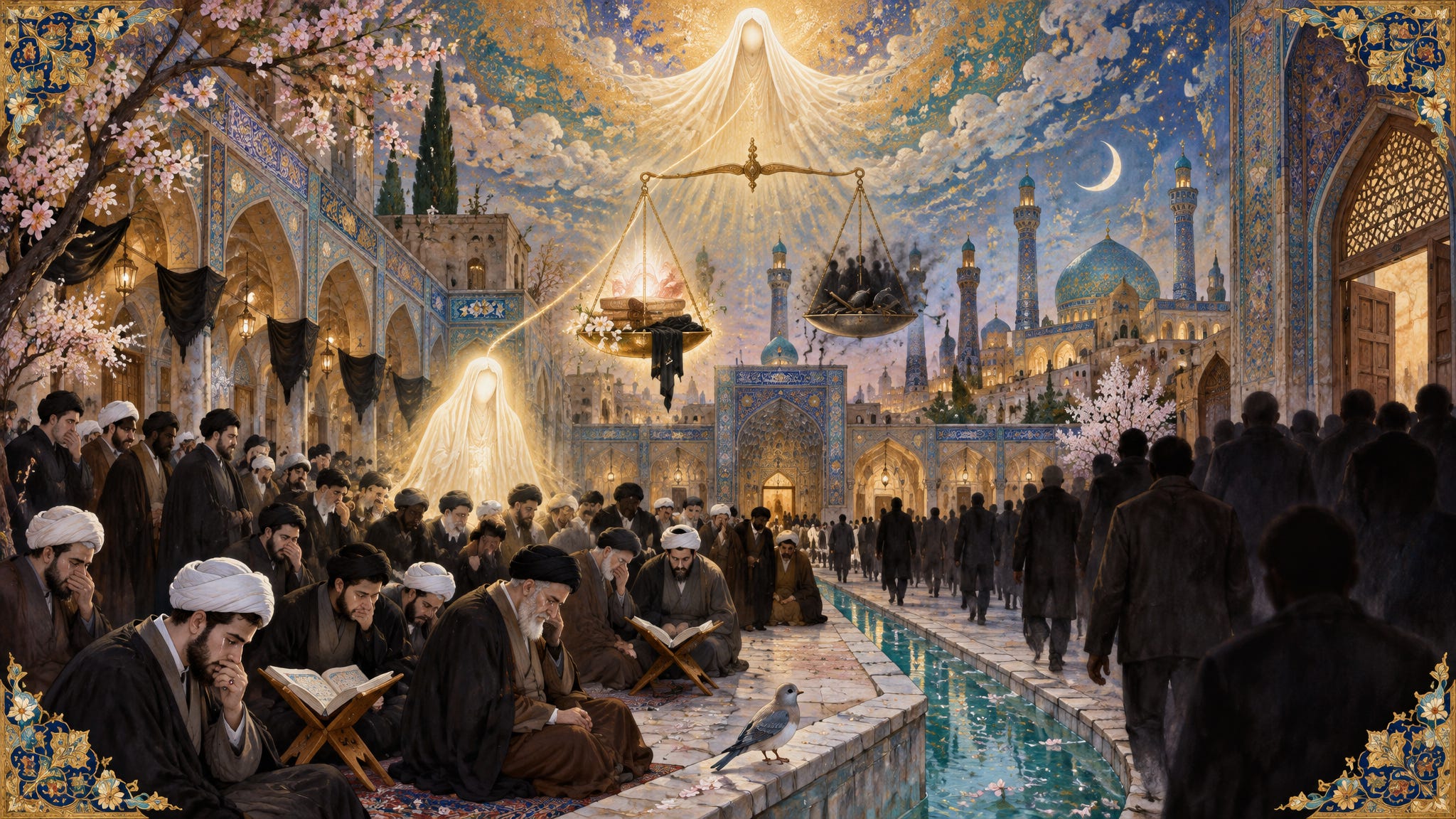
In the spring of 1963, on the day kept for the death of Imam al-Sadiq, the students of Qom gathered in the Fayziyya — the great school at the heart of the city — to mourn him.
And men came to them in plain clothes.
Our maqtal tonight is for those students, and for the Imam whose death they had gathered to mourn.
And it is given in the voice of the one who carries every one of their griefs: the Imam of our Age.
Maqtal (Lamentation) for the Twenty-First Session of the Architecture of Guidance
Supplication
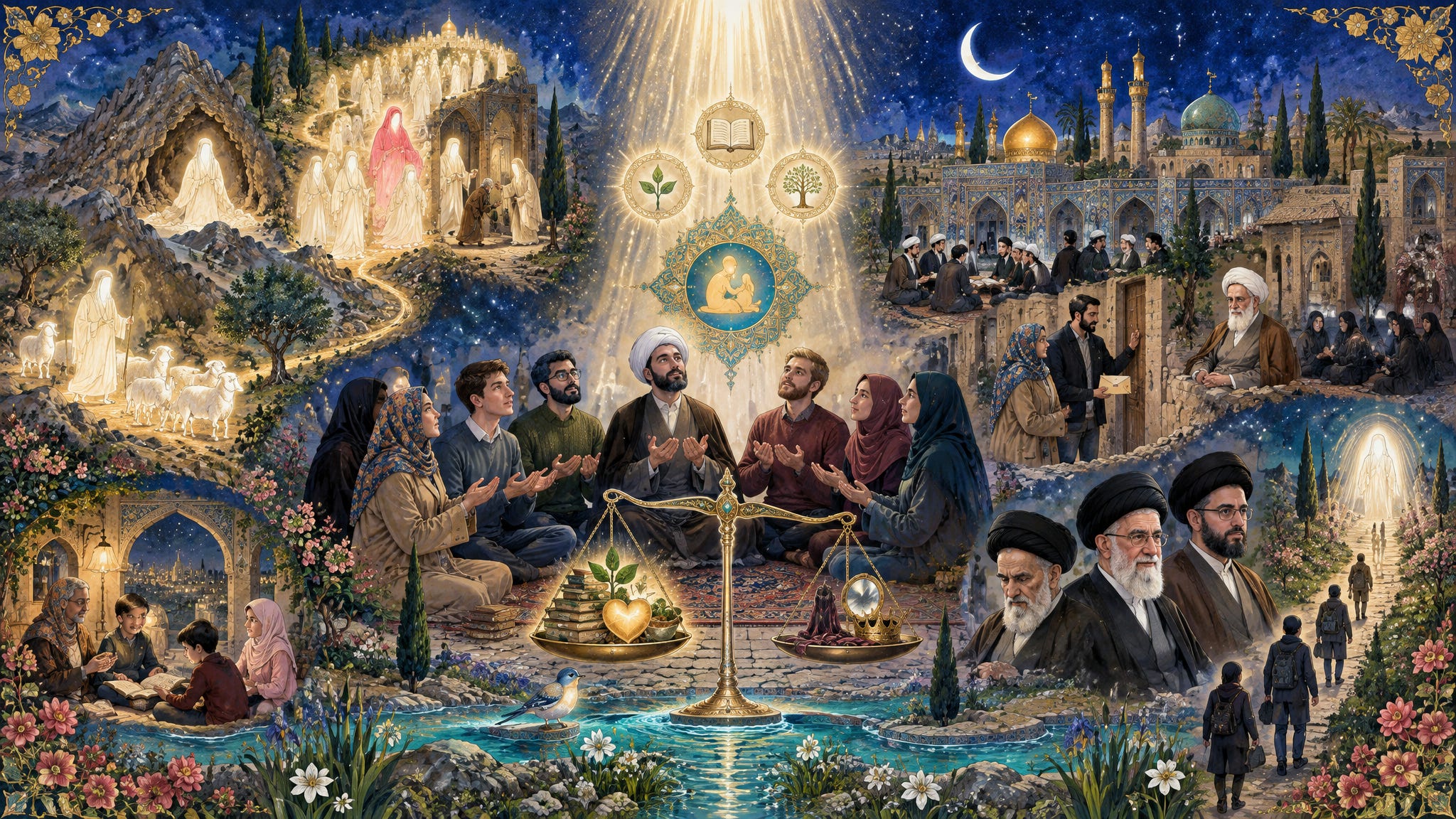
O God, we ask You by the light You cast into the hearts of those You will to guide, and by the servitude that is the beginning of knowledge.
By Your prophets, peace and blessings be upon them all — by Moses with the flock in Midian, and by the one who went up to Hira alone.
By Muhammad, peace and blessings be upon him, his family, and his righteous companions.
By the fourteen — by Sayyedah Fatimah al-Zahra, peace and blessings be upon her, in these her days; and by every Imam from Amir al-Mu’minin, peace and blessings be upon him, to the one we are waiting for; and by Imam Ja’far al-Sadiq, peace and blessings be upon him, who opened his door to an old man from Basra.
O God, make us students on the road to salvation, all our lives.
Increase us in knowledge; let its head be humility; and dress it in forbearance.O God, keep the students in Qom and in Najaf tonight — the ones on the floor of the dars, the ones in their dry years, the ones far from home.
Protect them from the pride of the clothes, and from those who would flatter them.
Give them the patience of the wilderness years, and bring them home with something to give.O God, give them something to come home to — and make us part of it.
Make us like the man who knocked on the door in the heat, before anyone had to ask.O God, have mercy on Mirza Habibullah Araki, the father of his whole street; on the students of the Fayziyya; and on every student of this religion who was beaten, or burned out, or driven away for the clothes he wore.
O God, bless the nights of Fruit of the Heart, and the parents and children who come to them.
O God, have mercy on the previous leader, Imam Khomeini, may You rest his pure soul.
O God, we remember before You the martyred leader, Imam Sayyed Ali Khamenei, may You rest his pure soul, from whose lectures on patience this circle of ours first began.
Accept him, and gather him with those he loved.O God, protect and guide and lengthen the life of our Wali al-Faqih, Imam Sayyed Mujtaba Khamenei, may You protect him, and keep him firm on the straight path until the rising of the one we are waiting for.
O God, hasten the relief of Your friend and the son of Your friend — the Imam of our Age, may our souls be his ransom and may You hasten his return.
Make us among his students, and among those who work for him.
And make us among those who wait for him actively — who prepare, and do not only wait.O God, give us success in whatever we do for Your sake.
And give us a good ending, like the righteous scholars who went before us.And whatever we have said tonight that was true, it is from You; and whatever was wrong in it is from me, and I ask Your forgiveness for it.
Amen, O Lord Sustainer of the Universes
Amen, O Most Merciful of the Merciful
And from Him alone is all ability and He has authority over all things.
The report of 'Unwan al-Basri is preserved in Mishkat al-Anwar (pages 325–328) and in Bihar al-Anwar (Volume 1, pages 224–226). Allamah al-Majlisi says he found it in the handwriting of Shaykh al-Baha'i, who records it from al-Shahid al-Awwal, who copied it from the handwriting of Shaykh Ahmad al-Farahani, from 'Unwan.
Its chain is incomplete; its content is sound.
It is read here from the editors' note to Munyat al-Murid (Mawsu'at al-Shahid al-Thani, Volume 1), which gives it in full from Bihar.
The print repeats one clause in the Imam's description of servitude; the translation gives it once.
Translation mine throughout.
The whole report, in Arabic with its translation, is in footnote 2 below.
The whole report of 'Unwan al-Basri, as the editors of Munyat al-Murid give it from Bihar al-Anwar
حديث عنوان البصري مروي في مشكاة الأنوار، ص ٣٢٥ - ٣٢٨؛ وبحار الأنوار، ج ١، ص ٢٢٤ - ٢٢٦، ونحن ننقله هنا بطوله - لمافيه من الفائدة - عن بحار الأنوار. قال العلامة المجلسي (قدس الله نفسه الزكية): أقول: وجدت بخط شيخنا البهائي (قدس الله روحه)، ما هذا لفظه: قال الشيخ شمس الدين محمد بن مكي: نقلت من خط الشيخ أحمد الفراهاني (رحمه الله) عن عنوان البصري - وكان شيخاً كبيراً قد أتى عليه أربع وتسعون سنة - قال: كنت أختلف إلى مالك بن أنس سنين، فلمَا قدم جعفر الصادق (عليه السلام) المدينة، اختلفت إليه وأحببت أن أخذ عنه كما أخذت عن مالك. فقال لي يوماً: إنّي رجل مطلوب ومع ذلك لي أوراد في كل ساعة من آناء الليل والنهار، فلا تشغلني عن وردي، وخذ عن مالك، واختلف إليه كما كنت تختلف إليه؛ فاغتممت من ذلك وخرجت من عنده وقلت في نفسي: لو تفرّس في خيراً لما زجرني عن الاختلاف إليه والأخذ عنه، فدخلت مسجد الرسول (عليه السلام) وسلّمت عليه، ثمّ رجعت من الغد إلى الروضة وصلّيت فيها ركعتين، وقلت أسألك يا الله يا الله! أن تعطف عليّ قلب جعفر وترزقني من علمه ما أهتدي به إلى صراطك المستقيم. ورجعت إلى داري مغتماً ولم أختلف إلى مالك بن أنس لما أشرب قلبي من حب جعفر، فما خرجت من داري إلا إلى الصلاة المكتوبة حتى عيل صبري، فلمَا ضاق صدري تنعّلت وتردّيت وقصدت جعفراً وكان بعد ماصلّيت العصر، فلمَا حضرت باب داره استأذنت عليه فخرج خادم له فقال ماحاجتك؟ فقلت: السلام على الشريف، فقال: هو قائم في مصلّاه، فجلست بحذاء بابه فما ← → لبثت إلاّ يسيراً إذ خرج خادم فقال: ادخل على بركة الله، فدخلت وسلّمت عليه، فردّ السلام وقال: اجلس غفر الله لك، فجلست فأطرق مليّاً، ثمّ رفع رأسه، وقال: أبو من؟ قلت: أبو عبدالله، قال: ثبّت الله كنيتك ووفّقك، يا أبا عبد الله ما مسألتك؟ فقلت في نفسي: لولم يكن لي من زيارته والتسليم غير هذا الدعاء لكان كثيراً. ثمّ رفع رأسه، ثمّ قال: مامسألتك؟ فقلت: سألتُ الله أن يعطف قلبك عليّ ويرزقني من علمك، وأرجو أنَّ الله تعالى أجابني في الشريف ما سألته، فقال: يا أبا عبدالله! ليس العلم بالتعلم، إنما هو نور يقع في قلب من يريد الله تبارك وتعالى أن يهديه، فإن أردتَ العلم فاطلب أوّلاً في نفسك حقيقة العبودية، واطلب العلم باستعماله، واستفهم الله يفهمك، قلت: يا شريف! فقال: قل يا أبا عبدالله. قلت: يا أبا عبدالله! ما حقيقة العبودية؟ قال: ثلاثة أشياء: أن لا يرى العبد لنفسه فيما خوّله الله ملكاً؛ لأنَّ العبيد لا يكون لهم ملك، يرون المالَ مالَ الله يضعونه حيث أمرهم الله به، ولا يدَّبِّر العبد لنفسه تدبيراً، وجملة اشتغاله فيما أمره تعالى به ونهاه عنه، فإذا لم يرَ العبد لنفسه فيما أمرهم الله به، ولا يدَّبِّر العبد لنفسه تدبيراً، وجملة اشتغاله فيما أمره تعالى به ونهاه عنه، فإذا لم يرَ العبد لنفسه فيما خوّله الله تعالى ملكاً هان عليه الإنفاق فيما أمره الله تعالى وأن ينفق فيه، وإذا فوَّضَ العبد تدبير نفسه على مدبره هان عليه مصائب الدنيا، وإذا اشتغل العبد بما أمره الله تعالى ونهاه لا يتفرَّغُ منهما إلى المراء والمباهاة مع الناس، فإذا أكرم الله العبد بهذه الثلاثة هان عليه الدنيا، وإبليس، والخلق، ولا يطلب الدنيا تكاثراً وتفاخراً، ولا يطلب ما عند الناس عزّاً وعلوّاً، ولا يدع أيّامه باطلاً، فهذا أوّل درجة التقى، قال الله تبارك وتعالى: ﴿تِلْكَ الدَّارُ الْأُخِرَةُ نَجْعَلُهَا لِلَّذِينَ لَا يُرِيدُونَ عُلُوّاً فِي الْأَرْضِ وَلَا فَسَاداً وَالْعَنْقِبَةُ لِلْمُتَّقِينَ﴾ [القصص (٢٨): ٨٣]. قلت: يا أبا عبد الله! أوصني، قال: أوصيك بتسعة أشياء فإنها وصيّتي لمريدي الطريق إلى الله تعالى، والله أسألُ أنْ يوفقك لاستعماله، ثلاثة منها في رياضة النفس، وثلاثة منها في الحلم، وثلاثة منها في العلم، فاحفظها وإيّاك والتهاونَ بها. قال عنوان: ففرّغت قلبي له.
فقال: أما اللواتي في الرياضة: إِيّاك أن تأكل مالا تشهيه فإنَّه يورث الحماقة والبَلَه، ولا تأكل إلاّ عند الجوع، وإذا أكلت فكل حلالاً وسم الله، واذكر حديث الرسول : «ما ملأ آدمي وعاء شراً من بطنه. فإن كان ولا بد فثُلُثٌ لطعامه وثلثٌ لشرابه وثلثٌ لنفسه». [سنن ابن ماجة، ج ٢، ص ١١١١، ح ٣٣٤٩]
وأما اللواتي في الحلم: فمن قال لك: إن قلت واحدةً سمعت عشراً، فقل: إن قلت عشراً لم تسمع واحدةً، ومن شَتَّمك فقل له: إن كنت صادقاً فيما تقول فأسأل الله أن يغفر لي، وإن كنت كاذباً فيما تقول فالله أسألُ أن يغفرلك، ومن وَعَدَك بالخنى فعِدْه بالنصيحة والدعاء.
[…]
قم عني يا أبا عبدالله! فقد نصحت لك ولا تفسد عليّ وردي، فإنِّي امرء ضنين بنفسي، والسلام على اتبع الهدي.
“The report of ‘Unwan al-Basri is related in Mishkat al-Anwar, pages 325–328, and in Bihar al-Anwar, Volume 1, pages 224–226; and we give it here in full, for the benefit in it, from Bihar al-Anwar.
Allamah al-Majlisi, may God sanctify his pure soul, said: I say: I found in the handwriting of our shaykh al-Baha’i, may God sanctify his spirit, the following, in these words: Shaykh Shams al-Din Muhammad ibn Makki said: I copied from the handwriting of Shaykh Ahmad al-Farahani, may God have mercy on him, from ‘Unwan al-Basri — who was a very old man, who had reached ninety-four years. He said:
I used to go to Malik ibn Anas for years. When Ja’far al-Sadiq, peace be upon him, came to Medina, I went to him too, and I wanted to take from him as I had taken from Malik. Then one day he said to me: “I am a man who is sought; and besides that, I have devotions at every hour of the night and the day. So do not keep me from my devotions. Take from Malik, and keep going to him as you used to.” I was grieved by this. I left him, and said to myself: if he had perceived any good in me, he would not have turned me away from coming to him and taking from him. So I went into the mosque of the Messenger, peace be upon him, and greeted him; and the next day I came back to the Rawda and prayed two rak’as in it, and said: I ask You, O God, O God, to turn the heart of Ja’far towards me, and to grant me from his knowledge what will guide me to Your straight path.
I went back to my house grieving, and I did not go to Malik ibn Anas, because of the love of Ja’far my heart had been made to drink. I did not leave my house except for the obligatory prayer, until my patience gave out. When my chest grew tight, I put on my sandals and my cloak and set out for Ja’far; it was after I had prayed ‘Asr. When I came to the door of his house I asked permission to see him, and a servant of his came out and said: “What do you need?” I said: “Peace be upon the noble one.” He said: “He is standing in his place of prayer.” So I sat down opposite his door. I had waited only a little when a servant came out and said: “Come in, with the blessing of God.”
I went in and greeted him. He returned the greeting and said: “Sit — may God forgive you.” I sat, and he lowered his head for a long while; then he raised his head and said: “Whose father are you?” I said: “Abu ‘Abdillah.” He said: “May God make your kunya firm, and grant you success. O Abu ‘Abdillah, what is your question?” I said to myself: if I had nothing from this visit and this greeting but this prayer, it would be a great deal. Then he raised his head and said: “What is your question?” I said: “I asked God to turn your heart towards me and to grant me from your knowledge; and I hope that God the Exalted has answered me, in the noble one, with what I asked of Him.” He said: “O Abu ‘Abdillah, knowledge is not by learning. It is only a light that falls into the heart of whomever God, Blessed and Exalted, wills to guide. So if you want knowledge, seek first in yourself the reality of servitude; seek knowledge by putting it to use; and ask God for understanding, and He will give you understanding.” I said: “O noble one!” He said: “Speak, Abu ‘Abdillah.” I said: “O Abu ‘Abdillah, what is the reality of servitude?”
He said: “Three things: that the servant does not see himself as owning anything of what God has placed in his charge — for servants have no ownership: they see wealth as God’s wealth, and put it where God has commanded them to put it; that the servant does not arrange his own affairs for himself; and that the whole of his occupation is with what God the Exalted has commanded him and forbidden him. … When the servant does not see himself as owning what God the Exalted has placed in his charge, spending becomes easy for him in what God the Exalted has commanded him to spend on. When the servant hands the arranging of himself over to the One who arranges him, the hardships of this world become easy for him. And when the servant is occupied with what God the Exalted has commanded and forbidden him, he finds no leisure from these for disputing and showing off before people. When God honours the servant with these three, this world becomes easy for him, and Iblis, and people; he does not seek the world to amass it and boast of it, nor seek from what people have honour and high standing; and he does not let his days go to waste. This is the first degree of taqwa. God, Blessed and Exalted, has said: ‘That Abode of the Hereafter — We make it for those who desire neither exaltation in the earth nor corruption; and the end belongs to the God-wary’ [al-Qasas (28): 83].”
I said: “O Abu ‘Abdillah, counsel me.” He said: “I counsel you with nine things — for they are my counsel to those who want the road to God the Exalted, and I ask God to grant you success in putting it to use: three of them on disciplining the self, three on forbearance, and three on knowledge. So keep them, and beware of taking them lightly.” ‘Unwan said: So I emptied my heart for him.
He said: “As for those on discipline: beware of eating what you have no appetite for, for it breeds foolishness and dullness; do not eat except when you are hungry; and when you eat, eat what is lawful, and say the name of God; and remember the saying of the Messenger: ‘No human being fills a vessel worse than his belly. If it must be, then a third for his food, a third for his drink, and a third for his breath.’ [Sunan Ibn Majah, Volume 2, page 1111, hadith 3349]
As for those on forbearance: whoever says to you, ‘If you say one word, you will hear ten,’ say to him: ‘If you say ten, you will not hear one.’ Whoever insults you, say to him: ‘If you are truthful in what you say, I ask God to forgive me; and if you are lying in what you say, I ask God to forgive you.’ And whoever threatens you with obscenity, promise him good counsel and prayer.
[As for those on knowledge — given in full in Point 2, under The Lion and the Bridge.]
Rise from me, Abu ‘Abdillah. I have counselled you sincerely; do not spoil my devotions for me, for I am a man who is sparing of himself. And peace be upon whoever follows the guidance.”
— the report of ‘Unwan al-Basri, in the editors’ note to al-Shahid al-Thani, Munyat al-Murid (Mawsu’at al-Shahid al-Thani, Volume 1), from Bihar al-Anwar (Fihrist, PDF pages 109–110); the arrows are the print’s own marks where the note turns the page; the print repeats one clause in the description of servitude, given once here (…); after the Messenger’s name the print’s honorific is a glyph the text layer does not carry; the three counsels on knowledge are carried in Point 2; my translation
Allamah Tabatabai on Korah’s answer (28:78) and on the verse (28:83), each given whole, with the reports he brings on the verse.
قوله تعالى:«قال إنما أوتيته على علم عندي»إلى آخر الآية.
لا شك أن قوله«إنما أوتيته على علم عندي»جواب عن جميع ما قاله المؤمنون من قومه و نصحوه به و كان كلامهم مبنيا على أن ما له من الثروة إنما آتاه الله إحسانا إليه و فضلا منه من غير استيجاب و استحقاق فيجب عليه أن يبتغي فيه الدار الآخرة و يحسن به إلى الناس و لا يفسد في الأرض بالاستعلاء و الاستكبار و البطر.
فأجاب بنفي كونه إنما أوتيه إحسانا من غير استحقاق و دعوى أنه إنما أوتيه على استحقاق بما عنده من العلم بطرق اقتناء المال و تدبيره و ليس عند غيره ذلك، و إذا كان ذلك باستحقاق فقد استقل بملكه و له أن يفعل فيما اقتناه من المال بما شاء و يستدره في أنواع التنعم و بسط السلطة و العلو و البلوغ إلى الآمال و الأماني.
و هذه المزعمة التي ابتلي بها قارون فأهلكته - أعني زعمه أن الذي حصل له الكنوز و ساق إليه القوة و الجمع هو نبوغه العلمي في اكتساب العزة و قدرته النفسانية لا غير - مزعمة عامة بين أبناء الدنيا لا يرى الواحد منهم فيما ساقه إليه التقدير و وافقته الأسباب الظاهرة من عزة عاجلة و قوة مستعارة إلا أن نفسه هي الفاعلة له و علمه هو السائق له إليه و خبرته هي الماسكة له لأجله.
و إلى عموم هذه المزعمة و ركون الإنسان إليها بالطبع يشير قوله تعالى:«و إذا مس الإنسان ضر دعانا ثم إذا خولناه نعمة منا قال إنما أوتيته على علم بل هي فتنة و لكن أكثرهم لا يعلمون قد قالها الذين من قبلهم فما أغنى عنهم ما كانوا يكسبون فأصابهم سيئات ما كسبوا و الذين ظلموا من هؤلاء سيصيبهم سيئات ما كسبوا و ما هم بمعجزين أ و لم يعلموا أن الله يبسط الرزق لمن يشاء و يقدر إن في ذلك لآيات لقوم يؤمنون»: الزمر: 52، و قال:«أ فلم يسيروا في الأرض فينظروا كيف كان عاقبة الذين من قبلهم كانوا أكثر منهم و أشد قوة و آثارا في الأرض فما أغنى عنهم ما كانوا يكسبون فلما جاءتهم رسلهم بالبينات فرحوا بما عندهم من العلم و حاق بهم ما كانوا به يستهزءون»: المؤمن: 83، و عرض الآيات على قصة قارون لا يبقي شكا في أن المراد بالعلم في كلام ما قدمناه.
و في قوله:«إنما أوتيته»من غير إسناد الإيتاء إلى الله سبحانه كما في قول الناصحين له:«فيما آتاك الله»نوع إعراض عن ذكره تعالى و إزراء بساحة كبريائه.
و قوله:«أ و لم يعلم أن الله قد أهلك من قبله من القرون من هو أشد منه قوة و أكثر جمعا»استفهام توبيخي و جواب عن قوله:«إنما أوتيته على علم عندي»بأيسر ما يمكن أن يتنبه به لفساد قوله فإنه كان يرى أن الذي اقتنى به المال و هو يبقيه له و يمتعه منه هو علمه الذي عنده و هو يعلم أنه كان فيمن قبله من القرون من هو أشد منه قوة و أكثر جمعا، و كان ما له من القوة و الجمع عن علم عنده على زعمه، و قد أهلكه الله بجرمه، فلو كان العلم الذي يغتر و يتبجح به هو السبب الجامع للمال الحافظ له الممتع منه و لم يكن بإيتاء الله فضلا و إحسانا لنجاهم من الهلاك و متعهم من أموالهم و دافعوا بقوتهم و انتصروا بجمعهم.
و قوله:«و لا يسأل عن ذنوبهم المجرمون»ظاهر السياق أن المراد به بيان السنة الإلهية في تعذيب المجرمين و إهلاكهم بذنوبهم فيكون كناية عن عدم إمهالهم و الإصغاء إلى ما لفقوه من المعاذير أو هيئوه من التذلل و الإنابة ليرجو بذلك النجاة كما أن أولي الطول و القوة من البشر إذا أرادوا تعذيب من يتحكمون عليه سألوه عن ذنبه ليقضوا عليه بالجرم ثم العذاب، و ربما صرف المجرم بما لفقه من المعاذير عذابهم عن نفسه لكن الله سبحانه لعلمه بحقيقة الحال لا يسأل المجرمين عن ذنوبهم و إنما يقضي عليهم قضاء فيأتيهم عذاب غير مردود.
قوله تعالى:«تلك الدار الآخرة نجعلها للذين لا يريدون علوا في الأرض و لا فسادا و العاقبة للمتقين»الآية و ما بعدها بمنزلة النتيجة المستخرجة من القصة.
و قوله:«تلك الدار الآخرة»الإشارة إليها بلفظ البعيد للدلالة على شرفها و بهائها و علو مكانتها و هو الشاهد على أن المراد بها الدار الآخرة السعيدة و لذا فسروها بالجنة.
و قوله:«نجعلها للذين لا يريدون علوا في الأرض و لا فسادا»أي نختصها بهم و إرادة العلو هو الاستعلاء و الاستكبار على عباد الله و إرادة الفساد فيها ابتغاء معاصي الله تعالى فإن الله بنى شرائعه التي هي تكاليف للإنسان على مقتضيات فطرته و خلقته و لا تقتضي فطرته إلا ما يوافق النظام الأحسن الجاري في الحياة الإنسانية الأرضية فكل معصية تقضي إلى فساد في الأرض بلا واسطة أو بواسطة، قال تعالى:«ظهر الفساد في البر و البحر بما كسبت أيدي الناس»: الروم: 41.
و من هنا ظهر أن إرادة العلو من مصاديق إرادة الفساد و إنما أفردت و خصت بالذكر اعتناء بأمرها، و محصل المعنى: تلك الدار الآخرة السعيدة تخصها بالذين لا يريدون فسادا في الأرض بالعلو على عباد الله و لا بأي معصية أخرى.
و الآية عامة يخصصها قوله تعالى:«إن تجتنبوا كبائر ما تنهون عنه نكفر عنكم سيئاتكم و ندخلكم مدخلا كريما»: النساء: 31.
و قوله:«و العاقبة للمتقين»أي العاقبة المحمودة الجميلة و هي الدار الآخرة السعيدة أو العاقبة السعيدة في الدنيا و الآخرة لكن سياق الآيتين يؤيد الأول.
و في المجمع، و روى زاذان عن أمير المؤمنين(عليه السلام): أنه كان يمشي في الأسواق و هو وال يرشد الضال و يعين الضعيف و يمر بالبياع و البقال فيفتح عليه القرآن و يقرأ:«تلك الدار الآخرة - نجعلها للذين لا يريدون علوا في الأرض و لا فسادا»و يقول: نزلت هذه الآية في أهل العدل و التواضع من الولاة و أهل القدرة من سائر الناس.
و فيه، روى سلام الأعرج عن أمير المؤمنين(عليه السلام)قال: الرجل ليعجبه شراك نعله فيدخل في هذه الآية«تلك الدار الآخرة»الآية.
أقول: و عن السيد ابن طاووس في سعد السعود، أنه رواه عن الطبرسي هكذا: إن الرجل ليعجبه أن يكون شراك نعله أجود من شراك نعل صاحبه فيدخل تحتها.
و في الدر المنثور، أخرج المحاملي و الديلمي عن أبي هريرة عن النبي(صلى الله عليه وآله وسلم): في الآية قال: التجبر في الأرض و الأخذ بغير الحق.
“His words, exalted is He: “He said, ‘I have been given it only because of knowledge I have’” — to the end of the verse.
There is no doubt that his words, “I have been given it only because of knowledge I have,” are an answer to everything the believers among his people had said to him and counselled him with. Their words rested on this: that the wealth he had, God had given him only as a kindness to him and a grace from Him, without his having earned it or having any right to it; and so he must seek the abode of the Hereafter in it, do good to people with it, and not cause corruption in the earth by rising above others, by arrogance, and by insolence.
So he answered by denying that he had been given it only as a kindness, without any right to it; and by claiming that he had been given it by right, through the knowledge he had of the ways of acquiring wealth and managing it — knowledge that others did not have. And if it was by right, then he owned it independently, and could do with the wealth he had acquired whatever he wished, and draw on it for every kind of luxury, for extending his power, for exaltation, and for reaching his hopes and wishes.
And this delusion with which Korah was tried, and which destroyed him — I mean his claim that what had won him the treasures and brought him strength and numbers was his own brilliance of knowledge in gaining standing, and his own capacity, and nothing else — is a delusion common among the children of this world. None of them sees, in the passing standing and borrowed strength that destiny has driven to him and outward causes have favoured him with, anything but this: that his own self brought it about, his knowledge drove it to him, and his expertise is what holds it for him.
And to how common this delusion is, and how man by his nature leans on it, His words point, exalted is He: “When distress befalls man, he supplicates Us. Then, when We grant him a blessing from Us, he says, ‘I was given it by virtue of [my] knowledge.’ Indeed, it is a test, but most of them do not know. Those who were before them [also] said that, but what they used to earn did not avail them. So the evils of what they had earned visited them, and as for the wrongdoers among these, the evils of what they earn shall be visited on them and they will not frustrate [Allah]. Do they not know that Allah expands the provision for whomever He wishes and tightens it [for whomever He wishes]? There are indeed signs in that for a people who have faith.” (al-Zumar 39:49–52). And He has said: “Have they not travelled over the land so that they may observe how was the fate of those who were before them? They were more numerous than them and were greater [than them] in power and with respect to the effects [they left] in the land. But what they used to earn did not avail them. When their apostles brought them manifest proofs, they boasted about the knowledge they possessed, but they were besieged by what they used to deride.” (Ghafir 40:82–83). And setting these verses beside the story of Korah leaves no doubt that what is meant by knowledge in his words is what we have described.
And in his saying, “I have been given it,” without attributing the giving to God, glory be to Him — as his counsellors had done when they said, “in what God has given you” — there is a kind of turning away from the mention of Him, exalted is He, and a slighting of the court of His majesty.
And His words, “Did he not know that God had destroyed before him, of the generations, those who were stronger than him in power and greater in numbers?” are a rebuking question, and an answer to his saying, “I have been given it only because of knowledge I have” — with the simplest thing that might wake him to how false his saying was. For he held that what had won him the wealth, and kept it for him, and let him enjoy it, was the knowledge he had; and he knew that among the generations before him there had been those stronger than him in power and greater in numbers, whose strength and numbers came — by their own claim — from knowledge they had; and God destroyed them for their crimes. Had the knowledge he was so deceived by, and boasted of, been the cause that gathered wealth, guarded it and gave the enjoyment of it — and not God’s giving, out of grace and kindness — it would have saved them from destruction and let them enjoy their wealth; they would have defended themselves by their strength and prevailed by their numbers.
And His words, “and the guilty are not asked about their sins”: the apparent sense of the context is that they state God’s way in punishing the guilty and destroying them for their sins. It is then a figure for not granting them respite, and not listening to the excuses they have patched together, or the abasement and contrition they have put on in the hope of escaping by it — as men of power and might, when they mean to punish someone under their rule, ask him about his offence so as to judge him guilty and then punish him; and sometimes the guilty man turns their punishment away from himself by the excuses he has patched together. But God, glory be to Him, because He knows the truth of the matter, does not ask the guilty about their sins: He simply decrees against them, and a punishment comes to them that is not turned back.
His words, exalted is He: “That abode of the Hereafter — We make it for those who do not want exaltation in the earth, nor corruption; and the end belongs to the God-wary.” This verse and the one after it stand as the conclusion drawn from the story.
And His words, “That abode of the Hereafter”: it is pointed to with the word for what is far, to show its nobility, its splendour and the height of its station; and this is the evidence that what is meant is the happy abode of the Hereafter — which is why they have explained it as Paradise.
And His words, “We make it for those who do not want exaltation in the earth, nor corruption,” mean: We reserve it for them. To want exaltation is to rise above God’s servants and to be arrogant towards them; and to want corruption in it is to seek acts of disobedience to God, exalted is He. For God has built His laws — which are the duties placed upon man — on what man’s nature and make require; and his nature requires nothing but what accords with the best order running through human life on earth. So every act of disobedience leads to corruption in the earth, directly or indirectly. He, exalted is He, has said: “Corruption has appeared in land and sea because of the doings of the people’s hands” (al-Rum 30:41).
From this it is clear that wanting exaltation is one instance of wanting corruption; it has been set apart and named on its own only out of concern for its gravity. The sum of the meaning: that happy abode of the Hereafter We reserve for those who do not want corruption in the earth — neither by rising above God’s servants, nor by any other act of disobedience.
And the verse is general; it is particularized by His words, exalted is He: “If you avoid the major sins that you are forbidden, We will absolve you of your misdeeds and admit you to a noble abode.” (al-Nisa’ 4:31).
And His words, “and the end belongs to the God-wary”: that is, the praiseworthy, beautiful end — which is the happy abode of the Hereafter; or the happy end in this world and the Hereafter. But the context of the two verses supports the first.
In al-Majma’: Zadhan narrated from Amir al-Mu’minin, peace be upon him, that he used to walk in the markets while he was ruler, guiding the one who had gone astray and helping the weak; and he would pass by the seller and the grocer, open the Qur’an to him and recite: “That abode of the Hereafter — We make it for those who do not want exaltation in the earth, nor corruption”; and he would say: “This verse came down about the people of justice and humility among those who govern, and about the people of power among the rest of mankind.”
And in it: Sallam al-A’raj narrated from Amir al-Mu’minin, peace be upon him, that he said: “A man — the strap of his sandal pleases him, and he enters into this verse: ‘That abode of the Hereafter …’”
I say: and it is reported from al-Sayyid Ibn Tawus, in Sa’d al-Su’ud, that he narrated it from al-Tabrisi thus: “A man is pleased that the strap of his sandal should be finer than the strap of his companion’s sandal — and he enters under it.”
And in al-Durr al-Manthur: al-Mahamili and al-Daylami narrated from Abu Hurayra, from the Prophet, God bless him and his family and grant them peace, that he said of the verse: ‘Tyranny in the land, and taking without right.’”
— Allamah Tabatabai, al-Mizan fi Tafsir al-Qur’an, on Surah al-Qasas 28:76–84 (Fihrist, record 11, lines 41–55 and 105–115 and record 12, lines 27–33); the verses he quotes from other surahs are in Qarai’s English, 28:78 and 28:83 in mine; he gives the Ghafir passage as verse 83 — it is 82–83; Qarun is given as Korah; my translation
One more thread — ours, not Allamah’s.
The Imam’s word for what God has placed in the servant’s hands is khawwalahu. It is the verb of Surah al-Zumar 39:49 — the very verse Allamah sets beside Korah’s answer, to show how common his delusion is. There it is the man who, when God grants him a blessing, says: I was given it by virtue of my knowledge. The Imam’s first condition of servitude answers that man in his own word.
فَإِذَا مَسَّ ٱلۡإِنسَٰنَ ضُرّٞ دَعَانَا ثُمَّ إِذَا خَوَّلۡنَٰهُ نِعۡمَةٗ مِّنَّا قَالَ إِنَّمَآ أُوتِيتُهُۥ عَلَىٰ عِلۡمِۭۚ بَلۡ هِيَ فِتۡنَةٞ وَلَٰكِنَّ أَكۡثَرَهُمۡ لَا يَعۡلَمُونَ
“When distress befalls man, he supplicates Us. Then, when We grant him a blessing from Us, he says, ‘I was given it by virtue of [my] knowledge.’ Indeed, it is a test, but most of them do not know.”
— Qur’an, Surah al-Zumar (the Chapter of the Troops) #39, Verse 49; the link to the Imam’s word is our observation, not al-Mizan’s
Misbah al-Shari’a — the four roots, conduct with people and with the world, and the last line of Chapter One; and from Chapter Two, its first line and the three letters of the servant.
قال الصادق عليه السلام : أصول المعاملات تقع على أربعة أوجه : معاملة الله ، ومعاملة النفس ، ومعاملة الخلق ، ومعاملة الدنيا ، وكل وجه منها منقسم على سبعة أركان .
وأصول معاملة الخلق سبعة : الحلم ، والعفو ، والتواضع ، والسخاء ، والشفقة ، والنصح ، والعدل والانصاف .
وأصول معاملة الدنيا سبعة : الرضا بالدون ، والإيثار بالموجود ، وترك طلب المفقود ، وبغض الكثرة ، واختيار الزهد ، ومعرفة آفاتها ، ورفض شهواتها مع رفض الرياسة .
فإذا حصلت هذه الخصال في نفس واحدة ، فهو من خاصة الله وعباده المقربين وأوليائه حقاً .
قال الصادق عليه السلام : العبودية جوهر كنهها الربوبية ، فما فقد من العبودية وجد في الربوبية ، وما خفي عن الربوبية أصيب في العبودية .
قال النبي صَلَّى ٱللَّٰهُ عَلَيْهِ وَآلِهِ وَسَلَّمَ : أعبد الله كأنك تراه ، فإن لم تكن تراه فإنه يراك ، وحروف العبد ثلاثة : ( ع ب د ) فالعين علمه بالله ، والباء بونه عمن سواه ، والدال دنوه من الله تعالى بلا كيف ولا حجاب ، وأصول المعاملات تقع على أربعة أوجه كما ذكر في أول الباب الأول .
“Al-Sadiq, peace be upon him, said: The roots of conduct fall under four aspects — conduct with God, conduct with the self, conduct with people, and conduct with the world — and each of them is divided into seven pillars.
… And the roots of conduct with people are seven: forbearance, pardon, humility, generosity, compassion, sincere counsel, and justice and fairness.
And the roots of conduct with the world are seven: contentment with little, preferring others with what one has, leaving off the pursuit of what one lacks, hatred of abundance, choosing renunciation, knowing its dangers, and rejecting its desires together with rejecting leadership.
So when these qualities come together in a single soul, he is among God’s elect, and His servants brought near, and His friends in truth.
[Chapter Two] Al-Sadiq, peace be upon him, said: Servitude is a substance whose essence is lordship. What is lost of servitude is found in lordship; and what is hidden of lordship is reached in servitude.
… The Prophet, God bless him and his family and grant them peace, said: Worship God as though you see Him; for if you do not see Him, He sees you. And the letters of al-’abd are three — ‘ayn, ba’, dal. The ‘ayn is his knowledge of God; the ba’ is his distance from all besides Him; and the dal is his nearness to God the Exalted, without how and without veil. And the roots of conduct fall under four aspects, as was mentioned at the start of Chapter One.”
— Misbah al-Shari’a wa Miftah al-Haqiqa, Chapter One, printed pages 5–6, and Chapter Two, printed pages 7–8 (Fihrist, PDF pages 7 to 10); my translation
A note on the Hebrew of Exodus 3:1.
The Hebrew is partial, and it is not yet a good copy. It is taken from the text of a printed Hebrew Bible held in Fihrist (record 102), and that text has three faults against the printed page. It leaves out one whole line of the verse — in the English, “Midian: and he led the flock to the backside of the desert, and came to the mountain of” — which is marked here […]. It carries none of the cantillation marks. And it misreads some of the points: for one, it ends Jethro's name and “his father-in-law” in -u, where the page has -o. A full, accurately pointed text of the Torah is being prepared; when it is in, this verse will be replaced with it. Until then, the printed page is the one to read.
Qur'an, Surah Aal Imran (the Chapter of the Family of Imran) #3, Verses 3 and 4; Qur'an, Surah al-Ma'idah (the Chapter of the Table Spread) #5, Verse 48; Qur'an, Surah al-Ma'idah (the Chapter of the Table Spread) #5, Verse 13
The three verses narrated above.
نَزَّلَ عَلَيۡكَ ٱلۡكِتَٰبَ بِٱلۡحَقِّ مُصَدِّقٗا لِّمَا بَيۡنَ يَدَيۡهِ وَأَنزَلَ ٱلتَّوۡرَىٰةَ وَٱلۡإِنجِيلَ مِن قَبۡلُ هُدٗى لِّلنَّاسِ وَأَنزَلَ ٱلۡفُرۡقَانَۗ إِنَّ ٱلَّذِينَ كَفَرُواْ بِـَٔايَٰتِ ٱللَّهِ لَهُمۡ عَذَابٞ شَدِيدٞۗ وَٱللَّهُ عَزِيزٞ ذُو ٱنتِقَامٍ
“He has sent down to you the Book with the truth, confirming what was [revealed] before it, and He had sent down the Torah and the Evangel before as guidance for mankind, and He has sent down the Criterion. Indeed, there is a severe punishment for those who deny the signs of Allah, and Allah is all-mighty, avenger.”
— Qur’an, Surah Aal Imran (the Chapter of the Family of Imran) #3, Verses 3 and 4
وَأَنزَلۡنَآ إِلَيۡكَ ٱلۡكِتَٰبَ بِٱلۡحَقِّ مُصَدِّقٗا لِّمَا بَيۡنَ يَدَيۡهِ مِنَ ٱلۡكِتَٰبِ وَمُهَيۡمِنًا عَلَيۡهِۖ فَٱحۡكُم بَيۡنَهُم بِمَآ أَنزَلَ ٱللَّهُۖ وَلَا تَتَّبِعۡ أَهۡوَآءَهُمۡ عَمَّا جَآءَكَ مِنَ ٱلۡحَقِّۚ لِكُلّٖ جَعَلۡنَا مِنكُمۡ شِرۡعَةٗ وَمِنۡهَاجٗاۚ وَلَوۡ شَآءَ ٱللَّهُ لَجَعَلَكُمۡ أُمَّةٗ وَٰحِدَةٗ وَلَٰكِن لِّيَبۡلُوَكُمۡ فِي مَآ ءَاتَىٰكُمۡۖ فَٱسۡتَبِقُواْ ٱلۡخَيۡرَٰتِۚ إِلَى ٱللَّهِ مَرۡجِعُكُمۡ جَمِيعٗا فَيُنَبِّئُكُم بِمَا كُنتُمۡ فِيهِ تَخۡتَلِفُونَ
“We have sent down to you the Book with the truth, confirming what was before it of the Book and as a guardian over it. So judge between them by what Allah has sent down, and do not follow their desires against the truth that has come to you. For each [community] among you We had appointed a code [of law] and a path, and had Allah wished He would have made you one community, but [His purposes required] that He should test you in respect to what He has given you. So take the lead in all good works. To Allah shall be the return of you all, whereat He will inform you concerning that about which you used to differ.”
— Qur’an, Surah al-Ma’idah (the Chapter of the Table Spread) #5, Verse 48
فَبِمَا نَقۡضِهِم مِّيثَٰقَهُمۡ لَعَنَّـٰهُمۡ وَجَعَلۡنَا قُلُوبَهُمۡ قَٰسِيَةٗۖ يُحَرِّفُونَ ٱلۡكَلِمَ عَن مَّوَاضِعِهِۦ وَنَسُواْ حَظّٗا مِّمَّا ذُكِّرُواْ بِهِۦۚ وَلَا تَزَالُ تَطَّلِعُ عَلَىٰ خَآئِنَةٖ مِّنۡهُمۡ إِلَّا قَلِيلٗا مِّنۡهُمۡۖ فَٱعۡفُ عَنۡهُمۡ وَٱصۡفَحۡۚ إِنَّ ٱللَّهَ يُحِبُّ ٱلۡمُحۡسِنِينَ
“Then, because of their breaking their covenant We cursed them and made their hearts hard: they pervert words from their meanings, and have forgotten a part of what they were reminded. You will not cease to learn of some of their treachery, excepting a few of them. Yet excuse them and forbear. Indeed Allah loves the virtuous.”
— Qur’an, Surah al-Ma’idah (the Chapter of the Table Spread) #5, Verse 13
Acts 7:30 puts Moses' years in Midian at forty.
It sits uneasily beside the Qur'an's own account in Surah al-Qasas (28:27–29) of an agreement for eight years, or ten, and it is not used here.
Al-Sayyid Ni'matullah al-Jaza'iri's own account, as given in Tunukabuni, Qisas al-'Ulama', Arabic translation, printed pages 786–788 (Fihrist, PDF pages 769–771). Narrated, not quoted: the book's text layer misreads several words in these lines, so its Arabic is not carried. The primary is al-Jaza'iri's own account of his life in al-Anwar al-Nu'maniyya. Translation mine.
Qisas al-’Ulama’, PDF page 769 — narrated
Ayatullah Shaykh Muhsin Araki, Dar Maktab-e Pedar (In My Father's School), records 17–18 (Fihrist). Translation mine
The son’s account, from In My Father’s School.
قرار میگیرند و در سن پانزده سالگی برای ادامه تحصیل به سلطانآباد اراک عزیمت میکنند که همزمان با اواخر دورۀ استقرار مرحوم حاج شیخ عبدالکریم حائری یزدی (ع) در اراک بوده است. مرحوم پدرم در آن دیار مستقر میشوند و در مدرسه حاج محمد ابراهیم به همراه مرحوم آیت الله حاج آقا مجتبی عراقی (ع) داییزاده خویش حجره میگیرند. در آنجا با تعدادی از بزرگان و علمای اراک آشنا میشوند و در نزد استادان برجسته آن دوران تحصیل میکنند.
بعد از عزیمت مرحوم حاج شیخ عبدالکریم حائری (ع) به قم، ایشان نیز با تعدادی از طلاب و فضلابه قم هجرت کرده و مدتی در درس مرحوم حاج شیخ شرکت میکنند. مرحوم ابوی ارتباط نزدیکی با مرحوم محقق داماد (ع)، مرحوم حاج آقا مرتضی حائری (ع)، مرحوم آقای صدوقی (ع)، مرحوم حاج آقا بهاءالدین محلاتی (ع)، مرحوم آقای شمس آبادی (ع) و دیگر بزرگان داشتند و با این بزرگان حوزه، بحث مشترکی داشتند. یادم هست تا روزگاری که در نجف بودم این ارتباط صمیمی همچنان ادامه داشت.
مرحوم پدرم دورۀ درس خارج فقه و اصول را در قم میگذرانند. آن روزگار مصادف با حکومت پهلوی اول بود. در این دوره فشار زیادی بر طلاب و علمای حوزه قم وارد میشد به نحوی که پدرم میفرمود:
آرزو داشتیم بتوانیم با لباس طلبگی آزادانه در خیابانهای قم تردد کنیم.
یادم هست که مرحوم ابوی میفرمودند:
ما مجبور بودیم قبل از طلوع فجراز حجرهها خارج شویم و به اطراف قم عزیمت کنیم و شبها بعد از تاریکی شب به حجرهها برگردیم تا توسط نیروهای رضاخان دستگیر نشویم و خلع لباس نگردیم.
قانون اتحاد شکل و لباسی که رضاخان دستور انجام آن را داده بود باعث میشد تا هر کجا طلاب را میدیدند آنان را با زور و ارعاب مجبور به درآوردن لباس روحانیت کنند و مورد آزار و اذیت خویش قرار دهند.
از جمله حوادث ناگواری که برای مرحوم پدرم در آن دوران اتفاق میافتد برخورد ایشان با یکی از عُمال رضاخانی میباشد که ظاهراً وی به صدیقهٔ طاهره جسارتی میکند و مرحوم پدرم در برخورد با وی، سیلی محکمی برصورت آن فرد میزند و مجبور به فرار میشوند و به خاطر همین موضوع نیروهای رضاخان در پی دستگیری ایشان بودند. همین امر باعث میشود که مرحوم پدرم در سال ۱۳۱۴ هجری شمسی به نجف عزیمت کنند.
“… and at the age of fifteen he set out to continue his studies in Sultanabad, in Arak — which coincided with the last part of the late Hajj Shaykh ‘Abd al-Karim Ha’iri Yazdi’s stay in Arak. My late father settled there, and took a room in the Madrasa of Hajj Muhammad Ibrahim together with his cousin, the late Ayatullah Hajj Aqa Mujtaba ‘Iraqi. There he came to know a number of the notables and scholars of Arak, and studied with the outstanding teachers of the time.
After the late Hajj Shaykh ‘Abd al-Karim Ha’iri moved to Qom, he too migrated to Qom with a number of students and scholars, and for a time attended the late Hajj Shaykh’s lessons. My late father had close ties with the late Muhaqqiq Damad, the late Hajj Aqa Murtada Ha’iri, the late Aqa Saduqi, the late Hajj Aqa Baha’ al-Din Mahallati, the late Aqa Shamsabadi and other great figures, and studied in shared discussion with these great figures of the hawza. I remember that, up to the time I was in Najaf, this close friendship still continued.
My late father completed the course of kharij in fiqh and usul in Qom. That time coincided with the rule of the first Pahlavi. In this period great pressure was put on the students and scholars of the Qom hawza, so that my father used to say:
We longed to be able to walk the streets of Qom freely, in a student’s clothes.
I remember my late father saying:
We had to leave our rooms before dawn and go out to the outskirts of Qom, and come back to our rooms at night, after dark, so that Reza Khan’s forces would not arrest us and strip us of our clothes.
The law of uniformity of dress that Reza Khan had ordered meant that wherever they saw students, they forced them by violence and intimidation to take off the clothes of the clergy, and harassed and abused them.
Among the bitter things that happened to my late father in those days was his encounter with one of Reza Khan’s agents, who — apparently — showed insolence towards al-Siddiqa al-Tahira; and my late father, in confronting him, struck him a hard slap across the face, and had to flee; and because of this Reza Khan’s forces were out to arrest him. This is what led my late father to leave for Najaf in the year 1314 of the solar hijri calendar.”
— Ayatullah Shaykh Muhsin Araki, Dar Maktab-e Pedar (In My Father’s School) (Fihrist, records 17–18); record 17 opens mid-sentence, as the page does; the (ع) after names is the text layer’s rendering of the book’s honorific for the departed; 1314 is 1935; the book’s own word is apparently, which is why the sermon says as the family tells it; my translation
In Tabyeen, Session 12, When Knowledge Is Not Enough (10 August 2025), and in this series, Session 53 (21 January 2026).
Allamah Tabatabai on the chapter, and on the verse.
تصف السورة المنافقين و تسمهم بشدة العداوة و تأمر النبي(صلى الله عليه وآله وسلم)أن يحذرهم و تعظ المؤمنين أن يتحرزوا من خصائص النفاق فلا يقعوا في مهلكته و لا يجرهم إلى النار، و السورة مدنية.
قوله تعالى:«و إذا رأيتهم تعجبك أجسامهم و إن يقولوا تسمع لقولهم»إلخ، الظاهر أن الخطاب في«رأيتهم»و«تسمع»خطاب عام يشمل كل من رآهم و سمع كلامهم لكونهم في أزياء حسنة و بلاغة من الكلام، و ليس خطابا خاصا بالنبي(صلى الله عليه وآله وسلم)، و المراد أنهم على صباحة من المنظر و تناسب من الأعضاء إذا رآهم الرائي أعجبته أجسامهم، و فصاحة و بلاغة من القول إذا سمع السامع كلامهم مال إلى الإصغاء إلى قولهم لحلاوة ظاهره و حسن نظمه.
و قوله:«كأنهم خشب مسندة»ذم لهم بحسب باطنهم و الخشب بضمتين جمع خشبة، و التسنيد نصب الشيء معتمدا على شيء آخر كحائط و نحوه.
و الجملة مسوقة لذمهم و هي متممة لسابقتها، و المراد أن لهم أجساما حسنة معجبة و قولا رائعا ذا حلاوة لكنهم كالخشب المسندة أشباح بلا أرواح لا خير فيها و لا فائدة تعتريها لكونهم لا يفقهون.
“The surah describes the hypocrites and brands them with the intensity of their enmity; it commands the Prophet, God bless him and his family and grant them peace, to beware of them; and it admonishes the believers to guard themselves against the traits of hypocrisy, so that they do not fall into its ruin and it does not drag them into the Fire. The surah is Medinan.
His words, exalted is He: “When you see them, their bodies impress you, and if they speak, you listen to their speech” … The apparent sense is that the address in “you see them” and “you listen” is general — it includes everyone who saw them and heard their words, because they were in fine attire and eloquent of speech — and is not addressed to the Prophet alone. What is meant is that they were handsome to look at and well-proportioned of limb, so that whoever saw them was impressed by their bodies; and fluent and eloquent of speech, so that whoever heard them inclined to listen, for the sweetness of its surface and the beauty of its arrangement.
And His words, “as if they were dry logs propped up,” blame them for what they are within. … The sentence is set out to blame them, and completes the one before it: they have fine, impressive bodies and splendid, sweet speech — but they are like propped-up logs: forms without souls, with no good in them and no benefit to be had from them, because they do not understand.”
— Allamah Tabatabai, al-Mizan fi Tafsir al-Qur’an, on Surah al-Munafiqun 63:1–8 (Fihrist, lines 3 and 31–35); a few words of grammar on the word for “logs” are passed over (…); my translation
Qur'an, Surah al-Isra (the Chapter of the Night Journey) #17, Verse 36 — narrated (heard in full in Session 76, and in Tabyeen, Session 11, The Trust and the Pulpit); Qur'an, Surah al-Ma'idah (the Chapter of the Table Spread) #5, Verse 2 — narrated.
The two verses.
وَلَا تَقۡفُ مَا لَيۡسَ لَكَ بِهِۦ عِلۡمٌۚ إِنَّ ٱلسَّمۡعَ وَٱلۡبَصَرَ وَٱلۡفُؤَادَ كُلُّ أُوْلَـٰٓئِكَ كَانَ عَنۡهُ مَسۡـُٔولٗا
“Do not pursue that of which you have no knowledge. Indeed hearing, eyesight, and the heart—all of these are accountable.”
— Qur’an, Surah al-Isra (the Chapter of the Night Journey) #17, Verse 36
يَـٰٓأَيُّهَا ٱلَّذِينَ ءَامَنُواْ لَا تُحِلُّواْ شَعَـٰٓئِرَ ٱللَّهِ وَلَا ٱلشَّهۡرَ ٱلۡحَرَامَ وَلَا ٱلۡهَدۡيَ وَلَا ٱلۡقَلَـٰٓئِدَ وَلَآ ءَآمِّينَ ٱلۡبَيۡتَ ٱلۡحَرَامَ يَبۡتَغُونَ فَضۡلٗا مِّن رَّبِّهِمۡ وَرِضۡوَٰنٗاۚ وَإِذَا حَلَلۡتُمۡ فَٱصۡطَادُواْۚ وَلَا يَجۡرِمَنَّكُمۡ شَنَـَٔانُ قَوۡمٍ أَن صَدُّوكُمۡ عَنِ ٱلۡمَسۡجِدِ ٱلۡحَرَامِ أَن تَعۡتَدُواْۘ وَتَعَاوَنُواْ عَلَى ٱلۡبِرِّ وَٱلتَّقۡوَىٰۖ وَلَا تَعَاوَنُواْ عَلَى ٱلۡإِثۡمِ وَٱلۡعُدۡوَٰنِۚ وَٱتَّقُواْ ٱللَّهَۖ إِنَّ ٱللَّهَ شَدِيدُ ٱلۡعِقَابِ
“O you who have faith! Do not violate God’s sacraments, neither the sacred month, nor the offering, nor the necklaces, nor those bound for the Sacred House, who seek their Lord’s grace and [His] pleasure. But when you emerge from pilgrim sanctity, you may hunt for game. Ill feeling for a people should not lead you, because they barred you from [access to] the Sacred Mosque, to transgress. Cooperate in piety and Godwariness, but do not cooperate in sin and aggression, and be wary of God. Indeed God is severe in retribution.”
— Qur’an, Surah al-Ma’idah (the Chapter of the Table Spread) #5, Verse 2;
See Note 10.
The chain: a number of our companions, from Ahmad ibn Muhammad, from Nuh ibn Shu'ayb al-Naysaburi, from 'Ubaydullah ibn 'Abd Allah al-Dihqan, from Durust ibn Abi Mansur, from 'Urwa, the nephew of Shu'ayb al-'Aqarqufi, from Shu'ayb, from Abu Basir.
Al-Shahid al-Thani gives the report in Munyat al-Murid with wa-rida'uhu al-ma'ruf, "its cloak is kindness", where al-Kafi has wa-zaduhu al-ma'ruf, "its provision is kindness" (the editors' note, Fihrist, PDF page 109)
The chain: Muhammad ibn Yahya al-'Attar, from Ahmad ibn Muhammad ibn 'Isa, from al-Hasan ibn Mahbub, from Mu'awiya ibn Wahb. Graded reliable by Muhsini, Mu'jam al-Ahadith al-Mu'tabara; also in al-Saduq's Amali.
Du'a al-Iftitah, in Shaykh 'Abbas al-Qummi, Mafatih al-Jinan (Fihrist, PDF page 274) — narrated
The son’s account, from In My Father’s School, under the heading Attending to the students, and caution in spending religious funds.
مرحوم آیت الله موسوی اردبیلی مکرّر از عنایتی که پدرم در نجف اشرف به ایشان داشتند، یاد میکرد. در خصوص رسیدگی مرحوم پدرم به ایشان در ابتدای ورود به حوزه نجف اینچنین نقل فرمود:
تازه وارد حوزهٔ نجف شده بودم. حجرهای را در مدرسهٔ سید یزدی اختیار کردم و با آنکه آقازاده بودم از نظر مالی سخت در مضیقه بودم. بعد از ظهر یک روز تابستانی داغ نجف، درب حجرهام زده شد. درب حجره را که باز کردم پدر شما میرزا حبیب الله اراکی بود. عبار را بر سرانداخته و پاکتی که حاوی مقداری پول از طرف مرحوم آیت الله العظمی سید عبدالهادی شیرازی بود را به من داد. پاکت را که باز کردم دیدم در آن مبلغ نیم دینار عراقی که در آن روزها مبلغ معتنابهی بود وجود دارد.
روز بعد با طلبۀ همشهری دیگری نیز که با من دوست بود سخن از این جریان به میان آمد، معلوم شد مبلغی نیز به وسیلهٔ ایشان به آن طلبه داده شده؛ لکن مبلغ آن ربع دینار بود. طلبۀ مذکور مقداری ناراحت شد. ظاهراً دلیل آنکه مبلغی که به من داده شد نیم دینار بود ملاحظۀ دینی بود که داشتم. به هر حال مطلب را به ابوی شما گفتم و از ایشان خواستم ربع دینار را از آنچه به من دادهاند پس بگیرند تا مبلغ مربوط به من نیز همان باشد که دوست من دریافت کرده است. پدر شما در جواب فرمود: «نه این مبلغ مربوط به شماست، ما مبلغی که به دوست شما دادهایم را اضافه و به ایشان نیز نیم دینار میدهیم.
مرحوم آیت الله موسوی اردبیلی این مطلب را شاهدی بیان میکردند بر میزان توجهی که مرحوم ابوی به طلاب داشتند؛ و اینکه خودشان جویای احوال طلاب میشدند و پیش از آنکه کسی اظهار نیاز کند به او رسیدگی میکردند. این در حالی بود که پدرم برای مخارج خود در مصرف وجوه شرعیه به شدت احتیاط میکردند.
در میان طلاب نجف رسم بود عدهای شبهای جمعه به زیارت سیدالشهدا میرفتند. مرحوم ابوی با همهٔ علاقهای که به زیارت سیدالشهدا داشت شبها و روزهای زیارتی
مخصوص را به زیارت میرفتند و چنین نبود که هر شب جمعه به زیارت بروند. همچنین با همه علاقهای که به ایران و بستگانشان در ایران داشتند، تنها در موردی که تکلیف شرعی ایجاب میکرد به ایران سفر میکردند. روزی خدمتشان عرض کردم: بسیاری از آقایان هر شب جمعه کربلامیروند، هر تابستان به ایران و به زیارت مرقد حضرت رضا (ع) مشرّف میشوند، ما هم دوست داریم هر شب جمعه به کربلا برویم و هر تابستان به ایران و زیارت حضرت مشرّف شویم. چرا شما هر شب جمعه به کربلا و هر تابستان به ایران و مشهد الرضا (ع) نمیروید که ما را هم به همراه خود ببرید تا زیارتی و در ضمن سیاحتی نصیب ما هم بشود؟ پس از تکرار مطلب به ایشان روزی سبب را چنین توضیح دادند:
مالی که دست ماست سهم مبارک امام زمان (ع) رحمهالشرف است. رضایت آن حضرت در صرف سهم ایشان در این گونه اعمال مستحبی برای من محرز نیست.
به ایشان عرض کردم: شما که به سفر زیارتی در مناسبتهای مخصوص مشرّف میشوید چه فرقی میان این سفرها با آن سفرها وجود دارد؟ فرمودند:
در مناسبتهای خاص، سفر زیارتی سیدالشهدا (ع) یا سفر به ایران را محتمل الوجوب یا محرز الوجوب میدانم؛ به خلاف این سفرهای مکرّر که سفرهای
استحبابی است.
در سایر مصارف و مخارج زندگی نیز مرحوم پدرم چنین بود. گاهی که توسعهای در مخارج میدیدیم، روشن بود که هدیهای، پولی و از این قبیل موارد رسیده، که آن هم با احتیاط به مصرف میرسید.
روزی در آن زمان که در ایران بودم شخصی از بزرگان مرا دید و به من گفت: مبلغی سهم امام را به ابوی شما رساندم و از ایشان خواستهام که از فلان مرجع تقلید اجازهٔ صرف مبلغی از آن را برای شما بگیرد. مدتی بعد مرحوم ابوی مبلغی برای من فرستادند، به ایشان عرض کردم: این همان مبلغی است که فلان آقا بابت سهم امام به شما داده و گفته اجازهٔ صرف آن را برای اینجانب بگیرید؟ فرمود:
نه، من از سهم امام در این گونه موارد صرف نمیکنم، مبلغ سهم امام مذکور را به طور کامل به همان مرجع تحویل دادم و رسیدش را برای آن آقا فرستادم.
“The late Ayatullah Musavi Ardabili often recalled the kindness my father showed him in Najaf al-Ashraf. Of my late father’s care for him when he first came to the Najaf hawza, he related this:
I had just arrived in the hawza of Najaf. I took a room in the madrasa of Sayyid Yazdi, and though I was a scholar’s son, I was in serious financial straits. One afternoon, on a scorching Najaf summer day, there was a knock at the door of my room. When I opened it, it was your father, Mirza Habibullah Araki. He had thrown his ‘aba over his head, and he gave me an envelope holding some money from the late Ayatullah al-’Uzma Sayyid ‘Abd al-Hadi Shirazi. When I opened the envelope, I saw that it held half an Iraqi dinar — a considerable sum in those days.
The next day the matter came up with another student from my town, who was a friend of mine, and it turned out that a sum had been given to that student through him as well — but his was a quarter of a dinar. That student was somewhat upset. Apparently the reason the sum given to me was half a dinar was a consideration of d-y-n that I had. In any case, I told your father about it, and asked him to take back a quarter of a dinar from what he had given me, so that the sum for me would be the same as what my friend had received. Your father said in reply: ‘No — this sum is yours. We will add to what we gave your friend, and give him half a dinar too.’
The late Ayatullah Musavi Ardabili would tell this as a witness to how much attention my late father gave the students: that he himself went looking into the students’ circumstances, and saw to a person before anyone voiced a need. And this while my father, for his own expenses, was extremely cautious in spending religious funds.
Among the students of Najaf it was the custom for a number of them to go on Thursday nights to the ziyara of Sayyid al-Shuhada. My late father, for all the love he had for the ziyara of Sayyid al-Shuhada, went on ziyara on the special nights and days of ziyara; it was not that he went every Thursday night. Likewise, for all his attachment to Iran and to his family in Iran, he travelled to Iran only when a religious duty required it. One day I said to him: Many of the gentlemen go to Karbala every Thursday night, and every summer they go to Iran and to the shrine of Imam al-Rida; we too would love to go to Karbala every Thursday night, and every summer to Iran and to the ziyara of the Imam. Why do you not go to Karbala every Thursday night, and to Iran and Mashhad every summer, and take us with you, so that we too might have a ziyara — and a little travel along with it? After I had raised it with him more than once, one day he explained the reason like this:
The money in our hands is the blessed share of the Imam of the Age. That he is pleased for his share to be spent on recommended acts of this kind is not established for me.
I said to him: You do go on ziyara journeys on the special occasions — what difference is there between those journeys and these? He said:
On the special occasions I hold the journey to the ziyara of Sayyid al-Shuhada, or the journey to Iran, to be possibly obligatory or certainly obligatory — unlike these repeated journeys, which are journeys that are recommended.
In the other expenses and costs of life my late father was the same. Sometimes, when we saw the household spending loosen a little, it was plain that a gift, some money or the like had arrived — and that too was spent with caution.
One day, at the time when I was in Iran, one of the notables saw me and said: I delivered a sum of the Imam’s share to your father, and asked him to obtain permission from a certain marja’ to spend part of it on you. Some time later my late father sent me a sum. I said to him: Is this the same sum that a certain gentleman gave you as the Imam’s share, asking you to get permission to spend it on me? He said:
No. I do not spend from the Imam’s share in cases like this. I handed that Imam’s share over in full to that same marja’, and sent the receipt to the gentleman.”
— Ayatullah Shaykh Muhsin Araki, Dar Maktab-e Pedar (In My Father’s School) (Fihrist, records 55–58 ); the gaps after names are where the book sets its honorific for the departed; the word left as d-y-n in record 56 reads either as religion (a religious consideration) or as debt, and the sermon does not say why his sum was larger; after the Imam of the Age’s name in record 57 the text layer has a garbled honorific, not translated; my translation
The sentence from Amir al-Mu’minin’s sermon.
أَمَا وَالَّذِي فَلَقَ الْحَبَّةَ، وَبَرَأَ النَّسَمَةَ، لَوْلاَ حُضُورُ الْحَاضِرِ، وَقِيَامُ الْحُجَّةِ بِوُجُودِ النَّاصِرِ، وَمَا أَخَذَ اللهُ عَلَى العُلَمَاءِ أَلاَّ يُقَارُّوا عَلَى كِظَّةِ ظَالِم، وَلا سَغَبِ مَظْلُوم، لاَلقَيْتُ حَبْلَهَا عَلَى غَارِبِهَا، وَلَسَقَيْتُ آخِرَهَا بِكَأْسِ أَوَّلِها، وَلاَلفَيْتُمْ دُنْيَاكُمْ هذِهِ أَزْهَدَ عِنْدِي مِنْ عَفْطَةِ عَنْز!
“By Him who split the seed and brought the living soul into being — were it not for the presence of those who came, and the proof established by there being helpers, and what God has taken from the scholars, that they not sit easy with the glut of an oppressor or the hunger of the oppressed, I would have thrown its rein back over its withers, and given its last the same cup to drink as its first; and you would have found this world of yours worth less to me than a goat’s sneeze.”
— al-Sharif al-Radi, Nahj al-Balagha, Sermon 3, known as al-Shiqshiqiyya (Fihrist, record 52); my translation
Qur'an, Surah al-Talaq (the Chapter of the Divorce) #65, Verses 2 and 3: heard in our first series, on patience (Session 5), and in this series in Sessions 29 and 41
The verse narrated above.
فَتَقَبَّلَهَا رَبُّهَا بِقَبُولٍ حَسَنٖ وَأَنۢبَتَهَا نَبَاتًا حَسَنٗا وَكَفَّلَهَا زَكَرِيَّاۖ كُلَّمَا دَخَلَ عَلَيۡهَا زَكَرِيَّا ٱلۡمِحۡرَابَ وَجَدَ عِندَهَا رِزۡقٗاۖ قَالَ يَٰمَرۡيَمُ أَنَّىٰ لَكِ هَٰذَاۖ قَالَتۡ هُوَ مِنۡ عِندِ ٱللَّهِۖ إِنَّ ٱللَّهَ يَرۡزُقُ مَن يَشَآءُ بِغَيۡرِ حِسَابٍ
“Thereupon her Lord accepted her with a gracious acceptance, and made her grow up in a worthy fashion, and He charged Zechariah with her care. Whenever Zechariah visited her in the sanctuary, he would find provisions with her. He said, ‘O Mary, from where does this come for you?’ She said, ‘It comes from Allah. Allah provides whomever He wishes without any reckoning.’”
— Qur’an, Surah Aal Imran (the Chapter of the Family of Imran) #3, Verse 37
The son’s account, from In My Father’s School.
در ایام فاطمیهٔ دوم، شش روز روضه داشتیم. حیاط خانه واتاق و هرجا که در خانهٔ ما جایی برای نشستن بود، لبریزاز جمعیت میشد. پدرم درب خانه مینشست و به کسانی که برای روضه میآمدند خوش آمد میگفت. تعدادی بچههای خردسالِ همسایههای عرب ما که معمولاً بسیار فقیرو به تمام معنا پابرهنه بودند، درب خانه جمع میشدند تا از چای واحیاناً نوشیدنی یا خوراکی دیگری که به جمعیت حاضران در روضه داده میشد بهرهای ببرند، پدرم با این بچهها انس و ملاطفتی عجیب داشت. علیٰرغم ظاهر کثیف و سرو صورت آلودهای که داشتند آنها را روی زانوی خود مینشاند، با دست خود چای را شیرین میکرد و با دست خود به آنان چای و خوراکی میداد. این مهربانی و ملاطفت چنان تأثیری در دل این بچهها و سایر همسایگان گذاشته بود که علیٰرغم آن قساوت و خشونت و طبع بیابانی که داشتند، در برابر پدرم چنان رام و با محبت بودند که گویا نسبت به ایشان احساس پدری میکردند.
من در ایام رحلت پدرم در قم بودم، خواهرم نقل میکرد:
این همسایگان شرور و خشن آنچنان در سوگ
پدرم میگریستند و زاری میکردند و با ما همدردی میکردند که احساس میکردیم عضوی از خانوادهٔ ما هستند و میگفتند: او پدر همهٔ ما بود. زن و مرد و بزرگ و کوچکشان از بیتابی سراز پا نمیشناختند.
یکی از همسایگان نزدیک ما، روزی مرا دید و از پدرم ذکر خیری کرد و جریانی را تعریف کرد؛ ایشان گفت:
من و تعدادی از بچههای همسایه به اقتضای سن نوجوانی، شرارتهایی میکردیم؛ از جمله اینکه دوست داشتیم با تیرکمان لامپهای خیابان را هدف قرار دهیم و آنها را بترکانیم، یکی از هدفهای همیشگی ما، لامپ روی درب خانهٔ شما بود، هرگاه فرصتی دست میداد برای بازی لامپ درب خانهٔ شما را با تیرکمان هدف میگرفتیم و میترکاندیم. پدر شما هم از این کار آزرده میشد و به تدریج دانسته بود کار کیست، ولی به روی خود نمیآورد و همچنان هرگاه ما را میدید به ما محبت میکرد، تا روزی پدرم - پدر این همسایه - از کار من مطلع شد و دانست که شکستن لامپ درب خانهٔ شما کار من است. دست مرا گرفت و نزد پدر شما آورد تا در برابر پدر شما مرا تنبیه کند و بدین ترتیب هم مرا ادب کرده باشد و هم از خجالت پدر شما درآمده باشد. پدرت تا مرا
دید نه تنها پدرم را از هرگونه آزردن من به شدت منع کرد؛ بلکه به طور عجیب وغیرقابل انتظاری به من محبت نمود و با چهرهای خندان و گشاده مبلغ صد فلس - که در آن روزگار پول کمی نبود - به من داد و به پدرم گفت: کاری با ایشان نداشته باشید، کاری نکرده و برای من دعا کرد. این رفتار پدر شما آن چنان در من اثر گذاشت که نه تنها از کاری که کرده بودم به شدت پشیمان شدم، بلکه از این پس از لامپ درب خانه شما و لامپهای دیگر خانهها نگهبانی میکردم و اجازه نمیدادم بچههای دیگر به لامپها آسیبی برسانند.
این داستان آموزنده ما را به یاد آیه کریمه قرآن میاندازد که فرمود:
﴿وَلَا تَسْتَوِي الْحَسَنَةُ وَلَا السَّيِّئَةُ ادْفَعْ بِالَّتِي هِيَ أَحْسَنُ فَإِذَا الَّذِي بَيْنَكَ وَبَيْنَهُ عَدَاوَةٌ كَأَنَّهُ وَلِيٌّ حَمِيمٌ﴾۱؛
نیکی و بدی یکسان نیستند بدی را با نیکوترین شیوه دفع کن، ناگهان بینی آن را که با تو دشمنی دارد همانند دوستی صمیمی است.
“In the days of the second Fatimiyyah we held six days of rawda. The courtyard of the house, the rooms, and every place in our house where there was room to sit would be overflowing with people. My father would sit at the door of the house and welcome those who came for the rawda. A number of the little children of our Arab neighbours — usually very poor, and barefoot in every sense of the word — would gather at the door to have a share of the tea, and perhaps a drink or something to eat, that was given to the people gathered at the rawda; and my father had a remarkable fondness and gentleness with these children. In spite of their dirty appearance and grimy heads and faces, he would sit them on his knee, sweeten the tea with his own hand, and give them tea and food with his own hand. This kindness and gentleness had so affected the hearts of these children and of the other neighbours that, in spite of the hardness, roughness and desert temper they had, they were so tame and loving towards my father that it was as if they felt him to be a father to them.
In the days of my father’s passing I was in Qom. My sister related:
These rough and hard neighbours so wept and lamented in mourning for my father, and grieved along with us, that we felt they were members of our family; and they said: He was the father of all of us. Their women and men, old and young, were beside themselves with grief.
One of our close neighbours saw me one day, spoke well of my father, and told me a story. He said:
I and a number of the neighbourhood boys, as boys of that age will, used to get up to mischief. Among other things, we liked to take aim at the street lamps with catapults and burst them, and one of our constant targets was the lamp over the door of your house: whenever we had the chance, for a game, we would take aim at the lamp over your door with our catapults and burst it. Your father was hurt by this, and little by little he came to know whose doing it was; but he did not let it show, and whenever he saw us he still showed us kindness — until one day my father (the father of this neighbour) learned what I had been doing, and knew that breaking the lamp over your door was my work. He took me by the hand and brought me to your father, to punish me in front of him, and in this way both to discipline me and to clear his own shame before your father. As soon as your father saw me, not only did he firmly forbid my father from hurting me in any way; in a remarkable and unexpected way he showed me affection, and with a smiling, open face gave me a hundred fils — no small sum in those days — and said to my father: Leave him be, he has done nothing. And he prayed for me. Your father’s conduct affected me so much that not only did I deeply regret what I had done; from then on I guarded the lamp over your door, and the lamps of the other houses, and did not let the other children harm the lamps.
This instructive story brings to mind the noble verse of the Qur’an, where He says: [Fussilat 41:34] — Good and evil are not equal: repel evil in the best way, and suddenly you see that the one who was hostile to you is like a close friend.”
— Ayatullah Shaykh Muhsin Araki, Dar Maktab-e Pedar (In My Father’s School) (Fihrist, records 47–49); record 47 is carried from where this account begins, and its last line runs on into record 48, and record 48’s into record 49, as the pages do; the verse is in the book’s own Arabic, with its footnote number, and the English after it renders the book’s Persian; the gaps after my father are where the book sets its honorific for the departed; my translation