

In His Name, the Most High
وَقَالَ (عليه السلام): خَالِطُوا النَّاسَ مُخَالَطَةً إِنْ مِتُّمْ مَعَهَا بَكَوْا عَلَيْكُمْ وَإِنْ عِشْتُمْ حَنُّوا إِلَيْكُمْ.
"Amir al-Mu'minin, Imam Ali, peace and blessings be upon him, said: Mix with people in such a way that, if you die, they weep for you; and if you live, they long for you."
— al-Sharif al-Radi, Nahj al-Balagha, Saying 10; my translation
One sentence of Imam Ali tonight, before anything else.
Mix with people.
The word he uses does not mean meet people, or visit them, or see them on Fridays.
It means mix in among them.
Be part of their life, so that your life and theirs are no longer two separate things.
And then he gives two tests, in one sentence.
The first test is while you are alive:
they long for you.
When you are away, even for a little while, they miss you.
They ask where you are.
The room feels emptier without you in it.
The second test is when you are gone:
they weep for you.
The scholars who came after him read this sentence closely.
One of our great classical commentators, Ibn Maytham al-Bahrani, says that this is what good companionship is, and what noble character is; and that the longing and the weeping are simply its fruit.
They grow out of it by themselves.
And he adds one more fruit:
their need of him.
People who have been treated like that come to need the one who treated them like that.
Another of our scholars, Shaykh ‘Abbas al-Qummi, stops on the word for longing.
It means, he says, the soul’s yearning.
And a commentator from our own time, from Lebanon, says it in the plainest words of all.
Meet people with a cheerful face.
Speak to them gently and kindly.
And let them feel that you are with them, in their good times and in their bad, in their hardship and in their struggle.
Then, naturally, when you are absent they will miss you and look for you, and when you die they will weep.
This, he says, is how a Muslim should be.
— Sayyed 'Abbas 'Ali al-Musawi, Sharh Nahj al-Balagha, volume 5, on Saying 101
— Ibn Maytham al-Bahrani, Sharh Nahj al-Balagha (he numbers it Saying 5)2
— Shaykh ‘Abbas al-Qummi, Sharh Hikam Nahj al-Balagha, no. 1153
So hold on to a question tonight.
What kind of man do people weep for?
Not the man people respect from a distance.
Not the man whose name is on a poster.
The man they weep for, and long for.
Keep that question with you.
Before the night is over, a whole town will answer it.
And God said the same thing to His Prophet, in His Book.
وَٱصۡبِرۡ نَفۡسَكَ مَعَ ٱلَّذِينَ يَدۡعُونَ رَبَّهُم بِٱلۡغَدَوٰةِ وَٱلۡعَشِيِّ يُرِيدُونَ وَجۡهَهُۥۖ وَلَا تَعۡدُ عَيۡنَاكَ عَنۡهُمۡ تُرِيدُ زِينَةَ ٱلۡحَيَوٰةِ ٱلدُّنۡيَاۖ وَلَا تُطِعۡ مَنۡ أَغۡفَلۡنَا قَلۡبَهُۥ عَن ذِكۡرِنَا وَٱتَّبَعَ هَوَىٰهُ وَكَانَ أَمۡرُهُۥ فُرُطٗا
Content yourself with the company of those who supplicate their Lord morning and evening, desiring His Face, and do not lose sight of them, desiring the glitter of the life of this world.
And do not obey him whose heart We have made oblivious to Our remembrance, and who follows his own desires, and whose conduct is [mere] profligacy.
— Qur’an, Surah al-Kahf (the Chapter of the Cave) #18, Verse 28; my translation
The verse begins with a command.
In the English you have just heard,
it is content yourself with the company of.
But the Arabic is stronger: it is built on the word for patience.
Hold yourself patiently with them.
God does not say to His Prophet,
you will enjoy their company.
He says,
hold yourself there.
Keep yourself with them, even when it costs you.
So the place beside the poor is not a matter of taste.
It is a command.
And it takes effort.
Allamah Tabataba’i, in his great commentary, al-Mizan, puts it simply.
What is required of the Prophet is to hold himself with those poor among the believers who never stop calling on their Lord; and not to turn towards the pampered, who boast of the adornment of this world, an adornment that, the same chapter says, will one day be a barren plain.
— Allamah Sayyed Muhammad Husayn Tabataba'i, al-Mizan fi Tafsir al-Qur'an, on Surah al-Kahf, Verses 27–314
Now look at the people he is told to stay with.
Those who call on their Lord morning and evening.
Allamah says:
morning and evening does not mean two appointments, one in the morning and one at night.
It means without ceasing.
Permanence, he says, is what you see when morning follows evening and evening follows morning, again and again.
These are people whose whole life is turned towards God.
— Allamah Sayyed Muhammad Husayn Tabataba’i, al-Mizan fi Tafsir al-Qur’an, on Surah al-Kahf, Verse 285
Hold on to those two words,
morning and evening.
In a few minutes you will hear Imam Ali use them.
And then the verse says:
do not let your eyes pass beyond them.
Allamah explains the word. It means: do not let your eyes pass over them, and leave them behind, while you go looking for the glitter of this world.
— Allamah Sayyed Muhammad Husayn Tabataba’i, al-Mizan fi Tafsir al-Qur’an, on Surah al-Kahf, Verse 286
You know how this happens.
You walk into a room, and the eyes go, by themselves, to whoever looks important.
The man in the good suit.
The man with the title.
And the old man in the corner, the one who has come every week for thirty years, the eyes pass over him.
God says to His Prophet:
do not let your eyes do that.
Why would anyone need to be told this?
Because there was pressure.
There always is.
Ayatullah Jawadi Amoli, in his lessons on this chapter, says that people whose hearts are closed make two kinds of proposal to God’s messengers.
The first proposal is:
change your message.
Change these verses.
Soften these principles.
Bring us a different Qur’an.
And the second proposal is:
change your followers.
Leave these poor people, these weak people, and then we will come.
We who are wealthy will not sit in one place with the destitute.
God, he says, related both proposals in His Book, and refused both.
And He named where both of them come from:
a closed heart.
— Ayatullah 'Abdullah Jawadi Amoli, Tafsir-e Tasnim, lessons on Surah al-Kahf, session 32 (17 March 2009)7
Some of the commentators carry a report about this verse.
Two chiefs of the Arab tribes, men the Prophet was drawing towards Islam, came to him and said:
if you sat at the head of the gathering, and kept away from these people and the smell of their cloaks,
meaning Salman, and Abu Dharr, and the poor Muslims in their rough woollen cloaks,
then we would sit with you, and talk with you, and learn from you.
Now, Allamah himself is careful here, and so should we be.
He says that if that report were the occasion of the verse, the verse would have been revealed in Medina; and the setting of these verses in the chapter does not support that.
So I do not tell it to you as the reason the verse came down.
I tell it to you because the demand in it is exactly the demand every prophet heard:
send the poor away, and we will come.
— Allamah Sayyed Muhammad Husayn Tabataba’i, al-Mizan fi Tafsir al-Qur’an, on Surah al-Kahf, Verses 27–31, the section on the reports8
Last week you heard this verse’s sister, from Surah al-An’am9:
do not drive away those who call on their Lord morning and evening.
Two verses, the same people, the same two words.
So here is the first thing to say about the scholar among the people.
He is the one who refuses the second proposal.
The One Among the People
Last week, at the very end, I said two lines:
“Tonight we looked up, at the one who teaches. Next week, God willing — the scholar among the people.”
— from this majlis, last week: The Architecture of Guidance, Part 22, The Teacher
Last week we sat inside the dars and looked up at the one at the front.
Tonight we step outside the dars, to the level most of us actually meet.
Not the great marja' — the senior jurist whose rulings people follow — whose name is on the books on your shelf; we spoke about him a month ago.
Not the mujtahid, who spends his life deriving the rulings; he is next week.
Tonight is the man who marries you.
The man who buries your father.
The man who settles the quarrel at the door before it becomes a court case.
The man who picks up the phone at two in the morning when someone is dying and the family does not know what to do.
Most people will never meet a marja’.
Almost everyone meets this man.
And tonight has a spine, in three short clauses.
He goes to them.
He carries their burdens as his own.
And he never makes them feel small.
Three clauses, three points.
And one more thing.
Tonight, one man will walk with us from the first point to the last.
I will tell you his name when we meet him.
What We Carry Forward
This is the twenty-third part of The Architecture of Guidance, within our series on the Lantern of the Path, and the fourth of twelve nights we have called Those Who Carry It: the people who carry this faith from one generation to the next.
Tonight is Wednesday the 18th of November, 2026, 7–8 Jumada al-Thani 1448 — depending on the sighting of the moon.
Three weeks ago we asked what a scholar is, and Imam Ali gave us the word for the whole block: the scholar is the one who carries it.
Two weeks ago we sat on the floor of the dars with the student.
And last week we looked up at the teacher.
We heard Imam Ali say that God took a pledge from the people of knowledge to teach, before He took a pledge from the people of ignorance to learn.
We read the opening of Surah al-Rahman:
He taught the Qur’an;
He created man:
God taught before He created.
We heard one great scholar refuse the praise meant for his student, and the student give it back to his teacher:
I am Tabataba’i; he is my teacher.
And we heard Imam al-Sadiq, peace and blessings be upon him:
this knowledge has a lock, and its key is the question.
And on Saturday, the 14th, Fruit of the Heart came to its last night, The House of Praise, on the second report of the martyrdom of Sayyedah Fatimah al-Zahra, peace and blessings be upon her.
So the teacher teaches.
The lesson ends.
He stands up, closes the book, and walks out of the door.
Where does he go?
Where Others Do Not Go
The Job Description
Imam Ali once wrote a letter to Qutham ibn al-’Abbas, his governor in Mecca.
It is short.
And in it, he wrote the job description.
أَمَّا بَعْدُ، فَأَقِمْ لِلنَّاسِ الْحَجَّ، وَذَكِّرْهُمْ بِأَيَّامِ اللهِ، وَاجْلِسْ لَهُمُ الْعَصْرَيْنِ، فَأَفْتِ الْمُسْتَفْتِيَ، وَعَلِّمِ الْجَاهِلَ، وَذَاكِرِ الْعَالِمَ، وَلَا يَكُنْ لَكَ إِلَى النَّاسِ سَفِيرٌ إِلَّا لِسَانُكَ، وَلَا حَاجِبٌ إِلَّا وَجْهُكَ، وَلَا تَحْجُبَنَّ ذَا حَاجَةٍ عَنْ لِقَائِكَ بِهَا، فَإِنَّهَا إِنْ ذِيدَتْ عَنْ أَبْوَابِكَ في أَوَّلِ وِرْدِهَا لَمْ تُحْمَدْ فِيمَا بَعْدُ عَلَى قَضَائِهَا.
“Now then: establish the Hajj for the people, and remind them of the Days of God.
Sit for them at both ends of the day: give the ruling to the one who asks for it, teach the one who does not know, and converse with the one who knows.
Let there be no envoy between you and the people but your own tongue, and no gatekeeper but your own face.
Never bar anyone in need from meeting you about it; for if it is turned away from your doors when it first comes, you will not be praised for meeting it afterwards.”
— al-Sharif al-Radi, Nahj al-Balagha, Letter 67, to Qutham ibn al-’Abbas; my translation
Now, to be honest with you: Qutham was a governor, not a scholar.
Imam was telling a governor how to receive the pilgrims.
But this part of the letter, the part about sitting for the people, is the duty of anyone who holds the people’s trust.
And the scholar first of all.
And listen to the first instruction.
Sit for them at both ends of the day.
Both ends of the day.
Morning, and evening.
Four Kinds of People at the Door
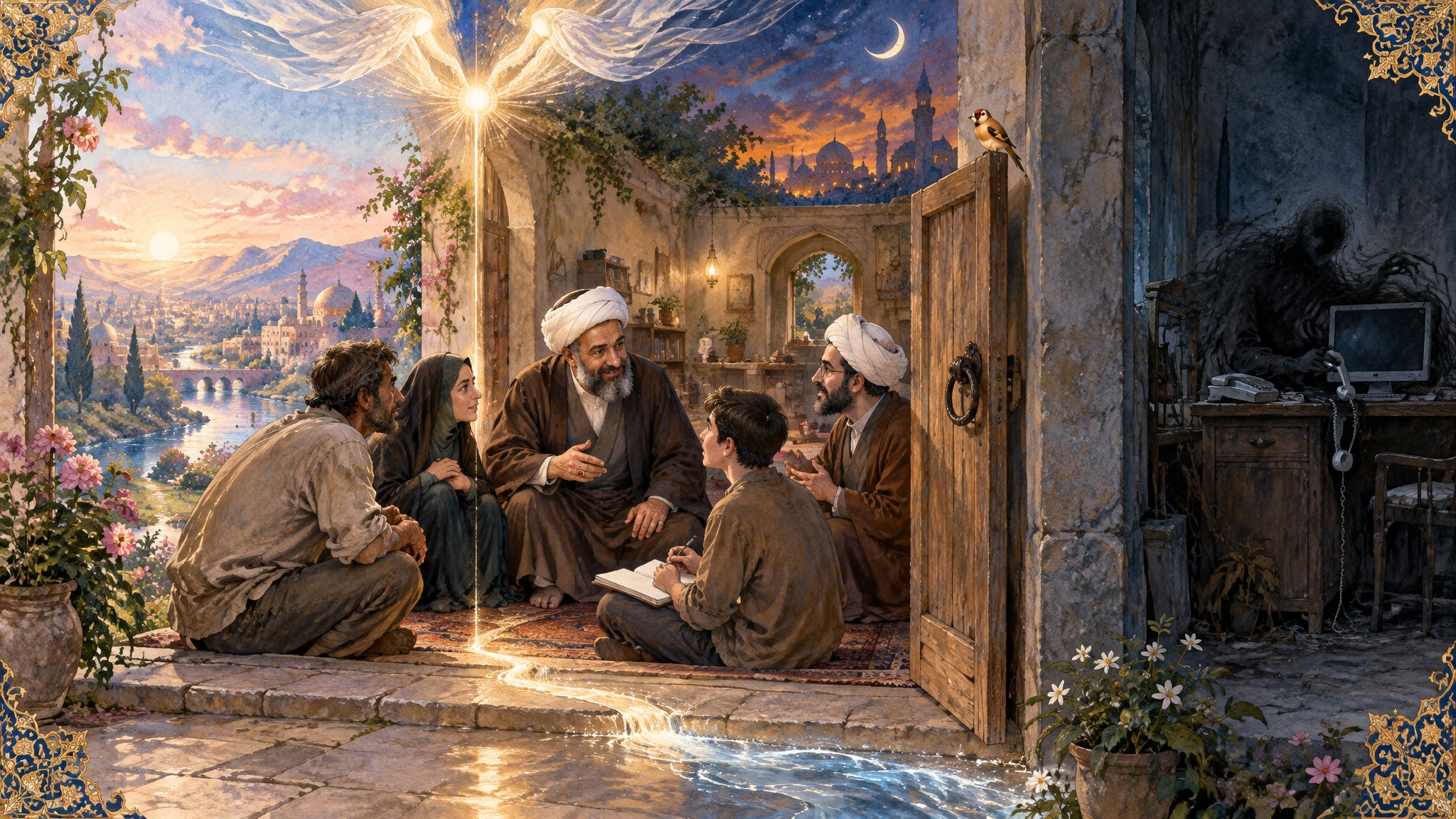
Our classical commentator Ibn Maytham noticed it too.
He explains
both ends of the day with two words: the morning and the evening.
They are the very words of the verse we opened with.
Those who call on their Lord morning and evening.
The Qur’an and the Imam meet, in a single line of a commentator.
And then he does something beautiful with the three duties.
Give the ruling.
Teach.
Converse.
Why these three?
Because, he says, there are only so many kinds of people who come to the door.
People are either learned, or not.
The one who is not learned either follows, he simply wants to know what to do, or he wants to learn, he is a student.
And the learned one is either the scholar himself, or someone else like him.
So the one who follows needs a ruling:
give him the ruling.
The one who wants to learn needs teaching:
teach him.
And the learned man needs another learned man to talk things through with:
converse with him.
Three duties, because there are three kinds of people at the door.
And then he comes to
no gatekeeper but your face.
Why does Imam Ali forbid the gatekeeper?
Ibn Maytham says:
Because the gatekeeper is where arrogance lives.
And where ignorance lives, ignorance of what people are going through, which the one in charge must know as fully as he can.
— Kamal al-Din Maytham ibn 'Ali ibn Maytham al-Bahrani, Sharh Nahj al-Balagha, on Letter 67 (his Letter 66)10
We do not have many gatekeepers with spears any more.
But we have others.
The phone that is never answered.
The message left on read for a week.
Appointments only.
Email the office.
Every one of them is a gatekeeper.
And every one of them, Ibn Maytham would say, is a little place where arrogance can live, and where a scholar stops knowing what his people are going through.
The One Who Rarely Comes
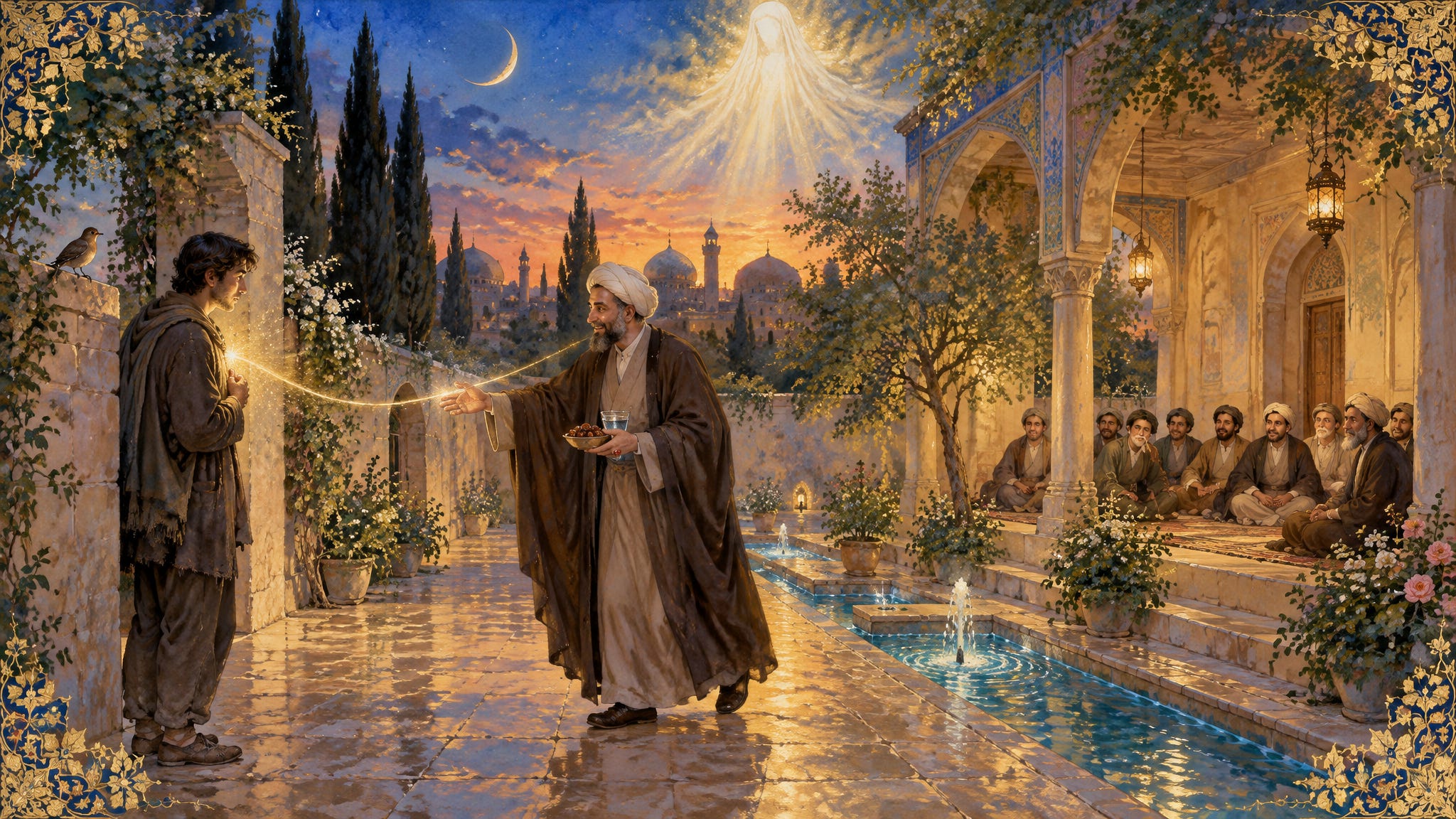
A commentator from our own time, Sayyed ‘Abbas ‘Ali al-Musawi, read the same letter and found someone else in the room.
He says Imam Ali divided the sitting into parts.
One part for those who want to know the rulings of their religion.
And another part, he says,
for teaching the people who are not bound to Islam by a strong bond:
to teach them the religion, its rulings and its meanings.
A whole share of the scholar’s day belongs to the ones whose connection is weak.
The ones who rarely come.
And on the line never bar anyone in need, he says:
if someone comes to you with a need, receive him directly.
Do not push him away.
Do not delay it.
Because the sweetness of meeting a need, and its reward, lies in meeting it quickly; and if you delay it, its sweetness is lost.
— Sayyed 'Abbas 'Ali al-Musawi, Sharh Nahj al-Balagha, volume 5, on Letter 6711
The Ordinary Work
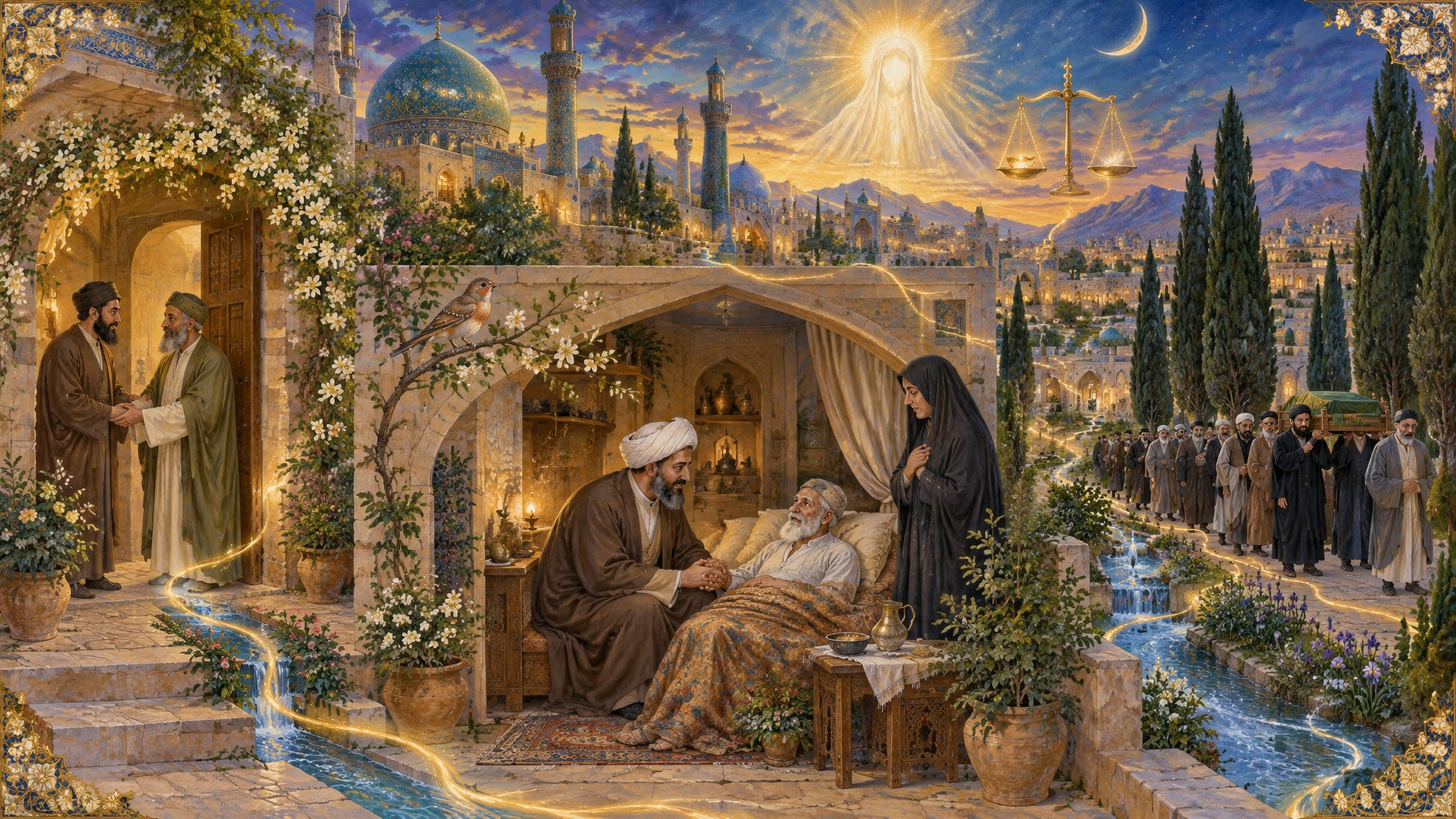
So what does that sitting look like on an ordinary Tuesday?
Imam al-Sadiq, peace and blessings be upon him, gave the answer, and it is in al-Kafi, our great early collection of hadith.
Not in a chapter about scholars.
In the chapter about how believers live together.
لِلْمُسْلِمِ عَلَى أَخِيهِ الْمُسْلِمِ مِنَ الْحَقِّ أَنْ يُسَلِّمَ عَلَيْهِ إِذَا لَقِيَهُ وَيَعُودَهُ إِذَا مَرِضَ وَيَنْصَحَ لَهُ إِذَا غَابَ وَيُسَمِّتَهُ إِذَا عَطَسَ وَيُجِيبَهُ إِذَا دَعَاهُ وَيَتْبَعَهُ إِذَا مَاتَ.
“Of the right a Muslim has over his brother Muslim: that he greets him when he meets him, visits him when he is ill, is true to him when he is absent, blesses him when he sneezes, answers him when he invites him, and follows his bier when he dies.”
— Imam Ja’far al-Sadiq, peace and blessings be upon him, in al-Kulayni, al-Kafi, volume 2, hadith 610; my translation
These are rights every Muslim owes every Muslim.
But read them again as if they were a scholar’s diary for the week.
Greet him when you meet him:
the greeting at the door of the mosque, the hand held out first.
Visit him when he is ill:
the hospital ward on a Tuesday afternoon.
Be true to him when he is absent:
the man spoken about behind his back, and the scholar who defends him when he is not there to defend himself.
Answer him when he invites you:
the wedding.
Follow his bier when he dies:
the funeral.
That is the ordinary work.
The marriage he conducts, the funeral prayer he leads, the quarrel at the door he settles quietly, before it reaches a lawyer.
Some people speak of this as if it were the lesser work of a lesser scholar, the one who did not become a great mujtahid.
It is not.
He is the scholar most people will ever meet.
And these are the rights of believers, done first, and done always.
Last week, at the very end of the night, you heard al-Shahid al-Thani say it in one sentence: just as the teacher teaches people what their religion needs for their dealings with God, he teaches them what their world needs for their dealings with people.
Tonight is the second half of that sentence.
— al-Shahid al-Thani, Munyat al-Murid fi Adab al-Mufid wa al-Mustafid, in Mawsu'at al-Shahid al-Thani, volume 112
Who Sends Him
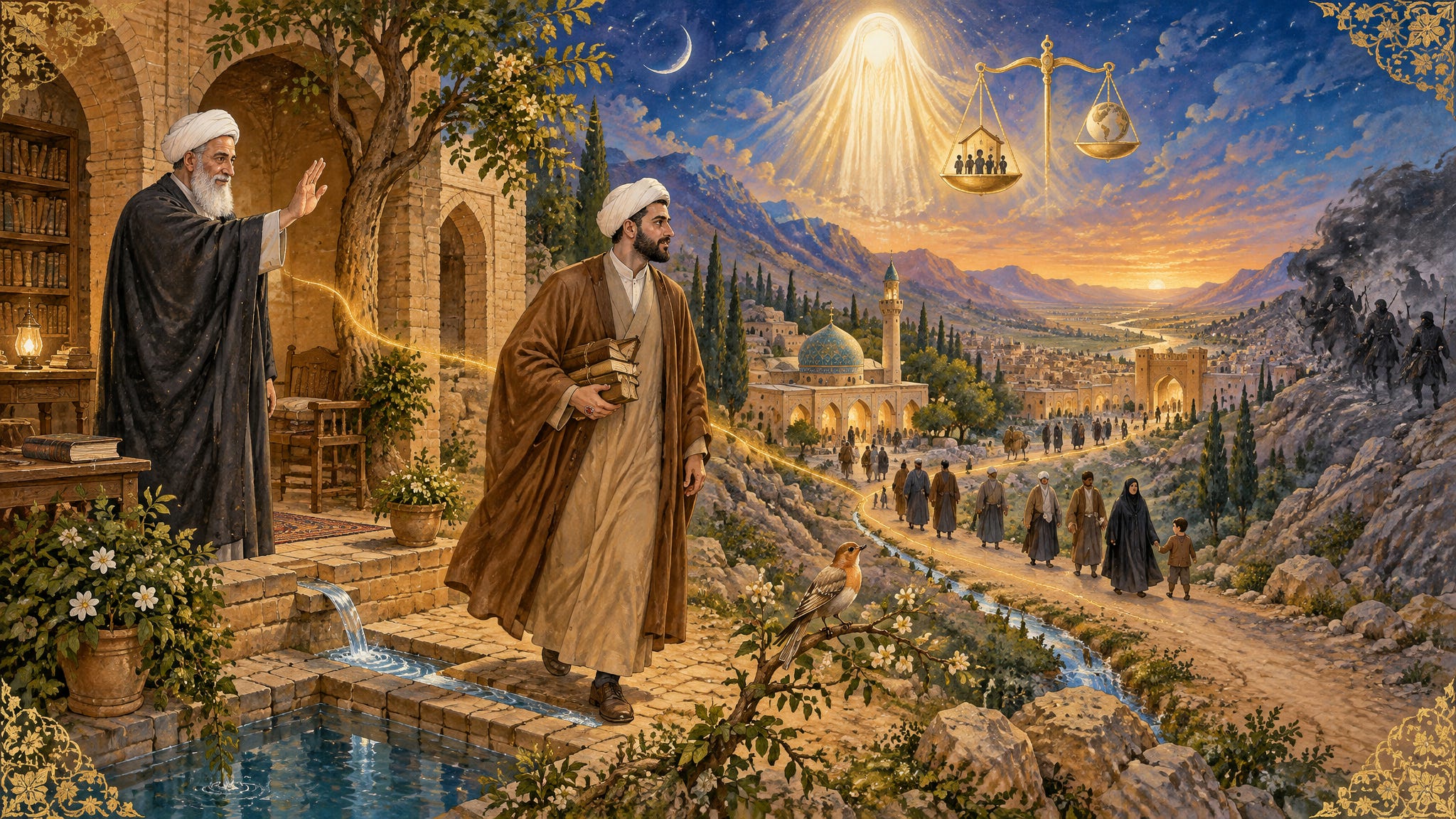
But someone has to send him.
Ayatullah Bahjat used to tell his students about the great Mirza Shirazi, the marja’ of his whole age, in Samarra.
When the Mirza saw that a student was not suited to ijtihad, that he was never going to become a great jurist, then once that student had learned the basics and the practical rulings, the Mirza sent him home: back to his own town, to guide the people, to teach them the rulings, and to correct their prayer.
And then Ayatullah Bahjat asks a question that should stay with every one of us.
To whom have the orphans of the family of Muhammad been entrusted?
The orphans of the family of Muhammad are the believers who live in the absence of their Imam, with no one to reach.
Who is teaching them?
Who is correcting their prayer?
And he tells of a scholar in Qom who led the prayer in a small neighbourhood mosque and taught the people their rulings.
That scholar said:
from the people of the neighbourhood, not a penny ever came to me.
But whenever I went to that mosque, provision came to me from somewhere else.
And whenever I stopped going, it stopped.
— Dar Mahzar-e Ayatullah al-'Uzma Bahjat, §56913
And the same Mirza Shirazi made another sending.
There is a town called Kangavar, in what is today the province of Kermanshah, in western Iran.
It sat on the old road the pilgrims took on their way to the shrines in Iraq.
And that road was dangerous.
Highwaymen.
So Mirza Shirazi asked a scholar, Mulla Muhammad Baqir ‘Iraqi, to go and settle there.
To teach the people, and to make the road safe for the pilgrims.
And he went.
And after he settled there, the teachings of the Ahl al-Bayt, the Prophet's household, were taught, the road became safe, and most of the people of that region came to the school of the Ahl al-Bayt.
The Mirza asked.
The scholar went.
And God opened the hearts.
— Ayatullah Shaykh Mohsen Araki, Dar Maktab-e Pedar14
Think about that.
The greatest marja’ of his age measured his school not only by the mujtahids it produced, but by where its students went home to.
Bread and Yoghurt
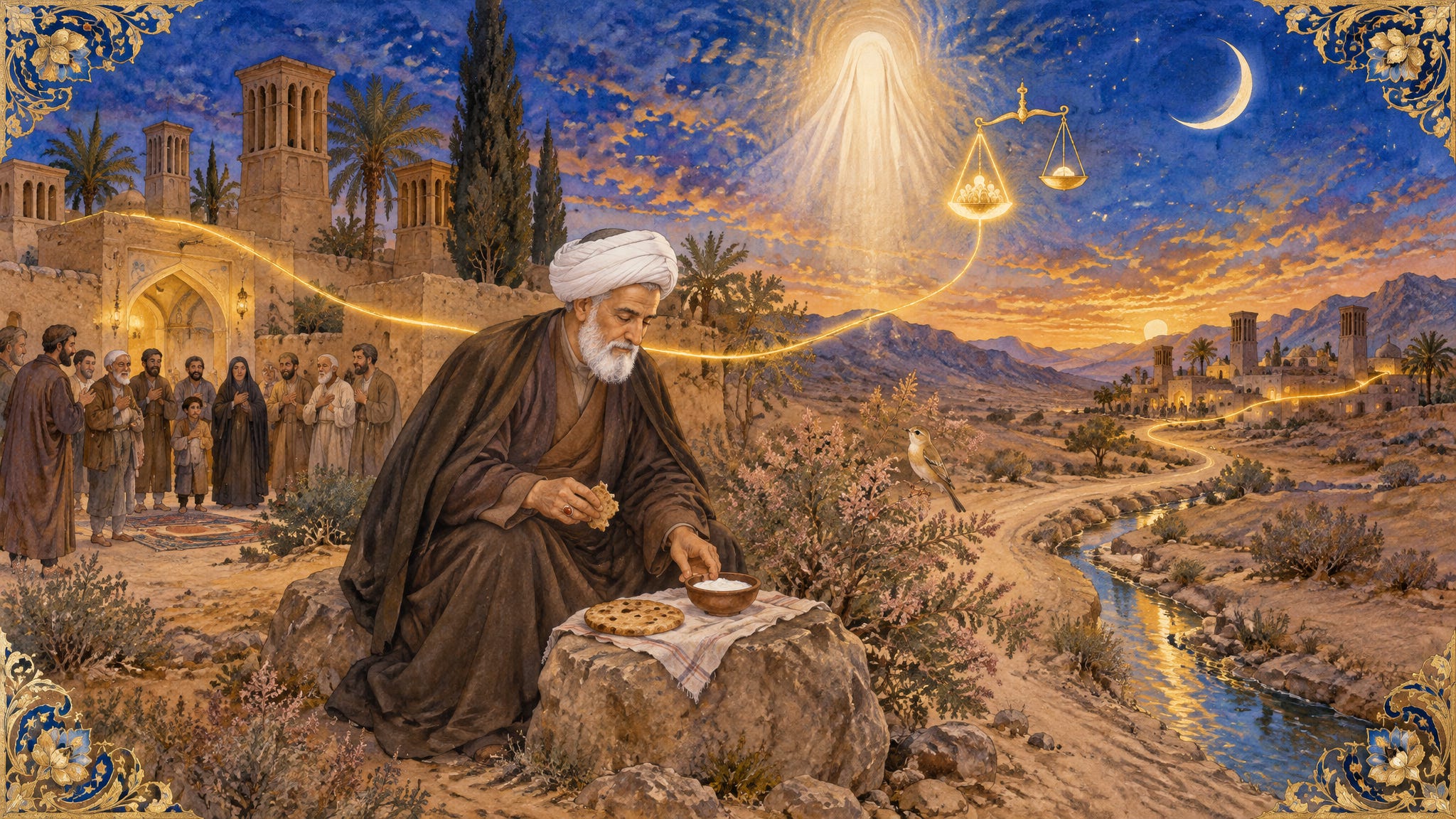
And how does he go?
Ayatullah Bahjat tells of a scholar of Yazd, the old desert city in the centre of Iran, called Shaykh Gholamreza Yazdi.
A real scholar, and a great one.
Ayatullah Hajj Aqa Husayn Qummi once said that there were only two men whose minbar was really worth sitting under, and Shaykh Gholamreza was one of them.
Ayatullah Bahjat said:
I saw one of his minbars myself.
In the town, Shaykh Gholamreza lived comfortably.
He was not a poor man.
But whenever he went out to the villages, he took barley bread and yoghurt with him.
And in every village he reached, he taught the people how to recite their prayer and the rulings they needed.
And then he went on to the next village.
Always on the move.
And in every village, his food was his own.
He simply kept away from the people’s food.
And Ayatullah Bahjat says:
those who, like the prophets, are given this work, and who do it without expecting anything, and without making anyone feel indebted to them, God knows what stations they have.
And then he says the sentence that takes away every excuse.
If a student is pious, even one who is still reading Mughni, he can do this work.
Mughni is a grammar book.
It is early in the course.
He is saying:
You do not have to be a great scholar to go and teach a village how to pray.
You have to be pious, and you have to go.
— Dar Mahzar-e Bahjat, §567 and §36415
Four Words
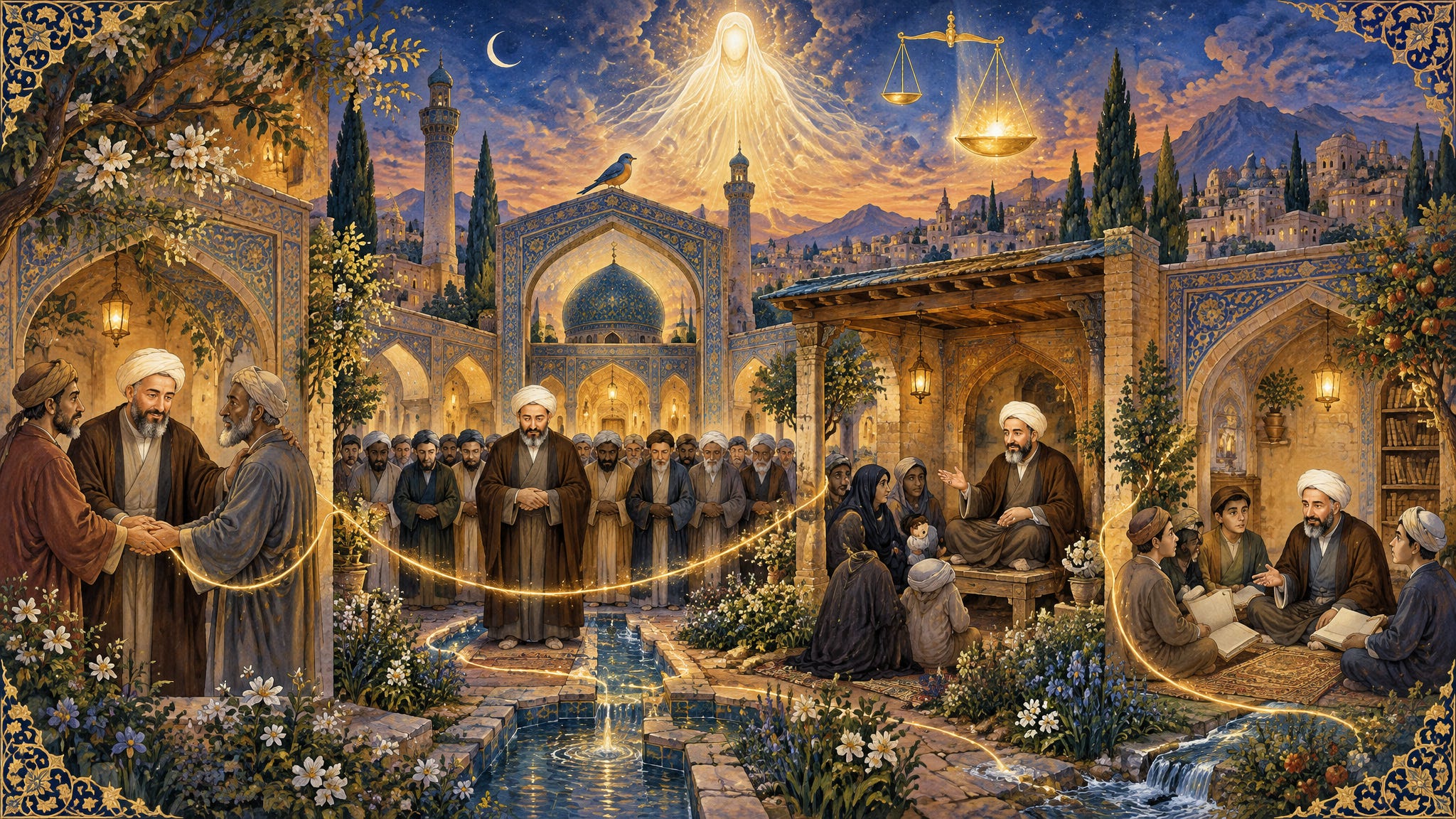
And what does he do when he gets there?
There is an old book of the lives of the scholars, written in Iran in the nineteenth century, and in it there is a description of one scholar’s whole life in four words.
He was one of the finest students of a great teacher, and the book says that, in his lifetime, he busied himself with
disputes, congregational prayer, preaching, and teaching.
Four words.
A whole life.
Settling people’s quarrels.
Leading them in prayer.
Reminding them of God.
Teaching them.
His teacher, Sayyed Ibrahim al-Qazwini, will come back later tonight.
You will see him stand up for a child.
— Mirza Muhammad Tunukabuni, Qisas al-'Ulama' (Arabic translation), on Sayyed Ibrahim al-Musawi al-Qazwini16
Where Others Do Not Go
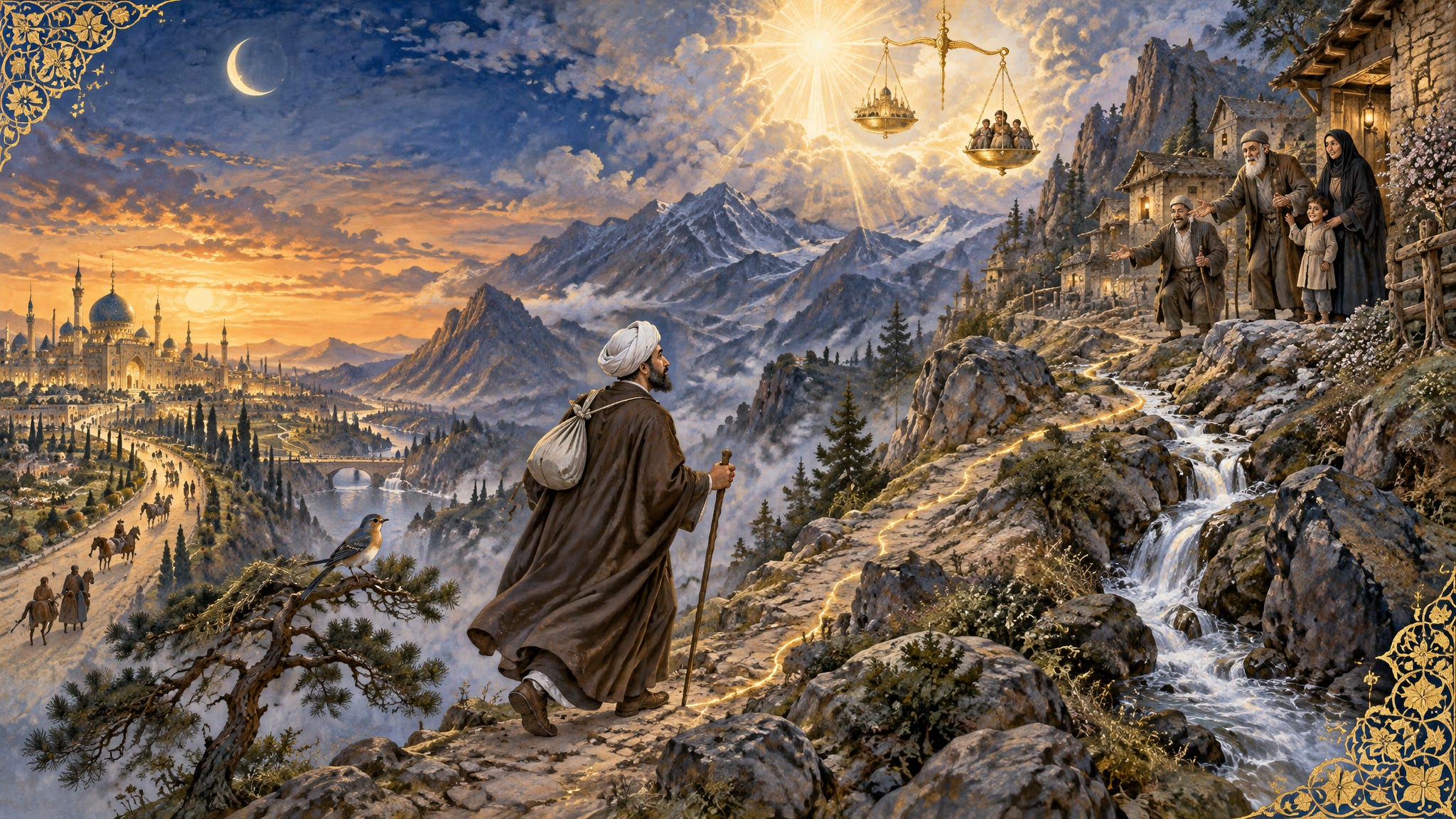
And where must he go?
Ayatullah Bahjat asked it in the plainest way.
The poor.
The deprived.
The ones far away.
The weak.
In the lands of Islam, and in lands that are not Muslim.
People who have no way to reach a scholar, or cannot afford to bring one.
Are they to be ignored?
And then:
if we count them as nothing, will not those above us count us as nothing too?
And then he says it.
Those who go out to preach, and do not count themselves excused from going, must go to the places where others do not go.
And he points back at Shaykh Gholamreza with his bread and yoghurt: a man of that greatness and standing was ready for this work, and that is a proof complete against all of us.
— Dar Mahzar-e Bahjat, §56817
Two Rented Rooms
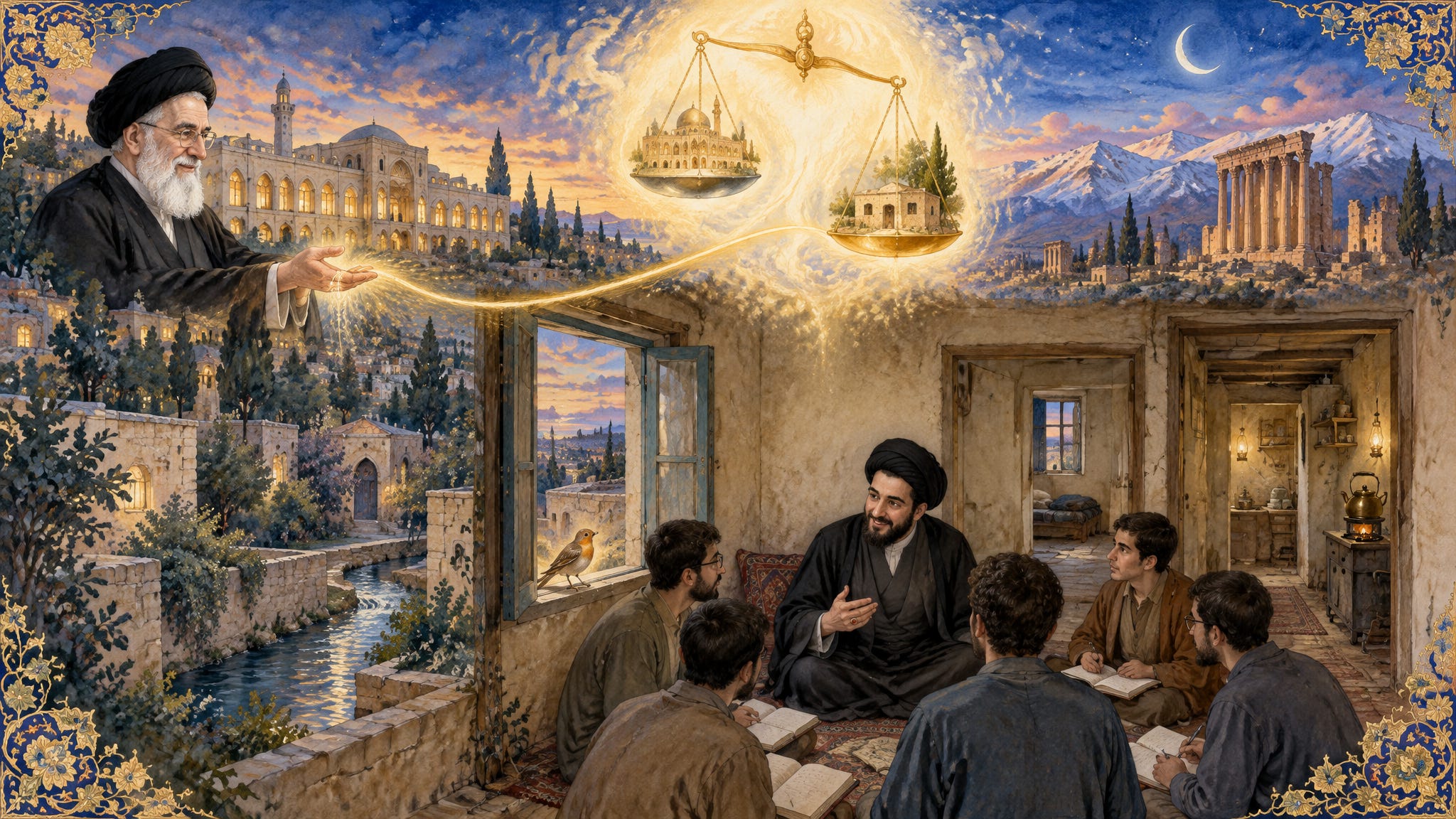
And now let me introduce you to the man who will walk with us tonight.
His name is Sayyed Abbas al-Musawi.
He was from Nabi Shith, a village in the Bekaa, the long valley in the east of Lebanon, between Beirut and the Syrian border.
As a young man he studied in Tyre, in the south of Lebanon, with Imam Musa al-Sadr.
Then he went to Najaf, to the great hawza beside the shrine of Imam Ali, and studied there with the martyr, Ayatullah Sayyed Muhammad Baqir al-Sadr.
Remember his name.
He will be with us all night.
In 1978, he came home from Najaf.
He was in his mid-twenties — Sayyed Hasan, years later, remembered him as about twenty-eight.
His family lived in the southern suburb of Beirut.
He could easily have stayed there, as the imam of a mosque, or of a whole neighbourhood.
And then he was offered something more.
There was a great scholar in that southern suburb of Beirut, Ayatullah Sayyed Muhammad Husayn Fadhlullah.
You will meet him properly later tonight.
Sayyed Fadhlullah already had a hawza of his own in Beirut, a seminary, up and running.
And he offered it to the young man.
Take it over.
Another great scholar of Lebanon, Shaykh Muhammad Mahdi Shams al-Din, made him the same offer.
Think about what that meant.
A building.
A budget.
Salaries.
Teachers.
Students.
Everything ready.
All he had to do was say yes.
He said no.
But he did not go on his own.
He carried an ijaza, a licence, from Shaheed al-Sadr to found a hawza in Baalbek.
His teacher had sent him.
He went to Baalbek, a city in the northern Bekaa, about eighty-five kilometres north-east of Beirut, where there was no hawza at all.
And in February 1978, he founded one from nothing.
Two rented rooms and a bathroom.
There was no kitchen; the corridor was the kitchen.
Four or five students.
And he was the director, and the teacher, and the father of the house.
He would not even settle in his own village, Nabi Shith, as its prayer-leader, though he could have.
His choice was to found a school, because, as one of his first students said years later, he held that
the transformation begins here.
He went where others did not go.
And here is the part of the story I love most.
Sayyed Fadhlullah, whose ready-made school the young man had just turned down, blessed the new hawza.
He supported it.
He gave money.
And, as one of those who was there said years later,
in fairness, for many long years Sayyed Fadhlullah kept giving a monthly sum to this hawza in Baalbek.
The refusal did not cost Sayyed Abbas the friendship of the older scholar.
It won him a patron.
Now, to be precise, because people get this wrong: Sayyed Abbas was not Sayyed Fadhlullah’s student.
He studied at Imam Musa al-Sadr’s institute in Tyre, and then in Najaf, under the supervision of Shaheed al-Sadr.
Sayyed Fadhlullah was the elder scholar who backed a younger man’s choice, even when that choice was to say no to him.
— Sayyed Hasan Nasrallah, speech at the fortieth anniversary of the hawza in Baalbek, 24 February 2018, as published by almaaref.org18
— Sayyed Hasan Nasrallah, interview on al-Manar, as reported by al-Ahed News, 23 February 202219
— Sayyid al-Muqawama (collected authors)20
Not a Corner of Life
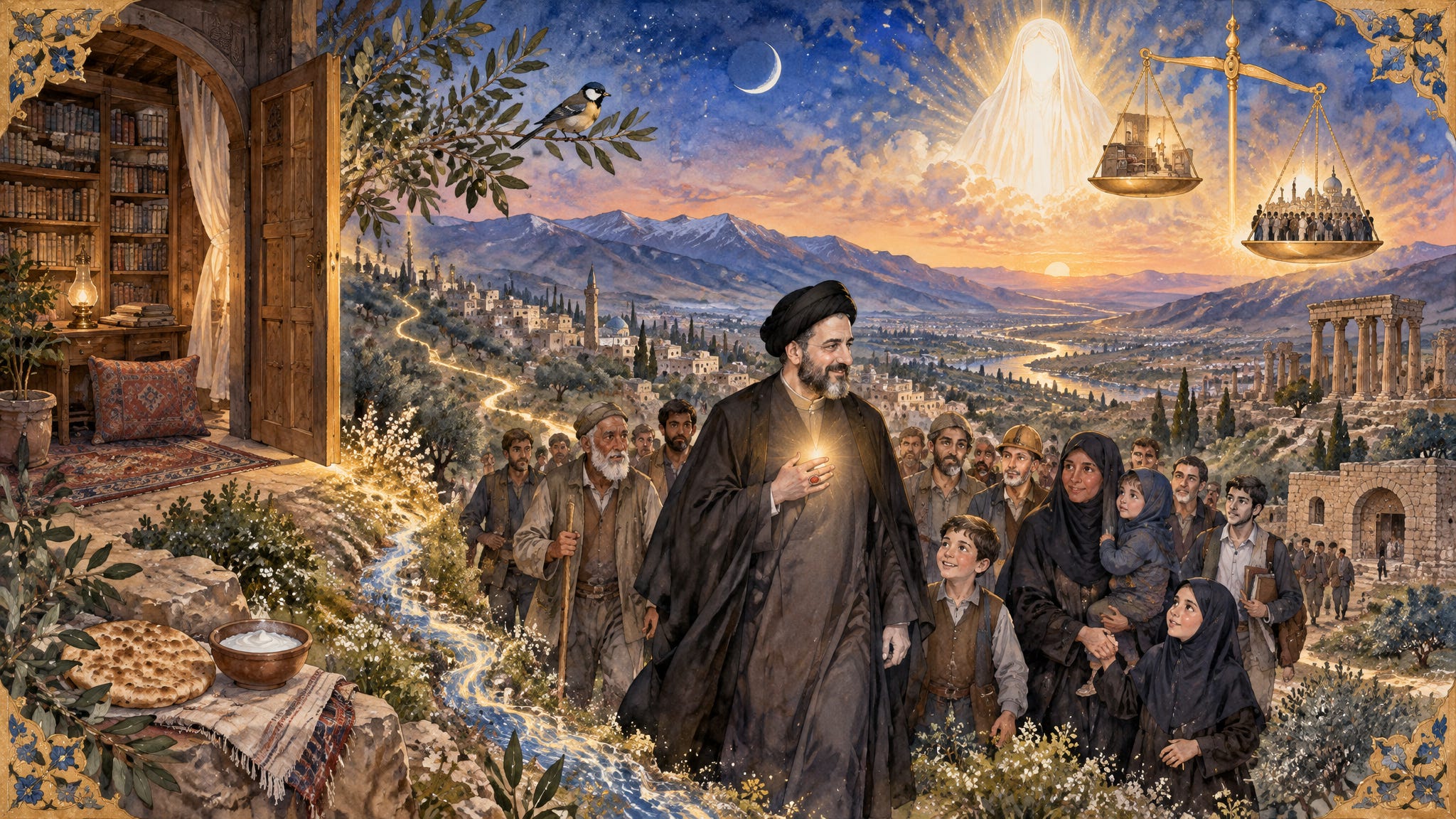
Years later, when Sayyed Abbas was gone, Sayyed Fadhlullah spoke about him.
And what he said is the whole of this first point.
«عاش الله في قلبه فكان إنسان الايمان، وعاشت الرسالة في وجدانه فكان إنسان الاسلام، وعاشت المسؤولية في وعيه فكان إنسان الحركة، وعاشت الامة في كل كيانه فكان إنسان الثورة. عندما انطلق الى رحاب الله ادركت الأمة معنى أن يعيش الانسان لأجلها من خلال ما يعيش الله، لأنّ معنى أن يعيش الانسان الله، لا أن ينعزل في زاوية من الحياة، بل أن يتحمل مسؤولية الحياة، مسؤولية الأمة.
“God lived in his heart, so he was the human being of faith; the Message lived in his conscience, so he was the human being of Islam; responsibility lived in his awareness, so he was the human being of movement; the Umma lived in his whole being, so he was the human being of revolution. When he set out to the presence of God, the Umma understood what it means for a man to live for it through living God; for to live God is not to withdraw into a corner of life, but to carry the responsibility of life, the responsibility of the Umma.”
— Ayatullah Sayyed Muhammad Husayn Fadhlullah, on Sayyed Abbas al-Musawi, in Sayyid al-Muqawama (collected authors); my translation
To live God is not to withdraw into a corner of life.
A scholar can live in a corner.
A comfortable corner, with books, and a ready-made school, and students who come to him.
And he can be a good man in that corner.
But that is not what Imam Ali asked of Qutham.
It is not what Mirza Shirazi asked of his students.
It is not what Shaykh Gholamreza did with his bread and yoghurt.
And it is not what Sayyed Abbas did in Baalbek.
This City
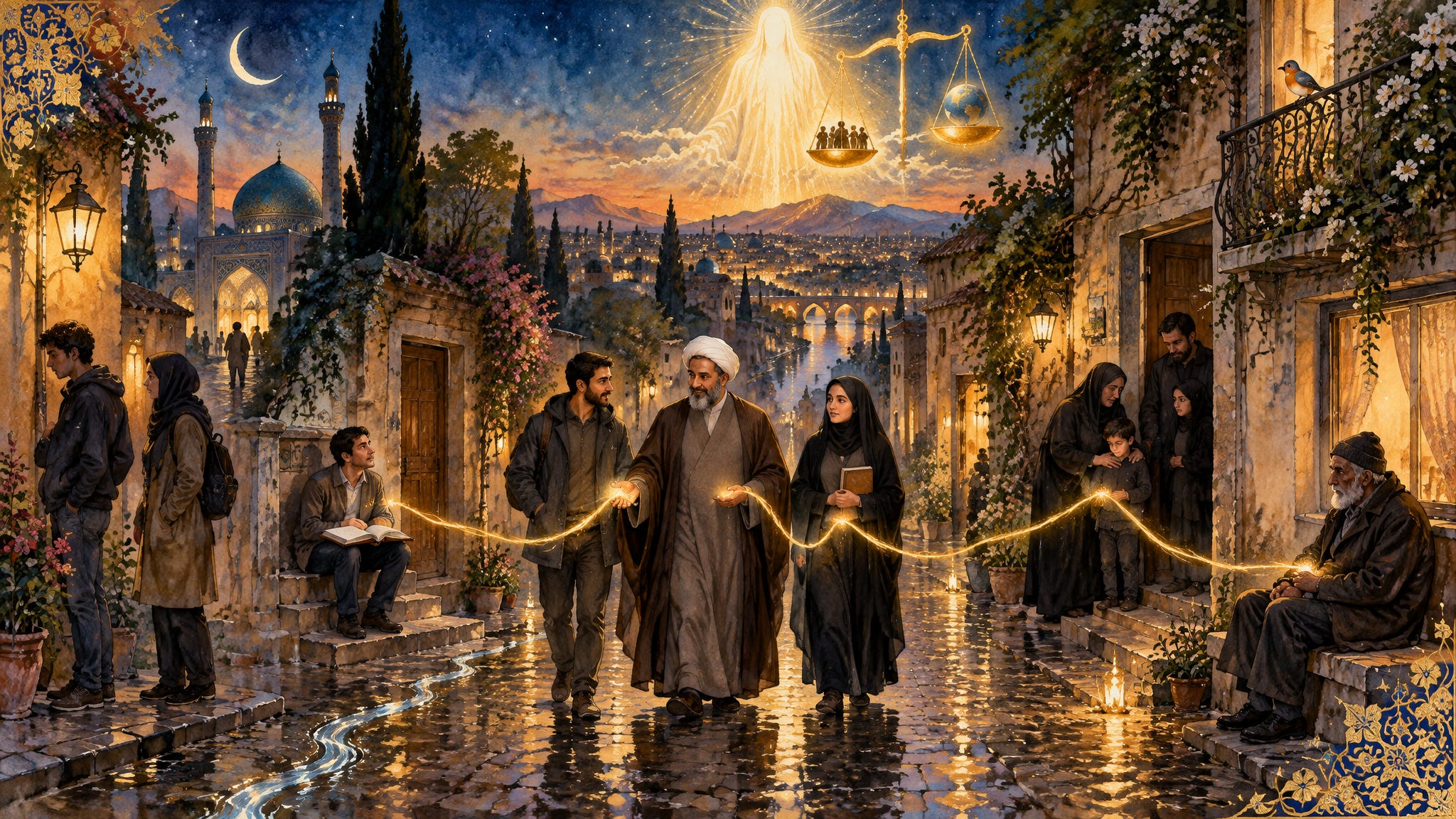
So let me bring it home.
This city is a place others do not go.
Think of the young people who no longer come.
The new believer who has no one to ask.
The family that only ever meets a scholar at a funeral.
The old man who used to come every week, and stopped, and nobody asked why.
Ayatullah Bahjat’s question is our question.
If we count them as nothing, who will count us?
And this is the work of waiting for the Imam of our Age, may our souls be his ransom, and may God hasten his return.
The scholar who goes to the edge, and the believer who carries a burden there, are serving the people of the absent Imam until he returns.
And this is not only the job of the man in the turban.
Anyone who carries any knowledge at all carries this.
We will come back to what that asks of you.
Going is the first step.
Carrying is the second.
Lessons for Our Time
Lesson One — The Ordinary Rights Are the Work
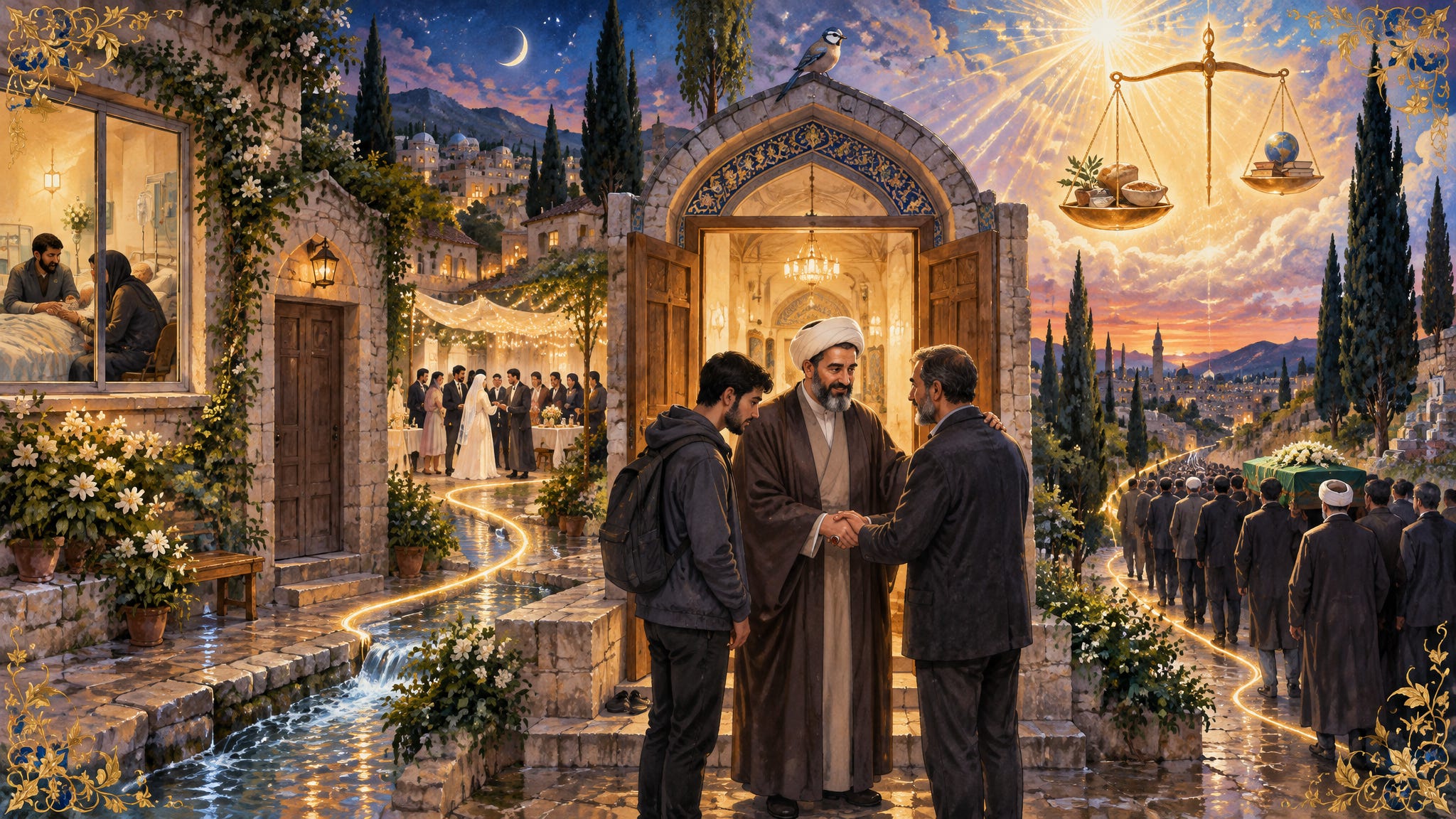
The greeting, the visit to the sick, the word for the one who is absent, the wedding, the bier: these are not the small change of religious life, to be done once the real work is finished.
They are the real work.
And a need met the first time it comes keeps its sweetness.
A need left waiting loses it.
What does that look like for us — here, this week?
If you are the one people come to — the imam, the teacher, the one on the committee, the one the family rings when something goes wrong —
Keep no gatekeeper.
Answer the phone the first time, or ring back the same day.
Do not leave the message on read for a week.
If someone has to go through three people to reach you, you have built a gatekeeper, even if none of them carries a spear.
Go to the hospital yourself.
A card is kind; a face at the bedside is a right.
Go to the funeral of the man who never came to the mosque: his family will remember who stood in the rows.
Go to the wedding of the family nobody knows. And after the majlis, do not slip out through the side door.
Stand at the door of the mosque for ten minutes.
That is where the questions are that nobody asks from the floor.
And when someone brings you a quarrel, settle it quietly, and early, before it reaches a lawyer, or a family group chat.
That is the first of the four words.
It is not beneath you.
And if you are among the people —
Remember where Imam al-Sadiq put these rights.
Not in a chapter about scholars.
In the chapter about how believers live together.
They are on all of us.
Visit the neighbour in hospital.
Follow the bier, even of someone you hardly knew: the rows behind a stranger’s coffin are part of his honour.
Be true to the brother who is spoken about when he is not in the room.
Answer the invitation, even when you are tired.
And when you need the scholar, come.
Do not be too shy to knock, and do not wait until the need has grown into a crisis.
The sweetness is in the first time.
That is all the first lesson asks.
The ordinary rights, done first, and done always.
Lesson Two — Go Where Others Do Not Go
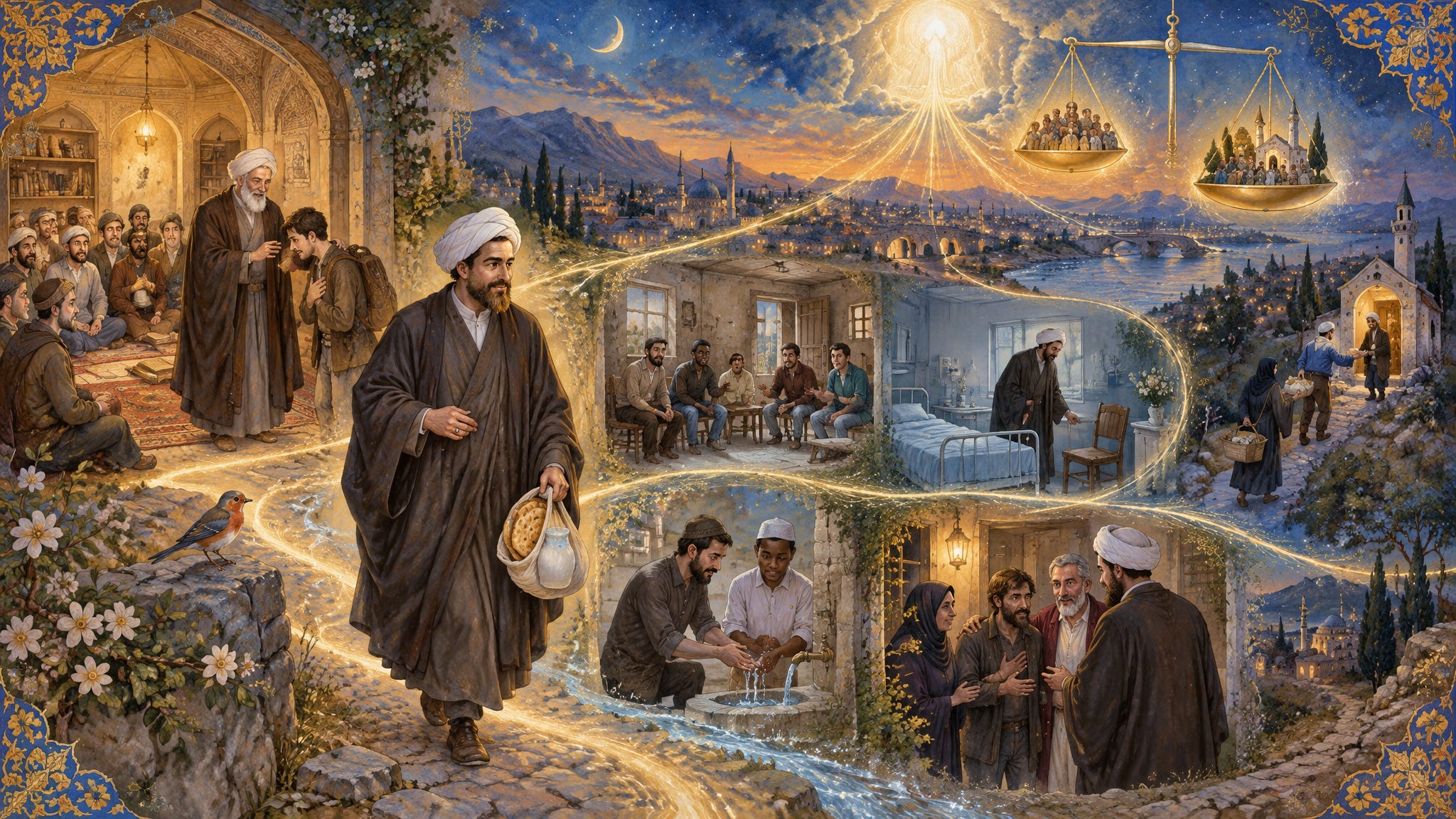
The one at the edge of the community is the first one we owe.
If we count them as nothing, who will count us?
If you are the one people come to —
Look at who is not in the room: the ones we named a moment ago.
A whole share of the day, the commentator said, belongs to the ones whose bond is weak.
Give it to them on purpose, not only when they happen to turn up.
So go to them.
Shaykh Gholamreza took his own bread and yoghurt and would not eat the people’s food.
Take whatever is your bread and yoghurt, your own petrol, your own time, and go: to the town with no class, to the hospital ward no one visits, to the students’ society that has never had a scholar walk in.
And go without making anyone feel that they owe you.
And send. Mirza Shirazi measured his school by where its students went home to.
If you run a class, do not only ask
how many came this year?
Ask where did they go, and whom are they teaching now?
And if you are among the people —
You do not have to be a great scholar.
Even one who is still reading Mughni, Ayatullah Bahjat said.
If you know how to pray, someone near you does not.
Sit with the new Muslim at work and show him how to wash for prayer.
If you know the rulings for the funeral and burial, someone near you will need them one day, at two in the morning.
Be the one they can ring.
And look for the one at the edge of your own family.
The cousin who drifted.
The uncle nobody invites.
You may be the only scholar he ever meets.
And when this community sends someone out, to a far town, to a small mosque, to the place nobody else wanted, carry him.
Give to the work.
Ring him.
The scholar in Qom said that whenever he went to that small mosque, his provision came from somewhere.
Let some of it come through you.
That is the second lesson.
Going is the first step.
Here I Am
The Clinic

In the south of Lebanon there is a village called Jibshit, in the district of Nabatieh, about an hour’s drive south of Beirut.
And in Jibshit there was a young scholar called Shaykh Ragheb Harb.
The people of the South still call him by a title:
the Shaykh of the Martyrs.
Tonight I am not going to tell you how he died.
Tonight I want to tell you how he lived.
He wanted to enlarge the mosque of his village, and it became the largest mosque in the history of Jabal ‘Amil, the old name for the Shi’a heartland of South Lebanon, a mosque that would hold about three thousand people.
But there was a problem.
Where the mosque had to grow, there was an old village clinic.
And some people objected: the clinic would have to come down.
And Shaykh Ragheb smiled, the smile people remembered him for, and he said:
Make the house I rent into a clinic.
And he meant it.
He gave up the house he was renting, so the village could have its clinic, and he moved his family into his grandmother’s house.
They lived there for about two years, until he could build a house of his own.
But that is not even the story I want to tell you.
The people who knew him said that he paved the roads of the village with his own hands.
That he helped the believers build their houses.
One of them said:
he did it with us, when the foundations of our house were dug.
And because he did it, others did it.
Unpaid work for each other spread through the village, especially in the hard years of Lebanon’s war, when so many men had no work at all.
And one day, while he was working in one of the neighbourhoods of Jibshit, he was down inside a pit, digging.
He had taken his turban off.
And a woman came along the road, looking for Shaykh Ragheb.
She needed him for something.
And from the bottom of the pit, a labourer called up to her.
Come, go ahead.
Here I am.
She thought he was joking.
How could the Shaykh be a labourer in a ditch?
And the people around had to tell her:
Yes.
This is Shaykh Ragheb.
— Shaykh al-Shuhada' wa-Amir al-Muqawimin (on Shaykh Ragheb Harb)21
Here I am.
The woman went looking for a scholar, and she found a man in a ditch.
That is not where we expect to find him.
It is where he was.
And the book that tells this story sets a verse beside it, from Surah al-Insan.
إِنَّمَا نُطۡعِمُكُمۡ لِوَجۡهِ ٱللَّهِ لَا نُرِيدُ مِنكُمۡ جَزَآءٗ وَلَا شُكُورًا
“[saying,] ‘We feed you only for the sake of God. We desire no reward from you, nor thanks.’”
— Qur’an, Surah al-Insan (the Chapter of Humanity) #76, Verse 9; my translation
You know whose words these are.
Allamah Tabataba’i, in his commentary on this surah, brings the report from Imam al-Sadiq, peace and blessings be upon him.
Sayyedah Fatimah had a little barley, and the family made it into a porridge.
When it was ready, and they set it before them, a poor man came to the door.
Imam Ali stood and gave him a third.
Then an orphan came, and he gave him a third.
Then a captive came, and he gave him the last third.
And they did not taste it.
So God revealed the verses about them.
And then Imam al-Sadiq says the words that bring this verse into a ditch in Jibshit:
and they apply to every believer who does that, for the sake of God.
— Allamah Tabataba'i, al-Mizan fi Tafsir al-Qur'an, on Surah al-Insan, Verses 1–22, citing Tafsir al-Qummi22
We desire no reward from you, nor thanks.
Not even thanks.
He gave away his house and dug other people’s foundations, and he did not want anyone to say thank you.
The Cords of His Heart
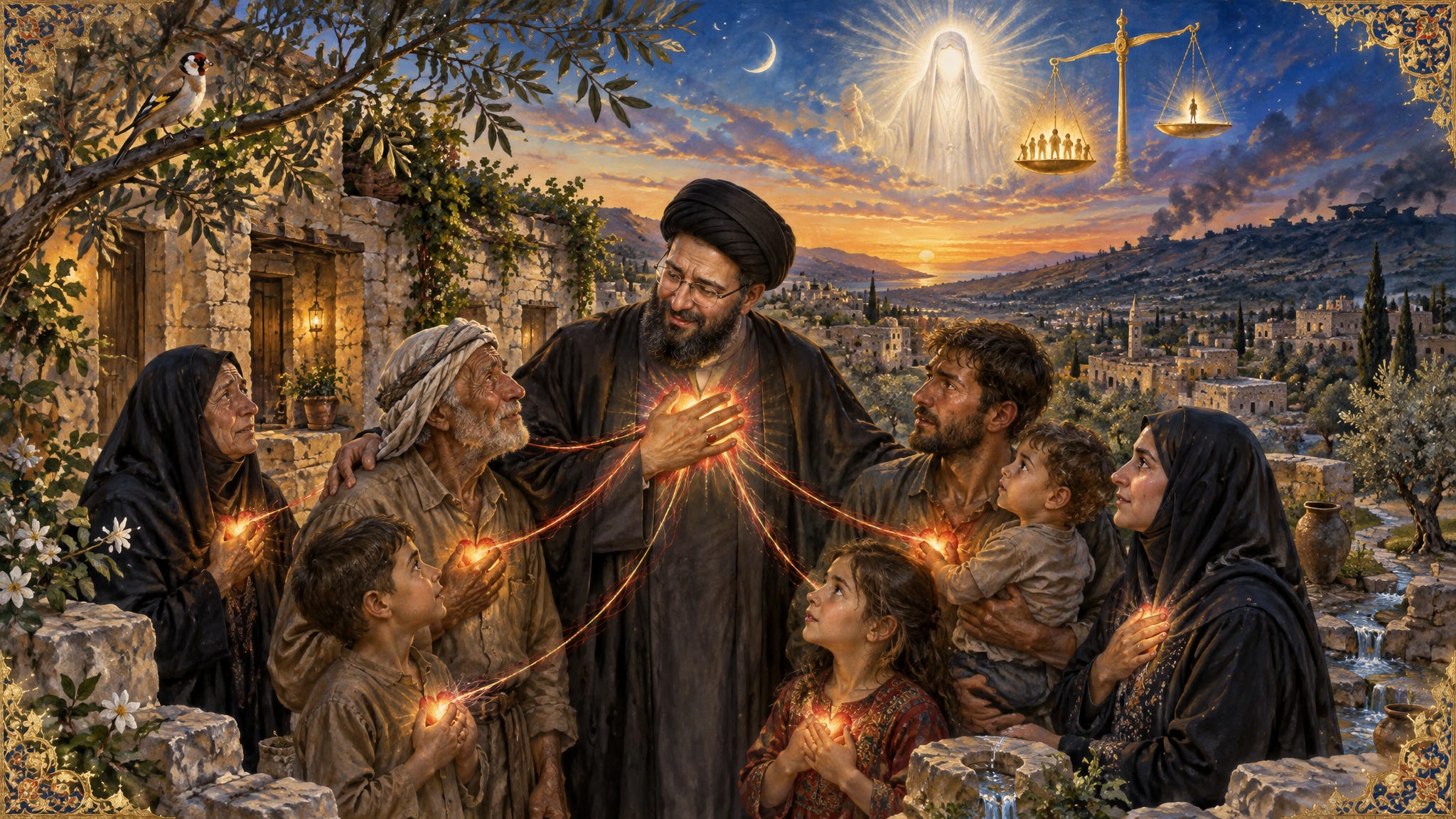
And the man we met in Point One, Sayyed Abbas, felt the South in the same way.
Before the 1982 invasion of Lebanon, he went down to the South for the first time, and came to know the people of its villages.
And those who wrote about him said this:
The pains of the southerners tore at the cords of his heart, as though he were living them himself, and suffering what they suffered.
And they said:
that visit of his was not to satisfy a curiosity, to see some village he had never seen.
And it was not for any one thing.
It took in everything.
— Sayyid al-Muqawama (collected authors; documented by Muhammad Husayn Bazzi)23
That is the difference between going and carrying.
Going is a visit.
Carrying is when their pain becomes yours.
The Shelter of the Weak
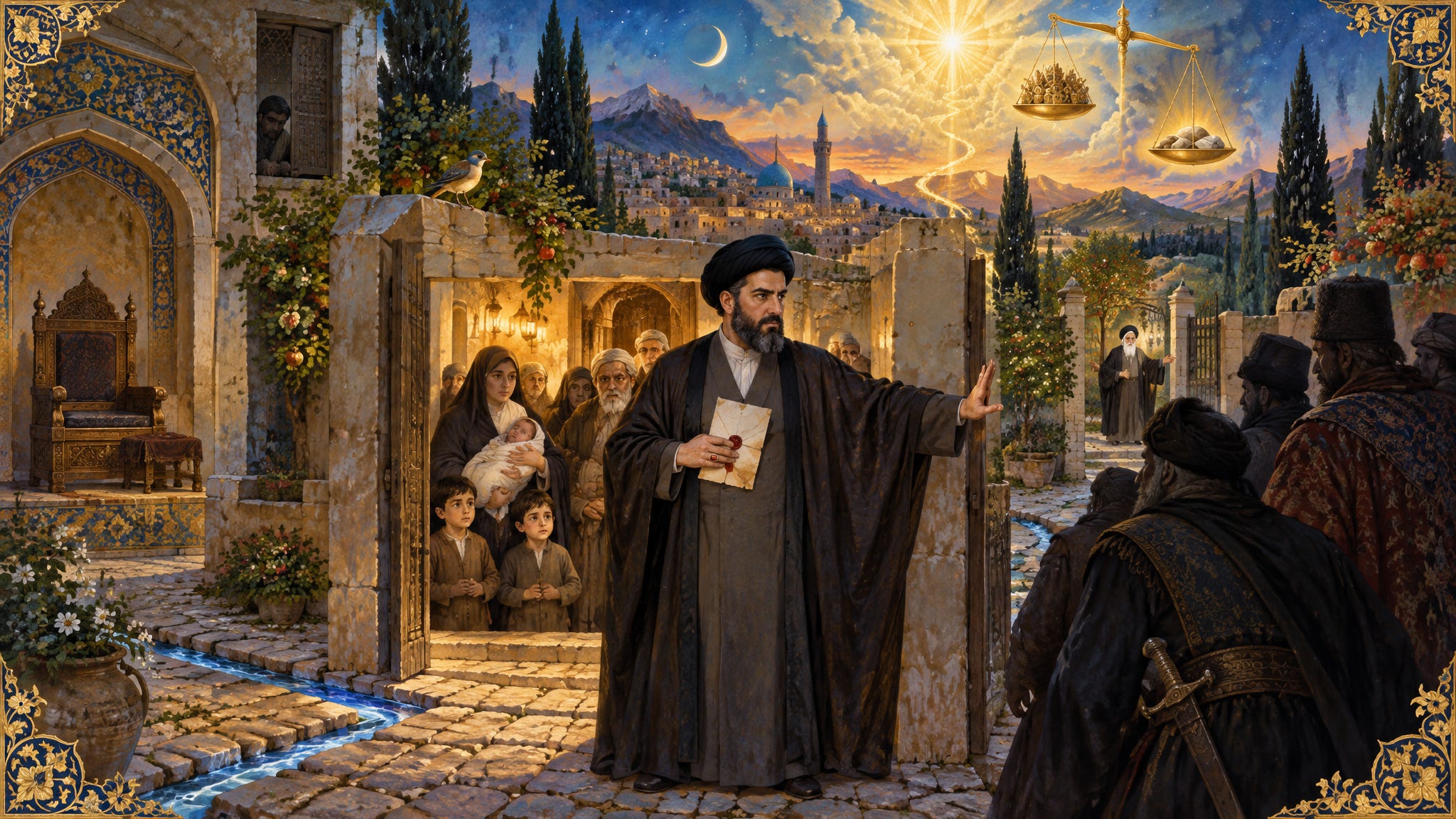
Now let me take you a century back, and a long way east, to a small town in Iran called Khomein, in what is today the province of Markazi, in the middle of the country.
In Khomein there lived a sayyed and a scholar called Sayyed Mustafa.
And he is the father of Imam Khomeini.
His son, Imam Khomeini’s elder brother, who lived to become a great ayatullah himself, Ayatullah Pasandideh, wrote down what he remembered.
He says that in those years his father was very influential.
He had servants, and armed men, and estates.
And he used all of it to attend to the people’s affairs.
But listen to what he did not do.
He did not sit as a judge in the formal religious courts.
He left that to another scholar of the town, out of caution.
He was afraid of getting a judgement wrong.
And when people gave him the title Imam Jum’a, the imam of the Friday prayer, the official title, he refused it.
— Ayatullah Sayyed Morteza Pasandideh, Khaterat (Memoirs)24
Influence, used for people.
Titles, refused.
But the khans, the local lords, were bullying the town.
And his son says something remarkable about that.
They had one rival.
And that was our father.
The khans wanted him gone.
And they knew that if he were removed, no one would stand against them.
His sons were children; the youngest, Ruhullah, the future Imam, was a baby of three or four months.
And the other scholars of the town, his son says, were cautious.
They kept their heads down.
They would not oppose the khans.
And let us be fair to them too.
The memoir tells us what Sayyed Mustafa had: servants, and armed men, and estates.
It does not tell us that every other scholar had that shield.
Fear under men like the khans is not a small thing.
We do not sit here, a century later, and sneer at people who were afraid.
So, apart from him, no one would act.
And with him gone, they could trample the people’s rights.
— Ayatullah Sayyed Morteza Pasandideh, Khaterat (Memoirs)25
And one day the people came to him in secret, with their complaints against the governor and against Heshmat al-Dowleh, the strongman of the region.
He could not stop them himself.
So he did what he could.
He wrote a letter of complaint, and sent it by post to the prime minister in the capital.
He did not know that the post, and the postmaster, were under Heshmat al-Dowleh’s control.
The letter was handed straight to him.
A few days later, officers came to Sayyed Mustafa’s door, claiming the prime minister had ordered his arrest.
They took him, and held him prisoner in the great Heshmatiyyeh garden, until an old and respected sayyed of the region talked Heshmat al-Dowleh round, and he was released, with an apology.
— Ayatullah Sayyed Morteza Pasandideh, Khaterat (Memoirs)26
And he would not stop standing between the khans and the people.
How that story ends belongs to another night.
Influence, used for people.
Titles, refused.
That is what carrying looks like when you have something to carry with.
What It Costs
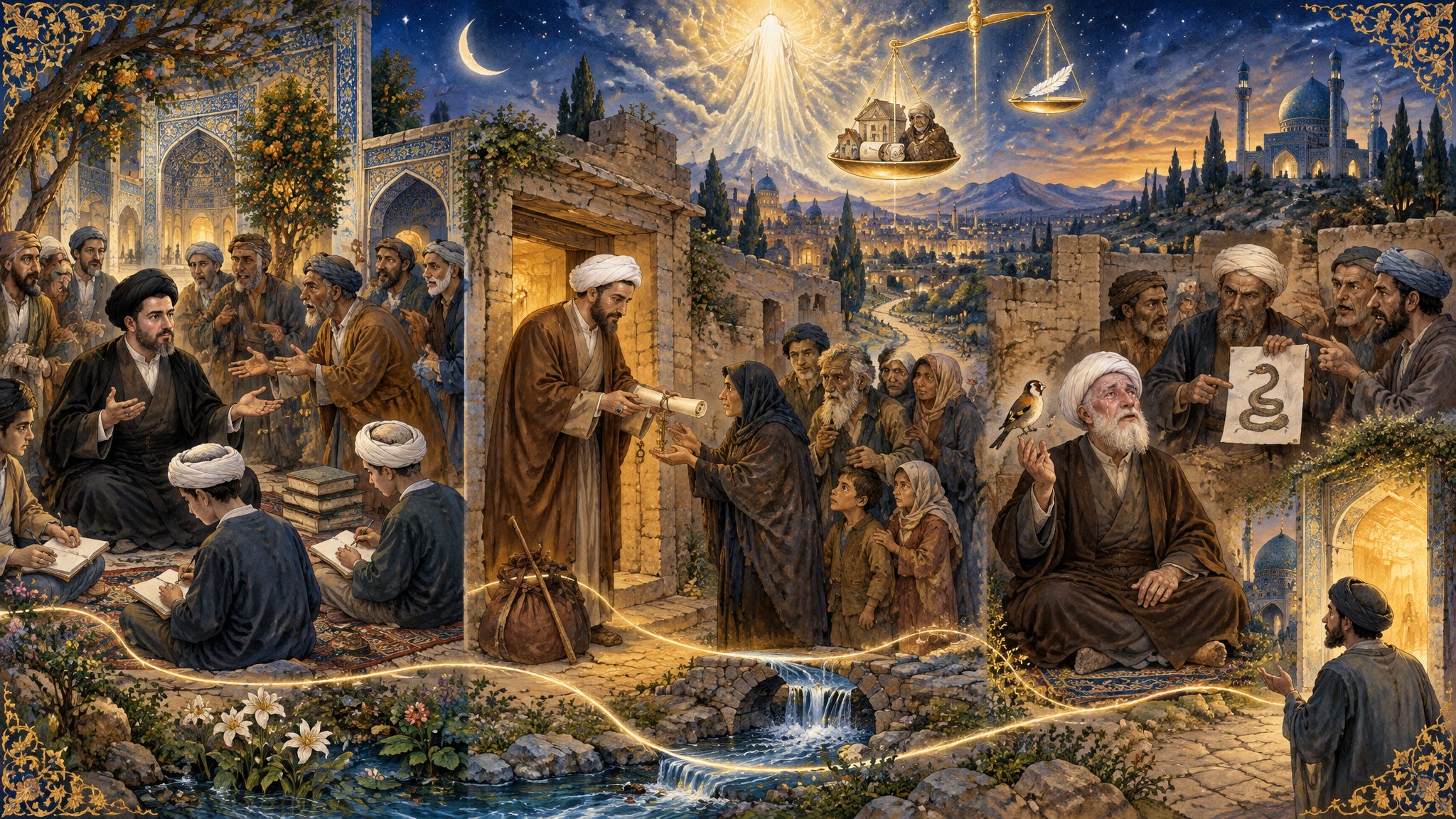
And carrying costs.
Let us say how much, plainly, because we do the scholars no favours by pretending it is easy.
First, his day is not his own.
There was a great scholar of Isfahan, Sayyed Muhammad Baqir Shafti.
His lessons were famous for their precision; crowds came to them.
But he could only teach two or three days a week, and some weeks not at all.
And sometimes the people’s disputes came to him in the middle of the lesson, and the lesson fell apart.
One of his students said:
I copied out the chapters on purity and prayer of the Great Commentary, a book of fiqh, in his lesson: when he was receiving the people with their disputes, we sat there with no lesson, and I copied.
— Tunukabuni, Qisas al-'Ulama' (Arabic translation), on Sayyed Muhammad Baqir Shafti27
Second, his house is not his own.
The great jurist Shaykh Ja’far Kashif al-Ghita’ used to mortgage his own house, most years, and give the money to the poor.
And then he would travel to Iran, raise the money, come back, and redeem his house.
And the next year, he would do it again.
— Qisas al-'Ulama', on Shaykh Ja'far Kashif al-Ghita'28
And third, and this is the hardest: his dignity is not his own.
Mirza al-Qummi was the greatest scholar of the principles of jurisprudence in his age.
His book, al-Qawanin, was studied in every hawza for generations.
And for a time, he lived in a village.
And the people of the village did not know who he was.
The village had its own mulla, and that mulla belittled him.
One day he gathered the villagers, and sent for the Mirza, and said:
ask him to write the word “snake”.
So the Mirza wrote the word.
And then the mulla drew a snake, a picture of one, and asked the villagers:
which of these is the snake?
Mine, or his?
The villagers could not read.
They chose the drawing.
And it got worse.
One day two men came to the Mirza with a dispute for him to judge.
And the dispute was so petty, so small, that I will not even repeat it from this minbar.
When the Mirza saw what he was being asked to judge, the greatest jurist of his age, he wept.
He raised his hand to the sky, and said:
My God, do not be content for me with a humiliation greater than this.
— Qisas al-'Ulama', on Mirza Abu al-Qasim al-Qummi29
I tell you this because it is true.
The role can break even a great man.
And because it is the reason for the third point tonight.
If a drawing of a snake, and a sneer, and a petty quarrel could make the greatest jurist of his age weep, think what a sneer can do to an ordinary person who comes to the mosque with a question.
The Marriage He Could Not Mend
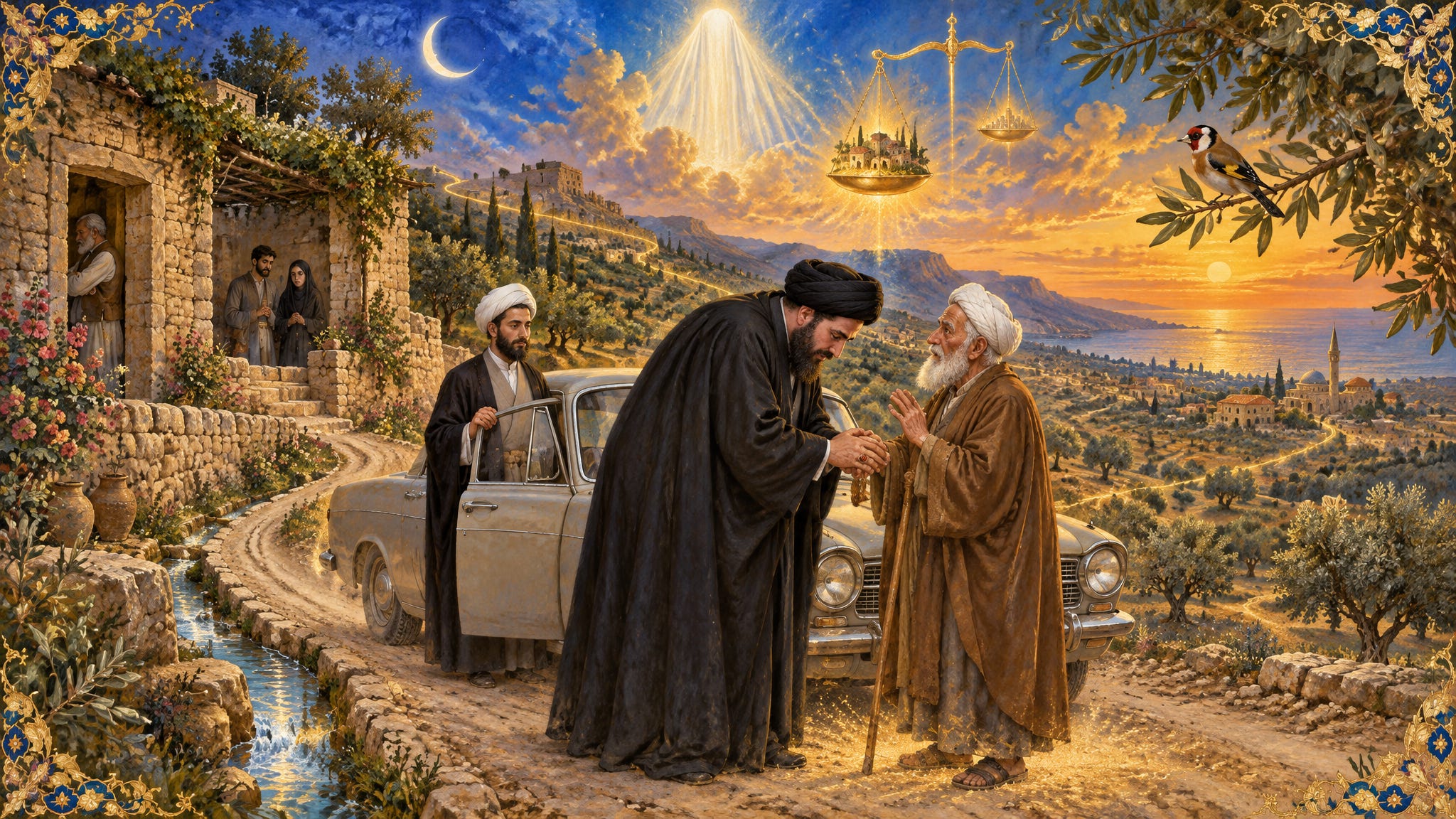
And even the greatest reconciler of his age failed once.
You met Imam Musa al-Sadr in Point One: Sayyed Abbas studied at his institute in Tyre.
A young cleric who was with him that day tells this story, from 1964.
A young couple in a village of the South had married against the will of the bride’s father.
And the father would not accept it.
So the Imam drove out to the village to mend it.
A dirt road.
The car went round the village three times before they found the house.
They arrived at about four in the afternoon.
And the Imam sat with the father for an hour.
Stories.
Verses of the Qur’an.
Narrations from the Ahl al-Bayt.
Everything he had.
And the father said:
order me to slaughter one of my sons, or myself, but excuse me from this.
And the Imam got up, and walked out, angry.
He was a human being.
He had tried, and he had failed, and he was angry.
And then something happened that tells you everything about him.
As they drove on through the village, they saw a venerable scholar of the South walking along the road.
And the Imam stopped the car.
He got out, and went over to shake his hand.
And the scholar asked him:
I hope all is well.
What brings you here?
And Imam Musa al-Sadr, who had just failed, who was still angry, answered him with complete humility:
We came to kiss the ground you walk on.
And the old man said:
I seek God’s forgiveness.
— Shaykh 'Afif al-Naboulsi, Mushahadat wa-Tajarib li-Taqat min Sirat al-Imam al-Sadr30
The famous man, the man the whole of Lebanon knew, had just failed.
And he stopped the car to honour the scholar who lives among them.
The one who stays in the village.
The one who marries and buries, year after year, when the famous people have driven away.
In 1978, Imam Musa al-Sadr was made to disappear in Libya.
His fate is unknown to this day.
May God return him in good health.
— Mawsu'at Qura wa-Mudun Lubnan (the Encyclopedia of the Villages and Towns of Lebanon), volume 18, p. 22, among the notables of Qabrikha, in its notice of Shaykh Mahdi Shams al-Din (1936–2001), who took over the Council's presidency; the words are the book's, a part of one sentence31
— Shaykh 'Afif al-Naboulsi, Mushahadat wa-Tajarib li-Taqat min Sirat al-Imam al-Sadr32
— the Imam Musa al-Sadr Centre for Research and Studies, Khulasat Qadiyyat Ikhfa' al-Imam al-Sayyid Musa al-Sadr wa-Akhawayhi (a summary of the case), dated August 2026, as published at imamsadr.net33
— Sayyed Hasan Nasrallah, speech on the tenth of Muharram 1446 (July 2024), as published by al-Ahed News: a part of one sentence, in which he renews the people's allegiance; the Arabic as saved in our dossier34
Carrying is the second step.
The third is how you treat people while you carry them.
Lessons for Our Time
Lesson Three — Here I Am
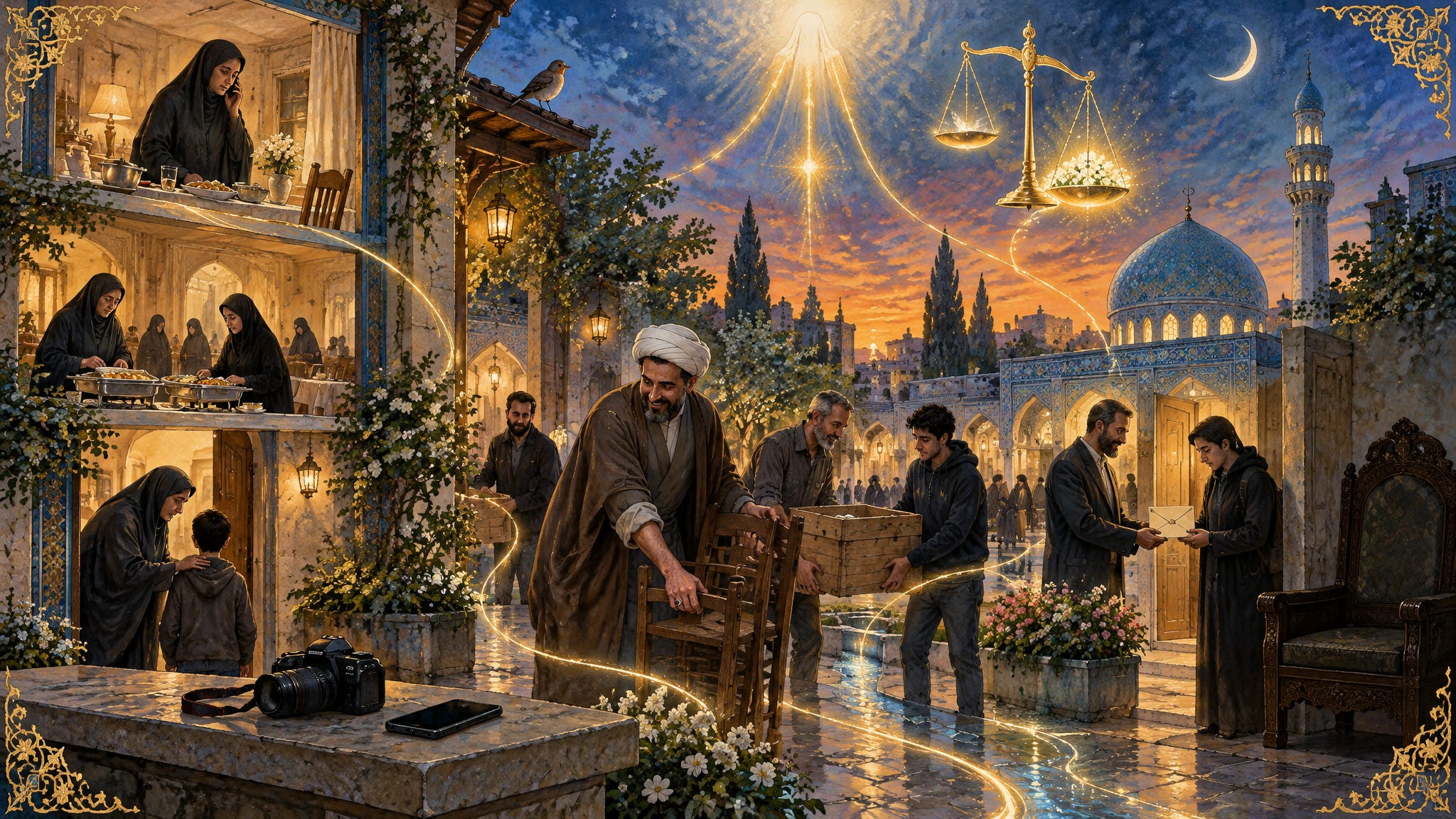
The work no one photographs is still the work.
And often it is the women who carry it.
The wife who lives with the late calls and the interrupted meals.
The sisters who feed the people after the funeral.
The mothers who notice which child has stopped coming.
No camera is on them.
But God is not blind to them.
A scholar at the bottom of a pit, digging, taken for a labourer, said
Here I am.
And the book that tells it set beside him a verse:
we feed you only for the sake of God; we want no reward from you, nor thanks.
If you are the one people come to —
Do some of the work with your own hands.
Put out the chairs.
Carry the coffin.
Help the family move house.
Not for the photograph: there should be no photograph.
When the people see their scholar in the ditch, they learn that the ditch is part of the religion.
And spend your standing.
You have something many of the people do not: a name that opens doors.
A letter from you reaches the council, the school, the hospital, faster than theirs.
Spend it on them, as Sayyed Mustafa spent his influence on the people of Khomein, and not on yourself.
And be careful with titles.
He refused the title of Imam Jum’a, and left the judging to another scholar, out of caution.
Influence is for spending on people, not for wearing.
And if you are among the people —
Here I am is not only the scholar’s word.
When the mosque needs someone to clear up after the majlis, say it.
When the family next door is moving, say it.
When the funeral needs men to dig, say it.
Shaykh Ragheb’s village learned unpaid work for one another from him.
Let your street learn it from you.
And whatever standing you have, at work, at the school gate, in the family, spend some of it on someone who has none.
Write the reference.
Make the phone call.
Introduce the young man who has no one to introduce him.
And do it as the verse says: for the sake of God, wanting no reward, and no thanks.
That is the third lesson.
The work no one photographs.
Lesson Four — The Cost Is Real
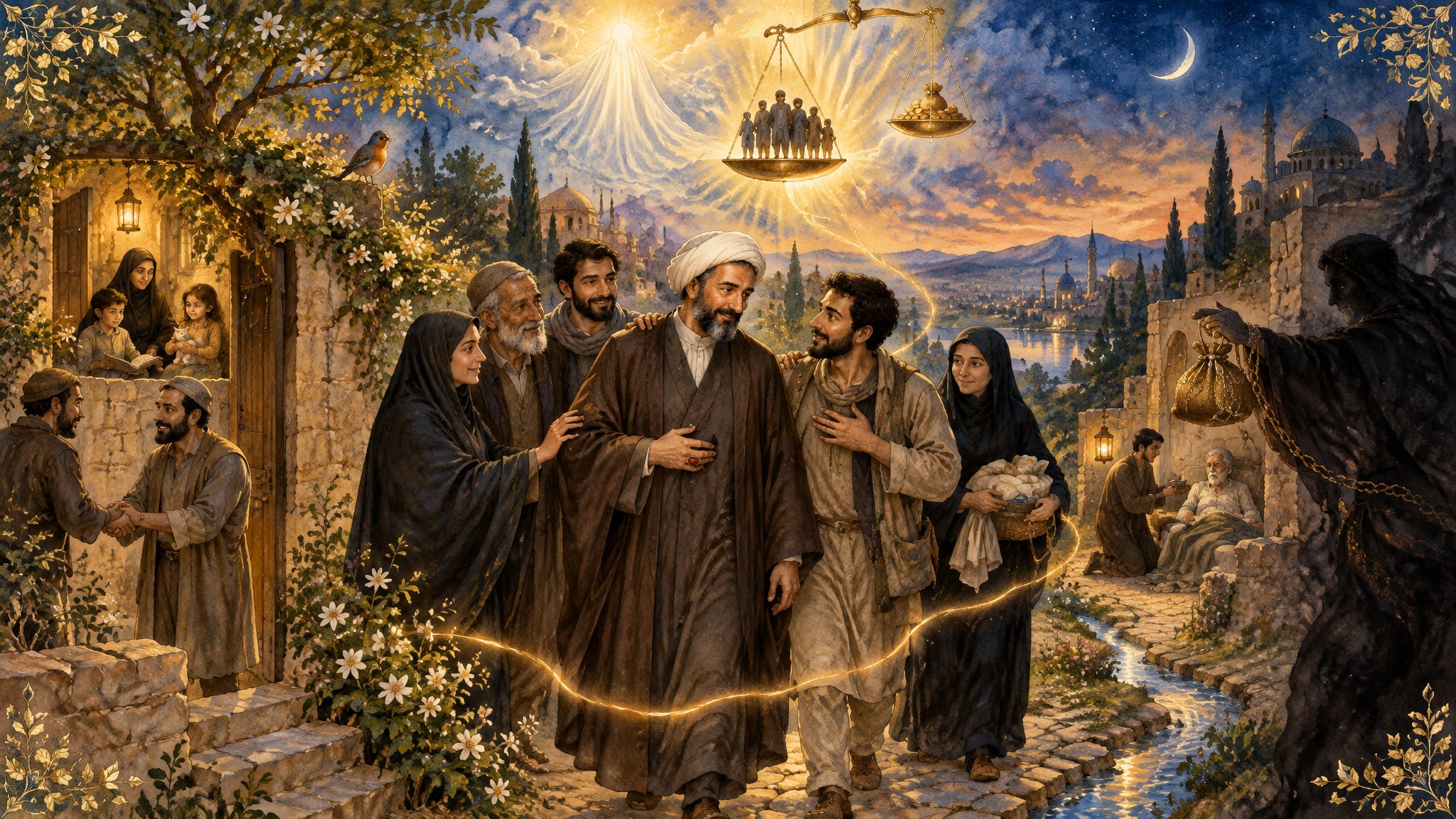
Carrying costs.
His day is not his own.
His house is not his own.
And sometimes his dignity is not his own.
We do the scholars no favours by pretending otherwise, and we do ourselves no favours by leaving them to pay it alone.
If you are the one people come to —
Count the cost before God, not before the people.
Sayyed Shafti’s lessons fell apart because the disputes came in the middle of them, and he still received the disputants.
Shaykh Ja’far mortgaged his house year after year.
That is the price of the office.
Do not complain of it from the minbar.
But do not be ashamed to weep, as Mirza al-Qummi wept.
My God, do not be content for me with a humiliation greater than this.
And learn what he learned: if a sneer could make the greatest jurist of his age weep, the people you serve can be hurt just as easily.
Your patience with them is where the third point begins.
And when you fail, and you will, as Imam Musa al-Sadr failed in that village, stop the car, as he did.
Honour the one who stays.
The man who marries and buries, year after year, is worth more than the famous visit that did not work.
And if you are among the people —
Be patient with the scholar whose day is not his own.
If he is late to your event, he may have been at a hospital bed.
If he has not rung back, three families may have rung first.
Do not make his house your house.
His wife and his children did not take on the office; do not judge them as though they had.
And look after him, so that he never has to mortgage anything.
Thank him to his face.
And the next time a quarrel takes you to his door, ask yourself first: is this worth his tears?
Settle the small things among yourselves, and bring him the things that need him.
And if the scholar near you is not living this way — if his door is closed, if he answers to the wealthy and not to the poor, if he has gone quiet where he should speak — do not walk away from him, and do not only complain about him.
Help him.
Help him stand on his own feet, so that he does not need a few rich donors, or the favour of the powerful, and no one can buy his silence.
Protect him: when he tells the truth and the powerful come for him, he must not be standing alone.
And hold him to the work, kindly and firmly.
Bring him the sick, the absent, the one at the edge, and go with him.
Not as a committee managing an employee.
As believers helping one another.
When we sat with the Student, we heard God say it:
وَتَعَاوَنُواْ عَلَى ٱلۡبِرِّ وَٱلتَّقۡوَىٰۖ وَلَا تَعَاوَنُواْ عَلَى ٱلۡإِثۡمِ وَٱلۡعُدۡوَٰنِۚ
Cooperate in piety and Godwariness, but do not cooperate in sin and aggression.
— Qur’an, Surah al-Ma’idah (the Chapter of the Table Spread) #5, Verse 2; a clause from the middle of the verse; my translation
What keeps a scholar free, and stands beside him while he does his duty, is cooperation in piety.
Leaving him to the ones who would buy him is the other kind.
That is the fourth lesson.
The cost is real.
Carry some of it.
Never Make Them Feel Small
The Ice Cream
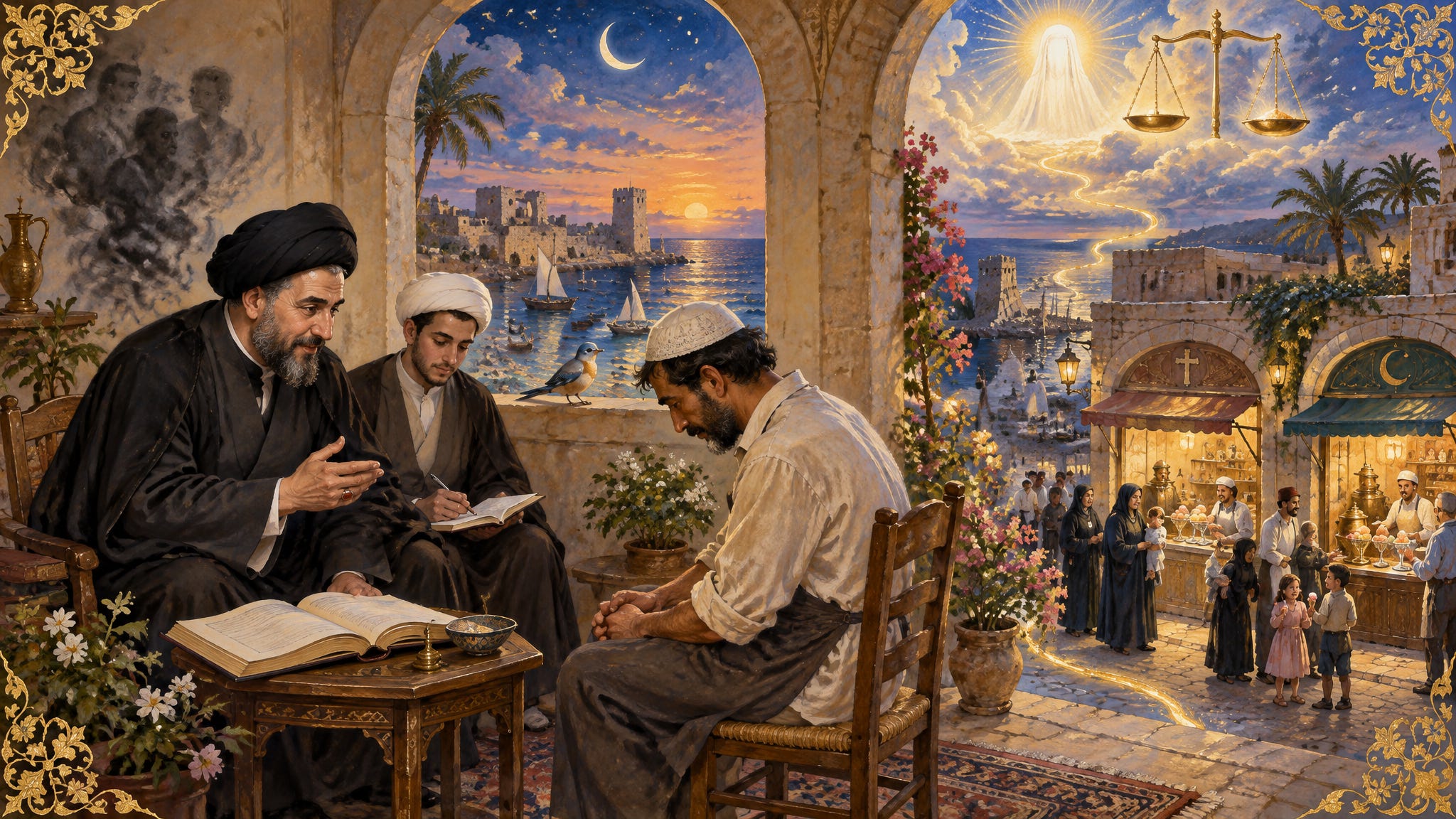
Tyre is an ancient port city on the southern coast of Lebanon.
In the 1960s, Imam Musa al-Sadr lived there.
There was a Christian in Tyre who sold ice cream.
And there was a Muslim who also sold ice cream, and he was jealous.
So he started a rumour.
He told people the Christian’s ice cream was najis: ritually impure.
And people believed him, because the fatwa of the great marja’ of the time, Ayatullah al-Hakim, that the People of the Book are pure, had not yet reached ordinary people.
One man started the rumour.
A community carried it.
Ordinary people can carry a lie without checking it.
We spoke about this in Session 3 of our Fatimiyyah Series Fruit of the Heart.
And the Christian’s business was being ruined.
So he went to Imam Musa al-Sadr.
And the Imam sent for the Muslim seller, and he admonished him, and he told him that this weapon he was using breeds hatred between the communities of Tyre.
And then he gave him the fiqh.
The juristic view does not help you.
Imam al-Hakim, the supreme marja’ of our community, has ruled that the People of the Book are pure, and this Christian is one of them.
And then he gave him a way out.
If you want what is lawful, there is only one way: fair competition.
Make better ice cream.
The man would not stop.
So the Imam warned him:
if you do not stop, I will come down with the believers who are with me, and we will eat ice cream at the Christian’s shop, in front of everyone, and declare that it is pure, and you will lose a great deal.
And the man stopped.
— Shaykh ‘Afif al-Naboulsi, Mushahadat wa-Tajarib li-Taqat min Sirat al-Imam al-Sadr35
That is the story as it is usually told.
A famous story.
A magazine in Beirut reported it: that the Imam went to the Christian’s shop, and ate ice cream there, in front of the people.
But the young cleric who told us the story of the marriage asked the Imam about it.
Is it true?
Did you go and eat the ice cream?
And the Imam told him, word for word:
I never went to the shop.
They got it wrong in what they wrote, and I do not reply to them.
What happened is that I admonished the Muslim seller first, and showed him the right way to work.
When he would not stop, I warned him that I would go to the shop and that we would eat there in front of people.
And when he saw I was serious, he gave up his campaign and went back to how he was.
— Shaykh ‘Afif al-Naboulsi, Mushahadat wa-Tajarib li-Taqat min Sirat al-Imam al-Sadr36
So there are two lessons here, not one.
The first is how a scholar corrects.
By sending for him.
With knowledge, with the actual fiqh.
With love.
And by giving the man a better way, not only a rebuke.
Make better ice cream.
And the second lesson is how a story grows.
The true story was good.
But the better version, the one where the Imam walks into the shop, took over, and spread like fire through dry grass.
And that is why, in this series, we only tell you what we can show you on a page.
Umm Joseph
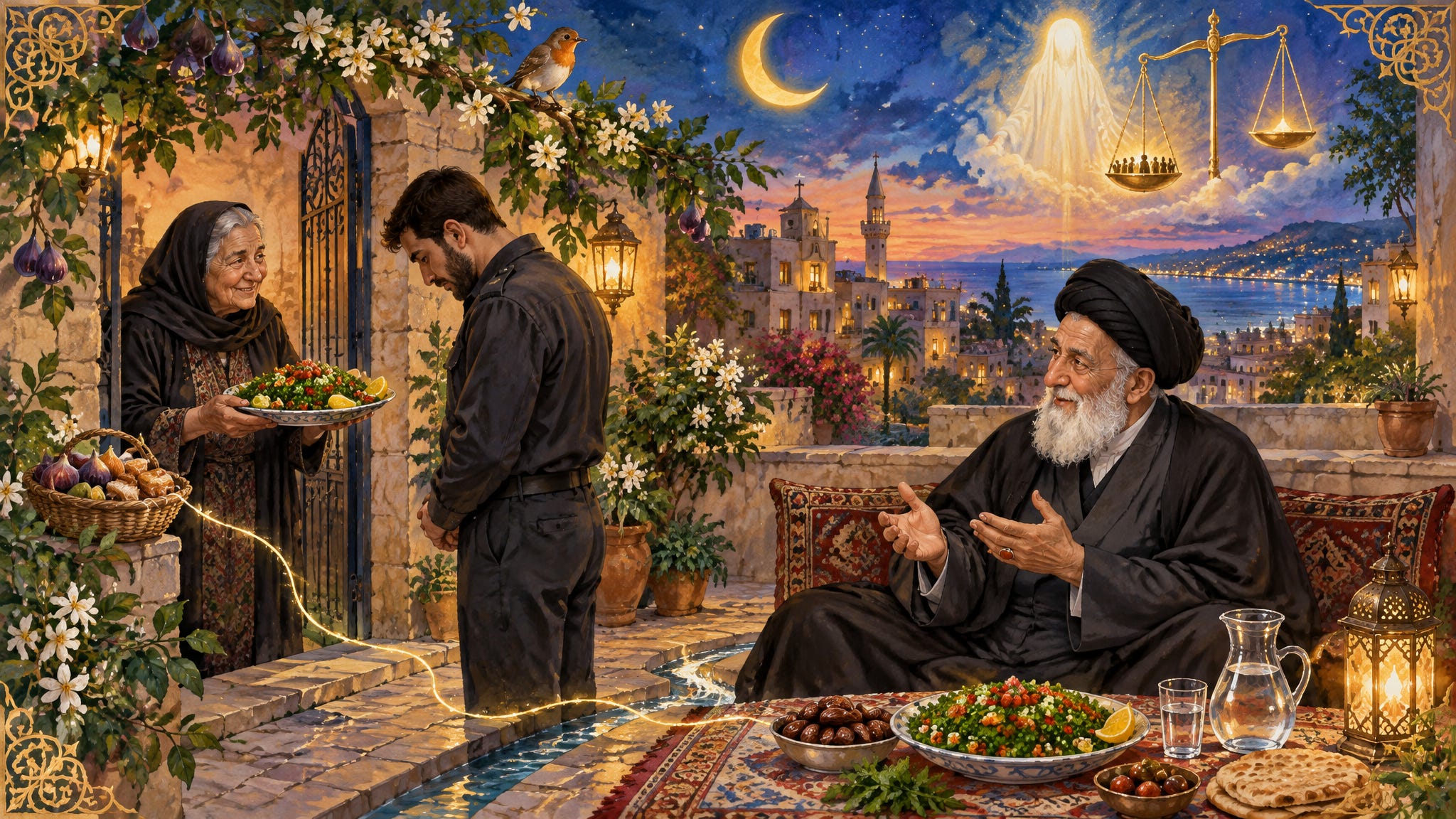
A generation later, in Beirut, there is a story with the same heart, from the other side.
Ayatullah Fadhlullah lived in the southern suburb of Beirut, and he had Christian neighbours.
His companions, the young men who guarded his house, were fond of them.
They respected them, and ran errands for them.
And the neighbours would bring them fruit from their land, and sometimes a plate of sweets.
One of the neighbours was an old lady called Umm Joseph.
One day in the month of Ramadan, she forgot that the Muslims were fasting.
And she made a plate of Lebanese tabbouleh, and carried it over to the young man standing guard at the gate, with joy on her face.
And he said, straight away:
I’m fasting.
Just that.
No thank you.
No warmth.
And she said, sharply:
What, am I impure, then?
— Min al-Zaman al-Jamil ma'a al-Sayyid Fadlallah37
Sayyed Fadhlullah heard about it.
And he called the young man in.
You should have taken the plate from her, and eaten it with your iftar.
You should have let her feel your gratitude, and your thanks for her kindness to you.
She is a good old woman.
You should have done it so that she would not feel hurt, and embarrassed.
— Min al-Zaman al-Jamil ma’a al-Sayyid Fadlallah38
In Tyre, a Muslim’s lie made a Christian feel small.
In Beirut, a Muslim’s haste did.
And both scholars mended it the same way.
By putting the person first.
Level with the People
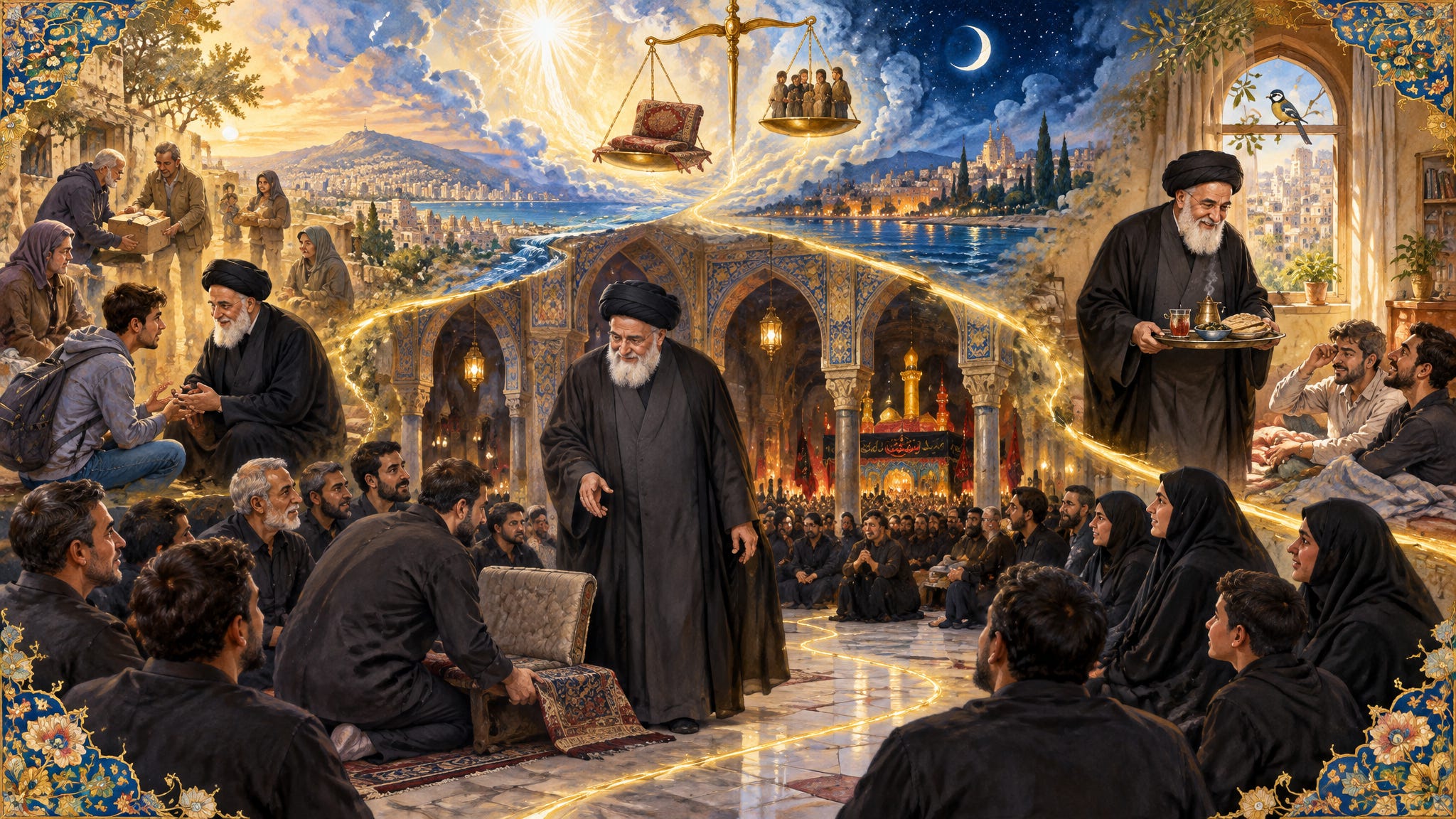
And in his own house, and in his own mosque, Sayyed Fadhlullah lived the same way.
One man who walked beside him for years said:
In my whole life, following the Sayyed, I never heard him say a bad word about any human being.
He watched for what was good in people, in what they did, and he shone a light on it, to make it shine.
— Min al-Zaman al-Jamil ma’a al-Sayyid Fadlallah39
In the nights of Ashura, the nights we mourn Imam Husayn, they held majalis in the mosque of the two Imams, al-Hasan and al-Husayn.
Sayyed Fadhlullah would give his talk from the minbar, and then he would come down and sit on the floor with the people, to listen to the rest of the majlis.
One of the men who organised the majalis worried about him, sitting on the hard floor, night after night.
So he made him a mat of cloth to sit on, with a cushion for his back.
The Sayyed came down from the minbar and walked to the place where he always sat.
And he saw the mat and the cushion.
And he stayed standing.
He did not sit down.
And with every courtesy, gently, he asked them to take the mat and the cushion away.
Because he wanted to be level with the people.
— Min al-Zaman al-Jamil ma’a al-Sayyid Fadlallah40
And when his house was bombed, his aides began to sleep in the room next to his, to guard him.
And every morning, he came into their room himself, carrying the breakfast tray in his own hands.
And he would say to them, gently, like a father:
Breakfast is better than sleep.
You know where that comes from.
In the dawn call of our brethren of the Sunnah — words our own adhan does not have — it says41
Prayer is better than sleep.
He was smiling at them.
— Min al-Zaman al-Jamil ma’a al-Sayyid Fadlallah42
And he used to say:
I learned from the Messenger of God to love all people.
To love the believer, and work together with him.
And to love the one who does not believe, so that I can open up to him, on many things.
— Min al-Zaman al-Jamil ma’a al-Sayyid Fadlallah, citing al-Kalam al-Sayyid, volume 6, p. 34543
A man who would not sit one cushion higher than the people would never make a questioner feel small.
There is no such thing as a silly question.
There is only the person who makes it feel silly.
Never Once
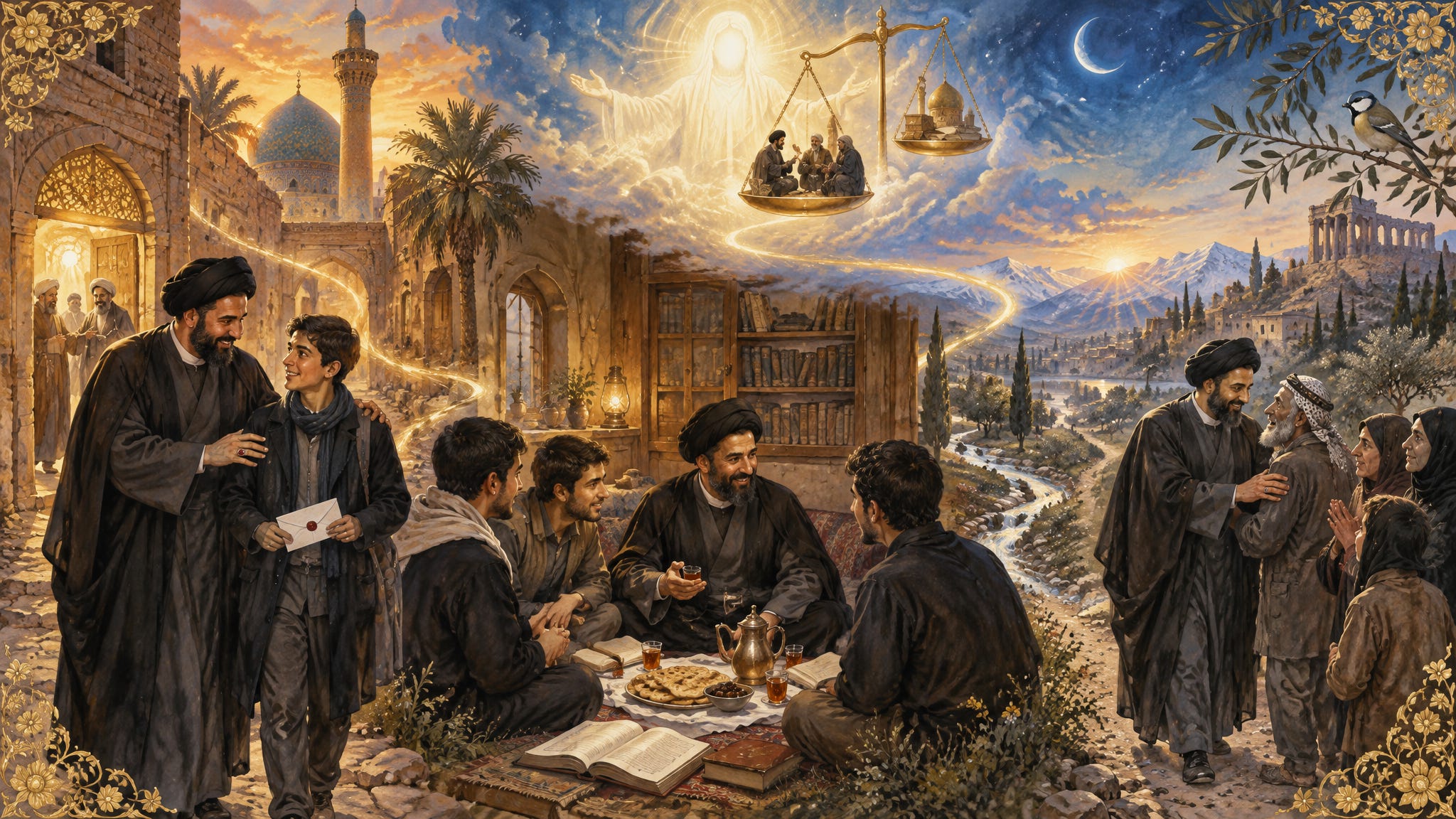
And now, our man from Point One.
Sayyed Abbas.
What was he like with the people who learned from him?
One of them told us.
In December 1976, a boy of sixteen arrived in Najaf from Lebanon, carrying a letter for Shaheed al-Sadr.
He was far from his family, and he did not know anyone.
He would one day be known to the whole world as Sayyed Hasan Nasrallah.
Tonight, he is just a boy with a letter.
He needed someone to take him to the great scholar’s house.
And a friend said:
I know one of his close students.
He won’t hesitate.
It was Sayyed Abbas.
He met the boy outside his house, heard what he needed, and said:
let’s go now.
Sayyed Abbas had a dark complexion, and the boy took him for an Iraqi, so he tried to speak to him in the Iraqi dialect.
And Sayyed Abbas laughed, and said:
I’m Lebanese.
From Nabi Shith.
They arrived at Shaheed al-Sadr’s house without an appointment, and they were let straight in, because, as the boy remembered,
the visitor was Sayyed Abbas.
— Sayyed Hasan Nasrallah, on his teacher, in Sayyid al-Muqawama44
— Sayyed Hasan Nasrallah, interview on al-Manar, as reported by IRNA's Arabic service, 24 February 202245
And Shaheed al-Sadr turned to Sayyed Abbas, and said:
this young sayyed is my trust with you.
You are responsible for his studies, his upbringing, and all his affairs.
Give him some money to buy clothes and books.
From that moment, the boy said, Sayyed Abbas was his guardian.
The bond between them was a student and his teacher, and a child and his father.
And then he says this:
Yet I bear witness before God, that from that day he overflowed with tenderness towards me, kindness, and the deepest care.
And yet he never once made me feel anything other than that he was a brother who gives counsel, and a sincere colleague.
Never the teacher.
Never the guardian.
Through a bond that lasted more than sixteen years — sixteen by the moon, fifteen by the sun.
— Sayyed Hasan Nasrallah, on his teacher, in Sayyid al-Muqawama46
He never once made me feel that he was the teacher.
And those who studied with him in Najaf said that every day he asked after his students.
Their food, their affairs.
Was anyone ill?
Had anyone run out of money?
Had anyone gone to sleep without eating?
And the next day he would hear them recite their lessons.
One of them said:
we were afraid of him, if we came to the lesson without having learned it.
And in the same breath:
with Sayyed Abbas, we never felt that we were students in front of a teacher.
We were his children.
In Najaf, he said, Sayyed Abbas was a father and a mother to his students.
And in Baalbek, years later, when the hawza had moved to the orphans’ charity, he had no car.
So every day, before sunrise, he walked from his house in the heart of the town out to the hawza, and back again.
And when someone asked him why, he said:
I’m exercising.
— Sayyed Hasan Nasrallah, speech at the fortieth anniversary of the hawza in Baalbek, 24 February 201847
— Sayyed Hasan Nasrallah, interview on al-Manar, as reported by al-Ahed News, 23 February 202248
— the same interview, as reported by IRNA's Arabic service, 24 February 202249
And with the people, his student wrote:
He loved them, and he was sincere to them.
A preacher going from pulpit to pulpit, and from village to village.
A servant tending their pains, and dressing their wounds.
Earthy, and humble.
Living like them, and with them.
Speaking their plain, good language, far from tangled jargon.
— Sayyed Hasan Nasrallah, How We Knew al-Musawi, in Sayyid al-Muqawama50
He met them with a kind smile, and embraced them with true affection.
He honoured the old, and respected the young, and he listened to them without sighing, and without tiring.
What hurt them grieved him.
What made them happy made him happy.
He was close to their hearts; no, he lived in their hearts.
Humility and earthiness were, I believe, the greatest thing in Sayyed Abbas.
— Sayyid al-Muqawama51
He listened to them without sighing, and without tiring.
You know the sigh.
The little breath out when someone asks the same question for the third time.
The glance at the watch.
He never did it.
He never once made me feel that he was the teacher.
That is the whole of this third point, in a student’s words.
Standing for a Child
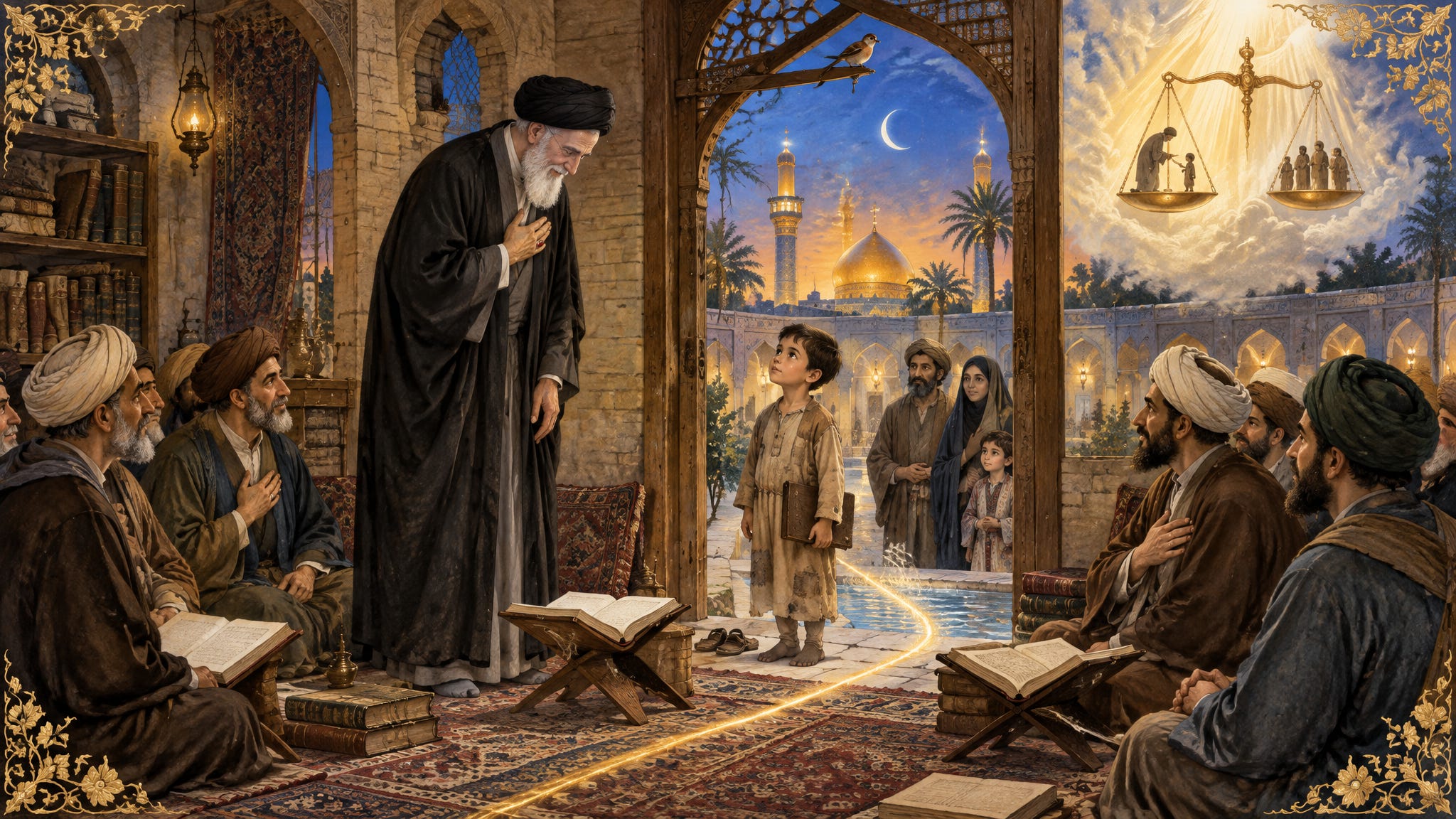
And a century earlier, another sayyed did something like it.
You heard his name in Point One: Sayyed Ibrahim al-Qazwini, whose student’s life was four words.
The man who wrote the lives of the scholars of his age said of him:
I never saw, among the scholars of the Arabs or the Persians, anyone finer in character.
If a child came in to him, a child old enough to understand, he would humble himself and stand up for him.
Whether the boy was from an ordinary family or not.
Whether he was the son of a notable or not.
A great scholar, standing up for a child.
— Mirza Muhammad Tunukabuni, Qisas al-'Ulama' (Arabic translation), on Sayyed Ibrahim al-Musawi al-Qazwini52
The Necklace
And at the very top of a revolution, a man did the same.
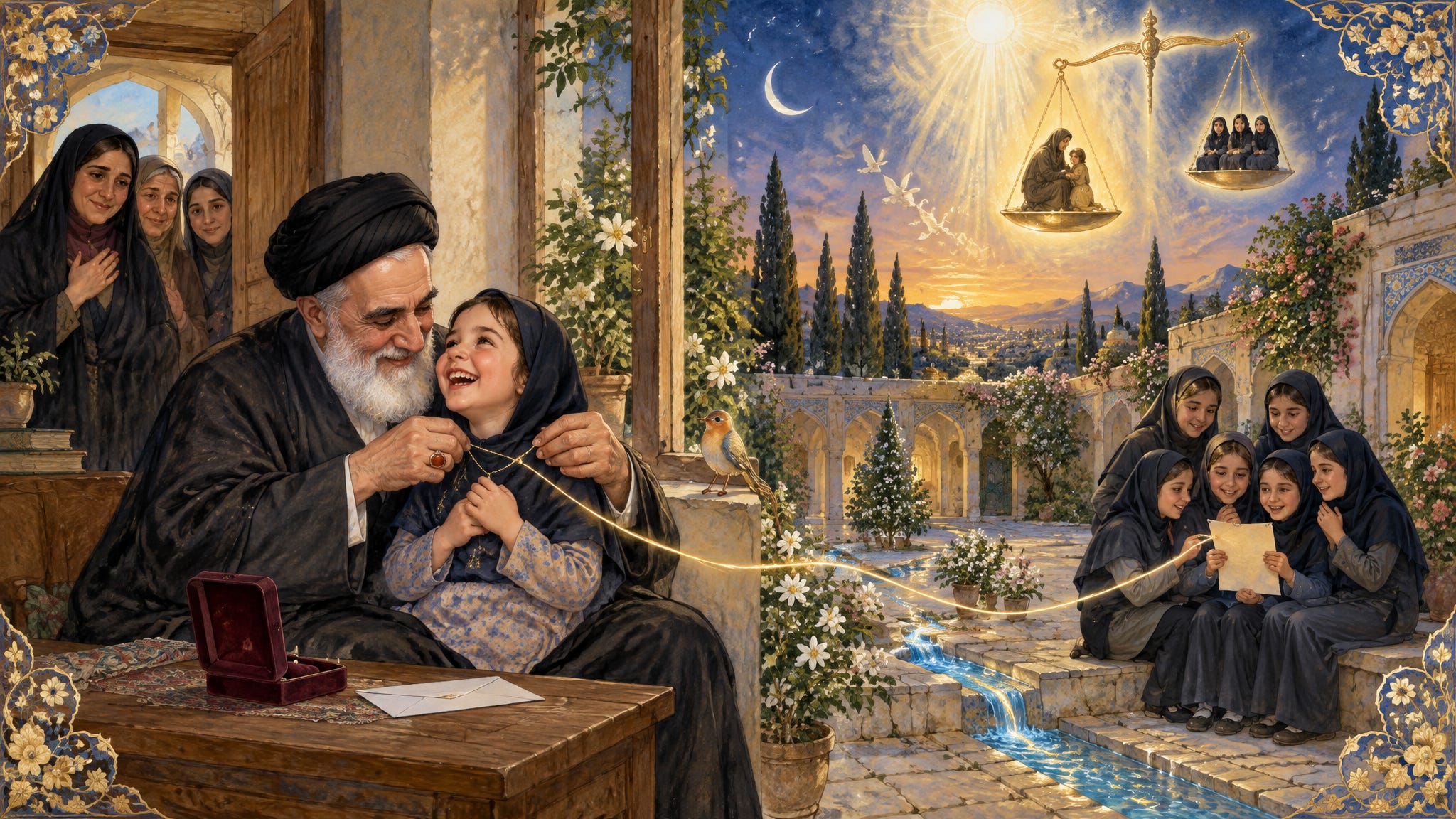
Once, an Italian teacher sent Imam Khomeini a gift: her own wedding necklace, with a letter of respect.
He accepted it, and kept it on his desk.
Two or three days later, they brought a little girl to see him.
Her father had been killed at the front.
And the Imam had her brought to him, and he sat her in his lap.
He laid his cheek against hers, and stroked her head.
Those around him said they had never seen him do that, not even with his own children.
And he talked to her in a whisper, like that, cheek to cheek, until the sadness left her face and she laughed.
And then he took the Italian teacher’s necklace from his desk, and put it round the little girl’s neck with his own hands.
They said they saw the joy shining on her face as she walked out.
— Qabasat min Sirat al-Imam al-Khomeini (Rajai)53
And once, the pupils of a school called al-Fatimiyya, children in the fifth grade, wrote him a letter.
They had read about Imam al-Jawad, peace and blessings be upon him, writing a letter of advice to a governor.
And they said:
we wanted to give you advice too.
But we can’t.
Because you are great, and far from every sin.
And the Imam wrote back to them.
My dear children.
I read your kind letter.
I wish, my dear ones, that you had given me advice in it.
Because I need your advice.
— Imam Khomeini, his reply, in Qabasat54
In the Taxi
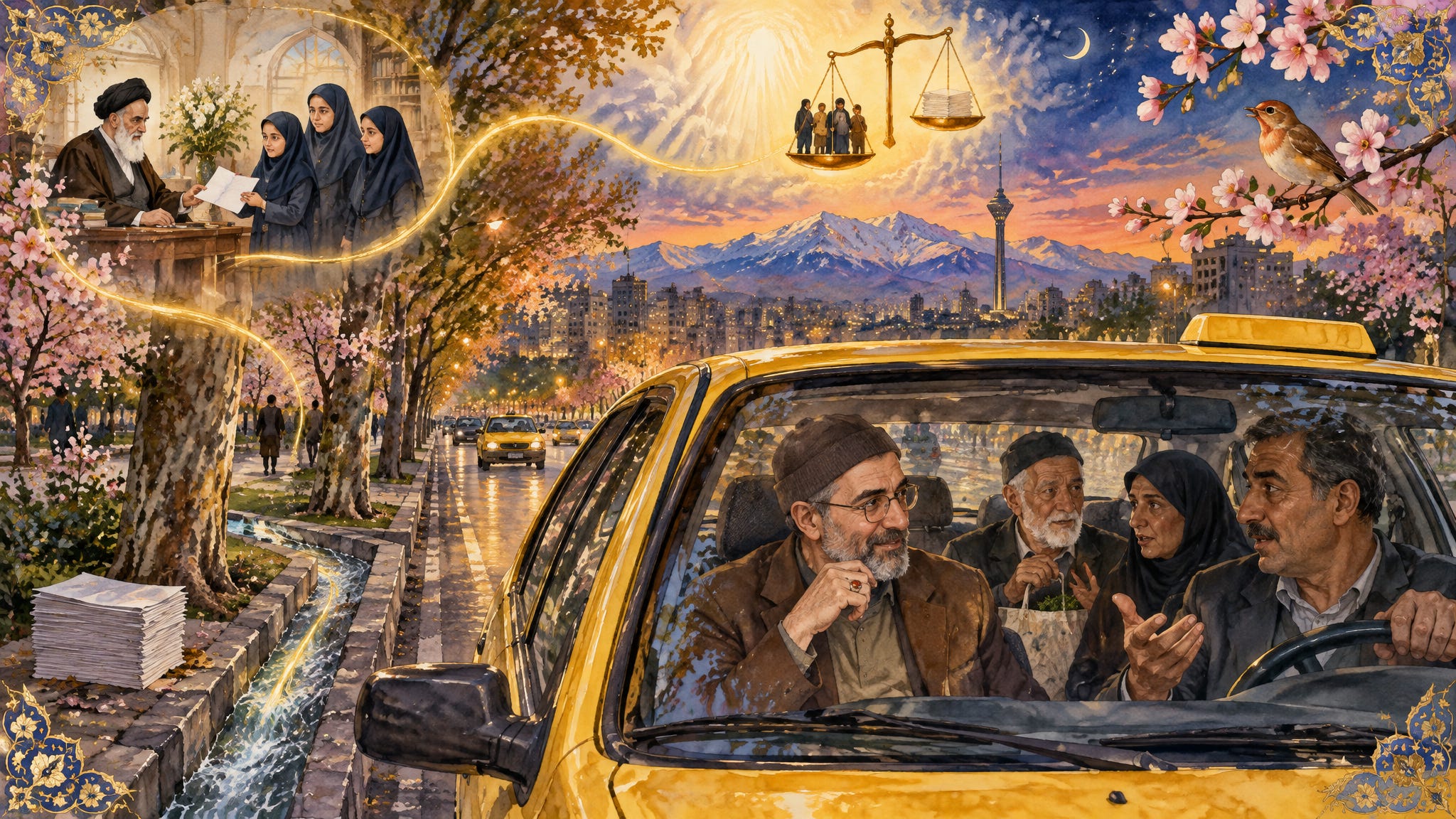
And the one who carries that office today has told the same kind of story about himself.
In his message for the Iranian New Year this March, Imam Sayyed Mujtaba Khamenei said that for a period, without anyone recognising him, he would ride in a taxi through the streets of Tehran, and listen to what the people said.
He said he valued it more than many opinion polls.
He said that what he heard was mostly criticism, about the economy and about how things were being managed, and that he often agreed with it.
And he said:
I learned a great deal from you, and I am still looking to learn more.
I hope I am not deprived of this blessing.
— Imam Sayyed Mujtaba Khamenei, Nowruz message for 1405, 19 March 202655
Two leaders, decades apart.
One asks a class of schoolchildren for their advice.
The other rides unrecognised in a taxi, to hear the people.
And both say the same thing.
I learn from you.
To Cure, Not to Please
But gentle is not the same as soft.
Ayatullah Bahjat warns against that too.
The real preacher, he says, is the messenger of the Messenger of God, peace and blessings be upon him, his family, and his righteous companions, on one condition:
that he preaches as the Prophet taught, and not to give the people what they want.
He gives them the cure for the illnesses of their souls, according to their condition.
Not a pleasant voice with nothing in it.
— Dar Mahzar-e Bahjat, §47456
Imam Musa al-Sadr did not tell the ice-cream seller that what he did was fine.
Sayyed Fadhlullah did not tell the young guard that he had done nothing wrong.
They told the truth.
They just never made anyone feel small while they told it.
Never make them feel small does not mean never tell them the truth.
What We Owe Him
And one more right, the other way round.
The scholar who serves the people is owed something by them.
His time is not ours to fill at every hour without a word of thanks.
His family is not ours to judge.
He is not an employee to be managed by a committee.
He is a servant of God who has chosen to live among us.
He carries us.
We should carry him.
The Imam Whose Table Had No Head
And at the end of tonight, we will stand with an Imam who, on the long road to Khurasan, called for his food, and gathered the servants of his house round the same spread.
An Imam whose table had no head.
Lessons for Our Time
Lesson Five — Correct Privately, with Knowledge and with Love

Never make them feel small does not mean never tell them the truth.
Correct what is wrong, but privately, with knowledge, and with love; and give the person a better way.
The ice-cream seller was sent for, and admonished first, and shown the right way to work, and given a way out:
fair competition.
The young guard was not humiliated at the door.
He was called in.
If you are the one people come to —
Correct in private.
If the man beside you in the row has his hands wrong, tell him after the prayer, quietly, and not in front of his son.
Correct with knowledge.
Know the ruling before you correct anyone, and say where it comes from.
Correct with love.
Let the person feel that you are on his side.
Sayyed Fadhlullah did not only tell the guard he had done wrong; he told him why it mattered.
She is a good old woman.
She should not have been left hurt, and embarrassed.
And always leave a door.
Make better ice cream.
A correction with no way out in it is not a correction.
It is a sentence.
And be careful with stories.
The true story of the ice cream was good.
The better version spread like fire through dry grass.
Tell only what you can show.
And do not give the people only what they want to hear:
Ayatullah Bahjat said the real preacher brings the cure.
And if you are among the people —
When you are corrected, do not ask
who is he to tell me?
Ask whether it is true, and thank the one who cared enough to say it quietly.
And when you correct someone yourself, your child, your colleague, the brother in the group chat, do it the way you would want it done to you.
Not in front of the group.
In private.
With the ruling, not with your mood.
And with a way out.
And do not forward the better version of the story.
Forward only what you can show.
That is the fifth lesson.
Lesson Six — Level with the People
The marja’ would not sit higher than the people.
The teacher never once let his student feel that he was the teacher.
The Imam wrote to a class of schoolchildren:
I wish you had advised me.
And the one who carries that office today rode in a taxi to listen:
I learned a great deal from you.
If you are the one people come to —
Never make a questioner feel small.
When someone asks you something you think is obvious, answer it as if it were the best question you have heard all year: to him, it is.
And never let the room laugh at it.
Take the cushion away.
If they have put out a special seat for you, and the people are on the floor, sit with the people.
And carry the tray in yourself, sometimes.
Breakfast is better than sleep.
Stand for the child.
The smallest person in the room is the measure of you.
Imam Khomeini took the orphan girl on his lap, and put the necklace round her neck with his own hands.
And listen.
Ask the people what they think, and mean it.
Learn from the ones you serve.
And if you are among the people —
He carries us.
We should carry him.
And one of the ways to carry him is to give him what the Imam asked those children for: advice.
Courteously, privately, sincerely.
Tell him when something he said helped you.
Tell him, quietly, when something he said hurt someone.
A scholar who hears only praise is alone.
And do not be the room that laughs.
When the new believer at the back asks the question you think is too basic, do not smile at your neighbour.
Somebody once answered all your obvious questions.
And his time is not yours to fill at every hour of the day without a word of thanks.
I said it earlier, and I will say it again:
He is not an employee to be managed by a committee.
He is a servant of God who has chosen to live among us.
That is the sixth lesson.
Level with the people.
The Close — The Last Day
At the very beginning tonight, I gave you one sentence of Imam Ali.
Mix with people in such a way that, if you live, they long for you; and if you die, they weep for you.
And I asked you to hold on to a question.
What kind of man do people weep for?
Let me answer it with one day of one man’s life.
Jibshit
It is the 16th of February, 1992.
Sayyed Abbas, the man who walked with us all night, is now the leader of a whole movement.
And he has decided to go to Jibshit.
The village of Shaykh Ragheb Harb, the man in the pit from Point Two.
Because it is the anniversary of Shaykh Ragheb’s martyrdom, and the village is holding a gathering, and Sayyed Abbas insists on being there.
Dangers surround him.
There has been shelling since the morning.
He insists.
And he stands up to speak.
And in his last speech, he speaks for the poor.
About the oppressed people the state had forgotten.
The deprivation in the southern suburbs of Beirut.
The South, and the western Bekaa, left to themselves.
The farmers.
The hospitals.
The water of the Litani river, running out into the sea unused.
And he pledged, to the Imam of our Age, and to Shaykh Ragheb, that he would go on.
The Question
When the gathering was over, Shaykh Ragheb’s son, Ahmad, stood up and spoke.
And when he had finished, Sayyed Abbas went over to him, and embraced him, to congratulate him.
And then he asked him a question that left everyone who heard it astonished.
He asked the young man if there was anything he wanted taken to his father.
To his father.
Who had been martyred, eight years before.
As though, the man who wrote his life said, he knew that he would soon meet his friend, his beloved, and the companion of his martyrdom.
— Sayyid al-Muqawama59
As Was His Custom
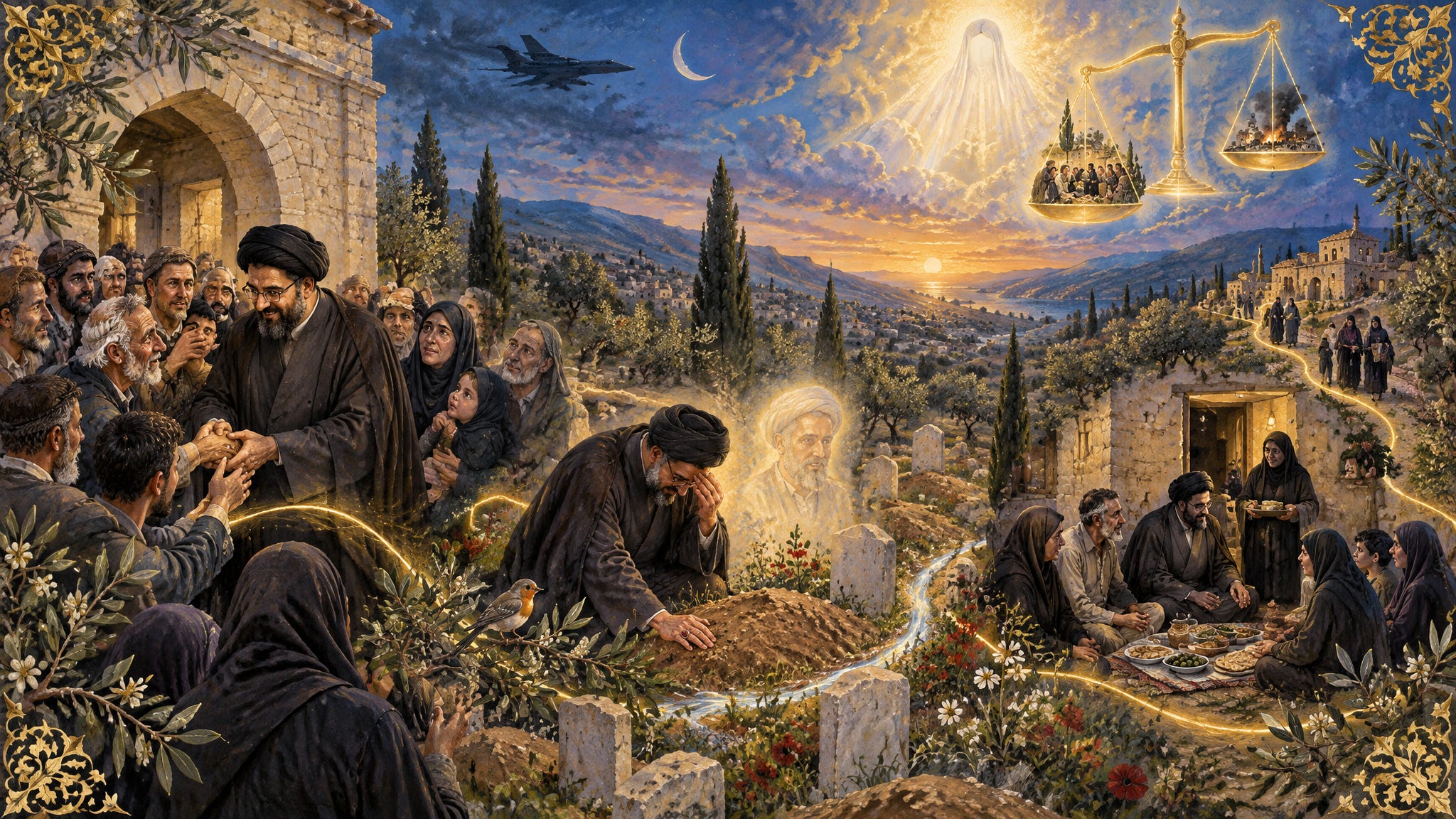
When it was over, the crowds pressed in around him.
They wanted to shake his hand, to see him up close.
Not knowing that they were seeing him for the last time.
And with the aircraft still in the sky above, he stayed.
The man whose breast, they said, was used to gathering in all the voices of grief and letting them pour out their complaints.
He stayed, and listened, and shook hands, and talked with them.
Then he went to the grave of Shaykh Ragheb, and the graves of the martyrs of the village.
And he passed his right hand over Shaykh Ragheb’s grave, and then he wiped his hand across his own forehead.
And then:
As was his custom, he also visited the families, and some of the poor households.
He had lunch with Shaykh Ragheb’s family.
And then he went on to a neighbouring village, to visit the family of another martyr.
— Sayyid al-Muqawama60
Even on the last day of his life, after the speech, after the crowds, after the grave, he went where others do not go.
Point One, lived to the very end.
The Road
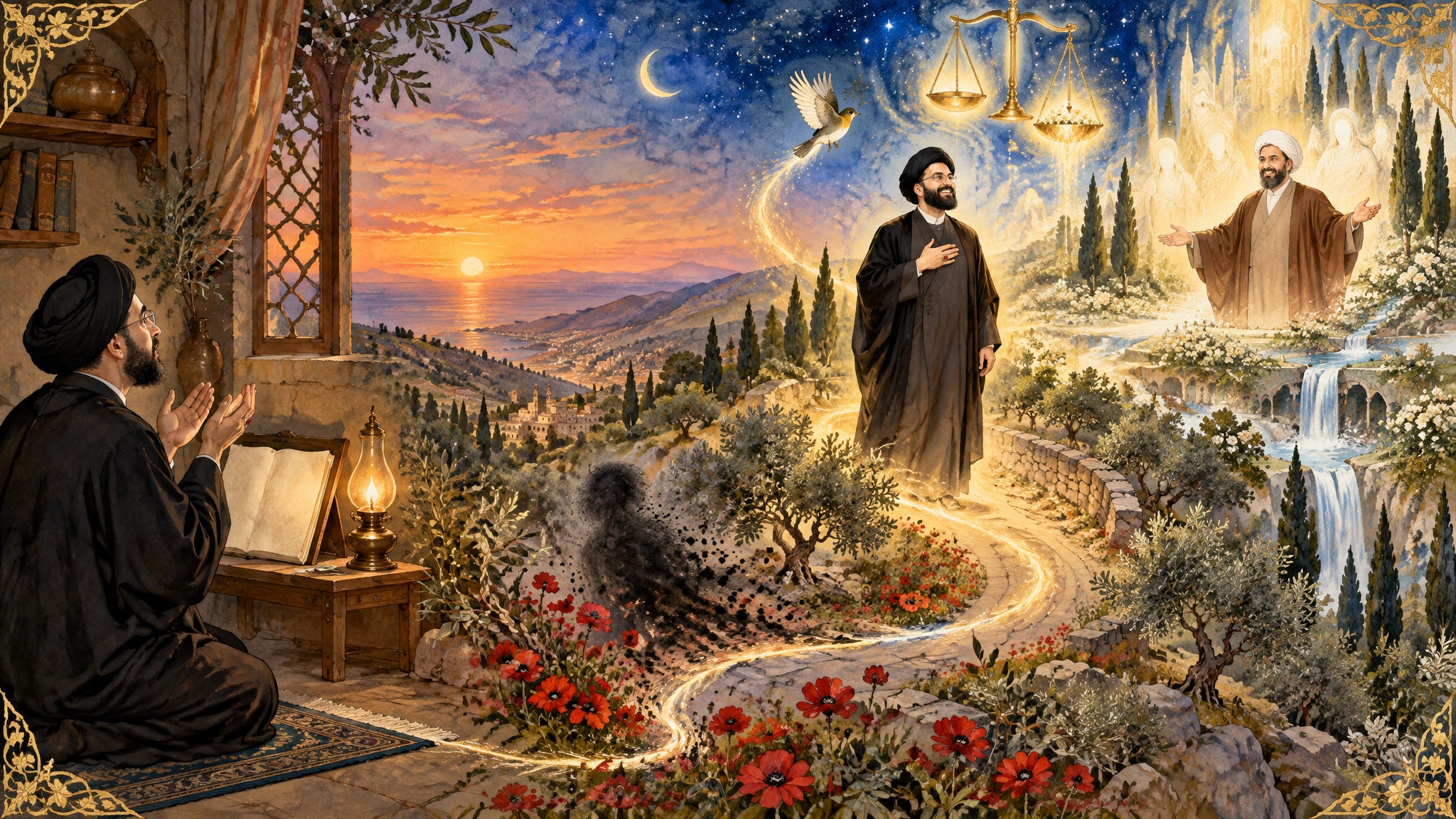
And then he took the road home.
The believing Sayyed did not fear death.
Nor did he care whether it was near him.
He did not tremble, he did not shake with fear.
And his radiant smile never left him.
— Sayyid al-Muqawama61
And on that road, that day, he was martyred.
Some time before, he had written a prayer.
The book does not say when, or why.
It only gives the words.
My God.
If You insist on dealing with me by Your justice, and on holding me to account for what every limb of mine has done, then I ask You to grant me a purified martyrdom, one that I have chosen for myself, as an expiation for my sins.
A martyrdom with few like it, in which my body is torn apart, and every limb of mine receives the punishment it deserves.
And after that, O Lord, it becomes certain that You will settle me beside You, and beside Your friends.
I say certain, because of my faith in Your justice; let alone my faith in Your kindness.
And it was answered.
— Sayyed Abbas al-Musawi, from his supplication, given as the epigraph of Sayyid al-Muqawama62
The Answer
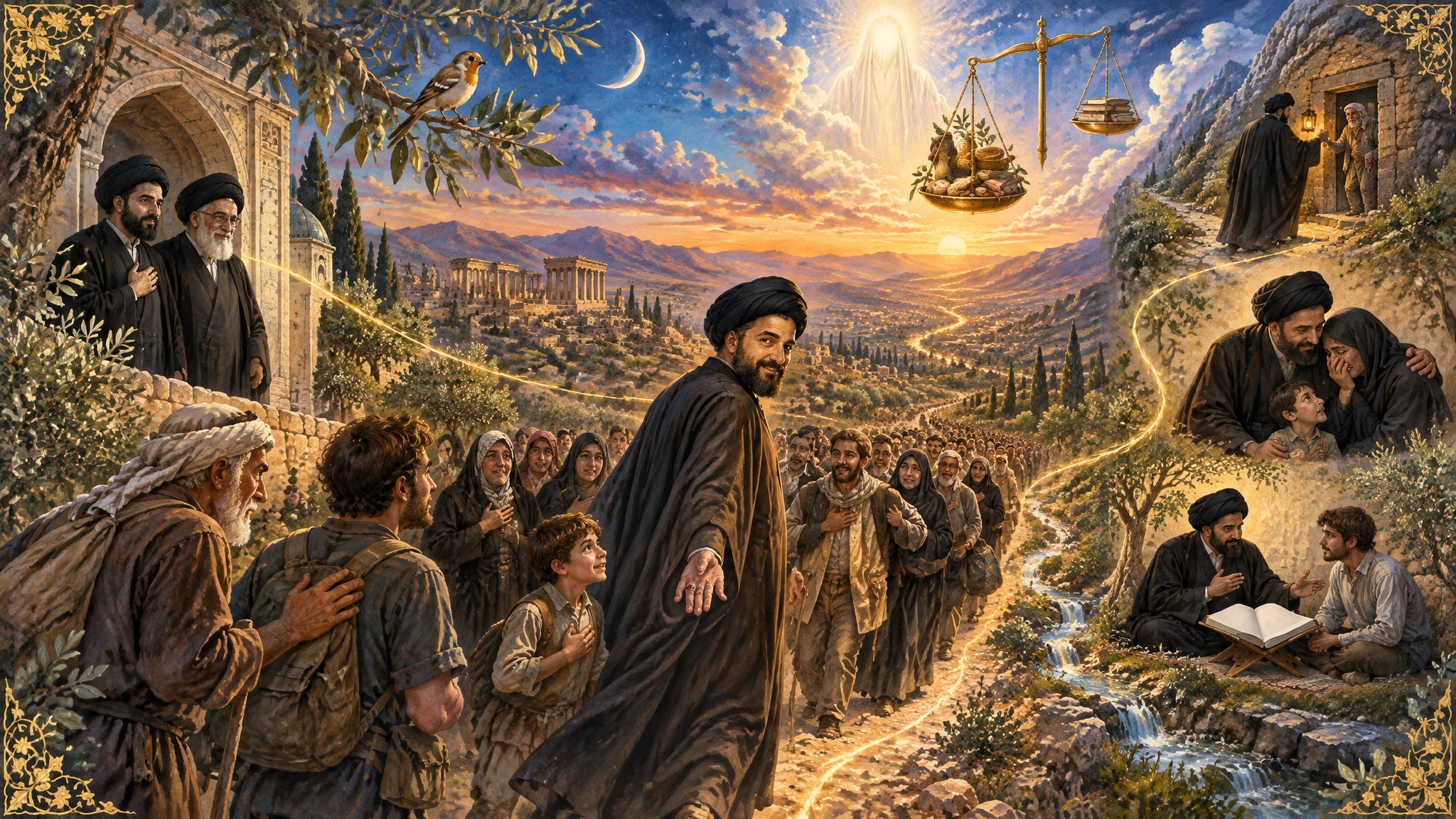
His student, the boy from Najaf, finished the sentence I gave you in the third point.
Humility and earthiness were the greatest thing in him, and the secret of the great love people had for him.
And Sayyed Fadhlullah, who had backed his little hawza in Baalbek for all those years, said:
The Umma found itself in him.
So it answered him, and lived with him, and walked behind him.
— Ayatullah Sayyed Muhammad Husayn Fadhlullah, on Sayyed Abbas al-Musawi, in Sayyid al-Muqawama63
If you live, they long for you.
If you die, they weep for you.
That is the kind of man people weep for.
The one who goes where others do not go.
The one who carries their pain as if it were his own.
The one who never once makes them feel small.
And that is the test.
For the scholar of this community.
And for every one of us who carries any knowledge at all.
Three Lines
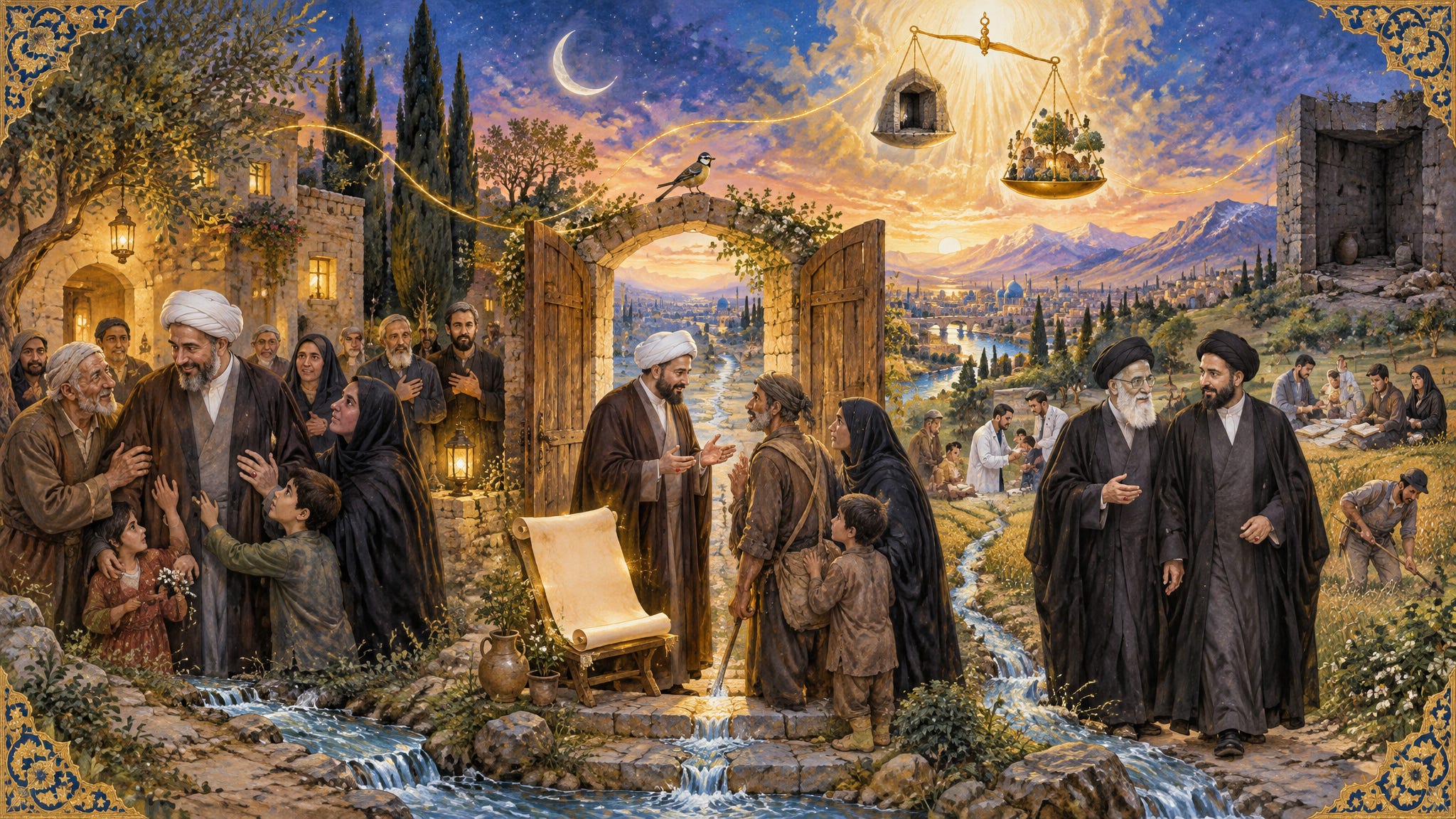
If everything else from tonight goes, keep three lines.
The first is Imam Ali’s:
mix with people in such a way that, if you live, they long for you; and if you die, they weep for you.
The second is his letter to Qutham:
let there be no envoy between you and the people but your own tongue, and no gatekeeper but your own face.
And the third is Sayyed Fadhlullah’s, about the man we walked with tonight:
to live God is not to withdraw into a corner of life.
Conclusion — Key Takeaways
Three things to take out of this room.
And they are things to do, not only things to think.
The first.
Go where others do not go — and the ordinary rights are the work.
This week:
make the one visit you have been putting off.
The sick, the grieving, the one at the edge.
The second.
Here I am — and the cost is real.
Influence is for spending on people.
And the one who carries us should be carried.
This week: do one job for someone else that nobody will see, and nobody will thank you for.
The third.

Never make them feel small — and never stop telling them the truth.
This week: when someone asks you something you think is obvious, answer it as though it were the best question you have heard.
The Mujtahid
Tonight we walked out among the people.
Next week, God willing — the mujtahid.
Eulogy — Ayatullah Sayyed Muhammad Husayn Fadhlullah: The Teacher Who Prayed Behind His Student
Tonight we remember Ayatullah Sayyed Muhammad Husayn Fadhlullah.
You have met him already tonight.
The marja’ of the southern suburb of Beirut, who offered a young man his school, and when the young man said no, sent his hawza money every month for years.
The scholar who told his guard to eat an old woman’s tabbouleh at iftar.
The man who would not sit on a cushion.
Let me tell you one more story.
There was a man in his community called Shaykh Hasan Shehadeh.
Everybody trusted him, though he was not the most learned of the scholars.
He was poor.
He had four children at home with special needs.
He never once missed the night prayer.
When the war grew fierce he emigrated to America, and he was the same man there.
And poor as he was, he paid his khums — the religious dues — and he paid it to no one but Sayyed Fadhlullah, an ocean away.
The man who wrote about him set a verse of the Qur’an beside his name, about a grace that God gives only to the patient:
وَمَا يُلَقَّىٰهَآ إِلَّا ٱلَّذِينَ صَبَرُواْ وَمَا يُلَقَّىٰهَآ إِلَّا ذُو حَظٍّ عَظِيمٖ
But none is granted it except those who are patient, and none is granted it except the greatly endowed.
— Qur’an, Surah Fussilat (the Chapter of that Explained in Detail) #41, Verse 35; my translation
— Min al-Zaman al-Jamil ma'a al-Sayyid Fadlallah, under the heading When the Teacher Prays Behind His Student64
One day, in the mosque of Imam al-Rida in Bir al-Abed, a quarter of Beirut’s southern suburb, the call to prayer was given, and Sayyed Fadhlullah was late.
He had not arrived.
So Shaykh Hasan Shehadeh stood up and began the prayer.
And the believers, because they knew how much the Sayyed trusted him, lined up behind him.
And then the Sayyed arrived.
He went into his room, the one whose door opens onto the mosque.
And before the door was opened, someone told him:
Shaykh Hasan is leading the people in prayer.
And the Sayyed went forward to the door.
And it was opened.
And he walked into the mosque, and began his prayer behind Shaykh Hasan Shehadeh.
The marja’ of a whole city walked through his own door, and stood behind his student.
— Min al-Zaman al-Jamil ma'a al-Sayyid Fadlallah, under the heading When the Teacher Prays Behind His Student65
In his lifetime, there were those who made false claims against him, who slandered him and insulted him.
It came to nothing.
His legacy continues, and his works are open for anyone to read66.
In his last years he was often ill, and he spent time in Bahman Hospital, a few metres from his mosque.
Once, before an operation, the men around him said he forgot his own pain completely.
He did not think for a moment about the fear of the operating theatre.
All he thought about was the mosque, and the people who prayed there: that they should not miss the prayer, and the supplication, and the lesson.
— Min al-Zaman al-Jamil ma’a al-Sayyid Fadlallah67
And a short time before he died, it was a Friday.
He was lying in Bahman Hospital.
He looked around, and saw his visitors, and the people looking after him, gathered round his bed.
And the time for the prayer was coming.
He looked from face to face.
And the room went silent.
And he said:
What is the matter with you?
Today is Friday.
Don’t let the Friday prayer slip away from you.
If I could go down to the mosque, it is only a few metres away, I would not be late to pray behind the imam.
His own son was leading the prayer that day.
To the prayer.
Put your trust in God.
— Min al-Zaman al-Jamil ma’a al-Sayyid Fadlallah68
He was always like that.
In July 2006, on a Friday, the Israeli jets were over the southern suburb of Beirut.
The night before, buildings and bridges had been destroyed, and parts of the suburb were rubble.
People were frightened.
The streets were empty.
Families had left at dawn for somewhere safer.
And the Sayyed was in the mosque, waiting for the call to prayer.
— Min al-Zaman al-Jamil ma’a al-Sayyid Fadlallah69
Sayyed Fadhlullah died on Sunday the 4th of July, 2010, the 22 of Rajab, 1431, in Bahman Hospital.
He was seventy-four.
Two days later, they carried him through the streets of the southern suburb.
And the procession passed the mosque of Imam al-Rida in Bir al-Abed: the mosque where, years before, he had walked through his own door and prayed behind his student.
Then they brought him back to the mosque of the two Imams, al-Hasanayn, where his brother led the funeral prayer over him.
And there they buried him.
He lies in the mosque he could not walk down to from his hospital bed.
— Al Jazeera, "Death of the Shi'i marja' Fadhlullah", 4 July 201070
— al-Khanadeq, "The death of Sayyed Muhammad Husayn Fadhlullah" (the funeral of 6 July 2010)71
— fnoor.com, from its article on Sayyed Muhammad Husayn Fadhlullah, under the heading His death72
May God raise him with Muhammad and the family of Muhammad.
Segue to Maqtal
A scholar who, from his hospital bed, sent his visitors away to the Friday prayer.
A sayyed who, on the last day of his life, went to the poor households as was his custom, and asked a young man whether there was anything he wanted taken to his father.
As though he knew.
Both of them knew.
All night we have watched scholars refuse the place at the head.
A marja’ who would not sit on the cushion, because he wanted to be level with the people.
A teacher in Najaf who never once let his student feel that he was the teacher.
A marja’ of a whole city who walked through his own door and stood behind his student.
They learned it somewhere.
Long ago, on the road to Khurasan, an Imam called for his food, and gathered round his spread the servants of his house, the black and the others, and ate with them.
A table with no head.
And in Khurasan, one morning, that Imam knew too.
And on the morning he knew, he asked for his shoes.
Our maqtal tonight is given in the voice of the one who carries every one of their griefs: the Imam of our Age, may our souls be his ransom, and may God hasten his return.
Maqtal (Lamentation) for the Twenty-Third Session of the Architecture of Guidance
Supplication
In Your Name, the Lord of the Martyrs and the Truthful
O God, we ask You by those who call on their Lord morning and evening, desiring Your Face, and by the door that is never shut on anyone in need.
By Your prophets, peace and blessings be upon them all, who were told to send the poor away, and would not.
By Muhammad, peace and blessings be upon him, his family, and his righteous companions, who held himself patiently with Salman and Abu Dharr, and never let his eyes pass over them.
By the fourteen — by Sayyedah Fatimah al-Zahra, peace and blessings be upon her, in this month of her martyrdom and her birth;
by Amir al-Mu’minin, Imam Ali, peace and blessings be upon him, who wrote: no gatekeeper but your own face;
by Imam Ja’far al-Sadiq, peace and blessings be upon him, who set down the rights of the believer;
by Imam al-Jawad, peace and blessings be upon him, whose letter of advice the children read;
by Imam al-Rida, peace and blessings be upon him, whose table had no head; and by every Imam to the one we are waiting for.O God, make us mix with Your servants so that, if we die, they weep for us, and if we live, they long for us.
Make us go where others do not go, carry their burdens as our own, and never make a single one of them feel small.O God, be with the orphans of the family of Muhammad, who live in the absence of their Imam, and send them someone to teach them.
Bless every scholar who answers at two in the morning; and make us carry the one who carries us.
And bless our neighbours, of every faith.O God, have mercy on the martyr Sayyed Abbas al-Musawi, who went to the poor households on the last day of his life;
on the Shaykh of the Martyrs, Shaykh Ragheb Harb, who said from the bottom of a pit, Here I am;
and on Ayatullah Sayyed Muhammad Husayn Fadhlullah, who stood behind his student. Raise them with Muhammad and the family of Muhammad.O God, return to us Imam Musa al-Sadr, and his two companions, Shaykh Muhammad Ya’qub and Sayyed Abbas Badr al-Din, in good health.
O God, have mercy on Mirza Shirazi and Mulla Muhammad Baqir ‘Iraqi; on Shaykh Gholamreza Yazdi;
on Sayyed Mustafa and his son, Ayatullah Pasandideh;
on Sayyed Muhammad Baqir Shafti, Shaykh Ja’far Kashif al-Ghita’ and Mirza al-Qummi;
on Sayyed Ibrahim al-Qazwini; on Ayatullah Bahjat, Allamah Tabataba’i, Ibn Maytham al-Bahrani and Shaykh ‘Abbas al-Qummi;
on Shaheed al-Sadr and Shaykh Muhammad Mahdi Shams al-Din;
on the martyr Sayyed Hasan Nasrallah;
on Shaykh Hasan Shehadeh;
and on every scholar who has lived among the people.And lengthen the lives of those who still carry it among us, Ayatullah Jawadi Amoli and Ayatullah Araki among them.
O God, accept from the parents and children who came to the nights of Fruit of the Heart, and keep them close to the daughter of Your Prophet.
O God, have mercy on Imam Khomeini, may You rest his pure soul.
O God, we remember before You the martyred Leader, Imam Sayyed Ali Khamenei, may You rest his pure soul, from whose lectures on patience this circle of ours first began.
Accept him, and gather him with those he loved.O God, protect and guide and lengthen the life of our Wali al-Faqih, Imam Sayyed Mujtaba Khamenei, may You protect him, and keep him firm on the straight path until the rising of the one we are waiting for.
O God, hasten the relief of Your friend and the son of Your friend — the Imam of our Age, may our souls be his ransom and may God hasten his return. Make us among those who go where others do not go in his service, and who carry his people’s burdens as our own.
And make us among those who wait for him actively — who prepare, and do not only wait.O God, give us success in whatever we do for Your sake.
And give us a good ending, like the scholars we remembered tonight: longed for while they lived, and wept for when they died.And whatever we have said tonight that was true, it is from You; and whatever was wrong in it is from me, and I ask Your forgiveness for it.
Amen, O Lord Sustainer of the Universes
Amen, O Most Merciful of the Merciful
And from Him alone is all ability and He has authority over all things.
Sayyed ‘Abbas ‘Ali al-Musawi words:
دعا الإسلام إلى حسن العشرة وأن يسير الإنسان مع الناس سيرة طيبة بأن يلقاهم بالبشر ويتكلم معهم بالرقة والعطف ويشعرهم أنه معهم في سرائهم وضرائهم وما يصيبهم من شدة وعناء وهذا بطبيعة الحال له نتائج وآثار ومن آثاره ونتائجه أنه إذا غاب عنهم افتقدوه وبحثوا عنه وحنوا إليه واشتقوا إلى رؤيته وأما إذا مات فإنهم يبكون عليه ويحزنون لأنهم يشعرون بخسارتهم لفقده وهكذا ينبغي أن يكون المسلم إن غاب اشتقوا إليه وإن مات بكوا عليه.
“Islam calls for good companionship, and that a person should conduct himself with people well: that he meet them with a cheerful face, speak with them gently and kindly, and let them feel that he is with them in their good times and their bad, and in the hardship and toil that befall them. This naturally has its results and effects, and among them: that when he is absent from them, they miss him, look for him, long for him, and yearn to see him; and when he dies, they weep for him and grieve, because they feel their loss in losing him. This is how a Muslim should be: if he is absent, they long for him; and if he dies, they weep for him.”
— Sayyed ‘Abbas ‘Ali al-Musawi, Sharh Nahj al-Balagha, volume 5, on Saying 10; my translation
Ibn Maytham on Saying 10 (he numbers it 5).
٥ - وقال : خَالِطُوا النَّاسَ مُخَالَطَةً إِنْ مُتَّمَ مَعَهَا بَكَوْا عَلَيْكُمْ، وَإِنْ عِشْتُمْ حَنُّوا إِلَيْكُمْ.
نبه بذلك على حسن المعاشرة للناس ومعاملتهم بمكارم الأخلاق. وكَنَّى عن ذلك بقوله: إن متم. إلى آخره. إذ من لوازم حسن المعاشرة للمخاطب الحنة إليه في حياته وافتقاره. والبكاء عليه بعد وفاته. والجملة الشرطية في موضع نصب صفة المخالطة.
“5. And he said [peace be upon him]: Mix with people in such a way that, if you die, they weep for you, and if you live, they long for you. // By this he drew attention to good companionship with people, and to treating them with noble character. He alluded to it with his words if you die , to the end, since among the necessary consequences of good companionship towards the one you deal with are longing for him in his life, and need of him, and weeping for him after his death. The conditional sentence stands in the accusative, as a description of the mixing.”
— Ibn Maytham al-Bahrani, Sharh Nahj al-Balagha (he numbers it Saying 5); my translation
Shaykh Abbas Qummi on Saying 10.
١١٥ - خَالِطُوا النَّاسَ مُخَالَطَةً إِنْ مِتُّمْ مَعَهَا بَكَوْا عَلَيْكُمْ، وَإِنْ عِشْتُمْ حَنُّوا إِلَيْكُمْ(١).
حنُّوا - بالحاء المهملة - من الحنين، وهو الشوق وتوقان النفس، من حنّ إليه يحنُّ - بالكسر - حنيناً(٢).
وقال ابن أبي الحديد: وقد روي «حنُّوا» بالخاء المعجمة، من الخنين؛ وهو صوت يخرج من الأنف عند البكاء. وإلى تتعلق بمحذوف، أي حنُّوا شوقاً إليكم(٣). وفيه كما ترى.
وبالجملة، هذا الكلام في الأمر بإحسان العشرة مع الناس، وقد ورد في هذا الباب كثير واسع.
“115. Mix with people in such a way that, if you die, they weep for you, and if you live, they long for you.(1) // ḥannū, with the unpointed ḥā’, is from al-ḥanīn, which is longing and the soul’s yearning: ḥanna ilayhi, yaḥinnu, with kasra, ḥanīnan.(2) // Ibn Abi al-Hadid said: it has also been narrated khannū, with the pointed khā’ [the page prints ḥannū here, evidently for khannū], from al-khanīn, a sound that comes out of the nose in weeping; and to you attaches to a word left unsaid, that is, they make that sound out of longing for you.(3) And there is in that what you see. // In sum, this saying is the command to keep good company with people, and a great deal has come down on this subject.”
— Shaykh ‘Abbas al-Qummi, Sharh Hikam Nahj al-Balagha, no. 115; my translation. The numbers in brackets are the book’s own notes:
(1) Nahj al-Balagha, Saying 10;
(2) al-Jawhari, al-Sihah, 5:2104;
(3) Ibn Abi al-Hadid, Sharh Nahj al-Balagha, 18:107. We keep the plain reading, longing.
Allamah on “hold yourself patiently with them”:
بل الذي عليه أن يصبر نفسه مع أولئك الفقراء من المؤمنين الذين لا يزالون يدعون ربهم و لا يلتفت إلى هؤلاء الكفار المترفين الذين يباهون بما عندهم من زينة الحياة الدنيا التي ستعود صعيدا جرزا بل يدعوهم إلى ربهم و لا يزيد على ذلك فمن شاء منهم آمن به و من شاء كفر و لا عليه شيء، و أما الذي يجب أن يواجهوا به إن كفروا أو آمنوا فليس هو أن يتأسف أو يسر، بل ما أعده الله للفريقين من عقاب أو ثواب.
“Rather, what is upon him is to hold himself patiently with those poor among the believers who never cease calling on their Lord, and not to turn to these pampered unbelievers who boast of the adornment of this world’s life, which will become a barren plain; rather he calls them to their Lord and adds nothing to that. Whoever of them wishes believes in him, and whoever wishes disbelieves, and nothing is upon him; and what they must face, whether they disbelieve or believe, is not that he grieve or rejoice, but what God has prepared for each of the two parties, of punishment or reward.”
— Allamah Sayyed Muhammad Husayn Tabataba’i, al-Mizan fi Tafsir al-Qur’an, on Surah al-Kahf, Verses 27–31; my translation
و المراد بدعائهم ربهم بالغداة و العشي الاستمرار على الدعاء و الجري عليه دائما لأن الدوام يتحقق بتكرر غداة بعد عشي و عشي بعد غداة على الحس فالكلام جار على الكناية.
“What is meant by their calling on their Lord morning and evening is constancy in supplication and keeping to it always, for permanence is realised to the senses by morning following evening and evening following morning; the words run by way of allusion.”
— Allamah Sayyed Muhammad Husayn Tabataba’i, al-Mizan fi Tafsir al-Qur’an, on Surah al-Kahf, Verse 28; my translation
Allamah on “do not let your eyes pass beyond them”.
و قوله تعالى:«و لا تعد عيناك عنهم تريد زينة الحياة الدنيا»أصل معنى العدو كما صرح به الراغب التجاوز و هو المعنى الساري في جميع مشتقاته و موارد استعمالاته قال في القاموس،: يقال: عدا الأمر و عنه جاوزه و تركه انتهى فمعنى«لا تعد عيناك عنهم»لا تجاوزهم و لا تتركهم عيناك و الحال أنك تريد زينة الحياة الدنيا.
“And His words, ‘and do not let your eyes pass beyond them, seeking the adornment of the life of this world’: the root meaning of ‘adw*, as al-Raghib states, is passing beyond, and that is the meaning running through all its forms and uses. In al-Qamus: one says ‘ada al-amr and ‘ada ‘anhu: he passed it by and left it. So the meaning of ‘let not your eyes pass beyond them’ is: let your eyes not pass over them and leave them, while you seek the adornment of the life of this world.”*
— Allamah Sayyed Muhammad Husayn Tabataba’i, al-Mizan fi Tafsir al-Qur’an, on Surah al-Kahf, Verse 28; my translation
Ayatullah Jawadi Amoli on the two proposals.
اما آن مطلب اول كه قلب بسته شد آياتي نظير ﴿كَلَّا بَلْ رَانَ عَلَي قُلُوبِهِم مَّا كَانُوا يَكْسِبُونَ﴾[1] يك, از قبيل ﴿أَفَلاَ يَتَدَبَّرُونَ الْقُرْآنَ أَمْ عَلَي قُلُوبٍ أَقْفَالُهَا﴾[2] دو, از قبيل ﴿مَنْ أَغْفَلْنَا قَلْبَهُ عَن ذِكْرِنَا﴾ سه, از قبيل ﴿وَقَالُوا قُلُوبُنَا فِي أَكِنَّةٍ مِمَّا تَدْعُونَا إِلَيْهِ﴾[3] و مانند آن چهار, مجموعه اين چهار طايفه و مانند آن نتيجهٴ تلخي كه داد اين است كه ﴿لَهُمْ قُلُوبٌ لاَيَفْقَهُونَ بِهَا﴾[4] اين گروه چون نميفهمند انسان چيست و جهان چيست و پيوند انسان و جهان چيست به رهبران الهي چند پيشنهاد ميدهند كه همهٴ اين پيشنهادها مطابق با قلبهاي بستهٴ اينهاست گاهي پيشنهاد ميدهند كه شما حرفهايتان را عوض كنيد اين آيات الهي را تغيير بدهيد, اين اصولي كه آورديد عوض بكنيد ﴿لاَ يَرْجُونَ لِقَاءَنَا ائْتِ بِقُرْآنٍ غَيْرِ هذَا أَوْ بَدِّلْهُ﴾[5] و مانند آن اين پيشنهاد تبديل, تحريف, تغيير و مانند آن مربوط به اصل مكتب است گاهي هم پيشنهاد ميدهند كه اعضا و پيروان اين مكتب را عوض كنيد اين فقرا و مستضعفان اينها را ترك كنيد تا ما بياييم ما كه توانگريم با اين تهيدستها يكجا نمينشينيم اين دو پيشنهاد مذموم گاهي از يك نفر است يك گروه است, گاهي از دو گروه است و اينها مانعةالجمع نيستند كه هر دو مطلب را بخواهند ذات اقدس الهي هم آن پيشنهاد را نقل كرد و رد كرد, هم اين پيشنهاد را ذكر كرد و باطل دانست و منشأ اين دوتا پيشنهاد باطل را بستگيِ دل معرفي كرد وقتي محور انديشه بسته باشد خب انسان درك نميكند برابر چشم و گوش نظر ميدهد و چشم و گوش هم كه محور تفكّر و تعقّل و انديشه نيستند. فرمود: ﴿وَاصْبِرْ نَفْسَكَ مَعَ الَّذِينَ يَدْعُونَ رَبَّهُم بِالْغَدَاةِ وَالْعَشِيِّ يُرِيدُونَ وَجْهَهُ﴾ اينها ماندگارند.
“As for the first matter, that the heart was closed — verses such as ‘No indeed! Rather their hearts have been sullied by what they have been earning’, one; such as ‘Do they not contemplate the Qur’an, or are there locks on their hearts?’, two; such as ‘him whose heart We have made oblivious to Our remembrance’, three; such as ‘They say, Our hearts are in veils from what you invite us to’, four — the bitter result these four groups of verses give is that ‘they have hearts with which they do not understand’. Because this group does not understand what the human being is, what the world is, and what binds the two, they make proposals to the divine leaders, all of which match their closed hearts. Sometimes they propose: change your words; alter these divine verses; change these principles you have brought — ‘those who do not expect to encounter Us say, Bring a Qur’an other than this, or alter it’ — and this proposal of altering, distorting and changing concerns the school itself. And sometimes they propose: change the members and followers of this school; leave these poor and these mustad’afin so that we may come; we who are wealthy will not sit in one place with these destitute. These two blameworthy proposals sometimes come from one person or one group, sometimes from two groups; and they do not exclude each other: they may want both. God Most Holy related that proposal and refuted it, and mentioned this proposal and declared it void; and He named the source of these two false proposals as the closing of the heart. When the axis of thought is closed, a person does not understand; he judges by what is before his eyes and ears, and eyes and ears are not the axis of reflection, reason and thought. He said: ‘And hold yourself patiently with those who call on their Lord morning and evening, seeking His face’ — these are the ones who endure.”
— Ayatullah ‘Abdullah Jawadi Amoli, Tafsir-e Tasnim, lessons on Surah al-Kahf, session 32 (17 March 2009); my translation
و فيه، أخرج ابن مردويه و أبو نعيم في الحلية، و البيهقي في شعب الإيمان عن سلمان قال: جاءت المؤلفة قلوبهم إلى رسول الله(صلى الله عليه وآله وسلم)عيينة بن بدر و الأقرع بن حابس فقالوا: يا رسول الله لو جلست في صدر المجلس و تغيبت عن هؤلاء و أرواح جبابهم يعنون سلمان و أبا ذر و فقراء المسلمين و كانت عليهم جباب الصوف جالسناك أو حادثناك و أخذنا عنك فأنزل الله: و اتل ما أوحي إليك من كتاب ربك إلى قوله أعتدنا للظالمين نارا» يهددهم بالنار.
“In it [al-Durr al-Manthur]: Ibn Mardawayh, Abu Nu’aym in al-Hilya and al-Bayhaqi in Shu’ab al-Iman narrated from Salman, who said: Those whose hearts were being won over came to the Messenger of God, peace and blessings be upon him and his family — ‘Uyayna ibn Badr and al-Aqra’ ibn Habis — and said: O Messenger of God, if you sat at the head of the gathering and kept away from these people and the smell of their cloaks — meaning Salman, Abu Dharr and the poor of the Muslims, who wore cloaks of wool — we would sit with you, talk with you and learn from you. So God revealed: ‘And recite what has been revealed to you of the Book of your Lord’ up to His words ‘We have prepared for the wrongdoers a fire’, threatening them with the Fire.”
أقول: و روى مثله القمي في تفسيره لكنه ذكر عيينة بن الحصين بن الحذيفة بن بدر الفزاري فقط، و لازم الرواية كون الآيتين مدنيتين و عليه روايات أخر تتضمن نظيرة القصة لكن سياق الآيات لا يساعد عليه.
“I say: al-Qummi narrated the like in his tafsir, but he mentioned only ‘Uyayna ibn Hisn ibn Hudhayfa ibn Badr al-Fazari. What the report entails is that the two verses are Medinan, and other reports carry a similar story; but the context of the verses does not support it.”
— Allamah Sayyed Muhammad Husayn Tabataba’i, al-Mizan fi Tafsir al-Qur’an, on Surah al-Kahf, Verses 27–31, the section on the reports; my translation
وَلَا تَطۡرُدِ ٱلَّذِينَ يَدۡعُونَ رَبَّهُم بِٱلۡغَدَوٰةِ وَٱلۡعَشِيِّ يُرِيدُونَ وَجۡهَهُۥۖ مَا عَلَيۡكَ مِنۡ حِسَابِهِم مِّن شَيۡءٖ وَمَا مِنۡ حِسَابِكَ عَلَيۡهِم مِّن شَيۡءٖ فَتَطۡرُدَهُمۡ فَتَكُونَ مِنَ ٱلظَّـٰلِمِينَ
“Do not drive away those who supplicate their Lord morning and evening desiring His face.
Neither are you accountable for them in any way, nor are they accountable for you in any way, so that you may drive them away and thus become one of the wrongdoers.”
— Qur’an, Surah al-An’am (the Chapter of the Cattle) #6, Verse 52
Ibn Maytham on Letter 67.
الثالث: أن يجلس لهم العصرين: أي الغداة والعشي لكونهما أطيب الأوقات بالحجاز، وأشار إلى أعظم فوائد جلوسه في الوقتين وهي فائدة العلم، وحصره وجوه حاجة أهلها إليها وأمره بسد تلك الوجوه، بيان الحصر أن الناس إما غير عالم أو عالم، وغير العالم إما مقلد أو متعلم طالب، والعالم إما هو أو غيره. فهذه أقسام أربعة. فوجه حاجة القسم الأول وهو الجاهل المقلد أن يستفتي فأمره أن يفتيه ووجه حاجة الثاني، وهو المتعلم الجاهل أن يتعلم فأمره أن يعلمه، ووجه حاجة الثالث هو مع الرابع وهو العالم أن يتذاكرا فأمره بالمذاكرة له.
الرابع: نهاه أن يجعل له إلى الناس سفيراً يعبر عنه إلا لسانه، ولا حاجباً إلا وجهه لأن ذلك مظنة الكبر والجهل بأحوال الناس التي يجب على الوالي الإحاطة بها بقدر الإمكان. وإلا للحصر وما بعدها خبر كان.
“The third: that he sit for them at the two ends of the day, that is, the morning and the evening, since these are the best times in the Hijaz. He pointed to the greatest benefit of his sitting at these two times, which is the benefit of knowledge; he set out exhaustively the ways the people there need it, and ordered him to meet each of those needs. The proof that the list is complete: people are either not learned or learned; the one who is not learned either follows or is a student who seeks; and the learned man is either he himself or another. These are four kinds. The need of the first, the unlearned follower, is to ask for a ruling, so he ordered him to give him the ruling; the need of the second, the unlearned student, is to learn, so he ordered him to teach him; and the need of the third with the fourth, the learned man, is that they discuss together, so he ordered him to converse with him. // The fourth: he forbade him to have any envoy to the people speaking for him but his tongue, or any gatekeeper but his face, because that is where arrogance lives, and ignorance of the people’s conditions, which the one in charge must know as fully as he can. (Illā in the text here restricts, and what follows it is the predicate of kāna.)”
— Kamal al-Din Maytham ibn ‘Ali ibn Maytham al-Bahrani, Sharh Nahj al-Balagha, on Letter 67 (his Letter 66); my translation
al-Musawi on Letter 67.
(واجلس لهم العصرين فافت المستفتى وعلم الجاهل وذاكر العالم) اجلس للناس في هذين الوقتين وقت الصبح ووقت العشاء فإنها أطيب الأوقات في الحجاز وتتقبل الناس فيهما ما تعطيهم من العلم وما تعظهم به .
ثم قسم مجلسه بين من يريد أن يعرف أحكام دينه فيعرفه معالم الحلال والحرام ويرد على مسائل من استفتاه وقسم ثاني من أوقاته يكون لتعليم الناس الذين لا تربطهم بالإسلام رابطة قوية فيعلمهم الدين وأحكامه ومفاهيمه وتشريعاته وقسم ثالث من أوقاته
“’Sit for them at the two ends of the day; give the ruling to the one who asks, teach the one who does not know, and converse with the one who knows’: sit for the people at these two times, the time of morning and the time of evening, for they are the best times in the Hijaz, and people take in at them the knowledge you give them and the counsel you offer. Then he divided his sitting: between the one who wants to know the rulings of his religion, so he teaches him the landmarks of the lawful and the unlawful and answers the questions of whoever asks; a second part of his time for teaching the people who are not bound to Islam by a strong bond, so he teaches them the religion, its rulings, its concepts and its laws; and a third part of his time…”
(ولا يكن لك إلى الناس سفير إلا لسانك ولا حاجب إلا وجهك) اجعل حاجات الناس معك مباشرة وإذا أردت حاجة من أحد فواجه صاحبها بدون وسائط فإن الحاجب يمنع أصحاب الحاجات من إيصالها إليك والسفير قد لا يوصل مرادك إلى من ترسله . . .
(ولا تحجبن ذا حاجة عن لقاك بها فإنها إن ذيدت عن أبوابك في أول وردها لم تحمد فيما بعد على قضائها) إذا كان لأحد حاجة عندك فاستقبله بها مباشرة ولا تدافعه أو تأخر تنجيزها أو تسوف في قضائها وعلل ذلك بأنه إذا سوفها ثم قضاها لم يحمد على فعلها لأن لذتها وأجرها يحصل كما قيل في تعجيلها وتصغيرها وسترها فإذا آخر قضاءها فقدت لذتها وبهجتها .
“’Let there be no envoy between you and the people but your tongue, and no gatekeeper but your face’: make people’s needs come to you directly; and if you want something from someone, face him yourself without intermediaries; for the gatekeeper keeps people with needs from reaching you, and the envoy may not carry what you mean to the one you send him to… ‘Do not bar anyone in need from meeting you about it; for if it is turned away from your doors when it first comes, you will not be praised for meeting it afterwards’: if someone has a need with you, receive him with it directly; do not push him away, or delay fulfilling it, or put it off. He gave the reason: if he puts it off and then fulfils it, he will not be thanked for doing it, because its sweetness and its reward come, as has been said, from doing it quickly, making little of it, and keeping it hidden; and if he delays fulfilling it, it loses its sweetness and its joy.”
— Sayyed ‘Abbas ‘Ali al-Musawi, Sharh Nahj al-Balagha, volume 5, on Letter 67; my translation
The sentence from last week.
وبالجملة فكما يعلمهم مصالح دينهم لمعاملة الله تعالى، يعلمهم مصالح دنياهم لمعاملة الناس، فيكمل لهم فضيلة الحالتين.
“In short: just as he teaches them what their religion needs for their dealings with God, he teaches them what their world needs for their dealings with people — so the excellence of both is complete for them.”
— al-Shahid al-Thani, Munyat al-Murid fi Adab al-Mufid wa al-Mustafid, in Mawsu’at al-Shahid al-Thani, volume 1; my translation; quoted in Part 22
Ayatullah Bahjat on Mirza Shirazi, and the orphans of the family of Muhammad.
میرزاي شیرازي بزرگ ) - (717رحمه الله -طلاب غیر مسـتعد را که تشـخیص می داد اهل اجتهاد نیسـتند ،وقتی جامع المقدمات و رساله عملیه را یاد می گرفتند ،براي ارشاد و تعلیم مسایل و اصـلاح قرائت نماز مردم به محل هاي خودشان می فرسـتاد .در هر حال، تعلیمات عوام و ایتام آل محمد صلوات الله علیهم اجمعین -را به که سپرده اند؟! عرب هاي بادیه نشین که دارایی نداشتند تا از یک روحانی جهت تبلیغ احکام دعوت و پذیرایی کنند ،براي رکوع و سجود ،جست و خیر می کردند! عالمی که در قم )در مسجد محله اي( نماز اقامه می کرد و احکام را بیان می نمود ،می گفت :از مردم محله و اهل مسجد یک پول هم نمی رسد ،ولی هر وقت به آن مسـجد می روم از جاهاي دیگر حواله می رسد ،و هرگاه نمی روم قطع می شود! اهل علمی که مشـغول کار خود بوده اند ،معجزات دیده اند!
“The great Mirza Shirazi (God have mercy on him) would send students who were not suited, whom he judged not to be people of ijtihad, back to their own places, once they had learned the Jami’ al-Muqaddamat and the practical treatise, to guide people, teach the rulings, and correct people’s recitation of the prayer. In any case, to whom has the teaching of ordinary people, and of the orphans of the family of Muhammad, God’s blessings be upon them all, been entrusted?! Bedouin Arabs who had no means to invite and host a cleric to teach them the rulings would hop and jump about in their bowing and prostration! A scholar in Qom who led the prayer in a neighbourhood mosque and explained the rulings used to say: ‘From the people of the neighbourhood and the mosque not a penny comes; but whenever I go to that mosque, a remittance comes from elsewhere, and whenever I don’t go, it stops!’ People of knowledge who were busy with their work have seen miracles!”
— Dar Mahzar-e Ayatullah al-’Uzma Bahjat, §569; my translation
مرحوم ملامحمد باقر عراقی که جد امّی پدرم میباشند در کنگاور به دستور مرحوم میرزای شیرازی ساکن میشوند.
دلیل دستور ایشان به مرحوم ملامحمد باقر عراقی این بوده که منطقهٔ کنگاور در مسیر راه زائران عتبات عالیات بوده است. این مسیر همواره به دلیل وجود راه زنان ناامن بوده و به همین دلیل برای نشر معارف اهل بیت و تأمین امنیت راه زائران عتبات در این منطقه مرحوم میرزای شیرازی از مرحوم ملامحمد باقر عراقی درخواست میکنند تا ایشان در این منطقه مستقر شوند. پس از استقرار ایشان در این منطقه هم معارف اهل بیت تبلیغ میشود و هم امنیت برپا میگردد و غالب اهالی آن منطقه به تشیّع گرایش پیدا میکنند.
“The late Mulla Muhammad Baqir ‘Iraqi, my father’s maternal grandfather, settled in Kangavar on the instruction of the late Mirza Shirazi. // The reason for his instruction to the late Mulla Muhammad Baqir ‘Iraqi was that the region of Kangavar lay on the road of the pilgrims to the holy shrines. This road had always been unsafe because of highwaymen; and for this reason, to spread the teachings of the Ahl al-Bayt and to secure the road of the pilgrims to the shrines in this region, the late Mirza Shirazi asked the late Mulla Muhammad Baqir ‘Iraqi to settle in this region. After he settled in this region, the teachings of the Ahl al-Bayt were preached and security was established, and most of the people of that region turned to Shi’ism.”
— Ayatullah Shaykh Mohsen Araki, Dar Maktab-e Pedar; my translation
Ayatullah Bahjat on Shaykh Gholamreza Yazdi.
آیا اگر این قسـمت از تبلیغ ،یعنی تعلیم مسایل واجب و حلال و حرام را ترك کنیم ،بلا نمی آید؟! مرحوم آقا شیخ غلامرضا یزدي، عـالم حسابی و خیلی بزرگواري بود که به دهات اطراف و دور دست می رفت .از حاج آقا حسـین قمی -رحمه الله -نقل شـده که فرموده اند :از منبر دو نفر می شود اسـتفاده کرد ،که ي کی آقاي شیخ غلامرضا است .بنده هم یک منبر ایشان را دیده ام .ایشان نان جو و مـاست بـا خود بر می داشت و به آبادي ها می رفت ،و قرائت نماز و مسایل مهم را به مردم یاد می داد ،و به آبادي و ده دیگر می رفت و همواره در حال گردش بود .ایشاین از علماي بزرگ زمان خود بود ،ولی چنین برنامه اي داشت .اگر طلبه متـدین باشـد، مغنی خوان هم می تواند این کار را انجام دهد.
“If we abandon this part of preaching, teaching the obligatory rulings and the lawful and unlawful, will calamity not come? The late Aqa Shaykh Gholamreza Yazdi was a real scholar and a very noble man, who went to the villages around and far away. It is reported that Hajj Aqa Husayn Qummi said: only two men’s minbar is worth benefiting from, and one of them is Aqa Shaykh Gholamreza. I myself saw one of his minbars. He would take barley bread and yoghurt with him and go to the villages, and teach people the recitation of the prayer and the important rulings, and go on to another village and hamlet, always on the move. He was one of the great scholars of his time, yet he had such a programme. If a student is pious, even one reading Mughni can do this work.”
— Dar Mahzar-e Bahjat, §567; my translation
شنیـدم زمـانی که مرحوم آقا شـیخ غلامرضا یزدي ) (524در یزد اقـامت داشت خیلی خوش گـذران بود ،ولی هرگـاه به روسـتاهاي اطراف می رفت با خود نان و ماست و ...بر می داشت و به هر ده که می رسید ،قرائت نماز و مسایل مورد نیاز را به مردم یاد می داد و آن گاه به آبادي دیگر می رفت .و در همه حال خوراکش از خودش بود و از غذاي مردم پرهیز می نمود .آنان که مثل انبیا علیهم السـلام -مامور تبلیغ هستند و بدون چشم داشت و منت ،کار آن ها را انجام دهند ،خدا می داند چه مقاماتی دارند! البته در صورتی
“I heard that when the late Aqa Shaykh Gholamreza Yazdi lived in Yazd he lived very comfortably; but whenever he went to the villages around, he would take bread and yoghurt and such with him, and at every village he reached he would teach the people the recitation of the prayer and the rulings they needed, and then go on to another village. And in every state his food was his own, and he kept away from the people’s food. Those who, like the prophets, peace be upon them, are charged with preaching, and do the work without expectation or making anyone indebted, God knows what stations they have! Provided…”
— Dar Mahzar-e Bahjat, §364; my translation
The four words, and the teacher who stood for a child.
وكان عنده زوجتان إحداهما ضعيفة لم تنجب له أولاداً، والأخرى أنجبت له بنات خطب إحداهن المرحوم الملاعلي محمد وأجابه السيد. وكان من فضلاء تلامذته واشتغل في أيّام حياته بالمرافعات وصلاة الجماعة والوعظ والتدريس وخلفه بعد مماته كما خلف شريف العلماء بعد مماته، وكما تدين تدان، لكنّه لم يطل الزمان حتى دعاه بعض أهل بلد الشيخ الملاعلي محمد وسمموه. وخلف من إحدى زوجاته ولدين.
وبنيت قلعة سامراء باهتمام الأستاذ، وكانت تأتيه من الهند أموال كثيرة يرسلونها كل عام من الموقوفات، وكان يصرفها على الفقراء وإصلاح المشاهد المشرفة.
أما في الأخلاق فقد وصل هذا العظيم إلى مرتبة يخرج وصفها عن قدرة الكاتب، بل لم أر بين علماء العرب والعجم أفضل من هذا البحر الخضم في الأخلاق، حتى إنه إذا دخل عليه ولد مميز يتواضع ويقف له، سواء كان الصبي عامياً أو غير عامي، وسواء كان من أولاد النجباء أو لم يكن، وهذه الأحوال لم تكن في أحد من أبناء العصر.
“He had two wives: one was frail and bore him no children, and the other bore him daughters, one of whom the late Mulla ‘Ali Muhammad asked to marry, and the Sayyed agreed. He was among his finest students, and in his lifetime occupied himself with disputes, congregational prayer, preaching and teaching; and he succeeded him after his death, as he had succeeded Sharif al-’Ulama’ after his; and as you judge, so are you judged: but not long after, some people of the Shaykh Mulla ‘Ali Muhammad’s town invited him and poisoned him. He left two sons by one of his wives. // The fort of Samarra was built through the master’s efforts; much wealth came to him every year from India, sent from endowments, and he spent it on the poor and on repairing the holy shrines. // As for character, this great man reached a rank whose description lies beyond the writer’s power; indeed, I never saw among the scholars of Arabs or Persians anyone finer in character than this vast sea: so much so that if a discerning child came in to him, he would humble himself and stand for him, whether the boy was a commoner or not, whether from the children of notables or not; and these states were in no one else of his age.”
— Mirza Muhammad Tunukabuni, Qisas al-’Ulama’ (Arabic translation), on Sayyed Ibrahim al-Musawi al-Qazwini; my translation
“where others do not go”.
آیا این بیچاره ها و مردم محروم و دور افتاده و مستضـعف که در بلاد اسـلامی یا غیر مسـلمان مضـطرند و دسترسی به عالم روحانی ندارنـد و یا تمکن ندارند ،باید ندیده گرفته شوند؟! اگر ما آن ها را کالعدم فرض کنیم ،آیا در این صورت دیگران ،بالاترها )(715 هم ما را کالعـدم و نادیـده فرض نمی کنند؟! از اهل علم کسانی که براي تبلیغ می روند و خود را از رفتن معذور نمی دانند ،باید به جاهایی برونـد که دیگران نمی رونـد .این که آن آقا ) (716بـا آن عظمت و مقامات براي این کار حاضـر می شـد ،بر ما هم حجت تمام است .کاري که براي شاگردانش به چند واسطه ،هم ممکن بود!
“These poor, deprived, far-flung and weakened people, in Islamic lands or non-Muslim ones, who are in need and have no access to a scholar, or cannot afford one: are they to be ignored? If we count them as nothing, will not others, those above us, count us as nothing and ignore us? Of the people of knowledge who go out to preach and do not count themselves excused from going: they must go to the places others do not go. That that gentleman, with all his greatness and standing, was ready for this work is a proof complete against us too: work that was possible even for his students’ students!”
— Dar Mahzar-e Bahjat, §568; my translation
The founding of the hawza in Baalbek, and Sayyed Fadhlullah’s support, in the words of one who was there.
أولاً: هذه المدرسة التي أصبحت بفضل الله حوزة أسسها السيد عباس وحيداً فريداً، هو المشرف والمدير والأستاذ والمربّي في شباط 1978 م.
حسناً، هذا فيا يخص المكان. الخيار الآخر، نوع العمل تأسيس حوزة مدرسة دينية. السيد عباس عندما أتى إلى البقاع، طبيعي كان يستطيع أن يكون أمام بلدة النبي شيت. لم يأخذ هذا الخيار. حتى عندما أتى إلى بعلبك ليس تحت عنوان أنه يريد أن يكون أمام مدينة بعلبك، أو عالم المنطقة، إنما خياره الأساسي هو كان تأسيس مدرسة دينية وحوزة علمية، لأنه كان يعتبر أن التحول يبدأ من هنا، وهذا كان صحيحاً.
عرض على السيد عباس أنه أنشىء مدرستك في بيروت، في البداية عرض عليه من قبل آية الله المرحوم سماحة السيد محمد حسين فضل الله، انه تفضل يا أخي أنت استلم الحوزة، لدينا مدرسة فلتتفضل وتستلمها. أيضاً سماحة آية الله المرحوم الشيخ محمد مهدي شمس الدين عرض عليه أنه نحن لدينا مدرسة فلتتفضل وتستلمها، هذه المدارس كانت موجودة في ال 1978 في الضاحية الجنوبية. لكن السيد عباس أصرّ على أن يؤسس مدرسة في بعلبك.
حسناً، كل الطروحات الأخرى رفضها السيد وأصر أنه لا: نقيم دراسة في بعلبك ولو بدأنا بأستاذ ومجموعة صغيرة من الطلاب وغرفة واحدة. أتينا إلى بعلبك، أتذكر أنه أول مرة في حياتي آتي إلى بعلبك، أتيت مع السيد عباس، أتينا إلى بعلبك مجموعة من الطلاب العزّاب.
أول مبنى استأجره السيد عباس؛ سأدلكم عليه: وأنتم جالسون في مركز الامام الخميني، من حيث أنتم جالسون تتجهون نزولاً باتجاه رأس العين باتجاه الشمال بالقرب من مكتب البريد، كان هناك غرفتان وحمّام؛ حتى مطبخ لم يكن هناك. الآن أخونا الشيخ أحمد الذي يقوم بالتعريف، الشيخ احمد الشيخ، وكان بهذه المجموعة الأولى، هو يعرف هذه التفاصيل أكثر مني.أنا أسميه الشيخ الأقدم في هذه الحوزة. يعني، فحتى الممر الصغير للغرفتين كان مطبخ الطلاب. أربعة أو خمسة طلاب في غرفتين، ينامون ويسكنون ويدرسون، ومديرهم وأستاذهم ومشرفهم وأبوهم الوحيد هو السيد عباس الموسوي. هكذا بدأت هذه المدرسة، طبعاً كان المنزل إيجاراً.
حسناَ، كان يحتاج بطبيعة الحال إلى غطاء علمائي ومرجعي وما شاكل. كان لدى السيد عباس علاقة جيدة بكبارنا في تلك المرحلة؛ مثلاً: مع سماحة الإمام المغيّب السيد موسى الصدر أعاده الله بخير، السيد عباس ذهب والتقى مع سماحة الإمام، حكى معه وأخذ بركته وأيضاً قدّم دعماً متواضعاً. في ذلك الوقت لم يكن لدى أحد إمكانات. كذلك اتصل بآية الله سماحة السيد محمد حسين فضل الله رحمه الله. والسيد بارك وأيّد ودعم وقدم دعماً مالياً. وأيضاً ؛للإنصاف أنه: لسنوات طويلة بقي سماحة السيد فضل الله رحمه الله يقدم دعماً مالياً شهرياً لهذه الحوزة في مدينة بعلبك. هذا كله أقوله اليوم إنصافاً. أيضاً اتصل بسماحة آية الله الشيخ محمد مهدي شمس الدين رحمه الله. سماحة الشيخ أيّد معنوياً؛ نحن معكم. وبالتالي كان السيد عباس يتصرف أن هذه الحوزة مغطّاة من كبار علماء لبنان.
“First: this school, which by God’s grace has become a hawza, was founded by Sayyed Abbas alone, single-handed: he was the supervisor, the director, the teacher and the one who raised them, in February 1978. // Well, that is as regards the place. The other choice was the kind of work: founding a hawza, a religious school. When Sayyed Abbas came to the Bekaa, naturally he could have been the prayer-leader of the town of Nabi Shith. He did not take that option. Even when he came to Baalbek, it was not under the heading that he wanted to be the prayer-leader of the city of Baalbek, or the scholar of the region; his basic choice was to found a religious school and a hawza, because he held that the transformation begins here, and that was right. // It was put to Sayyed Abbas that he should set up his school in Beirut. At first it was offered to him by the late Ayatullah, His Eminence Sayyed Muhammad Husayn Fadhlullah: ‘Please, brother, you take over the hawza; we have a school, so please come and take it over.’ His Eminence the late Ayatullah Shaykh Muhammad Mahdi Shams al-Din also offered him: ‘We have a school, so please come and take it over.’ These schools existed in 1978, in the southern suburb. But Sayyed Abbas insisted on founding a school in Baalbek. // Well, the Sayyed refused all the other proposals and insisted: no, we will set up study in Baalbek, even if we begin with one teacher, a small group of students and a single room. We came to Baalbek. I remember it was the first time in my life I came to Baalbek; I came with Sayyed Abbas. We came to Baalbek, a group of unmarried students. // The first building Sayyed Abbas rented, I will show you where it is: from where you are sitting in the Imam Khomeini Centre, you head down towards Ras al-Ayn, northwards, near the post office. There were two rooms and a bathroom; there was not even a kitchen. Our brother Shaykh Ahmad, who is presenting today, Shaykh Ahmad al-Shaykh, was in this first group, and he knows these details better than I do; I call him the senior shaykh of this hawza. I mean, even the little corridor of the two rooms was the students’ kitchen. Four or five students in two rooms, sleeping, living and studying, and their director, their teacher, their supervisor and their only father was Sayyed Abbas al-Musawi. That is how this school began; and of course the house was rented. // Naturally, he needed the cover of the scholars and of the marja’s. Sayyed Abbas had a good relationship with our elders in that period. For example, with His Eminence the absent Imam, Sayyed Musa al-Sadr, may God return him safely: Sayyed Abbas went and met the Imam, spoke with him and took his blessing, and he also gave a modest support; at that time no one had resources. He also contacted Ayatullah, His Eminence Sayyed Muhammad Husayn Fadhlullah, may God have mercy on him, and the Sayyed blessed it, endorsed it, supported it and gave financial support. And, in fairness: for many long years His Eminence Sayyed Fadhlullah, may God have mercy on him, kept giving monthly financial support to this hawza in the city of Baalbek. All this I say today in fairness. He also contacted Ayatullah, His Eminence Shaykh Muhammad Mahdi Shams al-Din, may God have mercy on him, and His Eminence the Shaykh gave his moral support: we are with you. So Sayyed Abbas acted as one whose hawza was covered by the senior scholars of Lebanon.”
نعود إلى الحوزة. بعد العودة من النجف ـ هذا الجزء من التاريخ مفيد قوله ـ السيد عباس شاب يبلغ من العمر 28 سنة على ما اذكر، كان لديه خيارات وعُرض عليه خيارات. يعني هنا يجب أن نبدأ من سؤال: لماذا في بعلبك؟ ما هي طبيعة العلاقة؟ وكان لديه خيار ـ وقتها، في الأدبيات كنا نقول: بقاع بيروت جنوب. كان استعمال كلمة الضاحية قليلاً ربما، حيث كانت لا تستخدم إلا قليلا. فكنّا نقول إنه لديه فرصة في بيروت. بيروت يعني الضاحية. كان يقدر أن يكون إمام مسجد، إمام حيّ، إمام منطقة. كان يستطيع أن يكون فاعلاً ومبلّغاً ووسيطاً ولديه حضور كبير. أصلاً ؛أهل السيد ساكنون في الشياح، وعائلته ساكنة في بيروت. صحيح هو من بلدة النبي شيت، ولكن هو ساكن هناك. هو ابن بيروت، ابن الضاحية، ابن الشياح. لكن السيد عباس لم يختار هذا الخيا. السيد عباس كان خياره الذهاب إلى البقاع، والعمل في البقاع، وتحمل مسؤولية العمل الديني والإسلامي في البقاع.
كان يستطيع أن يستلم في الضاحية ـ وهو مرتاح ـ مدرسة ومبنى وموازنات ورواتب وأساتذة وطلاب ومناهج وكل شيء، ويدير ما هو قائم، لكنه اختار أن يؤسس مدرسة. وسأتكلم بعد قليل عن الصعوبات وشظف العيش والفقر والصبر والتعب والعناء الذي عاناه السيد عباس في هذا السياق. أنا لا أتكلم بهذا فقط للتاريخ، وإنما أيضا للاستفادة منه كعبرة.
“[Two further paragraphs of the same speech, on his age and his options, and on the ready-made school; in the speech the first stands between the first and second paragraphs above, the second between the third and fourth:] Let us return to the hawza. After the return from Najaf (this part of the history is worth telling), Sayyed Abbas was a young man of about twenty-eight, as I recall. He had options, and options were put to him. Here we have to begin with a question: why Baalbek? What was the nature of the connection? He had a choice. At that time, in our way of speaking, we used to say: the Bekaa, Beirut, the South; the word al-Dahiya was used only a little then, perhaps. So we said he had an opportunity in Beirut, Beirut meaning the southern suburb. He could have been the imam of a mosque, the imam of a neighbourhood, the imam of an area. He could have been active, a preacher, a mediator, with a large presence. Indeed the Sayyed’s family lived in al-Shiyyah, his family lived in Beirut. True, he is from the town of Nabi Shith, but he lived there: he is a son of Beirut, a son of the Dahiya, a son of al-Shiyyah. But Sayyed Abbas did not choose this option. Sayyed Abbas’s choice was to go to the Bekaa, to work in the Bekaa, and to take up the responsibility of religious and Islamic work in the Bekaa. // He could have taken over in the Dahiya, comfortably, a school and a building, budgets and salaries, teachers and students and curricula and everything, and run what already existed; but he chose to found a school. I will speak shortly about the difficulties, the hardship of living, the poverty, the patience, the fatigue and the toil that Sayyed Abbas endured in this. I do not say this only for the record of history, but also so that we take it as a lesson.”
— Sayyed Hasan Nasrallah, speech at the fortieth anniversary of the hawza in Baalbek, 24 February 2018, as published by almaaref.org; the Arabic is the page's, as saved in our dossier; the paragraphs are given whole, with what stands between them left out (each // marks a gap); the first six are in the order he says them, and the last two stand where the bracket says; my translation
وعن المرحلة التي عاد فيها السيد عباس الموسوي إلى لبنان، لفت السيد نصرالله إلى أنّ السيد عباس الموسوي حصل على إجازة من السيد محمد باقر الصدر لتأسيس حوزة دينية في منطقة بعلبك وكذلك دعم من السيد موسى الصدر وعلى دعم لعدّة سنوات من السيد محمد حسين فضل الله”، مضيفاً أنّه “كانت علاقة السيد عباس مع الشهيد محمد باقر الصدر علاقة مميّزة وكان متأثّراً جداً به ويعتقد بمرجعيته وقيادته وولايته، وذائبًا وفانيًا به، ولكن أيضاً كان يحترم كلّ المراجع الدينيّة”.
“On the period when Sayyed Abbas al-Musawi returned to Lebanon, Sayyed Nasrallah pointed out that Sayyed Abbas al-Musawi had received permission from Sayyed Muhammad Baqir al-Sadr to found a religious hawza in the Baalbek region, as well as support from Sayyed Musa al-Sadr, and support for several years from Sayyed Muhammad Husayn Fadhlullah, adding that ‘Sayyed Abbas’s relationship with the martyr Muhammad Baqir al-Sadr was a special one: he was greatly influenced by him, believed in his marja’iyya, his leadership and his guardianship, and was wholly devoted to him, lost in him; but he also respected all the religious marja’s.’”
— Sayyed Hasan Nasrallah, interview on al-Manar, as reported by al-Ahed News, 23 February 2022; the Arabic as saved in our dossier; my translation
ولفت السيد نصرالله إلى أنه “بعد العودة من النجف أوّل من سألنا عنه هو أستاذنا السيد عباس الموسوي فذهبنا الى منزل أهله في الشياح وسألناه ما الذي يجب أن نفعله؟”، وأعلن أن “السيد عباس الموسوي حصل على إجازة من السيد محمد باقر الصدر لتأسيس الحوزة وكذلك دعم من السيد موسى الصدر وعلى دعم لعدة سنوات من السيد محمد حسين فضل الله”.
“Sayyed Nasrallah noted that ‘after returning from Najaf, the first one we asked after was our teacher, Sayyed Abbas al-Musawi; so we went to his family’s home in al-Shiyyah and asked him: what should we do?’ And he stated that ‘Sayyed Abbas al-Musawi obtained permission from Sayyed Muhammad Baqir al-Sadr to found the hawza, as well as support from Sayyed Musa al-Sadr, and support for several years from Sayyed Muhammad Husayn Fadhlullah.’”
— the same interview, as reported by IRNA’s Arabic service, 24 February [2022]; the Arabic as saved in our dossier; my translation
Where Sayyed Abbas studied, at Imam Musa al-Sadr’s institute and in Najaf under Shaheed al-Sadr.
وبناءً على إشارة من السيد موسى إتحاق السيد عباس بالحوزة العلمية والتي كان اسمها «معهد الدراسات الاسلامية» العائدة للسيد موسى في صور.
وكانت علاقته بالسيد موسى قد اشتدت أواصراها وكان بينهما الاحترام المتبادل، وللمرة الثانية وبناءً على رغبة السيد موسى بمتابعة تحصيله العلمي في العراق وتحت إشراف الشهيد آية الله العظمى محمد باقر الصدر(١) كانت مسيرته وخطواته الأولى خارج لبنان.
عام ١٩٦٩ انطلق الموسوي الى النجف الاشرف، فكانت غريته عن ارضه ووطنه وعن أهله وفي نفس الوقت غرية النفس عن الملذات الدنياية التي تاسر الشباب في ذاك العمر، فلم يكن يأبه ببهرجة هذه الدنيا المخادعة ولم يكن يلتفت الى كل هذه المظاهر التي قد تبهر الانسان فتعمى بصيرته وتشده اليها، بل سلك الطريق المؤدية الى الحق والصواب، الطريق المؤدية الى العبادة، فتوغل في شعاب الايمان والمعرفة وغاص في عمق العقيدة الاسلامية على أيدي بعض الأساتذة لينتقل بعد بلوغه «مرحلة الخارج» ويكمل دراسته على يدي مثله الاعلى الشهيد السيِّد محمد باقر الصدر (قده)، الذي جعله في منزلة خاصة منه وأخصه زلفة، نظراً لما كان لدى الموسوي من ذكاء واندفاع، وحب للمعرفة، ولتمتعه بخصال حميدة، تجعله مميزاً عن غيره ومن الدلائل على ذلك إنهاؤه تلك المرحلة بفترة خمس سنوات مع أن غيره يحتاج الى وقت أكثر.
“And on a suggestion from Sayyed Musa, Sayyed Abbas joined the religious seminary whose name was the Institute of Islamic Studies , belonging to Sayyed Musa, in Tyre. // His relationship with Sayyed Musa had grown strong, with mutual respect between them; and for the second time, at Sayyed Musa’s wish that he pursue his studies in Iraq under the supervision of the martyr, Grand Ayatullah Muhammad Baqir al-Sadr,(1) came his journey and his first steps outside Lebanon. // In 1969 al-Musawi set out for Najaf al-Ashraf. It was his exile from his land, his homeland and his family, and at the same time the soul’s exile from the worldly pleasures that captivate young men at that age. He paid no heed to the glitter of this deceiving world, nor turned to all the appearances that can dazzle a man, blind his insight and draw him to them; he took the road that leads to the truth and to what is right, the road that leads to worship. He went deep into the paths of faith and knowledge and dived into the depths of Islamic belief at the hands of some teachers, then, after reaching the stage of al-kharij , moved on to complete his studies at the hands of his ideal, the martyr Sayyed Muhammad Baqir al-Sadr, may his soul be sanctified, who gave him a special place with him and drew him closest, because of al-Musawi’s intelligence and drive, his love of knowledge and his fine qualities, which set him apart from others; and among the signs of it is that he completed that stage in five years, when others need longer.”
— Sayyid al-Muqawama (collected authors); my translation; for the reader only. The (1) is the book’s own note, on Shaheed al-Sadr
The clinic, and the Shaykh in the ditch.
المسجد الأكبر في تاريخ جبل عامل، والذي يتسع لحوالي ثلاثة آلاف شخص.
هذا بعدما تحمل في سبيله، إذ لَمَّا أراد توسيع المسجد، اعترض البعض لوجود مستوصف قديم في المكان ولا بد من هدمة.
فقال ببسمه المعروفة: اجعلوا بيتي الذي أستأجره مستوصفاً. وبالفعل استقر مع عائلته في بيت جدته حوالي سنتين إلى أن بني بيتاً وانتقل إليه.
بل كم كان يرصف الطرقات ويساعد المؤمنين في بناء بيوتهم كما حصل معنا في حفر الأساس للمنزل.
فصار العمل الجماعي المجاني بعد ذلك منتشرا في القرية بين المؤمنين - وخاصة في الأحداث الأليمة للبنان، إذ الكثير من الرجال كانوا دون عمل، وفي إحدى المرات وبينما كان يعمل في «السموقة» حارة في جبشيت وهو داخل حفرة، نازعاً عمامته عن رأسه، جاءت امرأة تسأل عن الشيخ راغب. فقال: تفضلي. هاؤنذا. فظنت أنه يمزح، إذ من المدهش أن يكون عاملاً. فقيل لها: نعم، هذا هو الشيخ راغب.
وهذه السجية “العمل المجاني مع التواضع” مما اشتهر فيهما وكأنه يقول: ﴿لا نريد منكم جزاءً ولا شكورا إِنَّا نخافَ من ربنا يوماً عبوساً قمطريراً﴾.
“…the largest mosque in the history of Jabal ‘Amil, which holds about three thousand people. // This was after what he bore for its sake: when he wanted to enlarge the mosque, some objected because there was an old clinic on the site that would have to be demolished. // He said, with his well-known smile: ‘Make the house I rent into a clinic.’ And indeed he settled with his family in his grandmother’s house for about two years, until he built a house and moved into it. // How often he paved the roads and helped the believers build their houses, as happened with us when the foundations of our house were dug. // So unpaid communal work spread in the village among the believers afterwards — especially in Lebanon’s painful events, when many men were without work. Once, while he was working in al-Samuqa, a neighbourhood of Jibshit, down inside a pit, his turban taken off his head, a woman came asking for Shaykh Ragheb. He said: ‘Come, go ahead. Here I am.’ She thought he was joking, for it was astonishing that he should be a labourer. She was told: ‘Yes, this is Shaykh Ragheb.’ // This trait, unpaid work with humility, was among the things he was best known for, as though he were saying: ‘We do not want any reward from you, nor any thanks. Indeed we fear from our Lord a frowning, calamitous day’ (al-Insan 76:9–10).”
— Shaykh al-Shuhada’ wa-Amir al-Muqawimin (on Shaykh Ragheb Harb); my translation
The report, in al-Mizan.
و في تفسير القمي، عن أبيه عن عبد الله بن ميمون عن أبي عبد الله(عليه السلام)قال: كان عند فاطمة(عليها السلام)شعير فجعلوه عصيدة فلما أنضجوها و وضعوها بين أيديهم جاء مسكين فقال: مسكين رحمكم الله فقام علي(عليه السلام)فأعطاه ثلثا فلم يلبث أن جاء يتيم فقال: اليتيم رحمكم الله فقام علي(عليه السلام)فأعطاه الثلث ثم جاء أسير فقال: الأسير رحمكم الله فأعطاه علي(عليه السلام)الثلث و ما ذاقوها فأنزل الله سبحانه الآيات فيهم و هي جارية في كل مؤمن فعل ذلك لله عز و جل.
أقول: القصة كما ترى ملخصة في الرواية و روى ذلك البحراني في غاية المرام، عن المفيد في الاختصاص، مسندا و عن ابن بابويه في الأمالي، بإسناده عن مجاهد عن ابن عباس، و بإسناده عن سلمة بن خالد عن جعفر بن محمد عن أبيه(عليه السلام)، و عن محمد بن العباس بن ماهيار في تفسيره بإسناده عن أبي كثير الزبيري عن عبد الله بن عباس، و في المناقب، أنه مروي عن الأصبغ بن نباتة.
“In the Tafsir of al-Qummi, from his father, from ‘Abd Allah ibn Maymun, from Abu ‘Abd Allah, peace be upon him, who said: Fatimah, peace be upon her, had some barley, and they made it into a porridge. When it was cooked and they set it before them, a poor man came and said: ‘A poor man, God have mercy on you.’ ‘Ali, peace be upon him, stood and gave him a third. Before long an orphan came and said: ‘An orphan, God have mercy on you,’ and ‘Ali stood and gave him a third. Then a captive came and said: ‘A captive, God have mercy on you,’ and ‘Ali gave him the third; and they did not taste it. So God, Glorified, revealed the verses about them; and they apply to every believer who does that for God, Mighty and Majestic. // I say: the story, as you see, is summarised in the report. Al-Bahrani narrated it in Ghayat al-Maram: from al-Mufid in al-Ikhtisas, with a chain; from Ibn Babawayh in al-Amali, by his chain from Mujahid from Ibn ‘Abbas, and by his chain from Salama ibn Khalid from Ja’far ibn Muhammad from his father, peace be upon him; and from Muhammad ibn al-’Abbas ibn Mahyar in his tafsir, by his chain from Abu Kathir al-Zubayri from ‘Abd Allah ibn ‘Abbas; and in al-Manaqib, that it is narrated from al-Asbagh ibn Nubata.”
— Allamah Tabataba’i, al-Mizan fi Tafsir al-Qur’an, on Surah al-Insan, Verses 1–22, citing Tafsir al-Qummi; my translation
His first visit to the South.
زيارته الأولى لجنوب لبنان كانت قبيل الاجتياح الفاشم عام ١٩٨٢، حيث تعرف الى اهالي تلك القرى التي طلع فجر المقاومة من شقوق صخورها، من شموخ جبلها العاملي، أولئك الذين يحملون في صدورهم القلوب الوالهة، الباحثة عن العزة والكرامة، والذين يبذلون أرواحهم معانقين الشهادة، غير مبالين بجراحات أجسادهم الفتية، غير عابئين بزهوة الشباب الضرة ولا مكرثين لمغادرتهم هذه الدنيا، فرحين، مستبشرين بلقاء الحسين(ع) لينالوا شفاعته في دار الحق والبقاء.
كانت الآم الجنوبين، وتقطع نياط قلب الموسوي، ولكأنه من يعيشها ويعاني ما يعانوه، وزيارته تلك لم تكن لإشباع رغبة بالتعرف على قرية او ضيعة يجهلها ولم تكن تختص بشيء معين، بل كانت زيارته شاملة لكل شيء، لمواقع التصدي حيث الاعين
“His first visit to South Lebanon was shortly before the wicked invasion of 1982, when he came to know the people of those villages from the cracks of whose rocks, from the heights of whose ‘Amili mountain, the dawn of the resistance rose: those who carry in their breasts love-struck hearts, seeking honour and dignity, who give their lives embracing martyrdom, careless of the wounds of their young bodies, heedless of the bloom of their youth, unconcerned at leaving this world, joyful, glad at the meeting with al-Husayn, peace be upon him, to gain his intercession in the abode of truth and permanence. // The pains of the southerners tore at the cords of al-Musawi’s heart, as though he were one who lived them and suffered what they suffered. And that visit of his was not to satisfy a wish to get to know some village or hamlet he did not know, nor was it limited to any one thing: rather, his visit took in everything: the front-line positions, where the eyes…”
— Sayyid al-Muqawama (collected authors; documented by Muhammad Husayn Bazzi); my translation
Sayyed Mustafa’s influence, and what he would not take.
آنچه مسلم است مرحوم آقا مصطفی در سال 1312 هجری قمری تا 1320 در خمین می زیستند. در این سالها که در خمین بودند، و بسیار با نفوذ بودند، خدمه و تفنگچی و املاک داشتند و مشغول اداره امور بودند، به کارها هم رسیدگی می کردند ولی در مرافعات شرعی ـ به جهت مراعات احتیاط ـ وارد نمی شدند مسائل شرعی را مرحوم آخوند ملا محمد جواد که عموی مادر ما بود، انجام می داد و سایر علما محافظه کار بودند. بد نیست بنویسم که به مرحوم پدر ما نسبت امام جمعه داده بودند و ایشان نپذیرفتند. [1]
“What is certain is that the late Aqa Mustafa lived in Khomein from 1312 to 1320 AH. In these years in Khomein he was very influential; he had servants, riflemen and estates, and was busy managing affairs; he attended to people’s matters, but he did not enter into shar’i litigation, out of caution: the shar’i matters were handled by the late Akhund Mulla Muhammad Jawad, our mother’s uncle; and the other ulama were conservative. It is worth writing that the title of Imam Jum’a had been attributed to our late father, and he did not accept it.”
— Ayatullah Sayyed Morteza Pasandideh, Khaterat (Memoirs); my translation
The khans’ one rival.
مدعی داشتند و آن هم مرحوم آقا مصطفی (پدر ما) بوده و می خواستند او را از میان بردارند و می دانستند که اگر او را از میان بردارند، ما نمی توانیم کاری بکنیم زیرا من و آن اخوی دیگرمان بیش از هفت و هشت سال نداشتیم و آقای خمینی هم سه یا چهار ماهشان بود، و از زنها هم که کاری برنمی آمد. سایر علما هم از قبیل مرحوم آخوند ملا محمد جواد گرچه با آنها قوم و خویش نبودند ولی محافظه کار و محتاط بودند و مخالفت نمی کردند. بنابراین کسی اقدام نمی کرد و آنها با از میان برداشتن آقا مصطفی می توانستند، به راحتی به حقوق مردم تجاوز کنند و زورگویی نمایند.
“[The khans] had one rival, and that was the late Aqa Mustafa, our father; they wanted to remove him, and they knew that if they removed him, we could do nothing, for my other brother and I were no more than seven or eight years old, Aqa Khomeini was three or four months old, and the women could do nothing. The other ulama, such as the late Akhund Mulla Muhammad Jawad, though not related to them, were conservative and cautious and did not oppose them. So no one would act, and by removing Aqa Mustafa they could easily trample the people’s rights and bully them.”
— Ayatullah Sayyed Morteza Pasandideh, Khaterat (Memoirs); my translation
The letter to the capital.
این اوضاع خمین بود از طرفی زورگویی های حشمت الدوله و حاکم خمین و شکایات محرمانه مردم از آنها موجب شد مرحوم آقا مصطفی که شخصاً نمی توانست جلو حشمت الدوله را بگیرد، از طریق پست به اتابک [1] شکایت کتبی کند غافل از اینکه پست و رئیس پستخانه در کنترل حشمت الدوله بود. پستخانه، نامه را به حشمت الدوله می دهد. او بعد از چند روز به اسم اینکه صدراعظم دستور داده است مأمور فرستاده و مرحوم آقا مصطفی را دستگیر و در باغ بزرگ حشمتیه به صورت بازداشت نگاه می دارد. مرحوم «حاج میرزا رضا» از سادات بسیار بزرگ و معمر ریحان کمره که در عداد آقایان محترم محسوب می شد (و بعداً مرحوم آقا تراب پسرش با ما خویشاوندی سببی پیدا کرد) نزد حشمت الدوله می رود و با زبان چاخان و اندرز و خیرخواهی او را از عمل زندان مرحوم آقا مصطفی پشیمان و با معذرت رها می
“This was how things were in Khomein. The bullying of Heshmat al-Dowleh and of the governor of Khomein, and the people’s secret complaints against them, led the late Aqa Mustafa, who could not personally stop Heshmat al-Dowleh, to send a written complaint by post to the Atabak, not knowing that the post and the postmaster were under Heshmat al-Dowleh’s control. The post office gave the letter to Heshmat al-Dowleh. A few days later, claiming that the prime minister had ordered it, he sent officers, arrested the late Aqa Mustafa, and held him under detention in the great Heshmatiyyeh garden. The late Hajj Mirza Reza, one of the very great and aged sayyeds of Rihan in Kamareh, counted among the respected gentlemen (and later his son, the late Aqa Torab, became related to us by marriage), went to Heshmat al-Dowleh and, with smooth talk, counsel and goodwill, made him regret the imprisonment of the late Aqa Mustafa, and he released him with an apology…”
— Ayatullah Sayyed Morteza Pasandideh, Khaterat (Memoirs); my translation
Sayyed Shafti’s lessons.
وأما تدريس حجة الإسلام في نهاية الدقة والمتانة وغاية التفصيل في أقوال الفقهاء، وكان يذكر وجوهاً واحتمالات كثيرة في فهم عباراتهم، وكان يجتمع خلق كثير لحضور درسه، لكن درسه كان قليلاً إذ يدرَّس في الأَسْبُوع يومين أو ثلاثة أو أقل، بل في بعض الأسابيع لا يدرَّس.
وفي بعض الأحيان تأتيه المرافعات أثناء الدرس فيضطرب الدرس. يقول الملا جعفر نظر آبادي ـ الساكن في قزوين والمجاز من الشهيد الثالث والملا صالح، وكان فاضلاً جامعاً، وقد درست عنده بعضاً من شرح اللمعة، وله شرح على المختصر النافع ـ إنني كتبت الطهارة والصلاة من الشرح الكبير في مجلس درس حجة الإسلام، أي عندما كان يستقبل المترافعين أثناء الدرس فنجلس بلا درس، فكان معي الطهارة والصلاة من الشرح الكبير فكنت أكتبه.
“As for Hujjat al-Islam’s teaching, it was of the utmost precision and solidity and the greatest detail in the jurists’ views; he would set out many readings and possibilities in understanding their words, and a great crowd gathered to attend his lesson; but his lessons were few, for he taught two or three days a week, or fewer; indeed some weeks he did not teach at all. // Sometimes disputes came to him in the middle of the lesson, and the lesson was thrown into disorder. Mulla Ja’far Nazarabadi — who lived in Qazvin, held licences from the Third Martyr and Mulla Salih, was a learned and accomplished man (I studied some of Sharh al-Lum’a with him), and wrote a commentary on al-Mukhtasar al-Nafi’ — says: ‘I copied out the Tahara and Salat of al-Sharh al-Kabir in Hujjat al-Islam’s lesson: that is, when he was receiving the disputants in the middle of the lesson, we would sit without a lesson, and I had the Tahara and Salat of al-Sharh al-Kabir with me, so I would copy it.’”
— Tunukabuni, Qisas al-’Ulama’ (Arabic translation), on Sayyed Muhammad Baqir Shafti; my translation
Shaykh Ja’far’s house.
يرهن بيته في أكثر السنوات ويبذل مال الرهن بين الفقراء، ثم يذهب إلى إيران ويأتي بالمال ويفك الرهن.
“He would mortgage his house in most years and spend the mortgage money among the poor; then he would go to Iran, bring back money, and redeem the mortgage.”
— Qisas al-’Ulama’, on Shaykh Ja’far Kashif al-Ghita’; my translation
The snake, and the Mirza’s tears.
ولم يعرف أهل القرية قيمة الميرزا، والمعروف أن ملّا القرية كان يستخفّ بالميرزا بجمع أهل القرية وطلبوا الميرزا، فقال لهم: قولوا للميرزا أن يكتب «حيّة». فكتبها الميرزا، لكن ذلك الملّا رسمها وقال لإهل القرية: انظروا هل الحية هي التي أنا كتبتها أم التي كتبتها الميرزا؟ وحيث إنّ أهل القرية لا يعرفون القراءة فضّلوا ما كتبتها الملّا فتأثر الميرزا من ذلك تأثراً شديداً.
وقد وصل الأمر إلى أنه أتى شخصان إلى الميرزا ليترافعا عنده، فادّعى أحدهما على الآخر أنه قد أحدث فأنكر الآخر، عندما رأى الميرزا الأمر على هذه الصورة بكى ورفع يده نحو السماء وقال: إلهي، لا ترضَّ لي ذلة أكثر من ذلك. وهذا هو ما يوجهه السكن في القرى وكما قالوا:
“The people of the village did not know the Mirza’s worth. It is well known that the village mulla used to belittle the Mirza: he gathered the villagers and they sent for the Mirza, and he said to them: ‘Tell the Mirza to write “snake”.’ The Mirza wrote it; but that mulla drew one, and said to the villagers: ‘Look: is the snake the one I wrote, or the one the Mirza wrote?’ And since the villagers could not read, they preferred what the mulla had made, and the Mirza was deeply affected. // It came to the point that two men came to the Mirza to have their dispute judged by him: one claimed the other had broken wind, and the other denied it. When the Mirza saw how things stood, he wept, raised his hand to the sky, and said: ‘My God, do not be content for me with a humiliation greater than this.’ This is what living in villages brings, as they say:”
— Qisas al-’Ulama’, on Mirza Abu al-Qasim al-Qummi; my translation
The father’s refusal, and the Imam’s words.
يخطف شاب من معارفي شابة من أقاربه بعد فشل كل المحاولات عن ثني والدها عن رأيه ويظل والد الفتاة متصلباً أمام مجموعة حالات ذات قدر واحترام ولأن الحب جارف ذهبت البنت مع الشاب وتم عقد الزواج واعتبر القاضي يومها أن الأب معضل ونامت الحادثة سنة بعدها بدأت الوساطة للصلح وكرت سنة اخرى ولم يفلح أحد.
وكان الإمام الصدر قد ذاع صيته في حل المشاكل المعضلة فقصده هذا الشاب شارحاً قصته -ومأساة زوجته ببعدها عن أهلها واخوتها واستجار به، فوعده مفي المساعدة وحدد له يوماً وساعة للذهاب.
من الأمور فكنت معه في هذه الرحلة حيث ذهبنا الى هذه القرية الفقيرة التي ليس لها طريق الا طريق ترابية من بلد بعيدة عن الخط الساحلي كثيراً فدارت السيارة ثلاث مرات حول القرية حتى وصلنا حوالي الرابعة عصراً وفوجئ الجميع، الرجل العنيد في مواقفه وأخوته من قدوم السيد فخاف الإخوة من تفشيل صاحب الكرامة والذي لا يفشله أحد فتغيرت وجوه خوفاً وطمعاً والكل يدعو ربه مساعدة السيد لحل المعضلة التي ليست (أقل من مشكلة الشرق الأوسط).
سحر السيد القوم بلسانه وهم ذهول لهذا الجمال وهذا البيان وبقي مدة ساعة في اللطائف والظرائف والنوادر والقصص وتفسير آيات وعرض روايات حتى جاءت ساعة الحسم والسيد مواعيده كثيرة فولج بعدها الباب فوجده عصياً ثم غير الأسلوب بشكل أقوى فلان الحاج من جانب وبقيت المسألة الجوهرية على حالها. ومما قاله (والد الفتاة) سيدي تامرني الآن بذبح ولد من أولادي حاضر لأمرك، تامرني بذبح نفسي حاضر لأمرك ولكنني أرجوك الإعفاء من هذا الأمر. وفجأة يغضب السيد الذي حل مشكلة مارون الراس الشهيرة والمستعصية ثم يقف هذا الرجل مقابل السيد بهذا العناد وهذا
التصلب، هذا التصرف دفع السيد إلى أن ينتفض ويقول له: انك لا تستحق رحمة الله (الله لا يرحمك) لقد سمعت كل ذلك بالتمام تمامًا في سنة ١٩٦٤. بعدها يمشي السيد مغضباً. نركب السيارة ونجتاز مسافة لا بأس بها داخل القرية وإذ بنا نرى عالماً عاملياً جليلاً في الطريق فينزل السيد من السيارة ليصافح السيد الجليل والعالم الممتاز ثم يسأله ذلك العالم خيراً إن شاء الله ما الذي جاء بكم أجابه بكل تواضع:
جئنا نقبل الارض التي تمشي عليها، فيقول ذلك العالم استغفر الله. وبعد أن عرف الناس الحادثة وان السيد قد فشل وأنه (طلع زعلان) تحول الجميع ينظرون إلى هذا الرجل بعين الكره والغضب إذ لا يجوز أبداً استعمال هذا المنطق بوجه السيد.
“A young man I know eloped with a young woman, a relative of his, after every attempt to turn her father from his view had failed. The girl’s father stayed unbending before a number of men of standing and respect; and because love sweeps all before it, the girl went with the young man, the marriage contract was made, and the judge that day held the father to be obstructing. The affair slept for a year; then mediation for a reconciliation began, another year went by, and no one succeeded. // Imam al-Sadr’s reputation for solving intractable problems had spread, so this young man went to him, explaining his story and his wife’s sorrow at being cut off from her family and her brothers, and sought his protection; and he promised him help and set him a day and an hour to go. // …of the matters; so I was with him on this journey, when we went to this poor village, which had no road but a dirt track, from a town far from the coast road. The car went round the village three times before we arrived, at about four in the afternoon, and everyone was taken by surprise at the Sayyed’s coming: the man, obstinate in his positions, and his brothers. The brothers feared that the man of honour, whom no one ever turns away disappointed, would be made to fail; faces changed, in fear and in hope, and everyone prayed to his Lord to help the Sayyed solve the problem, which was (no smaller than the Middle East problem). // The Sayyed enchanted the people with his tongue, and they were dazzled by this beauty and this eloquence. He stayed an hour in pleasantries, anecdotes, rarities and stories, the interpretation of verses and the presentation of narrations, until the decisive hour came, and the Sayyed had many appointments. Then he tried the door and found it locked; then he changed his approach to a stronger one, and the Hajj softened somewhat, but the essential question stayed as it was. Among what the girl’s father said: ‘My master, order me now to slaughter one of my sons, and I am at your command; order me to slaughter myself, and I am at your command; but I beg you to excuse me from this matter.’ And suddenly the Sayyed, who had solved the famous and intractable problem of Maroun al-Ras, grows angry, as this man stands before the Sayyed with this obstinacy and this // rigidity. This behaviour drove the Sayyed to rise up and say to him: ‘You do not deserve God’s mercy’ (God will not have mercy on you). I heard all of it, exactly, in the year 1964. After that the Sayyed walked away angry. // We got into the car and had gone a fair distance inside the village when we saw a venerable ‘Amili scholar on the road; the Sayyed got out of the car to shake hands with the venerable sayyed, the excellent scholar. Then that scholar asked him: ‘I hope all is well, God willing: what brought you here?’ He answered him with complete humility: ‘We came to kiss the ground you walk on.’ And that scholar said: ‘I seek God’s forgiveness.’ // After people learned of the incident, that the Sayyed had failed and left upset, everyone turned to look at this man with dislike and anger, for it is never permissible to use such a logic in the face of the Sayyed.”
— Shaykh ‘Afif al-Naboulsi, Mushahadat wa-Tajarib li-Taqat min Sirat al-Imam al-Sadr; my translation. In the majlis it is said only that he left angry; his words here: words spoken in anger, as any man might speak them.
1978, Libya, and to this day.
استلم مهام الرئاسة إثر تغييب الإمام الصدر 1978
“…[he] took on the duties of the presidency [of the Supreme Islamic Shi’i Council] after the absenting of Imam al-Sadr, 1978…”
— Mawsu’at Qura wa-Mudun Lubnan (the Encyclopedia of the Villages and Towns of Lebanon), volume 18, p. 22, among the notables of Qabrikha, in its notice of Shaykh Mahdi Shams al-Din (1936–2001), who took over the Council’s presidency; the words are the book’s, a part of one sentence; my translation
وتغلب على كل الصعاب وسجل اسمه في الجامعة وأخذ قسيمة السكن وبعدها أعلن إخفاء الامام الصدر في ليبيا.
ولكن الحاج أسعد قبيسي المحب للسيد موسى رأى في منامه أن الامام الصدر غاب وسيبقى في رحلته ثلاثين سنة ثم يعود وفسرها بعض المفسرين يومها بأنه ستبقى قضيته لغزاً وتحل بعد ثلاثين سنة وربما يكون هذا أقرب لأنه الى الآن لم يفصح القذافي عن شيء ازاء هذه الجريمة.
“[My son Muhammad] overcame every difficulty, registered his name at the university and took his housing slip; and after that it was announced that Imam al-Sadr had been made to disappear in Libya. // But Hajj As’ad Qubaysi, who loved Sayyed Musa, saw in a dream that Imam al-Sadr had gone away, and would remain on his journey thirty years, and then return. Some interpreters at the time took it to mean that his case would remain a riddle, and be solved after thirty years; and perhaps that is the nearer reading, for to this day Qaddafi has disclosed nothing about this crime.”
— Shaykh ‘Afif al-Naboulsi, Mushahadat wa-Tajarib li-Taqat min Sirat al-Imam al-Sadr; the two paragraphs are given whole, with what stands between them left out (// marks the gap); my translation
ثمانية وأربعون عامًا انقضت على إخفاء رئيس المجلس الإسلامي الشيعي الأعلى السيد موسى الصدر عن وطنه وأهله منذ زيارته وأخويه سماحة الشيخ محمد يعقوب والإعلامي الأستاذ السيد عباس بدر الدين إلى ليبيا بدعوة رسمية من سلطاتها في 25 آب 1978.
منذ ذلك التاريخ وحتى اليوم، تؤكد القرائن حصول جرم إخفاء الإمام وأخويه في ليبيا، ومسؤولية السلطات الليبيةـ ونظام القذافي تحديدًاـ وهو ما خلصت إليه أجهزة الأمن والقضاء الايطالية، وأجهزة الأمن اللبنانية، التي كذَّبت بعد تحقيقات مطولة ولأكثر من مرة الادعاء الليبي الرسمي بأن الإمام وأخويه تركوا الأراضي الليبية متجهين إلى إيطاليا.
وعلى اعتبار أن قضية التغييب هي جريمة مستمرة ضد الإنسانية لا تسقط بالتقادم، تتمادى بها السلطات الليبية المتعاقبة برفضها التعاون وعدم الالتزام في تنفيذ الاتفاق الذي تنص عليه مذكرة التفاهم الموقعة بين لبنان وليبيا عام 2014، فإن هدفنا الأول والأخير، هو تحرير الإمام والشيخ والسيد وتأمين عودتهم من معتقلات نظام القذافي سالمين إلى وطنهم وأهلهم ومحبيهم.
“Forty-eight years have passed since the head of the Supreme Islamic Shi’i Council, Sayyed Musa al-Sadr, was made to disappear from his homeland and his people, since his visit to Libya with his two brothers, His Eminence Shaykh Muhammad Ya’qub and the journalist Ustadh Sayyed Abbas Badr al-Din, at the official invitation of its authorities, on 25 August 1978. // From that date until today, the evidence confirms that the crime of making the Imam and his two brothers disappear took place in Libya, and the responsibility of the Libyan authorities, the Qaddafi regime in particular: which is what the Italian security services and judiciary concluded, and the Lebanese security services, which, after long investigations and more than once, gave the lie to the official Libyan claim that the Imam and his two brothers had left Libyan territory for Italy. // And since the case of the absenting is a continuing crime against humanity that does not lapse with time, in which the successive Libyan authorities persist, by refusing to cooperate and by failing to carry out the agreement set down in the memorandum of understanding signed between Lebanon and Libya in 2014, our first and last aim is to free the Imam, the Shaykh and the Sayyed, and to secure their return, safe, from the prisons of the Qaddafi regime to their homeland, their families and those who love them.”
— the Imam Musa al-Sadr Centre for Research and Studies, Khulasat Qadiyyat Ikhfa’ al-Imam al-Sayyid Musa al-Sadr wa-Akhawayhi (a summary of the case), dated August 2026, as published at imamsadr.net; the Arabic as saved in our dossier; the three paragraphs given whole and in order (each // marks a new paragraph); my translation
لخط ونهج الإمام موسى الصدر أعاده الله بخير
“…to the line and path of Imam Musa al-Sadr, may God return him in good health…”
— Sayyed Hasan Nasrallah, speech on the tenth of Muharram 1446 (July 2024), as published by al-Ahed News: a part of one sentence, in which he renews the people’s allegiance; the Arabic as saved in our dossier; my translation
The ice-cream seller.
في صيف ٦٦ كان الناس يتلذذون عند البائع (طانيوس) - عائلته «محفوظ» على ما أظن - لانه حاذق في تركيب هذا المعجون اللذيذ وكان (يشد الزبونات) من كل حدب وصوب مسلماً كان الزبون أو مسيحيًا وكان الى جانبه رجل مسلم شيعي ايضاً عنده محل بوظة ولم تكن صناعته للبوظة جيدة فكان الناس يفضلون بوظة المسيح على المسلم. فكان البائع المسلم يحسد جاره. فاهتدى إلى طريقة تمنع الناس من أكل البوظة من صاحب المحل المسيح، فصار يشيع بين الناس أن بوظة
المسيحي نجسة على الزبائن تتحول إليه وفعلا بدأ يعزف على وتر الطهارة والنجاسة التي يلتزم بها الناس ولم تكن فتوى الامام الحكيم بطهارة اهل الكتاب خصوصاً المسيحيين منهم قد وصلت. فضرب هذا الإعلان والشعار محل البائع المسيح.
فلجأ هذا الرجل إلى السيد موسى الصدر فاضطر السيد أن يتدخل لحلها بسرعة فبعث خلف البائع المسلم ووعظه وأنكر عليه استخدام هذه الوسيلة وحذره من مغبة استعمال هذا السلاح لأنه يؤدي إلى حالة طائفية بغيضة في صنور والجوار، والرأي الفقهي لا يساعدك، لأن الامام الحكيم وهو المرجع الاعلى للطائفة طهر اهل الكتاب وهذا البائع المسيح منهم فإذا أردت الحلال فما عليك إلا بالمنافسة المشروعة وهي تحسين جودة البوظة وعندما لم يلتزم بالموعظة حذره من انه اذا لم تلتزم سأنزل أنا ومن معي من المؤمنين ونأكل البوظة عند المسيحي ونعترف بطهارته وصحة الاكل من عنده فتخسر خسارة كبيرة. عندما وجد البائع المسلم أن الأمور آخذة بالتصعيد ارتدع عن هذه الدعاية الخاسرة وعاد إلى مزاولة عمله الطبيعي.
“In the summer of ‘66 people delighted in the ice cream of the seller (Tanios), of the Mahfouz family, I think, because he was skilled at making this delicious paste, and he drew customers from every side, Muslim or Christian. Beside him was a Muslim man, a Shi’i, who also had an ice-cream shop; his ice cream was not good, so people preferred the Christian’s ice cream to the Muslim’s. And the Muslim seller envied his neighbour. So he hit on a way to stop people eating ice cream from the Christian shopkeeper: he began spreading among the people that the ice cream // of the Christian was impure, so that the customers would turn to him. And indeed he began to play on the string of purity and impurity, which people observe; and Imam al-Hakim’s fatwa on the purity of the People of the Book, especially the Christians among them, had not yet reached them. This announcement and slogan struck the Christian seller’s shop. // So the man took refuge with Sayyed Musa al-Sadr, and the Sayyed had to step in quickly. He sent for the Muslim seller, admonished him and rebuked him for using this means, and warned him of the consequences of using such a weapon, because it leads to a hateful sectarian state in Tyre and around it: ‘The juristic view does not help you, for Imam al-Hakim, the supreme marja’ of the community, has ruled the People of the Book pure, and this Christian seller is one of them. If you want what is lawful, your only way is fair competition: improve the quality of your ice cream.’ When he did not heed the admonition, he warned him: if you do not stop, I will come down with the believers who are with me, and we will eat ice cream at the Christian’s and declare his purity and that it is sound to eat from him, and you will lose heavily. When the Muslim seller saw that matters were escalating, he desisted from this losing propaganda and went back to his normal work.”
— Shaykh ‘Afif al-Naboulsi, Mushahadat wa-Tajarib li-Taqat min Sirat al-Imam al-Sadr; my translation
The Imam’s own account, word for word.
فسألته عن قصة البوظة وكيف ذهب واكل البوظة هناك - لان مجلة الحوادث - قالت ان السيد ذهب الى المحل واكل البوظة امام الناس، وسرى هذا في الاعلام فقال لي بالحرف: «لم اذهب الى المحل ابداً» هم اخطأوا في هذه الكتابة، ولا ارد عليهم، ولكن الذي حصل انني وعظت البائع المسلم أولاً وفهمته الطريقة الصحيحة للعمل، فلما لم يرتدع، حذرته وهددته بالذهاب الى المحل، واننا سوف ن أكل هناك امام الناس، ولما رأى مني الجد في المسألة اقلع عن اعلاناته وعاد الى طبيعته.
ما كتب في الحوادث ونقل على لسان الناس انتشر انتشار النار في الهشيم وحقق للسيد شعبية واسعة خصوصاً في الشارع المسيحي الذي قدر للسيد معالجته الأزمات بهذا الأسلوب الواعي والحكيم وهكذا كانت العناية الالهية تلاحقه في كل أعماله وقد قرظه بعض الاساتذة بقوله السيد موسى الصدر مسدد من الله.
“I asked him about the story of the ice cream and how he went and ate ice cream there, because the magazine al-Hawadith had said the Sayyed went to the shop and ate ice cream in front of people, and this spread in the media. He told me, word for word: ‘I never went to the shop.’ They got it wrong in that writing, and I do not reply to them; but what happened is that I admonished the Muslim seller first and made him understand the right way to work; when he did not desist, I warned him and threatened to go to the shop and that we would eat there in front of people; and when he saw I was serious, he gave up his announcements and went back to how he was. // What was written in al-Hawadith and passed from mouth to mouth spread like fire in dry grass, and won the Sayyed wide popularity, especially in the Christian street, which valued his handling of crises in this aware and wise way; and so divine care followed him in all his works, and one of the teachers praised him, saying: Sayyed Musa al-Sadr is guided by God.”
— Shaykh ‘Afif al-Naboulsi, Mushahadat wa-Tajarib li-Taqat min Sirat al-Imam al-Sadr; my translation
Umm Joseph.
ولأنّ مرافقي السيّد كان يُودّون جيرانه المسيحين ويحترمونهم، ويقضون بعض حوائجهم، كان هؤلاء الجيران المسيحون، يقدّمون للمرافقين بعض الفواكه التي ينتجونها من أراضيهم، أو يحملون إليهم بعض صحون الحلوى..
وحدث مرّة أنّ أمّ جوزف وفي شهر رمضان كان حرّاس بيت السيّد صائمين كالعادة، فحملت أمُّ جوزف الذي غاب عن ذهنها أنّ هذه الأيام هي أيّام صيام عند المسلمين، إلى أحد الحراس الواقف أمام البوابة الرئيسية للمنزل صحناً من التبولة اللبنانية، وقدّمته إليه وكان السرور بادياً على وجهها.. ولكنّ هذا الأخ المرافق بادرها بالقول: أنا صائم من دون أن يُشعرها بشيء من الامتنان، وهناك كان في ردّة فعلها شيءٌ من الحدّة قائلة: شو أنا نجسة؟!!.. .
“Because the Sayyed’s companions were fond of his Christian neighbours and respected them, and did some of their errands, these Christian neighbours would offer the companions some of the fruit they grew on their land, or bring them plates of sweets. // It happened once that Umm Joseph, in the month of Ramadan, when the guards of the Sayyed’s house were fasting as usual (and it had slipped her mind that these were the Muslims’ days of fasting), carried a plate of Lebanese tabbouleh to one of the guards standing at the main gate of the house, and offered it to him, joy showing on her face. But this brother, the companion, answered her at once: ‘I am fasting,’ without letting her feel any gratitude; and at that there was some sharpness in her reaction: ‘What, am I impure?!’”
— Min al-Zaman al-Jamil ma’a al-Sayyid Fadlallah; my translation
Sayyed Fadhlullah calls the guard in.
عرف السيّد بالأمر، فاستدعى هذا الأخ، قائلاً له: كان يجب عليك أن تأخذ منها الصحن، وعند الإفطار تناوله مع أفطارك، كان عليك أن تُشعرها بامتنانك وشكرك لتودّدها منك، وهي المرأة العجوز الطيبة حتى لا تشعر بالضيق والحرج..
“The Sayyed learned of it, and called this brother in, saying to him: ‘You should have taken the plate from her, and eaten it with your iftar. You should have let her feel your gratitude and thanks for her kindness to you, and she a good old woman, so that she would not feel distress and embarrassment.’”
— Min al-Zaman al-Jamil ma’a al-Sayyid Fadlallah; my translation
Never a bad word.
واكب، في النبعة وبعد النبعة حياة السيّد، حدّثني قائلاً: «في حياتي كنتُ أتابعُ حركة السيّد، لم يتكلم بأيّ كلمة سيّئة على إنسان، وكان يراقب الإيجابيات في الإنسان وفي الأعمال وفي الواقع، فيشجّع ويُلقي الضوء على هذه الإيجابيات لينيرها، ويبتعد عن السلبيات..»
“[One who] accompanied the Sayyed’s life, in al-Nab’a and after al-Nab’a, told me: ‘In my life I followed the Sayyed’s movements; he never spoke a single bad word about any human being. He watched for the positives in a person, in deeds and in reality, encouraging them and shining a light on them to make them shine, and he kept away from the negatives.’”
— Min al-Zaman al-Jamil ma’a al-Sayyid Fadlallah; my translation
The mat and the cushion.
وفيما أذكر شخصياً، وكوننا نقيم مجالس عاشوراء في مسجد الإمامين الحسنين (عليهم السلام) التي كان السيّد يحرص على حضورها والحديث فيها، وبعد أن يُلقي محاضرته كان يجلس مع الناس على الأرض ليستمع اِلى المجلس، وللتخفيف من تعب السيّد على الأرض، بادرتُ شخصياً لصناعة بساط من القماش ليجلس عليه مع مسند للظهر، نزل من على المنبر، وتوجّه إلى المكان الذي يجلس فيه عادة، فوجد البساط والمسند، بقي واقفاً ولم يجلس، وأمرنا بكل أدب وتهذيب أن نُزيل البساط والمسند، لأنّه يريد أن يساوي بينه وبين الناس.
“As I remember it personally: we used to hold the Ashura majalis in the mosque of the two Imams al-Hasan and al-Husayn, peace be upon them, which the Sayyed was keen to attend and speak at. After giving his talk he would sit with the people on the floor to listen to the majlis. To ease the Sayyed’s tiredness on the floor, I took it upon myself to make a cloth mat for him to sit on, with a back-rest. He came down from the minbar and went to the place where he usually sat, and found the mat and the back-rest. He stayed standing and did not sit, and with every courtesy and refinement asked us to remove the mat and the back-rest, because he wanted to be level with the people.”
— Min al-Zaman al-Jamil ma’a al-Sayyid Fadlallah; my translation
The call to the morning prayer from our brethren of the Sunnah has the additional words “prayer is better than sleep”, what Sayyed Fadhlullah was doing was a play on words.
Breakfast is better than sleep.
وأختم بما حدّثني به الأخ السيّد طاهر (رحمه الله) أحد معاوني السيّد، تدليلاً على عظمة أخلاقه وتواضعه، فيقول: «كنا ننام في منزل سماحة السيّد في الغرفة الملاصقة لغرفة السيّد حرصاً على أمنه وسلامته، بعد أن تعرّض منزله في منطقة الغبيري في الضاحية الجنوبية للقصف الشديد من قِبَل قوى الظلام.. وفي الصباح كان يدخل علينا حاملاً بين يديه صينيّة الطعام والتي نسمّيها باللبناني (الترويقة) ويخاطبنا بلطف وحنو وأبوة قائلاً لنا:
«الترويقة خيرٌ من النوم» يقدّم لنا الطعام.. ويعود إلى شأنه»..
“And I close with what the brother Sayyed Tahir, God have mercy on him, one of the Sayyed’s aides, told me, as a sign of the greatness of his character and his humility. He says: ‘We used to sleep in His Eminence’s house, in the room next to the Sayyed’s, for his security and safety, after his house in the Ghobeiry area of the southern suburb had been heavily bombarded by the forces of darkness… In the morning he would come in to us carrying the food tray in his own hands, what we in Lebanese call al-tarwiqa, and speak to us gently, tenderly, like a father, saying: “Breakfast is better than sleep.” He would serve us the food, and go back to his work.’”
— Min al-Zaman al-Jamil ma’a al-Sayyid Fadlallah; my translation
To love all people.
ولقد عَهِدْنا السيّد في مسيرة حياته كلّها أنّه يقابلُ الإساءةَ بالإحسان، والشرَّ بالمعروف، وهذا ديدنه طوال حياته حيث اتّخذ من رسول الله أسوةً وقدوةً ومثالاً له، وكان يقول: «لقد تعلّمت من رسول الله أن أُحبَّ الناس جميعاً، أحبَّ الإنسان المؤمن وأتعاون معه، وأحبَّ الإنسان غير المؤمن لأنفتح معه على كثير من القضايا». [الكلام السيّد، ج ٦، ص ٣٤٥]
“We have known the Sayyed, all through his life, to meet harm with kindness and evil with good; this was his way all his life, taking the Messenger of God as his example, model and ideal. He used to say: ‘I learned from the Messenger of God to love all people: to love the believing person and work together with him, and to love the person who does not believe, so as to open up to him on many matters.’”
— Min al-Zaman al-Jamil ma’a al-Sayyid Fadlallah, citing al-Kalam al-Sayyid, volume 6, p. 345; my translation
The boy from Najaf, and the visitor.
كنت ابحث عمن يأخذ بيدي الى الإمام الشهيد لأسلّمه الرسالة، وبها كان يرتبط مصيري وطريقة حياتي في النجف الأشرف، قال صديقي الشهيد الشيخ علي أنا أدلك على احد تلامذته ومقرّبيه واهل الثقة عنده وهو لن يتردد بمصاحبتك الى منزل الإمام الشهيد، وكان الدليل لي من اليوم الأول في النجف هو السيِّد عباس الموسوي. التقيته امام منزله، وعرضت عليه امري فوافق بسرعة وقال لنذهب الآن، لم اره من قبل ولسُمرته المعروفة ظننته عراقياً وحاولت أن اتحدث معه بلهجة خاصة فضحك وقال لي: أنا لبنانى من بلدة النبي شيت البقاعية، وصلنا منزل الإمام الشهيد بدون موعد مسبق وأذن لنا بالدخول ما دام الزائر هو السيِّد عباس، وجلسنا واقبل عليّ يسألني عن لبنان وعن العلماء وعن العمل الاسلامي، بعدها التفت
“I was looking for someone who would take me by the hand to the martyred Imam, so that I could hand him the letter on which my fate and my whole way of life in holy Najaf depended. My friend, the martyr Shaykh ‘Ali, said: I will point you to one of his students, one of those close to him and whom he trusts; he will not hesitate to go with you to the martyred Imam’s house. And my guide, from the first day in Najaf, was Sayyed Abbas al-Musawi. I met him in front of his house and put my matter to him; he agreed at once and said: let us go now. I had never seen him before, and because of his well-known dark complexion I thought he was Iraqi, and I tried to speak to him in a particular dialect; he laughed and said to me: I am Lebanese, from the Bekaa town of Nabi Shith. We reached the martyred Imam’s house without an appointment, and he gave us leave to enter, since the visitor was Sayyed Abbas. We sat, and he turned to me, asking me about Lebanon, about the scholars and about Islamic work; after that he turned…”
— Sayyed Hasan Nasrallah, on his teacher, in Sayyid al-Muqawama; my translation
The date, and his age.
وخلال مقابلة مع “المنار” حول مسيرة السيد عباس الموسوي قال السيد نصرالله “تعرفت على السيد عباس الموسوي في 16-17 كانون الأول 1976 في النجف الأشرف”، وأضاف أن “الشهيد الشيخ علي كريم الذي كانت تربطني معرفة به عرفني على السيد عباس الموسوي في النجف الأشرف”، ولفت إلى أنه “عندما وصلت الى النجف كان عمري 16 عامًا وكانت المرة الأولى التي أسافر فيها خارج لبنان”.
“In an interview with al-Manar on the life of Sayyed Abbas al-Musawi, Sayyed Nasrallah said: ‘I came to know Sayyed Abbas al-Musawi on the 16th–17th of December 1976, in holy Najaf.’ He added that ‘the martyr Shaykh ‘Ali Karim, whom I knew, introduced me to Sayyed Abbas al-Musawi in holy Najaf’, and pointed out that ‘when I arrived in Najaf I was sixteen years old, and it was the first time I had travelled outside Lebanon.’”
— Sayyed Hasan Nasrallah, interview on al-Manar, as reported by IRNA’s Arabic service, 24 February 2022; the Arabic as saved in our dossier; my translation
Never the teacher.
إلى السيد عباس وقال له إن هذا السيد «يقصدني أنا» هو امانتي عندك وانت مسؤول عن دراسته وتربيته وجميع شؤونه اعطه مبلغاً من المال لشراء اللباس والكتب وما شاكل، ومن تلك اللحظة كان السيد عباس الأمين عليّ وبدأت علاقتي معه كتلميذ باستاذه وكولد بأبيه وخصوصاً عندما يكون الطالب مثلي في سن صغير وفي بلد بعيد عن الأهل والأقارب. لكني اشهد الله تعالى أن السيد الشهيد منذ ذلك اليوم كان يتدفق حناناً عليّ عطفاً بي واهتماماً شديداً، إلا أنه لم يشعرني في يوم من الأيام إلا أنه الإخ الناصح، والزميل المخلص، بعيداً عن كل حسابات «الاستذة» والقيمومة، ومن خلال العلاقة التي امتدت أكثر من ستة عشر عاماً.
“[Shaheed al-Sadr turned] to Sayyed Abbas and said: ‘This Sayyed’ (meaning me) ‘is my trust with you; you are responsible for his study, his upbringing and all his affairs; give him some money to buy clothes and books and the like.’ From that moment Sayyed Abbas was my guardian, and my bond with him began as a student with his teacher and a child with his father, especially when the student is, like me, young and in a land far from family and relatives. // Yet I bear witness before God that from that day the martyr Sayyed overflowed with tenderness toward me, kindness and intense care; yet he never once made me feel anything but that he was the brother who counsels and the sincere colleague, far from every reckoning of being ‘the teacher’ and of guardianship, through a bond that lasted more than sixteen years.”
— Sayyed Hasan Nasrallah, on his teacher, in Sayyid al-Muqawama; my translation
Sayyed Abbas among his students, in the words of one of them.
عندما كنا في مبرة الأيتام مبرة الامام المهدي (عج) في الشراونة، السيد عباس كان يسكن في قلب مدينة بعلبك، على ما أذكر كان بيته في حي الشيخ حبيب، الآن إخواننا الذين يسكنون في بعلبك يعلمون، تصوروا شخصاً كل يوم يمشي صباحاً باكراً قبل طلوع الشمس من حي الشيخ حبيب إلى مبرة الإمام المهدي (عج) في الشراونة مشياً على قدميه؛ إنه السيد عباس. لأنه ليس لدينا سيارة تجلب الأساتذة إلى الحوزة. يجب أن يأتوا سيراً على الأقدام أو يستأجروا، السيد من جهة لم يكن معه الأموال ومن جهة ليس لديه سيارة ومن جهة يقول لك أقوم بالرياضة. ما هذه الرياضة؟ من حي الشيخ حبيب إلى الشراونة كل يوم سيراً على الاقدام ذهاباً وإياباً؟ ولكن هذا يعبر عن الظروف التي نشأت فيها هذه الحوزة وهذه المدرسة، هذا كله من علامات الإخلاص.
الذي جاء بهؤلاء الطلاب إلى بعلبك هو تجربتهم مع السيد عباس في النجف الاشرف. عندما تصبح ـ بل إطالة؛ لأن هذا بحث يطول وأنا أريد أن أترك القليل من الوقت ـ عندما تصبح العلاقة بين الأستاذ والطلاب علاقة الأب مع أبنائه، نحن بالنسبة للسيد عباس بالنجف الأشرف كنا أولاده، كنا مثل أولاده. وقتها بالنجف كان لديه ياسر وسميّة. نحن كنا فلان وفلان وفلان عند السيد عباس مثل ياسر وسمية: يربّينا ويتفقدنا ويسأل عن صحتنا في حال مرض أحد منا. في حال كان أحدا ليس معه مال، في حال نام أحد بلا أكل، في حال أحد لم يدرس جيداً. أنا أعرف في النجف يوجد أساتذة يعطون الدرس ويمشون، السيد عباس يأتي بنا ويستمع لنا، واكشف لكم سر: كنا نخاف منه. يعني في حال جئنا إلى الدرس ولم نكن حافظين . إلى هذه الدرجة. كيف العلاقة بين الأبن مع والده؟ تماماً، يوجد علاقة أب وأبناء، ولذلك نحن مع السيد عباس لم نكن نشعر بأننا طلاب عند أستاذ. كنا نشعر بأننا عائلة ويوجد أب يرعاها ويهتم بها ويحنّ عليها ويحمل همّها: أكلها وشربها وثيابها وصحتها ودرسها وعافيتها، وحتى فيما بعد زواجها وعائلتها وغيره.
في النموذج الأكاديمي عادةً الأمور تختلف. يأتي الأستاذ أو الدكتور ـ الآن أصبح لدينا الشيخ الدكتور ـ يأتي ويجلس أمام الطلاب ويعطي الدرس ويذهب. وربما لا يحفظ أسماء الطلاب ولا يعلم ممّا يعانون وما هي مشكلتهم؟ وفي حال يوجد شخص واضح على وجهه علامات التعب ما هي قصته؟ ليس له علاقة. هو دكتور في الجامعة، يأتي ويعطي الدرس ويمشي.
“When we were at the orphans’ charity, the Imam al-Mahdi charity (may God hasten his relief) in al-Sharawneh, Sayyed Abbas lived in the heart of the city of Baalbek; as I remember, his house was in Hayy al-Shaykh Habib, and our brothers who live in Baalbek now know it. Imagine a man who every day, early in the morning, before sunrise, walks on his own two feet from Hayy al-Shaykh Habib to the Imam al-Mahdi charity in al-Sharawneh: that is Sayyed Abbas. Because we had no car to bring the teachers to the hawza; they had to come on foot, or hire one. The Sayyed, on the one hand, had no money; on the other, he had no car; and on the other, he tells you: I am exercising. What exercise is this? From Hayy al-Shaykh Habib to al-Sharawneh every day on foot, there and back? But this tells you the conditions in which this hawza and this school grew up. All of it is among the signs of sincerity. // What brought these students to Baalbek was their experience with Sayyed Abbas in Najaf al-Ashraf. When the relationship between the teacher and the students becomes (without going on at length, because this is a long discussion and I want to leave a little time) when it becomes the relationship of a father with his children: we, for Sayyed Abbas in Najaf al-Ashraf, were his children; we were like his children. At that time in Najaf he had Yasir and Sumayya. We, so-and-so and so-and-so and so-and-so, were to Sayyed Abbas like Yasir and Sumayya: he raised us, looked in on us, asked after our health if one of us fell ill; if anyone had no money, if anyone had gone to sleep without eating, if anyone had not studied well. I know that in Najaf there are teachers who give the lesson and walk off; Sayyed Abbas would bring us and hear us. And I will tell you a secret: we were afraid of him. I mean, if we came to the lesson without having learned it by heart. To that degree. What is the relationship between a son and his father? Exactly that: there was a relationship of a father and children. And so with Sayyed Abbas we did not feel that we were students in front of a teacher. We felt that we were a family, with a father who looked after it, cared for it, was tender towards it and carried its worries: its food and drink, its clothes, its health, its studies and its wellbeing, and even, later, its marriages, its families and the rest. // In the academic model things are usually different. The teacher or the doctor (now we even have the shaykh-doctor) comes, sits in front of the students, gives the lesson and leaves. And perhaps he does not know the students’ names, nor what they suffer, nor what their problem is. And if there is someone with signs of exhaustion plain on his face, what is his story? It is nothing to do with him. He is a doctor at the university; he comes, gives the lesson and goes.”
— Sayyed Hasan Nasrallah, speech at the fortieth anniversary of the hawza in Baalbek, 24 February 2018, as published by almaaref.org; the Arabic is the page’s, as saved in our dossier; the paragraphs are given whole, in the order he says them, with what stands between them left out (each // marks a gap); my translation
وأضاف السيد نصرالله أنّ “السيد عباس كان عندما يعطي الدرس في اليوم التالي ويقوم بالتسميع وفي أوّل سنة دراسية في النّجف الأشرف معه لم تكن هناك عطل أبدًا، فالسنة الدراسية مع السيد عباس الموسوي كانت توازي 3 سنوات بدون مبالغة من حيث الدروس وجدّية التّحصيل.. وكان دائماً وفي كلّ يوم يسأل عن الطلاب وعن أكلهم وشؤونهم وكلّ أمورهم، وكان يمشي يومياً إلى الدرس والزيارة في حرم أمير المؤمنين الإمام علي عليه السلام نحو 3 كيلو متر، وفي النجف الأشرف كان الأب والأم لطلبته، ويعمل على تخريج القادة والكوادر”.
“Sayyed Nasrallah added that ‘when Sayyed Abbas gave the lesson, the next day he would hear it recited back; and in the first academic year with him in Najaf al-Ashraf there were no holidays at all, so that an academic year with Sayyed Abbas al-Musawi was worth three years, without exaggeration, in its lessons and the seriousness of its study. And he was always, every day, asking after the students, their food, their affairs and everything to do with them; and every day he walked about three kilometres to the lesson and to the visitation at the shrine of the Commander of the Faithful, Imam Ali, peace be upon him; and in Najaf al-Ashraf he was the father and the mother to his students, and worked to bring forth leaders and cadres.’”
— Sayyed Hasan Nasrallah, interview on al-Manar, as reported by al-Ahed News, 23 February 2022; the Arabic as saved in our dossier; my translation
وأضاف السيد نصرالله “السيد عباس كان دائماً وفي كل يوم يسأل عن الطلاب وعن أكلهم وشؤونهم وكل أمورهم فكان في النجف الأشرف الأب والأم لطلبته”، وكان يعمل على يعمل على تخريج القادة والكوادر، وكان يمشي يومياً إلى الدرس والزيارة في حرم أمير المؤمنين (ع) نحو 3 كيلومتر.
“Sayyed Nasrallah added: ‘Sayyed Abbas was always, every day, asking after the students, their food, their affairs and everything to do with them; so in Najaf al-Ashraf he was the father and the mother to his students.’ And he worked to bring forth leaders and cadres, and every day he walked about three kilometres to the lesson and to the visitation at the shrine of the Commander of the Faithful, peace be upon him.”
— the same interview, as reported by IRNA’s Arabic service, 24 February 2022; the Arabic as saved in our dossier, where the page repeats two words by mistake; my translation
Among the people.
احبهم واخلص لهم، مُبلِّغاً من منبر الى منبر ومن قرية الى قرية، وخادماً يرعى الامهم ويضمد الجراح، وترابياً متواضعاً يعيش مثلهم ومعهم، يتحدث بلغتهم البسيطة الطيِّبة بعيداً عن
“He loved them and was sincere to them: a preacher from pulpit to pulpit and from village to village, a servant tending their pains and dressing their wounds, earthy and humble, living like them and with them, speaking their plain, good language, far from…”
— Sayyed Hasan Nasrallah, How We Knew al-Musawi, in Sayyid al-Muqawama; my translation
The kind smile.
تعقيد المصطلحات، يقبل عليهم بالابتسامة الطيبة ويعانقهم بالمودة الصادقة، يُوقر الكبير ويحترم الصغير ويصغي لهم دون تأفف أو ملل، يحزنه ما يصيبهم ويفرحه ما يسعدهم، قريب من القلوب بل ساكن فيها بل مالك لها، لذا احبوه واخلصوا له، لقد كانت سمة التواضع والترابية على ما اعتقد اعظم ما في السيد عباس وسرّ الحب الكبير الذي حمله الناس له حتى كان لاستشهاده وقع الفاجعة.
“…far from tangled jargon. He met them with a kindly smile and embraced them with true affection. He honoured the elder and respected the young, and listened to them without sighing or tiring. What struck them grieved him; what gladdened them gladdened him. He was close to hearts, rather he dwelt in them, rather he owned them; so they loved him and were loyal to him. Humility and earthiness were, I believe, the greatest thing in Sayyed Abbas, and the secret of the great love people bore him, so that his martyrdom fell on them like a catastrophe.”
— Sayyid al-Muqawama; my translation
The teacher who stood for a child.
أما في الأخلاق فقد وصل هذا العظيم إلى مرتبة يخرج وصفها عن قدرة الكاتب، بل لم أر بين علماء العرب والعجم أفضل من هذا البحر الخضم في الأخلاق، حتى إنه إذا دخل عليه ولد مميز يتواضع ويقف له، سواء كان الصبي عامياً أو غير عامي، وسواء كان من أولاد النجباء أو لم يكن، وهذه الأحوال لم تكن في أحد من أبناء العصر.
“As for character, this great man reached a rank whose description lies beyond the writer’s power; indeed, I never saw among the scholars of Arabs or Persians anyone finer in character than this vast sea: so much so that if a discerning child came in to him, he would humble himself and stand for him, whether the boy was a commoner or not, whether from the children of notables or not; and these states were in no one else of his age.”
— Mirza Muhammad Tunukabuni, Qisas al-’Ulama’ (Arabic translation), on Sayyed Ibrahim al-Musawi al-Qazwini; my translation
The necklace.
بعثت معلمة إيطالية بقلادة ومعها رسالة إلى الإمام عبّرت فيها عن عواطف جياشة تجاهه وتجاه منهجه وقالت فيها: إن هذه القلادة هي هدية زواجي ولذلك فإني أحبها كثيراً ولكني مع ذلك أقدمها لكم تعبيراً عن عمق احترامي لكم ولنهجكم. احتفظنا بهذه القلادة مدة ثم قدمناها للإمام مع ترجمة للرسالة ونحن نشك في قبوله لها لكنه قبلها ووضعها على منضدة في غرفة عمله.
وبعد يومين أو ثلاثة جاؤوا بطفلة صغيرة فقد والدها في الجبهة, فأمر الإمام بإدخالها عليه وأجلسها في حجره ووضع خده على خدها وهو يمسح على رأسها وهذا لم نكن نراه يفعله حتى مع أولاده. وظل يحادثها همساً وهو على تلك الحالة حتى زال عنها الغم والحزن وضحكت, ثم أخذ القلادة التي بعثتها له السيدة الإيطالية, ووضعها بنفسه في عنق الطفلة فغمرها الفرح, وقد شاهدناه متجلياً على وجهها وهي تخرج من عنده.
“An Italian teacher sent a necklace, with a letter to the Imam in which she expressed strong feeling for him and his way, and said in it: ‘This necklace is my wedding gift, and so I love it very much; but even so I give it to you, as an expression of my deep respect for you and for your way.’ We kept the necklace for a while, then presented it to the Imam with a translation of the letter, doubting that he would accept it; but he accepted it, and put it on a table in his study. // Two or three days later they brought in a little girl who had lost her father at the front. The Imam had her brought to him and sat her in his lap; he laid his cheek against hers and stroked her head, something we had never seen him do, even with his own children. He went on talking to her in a whisper, like that, until the grief left her and she laughed. Then he took the necklace the Italian lady had sent him, and put it round the girl’s neck with his own hands. Joy flooded her; we saw it shining on her face as she left him.”
— Qabasat min Sirat al-Imam al-Khomeini (Rajai); my translation
The children’s letter, and the reply.
سلام على إمامنا العزيز, نحن طلبة الصف الخامس الابتدائي (جهاد) في مدرسة الفاطمية. وقد قرأنا في كتاب التربية الدنية الرسالة التي بعثها الإمام محمد التقي× لوالي سيستان ونصحه فيها, لذلك قررنا أن نكتب رسالة لك ننصحك فيها, ولكننا لا نستطيع أن ننصحك يا إمامنا, فأنت عظيم بعيد عن كل المعاصي.
أبنائي الأعزاء, قرأت رسالتكم الودية؛ ويا ليتكم ـ أيها الأعزاء ـ كنتم قد نصحتموني فيها فانا محتاج لنصيحتكم.
“Peace be upon our dear Imam. We are the pupils of the fifth primary class (Jihad) at the al-Fatimiyya school. We read in our religious education book the letter that Imam Muhammad al-Taqi [peace be upon him] sent to the governor of Sistan, advising him; so we decided to write you a letter advising you. But we cannot advise you, our Imam, for you are great, and far from every sin. // [The Imam’s reply:] My dear children, I read your kind letter; and I wish, my dear ones, that you had given me advice in it, for I am in need of your advice.”
— Imam Khomeini, his reply, in Qabasat; my translation
The taxi.
از توفیقات بنده امکان شنیدن سخنان مردم عزیز از انواع طبقات اجتماعی بوده است. از جمله در بازهای زمانی، با هیئتی ناشناس با شما در تاکسی که به درخواست خودم تهیه شده بود در خیابانهای تهران همسفر میشدم و به سخنانتان گوش فرا میدادم و این نوع نمونهگیری را از خیلی از نظرسنجیها برتر میدانستم. برداشت بنده در خیلی موارد موافق کلمات شما که معمولاً بشکل انتقادات مختلف مربوط به جهات اقتصادی و مدیریتی بیان میشد، بود. در این ضمن خیلی چیزها از شما فرا گرفتم و همچنان بدنبال یادگیریهای جدید هستم. از جمله در همین ایام قبل و بعد از ۱۹ رمضان المبارک باز هم از افراد مختلفی از شما که در میادین حضور داشتید مواردی را آموختم. امیدوارم از این نعمت محروم نشوم.
“Among the blessings granted to me has been the chance to hear the words of the dear people, of every social class. Among other things, for a period, unrecognised, I would ride with you in a taxi that had been arranged at my own request, through the streets of Tehran, and listen to what you said; and I counted this kind of sampling better than many opinion polls. In many cases my own reading agreed with your words, which usually came as criticisms of economic and managerial matters. Along the way I learned a great deal from you, and I am still looking to learn more. In these very days, before and after the 19th of Ramadan, I again learned things from many of you who were out in the squares. I hope I am not deprived of this blessing.”
— Imam Sayyed Mujtaba Khamenei, Nowruz message for 1405, 19 March 2026; my translation
Ayatullah Bahjat on the real preacher.
اگر کسـی کار پیغمبر -صلی الله علیه و آله و سلم -را بکند و براي تبلیغ برود و نسخه ي او طبق دستورات پیغمبر -صلی الله علیه و آله و سـلم -مرتب باشـد ،به هر جا برود نورانی می کنـد و دل هاي مرده و غیر مزروعه را منبت حسن (623) ،و شوره زارهاي سینه هـا را لاـله زار و سـرسبز می گردانـد .مبلغ هر پیـامبر از حواریین آن پیغمـبر و در حقیقت پیغـامبر پیغمبر است ،چه بـا واسـطه ،یـا بی واسـطه ،به شـرط آن که مطابق دسـتورات آن پیغمبر تبلیغ نمایـد ،نه این که خواسـته ها و خواهش هاي مردم را برآورده کنـد .بلکه شفـاي امراض روحی مردم را به حسب حـال خودشـان بدهـد ،نه این که شافی مرض هاي خود و عامل به مشـتهیات خود و دیگران باشـد .مثلا صـداي خوب از او بخواهنـد و او با صداي خوب بخواند .چه قدر فرق است بین این که مطلبی را با صداي خوب و یا به شعر در آورد و آن را با صـداي خوب ادا کند ،و بین این که تنها صداي خوب داشـته باشد بدون درمان و فایده و بی محتوي .یکی
“If someone does the Prophet’s work and goes out to preach, and his prescription is in order according to the Prophet’s instructions, wherever he goes he gives light: he makes dead and unplanted hearts grow good things, and turns the salt-flats of the breast into a green field of tulips. The preacher of every prophet is of that prophet’s disciples, and in truth the messenger of the messenger, whether directly or through others, on condition that he preaches according to that prophet’s instructions, not that he fulfils the people’s wants and wishes; rather that he gives the cure for people’s spiritual illnesses according to their own condition, not that he cures his own illnesses and acts on his own and others’ appetites. For example, they want a good voice from him, so he recites with a good voice. How great the difference between putting a meaning into a good voice or into verse and delivering it well, and merely having a good voice, with no cure, no benefit, no content.”
— Dar Mahzar-e Bahjat, §474; my translation
The last speech.
إقامتها لهذا المهرجان في جبشيت، رغم أن المخاطر كانت تحدق بها، وبأمينها العام السيد عباس الذي كان مصراً على إقامة هذا المهرجان وعلى حضوره، وهو الذي اعتاد أن يكون بين أحضان الأرض المقاومة في أقسى ظروفها وأحلك أوقاتها مع المجاهدين، فكيف لا يكون بين محبي المقاومة وبين الحشود التي توافدت من كل أنحاء لبنان لإحياء تلك الذكرى، رغماً عن غطرسة العدو وتهديداته فاسرائيل تزيد من وعيدها ووحشيتها وإرهابها ونحن نزداد صلابةً واتحاداً وقوةً.
وأقيم المهرجان وكان للسيد كلمته الأخيرة التي تحدث فيها عن المقاومة، وعن محاربة الظلم والاستضعاف والعدوان، مشيداً بمواقف الشهيد الشيخ راغب وباستشهاده، معلناً من وحي تلك الذكرى العظيمة ومن قلب جبشيت، التصميم على مواجهة الاحتلال الإسرائيلي، مفسراً أطماع الكيان الصهيوني المدعوم من الموقف الاميركي، بأن تكون في قلب الوطن العربي وبأن تصبح مركزاً تجارياً لكل المنطقة ونقطة الاتصالات والمواصلات بين آسيا، وأفريقيا، موضحاً معاني المفاوضات التي تجري وخلفياتها، وموجهاً انتقاداته للدولة اللبنانية المقصرة بحق الشعب المستضعف الفقير الذي يعاني الحرمان في الضاحية، والاهمال في وادي ابو جميل، والنسيان في الجنوب والبقاع الغربي. تكلم السيد عن أوضاع المهجرين سائلاً الدولة عن الحلول لمشاكل الجبل، عن مياه الليطاني وأنهار جبل عامل كلها التي تصب في البحر دونما
الاستفادة منها، عن المستشفيات، وعن المزراعين والفلاحين وعن كل المشاكل الحياتية التي يعانيها المواطن اللبناني، وحمل الدولة اللبنانية مسؤوليتها تجاه المناطق المستضعفة وخاصة الجنوب المحروم، وإلا فإن الحزب وأمينه وشعبه، سيقوم بتحمل هذه المسؤولية لأن العصر الذي نعيشه هو عصر الشعوب وليس عصر الدول، والشعب الذي يعاني القهر والحرمان ولديه قادة وحزب يدعمه، ويقف بجانبه، ويبث الوعي والايمان في صدره ويمنحه العطاءات، قادر على النهوض، وعلى الانتفاض والتحرير من وحل الغافلين عنهم وعن همومهم، الشعب الذي أسقط اتفاقية ١٧ ايار،(١) وجاهد في دفع الاحتلال، وبقي صامداً بفضل مقاومة صارت كشجرة وارفة ظلالها على أرضه، سيحمل راية الحق بنفسه وسيتحمل المسؤولية حتى النهاية ومهما كانت النتائج. ومن مقلع الجنوب جبشيت، حث السيد على دعم المقاومة معاهداً إمام العصر والزمان (عج) والشيخ راغب، وكل الشهداء والاسرى على المضي قدماً، وعلى السير في خطاهم ونهجهم وخلال المهرجان، كانت الاوضاع الامنية غير مستقرة، فالقصف المدفعي كان قد بدأ ذلك اليوم منذ الصباح، وحركة الطيران لم تهدأ طيلة تلك الليلة.
“…its holding this festival in Jibshit, although dangers surrounded it and its Secretary-General, Sayyed Abbas, who insisted on holding this festival and on attending it: he who was used to being in the embrace of the resisting land in its harshest conditions and darkest times, with the fighters, how could he not be among the lovers of the resistance, among the crowds that had come from every part of Lebanon to mark that anniversary, in spite of the enemy’s arrogance and threats? Israel increases its threats, its savagery and its terror, and we increase in firmness, unity and strength. // The festival was held, and the Sayyed gave his last speech, in which he spoke about the resistance, and about fighting injustice, oppression and aggression; praising the stands of the martyr Shaykh Ragheb and his martyrdom; announcing, from the inspiration of that great anniversary and from the heart of Jibshit, the resolve to confront the Israeli occupation; explaining the ambitions of the Zionist entity, backed by the American position, to be at the heart of the Arab homeland and to become a commercial centre for the whole region and the junction of communications and transport between Asia and Africa; making plain the meaning of the negotiations under way and what lay behind them; and directing his criticism at the Lebanese state, which had failed in its duty to the poor, oppressed people suffering deprivation in the southern suburb, neglect in Wadi Abu Jamil, and oblivion in the South and the western Bekaa. The Sayyed spoke about the condition of the displaced, asking the state for solutions to the problems of the Mountain; about the waters of the Litani and all the rivers of Jabal ‘Amil that pour into the sea without // being used; about the hospitals; about the farmers and the peasants; and about all the problems of daily life that the Lebanese citizen suffers. He held the Lebanese state responsible for the oppressed regions, especially the deprived South: otherwise the party, its Secretary-General and its people would take up this responsibility, because the age we live in is the age of peoples, not the age of states; and a people suffering oppression and deprivation, which has leaders and a party that supports it, stands beside it, spreads awareness and faith in its breast and gives to it, is able to rise, to stir, and to free itself from the mire of those heedless of them and of their cares: the people that brought down the 17 May agreement,(1) strove to repel the occupation, and stood firm thanks to a resistance that has become like a tree spreading its shade over its land, will carry the banner of truth itself and bear the responsibility to the end, whatever the consequences. And from the quarry of the South, Jibshit, the Sayyed urged support for the resistance, pledging to the Imam of the Age and of Time, may God hasten his relief, to Shaykh Ragheb, and to all the martyrs and prisoners, to go forward and to walk in their footsteps and their way. During the festival the security situation was unstable: the artillery shelling had begun that day in the morning, and the movement of aircraft did not stop all that night.”
— Sayyid al-Muqawama (collected authors); my translation. The first // marks a new paragraph of record 69; the second, where record 70 takes up record 69’s sentence; the (1) is the book’s own note on the 17 May agreement of 1983
The date, and the eighth anniversary.
الخطاب الأخير... كلمة الوداع والتي كانت في الذكرى الثامنة لإحياء شهادة شيخ الشهداء الشيخ راغب حرب في السادس عشر من شباط ١٩٩٢ في بلدة جبيت ١٣ شعبان ١٤١٣ هـ.
“The last speech… the farewell address, which was given at the eighth commemoration of the martyrdom of the Shaykh of the Martyrs, Shaykh Ragheb Harb, on the sixteenth of February 1992, in the town of Jibshit [the book prints Jibit], 13 Sha’ban 1413 AH [so the book; the sixteenth of February 1992 fell in Sha’ban 1412].”
— Sayyid al-Muqawama (collected authors); my translation
The question at Jibshit.
وعند الاختتام وبعدما أنهى أحمد راغب حرب (١) كلمته، عانقه السيّد مهنئاً وسائلاً إياه سؤالاً مثيراً للدهشة والاستغراب، سأله اذا كان يريد شيئاً من والده الشهيد راغب حرب، وكأنه يعلم بأنه سيلاقي صديقه وحبيبه ورفيق شهادته في القريب العاجل.
“At the close, after Ahmad Ragheb Harb had finished his speech, the Sayyed embraced him in congratulation and asked him a question that left people astonished and amazed: whether there was anything he wanted to send to his martyred father, Ragheb Harb, as though he knew he would soon meet his friend, his beloved, and the companion of his martyrdom.”
— Sayyid al-Muqawama; my translation. (The Arabic asks whether he “wanted anything from” his father: in Lebanese speech, the everyday way of asking “is there anything you want me to take to him, any message for him?”)
As was his custom.
عند الانتهاء تجمهّرت الحشود حول السيّد عباس، تصافحه وتراه عن قرب بدون أن تعرف أنها تراه للمرة الأخيرة، ورغم اضطراب الاجواء بوجود الطائرات الاسرائية بقي السيّد صاحب الصدر الحنون الذي أعتاد على ضم الاصوات التي تبث لوعة الأسى اليه مطلقة شكواها يستمع ويصافح ويحاور الحشود، ثم انطلق لزيارة قبر الشيخ راغب حرب وكافة الشهداء، ماسحاً بيده اليمنى على قبر الشيخ واضعاً إياها على جبينه الطاهر ليمسحها به، وكعادته أيضاً زار العوائل وبعض الأسر المستضعفة، وغادر الى بلدة الشرقية بعد تناوله طعام الغذاء مع اسرة شيخ الشهداء حيث زار أهل الشهيد احمد شعيب.
“When it ended, the crowds pressed around Sayyed Abbas, shaking his hand and seeing him up close, not knowing they were seeing him for the last time. Despite the turbulent skies, with the Israeli aircraft overhead, the Sayyed remained, the one with the tender breast, used to gathering to it the voices that pour out the ache of grief, letting their complaints go: listening, shaking hands, talking with the crowds. Then he went to visit the grave of Shaykh Ragheb Harb and all the martyrs, passing his right hand over the Shaykh’s grave and then placing it on his own pure forehead to wipe it there. As was his custom, he also visited the families and some of the poor households, and left for the town of al-Sharqiyya after lunch with the family of the Shaykh of the Martyrs, where he visited the family of the martyr Ahmad Shu’ayb.”
— Sayyid al-Muqawama; my translation
The road.
لم يخش السيّد المؤمن الموت ولم يهمه اذا كان قريباً منه، لم يرتعد ولم يرتجف خوفاً، ولم تفارقه ابتسامته المشرقة
“…the believing Sayyed did not fear death, nor care whether it was near him; he did not tremble or shake with fear, and his radiant smile never left him.”
— Sayyid al-Muqawama; my translation
His supplication.
«إلهي.. إن أنت أصررت على معاملتي بعدالتك ومحاسبتي على ما اقترفته كل جارحة من جوارحي فأطالبك أن ترزقني شهادة مطهرة، أنا اخترتها بنفسي كفارة عن ذنبي، شهادة قلًّ نظيرها يتفتت فيها جسدي وتنال كل جارحة من جوارحي ما تستحقه من القصاص والعقوبة وبعدها يا ربَ يصبح حتماً أن تسكنني بجوارك وجوار أوليائك أقول حتماً لإيماني بعدلك فضلاً عن إيماني بلطفك.»
“My God… if You insist on dealing with me by Your justice, and reckoning with me for what every limb of mine has committed, then I ask You to grant me a purified martyrdom, one I have chosen for myself, as expiation for my sin: a martyrdom with few like it, in which my body is torn apart and every limb receives the retribution and punishment it deserves. After that, O Lord, it becomes certain that You will settle me beside You and beside Your friends. I say ‘certain’ because of my faith in Your justice, let alone my faith in Your kindness.”
— Sayyed Abbas al-Musawi, from his supplication, given as the epigraph of Sayyid al-Muqawama; my translation. The book gives no date or occasion for it.
The Umma found itself in him.
لقد وجدت الأمة فيه نفسها فتفاعلت معه وعاشت معه وسارت وراءه.
“The Umma found itself in him, so it responded to him, lived with him and walked behind him.”
— Ayatullah Sayyed Muhammad Husayn Fadhlullah, on Sayyed Abbas al-Musawi, in Sayyid al-Muqawama; my translation
Shaykh Hasan Shehadeh.
وعندما اشتدّت الحرب في لبنان، هاجر إلى أميركا.. وهناك كما يحدّثني الصّديق الحاج فؤاد بيضون، أنّ الشيخ حسن شحادة، كان ثقة الناس جميعاً، وصحيح أنّه لم يرتق بِعِلْمه إلى مستوى بعض العلماء في أميركا، ولكن بسبب تديّنه وورعه وعدم حبّه للدنيا والأخذ من جِلّها وحرامها، كان الناس يثقون به ويصلّون خلفه جماعة..
كان مسالماً، غيوراً على دينه، ليس لديه وقت للعبث واللّهو، بل يقضي أيامه في الصلاة والدعاء والعمل، ورغم أنّ أولاده كانوا يعيشون معه في البيت نفسه، حيث إنّ أربعة منهم كانوا من ذوي الاحتياجات الخاصة، وكم كان يتحمّل بسبب ذلك من وقت يصرفه على رعايتهم، ومن مال يوفّره لعلاجهم، وما إلى ذلك، ولم يُعرف عنه إلا الصبر. وقد
كان مصداقاً للآية المباركة: ﴿وَمَا يُلَقَّاهَا إِلَّا الَّذِينَ صَبَرُوا وَمَا يُلَقَّاهَا إِلَّا ذُو حَظٍّ عَظِيمٍ﴾ [فصلت: ٣٥]..
وقد عايش الأخ الحاج فؤاد بيضون المرحوم الشيخ حسن شحادة عن كثب، فكان لا يترك صلاة الليل، ولا يصلّي الصلاة المفروضة إلا في المسجد، وكثيراً ما كان يُؤمّ المصلّين بدلاً من إمام الجماعة الذي كان لا يأتي إلى المسجد أحياناً...
ورغم فقره، كان يدّخر بعض المال، ويقول للحاج بيضون إنه لا يدفع الخمس إلا للسيد فضل الله ...
“When the war in Lebanon grew fierce, he emigrated to America. And there, as my friend al-Hajj Fu’ad Baydoun tells me, Shaykh Hasan Shehadeh was trusted by all the people. It is true that in his learning he did not rise to the level of some of the scholars in America; but because of his religiousness, his scrupulous piety, and his lack of love for this world and for taking from it, lawful or forbidden, the people trusted him and prayed behind him in congregation. // He was peaceable, jealous for his religion, with no time for idleness and amusement; he spent his days in prayer, supplication and work. And though his children lived with him in the same house, four of them with special needs, and how much he bore because of it, in the time he spent caring for them and the money he set aside for their treatment and the rest, nothing was known of him but patience. And // he was an embodiment of the blessed verse: ‘But none is granted it except those who are patient, and none is granted it except the greatly endowed’ (Fussilat 41:35). // Our brother al-Hajj Fu’ad Baydoun lived closely alongside the late Shaykh Hasan Shehadeh: he never left the night prayer, and he prayed the obligatory prayers only in the mosque; and often he led the worshippers in place of the prayer-leader, who sometimes did not come to the mosque. // And despite his poverty, he would save some money, and tell al-Hajj Baydoun that he paid his khums to no one but Sayyed Fadhlullah.”
— Min al-Zaman al-Jamil ma’a al-Sayyid Fadlallah, under the heading When the Teacher Prays Behind His Student; my translation
The teacher who prayed behind his student.
وثقته بالسيّد نابعة من ثقة السيّد به، وهناك أعود للحادثة التي حصلت في مسجد الإمام الرضا في بئر العبد في الضاحية الجنوبية من بيروت، رُفع الأذان في مسجد الإمام الرضا ولسبب من الأسباب تأخّر السيّد عن المجيء للصلاة، قام الشيخ حسن شحادة وبدأ بالصلاة، وهناك وبسبب الثقة المعطاة له من السيّد، اصطف المؤمنون خلفه وبدأوا الصلاة معه جماعة. وهناك وصل السيّد ودخل غرفته التي يُفتح بابها على المسجد، وقبل فتح الباب، قيل له إنّ الشيخ حسن يصلّي جماعة بالناس، هنا تقدّم السيّد نحو الباب الذي فتح ودخل إلى المسجد وبدأ الصلاة خلف الشيخ حسن شحادة...
“His trust in the Sayyed came from the Sayyed’s trust in him. And here I return to what happened in the mosque of Imam al-Rida in Bir al-Abed, in the southern suburb of Beirut. The call to prayer was raised in the mosque of Imam al-Rida, and for some reason the Sayyed was late coming to the prayer. Shaykh Hasan Shehadeh stood and began the prayer, and because of the trust the Sayyed had given him, the believers lined up behind him and began the prayer with him in congregation. Then the Sayyed arrived and entered his room, whose door opens onto the mosque; and before the door was opened, he was told that Shaykh Hasan was leading the people in prayer. At that the Sayyed went forward to the door, which was opened, entered the mosque, and began the prayer behind Shaykh Hasan Shehadeh…”
— Min al-Zaman al-Jamil ma’a al-Sayyid Fadlallah, under the heading When the Teacher Prays Behind His Student; my translation
I want to get one thing in everyone’s mind.
Almost everything the late Sayyed says, many other Scholars say, but why don’t they attack the other scholars and only attack Sayyed Fadhlullah.
I don’t understand.
We all have the right to differ with each other.
— Ibrahim Mustapha, Lies Targeting Grand Ayatollah Sayyed Muhammad Husayn Fadhlullah, edited by the Bayynat Office, Lebanon, Translation Department (2013), under the heading What I have to say about the lies targeting the Sayyed; the book’s own English, as printed
Before the operation.
نسي السيّد أوجاعه وتخطّى التفكير بالحادث المروّع الذي حصل معه، ولم يفكّر للحظة برهبة الدخول إلى غرفة العمليات، وكان تفكيره كلّه متعلّقاً بالمسجد والمصلّين وألاّ تفوتهم بركة الصلاة والدعاء والفائدة من الدرس الدينيّ..
“The Sayyed forgot his pains and put the terrible accident out of his thoughts; not for a moment did he think of the dread of entering the operating room. All his thought hung on the mosque and the worshippers, that they should not miss the blessing of the prayer, the supplication and the benefit of the religious lesson…”
— Min al-Zaman al-Jamil ma’a al-Sayyid Fadlallah; my translation
The last Friday.
السيّد في المستشفى (مستشفى بهمن)، وقبل وفاته بفترة زمنيّة قصيرة، واليومُ يومُ جمعة، نظر حوله فرأى الزوّار والمرافقين، ووقت الصلاة يكاد يحين.. تصفّح الوجوه، وصمتٌ ملأ المكان..
ما بالكم اليومُ الجمعة لا تفوّتوا على أنفسكم اكتساب فضيلة صلاة الجمعة لو كان بإمكاني النزول إلى المسجد (ما بين المستشفى والمسجد أمتارٌ قليلة) لمّا تأخّرت عن الالتحاق ائتماماً بإمام الجمعة (وكان حينها يُؤمّ الصلاة نجله سماحة السيّد علي) .. إلى الصلاة، توكّلوا على الله..
“The Sayyed in hospital (Bahman Hospital), a short time before his death; the day a Friday. He looked around him and saw the visitors and those attending him, and the time of prayer was nearly come. // He looked over the faces, and a silence filled the room. // ‘What is the matter with you? Today is Friday; don’t let the merit of the Friday prayer slip from you. If I could go down to the mosque (between the hospital and the mosque are only a few metres), I would not be late joining the Friday imam’ (his son, Sayyed ‘Ali, was leading the prayer then) ‘… To the prayer; put your trust in God.’”
— Min al-Zaman al-Jamil ma’a al-Sayyid Fadlallah; my translation
July 2006.
اليومُ، يومُ جمعة والشهر تموز من عام ٢٠٠٦، طيران العدوّ الإسرائيلي فوق سماء الضاحية الجنوبية، الليلة الماضية، دُمّرت أبنية وجسورٌ وأماكن، وصار قسمٌ من مناطق الضاحية ركاماً، القلق والخوف يسيطران على السكان، الشوارع خالية من المارة والسيارت، البعض مع الفجر ترك الضاحية الجنوبية وتوجّه مع عياله وأطفاله إلى أماكن أكثر أماناً.
السيّد ينتظر رفع الأذان..
“The day a Friday, the month July of the year 2006. Enemy Israeli aircraft over the sky of the southern suburb; the night before, buildings, bridges and places destroyed, and part of the suburb turned to rubble; worry and fear gripping the people; the streets empty of passers-by and cars; some, at dawn, had left the southern suburb with their families and children for safer places. // The Sayyed was waiting for the call to prayer to be raised…”
— Min al-Zaman al-Jamil ma’a al-Sayyid Fadlallah; my translation
His death, and his funeral.
أعلنت مصادر طبية في العاصمة اللبنانية بيروت اليوم وفاة المرجع الشيعي اللبناني آية الله السيد محمد حسين فضل الله عن عمر ناهز الـ75 إثر نزيف داخلي حاد تعرض له قبل أيام.
“Medical sources in the Lebanese capital, Beirut, announced today the death of the Lebanese Shi’i marja’, Ayatullah Sayyed Muhammad Husayn Fadhlullah, at an age of nearly seventy-five, after severe internal bleeding which befell him some days ago.”
— Al Jazeera, “Death of the Shi’i marja’ Fadhlullah”, 4 July 2010; the Arabic as saved in our dossier, with the page’s link and bold marks left out; my translation
في يوم التشييع، شارك الآلاف في المسيرة التي نظمت في الضاحية الجنوبية لبيروت، والتي سارت بالجثمان من منزله مروراً بمسجد الإمام الرضا … قبل أن يعودوا الى مسجد الحسنين للصلاة عليه والقيام بدفنه.
“On the day of the funeral, thousands took part in the procession held in the southern suburb of Beirut, which carried the body from his home, passing the mosque of Imam al-Rida … before they returned to the mosque of al-Hasanayn to pray over him and to bury him.”
— al-Khanadeq, “The death of Sayyed Muhammad Husayn Fadhlullah” (the funeral of 6 July 2010); the Arabic as saved in our dossier; my translation
توفي نهار الأحد في 04/ 07/2010 في مستشفى بهمن في حارة حريك إثر نزيف حاد اصابه في المعدة. وذلك بعد معاناة طويلة مع المرض. ودفن بجنب قاعة الزهراء الملحقة بمسجد الإمامين الحسنين في محلة حارة حريك في الضاحية الجنوبية لمدينة بيروت بعد أن صلى عليه أخوه السيد محمد علي فضل الله.
“He died on Sunday, 4 July 2010, in Bahman Hospital in Haret Hreik, after a severe haemorrhage in the stomach, following a long struggle with illness. He was buried beside the al-Zahra hall attached to the mosque of the two Imams, al-Hasanayn, in the Haret Hreik quarter of the southern suburb of Beirut, after his brother, Sayyed Muhammad Ali Fadhlullah, had prayed over him.”
— fnoor.com, from its article on Sayyed Muhammad Husayn Fadhlullah, under the heading His death; the Arabic as saved in our dossier; my translation. The page is otherwise a critique of his views; it is cited here for these facts alone