

In His Name, the Most High

شَرَعَ لَكُم مِّنَ الدِّينِ مَا وَصَّىٰ بِهِ نُوحًا وَالَّذِي أَوْحَيْنَا إِلَيْكَ وَمَا وَصَّيْنَا بِهِ إِبْرَاهِيمَ وَمُوسَىٰ وَعِيسَىٰ ۖ أَنْ أَقِيمُوا الدِّينَ وَلَا تَتَفَرَّقُوا فِيهِ
“He has ordained for you of the religion what He enjoined upon Noah, and that which We have revealed to you, and what We enjoined upon Abraham and Moses and Jesus — that you establish the religion and do not divide over it.”
— Qur’an, Surah al-Shura (the Chapter of Consultation) #42, Verse 13
The Charge Is Older Than We Are
Last week we spent an hour answering a charge.
We took it seriously.
We did not wave it away.
We went to the verse the charge is built on, and we read what the commentators actually said about it, and we found that the charge does not survive contact with its own evidence.
Tonight I want to tell you something about that charge which I did not tell you last week.
It is older than Islam.
It is older than the Qur’an, older than the Prophet, peace and blessings be upon him, his family, and his righteous companions, older than the Arabic language as a language of scripture.
Men were arguing about whether you may stand at a grave and speak, and what it means if you do, in houses that were not our house, in centuries before ours.
And here is the part that should interest us most.
They did not run from the question.
They wrote it down.
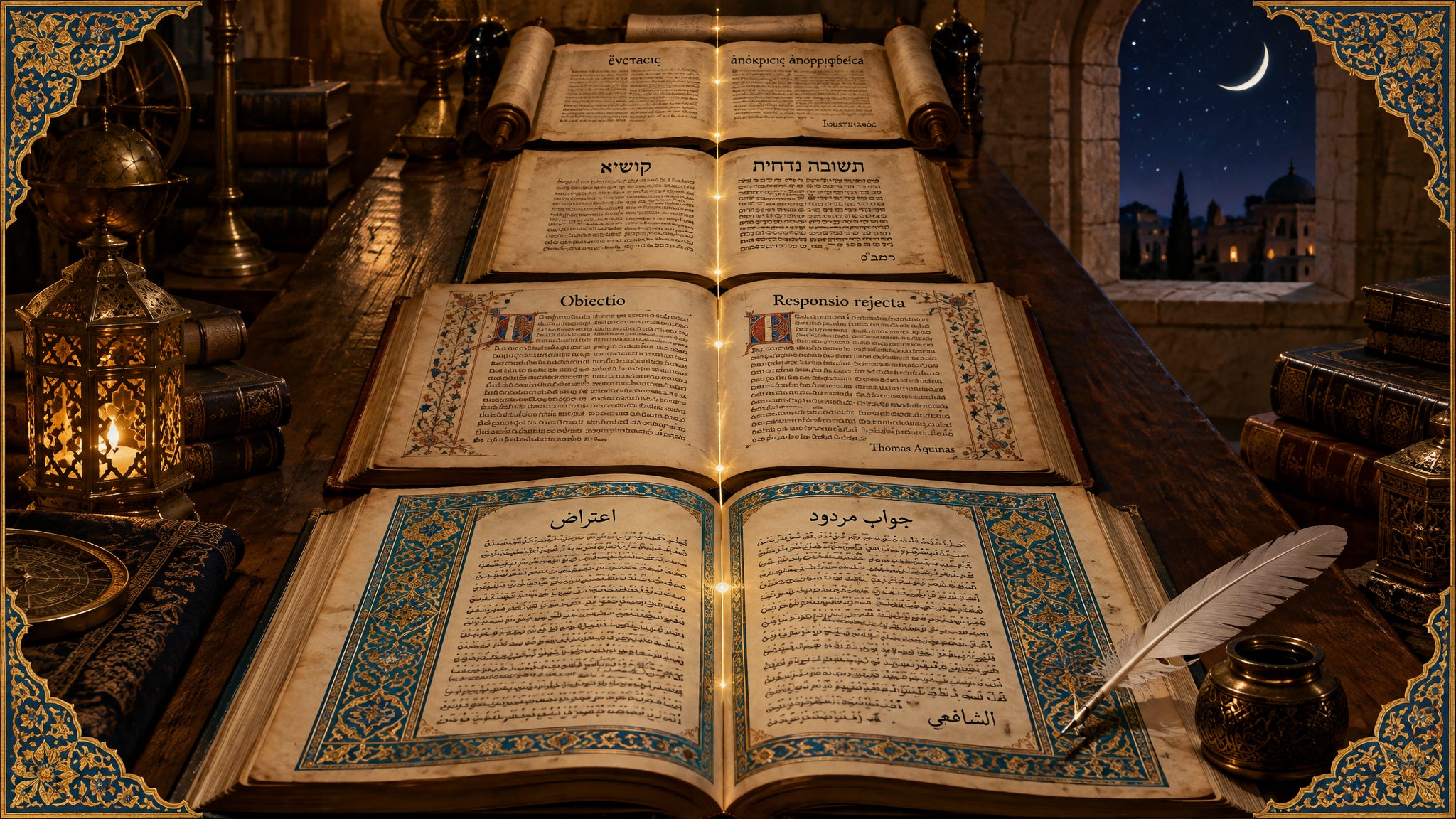
They wrote it into their books of law — not the answer only, but the question itself, in its sharpest form, with the objection standing up at full height and not cut down to size.
And they wrote down the answer they did not accept, and they kept the name of the man who gave it, so that anyone reading a thousand years later could see exactly what had been said and exactly who had said it.
That is what the people who faced this before us did.
And so should we.
What I Am Not Going to Say

Before I go any further I want to name something, because if I do not name it, someone in this room will reach for it, and they will be reaching for it with my material in their hand.
I am not going to stand here tonight and tell you that other people do this too, so it must be fine.
That is a bad argument.
You would be right not to accept it from me, and I would deserve it if you did not.
Everybody does it has never made one single thing lawful in the history of this religion.
If the practice were wrong, the fact that it is old and widespread would only make it an old and widespread wrong.
I will not offer you that, and if you hear it in my mouth tonight I want you to correct me.
So let me tell you what I am actually going to show you.
Three things.
The first — that the question is old.
Not our question, invented last century by people looking for something to argue about.
A serious, ancient question that serious, ancient people took seriously.
The second — that the houses which took it seriously all answered it the same way in one respect: they attached a limit.
Every one of them.
They did not say do whatever you like.
They said here is what this is, and here is what it is not, and here is the line.
And the third — and this one is aimed at us, so brace for it — that the warning which comes attached to all of this is not a warning about somebody else.
That is the night.
Video of the Sermon (Majlis/Lecture)
Recap — What We Carry Forward

We are in The Architecture of Guidance, and this is the fifteenth part of it.
And inside it we are working through a smaller sequence called The House Beside the Grave.
Tonight is the seventh of those, and there are eleven.
Tonight is Wednesday the 23rd of September 2026, and it is the 11th of Rabi al-Thani, of the year 1448.
What we carry forward is short.
From the seventy-third: the dead are not absent.
They know the visitor, and they take comfort in him — uns, the word we spent a night on, the warmth of company that keeps loneliness off.
From the seventy-fourth: the charge of idolatry, examined at its source, turns out never to have been about the oneness of God at all — and the commentator the objectors themselves rely on files the whole matter under the law of funerals, which is where you file a question about how you bury people, not a question about whom you worship.
And tonight, the third sentence.
We were not the first to ask.
The Question, As It Actually Arrives

I want to be honest with you about how this question reaches a person, because we have a habit in the seminary of answering questions in a form nobody ever asks them in.
Nobody walks up to you and says:
I wish to raise an objection concerning the permissibility of structures erected over the graves of the righteous.
What happens is this.
You are standing at a shrine.
Or you are showing somebody a photograph of one.
And they look at it, and they look at you, and they say:
Why do you do that?
That is the question.
Five words, and underneath them a suspicion — that there is something here that has slipped, that the line between honouring and worshipping has gone soft, and that you have not noticed because you grew up inside it.
Now.
A question like that cannot be answered by how it feels to you.
It feels right to you.
Of course it does — you have been doing it since you were a child and your mother held your hand at the doorway.
And it feels wrong to the person asking, and it feels wrong to them for reasons that are not stupid.
Feelings are not an argument.
Not theirs, and not ours.
So how do you settle it?
You ask what follows.
You take the thing you believe, and you push it until it produces a consequence — until it makes a difference to what you would actually do, in a real case, on a real morning.
And then you look at the consequence and you ask whether you can live with it.
Hold onto that, because in about fifteen minutes I am going to show you a room full of men doing exactly that, and they were not Muslims, and they had never heard of us.
Why We Are About to Read Their Books

Now I have to stop and do something, because otherwise you will sit through the next half hour waiting for me to explain myself.
In a few minutes I am going to open the books of the Jewish tradition in front of you, and read from them, carefully and with respect.
And after that I am going to open the Gospel.
A Shia majlis.
On a Wednesday night.
Reading the Talmud.
You are entitled to ask me why.
So here is why, and it is not my reason.
It is three verses and a hadith, and none of them is obscure.
What Every Human Being Is Made Of

The first is a thing we have already spent a whole night on, so I will only put my hand on it as I pass.
The one God took from every soul before any of us had a body to break it with — Am I not your Lord? — and every soul said yes.
We gave an entire evening to that in the Shahada nights, and I am not going to re-open it now.
But I will give you the hadith, because this one says something the covenant alone does not.
Imam Sadiq, peace and blessings be upon him, is asked about the fitrah — the original disposition God made every human being upon.
And he answers:
هِيَ الْإِسْلَامُ، فَطَرَهُمُ اللهُ حِينَ أَخَذَ مِيثَاقَهُمْ عَلَى التَّوْحِيدِ، قَالَ: أَلَسْتُ بِرَبِّكُمْ، وَفِيهِ الْمُؤْمِنُ وَالْكَافِرُ
“It is submission. God made them upon it when He took their covenant upon His oneness, saying: Am I not your Lord? — and in it is the believer and the disbeliever.”
— al-Kafi, Volume 2, the second hadith of the Book of Belief and Disbelief
Hear the last clause.
And in it is the believer and the disbeliever.
Not the believer only.
The disbeliever too — because the fitrah is not a reward for getting it right.
It is the material every human being is made out of, before anybody gets anything right or wrong.
So when I open their book in a moment, understand what I am doing.
I am not extending a courtesy to somebody outside.
I am reading what men made of the same substance as you made of the same question you have.
Noah, Abraham, Moses, Jesus — and You

The second is the verse I put at the door tonight.
شَرَعَ لَكُم مِّنَ الدِّينِ مَا وَصَّىٰ بِهِ نُوحًا وَالَّذِي أَوْحَيْنَا إِلَيْكَ وَمَا وَصَّيْنَا بِهِ إِبْرَاهِيمَ وَمُوسَىٰ وَعِيسَىٰ ۖ أَنْ أَقِيمُوا الدِّينَ وَلَا تَتَفَرَّقُوا فِيهِ
“He has ordained for you of the religion what He enjoined upon Noah, and that which We have revealed to you, and what We enjoined upon Abraham and Moses and Jesus — that you establish the religion and do not divide over it.”
— Qur’an, Surah al-Shura (the Chapter of Consultation) #42, Verse 13
One religion.
Ordained.
Not four religions in a row, each replacing the last like a new edition of a book.
One thing, enjoined on Noah, enjoined on Abraham, enjoined on Moses, enjoined on Jesus, and enjoined on you —
that you establish the religion and do not divide over it.
If that verse is true, then when I find a man in another house asking my question with care, I am not finding a coincidence.
And How We Are Told to Differ

And the third is the one that tells us how to disagree.
وَلَا تُجَادِلُوا أَهْلَ الْكِتَابِ إِلَّا بِالَّتِي هِيَ أَحْسَنُ إِلَّا الَّذِينَ ظَلَمُوا مِنْهُمْ ۖ وَقُولُوا آمَنَّا بِالَّذِي أُنزِلَ إِلَيْنَا وَأُنزِلَ إِلَيْكُمْ وَإِلَٰهُنَا وَإِلَٰهُكُمْ وَاحِدٌ وَنَحْنُ لَهُ مُسْلِمُونَ
“And do not dispute with the People of the Book except in the way that is best — except those of them who do wrong. And say: we believe in what has been sent down to us and what has been sent down to you, and our God and your God is One, and to Him we are submitted.”
— Qur’an, Surah al-Ankabut (the Chapter of the Spider) #29, Verse 46
Allamah Sayyed Muhammad Husayn Tabataba’i, in al-Mizan, tells us what the way that is best actually requires.
And I want you to listen to this, because he is not describing a mood.
He is describing a method.
وَالْمُجَادَلَةُ إِنَّمَا تَحْسُنُ إِذَا لَمْ تَتَضَمَّنْ إِغْلَاظاً وَطَعْناً وَإِهَانَةً… وَأَنْ يَقْتَرِبَ الْمُجَادِلُ مِنْ خَصْمِهِ وَيَدْنُوَ مِنْهُ حَتَّىٰ يَتَّفِقَا وَيَتَعَاضَدَا لِإِظْهَارِ الْحَقِّ مِنْ غَيْرِ لَجَاجٍ وَعِنَادٍ
“Disputation is only good when it contains no harshness, no slur, and no humiliation — and that the one disputing draws near to his opponent and comes close to him, until the two of them agree and support one another in bringing out the truth, without stubbornness or obstinacy.”
— Allamah Sayyed Muhammad Husayn Tabataba’i, al-Mizan fi Tafsir al-Qur’an, on Surah al-Ankabut #29, Verse 46
That the two of them support one another in bringing out the truth.
That is what we are doing tonight.
Three houses’ books, opened side by side, to bring out one truth about standing at a grave.
And now the lock, and I want it said plainly so that nobody can walk out of here tonight with the wrong thing in their pocket.
I am not telling you the religions are the same.
We differ.
We differ on things that matter more than this, and we differ on them permanently, and I am not going to stand on this pulpit and pretend otherwise to make an evening go down smoothly.
Where the roads part, they part.
What I am telling you is that the differing is supposed to be honourable.
And that is not my opinion.
That is a command, with a verse behind it.
They Asked It, and Then They Tested It
Before I Read You a Word of It

Before I read you a word of it, let me tell you what it is, because most of us in this room have never been told.
The Torah is the Book.
That much most of us know — what they hold as the revelation given at Sinai.
The Talmud is the second thing.
And that is their word for it, not mine.
One of their own scholars asks the question directly — why is it called Mishnah? — and he answers: because it is the second, in relation to the Torah.
It is the written record of centuries of argument among their scholars about how to live what was revealed.
Not the revelation.
The working out of the revelation.
What does this actually require of a man on a Tuesday, in a field, with a neighbour, in a year of drought.
And here is the thing I want you to hold.
For a long time they held that it must not be written down at all.
That it had to live in the mouth.
Carried by men, from men.
That to put it on a page was to kill something in it.
And then they wrote that ruling down too — with the names of who said it, and who heard it from him, and who heard it from him.
Sit with that for a moment.
It Keeps the Argument It Rejected
And there is a second thing about this literature, and it is the thing that makes tonight possible.
It writes down the argument it rejected.
By name.
You open a page and you find two men disagreeing, and the book does not tidy it away.
It keeps the losing answer.
It keeps the name of the man who gave the losing answer.
It keeps his reasoning at full strength, so that a reader hundreds of years later can look at it and think — actually, I am not sure he was wrong.
Which means this.
You cannot hold that book up and say this is what they believe.
Because on the next line it says the opposite, and the book kept both.
A book that preserves the losing opinion is not a creed.
It is a record of an argument.
What I Told You on the Tenth Night of Muharram

Now I have to say something, and I want to say it in front of you rather than hope nobody remembers.
On the tenth night of Muharram, from this pulpit, I told you that there is material in that literature — in the Talmudic accounts and in what came after them — about Jesus, may our souls be his ransom, and may God hasten his return, and about his mother, the blessed Saint Mary, peace and blessings be upon her, that we as Muslims find unspeakable.
That was true.
I do not take it back and I am not going to soften it tonight to make the next twenty minutes go down easier.
And it is also true that inside that same literature there are men asking our exact question, tonight’s question, with enormous care and enormous honesty.
Both of those are true at once.
And they are only able to be true at once because it is not a creed.
It is a library of arguments, and a library contains what its authors put in it, including the things you would not have put in it.
And We Would Not Survive That Test Either
And now the part that costs us something, because otherwise I am doing somebody a favour and I am not interested in doing anybody a favour tonight.
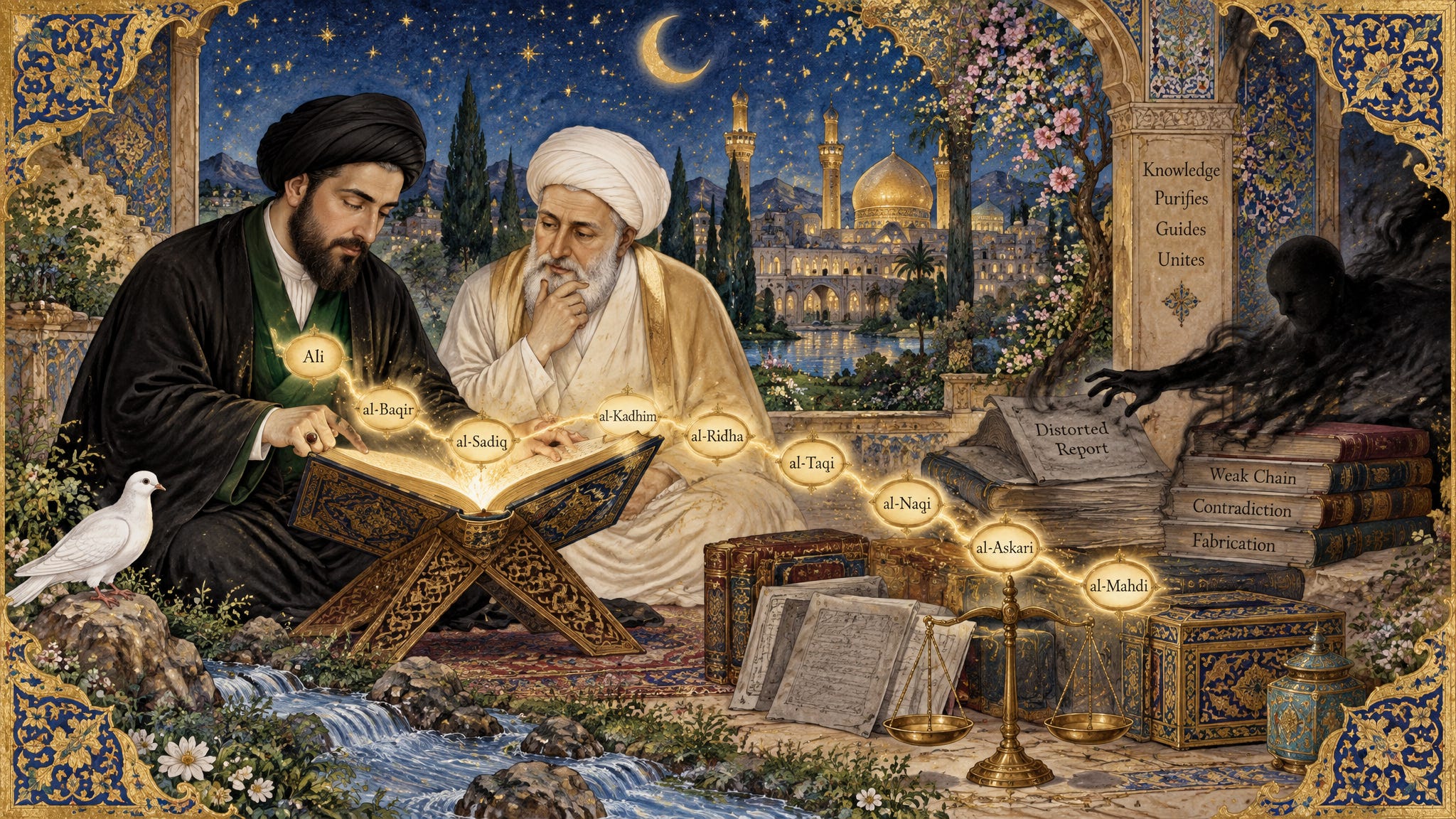
We have that kind of literature too.
Transmitted.
Argued over.
Graded and re-graded.
Full of reports that our own scholars examined and threw out, and full of reports that one scholar kept and the next scholar refused, and full of things that, if you went looking for them with bad intentions and a highlighter, you could hold up in front of a camera.
You cannot judge a tradition by the worst thing you can find in its secondary literature.
We know that.
We know it because we would not survive that test either.
So that is what the Talmud is.
Now let me show you what is in it.
Before I Open Their Book — Our Own
I am going to read you something from the Talmud in a moment.
Before I do, I want you to hear the same event from our own Qur’an, in our own language, so that when the other book opens you already know the ground you are standing on.
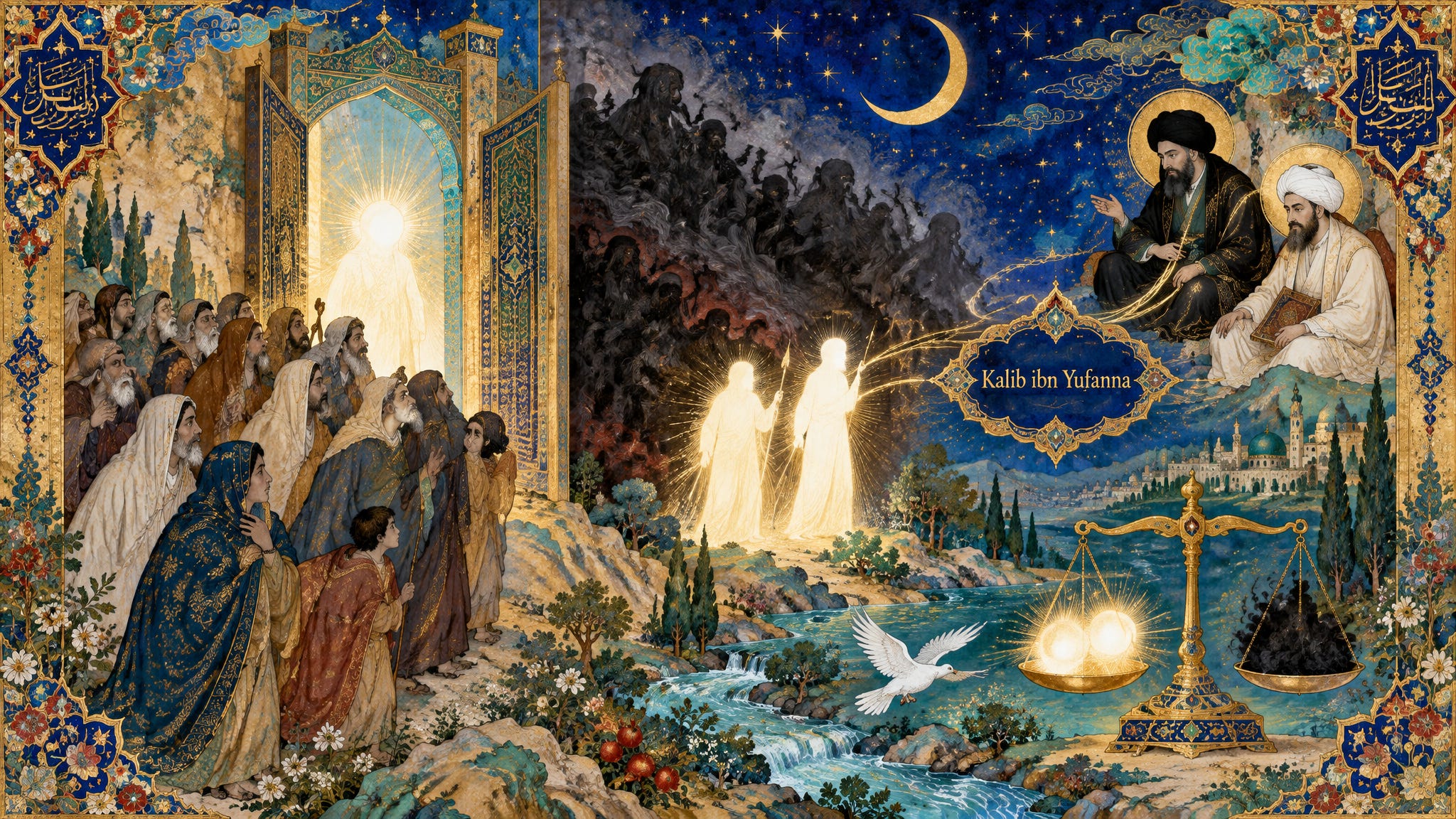
Moses, peace and blessings be upon him, brings his people to the edge of the holy land and tells them to go in.
يَا قَوْمِ ادْخُلُوا الْأَرْضَ الْمُقَدَّسَةَ الَّتِي كَتَبَ اللَّهُ لَكُمْ وَلَا تَرْتَدُّوا عَلَىٰ أَدْبَارِكُمْ فَتَنقَلِبُوا خَاسِرِينَ
قَالُوا يَا مُوسَىٰ إِنَّ فِيهَا قَوْمًا جَبَّارِينَ وَإِنَّا لَن نَّدْخُلَهَا حَتَّىٰ يَخْرُجُوا مِنْهَا فَإِن يَخْرُجُوا مِنْهَا فَإِنَّا دَاخِلُونَ
قَالَ رَجُلَانِ مِنَ الَّذِينَ يَخَافُونَ أَنْعَمَ اللَّهُ عَلَيْهِمَا ادْخُلُوا عَلَيْهِمُ الْبَابَ فَإِذَا دَخَلْتُمُوهُ فَإِنَّكُمْ غَالِبُونَ ۚ وَعَلَى اللَّهِ فَتَوَكَّلُوا إِن كُنتُم مُّؤْمِنِينَ
“O my people, enter the holy land which God has written for you, and do not turn back upon your heels, for then you will turn about as losers.
They said: O Moses, in it are a tyrannical people, and we will never enter it until they leave it. So if they leave it, then we will enter.
Two men among those who feared, upon whom God had bestowed favour, said: enter upon them by the gate — for when you have entered it, you will be the victors. And upon God put your trust, if you are believers.”
— Qur’an, Surah al-Ma’idah (the Chapter of the Table Spread) #5, Verses 21, 22 and 23
So the two men are in our Book.
Not as a footnote.
God Himself describes them —
among those who feared, and upon whom God had bestowed favour.
That is a testimonial.
Whoever these two are, the Qur’an has vouched for them.
And now, who were they?
Allamah Sayyed Muhammad Husayn Tabataba’i answers that in al-Mizan, and notice who he says agrees with him.
وَقَدْ ذَكَرَ الْمُعْظَمُ مِنْ مُفَسِّرِي الْفَرِيقَيْنِ: أَنَّ الرَّجُلَيْنِ هُمَا يُوشَعُ بْنُ نُونٍ وَكَالِبُ بْنُ يُوفَنَّا، وَهُمَا مِنْ نُقَبَاءِ بَنِي إِسْرَائِيلَ الِاثْنَيْ عَشَرَ
“And most of the commentators of the two schools have stated that the two men are Yusha’ ibn Nun and Kalib ibn Yufanna, and the two of them are among the twelve chiefs of the Children of Israel.”
— Allamah Sayyed Muhammad Husayn Tabataba’i, al-Mizan fi Tafsir al-Qur’an, on Surah al-Ma’idah #5, Verse 23
The commentators of the two schools.
Our scholars and theirs — meaning our Sunni brothers and ours — agree on the name of this man.
There is no dispute about it in our house at all.
Kalib ibn Yufanna.
Caleb, son of Jephunneh.
One of twelve chiefs.
One of two who did not go along with the rest.
Now hold that name, because in about ninety seconds a book that is not ours is going to tell you where he went.
A Man Peels Off from the Group
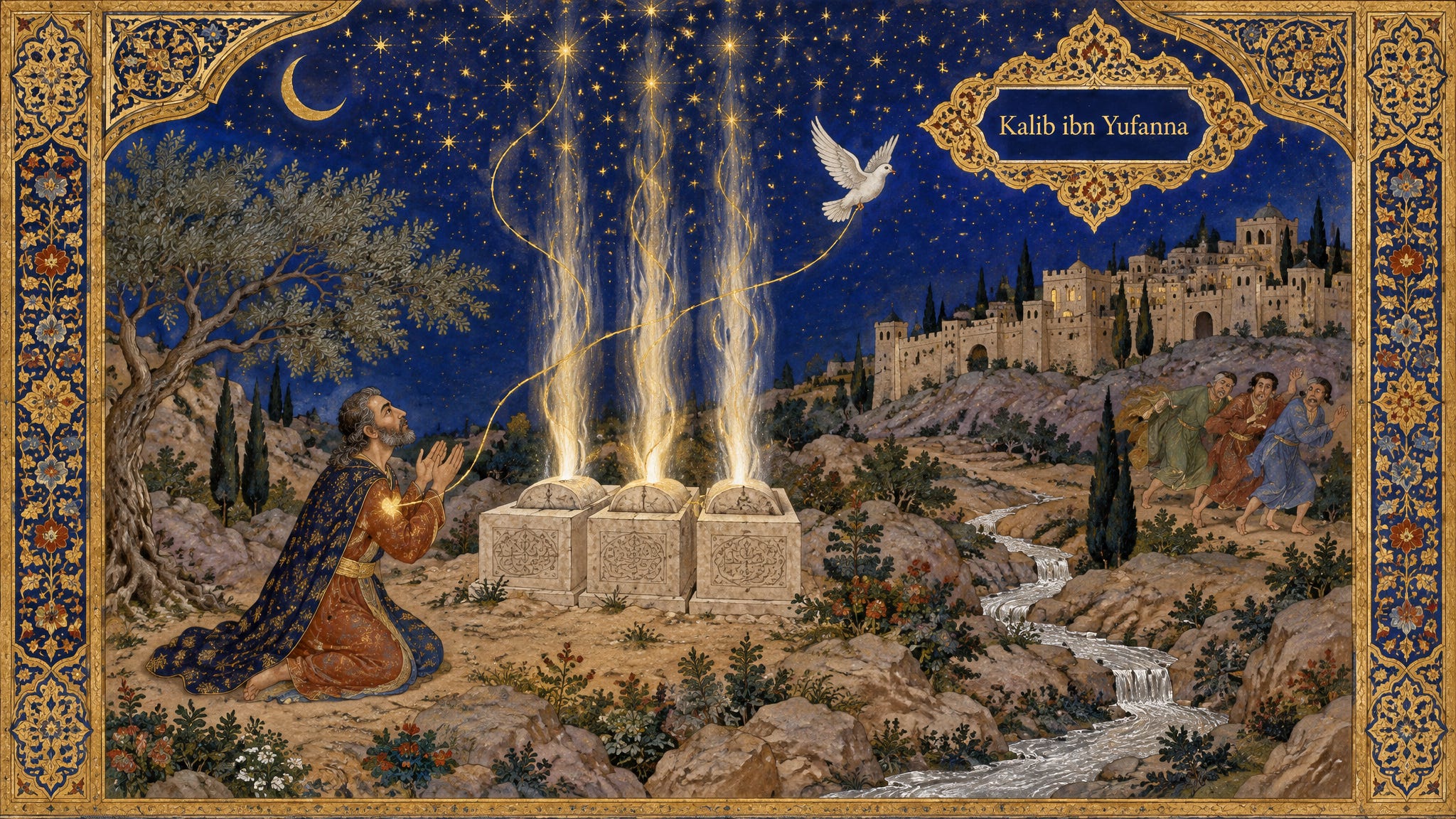
Twelve are sent ahead into the land.
Most come back and tell the people a story designed to frighten them out of obedience.
Two do not.
And the Talmud tells us where one of those two went, on that journey, when he separated himself from the rest of them.
ויעלו בנגב ויבא עד חברון ויבאו מבעי ליה אמר רבא מלמד שפירש כלב מעצת מרגלים והלך ונשתטח על קברי אבות אמר להן אבותי בקשו עלי רחמים שאנצל מעצת מרגלים
“’And they went up in the south, and he came to Hebron.’ — it should have said ‘and they came’! Rava said: this teaches that Caleb separated himself from the counsel of the spies, and he went and prostrated himself upon the graves of the fathers. He said to them: my fathers, seek mercy for me, that I may be saved from the counsel of the spies.”
— Babylonian Talmud, Sotah 34b
Hear what he does.
He leaves the group.
He walks to Hebron - what in Arabic is called al-Khalil, where the fathers are buried — Abraham and Isaac and Jacob, peace and blessings be upon them.
He goes down at the graves.
And he speaks to them.
My fathers, seek mercy for me.
He does not ask them for anything.
He asks them to ask.
And the man in the report is not a man in trouble with his faith.
He is the one who got it right.
He is the one who came back and told the truth when the others lied.
And Look Where It Comes From
Now I want you to notice how the Talmud arrives at this, because this is the part that should make you sit up.
It is not a story somebody remembered.
It is a grammar problem.
The verse says they went up in the south — plural, all of them, the whole group.
And then in the same breath it says and he came to Hebron.
Singular.
He came.
And the Talmud stops dead and says: it should have said and they came.
One letter.
A verb that changes number in the middle of a sentence, and everybody had read past it for generations, and somebody did not read past it.
Somebody stopped and said — wait.
Why does it go from they to he?
And out of that comes the whole report.
Now.
Where have you seen that before?
Last week, in this room, we stood on a verse about the standing place of Abraham, peace and blessings be upon him, and I asked you to notice a single preposition in it — the little word that makes the difference between taking the place itself and taking a place of prayer from it.
And I told you that the whole question turns on that one word, and that the commentator who reads carefully sees it and the one who reads fast does not.
That is the same method.
I am not telling you they are like us.
I am telling you something narrower and more interesting.
The method is the same method.
Men who take a revealed text seriously enough to slow down at a change of number — in Hebron and in Baghdad, in Hebrew and in Arabic, with no contact between them — end up doing the same thing, because the text is the kind of thing that rewards it.
And Then They Ask Our Question Out Loud
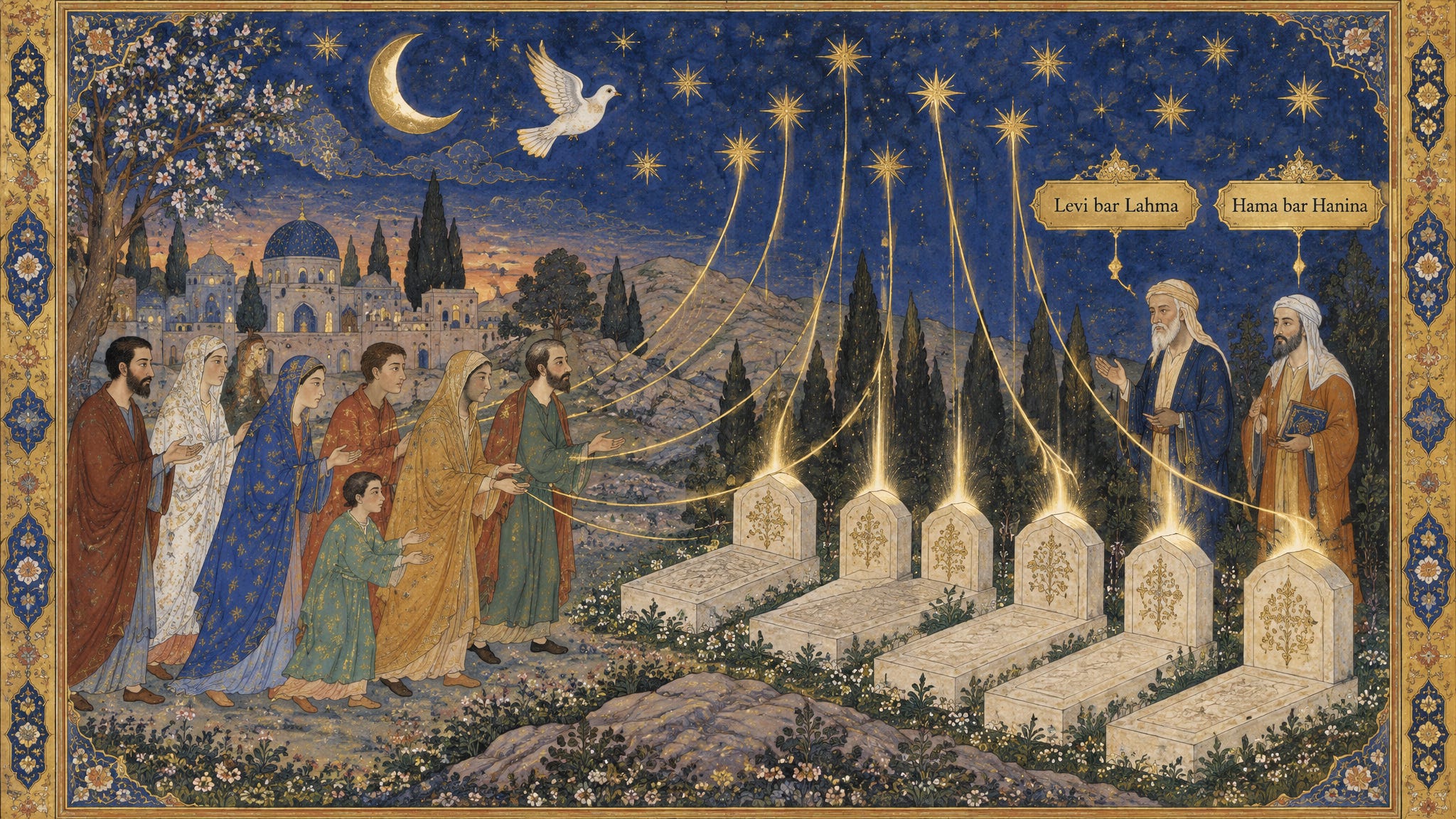
And now here is the passage I have been walking you toward all evening.
A fast day.
A public calamity — drought, plague, the things that make a community go out together and humble themselves.
And part of what they do on that day is that they go out to the cemetery.
And the Talmud asks why.
למה יוצאין לבית הקברות פליגי בה רבי לוי בר לחמא ורבי חמא בר חנינא חד אמר הרי אנו חשובין לפניך כמתים וחד אמר כדי שיבקשו מתים רחמים עלינו מאי ביניהו איכא ביניהו קברי גוים
“Why do they go to the cemetery? R. Levi b. Lahma and R. Hama b. Hanina differ as to the reason. The one maintains that it signifies: we are before Thee as dead. While according to the other it is in order that the departed ones should pray for mercy in our behalf. What practical difference is there? The difference arises with regard to non-Jewish cemeteries.”
— Babylonian Talmud, Ta’anit 16a, in the edition of Henry Malter
Why do they go to the cemetery?
Let that sentence sit in the room for a second.
That is our question.
That is the four-word question the man at the shrine asks you, word for word, in another language, in another house, from men who had never heard of us and never would.
And I am not going to tell you how long ago it was said, and I want to explain why, because it matters.
I could give you a number.
There is a number available and it sounds impressive.
But the number would be attached to the date somebody thinks that book was finished, and the people who study these things for a living do not agree about when that book was finished, and if I lean my argument on their disagreement then the first person who wants to knock it over will knock it over, and he will be right, and the room will stop listening.
So I will not give you a date for the book.
I will give you the men.
They are named in the text.
Rabbi Levi bar Lahma and Rabbi Hama bar Hanina.
You can look them up.
They taught, they had students, they had teachers, and their dates are not a matter of dispute.
And both of them were dead and buried before the Prophet, peace and blessings be upon him, his family, and his righteous companions, was born.
That is the claim.
It does not need a century number and it cannot be knocked over.
And Then — Listen — They Test It
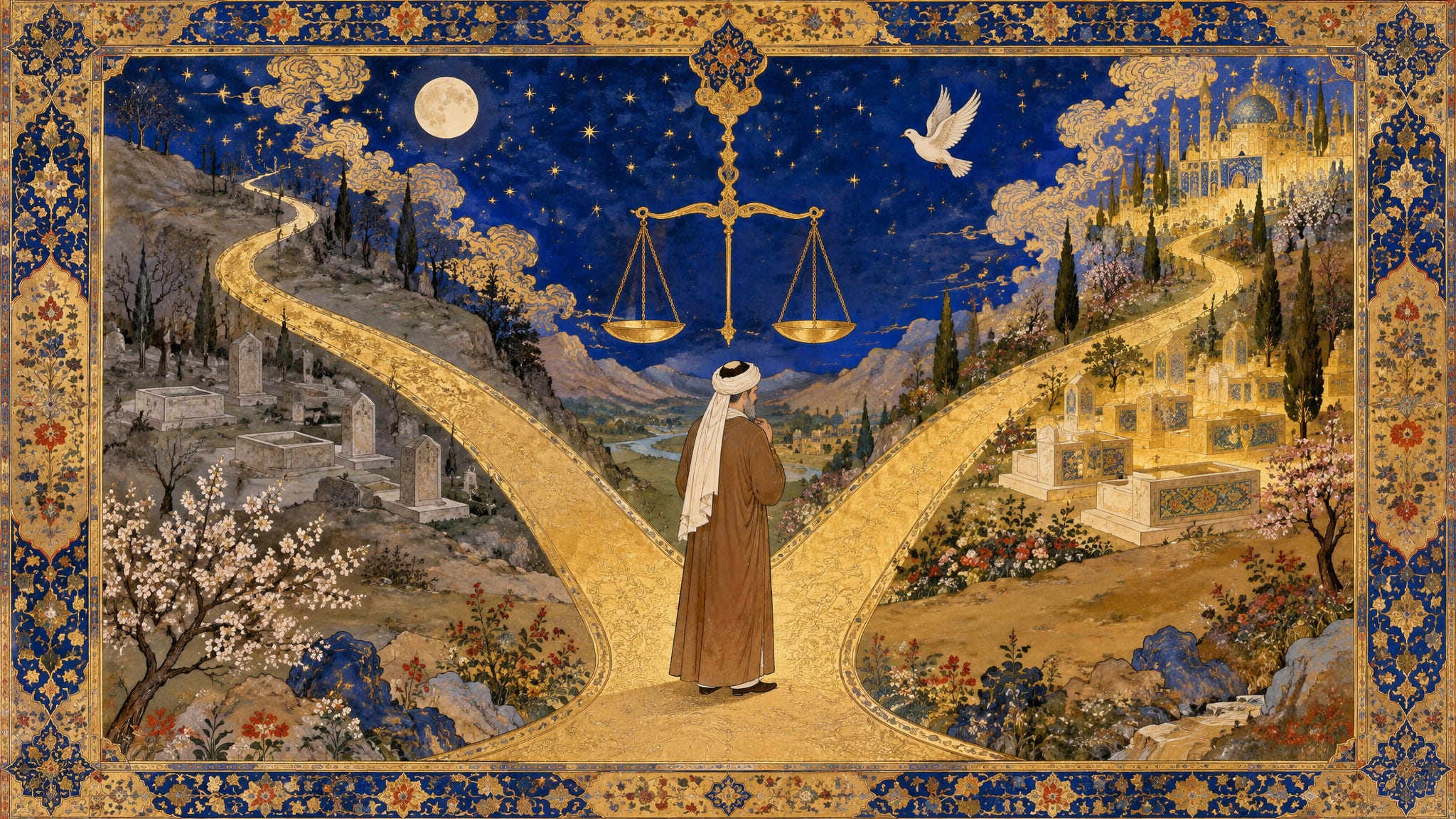
Now watch what they do next, because this is the point of the whole point.
They have two answers on the table.
The first:
we are before Thee as dead.
We come out to the graves to say something about ourselves.
Look at us, God — we are as good as these.
We are dust the same as this dust.
It is an act of humbling, and it is aimed at God, and the dead in it are scenery.
The second:
that the departed ones should pray for mercy in our behalf.
We come out to the graves because the people in them can ask, and we are asking them to ask.
Two completely different theologies of the same walk.
And the Talmud does not settle it by which one feels more pious.
It asks:
What practical difference is there?
What would actually change?
Show me a case where the two answers give you different instructions.
And it finds one, immediately.
The difference arises with regard to non-Jewish cemeteries.
Follow it through.
If the reason is we are before Thee as dead — then any grave will do.
Dust is dust.
You can make that statement about yourself standing anywhere there are graves.
But if the reason is that the departed ones should pray for mercy in our behalf — then it matters enormously whose graves they are.
You do not go to the graves of people who would not be asking.
One question.
And now the two answers are no longer two moods.
They are two different sets of instructions for a real morning in a real place, and you can look at them and decide.
That Is Exactly What We Did Last Week
My dear brothers and sisters.
That is exactly what we did last week.
Last week I read you the Imam of the Shafi’is, al-Nawawi, on the question of building over a grave, and I showed you that he did not settle it by how it felt.
He asked what follows — whose land is it, is it endowed, is it public, what would the ruling be if the answer were yes.
He was not reading this.
He had never seen this page and would not have wanted to.
He arrived there by himself.
Because that is what happens when serious people take a question seriously.
They stop asking how it feels and they start asking what follows.
And It Reaches the Book of Law

And one last thing, and then I am done with this house.
This did not stay in the study hall.
It went into the code of law.
Not into a book of piety or a book of stories — into the book a man opens to find out what he is supposed to do.
ויש מקומות נוהגין לילך על הקברות ולהרבות שם בתחנות
“And there are places where the custom is to go to the graves, and to pray much there.”
— Rema, gloss on Shulchan Arukh, Orach Chayim 581:4
In a code of law.
As custom.
Recorded plainly, without apology and without embarrassment.
Somebody asked the question.
Somebody wrote the question down.
Somebody wrote down both answers, and the name of the man who gave the answer they did not take.
And somebody tested it against a real case.
And at the end of all of that it entered the law as a custom in some places.
That is a house that was not afraid of its own question.
Lessons for Our Time
The Ones Who Took It Seriously Always Attached a Limit
Here is the first thing to carry.
Every house that took this question seriously answered it with a limit attached.
Not one of them said:
do whatever moves you.
Not one of them said:
it is all intention, so nothing is off the table.
They said — here is what this is, and here is what it is not, and here is where the line falls.
The Talmud’s line fell at whose graves you are standing at.
Al-Nawawi’s line fell at whose land you are building on.
Different houses, different lines, and every single one of them a line.
Now think about what that does to the objection.
Because the objection, when you strip it down, is an objection to carelessness.
It is the fear that somebody, somewhere, has stopped noticing the difference between honouring a man and worshipping him.
And that fear is not stupid.
I have said so before and I will say it again.
There are people who are careless about it, and some of them are ours.
But look at what the evidence actually shows.
Carefulness is the mark of every house that took this question seriously.
The carefulness is the tradition.
The carelessness is the departure from it.
So when somebody accuses you of carelessness, the answer is not to get loud.
The answer is to be careful — visibly, out loud, with your limits stated where people can hear them.
You do not answer a charge of carelessness by being offended.
You answer it by being careful.
A Question You Can Write Down Is a Question You Are Not Afraid Of

And here is the second, and it is smaller and it will stay with you longer.
A question you can write down is a question you are not afraid of.
We wrote ours down last week.
In front of you.
In its strongest form, with nothing filed off it, and I did not stand up here and pretend the objection was stupid, because it is not stupid.
And theirs is written down in their book too — and next to it, kept, is the answer they did not take.
With the name of the man who gave it, so that you can go and check whether he was right.
Think about what kind of confidence that takes.
To write down the argument against yourself.
To preserve it accurately.
To hand your grandchildren the sharpest version of the case you rejected, and trust them to look at it properly.
That is not the behaviour of people with something to hide.
Now turn it around.
The people in trouble are never the ones who write the question down.
The people in trouble are the ones who cannot let it be asked.
The ones who go quiet, or loud, or personal.
The ones who tell you the question itself is a sign of bad character — bad Akhlaq, so that nobody in the room has to hear the answer.
Watch for that.
In others, and — this is the one that matters — in yourself.
Because if you ever find that there is a question about your own religion that you would rather was not asked in front of you, that is not a sign that the question is dangerous.
That is a sign that you have not done the reading.
And Our Own Books Say It First
I Am Not About to Tell You What Christians Do
Let me be very clear about what is coming, because there is an easy misunderstanding available here and I want to close it before we start.
I am not about to tell you what Christians do.
I am not going to show you a practice in another community and invite you to feel better about ours.
That would be the same bad argument I refused at the start of the evening, dressed differently, and you would be right to catch me at it.
I am about to read you what is in our books.
Our narrations.
Our compilations.
The ones our own scholars transmitted and our own scholars argued about.
And what is in them is about a prophet, peace and blessings be upon him, whom we love and whom we are commanded to love, and about what God told him to do.
The Christian material comes at the end, and it comes as a footnote, not as evidence.
Everything that follows is ours.
God Tells a Prophet to Stand at a Grave
Shaykh al-Mufid records, in his Amali, a revelation from God to Jesus son of Mary, may our souls be his ransom, and may God hasten his return.
Four instructions in one breath.
Listen to the company the fourth one keeps.
يَا عِيسَى، هَبْ لِي مِنْ عَيْنَيْكَ الدُّمُوعَ، وَمِنْ قَلْبِكَ الْخُشُوعَ، وَاكْحُلْ عَيْنَيْكَ بِمِيلِ الْحُزْنِ إِذَا ضَحِكَ الْبَطَّالُونَ، وَقُمْ عَلَىٰ قُبُورِ الْأَمْوَاتِ فَنَادِهِمْ بِالصَّوْتِ الرَّفِيعِ لَعَلَّكَ تَأْخُذُ مَوْعِظَتَكَ مِنْهُمْ، وَقُلْ: إِنِّي لَاحِقٌ بِهِمْ فِي اللَّاحِقِينَ
“O Jesus, make Me a gift of the tears of your eyes, and of the humility of your heart. And anoint your eyes with the kohl-stick of sorrow when the idle ones laugh. And stand at the graves of the dead and call to them with a raised voice — perhaps you will take your admonition from them. And say: I am joining them, among those who join.”
— Shaykh al-Mufid, al-Amali, on the authority of Imam Sadiq, peace and blessings be upon him
Notice what it is grouped with.
Tears.
Humility of the heart.
The kohl-stick of sorrow, drawn along the eye, while the idle ones are laughing.
And then — in the same list, in the same voice, as the fourth of four —
stand at the graves and call out.
That is not a legal instruction.
Nobody legislates the tears of a man’s eyes.
This is the register of intimacy — of what God asks from someone He has drawn close.
Standing at a grave and calling out belongs, in God’s own ordering, with weeping and with humility and with refusing to laugh along with the idle.
Read the clause itself again, slowly, and hear what is actually being asked.
Stand at the graves.
Not walk past them. Not glance. Stand.
And call to them.
Not think about them.
Not reflect upon them silently, in the privacy of your own heart, in a manner unlikely to attract comment.
Call to them — and call with a raised voice.
And then speak to them directly, in the second person, about yourself:
I am joining you.
Now.
Whatever standing at a grave and calling out is — it cannot be the thing the charge says it is.
Because God is the one giving the instruction, and He is giving it to a prophet, and He is not instructing a prophet to commit the one sin the whole of prophethood exists to abolish.
You do not have to take my word for the ruling. Just hold the two things side by side.
On the one side, a charge that says speaking at a grave is the beginning of idolatry.
On the other side, God telling a prophet to go and speak at a grave, out loud.
They cannot both be describing the same act.
And Now the Verse You Are About to Think Of
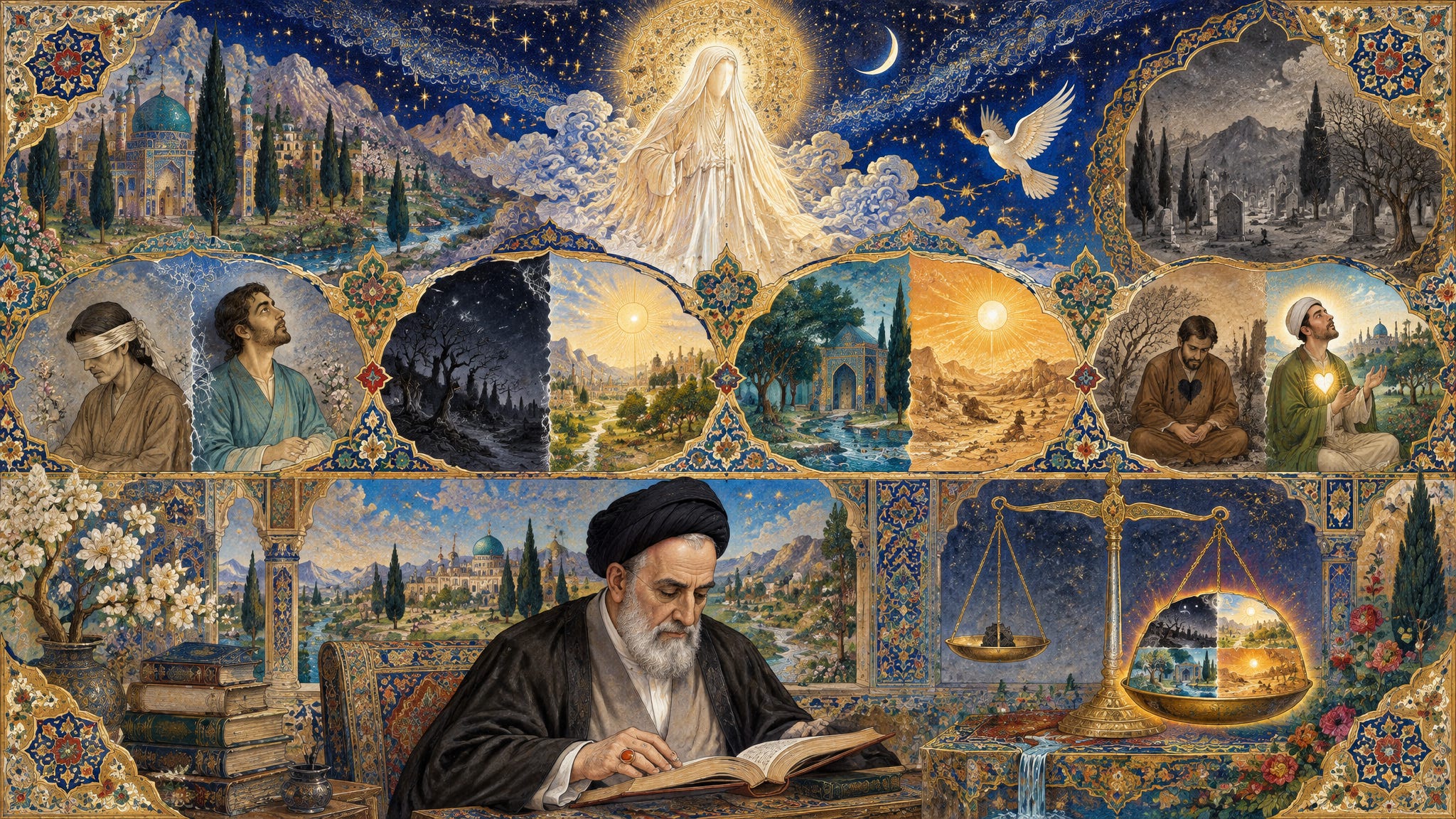
Now some of you — and I mean this as a compliment — some of you have already got a verse in your mouth.
I know which one.
Let us go and get it, because I am not going to leave it sitting in the room unsaid while I move on to something more comfortable.
وَمَا يَسْتَوِي الْأَعْمَىٰ وَالْبَصِيرُ
وَلَا الظُّلُمَاتُ وَلَا النُّورُ
وَلَا الظِّلُّ وَلَا الْحَرُورُ
وَمَا يَسْتَوِي الْأَحْيَاءُ وَلَا الْأَمْوَاتُ ۚ إِنَّ اللَّهَ يُسْمِعُ مَن يَشَاءُ ۖ وَمَا أَنتَ بِمُسْمِعٍ مَّن فِي الْقُبُورِ
“And the blind and the seeing are not equal.
Nor the depths of darkness and the light.
Nor the shade and the scorching heat.
And the living and the dead are not equal. Indeed, God causes to hear whom He wills — and you are not one who makes those in the graves hear.”
— Qur’an, Surah Fatir (the Chapter of the Originator) #35, Verses 19, 20, 21 and 22
You are not one who makes those in the graves hear.
That is the verse.
It is a real verse and it is put to us constantly, and the person putting it to us is usually not being dishonest.
They are reading what is in front of them.
So let us read what is in front of them properly — all of it, not the last clause on its own.
Look at the shape of the passage.
It is a list.
Four pairs, one after another, in a single breath.
The blind and the seeing.
Darkness and light.
Shade and burning heat.
The living and the dead.
Now — nobody in the history of this religion has ever read the first pair as a statement about eyesight.
Nobody has ever said that God is here comparing the visually impaired unfavourably with the sighted.
Every reader who has ever lived understands immediately that the blind means the one who will not see what is in front of him, and the seeing means the one who will.
Nobody reads the second pair as a remark about the hours of daylight.
Nobody reads the third pair as advice about standing in the shade.
Three similitudes.
And then, in the same list, in the same breath, in the same grammatical shape — the fourth.
And suddenly, we are told, this one is about actual corpses.
Allamah Sayyed Muhammad Husayn Tabataba’i, in al-Mizan, says what a careful reader would say.
He reads the whole run as one run — the blind and the seeing, the darkness and the light, the shade and the heat, the living and the dead — as four similitudes for one thing: the believer and the one who has closed himself.
And on those in the graves he says:
وَالْمُرَادُ بِهِمُ الْكُفَّارُ الْمَطْبُوعُ عَلَىٰ قُلُوبِهِمْ
“And what is meant by them is the disbelievers upon whose hearts a seal has been set.”
— Allamah Sayyed Muhammad Husayn Tabataba’i, al-Mizan fi Tafsir al-Qur’an, on Surah Fatir #35, Verse 22
Those in the graves are not the dead.
They are the living — walking around, eating lunch, perfectly healthy — with something sealed over the heart, so that the message goes in at the ear and arrives nowhere.
And the verse is a consolation to the Prophet, peace and blessings be upon him, his family, and his righteous companions.
It is God telling him: this is not your failure.
You cannot force it.
You are not the one who makes a man hear who has decided not to.
The verse is not about a cemetery.
It is about a man in the third row who has made up his mind.
At His Cousin’s Grave
And one more from our own books, and this one I have been waiting all evening to give you.
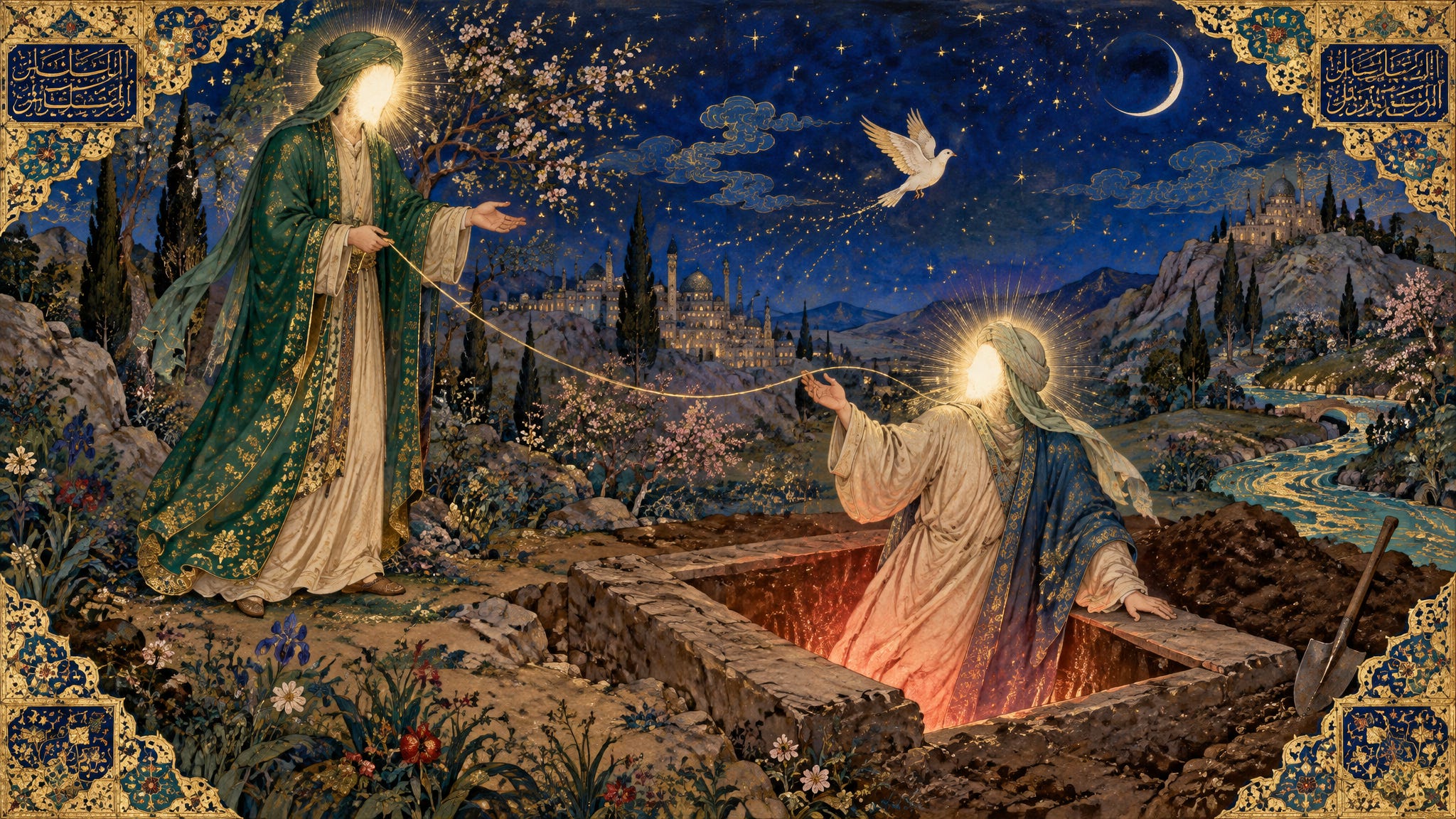
In al-Kafi, in Volume Three, in the Book of Funerals — the same book from which we took the first point of the seventy-third session — there is a report about Jesus son of Mary, may our souls be his ransom, and may God hasten his return, and I will give it to you whole, because the end of it is the part that matters and I do not want you hearing only the first half.
He goes to the grave of Yahya ibn Zakariyya — John the Baptist, peace and blessings be upon him.
His cousin.
إِنَّ عِيسَى ابْنَ مَرْيَمَ جَاءَ إِلَىٰ قَبْرِ يَحْيَى بْنِ زَكَرِيَّا وَكَانَ سَأَلَ رَبَّهُ أَنْ يُحْيِيَهُ لَهُ، فَدَعَاهُ فَأَجَابَهُ وَخَرَجَ إِلَيْهِ مِنَ الْقَبْرِ، فَقَالَ لَهُ: مَا تُرِيدُ مِنِّي؟ فَقَالَ لَهُ: أُرِيدُ أَنْ تُؤْنِسَنِي كَمَا كُنْتَ فِي الدُّنْيَا. فَقَالَ لَهُ: يَا عِيسَى، مَا سَكَنَتْ عَنِّي حَرَارَةُ الْمَوْتِ وَأَنْتَ تُرِيدُ أَنْ تُعِيدَنِي إِلَى الدُّنْيَا وَتَعُودَ عَلَيَّ حَرَارَةُ الْمَوْتِ؟ فَتَرَكَهُ فَعَادَ إِلَىٰ قَبْرِهِ
“Jesus son of Mary came to the grave of Yahya ibn Zakariyya, and he had asked his Lord to bring him to life for him. So he called him, and he answered him, and came out to him from the grave. He said to him: what do you want from me? He said to him: I want you to keep me company, as you used to in the world. He said to him: O Jesus — the heat of death has not yet settled away from me, and you want to return me to the world and have the heat of death come back upon me? So he left him, and he returned to his grave.”
— al-Kafi, Volume 3, the Book of Funerals
Now.
There is more in that than I can open tonight, so let me take only what belongs to this evening.
Uridu an tu’nisani.
Uns.
That is the word.
That is the word we spent a whole evening on — the warmth of company, the particular comfort of not being alone, the thing one person gives another simply by being there.
Two weeks ago we found it in a narration about what the dead receive from the living.
And here it is in the mouth of a prophet — asking for it in the other direction. At a grave. Out loud.
And then hear the answer, because the answer is not what a story invented to comfort us would have said.
The heat of death has not yet settled away from me.
He says no.
Not out of coldness.
He had loved him in the world and there is no suggestion he has stopped.
He says no because coming back would cost him something, and he has already paid it once, and he does not want to pay it again.
Think about what has to be true for that sentence to be sayable.
He is conscious.
He is present.
He can be called, and he can hear, and he can answer.
He remembers the world and what he was to this man in it.
And he has an interest of his own — something he wants and something he would rather avoid — which means he is not an object in somebody else’s story.
He is still a person.
I am not going to draw the conclusion for you.
Sit with it.
What the Angels Say, and Where the Prophet Said It
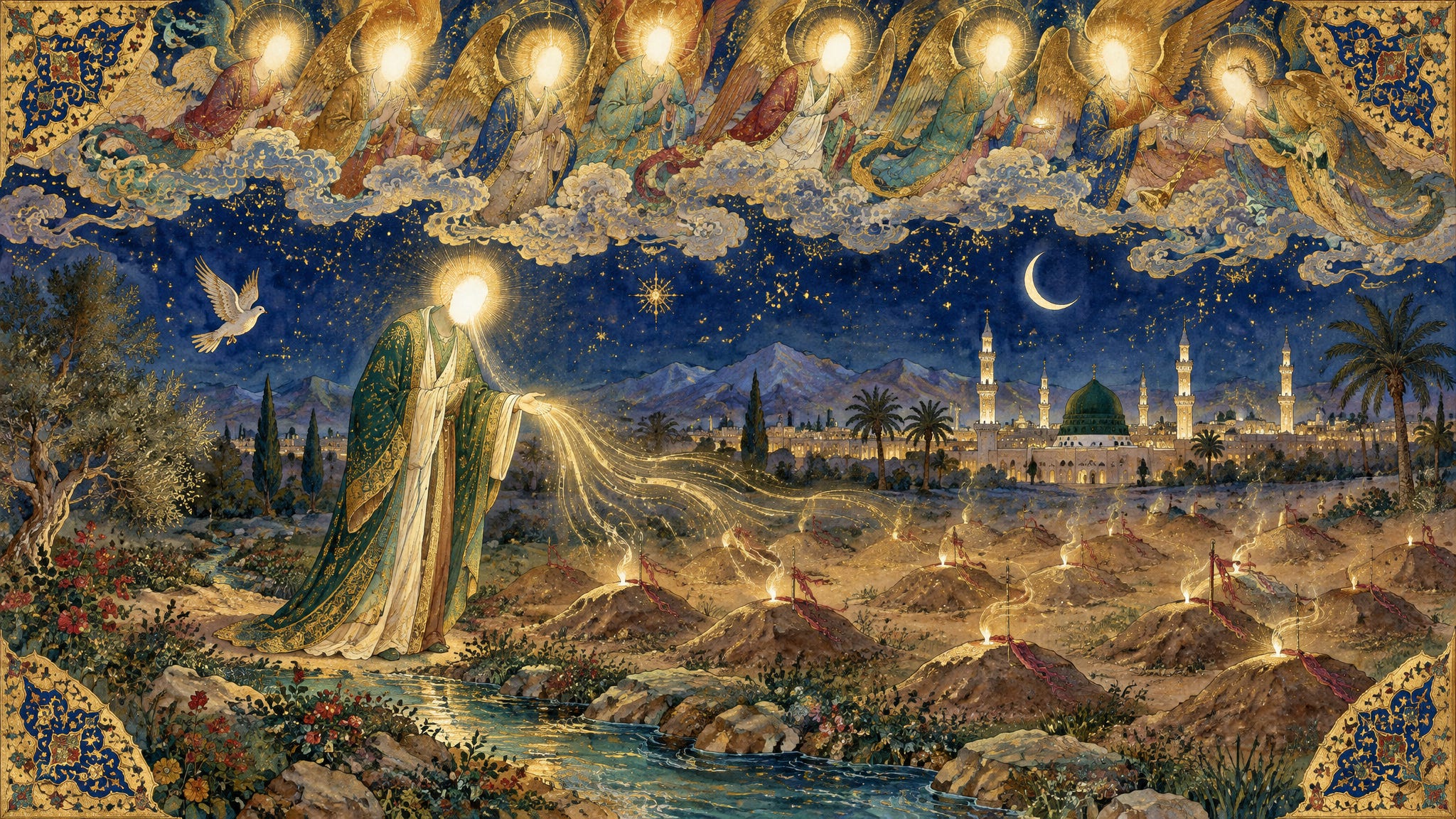
One more, and it is the only thing in this Point that is not from our own books — so before I give it to you, hear what our own books say about the same act.
There is a verse describing what the angels say when they come in upon the patient in the Garden.
سَلَامٌ عَلَيْكُم بِمَا صَبَرْتُمْ ۚ فَنِعْمَ عُقْبَى الدَّارِ
“Peace be upon you for what you endured — and how excellent is the final home.”
— Qur’an, Surah al-Ra’d (the Chapter of Thunder) #13, Verse 24
Now hear where those words were said on this earth.
وَبَلَغَنِي أَنَّ النَّبِيَّ صَلَّى اللَّهُ عَلَيْهِ وَآلِهِ كَانَ إِذَا أَتَى قُبُورَ الشُّهَدَاءِ قَالَ: السَّلَامُ عَلَيْكُمْ بِمَا صَبَرْتُمْ فَنِعْمَ عُقْبَى الدَّارِ
“And it has reached me that the Prophet, may God bless him and his family, when he came to the graves of the martyrs, would say: peace be upon you for what you endured, and how excellent is the final home.”
— Ibn Qulawayh, Kamil al-Ziyarat, on the authority of Imam Sadiq, peace and blessings be upon him
Sit with the shape of that.
The greeting that the angels give in Paradise — the Messenger of God, peace and blessings be upon him, his family, and his righteous companions, brought it out to a field outside Madina and said it to men in the ground.
Not about them.
To them.
In the words the angels use.
So going to the graves of people who were killed for refusing, and speaking to them, and keeping the place — that is not a thing we picked up from anybody.
It is in our Book and it is in our Prophet’s mouth.
And They Kept the Day
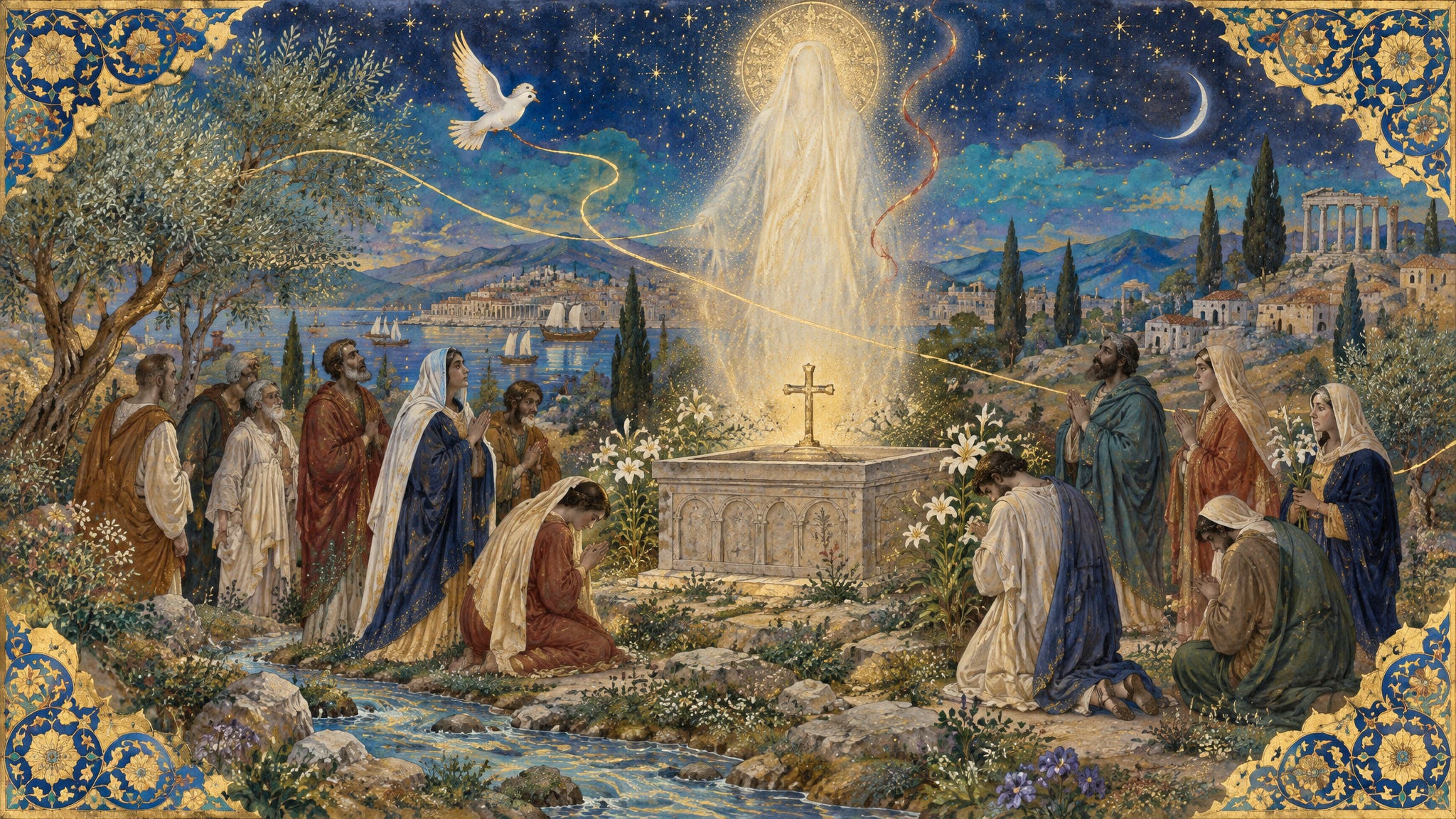
And now the one that is theirs, and I give it to you as theirs.
On the fifth night of Muharram I told you about Polycarp — the old bishop of Smyrna who would not say the words that would have saved him, and who was burned for it.
What I did not dwell on then, I will name now.
His people gathered his bones afterwards.
They described them as more valuable than jewels.
They buried them in a place they chose.
And they said that they would gather there, on the anniversary, in gladness, to remember the ones who had gone before and to prepare the ones who were coming.
An annual gathering.
At a tomb.
On a date.
Written down by the people who did it, without the slightest sense that they were doing anything that needed defending.
That is all.
I am not going to build on it.
I mention it only so you know that the pattern is not narrow.
Lessons for Our Time
God Told a Prophet to Stand at a Grave and Speak

The first is one sentence and it does not need my help.
God told a prophet to stand at a grave and speak out loud.
That is in our books.
Not in theirs — in ours.
Transmitted by our own compilers, in a collection our own scholars have used for a thousand years.
So whatever visiting is, it cannot be the thing the charge says it is.
I am not re-arguing the seventy-fourth session tonight.
We did that work and it stands.
I am adding one stone to it: that the practice the charge calls a novelty and a slide into idolatry turns out to be something God instructed a prophet to do, in plain language, with a raised voice.
And notice the company He put it in.
Tears.
Humility of the heart.
Sorrow drawn along the eye like kohl, while the idle are laughing.
And then — go and stand at the graves and call out.
That is where God filed it.
Not under law, and not under danger, and certainly not under the things a servant must be warned away from.
He filed it with the tears.
So when the charge comes — and it will come, and it will probably come from someone who means well — you now know something about the shape of the answer.
The answer is not how dare you.
The answer is not a list of scholars’ names delivered at speed.
And the answer is certainly not everyone does it, which I refused at the start of this evening and which I refuse again now.
The answer is:
Let me show you where God put this.
Hold that lightly.
Do not become pleased with yourself about it — being right is the least interesting thing a person can be, and a man can be right about a grave and wrong about nearly everything else.
But hold it.
And the Verse They Quote at You Says the Opposite
And the second, and this one you will use.
The verse people quote at you says close to the opposite of what they think it says.
You are not one who makes those in the graves hear
— and those in the graves, on the reading of Allamah Tabataba’i, are the sealed-hearted living.
The fourth of four similitudes in a single run, three of which nobody has ever taken literally.
Now.
When you say this to somebody, say it the way I have just said it.
Do not say it in triumph.
Do not say you have been misreading your own Qur’an — even if it is true, especially if it is true.
The moment a person feels humiliated, the argument is over and you have won nothing.
Say it the way you would want it said to you if you had been the one reading past it.
Name the commentator.
Give the reason.
Show them the four pairs and let them see it for themselves.
And then stop talking.
Because the argument that convinces is never the one you win.
It is the one they finish in their own head after you have gone home.
And there is one more thing in this, and it is bigger than the verse.
Ask yourself how the misreading happened.
Because it did not happen through malice, and it is important that you understand that, or you will handle the next person badly.
It happened because somebody took the last clause of a list and read it on its own.
That is all.
There was no conspiracy.
Four pairs in a single breath, and somebody quoted the fourth one, and once you have only the fourth one in front of you, the plain meaning of the words is exactly what they said it was.
Now — that is the most ordinary error in the world, and we make it constantly.
We do it with hadith.
We take the sentence that suits us and leave the sentence before it where it lies.
We do it with each other — we hear the fourth clause of what our brother said, the one that stung, and we build a whole opinion of him out of it while the three clauses that framed it go unremembered.
And we do it with ourselves.
A man will take one thing he did on one bad afternoon and read it as the summary of his life, when it was the fourth item in a list, and God has the whole list.
So when you correct somebody’s reading of this verse, correct the method, gently, not just the verse.
Say: look at the run.
Look at what it sits inside.
Because if they learn that — if they learn to read the list and not the clause — you have given them something far more valuable than a point about a cemetery.
You have given them a way of reading that will protect them from a hundred arguments you will never be there for.
The Turn, and It Is Aimed at Us
We Did Not Read You All of It
On the tenth night of Muharram, in this hall, we read the Seven Woes.
You will remember them.
The long sequence in the Gospel of Matthew where Jesus son of Mary, may our souls be his ransom, and may God hasten his return, turns on the religious establishment of his own community and says woe to you seven times over.
We read them because of what was done to him, and to his mother, and to those who followed him.
We did not read you all of them.
There are two verses in the middle of that sequence that I left where they were, because they did not belong to that night.
They belong to tonight.
And Again — Our Own Book First
Same discipline as Point 1.
Before I read you a word of the Gospel, hear the charge in our own Qur’an, in our own language, about the same community and the same conduct.
God is speaking to the Children of Israel, and He reminds them what they were given before He says what they did with it.
وَلَقَدْ آتَيْنَا مُوسَى الْكِتَابَ وَقَفَّيْنَا مِن بَعْدِهِ بِالرُّسُلِ ۖ وَآتَيْنَا عِيسَى ابْنَ مَرْيَمَ الْبَيِّنَاتِ وَأَيَّدْنَاهُ بِرُوحِ الْقُدُسِ ۗ أَفَكُلَّمَا جَاءَكُمْ رَسُولٌ بِمَا لَا تَهْوَىٰ أَنفُسُكُمُ اسْتَكْبَرْتُمْ فَفَرِيقًا كَذَّبْتُمْ وَفَرِيقًا تَقْتُلُونَ
“And We gave Moses the Book, and We followed him up with messengers after him. And We gave Jesus son of Mary the clear signs, and We supported him with the Holy Spirit. Is it then that every time a messenger came to you with what your souls did not desire, you grew arrogant — and a party you denied, and a party you kill?”
— Qur’an, Surah al-Baqarah (the Chapter of the Cow) #2, Verse 87
A party you denied, and a party you kill.
That is our Book.
Not somebody else’s report of what they said about themselves — God’s own words, in the Qur’an we recite, about prophets sent and prophets killed.
So when I open the Gospel in a moment and you hear something that sounds hard, understand: you have already heard it.
We recite it.
It is on our own page and it has been for fourteen centuries.
And now hear the same charge in the mouth of the prophet it was made through.
What the Sixth Woe Actually Says
Οὐαὶ ὑμῖν, γραμματεῖς καὶ Φαρισαῖοι ὑποκριταί, ὅτι οἰκοδομεῖτε τοὺς τάφους τῶν προφητῶν καὶ κοσμεῖτε τὰ μνημεῖα τῶν δικαίων, καὶ λέγετε· Εἰ ἤμεθα ἐν ταῖς ἡμέραις τῶν πατέρων ἡμῶν, οὐκ ἂν ἤμεθα αὐτῶν κοινωνοὶ ἐν τῷ αἵματι τῶν προφητῶν· ὥστε μαρτυρεῖτε ἑαυτοῖς ὅτι υἱοί ἐστε τῶν φονευσάντων τοὺς προφήτας.
“Woe unto you, scribes and Pharisees, hypocrites! because ye build the tombs of the prophets, and garnish the sepulchres of the righteous, and say, If we had been in the days of our fathers, we would not have been partakers with them in the blood of the prophets. Wherefore ye be witnesses unto yourselves, that ye are the children of them which killed the prophets.”
— The Gospel according to Matthew, Chapter 23, Verses 29, 30 and 31
Now.
I want to do something careful here, and I want you to watch me do it, because this passage gets misused in both directions and I am not going to misuse it in either.
Read What He Is Actually Angry About
Here is what he does not say.
He does not say: stop building tombs for the prophets.
He does not say that building the tomb is the sin.
He does not say the sepulchre should come down.
He does not say the garnishing is idolatry, or that the money would be better spent, or that the righteous need no monument.
Go back and look.
The building is simply there.
It is described.
It is assumed.
It is the setting of the rebuke, not its object.
And I want you to feel how odd that is, given who is speaking.
This is a man who, three verses earlier, has just compared these same people to whited sepulchres — beautiful outside and full of dead men’s bones within.
He is not shy about tombs as an image.
He has just used one as an insult.
So if the building of tombs for prophets were itself the offence, this is the moment.
The image is already in his mouth.
Two more words and the sixth woe becomes woe to you, because you build.
He does not say it.
He says because you build the tombs of the prophets — and then keeps going, into a different clause entirely, and the sentence does not come to rest until it reaches something the builders are saying.
So what is he angry about?
He tells us, in the very next breath, and he is completely explicit.
And say, If we had been in the days of our fathers, we would not have been partakers with them in the blood of the prophets.
That is the sin.
It is the sentence that comes out of the mouth while the hands are doing the building.
We would never have done what our fathers did.
The tomb-builder standing at the tomb of a murdered prophet, telling himself and anyone listening that he would have been on the right side.
That had he been there, on that morning, when it actually cost something — he would have stood with the prophet and not with the men who killed him.
And Jesus, may our souls be his ransom, and may God hasten his return, looks at that man and says:
you have just given evidence against yourself.
And the Verb Is Our Word
And I want you to hear the word he uses, because it is our word.
ὥστε μαρτυρεῖτε ἑαυτοῖς ὅτι υἱοί ἐστε τῶν φονευσάντων τοὺς προφήτας.
“Wherefore ye be witnesses unto yourselves, that ye are the children of them which killed the prophets.”
— The Gospel according to Matthew, Chapter 23, Verse 31
μαρτυρεῖτε — martyreite.
From martys.
The word that the whole Shahada series was built on — the word that does not mean victim and never did, the word that means witness, and that comes to mean the one who paid for his testimony with his body.
You bear witness.
Against yourselves.
Think about where else we have met this shape.
When you stand at a shrine and recite a ziyarah, what is the form of the words?
It is not a request.
It is not, mostly, a petition.
Go and look at the text of the Ziyarah of Hani ibn Urwa, which we read together.
Ash-hadu.
I bear witness.
Three times over.
A ziyarah is a formula of testimony.
That is its grammar.
You go to the grave and you give evidence.
Go and read one slowly.
You will find the same verb again and again — that you established the prayer, that you gave the alms, that you commanded the good and forbade the evil.
Each clause opening on I bear witness.
That is not praise.
Praise is a different grammar.
Praise says how beautiful you were.
Testimony says this is what happened, and I am putting my name to it.
And a witness can be examined.
That is what a witness is for.
Nobody takes testimony and files it unread.
The whole point of giving evidence is that somebody is going to weigh it, and weigh you, and ask whether the man giving it is the kind of man whose word means anything.
So when you stand at that grave and say ash-hadu — you have entered yourself into the record.
And the Gospel here is saying exactly that, and then adding the part we would rather not hear: evidence can go either way.
The man who builds the tomb is testifying.
He cannot help it.
The building is a statement, in stone, and everybody can read it.
He has put his name to a claim about which side he is on.
The only question the Gospel asks is what his testimony actually establishes.
And It Was Not Us Who Drew This Parallel
Now.
I could stop here, and you could go home thinking that this was a Shia preacher who went looking in somebody else’s book for a clever verse about somebody else’s community.
So let me take that away from you, and let me take it away using the one voice in this tradition that nobody in this room is going to argue with.
At Mina, during the Hajj, before the caravan and before the road and before any of what we weep for in Muharram — Imam Husayn ibn Ali, peace and blessings be upon him, stood up in front of the scholars and the notables of the Muslim world, who had come from every city for the pilgrimage, and he gave them a diagnosis.
We gave a whole night to that sermon in the Shahada series and I am not going to give it again.
I want one thing from it tonight.
The way he opened.
He did not open with an argument.
He opened by reciting verses — and the choice of verses is the argument, and the second one is why I have kept this until the end of the evening.
The first was this.
لَوْلَا يَنْهَاهُمُ الرَّبَّانِيُّونَ وَالْأَحْبَارُ عَن قَوْلِهِمُ الْإِثْمَ وَأَكْلِهِمُ السُّحْتَ ۚ لَبِئْسَ مَا كَانُوا يَصْنَعُونَ
“Why do the rabbis and the scholars not forbid them from their sinful speech and their consuming of what is unlawful? How wretched is what they have been doing.”
— Qur’an, Surah al-Ma’idah (the Chapter of the Table Spread) #5, Verse 63
A verse about the religious authorities of an earlier community, who saw what was being done in front of them and said nothing.
And he reads it out to the religious authorities of his community, sitting in front of him, in Arabic they understood perfectly.
Now the second.
لُعِنَ الَّذِينَ كَفَرُوا مِن بَنِي إِسْرَائِيلَ عَلَىٰ لِسَانِ دَاوُودَ وَعِيسَى ابْنِ مَرْيَمَ ۚ ذَٰلِكَ بِمَا عَصَوا وَّكَانُوا يَعْتَدُونَ
كَانُوا لَا يَتَنَاهَوْنَ عَن مُّنكَرٍ فَعَلُوهُ ۚ لَبِئْسَ مَا كَانُوا يَفْعَلُونَ
“Cursed were those who disbelieved among the Children of Israel, by the tongue of David and of Jesus son of Mary. That was because they disobeyed and were transgressing.
They did not forbid one another from the wrong that they did. How wretched is what they were doing.”
— Qur’an, Surah al-Ma’idah (the Chapter of the Table Spread) #5, Verses 78 and 79
Stop there.
By the tongue of Jesus son of Mary.
My dear brothers and sisters — what do you think we have been reading for the last ten minutes?
The Qur’an tells us that Jesus, may our souls be his ransom, and may God hasten his return, cursed a portion of his own community, and it tells us exactly what for:
they did not forbid one another from the wrong that they did.
And the Gospel of Matthew shows him doing it.
Seven times over.
And the sixth of those seven is the one I read you tonight — the men at the tombs of the murdered prophets, saying
we would never have done what our fathers did.
The Qur’an reports the curse.
The Gospel preserves the words.
And Imam Husayn, peace and blessings be upon him, picks up the Qur’anic verse about it — and turns it on the scholars of the Muslims.
That is three layers, and I did not stack them.
He did.
What He Said to the Scholars in Front of Him
And then he says the sentence that I want you to carry out of this hall tonight.
وَأَنْتُمْ تَرَوْنَ عُهُودَ اللَّهِ مَنْقُوضَةً فَلَا تَفْزَعُونَ وَأَنْتُمْ لِبَعْضِ ذِمَمِ آبَائِكُمْ تَفْزَعُونَ وَذِمَّةُ رَسُولِ اللَّهِ صَلَّى اللَّهُ عَلَيْهِ وَآلِهِ مُحْتَقَرَةٌ
“And you see the covenants of God broken, and you are not alarmed — while for some of the covenants of your fathers you are alarmed. And the covenant of the Messenger of God, may God bless him and his family, is held in contempt.”
— Imam Husayn ibn Ali, peace and blessings be upon him, the Sermon at Mina; Tuhaf al-Uqul of al-Hasan ibn Ali ibn Shu’bah al-Harrani
You see the covenants of God broken, and you are not alarmed.
Do you hear where we started tonight?
We opened this evening on a covenant.
The oldest one.
The one taken from every soul before any of us had a body —
Am I not your Lord?
— and I told you it is what every human being is made out of, the believer and the disbeliever alike.
And here is the grandson of the Prophet, at Mina, telling the scholars of his community that they can watch that covenant broken in front of them and feel nothing, while a slight against their own family name would have them on their feet.
He did not think the warning was about somebody else.
And then he went to Karbala.
Lessons for Our Time
Ask Which One You Are
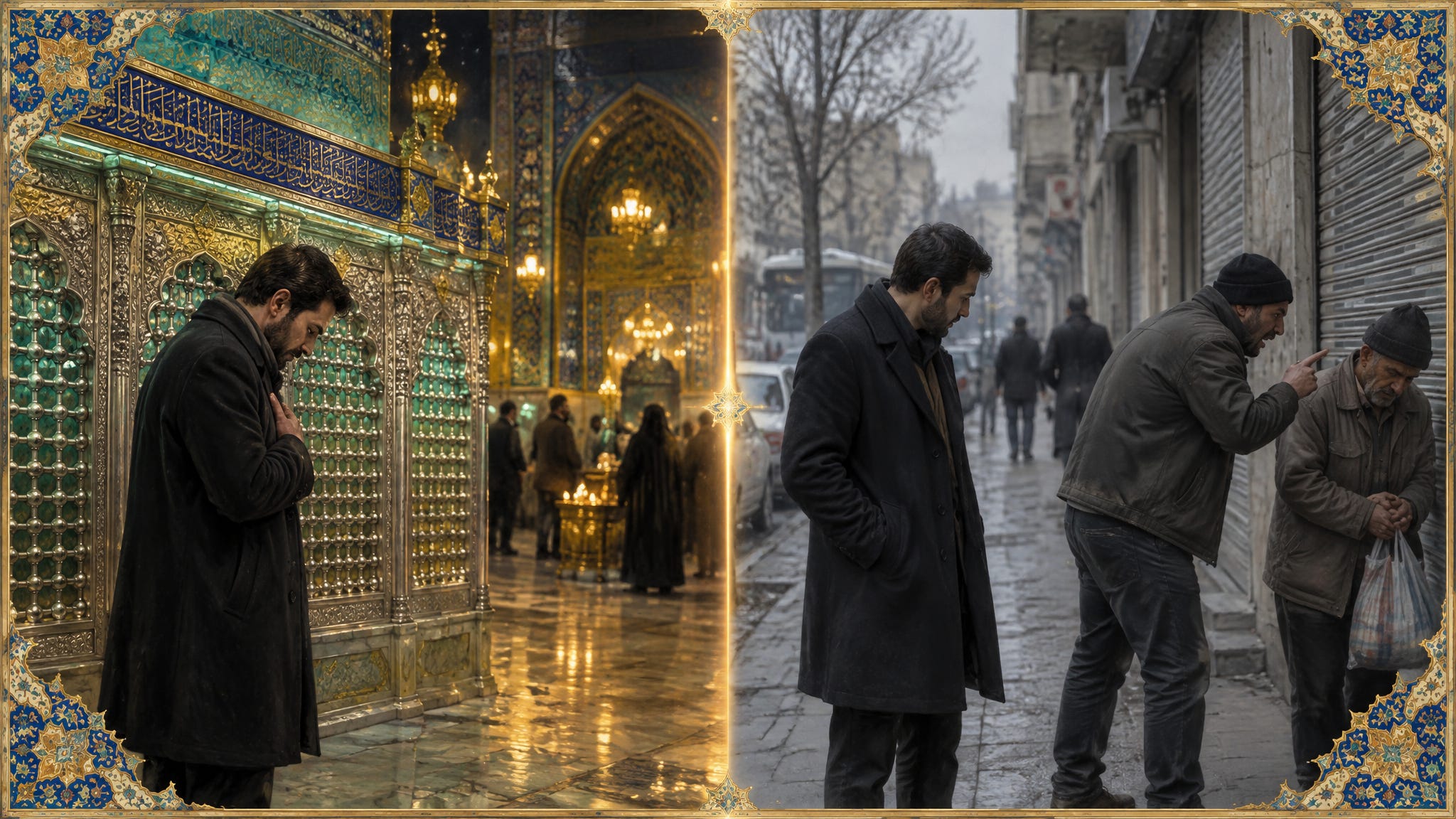
So the first lesson is the hardest one in the session, and I want it to land plainly.
The Gospel does not rebuke people for building the tombs.
It rebukes them for building tombs for prophets their own fathers killed — and then congratulating themselves at the graveside.
Now ask yourself the question, and ask it honestly, because nobody else in this room can hear your answer.
Which one are you?
Because we build.
We build beautifully.
We spend money we do not have on tile-work and calligraphy and silver, and I am not going to stand here and say that is wrong, because I have spent the whole evening showing you it is not.
But the building is not the test.
The test is what you would have done on the morning.
Not what you feel when the noha is playing and the lights are low and everyone around you is weeping.
Anyone can feel that.
Feeling it costs you nothing and proves nothing, and the men in that verse felt it too — that is precisely why they were building.
The test is what you do on a Tuesday, when the person being wronged in front of you is nobody’s idea of a martyr, and standing up for them will cost you a friendship or a contract or your standing among people whose opinion you value.
That is the morning.
It comes to all of us, in small sizes, constantly.
And the honest truth is that most of us find out on that morning that we are not quite who we thought we were at the shrine.
And the Man Who Asked That Question Went to Karbala
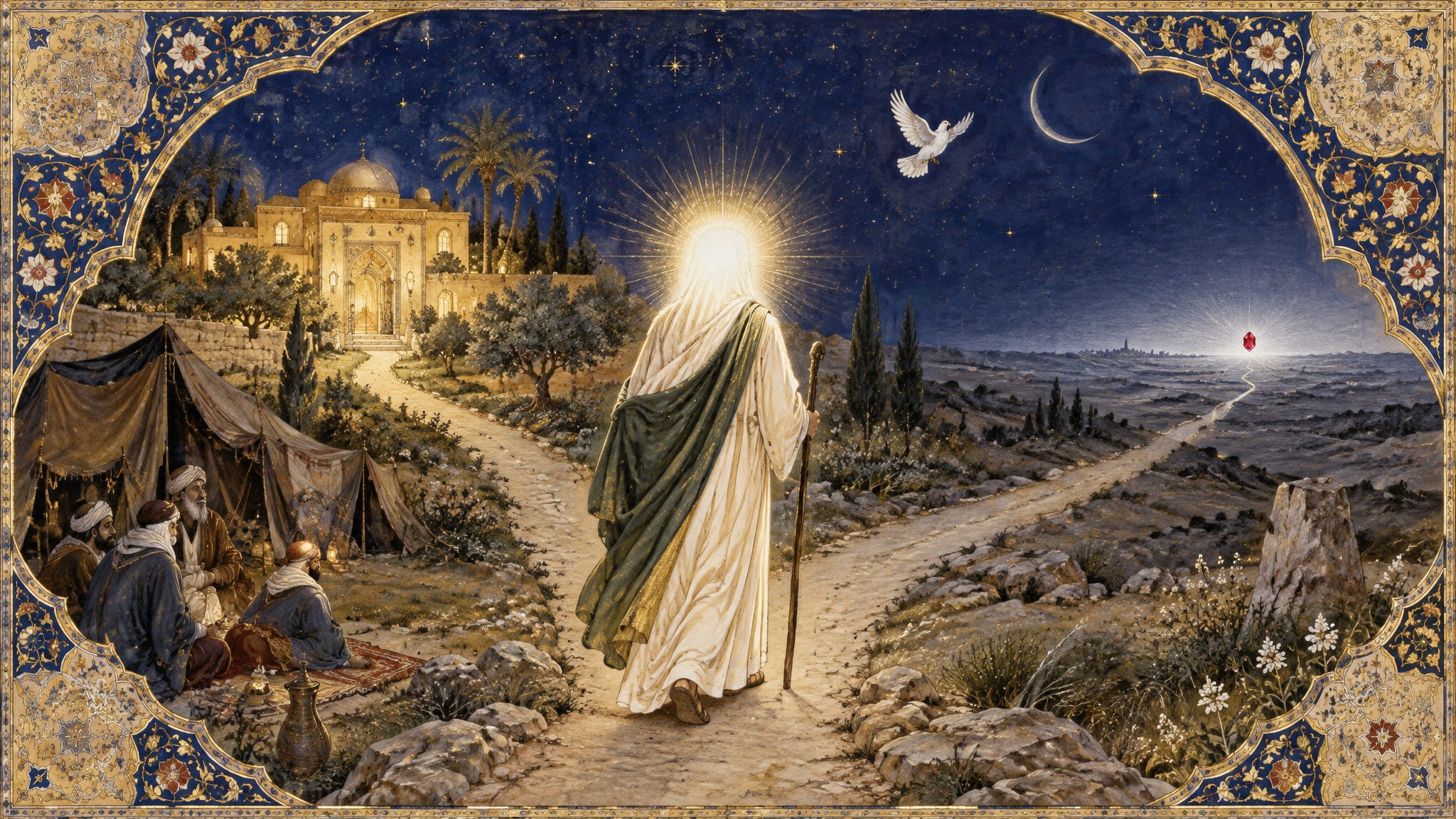
The second is one clause, and then I will stop.
The man who asked that question of his own community asked it at Mina.
And then he went to Karbala.
I am not going to preach Karbala to you now.
We have a whole life for that, and we have the nights ahead.
I only want you to notice that he did not ask it and go home.
Every System God Gave Can Be Corrupted
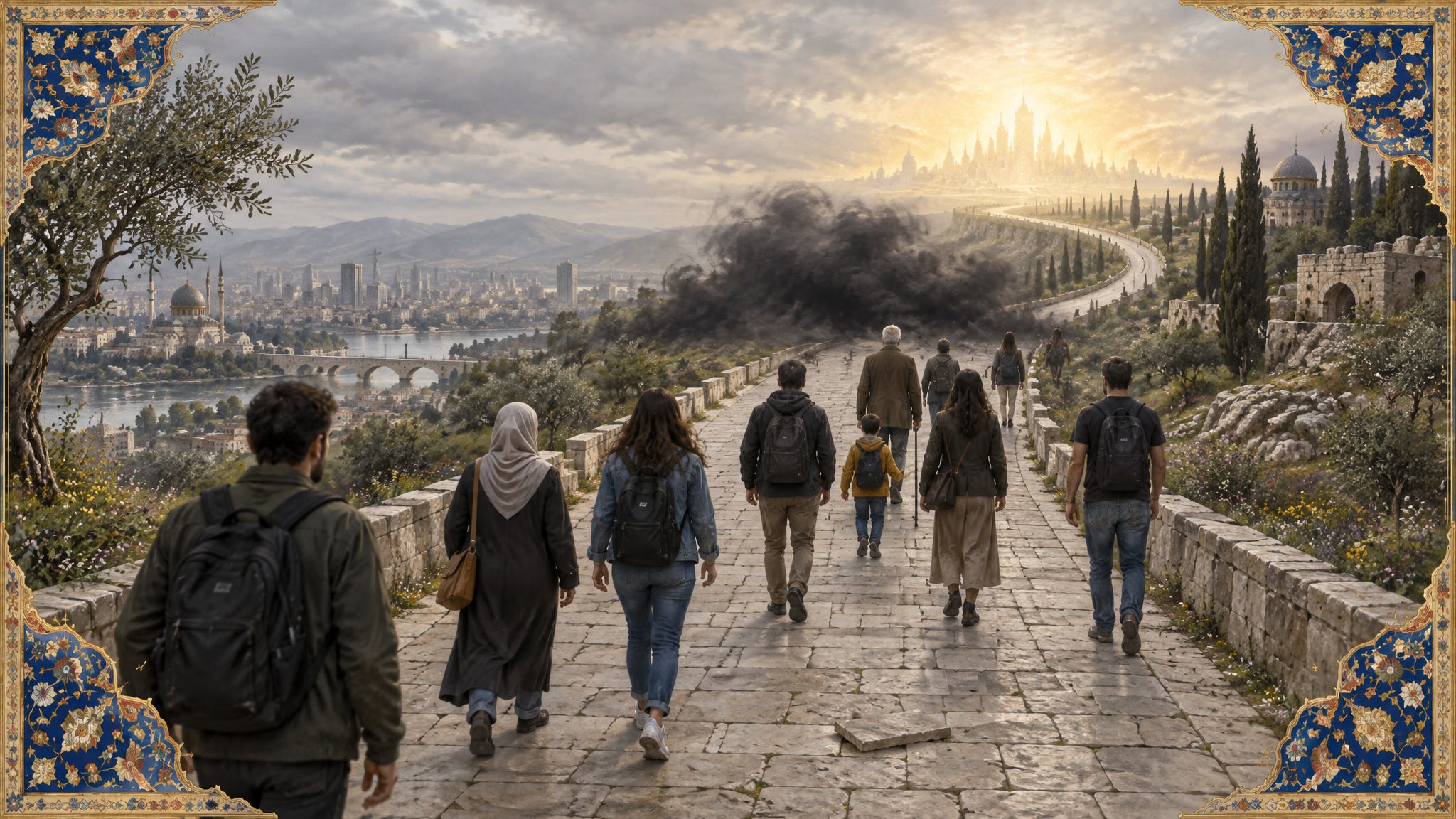
And the third.
This is new, and it is the beginning of something rather than the end of it, so I am going to open the door and then close it again, and we will come back to it properly.
Everything I have shown you tonight has a shadow behind it, and the shadow is this:
Every system God ever gave has been corrupted by men.
Now — hear me carefully, because this sentence can be misheard in about four different ways.
That is not a slur against anybody’s religion.
It is not me saying their religion went wrong and ours did not.
It is Satan’s stated plan.
He announced it, out loud, at the beginning, and God recorded the announcement in the Book so that we would know.
قَالَ فَبِمَا أَغْوَيْتَنِي لَأَقْعُدَنَّ لَهُمْ صِرَاطَكَ الْمُسْتَقِيمَ
“He said: because You have let me go astray, I will surely sit in wait for them on Your straight path.”
— Qur’an, Surah al-A’raf (the Chapter of the Heights) #7, Verse 16
Look at where he says he will sit.
Not on the crooked path.
Not in the tavern and the casino and the places we have all agreed are dangerous.
Your straight path.
He sits on the road that leads to God.
Because there is no point sitting anywhere else — the people he wants are the ones who are already walking.
You do not need to ambush a man who is not going anywhere.
So corruption, when it comes, does not come to people who have left the road.
It comes to people who are on it.
Who are praying.
Who are building.
Who are certain they are doing God’s work.
And it takes them a few degrees off, and then a few more, and they never once feel themselves turning.
Now — if that is true, how would you ever know?
You are not a scholar.
You cannot audit somebody’s theology.
Somebody stands in front of you with a beard and a turban and a thousand citations and tells you this is God’s command, and what exactly are you supposed to do with that?
God has given us a test that does not require a seminary.
إِنَّ اللَّهَ لَا يَظْلِمُ مِثْقَالَ ذَرَّةٍ ۖ وَإِن تَكُ حَسَنَةً يُضَاعِفْهَا وَيُؤْتِ مِن لَّدُنْهُ أَجْرًا عَظِيمًا
“Indeed, God does not wrong by the weight of an atom. And if there is a good deed, He multiplies it, and gives from Himself a great reward.”
— Qur’an, Surah al-Nisa (the Chapter of Women) #4, Verse 40
God does not oppress.
Not by the weight of an atom.
Not a little, not in a good cause, not as a regrettable necessity, not for a greater outcome later.
So here is the test, and a child can apply it.
When a man oppresses, and tells you he is doing God’s work — you do not need to be a scholar to know.
God does not oppress.
The oppression is the answer.
Whatever else may be true about that man’s learning and his lineage and his following, the thing he is doing is not from God, because God does not do it.
And I want to leave you with what dhulm — oppression —actually is, because we have flattened it into a political word and it is not first a political word.
Allamah Sayyed Muhammad Husayn Tabataba’i defines it in one clause, and he does it while explaining a verse about the Day of Judgement — this Day, no soul will be wronged at all, and you will not be recompensed except for what you used to do.
وَلَا يُتَصَوَّرُ مَعَ ذَٰلِكَ ظُلْمٌ، لِأَنَّ الظُّلْمَ وَضْعُ الشَّيْءِ فِي غَيْرِ مَوْضِعِهِ، وَتَحْمِيلُ الْعَامِلِ عَمَلَهُ وَضْعُ الشَّيْءِ فِي مَوْضِعِهِ ضَرُورَةً
“And no wrong is conceivable along with that — because wrong is the putting of a thing somewhere other than its place, and the loading of the doer with his own deed is the putting of a thing in its place, necessarily.”
— Allamah Sayyed Muhammad Husayn Tabataba’i, al-Mizan fi Tafsir al-Qur’an, on Surah Ya-Sin #36, Verse 54
Hear both halves of that, because he has given us the whole thing in one breath.
Wrong is a thing put where it does not belong.
And justice — this is the half we never say — is a thing put where it does belong.
On that Day, each man is handed exactly his own deed and nothing else.
That is not God being lenient and it is not God being severe.
That is a thing arriving at its own place.
So dhulm is displacement.
That is all it is.
Which means it starts long before anyone has any power.
It is in the word you place where a different word belonged.
It is in the attention you give where it was not owed and withhold where it was.
It is nearer to sin than to politics, and it is why a man can be an oppressor in his own house before he has ever oppressed a nation.
That is the door.
I am closing it now, because it needs a night of its own and it is going to get one.
But keep it in the back of your mind for the rest of this series, and notice — please notice — that I have not named a single community tonight.
Because if this lesson does not obviously include us, then I have not finished teaching it.
The Close

So we have been in three houses tonight, and I want to put down what we found in each of them in as few words as I can.
The question is old.
Older than us, older than our Book, asked by men who had never heard of us and would not have recognised us.
The answers came with limits attached.
Every serious house that asked it attached one.
The carefulness is the tradition; the carelessness is the departure.
And the only people that the Book and the Gospel and the Talmud between them agree in warning are the ones who honour the dead beautifully and would not have stood beside them while they were alive.
That is the whole night.
Conclusion — Key Takeaways
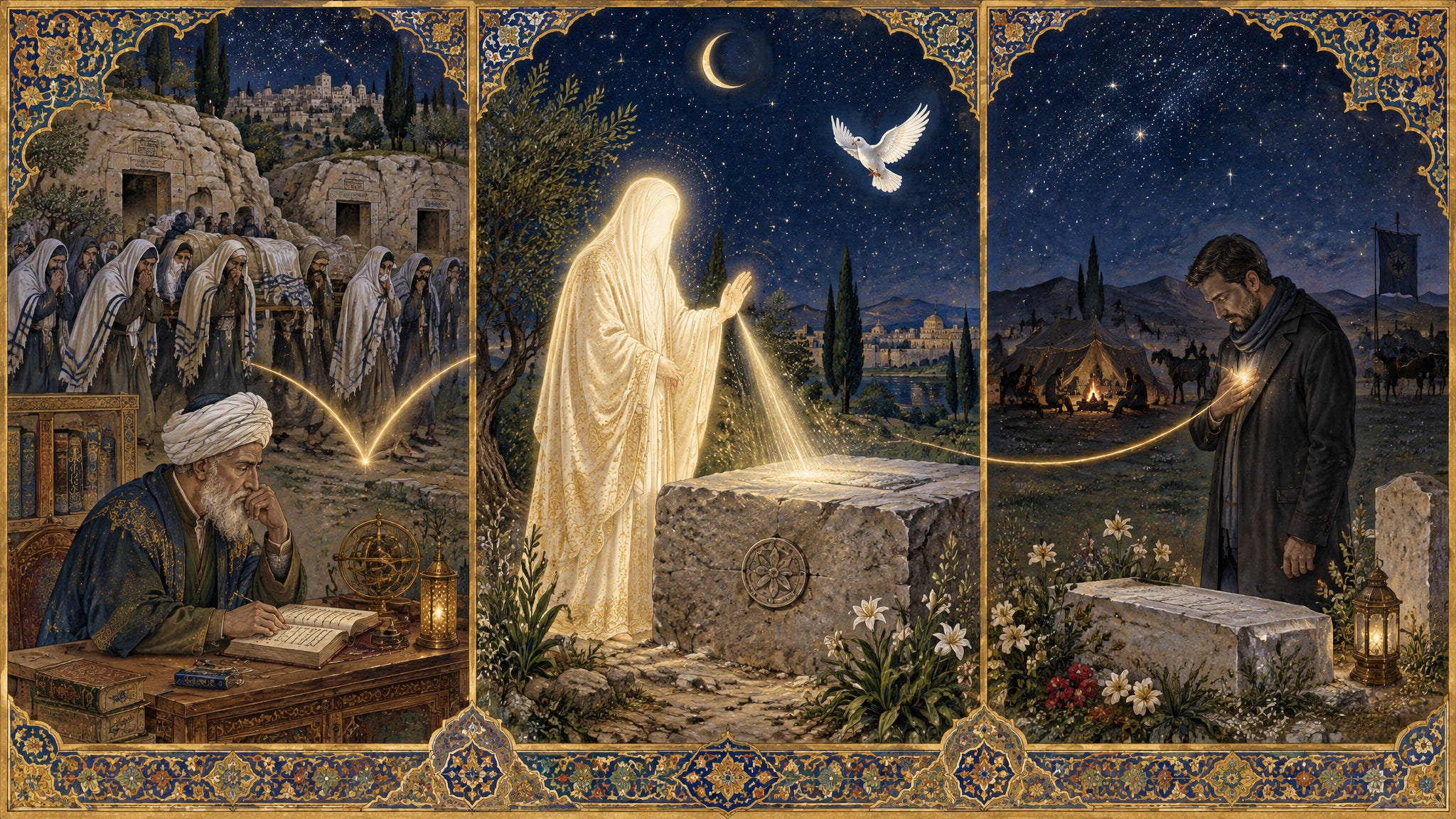
Three things to take home, and I will not re-argue any of them.
The first.
You do not settle a question about worship by how the practice feels.
You settle it by asking what follows from it.
The men in Ta’anit did that, al-Nawawi did that, and neither of them had ever heard of the other.
When somebody asks you why do you do that — the answer is not because it feels right to me.
The answer is: here is what I believe about it, here is what follows from what I believe, and here is the line I will not cross.
The second.
Our own books settle the question before anybody else’s do.
God instructed a prophet to stand at a grave and call out with a raised voice.
The verse quoted against us, read in its own run, turns out to be about the living.
We are not borrowing a defence from another house tonight — we are noticing that other houses arrived independently at something our own books already say.
And the third, which is the one I want you to be uncomfortable about on the way home.
The warning is not about somebody else.
The Gospel does not rebuke the building.
It rebukes the sentence said while building —
we would never have done what our fathers did.
And the first man to turn that warning on his own community’s scholars was Imam Husayn, peace and blessings be upon him, at Mina, using a verse God had revealed about the scholars of an earlier people.
He did not think it was about somebody else.
Neither should we.
Eulogy — Yahya ibn Zakariyya (John the Baptist)
Two Boys, and Nobody Had Carried Either Name
An old man is praying in a chamber, alone, and asking God for something he has no business asking for at his age.
And God answers him.
يَا زَكَرِيَّا إِنَّا نُبَشِّرُكَ بِغُلَامٍ اسْمُهُ يَحْيَىٰ لَمْ نَجْعَل لَّهُ مِن قَبْلُ سَمِيًّا
“O Zechariah, We give you glad tidings of a boy whose name is Yahya (John). We have not made for him, before this, any namesake.”
— Qur’an, Surah Maryam (the Chapter of Mary) #19, Verse 7
We have not made for him, before this, any namesake.
Think about how strange that is to say about a baby.
God is announcing a child, to a father who has waited a lifetime, and the detail He chooses to give is that nobody has ever been called this before.
Of all the things that might be said about a boy — that he will be righteous, that he will be a prophet, that he will bring you joy, all of which God does say elsewhere — the first distinguishing mark given here is that the name is new.
Nobody had carried it.
He was the first thing of his kind.
And What Our Own House Kept About It
And now let me give you the narration that our own house has kept about that phrase, because Imam Sadiq, peace and blessings be upon him, was asked about it and he did not answer about Yahya alone.
لَمْ يَجْعَلِ اللَّهُ لَهُ مِنْ قَبْلُ سَمِيًّا: الْحُسَيْنُ بْنُ عَلِيٍّ لَمْ يَكُنْ لَهُ مِنْ قَبْلُ سَمِيًّا، وَيَحْيَى بْنُ زَكَرِيَّا لَمْ يَكُنْ لَهُ مِنْ قَبْلُ سَمِيًّا، وَلَمْ تَبْكِ السَّمَاءُ إِلَّا عَلَيْهِمَا أَرْبَعِينَ صَبَاحاً. قَالَ: قُلْتُ: مَا بُكَاؤُهَا؟ قَالَ: كَانَتْ تَطْلُعُ حَمْرَاءَ وَتَغْرُبُ حَمْرَاءَ
“’God had not made for him, before this, any namesake’ — Husayn ibn Ali, there had been no namesake for him before; and Yahya ibn Zakariyya (John the son of Zechariah), there had been no namesake for him before. And the sky did not weep except for these two, for forty mornings. He said: I asked, what was its weeping? He said: it would rise red, and set red.”
— Ibn Qulawayh, Kamil al-Ziyarat, the chapter on the weeping of the heavens and the earth
Two boys.
Separated by centuries and a language and a desert.
Neither of them had a name before he was given it, and neither of them has been repeated since in the way that matters.
And one sky, that had not wept before and would not weep again, wept for both.
It would rise red, and set red.
I have nothing to add to that image and I am not going to try.
What He Was Given, and What It Cost Him

He was a boy, and God addressed him as a man.
يَا يَحْيَىٰ خُذِ الْكِتَابَ بِقُوَّةٍ ۖ وَآتَيْنَاهُ الْحُكْمَ صَبِيًّا
وَحَنَانًا مِّن لَّدُنَّا وَزَكَاةً ۖ وَكَانَ تَقِيًّا
وَبَرًّا بِوَالِدَيْهِ وَلَمْ يَكُن جَبَّارًا عَصِيًّا
“O Yahya (John), take the Book with strength. And We gave him judgement while yet a boy.
And tenderness from Us, and purity. And he was God-fearing.
And dutiful to his parents, and he was not a tyrant, disobedient.”
— Qur’an, Surah Maryam (the Chapter of Mary) #19, Verses 12, 13 and 14
Take the Book with strength.
And then, immediately, the word that undoes any picture you might have been forming of a hard man.
Hanan.
Tenderness.
Tenderness from God, given to him as a gift, alongside the strength.
Not instead of it.
The same boy who was told to take the Book with strength was given tenderness out of God’s own presence, and was dutiful to his parents, and was not a tyrant.
Those are the two halves of a witness, and we do not often hold them together.
We can manage strength without tenderness — that is easy and there are a great many people doing it.
We can manage tenderness without strength — that is comfortable and there are more.
He was given both, as a child, and he carried both into a room with a king in it.
And That Is Why We Are Told to Go
وَسَلَامٌ عَلَيْهِ يَوْمَ وُلِدَ وَيَوْمَ يَمُوتُ وَيَوْمَ يُبْعَثُ حَيًّا
“And peace be upon him the day he was born, and the day he dies, and the day he is raised alive.”
— Qur’an, Surah Maryam (the Chapter of Mary) #19, Verse 15
Three days named.
And the middle one is named without being described.
God does not tell us here what happened on it.
He tells us only that peace is upon him on it — the same peace as on the day he was born, the same peace as on the day he will be raised.
I am going to leave that day where God left it, for a few more minutes.
But hear what the verse does.
It sends peace upon him.
Not about him.
Upon him — addressed, delivered, to a person, on a day.
And that is the whole of what we have been doing all evening.
That is what a man does when he stands at a grave and speaks.
He is not performing an emotion.
He is not decorating a building.
He is delivering something to somebody, in the second person, because he has been told that it arrives.
Caleb went to Hebron and said
my fathers.
Jesus, may our souls be his ransom, and may God hasten his return, stood at his cousin’s grave and said
keep me company, as you used to.
God told him to stand there and call out with a raised voice.
And the sky, which has wept for two men only, rose red and set red for forty mornings for a boy whose name nobody had carried.
That is why we are told to go.
Segue to the Maqtal
There is a man sitting in front of Imam Sadiq, peace and blessings be upon him, and he has a question about going to a grave.
Not this grave.
Another one.
And the answer he gets will contain the name of the boy we have just been speaking about — because the Imam does not answer him about one man alone either.
Let us go and sit with them.
Maqtal (Lamentation) for the Fifteenth Session of the Architecture of Guidance
Supplication
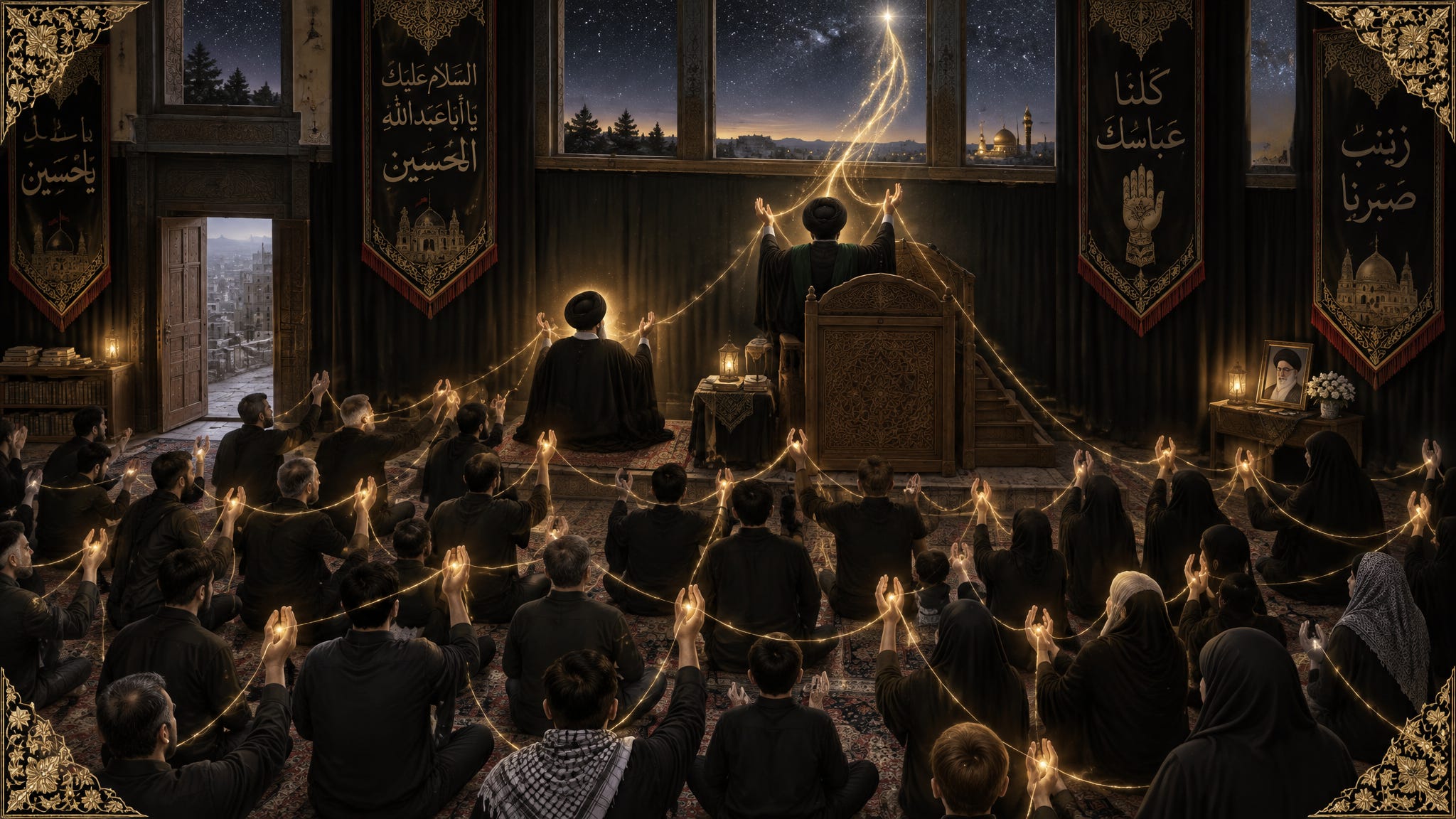
In His Name, the Lord of the Martyrs and the Truthful
O God, send blessings upon Muhammad and the family of Muhammad.
O God, we thank You for the verse at the door tonight — that You ordained one religion, and enjoined it upon Noah and Abraham and Moses and Jesus son of Mary, may our souls be his ransom, and may You, our beloved Lord, hasten his return — and upon us.
And we ask You to make us worthy of standing in that line rather than merely claiming it.O God, we ask You for the martyred leader, Imam Sayyed Ali Khamenei — may You rest his pure soul — that You raise his station, and gather him with those he loved, and accept from him what he gave.
O God, protect the living leader, Imam Sayyed Mujtaba Khamenei — may You protect him — and steady his hand, and put barakah in his years.
O God, we ask You for a careful tongue.
Keep us from the argument that wins and convinces nobody.
Keep us from the cleverness that leaves a person smaller than we found them.
And when we are wrong — and we will be wrong — let us be the kind of people who write the correction down next to the mistake, with our name on it.O God, we ask You for the morning.
Not for the feeling at the shrine, which costs us nothing and which You did not ask us for.
For the Tuesday.
For the moment when somebody nobody will ever write about is being wronged in front of us and it will cost us something to say so.
Put us on the right side of that morning, O God, because we have stood at enough graves now to have run out of excuses.O God, we ask You for everyone in this room who has honoured a dead person more easily than they could honour a living one.
Forgive us that.
It is most of us.O God, hasten the relief of our master, the Imam of our Age — may our souls be his ransom — and let us be among those who serve him, and are witnesses at his side.
And until that day, let us be people who ask the question out loud, and write it down, and keep the answer we did not like beside it.
Amen, O Lord Sustainer of the Universes
Amen, O Most Merciful of the Merciful
And from Him alone is all ability and He has authority over all things.