

In His Name, the Most High
اَلسَّلاَمُ عَلَيْكَ يَا أَبَا عَبْدِاللَّهِ
وَعَلَى الْأَرْوَاحِ الَّتِي حَلَّتْ بِفِنَائِكَ
عَلَيْكُمْ مِنَّا جَمِيعًا سَلاَمُ اللَّهِ أَبَدًا مَا بَقِينَا وَبَقِيَ اللَّيْلُ وَالنَّهَارُ
وَلا جَعَلَهُ اللَّهُ آخِرَ الْعَهْدِ مِنَّا لِزِيَارَتِكُمْ
اَلسَّلاَمُ عَلَى الْحُسَيْنِ
وَعَلَى عَلِيِّ بْنِ الْحُسَيْنِ
وَعَلَى أَوْلَادِ الْحُسَيْنِ
وَعَلَى أَصْحَابِ الْحُسَيْنِ
Peace be upon you, O Aba Abdillah (O Husayn),
and upon the souls who have gathered in your courtyard.Upon you, from us all, is the peace of God—forever,
for as long as we remain and as long as night and day endure.And may God never make this our last pledge to visit you.
Peace be upon al-Husayn,
and upon Ali, son of al-Husayn,
and upon the children of al-Husayn,
and upon the companions of al-Husayn.— Adapted from Ziyarat Ashura
Video of the Majlis (Sermon/Lecture)
The Witness Did Not Stay in the Books
Last night we set a seed in the ground, and tonight we have come back to find what it has grown into — but it has grown into something far larger than a plant.
It has grown into a question about the age we are living in.
We ended the thirteenth night on a single sentence, and I asked you to carry it home and sleep with it under your pillow:
You do not have to die to be a witness — but you must be willing to.
We had walked, the two of us, all the way through the grades of witness — the battlefield and the Hereafter, the scholar at his desk, the mother in her childbed, the honest man on his road, and the smallest witness of all, the little one in the ruin of Sham.
And we drew from the whole long night one freeing and one demanding truth and tied them together: the gate is enormous, and you are invited through it — and the willingness is the part that is yours.
Now hold that, and let me ask you the question that has been waiting on the other side of it since the very first night of this series.
We have spent thirteen nights proving — from the Qur’an, from the Imams, from the jurists and the philosophers — that the witness is real, that the chain of witness runs unbroken from Abel, the first man wronged for his faith, all the way down through the prophets and the Imams to a three-year-old in a roofless cell in Damascus.
We have called that chain unbroken.
But here is the question.
Is it past?
Is the chain a closed thing, a beautiful museum we visit on these nights and then leave behind when the lights come up?
Or is the chain still being forged — link by link, in our own lifetime, with names we have spoken aloud, with faces we have seen on the glass of the phones in our pockets?
I want to say the answer plainly, at the very top of the night, so that you can watch it gather its terrible weight as it comes:
Martyrdom is not history.
It is happening now.
The witnesses did not stay in the books.
They walked out of the chronicles and into our own decade.
And tonight we are going to meet them — the generation that held a frontier for eight years; the chain of men, in Lebanon and Iraq and Iran, who were struck down one after another across the span of our own adult lives; the scientists murdered in their cars with their children beside them; the children of Gaza, a whole generation of witnesses, broadcast into our hands; and, weeks ago, in Tehran, the wali al-amr himself — the guardian of the affair of the Muslims — martyred, and his last word to the world a verse of the Qur’an.
And here is the takeaway of the night, and I am not going to dress it up, because the whole of Shahada has been walking toward it:
To see these witnesses for what they truly are — to recognise the chain when it runs right past your own front door — is the test of whether you understood a single one of the thirteen nights that came before.
It is one thing to weep for a witness who died thirteen hundred years ago.
The chronicles have done the hard work for us; the love is safe, the verdict is settled, the shrine is built.
It is another thing entirely to look at a man martyred last month, in a war the newspapers you read called something else, and to know him for what he is.
That recognition is the examination this whole series has been preparing you to sit.
Tonight is the paper.
Let us begin.
The Two Things We Do at Once
We open every one of these nights the same way — with the salutation of Ziyarat Ashura, the peace upon Aba Abdillah and upon the souls that alighted in his courtyard.
We have said it so many times that it can slide past us like a habit.
Tonight I am going to ask you to stop on it, because the text we open with is, all by itself, the constitution of everything else we are going to say.
Listen to what Ziyarat Ashura actually trains the tongue to do.
It does two things in a single breath.
With the one breath, it greets — it turns toward Imam Husayn, peace and blessings be upon him, and toward the wronged, and it pledges itself to them.
And with the very same breath, it disavows — it turns away from the throne that wronged them.
Hear the disavowal in the Imam’s own words:
فَلَعَنَ اللَّهُ أُمَّةً أَسَّسَتْ أَسَاسَ الظُّلْمِ وَالْجَوْرِ عَلَيْكُمْ أَهْلَ الْبَيْتِ، وَلَعَنَ اللَّهُ أُمَّةً دَفَعَتْكُمْ عَنْ مَقَامِكُمْ وَأَزَالَتْكُمْ عَنْ مَرَاتِبِكُمُ الَّتِي رَتَّبَكُمُ اللَّهُ فِيهَا، وَلَعَنَ اللَّهُ أُمَّةً قَتَلَتْكُمْ.
“May the mercy of God be distant from the people who laid the foundation of oppression and injustice against you, O People of the House; and may the mercy of God be distant from the people who drove you from your station and removed you from the ranks in which God had placed you; and may the mercy of God be distant from the people who slew you.”
— Ziyarat Ashura (Mafatih al-Jinan)
And then, two lines on, the other half — the pledge of allegiance, the tawalla:
يَا أَبَا عَبْدِ اللَّهِ، إِنِّي سِلْمٌ لِمَنْ سَالَمَكُمْ وَحَرْبٌ لِمَنْ حَارَبَكُمْ إِلَى يَوْمِ الْقِيَامَةِ.
“O Aba Abdillah, I am at peace with whoever is at peace with you, and at war with whoever wages war against you, until the Day of Resurrection.”
— Ziyarat Ashura (Mafatih al-Jinan)
Two motions, one breath.
Stand with the wronged.
Turn away from the throne that wrongs them.
This is not a slogan and it is not a mood.
For Muslims — especially Shia Muslims — living under occupation, under sanction, under surveillance, or — like so many of us — in the diaspora of an empire whose flag flies over our own street, this is the constitution.
It is the text that teaches the believer to hold two things at once and never let go of either:
solidarity with the oppressed, and disavowal of the oppressor.
Not hatred of a people — disavowal of a system.
Hold the distinction, because the whole night turns on it.
And now I am going to set a hinge in the floor of this room, and I am going to ask you to remember exactly where it is, because in about an hour I am going to come back and stand on it.
Here it is.
You have been saying the tabarra of this ziyarah for fourteen hundred years.
Every Thursday, every Ashura, every time you turn to greet Imam Husayn, you have disavowed the oppressor — never the bystander, never a nation, never a people — only the throne, and the foundation of injustice it was built on.
So when, much later tonight, we come at last to the cry our own community raises in the streets of the world — the cry that is the single most weaponised and most misunderstood sentence we ever say aloud — I am going to ask you to recognise it.
Because it is not a new thing, and it is not a hateful thing.
It is this — the tabarra of Ziyarat Ashura, stepped down off the page and spoken aloud in a different language.
Hold that.
We will return to stand on it.
We begin where the witness of our own lifetime begins — not with the cry in the street, but on a frontier that a whole generation chose to hold.
The Roots: A Generation That Held the Line
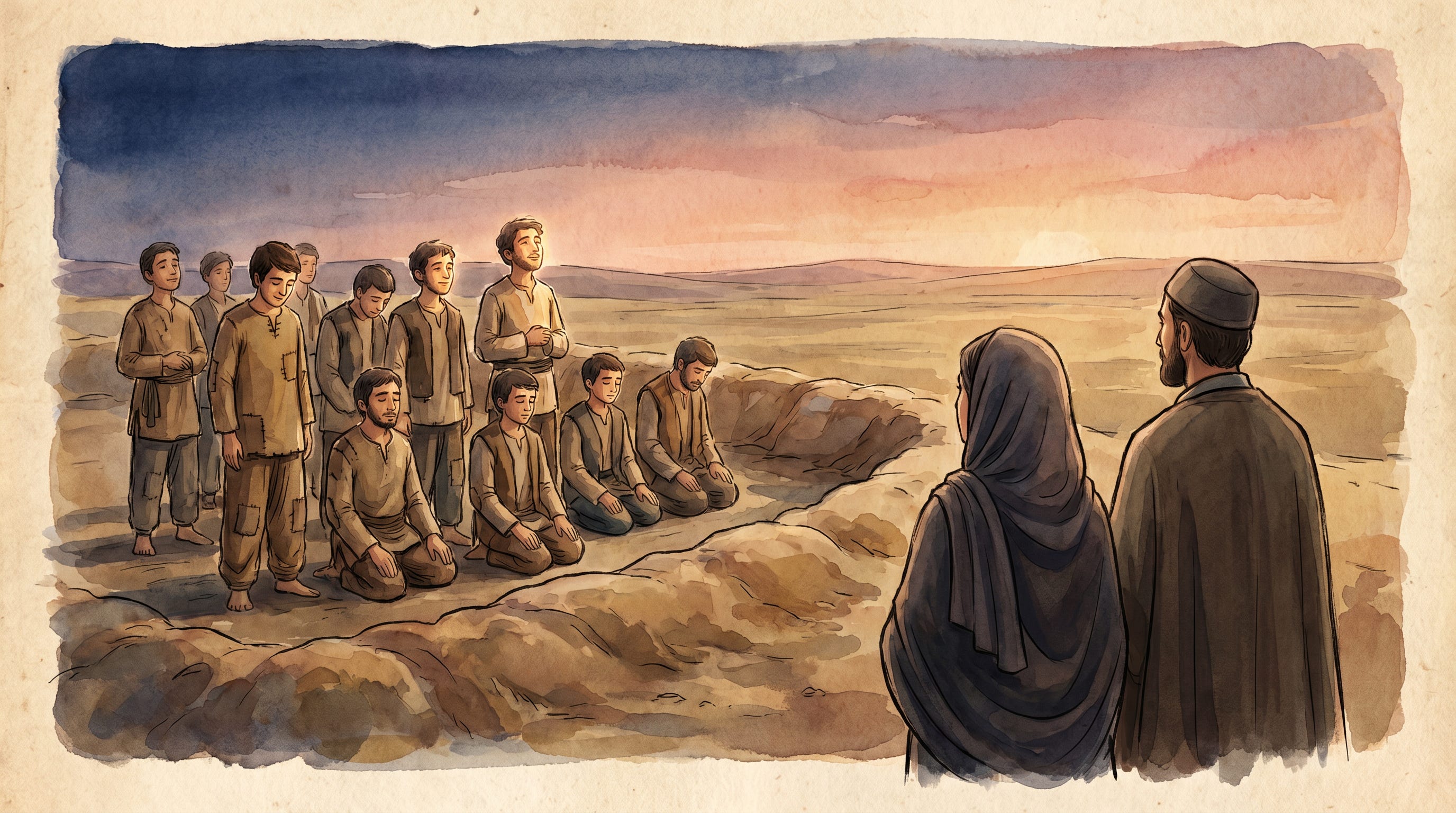
Two nights ago, on the twelfth night, we read together the supplication that Imam Zayn al-Abidin, peace and blessings be upon him, composed for the people of the frontiers — the Duʿa Ahl ath-Thughoor — and we drew from it the idea of murabatah: the holding of the line, the guarding of the seam between the oppressor and the oppressed, as a grade of worship in its own right.
I told you that night that the frontier-holder was, for the moment, a figure in a prayer — a beautiful abstraction.
Tonight I have to make him flesh, because in our own century a whole generation of young men turned that abstraction into a war they did not start, and then — and this is the heart of it — they wrote down why.
The War, Plainly
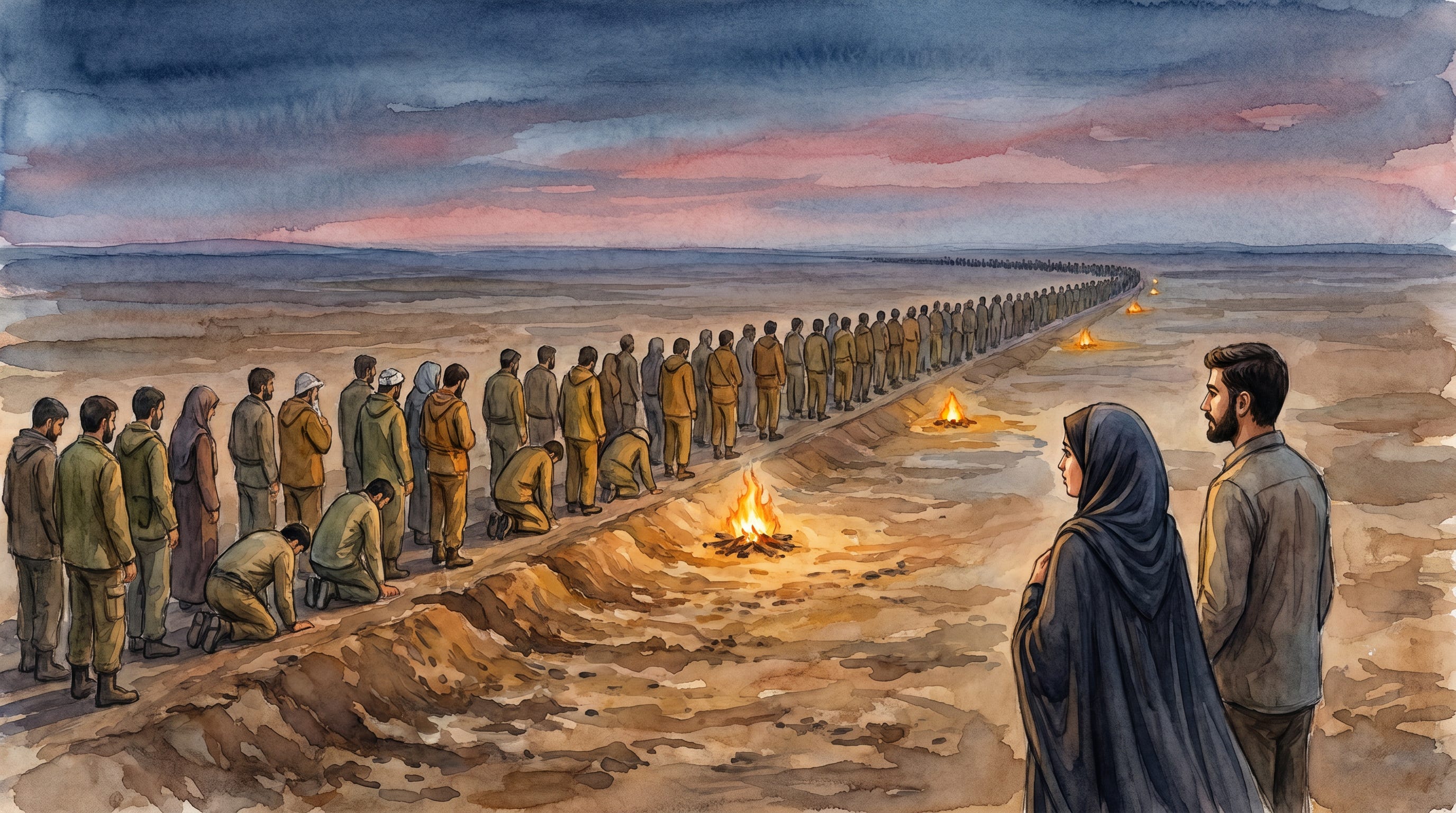
Let me set it without a single ornament, because the facts are heavy enough to need none.
In September of 1980, the regime of Saddam Hussein invaded the Islamic Republic of Iran.
It was not a war Iran chose; it was an invasion Iran answered.
It lasted eight years.
It cost a generation — young men, and boys who lied about their age to get to the front, and old men who would not stay behind.
The world armed the aggressor; you will hear, on another night, exactly which capitals sold Saddam exactly which weapons, and which of them knew he was using poison gas while they kept the credit lines open.
Tonight that is not our subject.
Tonight our subject is the men who held the line — and what they understood themselves to be doing while they held it.
The Front Was A Mihrab
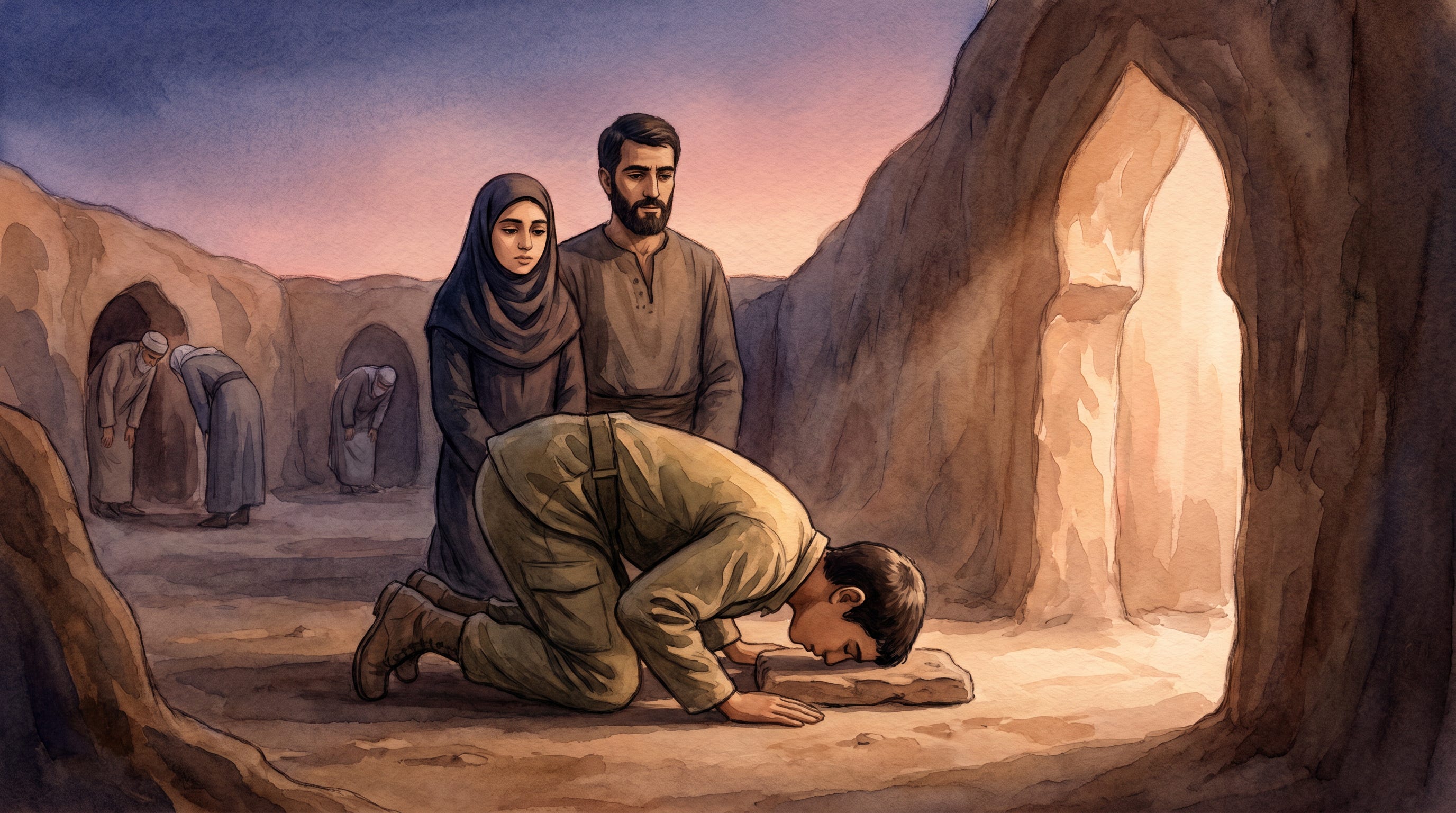
Because they did not understand it as soldiers usually understand a war.
Imam Khomeini gave that generation a doctrine, and the doctrine was this: that the front line against an unjust aggressor is not merely a military position — it is a mihrab, a place of worship; that to hold the seam against the one who comes to devour your people is ibadah, an act of devotion; that the frontier of the Duʿa Ahl ath-Thughoor is not a metaphor but a place you can stand, with mud on your boots, and worship God by refusing to let the aggressor pass.
The basiji — the volunteer — did not go to the front for the nation only, the way a conscript goes.
He went the way a man goes to the mosque.
The trench was a prayer-niche. Murabatah — the abstraction of the twelfth night — had become a national reality and a personal devotion at once.
The Genre of The Final Will — The Layperson’s Sahifa
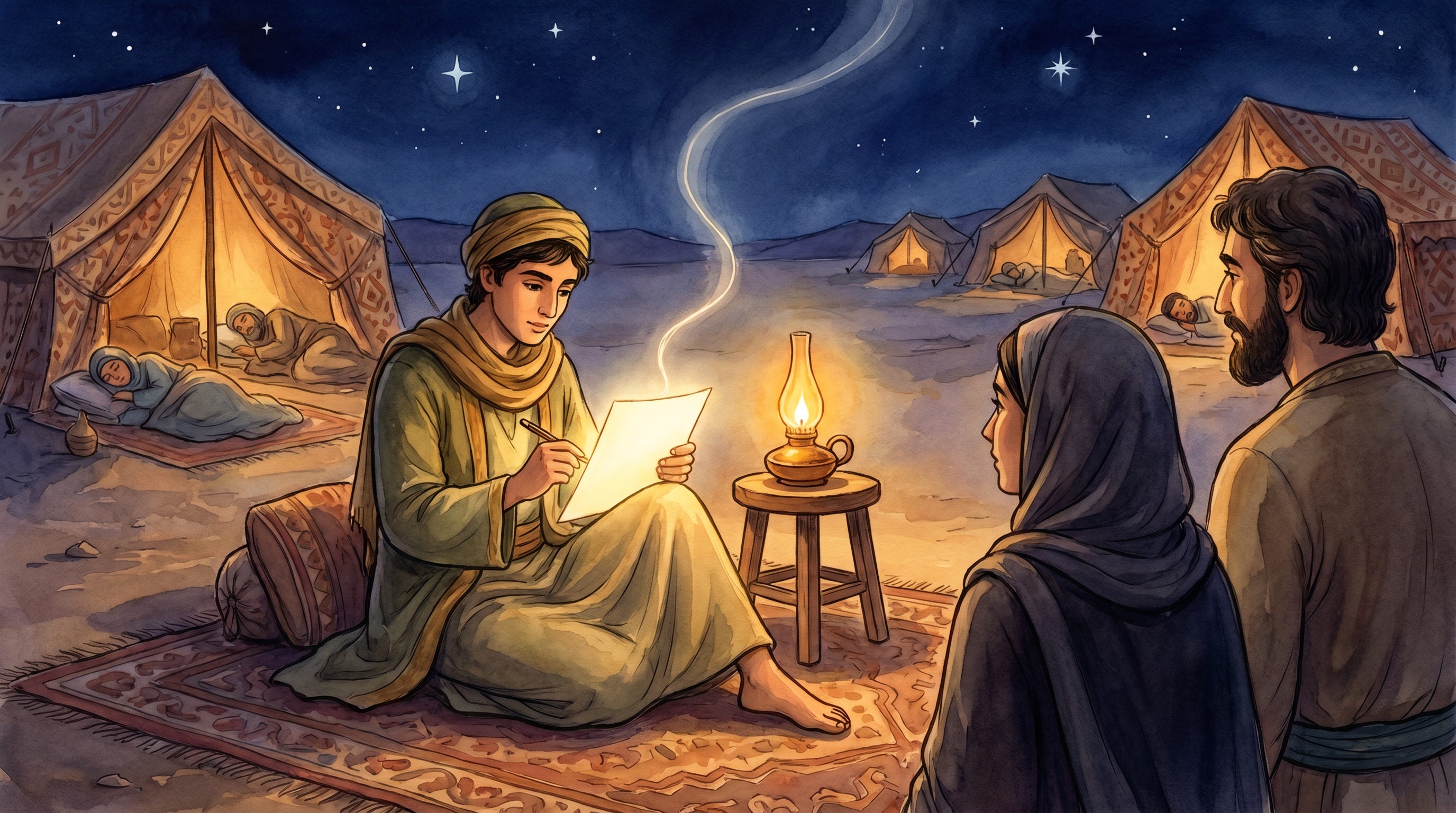
And here is the thing those young men left behind, the thing I most want to put into your hands tonight.
They wrote wills.
Before they went out — many of them — they sat down and wrote a wasiyyat-nameh, a final testament, a letter to be opened only if they did not come back.
And they have been published since, in their thousands, gathered into volumes, kept in foundations, read aloud over loudspeakers.
And when you read them — something startling happens.
They read like extensions of the very supplication we studied on the twelfth night.
They read like the Sahifa of Imam Zayn al-Abidin, written in the plain hand of a twenty-year-old.
The layperson’s Sahifa.
Witness, written down — before it died.
Let me give you one, plainly.
His name was Mohammad Reza Samadzadeh.
He was born in Zahedan in 1961, and he was martyred at Somar in November of 1981, around the age of twenty.
His will opens — and listen to where a twenty-year-old reaches for his opening, in the dark, before a battle he may not survive — it opens on the verse of the second night of this series:
آنها که در راه خدا کشته میشوند، هرگز نمیمیرند…
“Those who are killed in the way of God never die…”
— Mohammad Reza Samadzadeh, from his final will (Sacred Defence; martyred at Somar, 1981)
He has reached, untaught, for the same truth Umm Salamah’s bottle of red earth carried across this whole series — that the witness lives on beside his Lord.
And then he turns to his mother and his father, and he asks them — this is the part that undoes me — he asks them not to receive his death with grief, not to be frightened of his body, and if it is convenient, to bury him quietly in Zahedan.
A boy of twenty, composing his mother’s consolation in advance, so that her sorrow would have somewhere soft to land.
That is not a soldier’s letter.
That is a worshipper’s letter.
That is the Duʿa Ahl ath-Thughoor in a young man’s own handwriting.
And then there is the one I want to carry forward into the rest of the night, because it ties this frontier straight back to the standard-bearer of Karbala we stood beside on the seventh night.
His name was Sayyed Ali Hashemi.
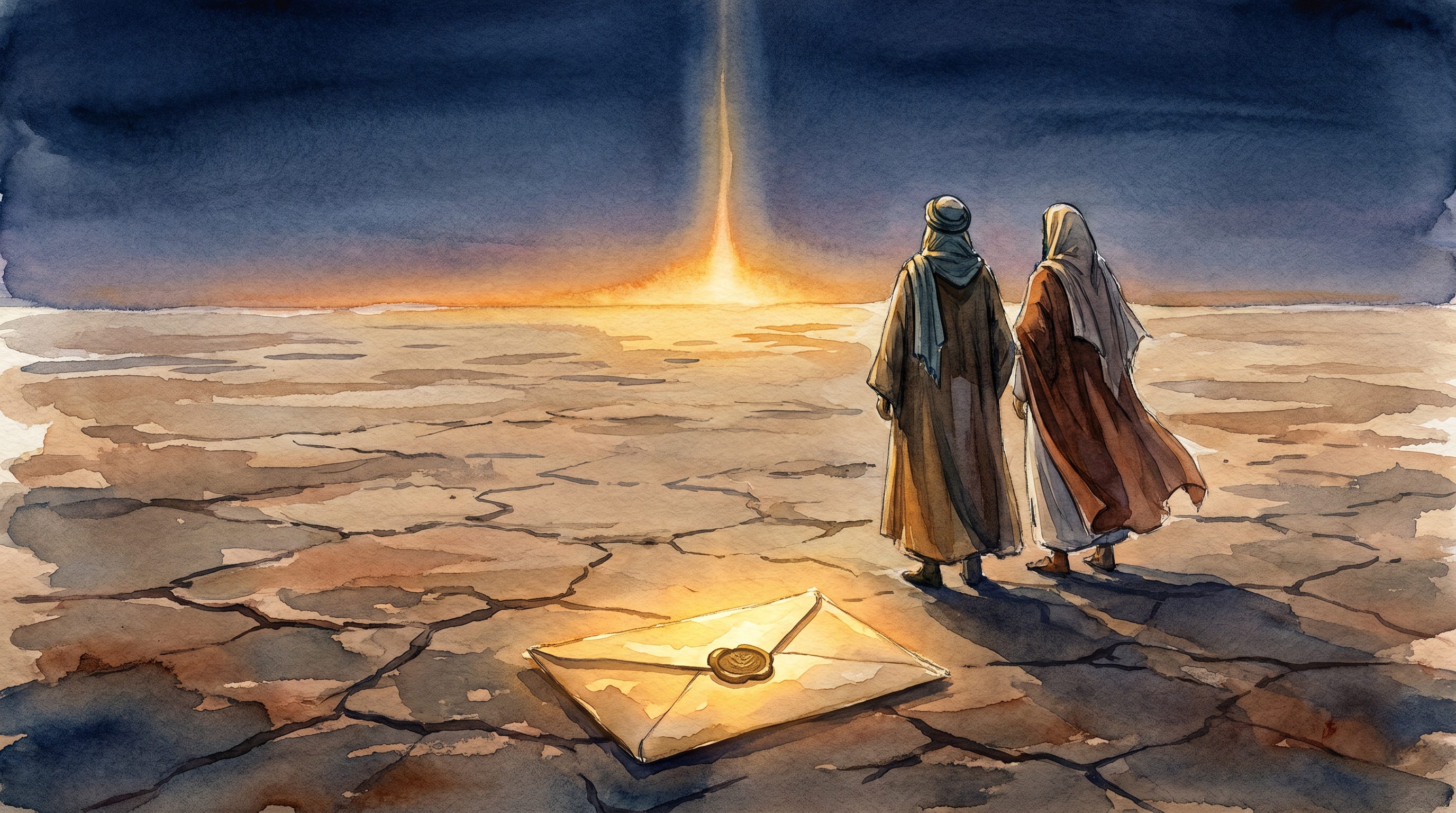
He commanded a division; he was martyred on Majnoon Island in June of 1988, and — hold this — his body was not found for twenty-two years; it came home in 2010.
And in his will he prays a prayer so saturated in Karbala that you can taste the dust of it.
He asks God for three things, and he asks for them by the names of the men of the field:
خداوندا امکان شهید شدنم در بیابانی بیآب قرار ده که همچون مولایم امام حسین (علیهالسلام) تشنه شهید بشوم. خداوندا میخواهم موقع شهید شدن سر از بدنم جدا شود تا در محضر سیدالشهدا سلاماللهعلیه سرافکنده نباشم. خداوندا میخواهم هنگام شهادت هر دو دستم از بدن جدا شود تا در محضر پرچمدار اسلام ابوالفضل شرمنده نباشم.
“O God, grant that I be martyred in a waterless desert, that I may be thirsty like my master Imam Husayn. O God, I ask that at the moment of my martyrdom my head be severed from my body, so that I will not be ashamed before the Master of Martyrs. O God, I ask that at the moment of my martyrdom both my hands be cut from my body, so that I will not be ashamed before the standard-bearer of Islam, Abu al-Fadl.”
— Sayyed Ali Hashemi, from his final will (Sacred Defence; martyred on Majnoon Island, 1988)
Both my hands — so that I will not be ashamed before al-Abbas.
The standard-bearer of the seventh night, the man whose two hands were taken at the Euphrates — and here is a commander in the 1980s asking God to let him lose his hands the same way, so that when he meets al-Abbas he will not have to look down at two whole arms and feel the shame of having kept what al-Abbas gave away.
And he asks —
was Ali al-Akbar without purpose? Was Abu al-Fadl without purpose? Can a soldier of Ruhollah be without purpose?
— and he asks that a picture of Imam Khomeini be placed on his grave larger than his own,
“hoping that he counts me among his soldiers.”
The chain of witness is not an idea to this man.
It is the address he is writing to.
He is mailing his death to Karbala.
That is the root, and it is the first thing I needed you to see tonight: the frontier-holder of the twelfth night is no longer an abstraction in a prayer.
Here is a whole generation that held the seam against the aggressor, understood the holding as worship, and wrote its witness down before it died — and wrote it in the vocabulary of Imam Husayn and al-Abbas.
The chain did not stop at Karbala.
It came down to a boy from Zahedan and a commander on Majnoon Island, and they knew it, and they signed their names to it.
And We Will Be Honest About What Came After
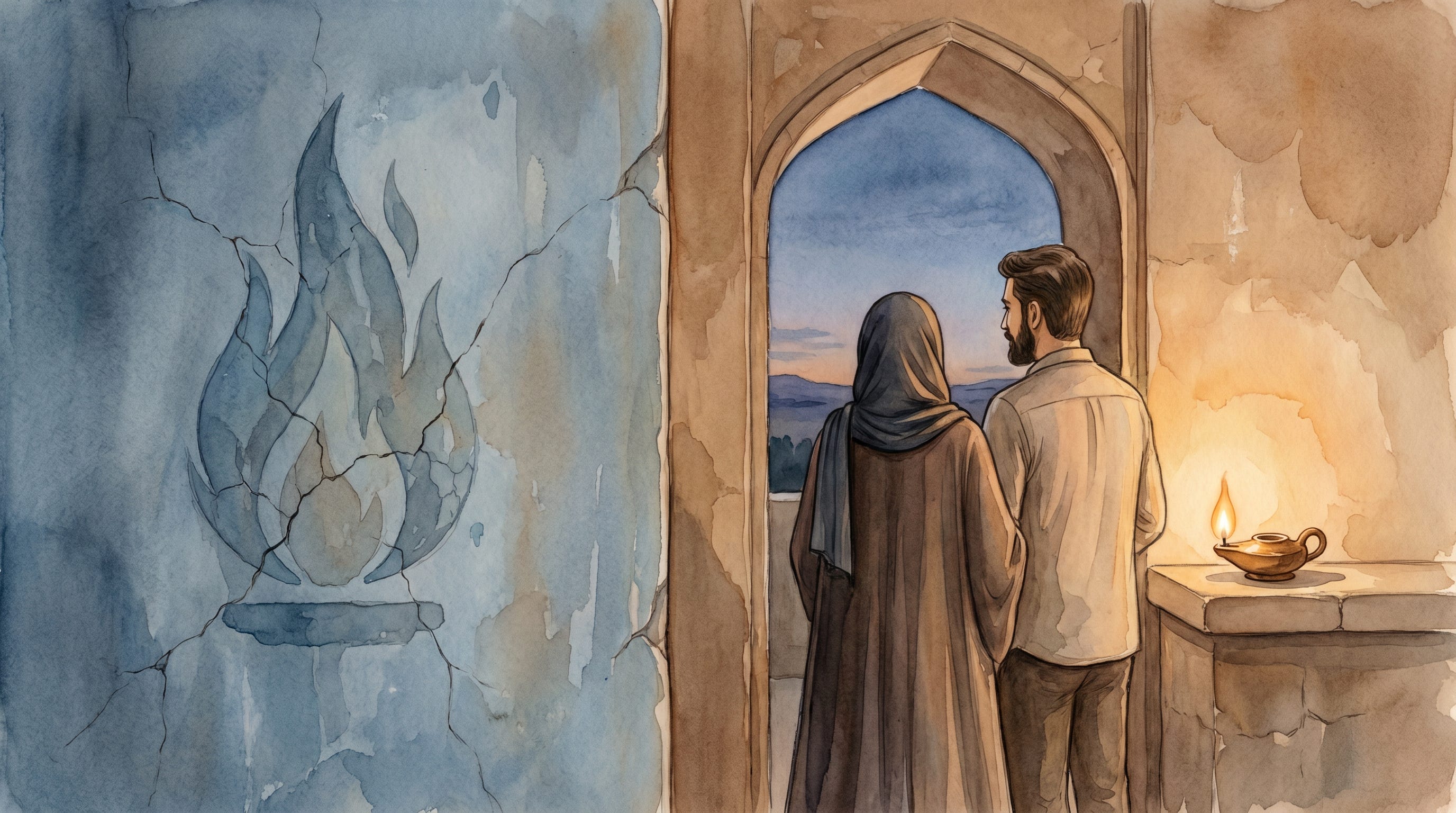
Now — because honesty is the whole method of this series, and because I will not sell you anything tonight — I have to say the harder half of this, the half a propagandist would leave out.
That witness was, afterward, institutionalised.
The wills became foundations.
The faces became murals on the sides of buildings.
The sacrifice became a curriculum, a commemoration, a season.
And there is a real and beautiful strength in that: a society that remembers its martyrs, that forms its young around the memory of sacrifice rather than around the memory of consumption, is doing something most of the modern world has forgotten how to do.
I will not pretend otherwise.
But there is an honest critique that has been made, from within, and we made its theology ourselves on the eighth night: the danger that the witness becomes an aesthetic — a slogan on a banner, a career for the well-connected, a beautiful image emptied of the substance that made it beautiful.
The eighth night warned us against exactly this — the counterfeit that keeps the form of the witness and loses the heart of it.
So we name both.
The remembering is good; the hollowing-out is the danger; and the very fact that we can say both, out loud, on the same night, is the discipline that earns us the right to everything else we are going to say.
We are not selling anything tonight.
We are weighing.
A whole generation held a frontier, and wrote down why.
That is not history either.
The same chain that produced Samadzadeh and Hashemi kept producing links — and some of those links, you watched die.
So let us follow it down, out of the trenches of the 1980s, and into the chain of our own adult lifetime.
The Branches: The Chain of Our Own Lifetime
On the thirteenth night we mapped the grades of witness — the battlefield, the Hereafter, the scholar, the worker, the child.
Tonight I am going to take that map and lay it over the last forty years, and you are going to watch the grades of witness walk among us.
I am going to name names.
Not many — this is not a roll call for its own sake; every name here is a link, and I want you to feel the chain take the strain as we hang each one on it.
And there is a discipline I am asking of myself as I go: as we name them, we name them at a single, level weight — no name lifted higher in the voice than the next, no melody creeping into the litany — because a list of martyrs is not a song.
It is a chain, and a chain is strongest when every link is forged to the same gauge.
Lebanon: The Seam That Did Not Stop Bleeding
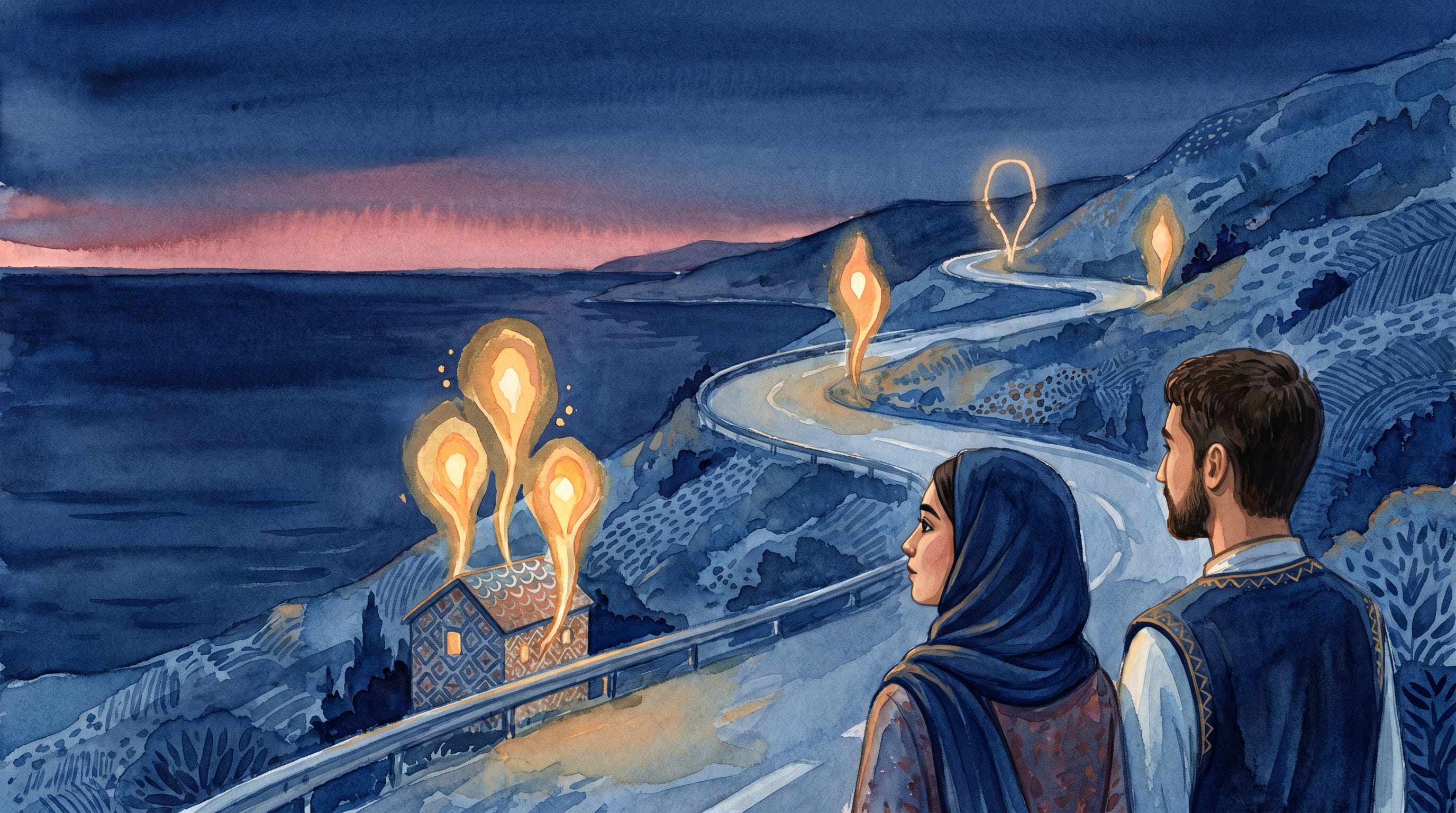
Start in Lebanon, on a seam of the world the empire has tried to cauterise for half a century, and that has not stopped bearing witness.
Begin with Imam Musa al-Sadr — who vanished.
He flew to Libya in 1978 and he never came back; he was disappeared, erased, made to not-exist by a regime that found his voice inconvenient.
And here is a strange grade of witness for you, one the thirteenth night’s map can hold: a martyrdom in absence.
The man whose very erasure testifies — whose empty place at the table has shouted, for nearly fifty years, louder than his presence ever could.
The empire thought that to disappear a man is to silence him.
It learned, with Imam Musa al-Sadr, that an absence can be a witness too.
Then Ayatullah Sayyed Muhammad Husayn Fadhlullah, the scholar whose lectures and rulings formed a generation, and whom they tried to kill with a car bomb that murdered eighty people in a Beirut street and missed him — the scholar-witness who lived under the shadow of the bomb and went on teaching.
Then Sayyed Abbas al-Musawi.
16th February 1992.
An Israeli helicopter tracked his motorcade home from a commemoration and fired — and it did not only kill him.
It killed his wife, Sayyedah Siham, and it killed his small son, Sayyed Husayn, a child of five.
The household, struck together.
I am going to let that resonance stand without forcing it — you can hear, on the road home from a commemoration of Karbala, the rhyme of a household taken together; I do not need to hammer it into an equation.
I only need you to notice that the man who led the Islamic resistance was martyred with his wife and his child beside him, on the road home, in our own time, and that the tradition of the household-that-is-struck-together did not end at the Euphrates.
Then Hajj Imad Mughniyeh — Damascus, February 2008 — and here a thread from the eleventh night pays off in a single line.
We spoke, on the eleventh night, of the witness who effaces himself, who lives a quarter of a century in the shadows so that the work can go on, whose own name is a kind of fast he keeps.
That was Hajj Imad: twenty-five years a ghost in the service of the line, until a bomb in a car headrest found him.
The man who gave up his own visibility as a form of worship.
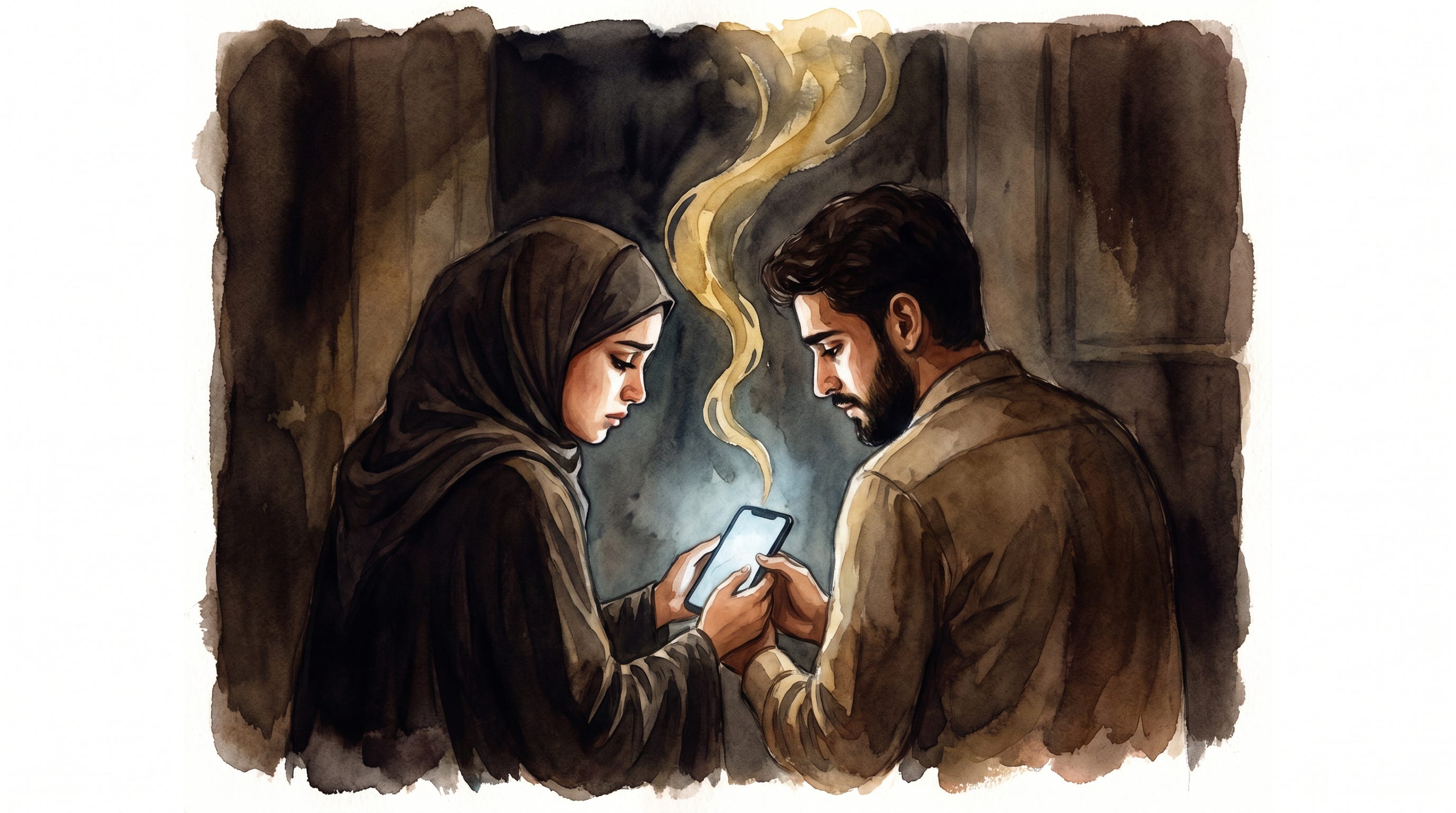
And then — 27th of September, 2024 — Sayyed Hassan Nasrallah.
And I do not have to tell you who he was, or read it to you from a chronicle, because you watched it happen.
Many of you in this room learned of his martyrdom the way you learn of a death in your own family now: from the glass of the phone in your hand, in real time, the bunker-busting bombs going into the earth of Dahiyeh on a live feed.
This is what I meant at the top of the night.
The chain did not stay in the books.
We watched a link of it severed, on our phones, on a Friday, and we wept into the same glass that showed it to us.
That is a witness of our own lifetime.
Not a chronicle.
A memory.
Iraq: The Shrines, And The Men Who Guarded Them
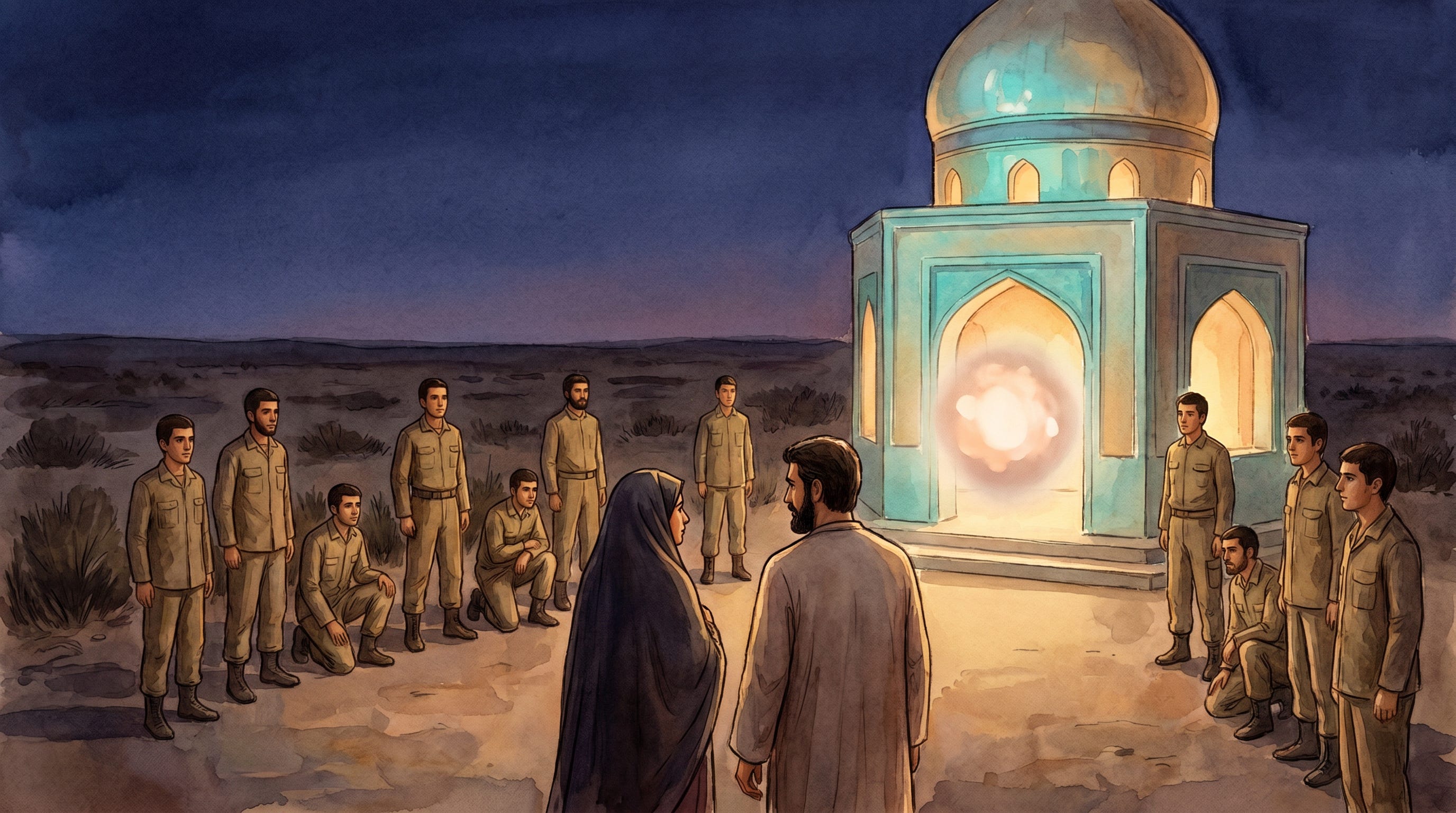
Cross into Iraq.
Ayatullah Sayyed Muhammad Baqir al-Hakim — returned from a lifetime of exile to a free Najaf, and was murdered there, at the door of the Shrine of the Commander of the Faithful, by a car bomb in August 2003, along with scores of worshippers leaving the Friday prayer.
The scholar martyred on the threshold of the very shrine he had spent his life longing to return to.
And then the defenders of the shrines — the young men of the Popular Mobilisation, who, when the takfiri flood of ISIS, aka DAESH, came down on Iraq to erase the shrines of the Imams and to enslave the Yazidi and slaughter the Christian and the Shia alike, put their bodies between the takfiri and the dome.
These are the battlefield martyrs of the thirteenth night’s first door — the shaheed of the front line — produced, in their thousands, in our own decade, on our own watch.
And at the head of them, Hajj Abu Mahdi al-Muhandis, the deputy commander of that mobilisation.
I want to read you something from his testament, because it is going to come back at the very heart of this night, when we reach the cry in the street, and I want it already in your ear.
He says — and mark who he lists among the people he understands himself to be serving:
هدف ما کسب رضایت خداوند متعال، خدمت به مردم ـ اهل سنت، شیعیان، مسیحیان و ایزدیها است، ما متجاوز نیستیم بلکه برای اصلاح و نابودی تروریسم در این منطقه میجنگیم.
“Our goal is to gain the pleasure of God Almighty, and to serve the people — Sunnis, Shiites, Christians, and Yazidis. We are not aggressors; rather, we fight for reform, and for the elimination of terrorism in this region.”
— Hajj Abu Mahdi al-Muhandis, from his recorded final testament (Farsi)
Christians and Yazidis.
The man the empire’s newspapers filed under “Iran-backed militia commander” names the Christian and the Yazidi among the people he is dying to protect.
Keep that sentence.
We will need it.
Hajj Abu Mahdi was martyred on the 3rd of January, 2020 — and to say how, we have to cross the last border, into Iran, and arrive at the link that reframes this entire series.
Iran, And The Link That Reframes Everything
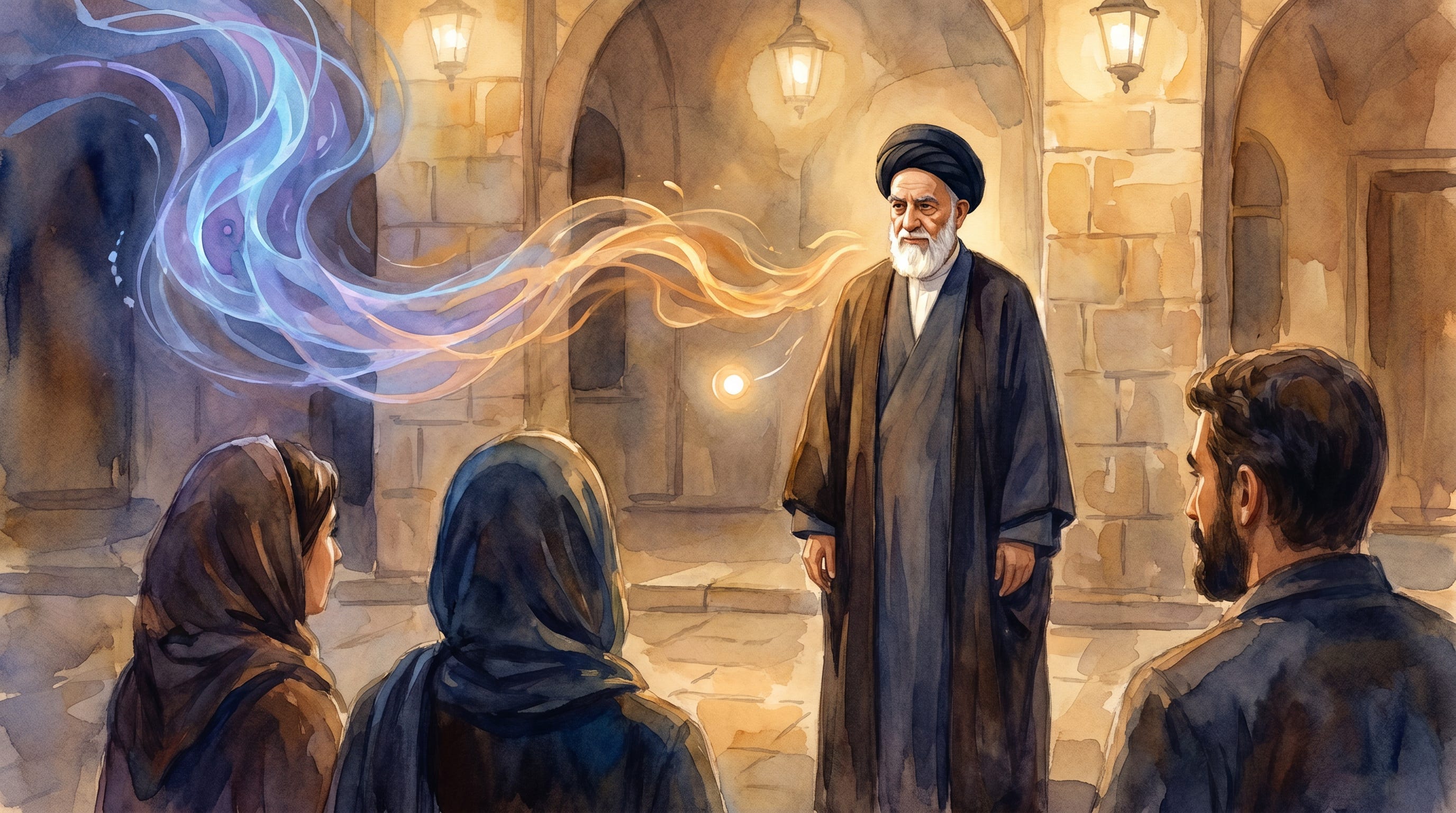
On that same night — the 3rd of January, 2020 — at Baghdad airport, an American drone, flown from a base in the Nevada desert, fired missiles into a convoy and killed Hajj Abu Mahdi al-Muhandis and, beside him, Hajj Qasem Soleimani.
We have walked the road of Hajj Qasem across four nights of this series — his Talab, his Eshgh, his Ma’rifat, his Shahadat; we closed the four stages of his path on the ninth night, and I will not re-walk them now.
Tonight he simply takes his place in the chain — the commander who held the seam against the takfiri flood across two countries, named by an empire as a terrorist and killed by it in the open, by remote control, on a third country’s soil.
A link.
Hang him on the chain at the same level weight as the rest, and move on — because the chain has one more link in our own lifetime, and it is the one that makes a believer have to sit down.
Because weeks ago — on the 28th of February, 2026 — the chain reached the wali al-amr himself.
Imam Sayyed Ali al-Husayni Khamenei, may God rest his pure soul, the guardian of the affair of the Muslims, was struck in his own place in Tehran, by a fire sent from far away, and martyred.
The guardian of the line.
The man who, for thirty-six years, carried the trust and never once set it down.
Now I have to handle this with great care, and I want to tell you exactly how I am going to handle it, because the temptation is to stop the whole series here and build a second series inside it.
I am not going to do that.
His life, his station, the meaning of wilayat al-faqih, the whole theology of the guardianship he carried — that has its own home; it is coming, in the forthcoming Lantern of the Path sub-series on Wilayat al-Faqih, and it deserves the room.
Tonight he does one thing, and one thing only: he stands in the chain.
He is the link of our own lifetime that proves the chain is not a museum.
So let me give you only the two things that make him the link, and then let him take his place.
The first is what he said near the end.
On the seventh night and the tenth night of this series, we heard Imam Husayn, peace and blessings be upon him, give his first refusal — the night they came to Walid ibn Utba’s house in Medina and demanded his allegiance to Yazid, and he answered:
وَمِثْلِي لَا يُبَايِعُ مِثْلَ يَزِيدَ أَبَدًا.
“And one like me does not ever give allegiance to one like Yazid.”
— Imam Husayn; Sayyid Ibn Tawus, al-Luhuf
Eleven days before he was martyred — on the 17th of February, 2026 — Imam Khamenei stood up and said that exact sentence again, in his own words, into our own time:
ملت ایران درسهای اسلامی و شیعی خود را خوب میداند؛ میداند چه کاری باید بکند. امام حسین (ع) فرمود: مثل من با مثل یزید بیعت نمیکند.
“The Iranian nation knows its Islamic and Shia lessons well; it knows what it must do. Imam Husayn, peace be upon him, said: ‘One like me does not give allegiance to one like Yazid.’”
— Imam Sayyed Ali Khamenei, Imam Khomeini Hussainiyah, Jamaran, Tehran, 17 February 2026
He restated Imam Husayn’s first refusal — and notice, with the care the thirteenth night taught us, that he did not say “I will not give allegiance”; he said the nation will not, a people like ours will not give allegiance to corrupt lords like the ones now in power in the empire.
He spoke of the system, never of himself.
And eleven days later, they killed him.
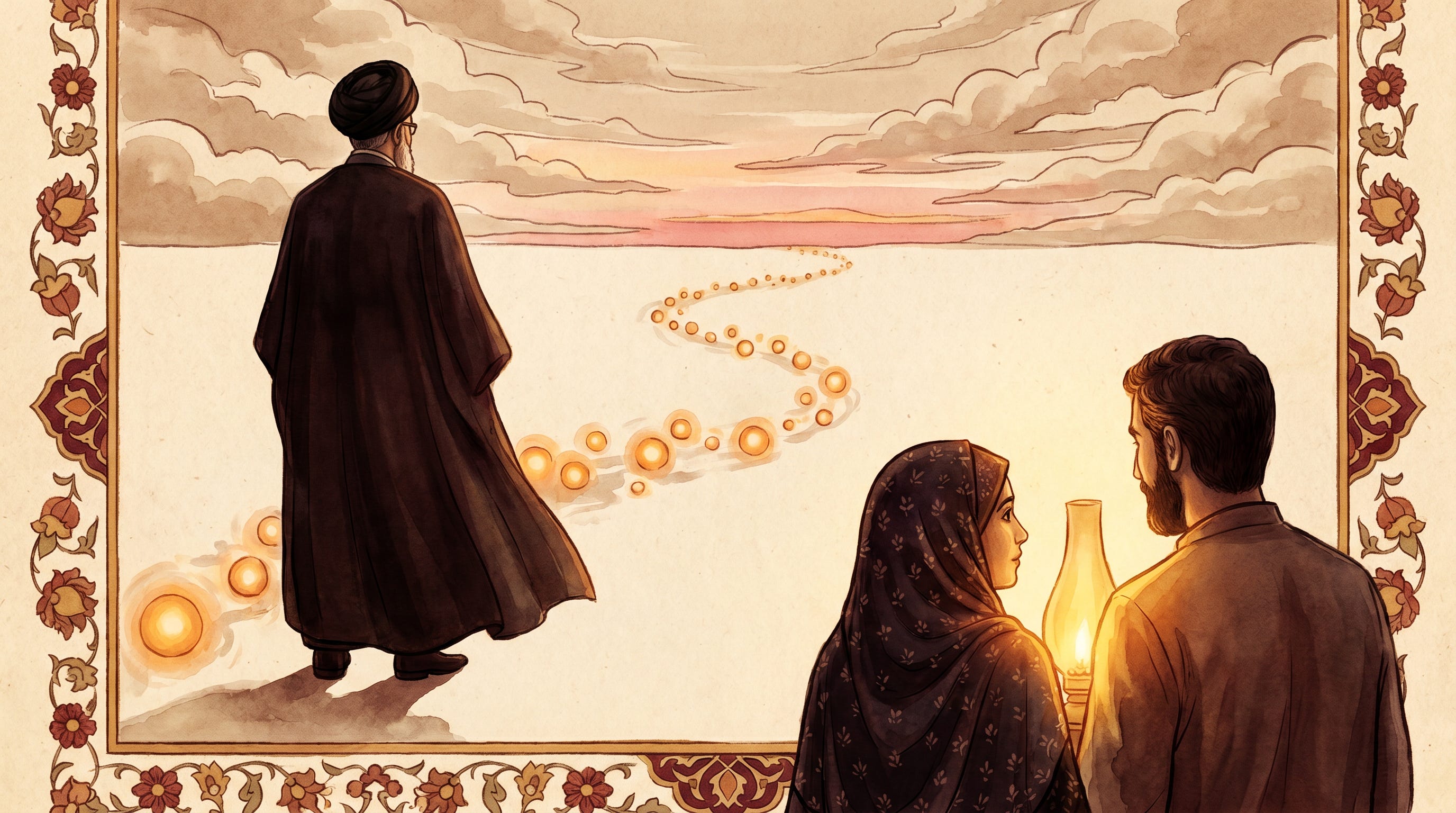
The first refusal of Karbala, restated by the guardian of the line in our own decade — and the price paid, the same week, in full.
That is not a man quoting Imam Husayn.
That is the chain holding.
And the second thing is the one I cannot get past, and I do not think you will either.
On the day he was martyred, his official account posted a message to the world.
And the message was not a threat, and it was not a boast.
It was a verse of the Qur’an.
This one:
مِنَ الْمُؤْمِنِينَ رِجَالٌ صَدَقُوا مَا عَاهَدُوا اللَّهَ عَلَيْهِ ۖ فَمِنْهُم مَّن قَضَىٰ نَحْبَهُ وَمِنْهُم مَّن يَنتَظِرُ ۖ وَمَا بَدَّلُوا تَبْدِيلًا.
“Among the believers are men who have been true to their covenant with God. Among them is he who has fulfilled his pledge, and among them is he who still waits — and they have not changed in the least.”
— Qur’an, Surah al-Ahzab (the Chapter of the Confederates) #33, Verse #23
I want you to feel the whole series gather behind that verse.
On the second night we stood at the covenant of Alast — am I not your Lord? — the oldest promise the human soul ever made, in Surah al-A’raf.
On the third night and the fourth night we watched the men of the House keep that covenant.
And here, on the day of his death, the guardian of the line reaches for the verse that says the covenant was kept —
sadaqū mā ʿāhadū Allāha ʿalayh,
they were true to what they promised God
— and he files himself under its first clause,
fa-minhum man qadā nahbahu,
the one who fulfilled his pledge,
the one who has paid it to the death.
He told us, in his last public word, which clause of that verse he had come to.
He had come to the end of the covenant of the second night, and he had kept it.
The promise of Alast, sealed — in our own lifetime — by a man who would not change in the least.
That is the link.
And now I let him take his place in the chain, and I tell you plainly that the trust did not fall when he did — it passed, within days, to his son, Imam Sayyed Mujtaba al-Husayni Khamenei, may God protect him; and the full telling of what that trust is waits for its own night.
Tonight, it is enough that you have seen the chain reach all the way to the wali al-amr, and hold.
The Killing Of A People’s Future
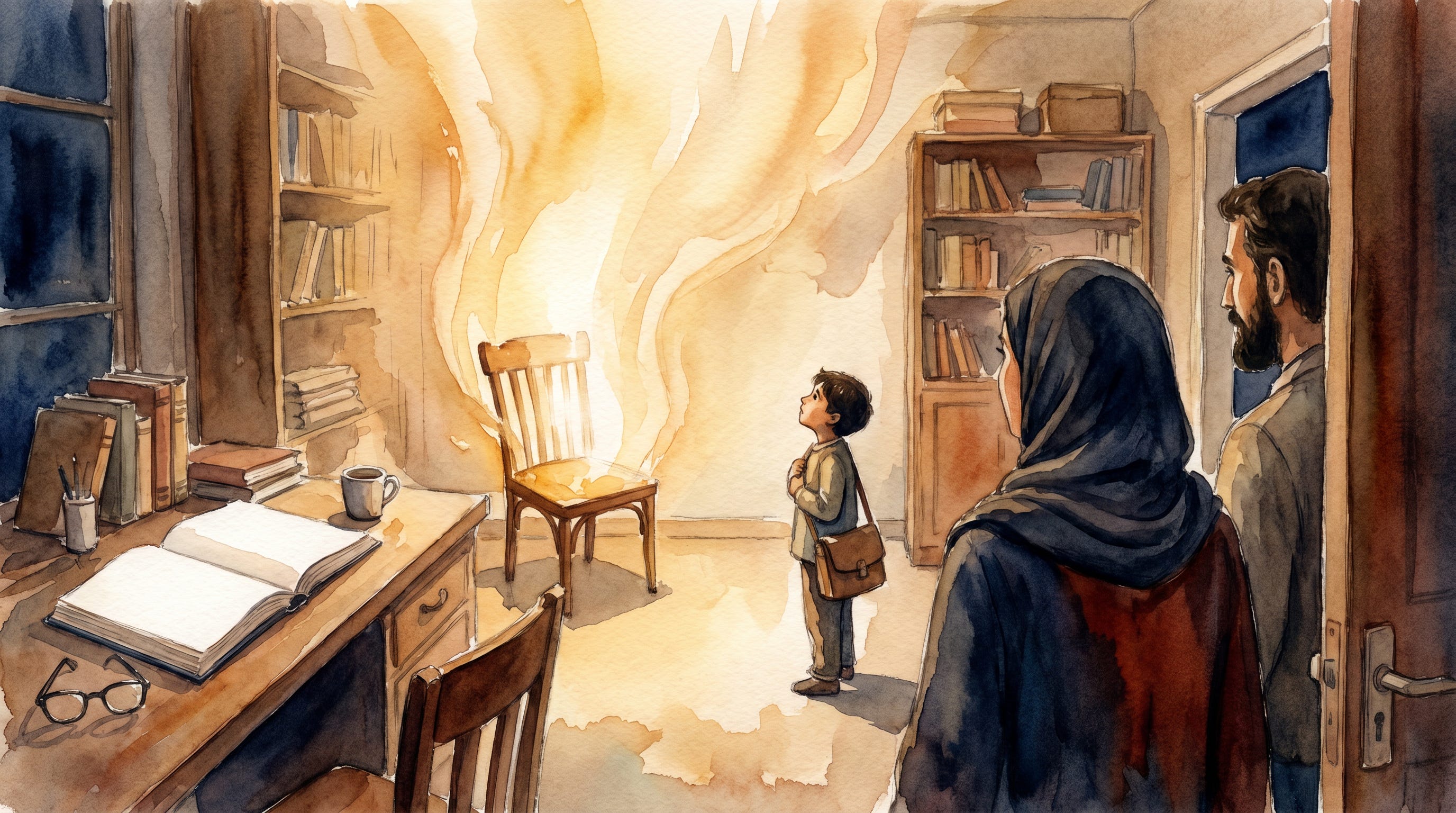
But the empire that severed those links did not only kill commanders and guardians.
It has been killing something quieter, and in some ways more revealing, for at least fifteen years — and I planted only the principle of it on the eleventh night, and tonight I have to name it.
On the eleventh night I asked you a question and left it hanging:
What is the excuse for killing a professor of physics?
A cancer researcher?
A scholar of artificial intelligence?
The killing of knowledge itself, by stealth, to keep a people subordinate.
Tonight I give the question a face — and I am going to lead with the cleanest, most human case in the whole record, because precision is mercy here, and because I want the point to be one no honest person can knock down.
His name was Dariush Rezaeinejad.
He was a young researcher, an engineer; he was thirty-five.
In July of 2011, gunmen on a motorcycle shot him five times outside his home in Tehran — while he was in his car, with his wife wounded beside him, and their little daughter in the car, just collected from kindergarten.
A child, picked up from kindergarten, in the back of the car while her father was shot to death in front of her.
And that daughter, Armita, said one sentence afterward, in English, that I want to be the whole of the human case:
“He was a scientist who had nothing to do with violence.”
That is one.
The iconic one is Mohsen Fakhrizadeh, killed in November 2020 on a road outside Tehran by a remote-controlled, satellite-linked, computer-aimed machine gun — a man shot dead by a machine with no hand on it, his wife twenty-five centimetres away and untouched, because the machine was that precise about which life it was ending.
And it is not two cases; it is a pattern that runs from 2010 to 2025 — Alimohammadi, Shahriari, Ahmadi Roshan, and on through the strikes of June 2025 — a decade and a half of scientists killed in their cars, on their roads, beside their families.
Now hear the discipline of how I am arguing this, because it matters.
I am not standing here to adjudicate the exact job description of any one of these men — some of them are tied, by Iran’s own account, to programmes the empire feared, and I am not going to pretend to weigh each man’s file.
The attribution of these killings — to a foreign intelligence service, by stealth — is what is reported; I name it as reported, and I do not need more than that.
Because my argument is not about any one man’s role.
My argument is about the method, and about the principle.
The method is the assassination of knowledge by stealth — the murder of a non-combatant, a teacher, a researcher, in front of his children, not for anything he did on a battlefield, but for what he knew, and for what he might teach a people to know.
And here is the principle, the reductio I left you on the eleventh night, and it stands on its own, clean of any one man’s file:
What conceivable excuse is there for killing a cancer researcher?
A scholar of artificial intelligence?
A professor at a university?
To kill a people’s scientists is to kill its future — its capacity to learn, to heal, to build, to climb up out of the subordination the empire has assigned it.
It is a crime of the very first order.
And the collective West — and most of the world with it — did not condemn it.
It looked away.
So do this one honest thing: imagine, for a single moment, the scientists of a Western nation assassinated in their cars on the school run, by a foreign machine, one after another for fifteen years.
Imagine the reaction.
Now measure that imagined reaction against the actual silence.
The silence is the double standard, exposed — the empire, and the media that launders for it.
And here is the hinge that takes us out of the chain of martyrs and into the hardest and most important movement of the night.
Why?
Why would a throne murder the future of a people it claims to have no quarrel with?
Why kill the teacher, the researcher, the child’s father on the school run?
There is a word for the answer, and I want you to hold it the way we held the hinge in the floor: interest.
Capital.
Resources.
The lion’s share.
The throne kills the future of a people to keep that people from rising into a position where it might one day claim its own share.
But hold the word interest the way the rest of the night will teach you to hold it — as a symptom, never the sickness itself.
The hunger for the lion's share is only the appetite.
Arrogance is the body it feeds — the will to raise yourself by holding another down — and the capital is merely what that arrogance reaches for.
The throne does not devour because it is hungry; it is hungry because it is proud.
Hold that, because it opens the next door, and behind the next door is the whole machinery of the age.
Broadcast Into Our Hands
But before we open that door, there is one more branch of the chain, and it is the one that is bleeding right now, tonight, while we sit here — and it is the emotional centre of gravity of this whole night, so I am not going to rush past it.
From October of 2023 to this very hour, a genocide.
I am going to give you only the figures the most careful international monitors will stand behind, because I will not inflate what is already unbearable.
As of late March 2026, the United Nations humanitarian office counts more than seventy-two thousand Palestinians killed in Gaza, and more than a hundred and seventy thousand wounded; nearly two million people — almost the entire population — driven from their homes.
And the children — a whole generation of the children of Gaza — a generation of witnesses, in the exact sense this series has spent fourteen nights building.
And the thing that makes this different from every atrocity in the long human record of atrocity is the glass.
It was broadcast into our hands.
We did not read about it forty years later in a book.
We watched it, live, on the phones in our pockets — the most documented slaughter in the history of the species, witnessed in real time by the largest audience that has ever witnessed anything, and not stopped.
And among the witnesses was a witness who died witnessing — and for a series called Shahada, there is no purer link in the whole chain.
His name was Anas al-Sharif.
He was twenty-eight, a journalist, born in the Jabaliya refugee camp; he reported from Gaza for the world to see, until, in August of 2025, an Israeli strike on a tent of journalists killed him.
And he had written his will in advance, to be released if they killed him.
And listen to what a man whose entire life was bearing witness asks of God in his last words:
لَمْ أَتَوَقَّفْ أَبَدًا عَنْ قَوْلِ الْحَقِيقَةِ كَمَا هِيَ، دُونَ تَزْوِيرٍ أَوْ تَحْرِيفٍ — لِيَكُونَ اللَّهُ شَهِيدًا عَلَى أُولَئِكَ الَّذِينَ صَمَتُوا.
“I never stopped telling the truth as it is, without falsification or distortion — so that God may bear witness over those who stayed silent.”
— Anas al-Sharif, from his final testament, Gaza, August 2025
So that God may bear witness over those who stayed silent.
He died holding up the witness — and with his last breath he handed the question to us.
Who stayed silent.
And he was not the only one to hand it on.
The children handed it on too.
A child of Gaza named Muhammad Abdul Qadir Husayn wrote his own will, and in it he said:
“I am a trust; do not humiliate us,”
and he begged the peoples of the world — he listed them, nation by nation —
“do not forget Gaza.”
A child, entrusting the earth with his own people, because the thrones would not.
So here is the question this beat lays on every English-speaking believer in the West, the question we cannot honestly walk around: what does it do to a soul — what does it require of a soul, for the rest of its life — to have watched tens of thousands of witnesses produced in a single generation, broadcast into the palm of its own hand, and to have been told, by every throne and every screen around it, to look away and call it something else?
Anas al-Sharif asked God to witness against the ones who stayed silent.
We do not get to be the ones who stayed silent.
And the refusal to stay silent is exactly the cry we have been circling all night — the cry that the hinge in the floor has been waiting for.
We have named the throne’s victims.
Now we have to name the throne.
Down With the Throne: Marg bar Amrika, Marg bar Esra’il
Now we come to it.
To the cry.
To the single most weaponised and most misunderstood sentence our community ever says aloud — the sentence that gets us called fanatics, that gets quoted back at us with the camera lingering on the angriest face in the crowd, that has, more than almost anything else, been used to convince the watching world that we are a people who wish death on people.
I am going to spend the heart of this night on it, and I am going to give it a clean name and a clean theology, because it has earned both — and because you cannot be against a thing until you have shown, plainly and patiently, exactly what the thing is.
And I am going to insist on one posture the whole way through, the posture of the believer at his best: tabyeen — clarification — not apologetics.
I am not going to stand here wringing my hands and whispering, well, we don’t really mean it.
We mean it.
The cry is right; the people who raise it are right; the thrones it is aimed at are what it says they are.
What I am going to do is the harder thing: show you precisely what we mean, so precisely that the fear drops out of it and only the truth is left standing.
We do it in this order.
First the constitution — what the believer is even permitted to be against.
Then the word — what “down with” actually means.
Then the method — how a fair person judges a nation at all.
Then the evidence — the throne, worked as a live case.
And then the landing — who the cry is really for, and how it ends.
The Constitution: What Islam Is Actually Against
You cannot say “down with” anything until you have established what a believer is permitted to oppose.
And the constitution is not my opinion.
It is the Qur’an, and it is decisive.
Start at the baseline.
What did the Prophet, peace and blessings be upon him, his family and his righteous companions, come as?
وَمَا أَرْسَلْنَاكَ إِلَّا رَحْمَةً لِّلْعَالَمِينَ.
“And We did not send you except as a mercy to all the worlds.”
— Qur’an, Surah al-Anbiya (the Chapter of the Prophets) #21, Verse 107
Not as a mercy to the Arabs.
Not as a mercy to one tribe or one creed.
To all the worlds — to all of humanity, believer and unbeliever, near and far.
The baseline of the whole religion is mercy, not conquest.
Now build on that baseline, because the next thing the constitution does is tell you the one thing the believer is licensed to take up arms against — and it is not what you have been told it is.
Hear the very first verse of permission to fight ever revealed.
We stood on this exact verse on the seventh night, as our preamble; the constitution was laid down seven nights ago, and tonight it comes back to do its work:
أُذِنَ لِلَّذِينَ يُقَاتَلُونَ بِأَنَّهُمْ ظُلِمُوا ۚ وَإِنَّ اللَّهَ عَلَىٰ نَصْرِهِمْ لَقَدِيرٌ الَّذِينَ أُخْرِجُوا مِن دِيَارِهِم بِغَيْرِ حَقٍّ إِلَّا أَن يَقُولُوا رَبُّنَا اللَّهُ.
“Permission to fight has been given to those who are fought against, because they have been wronged — and indeed God is fully able to give them victory. Those who have been driven from their homes without right, only for saying: our Lord is God.”
— Qur’an, Surah al-Hajj (the Chapter of the Pilgrimage) #22, Verses 39–40
Watch the grammar with your own eyes, because the whole constitution is in one little particle.
Permission is given — why?
Bi-annahum dhulimū — because they were wronged.
And our deepest commentator nails the particle to the floor.
Allamah Tabataba’i, in al-Mizan, says the bāʾ there — the “because” — is the bāʾ of causation: the permission is given because they have been oppressed, and the oppression is then defined in the very next breath as being expelled from their homes.
و الباء في «بأنهم ظلموا» للسببية و فيه تعليل الإذن في القتال أي أذن لهم فيه بسبب أنهم ظلموا، و أما ما هو الظلم فتفسيره قوله: «الذين أخرجوا من ديارهم بغير حق» إلخ.
“The bāʾ in ‘because they were wronged’ (bi-annahum dhulimū) is for causation, and in it is the justification of the permission to fight — that is, they were given permission to fight because they were wronged; and as for what the wrong is, its interpretation is His saying: ‘Those who have been expelled from their homes without right,’ and so on.”
— Allamah Tabataba’i, al-Mizan fi Tafsir al-Qur’an, commentary on Surah al-Hajj #22, Verses 39–40 (vol. 28, p. 226)
So the very first licence to fight in the history of this religion is a licence against dhulm — against injustice, against expulsion, against theft of home — and it is not, anywhere in the verse, a licence against kufr, against unbelief, against the mere fact that someone holds a different creed.
The constitution opens against injustice, not against belief.
Mark it.
And if you doubt that the earliest fighting of Islam was actually about injustice and not about disbelief, look at what the Qur’an says the believers of Mecca were actually fighting over.
The pagan aristocracy of Quraysh had seized the homes and the property the Muslims left behind when they were driven out to Medina, and were trading on the proceeds.
The Qur’an names it:
لِلْفُقَرَاءِ الْمُهَاجِرِينَ الَّذِينَ أُخْرِجُوا مِن دِيَارِهِمْ وَأَمْوَالِهِمْ.
“For the poor emigrants who were expelled from their homes and their properties.”
— Qur’an, Surah al-Hashr (the Chapter of the Exile) #59, Verse 8
Expelled from their homes and their properties.
The reckoning at Badr and after was a reckoning with stolen wealth and aggression and expulsion — not a punishment handed down to people for declining to believe.
Correct the slander at its root: it was never
“they fought because the others would not believe.”
It was
“they fought because they had been robbed and driven out.”
And then the Qur’an draws the line so plainly that no honest reader can blur it.
The clearest verse of all:
لَّا يَنْهَاكُمُ اللَّهُ عَنِ الَّذِينَ لَمْ يُقَاتِلُوكُمْ فِي الدِّينِ وَلَمْ يُخْرِجُوكُم مِّن دِيَارِكُمْ أَن تَبَرُّوهُمْ وَتُقْسِطُوا إِلَيْهِمْ ۚ إِنَّ اللَّهَ يُحِبُّ الْمُقْسِطِينَ إِنَّمَا يَنْهَاكُمُ اللَّهُ عَنِ الَّذِينَ قَاتَلُوكُمْ فِي الدِّينِ وَأَخْرَجُوكُم مِّن دِيَارِكُمْ وَظَاهَرُوا عَلَىٰ إِخْرَاجِكُمْ أَن تَوَلَّوْهُمْ.
“God does not forbid you, regarding those who did not fight you over religion and did not drive you from your homes, that you be kind and just to them — indeed God loves the just. God only forbids you, regarding those who fought you over religion and drove you from your homes and supported your expulsion, that you take them as allies.”
— Qur’an, Surah al-Mumtahanah (the Chapter of the Examined Woman) #60, Verses 8–9
There it is, in black and white.
The Qur’an draws the line at aggression and expulsion — at fighting you and driving you out — and it explicitly draws the line not at religious difference.
The one who differs from you in creed but does not fight you and does not expel you?
Be kind to them.
Be just to them.
God loves the just.
And Allamah Tabataba’i, in al-Mizan, draws that line in his own hand — and tells you exactly who the verse means, and what the kindness and the justice are:
قوله تعالى: «لا ينهاكم الله عن الذين لم يقاتلوكم في الدين و لم يخرجوكم من دياركم أن تبروهم و تقسطوا إليهم» إلخ، في هذه الآية و التي تتلوها توضيح للنهي الوارد في أول السورة، و المراد بالذين لم يقاتلوا المؤمنين في الدين و لم يخرجوهم غير أهل مكة ممن لم يقاتلوهم و لم يخرجوهم من ديارهم من المشركين من أهل المعاهدة، و البر و الإحسان، و الأقساط المعاملة بالعدل، … و قوله: «إن الله يحب المقسطين» تعليل لقوله: «لا ينهاكم الله».
“His saying, ‘God does not forbid you, regarding those who did not fight you over religion and did not drive you from your homes, that you be kind to them and deal justly with them’ — in this verse and the one that follows is a clarification of the prohibition given at the opening of the surah (chapter). And what is meant by ‘those who did not fight the believers over religion and did not drive them out’ is those other than the people of Mecca — those among the idolaters who did not fight them and did not expel them from their homes: the people bound by treaty. And al-birr is kindness and goodness, and al-iqsāṭ is dealing with justice. … And His saying, ‘Indeed God loves the just,’ is the justification for ‘God does not forbid you.’”
— Allamah Tabataba’i, al-Mizan fi Tafsir al-Qur’an, commentary on Surah al-Mumtahanah #60, Verses 8–9 (vol. 38, pp. 91–92)
The non-combatant who merely differs in religion —
the one bound to you by treaty, the one who never raised a hand against you
— is owed, by the command of the God who loves the just, not suspicion and not hostility, but kindness and just dealing.
The constitution could not be clearer:
the line is drawn at injustice, never at belief.
There Is No Compulsion — Because Forced Belief Cannot Even Work
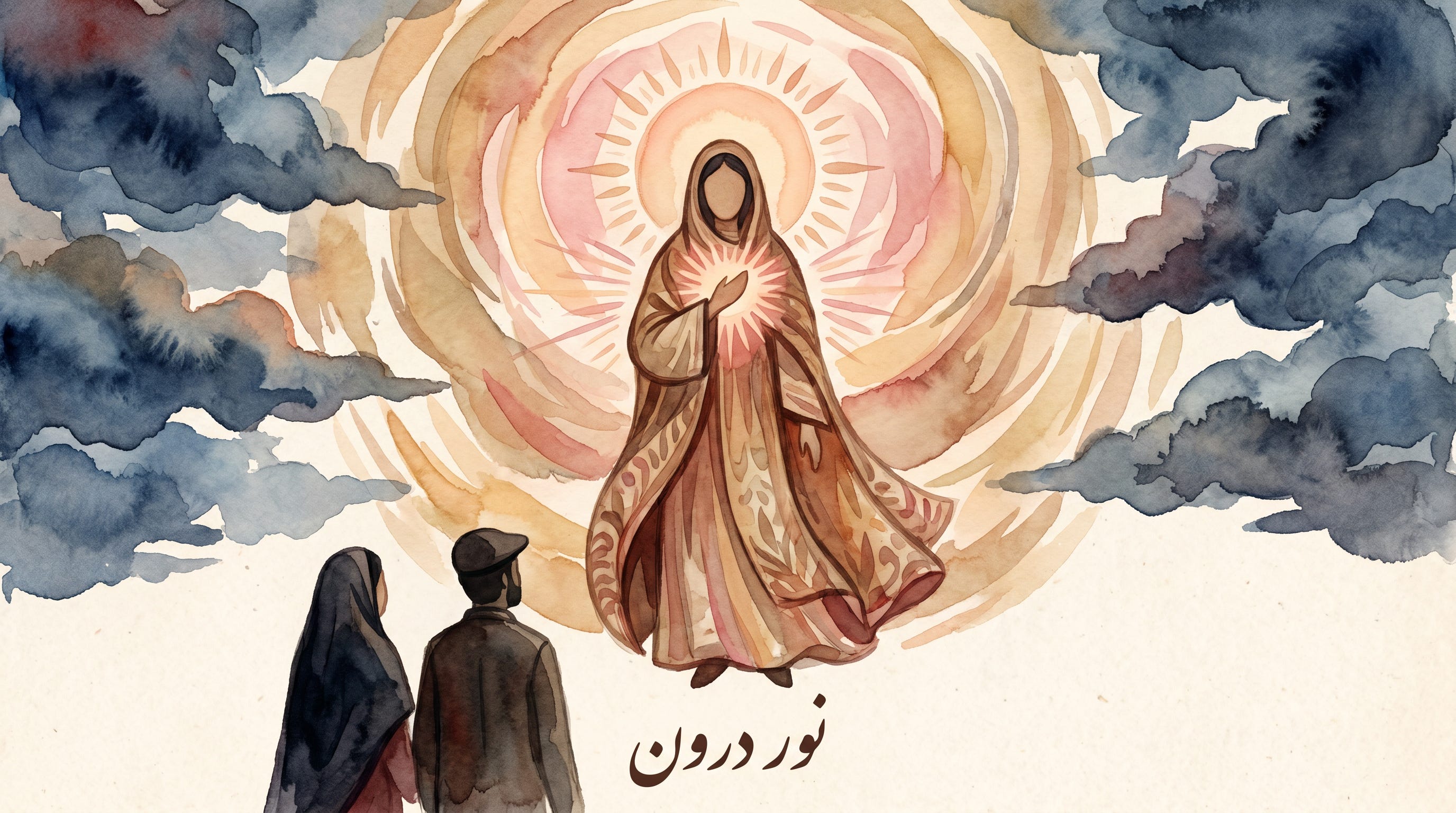
And now the keystone, the verse you have heard a hundred times and perhaps never heard all the way down:
لَا إِكْرَاهَ فِي الدِّينِ ۖ قَد تَّبَيَّنَ الرُّشْدُ مِنَ الْغَيِّ.
“There is no compulsion in religion; the right course has become clear from error.”
— Qur’an, Surah al-Baqarah (the Chapter of the Cow) #2, Verse 256
We usually hear that as a rule — you must not force belief.
It is that.
But Allamah Tabataba’i shows us it is something deeper than a rule: it is a statement of how reality is built.
He writes:
و الاعتقاد و الإيمان من الأمور القلبية التي لا يحكم فيها الإكراه و الإجبار، فإن الإكراه إنما يؤثر في الأعمال الظاهرية و الأفعال و الحركات البدنية المادية، و أما الاعتقاد القلبي فله علل و أسباب أخرى قلبية من سنخ الاعتقاد و الإدراك.
“Belief follows reason and understanding; and nothing but reason and understanding can create it… You may force someone to do a certain physical action against his will, but he cannot be forced to believe against his will.”
— Allamah Tabataba’i, al-Mizan fi Tafsir al-Qur’an, commentary on Surah al-Baqarah #2, Verse #256 (vol. 4, p. 162)
Do you hear the move?
It is not only that you may not force belief.
It is that you cannot.
Belief is a thing of the heart, and the heart answers to reason, to understanding, to free recognition — and to nothing else.
You can put a sword to a man’s throat and make his tongue move.
You cannot put a sword to his heart and make it recognise.
God says the same of His own Prophet — to His own Prophet — in Surah Yunus:
وَلَوْ شَاءَ رَبُّكَ لَآمَنَ مَن فِي الْأَرْضِ كُلُّهُمْ جَمِيعًا ۚ أَفَأَنتَ تُكْرِهُ النَّاسَ حَتَّىٰ يَكُونُوا مُؤْمِنِينَ.
“And had your Lord willed, everyone on earth would have believed, all of them together. So will you compel people until they become believers?”
— Qur’an, Surah Yunus (the Chapter of Jonah) #10, Verse 99
God Himself, who could have made every soul believe with a single word of His will, chose not to — because a faith that is forced is not the faith He wants.
And Allamah Tabataba’i, on this very verse, says the obvious and devastating thing in his own hand:
قوله تعالى: «و لو شاء ربك لآمن من في الأرض كلهم جميعا» أي لكنه لم يشأ ذلك فلم يؤمن جميعهم و لا يؤمن، فالمشيئة في ذلك إلى الله سبحانه و لم يشأ ذلك، فلا ينبغي لك أن تطمع فيه و لا أن تجتهد لذلك، لأنك لا تقدر على إكراههم و إجبارهم على الإيمان، و الإيمان الذي نريده منهم هو ما كان عن حسن الاختيار لا ما كان عن إكراه و إجبار.
“His saying, ‘And had your Lord willed, all those on earth would have believed, together’ — that is, but He did not will it, so they did not all believe, nor will they; the willing of that belongs to God, glory be to Him, and He did not will it. So it is not fitting for you to hope for it, nor to exert yourself for it — for you have no power to coerce them and force them into belief; and the belief We want from them is that which comes by good free choice (husn al-ikhtiyār), not that which comes by compulsion and force.”
— Allamah Tabataba’i, al-Mizan fi Tafsir al-Qur’an, commentary on Surah Yunus #10, Verse #99 (vol. 19, pp. 159–160)
The belief God wants is the belief that comes by husn al-ikhtiyār — by good free choosing — or it is not a belief He will accept at all.
Now stay with me, because here is the keystone the whole movement is built on, and it is the place where the constitution turns from a rule into a reason.
Forced belief is not merely forbidden.
It cannot succeed.
A belief that is coerced is, by its own nature, temporary and untrue — the tongue says one thing while the heart says another.
And our tradition has a word for exactly that condition, the gap between the tongue and the heart: nifāq.
Hypocrisy.
Listen to how the Imams define faith itself, and watch what it does to the very idea of a forced convert:
الْإِيمَانُ مَعْرِفَةٌ بِالْقَلْبِ، وَإِقْرَارٌ بِاللِّسَانِ، وَعَمَلٌ بِالْأَرْكَانِ.
“Faith is recognition by the heart, profession by the tongue, and action by the limbs.”
— Imam Ja’far al-Sadiq, al-Kafi, vol. 2, the Book of Faith and Disbelief, the Chapter on the Reality of Faith
Recognition by the heart first — and the profession of the tongue rests entirely on it.
So when a tyrant puts a sword to a man and forces the tongue to say the words, the tongue moves, but the heart was never given the chance to recognise.
What has the tyrant produced?
Not a believer.
A man whose tongue and heart are at war — a munafiq — a hypocrite, manufactured by the sword.
He has not built faith.
He has built its opposite.
The jurists put this in the most precise legal terms: the testimony of faith, the shahada, is an iqrar, a binding declaration — and a declaration made under coercion, under ikrah, is batil, legally void, because coercion strips away the intention and the consent that make a declaration real.
Force the words, and you have not made a Muslim; you have made a man perjure himself before God.
Ayatullah Sayyed Abu al-Qasim al-Khoei stated the principle at its root, against those who imagined the verse of no-compulsion had been cancelled by some later verse of war:
الدِّينُ فِي ذَاتِهِ يَتَأَبَّى الْإِكْرَاهَ عَلَيْهِ.
“Religion, by its very nature, refuses to be coerced.”
— Ayatullah Khoei, al-Bayan fi Tafsir al-Qur’an, p. 288
By its very nature refuses it.
And this is the place to lay to rest, for good, the slander that Islam was spread by the sword.
The wars of the Prophet and the Imams — and here is the marjaʿī articulation of the whole thing, from Imam Khomeini — were never fought to force the religion into people’s hearts.
They were fought to break the taghūt-systems, the structures of tyranny that stood between the people and the message, that kept the truth from even reaching the ears of those the tyrant ruled.
Imam Khomeini writes, in his great work of jurisprudence:
الْهَدَفُ رَفْعُ الْفِتْنَةِ وَإِزَالَةُ حُكُومَاتِ الطَّاغُوتِ، لَا إِجْبَارُ النَّاسِ عَلَى الدِّينِ.
“The aim was the removal of sedition and the dismantling of the tyrant-systems — not the compulsion of people into the religion. For faith is a matter of the heart, and is not attained by force and the sword.”
— Imam Khomeini, Tahrir al-Wasila, Kitab al-Jihad, see also Sahifeh-ye Imam, vol. 19, p. 234
Hold what that just did.
The sword of Islam, says the founder of the Islamic Republic, was never aimed at a person’s belief.
It was aimed at the taghūt-system — the tyrant-structure — that stood between people and the freedom to choose.
And that is the bridge, the exact bridge, into the cry we are walking toward: the sword — and the cry — are against the taghūt-system, never against a person’s belief and never against a person’s life.
Remember that.
We will stand on it in a moment.
And there is a fiqh-principle here that seals it, and it is one we have already met this very series.
We are not permitted to help a soul into a sin —
وَتَعَاوَنُواْ عَلَى ٱلۡبِرِّ وَٱلتَّقۡوَىٰۖ وَلَا تَعَاوَنُواْ
عَلَى ٱلۡإِثۡمِ وَٱلۡعُدۡوَٰنِۚ وَٱتَّقُواْ ٱللَّهَۖ إِنَّ ٱللَّهَ شَدِيدُ ٱلۡعِقَابِCooperate in piety and Godwariness, but do not cooperate in sin and aggression, and be wary of God. Indeed God is severe in retribution.
— Qur’an, Surah al-Ma’idah (the Chapter of the Table Spread) #5, Verse 2
lā taʿāwanū ʿalā al-ithm wa-l-ʿudwān,
do not cooperate in sin and aggression,
This is why the jurists say you do not even ask the question of the man you know will lie to you, except where a higher duty demands it — because to corner a soul into a lie is to assist him into the sin.
Now apply it to forced belief: to force a man to profess a faith his heart does not hold is to help him to a lie — to drag a soul into nifāq — into hypocrisy.
It is the precise opposite of religion.
The one who forces conversion thinks he is saving a soul; the Qur’an says he is destroying one, by manufacturing a hypocrite where God wanted a free believer.
And our master, the Commander of the Faithful, Imam Ali, set the dignity of that free choosing at the centre of what a human being even is:
وَلَا تَكُنْ عَبْدَ غَيْرِكَ وَقَدْ جَعَلَكَ اللَّهُ حُرًّا.
“And do not be the slave of another, for God has made you free.”
— Imam Ali ibn Abi Talib, Nahj al-Balagha, Letter 31 (his testament to his son al-Hasan)
God made you free.
Freedom is not a Western invention the empire is bringing to us at the point of a missile; it is the dignity God stitched into the human soul, the dignity that makes belief possible in the first place.
And history proves the whole argument, again and again, with a grim consistency: forced belief never holds.
Look at what the great coercers actually built — because every one of them proves the rule by breaking against it.
The Inquisition tortured Spain into a uniformity of creed, and produced a nation of secret unbelievers and terrified conformists.
The Soviet empire all but outlawed religion across a sixth of the earth for the better part of a century — and St Basil’s still stood on the square, and the moment the boot lifted, faith came back up out of the ground like grass through concrete, because belief in God sits in the core of a people and cannot be coerced out — and cannot be coerced in.
That is the wall the throne keeps colliding with: it can break a body, but it cannot make a heart.
Which is exactly why the believer's sword — and, in a moment, the believer's cry — was never aimed at what a person believes.
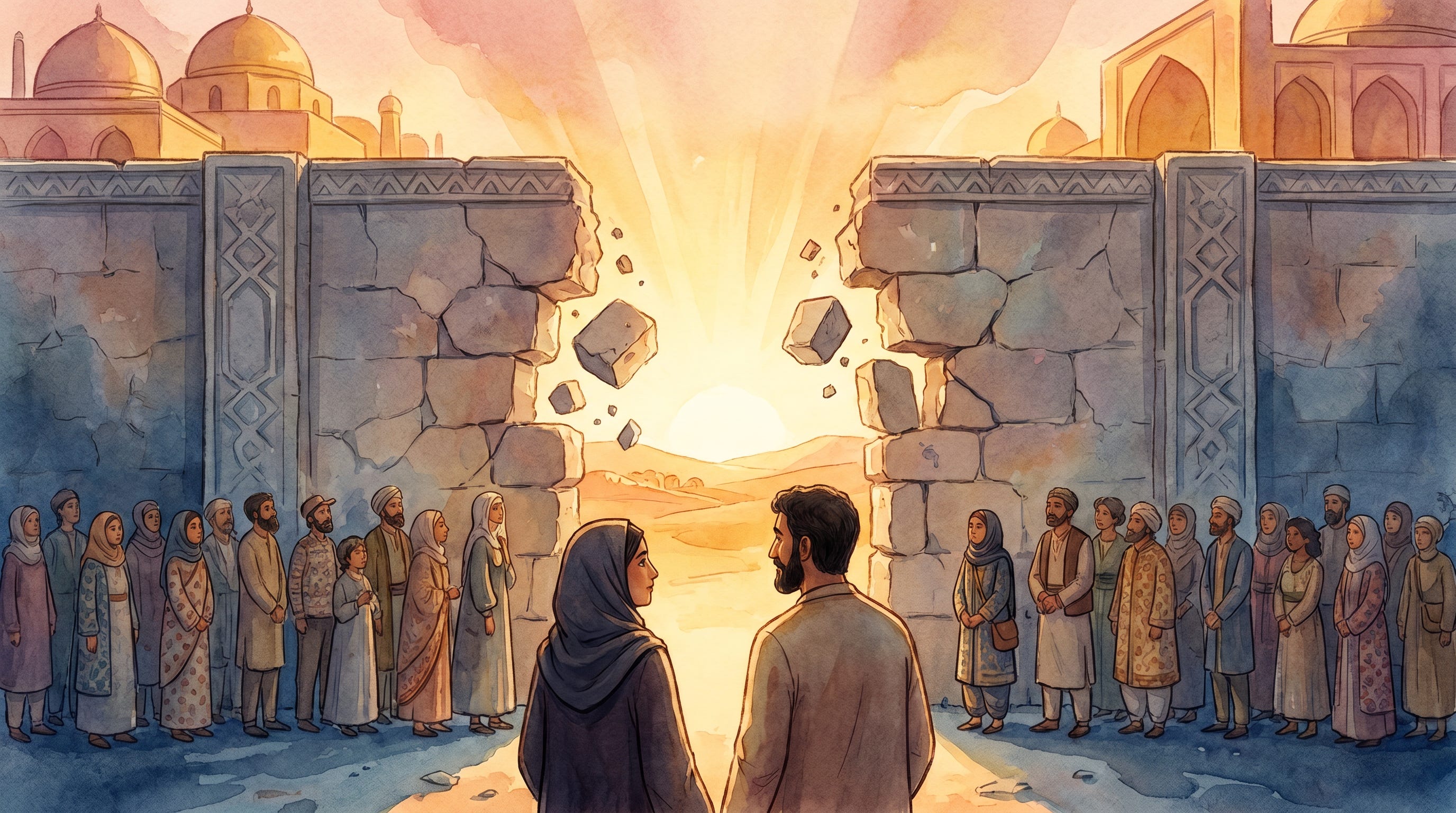
It is aimed at one thing only: the structure that stands between people and the freedom to choose at all.
Keep that in your hand.
We are about to need it in the street.
And so we must lift away, gently but firmly, a thing some sincere and zealous people have done — forced a conversion, dragged a tongue to the shahāda, on the strength of a misread narration, imagining they were handing the man a guaranteed place in Paradise.
No one is guaranteed Paradise.
That has been a theme of this whole series, from the third night to the thirteenth.
What matters is not a creed pronounced at sword-point; what matters is the state a person dies in.
A lifetime of apparent sanctity can be undone by a final act, and a lifetime of error can be redeemed by a final turning.
You cannot hand a man Heaven by handing him a sentence his heart does not hold.
The Real Fault-Line: The Arrogant And The Downtrodden
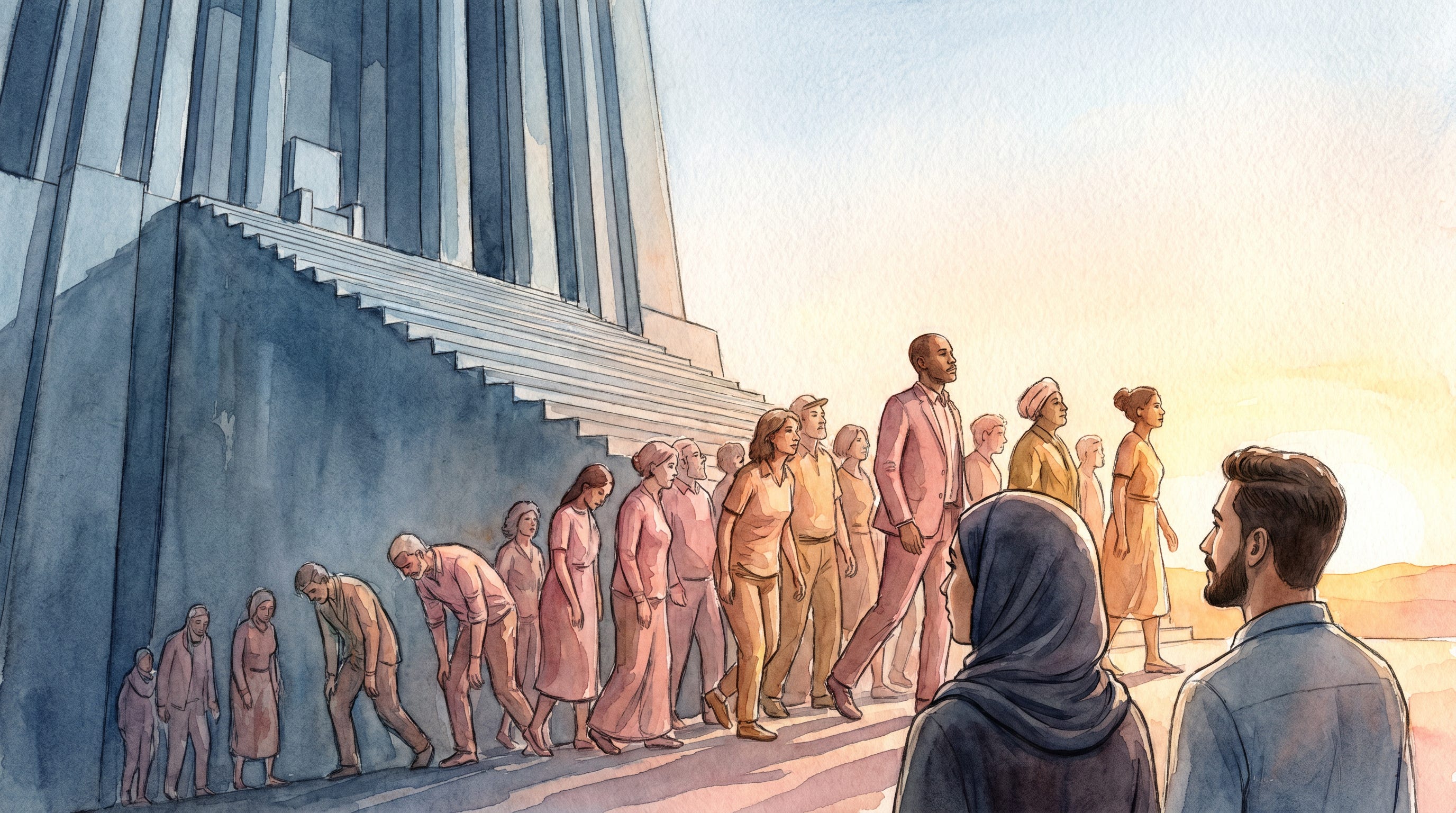
So if the line is not between Muslim and non-Muslim, where is it?
The Qur’an draws the real fault-line of all human history, and once you see it you cannot un-see it.
It runs not between East and West, not between creed and creed, but between the arrogant — al-mustakbirūn, the ones who exalt themselves and devour others — and the downtrodden — al-mustadhʿafūn, the ones the arrogant grind down.
Listen to how God describes His own programme in history:
وَنُرِيدُ أَن نَّمُنَّ عَلَى الَّذِينَ اسْتُضْعِفُوا فِي الْأَرْضِ وَنَجْعَلَهُمْ أَئِمَّةً وَنَجْعَلَهُمُ الْوَارِثِينَ.
“And We desired to show favour to those who were oppressed in the land, and to make them leaders, and to make them the inheritors.”
— Qur’an, Surah al-Qasas (the Chapter of the Stories) #28, Verse 5
That is the axis the whole series has been tracing without always naming it — from Abel and Cain on the first night, to Pharaoh and the children of Israel, to Imam Husayn and Yazid.
The arrogant work against populations: they lie, they manipulate, they plant half-truths, and — mark this, because it is the diagnostic — they amplify a people’s wounds instead of healing them, because the wound is the arrogant one’s profit.
And tonight, for the first time in this series, we name that axis in the present tense — and we name the cry that disavows the arrogant for what it is.
Now — and only now, with the constitution clear — we can say what the cry in the street actually means.
The Word: What “Down With” Means
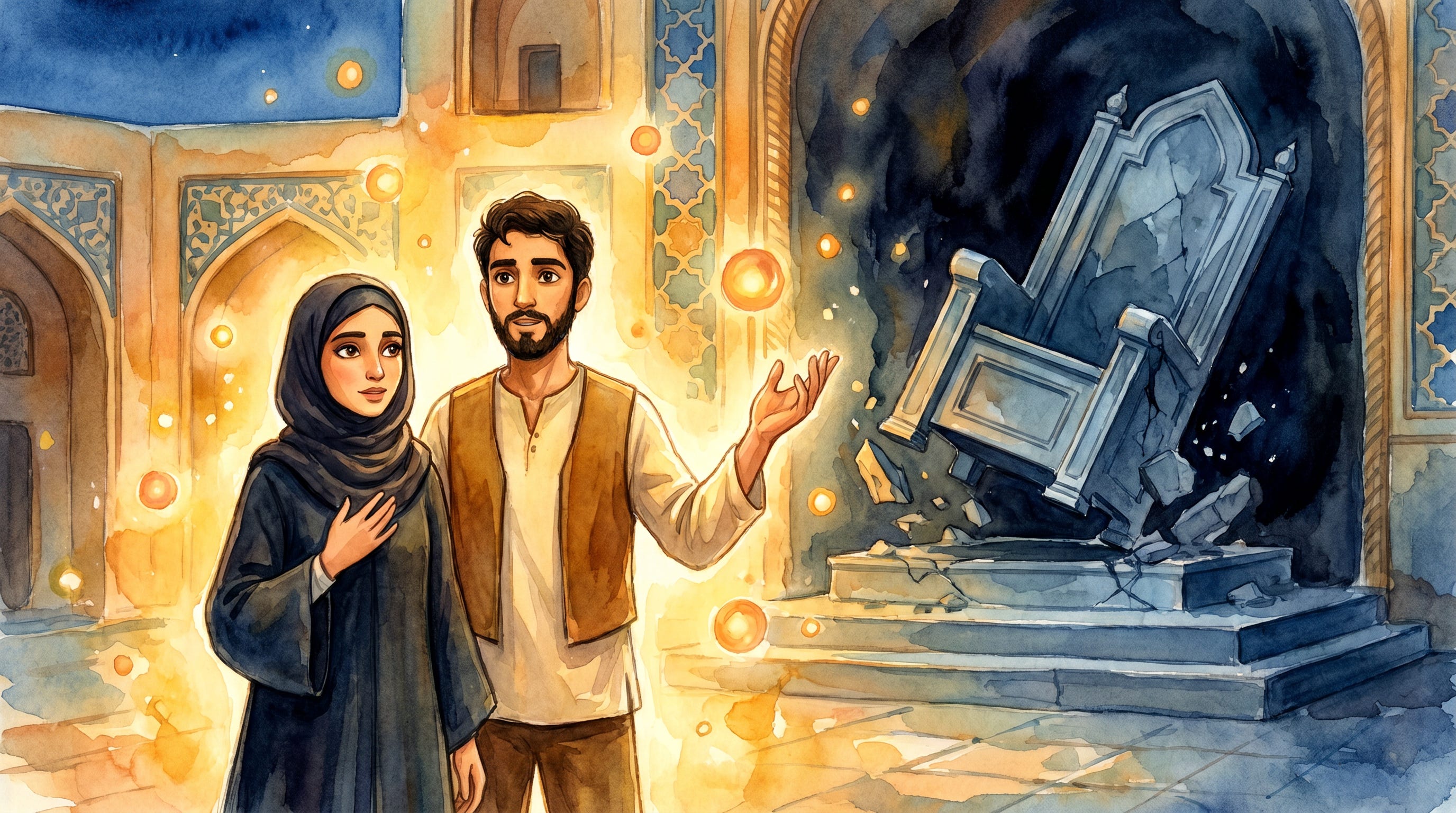
Marg bar.
Let me start by doing the honest thing, the thing we always do with a frightening word: let me not hide it.
In Persian — Farsi, marg (مرگ) means death, and bar (بر) means upon.
Literally — and I will say it plainly, I will not pretend the word is something it is not — marg bar translates, word for word, as "death to."
And in the very same breath, before anyone can lift those three words away from the rest of the sentence, I will tell you what every speaker of the language already knows, and what no clip of an angry crowd will ever show you: the words say "death to," and the meaning was never about death at all.
Say it out loud.
Do not flinch from it.
Just as we did with laʿan.
Because we have done exactly this before, in this very series, and it is the precedent that unlocks everything.
We long ago refused the English word “curse” for the Arabic laʿan — do you remember?
We refused it because “curse” in English drags in malice and witchcraft and the wishing of evil onto a person, and laʿan never meant any of that.
Laʿan is a supplication — that the mercy of God be made distant from the oppressor.
So we put the clumsy, frightening English word down, and we picked up the accurate one:
“May the mercy of God be distant from him.”
Same referent.
Cleaner understanding.
The fear drained out and the truth stayed.
The exact same move applies to marg bar.
“Death to” makes the English ear hear a wish upon bodies — a desire that human beings drop dead.
The idiom never meant that.
Across the languages of the Resistance — whose first language, remember, is not English — marg bar does the work that the English “down with the king” does, that the French “à bas” does, that the Arabic “yasquṭ” does.
It is the repudiation of a throne, a system, a regime — “down with it,” “may it fall,” “let this be brought low.”
It is what a crowd shouts at a tyrant’s statue as the rope goes round its neck.
“Down with the throne.”
And hear me: “down with” is not the soft translation.
It is the accurate one — and it is the stronger one.
It is stronger because it aims the repudiation exactly where it belongs — at the system of arrogance — and it closes the door on the fear-word “death,” which was never the point.
We are not a people who wish death.
We do not wish death — or the Fire — on a single soul that God has made.
What we disavow is the system.
And this is nothing other than the Qur’an’s own barāʾa — theological disavowal of oppression — as against baghdh, the hatred of persons and peoples, which our religion forbids us.
Barāʾa from the throne; never baghdh of a people.
And now — now I come back and stand on the hinge I set in the floor at the start of the night.
Do you feel it under your feet?
Marg bar Amrika, marg bar Esra’il — down with the throne of America, down with the throne of the Zionist regime
— is the tabarra of Ziyarat Ashura, spoken aloud in the street.
It is the very thing your tongue has done every Thursday for fourteen hundred years:
fa-laʿana Allāhu ummatan assasat asāsa al-dhulm
may the mercy of God be distant from the people who laid the foundation of oppression.
Not the bystander.
Not a nation.
Not a people.
The foundation of oppression — the throne, the system, the taghūt-structure that Imam Khomeini said the very sword of Islam was aimed at.
The believer who cries marg bar in the square and the believer who whispers the laʿan of Ziyarat Ashura in the dark are doing the same thing in two languages.
Disavowing the throne.
Standing with the wronged.
So let me state the rule that governs the whole cry, the rule we have been calling Lock Number Eight all series long:
The regime is the disease; the named ruler is only a symptom.
Name a ruler — name any of them, in London, Washington or Tel Aviv or anywhere else — and the system simply installs another.
The throne does not depend on the man; the man depends on the throne.
So we say “down with the throne” — never “down with a man,” and never, ever, “down with a people.”
The cry is against a structure of arrogance.
It was never against a human being’s life, and it was never against a human being’s belief.
The Method: The Believer As The Fair Arbiter
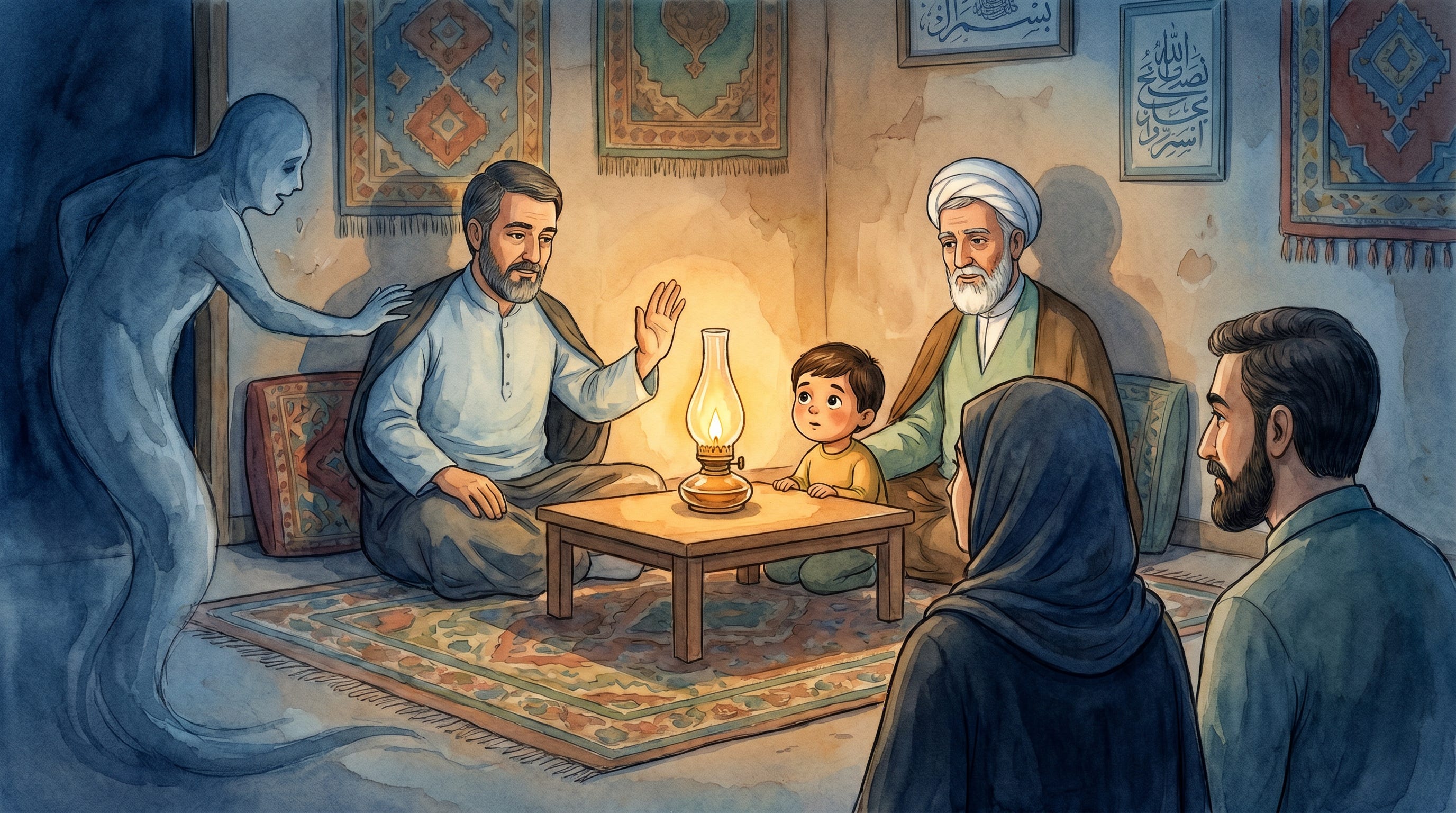
But how does a believer even judge a nation?
How do we know which throne the disavowal belongs to, and which accusation against a country is true and which is a manufactured lie?
Here I have to teach you not from a book, but from the way I have been taught to do the most ordinary and the most delicate work of a religious life: arbitration.
Before you judge a nation, learn how I am taught to judge a marriage.
When a woman comes to me asking for help against her husband, I am not permitted to act on the surface of it — on the tears in front of me, on the version I am handed.
If I did, I would do terrible damage, and I would call it justice.
So I am taught to do this.
I hear both sides, each one alone, where neither can perform for the other.
I listen to the children — because the children, as a rule, do not lie; they have no case to win, they only have a home they want to be whole.
I hear the in-laws — and I quietly discount for their bias, because I know which way each of them leans before they open their mouths.
And there is one more thing I am taught to do, and it is the most important:
I silence the lobby.
There is almost always a lobby — the sister, the friend, the relative who keeps whispering in the wronged party’s ear, badmouthing the other side, pouring fuel on a fire that might otherwise be put out, because her stake is in the conflict continuing.
She is not a fair party.
She is clouding the truth.
And I cannot reach the truth until I have, gently, set her aside for the duration of the judgement.
Only then — with both sides heard, the children believed, the bias discounted, the lobby silenced, the crocodile tears refused, the truth seen beneath the veneer — only then can a fair judgement be made.
And the aim of the whole exercise — hear this, because it governs everything — the aim is always remedy.
Never the manufacture of hatred.
I am there to heal a home, not to win a war.
Now take that exact method, and scale it up to the size of a nation.
Geopolitics has more moving parts.
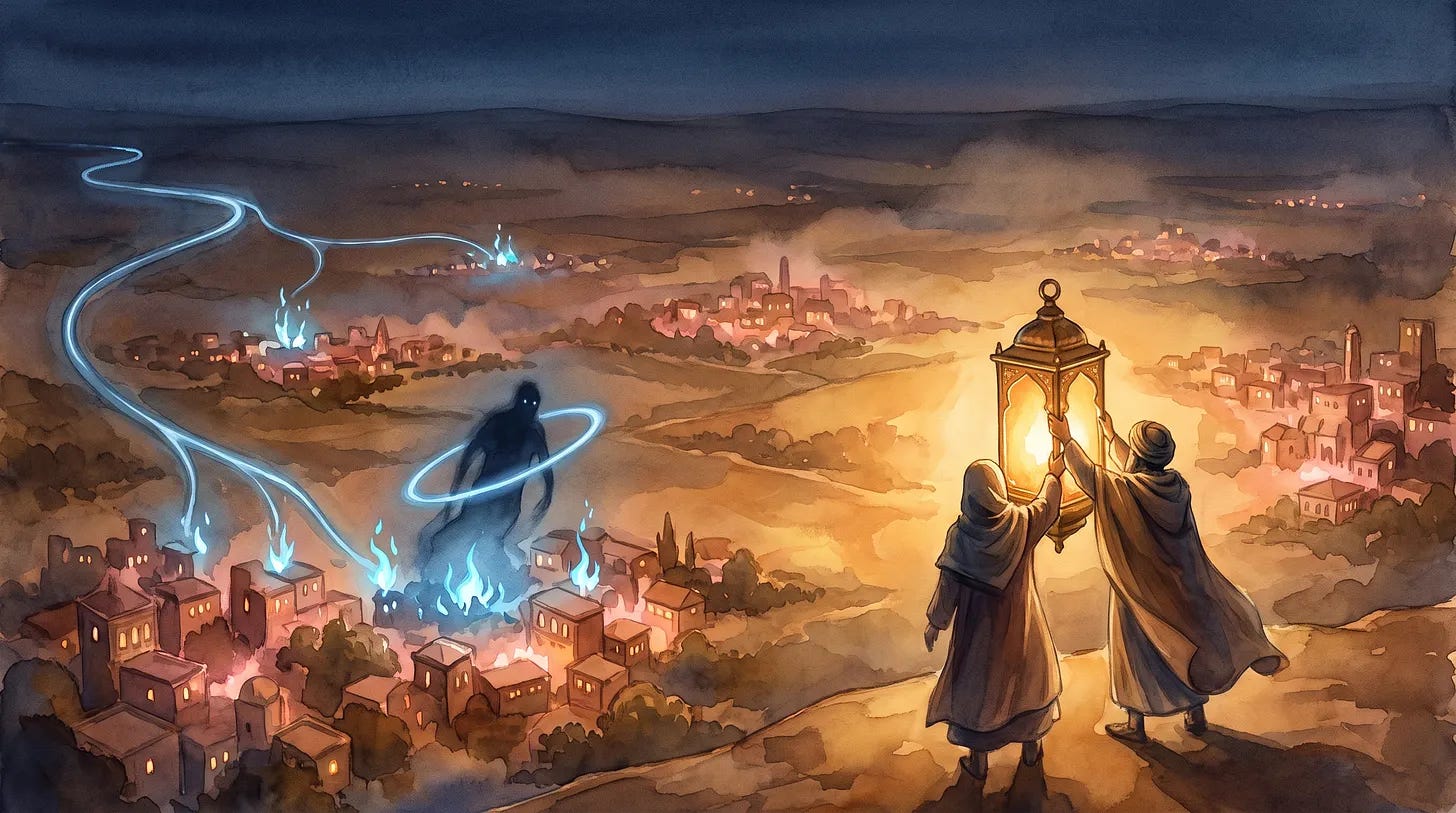
It does not have a different method.
When a people is said — from the outside, by a throne with cameras — to be oppressed by its own government and crying out for rescue, the believer does not simply go nuts and demonise the country.
That helps no one; worse, it deepens the very oppression it claims to oppose, because it hands the lobby exactly the picture the lobby wanted to paint.
The believer does what the arbiter does: he gathers the data points.
Is the country at war?
Is it under siege, under sanctions, under blockade?
Has it been hit by disaster?
And — this is the one the lobby never wants you to ask — is there manufactured sedition coming in from outside?
And then the believer watches cause and effect with cold, fair eyes.
The internet is suddenly open — and “spontaneous” sedition erupts.
The internet is cut — and, strangely, calm returns.
Ask yourself what that sequence tells you.
Ask who benefits from the noise.
A spontaneous uprising does not run on a foreign switch.
And the believer does the last and hardest thing the arbiter does: he names and removes the lobby.
At the scale of nations, the whispering sister is the special-interest entity — the foreign capital that wants the resource, the NGO that flies in to amplify the wound instead of reporting its cause, and the media that loops the footage.
She is not a fair party.
She is clouding the truth.
The fair arbiter sets the lobby aside for the duration of the judgement — exactly as in the marriage — not because the lobby is never partly right, but because a party with a stake in the conflict continuing cannot be trusted to tell you whether the conflict should continue.
Tabyeen — clarification — is the antidote to the lobby.
It is the discipline that protects both the genuinely oppressed and the falsely accused.
And now, with the method in hand, let us work the live case.
The Evidence: The Live Case, Worked
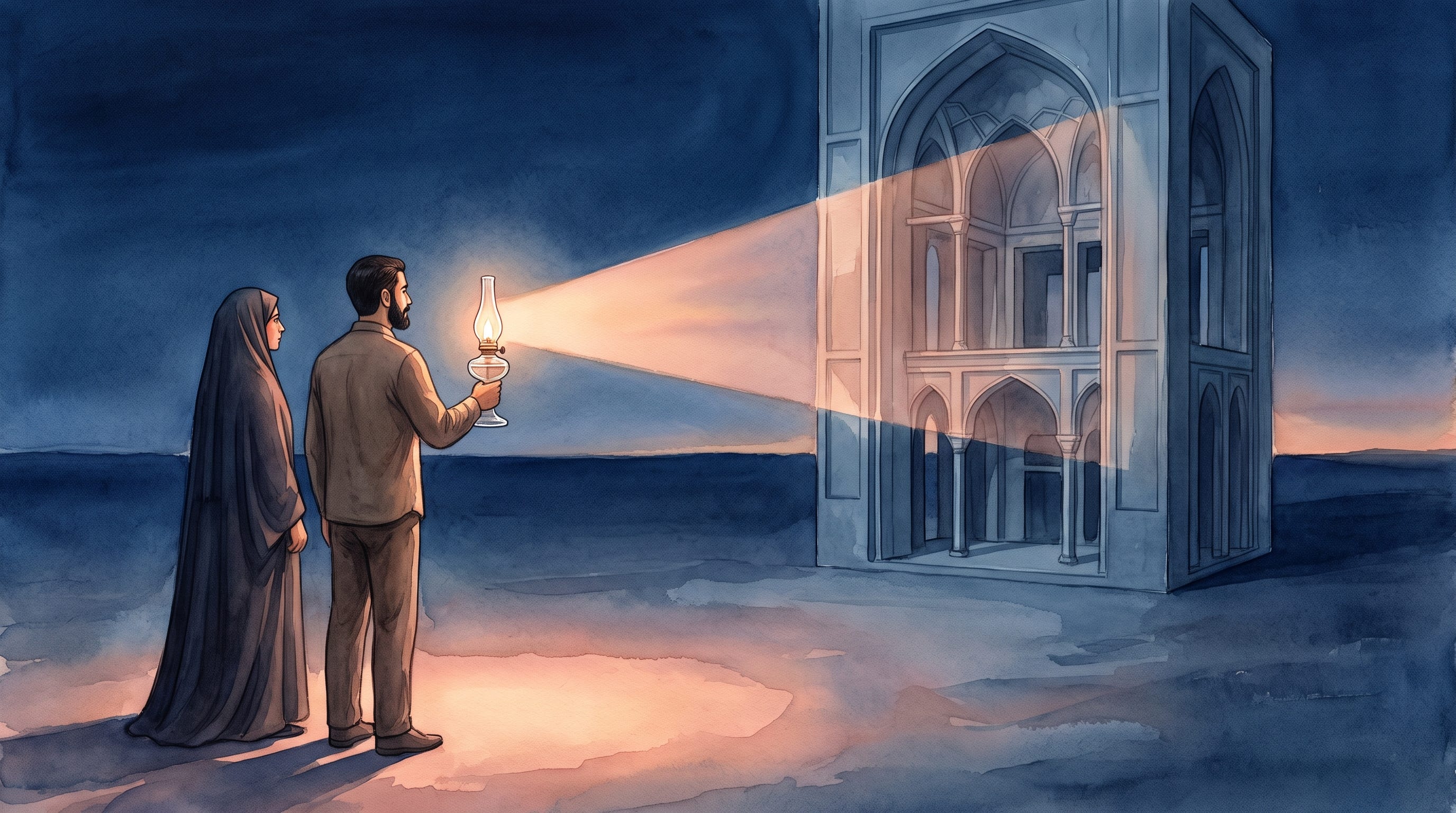
Apply the method to a real country, in real history, and watch the throne reveal itself.
Iran, Oil, And The Play That Was Run Twice

Take Iran.
In the early 1950s, Iran did the most ordinary thing a free nation can do: it moved to take ownership of its own oil, under its elected prime minister, Dr Mohammad Mossadegh.
And here is the detail the empire’s version always, always leaves out:
Iran did not say the British get nothing.
Dr Mossadegh recognised Britain’s investment and offered it a fair settlement — a fair share.
He simply would not hand over the lion’s share of Iran’s own oil to a foreign company indefinitely, the way it had been handed over before.
A fair share, not the lion’s share.
That is not extremism.
That is arbitration — that is the just outcome the fair arbiter would reach.
And what did the throne do when offered a fair judgement?
It did not arbitrate.
It became the lobby.
The British regime, refusing the fair share, cajoled the American regime; and in 1953, an American operative named Kermit Roosevelt and the CIA went into Tehran and planted sedition — they manufactured the protests, they bought the crowds, they engineered the chaos — and they overthrew the elected Dr Mossadegh, in the operation the CIA itself, decades later, in 2013, finally admitted it had run — Operation Ajax.
And in his place they installed — or rather they empowered, with absolute power — the monarch, Muhammad Reza Pahlavi, the Shah.
That is the arbitration method run in reverse: the special-interest entity manufactures the chaos, points at the chaos it manufactured, and calls its own coup the will of the people.
Now hold 1953 in one hand — and let me put our own moment in the other, because the same play was run again, seventy years on — and this time, the empire admitted the method in its own words.
The chain is exactly the one the arbiter is trained to look for: a manufactured economic collapse → a wave of “spontaneous” sedition → the strikes of the 28th of February, 2026, that martyred Imam Khamenei → and waiting in the wings, a would-be restored throne, the old Shah’s son, blessing it all from his base in the West.
Watch the manufactured collapse get confessed.
The Treasury Secretary of the United States, Scott Bessent, testifying before the Senate Banking Committee in February of 2026, said this out loud, on the record:
“We created a dollar shortage in the country… The Iranian currency went into free fall, inflation exploded, and… we see Iranians on the streets.”
— Scott Bessent, US Treasury Secretary, testimony to the Senate Banking Committee, February 2026 (reported by Al Jazeera, 13 February 2026, and Politifact, 27 February 2026)
We created it.
We engineered the shortage; we collapsed the currency; and hence we see Iranians on the streets.
There is your “spontaneous uprising,” confessed by the hand on the switch.
There is the lobby, on the record, admitting it manufactured the chaos it then pointed at.
The fair arbiter does not have to guess; the throne has testified against itself.
And the heir-in-waiting?
On the day of the strikes, the old Shah’s son posted, in his own words:
این یک مداخله بشردوستانه است؛ و هدف آن، جمهوری اسلامی، دستگاه سرکوب و ماشین کشتار آن است؛ نه کشور و ملت بزرگ ایران.
“This is a humanitarian intervention; and its target is the Islamic Republic, its apparatus of repression and its machinery of slaughter — not the country and the great nation of Iran.”
— Reza Pahlavi, post on X, 28 February 2026
A “humanitarian intervention.”
In a televised interview weeks earlier, asked whether he bore responsibility for the Iranians being sent to their deaths, he answered, in English:
“This is a war, and war has casualties.”
And on that first day of the strikes, an American cruise missile struck a girls’ school in the town of Minab and killed a hundred and sixty-eight children — and to the families of those hundred and sixty-eight children, the heir-in-waiting, to this day, has not offered a single word of condolence.
“War has casualties.”
The children of Minab were mere casualties to the man who would sit on the restored throne.
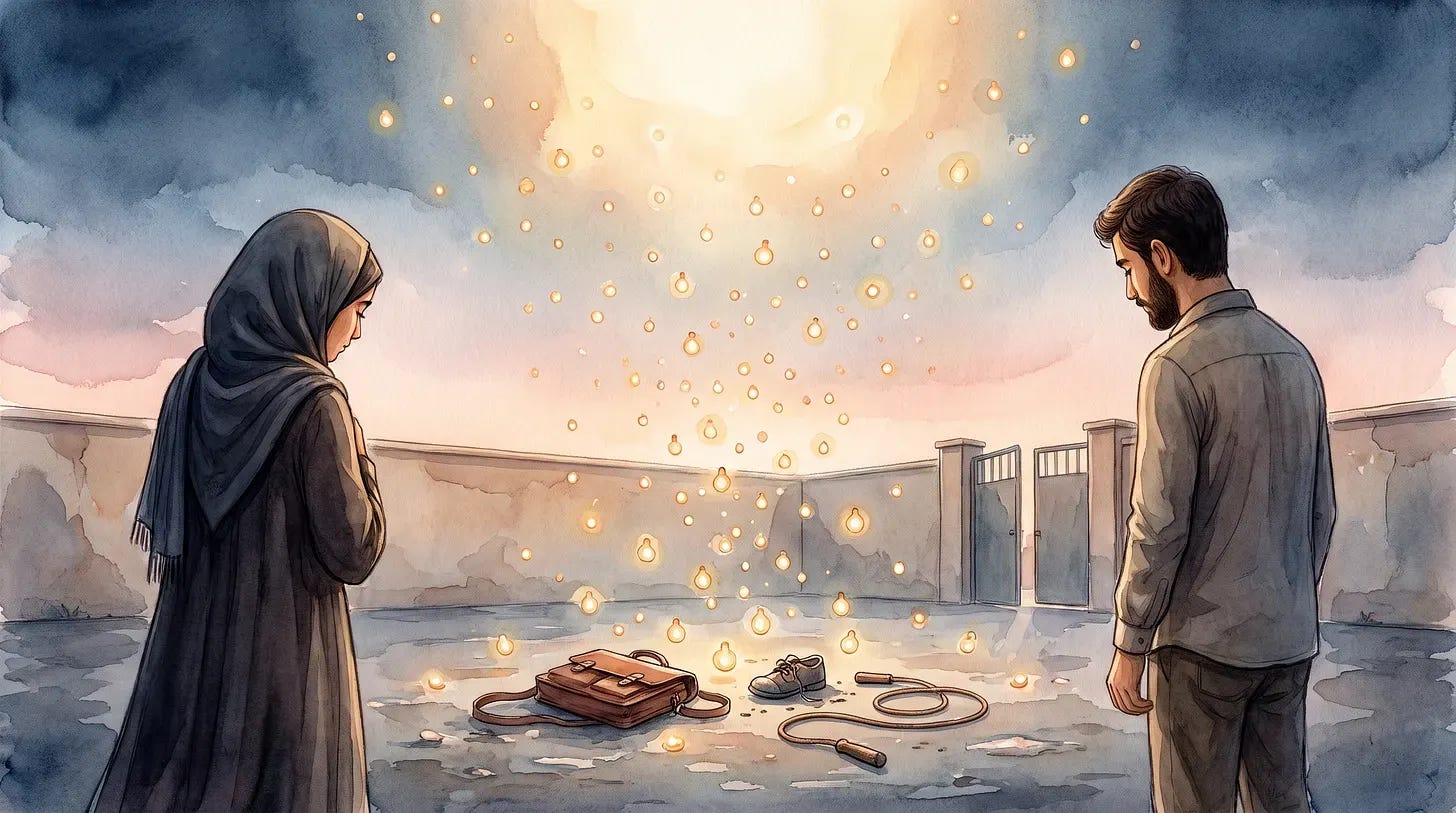
And now hold the rule we set down — Lock Number Eight — over this whole scene, because it would be the easiest thing in the world to make this about one man, and that is exactly the mistake the method forbids.
The heir-in-waiting is not the disease.
He is the instrument — the would-be heir of a throne, a symptom of the mechanism.
The mechanism is the subject: the engineered collapse, the manufactured unrest, the strikes, and the man-in-waiting who calls dead schoolchildren acceptable.
Replace him tomorrow and the throne would find another.
The 1953 coup and the 2026 strikes are one sentence: the same play — engineered sedition, an installed monarch, a fair share refused and the lion’s share seized — run twice, by the same hands, seventy years apart.
And notice which of the two confessions does the proving.
The pattern does not stand on the new admission.
It stands on the old one — on Ajax, which the empire's own intelligence service put in writing in 2013, after sixty years of denial.
That is the documented spine of the whole claim, and it would hold if the Treasury Secretary had never opened his mouth.
The 2026 confession founds nothing; it simply confirms, in the present tense, a method the empire had already conceded in the past.
Kermit Roosevelt’s crowd in 1953 and the Treasury’s “dollar shortage” in 2026 are the same method, and now you can read it because the method has finally confessed.
How The Throne Keeps Itself
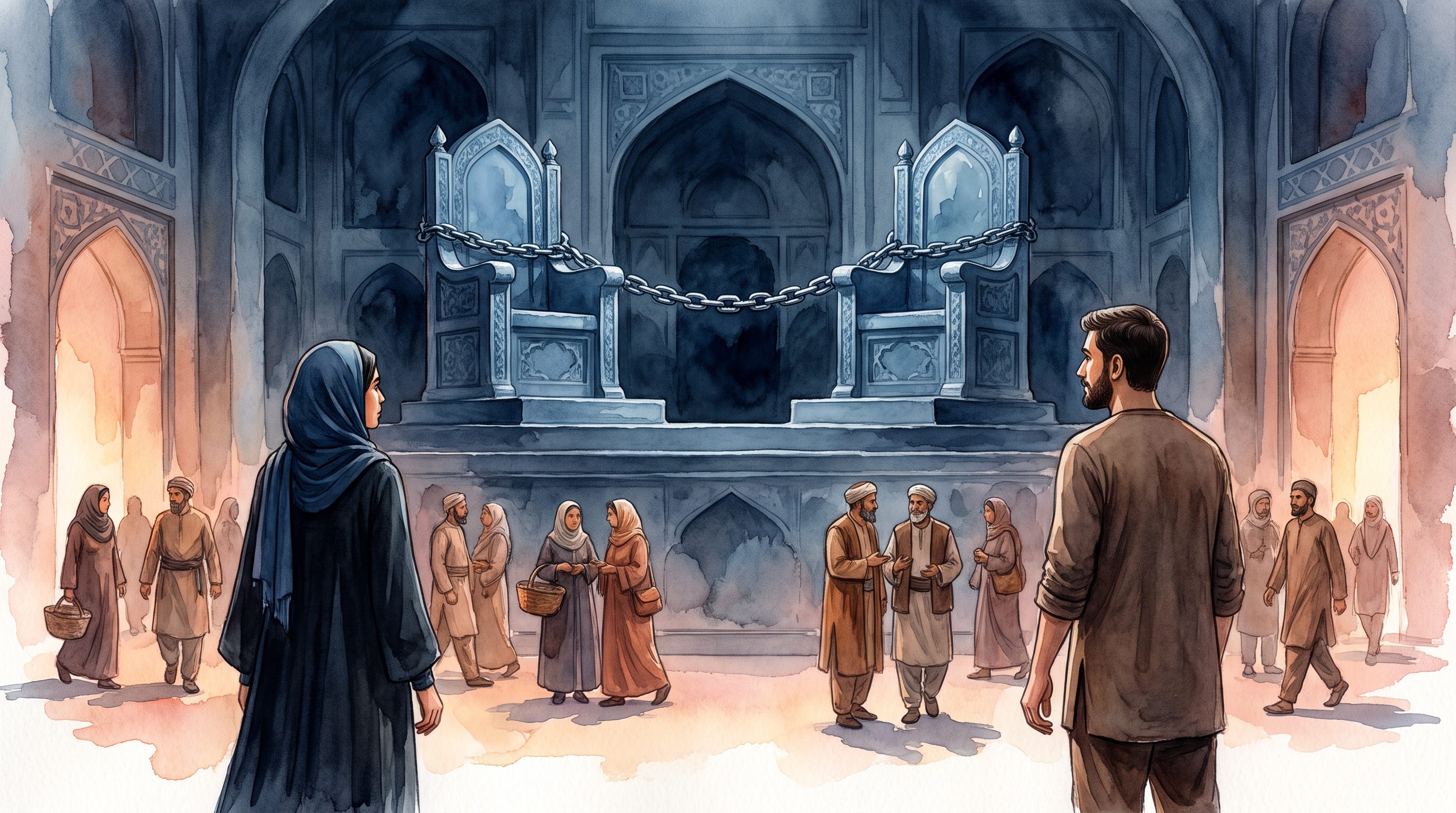
That is one throne, worked as a live case.
Behind it stands the machinery that lets such thrones keep their grip across generations, and I am going to speak of it only at the level of mechanism, because the moment you turn a structural truth into a parade of names you have left the discipline of the arbiter and joined the lobby.
So: the mechanism.
Thrones have always protected themselves the same way — not only by force, but by binding others to them through shared compromise.
The oldest version of it is the one the chroniclers caught in the ancient empires: the empire is afraid of what its corrupted partner can reveal — and so the empire and its partner are chained together by a mutual guilt, each holding the other’s secret, each unable to break free without bringing the other down.
That is how power is captured, and that is how it is kept — not by loyalty, but by leverage.
I name the mechanism and I stop there, because the documented and the speculative must never be allowed to blur, and a structural truth does not need a list of names to be true.
And the throne does not stand alone among the nations.
There are the regimes that sing along.
I will name the dynamic and honour the peoples, because honour without conflation governs this too.
There are European regimes — some now quietly stepping back from the song, and others doubling down on it, in language that should disturb any conscience that remembers its own continent’s history; and there is the British regime, exporting the arms and then policing its own citizens who walk out into the street to protest the slaughter those arms are used for.
And there are the Gulf regimes that pressed the empire toward the 2026 escalation against Iran — regimes that had, evidently, not read the Sacred Defence of the 1980s, and did not understand what a people that has learned to hold a frontier as worship will do when it is struck.
In every one of these — and this is the discipline that keeps us honest — I name the regime as a system, and I honour the people by name.
Not the German people; the regime’s choice.
Not the British people walking in their own streets against the arms their government ships; they are the witnesses, criminalised for their conscience.
Not the peoples of Arabia; the regimes that pressed for the war.
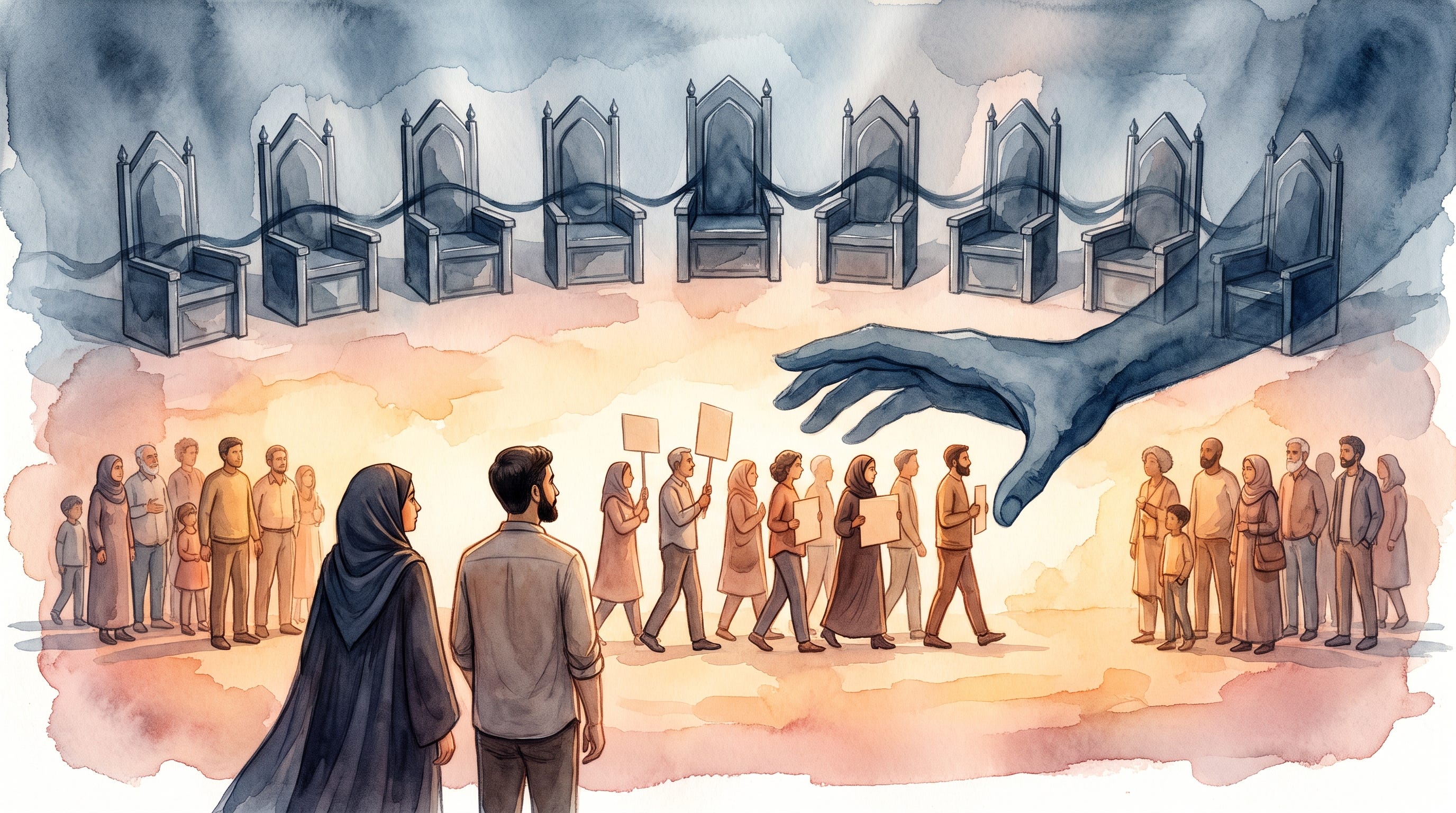
The throne is the disease.
The people are, so often, among the throne’s first victims.
And The Arbitration Turns On Us, Too
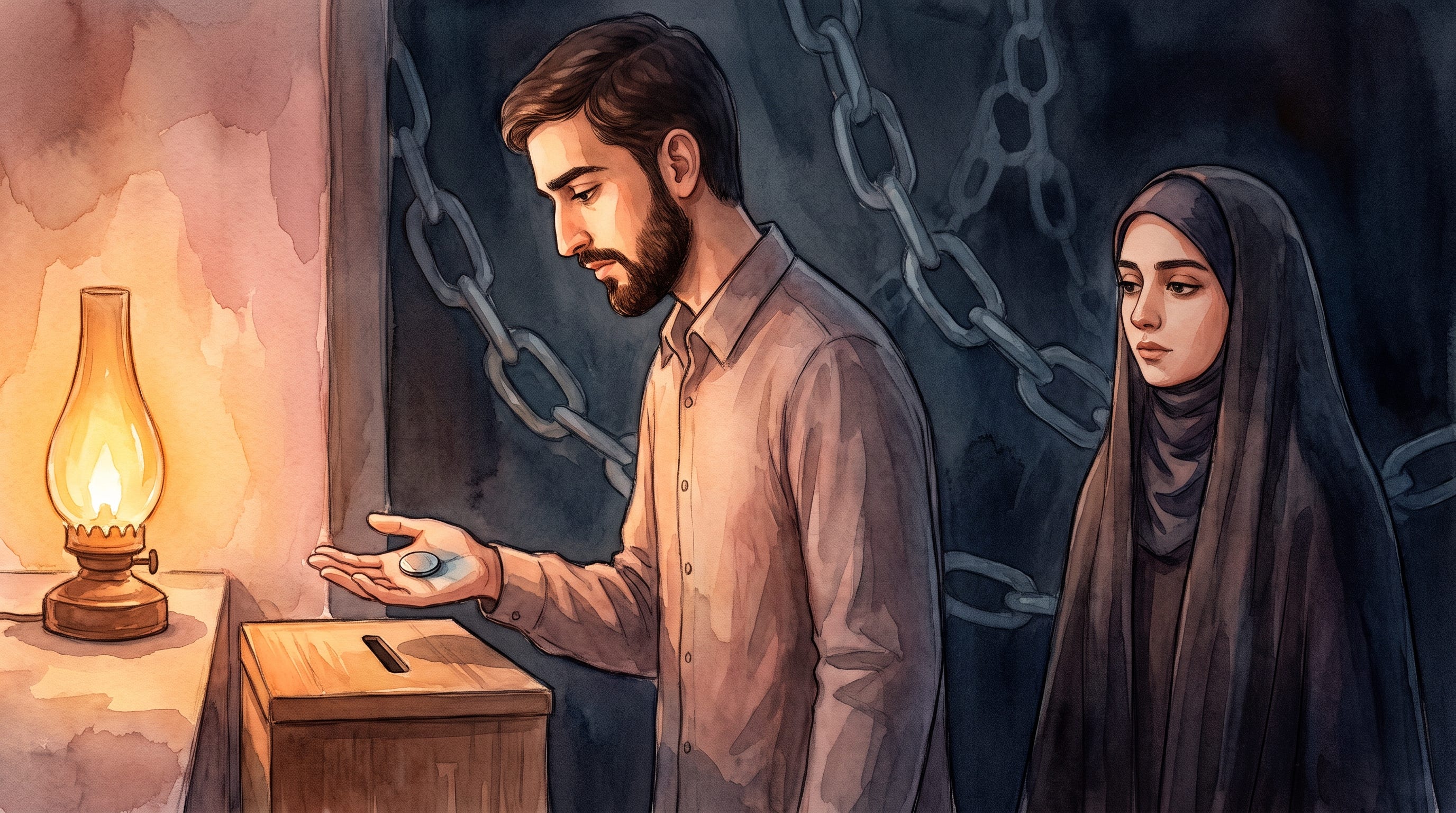
And there is one more place the arbitration’s blade has to turn, and it turns inward, onto us, because the fair arbiter does not exempt his own side.
On the thirteenth night, we stood among the looters of Karbala — the ones who came in the night after the battle and stripped the bodies, and “took precedence over one another” in the stripping, each one telling himself the oldest lie of the accomplice: if I don’t, someone else will.
I planted a sentence there and told you it would come back.
Here it is, grown.
A sin you commit because another stood ready to commit it in your place is still, wholly and only, your sin.
And the modern face of that looter’s lie is everywhere the machinery of this genocide touches an ordinary ledger: the reinsurance that underwrites it; the component, the part, the piece of software in the weapon; the building raised on stolen, occupied land; the financial service that moves the money.
Every link in that chain is doing what the looter did —
وَتَعَاوَنُواْ عَلَى ٱلۡبِرِّ وَٱلتَّقۡوَىٰۖ وَلَا تَعَاوَنُواْ
عَلَى ٱلۡإِثۡمِ وَٱلۡعُدۡوَٰنِۚ وَٱتَّقُواْ ٱللَّهَۖ إِنَّ ٱللَّهَ شَدِيدُ ٱلۡعِقَابِCooperate in piety and Godwariness, but do not cooperate in sin and aggression, and be wary of God. Indeed God is severe in retribution.
— Qur’an, Surah al-Ma’idah (the Chapter of the Table Spread) #5, Verse 2
taʿāwun ʿalā al-ithm wa-l-ʿudwān
cooperation in sin and aggression,
The second face of the very verse, Surah al-Maʾidah, the Chapter of the Table Spread, Fifth Chapter of the Quran, Verse 2, that opened our constitution tonight.
One verse, two faces: on the first face, do not force a soul to faith; on the second face, do not help a throne to oppression.
And the warning we built on the twelfth night returns with it — Guardians, Not Accomplices.
The believer cannot launder an unclean gain by writing a cheque to the mosque on Friday.
The dust does not come off the coin in the donation box.
I speak here strictly of the type and the mechanism — never of a person; the careful, procedural working-out of all this deserves a whole night of its own, and it will get one, God willing.
Tonight it is enough to know that the arbiter’s blade cuts toward us as well: we are not only watching the throne.
We are, every one of us, being asked whether our own hands are clean of it.
The Peoples Honoured, And The Truth Will Out
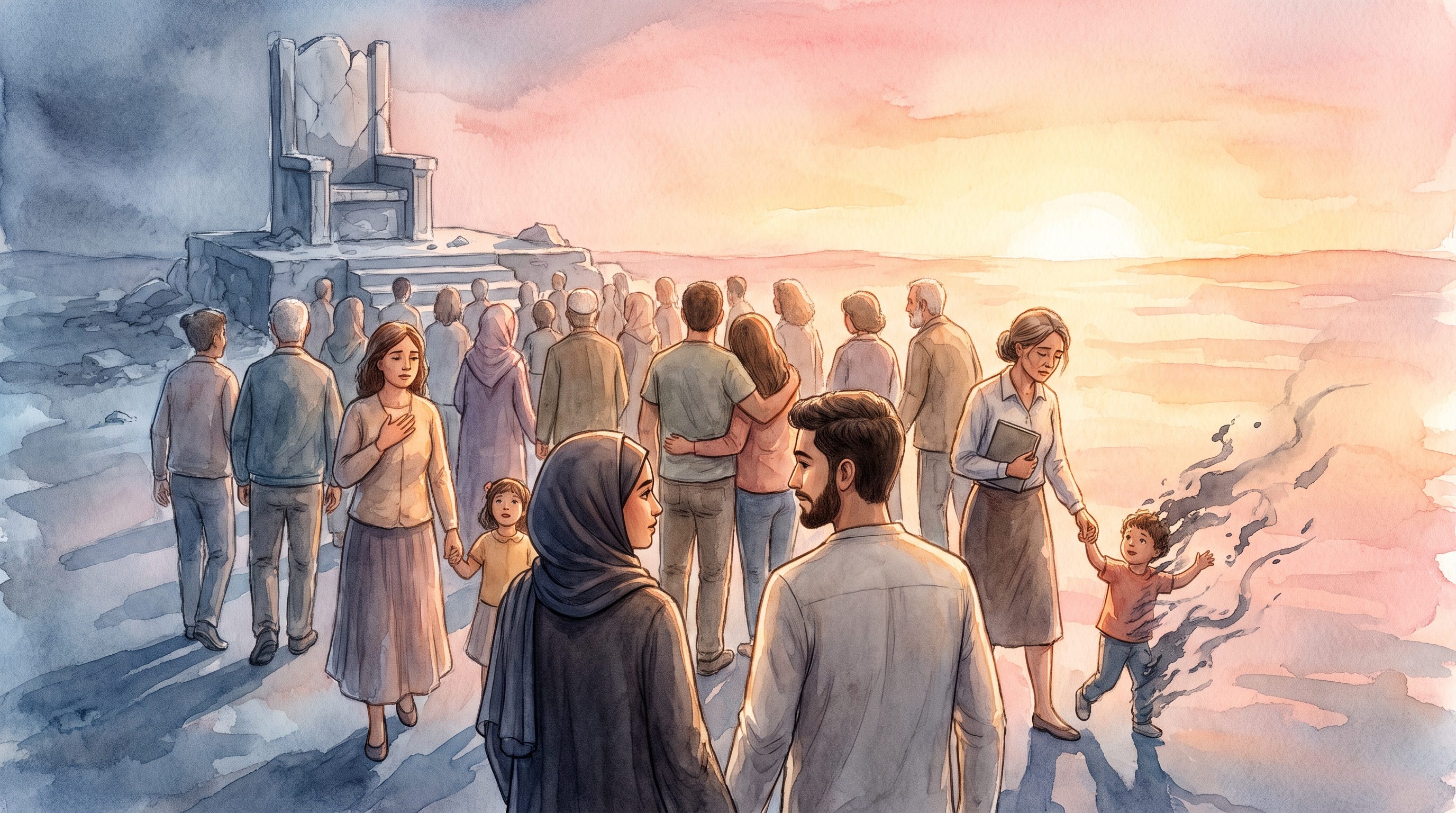
And now we land the whole movement — and we land it on the thing that has been its secret heart the entire time.
The cry is FOR the peoples.
Let me say it as plainly as it can be said: marg bar Amrika, marg bar Esra’il — down with these thrones — is not against the American, and it is not against the Jew, and it is not against the Israeli child.
It is for them.
Let me name them, one by one.
It is for the American mother who lost her son to a war built on a lie, and who has spent the rest of her life asking what he died for.
It is for the Jewish family whose conscience refuses what is done in their name — who stand in the square with us and say not in my name, and who carry, in their own scripture, the memory of what an empire does to a people.
It is for the Israeli child, who was handed a fear he never chose and never earned — a fear fed to him by a regime that cannot govern without it, that needs him afraid because a frightened child becomes a compliant citizen.
The fear in him is real; it was simply never his to begin with.
It was manufactured somewhere above his head and placed into his small hands — and he, too, deserves to be set free of it.
It is for the teacher in the empire’s heartland whose school is starved of money while the bombs are loaded and shipped.
The cry is for all of them — against the throne that exploits them all.
The mustadhʿafūn — the downtrodden — inside the empire’s own borders are among the wronged the cry defends.
That is why we do tabyeen and not hatred: because we want all of them— Muslim, Jewish, Christian, and those of no faith at all — to look up and see the same few arrogant thrones, and to see that they themselves were never the target.
They were the prey, the same as us.
And the Resistance says this in its own mouth — and here is the sentence I told you to keep, the one from Hajj Abu Mahdi al-Muhandis’s testament:
“to serve the people — Sunnis, Shiites, Christians, and Yazidis — we are not aggressors.”
Now stand that sentence next to the throne’s vocabulary, and let the inversion be the whole night.
The men the empire’s newspapers call “terrorists” name the Christian and the Yazidi among the people they are dying to serve.
The throne that calls itself “civilisation” calls a hundred and sixty-eight dead schoolchildren “collateral.”
Read that twice.
The one the empire calls a monster lists the Christian among his children.
The one the empire calls the leader of the free world calls the children acceptable losses.
That inversion — who actually loves the peoples and who actually devours them — is the entire argument of this night, compressed into a single unbearable contrast.
And so to the close of the whole movement — and we close it the way the believer can afford to close it, because the believer is not afraid of the verdict of history.
Three traditions, saying one thing.
From the Gospel:
“For there is nothing covered, that shall not be revealed; and hid, that shall not be known.”
— Gospel of Matthew 10:26
“For nothing is secret, that shall not be made manifest; neither anything hid, that shall not be known and come abroad.”
— Gospel of Luke 8:17
And the warning the proud have never once heeded:
“Pride goeth before destruction, and a haughty spirit before a fall.”
— Proverbs 16:18
And these are not foreign to us; they are the same truth our own Book thunders, and on this we honour the shared inheritance without conflating the roads.
God says:
وَقُلْ جَاءَ الْحَقُّ وَزَهَقَ الْبَاطِلُ ۚ إِنَّ الْبَاطِلَ كَانَ زَهُوقًا.
“And say: the truth has come and falsehood has vanished. Indeed falsehood is ever bound to vanish.”
— Qur’an, Surah al-Isra (the Chapter of the Night Journey) #17, Verse 81
بَلْ نَقْذِفُ بِالْحَقِّ عَلَى الْبَاطِلِ فَيَدْمَغُهُ فَإِذَا هُوَ زَاهِقٌ.
“Rather, We hurl the truth against falsehood, and it crushes it, and at once falsehood vanishes away.”
— Qur’an, Surah al-Anbiya (the Chapter of the Prophets) #21, Verse 18
The truth will out.
The proud will fall.
The hidden will be revealed.
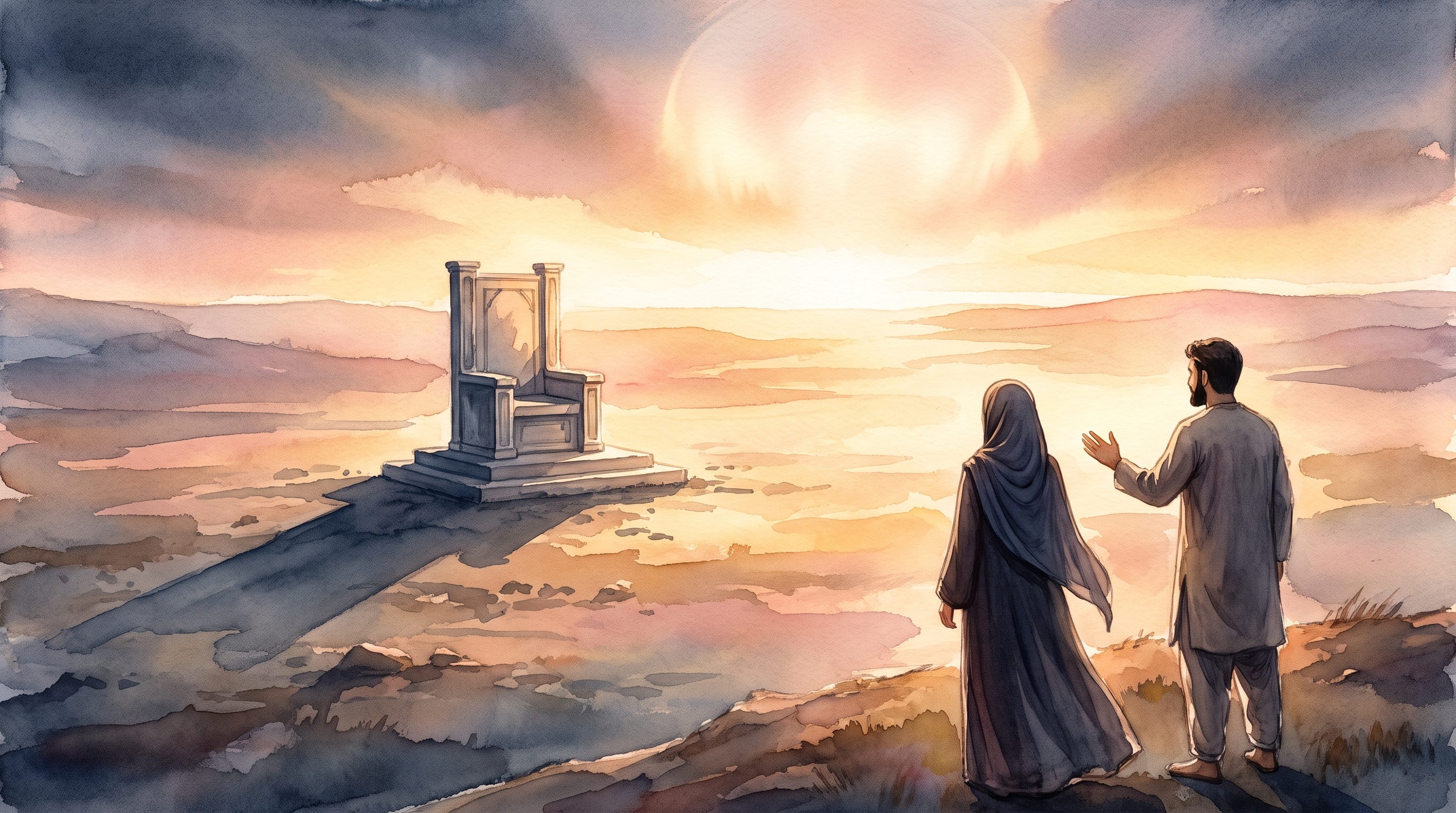
The throne is afraid of exactly one thing, and it is not our anger — it is the daylight.
That is why it manufactures the collapse, and buys the crowd, and launders the killing through the word “collateral,” and polices the citizen who walks into the street to say no.
It is afraid of being seen.
And the believer’s whole task — tabyeen, clarification, the patient lifting of the veneer — is simply to help the daylight in.
We have named the throne, and we have named whom the cry is for.
Now: what does all of it ask of us?
What the Living Witness Asks of You
Two lessons fall out of this whole night, and they are not new doctrines — they are the two oldest truths of our religion, brought to rest on the witnesses of our own lifetime.
Take them home.
The first is this: the saying of Imam Husayn is the saying of every true witness.
We heard it tonight — Imam Khamenei’s last public word restating Imam Husayn’s first refusal,
One like me does not give allegiance to one like Yazid.
But do not file that as a sentence for guardians and commanders only.
Bring it down into your own life, because that is where it actually has to be spoken.
When you see a believer in our own time refuse to bow to the false lords of the age — and the false lords of the age are not only emperors; they are the state, the market, the career, the peer-group, the consensus that has learned to call the forbidden good and the commanded a burden — you are watching one like me being said again, and you are watching the chain hold.
And here is the part the whole series has been driving at since the tenth night: that refusal is first a refusal in the heart.
Before Imam Husayn refused Yazid in the open, the inner Yazid had already been refused, every day, in the dark, where no one was watching.
The greater struggle — al-jihād al-akbar — is the one that earns the right to the lesser.
The man who has not refused the tyrant in his own chest has no power to refuse the tyrant on the throne; he will simply trade one master for another.
Someone like me begins as a sentence you say to yourself.
The second lesson is the one that keeps the first one from going wrong: it always, always returns to reliance on God.
Take the tawhīd out of any of this and watch what happens.
A resistance without tawhīd collapses into mere nationalism — the tribe with better weapons, the throne with a different flag.
And a tawhīd without resistance collapses into quietism — a private piety that lets the throne do as it pleases and calls its own silence patience.
Our witnesses, from Imam Husayn to the guardian of last month, refused both collapses at once.
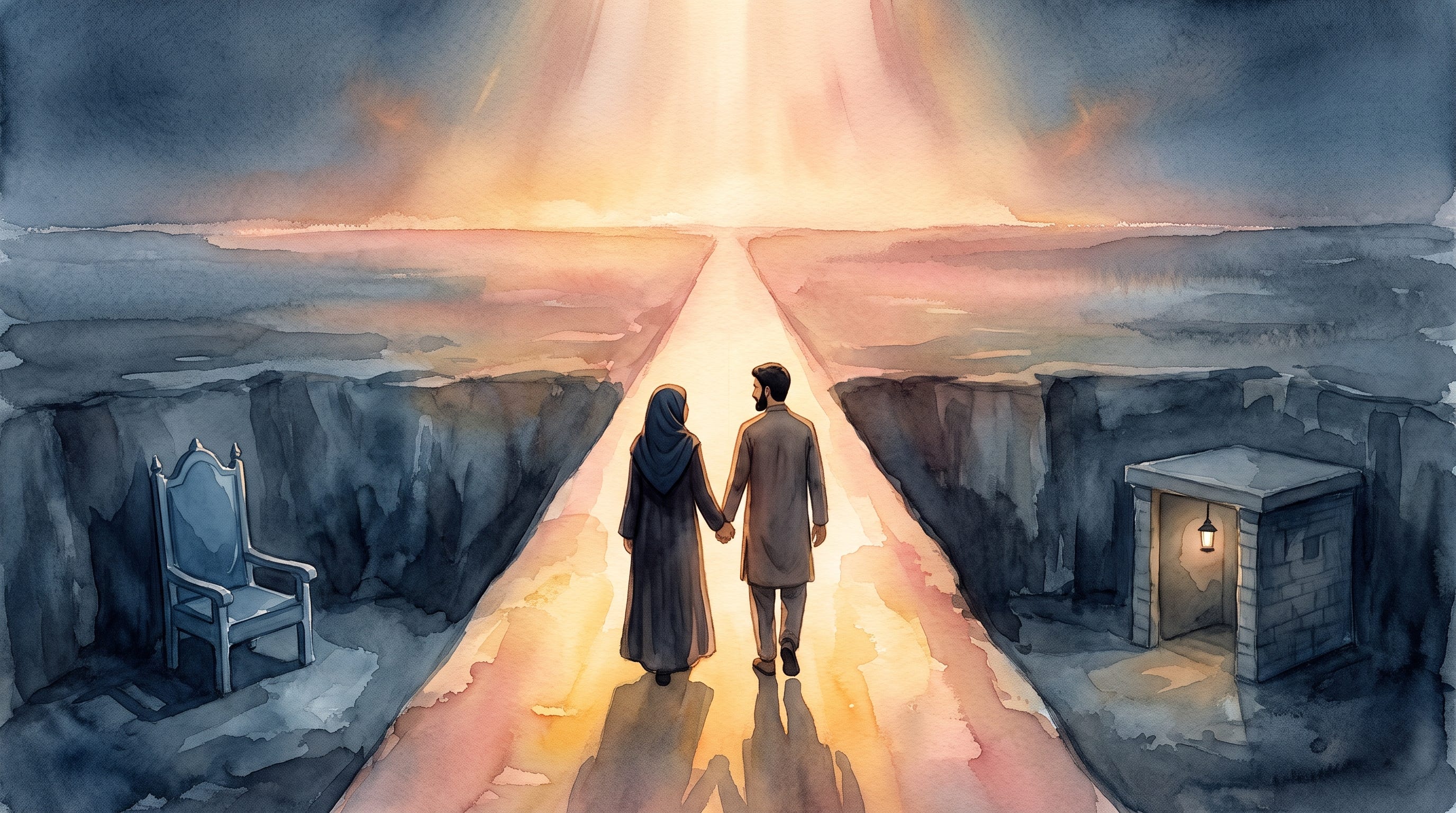
That is the narrow road, and it is the only road.
The engine was never the geopolitics.
The engine was the worship.
The Witness Is Proven by How the Witness Lives
And if you want to know whether a witness is real — whether the refusal in his chest is true and not theatre — there is an old and merciless test, and it is not his rhetoric.
It is how he lives.
Sayyed Abbas al-Musawi used to draw the contrast from his pulpit in the Bekaa, in the years before they killed him: the leader who lives in a palace, walled off from the hardship of the people he claims to lead, against the leader who shares the people’s bread and the people’s fear.
And the measure he reached for was the measure the Commander of the Faithful set down for all time, in his letter to his own governor in Basra — a governor who had gone to a rich man’s banquet:
أَأَقْنَعُ مِنْ نَفْسِي بِأَنْ يُقَالَ هَذَا أَمِيرُ الْمُؤْمِنِينَ، وَلَا أُشَارِكُهُمْ فِي مَكَارِهِ الدَّهْرِ، أَوْ أَكُونَ أُسْوَةً لَهُمْ فِي جُشُوبَةِ الْعَيْشِ.
“Shall I content myself with being called ‘Commander of the Faithful,’ and yet not share with the people the hardships of the age — or not be an example to them in the roughness of living?”
— Imam Ali ibn Abi Talib, Nahj al-Balagha, Letter 45 (to Uthman ibn Hunayf al-Ansari)
That is the test, and it cannot be faked, and it explains why the chain of witnesses we have named tonight is a chain of men who lived low — Hajj Qasem in the same boots for thirty years; the guardian of the line who, when at last he was buried, had his grave wait, in deference, behind the grave of Imam Husayn.
The witness is proven by how the witness lives, because the witness is, in the end, a worshipper, and worship leaves marks on a life that office cannot counterfeit.
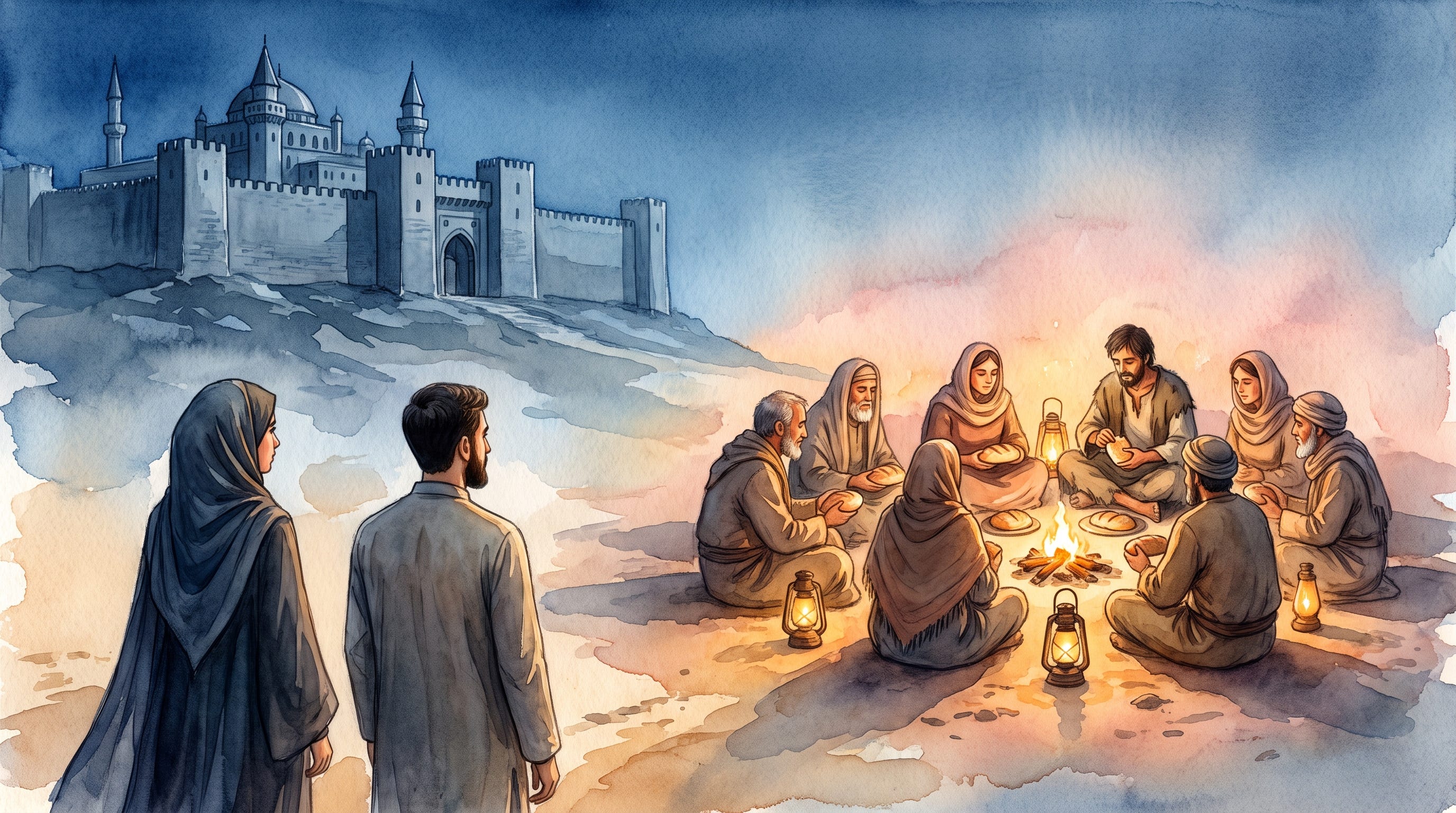
And the deepest teacher of this, in our own decade, has been Shaykh Naim Qassem, who put the whole order of it into a single image — and it is the image that ties tonight’s entire argument back to its root.
He takes the thing the world sees — the resistance, the front, the jihād al-asghar, the lesser struggle — and he shows you what it actually grows from:
إنّ الجهاد الأصغر (العسكري) هو فرعٌ من فروع الجهاد الأكبر (جهاد النفس). والمقاومة المرئية هي الأغصان والثمار التي تنبت من تربة التربية الإيمانية والروحية؛ فلا يمكن للأغصان أن تصمد إذا فسدت الجذور.
“The lesser jihad — the military one — is a branch of the branches of the greater jihad, the struggle against the self. The visible resistance is the branches and the fruits that grow from the soil of faith-based and spiritual cultivation; and the branches cannot stand firm if the roots decay.”
— Shaykh Naim Qassem, Hizbullah: The Story from Within (trans. Dalia Khalil, Saqi Books, 2005), ch. 3, “Jihad: The Greater and the Lesser,” p. 78
The branches cannot stand if the roots rot.
Everything you saw tonight — the frontier held, the chain of martyrs, the cry in the street rightly understood — all of it is branches and fruit.
The root is in the dark, underground, unseen: the soil of tarbiyah, of the formation of the self, of the daily worship that nobody films.
And just last October, in a stadium in Beirut full of tens of thousands of young scouts gathered to honour Sayyed Hassan Nasrallah, Shaykh Naim said the same thing in a single, dense sentence — and notice what comes first in his list, because it is the whole thesis of this night:
المقاومة خيارٌ تربويٌّ وثقافيٌّ وأخلاقيٌّ وسياسيٌّ، وهي جهاد النفس والعدو، وقوّة إيمانٍ وإرادةٍ وموقفٍ وصمودٍ وعزٍّ واستقلال.
“Resistance is a pedagogical, cultural, ethical, and political choice; it is the struggle against the self — and the enemy; a strength of faith, of will, of stance, of steadfastness, of dignity, and of independence.”
— Shaykh Naim Qassem, the “Sayyed Generations” gathering, Beirut, 12 October 2025 (Al-Mayadeen / Mehr News)
The struggle against the self — and the enemy.
In that order.
The self before the enemy.
The greater jihad named first, and the lesser named second, because the first is the soil and the second is only the branch.
So hear the landing of the whole night:
The geopolitics is downstream of the prayer.
Remove the tawhīd, and what you have left is a militia — a tribe with weapons.
Keep the tawhīd, and what you have is a witness.
The cry in the street is only true on the lips of a soul that has first done its disavowing in the dark.
The One Fault-Line, At Every Scale
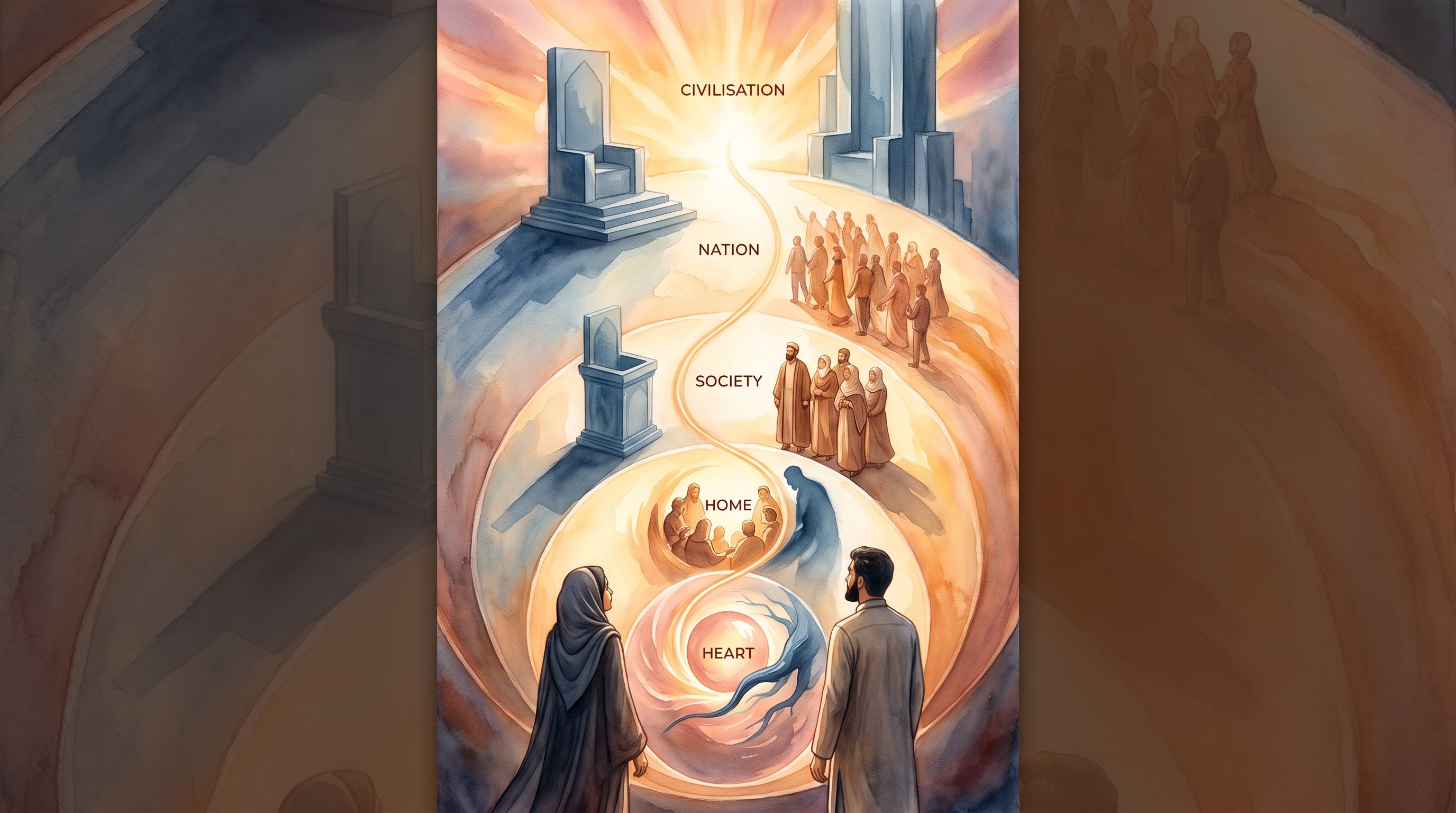
And now let me name, as the close of fourteen nights, the single thing this whole series has been mapping — because tonight it finally stands up to its full height.
The whole of Shahada has been one map of one fault-line.
Not Muslim against non-Muslim.
Not East against West.
The arrogant against the downtrodden — al-mustakbirūn against al-mustadhʿafūn — and the staggering thing, the thing I want you to walk out of here holding, is that it runs through every single level of the human condition, and it is the same fault-line at every level.
It runs through the heart — the inner Yazid, the nafs al-ammara, the self that commands to evil and lords it over the soul that should be ruling it.
That is the jihād al-akbar, and it is where the whole map begins.
It runs through the home — the one who lords it over a household, who makes a wife or a child mustadhʿaf under his own roof, against the one who serves the household he was given charge of.
It runs through the society — and we saw it on the thirteenth night: the court-mullā who climbs the pulpit for the throne’s coin, against the honest worker who earns his bread by what God made lawful and asks no one’s permission to be upright.
It runs through the nation — and that has been tonight: the throne, and the people it devours; the mustakbir regime, and the mustadhʿafūn it grinds down, inside its borders and out.
And it runs through the whole of civilisation — and that was the tenth night, the climax of the series: every empire that ever called its killing necessary or holy, weighed against Imam Husayn the furqān, the Criterion, and found wanting.
The arrogant are the same at every scale — in the chest, in the house, in the street, in the capital, in the empire.
They lie, they exalt themselves, they devour the weak, they amplify the wound for profit.
And the witness is the one who refuses them at every scale — who refuses the inner Yazid in the dark, and the petty tyrant at home, and the false scholar in the society, and the throne over the nation, with one and the same refusal,
one like me does not give allegiance to one like him,
spoken all the way down.
That is the theology of witness, entire.
That is what fourteen nights were for.
The Pact We Make Tonight
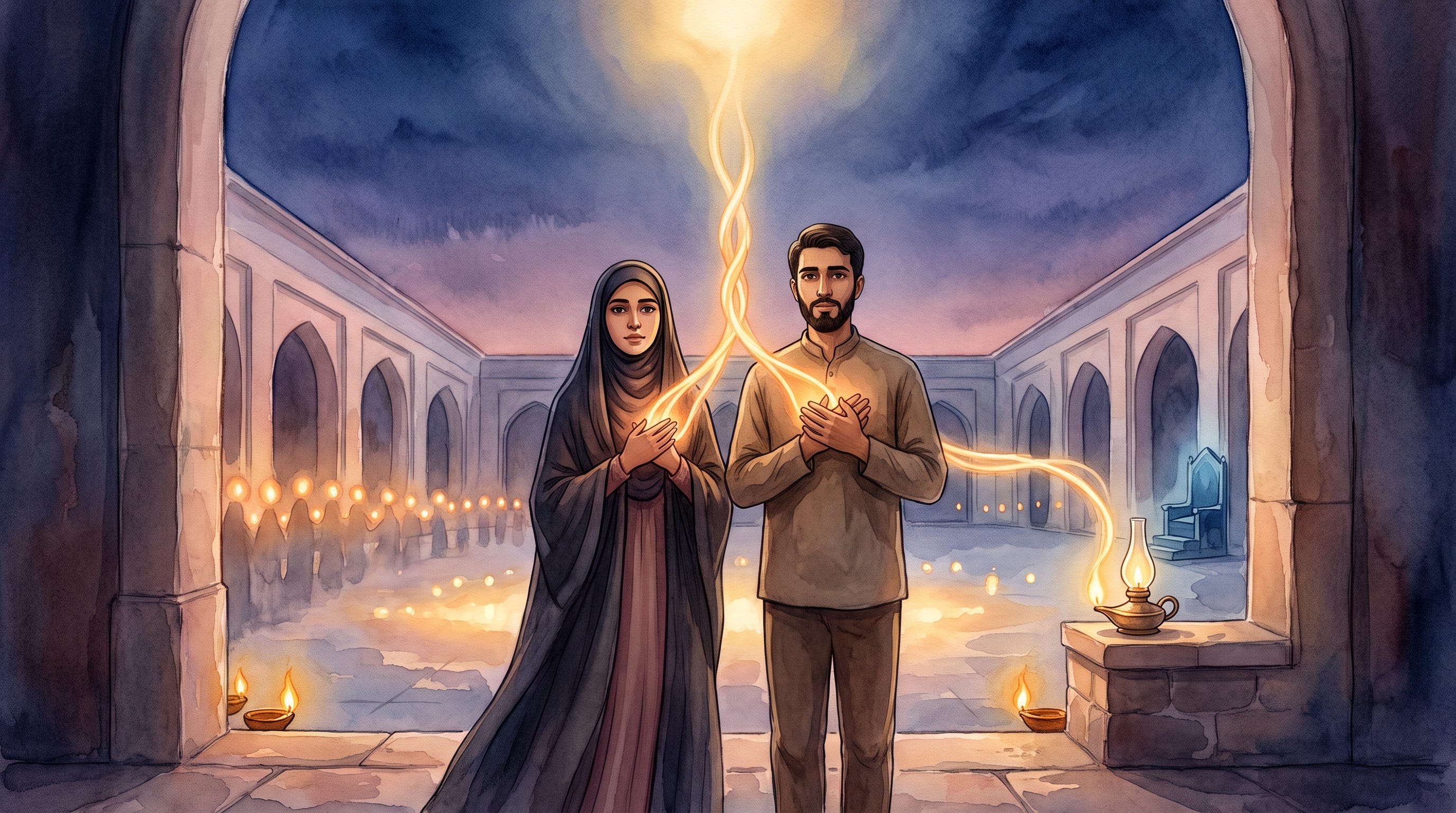
So we make our pact, and tonight it has three strands, and they tighten into one.
First: we will see the chain for what it is.
We will not be the people who weep for a witness thirteen centuries dead and fail to recognise the witness martyred last month.
The chain is not a museum; it is being forged in our own lifetime, with our own names, and to recognise it — to know the wali al-amr and the journalist in the tent and the father shot on the school run for the witnesses they are — is the whole examination of this series.
We commit to passing it.
Second: we will say the cry, and know what we are saying.
Marg bar the throne — down with the systems of arrogance — is the tabarra of Ziyarat Ashura spoken aloud, barāʾa from oppression and never baghdh of a people.
We will say it as tabyeen and never as hatred; we will name the system and honour the people; we will be, at the scale of nations, the fair arbiter and never the lobby — gathering the data, watching cause and effect, silencing the whisper, and aiming our disavowal exactly where the Qur’an aims it: at injustice, never at belief, and never at a single soul God has made.
Third — and this is the one that turns the other two from politics into worship — we will begin the refusal in our own chest.
Every day is Ashura, and every land is Karbala, and the first Karbala is the one behind your own ribs.
We will do our disavowing in the dark first, where no one films it, because the branches cannot stand if the roots rot.
Be willing, the thirteenth night told us — willing all the way down.
And tonight adds: be willing here, in the one battlefield you are guaranteed to be handed, the nafs al-ammāra, and let everything else grow up out of that soil.
The Road Ahead
Tomorrow night is the last.
The twentieth of Safar.
Arbaeen.
The fortieth day.
We have carried a heavy night tonight — by design; it was the densest of all of them, because the whole present-tense argument of this series had to land somewhere, and it landed here.
Tomorrow we set the weight down.
The fifteenth night is the warm close — not light in substance, never that, but light in the way it is carried.
We will walk the last stretch of the road into Karbala on the fortieth day; we will renew the covenant — the living pledge, the Duʿa al-ʿAhd of every morning and the Ziyarat Arbaeen of the day itself; and the voice that has carried these maqatil, broken since the trampling, will have come all the way home.
Tomorrow we do not argue.
Tomorrow, God willing, we arrive.
The Question To Carry Home
But before we arrive, tonight the Imam of our Age has one figure to take us down to — and he asks us, as he asks at the close of every one of these nights, the oldest question in the whole of Shahada, the question that was first asked over the body of Abel:
Where is your brother?
And tonight the question has grown teeth, because tonight we cannot pretend the brother is far away or long ago.
Where is your brother?
He is in Gaza, broadcast into your hand.
He is the father shot on the school run with his daughter in the back seat.
He is the journalist in the tent who died asking God to witness against the silent.
He is the guardian struck in his own house.
He is the mustadhʿaf under every arrogant heel at every scale — including, God help us, the one in our own chest.
Where is your brother?
You have watched him die, on the glass in your palm.
The whole night has been asking whether you recognised him.
Tomorrow we walk toward him.
Tonight we go down to meet the first man who ever did.
He Walked Toward Husayn
Because there was once a man who could not be at Karbala either.
He was not there on the day.
He was old, and he was blind, and he was hundreds of miles away — and when it was over, when the worst had already happened and there was nothing left to prevent and no one left to save, he did the one thing that is still left to a witness who survives the witness: he walked toward Husayn.
His name was Jabir ibn Abdullah al-Ansari — a companion of the Prophet himself, peace and blessings be upon him, his family and his righteous companions; an old man who had carried the love of the House across nearly a whole century, when carrying it was costly.
And on the fortieth day, the first Arbaeen, with a single younger companion named Atiyya to steady him so he would not fall, this blind old man set his feet on the road to Karbala — the first feet on the road that twenty million feet now walk every year.
The first pilgrim.
The template for every single one of us who will walk toward Imam Husayn tomorrow, whether on the road to Karbala or on the carpet of this room or in the quiet refusal of a breaking heart.
And the voice that will tell you of him is the voice you have heard across all these nights and come to know — the Mahdi-Maqtal-Voice, an imagining, in clear English, of the voice of the Imam of our Age, our living Hidden Imam, speaking to us from behind the veils; not a living man’s voice, but a vessel for his words.
It is the voice that broke, on the tenth night, at the trampling — that has stayed low and broken and grieving through every night since.
And tonight, at last, at the very moment the first pilgrim’s hand finally touches the earth that holds his grandfather, it comes home.
Listen for it.
You will hear the grief stand up and become something else.
So let the candle stand.
And beside it tonight, on the grey stone, let there be a single new thing — the one object in all these nights that does not sit still, that leans forward, that is already pointing down the road: a pilgrim’s staff.
The staff of an old blind man, walking toward Imam Husayn.
The staff that opens, tomorrow, onto the road we all walk home.
Come down with me, now — onto the road to Karbala, on the fortieth day.
Segue to Maqtal (Lamentation)
Maqtal (Lamentation) for the Fourteenth Night — the Fourth Night of Arbaeen, 19 Safar 1448 — “He Walked Toward Husayn.”
Supplication
We have walked the road with him.
The pilgrim’s staff is still leaning on the grey stone, and the candle is still burning.
Now, before we rise to go out into the night, we turn our faces back to God, and we lift our hands.
O God — we have nowhere to go but to You, and no one to ask but You, and no words enough except the ones You have placed upon the tongues of Your friends.
O God, by the truth of the witness whose courtyard we greeted at the opening of this night — our Master Aba Abdillah al-Husayn — and by the truth of the souls that alighted in his courtyard, send Your peace and Your blessing upon Muhammad and the Family of Muhammad: the first of the witnesses, and the seal of them.
O God, send Your peace upon the whole chain of the prophets, the first witnesses of the earth — Adam and Abel, Noah and Abraham, Ishmael and Isaac, Moses and Aaron, David and Solomon, Zechariah and John, and Jesus son of Mary — peace and blessings be upon them all; the chain that was never broken, and that runs through this room to this hour.
O God, send Your peace upon the witnesses of our own lifetime, whom we watched walk the road and fall on it —
upon Imam Khomeini, who lit the lamp;
upon Shaheed Motahhari and Ayatullah Beheshti and Ayatullah Mufatteh, and Ayatullah Muhammad Baqir al-Sadr and his sister Sayyedah Bint al-Huda, the witnesses of the pen and the lectern;
upon Ayatullah Muhammad Baqir al-Hakim, martyred at the shrine;
upon Sayyed Abbas al-Musawi, and his wife Sayyedah Siham and his small son Sayyed Husayn, struck together on the road home;
upon Hajj Imad Mughniyeh, who gave up his own name as a fast he kept for You;
upon Sayyed Hassan Nasrallah, whom we watched leave us on the glass of our own hands;
upon Hajj Qasem Soleimani and Hajj Abu Mahdi al-Muhandis, taken together in the open;
upon the martyrs of the Sacred Defence who wrote their wills like a layperson’s Sahifa — Samadzadeh, and Hashemi who asked for the thirst of Husayn and the severed hands of al-Abbas;
upon the scientists murdered in their cars with their children beside them;
and upon Anas al-Sharif, who died bearing witness and asked You to witness against the silent: may You be pleased with them all, and gather them with the witnesses they served, and let not one of the lamps they lit go out.
O God, and we send our peace to the one who reframed the whole chain — the guardian of the line in our own days, the martyr-Leader Imam Sayyed Ali al-Husayni Khamenei, may God rest his pure soul — who restated the refusal of Imam Husayn and paid its price the same week, and whose last word to the world was the verse of the covenant kept.
Receive him among those who fulfilled their pledge and did not change in the least; and let his grave, that waited in deference behind the grave of Imam Husayn, be a light upon the road.
O God, preserve for us the one who now holds the line — our master, the guardian of the affair, Imam Sayyed Mujtaba al-Husayni Khamenei, may God protect him — the son who has taken up his father’s trust with a wounded and a grieving hand.
Strengthen his hands.
Sharpen his sight.
Keep him steadfast upon the path of the witnesses, until the hour of the One we await.
O God, and send Your peace upon the smallest witnesses of our own days, broadcast into our hands and not saved — upon the hundred and sixty-eight children of Minab and their teachers; upon the children of Gaza, and of Lebanon, and of Yemen, and of Iraq, and of Syria, and of Bahrain, and of Kashmir, and of every place where a school became a grave and a candle was put out so that the rest of us might see.
You named them in Your Book — the men, the women, and the children — so do not let us forget the names that You remembered.
O God, and send Your peace upon the first pilgrim, Jabir, the companion of Your Prophet, who when there was nothing left to do but walk, walked; and upon every soul who will set out tomorrow, on the fortieth day, on the road he opened.
O God, hasten the relief of our Master, the Awaited One, the Mahdi, the son of Hasan — may our souls be his ransom and may You hasten his return — and make us, before that hour comes, among those who saw the chain for what it was; who said the cry as tabyeen and never as hatred; who were the fair arbiter and never the lobby; who began the refusal in their own chests; and who, when at last You asked, did not look away.
And we say, of every witness we have named this night, the truest sentence we know:
وَلَا تَقُولُوا لِمَن يُقْتَلُ فِي سَبِيلِ اللَّهِ أَمْوَاتٌ ۚ بَلْ أَحْيَاءٌ وَلَٰكِن لَّا تَشْعُرُونَ.
“And do not say of those who are killed in the way of God, ‘They are dead.’ Rather, they are alive — but you do not perceive it.”
— Qur’an, Surah al-Baqarah (the Chapter of the Cow) #2, Verse 154
They are alive. Every one of them — the guardian and the commander and the scientist and the journalist and the child.
Alive, with their Lord, provided for; and we are the ones who do not yet perceive it.
And we close with the three verses we always close with — the belonging, the warning, and the trust:
إِنَّا لِلَّهِ وَإِنَّا إِلَيْهِ رَاجِعُونَ.
“Indeed we belong to God, and indeed to Him we return.”
— Qur’an, Surah al-Baqarah (the Chapter of the Cow) #2, Verse 156
وَسَيَعْلَمُ الَّذِينَ ظَلَمُوا أَيَّ مُنقَلَبٍ يَنقَلِبُونَ.
“And those who have done wrong are going to know to what an overturning they will be overturned.”
— Qur’an, Surah al-Shu’araa (the Chapter of the Poets) #26, Verse 227
حَسْبُنَا اللَّهُ وَنِعْمَ الْوَكِيلُ.
“God is sufficient for us, and He is the best of guardians.”
— Qur’an, Surah Aal Imran (the Chapter of the Family of Imran) #3, Verse 173
Amen, O Lord Sustainer of the Universes.
Amen, O Most Merciful of the Merciful.
And from Him alone is all ability, and He has authority over all things.