

In His Name, the Most High
The Cumulative Ascent
The series The Lantern of the Path was never designed as a collection of isolated lectures.
From the very beginning, this journey was declared to be cumulative—a fortress built stone upon stone, where each session rests upon the weight of those that came before it.
Over fifty sessions ago, a simple question was posed: What does it mean to be a servant of God?
To answer that question, rules could not simply be listed. A worldview had to be built.
And so we walked.
We walked through Tawheed—the Oneness of God—learning that the goal of the believer is not merely to acknowledge that God exists, but to become so absorbed in His reality that everything else fades into shadow.
We walked through Adalah—the Justice of God—understanding that every law, every prophet, every imam, every moment of history operates under the canopy of His perfect equity.
We walked through Nubuwwah—the chain of Prophets—tracing the road signs that God placed throughout human history to guide travellers toward their destination.
We walked through Wilayah and Imamah—Guardianship, Authority, and Leadership—understanding that after the seal of Prophethood, the guidance did not cease; it continued through the Twelve who inherited the mantle.
And for the past several sessions, we have been walking through Mahdawiyyah—the Culminating Guidance—the doctrine of the Awaited Imam who stands at the end of this road, the one for whom all of history has been preparation.
This trajectory was never arbitrary.
It mirrors the very structure of the Islamic worldview itself.
The Threshold We Now Cross

In the previous sessions, we examined the seventy years of the Minor Occultation.
We witnessed the Crisis Manager—Uthman ibn Sa’id al-Amri—who stabilised the community in the immediate aftermath of the Eleventh Imam’s martyrdom.
We witnessed the Institution Builder—Muhammad ibn Uthman—who transformed emergency measures into a permanent global network.
We witnessed the Diplomat in the Lion’s Den—Husayn ibn Ruh al-Nawbakhti—who navigated the treacherous waters of the Abbasid court with the precision of a surgeon and the patience of a saint.
And we witnessed the Closing of the Gates—Ali ibn Muhammad al-Samarri—who delivered the Final Tawqi’, sealing the door of Specific Deputyship and preparing the community for the long road ahead.
That road is now ours.
The Minor Occultation was the training camp.
The Major Occultation is the march.
And tonight, we step into the Great Silence—the vast desert that stretches from 329 AH to our own day, and beyond, until the Cry from the Heavens and the rising of the Sufyani signal that the dawn is finally breaking.
A Word on the Nature of These Sessions

Before proceeding, a word must be said—one that applies not only to this series but to all the work undertaken together, whether through The Lantern of the Path, The Art of Supplication, Tabyeen, Wilayah in the Home, Patience, or any other journey embarked upon.
These sessions are cumulative.
They are not isolated islands of knowledge, but stepping stones across a single river.
Each session builds upon what came before; each insight assumes a foundation that was laid in earlier discussions.
When these sessions are treated in isolation—watching one here, reading one there—benefit may certainly be gained, but the fuller, richer understanding that emerges when the pieces form their intended whole is forfeited.
Yes, recaps are provided. What has come before is summarised. But a summary, by its nature, is a distillation—a concentrated drop where once there was an ocean. The recap orients; it does not replace the journey.
For those who are new to this path, or who have joined partway through, the encouragement is this: return to the beginning when possible. Walk the path in sequence. Allow the knowledge to accumulate in the heart as it was meant to.
The Posture of the Awaiter
And now, as we stand at the threshold of the Era of Establishment—the first century and a half of the Great Occultation—we must ask ourselves what posture the believer must adopt for this long night.
The Quran commands:
فَاصْبِرْ صَبْرًا جَمِيلًا
“So be patient—a beautiful patience.”
— Quran, Surah al-Ma’arij (the Chapter of the Ascending Stairways) #70, Verse 5
Sabr Jameel—not a bitter patience, not a resentful patience, but a beautiful patience.
A patience that transforms the one who practises it.
This is the patience of the awaiter.
Not passive.
Not apathetic.
Not sitting idle while the world burns.
But active.
Purposeful.
Engaged in the work of preparation—building the self, building the community, building the foundations upon which the Imam will one day stand.
In that spirit, we beseech God, the Most High, to grant us patience in this long night of separation.
We beseech Him for fortitude when the trials of this age press upon us. We beseech Him for wisdom to distinguish truth from falsehood, and for tawfeeq—the ability and success—to act upon what we learn.
May we be among the true awaiters—not those who wait passively, but those who prepare actively.
May we be among those who work, with every breath and every deed, to hasten the appearance of His Proof, the Master of the Age, Imam al-Mahdi, may our souls be his ransom, and may God hasten his noble relief.
And when he comes, may we be counted among his helpers, his supporters, and those who are worthy of his glance.
Video of the Majlis (Sermon/Lecture)
This is the video presentation of this write-up as a Majlis (part of the Truth Promoters Weekly Wednesday Majlis Program)
Audio of the Majlis (Sermon/Lecture)
This is the audio presentation of this write-up as a Majlis (part of the Truth Promoters Weekly Wednesday Majlis Program)
Recap
The Closing of the Gates
In the previous session, we stood at the threshold of silence.
We examined the life and legacy of Ali ibn Muhammad al-Samarri—the Fourth and Final Deputy—the man entrusted not with building, not with navigating, but with closing.
The Architecture of the Minor Occultation
We traced the architecture of the seventy-year transition:
The First Deputy—Uthman ibn Sa’id al-Amri—was the Crisis Manager. In the immediate aftermath of the Eleventh Imam’s martyrdom, when spies watched every shadow and the child-Imam had to be hidden from a state that had killed his father, grandfather, and great-grandfather, this oil merchant in the bazaars of Samarra held the line. His operational base was the Marketplace: anonymous, noisy, invisible.
The Second Deputy—Muhammad ibn Uthman—was the Institution Builder. For forty years, he transformed emergency measures into a permanent structure. He institutionalised the collection of Khums, perfected the secret network of agents stretching from Qom to Yemen, and delivered the foundational Tawqi’ that established the legitimacy of the scholars for the age to come:
وَأَمَّا الْحَوَادِثُ الْوَاقِعَةُ فَارْجِعُوا فِيهَا إِلَى رُوَاةِ حَدِيثِنَا، فَإِنَّهُمْ حُجَّتِي عَلَيْكُمْ وَأَنَا حُجَّةُ اللَّهِ عَلَيْهِمْ.
“As for the newly occurring events (Al-Hawadith al-Waqi’ah), refer regarding them to the narrators of our traditions (Ruwat Hadithina), for surely they are My Proof (Hujjati) over you, and I am the Proof of God over them.”
— Al-Saduq, Kamal al-Din wa Tamam al-Ni’mah, Volume 2, Chapter 45, Hadith 4.
The Third Deputy—Husayn ibn Ruh al-Nawbakhti—was the Diplomat in the Lion’s Den. With his appointment, the headquarters of the Resistance shifted from the marketplace to the court. For twenty-one years, this aristocrat among theologians navigated the treacherous waters of the Abbasid elite, wielding the wand of strategic ambiguity, practising courtesy so beautifully that even his enemies attended his funeral, and excommunicating the cancer of Shalmaghani before it could destroy the body from within.
The Fourth Deputy—Ali ibn Muhammad al-Samarri—was the Executor of the Estate. His tenure lasted only three years. He came not from the philosophers or the courtiers, but from a family of Khuddam—servants who had managed the estates and carried the letters for generations. He was the Unknown Soldier, the Bureaucrat of God, the one who did the work, locked the door, and left without waiting for applause.
The Principle: System Over Person
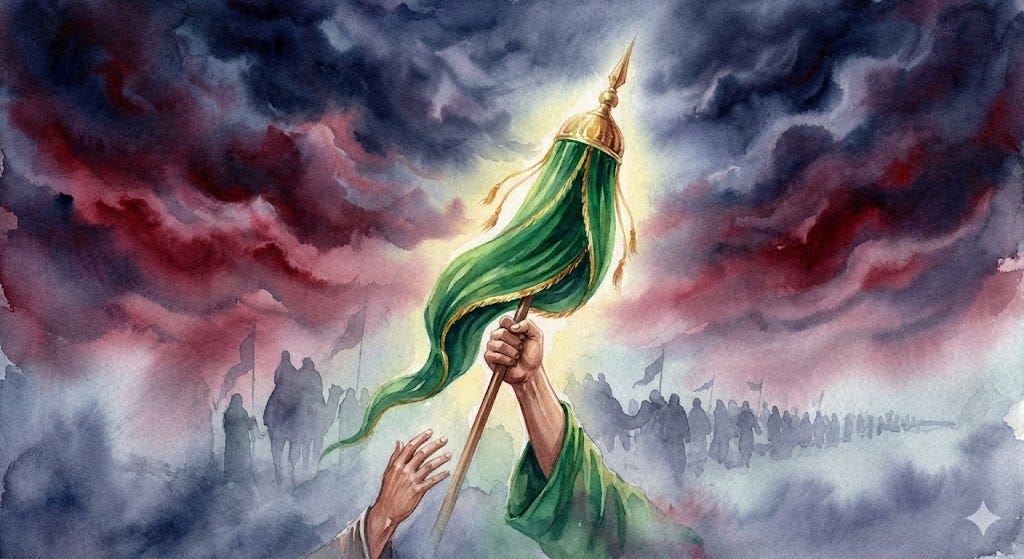
We explored the theological principle embedded in this transition: the System must survive the Person.
Human societies form personality cults. Faith attaches to charismatic leaders, celebrity scholars, famous commanders. But what happens when they die?
The Fourth Deputy’s brief tenure was a divine lesson in weaning the community off the scaffolding so the building could stand on its own.
The First Deputy stabilised.
The Second institutionalised.
The Third navigated.
The Fourth dismantled—not to destroy, but to liberate.
We saw this principle tested in our own lifetime.
When Imam Khomeini passed, the enemies of the Revolution celebrated, predicting immediate collapse. They were wrong—because Imam Khomeini had built an institution, not a cult.
When Sayyed Hassan Nasrallah was martyred, they celebrated again, declaring the Resistance “decapitated.” Within days, the banner passed to new hands.
The chain did not break.
It has never broken.
Because we are the school of Karbala.
We watched Imam Husayn fall—and then watched Sayyedah Zaynab carry the message forward in chains.
We are not surprised by the martyrdom of our leaders.
We are prepared for it.
“Being killed is our habit,” declared Imam Sajjad to the tyrant Ibn Ziyad, “and our honour is martyrdom.”
The Final Tawqi’
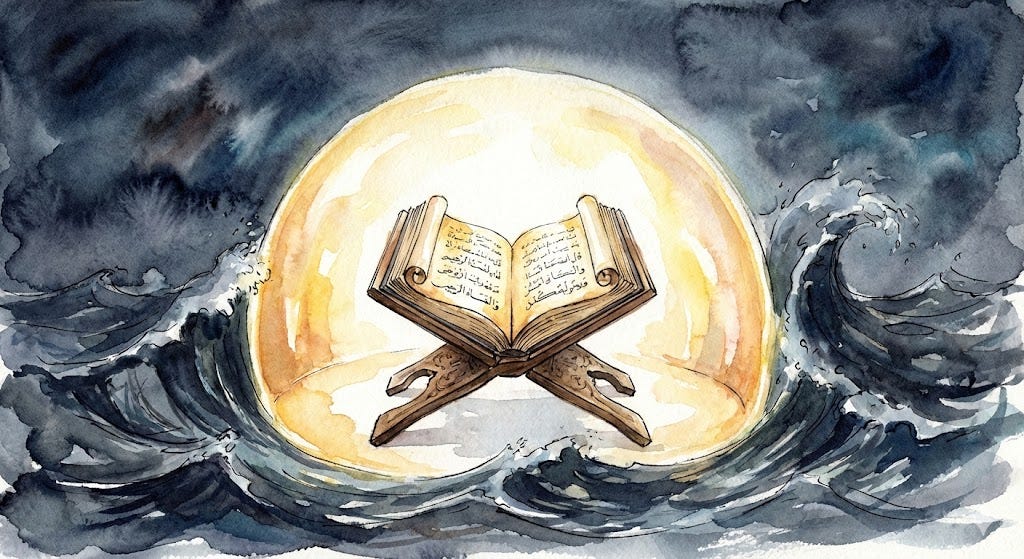
And then we examined the document that sealed the era.
Six days before the Fourth Deputy’s death, he gathered the elders and read aloud the final communication from the Hidden Imam—the Tawqi’ that would become the legal constitution of the Major Occultation:
يَا عَلِيَّ بْنَ مُحَمَّدٍ السَّمُرِيَّ... عَظَّمَ اللَّهُ أَجْرَ إِخْوَانِكَ فِيكَ، فَإِنَّكَ مَيِّتٌ مَا بَيْنَكَ وَبَيْنَ سِتَّةِ أَيَّامٍ.
فَأَجْمِعْ أَمْرَكَ وَلَا تُوصِ إِلَى أَحَدٍ فَيَقُومَ مَقَامَكَ بَعْدَ وَفَاتِكَ.
فَقَدْ وَقَعَتِ الْغَيْبَةُ التَّامَّةُ...
وَلَا يَكُونُ الظُّهُورُ إِلَّا بَعْدَ إِذْنِ اللَّهِ تَعَالَى ذِكْرُهُ، وَذَلِكَ بَعْدَ طُولِ الْأَمَدِ، وَقَسْوَةِ الْقُلُوبِ، وَامْتِلَاءِ الْأَرْضِ جَوْرًا.“O Ali ibn Muhammad al-Samarri... you shall die within six days. So settle your affairs and do not appoint anyone to take your place after your death. For the Complete Occultation has occurred. And my appearance shall not be until after the permission of God—and that is after a long time, the hardening of hearts, and the filling of the earth with tyranny.”
—Al-Saduq, Kamal al-Din wa Tamam al-Ni’mah, Volume 2, Chapter 45, Hadith 45
—Al-Tusi, Kitab al-Ghaybah, Page 395
The Imam did not offer false hope. He did not promise a quick rescue. He prepared the community for the long road.
And then came the firewall—the Anti-Cult Clause that has protected the community for over a thousand years:
وَسَيَأْتِي لِشِيعَتِي مَنْ يَدَّعِي الْمُشَاهَدَةَ. أَلَا فَمَنِ ادَّعَى الْمُشَاهَدَةَ قَبْلَ خُرُوجِ السُّفْيَانِيِّ وَالصَّيْحَةِ فَهُوَ كَذَّابٌ مُفْتَرٍ.
“And there will come to my Shia those who claim to have seen me [claiming special deputyship]. Beware! Whoever claims such observation before the rising of the Sufyani and the [Heavenly] Cry is a liar and a slanderer.”
— Al-Saduq, Kamal al-Din wa Tamam al-Ni’mah, Volume 2, Chapter 45, Hadith 45
— Al-Tusi, Kitab al-Ghaybah, Page 395
Kadhdhab Muftari—a liar and a slanderer.
Not “mistaken.”
Not “possibly sincere.”
A liar.
A slanderous liar.
With this single declaration, the Imam pronounced the verdict—fourteen centuries in advance—on every false claimant who would arise: the Baha’is, the Ahmadis, the imposter of Basra, and the countless smaller cults that have crashed against this wall.
The door of Specific Deputyship was closed.
The era of General Deputyship—the Marjaiyyah—had begun.
The Warning
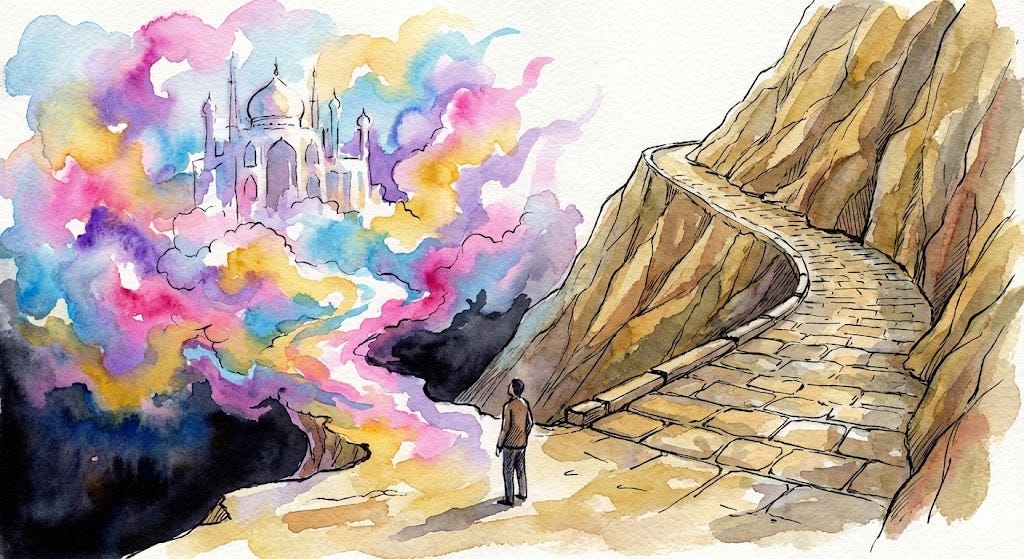
We concluded with a warning for our age: the seduction of “Shortcut Spirituality.”
The charlatans do not ask for Fiqh and Aql—Jurisprudence and Reason.
They ask for dreams.
They tell their followers:
“Do not listen to the scholars who use logic.
Logic is from Satan.
Listen to your dreams.
If you see me in a dream, that is proof.”
This is a mechanism to bypass the rational leadership of the Shia.
It replaces Law with Hallucination.
It replaces Scholarship with Sensation.
And behind some of these movements—as the late strategic analyst Hajj Nader Talebzadeh warned—stands the hand of Badal-Sazi: Substitute-Making.
Western intelligence agencies realised they could not defeat the revolutionary Islam of Imam Khomeini with tanks alone.
So they manufacture counterfeit versions—forms of “Shia spirituality” that neutralise the revolutionary spirit, that keep the youth busy with conspiracy theories and esoteric rabbit holes instead of building institutions and defending the oppressed.
The goal is not to make the Shia youth atheist.
The goal is to make them distracted.
And the distracted youth is a neutralised youth.
The Threshold
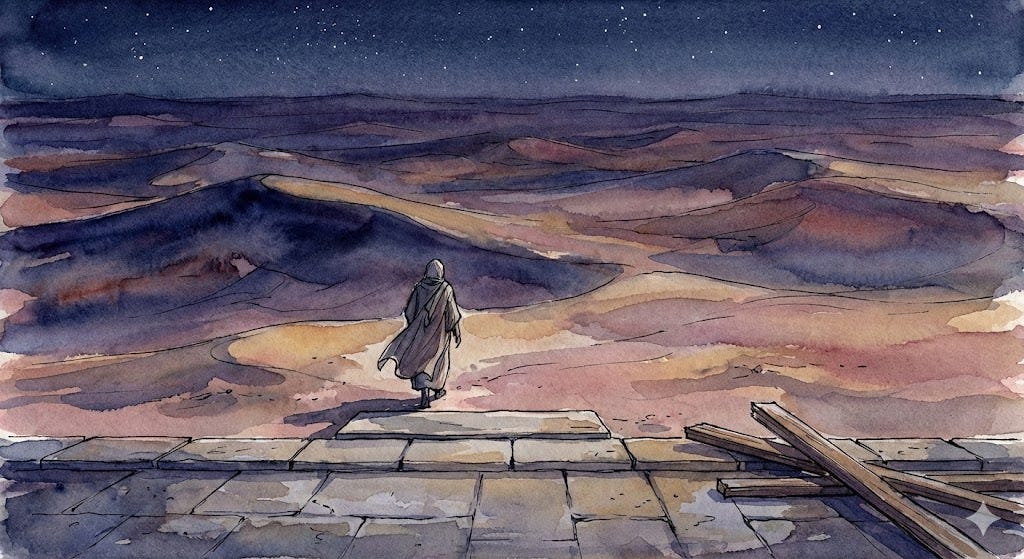
With the Final Tawqi’ delivered and the Fourth Deputy laid to rest, the Minor Occultation came to its end.
The training camp was over.
The scaffolding was removed.
The community stepped into the Great Silence—the vast desert of the Major Occultation that stretches from 329 AH to our own day, and beyond.
It is into this desert that we now venture.
Mahdawiyyah (The Culminating Guidance) - The Era of Establishment - The Great Sifting and The Crisis of the Void
The Divine Logic of Separation
The Quranic Frame
Before we enter the history, we must first understand the theology.
The Quran establishes a principle that governs all of human history—a principle that explains, in advance, why the year 329 AH had to be so painful:
مَّا كَانَ اللَّهُ لِيَذَرَ الْمُؤْمِنِينَ عَلَىٰ مَا أَنتُمْ عَلَيْهِ حَتَّىٰ يَمِيزَ الْخَبِيثَ مِنَ الطَّيِّبِ ۗ وَمَا كَانَ اللَّهُ لِيُطْلِعَكُمْ عَلَى الْغَيْبِ وَلَٰكِنَّ اللَّهَ يَجْتَبِي مِن رُّسُلِهِ مَن يَشَاءُ ۖ فَآمِنُوا بِاللَّهِ وَرُسُلِهِ ۚ وَإِن تُؤْمِنُوا وَتَتَّقُوا فَلَكُمْ أَجْرٌ عَظِيمٌ
God will not leave the believers as you are, until He separates the bad from the good. Nor will God inform you of the future, but God elects from among His messengers whom He wills. So believe in God and His messengers. If you believe and practice piety, you will have a splendid reward.
— Quran, Surah Aal-i-Imran (the Chapter of the Family of Imran) #3, Verse 179
Pause on this.
“God will not leave the believers as you are.”
The community had grown comfortable during the Minor Occultation.
There was a Deputy.
There was a system.
There was a hand to hold.
But comfort is not the goal of faith.
Growth is.
And growth requires disruption.
Allamah Tabatabai, in his monumental Al-Mizan, explains the sociological necessity embedded in this verse:
فمن الواجب في الحكمة الإلهية أن يميز الخبيث من الطيب، ولا يتم ذلك إلا بامتحان عام يقلب ظهرهم لبطنهم... فإذا وردت عليهم المحن والشدائد وتعلقت القلوب بالأسباب وتمسكت النفوس بالأوهام تميز عند ذلك المؤمن حقاً من غيره، وظهر الكفر والنفاق الكامنان في الأنفس.
“Therefore, it is necessary in Divine Wisdom that He distinguishes the bad from the good. And this cannot be accomplished except through a general examination (imtihan ‘aam) that turns their insides out... When trials and hardships arrive upon them, and hearts cling to material causes, and souls hold fast to illusions—at that moment, the true believer is distinguished from the other, and the disbelief and hypocrisy dormant within the souls are revealed.”
— Allamah Tabatabai, Al-Mizan fi Tafsir al-Quran, Volume 4, Page 86
The closing of the gates in 329 AH was not a tragedy.
It was an examination.
It was the moment when the inner states of the believers—states that had been invisible during the ease of the Minor Occultation—were forced to manifest externally.
The hypocrites revealed themselves by leaving.
The believers revealed themselves by staying.
This is the Great Sifting.
This is Al-Tamhis.
The Phenomenon of Hayrah — The Vertigo of the Soul
The Darkness Descends
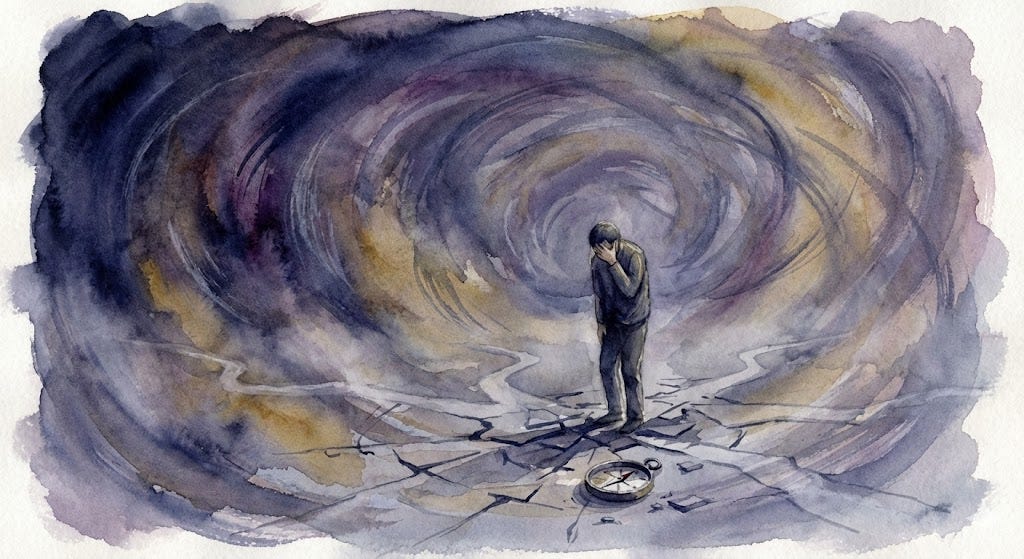
Imagine the scene.
It is the year 342 AH—thirteen years after the closing of the gates.
A scholar named Shaykh Muhammad ibn Ibrahim al-Nu’mani sits in his study, surveying the wreckage.
The community he loves is fracturing before his eyes.
He picks up his pen and writes what may be the most painfully honest assessment in all of Shia literature:
فأما بعد، فإنا تأملنا ما عليه العصابة ـ أعزها الله ـ من التشعب، وافترق الكلمة، وتشعب المذاهب في هذا الوقت الذي هو سنة اثنتين وأربعين وثلاثمائة، فوجدنا من قد شك في إمامة وليه وابن نبيّه...
ورأيت كثيراً منهم قد ارتدّ عن القول بإمامته (عليه السلام) للحيْرة التي تملّكتهم، والغيبة التي طالت عليهم...
To proceed: We observed the condition of the Group (the Shia)—may God strengthen them—and saw their fragmentation, the disunity of their word, and the divergence of their schools of thought in this current time, which is the year 342 AH. We found among them those who have doubted the Imamate of their Guardian...
And I saw that many of them had apostatised from the belief in his Imamate (peace be upon him) due to the Perplexity (Hayrah) that overwhelmed them, and the Occultation which seemed prolonged to them...”
— Al-Nu’mani, Kitab al-Ghayba, Author’s Introduction, Page 22
Hayrah.
Perplexity.
Spiritual vertigo.
This is not a term for minor confusion.
This is a term for existential disorientation—the feeling of a man who has lost his compass in a sandstorm, who spins in circles searching for a direction that no longer seems to exist.
For seventy years, the Shia had lived with a lifeline.
Even though the Imam was hidden, there was a Deputy.
There was an address.
There was someone to write to, someone who would respond with a letter bearing the Imam’s seal.
And then, suddenly, there was no one.
The letters stopped.
The seal vanished.
The door closed.
And the community was left standing in the silence, asking the question that has echoed through every generation since:
Where do we go now?
The Anatomy of Perplexity (Hayrah)
What does Hayrah look like in practice?
It looks like the man who says:
“If the Imam is real, why doesn’t he show himself?
Why doesn’t he end our confusion?”
It looks like the woman who says:
“I believed because my father believed, and my father believed because the Deputy confirmed.
But now there is no Deputy.
On what do I base my belief?”
It looks like the youth who says:
“The scholars disagree among themselves.
How can I know which one speaks the truth?”
These are not the questions of enemies.
These are the questions of sincere hearts struggling to find footing on shifting sand.
And the early scholars did not condemn these questions.
They understood that Hayrah was the natural response of a community that had relied on sensory confirmation—on the visible presence of a Deputy—suddenly being asked to believe without that confirmation.
The Philosophy of Perplexity (Hayrah): From Sensory Faith to Rational Faith
This is where the wisdom of the contemporary scholars becomes essential.
Ayatullah Jawadi-Amoli offers a reframe that transforms our understanding of this crisis:
دوران غیبت، دوران شکوفایی عقل است. تا زمانی که امام ظاهر است، مردم به اتکای دیدن امام حرکت میکنند، اما در غیبت، عقل و استدلال باید جایگزین حس شود. حیرت ممدوح آن است که انسان را به تفکر وادار کند نه به کفر.
“The era of Occultation is the era of the blossoming of the Intellect (Aql). As long as the Imam is manifest, people move based on relying on seeing the Imam. But in the Occultation, intellect and reasoning must replace sensory perception...
The ‘Praiseworthy Perplexity’ (Hayrat-e Mamduh) is that which compels a human being towards deep contemplation (tafakkur), not towards disbelief (kufr).”
— Ayatollah Jawadi-Amoli, Imam Mahdi: Mawjud-e Maw’ud, Section on “The Philosophy of Occultation”
Read this carefully.
Ayatullah Jawadi is not saying that Hayrah is good.
He is saying that Hayrah can be used for good.
There are two responses to perplexity:
The First Response is to surrender to the confusion—to let the vertigo pull you down into doubt, and from doubt into denial, and from denial into apostasy. This is the path of those who left in 342 AH.
The Second Response is to let the confusion drive you deeper—to recognise that the easy answers are no longer available, and therefore to seek the hard answers. To move from
“I believe because I saw the Deputy”
to
“I believe because I have investigated the proofs.”
To move from blind imitation (Taqlid in the negative sense) to investigation (Tahqiq).
The first response produces apostates.
The second response produces scholars.
The Major Occultation was designed to produce scholars.
The Mirror for the Present
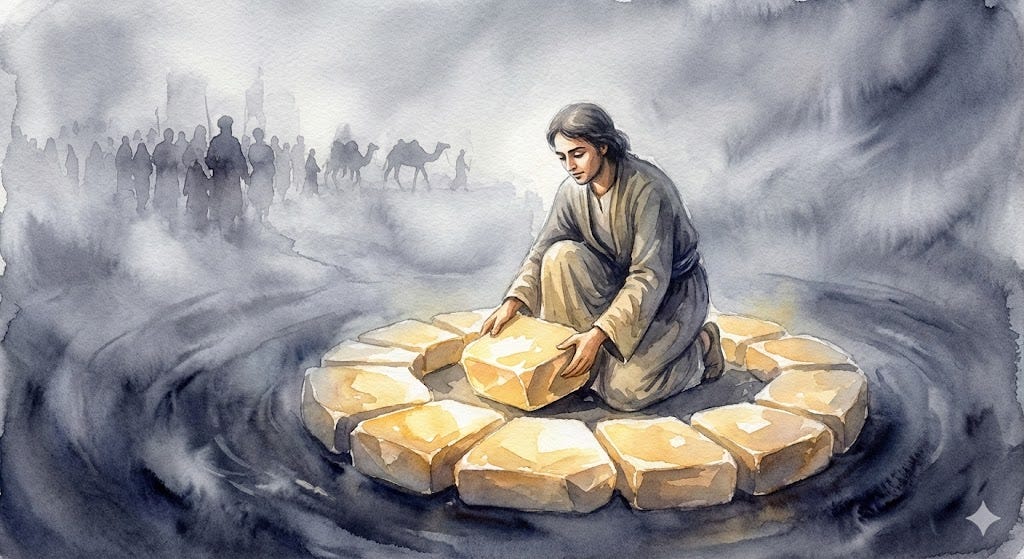
This reframe is essential for the present age.
Every generation of believers passes through its own perplexity (Hayrah).
There are moments in the life of every sincere Muslim when the certainties of childhood faith begin to wobble.
Perhaps it is the encounter with confusing irreligious or secular arguments in college and university.
Perhaps it is the trauma of personal suffering that seems to contradict Divine Justice.
Perhaps it is the scandal of a trusted scholar whose hypocrisy is exposed.
In these moments, the believer feels the vertigo.
The ground shifts.
The compass spins.
And the question arises:
“Do I still believe?”
The lesson of the early community is this:
The vertigo is not the end.
It is the invitation.
It is the invitation to stop relying on the faith of others and to build a faith of one’s own.
It is the invitation to move from the child who believes because his father believed, to the adult who believes because he has walked the path of proof himself.
The scholars who survived 329 AH did not survive because they had no doubts.
They survived because they treated their doubts as questions to be answered, not as conclusions to be accepted.
A Clarification: Doubt is Not Disbelief
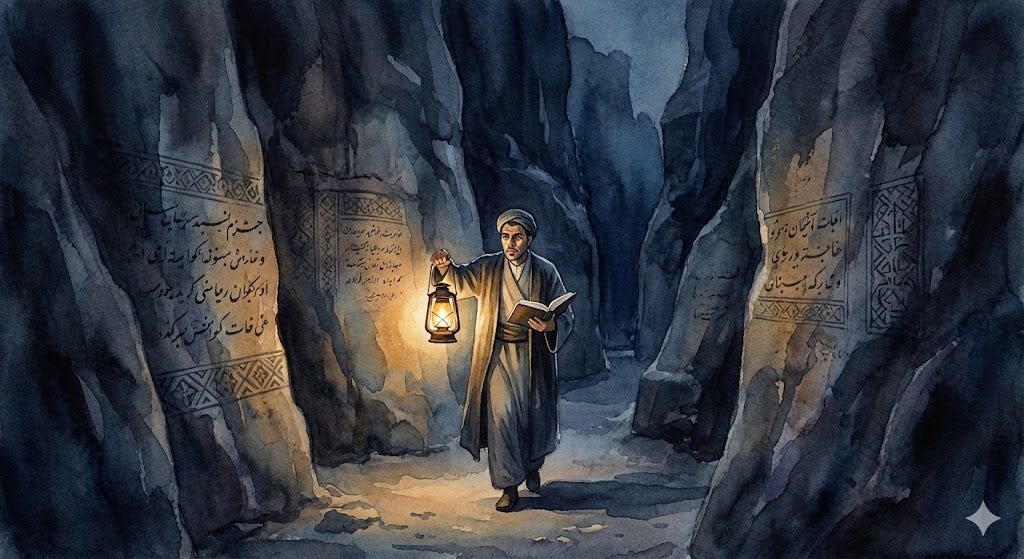
And here a clarification must be made, because the modern age is plagued by a false binary.
On one side stand those who say:
“If you have any doubt, you are a disbeliever.
True faith has no questions.”
On the other side stand those who say:
“Doubt is liberation.
Question everything.
Tear down all certainties.”
Both are wrong.
The tradition of the Ahl al-Bayt charts a middle path.
Doubt—in the sense of a question arising in the mind—is not disbelief. It is a natural human experience. Even the prophets asked questions of God. Ibrahim, peace be upon him, asked to see how God resurrects the dead—not because he disbelieved, but because he sought the tranquility of witnessed knowledge.
What is disbelief is the decision to stop seeking.
The one who has a doubt and says,
“I will investigate until I find the answer”
—this person is on the path, even if the path is currently dark.
The one who has a doubt and says,
“I will use this doubt as an excuse to stop practicing, to stop seeking, to abandon the community”
—this person has left the path.
The early Shia who remained were not those who had no doubts.
They were those who refused to let their doubts become their identity.
They let the perplexity (Hayrah), the confusion, drive them to the books.
They let the vertigo push them toward knowledge.
And in doing so, they transformed from passive recipients of guidance into active seekers of truth.
The Middle Way: Neither Rushing Nor Retreating
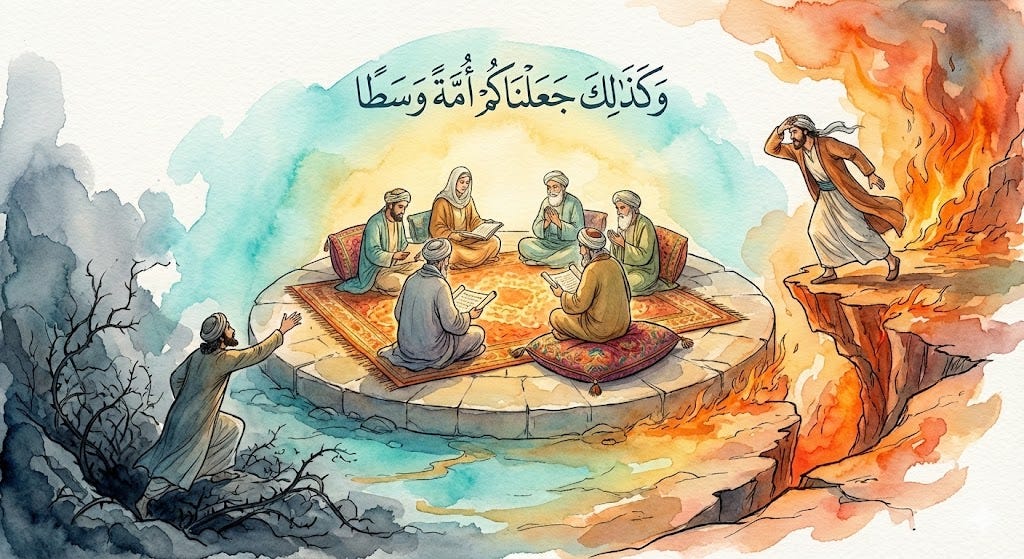
But this transformation requires a further clarification — one that will serve as a compass for the remainder of this series.
In the chaos of the Occultation, two groups perished.
The first were those who rushed ahead — who could not bear the waiting, who launched uprisings without the Imam’s permission, who decided that they would force the hand of history.
These were the Extremists (Ghulat), the hasty revolutionaries, the ones who overshot the mark.
The second were those who fell behind — who surrendered to despair, who said
“the Imam is gone, so what is the point?”
—who abandoned practice, abandoned community, abandoned hope.
These were the Laggards (Muqassirun), the fatalists, the ones who never reached the mark at all.
Both perished.
Both missed the path.
But between them — holding the ground, neither retreating nor recklessly charging — stood a third group.
The survivors.
The Quran names them:
وَكَذَٰلِكَ جَعَلْنَاكُمْ أُمَّةً وَسَطًا لِّتَكُونُوا شُهَدَاءَ عَلَى النَّاسِ وَيَكُونَ الرَّسُولُ عَلَيْكُمْ شَهِيدًا
“Thus We have made you a Middle Nation (Ummatan Wasata) that you may be witnesses to the people, and that the Apostle may be a witness to you...”
— Quran, Surah Al-Baqarah (the Chapter of the Cow) #2, Verse 143
Ummatan Wasata — a Middle Nation.
Not a nation of extremes.
Not a nation that swings wildly between excess and deficiency.
A nation of balance. Of equilibrium. Of measured, principled steadfastness.
Allamah Tabatabai, in Al-Mizan, explains the depth of this designation:
إنما سماهم أمة وسطاً لكونهم متوسطين بين طرفي الإفراط والتفريط... فإن الناس في هذا الباب فرقتان: منهم من غلب عليه جانب الروح فترك كمال جسمه ورفض لذائذ الدنيا كالنصارى... ومنهم من غلب عليه جانب الجسم وقواه فتركوا الروحانية وفضائلها كاليهود... والإسلام هو الوسط الذي يجمع بين الجانبين.
“He named them a ‘Middle Nation’ only because they are situated between the two extremes of Excess (Ifraat) and Negligence (Tafrit)... For people in this regard are of two groups: There are those dominated by the spiritual aspect, who abandoned physical perfection and rejected worldly pleasures, such as the Christians... And there are those dominated by the physical aspect and its faculties, who abandoned spirituality and its virtues, such as the Jews... Islam is the Middle (Wasat) which combines both aspects.”
— Allamah Tabatabai, Al-Mizan fi Tafsir al-Quran, Volume 1, Pages 320-324
But what does this “Middle” look like in practice?
Who embodies it?
Imam Ja’far al-Sadiq, peace be upon him, answers directly:
عَنْ أَبِي عَبْدِ اللَّهِ (ع) فِي قَوْلِ اللَّهِ عَزَّ وَجَلَّ: (( وَكَذَلِكَ جَعَلْنَاكُمْ أُمَّةً وَسَطاً )) قَالَ: نَحْنُ الْأُمَّةُ الْوُسْطَى، وَنَحْنُ شُهَدَاءُ اللَّهِ عَلَى خَلْقِهِ، وَحُجَجُهُ فِي أَرْضِهِ
“From Abu Abdullah (Imam Sadiq), peace be upon him, regarding the statement of God (Mighty and Majestic): ‘Thus We have made you a Middle Nation’: He said: ‘We are the Middle Nation, and we are God’s witnesses over His creation, and His proofs (Hujaj) on His earth.’”
— Al-Kulayni, Al-Kafi, Volume 1, Kitab al-Hujjah, Chapter: “That they are the Witnesses of God,” Hadith #1
The Imams are the Middle.
They are the reference point.
They are the standard against which all positions are measured.
And the Commander of the Faithful, Imam Ali, peace be upon him, crystallises this into one of the most profound metaphors in all of Islamic literature:
نَحْنُ النُّمْرُقَةُ الْوُسْطَى، بِهَا يَلْحَقُ التَّالِي، وَإِلَيْهَا يَرْجِعُ الْغَالِي
“We are the Middle Cushion (Al-Numruqah al-Wusta). The laggard must catch up to it, and the extremist must return to it.”
— Nahjul Balaghah, Saying #109
A Numruqah is a cushion — a firm support upon which one reclines.
The Imam is saying:
We are the centre.
We are the axis.
All positions are defined in relation to us.
The one who has fallen behind — the one paralysed by Hayrah, the one who has given up, the one who says “waiting is pointless” — this one must catch up to the Cushion.
He must move forward, re-engage, return to practice and study and hope.
The one who has rushed ahead — the one who launches movements without authority, the one who claims special access to the Imam, the one who says
“I know better than the scholars”
— this one must return to the Cushion. He must pull back, submit to the system, recognise that his zeal has outpaced his wisdom.
Ayatullah Jawadi Amoli, in Tafsir-e Tasneem, applies this directly to the era of Occultation:
امت وسط بودن یعنی دوری از افراط و تفریط. در فرهنگ تشیع، «وسط» همان جایگاه ولایت است. هر کس از امام جلو بیفتد (غلو کند) هلاک میشود و هر کس عقب بماند (تقصیر کند) نابود میشود. در دوران غیبت، این اعتدال بسیار حیاتی است تا شیعیان نه دچار یأس شوند (تفریط) و نه دچار عجله و قیامهای بیموقع (افراط).
“Being the ‘Middle Nation’ means avoiding Excess (Ifraat) and Deficiency (Tafrit). In the culture of Shi’ism, the ‘Middle’ is the very station of Wilayah. Whoever advances ahead of the Imam (commits Ghuluw) perishes, and whoever lags behind (commits Taqsir) is destroyed. In the era of Occultation, this equilibrium (i’tidal) is vital so that the Shia neither fall into despair (Deficiency) nor fall into haste and untimely uprisings (Excess).”
— Ayatollah Jawadi Amoli, Tafsir Tasneem, Volume 7, Pages 450-455
This is the answer to Hayrah.
Not to abandon the path in despair.
Not to forge a new path in arrogance.
But to find the Cushion — the line of the Imams, preserved by the scholars — and to hold that position with patience, with study, with disciplined action.
This is Active Waiting.
This is the stance of the survivor.
This is the Middle Way.
But understanding that doubt is not disbelief answers only half the question.
The deeper question remains:
Why did God ordain this confusion in the first place?
The Divine Law of Tamhis — The Sifting of Souls
Why Did God Allow This?
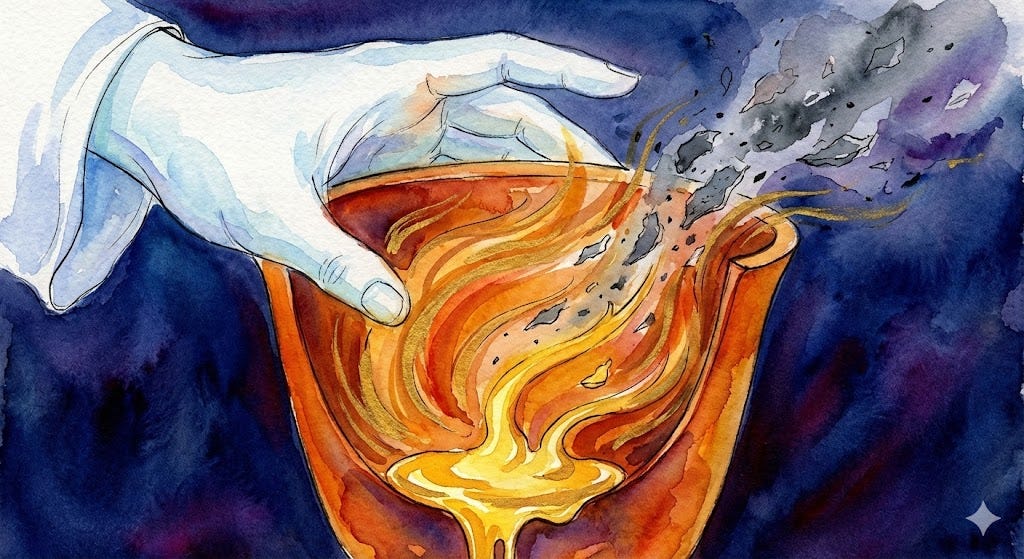
The first point described the phenomenon — and the proper response to it.
Now we must understand the purpose.
Why did God allow the community to fall into such confusion?
Why did He not send another Deputy, or grant a vision to every believer, or write the proof of the Imam’s existence across the sky?
The answer is found in a word that appears repeatedly in the narrations of the Ahl al-Bayt:
Tamhis.
Purification.
Sifting.
The separation of gold from dross.
The Hadith of the Sifting

Imam Ja’far al-Sadiq, peace be upon him, was once approached by a companion named Mansur al-Sayqal who expressed eagerness for the reappearance of the Imam.
The Sixth Imam’s response was not comfort.
It was warning:
هَيْهَاتَ هَيْهَاتَ! لَا يَكُونُ مَا تَمُدُّونَ إِلَيْهِ أَعْيُنَكُمْ حَتَّى تُغَرْبَلُوا، لَا وَ اللَّهِ، وَ لَا يَكُونُ مَا تَمُدُّونَ إِلَيْهِ أَعْيُنَكُمْ حَتَّى تُمَحَّصُوا، لَا وَ اللَّهِ، وَ لَا يَكُونُ مَا تَمُدُّونَ إِلَيْهِ أَعْيُنَكُمْ حَتَّى تُمَيَّزُوا، لَا وَ اللَّهِ، وَ مَا يَكُونُ مَا تَمُدُّونَ إِلَيْهِ أَعْيُنَكُمْ إِلَّا بَعْدَ إِيَاسٍ، لَا وَ اللَّهِ، لَا يَكُونُ مَا تَمُدُّونَ إِلَيْهِ أَعْيُنَكُمْ حَتَّى يَشْقَى مَنْ شَقِيَ وَ يَسْعَدَ مَنْ سَعِدَ
“Far from it! Far from it! That which you turn your eyes towards [the Reappearance] will not occur until you are sifted (tugharbalu)! No, by God! That which you look forward to will not occur until you are purged (tumahhasu)! No, by God! It will not occur until you are distinguished (tumayyazu)! No, by God! It will not occur except after [a period of] despair! No, by God! It will not occur until the wretched become wretched [by their own choice] and the felicitous become felicitous.”
— Al-Kulayni, Al-Kafi, Volume 1, Page 370, Hadith #2
— Al-Nu’mani, Kitab al-Ghayba, Chapter 12, Hadith #16
Three verbs. Three stages of the same process.
Tugharbalu — You will be sifted, like wheat in a sieve, the chaff blown away.
Tumahhasu — You will be purged, like gold in a furnace, the impurities burned out.
Tumayyazu — You will be distinguished, like colours separated from a mixture, each element revealing its true nature.
The Imam is saying:
The Reappearance is not a gift given to the unprepared.
It is a trust given to those who have proven themselves worthy.
And the proof of worthiness is not comfort.
It is trial.
The Authentication: Who is Mansur al-Sayqal?
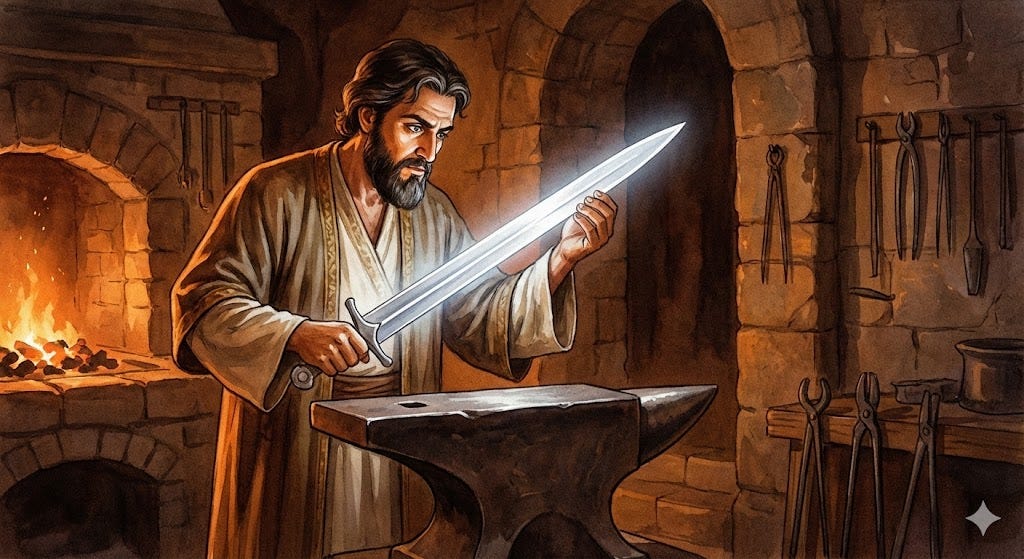
This narration comes to us through Mansur ibn al-Walid al-Sayqal — a sword-maker from Kufa whose reliability has been verified by the masters of biographical evaluation.
Al-Najashi, the supreme authority in the science of Rijal, records:
منصور بن الوليد الصيقَل، كوفي، ثقة، روى عن أبي عبد الله (عليه السلام)
“Mansur ibn al-Walid al-Sayqal: Kufan, Trustworthy (Thiqah). He narrated from Abu Abdillah [Imam Sadiq] (peace be upon him).”
— Al-Najashi, Rijal al-Najashi, Entry #1098
— Al-Khoei, Mu’jam Rijal al-Hadith, Volume 19, Entry #12693
This authentication matters.
It means the warning about the Sifting is not folklore — it is verified doctrine.
It is not a story passed down carelessly — it is a narration that has survived the rigorous scrutiny of the scholars whose task it was to separate authentic transmission from fabrication.
The principle of Tamhis rests on solid ground.
The Exegesis (Tafsir) of Sifting (Tamhis)
Return now to the Quranic verse with which we opened:
مَّا كَانَ اللَّهُ لِيَذَرَ الْمُؤْمِنِينَ عَلَىٰ مَا أَنتُمْ عَلَيْهِ حَتَّىٰ يَمِيزَ الْخَبِيثَ مِنَ الطَّيِّبِ ۗ وَمَا كَانَ اللَّهُ لِيُطْلِعَكُمْ عَلَى الْغَيْبِ وَلَٰكِنَّ اللَّهَ يَجْتَبِي مِن رُّسُلِهِ مَن يَشَاءُ ۖ فَآمِنُوا بِاللَّهِ وَرُسُلِهِ ۚ وَإِن تُؤْمِنُوا وَتَتَّقُوا فَلَكُمْ أَجْرٌ عَظِيمٌ
God will not leave the believers as you are, until He separates the bad from the good. Nor will God inform you of the future, but God elects from among His messengers whom He wills. So believe in God and His messengers. If you believe and practice piety, you will have a splendid reward.
— Quran, Surah Aal-i-Imran (the Chapter of the Family of Imran) #3, Verse 179
Ayatullah Jawadi-Amoli, in his Tafsir-e Tasneem, explains the epistemology behind this separation:
علم غیب مخصوص خداست و احدی جز به اذن او بر آن آگاه نمیشود. مصلحت نیست که همه اسرار برای همه فاش شود، زیرا ایمان به غیب ارزش خود را از دست میدهد. تمحیص (غربال شدن) سنت قطعی خداست تا مدعیان دروغین از صادقان جدا شوند. اگر امام همیشه ظاهر باشد، نفاق پنهان میماند.
“Knowledge of the Unseen (Ilm al-Ghayb) belongs exclusively to God, and no one becomes aware of it except by His permission. It is not prudent (maslahat) for all secrets to be revealed to everyone, for then belief in the Unseen would lose its value. Sifting (Tamhis) is a definitive tradition of God, so that false claimants are separated from the truthful. If the Imam were always manifest, hypocrisy would remain hidden.”
— Ayatullah Jawadi-Amoli, Tafsir-e Tasneem, Volume 16, Pages 540-542
This is profound.
If the Imam were visible to all, if proof were handed to every questioner, if the path required no struggle — then what would distinguish the sincere from the hypocrite?
Both would follow.
Both would appear identical.
The hypocrite would enjoy the benefits of association with the truth without ever having paid the price of genuine belief.
But God does not allow the hypocrite to hide forever.
He creates conditions — trials, confusions, hardships — that force the inner state to manifest externally.
The one whose faith was rooted in convenience abandons ship when the waters grow rough.
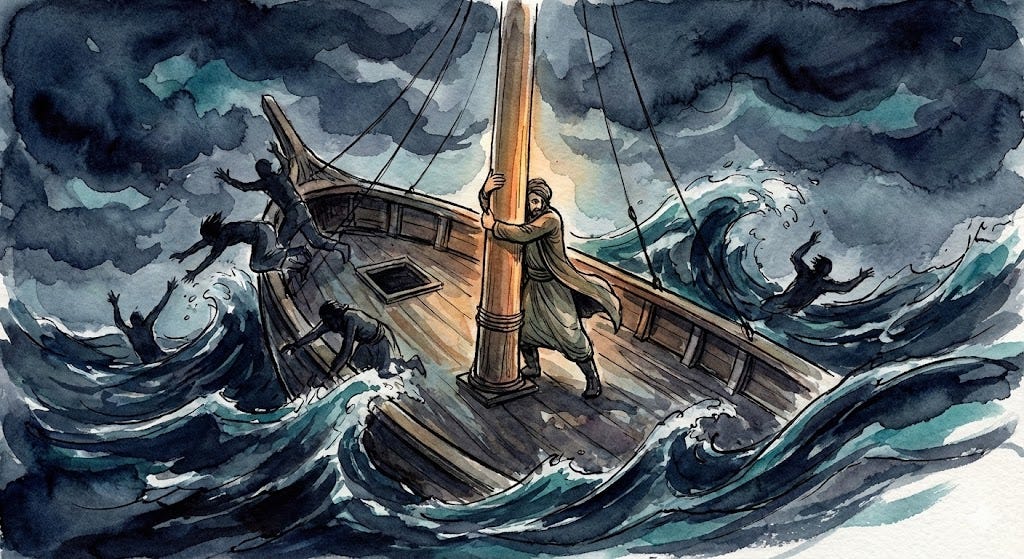
The one whose faith was rooted in truth grips the mast tighter.
This is the Tamhis.
This is why the Major Occultation had to be difficult.
The Contemporary Lens: The Islamic Revolution as Tamhis
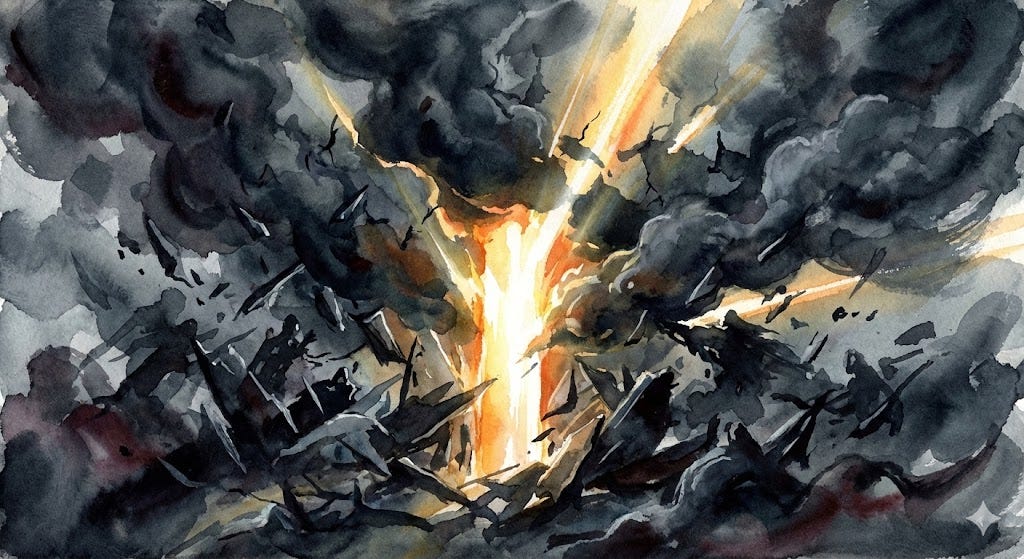
This principle did not expire in 329 AH.
It is active today.
Imam Khamenei, in a speech to government officials during the height of economic sanctions, applied this framework to the present:
امروز هم روز امتحان است... سنت الهی تمحیص است. این فشارها، این تحریمها، این سختیها برای آن است که جوهر انسانها آشکار شود. آن کسانی که ادعای تشیع و پیروی از اهل بیت دارند، در میدان عمل محک میخورند.
“Today is also a day of testing... The Divine Tradition (Sunnah) is Tamhis (purification). These pressures, these sanctions, these hardships exist so that the essence of human beings becomes manifest. Those who claim to be Shia and followers of the Ahlul Bayt are assayed [tested for purity] on the battlefield of action.”
— Imam Khamenei, Speech to Government Officials, 1390 SH (2011 CE)
The sanctions.
The media war.
The assassinations of scientists.
The cultural invasion.
The internal seditions.
None of this is random.
None of this is “bad luck.”
It is the continuation of the same Sunnah that operated in 329 AH — the Divine Tradition of sifting.
The Methodology: Reading Text Through Time
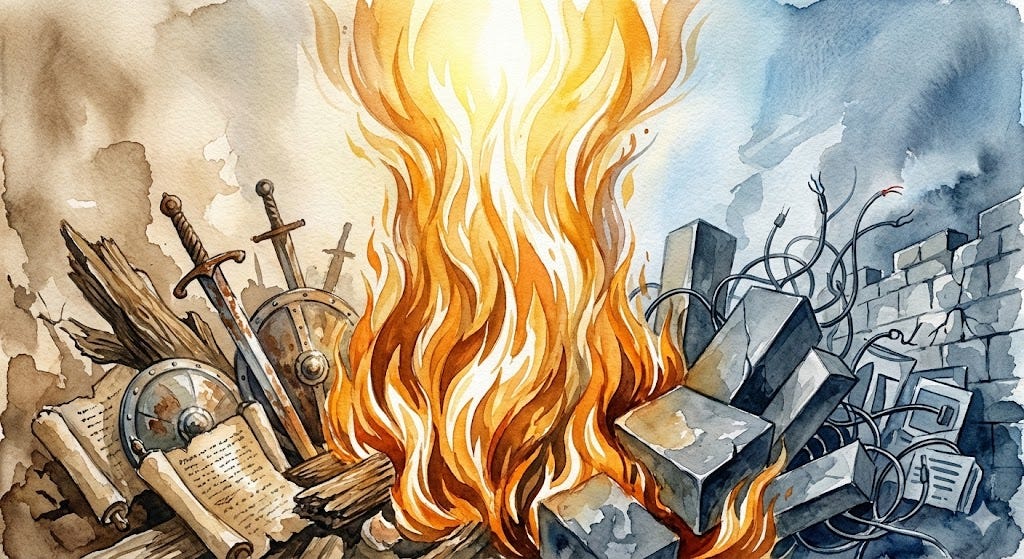
But how can we apply a narration from the eighth century to the sanctions of the twenty-first?
This is the question the Minhaj of Qom — the methodology of the Revolutionary Hawza — answers.
Imam Khomeini, in his final years, articulated a principle that transformed the science of Ijtihad:
زمان و مکان دو عنصر تعیین کننده در اجتهادند. مسألهای که در قدیم دارای حکمی بوده است به ظاهر همان مسأله در روابط حاکم بر سیاست و اجتماع و اقتصاد یک نظام ممکن است حکم جدیدی پیدا کند... مجتهد باید به مسائل زمان خود احاطه داشته باشد.
“Time (Zaman) and Space (Makan) are two determining elements in Ijtihad. A specific issue that had a certain ruling in the past... might acquire a new ruling within the governing relations of politics, society, and economics of a [modern] system... The Mujtahid must encompass [have mastery over] the issues of his own time.”
— Imam Khomeini, Sahifeh-ye Imam, Vol. 21, Page 98
This is not relativism.
This is not saying “the religion changes with the times.”
It is saying:
The principles are eternal, but their application requires wisdom.
The principle of Tamhis — that God sifts the believers through hardship — is eternal.
Its manifestation in 329 AH was the closing of the gates.
Its manifestation in our age is the economic siege, the media war, the assassination of scientists and generals.
The principle is the same.
The furnace is the same.
Only the fuel has changed.
The Islamic Revolution, as the political manifestation of waiting for the Imam, must pass through the same furnace that the early community passed through.
The fair-weather supporters must be separated from the steadfast.
The opportunists must be separated from the believers.
The gold must be separated from the dross.
And the Reappearance — like the closing of the gates before it — will not occur until the sifting is complete.
The Geopolitical Tamhis: The Acceleration of the Sifting
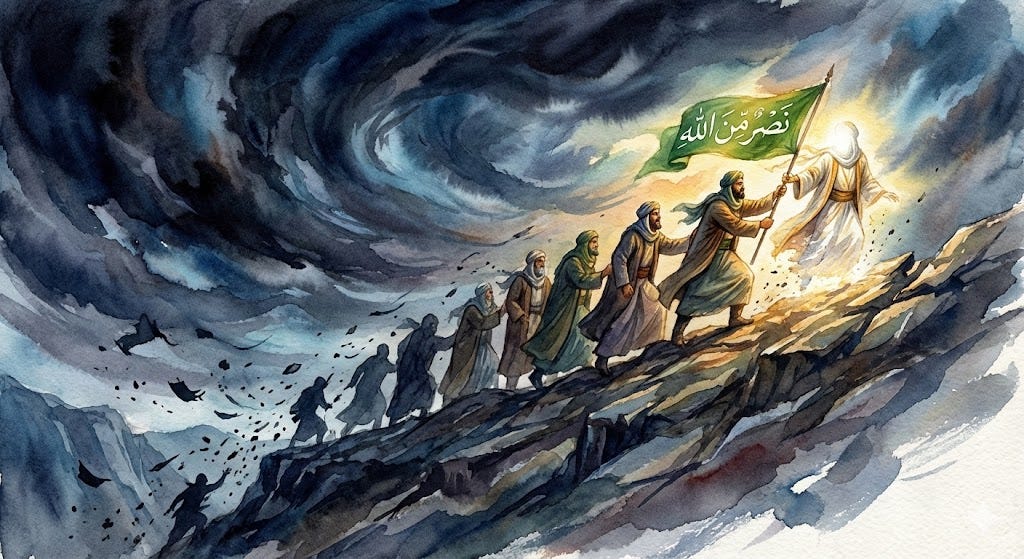
Extend this further.
Consider the condition of the Shia — and indeed, the condition of humanity — in the present moment.
The Tamhis is no longer a principle studied in books.
It is unfolding on screens, in headlines, in the smoke rising from bombed cities.
And it is accelerating.
Shaykh Alireza Panahian, one of the most incisive voices on the philosophy of awaiting, describes this acceleration with a striking image:
هر چه به قله نزدیکتر میشویم، باد شدیدتر میوزد و خالصسازی جدیتر میشود. در آخرالزمان، زمان شتاب میگیرد. حوادث پشت سر هم میآیند تا فرصت نفاق را از کسی بگیرند. امروز میبینید کسی که سی سال ادعای انقلابیگری داشت، ناگهان در یک پیچ تاریخی سقوط میکند. این همان سنت تمحیص است; خدا تعارف ندارد.
“The closer we get to the Peak, the stronger the wind blows and the Purification becomes more serious. In the End Times, time accelerates. Events occur one after another specifically to take away the opportunity for hypocrisy. Today, you see someone who claimed to be a revolutionary for thirty years suddenly collapse at a historical turning point. This is that very Tradition of Tamhis; God does not show favouritism.”
— Shaykh Alireza Panahian, Lecture on “The Seditions of the End Times” (Fetneh-ha-ye Akhar-al-Zaman)
The wind at the peak.
Events cascading one after another.
The pandemic.
The genocide.
The assassinations.
The economic sieges.
The open threats of war.
Each one a gust that shakes the climbers on the mountain — and those not gripping tightly are thrown off.
In Gaza, a people face extermination.
Not a war — a genocide.
Entire neighbourhoods erased.
Entire families deleted from the registry of the living.
Children pulled from rubble, grey with dust, silent with shock.
And yet — the people of Gaza have not surrendered.
They have not begged for mercy from the merciless.
They have not abandoned their land, their dignity, their faith.
They bury their dead, pray over the fragments, and remain.
This is Tamhis.
The furnace is hotter there than anywhere else on earth.
And those who endure it — who choose death standing over life kneeling — are being purified into something the world has rarely seen.
In Lebanon, the Resistance has faced blow after blow.
The economic collapse.
The port explosion that devastated Beirut.
The political deadlock engineered to strangle the state.
And then — in rapid succession — the assassination of its leaders.
Sayyed Hassan Nasrallah.
The voice of the Resistance for over three decades.
The man who liberated the South in 2000, who stood defiant in 2006, who sent his fighters to break the back of Daesh in Syria. Martyred.
Sayyed Hashem Safieddine.
His successor, the quiet architect, the keeper of the institution.
Martyred.
Commander after commander.
Scholar after scholar.
The decapitation strategy deployed with full fury.
And what did the enemies expect?
They expected collapse.
They expected the fighters to scatter, the families to flee, the movement to dissolve into grief and recrimination.
They were wrong.
Because they do not understand what they are dealing with.
They do not understand that every martyrdom is a Tamhis — a sifting that operates upon those who remain, separating the weak-hearted who despair from those whose resolve is only tempered harder by the loss.
They do not understand that the Resistance was built precisely for this — that Sayyed Hassan himself spent thirty years preparing the institution to survive his absence.
And so the banner passed.
From Sayyed Hassan to Sayyed Hashem to Shaykh Naim Qassem.
The chain did not break.
The structure held.
The resistance continued.
But here is the deeper lesson:
The Tamhis is not only for those within the Resistance.
It is for those watching.
When the news broke of Sayyed Hassan’s martyrdom, a sifting occurred across the world — in living rooms, in group chats, in the hearts of millions who had claimed to support the Resistance.
Some saw defeat.
They said:
“It is over.
The Resistance is finished.”
Some saw victory delayed.
They said:
“The man is gone, but the path remains.
We continue.”
The martyrdom did not create these two responses.
It revealed them.
It exposed who had believed in a person versus who had believed in a principle.
It separated those whose loyalty was contingent on success from those whose loyalty was rooted in truth.
This is the Tamhis of the spectator.
And it is no less real than the Tamhis of the fighter.
In Iran, the assassination of Hajj Qassem Soleimani — the architect of the Axis of Resistance, the commander who reshaped the map of West Asia — was meant to be a death blow.
It was not.
The funeral processions that stretched for miles, the missiles that struck Ayn al-Asad, the continuation of every project he had built — all of it testified that the system was larger than any single man.
But again — the martyrdom sifted.
It revealed who would buckle under American threat and who would stand firmer.
It separated the governments that issued mealy-mouthed condemnations from those that named the crime for what it was.
And now, the arrogance intensifies further.
In these very days, the leaders of the American regime openly threaten the life of Imam Khamenei — may God protect him and extend his life.
The President of the United States speaks casually of “regime change,” of “new leadership” for the Islamic Republic, as though the Guardian of a nation of ninety million souls were a chess piece to be removed from the board.
Iranian President Pezeshkian has responded with the clarity the moment demands: any targeting of the Leader would constitute an all-out war.
تعرض به رهبری معظم کشورمان بهمنزله جنگ تمام عیار با ملت ایران است.
Any aggression against the Supreme Leader of our country is tantamount to all-out war against the Iranian nation.
This is not posturing.
This is the truth of Wilayah.
An attack on the Leader, on the Wali al-Faqih is an attack on the system.
An attack on the system is an attack on the people.
And a people who have been sifted for more than forty-five years — through war, through sanctions, through sedition, through assassination — such a people do not surrender.
But observe the Tamhis at work even here:
The threats expose not only the arrogance of the enemy, but the character of those who watch.
Some Muslims — some who claim to follow the Ahl al-Bayt — hear these threats and secretly hope they succeed.
They have grievances, real or imagined, and they would see the destruction of the Islamic Revolution and Islamic Republic as liberation rather than catastrophe.
Others hear the threats and feel their attachment to the Wilayah deepen.
They recognise that whatever imperfections exist in any human system, the alternative being offered is not reform but annihilation — the annihilation of the only state on earth that stands openly against the Zionist project, the only state that arms the Resistance, the only state that refuses to kneel.
The threat sifts.
The response reveals.
In Iraq, after decades of oppression, the community faces the test of governance — and with it, the sifting of those who sought power for service from those who sought power for self.
The resistance and militias that defeated Daesh must now prove they can build, not only destroy.
The politicians who wave the banner of the Ahl al-Bayt must now prove they serve the people, not their pockets.
The furnace has changed shape, but it burns no less hot.
In Yemen, a community under the most brutal blockade in modern history continues to stand.
No electricity, no medicine, no food security — and still they fight.
They launched operations in solidarity with Gaza, turning the Red Sea into a graveyard for the ships of complicity.
They forced the US Empire to retreat.
They have nothing, and yet they give everything.
If this is not Tamhis, the word has no meaning.
In Bahrain, in Nigeria, in Pakistan, in every corner of the world where the followers of the Household face persecution — the sifting is active.
Some flee.
Some hide.
Some apostatise quietly, slipping into the comfortable anonymity of disbelief.
And some remain.
The Pandemic: A Tamhis of Humanity
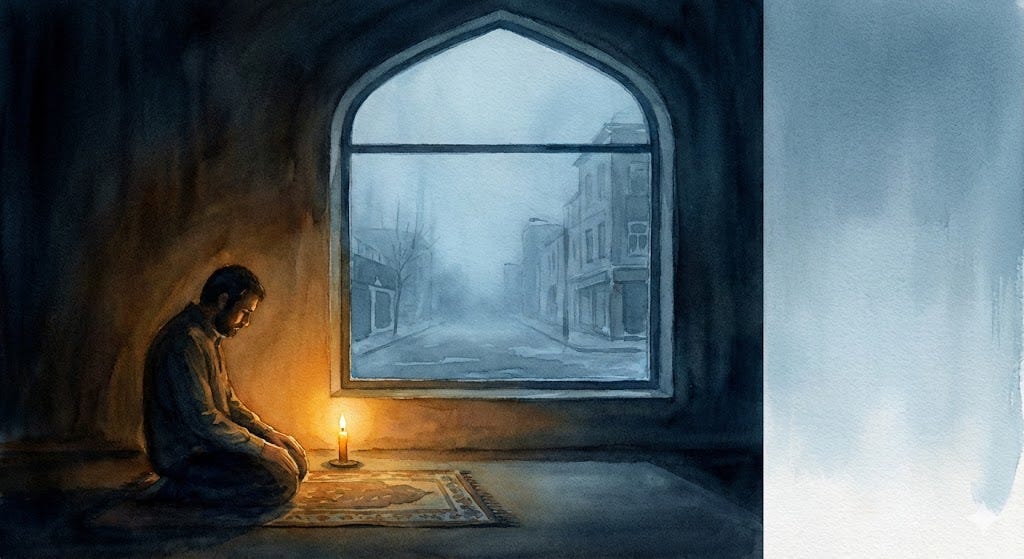
And then there was the pandemic.
A silent, invisible Tamhis that touched every nation on earth.
It revealed which governments cared for their people and which abandoned them to the calculus of profit.
It revealed which communities had solidarity and which had only the illusion of it.
It revealed, in the quiet of lockdown, what each soul truly worshipped — God, or comfort; principle, or convenience.
For the believers, it was a time of reflection, of recalibration, of asking:
“If death comes tomorrow, am I ready?”
For the heedless, it was an inconvenience to be endured until the restaurants reopened.
The virus did not discriminate.
But it revealed.
And revelation is the essence of Tamhis.
The Witnesses Who Passed the Test
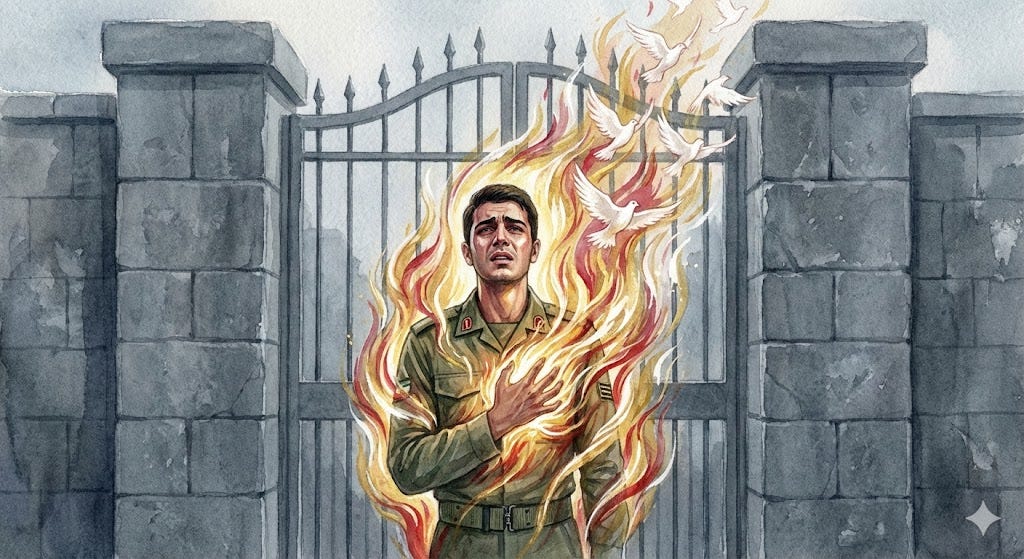
And some — a precious few — have passed the test at a cost that defies comprehension.
On February 25th, 2024, a twenty-five-year-old United States Air Force serviceman named Aaron Bushnell walked to the gates of the Israeli Embassy in Washington, D.C.
He set up a camera.
He livestreamed what followed.
He said:
“I am an active-duty member of the United States Air Force. And I will no longer be complicit in genocide. I am about to engage in an extreme act of protest. But compared to what people have been experiencing in Palestine at the hands of their colonisers — it’s not extreme at all. This is what our ruling class has decided will be normal.”
— Aaron Bushnell, Final Statement, February 25, 2024
And then he set himself on fire.
As the flames consumed him, he did not scream in pain.
He screamed:
“Free Palestine!
Free Palestine!”
— over and over, until he collapsed.
He died later that day.
Aaron Bushnell was not a Muslim.
He was raised in a Christian community.
He was a serving member of the armed forces of the very empire whose complicity he could no longer bear.
And yet — by whatever name we call it — he passed the Tamhis.
He chose truth over comfort.
He chose witness over silence.
He chose to burn rather than be complicit.
Three days later, Imam Khamenei, may God protect him, addressed the significance of this act:
نسلکشی در غزه حتی برای آن جوانی که در فرهنگ غرب تربیت شده دردناک است.
“The genocide in Gaza is even painful for that young person who was brought up in Western culture.”
— Imam Khamenei, Official Statement, February 28, 2024
The Leader’s observation pierces to the heart of the matter.
Here was a young man raised entirely within the Western system — its military, its culture, its values.
He was not taught to love Palestine.
He was not raised on the stories of Karbala.
He had no inherited grievance, no communal memory of oppression.
And yet the genocide broke him.
Why?
Because the Fitrah — the innate moral conscience that God placed in every human soul — cannot be entirely suppressed.
Western liberal democracy, for all its propaganda, for all its manufacture of consent, could not silence the voice that God planted in Aaron Bushnell’s chest.
This is what Imam Khamenei meant when he declared, in those same days, that
فرهنگ غرب در ماجرای غزه بیآبرو شد
“Western culture has been disgraced in the events of Gaza.”
— Imam Khamenei, Meeting with Members of the Assembly of Experts, March 5, 2024
The disgrace is not merely political — not merely that Western governments supported a genocide while preaching human rights.
The disgrace is spiritual.
The system that claims to represent the pinnacle of human civilisation, the system that lectures the world on values and ethics, the system that presents itself as the guardian of human dignity — this system produced a young man so morally tortured by its actions that the only protest he could conceive was to set himself on fire.
This is not a failure of policy.
This is a failure of soul.
The culture that shaped Aaron Bushnell could not give him the tools to live with what he knew. It could only give him the tools to die.
And when a civilisation’s own children choose death by fire over complicity in its crimes, that civilisation stands condemned — not by its enemies, but by its own conscience made flesh.
The Tamhis reached him — and he responded.
The Tamhis does not confine itself to a single theatre.
The same divine sifting that operates through Gaza operates wherever power crushes the vulnerable.
He Is Not the Only One
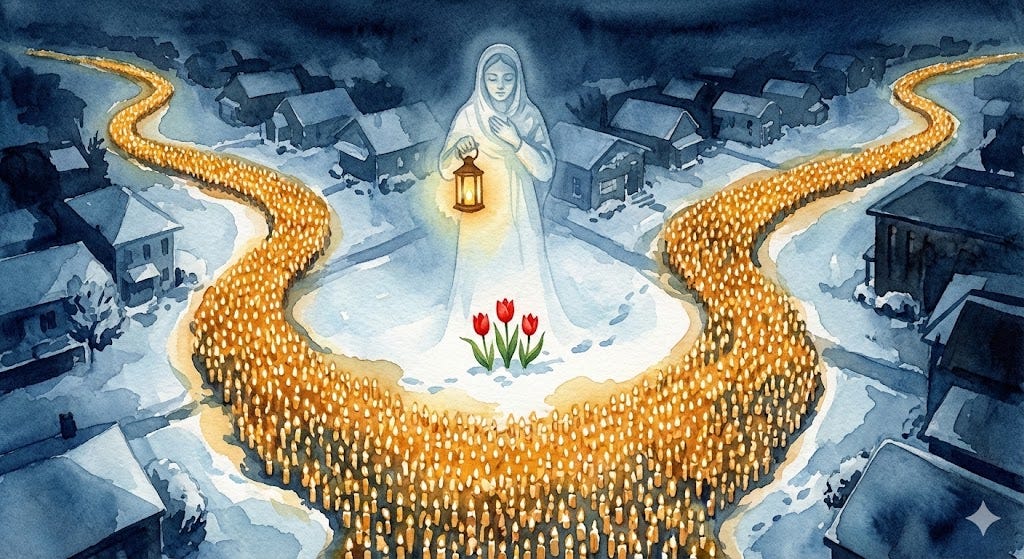
In Minneapolis, in January of this year — 2026, a thirty-seven-year-old mother named Renee Nicole Good was shot and killed by an agent of ICE — the immigration enforcement agency that has become, under the current regime, something resembling a paramilitary force unleashed upon communities.
Renee was not an immigrant.
She was an American citizen.
A poet.
A mother of three.
A woman who had just dropped her six-year-old son at school.
But she had committed an unforgivable sin in the eyes of the regime: she had been watching.
She had been part of a neighbourhood network that monitored ICE raids, that blew whistles to warn families, that stood as witnesses to the terror being inflicted on immigrant communities.
For this — for watching, for caring, for refusing to look away — she was killed.
An ICE agent fired three shots into her vehicle.
One through the windshield.
Two through the driver’s side window.
She died blocks from her home.
The regime’s response?
To investigate her — to comb through her associations, to label her a “domestic terrorist,” to smear a dead mother as an enemy of the state because she had the audacity to stand with her neighbours.
And yet — tens of thousands of people attended her vigil.
Tens of thousands people in Minneapolis, in the cold of January, gathered to say her name.
This, too, is Tamhis.
The killing of Renee Nicole Good sifted a city.
It sifted a nation.
It forced millions to ask:
What kind of country kills a mother for watching?
What kind of government investigates the victim and protects the shooter?
And some answered:
This is fine.
This is order.
This is necessary.
And others answered:
This is monstrous.
And I will not be silent.
The sifting continues.
A Reflection on Identity
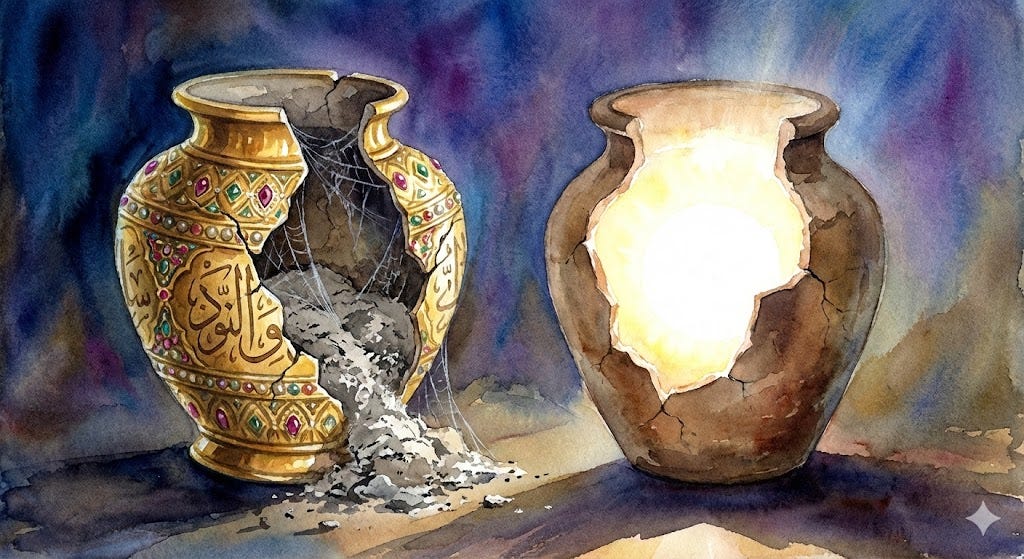
And here we must pause to reflect on an uncomfortable truth.
Aaron Bushnell was not a Muslim.
Renee Nicole Good was not a Muslim.
And yet they passed.
How many who identify as Muslim will fail the same test?
Let us be clear about what “identity” means in this context.
To identify as Muslim is to eat the biryani.
To wear the thobe or the abaya.
To attend the mosque on Fridays — or at least on Eid.
To fast in the month of Ramadhan.
To post Alhamdulillah on social media.
To feel a warm glow of belonging when the adhan is called.
None of this is the Tamhis.
The Quran is explicit:
أَمۡ حَسِبۡتُمۡ أَن تَدۡخُلُواْ ٱلۡجَنَّةَ وَلَمَّا يَعۡلَمِ ٱللَّهُ ٱلَّذِينَ جَٰهَدُواْ مِنكُمۡ وَيَعۡلَمَ ٱلصَّٰبِرِينَ
“Or did you think that you would enter Paradise while God has not yet made evident those of you who strive in His cause and made evident those who are steadfast?”
— Quran, Surah Aal-i-Imran (the Chapter of the Family of Imran) #3, Verse 142
The sifting does not ask what you eat.
It does not check your wardrobe.
It does not count your mosque attendance or scroll through your Instagram captions.
The sifting reaches deeper — into the Fitrah, into the depths of the soul where no one sees but God.
Allamah Tabatabai explains:
والتمحيص: تخليص الشيء من كل ما يغشيه من الشوائب... وهذه الفتنة والامتحان أمر لا بد من وقوعه ولا محيص عنه، ليمتاز به الحق من الباطل، ويتميز به المؤمن من المنافق
“Tamhis means purifying a thing from all impurities that cover it... This trial and examination is a matter that must inevitably occur and cannot be escaped, so that Truth may be distinguished from Falsehood, and the believer distinguished from the hypocrite.”
— Allamah Tabatabai, Al-Mizan fi Tafsir al-Quran, Volume 4, Commentary on Surah Aal-i-Imran, 3:141
And there, in that hidden chamber of the heart, the sifting asks one question:
When the truth demanded something of you — what did you choose?
Aaron Bushnell answered that question with fire.
Renee Nicole Good answered it by watching — by refusing to look away when her neighbours were hunted.
The martyred scholar, Ayatullah Muhammad Baqir al-Sadr, warned his students in Najaf:
يا إخواني ... لا تقل أنا عالم، ولا تقل أنا مؤمن، إلا بعد أن تمتحن نفسك وتمحصها... هل الدنيا أكبر في نفوسنا من الله؟ أو أن الله سبحانه وتعالى أكبر في نفوسنا من الدنيا؟ هذا هو المحك
“Oh my brothers... do not say ‘I am a scholar,’ and do not say ‘I am a believer,’ until you have tested yourself and purged your intentions... Is the world greater in our souls than God? Or is God, Glorified and Exalted, greater in our souls than the world? This is the criterion.”
— Shaheed Muhammad Baqir al-Sadr, from the lecture series “Hubb al-Dunya” (Love of the World), Al-Majmu’ah al-Kamilah, Volume 14
This is the criterion.
Not the turban.
Not the title.
Not the years in the Hawza.
The criterion is what sits on the throne of your heart when the test arrives.
The Failure of the Credentialed
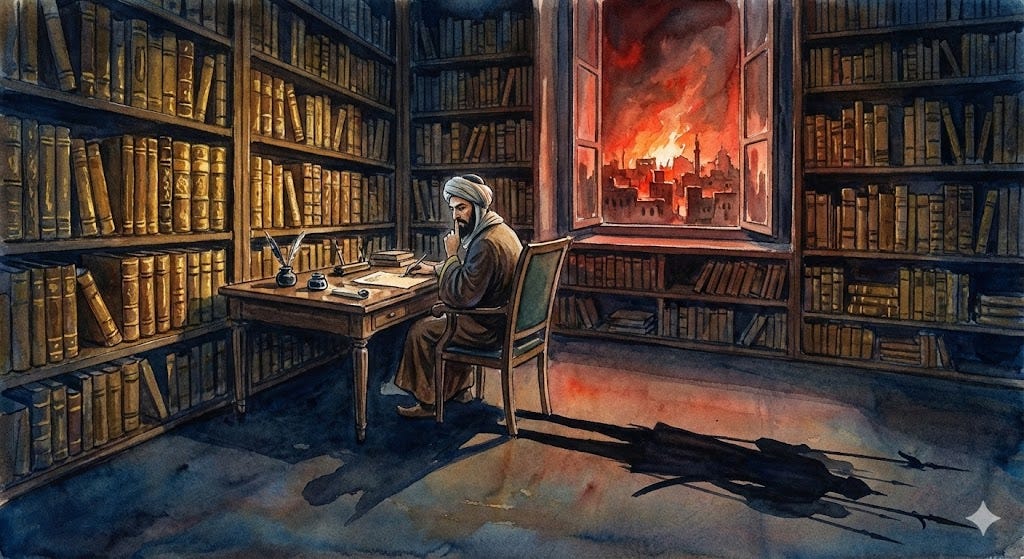
Meanwhile, there are those who pray five times a day, who have memorised the Quran and countless ahadith, who can debate fiqh (jurisprudence) and kalam (theology) for hours — and who, when Gaza burned, found reasons to look away.
Who told themselves it was “too political.”
When the port exploded in Beirut — when the heart of a nation was torn open and the bodies of the innocent lay beneath the rubble — there were those who refused even to say a prayer for the martyrs.
Not because they doubted the tragedy.
But because acknowledging it might be deemed “political.”
Because it might cost them donors.
Because it might offend those whose offence they feared more than the displeasure of God.
The Quran warned of precisely this:
وَلَا تَشۡتَرُواْ بِـَٔايَٰتِي ثَمَنٗا قَلِيلٗا وَإِيَّٰيَ فَٱتَّقُونِ وَلَا تَلۡبِسُواْ ٱلۡحَقَّ بِٱلۡبَٰطِلِ وَتَكۡتُمُواْ ٱلۡحَقَّ وَأَنتُمۡ تَعۡلَمُونَ
“And do not exchange My signs for a small price, and fear only Me. And do not mix the truth with falsehood or conceal the truth while you know it.”
— Quran, Surah Al-Baqarah (the Chapter of the Cow) #2, Verses 41-42
Do not exchange My signs for a small price.
The “small price” is not always gold.
Sometimes it is a position.
Sometimes it is a platform.
Sometimes it is simply the avoidance of discomfort — the quiet life, the undisturbed salary, the continued approval of those who hold power over your career.
And when documents emerged — documents drafted under the guise of “interfaith dialogue” — that twisted the words of the Quran, that sanitised oppression, that provided religious cover for those who supported the massacre of children, that sought to neutralise any resistance to genocide — what did certain “scholars” do?
They had the knowledge to refute.
Collectively, hundreds of years of seminary training sat among them.
Hundreds of years of studying Usul and Fiqh, of parsing Arabic grammar, of debating the subtleties of hadith authentication.
Enough knowledge, one would think, to dismantle a document built on distortion.
But they did not refute.
They did not clarify the misinterpretations.
They did not defend the Book of God against those who had bent its words to serve the interests of oppressors.
Instead, they fixated on a personality — a minor figure, a failed student, a convenient target.
They spent their energy on insults and denunciations, on the politics of reputation rather than the defence of truth.
And to this day — more than a year later — the lies remain unrefuted.
The distortions stand uncorrected.
The Quran remains misrepresented in that document, and those who had the knowledge to defend it chose silence.
Why?
Because refutation requires courage.
It requires standing against powerful interests.
It requires the possibility of losing positions, funding, and the approval of those who control platforms.
Attacking a weak personality requires nothing.
It is cost-free outrage.
It is theatre that performs righteousness without ever risking anything.
This is not scholarship.
This is pantomime.
Imam Khomeini spoke of such men with undisguised severity:
خطر عالِمى كه عمل نكند، از خطر طاغوت زيادتر است... إذا فَسَدَ العالِمُ فَسَدَ العالَمُ
“The danger of a scholar who does not act upon his knowledge is greater than the danger of the taghut (tyrant)... ‘If the scholar becomes corrupt, the entire world becomes corrupt.’”
— Imam Khomeini, Sahifeh-ye Imam, Volume 2, Page 27
And Imam al-Askari, peace be upon him, was even more direct. Speaking of the corrupt among the scholars — those who mislead, who conceal, who sell the signs for a small price — he declared:
فَأَمَّا مَنْ كَانَ مِنَ الْفُقَهَاءِ صَائِناً لِنَفْسِهِ حَافِظاً لِدِينِهِ... فَلِلْعَوَامِّ أَنْ يُقَلِّدُوهُ... وَ هُمْ أَضَرُّ عَلَى ضُعَفَاءِ شِيعَتِنَا مِنْ جَيْشِ يَزِيدَ عَلَى الْحُسَيْنِ بْنِ عَلِيٍّ (ع) وَ أَصْحَابِهِ
“As for the jurist who guards his soul and protects his religion... the common people should follow him. But [regarding the corrupt scholars]: They are more detrimental to our weak Shia than the army of Yazid was to Husayn ibn Ali and his companions.”
— Al-Tabarsi, Al-Ihtijaj, Volume 2, Page 458
— Hurr al-Ameli, Wasa’il al-Shia, Volume 27, Page 131
Read this again.
More detrimental than the army of Yazid.
The army of Yazid killed seventy-two at Karbala.
But the corrupt scholar — the one who has the knowledge and conceals it, the one who sells the signs for position and comfort — this one kills something far greater.
He kills trust in the religion itself.
He kills the faith of those who looked to him for guidance and found only silence.
He kills the possibility that the next generation will believe that scholarship means anything at all.
And the Tamhis sees through it.
The Lesson of Hur and Shimr
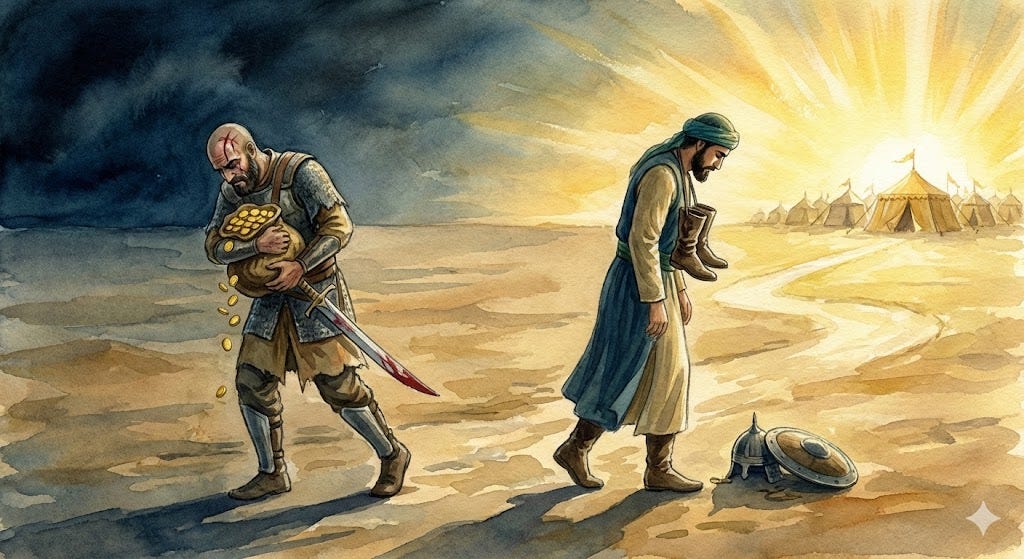
On the plains of Karbala, two men faced the same choice.
Hur ibn Yazid al-Riyahi was a commander in the army of Yazid.
He had blocked Imam Husayn’s path to Kufa.
He had followed orders.
He had done what was expected of him by those who held power.
Shimr ibn Dhil-Jawshan was also a commander.
He too had followed orders.
He too stood on the side of the state, the side of money, the side of worldly success.
Both men stood on the morning of Ashura with the same information before them.
Both knew who Husayn was.
Both understood what killing the grandson of the Prophet would mean.
And both made a choice.
But here is what makes Shimr’s choice so devastating:
Shimr had not always been on the side of falsehood.
خرج أدهَم بن مِحرَزٍ من أصحابِ معاويةَ بصفّين إلى شِمرِ بنِ ذي الجوشن، فاختلَفا ضَربتَين؛ فضربه أدهَمُ على جبينِه، فأسرع فيه السيفُ حتّى خالط العَظم
Adham ibn Mihraz came out from the companions of Muawiyah at Siffin to [fight] Shimr ibn Dhil-Jawshan. They exchanged two blows; Adham struck him on his forehead, and the sword cut deep until it reached the bone...
— Al-Minqari, Waq’at Siffin, Pages 267-268
The logic is clear: Adham was “from the companions of Muawiyah,” and he came out to duel Shimr.
A duel occurs between opposing sides.
Therefore, Shimr was in the camp of Imam Ali.
He had stood with Imam Ali.
He had fought for Wilayah.
He bore on his face — for the rest of his life — the scar of a blow received while defending the truth.
And then — through the choices of decades, through the slow erosion of principle, through the accumulation of small compromises — he arrived at Karbala on the opposite side.
And he severed the head of Husayn.
Ayatullah Misbah-Yazdi reflects on this trajectory:
ملاک عاقبت بخیری است. شمر جانباز جنگ صفین بود که کارش به جایی رسید که سر امام حسین (ع) را برید... هیچ کس نباید به خود مغرور شود، امتحان تا لحظه آخر ادامه دارد
“The criterion is a good ending (aqibah). Shimr was a veteran of the Battle of Siffin, yet his affairs reached a point where he severed the head of Imam Husayn... No one should become arrogant regarding themselves; the test continues until the very last moment.”
— Ayatullah Misbah-Yazdi, Lecture Series “Akhlaq dar Quran” (Ethics in the Quran), Qom
The test continues until the very last moment.
Shimr’s years at Siffin did not save him.
His service under Imam Ali did not protect him.
Because the Tamhis is not a single examination passed once and never revisited.
It is a continuous process — and every moment presents the choice again.
Hur chose differently.
In the final hours, when the cost of truth became clear, he crossed the lines.
He rode to Imam Husayn, dismounted, and said:
“Is there any repentance for me?”
And Imam Husayn accepted him.
Hur died that day — not as a commander of Yazid’s army, but as a martyr in the service of truth.
His shrine stands near Karbala to this day, visited by millions who honour the man who changed course when changing course cost everything.
The Tamhis does not ask how many years you studied.
It does not ask how many titles you accumulated.
It does not ask how large your following is, or how many institutions bear your name.
It does not even ask how you began.
It asks only this:
When the moment came — when Imam Husayn stood on one side and Yazid on the other — where did you stand?
There are those with no seminary training, no credentials, no titles — who stood with Imam Husayn.
And there are those with hundreds of years of collective learning — who could not bring themselves to refute a document.
There are those who began with Imam Ali at Siffin — and ended by severing the head of his grandson.
The sifting does not care about your beginnings.
It cares about your ending.
The Shell and the Substance
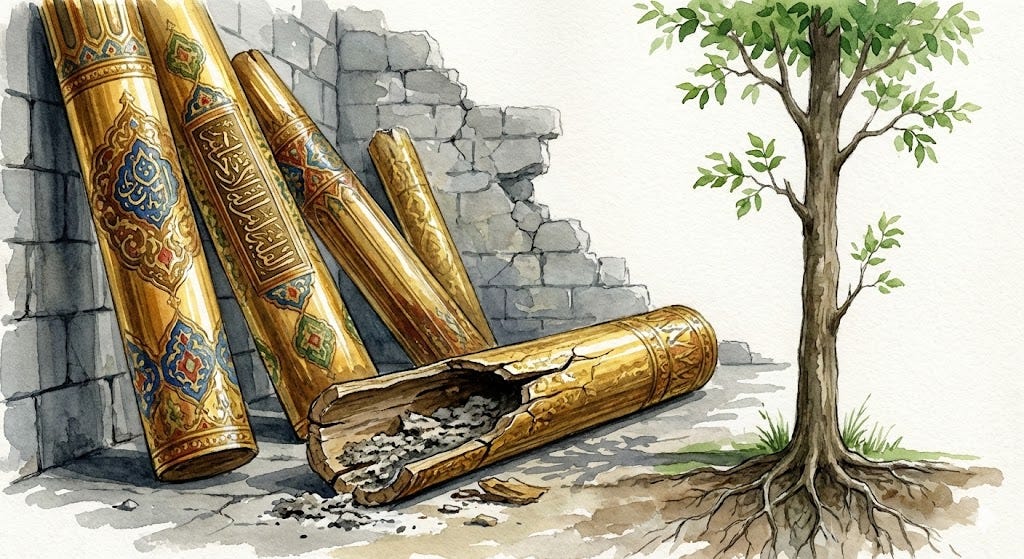
The Quran offers a haunting image of such people:
وَإِذَا رَأَيۡتَهُمۡ تُعۡجِبُكَ أَجۡسَامُهُمۡۖ وَإِن يَقُولُواْ تَسۡمَعۡ لِقَوۡلِهِمۡۖ كَأَنَّهُمۡ خُشُبٞ مُّسَنَّدَةٞ
“And when you see them, their forms please you, and if they speak, you listen to their speech. Yet they are as if they were pieces of wood propped up...”
— Quran, Surah Al-Munafiqun (the Chapter of the Hypocrites) #63, Verse 4
Khushubun Musannadah — Propped-up timber.
Impressive to look at.
Commanding in speech.
But hollow within — possessing no life of their own, dependent entirely on the wall against which they lean.
Ayatullah Jawadi-Amoli explains:
اينها اجسام بىروح هستند كه فقط به ديوار نفاق تكيه دادهاند. نه از خود استقامتى دارند و نه حيات معنوى
“These are soulless bodies that merely lean against the wall of hypocrisy. They possess neither independent steadfastness nor spiritual life... A piece of wood leaned against a wall has no property other than eventually burning.”
— Ayatullah Jawadi-Amoli, Tafsir-e Tasnim, Commentary on Surah Al-Munafiqun, 63:4
No property other than eventually burning.
This is the fate of the hollow — not merely collapse, but combustion.
The propped-up timber cannot stand on its own.
Remove the wall — remove the donors, the platforms, the positions — and it collapses.
And on the Day when all walls are removed, when every soul stands alone before its Lord, what will remain of those whose substance was borrowed entirely from the structures they leaned against?
The hadith is clear:
إِنَّ اللَّهَ لاَ يَنْظُرُ إِلَى صُوَرِكُمْ وَلاَ إِلَى أَمْوَالِكُمْ وَلَكِنْ يَنْظُرُ إِلَى قُلُوبِكُمْ وَأَعْمَالِكُمْ
“Verily, God does not look at your forms nor your wealth, but He looks at your hearts and your deeds.”
— Al-Majlisi, Bihar al-Anwar, Volume 74, Page 90
And on the Day when the veils are lifted, many who carried the name “Muslim” — many who carried the title “Scholar” — will find that their identity was a shell.
Beautiful on the outside.
Hollow within.
Propped-up timber that impressed the onlookers but had no life of its own.
And some who never carried that name at all will find that their Fitrah had already submitted — even if their tongue never uttered the Shahadah.
This is not to say that identity does not matter.
It does.
The Shari’ah matters.
The community matters.
The rituals and the practices are pathways to God.
But they are pathways — not destinations.
The destination is the state of the heart when the test comes.
And the test is coming for everyone.
The Arrogance Unmasked
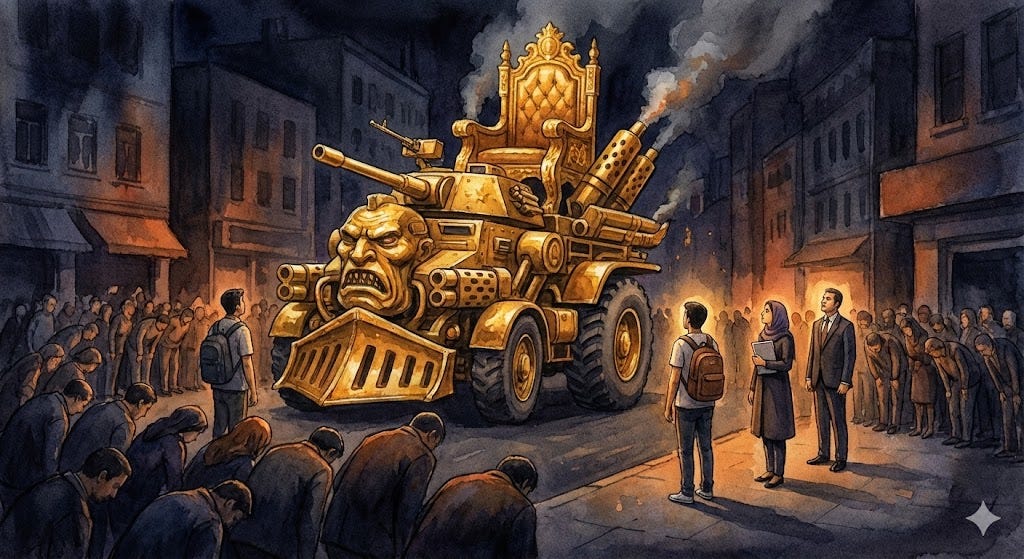
And the test is being administered with increasing brazenness.
Consider what the world has witnessed in recent months from the American regime alone:
The open discussion of annexing Greenland — a sovereign territory — as though colonialism were back in fashion.
The abduction of President Maduro and his wife and the ongoing threats against Venezuela, Columbia, Cuba, Mexico, Iran, Lebanon and more.
The abandonment of all pretence of “international law” — a concept invoked only when convenient, discarded the moment it constrains.
The ICE raids that terrorise communities, that break down doors, that kill mothers and call them terrorists.
The parading of cruelty as strength.
The celebration of brutality as policy.
This is not hidden.
This is broadcast.
This is boasted.
And the Tamhis operates through it.
Because every act of brazen injustice forces a choice.
You can watch the powerful trample the weak and say:
“This is the way of the world.
I will align myself with power.”
Or you can watch and say:
“This is abomination.
And though I am weak, I will not lend my consent.”
The students who built encampments on university lawns, who faced arrest and suspension and smear campaigns — they were being sifted.
The journalists who reported the truth and lost their jobs — they were being sifted.
The politicians who broke ranks, who named the genocide, who refused to vote for more weapons — they were being sifted.
The federal prosecutors in Minnesota who resigned rather than participate in the cover-up of Renee Nicole Good’s killing — they were being sifted.
And those who failed the test — the columnists who called for “proportionality” in the murder of children, the academics who signed letters defending the indefensible, the celebrities who posted black squares for one cause and stayed silent for another — they too were being sifted.
Their inner states were revealed.
The Purpose of Acceleration
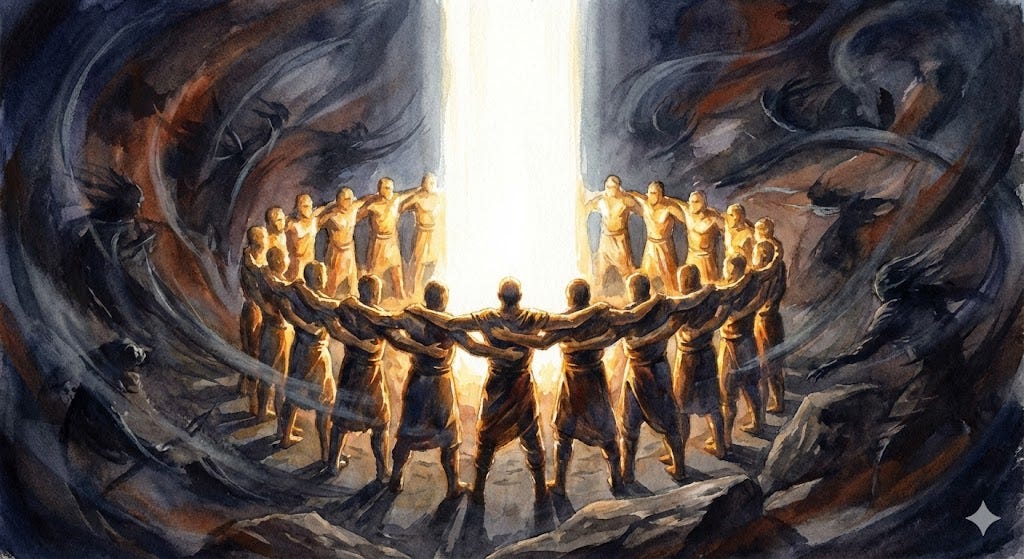
Why now?
Why this concentration of trials — pandemic, genocide, assassinations, economic collapse, open threats against the leadership of the Resistance — in such a compressed span of time?
Shaykh Alireza Panahian offers an answer:
ظهور اتفاق نخواهد افتاد مگر اینکه غربال نهایی صورت بگیرد. غربال آخرالزمان، غربال بسیار دقیقی است. در این غربال، منافقین پنهان که در ظاهر بسیار متدین و انقلابی هستند، رسوا میشوند. فلسفه غیبت این است که یاران حضرت باید چنان خالص شوند که دیگر امکان خیانت وجود نداشته باشد. تاریخ تکرار نخواهد شد؛ این بار علی (ع) تنها نمیماند.
“The Reappearance will not occur unless the Final Sifting takes place. The Sifting of the End Times is an extremely precise sifting. In this process, the hidden hypocrites — who outwardly appear very religious and revolutionary — will be disgraced and exposed. The philosophy of the Occultation is that the companions of His Eminence must become so pure that the possibility of betrayal no longer exists. History will not repeat itself; this time, Ali will not remain alone.”
— Shaykh Alireza Panahian, Lecture on “The Philosophy of the Procrastination of the Reappearance”
This time, Ali will not remain alone.
This is the purpose of all of it.
The Imam will not return to a world of sleepwalkers.
He will not return to companions who will abandon him at Siffin, who will negotiate behind his back at Nahrawan, who will fail him as so many failed his father and grandfather.
He will return to a people who have been tested — tested by confusion, tested by hardship, tested by the murder of their leaders, tested by the mockery of the world — and who remained.
The sifting is not cruelty.
It is mercy.
It is the mercy of being given the chance to prove, before the Imam arrives, that we are worthy of standing in his ranks.
The Tamhis does not require belief in the Imam to operate.
It is a universal law.
It operates on all of humanity.
And in this moment, it is operating with an intensity that has not been seen in generations.
Those who chose truth, even when truth cost them everything — these will be his helpers.
Those who chose comfort, even when comfort required complicity — these will find that their choice has been recorded.
The sifting will have already answered who is who.
And on the day the Imam calls, the ranks will already be formed.
A Clarification: Numbers Do Not Equal Truth
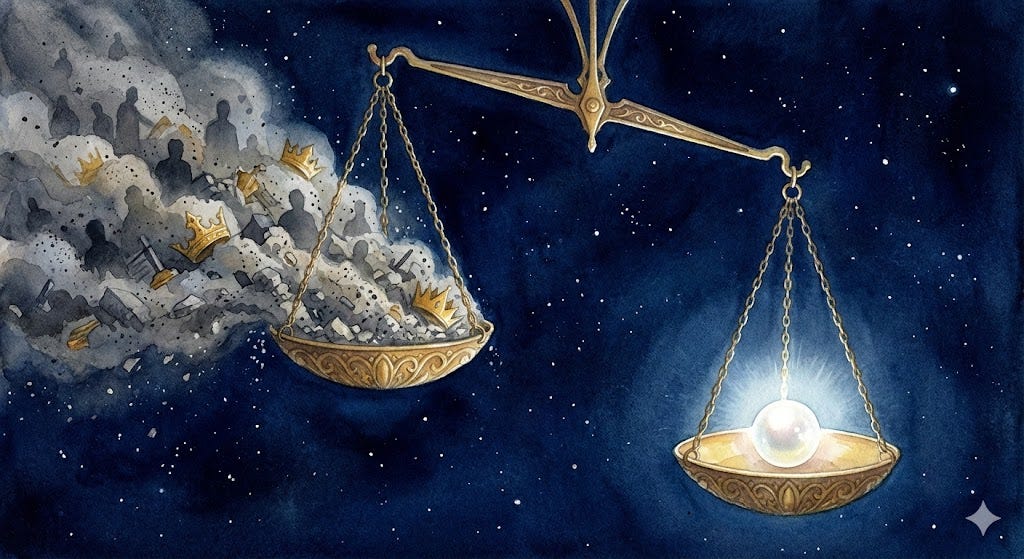
And here a clarification must be made for the modern mind, which is addicted to democracy and majority opinion.
The Tamhis is not a popularity contest.
The Quran never promised that the truth would be followed by the majority.
In fact, it promised the opposite:
وَإِن تُطِعْ أَكْثَرَ مَن فِى ٱلْأَرْضِ يُضِلُّوكَ عَن سَبِيلِ ٱللَّهِ
“And if you obey most of those on earth, they will lead you astray from the way of God.”
— Quran, Surah Al-An’am (the Chapter of the Cattle) #6, Verse 116
In 342 AH, when Al-Nu’mani surveyed the community, the majority had left.
The majority had succumbed to Hayrah.
The majority had decided that the Occultation was too long, too confusing, too demanding.
And the minority — the remnant, the steadfast — preserved the truth.
This is a pattern that repeats throughout sacred history.
Noah preached for 950 years.
How many boarded the Ark?
A handful.
Abraham stood against the idolaters.
How many stood with him?
Almost none.
Imam Husayn rode to Karbala.
How many accompanied him?
Seventy-two.
The truth has never been determined by a show of hands.
The truth is determined by alignment with the Divine Will — even if that alignment leaves you standing alone.
The one who abandons the path because “everyone is leaving” has failed the Tamhis.
The one who remains on the path because it is true, regardless of who else remains — this one has passed.
A Foreshadowing: The Question of Banners
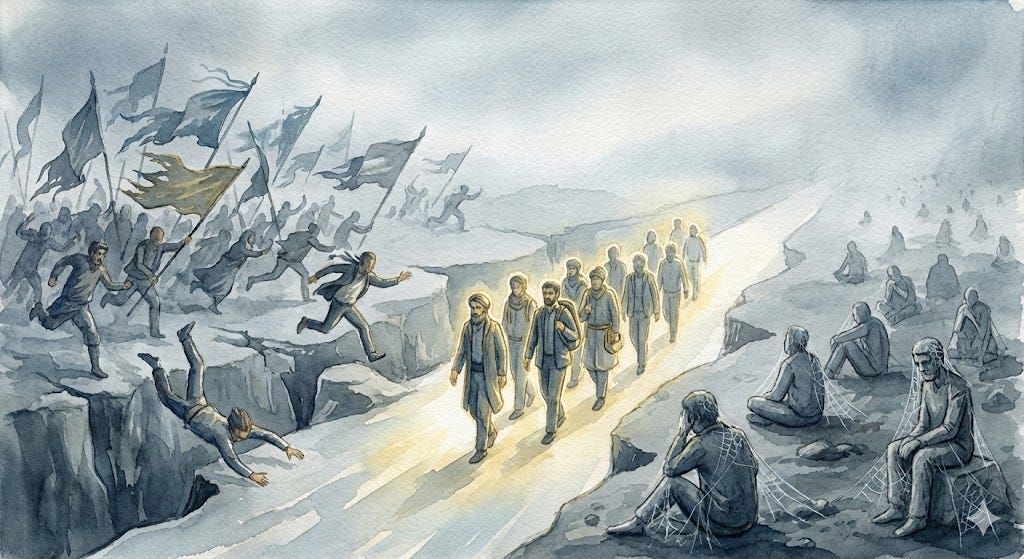
Mansur al-Sayqal — the same trustworthy narrator who transmitted the Sifting hadith — also narrated another tradition. One that has caused great confusion across the centuries.
It speaks of “banners” raised before the Qa’im, and warns against following them.
Some have read this as a prohibition against any Islamic governance during the Occultation — a command to sit and wait passively until the Imam appears.
They are wrong.
But that discussion belongs to a later session, when we examine the divergent paths the community took in response to the Great Silence — the paths of uprising, the paths of quietism, and the narrow road between them.
For now, it is enough to note: the same narrator who warned us about the Sifting also warned us about false banners. Both warnings serve the same purpose — to keep the believer on the Middle Cushion, neither rushing ahead nor falling behind.
The Sifting removes the uncommitted.
The Banner warning removes the reckless.
What remains is the gold.
From Furnace to Fortress
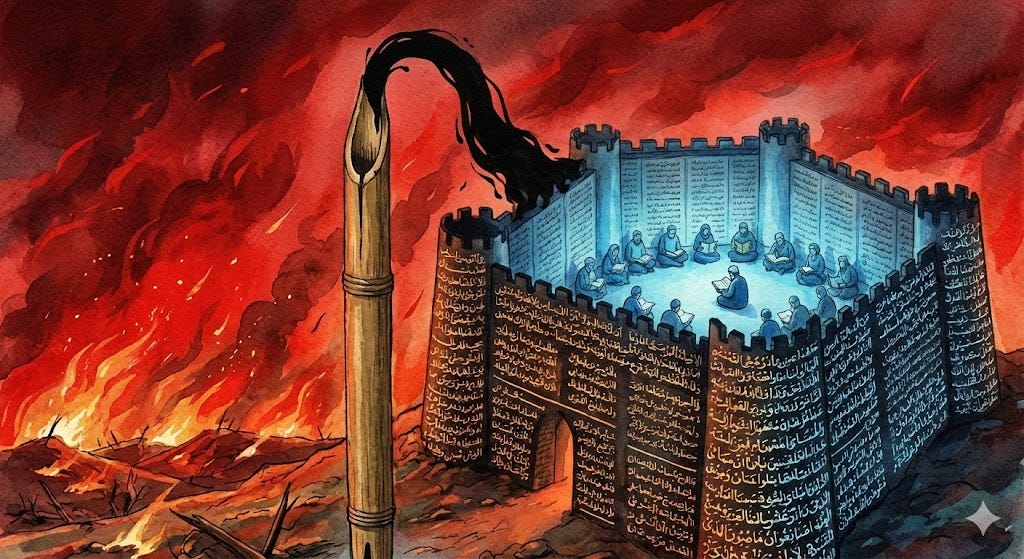
But the sifting is only half the story.
The furnace separates — it burns away the dross, it reveals who will stand and who will flee.
Yet separation alone does not preserve.
A community can be purified down to its most committed core and still perish — if that core has nothing to hold onto, nothing to transmit, nothing to teach the next generation.
The martyrs of Gaza die with La ilaha illallah (the is no god, except The God) on their lips.
But who taught them those words?
Who preserved the meaning behind them?
Who ensured that the chain of knowledge stretched unbroken from the lips of the Prophet to the rubble of Jabalia?
The Tamhis creates the survivors.
But the survivors need a fortress — a structure of knowledge, a preserved inheritance, a compiled wisdom that can outlast any individual life.
And so we turn now from the fire to the ink — from those who passed the test in blood to those who ensured the test could continue to be administered across the centuries.
For the pen, too, is a weapon in this war.
And in the darkest hour of the Occultation, it was the pen that saved the religion.
The Intellectual Rescue — The Pen as the Saviour
The Crisis and the Response
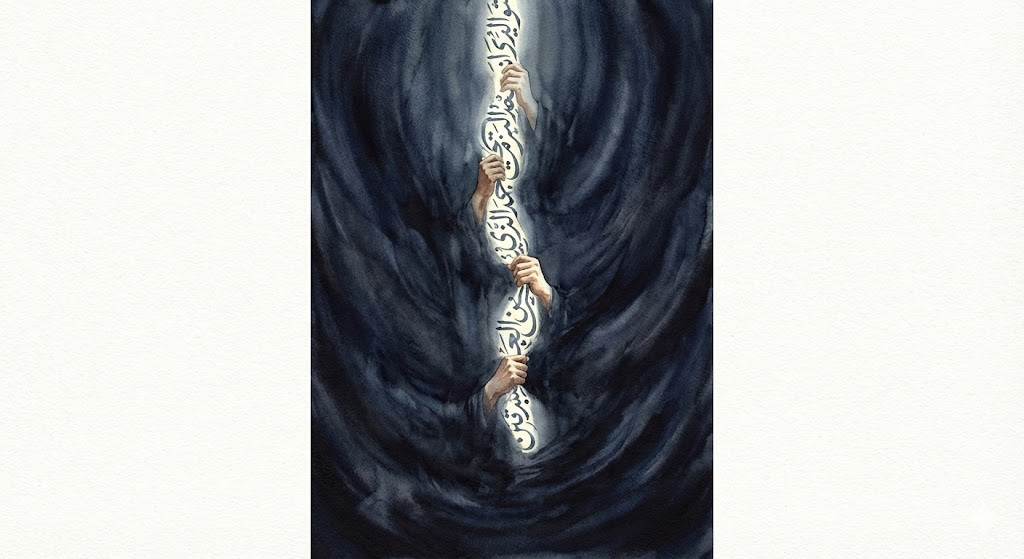
We have established the crisis (Hayrah).
We have explained the purpose (Tamhis).
Now we must examine the survival.
How did the community endure?
The Imam was hidden.
The Deputies were gone.
The hypocrites had fled.
The sincere remained — but what did they hold onto?
They held onto the Text.
When the living voice was silenced, the written word became the lifeline.
And a generation of scholars rose to the occasion, understanding that their task was nothing less than the preservation of the religion itself.
The Historical Pivot: From Mouth to Page
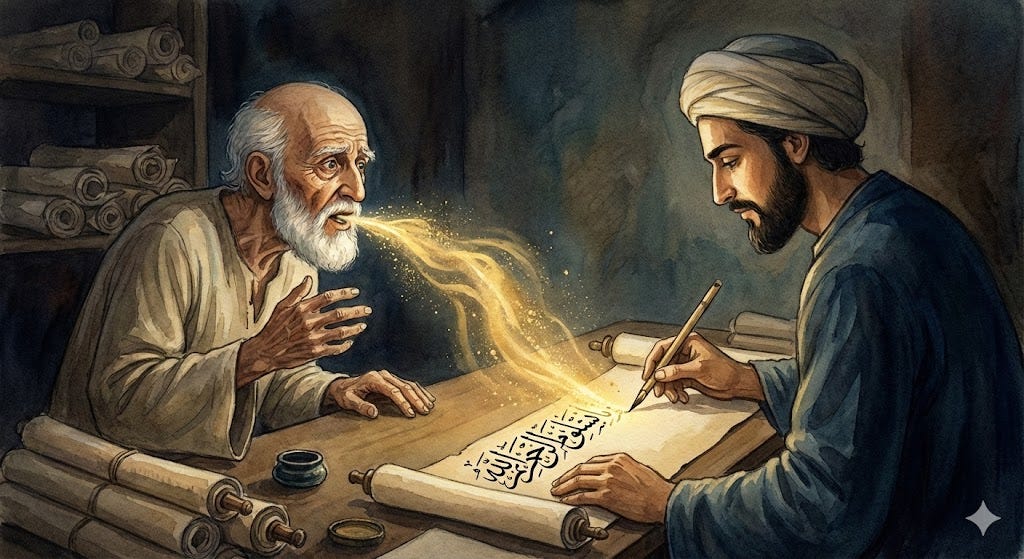
By 350 AH — just two decades after the Major Occultation began — the community faced an existential crisis that compounded the theological one.
The Oral Tradition was dying.
For generations, the transmission of knowledge had been personal.
A student would sit before a Shaykh who had sat before another Shaykh who had heard the words from the lips of the Imam himself.
The chain was living.
The knowledge passed from heart to heart, breath to breath.
But now the direct witnesses were dying.
The companions who had seen Imam al-Askari, who had met the Hidden Imam in his childhood, who had received letters from the Deputies — these men were old.
They were passing away.
And with each death, a link in the chain was severed.
The scholars understood: if they did not act, the words of the Imams would die with the generation that had heard them.
They had to — if we may use a modern metaphor — digitise the Imam.
They had to transfer the living tradition into a form that could survive the death of its carriers.
They had to write.
The Dream of Shaykh Saduq
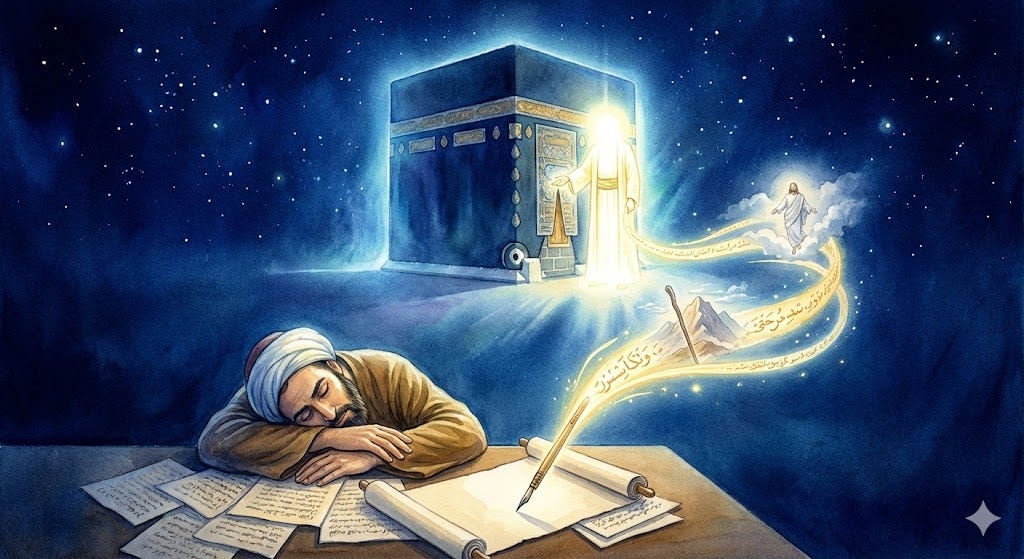
Among these scholars, none stands taller than Abu Ja’far Muhammad ibn Ali ibn Babawayh — known to history as Shaykh al-Saduq.
Born around 305 AH, he lived through the transition.
He witnessed the closing of the gates.
He saw the community fracture.
And he responded with the pen.
His masterwork, Kamal al-Din wa Tamam al-Ni’ma (The Perfection of Religion and the Completion of Blessing), is one of the foundational texts of Mahdism — a comprehensive encyclopedia of proofs, narrations, and arguments for the existence and occultation of the Twelfth Imam.
But the origin of this book is itself a proof of the Imam’s continued care for his community.
Shaykh Saduq had travelled to Nishapur and found the Shia there drowning in confusion about the Ghaybah.
The questions were endless.
The doubts were spreading.
The scholar himself was weighed down by sorrow — separated from his family, surrounded by a community in crisis.
And then, in a dream, he received his mission.
He records in his introduction:
فبينا أنا ذات ليلة أفكر فيما خلفت ورائي من أهل وولد... إذ غلبني النوم فرأيت كأني بمكة... ورأيت القائم (عليه السلام) واقفاً بباب الكعبة...
فقال لي: لِمَ لا تصنّف كتاباً في الغيبة حتى تكفى ما قد همّك؟
فقلت: يا ابن رسول الله، قد صنّفت في ذلك أشياء.
فقال (عليه السلام): ليس على ذلك السبيل، صَنِّفْ الآنَ كتاباً في الغيبة واذكر فيه غيبات الأنبياء (عليهم السلام)...
“While I was reflecting one night on the family and children I had left behind [in Rayy]... sleep overcame me. I saw myself in Makkah... and I saw the Qa’im (peace be upon him) standing at the door of the Ka’bah...
He said to me: ‘Why do you not compile a book concerning the Occultation, so that your distress may be relieved?’
I said: ‘O Son of the Messenger of God, I have already compiled works on that.’
He (peace be upon him) replied: ‘Not in that manner. Compile now a book on the Occultation and mention within it the occultations of the Prophets (peace be upon them)...’”
— Al-Saduq, Kamal al-Din wa Tamam al-Ni’ma, Author’s Introduction, Pages 3-4
The Imam himself — in a vision — commanded the scholar to write.
Not to wait passively.
Not to mourn endlessly.
But to write.
And notice the instruction:
“Mention within it the occultations of the Prophets.”
This was the key insight that would stabilise the community.
The Occultation was not an anomaly.
It was not a failure.
It was not evidence that something had gone wrong.
It was a Sunnah — a divine pattern repeated throughout sacred history.
Moses disappeared from his people for forty days, and they made a calf.
Jesus was raised to heaven, hidden from his community for two thousand years and counting.
The Prophets themselves experienced Ghaybah.
And when Shaykh Saduq documented this — when he laid out the evidence, narration after narration, proof after proof — he gave the bewildered believer something to hold onto.
This has happened before.
This is part of the pattern.
You are not abandoned — you are being tested, as every community before you was tested.
The book rationalised the Ghaybah for the masses.
It transformed confusion into comprehension.
The Software of the Civilisation
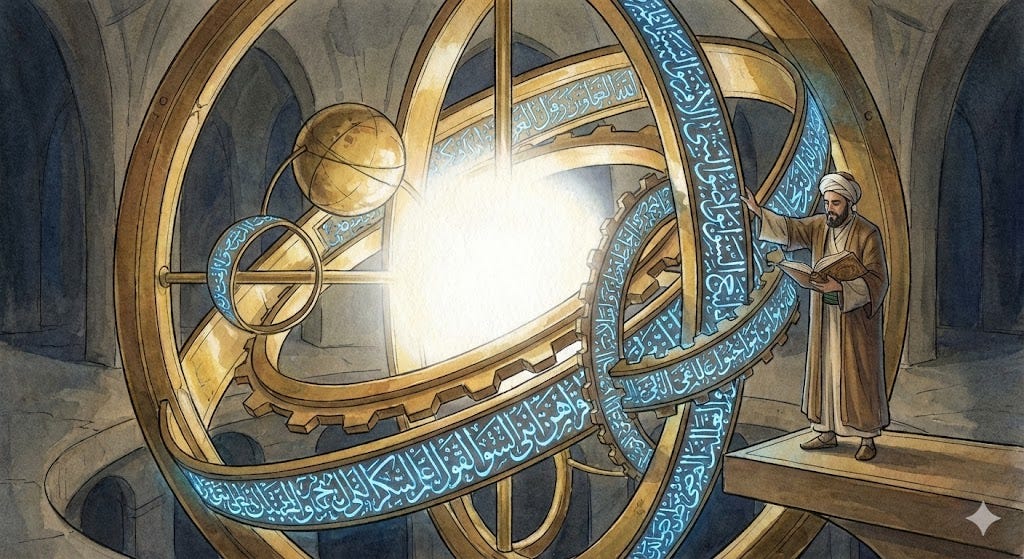
Ayatullah Misbah-Yazdi, one of the most rigorous philosophical minds of the contemporary Hawza, offered a striking metaphor for what these scholars achieved:
He distinguished between the Hardware and Software of any system:
تمدن دارای دو بخش است: بخش سختافزاری که شامل صنعت، تکنولوژی و پیشرفتهای مادی است، و بخش نرمافزاری که شامل فرهنگ، سبک زندگی و اعتقادات است. ما در بخش سختافزاری ممکن است از دیگران بیاموزیم، اما در بخش نرمافزاری که روح تمدن است، باید تولیدکننده باشیم نه مصرفکننده. اگر نرمافزار (فرهنگ) فاسد شود، سختافزار (تکنولوژی) به ابزاری برای نابودی بشر تبدیل میشود.
“Civilisation consists of two parts: The Hardware (Sakht-afzar) section, which includes industry, technology, and material advancements; and the Software (Narm-afzar) section, which includes culture, lifestyle, and beliefs. We may learn from others in the hardware section, but in the Software section — which is the soul of civilisation — we must be producers, not consumers. If the Software (culture) becomes corrupt, the Hardware (technology) turns into a tool for the destruction of humanity.”
— Ayatullah Misbah Yazdi, Rahbord-ha-ye Ehya-ye Tamaddon-e Eslami (Strategies for Reviving Islamic Civilisation)
But Ayatullah Misbah-Yazdi extends this framework directly to the question of the Occultation:
در زمان غیبت که دست ما از دامان امام معصوم کوتاه است (نبودِ حضور فیزیکی)، اسلام تعطیلبردار نیست. ما باید به «قانون» و «علم» رجوع کنیم. فقیه کسی است که تخصص در شناخت این نرمافزار الهی (احکام و معارف) دارد و آن را در جامعه پیاده میکند. اطاعت از فقیه، اطاعت از همان نرمافزاری است که امام برای اداره جامعه طراحی کرده است.
“In the era of Occultation, when our hands are cut off from the hem of the Infallible Imam (absence of physical presence), Islam does not cease to function. We must refer to the ‘Law’ and ‘Knowledge.’ The Jurist (Faqih) is the one who specialises in recognising this Divine Software (Laws and Teachings) and implementing it in society. Obedience to the Faqih is obedience to that very Software which the Imam designed for the administration of society.”
— Ayatollah Misbah Yazdi, Negahi Gozara be Nazariye-ye Wilayat-e Faqih (A Passing Glance at the Theory of Wilayat al-Faqih), Chapter 2
A clarification is necessary here, lest the metaphor be misunderstood.
When we speak of “Software,” we do not mean a static programme that runs the same way forever — a fixed code that merely executes pre-written commands.
The Divine Software is alive.
It contains principles that must be understood, extracted, and applied to circumstances the original texts never explicitly addressed.
The Imams did not issue rulings on cybersecurity, on bioethics, on the complexities of modern finance. Yet the principles they transmitted — when properly understood — contain within them the capacity to address these matters.
This is why the role of the Faqih is not merely to recite what was written, but to comprehend the underlying wisdom and extend it to new situations. He is not a tape recorder playing back ancient rulings. He is a physician who has mastered the medical tradition and can therefore diagnose diseases that did not exist when the textbooks were written.
The Software is not static. It is generative.
And this is what distinguishes the living tradition of Ijtihad from the dead letter of mere transmission.
“Our hands are cut off from the hem of the Infallible Imam.”
This is the reality of the Major Occultation stated without sentimentality.
The Hardware — the living, breathing, visible Imam who could be approached, questioned, embraced — is hidden.
Does the system crash?
No.
We switch to running entirely on the Divine Software: the books, the narrations, the compiled wisdom, the legal rulings, the ethical framework that the Imams left behind.
And the scholar’s role?
He is not the King.
He is not the replacement for the Imam — no one can replace the Imam.
He is the Chief Engineer.
He keeps the Software running.
He interprets it for the users.
He patches the bugs when deviants try to corrupt the code.
He ensures compatibility with the changing circumstances of each age.
The scholars who wrote Al-Kafi, who compiled Kamal al-Din, who built the Hawzas of Najaf and Qom — they were not seeking thrones.
They were maintaining the operating system that would run the Ummah until the Return.
The Quranic Mandate
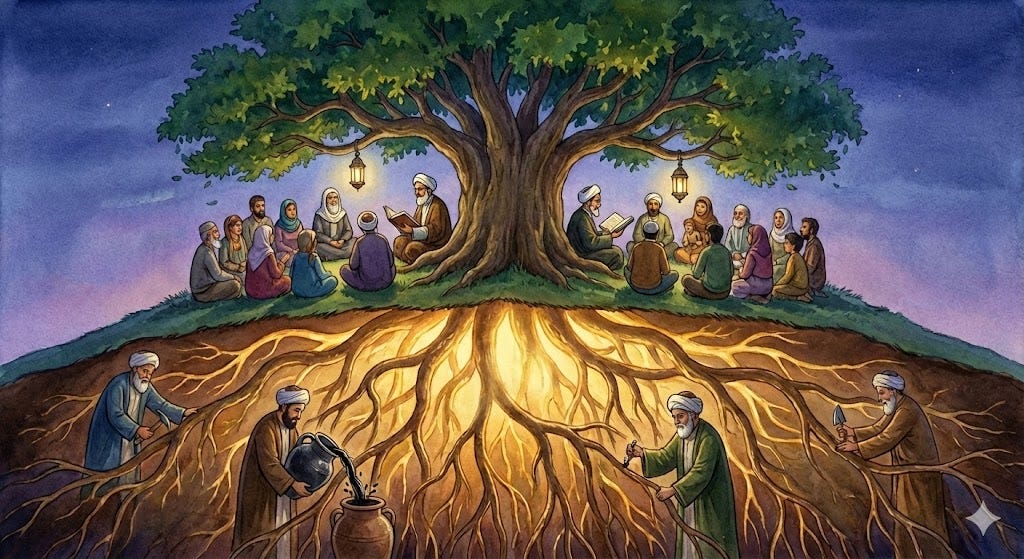
This role is not an innovation of the scholars.
It is a Quranic obligation:
وَمَا كَانَ ٱلْمُؤْمِنُونَ لِيَنفِرُوا۟ كَآفَّةً ۚ فَلَوْلَا نَفَرَ مِن كُلِّ فِرْقَةٍ مِّنْهُمْ طَآئِفَةٌ لِّيَتَفَقَّهُوا۟ فِى ٱلدِّينِ وَلِيُنذِرُوا۟ قَوْمَهُمْ إِذَا رَجَعُوٓا۟ إِلَيْهِمْ لَعَلَّهُمْ يَحْذَرُونَ
“Yet it is not for the faithful to go forth en masse. But why should not a company from every group of them go forth to become learned in religion (li-yatafaqqahu fi al-din), and to warn their people when they return to them, so that they may beware?”
— Quran, Surah At-Tawbah (the Chapter of the Repentance) #9, Verse 122
Allamah Tabatabai, in his monumental Al-Mizan, explains the scope of this verse:
الآية تدل على وجوب النفر للتفقه... ومعنى التفقه هو التفهم في جميع المعارف الدينية من أصولها وفروعها، لا خصوص الأحكام العملية كما هو اصطلاح المتأخرين. وهذا النفر مقدمة لهداية الجاهلين ولبقاء الدين.
“The verse indicates the obligation of ‘going forth’ for the sake of deep understanding (tafaqquh)... The meaning of tafaqquh is to comprehend all religious knowledge, from roots (Usul) to branches (Furu’), not merely practical laws as is the terminology of later scholars. This ‘going forth’ is a prerequisite for guiding the ignorant and for the survival of the Religion (Baqa’ al-Din).”
— Allamah Tabatabai, Al-Mizan fi Tafsir al-Quran, Volume 9, Page 404
The survival of the religion.
Baqa’ al-Din.
This is what was at stake in 329 AH.
And this is what the scholars secured — not through miracles, not through visions, but through the unglamorous, painstaking work of learning, writing, teaching, and transmitting.
A Clarification: The Trap of Anti-Intellectualism
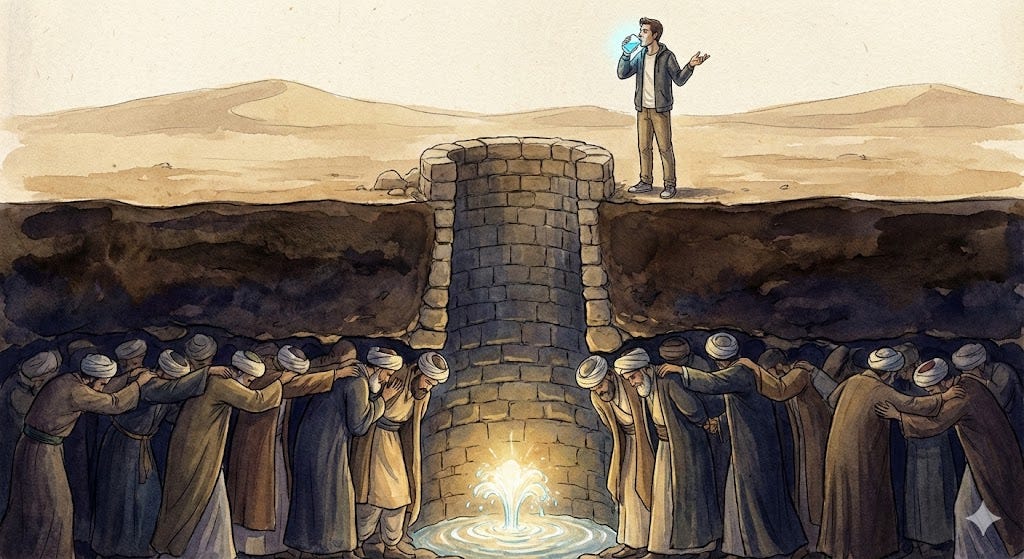
And here a clarification must be made — because in our own time, a strange deviation has emerged.
There are voices — online, in social media, in certain circles — who say:
“We don’t need scholars.
We just need the Hadith.
Give us the raw narrations, and we will interpret them ourselves.”
The impulse is understandable.
It sounds democratic.
It sounds pure.
It sounds like a return to authenticity.
It is, in fact, self-destruction.
For who preserved the Hadith?
The scholars.
Who travelled across deserts to hear a single narration from a dying Shaykh?
The scholars.
Who verified which narrations were authentic and which were fabrications planted by enemies?
The scholars.
Who built the institutions — the Hawzas, the libraries, the chains of transmission — that carried the Imam’s words across a thousand years of war, persecution, and exile?
The scholars.
To reject the scholarly tradition while claiming to follow the Hadith is to saw off the branch on which one sits.
Without Shaykh Al-Nu’mani, without Shaykh Al-Saduq, without Shaykh Al-Mufid, without Shaykh Al-Tusi, without Shaykh Al-Kulayni, without Allamah Majlisi, and countless others — without these men — who gave their lives to compile, verify, transmit and educate — we would have nothing.
No Kafi.
No Man La Yahduruhu al-Faqih.
No Tahdhib al-Ahkaam.
No Istibsar.
No Kamal al-Din.
No Bihar al-Anwar.
No access to the words of the Imams at all.
The Hadith did not fall from the sky.
It was carried to us in the hands of scholars.
And those who now reject the scholars while quoting the Hadith are drinking from a well while cursing the men who dug it.
The Intellect as Guardian

Allamah Tabatabai articulated the principle that underlies the entire Qom school:
فالعقل من إحدى الحجج الإلهية، وهو الذي يميز الحق من الباطل في المعارف الكلية... ولا يجوز إبطال حكم العقل بنقل، فإن النقل إنما يثبت صدقه بالعقل.
“The Intellect (Aql) is one of the Divine Proofs (Hujjah). It is that which distinguishes Truth from Falsehood in universal knowledge... It is not permissible to invalidate the judgment of the Intellect using a Narrated Text (Naql), for the veracity of the Narrated Text is only established via the Intellect.”
— Allamah Tabatabai, Al-Mizan fi Tafsir al-Quran, Volume 5, Page 255
This is the heart of the matter.
We do not use the intellect against the text.
We use the intellect to verify the text, to understand the text, to apply the text.
How do you know a narration is authentic?
Through rational evaluation of the chain.
How do you know a text is not corrupted?
Through intellectual comparison with other texts.
How do you know which ruling applies to your situation?
Through reasoned analysis of principles.
The intellect is not the enemy of revelation.
It is its guardian.
Those who reject this method in the name of “purity” do not realise that without the intellect, they cannot even know which texts are pure.
We will return to this tension — between the way of pure transmission and the way of reasoned engagement — in a dedicated session.
It is one of the defining debates of the Occultation era, and it continues to this day.
For now, the lesson is this:
The antidote to confusion is not emotion.
It is literacy.
The scholars who saved the religion did not do so by weeping louder than others.
They did so by knowing, understanding and applying more — and by ensuring that knowledge survived.
And this is also our task, our duty, and that of every person who years for the return of the Awaited Master, may our souls be his ransom.
We must make available the works of the great scholars, to educate the people, to ensure that people can get through the Tamhis, the great sifting, and above all to ensure that there is a cadre of people that are ready for the return of the Master of the Age, may our souls be his ransom, and may God hasten his return.
Conclusion: The Wheat That Remained
The Arc of Survival
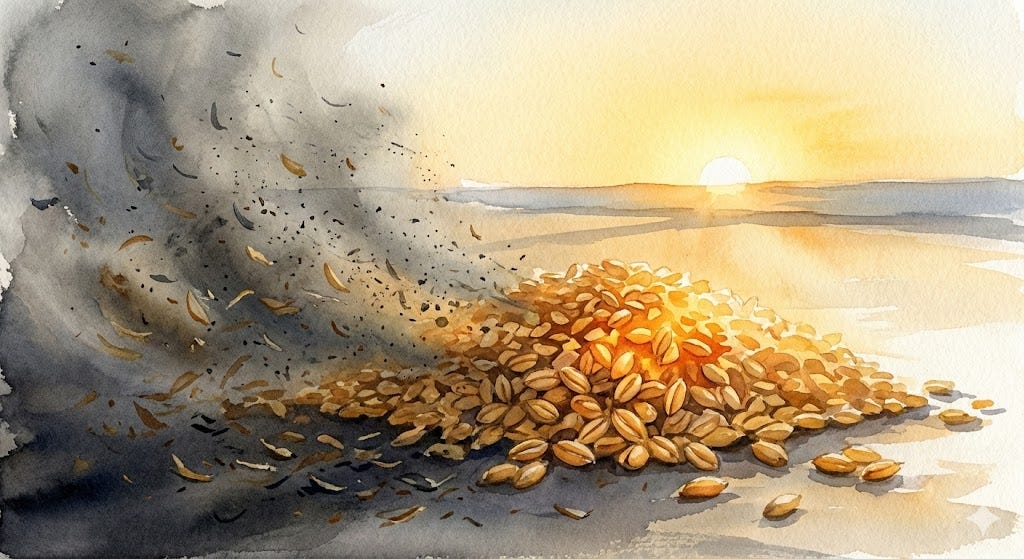
Let us now gather the threads of what we have examined.
The Crisis
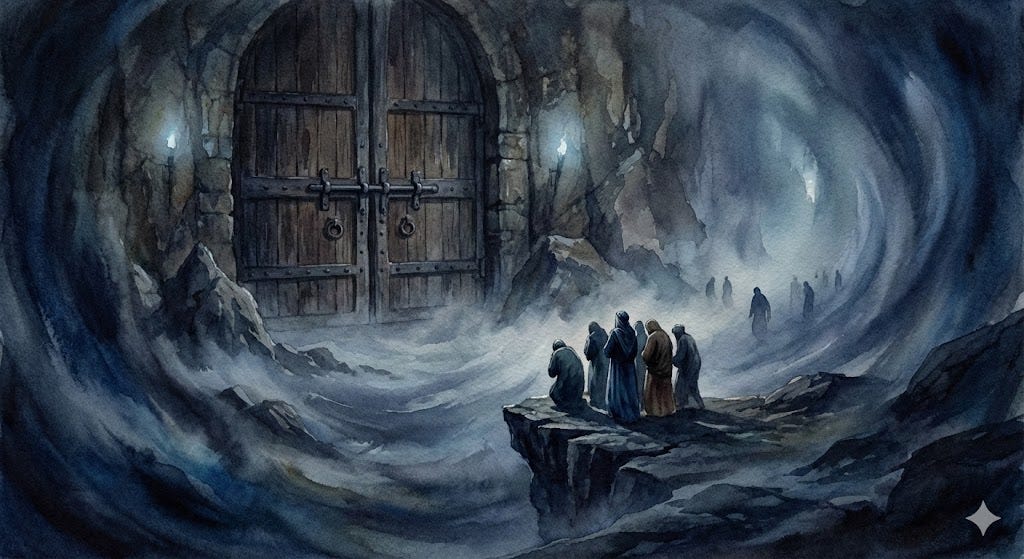
In 329 AH, the gates closed.
The community was plunged into Hayrah — a spiritual vertigo, a darkness of the soul.
The living connection to the Imam was severed.
The Deputies were gone.
The hypocrites fled.
The weak-hearted apostatised.
And those who remained stood bewildered in a silence that stretched toward an unknown horizon.
The Purpose
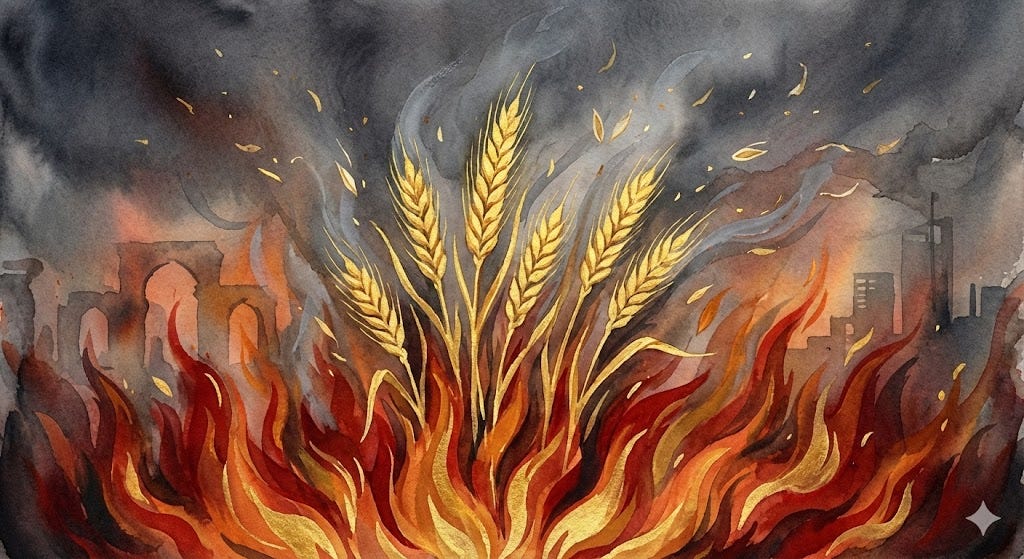
But the silence was not abandonment.
It was Tamhis — the Divine Sifting that God has decreed for every community that claims to follow the truth.
The furnace was lit not to destroy, but to purify.
The wheat was thrown into the sieve not to be lost, but to be separated from the chaff.
And across the centuries — from 329 AH to this very moment — the sifting has never stopped.
It burns in Gaza.
It burns in Lebanon.
It burns in the sanctions and the assassinations and the threats against the Wali.
It burns in the hearts of those who must choose, again and again, between comfort and truth.
The Rescue
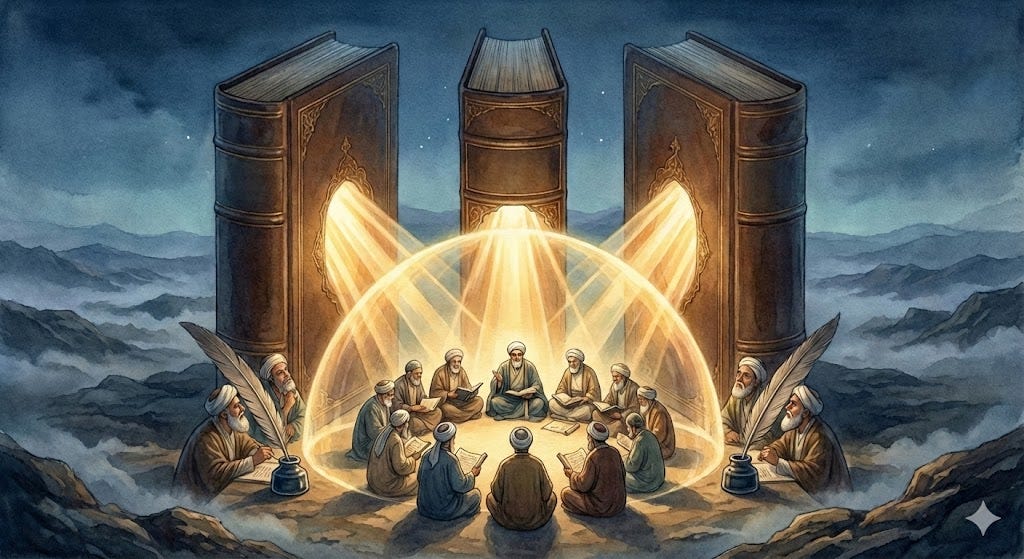
And in the midst of the fire, a generation of scholars rose — not with swords, but with pens.
They understood that the living voice had fallen silent, and so the written word must carry what the voice could no longer speak.
They compiled.
They verified.
They transmitted.
They built the Divine Software that would run the Ummah for a thousand years.
Shaykh Al-Saduq saw the Imam in a dream and was commanded to write.
And he wrote.
And because he wrote, we have Kamal al-Din.
And because Shaykh Al-Nu’mani wrote, we have Kitab al-Ghaybah.
And because Shaykh Al-Kulayni wrote, we have Al-Kafi.
And because they all wrote, we have a religion.
The Two Weighty Things
To understand the magnitude of what these scholars preserved, we must return to what the Prophet himself declared he was leaving behind.
اَلنَّبِيُّ صَلَّى اللهُ عَلَيْهِ وَآلِهِ قَالَ: إِنِّي تَارِكٌ فِيكُمُ الثَّقَلَيْنِ: كِتَابَ اللهِ وَعِتْرَتِي أَهْلَ بَيْتِي، مَا إِنْ تَمَسَّكْتُمْ بِهِمَا لَنْ تَضِلُّوا بَعْدِي أَبَدًا، وَإِنَّهُمَا لَنْ يَفْتَرِقَا حَتَّى يَرِدَا عَلَيَّ الْحَوْضَ
The Prophet (peace and blessings be upon him and his family) said: “I am leaving among you two weighty things (Thaqalayn): the Book of God and my progeny, my Ahl al-Bayt. As long as you hold fast to them, you will never go astray after me, ever. And indeed, they will never separate from one another until they come to me at the Pond (of Kawthar).”
— Al-Kulayni, Al-Kafi, Volume 1, Page 294
— Al-Saduq, Uyun Akhbar al-Ridha, Volume 1, Page 212
— Al-Majlisi, Bihar al-Anwar, Volume 23
Two weighty things.
Not one.
Two.
The Book of God — the Quran — and the Ahl al-Bayt.
The Prophet did not say:
“Hold fast to the Quran alone.”
He said:
“Hold fast to them both.”
And he warned:
“They will never separate from one another.”
The Quran without the Ahl al-Bayt is half a religion.
The Ahl al-Bayt without the Quran is half a religion.
Only together do they form the complete guidance that protects from misguidance.
Allamah al-Hilli, one of the greatest classical Imami theologians, explains the implication:
قال العلّامة الحلّي في الاستدلال بحديث الثقلين على لزوم اتّباع أهل البيت عليهم السلام:
فهذا يدلّ على أنّ التمسّك في الدِّين إنّما هو بالكتاب والعترة معاً، وأنّهما معاً أصلُ الهداية بعد النبيّ صلى الله عليه وآله، ومن خالفهما فقد ضلّ عن الصراط المستقيم
“This indicates that holding fast in religion is only by means of the Book and the Itrah (progeny) together, and that they both together are the foundation of guidance after the Prophet (peace be upon him and his family). Whoever opposes them has strayed from the straight path.”
— Allamah al-Hilli, Nahj al-Haqq wa Kashf al-Sidq (The Way of Truth and the Unveiling of Veracity), Pages 255-256
The Book and the Itrah together are the foundation of guidance.
Now consider what the Major Occultation meant.
The Quran remained.
It was written.
It was preserved.
It could be read, memorised, recited.
But what of the Ahl al-Bayt?
The Twelfth Imam was hidden.
The Deputies were gone.
The living voice that had interpreted, explained, and applied the Quran for three centuries had fallen silent.
If nothing was done, the Ummah would be left with only half of what the Prophet had commanded them to hold onto.
The Quran would remain — but its authoritative interpretation through the Ahl al-Bayt would be lost.
The words would survive — but the meaning would perish.
The Scholars as Preservers of the Second Thiqal (Weighty Thing)
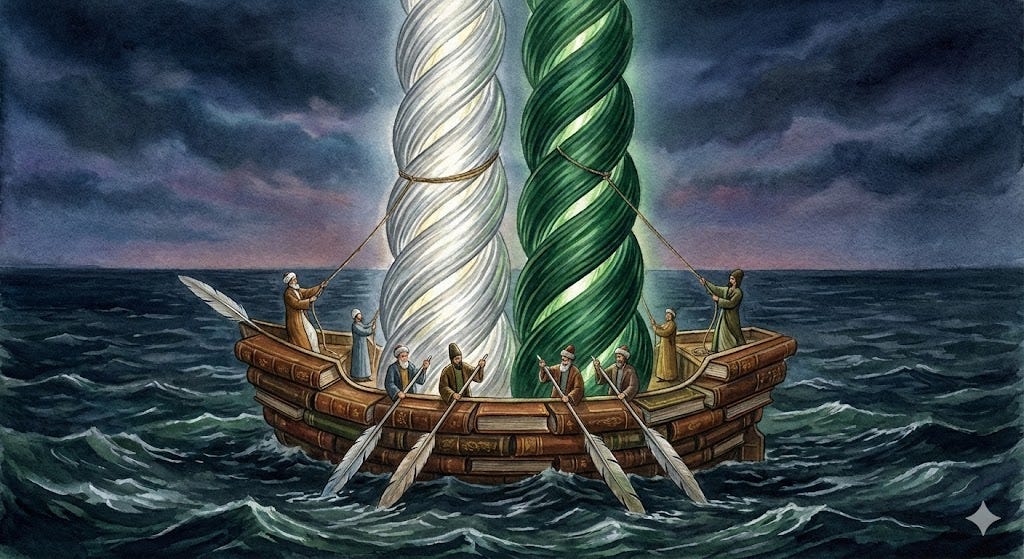
This is what the scholars understood.
This is why they wrote.
They were not merely producing books.
They were preserving the second Thiqal — the teachings, the narrations, the jurisprudence, the theology, the ethics that the Imams had transmitted across three centuries.
Al-Majlisi, the compiler of the largest Shia encyclopedia, states this explicitly:
قال العلّامة المجلسي في شرح حديث الثقلين:
فثبت أنّ مصدرَ المعرفة بالدِّين وشريعة سيّد المرسلين إنّما هو القرآنُ الكريم وأهلُ البيت عليهم السلام، ومن عدل عنهما فقد ضلّ وغوى
“Thus it is established that the source of knowledge of religion and the law of the Master of the Messengers is only the Noble Quran and Ahl al-Bayt (peace be upon them), and whoever turns away from them has gone astray and is ruined.”
— Al-Majlisi, Bihar al-Anwar, Volume 23, Pages 105-106
The source of knowledge of religion is only the Quran and Ahl al-Bayt.
When Shaykh Al-Kulayni compiled Al-Kafi, he was not writing a book.
He was bottling the voice of the Imams so that it could speak across the centuries.
When Shaykh Al-Saduq compiled Man La Yahduruhu al-Faqih, he was not producing an academic exercise.
He was ensuring that the legal rulings of the Ahl al-Bayt would survive the silence.
When Shaykh Al-Tusi compiled Tahdhib al-Ahkam and Al-Istibsar, he was not seeking scholarly prestige.
He was building an ark to carry the second Thaqal through the flood of the Occultation.
Al-Hurr al-Ameli, after collecting these narrations, summarised their significance:
قال الشيخ الحرّ العاملي بعد إيراده لأحاديث الثقلين:
فهذه الأخبار المتواترة تدلّ بأوضح دلالة على أنّ المرجع في أحكام الشريعة ومعارف الدِّين هو كتابُ الله تعالى وعترةُ نبيّه صلى الله عليه وآله، ومن أخذ الدِّين من غيرهما فقد خالف أمرَه، وعرّض نفسه للضلال والهلاك
“These mutawatir reports indicate with the clearest indication that the reference in the rulings of the Shari’ah and the knowledges of religion is the Book of God, exalted is He, and the Itrah of His Prophet (peace be upon him and his family). Whoever takes religion from other than them has opposed His command and exposed himself to misguidance and destruction.”
— Al-Hurr al-Ameli, Wasa’il al-Shia, Volume 27, Bab al-Akhdh bi’l-Kitab wa’l-Itrah
Whoever takes religion from other than them has opposed His command.
This is what was at stake.
This is what the scholars saved.
Without them, we would have the Quran — but we would have lost the interpretive key that unlocks it.
Without them, we would have half a religion — and a half-religion cannot guide.
The Prophet said:
“They will never separate.”
The scholars ensured they did not.
They bound the words of the Imams to paper so that the two Thiqals would remain united — accessible, transmittable, alive — until the Imam returns to speak once more in his own voice.
The Fortress of Knowledge
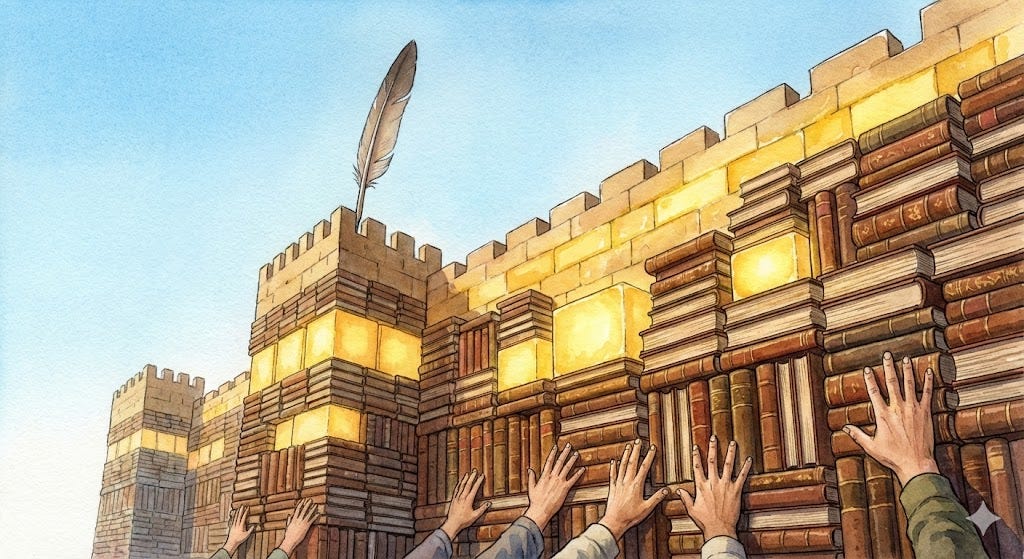
The antidote to confusion was not emotion.
It was literacy.
The antidote to despair was not sentiment.
It was scholarship.
The fortress held — not because its walls were made of passion, but because they were made of knowledge.
And we who recite those narrations today, who study that fiqh, who build our theology on those foundations — we are the beneficiaries of men who understood that the pen, in the right hands, is mightier than any sword.
They saved the religion.
They preserved the Thiqal.
And because of them, when we reach for the teachings of the Ahl al-Bayt, our hands do not grasp at empty air.
The Identity We Carry
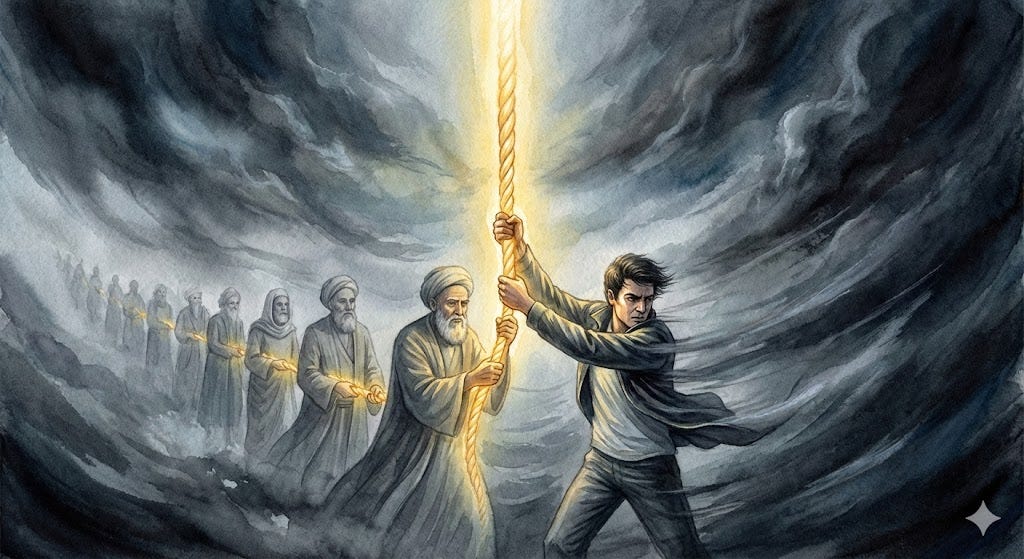
And so we must understand who we are.
We are not “Twelvers” by accident.
We are not “Shia” by inheritance alone.
We are the survivors of the Sifting.
We are the descendants of those who did not leave when the majority left.
We are the heirs of those who gripped the rope when the wind howled and the chaff scattered across the desert.
We are the wheat that remained in the sieve when history shook it with all its fury.
This is not arrogance.
This is responsibility.
For if we are the survivors, then we carry within us the trust that was preserved through blood and ink and exile and patience.
And that trust demands something of us.
It demands that we, too, pass the Tamhis of our age.
It demands that we, too, choose truth over comfort when the choice is placed before us.
It demands that we, too, become literate — not merely in the rituals, but in the knowledge that the scholars died to preserve.
The sifting has not ended.
It has only changed form.
And the question that faced the believers of 329 AH is the same question that faces us now:
When the test comes — and it is coming — what will you choose?
The Question That Remains
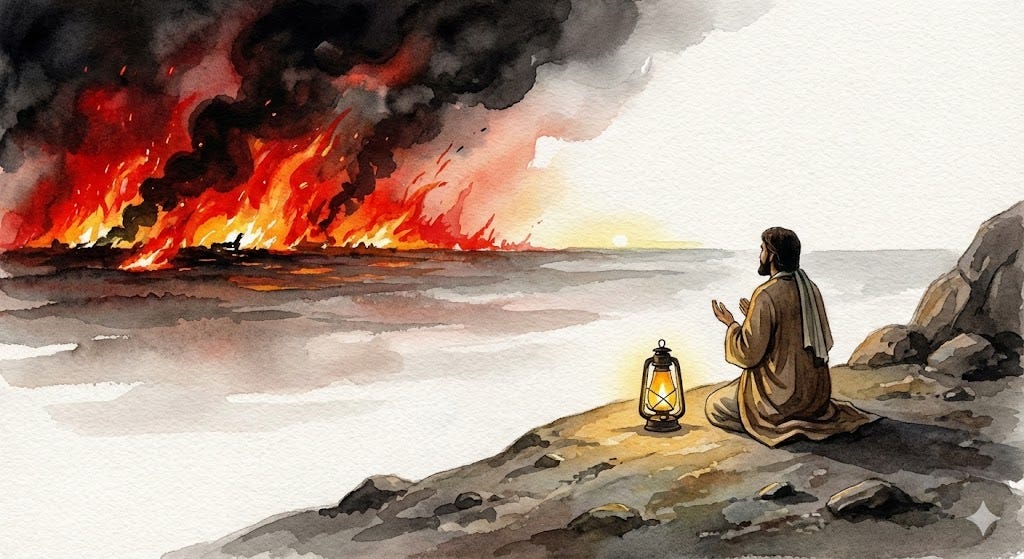
But there is a question we have not yet answered.
We have spoken of how the community survived — through patience, through scholarship, through the preservation of the Text.
But we have not yet spoken of how they lived.
What did the Twelvers do while they waited?
For they were not the only ones responding to the crisis of the Occultation.
Others responded differently.
The Zaydis raised banners.
They established states by the sword in Yemen and Tabaristan.
They promised immediate justice, immediate victory, immediate satisfaction for the grievances of the oppressed.
The Ismailis went further.
The Qarmatians — a branch of the Ismaili movement — attacked Makkah itself, slaughtered pilgrims in the sanctuary, and stole the Black Stone from the Ka’bah.
They declared that the age of waiting was over, that the Mahdi had come, that the revolution was now.
And what did the Twelvers do?
They watched.
They waited.
They were called cowards.
They were called quietists.
They were accused of abandoning the struggle, of making peace with oppression, of betraying the legacy of Imam Husayn.
Were these accusations true?
Or was there a deeper wisdom — a strategy that the impatient could not see?
This is the question we will take up in the next session:
The World in Fire — The Geopolitics of Waiting.
We will examine the “false dawns” — the movements that promised immediate victory and delivered only ashes.
We will re-examine Taqiyyah — not as cowardice, but as the security protocol of a community under siege.
And we will define Intidhaar — the Waiting — not as passivity, but as the most active form of faith.
For the Occultation is not a pause button on Islam.
It is a different mode of operation.
And those who understood that mode survived.
Those who did not — no matter how sincere, no matter how brave — burned themselves out in the fires they themselves had lit.
Let us pause here.
Let the weight of what we have discussed settle.
For we have spoken of furnaces and sifting, of apostasy and steadfastness, of scholars who saved a religion and believers who burned rather than comply.
These are not light matters.
And so, before we turn to the question of how the community lived during the Waiting — the question of false dawns and true patience, which we will take up in the next session — let us close this session as it should be closed.
Not with analysis.
Not with argument.
But with supplication.
For in the end, we cannot sift ourselves. We cannot purify our own hearts. We cannot guarantee that we will pass when the test arrives.
We can only ask the One who administers the test to grant us the strength to endure it.
A Supplication-Eulogy for the Sifting
In His Name, the Lord of the Sifting, and the Sifted
O God —
You who sifted the companions of Noah until only a handful boarded the Ark,
You who sifted the followers of Moses until only a remnant crossed the sea,
You who sifted the lovers of Husayn until only seventy-two remained on the plains of Karbala —
We stand before You in this age of sifting,
Knowing that the furnace is lit for us as it was lit for those before us.
Grant us the patience of those who endured the Hayrah and did not break.
Grant us the wisdom of those who preserved the Text when the voice fell silent.
Grant us the clarity to see the Tamhis for what it is — not punishment, but purification; not cruelty, but mercy.
And grant us, O Lord, the strength to pass.
Let us not be among those who abandon the path because the path is difficult.
Let us not be among those who sell their souls for comfort when the price of truth is discomfort.
Let us not be among those whose identity was a shell — beautiful on the outside, hollow within.
Make us, O God, among the wheat that remains.
Make us among those whose names are written in the register of the Awaiting.
Make us among those who, when the Imam calls, will not need to be asked whether they are ready —
Because the sifting will have already answered.
We ask this in the name of the one for whom we wait,
The Proof of God upon His creation,
The Remnant of the Prophets,
The Inheritor of the Trustees,
The Master of the Age —
Imam al-Mahdi, may our souls be his ransom, and may You, O God, hasten his return.
And may the peace and blessings of God be upon Muhammad and the Family of Muhammad.
Amen, O Lord Sustainer of the Universes.
Amen, O Most Merciful of the Merciful.
And from Him alone is all ability and He has authority over all things.